Ronald.phillips
Shared posts
Non-RPG General News - Return to Monkey Island Interview @Adventure Gamers
Elden Ring Framerate Unlock Mod Brings FOV, Widescreen Support, and Several Other Improvements

Elden Ring, FromSoftware's extremely popular next entry in the Souls series, has seen a new improvement made by the community. It comes in the form of an improvement mod that brings several improvements to the game for enthusiasts that are looking to further improve their Elden Ring experience.
This mod which works as a separate program was made by 4 contributors and is currently available for download on Github. It allows Elden Ring players to remove the frame rate limit, change FOV (Field of View), add widescreen support, alter Game Speed, and also have access to several other improvements and modifications.
What's more, this modification utility works with legitimate, unmodified steam versions of the game as well as with unpacked, not-so-legit versions. However, you must keep in mind that Elden Ring must run on Offline Mode with Elden Ring's Easy Anti-Cheat system disabled. The patcher must be started every time the user wants to use its features.
You can watch this in action below. User AJ Gaming on Youtube has showcased the mod in action at maximum settings using a rig with an Intel i9 12900K processor and an RTX 3090Ti card.
This utility, unfortunately, has a few limitations. If the notes from the Github page are anything to go by, the game has forced VSYNC so unlocking the frame rate when your monitor has 60Hz will do nothing. VSYNC has to be disabled first. The monitor you're playing Elden Ring on also has to natively support the widescreen resolution otherwise it won't show up correctly.
This utility can be used with both NVIDIA and AMD Radeon graphics cards. There are specific instructions to use them, of course. So make sure to read the Github repository and follow them to be able to optimize your Elden Ring experience. Elden Ring is currently available on PC, Xbox Series X|S, PlayStation 5, Xbox One, and PlayStation 4.
The post Elden Ring Framerate Unlock Mod Brings FOV, Widescreen Support, and Several Other Improvements by Ule Lopez appeared first on Wccftech.

Crimes Of The Future Teaser: Kristen Stewart, Viggo Mortensen Get Freaky In David Cronenberg's Return To Body Horror
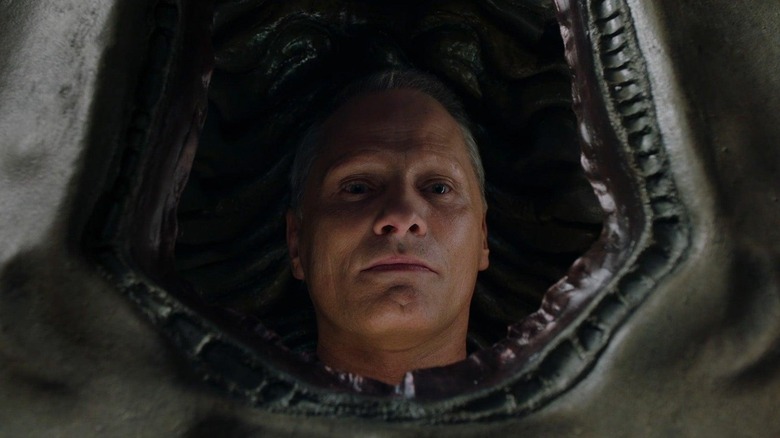
David Cronenberg is back, baby! And his new film, "Crimes of the Future" looks as gross and chilling as you'd expect from the director's return to body horror.
After scaring an entire generation of filmgoers with movies that exposed how disgusting and malleable the human body could be, like "The Fly," "Shivers" and "eXistenZ," Cronenberg turned his eye to drama work. The Canadian director then gave us the very last VHS release with the fantastic and accessible "A History of Violence" as well as one of the first films to showcase what a great actor Robert Pattinson is in "Cosmopolis."
Now, eight years after his last film, Cronenberg is back on the director's chair with "Crimes of the Future," which is making its debut as part of the official competition at the 2022 Cannes Film Festival. Honestly, this is a trailer best seen to be believed.
The Maestro Returns
While rumors of David Lynch gracing the steps of the Palais des Festivals at Cannes were premature, Cronenberg's latest will indeed premiere at the renowned festival, in competition no less.
The trailer for "Crimes of the Future" shows very little, but the images speak more than a thousand words. The film is unequivocally a body horror sci-fi movie, with Cronenberg's signature biological plugs, and an image of a man with ears on his forehead, and a sewn-shut mouth.
The film has a stellar cast that reunites Cronenberg with "A History of Violence" star Viggo Mortensen, and also includes Kristen Stewart and Léa Seydoux. The story is set in the distant future where humans have undergone new mutations and many are opposing the next step in human evolution.
Though they share a title, "Crimes of the Future" is not a remake of the director's 1970 film.
There is no release date for "Crimes of the Future" just yet, but it will premiere as part of the Cannes Film Festival alongside new movies by Claire Denis, Kore-eda, James Gray, Park Chan-wook, and more.
Neon describes the film as such:
"As the human species adapts to a synthetic environment, the body undergoes new transformations and mutations. With his partner Caprice (Léa Seydoux), Saul Tenser (Viggo Mortensen), celebrity performance artist, publicly showcases the metamorphosis of his organs in avant-garde performances. Timlin (Kristen Stewart), an investigator from the National Organ Registry, obsessively tracks their movements, which is when a mysterious group is revealed... Their mission – to use Saul's notoriety to shed light on the next phase of human evolution."
Read this next: The Horror Movies We Can't Wait To See In 2022
The post Crimes of the Future Teaser: Kristen Stewart, Viggo Mortensen Get Freaky in David Cronenberg's Return to Body Horror appeared first on /Film.
Star Trek: The Next Generation animated in the style of Star Trek: The Animated Series

What if Star Trek: The Next Generation was animated in the 70s instead of produced as live-action a decade later? After all, Star Trek: The Animated Series was an Emmy-award winner that proved the fandom could support a show on network TV. — Read the rest
This portable chainsaw packs a punch for just $23

We thank our sponsor for making this content possible; it is not written by the editorial staff nor does it necessarily reflect its views.
For decades, we've used pocket knives to cut tape, open boxes, and perform all manner of mundane tasks. — Read the rest
Check Whether Your Toyota or Lexus Is Part of This Massive Recall

It’s officially road trip season, and according to a recent survey, 80% of Americans are gearing up to hit the open road this summer. But road trip or not, it’s best to stay on top of things when it comes to the safety of your vehicle. In addition to regular maintenance, this also means paying attention to any…
Zoe Bell Will Direct An Action Comedy Based On Her Viral Boss B**** Fight Challenge
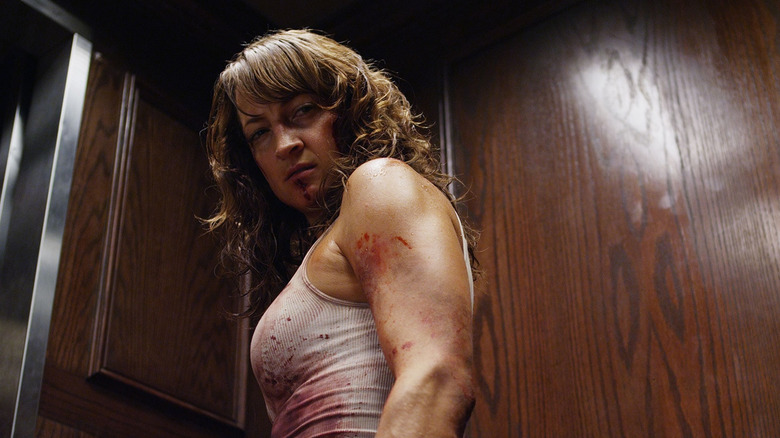
Even the worst circumstances can inspire great art — or so Hollywood has spent the past year trying to prove with various filmed-in or inspired-by the pandemic. For better or worse, we'll be enduring stories about people trapped in isolation for many years to come, but on the brighter side, we also get to spend more time with the creativity that was born during quarantine. Sans a couple of "Imagine"-esque stinkers, being trapped inside worked wonders on some folks' imagination, including the likes of Zoë Bell, the stuntwoman and actress known for three decades of work. While the rest of us were getting really into sourdough and long walks through the neighborhood, Bell was putting together a thrilling and increasingly violent challenge: the Boss Bitch Fight Challenge.
The culmination was a video dropped to Instagram that played like a violently virtual version of telephone. With famous faces including Halle Berry, Scarlet Johansson, Margot Robbie, Sophia DiMartino, and many more, the video features various celebrities and stuntwomen kicking some virtual ass by violently attacking their cameras (you can check it out here). With Daryl Hannah channeling her Kill Bill character's penchant for needlework, Robbie whipping out a bat a la Harley Quinn, and even Lucy Lawless showing up with her Xena charms, the video rivaled "Avengers: Endgame" for the greatest crossover event of the century. So naturally, a Hollywood studio swooped in with the only possible response to this virality — turn it into a movie!
Boss B***** Fight Challenge... The Movie!
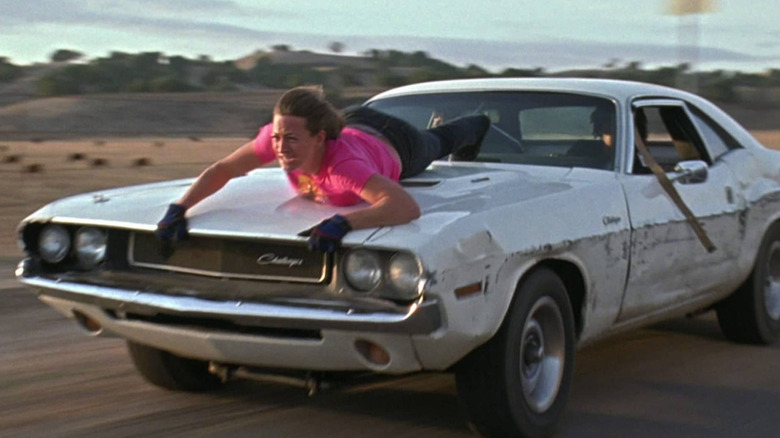
Per Deadline, Lionsgate has picked up an action-comedy pitch from Kirsten "Kiwi" Smith and Mamrie Hart, and tapped Zoë Bell to direct the movie based on her quarantine short film. An industry trailblazer, Bell has been in stuntwork since 1992, eventually going on to forge a decades-long relationship with Quentin Tarantino as a stuntwoman and actress in his film including "Death Proof," "Kill Bill," and most recently, "Once Upon a Time in Hollywood." With a prolific filmography and years of experience, who better knows the ins and outs of action-packed filmmaking? This marks Bell's directorial debut, a promising prospect given her career thus far. Speaking on Lionsgate's excitement for the project, president of production Erin Westerman said:
"Zoë has built up a huge fan base over the years – which is no surprise, because she's a bona fide icon who kicks ass and takes names in a part of the industry still dominated by men. Her legend only grew with the 'Boss Bitch' video that everyone loved during quarantine. After a long and storied career of taking the hits, she'll now be calling the shots."
A writer on the project, Smith is best known for working on some of the funniest studio comedies of the late '90s and early aughts including, "Legally Blonde," "10 Things I Hate About You," and "She's the Man." If the name Mamrie Hart doesn't trigger some very specific memories from the 2010s YouTuber era, then just know that the comedian and actress has a dedicated following of over 3 million followers across social media, and is also the writer behind comedies, "Camp Takota" and "Dirty 30."
There's no word yet on plot specifics or casting, but fingers crossed that some of the featured friends from the original short film will make their grand return for even more badassery.
Read this next: The 18 Best Action Movie Actors Ranked
The post Zoe Bell Will Direct An Action Comedy Based On Her Viral Boss B**** Fight Challenge appeared first on /Film.
Gentleman tried to flip "Jack Dorsey's first tweet" NFT for $48 million, but highest offer was only $277

In March 2021, Malaysia-based crypto entrepreneur Sina Estavi bought an NFT of Jack Dorsey's first-ever tweet for $2.9 million, likening his proud purchase to "the Mona Lisa painting."
Dorsey's tweet, dated March 21, 2006, said, "just setting up my twttr."
A year after his extravagant "investment," on April 6 (last week), Estavi figured he could flip his NFT and make a small fortune, announcing on Twitter, "I decided to sell this NFT ( the world's first ever tweet ) and donate 50% of the proceeds ( $25 million or more ) to the charity @GiveDirectly." — Read the rest
CD Projekt RED - Climbed to the Top of the RPG Mountain, then slipped
Review: In DUAL, She Must Fight For Her Life
 Directed by Riley Stearns, the sci-fi thriller pits Karen Gillan against Karen Gillan in a dual to the death. Aaron Paul also stars.
One Stunt Gone Wrong Wasn't Going To Stop Supercop's Michelle Yeoh
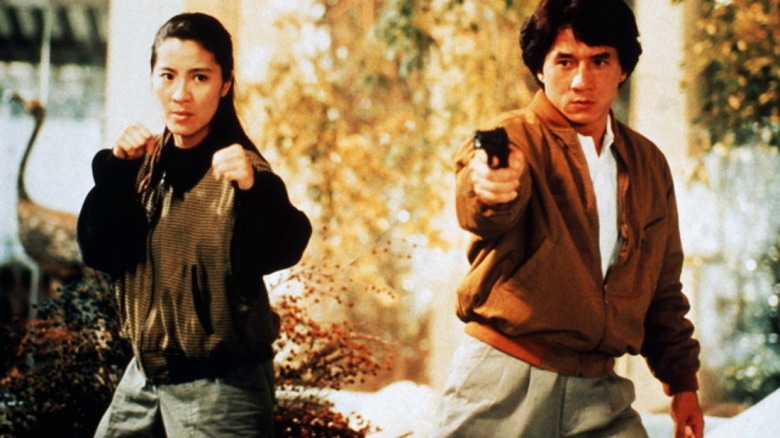
It's entirely possible that you've only just learned about the majesty of Michelle Yeoh. She's currently starring in the fantastic "Everything Everywhere All at Once," where she gets to indulge in drama and action in equal measure. Or perhaps you've recently seen her as Shang-Chi's aunt in "Shang-Chi and the Legend of the Ten Rings" or as Philippa Georgiou in "Star Trek: Discovery" on Paramount+. Michelle Yeoh has always been with us, she's just now getting the much larger shine she deserves.
Prior to all these Hollywood roles, Yeoh was one of the biggest Hong Kong action stars. She got her start in the industry as a supporting character in the 1985 action-comedy "The Owl vs Bombo," directed by Sammo Hung. By her third film, 1985's "Yes, Madam," Yeoh was already taking on starring roles. This would ultimately lead her to share the screen with Jackie Chan in 1992, as the co-lead of "Police Story 3: Super Cop."
Which One Is The Super Cop Again?
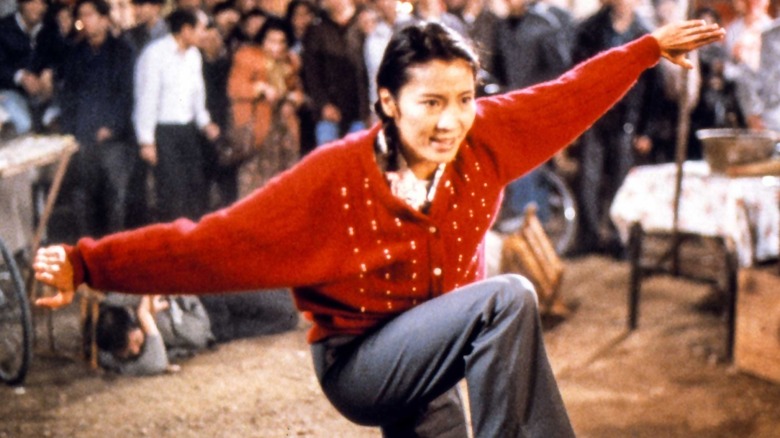
Known in its Western release as "Supercop," the 1992 film was the third installment in the popular "Police Story" franchise. Chan stars in the first three films as Chan Ka-Kui, a hot-tempered and driven cop who also has the martial arts and acrobatics prowess to keep himself alive. The film places Inspector Chan in a partnership with Interpol Inspector Jessica Yang, who's hunting down a local drug lord named Chaibat.
"Supercop" is the first "Police Story" entry to not be directed by Chan himself, with Stanley Tong sitting behind the camera instead. Despite that, the action scenes are still fantastic. Not only are both actors showcasing tight martial arts choreography, but they're also doing their own stunts. This adds a heightened sense of danger and tension to the action, like when Chan hangs off a helicopter on a rope ladder as it flies over the cityscape of Kuala Lumpur.
Prior to that scene though, there's a car chase through the streets, with the tenacious Jessica Yang hanging off a moving van.
The Ultimate Trust Fall
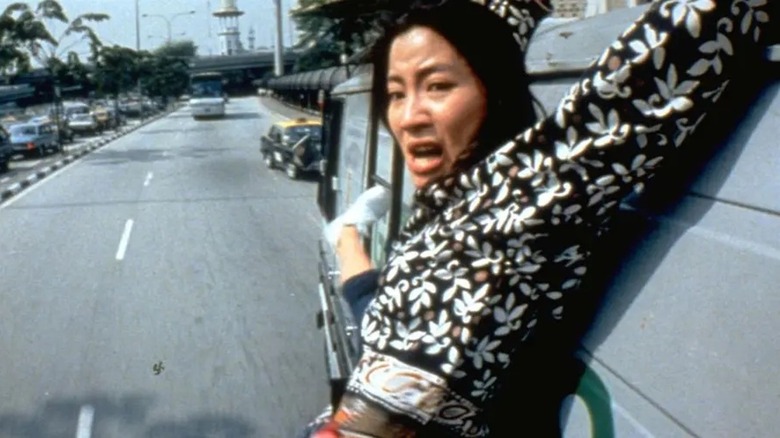
The scene in question has Yang holding onto the van containing their target, while Inspector Chan races behind them in a red sports car. Yang is holding on for dear life as the van careens through traffic, sometimes with only a single arm on the van. She also has to dodge other cars and even a bus to stay alive. The culmination of the scene sees Yang jump off the van onto a moving car driven by Chan. Once she lands on the hood of the car, it breaks, throwing her into the street.
It's one of the craziest stunts in a Jackie Chan film and Yeoh does the entire thing herself. No stunt double and no visible wires. The danger was real and in a recent interview with Entertainment Weekly, Yeoh admitted that the stunt almost killed her.
"In Asia at that time, we don't really do rehearsals, we don't have weeks of preparation. We learn the stunt and we do it. So you park the [truck] and Jackie's car next to each other and you look at it and it's about a six-foot fall, it's not much, and you think, 'I could do this.' But once the two cars are moving you go, 'oh, wow, this is a completely different experience. I'm not standing still, the car isn't, nothing is still.' I don't know whether it was crazy, a moment of insanity, [but] the thought that went through my head was, you're never going to know how it feels until you try it."
It Takes Two ... Takes
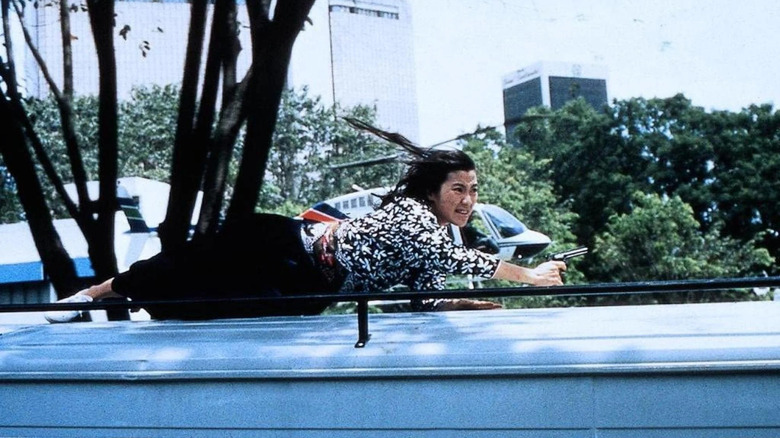
Yeoh recalls that the first time the crew tried the stunt, it didn't go so well. She jumped off the van and hit the car, but the windshield was supposed to shatter and slow her momentum a bit. Instead, it didn't, giving her nothing to hold onto. So she slid right off the car. It was enough that Chan himself almost called off the stunt.
"Then I hear Jackie. He was like, 'Okay, okay, that's it! Enough! We are finished for the day! We're not doing anymore! This is stupid! This is ridiculous! We're not doing it!'" she explained.
Instead, Yeoh got back up and convinced Chan and director Stanley Tong to try again. "Stanley and I go back a long way [to] when he was a stuntman," added Yeoh. "So he understands the level of who I am and what I can and am willing to do. So we went up and got it in the next take."
Luckily, Yeoh not only survived the stunt, but she went on to have a long career. And that's why you can catch her doing her amazing work in "Everything Everywhere All at Once." And maybe go watch "Supercop," which is available to stream for free on Pluto TV.
Read this next: The 18 Best Action Movie Actors Ranked
The post One Stunt Gone Wrong Wasn't Going to Stop Supercop's Michelle Yeoh appeared first on /Film.
Letterkenny Live: A Lesson In Canadian Hospitality
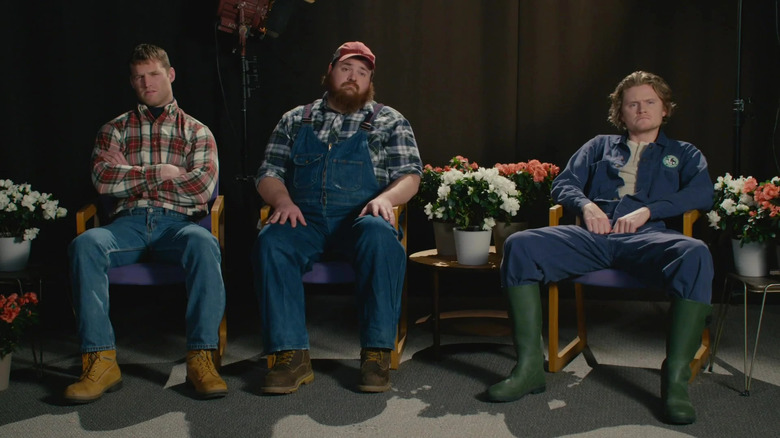
"So you laughed heartily throughout Letterkenny Live with your pals the other day ... and it was so rich with fan adoration you pitched an article."
No, that's not a direct "Letterkenny" cold open quote. The above describes my experience attending "Letterkenny Live" in Los Angeles. An event where game-day Shoresy jerseys and flannel button-downs colored a crowd of hootin', hollerin' Americans getting roasted by the quickest wits in Canada. I've witnessed network properties exploit their popularity — I've been in those icky, dollar-sign-driven crowds — but that's not "Letterkenny Live." "If you could be one thing, you should be efficient," Wayne would say. I'll forever respect the entire Letterkenny cast and crew for making its superfans feel as appreciated as they've made the show feel across the Northern American border.
Is the merchandise overpriced at, like, $40 per tee? Of course. Did I spend too much on exclusive tour novelties on the way out? Don't judge me — our tickets dated back to a January 1, 2020 purchase date, and we were vibrating with anticipation after an extended rescheduling hiatus. That's par for the course at similar events or convention atmospheres, which doesn't detract from the shared excitement.
My confession is that I've never attended a "live experience" for any favorite television series. Then again, I'm not sure I've ever obsessed over and rewatched an episodic program like "Letterkenny." Expectations for a 90-minute in-person iteration of "Letterkenny" were largely unknown. I wondered how the staple actors could recreate another fulfilling day of hard labor, Puppers lager, and fisticuffs should anyone act a fool. With lawn chairs arranged in front of a massive display screen on the theater's stage, a produce stand to the right, and two hockey player lockers next to a toilet stall on the left, I began to gather an idea.
We're Doing It Live!
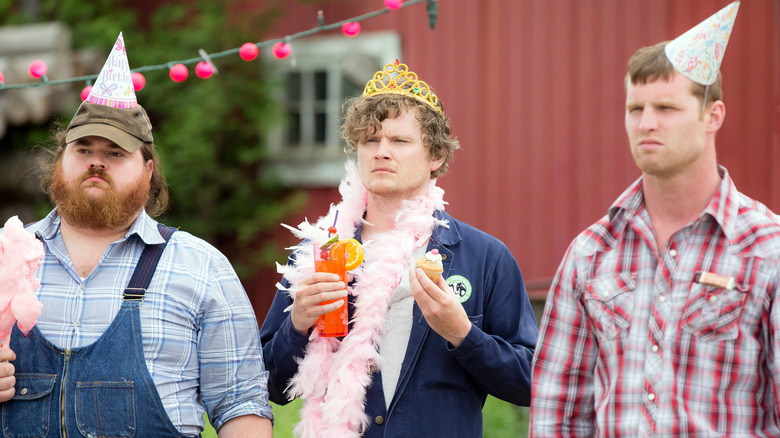
What's endearing about "Letterkenny Live" is that all performers are out there to prove it's not just behind-the-scenes magic that imbues each episode with its trademark signatures. The show's machine-gun barrage of zippy wordplay, the Skids' dance moves, everyone's ability to (almost always) keep straight faces while jokes escalate — "Letterkenny Live" proves it's natural. Stewart (Tyler Johnston) and Roald (Evan Stern) start the show by getting groovy as they would in a convenience store parking lot, only for Roald to bust out competition-level breakdancing chops with flip-after-spin. That's just a taste before Wayne (Jared Keeso), Katy (Michelle Mylett), Daryl (Nathan Dales), and Squirrely Dan (K. Trevor Wilson) jive right back into their usual rhythm of building puns like Jenga towers that somehow never topple.
They're professionals — I get it. That's not what I'm commemorating. "Letterkenny Problems" started as this "hicks from the farmland" web series, and you can tell Jared Keeso is beyond overwhelmed by the show's success, from Canadian notoriety to international acclaim. That goes for the entire cast, some 10 seasons in and counting. Keeso incorporates attendees into "Letterkenny Live" by asking, "How are ya now?" and thrives off the fuel that is his audiences' laughter, primarily when localizing one-liners to trash whatever city's playing host that night. There's already an episode about jabronis from Los Angeles who can't stop talking about tacos and hiking, but the added UCLA potshots were a nice touch.
The entirety of "Letterkenny Live" revolves around giving back to the fanbase. Not only that, but COVID-19 derailed this particular redo "Letterkenny Live" journey (multiple times if memory doesn't fail). It almost feels like a Letterkenny talent show — minus Darry's line dancing — as actual stand-up comedians K. Trevor Wilson, Mark Forward (who punts trash cans as "Coach"), and Jeff McEnery (who cleans toilets as "Alexander") perform sets for the audience out of character. Wayne and the gang also unpack new goodies for "Letterkenny" lovers to gander (exclusives not to be spoiled). Everyone wants to contribute, not only by way of untelevised skits, making the whole production feel like a hug that stinks of sweat and Gus N' Bru. Per the show's strict no videos or photography policy, zero secrets will be spoiled.
As a "Letterkenny" fan myself, this personalized experience is unique because it's not an outright convention meet-and-greet, nor is it just a quick cash-in on additional content. Coach interrupts Wayne's banter to explain how audiences only want to hear bands play their hits — K. Trevor's the only one who broke in our show when Mark pronounced Van Halen's "Panama" as goofily as possible — and Wayne obliges without falling into clip show formulas. It's impossible not to feel the joy Keeso gets by making audiences beg for Wayne to hug pastor Glen (Jacob Tierney), or while assaulting puck buddies Reilly (Dylan Playfair) and Jonesy (Andrew Herr) with blazing takedowns about both their mothers as Shoresy. Immaculately, to no shock, these verbal gymnastics of crudeness never break stride or stumble over a single word. Keeso and company don't need to test themselves on stage, but they do anyway.
Do What You Love, You'll Never Work A Day In Your Life
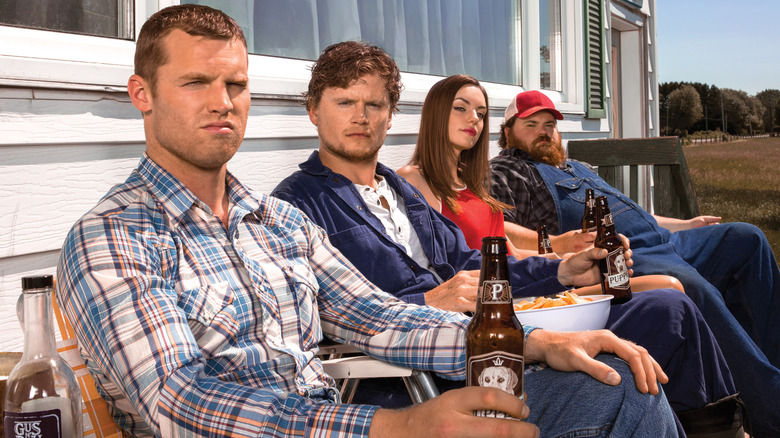
It's the "anyway" that tickles my heart. There are 5,000 people in Letterkenny, but infinitely more "Letterkenny" fans who'd continue watching without additional tie-in opportunities. Keeso's traveling comedy show promotes "Letterkenny Live" as a thank you gesture (profitable to boot), which becomes evident during the outro curtain call where every attending player said something they love about Los Angeles. Their graciousness and generosity poured in ways that make you only want to root for the underdog program to succeed even harder, melting away the cynicism of Hollywoodized productions that never give back.
"Do what you love, you'll never work a day in your life." No second of "Letterkenny Live" feels like labor, just heroic showmanship in barn clothes that tightens a stronger sense of community.
Nowadays consumable media often feels corporate and churnable — but "Letterkenny Live" drives this homely warmth that guarantees it one of the most genuine shows on air. Who knew that not only some nonsense problems from Canadian nowheres could become such a cultural phenomenon, but that the creators and actors were such grade-A, grass-fed, Alberta beef champions. All the camaraderie Letterkenny's saints preach throughout rough-and-tumble episodes became an infectious perfume that wafted from the hilarious, creatively uncouth "Letterkenny Live" show in Los Angeles. Even if McEnery performed a bit about pretentious Los Angeles movie critics reviewing titles like "Battle Los Angeles" like their Oscar nominees that he might as well have told while locking eyes only with me and only me.
Maybe I'm biased, but what can I say? They just do it Betterkenny. All pitter-patter, no lack of gettin' at 'er.
Read this next: 20 Underrated Comedy Movies You Need To Watch
The post Letterkenny Live: A Lesson In Canadian Hospitality appeared first on /Film.
How Teenage Boredom Inspired Edgar Wright's Cornetto Trilogy
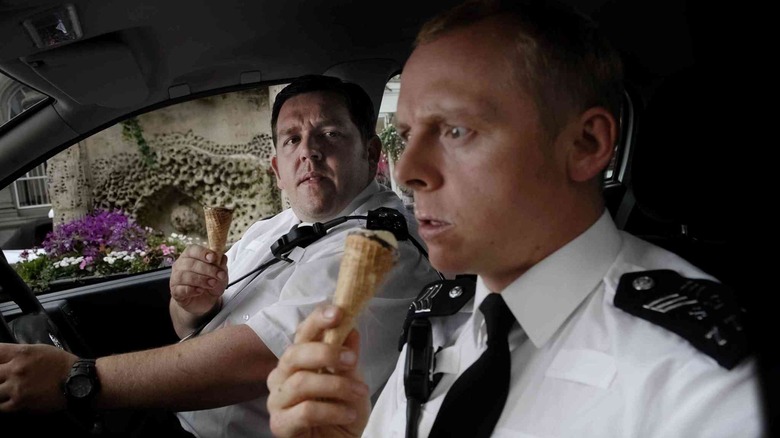
Ask a wildly talented filmmaker with oddball sensibilities about the inspirations and influences that went into their most personal films, and you'll likely get some unexpected answers in return. Like all art, making movies that truly stand out sometimes requires the absolute best at their craft to put a few pieces of themselves into the stories they create. Whether such introspection actually registers in the minds of every casual viewer, or merely those who are already most invested in the fairly complicated details of the filmmaking process, the results can be equally as affecting among anyone who shares even just the smallest overlap between their life experiences and the director's own.
You might be tempted to think that this description would apply most vigorously to a certain type of serious-minded director like Terrence Malick or Martin Scorsese, whose art most obviously reflects their own particular life concerns. But who's to say that this can't also remain true for those with a slightly different — though no less valid — set of sensibilities?
Director Edgar Wright made quite a name for himself among movie lovers with the release of his Cornetto Trilogy over the span of almost a decade, all starring actors Simon Pegg and Nick Frost in some of the most gleefully imaginative and oh-so-British romps you'll ever see. Because of the irreverent and, at times, even slapstick comedy tones of these films, fans might not be predisposed to considering just how personal they may be, even when all three titles boast some incredibly rich and layered ideas running just underneath the surface. As Wright recently explained, the same holds true even for more recent efforts like the horror period piece, "Last Night in Soho."
'You're Dramatizing Your Own Mundane Experiences Into Something More Exciting'
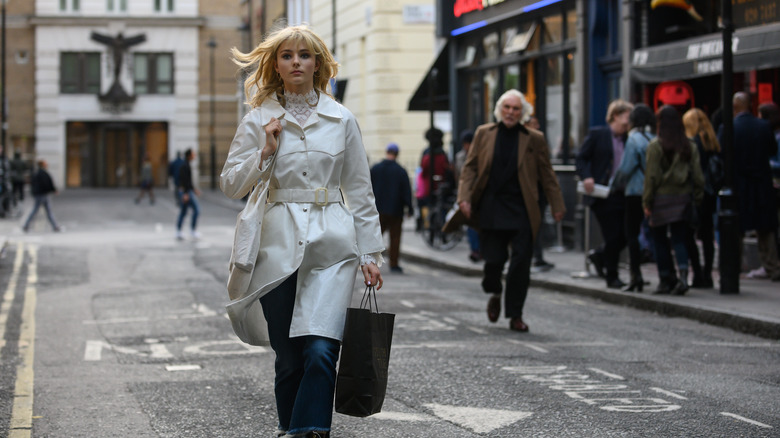
In a recent talk with Interview Magazine, Edgar Wright reminisced about the admittedly varied premises of a few of his most well-known films and the mildly surprised reactions he receives when informing others of how personal they are to him. Wright said:
"Oh, yeah. That's what's strange — 'Shaun of the Dead' is a film about a zombie apocalypse, 'Hot Fuzz' is a film about cops in Somerset, 'Last Night in Soho' is about a Cornish fashion student coming to London with supernatural powers — and I say, 'Oh, they're all really personal.' [Laughs] People are like, 'How?' But you do put yourself into them, and you're dramatizing your own mundane experiences into something more exciting."
Fittingly, a recurring theme throughout his Cornetto Trilogy (and, in fact, many of his other films as well) involves the need for stunted characters to grow up, accept their different stations in life, and try to come to terms with the new and unfamiliar settings they find themselves in. Not all his characters are successful at navigating these struggles, but it's clear that much of this comes from Wright's own upbringing, including his own teenage boredom, as it turns out. He goes on to say:
"...I grew up in Dorset and Somerset, so a lot of what I've done is the product of being bored as a teenager. Somerset is a very picturesque and beautiful place, but when you're a teenager, picturesque is not what you want — you want to get to the city. Now I'm older, and I think more fondly about my bucolic childhood in the country. So, all of the things you make become like love/hate letters to the place that you're from."
So far, Wright has proven exceptionally adept at putting his own unique stamp on films that, at first glance, hardly seem to have anything to do with one another. But to hear him tell it, every shared quality between them starts from the most intimately personal place. And maybe a little ennui thrown in there, for good measure.
Read this next: 14 Awesome Comedies That Never Got Sequels
The post How Teenage Boredom Inspired Edgar Wright's Cornetto Trilogy appeared first on /Film.
10 Types of Video That Are Satisfying to Watch (and Why)
While browsing social media platforms like YouTube, Instagram, and Facebook, you probably came across random videos that are oddly satisfying to watch. Such videos are pretty popular on social media these days as they tend to get a lot of views.

A clearer lens on Zero Trust security strategy: Part 1
Today’s world is flooded with definitions and perspectives on Zero Trust, so we are kicking off a blog series to bring clarity to what Zero Trust is and what it means.
This first blog will draw on the past, present, and future to bring a clear vision while keeping our feet planted firmly on the ground of reality.

We start off with some observations and insights on how people are seeing Zero Trust, then highlight some great work at the National Institute of Standards and Technology (NIST) to make Zero Trust real using products available today, and then highlight work being done at The Open Group to standardize Zero Trust (including an origin story of The Jericho Forum from Steve Whitlock).
Perceptions and scope: How people see Zero Trust
As we talk to customers and partners, it’s become clear that most people see Zero Trust as either a strategic security transformation or as a specific initiative to modernize access control.

While Zero Trust principles are critical to securing access control to the cloud and digital assets, Zero Trust’s scope doesn’t stop there. The urgent need to modernize security beyond the classic perimeter approach extends to:
- Detecting and responding to threats to your assets in the security operations center (SOC).
- Protecting data anywhere it goes.
- Continuously monitoring and improving IT infrastructure security posture.
- Integrating security into application development processes like development operations (DevOps).
- Continuously reporting and remediating compliance risks.
- Extending these capabilities across IoT and operational technology (OT) assets that are frequently targeted by attackers.
The confusion comes because access control is almost always the first priority to solve, whether or not you are planning a major strategic overhaul. As business-critical assets move outside the perimeter to cloud and mobile, the first priority is always to rapidly put in controls to ensure only authorized people can access these business assets. Additional focus is added to this initiative as attackers have learned to reliably get past perimeter access controls with phishing and credential theft attacks.
Access control is urgent but it isn’t the only security problem to solve across this transforming technical estate.
NIST: Zero Trust capabilities available today
The National Cybersecurity Center of Excellence (NCCoE) is bringing many vendors into the lab to implement their solutions for Zero Trust to create actionable guidance. This is creating clarity by implementing the actual technical capabilities of today in a highly transparent process.
I also witnessed how this effort is driving consistency in the industry during my participation as a member of the Microsoft team supporting this effort. I watched many vendors share their vision of Zero Trust to the collective project team during the kickoff (which was like a condensed version of the RSA conference show floor). The only thing I saw in common among these presentations was that each vendor used the NIST Zero Trust diagram (often mapping their solutions to it). While this illustrated how challenging it is to get a common view of Zero Trust, it also showcases how valuable NIST’s efforts are at creating much-needed consistency for Zero Trust.
For more information, read our blog Microsoft and NIST collaborate on EO to drive Zero Trust adoption or visit the NCCoE project page.
The Open Group: Standardizing Zero Trust
The Open Group is well on the path to defining Zero Trust as a global standard, similar to The Open Group Architecture Framework (TOGAF), Open FAIR, and others. This rigorous process is focused on clearly defining the scope of Zero Trust, what it is, what it isn’t, and how to link Zero Trust (and security) to business goals and priorities. This top-down approach complements the NIST technology-up approach to provide additional clarity for Zero Trust.
Some historical context from the Jericho Forum®
The Open Group is no stranger to Zero Trust as they host the (now-retired) Jericho Forum® which is widely recognized as planting the seeds for what became the modern Zero Trust movement. The Open Group’s Zero Trust work builds on this work from almost 20 years ago and focuses on the challenges faced by modern enterprises today.
Before we get into the current work, we thought it would be helpful to do a quick review of the Jericho Forum® origin story. While the world was different back then in many ways, this effort was born of the truth that perimeter approaches were failing to meet security needs even back then.
Steve Whitlock is one of the original Jericho Forum® members and graciously shared this origin story:
The mid to late 1990s—By all measures, security costs were rising but the solutions weren’t actually solving the problems. A few Chief Information Security Officers (CISOs) of large enterprises based in the United Kingdom met periodically to try and figure out what was going on. While their perspective didn’t fit the accepted norm of “protect the network,” these CISOs were not novices. One CISO of a large United Kingdom-based energy company had been among the first professional CISOs in Britain and trained many people who would go on to run information security at other corporations. Another at a European energy company had written an internal document that evolved into the ISO 2700 series of security and risk management standards.
In January of 2004, these four CISOs formed the Jericho Forum® to focus on defining the issue, termed de-perimeterisation, and proposing a way forward. Their efforts quickly attracted other strategic thinkers. In 2005, the first Jericho Forum® conference was held and a visioning white paper was released. This was followed in 2006 by the Jericho Forum® Commandments. This set of strategic principles is designed to enable an organization to survive in a world without traditional perimeters. The Jericho Forum® went on to issue a series of papers on related topics including cloud security, secure collaboration, security protocols, Voice over Internet Protocol (VoIP), wireless, and data security. And a second set of commandments concerning identity, entitlement, and access management was released in 2011.
Later, the Jericho Forum® was fully absorbed into The Open Group, and having laid out its principles for change, formally shut down in 2013. The Jericho Forum® articulated the need for better data protection, including the use of smart data, and one of its founders created a global organization to define the parts of a global digital identity ecosystem. Others from the Jericho Forum® contributed to a cloud security organization’s guidance documents.
The Zero Trust Commandments and beyond
The current work of The Open Group builds upon those hard-won lessons and updates them today with recent best practices, current trends, and expected future trends:
- This started with the Zero Trust Core Principles that defined Zero Trust, including key drivers and core principles.
- This continued into the Zero Trust Commandments that updated the original Jericho Forum® Commandments, defining a non-negotiable list of criteria for Zero Trust.
- Work is now underway in The Open Group to build on these commandments and provide a full technical standard for a Zero Trust reference model.
The Zero Trust commandments are one of the clearest ways available today to identify if something is Zero Trust or not. If you hear a claim of Zero trust, you can ask:
-
Does this action support one or more commandments?
If yes, it can be part of Zero Trust. -
Does this action violate a commandment?
Anything that violates a commandment is not Zero Trust (and is probably counterproductive to business goals, security, or both).
We will dive deeper into the Zero Trust Commandments through several upcoming blogs in this series.
In the meantime, we encourage you to read up on the Zero Trust Commandments and use them to guide your Zero Trust planning and help filter out what is and isn’t actually Zero Trust.
Embrace proactive security with a Zero Trust framework
- Read the full Forrester Consulting study commissioned by Microsoft, The Total Economic Impact
 of Zero Trust Solutions From Microsoft, and learn more about the return on investment (ROI) of implementing a Zero Trust framework with Microsoft.
 - Read our whitepaper, Evolving Zero Trust, for key insights, Zero Trust architecture, and a maturity model to help accelerate your adoption.
Join other cybersecurity professionals at the Microsoft Security Summit digital event on May 12, 2022. Get fresh security insights during a live chat Q&A with cyber strategy and threat intelligence experts and discover solutions you can use to lay the foundation for a safer and more innovative future. Register now.
To learn more about Microsoft Security solutions, visit our website. Bookmark the Security blog to keep up with our expert coverage on security matters. Also, follow us at @MSFTSecurity for the latest news and updates on cybersecurity.
The post A clearer lens on Zero Trust security strategy: Part 1 appeared first on Microsoft Security Blog.
Nearly 50% Of Fans We Polled Said This Was The Best Star Trek Captain
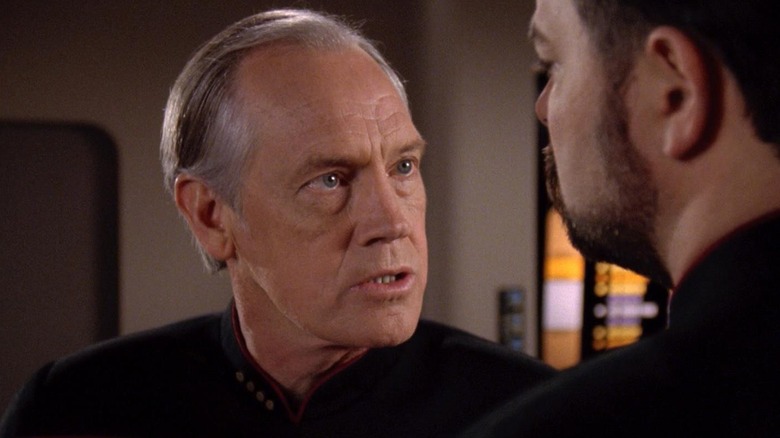
(Welcome to Survey Says, a feature where we conduct a movie-related survey for a random group of people and explain why they're completely right, completely wrong, or somewhere in-between.)
Greetings, Jellico fans! Our time has arrived!
The good people at /Film have conducted a poll of their favorite "Star Trek" captains, and I suspect a new epoch is nigh. Everyone's favorite captain, Captain Jellico (Ronny Cox) is undoubtedly at the top of this list, and we, his legion of fans, will be able to solider into the thicket of this article, comforted that the unvarnished truth shall be revealed. Captain Jellico, the stern, unfatherly, angry, ultra-professional who took command of the U.S.S. Enterprise in the two-part episode of "Star Trek: The Next Generation" called "Chain of Command," is — without argument — the single best character in "Star Trek," making him perhaps one of the single greatest creations in all of fiction. Becky Sharp, Atticus Finch, Falstaff, Electra, and Raskolnikov can retire now. They are no longer needed. We have Capt. Edward Jellico and we need nothing more.
So let us take a look, my Fellicows (a portmanteau of Jellico and fellows; it's what we call our tribe), and see the truth come to light. Let us see the facts laid bare. Let the veil drop from the eyes of a blinded planet, and let them come in. Let us all join together in a celebration of Edward Jellico. All power to Jellico.
Wait... It's James T. Kirk?
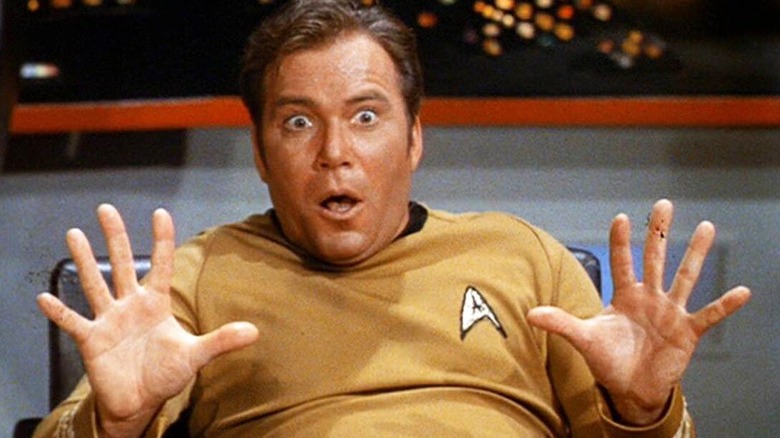
According to /Film's poll of 619 random people, 49.92% voted for ... hmm, I would think Edward Jellico would have commanded a greater percentage than 49.92%. I suppose some have yet to see the light. Anyway, Jellico received ... Wait, the 49.92% went to Capt. James T. Kirk.
James T. Kirk, the third captain of the U.S.S. Enterprise (after Capt. Robert April and Capt. Christopher Pike) will be born in Riverside, IA on March 22, 2228. You can visit his birthplace today. Played by William Shatner, Chris Pine, Jimmy Bennett, Vic Mignogna, James Cawley, Paul Wesley, and several others, Kirk was the first captain seen on screen by the public. While Kirk has a pop culture reputation for being a reckless cowboy who regularly breaks the Prime Directive, Kirk was, in fact, a judicious and sterm captain who regularly enforced rules and brought an essential balance to the ship. His first officer, Spock, offered logic and intellect. His best friend, the ship's CMO Dr. McCoy, offered gut feelings and anger. Kirk was able to listen to both and choose a path forward. He was authoritative and largely clear-headed, rarely giving over to passions in a crisis. His reputation as a ladies' man, however, is a matter of record.
I have heard it said that Kirk was the best role model of all Trek's captains, and emulating his confidence and behavior would be very becoming an authority figure. The character has been part of the popular consciousness for 55 years. I suppose we Jellico fans can let this one slide.
The Other Star Trek Captains
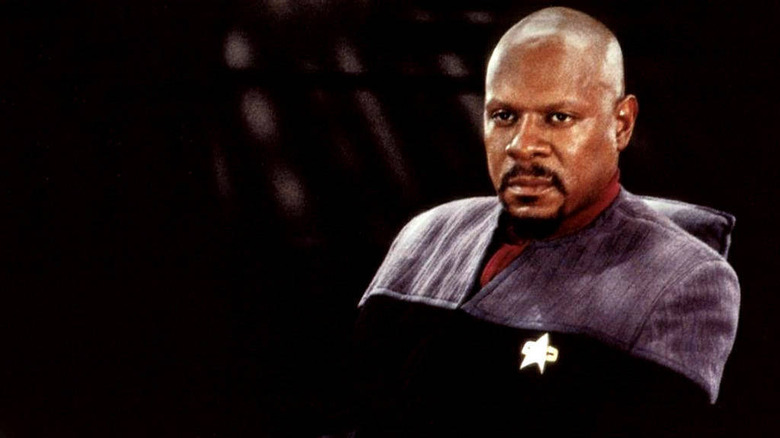
In second place, Jean-Luc Picard earned 30.37% of the vote, although those polled clearly meant to vote for Edward Jellico. Picard (Patrick Stewart) was Jellico's colleague, and he commanded the U.S.S. Enterprise-D and -E in "Star Trek: The Next Generation," as well as the films based on that show. If one is in a management or command position, one couldn't do much better than to emulate Jean-Luc Picard. He is open to ideas from his crew, always quick to make a wise command decision, and aloof enough to keep the bridge of his ship professional at all times. Picard is the professor you do not want to disappoint because you admire their intelligence so much. Picard is such a beloved character, he was the first to get a TV series devoted exclusively to him.
In third, with a mere 7.59% was Christopher Pike. Played by Jeffrey Hunter in the original "Star Trek" pilot, Pike stumbled his way into "Trek" canon when the episode was edited into a two-part episode called "The Menagerie." The fate of Pike was to end up severely scarred and bound to a wheelchair. This fate was glimpsed by the new version of Pike (now Anson Mount) on "Star Trek: Discovery." Hunter was an aggressive, angry captain. Mount plays Pike as far more dashing and personable. He'll soon be seen turning on the charm in "Star Trek: Strange New Worlds."
Fourth place goes to Jonathan Archer (Scott Bakula), the captain of the Enterprise in, well, "Enterprise." He gained a mere 5.33% of the vote. Deliberately archetypal, Archer rested on a matrix somewhere between a Kirk-like Starfleet captain and a chuckling old-world NASA astronaut. In fifth was Captain Janeway (Kate Mulgrew) from "Star Trek: Voyager," with 3.88% of the vote. Janeway was a bold authoritarian who puts her crew in danger to get coffee. And in last place is Capt. Benjamin Sisko from "Star Trek: Deep Space Nine," with 2.91% of the vote. Even Jellico fans can see Sisko's low rank on this list as a grave injustice. Sisko's passion and willingness to put himself in difficult command positions made for a vital strength in an unstable time.
Captains Left Off
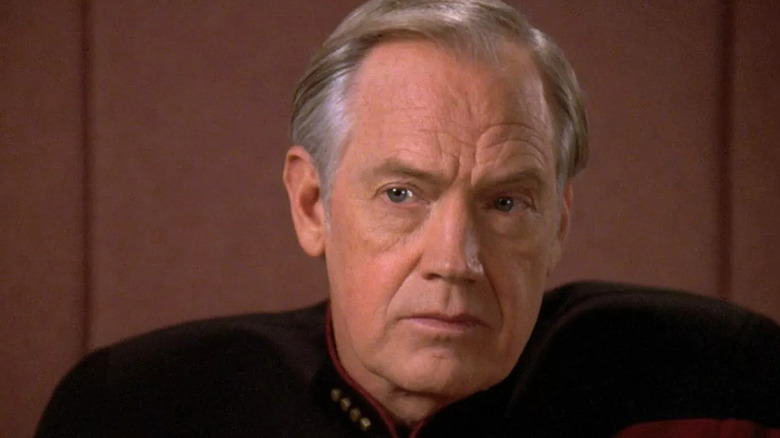
I have come to peace that Jellico did not appear on this poll. That is my burden to endure. Perhaps it's like leaving "Citizen Kane" off of lists of the best movies of all time: It's simply too obvious to include. Yes, that's it. Jellico was too obvious a choice, so the rest of the poll is a runners-up list. Yes, that is how it goes. In my mind.
Also excluded from the list is Capt. Georgiou (Michelle Yeoh), Capt. Saru (Doug Jones), Capt. Lorca (Jason Isaacs), and star Capt. Burnham (Sonequa Martin-Green) from "Star Trek: Discovery." Capt. Carol Freeman (Dawnn Wells) from "Star Trek: Lower Decks" is also absent, as is Capt. Riker (Jonathan Frakes) from the same show. Capt. Rios (Santiago Cabrera) from "Star Trek: Picard" is not on this list. Capt. Hikaru Sulu of the U.S.S. Excelsior is not here, nor is Will Decker (Stephen Collins) from "Star Trek: The Motion Picture." Capt. Richard McKenzie, who blew up on the U.S.S. Yamato, is not polled. Commodore Decker (William Windom) wasn't technically a captain, even though he was in charge of the Enterprise and the Constellation. There's no word of Capt. Balthazar Edison (Idris Elba), who was transformed into the evil villain Kroll in "Star Trek Beyond." I do love me some Capt. John Herriman (Alan Ruck) from "Star Trek: Generations," as he was in command of the Enterprise-B. Although credit to Capt. Rachel Garrett (Tricia O'Neil) of the Enterprise-C for enduring what she had to.
And that's just captains of Starfleet vessels. Klingons and Vulcans also used "Captain" as a rank. Absent from the list are Guls, Daimons, Commanders, and other species' command structures.
I think we need to go back in. For the good of Jellico.
Read this next: The 15 Worst Sci-Fi Movies Of The 21st Century (So Far)
The post Nearly 50% of Fans We Polled Said This Was the Best Star Trek Captain appeared first on /Film.
Return to Monkey Island!
Not only are we getting a new Monkey Island game this year, but the original brains behind it himself, Ron Gilbert, is directly involved this time. Apparently. While it will not be the Monkey Island 3 he had in mind way back in the early 1990s, I’m very hopeful.
The Similarities Between Alexander Skarsgard's True Blood And The Northman Characters Are 'Not A Complete Coincidence'
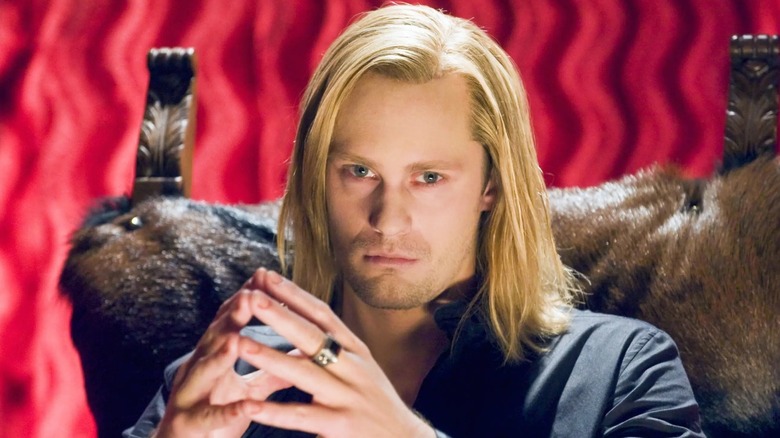
If you've noticed the similarities between Alexander Skarsgård's "The Northman" role as Amleth and his character Eric Northman in "True Blood," know in your heart that the character overlaps are no coincidence. In a conversation with Entertainment Weekly, Skarsgård talked about how the narrative of Robert Eggers' Viking epic, "The Northman," sounded like a spin-off for his "True Blood" character, confirming it is "not a complete coincidence." Joking that Eggers' film is a "straight-up sequel," Skarsgård talked about his long-time dream of starring in a Viking movie authentic to its core essence after being inspired by his character's origins in "True Blood:"
"This is a straight-up sequel. I want to credit True Blood a little bit, at least for giving me that idea.
I was kind of harboring this idea, this dream of one day making an epic Viking movie, but in a truly authentic way, that would capture the essence of the old Icelandic sagas and the poetry — that stark, laconic, harsh world and characters and tone. But it was a distant dream 10 years ago."
Well, dreams do come to fruition, and Skarsgård assuming the role of Amleth seems poetic in more ways than one.
'I Will Avenge You, Father'
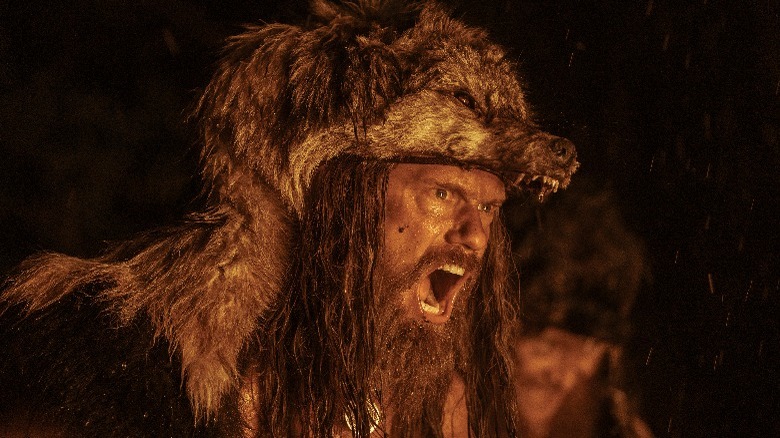
In "True Blood," Eric Northman was obviously a vampire, and an ancient one at that, as he was over a 1,000 years old. In season 3, Eric's backstory was revealed: his father, Ulfrik, was a Viking king who was killed during a sudden werewolf attack in their home (the werewolves killed Eric's entire family and handed Ulfrik's crown to a cloaked figure). Before his father died, Eric made a promise of avenging him and spent most of his time searching for his father's killer in Scandinavia. On the verge of death during a battle, Eric was turned by the vampire Godric, which made him an immortal from that moment on.
Sounds familiar? Well, not the vampire part, but most of the beats of Eric's origin story in "True Blood" are intensely similar to Amleth's in "The Northman," as the Eggers film is a tale of revenge, betrayal, and mysticism in the Viking era. Revenge tales that stem from familial loss are not rare by any means, as the Scandinavian folk tale of Amleth eventually led to William Shakespeare's "Hamlet," birthing similar stories down the line.
Skarsgård also talked about the experience of filming the "True Blood" scenes that revealed his character's Viking origins:
"Malibu Canyon [in California] doubled for Sweden, but they were a couple of amazing days. I loved it so much. There was something coming out where I was starting to feel like, 'How amazing would it be to tell a Viking story on a bigger canvas, on a more epic scale — not just [with] a two-day flashback but actually have a whole Viking journey?'"
While Skarsgård's dream of making an authentic Viking saga did not become a reality right after, things fell perfectly into place once he was cast in the role of Amleth in "The Northman." The result is a brutal, glorious saga that is truly Eggers-ian in tone, boasting of massive scope and scale, along with remarkable faithfulness to Scandinavian lore.
"The Northman" will hit theaters on April 22, 2022.
Read this next: 12 Awesome Action Movies That Never Got Sequels
The post The Similarities Between Alexander Skarsgard's True Blood and The Northman Characters Are 'Not a Complete Coincidence' appeared first on /Film.
New Jemm & HimemSX releases
To support JH's new FAT32 ramdisk rdrvsx32, both JemmEx and HimemSX were adjusted and got a new version number. Thanks Japheth! You can find them at Jemm GitHub and HimemSX GitHub. We've also mirrored these at the FreeDOS Files Archive at Ibiblio, under /dos/himem/jemm and /dos/himem/himemsx
jSH version 0.92
jSH is a script interpreter for DOS based operating systems like MS-DOS, FreeDOS or any DOS based Windows (like 95, 98, ME). The focus is on file io and text mode user interfaces. jSH is a side project to DOjS, a Javascript canvas for creative coding. SuperIlu recently released jSH version 0.92. Changes include: updated zlib to 1.2.12, source code cleanup, Sleep() now uses milliseconds and not seconds, added simple text mode port of p5js for fun, and added IntenseVideo() and BlinkVideo(). You can find the new release at jSH on GitHub and more directly at jSH v0.92.
Melting Ice Caps May Not Shut Down Ocean Current


Read more of this story at Slashdot.
Russia Is Jamming GPS Satellite Signals In Ukraine, US Space Force Says
Read more of this story at Slashdot.
Apple Says Plan for Nearly 50% Commission on Metaverse Purchases 'Lays Bare Meta's Hypocrisy'
Read more of this story at Slashdot.
Metaverse Company To Offer Immortality Through 'Live Forever' Mode
Read more of this story at Slashdot.
Digging Into Open Reporting
As many readers of this blog are aware, I often find great value in open reporting, but that I also see the value in taking that open reporting a step (or three) further beyond where it exists now. In more than a few instances, something extra can be pulled from open reporting, something not presented or discussed in the article that can be of significant value to readers in domains such as DFIR, detection engineering, MSS/SOC monitoring, etc. As a result, I've spent a great deal of time during my career looking for alternate means for detecting activity (user, threat actor, malware) presented in open reporting, largely due to gaps in that reporting.
For example, there's a great deal of open reporting that is based solely on RE and analysis of malware that is part of the final stage of the attack (ransomware, etc.), without addressing anything that occurred prior to the final malware deployment, beginning with initial access. Now, I understand that not everyone has access to DFIR data to support this level of open reporting, but some do, and tremendous value can be derived if that information is shared. I understand that in some instances, authors feel that they can't share the information but very often it may simply be that they don't see the value in doing so.
MS DART and MSTIC recently published some excellent open reporting on Tarrask that I found quite fascinating, based initially on the title alone (which, oddly enough, is what also catches my eye with respect to beers and books). I mean, the title refers to using Scheduled Tasks for defense evasion...when I read that, I immediately wanted to know more, and I have to say, the DART and MSTIC teams did not disappoint.
The article itself is full of "stuff" that can be unpacked. For example, there were some interesting statements in the article, such as:
Further investigation reveals forensic artifacts of the usage of Impacket tooling for lateral movement and execution...
So, what does that look like? I searched on the web and found that someone shared some forensic artifacts associated with the use of Impacket tooling about 2 yrs ago. While this is a great resource, unfortunately, many of the Windows Event Log records described are not available via the default logging configuration and require additional steps to set up. For example, while generating Security-Auditing records with event ID 4688 is just a matter of enabling Process Tracking, including the full command line for the process in the event record requires an additional Registry modification. Throughout my time in DFIR, there have been very few instances where the audit configuration of compromised systems was beyond default, and more than a few instances where threat actors took steps to disable the logging that was available.
Note that the article has a similar comment to that effect:
Neither of these are audited by default and must be explicitly turned on by an administrator.
Ah, there you go! There are these great Windows Event Log artifacts that are available if the default audit configuration is modified prior to an attack taking place!
Note: Even after an attack starts, there are ways to manipulate Windows Event Logs as a means of defense evasion. This is NOT part of the MS DART/MSTIC blog post, and is mentioned here to bring attention to issues with default audit configuration and monitoring systems for modifications to the audit configuration.
From the guidance section of the article:
Enumerate your Windows environment registry hives looking in the HKLM\SOFTWARE\Microsoft\Windows NT\CurrentVersion\Schedule\TaskCache\Tree registry hive and identify any scheduled tasks without SD (security descriptor) Value within the Task Key...
Stop Saying Exercise ‘Ruins Your Knees,’ FFS

It is 2022, and there are still people out there saying that exercises like running or squatting will “ruin your knees.” And this bullshit needs to stop. That’s not how knees work. That’s not how anything works.
The Cult-Classic Action Flicks That Inspired Attack The Block
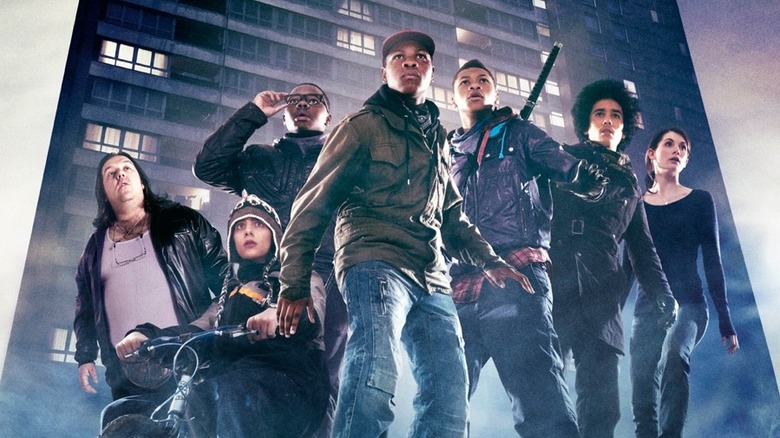
If you haven't watched "Attack The Block," you're missing out. The film takes a novel approach to the alien invasion genre, from its protagonists being a gang of juvenile delinquents to its notable lack of apocalyptic destruction (the aliens are mostly confined to a single South London tower block, and the teens have to dispatch them using makeshift weapons).
But perhaps the biggest testament to the impact of "Attack the Block" are the impressive careers that its cast members have gone on to since, including John Boyega (who played Finn in the "Star Wars" sequel trilogy), Franz Drameh (who played one half of Firestorm in "Legends of Tomorrow"), and Jodie Whittaker (who plays the most recent incarnation of the Doctor in "Doctor Who"). That's saying nothing of director Joe Cornish, who went on to direct the highly-praised fantasy adventure "The Kid Who Would Be King," and is slated to reunite with Boyega for an "Attack The Block" sequel.
Last year, Cornish took place in an oral history conducted by Vice for the 10th anniversary of "Attack The Block." During the retrospective, talk turned to Cornish's biggest movie influences -- with most of them being cult classic films that you may be familiar with. If not, they make for a great list of recommendations for anyone who loved "Attack the Block," and wants to see more movies with a similar vibe.
Mr. Cornish, Come Out To Playyy....
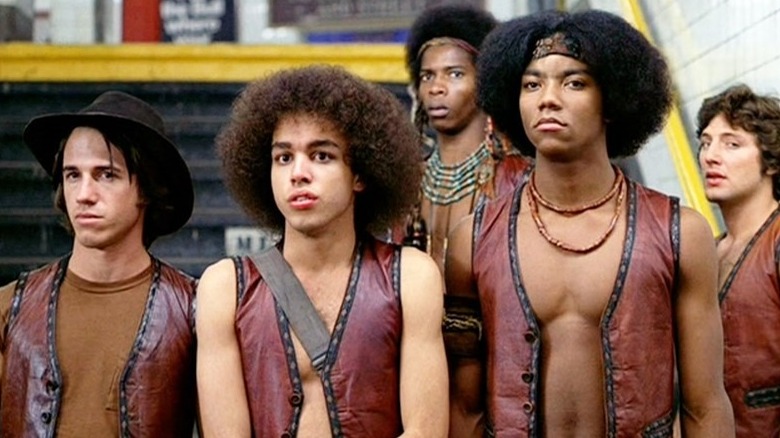
The movies of Walter Hill and John Carpenter served as a major influence on "Attack The Block" -- particularly Hill's street gang epic "The Warriors." Cornish said that he drew visual inspiration from "The Warriors" for his own movie, particularly since it takes place at night. That said, the filmmaker also wanted to stay true to the more vibrant aesthetic that comes with the sci-fi genre:
"I was inspired by Walter Hill and John Carpenter's movies, like 'The Warriors,' 'Assault on Precinct 13' and 'Streets of Fire,' which are all set at night and do really cool things with psychedelic colours at night. Most British films are set in that really grim, gritty, depressing environment, but we were making a sci-fi movie so we wanted it to be escapist and otherworldly."
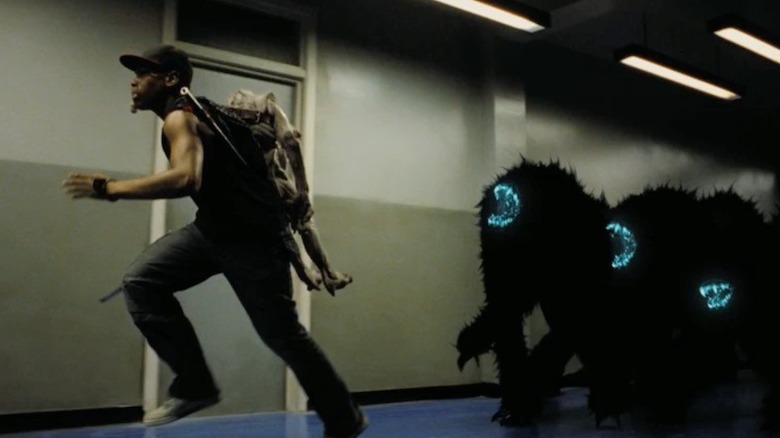
The otherworldly effect is felt in the alien design. The aliens are round spiky black balls with glowing blue fangs lining their mouths, and they also bleed neon blue blood when wounded. Cornish and cinematographer Tom Townend also chose to utilize lighting in creative ways, from the gang's first appearance to their leader, Moses (Boyega), running down a brightly-lit hallway while the aliens chase him. And like "The Warriors," "Attack The Block" features a group of teens in the fight of their life -- only the "rival gang" in this case is an invading race of aliens.
One For The Funnybooks
Another source of inspiration for the film's design were comic books, as Cornish loves the medium and used it to plot out the look and feel of the action sequences:
"We wanted to make it look like a comic book and put fantasy cinema in a place where fantasy cinema wasn't usually allowed to go. I'm a big comic book fan and as a first time director, I found that a very useful way to visualise the film, plan what cool frames would be like, and what were the people and objects would look their best."
Indeed, both the premise and visuals of "Attack the Block" resemble a graphic novel -- especially when Moses picks up a katana to fight the aliens. Cornish's love of comic books has since led him to work on more directly comic-related projects: he helped write the screenplay for the first "Ant-Man" movie, and is slated to direct an adaption of the Image Comics series "Starlight" for 20th Century Studios. Hopefully, Cornish will take the lessons he learned from "Attack The Block" and apply them to "Starlight" -- especially since that series takes place on an alien planet.
Read this next: 12 Shows Like Stranger Things You Definitely Need To Stream
The post The Cult-Classic Action Flicks That Inspired Attack The Block appeared first on /Film.
NASA Hubble Archives Reveal Mysterious Ancestor of Supermassive Black Holes - CNET

Why Mary Harron Refused To Meet With Leonardo DiCaprio For American Psycho

Not sure if you all have heard about it, but in the year 1997, this movie called "Titanic" came out. It was a hit! One of the stars of that film was a young man by the name of Leonardo DiCaprio. Thanks to his role in this film and in Baz Luhrmann's "William Shakespeare's Romeo + Juliet" the year before, he became one of the most in-demand actors of the time. You could catch him on the cover of every magazine and plastered across bedroom walls of teenage girls everywhere. He was sort of like Timothée Chalamet before Timothée Chalamet. Well, that's not exactly true. He was Chalamet times a thousand in terms of popularity.
After "Titanic," DiCaprio took a step back from the limelight because the level of fame he was existing in would break anybody's brain if you are in it long enough. When he did want to work, he wanted to run as far as he possibly could from the heartthrob image he had been given. One role that caught his eye was that of Patrick Bateman, the psychopathic investment banker at the center of "American Psycho." It would be a classic movie star subversion performance, and the producers were incredibly keen on the idea of having a gigantic star in their film, even announcing his involvement in the film at the Cannes Film Festival in 1998. But there was one problem: Mary Harron, the director of the film, did not want anything to do with him for the part, and she pushed back the idea to the point where she would not even meet with the actor.
A Boy In A Man's Clothes
Mary Harron had only made one feature film prior to "American Psycho," the Valerie Solanas biopic "I Shot Andy Warhol." Though she was the director, she certainly did not have the most power in the creation of the film. "American Psycho" was a hit book by Bret Easton Ellis, and so many people had been trying to make it into a film since its publication in 1991. If a massive star like DiCaprio wants to do the project, she was not going to be able to truly change that. Looking back at the film with the The Guardian, Harron said:
"Leonardo wasn't remotely right [for the part]. There's something very boyish about him. He's not credible as one of these tough Wall Street guys ... He brought way too much baggage with him - I did not want to deal with someone who had a 13-year-old fan base. They shouldn't see the movie. It could've gotten us in a lot of trouble."
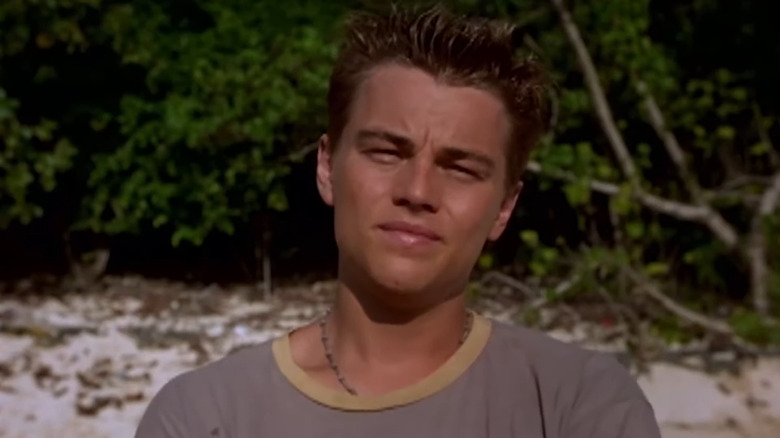
DiCaprio would not have even been 24 years old when the producers announced his involvement, and he looked to be about 17. Harron could not have been more right in her assessment of the casting decision. This was a kid, and while the characters in "American Psycho" are a bunch of young, white pricks, they aren't that young. Just look at DiCaprio in the Danny Boyle film "The Beach" above, which was also released in 2000 alongside "American Psycho." Nothing about that look reads as an adult in almost any way. This led to Harron being taken off the project and replaced with Oliver Stone, who Harron thought "was probably the single worst single person to do it." The "JFK" filmmaker worked with DiCaprio on getting the script into a place that felt good, but they just never got there. Ultimately, they both abandoned the project.
Luckily, Harron came back aboard, and the producers let her cast the person she had wanted all along to play Patrick Bateman: Christian Bale.
Why Cast A Star When You Can Make One?
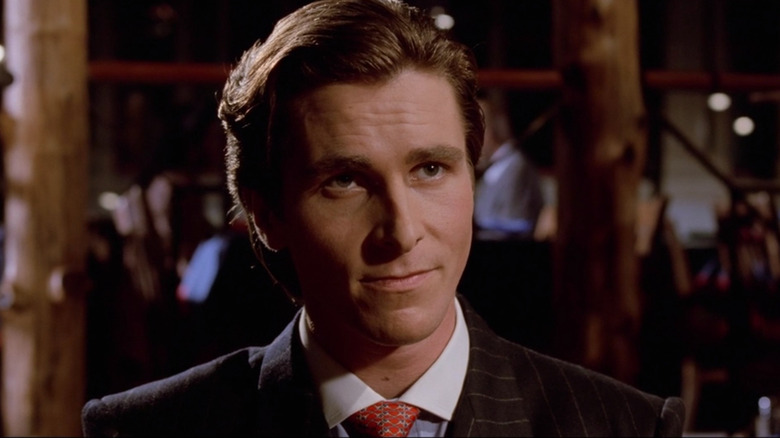
Early on in Christian Bale's career, it looked as though he would have to endure the same heartthrob stigma applied to DiCaprio. With roles like Laurie in Gillian Armstrong's 1994 adaptation of "Little Women," it is not hard to see his classic leading man career. I am sure he was that to a subset of teenagers, but the films Bale was appearing in were never the colossal, culture defining hits that would have totally hamstrung a career into strict typecasting. Though he is only a mere 10 months older than Leonardo DiCaprio, they looked like they were from two completely different generations in the year 2000. Bale quickly grew into his face, and frankly, he has not looked as though he has aged that much in the 22 years since. DiCaprio, on the other hand, didn't start looking like a fully grown man until the 2010s.
There was also something about those parts that never quite sat right on Bale, and as his later career has shown, he has basically zero patience for that kind of acting period. Clearly, a darkness and obsessiveness was lurking under the surface. This is why Mary Harron had to cast Bale as Patrick Bateman. He could expertly capture the psychopathy bubbling beneath the slick, handsome demeanor he was putting on. But because he was not the world beater DiCaprio was, she did have to compromise on the supporting cast by putting in famous faces like Reese Witherspoon and Jared Leto.
However, what you are left thinking about once the credits roll on "American Psycho" is Christian Bale. He takes complete command of the screen every frame he is in, and despite the film's controversial content, it is the film that made everybody and take notice of this guy. Afterwards, he was no longer getting nice supporting parts. He was getting leads. Oh, and then he played Batman. Without his performance in "American Psycho," who knows what Christian Bale's career would look like today, and who knows if "American Psycho" would be a film we keep returning to all these years later? When making a movie, you should always go for who is best for the part and not who do you think will make the most money. In the end, Mary Harron got to have the last laugh:
"Lionsgate wouldn't speak to me for four months ... Now they're apologizing."
Read this next: Batman Movies Ranked From Worst To Best
The post Why Mary Harron Refused To Meet With Leonardo DiCaprio For American Psycho appeared first on /Film.
Star Trek: The Next Generation – The Animated Series
I unironically ADORE the animated series from the 70s. I was squarely in the target audience, and I guess I’ve never left that part of me behind.
So since this came across my event horizon earlier today, I’ve been OBSESSED. I mean, I was legit bummed Wesley wasn’t on the bridge, but quickly realized it’s perfect that they replaced him what what I think is a Kzinti, the way TAS replaced Chekov with Arex, the Edosian.
I couldn’t remember what species Arex was, so I had to look it up, and I read this, so before we get to the video I want you to watch, check out Leonard Nimoy:
Initially, Filmation was only going to use the voices of William Shatner, Leonard Nimoy, DeForest Kelley, Doohan and Barrett. Doohan and Barrett would also perform the voices of Sulu and Uhura. Nimoy refused to voice Spock in the series unless Nichelle Nichols and George Takei were added to the cast, claiming that Sulu and Uhura were proof of the ethnic diversity of the 23rd century and should not be recast. Nimoy also took this stand as a matter of principle, as he knew of the financial troubles many of his Star Trek co-stars were facing after cancellation of the series.[6]
What an amazing human he was. And how fucking racist were the people who were like “yeah, replace those actors of color with white people to save money.” WOW.
Anyway, check this out. If you’re of a certain age, I expect you will share my reaction when that music starts playing.
Also, if anyone wants to animate Wesley Crusher in the style of Filmation, I would be massively supportive of that.