Shared posts

23 Apr 03:01

Nicolas Cage Wants To Know Why He Stopped Getting Comedy Roles, And So Do We

by Kaylee Dugan

Feel free to call it a comeback, because Nicolas Cage is back in the comedy game, baby. The actor, who is equally well-known for his balls to the wall action roles as his madcap comedy characters, has been getting weird in all the best ways over the last few years. Between the surreal, heavy metal horror, "Mandy," and the heart-wrenching drama, "Pig," Cage has been like a bird decorating his nest with indie darlings, but it was only a matter of time before he was called back into the comedy limelight. 

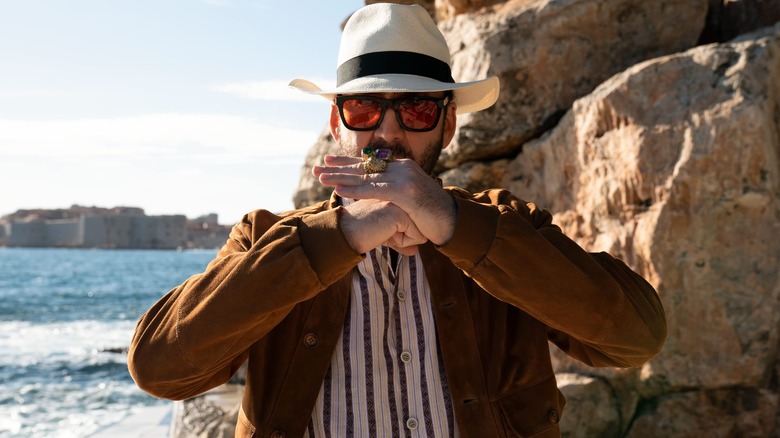
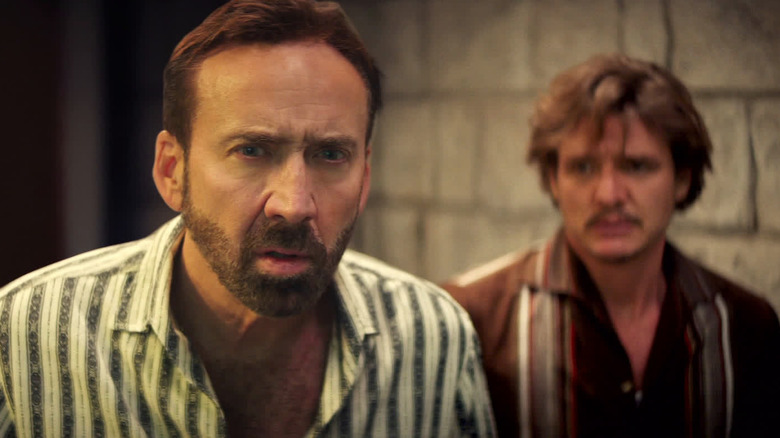
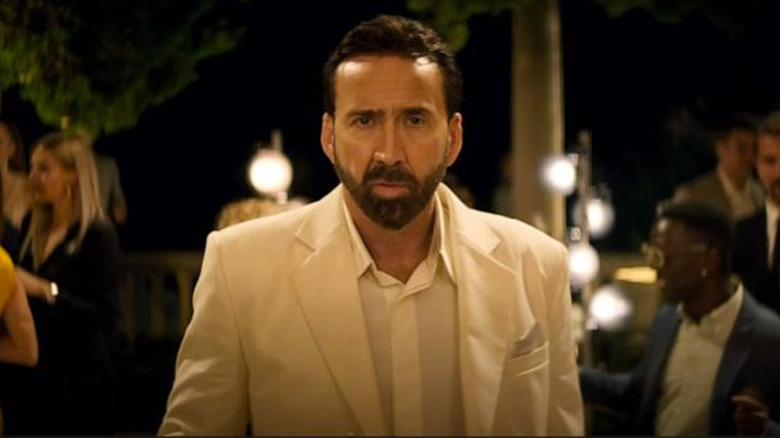
His most recent film "The Unbearable Weight of Massive Talent" harkens back to both of Cage's acting tent polls: high-octane action films like "Con Air" and laugh-out-loud comedies like "Raising Arizona." The film follows Cage (delightfully playing himself) who is struggling financially and decides to take on an unusual gig in order to help out his cash flow. The catch? Said gig involves him making an appearance at his biggest fan's (Pedro Pascal) party. The other catch? Pascal is also a cartel boss. As you can imagine, things get weird, wild, and wonderful.

The Comedy King

As nice as it is to see Cage back in his zone, it also begs the question, what took him so long? According to an interview with the Los Angeles Times (via Indiewire), Cage has been asking the same question:

"I've been scratching my head a little bit as to why Hollywood wasn't offering me comedies anymore ... I had done 'Raising Arizona' and 'Honeymoon in Vegas' and 'It Could Happen to You' and 'Moonstruck.' I was just sort of like, 'Where did that option go?' I think this movie will help with that."

Where did that go? It's clear that Cage has the comedic chops, he steals scenes in the aforementioned "Raising Arizona" and "Moonstruck," and if you haven't seen "Valley Girl," one of his first films, you're in for a weird hasn't-entirely-aged-well treat with that one. Fun fact, for a long time my phone background was a still of Cage from "Valley Girl," and strangers would sometimes ask me if it was a picture of my boyfriend. I wish!

If "The Unbearable Weight of Massive Talent" is Cage's official re-entry into the world of comedy, I have one incredibly specific and probably unlikely request ... Could he once more (with feeling) team up with Cher for "Moonstruck: 2 Moon 2 Struck" or "Moonstruck 2: Night Fever" or "Moonstruck 2: Moon Stricken" or something? I'm dying to see him pop on that wooden hand, throw on a white tank top, and carry Cher around his bakery like a sack of flour, and I feel deeply in my bones that I am not alone. It's time to give the people what they want.

Read this next: Single-Season '80s Sci-Fi And Fantasy Shows That Deserve A Second Shot

The post Nicolas Cage Wants To Know Why He Stopped Getting Comedy Roles, And So Do We appeared first on /Film.

22 Apr 23:34

Hyundai Debuts a Camper Version of Its Incredible Staria Minivan - Roadshow

by Kyle Hyatt
22 Apr 23:19

Godfall: Ultimate Edition Review

by hyu@gamingnexus.com
The enhanced and complete package of the first "looter-slasher" in gaming history. Goodfall or still Godawful?
22 Apr 19:23

12 Games to Play if You Love Elden Ring

by Brad R. Edwards

Elden Ring is turning out to be a behemoth in terms of popularity. Its justified hype and acclaim have shined a light on the action RPG genre as a whole, including older FromSoftware titles.

22 Apr 19:09

For One Scene, The Northman Becomes The Best Video Game Movie Ever

by Rafael Motamayor

This article contains spoilers for "The Northman."

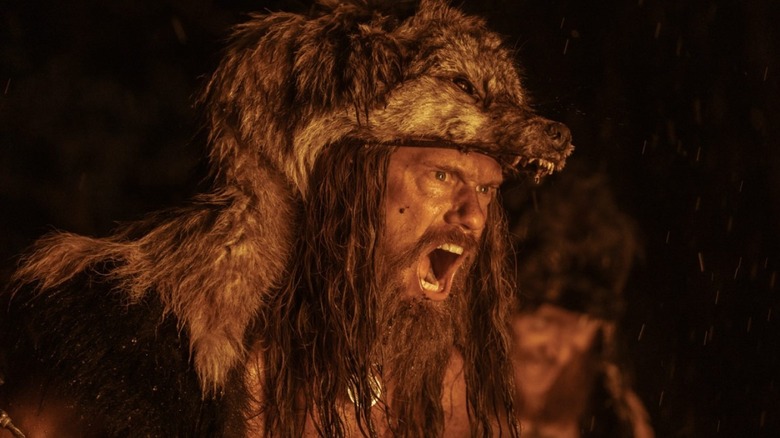
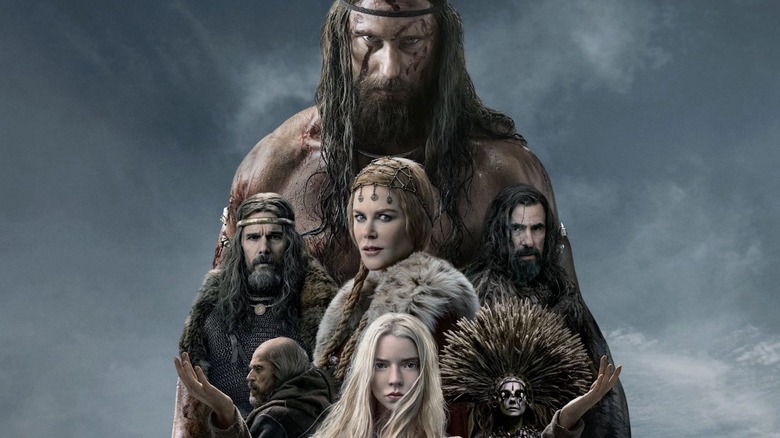
Director Robert Eggers is known for his attention to historical detail. From "The Witch" relying on natural light and authentic dialects to "The Lighthouse" traumatizing its cast, his movies are a treasure trove of small touches that feel like they were warped onto the screen straight from the past. His third feature, "The Northman," accurately recreates the living hell that was Viking times.

From painfully cold shooting in the forest to nude fighting near volcanoes, Eggers gives us what may very well be the most accurate portrayal of Vikings in a film. At a time when so many Viking movies and shows are focusing on political scheming and big elaborate fights, "The Northman" gives us a gritty, brutal, and ugly film about how terrible Vikings were, and how life during this period was probably cold, brutal, and short.

Then there's that one scene where "The Nothman" straight-up becomes an RPG and gives us the best video game movie scene ever, despite the film not being based on a video game in any way, shape, or form.

Go To The Creepy Cave And Get A Magic Sword

After spending years telling himself to avenge his father, save his mother, and kill his uncle Fjölnir, Viking-prince-turned-berserker Amleth embarks on a journey to Iceland to enact his plan of revenge once and for all. Once in Iceland, he poses as a slave and starts terrorizing his uncle's army, killing them off one-by-one.

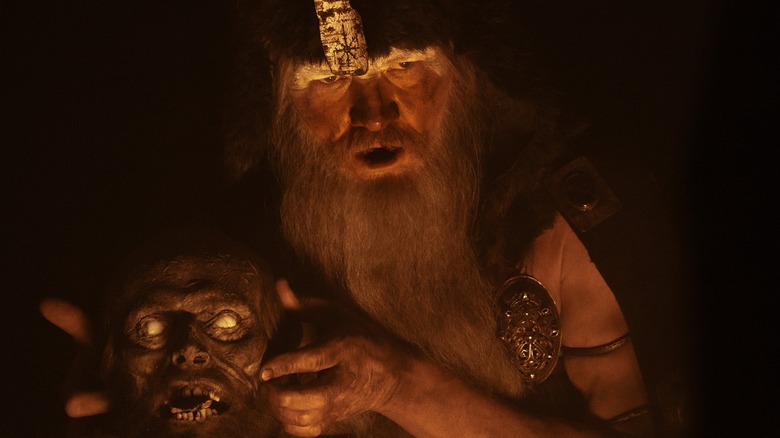
But before he can truly take revenge on Fjölnir, he needs to level up a bit. After a brief visit to a He-Witch that talks to the disembodied head of a court jester (the severed head of Willem Dafoe, no less), the quest-giver tells Amleth that he needs a magical sword to defeat his uncle, which he must take from an ancient burial site.

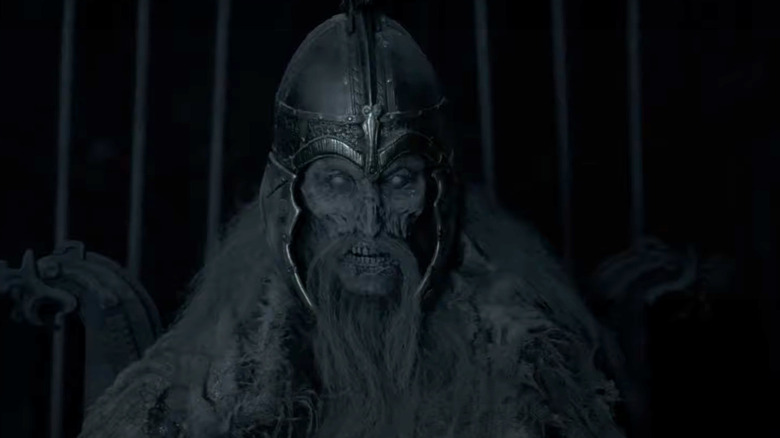
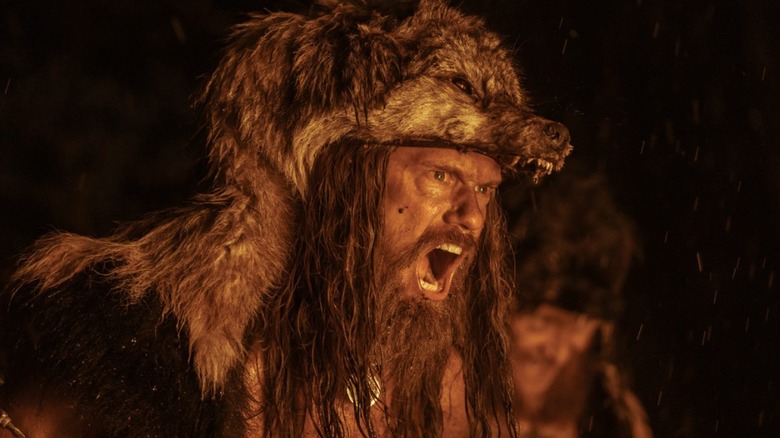
That's right. In the middle of this epic tale of revenge, Amleth literally goes on a side quest to find some loot from a magic cave. After finding the remains of an ancient ship in the decrepit tomb, and the lone skeleton of a warrior sitting on a throne, Amleth tries to grab the sword ... and the skeleton seemingly comes to life and challenges our hero to a duel.

An Epic Boss Fight With A Finishing Move

Despite the movie being as accurate to known historical detail as possible, this scene takes a turn toward the ludicrous and it is a blast. The mighty undead warrior (a Draugr like the undead foes in "Skyrim") basically acts like a boss in an RPG like "Elden Ring," taking his sweet time approaching the player before proceeding to utterly obliterate him with mighty swings of his sword that could kill any low-leveled character in an instant, forcing Amleth to instead roll for his life like he was a Tarnished in FromSoftware's latest game. Press the circle button, Amleth! The circle button!

Eggers and cinematographer Jarin Blaschke even frame the scene like a third-person POV game, closing in on Amleth and making the cave feel claustrophobic, with the towering skeleton covering most of the frame. The lighting adds to the mood too, dusty and pale in a way that feels ethereal and creepy. It looks just like location a boss would reside in, untouched by time, full of loot that you can somehow not touch, just waiting for the player to approach before the Big Bad activates.

The fight goes on for a couple of minutes until Amleth discovers the pleasure of the jump attack and realizes that the skeleton boss seems afraid of the moonlight, which makes him change strategies. He finds a new weapon in his inventory and proceeds to push the boss into the light, slowly eating away at his health bar until the moonlight paralyzes the skeleton and brings him to his knees. To make it even clearer that this is a video game, Amleth takes the magic sword, decapitates the boss, and literally shoves his head up his ass as a finishing move.

And as a reward for winning the fight, Amleth gets a shiny new sword. Literally. The hero enters a side quest cave, defeats a boss, and gets a better weapon. 

Sure, a later moment implies that this fight was entirely in Amleth's imagination (reality is fluid in "The Northman," and the supernatural and the mundane mingle regularly). So was this scene necessary? Probably not. And yet, "The Northman" takes the time to not only portray the intricacies of the Norse world, but to also briefly become a video game and give us an incredibly cool boss fight with a magic sword as a reward. Does Robert Eggers need to make a "Skyrim" or "Elden Ring" adaptation now? Absolutely.

"The Northman" is now in theaters.

Read this next: The 14 Greatest Science Fiction Movies Of The 21st Century

The post For One Scene, The Northman Becomes the Best Video Game Movie Ever appeared first on /Film.

22 Apr 19:07

6 First Aid Techniques You Can Use on Yourself in an Emergency

by Beth Skwarecki

One of my biggest takeaways from taking first aid and CPR classes is that if you’re going to have a medical emergency, do it with a friend. You can’t perform CPR on yourself, after all. But there are plenty of ways you can attempt to handle an emergency if you’re still conscious, so we’ll go through a few of them here.

Read more...

22 Apr 17:51

Let's celebrate fifteen years of Hot Fuzz

by Devin Nealy

They don't make 'em like Edgar Wright anymore. With his films Baby Driver and Last Night in Soho, the mega-talented Wright has asserted himself as one of the most interesting auteurs of the modern era. Long-time Edgar Wright fans were already aware of his versatility as a filmmaker, but watching the rest of the world uncover what we already knew has been fun.  — Read the rest

22 Apr 17:49

We're All Going to the World's Fair (2021) [WEBRip] [1080p] [YTS.MX]

We're All Going to the World's Fair (2021)
IMDB Rating: 6.2/10
Genre: Drama / Horror
Size: 1.58 GB
Runtime: 1hr 26 min

Late on a cold night somewhere in the U.S., teenage Casey sits alone in her attic bedroom, scrolling the internet under the glow-in-the-dark stars and black-light posters that blanket the ceiling. She has finally decided to take the World's Fair Challenge, an online role-playing horror game, and embrace the uncertainty it promises. After the initiation, she documents the changes that may or may not be happening to her, adding her experiences to the shuffle of online clips available for the world to see. As she begins to lose herself between dream and reality, a mysterious figure reaches out, claiming to see something special in her uploads. —Sundance Film Festival
22 Apr 17:48

How Much Garden You Would Need to 100% Survive On

by Jeff Somers

Gardening is often pitched as a relaxing, therapeutic activity—and it is relaxing and therapeutic! But it’s also a sign of how advanced society has become that we can regard growing food as a charming hobby instead of an absolute necessity. On the one hand, that’s a clear sign of mankind’s mastery over the world. On…

Read more...

22 Apr 17:47

Ubisoft quietly shutting down online features for many of its classic Xbox 360 games

by Robert Collins
22 Apr 17:47

macOS Server discontinued after 23 years, but some features will live on

by Corbin Davenport

Even before macOS 10 (then Mac OS X 10) was available to everyone, there was a server version intended for running fleets of Mac computers in businesses, schools, and other organizations. Apple has slowly phased out macOS Server over the past few years, by moving most of its functionality to other places in the Mac operating system, and now it’s officially discontinued.

Apple confirmed in a support document that macOS Server is discontinued as of April 21, 2022. macOS Server in its current form is just an application running on top of a normal macOS installation, and the app is still available to download and is fully compatible with the latest macOS Monterey release.

macOS Server screenshot

macOS Server (Credit: Apple)

Some services in the app are available in other areas of the system, like File Sharing, the Caching Server, and the Time Machine Server. However, several other features in recent versions of macOS Server require switching to a slightly-different solution or third-party software — the servers for email, Wiki management, FTP (not SFTP), and VPN don’t have direct replacements in regular macOS. The Profile Manager in macOS Server is perhaps the most important component, and Apple’s only recommendation is switching to a third-party option like Microsoft Active Directory.

macOS Server first arrived as Mac OS X Server 1.0 in 1999, released a whole year before the first public version of Mac OS X. Apple later replaced it with a customized version of Mac OS X 10.0 once that version became available in 2001, which had various server applications and services built-in. Starting with Mac OS X 10.7 Lion, Server became an App Store app running on top of regular macOS. Apple also added features over the years for managing iOS devices, in addition to Macs and cross-platform services.

Source: Apple Support
Via: MacRumors

The post macOS Server discontinued after 23 years, but some features will live on appeared first on XDA.

22 Apr 17:46

Ubuntu Linux 22.04 arrives with new desktop features and full Raspberry Pi 4 support

by Corbin Davenport

Ubuntu probably isn’t the most popular desktop Linux distribution at this point, but it’s still one of the top options for corporate use, and it serves as the technical foundation for projects like Linux Mint and Elementary OS. Ubuntu always has two major releases per year, and right on schedule, Ubuntu 22.04 LTS is now available.

Ubuntu 22.04 screenshot

Credit: Canonical

Ubuntu 22.04 is a Long Term Support (LTS) release, which means it will be supported for five years with security fixes and select app updates. That means you can stay on it for years if you don’t want to deal with major updates on a regular basis, or you can update to 22.10 when it becomes available in October (which will not be an LTS release).

The main change is that Ubuntu now uses the Gnome 42 desktop environment, though as OMG Ubuntu noted in its coverage, some apps and features were held back to keep 22.04 as stable as possible. Gnome 42 switches to a horizontal workspace switcher and app launcher, similar to Windows 11 and macOS, and there are some new touchpad gestures for moving between workspaces and windows. Canonical, the developers of Ubuntu, says the new update “can double the desktop frame rate on Intel and Raspberry Pi” systems compared to the last version.

Smaller changes include a new screenshot/screen recording feature, updated colors and a true dark mode in the system theme, and an improved Ubuntu Software app. The default web browser, Firefox, is now a Snap package instead of a traditional APT package. That will likely be controversial, as Snap packages aren’t too popular with most of the Linux community — Linux Mint recently worked with Firefox to keep a non-Snap version available for Mint users.

Download Ubuntu

Ubuntu 22.04 is the first release that works on all Raspberry Pi 4 models when using the full desktop environment, which Raspberry Pi revealed earlier this year. It also includes the Rust programming language, OpenSSL v3, Remote Desktop Protocol (RDP), Linux kernel 5.15, and Mesa 22 graphics.

Ubuntu 22.04 is available for various AMD-based and 64-bit x86 PCs. Docker, WSL, and other services that offer Ubuntu images are in the process of rolling out Ubuntu 22.04.

Source: Canonical, OMG Ubuntu

The post Ubuntu Linux 22.04 arrives with new desktop features and full Raspberry Pi 4 support appeared first on XDA.

22 Apr 16:53

The Northman Is A Dream For Akira Kurosawa Fans

by Bryan Young

Robert Egger's "The Northman" is based on the Norse myth of Amleth, which was a chief inspiration for Shakespeare as he crafted "Hamlet." The story of a man killing his brother king and marrying the dead man's wife, leaving the dead man's son to find his own place in the story and exact revenge feels as old as time itself. It's impossible to look at the original myth and not think about the reformulations of the Bard, and Eggers seems to have approached the text like a mix between "Hamlet" and "Macbeth." 

The film itself is Eggers at his most mainstream and action oriented, but still leaves enough of his signature darkness, symbolism, and flat out weirdness to make it one of the best movies to come out in 2022.

Throne Of Blood And Macbeth

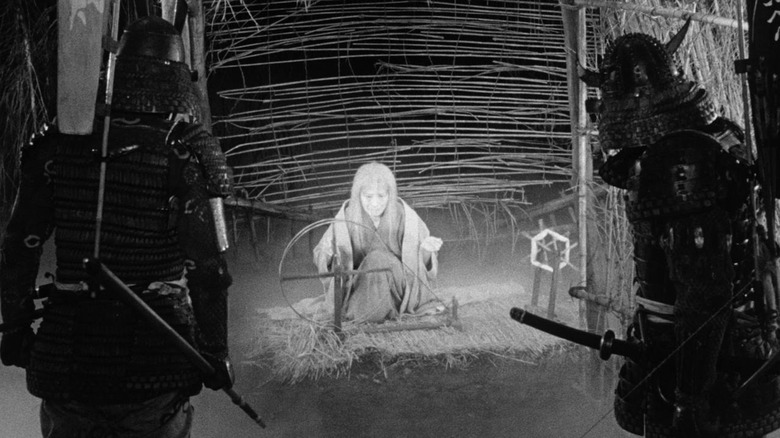
Another filmmaker who tread this Shakespearean territory with aplomb was Akira Kurosawa, albeit with samurai rather than Vikings. Kurosawa's 1957 classic "Throne of Blood" is a Japanese retelling of "Macbeth," replete with creepy forest witches and a sealed fate and pre-written destiny for all involved. Whether Eggers was consciously borrowing from Kurosawa or not we don't know, but there are striking similarities that feel undeniable to fans of both films.

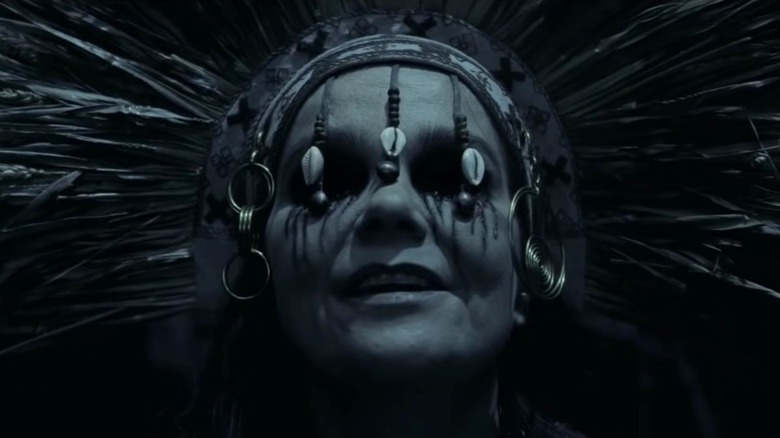
In "The Northman," Björk plays a seeress that feels very much like the witches in Kurosawa's "Throne of Blood." In both films, these witches lay out the destiny for the main characters. In "The Northman," that's Alexander Skarsgård as Amleth, and in "Throne of Blood," it's Toshiro Mifune as Washizu. Neither of them know how their fates will play out, only that they will. Both are under immense pressure to see how these foretold destinies will mean for them. In the end, these fortunes told are fatal for our protagonists, as they wind through stories where they discover more and more that they can't trust who they thought they could and things aren't always as they seem.

Kurosawa's "Throne of Blood" has an otherworldly quality to it that Eggers offers a modern sort of take on. There's a famous shot in the samurai picture where the camera and characters step into a witches hut, but when it pulls back out, the entire hut has vanished. It was cutting edge for 1957, Eggers pulls many similar tricks, but with the flourishes of 2022's cinema technology.

Hamlet And The Bad Sleep Well

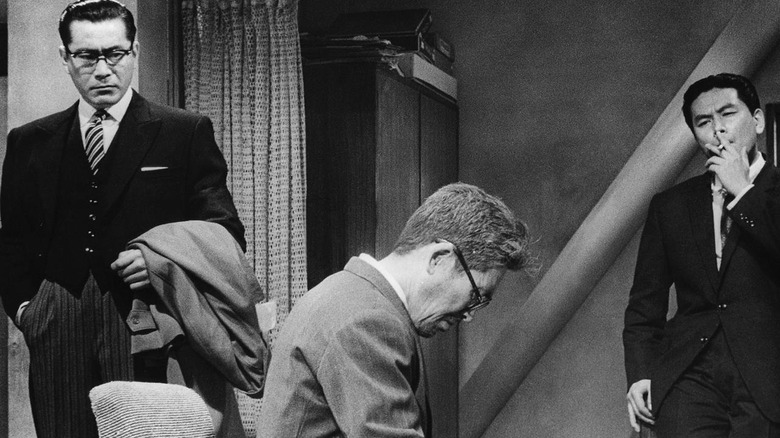
Kurosawa took on "Hamlet" in a more direct fashion himself with his 1960 noirish look at corporate corruption called "The Bad Sleep Well." This film starred Toshiro Mifune again, as Nishi, a Japanese stand-in for Hamlet. In that film, Nishi's father is killed by a corporate boss and he works to expose the murder and force those who killed his father to pay. In Shakespeare's "Hamlet," a play is staged for the benefit of the murdering uncle, so that Hamlet can gauge his reaction in public and begin to sow doubt and guilt in the minds of his enemy. In "The Bad Sleep Well," Kurosawa replaces the play with a wedding cake, a massive replica of the corporate office building where his father was murdered. A single rose adorns the window from which his father was thrown to his death.

For "The Northman," this moment gets bloodier and more visceral as Amleth eviscerates some of his uncle's men and cuts them into pieces for a grotesque display on the side of a building. In all three cases, it has the intended effect, playing mind games with the murderer they hope to take their revenge against.

The Visuals Of Dreams

Akira Kurosawa didn't get to make as many color films as he should have, but when he was able to add color to his tools as a filmmaker, it was nothing short of stunning. Perhaps his most beautiful film was 1990's "Dreams." (If you haven't seen "Dreams," remedy that, if nothing else for Martin Scorsese's brilliant cameo as Vincent Van Gogh.) This is essentially an anthology film where Kurosawa is at his most visually arresting as he reinterprets folklore, myth, and his own dreams. The way color is used in the film, especially for its more abstract moments, has a painterly quality. Kurosawa himself painted prolifically to establish the looks of his movies. Many of these paintings were storyboards and, in all of the films across his career, every frame looked like it deserved to be hung up in a museum.

With "The Northman," Robert Eggers took this one step further, offering stunning tableaus of Iceland and the other Viking territories. As the Valkyries ride to Valhalla, it's as otherworldly and unsettling as the myths that Kurosawa captured in "Dreams."

The entire ending of "The Northman," though, feels like it could have been lifted from a Kurosawa film (or another film that cribbed Kurosawa). As Amleth and his uncle face off in the molten lava flows of a volcano, the cinematography and colors used feel like the sort of paintings Kurosawa rendered on film in "Dreams."

Kurosawa student and devotee George Lucas used a similar motif in his "Star Wars" take on "Macbeth" and "Throne of Blood" with "Revenge of the Sith" and that lava is symbolic on a mythological level across each of these films.

A Blend Of All Three

Robert Eggers was able to successfully blend all of these gorgeous cinematic techniques and story flourishes into a film that feels fresh as it does ancient in its storytelling. As I watched, I truly felt as though I were watching someone reinterpret Kurosawa, reinterpreting Shakespeare, but with Vikings rather than samurai. For a fan of Kurosawa and a devotee of the man's oeuvre, that's high praise. "The Northman" is a stunning achievement and deserves to be held on a shelf alongside these classics and studied under the same sort of magnifying glass.

With only three feature films to his credit as director, Robert Eggers might not end his career as accomplished as Akira Kurosawa, but he's certainly made a go of it so far.

"The Northman" comes out in wide release on April 22, 2022.

Read this next: The 20 Greatest War Films Of All Time

The post The Northman is a Dream for Akira Kurosawa Fans appeared first on /Film.

22 Apr 16:52

Attention Industry Execs: We Still Want Vampire Content, Morbius Just Sucked

by BJ Colangelo

(Welcome to The Soapbox, the space where we get loud, feisty, political, and opinionated about anything and everything.)

This year marks the 100th anniversary of "Nosferatu," and here at /Film we've been celebrating the occasion with our ongoing "Year of the Vampire" series. Bloodsuckers have always been a favorite bedfellow for film fans, which is why so many of us have been excited for the upcoming flood of vampire projects. Nicolas Cage is set to play Count Dracula opposite Nicholas Hoult's "Renfield" and AMC is breathing new life into a classic tale with a series version of "Interview with the Vampire. Unfortunately, not all of the highly-anticipated vampire projects are going to see life outside of the coffin.

After years of waiting for Karyn Kusama to bring her Dracula reimagining, titled "Mina Harker," to life, the Blumhouse and Miramax film has been scrapped just a few weeks before production. The film was reportedly taken off the roster due to "creative differences," but that could mean any number of things. Based on how screenwriter (and Kusama's husband) Phil Hay has been discussing the film on Twitter, it sure seems like this was not something anyone on the team wanted to happen, but they tried their best to maintain their vision.

Less than 24 hours prior, Robert Eggers announced on an episode of the "WTF with Marc Maron" podcast that his highly-anticipated remake of "Nosferatu" was not happening at the moment, because there is no god and if there was, we are clearly being punished for our insolence. Two extremely high-profile vampire projects getting kicked to the curb seems too eerie to be a coincidence, and it's hard not to see this as a studio freakout in the wake of the embarrassing box office and critical performance of the vampire superhero movie, "Morbius."

Vampirism Isn't Why Morbius Failed

With superhero movies all but guaranteed to smash the box office, the low turnout for "Morbius" was a massive disappointment for Sony. In its second weekend, the film dropped 73.9% from its debut. While it's earned back its shooting budget, the additional expenses of pandemic-related delays and marketing have not been accounted for, which means the $147.5 million global gross probably wasn't what Sony had in mind when they greenlit a superhero movie with an Academy award-winning actor in the title role.

/Film's own Chris Evangelista captured the failure of "Morbius" perfectly, calling it "an absolutely dreadful piece of pre-packaged junk that throws a bunch of CGI ghoul faces our way and hopes for the best." Sure, the film attempted to pay homage to vampire films and the oft-unfairly maligned era of 1990s superhero movies, but does so in a way that fails to understand what makes both subgenres fun in the first place. Add that to the fact that audiences are growing increasingly annoyed with Jared Leto's off-screen behavior and unsavory history of misconduct allegations, and it's no wonder why "Morbius" couldn't bring home the bacon. 

Despite the film's shortcomings, superhero movies aren't stopping anytime soon ... but suddenly, vampire films are? I'm really trying not to wear a tin foil hat about this, but it really does seem like studios are spooked by the film's financial failure and are convinced that vampires are "out," or however out-of-touch executives talk.

Hollywood Has Never Known What To Do With Successful Vampire Movies

How you feel about the "Twilight" films doesn't matter, because there's a more important conversation to be had other than whether or not vampires sparkle. When Catherine Hardwicke ("Thirteen," "Lords of Dogtown") was tapped to direct the first film, "Twilight" wasn't expected to make any money. The script was turned down by both Paramount and Fox, allowing Summit Entertainment to say "yes." Hardwicke became responsible for the biggest opening weekend for a female director at the time. Unfortunately, because the film became ridiculously profitable, Hardwicke was kicked to the curb in favor of male directors who would continue the rest of the franchise. Hardwicke understood both vampire films and teenage romance, but producers worried about their bottom line immediately pivoted to a "safer" route, and gave the reins to people who have never known what it is like to be a teen girl in love with someone really, really bad for them.

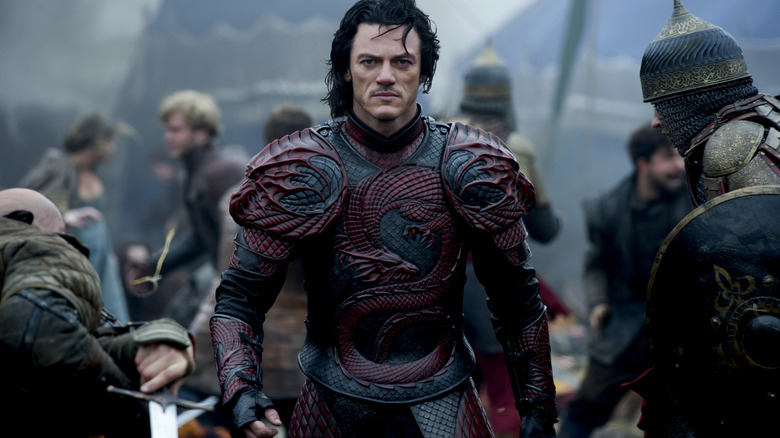
What about other major Hollywood vampire movies? "Dracula Untold" hit theaters in 2014 and, despite a modestly successful worldwide box office gross, was ripped apart by fans and critics alike. It was also an action fantasy film and not really a vampire film. Examining the last decade, all the recent beloved vampire films have come from outside of Hollywood. "What We Do In The Shadows" may now have a hit Hulu series, but the original film was a feisty indie release that thrived on word of mouth recommendations. Hell, the last vampire film to come out of the studio system and make a good chunk of change that wasn't a remake or part of a legacy franchise was ... *checks notes* ... "Hotel Transylvania." No shade to the Adam Sandler animated vamp films (which I genuinely do love) but I think this further proves my point. Studios are terrified of not making f-you money, and audiences are seemingly afraid of acknowledging the painful realities of immortality, so watering the themes in vampire films down to a place where they can be digested by children feels like the key to success.

Let Vampires Be Horny Again

Here's the honest truth -- the best vampire films aren't comic book style action films ("Blade" is the exception, don't @ me), they're gripping tales absolutely dripping with sexuality. Even when sexuality is hidden in the subtext in films like "The Lost Boys," a massive part of the danger of vampires is how easily they are able to seduce their prey. Don't get me wrong, there's plenty of fun to be had with nightmare fuel-looking vampires like in "30 Days of Night," but even 1931's "Dracula" plays with the sexual irresistibility of the cloaked Count, with Renfield serving as his begging, submissive bottom. People are fooling themselves if they believe the "Twilight" craze was rooted in "love" and not a bunch of repressed teenagers and unsatisfied housewives totally turned on by the idea of getting boned by an undead hunk who puts you on a pedestal. May this serve as a reminder, "50 Shades of Gray" was originally "Twilight" fanfiction called "Master of the Universe" and I don't think I need to argue in favor of that film's blatant horniness. "American Horror Story: Hotel" let Lady Gaga be a vampire queen who f****, and it's considered by many to be one of the best seasons of the hit anthology. The people have spoken, and they want hot, vampire, sex.

Look, I'm sorry to everyone who worked on "Morbius" that the film wasn't a bigger success because, despite what this title implies, I sincerely don't want any film to fail. That said, it's really grinding my gears that it seems like studios are running away from vampire projects post-"Morbius," especially ones that were pretty universally garnering excitement. At this point, I can only hope that "Renfield" blows away all expectations and ushers in a wave of vampire films. Until then, the Karyn Kusama "Mina Harker" movie in which Jasmine Cephas Jones crossed paths with Dracula in Los Angeles will have to exist in my wildest fantasies. For shame.

Read this next: The 20 Best Zombie Movies Of All Time

The post Attention Industry Execs: We Still Want Vampire Content, Morbius Just Sucked appeared first on /Film.

22 Apr 16:51

Nicolas Cage Insisted On Staying Unlikable In The Unbearable Weight Of Massive Talent

by Ryan Scott

Nicolas Cage has been steadily acting for decades, and his career has been rather eclectic. Currently, we are in something of a Cage renaissance with the actor starring in some of his best movies in years, including "Mandy" and "Pig" as a couple of examples. Now, another example of the actor's resurgence has arrived in the form of "The Unbearable Weight of Massive Talent," Perhaps the most Cage-y movie to come around in a long time.

The film sees the actor playing a heightened, fictionalized version of himself who is down on his luck and must attend a mega-fan's (played by Pedro Pascal) birthday party to help pay off some of his debts. But this is not Cage putting his truest self out there, it's fiction with a dash of truth. To that end, he very much insisted on being unlikable for the movie's sake.

Unlikable For The Sake Of The Audience

During a recent interview with Collider, Cage discussed some of what went into crafting his character for "The Unbearable Weight of Massive Talent." During the making of the movie, he discovered that certain scenes actually worked better when he was far less likable, even if it didn't necessarily paint him in a better light. Cage said:

"'We've got to make the character more likable, more likable, and then they lose some of the self-deprecating humor or the irreverent humor that Tom had. Like, okay, the piano scene where the character is drunk and he's playing piano and he's making a mess at the birthday party. They homogenized it so much that the Nic Cage character wasn't doing anything wrong. Everybody was rolling their eyes. Like, 'Well, he's just singing a sweet song to his daughter!' You got to make it more of a train wreck at the risk of him being less likable because the character has to grow. He has to evolve into a sensitive family man."

While not everyone is an actor, it is easy to imagine that playing a version of yourself on screen would be a pretty vulnerable position to be in. But to go beyond that and have the presence of mind to choose to be less likable, even if it means being more vulnerable, speaks volumes about Cage as an actor.

Producer Nicolas Cage, Actor Nicolas Cage

Another element to this puzzle for Cage is that he wasn't merely a hired gun on this film. He served as a producer as well, which meant that he actually had to put on a different hat and advise both the studio, Lionsgate, as well as director Tom Gormican at times. That's kind of how he arrived at knowing the movie version of Nicolas Cage needed to be less-than-perfect at times. Cage had to divorce himself from the performance in order to arrive at that though. The actor explained:

"I had to watch it because my other hat on this movie was producer, and as a producer, it got to a point where the studio had an opinion and the director had an opinion and it was time for fresh eyes. And I had to shut off half my mind and half my heart and look at the movie from a place of neutral, and as a producer, I was able to say to the studio, 'I think you've got to put some of [director] Tom [Gormican]'s flavor back in the movie. You're losing a lot of the flavor of the comedy.' And to Tom, I had to say, 'I think these two scenes aren't landing.' And I'm glad I did it because I think we finally got to a place where the movie works as a whole in the best possible way, the best of both worlds."

Luckily, Cage was able to separate those two because the movie is undoubtedly all the better for it.

"The Unbearable Weight of Massive Talent" is in theaters now.

Read this next: The 14 Greatest Biopics Of The 21st Century

The post Nicolas Cage Insisted On Staying Unlikable In The Unbearable Weight Of Massive Talent appeared first on /Film.

22 Apr 16:50

Apocalypse Now Turned Nicolas Coppola Into The Nicolas Cage We Know Today

by Lyvie Scott

Life can be tough for descendants of Hollywood dynasties. There's always the nagging suspicion that their success is the product of nepotism, and references to famous family members seem to follow them wherever they go. Many actors and filmmakers avoid discussions on the topic whenever possible, and some have even gone so far as to change their surnames in an effort to stand on their own.

Nicolas Cage is one of the few actors to put real distance between himself and his famous family. Born Nicolas Kim Coppola, Cage is nephew to legendary director Francis Ford Coppola — but after changing his name early in his career (and banking unforgettable performances in some truly gonzo films thereafter), the actor managed to carve out a legacy all his own.

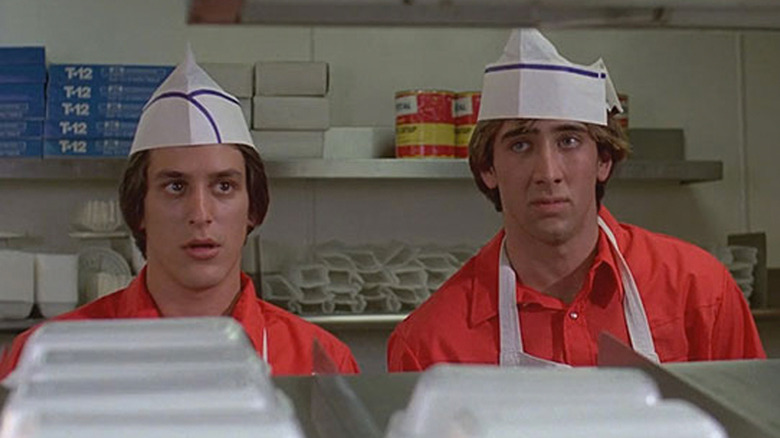
Today, there's a whole generation of fans who have literally no idea that Cage's uncle did, in fact, direct "The Godfather" — despite the fact that, in his very first film, he's credited as "Nicolas Coppola." Cage took on his new surname after appearing in Amy Heckerling's "Fast Times at Ridgemont High," but he's never outright explained what spurred him to the switch. Until now, that is.

The Unbearable Weight Of A Famous Family

While promoting his new film, "The Unbearable Weight of Massive Talent," Cage sat down with Wired to answer the Internet's burning questions. Given his decade-spanning career — not to mention his highly-publicized exploits — you can imagine just how much the Internet wants to know. Fortunately, enough fans have asked Google why exactly Cage changed his name all those years ago, and now those fans finally have an answer.

It was actually Cage's experience on the set of "Fast Times" that inspired the change. The 1982 film was only a few years removed from Coppola's seminal film "Apocalypse Now," and it was just one of a few films that others referenced whenever Cage was around.

"People would not stop saying things like, 'I love the smell of Nicolas in the morning,'" Cage told Wired, "because of 'Apocalypse Now,' and Robert Duvall saying, 'I love the smell of napalm in the morning.'" He continued:

"It made it hard to work, and I decided, 'I don't need this,' so I changed it to Cage. It's a combination of Luke Cage from Marvel comics, who was a character I liked, also named Power Man, and John Cage, the avant-garde composer. Speaks volumes about everything I've been up to ever since."

Cage may be a bit of a nepotism baby on paper, but he's more than proven his merits in the 30-plus years since his "Fast Times" debut. The Coppola name comes with a hefty legacy, and all sorts of expectations — but if his varied filmography is any indication, Cage doesn't seem overly concerned with legacy. The actor has always taken a very individualistic approach to film; he treats his career less like a body of work than a moment-to-moment exploration of what feels good in the moment, and it's hard to ignore just how refreshing that is.

"The Unbearable Weight of Massive Talent" is now playing in theaters.

Read this next: The Horror Movies We Can't Wait To See In 2022

The post Apocalypse Now Turned Nicolas Coppola Into The Nicolas Cage We Know Today appeared first on /Film.

22 Apr 16:49

UK's Department for Transport Proposes To Allow Drivers To Watch TV on Self-Driving Cars

by msmash
People using self-driving cars will be allowed to watch television on built-in screens under proposed updates to the Highway Code. From a report: The changes will say drivers must be ready to take back control of vehicles when prompted, the government said. The first use of self-driving technology is likely to be when travelling at slow speeds on motorways, such as in congested traffic. However, using mobile phones while driving will remain illegal. No self-driving cars are currently allowed on UK roads, but the first vehicles capable of driving themselves could be ready for use later this year, the Department for Transport (DfT) said. The planned changes to the code are expected to come in over the summer. The updates, proposed following public consultation, were described as an interim measure to support the early adoption of the technology and a full regulatory framework is planned to be implemented by 2025.

Read more of this story at Slashdot.

22 Apr 13:18

The Northman Ending Explained: Revenge Is A Flat Circle

by Rafael Motamayor

We're in a bit of a Vikings renaissance — a Vikingssance, if you will. Whether it's "The Last Kingdom" and its tale of identity and war, the intricate political scheming of "Vikings Valhalla," the animated coming-of-age epic "Vinland Saga," or even the sci-fi take from Marvel's "Thor" movies, it's a good time to be into Vikings. These titles have helped challenge the notion of Norse people as just uncultured savages, showing instead complex tales of political intrigue, with intricate social and religious systems, and stories that are about more than pillage and plunder.

The latest project to try and join that group is Robert Eggers' "The Northman," a movie that retells the legend of Amleth — which inspired Shakespeare's "Hamlet" — and plays like a live-action "Vinland Saga" by way of Genndy Tartakovsky's "Primal." This is a film that teases the complexity and higher drama of something like "History's Vikings," but stays focused on a smaller, intimate tale of revenge, while not being afraid to get dirty and brutal in its depiction of Viking culture, especially how slavery played into it.

Understanding the ending of the film involves navigating a lot of bizarre, enthralling dream imagery and Norse mythology, as well as some real history. Let's take a look at the tale of Amleth.

A Brutal Life Of Violence

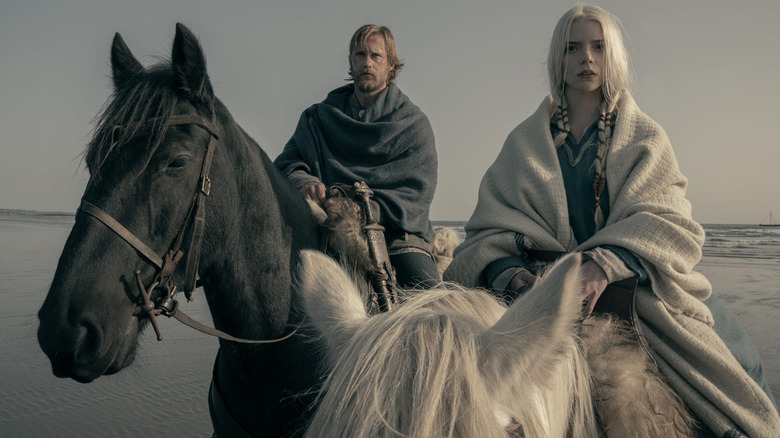
"The Northman" follows the tale of Amleth (Alexander Skarsgård), son of King Aurvandill (Ethan Hawke), who is betrayed by his brother, Fjölnir (Claes Bang). Amleth escapes his country and vows to avenge his father, save his mother, and kill Fjölnir. Years later, Amleth has joined a Viking horde plundering and pillaging Eastern Europe, and hears a prophecy that reignites his desire for revenge. Joined by an enslaved sorceress named Olga (Anya Taylor-Joy), Amleth travels to Iceland while posing as a slave and begins a reign of terror on Fjölnir. 

From the get-go, what makes "The Northman" stand out from other Viking-centric tales is its focus on the banality and matter-of-fact way violence and savagery were part of the day-to-day Viking culture. When we see Amleth fight, he is absolutely brutal, a one-man army capable of mowing down every armored soldier he faces while being mostly naked. Indeed, Amleth is a berserker, a part of the vanguard for a Viking army sent in first to attack with fierce and bloody violence to shock the enemy before the main troops arrive — while high on drugs that send Amleth on a trance-like state of rage.

It's not just that we see several characters talk about wanting to die by the sword in order to reach Valhalla or that dying of old age is disgraceful, but Eggers shoots the misery and brutality of war in a way that's simultaneously over-the-top but also chillingly nonchalant. When we see Viking warriors gather up the survivors they didn't deem fit enough to be slaves and trap them in a house they then set on fire, it's shocking and upsetting, but played out like just another day at the office.

Vengeance, Like War, Never Changes

Before embarking on his quest for vengeance, Amleth receives a warning that he will one day have to choose between "kindness for your kin or hate for your enemies," a warning that marks the central theme of "The Northman." 

Indeed, while on a surface level the movie has a basic and familiar premise (to be fair, it is really a tale as old as time), it is still a profound tale of the cyclic nature of vengeance. After having spent most of the film slowly enacting a plan to terrorize Fjölnir and his henchmen, Amleth is finally reunited with his mother Gudrún (Nicole Kidman), which changes everything. 

The big (and only, really) twist in "The Northman" is that Gudrún is not a defenseless victim, but the person that put this entire story in motion. It was her idea to get Fjölnir to kill Aurvandill, as she reveals that she was a slave to Aurvandill herself, and Amleth's birth was the result of rape. After biding her time for years, she and Fjölnir saw a way to break free from her former husband's cruelty. Choosing to spare Amleth from a life of hate and revenge, and to protect her new son with Fjölnir, Gunnar, she suggested Fjölnir's men kill Amleth as a child too.

This revelation — and the deaths of Gudrún and Gunnar at Amleth's hand soon after — are impactful because it plays into the film's portrayal of the horrors of Viking times (the violence and the slavery), but also how hard it is to escape a cycle of hatred and revenge. Amleth is as much a victim as Gudrún, and his quest for vengeance is but the latest chapter in a story she began long ago. When Amleth hears Gunnar's screams of terror after seeing his mother being murdered, he sees himself become like Fjölnir, creating a new Amleth in the young boy.

The ultimate message of the film, that once you enter a path of violence it is nearly impossible to escape, comes at a climax when Amleth discovers that Olga is pregnant with his twins, and leaves her on a ship to the mainland while he goes looking for Fjölnir. He has chosen hate for his enemies, leaving behind any semblance of humanity or love. When Amleth fights Fjölnir at the base of a volcano, which they call the Gates of Hel, he is completely naked, a berserker once again, high on a thirst for blood and revenge that ends both his and Fjölnir's lives. 

"The Northman" is metal as hell, a movie with bizarre imagery, spectacular acting, and a simple yet powerful story of the flat circle of revenge and how often it leads to naked fights in volcanos.

"The Northman" is now in theaters.

Read this next: Horror Roles That Changed Actors Forever

The post The Northman Ending Explained: Revenge Is A Flat Circle appeared first on /Film.

22 Apr 13:17

Shanghai's Low Covid Death Toll Revives Questions About China's Numbers

by msmash
China's largest city has recorded just 17 Covid deaths, despite surging cases. How China defines a Covid death may be part of the reason. The New York Times: By the numbers, Shanghai has been an exemplar of how to save lives during a pandemic. Despite the city's more than 400,000 Covid-19 infections, just 17 people have died, according to officials, statistics they have touted as proof that their strategy of strict lockdowns and mass quarantines works. But those numbers may not give a complete picture of the outbreak's toll. China typically classifies Covid-related deaths more narrowly than many other countries, labeling some chronically ill patients who die while infected as victims of those other conditions. In addition, a nearly three-week lockdown of China's biggest city has limited access to medicine and care for other illnesses. A nurse who suffered an asthma attack died after being denied care because of virus controls. A 90-year-old man died of complications from diabetes after being turned away from an overwhelmed hospital. "If, at the time, he had been able to get treatment, he probably would have survived," said the man's granddaughter, Tracy Tang, a 32-year-old marketing manager. Residents and frontline workers have also been pushed to their limits by the policies. A hospital worker started bleeding internally after long hours conducting mass testing; she, too, died. It may never become clear how many similar stories there are. China does not release information on excess deaths, defined as the number of deaths -- from Covid as well as other causes -- exceeding the expected total in a given period. Public health scholars say that figure more accurately captures losses during the pandemic, as countries define Covid-related deaths differently. But as an example of the hidden impacts, a prominent Chinese physician recently estimated that nearly 1,000 more diabetes patients could die than expected during Shanghai's lockdown, urging the authorities to take a more measured response. The outbreak there has revived questions about the true toll of Covid in China, which has officially reported fewer than 5,000 deaths from the coronavirus in two years. Beijing is unlikely to waver from its stringent approach. China's leader, Xi Jinping, has made the country's low death and infection rates central to his administration's legitimacy. Officials have been fired after even a few cases were detected in their jurisdictions. Last week, Mr. Xi said that "prevention and control work cannot be relaxed." The focus on minimizing Covid deaths risks incentivizing officials to neglect other causes of death, said Xi Chen, a professor of public health at Yale.

Read more of this story at Slashdot.

22 Apr 13:17

More Dimensions - Epsilon Build v1.01

More Dimensions - Epsilon Build v1.01
This is a HD compilation of levels running under Quakespasm-spiked including: (a) The levels from Arcane Dimensions 1.8 which were not present in 1.7 (b) The Forgotten Sepulcher, which was not present in the HD Epsilon release of Arcane Dimensions 1.7 and (c) Several third-party Arcane Dimensions levels which are not part of the official release. The latter includes Annihilith of Abhorration, Tomb of Fenrir, The Refinery and "The faults within" (a remake of quake's e3m2 "The Vaults of Zin") (d) My 2-hour dark-ambient/metal/industrial soundtrack.
22 Apr 13:17

Unofficial Patch 11.2

Unofficial Patch 11.2
Vampire: The Masquerade - Bloodlines Unofficial Patch 11.2
22 Apr 13:16

VMware's Head of Cybersecurity Strategy Discusses Modern Bank Heists

by Kevin Townsend

Digital Bank Heists – Because That’s Where the Money Is Today

read more

22 Apr 13:16

Massive DNA study of human cancers offers new clues about their causes

by Mariella Moon

A team of UK scientists has analyzed the complete genetic makeup of 12,000 tumors from NHS patients and discovered 58 new mutations that provide clues about their potential causes. The team, composed of scientists from Cambridge University Hospitals and the University of Cambridge, used data from the 100,000 Genomes Project. That's a British initiative to sequence the whole genomes of patients with cancers and rare diseases. 

Team leader Professor Serena Nik-Zainal said this is the largest study of its kind and that the vast amount of data her team worked with allowed them to detect patterns in the genetic alterations or "mutational signatures" found in the tumors. By comparing their results with other studies, they were able to confirm that 58 of the mutational signatures they found were previously unknown. Some of them are pretty common, while some are rare.

"The reason it is important to identify mutational signatures is because they are like fingerprints at a crime scene — they help to pinpoint cancer culprits," Nik-Zainal explained. Some signatures could show that past exposure to environmental causes such as smoking or UV light had triggered the cancer, while others could have treatment implications. They could, for instance, pinpoint genetic abnormalities that could be targeted by specific drugs. 

Professor Matt Brown, chief scientific officer of Genomics England said: "Mutational signatures are an example of using the full potential of [whole genome sequencing]. We hope to use the mutational clues seen in this study and apply them back into our patient population, with the ultimate aim of improving diagnosis and management of cancer patients."

In addition to conducting DNA analysis and publishing its results in Science, the team also developed an algorithm called FitMS that will give clinicians easy access to the new information they discovered. FitMS looks for both common and rare signatures in the results of a patient's whole genome sequencing test. Doctors can use the algorithm to find out if their patients exhibit any of the newly discovered mutations for a more accurate diagnosis and for personalized treatments. 

22 Apr 13:16

Why couldn't samurai be left-handed?

by Devin Nealy
Left Handed Samurai

Gone are the days when the media only allowed a narrow view of humanity, absent of other cultures, races, creeds, and orientations. But what of left-handed people?

I'm being a little facetious, but it's true that society isn't built to accommodate lefties, no matter how much Ned Flanders and Francine Smith have tried to help. — Read the rest

22 Apr 13:15

Hold Tight – Netflix Series Review

by Karina "ScreamQueen" Adelgaard
22 Apr 13:15

Taxi Driver: Season 1 – Netflix Review

by Karina "ScreamQueen" Adelgaard
22 Apr 13:14

Steven Spielberg Doesn't Hide Which Indiana Jones Film He Likes The Least

by Sandy Schaefer

1984's "Indiana Jones and the Temple of Doom" is an important entry in Steven Spielberg's career as a director. It opens with a razzle-dazzle song-and-dance number in a 1930s nightclub, a marvelous sequence that spoke to the filmmaker's ability to make a killer movie musical decades before he finally realized that promise with 2021's "West Side Story." The film then proceeds to deliver one rollicking action scene after another (thrilling chases, brutal fistfights, you name it), many of which rank among the best of Spielberg's career to this day. What makes it all the more impressive is how different the movie is from Indy's first outing, "Raiders of the Lost Ark," when it comes to everything from the tone to its pulpy B-movie inspirations, all of which forced Spielberg to really challenge himself as a storyteller.

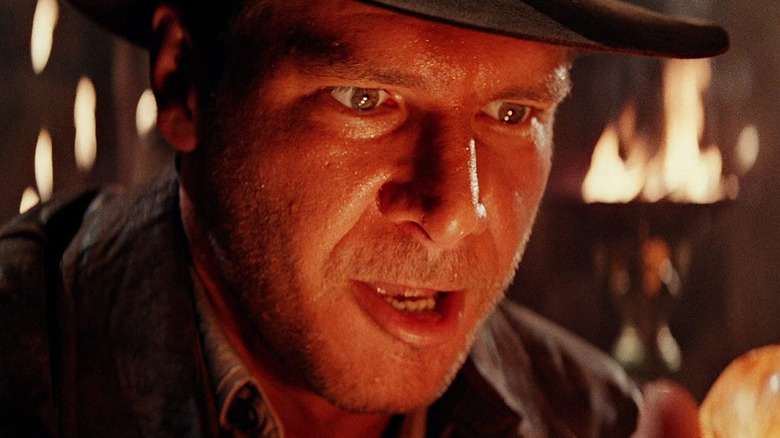
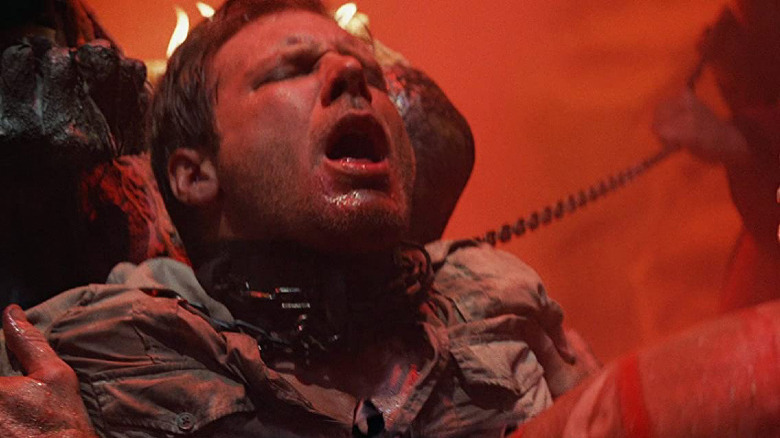
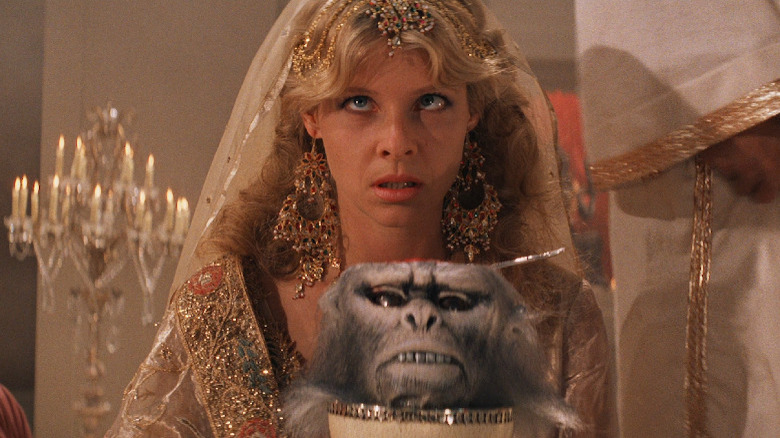
Yet, as you've no doubt already put together based on the above image and this article's headline, "Temple of Doom" remains the Indiana Jones movie Spielberg likes the least. This hasn't changed in the wake of 2008's not-so-beloved "Indiana Jones and the Kingdom of the Crystal Skull," either, as Susan Lacy confirmed back when she was promoting her 2017 documentary "Spielberg." Let's examine why that is, shall we?

'It Was Too Dark, Too Subterranean, And Much Too Horrific'

It's saying something that "Indiana Jones and the Temple of Doom" is commonly known as the "dark" Indiana Jones movie, given the many gruesome ways characters kick the bucket in the franchises's other entries. That said, "Temple of Doom" was one of the films that led directly to the PG-13 rating, and for valid reason. It's a movie where, among other things, a still-living person gets their heart ripped out of their chest before being dropped into a fiery pit, the villains enslave children to do their evil bidding, and even Indy is subjected to torture by way of voodoo dolls and being forced to drink mind-controlling "blood."

Speaking to the Sun-Sentinel in 1989, Spielberg explained that he felt "Temple of Doom" was simply too bleak for its own good. More than that, he argued it veered further into pure horror than "Poltergeist," the now-classic thriller that he co-wrote and produced (and, as the old urban legend alleges, may've secretly directed) two years before making it:

"I wasn't happy with the second [Indiana Jones] film at all. It was too dark, too subterranean, and much too horrific. I thought it out-poltered 'Poltergeist.' There's not an ounce of my own personal feeling in 'Temple of Doom.'"

George Lucas, who co-wrote and produced "Temple of Doom," was gentler to the film when interviewed by Grantland in 2012. "Oh, I'm not renouncing it," Lucas clarified. He went on to explain why the movie ended up as dark as it is:

"I was going through a divorce, and I was in a really bad mood [when I wrote the story for 'Temple of Doom']. So I really wanted to do dark. And Steve then broke up with his girlfriend, and so he was sort of into it, too. That's where we were at that point in time."

As Grantland noted in its article, Lucas' revelation certainly lends a whole deeper layer of meaning to the image of a person getting their heart (literally) ripped out in the film.

Yes, We're Going To Talk About The Elephant In The Room

To address the elephant in the room (but not the one Harrison Ford was riding when he re-injured his back): Yes, "Temple of Doom" comes across as pretty brazenly racist, even for an Indiana Jones movie. From its portrayal of the Shanghai crime bosses in its opening to the Kali-worshipping Thuggees, the film has long been criticized for perpetuating racial and ethnic stereotypes with its villains. Even with the addition of Ke Huy Quan as Indy's lovable sidekick Short Round, it's nay-impossible to overlook these elements. That's to say nothing of the choice to have "Raiders of the Lost Ark" actor Pat Roach play a Thuggee enforcer in brown-face makeup, or the way Indy is propped up as a white savior.

According to British-Indian actor Roshan Seth, who plays Chattar Lal, the film's most cringe-worthy scene — the banquet at Pankot Palace — was actually a gag that didn't land. Here's what he told Empire in 2012:

"The banquet scene was a joke that went wrong. I got a great deal of flak for it because people kept saying, 'How does an intelligent man like you agree to be in a film which shows Indians dining on beetles and eels?' Steven intended it as a joke, the joke being that Indians were so f***ing smart that they knew all Westerners think that Indians eat cockroaches, so they served them what they expected. The joke was too subtle for that film."

While the banquet scene still sounds like a bad idea (even knowing this), it does speak to the large issue of Spielberg not having a firm grasp on the tone he was going for in "Temple of Doom." As part of the same Empire article, the director suggested that it was "ahead of its time for my own sensibility and exactly right on schedule" for Lucas, himself no stranger to dark sequels after "Star Wars: The Empire Strikes Back." This also explains why he remains so hard on the movie. When push comes to shove, he feels it could've turned out better than it did, had it come later in his career.

Spielberg added:

"I'm certainly there now in my filmmaking, as you've probably witnessed ever since 'Schindler's List.' Before that, it was a bit of a struggle against common sense to go as dark as we did."

Read this next: The 15 Best Cold War Movies Ranked

The post Steven Spielberg Doesn't Hide Which Indiana Jones Film He Likes The Least appeared first on /Film.

22 Apr 13:13

Joe Biden, and the Country, Could Really Use a CTO

by Steven Levy
Plus: Obama’s head techy, the world’s social media addiction, and Russia’s unwelcomed escalation.
22 Apr 13:13

Leaked Chats Show LAPSUS$ Stole T-Mobile Source Code

by BrianKrebs

KrebsOnSecurity recently reviewed a copy of the private chat messages between members of the LAPSUS$ cybercrime group in the week leading up to the arrest of its most active members last month. The logs show LAPSUS$ breached T-Mobile multiple times in March, stealing source code for a range of company projects. T-Mobile says no customer or government information was stolen in the intrusion.

LAPSUS$ is known for stealing data and then demanding a ransom not to publish or sell it. But the leaked chats indicate this mercenary activity was of little interest to the tyrannical teenage leader of LAPSUS$, whose obsession with stealing and leaking proprietary computer source code from the world’s largest tech companies ultimately led to the group’s undoing.

From its inception in December 2021 until its implosion late last month, LAPSUS$ operated openly on its Telegram chat channel, which quickly grew to more than 40,000 followers after the group started using it to leak huge volumes of sensitive data stolen from victim corporations.

But LAPSUS$ also used private Telegram channels that were restricted to the core seven members of the group. KrebsOnSecurity recently received a week’s worth of these private conversations between LAPSUS$ members as they plotted their final attacks late last month.
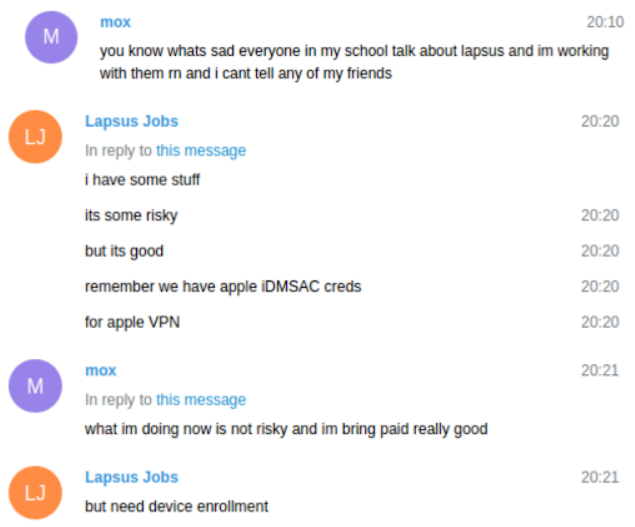
The candid conversations show LAPSUS$ frequently obtained the initial access to targeted organizations by purchasing it from sites like Russian Market, which sell access to remotely compromised systems, as well as any credentials stored on those systems.

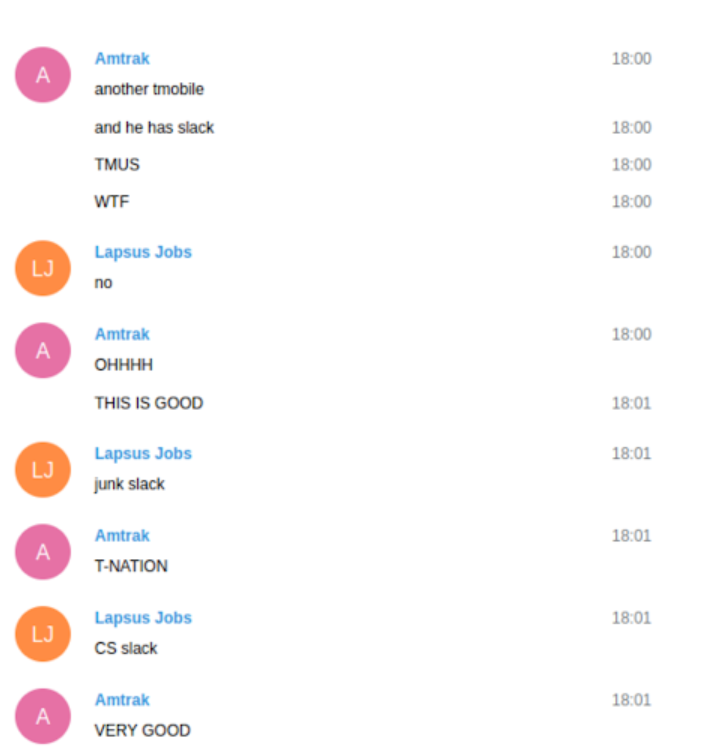
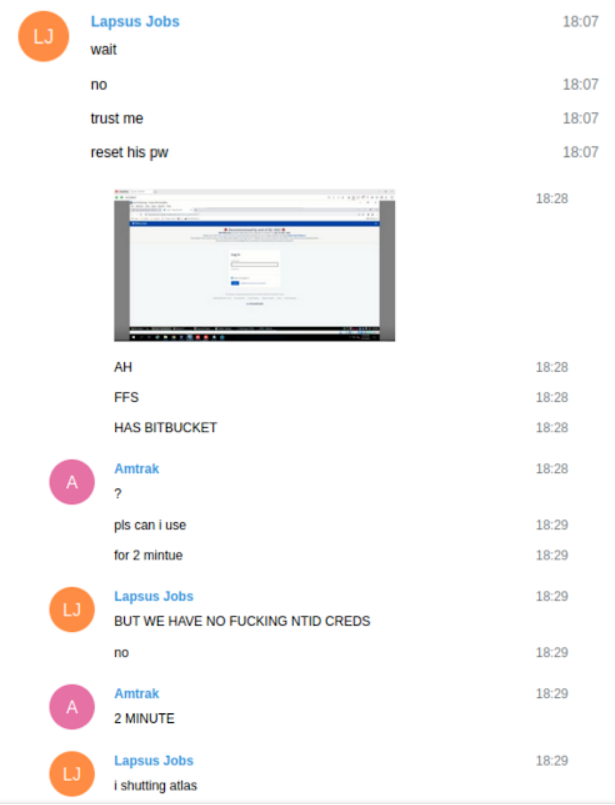
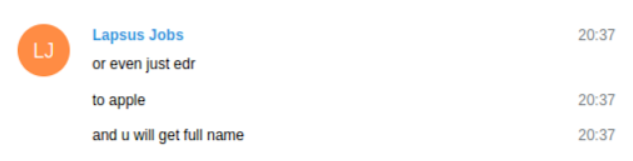
The logs indicate LAPSUS$ had exactly zero problems buying, stealing or sweet-talking their way into employee accounts at companies they wanted to hack. The bigger challenge for LAPSUS$ was the subject mentioned by “Lapsus Jobs” in the screenshot above: Device enrollment. In most cases, this involved social engineering employees at the targeted firm into adding one of their computers or mobiles to the list of devices allowed to authenticate with the company’s virtual private network (VPN).

The messages show LAPSUS$ members continuously targeted T-Mobile employees, whose access to internal company tools could give them everything they needed to conduct hassle-free “SIM swaps” — reassigning a target’s mobile phone number to a device they controlled. These unauthorized sim swaps allow an attacker to intercept a target’s text messages and phone calls, including any links sent via SMS for password resets, or one-time codes sent for multi-factor authentication.

The LAPSUS$ group had a laugh at this screenshot posted by their leader, White, which shows him reading a T-Mobile news alert about their hack into Samsung. White is viewing the page via a T-Mobile employee’s virtual machine.

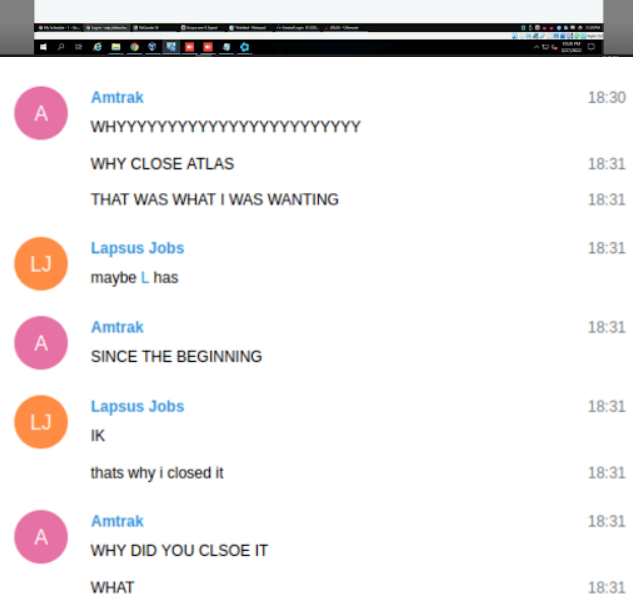
In one chat, the LAPSUS$ leader — a 17-year-old from the U.K. who goes by the nicknames “White,” “WhiteDoxbin” and “Oklaqq” — is sharing his screen with another LAPSUS$ member who used the handles “Amtrak” and “Asyntax.”

The two were exploring T-Mobile’s internal systems, and Amtrak asked White to obscure the T-Mobile logo on his screen. In these chats, the user “Lapsus Jobs” is White. Amtrak explains this odd request by saying their parents are aware Amtrak was previously involved in SIM swapping.

“Parents know I simswap,” Amtrak said. “So, if they see [that] they think I’m hacking.”
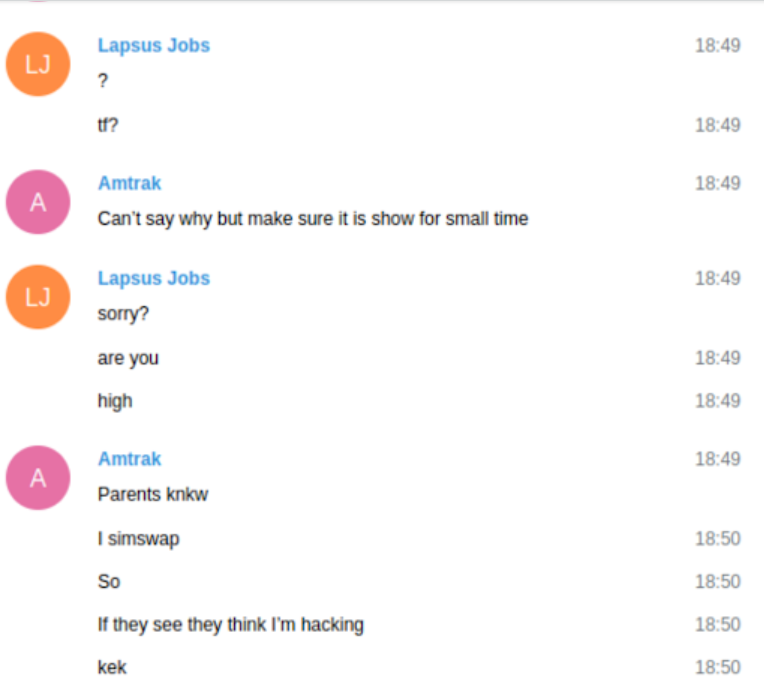
The messages reveal that each time LAPSUS$ was cut off from a T-Mobile employee’s account — either because the employee tried to log in or change their password — they would just find or buy another set of T-Mobile VPN credentials. T-Mobile currently has approximately 75,000 employees worldwide.

On March 19, 2022, the logs and accompanying screenshots show LAPSUS$ had gained access to Atlas, a powerful internal T-Mobile tool for managing customer accounts.

LAPSUS$ leader White/Lapsus Jobs looking up the Department of Defense in T-Mobile’s internal Atlas system.

After gaining access to Atlas, White proceeded to look up T-Mobile accounts associated with the FBI and Department of Defense (see image above). Fortunately, those accounts were listed as requiring additional verification procedures before any changes could be processed.

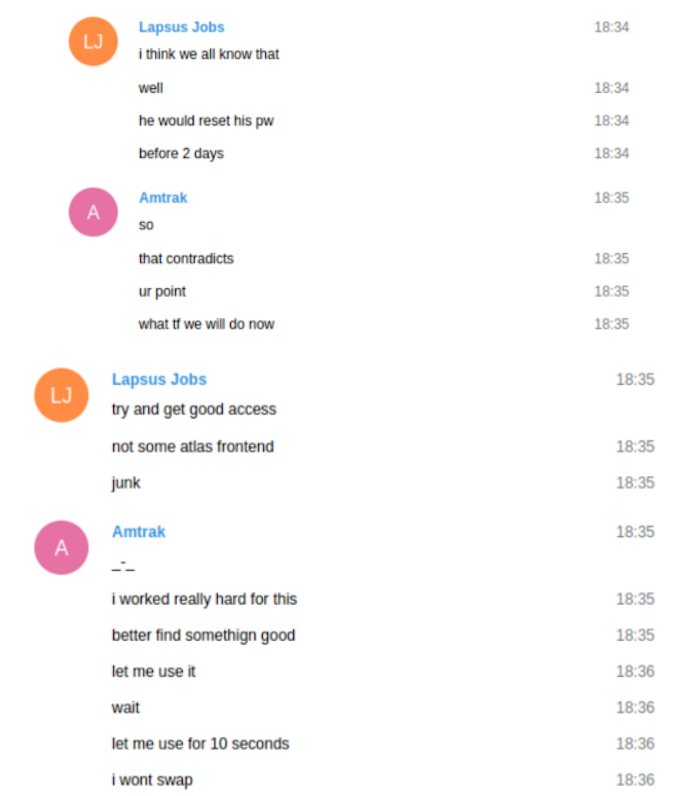
Faced with increasingly vocal pleadings from other LAPSUS$ members not to burn their access to Atlas and other tools by trying to SIM swap government accounts, White unilaterally decided to terminate the VPN connection permitting access to T-Mobile’s network.

The other LAPSUS$ members desperately wanted to SIM swap some wealthy targets for money. Amtrak throws a fit, saying “I worked really hard for this!” White calls the Atlas access trash and then kills the VPN connection anyway, saying he wanted to focus on using their illicit T-Mobile access to steal source code.
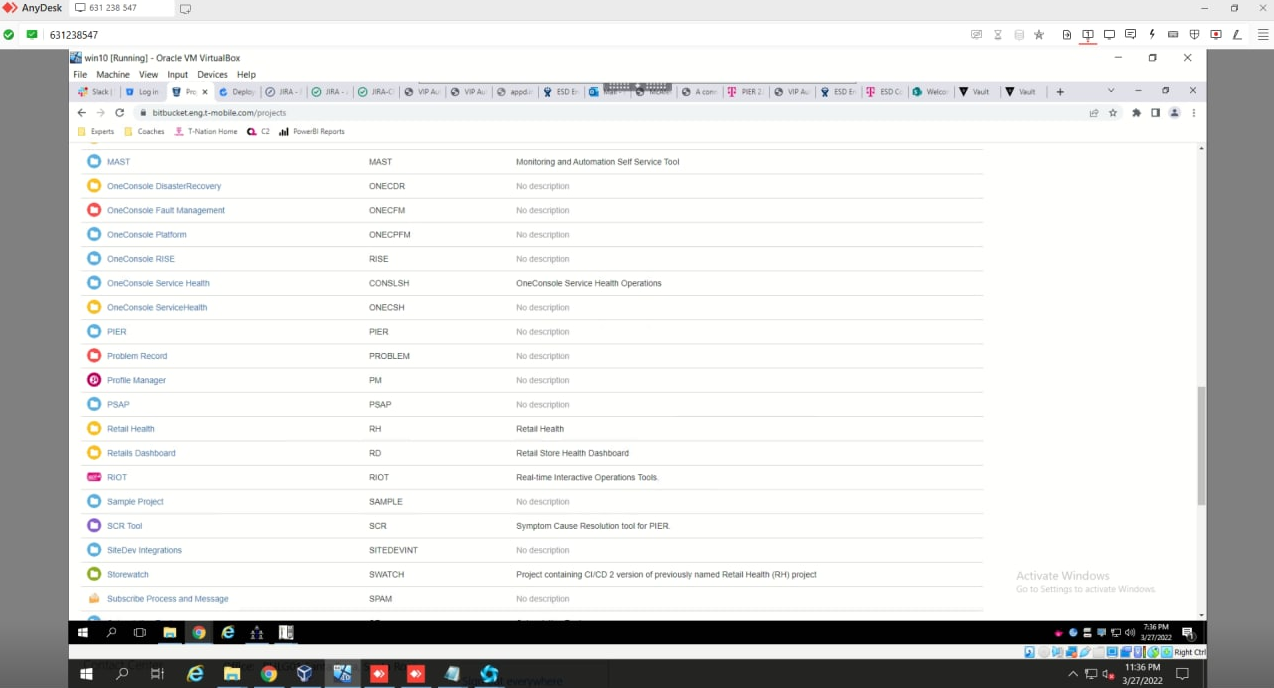
A screenshot taken by LAPSUS$ inside T-Mobile’s source code repository at Bitbucket.

Perhaps to mollify his furious teammates, White changed the subject and told them he’d gained access to T-Mobile’s Slack and Bitbucket accounts. He said he’d figured out how to upload files to the virtual machine he had access to at T-Mobile.

Roughly 12 hours later, White posts a screenshot in their private chat showing his automated script had downloaded more than 30,000 source code repositories from T-Mobile.
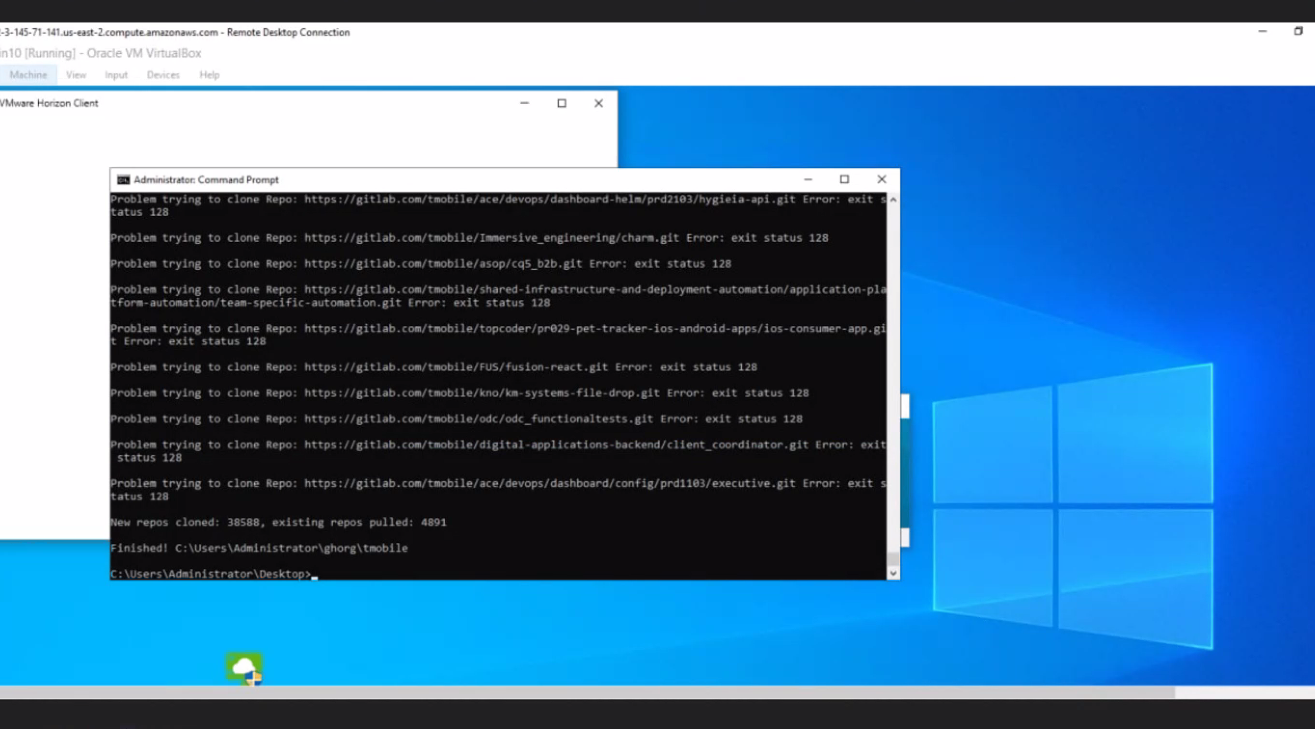
White showing a screenshot of a script that he said downloaded all available T-Mobile source code.

In response to questions from KrebsOnSecurity, T-Mobile issued the following statement:

“Several weeks ago, our monitoring tools detected a bad actor using stolen credentials to access internal systems that house operational tools software. The systems accessed contained no customer or government information or other similarly sensitive information, and we have no evidence that the intruder was able to obtain anything of value. Our systems and processes worked as designed, the intrusion was rapidly shut down and closed off, and the compromised credentials used were rendered obsolete.”

CONSIDER THE SOURCE

It is not clear why LAPSUS$ was so fixated on stealing source code. Perhaps LAPSUS$ thought they could find in the source clues about security weaknesses that could be used to further hack these companies and their customers. Maybe the group already had buyers lined up for specific source code that they were then hired to procure. Or maybe it was all one big Capture the Flag competition, with source code being the flag. The leaked chats don’t exactly explain this fixation.

But it seems likely that the group routinely tried to steal and then delete any source code it could find on victim systems. That way, it could turn around and demand a payment to restore the deleted data.
In one conversation in late March, a LAPSUS$ member posts screenshots and other data indicating they’d gained remote administrative access to a multi-billion dollar company. But White is seemingly unimpressed, dismissing the illicit access as not worth the group’s time because there was no source code to be had.

LAPSUS$ first surfaced in December 2021, when it hacked into Brazil’s Ministry of Health and deleted more than 50 terabytes of data stored on the ministry’s hacked servers. The deleted data included information related to the ministry’s efforts to track and fight the COVID-19 pandemic in Brazil, which has suffered a disproportionate 13 percent of the world’s COVID-19 fatalities. LAPSUS$’s next 15 victims were based either in Latin America or Portugal, according to cyber threat intelligence firm Flashpoint.

By February 2022, LAPSUS$ had pivoted to targeting high-tech firms based in the United States. On Feb. 26, LAPSUS$ broke into graphics and computing chip maker NVIDIA. The group said it stole more than a terabyte of NVIDIA data, including source code and employee credentials.

Dan Goodin at Ars Technica wrote about LAPSUS$’s unusual extortion demand against NVIDIA: The group pledged to publish the stolen code unless NVIDIA agreed to make the drivers for its video cards open-source. According to these chats, NVIDIA responded by connecting to the computer the attackers were using, and then encrypting the stolen data.

Like many high-tech firms whose value is closely tied to their intellectual property, NVIDIA relies on a number of technologies designed to prevent data leaks or theft. According to LAPSUS$, among those is a requirement that only devices which have been approved or issued by the company can be used to access its virtual private network (VPN).

These so-called Mobile Device Management (MDM) systems retrieve information about the underlying hardware and software powering the system requesting access, and then relay that information along with any login credentials.

In a typical MDM setup, a company will issue employees a laptop or smartphone that has been pre-programmed with a data profile, VPN and other software that allows the employer to track, monitor, troubleshoot or even wipe device data in the event of theft, loss, or a detected breach.

MDM tools also can be used to encrypt or retrieve data from connected systems, and this was purportedly the functionality NVIDIA used to claw back the information stolen by LAPSUS$.

“Access to NVIDIA employee VPN requires the PC to be enrolled in MDM,” LAPSUS$ wrote in a post on their public Telegram channel. “With this they were able to connect to a [virtual machine] that we use. Yes, they successfully encrypted the data. However, we have a backup and it’s safe from scum!!!”

NVIDIA declined to comment for this story.

On March 7, consumer electronics giant Samsung confirmed what LAPSUS$ had bragged on its Telegram channel: That the group had stolen and leaked nearly 200 GB of source code and other internal company data.

The chats reveal that LAPSUS$ stole a great deal more source code than they bragged about online. One of White’s curious fascinations was SASCAR, Brazil’s leading fleet management and freight security company. White had bought and talked his way into SASCAR’s systems, and had stolen many gigabytes worth of source code for the company’s fleet tracking software.

It was bad enough that LAPSUS$ had just relieved this company of valuable intellectual property: The chats show that for several days White taunted SASCAR employees who were responding to the then-unfolding breach, at first by defacing the company’s website with porn.

The messages show White maintained access to the company’s internal systems for at least 24 hours after that, even sitting in on the company’s incident response communications where the security team discussed how to evict their tormentors.

SASCAR is owned by tire industry giant Michelin, which did not respond to requests for comment.

ENROLLMENT

The leaked LAPSUS$ internal chats show the group spent a great deal of time trying to bypass multi-factor authentication for the credentials they’d stolen. By the time these leaked chat logs were recorded, LAPSUS$ had spent days relentlessly picking on another target that relied on MDM to restrict employee logins: Iqor, a customer support outsourcing company based in St. Petersburg, Fla.

LAPSUS$ apparently had no trouble using Russian Market to purchase access to Iqor employee systems. “I will buy login when on sale, Russians stock it every 3-4 days,” Amtrak wrote regarding Iqor credentials for sale in the bot shops.

The real trouble for LAPSUS$ came when the group tried to evade Iqor’s MDM systems by social engineering Iqor employees into removing multi-factor authentication on Iqor accounts they’d purchased previously. The chats show that time and again Iqor’s employees simply refused requests to modify multi-factor authentication settings on the targeted accounts, or make any changes unless the requests were coming from authorized devices.

One of several IQOR support engineers who told LAPSUS$ no over and over again.

After many days of trying, LAPSUS$ ultimately gave up on Iqor. On Mar. 22, LAPSUS$ announced it hacked Microsoft, and began leaking 37 gigabytes worth of Microsoft source code.

Like NVIDIA, Microsoft was able to stanch some of the bleeding, cutting off LAPSUS$’s illicit access while the group was in the process of downloading all of the available source code repositories alphabetically (the group publicized their access to Microsoft at the same time they were downloading the software giant’s source code). As a result, LAPSUS$ was only able to leak the source for Microsoft products at the beginning of the code repository, including Azure, Bing and Cortana.

BETRAYAL

LAPSUS$ leader White drew attention to himself prior to the creation of LAPSUS$ last year when he purchased a website called Doxbin, a long-running and highly toxic online community that is used to “dox” or post deeply personal information on people.

Based on the feedback posted by Doxbin members, White was not a particularly attentive administrator. Longtime members soon took to harassing him about various components of the site falling into disrepair. That pestering eventually prompted White to sell Doxbin back to its previous owner at a considerable loss. But before doing so, White leaked the Doxbin user database.

White’s leak triggered a swift counterpunch from Doxbin’s staff, which naturally responded by posting on White perhaps the most thorough dox the forum had ever produced — including videos filmed just outside his home where he lives with his parents in the United Kingdom.

The past and current owner of the Doxbin — an established cybercriminal who goes by the handle “KT” — is the same person who leaked these private LAPSUS$ Telegram chat logs to KrebsOnSecurity.

In early April, multiple news outlets reported that U.K. police had arrested seven people aged 15-21 in connection with the LAPSUS$ investigation. But it seems clear from reading these leaked Telegram chats that individual members of LAPSUS$ were detained and questioned at different times over the course of several months.

In his chats with other LAPSUS$ members during the last week in March, White maintained that he was arrested 1-2 months prior in connection with an intrusion against a victim referred to only by the initials “BT.” White also appeared unconcerned when Amtrak admits that the City of London police found LAPSUS$ Telegram chat conversations on his mobile phone.

Perhaps to demonstrate his indifference (or maybe just to screw with Amtrak), White responds by leaking Amtrak’s real name and phone number to the group’s public Telegram channel. In an ALL CAPS invective of disbelief at the sudden betrayal, Amtrak relates how various people started calling their home and threatening their parents as a result, and how White effectively outed them to law enforcement and the rest of the world as a LAPSUS$ member.
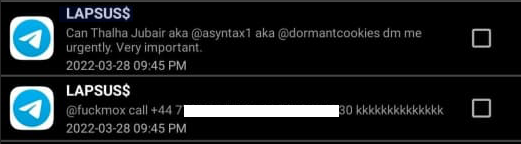
The vast majority of noteworthy activity documented in these private chats takes place between White and Amtrak, but it doesn’t seem that White counted Amtrak or any of his fellow LAPSUS$ members as friends or confidants. On the contrary, White generally behaved horribly toward everyone in the group, and he particularly seemed to enjoy abusing Amtrak (who somehow always came back for more).

Mox,” one of the LAPSUS$ members who shows up throughout these leaked chats, helped the group in their unsuccessful attempts to enroll their mobile devices with an airline in the Middle East to which they had purchased access. Audio recordings leaked from the group’s private Telegram channel include a call wherein Mox can be heard speaking fluently in Arabic and impersonating an airline employee.

At one point, Mox’s first name briefly shows up in a video he made and shared with the group, and Mox mentions that he lives in the United States. White then begins trying to find and leak Mox’s real-life identity.

When Mox declares he’s so scared he wants to delete his iCloud account, White suggests he can get Mox’s real name, precise location and other information by making a fraudulent “emergency data request” (EDR) to Apple, in which they use a hacked police department email account to request emergency access to subscriber information under the claim that the request can’t wait for a warrant because someone’s life is on the line.
White was no stranger to fake EDRs. White was a founding member of a cybercriminal group called “Recursion Team,” which existed between 2020 and 2021. This group mostly specialized in SIM swapping targets of interest and participating in “swatting” attacks, wherein fake bomb threats, hostage situations and other violent scenarios are phoned in to police as part of a scheme to trick them into visiting potentially deadly force on a target’s address.
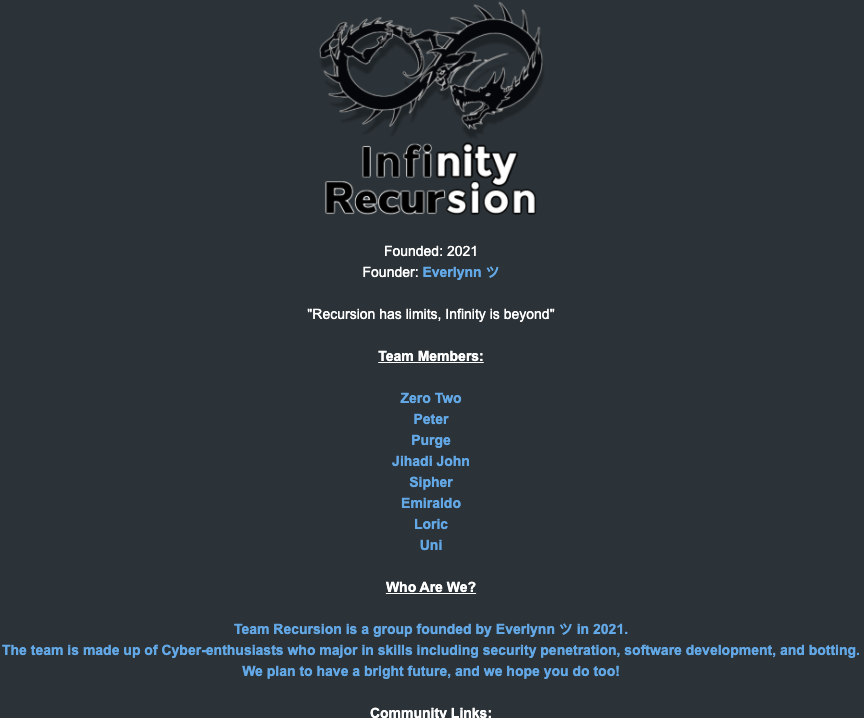
The roster of the now-defunct “Infinity Recursion” hacking team, from which some members of LAPSUS$ hail.

The Recursion Team was founded by a then 14-year-old from the United Kingdom who used the handle “Everlynn.” On April 5, 2021, Everlynn posted a new sales thread to the cybercrime forum cracked[.]to titled, “Warrant/subpoena service (get law enforcement data from any service).” The price: $100 to $250 per request.
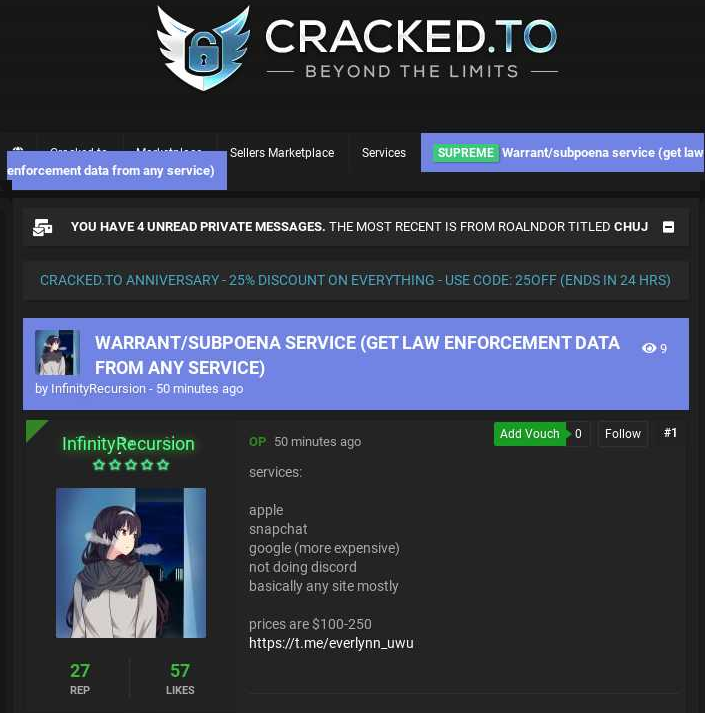
Everlynn advertising a warrant/subpoena service based on fake EDRs.

Bringing this full circle, it appears Amtrak/Asyntax is the same person as Everlynn. As part of the Recursion Team, White used the alias “Peter.” Several LAPSUS$ members quizzed White and Amtrak about whether authorities asked about Recursion Team during questioning. In several discussion threads, White’s “Lapsus Jobs” alias on Telegram answers “yes?” or “I’m here” when another member addresses him by Peter.

White dismissed his public doxing of both Amtrak and Mox as their fault for being sloppy with operational security, or by claiming that everyone already knew their real identities. Incredibly, just a few minutes after doxing Amtrak, White nonchalantly asks them for help in stealing source code from yet another victim firm — as if nothing had just happened between them. Amtrak seems soothed by this invitation, and agrees to help.

On Mar. 30, software consultancy giant Globant was forced to acknowledge a hack after LAPSUS$ published 70 gigabytes of data stolen from the company, including customers’ source code. While the Globant hack has been widely reported for weeks, the cause of the breach remained hidden in these chat logs: A stolen five-year-old access token for Globant’s network that still worked.
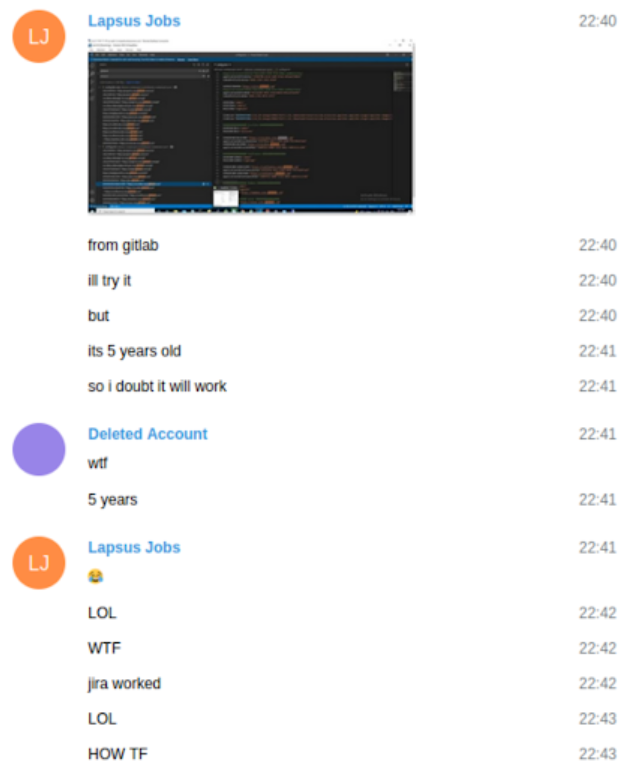
LAPSUS$ members marvel at a 5-year-old stolen authentication cookie still working when they use it against Globant to steal source code.

Globant lists a number of high-profile customers on its website, including the U.K. Metropolitan Police, software house Autodesk and gaming giant Electronic Arts. In March, KrebsOnSecurity showed how White was connected to the theft of 780 GB worth of source code from Electronic Arts last summer.

In that attack, the intruders reportedly gained access to EA’s data after purchasing authentication cookies for an EA Slack channel from the dark web marketplace “Genesis,” which offers more or less the same wares as the Russian Market.

One remarkable aspect of LAPSUS$ was that its members apparently decided not to personally download or store any data they stole from companies they hacked. They were all so paranoid of police raiding their homes that they assiduously kept everything “in the cloud.” That way, when investigators searched their devices, they would find no traces of the stolen information.

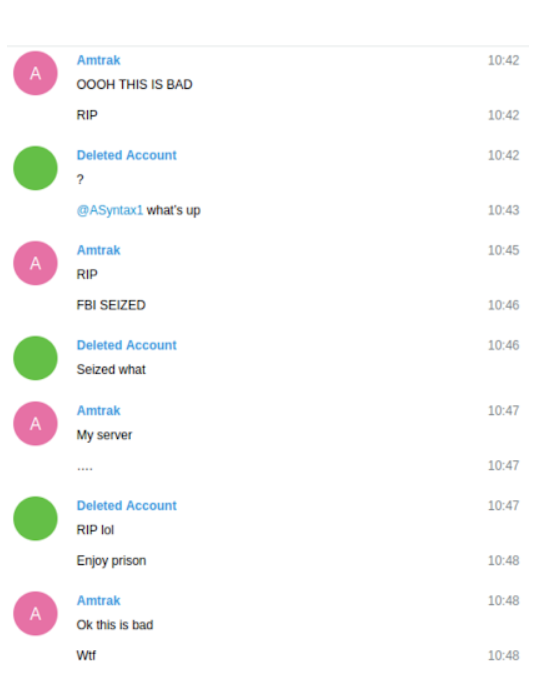
But this strategy ultimately backfired: Shortly before the private LAPSUS$ chat was terminated, the group learned it had just lost access to the Amazon AWS server it was using to store months of source code booty and other stolen data.

“RIP FBI seized my server,” Amtrak wrote. “So much illegal shit. It’s filled with illegal shit.”
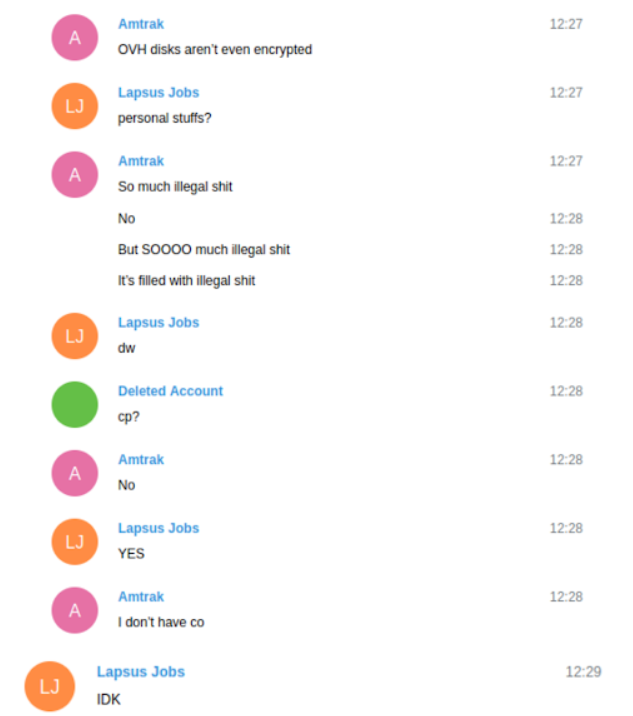
White shrugs it off with the dismissive comment, “U can’t do anything about ur server seized.” Then Amtrak replies that they never made a backup of the server.

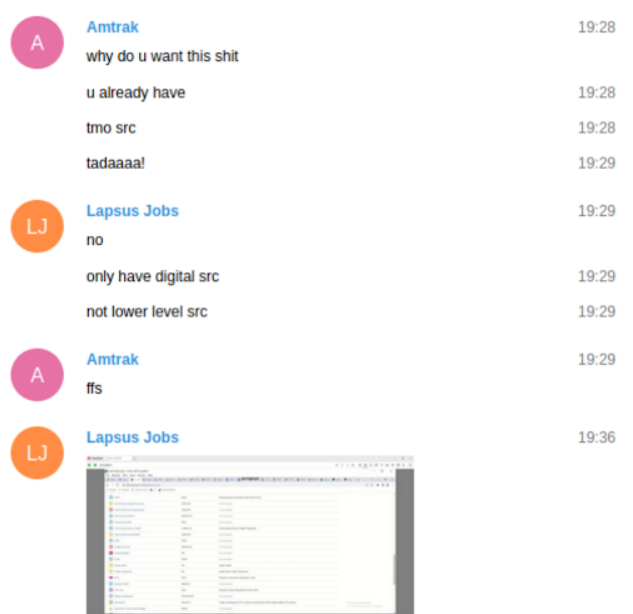
“FFS, THAT AWS HAD TMO SRC [T-Mobile source] code!” White yelled back.

The two then make a mad scramble to hack back into T-Mobile and re-download the stolen source code. But that effort ultimately failed after T-Mobile’s systems revoked the access token they were using to raid the company’s source code stash.

“How they noticed?” Amtrak asked White.

“Gitlab auto-revoked, likely,” White replied. “Cloning 30k repos four times in 24 hours isn’t very normal.”

Ah, the irony of a criminal hacking group that specializes in stealing and deleting data having their stolen data deleted.

It’s remarkable how often LAPSUS$ was able to pay a few dollars to buy access to some hacked machine at a company they wanted to break into, and then successfully parlay that into the theft of source code and other sensitive information.

What’s even more remarkable is that anyone can access dark web bot shops like Russian Market and Genesis, which means larger companies probably should be paying someone to regularly scrape these criminal bot services, even buying back their own employee credentials to take those vulnerable systems off the market. Because that’s probably the simplest and cheapest incident response money can buy.

The Genesis bot shop.
22 Apr 01:22

Microsoft Is Disabling SMB1 File-Sharing Protocol in Windows 11 Home

by msmash
joshuark shares a report: Microsoft's Windows 10 operating system already disables by default SMB (Server Message Block) version 1, the 30-year-old file-sharing protocol. Now the company is doing the same with Windows 11 Home Dev Channel test builds, announced officials on April 19. SMB1 is considered outdated and not secure. However, some users with very old equipment may be in for a surprise if their Windows 11 laptops can't connect to an old networked hard drive, as officials said in a blog post about the SMB1 phase out plan. "There is no edition of Windows 11 Insider that has any part of SMB1 enabled by default anymore. At the next major release of Windows 11, that will be the default behavior as well," said Ned Pyle, Principal Program Manager. "Like always, this doesn't affect in-place upgrades of machines where you were already using SMB1. SMB1 is not gone here, an admin can still intentionally reinstall it," Pyle added.

Read more of this story at Slashdot.