Earlier today, AMD announced its Ryzen 7000 Desktop CPUs based on the 5nm Zen 4 architecture. The new processors deliver a rather decent 'greater than 15% performance improvement over its predecessors but many AMD fans find that to be not as impressive based on all the rumors & leaks regarding the chips. So how much fast is Ryzen 7000 expected to be & could the red team yet again jebait us with much higher performance than what's currently been demonstrated?
AMD Ryzen 7000 CPU Performance Should Not Be Considered Lackluster, Greater Than 15% Uplift Was Achieved With Pre-Production Samples
AMD showcased three performance aspects of its next-gen Ryzen 7000 Desktop CPU. We saw the clocks, we saw performance versus Intel's fastest Alder Lake CPU, we got some info regarding the single-threaded performance figures and all of these figures were from a pre-production 16-core chip. We don't have a name for this chip yet but it's going to succeed the Ryzen 9 5950X 'Zen 3' & offer higher clocks.
First of all, according to Ian Cutress of TechTechPotato, the TDP (Thermal Dissipation Power) figures for AMD Ryzen 7000 CPUs are going to be 125W while the PPT (Package Power Tracking) is going to be 170W. AMD provided this information in a reply to whether the 170W figure was an actual TDP for the upcoming chips or an upper-bound limit for the package. Despite AMD confirming during its Q/A session that the 170W figure was the PPT that the AM5 (LGA 1718 socket) can sustain, they still showed 170W as a 'TDP' figure. This might be due to miscommunication between AMD marketing & technical teams.
Moving on, the TDP figures were the most important and generally, AMD used to be very proud of showcasing them during live demos. This time, however, AMD decided to keep them hidden which is weird but since we are talking pre-production samples, AMD might have decided to keep them under wraps till the final silicon is produced. That's where the clocks come in too!
AMD showcased some insanely fast frequencies with the same Ryzen 7000 CPU sample hitting up to 5.52 GHz but we did see some variation in the clock speeds which started at 5.1 GHz and went up to the max 5.52 GHz speed which everyone is talking about. Once again, we weren't told if the chip was running at stock clocks or if some new PBO or XFR technology was pushing the chip this hard. We all remember the infamous chiller demo of Intel's Skylake-X that was used to demo its impressive frequencies for the time. Now I am not saying that AMD was using a chiller and they could've used the same ASETEK 280mm radiator that's been used throughout the pre-production chip tests but still, a word on temperatures or cooling would've been nice too.
These are small details that make up a bigger part. So coming to the next part, we have to talk about the Blender demo. Blender is one application where AMD has a strong foothold. AMD's Ryzen 9 5950X is about 15-20% faster in the same benchmark versus the Intel Core i9-12900K. During the demo, AMD stated that the Ryzen 7000 Desktop CPU was 31% faster than 12900K. What's not told is that in the footnotes, the difference is larger with AMD finishing the render in a total of 204 seconds while the Alder Lake CPU finishes the demo in 297 seconds. In reality, the Ryzen 7000 CPU took 31% less time or offered 45% faster performance than the competing chip.
RPL-003: Testing as of May 5, 2022, by AMD Performance Labs using pre-production silicon and performance projections for final products which are subject to change when released on market. Render time measured in seconds to complete and AMD Ryzen 7000 series processor wallpaper render. AMD Time: 204 seconds, Intel time: 297 seconds. Lower score is better. Core i9-12900K System: ASUS ROG Maximus Z690 HERO, 2x16 DDR5-6000CL30. AMD Ryzen 7000 series (pre-production 16-core): AMD Reference X670 Motherboards, 2x16GB DDR5-6400CL32. All systems configured with Radeon RX 6950 XT (driver:22.10 PRIME), Windows 11 Build 22000.593, Samsung 980 PRO 1TB, Asetek 280MM Liquid cooler. Results may vary.
The marketing team could've really used the 45% number against the Intel Core i9-12900K but it looks like AMD is still sandbagging its own CPUs for some reason unknown. Then we have the 15% performance uplift gain. This gain isn't IPC, but it's in fact a combination of both the IPC and clock speeds that gives us the greater than 15% single-threaded performance number, as Robert Hallock has stated. This means that the IPC in general isn't as big as expected and could end up being in the single-digit range (9-10%). The clocks and the rehauling of the architecture are what are going to provide the major performance uplifts.
AMD Ryzen 7000 16-Core Desktop CPU 'Blender' Performance Demo:
AMD does use the word 'Greater' here but it shouldn't be over 20% as AMD could have used that instead of the 15% claim instead to make it sound better. However, the actual number could lay between 15-19% and 19% would be the best possible scenario so expect 16-17% to be a more realistic number.
Even if 15% was a concrete number then this would be better than anything that Intel used to cook up back in the days when it was stuck with its 14nm process node but this isn't the same ground for competing anymore. Intel's offerings have been just as disruptive as AMD's starting Alder Lake and Raptor Lake is a big threat for Zen 4 now more than ever so the red team is going to be very considerate about revealing the full potential of their chips to their adversary who will also have their own next-gen chips available at the same time.
But again, this number can change and AMD has moved its performance projections up in the past too. We are talking about a Fall 2022 launch which means September at the earliest for the Ryzen 7000 CPUs. That's still 5-6 months worth of wait and lots of time for improvements & optimizations. All of these performance numbers are just claims for now and AMD can only go up from here. We are almost sure that AMD will go silent for a while now and come back a few months later with a few surprises in its pockets.
One surprise could be jebaiting the whole tech world with a far better show-case of its Ryzen 7000 Desktop CPUs than what was delivered today. We will keep our hopes up and would ask everyone to wait for the final CPUs to be announced. With that said, we would like to hear what you thought about the performance claims and clock numbers AMD showcased during its Computex 2022 keynote in the comments below!
Addition AMD Ryzen 7000 Desktop CPU Test Footnotes:
Testing as of May 5, 2022, by AMD Performance Labs. Single-thread performance evaluated with Cinebench R23 1T. AMD Ryzen 9 5950X System: ASUS ROG Crosshair VIII Hero X570, 2x8 DDR4-3600C16. AMD Ryzen 7000 Series: AMD Reference X670 Motherboard, 16-core pre-production processor sample, 2x16GB DDR5-6000CL30. All systems configured with Radeon RX 6950XT GPU (driver: 22.10 Prime), Windows 11 Build 22000.593, Samsung 980 Pro 1TB SSD, Asetek 280MM liquid cooler. Results may vary. RPL-001
Max boost for AMD Ryzen processors is the maximum frequency achievable by a single core on the processor running a bursty single-threaded workload. Max boost will vary based on several factors, including, but not limited to: thermal paste; system cooling; motherboard design and BIOS; the latest AMD chipset driver; and the latest OS updates. GD-150.
AMD’s product warranty does not cover damages caused by overclocking, even when overclocking is enabled via AMD hardware and/or software. GD-26.
Testing as of May 5, 2022, by AMD Performance Labs using pre-production silicon and performance projections for final products which are subject to change when released in market. Sequential/sustained disk throughput measured with CrystalDiskMark. AMD Ryzen 7000 Series: AMD Reference X670 Motherboard, 16-core AMD Ryzen 7000 Series pre-production sample, 2x16GB DDR5-6000CL30, PCIe® Gen 5 prototype SSD versus Phison E18+ PCIe® Gen 4 SSD, Radeon RX 6950XT (driver: 22.10 Prime), Windows 11 Build 22000.593, Asetek 280MM liquid cooler. Results may vary and/or are subject to change as the storage ecosystem develops and final products are available. RPL-002
Ubisoft has announced that Title Update 1.5.2 for Assassin’s Creed Valhalla will release tomorrow. This patch is 7GB in size on PC, and below you can find its complete changelog. According to the French company, Patch 1.5.2 adds the Armory building and loadout feature to the game, as well as new rewards to River Raids. … Continue reading Assassin’s Creed Valhalla Title Update 1.5.2 is 7GB on PC, full patch notes →
"Prisoners" marked the English-language crossover of Denis Villeneuve, the director of "Sicario" and sci-fi heir apparent to Ridley Scott (with films such as "Arrival," "Blade Runner 2049," and "Dune"). Though Villeneuve actually shot another warm-up film with Jake Gyllenhaal — the spidery doppelgänger thriller "Enemy" — before "Prisoners," its release would come after, meaning that "Prisoners" would be the first introduction to many stateside audiences for Villeneuve's work -- unless they were already versed in his earlier French-language movies like "Incendies."
Whereas "Enemy" and "Sicario" are the length of standard movies, clocking in at 90 and 121 minutes, respectively, "Prisoners" is a longer film with a 153-minute runtime. Though it's still operating in thriller mode, the thrills are more drawn out amid the dark drama of two families dealing with the abduction of their girls. "Prisoners" was Villeneuve's first collaboration with both the late composer Jóhann Jóhannsson and director of photography Roger Deakins (who earned an Academy Award nomination for his cinematography), and it saw him working with a top-shelf cast, including Hugh Jackman, Jake Gyllenhaal, Viola Davis, Maria Bello, Terrence Howard, Melissa Leo, Paul Dano, Dylan Minnette, and David Dastmalchian.
"Prisoners" ends on a note that gives resolution to plot and characters arcs but also leaves the viewer to imagine what will happen next. If you hear a whistle blowing, that indicates spoilers, as we're about to delve into those and discuss the ending of Denis Villeneuve's "Prisoners."
Patient And Penitent In Affliction
"Prisoners" begins with a hunting scene, as Jackman's character, Keller Dover, recites the Lord's Prayer and his son Ralph, played by Minnette, trains a rifle on a deer. Dover is a religious man: he wears a cross around his neck and has one hanging from the rearview mirror in his truck. He says the most important thing his own father taught him was to be ready, and we'll see later that his basement is overstocked with emergency supplies, as if he wants to be especially well-prepared for judgment day coming like the proverbial "thief in the night" of scripture.
Despite this, Kellar is not at all prepared for what happens when his daughter goes missing.
In an interview with Go into the Story, "Prisoners" screenwriter Aaron Guzikowski discussed how Kellar's outwardly God-fearing nature and the "connections to Catholic iconography and Bible stories" in the movie and his overall writing stem from his upbringing. While not a practicing Catholic, Guzikowski draped "Prisoners" in some religious trappings that inform Keller's arc and the movie's ending.
After Kellar's daughter, Anna (Erin Gerasimovich), disappears, and suspicion falls on the mentally handicapped Alex Jones (Dano's character, not the controversial real-life radio host), we see Kellar take the law into his own hands, essentially playing God in the name of being a protective parent. At one point, we hear a preacher's voice on Kellar's car stereo talk about being "patient and penitent in affliction," but Kellar is having none of that. He becomes convinced that Alex knows something about where his daughter is. He's not entirely wrong about that, but he goes to extreme lengths to extract information from a man with the mental capacity of a 10-year-old.
As We Forgive Those Who Trespass Against Us
Ralph had spotted Alex's RV in the neighborhood before his sister and Kellar's daughter went missing, and the girls had been playing on it, which is what partially led Detective Loki (Gyllenhaal) and the police to arrest Alex and interrogate him. However, they could find no physical evidence of Anna having ever been in the RV.
As Alex is being let go, Kellar attacks him outside the police station. Later, after Kellar sees Alex being cruel to a dog and singing the "Batman smells" version of "Jingle Bells" (which Anna had been singing the day she disappeared), he kidnaps him and keeps him captive in his vacant house so he can conduct his own brutal interrogations.
Kellar involves the Birches, Franklin and Nancy (Howard and Davis), in his vigilantism since their daughter, Anna's playmate, Joy (Kyla-Drew Simmons) has also gone missing with Anna. Outside the police station, Kellar heard Alex say, "They didn't cry until I left them," thus implying that Alex knows something about where the girls are.
Franklin confronts Kellar with the question, "What if you're wrong? What if you only heard what you wanted to hear?" But Alex has his own justifications for the violence and torture he inflicts on Alex. His rationale, which he explains to Franklin, is, "He's not a person anymore. He stopped being a person when he took our daughters." Dehumanizing his prisoner goes against his own religion, however, and as he recites the Lord's Prayer again later in the movie, it's no longer so comfortable for Kellar to speak the "as we forgive those who trespass against us" part.
Snakes Unlocked
In "Prisoners," Leo's character, Holly Jones, is supposed to be Alex's aunt. She says his parents died in a car accident, and her own husband walked out on her one day and never came back. However, when Loki is investigating another suspect, Father Dunn (Len Cariou), he finds a corpse in the cellar, and this corpse belongs to a man with a maze necklace that matches the one Holly's husband is wearing in an old photo.
This also connects the man to Bob Taylor (Dastmalchian), another suspect whose house holds many map drawings and locked containers full of live snakes and bloody children's clothes. Dunn told Loki that the dead man, Mr. Jones, was waging a war against God, and we eventually learn that he and Holly were doing it together after their son died of cancer.
When Kellar goes to confront Holly at her house, she tells him that she and her husband used to spend their summers driving around in a camper, "handing out pamphlets, spreading the good word." The loss of their son turned them against God, and they started making children disappear to make people "lose their faith" and "turn them into demons" like Kellar.
Alex, as it turns out, is the very first child that Holly and her husband abducted, all grown up now. He himself is a victim who had his emotional growth stunted by trauma at an early age. Bob was their second victim, and it left him similarly troubled, to the point where he winds up shooting himself after getting his hands on an officer's gun while in police custody.
Doing The Lord's Work
In his zeal to find his daughter, Kellar unwittingly continued the cycle of abuse, hurting someone who "never laid a hand on his daughter." "Prisoners" almost seems to be headed for an ending like "The Vanishing" at first, as Holly holds Kellar at gunpoint, telling him to imbibe a drug if he wants to see his daughter again. In the end, it's Loki who saves the girls, while Kellar is left trapped below ground under a car in Holly's yard.
Though Loki's name links him to a mythological trickster of Norse mythology (namesake of the well-known Marvel character), that in and of itself may be a red herring. Loki, not Kellar, is the real hero of "Prisoners."
When we first meet Loki, he's eating alone in a Chinese restaurant on Thanksgiving. He has a nervous tic that causes him to blink a certain way, and when he's questioning Father Dunn, a registered sex offender, he reveals that he spent time at Huntington Boys Home, a place implied to have its own abusive history.
Loki has overcome the victimization loop to become one of the good guys. Rather than visiting the wrongs that were done to him on other people, he's doing the actual Lord's work, trying to help others. At the end, Alex is reunited with his family after 26 years, and Kellar is left calling for help, blowing the missing whistle that Anna and Joy went off to find in the first place. That whistle set in motion the plot of "Prisoners," so it's fitting that it brings the movie to a close. And though we don't see it, we can imagine that the sound of it will help Loki unearth Kellar after the film has faded to black.
So spoke Mark Watney (Matt Damon), the title character in Ridley Scott's 2015 film "The Martian," easily one of the best films of its year. Written by Drew Goddard after the novel by Andy Weir, the film had a pretty simple thesis: Science, knowledge, and engineering know-how were not just superpowers, but could be the stuff of ripping entertainment. Most importantly, "The Martian" reveals that our most human quality — our good humor — will be our most vital survival tool. The film is gloriously propulsive and infectiously funny, despite being a desperate story of a man stranded on the surface of Mars.
Watney, the mission's botanist, is left behind after a sandstorm forces his astronaut companions to leave, and he has to find ways to extend his air and water supply in his temporary habitat, grow food in the Martian dirt (he grows potatoes using the crew's own manure), and move about the planet's surface salvaging what supplies he can from other Martian missions (the film takes place in the near future, when such missions are common). It helps to have music, though woe to Watney for only having a playlist of 1970s disco hits to keep him company.
If you're wondering how he eats and breathes and other science facts, then know NASA has that well in hand. Much of "The Martian" was based on real tech currently used or in development for actual space travel.
HERA
A trip to Mars would take many months, and any astronauts traveling there would have to learn to survive in an enclosed habitat — referred to as the Hab in "The Martian." NASA's current experimental habitat for potential use on the Martian surface is called the HERA (Human Exploration Research Analogue). Compared to the Hab in the movie, the HERA facility is an enormous hotel, featuring two floors(!), living quarters, a shower (it's called a hygiene module), and a greenhouse for growing food.
While living on the module for weeks at a time, astronauts in training are not allowed outside (natch), and they have to complete the same mission tasks they would while on another planet. The HERA habitat has already been used for research related to the International Space Station, and it's useful not just for practical reasons (supply levels, ergonomics, etc.), but for behavioral ones as well. The psychology of being bound inside a small module on a distant planet for an extended period may take a toll on mental health, and living in the facility would gauge that. One would hope the astronauts would be given more music than a mere disco playlist.
Food And Water
A mission to Mars could only bring so much food. Every pound on a space shuttle needs to be calculated and paid for, and the lighter one can make their mission, the better. Given that a Mars trip would take months, food would need to be produced on the planet's surface out of necessity. This means gardening (and no, NASA is not sending livestock to Mars). As mentioned above, Watney's food supply in "The Martian" was constructed with reclaimed water, potato seeds, and human waste. Not a great diet, but doable for the desperate situation.
The ISS currently has a system in place called Veggie, a system where small plants are grown inside miniature "pillows" full of dirt and fertilizer and that produces edible plants on a limited basis. Veggie proved successful in 2014, though citizens on the ISS still rely on deliveries from Earth for most of their provisions. This isn't yet enough to feed a cadre of astronauts, but it's a darn promising start.
Water is a trickier problem, as liquids behave much differently in low gravity than they do on Earth, and transporting a lot of them to Mars would be difficult and heavy. Culling drinkable water from the planet is also a bugaboo, as NASA missions have revealed only small deposits of ice and trace water vapor in the Martian atmosphere, and it's hard to tell how useful it might be to an astronaut. The ice at the Martian poles is mixed with frozen CO2, making it unpalatable. Recycling human waste seems like the obvious answer, and NASA is working on complex filtration to make that happen.
Air And Breathing In A Spacesuit
Air is easier to produce than you might think, and the ISS already has a pretty efficient system in place for generating breathable air called the Oxygen Generation System. Using electrolysis, the ISS can split water molecules into their base atoms (hydrogen and oxygen), releasing the breathable particles into the atmosphere, and shooting the hydrogen out into space. Some of the hydrogen is salvaged by something called the Sabatier system, which can fuse the carbon dioxide molecules breathed out by the astronauts with the rogue hydrogen produced by electrolysis and make water.
The most prominent feature seen in "The Martian" is Watney's spacesuit, and NASA scientists have been working for years to find just the right balance of cloth and hard elements to balance protection with durability and comfort. NASA knows there is not going to be one universal spacesuit that will function for every job, so several versions would be needed. The current prototype of Martian spacesuit is called the Z-2, and it looks like something from a 1950s sci-fi movie. Which is cool. Next on the design docket is a spacesuit that can be left outside to avoid tracking Martian dust into the habitat.
Ion Propulsion
In "The Martian," the central ship, the Ares 3, talks a lot about getting to Mars on ion propulsion. "Ion propulsion" may sound like a "Star Trek" conceit, but it is, in fact, a real way a ship can travel. Ions, as we all remember from fourth grade science class, are electrically charged particles, and in an ion propulsion engine, molecules of argon or xenon are charged, with the charged elements squeezed out the back boosters as enormous speeds. According to NASA, close to 200,000 mph. That sounds like a lot, but it's actually a very gentle push. Like "a gentle breeze," in NASA's words.
However, given that the trip to Mars is 140 million miles, and acceleration can only increase over the course of the journey, such a breeze is all that would be needed to eventually get a spacecraft up to enormously fast speeds. What's more, a gentle "push" from an ion engine would be an ideal way to steer a craft without expending a lot of energy. The spacecraft Dawn used ion propulsion continuously for years to eventually orbit dwarf planet Ceres, located between Mars and Jupiter.
While "The Martian" is not science fact, it's a kind of hard science fiction that is exhilarating to watch, and give viewers hope that humanity — with its know-how and ability to smirk — will persist in a positive direction.
"Stranger Things 4" doesn't have an original thought in its head, and I say that in the most friendly way possible. I am not mocking the show for its unoriginality; I am merely stating it as fact. Indeed, I'd argue that if you pressed creators The Duffer Brothers on this, they'd freely concede that yes, the latest season of the big Netflix hit is probably the most derivative yet. It's also entertaining as hell; a summer blockbuster dressed up as an action-packed TV series. Everything is bigger this season; it's a sprawling, globe-trotting adventure that is constantly cutting between a huge cast of characters. And everything unfolding here feels both wildly exciting and eye-rollingly familiar. "Stranger Things" has always been about wearing its influences on its sleeve. Indeed, that's part of the show's power. Its frequent familiarity makes it feel more lived-in than it really is. By drawing on ideas and concepts solidified by folks like Stephen King and Steven Spielberg, "Stranger Things" is playing with, and preying on, our nostalgia.
Once again, "Stranger Things" freely pulls from Spielberg and King, while also throwing in plenty of other references — or rip-offs, if you want to be crude — from other '80s (and sometimes '90s) pop entertainment. Wes Craven's "A Nightmare on Elm Street" is the biggest influence on the season, and the show doesn't even try to hide it. They have a character flat-out reference the film, and Freddy Krueger himself, Robert Englund, makes a cameo appearance. But the "Nightmare"-influenced story is just one part of a somewhat exhausting season. There are many balls up in the air here, and it's to the credit of the Duffers and their team that the show skillfully juggles them all with very few stumbles. Yes, we've seen almost all of what's happening here before in some other form, but darn it, it's still fun to watch. There's a breathlessness to the pacing as the season jumps around to various places and various groups of characters, all of whom are connected in one way or another.
When we last left the show, super-powered Eleven (Millie Bobby Brown) had saved the day yet again, and lost her powers in the process. Her surrogate father Jim Hopper (David Harbour) was believed to be dead, but by now everyone knows that's not true — Hopper is alive, as the promotional material for the season has made abundantly clear. But he's in pretty bad shape, locked away in a Russian prison. Without someone to take care of her, Eleven has left Hawkins, Indiana, and moved to California with Joyce Byers (Winona Ryder), who is also mourning Hopper, and her sons Will (Noah Schnapp) and Jonathan (Charlie Heaton). Back in Hawkins, Eleven's boyfriend Mike (Finn Wolfhard) is now in high school with his friends Dustin (Gaten Matarazzo) and Lucas (Caleb McLaughlin). But the once tight-knit gang of friends has splintered a bit. Lucas is now on the basketball team and palling around with the popular kids. Mike and Dustin, meanwhile, have joined a new D&D group led by opinionated weirdo Eddie Munson (Joseph Quinn). Lucas has also drifted away from his former girlfriend, Max (Sadie Sink), who is going through a bout of major depression following the death of her troubled stepbrother Billy. Then there's Mike's older sister Nancy (Natalia Dyer), who feels herself growing apart from Jonathan, her boyfriend. And of course, babysitter and man of great hair Steve (Joe Keery) is still hanging around Hawkins, now with his constant (platonic) companion Robin (Maya Hawke).
Of course, since this is "Stranger Things," strange(r) things begin to happen pretty quickly. Folks in Hawkins just can't catch a break. There's a new monster in town, the creepy Vecna, who is targeting teens in very Freddy Krueger-like ways.
A Support Group For People Who Experience The Supernatural
Rather than stay firmly within Hawkins, "Stranger Things 4" gets to explore new locations. As a result, several different plot threads unfold. There's the scary stuff going on in Hawkins. Then there's Eleven dealing with her loss of powers in California while being bullied by some of the most sadistic high school kids in history. And then there's also the plotline involving Hopper in Russia, and the plan for Joyce and her new side-kick Murray (Brett Gelman) to hopefully rescue him. It's a lot to take in, and the show knows it. So much so that every episode this season is super-sized; not a single episode clocks in under an hour. You'd think longer episodes would give these many threads room to breathe, but "Stranger Things 4" is overloaded to exhaustion. We'll cut from one scene in Hawkins to another scene in Russia to another scene somewhere else, and then back again. It can get dizzying.
A lack of originality should sink this season, especially with so much going on. And yet, I found myself thrilled by the break-neck speed at which the show throws one giant, lightning-paced scene after another our way. The characters almost never sit still; they're forever running, biking, fighting, or screaming. I imagine if events of this magnitude were really happening to a group of kids they'd all be certifiably insane by now, but these kids have been down this road before. They've butted heads with the supernatural three times already, so in some ways, all the madness of this season is business as usual.
The original core group remains strong, although once again, the series sequesters Brown away from most of her co-stars. And yes, they all look older now, and at first, it's a little jarring to see these kids look so, well, grown-up. But that fades pretty quickly as we get swept up in the adventure. Harbour remains the show's MVP, and he goes through serious hell this season. But "Stranger Things" also has a knack for giving us new characters who don't seem out of place. Sink's Max felt a little off during her first season (season 2), but by season 3 she was an essential member of the team, and gets even more to do this season. Last season gave us Hawke's Robin, who became a fan favorite from the jump, similar to the way Lucas' hilarious, no-nonsense little sister Erica (Priah Ferguson) became a major character after a few scene-stealing moments. This time, we have new players like Eddie, the D&D group leader who seems completely obnoxious during his first scene, only to be revealed as a charming, funny guy. We also meet Argyle (Eduardo Franco). Franco's performance is funny, but the writing turns him into little more than Comic Relief Stoner Guy.
What connects all these characters is their chance encounters with things that go bump in the night. In a way, the show has become a story about a support group for people who experience the supernatural. Every time a new season unleashes some new horror, the circle grows, with new members inducted into the club via their proximity to the weird and unexplained. And that's part of the show's charm, too — that all these outcasts and weirdos have found each other in the midst of all this chaos.
A Summer Blockbuster
You could shrug all of this off by saying "Stranger Things 4" does little more than play the hits. And that's true; familiarity is essential to the show's DNA. And yet, it never feels tired or overdone. There's no sense of "Been there, done that." Yes, we've come across the thrills and chills here before in other forms, but that doesn't mean they don't still maintain their power. It helps that the cast is so charismatic, and the filmmaking is often so surprisingly strong — there's even a big one-take action scene thrown in, with characters scrambling through gunfire, that feels genuinely exciting and scary.
The longer episodes never feel bloated, and the series actually has a little fun playing with our expectations. We're so trained to feel a show's runtime without looking at our watches, and when something big happens and then the screen cuts to black, that usually means the episode has ended. In a neat bit of trickery, "Stranger Things 4" fakes us out more than once. When an hour has gone by and we expect an episode to end, some big, crazy moment will happen and then the screen will indeed cut to black. "Ah, it's over!" we think — only for the show to then cut to a completely new scene, revealing that the episode isn't over after all.
As fun as this all is, you can still see through the facade and spot the cracks in the foundation. The show takes a lot of lazy shortcuts, such as having characters instantly draw the correct conclusions in order to move on to the next scene as quickly as possible. And while suspension of disbelief is essential for a show like this that deals with the inexplicable, there are more than a few explanations here that don't hold water. On top of that, there are countless scenes set in dark locations that are nearly impossible to see. I know dark and shadowy spots are baked into a show of this nature, but damn it, we should still be able to see what's happening on the screen.
None of this is enough to sink the show, though. "Stranger Things 4" is hitting familiar notes, but they still sound great. The series is a fine-tuned machine by now, designed to deliver a maximum amount of entertainment dressed up in the clothing of nostalgia. Season 4 will not convert anyone who has already given up on the show, but those still invested in the misadventures of the kids from Hawkins are going to have a blast. They used to play big, loud, sweet, fun entertainment like this at the multiplex on hot summer days, but now we'll have to settle for Netflix.
"Stranger Things 4" hits Netflix on May 27, 2022. Two additional final episodes will follow on July 1, 2022.
It was recently pointed out to me that a simple “hello world” style application built with Open Watcom C/C++ 1.9 does not run on Win32s version 1.30, even though the same executable runs just fine on Windows NT 3.51, Windows 95, or Windows 10.
More specifically, the program crashes rather early on Win32s. With the help of map files and source code, I established that the crash occurs in an internal function called __setenvp, which tries to dereference a null pointer stored in an internal variable _RWD_Envptr.
The _RWD_Envptr variable is filled in by the GetEnvironmentStrings API in the C runtime startup code. The GetEnvironmentStrings API call ends up importing GetEnvironmentStringsA from KERNEL32.DLL. And clearly GetEnvironmentStringsA is failing on Win32s, although it works just fine on NT and Win9x.
Further probing revealed that the GetEnvironmentStrings API has curious history. On Windows NT 3.1, there was only GetEnvironmentStrings (no A or W suffix). On all later Win32 implementations, starting with NT 3.5, there’s GetEnvironmentStringsA and GetEnvironmentStringsW, as well as FreeEnvironmentStringsA and FreeEnvironmentStringsW.
On NT 3.1, there was no FreeEnvironmentStrings, presumably because GetEnvironmentStrings returned a pointer to existing memory that couldn’t be freed (and would be freed at process termination anyway). On NT 3.5, GetEnvironmentStringsA converts the strings provided by GetEnvironmentStringsW and allocates memory for the converted strings, so there is something to free.
A quick experiment with Microsoft Visual Studio 4.0 showed that a test application does run on Win32s; reading MSVC 4.0 runtime source code also revealed that Microsoft calls GetEnvironmentStringsA and immediately terminates the process if GetEnvironmentStringsA fails. So… how can that work on Win32s?
Examining the EXE file produced by MSVC 4.0 revealed that it imports GetEnvironmentStrings and notGetEnvironmentStringsA. Changing the Open Watcom kernel32.lib import library to make GetEnvironmentStringsA an alias of GetEnvironmentStrings made the application work on Win32s. But why?
A closer look at W32SCOMB.DLL shipped with Win32s showed the cause of the odd Win32s behavior. Although W32SCOMB.DLL exports all of GetEnvironmentStrings, GetEnvironmentStringsA, and GetEnvironmentStringsW, the latter two are stubs which always fail, and only GetEnvironmentStrings with no suffix actually does something useful. That seems like a bug in Win32s—GetEnvironmentStringsA should have been an alias of GetEnvironmentStrings.
The mess was most likely caused by a design defect in Windows NT 3.1. The plain GetEnvironmentStrings function probably should never have existed, only GetEnvironmentStringsA and GetEnvironmentStringsW, as is the case with other APIs. Windows NT 3.5 corrected the oversight, but its KERNEL32.DLL still had to export the suffix-free GetEnvironmentStrings—otherwise almost all existing applications would have been broken.
Win32s tracked the development of Windows NT, therefore it implemented GetEnvironmentStrings, and initially only that. Win32s version 1.20 (1994) added GetEnvironmentStringsA and GetEnvironmentStringsW, but only as dummies. As mentioned above, making GetEnvironmentStringsA always fail was arguably wrong… but wasn’t noticed because Microsoft’s programs did not use GetEnvironmentStringsA.
At least up to and including MSVCRT40.DLL, Microsoft’s runtime DLLs only imported GetEnvironmentStrings. That also illustrates why any reasonable Win32 implementation needs to provide the GetEnvironmentStrings import and not just GetEnvironmentStringsA; if it didn’t, quite a few older applications would break because they need the suffix-free GetEnvironmentStrings.
Win32 SDK Details
As mentioned above, tweaking the kernel32.lib import library is one way to work around the problem with GetEnvironmentStringsA on Win32s. But that’s not what Microsoft’s SDK does.
Here is how WINBASE.H in the NT 3.5 SDK defined the then-new FreeEnvironmentStrings API:
That’s the usual way of dealing with Unicode APIs. Function prototypes have ‘A’ and ‘W’ suffix, and a suffix-less macro is defined to map to one or the other.
But that’s not how GetEnvironmentStrings was dealt with:
The non-Unicode function prototype has no suffix, and the macro is “backwards”, mapping the ‘A’ function to the suffix-less original. Thus when the Microsoft runtime calls GetEnvironmentStringsA, the compiler ends up generating a call to GetEnvironmentStrings instead. This oddity persists to the present day and even Windows 10 SDK headers handle GetEnvironmentStrings the same way.
Moral of the story? Changing operating system APIs is a messy business.
Contrary to those shouting loudly on the internet, Google Stadia isn’t dead. And as I’ve written previously, it’s really rather good. In fact, the last post I published on Stadia provoked a lot of great discussion about the platform. There’s plenty to love and enjoy, but there are legitimate concerns and areas that could be improved.
The Stadia team knows this and again, contrary to opinion in some corners of the internet, is working very hard on making the platform better. Among the comments and discussions that came out of that last post, though, one point stuck and got me thinking.
It comes down to the business model. Very few deny how good the technology of Stadia is but Google’s business model for it doesn’t sit right. For some, the idea of buying games that only live in the cloud doesn’t appeal to them. That plus Google’s penchant for canceling products over the years does not incite any particular confidence in consumers. I can’t say I’m not worried about this, because I am a little. Nobody really knows what would happen. But thinking deeper, this model was possibly the wrong path to begin with and I think for Stadia to have a brighter future, selling games should potentially be off the table.
Google Stadia is modeled like a traditional console
In the present day, Google Stadia and its games catalog are operated like any other games console or PC store. You rock up with your wallet, hand over some cash, and buy a game.
You can also pay a monthly fee for Stadia Pro which puts fresh titles in your library every month. Or so long as you remain a subscriber, it does. Stadia Pro is fantastic, with about 50 games players can claim at the time of writing. You don’t have that on PlayStation Plus or Xbox Games With Gold. Even the Epic Games Store and its weekly freebies fall behind on quantity.
Stadia should move to an entirely subscription-based platform
The way Stadia, accounts, and Pro have been handled since launch hasn’t been the slickest operation, but it’s in a good place now. You don’t actually need a Stadia account anymore for some basic features or even to play some of the demos. But I think the best thing Google could do is double down on Stadia Pro and stop selling games entirely.
Stadia should move to an entirely subscription-based platform like its cloud competitors. If people don’t need to fork over money to “own” the games they want to play, it could relieve some of the negativity and worry that Google pulls the plug someday.
Amazon, Microsoft, and NVIDIA all have a better model
When you look at the respective business models, you could make an argument Stadia’s model is the worst. That’s because the current main competition from Amazon, Microsoft, and NVIDIA, all operate on a subscription model. Just like you subscribe to Netflix and binge on your favorite shows, you can subscribe to their services and binge on your favorite games.
NVIDIA GeForce Now is a little different, in so much as you can only play games through it that you’ve purchased on other stores, including Steam, Epic, and Ubisoft. In this case, there’s as close to no risk as any subscription service because you’re basically just renting a powerful PC in the cloud to get your own stuff. But Microsoft has a subscription for the cloud with Game Pass and Amazon operates a subscription model with Luna.
Luna is particularly interesting as the pricing is split down more like a television package than anything else. When signed up, you can choose different ‘channels’ to subscribe to, alongside a free rotation for Amazon Prime subscribers. If you only want kid’s games, for example, you can subscribe to the family channel.
Microsoft bundles its cloud gaming offering into Game Pass Ultimate at the moment, though that is starting to loosen up with the arrival of Fortnite for all to play. It isn’t every game in Game Pass, but there’s a large catalog and of course, you don’t have to buy any games to play them through the cloud.
Each of these leans into the subscription model, whereas on Stadia it just feels like a bonus. A necessary bonus.
Google should consider moving Stadia to subscription-only
Some of the work has already been done. Stadia Pro has a huge library, and with over 100 games in my personal Stadia account, most can be attributed to being available through Pro. If you play on Stadia, you need to have Stadia Pro lest ye never truly get the best from the platform. Ubisoft+ is also available through Stadia, providing access to all the publisher’s available titles for a monthly fee.
It sucks that everything in life is moving to a subscription, but that’s apparently what both, the businesses and the masses want. Given the trepidation many have over buying games from Google with that nagging feeling in the back of their mind that one day the plug will be pulled, it seems like it could be a good idea.
Reshaping the business model could potentially make it an easier sell to publishers as well. Microsoft seems to be doing well with Game Pass after all. When you have a pool of subscribers, there’s already a captive audience for new games added. The current Stadia Pro subscription is really good value, unlocking regular ‘free’ titles as well as 4K and HDR gaming. A small increase in the monthly charge or adding additional tiers I think would go down well with existing players and certainly attract those who are on the fence because they don’t want to spend $60 on a game on Stadia.
Will this ever happen? Who knows. Google remains committed to Stadia for the foreseeable future, but how long will that last if the player numbers don’t meet expectations? The Stadia community is much larger than many give it credit for, but something probably needs to change fundamentally with how the platform is operated if it’s going to have a bright future. Be that an idea like this, offering a subscription plan alongside purchasing such as Game Pass offers or cheaper access but serving ads. There’s a lot that Google could do with Stadia. How would you change it?
It's hard to imagine, but at one point, Duke Nukem was one of the biggest video game properties on the planet. Looking at the series with modern eyes, Duke Nukem is a crass example of masculinity, replete with dated views of women and violence. — Read the rest
"62-year-old Val Kilmer was just 26 when he played Iceman in the 1986 movie Top Gun," remembers long-time Slashdot reader destinyland.
But in 2015 Kilmer lost his voice to throat cancer, remembers Parade:
In his 2020 memoir I'm Your Huckleberry, Kilmer joked that he has less of a frog in his throat and more of a "buffalo." He said, "Speaking, once my joy and lifeblood, has become an hourly struggle."
Kilmer has teamed up with Sonantic, a U.K.-based software firm that uses artificial intelligence to copy voices for actors and production studios, to replicate his speech, using old recordings of his voice and existing footage. Kilmer elaborates on the process of finding his voice again through AI in a video posted to YouTube in August 2021. In his new AI-enhanced voice, which does indeed emulate the speech audiences are familiar with, Kilmer says: "People around me struggle to understand me when I'm talking, but despite all that, I still feel I'm the exact same person, still the same creative soul. A soul that dreams ideas and stories constantly.
"But now I can express myself again, I can bring these dreams to you, and show you this part of myself once more. A part that was never truly gone, just hiding away."
Kilmer's health struggles, his childhood tragedies and his ambitious career were recently documented in the acclaimed 2021 feature-length doc Val, now streaming on Amazon Prime Video. Top Gun: Maverick screened at the Cannes Film Festival to rapturous reviews, with thunderous fanfare including an air show. Though reports say audiences gave the action picture (currently sitting at a 97% on Rotten Tomatoes) a five-minute standing ovation, with audible responses throughout the picture, mainly at the groundbreaking stunt work, it's also been reported an audience-favorite scene is the "overwhelming" emotional response to the reunion of Tom Cruise and Kilmer.
Researchers have found a new material for use in cutting-edge processors that can conduct heat 150% more productively, proclaims the Lawrence Berkeley National Laboratory. Heat development in processors is a significant issue for execution, and silicon can be excellent for insulating heat and hinder cooling. With new ultrathin silicon nanowire innovation applied, it is trusted that chips will become minimal, highly efficient, and remain cool from such a generally necessary change. The critical difference that has been tried is the utilization of isotopically decontaminated Silicon-28 (Si-28).
Can ultrathin silicon nanowire technology improve processor performance through better heat conduction?
Silicon is modest and plentiful yet an unfortunate conductor for heat. This issue is tiny computer chips with a considerable number of semiconductors timed at GHz speeds have plagued researchers for years. Regular silicon comprises three isotopes: silicon-28, silicon-29, and silicon-30. Silicon-28 is the most ordinarily bountiful, making up around 92% of standard silicon. In addition, it has for quite some time been realized that Si-28 is the best guide for heat conduction. Si-28 can lead to heat around 10% better than average silicon whenever cleansed. Notwithstanding, the benefit has been decided as not beneficial as of not long ago.
Lawrence Berkeley National Laboratory researchers used pure Si-28 to create ultrathin nanowires to promote better heat conduction. The results were 150% better through properly conducting heat, surprising as the expectation was only between ten to twenty percent improvement.
Electron microscopy demonstrated that the Si-28 nanowires had a more flawless glassy finish, allowing them to not suffer from poor phonon confusion and escape in raw silicon nanowire thermal transmission. Additionally, a natural layer of SiO2 is initiated upon the nanowires, maintaining the phonons to transport heat efficiently.
The team testing the effects of using ultrathin silicon nanowire technology would like to experiment with more control instead of measuring the heat conduction located in the nanowires. However, the researchers have difficulty obtaining materials as they are not in rich abundance.
The findings by the team do pose an exciting look into the future of semiconductor technology to find more use in consumer-level machines.
For the occasion of the Bethesda Publisher Sale, we asked a couple of our teammates at GOG about their favorite games from this publisher, and why they loved those titles, or what made them special to them. Below, you can read the second entry (the first one is here), from our QA Tester, Rostyslav Chystoserdov.
The Elder Scrolls IV: Oblivion happened to be the first TES game I’ve ever played and completely fell in love with. It came out when I was in sixth grade, had a potato PC, and no internet. Unsurprisingly, my PC couldn’t handle the game and it ran extremely badly, but a good friend of mine came to the rescue and found some tips on the Web on how to lower the graphics even below the available settings.
After tweaking the configuration parameters we managed to make the game playable and the result was “stunning”: the game had no trees, grass, shadows, or other visual effects (such as fire) and all dungeons were bright as day, but it still managed to blow my mind. A fascinating story, a spectacular setting, numerous well-written side quests, and one of the best soundtracks I’ve ever heard in any game to this day – that clearly was love at first sight.
It goes without saying that I spent a tremendous amount of time in Oblivion and highly recommend everyone to do the same thing, especially if their rig is better than my good old potato PC from 2006. Oh, and make sure to hear of the High Elves.
Until recent years, news coverage of Johnny Depp mostly focused on his abilities as a character actor and the staggering success of "The Pirates of the Caribbean" franchise. At the moment, Depp can only be seen in live streams of his defamation trial against Amber Heard, and the Disney franchise is on unstable ground. Instead of diving into the minefield of details in the court case, I'm here to focus on his portrayal of Captain Jack Sparrow, which, strangely enough, he testified about.
"Funny old world innit?"
For some fans of the series, Captain Jack is the reason they kept watching the countless sequels Disney churned out, and it's easy to understand why. From the moment he sails into town atop a sinking boat and swaggers onto the dock, it's clear this character isn't the stereotypical ruthless pirate from ancient tales, and that's what makes him interesting.
Originally, Disney wanted Captain Jack to be the hero that swoops in and saves the damsel in distress, but that's not who Depp imagined him to be. Depp's version of the character is a staggering, rum-guzzling, cartoonish criminal, who has been driven mad by the sun. Disney executives were confused by Depp's flamboyant performance — and even considered firing him.
'Making A Soup'
As Depp recalls in his testimony, he was first sent the "Pirate of the Caribbean" script back in 2002, and he thought it read like a typical Disney film:
"It had all the hallmarks of a Disney film, that is to say, a predictable three-act structure, and the character of Captain Jack was more of a swashbuckler type that would swing in shirtless and be the hero. I had quite different ideas about the character, so I incorporated my notes into the character, and brought that character to life, much to the chagrin of Disney initially."
Back in the early 2000s, Depp was the father of a toddler, and spent many hours watching old classic cartoons. He was inspired by Wile E. Coyote and Bugs Bunny's silliness and flamboyance, and the cartoon genre's ability to suspend disbelief to a ridiculous degree. He wanted Captain Jack to have these abilities and characteristics:
"For example, Wile E. Coyote gets a boulder dropped on his head and he's completely crushed, but they cut to the next scene and he's just got a little bandage on his head ... And nobody ever asked a question, whether you were 5 or 95, you didn't ask a question. 'Oh, Wile E. Coyote, of course he's still alive,' so I tried to incorporate these kinds of ideas into the character of Captain Jack Sparrow, so that I could try to push those parameters and control the suspension of disbelief to be able to control the character's actions, words, movements, and put them in a place where the things that he would do or say were so ... ludicrous ... So, for me, it was a way to stretch the parameters of a character and take a risk."
In the end, Depp decided Captain Jack should be a "soup" of Pepé Le Pew and Keith Richards, which raised a lot of skeptical eyebrows among Disney executives.
'They Couldn't Understand Captain Jack'
When filming began on "Pirates of the Caribbean," Disney was totally thrown by Depp's performance. They wanted a hero, but they got a staggering, slurring character with a silly run. The actor remembers getting a call from Disney's higher ups:
"I got a call from the upper echelon at Disney who were courageous enough to ask me, 'What the f*** are you doing?' And again, the questions came up, 'Is it drunk? Is it gay?' All I could say was, cause they set me up with a great line, I said, 'Well don't you know all my characters are gay?' I really expected to be fired, but I wasn't for some reason. They were actually gonna put subtitles under my character, they couldn't understand Captain Jack."
Disney can't be blamed for thinking Captain Jack is a strange character because he is, but they should have expected that when they hired Johnny Depp. It's like they forgot this man played Edward Scissorhands, who is possibly one of the strangest characters in a movie ever. Despite the execs' questions and confusion about the character, they must have warmed to Depp's version because they kept him on the project.
Audiences loved Captain Jack Sparrow's cartoonish nature, and "The Pirates of the Caribbean: The Curse of the Black Pearl" earned $305 million domestically and spawned four successful sequels. Collectively, the films have earned Disney well over a billion dollars, but recent events might affect the franchises' future.
The End Of Captain Jack
In December of 2018, the current president of Disney, Sean Bailey, revealed to The Hollywood Reporter that "Pirates of the Caribbean 6" won't feature Captain Jack at all, explaining they wanted the film to have "new energy and vitality." It's not clear whether this is because of recent abuse allegations or because the "Pirates of the Caribbean" films have been decreasing in popularity with each sequel. Either way, Disney is going to attempt to continue the franchise without the mischievous Captain Jack.
Unlike Wile E. Coyote, this is a crushing boulder Captain Jack is not likely to survive.
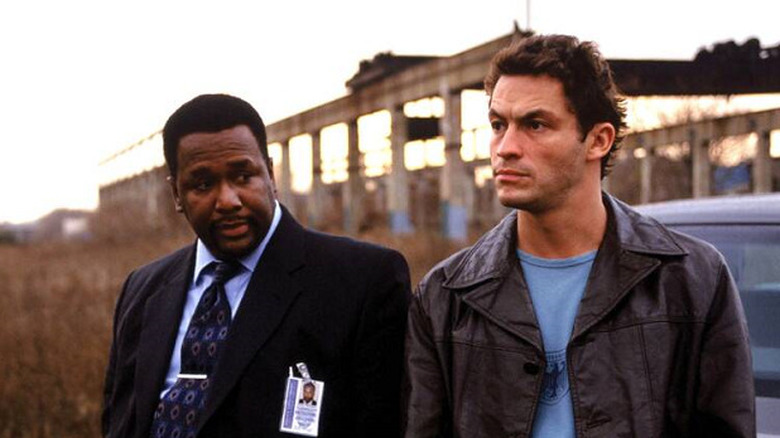
HBO's "The Wire" recalibrated the way audiences engaged with TV drama, not just through its sly sociopolitical commentary dressed up as cop procedural, but in the ways that its characters amplified its themes. One of the stauncher characters on the cop side was Det. William "Bunk" Moreland, played by Wendell Pierce. As complex as any other player on the chessboard but just as singular, Bunk was as dedicated to the bottle as he was to his work.
Pierce told journalist Jonathan Abrams how he came to see origins of his character, who was based on Baltimore Police Department Det. Oscar "Rick" Requer, in the flesh during a shoot with Dominic West (who played Det. McNulty) during a scene like any other in the series, wherein a dead body acts as a scrawling statement on what Alan Sepinwall calls "the rotting state of the American city — and by extension, the broken condition of America itself." It was a season 1 episode surrounding the shooting death of maintenance man — and state witness — William Gant (Larry Hull). Pierce elaborated to Abrams:
"[Requer] pulled up in a Cadillac with his cigar going. I guess he was about 50 feet away and when he got out the car, looked across the street at me with squinted eyes, cocked his head to the side in disbelief in one look, almost as if to say, 'What the hell are you doing?' And got back in the car and drove off. I was terrified from that day forward and for five years, did not speak to the man. We'd pass messages here and there. 'How's it going?' 'Fine.' That's it. But I was terrified to get his opinion."
Later on, the opportunity arose for Pierce to meet his character's progenitor in person, and he couldn't pass it up.
Bunk, You Made Me Famous.
Despite the distant introductions, Wendell Pierce and his character's real-life counterpart, Oscar "Rick" Requer, eventually got on like peas and carrots. Requer had joined the Baltimore Police Department on patrol in 1964, eventually joining the Criminal Investigation Division and being featured alongside his unit in the demystifying 1991 book "Homicide: A Year on the Killing Streets," written by "The Wire" creator David Simon. The "Treme" actor learned of the real Bunk's upcoming retirement from the BPD, and he knew he had to be present. Pierce told Jonathan Abrams:
"I got all the information. I summoned all the courage I could summon to face my criticism, which I expected, and walked into the hall. There he was, 50 feet again away from me, squinting, looking at me, cocked head to the side. I walk up to him and he said, 'Bunk, you made me famous.' He burst out in a huge smile and laughing and greeted me as if I was the prodigal son going home. They immediately put me on the program. I had to give a speech at his retirement party and all. And since then, we've been more in touch now after 'The Wire' than before."
The same oral history makes it clear it wasn't Simon's aim to have the actors meet the men and women who inspired the roles they play. The showrunner felt that, "unless you're doing historical drama," it's best to let the actor stay sturdy in the character written for them, which can and does differ from the real deal. Watching Bunk's symphonic usage of profanity, that approach probably worked out for the best.
"In the last six months, we observed a 254% increase in activity from a Linux trojan called XorDdos," writes the Microsoft 365 Defender Research Team. It's a trojan combining denial-of-service functionality with XOR-based encryption for communication.
Microsoft calls it part of "the trend of malware increasingly targeting Linux-based operating systems, which are commonly deployed on cloud infrastructures and Internet of Things devices." And ZDNet describes the trojan "one of the most active Linux-based malware families of 2021, according to Crowdstrike."
XorDdos conducts automated password-guessing attacks across thousands of Linux servers to find matching admin credentials used on Secure Shell (SSH) servers... Once credentials are gained, the botnet uses root privileges to install itself on a Linux device and uses XOR-based encryption to communicate with the attacker's command and control infrastructure.
While DDoS attacks are a serious threat to system availability and are growing in size each year, Microsoft is worried about other capabilities of these botnets. "We found that devices first infected with XorDdos were later infected with additional malware such as the Tsunami backdoor, which further deploys the XMRig coin miner," Microsoft notes... Microsoft didn't see XorDdos directly installing and distributing the Tsunami backdoor, but its researchers think XorDdos is used as a vector for follow-on malicious activities...
XorDdoS can perform multiple DDoS attack techniques, including SYN flood attacks, DNS attacks, and ACK flood attacks.
Microsoft's team warns that the trojan's evasion capabilities "include obfuscating the malware's activities, evading rule-based detection mechanisms and hash-based malicious file lookup, as well as using anti-forensic techniques to break process tree-based analysis.
"We observed in recent campaigns that XorDdos hides malicious activities from analysis by overwriting sensitive files with a null byte. It also includes various persistence mechanisms to support different Linux distributions."
Chinese engineers will take the ideas of a research paper and turn it into the world's largest 3D-printed project. Popular Mechanics: Within two years, officials behind this project want to fully automate the unmanned construction of a 590-foot-tall dam on the Tibetan Plateau to build the Yangqu hydropower plant -- completely with robots. The paper, published last month in the Journal of Tsinghua University (Science and Technology), laid out the plans for the dam, as first reported in the South China Morning Post. Researchers from the State Key Laboratory of Hydroscience and Engineering at Tsinghua University in Beijing explain the backbone of automation for the planned Yellow River dam that will eventually offer nearly five billion kilowatt-hours of electricity annually. (It's worth noting that China's Three Gorges Dam -- a hydroelectric gravity dam spanning the Yangtze River -- is the world's largest power station in terms of energy output.) But it's hard to tell what's more ambitious: the fact that the researchers plan to turn a dam site into effectively a massive 3D-printing project, or that through every step of the process the project eliminates human workers as they go fully robotic.
In the dam-"printing" process, machinery will deliver construction materials to the worksite -- the exact location needed, eliminating human error, they say -- and then unmanned bulldozers, pavers, and rollers will form the dam layer by layer. Sensors on the rollers will keep the artificial intelligence (AI) system informed about the firmness and stability of each of the 3D-printed layers until it reaches 590 feet in height, about the same height as the Shasta Dam in California and shorter than the Hoover Dam's 726 feet. With the largest existing 3D-printed structures rising about 20 feet tall -- from houses in China to an office building in Dubai -- the exploration of 3D-printed projects continues to expand. Already we've seen a 1,640-foot-long retention wall in China, housing and office buildings across the globe, and now the U.S. Army has plans for barracks at Fort Bliss in Texas.
A free weekend is underway on Steam where you can play State of Decay 2: Juggernaut Edition, the Windows action/RPG from Undead Labs. This gives everyone the chance at surviving the zombie...
There are a lot of strong opinions about the "Star Wars" prequels. Some fondly remember them as the films they grew up on, while others have gone as far as to say George Lucas ruined the franchise. But how about trying this one on for size: Lucas almost killed Natalie Portman's career.
Lucas seemed preoccupied with the all-digital visuals of the prequels, taking advantage of cutting-edge special effects at the turn of the century. According to StarWars.com, "Attack of the Clones" had more than 2,000 visual effects shots integrated into the film. However, all that digital technology disrupted the audio recording in "Attack of the Clones," causing the need for every single line of dialogue to be rerecorded.
While Lucas did push the digital filmmaking movement forward, he also forgot one big thing important to any film: believable dialogue. In the book "The Star Wars Archives: 1999-2005," Lucas admits that the dialogue between Anakin Skywalker (Hayden Christensen) and Queen Padmé Amidala (Natalie Portman) in "Attack of the Clones" was corny. He tries to justify the wooden dialogue between characters as "consistent with the 'Star Wars' style," forgetting how Mark Hamill purposely gave Luke Skywalker a character arc simply through the way he delivered his lines.
Poorly written dialogue, rerecorded audio, green screen sets, and new technology equaled poor performances by nearly all the prequel actors. So much so that Portman struggled to find work after the trilogy wrapped.
'Everyone Thought I Was A Horrible Actress'
From "No, I am your father" to "I love you ... I know," the original trilogy is loaded with memorable moments and quotable one-liners. Heck, even the droids are memorable ("I am C-3P0, human cyborg relations."). So, what the heck happened with the prequels? In "The Star Wars Archives: 1999-2005," George Lucas described it as "presented very honestly, it isn't tongue-in-cheek at all, and it's played to the hilt." Seriously, Lucas said this. I'm not sure he understands what the phrase "to the hilt" means in this galaxy.
Noted film critic Roger Ebert summed up the dialogue from the prequels best, specifically in his review for "Attack of the Clones": "But as someone who admired the freshness and energy of the earlier films, I was amazed, at the end of 'Episode II' to realize that I had not heard one line of quotable, memorable dialogue. They talk and talk and talk. And their talk is in a flat utilitarian style: They seem more like lawyers than the heroes of a romantic fantasy."
Natalie Portman talked to New York magazine about the damage her performance in the prequels did. Portman said:
"'Star Wars' had come out around the time of [the theatrical play] 'Seagull,' and everyone thought I was a horrible actress. I was in the biggest-grossing movie of the decade, and no director wanted to work with me."
But then a director from the 1970s American New Wave film movement stepped in and possibly saved her career.
From Ugly Duckling To Black Swan
Director Mike Nichols — perhaps best known for his 1967 film "The Graduate," for which he won an Oscar for Best Director — also knows a thing or two about acting. Before a lengthy career as a film director, Nichols was an improv comic (one-half of the influential Nichols and May act with Elaine May), stage actor, and theater director. His eye for talent was keen, casting an unknown Dustin Hoffman as the lead in "The Graduate." Nichols would later get a firsthand look at Portman's talents when directing her in the 2001 theatrical play "The Seagull."
So when Portman struggled to find work after "Star Wars," Nichols intervened. Portman explained to New York magazine how Nichols wrote a letter to "Cold Mountain" director Anthony Minghella, urging him to hire her. Portman was cast as a Civil War-era widowed mother, and the role could not have been more opposite from her stiff performance in "Star Wars."
The "Cold Mountain" role reignited Portman's career, leading to an Oscar nomination for Best Supporting Actress in Nichols' 2004 film "Closer" and an Academy Award for Best Actress in 2010's "Black Swan." Portman would discover she wasn't the only one Nichols saved. Portman later learned "One Flew Over the Cuckoo's Nest" director Milos Forman was granted asylum in the United States thanks to a letter from Nichols.
Although George Lucas remains a galaxy-sized force in Hollywood, creating the "Star Wars" universe and helping to launch the modern blockbuster era, he almost destroyed Portman's young career. Thankfully, Nichols had the vision to see Portman was ready to graduate far beyond what audiences saw in the "Star Wars" prequels.
Cassandra Peterson opens her 2021 autobiography, "Yours Cruelly, Elvira: Memoirs of the Mistress of the Dark," with the story of how she became Elvira. The story goes, she was only a day into her marriage to Mark Pierson when she got a call from her friend Dawna — on her honeymoon in the Colorado Rockies — urging her to return to L.A. to audition for the part of a sassy horror hostess at the TV station KHJ. Peterson refused. She wasn't going to cut her vacation short. Her friend Dawna, the one alerting her to the audition, was persistent. When her honeymoon was over, miraculously, the part wasn't yet filled, and Peterson was able to go in to audition after all. She says that the script sucked, and she failed to come in costume as the casting call requested. But her quips and ad libs appealed to those in charge, and she landed the gig. That was in 1981. Peterson was 30. She has been Elvira ever since.
Peterson's acting career stretches back far further than Elvira, however. Her autobiography also describes a horrible home life as a child, having to bear the wrath of an abusive mother, leading her to leave home at age 14, and signing a contract to perform in Vegas by age 17, dancing in a revue show called "Vive Les Girls!" Oh, and Peterson's pre-Elvira career took many interesting turns besides. She even toured with an Italian pop band called I Latins 80.
Mixed in with all the dancing gigs and band tours were also a few feature films. The very first being none other than 1971's "Diamonds Are Forever," the James Bond movie wherein Sean Connery returned after George Lazenby played 007 in "On Her Majesty's Secret Service."
Vive Les Girls!
The British website Horror Channel interviewed Peterson back in 2008, asking her about the experience. An extended portion of "Diamonds are Forever" takes place in Las Vegas, where James Bond is tracking down some illegal diamonds that are hidden inside a corpse. There's a standup comedian involved in the plot, as well as a femme fatale named Plenty O'Toole (Lana Wood) and another named Tiffany Case (Jill St. John). Look, the stories in most of the James Bond movies are typically opaque. The movies are driven by action set pieces, sex scenes, and exotic locales.
To take advantage of the Las Vegas location, the producers of "Diamonds Are Forever" filmed some shows that were already being performed, and one of them happened to be "Vive Les Girls!" Peterson only appeared briefly, but it also led to her taking an additional gig as an extra. Peterson recalled:
"They actually filmed a scene of the show I appeared in Las Vegas, 'Vive Les Girls!' at the Dunes Hotel. I was on stage as a showgirl doing the show. I'm not even sure if I ended up in the final cut, but I did get to go to London later, worked a day on the film as an extra (think the scene was cut) but had a very memorable day at Pinewood Studios, seeing what goes on behind the scenes in a Bond film and having lunch in the commissary with Cubby Broccoli, Sean Connery, Michael Caine and Tony Curtis."
Peterson did not elucidate on talking to Caine or Curtis. But then, Peterson had met many famous people by that point in her career, including members of the Rat Pack. Peterson also would famously go on a date with Elvis Presley (no word yet as to whether or not that date will be dramatized in Baz Luhrmann's upcoming Elvis biopic). Additionally, when touring in Italy, she would land a dancing role in Federico Fellini's 1972 film "Roma," also playing a dancer. Peterson's first credited role was playing the role of Katya in Stephanie Rothman's sexploitation flick "The Working Girls," but of course, she will always be Elvira: Mistress of the Dark.
I recently had the chance to sample Bushmill’s second Rare Casks expression, a 29-year-old single malt Irish Whiskey finished in Pedro Ximenez Sherry casks. This stuff retails for a whopping $750, and it’s worth it. It was initially (triple) distilled in 1992 and aged in bourbon barrels until 2004, then transferred to…
"Hereditary" might well be one of the most unsettling films of the last decade, but it's not always an easy one to follow. At first glance, it's a highly-strung family melodrama with a dark secret hiding beneath the surface.
And director Ari Aster goes to great lengths to keep that secret just out of sight.
"Hereditary" is the story of the Graham family, which is struggling with loss after the death of its unseen matriarch, Ellen Tapper Leigh (Kathleen Chalfant). There's very clearly something wrong here as the creeping tension engulfs the family, whether it's seen through eerie miniatures made by Annie (Toni Collette) or the outright weirdness of the family's youngest child, Charlie (Milly Shapiro).
The family melodrama begins to simmer and soon boils over. There's unresolved tension throughout the family -– Charlie was clearly grandma's favorite, while Annie paints a picture of a fractured family via her work.
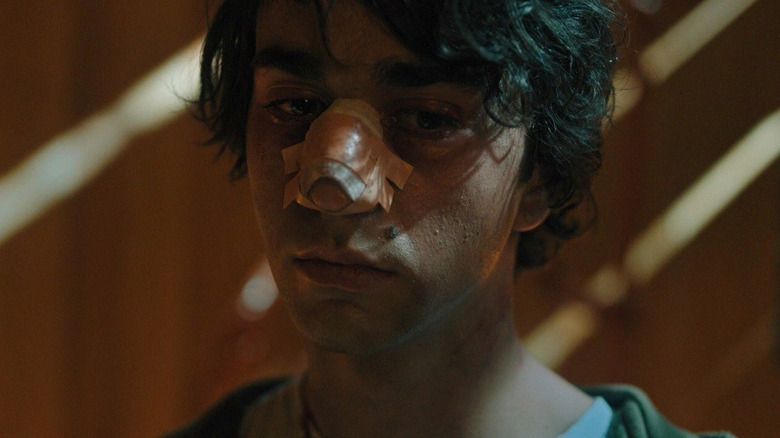
Then, there's Peter (Alex Wolff). Obviously struggling to fit in with his highly-strung family, Peter is an average teenager trying to find his feet. He's more into parties and smoking weed than looking after his younger sister, and when tragedy strikes, the family begins a descent into hell.
"The film is a horror film, it's unabashedly one, but as I was pitching it, I was describing it as a family tragedy that curdles into a nightmare," said writer and director Ari Aster.
And while that nightmare begins with the death of yet another family member, it turns out the answers were hiding in plain sight all along.
It's All About Paimon
By the time the final act comes around, "Hereditary" reveals its hand: It's all about Paimon.
A demon and one of the eight lords of hell, Paimon has been at the very core of the film right from the beginning. But who exactly is he? Paimon is a Goetic demon, often described as a king or high-ranking demon from hell. Aster found references to Paimon in a book called "The Lesser Key of Solomon" during his research and decided to go with it.
"The devil has been done to death," he said in a Reddit AMA. "Paimon was my favorite option that came up in my research."
When it comes to "Hereditary," it's Paimon who is summoned at the very end of the film, and it's revealed that Peter is his intended vessel -– a human host for Paimon to embody on Earth. That's right: After (metaphorically) going through hell and back, Peter is revealed to be the focus of the entire twisted story.
The death of his sister, his mother's breakdown, and everything that follows serves to wear him down emotionally. Only when Peter is at his lowest point can he become susceptible, and then he's used as a vessel for the demon Paimon.
It turns out that his grandmother manipulated their entire lives for this purpose. There are hints of this throughout the movie, but we'll get to that. Suffice to say that the grandmother's influence, and the cult she founded, can be felt all the way through the film.
A Demonic Seal Hiding In Plain Sight
Our first glimpse of Paimon's influence comes very early in "Hereditary." We just didn't know it at the time.
One of the film's first scenes depicts the funeral of the Graham family matriarch -– the sinister grandmother whose influence extends over all their lives. But she's more than just a granny who oversteps boundaries. She's actually the founder of a sinister cult who's controlling the family for its own nefarious ends.
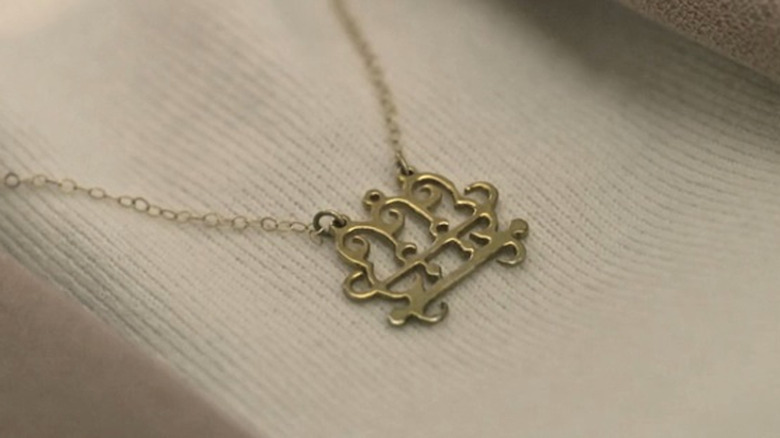
And that's depicted by her oddly-shaped necklace.
That necklace is actually a sigil -– a demonic seal found in occult texts which represents the demon Paimon. Good old grandma is seen wearing one on her necklace, but the seal is found throughout the film, notably etched into the telegraph pole which decapitates poor Charlie.
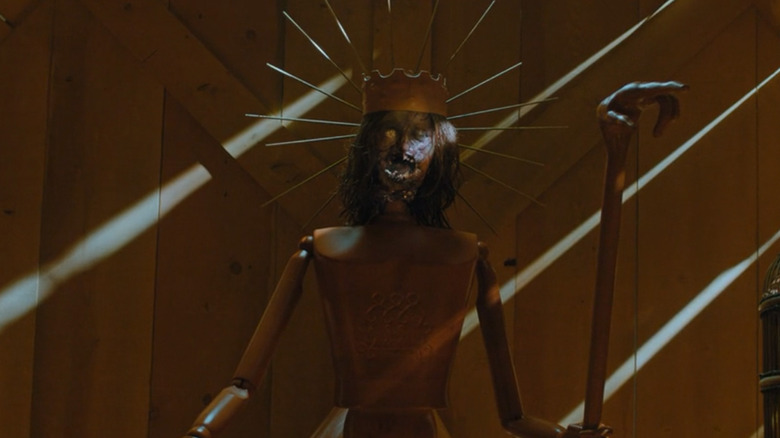
The mid-17th century book "The Lesser Key of Soloman describes Paimon as "[appearing] in the form of a Man sitting upon a Dromedary [one-humped camel] with a Crown most glorious upon his head."
Of course, in the film's final scenes, we see Peter crowned by the Cult of Paimon, thus becoming the vessel for the demon itself. But the cult has been interfering with Peter and his family long before the film begins.
In fact, their influence can literally be seen throughout the family home.
The Writing's On The Wall
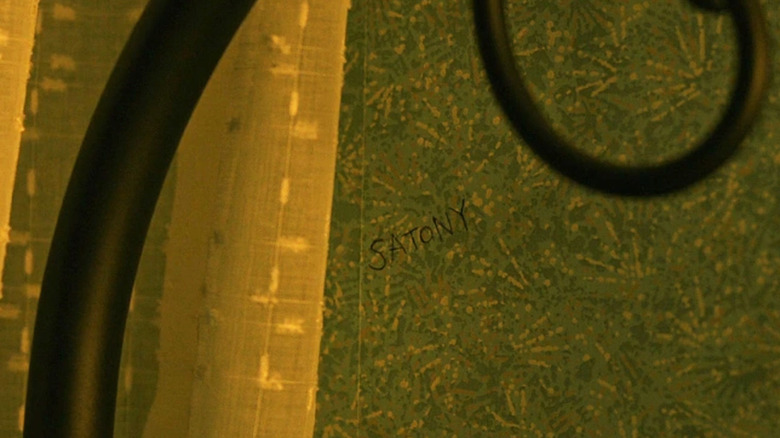
There's a moment during "Hereditary" when Annie finds obscure writing on the wall of Charlie's room, but doesn't really question it. In fact, she's later seen adding the word "Satony" to the model she's making.
And that's not the only bit of weird text you can find in the Graham family home.
If you look closely, you'll find the words "satony," "zazas," and "liftoach pandemonium" scrawled onto the walls and in hidden spots throughout the film. But what does it mean? In that same Reddit AMA, Aster explains what it's all about:
"Those are isolated pieces of an invocation spell that is suggested to be written all over the house. We only see three of these in the film, but there are many more (probably written behind furniture or otherwise hidden). 'Liftoach Pandemonium' has a special significance. It translates as 'Open Up Chaos (or Hell).'"
The word "satony" is frequently used in necromancy, while "zazas" seems to refer to a spirit frequently conjured by Ouija boards. Obviously, this is a strong hint about what's to come, with the Cult of Paimon (and presumably dear old granny) opening up the gates of hell to commune with their lord.
The clues were all there if you knew where to look. And it looks as though Peter wasn't the cult's first attempt to find a host for Paimon.
Annie's Brother Was The First Attempt
Annie also has a mysterious brother who is mentioned by name but never seen.
It's revealed that years before the events of "Hereditary," Annie's brother took his own life following a diagnosis of schizophrenia. That would have been tragic enough already -- except it's not entirely true.
At one point, Annie explains what happened:
"My older brother had schizophrenia and when he was 16, he hanged himself in my mother's bedroom and of course the suicide note blamed her, accusing her of putting people inside him."
It's an eerie confession, and while Annie seems oblivious to her mother's motives, it reveals what granny was up to the entire time. Clearly, she had attempted to use her own son as a vessel for the demon Paimon. And when that didn't work out, she moved on to find a new one.
Why didn't she try to use Annie as a vessel? Well, that's a little more complicated. You see, Paimon desires a male form, which is why the cult tries to use Annie's brother at first and then moves on to Annie's son, Peter.
But there was also another attempt in between...
Charlie Was Paimon, Too
Despite the demon's demand for a male host, it looks as though the Cult of Paimon grew restless.
After the failed attempt with Annie's brother, the Cult clearly turned its interest toward Peter, but there was a problem: Annie's husband Steve (Gabriel Byrne) wanted the family to have nothing to do with their grandmother.
"She lived in our house at the end before hospice," Annie revealed at group therapy. "We weren't even talking before that. I mean, we were and then we weren't. And then we were. She's completely manipulative. Until my husband finally enforced a no-contact rule, which lasted until I got pregnant with my daughter."
That's right -- Charlie was the catalyst for granny being allowed to return. And according to Annie, it wasn't long before she "got her hooks" into her.
"Charlie is the first successful host for Paimon," revealed Aster in an interview with Variety. "It's transferred from Charlie to Peter at the end. [It's Paimon] from the moment she's born. I mean, there's a girl that was displaced, but she was displaced from the very beginning."
Essentially, that means that it's Paimon inhabiting Charlie's body throughout "Hereditary" ... and that makes it far easier for the demon and its cult to manipulate Peter.
The poor boy never stood a chance. When the time came, it was Peter who was displaced to make way for the lord of hell. Thanks, grandma.
Each and every Hitman 3 update offers a lot for players to sink their teeth into, from a new single-player mode at the start of the year to VR support in its Year 2 patch notes. The latest release is no different, as those with a compatible graphics card will now be able to see Hitman 3 in all its glory with ray tracing, Nvidia DLSS, and AMD FSR.
Enabling both ray traced reflections and shadows can be quite demanding, especially considering Hitman 3 is already up there in terms of power hungry games. Including Nvidia DLSS is a great move to boost fps on supported GPUs, but you'll only have access to the first generation of FidelityFX Super Resolution if you can't run team green's option, as AMD FSR 2.0 is unavailable here. It only released last week, though, so it might need more time in the oven if it is in the pipeline for Hitman 3.
Intel XeSS is also notably absent despite featuring the game prominently in its marketing campaign for its first-party upscaler. We expect it'll drop eventually and will likely match the timeline of Intel Arc Alchemist graphics cards, which have been delayed several times already.
One year before Oliver Stone pricked America's conscience with "Platoon," Sylvester Stallone used the Vietnam War as a backdrop for his unabashedly pulpy "Rambo: First Blood Part II." Conceived at the height of the POW/MIA dispute, which demanded a full accounting of all American soldiers who never returned home from the conflict, the film is both entertainingly exploitative and morally repugnant. It transforms the first movie's grievously traumatized John Rambo into a cartoonishly lethal one-man-army, and preys on the hopes of military families who at the time were clinging to dreams that their loved ones were still being held in bamboo cages somewhere in Southeast Asia. Stallone's intent might've been dubious, but it was right in line with the zeitgeist. Despite a raft of scathingly indignant reviews, "Rambo: First Blood Part II" was the second highest grossing movie of 1985.
For some, the title character represented the stirring, hyper-macho apotheosis of the all-American hero who passed out of fashion when John Wayne bit the dust. For others, Rambo embodied a regressive jingoism that gradually manifested in a whole new series of military misadventures. For Stallone, the film gave voice to veterans' disillusionment not with the United States, but its citizenry's lack of ardor for the greatest country on Earth. This is the gist of Rambo's anguished closing sentiment. Where did Stallone get this notion, and does his protagonist's impassioned plea make a lick of sense given the film's ambiguity about the war? Let's unpack this sucker.
To Survive A War, You Gotta Become A War
At the outset of "Rambo: First Blood Part II," our hero is doing hard time in a labor camp as punishment for the events of the first movie when his former superior and only remaining ally, Colonel Trautman (Richard Crenna), drops by to dangle a presidential pardon. All Rambo has to do to earn his freedom is parachute into Vietnam, obtain photographic evidence of U.S. prisoners of war still being held in the country, and get airlifted out. Rambo accepts, but throws up an immediate red flag when he asks Trautman "Do we get to win this time?" Rather than reiterate that this is strictly a reconnaissance mission, Trautman replies, "This time it's up to you."
Rambo is promptly flown to a military base in Thailand, where the operation's treacherous manager, Roger Murdoch (Charles Napier), immediately throws cold water on the ex-Green Beret's inclination to resume the war. The only shooting is to be done via camera. What Rambo and Trautman fail to realize is that Murdoch's congressional overseers expect Rambo to find zero evidence of imprisoned U.S. soldiers; worse, they have no idea that Murdoch plans to leave the Medal of Honor winner to die in the unlikely event that he does put eyes on POWs. It's yet another weak-willed, bureaucratic betrayal of a patriot willing to die for his country. In other words, it's Vietnam all over again. What Murdock does not know is that Rambo is determined to win this time.
I Want What They Want
The bulk of "Rambo: First Blood Part II" is sensationally entertaining nonsense. Director George Pan Cosmatos, working with the insanely overqualified cinematographer Jack Cardiff (best known for lensing such cinematic landmarks as "A Matter of Life and Death,""Black Narcissus," and "The Red Shoes"), dazzle the viewer with muscular action set pieces, while Jerry Goldsmith's propulsive score gets the blood pumping something fierce. Rambo is captured and tortured by a couple of stock Russian baddies, who disastrously underestimate the warrior's capacity for bloodshed. They mess around, and they sho'nuff find out. Rambo avenges -- via explosive-tipped arrow -- the death of the river pirate (Julia Nickson) he'd abruptly fallen in love with, kills the Russians, returns with a clutch of POWs, delivers his aggrieved valedictory, and wanders off into the wilds of Thailand. Audience cheers. Credits roll.
It's tempting to shut off your brain and enjoy the ludicrously thrilling ride, but Stallone isn't one for mindlessness. He's a serious artist who invests each of his signature franchise films with a piece of his soul and/or mind. The "Rocky" films reflect his evolution as an artist and a man, while the "Rambo" movies express his political worldview. "First Blood" did not originate with Stallone (Clint Eastwood and Robert De Niro were in the early running for the lead role), but, once cast, he leveraged his "Rocky" star power to make the character his own. That film is a grounded, wholly uncontroversial tale of a combat-addled soldier who came home to disdain instead of a parade. And because all decent people, regardless of political affiliation, can agree that Vietnam vets got the rawest of deals after the war, we sympathize with and root for Rambo. The sequel, however, is a completely different beast. It's as adrenalized as "Rocky III," but thematically unsettled. This is why the final scene, while heartfelt, strikes a strangely discordant tone.
After settling his debts with the duplicitous Murdock, Rambo gets into a heated exchange with Trautman. The colonel is conflicted. In an earlier fracas with Murdock, he acknowledges the war was a mistake based on a lie, but, as a soldier, his duty is to bring every living American back home. If that requires a resumption of hostilities, so be it. Now that Rambo has carried out this mission, Trautman implores his protégé to return home as well. When Rambo resists, Trautman tells him that, while the war was wrong, he shouldn't hate his country for it. He then asks Rambo what he wants. Rambo explodes. "I want what they want, and every other guy who came over here and spilled his guts and gave everything he had wants! For our country to love us as much as we love it! That's what I want!"
A Rousing Corrective To A Needlessly Bloody Failure
In a wide-ranging 2006 Q&A, Stallone said, "I realize his speech at the end may have caused millions of viewers to burst veins in their eyeballs by rolling them excessively, but the sentiment stated was conveyed to me by many veterans." This may very well be true, but for many of the 2.2 million unfortunate sons who couldn't defer their way out of service, the Vietnam War was a reminder that the poorest Americans will always fight the misguided battles of the ruling class. Furthermore, these Americans will be forced to join a second fight on the homefront just to ensure their government lives up to its obligations. The failure of the Vietnam War, and the miserable treatment of the men who fought it, had nothing to do with insufficient love of country. Rather, it was a tragedy of blind, unquestioning affection by millions of patriots who knew they'd never be called to serve.
At the height of his Hollywood powers, and in the midst of the Reagan era, Stallone's commercial instincts were spot-on. The majority of the country was raring to flex its military muscle again and remind the world that the United States will always be the premiere superpower on the planet. But by creating a rousing corrective to a needlessly bloody failure, Stallone spun a new, equally pernicious lie, one that many Americans believe to this day. Rambo might've been invincible, but the true believers who enlisted to fight the Iraq War based on wholesale fabrication were not. The lessons of "Platoon" and the sobering films it inspired were, in the end, no match for the fantasy of "Rambo: First Blood Part II."
The CW's upcoming "Supernatural" prequel series, "The Winchesters," is developing faster than fans anticipated, as a full-fledged trailer dropped yesterday, in which Dean Winchester returns as the narrator of his parents' story. Jensen Ackles, who is producing the series as well as reprising his role as Dean, has stoked hope for "Supernatural" fans by saying that there is always a way of bringing back fan-favorites from the original show (via TV Line):
"The great thing about this world is that nothing is off the table. We have ways of bringing back fan-favorite characters and the actors that played them. We also have ways of bringing back younger versions of those characters."
As "The Winchesters" revolves around the love story between John Winchester (Drake Rodger) and Mary Campbell (Meg Donnelly), the focus of the tale will be on the origins of demon hunting in the Winchester family, and how it took a toll on them. This premise obviously leaves the door open for the return of many characters seen in "Supernatural," including demons, entities, humans -- and, yes, angels.
The return of the Winchesters would mean greater insight into Dean (Ackles) and Sam's (Jared Padalecki) past, but also provide context to what "new mission" Dean is on, as seen in the trailer. Dean's presence cannot be placed on the timeline at the moment, as it is unclear as to when exactly he took over the mission to find out more about his family's legacy (though presumably it was at some point before the end of "Supernatural"). Apart from the past unraveling, there are also threats in the present, in which a secret organization is involved in shady, behind-the-scenes dealings.
The Return Of Castiel?
The return of fan-favorite characters could mean younger versions of beloved "Supernatural" characters popping up midway (or familiar faces, like that of Sam, could appear for an episode or two), or the appearance of ageless beings, such as the angel Castiel. Castiel has been an integral part of "Supernatural" ever since his arrival in season 4, and divine intervention has been an important plot point in terms of John and Mary's union. This naturally begs the question as to whether Castiel or any other angel — such as Michael, Raphael, or Metatron — could be making a comeback in the prequel series.
When TVLine asked Ackles whether angels will play a role in the prequel, the actor neither confirmed nor denied the assumption: "Ooh, that is a really good question, and TBD," the actor said. Well, that means anything could happen!
Here's the official synopsis for "The Winchesters:"
"Mary is 19 years old and has been fighting the forces of darkness since she was a child. After losing someone close to her, the hardened hunter considers quitting the family business — until her father's disappearance and the arrival of newcomer John forces her to lead a new team. John has recently returned from Vietnam. Selfless and clear-headed, he finds a new mission back home, where traces of his father's past lead him to a secret organization and a whole new war as a hunter."
"The Winchesters" is expected to premiere on The CW later in 2022.
Smart Mouth Productions announces post-production is complete on THEY WAIT IN THE DARK, the latest feature from celebrated indie horror film director/writer Patrick Rea (I Am Lisa, Arbor Demon, Nailbiter). Rea’s latest film was shot in the summer of 2021 entirely on location in the Kansas City area.
Director Rea brings his unique vision to the latest addition in his catalog. “I had always wanted to make a haunted house story, but I didn’t want to regurgitate the same plot that had been done a million times before to varying results. I wanted to come at this specific sub-genre of horror from a fresh angle,” explains Rea.
The supernatural/domestic thriller stars Sarah McGuire (The Stylist, I Am Lisa), Laurie Catherine Winkel (MacGyver, Father of the Bride), and introduces newcomers Patrick McGee and Paige Maria.
McGuire stars as Amy, a young woman on the run with her young son Adrian (McGee) from her abusive ex-girlfriend (Winkel). When the past rises up to haunt them they must confront the forces threatening them from both outside and in.
From Executive Producer Meagan Flynn, “What does our past mean for our future? Can the cycles of abuse be broken? And are the things that haunt us real or otherworldly or both? These are the questions Dark challenges us with.”
With sound design and score by Ben Benefield and special effects makeup from Jake Jackson, THEY WAIT IN THE DARK is currently open for sales and distribution inquiries