
The post Murder at Yellowstone City 2022 HDRip XviD AC3-EVO appeared first on SceneSource.
The post Murder at Yellowstone City 2022 HDRip XviD AC3-EVO appeared first on SceneSource.


Read more of this story at Slashdot.
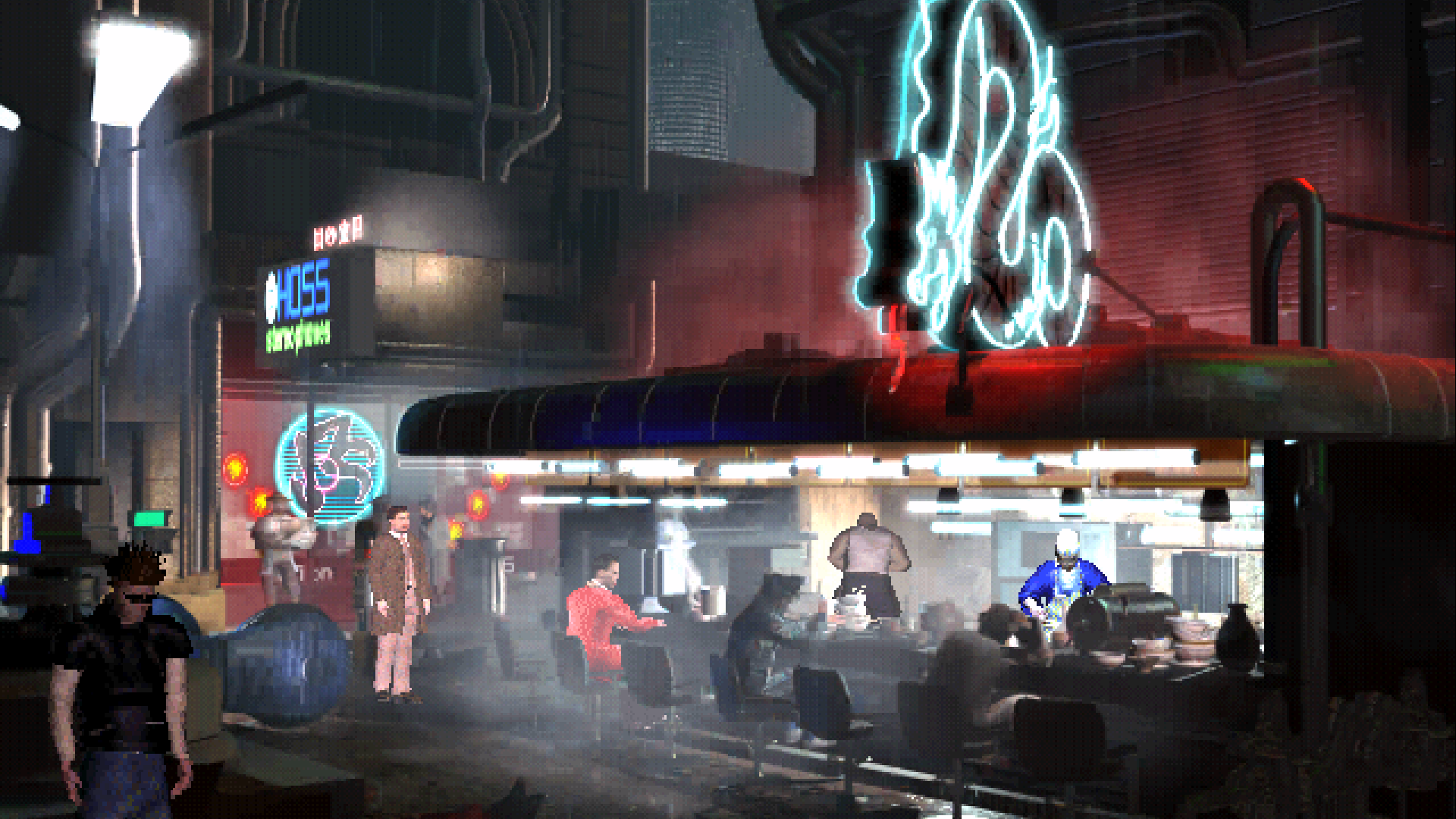
Blade Runner: Enhanced Edition launched this week, upping the resolution and increasing the framerate of Westwood's ancient adventure game in ways that make it look consistently worse than the original. If you bought the game on GOG, you could at least switch over to the superior ScummVM release, but not on Steam... Until earlier today, when Blade Runner Classic was added to the Steam version, too.
Note: This is a Shamus-scheduled article that is being published post-mortem.
Back at the white house, Troy meets with Alex face-to-face. This next part is like your visits to Seraph Industries in Deus Ex Human Revolution. The player isn’t allowed to pull out their weapons[1] or do any other shenanigans that would break the story. I know these games pride themselves on player agency and freedom, but I think most players are okay with not being allowed to pointlessly fire their weapons or toss inventory items around for no reason while visiting the White House.
Alex sums up the plot so far: Life is back to normal for the president. His poll numbers are up even more since the attempt on his life. We ID’d the people that attacked the White House[2] and they’re a jumbled assortment of misfits and cranks. It isn’t rare that a few loonies would want to try something like this. There are always a few threats, regardless of who’s in office. What is rare is that the group would have the budget, training, and knowledge to get so close. These people were obviously helped by someone a lot richer, smarter, and better-connected. This fits with what Troy learned in Switzerland.
Troy asks how the arrests are going with the State Department. Alex says she hasn’t heard anything yet. The two wonder what “Project Morpheus” might be about.
Next Troy meets with Sam Carter. On his way there, the player might spot the Woman in Orange. She’ll be standing somewhere distant and unreachable, sort of like a G-Man sighting in Half-Life.
Carter is glad to see Troy Denton. However, if you killed a bunch of people in Miami then he’ll express his disappointment. Otherwise he’ll congratulate you on a job well-done. After that he says…
Carter: Here, I wanted you to have this.
Carter hands Troy a Smith & Wesson Model 29 revolver. (This is the infamous “Dirty Harry” gun. I spent a lot of time trying to figure out a weapon with the right properties and of the right age to plausibly appear here. I’m not totally happy with this choice, but I’m mostly confident that I’ve avoided making any outrageous firearm blunders.)
Troy: (Taking the weapon and looking it over.) Woah, ancient tech.
Carter: That sidearm was carried by the man who trained me. This weapon was used to protect Jimmy Carter, Ronald Regan, Bill Clinton, and the first two Bushes. And I’ve carried it as my back-up weapon for every president since then.
Troy: I’ve never understood the thinking behind revolvers. You only get six shots. Our standard issue sidearms hold 15.
Carter: You and I both know there’s more to a weapon than its capacity. This thing has stopping power. It was overkill in its day, but in a world where you might face an augmented threat, you want to have something like this on you.
Troy: It belongs in a museum.
Carter: It’s a service pistol. It belongs in service.
Troy: So I guess you’re really serious about retiring?
Carter: You’re holding my second-favorite handgun, so you know I am.
Troy: Thanks Carter. I’ll take good care of it.
I’ll explain the thinking behind this scene in a minute. For now, Troy takes the weapon. Troy reminds Carter about the “Morpheus Protocol” threat. Carter assures him that security is super-tight. No tour groups. No press. There are hardly any civilians in the building, and we’re practically strip-searching everyone at the front door. There are hundreds of soldiers hidden along the building’s perimeter and we’ve got drones circling the building like angry bees. It would take an army just to shout an insult at the president.
Carter then explains that Troy should report directly to the president and tell him what we’ve learned in Switzerland.
On his way into the President’s office, Troy will pass the Woman in Orange. Her design should make it clear that she’s trouble in an obvious-but-not-actionable way. Maybe she’s got a mean face, or maybe she has a femme fatale thing going on. That, plus the orange outfit,[3] ought to be enough to grab the player’s attention.
Troy enters the president’s office. As he enters, a guard leaves. So now it’s just Troy, the president, and one rando secret service agent in the room. The president jokingly refers to Denton as “Agent Nephew”, doing a slightly cringy callback to Denton’s gaffe on day 1. Then he prompts Troy to explain what he learned on his mission.
The door to the office opens, cutting Troy off mid-sentence. We turn to see the Woman in Orange standing in the doorway.
The president remarks, “Oh, it’s you? It’s not quite time for our meeting yet.”
She seems to be reaching inside her coat, or handbag, or whatever looks the most overtly threatening.
“Gun!” the other agent shouts.
Troy grunts as his vision dims. This feels exactly like the malfunction we had when Leo Gold escaped.[4] The other secret service agent seems to be having the same problem – he’s doubled over, off-balance. He’s trying to get out his weapon.
Troy draws his pistol. (And hey, since Carter gave us that present, we have a pistol no matter what, even if the player is doing a novelty no-weapons / no-inventory pacifist run! Because this scene would turn into a farce if Troy was guarding the president with something impractical like a melee weapon or a rocket launcher. Also, the animators can build this scene around this one weapon, rather than scripting for every possible thing the player might be carrying.) He struggles to lift the weapon, but he can’t seem to point it at the Woman in Orange. His vision slams to black, we hear gunshots, and there’s a thud.
The screen stays black for several long seconds. Dead silence.
There’s a rush of sound as Troy wakes up. An alarm is going off. The old revolver is laying on the floor in front of him. He doesn’t pick it up. The door is closed again. The Woman in Orange is gone, and the president is dead. So is the other agent.
Troy checks on the president and then radios to Alex for help. He tells her to find the Woman in Orange.
Alex: (Frustrated.) My screens all went blank for a minute there. They’re back now, but I don’t… I don’t see a woman in orange anywhere near you.
Troy figures Mrs. Orange must have used the secret escape tunnel. He opens the secret door to follow her.[5] As the panel slides open, the main door to the room is kicked open violently and more secret service agents enter. They yell at Troy to stop, assuming that he’s the one who killed the president.
We’re in full gameplay mode now, so the player is free to handle this however they want. They can run into the secret passage, they can pull a weapon and murder their former compatriots, or I guess they could also stand still and get shot.[6]
The passage leads to steam tunnels like the ones we visited in the tutorial. We play peek-a-boo with the security system for a bit. There are military guys milling around “searching” for Denton the way enemies do in these games. The steam tunnels should quickly give way to the kitchen and laundry areas of the basement, because we already spent some time in this environment during the tutorial and we don’t want this to feel too repetitive.
There are a few encounters with groups of one or two agents along the way. While shooting is the path of least resistance, these encounters are designed so that it’s possible to escape without being forced to gun everyone down.
After the first of these encounters, we get this exchange…
Troy: Alex! Why is everyone shooting at me?
Alex: I don’t know how to tell you this Denton, but everyone thinks you killed the president.
Troy: Show them the security footage. I was incapacitated right as the Woman in Orange came in. We have to find her. She’s the one who did it!
Alex: I believe you. But I don’t have the security footage. My cameras went blank right before the assassination.
Troy: (Bitterly.) So she’s getting away while we waste time shooting at each other.
Alex: Carter told the secret service to stand down, but we have all these extra security people here today, and they don’t answer to him.
Troy: This must be the Morpheus Protocol: Use some kind of anti-aug tech to disable the President’s security detail.
Alex: Look, not many people know about this, but I actually have a backup system in place. It’s kind of a dead drop for video data. All of the footage is streamed to a backup server so we always have a copy, even if my security console is compromised.
Troy: Then I need that data to clear my name. Please Alex. Without that footage, the bad guys can make up any story they like and blame this all on a lone attacker – on me.
Alex: Of course I’ll help you. The problem is, the server is a one-way connection. It collects data automatically, but if you want to recover any of it then you have to physically access the machine.
Troy: Great. Just tell me where it is.
Alex: Utah.
Troy: UTAH?!
Alex: Get to the roof. I’ve got an idea.
This section is linear, so let’s keep it short. This “But I don’t want to shoot my former colleagues” thing will wear thin if it drags on too long. Denton sneaks[7] upstairs and gets on the roof.
Alex remotely hijacks a helidrone. There’s so much chaos right now that nobody is going to notice if a single drone goes missing. She brings the drone in to pick up Troy and allow him to escape the premises.
Before he boards the heli, Alex tells him that he needs to unplug from the system. The PARASIGHT network will be able to track his mobile phone.
We get a little cutscene where Troy crushes his cell phone and drops it on the ground. Then he removes his secret service earpiece[8] and steps on it, literally and symbolically breaking his ties to his old job. Portentous musical sting.
He boards the heli and vanishes into the night sky.
I think the idea of a “central” server with a one-way connection is inherently cartoonish. Which means this is a perfect idea for a mission.
This is a fairly straightforward location. It’s a big technology base / server farm that serves as a gameplay obstacle course. We should hit all the classics here: Visible red laser triplines hooked up to alarm systems, auto-turrets, patrol robots, rooms filled with coolant, massive steel airlocks hooked up to needlessly complicated puzzle-switches, maze-like layouts, dark corridors, and an excess of security cameras. Elsewhere in the game I’d caution the level designers to go easy on the air vents because they were just too often a definitive right answer in Human Revolution and Mankind Divided. But here in the Deep Storage level I’d tell them to go wild with the vents. Make them big, have them go everywhere, and fill them with big spinning fans that need to be turned off or routed around.
Also, is it too much to ask to make vents actually blowing air? Why are videogame HVAC systems always turned off? Then again, maybe having them blow air means thinking about where the air comes from, which would call into question these strange orphaned ducts that connect to rooms but never to any HVAC equipment. I don’t know. I’d tell the level designers to see what they can come up with. I like the idea of these vents being filled with the sound of rushing air and having a perceptible directionality to them. Perhaps you can find your way to the core by always going “upstream” against the currents.
The number of flesh-and-blood guards should be pretty low, and mostly limited to the outer layers of security. As the player moves inward the security should be automated, and in the innermost rooms it should be mostly environmental hazards.
There’s not much here in the way of story. We’ll give Troy and Alex a few lines to process the death of their old boss and talk about how much they liked him and how hopeful people seemed when he was elected. If there are sidequests or bonus objectives, they should probably take the form of self-directed treasure hunts. Maybe we tantalize the player with hard-to-reach weapons and upgrades and let them puzzle their way to the loot if they’re up for it.
This is one of the locations we’re going to get to revisit later in the game. I kinda like the idea of using this against the player. We can let them take some shortcuts on their way in, maybe setting off alarms and generally half-assing the job. There won’t be any obvious consequences at first, but then on the second visit they would find their original route of ingress has been fortified / blocked off. So if you were sloppy on your first visit, you’d have fewer options on your second. But doesn’t that just punish people who dislike stealth by making them do more of it? I dunno. I think there’s the opportunity for fun here.
Alternate idea, multiple routes:
Path A requires stealth. B is filled with trigger-happy mooks and no hiding places. C is an obstacle course of environmental hazards and hacking. The player has to choose one of the three routes, and various one-way doors save OCD players from feeling compelled to backtrack and run all three routes. Each path can have an aug upgrade. So you’ll get to the end of your chosen path, and you’ll see a now-unreachable upgrade from one of the other paths. Then when you visit this place later, you can do the same path again if you liked it, or you can try one of the other paths. But of course, you’ll only get another upgrade if you do a different route.
I think it won’t feel like “recycled content” if we specifically design the place to be visited multiple times, with opportunities for different experiences on each visit.
You get the idea. I’d give the level designers lots of room to work and then see what they come up with.
Troy reaches the backup server, where a big-screen computer terminal is waiting for him. There’s another door nearby that leads deeper into the facility, but we’re not going to be able to get past it on this visit.
Alex reminds him that they’re about to see the raw, unedited footage of the assassination, so he should brace himself.
The footage plays. We see the office from a camera[9] near the ceiling. Secret service guy on the left. Troy Denton on the right. President Ellis in the middle. We see the door open in the background. We can see the Woman in Orange, although her face is hidden from this angle. The president says something to the open doorway. Mrs. Orange pulls something out of her jacket / handbag. But it’s not a gun, it’s a… remote control? A phone? Maybe she pushes a button?
Both secret service guys double over. The guy on the left collapses. Troy suddenly stands up straight. He puts three rounds into Ellis, then three more rounds into his fellow agent. Then he points the gun at his own head and pulls the trigger three more times, resulting in three dry clicks from the now-empty weapon. Then he goes limp, dropping the weapon on the floor in front of him.
(Ok, now you can see why we needed Sam Carter to give our hero a six-shooter.)
Troy is stunned silent. We linger on the aftermath for a few more seconds.
Alex finally realizes that this was the Morpheus Protocol: Hijack an augmented agent to do the assassination, and then have that agent kill themselves to cover up the evidence. If Troy had pulled out a 9mm – which is what the vast majority of agents carry – then there would have been enough shots to finish the job. But because he was carrying Carter’s old six-shooter, he ran out of bullets before killing himself.
Troy is stunned. He really did kill Ellis. He’s mortified. He’s also confused. He didn’t think that his augmentations were able to do something like this – that they could knock him out and hijack his body. The implications are horrifying.
Alex says she doesn’t want to continue to run this operation from her office in the White House. For one thing, she’s now an accessory to whatever this is. She understands that Troy isn’t really at fault, but she also realizes that the two of them would have a very hard time explaining themselves. Secondly, she thinks she might be a target if anyone decides to clean up loose ends. She needs to get somewhere safe if she’s going to continue to help Troy. She tells him to get clear while she finds someplace to hide.
Getting out is easier than getting in, but it still takes the player a few minutes to retrace their steps and make their way past all the layers of security.
Troy doesn’t like that his body can be hijacked at any time. He figures he needs to find some sort of proof if he’s going to clear his name.
Alex suggests a visit to Mirai Technology, where his augmentations were designed. Maybe there he can learn how the hijacking works, who has access, and how he can protect himself. Maybe he can even find source code that can back up his claims.
Aside: I think if this was a real game pitch I might re-arrange some missions to put some stuff between the assassination and the reveal. I think the longer the player walks around thinking they’ve been wrongly accused, the harder it will hit when they learn the truth.
But I wanted to have both the assassination and the reveal in the same entry because I didn’t want people in the comments to spoil the twist with speculation. (Or worse, have someone devise something better than my idea, thus making my twist seem lame in comparison. This ain’t my first rodeo.)
Next week we’re headed for Tokyo.

You did everything right to properly clean and properly load your dishwasher. So why is there a pool of standing water at the bottom of the machine? What can you do when your trusty dishwasher refuses to drain? If the last thing you want is to shell out for a repair person—or worse, a whole new machine—you might be in…
As promised, here is the source code for the Windows 9x VirtualBox display minidriver. For discussion of the source code, see the included readdev.txt file.
The code was developed on a Windows 10 host system. For extra credit, I attempted to build the minidriver on Windows 9x. Ideally with source code control… but is that even possible?
I could not find any clear information on whether Mercurial ever worked on Windows 9x. After a longish software archaeology session, I concluded that it did, at least somewhat. Here’s the proof:

I used a Mercurial 1.1.2 installer downloaded from here. As far as I can tell, none of the downloads from the official site (Mercurial 1.4 and later) work on Win9x—Mercurial installs without complaints, but fails to do anything useful, possibly because of Python incompatibility with Windows 9x.
But Mercurial 1.1.2 works, least on Windows 98 SE and Windows Me. It fails to clone over HTTP on plain Windows 95 because the Python socket module won’t load. There may be a way to upgrade the Windows 95 socket support but that is of limited interest to me given that Windows 98 SE works without tweaking. I have not tried to figure out if and how well other Mercurial versions work, since 1.1.2 did the job I needed.
With the source code on a Windows 98 machine, it’s no problem building it with the Open Watcom C/C++ 1.9 compiler, it is just a question of running wmake. Happy hacking!

The Supreme Court of the United States today overturned Roe. v. Wade in a 6-3 ruling which eliminates the right to an abortion. State bans on abortion, on the books or expected imminently in about half of U.S. states, may now be enforced. — Read the rest
The US Cybersecurity and Infrastructure Security Agency (CISA), the National Security Agency (NSA), and the National Cyber Security Centres in New Zealand (NZ NCSC) and the United Kingdom (NCSC-UK) have issued joint guidance on the proper configuration and monitoring of PowerShell to eliminate the risk of abuse.
The United States Cybersecurity and Infrastructure Security Agency (CISA) and the Coast Guard Cyber Command (CGCYBER) have issued a joint advisory to warn organizations that threat actors continue to exploit the Log4Shell vulnerability in VMware Horizon and Unified Access Gateway (UAG) servers.

One of Westwood's classics is enhanced and available again, this time for modern hardware. Blade Runner: Enhanced Edition is finally out today for PC and consoles.
Nightdive Studios put together this remastered version of the 1997 adventure classic. It's available digitally on PC, PlayStation, and Xbox consoles, and on the Nintendo Switch. The Enhanced Edition is also getting a Limited Run physical version, too.
While Westwood may be known for its history in the real-time strategy genre, Blade Runner was its surprise adventure hit. It runs alongside the Ridley Scott film, weaving through the events of the movie. It has branching paths though, and has been well-remembered for both its style and impressive design.
https://www.youtube.com/watch?v=kDxS2jh76Kg
Nightdive, the studio which has tackled other remasters like System Shock: Enhanced Edition, has put a few modern touches on Blade Runner. Since it's coming to consoles, gamepad support is an obvious one.
The original Westwood videos have been upscaled to 4K resolution and 60 frames per second. There is also an HD display, and a new clue interface. Plus, international fans can use the original foreign-language translations in Spanish, German, French, Italian, and Chinese subtitles.
As for reception? Well, it currently seems iffy. Users on Steam are voting it into the Mostly Negative tier on launch day. Rock Paper Shotgun also had some words about this Enhanced Edition compared to other options, and provided some good comparison screenshots.
There is another version of the original Blade Runner just for PC, on GOG. So if your impressions of the Enhanced Edition are similarly tepid, you can at least pick that one up instead.
The post Blade Runner: Enhanced Edition is out now for PC and consoles appeared first on Destructoid.

Look, this was an easy sell for me. I'm a simple man: I see Sekiro news in 2022, even by way of fan-created content, and I get excited. That includes this Elden Ring Sekiro mod (with a bit of Bloodborne), which addresses one crucial mechanical aspect: rolling/dodging.
Created by nmsl2018, the mod's concept is very easy to grasp, but it has a whopper of a name: "replace light roll animation with Sekiro step and medium roll with Bloodborne step." The title says it all! It literally removes the light roll from the game and replaces it with the Sekiro quickstep, and the medium roll (which most players are likely working with) is now a Bloodborne sidestep. In other words, combat is going to flow a lot differently with a different dodge animation/mechanic.
So Bloodborne always gets a ton of praise, but you gotta love seeing anything mention Sekiro in 2022. Anecdotally, I've heard of a lot of people getting either back into Sekiro or playing it for the first time after folks have finished Elden Ring, which is fantastic. It never really got the same amount of coverage or any significant post-launch content, but it'll go down in history as an action classic.
Consider this an extra positive review, on top of our review! While it might not be the ideal candidate for a "first From Software game," it forges its own path and differentiates itself from the rest of the pack in a big way.
The post This light Elden Ring mod replaces rolling with Sekiro and Bloodborne sidesteps appeared first on Destructoid.
This post contains spoilers for the latest episode of "Star Trek: Strange New Worlds."
One of the greatest strengths of "Star Trek" comes from how malleable the franchise can be. As proven time and time again over the decades, only limitations in creativity and imagination on the writers' part (and that of its viewers, as well) can hold the property back from its best version of itself. Stories set in this ostensibly futuristic, space-faring universe can span the issue of anti-Black racism in 1950s America, pack an entire hypothetical lifetime into the runtime of a single episode, or even take its cues from no greater authority than Shakespeare in surprising and inventive ways. "Trek" tends to wear its influences on its sleeve, as most recently evidenced by the latest episode of "Strange New Worlds."
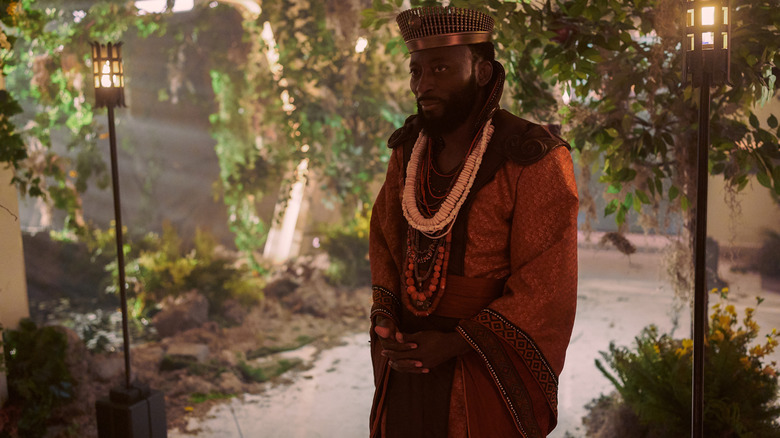
Things got downright medieval in "The Elysian Kingdom," which saw Dr. M'Benga (Babs Olusanmokun) thrust into a LARPer's dream while the USS Enterprise navigated a nebula -- one that happens to house a sentient being made up entirely of pure consciousness. Yeah, that's "Star Trek" for you! The doctor is at a loss to explain why the fairytale storybook he routinely reads to his young daughter Rukiya (Sage Arrindell) has inexplicably come to life around him, with the crew playacting specific characters from the fantasy novel in all their genre goofiness.
In the midst of all these nerdy joys, viewers could've easily missed one particular reference that'll be sure to please "The Lord of the Rings" fans everywhere. If you're going to plunge headfirst into fantasy, might as well borrow from the best. The "Strange New Worlds" creative team did exactly that ... for those who were paying close attention, at least.
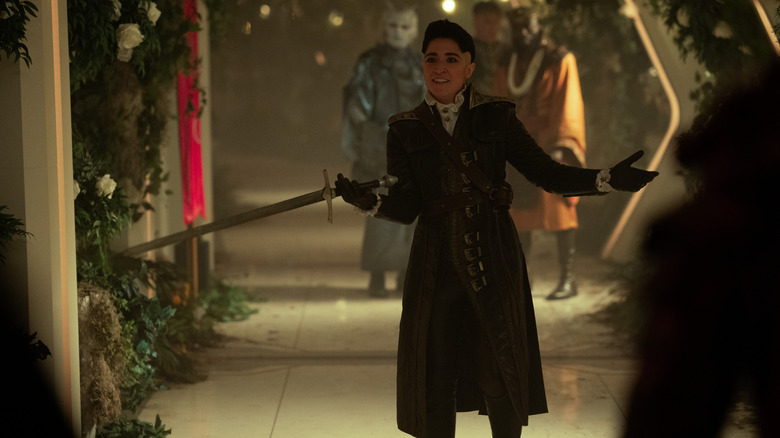
Oh, to have been a fly on the wall when the "Strange New Worlds" writers' room cracked the story that would feature M'Benga as a king, the Aenar engineer known as Hemmer (Bruce Horak) as a hilariously confused wizard, the heroic Captain Pike (Anson Mount) transformed into a craven chamberlain with allegiances prone to shift with the winds, La'an Noonien-Singh's (Christina Chong) puppy-loving princess, and Melissa Navia's sword-wielding Ortegas. There was love, betrayal, incredible line readings, and pretty much everything fantasy fans could possibly want from a "Star Trek" episode that started off subdued, quickly turned into a lark, and then looped right back around to its poignant ending.
Amid all the hijinks, viewers undoubtedly got a kick out of the lush production design and props littered throughout the fairytale-infused Enterprise sets. But even the biggest fans may not have realized the "Lord of the Rings" reference hiding in plain sight. Thanks to a particularly observant Reddit thread, some noticed that Ortegas' sword in the episode bears an uncanny resemblance to the blade wielded by Aragorn, son of Arathorn (played by Viggo Mortensen), in "The Fellowship of the Ring." It would seem that the "Strange New Worlds" crew got their hands on either prop sword from the production of "The Lord of the Rings" or one of those fancy prop replicas. Seriously, check out the similarities between the two blades for yourself!
Dare I point out that the visual of a Starfleet navigator running around the ship with a medieval weapon in hand actually has precedent in "Trek" lore, too? Talk about knowing your franchise history ... although this isn't the first time "Trek" and "The Lord of the Rings" has intersected, either.
Oh, and Tolkien nerds: next week's "Strange New Worlds" episode is titled "All Those Who Wander."
Read this next: 20 Movies About Aliens That You Definitely Need To Watch
The post Star Trek: Strange New Worlds Features a Lord of the Rings Reference You Probably Missed appeared first on /Film.
With this week's very explicit episode of "The Boys," it's worth taking a moment to look back at the last big TV show that was famous for its heavy amount of nudity: "Game of Thrones." (Okay, so there is also "Euphoria," but that's a whole other can of worms.) Before the epic fantasy show was being bashed for its poor plotting and questionably-concluded character arcs, the big recurring complaint critics had about it was the way showrunners used sex and sexual assault, particularly when it came to its female characters.
Often cited is the constant sexposition throughout seasons 1 through 3, in which the show would shamelessly throw in a naked lady or two to make a potentially boring info-dump more interesting for the fellas at home. But perhaps most damning was the show's apparent obsession with sexual assault. Nearly every major female character is either threatened with rape at some point or is actually raped on screen.
The books were also heavy on the rape scenes, but the show had a tendency to downplay the books' social commentary and ramp up the shock value. You can see this most clearly in the scenes that only happened in the show. One critic pointed to the episode where King Joffrey "demanded at the point of a crossbow, that prostitutes bludgeon each other for his enjoyment" as the moment she gave up on the show. Scenes like that one "made it clear that Thrones was a show willing to mount its action upon the stage of women's bodies." Joffrey torturing those two women in early season 2 is a textbook example of being gratuitous; it served no purpose to the show other than to confirm that Joffrey was a sadist, which we already knew.
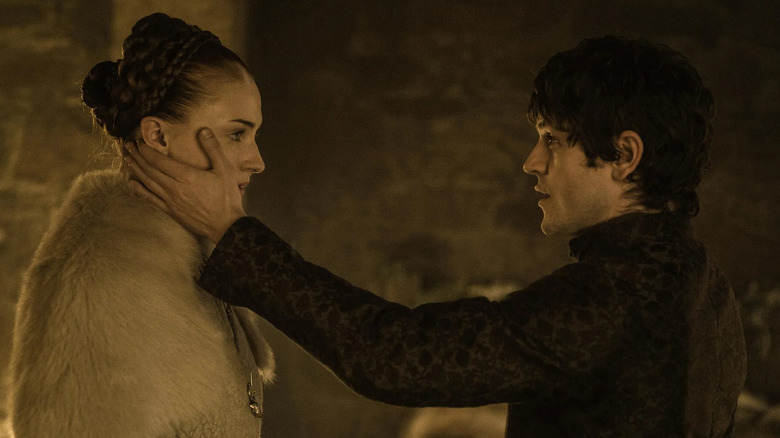
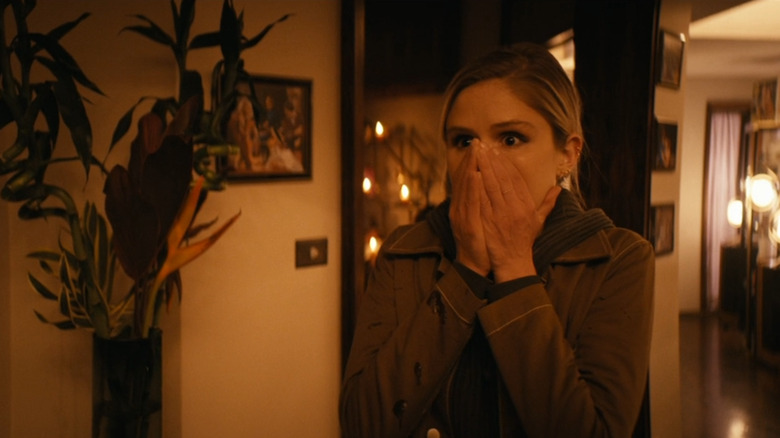
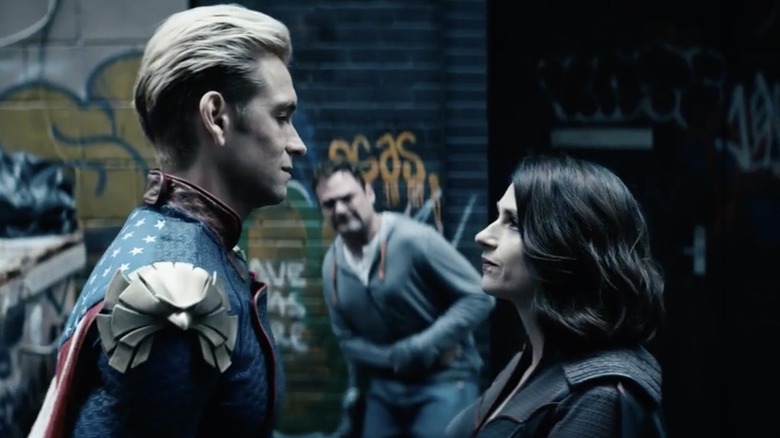
Probably the best example of the difference between "Game of Thrones" and "The Boys" is the way each show went about the assaults of Sansa (Sophie Turner) and Annie (Erin Moriarty). It's not a perfect parallel: Sansa had been on the show for five seasons before she was raped, whereas this was Annie's first episode. They're similar in that they were both controversial -- most people who gave up on "The Boys" in the first episode tend to point to this scene as the reason why -- and they're each given a lot of weight in the narrative.
The difference is that Sansa's rape scene wasn't in the books. At this point in the books, Sansa was still chilling in the Vale, pretending to be Littlefinger's bastard daughter Alayne. She had to deal with some creepy flirtations from Littlefinger, but that was the worst of it. Meanwhile, Annie's rape scene was not only in the source material, but it was far, far worse in it. Whereas the show has Annie getting coerced into oral sex by the Deep, the comics has her getting forced into it by Homelander, Black Noir, and A-Train at the same time. While the scene is treated seriously in the show, the comics really seem to play the situation as more of a comedy, which makes the whole thing feel far grosser than the show's version.
From the first episode, "The Boys" was downplaying its source material's sexual violence, whereas "Game of Thrones" was constantly ramping it up.
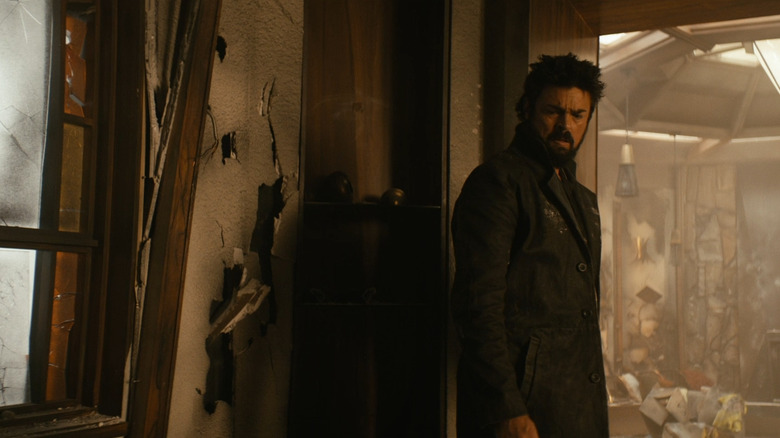
The other notable thing about Annie's scene is that it almost wasn't on the show altogether. "One of the first questions we discussed when taking the project is: Are we going to do the moment when Starlight is sexually assaulted?" showrunner Eric Kripke explained. "And even this was a year or so before the Me Too movement. I was nervous. I thought it might be too far. But every female producer on the show said, 'You have to do it, because we've all experienced a version of it to varying degrees in our careers.' And I said, 'All of you?' And they said, 'All of us.'"
So, the writers took a scene from the comics, had it play it out in a more interesting and less gratuitous way, and then used it to develop a season-long storyline in which Annie goes public with what happens. It created what may have been one of the most relevant TV shows during the beginning of the Me Too movement, as season 1 commented on it in a way that both paid respect towards victims of assault while critiquing the way the corporate PR world responded to these types of scandals.
Season 2 followed along the "sex as satire" route with the relationship between Homelander and Stormfront. With their relationship being a metaphor for the police intermingling with white supremacists, it makes sense that their sex scenes were some of the most absurd (and most depraved) scenes in the whole show.
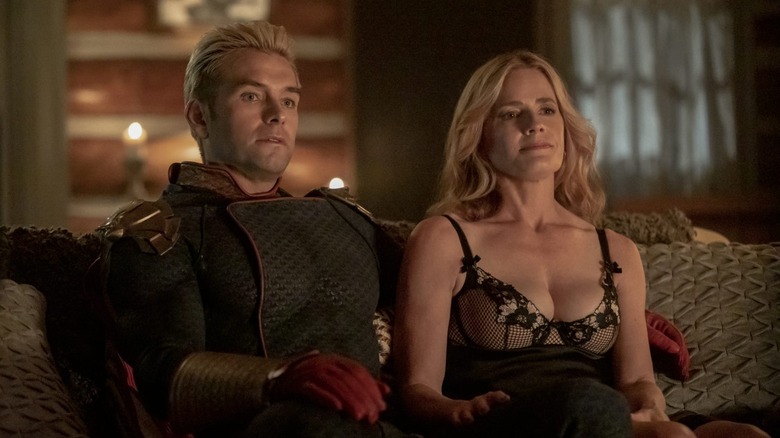
Perhaps the best example of "The Boys'" comparative restraint is the way that Homelander, while certainly a rapist, rarely actually threatens a female character with rape. His sex scenes on the show are weird and unsettling, but they're undeniably far more creative than most of what we've seen on TV. It's hard to consider his scenes with Stillwell in season 1 as strictly consensual, considering the massive power imbalance, but these scenes are laden with so much subtext about Homelander's psyche.
Meanwhile, you can go back to most of the sexual assault scenes of "Game of Thrones" and look at what the scene is telling us about the rapist in question. Often the show would feature a minor character abusing some serving girl for seemingly no purpose except to establish that he's a bad guy, so that a character like Arya or Jon or the Hound can murder them and the audience will feel good about it. Sansa's rape scene is the same thing, but bigger: it exists to further establish Ramsay as an evil character so that it'll be more satisfying later when Sansa feeds him to his dogs.
Homelander's evil is put on display constantly throughout "The Boys," but the way the writers go about showing his evil is far more creative than anything "GOT" showrunners Benioff and Weiss ever came up with. You can call Homelander's many acts of sadism over the series disturbing or frustrating, but you can't call them lazy writing. Season 3 set up a dynamic between him and Starlight that could've easily, in the hands of Benioff and Weiss, resulted in a rape or attempted rape scene, but the show wisely avoided going in that direction.
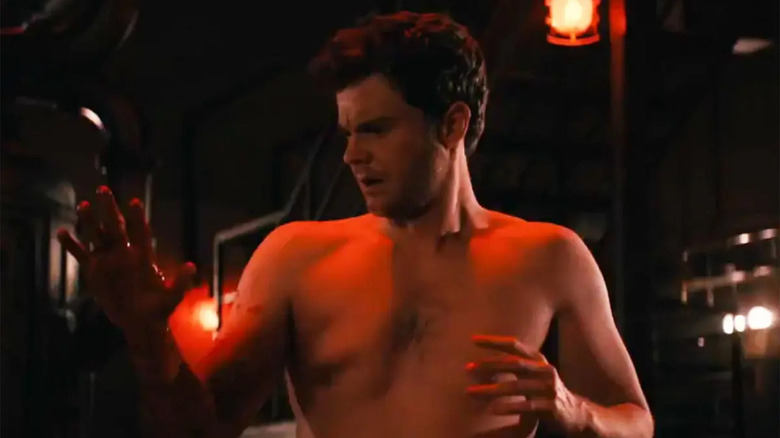
If you came into season 3 of "The Boys" thinking "this show is good, but I just wish they'd show us more of Jack Quaid's ass," you're in luck. The fourth episode of the season introduces the plot point of Hughie having the ability to teleport. The show easily could've established that Hughie's clothes would teleport with him and most viewers wouldn't have had any trouble suspending their disbelief. Instead, the show goes out of its way to have nudity be an unavoidable cost of Hughie's powers, and commits to it for the rest of the season.
It's not that "The Boys" is more shy than "Game of Thrones" about nudity; in fact, they're just as willing as the latter to include sex and nudity that doesn't strictly advance the plot. The difference is that "The Boys" is both far more willing to show male nudity (enthusiastic about it, even), and almost all of their sexual content is meant to be funny or disturbing, usually both. The sexual content on "The Boys" is typically designed not to titillate the audience or as an easy way to establish that a character's bad, but as a way to explore how being a supe would affect someone's sex life. For a tame example, the Deep having gills makes it so he always wants to have his shirt on during sex. For a less tame example, a character with ice powers can accidentally freeze a man's penis so severely that it snaps off.
In a media landscape where people are constantly debating whether a sex scene is strictly necessary or not, "The Boys" understands that it doesn't have to be completely necessary. Sex is an inherently interesting, complex thing, one of the few parts of life that can't be explained rationally. We can understand why people rob or kill, but we can never know for certain why Homelander has a breast milk fetish. (Yes, he grew up without a mother, but that only provides one piece of this horrifying puzzle.) It makes sense why a story would want to dive into this part of a person's life, regardless of how uncomfortable it might make some people in the audience.
The problem with most of the sex scenes on "Game of Thrones" wasn't necessarily that they were uncomfortable or extraneous, but that they were all kind of the same, weren't they? Littlefinger monologues while two women have sex in front of him. Viserys monologues while his naked servant girl takes a bath with him. There's a lack of imagination here that makes these scenes kind of depressing, whereas the arguably gratuitous sex in "The Boys" is nothing if not creative. Even at their weirdest and most graphic, you can tell the writers put a ton of thought into what you're seeing. And when sex on "The Boys" does feel depressing, it's a purposeful decision.
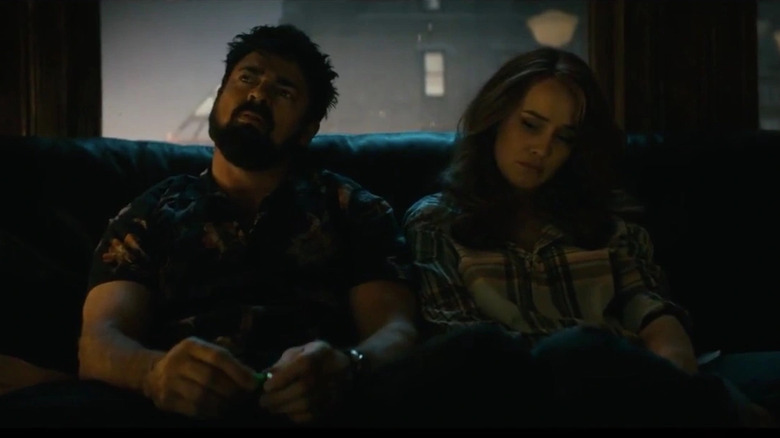
When /Film's own Witney Seibold wrote a defense of sex scenes on TV and film, one of the points he made was that when sex is depicted as an imperfect, often awkward or silly act, it helps to destigmatize it. "Not all sex is perfect, and more sex scenes would allow for a moment of embarrassed vulnerability wherein two partners can openly talk about how what they did might have been awkward or just a bad idea."
And sure enough, "The Boys" takes the idea that "not all sex is perfect" and commits to it hard. In particular, the sex portrayed in "Herogasm" is very much not perfect or romantic, it's not even cool or impressive. It's just kind of sad. Some of these supes have powers that sound like they'd be a benefit in the bedroom, but the powers on display throughout the orgy seems to take all the humanity out of the act.
In contrast, the "normal" sex scenes between characters like Annie and Hughie -- where superpowers aren't a major factor -- often come across as unflinchingly wholesome in comparison. Whereas the sex in "Game of Thrones" is almost always linked to someone's quest for power or dominance, the non-supe-focused sex scenes in "The Boys" are some of the only moments where the characters feel safe.
As "The Boys" grows in popularity, it provides an interesting showcase for how nudity, sex, and sexual assault are depicted on mainstream television. "The Boys" probably couldn't get away with "Game of Thrones'" early treatment of women, even if they wanted to. And though there's nothing inherently wrong with depicting these things on TV, the intelligence in which "The Boys" goes about them -- and the occasional restraint -- are definitely appreciated.
Read this next: The 15 Most Anticipated Comic Book Movies And Shows Of 2022, Ranked
The post How The Boys Gets Around a Big Game of Thrones Problem appeared first on /Film.
Read more of this story at Slashdot.
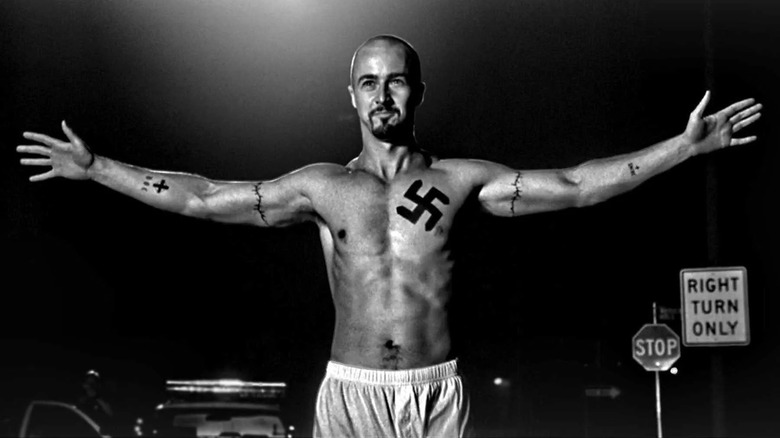
"American History X" is a hard-hitting story about intergenerational racism. Edward Norton stars as Derek Vinyard, a reformed skinhead who tries to rescue his younger brother Danny, played by a pensive Edward Furlong, from the clutches of the neo-Nazi movement. "American History X" was critically hailed and Norton received an Oscar nomination for Best Actor for his formidable performance. In his essay for The Guardian, "American History X" director Tony Kaye explains why he cast Norton in the role, and why the actor ended up working more behind the scenes.
"When New Line sent me the script of 'American History X,' about the relationship between a neo-Nazi and his impressionable kid brother, it was deeply flawed. I thought I could manoeuvre around it: invent stuff, improvise, improve what was on the page. That was one of the reasons I went along with the studio's idea to cast Edward Norton. At the time Norton was Hollywood's golden boy, although personally I didn't think he had enough weight or presence. I held some open casting calls but I couldn't find anyone better than him. And one advantage of having Edward was that we had a shared vision of how to improve the script. In casting him I was really buying another writer."
Norton's collaboration with Kaye on the script, rewriting much of the dialogue, led to an acrimonious battle for artistic control. The director went on a rampage against his star and New Line Cinema, eventually disowning the version of "American History X" that would appear in theatres, mainly because Norton contributed greatly to the shaping of the film's final edit.
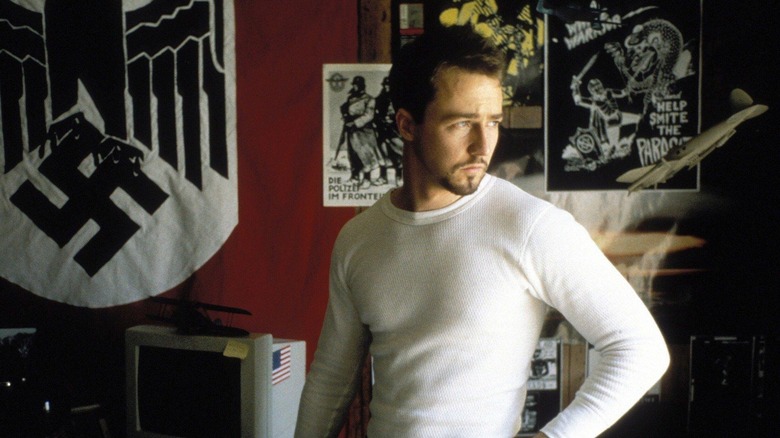
After the first screening of his 95-minute cut, Kaye received lengthy notes from New Line Cinema and Norton on how it could be improved. This enraged the director, but then he began imagining a radical new version of the film that would require a year to remake. The studio refused and allowed Norton to work on a new cut with an assistant editor — a move that outraged Kaye so much he punched a wall and broke his hand. Kaye unleashed a temper tantrum of epic proportions: petitioning to have his name removed from the credits or be listed as "Humpty Dumpty," spending thousands on 35 full-page ads in Hollywood trade papers condemning Edward Norton and the producers, and removing the film from the Toronto International Film Festival.
Kaye was incredibly passionate about his singular vision for the film which, in his opinion, was being destroyed by Norton and the studio. He resented the final version of "American History X," feeling it over-emphasized the emotional performances and had too many melodramatic close-ups of characters crying in each other's arms. "And, of course, Norton had generously given himself more screen time," he chides in his Guardian essay. Yet even though Kaye describes Norton as a "narcissistic dilettante," he would still work with him again "because he is phenomenally talented."
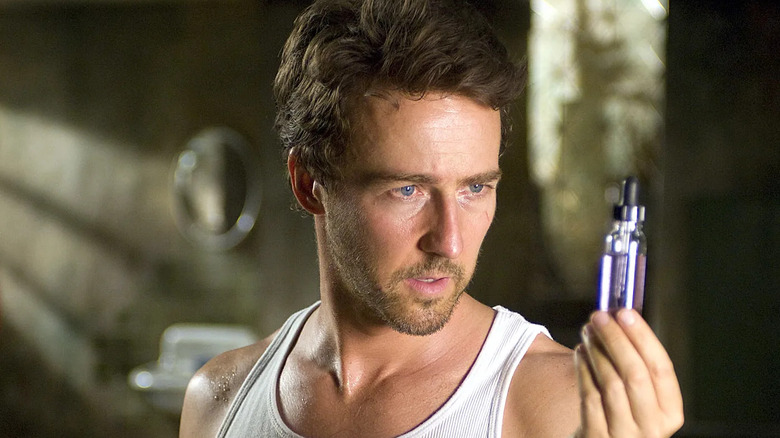
There have been other instances besides "American History X" where Edward Norton didn't just act in a film. He frequently argued over the script of "Red Dragon" with director Brett Ratner. Ratner explains some of the challenges of working with Norton in an interview with the Los Angeles Times, saying "He likes to challenge the director. It's all about intellectual debate ... Edward's instinct is going to be, 'I have to take over this film.' He's going to try to rescue the film. That's both a blessing and a curse."
Norton wrote parts of "The Incredible Hulk" script to improve the green monster's character arc. Director Louis Leterrier told Empire, "Edward's script has given Bruce's story real gravitas," but the original screenwriter Zak Penn was disappointed in the changes, confessing to Entertainment Weekly, "I wasn't happy with him coming to Comic-Con saying that he wrote the script." Norton would not return for a "The Incredible Hulk" sequel or "The Avengers" in 2012, missing his chance to be a part of the mammoth Marvel Cinematic Universe.
Salma Hayek, Norton's ex-girlfriend, was pleased with their collaboration on "Frida." He "beautifully rewrote the script several times and appallingly never got credit" when she was under immense pressure from Harvey Weinstein to meet a tight deadline (per The New York Times).
All of this controversy gave Norton the reputation of being a difficult actor to work with — someone who would take over the director's vision to suit his own egotistical needs. But Norton defends himself in the Telegraph as being committed to his art and striving to make the best film possible — even if that means he has to be more than just the star.
Read this next: 14 Remakes That Are Better Than The Original
The post Edward Norton Did A Lot More Than Act For American History X appeared first on /Film.
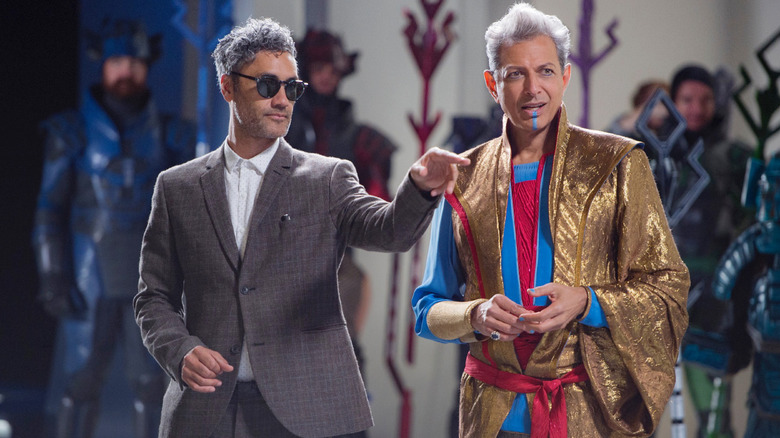
Like many (most?) feature film directorial debuts, Taika Waititi's 2007 rom-com "Eagle vs Shark" is rough around the edges. The movie centers on Lily (co-writer Loren Horsley), a lonely, soft-spoken fast food worker and wannabe songwriter who develops a crush on Jarrodd, a far-from-lovable video game store employee played by Jemaine Clement. At the time of its release, many critics felt "Eagle vs Shark" hewed a little too closely to Jared Hess' similarly quirky, deadpan indie comedy "Napoleon Dynamite." Looking back at it 15 years later, however, the film's blend of off-beat humor and melancholy gives it what is now widely recognized as a distinctly "Waititi-esque vibe."
It's a testament to his skill as an artist that Waititi has been able to maintain the same humorous and playful yet bittersweet style from project to project, be they his low-budget directorial efforts ("Boy," "Hunt for the Wilderpeople," "Jojo Rabbit") or even something like the series "Our Flag Means Death" (which he mainly works on as an actor and producer). Waititi was even able to hold onto a lot of his personality when he entered the well-oiled machine that is the Marvel Cinematic Universe with 2017's "Thor: Ragnarok," delivering a zany, visually-imaginative, and otherwise enjoyable outing with the God of Thunder.
By his own admittance, though, it hasn't always been easy. As Waititi told WIRED (half-joking, but at the same time half-not), he often finds himself smiling and nodding while taking to studio executives, only to head off and do what he wants instead. "It's literally me trying to not do whatever the grown-ups say," as he put it.
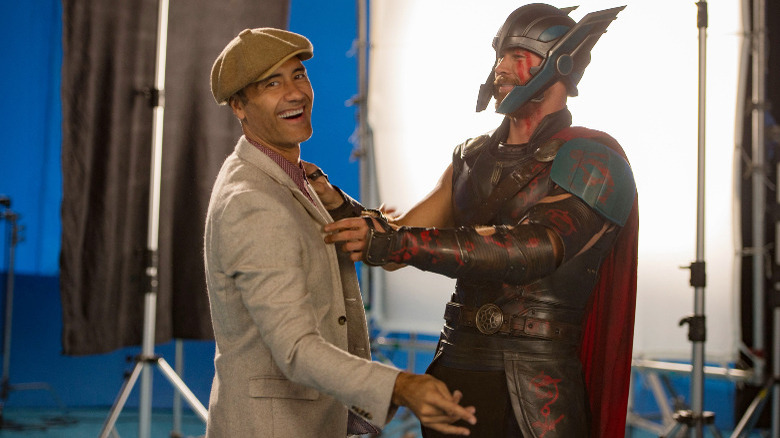
For all its critical and box office success, Marvel Studios is notorious for flattening the voices of its directors in order to better fit their individual styles with the in-house look and tone of the Marvel Cinematic Universe — a homogenizing effect that Taika Waititi had to be extra wary of while directing "Thor: Ragnarok" and its sequel, "Thor: Love and Thunder." On the plus side, his success in that arena has opened up new doors to him, allowing him to go off and work on smaller, more personal films ("Jojo Rabbit," "Next Goal Wins") and TV shows ("Our Flag Means Death," "Reservation Dogs") in-between landing high-profile gigs like directing a "Star Wars" movie.
Once again, though, joining the Marvel machine comes with its drawbacks, as Waititi told WIRED:
"I do miss the feeling where I was excited to wake up and write. So much of what I do now is associated with deadlines and with people wanting something from me. And then it starts to feel like you're just sitting in traffic waiting to go to work."
What Waititi's talking about here is a hard truth that filmmakers inevitably have to face after their early success paves the way to them tackling bigger projects, only to discover just how exhausting the grind really is when you're no longer working on a movie with a bunch of your friends and what little (well, "little") money you can scrap together. But again, that you can tell the person who directed "Eagle vs Shark" all those years ago is the same one who made "Thor: Ragnarok" just goes to show: Waititi has done as fine a job as any at navigating the treacherous waters that are the Hollywood studio system.
"Thor: Love and Thunder" hits theaters July 8, 2022.
Read this next: Every Pre-MCU Marvel Movie Ranked
The post Joining The Marvel Machine Had Some Downsides For Taika Waititi appeared first on /Film.
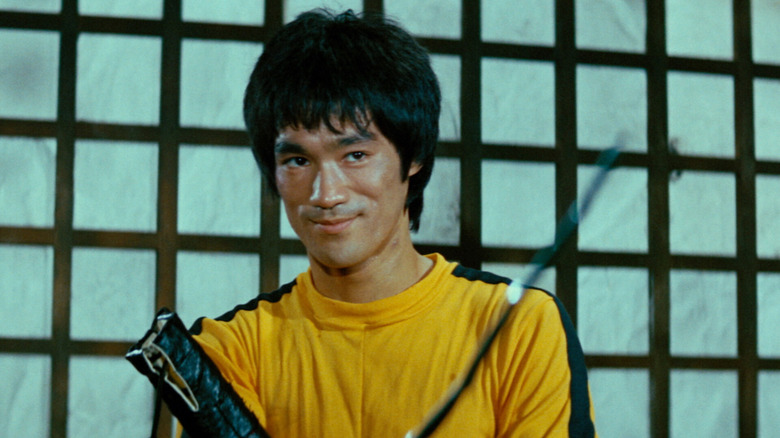
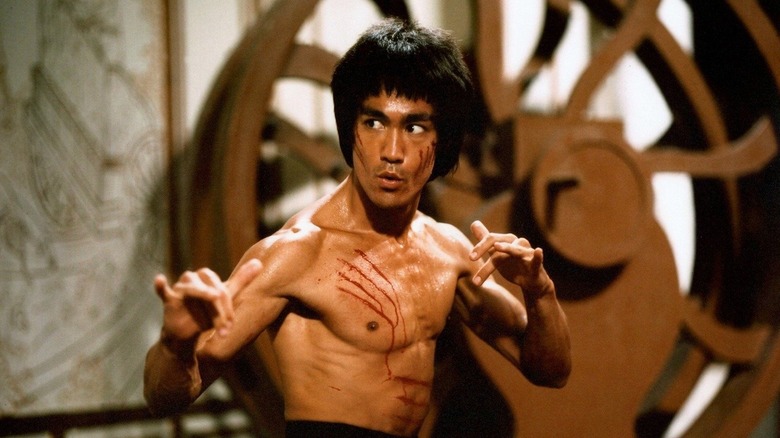
Bruce Lee has been gone for nearly 50 years, but his legacy looms as large as ever in the American cultural consciousness. No single person did more to popularize martial arts in the United States than Lee. His movies drove kids all over the country to enroll in karate classes. There would probably be no UFC without him. The likes of Chuck Norris, Steven Seagal, and Jean Claude Van Damme owe their careers to him.
Most importantly, Lee broke down barriers for Asian-American actors in the predominantly white Hollywood of the 1960s and '70s. Though it would take the industry several more decades to take seriously the lack of Asian-American representation in movies and television shows (and it still has a long way to go), Lee's heartbreakingly brief stardom served as a gateway into Asian culture. Documentary filmmaker Bao Nguyen understands this, which is why his excellent ESPN documentary on Lee's life, "Be Water," uses its subject as a springboard to a larger conversation about Asian-American history.
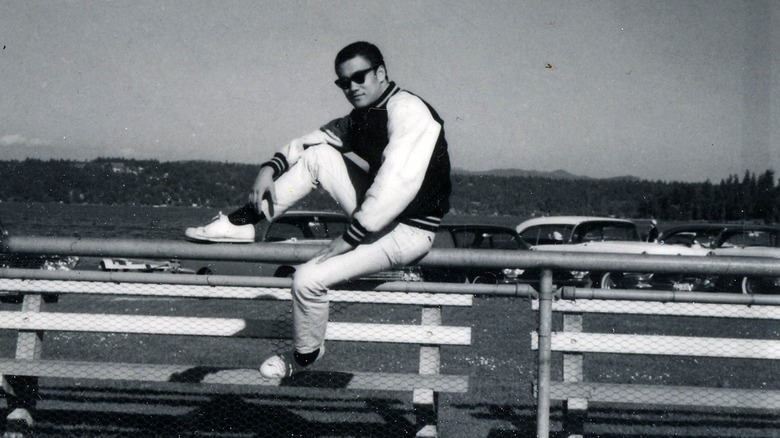
Prior to his '70s breakthrough, Lee was hugely popular in Hollywood circles as a martial arts instructor to the stars. His students included Norris, James Coburn, Sharon Tate, and Kareem Abdul-Jabbar. He was a handsome man with high-wattage charisma. Everyone knew he was a movie star waiting to happen. But, as Nguyen's documentary repeatedly demonstrates, the studios wanted to showcase his blazingly brilliant martial artistry via white actors.
This was just one more infuriating instance of Asian-Americans being sidelined as their culture was wantonly exploited. As Nguyen told Jumpcut's Nguyen Le, Lee's struggles allowed him to educate viewers about a virulent strain of bigotry that isn't discussed nearly enough:
"[You can] think of the film as sort of this Trojan horse where you think you're learning just about Bruce Lee, but you're also learning about Asian American history, American racial history, the 'model minority' myth, and all of these things that sort of act as the contours of who we are as people as Asian Americans."
Hollywood has made a good deal of cosmetic progress over the last decade in terms of acknowledging Asian art (e.g. in 2020, Bong Joon-ho's "Parasite" became the first film not in English to win the Academy Award for Best Picture), but it's still failing when it comes to Asian-American representation and depiction. In 2021, the Coalition of Asian Pacifics in Entertainment survey showed that 35% of films featuring Asian-American or Pacific Islander characters employed at least one hoary cultural stereotype. Meanwhile, 90% of respondents said they are often the only person of Asian-American or Pacific Islander descent in the room. 55% of these respondents said they've encountered "blatant racism" at work.
For a supposedly progressive industry, these findings are more than inexcusable, they're abhorrent. While it's important to celebrate the life and accomplishments of Bruce Lee, it's just as vital to understand that the prejudice he faced 50 years ago hasn't gone away. There's much work to be done. This is something Nguyen's "Be Water," which is currently streaming on Disney+, painfully and emphatically drives home.
Read this next: The 18 Best Action Movie Actors Ranked
The post Bruce Lee Was a 'Trojan Horse' For Be Water's Broader Message appeared first on /Film.
YouTube’s “64 Bits” has shared a video, showcasing what a 16-bit SNES demake of Elden Ring could have looked like. And, to be honest, 64 Bits nailed everything you’d expect to see from a SNES version of FromSoftware’s latest game. This looks and feels like a proper SNES game. Basically, this Elden Ring demake appears … Continue reading This 16-bit SNES demake of Elden Ring looks retro-cool →
The post This 16-bit SNES demake of Elden Ring looks retro-cool appeared first on DSOGaming.
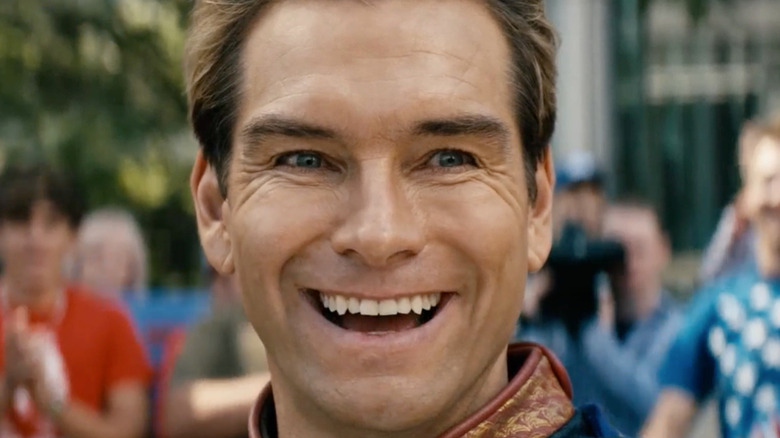
"I am very excited for everyone to meet the real me," declared a grimacing Homelander (Antony Starr) in the Season 3 premiere of "The Boys." It might be the scariest threat he's delivered on the show thus far. Season 2 ended with Homelander defeated, masturbating atop the Chrysler Building in a futile attempt at restoring his tarnished dignity. Season 3 is about him clawing back up, and it's terrifying.
In doing so, it's also clearer than ever that the biggest influence on the character isn't Superman or Captain America, it's Donald Trump, another malignant narcissist with bleached blond hair and a history of cozying up to Nazis. Showrunner Eric Kripke confirmed this in an interview with Rolling Stone, bluntly titled, "Yes, Homelander on 'The Boys' Is Supposed to Be Donald Trump."
In a truly baffling turn of events, some "Boys" fans are shocked. Despite two prior seasons with the subtlety of a sledgehammer, these fans hadn't clued into either Homelander's irredeemability or that the show's satire is aimed firmly at the right. Let's look into why they are shocked and why they shouldn't have been.
This hullabaloo began on "The Boys" subreddit. The tipping point was season 3, episode 5, thanks to the character Blue Hawk (Nick Wechsler). Blue Hawk's name and "color-blind" crimefighting that's really not anything of the sort are a not-so-subtle shade of the Blue Lives Matter crowd. You can read /Film's Michael Boyle go into more detail on that storyline here.
A now-deleted post on the subreddit titled, "Was really liking Blue Hawk until the end of his speech." The poster elaborated, "His speech should have been sarcastic because there is no reason to [apologize] for eliminating criminals." Other members of the community tore this apart. As a forum moderator succinctly said, "Right-wingers are finally understanding that the show is making fun of them."
The situation earned more attention thanks to writer Ryan Broderick tweeting about it, which "The Boys" official Twitter account then highlighted. Broderick screenshotted both the deleted Blue Hawk post and another one, "The Boys perfectly displays what the dictator trap is." This post praised the show's satirical depiction of Homelander's Trumpian rule of Vought, but ended up locked due to fans who, as Broderick put it, "thought Homelander was cool." Broderick observed of pro-Homelander commentators, "They know he's the bad guy. They want ... [him] redeemed so they don't get uncomfortable [for liking him]." That Homelander's only getting worse no doubt grates them.
For reference, many posts and comments on "The Boys" subreddit were removed due to community Rules 3 and 6: "Be civil" and "No politics" respectively. However, even the community's left-leaning members refused to be silent, one arguing that Rule 6 is too restrictive since the show is so blindingly political. Indeed, the parallels between Homelander and Trump are so obvious it's nigh impossible to discuss his character arc and not get political.
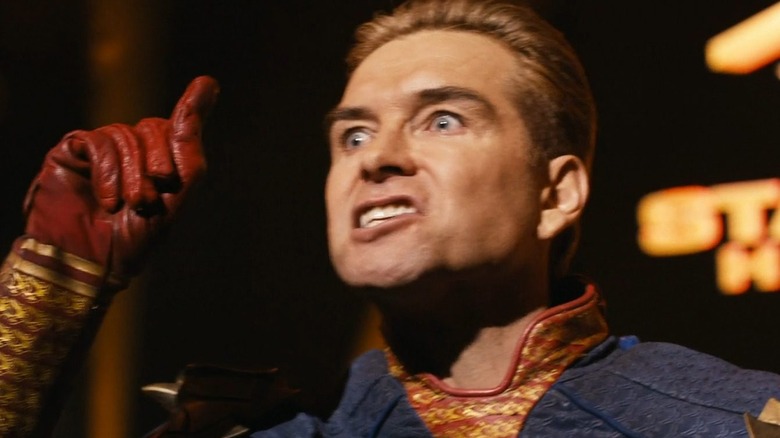
Vought CEO Stan Edgar (Giancarlo Esposito) attempts to neuter Homelander's power by making Starlight (Erin Moriarty) co-captain of the Seven. Homelander's Nazi girlfriend Stormfront (Aya Cash) then dies by suicide on his birthday. By the end of season 3, episode 2, he's had enough and goes on a deranged, self-congratulatory speech, all aired on live TV.
The speech bears many hallmarks of Trump's rhetoric (if you can call it that). Homelander declares, "you need me to save you, I am the only one who possibly can," akin to Trump's declaration, "I alone can fix [America]," at the 2016 RNC. He also says, "All my life rich people, powerful people tried to muzzle me, cancel me, keep me obedient." As Trump does, Homelander is attacking the same elite he's a part of. This sort of anti-establishment conservatism is inherently contradictory. A movement all about shoring up tradition and capital can't topple them, especially when its leader is someone lifted by those power structures.
Unfortunately, just like disaffected white people flocked to Trump in the real world, many ex-Stormfront fans find themselves with a new icon in Homelander. What many Trump fans like about the man is that "he tells it like it is," meaning he voices their preconceived prejudices. Homelander is getting an audience for similar reasons.
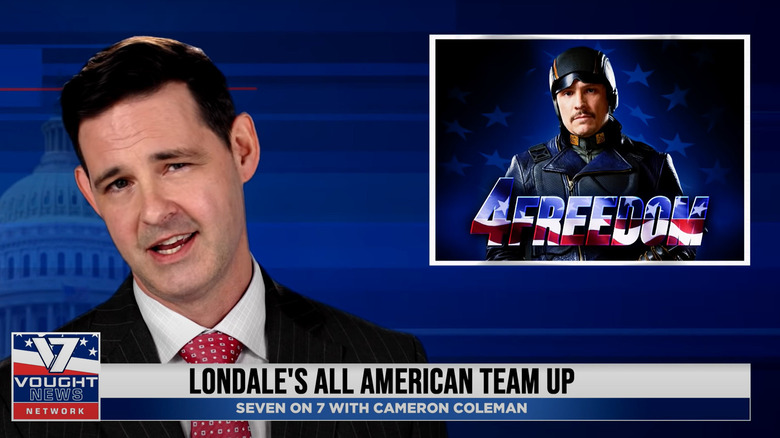
In episode 5, while being interviewed on the "Cameron Coleman Hour," Homelander is asked about a recent super-villain attack. His response is, "America is safe, go to your restaurants, go to your movie theaters, live your lives!" This is a clear shot at Trump's laissez-faire handling of COVID-19. He continues his attacks on the media in Episode 6: "The American people know ... when someone is lying to them." He didn't have to say "Fake news" to get the point across.
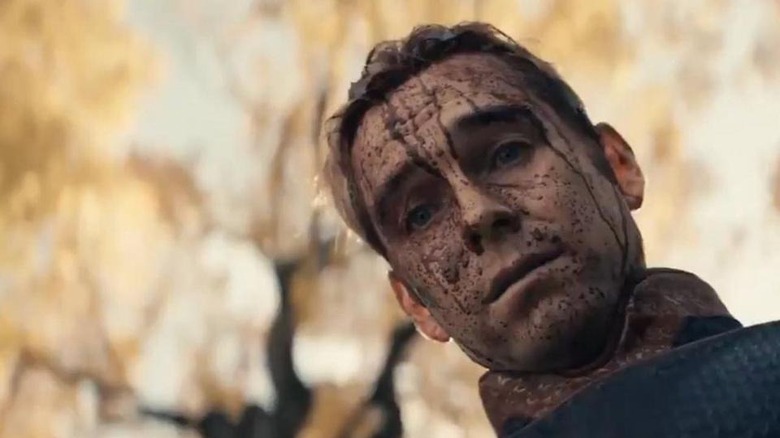
In the aforementioned Rolling Stone interview, Kripke elaborated:
"[Homelander's] always been a Trump analogue for me... He has this really combustible mix of complete weakness and insecurity, and just horrible power and ambition, and it's just such a deadly combo. Of course he would feel victimized that people are angry that he dated a Nazi. All he ever wants is to be the most powerful person he can be, even though he's completely inadequate in his abilities to handle it. So it's white-male victimization and unchecked ambition. And those issues just happened to reflect the guy who, it's just still surreal to say it, was... president of the United States. And it's a bigger issue than just Trump. The more awful public figures act, the more fans they seem to be getting."
Conservatives' fixation on cancel culture has indeed created many martyrs. Gina Carano, fired from LucasFilm due to anti-Semitic and transphobic social media posts, is now starring in the Daily Wire-produced "Terror on the Prarie." The film's marketing puts her "cancellation" by Disney front and center.
Homelander's mix of power and self-pity resonates with the type of people he's appealing to in his world and ours. He's literally the most powerful man in the world, but also sees himself as a victim because not everyone worships him. His fragile ego drives his actions, like how he stocks Vought's leadership with cronies like the Deep (Chace Crawford), Black Noir (Nathan Mitchell), and Ashley (Colby Minifie) while firing or killing (RIP Supersonic) those who step out of (his) line. Speaking to his own reflection in episode 6, Homelander finally acknowledges how he craves to be loved even by "mud people" he views as lesser.
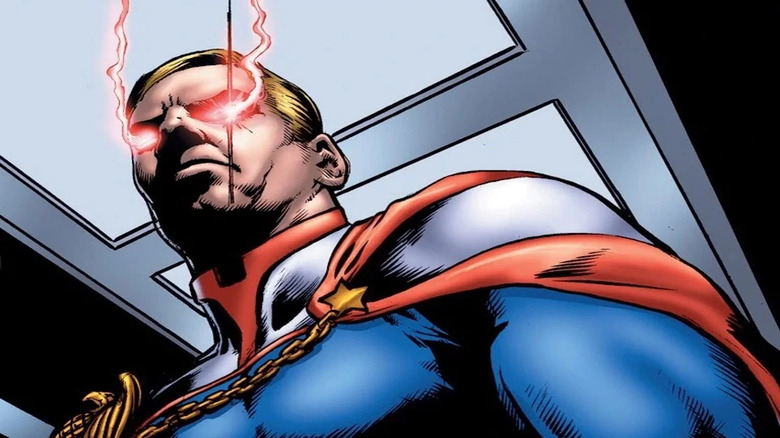
It's honestly inexcusable for fans to be shocked at Homelander's descent. For one, it'd be out of character for the show. Many of the contemptible supe characters, like the Deep and A-Train (Jessie Usher), have been given pitiable moments and opportunities for change. A-Train was offered a spot on the anti-Homelander team by Supersonic, while back in Season 1, the Deep was sexually assaulted, experiencing the same pain he caused Starlight. And yet, these characters continually squander their chances for growth. Why would Homelander, who's committed the same crimes as those two and worse, be the one who finally turns over a new leaf?
Queen Maeve (Dominique McElligott) has had the closest thing to a redemption arc, but she was never evil, just apathetic. Indeed, all of her worst moments were because of Homelander's influence.
As for the political side, satire of right-wing figures is baked into Homelander's character, even in Garth Ennis and Darrick Robertson's original comics. For one, there's his name. It's a pastiche of the Department of Homeland Security, which was founded after 9/11. Since the organization's inception, that name has been criticized for nationalistic connotations. Fitting for a character literally draped in an American flag who embodies this country's ugly Id. "The Boys" began publication in 2006, so the Bush administration cast a shadow over its satire. Season 1 echoed this, between the plane crash plot point and Homelander all but quoting George W. As the series has gone on though, the politics have become more and more of the moment, hence a Homelander that's more Donald than Dubya.
With all this mind, it's baffling how right-wingers could latch onto Homelander as a figure of valorization. As Eric Kripke himself asked, "Um... are they actually watching the show?"
Read this next: The Best Movies Streaming Right Now: Malignant, A Hero, And More
The post Why So Many Fans Are Shocked By Homelander's Arc In The Boys Season 3 appeared first on /Film.
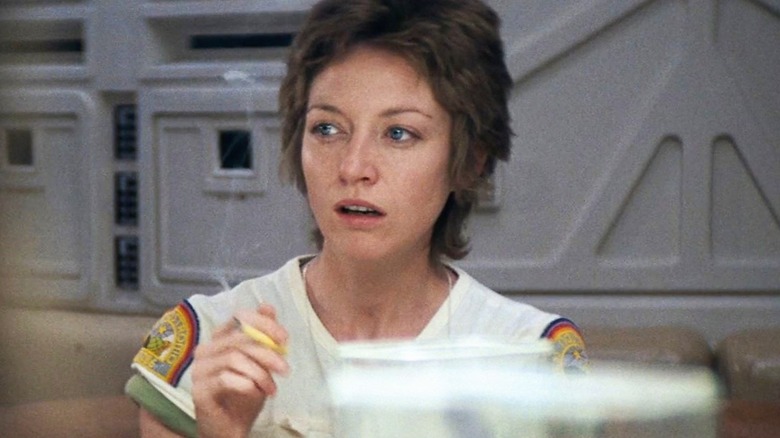
Throughout the many versions of the script for "Alien," there was one scene that always stayed more or less the same: the "chestburster" sequence where John Hurt's character, Kane, suddenly gives birth to an alien at the dinner table. Initial Dan O'Bannon and Ronald Shusett knew early on that they wanted to have the alien impregnate one of the crew members of the Nostromo, resulting in a truly horrifying demise.
The other characters' fates were less certain. Screenwriters David Giler and Walter Hill extensively revised and rewrote the original script, creating eight more drafts in total. Director Ridley Scott even pitched an ending where the Xenomorph brutally kills Ripley and takes control of the ship, though the idea was quickly shot down by the studio.
Research compiled by the "Alien" fan site Strange Shapes reveals that one of the elements that kept changing throughout these many versions of "Alien" was Lambert's cause of death. Played by Veronica Cartwright, Lambert died on the page in a variety of ways, from being eaten by the alien to being accidentally burned alive. Here's a rundown of the many alternate Lambert death scenes and why, in the end, none of them ended up actually being filmed.
Originally titled "Starbeast," Dan O'Bannon and Ronald Shusett's 1976 version of the "Alien" script had just six crew members. (Ian Holm's android character, Ash, was added later in the revisions by David Giler and Walter Hill.) The characters had completely different names in this early draft, but while male pronouns were used throughout, the script notes that "the crew is unisex and all parts are interchangeable for men or women."
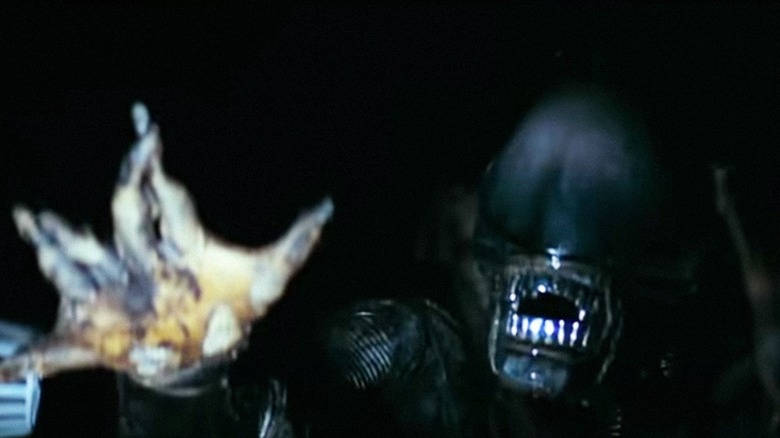
Whereas Lambert is the last crew member to die in the version of "Alien" we all know, she was originally killed second. After Kane violently gives birth through his chest, the rest of the crew set out to hunt down what they think is still a small alien creature. They locate the vent with the alien in it, and Lambert opens it up so that they can torch the little sucker. Unfortunately, he's instead confronted with six feet of pure nightmare fuel. As Dallas and Ripley look on in horror...
[Lambert] lets out a horrible shriek, and the thing grabs his head in one claw and twists it off like a man pulling the head of a chicken, then throws it to the floor with an audible clunk. Clutching [Lambert's] body tightly against itself, it turns and bounds down the hall. [Lambert's] headless body is still kicking and struggling as the monster leaps head-first into another air shaft.
Gruesome! But at least it's a quick death, unlike some of the others on this list.
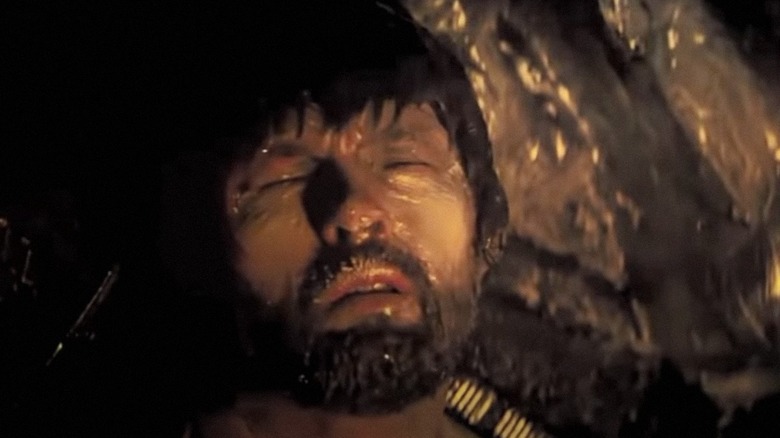
One of the scenes that ended up getting cut from "Alien," though it was later included in the 2003 Director's Cut, saw Ripley discovering the cocooned bodies of Dallas and Brett, preserved by the Xenomorph for later use. Dallas is still alive when Ripley finds him in the cocoon, and in one draft of the script he indicates another cocoon dangling from the ceiling -- "smaller and darker, with a harder shell" -- and tells Ripley, "That was Brett ... it ate Lambert."
It's a grim piece of exposition that leaves the horrors of Lambert's death largely up to the imagination. In the version of this scene that made it into the Director's Cut, though, Dallas is too far gone to be offering up information about the rest of the crew. Instead he simply moans, "Kill me ... kill me ..." over and over until Ripley puts him out of his misery with her flamethrower.
The original tagline for "Alien" was, "In space, no one can hear you scream." Because space is a vacuum, it can kill you in all sorts of ways that are too horrible to comprehend. But let's comprehend them anyway!
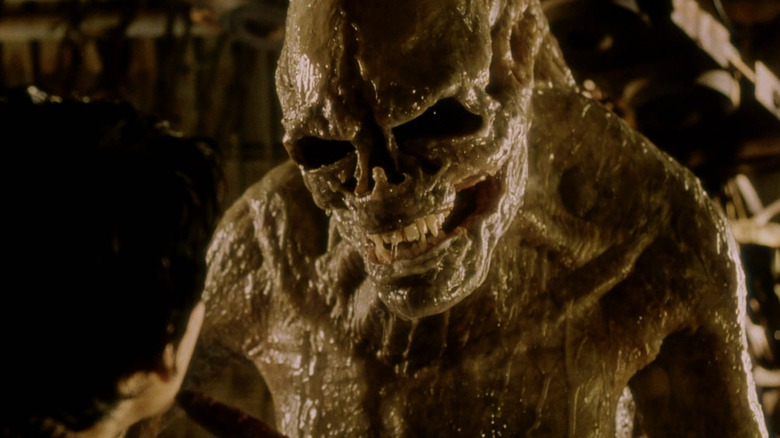
If you've seen Jean-Pierre Jeunet's 1997 sequel "Alien Resurrection," you may remember that it featured a weird human-Xenomorph hybrid called the Newborn. At the end of the movie, Ripley 8 -- a clone of Ripley who herself is cross-contaminated with Xenomorph DNA -- uses her acidic blood to burn a small hole in the hull of the ship. The Newborn then gets sucked out through this hole and into space piece-by-piece, like meat going through a mincer.
This gory death was originally designed to be experienced in the first "Alien" movie by -- you guessed it! -- Lambert. As Ridley Scott explained, "I wanted Lambert to get sucked out of the ship through an opening about the size of a keyhole." Lambert was saved from this particularly awful fate by budgetary constraints, and by the limits of 1970s special effects. "We couldn't afford it," said Scott. "Besides, I couldn't work out in those days how to squeeze a body through a hole that big."
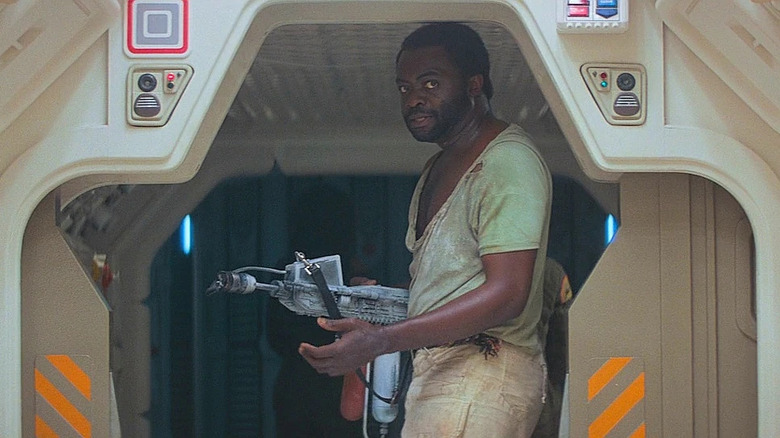
Flamethrowers are one of the best ways to kill a Xenomorph, but they're also pretty dangerous for humans as well. In the final version of Parker and Lambert's death scene, Lambert is cornered by the creature and Parker, wielding a flamethrower, yells at her to "get out of the way" so that he can have a clear shot at the alien. But Lambert is frozen in fear, and Parker ends up being pinned and killed with a brutal bite from the Xenomorph's inner mouth.
In one of the later versions of the "Alien" script, this scene goes a little differently. Instead of Parker and Lambert both being killed by the alien, Parker accidentally sets Lambert on fire while trying to barbecue the Xenomorph. There are a couple of lessons to be learned here: one about responsible flamethrower use, and another about getting out of the way when someone tells you to get out of the way.
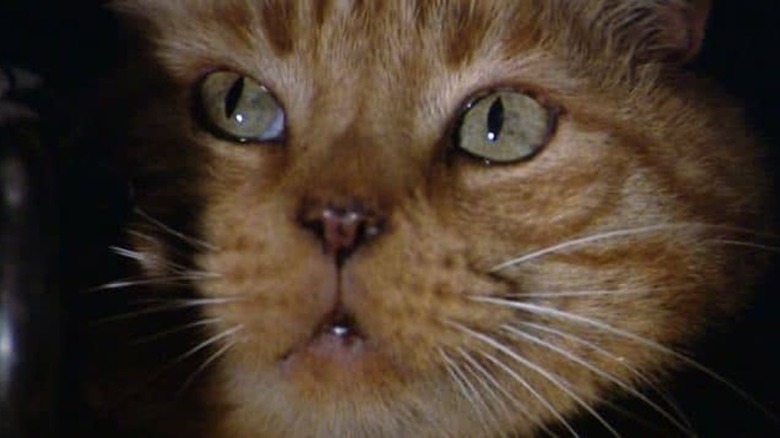
In the near-final version of Lambert's death, she simply dies of fright -- something that's pretty believable thanks to Veronica Cartwright's performance, which cemented her as one of the all-time great scream queens of horror cinema.
"Ridley wanted to do a thing where I freak out and crowded back into one of those lockers that the cat came out of," Cartwright explained to Fantastic Films magazine in 1979. "I sort of crawl up into it and die of fright." Cartwright believed that this was going to be Lambert's fate right up towards the end of filming, but they ran out of time and never got around to filming her crawling into the locker. In the end, her death had to be cobbled together using footage from an earlier scene in the movie ... which brings us to the version of Lambert's death that actually ended up in "Alien."
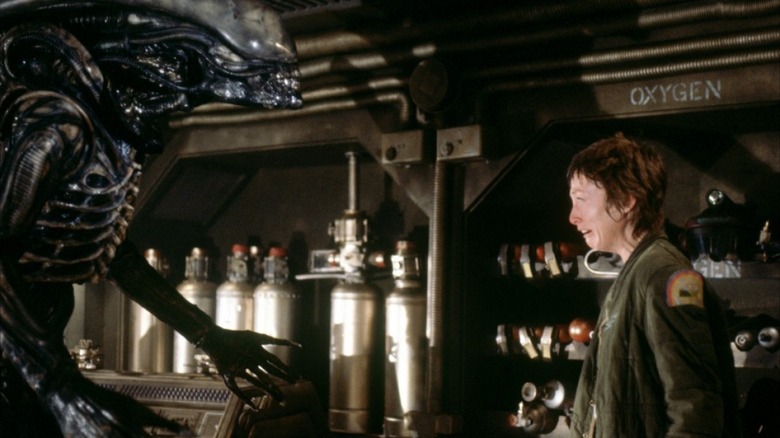
Despite the many grim deaths that were cooked up for Lambert, none of them ended up being filmed. The ominous shot of the Xenomorph's tail creeping up between Lambert's legs was actually a spare shot of Harry Dean Stanton's legs from Brett's death scene. "When I was watching the movie I realized, 'those aren't my legs!'" Cartwright later recounted. "It was really weird."
To offer at least some kind of a payoff for Lambert's death, a last-minute scene was shot to show her dangling, bloodied foot when Ripley discovers the body. Cartwright had to hang from "a jockstrap contraption for a couple of hours" to film the shot, "and then they decided that was what [her] death would be." After reading about all those other grisly deaths it might seem a bit anticlimactic, but sometimes horror is most effective when it's left up to the imagination.
Read this next: The Horror Movies We Can't Wait To See In 2022
The post Every Alternate Death Scene For Alien's Lambert Explained appeared first on /Film.
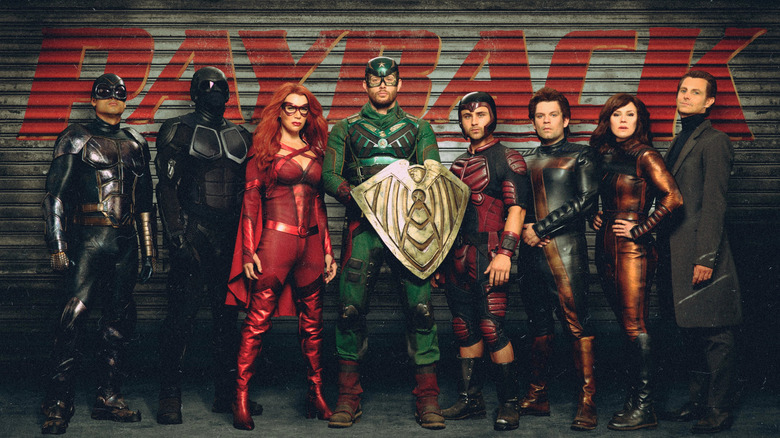
Note: this feature contains spoilers for "The Boys" up to season 3, episode 6, "Herogasm."
If you watch "The Boys," then you probably know the Seven inside and out by this point. The Vought International-sponsored superhero team may look like heroic figures, but for the most part they're narcissistic and even downright dangerous individuals seeking total control over their audience. Okay, maybe the only member of the Seven that fits that last bill is Homelander, but the point still stands.
Viewers know and understand the Seven, at least a little bit, but they don't necessarily know about any of the other teams that exist within the same universe. While the Seven are the most popular superhero team around, there have been many others that existed before or during their rise. Payback, a former Vought-sponsored team, was one of these teams, and their history plays a major role in this season of "The Boys." However, they're still a bit of an enigma, so let's go through the members of this formerly famous team and the comic book characters they're parodying.
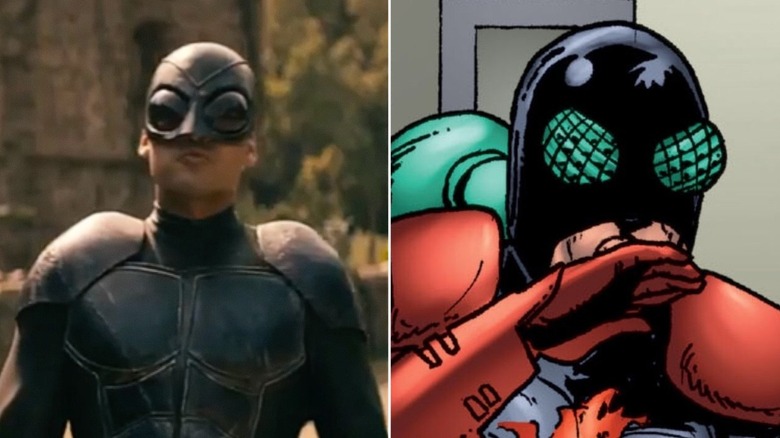
Poor Swatto! He didn't even last one episode before getting killed off. He met his untimely but ultimately cowardly death after flying into the air, alerting the Sandinistas to the U.S. camp in Nicaragua. After realizing that the Sandinistas have invaded the camp, Swatto flies away, getting struck by a rocket in the process.
Swatto's sole appearance on "The Boys" is quite different from his rolce in the comic series. Then again, the show takes a lot of creative liberties from its source material, and usually for the best. Case in point, Swatto's first comic appearance saw him in a flashback where Tek Knight attempts to sexually assault Mind-Droid. Later on, he and the other members of Payback are ordered to kill the Boys, and Swatto eventually meets his end via pickaxe, likely at the hands of Butcher.
Even though his time on the show greatly differed from his appearances in the comics, Swatto still maintains the same abilities. He is meant to be a parody of both Ant-Man and the Wasp from Marvel Comics, being able to grow a pair of wings from his back and fly with them. However, he cannot alter his size, a flaw that ultimately costs him his life since he probably could've avoided his death if he could. Oh well, hindsight's 20/20.
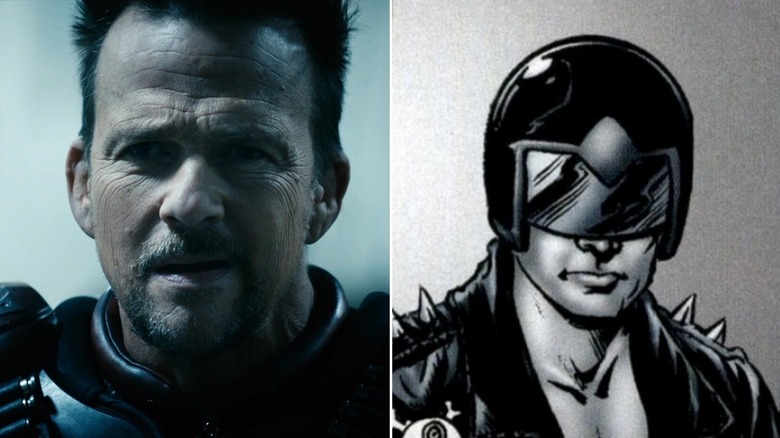
At least it was nice seeing Sean Patrick Flanery for a while. Unfortunately, it didn't take long for this Second Amendment-defending, left-wing-socialism-fighting American "badass" to get carved up by a Suped-up Butcher. On the bright side, he was able to make it out of the Nicaragua incident alive, even if he was too busy mowing down everyone in his path to ensure the safety of those around him. Swatto can't say that.
In the original comics, Gunpowder was not affiliated with Payback but rather the group Teenage Kix, a group that held A-Train among its former members in both the comics and the show. After the group confronts the Boys, Gunpowder gets his helmet destroyed but is relatively unharmed. The same cannot be said for his teammate Blarney Cock, who is accidentally killed by Hughie.
Gunpowder's inspirations aren't as clear as his new Payback colleagues, as he's a bit of an amalgamation of several different comic mainstays. His status as a former sidekick turned disillusioned weapon in the show gives heavy Winter Soldier vibes, while his aesthetics and penchant for guns in both the comics and show derive from DC's Deadshot and Rebellion's Judge Dredd. That latter inspiration makes his death on the show a lot more serendipitous.
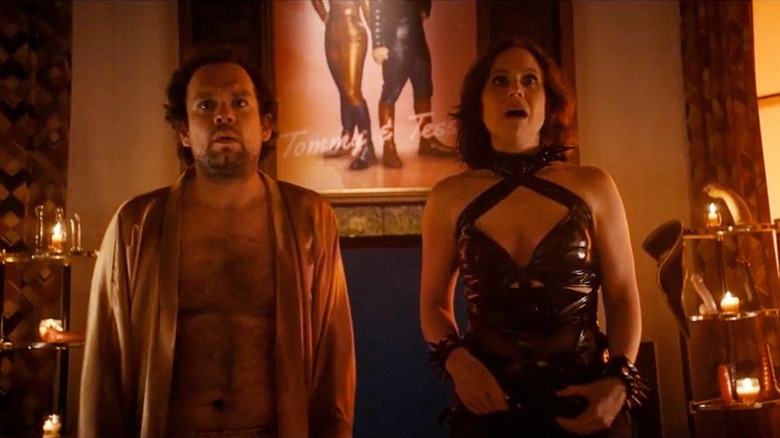
This duo is pretty interesting, not only because of their goofy powers and their status as the hosts of Herogasm but because they're among the few wholly original Supes on the show (alongside Ezekiel, Translucent, and Termite). While this means they don't have any comic history to analyze, we can certainly get into how they are on the show and what leads up to their mood-killing deaths.
The TNT Twins are perhaps the most arrogant members of Payback, which is saying a lot considering how gross pre-capture Soldier Boy was. Before the ill-fated attack in Nicaragua, these two had the gall to sit back and sunbathe. At least their teammates were standing around and pretending to be useful! They didn't even use their powers when the Sandinistas came roaring into the camp, but instead ran and hid like cowards. Given the arguments they got into with each other in the middle of their annual orgy meet-up, it shouldn't be surprising that they only went into the superhero industry for fame.
Tommy and Tessa bring to mind two different sibling duos: Marvel's Northstar and Aurora and DC's Wonder Twins, although the latter duo seems to have more influence. Their superpower, the ability to transfer energy between each other to create explosions, likely came from DC's slightly-jokey team.
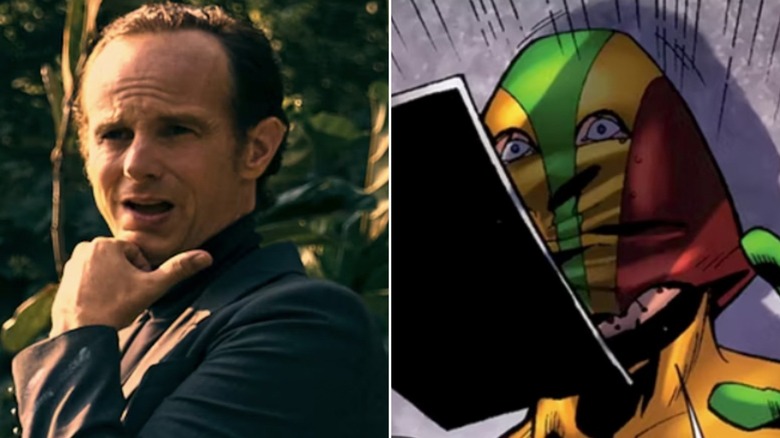
Okay, we're not entirely sure what's going on with this guy, as he's been a bit of an enigma. We didn't see him a ton during the Nicaragua incident, and there isn't any promotional information released that gives us insight into this character. We currently don't know his whereabouts in the show's present, making him safe from Soldier Boy for now. Unfortunately, he probably won't be safe for long, given that Butcher has already tracked down almost all his other former teammates.
While the name Mindstorm is wholly original to the show, there is the possibility that he is the show's version of Mind-Droid, a parody of Marvel's Vision right down to his color scheme. The previously-mentioned Supe was one of Payback's members in the comics, and met an unfortunate end after the team was ordered to kill the Boys. Despite his robotic appearance, he's just a human Supe with telekinetic abilities -- something he tries to tell Butcher before his head gets cut off with a shovel.
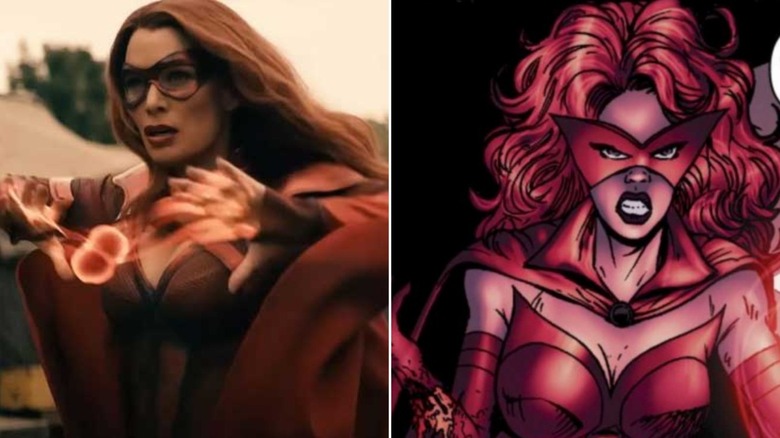
Life is rough. One day, you're the lead female hero of a Vought superhero team, and the next, you're a theme park attraction only attended by a handful of visitors wanting to escape the heat. You might also be running sexual livestreams sometimes. This life is one that Crimson Countess lives every day now after Payback was disbanded. Well, at least it was the life she used to live before getting reduced to a smoldering skeleton because of her ex-boyfriend, Soldier Boy. Now she can no longer sing about how chimps can't cry.
Like the rest of her Payback team members, Crimson Countess' role on the show differs from her comic book appearance in a few key ways. Most notably, her lover in the comics was Mind-Droid, whom she often cheated on with several other men. Her death was also directly at the hands of Butcher rather than Soldier Boy; the leader of the Boys choked her and then broke her neck with a belt.
Crimson Countess' appearance and ability to conjure her powers through her hands mark a resemblance to Marvel's Scarlet Witch, but her actual abilities are vastly different. In both the comics and the show, she can create orbs of fire and energy by making a specific gesture with her hands. She's also shown to have some super strength in the show, given that she's briefly able to take on Kimiko in a fight.
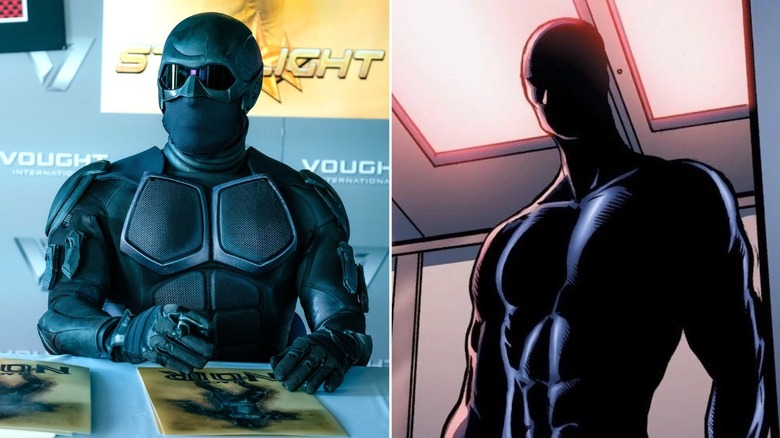
Black Noir is perhaps the luckiest member of Payback. Unlike his washed-up former teammates, he's still got a fruitful superhero career and is actually taken seriously as a menacing figure. Unfortunately, considering he's on the Seven, saying that he's got it good is a lie.
He's also considered the character that has changed the most from page to screen. Black Noir in the comics and Black Noir on the show are completely different people, albeit with somewhat similar powers. Both versions of the character are highly skilled at fighting and are able to withstand heavy-duty impact, but the Black Noir of the comics is actually Homelander's clone and thus shares all his powers. He was also the one who assaulted Becca, a crime committed by Homelander himself in the TV adaptation. Instead, the show's Black Noir is a ninja-like Supe who is unquestionably loyal to Vought, specifically Stan Edgar (Giancarlo Esposito) and Homelander, although this could be because he was left mute and mentally damaged during Payback's Nicaragua incident.
Given his prominence as a member of the Seven, it likely won't take long for Soldier Boy to set his sights on Black Noir. Actually finding him will be another matter, since Noir removed his Vought tracking chip and went on the run as soon as he found out that Soldier Boy was hunting down members of Payback.
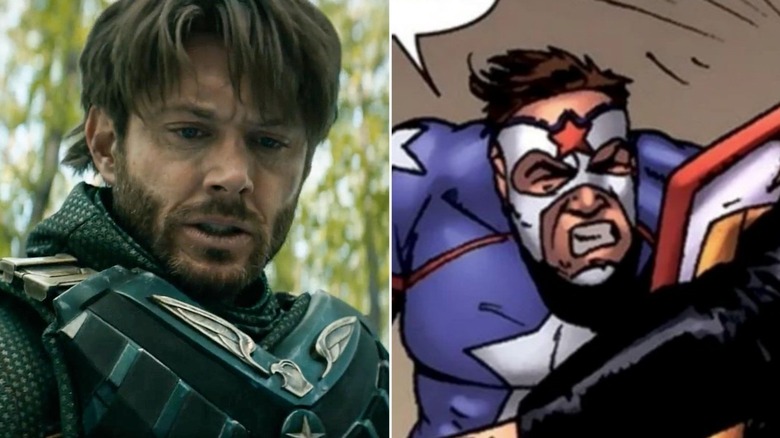
Watch your back, Homelander! The most indestructible and dangerous superhero wants to reclaim his title. Soldier Boy is the real deal when it comes to the damage he can wreak when he gets angry enough; after all, his first experience back in the real world cost the lives of 19 civilians. Despite this, he already seems to be enjoying the fact that he's out of Russian hands, as he's snorting up pills and making sure his former teammates die a painful death.
This is a pretty far cry from Soldier Boy's comic appearance, which shows him committing brutal acts but in a naive and cowardly way. His desperation to appease Homelander, so much so that he's willing to be assaulted by him, is replaced in the show with jealous anger over him being America's favorite hero instead of him. While the comic and the show have him adept at fighting and able to withstand copious amounts of damage, the show also gives him the ability to project radiation blasts from his chest. Oh, and he can also sing.
It's pretty clear that both the comic and show Soldier Boy derives a lot from Captain America. However, while the comic parodies the idea of an ultra-patriotic superhero who is ultimately a coward, the show envisions this character as someone so disillusioned that he doesn't care about saving anyone but himself. Given his show backstory as a weapon made through experimentation, there are also hints of the Winter Soldier, especially in his grittier attire.
Read this next: 13 Box Office Bombs That Are Truly Worth A Watch
The post The Boys: Every Supe From Payback's Name, Powers & History Explained appeared first on /Film.
Read more of this story at Slashdot.
Read more of this story at Slashdot.
 It’s 1978 and someone is abducting teenage boys in the suburbs of Denver. The police have no leads, no bodies, and no hope. When Finney (Mason Thames) disappears, he finds out what’s been happening to all of those kids, but there’s a disconnected telephone in the cement dungeon where he now spends his days, and it may be his way out. Scott Derrickson’s The Black Phone is the latest mid-budget horror film from the director of Sinister, and his partner, writer C. Robert Cargill (Doctor Strange). Based on a story by Joe Hill (N0S4A2), The Black Phone is a very effective supernatural horror film that explores the lives of a pair of siblings coping with the loss of their mother, the alcoholism and despondence of...
Director Taika Waititi has a brand new film coming out called "Thor: Love and Thunder." Perhaps you've heard of it? Naked thunder god, Marvel, hammers, and stuff? I'm kidding, of course. It's the latest Marvel Cinematic Universe film, starring Chris Hemsworth, Natalie Portman, Christian Bale, and Tessa Thompson. Waititi is also heading into the "Star Wars" universe to do some directing. He's doing pretty well, that Taika. He also gives some of the funniest interviews out there, including the one he just did on "The Late Show with Stephen Colbert."
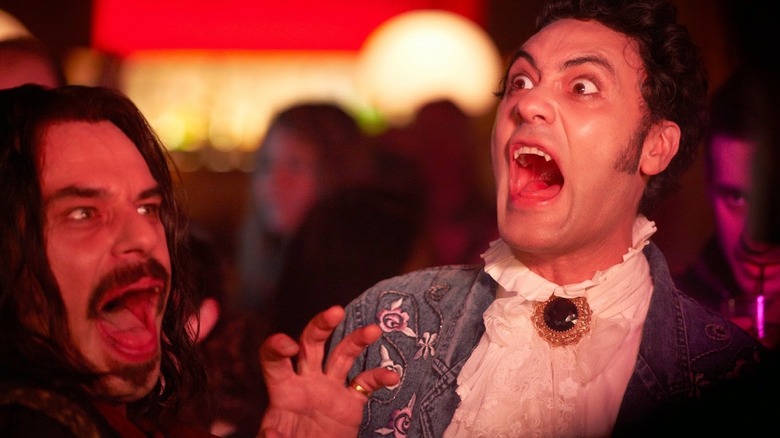
Before the hit FX TV series "What We Do in the Shadows" gave us the story of a clan of vampires living on Staten Island in mockumentary form, Waititi and Jemaine Clement co-wrote and starred in a film of the same name, which the series was based on. The 2014 film had a very small budget, and there wasn't a lot of money for building sets. In order to create the house that the origin coven of vampires share, Waititi revealed that he had to do some illegal things -- things that would surely scandalize the citizens of Hobbiton.
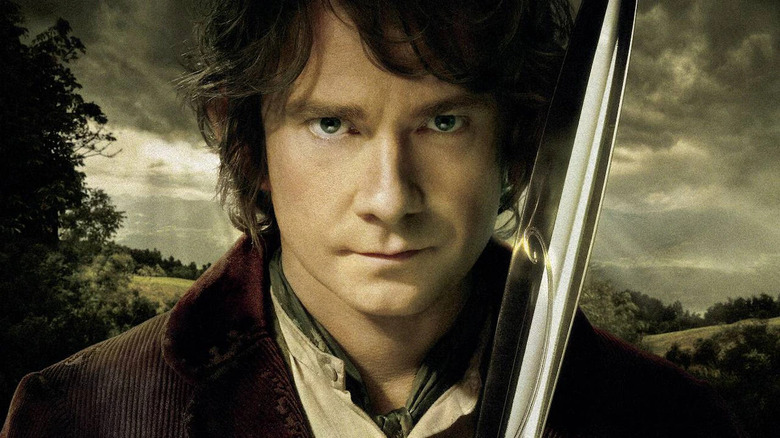
Waititi confessed these Middle-earth crimes to Stephen Colbert, explaining:
"When I did 'What We Do in the Shadows,' when Jemaine and I were shooting that, we didn't have much money to do that film, and 'The Hobbit' had just wrapped. And, so, our production designer — man, I don't know if I should tell this. OK, but I will — our production designer, in the dead of night, took his crew to 'The Hobbit' studios and stole all of the dismantled, broken-down green screens and took all of the timber, and we built a house."
Hey, making an independent film is hard, and finding money to do it is even harder. Plus, production had wrapped on "The Hobbit," so it wasn't like they were using them anyway! I'm not condoning stealing stuff from movie sets, of course, but this is Taika Waititi we're talking about. I feel like once you've signed on to direct a "Star Wars" film, the likelihood of Peter Jackson coming over to put a smackdown on you isn't high.
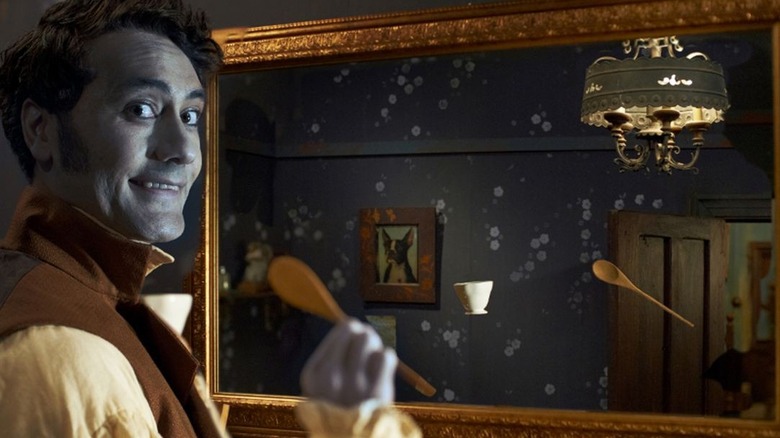
Peter Jackson may not even be aware of the theft. Waititi said, "I had never talked to Peter Jackson about this. I don't know if he knows. I like telling it at parties, that story. But I don't know if he actually knows."
I mean, he probably does. If you tell a story at enough parties, it does get back to people. Waititi also mentioned that he had some great conversations with Jackson before he directed the last "Thor" film. Being no stranger to low-budget movies himself, I have a feeling Jackson would probably appreciate his willingness (or at least, the production designer's willingness) to go the extra mile, as it were, to make a film.
"Thor: Love and Thunder" will hit theaters on July 8, 2022. Thor rides in a flying boat drawn by goats. I'm very excited to see this.
Read this next: 16 Horror Movies That Ruined Everyday Activities
The post Taika Waititi's What We Do in the Shadows Crew Stole Equipment From The Hobbit Set appeared first on /Film.
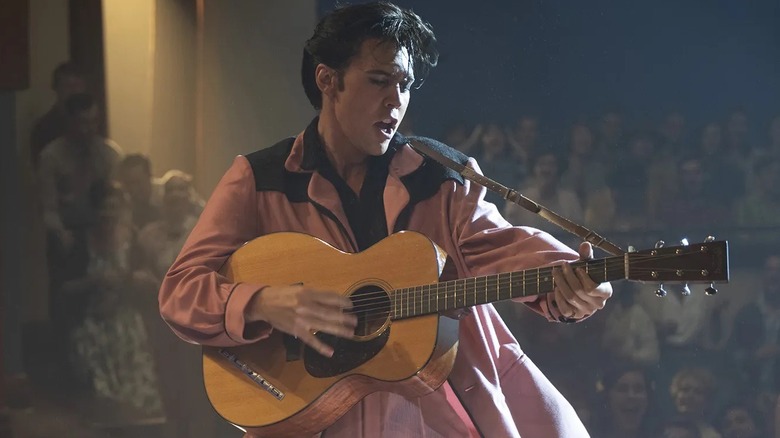
"Elvis" is many things: a biopic of one of the biggest stars in the world, a Baz Luhrmann movie, a star vehicle for the relatively unknown Austin Butler, and a chance for Tom Hanks to play a villain. While your head may be spinning after two hours and forty minutes of Luhrmann's typically frenetic editing, it may have given you the taste for more. So, where to turn to next?
If you're unfamiliar with Elvis' movie career, you may want to know which of his 30 movies to check out first. If you're new to the work of the Oscar-nominated filmmaker, let us point you in the direction of a little thing called "The Red Curtain Trilogy." If "Elvis" has given you the taste for biopics of music stars, there are certainly some to be recommended and some to be avoided.
If you want to know more about this Austin Butler kid, we have you covered, and if you're in the mood for more weirdness from America's Dad and all-around Mr. Nice Guy Tom Hanks, we can point you in the right direction there, too. Whatever you're hunka hunka hankering for, let us guide you through the 10 movies to check out next after watching "Elvis."
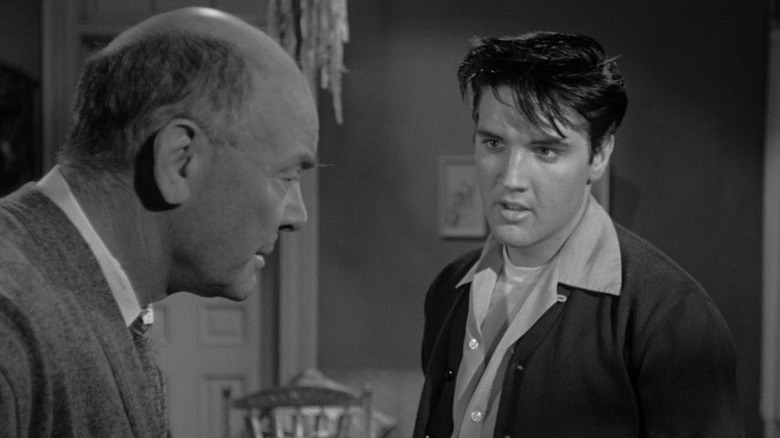
You might have an image of an Elvis movie in your head, and it probably involves bright colors and surfboards. Surprisingly, some of his earlier black-and-white movies were grittier than expected. If you took Elvis (and the singing scenes) out of "King Creole" and replaced him with James Dean or Paul Newman, you probably wouldn't bat an eye. Elvis plays the rebellious, angry young man type that rails against his father that we saw from many young actors in the '50s. Helmed by Michael Curtiz, who also made "Angels with Dirty Faces," "Mildred Pierce," and "Casablanca," it should come as no surprise that it's well-directed and looks great.
"King Creole" is a tension-filled gangster thriller, with the odd Elvis song thrown in there to keep the fans (and Colonel Parker) happy. It's easy to imagine that this was at a stage when Presley wanted to take acting seriously and not just use movies as vehicles to sell records. He plays Danny, a teenager whose father is desperate for him to finish school, but he just wants to make money as a singer and he's torn between a nice girl, and a gangster's moll. When he starts to achieve success and bring in crowds at the King Creole club, it attracts the attention of the local New Orleans kingpin (amusingly played by Walter Matthau) who wants Danny to work for him. "King Creole" is a good movie, not just a good Elvis movie.
If you're looking for a more typical Elvis movie, you can't go wrong with "Viva Las Vegas." The title song is among the best of all Elvis tracks, for starters. The movie also features a leading lady possibly best-suited to Presley, and with whom he had the best chemistry: Ann-Margret. She could certainly keep up with him in the hip-swiveling dancing stakes, as you'll see in some fast-paced scenes involving the twist, and Ann-Margret generally shaking her funky stuff.
The plot is based around car racing, of all things, with Elvis playing Lucky Jackson, a young racer who is desperate to enter and win the local Grand Prix. He has money troubles, and this being Vegas, he both wins and loses a large amount in an effort to fix his engine. While doing various odd jobs in order to earn money, he manages to woo the lovely red-head Rusty, a swimming instructor at one of the Vegas hotels. Lucky knows the right people, because he manages to borrow boats and helicopters to aid him in his courtship. Of course, the movie culminates with the race itself, and Rusty following along in a helicopter above. "Viva Las Vegas" is silly fun, but the song-and-dance numbers are great, and there are some fantastic sequences set at Rusty's house and on the Hoover Dam.
It's doubtful that "Elvis" is your first Baz Luhrmann movie, but if you haven't seen much of his work and want to explore more, you should definitely go back to where it all began. 1992's "Strictly Ballroom" is the only Luhrmann movie set in contemporary Australia and it's populated by an amazing supporting cast of character actors, most of whom are covered in thick layers of fake tan and hairspray. Many of Luhrmann's hallmarks are already present, including his frenetic editing and use of close-ups that don't shy away from the grotesque.
The tracks "Love Is in the Air" and "Time After Time" are both set to gorgeously memorable sequences. Dance champion Scott Hastings has a rebellious maverick streak, wanting to break out of the strict confines of ballroom dancing and do his own steps. He also needs a new partner and finds one in an unlikely source; a wallflower beginner from his mother's dancing school. The performances of Pat Thompson and Barry Otto as Scott's parents, as well as the dancing federation head-honcho Barry Fife (Bill Hunter), really elevate "Strictly Ballroom" to something special.
This is by far Luhrmann's funniest film, and it's a shame that he doesn't inject as much comedy into his later work. With 1994's "Muriel's Wedding" and "The Adventures of Priscilla, Queen of the Desert," this was a mini golden age for Australian comedy movies. If you haven't seen Luhrmann's first film, you should definitely rectify that.
The final part of Baz Luhrmann's "Red Curtain Trilogy," following "Strictly Ballroom" and "Romeo + Juliet," is where it reached its zenith. "Moulin Rouge!" is the Baziest Baz Luhrmann film, and the one where you can really decide if you fall into the love or hate camp. Nicole Kidman (Satine) and Ewan McGregor (Christian) are both extraordinary in this musical dialed-up-to-11, set during the Belle Époque. Jim Broadbent and John Leguizamo are also fantastic in their supporting roles.
The songs are a huge reason for the success of "Moulin Rouge!" from the famous "Elephant Love Medley" to "Your Song" and the "Tango de Roxanne." The film's crowning achievement, though, is McGregor's performance of "Come What May" at the climax of the film; utterly shattered, voice and heart breaking, as Christian gradually makes his way back to Satine on the stage. Neither McGregor nor Kidman has the range or power of Broadway singers, but they absolutely know how to sell the emotion of the music. The songs are performed extremely well largely due to their acting doing all of the heavy lifting.
Musicals that are all about putting on a show are often the most successful. Luhrmann, and his crucial collaborator Catherine Martin, could dial the theatrical style up limitlessly in this red satin draped theatre with a windmill out front and a giant elephant in the garden. Little touches, like Kylie Minogue's Green Fairy, only add to the magic. "Moulin Rouge!" is easily one of the best musicals of all time.
Biopics of any kind, and particularly ones about musicians, can be extremely formulaic, leading to a particularly famous parody of the subgenre. Biopics tend to be more successful when they take a less conventional approach, and that is certainly something that director Todd Haynes has done. His 2007 Bob Dylan biopic "I'm Not There" famously uses many different actors — including Cate Blanchett, Heath Ledger, Ben Whishaw, and Richard Gere — to embody the soul of the folk singer at different stages of his life.
"Velvet Goldmine" takes an even more loose approach, with Jonathan Rhys Meyers playing Brian Slade (a stand-in for David Bowie) and Ewan McGregor playing Curt Wild (who looks like Iggy Pop, but is based on both Iggy Pop and Lou Reed). Because Bowie did not give permission for his songs to be used, the soundtrack is made up of '90s musicians such as Thom Yorke, Bernard Butler, Thurston Moore, Pulp, and Placebo either covering songs by the likes of Brian Ferry and Marc Bolan, or contributing new ones.
Like "Almost Famous," a journalist is at the center of this story, here played by Christian Bale. Bale, McGregor, Meyers, and Toni Collette (as Brian's wife) give brilliant performances and it goes without saying that John Dunn's costume design is second-to-none. Biopics will always be subjective, and the figure at the center will be viewed with a particular lens, so acknowledging this and layering fact and fiction is often the most successful route.
Since the release of "Walk Hard: The Dewey Cox Story," the music biopic can never be viewed in the same way again. Unfortunately, the film most affected by this is 2005's "Walk the Line," which is a shame because while it may be considered conventional, it's a well-acted and directed biopic. With Johnny Cash coming up in Memphis in the mid-1950s and rising in fame during the 1960s, there are many parallels with Elvis, including them both having served in the military.
Reese Witherspoon is the surprising secret weapon of "Walk the Line." You might think that her energy would seem in total contrast to Joaquin Phoenix, but they actually complement each other extremely well. Director James Mangold has had an eclectic career, including the excellent thriller "Cop Land" and 2017's brilliant "Logan." He knows that Witherspoon's June is the heart and soul of this story and that it works best as a romance. Witherspoon absolutely deserved her Oscar for showing how June transformed on stage, along with her annoyance when Johnny brings their real-life into the performance — not least when he proposes in front of an audience.
Movies about performers should have an interest in performance, which is why a director like Baz Luhrmann is a good match for a music biopic. "Walk the Line" does a nice job of revealing the public and private lives of two country stars, and their interdependence is crucial to their story.
In a clear example that not all music biopics are created equal, Dexter Fletcher's biopic of Elton John will stand the test of time. One of the things that makes "Rocketman" stand out is that it's a fully-fledged musical, with spectacular song-and-dance numbers. Starting on a high with "Saturday Night's Alright (For Fighting)" through to "Crocodile Rock" at the Troubadour and continuing with "Honky Cat," we are taken on flights of fancy and fantasy, into the mind of Reg Dwight as he dreams of becoming a pop star and then, of course, becomes one of the most successful recording artists of all time. Julian Day's costumes are also, unsurprisingly, a highlight; this film only winning one Oscar is a travesty.
Jamie Bell gives a typically impressive performance as John's long-term friend and songwriting partner Bernie Taupin, and Richard Madden plays his lover John Reid. But it is Taron Egerton who is the whirling dervish at the center of this wild ride, a centrifugal force drawing the audience in and not letting them go for the entire runtime. "Rocketman" deserved more attention, and it's a brilliant example of everything a music biopic can be.
You may leave "Elvis" thinking that you've witnessed Tom Hanks' weirdest performance, but let me stop you right there. Back in 2012, Hanks starred in "Cloud Atlas" a century-spanning epic directed by Tom Tykwer and the Wachowskis. Like the other stars, Hanks takes on around six roles, including a devious ship's surgeon in 1849, a scientist in 1970s San Francisco, an ill-mannered Cockney bad-boy gangster/author in 2012, and finally his main role: a humble goatherd in 2321.
As there are six different stories from six different time periods, some are stronger than others. The 1930s segment starring Ben Whishaw, Jim Broadbent, and James D'Arcy is probably the best, and the most emotionally stirring. The 2012 segment — which also stars Broadbent, as well as a hilarious and great Hugh Grant — features Hanks' entirely unexpected character and his murderous ways as the inciting incident of this storyline. The cast also includes Susan Sarandon, Hugo Weaving, Jim Sturgess, Keith David, and Bae Doona.
Hanks' main screen partner is Halle Berry in both the 1970s and the 2321 sections. They actually have good chemistry with one another, despite the challenges of some bizarre makeup and wigs. "Cloud Atlas" is even longer than "Elvis," and certainly not to everyone's taste. However, it's not often we get filmmaking that is this bold and risky, and that is always worth your time.
It is likely that you will come away from "Elvis" so impressed by Austin Butler that you'll want to know what other projects you can see him in. Butler began his career at a young age on the likes of "Hannah Montana," "Zoey 101" and "Ruby & The Rockits." He has since graduated into more mature roles, such as in Jim Jarmusch's "The Dead Don't Die." His most significant pre-"Elvis" film role is probably as Tex Watson, one of the ringleaders (alongside Charles Manson) in the murders of eight people, including Sharon Tate. Although in Quentin Tarantino's "Once Upon a Time... In Hollywood" version of events, things work out somewhat differently.
While Butler only has a small role, he interacts with both Brad Pitt's Cliff, who has a memorable visit to Spahn Ranch, and with Leonardo DiCaprio's Rick who becomes enraged when the "hippies" visit his street in a loud car. And more crucially, he also "interacts" with Brandy the dog. Butler is understated in his role as Tex, remaining an enigmatic figure. Tarantino seems uninterested in the motivations of the Manson Family, and more focused on their violent actions being thwarted by two bumbling action stars.
If there's any justice, "Elvis" will be a launchpad for Butler's career and he will have bigger roles in more movies in the future, starting with "Dune: Part Two." He's already worked with four prestigious directors, and received an endorsement from none other than Denzel Washington, so his career should be about to take off into the stratosphere.

Did you know that Elvis Presley's granddaughter is an actor? Riley Keough has been steadily racking up an impressive list of credits including "Mad Max: Fury Road," "American Honey," "Logan Lucky," and "Under the Silver Lake." Maybe her most impressive turn thus far is in Janicza Bravo's "Zola," in which she plays stripper Stefani who brings her friend Zola on a wild road trip to Florida, where things start to go awry.
Famously based on a viral Twitter thread, "Zola" makes a good companion piece to "Elvis" in more ways than one. It's a very modern tale of fame and celebrity, and with a story that originated on social media, it is ever-present in the narrative. Stefani makes the trip seem glamorous with constant selfies and videos, but as things spiral out of control, there's less documenting. One of the strongest aspects of this film is Ari Wegner's cinematography, which enhances the "Spring Breakers" feel. Neon bikinis shine out against dismal backdrops, with constant scenes of driving under sickly yellow streetlights and the use of mirrors meaning that the two central characters have nowhere to hide.
Keough is a revelation. Her culturally-appropriated accent will make you cringe, but this only works so well because it bounces off Taylour Paige's stoicism. There is propulsive energy and humor throughout "Zola" which comes directly from the Twitter-thread source. It's one of the best contemporary films to capture the times we live in, and Keough proves that she's a star.
Read this next: The 14 Greatest Biopics Of The 21st Century
The post Elvis Fans Will Want To Watch These 10 Movies Next appeared first on /Film.