With the planet’s January-October period ranking as the warmest ever recorded, it’s looking more and more likely 2015 will go down as the hottest year in known history. (And by an “enormous margin,” notes the Capital Weather Gang.)
To help us understand what’s driving up the temperature, NASA has created this hypnotic visualization of two huge sources of atmospheric CO2: burning biomass and emissions from megacities, aka those with populations above 10 million. Based on a supercomputer’s climate simulation, the animation is perhaps a little too beautiful given its subject matter. Fire-caused emissions from agriculture and lightning-sparked wildfires swirl like actual flames in Africa, Australia, and South America, whereas urban CO2 pours like blue chimney-smoke from Southern California, the Northeast, China, the U.K., and elsewhere.
Scientists are using climate models like this one—called GEOS-5 (Goddard Earth Observing Model, Version 5, created at NASA’s Goddard Space Flight Center)—to better understand how carbon dioxide moves around Earth’s atmosphere and how carbon moves through Earth’s air, land, and ocean over time. Rising carbon dioxide levels in the atmosphere are driving Earth’s ongoing climate change.
This animation shows a five-day period in June 2006. The model is based on real emissions inventory data and is then set to run so that scientists can observe how the greenhouse gas behaves in the atmosphere once it has been emitted.
(Note the simulation repeats itself a few times in this video.)
“We have freedom of speech, we have freedom of religion,” says Megyn Kelly, in this segment about the coalition-building impulses of an overripe pumpkin from Halloween 2007. “And we’re opening up a very dangerous door if we get the government getting to go into a religious institution and decide what amounts to hate speech.”
Katrina Pearson, a spokesperson for the Trump campaign, starts spewing an assortment of nouns and verbs with all the coherence of that girl in your dorm who decided to major in sociology because she just really liked people. Megyn Kelly takes the question and throws it to Saba Ahmed, president and founder of the Republican Muslim Coalition.
“Megyn,” says Ahmed, very, very calmly, “we go to the mosque to pray.”
I recommend this video if only to truly appreciate the nonverbal performance of the third person being interviewed, which is that hijab, which is all, “WHAT UP, BITCH, U SEE ME? I KNOW U SEE ME BITCH.”
Dear White People: Please stop calling the police every time you see a person of color that is new to you.
Earlier this morning, The Washington Post published an essay by a Santa Monica, CA resident named Fay Wells, a Duke and Dartmouth graduate who is now a VP of Strategy at a multinational corporation who also happens to be a black woman. In it, she tells the story of how she locked herself out of her apartment, hired a locksmith to get her back inside, then had to deal with 19 police officers coming to her house with dogs, because her white neighbor saw her doing this and “had never seen her before.”
Here are some of the lowlights. Wells explains all the ways in which she attempted to explain and do everything right, and still got mistreated:
Later, I learned that the Santa Monica Police Department had dispatched 19 officers after one of my neighbors reported a burglary at my apartment. It didn’t matter that I told the cops I’d lived there for seven months, told them about the locksmith, offered to show a receipt for his services and my ID. It didn’t matter that I went to Duke, that I have an MBA from Dartmouth, that I’m a vice president of strategy at a multinational corporation. It didn’t matter that I’ve never had so much as a speeding ticket. It didn’t matter that I calmly, continually asked them what was happening. It also didn’t matter that I didn’t match the description of the person they were looking for — my neighbor described me as Hispanic when he called 911. What mattered was that I was a woman of color trying to get into her apartment — in an almost entirely white apartment complex in a mostly white city — and a white man who lived in another building called the cops because he’d never seen me before.
On the response she received after she finally convinced them that she lived there:
After the officers and dog exited my “cleared” apartment, I was allowed back inside to speak with some of them. They asked me why I hadn’t come outside shouting, “I live here.” I told them it didn’t make sense to walk out of my own apartment proclaiming my residence when I didn’t even know what was going on. I also reminded them that they had guns pointed at me. Shouting at anyone with a gun doesn’t seem like a wise decision.
I had so many questions. Why hadn’t they announced themselves? Why had they pointed guns at me? Why had they refused to answer when I asked repeatedly what was going on? Was it protocol to send more than a dozen cops to a suspected burglary? Why hadn’t anyone asked for my ID or accepted it, especially after I’d offered it? If I hadn’t heard the dog, would I have opened the door to a gun in my face? “Maybe,” they answered.
On her interaction with the neighbor who called 911 in the first place:
I introduced myself to the reporting neighbor and asked if he was aware of the gravity of his actions — the ocean of armed officers, my life in danger. He stuttered about never having seen me, before snippily asking if I knew my next-door neighbor. After confirming that I did and questioning him further, he angrily responded, “I’m an attorney, so you can go f— yourself,” and walked away.
If you listen to the 911 call over at the Washington Post piece, you’ll hear how ridiculous the call sounds. The guy is reporting a “Hispanic male with tools” “tap-tap-tapping” on the lock, and how he “clearly didn’t have keys to the apartment.” Also, how he wore a cap and a dark shirt and was carrying “some kind of briefcase.” And I wanted to scream “Um, MAYBE BECAUSE IT’S A LOCKSMITH WITH LOCK-PICKING TOOLS.” I don’t know what’s worse, this guy calling 911 based on very little information (he didn’t know whether the apartment was vacant or not, the thought of a locksmith didn’t even occur to him, he says the “Hispanic male” was with two “Hispanic girls,” which is completely wrong), or the cops sending NINETEEN police officers to deal with a robbery that may or may not have even been happening.
As of right now, there’s an internal investigation (good luck!) into Wells’ allegations. According to the Post, “The department also said that it was protocol for this type of call to warrant ‘a very substantial police response,’ and that any failure of officers to provide their names and badge numbers ‘would be inconsistent with the Department’s protocols and expectations.'”
Downtown Los Angeles is synonymous with a kind of vintage seediness, having backdropped so many classic noir films and novels. Even now, as artisanal grocers and bike-churned ice-creameries brighten its Beaux Art and Art Deco towers, there’s plenty of enigma left. You just have to look underground, where a multi-mile network of pedestrian tunnels will raise the hair on your skin.
Hidden beneath government administrative buildings near Bunker Hill, some of these concrete footpaths have been around since the early 20th century. Their origins aren’t clear, but stories of their many legendary uses abound.
There’s the tale of West Coast mobster Mickey Cohen, whisked through the tunnels from his cell in the Hall of Justice to be tried for tax evasion at a federal courthouse in 1951. (The convicted “Onion Field” killers Jimmie Lee Smith and Gregory Powell traveled a similar route in the 1960s.) There was the time the county had to transport $1 billion in cash payments from the Hall of Records to the Hall of Administration—in utter secrecy. As Charles Manson sat through his trial at L.A. Superior Court, his most vigilant supporters supposedly plotted to free him via the underground network.
(Laura Bliss)
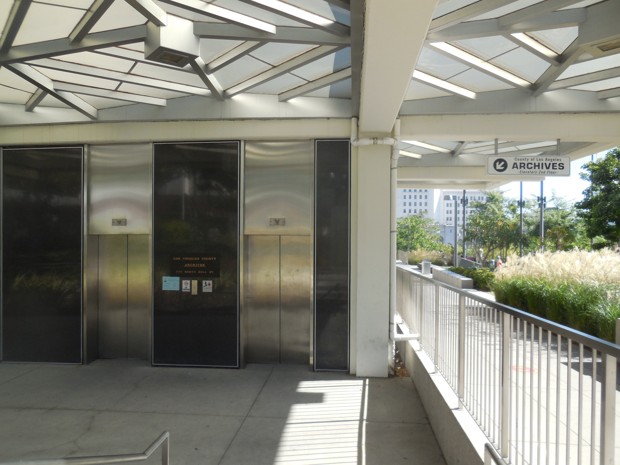
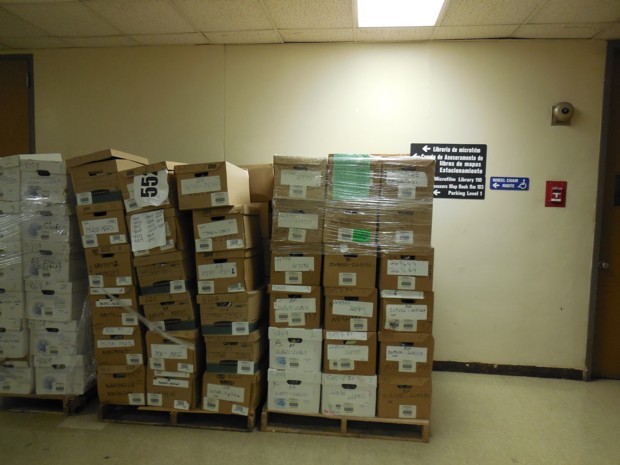
You too can enter the tunnels if you dare, though they are technically closed to the public. One entrance is hidden in plain sight: Just below grade, in a corner of the recently revamped Grand Park (pink lawn chairs and native grasses, hello), you can find an aging elevator with a huge address printed across the top: 222 N. Hill Street. Press “2” to go down, and let the rickety doors shut out the last daylight you’ll see for a while. Step out into a landing hallway lined with massive pallets of shrink-wrapped banker’s boxes—old files put to rest. Hang a right, ride an escalator up a level, and straight ahead are the tunnels: cold, windowless, and labyrinthine.
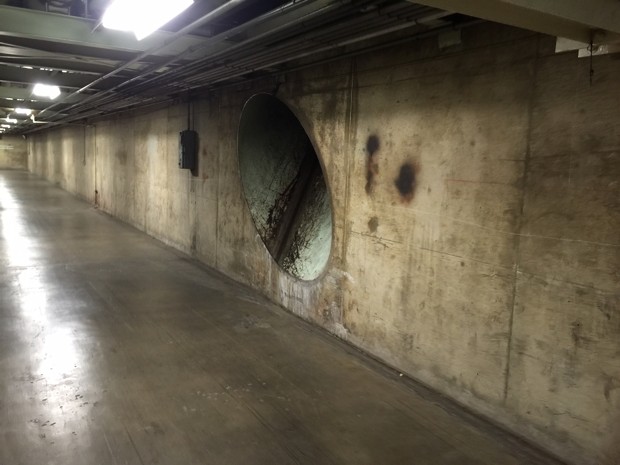
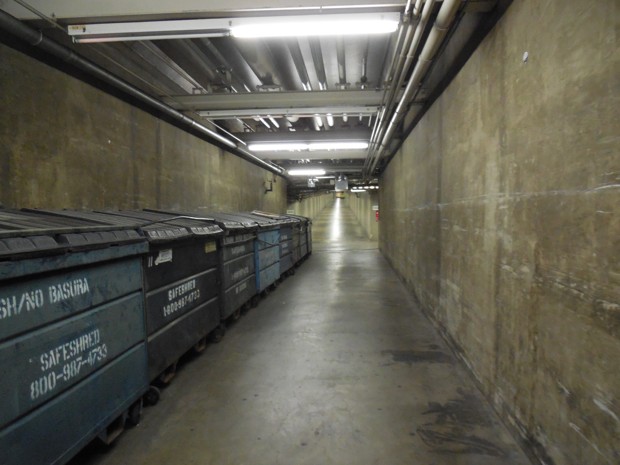
Air vents wheezing above you, you can tip-toe through the pathways—at least the ones that aren’t fenced off. Some are surreally long, with huge circular ducts in the walls. Others are a series of turns studded with security mirrors and “SOUND HORN” signs. When I was there, I passed a lone filing cabinet flat on its back and a empty golf cart stacked with legal boxes, apparently waiting for a driver. Somewhere upstairs a baby was crying. My heart was beating as I retraced my steps, confidently as I could, back to the escalator, down to the elevator, and up to Grand Park. (Supposedly the tunnels can also spit you out in the Hall of Administration, but I didn’t chance getting truly lost.) After 20 minutes in the tunnels, I was happy to meet the sun again.
A year ago the Dutch town of Krommenie made bicycling even greener by opening a bike path composed of solar panels. This had never been done before, so it was anyone’s guess whether it would succeed as either a path or an energy source. Now the results are in, and they’re not too shabby.
The solar bike path has generated 9,800 kilowatt-hours of energy, according to an update posted on the project’s website. That’s enough to power three households for a year. What’s even more impressive is that, as SolaRoad’s Sten de Wit explained to Fast Company, the results exceeded what the creators were expecting: Their lab assessments of how things like pollution and shade from people using the paths would affect the solar generation led them to underestimate the output.
The success of this pilot lends credence to a broader movement to build infrastructure that promotes a more sustainable society. Since we already need roads to get around, why not also draw some energy from them? That same goal motivated the Idaho-based inventors behind the similarly named Solar Roadways, who are working on parking lots and streets made of modular solar panels, not to mention the U.K. government’s tests of highways that can recharge electric vehicles as they drive.
It’s worth noting that the price tag, originally estimated at $3.7 million, makes SolaRoad an expensive way to get a small amount of electricity. But as a proof of concept the news is reassuring: this isn’t some harebrained scheme, but a practical way to produce nontrivial amounts of power. And whereas most roads cost more over the years as they require maintenance for wear and tear, solar roads pay off their costs simply by existing.
In Baltimore, the median home price was around $108,000 at the close of September—a bargain compared to nearby cities such as Washington, D.C., and Alexandria, Virginia, where median values were closer to $500,000.
That’s potentially good news for a city that’s badly in need of a change. Baltimore is a prime illustration of a city wracked by poverty, disinvestment, and the issues that intertwine themselves with those circumstances, such as violence and tense police-resident relationships.
Relatively affordable housing, and the increased homeownership rates that come with it, could help reverse these trends. Homeownership is an important tool for local economies: It spurs investment in neighborhoods and surrounding areas, helps to rebuild communities, raises nearby home values, and revitalizes areas that are plagued with blight, poor schools, and a lack of retail outlets. Affordable housing is hard to come by in many cities around the country, but Baltimore has plenty of it.
But the benefits of homeownership will only be shared equally if the prerequisites for owning a home are equal for everyone. Unfortunately, they’re not.
A new report from the National Community Reinvestment Coalition shows the distribution of home loans among Baltimoreans is decidedly uneven: Of the 2,653 mortgage applications submitted by white applicants in 2013, 75 percent were approved. Of the 1,304 submitted by black applicants, 61 percent were approved.
The gap is significant: White residents make up only 28 percent of Baltimore’s population, yet they account for 54 percent of loan applications, and 59 percent of all loans granted. Conversely black residents make up nearly two-thirds of the city’s population, but account for only 27 percent of applications and fewer than one-quarter of all loans granted. Asian residents, according to their analysis, apply for and receive a proportional number of loans based on their population size.
White residents make up only 28 percent of Baltimore’s population, but account for 59 percent of loans.
Black applicants are twice as likely to have a mortgage application rejected. Even when they’re approved, black applicants are given higher interest rates and are more likely to be granted subprime loans. In some cases, the argument can be made that these differences are simply a function of economics: White families hold more wealth and have higher median incomes, which can make them more likely to pay loans back on time.
But the NCRC found that wealth gaps between races can’t be used as a catch-all excuse for the discrepancies in home lending. When it compared the lending activity in different parts of the city, the NCRC found that while finances are a driving determinant for mortgage acceptance in the suburbs surrounding Baltimore, within the city it’s race, not money, that best predicts mortgage approvals.
“While majority-white neighborhoods are sites of robust lending activity, majority-black neighborhoods are consistently excluded from lending activity,” the study’s authors write. In fact, the best predictor of mortgage approval was how many white residents lived in a particular neighborhood. In poorer, more heavily black neighborhoods, lending activity was diminished, regardless of income level. That’s a problem in a city where 63 percent of the population is black.
It’s a bit of a vicious cycle. Some lenders may see high-poverty, high-minority tracts as a bad bargain, areas where home values aren’t sure to rise. But the lack of lending in such areas is precisely what contributes to the economic stagnation and growing inequality of the city and cities like it. Homeownership can help increase wealth, it can invite investment in the form of small businesses and services, and it can change the culture of and commitment to a neighborhood. For now, wide swaths of Baltimore won’t have that opportunity.
New Jersey Governor Chris Christie, pictured during the most recent Republican presidential debate, said this week that the U.S. should not accept even 5-year-old orphan refugees from Syria. (Jim Young/Reuters)
Maybe New Jersey Governor Chris Christie was going for hyperbole when he said that the U.S. should not admit even four-year-old Syrian orphans as refugees. Or maybe not. A four-year-old Syrian refugee is about as vulnerable a person as one can imagine, and the official U.S. policy on refugee resettlement is to give priority to the most vulnerable people in need. It’s not just a pretty slogan on the Statue of Liberty.
But Governor Christie and at least 27 other governors want to shut the door to Syrian refugees. Never mind that governors have no say on accepting refugees. Once the federal government grants someone refugee status—following an exhaustive security vetting process—that person becomes a legal resident of the U.S. No one, not even governors, can discriminate against refugees based on their religion, race, nationality, or ethnicity.
Even if Governor Christie could somehow keep Syrian refugees from resettling in New Jersey, they would just settle somewhere else and move to New Jersey. That’s how strong the pull of family is, according to refugee-resettlement leaders. “There is little that governors could do, and little that they could want to do, to keep families apart,” says Linda Hartke, president of the Lutheran Immigration and Refugee Service, in a phone call with reporters.
Where governors have much greater sway is over the mechanics of resettlement, the process of finding homes for refugees once they’ve been given that status by the federal government. After all, refugees need a place to live, and in most(but not all!)of the U.S., that place will fall under the jurisdiction of a state.
So governors can gum up the works for agencies that help resettle refugees. But much worse,governors can perpetuate a climate of distrust around Syrian refugees by the statements—which is the last thing they need after escaping the hell of war.
Nearly all funding for refugee resettlement is federal
States contribute very little to the aid that refugees receive for housing, food, clothing, and medicine. Two federal purses cover most of the government aid that refugees receive: one provided by the U.S. State Department and the other provided by the U.S. Department of Health and Human Services.
In the U.S., refugee resettlement works as a public-private partnership program. The federal government works with resettlement agencies, typically faith-based charities, to help resettle refugees. The State Department operates the Reception and Placement Program, while HHS runs the Office of Refugee Resettlement. Both provide funds to resettlement agencies that work directly with refugees.
Since refugee resettlement funds are federal, states can’t cancel them outright. Conservative governors can neither detain Syrian refugees at their borders nor kill the emergency funding that gives them food, clothing, shelter, and medicine.
Some federal funding for refugees flows through the states
The funds provided by the State Department go directly to resettlement agencies, so individual states can’t touch this purse. But the HHS funds—which provide refugees with cash assistance (for up to 8 months), medical aid, and employment services as they are relocating—are distributed via the states, for the most part.
Governors could opt out of receiving these funds. But according to Lavinia Limon, president and CEO for the U.S. Committee for Refugees and Immigrants, any federal funds diverted from the states would just be channeled to the refugee-resettlement service providers instead. So at best, Republican governors could maybe temporarily throw a wrench into the allocation of funds for refugee resettlement.
Several states have already opted out of administering these funds. Vermont, for example, takes in so few refugees as a matter of course that it makes little sense for them to devote state resources to coordinating nonprofits on resettlement. In Alabama and Tennessee, the states simply allow Catholic charities to take federal funds directly for refugee resettlement. While governors of both states oppose Syrian refugees, neither has any means of objecting except to ask the federal government not to send refugees their way.
But in the big states that admit a lot of refugees—Texas, Illinois, Michigan, New York—the money goes first to the government. And governors in those states could, at least temporarily, make matters miserable for refugees and the agencies that serve them.
“I’ve never seen anything like this,” says Eskinder Negash, senior vice president for global engagement at the U.S. Committee for Refugees and Immigrants. “I’ve been serving refugees for over 35 years. We have been doing refugee resettlement [as a nation] for over 200 years. This is a country of refugees and immigrants—or so I’m told.”
Resettlement agencies do honor the wishes of communities
While some governors don’t sound like they are requesting so much as demanding, resettlement agencies do respect when communities must decline refugee resettlement for legitimate reasons. Talking today with reporters, Limon gave an example of a factory closing, putting a temporary strain on a community to find enough employment for resettled refugees.
Obviously, this gets into thorny questions about what constitutes valid concern. But refugee resettlement leaders agree that national security is simply not one of them, given the intensity of the U.S. security regime. Refugees are screened by the United Nations before they are recommended for the U.S., and then they are screened exhaustively by federal agencies before they are ever even interviewed by the U.S. Department of Homeland Security. And that’s just step one in the process. It takes at minimum 2 years to place Syrian refugees.
“Speaking for the U.S. Conference of Catholic Bishops, we're not going to shy away from settling refugees from Syria where it's in their best interest,” says Kevin Appleby, director of migration policy for the organization. Resettlement agencies steer refugees toward family and opportunity and toward places where the organizations have capacity. “For our purposes, we're not going to fall for that [political] trap, and we hope the administration does not fall for that trap either.”
Leaders could make people fearful of Syrians
Republicans such as Maryland Governor Larry Hogan, who announced this afternoon that the state is requesting that the federal government stop placing refugees in Maryland, can do little more than ask. It remains to be seen whether the federal government will do anything to tighten security screenings for refugees.
But in the meantime, Governor Hogan and other obstructionist governors risk cultivating a sense of fear around Syrian refugees—fears that are misplaced to begin with but could be misdirected toward Muslims or Arab Americans. While there is room for governors to ask for details about federal security protocols, some of their statements could lead residents to think that there are no security precautions in place. And the chorus of Republican voices calling on a power that is not theirs to grant risks turning a life-or-death issue into a partisan circus.
“The protection that the U.S. offers for a very small percentage of the world’s refugees must not be denied to Syrians,” says Hartke. “To close the door on resettling Syrian refugees would be nothing less than a death warrant for tens of thousands of Syrian families running for their very lives.”
If you head over to Google+ today, you’ll see that things look a little different.
Since we last posted, we’ve spent a lot of time listening to what people using Google+ had to say. There were two features they kept coming back to: Communities, which now average 1.2 million new joins per day, and Collections, which launched just five months ago and is growing even faster. Whether it’s the Nonfiction Addiction Community, where people can be found discussing the best in Crime or Travel storytelling, or the Watch Project Collection, where more than 40,000 people are following an antique watch hobbyist, these are the places on Google+ where people around the world are spending their time discovering and sharing things they love.
And so we’ve reimagined Google+ to help them do that. Today, we’re starting to introduce a fully redesigned Google+ that puts Communities and Collections front and center. Now focused around interests, the new Google+ is much simpler. And it’s more mobile-friendly—we’ve rebuilt it across web, Android and iOS so that you’ll have a fast and consistent experience whether you are on a big screen or small one. You’ll need to opt-in to this new version of Google+ on the web to see the changes—check out our Google+ post for more on how to give it a try.
Creating great products that solve real needs and make life easier for people is something Google is always striving for. Your feedback got us this far—as we continue to refine Google+, we’d love to keep hearing from you. In the meantime, we look forward to seeing how today’s changes help kickstart even more conversations around everything from Zombie Cats to Vintage Calculators.
It was way back in March that Google and ASUS revealed a couple of interesting ChromeOS products. There was an interesting yoga-like Chromebook that could flip and fold into a tablet, and also a small little dongle called the Chromebit which turned any HDMI monitor or TV into a computer.
That dongle is nearly ready to be sold. Google and ASUS have revealed that the device will cost $85 when it launches. We don’t know when exactly that launch will happen, but we do know where you’ll be able to get it. Folks in the Us can get it from Amazon, Fry’s and Newegg. It’ll also be available in Australia, Canada, Denmark, Finland, Japan, New Zealand, Norway, Spain, Sweden, Taiwan and the UK.
The Chromebit won’t be able to rival the big boys in terms of performance, of course, but it has enough under the hood to deliver a competent Chrome OS experience, which favors lightweight web apps that don’t need a ton of horsepower. Here’s what’s going on inside:
Rockchip RK3288-C with Mali T764 graphics
16GB of storage and 2GB of RAM
Dual-band 2×2 WiFi AC
HDMI-out, 1x USB 2.0, Bluetooth 4.0 LE
123 x 31 x 17mm
75g
Also note that the Chromebit needs an external power source, and ASUS opted to use a proprietary wall outlet connection so you won’t be able to power it using your display’s USB ports. It’s a petite little thing that could be the perfect entry-level device for those who don’t already have a more capable PC, and at $85 it could make the perfect gift for the upcoming holiday season. Would you grab one if the need for an affordable PC arose?
Mourners gather at the site of explosions in the southern suburbs of Beirut in Lebanon. (Hasan Shaaban/Reuters)
The twin suicide-bomb attacks that killed 43 people and injured more than 240 others in Beirut on Thursday were quickly overshadowed by the deadly attacks in Paris on the following evening. It has come as an understandable shock to the people of Lebanon that the West did not respond the same way to their tragedy. Where was the global outpouring of grief over Beirut?
Any honest accounting of why the world appeared to care less about the victims of the Beirut attacks has to account for Western attitudes toward the Middle East—attitudes that are shaped by ignorance, bias, racism, and the media. There are other, less insidious factors, though, that help to explain the selective solidarity shown by the West, although none of them is especially assuring. The timing of the attacks in Paris, for example, coming as they did on Friday evening, was keyed for maximum exposure in the West. There were more attack sites in Paris, and the attacks were deadlier. (In Beirut, a third bomber was killed before his explosives belt detonated.)
Then there’s the social-media component to consider. While social-media platforms are important for any breaking emergency situation, Facebook served as a special source for news during the Paris attacks. Mark Zuckerberg has explained that Facebook’s Safety Check feature, which is usually reserved for natural disasters, was extended to terrorist attacks after the events of Friday in Paris—so it simply wasn’t an option on Thursday for people with loved ones in Beirut. Users still haven’t been given the option to filter their profile pics with the flag of Lebanon, however.
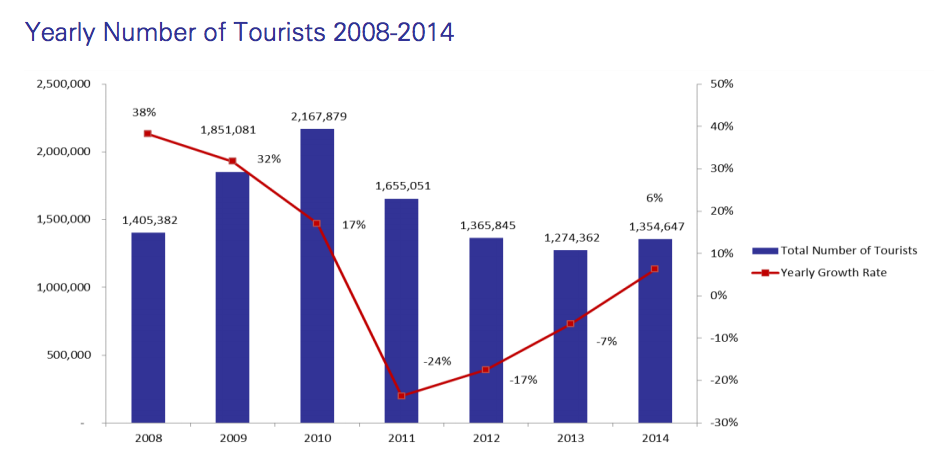
There is least one other way to explain the West’s selective solidarity with Paris over Beirut: Tourism is on a sharp decline in Beirut, which used to be called the “Paris of the Middle East.” It’s been a long time since the city was seen as a paradise by jet-setting mods. For the better part of the last 40 years, tourism has been totally flat in Lebanon (and therefore Beirut, the country’s leading destination).
Tourism in Lebanon. (Blominvest Bank/Ministry of Tourism)
Very recently, this situation started to turn around. Tourism in Lebanon had come back from the brink just five years ago, in 2010, when more than 2 million tourists came—a high-water mark since the end of the civil war there in 1990. But since 2010, tourism has backslid by more than 40 percent, only stabilizing in 2014. The ISIS attacks in Beirut are unlikely to help matters.
ISIS has claimed one other attack in Beirut, a car bombing in January, although it may have been responsible for deadly attacks in 2013. Strictly speaking, to the extent that the city’s reputation abroad suffers from the perception that it is always under attack by ISIS, that is mistaken—at least until now. Lebanon now faces war on its southern border (with Israel) and instability along its eastern and northern borders (with Syria). Beirut has been the target of frequent attacks stemming from these sources (and others). If anything, strikes by Israel between 1996 and 2000 and then again in 2006 have done as much to tamp tourism in Lebanon as the more recent violence spilling over its border with Syria. To add insult to injury, Beirut is also suffering a complete governance crisis.
An entire generation of Westerners has never known Beirut to be a beautiful world capital through first-hand or even second-hand experience. By contrast, nearly 7 million people visit the Eiffel Tower alone every year. While it doesn’t take first-hand experience to feel empathy for a place and its people, Westerners know Paris directly and indirectly. They’ve scarcely been introduced to Beirut, and that’s even less likely now.
Residents of the Gilmor Homes housing projects in Baltimore, Maryland, where women have accused housing officials of sexual harassment. (REUTERS/Eric Thayer)
Women living in public housing have a difficult enough time keeping men out of their homes who’ve threatened to abuse them sexually. A 2002 study from the sociologist and researcher Walter DeKeserdy found that “Women in public housing experience more intimate partner violence, including sexual violence, than the general population.”
And yet, there are certain men that women in public housing can’t make persona non grata, even when those men display sexually threatening behavior, because the men work for the housing authority responsible for helping provide the women shelter. Allegations and evidence of sexual attacks by housing officials have surfaced in various cities in recent years.
One disturbing, major case of this is playing out right now in Baltimore, where 20 women living in public housing complexes have joined a federal lawsuit against the city’s housing authority over accusations that maintenance workers have been demanding sexual favors in exchange for repair work. Attorneys on the case say there are potentially hundreds more women who’ve been subjected to this as well. The U.S. Department of Housing and Urban Development is investigating the allegations, as is the state’s attorney’s office.
The lawsuit states that executives in the city’s housing authority either ignored these complaints for years, or discouraged women from pressing forward with them. Women in the suit say they’ve had to go without heat and live with broken appliances because they refused maintenance workers’ sexual requests. In public housing, residents often have to rely on housing-authority staff for repair work either because they can’t afford their own handymen, or because of rules restricting them to staff help.
But Baltimore isn’t the only city where public housing authorities are responding, or failing to respond, to sexual harassment complaints. The number of similar cases reported over recent years has reached the point where there seems to be a much more widespread problem that is not being properly reported. In the Baltimore case, attorneys say other women have come forth with stories, but are afraid to go on record. Women in such precarious positions have real reason to think they could get evicted for complaining.
U.S. Department of Justice civil rights chief Vanita Gupta pointed to this problem in remarks she gave earlier this year commemorating the 47th anniversary of the Fair Housing Act. Said Gupta:
We continue to see the scourge of sexual harassment in housing. In three recent settlements, the allegations were similar. We alleged that an owner or the property managers engaged in a pattern or practice of sexually harassing female tenants and prospective tenants. All three cases involved horrific conduct. Our complaints alleged that the defendants made constant unwanted sexual comments and advances toward their female tenants; exposed themselves; requested sexual acts for reduced rents, delayed evictions, or other housing benefits; and took adverse actions when those sexual overtures were resisted.
Sadly, many of the tenants in these properties felt that their only choice was to endure the harassment or be forced to live with their children on the street.
Below are brief synopses of a few cases of “horrific conduct,” where public housing authority officials were accused of trying to engage in sexual quid pro quo, and/or ignoring women’s complaints about it:
Kansas City, Kansas
In this lawsuit, filed by the DOJ on October 26, 2015, Victor L. Hernandez, a former hearing officer for the Kansas City Housing Authority, is accused of making sexual advances against two women who had applied for public housing and were rejected. In Hernandez’s role, he helped rejected applicants file appeals so they could be reconsidered for admission into the public housing program. One woman, Daneasha Davis, was in his office discussing her appeal with him when he began telling her that her Facebook pictures were sexy. He then, according to the complaint, “unzipped his pants, exposed himself to her, and asked her inappropriate and offensive sexual questions about men’s genitalia.”
Another woman, Autumn Weaver, was discussing appealing an eviction notice with Hernandez in his office when she noticed he was looking down her shirt. Then, according to the complaint, he started showing her a pornographic video on his phone and and began asking her sexually explicit questions. Hernandez “implicitly conditioned the outcome of Weaver’s grievance hearing regarding her possible eviction on her enduring his sexual conduct during the meeting in his office and/or otherwise engaging in sexual conduct with him.”
Hernandez was fired after admitting to improper behavior with Davis. The DOJ is seeking monetary damages for the women and a court order for the housing authority to take up preventive measures for the future.
Scotland County, North Carolina
Here, the DOJ joined a lawsuit filed in April 2014 in which women in Scotland County said two employees of Southeastern Community and Family Services were asking for sexual favors in return for securing public housing. That case was settled this past July for $2.7 million—“the largest monetary settlement ever agreed to in a sexual harassment case brought by the Justice Department under the Fair Housing Act,” reads a Justice Department press release.
The two housing employees accused of sexual wrongdoing, John Wesley and Eric Pender, have denied that they engaged in this illicit behavior, but by consent decree they are still now barred from handling any Section 8 or public housing transactions. Even if they become private landlords, they must retain an independent manager, approved by the federal government, to handle the rental transactions.
“It is deeply offensive and illegal to sexually harass women who are seeking housing for themselves and their families,” said DOJ’s civil rights chief Gupta of the case.
Bossier City, Louisiana
In this case, brought by a woman in Bossier City, which neighbors Shreveport, Louisiana, a male maintenance worker for the local housing authority allegedly fondled the woman’s breasts and sexually assaulted her during a visit in 2008 to repair her kitchen sink. When she told the maintenance worker she would report him, he allegedly groped and harassed her on other occasions, to the point where she ended up obtaining a protective order from police against him.
Aware that the worker had keys to her apartment, she asked the housing authority to change her locks, which the housing office denied, according to the complaint. The woman felt insecure enough that she moved her three children to her parents’ house for a few months. Read the complaint here for a litany of other creepy behavior by the worker that crossed the woman’s boundaries.
The case was settled under confidential terms in 2012, but during the course of the investigation, the fair housing center found evidence that the maintenance worker had assaulted other women tenants, and that the housing authority had “repeatedly engaged in sex discrimination in violation of the Fair Housing Act.”
This goes to show that when women in these circumstances bravely come forward, it’s sometimes an indication of a problem that has been festering without being addressed for some time. Morgan Williams, general counsel for the National Fair Housing Alliance who worked on the Bossier City case, tells Citylab that he thinks the problem is much more widespread than what these few cases indicate.
“Victims of harassment and their families have a lot to lose if they are evicted, as it can mean that they lose their housing subsidy,” says Williams. “The threat of both eviction and physical retaliation mean there’s often a lot at risk when victims of harassment step forward with enforcement.”
The U.S. Department of Housing and Urban Development (HUD) recently proposed a new rule to protect women in public housing in these situations. It seeks to define two specific kinds of violations: “quid pro quo harassment” and “hostile environment harassment.” The rule is open to public comment right now, through December 21. As HUD explained the need for the new rule in a recent blog:
The unique vulnerability of poor women makes them targets of sexual harassment in their home. Immigrants, racial and ethnic minorities, single mothers, and persons with disabilities may also experience increased vulnerabilities. Housing providers may coerce women into sexual acts, threatening to put the woman and her children out on the street if they do not comply with their demands. …
This rule is simple: no one should be subject to harassment and especially not in your house, which should be your sanctuary.
Quick: who is the author of the famous Diary of Anne Frank? If you said "Anne Frank" you'd be correct -- but thanks to copyright law, the Foundation that holds the copyright on the book is now trying to add her father's name as a co-author, all because of copyright law.
The move has a practical effect: It extends the copyright from Jan. 1, when it is set to expire in most of Europe, to the end of 2050. Copyrights in Europe generally end 70 years after an author’s death. Anne Frank died 70 years ago at Bergen-Belsen, a concentration camp, and Otto Frank died in 1980. Extending the copyright would block others from being able to publish the book without paying royalties or receiving permission.
Of course, there are some problems with this, including the fact that in the original publication of the diary, Otto Frank wrote a prologue insisting that the entire diary was written by his late daughter. The Anne Frank Fonds organization in Basel Switzerland currently holds the copyright, but the Anne Frank House Museum in Amsterdam -- which is a totally separate organization -- had been relying on the upcoming expectation that the book would move back into the public domain to apparently create a public version of the diary.
The museum has been working for five years with historians and researchers on an elaborate web version of the diary intended for publication once the copyright expires. The research is still progressing with a historical and textual analysis of her writing, including deletions, corrections and stains.
Meaning, the two organizations connected to Anne Frank's legacy may end up in court sparring over the copyright on the diary.
Which, you know, should at least raise the following question: who in their right mind thinks that copyright was the "incentive" necessary for Anne Frank to write her diary? I'm sure that the revenue from the sales on the book have been quite good to the foundation, and I'll even assume the foundation has done good things with that money in Frank's memory. But that doesn't justify gaming the system to keep the work out of the public domain, where it is likely to do even more good.
Even more to the point: Otto Frank had over 20 years to claim that he was a co-author. And he did not. It's already somewhat questionable that we extend copyright after death, but to enable an organization to claim that someone else has had a copyright in a work decades after his death when he did nothing during his own life to claim it seems exceptionally questionable.
One of Anne’s own astute diary entries seemed to anticipate the disputes: “Why do grown-ups quarrel so easily?”
In this case, the answer is: "because of screwed up copyright law and, of course, lots and lots and lots of money."
Of course, the folks who run the foundation are pulling out bogus arguments about protecting Anne. Because they're liars.
The foundation’s officials said that their aim is to “make sure that Anne Frank stays Anne,” Mr. Kugelmann said, by maintaining control and avoiding inappropriate exploitation of the work. “When she died, she was a young girl who was not even 16. We are protecting her. That is our task.”
Critics, he said, are wrongly looking at the intended change as a financial matter. “It is not about the money,” he said.
Except that's not the purpose of copyright law. And, at some point the book is going into the public domain no matter what. So what is he really "protecting"? The only thing that this protects is the money. That's it.
Oh, and in the meantime, none of this really matters, because as the link above notes, in 1991, an editor named Mirjam Pressler "revised, edited and added 25 percent more material from Anne Frank's diary for what was called a 'definitive edition'." And, amazingly, Pressler was given the copyright on that edition, which she then transferred to the foundation. As the report notes, Pressler is still alive, and thus the Foundation will retain the copyright on that larger edition at least until 70 years after Pressler passes away.
And, of course, since that misleadingly titled "definitive edition" in 1991, additional content has been released as well. In 2001 some extra pages were published. Apparently, those were subject to something of a copyright fight as well -- with the Netherlands State Institute for War Documentation claiming to hold the rights to them and the same Anne Frank Fonds organization claiming that it was "absolutely illegal" for Otto Frank's friend to share the pages with an author. Eventually that fight was settled when a $300,000 donation was made.
And, of course, even more recently, the same foundation apparently released a fully "unedited" version that put back in a bunch of the stuff that had been cut out of all previous versions (which some deemed to be scandalous). Of course, as an unedited version, there shouldn't be any claim to a separate author -- so in theory that complete version should be entering the public domain in many countries in just a couple months. Of course, here in the US, where we keep extending copyright terms, we've got to wait longer anyway. Because, again, without that, why would there be any incentive at all for her to have written her diary...
Get your corn, your beans, and your soup to Lexington, Kentucky, as long as they’re in cans. From November 16 to December 18, the local parking authority is accepting canned food for outstanding parking citations, in place of cold, hard cash.
Ten cans of food are worth one $15 credit, the Associated Press reports. (Citations above $15 must be paid in the aforementioned cash.) Those with multiple parking citations are permitted to donate ten cans of food for each offense.
The food will be donated to God’s Pantry Food Bank network, which provides more than 121,400 meals per day to hungry people and families in central and eastern Kentucky. “One expired parking meter ticket could mean two meals for hungry Fayette County families,” God's Pantry CEO Marian Guinn told the AP.
Last year’s “Food for Fines” program, Lexington’s first, collected 6,200 cans of food for 600 parking meter citations. This year, organizers will accept canned food for any parking citations issued by the parking authority or by the police.
Food can hoarders who like to park in illegal places might want to consider Albany, New York, as a new home: They also run a “Food for Fines” program. Non-perishable food lovers with a corresponding book hoarding problem might want to check out Coralville, Iowa, or Monmouth County, New Jersey, whose public libraries periodically allow overdue fines to be paid in food, too.
Nancy Markham’s instinct was to call the police when she was attacked in her home.
That’s exactly what the single mother of two from Surprise, Arizona, did when her ex-boyfriend allegedly choked her, punched her, or threatened her with weapons on multiple occasions between March and September 2014, according to legal documents describing the incidents. He often fled before the police responded. But in September, Markham received a different response to her 911 calls: an eviction notice.
“The police contacted my property manager because I’d called the police too many times,”says Markham, who spoke to reporters during a media call in August. “I’d never heard of this law before.”
Markham was referring to a local “nuisance law” that targets housing units that call 911 four or more times in a month to report a crime, or are the location where two or more crimes take place. Once the city identifies a housing unit as a nuisance and informs the landlord, he or she must ensure the conditions cease or risk losing the business license. Getting rid of the nuisance usually means getting rid of the tenant.
Cities across the U.S. have enacted similar nuisance laws, generally to cut down on the volume of 911 calls. The idea is that by penalizing people who dial in repeatedly, police departments can avoid wasted time and more efficiently fight crime. But sometimes people frequently call 911 because they frequently endure criminal activity. This is especially true with victims of domestic abuse, some of whom have been thrown out of their homes by such laws.
And that’s spurring legal battles around the country to turn the tide against this type of ordinance.
How nuisance laws work
On their surface, nuisance laws—sometimes known as “crime-free housing” ordinances—seek something most any city would want: quiet and law-abiding rental properties. A Surprise city government “Issues Update” from July 2009 says the goal of the nuisance law, which was then in development, was “to ensure that for lease residential units do not become detriments to the quality of life in our neighborhoods.”
The Surprise nuisance law was adopted in 2010. From then on, if the policelogged multiple 911 calls from a property, they responded to them but could contact the landlord and notify them of the nuisance property. It became the landlord’s job to “abate” the problem or risk legal punishment. And that’s where the legal questions start, because “abate” almost always means “evict.”
Abusers acted more violently because they knew the victim could not call the police.
“Cities have not typically been very open-minded about thinking about abatement,” attorney Sandra Park, who leads the American Civil Liberties Union’s efforts to challenge nuisance laws, tells CityLab. “Even if they don’t say ‘eviction’ explicitly, that’s what they mean. They could have a completely different attitude. Instead they take a more punitive approach.”
This leads to the kind of twisted scenarios that will send you running for a copy of the Constitution. Like the 2012 case of Lakisha Briggs of Norristown, Pennsylvania. Police there moved to evict her after she got flown by helicopter to the hospital with a four-inch stab wound in her neck. Her violent ex-boyfriend did the stabbing, but it was her apartment, so the law considered her the nuisance.
Your safety or your home
The ACLU sued in the case of Briggs and won, spurring statewide legislation to protect tenants who need to call 911 in an emergency. This August, the civil liberties organization also filed a lawsuit against the city of Surprise with Nancy Markham as the plaintiff. The suit argues that the arbitrary numerical limit on calls to the police denied Markham her 1st Amendment right to petition the government and 14th Amendment rights to due process and equal protection.
Last month, the Arizona district court issued a preliminary injunction to stop enforcement of the nuisance ordinance until the case is resolved or the city amends the law in a way that addresses the problem. Sergeant Tim Klarkowski of the Surprise Police Department confirmed to CityLab that the ordinance is under review with the legal team, and that potential revisions could be on their way.
A good place to start would be where the ordinance fails to distinguish whether the person living in the rental unit is responsible for the crimes or is a victim of them. The mere fact that a crime occurred at a particular apartment is enough to potentially condemn the occupant to homelessness.
“If you’ve got a loud party going on and it goes on every weekend, that’s a different thing than someone who is getting battered every weekend,” says Ruth Glenn, executive director of the National Coalition Against Domestic Violence. “For some of those ordinances and laws, there’s no distinction about what that can be.”
Nor does the law require anyone to inform the tenant that the city has determined their residence to be a nuisance. For all the visits the police made to her place, Markham never heard about the law until she was evicted.
But even if the cops, responding to yet another attack by her ex-boyfriend, had warned her that one more 911 call would exceed her monthly limit, what then? The only way to maintain her home would be to refrain from calling the police the next time the ex-boyfriend came to attack her. “Nobody should have to face the impossible choice between her safety and her home,” Markham says.
In fact, the nuisance law gives abusers a new legal weapon against their victims, says Gretchen Arnold, a professor of women’s and gender studies at St. Louis University who researches how these laws affect domestic abuse survivors. In her research, Arnold has interviewed women who believed their abusers acted more violently because they knew the victim could not call the police. She also found instances in which the abuser called the police on the victim’s apartment as a form of harassment, because it racked up the count towards nuisance level.
And if a tenant does get evicted for too many police calls, they carry a label of “nuisance tenant” on their record, which makes it harder to rent a new place.
A national concern
These laws aren’t just an Arizona or Pennsylvania phenomenon. Park says that in addition to those states the ACLU has worked to challenge or raise awareness about them in Iowa, Illinois, New Hampshire, New York, and Wisconsin. There’s no comprehensive list of nuisance laws, though, because it’s hard to systematically identify them without sifting through every city’s local ordinances. And there are a lot of cities in America.
“Without really trying we’ve documented hundreds of them,” Park says.
Perhaps the most effective way to prevent these laws from evicting domestic abuse survivors is to pass state legislation overriding the local ordinances. Minnesota has a law that protects a tenant’s right to call the police for emergency assistance. Pennsylvania passed a broad protection for tenants calling in response to abuse or crime. An Illinois law that goes into effect November 19 specifically protects victims of domestic violence and people with disabilities.
But elsewhere local governments are still trying to impose the nuisance restrictions. The St. Louis County Council just last month tried to pass a bill that would force landlords to evict tenants for three nuisance violations within 12 months. Pressure from critics led them to amend it to exempt victims of domestic abuse, but the amended version of the bill later passed the council and contained justice concerns of its own.
Cities could save time and legal fees by not using their authority to evict domestic abuse survivors. The benefits to the health and safety of residents would be even more significant. But city councils have shown a startling inclination to embrace nuisance laws without stopping to consider their dire human consequences. Those consequences will continue until all cities treat a true call for help as something to be answered, not punished.
I am a veteran and a Googler. I retired in 2012 after a 25-year career in the military, and this week with Google.org, I helped bring veterans with disabilities, and those otherwise unable to travel, their first virtual reality experience. On Thursday morning, we filmed the NYC Veteran’s Day Parade in 360-degree video, and with Google Cardboard, brought together veterans and their families at VA hospitals from Palo Alto, California, to Pryor, Oklahoma to experience the nation's largest Veterans Day parade in virtual reality as if they were there, marching. These #UnitedWeMarch events will continue over the next few days, at VA hospitals around the country.
The virtual parade video is available on YouTube 360 (desktop), the YouTube app (mobile) and via Google Cardboard (also mobile).
It was incredible to reconnect with other veterans and even better to see their reactions to the virtual parade. One Marine who served in Vietnam even remarked, "You just took me away from this hospital room to New York. And you didn't even charge me airfare!"
#UnitedWeMarch is part of the Google Impact Challenge: Disabilities, which has given $20M in grants from Google.org toward organizations improving the lives of people with disabilities. In honor of disabled veterans, Google.org also gave a $235,000 grant to America Makes to create a training for military veterans to learn the basics of using new technologies to build personalized assistive devices like 3D-printed prosthetic limbs. This is all in collaboration with the Department of Veterans Affairs Center for Innovation.
I’m so grateful to have been there yesterday, seeing the veterans temporarily escape their hospital beds through virtual reality and experience the crowds cheering them along the parade route. We'll continue these virtual marches tomorrow and into next week, so that every veteran has the chance to be celebrated.
Posted by James Reid, Googler and Google VetNet member
Humanity’s done a good job of trashing the ocean with trillions of microplastics—degraded material from packaging, beauty products, fishing gear, and other stuff—and now the seas are returning the favor, contaminating edible sea salt with bits of polyethylene terephthalate and cellophane.
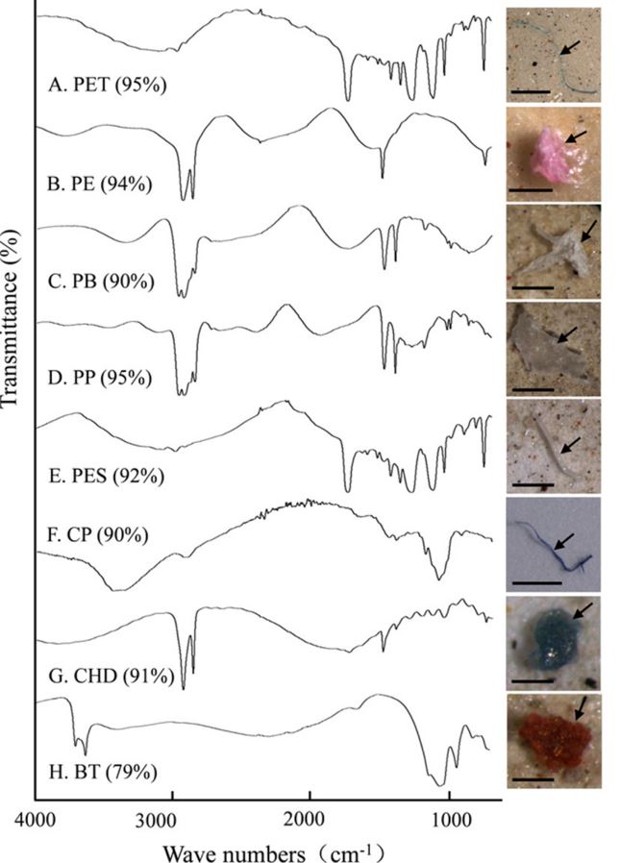
This dismal discovery was made by researchers at East China Normal University and elsewhere, who write in a new, government-funded study about worrying plastic concentrations in salts at Chinese supermarkets. They filtered 15 brands of commercial salt, including lake and rock varieties for comparison, and found as many as 681 plastic particles per kilogram of sea salt. Using World Health Organization diet guidelines, they calculate sea-salt users could be unintentionally consuming roughly 1,000 pieces of plastic a year.
The most prolific foreign objects they found were fibers and fragments, with the majority measuring under 0.2 millimeters and shaded red, blue, white, and black. The rock and lake salts showed concentrations of plastic from 7 to 204 and 43 to 364 particles per kilogram, respectively. Polyethylene, PET, and cellophane were among the most common adulterants, though a wavelength analysis detected other fun stuff, like polyalkene, ethylene vinyl acetate, and polyester—the latter suggesting you could be eating the remnants of somebody’s ugly, 1970s-era pants.
These findings suggest China’s got a serious microplastics infestation, something researchers have known for a while; sediments in the southern island province of Hainan have shown up to 8,714 particles per kilogram, and Hong Kong’s beaches are teeming with as many as 5,595 pieces per square meter of seawater.
Of course, with plastic littering the world from the bottom of the ocean to the Arctic to the Great Lakes, it’s not just China’s problem. Microplastics have been found in honey from Europe and Mexico, and a study last year on contaminated mussels and oysters estimated Europeans ingest as much as 11,000 microplastics each year.
What are the health impacts from this inedible “seasoning”? That’s not clear, but they’re probably not good, the researchers write:
Microplastics are a particular threat to organisms due to their small size and their capacity to absorb persistent organic pollutants. The constituents of plastics, as well as the chemicals and metals they absorb, may ultimately be ingested by humans through the consumption of seafood. Due to the pollution of seawater, many contaminants have been found in sea salts, including plasticizers, such as di(2-ethylhexyl) adipate and benzyl butyl phthalate. Plastic might be the direct sources of these contaminants. However, plastics might absorb contaminants from the seawater and transfer them to the sea products. Therefore, the presence of marine microplastics in sea salts might pose a threat to food safety.
The installation at White River State Park. (Kimberly McNeelan)
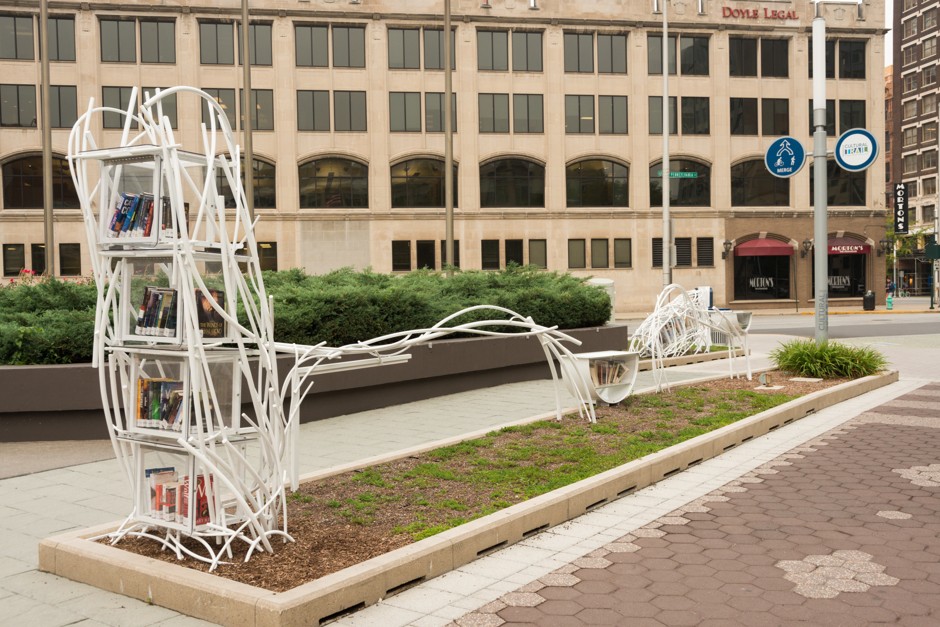
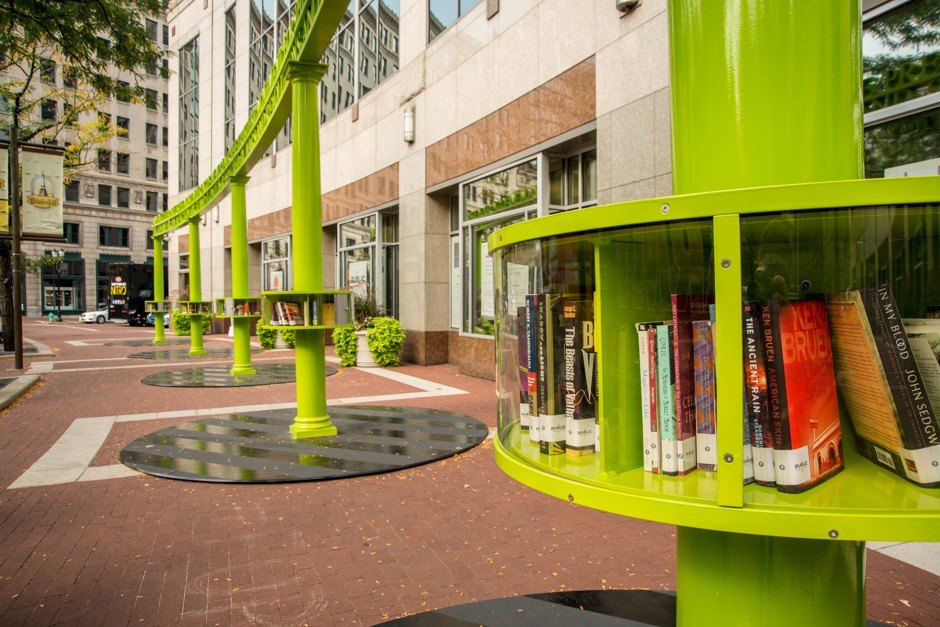
Some people who try to install modest Little Free Libraries find themselves in spats—or legal kerfuffles—with site owners who accuse them of shrugging off zoning laws. But in Indianapolis, there are city-sanctioned, immersive installations that double as libraries and sculptures.
As part of the project, The Public Collection, local artists constructed elaborate shelves for books donated by the Indianapolis Public Library. The team then secured two-year contracts or permits with homeless shelters, parks, and other locations around town.
“There are no barriers when you walk up to one of these,” says the founder, Rachel Simon. There are no hurdles—no library card or sign-out sheet. “It’s coming to the people, instead of expecting people to come to the art.”
The installation at the Cultural Trail. (Eric Nordgulen)The structure inside Eskenzi Health. (Kate Hudnall)The setup inside Horizon House. (Stuart Hyatt & S+Ca)Two installations within the Mary Rigg Neighborhood Center. (Phil O'Malley)Installations at Monument Circle. (Brian McCutcheon)
Roughly 60 percent of the world is without Internet today, and even where online access is available, it can still be spotty. That means that quick and easy access to information is still not possible for a majority of the population. This is a huge problem, especially as people attempt to navigate and explore the world around them, so Google Maps is taking steps to help people across the globe find directions and get where they’re going, even when they don’t have an Internet connection.
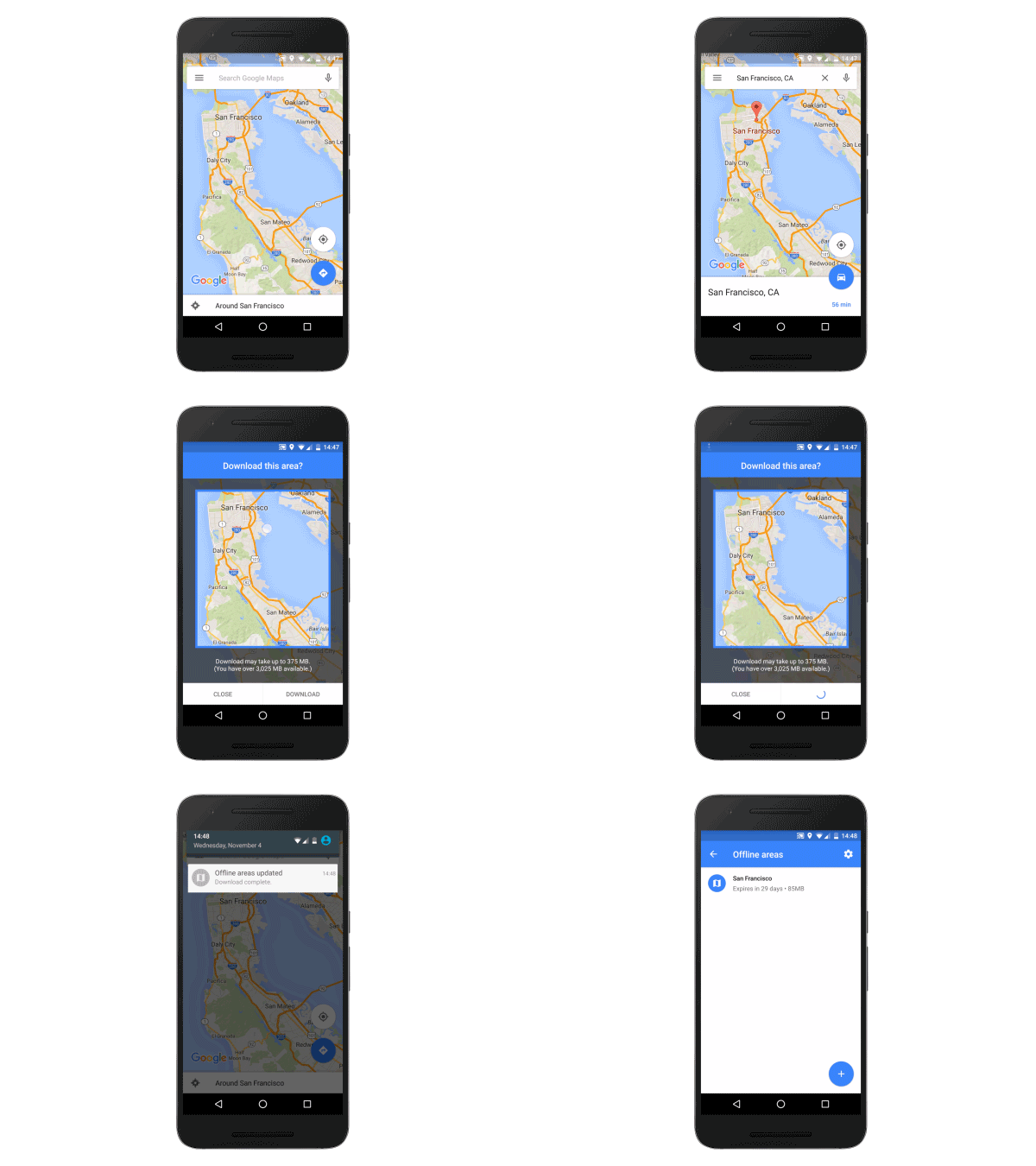
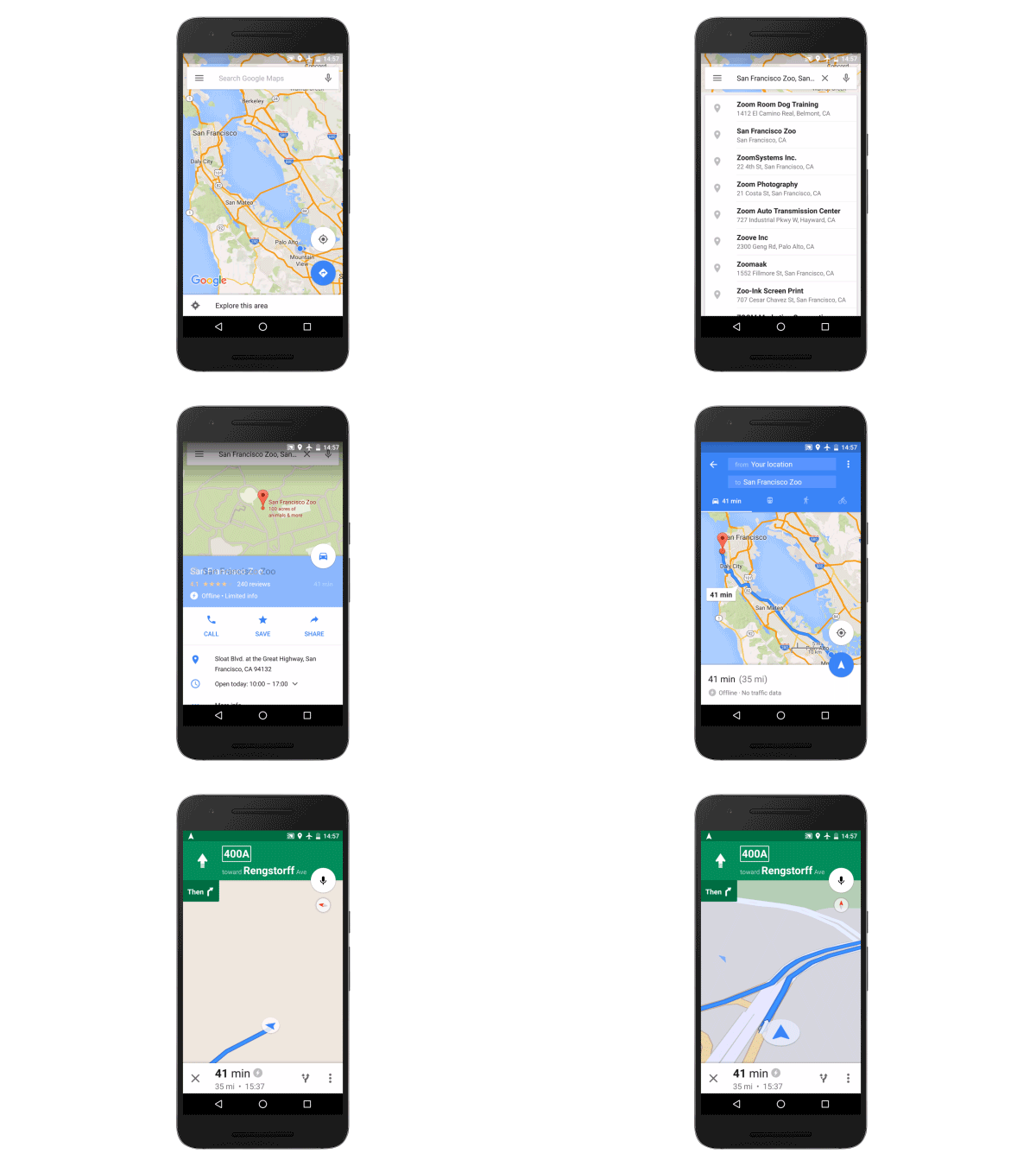
Now you can download an area of the world to your phone, and the next time you find there’s no connectivity—whether it’s a country road or an underground parking garage—Google Maps will continue to work seamlessly. Whereas before you could simply view an area of the map offline, now you can get turn-by-turn driving directions, search for specific destinations, and find useful information about places, like hours of operation, contact information or ratings.
You can download an area by searching for a city, county or country, for instance, and tapping "Download" on the resulting place sheet, or by going to "Offline Areas" in the Google Maps menu and tapping on the “+” button. Once downloaded, Google Maps will move into offline mode automatically when it recognizes you’re in a location with spotty service or no connectivity at all. When a connection is found, it will switch back online so you can easily access the full version of Maps, including live traffic conditions for your current route. By default, we’ll only download areas to your device when you are on a Wi-Fi connection to prevent large data fees.
We first previewed these new capabilities during Google I/O in May, and today we’re gradually rolling out the first set of these improvements with the latest version of Google Maps on Android (coming soon to iOS). Over time, we’ll be introducing even more offline features to help you find your way—even when you can’t find a connection.
I’ve gone apple-picking with friends a few times, and picked berries too. As I strolled through picturesque orchards and shielded my eyes from the autumn sunlight, I couldn’t help but think: This is someone’s job.
I work in a cubicle. How would it feel if, on the weekends, a bunch of people from a few towns over dressed themselves in business casual, gathered around my desk, and Instagrammed pictures of each other perched on my rolling chair, pretending to type away at my laptop?
That’s not a perfect analogy—my cubicle is anything but pastoral. This thought experiment having failed, I decided the best way to learn how apple farmers feel about going apple-picking was to ask them.
“I have never met or heard of someone coming to our Eastern Washington apple-growing region to pick apples for leisure,” Jeff Pheasant, a fifth-generation apple farmer in Soap Lake, Washington, told me. “It must be an East Coast or urban thing.” Pheasant Orchards employed 20 full-time and several additional part-time workers to harvest 9 million pounds of apples this year, and Pheasant found the idea of picking for fun “hilarious and sad,” a reflection of just how estranged from nature modern Americans must feel.
“We don't try to build our own furniture, or cars. We don't feel the need to go to the forest ourselves to cut a tree down when we need lumber,” he said, adding, “Our economy has raised people's quality of life by becoming more efficient and productive. I don't understand why we want to go backwards when it comes to agriculture.”
Pheasant was bewildered that anyone would care to pick their own apples, but another farmer I spoke with said her farm welcomes leisure pickers. Keri Wilson, whose family’s Washington farm has been operating for more than 125 years, told me what it feels like to be working while people are picking apples for fun. “We’re picking, and they come out to have this experience, but we become part of the zoo,” she says. “They look at you as if you’re … under the microscope.”
“We’re not stupid people.”
Wilson says she and her coworkers sometimes feel a need to perform for visitors. “There’s a belief that they’re coming out to see these poor dumb people,” she sighs. She says that everyone in her family has gone to college, and some hold advanced degrees. “We’re not stupid people,” she says.
Though it’s a leisure activity for some, picking apples professionally is demanding work. “Picking apples off a tree is not the same as being an apple-picker,” says Jeff Pheasant. The majority of apples in supermarkets are picked by hand, and the annual U.S. apple harvest is estimated to involve 70,000 workers. On a good day, a worker might fill up between eight and 12 900-pound bins, according to Pheasant. Professional pickers tend to work seasonally, with many driving hundreds of miles (sometimes with families in tow) to reap pumpkins, pears, berries, or whatever is in season in various parts of the country. (Researchers at Washington State University, which is near America’s biggest apple-producing region, announced last summer that they were testing an apple-picking robot.)
The nature of pick-your-own attractions has changed significantly in recent decades. It used to be that people would come to the fields to buy fruit cheaply and in bulk, for canning. “Now,” Wilson says, “they're coming out because they want to have little Sarah get a photo under the tree holding onto a piece of fruit. They buy two pieces of fruit or three pieces of fruit, and they walk around the orchard as if it were an animal park.”
Because today’s pick-your-own visitors aren’t buying nearly as much fruit, Wilson Banner Ranch, where Keri Wilson works, has adapted its business model. “We do make a ton of money on apple sippers, when we sell cider,” Wilson says. “You-picking is a way to attract people to encourage that sale.”
The other purpose pick-your-own serves now is reducing what Wilson calls “the ‘gong’ questions.” “We have people that come here and they’ll say, ‘When are the oranges going to be ready?’” she says. “Well, if you know anything about the Pacific Northwest, the oranges will never be ready, because they come from California.”
“They want to have little Sarah get a photo under the tree holding onto a piece of fruit.”
As I talked to apple farmers, their bewilderment at leisure picking became my own: How did the idea of picking apples for fun even come to be in the first place?
“There are a couple of old theories about the relationship between work and leisure,” says Gerry Chick, a retired professor of recreation, park, and tourism management at Penn State. First, there’s the spillover theory, which holds that people spend their leisure time doing things related to their jobs. “So, somebody who works with heavy equipment, for example, plays with electric trains as a hobby,” Chick says. (In his own free time, Chick still likes doing data analysis like the kind he did while working.) And then there’s the compensation theory, which says that in their free time, people do what they can to forget about their professional obligations. “I am not quite sure which your apples example best fits,” Chick says. “Sounds like some sort of compensation to me.”
“Along with desk jobs can come a sense of disconnection from nature, and I think this is playing in,” says Scott Cohen, a professor of tourism management at the University of Surrey, in England. “It allows for a tactile connection with nature. The ‘work’ is multi-sensual—one doesn’t just see, but can smell, feel and taste the apples.”
It turns out that Americans have a curious history of using their time off to observe workers—often workers engaged in physical labor. “Tourist curiosity in work sites dates from the early-nineteenth century,” writes the historian Cindy S. Aron in her book Working at Play: Vacations in the United States. The earliest known example seems to come from the Pennsylvania coal town of Maunch Chunk, which started attracting tourists in the 1820s. Through the rest of the century, ironworks and factories drew travelers as well. An 1888 guidebook had this tip for visiting Chicago’s livestock-trading center: “Grain Elevators are a very interesting feature, and should be visited, in order to obtain an idea of the manner in which the immense grain-trade of Chicago is carried on.”
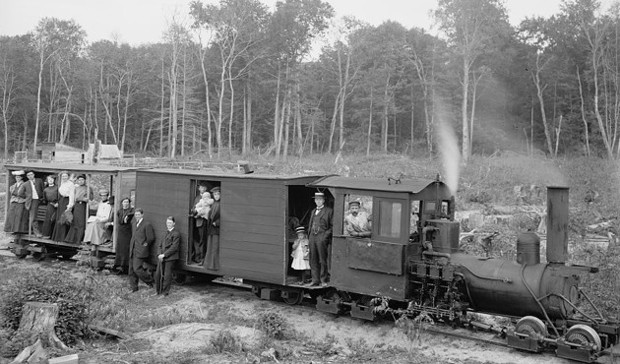
A train of tourists makes its way to a Michigan logging camp in 1906. “Many tourists chose to include work sites such as logging camps and coal mines on their tours,” writes historian Cindy Aron in Working at Play, where this image has appeared. (Library of Congress)
On a vacation in September 1878, Aron writes, a legal professional named Matthew Deady toured a mill and a mine. In his diary, Deady wrote that while 1,700 feet underground, he “took a handful of the soft mealy ore.” He continued:
The Thermometer was 110. I had on a flannel shirt and drawers and perspired as if in a hot bath. We reached the daylight again after an hours [sic] absence and had a most delicious tepid shower bath.
Deady’s version of fun was essentially the simulated workday of a miner. The emphasis, though, should be on “simulated”: Upon resurfacing, the mine’s owner presented him with champagne.
What on earth compelled Matthew Deady to tour a filthy, overheated mine in his leisure time? Aron has three theories. First, and perhaps least applicable to today’s apple-pickers, she suggests that visiting workplaces “served to reinforce Americans’ belief in their countrymen’s ingenuity and technological expertise.” Second, she writes, “Touring a workplace allowed middle-class vacationers to be connected to work while they were also at play—helping perhaps to elide tensions produced by the idleness of vacationing.” Again, that’s a theory that probably says more about 19th-century mines than 21st-century orchards, which few leisure pickers associate with the idea of work.
But Aron’s third idea echoes some of Keri Wilson’s feelings: “Such tourism allowed middle-class tourists to measure the gulf between themselves and those whom they observed at work,” Aron writes, “marking their difference from the working class even while affirming the centrality of work to middle-class life.”
That’s the interpretation I find most compelling, and Wilson said something that supported this theory as well. “Because we're farmers, we want to promote agrotourism … and we want them to enjoy the dream they have in their head, whatever that is,” Wilson told me. “You can't disabuse them too much of their notion, but you have to gently pull them away from the idea that the skilled employees we have … [are] not idiots off the street.”
Wilson says that in recent years, as highbrow culture has romanticized the idea of going back to the land and working with one’s hands, she has been approached by earnest young people hoping to be farmers, only to have them quit shortly after seeing how much physical work it requires. “Those momentary frustrations are with every job,” she says, “but I think with ours, people see us at the most bountiful time of the year, so it looks glamorous.”
Denver Post reports that sports brand Adidas announced that they’d provide “free design resources” along with “financial support” to high schools that want to change their Native American mascots, in conjunction with the White House Tribal Nations Conference, which “includes leaders from the 567 federally recognized tribes.” While California recently banned the name “Redskins” for high school teams, there are plenty of other teams with similar names like “Indians.” In creating this initiative, Adidas will help out schools that may want to change their mascots, but don’t have the means to do so.
Eric Liedtke, head of global brands, said:
Today’s announcement is a great way for us to offer up our resources to schools that want to do what’s right — to administrators, teachers, students and athletes who want to make a difference in their lives and in their world. Our intention is to help break down any barriers to change — change that can lead to a more respectful and inclusive environment for all American athletes.
President Obama also praised the brand, and called the action “smart” because now schools “don’t really have an excuse.”
With initiatives and widespread support of these changes, there’s increasing pressure on teams like the Washington Redskins to change their mascot. Maury Lane, an “outside teams spokesman for the Redskins” called their actions hypocritical, claiming “changing names at the high school level of play and continuing to profit off of professional like-named teams is absurd.” Lane also added that “It seems safe to say that Adidas’ next targets will be the biggest sports teams in the country, which won’t be very popular with their shareholders, team fans, or partner schools and organizations.”
Well, many hope that the bigger sports teams will be next. Native News Online discussed how exposure to these stereotypes is psychologically damaging to Native youth. Maggie Hundley, a founding board member of non-profit organization Not Your Mascot was thrilled at the news:
I’m so happy that Adidas has announced their support for an end to racist mascots, team names, monikers and logos in school level sports. This sends a clear message to educators, coaches, students and the public that the self esteem and identity of Native youth is more important than a caricature or stereotype.
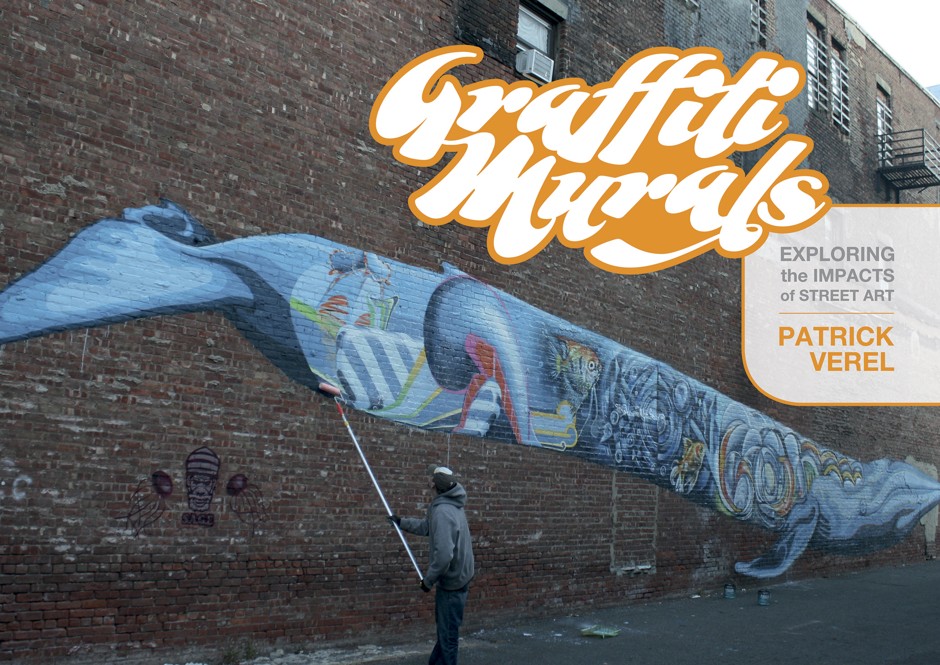
“What people fear is not graffiti itself,” writes Patrick Verel, “but rather what it represents.”
That’s a line from Verel’s new book, Graffiti Murals: Exploring the Impacts of Street Art(Schiffer). Unlike many who have written about graffiti in the past, Verel doesn’t emphasize the aesthetics of the medium, although he takes it seriously as an art form. Instead, Verel focuses on the socioeconomic implications of graffiti—the way it affects the perception that building owners, local businesspeople, and residents have of a street and a neighborhood.
What graffiti represents for many, Verel writes, is an unruly, dangerous, and unpredictable environment. But he doesn’t think it has to be that way.
Verel’s special area of interest is the independent graffiti mural. These are works that occupy a middle ground between simple tags (usually construed as vandalism), and the large-scale, municipally sanctioned murals created by organizations such as Groundswell or Philadelphia’s Mural Arts program. Verel looks at six case studies of such murals: four in New York City and two in New Jersey.
Schiffer Publishing
Most of the work in the case studies was created by independent artists with the permission of property owners, many of whom are hoping to forestall random, low-grade graffiti. That, of course, is the issue in many places. A blank wall in a city—especially in an industrial or economically marginal neighborhood—rarely remains blank for long. The proliferation of tags, quickly thrown up in the dead of night, can create a chaotic visual environment that is perceived being as out of control.
That look is anathema to many business and property owners, writes Verel:
Lose control of the property’s appearance, and one loses the capital it represents.
To fight graffiti, many cities, including New York, have programs in which they help property owners cover it with a fresh coat of paint, a process known as “buffing.” But buffed walls often get retagged, writes Verel. That’s where he and many of the people he talks to think graffiti murals can play a crucial role; they’re more likely to be respected and left alone than a simple blank wall:
I aim to show that there is another way: Graffiti murals that retain the energy or “aura” of the art form, while providing the important symbolic control that property owners need.
Schiffer Publishing
Graffiti murals have many intertwined benefits, according to the people Verel interviews. He looks at the case of a wall in upper Manhattan on a building that’s home to an auto repair shop, a garage, and a Chinese restaurant. The wall is covered with about 20 colorful, elaborate pieces of graffiti. A veteran street artist named Crane and his crew repaint the wall every spring and fall, at no charge, simply to have a place to promote their own work. The auto shop’s manager agreed to let the artists do what they wanted because he thought it would be the best solution for the property. Verel writes:
[Romeo] prefers clean walls to murals, but he hates tagging even more, and he believes that Crane’s mural is a better deterrent to the tags than buffing. In fact, Romeo turned down a city graffiti cleanup crew who offered to buff the building for free.
Verel’s book makes the case that in certain parts of the city, this kind of relationship between artists and building owners can be mutually beneficial. He isn’t overly idealistic about the power of the art, and interviews more than one neighborhood resident who thinks that any graffiti, even that approved by property owners, is unsightly and distracting. But many others he spoke with felt more like a Manhattan woman named Marisol.
When Verel asked her if the Crane mural was better than a blank wall, she had this to say:
“Yeah. For the simple reason is that life is beautiful. Why not? Draw something on a blank canvas and make it beautiful, and let other people see your artwork.”
Officers in East Rock (CT) are starting a pilot program.
“Cars will be checked for visible valuables,” said New Haven City Spokesperson Laurence Grotheer.
If they see a valuable Grotheer says they’ll take it if your car doors are unlocked. They’ll leave a note and you can pick it up at the police station property room.
Arguably, residents will be better off having their valuables stolen by the police rather than by criminals. But what gives cops the right to enter vehicles and take stuff? The city's spokesperson says it's built right into warrant exception statutes.
Grotheer says there’s a *caretaker* provision in state law that allows them to do it.
“There is an exemption in standard search warrant provisions to allow for this caretaker action,” said Grotheer.
Except that's not really what the "caretaker" provision is for. Generally, it's used to allow officers to approach and question motorists who appear to be in distress or enter homes in cases of medical emergencies, etc. What it's not there for is the seizure of valuables under the assumption that someone's poor personal decision may result in criminal activity at some undetermined point in the future.
Community Caretaker Function: The Courts have created a Caretaker exception under which local police officers are charged with community caretaking functions, totally divorced from the detection, investigation, or acquisition of evidence relating to violation of any criminal statute An example is checking on motorists parked in rest areas, especially in winter, or opening an unlocked door of a parked vehicle when the officer is acting out of concern for the well-being of the person inside.
This removes pesky roadblocks like "reasonable suspicion" and "probable cause." That's why it's routinely abused to perform warrantless searches. Several court decisions related to "community caretaking" exceptions can be found at the indispensable FourthAmendment.com.
Even if we had determined that the police were exercising a bona fide community caretaker function when they searched Matalonis’s residence, the entry would not fall within the community caretaker exception because it fails under the third inquiry–“whether the public interest outweighs the intrusion upon the privacy of the individual such that the community caretaker function was reasonably exercised within the context of a home.”
Warrantless entry into defendant’s car at the scene of a three vehicle accident, when she was being attended to by paramedics to see if she was alright, was not legally sustainable entry under the community caretaking function because she was still there and conversing with EMTs. The officer never asked for consent to look for the papers; he just went into the car.
A couple kissing in a car is not particularized suspicion that a crime is occurring or about to occur. Instead of “moving them along,” the officer detained them, and the detention was unlawful. The state’s community caretaking justification for rousting them also failed.
But as there is no clear delineation of what does or doesn't fall under the "community caretaking" warrant exception, searches and seizures are handled on a case-by-case (and state-by-state) basis when challenged in court by criminal defendants or plaintiffs in civil rights lawsuits. So, when the city's spokesperson says the following, it's unfortunately very true.
Grotheer says all laws are open to interpretation.
And most interpretations will favor law enforcement, who have a multitude of exceptions, including the incredibly expansive "good faith" exception, to insulate them against allegations of misusing their power.
The program raises several questions, most of which will remain unanswered as the New Haven police have chosen to speak solely through the city's spokesperson.
First: Do the searches only implicate valuables visible through windows? Or are officers digging around in vehicles like the thieves they're "saving" citizens from, reaching under seats, opening storage consoles or peeking in the glove compartment?
Second: If the police are simply emulating thieves, would this supposed "community caretaking" function allow them to seize vehicles if ignition keys are present in unlocked automobiles? If not, WHY NOT?
Third: What does the department define as a "valuable" for the purposes of its warrantless entry into unlocked vehicles? Is it simply wallets, checkbooks, credit cards or electronic devices? Or does it cover anything someone could conceivably take, like clothing, groceries or anything else that might be found in plain sight?
Fourth: Would this same exception allow officers to check for unlocked house doors and remove valuables from residences? Would this also allow the fire department to enter unlocked homes if a firefighter spotted oily rags or frayed cords or whatever through an open window?
As long as the city is going to "interpret" this exception to enter vehicles and seize valuables, it should at least maintain its consistency across all other areas. Crossing into a person's home generally raises Fourth Amendment issues faster than unlocked vehicles on public streets, but considering the exception cited by the city is more frequently used to provide warrantless access to residences, it would only make sense for cops to go door-to-door to save citizens from their own careless actions.
I have reached out to both the city and police department for more clarification but I'm not expecting any answers. My guess is this program will be shut down sometime in the next few days. The city has hugely miscalculated the public's receptiveness to its warrantless search and seizure "public service." When it does get shut down, it will likely be accompanied by complaints about the public's lack of gratitude towards its ever-vigilant public servants. But like so many other ill-conceived efforts made on the "behalf" of the public, it appears to have been done without any consideration of the public's concerns.
UPDATE: No answers to the questions, but city spokesperson Laurence Grotheer informs me the program is now officially dead.
Thank you for reaching out about this…
After unanticipated press coverage sufficiently raised community awareness about this issue, NHPD plans for this initiative have been shelved…
Thanks again…
Laurence…
Yeah, it sucks when the people find out about the things the government plans to do to them for their own safety. The wording of Grotheer's statement is very peculiar. He obviously supported the program during earlier statements to the same press he didn't anticipate would turn it into a "thing," but trots out the phrase "community awareness" as though he's never used it in this context before. "Community awareness" is always a good thing (and should precede implementation of dubious programs rather than follow behind it) but in this bizarre sentence, it's almost portrayed as the unfortunate byproduct of an apparent press ambush.
The National Endowment for the Humanities announced last Wednesday the "Chronicling America" contest to create projects out of historical newspaper data. The contest is supposed to showcase the history of the United States through the lens of a popular (and somewhat ephemeral) news format. But looking at the limits of the archival data, another story emerges: the dark cloud of copyright's legal uncertainty is threatening the ability of amateur and even professional historians to explore the last century as they might explore the ones before it.
Consider that the National Digital Newspaper Program holds the history of American newspapers only up until 1922. (It originally focused on material from 1900-1910 and gradually expanded outwards to cover material from as early as 1836.) Those years may seem arbitrary—and it makes sense that there would be some cut-off date for a historical archive—but for copyright nerds 1922 rings some bells: it's the latest date from which people can confidently declare a published work is in the public domain. Thanks to the arcane and byzantine rules created by 11 copyright term extensions in the years between 1962 and 1998, determining whether a work from any later requires consulting a flow chart from hell—the simple version of which, published by the Samuelson Clinic last year, runs to 50 pages.
The result is what's been dubbed "The Missing 20th Century," after it was brought to light by the striking research of Paul Heald, which shows copyright restrictions are tightly correlated with the lack of commercial availability of books. He analyzed the titles available in Amazon's warehouses to find a steep drop-off in titles first published after 1923, which carries through until just the last few years. As Heald's research shows, the number of books available from the 1850s is double the number available from 1950.
Despite what advocates of copyright term extensions like to say, the data suggests that after the first few years of a book's publication, publishers as a group are much less willing to print a text that's under copyright than one in the public domain.
The situation with newspapers is worse. After all, while books may tend to see their value to readers taper off after a few years after publication, for newspapers that same tapering happened in just days. Today's newspaper issue may be incredibly valuable in the right hands, but yesterday's is more likely to line bird cages or wrap fish than to end up preserved for posterity.
The big players keep their own archives. The New York Times, for example, makes articles available dating back to 1851. But that's an incomplete solution for two major reasons. For one thing, it sets up a single point of failure that could allow catastrophic losses. Just last month, flooding threatened a priceless collection of photos in the New York Times archive; had those images been digitized and widely copied, no single flood or fire would pose a risk. But also, even a robust archive from a major publication like the Times can't provide the kinds of insights that come from looking at a diverse collection from multiple different sources.
In the world of media journalism, we talk a lot about the future. But we can't have a coherent conversation about that without thinking about the past and the present. And those thoughts, in turn, rely on access to the history that we've allowed to be locked up under effectively unlimited copyright restrictions or as orphan works.
Because this issue is bigger than the entries into a particular contest, or the way today's history students can explore the past. The Atlantic documented last month the near-total disappearance of a groundbreaking series of investigative journalism from just eight years back. If copyright continues to jeopardize the unrestricted ability of archivists and researchers to preserve and contextualize our history, how much will we lose?
Map of San Francisco, in which blue lines represent male street names and red lines signify female street names. (Mapbox/OpenStreetMap)
A lot of things are named after people: food, theories, diseases, and among the most common, streets. Martin Luther King Jr. alone has more than 900 streets named after him throughout the U.S. Then there are several streets named after presidents like George Washington, scientists like Isaac Newton, and other historical figures.
But there’s a glaring problem with how streets get named: few memorialize women. A new interactive map from Mapbox developer Aruna Sankaranarayanan and her colleagues shows just how scarce female streets are in major cities around the world.
The group mapped seven cities: London, Paris, San Francisco, Mumbai, New Delhi, Chennai, and Bangalore. They found that, on average, only 27.5 percent of the studied streetshad female names.(The Mapbox team tried to filter out all neutral names so they could get a clearer sense of the true gender balance.) The difference within each city, when mapped, was visually striking—with blue lines (indicating male street names) far outnumbering pink ones (representing streets named for women).
The gender gap made headlines in August when a feminist group in Paris renamed 60 streets in honor of women. They were protesting the fact that only 2.6 percent of the city’s streets were named after prominent female figures. Even worse, many of the 166 women honored in Paris were wives and daughters of famous men.
The stunt turned quite a few heads, but the lack of female street names isn’t unique to France. In 2012, a geography teacher in Rome painstakingly traced the history of the city’s 16,500-plus streets and found only 580 streets—a mere 3.5 percent—named after women. It’s because “men made history,” Maria Pia Ercolini, the teacher, told the BBC.
For the new maps, Sankaranarayanan says it all started with a tweet from Genderlog, a crowd-sourced website that focuses on gender and gender violence in India.
That got her and her team, based in Bangalore, wondering about the gender imbalance among street names. They used crowd-sourced data from OpenStreetMap and plugged different street names into NamSor, a name recognition software that pulls information from a name and predicts its associated gender.
For example, based on a sample of nearly 9,000 names in the U.S., the software predicted San Francisco’s McAllister Street, named after American attorney Matthew Hall McAllister, as male and Octavia Street, named after a woman identified as the sister of a politician, as female. (The program isn’t perfect; it incorrectly labeled streets like Van Ness Avenue and Starr King Way—both named after men—as female.)
Bengalore has the highest proportion of female street names among the Indian cities mapped. (Mapbox/OpenStreetMap)
At 39 percent, Bengaluru had the highest share of female street names among the Indian cities mapped. But even that is less than half of all the city’s streets included in the analysis. And most of the female street names were located far from the city’s center, a common pattern among the seven cities. ”Generally the streets in the center of the city are older than the ones in the periphery because [of how] cities grow out,” says Sankaranarayanan.
The project’s main goal is to show the uneven distribution of gendered street names, but Sankaranarayanan hopes the maps might spark more movements like the ones in Paris. ”Street names sort of define the identity of a place,” she says, adding that the more people see the imbalance, the more they’ll start to think consciously about the affects of male dominance.
Pink lines, indicating streets named after women, are sparse throughout Mumbai. (Mapbox/OpenStreetMap)Like Bengalore, streets named after men in London tended to be located close to the city center. (Mapbox/OpenStreetMap)Many of the women in Paris who had a street named after them were wives and daughters of famous men. (Mapbox/OpenStreetMap)
City residents all over the world have long dreamed of a way to nudge rubbernecking tourists and other slow pokes to the side of the sidewalk. Liverpool in England has made that wish come true—at least for a short while. Retailer Argos has installed “Fast Track” pedestrian lanes near a shopping complex for a trial, er, run; The Daily Mailwalks us through the details:
Argos has painted new markings on the pavement outside its Liverpool store after research revealed almost half the nation found the slow pace of high streets to be their biggest shopping bugbear.
The new lane, being trialled this week in the Liverpool One shopping complex, hopes to help pick up the pace for those who are hurrying by bypassing the crowds.
New statistics show 31 per cent of people find pavement hoggers frustrating, while more than a quarter (27 per cent) get annoyed by dawdling pedestrians.
The marketing stunt, however brief, is bound to make all sorts of fast-walking cities jealous. New Yorkers, in particular, have tried many times in many ways to enforce proper sidewalk etiquette—from issuing pedestrian penalty cards that ding you for “carefree sauntering” to proposing ordinances that would require sidewalk training sessions to spray-painting walkways with “Tourists” and “New Yorkers” lanes. And yet the problem persists.
Godspeedy sidewalks, Liverpool. The world is watching.
USB Type-C is an exciting new standard, and with Google and Apple backing it hard you had to expect accessory makers to jump onto the train early. But some of the accessories being churned out for the standard aren’t all great.
In fact, some seem to be dangerous, or so says one Googler who had a heavy hand in working on USB Type-C and implementing it for the Chromebook line.
I have started reviewing USB cables on Amazon because I have gotten fed up with the early cables from 3rd party vendors that so blatantly flaunt the specification and I want to hold them to task.
You may not just get weird behavior from your devices with these bad cables… What some these vendors are doing is downright dangerous.
In most cases, the “dangerous” part refers to USB Type-A ends of the cables not drawing the right amount of current, which could lead to the cables or the ports they’re being plugged into to become damaged.
The Googler has done his part to list the exact issues in each review he’s posted, but that’s ultimately where his influence will end. As a standard, anyone can create a USB Type-C cable, and without the need to get the product certified before putting it into the market it will inevitably lead to a flood of accessories which don’t properly implement said standard.
And there you have it. That’s all the more reason to stick to official accessories whenever you can. If that’s an issue for you, well, at least someone is doing something to help you choose the right products. If you’re in need of a USB Type-C accessory soon then you’ll want to see if he has reviewed it to make sure it’s up to par. Park it right here for the reviews.
Last year, Harrison’s claims were given a fair trial for the first time. A convention of the Worshipful Company of Clockmakers and the National Physical Laboratory tested a pendulum timepiece made precisely to Harrison’s specifications and found that it lost only five-eighths of a second over the 100-day period. In April, Harrison’s clock was posthumously named the “most accurate mechanical clock with a pendulum swinging in free air” by Guinness World Records.
John Harrison, a legend in the world of maritime chronometers, as he appears in a new design for the U.K. passport. (Passport Office)
Harrison is just one of the British legends tapped by the Passport Office for a new vision for the U.K. passport. The new “Creative United Kingdom” design features a few of the traditional standbys—Shakespeare and the red telephone booth, for example—but also selections from across British culture. John Constable and Elisabeth Scott, for example, both appear, representing painting and architecture, respectively. Antony Gormley and Anish Kapoor, two contemporary artists, also made the grade.
But only two women appear in the proposed 34-page passport, which prompted protests from women in Parliament. Barbara Hepworth, Mary Wollstonecraft, Virginia Woolf, Jane Austen—the face of the new 10-pound note—and the Brontë sisters are among some of the names proffered by critics as additions to balance out the passport.
Perhaps the U.K. would be better off going in Norway’s direction and filling the passport with cool reductive landscapes.
Giles Gilbert Scott, the architet who designed Liverpool Cathedral, the Battersea Power Station, and the iconic red telephone booth, all pictured. (Passport Office)Angel of the North by Antony Gormley (Passport Office)Various festivals in the U.K. (Passport Office)Even more generic U.K. signifiers (Passport Office)John Constable, one of England’s greatest Romance painters. (Passport Office)More British-looking things (Passport Office)Parts of the pages glow under ultraviolet light, one of the passport’s security features (along with the Shakespeare watermark). (Passport Office)The London Underground, which one doesn’t need a passport to ride. (Passport Office)The ArcelorMittal Orbit sculpture made by Anish Kapoor for the London 2012 Olympic Games, plus other science-y doodles. (Passport Office)Charles Babbage and Ada Lovelace, the mathematicians who invented the first computer. (Passport Office)The London Eye and other iconic structures. (Passport Office)Elisabeth Scott appears with her work, namely the Royal Shakespeare Theatre in Stratford-upon-Avon; she is only one of two women to appear in the updated passport design. (Passport Office)