Shared posts

17 Jul 19:32

Cutest Story of the Weekend

by lskenazy

Readers — Just had to put this on the blog. HAD to. – L.

Dear Free-Range Kids: Ok, slightly off topic, but related to the whole walking thing – my niece at age 4 wanted a big party for her 5th birthday.  But they had just moved to a new neighborhood.  So she went around to all of the houses on her block (without her mother’s knowledge), and invited everyone who had a kid to her “party”.

Apparently, not only was she incredibly charming (no surprise I say, as her auntie), she told everyone the same date and time.  The only people who did not know about her party were her parents ;-) .

My SIL earned her Mother-Of-The-Century nomination for pretending she knew WHY random children were ringing her doorbell unannounced, ferreting out enough information to realize what was going on, and throwing my brother (her husband) out the back door with a tossed together list of party necessities with firm instructions to return within 30 minutes or never.

My niece is now 12, and that is one of her favorite “childhood” memories.  That is the kind of magic that is possible when a family goes Free-Range. – Christina

Now THAT’S a surprise party.

15 Jul 01:36

Little Girls on PA TV: Jews are Barbaric Monkeys, Wretched Pigs…

by Robert J. Avrech

Click here to view the embedded video.

Egypt is burning.

As of last Sunday approximately 90 women have been raped in Tahrir Square by supporters of the Muslim Brotherhood, and their opponents. Don’t look for good guys in this bottle of scorpions. Over fifty people have been murdered. Civil war is on the horizon.

Syria burns. Their civil war has been going on for almost three years. Over 100,000 people have been killed. Mass rape is used by both sides as a weapon of terror. Over a million Syrians have been forced from their homes.

But official Palestinian TV—funded by U.S. and European tax dollars—has but one burning issue: Jew-hatred.

In a normal civil society, educating children  as IslamoNazis would be considered child abuse. For the so-called Palestinians, it’s just routine.

Via: PMW

PA TV reporter: “Let’s meet these girls who want to recite a short poem.”

Girl 1: “I do not fear the rifle because your throngs are in delusion and ignorant herds.
Jerusalem is my land, Jerusalem is my honor
Jerusalem is my days and my wildest dreams.
Oh, you who murdered Allah’s pious prophets (i.e., Jews in Islamic tradition)
Oh, you who were brought up on spilling blood
You have been condemned to humiliation and hardship.
Oh Sons of Zion, oh most evil among creations
Oh barbaric monkeys, wretched pigs

Girl 2: Jerusalem is not your den
Jerusalem opposes your throngs
Jerusalem vomits from within it your impurity
Because Jerusalem, you impure ones, is pious, immaculate
And Jerusalem, you who are filth, is clean and pure.
I do not fear barbarity.
As long as my heart is my Quran and my city
As long as I have my arm and my stones
As long as I am free and do not barter my cause
I will not fear your throngs
I will not fear the rifle.”

[Official Palestinian Authority TV (Fatah), July 3, 2013]

08 Jul 13:04

Muslim Brotherhood Says Interim President Is A Jew, Secretly Backed By Israel…

by Robert J. Avrech

jew

A few days ago, when the mobs were gathering in Tahrir Square and the talking heads were all agog about another Arab Spring, I turned to Karen and said, “How long before these—ahem—freedom fighters, start raping women?”

Karen shrugged, rolled her eyes.

“How long before the Egyptians blame everything on the evil Jews?” I persisted.

Karen examined a split end.

Mind you, I was not expecting Karen to answer these questions. It’s just that every once in a while we feel that some measure of irony is necessary in the face of a 24/7 news cycle that is relentlessly depressing.

Look, for the past 6,000 years, Egypt has been ruled by pharaohs, caesars, kings, queens, regents, emirs, pashas, military dictatorships, secular dictatorships, cruel strongmen, stupid strongmen, degenerate strongmen, tyrants, demagogues, and Islamic fascists.

The best that can be said of Egyptian politics since time immemorial is that some regimes are less monstrous than others.

But they all had one thing in common. From the time the Children of Israel were enslaved by the Egyptians, all Egyptian leaders were and are Jew-haters of varying degrees.

When Barack Hussein Obama abandoned America’s ally Hosni Mubarak and backed the Muslim Brotherhood—an Islamist collective whose charter explicitly calls for the extermination of every Jew on the face of the earth—Seraphic Secret predicted (common sense at work, not prophecy) that once Egypt’s people got a dose of an MB government, they would look back with nostalgia on Mubarak’s regime.

Today, as Egyptians of too many political and religious ideologies to list (who’s on first?)  hover on the edge of civil war, there is only one certainty: the Arab Muslims will blame everything on the Jews; for without Israel/Jews as a scapegoat, Muslims, from Egypt to Indonesia, would be forced to confront, and take responsibility for, their pathologically failed and corrupt societies.

And that is not going to happen. At least not in the next hundred years.

From the Jerusalem Post:

The Muslim Brotherhood claimed in a post on its official website that Egypt’s new interim president Adli Mansour is Jewish, The Washington Post reported on Friday. The article on IkhwanOnline was subsequently removed.

Mansour, who previously served as the constitutional court’s chief justice was sworn in as interim president on Thursdayafter the army removed Islamist President Mohamed Morsi from power.

According to the Post, the article falsely stated that Mansour is “considered to be a Seventh Day Adventist, which is a Jewish sect.”

The authors also claimed that the Pope of Egypt’s Coptic church had refused to convert Mansour to Christianity.

The article on IkhwanOnline, according to the Post, posited that Mansour’s appointment was backed by Israel and the US as part of a plan to eventually install leading opposition figure and former IAEA chief Mohamed ElBaradei as president.

04 Jul 23:19

Thinking about patriotism

by noreply@blogger.com (Borepatch)
Ten years ago we heard shrill challenges from the Left, how dare you question my patriotism?

Now it seems that those of us who grew up in a past age - raised by the "Greatest Generation" - find ourselves increasingly divorced from the philosophies of that can only be calls the Ruling Class.  Our belief in individual freedom is sneered at, as an existential threat to the Ruling Class' dreams of ever increasing power and influence.

A class that has lost any core moral philosophy, one where nothing remains but appetite.

This day calls us to reflect, and for me it's the first time that the day has been a sober (and perhaps a bit melancholy) reflection on patriotism.  My gut tells me that fragmentation is the only possible solution to the ever expanding Leviathan, and that seems a weak reed to cling to.

I see the Democrats, in their lawless and contemptuous reveling in raw power.  I think on what will the Republicans do, when their turn comes.  Will they take a deep breath, reflect on the roots of the Republic, and step back from the reins of Power that they so deeply desired?  Alas, I think I know the answer to that.  Sulla followed Marius, and worse came after.

And so I find myself questioning the patriotism of the very leaders of this nation.  Didn't see this coming.

(Image source)
Happy Independence Day.
03 Jul 15:06

OK, this is an interesting bike

by noreply@blogger.com (Borepatch)

1974 Swiss Army Condor.  Blue Moon Cycles in Norcross seems to specialize in vintage bikes.  They have three of these for short money.

I'm not sure how comfortable it would be, but it looks practical as all get out.
02 Jul 14:51

The turning point

by noreply@blogger.com (Borepatch)
On this day in 1863, the boys of the 20th Maine led by a strange University Professor named Joshua Lawrence Chamberlain were fighting to save what was the most important scrap of real estate on the Gettysburg battlefield: the hill called Little Round Top.

Image via Civilwar.org
It seems like an inconspicuous and unimportant location, way off on the Union's left flank.  The main fighting during the night had been on the Union right, and latter in the day in the center.  You might have excused the Union brass from being unconcerned when John Bell Hood's Texans swept up the slopes of Little Round Top.

You'd be wrong if you thought that.  Little Round Top was the high point of the Union line; if the Confederates took the summit and placed artillery there, the entire line would have been shot to pieces.  I believe that if Stonewall Jackson had not died after Chancellorsville, Lee might have had him lead this charge rather than Hood.  Hood was no Jackson, and that saved the Union.

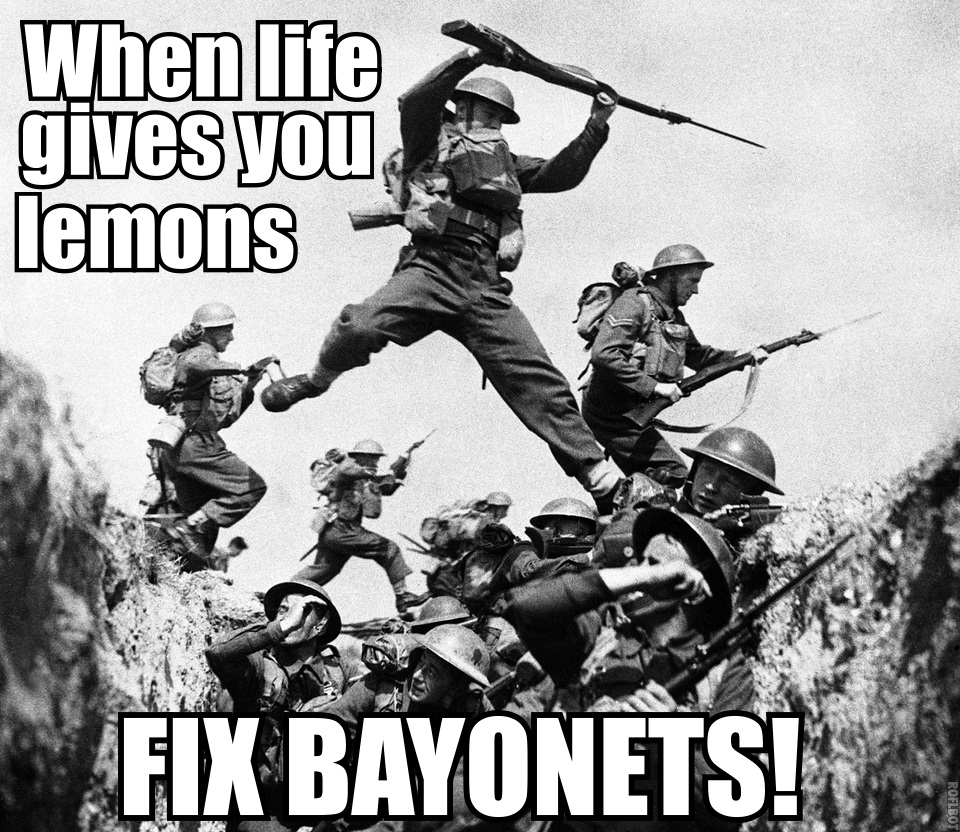
Or maybe it was that Chamberlain was no Oliver Howard, flanked and routed by Jackson.  Fluent in nine languages, he was from an age where Professors were expected to understand the Western Canon, and in particular the stories of past sacrifice for the advancement of freedom.  Chamberlain knew the stories in the original Greek and Latin.  Seeing his men shoot off their last ammunition, but understanding the position's importance - and recalling the story of The 300 and of Horatio at the Bridge, he turned to his troops and gave the order that stopped their hearts for a moment.
Soldiers!  Fix. Bayo. Nets!

They all knew that they were out of ammunition, and at that point they knew that they had to screw their courage to the sticking point.  The 20th Maine, of course, won the day and the battle.  Its center held like Jackson's stone wall while its right wing pivoted in an end run to catch the attacking Texans on the flank, routing them with cold steel alone.

Faulker - the finest of a whole stable of fine Southern authors - is justly famous for the way he captured every Southern boy's regrets over Picket's doomed charge the next day:
For every Southern boy fourteen years old, not once but whenever he wants it, there is the instant when it's still not yet two o'clock on that July afternoon in 1863, the brigades are in position behind the rail fence, the guns are laid and ready in the woods and the furled flags are already loosened to break out and Pickett himself with his long oiled ringlets and his hat in one hand probably and his sword in the other looking up the hill waiting for Longstreet to give the word and it's all in the balance, it hasn't happened yet, it hasn't even begun yet, it not only hasn't begun yet but there is still time for it not to begin ...
But it had even begun, and had been lost the day before when Hood's Texans ran for their lives from the Maine boy's bayonets.  You can't get there from here.  It was over the next day, over before it had even begun.  Perhaps Jackson could have channeled Lee, if he had still been alive.  Lee's "blood was up" and so he wouldn't have backed down, but perhaps Jackson could have proposed an alternative to the folly that was Pickett's Charge.

And so it played out: the end of the American War of Southern Independence (probably good), the end of the Federal Constitution (certainly bad), the end of slavery (certainly good), the unleashing of Leviathan (a grotesque horror as we learn to our own sorrow*).

Chamberlain went on to command the Union troops at Lee's surrender at Appomattox.  On his own initiative as the Confederates approached to lay down their arms he ordered the Union troops to show the respect due their foes with the command "Carry Arms".  He wrote afterwards of the moment:
Gordon, at the head of the marching column, outdoes us in courtesy. He was riding with downcast eyes and more than pensive look; but at this clatter of arms he raises his eyes and instantly catching the significance, wheels his horse with that superb grace of which he is master, drops the point of his sword to his stirrup, gives a command, at which the great Confederate ensign following him is dipped and his decimated brigades, as they reach our right, respond to the 'carry.' All the while on our part not a sound of trumpet or drum, not a cheer, nor a word nor motion of man, but awful stillness as if it were the passing of the dead.
The soldiers knew what the politicians did not, that we were a people united in custom if not in law.  The grotesqueries of the Reconstruction would have passed much faster if run by the soldiers of the 20th Maine than by the Radical Republicans.

Chamberlain also went on to be Governor of the great State of Maine - for some strange reason the Governor's Mansion is named not after him but after the odious and corrupt James G. Blaine.  Then like Cincinnatus, he went back to his plough, taking the position of President of the Bowdoin College where he taught.  Perhaps that's why th eGovernor's Mansion is named after a mere politician, rather than a Hero: he sought no honors, believing that he served.

Requiem aeternam dona eis, Domine, et lux perpetua luceat eis.  Amen.

* Note to NSA PRISIM operators: you are worse traitors than any Confederates who at least could honorably claim that they were fighting for their State which freely entered the Union under the belief that it could leave if it had need to.  They at least had an honorable justification for what they did.  In contrast to what you do.

Bootnote: The Gettysburg National Military Park is perhaps the Republic's largest Cathedral.  The whole park is a shrine, with numerous monuments to the different units that fought there.  The monument to the 20th Maine is particularly interesting: much less grandiose (and in much better artistic taste) than those for the many New York units which had little effect on the outcome, the 20th Maine has but a simple monument on the peak of Little Round Top.  But it has something much more impressive: the people who erected the monument planted White Pine trees - the Maine State tree, known by its bundle of five pine needles all together.  The Monument is surrounded by a White Pine forest, and other than the heat of a July day you might think that with the rocky terrain you might indeed me in the Pine Tree State.

This is the view from our day, looking back through the glass darkly from the vantage of 150 years later.  The incomparable film Gettysburg shows this pine forest:


But it wasn't so.  Little Round Top was essentially denuded, either by the battle or by logging before.  There were no trees until Maine veterans came to plant them.

Photograph by Matthew Brady, 1863.

01 Jul 16:27

QUOTES OF THE DAY

by Administrator

“What are the facts? Again and again and again – what are the facts? Shun wishful thinking, ignore divine revelation, forget what “the stars foretell,” avoid opinion, care not what the neighbors think, never mind the unguessable “verdict of history” – what are the facts, and to how many decimal places? You pilot always into an unknown future; facts are your single clue. Get the facts!”
―     Robert A. Heinlein

“The supreme irony of life is that hardly anyone gets out of it alive.”
―     Robert A. Heinlein

“Goodness without wisdom always accomplishes evil.”
―     Robert A. Heinlein

“Anyone who cannot cope with mathematics is not fully human. At best, he is a tolerable subhuman who has learned to wear his shoes, bathe, and not make messes in the house.”
―     Robert A. Heinlein

“At least once every human should have to run for his life, to teach him that milk does not come from supermarkets, that safety does not come from policemen, that ‘news’ is not something that happens to other people. He might learn how his ancestors lived and that he himself is no different–in the crunch his life depends on his agility, alertness, and personal resourcefulness.”
―     Robert A. Heinlein

“It is impossible for anyone to be responsible for another person’s behavior. The most you or any leader can do is to encourage each one to be responsible for himself.”
―     Robert A. Heinlein

“Political tags — such as royalist, communist, democrat, populist, fascist, liberal, conservative, and so forth — are never basic criteria. The human race divides politically into those who want people to be controlled and those who have no such desire. The former are idealists acting from highest motives for the greatest good of the greatest number. The latter are surly curmudgeons, suspicious and lacking in altruism. But they are more comfortable neighbors than the other sort.”
―     Robert A. Heinlein

“A generation which ignores history has no past — and no future.”
―     Robert A. Heinlein

28 Jun 13:30

Crime Doesn’t Pay, Local Edition

by Orin Kerr
(Orin Kerr)

From a local crime report:

ROBBERY, 06/25/13, 3200 block of S. Columbia Pike. At 7:50 pm on June 25, a juvenile subject grabbed an iPhone from a store employee and fled the scene on foot. Police located the subject a short distance away bleeding from the left eye after he was robbed of the phone he stole. The juvenile suspect was issued petitions for robbery and grand larceny with intent to distribute.

28 Jun 13:07

Don't hold the anchovies

“Eat wild seafood,” begins Sharpless’s version. “Not too much of the big fish. Mostly local.”

27 Jun 16:32

George Orwell's 11 Golden Rules for Making the Perfect Cup of Tea

by Cambria Bold
Wickemt

As per Orwell:

Lastly, tea — unless one is drinking it in the Russian style — should be drunk without sugar. I know very well that I am in a minority here. But still, how can you call yourself a true tea-lover if you destroy the flavour of your tea by putting sugar in it? It would be equally reasonable to put in pepper or salt. Tea is meant to be bitter, just as beer is meant to be bitter. If you sweeten it, you are no longer tasting the tea, you are merely tasting the sugar; you could make a very similar drink by dissolving sugar in plain hot water.

George Orwell on How to Make the Perfect Cup of Tea: His 11 Golden Rules

In 1946 English novelist and journalist George Orwell published an essay in the Evening Standard entitled "A Nice Cup of Tea." For everyone who's ever believed there's an art to making a good cup of tea, you'll definitely enjoy Mr. Orwell's 11 "golden" rules for the perfect cup. Read the full essay below:

More


27 Jun 15:45

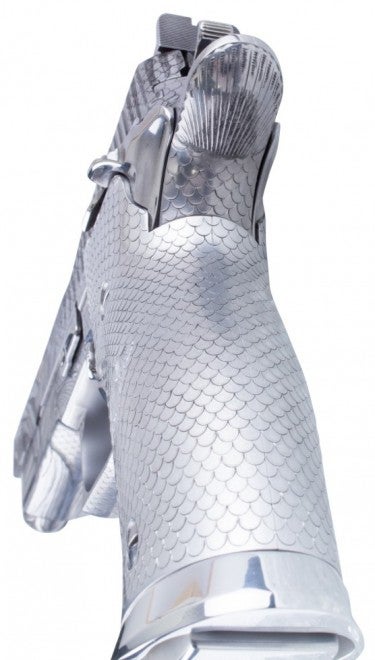
Oh My Gosh, This Might Be The Most Beautiful Pistol I Have Ever Seen

by Steve Johnson
BARRACUDA ON ICE


At IWA SIG Sauer Germany had a selection of handcrafted prestige guns that were engraved by SIG’s master engravers. This particular pistol is named Barracuda and was engraved by Hanns Dösel. It took my breath away. This is one of the most beautiful objects I have ever seen.


SIG BARRACUDA 2

SIG BARRACUDA 3


SIG BARRACUDA back


SIG BARRACUDA GRIP


BARRACUDA ON ICE 2

27 Jun 15:18

Imperfect Storms

by John Michael Greer
Last week’s post on the need to check our narratives against the evidence of history turned out to be rather more timely than I expected. Over the weekend, following hints and nods from the Fed that the current orgy of quantitative easing may not continue, stock and bond markets around the globe did a swan dive. In response, with the predictability of a well-oiled cuckoo clock, the usual claims that total economic collapse is imminent have begun to spread across the peak oil blogosphere.

As I write these words, the slump seems to have stabilized, but it’s a safe bet that if it resumes—and there’s reason to think that it will—the same claims will get plenty of air time, as they did during the last half dozen market slumps  If that happens, it’s an equally safe bet that a year from now, those who made and circulated those predictions will once again have egg on their faces, and the peak oil movement will have suffered another own goal, inflicted by those who have forgotten that the ability to offer accurate predictions about an otherwise baffling future is one of the few things that gives the peak oil movement any claim on the attention of the rest of the world.

Mind you, worries about the state of the world economy are far from misplaced just now.  In the wake of the 2008 crash, financial authorities in the US—first the Department of the Treasury, backed by Congressional appropriations, and then the Federal Reserve, backed by nothing but its own insistence that it had the right to spin the presses as enthusiastically as it wished—flooded markets in the US and overseas with a tsunami of money, in an attempt to forestall the contraction of the money supply that usually follows a market crash and ushers in a recession or worse.  The theory behind that exercise was outlined by Ben Bernanke in his famous “helicopter speech” in 2002:  keep the money supply from contracting in the wake of a market crash, if necessary by dumping money out of helicopters, and the economy will recover from the effects of the crash and return to robust growth in short order.

That theory was put to the test, and it failed. Five years after the 2008 crash, the global economy has not returned to robust growth. Across America and Europe, in the teeth of quantitative easing, hard times of a kind rarely seen since the Great Depression have become widespread. Official claims that happy days will be here again just as soon as everybody but the rich accepts one more round of belt-tightening (also a feature of the Great Depression, by the way) are increasingly hard to sustain in the face of the flat failure of current policies to bring anything but more poverty.  Meanwhile, the form taken by quantitative easing in the present case—massive purchases of worthless securities by central banks—has national governments drowning in debt, central banks burdened with mountains of the kind of financial paper that makes junk bonds look secure, and no one better off except a financial industry that has become increasingly disconnected from political and economic realities.

Thus the boom is coming down. On the 18th of this month, Obama commented in a media interview that Bernanke had been at the Fed’s helm “longer than he wanted,” an unsubtle way of announcing that the chairman would not be appointed to a third term in 2014. Shortly thereafter, the Fed let it be known that the ongoing quantitative easing program would be tapered off toward the end of the year, and the general manager of the Bank of International Settlements (BIS), one of the core institutions of global finance, gave a speech noting that central banks had gone too far in spinning the presses, and risked problems as bad as the ones quantitative easing was supposed to cure.

Markets around the world panicked, and for good reason. Most of the cash from quantitative easing in the US and elsewhere got paid out to large banks, on the theory that it would go to borrowers and drive another round of economic growth. That didn’t happen, because borrowing at interest only makes sense when growth can be expected to exceed the interest rate.  Whether it’s 18-year-olds taking out student loans to go to college, business owners issuing corporate paper to finance expansion, or what have you, the assumption is that the return on investment will be high enough to cover the cost of interest and still yield a profit. In the stagnant economy of the last five years, that assumption has not fared well, and where government guarantees didn’t distort the process—as happened with student loans in the US, for example—the result was a dearth of new loans, and thus a dearth of new economic activity.

Unused money in a bank’s coffers these days is about as secure as it is in the pocket of your average eight-year-old, though, and for most of the last five years, the world’s speculative markets were among the standard places for banks to go and spend it.  That helped drive a series of boomlets in various kinds of speculative paper, and pushed some market indices to all-time highs. The end of the quantitative easing gravy train very likely means the end of that process, and for an assortment of other fiscal gimmicks that have been surfing the waves of cheap money pouring out of the Fed and other central banks in recent years. A prolonged bear market is thus likely.

Could that bear market trigger a run on the investment banks that, under the cozy illusion that they’re still too big to fail, have become too arrogant to survive?  Very possibly.  The twilight of “Helicopter Ben” and his spin-the-presses policies also marks the end of the line for a coterie of economists and bankers, most of them associated with Goldman Sachs, who came to power after the 2008 crisis insisting that they knew how to fix the broken economy. They didn’t, and they are now in the process of discovering—as the neoconservatives found out before them—that while the American political class has almost limitless patience with corruption and venality, it has no tolerance at all for failure.  I expect to see a fair number of prominent figures in the nation’s financial bureaucracies headed back to the same genteel obscurity that swallowed the neocons, and it’s by no means unlikely that Goldman Sachs or some other big financial firm may be allowed to crash and burn as part of the payback.

And beyond that? One way or another, the end of quantitative easing bids fair to trigger a wave of harsh economic readjustments, government defaults, corporate bankruptcies, and misery for all. An immense overhang of unpayable debt is going to have to be liquidated in one way or another, and there’s no way for that to happen without a lot of pain.  That may well involve a recession harsh enough that the D-word will probably need to be pulled out of cold storage and used instead. Will the remaining scraps of democratic governance in Europe and America, and the increasingly fragile peace among the world’s military powers, survive several years of that?  That’s a good question, to which history offers mostly unencouraging answers.

Still, these deeply troubling possibilities aren’t the things you’ll hear aired across the more apocalyptic end of the peak oil scene, if recent declines in global stock markets continue. Rather, if experience is any guide, we can expect a rehash of the claims that the next big economic crisis will cause a total implosion of global financial systems, leading to a credit collapse that will prevent farmers from buying seed for next year’s crops, groceries from stocking their shelves, factories from producing anything at all, and thus land us all plop in the middle of the Dark Ages in short order.

It’s here that the issue discussed in last week’s post becomes particularly relevant, because there’s a difference—a big one—between the imaginary cataclysms that fill so much space on the doomward end of the blogosphere and what actually happens. Financial history is full of markets that imploded, economies that plunged into recession and depression, currencies that became worthless, and all the other stage properties of current speculations concerning total economic collapse, and it also has quite detailed things to say about what followed each of these crises. Without too much trouble, given access to the internet or a decently stocked library, you can find out what happens when a highly centralized economic system comes apart at the seams, no matter what combination of factors do the deed. The difference between what actually happens and the whole range of current fantasies about instant doom can be summed up in a single phrase: negative feedback.

That’s the process by which a thermostat works: when the house gets cold, the furnace turns on and heats it back up; when the house gets too warm, the furnace shuts down and lets it cool off. Negative feedback is one of the basic properties of whole systems, and the more complex the system, the more subtle, powerful, and multilayered the negative feedback loops tend to be.  The opposite process is positive feedback, and it’s extremely rare in the real world, because systems with positive feedback promptly destroy themselves—imagine a thermostat that responded to rising temperatures by heating things up further until the house burns down. Negative feedback, by contrast, is everywhere.

That’s not something you’ll see referenced in any of the current crop of fast-crash theories, whether those fixate on financial markets, global climate, or what have you. Nearly all those theories make sweeping claims about some set of hypothetical positive feedback loops, while systematically ignoring the existence of well-documented negative feedback loops, and dismissing the evidence of history.  The traditional cry of “But it’s different this time!” serves its usual function as an obstacle to understanding: no matter how many times a claim has failed in the past, and no matter how many times matters have failed to follow the predicted course, believers can always find some reason or other to insist that this time isn’t like all the others.

It  happens that I’ve been doing plenty of thinking about negative feedback recently, because I’ve fielded yet another flurry of claims that my theory of catabolic collapse must be false because it doesn’t allow for the large-scale crises that we’re evidently about to experience. Mind you, I have no objection to having my theory critiqued, but it would be helpful if those who did so took the time to learn a little about the theory they think they’re critiquing. In point of fact—I encourage doubters to read a PDF of the original essay—the theory of catabolic collapse not only assumes but requires large-scale crises. What it explains is why those crises aren’t followed by a plunge into oblivion but by stabilization and partial recovery.

The reason is negative feedback. A civilization on the way down normally has much more capital—buildings, infrastructure, knowledge, population, and everything else a macroeconomist would put under this label—than it can afford to maintain. Crisis solves this problem by wrecking a great deal of excess capital, so that it no longer requires maintenance, and resources that had been maintaining it can be put to more immediate needs. In addition, much of the wrecked capital can be stripped for raw materials, cutting expenditures further. Since civilizations in decline are by and large desperately short of uncommitted resources, and are also normally squeezed by rising costs for resource extraction, both these windfalls make it possible for a crumbling society to buy time and stave off collapse for at least a little longer; that’s what drives the stairstep process of crisis, stabilization, partial recovery, and renewed crisis that shows up in the last centuries of every historically documented civilization.

That sequence is so reliable that Arnold Toynbee could argue, with no shortage of evidence, that there are usually three and a half rounds of it in the fall of any civilization—the last half-cycle being the final crisis from which the recovery is somebody else’s business.  Our civilization, by the way, has already been through its first cycle, the global crisis of 1914-1954 that saw Europe stripped of its once-vast colonial empires and turned into a battleground between American and Russian successor states.  We’re just about due for the second, which will likely be at least as traumatic as the first; the third, if our civilization follows the usual pattern, should hit a battered and impoverished industrial world sometime in the 22nd century, and the final collapse will follow maybe fifty to a hundred years after that.

Now of course there are plenty of people these days insisting that industrial civilization can’t possibly take that long to fall, just as there are plenty of people who insist that it can’t fall at all. In both cases, the arguments normally rest on the blindness to negative feedback discussed above. Consider the currently popular notion, critiqued in one of last month’s posts, that humanity will go extinct by 2030 due to runaway climate change. The logic here follows the pattern I sketched out earlier—extreme claims about hypothetical positive feedback loops, combined with selective blindness to well-documented negative feedback loops that have put an end to greenhouse events in the past, propped up with the inevitable claim that the modest details that distinguish the present situation from similar events in the past mean that the lessons of the past don’t count. 

Current rhetoric aside, greenhouse events driven by extremely rapid CO2 releases are anything but rare in Earth’s history. The usual culprits are large-scale volcanic releases of greenhouse gases, which  boosted CO2 levels in the atmosphere up above 1200 ppm—that’s four times current levels—and thus drove what geologists, not normally an excitable bunch, call “super-greenhouse events.”  If massive CO2 releases into the atmosphere were going to exterminate life on Earth, these would have done the trick—and super-greenhouse events have happened many times already, just within the small share of the planet’s history that geologists have enough evidence to study.

What stops it? Negative feedback. The most important of the many negative feedback loops that counter greenhouse events is the shutdown of the thermohaline circulation, the engine that drives the world’s ocean currents. The thermohaline circulation also puts oxygen into the deep oceans, and when it shuts down, you get an oceanic anoxic event.  Ocean waters below 50 meters or so run out of oxygen and become incapable of supporting life, and the rain of carbon-rich organic materials from the sunlit levels of the ocean, which normally supports a galaxy of deepwater ecosystems, falls instead to the bottom of the sea, taking all its carbon with it. It’s an extremely effective way of sucking excess carbon out of the biosphere:  around 70% of all known petroleum reserves, along with thick belts of carbon-rich black shale found over much of the world, were laid down in a handful of oceanic anoxic events in the Jurassic and Cretaceous periods.

Oceanographers aren’t sure yet of the mechanism that shuts off the thermohaline circulation, but it doesn’t require the steamy temperatures of the Mesozoic to do it. At least one massive oceanic anoxic event happened in the Ordovician period, in the middle of a glaciation, and there’s tolerably good evidence that a brief shutdown was responsible for the thousand-year-long Younger Dryas cold period at the end of the last ice age. Not that long ago, global warming researchers were warning about the possibility of a shutdown of the thermohaline circulation in the near future, and measurements of deepwater formation have not been encouraging to believers in business as usual.

Meanwhile, other patterns of negative feedback are already under way.  Across much of the tropical world, increased CO2 levels in the atmosphere are helping to drive bush encroachment—the rapid spread of thorny shrubs and trees across former grasslands.  Western media coverage so far has fixated on the plight of cheetahs—is there any environmental issue we can’t reduce to sentimentality about cute animals?—but the other side of the picture is that shrubs and trees soak up much more carbon than grasslands, and in many areas, the shrubs involved in bush encroachment make cattle raising impossible, cutting into another source of greenhouse gases. Meanwhile, the depletion of fossil fuels imposes its own form of negative feedback; as petroleum geologists have been pointing out for quite a while now, there aren’t enough economically recoverable fossil fuels in the world to justify even the IPCC’s relatively unapocalyptic predictions of climate change.

Apply the same logic to the economic convulsions I mentioned earlier and the same results follow. The reason a financial collapse won’t result in bare grocery shelves, deserted factories, fallow fields, and mass death is, again, negative feedback. The world’s political, economic, and military officials have plenty of options for preventing such an outcome, most of them thoroughly tested in previous economic breakdowns, and so these officials aren’t exactly likely to respond to crisis by wringing their hands and saying, “Oh, whatever shall we do?”  For that matter, ordinary people caught in previous periods of extreme economic crisis have proven perfectly able to jerry-rig whatever arrangements might be necessary to stay fed and provided with other necessities. 

Whether the crisis is contained by federal loan guarantees and bank nationalizations that keep farms, factories, and stores supplied with the credit they need, by the repudiation of debts and the issuance of a new currency, by martial law and the government seizure of unused acreage, or by ordinary citizens cobbling together new systems of exchange in a hurry, as happened in Argentina, Russia, and other places where the economy suddenly went to pieces, the crisis will be contained.  The negative feedback here is provided by the simple facts that people are willing to do almost anything to put food on the table, governments are willing to do even more to stay in power, and in hundreds of previous crises, their actions have proven more than sufficient to stop the positive feedback loops of economic crisis in their tracks, and stabilize the situation at some level.

None of this means the crisis will be easy to get through, nor does it mean that the world that emerges once the rubble stops bouncing and the dust settles will be anything like as prosperous, as comfortable, or as familiar as the one we have today. That’s true of all three of the situations I’ve sketched out in this post. While the next round of crisis along the arc of industrial civilization’s decline and fall will likely be over by 2070 of so, living through the interval between then and now will probably have more than a little in common with living through the First World War, the waves of political and social crises that followed it, the Great Depression, and the rise of fascism, followed by the Second World War and its aftermath—and this time the United States is unlikely to be sheltered from the worst impacts of crisis, as it was between 1914 and 1954.

In the same way, the negative feedback loops that counter greenhouse events in the Earth’s biosphere don’t prevent drastic climate swings, with all the agricultural problems and extreme weather events that those imply; they simply prevent those swings from going indefinitely, and impose reverse swings that could be just as damaging. If the thermohaline circulation shuts down, in particular, there’s a very real possibility that the world could be whipsawed by extreme weather in both directions—too hot for a few more decades, and then too cold for the next millennium—as happened around the beginning of the Younger Dryas period 12,800 years ago. Our species survived then, and on several other similar occasions, and the Earth as a whole has been through even more drastic climate shifts many times; still, it’s a sufficiently harsh prospect for those of us who may have to live through it that anything that can be done to prevent it is well worth doing.

It’s only the contemporary fixation on “perfect storms” of various imaginary kinds that leads so many people to forget that imperfect storms can cause quite a bit of damage all by themselves. Yet it’s the imperfect storms, the ones we can actually expect to get in the real world, that ought to feature in predictions of the future—if those predictions are meant to predict the future, that is, rather than serving as inkblots onto which to project emotionally charged fantasies,  excuses for not abandoning unsustainable but comfortable lifestyles, or what have you.
24 Jun 21:33

Teach yourself computer security: Free training

by noreply@blogger.com (Borepatch)
Here's a site that has a bunch of open source lectures (some recorded) focused on computer and network security.  I haven't looked into these, but a lot of the topics seem pretty on-point.

Well, I have taken a skim on the Introduction to Vulnerability Assessment course (this is really my deepest area of expertise, and where I've published in the technical literature) and it passes the sniff test for usefulness.  The structure seems pretty coherent and complete for an intro course:
This is a lecture and lab based class giving an introduction to vulnerability assessment of some common common computing technologies.  Instructor-led lab exercises are used to demonstrate specific tools and technologies.

Course Objectives are
- Learning a general methodology for conducting assessments
- Scanning and mapping network topology
- Identifying listening ports/services on hosts
- Fingerprinting operating systems remotely
- Conducting automated vulnerability scans
- Auditing router, switch, and firewall security
- Auditing UNIX and Windows configuration and security
- Performing Web application and associated database security assessments

This class will serve as a prerequisite for later class on vulnerability assessment which dive deeper into specific areas such as Windows VA or web application VA.
There are slides in PowerPoint or PDF - 474 slides in the case of this course.  There's real training info here.

Given the state of the economy, anyone looking to switch career paths to a field where there will be long term (and well paying) demand, this is a good place to start.  Perhaps the most useful part of this is that it will gauge your interest - if this is boring or impenetrable, you should look at a different field.  If it's interesting and comprehensible, do more of the classes.

In particular, the CISSP Common Body Of Knowledge course is probably the most important if you want to break into the field.  CISSP is a general security certification that is recognized and accepted pretty much anywhere.  It will open doors for you even if you don't have any experience at all.

I must say that the Internet is truly a wonderful place.  Free knowledge.  It's raining soup, all you have to do is hold out a bucket.
21 Jun 18:46

Prometheus

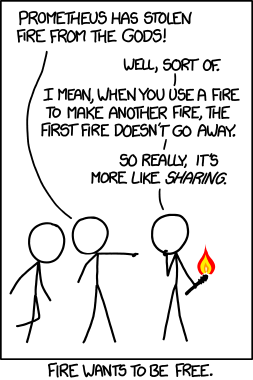
'I'm here to return what Prometheus stole.' would be a good thing to say if you were a fighter pilot in a Michael Bay movie where for some reason the world's militaries had to team up to defeat every god from human mythology, and you'd just broken through the perimeter and gotten a missile lock on Mount Olympus.
20 Jun 20:10

Now... Assume No Fed

by Tyler Durden

Back by popular demand.

Now... Assume No Fed


20 Jun 19:31

Pundit Math: Russell Brand is Smarter than Three Cable News Anchors Combined

by Tod Kelly
Wickemt

Loved this guy before. Love him 10x as much now.

Post image for Pundit Math: Russell Brand is Smarter than Three Cable News Anchors Combined

But that’s probably not a huge surprise, right?

Still, I’m posting this video because it is my new favorite thing on the Internet ever. [A big, thankful hat tip to the always fabulous Alyssa Rosenberg.]  Trust me when I say that you really, really need to watch this video.

On tour to promote his new one man show, Messiah Complex, Russell Brand sat down this week with the folks on Morning Joe.  (If you’re not familiar with it, Morning Joe is a MSNBC Fox-&-Friends-Wanna-Be vehicle.[1])  From his description, Brand’s show sounds fascinating:

I’m talking about Malcolm X, Che Guevara, Gandhi and Jesus Christ, and how these figures are significant culturally, and how icons are appropriated and used to designate consciousness and meaning – particularly posthumously… They’re all people who died for a cause, they’re all people whose icons are used to designate meaning, but perhaps not in the manner they intended.

Were this NPR’s Talk of the Nation or Fresh Air (to name two shows currently fashionable to s**t on by both the Right and the Left) a truly meaningful discussion or interview might have followed.  Instead, partisan cable news did what partisan cable news does best: trip over itself to make the most insipid observations possible.  Normally on cable news networks, everyone on camera knows their roles and does their part in dumbing down the conversation. The hosts do this to make the show easy to swallow for the most common denominator, and the guests do it because that’s what they need to do to be asked back so that they can jockey to be awarded the plumb “special contributor” paycheck.  This interview, though, is something else entirely.  In what was surely booked to be a mere five-minute throwaway puff piece, Russell Brand effectively dismantles the myth of “cable-news journalism” by not playing along and going completely off script.

Brand is clearly the smartest person in a room of people who have become a parody of themselves.  At one point when he is trying to explain why he can’t just do thirty seconds of Gandhi jokes and get his show’s point across, he is interrupted by the hosts’ observing that it’s so hard to understand English accents on the radio, but in person you can understand Russell perfectly!

Brans then turns to the bank of people working at multi-colored, futuristic looking computers (part of the “set”) behind the hosts.

“Who are these people?  At work, are they?” he asks incredulously.

“They’re Facebooking,” explain the hosts.  Instantly realizing how inane this sounds, they add, “and tweeting.”

The rest of the interview is filled with similar naked-emperor-exposing.  The questions asked by the hosts are along the lines of, “Can we see your boots? They’re very interesting!”, or, “You’re a comedian, but you also have a serious side, don’t you?”

At one point one of the hosts asks him which he prefers – standup comedy, movies or television, and Brand manages to answer in a way that is clearly meant to be a sharp, cutting and on-target insult to not only everyone in the room, but anyone that works in cable news period:

The thing I enjoy most is standup comedy, because you’re direct with your audience.  You can’t be misinterpreted… You know what happens if you work in media?  People like to change the information till it suits a particular agenda.  If you’re in a room with people then what you say is clear…  If you say something as a joke people can’t pretend you’re saying it seriously.  So I like to have direct communication with people, because I believe people are very, very intelligent, but the information gets manipulated a lot, to cause –you know – fake stirs and stuff.

It’s hard for me to choose which part of this I love more – the expressions of the faces of the Morning Joe hosts as they begin to understand he’s talking about them, or the hilarious “control-the-message” attempt to change the subject back to Brand’s funny English accent immediately after.

I’ll let Alyssa describe the climactic end:

And finally, Brand had enough. “Is this what you all do for a living? Let me help you. I’m here to promote a tour called Messiah Complex,” he told them exasperated, before shuffling up a stack of paper and posing a series of entirely reasonable questions about the roles of Bradley Manning and Edward Snowden in our national security environment before continuing his lecture. “You forget about what’s important and allow the agenda to be decided by superficial information.” Turning to Brzezinski, Brand asked, “What do you think that gesture means, the way you’re touching that bottle. You need to lose that ring because it don’t mean nothing to you.”

So treat yourself and watch the whole nine minutes.  Like I said, it’s my new favorite thing on the Internet ever:


[1] Seriously, how sad is that?

Follow Tod on Twitter, view his archive, or email him.

19 Jun 18:44

The Pace of Modern Life

'Unfortunately, the notion of marriage which prevails ... at the present time ... regards the institution as simply a convenient arrangement or formal contract ... This disregard of the sanctity of marriage and contempt for its restrictions is one of the most alarming tendencies of the present age.' --John Harvey Kellogg, Ladies' guide in health and disease (1883)
19 Jun 15:57

Matt Harvey challenged Jon Rauch to a fight

by Andrew Vazzano, SNY.tv

Matt Harvey challenged Jon Rauch to a fight last season, according to Jeff Passan of Yahoo! Sports.

Harvey was taking a nap when Rauch doused him with ice water, shocking him awake and also ruining Harvey’s phone.

“He bounded up and challenged Rauch to a fight. Right there. Right then. He gave up 7 inches, about 75 pounds and a gallon or so of bad ink. It didn’t matter that he was a rookie. Harvey would not be a joke. He would not be a punch line in Rauch’s re-telling. He would not let some mediocre clown play him,” Passan wrote.

Rauch backed down from the fight, Passan said.

“From that day forth, everyone who witnessed the incident or heard about it understood a new Mets commandment: Thou shalt not trifle with Matt Harvey,” he wrote.

Matthew Cerrone, Lead Writer

I love this story about Harvey not taking any crap from Rauch. This is EXACTLY the type of bold, “Don’t Tread on Me” attitude the Mets have been missing for much of the last 20 years. I hope this mindset can bond this franchise and spread like a disease within it. Harvey isn’t going to be the butt of anyone’s joke, and neither should the Mets.

By the way, Passan’s entire article is awesome. It is a must read. Seriously, if it’s the only other thing you do today, you have to check it out


19 Jun 14:09

How I Married Karen Thirty-Six Years Ago Today

by Robert J. Avrech
My bride Karen, June19, 1977.

My bride, Karen, June 19, 1977

Today is our 36th wedding anniversary.

But as readers of Seraphic Secret know, I have been helplessly, hopelessly in love with Karen ever since the fourth grade, when I first saw her on the playground of our elementary school, Yeshiva of Flatbush.

Without Karen, I never would have accomplished very much in life. It was her faith in my ambition, my talent and tenacity, that gave me the strength to become a successful Hollywood screenwriter-producer. And of course, it has always been Karen’s common sense that has turned me from an irresponsible young dreamer into a man who is willing to shoulder even the heaviest of burdens.

Yesterday, we took a walk together. At one point, I turned and glanced at Karen’s lovely profile. Time seemed to turn liquid as present and past merged. For one hallucinatory instant, I saw Karen as the ravishing, nine year-old, onyx-eyed beauty who captured my vulnerable heart.

I said to myself: “Karen loves me. Karen married me. We have built a wonderful life together. My world is complete.”

Here’s an excerpt from my eBook, How I Married Karen.

Chapter 15

Souls for Sale

Eleanor Boardman in “Souls for Sale,”

Eleanor Boardman in “Souls for Sale,” 1923, one of the best movies about Hollywood ever produced.


“Can I read the screenplay?”

“Um….”

I am my usual articulate self.

It is 1976. Karen and I have been dating for several weeks.

Karen is reserved. Karen is cautious. Several painful relationships have made her suspicious of the male of the species.

Imagine that.

Now we are sitting in a coffee shop on Manhattan’s Upper West Side and I spill, tell Karen of my dreams and aspirations.

“I am a screenwriter,” I say.

“I want to make movies,” I say.

Notice: I am not in medical, dental, or law school. Nor am I am studying to be an accountant, a businessman, a psychologist, an educator, a rabbi or a social worker.

I’m shooting for Hollywood.

Karen just gazes at me long and hard. Like Supergirl — the Jewish version — she seems to possess X-ray vision, and I’m pretty sure she can see right through me.

Karen does not flinch, she does not blink, she does not protest. Other young women have said to me:

“You can’t do that — you’re a shomer Shabbos Jew.”

Or:

“Is that a parnassah, a living?”

Or:

“What’s a screenplay?”

“That’s a wonderful ambition,” says Karen.

To this day I have no idea what kept me from falling to my knees and kissing her feet.

I have been so isolated in my love of movies, in my desire to become a Hollywood screenwriter, that at some point I just stopped telling people what I truly wanted out of life.

I was like a crypto-Jew during the Spanish Inquisition: on the surface, a normal American guy, but in the privacy of my apartment, a devoted screenwriter, pounding away on my manual Smith Corona, burning with images.

Karen sips her tea and asks me a series of logical questions about the structure of screenplays.

I explain that movies have three acts: exposition, conflict, resolution. I talk about main characters, how the script is all about a journey to overcome impossible obstacles and achieve something.

Karen asks about the business. “It’s very tough,” I concede.

I don’t tell her that Hollywood is littered with broken, failed screenwriters. I don’t want to scare her away.

I don’t tell her about one of my favorite movies, the silent classic Souls for Sale, a great comedic drama that views Hollywood as an asylum run by the lunatics.

“What have you written?”

I tell Karen about my latest script, an adaptation of a short story by the great Israeli Nobel laureate S.Y. Agnon. It’s been a struggle to write. Every script has its own unique problems to solve, but this script has been keeping me up at night. It’s good but flawed, deeply flawed.

“Can I read the screenplay?” Oh, boy. If I give it to Karen and she hates it — well, I have a feeling that this will diminish me in her eyes.

But if I don’t let Karen read it — well, that indicates total cowardice.

I have loved Karen since we were children. Helplessly and hopelessly. Abruptly, I realize that at some point I must make the leap from the warm embrace of romantic love into the real world where relationships are tested, where the depth of trust can be properly measured.

On the way home from the coffee shop, we stop at my apartment and I hand over my screenplay.

A little voice inside my head screams and screams and screams.

Several days pass without a response from Karen.

I tell myself: “She hates it.”

I stare at the telephone and growl: “What do you know about screenplays? Nothing. Who are you to judge me?”

And then, the phone chimes:

“I read your screenplay.”

Pause.

Someone on my block is beating on a set of drums and it’s making my entire body shake. Oh, wait — that’s my heart galloping in my chest.

“Annnd?” I whine.

We meet at the same coffee shop.

“I’m sorry I didn’t get back to you sooner,” Karen says, “but I wanted to read the original story and see what you did with it.”

Note to self: Unlike yours truly, Karen is thorough, believes in hard work, research.

“So I had to go to the library and find the Hebrew version.”

“Wait a minute — you read the original Agnon?”

Karen nods, sips her tea.

“It’s not hot enough.”

“My screenplay?”

“My tea.”

“You read the story in Hebrew?”

Karen nods, says to the waiter: “Can I have some hot tea, please?”

“I worked from an English translation. My Hebrew isn’t good enough to read Agnon’s original. ”

“I read both,” Karen says, “the Hebrew and the English.”

Which is why Karen was in the A class in the Yeshivah of Flatbush and I was in the C class, reserved for dummies.

Karen praises my work and then offers the most cogent criticism I have ever received on a screenplay. This young woman, who has never before read a movie script, effortlessly isolates the main problems in the story and offers a few simple suggestions that will help clarify the central theme and sharpen the main character. Oh, and Karen has a few notes on how to make the script a bit more commercial.

Always a fine idea.

I am flattered.

I am humbled.

And of course, I am a complete baby. “But you like my script, right?”

I’m pretty sure I’m begging.

Yes, Karen assures me, she likes it.

And only supernatural willpower stops me from saying: “Well, that means you like me too, right?”

Even I, violently love-smitten, have some reserves of pride.

Karen sips her hot tea, looks up at me with her coal-black eyes and says: “You’re going to have the career you want. I have faith in you.”

I bite my lip. Hard. It’s the only thing I can do to hold back a gush of tears. No one has ever said these words to me. All my life I have been the outsider, the lofty dreamer, the kid who just doesn’t fit in. In truth, I have almost no faith in myself.

It’s as if the cruel teachers in the Yeshivah of Flatbush had forever branded me, inside and out, with that fearful report card notation: “Does not live up to his full potential.”

In scripts, there is a decisive moment, almost always in the second act. It’s the point in the story where several plot lines converge, where the main character makes a momentous decision — and in terms of narrative, the story then moves along with single-minded velocity to the inevitable resolution and end.

We have reached that decisive moment. Karen and I have just taken a giant leap in our relationship, and here in this Manhattan coffee shop, we sip our tea and just bask in companionable silence.

I am going to marry Karen.

Karen is going to marry me. Everything is going to be okay.

It’s in the script.

coverThumb

“How I Married Karen” can be purchased via:

Amazon Kindle

iTunes

Barnes & Noble

If you like “How I Married Karen,” please leave a positive comment on either Amazon, iBookstore, or Barnes & Noble. And, of course, send it as a gift to your loved ones, or just recommend it to friends and relatives. Thanks so much.

19 Jun 13:51

16 Foods You Can Regrow from Kitchen Scraps — Tips from The Kitchn

by Cambria Bold

We already know you can regrow celery and scallions from their scraps. But leeks, lemongrass, and ginger, too? Yes indeed!

READ MORE »

19 Jun 13:50

Make the Best Gin & Tonic of Your Life: Advice from a Bartender in Oporto — 10-Minute Happy Hour

by Maureen Petrosky

Make the Best Gin & Tonic of Your Life: Advice from a Bartender in Oporto

The deep love of a G&T continually proves strong, not just in the summer and most definitely not just stateside — the New York Times called 2013 the Year of the Gin and Tonic and Europeans love this little cocktail just as much as we do. Yet, on a recent trip to Portugal, I found their G&Ts to be quite different than what I was used to sipping. That’s when a local bartender dropped some knowledge on me.

More


19 Jun 13:17

Christopher Lee: Metal Rocker and total badass

by noreply@blogger.com (Borepatch)
Christopher Lee is perhaps best known for his role as Saruman in The Lord Of The Rings films; lesser film viewers will remember him in the craptacular Star Wars episodes 2 and 3.  He has had a long and productive acting career spanning a range from Wizard and Jedi to Dracula.

But his life is nothing short of astonishing.  He witnessed the last execution via guillotine in France.  He fought in the Winter War in Finland in 1939.  He was in the SAS in North Africa during the War.  He was cousin to Ian Flemming, who tried (and failed) to get him cast as Dr. No (he had to wait until Man With The Golden Gun to play a Bond villain).

But this post is about his musical career which is nothing short of amazing.  He had classical voice lessons to develop a basso profondo operatic capability.  He's continued his recording career, most recently with the Symphonic Metal band Rhapsody Of Fire. 


At 90 years of age, he (and they) have a new Metal album out, Charlemagne: The Omens Of Death. I think that this makes him the oldest Metal recording artist.  As a matter of fact when the first Metal artists were still in diapers he was kicking Nazi ass in the SAS.  The only thing that would make him more badass was if he built motorcycles or something.

And just to show that he refused to get type cast in his music (as he did somewhat in his film career), here he's getting his redneck on with Ghost Riders In The Sky.  Dude - this version's sung by Dracula!


Here he is talking about making the Charlemagne album.  Rock On, Sir Christopher!


18 Jun 02:38

Ommegang announces next Game of Thrones beer: Take the Black Stout

by Winter Is Coming

Ommegang's Take the Black StoutWhen Brewery Ommegang and HBO partnered to release the Iron Throne Blonde Ale, more beers were promised. Today, they have unveiled the second of this line of exclusive Game of Thrones-themed beverages, it is called Take the Black Stout. Terri Schwartz of Zap2It writes:

Take the Black is a stout inspired by the Night’s Watch. Take the Black Stout is 7 percent alcohol by volume, whereas Iron Throne was 6.5 percent. This beer will also be released in 750 mL bottles and sixth barrel kegs.

As can be seen in the photograph below, the label art on the bottle features the Weirwood trees considered sacred by the people of the North. The design was created for the bottle by a52, the same studio that designed the iconic opening credits sequence for “Game of Thrones.”

Ommegang has said that given the overwhelming demand for Iron Throne Blonde Ale, they will be brewing up and distributing even more Take the Black Stout. The beer will be available in the US, beginning this fall.

Winter Is Coming: I’m not normally a fan of dark beer, but given how tasty Ommegang’s first offering was combined with the fact that I am a sucker for anything Game of Thrones, I will definitely be trying this.

17 Jun 19:56

Delaying The Great Reset

by Tyler Cowen

Some 74 percent of professors aged 49-67 plan to delay retirement past age 65 or never retire at all, according to a new Fidelity Investments study of higher education faculty. While 69 percent of those surveyed cited financial concerns, an even higher percentage of professors said love of their careers factored into their decision.

Here is more.
17 Jun 14:07

A Father's Day Message of Hope to My Son

You might ask: then why have children? It's a fair question.

13 Jun 22:52

Kale, Black Bean and Avocado Burrito Bowl

by Kate

Kale, black bean and avocado burrito bowl

Last week, Cookie and I zoomed up to Minneapolis to visit a friend. It was a long drive, long enough to justify lots of seat squirming as all the hills and trees started looking the same, but we made it there and we made it back. In between, we explored the city with my college roommate/tour guide. She took me to all the cool places to eat and drink, and shop, and hike and bike. She introduced me to the Minnesota delicacy known as fried cheese curds. (Cheese and beer at midnight is hard to beat, am I right?) It was a wonderful extended weekend and I didn’t want to come back home to a mountain of laundry and unanswered emails.

marinated raw kale

I composed this burrito bowl in my head on the drive home, somewhere between my stop at Ikea (first time!) and Iowa. I was feeling a little off balance after all the eating, drinking and shopping. I wanted a hearty meal with greens, one that would keep well so I could eat leftovers for a few days as I got caught up on work. I wanted something economical and practical, yet so tasty that I could forget about all of those factors and enjoy every bite. Mission accomplished!

Continue to the recipe...


13 Jun 18:58

It's Official: Caffeine Withdrawal Is a Mental Health Disorder

by Anjali Prasertong
Wickemt

The withdrawal is a mental health disorder? Shouldn't it be the addiction?

The DSM is, indeed, completely full of shit.

Caffeine Withdrawal Is Officially a Mental Health Disorder

If you've ever tried to kick the coffee habit, you are familiar with the symptoms of caffeine withdrawal: headaches, fatigue, irritability, and difficulty concentrating. But the release of the newest version of the American Psychiatric Association's Diagnostic and Statistical Manual of Mental Disorders (DSM-5) made official what us coffee addicts suspected all along. Caffeine withdrawal can be a mental health disorder.

More