
Shared posts
30 Apr 22:32

Irregular Webcomic! #4505
Seriously. "Moi?" is essentially the same as, "You got me. I did it. It's a fair cop." Just in French for style points.
29 Apr 11:17

Irregular Webcomic! #4504
TomfhainesWho would play such a thing?
For anyone unaware, Gloomhaven is a huge board game with zillions of components, released in 2017. It's one of the most critically acclaimed and popular board games ever. (At least among "serious" game players who keep up with modern board game releases - not necessarily casual gamers who pull out Monopoly every couple of months.) We see here that Siobhan was previously asking about Melville House being where "all the nerds live" not because she wasn't keen on going, but because she was keen on going.


21 Apr 12:08
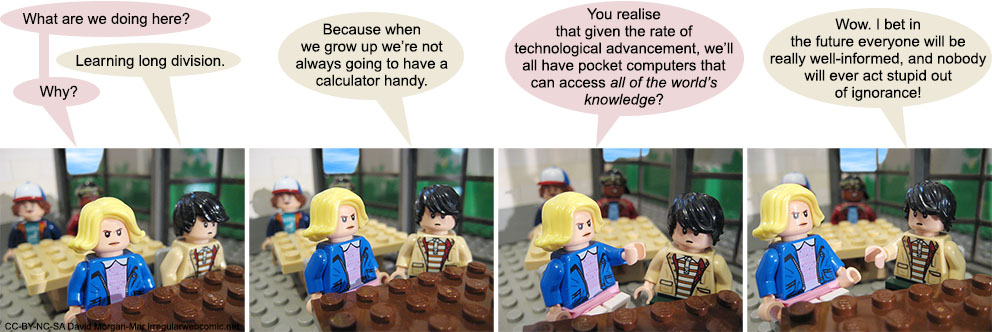
Irregular Webcomic! #4498
I originally wrote Mike's first line as "Learning mathematics", but on reflection I changed it to long division, because mathematics in general is actually used a lot in everyday adult life, in contrast to long division specifically. I can't remember the last time I had to do long division - it may well have been at school. I still know how to do it though.

04 Mar 20:41

Irregular Webcomic! #4464
Risk is a classic[1] board war game, released in 1957. Most of you have probably played it at some point. As war games go, it's relatively tractable and mainstream, involving a lot of dice rolling and abstraction of "armies" moving across a stylised map of the globe, rather than looking up tables of tank movement rates per model versus terrain and weather conditions on the Russian front. So it remains popular to this day, and like its other cash cows Hasbro has marketed the hell out of it with numerous licensed versions in recent years. [1] "Classic" in the context of board games usually means "invented before people understood how to make games that are actually fun to play". Although given some of the other old games still floating around, Risk is not the worst offender by far.




07 Jan 21:40
America, this you?
by Jessica Hagy

The post America, this you? appeared first on Indexed.
Madalyn Gregory, felixvulgaris and one other like this


17 Dec 22:12
Back in MY day, the stuff was GOOD.
by Jessica Hagy

The post Back in MY day, the stuff was GOOD. appeared first on Indexed.
Tindalostalbot likes this
15 Dec 20:57
And yet, you don’t feel SEEN.
by Jessica Hagy
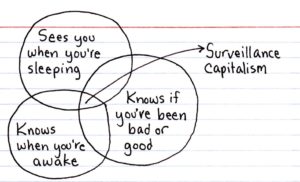
The post And yet, you don’t feel SEEN. appeared first on Indexed.
mkvande, Tindalostalbot and one other like this

07 Dec 22:04

2020-12-06 Rerun commentary: I've been fortunate enough to see several works by both Degas and Pollock in various museums around the world. If you've never been to an art museum, go some time. Even if you don't think you like art - if you've never seen it in person it's a completely different experience to seeing reproductions on a screen or in a book. You might just like it.
Irregular Webcomic! #2125 Rerun
Edgar Degas was a French artist of the late 19th and early 20th century. He is considered one of the founders of Impressionism, but his works generally show a more realistic style with more restrained use of non-mixed colours than that of other Impressionists such as Monet and Renoir. In fact Degas hated the term "Impressionism", and refused to be associated with the movement. He had a long painting career and treated many subjects, but is particularly identified with his studies of ballerinas, scenes of contemporary French cafe lifestyle, and racehorses.
Jackson Pollock was an American artist of the mid-20th century, who was the leading force behind the abstract expressionist art movement. This was the first significant Western art movement to emerge in the New World, and dethroned Paris from its long reign as the centre of world art.
The use of Jackson Pollock here is slightly anachronistic, since he did all his major work after 1940. But with all the other timestream mess going on, what's a little anachronism between artists?
2020-12-06 Rerun commentary: I've been fortunate enough to see several works by both Degas and Pollock in various museums around the world. If you've never been to an art museum, go some time. Even if you don't think you like art - if you've never seen it in person it's a completely different experience to seeing reproductions on a screen or in a book. You might just like it.



26 Oct 10:41

Irregular Webcomic! #4371
This is the Aussie Edition. In later instalments of the newly updated series, Steve wrestles the wampa, some mynocks, the exogorth, Jabba, the rancor, and the almighty sarlacc.
19 Oct 22:14
So much math involved.
by Jessica Hagy

The post So much math involved. appeared first on Indexed.
Tindalostalbot likes this

12 Oct 11:15

2020-10-11 Rerun commentary: It's always struck me as weird that elections are on Tuesdays in the USA. Here in Australia they're always on a Saturday, when (traditionally at least), most people are not working, so it's easier to go and vote. I've read that there was a reason, many years ago, for choosing Tuesday, in that it was convenient for all the farmers, who would go to church on Sunday, then spend Monday travelling to the nearest town where they could vote, so Tuesday was sensible. I do harbour a sneaking suspicion that this situation is no longer the case for most Americans... The other odd thing is seeing stories about people in the USA waiting for an hour or more, sometimes much more, to vote. I don't think I've ever spent more than 10 minutes or so waiting to vote, and usually it's less than 5 minutes. And then you can get down to the real serious business of election day, the Democracy Sausage.
Irregular Webcomic! #2109 Rerun
Today is, as almost all of you probably already know, an incredibly important day.
Something that always happens on a Tuesday in November.
You all know what I'm talking about.
2020-10-11 Rerun commentary: It's always struck me as weird that elections are on Tuesdays in the USA. Here in Australia they're always on a Saturday, when (traditionally at least), most people are not working, so it's easier to go and vote. I've read that there was a reason, many years ago, for choosing Tuesday, in that it was convenient for all the farmers, who would go to church on Sunday, then spend Monday travelling to the nearest town where they could vote, so Tuesday was sensible. I do harbour a sneaking suspicion that this situation is no longer the case for most Americans... The other odd thing is seeing stories about people in the USA waiting for an hour or more, sometimes much more, to vote. I don't think I've ever spent more than 10 minutes or so waiting to vote, and usually it's less than 5 minutes. And then you can get down to the real serious business of election day, the Democracy Sausage.
07 Oct 08:32

Irregular Webcomic! #4357
The Ship of Theseus is a philosophical question that has been discussed since at least the time of Heraclitus and Plato, around 500-400 BC. The formulation in terms of a ship belonging to the mythological figure of Theseus comes from traditional Greek mythology, and was recorded by Plutarch:
The ship wherein Theseus and the youth of Athens returned from Crete had thirty oars, and was preserved by the Athenians down even to the time of Demetrius Phalereus, for they took away the old planks as they decayed, putting in new and stronger timber in their places, insomuch that this ship became a standing example among the philosophers, for the logical question of things that grow; one side holding that the ship remained the same, and the other contending that it was not the same.Most people would probably agree that if you own a ship (or a felucca) and, say, one nail becomes rusty so you pull it out and put in a new nail, then it's still the same ship (or felucca). The Ship of Theseus asks what happens if over many years you slowly replace one part after another as they wear out (very likely never replacing more than a fraction of a percent at a time) until you reach a point where none of the original parts remain. At this point, is it still the same ship? Now, if you actually owned a boat and you had it registered, and you replaced worn parts one at a time over the years... I have no doubt that both the legal authorities and you would still consider it the same registered boat at all times. And if you reach the point where all of the parts have been replaced so that none of the original boat remained, it would still be registered under the name of the original boat. But looking back and thinking about it, would you as the owner consider it to be the same boat? Now imagine, as Thomas Hobbes did in the 17th century, that you kept all of the removed parts that you replaced over the years. And once the registered boat consisted of all new parts, you took all the original parts that had been removed and reassembled them to make another boat (albeit a bit worn out). Now you have two boats. Which one is the original boat? The newer one that has been continuously legally registered in the same name, or the unregistered worn out one made from the original parts? There's no answer, as people disagree. Lest this be considered a thought experiment with no real world application, consider the famous submersible Alvin, operated by the Woods Hole Oceanographic Institution and responsible for many pioneering oceanographic discoveries. Since it was built in 1964, it has been repaired, refitted, and overhauled many times, and in fact every component of the original 1964 Alvin has been replaced. Alvin still operates now, and has always been registered as the same vessel, without interruption from 1964 to now. Is it the same vessel? Again, people may disagree. This argument has been raging for at least 2400 years. The same argument, just with different people.
29 Sep 00:37
We’re all spooky goths now.
by Jessica Hagy

The post We’re all spooky goths now. appeared first on Indexed.
Tindalostalbot likes this
23 Sep 22:38

Irregular Webcomic! #4348
The other version has Obi-Wan telling Luke: You will go to the Dagobah system. There you will seek out Yoda, the Jedi Master who told my master that he couldn't train your father—thus leading ultimately to your father turning evil and murdering your mother and a whole bunch of Jedi and children—and after which he ran off to hide on Dagobah.
18 Sep 10:45
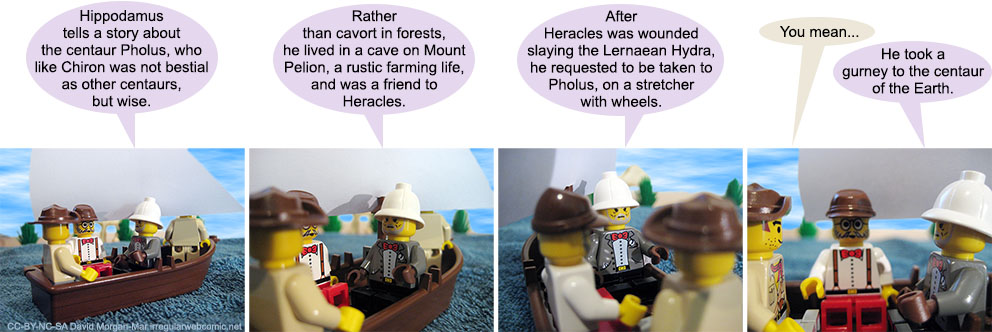
Irregular Webcomic! #4344
Pholus was indeed a centaur in Greek myth, who is said to have lived in a cave on (or at least near) Mount Pelion, which overlooks the modern city of Volos. Although Wikipedia says nothing about where the name of Volos comes from, the resemblance to Pholus is interesting. Ah... but Wiktionary says of the etymology: Uncertain. Possibly from Byzantine Greek Γόλος (Gólos), from Turkish Yolkaz, from Ancient Greek Ἰωλκός (Iōlkós). The change in consonants stems from a 19th century attempt by learned scholars to link the name with the Ancient Greek term βόλος (bólos, “fishing net”) or βῶλος (bôlos, “lump of soil”). A likely story. Anyway. Pholus was indeed a friend of Heracles, who slew the Lernaean Hydra as the second of his famous Twelve Labours. The rest of the mythology in this comic may be slightly embellished. On an unrelated note, Jules Verne's Journey to the Centre of the Earth was my favourite book for a long time as a child, and I read it many times over.