Abortion rights activists rally outside of the US Supreme Court after the overturning of Roe Vs. Wade. (Stefani Reynolds via Getty Images)
It’s a kind of miracle to write one book that changes the way people understand the world and their place in it. My friend Jonathan Haidt has written two of them: The Righteous Mind and his 2018 bestseller, cowritten by Greg Lukianoff, The Coddling of the American Mind.
Now he has launched a Substack, After Babel, to make sense of the “momentous sociological, cultural, and epistemological changes that occurred in many nations in the early 2010s, which gave us the chaos, fragmentation, and outrage that began to set in by the mid-2010s.”
The most important of those momentous changes: the rise of social media.
The damaging effects of social media on teen mental health are well-documented. (Haidt and I discussed it at length on Honestly.) But a recent post he wrote lays out in great detail how left-wing teen girls have been hit hardest of all. I was so struck by it—and suspect you will be, too. Perhaps especially if you’re a parent.
One note: Jonathan offers some really kind words about our podcast, The Witch Trials of J.K.Rowling, in this piece. I promise, we didn’t put him up to it. —BW
In May 2014, Greg Lukianoff invited me to lunch to talk about something he was seeing on college campuses that disturbed him. Greg is the president of FIRE (the Foundation for Individual Rights and Expression), and he has worked tirelessly since 2001 to defend the free speech rights of college students. That almost always meant pushing back against administrators who didn’t want students to cause trouble, and who justified their suppression of speech with appeals to the emotional “safety” of students—appeals that the students themselves didn’t buy. But in late 2013, Greg began to encounter new cases in which students were pushing to banspeakers, punish people for ordinary speech, or implement policies that would chill free speech. These students arrived on campus in the fall of 2013 already accepting the idea that books, words, and ideas could hurt them. Why did so many students in 2013 believe this, when there was little sign of such beliefs in 2011?
Greg is prone to depression, and after hospitalization for a serious episode in 2007, he learned CBT (Cognitive Behavioral Therapy). In CBT you learn to recognize when your ruminations and automatic thinking patterns exemplify one or more of about a dozen “cognitive distortions,” such as catastrophizing, black-and-white thinking, fortune telling, or emotional reasoning. Thinking in these ways causes depression as well as being a symptom of depression. Breaking out of these painful distortions isacurefor depression.
What Greg saw in 2013 were students justifying the suppression of speech and the punishment of dissent using the exact distortions that Greg had learned to free himself from. Students were saying that an unorthodox speaker on campus would cause severe harm to vulnerable students (catastrophizing); they were using their emotions as proof that a text should be removed from a syllabus (emotional reasoning). Greg hypothesized that if colleges supported the use of these cognitive distortions rather than teaching students skills of critical thinking (which is basically what CBT is), then this could cause students to become depressed. Greg feared that colleges were performing reverse CBT.
I thought the idea was brilliant because I had just begun to see these new ways of thinking among some students at NYU. I volunteered to help Greg write it up, and in August 2015 our essay appeared in The Atlantic with the title: “The Coddling of the American Mind.” Greg did not like that title; his original suggestion was “Arguing Towards Misery: How Campuses Teach Cognitive Distortions.” He wanted to put the reverse CBT hypothesis in the title.
After our essay came out, things on campus got much worse. The fall of 2015 marked the beginning of a period of protests and high-profile conflicts on campus that led many or most universities to implement policies that embedded this new way of thinking into campus culture with administrative expansions such as “bias response teams” to investigate reports of “microaggressions.” Surveys began to show that most students and professors felt that they had to self-censor. The phrase “walking on eggshells” became common. Trust in higher ed plummeted, along with the joy of intellectual discovery and sense of goodwill that had marked university life throughout my career.
Greg and I decided to expand our original essay into a book in which we delved into the many causes of the sudden change in campus culture. Our book focused on three “great untruths” that seemed to be widely believed by the students who were trying to shut down speech and prosecute dissent:
1. What doesn’t kill you makes you weaker.
2. Always trust your feelings.
3. Life is a battle between good people and evil people.
Each of these untruths was the exact opposite of a chapter in my first book, The Happiness Hypothesis, which explored ten Great Truths passed down to us from ancient societies east and west. We published our book in 2018 with the title, once again, of The Coddling of the American Mind. Once again, Greg did not like the title. He wanted the book to be called Disempowered, to capture the way that students who embrace the three great untruths lose their sense of agency. He wanted to capture reverse CBT.
The Discovery of the Gender-by-Politics Interaction
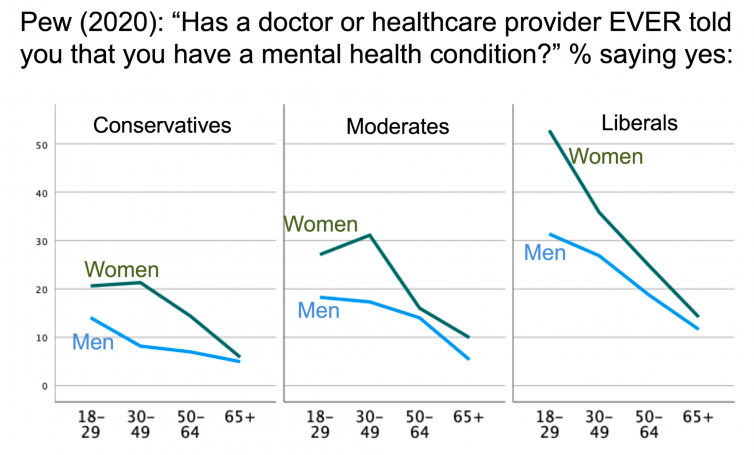
In September 2020, Zach Goldberg, who was then a graduate student at Georgia State University, discovered something interesting in a dataset made public by Pew Research. Pew surveyed about 12,000 people in March 2020, during the first month of the COVID shutdowns. The survey included this item: “Has a doctor or other healthcare provider EVER told you that you have a mental health condition?” Goldberg graphed the percentage of respondents who said “yes” to that item as a function of their self-placement on the liberal-conservative 5-point scale and found that white liberals were much more likely to say yes than white moderates and conservatives. (His analyses for non-white groups generally found small or inconsistent relationships with politics.)
I wrote to Goldberg and asked him to redo it for men and women separately, and for young vs. old separately. He did, and he found that the relationship to politics was much stronger for young (white) women. You can see Goldberg’s graph here, but I find it hard to interpret a three-way interaction using bar charts, so I downloaded the Pew dataset and created line graphs, which make it easier to interpret.
Here’s the same data, showing three main effects: gender (women higher), age (youngest groups higher), and politics (liberals higher). The graphs also show three two-way interactions (young women higher, liberal women higher, young liberals higher). And there’s an important three-way interaction: it is the young liberal women who are highest. They are so high that a majority of them said yes, they had been told that they have a mental health condition.
Figure 1. Data from Pew Research, American Trends Panel Wave 64. The survey was fielded March 19–24, 2020. Graphed by Jon Haidt.
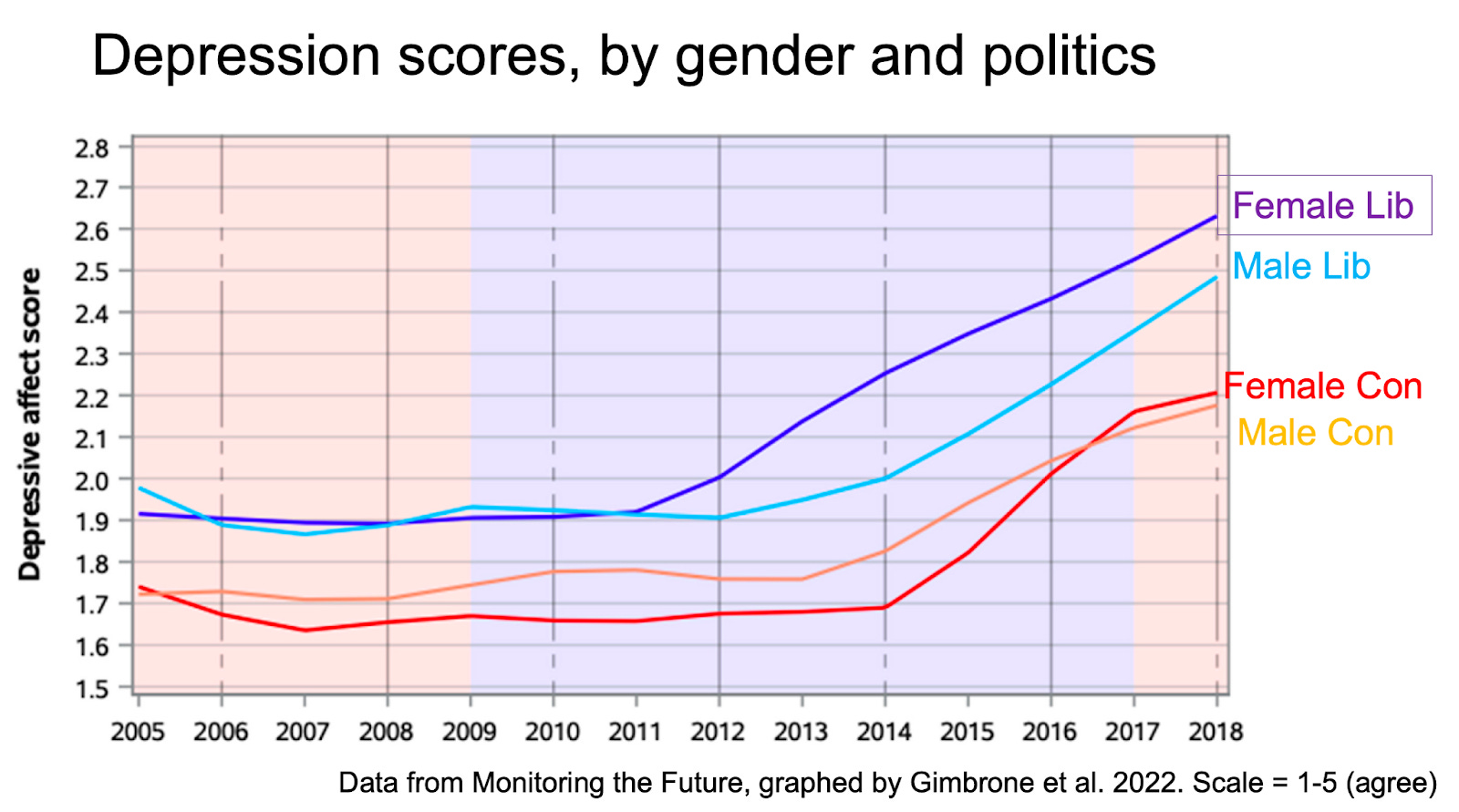
In recent weeks—since the publication of the CDC’s report on the high and rising rates of depression and anxiety among teens—there has been a lot of attention to a different study that shows the gender-by-politics interaction—Gimbrone, Bates, Prins & Keyes (2022), titled: “The politics of depression: Diverging trends in internalizing symptoms among US adolescents by political beliefs.” Gimbrone et al. examined trends in the Monitoring the Future dataset, which is the only major U.S. survey of adolescents that asks high school students (seniors) to self-identify as liberal or conservative (using a 5-point scale). The survey asks four items about mood/depression.Gimbrone et al. found that prior to 2012 there were no sex differences and only a small difference between liberals and conservatives. But beginning in 2012, the liberal girls began to rise, and they rose the most. The other three groups followed suit, although none rose as much, in absolute terms, as did the liberal girls (who rose .73 points since 2010, on a 5-point scale where the standard deviation is .89).
Figure 2. Data from Monitoring the Future, graphed by Gimbrone et al. (2022). The scale runs from 1 (minimum) to 5 (maximum).
The authors of the study try to explain the fact that liberals rise first and most in terms of the terrible things that conservatives were doing during Obama’s second term, e.g.,
Liberal adolescents may have therefore experienced alienation within a growing conservative political climate such that their mental health suffered in comparison to that of their conservative peers whose hegemonic views were flourishing.
The progressive New York Times columnist Michelle Goldberg took up the question and wrote a superb essay making the argument that teen mental health is not and must not become a partisan issue. She dismissed Gimbrone et al.’s explanation as having a poor fit with their own data:
Barack Obama was re-elected in 2012. In 2013, the Supreme Court extended gay marriage rights. It was hard to draw a direct link between that period’s political events and teenage depression, which in 2012 started an increase that has continued, unabated, until today.
After examining the evidence, including the fact that the same trends happened at the same time in Britain, Canada, and Australia, Goldberg concluded that “Technology, not politics, was what changed in all these countries around 2012. That was the year that Facebook bought Instagram and the word ‘selfie’ entered the popular lexicon.”
Journalist Matt Yglesias also took up the puzzle of why liberal girls became more depressed than others, and in a long and self-reflective Substack post, he described what he has learned about depression from his own struggles involving many kinds of treatment. Like Michelle Goldberg, he briefly considered the hypothesis that liberals are depressed because they’re the only ones who see that “we’re living in a late-stage capitalist hellscape during an ongoing deadly pandemic w record wealth inequality, 0 social safety net/job security, as climate change cooks the world,” to quote a tweet from the Washington Post tech columnist Taylor Lorenz. Yglesias agreed with Goldberg and other writers that the Lorenz explanation—reality makes Gen Z depressed—doesn’t fit the data, and, because of his knowledge of depression, he focused on the reverse path: depression makes reality look terrible. As he put it: “Mentally processing ambiguous events with a negative spin is just what depression is.”
Yglesias tells us what he has learned from years of therapy, which clearly involved CBT:
It’s important to reframe your emotional response as something that’s under your control:
Stop saying “so-and-so made me angry by doing X.”
Instead say “so-and-so did X, and I reacted by becoming angry.”
And the question you then ask yourself is whether becoming angry made things better? Did it solve the problem?
Yglesias wrote that “part of helping people get out of their trap is teaching them not to catastrophize.” He then described an essay by progressive journalist Jill Filipovic that argued, in Yglesias’s words, that “progressive institutional leaders have specifically taught young progressives that catastrophizing is a good way to get what they want.”
Yglesias quoted a passage from Filipovic that expressed exactly the concern that Greg had expressed to me back in 2014:
I am increasingly convinced that there are tremendously negative long-term consequences, especially to young people, coming from this reliance on the language of harm and accusations that things one finds offensive are “deeply problematic” or even violent. Just about everything researchers understand about resilience and mental well-being suggests that people who feel like they are the chief architects of their own life—to mix metaphors, that they captain their own ship, not that they are simply being tossed around by an uncontrollable ocean—are vastly better off than people whose default position is victimization, hurt, and a sense that life simply happens to them and they have no control over their response.
I have italicized Filipovic’s text about the benefits of feeling like you captain your own ship because it points to a psychological construct with a long history of research and measurement: locus of control. As first laid out by Julian Rotter in the 1950s, this is a malleable personality trait referring to the fact that some people have an internal locus of control—they feel as if they have the power to choose a course of action and make it happen, while other people have an external locus of control—they have little sense of agency and they believe that strong forces or agents outside of themselves will determine what happens to them. Sixty years of research show that people with an internal locus of control are happier and achieve more. People with an external locus of control are more passive and more likely to become depressed.
How a Phone-Based Childhood Breeds Passivity
There are at least two ways to explain why liberal girls became depressed faster than other groups at the exact time (around 2012) when teens traded in their flip phones for smartphones and the girls joined Instagram en masse. The first and simplest explanation is that liberal girls simply used social media more than any other group. Jean Twenge’s forthcoming book, Generations, is full of amazing graphs and insightful explanations of generational differences. In her chapter on Gen Z, she shows that liberal teen girls are by far the most likely to report that they spend five or more hours a day on social media (31% in recent years, compared to 22% for conservative girls, 18% for liberal boys, and just 13% for conservative boys). Being an ultra-heavy user means that you have less time available for everything else, including time “in real life” with your friends. Twenge shows in another graph that from the 1970s through the early 2000s, liberal girls spent more time with friends than conservative girls. But after 2010 their time with friends drops so fast that by 2016 they are spending less time with friends than are conservative girls. So part of the story may be that social media took over the lives of liberal girls more than any other group, and it is now clear that heavy use of social media damages mental health, especially during early puberty.
But I think there’s more going on here than the quantity of time on social media. Like Filipovic, Yglesias, Goldberg, and Lukianoff, I think there’s something about the messages liberal girls consume that is more damaging to mental health than those consumed by other groups.
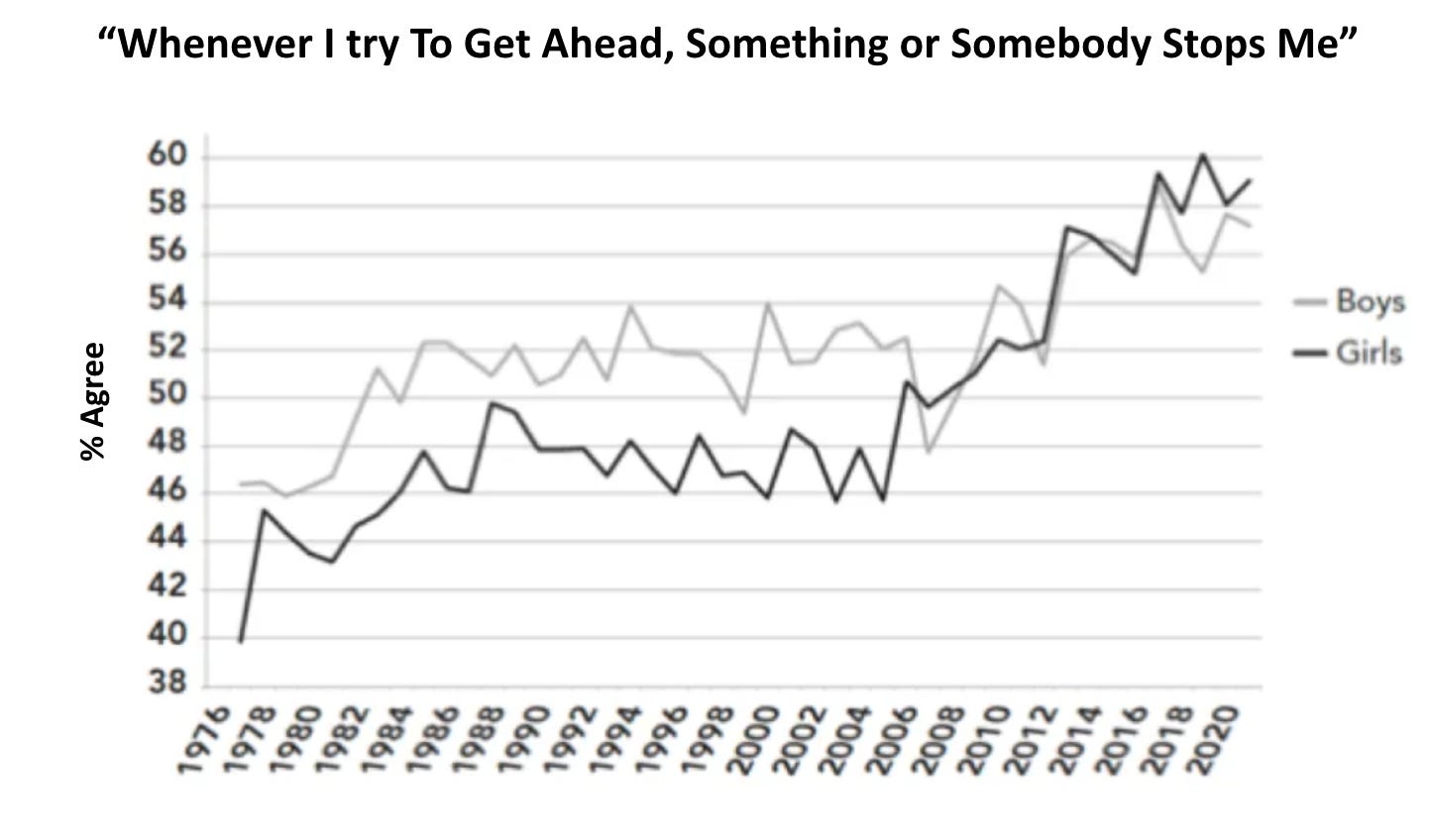
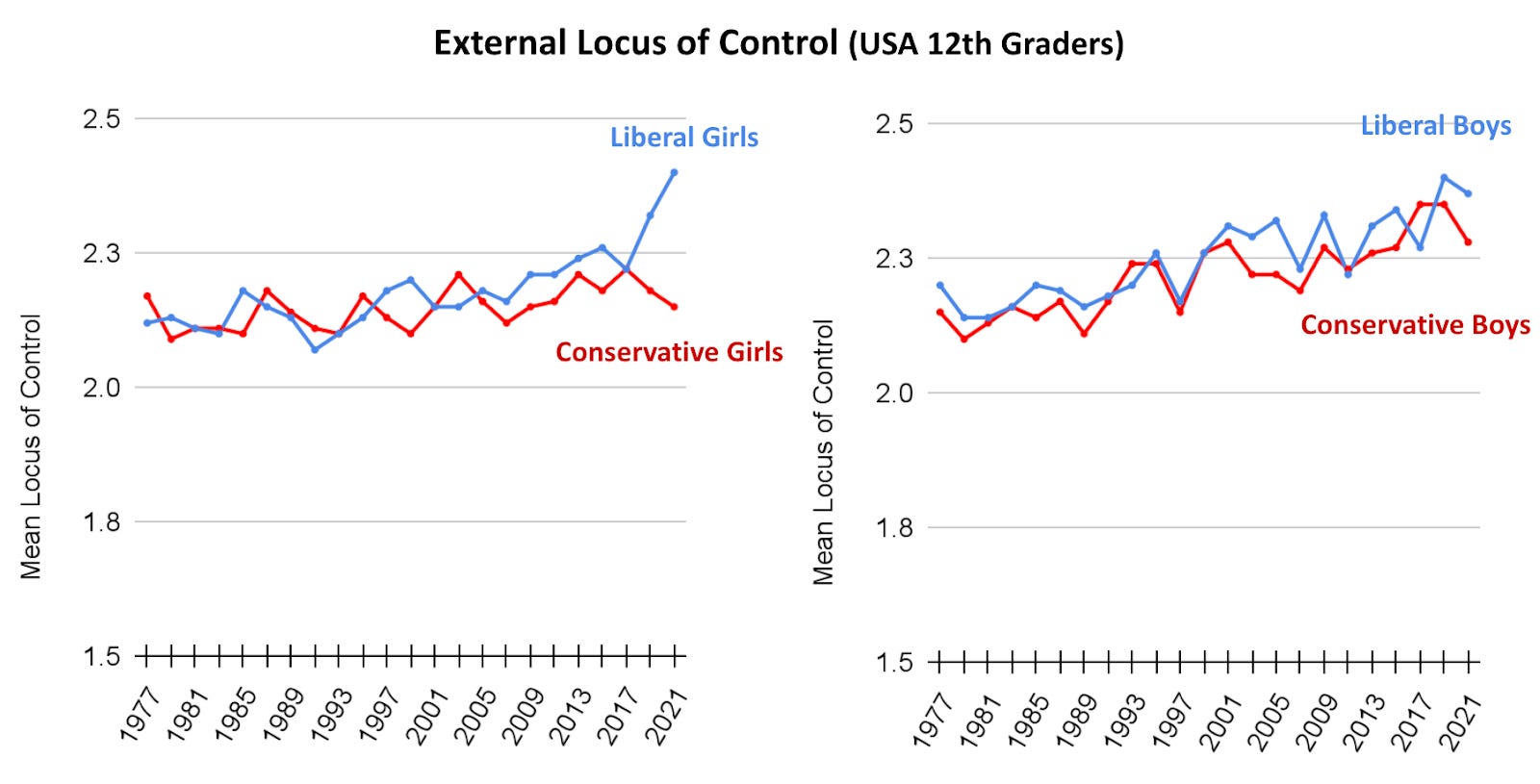
The Monitoring the Future dataset happens to have within it an 8-item Locus of Control scale. With Twenge’s permission, I reprint one such graph from Generations showing responses to one of the items: “Every time I try to get ahead, something or somebody stops me.” This item is a good proxy for Filipovic’s hypothesis about the disempowering effects of progressive institutions. If you agree with that item, you have a more external locus of control. As you can see in Figure 3, from the 1970s until the mid-2000s, boys were a bit more likely to agree with that item, but then girls rose to match boys, and then both sexes rose continuously throughout the 2010s—the era when teen social life became far more heavily phone-based.
Figure 3. Percentage of boys and girls (high school seniors) who agree with (or are neutral about) the statement “Every time I try to get ahead, something or somebody stops me.”From Monitoring the Future, graphed by Jean Twenge in her forthcoming book Generations.
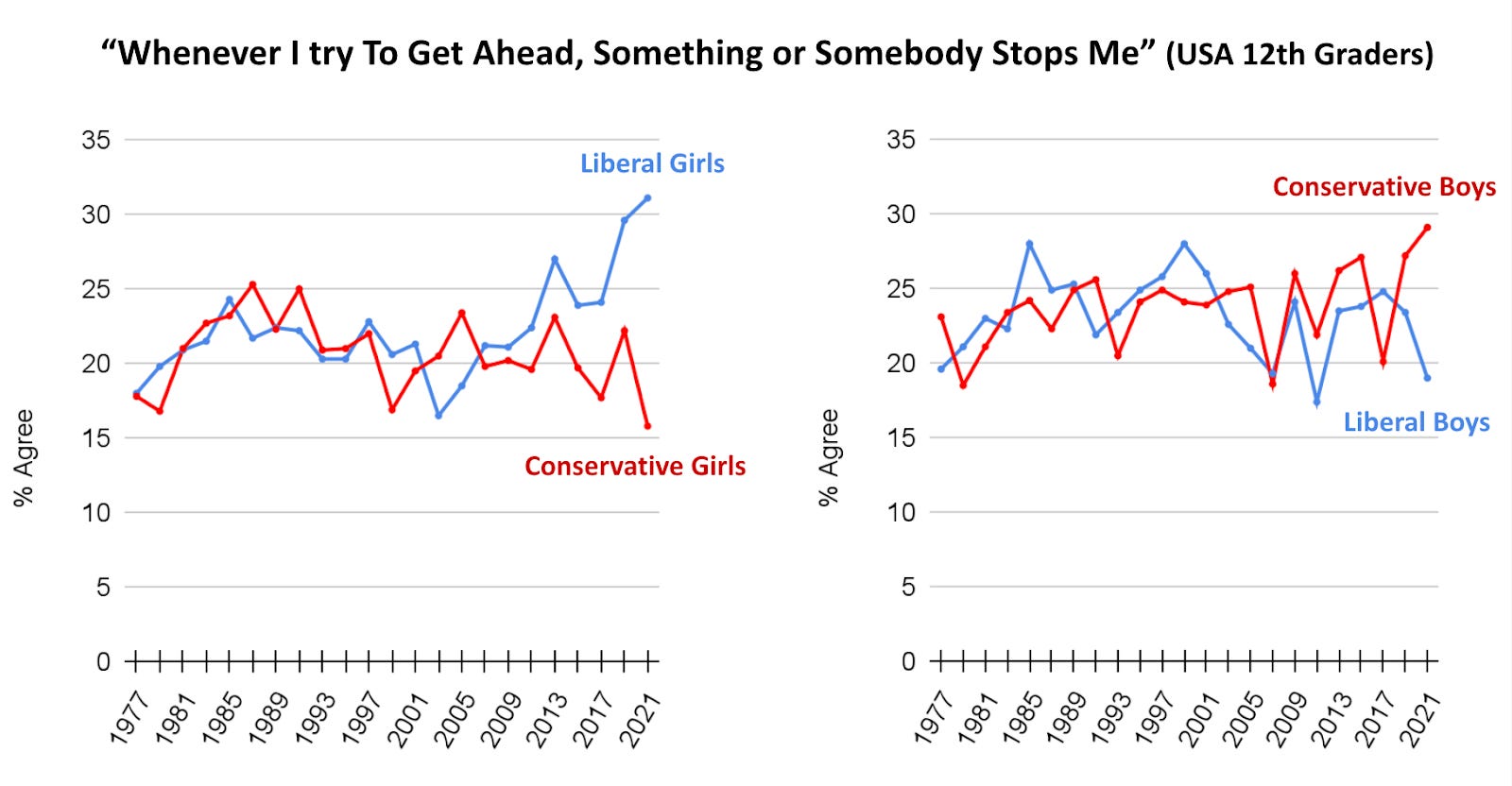
When the discussion of the gender-by-politics interaction broke out a few weeks ago, I thought back to Twenge’s graph and wondered what would happen if we broke up the sexes by politics. Would it give us the pattern in the Gimbrone et al. graphs, where the liberal girls rise first and most? Twenge sent me her data file (it’s a tricky one to assemble, across the many years), and Zach Rausch and I started looking for the interaction. We found some exciting hints, and I began writing this post on the assumption that we had a major discovery. For example, Figure 4 shows the item that Twenge analyzed. We see something like the Gimbrone et al. pattern in which it’s the liberal girls who depart from everyone else, in the unhealthy (external) direction, starting in the early 2000s.
Figure 4. Percentage of liberal and conservative high school senior boys (right panel) and girls (left panel) who agree with the statement “Every time I try to get ahead, something or somebody stops me.” From Monitoring the Future, graphed by Zach Rausch.
It sure looks like the liberal girls are getting more external while the conservative girls are, if anything, trending slightly more internal in the last decade, and the boys are just bouncing around randomly. But that was just for this one item. We also found a similar pattern for a second item, “People like me don’t have much of a chance at a successful life.” (You can see graphs of all eight items here.)
We were excited to have found such clear evidence of the interaction, but when we plotted responses to the whole scale, we found only a hint of the predicted interaction, and only in the last few years, as you can see in Figure 5. After trying a few different graphing strategies, and after seeing if there was a good statistical justification for dropping any items, we reached the tentative conclusion that the big story about locus of control is not about liberal girls, it’s about Gen Z as a whole. Everyone—boys and girls, left and right—developed a more external locus of control gradually, beginning in the 1990s.
Figure 5. Locus of Control has shifted slightly but steadily toward external since the 1990s. Scores are on a 5-point scale from 1 = most internal to 5 = most external.
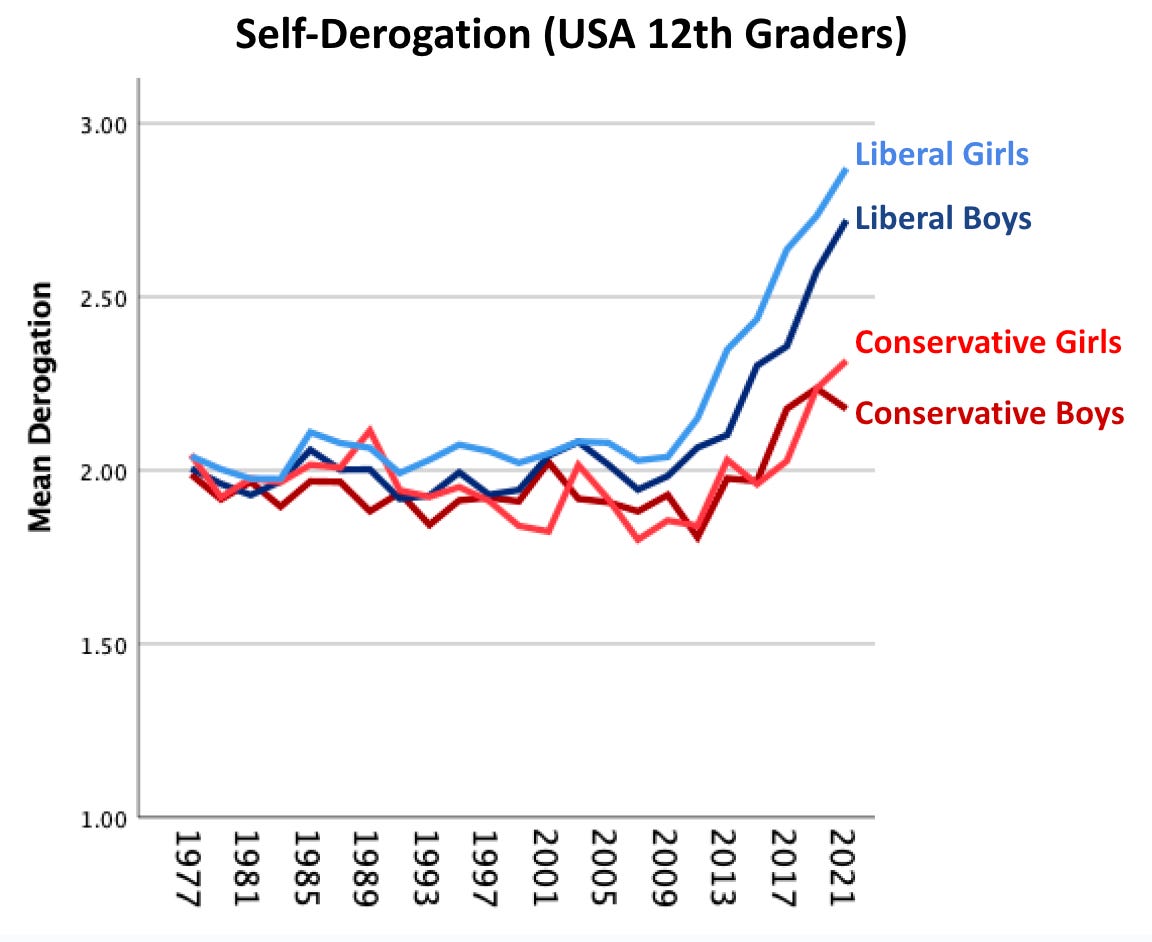
We kept looking in the Monitoring the Future dataset and the Gimbrone et al. paper for other items that would allow us to test Filipovic’s hypothesis. We found an ideal second set of variables: the Monitoring the Future dataset has a set of items on “self derogation” which is closely related to disempowerment, as you can see from the four statements that comprise the scale:
I feel I do not have much to be proud of.
Sometimes I think I am no good at all.
I feel that I can't do anything right.
I feel that my life is not very useful.
Gimbrone et al. had graphed the self-derogation scale, as you can see in their appendix (Figure A.4). But Zach and I re-graphed the original data so that we could show a larger range of years, from 1977 through 2021. As you can see in Figure 6, we find the gender-by-politics interaction. Once again, and as with nearly all of the mental health indicators I examined in a previous post, there’s no sign of trouble before 2010. But right around 2012 the line for liberal girls starts to rise. It rises first, and it rises most, with liberal boys not far behind (as in Gimbrone et al.).
Figure 6. Self-derogation scale, averaging four items from the Monitoring the Future study. Graphed by Zach Rausch. The scale runs from 1 (strongly disagree with each statement) to 5 (strongly agree).
In other words, we have support for Filipovic’s “captain their own ship” concern, and for Lukianoff’s disempowerment concern: Gen Z has become more external in its locus of control, and Gen Z liberals (of both sexes) have become more self-derogating. They are more likely to agree that they “can’t do anything right.” Furthermore, most of the young people in the progressive institutions that Filipovic mentioned are women, and that has become even more true since 2014 when, according to Gallup data, young women began to move to the left while young men did not move either way. As Gen Z women became more progressive and more involved in political activism in the 2010s, it seems to have changed them psychologically. It wasn’t just that their locus of control shifted toward external—that happened to all subsets of Gen Z. Rather, young liberals (including young men) seem to have taken into themselves the specific depressive cognitions and distorted ways of thinking that CBT is designed to expunge.
But where did they learn to think this way? And why did it start so suddenly around 2012 or 2013, as Greg observed, and as Figures 2 and 6 confirm?
Tumblr Was the Petri Dish for Disempowering Beliefs
I recently listened to a brilliant podcast series, The Witch Trials of J. K. Rowling, hosted by Megan Phelps-Roper, created within Bari Weiss’s Free Press. Phelps-Roper interviews Rowling about her difficult years developing the Harry Potter stories in the early 1990s, before the internet; her rollout of the books in the late ’90s and early 2000s, during the early years of the internet; and her observations about the Harry Potter superfan communities that the internet fostered. These groups had streaks of cruelty and exclusion in them from the beginning, along with a great deal of love, joy, and community. But in the stunning third episode, Phelps-Roper and Rowling take us through the dizzying events of the early 2010s as the social media site Tumblr exploded in popularity (reaching its peak in early 2014), and also in viciousness. Tumblr was different from Facebook and other sites because it was not based on anyone’s social network; it brought together people from anywhere in the world who shared an interest, and often an obsession.
Phelps-Roper interviewed several experts who all pointed to Tumblr as the main petri dish in which nascent ideas of identity, fragility, language, harm, and victimhood evolved and intermixed. Angela Nagle (author of Kill All Normies) described the culture that emerged among young activists on Tumblr, especially around gender identity, in this way:
There was a culture that was encouraged on Tumblr, which was to be able to describe your unique non-normative self… And that’s to some extent a feature of modern society anyway. But it was taken to such an extreme that people began to describe this as the snowflake [referring to the idea that each snowflake is unique], the person who constructs a totally kind of boutique identity for themselves, and then guards that identity in a very, very sensitive way and reacts in an enraged way when anyone does not respect the uniqueness of their identity.
Nagle described how on the other side of the political spectrum, there was “the most insensitive culture imaginable, which was the culture of 4chan.” The communities involved in gender activism on Tumblr were mostly young progressive women while 4chan was mostly used by right-leaning young men, so there was an increasingly gendered nature to the online conflict. The two communities supercharged each other with their mutual hatred, as often happens in a culture war. The young identity activists on Tumblr embraced their new notions of identity, fragility, and trauma all the more tightly, increasingly saying that words are a form of violence, while the young men on 4chan moved in the opposite direction: they brandished a rough and rude masculinity in which status was gained by using words more insensitively than the next guy. It was out of this reciprocal dynamic, the experts on the podcast suggest, that today’s cancel culture was born in the early 2010s. Then, in 2013, it escaped from Tumblr into the much larger Twitterverse. Once on Twitter, it went national and even global (at least within the English-speaking countries), producing the mess we all live with today.
I don’t want to tell that entire story here; please listen to the Witch Trials podcast for yourself. It is among the most enlightening things I’ve read or heard in all my years studying the American culture war (along with Jon Ronson’s podcast Things Fell Apart). I just want to note that this story fits perfectly with both the timing and the psychology of Greg’s reverse CBT hypothesis.
Implications and Policy Changes
In conclusion, I believe that Greg Lukianoff was exactly right in the diagnosis he shared with me in 2014. Many young people had suddenly—around 2013—embraced three great untruths:
They came to believe that they were fragile and would be harmed by books, speakers, and words, which they learned were forms of violence (Great Untruth #1).
They came to believe that their emotions—especially their anxieties—were reliable guides to reality (Great Untruth #2).
They came to see society as comprised of victims and oppressors—good people and bad people (Great Untruth #3).
Liberals embraced these beliefs more than conservatives. Young liberal women adopted them more than any other group due to their heavier use of social media and their participation in online communities that developed new disempowering ideas. These cognitive distortions then caused them to become more anxious and depressed than other groups. Just as Greg had feared, many universities and progressive institutions embraced these three untruths and implemented programs that performed reverse CBT on young people, in violation of their duty to care for them and educate them.
I welcome challenges to this conclusion from scholars, journalists, and subscribers, and I will address such challenges in future posts. I must also repeat that I don’t blame everything on smartphones and social media; the other strand of my story is the loss of play-based childhood, with its free play and self-governed risk-taking. But if this conclusion stands (along with my conclusions in previousposts), then I think there are two big policy changes that should be implemented as soon as possible:
1) Universities and other schools should stop performing reverse CBT on their students
As Greg and I showed in The Coddling of the American Mind, most of the programs put in place after the campus protests of 2015 are based on one or more of the three Great Untruths, and these programs have been imported into many K–12 schools. From mandatory diversitytraining to bias response teams and trigger warnings, there is little evidence that these programs do what they say they do, and there are somefindings that theybackfire. In any case, there are reasons, as I have shown, to worry that they teach children and adolescents to embrace harmful, depressogenic cognitive distortions.
One initiative that has become popular in the last few years is particularly suspect: efforts to tell college students to avoid common English words and phrases that are said to be “harmful.” Brandeis University took the lead in 2021 with its “oppressive language list.” Brandeis urged its students to stop saying that they would “take a stab at” something because it was unnecessarily violent. For the same reason, they urged that nobody ask for a “trigger warning” because, well, guns. Students should ask for “content warnings” instead, to keep themselves safe from violent words like “stab.” Many universities have followed suit, including Colorado State University, the University of British Columbia, the University of Washington, and Stanford, which eventually withdrew its “harmful language list” because of the adverse publicity. Stanford had urged students to avoid words like American, immigrant, and submit, as in “submit your homework.” Why? because the word submit can “imply allowing others to have power over you.” The irony here is that it may be these very programs that are causing liberal students to feel disempowered, as if they are floating in a sea of harmful words and people when, in reality, they are living in some of the most welcoming and safe environments ever created.
2) Congress should raise the age of “internet adulthood” from 13 to 16 or 18
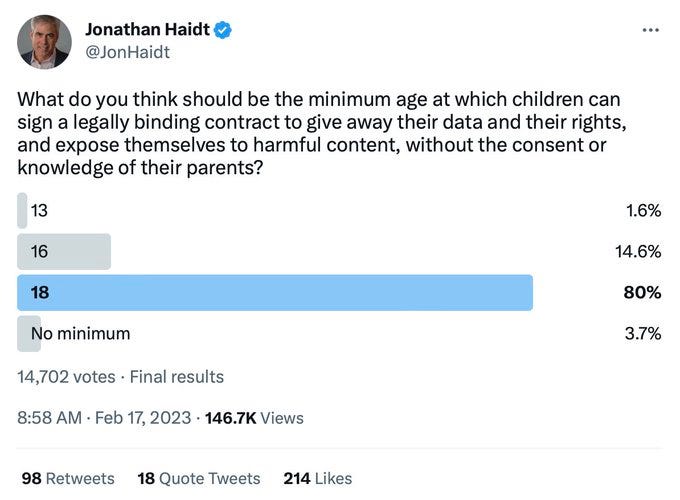
What do you think should be the minimum age at which children can sign a legally binding contract to give away their data and their rights, and expose themselves to harmful content, without the consent or knowledge of their parents? I asked that question as a Twitter poll, and you can see the results here:
Of course, this poll of my own Twitter followers is far from a valid survey, and I phrased my question in a leading way, but my phrasing was an accurate statement of today’s status quo. I think that most people now understand that the age of 13, which was set back in 1998 when we didn’t know what the internet would become, is just too low, and it is not even enforced. When my kids started sixth grade in NYC public schools, they each told me that “everyone” was on Instagram.
We are now 11 years into the largest epidemic of adolescent mental illness ever recorded. I know so many families that have been thrown into fear and turmoil by a child’s suicide attempt. You probably do too, given that the recent CDC report tells us that one in ten adolescents now say they have made an attempt to kill themselves. It is hitting all political and demographic groups. The evidence is abundant that social media is a major cause of the epidemic, and perhaps the major cause. It’s time we started treating social media and other apps designed for “engagement” (i.e., addiction) like alcohol, tobacco, and gambling, or, because they can harm society as well as their users, perhaps like automobiles and firearms. Adults should have wide latitude to make their own choices, but legislators and governors who care about mental health, women’s health, or children’s health need to step up.
It’s not enough to find more money for mental health services, although that is sorely needed. In addition, we must shut down the conveyer belt so that today’s toddlers will not suffer the same fate in twelve years. Congress should set a reasonable minimum age for minors to sign contracts and open accounts without explicit parental consent, and the age needs to be after teens have progressed most of the way through puberty. (The harm caused by social media seems to be greatest during puberty.) If Congress won’t do it then state legislatures should act. There are many ways to rapidly verify people’s ages online, and I’ll discuss age verification processes in a future post.
In conclusion: All of Gen Z got more anxious and depressed after 2012. But Lukianoff’s reverse CBT hypothesis is the best explanation I have found for Why the mental health of liberal girls sank first and fastest.
The Free Press finds the best insights and ideas on the internet—and brings them straight to your inbox. To support our work, become a subscriber today:
On February 17th fact-checker Iria Carballo-Carbajal, a neuroscientist by training, but apparently without any education in epidemiology, published a "fact-check" article on the Health Feedback website. In her headline, Carballo-Carbajal makes the following statement: "Multiple studies show that face masks reduce the spread of COVID-19; a Cochrane review doesn’t demonstrate otherwise."
This article is now being used by social media companies to suppress all references to the Cochrane study. I became aware of this on March 10th when I received a notification that a post by a member of a Facebook group I manage contained "false information."
The post referred to an opinion piece on the Cochrane review in the New York Times, published on February 10th. The "independent fact-checker" resource referred to was the aforementioned article by Carballo-Carbajal. Getting a fact-check stamp can be a serious issue for a newspaper, no less so for a scientific institution. Therefore it didn‘t come as a surprise that already on March 10th Cochrane editor Karla Soares-Weiser published a statement trying to downplay the study results, incorrectly claiming the study only aimed at assessing the effectiveness of interventions to promote mask wearing, while the clearly stated objective of the study is to assess the effectiveness of the pysical interventions themselves, not only the effectiveness of their promotion.
The same day the New York Times published a piece claiming in the headline that masks certainly work, but for the most part dedicated to smearing Cochrane study author Dr. Tom Jefferson. For example, the article claims Jefferson stated in an interview that there is no evidence that the SARS-CoV-2 virus is airborne, while what he actually says is that there are many transmission routes and further evidence is needed to ascertain precisely how transmission occurs.
This chain of events is a shockingly clear example of how the censorship industry works. It is all the more shocking considering how seriously flawed Carballo-Carbajal‘s "fact-check" article is, factually, logically and ethically.
1. The strawman
Carballo-Carbajal begins by creating a strawman, in this case a claim attributed to Dr. Robert Malone, referring to a recent post on his blog. Under the heading "Claim," the purported claim is stated thus: "Face masks are ineffective at reducing the spread of COVID-19 and other respiratory diseases, a Cochrane review demonstrates." This claim, quoted besides a picture of Dr. Malone, is nowhere to be found in his blog post.
As if this were not enough, Carballo-Carbajal continues, presenting what she calls a "full claim:" Review “failed to find even a ‘modest effect’ on infection or illness rate:” “the CDC Grossly Exaggerated the Evidence Supporting Mask Mandates.”
The problem with this is that while Dr. Malone is correctly quoted in the first part of the paragraph, the second is something he simply does not say in his blog post.
2. The ad hominem
Carballo-Carbajal then takes it upon herself to attack Dr. Malone, claiming he has spread "misinformation about Covid-19 vaccines", referring to another article, also published by Health Feedback. Now, in what does the purported misinformation consist, according to that article? The article is a "fact-check" of a Washington Times opinion piece by Dr. Malone and Dr. Peter Navarro published in 2021, where they argue against the US government‘s universal vaccination policy, arguing that it is based on four flawed assumptions. First, that universal vaccination can eradicate the virus, second that the vaccines are highly effective, third that they are safe, and fourth that vaccine-mediated immunity is durable.
Carballo-Carbajal could hardly have been less lucky with her reference. It is now abundantly clear that universal vaccination cannot eradicate the virus, that vaccine-mediated immunity wanes very quickly, even to the point of becoming negative, as infection studies and reinfection studies have already shown. The fact that the vaccines are not "(near) perfectly effective," quoting Malone and Navarro's article, is long since obvious; it is in fact the reason why they cannot eradicate the virus.
As for the third point, this is what Malone and Navarro say in their article: "The third assumption is that the vaccines are safe. Yet scientists, physicians, and public health officials now recognize risks that are rare but by no means trivial. Known side effects include serious cardiac and thrombotic conditions, menstrual cycle disruptions, Bell’s palsy, Guillain-Barre syndrome, and anaphylaxis." In other words, they aren‘t safe, they have many known rare side-effects, and this actually becomes clearer as time passes.
In short, Carballo-Carbajal tries to disqualify Dr. Malone by accusing him of "misinformation" about something else than the subject of her article. This is the classic ad-hominem tactic almost universal in "fact-check" pieces. Her failure is spectacular, as all the purported pieces of "misinformation" are now already verified facts.
3. The argumentation
Carballo-Carbajal‘s main summary (including "Details" and "Key take away") is the following:
Claims that face masks are ineffective at reducing the spread of COVID-19 based on a Cochrane review didn’t take into account the limitations of the review. While many users presented this review as the highest-quality evidence, the individual studies it evaluated varied greatly in terms of quality, study design, populations studied, and outcomes observed, which prevented the authors from drawing any definitive conclusions.
Randomized controlled trials are considered the gold standard when assessing the effectiveness of an intervention. However, this type of study can vary greatly in quality, particularly in complex interventions such as face masks, affecting the reliability of the results. In this context, many scientists consider that randomized controlled trials should be seen as a part of broader evidence including other study designs. When taking those studies into account, evidence suggests that widespread mask usage can reduce community transmission of SARS-CoV-2, especially when combined with other interventions like frequent handwashing and physical distancing.
I shall now break up this statement into parts and then verify the validity of each part. We must keep in mind that the source quoted is Dr. Malone‘s blog post, thus any reference to "claims" must be to Malone‘s blog post, which is the only source quoted. References to unidentified sources, such as "many websites and social media posts" must be disregarded for the obvious reason that no references are provided:
1. Statement: Dr. Malone claims the Cochrane review shows masks are ineffective at reducing the spread of Covid-19.
Discussion: As shown above, Dr. Malone does not make this claim. Instead he claims the study “failed to find even a ‘modest effect’ on infection or illness rate.” There is a critical distinction between claiming A doesn‘t work and claiming A has not been proven to work. The two do not have the same meaning.
Verdict: Carballo-Carbajal‘s statement is false.
2. Statement: Dr. Malone does not take into account the limitations of the review when making this claim.
Discussion: To begin with, Dr. Malone never makes the claim referred to, but a different claim. This notwithstanding, in his blog post he clearly cites the study authors‘ disclaimer on the uncertainty about the effects of face masks: "The low‐moderate certainty of the evidence means our confidence in the effect estimate is limited, and that the true effect may be different from the observed estimate of the effect.“... "[t]he high risk of bias in the trials, variation in outcome measurement, and relatively low compliance with the interventions during the studies hamper drawing firm conclusions and generalising the findings to the current COVID‐19 pandemic. It is therefore untrue that Dr. Malone "didn’t take into account the limitations of the review."
Verdict: Carballo-Carbajal‘s statement is false.
3. Statement: "[T]he individual studies [...] evaluated [in the review] varied greatly in terms of quality, study design, populations studied, and outcomes observed, [...] [preventing] the authors from drawing any definitive conclusions."
Discussion: The study results are clear: "There is low certainty evidence from nine trials (3,507 participants) that wearing a mask may make little or no difference to the outcome of influenza‐like illness (ILI) compared to not wearing a mask (risk ratio (RR) 0.99, 95 percent confidence interval (CI) 0.82 to 1.18. There is moderate certainty evidence that wearing a mask probably makes little or no difference to the outcome of laboratory‐confirmed influenza compared to not wearing a mask (RR 0.91, 95 percent CI 0.66 to 1.26; 6 trials; 3,005 participants). ... The use of a N95/P2 respirator compared to a medical/surgical mask probably makes little or no difference for the objective and more precise outcome of laboratory‐confirmed influenza infection (RR 1.10, 95 percent CI 0.90 to 1.34; moderate‐certainty evidence; 5 trials; 8,407 participants)."
Those results are repeated in the Authors‘ conclusions, adding the disclaimer that "[t]he high risk of bias in the trials, variation in outcome measurement, and relatively low compliance with the interventions during the studies hamper drawing firm conclusions and generalising the findings to the current COVID‐19 pandemic."
This disclaimer is the straw onto which Carballo-Carbajal clings with all her might. But as the lead author of the study has explained, this does not change the results of the study, it only states that the results may be affected by uncertainties arising from limitations of the studies used. In his own words:
"It’s called caution, and it’s called being honest with the evidence that we have found. This is the best evidence that we have" (see reference below).
It looks as if Carballo-Carbajal does not understand the meaning of a disclaimer in a scientific paper; instead she tries to use this to invalidate the study results and back up her claim that masks work, despite the evidence. A disclaimer in a study does not invalidate its results.
Verdict: Carballo-Carbajal‘s statement is misleading.
4. Statement: Randomized controlled trials are considered the gold standard when assessing the effectiveness of an intervention.
Discussion: The reference on which this statement is based is Dr. Malone‘s blog. While this statement may well be true, inferring that something is generally "considered the gold standard" based on the opinion of one scientist, is a grave logical error.
5. Statement: Gold standard studies vary greatly in quality.
Discussion: This claim is not backed up by any evidence. It may be true, or it may not.
Verdict: Carballo-Carbajal‘s statement is not supported by evidence.
6. Statement: Many scientists consider that randomized controlled trials should be seen as a part of a broader evidence.
Discussion: The source for this is an article in TheConversation by three epidemiologists and one expert in primary healthcare. The authors certainly make this claim, but without quoting any reference. Thus, the statement that it is based on the opinion of "many epidemiologists" is simply false. This is a claim made by three epidemiologists and considering the vast number of people with that training, the word "many" is most certainly not warranted. It must be added that appeal to numbers (argumentum ad populum) is a logical error.
Verdict: Carballo-Carbajal‘s statement is not supported by evidence. Its purported relevance is based on argumentum ad populum, a logical error.
7. Statement: When studies that do not fulfill the requirements of gold standard research are taken into account, they show widespread mask usage can reduce community transmission.
Discussion: It is of course true that by lowering the standard you may get different results, but this statement is problematic, for Carballo-Carbajal seems to draw from it the conclusion that despite the result of the Cochrane review, masks do in fact prevent transmission. This is evident from this passage, toward the end of the article: "A growing body of evidence from RCTs and observational studies suggests that consistent mask-wearing can effectively reduce the spread of respiratory viruses like SARS-CoV-2 in both healthcare and community settings. ... For the time being, face masks are another layer of protection in addition to vaccination, frequent handwashing, and physical distancing when the circulation of respiratory viruses is high."
This means Carballo-Carbajal‘s claim is not only that low quality studies suggest something; the final statement shows that she clearly claims that what they suggest is actually true. This claim is even clearer in her headline: "Multiple studies show that face masks reduce the spread of COVID-19." A subtle difference on the surface, but an all-important one. It means it is justified to rephrase the original statement as: "When studies that do not fulfill the requirements of gold standard research are taken into account, they show widespread mask usage can reduce community transmission and this is a valid conclusion."
This brings us to the question of why the low quality studies Carballo-Carbajal quotes were not included in the Cochrane review. Luckily we have a transcript of a detailed interview between the lead author of the study, Dr. Tom Jefferson (JF) and Dr. Carl Heneghan (CH), where this is discussed in detail:
CH. Now look, I’m going to take you to task here. In the author conclusions people are going to read this review and start to look at this and say, look, we’ve got the high quality evidence, we’ve got randomised controlled trials and particularly at the mask level they’re going to say, look, you’re showing in the community this lack of effect, but you start with the high risk of bias in the trial, variation in outcome measurement, and relatively low adherence with the intervention during the studies, which hampers us drawing firm conclusions. Now I push that point because the obvious answer then is to go to all the observational studies where people have done systematic reviews and certainly drawn firm conclusions about what to do. So could you just elaborate on what that means in the context of 78 trials – that’s a lot of randomised control trial evidence – can you elaborate on what that means?
TJ. It’s called caution, and it’s called being honest with the evidence that we have found. This is the best evidence that we have, but unlike some of the ideologists pushing the idea that non-randomised studies, observational studies could give answers, some of them come up with sweeping answers, sweeping statements, certainties, which simply do not belong to science. Science is not about certainty, science is about uncertainty, it’s about trying to move on the agenda, and accumulate knowledge. The use of non-randomised studies in respiratory virus assessment of interventions with respiratory viruses means that people do not understand, those who did those studies do not understand the play of several factors. For instance the seasonality, for instance the capricious comings and goings of these agents, they’re here one day, and gone the next. If you look at the SARS-CoV-2 behaviour in the UK surveillance for the last 12 months its up and down, and it’s just completely independent of any intervention, and also it’s very quickly up and very quickly down. Observational studies cannot account for that. Also, a very large proportion of observational studies are retrospective, and so they are subjected to merciless recall bias; researchers draw conclusions from data that they got from asking questions such as “Can you remember a month ago how many times you wore a mask” or “What you did on this or what you did on the other day” without keeping a diary. This is just simply not science. Inferring meterage, distancing, when the original studies did no such thing. So this is just an endless list of bias which cannot be taken into account by observational studies. And the only way that we have to answer questions is to run large prospective randomised control trials to answer a specific question in a specific population.”
As Jefferson explains here, the limitations of observational studies make it virtually impossible to draw from them the conclusion that Carballo-Carbajal does. Carballo-Carbajal quotes a number of observational studies to support her claim. I will not go through all those here, but looking at a some examples should be sufficient to provide evidence for some of the problems Jefferson discusses, as well as refuting some of Carballo-Carbajal‘s unsubstantiated conclusions.
For example one of the studies quoted, Wang et al, concludes that face mask use by the primary case and family contacts before the primary case developed symptoms was 79 percent effective in reducing transmission. This is a retrospective observational study where the evidence for mask usage is purely based on participant‘s after-the-fact own self-reporting.
Another one, Mello et al. shows how viral particles accumulate in masks, but Carballo-Carbajal takes this as evidence that "[a]vailable data indicates that mask-wearing is more effective when combined with other control measures, such as physical distancing and frequent handwashing."
To summarise, Carballo-Carbajal claims that since high quality studies do not prove the effectiveness of masks against transmission, then unreliable observational studies, which are excluded from the "gold standard" meta-review, precisely because of their unreliability, prove what the high quality studies fail to prove.
Verdict: Carballo-Carbajal‘s (rephrased) statement is false. Without rephrasing it is irrelevant.
8. Statement: The effect of mask usage is greater when combined with other interventions.
Discussion: This statement is problematic. It is already clear from the high quality evidence provided by the Cochrane review that the claim that masks reduce transmission is unproven. This means claiming they add to the protection provided by other interventions must be incorrect.
Verdict: Carballo-Carbajal‘s statement is false.
Carballo-Carbajal begins by falsely attributing to Dr. Robert Malone two claims which he has never made. Those false claims become the basis of her "fact-check."
She then wrongly accuses Dr. Malone of making false statements regarding a different matter, an ad hominem argument irrelevant to the subject of the article.
Out of the eight claims made by Carballo-Carbajal in her summary, backed up by her main text, four are plainly false, one is logically invalid, one is misleading and two are not supported by any evidence, out of which one is based on a logical error also.
Considering how this seriously flawed article is now apparently used to suppress the dissemination of an important scientific paper, to press the Cochrane editor-in-chief into making false claims about the objective of the paper and downplay its results, and to censor a review of the findings by an important mainstream newspaper, there is clearly an urgent need to act strongly against the so called "fact-checking" industry. The level to which this censorship has escalated is a clear and present threat to scientific research and development.
Signature was notable for having former Democratic Congressman Barney Frank on its Board. Frank’s signature Dodd-Frank Act, crafted in the wake of the 2008 financial crash, sought to improve accountability and transparency in the financial system.
Under that law, banks with assets in excess of $50 billion were deemed as being potentially “too big to fail,” and were therefore subject to a host of rigorous testing and regulation.
The Silicon Valley Bank failure strikes me as a colossal failure of bank regulation, and instructive on how rotten the whole edifice is. I write this post in an inquisitive spirit. I don't know the details of how SVB was regulated, and I hope some readers do and can chime in.
As reported so far by media, the collapse was breathtakingly simple. SVB paid a bit higher interest rates than the measly 0.01% (yes) that Chase offers. It attracted large deposits from venture capital backed firms in the valley. Crucially, only the first $250,000 are insured, so most of those deposits are uninsured. The deposits are financially savvy customers who know they have to get in line first should anything go wrong. SVB put much of that money into long-maturity bonds, hoping to reap the difference between slightly higher long-term interest rates and what it pays on deposits. But as we've known for hundreds of years, if interest rates rise, then the market value of those long-term bonds fall. Now if everyone comes asking for their money back, the assets are not worth enough to pay everyone back.
In sum, you have "duration mismatch" plus run-prone uninsured depositors. We teach this in the first week of an MBA or undergraduate banking class. This isn't crypto or derivatives or special purpose vehicles or anything fancy.
Where were the regulators? The Dodd Frank act added hundreds of thousands of pages of regulations, and an army of hundreds of regulators. The Fed enacts "stress tests" in case regular regulation fails. How can this massive architecture fail to spot basic duration mismatch and a massive run-prone deposit base? It's not hard to fix, either. Banks can quickly enter swap contracts to cheaply alter their exposure to interest rate risk without selling the whole asset portfolio.
Even Q3 2022 -- a long time ago -- SVB was a huge outlier in having next to no retail deposits (vertical axis, "sticky" because they are insured and regular people), and a huge asset base of loans and securities.
Michael then asks
.. how much duration risk did each bank take in its investment portfolio during the deposit surge, and how much was invested at the lows in Treasury and Agency yields? As a proxy for these questions now that rates have risen, we can examine the impact on Common Equity Tier 1 Capital ratios from an assumed immediate realization of unrealized securities losses ... That’s what is shown in the first chart: again, SVB was in a duration world of its own as of the end of 2022, which is remarkable given its funding profile shown earlier.
Again, in simpler terms. "Capital" is the value of assets (loans, securities) less debt (mostly deposits). But banks are allowed to put long-term assets into a "hold to maturity" bucket, and not count declines in the market value of those assets. That's great, unless people knock on the door and ask for their money now, in which case the bank has to sell the securities, and then it realizes the market value. Michael simply asked how much each bank was worth in Q42002 if it actually had to sell its assets. A bit less in each case -- except SVB (third from left) where the answer is essentially zero. And Michael just used public data. This is not a hard calculation for the Fed's team of dozens of regulators assigned to each large bank.
Perhaps the rules are at fault? If a regulator allows "hold to maturity" accounting, then, as above, they might think the bank is fine. But are regulators really so blind? Are the hundreds of thousands of pages of rules stopping them from making basic duration calculations that you can do in an afternoon? If so, a bonfire is in order.
This isn't the first time. Notice that when SBF was pillaging FTX customer funds for proprietary trading, the SEC did not say "we knew all about this but didn't have enough rules to stop it." The Bank of England just missed a collapse of pension funds who were doing exactly the same thing: borrowing against their long bonds to double up, and forgetting that occasionally markets go the wrong way and you have to sell to make margin calls. (That's week 2 of the MBA class.)
“The aftermath of these two cases is evidence of a significant supervisory problem,” said Karen Petrou, managing partner of Federal Financial Analytics, a regulatory advisory firm for the banking industry. “That’s why we have fleets of bank examiners, and that’s what they’re supposed to be doing.”
The Federal Reserve was the primary federal regulator for both banks.
Notably, the risks at the two firms were lurking in plain sight. A rapid rise in assets and deposits was recorded on their balance sheets, and mounting losses on bond holdings were evident in notes to their financial statements.
moreover,
“Rapid growth should always be at least a yellow flag for supervisors,” said Daniel Tarullo, a former Federal Reserve governor who was the central bank’s point person on regulation following the financial crisis...
In addition, nearly 90% of SVB’s deposits were uninsured, making them more prone to flight in times of trouble since the Federal Deposit Insurance Corp. doesn’t stand behind them.
90% is a big number. Hard to miss. The article echoes some confusion about "liquidity"
SVB and Silvergate both had less onerous liquidity rules than the biggest banks. In the wake of the failures, regulators may take a fresh look at liquidity rules,...
This is absolutely not about liquidity. SBV would have been underwater if it sold all its securities at the bid prices. Also
Silvergate and SVB may have been particularly susceptible to the change in economic conditions because they concentrated their businesses in boom-bust sectors...
That suggests the need for regulators to take a broader view of the risks in the financial system. “All the financial regulators need to start taking charge and thinking through the structural consequences of what’s happening right now,” she [Saule Omarova] said
Absolutely not! I think the problem may be that regulators are taking "big views," like climate stress tests. This is basic Finance 101 measure duration risk and hot money deposits. This needs a narrow view!
There is a larger implication. The Fed faces many headwinds in its interest rate raising effort. For example, each point of higher real interest rates raises interest costs on the debt by about $250 billion (1 percent x 100% debt/GDP ratio). A rate rise that leads to recession will lead to more stimulus and bailout, which is what fed inflation in the first place.
But now we have another. If the Fed has allowed duration risk to seep in to the too-big to fail banking system, then interest rate rises will induce the hard choice between yet more bailout and a financial storm. Let us hope the problem is more limited - as Michael's graphs suggest.
Why did SVB do it? How could they be so blind to the idea that interest rates might rise? Why did Silicon Valley startups risk cash, that they now claim will force them to bankruptcy, in uninsured deposits? Well, they're already clamoring for a bailout. And given 2020, in which the Fed bailed out even money market funds, the idea that surely a bailout will rescue us should anything go wrong might have had something to do with it.
(On the startup bailout. It is claimed that the startups who put all their cash in SVB will now be forced to close, so get going with the bailout now. It is not startups who lose money, it is their venture capital investors, and it is they who benefit from the bailout.
Let us presume they don't suffer sunk cost fallacy. You have a great company, worth investing $10 million. The company loses $5 million of your cash before they had a chance to spend it. That loss obviously has nothing to do with the company's prospects. What do you do? Obviously, pony up another $5 million and get it going again. And tell them to put their cash in a real bank this time.)
How could this enormous regulatory architecture miss something so simple?
This is something we should be asking more generally. 8% inflation. Apparently simple bank failures. What went wrong? Everyone I know at the Fed are smart, hard working, honest and dedicated public servants. It's about the least political agency in Washington. Yet how can we be seeing such simple o-ring level failures?
I can only conclude that this overall architecture -- allow large leverage, assume regulators will spot risks -- is inherently broken. If such good people are working in a system that cannot spot something so simple, the project is hopeless. After all, a portfolio of long-term treasuries is about the safest thing on the planet -- unless it is financed by hot money deposits. Why do we have teams of regulators looking over the safest assets on the planet? And failing? Time to start over, as I argued in Towards a run free financial system
Or... back to my first question, am I missing something?
****
Updates:
A nice explainer thread (HT marginal revolution). VC invests in a new company. SVB offers an additional few million in debt, with one catch, the company must use SVB as the bank for deposits. SVB invests the deposits in long-term mortgage backed securities. SVB basically prints up money to use for its investment!
"SVB goes to founders right after they raise a very, very expensive venture round from top venture firms offering:
- 10-30% of the round in debt
- 12-24 month term
- interest only with a balloon payment
- at a rate just above prime
For investors, it also seems like a no-downside scenario for your portfolio: Give up 10-25 bps in dilution for a gigantic credit facility at functionally zero interest rate.
If your PortCo doesn't need it, the cash just sits. If they do, it might save them in a crunch. The deals typically have deposit covenants attached. Meaning: you borrow from us, you bank with us.
And everyone is broadly okay with that deal. It's a pretty easy sell! "You need somewhere to put your money. Why not put it with us and get cheap capital too?"
Update:
1) Old Eagle Eye's comment below is fascinating. I am getting the sense that the rules actually preclude putting 2+2=4 together here. Copied here in toto
SIVB did have a hedge put on during 2022, but it was limited to its available-for-sale securities ("AFS"). It was precluded from hedging its interest rate risk in held-to-maturity securities ("HTM") by U.S. GAAP rules. [My emphasis] Here is the explanation found at PwC:
[PWC Viewpoint Commentary: "The notion of hedging the interest rate risk in a security classified as held to maturity is inconsistent with the held-to-maturity classification under ASC 320, which requires the reporting entity to hold the security until maturity regardless of changes in market interest rates. For this reason, ASC 815-20-25-43(c)(2) indicates that interest rate risk may not be the hedged risk in a fair value hedge of held-to-maturity debt securities." "ASC 815-20-25-12(d) provides guidance on the eligibility of held-to-maturity debt securities for designation as a hedged item in a fair value hedge."]
[Extracted subsection:
"Chapter 6: Hedges of financial assets and liabilities.
"6.4 Hedging fixed-rate instruments
"6.4.3.4 Hedging held-to-maturity debt securities
"ASC 815-20-25-12(d)
"If the hedged item is all or a portion of a debt security (or a portfolio of similar debt securities) that is classified as held to maturity in accordance with Topic 320, the designated risk being hedged is the risk of changes in its fair value attributable to credit risk, foreign exchange risk, or both. If the hedged item is an option component of a held-to-maturity security that permits its prepayment, the designated risk being hedged is the risk of changes in the entire fair value of that option component. If the hedged item is other than an option component of a held-to-maturity security that permits its prepayment, the designated hedged risk also shall not be the risk of changes in its overall fair value."]
Update 2: Thanks to anonymous below for a pointer to a good New York Times article about SVB, what the Fed knew and when. Apparently the bank's supervisors knew about problems for a long time before the bank failed. Whether this is good or bad news for the regulatory project I leave to you.
Surprising unanimity. I wonder if that means all the incriminating info has already been scrubbed.
TRANSPARENCY: House Votes 419-0 To Declassify All Intel On COVID Origins. “The Senate voted unanimously last week to approve a similar measure. The bill would require the declassification and release of all intelligence related to the origins of COVID and the virus’ possible connections to the Wuhan Institute of Virology (WIV) within 90 days of receiving the president’s signature.”
In somewhat shocking but oddly believable news, U.S. Rep. Bennie Thompson, the former chair of the January 6th committee, says that no one on the committee had access to the videos from January 6th.
Freight rail carrier Norfolk Southern has been under the spotlight for its saftey and environmental record following last month's toxic train derailment in East Palestine, Ohio.
I suppose its fitting that an administration with a VP who withheld exculpatory evidence whilst a DA has withheld exculpatory evidence. Doesn't resemble justice in any way, shape, or form.
According to the Herald, the new law criminalizes “any form of ‘influence’ outside of all abortion facilities, including silent prayer.” Offenders will be fined £100 ($118) the first time they are arrested for wrongthink; if court proceedings are deemed necessary, the fines could increase to £1,000 ($1,183). Amid the debate over this measure, a Conservative MP, Andrew Lewer, injected a note of sanity: “Police shouldn’t be asking ‘What are you thinking about?’” Indeed. And what if the person praying denies the offense? The World Economic Forum has been touting brain implants, and it’s easy to see how handy they’ll be for British police: the bobbies (do they still call these sinister Orwellian figures “bobbies”?) will simply be able to consult a readout of your thoughts, and if prayer shows up, you’ll have to pony up.
In 2018, when British cops were threatening social media critics after the NHS banished 23-month-old Alfie Evans to the Spartan hillside, British ex-pat Charles C.W. Cooke tweeted, “Michael Brendan Dougherty pointed out to me that police in the U.K. spend all their time on Twitter threatening people with jail time for frivolous things, and now I can’t stop seeing it.”
As a wise woman once wrote, “There’s no way to rule innocent men. The only power any government has is the power to crack down on criminals. Well, when there aren’t enough criminals one makes them.”
and horrific diets. See food pyramid and veganism.
YOU DON’T SAY: Historic decline in IQ could stem from poor education, study shows. “A recent study suggests that, for the first time in nearly 100 years, Americans’ average IQ is declining, a trend that the study’s authors theorize could result from the quality of education.”
GABE KAMINSKY: FBI worked secretly with hospitals to strip citizens’ gun rights, documents show. “New documents shared with the Washington Examiner, which Gun Owners of America obtained through the Freedom of Information Act, shed light on how facilities in New Hampshire, Delaware, Massachusetts, and Oklahoma, used the gun forms and supplied signatory records to the FBI. The forms are from 2011 and 2019, the year the FBI has said it discontinued their usage.”
Billions of people around the world face starvation if Net Zero policies ban the production of nitrogen fertiliser derived from fossil fuels, two top climate scientists have warned.
Americans, if you don't care about this, please don't whine at me in a few years when you can't say, believe, go, gather, petition, or defend anything because the government has overturned the Constitution.
SHE SAID IT: The Biden Administration can hardly deny what they mean by the term “equity” now.
In this campaign video, Kamala Harris made it clear that “equity” means equality of outcome, not equal treatment. The new Exec Order on equity implements this vision throughout the federal government.
There is a deeply disturbing legislative proposal in Florida where Sen. Jason Brodeur of Lake Mary has called for bloggers to register with the state if they want to write about the state’s governor, lieutenant governor, cabinet members or legislative officials. It is a highly intrusive, dangerous, and presumptively unconstitutional effort. Yet, it is also important to note that this is just a proposal from a single legislator with little real chance of passage. What I find interesting is the historical underpinnings of such a law. The comparison is not favorable for Sen. Brodeur.
The bill would require bloggers to file periodic reports with the state if they are paid for posts about the state’s governor, lieutenant governor, cabinet members or legislative officials. They could be fined $25 for each day the report is late, up to a maximum of $2,500 for each report. The legislation would exempt content on “the website of a newspaper or other similar publication.”
It is a vague and unnecessary law. In a Twitter post, Brodeur explained that he simply wants to bring greater transparency to blogs that advocate or lobby for specific causes. He notes that it is directed at those who are paid to write about elected officials in Florida.
In fairness to Sen. Brodeur, there are requirements for media to obtain press credentials to get full access to press areas in the federal or state capitals. However, the requirements are minimal and press can always cover events without such credentials by using public access.
Moreover, bloggers cover a wide range of speech and speakers. Blogs are part of the new media with a wide array of people covering or opining on contemporary events. It can range from the popular “citizen journalist” to minor “influencers” to satirical writers. Many blogs are now quite large and rival traditional newspapers or media outlets. They are a new and critical component in our free speech community. Many look to blogs as an alternative to what they see as a biased mainstream media.
I understand Brodeur’s motivation and his concern for bloggers who hide paid agendas or serve as surrogates for others. However, this is a really bad idea and it is not a new idea.
At the creation of our Republic, free press advocates like Thomas Paine were focused on state licensing laws that were abused in England by the Crown to control the media.
The licensing laws became a rallying cause in 1644 for many after John Milton wrote his famous pamphlet Areopagitica. Milton objected to the requirement of prior licensing of writers with the Crown, objecting that “debtors and delinquents may walk abroad without a keeper, but unoffensive books must not stir forth without a visible jailer in their title.” The licensing law ended in 1694. It was a defining moment of press freedom in fighting the need to secure permission to publish. Figures like Thomas Paine wrote against prior restraints and licensing systems as the core threats to free speech and the free press.
The Florida proposal would return us to mandatory licensing or registry as a prerequisite for free speech or the free press. I have no reason to assume that Sen. Brodeur has nefarious or authoritarian motives in this ill-conceived effort. However, he is on the wrong side of history in proposing a registry and should withdraw his bill.
[Secretary of State for Health and Social Care] Matt Hancock wanted to “deploy” a new Covid variant to “frighten the pants off” the public and ensure they complied with lockdown, leaked messages seen by The Telegraph have revealed.
***
In a WhatsApp conversation on Dec 13, obtained by The Telegraph, Damon Poole – one of Mr Hancock’s media advisers – informed his boss that Tory MPs were “furious already about the prospect” of stricter Covid measures and suggested “we can roll pitch with the new strain”.
The comment suggested that they believed the strain could be helpful in preparing the ground for a future lockdown and tougher restrictions in the run-up to Christmas 2020.
Mr Hancock then replied: “We frighten the pants off everyone with the new strain.”
Mr Poole agreed, saying: “Yep that’s what will get proper bahviour [sic] change.”
Plus: “Just as many U.S. liberals have attacked Elon Musk for releasing the Twitter files, many journalists in the U.K. have criticized the Telegraph and reporter Isabel Oakeshott. . . . It is a weird aspect of our present historical moment: journalists hate journalism.”
WHICH IS WHY HE NEVER GOT A PULITZER LIKE WALTER DURANTY, WHO PARROTED STALIN’S CLAIMS: Gareth Jones: The hero of the Holodomor and martyr for journalism. “Two years after his Ukraine adventures, Gareth Jones and a German journalist covered events in turbulent China. They were captured by bandits who released the German within two days but held on to Jones for sixteen more. Then on August 12, 1935—the day before his 30th birthday—Jones was shot to death. The evidence tying the murder to the Soviet secret police was overwhelming.”
Democrats in the Virginia State Senate killed a bill that would require schools teach about communism and its victims. House Bill 1816, the “Standards of Learning; instruction on dangers and victims of communism,” passed the Republican-controlled House of Delegates largely along party lines. But it then died in a committee of the Democratic-controlled state senate. […]