Shared posts

13 Apr 19:35

North Carolina church buys $3.3 million in medical debt for $15,000, cancels it, and then burns it

by Not the Bee

The Trinity Moravian Church in Winston-Salem bought $3.3 million in medical debt in their surrounding area for pennies on the dollar, roughly $15 thousand, and then canceled it, freeing their communities from oppressive debts hanging over their heads.

13 Apr 15:51

LEE FANG: MSNBC’s Mehdi Hasan Gets Basic Facts Wrong on DHS Content Moderation Partnership: Excl

by Glenn Reynolds

LEE FANG: MSNBC’s Mehdi Hasan Gets Basic Facts Wrong on DHS Content Moderation Partnership: Exclusive Twitter Files emails and publicly available documents show Mehdi Hasan’s accusation is false.

Imagine that.

MSNBC pundit Mehdi Hasan, in a series of tweets over the last five days, has repeatedly claimed that Matt Taibbi “deliberately & under oath misrepresented” the facts when he testified to Congress last month.

Hasan linked to a video of Taibbi’s testimony, in which the Racket News journalist noted that “Twitter executives did not distinguish between [the Department of Homeland Security] or [the Cybersecurity and Infrastructure Security Agency] and this group [the Election Integrity Partnership]” and that emails show and EIP worked in concert with CISA to flag content for moderation. Hasan claimed this is a lie, that Taibbi conflated a private nonprofit with a government agency during his testimony, and that EIP only worked with the Center for Internet Security, or CIS, a private sector organization with a similar acronym, not CISA.

It’s a serious charge and federal crime to make false statements to Congress, one punishable with prison time.

But the record shows that CISA, the government agency, was involved in the very formation of EIP and was one of the most important government partners to the group in its bid to influence content moderation decisions at firms such as Facebook and Twitter. EIP’s own leaders have said as much, and there is endless documentation – from publicly available websites, to discovery from litigation, and from the “Twitter Files” – that all confirm this relationship and CISA’s role in assisting EIP.

In other words, Hasan is wrong and presents a deeply distorted view of the mechanics of this process. Taibbi’s testimony, especially the video excerpted by Hasan, is accurate.

Worse, after being presented with evidence of CISA working directly with EIP, Hasan doubled down, repeating his false allegation that Taibbi lied under oath.

Well, MSNBC.

12 Apr 13:22

THEY’RE FROM THE GOVERNMENT AND THEY’RE HERE TO HELP: Secret limits to stop ‘suspicious’ Xanax a

by Stephen Green

THEY’RE FROM THE GOVERNMENT AND THEY’RE HERE TO HELP: Secret limits to stop ‘suspicious’ Xanax and Adderall orders are forcing some legitimate patients to scramble.

Patients diagnosed with conditions like anxiety and sleep disorders have become caught in the crosshairs of America’s opioid crisis, as secret policies mandated by a national opioid settlement have turned filling legitimate prescriptions into a major headache.

In July, limits went into effect that flag and sometimes block pharmacies’ orders of controlled substances such as Adderall and Xanax when they exceed a certain threshold. The requirement stems from a 2021 settlement with the US’s three largest drug distributors — AmerisourceBergen Corp., Cardinal Health Inc. and McKesson Corp. But pharmacists said it curtails their ability to fill prescriptions for many different types of controlled substances — not just opioids.

Independent pharmacists said the rules force them come up with creative workarounds. Sometimes, they must send patients on frustrating journeys to find pharmacies that haven’t yet exceeded their caps in order to buy prescribed medicines.

It’s just like shopping in the Soviet Union, but without the low prices.

12 Apr 13:13

“Connect to Opportunity”: State Department Pushed LinkedIn to Censor “Disinformation”

by jonathanturley

We have been discussing the growing amount of evidence of government censorship efforts using third party organizations as well as direct agency action. One source of funding for such effort was the State Department and its Global Engagement Center, or GEC. Now, litigation brought by Missouri and Louisiana shows that State Department officials pushed companies to get onboard with blacklisting efforts. Despite such evidence of direct government censorship efforts, Democratic members continue to oppose attempts to expose the full scope of such government programs and grants.  Witnesses who testified about the dangers of such censorship efforts were even denounced as “Putin lovers” and apologists for insurrectionists and racists by leading Democrats.

The latest evidence involves the site LinkedIn, an employment-focused social media site. The concern is that the effort to enlist LinkedIn could reflect an effort to target blacklisted individuals. The company’s “connect to opportunity” takes on a more menacing meaning when used as part of a blacklisting system.

I previously wrote that the congressionally created, federally funded National Endowment for Democracy (NED) supported blacklisting efforts at the British-based Global Disinformation Index (GDI). The index was widely ridiculed for targeting ten conservative and libertarian sites as the most dangerous sources of disinformation; it sought to persuade advertisers to withdraw support for those sites, while listing their most liberal counterparts as among the most trustworthy.

Shortly after my column posted in The Hill, the NED wrote to me to say that it was discontinuing support for the GDI. Microsoft also was forced into retreat after it was shown to be pushing the GDI’s biased blacklist.

Then we learned of additional funding through the State Department’s GEC.

We also know of backchannel communications with the CDC and other agencies.

Now, there is reported evidence that an official at the State Department sent an email to the networking platform LinkedIn advertising the so-called “disinfo cloud,” a GEC-funded project to identify “disinformation” online. While it is now reportedly shutdown, it was advertised as a “one-stop shop” to “identify and then test tools that counter propaganda and disinformation.”

GEC senior advisor Samaruddin Stewart asked for a meeting in February 2020 and said that he was “building relationships with technology companies” as part of the State Department’s efforts at “countering disinformation.” He later sought to get LinkedIn to use the Disinfo Cloud to “assist with identifying, understanding, and addressing disinformation.”

The push to enlist LinkedIn is chilling. This is a site where millions post their resumes and backgrounds for employment purposes. The effort to get the company to filter such postings through its Disinfo Cloud could result in individual blacklisting with government support. If someone has an account on LinkedIn who was flagged as a purveyor of “disinformation” by the State Department, the suggestion is that the company should take steps to remove or take other action with regard to that person. In other words, LinkedIn could be used as the business end of blacklisting.

In earlier columns, I noted that the Biden administration may have played us for chumps. As we celebrated the demise of the infamous Disinformation Governing Board with its “Disinformation Nanny,” the Biden administration never disclosed a larger censorship program, including the use of up to 80 FBI agents.

We now know that this effort extended far beyond Twitter. However, the Democratic leadership has opposed any investigations for years. They have even refused to accept the email evidence. When I testified on the Twitter Files, Rep. Debbie Wasserman Schultz (D-Fla.) criticized me for offering “legal opinions” without actually working at Twitter. As I have noted, it is like saying that a witness should not discuss the contents of the Pentagon Papers unless he worked at the Pentagon. It was particularly bizarre because I was asked about the content of the Twitter Files.  The content — like the content of the Pentagon Papers — are “facts.” The implication of those facts are opinions.

Members like Wasserman Schultz will likely continue to refuse to acknowledge these new emails. However, the public has repeatedly shown in polls that they want transparency on the censorship efforts.

The outreach to LinkedIn is particularly concerning and the House should explore what the State Department was suggesting that the company should do with those individuals or groups targeted as disinformers. For many, Linkedin is a chance to “connect to opportunity” but, for the government, it could offer a more menacing opportunity to connect blacklists to the blacklisted.

There is much we still do not know about these efforts, including the liaison with LinkedIn. Once again, however, the Democratic opposition to investigating the scope of such censorship efforts is telling and troubling. If these campaigns against disinformation are so noble as suggested by Democratic members, they should not oppose full transparency on all programs and grants. The reality is that these efforts raise serious legal and constitutional questions of what I have called “censorship by surrogate.”

The government has sought to achieve indirectly what it cannot do directly in the blacklisting and censorship efforts. These efforts can create a type of agency relationship with social media companies that triggers constitutional protections. The First Amendment only extends to government actions, but that can encompass the work of agents of the government. Even if such agency relationships are not sufficiently established, the efforts undermine free speech values in our country. In either case, we need a full investigation and full transparency on these programs and grants.

12 Apr 02:39

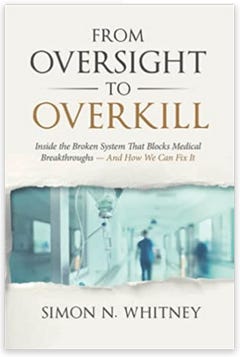
Book Review: From Oversight To Overkill

by Scott Alexander

I. Risks May Include AIDS, Smallpox, And Death

Dr. Rob Knight studies how skin bacteria jump from person to person. In one 2009 study, meant to simulate human contact, he used a Q-tip to cotton swab first one subject’s mouth (or skin), then another’s, to see how many bacteria traveled over. On the consent forms, he said risks were near zero - it was the equivalent of kissing another person’s hand.

His IRB - ie Institutional Review Board, the committee charged with keeping experiments ethical - disagreed. They worried the study would give patients AIDS. Dr. Knight tried to explain that you can’t get AIDS from skin contact. The IRB refused to listen. Finally Dr. Knight found some kind of diversity coordinator person who offered to explain that claiming you can get AIDS from skin contact is offensive. The IRB backed down, and Dr. Knight completed his study successfully.

Just kidding! The IRB demanded that he give his patients consent forms warning that they could get smallpox. Dr. Knight tried to explain that smallpox had been extinct in the wild since the 1970s, the only remaining samples in US and Russian biosecurity labs. Here there was no diversity coordinator to swoop in and save him, although after months of delay and argument he did eventually get his study approved.

Most IRB experiences aren’t this bad, right? Mine was worse. When I worked in a psych ward, we used to use a short questionnaire to screen for bipolar disorder. I suspected the questionnaire didn’t work, and wanted to record how often the questionnaire’s opinion matched that of expert doctors. This didn’t require doing anything different - it just required keeping records of what we were already doing. “Of people who the questionnaire said had bipolar, 25%/50%/whatever later got full bipolar diagnoses” - that kind of thing. But because we were recording data, it qualified as a study; because it qualified as a study, we needed to go through the IRB. After about fifty hours of training, paperwork, and back and forth arguments - including one where the IRB demanded patients sign consent forms in pen (not pencil) but the psychiatric ward would only allow patients to have pencils (not pen) - what had originally been intended as a quick record-keeping had expanded into an additional part-time job for a team of ~4 doctors. We made a tiny bit of progress over a few months before the IRB decided to re-evaluate all projects including ours and told us to change twenty-seven things, including re-litigating the pen vs. pencil issue (they also told us that our project was unusually good; most got >27 demands). Our team of four doctors considered the hundreds of hours it would take to document compliance and agreed to give up. As far as I know that hospital is still using the same bipolar questionnaire. They still don’t know if it works.

Most IRB experiences can’t be that bad, right? Maybe not, but a lot of people have horror stories. A survey of how researchers feel about IRBs did include one person who said “I hope all those at OHRP [the bureaucracy in charge of IRBs] and the ethicists die of diseases that we could have made significant progress on if we had [the research materials IRBs are banning us from using]”.

Dr. Simon Whitney, author of From Oversight To Overkill, doesn’t wish death upon IRBs. He’s a former Stanford IRB member himself, with impeccable research-ethicist credentials - MD + JD, bioethics fellowship, served on the Stanford IRB for two years. He thought he was doing good work at Stanford; he did do good work. Still, his worldview gradually started to crack:

In 1999, I moved to Houston and joined the faculty at Baylor College of Medicine, where my new colleagues were scientists. I began going to medical conferences, where people in the hallways told stories about IRBs they considered arrogant that were abusing scientists who were powerless. As I listened, I knew the defenses the IRBs themselves would offer: Scientists cannot judge their own research objectively, and there is no better second opinion than a thoughtful committee of their peers. But these rationales began to feel flimsy as I gradually discovered how often IRB review hobbles low-risk research. I saw how IRBs inflate the hazards of research in bizarre ways, and how they insist on consent processes that appear designed to help the institution dodge liability or litigation. The committees’ admirable goals, in short, have become disconnected from their actual operations. A system that began as a noble defense of the vulnerable is now an ignoble defense of the powerful.

So Oversight is a mix of attacking and defending IRBs. It attacks them insofar as it admits they do a bad job; the stricter IRB system in place since the ‘90s probably only prevents a single-digit number of deaths per decade, but causes tens of thousands more by preventing life-saving studies. It defends them insofar as it argues this isn’t the fault of the board members themselves. They’re caught up in a network of lawyers, regulators, cynical Congressmen, sensationalist reporters, and hospital administrators gone out of control. Oversight is Whitney’s attempt to demystify this network, explain how we got here, and plan our escape.

II. How We Got Here

Before the 1950s, there were no formal research ethics. Doctors were encouraged to study topics of interest to them. The public went along, placated by the breakneck pace of medical advances and a sense that we were all in it together. Whitney focuses on James Shannon’s discovery of new anti-malarials during World War II, as US troops were fighting over malarial regions of Southeast Asia). Shannon tested his theories on ambiguously-consenting subjects, including the mentally ill. But:

At a time when clerks and farm boys were being drafted and shipped to the Pacific, infecting the mentally ill with malaria was generally seen as asking no greater sacrifice of them than of everyone else. Nobody complained, major strides were made in the treatment of malaria, and Shannon received the Presidential Order of Merit.

Physicians of the time followed a sort of gentleman’s agreement not to mistreat patients, but the details were left to individual researchers. Some individual researchers had idiosyncratic perspective:

Looking back on that era, hematologist David Nathan remembered that he applied a rough version of the Golden Rule to experiments: He would never do anything to a research subject that he would not do to himself. Once an experiment passed this threshold, however, his idea of informed consent was to say, “You are the patient. I am Doctor Nathan. Lie down.”

I believe Dr. Nathan when he said he wouldn’t do anything to patients he wouldn’t do to himself - he once accidentally gave himself hepatitis in the course of an experiment. Still, this is not the sort of rule-abidingness that builds complete confidence.

A few doctors failed to follow even the flimsiest veneer of ethics. The most famous example is the Tuskegee Syphilis Study1, but this happened towards the end of the relevant era. The debate at the time was more shaped by Dr. Chester Southam (who injected patients with cancer cells to see what would happen) and the Willowbrook Hepatitis Experiment, where researchers gave mentally defective children hepatitis on purpose2. Two voices rose to the top of the froth of outrage and ended up having outsized effects: Henry Beecher and James Shannon.

Henry Beecher was a prominent Harvard anaesthesiologist and public intellectual, known for exploits like discovering the placebo effect.3 Being well-plugged-in to the research community, he was among the first to learn about studies like Southam's and Willowbrook, find them objectionable, and bring them to the public eye. Through public appearances and papers in prestigious journals, he dragged the issue in front of a sometimes-reluctant medical community. But he thought regulation would be devastating, and had no proposal other than "researchers should try to be good people", which everyone except him realized wasn't actionable.

Shannon was less brilliant, but unlike Beecher he was a practical and experienced bureaucrat. His own history of dubiously-consensual malaria research left him without illusions, but as he grew older he started feeling guilty (and also, more relevantly, became head of the National Institute of Health). Having no time for Beecher’s delusions of self-regulation, he ordered all federally-funded research to submit itself to external audits by Clinical Review Committees, the ancestors of today’s IRBs.

In the late 1960s and early 1970s, Beecher’s activism, Shannon’s CRCs, and the mounting level of Tuskegee-style scandals came together in a demand for the American Academy of Arts and Sciences to create some official ethics report. Most ethicists demurred to dirty their hands with something as worldly as medicine; after some searching, they finally tapped Hans Jonas, a philosopher of Gnosticism. In retrospect, of course bioethics derives from a religion that believes the material world is evil and death is the only escape. I’m barely even joking here:

In his most compelling passage, Jonas attacked the belief that we must pursue cures for the diseases that ravage us, that we cannot afford to forego continued medical advances. To the contrary, he wrote, we must accept what we cannot avoid, and that includes disease, suffering, and death. What society genuinely cannot afford is “a single miscarriage of justice, a single inequity in the dispensation of its laws, the violation of the rights of even the tiniest minority, because these undermine the moral basis on which society's existence rests.” He concluded that “progress is an optional goal.”

What miscarriages of justice was Jonas worried about? He was uncertain that people could ever truly consent to studies; there was too much they didn’t understand, and you could never prove the consent wasn’t forced. Even studies with no possible risk were dangerous because they “risked” treating the patient as an object rather than a subject. As for double-blind placebo-controlled trials, they were based on deceiving patients, and he was unsure if anyone could ethically consent to one.

AAAS’ report balanced Jonas’ extreme approach with more moderate voices, producing something in between. There could be medical research, but only with meticulous consent processes intended to ensure subjects understood every risk, even the most outlandish. Rather than a straight weighing of risks vs. benefits, overseers should start with a presumption that risk was unacceptable, and weigh benefits only weakly. This framework might have evolved further, but in the uproar following Tuskegee, Congress set it in stone, never to be changed by mere mortals.

Still, Whitney thinks of this period (1974 - 1998) as a sort of golden age for IRBs. The basic structure they retain today took shape - about a dozen members, mostly eminent doctors, but one mandatory non-researcher member (often a member of the clergy). They might not know everything, but they would know things like whether smallpox still existed. They could be annoying sometimes, and overprotective. But mostly they were thoughtful people who understood the field, able and willing to route around the seed of obstructionism Jonas had planted in the heart of their institution.

This changed in 1998. A Johns Hopkins doctor tested a new asthma treatment. A patient got sick and died. Fingers were pointed. Congress got involved. Grandstanding Congressmen competed to look Tough On Scientific Misconduct by yelling at Gary Ellis, head of the Office For Protection From Research Risks. They made it clear that he had to get tougher or get fired.

In order to look tough, he shut down every study at Johns Hopkins, a measure so severe it was called “the institutional death penalty”. Then he did the same thing (or various lesser penalties) at a dozen or so other leading research centers, often for trivial infractions. Duke got the axe because its IRB hadn’t properly documented whether a quorum of members was present at each meeting. Virginia University got the axe because, although it had asked patients for consents, it hadn’t asked the patient’s family members, and one family member complained that asking the patient for a family history was a violation of his privacy.

Each doomed institution had hundreds or even thousands of studies, all ruined:

One observer wrote, “Participants cannot receive treatments, enroll, or be recruited; results from time-sensitive studies cannot be reported; and data cannot be analyzed. Suspension means that there is no money to pay graduate students, travel to conferences, or purchase equipment. It means researchers may lose months, if not years, of work.”

Millions of dollars were lost. Chancellors were fired. The surviving institutions were traumatized. They resolved to never again do anything even slightly wrong, not commit any offense that even the most hostile bureaucrat could find reason to fault them for. They didn’t trust IRB members - the eminent doctors and clergymen doing this as a part time job - to follow all of the regulations, sub-regulations, implications of regulations, and pieces of case law that suddenly seemed relevant. So they hired a new staff of administrators to wield the real power. These administrators had never done research themselves, had no particular interest in research, and their entire career track had been created ex nihilo to make sure nobody got sued.

The increases in staff to accomplish this were substantial. The staff of the Northwestern IRB, for instance, grew between the late 1990s and 2007 from two people to forty-five. These fortified IRBs were in no doubt that their mission now extended beyond protecting research subjects. As Northwestern’s Caroline Bledsoe notes, “the IRB’s over-riding goal is clear: to avoid the enormous risk to the institution of being found in noncompliance by OHRP.”

The eminent doctors and clergymen - the actual board part of the Institutional Review Board - were reduced to rubber stamps. The age of the administrator had begun. These were the sorts of people who might not know that AIDS is sexually transmitted or that smallpox is gone. Their job began and ended with forcing word-for-word compliance with increasingly byzantine regulations.

This, says Whitney, is about where we are today. There were some minor changes. Gary Ellis ironically got fired, a victim of his own unpopularity. His Office For Protection From Research Risks got subsumed into a new bureaucracy, the Office For Human Research Protections. In 2018, OHRP admitted they had gone too far and made welcome reforms - for example, certain psychology studies where people just fill out questionnaires are now exempt from many requirements. These are genuinely helpful - but on a broader cultural level, the post-Ellis atmosphere of paranoia and obstruction is still the order of the day.

III. Tales From The Administrative Age

Here are some of the stories that Whitney uses to illustrate why he’s unsatisfied with the current situation:

A. Pronovost’s Checklist Study

Maybe you’ve read Checklist Manifesto by Atul Gawande, which shows that a simple checklist with items like “wash your hands before the procedure” can reduce medical error and save lives.

Peter Pronovost of Johns Hopkins helped invent these checklists, but wanted to take them further. He proved at his own ICU that asking nurses to remind doctors to use the checklists (“Doc, I notice you didn’t wash your hands yet, do you want to try that before the procedure?”) further improved compliance - just in his one ICU, it saved about eight lives and $2 million per year. Scaled up to the entire country, it could save tens of thousands of people.

To prove that it could work in any situation, he teamed up with the Michigan Hospital Association, which included under-resourced Detroit hospitals. They agreed to ask their nurses to enforce checklists. Johns Hopkins IRB approved the study, noting that because no personal patient data was involved, it could avoid certain difficult rules related to privacy. Michigan started the study. Preliminary results were great; it seemed that tens to hundreds of lives were being saved per month. The New Yorker wrote a glowing article about the results.

OHRP read the article, investigated, and learned that Johns Hopkins IRB had exempted the study from the privacy restrictions. These restrictions were hard-to-interpret, but OHRP decided to take a maximalist approach. They stepped in, shut down the study, and said it could not restart until they got consent from every patient, doctor, and nurse involved, plus separate approval from each Michigan hospital’s IRB. This was impossible; even if all doctors and nurses unanimously consented, the patients were mostly unconscious, and the under-resourced Detroit hospitals didn’t have IRBs. The OHRP’s answer would make Hans Jonas proud - that’s not our problem, guess you have to cancel the study.

Luckily for Pronovost, Atul Gawande had recently published Checklist Manifesto and become a beloved public intellectual. He agreed to take the case public and shop it around to journalists and politicians. The OHRP woke up and found angry reporters outside their door. Whitney records their forced justifications for why the study might be harmful - maybe complying with the checklists would take so much time that doctors couldn’t do more important things? Maybe the nurses’ reminders would make doctors so angry at the nurses that medical communication would break down? Dr. Gawande and the reporters weren’t impressed, and finally some politician forced OHRP to relent. The experiment resumed, and found the nurse-enforced checklist saved about 1,500 lives over the course of the study. The setup was exported around the country and has since saved tens of thousands of people. Nobody knows how many people OHRP’s six month delay killed, and nobody ever did figure out any way the study could have violated privacy.

B. ISIS 2

Don’t be alarmed if you hear your doctor was part of ISIS 2; it’s just the International Study on Infarct Survival, second phase. This was the 1980s, the name was fine back then, that’s not why IRBs got involved.

Infarct is the medical term for heart attack. At the time of the study, some doctors had started using a streptokinase + aspirin combination to treat heart attacks; others didn’t. Whitney points out that the doctors who gave the combination didn’t need to jump through any hoops to give it, and the doctors who refused it didn’t need to jump through any hoops to refuse it. But the doctors who wanted to study which doctors were right sure had to jump through a lot of hoops.

They ended up creating a sixteen-country study. In the British arm of the study, the UK regulators told doctors to ask patients for consent, and let them use their common sense about exactly what that meant. In the US arm, the Harvard IRB mandated a four page consent form listing all possible risks (including, for example, the risk that the patient would be harmed by the aspirin tasting bad). Most of the consent form was incomprehensible medicalese. Patients could not participate unless they signed that they had read and understood the consent form - while in the middle of having a heart attack. Most decided against in favor of getting faster treatment (which, remember, basically randomly did vs. didn’t include the study drugs).

The US recruited patients 100x slower (relative to population) than the UK, delaying the trial six months. When it finally ended, the trial showed aspirin + streptokinase almost halved heart attack deaths. The six month delay had caused about 6,000 deaths.

Later research suggested that long consent forms are counterproductive. A study by Lasagna and Epstein experimented with giving patients three different consent forms for a hypothetical procedure - then quizzing them on the details. Patients with a short consent form that listed only the major risks got twice the score on a comprehension test compared to those with the longer form; they were also less likely to miss cases where their medical histories made the study procedure dangerous (eg a person with a penicillin allergy in a study giving penicillin). Lasagna and Epstein’s longest consent form was still shorter than the forms in real studies like ISIS-2.

It seems to be a common position that existing consent forms fail patients; at least Whitney is able to find many lawyers, ethicists, and other authorities who say this. The OHRP occasionally admits it in their literature. And patients seem to believe it - in a survey of 144 research subjects, most described the consent form as “intended to protect the scientist and the institution from liability” rather than to inform the patient. Still, they do protect the scientist and institution from liability, so the consent forms stay.

My own consent form story: in my bipolar study, the IRB demanded I include the name of the study on the form. I didn’t want to - I didn’t want to bias patients by telling what we were testing for. Next they wanted me to list all the risks. There was no risk; we would be giving the patient a questionnaire that we would have given them anyway. The IRB didn’t care; no list of risks, no study. I can’t remember if I actually submitted, or only considered submitting, that the risk was they would get a paper cut on all the consent forms we gave them. In any case, another doctor on my team found a regulation saying that we could skip this part of the consent form for our zero-possible-harm study. The IRB accepted it, let us start the study, then changed their mind and demanded the full consent form along with their 26 other suggestions.

C. PETAL

If your lungs can’t breathe well, doctors can put you on a ventilator, which forces air in and out. It’s hard to get ventilators working right. Sometimes they push in too much air and injure your lungs. Sometimes they push in too little air and you suffocate. There are big fights about what settings to run ventilators on for which patients. For a while, doctors fought over whether to set ventilators on high vs. low, with many experts in each camp. Researchers formed a consortium called PETAL to study this, ran a big trial, and found that low was better. Lots of doctors switched from high to low, and lots of patients who otherwise would have gotten lung injuries lived to breathe another day.

Flush with success, PETAL started a new study, this time on how to give fluids to ventilator patients. Once again, doctors were divided - some wanted to give more fluids, others less. By mid-2002, PETAL had recruited 400 of the necessary 1000 patients.

Then OHRP demanded they stop. Two doctors had argued PETAL’s previous ventilator study was unethical, because they had only tested high vs. low ventilator settings, not middle ones. OHRP wanted them to stop all their current work while they investigated. They convened a panel of top scientists; the panel unanimously said their past research was great and their current research was also great, using terms like "landmark, world-class investigations". They recommended the study be allowed to restart.

OHRP refused. Its director, ethicist Jerry Menikoff, had decided maybe it was unethical to do RCTs on ventilator settings at all. He asked whether they might be able to give every patient the right setting while still doing the study4. The study team tried to explain to him that they didn’t know which was the right setting, that was why they had to do the study. He wouldn’t budge.

Finally, after a year, another panel of experts ruled in favor of the investigators and gave them permission to restart the study right away. They did, but the delay was responsible for thousands of deaths, and produced a chain effect on ventilator research that made us less prepared for the surge in ventilator demand around COVID.

IV. Hard Truths

Doctors are told to weigh the benefits vs. costs of every treatment. So what are the benefits and costs of IRBs?

Whitney can find five people who unexpectedly died from research in the past twenty-five years. These are the sorts of cases IRBs are set up to prevent - people injected with toxic drugs, surgeries gone horribly wrong, the like. No doubt there are more whose stories we don’t know. But as for obvious, newsworthy cases, there are ~2 per decade. Were there more before Ellis’ 1998 freakout and the subsequent tightening of IRB rules? Whitney can’t really find evidence for this.

What are the costs? The direct cost of running the nation’s IRB network is about $100 million per year. The added costs to studies from IRB-related delays and compliance costs is about $1.5 billion/year. So the monetary costs are around the order of $1.6 billion.

What about non-monetary costs? Nobody has fully quantified this. Some Australian oncologists did an analysis and found that 60 people per year died from IRB-related delays in Australian cancer trials. 6,000 people died from delays in ISIS-2, and that was just one study. Tens of thousands were probably killed by IRBs blocking human challenge trials for COVID vaccines. Low confidence estimate, but somewhere between 10,000 and 100,000 Americans probably die each year from IRB-related research delays.

So the cost-benefit calculation looks like - save a tiny handful of people per year, while killing 10,000 to 100,000 more, for a price tag of $1.6 billion. If this were a medication, I would not prescribe it.

Whitney doesn’t want a revolution. He just wants to go back to the pre-1998 system, before Gary Ellis crushed Johns Hopkins, doctors were replaced with administrators, and pragmatic research ethics were replaced by liability avoidance. Specifically:

  • Allow zero-risk research (for example, testing urine samples a patient has already provided) with verbal or minimal written consent.

  • Allow consent forms to skip trivial issues no one cares about (“aspirin might taste bad”) and optimize them for patient understanding instead of liability avoidance.

  • Let each institution run their IRB with limited federal interference. Big institutions doing dangerous studies can enforce more regulations; small institutions doing simpler ones can be more permissive. The government only has to step in when some institution seems to be failing really badly.

  • Researchers should be allowed to appeal IRB decisions to higher authorities like deans or chancellors5

These make sense. I’m just worried they’re impossible.

IRBs aren’t like this in a vacuum. Increasingly many areas of modern American life are like this. The San Francisco Chronicle recently reported it takes 87 permits, two to three years, and $500,000 to get permission to build houses in SF; developers have to face their own “IRB” of NIMBYs, concerned with risks of their own. Teachers complain that instead of helping students, they’re forced to conform to more and more weird regulations, paperwork, and federal mandates. Infrastructure fails to materialize, unable to escape Environmental Review Hell. Ezra Klein calls this “vetocracy”, rule by safety-focused bureaucrats whose mandate is to stop anything that might cause harm, with no consideration of the harm of stopping too many things. It’s worst in medicine, but everywhere else is catching up.

This makes me worry that we can’t blame the situation on one bad decision by a 1998 bureaucrat. I don’t know exactly who to blame things on, but my working hypothesis is some kind of lawyer-adminstrator-journalist-academic-regulator axis. Lawyers sue institutions every time they harm someone (but not when they fail to benefit someone). The institutions hire administrators to create policies that will help avoid lawsuits, and the administrators codify maximally strict rules meant to protect the institution in the worst-case scenario. Journalists (“if it bleeds, it leads”) and academics (who gain clout from discovering and calling out new types of injustice), operating in conjunction with these people, pull the culture towards celebrating harm-avoidance as the greatest good, and cast suspicion on anyone who tries to add benefit-getting to the calculation. Finally, there are calls for regulators to step in - always on the side of ratcheting up severity.

This is how things went in 1998 too. One researcher made a mistake and killed a patient. This made a sensational news story (unlike the tens of thousands of people who die each year from unnecessarily delayed research), so every major newspaper covered it. Academic ethicists wrote lots of papers about how no amount of supposed benefit could ever justify a single research-related death. The populace demanded action, Congress demanded the regulator regulate harder, and Ellis ratcheted up the IRB level. Hospitals hired administrators to comply with the new regulation, and lawyers lurked in the shadows, waiting to sue any hospital that could be found violating the new rules.

So why are things so much worse than the 1970s-90s IRB golden age? I blame a more connected populace (cable TV, the Internet, Twitter, etc), a near-tripling of lawyers per capita, and a lack of anything better to worry about (research was fastest during the World Wars, when the government didn’t have the luxury to worry about consent form length). This is my Theory of Everything; if you don’t like it, I have others.

Whitney tries to be more optimistic. A few ethicists (including star bioethicist Ezekiel Emanuel) are starting to criticize the current system; maybe this could become some kind of trend. Doctors who have been ill-treated are finding each other on the Internet and comparing stories. Greg Koski said that “a complete redesign of the approach, a disruptive transformation, is necessary and long overdue", which becomes more impressive if you know that Dr. Koski is the former head of the OHRP, ie the leading IRB administrator in the country. Whitney retains hope that maybe Congress or something will take some kind of action. He writes:

James Shannon’s IRB system, as established in 1966 and solidified by law in 1974, was an experiment, as are all attempts to manage our complex and changing society. Congress should try again, but it need not do so blindly. The present system’s vicissitudes make apparent some traps to avoid, while advances in public policy and risk management suggest a better approach. No system will be perfect, but we can do better, and doing so will protect subjects’ rights and welfare while improving the life of the nation, and the world.

1

Whitney notes that Tuskegee University, which lent some facilities for the study but was otherwise uninvolved, is justly upset at being associated with this atrocity. He would prefer to call it the US Public Health Service Syphilis Study after the actual perpetrators. Today we remember the bold whistleblowers who blew the lid off this scandal, but I didn’t realize how circuitous the path to exposure was. The researchers spent years being pretty open about their project to the rest of the research community. Peter Buxtun, an incidentally involved social worker (also “a libertarian Republican, former army medic, gun collector, and NRA member” - social workers were different in those days!) heard about it, was horrified, and tried to get it shut down. The relevant oversight board involved listened to his complaints politely, then decided there was no problem (the only issue the board flagged was the risk that it might make them look racist). Buxtun spent six years complaining about this to various uninterested stakeholders until finally a reporter listened to him and published an expose.

2

It’s not as bad as it sounds - adult staff at this state run school kept getting severe cases of hepatitis. Scientists investigated, and suspected that children had asymptomatic cases and were passing it on to staff. With parents’ permission, they deliberately infected some children with hepatitis to prove that it would be asymptomatic in them, and that therefore they must be the source of the staff infections. They were right, and their research led to better protection for staff with no negative effect on the children themselves. Still, the one sentence summary sounds pretty awful.

3

I’m interested in great families, so I had to check if he was a member of the famous Beecher family of Boston Brahmins (think Harriet Beecher Stowe). Any relationship, if it existed, was very distant - born Henry Unangst, he changed his name to trick people into thinking he was higher-status. Ironically, he became more famous than any of them, and probably increased their prestige more than they increased his. I’m still against this; it cost us the opportunity to call the placebo effect “the Unangst Effect”.

4

In one of his papers, he wrote: “How would you feel if your doctor suggested - not as part of a research study - that he pick the treatment you get by flipping a coin? Very few of us, as patients, would accept this type of behavior."

5

I’m mostly a fan of Whitney’s suggestions, but I’m not sure about this one. On the one hand, I understand why it would be good if, when IRBs make terrible decisions, researchers could appeal. But it also seems strange to have a panel of experts (eminent doctors, clergymen, etc) who can be overruled by a non-expert (a dean). Also, I find it hard to imagine a dean would ever do this - if anything ever goes wrong (or even if it didn’t) “the experts said this was unethical, but the dean overruled them” doesn’t sound very good.

11 Apr 15:53

Germany is shutting off its last nuclear power plants because shutting down the cleanest source of energy is totally the best way to beat climate change

by Not the Bee

Just in case you thought the climate change people were serious about reducing emissions to save the world from the giant sun monster because of the absolute horror that awaits us, lefties in Germany just completely shut down the cleanest energy production known to man.

10 Apr 18:03

Katie Hobbs Vetoes ‘minimum standards’ for Arizona mail-in signature verification…

by Kane
04 Apr 19:13

This crazy Arkansas man rode out a tornado on his porch and videoed it 😮

by Not the Bee
Jts5665

That dude is lucky to be alive.

DUDE! Look at the aftermath! Huge trees fell all around him, smoking his car and his house.

04 Apr 13:58

DEEP STATE UPDATE: A growing body of evidence shows U.S. govt officials, agencies, & contract

by Glenn Reynolds

DEEP STATE UPDATE:

04 Apr 13:40

PENTAGON STUDY: 77 Percent of Military-Age Americans Too Fat, Mentally Ill for Service.

by Stephen Green
03 Apr 20:11

TWITTER ALGORITHM INCLUDES “GOVERNMENT REQUESTED.” Man, I can just feel the freedom. Bonus question:

by Robert Shibley

TWITTER ALGORITHM INCLUDES “GOVERNMENT REQUESTED.” Man, I can just feel the freedom. Bonus question: which governments?

03 Apr 17:07

Whatever you think is about to happen in this video, you're wrong

by Not the Bee

Umm... I don't know what the heck I was expecting to happen in this video, but it's definitely not what happened. I mean, just check out the still shot above, and take your best guess. Now hit play...

03 Apr 00:15

GOVERNMENT MOTORS: GM Blunders So Badly We Thought It Was an April Fool’s Joke.

by Glenn Reynolds
31 Mar 18:16

Tragically, US Travel Restrictions Remain in Place

by Gwendolyn Kull
travel restrictions

The Information Age, for all its wonders in the vast and instant access to any topic imaginable, is really quite a paradox. Accessible information should ideally lead to greater knowledge and understanding. Yet, information is not always true or accurate, causing confusion and misleading recipients. Journalists and news organizations, therefore, bear a duty to their readers to investigate and verify information before publishing.

Vetting information should be relatively easy in some cases. So why do today’s media authors insist on being parrot-like mouthpieces instead of ethical, investigative journalists? Why do they not dig anymore? Why not question and confirm or correct information before publishing articles that get viewed by the masses, creating perceptions with a reckless disregard for the truth?

Forbes, TravelPulse, Sky Sports, and Express Daily among other outlets reported on Thursday that the United States has voted to end its restrictions against unvaccinated foreign travelers. Some of these articles quote Geoff Freeman, CEO of the US Travel Association, following a statement published on the organization’s website that appears to have since been deleted. In the quotes, Freeman praised the Senate’s passage of H.J.Res. 7, a bill terminating the national covid emergency declaration in the US, suggesting that this bill removed the travel vaccine mandate for visitors to the US.

Had any of these authors or their editors read the text of the bill, they would have at least questioned the accuracy of US Travel’s official commentary that the bill has any effect on the international travel ban. Instead, each news outlet in rapid succession published similar, misleading articles. Quintessential irresponsible journalism–erroneous reporting compounded with a “whisper down the lane” effect that because information has been reported, and then reported by multiple sources, it is now true albeit a gross misrepresentation of the facts.

The truth is the US has not lifted the travel ban. It is still in place without expiration, and will only be terminated by President Biden upon recommendation by the Secretary of Health and Human Services. Hope in that respect is grim for both citizens and noncitizens harmed and kept apart from loved ones by the restriction. 

HHS Secretary Xavier Becerra testified before the House of Representatives on March 28th that "the actions that our Administration is taking with regard to American citizens is to protect them as best possible against covid. The actions we take with regard to those trying to enter the country are somewhat similar, but there are some differences because these are folks who are asking for permission to come into the U.S." Representative Claudia Tenney (R-NY) asked if the decision to not lift vaccine mandates was political, to which Secretary Becerra responded that the mandates, including the travel restrictions, are “based on science and the evidence.”

While testifying, Becerra–a lawyer–is oblivious to statements made by his own CDC Director, Dr. Rochelle Walensky. Walensky told the public in an interview with CNN’s Wolf Blitzer that “vaccines are no longer effective at preventing disease.”

The CDC also updated its guidance to “no longer differentiate based on a person’s vaccination status because breakthrough infections occur…” as of August 19, 2022. However, the CDC has not yet removed the Amended Order banning unvaccinated travelers. In their official comment regarding the travel restrictions, the CDC responded that the order is simply an implementation of President Biden’s Proclamation 10294, and the agency defers status updates to the White House.

Given Becerra’s recent testimony, it is apparent that he is also unaware that the global scientists in the World Health Organization have recommended since July of 2021 that governments not require international travelers to be vaccinated against covid for entry. 

He further testified that he does not have the authority to issue “waivers” of the vaccine requirement for foreign travelers, which begs the question: Does Becerra know that he is responsible for advising President Biden to terminate the travel restriction? If he followed the science and the evidence, as he testified his Department does, then he should have advised President Biden to end Proclamation 10294 in the summer of 2022.

Alas, the only measures before Congress that would legislate an end to the covid travel restrictions have been stalled in the Senate. As of Thursday, Senator Mike Lee (R-UT) has twice asked his colleagues to unanimously consent to pass HR 185, a bill offered by Representative Thomas Massie (R-KY) that passed the House in February to terminate the CDC Amended Order requiring the covid vaccine for air passengers. Both calls for consent were quashed by objections.

Senator Peter Welch (D-VT) objected, believing Congress should not set precedent by ending any programs of President Biden’s public health emergency before the Administration was ready. At Lee’s second request for unanimous consent, Senator Cory Booker (D-NJ) stood and objected for then-absent Senator Bernie Sanders (D-VT). 

Although not all of the reasons for Sanders’ objections were read into the record, the “most compelling” objection, per Booker, was that covid originated outside of the US and “many health professionals” believe keeping unvaccinated noncitizens out will curb the spread of the disease and future variants.

Now that the objections have stalled any legislative action on HR 185, the Senate may need to hold a roll call vote to pass the bill and send it to President Biden, who has not promised to veto. Such a vote is not expected prior to April 17th, as Senators will be out of DC for state work.

Certain media outlets have also mistakenly published that the covid travel restrictions are due to end on April 10th. No doubt, their assumption comes from the TSA Security Directive, which orders airlines to comply with Proclamation 10294. Unfortunately, the agency renews this directive so long as Proclamation 10294 remains in place. 

It cannot be said enough that Proclamation 10294 and the CDC Amended Order implementing President Biden’s policy have no expiration date. Indeed, the White House only promised the restriction would “be reviewed” prior to the anticipated May 11th end to the covid public health emergency–there is no offered end date. 

Further, the Proclamation is based on the National Immigration Act. Although the national covid emergency spawned the development of this now-defunct policy, the legal authority rationalizing it will remain well beyond the termination of any emergency, allowing the policy itself to be enforced until removed.

An official from the White House advised that ending the national covid emergency does not end the travel restrictions, and those restrictions remain in effect at this time under Proclamation 10294 and the CDC’s Amended Order. The official did not provide an anticipated end date when asked.

To make this abundantly clear for the public: Presidential Proclamation 10294 requiring non-citizen non-immigrants be vaccinated to enter the US will only end if President Biden rescinds it, Congress repeals it, or the Judiciary strikes it down. To date, no lawsuits have been filed challenging the ban on foreign visitors. 

31 Mar 14:38

Jacob Chansley’s lawyer — Q Shaman was NOT released early. Do not give DOJ credit.

by Kane
31 Mar 12:47

A GALAXY-SHATTERING KABOOM: ‘Monstrous’ gamma-ray burst brightest seen since ‘human civilization be

by Glenn Reynolds

A GALAXY-SHATTERING KABOOM: ‘Monstrous’ gamma-ray burst brightest seen since ‘human civilization began.’ Happily, it was 1.9 billion light years away, but it still overloaded sensors here.

31 Mar 12:42

I ASSUMED THIS WAS FAKE, BUT IT’S NOT. Super-professional highlighting mine.

by Robert Shibley
Jts5665

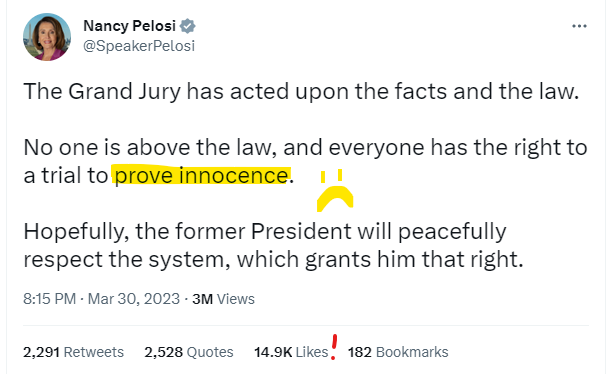
Guilty until proven innocent... The opposite of a just system.

I ASSUMED THIS WAS FAKE, BUT IT’S NOT. Super-professional highlighting mine.

30 Mar 21:42

I THOUGHT THAT THE INTERNATIONAL ASTRONOMIC UNION HAD SETTLED ON “WOMBAT” AS THE STANDARD UNIT OF ME

by Glenn Reynolds

I THOUGHT THAT THE INTERNATIONAL ASTRONOMIC UNION HAD SETTLED ON “WOMBAT” AS THE STANDARD UNIT OF MEASURE FOR ASTEROID LENGTH: Asteroid the size of 33 armadillos to pass Earth Sunday – NASA. “Asteroid 2023 FL2 is 35 meters, which is as much as almost 33 nine-banded armadillos lined up tail-to-snout.”

I must have missed the armadillo memo. I mean, I try to follow this stuff but I’m busy and it’s so hard to keep up.

30 Mar 20:48

Weeks after Tucker Carlson's new J6 footage, "QAnon Shaman" Jacob Chansley has been released early from prison

by Not the Bee
Jts5665

What about the rest of the people who got railroaded?

Only weeks after Tucker Carlson showed unreleased exculpatory footage of Jacob Chansley, the man dubbed the "QAnon Shaman" by the media, he has been released from prison more than a year early.

30 Mar 17:09

“WTF is Wrong with You”: Columbia Center and Law Students Protest Meeting With Justice Kavanaugh

by jonathanturley
Jts5665

"We cannot condone complicity with a man who is credibly accused of sexual assault." I wonder if they know the name Tara Reade...

Columbia University law students and alums are in an uproar over an Instagram post that showed students in the Federalist Society meeting with Supreme Court Justice Brett Kavanaugh at the Court. It would ordinarily be a singular experience for law students to spend time with one of the nine justices. That is not how it went over at Columbia where some are outraged by the meeting and Columbia’s posting the picture on its social media account. The Empowering Women of Color group announced it was “withdrawing our participation from Columbia Law School recruiting events.” Columbia’s own Center for Engaged Pedagogy, simply declared “WTF is wrong with you.”

With the posting, Columbia offered the following description:

“On February 23, members of the Columbia Federalist Society (@clsfedsoc) visited the Supreme Court of the United States to engage in conversation with Justice Brett M. Kavanaugh. During the visit, they learned about the human side of being a justice, the Court’s deliberation process, and how to be an effective advocate. Justice Kavanaugh also answered questions about a few of his most famous opinions.”

That would seem precisely the type of opportunity that a premier law school seeks to make available to its students. However, Kavanaugh remains persona non grata due to his conservative jurisprudence and allegations from his confirmation hearings. It does not matter that Kavanaugh (who was later the subject of an assassination attempt) was never charged with any crime and vehemently denies the allegations of Christine Blasey Ford.

Those opposing any engagement with Kavanaugh raised both his legal viewpoints and the assault allegations.

The Black Law Students Association wrote on behalf of a large number of groups to oppose the posting and to “put the administration on notice” that it is unacceptable for law students to meet with the justice — or for the law school to support it.

“We believe that our school’s choice to platform Justice Kavanaugh is symbolic of a pattern of behavior that our organization does not and will not support and will not be affiliated with. We thank LALSA, NALSA, EWOC, OutLaws, QTPOC, IfWhenHow, APALSA, SALSA, and others, for joining us in this advocacy and struggle. We look forward to continued collaboration. By joining us in this effort, you have all helped put the administration on notice that we have a strong and growing collective.”

The objection to “platforming” Kavanaugh is telling. Deplatforming is a major tool used by the anti-free speech movement.

As discussed earlier, former Dartmouth Professor Mark Bray is the author of a book entitled “Antifa: The Anti-Fascist Handbook” and one of the chief enablers of these protesters. Bray describes Antifa as “a pan-left radical politics uniting communists, socialists, anarchists and various different radical leftists together for the shared purpose of combating the far right.” However, the broader anti-free speech movement shares the same underlying opposition to “platforming” of those with opposing views.

Bray speaks positively of the effort to supplant traditional views of free speech: “At the heart of the anti-fascist outlook is a rejection of the classical liberal phrase… that says I disapprove of what you say but I will defend to the death your right to say it.” He defines anti-fascists as “illiberal” who reject the notion that far right views deserve to “coexist” with opposing views.

Bray says that the protesters do not “see fascism or white supremacy as a view with which they disagree as a difference of opinion.” Their goal is not co-existence but “to end their politics.” Bray and other academics are liberating students from the confines of what they deem the false “allegiance to liberal democracy.” Once freed of the values of free speech and democratic values, violence becomes merely politics by other means. When pushed, Bray stressed that Antifa is only a threat to one side and one party:

“There is a certain political lens that — agree or disagree with the lens — there is an element of continuity in terms of the types of groups targeted. I don’t know of any Democratic Party events that have been ‘no platformed,’ or shut down by anti-fascists. So there is a political lens, people will quibble about what the lens is, who designs the lens, but I don’t think the slippery slope is actually, in practice, nearly as much of a concern as people imagine it would be.”

The Empowering Women of Color group rejected the position of Columbia that it should maintain a neutral and tolerant position on such events or speakers:

“We cannot condone complicity with a man who is credibly accused of sexual assault. The insinuation from the Communications Office that the post was neutral and just the Law School’s way of highlighting activities students are participating in is laughable and untrue. A post of this kind, with its caption, is a terrifying stamp of approval.”

In other words, there is no neutrality. Columbia is expected to refuse to participate or recognize any event with the justice, who has never been charged, let alone convicted, of any crime.

However, it is the posting of the Center, as an official office of Columbia University, that is most alarming. The Center account was used to object:  “WTF is wrong with you. Ah yes. Every day I wake up wondering what is the day in the life of someone who strips people’s rights away.”  The Center helps design curriculum and methods of teaching for Columbia and states a mission of instilling “abolitionist” values:

“The CEP invites faculty, students, and staff to participate in a spring discussion group and incubation space focused on using abolitionist thinking to challenge our existing pedagogical practices and the way we live our lives. Participants will use abolitionist values to create personal and pedagogical praxes, come up with actionable plans toward a meaningful material transformation of the world.”

Those “plans” apparently do not involve principles of diversity of thought, due process, or free speech. Unless this is an unapproved posting, the Center is suggesting that law students should not meet with Kavanaugh and that the law school should not support any events with the justice.

I have no problem with the protesting of these groups, though I strongly disagree with their position. However, the involvement of an office or department of the university is deeply concerning. If this was an unapproved posting, Columbia should make that clear. If it was a statement on behalf of Columbia’s Center, the university should explain how this is consistent with its commitment to free speech and tolerance for opposing views of its students and faculty.

30 Mar 16:59

PUNCH BACK… ER, LIFT UP?… TWICE AS HARD: Male powerlifter ridicules Canada’s gender self-ID laws

by Stephen Green
30 Mar 16:58

IT’S GOOD TO BE THE NOMENKLATURA: James O’Keefe Uncovers Possible Lucrative Money-Laundering Schem

by Stephen Green
30 Mar 16:56

THINGS ARE SO BAD IN SEATTLE: That public transportation system officials have had to install Fentan

by Mark Tapscott

THINGS ARE SO BAD IN SEATTLE: That public transportation system officials have had to install Fentanyl detectors because the fumes are getting to drivers. Washington Free Beacon’s Susannah Luthi reports at least 50 bus drivers became so sick from the fumes that they had to stop and seek emergency medical treatment.

“The city is installing the detectors as part of a University of Washington study whose researchers hope to ‘better understand drugs that are being smoked on the buses and trains.’ Symptoms of fentanyl exposure include dizziness and breathing difficulties,” Luthi writes. Which makes one wonder, what else is there to understand – the fumes are evidence of illegal drug use and passengers doing so should be arrested and punished.

30 Mar 16:55

JUDGE DUNCAN: What We Must Expect of Our Law Schools. Let’s say the quiet part out loud: The m

by Glenn Reynolds

JUDGE DUNCAN: What We Must Expect of Our Law Schools.

Let’s say the quiet part out loud: The mob came to target me because they hate my work and my ideas. They hate the clients I represented in court. They hate the arguments I made. They evidently hate my judicial opinions, although the protesters were evidently familiar with only one of the hundreds I’ve written — an opinion where I refused to enlist the federal judiciary in the project of controlling what pronouns people use. So, the protesters did not come to respond to my talk or engage in counter-speech. They just wanted to vent their rage against me. None of this spectacle — this obviously staged public shaming — had the slightest thing to do with “free speech.” It had everything to do with intimidation. And to be clear, not intimidating me, but the protesters’ fellow students. The message could not have been clearer: Woe to you if you represent the kind of clients that Judge Duncan represented, or take the same views that he has.

Yes, this was a conspiracy to deny others their civil rights, and should be treated as such. Plus:

So, next, let’s talk about legal education. We shouldn’t forget that this incident did not occur in a campus bar at 12:45 a.m. after the USC game. It occurred in a law school — indeed, one of our nation’s elite law schools. Dean Martínez’s letter eloquently explained why this makes the incident doubly shameful. … Dean Martínez is correct when she writes, “I believe we cannot function as a law school from the premise that appears to have animated the disruption of Judge Duncan’s remarks.” And what was that premise? That “speakers, texts, or ideas believed by some to be harmful inflict a new impermissible harm justifying a heckler’s veto simply because they are present on this campus.” I’ve heard someone comment recently that to be a lawyer means, by definition, to have to occupy the same room with people you seriously disagree with — and yet to have to engage in reasoned, indeed persuasive, argument with them. If that is true — and it is — then the primitive impulse to shout someone down is not a trait we should want to encourage in law schools. Just the opposite. It is a trait we should strive to help students unlearn.

Indeed.

30 Mar 15:10

'Unacceptable incompetence': CDC made dozens of basic data errors on COVID, epidemiologists find

by Greg Piper
FDA evidence for full approval of COVID antiviral Paxlovid, known for "rebound" infections in top federal officials, found wanting by scientists, including NIAID researcher.
29 Mar 19:07

Senate votes 66-30 to repeal military force authorizations used to fight Iraq

by Madeleine Hubbard
Virginia Democrat Sen. Tim Kaine introduced the bipartisan legislation in February.
29 Mar 16:31

The Government Is Making Telemedicine Hard And Inconvenient Again

by Scott Alexander

[I’m writing this quickly to deal with an evolving situation and I’m not sure I fully understand the intricacies of this law - please forgive any inaccuracies. I’ll edit them out as I learn about them.]

Telemedicine is when you see a doctor (or nurse, PA, etc) over a video call. Medical regulators hate new things, so for its first decade they ensured telemedicine was hard and inconvenient.

Then came COVID-19. Suddenly important politicians were paying attention to questions about whether people could get medical care without leaving their homes. They yelled at the regulators, and the regulators grudgingly agreed to temporarily make telemedicine easy and convenient.

They say “nothing is as permanent as a temporary government program”, but this only applies to government programs that make your life worse. Government programs that make your life better are ephemeral and can disappear at any moment. So a few months ago, the medical regulators woke up, realized the pandemic was over, and started plotting ways to make telemedicine hard and inconvenient again.

The first fruit of their labor is DEA-407, which makes it hard for telemedicine doctors to prescribe controlled substances. Controlled substances are drugs like Adderall, Ritalin, Xanax, or Ambien that the government has declared to be potentially addictive. The new rules say that telemedicine doctors can no longer prescribe these (or, in some cases, can prescribe them one time in an emergency).

Why don’t I like this decision? I am a telepsychiatrist. I work with about a hundred psychiatric patients who, for one reason or another, prefer online to physical appointments:

  • Some live in small towns that don’t have psychiatrists of their own

  • Some have agoraphobia, chronic pain, or some other condition that makes it hard for them to go to an office.

  • Some move around a lot and like to be able to see their psychiatrist whether they’re in LA or SF.

  • Some live hundreds of miles away from me, but know and trust me for some reason, and would rather see me than someone closer to them.

  • Some appreciate the fact that I charge lower rates than psychiatrists who have offices, because I don’t have to pay for Bay Area commercial real estate and pass those costs on to my patients.

  • Some work during work hours, and like being able to see me from their office instead of taking half the day off to travel to my location.

  • Some like convenience and dislike inconvenience

As a psychiatrist, a big part of my job is prescribing controlled substances. For example, most guidelines agrees that the first-line treatment for severe ADHD is stimulant medications (eg Adderall or Ritalin). And although psychiatrists hate to admit it, the first-line treatment for temporary crisis anxiety, especially when it’s so bad that the patient isn’t able to listen to your clever plans to solve it with therapy, is benzodiazepines (eg Valium or Klonopin). You can’t be a good well-rounded psychiatrist without the option to sometimes prescribe these drugs.

"Well, your patients will have to find a different psychiatrist, or transition off of them”. Nobody ever finds different psychiatrists. Some of my patients are a bad match for my style or areas of expertise, and I’ve tried very hard to find them different psychiatrists, and it never works. Maybe there are no other psychiatrists in their area. Maybe the psychiatrists in their area don’t take the right insurance, or are too far away from mass transit. Maybe the psychiatrists have six month long wait lists. Sometimes it’s just that my ADHD patients get distracted and forget they were supposed to find new psychiatrists, and I can’t hold their hand literally all the time. As for transitioning off the medications, some patients absolutely cannot function at all without them. Did I mention that if you come off of some of them too quickly, you can literally die?

The medical regulators grudgingly acknowledge these issues and have placed two loopholes in the law:

  • If you ever see a doctor in person, even once, they can prescribe you controlled substances from then on, even if they only see you by telemedicine afterwards.

  • If you see another doctor in person, and that person writes your doctor a letter saying they agree with your doctor prescribing controlled substances, then your doctor can prescribe controlled substances.

These loopholes are helpful. They mean I can continue my psychiatry clinic. But they sort of lampshade how stupid all of this is, don’t they?

I’m probably going to rent an office somewhere in Oakland for the month for a few thousand dollars. I’ll demand my patients come see me in person, once, so I can keep prescribing them the medication I’ve been successfully prescribing them for years. My patients will spend hours driving in from Sacramento or Napa or wherever it is they live. I’ll see them, say “Yup, you look the same in person as you do over Zoom, good job”, and then refill their prescription, same as always. Except I’ll have to charge them a bit more, to recoup the cost of the office.

The ones who are hours and hours away, or who don’t have cars, will have to find some other doctor. They’ll spend hours on the phone with their insurance, with the office, etc, scheduling an appointment. They’ll pay some hefty co-pay. The conversation will go like this:

Patient: Please sign this form so I can continue seeing my psychiatrist, who I like and who is treating me successfully. It just says you’ve evaluated me and think I’m a good candidate for a psych referral.

Doctor: I don’t know anything about psychiatry.

Patient: Right, you’re not supposed to, that’s why you’re referring me to a psychiatrist.

Doctor: I don’t even know which psychiatrists are good to refer people to.

Patient: I suggest the one I’m already seeing, who was doing a great job until the government demanded I get your signature to keep seeing them.

Doctor: Okay, fine, that will be $200 please.

And that’s the best case scenario! The worst-case is that you get one of those doctors who think that Psych Drugs Aren’t Real Because You Just Need Jesus, and then the patient has to keep looking until they find someone else.

Meanwhile, if there are actual evil telemedicine doctors prescribing meth to impressionable young children, they’re doing the same thing. “Sorry impressionable young child, the law says I can’t keep prescribing you meth until you see me in person once. I’m renting an office temporarily, please come visit one time and pay extra so I can keep dealing meth to you.” That doctor has no problems! Meth addicts’ willingness to drive a few hours and pay a little extra is noticeably higher than real psychiatric patients’!

If there are corporate pill mills that overprescribe via telepsychiatry, it will be the easiest thing in the world for these corporations to hire one doctor to see all their patients in person one time. “One referral to the pill mill, that will be $200 please”. Certainly it will be easier for these corporations than it will be for me, operating my single-person psychiatry clinic on small margins.

The problem here is that the DEA is trying to catch evil overprescribers by filtering for whether a doctor can see a patient one time in person, which is uncorrelated with whether they’re an evil overprescriber or not. It’s just an extra hurdle that’s inconvenient for everyone. Evil overprescribers will clear the hurdle so they can keep making money, and good doctors will work overtime, pay a couple of thousand dollars extra, and clear the hurdle so they can keep supporting their patients.

The longer-term effect will be to make telemedicine harder in general. In order to see a telemedicine doctor for a condition like ADHD or crisis-level anxiety, you’ll first have to find a doctor in your area, make it through their waiting list, and go physically to their office. But this was exactly the famously-inconvenient process that telemedicine was designed to prevent. Now it doesn’t. It’s like allowing cell phones, but you’re only allowed to use them in your house. Or allowing signs in Braille, but you can’t use them unless you fill out a written request form.

If you want to see a telemedicine doctor for a condition that doesn’t require controlled substances, you’re okay for now. But most patients don’t know which conditions will or won’t require controlled substances ahead of time. And in a crisis, your doctor might - instead of solving the crisis - tell you “this requires a medication I can’t give you yet, please make an appointment with a doctor in your area and then get back to me.” I think this will be an unpleasant surprise for most patients in crisis. As people start to expect it, they’ll become warier of telemedicine.

See also commentary from The Hill (“the DEA’s new telehealth rules are medical malpractice”), Fierce Healthcare (the ATA calls it a “potential public health crisis”), Senator Mark Warner (“Given the dramatic shortage of mental health providers nationwide, expanded access to prescribers through telehealth is key”), Fast Company (“This could actually be catastrophic”), health care law firm Foley & Lardner (“The initial reaction is the rules are more restrictive than necessary and impose concerning limitations and burdens on clinicians and the patients they treat”), and LGBT site Them.us (“the rule could have a devastating impact on trans people”).

If you want, you can submit a comment to the DEA here (use the green box on the top right, act before March 31). I don’t think it will particularly help. There are already 20,702 comments. I haven’t read all of them, but I’ve read a few dozen; as far as I can tell, they are all negative. Each one is a unique story of woe, someone explaining why their particular edge case means this rule would be devastating for them. I have no faith that the DEA will care. Commenting seems almost pathetically innocent, like writing a letter to Vladimir Putin saying “please stop invading Ukraine” and hoping he will listen. Still, you can do it if you want.

29 Mar 13:16

ANOTHER GALAXY BRAIN TAKE FROM THE VIEW: Sunny Hostin suggests Chinese internment of Muslims not as

by Ed Driscoll

ANOTHER GALAXY BRAIN TAKE FROM THE VIEW: Sunny Hostin suggests Chinese internment of Muslims not as bad as U.S. mass incarceration.

“The View” co-host Sunny Hostin compared the Chinese internment of Uyghur Muslims to the U.S. on Tuesday and said “they’re putting more Black people in jail here.”

Hostin said she doesn’t see American exceptionalism due to the threats her children face as minorities.

“I don’t see that part of American exceptionalism. I’m sorry. I think this country has a lot of problems. They could be solved. Yes, maybe they are putting Muslims in jail in… China,” she began, turning to co-host Alyssa Farah Griffin. “They’re putting a lot more Black people in jail here.”

Farah Griffin said earlier in the segment that if America is not the number-one global superpower, it was going to be China and slammed it for its dreadful human rights record. The Chinese Communist Party has long claimed its re-education camps are voluntary, but its forced labor, sterilization and killing of the subjugated peoples has been deemed a genocide internationally.

I’m shocked to see a cast member of a Disney-produced show defending the CCP!

Flashback: Biden Sold Out America To China While Working For Hollywood.

And from America’s Newspaper of Record: Disney Editing Blunder: An Uighur Concentration Camp Can Be Clearly Seen In The Background Of ‘Mulan.’

29 Mar 02:01

We hate Tiktok, but this Bill is a trojan horse…

by Kane
28 Mar 20:21

Body Blow To Activists: Whopping 82% Of Berlin’s Voters Refused To Support 2030 Climate Neutrality

by P Gosselin

The results of Berlin’s Climate Neutrality By 2030 referendum tell us that FFF and Last Generation are fringe movements, remote of even Berlin’s mainstream.

It’ll take a longtime for the radical climate activists to recover from this major setback

The movement’s leaders reacted in disbelief and sourly to the defeat, as Twitter account holder Georg tweeted:


Crushing defeat

Last Sunday’s “Berlin Climate Neutrality By 2030” referendum failed resoundingly despite the more than a million euros spent in a massive run-up campaign that included plastering the city with posters, concerts by famous performers, huge support and propaganda by the media and hefty donations coming from left wing activists from the east and west coasts of USA.

Once the dust of the referendum had settled, it emerged that the “yes” side fell way short of the quorum 608,000 votes needed to pass the measure. Only 442,210 cast a vote in favor, which represents only 18% of Berlin’s eligible voters. The activists expected a far greater turnout. 82% refused to lend any support.

Berlin’s rejection of the climate neutrality by 2030 mandate is a massive body blow to the the radical Fridays for Future and Last Generation movement in Germany, and it will take months for the radicals to recover, it ever, from this setback.

The Berlin initiative to make the city climate neutral by 2030 was led by rich, upper class youths like Luisa “Longhaul” Neubauer. But Berliners, having been harassed for months by activists gluing themselves to the streets and blocking traffic, saw the folly of the initiative and the high costs it would entail politically and financially. They decided resoundingly they’d wanted no part of it.

Lashing out at the majority

The agony of referendum defeat was palpable as some of its leaders reacted by lashing out and insulting those who refused to vote “yes”, In a video, movement co-leader Luisa Neubauer sank into cynical accusations against the majority, even calling the uncooperative Berliners “fossil cynics” and “climate destroyers”.

Neubauer added: “There are forces in this city that are doing everything to get the last spark of climate destruction out.” In Neubauer’s view these forces include the vast 82% of Berliners who refused to vote “yes”. So troublesome democracy can be.

“Bubble has finally burst”

Germany’s Pleiteticker here commented on the Berlin referendum:

Social Democrat Dario Schramm wept on Twitter at the gloating that would now come from the other side. But he and other supporters of the green ban politics need not be surprised. For years they have been spreading their ideas of good politics for years in a self-righteous, arrogant and sometimes aggressive manner.

They, mostly members of the upper middle class, have declared war on the lower and lower middle class with their destructive climate measures. Outside the Berlin political bubble and the other urban feel-good oases of Germany, the Neubauers of this world never possessed much support. And now the bubble has finally burst. In the Marzahn, Köpenick and Lichtenberg districts, the majority of voters voted against the referendum. The normal working population of Berlin decided against the journalistic and political elite.”

But don’t expect the climate radicals to go away. They’ll be back at it soon enough.

Donate - choose an amount
5101520501002505001000