Shared posts

20 Aug 21:05

The 2015 major El Nino was predicted years in advance using a lunar cycle

by curryja

By Javier Vinós

In 2007, two Canadian scientists studying the effects of this cycle on the Pacific coast of North America successfully predicted the occurrence of a major El Niño event in 2015 based on lunar data. Remarkably, their prediction proved accurate.

The Earth’s oceans contain a vast mass of cold water beneath a thin layer of warm water, and the limited amount of mixing between them plays a crucial role in our existence. Tides, primarily influenced by changes in the moon’s orbit, are the main force behind this mixing, which has the potential to cool the climate. Keeling, who pioneered CO2 measurements, believed in this theory and predicted a cooling trend for the next decade. The impact of the 18.6-year lunar cycle on climate has been known for some time, but more recent research has revealed its influence on the El Niño Southern Oscillation (ENSO).

The potential uniqueness of the Earth-Moon system

When astrophysicists discuss the abundance of potentially habitable planets around Sun-like stars, they often overlook a crucial fact: Earth’s formation was probably an incredibly rare event. About 4.5 billion years ago, our planet was born from a chance collision between early Earth and a Mars-sized planet. This serendipitous event explains two extraordinary features of Earth that may be exceptionally rare among other Earth-like planets. The first remarkable feature is Earth’s large metallic core, which generates a strong magnetic field despite the planet’s size. This magnetic field plays an important role in protecting our atmosphere from the solar wind, preventing the loss of light gases. The second unusual aspect of Earth is that it has an unusually large satellite for its size. Normally, the mass ratio between a planet and its satellite is about 1:10,000. However, the Earth-Moon system has a mass ratio of only 1:81, so close that it is sometimes referred to as a double planet.

The presence of such a large satellite exerts a powerful influence on Earth. It may have been essential to the presence and maintenance of complex life over time. The gravitational pull of the Moon stabilizes the tilt of the Earth’s axis. If a small change in the tilt of as little as 2.4° leads to a glaciation, Earth’s climate may have been too unstable for complex life to evolve under much larger tilt changes without the Moon.

The main effect of the Moon on the Earth is thus mediated by gravity, one of the most powerful forces in the universe, which has the capacity to significantly affect climate through the tides it produces in the ocean, atmosphere, and crust.

Tides’ effect on climate

The Moon’s orbit is tilted by 5° relative to the Earth’s orbital plane, also known as the ecliptic. The points where the Moon’s orbit intersects the ecliptic are called nodes. Eclipses occur only when the Moon is near a node and the line connecting the two nodes is aligned with the Sun. This alignment occurs approximately every six months, creating an eclipse season.

However, the Moon’s orbital plane around the Earth undergoes a gradual precession that causes one of the nodes to complete a full rotation relative to one of the equinoxes over a span of 18.61 years. This phenomenon is called the lunar nodal cycle. As a result of this precession, the 5° tilt of the Moon’s orbit is either added to or subtracted from the Earth’s axial tilt, resulting in a change in the Moon’s declination (its position relative to the equator). This declination varies from a maximum of 28.5° during a major lunar standstill to a minimum of 18.5° during a minor lunar standstill, completing a full cycle over the course of 18.61 years. These changes affect tidal patterns.

Tides are a complex phenomenon. As a result of the Moon orbiting the Earth in the same direction as the Earth’s axial rotation, it takes 24.84 hours for the Moon to be over the same position, so there is a semidiurnal tide every 12.42 hours. But this is only one of the many constituents of the tides, and it is called M2 (M for Moon and 2 for being semidiurnal). The next constituent in strength is due to the lunar-solar declination. It is diurnal with a period of 23.93 hours, and it is called the K1 constituent

Since the strength of this diurnal tidal constituent is directly related to the declination of the Moon over the Earth’s equator, we observe an 18.6-year cycle in the strength of the lunisolar diurnal tide. The semi-diurnal tides are also affected but to a lesser extent. For example, the amplitudes of the largest diurnal and semi-diurnal tidal constituents, K1 and M2, vary by 13% and 5%, respectively, over an 18.6-year cycle.

The lunar nodal cycle influences surface ocean temperatures through vertical mixing, which is influenced by increased or decreased tidal currents depending on the phase of the cycle. Numerous studies analyzing oceanic and atmospheric time series have identified an 18.6-year cycle in sea surface temperature and sea level pressure at various locations in the Pacific and other regions. There is a large body of literature on this topic.

In the Pacific, two notable low-frequency oscillations affect sea surface temperature and sea level pressure. The first and most widely known is the Pacific Decadal Oscillation (PDO). However, there is also a shorter-period low-frequency oscillation known as the North Pacific Bidecadal Oscillation. This oscillation was first discovered in Alaska in 1998. A year later, in 1999, Shoshiro Minobe established a correlation between the PDO and the Bidecadal Oscillation, showing that both oscillations occur in synchrony.[1]

Figure 1a shows the North Pacific Index (NPI) during winter (December to February). The NPI serves as an indicator of sea level pressure changes in the Aleutian Low, a large region in the North Pacific. It has a strong correlation with the Pacific Decadal Oscillation (PDO). When the PDO is reflecting colder temperatures, the NPI is showing higher pressure patterns and the other way around. The graph contains two data sets with Gaussian smoothing. The thick solid line emphasizes the long-term, multi-decadal variation, while the thick dashed line represents the shorter-term, bidecadal variation.

Screen Shot 2023-07-18 at 11.28.46 AM

Figure 1. Multidecadal oscillations of the North Pacific Index. (a) Winter NPI data and two Gaussian smoothing. (b) Wavelet analysis.

Figure 1b from Minobe 1999 shows a wavelet analysis of the data. The graph illustrates time on one axis and frequency on another, while the third dimension is represented by the color scale indicating the pressure anomaly measured in hPa. This analysis allows us to identify two prominent oscillations: one occurring every 60 years and another every 20 years. In particular, significant climate shifts that cause sudden changes in the climate and ecology of the Pacific, such as the one in 1976 that triggered global warming, coincide with a simultaneous phase change in both oscillations.

Dave Keeling’s little-known tidal research

The ocean plays a critical role in moderating surface temperature variations on our planet. This fact is evident when comparing the greater seasonal temperature variations observed in continental climates compared to oceanic climates. Our existence depends on the lack of significant mixing between a thin layer of warm water, only a few hundred meters thick, on top of an icy cold ocean with an average temperature below 4°C. Even a small increase in vertical mixing could be catastrophic. It is clear, then, that vertical mixing in the ocean has the potential to be a climatic factor. The only two forces that can influence this vertical mixing are the wind and the Moon, as they contribute the necessary mechanical energy to the ocean. The Moon contributes about 4 TW (terawatts) of energy, while the wind contributes about 2 TW.

Charles David Keeling (1928-2005) was an outstanding scientist. In the late 1950s, he established a meticulous system for accurately measuring the background concentration of CO2 in the atmosphere. Keeling’s dedication quickly led to the discovery that these concentrations were steadily increasing. Despite several attempts to shut down the Mauna Loa station due to budget cuts, he single-handedly ensured its continued operation. Many considered this ongoing effort costly and routine, but Keeling’s persistence prevailed. In recognition of his remarkable scientific achievements, he was awarded the 2002 National Medal of Science, the highest lifetime honor for scientific achievement in the United States. The atmospheric CO2 record at Mauna Loa, known as the “Keeling Curve,” was designated a National Historic Chemical Landmark in 2015.

It is not widely known that Dave Keeling, in his later years of research, focused on the Moon as a means of understanding climate variability on Earth. While he firmly believed that CO2 increases were the cause of global warming, he sought to identify additional factors that could account for previous cooling periods that could not be explained by CO2 changes. Keeling theorized that changes in the Moon’s effect on ocean mixing could affect surface temperatures – a simple and scientifically sound mechanism. The only question is the magnitude of the effect of these changes.

Figure 2 is taken from a 1997 article by Keeling.[2] The strongest tides occur under certain circumstances: (1) during a Sun-Earth-Moon syzygy or alignment, (2) when the Moon is at its closest point to the Earth (perigee), (3) when the Moon is at one of the nodes of the Earth’s ecliptic, and (4) when the Earth is closest to the Sun (perihelion). On average, these conditions coincide about every 1800 years (1682, 1823, or 2045 years ± 18 years). However, harmonics and shorter periodicities occur when only a subset of these conditions are met.

The figure illustrates a 93-year cyclic pattern in tidal amplitude resulting from the succession of five nodal cycles. It’s important to note that tidal forcing does not increase continuously over decades. Rather, it increases on some days during a few lunar months when alignments occur, as indicated by the vertical lines in the figure. After that, the tidal forces may average out in the following years, only to regain strength 18 years later. The arcs connecting the peaks in tidal force are provided only as a visual aid to show the recurring pattern separated by an 18-year interval.

Screen Shot 2023-07-18 at 11.30.09 AM

Figure 2. Timing of lunisolar tidal forcing since 1600 AD. Each event, indicated by a vertical line, gives a measure of the forcing in terms of the angular velocity of the Moon, in degrees of arc per day. The gray bars correspond to cool climate episodes.

This figure was reproduced in my book when I explained how tidal forcing is a likely candidate for triggering the Dansgaard-Oeschger events during glacial periods.[3]

Keeling and co-author Timothy Whorf made an interesting observation about the alignment of significant increases in tidal forcing over the last 400 years. They noticed a correlation between these periods and the cool periods documented in a separate publication by Phil Jones, the former director of the Hadley Climate Research Unit (HadCRU). These cool periods are represented by the gray bars at the top of Figure 2.

While it may be unreasonable to claim that the cooling climate of these periods was caused solely by the increase in tidal forcing, it is plausible to consider that tidal forcing played a role in enhancing the cooling effect beyond what would have occurred in its absence. They projected another peak in tidal forcing in the coming 2030s (labeled “D” in the figure). This should coincide with my projection of a temperature drop due to the coincidence of low solar activity and the transition of the Atlantic Multidecadal Oscillation into its cold phase. Nature has yet to show its true strength to overconfident climate modelers.

The Moon as an El Niño predictor

In 2007, two Canadian scientists, McKinnell and Crawford, conducted a study examining the relationship between the lunar nodal cycle and various factors such as air temperatures, sea surface temperatures, and 400-year tree ring records along the Pacific coast of North America.[4] One notable finding they made was the correlation between winter sea surface temperatures measured at Scripps Pier in San Diego, California, and the tidal constituent K1, which influences diurnal tidal amplitude. Figure 3 shows this relationship.

Screen Shot 2023-07-18 at 11.31.25 AM

Figure 3. Mean January sea surface temperature anomalies at Scripps Pier superimposed on the diurnal lunar nodal cycle. Red circles, marking some El Niño years, have been added to the original figure.

Remarkably, the strongest positive January temperature anomalies at Scripps Pier consistently coincided with a lunar nodal cycle minimum. On the other hand, the lowest anomalies were often, though not always, observed within a year or two of a nodal cycle maximum.

McKinnell and Crawford also observed a remarkable synchronization between the lunar nodal cycle and some of the largest El Niño events of the 20th century, such as those in 1940/41, 1957/58, and 1997/98. Attributing the cause of El Niño solely to the Moon would be inaccurate, as there are instances (e.g., 1972/73, 1982/83) when El Niño events do not align with the nodal cycle.

Nevertheless, the relationship between the 18.6-year lunar cycle and El Niño had already been described in a 2001 article and has been further emphasized in recent studies.[5] [6] The explanation presented in the 2001 article suggests that tidal forces acting on the Pacific gyre modify the transport of cold water into the equatorial region, thereby influencing the likelihood and magnitude of El Niño events.

Even in the absence of a major El Niño event, the Scripps Pier data presented in Figure 3 show the presence of consecutive Niño episodes during lunar nodal cycle minimums. These are the Niño events of 1940/41 and 1941/42, 1957/58 and 1958/59, and 1976/77 and 1977/78.

Based on the available data, the authors suggest that the coincidence between the North American coastal sea surface temperature response to the lunar nodal cycle and El Niño events deserves greater attention, particularly if a strong El Niño occurs around 2015.

Given the challenges associated with predicting the occurrence of an El Niño event, let alone its magnitude, it is truly remarkable that the authors were able to successfully predict a major El Niño eight years in advance. Even more amazing is the fact that this prediction was based on the 18.6-year lunar cycle. It is recommended that anyone involved in ENSO forecasting take into account the accumulated knowledge of the Moon’s influence on ENSO. While not a hard and fast rule, it is apparent that the likelihood of a major El Niño event, or even successive Niño episodes, is higher for 2034. Such an event could potentially mitigate the expected cooling trend.

[1] Minobe, S., 1999. Geophys. Res. Lett. 26 (7), pp.855–858. doi.org/10.1029/1999GL900119

[2] Keeling, C.D. & Whorf, T.P., 1997. PNAS, 94 (16), pp.8321–8328. doi.org/10.1073/pnas.94.16.8321

[3] Vinós, J., 2022. Climate of the Past, Present and Future: A scientific debate. 2nd ed. Critical Science Press.www.amazon.com/dp/B0BCF5BLQ5 Also in French www.amazon.fr/dp/B0BRJ94Z2H/

[4] McKinnell, S.M. & Crawford, W.R., 2007. J. Geophys. Res. Oceans, 112 (C2). doi.org/10.1029/2006JC003671

[5] Cerveny, R.S. & Shaffer, J.A., 2001. Geophys. Res. Lett. 28 (1), pp.25–28. doi.org/10.1029/2000GL012117

[6] Yasuda, I., 2018. Sci. Rep. 8 (1), p.15206. doi.org/10.1038/s41598-018-33526-4

The post The 2015 major El Nino was predicted years in advance using a lunar cycle appeared first on Climate Etc..
19 Jul 12:38

IT’S GOOD TO BE KING, I GUESS?  FBI Whistleblower: Investigators Were Told to Wait For Hunter’s O

by Sarah Hoyt

IT’S GOOD TO BE KING, I GUESS?  FBI Whistleblower: Investigators Were Told to Wait For Hunter’s Okay Before Approaching his House to Interview Him.

#TEAMHEADSONPIKES would like a word with the Deep State Corruptocrats. All of them.

18 Jul 23:07

I LIKE THIS: New material is a game changer in radiative cooling. “The newly developed material’

by Glenn Reynolds

I LIKE THIS: New material is a game changer in radiative cooling. “The newly developed material’s performance is truly impressive: It reflected almost 98% of the Sun’s energy and radiated back 95% of the absorbed heat back into space. In tests carried out in Hong Kong, the coated surface could cool a surface down to 8.9°C below air temperature, and the temperature difference between coated and uncoated surfaces reached 24.30°C.”

18 Jul 21:35

"In Their Labs": Fifteen Illuminating Passages in The Proximal Origin Chats and Emails

by Matt Taibbi

Public and Racket have just published a pair of stories about a scientific cover-up and the manufacture of a major media deception, respectively, in the Covid-19 crisis. Both stories rely upon newly released documents from the House Select Subcommittee on the Coronavirus Pandemic, which is investigating communications between the authors of the influential Nature article from March, 2020, The proximal origin of SARS-CoV-2, and health officials like Drs. Anthony Fauci, Francis Collins, and Jeremy Farrar.

You can read the backstory involving these documents in the two pieces linked above. The key characters are Proximal Origin co-authors Dr. Kristian Andersen, Dr. Robert Garry, Dr. Andrew Rambaut, Dr. Edward Holmes, and Dr. Ian Lipkin. Here, I thought Racket readers might benefit from a simple list of illustrations showing key exchanges. You can draw your own conclusions:

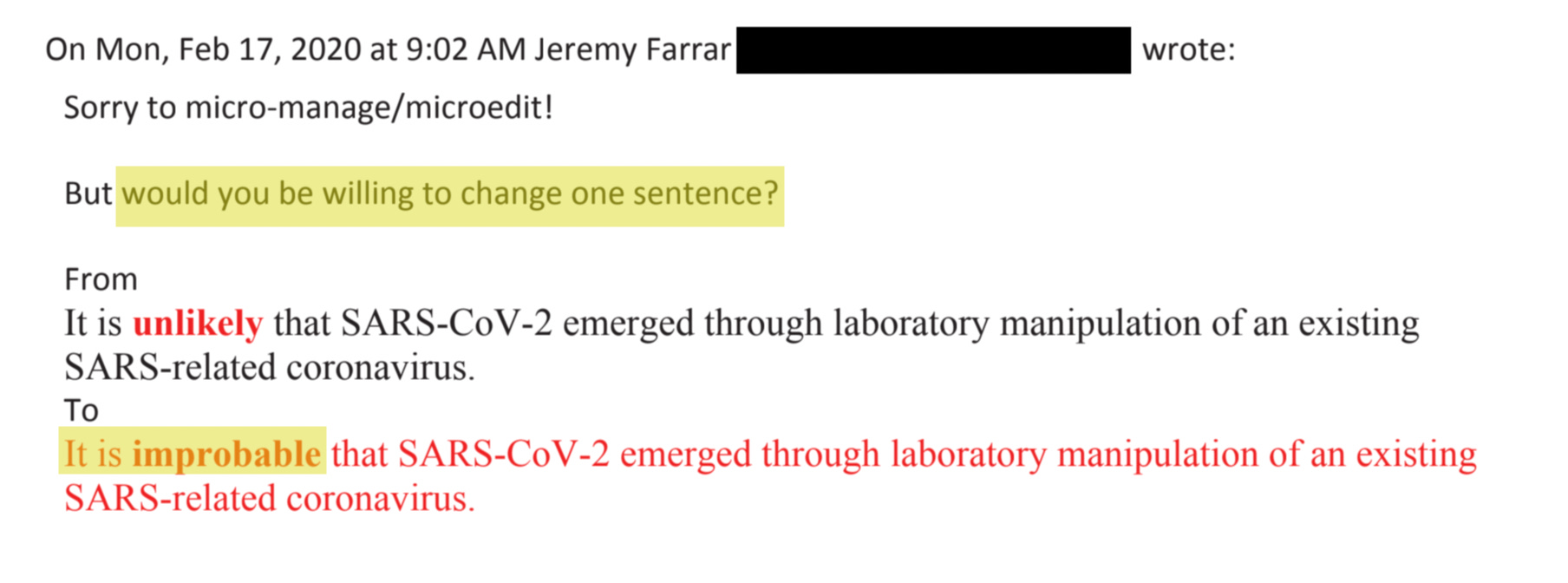
  1. Jeremy Farrar, now of the WHO, not only edited the Nature draft, he made a key change to its most quoted line:

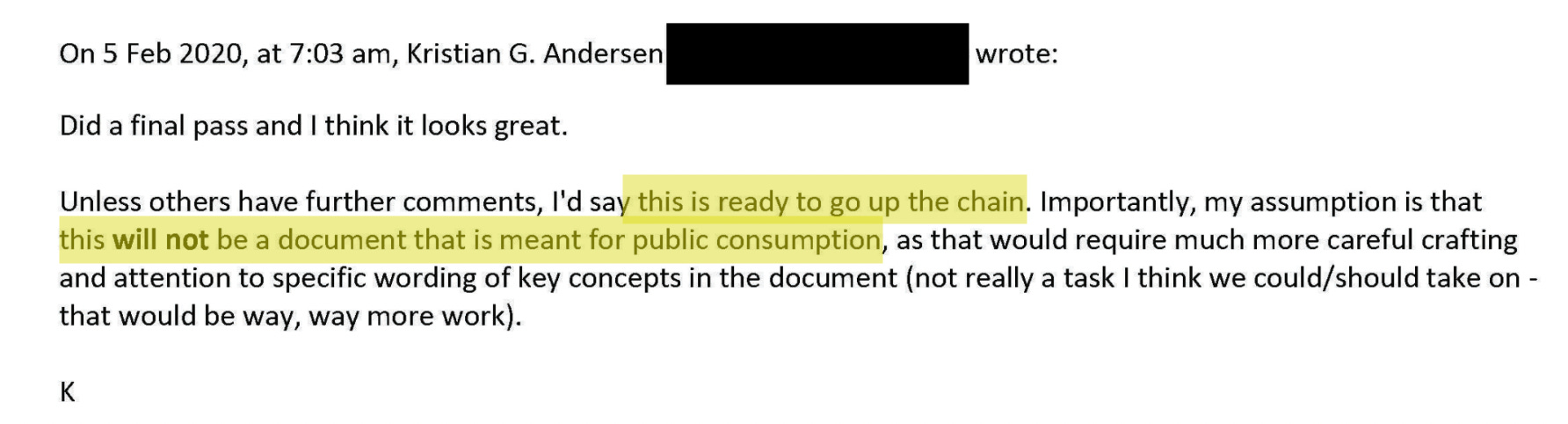
  1. Proximal Origin Co-Author Kristian Andersen makes reference to a draft being ready to “go up the chain”:

  1. Dr. Garry mentions that some may not like an early draft because it “allows… the nCoV may have arisen during cell culture passage in a lab (their labs).”

  1. Farrar will “push Nature” to get the article out “ASAP”:

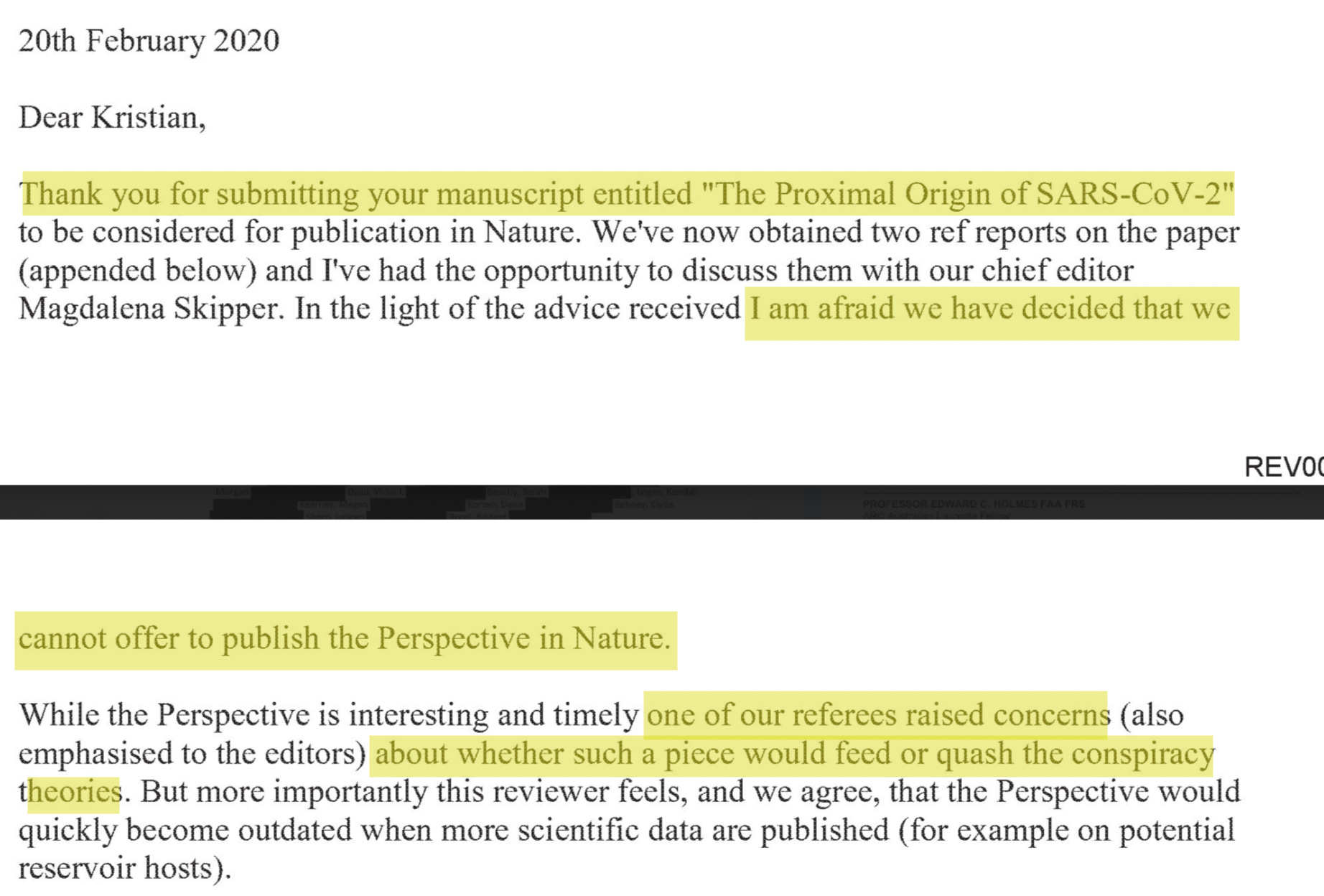
  1. Andersen gets rejection letter from Nature, with concern about “whether such a piece would feed or quash the conspiracy theories”:

  1. Andersen laments that a draft doesn’t “refute a lab origin” which “must be considered as a serious scientific theory” and “not dismissed out of hand as a conspiracy theory”:

  1. Co-author Ian Lipkin is not only “very worried about the furin cleavage site,” but “high ups are as well, inc. intel”:

  1. Close enough?” Co-authors propose cartoon image of EcoHealth Alliance’s Peter Daszak:

  1. Dr. Holmes: “Good idea not to mention all the other anomalies as this will make us look like loons.”

  1. Garry roots for Trump to “say more dumb stuff about the origins of the China virus, possibly poisoning Sino-American relations for decades,” then asks, “Does this make me a bad person?”

  1. Holmes on news that Lipkin has contracted Covid-19: “Well, that’s made my day.”

  1. Andersen “still leaning towards” cell culture hypothesis:

  1. “The furin would be the first thing to add for sure.”

  1. “Whatever has happened here, the virus has become very quickly loaded for human transition.”

  1. Andersen: “The presence of furin moves me a posteriori slightly more towards accidental release..”

18 Jul 20:55

Nigel Farage’s Coutts Account Closed as Bank Felt He Did Not “Align With Their Values”

by Will Jones

Coutts closed Nigel Farage’s bank accounts because his views “do not align with our values”, documents obtained by the former UKIP leader show. In other words, he was 'de-banked' for being politically suspect.

The post Nigel Farage’s Coutts Account Closed as Bank Felt He Did Not “Align With Their Values” appeared first on The Daily Sceptic.

18 Jul 20:31

The Welfare State’s Damaging Impact on Europe, Part I

by Dan Mitchell

At the risk of being repetitive, I’ve been arguing (and arguing, and arguing) that the United States should not turn its medium-sized welfare state into a European-style, large-sized welfare state.

Simply stated, that’s a route to economic anemia.

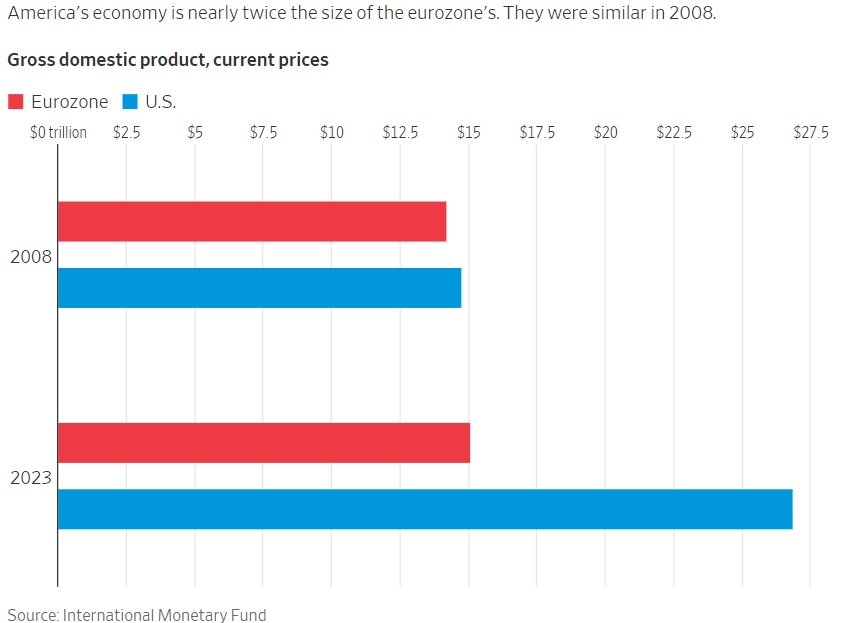
If you don’t believe me, look at this shocking chart, which compares European stagnation to American growth over the past 15 years.

The chart comes from a report in the Wall Street Journal. Here are some excerpts from that article.

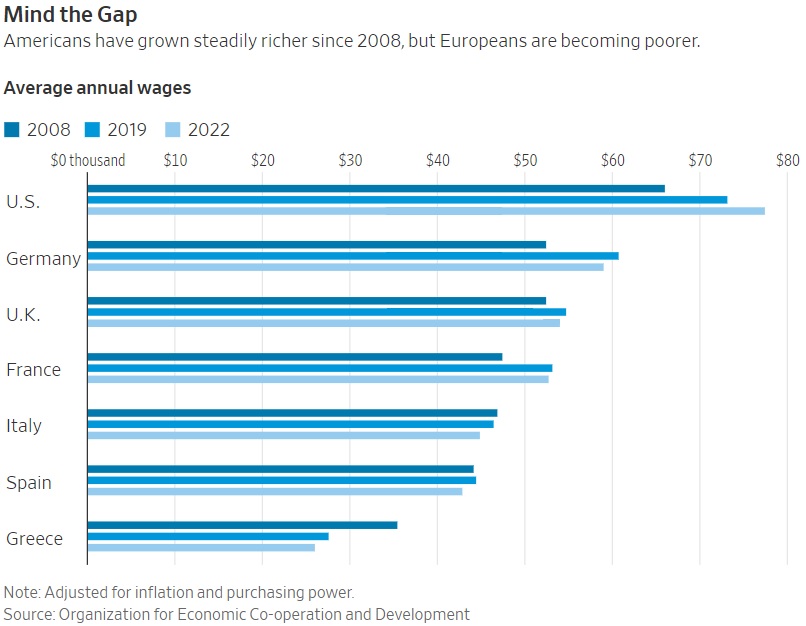
Europeans are facing a new economic reality… They are becoming poorer. …Private consumption has declined by about 1% in the 20-nation eurozone since the end of 2019 after adjusting for inflation… In the U.S., where households enjoy a strong labor market and rising incomes, it has increased by nearly 9%. …Adjusted for inflation and purchasing power, wages have declined by about 3% since 2019 in Germany, by 3.5% in Italy and Spain and by 6% in Greece. Real wages in the U.S. have increased by about 6% over the same period… The eurozone economy grew about 6% over the past 15 years, measured in dollars, compared with 82% for the U.S. …Weak growth and rising interest rates are straining Europe’s generous welfare states… given rising borrowing costs, economists expect taxes to increase, adding pressure on consumers. Taxes in Europe are already high relative to those in other wealthy countries, equivalent to around 40-45% of GDP compared with 27% in the U.S. American workers take home almost three-quarters of their paychecks, including income taxes and Social Security taxes, while French and German workers keep just half.

The last line in the above excerpt merits special attention.

Big government in Europe is very bad for workers, who earn less income. But, to make matters worse, taxes consume a bigger chunk of their smaller incomes.

And the income gap is growing every years, as illustrated by this chart from the article.

Note, by the way, that Greek wages have dropped by nearly $10,000 since 2008. That is partly a consequence of that nation’s fiscal crisis.

As I’ve warned, the same thing is about to happen to Italy.

P.S. And if we don’t reform entitlements in the United States, we’ll eventually suffer the same fate (though politicians will first spend a couple of decades raising taxes and repeating Greece’s mistakes).

18 Jul 16:38

Psychedelic Politics: The Battle Over Natural Medicine Regulation in Colorado

by Paotie Dawson
Natural Medicine Psychedelic Mushrooms
Photo courtesy of Sensi Magazine (IMG_1242-2).

Last November, Colorado voters passed Proposition 122, a law that decriminalizes the personal use, possession, growth, and transport of certain psychedelic plants and fungi. This was a significant victory for advocates of natural medicine, who have long argued that these substances have potential therapeutic benefits. However, by April, the law had been almost entirely rewritten by Colorado Senate President Steve Fenberg, to the surprise of Ashley Ryan, a Denver-based somatic psychedelic coach.

Fenberg introduced the Natural Medicine Health Act of 2022, also known as SB23-290, as the new regulatory framework for Proposition 122. This legislation was a near-complete rewrite of Proposition 122, leaving activists and stakeholders, including Ryan, stunned.

“SB23-290 violates the spirit of Prop 122 and harms marginalized people who need alternative healing options,” she said. Ryan also said felt the changes to Prop 122 were “based on the assumption that natural medicine users are potential victims or criminals who need to be protected or punished by the government.”

She also referred to a video of Colorado Rep. Ron Weinberg, a Republican, who testified before the legislature and said of SB23-290, “It was not in the original intent of what voters knew” when they passed Proposition 122. Weinberg went on to say the new legislation “is only going to create incidents” and problems that did not exist before Proposition 122 was passed.

Ryan recently appeared on the television show Dr. Phil and shared her experiences as a coach and educator about the benefits of psychedelic mushrooms, including her own personal experiences with micro-dosing. As a result of SB23-290, Ryan, a long-time Democrat, found herself increasingly at odds with Fenberg and the state Democrat Party.

Differences Between SB23-290 and Proposition 122

While both SB23-290 and Proposition 122 address the regulation of natural medicines, they differ significantly in their scope and implementation. SB23-290 does not allow for the use of psychedelics for therapeutic purposes, while Proposition 122 did. This is a major difference, as there is growing evidence that psychedelics can be effective treatments for a variety of mental health conditions.

SB23-290 establishes a comprehensive regulatory framework for natural medicine and its products, creating a Natural Medicine Advisory Board and a Division of Natural Medicine. It also sets out regulations for individuals and businesses involved in the cultivation, manufacturing, and distribution of natural medicine, and provides a process for the sealing of conviction records related to natural medicine offenses.

Proposition 122, officially known as the “Decriminalization and Regulated Access Program for Certain Psychedelic Plants and Fungi Initiative,” decriminalizes the personal use, possession, growth, and transport of certain psychedelic plants and fungi. It also creates a Regulated Natural Medicine Access Program for licensed healing centers to administer these substances. 

Notably, Proposition 122 did not mention retail sales of these natural health medicines and related substances, an important point of divergence from SB23-290 for Ryan.

Bait and Switch?

The drastic alteration of a voter-approved law by a single legislator has led to accusations of a “bait and switch” tactic. Ryan shares this view and is deeply concerned about the potentially harmful impacts of SB23-290. She believes SB23-290 “seems to target unregulated practice by imposing strict requirements and penalties on anyone who provides” substances decriminalized under Proposition 122 without a license.

SB23-290 will require those same people, including Ryan, to pay $3,500 for a license to provide natural medicine treatment. Ryan says the regulatory framework under SB23-290 will result in expensive fees for consumers. She estimates that a single microdose treatment will cost $500, and a month’s worth of micro-dosing or low-dose treatment may cost up to $6,000.

Ryan and other stakeholders argued that the high costs of licensing and treatment under SB23-290 could make it difficult for people who need access to psychedelic treatments to afford them. This is a particular concern for marginalized and lower-income individuals, who are already disproportionately affected by mental health problems.

They also fear that the high costs of licensing and treatment under SB23-290 could push these healing practices back into the shadows, undermining progress made toward mainstream acceptance of these alternative therapies.

The Future of Natural Medicine in Colorado

The controversy surrounding SB23-290 and Proposition 122 raises questions about the future of natural medicine in Colorado. However, there is growing evidence that psychedelics can be effective treatments for a variety of mental health conditions. This suggests that the regulation of natural medicine in Colorado could be an opportunity to improve access to these treatments for people who need them.

Ryan expressed her disappointment, saying, “It breaks my heart that I only have through June to teach my own standards-based personal use curriculum I’ve spent the last 6 months developing.” She also added that SB23-290, which prohibits marketing and advertising, will make it difficult for her and other treatment counselors and advocates to educate the public about the benefits of psychedelic treatments.

Ryan says she left the state Democrat Party and joined the Republican Party over SB23-290. “Only Republicans would talk to us,” during hearings discussing the language of SB23-290. “They actually listened and were supportive.”

Near the end of this year’s legislative session, Governor Jard Polis signed SB23-290 into law.


The Maverick Observer is an online free-thinking publication interested in the happenings in our region. We promote open views without bias. All views are welcome – it is how we learn from each other and grow as a community.


The post Psychedelic Politics: The Battle Over Natural Medicine Regulation in Colorado appeared first on The Maverick Observer.

18 Jul 16:35

NIMBY: Gem Hunters Found the Lithium America Needs. Maine Won’t Let Them Dig It Up. “But like just

by Stephen Green

NIMBY: Gem Hunters Found the Lithium America Needs. Maine Won’t Let Them Dig It Up. “But like just about everywhere in the U.S. where new mines have been proposed, there is strong opposition here. Maine has some of the strictest mining and water quality standards in the country, and prohibits digging for metals in open pits larger than three acres. There have not been any active metal mines in the state for decades, and no company has applied for a permit since a particularly strict law passed in 2017. As more companies begin prospecting in Maine and searching for sizable nickel, copper, and silver deposits, towns are beginning to pass their own bans on industrial mining.”

I’ll believe that the “clean energy transition” is necessary when the people who keep telling me about the necessity of the clean energy transition start acting like the clean energy transition is necessary.

18 Jul 14:37

Secret Service destroyed WH Cocaine bag, and related DNA…

by Kane
Jts5665

Pretty much have to assume it was either Hunter, Joe, or Kamala.

17 Jul 21:14

The FBI got fact-checked yesterday with a brutal Community Note slapped on this tweet 😂

by Not the Bee

The FBI tried to claim that it never targeted moms speaking out against mask mandates and porn in the classrooms and got wrecked for its trouble.

17 Jul 19:12

WHY, IT’S ALMOST AS THOUGH THE LEFT WANTS TO CREATE AN EDUCATIONAL UNDERCLASS THEY CAN MANIPULATE:

by Stephen Green

WHY, IT’S ALMOST AS THOUGH THE LEFT WANTS TO CREATE AN EDUCATIONAL UNDERCLASS THEY CAN MANIPULATE:

Or should I have said, “enlarge?”

17 Jul 19:09

FLASHBACK: CORBYNOMICS EXPLAINED.

by Glenn Reynolds
Jts5665

As Keynes said, "In the long run we're all dead."

FLASHBACK: CORBYNOMICS EXPLAINED.

17 Jul 14:02

RALPH SCHOELLHAMMER: The human cost of Net Zero. Western nations have long enjoyed the benefits o

by Stephen Green

RALPH SCHOELLHAMMER: The human cost of Net Zero.

Western nations have long enjoyed the benefits of industrialisation. Now, by clamping down on fossil fuels, they are trying to pull up the ladder. German foreign secretary Annalena Baerbock even had the audacity to lecture South Africa on its use of coal recently, while her own government has been burning it at record rates. Not without reason, parts of the developing world are beginning to accuse the West of engaging in ‘green colonialism’.

Make no mistake, the West’s prosperity rests on fossil fuels. The Industrial Revolution was fuelled by the exponential growth in available energy. In 1870, British steam engines generated four million horsepower, the equivalent amount of work done by 40million men. Feeding such a workforce would have required three times Britain’s entire wheat output. But in 1870, all it took to generate one horsepower was a pound of coal.

Coal was just the beginning. Soon oil was added to the fuel mix and eventually gas, too. This massive increase in energy production allowed a tremendous increase in living standards. The average Briton in 1960 was six times richer than his great grandfather in 1860.

Industrialisation transforms societies. The industrialisation of agriculture, for example, enables higher outputs with less labour, freeing humans for other endeavours. In the US, the labour needed to produce a kilogram of grain fell by 98 per cent between 1800 and 2020. The share of the population working in agriculture fell by a similar margin during that period. Not every country will have to follow this development path exactly – coal, for example, could be replaced by gas and nuclear. But what is certain is that no country will be able to industrialise and develop without fossil fuels.

The short version: Decarbonization is just neocolonialism with a smiling face.

17 Jul 13:48

Feds borrowing over $5 billion per day as programs face insolvency

by The Center Square Staff
Jts5665

Eventually one runs out of credit cards to transfer the balance to and the bill comes due...

The U.S. Congressional Budget Office released a report earlier this year projecting the national debt will be nearly twice as large as the U.S. economy in 30 years.
17 Jul 13:46

KAMALA: “When we invest in clean energy and electric vehicles and REDUCE POPULATION, more of our c

by Ed Driscoll
Jts5665

exterminationism.

KAMALA: “When we invest in clean energy and electric vehicles and REDUCE POPULATION, more of our children can breath clean air and drink clean water.”

WHAT DID THE VP JUST SAY?

Did she mean “reduce pollution“??

If so, what a Freudian slip!!

Considering the administration is in many ways Obama’s third term, his former “science” “czar,” John Holdren flashes his best Dr. Strangelove smile:  “Dr. John Holdren, director of the White House Office of Science and Technology Policy—better known as the ‘science czar’—has been a longtime prophet of environmental catastrophes. Never discouraged but never right. And thanks to resourceful bloggers, you can read excerpts from a hard-to-find book co-authored by Holdren in the late 1970s, called Ecoscience: Population, Resources, Environment, online. In it, you will find the czar wading into some unpleasant talk about mass sterilizations and abortions.”

17 Jul 13:45

YES, THEY REALLY SAID IT: House Republicans approved a $52.4 billion appropriations bill for State,

by Mark Tapscott

YES, THEY REALLY SAID IT: House Republicans approved a $52.4 billion appropriations bill for State, Foreign Operations and Related Programs that includes prohibitions on any U.S. tax dollars going to research labs controlled by China, Russia, North Korea, Iran or Venezuela, or to fund gain-of-function research such as that in the Wuhan lab that produced the Coronavirus.

The Washington Free Beacon’s Andrew Kerr reports the response of Democrats:

“To Democrats on the House Appropriations Committee, led by Rep. Rosa DeLauro (D., Conn.), these measures unravel ‘the hard-fought credibility and influence the United States has earned as a global leader,’ the lawmakers said in a press release Wednesday. ‘The bill threatens our national security and puts the American people and global health at risk,’ the Democrats added.”

No, they really did say that. It hurts U.S. national security to not fund research labs controlled by America’s adversaries. They actually said it.

17 Jul 13:43

MICROBIOME NEWS: Gut bacteria may affect clogged arteries.

by Glenn Reynolds
17 Jul 13:43

NEWS YOU CAN USE: Lifting even light weights builds strength, muscle.

by Glenn Reynolds
17 Jul 13:40

HOSPITAL FOOD: “Not Fit for a Dog.” “There was a concern that this overhaul would be too costly. H

by Glenn Reynolds

HOSPITAL FOOD: “Not Fit for a Dog.” “There was a concern that this overhaul would be too costly. However, we learned that fresh ingredients were actually less expensive than processed and pre-cooked meals.”

17 Jul 13:03

BIDEN’S POLICE STATE: ‘We’re Shutting the Gun Shows Down’: ATF SWAT Team Raids Part-Time Okla

by Glenn Reynolds
17 Jul 13:00

STANDING UP TO BIGOTRY AND MASSIVE RESISTANCE: Ohio college employees could be held ‘personally l

by Glenn Reynolds
13 Jul 19:33

This RFK Jr. dinner is proof we live in the best timeline 😂

by Not the Bee

A posh dinner for presidential candidate Robert F. Kennedy Jr. on New York City's Upper East Side turned into a shouting match that devolved into a flatulence display, according to reporters from the New York Post's Page Six publication.

13 Jul 19:31

“FOLLOW THE SCIENCE” — EXCEPT WHEN IT’S EMBARRASSING OR INCONVENIENT. Scientists Agreed To Downpla

by Glenn Reynolds

“FOLLOW THE SCIENCE” — EXCEPT WHEN IT’S EMBARRASSING OR INCONVENIENT. Scientists Agreed To Downplay Chinese Lab Leak Theory For Fear Of ‘S*** Show’, Messages Indicate.

13 Jul 15:51

Virginia woman bites rabid fox back after it latches onto her, locks it in her car

by Not the Bee
Jts5665

Just a reminder to clean your car out before it reaches the rabid fox stage. Big savings if you can avoid the rabies shots.

A Virginia woman went through a harrowing incident earlier this week when a rabid gray fox attacked her while she was cleaning out her car.

13 Jul 13:38

SO AS I REMARKED THE OTHER DAY, THE STORY ABOUT JUSTICE SONIA SOTOMAYOR USING STAFF TO HAWK HER BOOK

by Glenn Reynolds

SO AS I REMARKED THE OTHER DAY, THE STORY ABOUT JUSTICE SONIA SOTOMAYOR USING STAFF TO HAWK HER BOOKS seemed like thin gruel. But a friend reminds me of the underlying book scandal:

Sonia Sotomayor took $3.6 million from Penguin Random House publishing when the company did have business before the court, and declined to recuse herself.

In addition to the $3.6 million advance (which Penguin Random House lost money on), the Daily Wire found that Sotomayor received payments from the company annually from 2017 to 2021, totaling over $500,000. In 2013, she voted in a decision regarding a case involving Random House despite then-fellow Justice Stephen Breyer recusing himself after receiving money from the publisher. In 2020, Sotomayor received a $10,586 check from Penguin Random House on the same day a lawsuit against the publisher appeared before the Supreme Court. The Court voted not to hear the case in February 2020, and Sotomayor received her largest-ever payment from the publisher in May of that year.

While the media has been busy attacking conservative justices for supposed financial misconduct, including failure to disclose free travel, it turns out that Justice Sotomayor herself failed to disclose six trips funded by outside groups in 2016—without being targeted by the media or enduring the wrath of outraged Democrats.

Well, none of this has anything to do with actual ethics. As usual, we are being lectured on ethics by scoundrels.

13 Jul 13:36

SHOULD I CALL THE NEW YORK TIMES DISHONEST, OR IS THAT REDUNDANT: Here’s how the Times explains oppo

by David Bernstein

SHOULD I CALL THE NEW YORK TIMES DISHONEST, OR IS THAT REDUNDANT: Here’s how the Times explains opposition to a newly appointed journalism dean at Texas A&M:

McElroy, who once worked as an editor at The New York Times, said she was notified by the university’s interim dean of liberal arts, José Luis Bermúdez, of political pushback over her appointment.

“I said, ‘What’s wrong?'” Dr. McElroy recalled in an interview. “He said, ‘You’re a Black woman who was at The New York Times and, to these folks, that’s like working for Pravda.'” Dr. McElroy left The Times in 2011….

Matthew Poling, the president of [an alumni group opposed to her appointment], said that members did not approve of Dr. McElroy’s work promoting diversity, equity, and inclusion.

Diversity, equity and inclusion efforts had been a small part of her journalism and academic career, she said.

You would never get a sense from the article why McElroy was so controversial. I couldn’t believe that it was solely about the fact that she supports DEI, given that basically all academic bureaucrats are required to be on board.

So I googled for about two minutes, and got an answer from this article she wrote. She favors race-based hiring in journalism, calls “objectivity” a “flawed” goal for journalists, calls journalism a “white patriarchal institution.” (In fairness, she adds, “I wholeheartedly believe in journalism’s mission to seek truth and tell it fairly and dimensionally.”)

Also, it turns out that her protestation that “diversity, equity and inclusion efforts had been a small part of her journalism and academic career” is misleading. Her dissertation, as she describes it, was “about black columnists at ‘mainstream’ newspapers,” in which she “challenged Tom Rosenstiel and Bill Kovach’s thoughts about “diverse” journalists included their seminal book “The Elements of Journalism.” So her signature academic project may not have been about DEI “efforts,” but it was about DEI.

Proponents of the autonomy of academic institutions in the name of academic freedom from political interference can still object that her appointment should have been left solely to university officials to consider, without political interference. But even if one strongly takes that position, it doesn’t excuse the Times’ reporter from her obligation to (objectively and?) accurately report on why her appointment was controversial, rather than implying that it was just racism and extremism.

13 Jul 13:27

My Wray or the Hard Wray: New Twitter Files Contradict FBI Director’s Testimony

by jonathanturley

Yesterday’s hearing with FBI Director Christopher Wray was another maddening experience of faux contrition and open evasion. Wray apologized for violations that have already been established by courts or Congress (often over the best efforts of the FBI). However, on ample public evidence of new violations, Wray continued to use his favorite testimonial trilogy to dismiss any questions: expressing (1) lack of knowledge, (2) ongoing investigations, and (3) promises of later answers or briefings. He did, however, hold forth in detail after Rep. Eric Swalwell asked him about FBI Family Day. Despite the near total lack of substance, Wray did make one surprising denial. He insisted that the FBI does not engage in censorship efforts, focuses only on “foreign disinformation,” and does not pressure companies to censor others. Those denials are not only directly contradicted by the recent 155-page opinion of a federal court and the Twitter Files, but a new release from the Twitter Files and journalist Matt Taibbi.

Wray said that “…The FBI is not in the business of moderating content, or causing any social media company to suppress or censor.” He then added that these companies are not under any pressure in making their own decisions whether to censor people or groups flagged by the FBI.

The statement is obviously false. The FBI maintained a large operation of agents actively seeking the censorship of thousands, as discussed in my prior testimony.

Taibbi, however, has released another example of how aggressive the FBI was with social media companies. In the latest Twitter Files release, there is one email exchange where Twitter “immediately” suspended accounts flagged by the FBI without investigation.

Taibbi explained:

“In one shot, you can see the FBI asks to remove three accounts, that gets forwarded to Twitter, Twitter immediately suspends them, the accounts. But more importantly, when there’s a glitch, and the accounts remain up, the FBI immediately writes back and says, what’s the deal? We just wrote to you, why is it still up? So, that shows the nature of the relationship basically that it’s not really a collaboration. It’s much more like somebody reporting to an authority.

… [W]hat happens in these instances in the ones that I was showing, they’re just forwarding names of accounts that they say are associated with foreign threat actors. It’s very vague. And Twitter is taking them down before they even investigate. In this case, they later determined that they couldn’t find anything connecting them to any bad actors. In fact, one of them was from Canada. And so, that’s the problem. If it’s not connected with a crime, they’re just asking to take accounts down because they don’t like the profile of them.”

We also have hundreds of emails that show the FBI and other agencies targeting individuals for a wide array of disinformation, misinformation, and malinformation. The latter category is truly Orwellian. It covers true statements that can be used for a misleading purpose.

The latest email does not suggest that the FBI was the passive, helpful agency portrayed by the Director. For most people reading the email, it sounds like it is my Wray or the hard Wray.

12 Jul 22:43

IRS whistleblowers will testify on alleged Biden influence peddling next week

by Ben Whedon
Jts5665

This is likely why they just levied charges against the one of the other whistleblowers.

Both worked extensively on the Hunter Biden case for years and have stated that they repeatedly attempted to address their concerns about the case internally, but that their warnings went unheeded.
12 Jul 22:42

1/3 of student loan recipients spent more money in anticipation of debt forgiveness

by Ben Whedon
Jts5665

Stacking bad decisions upon bad decisions.

Five percent of the overall total claimed to have spent an additional $10,000, the minimum expected relief amount.
12 Jul 20:42

CHANGE: An Explosion of Life Happens on Earth Every 36 Million Years. Now We Know Why. A deep ana

by Stephen Green

CHANGE: An Explosion of Life Happens on Earth Every 36 Million Years. Now We Know Why.

A deep analysis of the fossil and geological record reveals a changing sea level that occurs in response to a 36-million-year cycle of tectonic movement.

This, a team led by geologist Slah Boulila of Sorbonne University in France has found, disrupts several ecosystems, causing many species to struggle – and new ones to blossom to fill the new ecological niches that emerge.

“In terms of tectonics, the 36-million-year cycle marks alterations between faster and slower seafloor spreading, leading to cyclical depth changes in ocean basins and in the tectonic transfer of water into the deep Earth,” says geoscientist Dietmar Müller of the University of Sydney.

“These in turn have led to fluctuations in the flooding and drying up of continents, with periods of extensive shallow seas fostering biodiversity.”

A close look at the fossil record shows that biodiversity is not a nice, even constant. Instead, it fluctuates dramatically on scales of tens of millions of years, punctuated by extinction events and the rise of new species.

It’s unclear how SUVs are involved in the process.