LOL! The Jamaal Bowman fire alarm memes are … on fire.
https://t.co/66LY0LVrLB pic.twitter.com/n4pzKdCLn1
— Magills (@magills_) September 30, 2023
Jts5665Surprisingly honesty of them.

I know elementary-aged children that go to public school who lay awake at night worrying about how climate change is going to kill them if they don't recycle.
WHY WASHINGTON IS ‘AWASH IN CORRUPTION:’ Professor Jonathan Turley told yesterday’s first House Impeachment Inquiry hearing that the nation’s capital “is awash in corruption,” referring to the millions of dollars paid by nearly two dozen foreign entities to the Biden family’s influence-peddling enterprise specifically and more generally to the access selling that is such a familiar feature of the governing political culture. The indictment of Sen. Robert “Gold Bar” Menendez (D-N.J.) also comes to mind.
But the bigger point is made by Issue & Insights in the context of former First Lady Michelle Obama being paid “an obscenely large amount for a speech in Germany on diversity.” Obama received $741,000 for a 60-minute oration, or $12,350 per minute. And let’s not forget the continuing worldwide grifting of Bill and Hillary Clinton with their foundation.
That bigger point is this: “These are all variations on a theme. Call it bribery, or extortion, or abuse of power, or whatever you want. This is how Democrats get rich these days. They expand the size and power of the federal government, then sell access and favors to the highest bidders.”
Call it Grifter Government. But don’t call it government of, by and for the people.
CHUCK ROSS: The Latest Hunter Biden Document Dump Is Littered With Bombshells. Here Are the Biggest.
A federal prosecutor on the Hunter Biden investigation ordered the FBI to remove references to then-candidate Joe Biden from a search warrant related to the probe.
In August 2020, FBI agents drafted a search warrant for the lobbying firm Blue Star Strategies that referenced the elder Biden as “Political Figure 1.” But assistant U.S. attorney Lesley Wolf intervened to remove the reference to Biden on the grounds that it was outside the scope of the warrant.
“There should be nothing about Political Figure 1 in here,” Wolf wrote in an email to FBI and IRS investigators.
The email adds to the growing evidence that the U.S. attorney’s office blocked investigators from pursuing leads related to the president. IRS investigators Gary Shapley and Joe Ziegler have claimed Wolf stymied several aspects of the investigation and tipped off Hunter Biden’s lawyers to a planned search of the first son’s storage unit in Virginia.
Wolf was removed from the prosecutorial team this year, for reasons yet to be explained.
Read the whole thing.
The German Government has been caught hiding an assessment, ahead of the nuclear phase-out, that keeping nuclear plants open would reduce CO2 emissions by 30 million tonnes per year.
The post German Government Caught Hiding Assessment That Keeping Nuclear Plants Open Would Sharply Reduce CO2 Emissions appeared first on The Daily Sceptic.
In a new FOI release the MHRA has finally come clean that it failed to test the safety of mass manufactured Covid vaccine batches, in contravention of its own regulations and public statements.
The post MHRA Finally Admits it Failed to Test the Safety of Mass Manufactured Covid Vaccine Batches appeared first on The Daily Sceptic.
Jts5665They should require clown suits. Way more appropriate for that crowd.

Sad! Why would they pick on that poor man and his Carhartt sweaters?
OF CRIMES AND COVERUPS: Fauci Diverted US Government Away From Lab Leak Theory Of COVID’s Origin, Sources Say: Fauci allegedly attacked lab leak theory at meetings at CIA, the State Department, and the White House. “Fauci had reasons to push scientists and intelligence analysts to believe the virus had a zoonotic origin since his agency had issued a grant to fund research at the Wuhan Institute of Virology (WIV) in China.”
Here you go, the actual damaging misinformation that was being spread while tech companies took down your memes in the name of public safety.
Related: Did Anthony Fauci Impede the Investigation of the Covid-19 Pandemic?
UNEXPECTEDLY! UK Study: Puberty Blockers Given to Teens — Get This — Worsened Their Mental Illnesses Rather Than Abating Them. “While the updated analysis from the University of Essex has yet to be peer-reviewed, another long-term study from Sweden found those who underwent transgender surgery were 19 times more likely to die by suicide than the general public.”
THE JUSTICE SYSTEM HAS ITS OWN VALUES: Real estate insiders bewildered by judge’s $18M valuation of Trump’s Mar-a-Lago: ‘Would list at $300M.’
AND THERE IS MY SHOCKED FACE AGAIN! Report: Top Officials on Biden’s Iran Team Acted Under Directions From Tehran.
I SEE. WELL, THE FBI NEEDS TO GO: FBI refuses to release documents in probe into possible nationwide voter registration fraud.
Also I told you the fraud is gargantuan.
THIS IS CNN:
A CNN Producer said he had an email from Hunter stating that Hunter "expected all of this "stuff" to go away when his dad becomes president."
Strange that I don't recall @CNN ever reporting this. pic.twitter.com/ULAQuHdHq9
— Jeff Carlson (@themarketswork) September 27, 2023
Just think of CNN as Democratic Party operatives with bylines, and it all makes sense.
Evergreen:
Jts5665So was this graft from previous corruption or in hopes of future corruption?
CULTURE OF CORRUPTION: Michelle Obama Earned $750,000 for One-Hour Speech at Germany Tech Fair.
FASTER, PLEASE: Texas Molten Salt Nuclear Reactor Planned for 2026.

THIS IS WILD, Y'ALL.
HOT! HOT! HOT!: Today, the U.S. Commission on Civil Rights is releasing its report on Anti-Asian Racism. My Commissioner Statement is here. I learned an important thing from this report: Only topics that are consistent with the progressive agenda can be the subject of a Commission report. In other words, it’s fine to demand accurate counts of hate crimes, but the question of how to prevent those crimes is of little interest. (And heaven forbid that we should discuss race-preferential college admissions policies!)
THERE IS NO RIGHT OR WRONG, ONLY OPPORTUNISM: Russell Brand Gets Pilloried For His Behavior. Howard Stern Gets Celebrated For His. Guess Why.
EVERYTHING IS GOING SWIMMINGLY:
The 10-year Treasury just hit a 16-year high of 4.5%, which – if sustained – is basically catastrophic for long-term federal deficits. This is much more important than the vast majority of daily politics and culture fights getting most of the media's attention. pic.twitter.com/2CBNEOOWZh
— Brian Riedl 🧀 🇺🇦 (@Brian_Riedl) September 25, 2023
Related: You Won’t Believe What We’re Spending ONE TRILLION DOLLARS to Buy.

Major international governments have signed multibillion-dollar legal contracts with drug companies in order to secure access to covid-19 vaccines.
But the drug companies and governments have refused to divulge details, saying the information is “commercial in confidence.”
In 2021, we got our first peek at contracts between Pfizer and various international countries after they were leaked to The Bureau of Investigative Journalism and US consumer group Public Citizen.
"The contracts offer a rare glimpse into the power one pharmaceutical corporation has gained to silence governments, throttle supply, shift risk and maximise profits in the worst public health crisis in a century," said Zain Rizvi, author of the Public Citizen report.
Pfizer was accused of “bullying” governments during contract negotiations, asking some Latin American countries to put up sovereign assets, such as embassy buildings and military bases, as a guarantee against the cost of any future legal cases.
Last month, a South African NGO called Health Justice Initiative won a high court challenge to gain access to all of South Africa’s covid-19 vaccine contracts.
Tony Nikolic, an Australian solicitor from law firm Ashley, Francina, Leonard & Associates, reviewed the Pfizer contract and says it reads like South Africa was “held to ransom” over the deal.

“It’s a one-sided contract. Pfizer gets all of the profits and none of the risks,” says Nikolic. “It’s akin to extortion, there’s absolutely no liability for the vaccine manufacturer in terms of injuries that may arise from their product.”
The South African government agreed to "indemnify, defend and hold harmless" Pfizer and all its affiliates from “any and all suits, claims, actions, demands, losses, damages, liabilities settlements, penalties, fines, costs and expenses” arising from the vaccine.
It also says the government will “create, dedicate, and maintain a no-fault compensation fund sufficient to undertake and completely fulfil the indemnification obligations….. for damage, injury, or harm arising out of, relating to, or resulting from the development, administration, or use of the vaccine.”
Nikolic says, “It’s like the manufacturers could ask for anything they wanted. There was such panic at the time and images in the media of people dying in the streets created a real sense of fear and insecurity around the world.”
The protection against liability is not only in place for the initial vaccine formulation, but for “any or all related strains, mutations, modifications or derivatives of the foregoing that are procured by Purchaser.”
“What this means,” explains Nikolic, “is that Pfizer can modify its vaccine to match whatever variants emerge, and still have all the same protections against liability. This is nothing more than a cash cow for Pfizer, they are privatising the profits, whilst socialising the costs.”
Pfizer charged the South African government $10 per dose, which is nearly 33 percent more than the $6.75 “cost price” it reportedly charged the African Union.
“In my view, this is why Pfizer wants the details kept secret, so that it can protect the various price differences between countries. It’s classic price gouging with a predatory twist, that is why procurement transparency is essential,” says Nikolic.
The contract states “the long-term effects and efficacy of the vaccine are not currently known and that there may be adverse effects of the Vaccine that are not currently known.”
Nikolic says this is in stark contrast to the public health messages at the time.
“We had politicians and key opinion leaders telling people that the vaccines were ‘safe and effective’ when the procurement contracts themselves did not make such claims,” says Nikolic.
“The contract clearly indicates that adverse effects were unknown at the time of signing. The burden of proof should never have been on the people to prove the vaccine was unsafe, it should have been on the manufacturer to prove the vaccine was safe,” he adds.
Nikolic has spent the last two years trying to access the procurement contracts signed by the Australian Government.
“Australians are still in the dark about what is contained within these contracts. We know it gave liability protection to the vaccine manufacturers like other countries, but that’s the extent of it,” says Nikolic.
“We need to know what our politicians knew at the time of signing the deal. And we need to know how much money we, the taxpayer, spent for a vaccine that turned out to be far less safe or effective than promised,’ he adds.
In a recent Australian Senate committee hearing, Queensland Senator Malcolm Roberts grilled Pfizer executives under oath about the indemnity clauses in its contract with the Australian government, but Pfizer refused to give details.

“The contents of Pfizer's contract with the Australian Government remains confidential,” said Pfizer Australia’s medical director Krishan Thiru.
In 2021, Nikolic mounted a legal challenge against covid-19 vaccine mandates in the NSW Supreme Court where he tried to subpoena the Pfizer contract, but his request was blocked.
Undeterred, Nikolic submitted an FOI request to the Australian Department of Health.
The FOI request, however, was denied because the contracts “contain information that is confidential in nature” such as “trade secrets and commercially valuable information.” It stated:
“The documents contain commercial information regarding the procurement of vaccines to Australia. The documents contain information specifically relevant to the unique commercial arrangements between the department and third parties, including indicative prices, payment terms, professional indemnity, ongoing funding measures, manufacturing details and production measures.”
Nikolic says, “It’s unethical, potentially unlawful and immoral for them to argue that the right to preserve commercial confidence overrides the right for public safety, it just doesn’t make sense.”
He adds, “It just boggles the mind how governments just rolled over and entered into agreements with companies like Pfizer that have a long track record of breaching the False Claims Act resulting in billion-dollar criminal and civil liability.”
Reposted from the author's Substack
A top vaccine adviser to the U.S. Government has refused to get the latest Covid shot as he warns about the long term impact of myocarditis and other serious side-effects.
The post Top U.S. Government Vaccine Adviser Refuses to Get Latest Covid Shot as He Warns of Long Term Impact of Myocarditis appeared first on The Daily Sceptic.
Jts5665No Problem here. All they have to do is adjust the data to match the models like they've been doing with temperatures.
Arctic summer minimum sea ice extent refuses to drop further, surprising and frustrating the alarmist media.
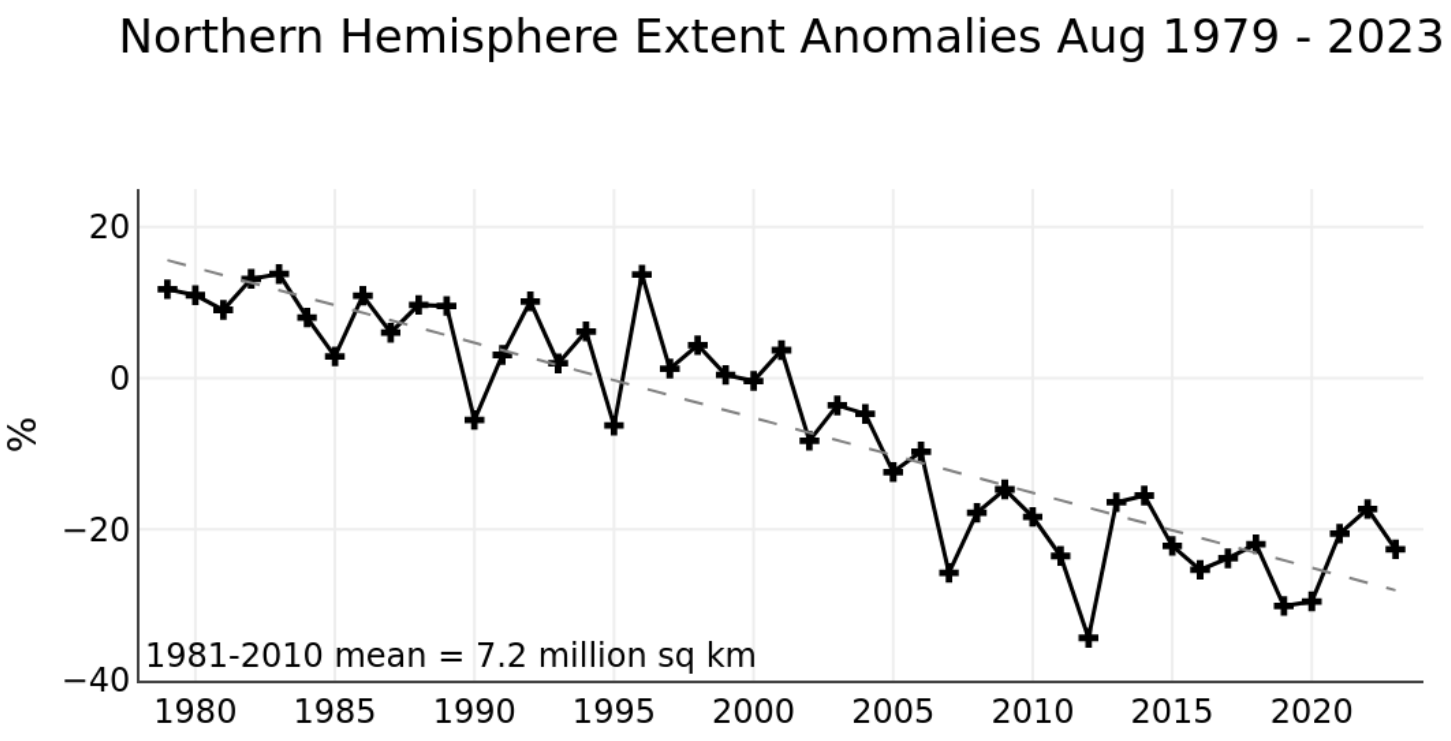
Image: National Snow and Ice data Center (NSIDC), Boulder, Colorado.
Hat-tip: Klimanachrichten
German research vessel Polarstern of the Alfred Wegener Institute (AWI) is currently underway again in the Arctic. where a decrease in sea ice had been expected there, or, probably more accurately said, hoped for.
But this year the minimum Arctic sea ice extent has turned out differently, as Germany’s widely viewed (climate-alarmist) Tagesschau news had to report:
In view of the extreme summer, the question arose in advance: Will the Arctic also see a new negative record in melting ice this year? This time, the Arctic has been spared. AWI director and expedition leader Antje Boetius tells Tagesschau that an unusual weather phenomenon prevented a record melt of Arctic sea ice this summer. According to Boetius, a sequence of low-pressure systems has led to an entirely different ice movement. The so-called transpolar drift, which describes the drifting of ice along certain routes, took a different course this year, she said. Ice from the Siberian region has been held together and compressed instead of drifting out and melting. For the AWI director, this shows that weather phenomena determine the development of sea ice, and that forecasting is more difficult than ever. The Arctic, with its sea ice and life, has been lucky once again, says the biologist. But things could go the other way. “If we are unlucky, if weather phenomena play unfavorably, we can also be affected by large ice-free parts much sooner than expected,” Boetius adds.”
We notice that when the opposite happens, e.g. heat, storms or more melt happens, then it’s all because of climate warming. But when it goes the other way, then it’s weather!
Donate – choose an amount
5101520501002505001000
Jts5665Scholarly malfeasance.
The academic history profession has a problem with intellectual integrity. Over the past decade, a cottage industry has emerged in elite university departments that explicitly aims to tear down free-market economists (often misnamed as “neoliberals”) by accusing them of racism, fascism, and similarly discredited beliefs.
Although these are serious charges, the historians who make them seldom have evidence to back their accusations. Instead, they misrepresent historical records, make up falsehoods out of thin air, and even rearrange quotations by their targets to make them appear racist. One of the worst offenders in this regard is Duke University historian Nancy MacLean, whose 2017 book Democracy in Chains tried to portray pioneering Public Choice economist James M. Buchanan as a complicit partner of Senator Harry Flood Byrd’s “Massive Resistance” efforts against Brown v. Board of Education.
MacLean’s thesis collapsed under scholarly scrutiny. To build her case, she mixed up the contents of historical records, misread and conflated footnotes in the secondary literature, and simply fabricated salacious stories wherein Buchanan became a secret admirer of John C. Calhoun and Agrarian Poetry, despite providing no evidence of either. When she wasn’t making them up out of thin air, MacLean also altered quotations to change their meaning, usually in ways that depicted their authors as monsters. In a more honest academic climate, it’s the type of behavior that would earn a professor a stern reprimand from the dean and perhaps a few article retractions.
Six years have passed since this episode, but MacLean is still up to her old tricks. Her newest target is the South African economist William Harold Hutt, who wrote a blistering critique of racial apartheid in 1964. MacLean’s interest in Hutt stems from the fallout over Democracy in Chains, because Buchanan recruited Hutt to the University of Virginia as a visiting faculty member in 1965. Having a prominent opponent of apartheid in Buchanan’s department did not mesh well with MacLean’s attempts to depict Buchanan as an agent of the arch-segregationist Byrd machine.
To get around this obstacle, MacLean has now seeks to besmirch Hutt. She has a new article out in the History of Economics Review, co-authored with Duke professor William S. Darity and graduate student M’Balou Camara. Its “thesis,” if it could even be called that, is to accuse Hutt himself of being a “white supremacist.”
Most of the new article is a recycled and slightly updated version of an error-riddled working paper that advanced similar claims. Art Carden and I dissected that paper last year, finding multiple instances where MacLean and her co-authors misrepresented their source materials to make their flimsy charges stick. But MacLean’s latest piece adds a new line of attack on Hutt, containing one of the most egregious examples of quote-editing that I have ever encountered in an academic work.
To support their contention that Hutt was a “white supremacist,” MacLean et al. excerpt a passage from his 1963 anti-apartheid book, The Economics of the Colour Bar. I reproduce their treatment of that passage here in full:
[Hutt] went further, admonishing that ‘races which grumble about the ‘injustices’ or ‘oppressions’ to which they are subjected can often be observed to be inflicting not dissimilar injustices upon other races (Hutt 1964, 39). The choice of verb (grumble) along with the scare quotes around injustices and oppressions illustrate how Hutt aimed to undercut the legitimacy of apartheid’s black South African critics, who were gaining international support as he wrote. His aim can be readily inferred: to deny the victims of apartheid the moral high ground claimed by the anti-apartheid movement.
In fact, this quoted excerpt is one of the main pieces of “evidence” that MacLean and her co-authors deploy to support their claims. As they describe it, “These passages attest that Hutt clearly saw the world through the lens of white racial superiority.” By allegedly denigrating the victims of apartheid in their cause, Hutt “demonstrated his belief that the fundamental source of racial disparity in South Africa and elsewhere was dysfunctional black behaviour.”
This is a serious charge to make against another scholar. It is also a falsehood.
Compare MacLean et al.’s portrayals to the full passage from page 39 of the Economics of the Colour Bar. The excerpted part of the quotation is in bold:
“Races which grumble about the ‘injustices’ or ‘oppressions’ to which they are subjected can often be observed to be inflicting not dissimilar injustices upon other races. We find a very clear case of this in any study of the grievances of the Afrikaners against ‘British imperialism’ and their fight against the threat of ‘Anglicisation’. In their policies towards the non-Whites, they are inflicting injustices which are remarkably similar to those of which they themselves have complained.”
If you’re wondering how these transgressions on the text passed basic peer review with the journal’s editors, you are not alone. Contrary to the claims of MacLean and her co-authors, Hutt was not attempting “to undercut the legitimacy of apartheid’s black South African critics.” He was writing about the racist hypocrisy of South Africa’s white Afrikaner community. The Dutch-descended Afrikaners often complained of historical injustices against their community at the hands of British colonial authorities, yet as Hutt pointed out, they turned around and perpetrated injustices against black Africans in the form of apartheid.
MacLean et al. took Hutt’s attack on white racists and, through selective excerpting of the original quotation, altered it into an attack on the victims of apartheid.
If this quote-editing exercise was a single incident, it might be possible to chalk it up to sloppiness or incompetence. But Hutt’s explicit reference to Afrikaner hypocrisy appears in the very next sentence, making a careless oversight unlikely. More importantly, MacLean and her colleagues have a long track record of similar behavior, misrepresenting sources and abusing historical evidence.
To academics like MacLean and Darity, both of whom write from positions of power, holding endowed chairs at an elite institution, historical inquiry is no longer an exercise in pursuing truth and understanding about the past. It is a tool for their own far-left political activism. To borrow a phrase from ethicist Nigel Biggar, they treat history as “an armoury from which to ransack politically expedient weapons.” In the process of that ransacking, they cross the line into willful misrepresentations of their source material, all in the service of a modern-day political cause. It’s a pattern of scholarly dishonesty that the academy has tolerated (and even elevated) for far too long.
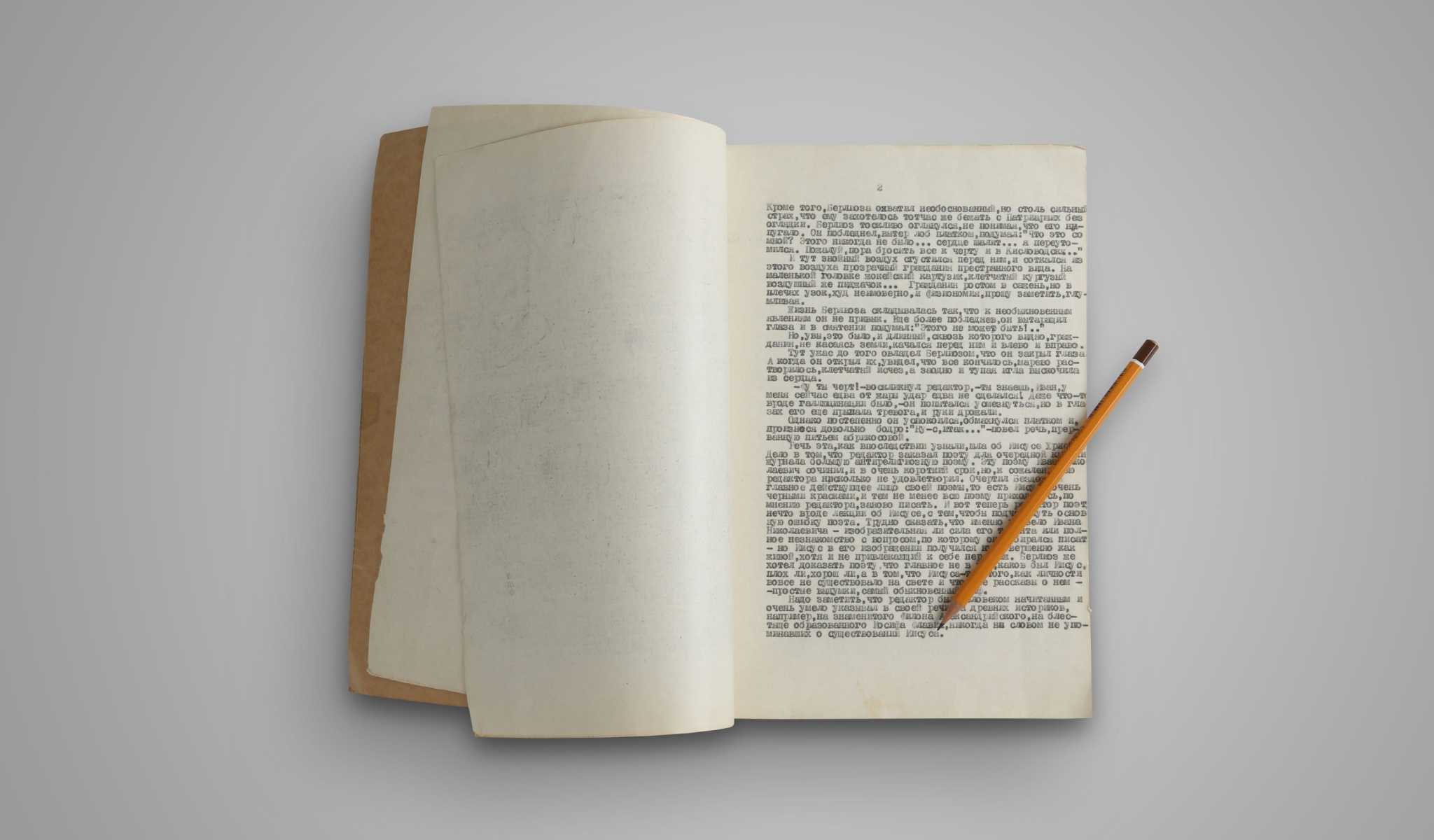
On May 15, 1970, the New York Times published an article by esteemed Russia scholar Albert Parry detailing how Soviet dissident intellectuals were covertly passing forbidden ideas around to each other on handcrafted, typewritten documents called samizdat. Here is the beginning of that seminal story:
“Censorship existed even before literature, say the Russians. And, we may add, censorship being older, literature has to be craftier. Hence, the new and remarkably viable underground press in the Soviet Union called samizdat.”
“Samizdat—translates as: ‘We publish ourselves’—that is, not the state, but we, the people.”
“Unlike the underground of Czarist times, today’s samizdat has no printing presses (with rare exceptions): The K.G.B., the secret police, is too efficient. It is the typewriter, each page produced with four to eight carbon copies, that does the job. By the thousands and tens of thousands of frail, smudged onionskin sheets, samizdat spreads across the land a mass of protests and petitions, secret court minutes, Alexander Solzhenitsyn’s banned novels, George Orwell’s ‘Animal Farm’ and ‘1984,’ Nicholas Berdyayev’s philosophical essays, all sorts of sharp political discourses and angry poetry.”
Though it is hard to hear, the sad fact is that we are living in a time and in a society where there is once again a need for scientists to pass around their ideas secretly to one another so as to avoid censorship, smearing, and defamation by government authorities in the name of science.
I say this from first-hand experience. During the pandemic, the US government violated my free speech rights and those of my scientist colleagues for questioning the federal government’s COVID policies.
American government officials, working in concert with Big Tech companies, defamed and suppressed me and my colleagues for criticizing official pandemic policies—criticism that has been proven prescient. While this may sound like a conspiracy theory, it is a documented fact, and one recently confirmed by a federal circuit court.
In August 2022, the Missouri and Louisiana attorneys general asked me to join as a plaintiff in a lawsuit, represented by the New Civil Liberties Alliance, against the Biden administration. The suit aims to end the government’s role in this censorship and restore the free speech rights of all Americans in the digital town square.
Lawyers in the Missouri v. Biden case took sworn depositions from many federal officials involved in the censorship efforts, including Anthony Fauci. During the hours-long deposition, Fauci showed a striking inability to answer basic questions about his pandemic management, replying “I don’t recall” over 170 times.
Legal discovery unearthed email exchanges between the government and social media companies showing an administration willing to threaten the use of its regulatory power to harm social media companies that did not comply with censorship demands.
The case revealed that a dozen federal agencies pressured social media companies Google, Facebook, and Twitter to censor and suppress speech contradicting federal pandemic priorities. In the name of slowing the spread of harmful misinformation, the administration forced the censorship of scientific facts that didn’t fit its narrative de jour. This included facts relating to the evidence for immunity after COVID recovery, the inefficacy of mask mandates, and the inability of the vaccine to stop disease transmission. True or false, if speech interfered with the government’s priorities, it had to go.
On July 4, US Federal District Court Judge Terry Doughty issued a preliminary injunction in the case, ordering the government to immediately stop coercing social media companies to censor protected free speech. In his decision, Doughty called the administration’s censorship infrastructure an Orwellian “Ministry of Truth.”
In my November 2021 testimony in the House of Representatives, I used this exact phrase to describe the government’s censorship efforts. For this heresy, I faced slanderous accusations by Rep. Jamie Raskin, who accused me of wanting to let the virus “rip.” Raskin was joined by fellow Democrat Rep. Raja Krishnamoorthi, who tried to smear my reputation on the grounds that I spoke with a Chinese journalist in April 2020.
Judge Doughty’s ruling decried the vast federal censorship enterprise dictating to social media companies who and what to censor, and ordered it to end. But the Biden administration immediately appealed the decision, claiming that they needed to be able to censor scientists or else public health would be endangered and people would die. The US 5th Circuit Court of Appeals granted them an administrative stay that lasted until mid-September, permitting the Biden administration to continue violating the First Amendment.
After a long month, the 5th Circuit Court of Appeals ruled that that pandemic policy critics were not imagining these violations. The Biden administration did indeed strong-arm social media companies into doing its bidding. The court found that the Biden White House, the CDC, the US surgeon general’s office, and the FBI have “engaged in a years-long pressure campaign [on social media outlets] designed to ensure that the censorship aligned with the government’s preferred viewpoints.”
The appellate judges described a pattern of government officials making “threats of ‘fundamental reforms’ like regulatory changes and increased enforcement actions that would ensure the platforms were ‘held accountable.’” But, beyond express threats, there was always an “unspoken ‘or else.’” The implication was clear. If social media companies did not comply, the administration would work to harm the economic interests of the companies. Paraphrasing Al Capone, “Well that’s a nice company you have there. Shame if something were to happen to it,” the government insinuated.
“The officials’ campaign succeeded. The platforms, in capitulation to state-sponsored pressure, changed their moderation policies,” the 5th Circuit judges wrote, and they renewed the injunction against the government’s violation of free speech rights. Here is the full order, filled with many glorious adverbs:
“Defendants, and their employees and agents, shall take no actions, formal or informal, directly or indirectly, to coerce or significantly encourage social-media companies to remove, delete, suppress, or reduce, including through altering their algorithms, posted social-media content containing protected free speech. That includes, but is not limited to, compelling the platforms to act, such as by intimating that some form of punishment will follow a failure to comply with any request, or supervising, directing, or otherwise meaningfully controlling the social media companies’ decision-making processes.”
The federal government can no longer threaten social media companies with destruction if they don’t censor scientists on behalf of the government. The ruling is a victory for every American since it is a victory for free speech rights.
Although I am thrilled by it, the decision isn’t perfect. Some entities at the heart of the government’s censorship enterprise can still organize to suppress speech. For instance, the Cybersecurity and Infrastructure Security Agency (CISA) within the Department of Homeland Security can still work with academics to develop a hit list for government censorship. And the National Institutes of Health, Tony Fauci’s old organization, can still coordinate devastating takedowns of outside scientists critical of government policy.
So, what did the government want censored?
The trouble began on Oct. 4, 2020, when my colleagues and I—Dr. Martin Kulldorff, a professor of medicine at Harvard University, and Dr. Sunetra Gupta, an epidemiologist at the University of Oxford—published the Great Barrington Declaration. It called for an end to economic lockdowns, school shutdowns, and similar restrictive policies because they disproportionately harm the young and economically disadvantaged while conferring limited benefits.
The Declaration endorsed a “focused protection” approach that called for strong measures to protect high-risk populations while allowing lower-risk individuals to return to normal life with reasonable precautions. Tens of thousands of doctors and public health scientists signed on to our statement.
With hindsight, it is clear that this strategy was the right one. Sweden, which in large part eschewed lockdown and, after early problems, embraced focused protection of older populations, had among the lowest age-adjusted all-cause excess deaths of nearly every other country in Europe and suffered none of the learning loss for its elementary school children. Similarly, Florida has lower cumulative age-adjusted all-cause excess deaths than lockdown-crazy California since the start of the pandemic.
In the poorest parts of the world, the lockdowns were an even greater disaster. By spring 2020, the United Nations was already warning that the economic disruptions caused by the lockdowns would lead to 130 million or more people starving. The World Bank warned the lockdowns would throw 100 million people into dire poverty.
Some version of those predictions came true—millions of the world’s poorest suffered from the West’s lockdowns. Over the past 40 years, the world’s economies globalized, becoming more interdependent. At a stroke, the lockdowns broke the promise the world’s rich nations had implicitly made to poor nations. The rich nations had told the poor: Reorganize your economies, connect yourself to the world, and you will become more prosperous. This worked, with 1 billion people lifted out of dire poverty over the last half-century.
But the lockdowns violated that promise. The supply chain disruptions that predictably followed them meant millions of poor people in sub-Saharan Africa, Bangladesh, and elsewhere lost their jobs and could no longer feed their families.
In California, where I live, the government closed public schools and disrupted our children’s education for two straight academic years. The educational disruption was very unevenly distributed, with the poorest students and minority students suffering the greatest educational losses. By contrast, Sweden kept its schools open for students under 16 throughout the pandemic. The Swedes let their children live near-normal lives with no masks, no social distancing, and no forced isolation. As a result, Swedish kids suffered no educational loss.
The lockdowns, then, were a form of trickle-down epidemiology. The idea seemed to be that we should protect the well-to-do from the virus and that protection would somehow trickle down to protect the poor and the vulnerable. The strategy failed, as a large fraction of the deaths attributable to COVID hit the vulnerable elderly.
The government wanted to suppress the fact that there were prominent scientists who opposed the lockdowns and had alternate ideas—like the Great Barrington Declaration—that might have worked better. They wanted to maintain an illusion of total consensus in favor of Tony Fauci’s ideas, as if he were indeed the high pope of science. When he told an interviewer, “Everyone knows I represent science. If you criticize me, you are not simply criticizing a man, you are criticizing science itself,” he meant it unironically.
Federal officials immediately targeted the Great Barrington Declaration for suppression. Four days after the declaration’s publication, National Institutes of Health Director Francis Collins emailed Fauci to organize a “devastating takedown” of the document. Almost immediately, social media companies such as Google/YouTube, Reddit, and Facebook censored mentions of the declaration.
In 2021, Twitter blacklisted me for posting a link to the Great Barrington Declaration. YouTube censored a video of a public policy roundtable of me with Florida Gov. Ron DeSantis for the “crime” of telling him the scientific evidence for masking children is weak.
At the height of the pandemic, I found myself smeared for my supposed political views, and my views about COVID policy and epidemiology were removed from the public square on all manner of social networks.
It is impossible for me not to speculate about what might have happened had our proposal been met with a more typical scientific spirit rather than censorship and vitriol. For anyone with an open mind, the GBD represented a return to the old pandemic management strategy that had served the world well for a century—identify and protect the vulnerable, develop treatments and countermeasures as rapidly as possible, and disrupt the lives of the rest of society as little as possible since such disruption is likely to cause more harm than good.
Without censorship, we might have won that debate, and if so, the world could have moved along a different and better path in the last three and a half years, with less death and less suffering.
Since I started with a story about how dissidents skirted the Soviet censorship regime, I will close with a story about Trofim Lysenko, the famous Russian biologist. Stalin’s favorite scientist was a biologist who did not believe in Mendelian genetics—one of the most important ideas in biology. He thought it was all hokum, inconsistent with communist ideology, which emphasized the importance of nurture over nature. Lysenko developed a theory that if you expose seeds to cold before you plant them, they will be more resistant to cold, and thereby, crop output could be increased dramatically.
I hope it is not a surprise to readers to learn that Lysenko was wrong about the science. Nevertheless, he convinced Stalin that his ideas were right, and Stalin rewarded him by making him the director of the USSR’s Institute for Genetics for more than 20 years. Stalin gave him the Order of Lenin eight times.
Lysenko used his power to destroy any biologist who disagreed with him. He smeared and demoted the reputations of rival scientists who thought Mendelian genetics was true. Stalin sent some of these disfavored scientists to Siberia, where they died. Lysenko censored the scientific discussion in the Soviet Union so no one dared question his theories.
The result was mass starvation. Soviet agriculture stalled, and millions died in famines caused by Lysenko’s ideas put into practice. Some sources say that Ukraine and China under Mao Zedong also followed Lysenko’s ideas, causing millions more to starve there.
Censorship is the death of science and inevitably leads to the death of people. America should be a bulwark against it, but it was not during the pandemic. Though the tide is turning with the Missouri v. Biden case, we must reform our scientific institutions so what happened during the pandemic never happens again.
From RealClearWire
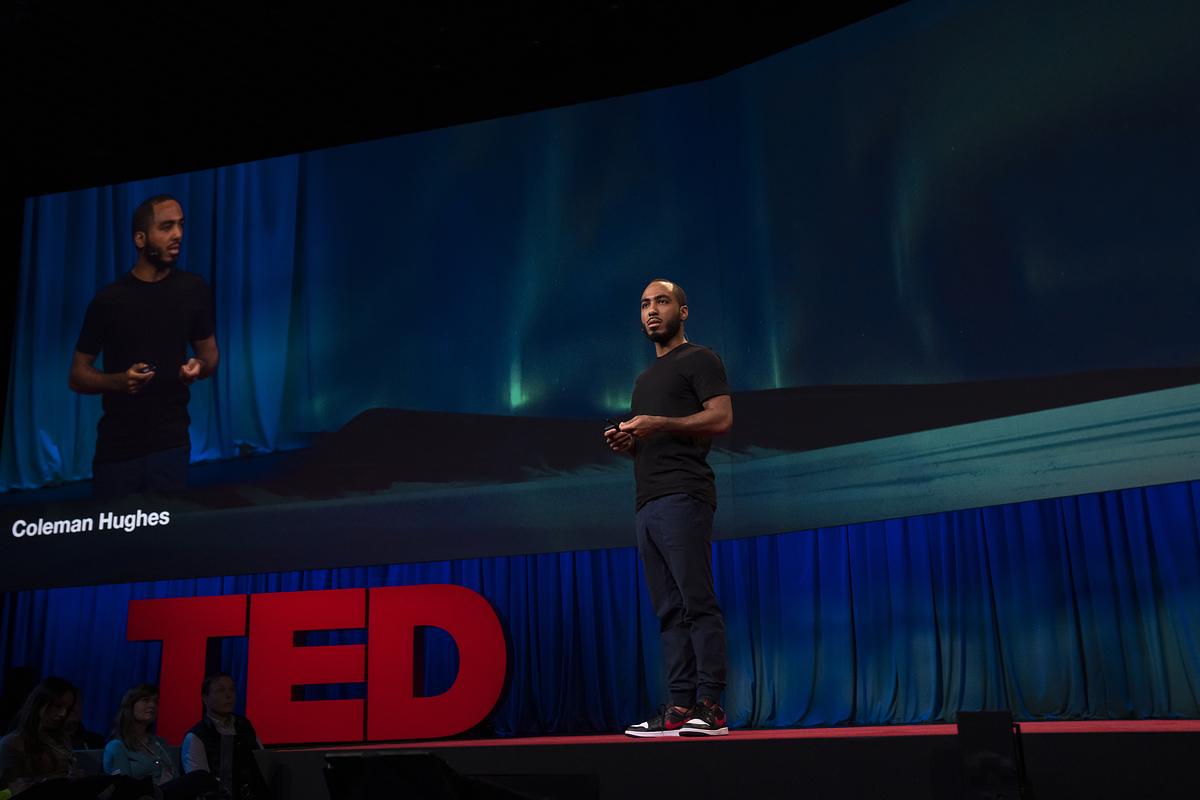
Like any young writer, I am well aware that an invitation to speak at TED can be a career-changing opportunity. So you can imagine how thrilled I was when I was invited to appear at this year’s annual conference. What I could not have imagined from an organization whose tagline is “ideas worth spreading” is that it would attempt to suppress my own.
As an independent podcaster and author, I count myself among the lucky few who can make a living doing what they truly love to do. Nothing about my experience with TED could change that. The reason this story matters is not because I was treated poorly, but because it helps explain how organizations can be captured by an ideological minority that bends even the people at the very top to its will. In that, the story of TED is the story of so many crucial and once-trustworthy institutions in American life.

Let’s go back to the start.
This past April, I gave a talk at the yearly TED conference in Vancouver, Canada. In my talk, I defended color blindness: the idea that we should treat people without regard to race, both in our personal lives and in our public policy. (This is also the topic of my forthcoming book.)
Even though a majority of Americans believe that color-blind policies are the right approach to governing a racially diverse society, we live in a strange moment in which many of our elite believe that color blindness is, in fact, a Trojan horse for white supremacy. Taking that viewpoint seriously—while ultimately refuting it—was the express purpose of my talk.
As you might imagine, TED is an unbelievably well-oiled machine. In the weeks and months leading up to the conference, I wrote my talk, revised it in conjunction with TED’s curation team, and cleared it with their fact-checkers. I have never prepared more thoroughly for a talk. On April 19, I stepped onstage in front of an audience of nearly 2,000 people and delivered it.
TED draws a progressive crowd, so I expected that my talk might upset a handful of people. And indeed, out of the corner of my eye, I saw a handful of scowling faces. But the reaction was overwhelmingly positive. The audience applauded; some people even stood up. Throughout the meals and in hallways, people approached me to say they loved it, and those who disagreed with it offered smart and thoughtful criticisms.
But the day after my talk, I heard from Chris Anderson, the head of TED. He told me that a group called “Black@TED”—which TED’s website describes as an “Employee Resource Group that exists to provide a safe space for TED staff who identify as Black”—was “upset” by my talk. Over email, Chris asked if I’d be willing to speak with them privately.
I agreed to speak with them on principle, that principle being that you should always speak with your critics because they may expose crucial blind spots in your worldview. No sooner did I agree to speak with them than Chris told me that Black@TED actually was not willing to speak to me. I never learned why. I hoped that this strange about-face was the end of the drama. But it was only the beginning.
On the final day of the conference, TED held its yearly “town hall”—at which the audience can give feedback on the conference. The event opened with two people denouncing my talk back-to-back. The first woman called my talk “racist” as well as “dangerous and irresponsible”—comments that were met with cheers from the crowd. The second commentator, Otho Kerr, a program director at the Federal Reserve Bank of New York, claimed that I was “willing to have us slide back into the days of separate but equal.” (The talk is online, so you can judge for yourself whether those accusations bear any resemblance to reality.)
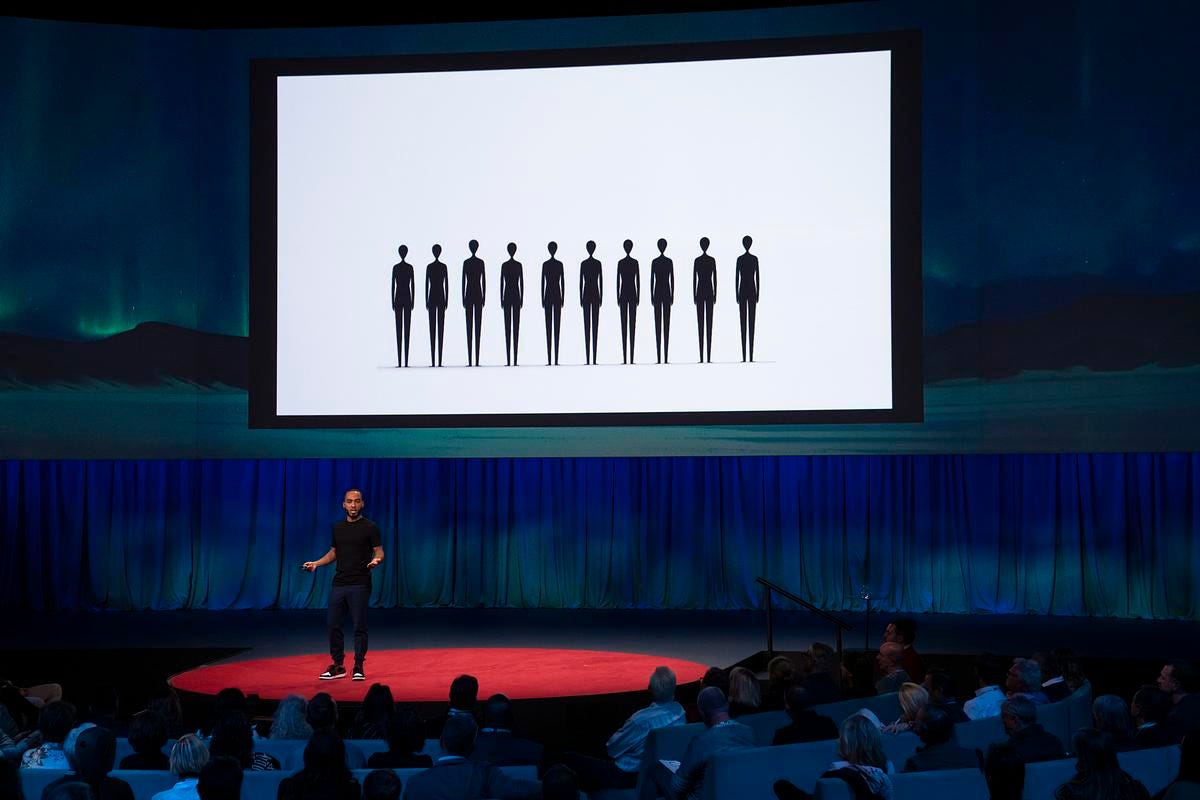
In response to their comments, Anderson took the mic and thanked them for their remarks. He also reminded the audience that “TED can’t shy away from controversy on issues that matter so much”—a statement I very much agreed with and appreciated. Because he said as much, I left the conference fairly confident that TED would release and promote my talk just like any other, in spite of the staff and audience members who were upset by it.
Two weeks later, Anderson emailed to tell me that there was “blowback” on my talk and that “[s]ome internally are arguing we shouldn’t post it.” In the email, he told me that the “most challenging” blowback had come from a “well-known” social scientist (who I later learned was Adam Grant). He quoted from Grant’s message directly:
Really glad to see TED offering viewpoint diversity—we need more conservative voices—but as a social scientist, was dismayed to see Coleman Hughes deliver an inaccurate message.
His case for color blindness is directly contradicted by an extensive body of rigorous research; for the state of the science, see Leslie, Bono, Kim & Beaver (2020, Journal of Applied Psychology). In a meta-analysis of 296 studies, they found that whereas color-conscious models reduce prejudice and discrimination, color-blind approaches often fail to help and sometimes backfire.
I read the paper that Grant referenced, titled “On Melting Pots and Salad Bowls: A Meta-Analysis of the Effects of Identity-Blind and Identity-Conscious Diversity Ideologies,” expecting to find arguments against color blindness. I was shocked to find that the paper largely supported my talk. In the results section, the authors write that “colorblindness is negatively related to stereotyping” and “is also negatively related to prejudice.” They also found that “meritocracy is negatively related to discrimination.”
I wrote back to Anderson:
Far from a refutation of my talk, this meta-analysis is closer to an endorsement of it.
The only anti–color blindness finding in the paper is that color blindness & meritocracy are associated with opposing DEI policies. Well, I do oppose race-based DEI policies in most (but not all) cases. Unapologetically. But that is a philosophical disagreement, not an example of me delivering incorrect social science.
I feel it would be unjustified not to release my talk simply because many people disagree with my philosophical perspective. By that standard, most TED talks would never get released.
To which he responded: “Thanks, Coleman. Great note. More soon.”
Before this email exchange, I hadn’t seriously considered the possibility that TED might not post my talk at all. What’s more, the fact that the “most challenging” blowback to my talk was a social science paper showing that color blindness reduces stereotyping and prejudice puzzled me.
About a week later, I received an email from Whitney Pennington Rodgers, the current affairs curator at TED and the point person for the curation of my talk. Whitney said that in lieu of releasing my TED talk normally, TED was inviting me “to participate in a moderated conversation that we would publish as an extension of your talk.” I’m always happy to converse and debate, so I agreed—too hastily, in retrospect. I had assumed that the phrase “an extension of your talk” was meant metaphorically—i.e., that this “moderated conversation” would be a separate video. Only later in the email exchange did I realize that it was meant literally. In other words, TED wanted my talk and this “moderated conversation” to be released as a single, combined video.
I had two problems with this. First, it would hold the release of my TED talk hostage to the existence of this other “moderated conversation” (which at the time was not guaranteed to happen at all). Secondly, I worried that tacking a debate to the end of my TED talk would effectively put an asterisk next to it. It would imply that my argument ought not be heard without also hearing the opposing perspective—that it shouldn’t be absorbed without a politically palate-cleansing chaser. Given that my talk had passed the initial fact-checking, the curation team, and had been cleared by Anderson and Rodgers themselves, I saw no reason why it wouldn’t be released and promoted as any other talk would be. I told Rodgers as much over a Zoom call.
Because she and I were unable to come to an agreement, I had a follow-up call with Anderson. On that call, he conceded that his employees’ anger stemmed from political bias, but nevertheless asked me to agree to an atypical release strategy: TED would release the debate and the talk as separate videos, but at the same time. He sold this idea to me as a way to amplify my talk—as if this atypical release strategy were conceived for my benefit. That made little sense to me. The reality, I told him, was that these nonstandard release strategies were intended not to amplify my message but to dilute it. After all, the whole genesis of this debacle was the fact that certain TED staffers wanted to nix my talk altogether—and Anderson feared an internal firestorm if my talk were released normally. Clearly, the release proposals being pressed upon me were conceived in order to placate angry staffers, not in order to amplify my message.
By the end of the calls, we had reached a compromise: TED would release and promote my talk as they would any other, and I would participate in a debate that would be released as a separate video no fewer than two weeks after my talk.
I held up my end of the bargain. TED did not.
My talk was posted on the TED website on July 28. The debate was posted two weeks later. By the time the debate came out, I had moved on—I assumed that TED had held up its end of the bargain and was no longer paying close attention.
Then, on August 15, Tim Urban––a popular blogger who delivered one of the most viewed TED talks of all time—pointed out that my talk had only a fraction of the views of every other TED talk released around the same time. Urban tweeted:
There have been a million talks about race at TED. For this talk and only for this talk was the speaker required to publicly debate his points after the talk as a condition for having it posted online. As it is, the lack of standard promotion by TED has Coleman’s talk at about 10% of the views of all the other talks surrounding his on their site.
Two days later, I checked to see if Tim was onto something. As of August 17, the two talks released just before mine had 569K and 787K views, respectively, on TED’s website. The two talks released immediately after mine—videos that had less time to circulate than mine—had 460K, 468K views, and 489K views, respectively. My talk, by comparison, had 73K views—only 16 percent of the views of the lowest-performing video in its immediate vicinity.
My debate with Jamelle Bouie—a New York Times columnist with almost half a million followers on X, formerly Twitter—has performed even worse on TED’s website. As of Tuesday, September 19—after having over a month to circulate—it had a whopping 5K views. That makes it the third worst-performing video released by TED in all of 2023.
Either my TED content is performing extremely poorly because it is far less interesting than most of TED’s content, or TED deliberately is not promoting it. A string of evidence points to the latter explanation: unique among the TED talks released around the same time as mine, my talk has still not been reposted to the TED Talks Daily podcast. In fact, it was not even posted to YouTube until I sent an email inquiry.
According to its website, TED’s mission is to “discover and spread ideas that spark imagination, embrace possibility, and catalyze impact.” They claim to be “devoted to curiosity, reason, wonder, and the pursuit of knowledge—without an agenda.” My experience suggests otherwise, with TED falling far short of those ambitions and instead displaying all the hallmarks of an institution captured by the new progressive orthodoxy. TED’s leadership must decide whether it wants to do something about it—or let the organization become yet another echo chamber.

Coleman Hughes is a columnist for The Free Press. Read the responses from Adam Grant and Chris Anderson to this essay here.
To support an organization committed to curiosity, become a Free Press subscriber today.
THIS SEEMS ENTIRELY IN CHARACTER FOR OUR RULERS: Taxpayers Stuck Paying the Bills for Oligarchs’ Seized Yachts and Mansions: Assets taken from sanctioned Russian billionaires are costly to maintain as legal hurdles hold up sales; $28,000 a week to keep mold out of the Alfa Nero.
Since Russian tanks rolled into Ukraine, dozens of governments launched an unprecedented effort to pressure Putin to end the war by going after his well-heeled cronies. The Russian Elites, Proxies, and Oligarchs Task Force, a multinational government group that coordinates on sanctions, reported in March that an estimated $58 billion of oligarchs’ assets, including yachts, mansions and investments, have been frozen or blocked because of their owners’ links to the Kremlin. . . .
So far, the grand total from the assets delivered to Ukraine by the U.S. is just $5.4 million, the U.S. said. The U.K. hasn’t turned any frozen assets into funds. Neither has the European Union. . . .
In practical terms, it is often taxpayers who are on the hook for eye-watering bills to maintain a fleet of high-end yachts and mansions that no one is allowed to use while sanctions remain in place. . . . As a rule of thumb, big yachts cost around 10% of their value a year to maintain, said Benjamin Maltby, a lawyer at Keystone Law
, which specializes in advising on megayachts. Their hulls need to be regularly scraped and air-conditioning units run nearly round the clock. The crew also needs paying. So does insurance and rent in marinas.
They have lost the use of their yachts, but on the other hand they’re sticking someone else with the bills for upkeep.