Computer chips are already processing information in nanoseconds. How much faster do we need them to go?
Computer chips are already processing information in nanoseconds. How much faster do we need them to go?
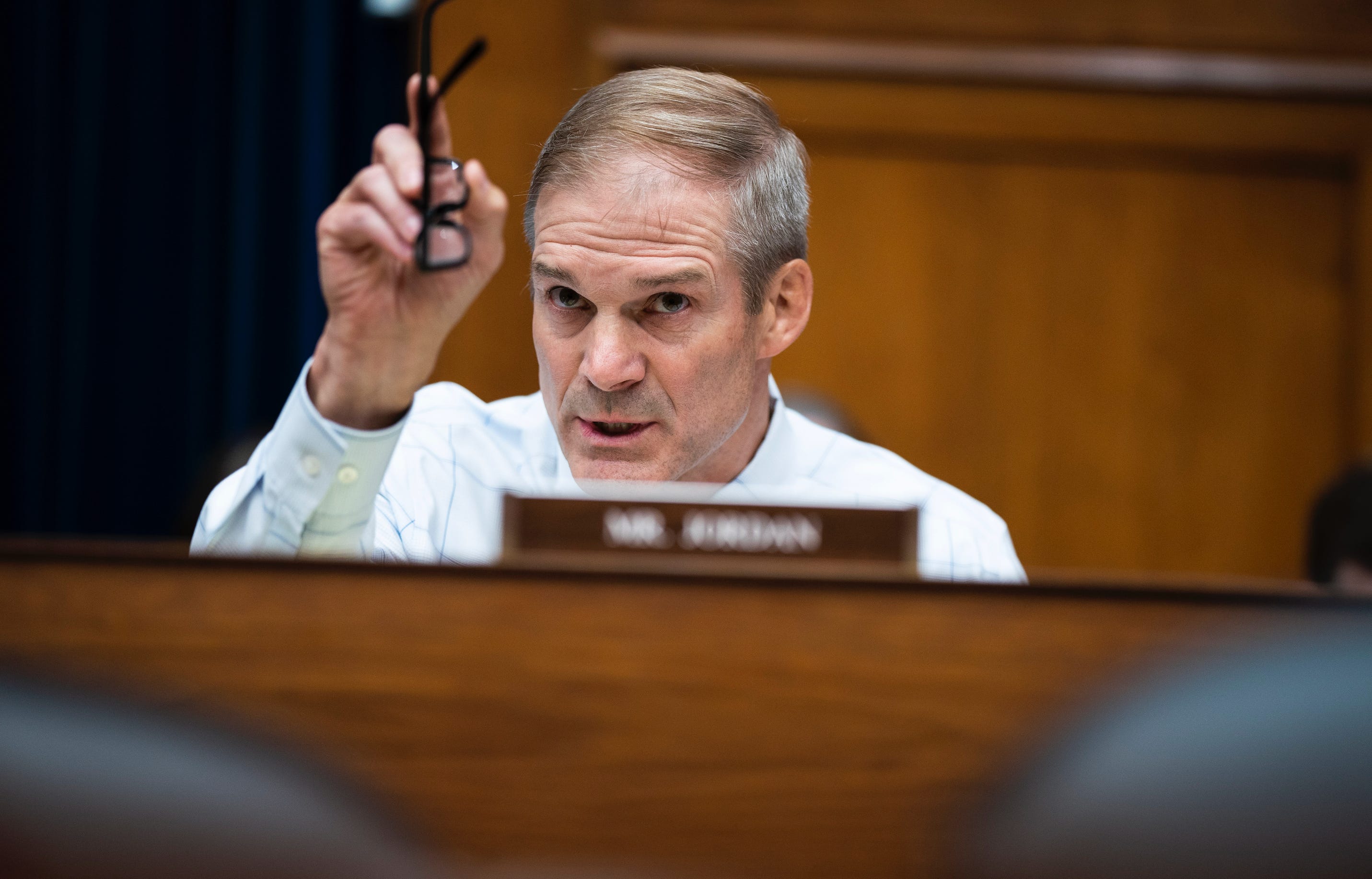
A new report about IRS home visits has just been released by the House Weaponization of Government Committee, chaired by Ohio congressman Jim Jordan. It outlines disturbing issues, including confirmation that IRS agents making home visits may come without warning, using aliases, and without informing local enforcement agencies of their presence.
One of the cases outlined is my own. My home was visited by the IRS while I was testifying before Jordan’s Committee about the Twitter Files on March 9th. Sincere thanks are due to Chairman Jordan, whose staff not only demanded and got answers in my case, but achieved a concrete policy change, as IRS Commissioner Daniel Werfel announced in July new procedures that would “end most” home visits.
Anticipating criticism for expressing public thanks to a Republican congressman, I’d like to ask Democratic Party partisans: to which elected Democrat should I have appealed for help in this matter? The one who called me a “so-called journalist” on the House floor? The one who told me to take off my “tinfoil hat” and put greater trust in intelligence services? The ones in leadership who threatened me with jail time? I gave votes to the party for thirty years. Which elected Democrat would have performed basic constituent services in my case? Feel free to raise a hand.
If silence is the answer, why should I ever vote for a Democrat again?
Jts5665Why would we stop nazis from outing themselves?

 Florida Gov. Ron DeSantis’s administration has ordered state universities to ban a pro-Palestinian student organization, Students for Justice in Palestine (SJP). The state has denounced SJP as supporting a “terrorist organization” after the massacre of Israelis by Hamas. I have previously written how Hamas is morally and legally a terrorist organization. However, this move would, in my view, violate the First Amendment and chill the exercise of free speech in higher education.
State university system Chancellor Ray Rodrigues wrote to university presidents Tuesday directing them to disband chapters of SJP. He quoted the national group’s declaration that “Palestinian students in exile are PART of this movement, not in solidarity with this movement.”
That is a rather thin rationale for declaring that the student groups are now aiders and abetters of terrorism. Nevertheless, Rodrigues declared “it is a felony under Florida law to ‘knowingly provide material support … to a designated foreign terrorist organization.’”
Students for Justice in Palestine has been on U.S. campuses for decades with more than 200 chapters across the United States. The Supreme Court has repeatedly struck down such content-based bans and has been particularly protective of free speech in higher education. In 1943, in the midst of World War II, Supreme Court Justice Robert Jackson wrote schools “educating the young for citizenship is reason for scrupulous protection of Constitutional freedoms of the individual, if we are not to strangle the free mind at its source and teach youth to discount important principles of our government as mere platitudes.”
The Supreme Court has protected speech that is vile and prejudicial. That included the racist and anti-Semitic speech of a Catholic priest in Terminiello v. City of Chicago, 337 U.S. 1 (1949). In that case, Justice William O. Douglas wrote:
The right to speak freely and to promote diversity of ideas and programs is therefore one of the chief distinctions that sets us apart from totalitarian regimes.
Accordingly a function of free speech under our system of government is to invite dispute. It may indeed best serve its high purpose when it induces a condition of unrest, creates dissatisfaction with conditions as they are, or even stirs people to anger. Speech is often provocative and challenging. It may strike at prejudices and preconceptions and have profound unsettling effects as it presses for acceptance of an idea. That is why freedom of speech, though not absolute… is nevertheless protected against censorship or punishment, unless shown likely to produce a clear and present danger of a serious substantive evil that rises far above public inconvenience, annoyance, or unrest. …There is no room under our Constitution for a more restrictive view. For the alternative would lead to standardization of ideas either by legislatures, courts, or dominant political or community groups.
I strongly disagree with many of the protests being held on campuses, including a deeply disturbing incident at George Washington University this week praising “the martyrs” in the Hamas attack. Our Jewish students need to feel safe on our campuses — a concern magnified this week by the image of Jewish students locked in a library for their own protection in New York.
However, the solution is not the denial of free speech on our campuses. Higher education demands a protective space for a diversity of viewpoints. The solution to bad speech remains better speech, not censorship or criminalization of speech.
Larry posted this over on the Book of Faces and good golly they didn’t like it! They throttled it to the point that there were maybe 24 comments in over 2 hours. Even with their regular throttling of his account, he would normally have been yelled at by a few hundred people by that time, so it’s really telling. Know where they can’t throttle it? Right here on the Monster Hunter Nation site. Enjoy. -Jack
I posted this on twitter earlier. Now I’m going to get yelled at by crazy people for the next few days.
##
For all the people on social media crying about Israelis blowing up innocents this week, yep, that sucks, but why do terrorists hide behind civilians?
You.
That’s it.
You make it an effective tactic for them.
I see people saying that anything that harms innocents should be a war crime.
Congratulations.
You just ensured that’s the tactic every evil bastard out there will use from now on. Hiding under a church or school or hospital becomes a get out of jail free card.
Go do terrorist shit. Then hide behind your kids. Kids die. Wait for the world to freak out and pressure the people you murdered to give up and leave you alone. Do more terrorist shit to them again tomorrow.
Your naivete about the nature of evil ensures that hiding behind civilians is a winning tactic for them. You get sad for their human shields, governments cave, the evil doers get to live to rape and murder again tomorrow.
There is nothing nice or kind or merciful about war.
It’s miserable. Innocent people suffer and die. It’s total bullshit.
And it’s been part of human nature forever and will never ever stop, regardless of how hard you virtue signal your angst on Twitter.
Letting aggressor barbarians hit you but get away just ensures that they’ll do the same shit tomorrow. Every nation in history has understood this.
It isn’t about being mean. It is about being punitive.
There aren’t diplomatic solutions with barbarians who are willing to go house to house, raping people to death. That ship has sailed.
The people who got hit are going to respond. We would. In fact, we did. Did we do it smartly? Nope. We did a lot of pointless shit for the next 20 years, but on 9-11 we didn’t give a shit what any other country had to say, and anybody who talked to us about “proportional response” got told to fuck off. This is the same thing, but approximately 30 times worse adjusted for relative population size.
So they’re going to do what they’re going to do, in the hope that they can stop it from happening again.
Will it work? Beats me. This shit’s complicated and anybody who pretends it isn’t is trying to sell you something.
But what I do know is that if you reward the enemy and give them what they want for hiding behind human shields, that just ensures they are going to do it more. Because when you’re evil, life is cheap, even your own kids, and everybody is expendable to get what you want.
So when Hamas hides under a school, they’re doing it for you.
NOTHING TO SEE HERE, MOVE ALONG: FBI Received ‘Criminal Information’ From 40+ Confidential Sources On The Biden Family. “Grassley said that an FBI task force inside the Washington Field Office shut down ‘reporting and information from those sources by falsely discrediting the information as foreign disinformation,’ the report said. The result was that a lot of the information that was given to officials went nowhere.”

When I accepted a tenure-track position in the economics department of Spelman College in the spring of 2021, handing out bogus grades was the last thing on my mind. Spelman, after all, has a great reputation. Based in Atlanta, it’s a women-only historically black college, one of the oldest in the country; for the past 15 years, it’s been rated the number one HBCU by U.S. News & World Report.
I arrived on campus in mid-August, a week before classes began, to attend an orientation session for new faculty. Sitting on the stage of a modestly sized auditorium, a panel of Spelman teachers and administrators pressed upon us the importance of maintaining high standards. I recall the head of the sociology department saying, “Absolutely don’t run a deficiency model!”—meaning we should never act as though our students were intellectually or educationally deficient. Another member of the panel said professors should work to instill the idea in students that they represent “black excellence.” As someone who has always lived in the white world (though I’m half Filipino), I found this deeply inspiring. I thought, this is the kind of place where I want to teach.
What I discovered, however, was that Spelman’s high-minded rhetoric didn’t match its reality. This was especially true when it came to awarding students grades they hadn’t earned. Grade inflation is a well-documented problem at universities across the country, of course. But what I found at Spelman was even more troubling: even after receiving the “normal” grade inflation, students demanded yet higher grades—and revolted when I wouldn’t go along. To my astonishment, the students went above me to Spelman’s administration, which capitulated without ever telling me. And because I refused to look the other way, I lost my job.
So much for maintaining high standards.

I taught two courses during my first semester at Spelman, but the one that caused most of the trouble was Econ 303—an econometrics class that most Spelman economics majors take in their junior year. Econometrics is about applying high-level mathematics to economic issues. It is not an easy course. But it is an essential course, one that imparts one of the key building blocks of economic modeling.
All economics majors have to be literate in probability theory, statistics, and math. They have to be comfortable developing the mathematical proofs that will clinch their arguments. I learned the importance of math when I was an economics student, and it’s something I communicated to students when I was a teaching assistant at the University of California–Irvine while getting my PhD. I felt it was important for my students to exit the course with an undergraduate-level proficiency.
At first, the class seemed to go well. The beginning of my time at Spelman coincided with the lifting of most of the university’s Covid-19 restrictions, so most students attended in person (though virtual attendance remained an option). Knowing that the material could take some time to understand, I made a point of writing detailed lecture notes and making them available. Econometrics isn’t the kind of course that lends itself to classroom discussions, but at least three-quarters of the 20 students in the class took advantage of my office hours. Most often, they were looking for help with mathematical proofs—and more than once I saw the light bulb go on after we’d talked. Those were immensely rewarding moments.
Then came the midterm. I wanted it to be challenging but not impossible. It lasted 75 minutes—the length of the class. The students were allowed to refer to the lecture notes I’d provided. But even with this open-book format, the results were disappointing. One student earned a 95, but the next highest grade was a 72. Most of the others were between the low 50s and mid-60s. Some of the grades, however, were extremely low, meaning that the average score was a failing grade. I’ll admit I was shaken up. This wasn’t what I expected. I asked my department chair for her advice, and she told me I should raise all the grades by 28 points. That way, the student with the 72 would get 100, and all the other grades would rise in lockstep.
Improving grades in this fashion is called scaling, and it’s very common, especially for difficult courses. And while it’s not something I’m crazy about doing, I’ve seen it done so often I no longer get worked up about the practice. Besides, I was new at Spelman, and I didn’t want to get into a spat with my department chair weeks after starting the job. So I did as she suggested.
I had assumed that the students would feel relieved—even grateful—to see the improvement in their grades. But I was wrong. When the students saw how low their original grades were—and that the raw average was a failing grade—they turned against me. In a class where students rarely spoke, they now peppered me with complaints. The test was too hard. They hadn’t had enough time to complete it. I hadn’t done a good enough job teaching them the material.
Their basic argument was that since virtually the entire class had performed poorly on the midterm, it had to be my fault, and therefore, I needed to make changes that aligned with their wishes and input. Boiled down, they had two demands: make the class easier, and promise that they would all get passing grades. One student even advised me to throw out the midterm and proceed as if it had never taken place.
Had I agreed to their demands, our little controversy would have ended, and we would have finished the semester in an uneasy détente. But it didn’t feel right. I recalled the statements made during orientation about how we shouldn’t run a deficiency model. To fold to these demands seemed like a dereliction of duty. My assumption—which turned out to be terribly naive—was that Spelman’s higher-ups would have my back.
There were another two months left in the semester. Ignoring the demands of my students, I taught the class the same way I had before the midterm. The atmosphere was chilly. The students stopped coming in person; instead, they all took the class virtually. Visits to my office dried up. Most of them even refused to do the coursework—making it likely that their final exam would be even worse than the midterm.
The Friday before the final exam, a large group of my students turned up at the department chair’s office to complain about me. Essentially, they wanted her to do what I wouldn’t—give them a better grade. Later that evening, the chair called me. She told me that my refusal to do what they demanded had caused the students to believe that I didn’t care about them. My response was that, in turning them down, I was showing that I did care. I wanted them to be the best versions of themselves; cutting corners in an important course was contrary to that goal. I also told her that this is what I thought Spelman wanted from me.
In response, the department chair offered several “solutions.” She thought I should offer some extra credit assignments. Another possibility was to give the final exam less weight than I had previously planned. I declined. She also told me that the students would be putting together a student-led survey to register their complaints against me.
Was that a veiled threat? It seemed that way to me.
Sure enough, the results of the final were worse than the midterm. I struggled with what to do. I knew my department chair was going to insist that I scale up the grades, so I did it preemptively. This time, I brought the second highest grade to a 90, which required scaling the grades by 36 points: a 57 was now an A. I can’t say I was comfortable with that big a jump, but in all honesty, I did it in the hope it would mitigate the students’ complaints about me.
It did not. Unbeknownst to me, the students had filed a grievance against me with Desiree Pedescleaux, Spelman’s dean of undergraduate studies. That grievance led to a conversation with several top administrators, including Pedescleaux and my department chair. The dean listed a series of complaints the students had lodged. For instance, I had merely recommended the textbook, but hadn’t required it. This was true: I made comprehensive notes for each class, and I thought the students could save some money by using my notes as their textbook. Some of the allegations were simply false, such as the charge that I didn’t post course assignments for students to review. Still, not once during the conversation did Pedescleaux ever mention changing my students’ grades.
It was nearly 10 months later, in November 2022, well into my second year at Spelman, when I discovered that that’s exactly what she had done: she had changed the students’ grades—and had never informed me. When my department chair told me this, I was stunned.
Yes, I had “scaled” their exam scores. But at least I had taught the class, knew how well (or how poorly) the students had done, and was in a position to make a judgment on their final grades based on the students’ performance in my class. But for an administrator to then change those final grades—behind my back—simply to appease them? How could that possibly be justified?
The response from my department chair, who has been at the college for 17 years, floored me: “This has been occurring ever since I started at Spelman.”
“That’s corrupt,” I blurted out. [In a statement emailed to The Free Press, a Spelman spokesperson wrote that “The College, its administrators, and faculty, exercise appropriate judgment in the delivery of our exceptional learning and living activities in order to maintain consistency across Spelman’s campus.” Spelman declined to comment on any of the specifics in this story.]
It took another three months for Dean Pedescleaux to admit to me that she had indeed raised the students’ grades by giving them “bonus points,” as she called them—enough to bring a C to a C+ and a B− to a B. This, she said, was “fair and equitable” because, as she put it, the students’ complaints about my teaching meant that “some adjustments were warranted.” [The Free Press was shown the email that Pedescleaux wrote to the author in which she acknowledged raising the students’ scores. When asked about this during a brief phone call with The Free Press, Pedescleaux said, “I have no comment.”]
I went to Spelman’s Faculty Council president. “I brought your issue to Faculty Council,” she responded in an email, “and some of them experienced what you did. They all agreed that grades are at the discretion of the instructor only, no one else.” But the Faculty Council took no further action.
Finally, I reached out to the interim provost to request a meeting. In early July 2023, with my second year at Spelman behind me, she emailed her response: “I have spoken to Dean Pedescleaux about the matter that you referenced concerning grades. I am satisfied with her response.” She agreed to a virtual meeting, however.
Going into the meeting, I expected to finally get a chance to discuss the issue with a high-level administrator. I knew that my persistence was not welcome, but I felt it was important to have a discussion. What’s more, the provost had been instrumental in giving me the job in the first place, so I assumed that our meeting would be cordial.
And it was cordial. But the content of the conversation wasn’t at all what I expected.
“Spelman has decided not to renew your contract for the upcoming school year,” she told me. “It would not be in the interest of you or the college to continue our professional relationship.”
She then began to discuss the mechanics of my firing, and as she did, I found myself—and I’m not sure why—feeling oddly empathetic to her: it can’t be easy to fire someone for so little reason, I thought. As the conversation wound down, she thanked me for my service to Spelman.
“Thank you,” I said.
“Take care,” she said, ending the meeting.
A few hours later, my email and other Spelman accounts were disabled.

The fact that I lost a coveted tenure-track position after just four semesters is obviously painful to me. But it’s the larger issue that really matters. Universities are supposed to impart knowledge, but they are also supposed to give students a taste of adulthood, which means accepting responsibility—and consequences. Instead, too many schools cower before their student bodies, conscious of the need for their parents’ tuition checks, and a high ranking in U.S. News & World Report.
I’m not the only professor who’s been embroiled in grading controversies. At UCLA, a professor was suspended when, he says, he refused to give black students easier grades than white students. A Harvard professor acknowledged at a faculty meeting a decade ago that he gives out two grades: the one that he feels they truly deserve and another, higher grade, for their transcript. And last year, at NYU, Maitland Jones Jr., an organic chemistry professor, was fired after his students circulated a petition that his class was too difficult and their grades were too low. He later wrote:
Can a young assistant professor, almost all of whom are not protected by tenure, teach demanding material?. . . . [E]ntire careers are at the peril of complaining students and deans who seem willing to turn students into nothing more than tuition-paying clients. . . . Students need to develop the ability to take responsibility for failure. If they continue to deflect blame, they will never grow.
I had always wanted to teach at a small liberal arts college and make a difference in students’ lives. But I’m not so sure that I can remain a teacher. It seems to me that this incessant catering to student demands—not over whether the food in the cafeteria should be improved, but whether they should get grades they haven’t earned—is resulting in a degraded educational experience. If college grades are fraudulent, doesn’t that mean a college degree is fraudulent too?
You bet it does.

Kendrick Morales is an economist and former assistant professor. Follow him on Substack here. And read this Free Press article by Dr. Stanley Goldfarb about declining standards at medical schools.
And to support our mission of independent journalism, become a Free Press subscriber today:
WHY DON’T PEOPLE TRUST THE MEDICAL PROFESSION? Johns Hopkins doctor’s bullying exposes whole profession.
The US medical profession has a real credibility problem — and doctors bear a huge share of the blame.
Consider the latest news for the “bad physician” file, the sobering tale of Dr. Jonathan Epstein, a leading pathologist at Johns Hopkins.
The doc allegedly bullied his colleagues to deliver second opinions supporting diagnoses from his wife, also a pathologist.
These included, horrifically, a surgical bladder removal that may not even have been necessary.
Epstein was put on administrative leave in May: Why is the public only finding out about this now?
Worse, neither Epstein nor his erstwhile employer has admitted that anything in the slightest could be wrong.
So here we have Hopkins — the byword for medical excellence in America — engaged in a seeming cover-up of what looks like massive misconduct by one of its top physicians.
Every institution has been corrupted.
AN OREGON DIPLOMA IS JUST A PIECE OF PAPER: Oregon keeps grad requirements low: No need for reading, writing, math competency. “Oregon must be a Looking Glass World: Motivating students to improve their writing and math skills is harmful. Sending them out into the world unprepared — but with another elective — is helpful.”
HIGHER EDUCATION BUBBLE UPDATE: At Harvard, there are 2,600 more administrators than undergrads.
To be honest, I don’t really want more Harvard undergrads. But then, I don’t want more Harvard administrators, either.
THAT IS SOME PRETTY SCREWED UP ALTERNATE HISTORY. WORSE THAN REGENCY ENGLAND HAVING A BLACK QUEEN: New York Magazine writer sparks outrage as claims Zionists worked with Nazis during WWII.
THE MASK COMES OFF: Determined to defend face coverings, a Scientific American article dismisses scientific “rigor.”
In response, [Naomi Oreskes, a Harvard professor of the history of science] claimed that “[t]he Cochrane finding was not that masking didn’t work but that scientists lacked sufficient evidence of sufficient quality to conclude that they worked.” She continues, “Jefferson erased that distinction, in effect arguing that because the authors couldn’t prove that masks did work, one could say that they didn’t work. That’s just wrong.” But Jefferson didn’t simply say that masks don’t work; he said there’s “no evidence” they work. The burden of proof should be on the side of those advocating a medical intervention. Without remotely having met that burden, Oreskes asserts that masks do work. Cochrane, she writes, “gave the false impression that masking didn’t help.”
In fact, 16 RCTs have tested whether masks effectively reduce the spread of viruses. Not onehas found compelling evidence that they do. Two have found statistically significant evidence that masks are counterproductive—that they increase the spread of viruses—probably because masks are frequently moist or dirty, and people often touch them. As for non-RCT evidence, check out this chart by Ian Miller, which shows that mask-mandate and mask-free states registered almost identical Covid-19 case rates.
Surgical masks were designed to protect patients from having open wounds infected by medical personnel, not to prevent the spread of viruses. N95 masks were designed to protect workers from breathing in fumes, smoke, or dust. When N95s were worn in hospitals pre-Covid, it was usually to protect against the spread of tuberculosis bacteria, not to stop the spread of viruses. As an article on the National Institutes of Health website puts it, “Viruses are tiny. . . . Billions can fit on the head of a pin.” Bacteria are huge by comparison: “Bacteria are 10 to 100 times larger than viruses.” Trying to block a virus with a mask is like trying to keep mosquitos out of your yard with a chain-link fence.
Read the whole thing.
Fears about new technology replacing human labor and causing overall unemployment have raged across industrialized societies for hundreds of years, despite a nearly continual rise in both jobs and wages in capitalist economies. The jobs apocalypse is always right around the corner; just ask the Luddites.
We had two such anti-technology jobs moral panics in the last 20 years — “outsourcing” enabled by the Internet in the 2000’s, and “robots” in the 2010’s. The result was the best national and global economy in human history in pre-COVID 2019, with the most jobs at the highest wages ever.
Thanks for reading Marc Andreessen Substack! Subscribe for free to receive new posts and support my work.
Now we’re heading into the third such panic of the new century with AI, coupled with a continuous drumbeat of demand for Communist-inspired Universal Basic Income. “This time is different; AI is different,” they say, but is it?
Normally I would make the standard arguments against technologically-driven unemployment — see good summaries by Henry Hazlitt (chapter 7) and Frédéric Bastiat (his metaphor directly relevant to AI). And I will come back and make those arguments soon. But I don’t even think the standand arguments are needed, since another problem will block the progress of AI across most of the economy first.
Which is: AI is already illegal for most of the economy, and will be for virtually all of the economy.
How do I know that? Because technology is already illegal in most of the economy, and that is becoming steadily more true over time.
How do I know that? Because:
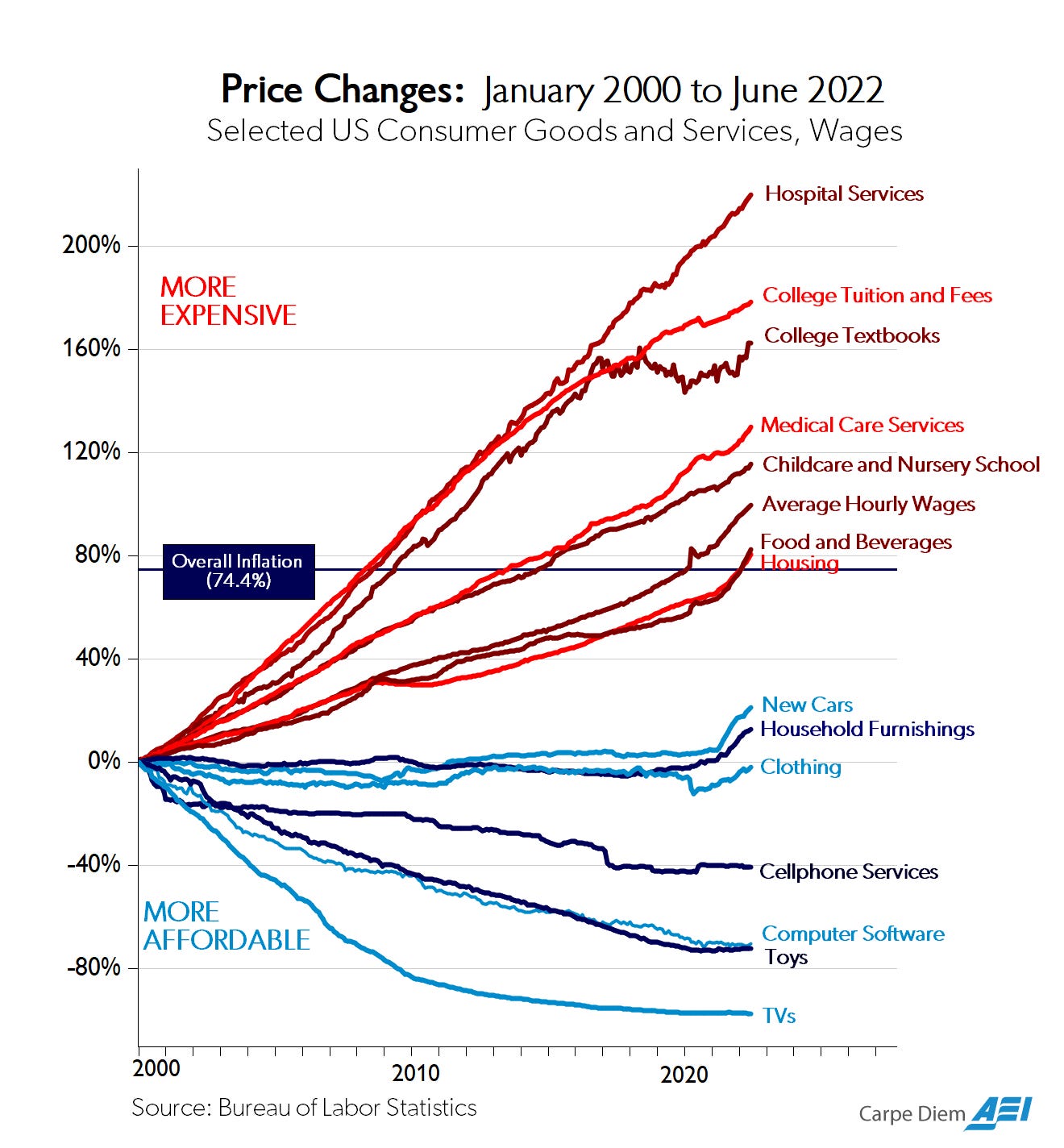
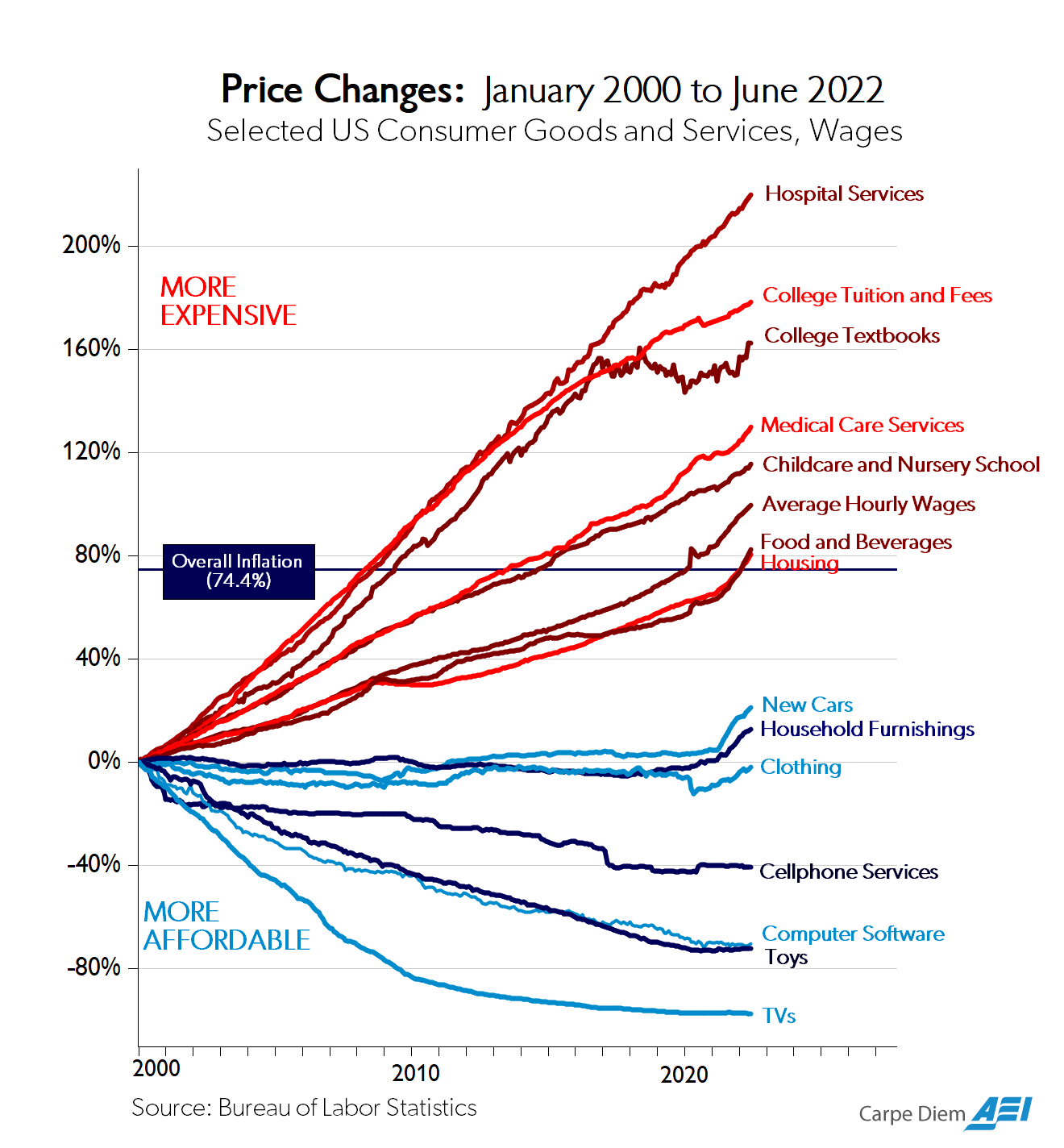
This chart shows price changes, adjusted for inflation, across a dozen major sectors of the economy.
As you can see, we actually live in two different economies.
The lines in blue are the sectors where technological innovation is allowed to push down prices while increasing quality. The lines in red are the sectors where technological innovation is not permitted to push down prices; in fact, the prices of education, health care, and housing as well as anything provided or controlled by the government are going to the moon, even as those sectors are technologically stagnant.
We are heading into a world where a flat screen TV that covers your entire wall costs $100, and a four year college degree costs $1 million, and nobody has anything even resembling a proposal on how to systemically fix this.
Why? The sectors in red are heavily regulated and controlled and bottlenecked by the government and by those industries themselves. Those industries are monopolies, oligopolies, and cartels, with extensive formal government regulation as well as regulatory capture, price fixing, Soviet style price setting, occupational licensing, and every other barrier to improvement and change you can possibly imagine. Technological innovation in those sectors is virtually forbidden now.
Whereas the sectors in blue are less regulated, technology whips through them, pushing down prices and raising quality every year.
Note the emotional loading of the interplay of production and consumption here. What do we get mad about? With our consumer hat on, we get mad about price increases — the red sectors. With our producer hat on, we get mad about technological disruption — the blue sectors. Well, pick one; as this chart shows, you can’t have your cake and eat it too.
Now think about what happens over time. The prices of regulated, non-technological products rise; the prices of less regulated, technologically-powered products fall. Which eats the economy? The regulated sectors continuously grow as a percentage of GDP; the less regulated sectors shrink. At the limit, 99% of the economy will be the regulated, non-technological sectors, which is precisely where we are headed.
Therefore AI cannot cause overall unemployment to rise, even if the Luddite arguments are right this time. AI is simply already illegal across most of the economy, soon to be virtually all of the economy.
Thanks for reading Marc Andreessen Substack! Subscribe for free to receive new posts and support my work.
THE TOXIC INDUSTRY OF HIGHER EDUCATION: We law students aren’t surprised campuses are so pro-Hamas.
Those outside academia should know these students are likely shocked that wider society is not applauding their actions.
They don’t see these statements as particularly heterodox — in fact, the opposite.
Why?
Schools have, by their own design, become devoid of free inquiry and exchange, adopting instead a homogenous set of viewpoints, many of them extremely radical.
An elite American institution’s average student body is no longer a representative sample of adolescents with top GPAs and test scores.
For years, admissions offices across the country have deliberately prioritized passion for social justice and activism in potential applicants — to their detriment.
Yes, the admissions people have been actively selecting for crazy social-justice warriors.
Mr. Kimche describes how “a collection of some 30 student groups” not only “failed to condemn this proto-genocide” perpetrated by Hamas, but “justified and celebrated it.” In recent months, Harvard administrators have bemoaned how the recent Supreme Court decision on affirmative action has threatened the preservation of diversity in the admissions process.
Perhaps its administrators should be more concerned with how to modify the school’s admissions process to ensure that students lacking a basic moral compass are rejected.
Instead of rewarded.
I SUPPOSE IT’S TOO MUCH TO HOPE THAT THEY’LL JUST DO AWAY WITH QUALIFIED IMMUNITY: “The U.S. Supreme Court on Friday agreed to consider what kind of evidence is needed to defeat a qualified immunity claim by government officials accused of engineering the retaliatory arrest of a new city council member who criticized the city manager. . . . Gonzalez is represented by the Institute for Justice. One of the group’s attorneys, Anya Bidwell, said in the press release Castle Hill, Texas, officials should not be allowed to use criminal laws “to launder First Amendment violations and create backdoor censorship.”
CAROL ROTH: America’s financial position is so bad it’s now a national security threat.
The IMF has come out explicitly and reinforced what its analysis has shown implicitly for quite some time: the current financial position of the U.S. is unsustainable. This shouldn’t be a surprise, as this has been echoed by analysis from the Treasury, the CBO (Congressional Budget Office) and just about anyone not detached from reality.
This unsustainability creates not only an economic security issue for the U.S., but a national security issue as well.
After exploding the already massive size of government another 40+% over the past four years, public debt to GDP is again at levels exceeding 120%. For context, the IMF and others have noted in the past that a sovereign balance sheet becomes unwieldy at around 70-80% debt to GDP.
If the U.S. were an emerging market, such a balance sheet would likely cause a currency crisis.
There’s a lot of ruin in a nation and Washington seems determined to find out exactly how much.
WE HAVED RAISED A GENERATION FILLED WITH IMBECILES:
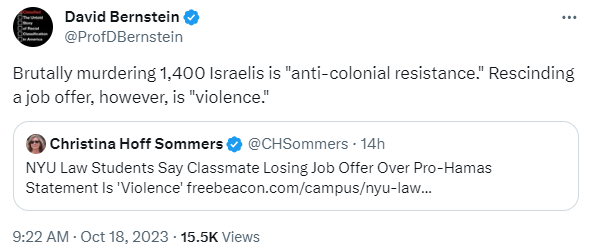
JIM TREACHER: The Curious Case of the Hospital That Didn’t Blow Up.
As it turns out, the people who behead babies and lie about it will also lie about other stuff.
Yesterday we got the news that Israel blew up a hospital in Gaza and killed 500 people.
However, there were a few minor, nitpicky problems with the story: 1) The hospital wasn’t blown up, 2) Nowhere near 500 people were killed, and 3) Israel had nothing to do with it.
It didn’t happen the way Hamas claimed it happened. A misfiring Palestinian Islamic Jihad rocket hit the hospital. It torched some cars in the parking lot and killed some people, but not 500. That’s awful for the people who were killed, but Israel didn’t kill them.
If any of this is a shock to you, then you must work in the media.
Pallywood strikes again.
Related:
Did the NY Times think we wouldn’t notice? pic.twitter.com/QcTeBsJ2ie
— End Wokeness (@EndWokeness) October 17, 2023
THEY’RE CLOSING THE BARN DOOR AFTER SETTING THE HORSE LOOSE: Biden administration announces new sanctions against Hamas.
Meanwhile: Biden Announces $100 Million in Aid That Will Likely Go to Hamas.
And surprise, surprise: the bombshell SH results call into question everything the ‘experts’ have been saying about polar bears in Hudson Bay for years.
The post Polar bear researchers hiding significant increase in Southern Hudson Bay numbers first appeared on Watts Up With That?.
Professor Mark Woolhouse of the University of Edinburgh, a member of the SAGE Covid modelling group, has told the Covid Inquiry his team was never asked to model the harms of lockdown or how to avoid it.
The post “We Were Never Asked to Model the Harms of Lockdown or How to Avoid It,” Says SAGE Modeller appeared first on The Daily Sceptic.
Jts5665interesting. Not sure I believe this, but maybe there will be repercussions to the bad action during the pandemic. I wonder if the pre-use testing process using different production methodology than the final product provided is the trigger for this.
The stock market may be waking up to the possibility that Pfizer may go bankrupt due to the upcoming Covid vaccine legal claims as its value plummets to below pre-pandemic levels.
The post Pfizer May Go Bankrupt, Financial Markets Realise, as Company’s Value Plummets to Below Pre-Pandemic Level appeared first on The Daily Sceptic.
Jts5665I definitely notice it. Especially when eating out.
ROCKY MOUNTAIN HIGH: Colorado’s 5.3% inflation rate outpaces national average of 3.7%.
Jts5665Freedom and ignorance can't coexist for long.
JOURNALISM: “In 1922, The New York Times published its first article about Adolf Hitler. The reporter, Cyril Brown, was aware of his subject’s anti-Jewish animus but he wasn’t buying it. ‘Several reliable, well-informed sources confirmed the idea that Hitler’s anti-Semitism was not so genuine or violent as it sounded,’ Brown wrote, ‘and that he was merely using anti-Semitic propaganda as a bait to catch masses of followers.’ Two years later, the Times published another news item on the future architect of the Holocaust: ‘Hitler Tamed by Prison.’ The Austrian activist, the piece said, ‘looked a much sadder and wiser man,’ and ‘his behavior during his imprisonment convinced the authorities that [he] was no longer to be feared.’ Many got Hamas wrong. But they shouldn’t have. Again and again, people say they intend to murder Jews. And yet, century after century, the world produces new, tortuous justifications for why anti-Jewish bigots don’t really mean what they say—even though they do.”