Shared posts

21 Nov 17:36

New York Times Controversy Exposes the Inherent Conflict in Advocacy Journalism

by jonathanturley

Jazmine Hughes, a writer for the New York Times Magazine, resigned this week after a conflict with her editors over signing of an anti-Israeli letter. New York Times Magazine Editor Jake Silverstein said Hughes violated the company’s policy on public protest. The incident exposes the inherent conflicts — and hypocrisy — in the shift away from neutrality in reporting in media companies and graduate programs.

I have long been a critic of what I called “advocacy journalism” as it began to emerge in journalism schools. These schools encourage students to use their “lived expertise” and to “leave[] neutrality behind.” Instead, of neutrality, they are pushing “solidarity [as] ‘a commitment to social justice that translates into action.’”

For example, we previously discussed the release of the results of interviews with over 75 media leaders by former executive editor for The Washington Post Leonard Downie Jr. and former CBS News President Andrew Heyward. They concluded that objectivity is now considered reactionary and even harmful. Emilio Garcia-Ruiz, editor-in-chief at the San Francisco Chronicle said it plainly: “Objectivity has got to go.”

Saying that “Objectivity has got to go” is, of course, liberating. You can dispense with the necessities of neutrality and balance. You can cater to your “base” like columnists and opinion writers. Sharing the opposing view is now dismissed as “bothsidesism.” Done. No need to give credence to opposing views. It is a familiar reality for those of us in higher education, which has been increasingly intolerant of opposing or dissenting views.

Downie recounted how news leaders today

“believe that pursuing objectivity can lead to false balance or misleading “bothsidesism” in covering stories about race, the treatment of women, LGBTQ+ rights, income inequality, climate change and many other subjects. And, in today’s diversifying newsrooms, they feel it negates many of their own identities, life experiences and cultural contexts, keeping them from pursuing truth in their work.”

There was a time when all journalists shared a common “identity” as professionals who were able to separate their own bias and values from the reporting of the news.

Now, objectivity is virtually synonymous with prejudice. Kathleen Carroll, former executive editor at the Associated Press declared “It’s objective by whose standard? … That standard seems to be White, educated, and fairly wealthy.”

In an interview with The Stanford Daily, Stanford journalism professor, Ted Glasser, insisted that journalism needed to “free itself from this notion of objectivity to develop a sense of social justice.” He rejected the notion that journalism is based on objectivity and said that he views “journalists as activists because journalism at its best — and indeed history at its best — is all about morality.”  Thus, “Journalists need to be overt and candid advocates for social justice, and it’s hard to do that under the constraints of objectivity.”

Lauren Wolfe, the fired freelance editor for the New York Times, has not only gone public to defend her pro-Biden tweet but published a piece titled I’m a Biased Journalist and I’m Okay With That.” 

Former New York Times writer (and now Howard University Journalism Professor) Nikole Hannah-Jones is a leading voice for advocacy journalism.

Indeed, Hannah-Jones has declared “all journalism is activism.”

At the same time, outlets like National Public Radio have abandoned the rule that journalists should not engage in public protests.

NPR declared that it would allow employees to participate in political protests when the editors believe the causes advance the “freedom and dignity of human beings.” So it remained up to the editors if a reporter could join a pro-life protest (unlikely) or a pro-gun control protest (very likely).

Hughes represents this new generation of reporters that have been told for years to leave neutrality behind on a newspaper that fired editors for publishing an opinion piece by a conservative senator.

Siverstein stated “while I respect that she has strong convictions, this was a clear violation of The Times’s policy on public protest. This policy, which I fully support, is an important part of our commitment to independence.”

Hughes signed a letter dated Oct. 26 titled “Writers Against the War on Gaza,” that declared “Israel’s war against Gaza is an attempt to conduct genocide against the Palestinian people.”

The letter specifically criticized the New York Times for an editorial supporting Israel and criticized “establishment media outlets” who call the Oct. 7 terrorist attack by Hamas “unprovoked.”

The letter stated “We cannot write a free Palestine into existence, but together we must do all we possibly can to reject narratives that soothe Western complicity in ethnic cleansing.”

I can understand why writers like Hughes are confused. Media outlets like NPR will allow them to protest if the editors agree with their causes while NY Times pledges that it will not publish the views of senators on protests while publishing foreign figures accused of unspeakable acts against protesters or academics who have said that they are fine with killing conservatives.

Of course, none of this is sustainable for the industry.

What is most striking about this universal shift toward advocacy journalism (including at journalism schools) is that there is no evidence that it is a sustainable approach for the media as an industry. While outfits like NPR allow reporters to actually participate in protests and the New York Times sheds conservative opinions, the new polling shows a sharp and worrisome division in trust in the media. Not surprisingly, given the heavy slant of American media, Democrats are largely happy with and trusting of the media. Conversely, Republicans and independents are not. The question is whether the mainstream media can survive and flourish by writing off over half of the country.

A 2021 study from the non-partisan Pew Research Center showed a massive decline in trust among Republicans. Five years ago, 70 percent of Republicans said they had at least some trust in national news organizations. In 2021, that trust was down to just 35 percent. Conversely, and not surprisingly, 78 percent of Democrats and Democratic-leaning independents saying they have “a lot” or “some” trust in the media. When you just ask liberal Democrats, it jumps to 83 percent.

This latest polling shows that the problem is only getting more acute for the media.

Yet, instead of denouncing the shift to advocacy journalism, media outlets are seeking to simply maintain a selective, NPR-like line of what advocacy is to be allowed, even fostered.

Notably, hundreds of journalists signed this letter but Hughes is the only one known to have left her position with their media company. We previously discussed how hundreds of writers and editors signed a petition to censor Associate Justice Amy Coney Barrett (citing their publishing company affiliations).

The problem for the NY Times is not severing ties with Hughes over her public advocacy, but the paper’s embrace of such advocacy in coverage, including its recent controversy over spreading false claims that Israel clearly bombed a hospital causing hundreds of deaths in Gaza.

If editors are actively telling young reporters to “leave neutrality behind,” they can hardly be surprised when writers like Hughes sign these letters.
11 Nov 16:58

Is Campus Rage Fueled by Middle Eastern Money?

by Bari Weiss
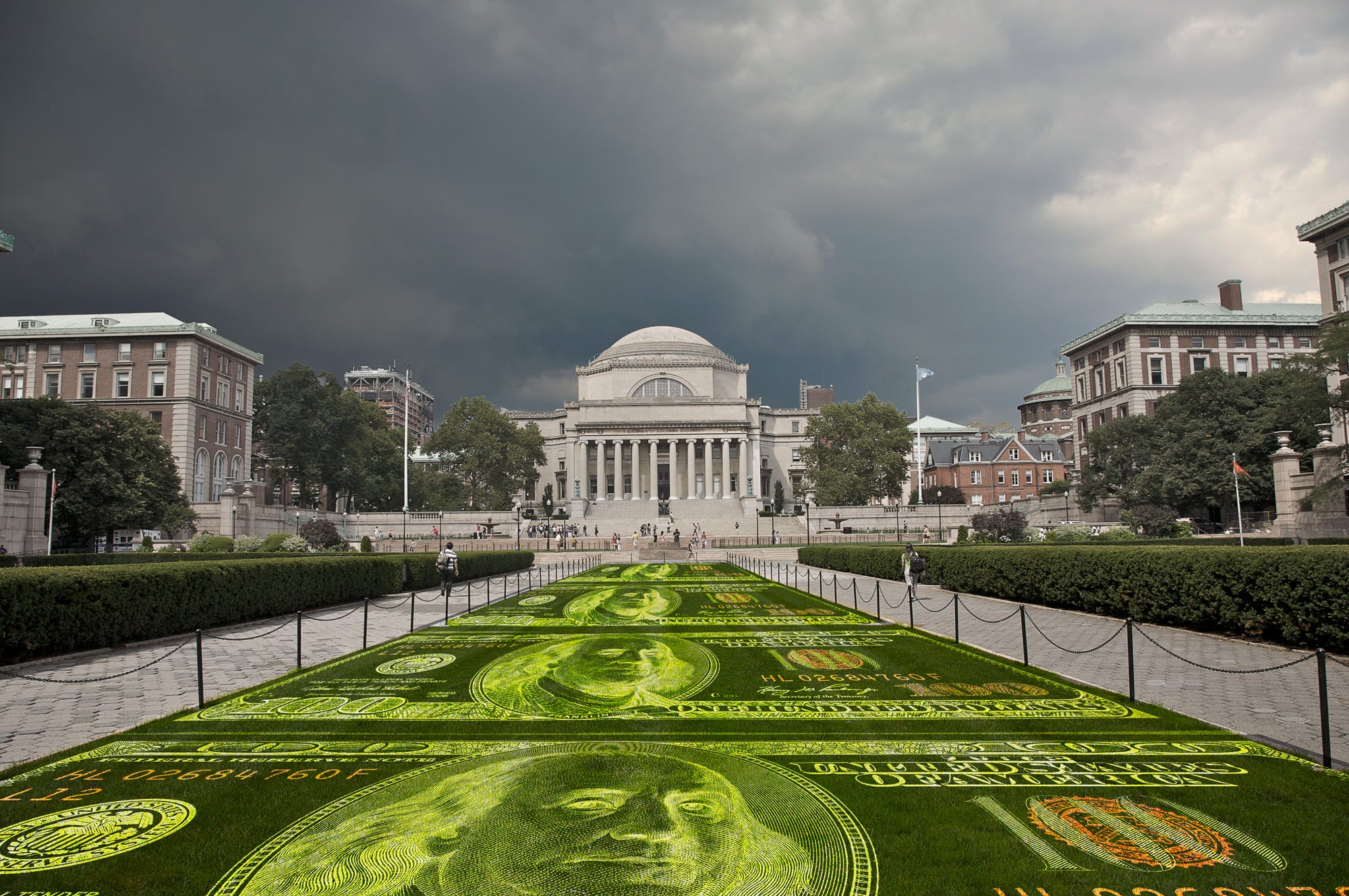
(Illustration by The Free Press, photos via Getty)

Since Hamas’s October 7 massacre, it has been hard to miss the explosion of antisemitic hate that has gripped college campuses across the country. At Cornell, a student posted a call “to follow [Jews] home and slit their throats,” and a professor said the terror attack “energized” and “exhilarated” him. At Harvard, a mob of students besieged an Israeli student, surrounding him as they bellowed “shame, shame, shame.” At dozens of other campuses, students gathered to celebrate Hamas. 

The response from school administrations has been alarming. With few exceptions, in the immediate aftermath of October 7, university presidents issued equivocal statements about the initial attack. Some professors even celebrated it. And the focus on the part of administration bureaucrats has been on protecting the students tearing down posters and being shamed for doing so.

Where did all of this hatred come from is a question worth pondering. As Rachel Fish and others have documented, for several decades a toxic worldview—morally relativist, anti-Israel, and anti-American—has been incubating in “area studies” departments and social theory programs at elite universities. Whole narratives have been constructed to dehumanize Israelis and brand Israel as a “white, colonial project” to be “resisted.” The students you see in the videos circulating online have been marinating in this ideology, which can be defined best by what it’s against: everything Western.

Many are rightly questioning how it got this bad. How did university leaders come to eulogize, rather than put a stop to, campus hate rallies and antisemitic intimidation? Why are campus leaders now papering over antisemitism? How could institutions supposedly committed to liberal values be such hotbeds of antisemitism and anti-Israel activism?

In large part, it is a story of the power of ideas—in this case, terrible ones—and how rapidly they can spread. But it is also a story of an influence campaign by actors far outside of the university campus aimed at pouring fuel on a fire already raging inside.

We’ve known for some time about the links between anti-Israel campus agitators, like Students for Justice in Palestine, and shady off-campus anti-Israel activist networks. 

But thanks to the work of the Network Contagion Research Institute (NCRI), a nonprofit research center, we now have a clearer picture of the financial forces at play at a higher, institutional level.

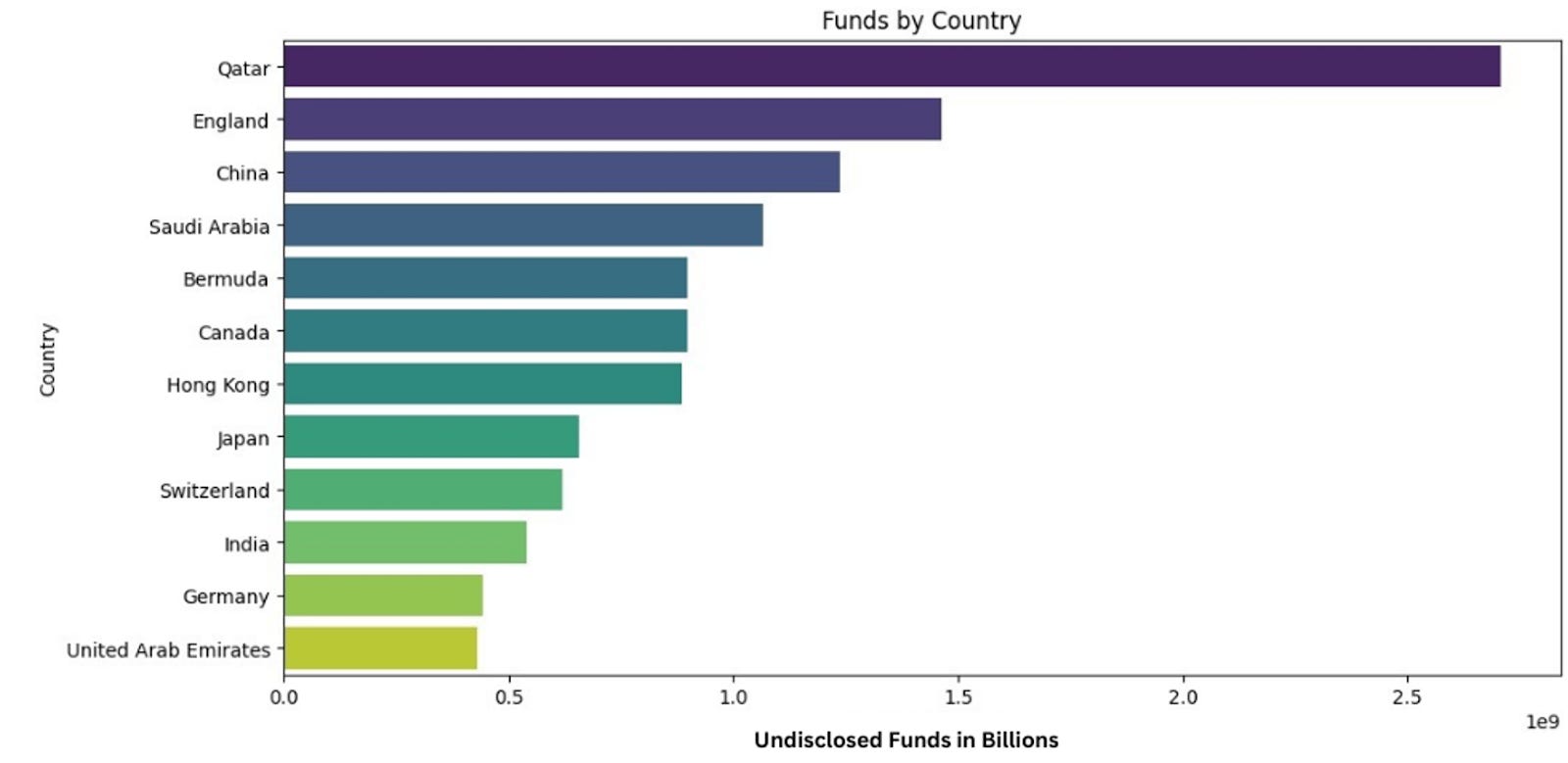
Today, after months of research, the NCRI released a report (comprising four separate studies) following the money. The report finds that at least 200 American colleges and universities illegally withheld information on approximately $13 billion in undisclosed contributions from foreign regimes, many of which are authoritarian.

Moreover, while correlation is not causation, they found that the number of reported antisemitic incidents on a given campus has a meaningful relationship to whether that university has received funding (disclosed and undisclosed) from regimes, or entities tied to regimes, in the Middle East. 

Overall, authors of the report write, “a massive influx of foreign, concealed donations to American institutions of higher learning, much of it from authoritarian regimes with notable support from Middle Eastern sources, reflects or supports heightened levels of intolerance towards Jews, open inquiry and free expression.”

The NCRI report found that:

  • From 2015–2020, institutions that accepted money from Middle Eastern donors had, on average, 300 percent more antisemitic incidents than those institutions that did not. 

  • From 2015–2020, institutions that accepted undisclosed funds from authoritarian donors had, on average, 250 percent more antisemitic incidents than those institutions that did not.

  • At least 200 American colleges and universities illegally withheld information on approximately $13 billion in undocumented contributions from foreign regimes, many of which are authoritarian. 

  • Campuses that accept undisclosed money are on average ~85 percent more likely to see campaigns “targeting academic scholars for sanction, including campaigns to investigate, censor, demote, suspend, or terminate.”

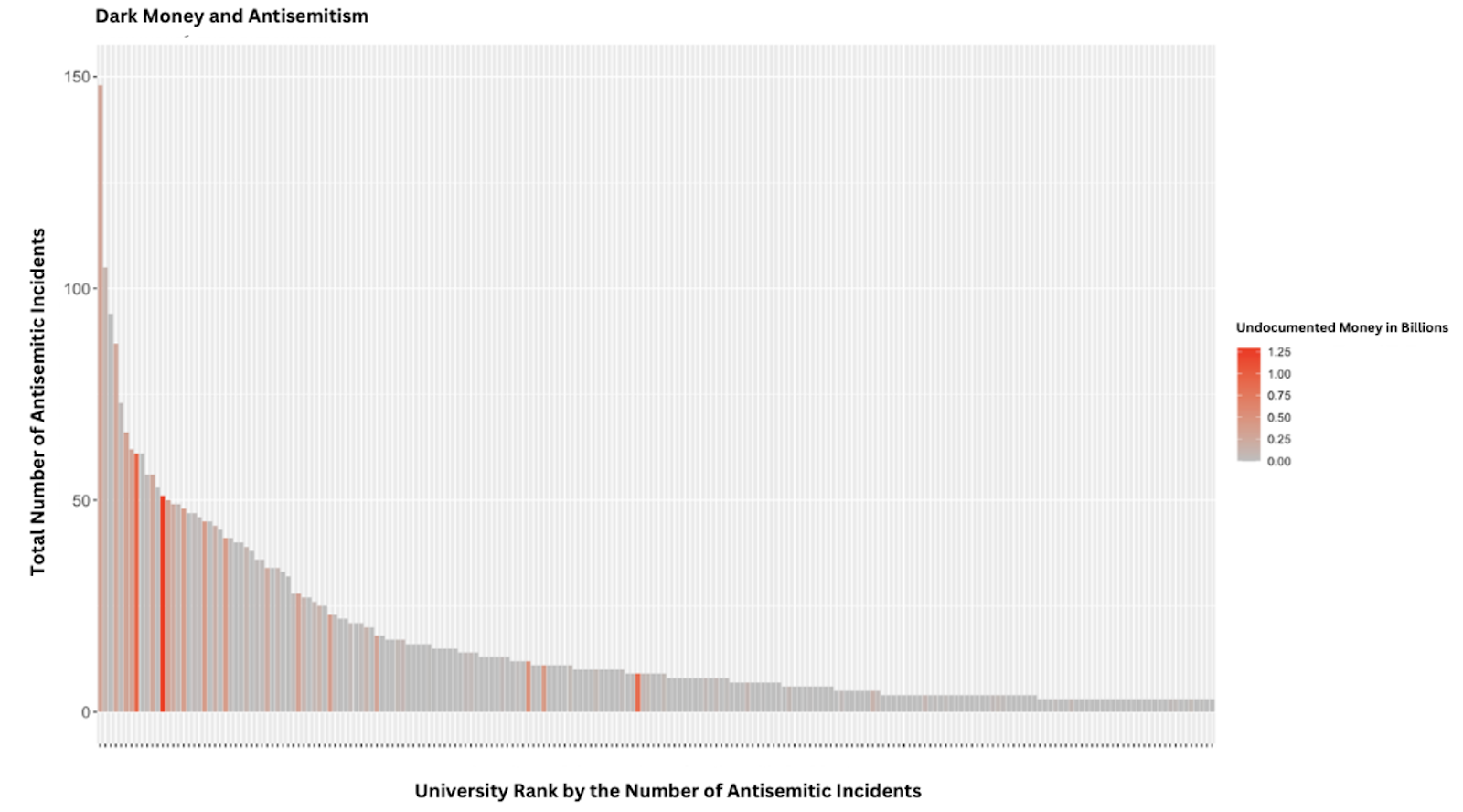
This chart from NCRI captures the relationship between concealed foreign donations and antisemitism on campus:

So who’s doing this concealed funding? Qatar, the country where Hamas’s leadership currently resides, is far and away the largest foreign donor to American universities, as Eli Lake recently documented in these pages:

Of course, correlation is not causation. Still, the NCRI report found that a reliable predictor of the intensity of campus antisemitism was the amount of undisclosed money a given university received from Middle Eastern regimes.

Former Harvard University president Larry Summers told me that he believes “donors and certainly authoritarian leaders who donate to universities may be looking to bolster their image or perception of legitimacy.” But he also said he doubts that “they are looking to or could succeed in changing attitudes or specific policies on campuses.”

“I’m cynical. I usually think things are about money. But I don’t think this is about money. Or at least not primarily,” a former president of a prominent liberal arts college told me. “If you look at the college professors signing on to these various statements, I don’t think it’s because those people got money in any significant way from a country like Qatar. It’s people who are ideologically part of a movement—whether you call it postcolonial or anticolonial—that is deeply opposed to Israel.”

There are other possibilities that may explain the NCRI’s findings. A fairly obvious one could be that Middle Eastern regimes are sponsoring professorships held by, or programs run by, professors or administrators who hold anti-Israel views and use their platform to spread them. This fact, itself, wouldn’t be news.

Another possibility is that universities, eager to attract and retain Middle Eastern funding, promote positions that they think will please the sensibilities of Middle Eastern regimes. Or maybe it is that universities that are indifferent to the atrocities committed or condoned by some of their largest funders are also indifferent to rising antisemitism on campus, allowing it to thrive. The same would hold true for freedom of expression and academic freedom. 

At the very least, the NCRI’s findings may explain why university presidents, whose main job is fundraising, may have been so slow to respond in the wake of the October 7 massacre, and when they did, they for the most part released weak statements. 

One thing I have a hard time believing is that these countries give nine- and ten-figure gifts to universities expecting nothing in return.

Become a Free Press subscriber today:

Subscribe now

11 Nov 16:56

Black Humor in ‘Communist Fat Camp’

by Francis Foster
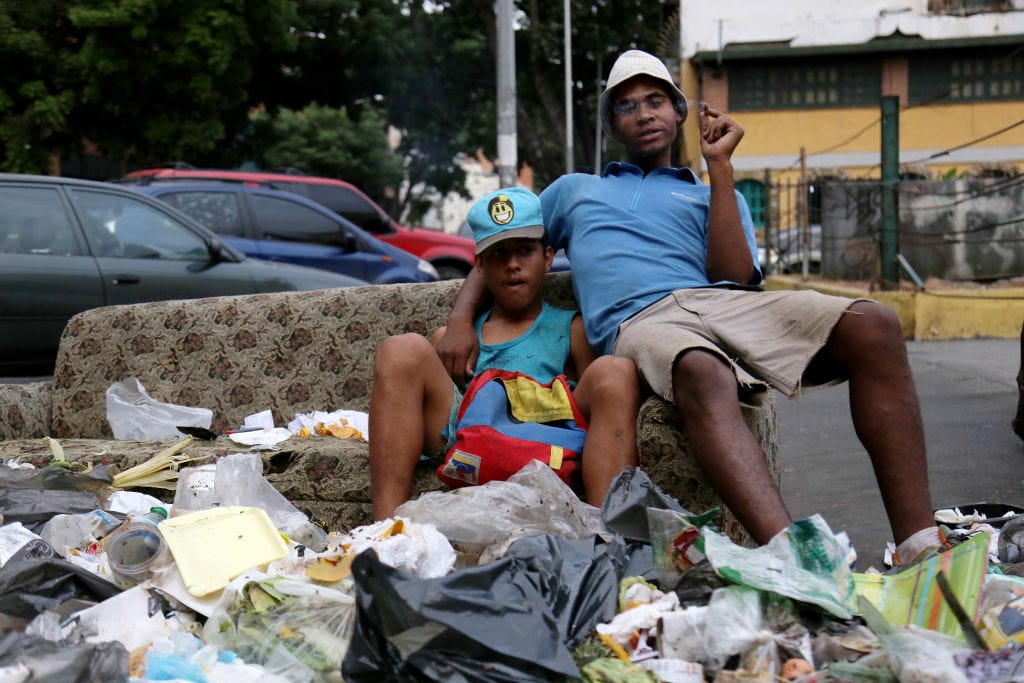
Two men on the streets of Caracas, Venezuela. (Edilzon Gamez via Getty Images)

Twenty or so years ago, I was visiting Caracas, the capital of Venezuela—where my mother is from and my grandparents still live—and I met a girl at a party who I instantly connected with. Her name was Diana. We flirted for a bit, but my best friend also had a crush on her, so I backed off. Years later, I returned to Venezuela and wondered if she was still around, and still single.

“Oh, you didn’t hear?” my friend said. “She died.”

Just months before, he told me, she’d been in a car chase with a group of thugs, who were trying to rob and kidnap her. She lost control of her vehicle and it crashed, bursting into flames. No attempts were made to save her and she burned to death in the inferno.

Without skipping a beat, my friend ended his story by saying, “Anyway, man, you want a beer?” 

This is the Venezuela I know.

It’s easy to look at the news today—with hundreds upon thousands of Venezuelan migrants flooding into the U.S. over the last few years—and think that something drastic and horrible must’ve happened in Venezuela recently. But the mass exodus is the result of decades of corruption and violence. And what’s truly remarkable isn’t how many people are leaving, but why so many are staying.

My friend’s reaction to the brutal murder of a young woman speaks volumes about how Venezuelans have learned to survive. When you live in a society where the price of life is cheap, it’s not a big deal when awful things happen. Everyone in Caracas knows at least one person who’s been kidnapped. It’s just a part of life, like jury duty. You’re kidnapped on a Monday, they hand you back on a Wednesday, you take a couple of days to get your affairs in order, and then you’re back to work the following Monday.

My mom left the country 45 years ago—after meeting my dad, who grew up in the UK—but I kept going back. I went to see my grandparents, who continue to live there, and old friends I’ve known since childhood. (I was born in the UK, but every Christmas of my childhood was spent in Venezuela.) But by 2005, I’d had enough. I couldn’t live with the constant fear. And though I pride myself on my sense of humor—I’m a professional stand-up comic—even I don’t have the gallows humor that’s become second nature, almost a defense mechanism, to so many friends and family members.

Not long before I left Venezuela for good, my friend Ernesto was robbed at gunpoint on a busy street in Caracas. He was at an ATM and felt a gun shoved into his back. “Take everything out of your bank account,” a gruff voice behind him demanded. “Any stupidity from you and I’ll put a bullet through your spine and you’ll never walk again.”

Ernesto took a deep breath. Every Venezuelan knows what to do in these circumstances. It’s drilled into you from childhood, one of the many lessons you have to learn if you want to survive in Caracas. He gave them what they wanted, and hoped for the best.

When he turned to see his assailants making an unhurried retreat, he realized that they were police officers. They even drove away in a police car, not at all concerned with the dozens of witnesses who saw them rob a civilian in broad daylight.

A few months later I ran into Ernesto at a party, where he was regaling the crowd with his tale of getting mugged by cops. His audience roared with laughter. Every line was crafted like a stand-up comedian’s well-honed routine. He was in his element, basking in the glow of an appreciative crowd.

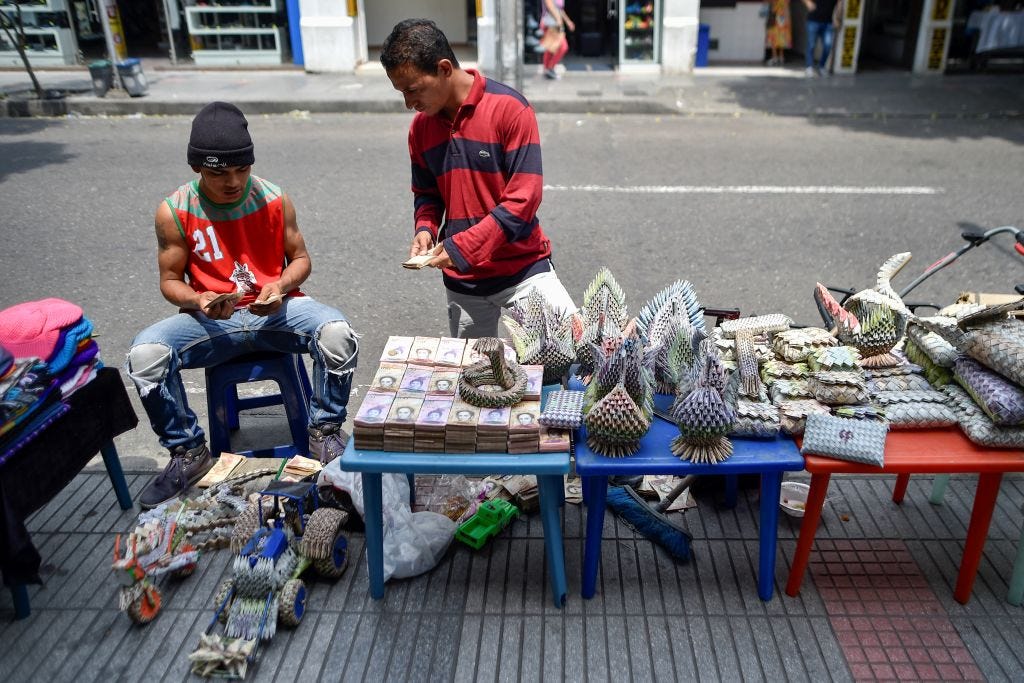
More than seven million Venezuelans have left the country as of August. But what’s truly remarkable is why so many stay. (Luis Robayo via Getty Images)

It reminded me of that famous line by the English poet Thomas Gray: “Moody Madness laughing wild amid severest woe.” 

Venezuelans have a saying: A llorar al valle. Roughly translated, it means “Go and cry to the valley.” When no one will listen to your problems, you “go and cry to the valley,” because it’s the only thing that’ll listen. There have been many tears shed to metaphorical valleys up and down the country, whether it’s families with relatives who have been murdered by armed criminals, or loved ones who have disappeared because they dared to criticize the regime.

More than seven million Venezuelans have left the country as of August, fleeing their homeland to escape poverty, hyperinflation, violence, and seemingly endless political corruption. Last month, President Biden granted temporary legal status to the 472,000 migrant Venezuelans already living in the U.S., protecting them from deportation for at least the next 18 months. But leaving home was never the first choice for many of them, and you can sense the yearning for what’s been lost in their wonderfully dark sense of humor. 

I have a cousin who fled Venezuela, and when I’ve asked his favorite thing about living in America, he usually replies with just two words: “Coca-Cola.” Thanks to a diet of processed food and refined sugar, his physique is far more American than Venezuelan. We joke that he desperately needs to return to his home country for a few months to do the “communism fat camp.” 

My uncle, who still lives in Venezuela, has type 2 diabetes, and he credits the communism diet with why he still has his original toes. “It’s amazing what can be achieved when you can’t afford to eat and the tap water has more parasites than the ruling class,” he told me with a big, hearty laugh.

I have another cousin, a journalist who wrote pieces criticizing Venezuela’s president Nicolás Maduro, and who was promptly threatened by the regime’s thugs. They informed him, in unflinching detail, what would happen to him if he continued to publicly voice his opinions. He fled in terror to Uruguay. But when I called him, he wasn’t grateful to have escaped. He missed home. And he insisted that Uruguay is one of the most boring countries on the planet. “I’m surrounded by cows,” he complained.

Caracas may be one of the murder capitals of the world. Ninety percent of the nation lives in poverty, according to the National Survey of Living Conditions. One in three Venezuelan children suffer from malnutrition, according to the National Academy of Medicine. Smuggling, whether it’s gas, food, or human beings, represents 20 percent of the Venezuelan economy. But hey, at least it’s exciting. And there’s more to do than stare at cows.

A general election is happening in Venezuela early next year, and there are already murmurs that Maduro could be unseated, ending almost a quarter century of socialist government. But I’m not optimistic. The corruption in Venezuela is a cancer and it’s metastasized over the last several decades. I love Venezuela and I want to return someday. But I have faith that the country will have a fair and honest election in 2024 about as much as I believe the communist diet is healthy and saved my uncle’s toes.

Not long ago, an old family friend named Henry flew from Venezuela to visit me in London. My parents—who are now both in their mid-70s—joined us for dinner, and during one of Henry’s stories, my dad leaned in close and said, “I’m sorry, Henry, would you mind speaking up? I’m getting older and I can’t hear you.”

Henry just sighed. “My apologies,” he said. “In Venezuela, we’re just used to whispering.”

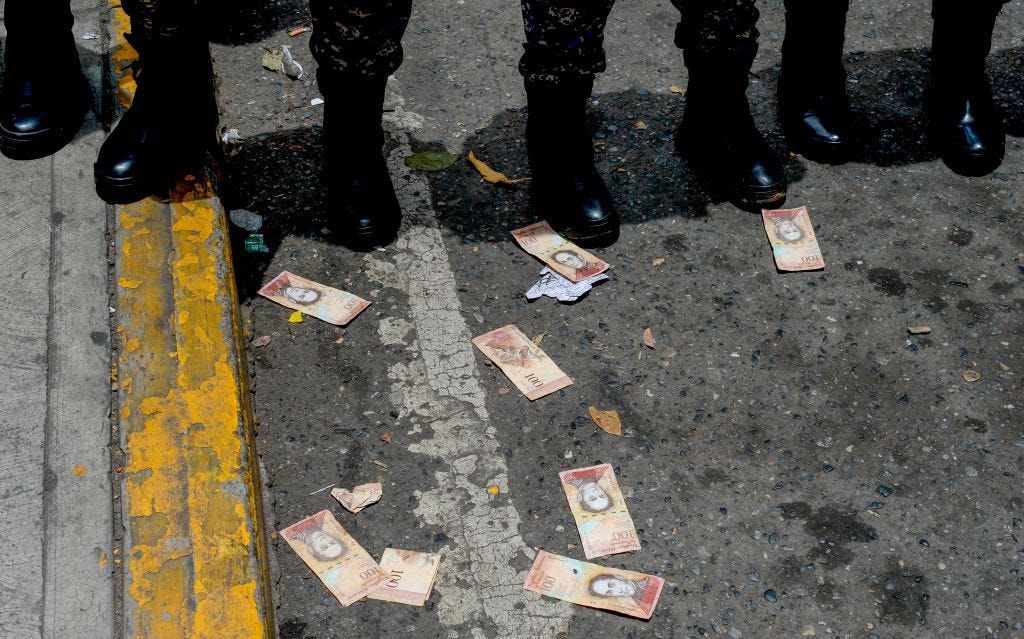
The Venezuelan bolívar is worth less than three cents to the U.S. dollar. (Federico Parra via Getty Images)

Those are the subtle ways that authoritarianism chips away at you. You don’t even realize anymore that every conversation is a whisper. It becomes rote, like when you’re taught to look both ways before crossing the street and you don’t even think about it anymore. You know what the repercussions will be if you step out of line. You whisper because it’s a choice between life or death.

But the fear and the tears always give way to laughter again, because that’s how we cope. At our dinner with Henry, we talked about how el bolívar fuerte—the Venezuelan currency, roughly translated as “the strong Bolívar”—is on the decline yet again. The exchange rate is around 0.028 in U.S. dollars. Toilet paper is now worth more than bolívar fuerte. And you can’t replace toilet paper with bolívar, although I’m sure someone has tried. We laughed about the state of affairs, but it’s the way you laugh about an old relative whose life has fallen apart, who’s living on the streets and doing drugs, and you’re not sure how to help him anymore.

The country we all knew from our childhoods no longer exists. It lives on only in our memories. When we bump into other Venezuelans, we share stories of the country we loved, the places we used to visit, and the people we used to know. And most importantly, we laugh—the soul cleansing, cathartic laughter that comes from people finding a way to negotiate a path through a shared trauma. 

It’s the only thing that prevents us from spending all of our lives crying to the valley.

Francis Foster is a stand-up comedian and co-host of Triggernometry, a free speech YouTube show and podcast. This is his first piece for The Free Press. You can follow him on X, formerly Twitter, @francisjfoster

And if you want to support more counterintuitive takes on the news, become a Free Press subscriber today:

Subscribe now

11 Nov 15:55

NBC Compares Criticism of Hunter’s Influence Peddling to Haley’s Daughter’s TikTok Posts

by jonathanturley

We have often discussed (and even marveled at) the determined effort of mainstream media to ignore the evidence of a massive corruption scandal surrounding the Biden family. However, even at this late date, NBC seems to have achieved singular distinction with a comparison between the criticism of the daughter of Nikki Haley for using TikTok and the criticism of Hunter Biden for influence peddling.

During the Republican presidential debate, Vivek Ramaswamy responded to Haley’s criticism of his use of the Chinese-linked social media app, TikTok, by pointing out: “she made fun of me for joining TikTok, while her own daughter was actually using the app for a long time, so you might want to take care of your family first.”

Haley responded by calling Ramaswamy “scum.”

Later Gov. Ron DeSantis said that children need to be out of bounds.

NBC saw an immediate opportunity to denounce the investigation into Hunter Biden: “Florida Gov. Ron DeSantis says he believes going after an opponent’s children is ‘out of bounds’ in political warfare. DeSantis, however, goes after President Biden’s son on a weekly basis.”

The comparison perfectly captured the all-hands-on-deck effort of the media in resisting coverage of the Biden scandal. A major network wanted the public to see the criticism of Haley’s daughter for using TikTok as the same as criticism of Biden’s son for influence peddling.

One child was posting playful social media posts while the other was orchestrating massive payments from foreign figures.

This is why polls have shown the media at record lows in terms of public trust.  Gallup and the Knight Foundation found that 50% of Americans believe that the news media lies in order to promote an agenda. Only 25% of Americans reject that premise. The public has largely rejected the mainstream coverage (or lack thereof). A majority believes that Hunter has received special protection in the investigation.

We have often discussed the increasing bias and advocacy in major media in the United States. While cable networks have long catered to political audiences on the left or right, mainstream newspapers and networks now openly frame news to fit a political narrative.

We previously discussed the release of the results of interviews with over 75 media leaders by former executive editor for The Washington Post Leonard Downie Jr. and former CBS News President Andrew Heyward. They concluded that objectivity is now considered reactionary and even harmful. Emilio Garcia-Ruiz, editor-in-chief at the San Francisco Chronicle said it plainly: “Objectivity has got to go.”

Downie explained that news leaders today

“believe that pursuing objectivity can lead to false balance or misleading “bothsidesism” in covering stories about race, the treatment of women, LGBTQ+ rights, income inequality, climate change and many other subjects. And, in today’s diversifying newsrooms, they feel it negates many of their own identities, life experiences and cultural contexts, keeping them from pursuing truth in their work.”

Likewise, Stanford journalism professor, Ted Glasser, has called for journalism to “free itself from this notion of objectivity to develop a sense of social justice.” He views “journalists as activists because journalism at its best — and indeed history at its best — is all about morality.”  Thus, “Journalists need to be overt and candid advocates for social justice, and it’s hard to do that under the constraints of objectivity.”

Lauren Wolfe, the fired freelance editor for the New York Times, has not only gone public to defend her pro-Biden tweet but published a piece titled I’m a Biased Journalist and I’m Okay With That.” 

Former New York Times writer (and now Howard University Journalism Professor) Nikole Hannah-Jones is a leading voice for advocacy journalism. Indeed, Hannah-Jones has declared “all journalism is activism.”

Washington Post columnist and MSNBC contributor Jennifer Rubin has also called for the media to abandon balance and impartiality.

While outfits like NPR allow reporters to actually participate in protests and the New York Times sheds conservative opinions, the new poll shows many are simply tuning out the media.

Put into this context, the NBC framing of the presidential debate is not just understandable but entirely predictable. It is why the “Let’s Go, Brandon” movement is as much a mocking of the media as it is the President. No one seriously buys the analogy of a criticism of a politician’s daughter over using social media with the criticism of a politician’s son who allegedly raised millions in influence peddling. One child was engaged in personal entertainment while the other was engaged in public corruption.

NBC’s slogan of “The news you want, when you want it” has become “the news you want, how you want it.” They are not alone in such echo chamber journalism. The problem is that a smaller percentage of the public seems to want news at all as their trust in the media generally continues to collapse.

The NBC hit on critics of Hunter Biden is precisely why. Yet, rather than recognize the falling revenues and influence of media, these outlets and journalists continue to saw feverishly at the branch on which they are sitting.

Square profile picture

NBC Politics
@NBCPolitics


Florida Gov. Ron DeSantis says he believes going after an opponent’s children is “out of bounds” in political warfare. DeSantis, however, goes after President Biden’s son on a weekly basis.

nbcnews.com
819.3K

Views


11 Nov 15:46

GREAT MOMENTS IN OBJECTIVITY: Associated Press Coverage of Courts, Climate Bankrolled by Dozens of L

by Ed Driscoll

GREAT MOMENTS IN OBJECTIVITY: Associated Press Coverage of Courts, Climate Bankrolled by Dozens of Left-Wing Foundations.

The Associated Press, the country’s top wire service, is now bankrolled in part by millions of dollars from left-wing foundations, including one founded by “1619 Project” author Nikole Hannah-Jones.

The news organization last year announced a series of “partnerships” to subsidize reporters covering climate change, race, and democracy. A review of the donor roster shows that the vast majority fund left-wing political causes, while none are supporters of conservative initiatives.

The Ida B. Wells Society, founded by “1619 Project” lightning rod Hannah-Jones, has teamed up with filmmaker Steven Spielberg’s Hearthland Foundation, for example, to foster “more inclusive storytelling” at the Associated Press.

In some ways, it was a natural partnership: The AP’s global investigations editor, Ron Nixon, serves on the Ida B. Wells Society’s board of directors. In others, it may prove more problematic, given that Hannah-Jones’s own reporting has been disputed by historians, who have argued—among other things—that her account of the motivations of the American revolutionaries is factually inaccurate.

The funding, much of it from these sorts of overly political actors, will make it more challenging for the Associated Press to swat away accusations of political bias. In one high-profile example, critics blasted the organization for revising its style guide to instruct reporters to avoid the use of terms like “the French,” which the AP indicated was “dehumanizing.”

AllSides, a group that tracks media bias across the industry, last year changed its rating for the AP from “center” to “leans left,” citing what it said was an increase in “word choice bias” and “bias by omission of views” in its coverage. AllSides says it closely monitors the Associated Press’s content because the AP’s content is “broad and far-reaching.”

Just think of AP as Democratic Party operatives with bylines, and it all makes sense.

10 Nov 19:40

How will DeSantis recover from this?? He said opponent's kids are "out of bounds" but NBC notes he attacks poor Hunter Biden "on a weekly basis" 💀

by Not the Bee
Jts5665

BIden's basically a child, too.

LEAVE HUNTER ALONE!

10 Nov 03:31

WAPO TOOK DOWN HAMAS CARTOON AMID STAFFERS’ ‘DEEP CONCERNS,’ INTERNAL MEMO INDICATES: Sally Buzbee,

by Ed Driscoll

WAPO TOOK DOWN HAMAS CARTOON AMID STAFFERS’ ‘DEEP CONCERNS,’ INTERNAL MEMO INDICATES:

Sally Buzbee, the executive editor of the Washington Post, sent an email to staff members on Wednesday night acknowledging their “many deep concerns and conversations” about a cartoon criticizing Hamas that the newspaper earlier in the day published and then deleted.

In the email, obtained by the Washington Free Beacon, Buzbee wrote:

Dear colleagues,

Given the many deep concerns and conversations today in our newsroom, I wanted to ensure everyone saw the notes sent out tonight by The Post’s opinions editor, David Shipley, to Post readers and to his staff in opinions.

My best, Sally

Buzbee forwarded an email that Shipley had sent opinions staff in which he said he had personally “taken down” the cartoon. Shipley included the full text of an editor’s note in which he publicly expressed “regret” that he had “missed something profound, and divisive” in publishing the image.

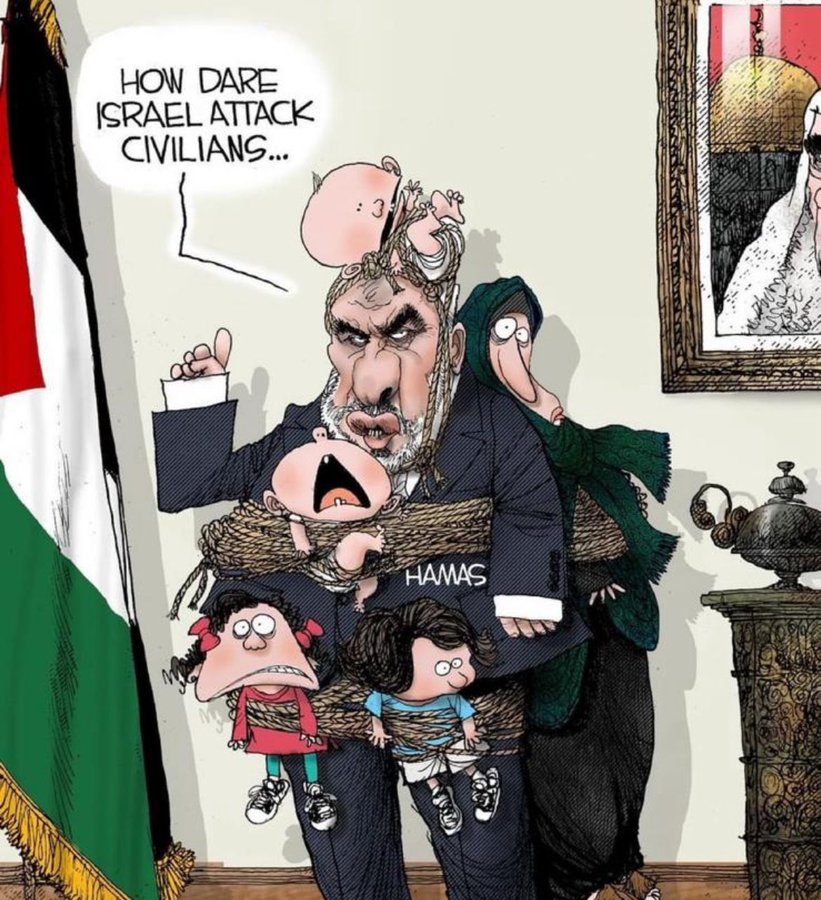
“A cartoon published by Michael Ramirez on the war in Gaza, a cartoon whose publication I approved, was seen by many readers as racist. This was not my intent. I saw the drawing as a caricature of a specific individual, the Hamas spokesperson, who celebrated the attacks on unarmed civilians in Israel,” Shipley wrote.

The cartoon depicted an individual, labeled “Hamas,” with children, a baby, and a woman strapped to his body. “How dare Israel attack civilians…,” the man said in a speech bubble.

Like the hostage posters anti-Semites are pulling down in major cities in the US and Europe, WaPo staffers don’t want to be reminded of what they actually support. Which is odd for a paper who’s slogan is “Democracy dies in darkness.”

09 Nov 22:01

Liberal journos are out here gaslighting, telling us that our bills aren't high because of inflation. It's all because of... drumroll..."high prices" 😂

by Not the Bee
Jts5665

Counting on staggering ignorance of basic economic principles will probably work for Stone. I think there's a reason Econ isn't taught anymore.

Vox senior correspondent Emily Stone just published an article cleverly titled, "The problem isn't inflation. It's prices." Stone delivers the article much like a sage graciously dispensing wisdom from on high, illuminating the darkness of ignorant people still frustrated that groceries and other basic goods are so expensive.

09 Nov 21:56

Electric vehicle registration fee recharging for next session

by The Center Square Staff
The fees range from $50 a year in Hawaii to more than $200 in other states.
09 Nov 21:15

Three Hamas leaders worth a combined $11 Billion.

by Kane
Jts5665

The foreign aid to Gaza probably direct deposits to their accounts.

09 Nov 13:55

YOU CAN’T “PRETEND” AWAY SEVERE DISABILITY:  Amy S.F. Lutz is talking sense over at WaPo:  I

by Gail Heriot

YOU CAN’T “PRETEND” AWAY SEVERE DISABILITY:  Amy S.F. Lutz is talking sense over at WaPo:  It is asinine to pretend that a severely autistic adult could waltz into a job that pays minimum wage or better if only the special Section 14c program, which allows them to be hired for less, were eliminated.  They will be unemployable.

This program doesn’t “take advantage” of severely disabled individuals for profit.  Overwhelming the 14c certificates an employer needs to participate in the program are held by non-profit community rehabilitation organizations.  They are just trying to give severely disabled individuals a little dignity (and their parents a little break.) The 14c program is overwhelmingly supported by the parents of the severely disabled.

I dissented from the report of the U.S. Commission on Civil Rights that Lutz rightly criticizes.  If you haven’t done so already, please take a look at that dissent.  Send it or the Lutz article to your favorite state legislator.   I don’t think I get frustrated all that easily.  But when red state legislators don’t get this and prohibit the program in their state (as some have done), I start wanting to bang my head against the wall … which could eventually make me unemployable.

08 Nov 14:37

Will Joe Rogan ditch Spotify and jump to Twitter.

by Kane
08 Nov 14:30

WHY YOUR TIKTOK FEED IS FULL OF ANTI-ISRAEL VIDEOS: Now, the company insists that it’s not algorith

by Ed Driscoll

WHY YOUR TIKTOK FEED IS FULL OF ANTI-ISRAEL VIDEOS:

Now, the company insists that it’s not algorithmically advantaging one side over the other. And, unfortunately, we have no way of knowing whether they’re telling the truth or not. It’s possible that the pro-Palestine skew of TikTok’s content is simply a natural result of its user and creator base, which is dominated by younger and more liberal people, who lean toward the Palestinian side to begin with. It’s also possible that TikTok, whose parent company ultimately answers to the Chinese Communist Party, is putting its thumb on the scale to show viewers more of the side that China aligns itself with and against the side of Israel, a key U.S. ally.

Flashback: TikTok May Be A Chinese Superweapon.

08 Nov 14:29

OH TO BE IN ENGLAND: Revealed: Hard-Left activist who led ‘from the river to the sea’ chant at pro-P

by Ed Driscoll
08 Nov 00:43

MARK JUDGE: The Captive Mind 70 years later: How totalitarians across the ages have suppressed free

by Glenn Reynolds
07 Nov 13:20

FOR A DEPARTMENT NOT YET TWENTY DHS IS SURE TURNING BAD QUICKLY:  New emails show DHS created Stanf

by Sarah Hoyt
Jts5665

Bad from the get go.

FOR A DEPARTMENT NOT YET TWENTY DHS IS SURE TURNING BAD QUICKLY:  New emails show DHS created Stanford ‘disinfo’ group that censored speech before 2020 election.

06 Nov 17:19

Drunk grizzly bears keep getting killed by trains in Montana.

by Kane
06 Nov 14:27

UN demands $1.2 Billion donation for Hamas.

by Kane
06 Nov 14:25

JUST WAIT UNTIL HE LEARNS THE TRUTH ABOUT SOCIALISM – IT’S NOT JUST COMPATIBLE, IT REQUIRES IT:  Ob

by Sarah Hoyt

JUST WAIT UNTIL HE LEARNS THE TRUTH ABOUT SOCIALISM – IT’S NOT JUST COMPATIBLE, IT REQUIRES IT:  Obama warns about dangers of market-based systems: ‘Compatible with slavery’.

06 Nov 14:19

GUT UND HART, DEUTSCHLAND: After migrant parent pressure, Anne Frank daycare center to be renamed.

by Ed Driscoll

GUT UND HART, DEUTSCHLAND: After migrant parent pressure, Anne Frank daycare center to be renamed.

Parents in Saxony-Anhalt German State promoted the decision to rename the “Anne Frank” daycare center in Tangerhütte, a small town in the state, according to reports in German media.

The move was driven by parents who found it difficult to explain Frank’s significance to their children. According to Apollo News, a German news site, in a small town in Saxony-Anhalt, a daycare center has become the center of a local scandal.

* * * * * * * *

The BILD newspaper added “Ultimately, the parents and employees wanted a name that was more ‘child-friendly’ and ‘better suited to their concept.’ Their needs are more important than the global political situation.”

The daycare center has been called Anne Frank since 1970. “Now parents want to rename it to ‘World Explorers’,” BILD said.

According to the report,  Frank no longer aligned with the “new focus on diversity.” Brohm stated that the desires of many parents to rename the daycare center held more weight than the global political situation.

Related: Can’t Imagine Why: Majority of Germans Now Completely Over Muslim Immigration.

06 Nov 14:17

ICYMI: OHIO NORTHERN UNIVERSITY: Power Corrupts but Sunlight Disinfects. “You don’t look As

by Glenn Reynolds

ICYMI: OHIO NORTHERN UNIVERSITY: Power Corrupts but Sunlight Disinfects.

“You don’t look Asian because your eyes are round instead of oval.”

“She’s the most pregnant woman I’ve ever seen.”

“Prospective law students prefer to see young faculty faces rather than old faculty faces.”

“I suppose you think you owe Professor Gerber because he practically wrote your paper.”

“The law school shouldn’t engage in illegal hiring practices.”

While one might expect a storm of consequences for the individual responsible for the first four statements, the story at Ohio Northern University (ONU) unfolds quite differently.

Behind the first four comments is, of all people, the current Dean of ONU’s College of Law, Charles Rose, who, in spite of uttering such statements, received a five-year contract extension.

Professor Scott Gerber, on the other hand, who opposed illegal hiring practices, found himself removed from his classroom by campus security officers on April 14 and was escorted to a meeting with Rose, who handed Gerber a “memorandum initiating his suspension from all faculty duties.”

Make them pay.

05 Nov 00:47

NATE SILVER: Free speech is in trouble: Young liberals are abandoning it — and other groups are

by Glenn Reynolds

NATE SILVER: Free speech is in trouble: Young liberals are abandoning it — and other groups are too comfortable with tit-for-tat hypocrisy.

Read the essay, but but game theory says that tit-for-tat is the best enforcement means for repeat interactions. “It encourages cooperation, it punishes defection, and it responds to each change in its opponent’s behavior.”

The only reason the Left traditionally supported free speech was to protect itself. Once it didn’t need to do that any more, it abandoned its protection, and it started censoring.

02 Nov 19:18

Dao Prize Acceptance Speech

by Matt Taibbi

I was a little nervous in Washington last night, so my speech didn’t come out exactly like this, but this is the address I prepared, for acceptance of the $100,000 Dao Prize for Excellence in Investigative Journalism:

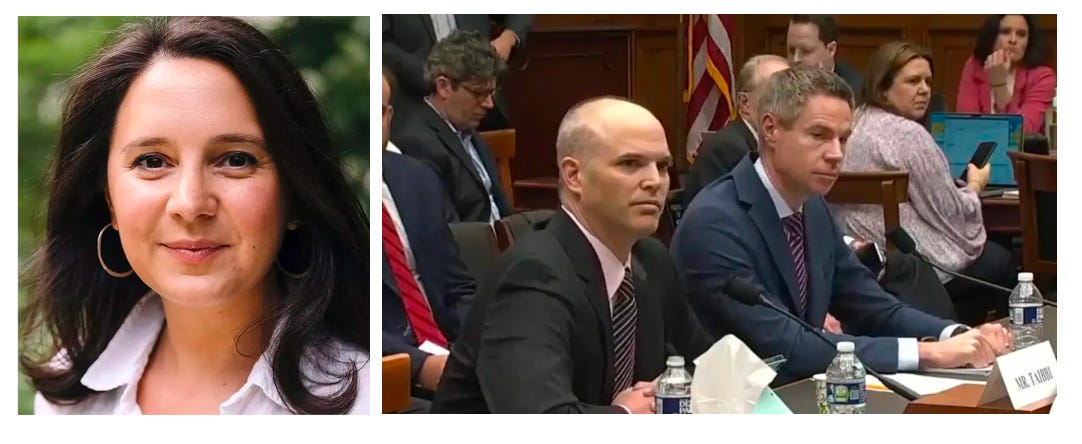
Thank you. As many of you know, it’s been a long year for those of us who worked on this story. To be recognized with such a significant award means a great deal to me and to the other recipients, Bari Weiss of The Free Press and Michael Shellenberger of Public, on whose behalf I’ll try to speak tonight.

More than two dozen reporters worked on the Twitter Files at different times, including Lee Fang, Paul Thacker, David Zweig, Aaron Maté, Matt Farwell, and many others, across the political spectrum. Journalists from left-leaning publications and reporters with conservative backgrounds both worked on this story, which was unique enough to employ pseudonymous citizen journalists like “Techno Fog” and Pulitzer Prize winner Susan Schmidt. Susan is here tonight, and has a new Twitter Files piece coming out on Twitter and Racket in the coming days.

To the National Journalism Center and the Dao Feng and Angela Foundation: I could not be more grateful that you’ve chosen to create such a significant new prize for old-school, fact-based reporting. The journalism profession has become hopelessly politicized in recent years. Editors now care more about narrative than fact, and as many of the people in this room know, there are now fairly extreme penalties for failing to toe party lines. This begins with pressures within the business to conform and continues with algorithmic targeting of advertisers of the sort that the Washington Examiner and its excellent reporter Gabe Kaminsky, who’s here tonight, reported on.

Most of these algorithmic penalties are based on a complex credentialing system, a process Google calls “surfacing authoritative content.” This basically means that if you’re not recognized by certain “authoritative” organizations, your work will not appear in features like Google News, Facebook’s news feed, the “For You” bar on Twitter, or in many institutional search engines. This has the effect of de-amplifying politically unorthodox content, from conservative sites like the Examiner or the New York Post to Consortium News or even the World Socialist Web Site. These sites are essentially consigned by algorithm to a separate set of Dewey Decimal shelves in the basement of the world’s library.

It's my hope and belief that the DAO Prize, by giving such work recognition, can help begin the process of bringing suppressed factual journalism out of the basement. It’s my hope journalists will someday look back at this moment as a turning point.

About a week ago I was interviewed about Twitter and content moderation and asked what I would do about speech, if I were put in charge of the Internet.

I made the mistake of answering, saying something like “Well, I’d start with all legal speech…” I don’t remember what I said, but it wasn’t smart.

Later I realized the correct answer: I’m not in charge of anything, and thank God! I’m just a reporter. My job is to get information and pass it on. That’s hard enough. Decisions are for voters.

I believe journalism began to lose its way when we lost touch with what it is we actually do. This was once more a trade than a profession. Reporters reflexively looked at things from the perspective of the general public, because they were the general public. They identified with cabbies, nurses, teachers, plumbers, hardware store owners, because that tended to be where they came from. They once thought people who couldn’t afford K Street lobbyists, the people who had the least representation, needed the press the most.

Those audiences tend not to want special treatment, because they’re not used to getting it. They’ll settle for the truth. You get that for us, we’ll buy your paper. That simple deal made things easy, as I learned from a young age. I’m blessed to have my father Mike here tonight. He started working at a New Jersey newspaper as a teenager. He used to say, “The story’s the boss.” We were supposed to follow facts wherever they led, publish anything true, and not care who was offended by it.

Beginning in the eighties and nineties, journalists started imagining things from a different perspective. After All The President’s Men it became a fashionable career choice. More reporters started coming from the Ivy Leagues, which in itself is not a bad thing. But a change took hold. Journalists were soon the same people, socially, as those they were charged with covering. They’d gone to school with aides to presidential candidates, intelligence analysts, and Wall Street bankers. Unlike the broader audience, these people did expect a certain kind of coverage. We started to see a string of stories from their perspective, telling us how hard it is to run a country, how hard the choices are.

“If we’re too idealistic, we won’t get elected!” was a common theme of campaign reports. Or, after 9/11, we started to see papers telling us how hard it was to fight al-Qaeda in a country that outlawed torture. The press began the process of identifying more with leaders than ordinary people.  

The question I was just asked, about being in charge of the Internet was in that same vein. Don’t you see how hard it is to run these companies? What would you do if you ran the Stanford Internet Observatory, the FBI, US Cyber Command?  

We don’t! Michael, Bari and I tried not to look at things from that angle, and asked the same questions any normal person would. We had different political beliefs, but it didn’t matter, because this was grunt work.

What does this email saying “flagged by DHS” mean? What’s a Foreign Influence Task Force? Why is Twitter having a weekly “Industry meeting” with the FBI? What’s “malinformation,” and how can something that’s true also be “disinformation”? What’s the Election Integrity Partnership and why are they working with the Global Engagement Center, whatever that is?

Publishing the answers to these questions for some reason offended a great many people, but it was true. We were very glad when we saw some of the other reporters here tonight, like Gabe and the Examiner, start to do deeper dives on organizations like the Global Engagement Center and its sponsorship of groups like the Global Disinformation Index.

This is how the media is supposed to work. Not long ago, if one outlet did a good story, you were happy if a competitor moved the story forward, because ultimately the public benefits from that kind of competition.

The public only loses when reporters see themselves as on the same team with the politicians and institutions they’re supposed to be covering. That situation ultimately will produce narrative policing instead of reporting.

Thank you to the National Journalism Center for sending the message that doing the job from outside the rope line, from the perspective of the general public, is still respected and appreciated. I hope this award, and the possibility of real policy changes that may ensue from legislative effort and court cases like Missouri v. Biden, will provide encouragement to future reporters who might otherwise hesitate to take on an unpopular subject. I hope we may be able to look back on this as a moment when things started to turn around for this business.

Lastly I should say that I’m so glad to be accepting this with Bari and Michael, and that all three of us owe a great deal to our subscribers, who pushed us to cover the story even though it didn’t always benefit them. With their support the three of us got to meet, and have quite an adventure together. As “so-called journalists” called as witnesses in one of the oddest congressional hearings in memory, Michael and I especially will always be part of one another’s lives. Thank you for allowing us to share this honor as well, and good luck to future recipients of the prize.

02 Nov 18:20

FBI raids home of Eric Adams top fundraiser.

by Kane
01 Nov 19:10

OOPS: Paxlovid doesn’t cut risk of long COVID, study finds.

by Glenn Reynolds
01 Nov 19:09

NATIONAL ARCHIVES REVEALS BIDEN EXCHANGED UP TO 82K PAGES OF EMAILS UNDER PSEUDONYMS WHILE VP. Imagi

by Robert Shibley

NATIONAL ARCHIVES REVEALS BIDEN EXCHANGED UP TO 82K PAGES OF EMAILS UNDER PSEUDONYMS WHILE VP. Imagine the level of confidence it required for Biden to turn those emails over to the National Archives and (correctly) assume nobody would reveal it (until forced by a lawsuit). Truly, some people lead charmed lives.

01 Nov 12:48

Colorado trial expert says Trump promoted violence unlike others, despite Dems' record of same words

by Natalia Mittelstadt
“If Democrats don't like your speech, it’s violence; if Democrats like your speech, it's free speech,” Mike Davis said.
31 Oct 21:26

NOT ANTI-WAR, JUST ON THE OTHER SIDE: I Wrote that Hamas Raped and Beheaded. Yale ‘Corrected’ Me. I

by Ed Driscoll

NOT ANTI-WAR, JUST ON THE OTHER SIDE: I Wrote that Hamas Raped and Beheaded. Yale ‘Corrected’ Me.

I escaped Yale University this weekend to celebrate the Jewish Sabbath in Brooklyn with a deeply pious Chasidic community, the neighborhood papered with “KIDNAPPED” posters featuring the faces of Israelis taken hostage by Hamas.

I was relieved to be away from hostile protests where many of my classmates have cheered—in reference to Hamas’s Oct. 7 massacre of Israelis—that such “resistance is justified.” At an Oct. 25 protest, Yale students publicly admonished an Oct. 12 op-ed I wrote for the Yale Daily News. In it, I noted that the student group Yalies4Palestine had blamed the victims for their plight, arguing that “the Israeli Zionist regime [is] responsible for the unfolding violence,” and called on the Yale community “to celebrate the resistance’s success.”

I was in Brooklyn when I learned that the Yale Daily News had done its own part to help the “resistance,” excising four sentences from my piece. They referred to Hamas’s atrocities. “Yes, they raped women. Yes, they kidnapped children. Yes, they beheaded men. Yes, they cheered the whole time.”

Appended to the article now is the following correction, made without my knowledge: “Editor’s note, correction, Oct. 25: This column has been edited to remove unsubstantiated claims that Hamas raped women and beheaded men.”

Anika Seth, the paper’s editor and “one of the inaugural Diversity, Equity & Inclusion co-chairs” at Yale will have a bright future at the New York Times.

31 Oct 14:10

REMINDER: A quote from Robert Heinlein: Throughout history, poverty is the normal condition of man.

by Ed Driscoll

REMINDER: A quote from Robert Heinlein:

Throughout history, poverty is the normal condition of man. Advances which permit this norm to be exceeded — here and there, now and then — are the work of an extremely small minority, frequently despised, often condemned, and almost always opposed by all right-thinking people. Whenever this tiny minority is kept from creating, or (as sometimes happens) is driven out of a society, the people then slip back into abject poverty.

This is known as “bad luck.”

And there’s plenty of it these days, as Kurt Schlichter writes: Accept That Savagery Is the True Nature of the World – and Deal With It.

29 Oct 21:52

Biden administration sued under FOIA about rules cracking down on charter schools; withholds 570 of 574 pages in release

by Hans Bader

Earlier, we wrote about Biden administration rules that impeded charter schools, reinforcing the power of left-wing teachers’ unions. Even the liberal Washington Post, which has not endorsed a Republican for president since 1952, criticized those rules as harmful and unjustified, as did non-partisan think-tanks such as the Fordham Institute. I submitted a Freedom of Information […]

The post Biden administration sued under FOIA about rules cracking down on charter schools; withholds 570 of 574 pages in release appeared first on Liberty Unyielding.