Shared posts

17 Jan 14:38

Groundbreaking nuclear plant approved, uses non-water-cooled reactor

by LU Staff

Could nuclear power make a comeback? It provides most electric power in countries like France and Slovakia, but in the U.S., nuclear power plants provide only about 18% of all power. The Nuclear Regulatory Commission makes it very expensive to construct a nuclear plant — even the application process is incredibly expensive and usually takes […]

The post Groundbreaking nuclear plant approved, uses non-water-cooled reactor appeared first on Liberty Unyielding.

16 Jan 21:09

This doesn't look like someone who could rip the U.S. military off for more than $100 MILLION. But prosecutors say she did just that.

by Not the Bee

I'd be nervous to steal so much as a paper clip from the United States Armed Forces. But this lady apparently felt a little bit bolder than that:

16 Jan 21:08

DON’T LET THIS BE THE FISH THAT GOT AWAY: A little fish at the Supreme Court could take a big bite o

by Stephen Green

DON’T LET THIS BE THE FISH THAT GOT AWAY: A little fish at the Supreme Court could take a big bite out of regulatory power. “The 1984 decision in the case known colloquially as Chevron states that when laws aren’t crystal clear federal agencies should be allowed to fill in the details.”

Between Chevron and Wickard v. Filburn, Washington’s power is essentially limited to Washington’s discretion about using it — something in very short supply.

16 Jan 16:35

How the leaders of the Great German Farmers' Protest are committed to neutralising their own movement, and what the farmers must now do if they want anything to change

by eugyppius

There are once again too many pictures for many email services. Please click over to my website if you want to read the full post.

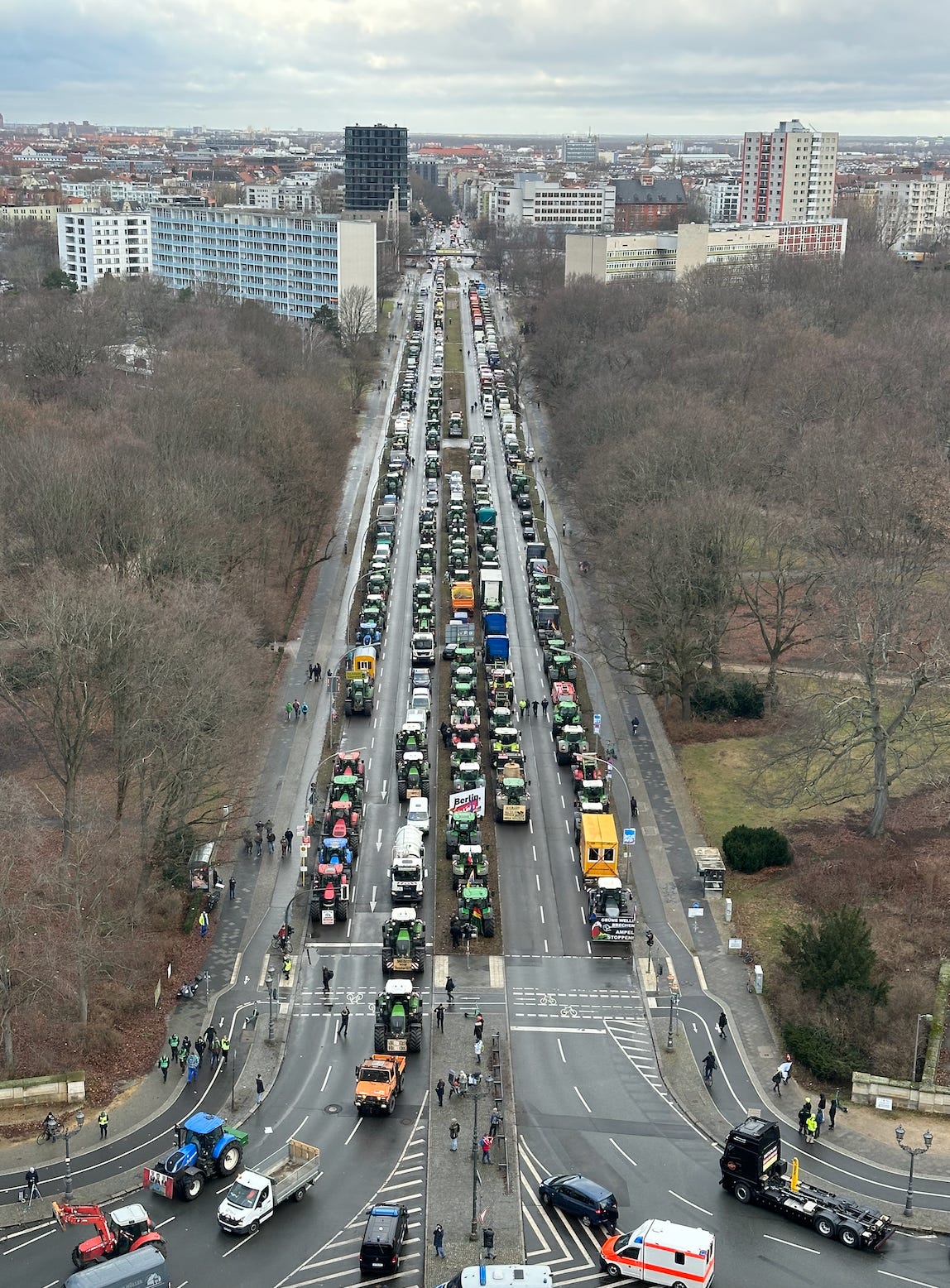
Yesterday tens of thousands of farmers, tradesmen and truckers, with at least 5,000 tractors and other vehicles, gathered on the Street of 17 June and adjacent boulevards. I could hear their horns from my room all the way on the other side of the Tiergarten throughout late Sunday night and early Monday morning. It was hard to sleep.

eugyppius: a plague chronicle is a reader-supported publication. maybe you subscribe?

As soon as the sun rose, I climbed to the top of the Victory Column, and saw nothing but tractors in every direction.

This was the eastward view towards the Brandenburger Tor:

Here’s the westward view looking towards the Technische Universität:

To the south on Hofjäger Allee:

Northwest along Altonaer Str.:

The day was cold and windy, but the mood was good. The police had quietly positioned water cannons and other crowd suppression equipment on side streets …

… but it was obvious that none of it would be used. Some papers are now eagerly reporting that “multiple arrests” occurred, by which they mean police detained about two dozen people. I’d say that’s the minimum you can expect at an action of this size, and because various bad actors are trying to tell lies, I want to be very clear: There was no confrontation between protestors and riot police, the officers were restrained and the worst I saw anybody do was set off some fireworks…

…and climb some light poles:

Around 11am there began the march down the Street of 17 June towards the stage on the Brandenburger Tor, where protest leader Joachim Rukwied, President of the German Farmers’ Association, and Finance Minister Christian Lindner were set to speak.

Along the way I saw the media that was missing on Sunday, including camera crews from Welt and Das Erste. Of course none of them bothered to interview any participants. I also met a press photographer; he came with me to the top of the Victory Column to get photographs of the crowd, but I was the only one of us who ended up taking any pictures. He had one look at the overflowing boulevards, declared there were no good shots, and quickly descended for more street-level photos. I understood this better upon reading the press coverage yesterday evening: Major news outlets are insisting, via police sources, that only 8,500 protestors attended – probably 30% of the true number. From the beginning, I guess, the press hoped to downplay the size of the protest.

The view from the crowd at 11:30am on the morning of the protest. The people in front of me had assembled hours earlier, and it was impossible to get a clearer view of the stage.

I had no illusions that either Rukwied or Lindner would have anything good to say. The former spent the days before the protest railing against “radicals” and singing hymns to “democracy” and the “ballot box”; the latter gave a speech on 6 January telling the farmers to go home.

The question was merely how bad these men would be, and I regret to report that both of them were as terrible as possible. You must remember that there is one way – and only one way – for the protest to succeed: The farmers have to adopt an inclusive political programme with broad appeal, and their goal must be the resignation of the Scholz government and new elections. While the farmers are a well-organised and influential segment of society, there aren’t that many of them, which is why the government alighted upon their plan of increasing farm-specific taxes to plug their budgetary hole in the first place. If the farmers confine themselves to issues like the diesel tax hike, they’ll make themselves irrelevant. Even the farmers I talked to seemed not to care that much about diesel subsidies; they have a wide array of much more serious and relatable concerns. The vision and the strategy are there, but their leadership is wholly compromised.

Berlin: Christian Lindner (FDP), Bundesminister für Finanzen, spricht neben Joachim Rukwied, Präsident des Deutschen Bauernverbandes, während der Kundgebung auf der Bühne.
Joachim Rukwied stands firmly at the side of Christian Lindner at the farmers’ protest on 15 Janaury, as Lindner flatly refuses all the farmer’s demands and makes vague future promises about de-bureaucratisation. This photo from dpa and not my own, because the thick crowd made getting any clear view of the stage impossible.

Rather than embrace the grievances of the farmers they summoned, Joachim Rukwied and the German Farmers’ Association are determined to shut them down. Yesterday, Rukwied insisted that the protest is solely about the diesel tax increases, even contradicting some of his fellow speakers on this point. He complained bitterly that the press had called his movement right-wing. He explained that “democracy” is all about “conversation” and “compromise,” and he advised everyone to leave Berlin and call their elected representatives. In other words, he did everything deliberately and precisely wrong. He must know that, if the farmers follow him on this path, they won’t get their way even on agricultural diesel; the government will insist on these taxes if only to humiliate them.

After three further speeches, the most egregious from Theresa Schmidt, who chairs something called the Federation of German Rural Youth and who has a peculiar talent for delivering grating schoolmarm lectures about dEmOCraCy, it was Finance Minister Christian Lindner’s turn to speak. The crowd weren’t inclined to hear a word from him, but Rukwied called for silence and they regrettably complied. Lindner proceeded to tell the demonstrators, with Rukwied at his side, that the diesel tax hike isn’t going anywhere, but he did promise to “de-bureaucratise” the regulatory apparatus so that the farmers might enjoy “more freedom.” The farmers were unimpressed, but they let him hold forth for a full twenty minutes. As thanks for their forbearance, they may read outraged reports across the media today about what a terrible time Lindner had trying to shout over all the booing and whistling.

On one point, however, Lindner was totally right. He said the protests were clearly about much more than diesel taxes, and here alone Rukwied contradicted him, again insisting on his tiresome self-neutering line that 30,000 people assembled in Berlin to protest taxes on agricultural diesel and nothing else. He said this in front of thousands of truckers and tradesmen, whom the tax hikes do not affect. He said it before a sea of placards venting fury at the present state of German and European politics in the broadest possible terms:

“Unplug the traffic light.”
From the top: “Farmers are rising up. And it’s not just us who have had enough, now everyone is resisting. Together we are strong.” – “The only thing to be done about this rudderless government is blocking the colours of red yellow and green, which stand for reduction, regulation and Berlinisation.” – “Berlin 2024. We’ll be back.”
“The country has been brought to a standstill because nobody wants this government! Stop the war against your own people.”
“Sometimes you have to sink the ship to get rid of the rats.” In the water are Green co-head Ricarda Lang, Agricultural Minister Cem Özdemir and Chancellor Olaf Scholz. The rat on the mast is telling Finance Minister Christian Lindner to jump into the water too.

In his concluding remarks, as Rukwied said yet again that he wanted only the “Rücknahme,” or withdrawal, of the tax increase, a group of angry farmers behind me began shouting that they want not “Rücknahmen” but “Rücktritte” – that is, resignations. They must now realise that Rukwied will not help them in this.

This morning there were still tractors on the Street of 17 June, so maybe there is yet hope. In any case, I think it’s important to remember what’s feasible here. Contrary to the expectations of some readers, I don’t think this or any protest can bring down the German state or realign European politics. Street activism is far from the only ingredient necessary to achieve a transformation on that scale. In the DDR there was at least an outside – an immediate alternative regime, in the form of the West, to which activists could appeal and from which they drew support. There is nothing like that for us now. What a well-supported protest like that of the farmers can do, is hurt the crisis-stricken Scholz government even more, increase the punishment for their failures and, if they are persistent enough, force new elections. That is far from everything, but it is not nothing either. Since the energy crisis, Germany has entered an accelerating process of deindustrialisation; there are real livelihoods at stake here, and it’s worth doing everything possible for any chance of moderating the destruction, however slight.

The aftermath.

At the same time, it’s plain that the unions and organisations like the German Farmers’ Association are hopelessly compromised. As valued reader Andreas Stullkowski points out, Rukwied is fully mobbed up with the present state and corporate establishment. He’s held paid advisory positions for the state-owned investment bank KfW, for Messe Berlin, for the German sugar producer Südzucker and for BayWa. His entire purpose is to channel the political discontent of the people he nominally represents along useless paths. If the farmers want anything to change, they’ll have to disregard his calls to capitulate and press on under their own steam.

eugyppius: a plague chronicle is a reader-supported publication. maybe you subscribe?

16 Jan 16:31

"We've got a bunch of dead robots out here": Chicago stations are full of EVs that wouldn't charge in the subzero temps

by Not the Bee

Remember how the politicians want to ban gas cars? Yeah ...

16 Jan 16:10

WOEING: What’s Gone Wrong at Boeing. Harry Stonecipher, who had been CEO of McDonnell Douglas a

by Stephen Green

WOEING: What’s Gone Wrong at Boeing.

Harry Stonecipher, who had been CEO of McDonnell Douglas and was CEO of Boeing from 2003 to 2005, said: “When people say I changed the culture of Boeing, that was the intent, so that it’s run like a business rather than a great engineering firm.”

Corporate culture can be a notoriously squishy topic—too readily subject to broad generalizations. And, of course, all big companies are interested in making money and boosting their stock price. But even if corporate cultures are hard to characterize accurately, they’re still real. As the management theorist Edgar Schein defined it, the essence of corporate culture is “the learned, shared, tacit assumptions on which people base their daily behavior.” In the old Boeing, the people who dictated those assumptions were the engineers. In the post-merger Boeing, the people who did so were more likely to be accountants.

For some businesses, a shift to a greater emphasis on bottom-line considerations might not have mattered that much. But manufacturing airliners in large numbers is not one of those businesses. That’s because making big aircraft is an unreasonably difficult thing to do. A plane like the 737 Max has, by some accounts, more than half a million parts. Boeing now outsources much of its production, leaving assembly as its main job, so those parts are made by at least 600 suppliers (many of which, in turn, rely on subcontractors). Supervising the reliability of the manufacturing and quality-control processes at all of those different suppliers, while ensuring the reliability of Boeing’s own assembly processes, requires a maniacal attention to detail, a willingness to spend freely on reliability and safety, and a culture that tolerates the reporting of mistakes and the investment of serious resources in fixing them.

That ethos is hard to instill using only financial incentives or the threat of firing. What’s really needed is a culture of perfectionism—and that’s what Boeing seems to have lost over the past 20 or so years.

One of Beoing’s problems is that it isn’t even run like a well-run business, much less like the engineering firm it used to be and ought to be.

16 Jan 15:49

Art Dealer Testifies that Hunter Expressly Asked for Buyer Information

by jonathanturley

More details are emerging from the recent testimony of Hunter Biden’s art dealer, George Bergès. We previously discussed how Bergès confirmed that the accounts of buyers flocking to buy Hunter’s art was false and that most of the art was purchased by his Democratic donor patron, Kevin Morris. Not only did Bergès shatter White House claims of a carefully constructed ethical system to keep Hunter from knowing the identity of purchasers, Bergès testified that Hunter expressly demanded to know the identity.

Various experts objected to the sales as a serious ethical problem of donors using the purchases to assist President Biden and his family.

The media dutifully reported at the time how the White House was grappling with the ethical questions and, according to the Washington Post, “the White House officials have helped craft an agreement.” It was portrayed as unprecedented and unyielding.

The White House continued to swat down questions by citing an ethical plan created for the sales. Andrew Bates, a spokesperson for the White House, said in a statement that “the President has established the highest ethical standards of any administration in American history, and his family’s commitment to rigorous processes like this is a prime example.”

Then White House spokesperson (and now MSNBC host) Jennifer Psaki stated:

“Well, I can tell you that after careful consideration, a system has been established that allows for Hunter Biden to work in his profession within reasonable safeguards […] But all interactions regarding the selling of art and the setting of prices will be handled by a professional gallerist, adhering to the highest industry standards. And any offer out of the normal course would be rejected out of hand. And the gallerist will not share information about buyers or prospective buyers, including their identities, with Hunter Biden or the administration, which provides quite a level of protection and transparency.”

It appears that the plan was not implemented until months after these assurances were made. If true, the White House effort was the ultimate example of closing the barn door after the horse has bolted. The clear message given repeatedly to Congress and the public was that an ethical plan was in place to prevent such knowledge.

Bergès reportedly testified that he had no contacts with the White House and Hunter knew the identity of the purchasers of most of the art. Notably, Bergès was reading these same reports in the news but never objected to the alleged misrepresentation. He admitted that he read of those reports and was confused.

A staffer asked: “When you’re seeing in the press that the White House is putting in certain safeguards regarding an ethics agreement but you’ve had no conversations with [the] White House, I mean, did you ever say to Hunter Biden, ‘Hey, where’s this coming from?’”

Bergès responded: “I might have. I probably did, yeah.” He admitted that he was surprised by the coverage “[b]ecause I hadn’t had any communication with the White House about an agreement.” That, of course, was never reported. Instead, the media dutifully reported how there was this comprehensive ethical plan in place.

What was particularly notable is that, despite the false White House claims and extensive coverage, Hunter appears to have discarded any such limits. Berges testified that artists usually do not know who buys their art.  So not only did Hunter not comply with the agreement with the first, this was a departure from standard operating procedure to let him know about the purchasers: “…I don’t know how it was phrased or—but I remember that there—that that was the difference…That part was different. Normally, the gallerist does not let the artist know who the collectors are…The first one was that I was required to disclose who the buyers were. In the second one, I was required to not disclose the buyers.”

The most important testimony, in my view, is still the massive purchase by Morris. This Democratic donor was introduced to Hunter at a Democratic fundraiser for the first time not long before reportedly giving him millions to pay off his taxes and support his lavish lifestyle. He then reportedly purchased most of the art as the media was reporting how hot Hunter was as a new emerging artist. The claims of walling off the identity of purchasers and the high demand for his art proved to be false.

In a letter to Fox News, Bergès insisted that the knowledge of the sales was due to “friends or by happenstance.”

For his part, Bergès says that he no longer carries Hunter’s art. He did confirm that he previously did speak with President Biden in person and on the phone during the period when he was selling his son’s art.

The media, however, now appears to be, again, largely ignoring the story and what it says about not just the ethical questions but its own prior coverage.

16 Jan 15:19

THEIR PRINCIPLES ARE VERY FLEXIBLE: https://twitter.com/byJoshuaDavis/status/1746743805410459829

by Glenn Reynolds

THEIR PRINCIPLES ARE VERY FLEXIBLE:

15 Jan 22:07

FIRE THEM ALL: Biden Administration Antisemites Plan Massive Walkout.

by Stephen Green
15 Jan 19:28

UM: Fani Willis speaks out after allegations she hired her lover to prosecute Trump: ‘You cannot ex

by Glenn Reynolds
15 Jan 02:07

Report: ESPN has returned DOZENS of Emmys after it was discovered they used fake names to get more awards for TV personalities

by Not the Bee

According to an exposè in The Athletic, over nearly three decades ESPN has run a scheme to get their on-air personalities and show hosts multiple Emmys for the same show in the same year, a violation of the National Academy of Television Arts & Sciences (NATAS) rules.

14 Jan 23:05

DANIEL GREENFIELD: The Greatest Islamophobia Hoax in America Exposed. When three Arab Muslim studen

by Ed Driscoll

DANIEL GREENFIELD: The Greatest Islamophobia Hoax in America Exposed.

When three Arab Muslim students were shot and wounded in Burlington, Vermont, politicians and the media immediately hyped it as the ‘Islamophobic Crime of the Century’.

President Biden issued a statement declaring that “there is absolutely no place for violence or hate in America.” Vice President Kamala Harris’ statement bemoaned that “far too many people live with the fear that they could be targeted and attacked based on their beliefs or who they are”. The three Muslim men identified as ‘Palestinian’, two of them were wearing keffiyehs and Kamala, like many other leftists, was implying that the shooter was ‘anti-Palestinian’.

“The idea that three young men walking down the street get shot, perhaps because of no other reason than they are Palestinian, is unspeakable,” Sen. Bernie Sanders said. ”But I gotta tell you, this is not just a local phenomenon, this is happening all over the country.”

Then he blasted Israel.

* * * * * * * *

The American-Arab Anti-Discrimination Committee falsely claimed that “a man shouted and harassed the victims, then proceeded to shoot them. We have reason to believe this shooting occurred because the victims are Arab.”

In reality, they had been shot by a local resident outside his house who did not say a word.

The three Muslim men were returning home from a party on Saturday night when James J. Eaton, a local resident with a history of mental instability, stumbled out of a white clapboard house on the residential street and without a word fired four shots at the three men.

Eaton had been described as “that hippie guy” and “progressive”, an organic farmer who had posted a meme with a definition of “Amerika” that called it “the worst sense of the United States, ie imperialism, corruption and the global exportation of American culture.”

He appeared to be a Biden supporter.

Media outlets, anti-Israel activists and politicians attributed the shootings to the Hamas war. Everyone from Biden and Kamala on down emphasized the “Palestinian” identities of those shot and implied that Eaton had attacked them because he was opposed to the ‘Palestinian’ cause.

In reality, Eaton supported Hamas.

On December 6, Seven Days, a local news outlet known for breaking stories about local politics, revealed that Eaton had tweeted, “the notion that Hamas is ‘evil’ for defending their state from occupation is absurd. They are owed a state. Pay up.”

Responding to an article about a proposed ceasefire, he wrote, “What if someone occupied your country? Wouldn’t you fight them?”

Local politicians were aware of this which is why in December a Burlington City Council resolution from Councilman Ali Dieng, an African Muslim immigrant currently running for mayor, trying to tie the shootings to an attack on Israel failed, and so did a resolution pushing the false claim that the students had been targeted because of their identity.

The latest Islamophobia hoax had fallen apart in Vermont, but still lingered nationally.

Read the whole thing.

14 Jan 23:01

U.S. HITS 60+ TARGETS AT NUMEROUS IRANIAN-BACKED HOUTHI FACILITIES THROUGHOUT YEMEN: U.S. OFFICIALS.

by Ed Driscoll

U.S. HITS 60+ TARGETS AT NUMEROUS IRANIAN-BACKED HOUTHI FACILITIES THROUGHOUT YEMEN: U.S. OFFICIALS.

Although the medical miracle behind this could be the bigger story:

And speaking of miracles, the left suddenly rediscovers the Constitution! Democrats fume after Biden orders Yemen airstrikes without congressional approval: ‘Unacceptable violation of the Constitution.’

14 Jan 15:08

IT SENDS TOO MUCH MONEY TO RED STATES: Biden facing pressure to rein in LNG exports. “In the past

by Glenn Reynolds

IT SENDS TOO MUCH MONEY TO RED STATES: Biden facing pressure to rein in LNG exports. “In the past two years, hundreds of cargoes loaded with supercooled gas have departed the U.S. Gulf Coast as foreign buyers turn to America for energy supplies. Developers of export terminals are now capitalizing on the momentum, pushing for plans to build more facilities to expand LNG production. But climate activists and Democratic lawmakers want the Biden administration to stop the expansion. They argue that the federal government, which has to approve LNG projects, is failing to account for the harmful effects of gas exports on the climate, the U.S. economy and local communities.”

They want us to buy gas from Putin. Everyone knows that commie carbon is good for the planet.

13 Jan 14:32

I REMEMBER WHEN CENSORSHIP WASN’T A JOURNALISTIC PRIORITY: New York Times journalist rage quits Sub

by Glenn Reynolds
12 Jan 19:11

Bill Ackman — I can no longer be associated with the Democrat Party.

by Kane
12 Jan 15:15

Highlights From The Comments On Capitalism & Charity

by Scott Alexander

[original post: Does Capitalism Beat Charity?]

1: Comments Where I Want To Reiterate That I’m In Near Mode
2: Comments Directly Arguing Against My Main Point, Thank You
3: Comments Promoting Specific Interesting Capitalist Charities
4: Other Interesting Comments
5: Updates And Conclusions

1. Comments That Make Me Want To Reiterate That I’m In Near Mode

Seen on Twitter:

Something like this was one of the most frequent comments and, imho, misses the point of the post.

I’m not running a Moral Worth Tournament where I match concepts against each other and decide which deserves more credit for good things. I’m discussing the Near Mode situation where some specific person (eg you) has some specific amount of money (eg $1,000) and wants to use it to improve human welfare.

Real people in my real comments section have argued that you shouldn’t spend it on charity, you should spend it on satisfying your daily needs (or invest it) because capitalism always works better than charity. I’m arguing that’s not the right way to think about this specific problem.

If you’re holding a Moral Worth Tournament and want to argue that Capitalism wins because it creates the preconditions that make everything else possible, fine, that’s outside the scope of this post. “Which is better, Capitalism or a double cheeseburger?” Even granting that capitalism is better in the cosmic sense, and that capitalism is a precondition for abundant food, and that Capitalism beats cheeseburgers in the Moral Worth Tournament happening inside your head - I’m arguing that if you’re hungry right now you should go to Burger King, not the New York Stock Exchange.

Bob Frank (blog) writes:

The value of capitalism isn't the "second order effects" so much as the cascading-indefinitely effects. It's the "give a man to fish" vs. "teach a man to fish" principle. While I in no way wish to denigrate the value of saving lives with better water... once you do that, then what? You have people who are alive, and still in the same situation they were in before.

The value of capitalism is that it elevates entire civilizations to a higher state of living. There's a reason why stuff like water dispensers to save lives are going to developing countries with no market economy: *in capitalist nations, there is no need for such things in the first place.* The equivalent work was baked into our basic infrastructure long ago.

Seems to me that one of the best places to invest, then, would be in research to figure out why the "charities that send economists (or other professionals) to developing countries and advise them on how to do more capitalism" were ineffective and how to do it better.

This is true, but I want to repeat exactly how Near Mode and specific my problem is: I have real money I want to spend on this.

It’s all nice and well to say “it would be good if someone could research why development charity doesn’t work so well”, but 1. This is a field called Development Economics 2. Like all academic fields, it’s full of a bunch of squabbling factions 3. You can definitely fund grad students to do PhDs in this, but they’ll come up with some theory about elite capture very slightly different from all the other factions’ theories, and then what?

Maybe you have an answer for this, but if it involves “Spend the rest of your life creating this hard-to-create institution from the ground up”, then I, personally, am not going to do this. I would prefer something more like a Bitcoin address I can send money to.

(if you actually give me a Bitcoin address then I’ll assume you’re trying to scam me and won’t send anything there, sorry.)

2. Comments Directly Arguing Against My Main Point, Thank You

VelveteenAmbush writes:

He never really addresses why plugging the cash into an index like the S&P 500 isn't a better use of funds than GiveWell's recommended charity. He chooses Instacart as his exemplar of capitalism, but then concludes that investing $1M in Instacart means "you can give 2,000 people a great deal on grocery delivery." But the whole point of investing is that it isn't one-and-done, that instead it grows exponentially over the long term, building wealth in the form of new and better companies which provide products, services, innovation and technology that are responsible for basically all of the good things you see on Steven Pinker's up-and-to-the-right charts illustrating the improvement of the human condition over time. These are the things that, if all goes well, will eventually lift humanity to the heavens, slay the demons (disease, death, etc.) that have haunted us forever, and awaken the dead matter of the cosmos into flourishing sentience.

Over the long term, investing your money is a better use of capital than donating it to charity if and only if investing it results in a greater exponential progression in wealth for humanity than donating it to charity. The historic annualized average return of the S&P 500 since its 1957 inception through the end of 2023 is 10.3%. That is a floor on the humanistic benefits created by investment, because it includes only the direct returns to the money invested, and it excludes the positive externalities the companies generate for society but do not capture directly. Since the earnings that companies generate are generally the product of voluntary trade, one should assume that the counterparties to each trade are also benefitting.

So: if you donate $1M to GiveWell's Dispensers For Safe Water charity today, will that end up creating more than $134M of value in 50 years? If not, it's a loser in terms of long-term opportunity cost. If so, then we can get into the more subjective exercise of trying to tabulate the positive externalities of investing.

To put my cards on the table, I don't like EA style giving because it focuses on the cheapest cost to save a life worldwide. But lives worldwide vary greatly in the extent to which they build wealth for humanity as a whole. In my opinion, looking for the lives that are cheapest to save worldwide is going to select for those least likely to contribute to the technological and commercial progress of mankind.

As an analogy, imagine there were a nursing home with 10,000 elderly residents. Suppose that nursing home were drastically underfunded such that their residents were dying left and right of eminently treatable conditions. You could save a lot of lives by donating money to supply better medical treatments to those residents. Perhaps that would be a kind thing to do. It would make a big difference to its residents. You could claim to have saved up to 10,000 lives. But it would not build wealth. Those residents are going to remain dependent and unproductive whether they die today, tomorrow, or in twenty years. Thus, from the longterm perspective of humanity, that donation is consumption, not investment, even though it happens to be other people (the nursing home residents) who do the consuming. Over the long term, investment is what will make us all wealthier and eventually uplift our species and awaken the cosmos.

My criticism of GiveWell style EA is that its causes are systematically akin to donating to underfunded nursing homes. If you view uses of funds as on a spectrum, with pure consumption one end of the spectrum and pure investment on the other, my position is that EA is more like consumption than putting your money into the S&P 500.

You can disagree with that, and it's fair to do so. I think it would actually be a healthy debate to have. I would love to see Scott go deep on this debate specifically, if he thinks he can thread the needle around certain delicate topics regarding human capital in doing so. But the form that the argument should take is over the expected long-term rate of return to humanity's wealth of the investment, not number of lives saved. Number of lives saved is the wrong metric entirely. Long-term ROI is the right metric.

I’m signal-boosting this because Velveteen is the kind of person my post is trying to argue against. Lots of people responded with “you’re responding to a straw man, which is just a distraction from [argument I like better]”. No, I’m responding to people like Velveteen. I appreciate their willingness to respond to my argument on its own terms instead of trying to deflect it to something else.

We talk a bit more in this comment subthread, but I have three main objections. First, at some point all of this has to bottom out in consumption. It’s great if I can turn money into more money, but this is the equivalent of getting a genie and wishing for more wishes - sure, do it, but at some point someone has to use at least some wishes or the whole thing is pointless. So this reduces to whether you should consume (either personally or charitably) now, vs. invest, turn your money into more money, and then consume it at some unspecified point in the future. This is a good and important question, and not one I have strong opinions about - see here and here for more.

Second, I care a lot about marginal utility of money. I think a (consumption) dollar goes much further in the developing world than the developed world. If you invest in high-growth companies, it may create more total wealth, but most of that wealth stays in the developed world. If you donate to charity, you will create less numerical wealth, but it will go to people who need it more. Which matters more? This is what the Instacart vs. clean water example was meant to provide intuitions for.

Third, how does company wealth compound vs. philanthropic “wealth”? If you give your money to a company, they’ll expand operations and grow at some rate (on average the market rate of return). If you spend your money curing tropical diseases, then some people will survive, and those people will build wealth / do labor / grow the economy (also you’ll save money that would otherwise have been spent treating those diseases). As I said on the subreddit, whatever else is bad about an 18 year old dying, you've lost ~50 years worth of productive labor that you invested eighteen years building up. Once you consider how much human effort it took raise and educate 2,000 eighteen-year-olds, and how much you can get done with a 2,000-person labor force, then letting those 2,000 people die starts to feel like a giant economic waste even in addition to the humanitarian cost (not to mention the amount of money saved by not building hospitals to treat the diseases that would otherwise have killed them). Probably those 2,000 people don't create more compounding wealth than an investment of the same amount of money into Instacart would, but I think the diminishing marginal utility of money case makes it likely that they produce more utility-adjusted wealth.

Velveteen protests that I haven’t proven this and don’t even have a model showing it’s a sane order-of-magnitude estimate. I accept this. I don’t think anyone has proven the opposite either. I’m going entirely off total guesses. It would be worthwhile for someone to try to calculate this but it would be a very big project, and a half-baked version would be worse than the total guesses.

3. Comments Promoting Specific Interesting Capitalist Charities

Michael Strong writes:

I was glad to see the EA Intervention Report on Charter Cities but it was limited by the fact that it was written by non-expert outsiders. Mark Lutter's response is much better informed than was their write up.

Regarding the widely varying success of SEZs - Read Lotta Moberg's, "The Political Economy of Special Economic Zones." Tl;dr privately financed zones are more likely to be successful than are crony capitalist, politically-motivated government financed zones, plus a lot more nuance worth reading for serious SEZ students. Moberg and Lutter are two of a handful of scholars who have done dissertations on zone related issues. The EA report was not informed by Moberg's research, thus they did not understand the political economy dynamics of different types of zones.

Insofar as one of the core conclusions of the "Intervention Report" was "economic development and reform zones," the actual work done by Charter Cities Institute and others in this domain do, in fact, work on a variety of zone-based reforms. The Romer-esque version of a "Charter City" was to some extent a straw man for what should have been a deeper dive into the global movement of zones with distinctive law and governance.

Thus several of their conclusions were sensible - but should have led you to increase your support of the Charter Cities Institute (CCI) rather than question it:

"Charter cities are expensive to build and take a long time to come to fruition, so if your focus was on the value of information, it seems likely that you could more cheaply and quickly generate this by focusing on alternatives which do not require you to build a new city, such as economic development and reform zones."

Hello? Much of CCI's work is towards what are de facto reform zones rather than grandiose Romer-esque Charter Cities - and that is the way they should be working.

There is a global movement towards zones with distinctive law and governance (precisely because it is widely recognized that bad institutions limit economic development). The Charter Cities Institute is indeed a leader in this movement, and should be supported, but the issue of better law and governance in zones is broader than their work alone. The most successful example is the Dubai International Financial Centre, where a common law legal system was placed in a 110 acre zone within UAE sharia law. It led to Dubai becoming a top global financial center in twenty years.

Zone based reforms are a hack around the public choice challenges of nation-state reforms. Bob Haywood, former director of the World Economic Processing Zones Association, makes the case that zones address Doug North's "natural state" of oligarchy preventing liberalization because export zones don't immediately threaten the rent-seeking structures. In his experience, usually zones were adovcated by the peripheral elites - not the core elites, but the son-in-law, cousin, younger brothers, etc. who had access to elites but were not currently benefiting from rent-seeking themselves. Without zone solutions, however irregular their success, most nations tend to be stuck in the "natural state" of oligarchic rent-seeking. Haywood makes the case that zones led to broader economic liberalization in Mexico, China, Mauritius, Ireland, and elsewhere. If the benefits of zone-based reforms includes broader economic liberalization then the returns are much greater.

The most important work being done by CCI is not necessarily creating Charter Cities - Prospera alone has a much more sophisticated platform than anything CCI has. But they play a crucial role in mainstreaming these ideas so that development economists, multi-lateral institutions, media, and well-intentioned Westerners pay more attention and are more likely to support reform zones. Prospera's technology is ready to replicate - we need this greater mainstream support to close the deals.

I've been involved in selling these ideas in multiple nations, and being able to point to the growing mainstream credibility achieved by CCI is definitely a factor leaning towards adoption. Conversely, without CCI's leadership, developing world government "reforms" are driven by a combination of venality, corruption, populist or leftist ideologies, World Bank banalities, and the occasional McKinsey analysis. CCI is a big positive step in the direction of concrete, actionable reform zones that are likely to improve institutions incrementally. If we can get to the point at which zones with their own law and governance become a routine technology of economic development, then the value of these institutional experiments is likely to become high.

Most people have no idea how much harder it is to do legal business in developing nations. The upside of making Prospera-quality law and adjutication available in zones in Africa will be significant over time. My wife, Magatte Wade, is working to bring Prospera to Africa because of this. She also writes and speaks about the ridiculous over-regulation of business in Africa that makes it necessary - she has first hand experience of what it is like to do business in the US vs. in Senegal. The fact that African nations are ranked at the bottom of the Doing Business index is not an artifact of measurement.

So by all means support CCI. The work it does is much more important than the EA Intervention Report acknowledges.

Michael is a big player in the charter cities world and I appreciate his input.

Like Michael, I think the theoretical case for charter cities and SEZs is strong. Rethink Priorities tried to supplement that with an empirical case, but it fell flat because most of them are poorly designed half-efforts that don’t work, and the empirical results reflected that. The natural next step would be to come up with some objective criteria for “well-done charter city / SEZ”, do a report-level amount of work demonstrating that these do work, and then argue that whatever we’re debating (eg CCI) fits the criteria for a well-done CC/SEZ and so its expected return should be in the group we’ve now proven to be good, not the other group Rethink Priorities proved to be bad. This would be a big effort, and AFAIK nobody has done it yet. So I continue to classify good CC/SEZs in the bin of “theoretically strong case, not super-strong empirical evidence yet”.

What you do with this bin is a value judgment, but my heuristic is that lots of things in it - the kind of things that are brilliant and well-intentioned and really should work and do work in flashy cases everyone knows about - then somehow fail to work when you try to scale them up. So although I’m (relatively) optimistic about CCs/SEZs and support them, I don’t yet think they’ve obviously proven their utility as the best form of charity.

The Effective Altruist Forum now has a post on Economic Growth - Donation Suggestions And Ideas, listing suspected top charities for helping countries develop. These include ACX Grants winner Growth Teams, the Charter Cities Institute, GiveDirectly, and Overseas Development Institute.

I say “suspected top charities” because these are just kind of thrown out there, and not given the really thorough EA treatment that eg GiveWell gives eg malaria charities. I understand why this is - it’s easy to do RCTs on whether malaria treatment works, and hard to do RCTs on the effects of spending ten years quietly lobbying Madagascar to have slightly different economic policy (or whatever).

Still, this is the main reason I don’t donate more to these kinds of charities. I assume most charities aren’t very good, and I only update this once someone (ideally a group of experts willing to devote a lot of time) analyzes them, gives one a seal of approval, and says it works better than whatever other charity I’m considering. This is hard to do in development work.

One of the charities listed on the Forum post is one I have specific reason to think isn’t very effective (I’m not going to publicly accuse it, because it’s a pretty weak reason, it would take hours to formulate a case strong enough that I didn’t feel like it was vibe-based-slander, and I don’t want to get in a fight). It’s just coincidence that I happen to know that. How many other ones on that list have serious flaws that I just haven’t yet run into evidence of? I don’t know!

The four I named above all seem good to me, although I’m not an expert and haven’t spent too much time evaluating them.

Mark Roulo writes:

> "Do something like donating to charity, but the donation should go to charities that promote capitalism somehow, or be an investment in companies doing charitable things (impact investing)"

One interpretation of this is that donating to the Grameen Bank is better than donating to the Heifer International.

Several people brought up Grameen Bank (Nobel winner Mohammed Yunus’ microfinance project) and other charities that loan poor people money to help them start small businesses. They thought these seemed like ideal ways to harness the power of capitalism for charitable ends.

I also used to think this, but articles like https://voxdev.org/topic/methods-measurement/understanding-average-effect-microcredit have convinced me that most studies show this doesn’t work in real life. I find this a surprising and counterintuitive result, and it’s part of why I seem so paranoid here and am demanding so much evidence before supporting charities in this field.

Laure X Cast writes:

I don't know about supporting capitalist charities (and I don't think I feel quite as bullish on capitalism for various reasons) but I think a different strategy to consider is 'investing' in (or donating to) charities that also operate in the market economy. Nonprofits make up 6% or so of GDP and there are many interesting nonprofits that have sustainable revenue, allowing them to re-invest in more work 'for good.'

I agree this is a potentially promising strategy. It’s good insofar as it forces the charity to be doing some useful thing someone wants (since they won’t make money if they don’t) and maintain some contact with reality (insofar as sales and prices keep them honest).

The counterargument is Nassim Taleb’s “barbell” idea (related: Purchase Fuzzies and Utilons Separately). If you’re trying to optimize two different goals (eg make money and do good), you’re better off doing half one and half the other, rather than putting all your chips in one fuzzy combination of both.

That is: why isn’t there a regular company, without a social mission, filling this need? Probably because it’s not very profitable. Why not? Probably some combination of “it’s not that useful” and “the intended recipients really need it, but don’t have enough money to pay for it / aren’t educated enough to know they need it”. If it’s not that useful, the charity’s not doing good work. If the intended recipients don’t have enough money or don’t understand enough to choose it on the open market, then a charity that charges them money will fail to serve a lot of the population.

I’m not saying a clever entrepreneur can’t thread this needle and make something that works here, this is just one reason I don’t think this solves the entire problem and obviously beats normal companies / normal charities.

Erusian writes:

This fails to engage with the actual argument of the social enterprise movement. The argument is that there is an irrational aversion to profitable activity among people who seek to do social good. Largely, in my opinion, due to ideological anti-capitalism. It is not that maximizing returns is the best use of money at all times or that we need to go around preaching the gospel of capitalism.

To give you a simple example, Foodhini is a for profit company that takes various refugees and has them make their regional cuisines then sells them in an Instacart or Uber Eats like model. It's a profitable company but it also does significant work to help these people get on their feet. Whether that's services to make sure the work is legal or helping them set up restaurants (which in turn profits Foodhini in various ways).

The argument is this is better than just giving them money or funding classes to help them integrate and that you should direct money toward this type of cause rather than charities that rely on constantly receiving a stream of donations. The model of constantly asking for money or grants to sustain the charitable activity is (according to the argument) supposed to be a last resort, not a first resort.

If that's not third world enough for you there's companies that help deploy limited resources to repair potholes in Central Asian roads (which the government is happy to pay for because it saves money), a company that makes water purifiers that it sells in Africa (while donating a significant number to poorer villages), a company that provides cheap industrial milling into certified gluten free flour for poor farmers, and so on. You also have non-profits that are 'profitable' in the sense they make enough money from standard business to operate like Ten Thousand Villages.

These are often not strictly the most profitable thing that people could be doing with their time but they both serve a social good AND they're profitable and therefore self-sustaining, able to raise investment, and don't need to spend nearly as much time asking for funds. That's the argument.

To be honest, I haven't heard a good counterargument. Which is one of the main reasons I'm backing this horse instead of EA.

Sorry I failed to engage with a completely different argument about something else.

I’m interested in hearing which of these things people think is best, and whether there’s any evidence supporting them.

Josh writes:

The charitable version of capitalism is GiveDirectly. It's just like buying things for yourself but the first person to spend the money is someone else.

For those of you who don’t know, GiveDirectly is a charity that gives your money directly to poor people in developing countries, and then they can spent it on whatever they want. They’re doing some cool stuff!

But precisely because they’re so good and so easy to quantify, they’ve become the bar that EA organizations rate other charities against, and some of those ratings find the other charities to be better. For example, GiveWell says the charities they fund are usually between 5x and 8x more effective than GiveDirectly.

I haven’t investigated these estimates and I don’t know what assumptions go into them, I don’t want to be taken as an authority here, just to relay what I’ve heard from other people who have thought about this more.

4. Other Interesting Comments

Michael Druggan (blog) writes:

I think this argument is nonsensical because money donated to charity eventually ends up back in the capitalist economy anyway the difference is what gets consumed along the way. If I donate $1 million dollars to the charity that builds wells that charity will then spend that on things like the materials to build wells, the capacity to ship those materials to the locations they need them, paying the people who build the wells etc. all the supposed second order benefits you would get from the money being spent in the capitalist economy would still happen since its still getting spent.

I originally thought this was claiming a sort of infinite free money pump that can’t exist.

Suppose that eg the US government decided to give everyone free health care by taxing people and spending it on health care. It seems like this should have tradeoffs or hurt the economy somehow. But you could argue that the health care money just goes to doctors and nurses and so on, who would then spend it on normal economy stuff, so the non-health-care economy is just as big as always.

But if I understand Michael’s response, he’s saying - the charity has to build the wells somehow, and that involves spending money on capitalist companies. Let’s say they hire Amalgamated Kenyan Wells. Then the money ends up in Amalgamated Kenyan Wells, presumably a profitable and successful company in the Third World, and this is no worse than donating to the company directly. So if your alternative was to give the money to a profitable and successful company in the Third World, the donation is better, because you do this and you get some free wells out of it!

Now I’m really not sure how to think about this. I think the answer is something like - the company has a certain profit margin (let’s say 10%), so you’re donating 10% of the money directly to Amalgamated Kenyan Wells, and the rest is going into the ground to become wells. So I agree that there’s some aspect of supporting capitalism here - maybe even one that’s better than giving to the company directly because it forces the company to demonstrate usefulness - but I think you could still argue that investing directly in the company has more effect.

rmostag1 writes:

Instacart's service isn't free after the $100 subscription - while you may no longer pay a per-order delivery fee, they continue to extract value through upcharging you on the cost of the groceries themselves (an item which costs $2 in-store costs $2.10 or $2.50 on Instacart), charging a percentage of the revenue to the retailer itself (so even if the price is equivalent in-store and on Instacart, Instacart charges a few percentage points of revenue to the retailer for the customer traffic), charging the retailer directly for providing services (most notably with smaller retailers, where Instacart may pick the products from the shelves, provide the back-end of the ecommerce platform, etc), or some combination of all of the above.

In all cases, the value extracted by Instacart far exceeds the stated fee that they charge you (either per-order or as a subscription), and you end up bearing it in one form or another at the end of the day. It's an interesting experiment to buy the same basket in-store and on Instacart at a retailer where the prices are NOT equivalent - often you'd surprised at the premium they're charging you for convenience. Certainly worth it for a segment of the population and a segment of retailers, but there's a reason that most retailers of scale are moving towards bringing the services formerly provided by Instacart in-house and figuring out ways to monetize it themselves - it's a frighteningly expensive proposition when you lay out all the costs end-to-end.

Thanks, this amply explains the part of their business model I found mysterious.

5. Updates And Conclusions

My biggest update is that I learned what Instacart’s business model actually is. Otherwise, not much, sorry.

If you want to change my mind, the most useful thing you can do is either:

  1. Propose a specific capitalist development charity for me to donate to (not a vague gesture at a type of charity, but a specific website with a donation page), and show me an analysis for how many dollars per QALY you get from it which finds it’s better than existing EA charities. Preferably this should be peer-reviewed or at least written by a good economist.

    (The only capitalist development charity I’ve seen try this was Charter Cities Institute, their numbers were absurdly high, I think the Rethink Priorities report reasonably suggested a much lower prior, and now the ball is in CCI’s court to demonstrate that they can pick winners effectively enough that the Rethink Priorities prior is inappropriate. To be clear, I think this would be a bad use of CCI’s time because it would be really hard and nobody but me has asked for it.)

  2. Give me an analysis with real numbers (even hand-wavey ones) demonstrating that capitalist charities should be so much more effective than other kinds of charities that investing in a broad basket of them outperforms other charities by such an order of magnitude that we don’t need specific numbers (even if 90% of the charities in the basket are frauds or duds or whatever).

This isn’t a gotcha or a rhetorical question, I think these could really change my mind.

12 Jan 15:11

NO EARTH-SHATTERING KABOOM: NASA unveils the new X-59 ‘quiet’ supersonic jet today and you can watc

by Glenn Reynolds
12 Jan 14:05

THE $23 MILLION QUESTION: Chicago Public Schools ‘Lost’ HOW Many Laptops and iPads???

by Stephen Green
11 Jan 22:17

NIH ignored nearly 3 years of FOIA requests for Wuhan lab, gain-of-function research records: suit

by Greg Piper
Group that fights federal funding of animal testing says one of agency's denials contradicted by published paper describing experiments at its Montana labs.
11 Jan 20:17

SHOCKER: Panel members for new psychiatric ‘bible’ received more than $14M from industry, analysis

by Glenn Reynolds

SHOCKER: Panel members for new psychiatric ‘bible’ received more than $14M from industry, analysis finds. “Sixty percent of US physicians serving as panel and task force members for the American Psychiatric Association’s official manual of psychiatric disorders received payments from industry totaling $14.24m, finds a study published by The BMJ. Because of the enormous influence of diagnostic and treatment guidelines, the researchers say their findings ‘raise questions about the editorial independence of this diagnostic manual.'”

11 Jan 20:17

I’M SO OLD, I REMEMBER WHEN EVEN SUGGESTING SUCH A THING WOULD GET YOU CANCELED: Fauci Now Says the

by Stephen Green

I’M SO OLD, I REMEMBER WHEN EVEN SUGGESTING SUCH A THING WOULD GET YOU CANCELED: Fauci Now Says the Lab-Leak Hypothesis Isn’t a ‘Conspiracy Theory.’

11 Jan 17:50

Oh Canada: Police Warn that Posting Images of Thieves May Violate Their Privacy Rights

by jonathanturley

While Canada eviscerates the right to free speech and association, some are apparently holding firm on the privacy rights of accused felons to warn homeowners not to post videos of thefts.

In Quebec, the police are now warning citizens not to post their doorbell videos of package thieves because they are, in the words of the spokesmen, “presumed innocent.”

Notably, these are scenes captured in public and posted by homeowners who had packages stolen from their doorsteps.

For critics, it is a continuation of misplaced priorities and policies on crime including the statement of Prime Minister Justin Trudeau that “you can’t use a gun for self-protection in Canada. It’s not a right that you have..”

It is true that you can be sued for defamation. However, that ordinarily requires fault. The police are arguing that conduct filmed on your property and visible from the street is protected by privacy even if the person is guilty of the crime.

If you use an image for commercial benefits, photos in public can pose risks. In 1998 the Supreme Court of Canada upheld the decision awarding $2000 to Pascale Claude Aubry against Éditions Vice-Versa for publishing a photo of her sitting on public steps without her knowledge. However, the court stressed that it was sold for commercial gain and had no newsworthy purpose.

Of course, deterring citizens from posting these images has a direct benefit for the police. These videos go viral and highlight the lack of enforcement and deterrence. The question is whether this is about the privacy interests of the thieves or the political interests of the police. We have seen police charge citizens for years for filming them in public. Those cases have largely been rejected.

Neighbors often shared descriptions and videos of local crime. The police department is now suggesting that such images could now get them into hot water. Oh Canada.

11 Jan 14:38

NEWS YOU MIGHT BE ABLE TO USE AND SHOULD PAY ATTENTION TO:  Chromium found in lead-tainted fruit po

by Sarah Hoyt

NEWS YOU MIGHT BE ABLE TO USE AND SHOULD PAY ATTENTION TO:  Chromium found in lead-tainted fruit pouches may explain contamination.

11 Jan 14:37

“FOLLOW THE SCIENCE” WAS A LIE: https://twitter.com/RobertKennedyJr/status/1745276075221962961?

by Glenn Reynolds

“FOLLOW THE SCIENCE” WAS A LIE:

11 Jan 14:35

DISPATCHES FROM THE MEMORY HOLE: https://twitter.com/bennyjohnson/status/1745276375374729680 F

by Ed Driscoll

DISPATCHES FROM THE MEMORY HOLE:

Flashback: Brian Kemp, Georgia’s Affable Culture Warrior.

In April 2020, businesses in Georgia were shuttered by government decree as in most of the rest of the country. Mr. Kemp was hearing from desperate entrepreneurs: “ ‘Look man, we’re losing everything we’ve got. We can’t keep doing this.’ And I really felt like there was a lot of people fixin’ to revolt against the government.”

The Trump administration “had that damn graph or matrix or whatever that you had to fit into to be able to do certain things,” Mr. Kemp recalls. “Your cases had to be going down and whatever. Well, we felt like we met the matrix, and so I decided to move forward and open up.” He alerted Vice President Mike Pence, who headed the White House’s coronavirus task force, before publicly announcing his intentions on April 20.

That afternoon Mr. Trump called Mr. Kemp, “and he was furious.” Mr. Kemp recounts the conversation as follows:

“Look, the national media’s all over me about letting you do this,” Mr. Trump said. “And they’re saying you don’t meet whatever.”

Mr. Kemp replied: “Well, Mr. President, we sent your team everything, and they knew what we were doing. You’ve been saying the whole pandemic you trust the governors because we’re closest to the people. Just tell them you may not like what I’m doing, but you’re trusting me because I’m the governor of Georgia and leave it at that. I’ll take the heat.”

“Well, see what you can do,” the president said. “Hair salons aren’t essential and bowling alleys, tattoo parlors aren’t essential.”

“With all due respect, those are our people,” Mr. Kemp said. “They’re the people that elected us. They’re the people that are wondering who’s fighting for them. We’re fixin’ to lose them over this, because they’re about to lose everything. They are not going to sit in their basement and lose everything they got over a virus.”

Mr. Trump publicly attacked Mr. Kemp: “He went on the news at 5 o’clock and just absolutely trashed me. . . . Then the local media’s all over me—it was brutal.” The president was still holding daily press briefings on Covid. “After running over me with the bus on Monday, he backed over me on Tuesday,” Mr. Kemp says. “I could either back down and look weak and lose all respect with the legislators and get hammered in the media, or I could just say, ‘You know what? Screw it, we’re holding the line. We’re going to do what’s right.’ ” He chose the latter course. “Then on Wednesday, him and [Anthony] Fauci did it again, but at that point it didn’t really matter. The damage had already been done there, for me anyway.”

The damage healed quickly once businesses began reopening on Friday, April 24. Mr. Kemp quotes a state lawmaker who said in a phone call: “I went and got my hair cut, and the lady that cuts my hair wanted me to tell you—and she started crying when she told me this story—she said, ‘You tell the governor I appreciate him reopening, to allow me to make a choice, because . . . if I’d have stayed closed, I had a 95% chance of losing everything I’ve ever worked for. But if I open, I only had a 5% chance of getting Covid. And so I decided to open, and the governor gave me that choice.’”

At that point, Florida was still shut down. Mr. DeSantis issued his first reopening order on April 29, nine days after Mr. Kemp’s. On April 28, the Florida governor had visited the White House, where, as CNN reported, “he made sure to compliment the President and his handling of the crisis, praise Trump returned in spades.”

Three years later, here’s the thanks Mr. DeSantis gets: This Wednesday Mr. Trump issued a statement excoriating “Ron DeSanctimonious” as “a big Lockdown Governor on the China Virus.” As Mr. Trump now tells the tale, “other Republican Governors did MUCH BETTER than Ron and, because I allowed them this ‘freedom,’ never closed their States. Remember, I left that decision up to the Governors!”

Of course, Trump is far from the only former official distancing himself from the debacle of 2020: Anthony Fauci Says Don’t Blame Him for COVID Lockdowns and School Closures.

And this isn’t the first time that Team Trump has tried to morph the history of 2020:

11 Jan 00:29

This NPR reporter was fired for telling jokes in his off hours. An arbitrator ordered him reinstated because they made him laugh.

by Not the Bee

Jad Sleiman was a reporter for Philadelphia-based NPR member station WHYY, but he's also trying to break into the stand-up comedy business as a Muslim comic in his off hours.

10 Jan 18:03

WOEING: Workers at Boeing Subcontractor Told to Falsify Records, New Investigation Finds. “Less than

by Stephen Green

WOEING: Workers at Boeing Subcontractor Told to Falsify Records, New Investigation Finds. “Less than a month before a door plug on a Boeing aircraft blew off midflight, employees at Spirit AeroSystems, a subcontractor for Boeing, had tried to warn corporate officials about serious safety problems with parts for 737 MAX jets. But those warnings went unheeded, and the employees were told to falsify records, according to a new investigation by The Lever on a federal complaint filed by workers at Spirit.”

10 Jan 14:11

Canadian Police Arrest Conservative Journalist on Trumped Up Charge of Assault

by jonathanturley

We have been discussing the rapid decline of free speech protections in Canada under Prime Minister Justin Trudeau. A vivid example of the increasing authoritarian approach was evident this week with the arrest of David Menzies, a reporter for Canada’s conservative Rebel News Network. Menzies was attempting to interview Deputy Prime Minister Chrystia Freeland when her security clearly manufactured a criminal charge in front of cameras.

Menzies was attempting to ask Freeland about Canada’s refusal to label Iran’s Islamic Revolutionary Guard Corps (IGRC) as a terrorist organization. Freeland continues to walk as Menzies attempts get an answer by walking backwards. As he stays with Freeland, a member of the Royal Canadian Mounted Police (RCMP) stands in his way and the result is a slight bump. The officer then immediately carries out an arrest with an eventual charge that Menzies assaulted him.

Trudeau has had a long running feud with Rebel News. Last week, we discussed the irony of how a Russian dissident was denied Canadian citizenship due to a conviction in Russia for speaking against the Ukrainian war (from Canada). Since Canada has the same criminalization of speech laws, Maria Kartasheva was pulled from her ceremony pending further investigation into whether she is a criminal practitioner of free speech.

The arrest of Menzies raises the same comparison to the approach of governments like Putin’s to critics. Note in the video below how the officer positions himself directly in the path of Menzies as he walks back with his back to the officer.

You can judge for yourself on what countries come to mind:

10 Jan 14:09

Hunter’s Art Dealer Contradicts White House Claims Over Art Sales

by jonathanturley

Over the last two years, ethicists and public interest groups have raised concerns over the selling of art by Hunter Biden as an avenue for Biden donors and allies to funnel money to the family. In response, then White House Press Secretary (and now MSNBC host) Jen Psaki repeatedly assured the public that there was a special ethical plan in place with the gallery to prevent Hunter from knowing who purchased the art. Yet, according to Georges Bergès, Hunter Biden’s art gallerist, he never spoke to anyone with the White House. Not only did he confirm that the White House never contacted him, but said that Hunter knew who purchased roughly 70% of the value of his art, including Democrat donors Kevin Morris and Elizabeth Hirsh Naftali.

The media dutifully reported at the time how the White House was grappling with the ethical questions and, according to the Washington Post, “the White House officials have helped craft an agreement.”

That appears to be news to Bergès who said that he had no contacts with the White House and Hunter knew the identity of the purchasers of most of the art. Notably, Bergès was reading these same reports in the news but never objected to the alleged misrepresentation. He simply continued to be a conduit for the funds to Hunter.

In the meantime, the White House continued to swat down questions by citing an ethical plan created for the sales. Andrew Bates, a spokesperson for the White House, said in a statement that “the President has established the highest ethical standards of any administration in American history, and his family’s commitment to rigorous processes like this is a prime example.”

Psaki stated:

“Well, I can tell you that after careful consideration, a system has been established that allows for Hunter Biden to work in his profession within reasonable safeguards […] But all interactions regarding the selling of art and the setting of prices will be handled by a professional gallerist, adhering to the highest industry standards. And any offer out of the normal course would be rejected out of hand. And the gallerist will not share information about buyers or prospective buyers, including their identities, with Hunter Biden or the administration, which provides quite a level of protection and transparency.”

The White House can now explain how it implemented this ethical plan without involving the gallery controlling the information and sales.

Some other details are concerning. Bergès admitted that Hunter knew that Naftali was one of the purchasers. However, he also reportedly admitted that he pushed Naftali to buy some of the pieces in 2020 without success. However, two months after Joe Biden became president, Naftali purchased her first piece of Hunter Biden’s artwork and later, in July 2022, President Biden announced Naftali’s appointment to the Commission for the Preservation of America’s Heritage Abroad.

Likewise, Bergès admitted that most of the art was actually purchased by lawyer Kevin Morris, who has reportedly given Hunter millions to cover unpaid taxes and expenses. So, as media was reporting how Hunter’s art was being eagerly purchased by art lovers, it appears to have been an illusion. It was Morris, and he only paid Bergès’ 40% commission on the $875,000 purchases.

Bergès admits that he has never seen a deal where the purchaser just paid his commission.

The strange arrangement reenforces the view that this was all a sham from the alleged ethics plan to the purchases themselves. Morris, a major Democratic donor, had only briefly met Hunter when he started to pay off his debts and support his lavish lifestyle.

The art sales were portrayed as a way for Hunter to support himself in a new (and successful) emergence as an artist. The Independent gushed how buyers were “floored” by Hunter’s talent and eagerly flocked to the shows.

However, it was largely Morris according to Bergès. So Hunter sent the art to New York and the press played up his success as an artist. Morris then bought most of the art and just paid Bergès his fee. The public was then left with the impression that Hunter was not only a successful artist, but supporting himself.

Bergès knew that. Morris knew that. And, more importantly, Hunter knew that.