Shared posts

10 Jan 20:06

Crony capitalism: How private industry used government force to kill the traditional light bulb for higher profits

by Mark J. Perry

1. In the Reason.tv video above, Nick Gillespie makes the case that the worst nanny state ban going into effect this year is the federal prohibition on traditional incandescent light bulbs. Here’s more:

Before the incandescent bulbs go out for good, it’s worth shining a light on its cause: The ban was pushed by light bulb makers eager to up-sell customers on longer-lasting and much more expensive halogen, compact fluourescent, and LED lighting. When customers balked at paying more for home lighting, General Electric, Sylvania, and Philips did what corporate behemoths always do: They turned to the government for regulation that rigs the market in their favor.

So when you throw out that last 40 cent 40 Watt light bulb, remember that you’re not just tossing out a piece of history, but a piece of what used to be a freer market.

2. In his recent Washington Examiner column, Tim Carney explains that it was “Industry, not environmentalists, that killed traditional bulbs,” here’s a slice:

The 2007 Energy Bill, a stew of regulations and subsidies, set mandatory efficiency standards for most light bulbs. Any bulbs that couldn’t produce a given brightness at the specified energy input would be illegal. That meant the 25-cent bulbs most Americans used in nearly every socket of their home would be outlawed.

People often assume green regulations like this represent the triumph of environmental activists trying to save the planet. That’s rarely the case, and it wasn’t here. Light bulb manufacturers whole-heartedly supported the efficiency standards. General Electric, Sylvania and Philips — the three companies that dominated the bulb industry — all backed the 2007 rule, while opposing proposals to explicitly outlaw incandescent technology (thus leaving the door open for high-efficiency incandescents).

Technologies often run the course from breakthrough innovation to obsolete. Think of the 8-track, the Model T or Kodachrome film. But the market didn’t kill the traditional light bulb. Government did it, at the request of big business.

3. Writing in Reason this week (“Lights Out For America’s Favorite Light Bulb“), Shawn Reagan reminds us that when industry and environmental groups claim that a regulation will solve all of our problems, consumers should be very skeptical – it’s likely “green cronyism” in disguise, here’s more:

The [incandescent bulb] ban is crony capitalism in its most seductive form—when it’s disguised as green. Major light bulb manufacturers supported the ban from the outset. The profit margin on old-style bulbs was pitifully low, and consumers just weren’t buying the higher-margin efficiency bulbs. New standards were needed, a lobbyist for the National Electrical Manufacturing Association told Congress in 2007, “in order to further educate consumers on the benefits of energy-efficient products.”

So Philips Electronics and other manufacturers joined with environmental groups to push for tighter lighting standards. As the New York Times Magazine explained in 2011, “Philips told its environmental allies it was well positioned to capitalize on the transition to new technologies and wanted to get ahead of an efficiency movement that was gaining momentum abroad and in states like California.” After much negotiation, a classic “bootleggers-and-Baptists” coalition was born. Industry and environmental groups agreed to endorse legislation to increase lighting efficiency by 25 to 30 percent.

The light-bulb ban is an example of how political coalitions are formed to force regulations on the general public that benefit a few large producers. A recent survey found that six out of every ten Americans are still in the dark about the latest bulb ban. Meanwhile, the dimwitted light-bulb policy just became the law of the land. The lesson here is straightforward: When industry and environmental groups claim that a regulation will solve all problems, consumers beware. It’s probably green cronyism in disguise.

MP: The industry-driven ban on traditional light bulbs is a classic, public choice example of how a small, well-organized, well-funded group of private firms engages in socially wasteful rent-seeking to influence the political process and enact legislation and regulations that increase the private profits of rent-seeking firms in the industry. Those higher profits though come at the expense of the general public and consumers – who are dispersed and disorganized and at a significant disadvantage in having their interests recognized and served. To paraphrase H.L. Mencken, the political process is frequently like two foxes (e.g. the light bulb manufacturers and their government accomplices) and a chicken (US consumers) taking a vote on what to eat for lunch. Light bulb manufacturers will now be more profitable in the years to come, but millions of Americans will pay a higher price – both in terms of the increased costs of the new light bulbs, and also in terms of a permanent reduction in our economic freedom.

10 Jan 18:01

Washington Big Spenders: Wasteful as Essential

by Doug Bandow

Doug Bandow

If you live anywhere but Washington, D.C., you probably believe that the federal government spends too much.  Today the national debt is more than $17 trillion.  CBO figured that existing budget plans would add between $6.3 trillion and $8.8 trillion in red ink over the coming decade. 

Social Security and Medicare alone account for more than $100 trillion in unfunded liabilities, promised benefits for which no revenues are set.  Counting a multitude of other debts and obligations, American taxpayers are on the hook for more than $220 trillion in unfunded liabilities.

As I point out in my new Forbes online column:

However, denizens of Washington see things very differently.  Policymakers recently approved a bipartisan budget that increased discretionary spending, theoretically the easiest outlay to control, over the next two years.  Legislators ignored so-called entitlement outlays, which threaten to consume the entire federal budget.

It really doesn’t matter which party is in charge in Washington.  Most Republicans have little desire to cut federal outlays.  One man’s waste is another man’s vote-winning special interest hand-out.

Sen. Tom Coburn (R-Ok.) has issued a second “Wastebook” which contains 100 of the dumbest uses of taxpayers’ money.  Explained the Senator:  “While the president and his cabinet issued dire warnings about the cataclysmic impacts of sequestration, taxpayers were not alerted to all of the waste being spared from the budget axe.”

For instance, the National Endowment for the Humanities devoted almost $1 million to the Popular Romance Project to “explore the fascinating, often contradictory origins and influences of popular romance as told in novels, films, comics, advice books, songs, and internet fan fiction, taking a global perspective—while looking back across time as far as the ancient Greeks.”  The National Science Foundation spent a quarter of a million dollars to study “attitudes toward the Senate filibuster among the American public.”

The Army spent nearly $300 million on a blimp for surveillance in Afghanistan—only to drop the project after its inaugural U.S. flight, selling the airship back to its maker for $301,000.  The International Trade Association devoted nearly $300,000 to send Indi Rock music executives on a tour to Brazil.  

The National Institutes for Health dropped $335,525 on a study which determined that “marriages that were the happiest were the ones in which the wives were able to calm down quickly during marital conflict.”  The $1.9 million Senate Office of Education and Training provides classes for staffers on such subjects as sleeping well and making small talk.  The National Endowment for the Arts used $10,000 to underwrite the PowerUP Project, which featured choreographed (utility) pole dancing. 

Housing and Urban Development used $1.2 million to create an apartment designed for the deaf in Tempe, Arizona, only to then decide that three-quarters of the residences should be occupied by people with normal hearing.  The Agriculture Department gave an Oklahoma winery $200,000 to purchase new equipment. 

The Institute of Museum and Library Services gave a New York museum $150,000 to create an exhibit on play.  NSF spent $2.9 million to create sites “where arts and science will be used to educate the public about Indianapolis’s water system.”

The Commerce Department provided Las Vegas with $800,000 to think about economic development.  The U.S. Marshals Service dropped nearly $800,000 on promotional “swag,” including Christmas ornaments.

Sen. Coburn’s 100 programs cost about $30 billion total.  While that’s a lot of money for most anyone except Bill Gates, it is small change for the federal government, less than 1/700th Uncle Sam’s current unfunded liabilities.  Even eliminating the many wasteful projects that litter the federal bureaucracy would not balance the budget.

But Congress should start by killing the Coburn 100.  Americans then need to have an adult conversation about the budget.  Too many people expect to live at someone else’s expense through Washington.  Which is why the nation faces financial ruin.

09 Jan 18:38

ACLU Sues City Of Omaha, 32 Police Officers For Use Of Excessive Force, Warrantless Search And Seizure

by Tim Cushing

If there's any question as to whether the officers subduing Octavius Johnson (who was apparently asking why a vehicle was being towed) applied excessive force (looks like the officer gets a few swings in before other witnesses arrive), it was answered by the 20+ cops who stormed the house (without a warrant, obviously) in order to seize and destroy the footage of the arrest contained in Jaquez Johnson's cell phone. The fact that their wheelchair-bound aunt was thrown to the ground during this altercation is nothing more than a side effect of her inadvertently being between dozens of cops and the person they were pursuing.

The cops that stormed the Johnson house to destroy evidence failed to comprehend that everyone has a camera these days -- like, say, the neighbor across the street who obtained this footage of the excessive force and the blitzkrieg of Omaha cops that followed.


Omaha.com has a timeline of the incident, which begins at 5:23 pm when an officer responds to a call to check on an unoccupied vehicle. Two hours later, the aunt is on the way to the hospital while three of the Johnson brothers are being booked on a variety of charges. All three have one charge in common: the rather meaningless "obstructing an officer."

The neighbor's recording made it impossible for the Omaha PD to sweep this under the rug (not that it didn't try). The officers' own admission that they had seized Jaquez Johnson's phone and erased his recording made it impossible for the department to pretend everything that happened was purely legal. In the end, four officers were fired for their involvement in this situation. As PINAC reported back in May, even the county attorney was unable to find anything less than damning to say about the incident.
“The conduct inside after the officers went inside (the house) is much more disturbing” than what’s on the YouTube video.

Kleine on memory card: He said the knowledge that the memory card was taken by Officer James Kinsella “comes from Officer Kinsella himself and what he said to other officers.”

Kleine: ”The officer’s conduct in taking that memory card is so out of line, it’s criminal conduct. We don’t know what’s on that memory card” and that’s what we want to find out.

On OPD trying to hide misbehavior: ”It’s of tremendous concern to the chief and it’s a concern to us. We can’t have this type of conduct. It’s a betrayal of public trust.”
Now the ACLU is joining the Johnson family in suing the city of Omaha, along with the 32 police officers involved.
Members of an Omaha family filed a lawsuit in federal court today alleging that excessive force and a warrantless search and seizure were used in response to a parking incident in March 2013. The Johnson family has never received compensation for the damages to their property or their medical expenses resulting from the incident. All charges against the Johnsons were dropped. An internal investigation resulted in the termination of four officers and criminal charges being brought against two of the officers for either tampering with evidence or being an accessory.
Unbelievably, the entire situation was ignited by nothing more than a parking violation. By the end of it, the Johnson house had been swarmed by Omaha police officers, something the ACLU claims is not simply a misuse of public funds but a clear violation of citizens' rights.
"Despite the fact that no crime, drugs, or weapons were involved, more than twenty officers arrived at the Johnson's home, invaded their privacy, confiscated their property and unnecessarily injured four members of the family," said cooperating attorney Diana Vogt. "You do not lose your right to be treated with respect by law enforcement simply because of where you live in Omaha or the color of your skin."

"Pulling over twenty officers away from other parts of the city should sound an alarm for taxpayers," said ACLU of Nebraska Legal Director Amy Miller. "Omaha Police have already been warned by the ACLU about their failure to respect the rights of those filming law enforcement. This incident further reinforces that independent oversight is needed to help evaluate training practices and provide for responses when officers depart from their training and standards."
According to the ACLU's statement, the Omaha PD's actions have generated several reports of officer misconduct and racial bias over the past few years. The PD also seems to have a problem understanding that citizens have a right to record on-duty officers. The ACLU hopes this lawsuit will help change the PD's underlying culture.
In the lawsuit, the Johnsons ask for monetary damages for their medical bills, damages to property, lost time from work and other expenses. Additionally, the ACLU hopes for punitive damages against four officers along with mandatory training for all OPD officers in de-escalation and First Amendment rights of those filming police.
The firing of the four officers directly involved with the destruction of evidence is a good start. The fact that this escalated from a parking violation to 20 officers storming a house is a clear indictment of the mindset guiding Omaha's law enforcement entities. At no point did anyone try to defuse the situation or ask themselves why 32 officers were needed to arrest one man disputing his vehicle being towed. Notably, the first call for backup went out solely because "people were coming out of the house." If that's all it takes to shake an officer's confidence, any arrest happening in public is going to be a problem -- both for the skittish officer(s) and for any citizens who happen to be in the area, especially if they're carrying cell phones or cameras.

Permalink | Comments | Email This Story


09 Jan 14:12

More Nematodes, Soil Bacteria, and Glowing in the Dark Wounds Observed in the American Civil Wars

by Dr. B G


Why Some Civil War Soldiers Glowed in the Dark

Source: Mental_Floss
Hat tip: Keith Bell; Dr. D'Adamo

Below from Matt Soniak

[***the soil based organism SBO discussed here is found in Prescript Assist]


By the spring of 1862, a year into the American Civil War, Major General Ulysses S. Grant had pushed deep into Confederate territory along the Tennessee River. In early April, he was camped at Pittsburg Landing, near Shiloh, Tennessee, waiting for Maj. Gen. Don Carlos Buell’s army to meet up with him.

On the morning of April 6, Confederate troops based out of nearby Corinth, Mississippi, launched a surprise offensive against Grant’s troops, hoping to defeat them before the second army arrived. Grant’s men, augmented by the first arrivals from the Ohio, managed to hold some ground, though, and establish a battle line anchored with artillery. Fighting continued until after dark, and by the next morning, the full force of the Ohio had arrived and the Union outnumbered the Confederates by more than 10,000.

The Union troops began forcing the Confederates back, and while a counterattack stopped their advance it did not break their line. Eventually, the Southern commanders realized they could not win and fell back to Corinth until another offensive in August (for a more detailed explanation of the battle, see this animated history).

All told, the fighting at the Battle of Shiloh left more than 16,000 soldiers wounded and more 3,000 dead, and neither federal or Confederate medics were prepared for the carnage.

The bullet and bayonet wounds were bad enough on their own, but soldiers of the era were also prone to infections. Wounds contaminated by shrapnel or dirt became warm, moist refuges for bacteria, which could feast on a buffet of damaged tissue. After months marching and eating field rations on the battlefront, many soldiers’ immune systems were weakened and couldn’t fight off infection on their own. Even the army doctors couldn’t do much; microorganisms weren’t well understood and the germ theory of disease and antibiotics were still a few years away. Many soldiers died from infections that modern medicine would be able to nip in the bud.

A BRIGHT SPOT

Some of the Shiloh soldiers sat in the mud for two rainy days and nights waiting for the medics to get around to them. As dusk fell the first night, some of them noticed something very strange: their wounds were glowing, casting a faint light into the darkness of the battlefield. Even stranger, when the troops were eventually moved to field hospitals, those whose wounds glowed had a better survival rate and had their wounds heal more quickly and cleanly than their unilluminated brothers-in-arms. The seemingly protective effect of the mysterious light earned it the nickname “Angel’s Glow.”

In 2001, almost one hundred and forty years after the battle, seventeen-year-old Bill Martin was visiting the Shiloh battlefield with his family. When he heard about the glowing wounds, he asked his mom - a microbiologist at the USDA Agricultural Research Service who had studied luminescent bacteria that lived in soil - about it.

“So you know, he comes home and, 'Mom, you're working with a glowing bacteria. Could that have caused the glowing wounds?’” Martin told Science Netlinks. “And so, being a scientist, of course I said, ‘Well, you can do an experiment to find out.’”

And that’s just what Bill did.

He and his friend, Jon Curtis, did some research on both the bacteria and the conditions during the Battle of Shiloh. They learned that Photorhabdus luminescens, the bacteria that Bill’s mom studied and the one he thought might have something to do with the glowing wounds, live in the guts of parasitic worms called nematodes, and the two share a strange lifecycle. Nematodes hunt down insect larvae in the soil or on plant surfaces, burrow into their bodies, and take up residence in their blood vessels. There, they puke up the P. luminescens bacteria living inside them. Upon their release, the bacteria, which are bioluminescent and glow a soft blue, begin producing a number of chemicals that kill the insect host and suppress and kill all the other microorganisms already inside it. This leaves P. luminescens and their nematode partner to feed, grow and multiply without interruptions.

As the worms and the bacteria eat and eat and the insect corpse is more or less hollowed out, the nematode eats the bacteria. This isn’t a double cross, but part of the move to greener pastures. The bacteria re-colonize the nematode’s guts so they can hitch a ride as it bursts forth from the corpse in search of a new host.

The next meal shouldn’t be hard to find either, since P. luminescens already sent them an invitation to the party. Just before they got got back in their nematode taxi, P. luminescens were at critical mass in the insect corpse, and scientists think that that many glowing bacteria attract other insects to the body and make the nematode’s transition to a new host much easier.

A GOOD LIGHT

Looking at historical records of the battle, Bill and Jon figured out that the weather and soil conditions were right for both P. luminescens and their nematode partners. Their lab experiments with the bacteria, however, showed that they couldn’t live at human body temperature, making the soldiers’ wounds an inhospitable environment. Then they realized what some country music fans already knew: Tennessee in the spring is green and cool. Nighttime temperatures in early April would have been low enough for the soldiers who were out there in the rain for two days to get hypothermia, lowering their body temperature and giving P. luminescens a good home.

Based on the evidence for P. luminescens’s presence at Shiloh and the reports of the strange glow, the boys concluded that the bacteria, along with the nematodes, got into the soldiers’ wounds from the soil. This not only turned their wounds into night lights, but may have saved their lives. The chemical cocktail that P. luminescens uses to clear out its competition probably helped kill off other pathogens that might have infected the soldiers’ wounds. Since neither P. luminescens nor its associated nematode species are very infectious to humans, they would have soon been cleaned out by the immune system themselves (which is not to say you should be self-medicating with bacteria; P. luminescens infections can occur, and can result in some nasty ulcers). The soldiers shouldn’t have been thanking the angels so much as the microorganisms.

As for Bill and Jon, their study earned them first place in team competition at the 2001 Intel International Science and Engineering Fair.
08 Jan 22:57

Police Misconduct -- The Worst Case in December

by Tim Lynch

Tim Lynch

Over at Cato’s Police Misconduct web site, we have identified the worst case for December. It was the case of Eric Crinnian, a Kansas City man who was threatened by police for refusing them warrantless entry into his home. When Crinnian, a lawyer, refused to let officers search his home in the middle of the night without a warrant, he says an officer told him, “If we have to get a warrant, we’re going to come back when you’re not expecting it, we’re going to park in front of your house, where all your neighbors can see, we’re gonna bust in your door with a battering ram, we’re gonna shoot and kill your dogs…and then we’re going to ransack your house looking for these people.”

That kind of conduct shows a clear contempt for the Constitution, which is supposed to be the law of the land.

We welcome assistance from readers. If you see a police misconduct story while you are reading the news, send it our way using this form. Thank you.

08 Jan 22:25

Remodeler Sues Woman Over Negative Reviews, Helps Force Another Critic Out Of Her Own Home

by Tim Cushing
Jts5665

Stay away from Baybrook...

You can't satisfy every critic. Sometimes people just want to complain. But when complaints surface, the worst thing you can do is make legal threats in response. This automatically gives every complaint against the company, no matter how specious, a veneer of truth. And if the complaints are justified, the time and money being deployed to shut up critics would be better utilized fixing the problems.

But some companies never learn. Or if they do learn, it's only after they've been exposed to the glaring sunlight that is the Internet. Baybrook Remodelers of Connecticut, and its owner Ken Carney, are now in that position.

Baybrook Remodelers has been pursuing one such critic for the past two years. Kristen A., who runs a website dedicated to her legal entanglements with Baybrook Remodelers, has been dealing with the company's attempts to curb her criticism since late in 2010. As she details on her site, she first attracted the remodeler's negative attention when she posted negative reviews detailing the company's refusal to honor its contractual design work after she decided to use someone else for the actual construction.


Currently, she's being sued for these reviews, along with "some negative reviews I wrote that were removed from online sites, some negative reviews that other people wrote, and for signs posted on another person’s house."

The signs posted at "another person's house" belong to Kristen's mother, who hung two signs critical of Baybrook Remodelers on her upstairs deck after issues she had with the company. The first sign simply said she did not recommend Baybrook Remodelers. After the owner tried and failed to have her remove this sign (attempts that included approaching Kristen's supervisor and asking him to intercede on his behalf), she hung another one -- one that specifically called out the company for its tendency to file lawsuits against critics, as well as being named in several lawsuits brought by unhappy customers.


Baybrook Remodelers responded by sending this ridiculous letter purporting to be a genuine legal threat.


Not only is the letter riddled with grammatical errors (and covered with Kirsten's coffee), but the address of the unnamed attorney traces back to Mailboxes, Etc. Readers will also note that the letter is unsigned and features nothing more than the words "Attorney at law" where a signature (and the name of the attorney) would normally be found.

When this failed to result in the removal of the signs, the remodeler approached the city of Milford, which obligingly circumvented its own statutes in order to yank the house's zoning approval, citing supposed violations from 2003 and 2004. The city also apparently tried to give itself instant, perpetual access to the house (ostensibly to check for further code violations) for as long as she remained living there. The city basically told her it wouldn't issue zoning approval until her signs came down, using the alleged violations -- which fell outside the city code's own six-year statute of limitations -- as leverage. Kristen's mother moved out of her own house in 2011 rather than continue battling Baybrook Remodelers and the city of Milford.

Kristen, however, continues to be hassled by Baybrook Remodelers for her reviews. As was noted at the beginning of the post, the case has dragged on since March of 2011. It appears Baybrook was hoping this case would never make it to trial.
Ken Carney’s lawyer has requested and been granted 15 extensions of time. On one occasion, he went 7 consecutive months without doing what was necessary to keep his case alive, and on another occasion he went another 4 consecutive months without moving his case forward. His lawyer has had 5 chances to rewrite his lawsuit to try to fix whatever was wrong with it.

Finally, the case has a trial date. This was pushed by my lawyer, not Ken Carney’s. Based on their actions so far, Ken Carney and his lawyer would have been happy to let this go another 2½ years.
Here's a look at the docket, which is filled with little else other than the plaintiff's extension requests. As Kristen notes, a trial is forthcoming, with jury selection beginning in March. This is what Baybrook's been avoiding. Obviously, it hoped its threats would be enough to quell the criticism. That has backfired and now the company is in the awkward position of having to explain itself to a jury. This isn't the only case Baybrook is dragging its heels on. Another Tort case filed by Baybrook Remodelers in 2010 is still ongoing, with numerous extensions having been filed here as well. A motion for summary judgement has been filed by the defendant who is obviously hoping to finally have this seemingly endless suit tossed.

Kristen's site contains even more details of Baybrook's shady behavior. She noticed that shortly after she posted her negative review detailing the 40+ lawsuits the company was involved in (Dec. 6, 2010), a flood of Baybrook's "admirers" took to these same sites to post glowing reviews of the company. Most of the reviews were posted Dec. 15-17, which either means the company was posting its own reviews or had just wrapped up a ton of contracts for deliriously happy customers. Some reviews even copy-pasted wording from positive reviews written years earlier. Other identically-worded reviews surfaced under different names in January of 2011. One was even posted on Baybrook's website using yet another name.

But the most damning indicator of the company's negative reputation is the 40 pages of complaints filed with the Connecticut Department of Consumer Protection. The complaints detail a variety of issues with Baybrook Remodelers, including its tendency to do shoddy work and leave cleanup and damage repairs to the client. Other complaints point out how reluctant the company is to engage with dissatisfied customers ("owner won't answer his phone").

Baybrook Remodelers (and Ken Carney) apparently feel the hole they've been digging isn't big enough. A legal threat was recently sent to Kristen's hosting company, Dreamhost. As she correctly points out, Section 230 of the CDA makes this a particularly futile act, something attorney Thomas Daly should have known. Of course, maybe Daly's focus on personal injury and landlord/tenant disputes hasn't yet exposed him to the limits of secondary liability.

Additionally, the letter contains no specifics about what Daly (and his client) believe is "defamatory." It just vaguely claims that the sites are and expects Dreamhost to roll over and shut Kristen's sites down. Considering it's been eight days since the takedown demand, it would appear Dreamhost isn't falling for Baybrook Remodeler's vague claims of defamation. (As Ken White at Popehat often states, vagueness in legal threats is the hallmark of meritless thuggery.)

Kristen has admirably stood up to a meritless thug, one that will soon have a chance to explain its tactics to a judge and jury. It will be hard-pressed to point out exactly where Kristen has crossed the defamatory line and will hopefully be made to answer for its endless court delays and nearly three years of harassment.

Permalink | Comments | Email This Story


08 Jan 19:30

Inequality Metrics Exclude Effects of Government Actions to Reduce Inequality

by admin

I have seen this fact a number of times and am always amazed when I read it, since poverty figures are never, ever presented with this bit of context

LBJ promised that the war on poverty would be an "investment" that would "return its cost manifold to the entire economy." But the country has invested $20.7 trillion in 2011 dollars over the past 50 years. What does America have to show for its investment? Apparently, almost nothing: The official poverty rate persists with little improvement.

That is in part because the government's poverty figures are misleading. Census defines a family as poor based on income level but doesn't count welfare benefits as a form of income. Thus, government means-tested spending can grow infinitely while the poverty rate remains stagnant.

Rector argues that poor today is very different than poor in  Johnson's day, and that perhaps we might celebrate a bit

Not even government, though, can spend $9,000 per recipient a year and have no impact on living standards. And it shows: Current poverty has little resemblance to poverty 50 years ago. According to a variety of government sources, including census data and surveys by federal agencies, the typical American living below the poverty level in 2013 lives in a house or apartment that is in good repair, equipped with air conditioning and cable TV. His home is larger than the home of the average nonpoor French, German or English man. He has a car, multiple color TVs and a DVD player. More than half the poor have computers and a third have wide, flat-screen TVs. The overwhelming majority of poor Americans are not undernourished and did not suffer from hunger for even one day of the previous year.

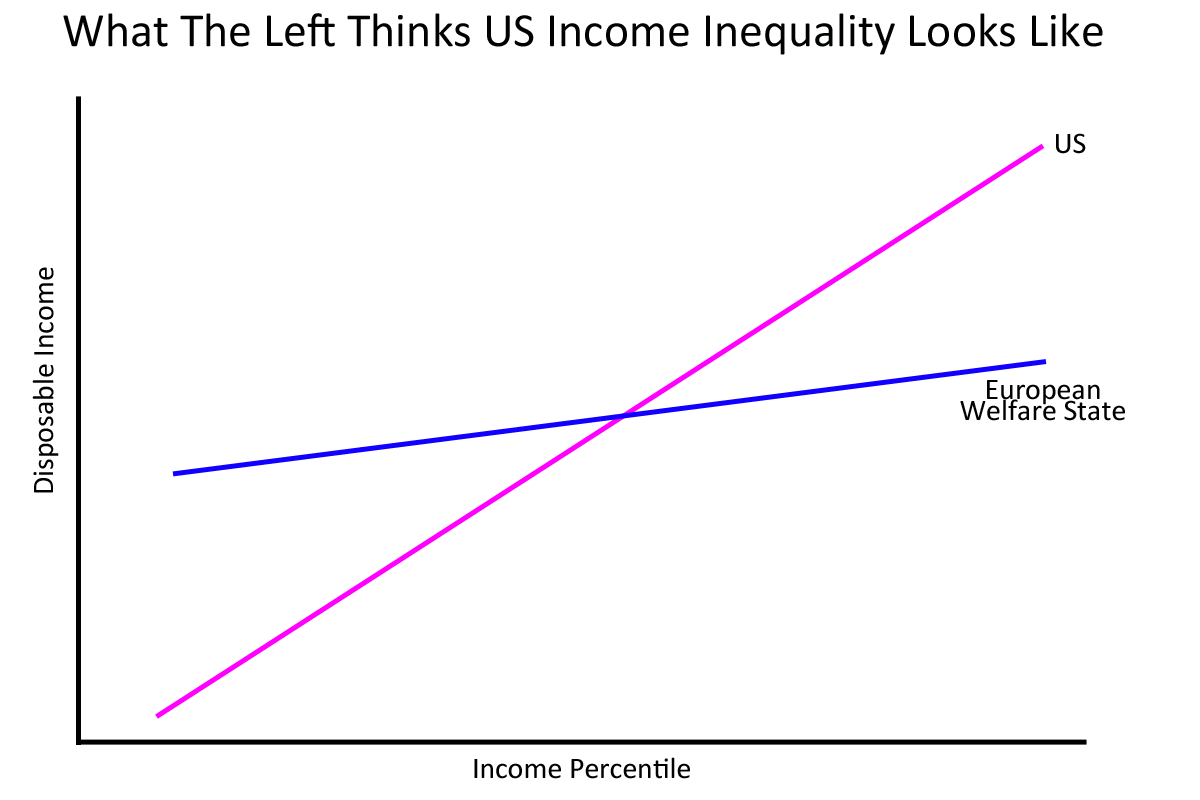
Remember what I presented a while back.  This is what the Left thinks, or wants us to think, American income inequality looks like -- our rich are richer than comparable European welfare states because our poor are poorer.

click to enlarge

And this is what income inequality in the US actually looks like -- our rich and middle class are richer, but our poor are not poorer.  A less redistributionist approach floats all boats.  I compared the US to many European welfare states, using the Left's own data source.  Here is an example, but hit the link to see it all.

click to enlarge

08 Jan 19:30

Global Warming: The Unfalsifiable Hypothesis

by admin

This is hilarious.  Apparently the polar vortex proves whatever hypothesis you are trying to prove, either cooling or warming:

Steven Goddard of the Real Science blog has the goods on Time magazine.  From the 1974 Time article “Another Ice Age?”:

Scientists have found other indications of global cooling. For one thing there has been anoticeable expansion of the great belt of dry, high-altitude polar winds —the so-calledcircumpolar vortex—that sweep from west to east around the top and bottom of the world.

And guess what Time is saying this week?  Yup:

But not only does the cold spell not disprove climate change, it may well be that global warming could be making the occasional bout of extreme cold weather in the U.S. even more likely. Right now much of the U.S. is in the grip of a polar vortex, which is pretty much what it sounds like: a whirlwind of extremely cold, extremely dense air that forms near the poles. Usually the fast winds in the vortex—which can top 100 mph (161 k/h)—keep that cold air locked up in the Arctic. But when the winds weaken, the vortex can begin to wobble like a drunk on his fourth martini, and the Arctic air can escape and spill southward, bringing Arctic weather with it. In this case, nearly the entire polar vortex has tumbled southward, leading to record-breaking cold.

07 Jan 21:30

6 Castles That Cost Less Than An Apartment In NYC

by Tyler Durden
Jts5665

Glad I don't live in NY, NY.

With Russian, Chinese, and Argentinian (with a record low in the blue dollar today) money washing ashore (in USD or Bitcoin) under the Status of Liberty, the 'prices' of upscale apartments in New York City have simply exploded. We thought some context for this apparent 'price' vs 'value' discrepancy was useful... presenting 6 castles that cost less than an apartment in NYC (and given the number of bedrooms, not to mention moats, dungeons, vineyards, ramparts and drawbridges - dramatically less in terms of per-capita spend).


Via imgur

07 Jan 14:14

Character vs. Chemistry

by Tom Naughton

I received an email today from Kahn Academy with the subject line Why New Year’s Resolutions are broken. The explanation (if you can call it that) in the message was that most people break their resolutions by February, so why not commit to completing an online course in January?

Cute. But it did get me thinking about why we break our New Year’s resolutions, especially resolutions to lose weight. I had quite a glorious career as a resolution-breaker back in the day, and I have the paperwork to prove it. From about age 25 all the way up until my daughters and Fat Head came along, I kept a daily journal.  That journal is filled with optimistic resolutions committed to paper in January, followed by self-recriminations and occasional self-loathing around April or May. Lather, rinse, and repeat the next year.

Twenty-some years ago, I was on a comedy tour that ran through Iowa and Nebraska. I was also on a New-Year’s-resolution diet. The headliner, who happened to be one of those lean-jock types who’d never been fat a day in his life, rang my room at our hotel in Iowa and asked if I wanted to go out for lunch.

“Thanks, but I can’t do it. I’m on the Slim-Fast diet.”

“Really? You’re living on those little shakes?”

“Yeah, I need to lose 25, maybe 30 pounds.”

“Well, I guess that keeps the food bill down when you’re on the road.”

The show was at a nightclub just off a two-lane highway in the middle of nowhere. As I parked in the nearly-empty lot an hour or so before the show, I wondered what kind of crowd they could possibly draw. The answer was: a great crowd. An awesome crowd. A packed-house crowd that cheered wildly when I finished my set and turned the stage over to the headliner. Man, I thought, they must get everyone who lives within 40 miles to show up for comedy night.

I went to the bar, intending to order a Diet Coke.

“You want a beer?” the bartender asked. “It’s on the house for the comedians.”

“Uh … sure. I’ll have a Miller Lite.” I was on a diet, after all. A light beer couldn’t hurt.

The second one didn’t hurt either. The third tasted awesome – and I don’t even like light beer. But man, was I craving that third one. I craved a fourth one after that, but stopped myself from ordering it. I was on a diet, after all.

I’d been aware of being hungry before my set, but sometime after finishing that third beer, I felt downright ravenous. Chew-the-furniture ravenous. As if reading my mind, the bartender walked over with a pepperoni pizza and set it in front of me.

“Here, you can have this. Somebody screwed up the order in the kitchen. We can’t sell it.”

Just tell him thanks but no thanks, I thought to myself. You’re on a diet. All you’ve had so far are three light beers with 100 calories each. No harm, no foul. You don’t really want this greasy pizza. Nothing tastes as good as thin feels, right?

Wrong. The pizza tasted fantastic – and I don’t usually order pepperoni on my pizzas. As soon as I took the first bite, my brain was screaming for the next one. And the next one. And the next one.

So there I was, stuffing my face with pizza when the headliner finished his set and came to the bar to get a drink. He didn’t say anything about me breaking my Slim-Fast diet. He didn’t have to. I saw him glance down at the pizza and then up at me, and he seemed to grimace just a wee bit. I interpreted his expression as You poor, weak-willed slob – mostly, of course, because that’s what I was thinking about myself.

In other words, I thought my failure to stick to a weight-loss diet (by no means my first or last failure) was caused by a flaw in my character. I was fat because I was mentally weak. I just need more willpower, more determination. I told myself that over and over, year in and year out.  My old journals are full of admonishments along the lines of “Why do I keep doing this to myself?  How many times am I going to start over on Monday and blow it again by Friday?”

Here’s a specific example from an entry in March 1997:

I worked on the play, then ate an entire pizza while watching King of the Hill and the X-Files. Why? Why do I do this? What gets inside of me and says, “You’re losing weight, you’re working out– it’s time to @#$% that up! Let’s undo all that progress!”

Well, I had the right idea as far as the problem being inside of me. But it wasn’t about character. It was about chemistry. Let’s revisit my comedy road-trip in Iowa and think in terms of what was happening at a biochemical level.

Back in those days, I was still mostly a vegetarian. I’d eat a little chicken or fish now and then when I went out for dinner, but I didn’t eat meat at all at home. (Most of those pizzas I downed were topped with spinach, mushrooms and onions.) I pretty much lived on cereal, fruit, vegetables, rice, pasta and potatoes. In other words, I’d conditioned myself to depend on regular infusions of glucose to provide fuel for my body and brain. And given how slowly I lost weight when I managed to stick with a calorie-restricted diet for a month or two, I obviously wasn’t very efficient at tapping my body fat for fuel.

Slim-Fast is nothing more than a can of liquid sugar with a wee bit of sunflower oil and milk protein tossed in. So whenever I went on a Slim-Fast diet, I was continuing to live on glucose, but far less of it than I was used to. The burst of simple sugar no doubt spiked my glucose, and then my body responded by releasing insulin to beat it back down. I remember often feeling shaky two hours after those Slim-Fast meals – it was low blood sugar, of course, but I couldn’t raise it with another meal or snack because I was on a diet.

When I walked into that nightclub in Iowa, I probably already had low blood sugar, thanks to the Slim-Fast meals. Fortunately for my performance, hearing an emcee announce my name always produced a burst of adrenaline, and adrenaline releases glucose from glycogen stores while simultaneously stimulating the release of fatty acids from adipose tissues. My brain had fuel for the show. But when I was finished with my set and the adrenaline rush was over, my blood sugar was probably falling again.

No wonder those Miller Lites tasted so darned good. Alcohol is fuel. As I topped up the fuel tank, my brain was happy. Unfortunately, alcohol is a quick-burn fuel, and after living on something like 600 calories of Slim-Fast all day, I’m sure I burned through it at a record rate. I not only ran short of fuel again, I was almost certainly shorter on fuel than before. Among its many other effects, alcohol suppresses the liver’s ability to convert glycogen to glucose. So as the alcohol burned away, my brain was starting to experience a full-scale fuel emergency. On a diet consisting mostly of sugar, it’s certainly not as if I was producing ketones to provide an alternate brain fuel.

That’s why I was ravenously hungry when the friendly bartender set a pizza I didn’t order in front of me. That’s why as soon as I looked at it and caught that pizza aroma, my brain was screaming “@#$% YOUR STUPID DIET! FEED ME NOW!”

And so I did. It wasn’t a matter of character. It was a matter of chemistry.

How many times have you (or someone you know) stuck to a calorie-restricted diet for a couple of weeks, had a few drinks at a party, then headed to a Denny’s for a massive meal? The usual explanation – which I bought into for years – is that the alcohol affected the part of the brain that controls discipline and inhibitions, so the dieter’s inner hedonist took over and decided to make a pig of itself. In other words, the alcohol unleashed a character flaw that had previously been manacled by conscious willpower.

Wrong.  By suppressing the conversion of glycogen to glucose, the alcohol produced a low-blood-sugar emergency — in a body already on the verge of a fuel shortage because of a restrictive diet.  The body and brain then responded with a series of biochemical reactions that triggered a ravenous appetite. The brain wasn’t being a bad boy because its noble half got drunk and fell asleep. It was protecting itself from a dangerous fuel shortage.

That’s also what was happening when I’d semi-starve myself for a week, living on microwave meals consisting of pasta with fat-free marinara sauce, then end up ordering a pizza and eating the whole thing. I couldn’t stick to the low-fat, low-calorie diets I tried over and over because they took me on blood-sugar roller-coaster rides my brain couldn’t tolerate.

I could tolerate a high-calorie, high-carb, low-fat diet and often did … but that diet created other problems which, at the time, also looked like character flaws to me. Gaining a little more weight every year was one.  An explosive temper when my glucose was falling and my adrenaline was rising in response was another.  Drinking too much was another.

I wrote about the drinking problem when I reviewed Nora Gedgaudas’ excellent book Primal Body, Primal Mind in a post nearly four years ago. Here’s what she wrote about alcoholics in that book:

Alcoholics are utterly dependent upon and regularly seek fast sources of sugar – alcohol being the fastest … the problem in alcoholism, in fact, really isn’t alcohol per se, but severe carbohydrate addiction … Once cravings for carbohydrates and dependence on carbohydrates as the primary source of fuel are eliminated, so are the alcohol cravings. Training the body to depend upon ketones rather than sugar for fuel is key to this equation.

As I recounted in that post, when I stopped living on a diet that had turned me into a sugar-burner and became a fat-burner instead, I also stopped craving alcohol. Sure, I’ll cut loose on vacation, I’ll cut loose on my birthday, but then it stops. During most weeks now, I have two beers on Saturday night when we go out to a local Mexican diner we like, and that’s it. Unlike 20 years ago, drinking those two beers doesn’t trigger a desire for six or eight or ten more. It’s not a matter of discipline; it takes no discipline to turn down something you don’t particularly want. My character didn’t change. My chemistry did.

So coming all the way back around to topic of the post, why do we break our New Year’s resolutions? Why will sales of Lean Cuisine and Weight Watchers meals spike for the next couple of months, then flatten out again? Why was the gym packed when I worked out yesterday but will almost certainly be back to half-empty by April?

Our weight-loss resolutions fail because we keep trying to change our character.  But character isn’t creating the problem.  Chemistry is.  When we try to overpower chemistry with the strength of our character, chemistry will eventually win.  And that’s why so many grand plans to shrink our waistlines — from the ones imposed on us by The Anointed in government all the way down to the ones we resolve to impose on ourselves — are doomed to fail.

More on that in a later post.

Facebook Twitter Share/Bookmark
05 Jan 04:09

Three-Dimensional Mid-Air Acoustic Manipulation [Acoustic Levitation]

by adafruit

The essence of levitation technology is the countervailing of gravity. It is known that an ultrasound standing wave is capable of suspending small particles at its sound pressure nodes and, so far, this method has been used to levitate lightweight particles, small creatures, and water droplets.

The acoustic axis of the ultrasound beam in these previous studies was parallel to the gravitational force, and the levitated objects were manipulated along the fixed axis (i.e. one-dimensionally) by controlling the phases or frequencies of bolted Langevin-type transducers. In the present study, we considered extended acoustic manipulation whereby millimetre-sized particles were levitated and moved three-dimensionally by localised ultrasonic standing waves, which were generated by ultrasonic phased arrays. Our manipulation system has two original features. One is the direction of the ultrasound beam, which is arbitrary because the force acting toward its centre is also utilised. The other is the manipulation principle by which a localised standing wave is generated at an arbitrary position and moved three-dimensionally by opposed and ultrasonic phased arrays. We experimentally confirmed that various materials could be manipulated by our proposed method.

04 Jan 14:54

Stop Letting NSA's Defenders Lie; There Have Been Many Significant Abuses

by Mike Masnick
We've been hearing regularly from the NSA's biggest defenders -- including former NSA boss Michael Hayden, current head of the House Intelligence Committee Rep. Mike Rogers and President Obama -- that despite all of the revelations about the NSA, there hasn't been any evidence of abuses. We've discussed over and over and over again why that's clearly untrue. Over at the Guardian, Trevor Timm has done an excellent job laying out in detail how President Obama and others are simply lying when they say there's been no evidence of abuses by the NSA. He details example after example of abuses that have come to light. Here's just one which shows not just abuses, but a pattern of regular abuse:
For years, as new data came into the NSA's database containing virtually every phone call record in the United States, analysts would search over 17,000 phone numbers in it every day. It turns out only about 1,800 of those numbers – 11% – met the legal requirement that the NSA have "reasonable articulable suspicion" that the number was involved in terrorism.

What were the other 89% of the numbers being searched for? We're not exactly sure. But we do know that five years after the metadata program was brought under a legal framework, the Fisa court concluded it had been "so frequently and systematically violated that it can fairly be said that this critical element of the overall … regime has never functioned effectively".
Part of the issue, of course, is that the NSA's defenders, including the President, seem to be trying to redefine the word "abuse" just as they've tried to redefine lots of other common English words concerning their surveillance efforts.
One reason might be that, like many other words, the NSA has a different definition of "abuse" than most people. After LOVEINT was brought up to Director of National Intelligence general counsel Robert Litt on a conference call with reporters, he replied:
I'm using abuse in a slightly more limited term. I'm not talking about the LOVEINT kind of thing, but people using surveillance for political purposes or to spy on Americans more generally or anything like that, as opposed to individual people screwing up.
Apparently to qualify as "abuse", the surveillance has to be on a massive scale, wilful, in bad faith, hidden from the Fisa court, and it has to about political views. Spying on loved ones or unauthorized spying on criminal behavior does not count.
Even worse, as Timm points out (and as we've discussed in the past), the LOVEINT disclosures revealed that many of those very willful abuses were only "discovered" years later when they were self-reported, meaning that there's a very good chance that there are many more abuses that were never discovered or reported.

But, of course, there's an even larger issue. Abusing the programs (no matter how you define that) presupposes the programs themselves are legitimate. That's highly questionable.
With all that said, it's unclear why we're quibbling over whether or not the government truly abused the data it has. The programs themselves are an abuse. A primary reason the founding fathers declared independence from the British was in protest of "general warrants" – the idea that the police could seize everything in a given neighborhood, only to go through it afterwards and find the criminal.

The Fourth Amendment requires particularized, individual court orders, and as long as the NSA is collecting such a vast database on every innocent person in the United States, and then searching it at their own discretion, they are abusing our constitution.
As Timm says, we don't allow police to search our homes or listen to phone calls without individual warrants and then say it's okay so long as they "don't abuse" what they discover. We say that those searches themselves are an abuse and unconstitutional. The same should be true of the NSA's efforts. They're all an abuse. An abuse of the Constitution and basic rights.

Permalink | Comments | Email This Story


04 Jan 14:46

Rolling Stone publishes cheap Marx ripoff: ‘5 economic reforms millennials should be fighting for’

by Doug Powers

**Written by Doug Powers

First, read the post at Twitchy and then decide if you want to give the unintentional Marxist satire at Rolling Stone a click. I’m not going to link to Rolling Stone’s capitalist website out of solidarity with the communist author.

Here’s a very brief sampling of the highlights in “Five Economic Reforms Millennials Should Be Fighting For”:

1. Guaranteed Work for Everybody

Unemployment blows. The easiest and most direct solution is for the government to guarantee that everyone who wants to contribute productively to society is able to earn a decent living in the public sector.
[...]
2. Social Security for All

But let’s think even bigger. Because as much as unemployment blows, so do jobs. What if people didn’t have to work to survive?
[...]
3. Take Back The Land

Ever noticed how much landlords blow? They don’t really do anything to earn their money. They just claim ownership of buildings and charge people who actually work for a living the majority of our incomes for the privilege of staying in boxes that these owners often didn’t build and rarely if ever improve.
[...]
4. Make Everything Owned by Everybody

Hoarders blow. Take, for instance, the infamous one percent, whose ownership of the capital stock of this country leads to such horrific inequality.

The counter-culture as promoted by Rolling Stone has gone from “don’t trust anybody over 35″ to “don’t trust anybody with an IQ over 35.”

In closing:

No, I will not link to @JAMyerson 's nonsense, but here is my official response: youtube.com/watch?v=LQCU36…
AG (@AG_Conservative) January 04, 2014

**Written by Doug Powers

Twitter @ThePowersThatBe

03 Jan 16:49

Endangered Species Act Turns 40: Feds Take Land, Stick Owners With Bills

Saturday marked the 40th anniversary of the Endangered Species Act, which proponents portray as a great success, claiming it has saved numerous species from extinction. In reality, the Endangered Species Act’s punitive approach to conservation has likely done more harm than good and it’s time to change our approach to endangered species in a way that works with, rather than against, the stewards of our land.

Consider Craig Schindler, a farmer in southeastern Missouri. For generations, Schindler’s family has allowed recreational cavers, kids, and scientists investigating a rare, two-inch species of fish called the grotto sculpin to access a mile-long cave running underneath their land.

In September, however, the U.S. Fish & Wildlife Service listed the grotto sculpin under the Endangered Species Act (ESA) based on information collected by the same scientists Schindler allowed on his land. The sculpin’s endangered listing means Schindler could effectively lose 18 acres of his land that produce thousands of dollars of crops each year.  “They’re cutting my living down,” Schindler told the Perryville News.  “I have cattle and grow-crops, but if you take 18 acres away from a guy, that’s quite a bit.” 

U.S. Fish & Wildlife also wants to implement buffer zones around numerous sinkholes on Schindler’s property that lead to caves with sculpin in them. The Schindlers, not the government, will have to pay the thousands of dollars in construction and fencing costs. Although the Fifth Amendment of the Constitution requires that “just compensation” be paid for any private property “taken for public use,” the Supreme Court has ruled that this does not apply to the type of “partial” regulatory takings typically imposed under the Endangered Species Act.

If he doesn’t comply, Schindler risks severe penalties, including a $100,000 fine and/or a year in jail should he harm a sculpin, an egg, or even its habitat. To avoid liability, Schindler no longer allows anyone in the cave, including people interested in the fish’s conservation. “I’m very hesitant about letting anyone in that cave, just for the simple fact that they’ll find something else” to put on the endangered species list, Schindler told the Perryville News.

Without scientific monitoring and study on land like Schindler’s, endangered species have decreased chances of survival. It’s the upside down world of the Endangered Species Act that’s become a familiar story. Because of the high costs and harsh penalties imposed upon them, far too many landowners seek to rid their land of endangered species and their habitats rather than have their properties turned into uncompensated de facto federal wildlife refuges

Given the Endangered Species Act’s severe penalties for property owners, it’s not surprising that on private lands the ratio of declining species to improving species is 9 to 1, while on federal lands the ratio is 1.5 to 1. That statistic is even more alarming when you consider that private lands are the most important habitat for endangered species. Fully 78% of endangered species depend on private land for all or some of their habitat, compared to 50% for federal land.

The best way to fix the Endangered Species Act is to remove the penalties that cause it to work against itself, replacing the penalties with positive incentives, such as payments to landowners.   There is a precedent for this: The U.S. Department of Agriculture’s Conservation Reserve Program pays farmers who agree to remove from production land that is deemed to be “environmentally sensitive”.  Currently, there are 25.6 million acres on 376,335 farms enrolled in the Conservation Reserve Program.   

“I think [the Reserve Program] really, really opened people’s eyes to what could be achieved in a basically non-regulatory, voluntary program,” stated the late Mollie Beattie, who led Fish & Wildlife from 1993-1996. “If there were an incentive to make the best habitat [for endangered and threatened species], we’d be miles ahead.”  

A similar initiative for endangered species—call it the Endangered Species Reserve Program—would have enormous potential. The key to successful endangered species conservation is to harness the generosity and willing cooperation of hardworking landowners like Craig Schindler. By punishing them for being good stewards, the Endangered Species Act unwittingly turns landowners into enemies of the very endangered species it’s trying to protect. That is counterproductive and tragic because most of this nation’s landowners would be happy to help conserve their country’s endangered species, as long as they are not punished for doing so and especially if they are compensated.  Just look at what they’re voluntarily doing through the Conservation Reserve Program.

Those serious about endangered species conservation should seek to tap the enormous goodwill, energy and talent of America’s landowners by charting a new course that respects property rights and compensates landowners for the costs incurred while conserving endangered species. 


03 Jan 16:47

Peter Schweizer: Congress Using Tax Code to Milk Industries

Appearing on Fox News' Hannity with guest-host Eric Bolling, Breitbart News Senior Editor-at-Large and Government Accountability Institute President Peter Schweizer said Washington's politicians are finding more creative ways to use the tax code to milk various industries to their benefit. 

Bolling noted that 55 new laws will bring in an estimated $54 billion in tax increases in 2014. Schweizer emphasized that Congress always finds a way to use creative accounting to get around the Congressional Budget Office and various "pay-as-you-go" requirements. 

Schweizer, regarded as the leading authority on crony capitalism in the country, said that the myriad of new laws represent a "classic" case of "what happens in Washington, D.C." He noted that politicians "are not going to do this without getting paid to do this."

He also said that politicians want to put in tax extenders and not make various tax cuts permanent because they "want to turn it into an annuity" so they can get industries like the high-tech industry to "give them donations" and "hire family members as lobbyists."

Schweizer said Washington's standard operating procedure is "destructive for the economy," but it is "great for the political class in Washington, D.C."

"Lobbyists don't get hired if problems are solved," Schweizer said. 

As Breitbart News has reported, Schweizer's best-selling book, Extortion, details some of the shenanigans that go on in Washington:  

  • How Democratic Congresswoman Grace Napolitano (D-CA) funneled at least $294,245 in campaign cash to herself by loaning her campaign money in 1998 at a staggering 18% interest rate and then letting the loan linger unpaid for 20 years
  • Has republished top secret "price lists," known officially as "party dues," that include the donation totals members of Congress must raise to land top committee spots and chairmanships 
  • How leadership PAC loopholes allow members of Congress to convert campaign cash into lavish lifestyle upgrades for themselves and their family members
  • Alleged that Speaker John Boehner (R-OH) bagged over $200,000 in donations from executives and companies prior to holding votes on three bills of critical importance to their industries
  • How President Barack Obama used a political extortion tactic known as a "double milker bill" to "milk" millions in donations by pitting Obama's friends in Hollywood against his supporters in Silicon Valley to extract cash from both.


02 Jan 17:07

A Milestone to Celebrate: I Have Closed All My Businesses in Ventura County, California

by admin

Normally, the closure of a business operation or division is not grounds for a celebration, but in this case I am going to make an exception.  At midnight on December 31, I not only drank a toast to the new year, but also to finally getting all my business operations out of Ventura County, California.

Never have I operated in a more difficult environment.  Ventura County combines a difficult government environment with a difficult employee base with a difficult customer base.

  • It took years in Ventura County to make even the simplest modifications to the campground we ran.  For example, it took 7 separate permits from the County (each requiring a substantial payment) just to remove a wooden deck that the County inspector had condemned.  In order to allow us to temporarily park a small concession trailer in the parking lot, we had to (among other steps) take a soil sample of the dirt under the asphalt of the parking lot.   It took 3 years to permit a simply 500 gallon fuel tank with CARB and the County equivilent.   The entire campground desperately needed a major renovation but the smallest change would have triggered millions of dollars of new facility requirements from the County that we simply could not afford.
  • In most states we pay a percent or two of wages for unemployment insurance.  In California we pay almost 7%.  Our summer seasonal employees often take the winter off, working only in the summer, but claim unemployment insurance anyway.  They are supposed to be looking for work, but they seldom are and California refuses to police the matter.  Several couples spend the whole winter in Mexico, collecting unemployment all the while.  So I have to pay a fortune to support these folks' winter vacations.
  • California is raising minimum wages over the next 2 years by $2.  Many of our prices are frozen by our landlord based on past agreements they have entered into, so we had no way to offset these extra costs.  At some point, Obamacare will stop waiving its employer mandate and we will owe $2000-$3000 extra additional for each employee.  There was simply no way to support these costs without expanding to increase our size, which is impossible (see above) due to County regulations.
  • A local attorney held regular evening meetings with my employees to brainstorm new ways the could sue our company under arcane California law.  For example, we went through three iterations of rules and procedures trying to comply with California break law and changing "safe" harbors supposedly provided by California court decisions.  We only successfully stopped the suits by implementing a fingerprint timekeeping system and making it an automatic termination offense to work through lunch.  This operation has about 25 employees vs. 400 for the rest of the company.  100% of our lawsuits from employees over our entire 10-year history came from this one site.  At first we thought it was a manager issue, so we kept sending in our best managers from around the country to run the place, but the suits just continued.
  • Ask anyone in the recreation business where their most difficult customers are, and they likely will name the Los Angeles area.  It is impossible to generalize of course, because there are great customers from any location, but LA seems to have more than its fair share of difficult, unruly, entitled customers.   LA residents are, for example, by far the worst litterers in the country, at least from our experience.  Draw a map of California with concentric circles around LA and the further out one gets, the lower the litter clean-up costs we have.  But what really killed it for me in Ventura County was the crazy irresponsible drinking and behavior.  Ventura County is the only location out of nearly 200 in the country where we had to hire full-time law enforcement help to provide security.  At most locations, we would get 1 arrest every month or two (at most).  In Ventura we could get 5-10 arrests a day.  In the end, I found myself running a location where I would never take my own family.

And so I got out.  Hallelujah.

PS-  People frequently talk about taxes in California being what makes the state "anti-business."  That may be, but I guess I never made enough money to have the taxes really bite.  But taxes are only a small part of the equation.


02 Jan 16:32

Great Moments in Border Control

by Walter Olson

Walter Olson

From the Boston Globe, “Virtuoso’s flutes destroyed by U.S. Customs”:

…Flute virtuoso [Boujemaa Razgui], who performs regularly with The Boston Camerata[,] lost 13 handmade flutes over the holidays when a US Customs official at New York’s JFK Airport mistook the instruments for pieces of bamboo and destroyed them. 

“They said this is an agriculture item,” said Razgui, who was not present when his bag was opened. “I fly with them in and out all the time and this is the first time there has been a problem. This is my life.” When his baggage arrived in Boston, the instruments were gone. He was instead given a number to call. “They told me they were destroyed,” he says.

One reader recalled the travel woes of distinguished Polish pianist Kristian Zimerman, as recounted by the L.A. Times

Zimerman has had problems in the United States in recent years. He travels with his own Steinway piano, which he has altered himself. But shortly after 9/11, the instrument was confiscated at JFK Airport when he landed in New York to give a recital at Carnegie Hall. Thinking the glue smelled funny, the TSA decided to take no chances and destroyed the instrument.   

Yes, by all means, let’s put federal agencies in charge of as many aspects of our lives as possible.

31 Dec 21:48

No public domain until 2019

by noreply@blogger.com (Vox)
Thank Disney for the artificial and immoral expansion of "copyright":
Current US law extends copyright for 70 years after the date of the author’s death, and corporate “works-for-hire” are copyrighted for 95 years after publication. But prior to the 1976 Copyright Act (which became effective in 1978), the maximum copyright term was 56 years – an initial term of 28 years, renewable for another 28 years. Under those laws, works published in 1957 would enter the public domain on January 1, 2014, where they would be “free as the air to common use.” (Mouse over any of the links below to see gorgeous cover art from 1957.) Under current copyright law, we’ll have to wait until 2053.1 And no published works will enter our public domain until 2019. The laws in Canada and the EU are different – thousands of works are entering their public domains on January 1.

What books and plays would be entering the public domain if we had the pre-1978 copyright laws? You might recognize some of the titles below.

    Samuel Beckett, Endgame (“Fin de partie”, the original French version)
    Jack Kerouac, On the Road (completed 1951, published 1957)
    Ayn Rand, Atlas Shrugged
    Margret Rey and H.A. Rey, Curious George Gets a Medal
    Dr. Seuss (Theodor Geisel), How the Grinch Stole Christmas and The Cat in the Hat
    Eliot Ness and Oscar Fraley, The Untouchables
    Northrop Frye, Anatomy of Criticism: Four Essays
    Walter Lord, Day of Infamy
    Studs Terkel, Giants of Jazz
    Corbett H. Thigpen and Hervey M. Cleckley, The Three Faces of Eve
    Ian Fleming, From Russia, with Love
    Ann Weldy (as Ann Bannon), Odd Girl Out
    A.E. Van Vogt, Empire of the Atom
These works will instead enter the public domain in 2053... unless Disney finagles another extension. The fact is that there is no such thing as "copyright", it is nothing more than a government-imposed intrusion on real property rights. No one need have any qualms about copying digital goods - including my own music and ebooks - because it is cannot possibly be considered stealing if you leave the original owner in the full possession of his property.

I'm not opposed to a limited copyright in order to encourage innovation. But the original term of 28 years was more than sufficient. What we have now is unjust, immoral, and the result of corpocratic government.

Posted by Vox Day.
31 Dec 14:03

10/10 would read again

30 Dec 17:11

Obamacare’s War on Civil Society: It Is Big Government or Nothing

by Doug Bandow

Doug Bandow

Washington offers many opportunities for schadenfreude, that wonderful German word which means to enjoy the misery of others.  The realization of liberal professionals who voted for Barack Obama that they will be forced to spend more on health insurance was one of those moments. 

Reported the New York Times: “Many in New York’s professional and cultural elite have long supported President Obama’s health care plan.  But now, to their surprise, opera singers, music teachers, photographers, doctors, lawyers and others are learning that their health insurance plans are being canceled and they may have to pay more to get comparable coverage, if they can find it.”

It’s not that they didn’t have policies that they liked and wanted to keep.  It seems that the policies were too good. 

Explained the Times:  “The rationale for disqualifying those policies, said Larry Levitt, a health expert at the Kaiser Family Foundation, was to prevent associations from selling insurance to healthy members who are needed to keep the new health exchanges financially viable.”  Unfortunately for these privileged Obama supporters, most make too much money for even the generous subsidies available under the exchanges.

As I point out in the American Spectator online:

Admittedly, it takes a few moments to stop laughing after reading this article.  If you believe in social justice and all that, you shouldn’t whine about the government running up your costs to fulfill its elaborate social engineering plan.  After all, that’s the purpose of liberal government—create Rube Goldberg policy contraptions that promote some higher good.  So what if you get run over in the process?  Eggs and omelets as the old Communists liked to say.

Still, it is striking how government is destroying civil society institutions which meet real human needs.  Even stranger is the possible federal attack on charities and hospitals which are paying the premiums for low-income patients. 

For instance, the Los Angeles nonprofit A Better LA has begun to subsidize health insurance for low-income people through the California state exchange.  Some hospitals are doing the same.  Melinda Hatton of the American Hospital Association told the Journal:  “We thought it was the kind of thing the Affordable Care Act would really support and encourage.”

Well, no.

Insurers are counting on covering well-off, and presumably healthier, professionals, not less well-off, and presumably less healthy, nonprofessionals.  Reported the Journal:  “Help from nonprofits or hospitals could speed the arrival of less healthy customers into the exchanges, outpacing the arrival of younger, healthier people.”

The administration has yet to state a clear position.  But Health and Human Services has indicated its “concerns with this practice, because it could skew the insurance risk pool.” 

Government is threatening civil society institutions, ranging from charitable to business, which are aiding the poor, disadvantaged, and uninsured!  True, the aid process is disorganized, decentralized, uncertain, and uneven.  But that is society. 

This complex interplay is what makes community.  Discerning and addressing needs, organizing diverse approaches, and responding to the people in front of you is what genuine compassion, which once meant “suffering with,” is all about.  David Beito has detailed the once important role of mutual aid societies, and how they were replaced by “impersonal bureaucracies controlled by outsiders,” such as Obamacare health exchanges.

Ultimately, Barack Obama and his allies have the world backwards.  They believe that government trumps society, and the solution to any problem should start in Washington.  Individual choice and community relations are unimportant.

Professional associations and charities demonstrate that society should be the starting point.  People should be not just allowed but encouraged to organize to solve problems.  Not only are individual lives bettered, but the sinews of community are strengthened.  Instead of supplanting other institutions, government should act as the ultimate backstop to help meet social needs which are not otherwise addressed. 

As my colleague David Boaz observed, Obamacare is “another example of a big-government, left-liberal policy that is pushing people away from cooperation and community and toward atomistic individualism.”  It’s quite an accomplishment.  Who says President Obama is a failure!?

28 Dec 04:48

50 ways that people are working around State obstacles and ‘leaving Leviathan.’ And 50 ways may soon become 50,000

by Mark J. Perry

Max Borders and Jeffrey Tuckers wrote an article in FEE recently that listed 50 ways that people are working around State obstacles and “leaving Leviathan.” Here are a few key excerpts from the article (and 10 of my favorite examples of creative destruction and “leaving Leviathan”):

State management of society is not only contrary to human liberty; it is also unworkable. It cannot achieve what it seeks to achieve, which is often all-round control of some sector of economic and social life. The attempt provokes a social backlash. People find loopholes and workarounds or just invent new ways to make progress possible. This is because people will not be caged. They struggle to be free and sometimes they succeed.

In our times, innovation has provided people with more tools. And often they use these tools to get around the barriers that politicians and bureaucrats have erected. Some of us take note of them every day. And while we may revel in their cleverness, we don’t take time to look at the big picture. Here is where this phenomenon of small ways to break out from and break down the system—which pop culture often labels “breaking bad”—gets really interesting.

Here are just 50 ways people are working around State obstacles (here are 10 of my favorite examples, see the full list at the article link):

1. Airbnb: This service allows people to rent out their homes for a couple of days. It offers competitive prices compared to hotels and gets around the whole of the regulatory apparatus, zoning control, union monopolies, and other barriers to entry. Of course, in some states, hotel cartels aren’t happy.

2. Uber: Taxis have their licenses, which drive up fares. It’s a cozy and well-protected cartel. Uber lets you get around this system, finding great rides in clean cars for better fares—all while checking (gasp! unlicensed) chauffeurs with reputation ratings.

3. Concierge healthcare: Doctors are opting out of Obamacare and the third-party payer system. Pay them up front and pay them out of pocket. Get the care you need and go buy a catastrophic plan if you can (instead of taking whatever’s on the Obamacare exchanges).

4. 3-D printing: Not only will people circumvent unconstitutional gun restrictions (like Cody Wilson has), but people will be able easily to get around patents and regulations by printing their own high-flow showerheads. When everyone is a maker, no one is regulated.

5. P2P lending: Prosper and Lending Club let people bypass big incumbent banks and crowdfund as borrowers and lenders. Where there is communication, there are deals being made.

6. The raw milk movement: The government has tried for decades to suppress this unpasteurized brew, but fans won’t be stopped. Buyers’ clubs are everywhere. The more the feds crack down, the more the demand for the product grows.

7. Medical marijuana/decriminalization: States are relaxing their prohibitions on marijuana. It’s becoming increasingly clear that the drug war is lost and that some drugs, like cannabis, have real therapeutic value. Regardless, prohibition is a fool’s errand and punitive measures are increasingly viewed as cruel and unnecessary. Even as the crackdowns continue, these are the first signs of the Drug War’s obsolescence and popular dissent.

8. Private schooling/homeschooling: If you don’t like the government schools, take your kids out. Millions of families are doing it. Some are even forming virtual coops and getting content from online sources.

9. Online education: Are you after a real education or a signaling mechanism? MOOCs and other online sources (like Khan Academy) are reducing the costs of education—away from the inflated guild of higher ed and publicly funded indoctrination camps.

10. Food trucks: Bricks-and-mortar restaurants love regulations because they can keep a boot on the necks of competitors. That’s why cities that tolerate food truck culture are giving these restaurants a run for their money. If you can stand to eat your tacos on a park bench, it might be worth hitting a food trailer—the ultimate in microentrepreneurship. They are often at the forefront of experimentation and variety.

How long will the State be able to keep up with the dizzying pace of innovation, as this civil disobedience hydra sprouts two heads in the place of any one severed? Unless the State gets really repressive really fast (and we’re all prepared to let them), its functionaries will not be able to control the swarms and the gales of creative destruction those swarms bring with them. Fifty ways will become 50,000. This is our present. This is our future.

HT: Mike LaFaive

27 Dec 22:56

Выкройка

Печатаем:

Сгибаем.

Любуемся результатом:

23 Dec 20:52

It's a Very Merry Christmas for Washington Insiders

by Daniel J. Mitchell

Daniel J. Mitchell

Last year, while writing about the corrupt and self-serving behavior at the IRS, I came up with a theorem that explains day-to-day behavior in Washington.

Simply stated, government is a racket that benefits the D.C. political elite by taking money from average people in America

I realize this is an unhappy topic to be discussing during the Christmas season, but the American people need to realize that they are being pillaged by the insiders that control Washington and live fat and easy lives at our expense.

If you don’t believe me, check out this map showing that 10 of the 15 richest counties in America are the ones surrounding our nation’s imperial capital.

Who would have guessed that the wages of sin are so high?

D.C., itself, isn’t on the list. But that doesn’t mean there aren’t a lot of people living large inside the District.
Here are some interesting nuggets from a report in the Washington Business Journal:

D.C. residents are enjoying a personal income boom. The District’s total personal income in 2012 was $47.28 billion, or $74,733 for each of its 632,323 residents, according to the Office of the Chief Financial Officer’s Economic and Revenue Trends report for November. The U.S. average per capita personal income was $43,725.

Why is income in D.C. so much higher? Well, the lobbyists, politicians, bureaucrats, interest groups, contractors, and other insiders who dominate the city get much higher wages than people elsewhere in the country.

And they get far higher benefits:

In terms of pure wages, D.C., on a per capita basis, was 79 percent higher than the national average in 2012 — $36,974 to $20,656. …Employee benefits were 102 percent higher in D.C. than the U.S. average in 2012, $7,514 to $3,710. Proprietor’s income, 137 percent higher — $9,275 to $3,906. …The numbers suggest D.C. residents are living the high life.

Below is a chart from Zero Hedge comparing income growth for both D.C. and the nation as a whole over the last few decades. It uses median household income rather than total personal income, so the numbers don’t match up exactly with the numbers from above. Regardless, it shows how D.C. income grew faster than the rest of the nation during the Bush years, and then even more dramatically during the Obama years.

In other words, policies like TARP, the fake stimulus, and Obamacare have been very good for Washington’s ruling class.

Want some other examples of profitable Washington sleaze? Here are some excerpts from Rich Tucker’s column for Real Clear Policy:

The real place to park your money is in Washington, D.C. That’s because the way to get ahead isn’t to work hard or make things; it’s to lobby Washington for special privileges. Look no further than the sweet deal the sugar industry gets. It’s spent about $50 million on federal campaign donations over the last five years. So that would average out to $10 million per year. Last year alone, the federal government spent $278 million on direct expenditures to sugar companies. That’s a great return on investment.

Big Corn may get an even better deal than Big Sugar:

Until 2012, the federal government provided generous tax credits to refiners that blended ethanol into gasoline. In 2011 alone, Washington spent $6 billion on this credit. The federal government also maintains tariffs (54 cents per gallon) to keep out foreign ethanol, and it mandates that tens of billions of gallons of ethanol be blended into the American gasoline supply. Nothing like a federal mandate to create demand for your product. How much would you pay for billions of dollars worth of largesse? Well, the ethanol industry got a steep discount. In 2012, opensecrets.org says, the American Coalition for Ethanol spent $212,216 on lobbying.

Rich warns that the United States is sliding in the wrong direction:

What makes Washington especially profitable is that its only products are the laws, rules, and regulations that it has the power to force everyone else to follow. …[W]e seem to be sliding toward what the authors term “extractive” institutions. That means government [is] using its power to benefit a handful of influential individuals at the expense of everyone else.

And let’s not forget that some people are getting very rich from Obamacare while the rest of us lose our insurance or pay higher prices.

This Reason TV interview with Andrew Ferguson explains that there is a huge shadow work force of contractors, consultants, and lobbyists who have their snouts buried deeply in the public trough:

I particularly like his common sense explanation that Washington’s wealth comes at the expense of everyone else. The politicians seize our money at the point of a gun (or simply print more of it) to finance an opulent imperial city.

So if you’re having a hard time making ends meet, remember that you should blame the crowd in Washington.

P.S.: Despite Republican claims of being the party of free markets and smaller government, the insider corruption of Washington is a bipartisan problem. Indeed, some of the sleaziest people in D.C. are Republicans.

P.P.S.: Though scandals such as Solyndra show that Obama certainly knows how to play the game.

P.P.P.S.: Making government smaller is the only way to reduce the Washington problem of corrupt fat cats.

23 Dec 15:16

More inexpensive ebook goodies!

by Patrick
Jts5665

good book


You can now download Brent Weeks' The Black Prism for only 1.99$ here.

Here's the blurb:

Gavin Guile is the Prism, the most powerful man in the world. He is high priest and emperor, a man whose power, wit, and charm are all that preserves a tenuous peace. But Prisms never last, and Guile knows exactly how long he has left to live: Five years to achieve five impossible goals.

But when Guile discovers he has a son, born in a far kingdom after the war that put him in power, he must decide how much he's willing to pay to protect a secret that could tear his world apart.
20 Dec 16:30

Digital doorbell lets you answer door -- when you're not home...


Digital doorbell lets you answer door -- when you're not home...


(Second column, 15th story, link)

20 Dec 15:13

Quotation of the Day…

by Don Boudreaux
(Don Boudreaux)

… is from James Taranto’s December 17th Wall Street Journal column, “(Almost) Everyone Loses“:

In short, what ObamaCare means to the uninsured who were not uninsurable is higher prices for a product they already were disinclined to buy, along with a punitive tax on not buying it. That seems more like a mugging than a benefit.

19 Dec 14:31

SUIT: Woman Cavity Searched, Subjected To Observed Bowel Movement -- Then Billed $5K...


SUIT: Woman Cavity Searched, Subjected To Observed Bowel Movement -- Then Billed $5K...


(Third column, 15th story, link)

18 Dec 17:32

How much did real US median income increase from 1979 to 2007? A lot depends on the measure of income used

by Mark J. Perry

How much did real US median income grow in the 28 years between from 1979 to 2007? Well, a lot depends on how what measure of income we are using, as Greg Mankiw points out in a post on his blog this week “On Measuring Changes in Income.” Based on a 2011 NBER working paper by Richard V. Burkhauser, Jeff Larrimore, Kosali I. Simon titled “A “Second Opinion” on the Economic Health of the American Middle Class” Professor Mankiw summarizes some of the paper’s main conclusions (illustrated graphically above, emphasis mine below):

The median income data [often cited] are on tax units rather than households, they do not include many government transfer payments, they are pre-tax rather than post-tax, they do not adjust for changes in household size, and they do not include nontaxable compensation such as employer-provided health insurance.

Does this matter?  Yes!  Here are some numbers from the Burkhauser paper:

1. From 1979 to 2007, median real income as measured by pre-tax, pre-transfer cash income of tax units rose by only 3.2%.  That is a paltry amount for such a long period.  You might conclude that middle class incomes have been stagnant. But wait.

2. Households are more important than tax units.  Two married people are one tax unit, whereas a couple shacked up are two tax units.  We would not want to treat the movement from marriage to shacking up as a drop in income.  If we look at households rather than tax units, that meager 3.2% rises to a bit more respectable 12.5%.

3. Now consider government transfer payments. If we add those in, that 12.5% number becomes an even better 15.2%.

4. What about taxes? The middle class received some tax cuts during that period.  Factoring taxes in, the 15.2% figure rises to 20.2%.

5. But not all households are the same size, and the size of households has fallen over time. Adjusting for household size increases that 20.2% to 29.3%.

6. There is still one thing left: employer-provided health insurance, an important fringe benefit that has grown in importance. Adding an estimate of that into income raises the 29.3% figure to 36.7%.

Bottom Line: During this period, has the middle class experienced stagnant real income (a mere 3.2% increase) or significant gains (a 36.7% increase)?  It depends on which measure of income you look at.  It seems clear to me that the latter measure is more relevant, but the former measure of income often gets more attention than it deserves.

Take this as a cautionary tale.  When people talk about changes in income over time, make sure you know what measure of income they are citing.

18 Dec 14:19

Imagine this letter – ‘Senator Menendez to Obama: Expanding car exports only enhances Big Three profits?’

by Mark J. Perry

Imagine that there was an outdated 1970s-era ban on exporting US-produced cars and trucks. Further imagine that the Big Three US automakers suddenly found themselves with excess capacity and an over-supply of vehicles and wanted to end the ban so they could export their plentiful supply of cars to eager buyers in foreign markets. Then imagine a letter like this from a member of Congress to President Obama in opposition to lifting the export ban on US-made vehicles:

December 16, 2013

President Barack Obama
The White House
1600 Pennsylvania Avenue NW
Washington, DC 20500

Dear Mr. President:

I write to express my deep concerns that your Administration is considering easing the ban that currently prevents American car companies from exporting domestically-produced motor vehicles to eager buyers in overseas markets. Easing this ban might be a win for the Big Three automakers in Detroit but it would hurt American consumers.

The threshold question is why would we want to export motor vehicles produced in states like Michigan to foreign markets? The Big Three clearly wants to pad their profits and fetch higher prices for their domestically-produced cars in overseas markets.  But considering that the Big Three together made more than $12 billion in profits last year (almost $33 million every day, and they are on track to make even more money this year), I think they are doing just fine with a domestic market, thanks to the current regulations that ban most car exports. I believe we should be more worried about the bottom line for American families than for the profits of the Big Three who are now lobbying to export their vehicles overseas.

As our nation continues on the path to economic recovery, it is critical that we support working class families who are carefully budgeting every dollar. According to JD Power, U.S. households are spending more than $30,000 on average to buy a new car this year. Over the last ten years, American consumers have seen average car prices rise from approximately $26,000 in 2003 to approximately $30,000 today. Motor vehicles that are produced in the U.S. by the Big Three should be used to lower car prices here at home, not sent to the other side of the world to foreign consumers.

We must continue to keep domestically-produced cars here at home to lower prices for American consumers. Allowing for expanded car exports would serve only to enhance the profits of the Detroit Three and could force U.S. consumers to pay even more for new cars. It is important that we view the assets of The Big Three as public (not private) resources, and their attempts to sell their products overseas must be viewed as a matter of public interest. Increased exports of American-made automobiles are not in the public interest, and the ban on car exports should not be lifted or eased. I urge you to reject any attempts to send more U.S.-produced cars overseas, and thank you for your attention to this important matter.

Sincerely,

Congressman John Doe

MP: Well, if that seems a little absurd, that’s because it is totally absurd. But the letter above essentially captures the spirit of a letter that Senate Foreign Relations Chairman Robert Menendez (D-NJ) just sent to President Obama (“Menendez to Obama: Expanding Crude Car Exports Only Enhances Big Oil Three Profits“). The only difference as you might guess from the revised title is that Rep. Menendez is objecting to easing the outdated, 1970s-era ban on crude oil exports, not a ban on car exports as I fictitiously present above.

HT: The inspiration for this post comes from Bryan Riley of the Heritage Foundation, who sent me an earlier version of the letter above. Bryan kindly allowed me to revise his initial draft and create the post above. Thank you, Bryan!

18 Dec 14:16

Triangle Trade and Physics

by admin

You have heard of the Atlantic triangle trade in school.  It is always discussed in terms of its economic logic (e.g. English rum to African slaves to New World sugar).  But the trade has a physical logic as well in the sailing ship era.  Current wind patterns:

Earth-wind-map


Real time version here.  Via Flowing data.

Seriously, click on the real time link.  Even if you are jaded, probably the coolest thing you will see today.  One interesting thing to look at -- there is a low point in the spine of the mountains of Mexico west of Yucatan.  Look at the wind pour through it like air out of a balloon.