Shared posts

16 Dec 19:48

“He’s got his explanations for why he’s voted, but I don’t really care."

by Walter Olson

Walter Olson

Rep. Justin Amash (R-Mich.), a figure well known to Catoites, is among the few members of Congress for whom the description “libertarian” does not seem like a stretch. Chair of the House Liberty Caucus, Rep. Amash is famous not only for his strong stands on behalf of limited government and for leading left-right alliances on such subjects as NSA surveillance but also for explaining publicly the reasons for each vote he takes in the House, which he seeks to derive from the language and principles of the U.S. Constitution.

Inevitably, some Republicans as well as Democrats are not happy with what he’s up to, and financial consultant Brian Ellis has launched a primary challenge against Rep. Amash in his Third Congressional District. Ellis says western Michigan “is not a libertarian district, and I’m willing to stake my campaign on that.” Some GOP businessmen in and around Grand Rapids are backing Ellis’s challenge, though many others side with Amash. 

Now the Weekly Standard is out with a piece by Maria Santos profiling the primary fight, which caught my attention with the following quote from Ellis: 

“He’s got his explanations for why he’s voted, but I don’t really care. I’m a businessman, I look at the bottom line.” He has no use for Amash’s constitutional scruples, remarking, “If something is unconstitutional, we have a court system that looks at that.” 

The first two sentences, at least as I would interpret them, basically amount to: “If you want someone to represent you who votes on principle and can explain his reasons, go ahead and stick with Justin because I don’t intend to decide on votes that way.” But it’s the follow-up that really caught me in mid-breath. As the House Clerk’s site explains, under Article VI of the U.S. Constitution, each member of the U.S. House on assuming office takes an oath pledging to “support and defend the Constitution of the United States,” to “bear true faith and allegiance to the same,” and to “well and faithfully discharge” the office’s duties. There is a structural reason why the Constitutional oath is required of officers in the legislative branch, and not merely of those in the executive and judiciary. It is that lawmakers are just as capable of breaking faith with the Constitution as members of those other branches. The main way they do so is to vote, knowingly or through inadvertence, for bills that overstep its provisions.

In other words, it sounds as if Mr. Ellis has chosen to kick off his campaign by promising to violate his oath of office.

16 Dec 17:42

Rodeo Clown Leads Voting For Town's 'Person Of Year'...


Rodeo Clown Leads Voting For Town's 'Person Of Year'...


(First column, 14th story, link)

13 Dec 21:26

FBI THWARTS BOMB PLOT AT KANSAS AIRPORT...

Jts5665

"FBI plans and thwarts bomb plot at KS airport"

Fixed it.


FBI THWARTS BOMB PLOT AT KANSAS AIRPORT...


(Second column, 1st story, link)

13 Dec 19:17

Center For American Progress Panel: End 'Christian Privilege' In Name of Religious Freedom

Jts5665

You'll never have liberty until you're in shackles... I sometimes wonder if the left reads 1984 as an inspirational story of good governance.

A panel discussion sponsored by John Podesta’s Center for American Progress (CAP) on Thursday came to the conclusion that Christian conservatives use religion as a justification for their discriminatory behavior. Americans, they argue, will never enjoy full religious freedom until Christians’ claims for religious liberty are defeated.

According to Joel Gehrke at the Washington Examiner, the Rev. Dr. C. Welton Gaddy, president of the George Soros-funded Interfaith Alliance, said, “People [are] using the term ‘liberty’ when they really mean ‘my liberty, your slavery.’’

Gaddy argued that the left’s view of religious liberty comes from an originalist reading of the Constitution that was universally understood in the early days of the nation. He said that, unfortunately, the American people have become “confused” and misled about the issue of religious liberty by the United States Catholic bishops.

"You have the Catholic bishops advocating for 'religious freedom,' which doesn't look anything like what religious freedom is in the Constitution," Gaddy said. "Unless we do those kind of dramatic actions [such as the ACLU suing the USCCB] in order to get us back to what the foundation of religious freedom has been all the time, it's going to get worse and worse, with people using the term 'liberty' when they really mean 'my liberty, your slavery.'"

"See, I grew up in a part of the country where we really believed in religious liberty but we really enforced bondage on everyone else, and it was because we were Christians and we had the Bible," Gaddy said.

Similarly, ACLU senior counsel Eunice Rho continued the narrative that religious beliefs work to justify discriminatory behavior. Rho denounced attempts to pass a Religious Freedom Restoration Act in various states.

“These are very dangerous because they can allow religion to be used to harm others,” Rho said

Gaddy likened Christian florists who refuse to provide services to gay weddings due to religious beliefs to employers who would post “whites only” signs in their storefronts.

“I don’t think we don’t want to go down that road again,” Gaddy said, and later agreed with another panel participant who said that liberals “need to start educating, and calling out, Christians for trying to exercise ‘Christian privilege.’”

Gaddy’s views are in sharp contrast to the Coalition of African-American Pastors (CAAP) who condemn gay rights activists’ use of the black civil rights movement to prop up gay weddings.

The Rev. William Owens, president of CAAP, organized students during the civil rights movement and marched with Martin Luther King.

As Breitbart News reported in August, Owens said the black community “knows that our civil rights were won through a strong faith in God, and most still believe that the truths of our faith say that marriage should be between a man and a woman.”

Regarding President Obama’s statement that his view of same-sex “marriage” “evolved” to allow him to support it, Owens told Breitbart News, “Obama is the most powerful man in the country, and he sent a signal that same-sex marriage is okay. Well, we don’t think it’s right, and that day was the day the dynamics changed.”

In the CAP panel discussion, however, Sally Steenland, director of the Faith and Progressive Policy Initiative at the Soros-funded CAP, said, “It sets up a false equation of ‘my religious liberty versus same-sex marriage, reproductive rights’ – as if those two are inherently opposed and you’ve got to choose one versus the other. And we, as we’ll talk about later in the panel, know that’s not the case.”

As Gehrke observes, however, that claim is at odds with the position of gay activist Chai Feldblum, whom President Obama appointed to the Equal Employment Opportunity Commission.

Perhaps acknowledging the inherent weakness in the argument for sexual liberty, Feldblum said in 2006, “There can be a conflict between religious liberty and sexual liberty, but in almost all cases the sexual liberty should win because that’s the only way that the dignity of gay people can be affirmed in any realistic manner.”

Gehrke notes, however, that the CAP panelists “never explained why Feldblum was wrong or articulated a judicable principle that reconciled the apparent tension between the sexual liberty of gay couples wanting to marry and the religious liberty of Christian-conservative business owners who don't want to service their weddings.”

Using what Gehrke describes as “clichéd comparisons” between Christians who oppose gay marriage and people who oppose interracial marriage, the panelists continued their discussion.

“We don’t tolerate that type of behavior,” Human Rights Campaign’s Sarah Wurbelow said. “Serving a client through a contract is not the same thing as putting your imprimatur on it, saying, ‘I agree with this particular marriage.’”

Similarly, NARAL deputy policy council Lissy Moskowitz expressed concern about the Hobby Lobby lawsuit pending before the Supreme Court, in which the Christian business owners claim that being forced to pay for employees’ contraception violates their religious beliefs.

“That’s the concern, that if the court rules in favor of Hobby Lobby, the concern is that, well, in this context, it's birth control, but what's not to stop another boss from saying, 'Well, I don't want to cover vaccines, mental health, blood transfusions' — I mean, the list goes on and on, and it's really worrisome," Moskowitz said.


13 Dec 16:55

Over 2000 cold and snow records set in the USA this past week

by Anthony Watts
Compare to 98 high temperature records, and 141 high minimum temperature records Quite an imbalance in weather records this week. Even the AGU fall meeting in San Francisco where the best and brightest global warming scientists were meeting was surrounded … Continue reading →
13 Dec 15:12

Friday Funnies: Banning Plastic Guns

by Chip Bok

Banning plastic guns

13 Dec 14:24

The Older Brother makes a case for Obamacare

by The Older Brother

Probably didn’t see that coming if you didn’t read it at the end of my last post, eh?

Well, I’m not under any illusion that the ACA is going to do anything its creators, supporters, and apologists ever talked about or promised.  But I do believe it’s got a chance of dramatically shifting Americans back to better health via some of the most dramatic Unintended Consequences in modern economic history.

Unintended Consequences is an actual and pretty self-explanatory economic term.  Like unemployment rising among the  most vulnerable people when the minimum wage is raised, for example.  It wasn’t intended, its degree isn’t necessarily predictable, but it isn’t really a mystery once they show up.  Normally, however, they’re only some fraction of the benefit of the new policy, law, regulation, or what have you.  This whole Obamacare thing is looking to be all about Unintended Consequences.

I’m going to get to how this is going to make for a better, healthier life for you fellow Fat Heads out there, and even more so for those who aren’t, but first I’m going to have to torture you with a quick primer on insurance.  Because even if you have health coverage right now, it’s important to understand that you probably still don’t really have insurance.

What do I mean by that? Let’s consider what true insurance is. It consists of:

1) Some large, definable risk (my house could burn down) within

2) a group of people (50,000 homeowners) that can’t/don’t want to assume the sole financial risk of same, which

3) will occur with some reasonably predictable frequency (100 houses per year in x market)

4) at a reasonably predictable cost to make whole ($175,000 per house)

[3) and 4) are what Actuaries do, and they're generally incredibly good at it and make great money, kids, so stay in school and study that math!]

So we pretty much know how many times this is going to happen and how much it’s going to cost to rebuild all of those houses — $17,500,000.

The thing nobody knows is — which 175 people out of that 50,000 homeowner group is it going to happen to?  So since none of those 50,000 want to be on the hook to rebuild their $175,000 house (remember, they still have to pay off the mortgage even if the house is nothing but ashes), they all chip in (via premiums) $350 to cover the rebuilding costs, maybe another $120 for admin and overhead, another $20 or so as profit, and there you go — you sleep easy in your $175,000 house in exchange for a $490 annual premium.

How is what most Americans who do have a health insurance policy not really insurance? Here’s a couple of the most blatant distortions from what real insurance is…

Does your homeowner’s insurance cover having your lawn mowed and windows washed?  Of course not.  Those expenses don’t comprise a risk to your financial well-being,  and we know exactly who it’s going to happen to — because it’s pretty much everyone.  If people did have that coverage, it’d be expensive as hell because 1) the cost of administering all of those small transactions would drive the overhead — and your premium — up way over the value of those routine expenses; and 2) with a low deductible or say a $2 co-pay, people would use the services way more often.  But how many people are aghast at the idea of “insurance” not paying for those one or two routine doctor visits a year, or not covering the one or two bottles of pink stuff for little Johnny’s ear infections.  Even though we all know it’s going to happen — to everyone.

[That type of true medical insurance -- no-frills, high deductible plan where you cover all of the regular stuff -- makes for a very affordable premium and is what Tom had -- until the ACA made it illegal.]

Or this — think this phone call ever takes place?:

“Acme Home and Auto, may I help you?”

“Yeah, um, I want to buy an insurance policy on my house.”

“OK, sir, do you know about what your house would cost to replace?”

“About $175,000 I think.”

“Good.  About how many square feet is your house?”

“Well, right now it’s zero.”

“Excuse me, how could you have a $175,000 house with no livable space?”

“Well, it burned down last night.  Say, I’d also like a really low deductible, OK?”

Of course that’s insane.  But it’s not called insane in the health insurance debate — there it’s called a “pre-existing condition.”  We should have a dialogue in this country about how to help uninsured people who already have medical conditions, but to think it belongs in the insurance market is no less insane than the above conversation.

OK, that’s real insurance, but for the rest of this I’ll be using the term to refer to the current stuff many of us have, mostly through employers.


…Now, let’s see how the ACA is going to help us all start getting healthier.  One of the main ways is this — odds are pretty good that by the end of next year, you’re not going to have insurance.  I don’t mean you personally.  That would be a major setback.  I mean you and probably 50-70 million of your closest friends.  Company-provided health care will be exiting the scene in rapid and dramatic fashion, and good riddance.

It’s a major setback if it happens to a few or even a few thousands of folks, because now they’re out there naked in the market where everyone else is able to pay for all of those expensive doctors visits and specialists and prescriptions.

But when 50 million people find themselves looking for health care with only their own resources, you don’t have a disaster — you’ve just created a monstrous consumer-driven market overnight.  Fifty million people who yesterday would’ve gone to the drug store (the closest one), given the nice person behind the counter their insurance card and $15 copay, and then gone home without a thought.  Now they’ll be saying things like:

“How much does this cost?”

“It’s $10 cheaper if I drive six blocks to your competitor — can you match that?”

Magic.

Another thing that’s coming to light if you’ve followed this at all is that the Obamacare policies, besides having major increases in both premiums and deductibles (out of pocket expenses before you get a dollar covered by insurance will probably range from $4,000 for the most expensive policies up to over $12,000 for the “cheap” ones) have made drastic cutbacks in the formularies.  That’s the approved drugs that they’ll pay for or count towards deductibles.  They have to have at least one drug from each class, and that’s pretty much what you’re going to have.

Many people are going to find that even if they have insurance, they drugs that have worked for them aren’t on the list, so they’ll be out of pocket. So even more important than that conversation at the pharmacy counter, more people will be asking their doctors things like:

“Isn’t there a generic for this?”

“Why’s it so expensive?”

“Why do you want me to take a drug for the rest of my life?”

“Shouldn’t I be looking at changing my diet and habits BEFORE trying drugs, instead of the other way around?”

Or even,

“It’s costing me $120 for this visit, not counting the hour I just sat in your waiting room.  I’d like a little more than 8 minutes and a prescription.  How about you explain why you’re making these recommendations.”

Another way this reshuffles the current incentives in our system in a major way is this:

I think most Fat Heads will agree that part of America’s problem is that the commodity, Frankenfoods are just plain cheaper calories than eating good food even before all of the subsidies and price distortions that work in their favor.  So, eating crap that has disastrous long term health effects is cheaper in the short run.  Then people get cheap drugs to treat the chronic conditions they develop as a result.  First we buy you the sugar, then we buy you the insulin.  Perfect.

If people suddenly find themselves actually footing the bill for their own poor lifestyle and diet decisions, I believe it will trigger a paradigm shift in how they view their food.  Perhaps even a paradigm shift in how they view the people who have been telling them what to eat for the last couple of decades.

These things don’t have to be voted on, or spelled out for the many people who won’t be that focused.  But they’ll be listening to the people who do care, and are focused, because now it matters to them, and their positive actions will yield positive results.

It’s all about that “Wisdom of Crowds” effect that Tom is lecturing on (which his how you got stuck reading this!).

OK, you’ve suffered enough.  Tom should be back next week.  I may put up a couple of corollaries to this line of thought over the weekend, like how the continuing collapse could trigger a sudden outburst of fiscal sanity, and how to decide whether or not you should be trying to get insurance, or just wait until your house burns down and then let Obama buy you a new one.

See you in the comments!

The Older Brother


Facebook Twitter Share/Bookmark
12 Dec 18:10

WSJ: Dems Nuked Filibuster to Defeat Halbig v. Sebelius

by Michael F. Cannon

Michael F. Cannon

Wall Street Journal editorial surmises that Senate Democrats eliminated the filibuster for non-Supreme Court judicial appointments so they could pack the U.S. Court of Appeals for the D.C. Circuit with judges that would block an important ObamaCare case called Halbig v. Sebelius:

Democrats surprised Republicans in November with how quickly they dismantled the filibuster, and we are beginning to see why. Another major challenge to ObamaCare is being heard by a D.C. Circuit district judge, this time concerning whether subsidies can be delivered by the federal exchanges. Then there’s the new IRS proposed rule curtailing the political speech of 501(c)(4) groups. This rule will also probably make its way to the D.C. Circuit, and blocking GOP-leaning groups from politicking is part of the Democratic strategy for holding the Senate in 2014.

Democrats figure they have a better chance to win if they have more nominees on the appeals court—either in a three-judge panel or en banc. The plaintiffs could appeal to the Supreme Court if they lose, but you never know if the Justices will take a case.

Case Western Reserve University law professor Jonathan H. Adler and I laid the groundwork for Halbig and three other cases challenging President Obama’s attempt to tax Americans without congressional authorization in this law-journal article.

12 Dec 15:28

Mark Levin: GOP Establishment Replaced 'Patriot' Paul Teller with 'Boehner Lackey'

On Wednesday, conservative talk radio host Mark Levin blasted the Republican establishment for purging the conservative wing in the House of Representatives and for lashing out against the grassroots conservatives and blue-collar Americans outside the beltway that listen to his radio show. 

Levin was discussing the firing of Paul Teller, the Executive Director of the Republican Study Committee (RSC). Teller was fired because he reportedly was undermining the moderate policies and compromises favored by the Republican establishment and leadership. 

Levin said most of his listeners would not know who Paul Teller is because he often worked behind the scenes, particularly in reaching out to grassroots conservatives, and he told his listeners to "just know they went after someone who was a patriot who worked very, very hard on behalf of conservatives." 

Calling the Republican establishment "neo-statists," Levin said on his radio show that the new leader of the RSC, Rep. Steve Scalise (R-LA), is a "[House Speaker John] Boehner [R-OH] lackey" who was put there to undermine movement conservatives. 

He said the the Republican Study Committee is "no longer" a truly conservative wing in the House because the "Republican leadership just wiped out the Executive Director."

Levin told his listeners that those in the Republican leadership like Boehner and Senate Minority Leader Mitch McConnell (R-KY) love to lash out "against you" and emphasized that the Republican establishment just "purged" the "conservative Republican wing of the House."

"All for what?" Levin asked. "A budget deal that is Mickey Mouse. When will they put the people first?"

Levin blasted the permanent political class in Washington for working their way up leadership by cutting deals, undermining colleagues, backstabbing, and learning to leak to mainstream and liberal outlets. He said Washington is full of "climbers" as opposed to "leaders" who fight and stand on principle when they do not control everything in Washington. 


12 Dec 13:43

Police Who Seized Woman's Phone As 'Evidence' Of Bogus Crime Now Complaining About Criticism

by Tim Cushing

Photography Is Not A Crime is in the middle of another police department vs. citizen feud and this one, like the last, is based on dubious "crimes" and a police department's disingenuous legal response to being slammed with phone calls as a result of its own actions.

The story starts out with a Louisiana woman (Theresa Richard) being arrested by Crowley Police Dept. officers for recording inside a police station. This was the latest in a long line of attempts by the CPD to silence and intimidate Richard after she filed a lawsuit against the department for false arrest and imprisonment stemming from an incident last year, when she (along with other members of her family) were accosted by police officers and accused of stealing a safe.

Richard’s husband and brother were confronted by cops for removing a safe from [Richard's] burned house after the fire inspector had deemed the investigation over.

The two men had wheeled the safe over on a dolly because the house was only down the street from where Richard lived.

But police arrived and accused them of stealing the safe. Richard said they also assaulted her and ordered her back inside her home. However, they ended up leaving without arresting anybody.
Richard couldn't get anyone at her local paper to cover the lawsuit against the CPD, so she took her story to a neighboring town's paper. Once it was published, she purchased copies to hand out, including one which she attempted to give to the Crowley police chief. That's when things went downhill.
[W]hen she entered the department to drop the newspaper off while carrying her camera as it was recording, she ended up getting arrested for “remaining after being forbidden,” which appears to be Louisiana’s version of trespassing…

Now police are refusing to return her camera in complete violation of the law as the United States Department of Justice specified in its guidelines from last year.
The guidelines allow warrantless seizures only if there is "evidence of a crime" and then only for as long as it takes to secure a warrant. The CPD has now had Richard's cellphone for more than a week (since Dec. 1st).

PINAC posted this story, along with contact info for the Crowley Police Dept. and the mayor of Crowley, Greg Jones. Carlos Miller also encouraged readers to connect with the department through its Facebook page.

It must have been a long couple of days for the Crowley Police Dept., which fired off two letters through the city attorney complaining about the "harassment" it has experienced as a result of the PINAC's post and Richard's own Facebook page detailing her experiences with the department.

The first letter, sent in response to Richard's lawyer asking for the release of her cellphone contains this ridiculous paragraph. (All punctuation errors, etc. in the original.)
Mrs. Richards posting and contact with the Police Department have increased and are beyond free speech. She is expressing more than mere opinion she is inciting and causing others to harass, confront and threaten physical violence against police officers. Email to the City website from other person express a willingness to physically confront officers and warnings of violence when encountering police. Her statements are encouraging other to engage in acts and confrontations which could lead to serious injury to police officers, innocent bystanders and themselves.
A thorough examination of Richard's Facebook page shows nothing of the sort. Here's everything that's been posted dealing directly with contacting the CPD.
Feel free to call the chief and ask how long he plans to keep the video of my so called disturbance. His number is (337)783-1234. Regan's number is (337)783-7141. Share! [link]

Thanks again for the flood of support! They know we are not going away, they know that I will not be intimidated and they know that I will keep doing what I KNOW is right. [link]

I would like to ask a favor of my friends living here in Crowley or surrounding areas to PLEASE let me know if you have ALSO been harassed over sharing my post or supporting my family by members of Crowley Police Department. I starting to hear from a few of my closest friends that officers from CPD are threatening to make things difficult for people who support me. PLEASE let us know if this has happened to you. Send me a PM and I will forward it to my attorney. You can also email me at tcrichard400@gmail.com. [link]
The second letter, sent a day later (the day PINAC published its article), is more of the same. The posting at PINAC obviously greatly increased the amount of incoming calls. The city's lawyer gripes about this being turned over to the court of public opinion and notes that these calls won't result in the release of Richard's phone. He also claims the PD's phone system potentially won't be able to handle the influx of calls, although he seems to indicate that it's working just fine so far.

It goes on to complain that some of the calls have been "abusive" and contain "foul language" and "name calling." While it's certainly not the preferable outcome, it is often the inevitable outcome when thousands of people are made aware of something that previously only a handful of individuals were privy to. City Attorney Thomas Regan wraps up his second letter with this:
I urge you again to ask your client to restrain her actions and conduct herself appropriately and ask that her followers do as well. They can use Facebook and other social media to express themselves, but it is necessary that she immediately deescalate the direct attack and threats to police and telephone harassment.
There are several problems with this. First off, as noted above, Richard isn't making threats or "direct attacks," nor is she encouraging others to do so.

Second, and most importantly, how utterly condescending (and colossally stupid) for the city (via its attorney) to "allow" people to discuss this incident on "social media." Of course they can do that. And there's nothing the CPD can do about it. But they also have the right to seek the redress of grievances directly. If the CPD isn't enjoying this negative attention, then maybe it will think twice before using BS tactics to seize citizens' recordings.

Then again, maybe it won't.
Since her arrest last week, she said they have posted signs banning photography and videography in the station. As if a makeshift sign would trump the Constitution.

The city's attorney may be hoping two stern letters will "deescalate" the bombardment of calls to the PD -- a direct result of its own actions -- but it seems more likely that it will only get worse before it gets any better. As we saw earlier, some police departments are willing to bend criminal law to silence criticism, and from the looks of these letters, CPD may decide to become a member of that select group. It's already used a questionable criminal charge as justification for seizing Richard's cellphone and has taped up a sign that indicates it's in the business of making up rules on the spot. Charging someone with harassment or intimidation or assault or whatever would hardly be unexpected.


Permalink | Comments | Email This Story


12 Dec 01:49

What happens in one minute on the Internet? A lot!

by Mark J. Perry

oneminuteThe graphic above comes from this Quartz article and compares what happens every minute on the Internet this year to last year’s activity. Pretty amazing. And the graphic below shows the percentage growth from 2012 to 2013 for Internet activity on Facebook, LinkedIn, Amazon, Google, You Tube and Twitter.

oneminutehchange

12 Dec 01:48

REPORT: Taxpayers Shell Out $14,000 per 'Enrollee'...

11 Dec 21:17

Sweep the leg, Johnny

Goat butts a kids leg, then head - AnimalsBeingDicks.com

This has to be the most adorable finishing move ever. 

11 Dec 20:42

Cafe charges extra to rude customers...


Cafe charges extra to rude customers...


(Third column, 8th story, link)

11 Dec 18:03

Ryan-Murray Budget Deal Replaces Real Spending Restraint of Sequester with Budget Gimmicks and Back-Door Tax Hikes

by Daniel J. Mitchell
Jts5665

Still looking for the that's depressing button...

Daniel J. Mitchell

How disappointing, but how predictable.

Politicians approved legislation in 2011 that was supposed to impose a modest bit of spending restraint over the next 10 years.

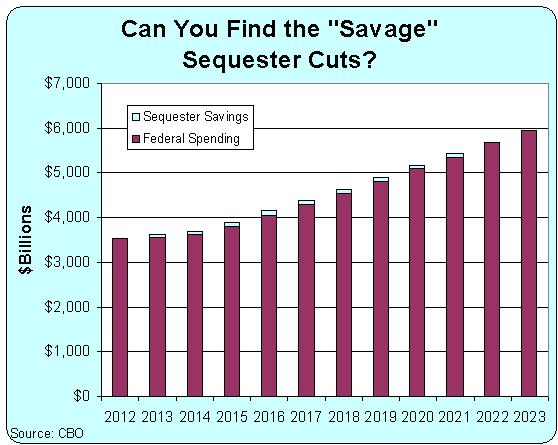
It wasn’t much. The enforcement mechanism, known as sequestration, merely was supposed to guarantee that spending climbed by $2.3 trillion rather than $2.4 trillion over the 10-year period.

But something is better than nothing, and the sequester that took place this year was a bitter defeat for President Obama and other advocates of bigger government.

And it also provided comic relief as the White House engaged in hysterical rhetoric in an attempt to scare people about sequestration.

But now there’s a deal to weaken the sequester and allow more government spending over the next two years. Hatched by Paul Ryan, the Republican Chairman of the House Budget Committee, and Patty Murray, the Democrat Chairwoman of the Senate Budget Committee, the most important takeaway is that the agreement will increase spending caps by $63 billion over the next two years.

This chart shows what will happen.

Murray-Ryan Budget Deal

The second most important thing to understand is that the Murray-Ryan deal contains several tax hikes. But since politicians can’t resist prevaricating, these provisions are being referred to as “user fees” and “offsetting receipts.”

The most outrageous tax hike is the added levy on airline travel. Honest people call this an increase in the ticket tax. The folks in Washington call it an “Aviation security service fee.”

There’s also a tax hike on private pension plans, as well as additional taxes (oops, I mean “user fees”) on trade.

You also won’t be surprised to learn that the so-called spending cuts in the agreement are mostly fluff and gimmicks.

The Treasury Department and Justice Department have been told not to spend “unobligated balances” in their forfeiture funds, but that was money they presumably weren’t going to spend anyway.

States, meanwhile, have been told they have to pay part of the cost of managing mineral leases on federal lands within their borders. Maybe someone can explain to me why payments from state governments to Washington count as a budget cuts.

And the agreement also assumes that Washington will do a better job of policing fraud in areas such as unemployment insurance and illegal utilization of handouts by prisoners. Those would be positive developments, to be sure, but one has to wonder why they weren’t enforcing those laws already.

By the way, the aforementioned tax hikes and make-believe spending cuts are supposed to generate “savings” over 10 years that will “offset” the higher spending that will occur 2014 and 2015.

Needless to say, all the new spending will take place in 2014 and 2015. But I wouldn’t hold my breath for alleged savings that are supposed to take effect in the following years.

Simply stated, the ink won’t even be dry on this agreement before the lobbyists, politicians, bureaucrats, and interest groups that control Washington start maneuvering to bust the spending caps and weaken the sequester next year. And the following year. And the year after that. And…well, you can fill in the blanks.

So what’s the bottom line?

Well, it’s clearly a big disappointment that Congressman Paul Ryan engineered this turkey of a deal rather than fighting for the sequester. Heck, this was the guy who put together very good entitlement reforms, yet now he’s helping Obama escape the sequester?

To be fair, folks on the Hill have told me that Ryan didn’t have much leverage because several Republicans indicated that they wouldn’t vote to comply with the sequester spending levels.

But if that’s the case, he should have at least forced a vote so the American people could see which GOP politicians are wobbly on the critical issue of restraining Leviathan.

To close on a somewhat optimistic note, it does appear that all the new spending is confined to 2014 and 2015. So if the spending caps are preserved for subsequent years, then it’s possible that the long-run trend line of government spending is unaffected.

That would be a good outcome. Not because the long-run trends are positive (if you look at the long-run data, we’re screwed), but because at least they wouldn’t have made a bad situation even worse.

If you want to damn the Murray-Ryan plan with faint praise, you could say it’s not nearly as bad as the read-my-lips deal of George H.W. Bush. That’s certainly true, but the sequester would be a much better outcome.

11 Dec 18:00

When "Zero Tolerance" Is Deadly

by Jason Bedrick

Jason Bedrick

In his testimony before Congress advocating for the legalization of medicinal marijuana, National Review senior editor Richard Brookhiser argued that “the law disgraces itself when it harasses the sick.” How much more so when a school’s absurd “zero tolerance” drugs policy prevents a child with asthma from reaching his life-saving inhaler in time:

Ryan Gibbons was only 12 years old when he died from a severe asthma attack during recess at school. He would have simply reached for the prescription inhaler that he always carried with him, but his school took it away and locked it in the principal’s office.

As Ryan gasped for air, his friends picked him up and carried him to the office where his inhaler was held. But they couldn’t get there in time. Ryan passed out before they reached his potentially life-saving medicine. He never recovered. The date was Oct. 9, 2012.

The tragedy took place at Elgin County School in Straffordville, Ontario, Canada. Now Ryan’s grieving mom, Sarah Gibbons, is leading a campaign to get schools to change their senseless policy of keeping essential inhalers away from asthmatic children — by law.

The bill that she wants lawmakers to pass is dubbed “Ryan’s Law,” in honor of her son’s memory. The proposed law would force schools to let kids who have a doctor’s okay carry inhalers in school, in a pocket or backpack.

It’s too often the case that would-be laws named after deceased children are hastily conceived with little thought given to unintended consequences, but here it is the policy that the law seeks to overturn that was implemented without enough forethought. Schools certainly have a legitimate interest in keeping even legal drugs like alcohol and tobacco off its premises and preventing potentially-harmful prescription drugs from falling into the wrong hands. But inhalers are different than antibiotics or other prescription drugs that are taken at regularly scheduled intervals. The risk that some non-asthmatic students might abuse the inhalers is dwarfed by the risk of blocking access to inhalers. According to the Asthma and Allergy Foundation of America, nearly 25 million Americans suffer from asthma, including over 9 percent of children, and there are about 3,300 deaths resulting from asthma each year, “many of which are avoidable with proper treatment and care.”

This isn’t the first time a school policy came between a student with asthma and his inhaler. Last year, a student with asthma experiencing breathing difficulties passed out when a school nurse and school dean refused to allow him to use his inhaler – which was “still in its original packaging, complete with his name and directions for its use” – because his mother hadn’t filled out the proper form. The school did not call 911 and insisted even after the fact that it had done the right thing by following its policy to the letter.

11 Dec 17:58

Global Warming Folly

by admin

I have not written much about climate of late because my interest, err, runs hot and cold.  As most readers know, I am in the lukewarmer camp, meaning that I accept that Co2 is a greenhouse gas but believe that catastrophic warming forecasts are greatly exaggerated (in large part by scientifically unsupportable assumptions of strong net positive feedback in the climate system).  If what I just said is in any way news to you, read this and this for background.

Anyway, one thing I have been saying for about 8 years is that when the history of the environmental movement is written, the global warming obsession will be considered a great folly.  This is because global warming has sucked all the air out of almost anything else in the environmental movement.  For God sakes, the other day the Obama Administration OK'd the wind industry killing more protected birds in a month than the oil industry has killed in its entire history.  Every day the rain forest in the Amazon is cleared away a bit further to make room for ethanol-making crops.

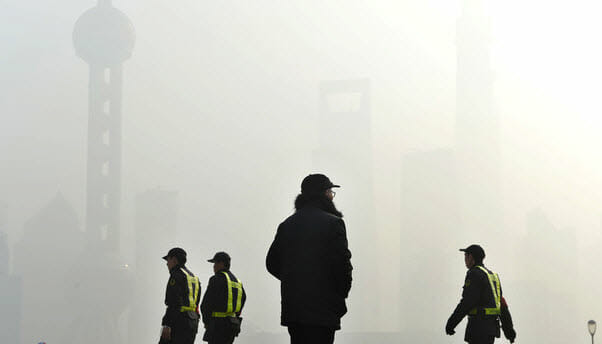
This picture demonstrates a great example of what I mean.   Here is a recent photo from China:

20131211_china1


You might reasonably say, well that pollution is from the burning of fossil fuels, and the global warming folks want to reduce fossil fuel use, so aren't they trying to fight this?  And the answer is yes, tangentially.   But here is the problem:  It is an order of magnitude or more cheaper to eliminate polluting byproducts of fossil fuel combustion than it is to eliminate fossil fuel combustion altogether.

What do I mean?  China gets a lot of pressure to reduce its carbon emissions, since it is the largest emitter in the world.  So it might build a wind project, or some solar, or some expensive high speed rail to reduce fossil fuel use.  Let's say any one of these actions reduces smog and sulfur dioxide and particulate pollution (as seen in this photo) by X through reduction in fossil fuel use.  Now, let's take whatever money we spent in, say, a wind project to get X improvement and instead invest it in emissions control technologies that the US has used for decades (coal plant scrubbers, gasoline blending changes, etc) -- invest in making fossil fuel use cleaner, not in eliminating it altogether.  This same money invested in this way would get 10X, maybe even up to 100X improvement in these emissions.

By pressuring China on carbon, we have unwittingly helped enable their pollution problem.  We are trying to get them to do 21st century things that the US can't even figure out how to do economically when in actuality what they really need to be doing is 1970's things that would be relatively easy to do and would have a much bigger impact on their citizen's well-being.

11 Dec 16:32

The "It's Libertarian So It's Bad" Argument Against Bitcoin

by Brian Doherty

A very silly piece from the Business Insider is making the rounds this morning for those who wish to stand athwart the digital future sneering "but it's libertarian." (The article has pretty much no intellectual value for anyone else.) (For an earlier take on people who have a hard time swallowing the libertarian implications and practice of the digital past, present, and future, see this from me earlier this week.)

The article by Jim Edwards posits that "Bitcoin Proves the Libertarian Idea of Paradise Would be Hell on Earth," with a bill of indictments against the surging digital currency that applies in pretty much every respect to any currency at all.

Criminals can use it! It can be stolen! (We all have things that are valuable to us on our hard drives. Bitcoin may end up being the most valuable thing lots of us have on our drives, but—back up, back up, back up. Undoubtedly a trustworthy and robust system of outsiders serving the function of digitally storing your wallets on other than just your harddrives will become common, just like pretty much every other valuable human need gets met by the market. Like every human endeavor, some crooks might get involved as well, naturally.) 

Edwards is right, let's just return to barter...this whole "currency" thing seems toooo risky.

Edwards also gives way too much importance to a supposed bug in the system that might allow colluding miners to cut out other miners (a problem that is probably fixable in the open-source debuggable Bitcoin system and that need not destroy the value of the currency to most users), and then gives even more scary attention to the notion that people can use Bitcoin as a tool to commit crimes, in case you didn't get it the first time and repetition might make it start to scare you.

He also is incensed that due to the nature of how it has rolled out, a small number of people have a lot of Bitcoin. This has little to do with its value as a means of exchange, unless he is imagining a world where suddenly the only thing that has value is Bitcoin and those of us lacking it are screwed. And for someone so worried about centralized power and manipulation of currency, he doesn't seem to have thought a lot about the Federal Reserve's role in the economy, even though circumventing it is one of the libertarian joys of Bitcoin.

Edwards hits on one point that, right this second, makes Bitcoin less than ideal as a currency: its huge day to day fluctuations in value in relation to all other monies and commodities in the world. It seems obvious to me that we are seeing lots of churn in Bitcoin based on people seeking in it not a currency but an investment vehicle, because of its huge zooms in value very recently.

We are still in the beginning of the world understanding how it wants to use digital currencies, and I would expect that in the near future we will see far more stability in Bitcoin's day to day value—though where this level will be in terms of the U.S. dollar is impossible to say.

What seems easy to say is that for anyone who has ever tried to transfer money, nationally or internationally, that the values in ease, speed, and cost of digital currency means that it will have the same leveling effect on industries like banking and finance that depend largely on their middleman function that already we've seen happen in book sales, video rentals, and travel agents.

People who doubt this are letting their ability to write Bitcoin and other digital currencies off as "libertarian" blind them to economic trends of the past 20 years in the digital age. If you can understand the value of, say, PayPal, then you already understand the value of Bitcoin; except Bitcoin doesn't have a middleman skimming.

The Internet has made life very unstable for those who made their living as middlemen skimming--even more unstable than the recent day to day value of Bitcoin.

Yes, it's decentralized, hard to control, hard to tax, arising from the free play of the market rather than government command--it's pretty libertarian stuff. The world can be, at its best, a pretty libertarian place. Don't let that scare you away from the future, libertarian haters. (Or go ahead! See if I care!)

For more on Bitcoin from a libertarian perspective, see this great essay by John Mather defending it from old-school Austrian economists who see it as essentially a non-money, and a Ponzi scheme.

Reason on Bitcoin, and our recent December feature by Jerry Brito on the many uses for the Bitcoin protocol besides a currency.

10 Dec 23:06

the rules of physics

STOP_in_the_name_of_the_laws_of_physics
10 Dec 16:20

Report: Unions Funding GOP Super PAC That Targets Tea Party

On Monday, the National Journal reported that "documents filed by other groups show that two labor organizations, the International Union of Operating Engineers and the Laborers' International Union of North America, directed a combined $400,000 to the Republican group [the Defending Main Street super PAC] in September and October."

The Defending Main Street super PAC was organized at the end of 2012 by former Congressman Steve LaTourette (R-OH), and  has very publicly declared war on the Tea Party. It is affiliated with and has offices at the same location as the Republican Main Street Project, which LaTourette currently heads and which former Congressman Tom Davis (R-VA) led from 2009 to 2012.

The group will not be required to file its first financial report with the Federal Election Commission until January 15, 2014, but earlier press reports indicate that it claims to have already raised $4 million of a planned $8 million to defeat Tea Party candidates in Republican primaries.

In October, LaTourette told the National Journal that "we'll go into eight to ten races and beat the snot out of them [Tea Party candidates] . . .  We're going to be very aggressive and we're going to get in their faces." 

Tea Party activists around the country were not surprised that the Republican establishment has enlisted the financial support of unions in their efforts to defeat limited government policies. Ben Cunningham, founder of the Nashville Tea Party, told Breitbart News on Monday "this confirms our belief that Washington, D.C. is about one thing and that is power. Whatever method will allow those in D.C. to keep power will be used."

Image source: Buildingoneamerica.org


09 Dec 19:13

Budget Deal: A Dangerous Precedent

by Chris Edwards
Jts5665

Recent years have convinced me that republicans don't care all that much about spending. They remain spending kittens compared to the democrat spending sabertooth tigers, though.

Chris Edwards

Republican and Democratic negotiators are expected to agree to a budget deal this week setting spending levels for 2014. The Washington Post says that the deal will amount to “little more than a cease-fire.”

However, the deal being described in media reports would be much worse than a cease-fire for Republicans, at least for fiscally conservative Republicans. That’s because the Budget Control Act of 2011 and related sequester have started bearing fruit and are currently providing substantial discretionary spending control. Yet Republican leaders are apparently planning to throw it away in return for revenue increases and paltry spending trims.

In theory, Republicans have the upper hand in budget talks because current law specifies that discretionary spending will be modestly reduced in 2014 to $967 billion. Republicans always claim that they are for spending restraint, and here they just need to hold firm on current-law budget caps to save serious money over time.

However, the Post story indicates that the GOP may agree to scrap the budget cap for 2014 and spend up to $1.015 billion in return for a tiny cut to federal pensions and a revenue increase, possibly from auctioning radio spectrum.

That would be a giant cave-in because a precedent will have been set. The next decade of savings from current-law budget caps would be in jeopardy. If Republican leaders up-end the budget caps this year, they will empower big-spending Democrats, liberal Republicans, and appropriators to completely blow up the caps in later years.

A $48 billion cap overrun this year could set the stage for spending hundreds of billions of dollars more over the coming decade. That would be snatching defeat from the jaws of 2011’s modest budget victory.

09 Dec 18:08

Cuba: Global Free Trade Champion?

by K. William Watson

K. William Watson

I would like to second Simon Lester’s ambivalent endorsement of the trade agreement reached by WTO members in Bali last week.  Despite cheers from governments and embarrassingly unrealistic claims of economic value, the new WTO agreement on trade facilitation is hardly something for free traders to get super-excited about. 

There was some excitement, however,  when a bit of last-minute diplomatic drama at the talks threatened to derail everything.  Cuba, it turns out, had some genuine demands for actual trade liberalization and indecorously refused to be ignored.  As reported by Inside U.S Trade [$]:

Cuba and three other Latin American countries – Bolivia, Venezuela and Nicaragua – had withheld consensus from the so-called Bali package consisting of a trade facilitation agreement as well as agriculture and development components.

Specifically, Cuba had refused to endorse the package until its demands were met for a provision in the trade facilitation deal that would prevent countries from applying discriminatory measures to goods in transit. This was aimed at counteracting a part of the U.S. trade embargo that prevents ships that engage in trade in Cuban ports from unloading cargo in the U.S. for 180 days thereafter.

After Cuba’s demands on trade facilitation came to the fore as the last outstanding issue on the evening of Dec. 6, WTO Director-General Roberto Azevedo held consultations throughout the night with the U.S. and Cuban delegations until 6 am. At that point, the two sides agreed to compromise language to address Cuba’s demands, according to an informed source.

The compromise language consists of one sentence in the Bali ministerial declaration that appears immediately after a sentence adopting the trade facilitation deal. It states: “In this regard, we affirm that the non-discrimination principle in Article V of the [General Agreement on Tariffs and Trade] 1994 remains valid.”

This “compromise” means that the U.S. takes on no new obligations, and the embargo remains as is.  Cuba wasn’t looking for an end to the embargo with its demands, merely recognition that this one small component of the embargo violates the brand new, U.S.-approved WTO rules. 

It’s difficult to imagine, however, that the process could have worked out any differently.  If there’s one thing that’s clear about the new WTO package at this point, it’s that the deal will not have any meaningful impact on U.S. trade policy.

Something is amiss when the global trading system’s achievements depend on the United States convincing Cuba and Venezuela to stop demanding freer trade.

09 Dec 15:43

The Most Dramatic Resistant Starch Success Story Yet

by Richard Nikoley

No introduction necessary.

~~~

Mr. Nikoley,

You and Tatertot Tim have stumbled, if that’s the correct word, onto something having more repercussions of which we “resistant-starchers” may be aware. The following is of course anecdotal, strictly an N=1 experiment.

Some relevant background: I am 61 years old, weigh 240 pounds (still obese but 60 pounds less so), and my menu is 99% very-low carb, less than 20 gm/day. In the past I ate sugar and its variants with abandon, to the point of gluttony; I love the stuff. As a result I had very high blood pressure and I was on the verge of becoming a full-blown T2 diabetic. My sugar cravings are now under control, my blood pressure is way down, the diabetes threat is non-existent, and blah, blah, blah, you know the story. However, a couple of things have continued to bother me.

Diarrhea has been a curse for many years, due no doubt to my pre-paleo menu, and any amount of sugar would result in an impressive blood glucose spike with an attendant spike in my blood pressure. Even if I spent the day completely avoiding carbohydrates, a single cookie or sliver of pie would result in the spikes and a bad night in bed with heartburn and small regurgitations of stomach contents. It’s been this way for the past few years.

Until your posts about resistant starches...

I have a degree in geology—part of my course of study was paleoarcheology—and I have been interested in our evolutionary ancestors’ diet since those days forty years ago, though I’m more a dilettante than an actual student of the subject. Your post on resistant starches, like Mark Sisson’s book Primal Blueprint, opened doors in my mind that had heretofore been invisible. I immediately saw the implications on blood glucose, the gut biome, etc., including the reason why a lot of people, such as modern “primitives,” can eat primarily fruits and such with no apparent ill effect. (The fiber content, supposedly blunting the sugar effect, has never fully explained, to me, the lack of damage that might be caused by a fruit diet. Are there resistant starches in fruit? Is there such a thing as a resistant sugar?)

I immediately purchased two bags of potato starch. I have been using milk kefir for many months and while it did reduce the diarrhea, the problem was not cured. Adding your proposed two tablespoons of potato starch twice per day helped a bit more but the curse persisted. The almost immediate effect of the potato starch though was the blunting of my blood glucose spikes if I ate any sugar. Another effect was a minor lowering of my blood pressure.

I have a self-imposed upper limit of 90 mg/dL (5 mmol/L) blood glucose. If it rises above that I get mad, obsessively tracking down the reason. I feel really, really good when my blood glucose stays between 73 and 80 mg/dL (4 to 4.4 mmol/L). Pre-paleo my blood pressure was in the area of 140/105 mmHg, post-paleo the pressure had stayed around 118/80 mmHg. About a week after starting potato starch my blood pressure dropped to an average of 113/75 mmHg and my blood glucose averaged 80 mg/dL (4.4 mmol/L) daily. But, as I said, my diarrhea continued to be a problem.

The Monday before Thanksgiving I got pissed off about my diarrhea situation and decided to double the dosage of the potato starch. That morning I put four tablespoons of starch in my usual pint of kefir and again Monday night before I went to bed. And Tuesday and Wednesday. Thursday, Thanksgiving Day, no more diarrhea; and the problem has not returned in the 2 1/2 weeks since.

Now to the point of this story. On Thanksgiving Day I ate cornbread dressing, ONE roll with butter, and a SLIVER of pumpkin pie with whipped cream. My blood glucose did spike of course but not as high as my history indicates. I figured it was one of those anomalies one gets from day-to-day and ignored the reduced numbers (four measurements over four hours). What did get my attention was sleeping soundly that night with no regurgitations at all; I slept the entire night, not awakening once.

Damned interesting that, and my attention was heightened. I’ve continued the protocol of 8 tablespoons of potato starch—4 in morning and 4 before bed—since Thanksgiving, wondering whether or not I’d meandered into something meaningful but I couldn’t figure out how to test it. Two days ago, Friday, Dec. 5, I decided to just do my usual stupid act of a full-speed-ahead experiment. I fixed a large amount of white rice, about three cups, and ate the entire amount. This meal should have put me in a light coma, spiking my blood sugar into the heavens and elevating my blood pressure. Well, my blood glucose did of course rise but only to a max of 140 mg/dL (7.8 mmol). My blood pressure did rise but since I didn’t log it I can’t report the number but it didn’t go as high as I expected. Friday night I slept like a dead man, rising only once to urinate but immediately returning to sleep, and NO regurgitation.

Okay cool, fine, I’m onto something maybe. Now for an acid test; lets really stress this N=1 theory. Yesterday, Friday, Dec. 6, I went to the grocery store and purchased a large-ish chocolate bar, a package of Nabisco’s Fig Newtons, and a small bag of sugar cookies. After returning home I settled into my chair, turned the TV to one of those bad, but hilarious, science fiction movies wherein a beast is killing young people and the lone survivor is a 110 pound, axe-wielding teenage girl, and proceeded to eat the chocolate, one sleeve of the Fig Newtons, and the whole bag of Snickerdoodle cookies. I then waited for the consequences.

Over six hours my blood glucose peaked at 160 mg/dL from 78 mg/dL (4.3 to 8.9 mmol) and my blood pressure went from 105/69 to 136/88 mmHg. Whoa! The BG should have gone to the moon and the BP should have popped an artery like an overfilled balloon. One weird thing though, my head felt inflated as if it were indeed a balloon; a really strange sensation. I did fall asleep but I didn’t pass out as I would have in the past. (Unfortunately I cannot report the number of pieces into which the teenage heroine chopped the beast.) My stomach was not happy of course but I wasn’t suffering the usual torments either, another really weird non-event. Of course I didn’t eat anything for the rest of the day until bedtime when I drank a pint of kefir with four tablespoons of potato starch.

Now for the final act. I went to bed last night at midnight, expecting a really tough night. The amount of sugar and flour and bad, cheap oils I had eaten should have put me through unmitigated hell, Dante’s Third Ring as it were. I should have lain there for a couple of hours with heartburn, eventually falling asleep but awakening after an hour with a mouthful of stomach acid. In the past I would have brushed my teeth, drank a potion of water and baking soda to alleviate the acid stomach, and fallen back into a restless sleep. But not last night. I was asleep within minutes, even after having napped for a couple of hours, and didn’t awaken until 7:00 this morning. I did not have the usual heartburn, I was fully rested, and the usual morning-after bout of diarrhea was absent. My stomach is still somewhat annoyed but what does one expect after such goings on?

The really big news though is my blood glucose this morning was only 78 mg/dL (4.3 mmol), my blood pressure was at 103/65 mmHg, and my resting heart rate was 67 bpm. Genuinely startling numbers in light of my history. There is definitely something else occurring with the resistant starch protocol other than helping the gut biome. If the good bugs are way down in the colon and the spiking of insulin/blood glucose starts in the stomach or the mouth, why did my various numbers stay low? Why did my usual heartburn stay away, allowing a restful sleep? Obviously a high population of good gut bugs effects the entire body but I cannot connect the dots of a healthy colon and bad food in the mouth or stomach.

Regardless, whatever is going on, my life has gotten much better thanks to your posts on resistant starch. I sleep very well, my blood glucose stays in the 70 – 80 mg/dL (3.9 – 4.4 mmol), my blood pressure is usually around 105/65 mmHg, and the diarrhea has disappeared, all in just three weeks of a large intake of a resistant starch. Simply amazing and astounding and all the other synonyms.

My kefir protocol.

Morning:

  • 1 pint milk kefir (my fermentation of course)
  • 4 tbls potato starch
  • 2 tbls cocoa powder (not Dutch-processed)
  • 1/4 tsp ascorbic acid powder (Vitamin C)
  • 1 tsp (2.5 gm) ground Ceylon cinnamon (anecdotally said to lower blood pressure, which I believe has some veracity)
  • 1/3-scoop veggie powder (Garden of Life’s “Perfect Food – Super Green Formula.” I am simply incapable of eating lots of vegetables, I don’t like them.)
  • Occasionally 1/4-cup of heavy cream for taste and mouth-feel
  • Occasionally 2 raw egg yolks for quickie protein
  • Occasionally pureed raw liver for all the benefits (contributes no discernable flavor but the color of the final mix is, um, unusual)

Shake/mix/blend well and allow it to sit for 20 minutes to let everything get soaked or dissolved or whatever. (Immediate ingestion doesn’t seem to do have much effect in the gut except impressive flatulence. For me, allowing the mix to sit for a while eliminates the flatulence. NB: I have been using the starch for several months so reduced flatulence may be due to my gut bugs having acclimated but if I drink the mix without the suggested soaking time I will sing a different tune. This fact is very important at night. Sweet Thang, on some matters, is so narrow-minded she can look through a keyhole with both eyes.)

Before bed:

  • 1 pint kefir
  • 4 tbls potato starch
  • 1/3-scoop veggie powder

Mix well, etc.

Thanks for your blog,

James

~~~

Nothing left to say. Your turn. Please share it. You never know who might be helped, a life veritably saved...just because you did, right in time and on time. ...And to get caught up, here's all the many posts on Resistant Starch.

09 Dec 15:40

Best Buy - Microsoft Xbox Live 12 Month Gold Membership $24.99

09 Dec 14:47

Open Interview with Scott

Next week (Dec 16- 20) I'll be doing interviews on Skype and phone about my new book (How to Fail almost Every time and Still Win Big...).

But I'm adding a twist to the process, just to see what happens.

I'll do the interviews in the priority order of biggest reach. So if no one but a high school newspaper asks for an interview, I'll do it. For next week only, no media outlet is too small. I'll do as many as I can fit into my schedule.

If you're interested in talking to me next week (or sooner), just email me at dilbertcartoonist@gmail.com and tell me roughly how big your audience reach is. Send me your Skype ID and/or phone number. I'll either call you when I have a minute or email to arrange a time.

You don't even need to be a professional writer. You just need a way to distribute the interview within your company or organization.

My guess is that I'll end up talking to just about everyone who asks. I don't have an assistant answering my email. I'll read everything that comes in, but I might not be able to respond to all of it.

Perhaps I'll be speaking with you soon. This should be fun.


09 Dec 14:41

Crime and Punishment in a Free Society

by Sheldon Richman

Would a free society be a crime-free society? We have good reason to anticipate it.

Don’t accuse me of utopianism. I don’t foresee a future of new human beings who consistently respect the rights of others. Rather, I’m drawing attention to the distinction between crime and tort — between offenses against the state (or society) and offenses against individual persons or their justly held property. We’re so used to this distinction, and the priority of the criminal law over tort law, that most of us don’t realize that things used to be different. At one time, an “offense” that was not an act of force against an individual was not an offense at all.

What happened? In England, the early kings recognized that the administration of justice could be a cash cow. So they grabbed on and never let go. As a result, the emphasis shifted to punishment (fines and imprisonment) and away from restitution (making victims or their heirs as whole as possible).

Liberty-minded people should regret this change. Yet again, the ruling elite exploited the people. It needed wealth to buy war materiel and allegiance, so it took it by force from the laboring masses, and corrupted the justice system in the process.

In The Enterprise of Law, Bruce Benson explains that before the royal preemption, customary law prevailed in England. One feature of this spontaneous order was that

offenses are treated as torts (private wrongs and injuries) rather than crimes (offenses against the state or the “society”). A potential action by one person has to affect someone else before any question of legality can arise; any action that does not, such as what a person does alone or in voluntary cooperation with someone else but in a manner that clearly harms no one, is not likely to become the subject of a rule of conduct under customary law.

Benson also notes that

prosecutorial duties fall to the victim and his reciprocal protection association. Thus, the law provides for restitution to victims arrived at through clearly designed participatory adjudication procedures, in order to both provide incentives to pursue prosecution and to quell victims’ desires for revenge.

In such a system of law, one was not likely to see “offenses” without true victims. Since cooperation through reciprocity is key to the success of customary law, the system is likely to be kept within narrow libertarian-ish limits. (Also relevant is John Hasnas’s paper “Toward a Theory of Empirical Natural Rights” [PDF].)

This arrangement worked out fairly well — until would-be rulers, who needed money to finance wars of conquest and buy loyalty by dispensing tax-funded jobs, discovered that there was gold to be had in the administration of justice.

Anglo-Saxon kings saw the justice process as a source of revenue, and violations of certain laws began to be referred to as violations of the “king’s peace.” Well before the Norman conquest [1066], outlawry began to involve not only liability to be killed with impunity but [quoting historians Frederick Pollack and Frederick Maitland] “forfeiture of goods to the king.”

The idea of the “king’s peace” started small but eventually expanded to all of society. The incentive was obvious. “Violations of the king’s peace required payment to the king,” Benson writes. As customary law was co-opted by the crown, the concept felony, arbitrariness in punishment, and imprisonment came to the administration of “justice.” The people were not pleased with the shifting focus from victims to king and his cronies, so they had to be compelled to cooperate.

For example, royal law imposed coercive rules declaring that the victim was a criminal if he obtained restitution before he brought the offender before a king’s justice where the king could get his profits. This was not a strong enough inducement, so royal law created the crimes of “theftbote,” making it a misdemeanor for a victim to accept the return of stolen property or to make other arrangements with a felon in exchange for an agreement not to prosecute.

Benson sums up

By the end of the reign of Edward I [1307], the basic institutions of government law had been established, and in many instances older custom had been altered or replaced by authoritarian rules to facilitate the transfer of wealth to relatively powerful groups. “Public interest” justifications for a government-dominated legal system and institutions must be viewed as ex postrationalizations rather than as ex ante explanations of their development.

Thus the criminal justice system as we know it is a product of state arrogation and a repudiation of individualism. This perverse approach to law was inherited by the representative democracies that succeeded the absolute monarchies in England and then America.

For reasons too obvious to need elaboration, a system of justice aimed at restitution makes eminently good sense. Someone is wronged, so the perpetrator should, to the extent possible, make things right. (In the case of murder, the victim’s heirs would have a monetary claim against the killer; in the case of an heirless victim, the claim could be homesteaded by anyone who puts the effort into identifying and prosecuting the killer.)

At the same time, the principle of restitution undercuts the case for punishment, correction, and deterrence as objectives of the justice system. The point isn’t to make perpetrators suffer or to reform them or to make potential perpetrators think twice. What good are these for the present victim? Correction and deterrence may be natural byproducts of a system of restitution, but they are not proper objectives, for where could a right to do more than require restitution come from?

Violence is so destructive of the conditions required by a community that facilitates human flourishing that its use is justifiable only when necessary to protect innocent life or to make victims whole. Thus it cannot be legitimate to use force to punish, reform, or deter. (Private nonviolent acts — for example, shunning — can have a proper role here. Also, a perpetrator who demonstrates that he is a continuing threat might legitimately be confined for reasons of self-defense.)

Punishment is wrong, Roderick Long writes, because “after all, we do not think that those who violate others’ rights accidentally should be made to suffer; but the only difference between a willing aggressor and an accidental aggressor lies in the contents of their thoughts — a matter over which the law has no legitimate jurisdiction.” (To my knowledge, Randy Barnett is the first libertarian of our era to lay out the case for a restitution-only system of justice.)

As Gary Chartier concludes in Anarchy and Legal Order, “Because there is no warrant for executions or punitive fines, and no warrant for restraint (which need not involve imprisonment) except as a matter of self-defense and the defense of others, there is no need for the distinctive institutions and practices of the criminal justice system.”

In a free society, crimes against person and property would be treated like torts. This would be a welcome change in a society that imprisons more people than any other, often for nonviolent and victimless “crimes.”

This column originally appeared at the Future of Freedom Foundation.

09 Dec 14:36

Unbelievable: ATF Using Mentally Disabled Teens to Run Drug-and-Gun Stings

by Nick Gillespie

Hat tip: Instapundit.

If you thought the Bureau of Alcohol, Tobacco, Firearms and Explosives (ATF) couldn't stoop any lower, you'd be wrong. The Milwaukee Journal Sentinel reports that the agency responsible for setting off the events that led to Waco and were at the center of the Fast and Furious gun-walking scandal are using mentally disabled teenagers to advertise businessess that are actually fronts for ATF sting operations.

The Journal Sentinel's expose leads with the tale of Aaron Key, a 19-year-old stoner whose mind is not quite all there. The ower of a head shop in Portland, Oregon, befriended Key and his friends online and then paid them to get neck tattoos advertising "Squid's Smoke Shop."

He and his friend, Marquis Glover, liked Squid's. It was their hangout. The 19-year-olds spent many afternoons there playing Xbox and chatting with the owner, "Squid," and the store clerks.

So they took the money and got the ink etched on their necks, tentacles creeping down to their collarbones.

It would be months before the young men learned the whole thing was a setup. The guys running Squid's were actually undercover ATF agents conducting a sting to get guns away from criminals and drugs off the street.

The tattoos had been sponsored by the U.S. government; advertisements for a fake storefront.

The teens found out as they were arrested and booked into jail.

Earlier this year, when the Journal Sentinel reported on an ATF sting operation in Milwaukee involving a "low IQ" informant, authorities wrote it off as an isolated act of rogue agents. The Journal Sentinel documents at least half-a-dozen stings from around the country that use the same "rogue" tactics of creating fake storefronts and using low IQ people to set stings in cities such as Pensacola, Florida, Albuquerque, New Mexico, and Wichita, Kansas.

"There is enough crime out there, why do you have to manufacture it?" said Jeff Griffith, a lawyer for a defendant in Wichita. "You are really creating crime, which then you are prosecuting. You wonder where the moral high ground is in this."

Apart from the moral issues (which are huge enough), there's a question of whether such operations are worth a damn in terms of serious collars:

In Albuquerque, for example, a man who was twice indicted on first-degree murder charges, once for killing a man in prison, was later busted in a storefront sting for being a felon in possession of weapon.

But in many cases examined by the Journal Sentinel, the people charged in the stings had minor criminal histories or nonviolent convictions such as burglary or drug possession.

In several of those cases, defendants still got stiff sentences, but others resulted in little or no punishment. In Wichita, nearly a third of the roughly 50 federal cases charged led to no prison time. Defendants got probation or had their case dismissed, records showed. One was acquitted by a jury.

Not the results federal agents typically trumpet.

In the case of Aaron Key and Marquis Glover, the judge handling the cases was puzzled over the ATF's decision to cajole the teens (who were ultimately convicted of crimes that were enabled by the government) into getting tattoos.

In federal court, a prosecutor who handled several of the ATF cases, including Key's, tried to explain to a judge why the agents employed the tactic.

The agents said they thought Key and Glover were testing them to see if they were law enforcement, Assistant U.S. Attorney Scott Kerin said in a January 2012 sentencing hearing.

Key and Glover supposedly did this by suggesting they all smoke marijuana.

Kerin said the agents then proposed Key and Glover get tattoos as a way to get them off their trail.

The explanation didn't make sense to U.S. District Judge Michael Mosman, a former federal prosecutor.

"I guess I don't make the connection," Mosman said. "They're concerned that if, among other things, they don't smoke marijuana with this guy that they'll be given up as law enforcement, so they think a way to derail that is to suggest that he get a tattoo?"

Kerin tried again to explain.

"Mr. Key and Mr. Glover were trying to identify them as law enforcement or possibly testing to determine if they were law enforcement."

The judge cut in: "I think I understand that part. I just don't understand why you put someone off your trail by suggesting they get a tattoo. How does that help?"

The judge ordered the ATF to pay for the removal of Key's tattoo.

Read the whole story, which details both how the ATF sets up fake businessess and the paltry results such efforts get in terms of doing anything about fighting criminal activity. And then ask yourself (and maybe your law enforcement and political representatives) just how bad does the Bureau of Alcohol, Tobacco, Firearms and Explosives have to be before it's finally disbanded?

Hat tip: Instapundit.

For more Reason on ATF failings, click here.

Reminder: Gallup finds a record-high percentage of Americans (60 percent), especially those who identify as political independents (65 percent), think the government has too much power. Any questions?

Back in October, Reason TV reported on how Riverside County, California cops tricked an autistic kid into selling pot as part of a sting operation.

09 Dec 06:28

70% Of Calfornia's Doctors Expected To Boycott...

08 Dec 21:40

ARCHITECT: If You Like Your Doctor, You Can Pay More...

08 Dec 13:55

Quotation of the Day…

by Don Boudreaux
(Don Boudreaux)

… is from pages 421-422 of Deirdre McCloskey’s stupendous 2010 volume, Bourgeois Dignity:

If bourgeois dignity and liberty are not on the whole embraced by public opinion, in the face of the sneers by the clerisy and the machinations of special interests, the enrichment of the poor doesn’t happen, because innovation doesn’t.  You achieve merely through a doctrine of compelled charity in taxation and redistribution the “sanctification of envy,” as the Christian economist the late Paul Heyne put it.  The older suppliers win.  Everyone else loses.  You ask God to take out two of your neighbor’s eyes, or to kill your neighbor’s goat.  You work at your grandfather’s job in the field or factory instead of going to university.  You stick with old ideas, and the old ferry company.  You remain contentedly, or not so contentedly, at $3 a day, using the old design of a sickle.  You continue to buy food for your kids at the liquor store at the corner of Cottage Grove and 79th Street.  And most of us remain unspeakably poor and ignorant.

Yes.  And so how very ironic that so much of “Progressive” ideology today is hostile to bourgeois dignity and liberty.  How very dangerous that that ideology focuses upon interventions by Great Leaders, plans from the top, and taxation as keys to progress.  How sad that “Progressives” concentrate – because of a combination of envy, childishness, and economic ignorance – on “redistribution” rather than upon institutions and markets and innovation and liberty that alone are able to ensure widespread and increasing prosperity for everyone.