The coronavirus now sweeping the world came from a “wet market” in Wuhan, China, which sells all kinds of exotic animals like bats, pangolins, live wolf pups, salamanders, civets, and bamboo rats.
Gross.
Now, it turns out Japan eats some weird stuff, too.
“The giant hornet, along with other varieties of wasps, has traditionally been considered a delicacy in this rugged part of the country,” the New York Times reported. “The grubs are often preserved in jars, pan-fried or steamed with rice to make a savory dish called hebo-gohan. The adults, which can be two inches long, are fried on skewers, stinger and all, until the carapace becomes light and crunchy. They leave a warming, tingling sensation when eaten.”
And they drink the hornets’ venom, too.
“The hornets can also give liquor an extra kick. Live specimens are drowned in shochu, a clear distilled beverage. In their death throes, the insects release their venom into the liquid, and it is stored until it turns a dark shade of amber.”
The invasive species, which was first spotted in Washington state in December (shortly before another Asian import — SARS-CoV-2, which causes COVID-19 — arrived) mostly attacks honey bees, which pollinate some fruits and vegetables, as well flowers.
“These hornets will actually come into colonies, and they will decapitate the bees at the hive. They can decimate an entire colony.” Honey bees and other native bees are important to the agriculture industry and “food sustainability,” University of Tennessee entomologist Jennifer Tsurda told WVLT News.
Lots of Asians eat bizarre things. The Japanese eat wasp crackers (boiled wasps dried and baked into crackers), fish sperm, tuna eyeballs, and duck embryos. Koreans eat raw horse meat, dog soup, silkworm pupae, fried tarantula, live octopus tentacles, crushed tortoise shell, and sea urchin gonads, while the Chinese eat toads, pigeons, scorpions, grasshoppers, blood soup, sharkfin soup — and live shrimp!
“We expected that we would start seeing more significant declines in new cases and deaths around the nation at this point, and we’re just not seeing that.”
In fact, Gottlieb pointed to rising daily COVID-19 cases in 20 states, including heavily locked-down states such as Virginia and Maryland.
But this seems to defy the “science” that governors and lawmakers repeatedly pledge to follow in order to keep people safe from the virus.
After all, Virginia Governor Ralph Northam issued his first social distancing order on March 17 to “stop the spread of the virus in the Commonwealth,” as he promised. A few weeks later, Northam, a physician, joined Maryland Governor Larry Hogan and Washington, D.C. Mayor Muriel Bowser to announce a collective shelter-in-place decree after residents failed to obey their original commands.
“What we’re seeing now is the result of how people interacted two or three weeks ago,” Northam scolded on March 30. “What we will see a few weeks from now will be determined by how people behave today and in the following days.”
But five weeks later, the area is reporting a record number of COVID-19 cases. Yes, of course, testing is ramping up, too—but considering the harsh stay-at-home orders, how and why are people still getting infected?
It turns out, as I wrote last month, “social distancing” is untested pseudoscience particularly as it relates to halting the transmission of the SARS-CoV-2 virus. On its website, the CDC provides no links to any peer-reviewed social distancing studies that bolster its official guidance.
Well, to be fair, you only need double-blind studies when you’re assessing drugs that President Trump mentions favorably.
But seriously, the lockdowns were sold as, and were originally meant to be, stopgaps to ensure that the number of cases didn’t outrun healthcare capacity. That’s not an issue — not even in NYC, where they’re closing field hospitals for lack of patients — and that means it’s time to reopen.
When we began our foray into quarantine seven weeks ago, there was a unifying and eminently sensible rationale behind it: “Bend the curve.” The idea was this: If allowed to go unchecked, COVID-19 would overwhelm hospitals, leaving patients without beds. Short on ventilators, patients would be left to suffocate. In short, by slowing the spread of the virus we would prolong the amount of time it spread through the country, but would reduce the total number of deaths. Moreover, we would buy time for the nation’s testing apparatus to ramp up, to produce more ventilators, and to expand hospital capacity. . . .
If this really was the goal, then “job well done,” as they say, or at least largely so. . . . There are many interesting stories within these data, but the main takeaway should be relatively clear: No states are on anything resembling an exponential growth trajectory, almost all states are past a peak, and most states are substantially so. This would suggest that in many states, the question really should be how to reopen while keeping hospitals from being overwhelmed again.
This is especially true given that the situation on the ground has changed dramatically since early March. Most states have substantially expanded hospital capacity, both by securing emergency locations to be used in case of overflow and by suspending elective surgeries, to the point where many hospitals are facing financial crises. Moreover, the arrival of the first COVID-19 therapeutic, Remdesivir, will help, since hospital stays are shortened when the drug is used. Personal protective equipment and ventilator availability has expanded, we’ve developed techniques for sanitizing PPEs, and ventilators may not be as useful as once thought. As of this writing, we’re testing over 200,000 people a day, which eclipses the rate South Korea achieved when containing its viral outbreak.
Perhaps most promisingly, the death rate looks lower than initially expected. It isn’t clear how much lower – studies disagree – but most of the serological studies find an implied fatality rate lower than the 1% used to arrive at the conclusion that 2 million people would die if the virus were allowed to run its course. Likewise – this is much less commented upon although it might be more important – the hospitalization rate looks substantially lower than initially anticipated.
Read the whole thing. We hear a lot about science. Science means changing your understanding based on the data.
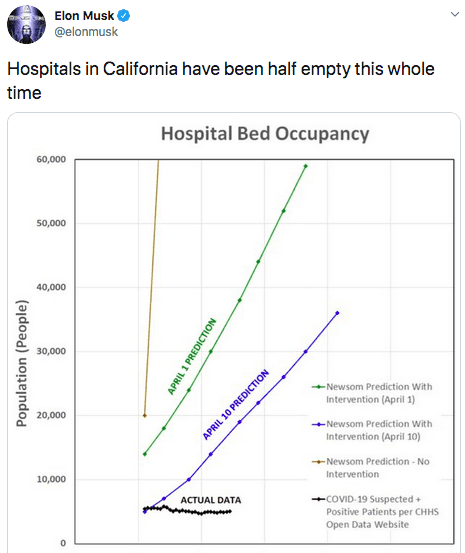
And speaking of success at bending the curve here’s a chart prepared by Chapman U. lawprof Tom W. Bell showing how little pressure there is on California ICU beds:
(1) Via reader Yves [not Cohen], a French media report that COVID19 was found in a blood sample taken from a lung patient at a suburban Paris hospital on December 27, 2019. [Hand-corrected DeepL translation]
Invited on the set of BFMTV on Sunday, May 3, Professor Yves Cohen, head of the intensive care unit at the Avicenne hospital in Bobigny (Seine-Saint-Denis), and at the Jean-Verdier hospital in Bondy (Seine-Saint-Denis), claims to have had a patient infected with Covid-19 at the end of December 2019. […] “We had a positive case at Covid-19 on 27 December 2019, when he was hospitalised with us at Jean Verdier,” he explained on the air. An analysis of the serological PCR tests carried out on the 24 pneumonia patients in December and January in these two hospitals led to this conclusion.[…] Dr Olivier Bouchaud, an infectiologist at the same Avicenne hospital, confirms this information. “PCR samples taken from a patient clearly show that he [tested positive for] Covid. We did have a first case in France on 27 December,” he adds. […] Professor Cohen mentioned that the infected patient had been ill for 15 days and that he had infected his two children, but not his wife. This person had not made any recent trips. For Doctor Bouchaud, “this does not necessarily mean that he is patient zero in France. But it does suggest that more research is needed to find out”. […] So far, the first officially recorded cases in France are those of three people, on January 24: a Frenchman of Chinese origin and two Chinese tourists who stayed in Wuhan, the original focus of the epidemic which appeared in December.
This, together with the earlier report that COVID19 was found during autopsy of a Santa Clara County patient who had died early February (which places the infection roughly at mid January), pushes the COVID19 timeline further back. [The French story is of course being picked up in Chinese propaganda media as “proof” that the virus did not come from China. Mais bien sûr, et je m’appelle Napoléon Bonaparte.]
(2) In the middle of an article about an Italian pharmacist who claims she has uncovered the main mechanism behind severe COVID19 this interesting nugget can be found: “Chiusolo told the Post, the Italian Society of Rheumatology interviewed 1,200 rheumatologists throughout Italy to collect statistics on contagions. Out of an audience of 65,000 chronic lupus and rheumatoid arthritis patients who systematically take hydroxychloroquine, only 20 patients tested positive for the virus [and none of those ended up in the ICU or died].” Time for a little back-of-envelope calculation. According to Worldometers, Italy has 210,717 documented cases out of a population of 60.2 million, or 0.35% of the population. This is almost certainly a gross underestimate, but 0.35% of 65,000 lupus and rheumatoid arthritis patients would be 228 — more than ten times the observed number.
An interesting control would be to check patients on some other long-term mild immunosuppressor drug (steroids? Multiple Sclerosis patients on Copaxone? Reader Laura R. suggests https://en.wikipedia.org/wiki/Methotrexate )
(3)
Mike Levitt, 2013 Nobel Prize winner in Chemistry, getting interviewed about COVID19 on UnHerd. I disagree about 30% of the time (and he should hire a fact-checker — his claim that Germany did not go on lockdown is peculiar to say the least), but a lot to chew on.
He has a rather interesting way of expressing mortality: weeks-equivalent of annual all-causes mortality. He estimates COVID19 will end up being about 4 weeks worth, which may be an easier number to grasp and keep in their head for people who don’t juggle data all day in their day jobs.
Seasoned journalists in China often say “Cover China as if you were covering Snapchat”—in other words, screenshot everything, under the assumption that any given story could be deleted soon. For the past two and half months, I’ve been trying to screenshot every news article, social media post, and blog post that seems relevant to the coronavirus. In total, I’ve collected nearly 100 censored online posts: 40 published by major news organizations, and close to 60 by ordinary social media users like Yue. In total, the number of Weibo posts censored and WeChat accounts suspended would be virtually uncountable. (Despite numerous attempts, Weibo and WeChat could not be reached for comment.)
Some people say this is China’s Chernobyl. On the contrary. While both disasters happened under totalitarian Communist regimes, COVID19 makes Chernobyl look like a kitchen ketchup spill.
(5) Bloomberg looks at how the Hawaii tourist industry (about 20% of the island’s economy[*]) has been devastated by the pandemic. At least they have the naval and other military presence to keep the rest of their economy going, plus some agriculture.
[*] indirectly it’s more, of course. In another illustration of Bastiat’s timeless essay “That which is seen and that which is not seen” (original title: Ce qu’on voit et ce qu’on ne voit pas), the sudden drop in purchasing power of those working in the tourist industry has a knock-on effect in other sectors.
UPDATE: what does the milder version of the disease feel like? In this article from March 12, a woman age 37 from the Seattle area shares her experiences:
Schneider revealed how she first began experiencing flu-like symptoms on Feb. 25. The symptoms occurred three days after she attended a party that was later identified as the place where at least five others caught the bug.
“I woke up and I was feeling tired, but it was nothing more than what you normally feel when you have to get up and go to work, and I had been very busy the previous weekend,” she said.
She felt a headache coming on around noon, along with fever and body aches. This was enough to cause her to leave her office at her biotechnology firm and head home.
The marketing manager napped but woke with a temperature that peaked at 103 degrees Fahrenheit that night.
“And, at that point, I started to shiver uncontrollably, and I was getting the chills and getting tingling in my extremities, so that was a little concerning,” she said.
She took over-the-counter flu medication, and called a friend to be on standby in case she needed to be taken to the hospital, but the fever receded over the following days.
Schneider wrongly assumed she didn’t have COVID-19 because she didn’t experience the usual symptoms such as coughing or shortness of breath.
She was up to date with her flu shot, but thought her illness was due to a different strain. When she visited her doctor, she was instructed to go home, rest up and drink large amounts of fluids.
The way she began to suspect she had something more serious was via social media. A friend on Facebook posted that several folks from the party had developed similar symptoms. These people went to their doctors, where they tested negative for the flu, but were not offered coronavirus tests because they were not showing the common signs of coughing and difficulty breathing.
Smartly, Schneider enrolled in a research program called the Seattle Flu Study in hopes of getting to the bottom of her sickness. She was mailed a nasal swab kit by the researchers, which she mailed back. Then began a wait of several days.
On March 7, she got a call with the bad news: She had tested positive for COVID-19. Surprisingly, Schneider felt relieved. “I was a little bit pleasantly surprised, because I thought it was a little bit cool,” she told the AFP, adding that she found it interesting from a “scientific perspective.”
Her symptoms had already subsided by the time she was diagnosed.
Remember, whether as “activist” groups or “activist” individuals, feminists are just Democratic Party tools. They’ll sacrifice women’s interests — as a group or as individuals — whenever it conflicts with the goal of power for the Democrats.
Socialist filmmaker Michael Moore is used to fawning media coverage. It started when he unveiled his debut documentary “Roger and Me” and never let up – despite creating a ream of fact-challenged films, including the abominable 2018 “documentary” “Fahrenheit 11/9.”
Until now.
Moore’s newest project, “Planet of the Humans,” is a dire look at climate change and the so-called heroes trying to save the planet.
Falling under the banner is Al Gore, considered an enviro-prophet second only to Greta Thunberg by most global warming advocates.
Religions get quite cross when their central tenets are called into question.
It started with a bowl of chicken noodle soup and a desire to help the community. It ended with the government threatening criminal charges.
"For 16 years, our family struggled with food and security, and a lot of people don't understand how hard it is if they don't struggle with that," says Kathy Hay, who notes she is in a much better financial place now. "I'm always looking for ways to help people that are having a hard time."
Inspired by the leftovers from a pot of chicken soup she'd made, Hay started researching ways to start a little free pantry in her Asotin County, Washington, neighborhood. In December she set one up in her backyard, replete with refrigerated food, canned goods, and produce—all available for free to those struggling to make ends meet.
Akin to little free libraries, these makeshift pantries popping up across the U.S. invite local participation, allowing passersby to donate edible goods. "The community really responded positively to it," says Hay. "It was exciting."
The excitement was short-lived. In February, the county health department dropped by to tell her and her husband that they needed to immediately desist operations, because Hay didn't have a permit. If they refused, the county threatened to pursue criminal charges.
What's more, getting that license wouldn't be sufficient to reboot the pantry. She would have to pay a fine. She would have to cough up an annual fee. And she would have to abide by a laundry list of regulations more appropriate for a large-scale distribution center.
Among the requirements were a slew of packaging regulations. Canned items needed to have a commercial label that traversed the full circumference of the can, for instance. Fresh foods—from apples and oranges to bread—were prohibited entirely. She would need to set up a separate collection spot where she screened every item, a rule anathema to the basic concept of a little free pantry. She would have to create, print, and distribute flyers explaining what can and cannot be donated. She would need to elevate the pantry above the ground, disqualifying her cupboard setup, though the health department "wouldn't be specific about how high it needed to be," she notes.
Now the Institute for Justice has filed a civil rights lawsuit on Hay's behalf, as well as on behalf of two women who benefited from the free pantry. The suit says the county infringed on Hay's constitutional rights when it stopped her from giving away food on her own property, and it alleges that it likewise violated the two beneficiaries' constitutional right to accept private charity.
"The regulations that the County wants Kathy to follow actually hurt the people they are intended to protect," says Caroline Grace Brothers, a constitutional law fellow at the Institute for Justice. "The food in Kathy's pantry poses no more threat to its beneficiaries than the food at a roadside farm stand with an 'honor box.' Yet Kathy has to follow pages of regulations to share food in her own backyard, while produce stands are allowed to sell food without interference."
It almost goes without saying that Hay's efforts would be particularly helpful at this juncture. Washington was the first state to report a COVID-19 case. Clarkston, the working-class town where Hay lives, already sported a 20 percent poverty level before the coronavirus struck—considerably higher than the national average.
So Hay is hoping for a speedy resolution. "The ideal outcome would be for the county to let me and anybody else who would like to have a little free pantry to be able to open one up," she says, "without being afraid that they're going to be charged with criminal behavior."
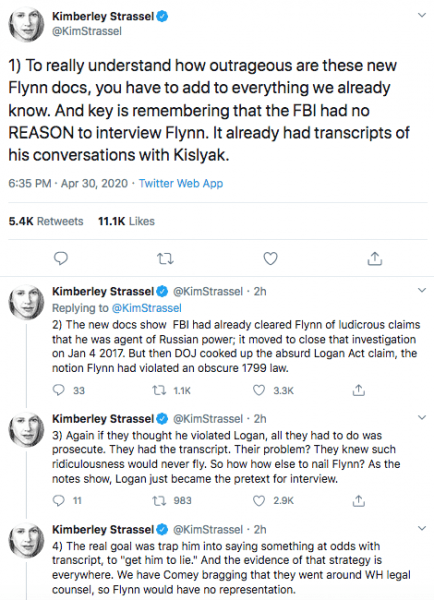
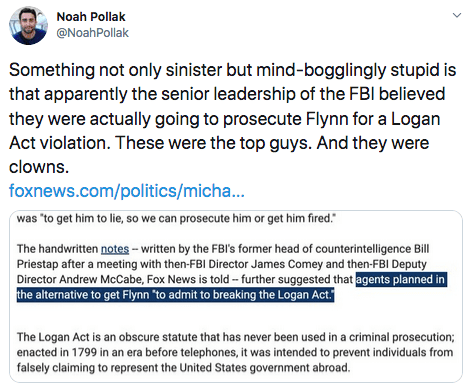
Some people invested in justifying the investigation and prosecution of Mike Flynn, former national security adviser to President Donald Trump, are pointing to the archaic, terrible Logan Act to justify Flynn's treatment.
In The New York Times' opinion section today, Norman Eisen (who served as House Democrats' counsel during the impeachment of Trump), argues that internal documents released Wednesday detailing how the FBI approached Flynn's interviews show that the investigation was legitimate. Eisen believes Trump's defense of Flynn "signals that the president will escalate his abuses of power in the run-up to the 2020 election."
The Michael Flynn scandal was one of the first to reveal the pattern of lawlessness that has characterized the Trump administration. In December 2016, Mr. Flynn, in a phone call, successfully implored Russia to moderate retaliation against the United States for sanctions imposed because of the attack on U.S. elections. The conduct raised serious questions under the Logan Act, which prohibits private parties from conducting U.S. foreign policy.
Eisen probably doesn't realize it (and he certainly wouldn't acknowledge it), but his invocation of the Logan Act here actually bolsters the argument that Flynn's prosecution had at least some political motivations.
The Logan Act is a terrible law, and it has never been invoked for a good reason. It was passed in 1799, during a small undeclared naval war, when a Philadelphia Quaker named George Logan attempted to independently negotiate peace between the United States and France. His efforts undermined the political goals of the ruling Federalist Party, and so the law was enacted as a tool to punish anyone else who attempted to follow in Logan's footsteps.
All which is to say: The very purpose of the Logan Act is to punish political speech that runs counter to the sitting president's foreign policy goals. Every invocation of the law has been to threaten somebody from an opposing political party for getting involved in foreign policy in a way that displeases whoever has control of the White House. The fact that nobody has actually ever been prosecuted for violating the Logan Act—which would create an opportunity to challenge whether the law itself violates the First Amendment—should be seen as a big red flag whenever it's mentioned.
The documents released this week do indeed show that FBI officials considered recommending to the Justice Department that Flynn be charged with Logan Act violations. This possibility was discussed in the media back in 2017, when Flynn pleaded guilty to lying about his connections and conversations with Russian ambassador Sergey Kislyak. I blasted the idea at the time, and I haven't changed my mind.
One more thing. This conversation between Kislyak and Flynn, where Flynn encouraged Russia not to react harshly to new sanctions from the United States, took place in late December 2016, after Trump won the presidential election and just weeks before he'd take office. Flynn was part of Trump's transition team and was representing the incoming administration. (Well, sort of: The administration itself apparently didn't know about these conversations, and that contributed to Flynn's downfall in February 2017.)
So even in the context of the Logan Act's stated purpose, it doesn't make sense to apply it to Flynn. Remember: The intent was to prevent outsiders from undermining the president's foreign policy goals. It's absurd to use it against an incoming official who merely pointed out that one of the lame duck president's policies isn't likely to stay in place.
We now know that the China coronavirus is deadly disease — except for with children and healthy adults.
If you’re in your 70s or 80s with comorbidities it can be very deadly.
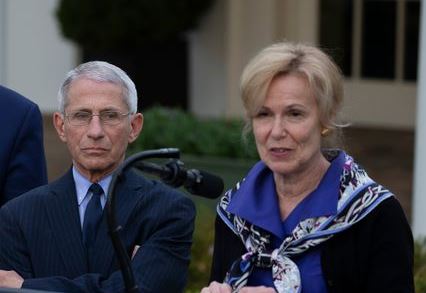
We also know that Dr. Fauci and Dr. Deborah Birx rushed in to the Oval Office in early March to warn President Trump of what to expect from the impending pandemic.
Fauci and Birx told President Trump the US could see up to 2 million deaths from the coronavirus.
Where did the good doctors get their numbers in early March?
Ad why did they push these wild predictions when no country in the world had over 15,000 deaths at the time?
Dr. Fauci and Dr. Birx got their numbers from Imperial College professor Neil Ferguson.
Neil Ferguson has a long record of buffoonish predictions.
Ferguson was wrong about the bird flu, mad cow disease, swine flu and now coronavirus.
And yet the media and Dr. Fauci took this guys predictions to push the lockdown that crashed the US economy.
Given the track-record of Imperial College's Prof. Neil Ferguson, who panicked HM Government into changing policy and enforcing the insane "lockdown", it's definitely not science that HM Government is following.#EndTheLockdownpic.twitter.com/C8p2kRxm5B
Neil Ferguson was wrong on mad cow disease back in 2001.
And here's @neil_ferguson in 2001 predicting up to 136,000 deaths from mad cow disease, which then fell to 50,000 – until he added "mad sheep" disease to get back to 150,000. Can't make it up.
Neil Ferguson has a record of grossly exaggerating his disease predictions.
And yet Dr. Fauci and Dr. Birx used his numbers to push the current lockdown?
Dr. Fauci should have been fired years ago.
And now we have 30 million Americans out of work because of his ridiculous assessment!
Fauci mislead @realDonaldTrump to lock down the US economy via INTIMIDATION using faulty computer models projecting up to 2.2 M deaths in the absence of ACTUAL empirical evidence for emergency.
Alternatively, such horrific examples could be made of the offenders here that the Bureau will be scared straight for a generation. But I think that’s even less likely than abolishing the Bureau.
(1) Yesterday, the NIAID announced the results of the first large-scale Remdesivir clinical trial. It is not a “magic bullet”, but this is a milestone in that for the first time, any drug has been shown to have an unambiguous therapeutic advantage: it significantly accelerates recovery in severe COVID19 cases. (I would be very interested to know if administering it before the patient’s symptoms escalate would forestall the latter. That would be an even bigger game-changer.[*]) Gilead Scientific’s CEO was restrained but upbeat in an open letter.— clearly they are looking at licensing the drug for manufacturing by third parties, as they clearly do not have the in-house manufacturing base for the massive amounts that would have to be synthesized.
Recapping how remdesivir works: it effectively impersonates a letter of the genetic code, except without an attachment point for the next letter. So when RdRp (RNA-dependent RNA polymerase) starts copying the genome, copying breaks off if the “imposter” letter is inserted. This trick in principle can mess up the replication of any RNA virus (not just SARS-nCoV-2), and in the test tube it did so for Ebola, SARS original edition ;), and MERS — but when given to actual Ebola patients its performance was underwhelming. (Such is the difference between a model and a patient.) Fortunately, it seems to be rather more successful against SARS-nCoV-2.
(2) In an earlier post, I looked at (meticulous and generally reliable) statistics for South Korea. At the time their case fatality rate (CFR) was only about 1%: according to a more recent Korean CDC report, it is 2.26%. Now their report gives a detailed distribution by age cohort. Apparently, their infections are not homogenously spread across the age pyramid: if we were to apply their mortality rates per age cohort to the published population pyramid of South Korea, we would get a CFR of 2.01%. If we substituted the much “younger” published population pyramid of Israel, that would lead to a CFR of 1.58%. This is still higher than the 1.35% I mentioned yesterday, but clearly indicates that the discrepancy between South Korean and Israeli CFRs is at least in part explicable by different age distributions.
Pulmonologist and medvlogger Roger Seheult MD about famotidine (Pepcid) as a potential COVID19 drug. Apparently the drug interferes with the viral protease. The ongoing trial has 1174 patients in 3 arms; (1) famotidine + hydroxychloroquine; (2) just hydroxychloroquine; (3) historical controls (who received neither).
“I think it is the worst pandemic since 1918,” said Cecile Viboud, an epidemiologist at the National Institutes of Health’s Fogarty International Center, alluding to the “Great Influenza” pandemic that claimed an estimated 675,000 lives in the United States.
The new serological data, which is provisional, suggests that coronavirus infections greatly outnumber confirmed covid-19 cases, potentially by a factor of 10 or more. Many people experience mild symptoms or none at all, and never get the standard diagnostic test with a swab up the nose, so they’re missed in the official covid-19 case counts.
[…]A commonly cited statistic about seasonal flu is that it has a fatality rate of 0.1 percent, That, however, is a case fatality rate. The infection fatality rate for flu is perhaps only half that, Viboud said. Shaman estimated that it’s about one-quarter the case fatality rate.
an article in Die Welt (in German) looks at the male-female mortality difference, which is most pronounced in the younger cohorts (the article speaks of 3:1 for people in they 50s) but dwindles to 1.5:1 in old age. Estrogen production in women is of course decreased in old age…
Via Instapundit: confirming earlier Chinese hints, a preprint from New York Presbyterian Hospital reports a relatively small, but significant difference in COVID-19 suspectbility between Rhesus-positive blood groups. (The difference for Rhesus-negative ones is not statistically significant.) O is least suspectible, A most so. (Unlucky me ;))
reports of reinfection of cured patients in South Korea appear to be due to false positives in testing: (h/t Instapundit). RT-PCR cannot tell non-viable virus fragments apart from “live” virus
And via Sarah Hoyt, disinfectant poisonings in children are on the rises since the epidemic. Reportedly, call volume rose by 20%. What does that mean in absolute numbers? According to https://www.poison.org/poison-statistics-national in 2018 hotlines of the 55 U.S. poison control centers assisted 2.1 million callers with actual or suspected poison exposure. 44.2% of these calls concerned children younger than 6. So 20% of 44.2% of 2.1 million works out to… 15,470 calls per month. I suspect a large fraction of these calls concern toddlers who cannot stop themselves from taste-testing any possible and impossible household object — but in a population of 330 million people, by the law of large numbers you will find some derpseals who will actually think drinking household cleaners is a good idea. [**]
Speaking of which, whatever marketing “geniuses” thought THIS was an appropriate packaging for household cleaning fluid — it looks almost exactly like a grape-flavored soft drink that is wildly popular with toddlers here — need to have their head examined. Or maybe THEY’ve been drinking too many cleaning fluids.
[*] allow me to belabor this point: If we could reliably stop this disease from developing the severe presentation, we could afford changing gears entirely and allowing herd immunity to develop.
[**] I would caution against the automatic assumption that anybody who is mind-blowingly stupid in one thing is an idiot overall. I know many brilliant scientists and artists who couldn’t manage a grocery store, or a vegetables stand in a farmer’s market, to save their lives. One of the surprising things I learned from Jan Swofford’s excellent biography of Ludwig van Beethoven was that he would multiply numbers by repeated addition — he never learned how to multiply properly. (Beethoven had been groomed as a child prodigy keyboardist — his father, a washed-up court musician, harbored hopes of turning Beethoven into the next Mozart — so young Ludwig’s general education was perfunctory at best. Nevertheless, he became an avid reader and was very familiar with the literature of his day, which inspired a number of his greatest compositions. Mozart’s general education was similarly defective. J. S. Bach actually graduated from a Latin high school — with indifferent grades, but three years younger than his class average — and later collected numerous scholarly works on theology, in Latin and in German, when he could afford to do so.)
We put that warning (about not ingesting products) on all of our list of disinfectants. Anything we approve, we always have that disclaimer, no matter what the product is.
And we’ve had that disclaimer on our disinfectants list before the coronavirus, but certainly we’ve highlighted it since March 6th.
We release the new list of disinfectants, the new approvals, every Thursday. And we released the list last Thursday, a couple of hours before the President’s press conference. That disclaimer is always on our press release.
And we actually had [sic] Washington Post reporter called and said, “You put this on here because of the President’s press conference, didn’t you?” I said, “No. Actually, our press release went out a couple of hours before the press conference.“
And then they ran a story over the weekend saying that EPA had to backtrack on the President’s statement, which is not the case at all.
But that just shows you how the media has their own, has an incredible bias. They just run with the story and they make facts up. We specifically told them no.
This wasn’t sloppy reporting. This was deliberate disinformation.
I’M SORRY, BUT THE FDA DOESN’T HAVE THE POWER TO REGULATE BACKPACKS, just because they have a “stealth pocket” to hold E-cigarettes and might be used by teens. This is absurd overreach.