Shared posts

14 Sep 01:54

My University Sacrificed Ideas for Ideology. So Today I Quit.

by Peter Boghossian

Peter Boghossian has taught philosophy at Portland State University for the past decade. In the letter below, sent this morning to the university’s provost, he explains why he is resigning.

Dear Provost Susan Jeffords,

​​I’m writing to you today to resign as assistant professor of philosophy at Portland State University.

Over the last decade, it has been my privilege to teach at the university. My specialties are critical thinking, ethics and the Socratic method, and I teach classes like Science and Pseudoscience and The Philosophy of Education. But in addition to exploring classic philosophers and traditional texts, I’ve invited a wide range of guest lecturers to address my classes, from Flat-Earthers to Christian apologists to global climate skeptics to Occupy Wall Street advocates. I’m proud of my work.

I invited those speakers not because I agreed with their worldviews, but primarily because I didn’t. From those messy and difficult conversations, I’ve seen the best of what our students can achieve: questioning beliefs while respecting believers; staying even-tempered in challenging circumstances; and even changing their minds. 

I never once believed  nor do I now  that the purpose of instruction was to lead my students to a particular conclusion. Rather, I sought to create the conditions for rigorous thought; to help them gain the tools to hunt and furrow for their own conclusions. This is why I became a teacher and why I love teaching.

But brick by brick, the university has made this kind of intellectual exploration impossible. It has transformed a bastion of free inquiry into a Social Justice factory whose only inputs were race, gender, and victimhood and whose only outputs were grievance and division.

Students at Portland State are not being taught to think. Rather, they are being trained to mimic the moral certainty of ideologues. Faculty and administrators have abdicated the university’s truth-seeking mission and instead drive intolerance of divergent beliefs and opinions. This has created a culture of offense where students are now afraid to speak openly and honestly. 

I noticed signs of the illiberalism that has now fully swallowed the academy quite early during my time at Portland State. I witnessed students refusing to engage with different points of view.  Questions from faculty at diversity trainings that challenged approved narratives were instantly dismissed. Those who asked for evidence to justify new institutional policies were accused of microaggressions. And professors were accused of bigotry for assigning canonical texts written by philosophers who happened to have been European and male.  

At first, I didn’t realize how systemic this was and I believed I could question this new culture. So I began asking questions. What is the evidence that trigger warnings and safe spaces contribute to student learning? Why should racial consciousness be the lens through which we view our role as educators? How did we decide that “cultural appropriation” is immoral?

Unlike my colleagues, I asked these questions out loud and in public. 

I decided to study the new values that were engulfing Portland State and so many other educational institutions — values that sound wonderful, like diversity, equity, and inclusion, but might actually be just the opposite. The more I read the primary source material produced by critical theorists, the more I suspected that their conclusions reflected the postulates of an ideology, not insights based on evidence.

I began networking with student groups who had similar concerns and brought in speakers to explore these subjects from a critical perspective. And it became increasingly clear to me that the incidents of illiberalism I had witnessed over the years were not just isolated events, but part of an institution-wide problem.

The more I spoke out about these issues, the more retaliation I faced. 

Early in the 2016-17 academic year, a former student complained about me and the university initiated a Title IX investigation.  (Title IX investigations are a part of federal law designed to protect “people from discrimination based on sex in education programs or activities that receive federal financial assistance.”) My accuser, a white male, made a slew of baseless accusations against me, which university confidentiality rules unfortunately prohibit me from discussing further. What I can share is that students of mine who were interviewed during the process told me the Title IX investigator asked them if they knew anything about me beating my wife and children. This horrifying accusation soon became a widespread rumor. 

With Title IX investigations there is no due process, so I didn’t have access to the particular accusations, the ability to confront my accuser, and I had no opportunity to defend myself. Finally, the results of the investigation were revealed in December 2017. Here are the last two sentences of the report: “Global Diversity & Inclusion finds there is insufficient evidence that Boghossian violated PSU’s Prohibited Discrimination & Harassment policy. GDI recommends Boghossian receive coaching.”

Not only was there no apology for the false accusations, but the investigator also told me that in the future I was not allowed to render my opinion about “protected classes” or teach in such a way that my opinion about protected classes could be known — a bizarre conclusion to absurd charges. Universities can enforce ideological conformity just through the threat of these investigations.

I eventually became convinced that corrupted bodies of scholarship were responsible for justifying radical departures from the traditional role of liberal arts schools and basic civility on campus. There was an urgent need to demonstrate that morally fashionable papers — no matter how absurd — could be published. I believed then that if I exposed the theoretical flaws of this body of literature, I could help the university community avoid building edifices on such shaky ground.

So, in 2017, I co-published an intentionally garbled peer-reviewed paper that took aim at the new orthodoxy. Its title: “The Conceptual Penis as a Social Construct.” This example of pseudo-scholarship, which was published in Cogent Social Sciences, argued that penises were products of the human mind and responsible for climate change. Immediately thereafter, I revealed the article as a hoax designed to shed light on the flaws of the peer-review and academic publishing systems.

Shortly thereafter, swastikas in the bathroom with my name under them began appearing in two bathrooms near the philosophy department. They also occasionally showed up on my office door, in one instance accompanied by bags of feces. Our university remained silent. When it acted, it was against me, not the perpetrators.

I continued to believe, perhaps naively, that if I exposed the flawed thinking on which Portland State’s new values were based, I could shake the university from its madness. In 2018 I co-published a series of absurd or morally repugnant peer-reviewed articles in journals that focused on issues of race and gender. In one of them we argued that there was an epidemic of dog rape at dog parks and proposed that we leash men the way we leash dogs. Our purpose was to show that certain kinds of “scholarship” are based not on finding truth but on advancing social grievances. This worldview is not scientific, and it is not rigorous. 

Administrators and faculty were so angered by the papers that they published an anonymous piece in the student paper and Portland State filed formal charges against me. Their accusation? “Research misconduct” based on the absurd premise that the journal editors who accepted our intentionally deranged articles were “human subjects.” I was found guilty of not receiving approval to experiment on human subjects. 

Meanwhile, ideological intolerance continued to grow at Portland State. In March 2018, a tenured professor disrupted a public discussion I was holding with author Christina Hoff Sommers and evolutionary biologists Bret Weinstein and Heather Heying. In June 2018, someone triggered the fire alarm during my conversation with popular cultural critic Carl Benjamin. In October 2018, an activist pulled out the speaker wires to interrupt a panel with former Google engineer James Damore. The university did nothing to stop or address this behavior. No one was punished or disciplined. 

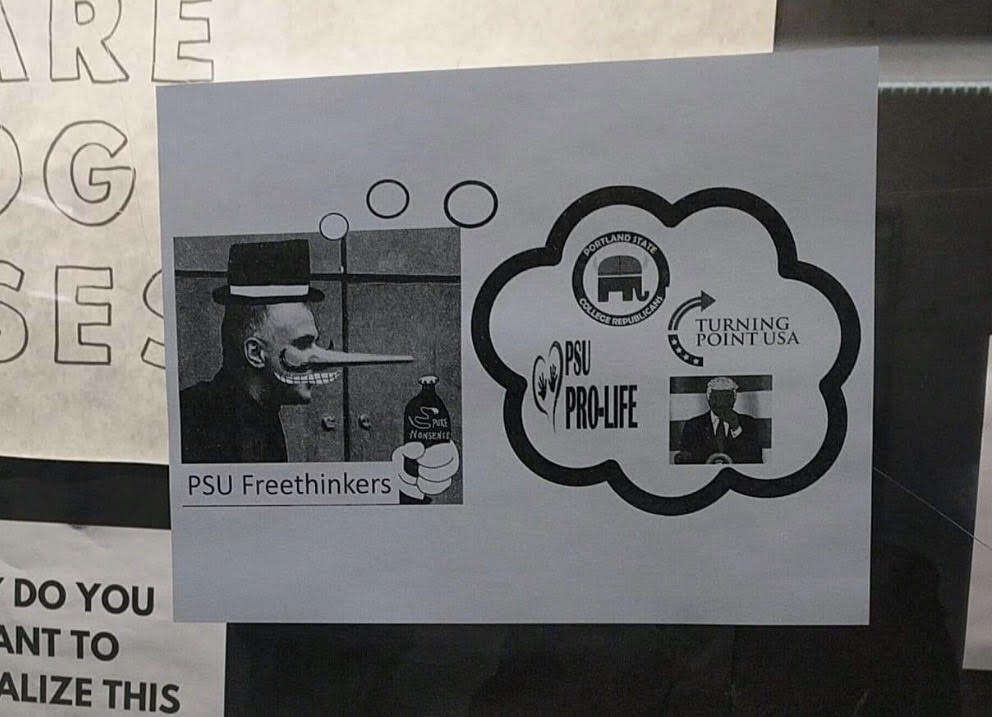
For me, the years that followed were marked by continued harassment. I’d find flyers around campus of me with a Pinocchio nose. I was spit on and threatened by passersby while walking to class. I was informed by students that my colleagues were telling them to avoid my classes. And, of course, I was subjected to more investigation.

I wish I could say that what I am describing hasn’t taken a personal toll. But it has taken exactly the toll it was intended to: an increasingly intolerable working life and without the protection of tenure.

This isn’t about me. This is about the kind of institutions we want and the values we choose. Every idea that has advanced human freedom has always, and without fail, been initially condemned. As individuals, we often seem incapable of remembering this lesson, but that is exactly what our institutions are for: to remind us that the freedom to question is our fundamental right. Educational institutions should remind us that that right is also our duty.  

Portland State University has failed in fulfilling this duty. In doing so it has failed not only its students but the public that supports it. While I am grateful for the opportunity to have taught at Portland State for over a decade, it has become clear to me that this institution is no place for people who intend to think freely and explore ideas. 

This is not the outcome I wanted. But I feel morally obligated to make this choice. For ten years, I have taught my students the importance of living by your principles. One of mine is to defend our system of liberal education from those who seek to destroy it. Who would I be if I didn’t?

Sincerely,

Peter Boghossian


It’s back-to-school week at Common Sense. If you missed yesterday’s story about the explosion in homeschooling — five million American kids are now learning in their living rooms! — read it here.

See you tomorrow.

Subscribe now

09 Sep 20:38

Is potassium effective against high blood pressure?

by Sebastian Rushworth, M.D.

I’ve written previously about how salt (sodium) only marginally raises blood pressure, and how the evidence that there is any benefit to reducing salt intake in the diet is weak at best. Now it’s time to look at that other salt, potassium. While sodium raises blood pressure, potassium supposedly lowers blood pressure, and many people have been given the recommendation to replace their table … Read more

The post Is potassium effective against high blood pressure? appeared first on Sebastian Rushworth M.D..

08 Sep 18:24

HMM: Stable memory test scores for Alzheimer’s patients with omega-3 intake….

by Glenn Reynolds
08 Sep 17:10

The CDC quietly changed the definition of "vaccination" so as to fit the political narrative and I'm pretty sure that's not how science is supposed to work.

by Not the Bee

I was first alerted to the CDC's backtracking on its decades-long association of vaccines with immunity by this tweet.

08 Sep 15:27

ROGER SIMON: America Lives Under Healthcare Fascism. Attributed to V.I. Lenin is a statement to the…

by Ed Driscoll

ROGER SIMON: America Lives Under Healthcare Fascism.

Attributed to V.I. Lenin is a statement to the effect that the fastest and surest way to communism or socialism—it varies according to the citation—is through the healthcare system.

The statement seems to be apocryphal. I say “seems” because no one appears able to locate it.

But, like so many possibly apocryphal statements (“A republic if you can keep it” and so forth), does anyone doubt its meaning is really true? That’s the reason such remarks continue to haunt us.

Since this is Rosh Hashanah, I will put it the way the old Jewish bubbes (grandmothers) did when I was a child. Apply the proper Yiddish accent: “So long as you’re healthy, it’s the main thing.”

And, to be clear, when I assert we live under healthcare communism, I don’t mean communism the way ye olde Karl Marx dreamed it up. I mean something even worse, more insidious—total state control of our lives, who wins and loses, who profits and who fails, who becomes a billionaire and who a pauper, even who survives… in other words communism as practiced in today’s People’s Republic of China and, increasingly, the United States.

You may not be interested in the gleichschaltung — but the gleichschaltung is interested in you.

08 Sep 15:25

IT’S A HOSTAGE CRISIS, WHERE THE HOSTAGES ARE KEPT IN AFGHANISTAN BY . . . U.S. THE STATE DEPARTMENT…

by Glenn Reynolds

IT’S A HOSTAGE CRISIS, WHERE THE HOSTAGES ARE KEPT IN AFGHANISTAN BY . . . U.S. THE STATE DEPARTMENT? State Dept. won’t give private rescue flights OK to leave Afghanistan. “The State Department said it will not formally approve the departure of chartered planes from Afghanistan carrying Americans and allies — complicating efforts by private citizens to complete the evacuation of the left-behind, according to an email obtained by Fox News.”

Plus: “Since the American military’s withdrawal from Afghanistan ended Aug. 30, private citizens and nonprofit groups have scrambled to arrange transportation out of Taliban-controlled territory for the dozens of American citizens and estimated thousands of Afghans who assisted US-led NATO forces during the two-decade-long war. White House press secretary Jen Psaki argued last week that the notion that the Biden administration was stopping such initiatives was incorrect.”

Well, Jen Psaki argues a lot of things.

08 Sep 15:20

Disturbing study on spike proteins…

by Kane
08 Sep 14:07

Back When The ACLU Actually Stood Up For Civil Rights, Rather Than Shilling for Totalitarianism

by admin

This article by Glenn Greenwald on the ACLU's response to COVID is simply remarkable.  I won't even try to excerpt it.  Suffice it to say that barely a decade ago, the ACLU actually was concerned about individual rights being trashed by coercive government pandemic responses.  Their 2008 position paper can only be called "prescient."   They warned that with a state-sponsored coercive intervention program fanned by media fear porn, "People, rather than the disease, become the enemy."  No kidding.   But the ACLU has unfortunately become an operative of the progressive wing of the Democratic Party, and as such has reversed its position -- even from as recently as March of 2020 -- presumably because the part in power has changed.

One other thing on a related note -- the ACLU is a long-time strong supporter of abortion rights.  As such, this position in their recent NYT editorial supporting forced vaccination seems counter-productive to their cause in the extreme: "we all have the fundamental right to bodily integrity and to make our own health care decisions. But these rights are not absolute. They do not include the right to inflict harm on others."  In the past, the absolute sanctity of one's body has been the bulwark in protecting abortion rights.  Other people's opinion on whether the fetus is a human life or not were declared irrelevant because "my body is sacred, period."  But if the body is no longer sacred if and when the government declares another human being is being harmed, how is that any different from the typical abortion opponents argument?

07 Sep 21:50

YOU MAY NOT BE INTERESTED IN THE GLEICHSCHALTUNG, BUT THE GLEICHSCHALTUNG IS INTERESTED IN YOU: Rutg…

by Ed Driscoll
Jts5665

Submission is everything...

YOU MAY NOT BE INTERESTED IN THE GLEICHSCHALTUNG, BUT THE GLEICHSCHALTUNG IS INTERESTED IN YOU: Rutgers bars unvaccinated students from attending virtual classes.

07 Sep 19:57

SARAH HOYT’S SHOCKED FACE IS ON AN EXTENDED SABBATICAL: Mark Zuckerberg may have lied to Congress ab…

by Stephen Green

SARAH HOYT’S SHOCKED FACE IS ON AN EXTENDED SABBATICAL: Mark Zuckerberg may have lied to Congress about who can see WhatsApp messages.

In 2016, WhatsApp announced it was using end-to-end encryption for all communications on its platform, covering everything from messages to file transfers. The use of end-to-end encryption is intended to offer users a level of privacy and security, but it seems that may not be true for the messaging app.

In a report by ProPublica, it is claimed WhatsApp employs more than 1,000 contract workers in Austin, Texas, Dublin, and Singapore, specifically for examining “millions of pieces of users’ content.” The workers “use special Facebook software” to look through messages and content that have been flagged by WhatsApp users, and have been screened by AI systems.

The reviews occur in spite of an assurance that appears in the app before users send messages for the first time, claiming “No one outside of this chat, not even WhatsApp, can read or listen to them.”

In 2018 testimony to the U.S. Senate, Facebook CEO Macrk Zuckerberg claimed “We don’t see any of the content in WhatsApp.”

Don’t use any Facebook services.

07 Sep 19:51

Authors object after Springer Nature journal cedes to publisher Frontiers’ demand for retraction

by Ivan Oransky
The authors of a paper taking a major database to task for including papers from allegedly predatory journals are objecting to the retraction of the article, which followed a request by one of the publishers mentioned in the analysis. And at least one of the journal’s editorial board members is considering resigning over the move. … Continue reading Authors object after Springer Nature journal cedes to publisher Frontiers’ demand for retraction
07 Sep 16:49

The National Archives put a "harmful language" warning on the site that hosts the Constitution, Declaration, and other historical records

by Not the Bee

If you haven't heard already, America was built on racism, misogyny, and cruelty, and anyone who thinks otherwise needs to read a copy of The Communist Manifesto.

07 Sep 14:31

SO WHAT EVER HAPPENED TO THIS? Japan Discovered a Rare-Earth Mineral Deposit That Can Supply The Wo…

by Glenn Reynolds

SO WHAT EVER HAPPENED TO THIS? Japan Discovered a Rare-Earth Mineral Deposit That Can Supply The World For Centuries.

This is the closest thing to an update I found.

07 Sep 14:12

WHOSE TWEET IS IT, ANYWAY? Facebook or Twitter posts can now be quietly modified by the government u…

by Stephen Green

WHOSE TWEET IS IT, ANYWAY? Facebook or Twitter posts can now be quietly modified by the government under new surveillance laws.

A new law gives Australian police unprecedented powers for online surveillance, data interception and altering data. These powers, outlined in the Surveillance Legislation Amendment (Identify and Disrupt) Bill, raise concerns over potential misuse, privacy and security.

The bill updates the Surveillance Devices Act 2004 and Telecommunications (Interception and Access) Act 1979. In essence, it allows law-enforcement agencies or authorities (such as the Australian Federal Police and the Australian Criminal Intelligence Commission) to modify, add, copy or delete data when investigating serious online crimes.

The Human Rights Law Centre says the bill has insufficient safeguards for free speech and press freedom. Digital Rights Watch calls it a “warrantless surveillance regime” and notes the government ignored the recommendations of a bipartisan parliamentary committee to limit the powers granted by the new law.

It’s Orwellian, is what it is.

07 Sep 13:32

WHEN YOU’VE LOST THE ATLANTIC…: Australia Traded Away Too Much Liberty. Intrastate travel within …

by Ed Driscoll

WHEN YOU’VE LOST THE ATLANTIC…: Australia Traded Away Too Much Liberty.

Intrastate travel within Australia is also severely restricted. And the government of South Australia, one of the country’s six states, developed and is now testing an app as Orwellian as any in the free world to enforce its quarantine rules. People in South Australia will be forced to download an app that combines facial recognition and geolocation. The state will text them at random times, and thereafter they will have 15 minutes to take a picture of their face in the location where they are supposed to be. Should they fail, the local police department will be sent to follow up in person. “We don’t tell them how often or when, on a random basis they have to reply within 15 minutes,” Premier Steven Marshall explained. “I think every South Australian should feel pretty proud that we are the national pilot for the home-based quarantine app.”

Exit question:

03 Sep 18:39

SCIENCE: “[Seventy-eight percent] of hospitalizations due to COVID are Obese and Overweight people….

by Glenn Reynolds

SCIENCE: “[Seventy-eight percent] of hospitalizations due to COVID are Obese and Overweight people. Is there an underlying problem that perhaps we have not given enough attention to?”

There’s no graft money to be made in making people healthy and fit. If there were, the entire system wouldn’t be organized around the reverse.

03 Sep 18:36

MINDING THE CAMPUS:  Wenyuan Wu gives the L.A. Times an appropriate dressing down:  “The Culture W…

by Gail Heriot

MINDING THE CAMPUS:  Wenyuan Wu gives the L.A. Times an appropriate dressing down:  “The Culture War Against the Little Man.”

03 Sep 16:28

Excellent catch, Simone Gold…

by Kane
The CDC is now listing vaccinated COVID-19 deaths as UNvaccinated deaths if they die within 14 days of the vaccine. Wow. pic.twitter.com/paxPfDp9lo — Dr. Simone Gold (@drsimonegold) September 2, 2021   The CDC is now listing Vaccinated deaths as Unvaccinated if they die within 14 days of the vaccine.         And there’s […]
03 Sep 15:56

HURRAY FOR ENGINEERS! AND IT’S GOOD THAT THE LAWYERS DIDN’T UNDERSTAND ENGINEERING, I GUESS: U.S. …

by Glenn Reynolds
Jts5665

I would argue that using a higher safety factor isn't bending the rules...

HURRAY FOR ENGINEERS! AND IT’S GOOD THAT THE LAWYERS DIDN’T UNDERSTAND ENGINEERING, I GUESS: U.S. Civil Engineers Bent the Rules to Give New Orleans Extra Protection from Hurricanes. Those Adjustments Might Have Saved the City During Ida.

01 Sep 17:14

Climate Science: Seeking Truth or Defending Consensus?

by Christopher Lingle

Science, as opposed to pseudoscience, scientific denialism or conspiracy theories, involves a willingness to inspect data and be open about as well as to view hypotheses and the evidence offered to support them with skepticism. Since empirical evidence can be manipulated or even used to disguise ideology or wishful thinking in support of a particular hypothesis, it is misleading, even dishonest, to insist that an objective, immutable “consensus” exists.

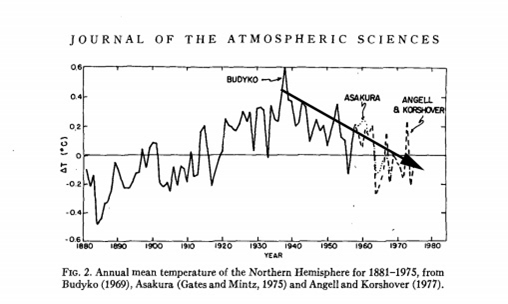
While there are certain “facts” that are widely accepted, e.g., that there is a global warming trend, the nature of the trend is contested and there is considerable dispute as to what the cause of the change or warming might be. But then, not so long ago, there was a scientific consensus that there was a long-term cooling trend for the land areas of North America. (see figure below).

Clearly, claims of a scientific consensus relating to anthropogenic global warming are not without controversy. In a world familiar with “cancel culture,” it would not be surprising that a dominant view could be contrived by punishing, marginalizing, or excluding dissenting views.

For its part, the scientific method generally involves the following sequence: observe, hypothesize, predict, test, analyze, and revise. But experimental confirmation cannot establish “truth” in any theory since future testing can render a theory to be untenable. While predictability is compelling by providing believability based on data, neither science nor any empirical theory reveals what is true, per se.

Indeed, the goal of science is to seek failure, not truth. As it is, “scientists” can engage in misinformation, including “cherry-picking” data, sloppy data collection or analysis, unintended errors, fraud (e.g., false or fabricated data) or “good intentions” based on cognitive or confirmation bias.

As such, all theories are tentative and subject to revision if more or better or contrary evidence appears. Being a skeptic is the mark of someone ready to reject ideas they believe lack sufficient evidence and to accept new ideas based on reliable evidence and reproducible results.

Rather than applaud conventional scientific wisdom said to support a consensus, we should celebrate uncertainty, honesty and openness that underpin science. Indeed, humility and self-criticism of one’s own work is as important as are communal and institutional critiques.

Unfortunately, belief in the “truth” relating to global warming (sic., climate change) has induced suggestions for skeptics to be forcibly silenced, even prosecuted for crimes. Meanwhile, insistence on the existence of a “scientific consensus” concerning the nature and causes of alterations is likely to direct funding and acceptance of research proposals towards those that promote the dominant view.

To that end, 19 federal agencies received climate change funding of more than $13 billion in 2017. The total spending on climate studies between 1989 and 2009 exceeded $32 billion, not including $79 billion spent for climate change technology research, foreign aid and tax breaks for “green energy.” As such, the losses of sinecures and access to largesse would be massive if global warming or climate change were discovered to be less than an existential problem.

It turns out that there is so much complexity about the various influences on climate that it is much more difficult than normally assumed. For example, the sun does not provide a constant intensity nor does the Earth rotate around it in a constant orbit, so that solar flaring and the wobbling of the Earth about its axis contribute to variations in solar heating.

There is also enormous complexity of the climatic impacts of ocean currents and regular climate events (e.g., El Niño and La Niña), making it difficult to determine whether average global sea surface temperatures are rising or falling. Indeed, oceanic convection at great depths and present in a few locations in the world is thought to connect the properties of the surface ocean and deep ocean, thus influencing the global thermohaline circulation and climate.

While the deep convective process is seasonally intermittent and relatively compact, observations and quantifying the transfer of deep water involve a difficult sampling problem. Variations in interannual surface salinity influence the rate of oceanic convection and poleward heat transport (thermohaline circulation). But insufficient accuracy in the measurements of these variations on a global basis make it difficult to provide reliable long-time-scale climate prediction and modeling.

Since hurricanes require warm sea surface temperatures (SSTs), the rise in tropical Atlantic sea surface temperatures above normal are inevitably interpreted to be evidence of global warming. But the year after Hurricane Katrina’s landfall, the Atlantic hurricane season was remarkably mild with only 3 named tropical storms compared to 9 at the same point the previous year when at least one hurricane normally should have appeared.

It seems that large areas in the tropical Atlantic were a bit cooler than normal, leading to a 12-year hurricane drought, the longest in US history, ending in 2017. On average, the upper ocean cooled dramatically between 2003 and 2005, a change that reversed 20% of the warming that supposedly had occurred over the previous 48 years.

Interestingly, hurricane droughts are also coincidental with land-based droughts. While coastal areas are deprived of the rainfall that accompanies the landfall of tropical storms and hurricanes to replenish groundwater, nearby inland regions also suffer from arid spells.

Yet climate activists tend to insist that both were due to rising average global temperatures. But global warming will cause some areas to be drier and less hospitable for food production while other areas will be wetter and more hospitable for agriculture. In all events, the net impact remains uncertain.

While the complexity of climate makes it difficult to make accurate models of the inherent stability of the overall system, there are stabilizing feedback mechanisms that keep the climate system from spinning out of control. These stabilizing forces in the climate system ensure that global temperatures do not have excessive variation.

For example, clouds and water vapor have dominant roles in determining average global temperatures. But there is no clear idea about the response of clouds to a warming tendency from slow increases in carbon dioxide content of the atmosphere. Nor is there a clear understanding of the response of precipitation systems to warming.

Precipitation results when the atmosphere is saturated with water vapor from surface evaporation, and water vapor causes at least 90% of the Earth’s greenhouse effect. As such, an increase in hurricane intensity could be natural and part of an efficient element of the climate system that removes both atmospheric water vapor and excess heat from the ocean.

Scientific arguments about climate change seem to be the centerpiece of the coming “climate action” policies that are being touted as part of the “Great Reset” that foresees the need for a major alteration in the global economy. The restrictions on human liberty and private property imposed by governments in response to the Covid-19 pandemic are likely to be only an “appetizer” for an expansion of political control to address climate change.

For context, consider that the UN Intergovernmental Panel on Climate Change (IPCC) issued its sixth report since 1990, announcing a “Code red for humanity” based on many factors, including an “irreversible” rise in sea level. The report insists that emissions of carbon dioxide and other greenhouse gasses (GHGs) are necessary to improve air quality and retard the rise of average global temperatures.

While evidence can be found for the certainty of rising sea levels, alternative interpretations of the same data source suggest the effect may be minimal (i.e., 3 inches over 100 years) such that there might be enough time to adjust. But as seen in the IPCC report, discussions of environmental issues tend to use an alarmist tone rather than relying on a neutral, purely informational approach. Indeed, neutral reports tend to be considered overly optimistic.

When science is mixed with politics, the result tends to be politics in its purest and most restrictive form. After all, political agents can be expected to look to “science” to provide a cover for expanded interventions or claims on resources that were previously considered to be unacceptable.

01 Sep 14:09

Wanna see what it looks like when a train plows into a wind turbine blade being hauled by a semi?? Of course you do. Of course you do.

by Not the Bee

Yeah, so someone probably got fired over this:

01 Sep 14:00

Lawyer defending 17 alleged Capitol breachers goes missing

by Sophie Mann
John Pierce has been unreachable and missing court dates since early last week
31 Aug 21:52

Liberalism’s Enemies

by Max Borders

What do Glenn Greenwald, Steven Pinker, and Jonah Goldberg have in common?

Left vs. right is such a crude distinction, after all. It always has been. It pulls people into partisan team sports. It locks them in affiliation binaries. It pits them against one another in memetic warfare, and sometimes even street violence. It is destroying their souls

More troublingly, though, left-right politics obscures a more fundamental dynamic: the rise of illiberal cultures. 

Authoritarianism is ascendant on the left and the right — but not just at the extremes. That means Americans are losing their liberalism. The rules, norms, and moral frameworks of the liberal order allow each of us pursue our particular life plans while socially cohering in peace. Or that’s the idea, anyway: E pluribus unum. But Illiberal culture is paving the way to illiberal politics as authoritarians seek to dissolve the liberal order.

Today, therefore, the critical distinction is not left and right. It is liberal and illiberal. Those aggressively pushing illiberal doctrines seek to destroy American ideals, which are the bases of a pluralistic order.

Ten Liberal Ideals

So what is true liberalism? And why do we need to preserve it?

I offer the following as simple heuristics, mainly because people adopt heuristics more readily than theories. I refer to “degree” so as not to be accused of being doctrinaire. In other words, these are ideals to strive for as liberals, even if we fall short.

One can consider oneself liberal by degrees using the following ten dimensions:

1.) Nonviolence. Limit the use of state violence or mass compulsion in service of a particular conception of the good.

Such is the essence of liberalism. Whether we appeal to ahimsa in the East or the Harm Principle in the West, we improve upon the ideal of nonviolence through conscious, continuous practice–even in politics. Applying this ideal to politics limits the ambitions of those who seek power to impose their notions of the good through mass compulsion. You might think of this prime value as comprising more familiar freedoms, such as religion, expression, and self-defense. As in Don’t harm people in their peaceful pursuits.

2.) Toleration. Tolerate other forms of non-violent expression or ways of living–as long as those ways injure no one. (Injury is not hurt feelings.)

Toleration is a basic virtue in a diverse society. It doesn’t mean we must be forced to associate with one another; it simply means we must respect one another’s life plans because we will most certainly all have different life plans. An ethic of toleration first acknowledges the fact of pluralism, then builds on it with the reciprocal practice of live and let live.

3.) Rule of Law. Support equality before the law or equal application of the law.

We want a society of rules as opposed to a society of rulers. If we’re to live together peacefully within some jurisdiction, the rules must apply equally to everyone. Historically, the extent to which the U.S. government has abandoned equal treatment is the extent to which it has been illiberal. Such always needs to be rectified–certainly in the past but also today. Just as you can’t fight fire with fire, you cannot fight illiberalism with more illiberalism. Justice is not a cosmic scoreboard to be equalized by powerful bureaucrats allocating favors, privileges, or intergenerational redress to groups. Liberal justice requires equality before laws that privilege no person or group–whether agents of the government or their supplicants.

4.) Category Blindness. See our common humanity beyond someone’s superficial characteristics and avoid imposing group categorization schemes.

Sometimes it can be hard to ignore someone else’s skin color, the way she speaks, or her apparent sexual identifiers. But these categories are not pertinent to questions about her capabilities, her various life plans, or “the content of [her] character.” Liberals seek to celebrate our common humanity as we variously pursue our missions. Continuous preoccupation with irrelevant categories diverts people from realizing a peaceful, prosperous liberal order together. Therefore, we are committed cosmopolitans, attuned to both our common humanity and the sacredness of every person, whatever their race.

5.) Real Community. Appreciate the importance of membership in healthy communities or systems of mutual aid, without lapsing into collectivism.

Americans have been mired in illiberal politics for so long that we have forgotten how to take care of each other. Whether you observe the decline of mutual aid in America through the lens of Kropotkin or Tocqueville, real community is dying. American voters, politicians, and bureaucrats have slowly created a zero-sum transfer state in which voting blocs seek to take from one another through lobbying and activism. Instead of building community and becoming the social safety net, too many Americans outsource their concerns to distant capitals. And they are turning to crude 20th century collectivism. We need to turn back to each other in real acts of compassion.

6.) Private Property. Accept the institution of private property, private ownership of capital goods, and private ownership of assets. 

Property ownership creates strong incentives to be productive and is, of course, a precondition of trade. Sustainable patterns of production and trade give rise to greater overall prosperity. The abstract rule of private property is not enough, though. We must practice stewardship, whether in taking care of our homes or in being responsible stewards of capital as executives or investors. While there are certainly healthy locally managed Ostrom commons, such systems should exist in balance with institutions that respect private property.

7.) Truth Tracking. Seek truth in an ongoing discovery process that includes the use of reason, evidence gathering, and falsification.

We all have an enormous responsibility to seek the truth, even if we are limited in our sensemaking. We can admit that we are in some ways always trapped in our own perspectives. But we can also use observation, falsification, and good discourse to track the truth. It’s vitally important to develop and improve upon our sensemaking methods, starting with how we communicate with one another. Appeals to one’s “lived experience” and subjective constructions are not enough. Just-so stories are the enemy of collective sensemaking. We should be open to the fact of others’ experiences but also to data that conform — at least in some way — to a mind-independent reality.

8.) Discourse Norms. Practice a principle of charity when in dialogue with others. 

Avoid the use of fallacy and rhetorical tactics that interfere with the pursuit of mutual understanding and improved collective intelligence. Human beings count on being able to understand the world in order to operate within it. Much of that understanding comes through the process of dialogue, or what meta-relating expert Michael Porcelli calls “weaving shared reality.” But to engage in constructive dialogue, one has first to commit to certain discourse norms and then be charitable to another’s perspective. Civilized society thrives on weaving shared reality, even if that reality is sometimes socially constructed. Dialogue that works to common understanding starts with assumptions of good faith and good rules of engagement.

9.) Internalized Costs. Adopt good institutions that minimize the imposition of harms or costs by one group onto others.

Whether in one’s individual behavior or corporate enterprises’ conduct, we ought to settle our disputes within a form of common law that minimizes the imposition of costs and harms onto others. In other words, any liberal doctrine forming law should disqualify cost-shifting to the extent practicable. Corporate entities and individuals alike must be held accountable for imposing costs onto others. Still, we acknowledge that the mode and manner of that accountability should also be liberal–for example, rooted in due process.

10.) Skepticism of Authority. Remain skeptical of political power, even when you think such power can be applied to bring about good ends.

The true liberal disciplines herself not to accept illiberal means to any desired end. The liberal knows that architectures of violence, once built, will eventually be hijacked by those who do not have our best interests at heart. That’s why we must take care to develop impartial systems of peaceful interaction. Though such systems do not always yield equal outcomes, they offer open access. And they create a multitude of opportunities for people to self-organize in diverse communities. By contrast, political authorities simply cannot build communities. Communities are built by individuals in pursuit of common missions, common interests, to address common needs.

I can’t help but think that there are still plenty of liberals in America, but our numbers are dwindling. Many have forgotten that one can hold conservative or progressive values and still call herself a liberal. So, of course, some liberals might emphasize certain points above and deemphasize others. To the extent that we hold most of these principles by degree, we must join in solidarity against illiberalism. Whether it’s activists on the right with their tiki torches or activists on the left with their Molotov cocktails–illiberal politics threatens to burn America down.

Liberalism, The Liberal Project, and Its Enemies

I won’t distract you, Dear Reader, with the sordid history of how the term liberalism was corrupted through time. Instead, I’ll just say that true liberalism is the doctrine that animates the American project. It is the only hope for any pluralistic society to thrive. In our sense, a liberal is concerned with liberating people–from violence, oppression, and poverty. Libertas perfundet omnia luce. Freedom will flood all things with light. The liberal project, begun in earnest during the Enlightenment, animated a band of polymaths who drew up the blueprints for the first liberal order in Philadelphia, 1787.

The men who drew up those documents were imperfect. The resulting order has always been imperfect. The American Project has struggled mightily through various eras to realize its ideals and has more than occasionally fallen short. It has succumbed to the temptations of power. It has mired itself in horrors such as slavery, eugenics, subjugation, internment camps, and unjust wars. It has allowed unholy alliances between corporations and the state. To many, all these failures mean we must abandon our liberal ideals. 

As Richard Delgado writes in his book, Critical Race Theory,

“Unlike traditional civil rights, which embraces incrementalism and step-by-step progress, critical race theory questions the very foundations of the liberal order, including equality theory, legal reasoning, Enlightenment rationalism, and neutral principles of constitutional law.”

It’s not just that many social justice advocates question that legal order. They seek to dismantle it. And that would be precisely the wrong path if one desires peace, freedom, and abundance.

If you thought attacks on liberalism were only coming from the left, the right is developing its own illiberal cultures. Patrick Deneen represents a growing group of national conservatives who claim that liberalism is a materialist, libertine “anticulture.” Never mind that liberal pluralism is the social arrangement most likely to make Deneen’s local theocracies possible. Deneen thinks freedom and free enterprise have run roughshod over America’s moral order. Though Deneen routinely conflates modern progressivism and classical liberalism, he’s ultimately hostile to both. So he advocates a brand of conservatism that is pretty far away from our Founding Ideals, despite the latter’s protections of religious freedom. It’s not hard to see how, if successful, Deneen’s religious localism could expand into dystopia like that depicted in The Handmaid’s Tale. While Deneen represents this illiberal right’s new priesthood, he has a long way to go to convert reactionaries into religious operatives serving a theocratic superstate.

To be honest, I have always been suspicious of Manichean variations on whether you are either with us or against us. But the rise of these authoritarian mind viruses is forcing us to pick a team.

Liberal or Illiberal

Illiberalism is dangerous not only because it lacks certain moral principles, it lacks limiting principles. Its adherents simply declare claims to political authority until they gather adherents. One might ask why — in this decidedly postmodern age — we would want to have any principles at all. The answer lies in how one avoids creating a moral universe that has tilted too far towards arbitrariness or absolutism. Liberalism is the middle path.

Without liberalism, we have no moorings. We jettison the neutral adjudication, mediation, and truth tracking that allow us to live together in healthy pluralism. If all discourse is to be reduced to proclamations of political power, then partisans are playing a dangerous game. The “winner,” after all, will shove his utopia down your throat. Why? Because political power is just the institutionalized threat of violence.

Liberalism is the only doctrine designed to make room for real diversity, which means it protects different experiments in living. Liberalism is the only doctrine that recognizes the rights of people to pursue different ideas of the good. All other doctrines require your submission to one true way. If we’re going to have to pick a team soon, then, we should no longer be asking whether that team is left or right. We should be asking whether that team is liberal or illiberal.

31 Aug 20:09

Mother of Slain Marine Suspended From Instagram Following Posts Criticizing Biden

by Matt Palumbo
31 Aug 20:09

Project Veritas Exposes Antifa Indoctrination in the Classroom

by Matt Palumbo
31 Aug 20:06

A STATISTICAL ANALYSIS OF COVID-19 BREAKTHROUGH INFECTIONS AND DEATHS: Sadly, people die each year….

by Ed Driscoll

A STATISTICAL ANALYSIS OF COVID-19 BREAKTHROUGH INFECTIONS AND DEATHS:

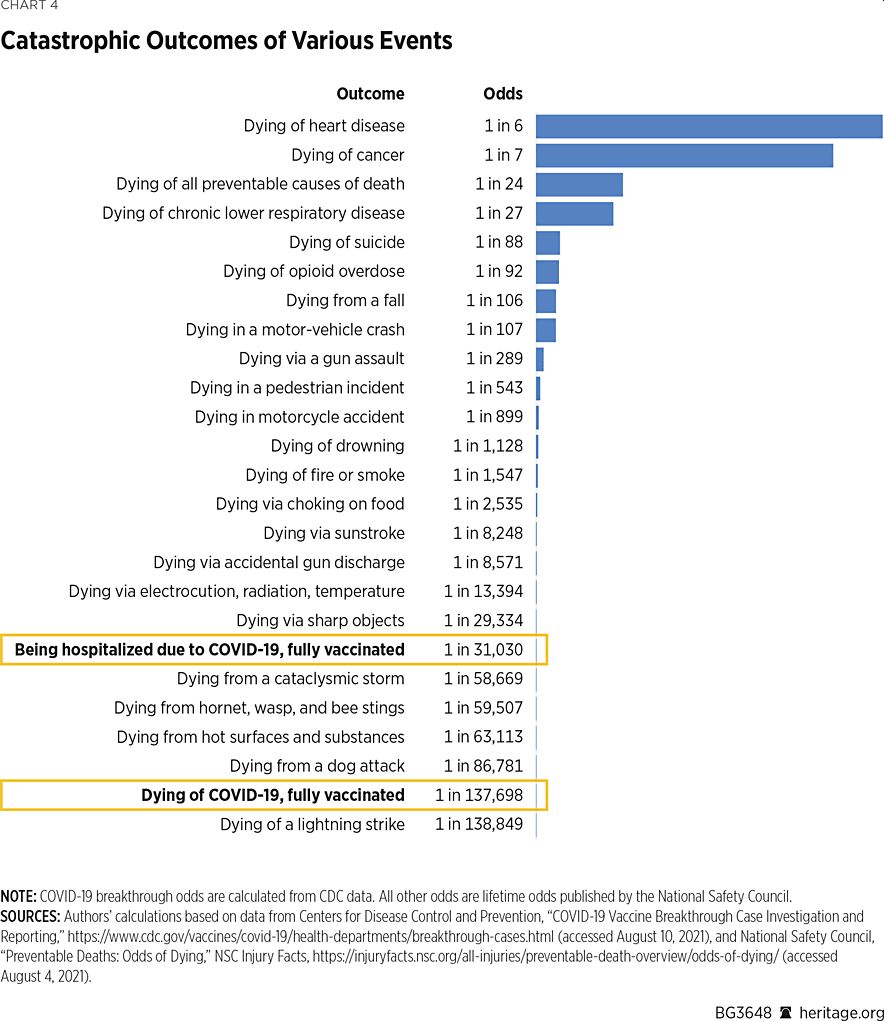
Sadly, people die each year. In 2019, the National Safety Council used data from the National Center for Health Statistics to estimate the odds of various lifetime causes of death, including (among others) heart disease, cancer, pedestrian incidents, and drowning. Heart disease, cancer, and other chronic lower respiratory diseases constituted some of the highest causes of death in 2019 (with odds of 1 in 6, 1 in 7, and 1 in 27, respectively).

There were many other causes of death albeit occurring at much lower frequencies. For example, motor vehicle crashes were associated with a 1 in 103 odds of dying, gun assaults were associated with a 1 in 289 odds of dying, and hornet wasp and bee stings were associated with a 1 in 59,507 odds of dying.

NSC Injury Facts, “Preventable Deaths: Odds of Dying,” https://injuryfacts.nsc.org/all-injuries/preventable-death-overview/odds-of-dying/ (accessed August 4, 2021).

In Chart 4, we compare the odds of a fully vaccinated person dying from COVID-19 to the odds of various other causes of death (as estimated by the National Safety Council).

Read the whole thing.

31 Aug 13:42

APPLE SPENT BIG BUCKS lobbying against bill to ban U.S. companies from using Chinese slave labor….

by Glenn Reynolds
30 Aug 13:16

FBI suffers another black eye, admits it hid payments to informant in white supremacist case

by John Solomon
The revelations come at a sensitive time for the FBI and Director Christopher Wray, who has insisted widespread problems revealed about the bureau's conduct in the now-discredited Russia collusion case have been fixed even as new revelations of misconduct come to light.
30 Aug 13:00

Crazy Government Responses to COVID Part 3: The Wrong Metrics

by admin

It should not be surprising that any roundup I do of problems with COVID response would include a chapter on metrics -- I am a very strong believer that metrics and incentives live at the very heart of most private and public organizational failures.  I already dealt with incentives in part I, though I will come back to them a bit in this piece.

For the metrics, I want to focus narrowly on the selection and quality of COVID-related tracking metrics.   Perhaps I will cover this in a later chapter, but I will not cover that absolutely awful performance of the media in reporting COVID data and COVID-related science.   Suffice it to say that the media has once again shown itself absolutely incapable of reading a scientific study and assessing the quality of the methodology, or parsing the true results of the study vs those ascribed to the study in the press release.  Inherent problems in the data, such as the time delay for death reporting, have been made an order of magnitude worse by the media's inability (unwillingness?) to explain shortcomings in the data.  Is it really so hard to explain how deaths reported yesterday in such and such state did not actually all occur yesterday and in fact represent data updates sometimes weeks old?  This simple bit of clarity has been a bridge too far for most of the media.

Poor Data Quality

For the last 18 months, we have had to work with absolutely awful data on COVID.  I am willing to believe that in March 2020 we had excuses for not knowing what we were doing.  But now?  Some examples:

  • We are testing for COVID using PCR tests that are far too sensitive.  These tests use a series of cycles to concentrate the virus being searched for.  Many tests are being conducted as high as 40 cycles, which pretty much everyone agrees is way too sensitive and is likely to give false positives.  Given the importance of this cycle number, it is astounding that in 18 months I have never seen -- not once -- a media article that has a statistic on positive COVID tests along with the cycle number at which these tests were conducted.
  • Hospitalization data is skewed by the fact that hospitals have strong financial incentives to report patients as COVID patients.   This means a dude in a car wreck who tests positive for COVID once brought in might be listed as a COVID patient, despite the fact that this person fits no definition any of us have for what should count as a COVID hospitalization.  Retrospective studies have consistently shown huge overcounts of COVID patients, confusing "patients with COVID" with the more important "patients who were hospitalized because of COVID."
  • Most retrospective audits have found that COVID death data suffers from the same over-reporting as hospitalization, as a person testing positive for COVID but dying of a stroke might still be listed as a COVID death
  • I have no idea what is going on in many states with COVID death reporting delays.  We still see COVID deaths being added to counts for dates months in the past.  Why the long long delay?  Is there some sort of reclassification going on, and if so why? If not, given that we literally have spent trillions of dollars on COVID response, why can't we fix these data issues?

Following the Wrong Metric

The metric we should really care about is deaths (or given the fact that COVID deaths skew so old, perhaps total life-years lost to COVID).  After all, if we are to be honest, it is the prospect of death and not getting really sick that has certain elements of our population nearly catatonic in fear.  The problem is that even without the death reporting problems outlined above, deaths are way too much of a lagging indicator to be useful in spotting early trends.

Unfortunately, though, because the vast vast majority of positive tests for COVID are for folks who will never display anything but mild symptoms (and due to the testing issues discussed above), this is not a very good metric either.  But there is another problem -- all positive tests are not created equal.  A positive test of a health 20-year-old is pretty much the occasion for a big yawn.  A positive test for an 86-year-old with heart problems and diabetes is a cause of immense concern.  But the metrics do not differentiate.  We just see case counts on the news.  And note the ratio between these two extremes has not been stable -- early on a lot of the cases were in older folks, while today most of the positive tests are in young and healthy people.  Add to this the fact that we now have positive tests in the vaccinated, who are highly unlikely to die of the disease, and I would argue that 1000 positive tests in August 2021 are FAR less worrisome than 1000 positive tests in March 2020.  But again we treat them the same.

So Coyote, is this just academic?  I don't think so.  Personally I think we have seen several decisions of late that are impossible to justify based on science.  For example:

  • Oregon governor orders that even the vaccinated must mask outdoors
  • Many, Many school districts are demanding that kids as young as 3 must mask in school

Neither of these are supported by any science, and to the extent that the former discourages people from getting out of crowded cities and into the outdoors, and the latter discourages children from getting educated, they likely have net negative consequences.  So why?

I would argue the problem is that we have gotten stuck on cases (from overly sensitive tests) being the key metric.  Kids going back to school will almost certainly increase case counts, but for a disease that is less threatening to them than the ordinary flu, so what?  We are stuck on a stupid metric that no longer reflects actual risk and we have politicians mindlessly (see part 1 on incentives) managing to that metric.

So what metric would be better?

First, a good metric needs to really measure what we care about.  At some level, if we really think about it, we shouldn't really give a sh*t about case counts -- we care about people who die or have serious health complications from the disease.

Second, a good metric needs to be easy to calculate and reach the same figure no matter who does the calculation

Third, a good metric needs to be timely.  It is not helpful to have a collision indicator in the cockpit that only lights up 30 seconds after the plane hits the mountain.

Through the middle part of last year, I tended to look at hospitalization data.  It had its flaws (discussed above) but it struck me as the best balance between being timely (more timely than deaths) and indicating true risk (vs just cases).

I can envision a better metric: risk adjusted cases.  This could be as simple or as complicated as one likes, but I would favor a simple version that did not look at too many metrics -- maybe just 5 or 6 age bands and maybe vaccination status.  How it would work in its simplest form is that each case in the summary statistics would be weighted with a factor based on that person's risk of death.  For a simple version with age bands, this means that a case in the 80+ band might have a multiplier of 10 or greater while a case in the 0-18 age band might have a multiplier of 0.1 or smaller.  This would have been impossible to do last March but certainly by the time of the winter peak last year it would have been very doable.  We could easily do this today and back calculate the 2020 data for comparability.  I think age adjustment would be enough, I wouldn't get more fancy than that because we tend to have the age in the case data but not a lot else.  Perhaps we could add a factor for vaccination status as we measure that too.

This approach give us a much clearer idea of how much we should be worried about rising case counts and would be a better leading indicator of potential stress on health care systems 1-2 weeks out.

29 Aug 12:50

I’M NOT SO OPTIMISTIC: Ida might tell us if we learned anything from Katrina. UPDATE: It seems …

by Glenn Reynolds

I’M NOT SO OPTIMISTIC: Ida might tell us if we learned anything from Katrina.

UPDATE: It seems my lack of confidence was not misplaced.

Also:

When you have the political class of a banana republic, eventually things start to look like a banana republic.

ANOTHER UPDATE: From the comments: “To tie it back to another commenter’s point in another thread, we have a managerial class who have MBAs and other credentials from all the correct schools, but are utter incompetents. They learned to game the system, and have relied on decades worth of accumulated social, political, cultural, and economic capital to carry them through these crises. Now that capital is almost used up, and they’re discovering that they are vastly overleveraged.”