Shared posts

20 Nov 05:08

Apply For An ACX Grant

by Scott Alexander

What is ACX Grants?

I want to give grants to good research and good projects with a minimum of paperwork. Like an NIH grant or something, only a lot less money and prestige.

How is this different from Marginal Revolution's Fast Grants, Nadia Eghbal's Helium Grants, or EA Funds' grant rounds?

Not different at all. It’s total 100% plagiarism of them. I'm doing it anyway because I think it’s a good idea, and I predict there are a lot of good people with good projects in this community who haven't heard about / participated in those, but who will participate when I do it.

How much money are you giving out?

ACX Grants proper will involve $250,000 of my own money, but I’m hoping to supplement with much more of other people’s money, amount to be determined. See the sections on ACX Grants + and ACX Grants ++ below.

Why do you have $250,000 to spend on grants?

Unsolicited gifts from rich patrons, your generosity in subscribing to my Substack, and the second item here.

Also, this isn’t investment advice or anything, but apparently cryptocurrency only ever goes up.

I thought you were a believer in effective altruism, which says you have to donate your money to the most effective charity - which is probably about fighting malaria or existential risk or something. Giving it to random people on your blog isn’t very effective, is it?

Some effective altruist organizations suggest that people with large but not billionaire-level amounts of money might want to try acting as charity “angel investors”. They argue that there are enough government agencies and billionaires to fund the biggest and most obvious legible high-impact opportunities. One of the best things that normal people can do with their donations is take a chance on interesting projects too small and illegible to catch governments’/billionaires’ attention. Some of these might accomplish some circumscribed goal with their seed funding; others might use the seed funding to produce preliminary results that convince governments and billionaires to help them the rest of the way. My access to the ACX community gives me a unique opportunity to do this, so I really do feel like this is the best way to donate this money.

But I’ll also, separately, be giving 10% of my income to more standard effective charities, since I’ve pledged to do this.

What kind of projects are likely to get grants?

Projects that could make the world a better place, but might not be able to catch the attention of more traditional funders. A (very non-exhaustive) list of things I’m looking for would include projects that:

  • help address global poverty, global health challenges, mental health issues, animal welfare issues, or global climate change.

  • move forward innovative and potentially socially beneficial technologies and ideas, even if these are very speculative.

  • help understand and prepare for potentially disruptive future events, like pandemics or the advent of AGI

  • improve the academic, governmental, and decision-making institutions that work on these other causes

  • help do basic research, awareness-raising, or meta-level work that could eventually lead to one of the above

I’ll also tentatively be allowing grants for personal or career development, but there will be a high bar in terms of proving that your career would be really great for the world and that you would have a hard time developing your career without this money. I’d be most likely to approve a grant in this category if you were from a developing country that doesn’t have a lot of traditional avenues for building career capital.

These are only suggestions! If you think you have something that could make the world a better place that doesn’t fall in these categories, apply anyway.

I’ll mostly be approaching this from an effective altruist framework, but I’m not wedded to calculating things out exactly (which is impossible anyway), and if you have a great project that doesn’t fit within “traditional” effective altruism, apply anyway.

I’ll be happy to consider your application whether or not you are a traditional academic, whether or not you have a long history of past successful projects, etc.

Because I only have $250,000 and want to make at least a couple of grants, I’m unlikely to fund projects that cost more than about $100,000. If you have a really great project that needs more money than this, you should apply anyway, and I’ll see if I can fund you through ACXG+ or ACXG++

Can a group of people apply as a team?

Yes, of course.

What is ACX Grants + ?

I know a lot of nonprofits and rich people looking for interesting projects to fund. With your permission (ie if you check a box saying so on the application form), then along with considering your project myself, I’ll forward it to any of these people who I think it’s a good match for. Some of these people have a lot of money and are really excited about this, so I would highly recommend opting in (by clicking the checkbox on the application form). This would also be a good option for people who need more than $250,000.

If you’re a nonprofit or rich person interested in participating in ACX Grants + , and I don’t already know about your interest, please send me an email at scott@slatestarcodex.com.

What Is ACX Grants ++ ?

If you opt into this one (also just a check box on the application form) then I’ll include a description of your project, plus your contact info, in a public post on this blog. Anyone who reads about it and wants to fund it can.

What’s the process like and how long will it take?

You’ll fill in a form that should take about fifteen minutes. I will read the form and talk with smart people who seem like they might have good opinions. If you are a leading candidate, I might or might not email you asking for more information, or try to arrange a short call with you. The whole process shouldn’t take more than an hour or two of your time.

I’ll close applications in two weeks, and announce winners between two to four weeks after that.

Will this be taxed?

My current understanding is that I will have to pay a gift tax but winners will not have to pay taxes on the grant money. Please double-check this with your local jurisdiction.

Grant-making foundations have some tax advantages, but I don’t have a grant-making foundation. Some grant-making foundations are helping with this project, but I can’t legally “go through them” in a way where I both give them the money and influence their decisions. We’re still talking to tax experts, but most likely we’ll make decisions separately, then compare notes, and split the funding in some legally-permissible way. None of this should matter to you except that your check might come from me or from a foundation (if you opted-in to ACX+). You shouldn’t have to pay taxes either way.

How do I apply?

Fill in the form here.

12 Nov 15:44

Big changes coming to CNN… Who will be fired first…

by Kane
Scoop: CNN is going back to a 100% news channel. A "good number" of the "talent/staff" will be let go to align to that new mission. 👉David Zaslav Vows To Be “Very Hands-On” And LA-Based In Running Warner Bros Discovery. https://t.co/q2F2u8Y4Hr — Jon Nicosia (@NewsPolitics) November 11, 2021   Full story at Deadline…     […]
12 Nov 14:25

BREAKING: Judge Orders FBI to Stop Search of Project Veritas Founder O’Keefe’s Phone Following Raid….

by Ed Driscoll
11 Nov 22:25

Is Saturated Fat Healthy?

by Mark Sisson

woman cooking with recipe on her ipadIt’s probably the one thing that prevents people from fully buying into the Primal Blueprint. Almost anyone can agree with the basic tenets – eating more vegetables, choosing only clean, organic meats, and getting plenty of sleep and exercise is fairly acceptable to the mainstream notion of good nutrition. The concept of Grok and a lifestyle based on evolutionary biology can be a harder sell, but anyone who’s familiar with (and accepts) the basics of human evolution tends to agree (whether they follow through and adopt the lifestyle is another question), at least intellectually. But saturated fat? People have this weird conditioned response to the very phrase.

“But what about all that saturated fat? Aren’t you worried about clogging up your arteries?”

In fact, “saturated fat” isn’t just that; it’s often “artery-clogging saturated fat.” Hell, a Google search for that exact phrase in quotations produces tens of thousands of entries. Most doctors toe the company line and roundly condemn it, while the media generally follows suit. The public, unsurprisingly, laps it up from birth. The result is a deeply ingrained systemic assumption that saturated fat is evil, bad, dangerous, and sinful, a preconceived notion that precludes any meaningful dialogue from taking place. Everyone “knows” that saturated fat clogs your arteries—that’s treated as a given—and attempting to even question that assumption gets you lumped in the crazy category. After all, if you start from such a “fundamentally incorrect position,” how can the rest of your argument be trusted?

What is Saturated Fat, Exactly?

A fatty acid molecule is typically an arrangement of carbon and hydrogen atoms. Saturated fats have two main characteristics:

  • All or most of the carbon-hydrogen bonds are single bonds
  • All available carbon bonds are paired with hydrogen atoms

This makes saturated fats highly stable and resistant to oxidation and rancidity, even when heated. That’s why our bodies tend to build cellular membranes with a significant portion of saturated fats. They provide stability and a strong foundation.

Saturated fat is also a fantastic source of energy, at least if you trust your body to make the right decision—otherwise, why else would we store excess carbohydrates as saturated body fat?29 In fact, when we burn body fat for energy, either through exercise or through dieting, we are quite literally consuming huge amounts of saturated (and monounsaturated) fat. Body fat is energy to be used for later; dietary fat is energy to be used immediately or stored for later.

Losing weight is like eating pure lard, which has nearly the same fatty acid composition as human adipose tissue. To vilify saturated fat is to assume that, over the span of our evolution, our bodies have somehow developed a predilection for a deleterious energy source that contributes to cardiovascular disease.

Does Saturated Fat Cause Heart Disease?

It should be a simple thing to show, right? Populations that eat the most saturated fat should have the most heart attacks. But this isn’t the case. Let’s look at a few.

The Tokelau Islanders

The Tokelauans traditionally consumed a diet high in saturated fat from coconut, as well as fish, fruit, and tubers. When I say “high in saturated fat” I mean it: about 40-50% of their total calories came from saturated fat from coconut meat. Conventional cardiologists would have a fit if their patients were eating that much saturated fat. And yet ECG research from a study in the 80s on Tokelauans still eating their traditional diet shows zero evidence of any prior heart attacks. In New Zealand at the time, about 1% of males aged 40-69 had readings that suggested a prior heart attack. In Tecumseh, USA, 3.5% of men aged 40-69 had prior heart attack readings. In Tokelauans, it was 0.0%.

The Kitavan Islanders

The Kitavans ate a much higher carb diet than the Tokelauans, but they still had a much higher saturated fat intake than is typically considered “healthy” at a 17% of calories. And they were free of most modern metabolic diseases, like diabetes and heart disease.

No matter where you look across the Pacific, high saturated fat intakes from coconut do not appear unhealthy or dangerous.30 No matter where you look across the Pacific, you see traditional diets that exceed the maximum 6% of calories form saturated fat ordained by the American Heart Association—and you see traditional populations eating those traditional diets avoid heart disease.

The Masai

The traditional diet for male Masai is a low-carb, high-saturated fat one that consists mainly of meat, milk, and blood, and research shows that they remain lean, healthy, and free of heart disease despite this conventionally-atherogenic diet.31

The French

The most famous of health “paradoxes,” the French paradox describes the fact that despite logging some of the highest intakes of saturated fat the French have some of the lowest rates of heart disease. And boy do people try to explain it away.

Just check out this explanation:32

“In representative cross sectional surveys of the French population performed in 1986–87 and 1995–97, the saturated fat intake was 15% of the total energy intake in the first survey and 16% in the latter survey. This high consumption of saturated fatty acids is such that French subjects are exposed to a high risk of CHD. Why a high consumption of saturated fatty acids does not lead to a high CHD risk in France (and maybe elsewhere) is a central question behind the French paradox concept.”

Somehow the French “survive” their exposure to a “high risk of CHD” in the form of eating saturated fat. You see what they did? The “risk” is very real. It’s just that the French luck out and survive it.

It all started, of course, with the infamous Ancel Keys and his Seven Countries Study, which tracked the fat consumption and heart disease levels of various nations. It was named for the seven countries that saw an increase in heart disease cases correspond with increased fat consumption, but it should have been named the Twenty Two Countries Study for all the data he omitted. Data, I should mention, that demolished his hypothesis of fat intake causing heart disease. Those red dots in the bottom right are the populations that didn’t make the original study: Tokelau, Masai, and Inuit.

Try drawing a straight line through those data points. As you can see, there is a faint, weak correlation between fat intake and heart disease, but it’s just that: a correlation. It shouldn’t confirm anything except the need to run controlled experiments to directly measure the effects of dietary fat. Unfortunately, that correlation was enough to get Keys the front cover of Time and widespread acclaim as the father of dietary science. His hypothesis gained traction in the scientific community and mainstream CW, a position it has never really relinquished. Subsequent controlled experiments to measure the effects of saturated fat have been either inconclusive, poorly designed, or completely unsupportive of the saturated fat-is-evil hypothesis, but because the starting point assumes it to be true, those inconclusive or unsupportive results become aberrations while the poorly designed studies become canon.

Meanwhile, Keys’ peer, British scientist John Yudkin, was finding even more compelling connections between dietary sugar and heart disease, but his ideas gained no traction and garnered no significant follow up experimental studies.33 Keys got the cover of Time and heaps of public adulation; Yudkin was relegated to publishing now-out-of-print books, writing letters to scientific journals that were only ignored, and languishing in relative obscurity. If you want a deeper discussion of Yudkin, check out Taubes’ Good Calories, Bad Calories.

Are Foods that Contain Saturated Fat Bad For You?

Ultimately, we aren’t eating “saturated fat.” We don’t eat isolated palmitic acid or stearic acid. We eat food, and sometimes that food contains saturated fat along with vitamins, minerals, and many other fatty acids. That’s food.

If researchers are going to say saturated fat is dangerous, they must show that saturated fat-containing foods are dangerous to eat. Have they? Let’s look at research into some foods high in saturated fat.

  • Gouda cheese: Full of saturated fat, also full of vitamin K2, reduces cardiovascular mortality.34
  • Pecorino romano cheese: Improved markers of atherosclerosis in those who ate it. Good source of CLA, yes, but also saturated fat. Still manages to reduce heart disease risk.35
  • Red meat: Increased red meat intake reduced dementia risk.36 Okay, grandpa, you might be able to remember your grandkids’ names but you’re gonna have a heart attack.
  • High-fat dairy: Reduces heart disease, diabetes, and overall mortality. Very high in saturated fat.

Okay, okay. Maybe these foods are “healthy in certain contexts” but still give you heart disease somehow. Sure, just prove it.

They cannot.

Or maybe they’re healthy “despite” the saturated fat intake. If we could just engineer gouda cheese to be richer in PUFAs or ribeyes to be lower in saturated fats, they’d be “even healthier!”

Does anyone believe this? We’re living in the real world where foods are foods. You can’t “control” for a variable that literally exists inside the food you’re trying to demonize.

Look to Evolution

To begin with, humans are born with a taste for fat. It’s delicious, and that’s no mistake. Given the choice between a lean chicken breast and a fatty, crispy thigh, most people instinctively go for the thigh. Social anti-fat conditioning might direct a few of us toward the dry breast, but fatty cuts just taste better.

Our taste for fat is hundreds of thousands of years old. From mammoth marrow you could use an ice scream scoop to harvest to shattered kudu femurs from half a million years ago to Bronze Age nomads living off mare milk and boar backfat, humans have always loved animal fat—much of which is saturated. Vilhjalmur Stefansson, hallowed purveyor of pemmican and admirer of the high-fat Inuit diet, spent considerable time with the northern native Americans and noted that they seemed to “hunt animals selectively.” They would specifically pass on the tender calves and go for the older caribou, the ones with huge slabs of back fat that could be rendered and stored. This caribou fat was about 50% saturated.

Does this mean you should only eat saturated fat? Of course not.

For one thing, eating nothing but saturated fat is very hard to do using whole foods. Very few animals exist in the world, past or present, with only saturated fat. The only exception I can recall is the coconut, a curious sort of beast that spends most of its time hanging from a tree impersonating a large hairy drupe. Your average slab of beef fat runs about 50% saturated fat, 45% monounsaturated fat, and 5% PUFA. That differs from cut to cut and depending on the diet of the animal, but not by much. It’s similar for other ruminants like bison and lamb. And the most prominent saturated fatty acid in ruminant fat is stearic acid, a fat that converts to monounsaturated oleic acid in the body and has an effect on cholesterol indistinguishable from MUFA or PUFA.

My point is that by eating whole foods, you will get saturated fat, monounsaturated fat, PUFA, vitamins, minerals, polyphenols, and a whole host of yet to be quantified food components. To single one out, one that has never even been shown to be dangerous, is pure folly.

I could go on, but you get the idea: Humans have been consuming a wide range of fatty acids for millennia, including saturated fatty acids. It probably makes sense to emulate that intake.

I’d love to hear you thoughts, so hit me up with a comment. What’s your stance on saturated fat?

Pasta_Sauces_640x80

References

  1. https://www.carbmanager.com/food-detail/nl:c98fedb80ffd76d0af046a72ba9165f0/mashed-potatoes
  2. https://www.cell.com/current-biology/fulltext/S0960-9822(21)01254-9
  3. https://academic.oup.com/advances/article/6/6/660/4555155
  4. https://pubmed.ncbi.nlm.nih.gov/32528974/
  5. https://bmcpediatr.biomedcentral.com/articles/10.1186/s12887-021-02631-1
  6. https://pubmed.ncbi.nlm.nih.gov/27893657/
  7. https://pubmed.ncbi.nlm.nih.gov/11342338/
  8. https://www.jci.org/articles/view/65952
  9. https://www.cell.com/abstract/S0092-8674(13)01073-8)
  10. https://www.cell.com/cell-metabolism/abstract/S1550-4131(16)30222-4
  11. https://www.ncbi.nlm.nih.gov/pubmed/26856338
  12. https://www.ncbi.nlm.nih.gov/pubmed/23242430
  13. https://www.ncbi.nlm.nih.gov/pubmed/23015914
  14. https://www.ncbi.nlm.nih.gov/pubmed/11127216
  15. https://pubmed.ncbi.nlm.nih.gov/11914191/
  16. https://pubmed.ncbi.nlm.nih.gov/29358568/
  17. https://pubmed.ncbi.nlm.nih.gov/16341622/
  18. https://www.ncbi.nlm.nih.gov/labs/pmc/articles/PMC6141993/
  19. https://pubmed.ncbi.nlm.nih.gov/33182364/
  20. https://www.jci.org/articles/view/86062
  21. https://link.springer.com/article/10.1007/s00198-017-4049-5
  22. https://pubmed.ncbi.nlm.nih.gov/28130552/
  23. https://www.ncbi.nlm.nih.gov/pubmed/26096586
  24. https://www.ncbi.nlm.nih.gov/labs/pmc/articles/PMC1495189/
  25. https://pubmed.ncbi.nlm.nih.gov/1790046/
  26. https://pubmed.ncbi.nlm.nih.gov/10320532/
  27. https://pubmed.ncbi.nlm.nih.gov/19011293/
  28. https://pubmed.ncbi.nlm.nih.gov/9076591/
  29. https://www.ebmonline.org/cgi/content/full/225/3/178
  30. https://pubmed.ncbi.nlm.nih.gov/7270479/
  31. https://pubmed.ncbi.nlm.nih.gov/18523037/
  32. https://www.ncbi.nlm.nih.gov/labs/pmc/articles/PMC1768013/
  33. https://www.springerlink.com/content/5p1348696516v6rl/
  34. https://www.willner.com/content/561_A.pdf
  35. https://pubmed.ncbi.nlm.nih.gov/19473822/
  36. https://www.ncbi.nlm.nih.gov/labs/pmc/articles/PMC8246598/

The post Is Saturated Fat Healthy? appeared first on Mark's Daily Apple.

11 Nov 22:11

FLASHBACK: Professor draws rage for telling students to work hard and avoid partying….

by Glenn Reynolds
Jts5665

wtf

11 Nov 19:27

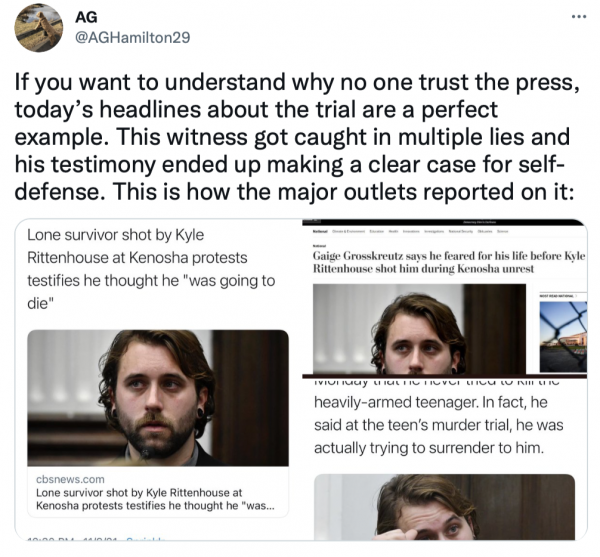
Facebook is hiding searches for Kyle Rittenhouse…

by Kane
    JUST IN 🚨 Facebook hides search for ‘Kyle Rittenhouse’ pic.twitter.com/TqMoGrHrpH — Insider Paper (@TheInsiderPaper) November 10, 2021     Glenn Greenwald gets religion on Rittenhouse media coverage… I never commented on the Rittenhouse case until I started watching large chunks of the trial, and all I can say is that anyone who has […]
11 Nov 19:25

FASTER, PLEASE: New compound provides innovative pain relief….

by Glenn Reynolds
11 Nov 17:13

The University of Maryland just introduced a new racial category: "Students of Color, minus Asian"

by Not the Bee

So I don't know why The University of Maryland had this slide up, but I'm guessing they were just running the whole "racism is everywhere" game that seems to be popular at the universities today.

11 Nov 14:25

Facebook Under Fire For Role in Covering Up Vietnamese Communist Figure Eating Gold-Encrusted Steak

by jonathanturley

We have often discussed the hypocrisy of leaders and social media companies proclaiming their faith in free speech while promoting unprecedented levels of censorship. However, the layers of hypocrisy in a story out of London is breathtaking. Gen. To Lam was shown recently on a trip to visit the grave of Karl Marx. That is hardly surprising for a Communist leader. What followed was a tad surprising. To Lam is shown eating a steak covered in 24-karat gold flakes at a restaurant owned by the social media star and restaurateur known as Salt Bae. It costs $1,150 per steak.  Facebook later suspended Salt Bae’s hashtag as the scandal exploded in Vietnam. It is not the first time social media has intervened to assist foreign authoritarian or government interests.  This story may prove Marx’s prediction that “history repeats itself, first as tragedy, second as farce.”

General Lam, Vietnam’s minister of public security, was visiting Britain for a global summit on climate change in Glasgow, and then led a group on Nov. 2 to the grave of Karl Marx where they “paid respect to those … on whose theories the Vietnamese people overthrew systems of oppression ruled by colonialists and imperialists.”  He then incongruously went to the London restaurant run by Nusret Gokce, who is known as Salt Bae for his dramatic way to put salt on food.

In one video on YouTube, Mr. Gokce serves three gold-covered steaks to a table of three men, including the general, as various people stand around them in rapt excitement.

Vietnam quickly moved to block the video and the widely used hashtag #saltbae was temporarily blocked on Facebook.

Facebook later expressed a total lack of knowledge on why the hashtag was suspended. However, this is not the first such intervention by social media companies in support of foreign governments. These companies, which routinely censor many in the United States in the name of protecting democracy, have intervened in support of some of the most anti-Democatic figures on Earth.

We have previously discussed Twitter’s robust censorship program that repeatedly has been denounced for bias in taking sides on scientificsocial, and political controversies. Twitter admitted to censoring criticism of India’s government and the company later flagged a critic of the Chinese government. YouTube later censored material from pro-Democracy opponents to Russia’s Vladimir Putin.

As for General Lam, he is unlikely deterred by the image of a communist eating gold-encrusted steak. After all, as Marx observed, “for the bureaucrat, the world is a mere object to be manipulated by him.”


10 Nov 23:27

CONFIRMED: Gavin Newsom Had Adverse Reaction To COVID Booster & Flu Shots….

by Stephen Green
10 Nov 19:56

PROBLEM: YouTube reportedly deleting dislikes on Biden Administration YouTube videos. —The Post…

by Ed Driscoll
10 Nov 19:54

OLD AND BUSTED: The Marines — We’re Looking for a Few Good Men. The New Hotness? U.S. Marine Cor…

by Ed Driscoll

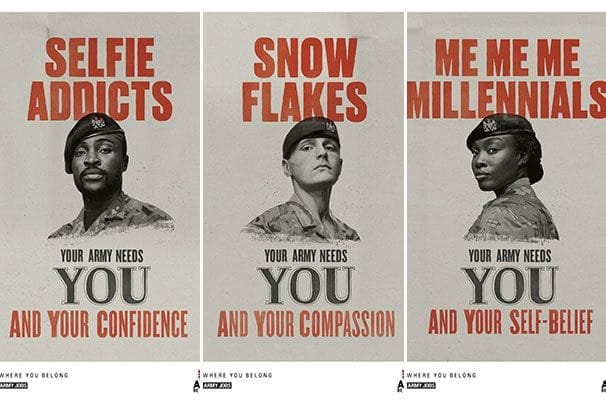
OLD AND BUSTED: The Marines — We’re Looking for a Few Good Men.

The New Hotness? U.S. Marine Corps is looking to hire a ‘Diversity, Equity and Inclusion Advisor’ with a starting salary of $144,128.

The British Army could be the inspiration for their next recruiting drive:

10 Nov 14:15

#JOURNALISM: UPDATE: His problem is that nobody thinks there’ll be rioting if he’s con…

by Glenn Reynolds

#JOURNALISM:

UPDATE:

His problem is that nobody thinks there’ll be rioting if he’s convicted.

Related: Someone Was Caught Taking Secret Video of Rittenhouse Jury Following Threat.

09 Nov 21:08

HMM: Someone Was Caught Taking Secret Video of Rittenhouse Jury Following Threat….

by Stephen Green
09 Nov 16:07

One Story that Tells Us Everything We Need to Know about Government

by Dan Mitchell

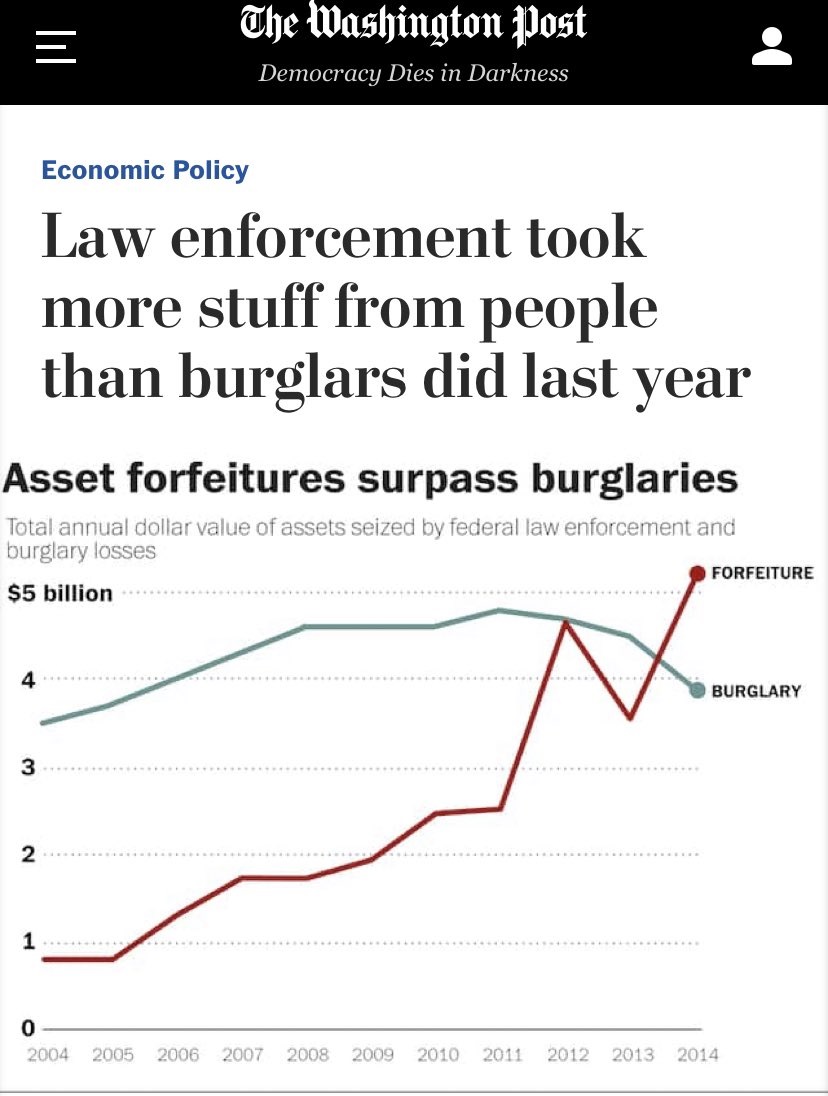
Civil asset forfeiture occurs when bureaucrats literally steal a person’s property when the person hasn’t been convicted – or perhaps not even charged – of any wrongdoing.

Citing a nauseating example of this odious practice, I wrote back in 2014 that all decent and moral people should be libertarians.

I was exaggerating, of course, so allow me to share a different statement that is completely accurate: Supporters of civil asset forfeiture (also known as “policing for profit“) are neither decent nor moral.

Indeed, they are bad people who support thuggish and unfair mistreatment of their fellow citizens.

If you think I’m being too dogmatic about this issue, here are some excerpts from a story in the New York Times by Michael Levenson.

When Kermit Warren lost his job shining shoes during the Covid-19 pandemic last year, he and his son took his life savings of nearly $30,000 to buy a tow truck to support Mr. Warren’s longtime side business of collecting scrap metal. …As Mr. Warren walked through security at the airport in Columbus, Ohio, the screeners asked him about the money… At the gate, just before Mr. Warren and his son boarded their flight, three agents from the Drug Enforcement Administration asked Mr. Warren about the cash. …The agents soon suspected that Mr. Warren was carrying illegal drug money and seized the cash. …“I never knew in my whole 58 years as a man in the United States that three D.E.A. agents could take a man’s money from him that he worked for, and not had committed any kind of crime, or was arrested for doing any type of wrongdoing,” Mr. Warren said… “How could they just take my money from me like that?” …The practice is a popular way to raise revenue but has been easily abused and widely criticized for depriving people of their right to due process and for disproportionately affecting poor people and people of color like Mr. Warren, who is Black.

Fortunately, this awful story has a happy ending.

…the Institute for Justice, a public interest law firm…sued the D.E.A. and the Transportation Security Administration, accusing the agencies of seizing travelers’ money without probable cause. …On Thursday, federal prosecutors agreed to return all $28,180 to Mr. Warren and to dismiss their civil forfeiture complaint.

Congratulations to the great libertarian lawyers at the Institute for Justice, who tirelessly fight on behalf of people suffering from abusive government.

And kudos to the small handful of states that have restricted the ability of law enforcement to steal from citizens.

But what we really need is for the Supreme Court to rule that civil asset forfeiture is unconstitutional. Fortunately, Clarence Thomas may be interested in leading such an effort.

P.S. The one silver lining to the horror of asset forfeiture is that it produced this clever example of humor.

P.P.S. Civil asset forfeiture is an example of predatory government (and I cheer people who find novel ways of fighting back).

09 Nov 16:06

Was Keynes Right on Short Work Weeks?

by Vincent Geloso

Economists are often lambasted for making predictions. Or at the very least, they are often lambasted for making predictions that history singled out as being particularly wrong. The most infamous was provided by British economist John Maynard Keynes in Economic Possibilities for our Grandchildren where he opined that, by 2030, the average work week would be around 15 hours (3 hours per work day). Essentially, this was a prediction about how much productivity growth there would be and how it would allow us to consume a great deal with very little effort. We are far away from that prediction: the average British worker worked 45 hours a week circa 1930 as opposed to 32 hours today. Thus, it is easy to see how we could lambast Keynes for being spectacularly wrong.

However, Keynes was right and those who have lambasted him are wrong because they fail to appreciate the role of gains in life expectancy.

Most industrialized countries – such as Keynes’ Britain – have seen life expectancy at birth increase by roughly 20 years since 1930. As such, we now have many more years to live and most of these extra years are spent in retirement. In contrast, workers in 1930 rarely enjoyed retirement and often died while still working. And that is not all; we also tend to enter the workforce much later. These changes at the two ends of our lifespans essentially mean longer periods of non-work.

In a new working paper, economic historian Nicholas Crafts devised a simple but potent method to test whether Keynes was right. Allowing for 8 hours of sleep per day, there are 112 waking hours available each week. Keynes’ prediction means that 97 of those 112 hours would be for leisurely pursuits. Given that British workers were enjoying only 65.5 hours of leisure per week circa 1930, Keynes was essentially predicting a 48.1% increase in the quantity of leisure enjoyed by workers. This is twice the improvement we actually observe today. However, this does not capture the effect of a longer retirement period.

But this can be circumvented easily, as Crafts points out. All that needs to be done is to take a 20-year-old worker and estimate the time ahead of him which is entirely determined by life expectancy. Then, that time can be divided between work and leisure. In 1931, a 20-year-old male worker could expect roughly 173,000 hours of leisure over his lifetime. That same male worker in 2011 could have expected 277,000 hours of leisure over his lifetime. That is an increase of 60% — a much larger increase than what Keynes predicted. This increase is entirely driven by the fact that a 20-year-old man in 1931 could only expect 4.66 years of retirement as opposed to 16.37 for the same man in 2011. 

For those who fail to appreciate the importance of this change, consider another way to present the same evidence: the percentage of a lifetime spent working. In 1931, expected lifetime hours of work represented 37.3% of all the waking time available as opposed to 20.3% in 2011. This means that leisure went from 62.7% of our lifetime to 79.7%. How can one not be in awe at such progress?

And there are still reasons to believe that Crafts is short-selling Keynes here! By using a 20-year-old male as his start point, Crafts is skipping the fact that people younger than 20 used to work quite early. Historical estimates suggest that more than 18% of British boys aged 10 to 14 still worked by 1911. And by age 18, virtually no differences with labor force participation rates of older workers can be observed. Today, a great number of young people tend to begin full-time work in their mid-twenties.

Adjusting for later entries into the job market only reinforces Crafts’ point that Keynes was correct! As such, if we were able to start from birth rather than age 20, we would find a more spectacular progress than that reported by Crafts.

Those who have lambasted Keynes for his prediction share the common pessimistic trait of our age, which consists in believing that we are not so much better off than our ancestors. In reality, when one takes the time to consider the multiple dimensions of what constitutes human well-being just as Crafts did, it is hard not to engage in hyperboles such as “We are infinitely better off than our close ancestors.” Yet, these hyperboles are not far off and Keynes understood at least that.

09 Nov 16:00

Project Veritas founder O'Keefe says FBI raid on his home 'attack on First Amendment'

by Just the News staff
O’Keefe also said his phone had reporters' notes from sources unrelated to the diary story
09 Nov 15:01

CHECK OUT JOB BOARD FOR PEOPLE WHO LOVE FREEDOM: Andrew Crapuchettes lost his job as CEO of a highly…

by Mark Tapscott

CHECK OUT JOB BOARD FOR PEOPLE WHO LOVE FREEDOM: Andrew Crapuchettes lost his job as CEO of a highly profitable tech firm because of his religious views. So he went out and started RedBalloon.work, a job board for connecting “employers who value freedom with employees who value it too.”

The web site adds that “we envision a world beyond cancel culture, where employees are free to work… without fear that they will find themselves on the wrong side of their employer’s politics. That’s it. No agendas, politics, or drama. Just work. Interested? Let’s create that world together.”

What a concept, a world where free people can work freely!

09 Nov 13:29

WELL, THEY THINK REALITY IS RACIST:   Supposedly Racist Paper Retracted For Actually Racist Reason…

by Sarah Hoyt

WELL, THEY THINK REALITY IS RACIST:   Supposedly Racist Paper Retracted For Actually Racist Reasons.

09 Nov 02:22

COLLUSION: Georgia Tech researcher discussed using ‘bag of tricks’ to prove Trump-Russia collus…

by Glenn Reynolds

COLLUSION: Georgia Tech researcher discussed using ‘bag of tricks’ to prove Trump-Russia collusion: indictment.

In building the case that Trump had worked with a bank with Kremlin ties, one of the researchers warned they would have to “expose every trick we have in our bag” to make “a very weak association” between Trump and the Russians.

According to the indictment, Georgia Tech computer scientist Manos Antonakakis (referred to in the indictment as “Researcher-1”), and data scientist David Dagon (“Researcher-2”) were on a team of data experts tasked with finding links between Trump and the Russian government.

The team’s findings were later disseminated to media outlets and to FBI investigators looking into collusion between Trump and the Russians.

So much anti-Trump desperation, makes you wonder what they were so worried about. . .

More:

According to the indictment, four computer researchers, including Antonakakis and Dagon, used access to internet data to prove a connection between Trump’s company and a bank linked to the Kremlin.

The data was provided to Georgia Tech through a program the school had recently initiated with the Defense Advanced Research Projects Agency in order to, according to the indictment, “receive and analyze large quantities of public and non-public data (including DNS data) from various Internet companies in order to identify the perpetrators of malicious cyber-attacks and protect U.S. national security.”

The data was allegedly provided to Georgia Tech by Rodney Joffe, senior vice president of Neustar (and identified as “Tech Executive-1” in the indictment.)

“A federal agency selected Georgia Tech and its researchers to work on some highly sensitive, extremely sophisticated computer systems research because of the school’s and its researchers’ world class reputations in this field and their high degree of integrity,” a Georgia Tech spokesperson told The College Fix in an emailed statement. “The research was very much about securing the United States of America, its systems of governance and its people.”

The Georgia Tech researchers, provided early access to the data, allegedly began using it to draw links between the Russians — even though Antonakakis and Dagon appeared skeptical of what they actually found. . . .

“The only thing that drives us at this point is that we just do not like [Trump],” Antonakakis added. “This will not fly in eyes of public scrutiny. Folks, I am afraid we have tunnel vision. Time to regroup?”

Nonetheless, the researchers allegedly began drafting a “white paper” using the allegations, which Sussman later presented to the FBI. During this drafting period, Sussman allegedly billed the Clinton campaign for his time.

It was all BS.

08 Nov 20:48

COVID19 micro-update, November 8, 2021: first oral antiviral drug approved

by Nitay Arbel (a.k.a. New Class Traitor)

Just days ago, mulnupiravir from Merck became the first oral antiviral for COVID to get approved by the MHRA, the British counterpart of the FDA. Dr. John Campbell comments:

The drug (originally developed at Emory U. for the treatment of influenza) works by impersonating one of the nucleosides, thus introducing copying errors in copies of the virus. IT is about 50% effective to stop deterioration when taken in the early phase of the disease, though it seems to be more effective at preventing death. A 5-day course costs $700 at present, but this may drop significantly as demand picks up and/or production is outsourced to generics manufacturers. Thus far, the only publically available data are a Merck press release.

But that’s not all. Pfizer just released intermediate data from their phase 2/3 clinical trial of ritonavir (Paxlovid), a protease inhibitor pill that works by irreversibly binding to the catalytic site of the protease enzyme (specifically, Cys145, meaning the amino acid cysteine at position 145 in the peptide sequence). This family of drugs was originally developed for the treatment of AIDS; now Pfizer’s press released claims that ritonavir is close to 90% effective in preventing hospitalization. More specifically, 1% of patients who received Paxlovid were hospitalized, compared to 6.7% in the control group: none (0%) of Paxlovid recipients died, compared to 1.6% in the control group.

The double-blind trial was discontinued, apparently with FDA approval, for compassionate reasons: if a drug is that effective, so the reasoning goes, continuing to give half the patients placebos would be unethical.

Bizarrely enough, significants fewer adverse events were reported with the drug than with the placebo.

This sounds almost too good to be true, and I’m a little (ahem) wary of “science by press release” as it’s too easy to “cook the books”, but I am definitely forward to seeing at least a preprint about the study. (Unless it’s really vaporware, this is likely forthcoming quite soon.)

And if two very promising drugs isn’t enough, the widely used, inexpensive SSRI antidepressant fluvoxamine appears to be repurposable as a COVID antiviral. Dr. Seheult explains:

That study (by Brazilian and Canadian researchers) has actually been published in The Lancet.

G. Reis et al., “Effect of early treatment with fluvoxamine on risk of emergency care and hospitalisation among patients with COVID-19: the TOGETHER randomised, platform clinical trial”, https://doi.org/10.1016/S2214-109X(21)00448-4

And the drug having been used massively for about 2 decades, its safety profile is well understood.

Meanwhile, some 90 countries are apparently queueing up to get supplies of ritonavir fom Pfizer.

Developing…

ADDENDUM: in this video (links to the papers in the description) Dr. Campbell comments on a few papers that indicate that ivermectin, to the extent that it works against COVID, appears to do so as what I would call an “unintentional 3CL protease inhibitor”.

08 Nov 19:31

Politifact Spreads Falsehoods on the COVID Survival Rate

by Matt Palumbo
08 Nov 16:12

DEVELOPING: U.S. federal appeals court issues stay on Biden’s vaccine rule for U.S. companies….

by Ed Driscoll
08 Nov 16:12

DISRUPT! We Can’t Wait for Universities to Fix Themselves. So We’re Starting a New One. “Nearly 40…

by Glenn Reynolds

DISRUPT! We Can’t Wait for Universities to Fix Themselves. So We’re Starting a New One. “Nearly 40% of those who pursue a college degree do not attain one. We should let that sink in. Higher education fails 4 in 10 of its students. A system that so brazenly extracts so much from so many without delivering on its basic promises is overdue for a reckoning. . . . It’s not just that we are failing students as individuals; we are failing the nation. Our democracy is faltering, in significant part, because our educational system has become illiberal and is producing citizens and leaders who are incapable and unwilling to participate in the core activity of democratic governance.”

Some big names associated with it.

08 Nov 16:08

Biden on Afghanistan in 2007: “You leave those billions of dollars of weapons behind, I promise they’re gonna be used against your grandchild and mine some day.”

by Not the Bee

I'm not making this up.

08 Nov 14:06

THEY TOLD ME NEO-CONFEDERATES WERE ON THE RISE — AND THEY WERE RIGHT! Sean Wilentz Reviews Noah Fe…

by Glenn Reynolds

THEY TOLD ME NEO-CONFEDERATES WERE ON THE RISE — AND THEY WERE RIGHT! Sean Wilentz Reviews Noah Feldman’s New Lincoln Book, “The Broken Constitution.” “Feldman is not alone with sidling up to confederate constitutionalism. The 1619 Project agrees with Chief Justice Taney’s interpretation of the Constitution in Dred Scott. So much of the modern progressive project depends on the original Constitution being a failed, sinful document. That argument must be accepted as a doctrine of faith to undermine originalism.”

“Critical Race Theory” is best understood as a revived form of slaveowner racial and constitutional thinking.

As I wrote about Justice Harlan a while back:

Harlan’s blistering dissent in Plessy was widely read in the pulpits of black churches around the nation and its focus on racial equality and the color-blind nature of the Fourteenth Amendment became the foundation for the winning argument in Brown v. Board of Education, which undid Plessy over a half-century later.

Harlan wrote: “In my opinion, the judgment this day rendered will, in time, prove to be quite as pernicious as the decision made by this tribunal in the Dred Scott Case” (He was right about that). . . .

This ringing statement of racial and social equality was radical at the time, when it was taken for granted by many, if not most, that the races were too different to live together, and must have their relations closely managed by the hand of government.

If Harlan’s position was radical then, it went on to become conventional wisdom decades later. But it is increasingly radical now, at a time when, once again, many in positions of leadership in our universities, our corporations, and even in our governments seem to believe that the differences between the races are insoluble and can only be managed by the overweening hand of authority. To the extent that “woke” politics and Critical Race Theory lead us to the same view of racial relations as was held by 19th-century Jim Crow theorists, I, like Harlan, must register my dissent.

And I still do.

06 Nov 17:41

Vaccine Authoritarianism Explained

by Max Borders

This is behavior that picks and chooses precepts from both syndromes [taking and trading], creating monstrous moral hybrids.” – Jane Jacobs, from Systems of Survival

Disclosure: I am vaccinated against Covid-19. So allow me to inoculate myself from any charges that I am an ‘anti-vaxxer.’ I am not. Yet, I join millions of people worldwide who are unsettled by vaccine mandates like those issued from the Biden Administration and from states like California. First, we should ask whether the mandates make sense from a public health perspective. Then, if not, we want to try to make sense of why authorities would double down on measures with such weak public health justification.

Mandates Make No Apparent Sense

Before we get into the political economy of that which slinks from the coital bed of government and pharma, we need briefly to get into the reasons why the current “public health” case for mandates and passports makes no sense.

  1. Schoolchildren currently have negligible risks from Covid-19. Subjecting kids to risks such as myocarditis, pericarditis, and thrombosis, however small, is not based on any rational assessment of the current data on Covid disease risks to children. So the main argument for mandatory child vaccination is that it protects adults. Not only do Covid vaccines have diminished effectiveness through time, but they also do precious little against transmissibility after only two months, especially against the variants currently raging worldwide. Breakthrough cases are legion, and waning vaccine effectiveness is well-documented. (Disclosure 2: Despite being vaccinated, I contracted Covid and passed it to my vaccinated partner and unvaccinated children.) Of course, no one has studied the long-term effects of mass mRNA vaccination on either adults or children, and even the clinical trials on children are dubious. So it’s strange to hear the usual boosters (no pun) of a more expansive regulatory state want to move full-throttle in forcing experimental therapies on kids. 
  1. Vaccine mandates introduce unnecessary risks to the scores of millions of Americans who are Covid recovered. Study after study (after study) demonstrates that people who have recovered from Covid-19 have robust, durable immunity, which is as good or better than vaccine immunity. There is no reason people with natural immunity should be compelled to undergo any therapy whose long-term effects are unknown. Never mind that the magnitude of the known risks is still being studied. (One Covid recovered law professor sued his university for just such a mandate.)
  2. Vaccine mandates are questionable even for those who have not yet contracted Covid-19. Why? It’s pretty simple: adults ought to weigh the known and unknown risks of any medical decision for themselves and seek proven early treatment if they contract the virus. As I pointed out above, the case for vaccine-based community protection is weak and growing weaker by the day. It’s frankly bizarre that we are living in such a time that authorities fancy it’s okay to force anyone to undergo therapies that are still considered experimental. Such is not to argue that riskier experimental therapies shouldn’t be an option for people in a pandemic; it is simply to argue against compulsion.

The good news is that millions of people around the world are in open rebellion against these mandates and the authorities who issue them. And the rebel alliance is not just a covey of anti-vaxxers. People of conscience, both vaccinated and unvaccinated, think these mandates are wrong. Mainstream media apparatchiks will continue to peddle talking points to justify these authoritarian measures, but the great unvaxxed aren’t having it. Current scientific findings and 13,000-plus physicians support their intransigence.

Given that extensive research militates against purported rationale for vaccine mandates, we have to ask: Why then? The answer might have something to do with the dynamics of political economy.

Follow the Money

At the risk of oversimplifying, I’m going to tell a story. I will use readily available information to form a rough timeline and a hypothesis that evokes traditional Public Choice Theory. For the uninitiated, Public Choice Theory is a branch of economics that deals with the behavior of actors operating in a matrix outside of normal market conditions, such as within the political realm.

Our story begins in Wuhan, China: December 2019. Or so it would seem. There, a mysterious virus had begun claiming lives. (As you’ll see, we’ll have to go back a little further than that.) Still, in December 2019, the world had started to notice. The virus soon spread beyond China, and by February 2020, the pandemic raged globally. 

In January 2020, a little-known company called Moderna developed their mRNA vaccine with a grant from BARDA (a sub-agency of the U.S. Dept. of Health and Human Services) but in close collaboration with NIAID, the federal infectious disease agency headed by Anthony Fauci. Indeed, the NIH shares the patent with Moderna. All told, government officials spent $2.5 billion to bring Moderna’s vaccine to market, with almost $1 billion going to research and development. Moderna/NIAID entered clinical trials for its mRNA vaccine on March 15, 2020, which means this research had begun, or been accelerated, at a pace unknown to most bureaucracies.

Readers will note that just six weeks before the start of Moderna/NIAID’s clinical trials, NIAID director Anthony Fauci maintained close contact with key stakeholders involved in a multi-year program that included risky gain-of-function research. The exchanges culminated in a now-famous Saturday conference call on February 1, 2020. That call included Scripps Research microbiologist Kristian G. Andersen who had warned Fauci by email a couple of days prior that “Some of the features (potentially) look engineered.” Scripps Research is no stranger to using and allegedly misusing NIH largesse, so it’s no surprise that Andersen would refer to any theories of lab leaks or engineered viruses as “crackpot theories.” 

Also present in that teleconference was NIH director Francis Collins who, amid increased calls to fire Fauci, recently resigned his own post.

Along with Fauci, at the center of questions surrounding dangerous gain-of-function research is Peter Daszak. His non-profit, Ecohealth Alliance, directed $600,000 in NIAID grants to the Wuhan lab between 2014 and 2019 as part of a grant to study bat coronaviruses. Daszak wrote Fauci in the days after the Saturday teleconference to thank him for using his gravitas to dismiss the lab-leak theory and propagate the SARS-CoV2 natural origins theory. Daszak was also behind publishing a letter to the venerable Lancet in which signatories denounced the lab-leak theory and boosted the notion of a natural origin. Before the letter’s publication, Daszak had written to a co-conspirator thus: 

“We’ll then put it out in a way that doesn’t link it back to our collaboration so we maximize an independent voice.” 

The Lancet later condemned that letter, citing conflicts of interest.

As mentioned, Daszak’s Ecohealth Alliance had also been a recipient of research funding over which Fauci had oversight. Not only did Daszak fail to disclose an Ecohealth Alliance grant proposal to DARPA — denied because its research posed dangers eerily similar to that of the current pandemic virus — but Daszak allowed himself to be installed as one of the principal investigators for the WHO, commissioned to look into the Wuhan Lab as a potential origin. 

The riff-raff commonly refer to this as the fox guarding the henhouse. 

The Moderna Connection

Now, excuse the interruption, but what on earth does all of the above have to do with vaccine mandates? 

In one of the email exchanges uncovered by a Judicial Watch FOIA request, a January 20, 2020 email initiated by NIH officials included a “Wuhan Pneumonia Report” along with a timeline of the initial outbreak in China to that point. The report also details a portfolio administered by none other than Peter Daszak of the non-profit EcoHealth Alliance.

Peter Daszak (R01A|110964-06) is funded for work to understand how coronaviruses evolve and jump to human populations, with an emphasis on bat CoVs and high-risk populations at the human-animal interface. Main foreign sites are in China (including co-investigators at the Wuhan Institute of Virology).”

Said “co-investigators” included researcher Fang Li of the WIV, who was to carry out research that sounds conspicuously similar to what lay folk now refer to as “gain of function.” But the exchange also describes another grant to “a team of investigators using mouse models of SARS and MERS to investigate CoV pathogenesis and develop vaccines and therapeutics.” Chimeric or “humanized” mice used in the Wuhan/EcoHealth Alliance research are now coming under greater scrutiny as potential pandemic vectors, belying Fauci’s statements before Congress.

Then, under a section of the report simply called “Vaccines,” NIH authors write:

The VRC [Vaccine Research Center] and collaborators have stabilized the MERS-CoV spike protein in its prefusion conformation. The stabilized spike protein is potently immunogenic and elicits protective antibodies to the receptor binding domain, n-terminal domain and other surfaces of the spike protein. The stabilized coronavirus spike protein, and mRNA expressing the spike protein through collaboration with Moderna Therapeutics, is currently being evaluated in the humanized DPP4 mouse model at UNC. (Emphasis mine.)

Needless to say, it is odd that the startup Moderna had been at the center of all this parallel research on bat coronaviruses for years leading up to the Wuhan outbreak, and was thus joined at the hip with Fauci’s NIAID.

The Fatal Conceit and Monstrous Hybrids

To be fair, the “gain of function” vision, which Anthony Fauci has always supported with a full throat, was to figure out how to develop an arsenal of therapeutics to combat any given virus that might leap from an animal to a human. The whole idealistic premise had been that researchers would collect viruses and find likely candidates for zoonosis in the lab. Then authorities would be able to fund drugmakers to create vaccines. As Fauci writes in 2012:

Scientists working in this field might say—as indeed I have said—that the benefits of such experiments and the resulting knowledge outweigh the risks. It is more likely that a pandemic would occur in nature, and the need to stay ahead of such a threat is a primary reason for performing an experiment that might appear to be risky.

A more cynical interpretation of the above might be that these stakeholders would benefit from a grave warning shot like the Covid-19 pandemic. But a more charitable understanding of events is that Fauci’s desire to save the world from pathogens had been vindicated, indeed accelerated, by a freak accident in Wuhan only they could clean up. That latter interpretation would only fly if the virus was thought to emerge naturally. Otherwise, the political equivalent of ‘Hey, we dropped a match in the forest, so we firefighters are going to get our hoses out now.’ would land with the public like a lead balloon — and for reasons Fauci had anticipated long ago

They knew they had better get their stories straight.

Thus, in the minds of Moderna executives like the allegedly vicious Moderna CEO Stéphane Bancel and his partners at NIAID, including Fauci, the vaccine train had already left the station. It was a technocrat’s dream, a public-private partnership for all humanity. The credulous, pious media continued to fawn over Fauci throughout 2020 and well into 2021. Remember, up to this point in the story, no mRNA vaccine had ever been rolled out to the masses. Yet Fauci’s reputation as public-health papa put him squarely in the position of Technocrat-in-Chief when it came to the pandemic and how to control it. Moderna stood to make a metric ton of money on top of the investment largesse Fauci had already directed to the start-up in the years leading up to the pandemic. But who could begrudge a life-saving hero becoming a billionaire?

Bootleggers, Baptists, and Vaccine Mandates

I would not go so far as to speculate that Anthony Fauci might be playing out Munchhausen by Proxy on a societal scale, though some have gone there. Still, I don’t think it’s a stretch to say that Fauci and his functionaries have behaved in a way that lends plausibility to orthodox Public Choice Theory, specifically the theory of Bootleggers and Baptists.

In 1983, economist Bruce Yandle developed the Bootleggers and Baptists framework to explain his belief that durable government action tends to come about with the support of two types of interest groups: those with moral interests and those with financial interests. Yandle appeals to early twentieth-century blue laws, which prohibited the sale of alcohol on Sundays. Baptists, the moralists, were motivated by their beliefs that Sundays should be respected as a day of prayer and rest, not drinking. The Bootleggers supported the ban, too, but only because they would enjoy a thriving black market on those days and profit from illegal alcohol sales. Durable government action, according to Yandle, tends to emerge with the support of coalitions that share a common goal even if they don’t share common motivations.

In a global pandemic, it has not been difficult to find a plethora of public health pieties. Nor has it been hard to find profiteers, especially pharma. I doubt that Anthony Fauci has any financial interests in the Moderna/NIAID vaccine — though investigators should look. He’s in it for the glory. Still, the Moderna/NIAID partnership puts the Bootleggers and Baptists on the same team. 

Fauci, President Biden, and all the MSM sentinels are the moralists in this equation, that is, if Prof. Yandle will permit a not-so-bright line between moralism and savior complex. They want to be known as the ones who beat the pandemic. One might even say Fauci has been planning for this his whole career. Now he graces us with his presence daily on SAHM programs such as The View, basking in the lamps, reminding us to wear our masks and get our vaccines.

The decrepit Biden, though he needs help getting up on that high horse, once bestride it, holds his mighty executive pen aloft and commands the multitudes to get the jab or else. Waiting in the wings are shadowy corporate figures, such as Moderna’s Bancel, prepared to execute these technocratic plans using billions of dollars inked in red. Though howls against Big Pharma were once prominent in the Progressive Playbook, those have mysteriously been redacted like Anthony Fauci’s FOIA’d emails. When one stops to think that these billions will have to be repaid by the very children who won’t have a choice but to get these vaccines, much less likely Covid, she might find the idea nauseous. A considerably more disturbing thought, though, is that Fauci probably suspected all along that NIH funding led to the creation and (accidental) release of a virus that has killed 5 million people as of this writing. 

Anthony Fauci is a monopsony on funding for infectious disease research. He clearly does not want to be known as the guy in charge of funding the pandemic, even inadvertently. His defensiveness, his untruths before Congress, and his moth like draw to camera lights — all seem to reveal a man who, in his moralism, refuses to acknowledge that his agency had any hand in the damage Covid dealt. He wants to be America’s doctor, and his grand plan has always been to vaccinate the world. In his favored scenario, he would not be viewed not as a negligent bureaucrat but a savior. And he wants to keep it that way. The researchers? The intermediaries? The pharma execs? They’re in it for the money upon which their careers depend.

My hypothesis, therefore, tentative but bold, is that economist Bruce Yandle must have seen this coming a mile away. The vaccine mandates of 2020-2021 is a story of Bootleggers colluding with Baptists. The only question that remains, then, is whether we’re going to let them get away with it.

06 Nov 01:14

TO BE FAIR, DEMOCRATS WERE HISTORICALLY THE PRO-SLAVERY PARTY: …

by Glenn Reynolds
04 Nov 18:41

AMERICA’S NEWSPAPER OF RECORD: McAuliffe Blames Loss On Low 3AM Ballot Turnout….

by Ed Driscoll

AMERICA’S NEWSPAPER OF RECORD: McAuliffe Blames Loss On Low 3AM Ballot Turnout.

03 Nov 16:37

OH: D.C. Jail Transfers Out 400 Prisoners for Disgusting, Inhumane Conditions — But Not a Single J…

by Stephen Green