Tammy Ravas, Visual and Performing Arts Librarian and Media Coordinator, University of Montana
Guest Blog Post by Tammy Ravas*
Happy Fair Use Week everyone!
Fair use is one of the most important exceptions to the exclusive rights of copyright holders. It allows people to use copyrighted materials for certain purposes without the need to ask permission from rights holders. Fair use is the safety valve in the law that allows citizens to exercise their first amendment rights when using copyrighted materials. It balances the rights of copyright holders with those who make uses of their materials for reasons that benefit society at large. In the actual statute, these purposes are: “criticism, comment, news reporting, teaching (including multiple copies for classroom use), scholarship, or research.” Without fair use, many familiar and everyday experiences could become illegal. For instance:
Online stores would not be able to effectively operate.
Only the rights holders of original images would be able to create Internet memes that one often finds on sites like Facebook, Twitter, Reddit, and many others.
This commentary could be next to impossible to create by virtue of the fact that each link and quotation I use from outside sources would require permission from rights holders. If fair use did not exist, the creators behind the content that I am linking to and quoting from could effectively censor this post by either denying my request or by charging me an exorbitant amount of money in licensing fees to use their material.
By looking at these examples, it is easy to see how you and your patrons rely on fair uses of copyrighted materials every single day. Here are a few library-specific scenarios to consider:
1. Making library materials accessible to those with disabilities:
A hearing-impaired patron would like to view a video in your collection that does not have captions. If there isn’t a copy available for purchase then fair use may help you to make that item
accessible to them. The Association for Research Libraries’ 2012 publication, Code of Best Practices in Fair Use for Academic and Research Libraries, provides guidance on this issue on pages 25 and 26:
When fully accessible copies are not readily available from commercial sources, it is fair use for a library to (1) reproduce materials in its collection in accessible formats for the disabled upon request, and (2) retain those reproductions for use in meeting subsequent requests from qualified patrons.
2. Use of digital files and multimedia equipment in your library.
An example of this would be a student creating a presentation for a high school class about movies based on video games. A student may use books and videos from the library’s collection along with other hardware and software to create the presentation. In more and more cases, students are assigned video presentations to post online to their classes. Also, patrons who read books, listen to music, or watch videos on mobile devices are relying on fair use to do so.
3. Digitizing materials in your collection.
In this example you can watch a video about how the New York Public Library relies on fair use to digitize an important collection on the World’s Fair.
To learn more about fair use, as well as fair use week, please visit the following resources:
by Jane Chalmers, Lecturer in Physiotherapy, Western Sydney University
Don't know much about the clitoris? It's probably not your fault. Jen/Flickr, CC BY-SA
Did you know the clitoris is a large and complex organ? If not, it’s probably not your fault: in anatomical textbooks, few words and diagrams are devoted to understanding the clitoris. Most label the very small portion of the organ visible on diagrams of the vulva, when in fact it’s almost entirely under the skin.
Studies of historical anatomical textbooks have shown that depictions of the clitoris were significantly limited and often omitted completely from the mid-19th into the 20th century.
During these times there were ideologies and subsequent theories relating to women’s bodies that likely encouraged and sustained censorship of the clitoris. For instance, there was Freud’s now defunct theory that clitoral stimulation was a sign of sexual immaturity and neurosis. Women were also taught not to enjoy sex; women had sex for reproductive purposes, while men had sex for pleasure.
These fallacies led to the neglect of the clitoris in research, literature and the public domain.
Although more recent research and feminist lobbying have improved the quality of information on the clitoris in current textbooks, most texts are still brief. These include minimal information, or information only on the external portion of the clitoris (the glans). This brevity has impacts on health care for women with clitoral and related pain.
This figure, published in 2014, depicts the clitoris as only the external clitoral glans and prepuce (hood).
What is the clitoris?
The clitoris lies at the junction of the labia minora (the inner lips of the vulva), just above the urethra. It is made up of four main parts: the glans, body, two crura and two bulbs. The glans is the only external part of the clitoris and is covered by a hood of skin.
The body, corpora, crura and bulbs of the clitoris are all made up of erectile tissue and converge below the glans. The body of the clitoris is generally 1-2cm wide and 2-4cm long.
The crura extend laterally from the body of the clitoris and are on average around 5-9cm long. The bulbs of the clitoris are generally 3-7cm long and lie between the body, crura and the urethra.
The clitoris is highly innervated, with twice as many nerve endings as the penis, and receives a rich blood supply. This rich blood supply allows the erectile components to swell up, with the body and glans of the clitoris becoming up to three times larger during arousal – and you thought a penile erection was impressive!
The clitoris (left) and penis (right) emerge from the same cells in a zygote.
Screenshot/Huffington Post
Foetus genital and reproductive organs are differentiated at six weeks' gestation. While the clitoris and penis arise from the same group of cells in a zygote, we now know they clearly have different forms and functions.
The penis has an obvious and well-researched role in the reproductive and urinary systems, while the function of the clitoris is usually stated as being purely for pleasure.
However, few studies have actually investigated the function of the clitoris. The close proximity of the clitoris to the urethra and vagina has led to suggestions that it plays a much larger role than sexual pleasure, such as assisting in maintaining immune health.
What we don’t know can hurt us
Censoring the clitoris in textbooks means doctors and other health-care professionals won’t be equipped to treat patients with clitoral concerns. Women are at risk of sexual dysfunction (such as lack of desire or arousal, decreased lubrication, inability to orgasm) from operations on their urinary and reproductive organs. This shows doctors need more in-depth knowledge, and we need further research into understanding the anatomy of the clitoris.
Because of its delicate yet complex make-up, the clitoris is prone to infections, inflammation and diseases. Some common examples are itching and soreness due to thrush infections, swelling due to bruising or inflammation, and pain of unknown origin (called clitorodynia).
Although it is not often spoken about, clitoral and vulvar pain are very common in women.
Educating patients about their condition can improve pain outcomes. Yet this may be difficult for doctors treating conditions such as clitorodynia, given they may not be receiving adequate information about the clitoris themselves.
On average, one-third of university-aged women are unable to find the clitoris on a diagram. We frequently use synonyms of females' reproductive organs as derogatory terms (“pussy” to mean weak, “cunt” to mean an unpleasant person) and many women are often not comfortable using anatomically correct terms.
More than 65% of women say they feel uneasy using the terms vagina and vulva. Instead they use code names such as “lady parts”, even when discussing gynaecological issues with their doctors.
Given there is evidence to suggest our sense of body ownership can influence pain, perhaps this lack of body ownership over the clitoris helps to explain why conditions such as clitorodynia are common.
The authors do not work for, consult, own shares in or receive funding from any company or organization that would benefit from this article, and has disclosed no relevant affiliations beyond the academic appointment above.
by Alison Stine on Pictorial, shared by Adam Clark Estes to io9
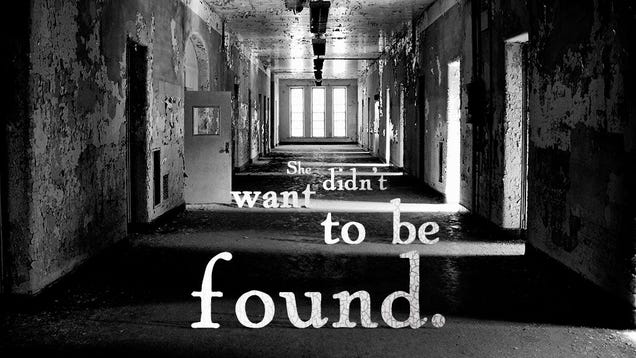
I’ve heard that Margaret Shilling was deaf. I’ve heard that she was unable to speak, to call for help. I’ve heard that she was playing hide-and-go-seek, and I’ve heard that she just wanted to die. She has been called Ohio’s most notorious ghost, the lost lady. Teenagers have prayed to her, broken into a building for her, lit candles to her, and lay down on the spot where her body did that famous thing—where it vanished, reportedly, and then reappeared, leaving a stain.
by Matt Novak on Paleofuture, shared by Cheryl Eddy to io9
You don’t own your ebooks with DRM. You’re merely licensing the privilege to read them. Some readers overseas have learned this the hard way (yet again) now that Nook is going out of business in the United Kingdom. But don’t worry, they’re working to let you maybe possibly transfer all those books you bought.
Evolution and religion may not be at war after all. True, the two may sometimes seem like incompatible, competing worldviews: evolutionary science is regularly rejected by prominent religious figures, and its teaching in religious schoolsis often controversial. And yet, many people seem to happily accommodate both. In the US, where more than nine in ten people say they believe in God, 50% believe in some form of evolution.
There’s a chance that many of these people don’t fully understand the nature of evolution as laid out by science. But most of the scientists who study the topic don’t view it in such combative terms either. The American National Academy of Science calls for a warm embrace of both religion and evolution. In a 2010 survey of evolutionary scientists, 87% of respondents said they had found some way to make religion and evolution compatible. A recent (now retracted) paper in the scientific journal PLOS One even controversially referred to human hands as a “proper design by the Creator”. How do scientists manage to reconcile these two contrasting ways of explaining our origins?
Incompatible creationism
There is a more widespread acceptance that believing in evolution and creationism is incompatible. Evolution is an idea based on scientific evidence that life developed because of random mutations in genetic material and the process of natural selection. Creationism, on the other hand, requires faith without analysis that life began due to the intervention of a supernatural creator. For this reason, there is a conflict between evolution and creationism that some people say can never be resolved.
For instance, some evolutionary scientists, including Richard Dawkins, see a world where only evolution can exist. Such evolutionists reject the premise of religion on the grounds that there is no evidence for it, instead favouring a naturalist worldview. Naturalism is the belief that only things in the natural world that can be observed and verified with evidence exist. For these scientists, evolution is the only way of explaining the origins of life, as belief in a creator requires faith and faith has no natural basis that can be subjected to experimentation.
One or the other?
Shutterstock
Others have argued that this naturalist worldview can itself be seen as a kind of modern religion. For example, Philip Johnson, an advocate of the theory of intelligent design, argues that scientists often place large amounts of faith and belief into Darwin’s theory of evolution. He says that evolution easily substitutes traditional religion and provides all the benefits, such as an explanation of where we came from. But those naturalist scientists still reject the idea of evolution being compatible with religion that involves a creator God.
The dualist alternative
Other evolutionists advocate a “dualist” way of looking at the world that gives space to both religion and evolution. Instead of seeing religion as something that comes from God, these scientists see it as a human adaptation to life, where religion has developed because of evolution.
Under this perspective, religion evolved naturally as a way of promoting cooperation. Humans need to cooperate to survive and religion provides a basis for them to do so. Religion can also help shame those who try to reject their group membership in order to make them tow the line and maximise greater chances of survival for the group.
The catch is that this worldview is not actually very kind to traditional theology. It describes religion in a way that is fundamentally atheistic in character, without belief in gods, corporeal spirit or life after death. This is why evolutionary scientists with dualist beliefs don’t see a conflict between religion and evolution. They don’t hold religious beliefs in the traditional sense. Instead they use evolution to explain the existence of religion.
Ultimately, to accept evolution as scientific fact, scientists (and indeed anyone) have to abandon the tenets of religion and accept there is no higher authority on the most meaningful matters of human existence. And that is what offends most religiously-minded people.
Nathan Aaron Kerrigan does not work for, consult, own shares in or receive funding from any company or organization that would benefit from this article, and has disclosed no relevant affiliations beyond the academic appointment above.
by Clive Hamilton, Professor of Public Ethics, Centre For Applied Philosophy & Public Ethics (CAPPE), Charles Sturt University
Ted Cruz and Donald Trump
Every decent person looks on goggle eyed as Donald Trump continues his unlikely march to the Republican Party nomination. We are mesmerized by how he goes out of his way to flout every rule of “political correctness”, from calling Mexican immigrants “rapists” and flirting with the Ku Klux Klan, to dismissing women he does not like as fat and ugly.
As each primary comes and goes the words “President Trump” seem less like a joke and more like a possibility. For most in this country, and certainly among those who read The Conversation, that would be the worst outcome imaginable.
But Donald Trump in the Oval Office is not the worst outcome imaginable. Ted Cruz in the Oval Office is the worst outcome imaginable.
Trump is a showman. The kind of people drawn to him are the kind who watch The Apprentice, a piece of elaborate theatre in which Trump’s ritual bullying and humiliation make for good sport. As a politician he understands that the backlash against the cultural shifts of the 1960s and 1970s, shifts that continue today, always made a large portion of the American population uncomfortable and resentful.
So not only do his outrages appeal to those who are tired of having to suppress their social views, but the horror they cause among his opponents and in the mainstream media, reinforce the feeling among his supporters that here is a man who finally speaks for them.
What this means for Trump’s underlying politics, and the decisions he would make if he were president, is not at all obvious. Trump has a history of taking liberal stances on a range of issues, including favouring abortion rights, supporting a single-payer healthcare system and endorsing an amnesty for illegal immigrants.
He was a registered Democrat and friend of Hillary Clinton. It’s because of these positions that genuine political conservatives are deeply suspicious of him, calling Trump a “typical New York City liberal”.
Cruz’s rage
In contrast to Trump, Ted Cruz is a hard-line, Tea-Party style, evangelical warrior who would ruthlessly use the power of the presidency to impose his vision on America. Trump’s anger may be real, or more likely it’s part of his shtick, but Cruz is fuelled by the same deep rage that gave birth to the Tea Party.
The Texas senator has been one of the most uncompromising Republicans in a Senate notorious for its unwillingness to allow the government to govern. Socially he is among the most conservative of the new breed of right-wing Republicans. He opposes abortion in all cases, including rape (“it’s not the baby’s fault”), except when the mother’s life is endangered. He’s opposed not only to same-sex marriage, but to civil unions as well.
He believes that “the overwhelming majority of violent criminals are Democrats” and has lamented the fact that “non-believers” are allowed to vote. He gives succour to the conspiracy theory that President Obama banned military personnel from praying. (According to his evangelical parents the young Ted “gave his heart to Christ” at a youth camp when he was eight-years-old.)
Yes, Trump latched on the “birther” conspiracy, but it always seemed to be a calculated move.
Against Cruz’s record of fanaticism (whipping other Republicans to shut down the government by refusing it funding) Trump is, and sees himself as, a dealmaker. Cruz warned conservative voters not to be fooled: “[…] if you think Washington is fundamentally broken, then the answer is not to elect a dealmaker who will cut even more deals with Democrats and make the problem worse.”
I haven’t mentioned economic policy, foreign policy or climate change, but on each of them a Trump presidency is a less disconcerting prospect. And while President Cruz would surround himself with ideologues on a mission, Trump is likely to appoint some more sensible people.
I’m scared of Trump, a lot, but I’m terrified of Cruz. So if I found myself at the Republican Convention, due to convene in July to choose a presidential candidate, and the only choice was between Trump and Cruz, then “The Donald” would get my vote, no question.
Sometimes you sit in front of your TV and realize you’re watching something important. It happens quite often on HBO’s Last Week Tonight with John Oliver and Sunday’s episode was no exception. In addition to an incendiary piece about abortion laws, Oliver attacked Hollywood whitewashing.
by Adam Clark Estes on Gizmodo, shared by Adam Clark Estes to io9
It’s time! This week, news that Hamburg banned coffee pods from government buildings set off a larger conversation about why we’re still giving our money to companies like Keurig and Nespresso. Let’s be honest: It’s time for the whole world to stop buying coffee pods.
Sorry, Episode VII. The biggest box office smash in Chinese history is The Mermaid, the latest film from Stephen Chow (Shaolin Soccer). An environmentalist tale with a harsh message about humans exploiting the oceans and mistreating other life forms, The Mermaidhas made an estimated $431 million in two weeks.
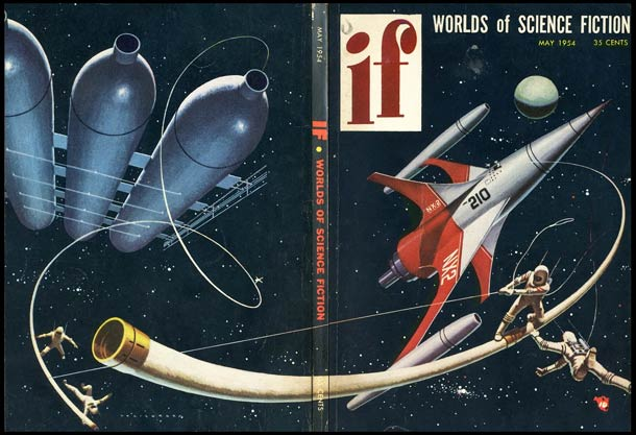
IF Magazine was a monthly science fiction magazine that was first published in 1952, and ran through 1974, before it was merged into its sister publication, Galaxy Science Fiction. Now, you can read the entire run online over on Internet Archive.
We’re suckers for fantastictravel posters , and artist Steve Thomas has created a set that we absolutely have to put up on our walls: posters inspired by the works of H.P. Lovecraft!
by Ria Misra on Gizmodo, shared by Ria Misra to io9
The foods readily available 35 years from now won’t look like the foods available today. Some of what we’re used to eating will be in short supply—and that new diet could cause an extra 500,000 deaths a year.
I’m happy to say that today I’m doing a review of a fun webcomic called Levi Levi and the Time Machine by LeEtta Schmidt aka leemsmachine.
LeEtta, the writer and artist of this comic, is an incredibly talented creator. Her website which displays her plethora of art which ranges from crafts, drawings, comics and fabric is well put together.
Levi Levi and the Time Machine is also well put together. Levi Levi, (that’s his full name by the way) according to his creator ‘ runs a detective agency/project manager consultant/anything you need fixer. He’s happiest when he’s on a job, and, when he’s not, needs someone to keep him in line.’ He is a dashing young man whose manner and willingness to get wrapped up in a mystery helps to draw you into the story from the beginning. Cute and easy to read, the comic’s art is wonderful, keeping the reader invested in wanting to know how it all ends.
The artwork is heavily stylized, the initial use of green, empty white space and heavy black lines reminding me of something akin to Dick Tracy, although the storyline more imitates Dirk Gently’s mysterious ways. If you liked reading about Douglas Adam’s detective then you’ll enjoy this story just as much.
The handwritten speech bubbles give it a down to earth slightly gritty tone that adds to the overall feeling of the story.
The change of art to show a different time period is fantastic and very well done, showing forethought by the artist and making the entire project feel more complete.
In my opinion this wonderful comic ends much too soon! There is so much potential for more story development including new lines of detective work. Some questions are not answered which leaves me hankering for more. I wanted to see what more trouble Levi Levi would get into and was very interested in seeing how his relationships developed with the other characters, but it seems for the moment what’s there is what you get.
Overall it’s a great little comic and I enjoyed reading it a lot. Some pages are just beautiful and it’s definitely worth a read! On top of that I’ve found that all of LeEtta Schmit’s work is worth looking into!
by Andrew Liszewski on Sploid, shared by Mario Aguilar to io9
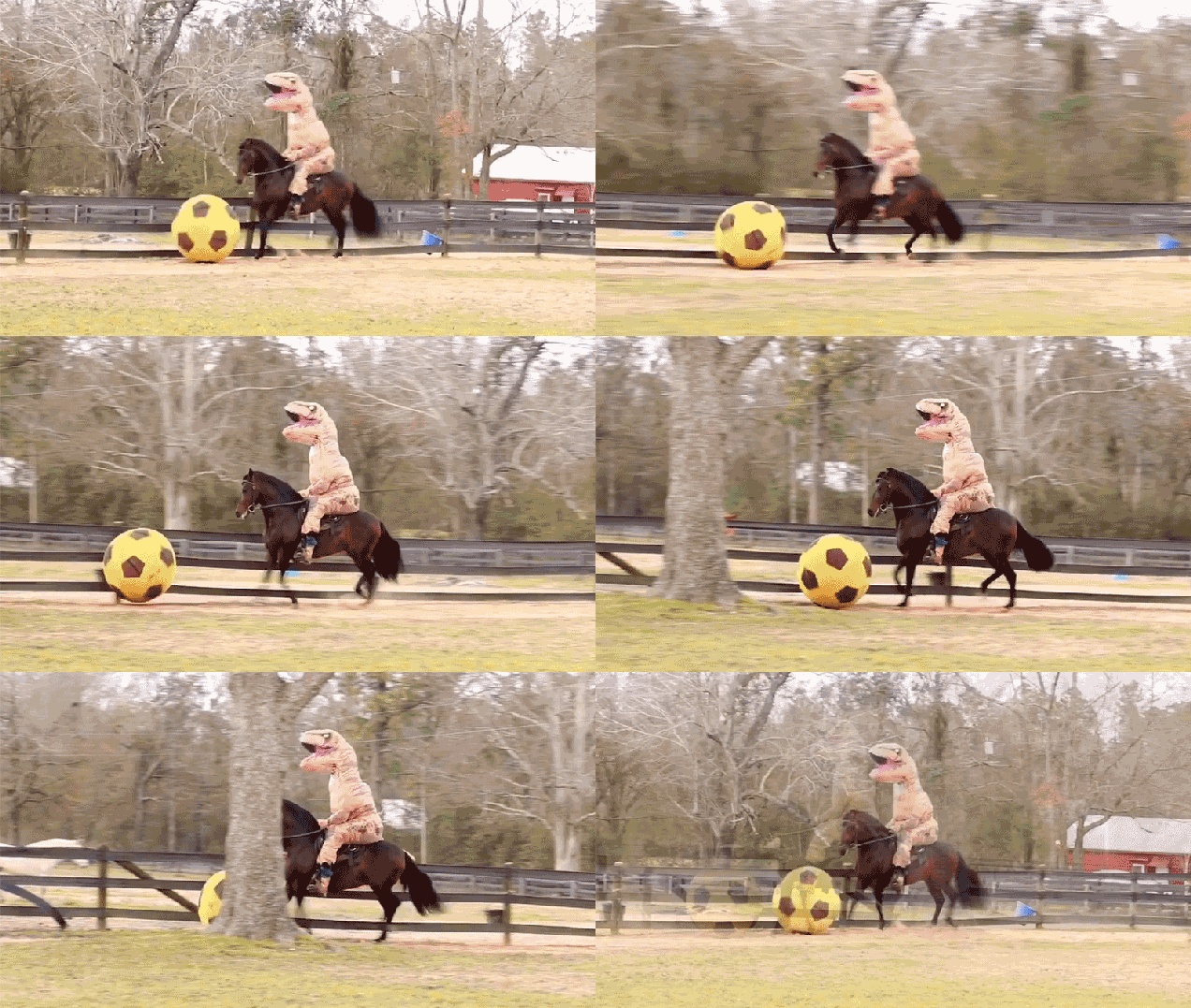
The internet has some dark corners, there’s no denying that. But how could humanity ever carry on without a tool that lets us share a brilliant video of a man in an inflatable T-rex costumeriding a horse kicking a giant soccer ball? Lets make sure we never do anything to endanger the world wide web, because how else could we possibly survive Wednesday afternoons without it?
by Maddie Stone on Gizmodo, shared by Adam Clark Estes to io9
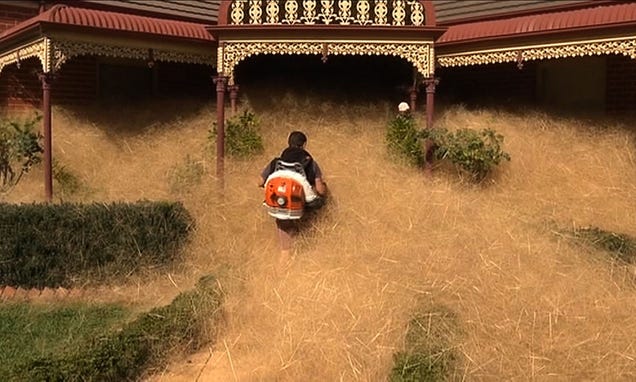
In America when we have droughts, mid-tier hotels stop filling their pools. In Australia, you get “hairy panic.” That’s the wonderfully apt name for the fast-growing tumbleweed currently consuming the town of Wangaratta.
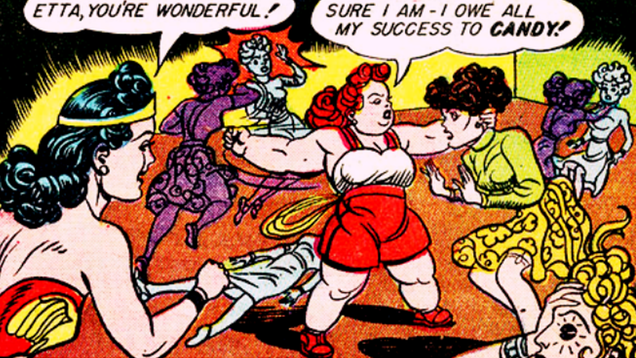
New set pictures of Wonder Woman filming have revealed that British actress Lucy Davis is seemingly playing one of the most prominent—and hilariously great—supporting characters in Wonder Woman’s comic book history: Etta Candy. And this doesn’t appear to be the New 52 version of the character, but the amazing classic iteration from WW’s debut in the ‘40s.
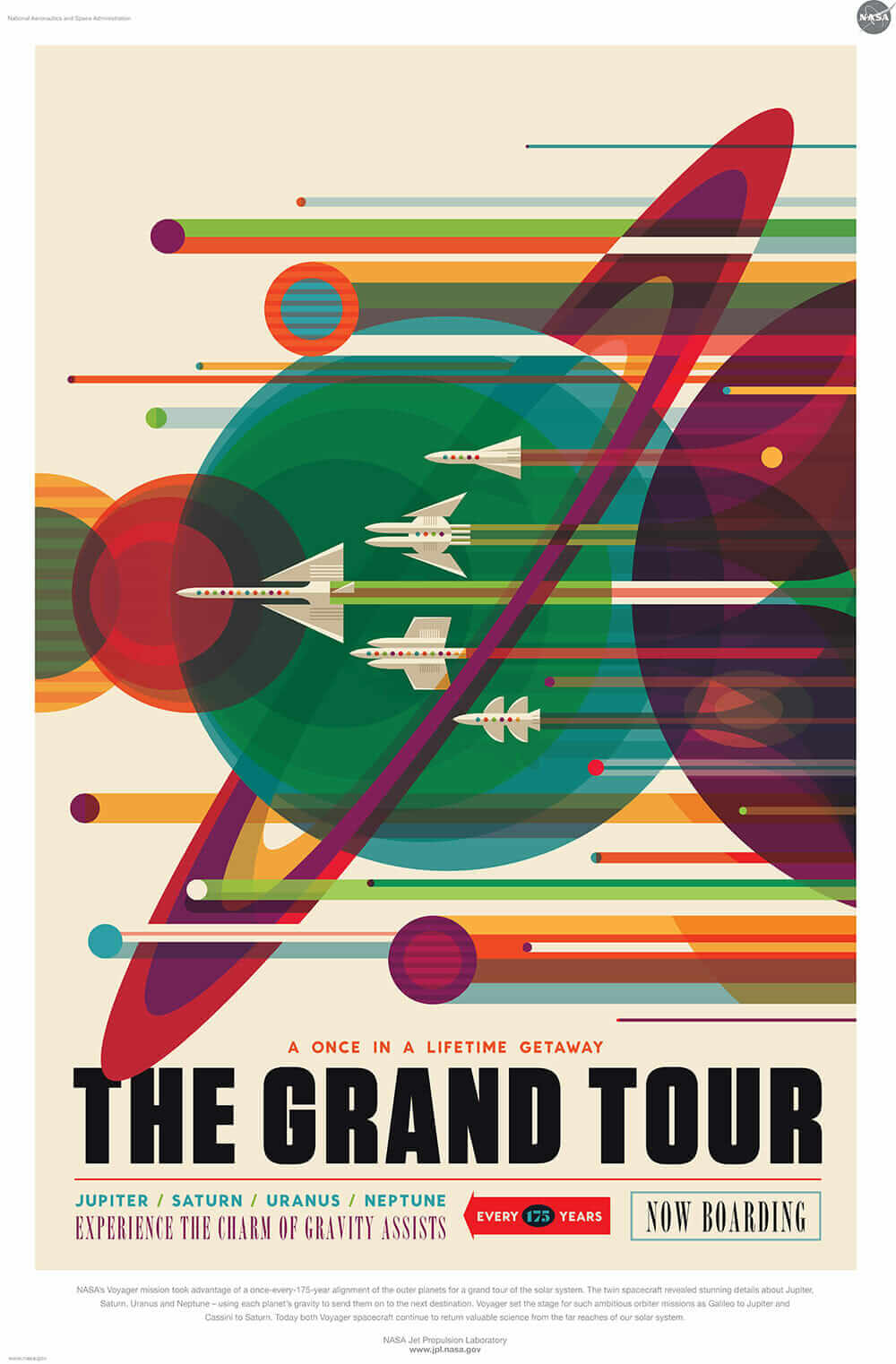
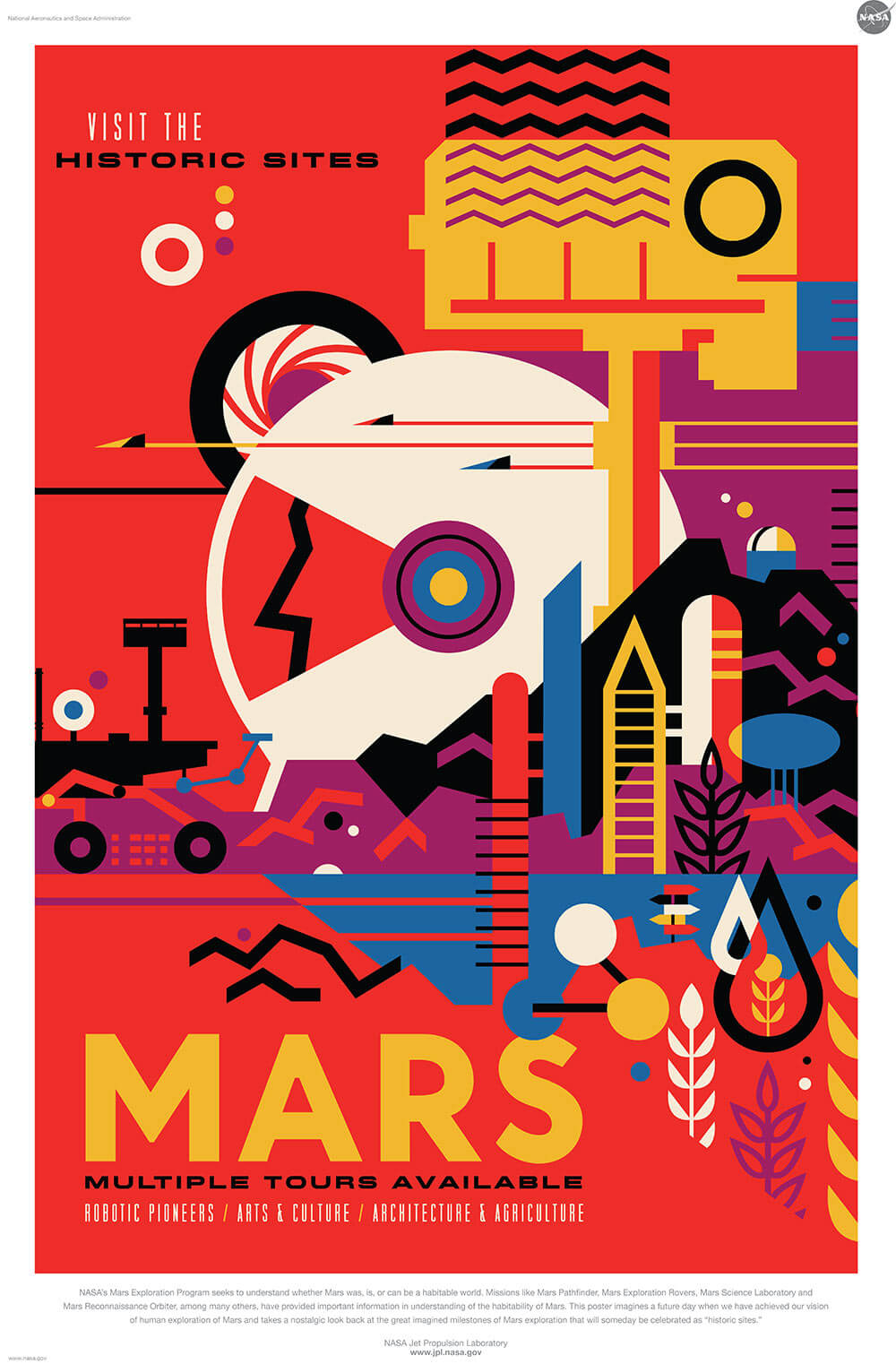
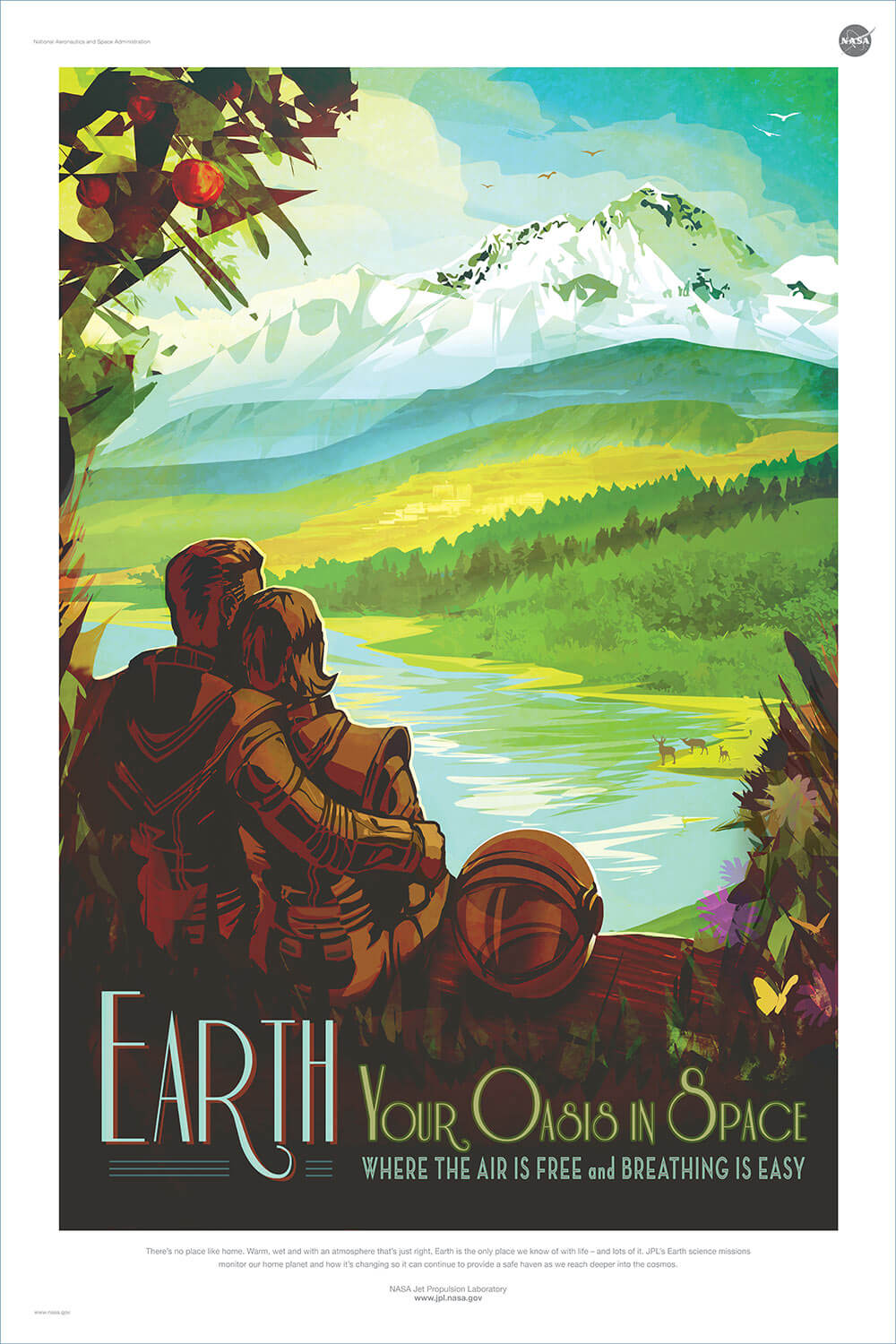
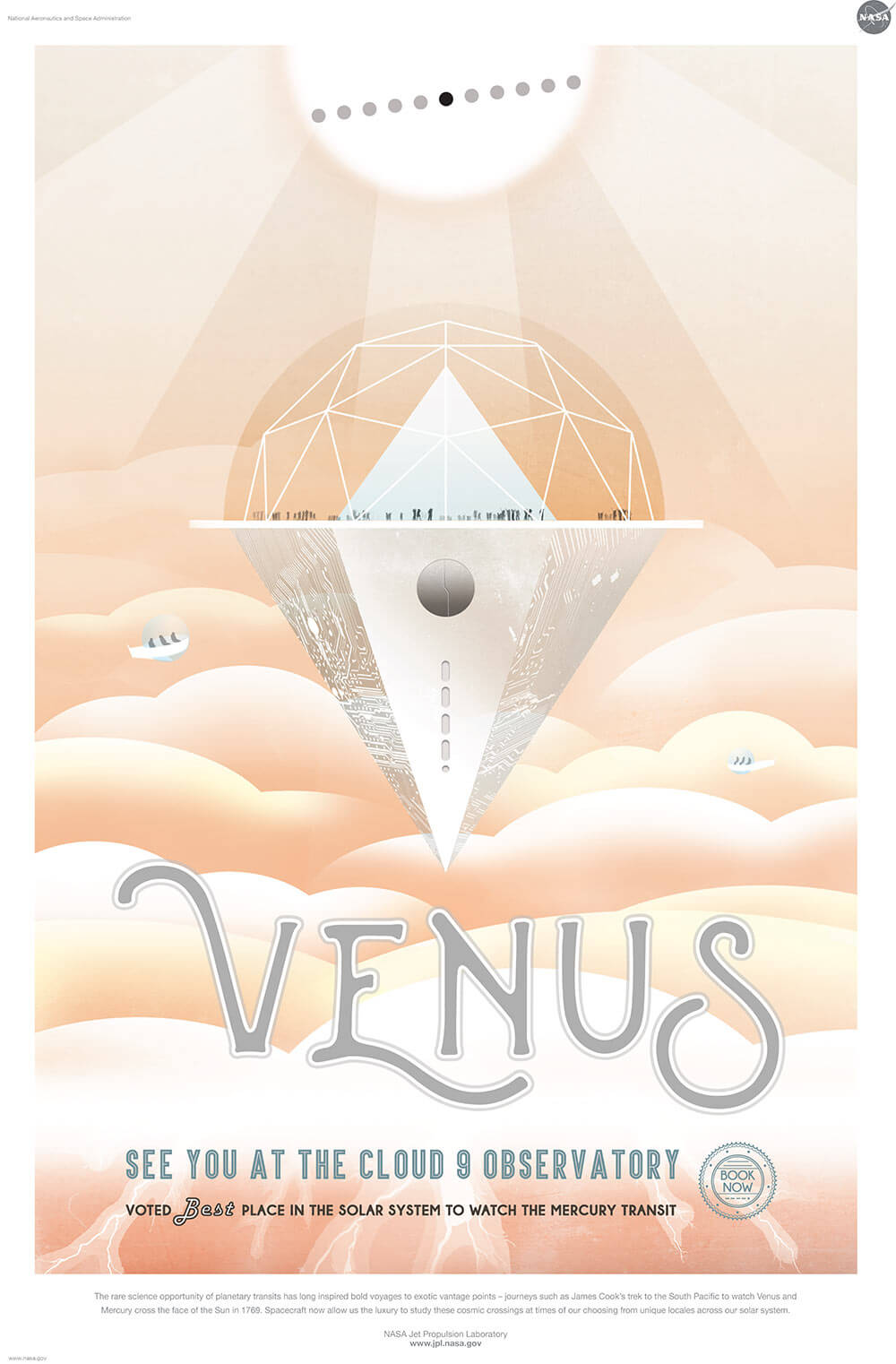
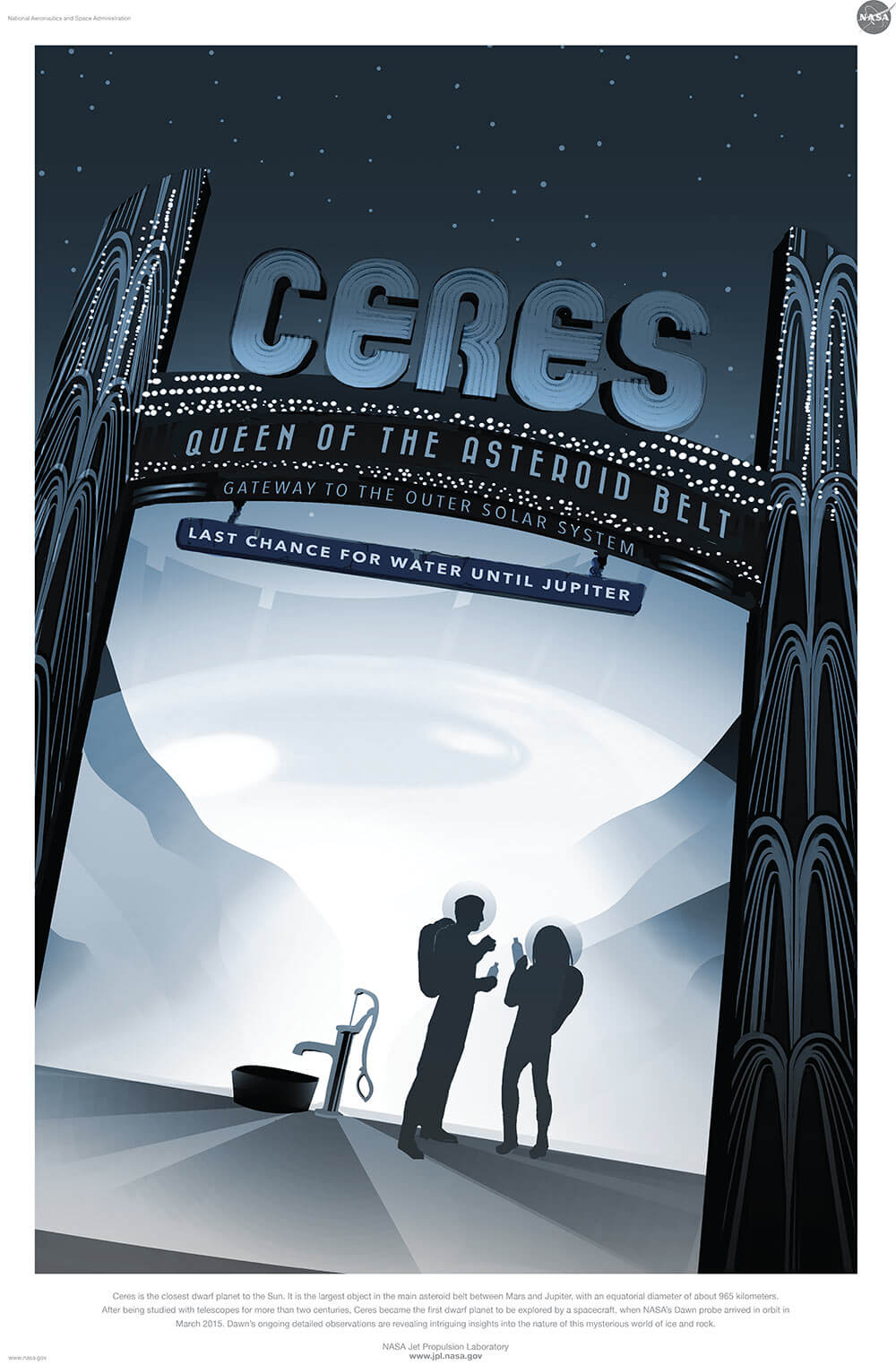
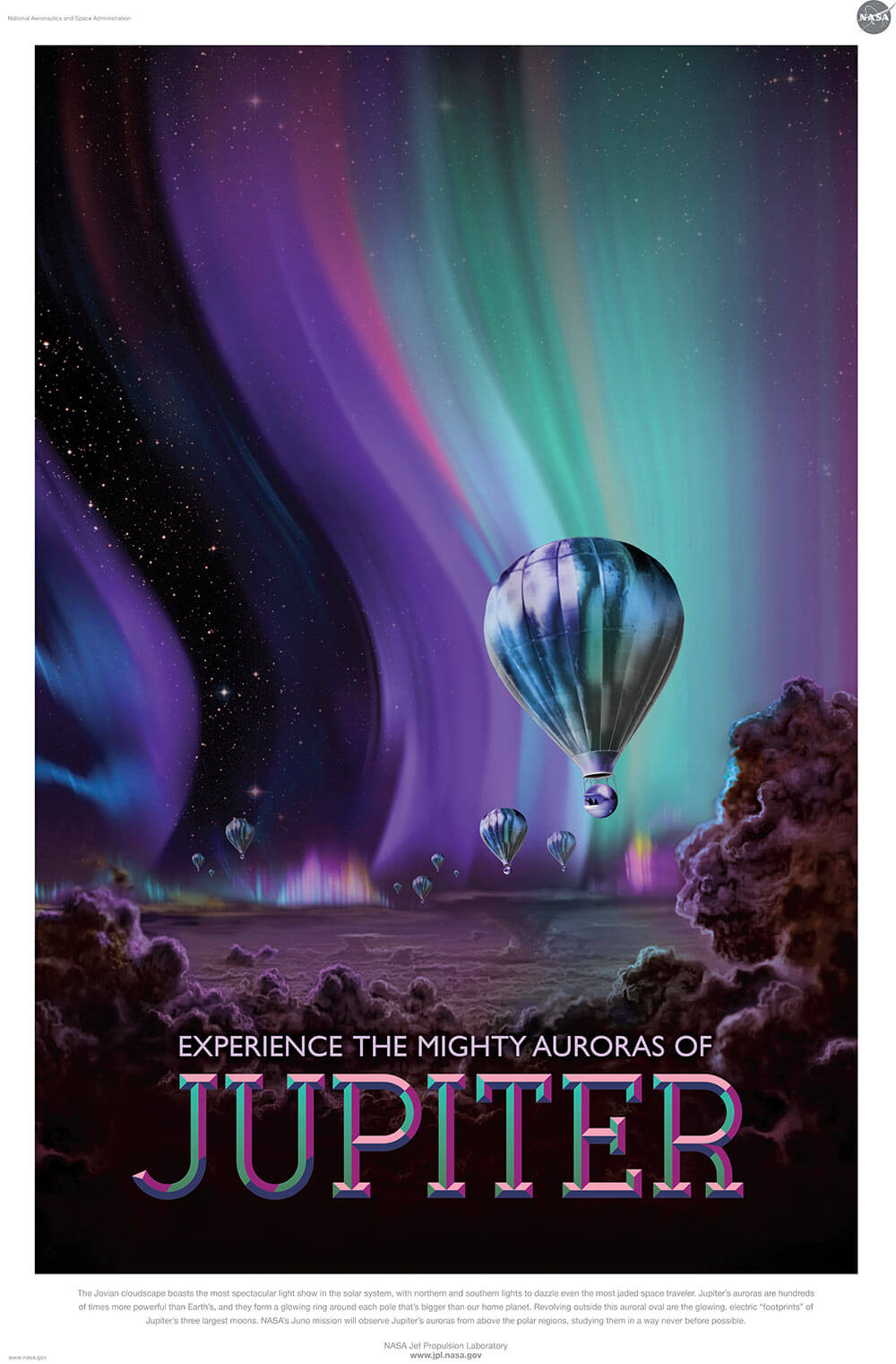
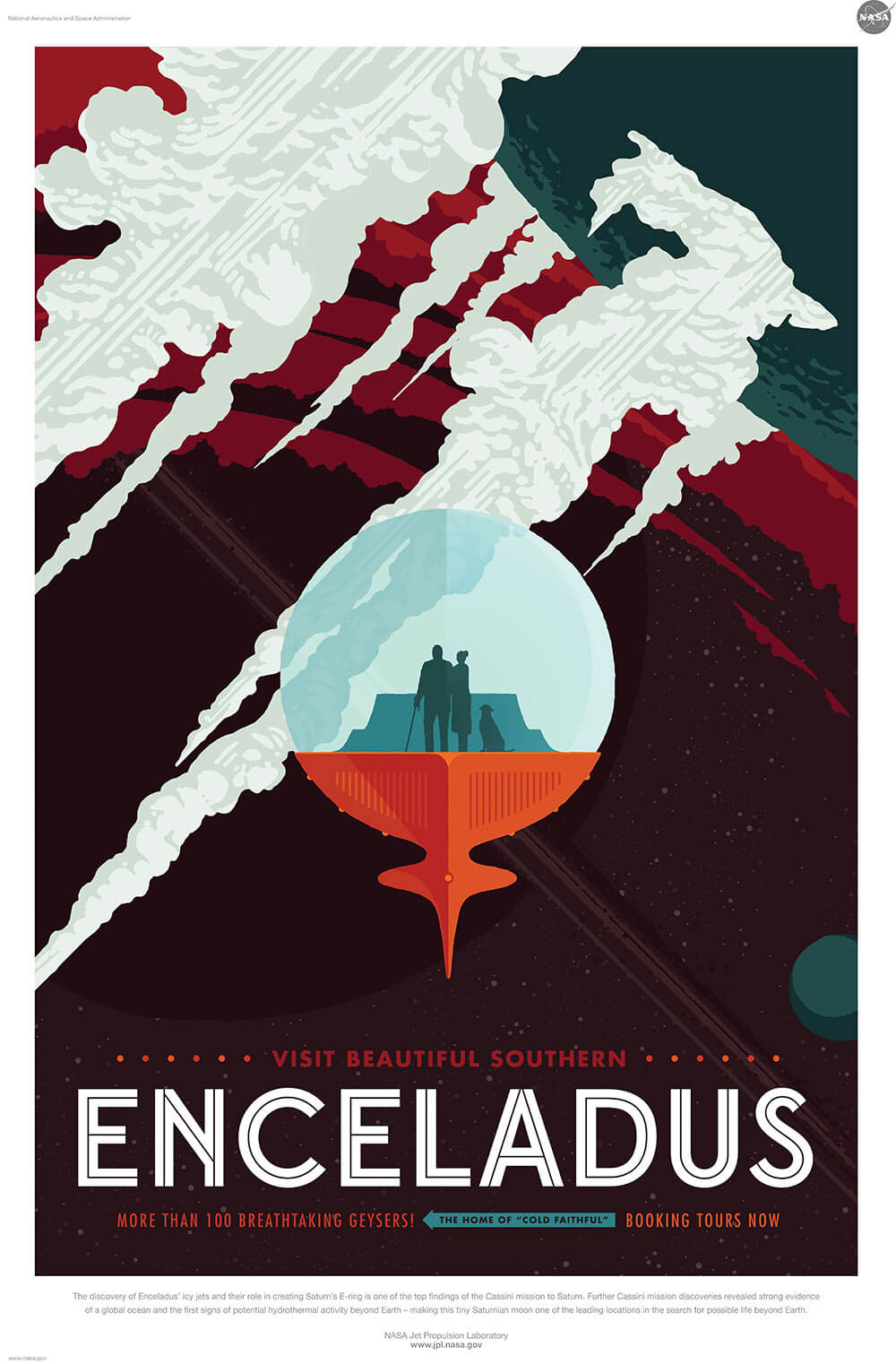
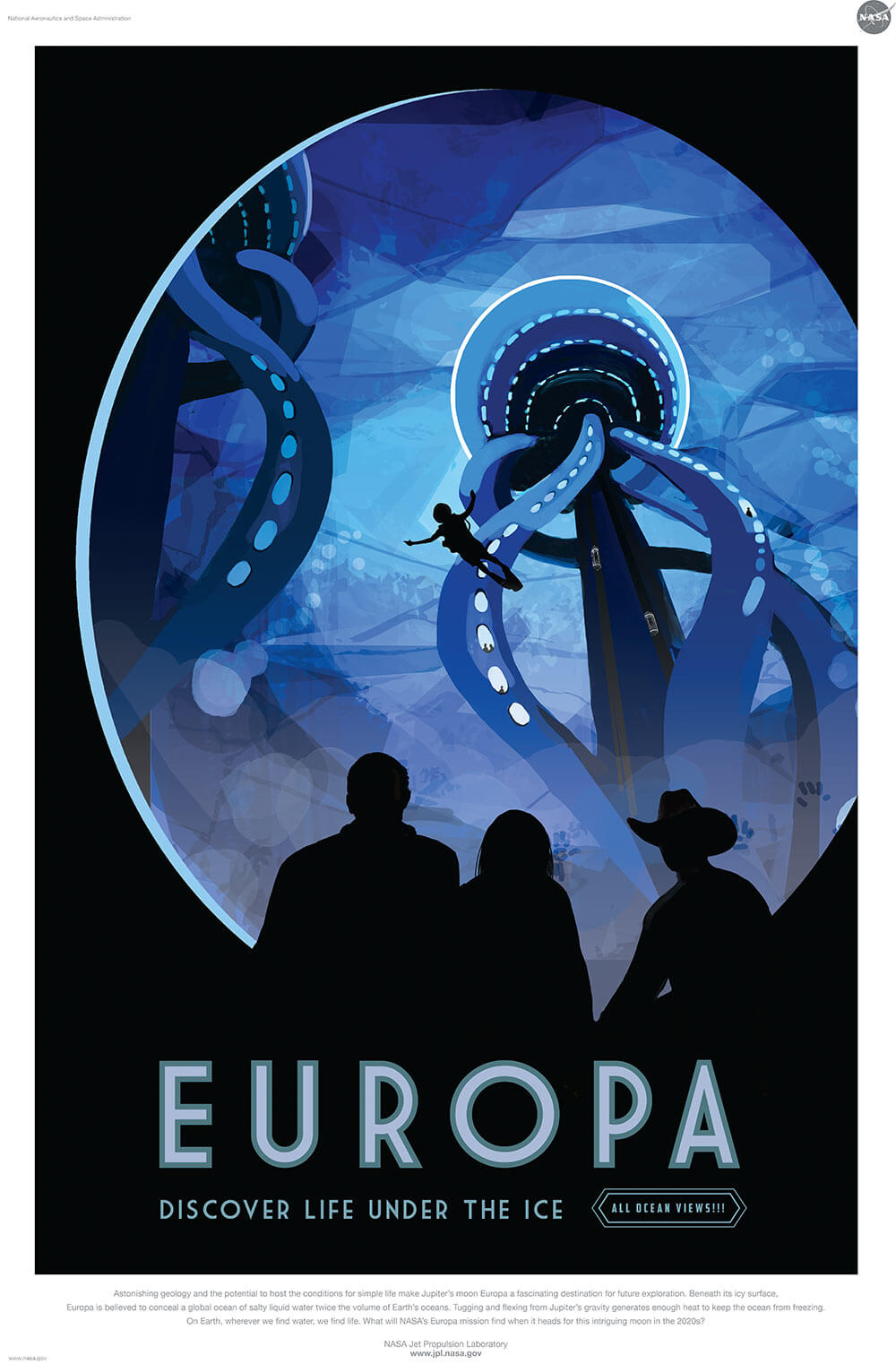
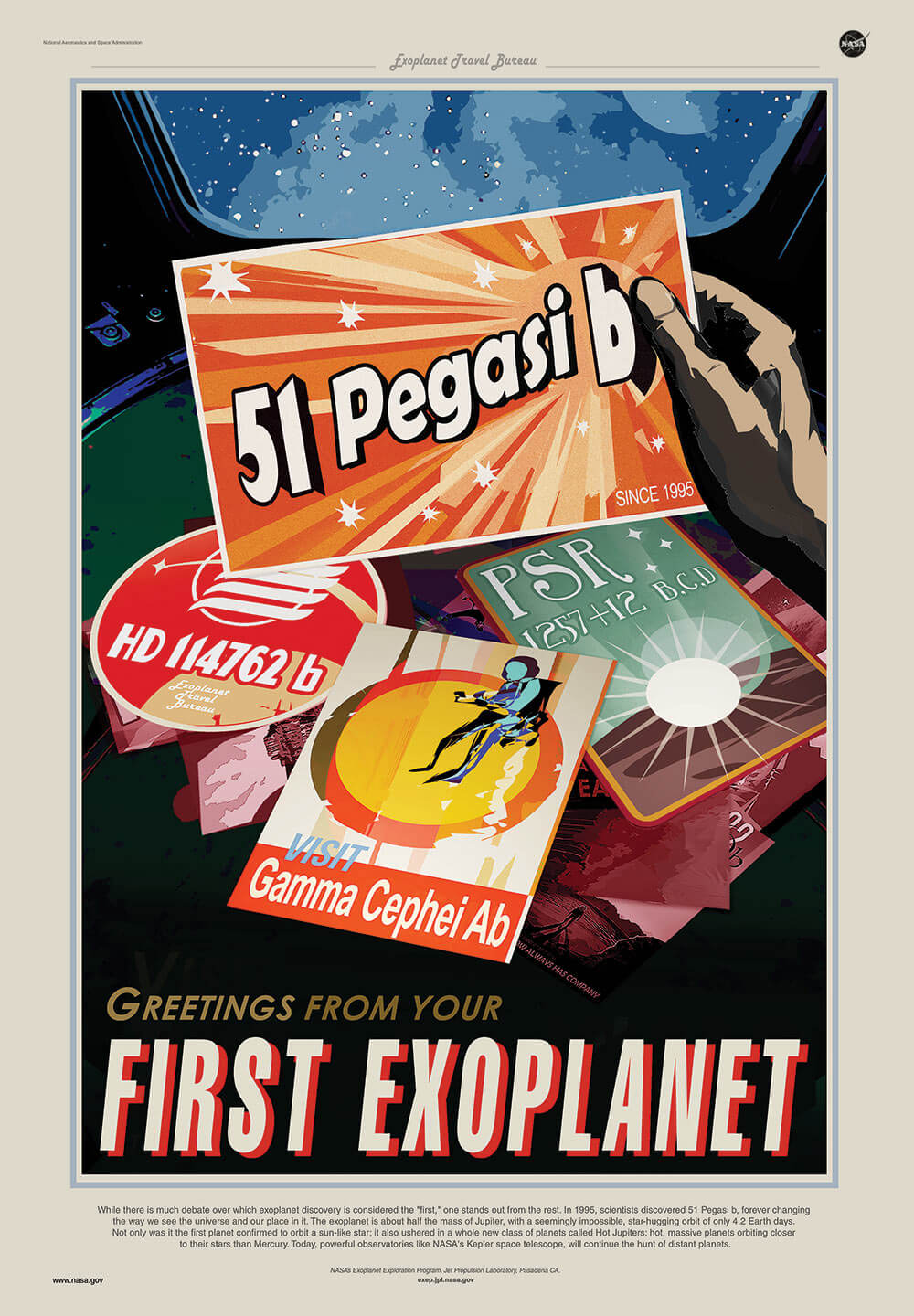
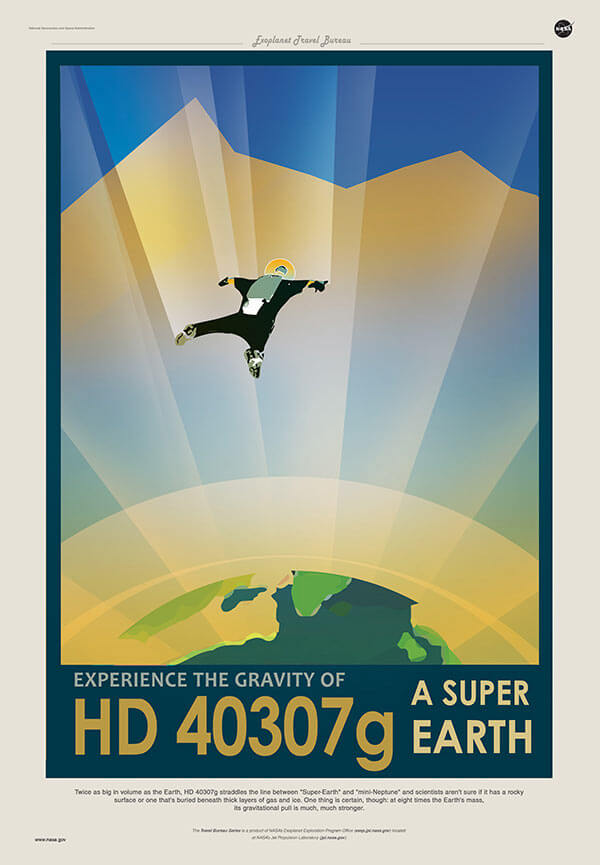
We love vintage travel posters — but how about futuristic space travel posters designed in vintage style? Yes: NASA and the Jet Propulsion Laboratory at California Institute of Technology (JPL) have commissioned a new set of 14 posters celebrating space travel — and they are available — FREE — for us to download, print, hang… and ponder. We also found where you can buy already-printed copies of some of the posters, too.
(P.S. We know we’re late to the www party celebrating these posters, but we need to feature this story anyway, for all present and future retro-crazy generations.)
Imagination is our window into the future. New travel posters from NASA’s Jet Propulsion Laboratory, Pasadena, California, envision a day when the creativity of scientists and engineers will allow us to do things we can only dream of now.
You can take a virtual trip to 14 alien worlds, and maybe even plaster your living room with planetary art, via the new, futuristic space tourism posters. The posters are available free for downloading and printing at:
Last year, five posters depicting planets beyond our solar system were introduced as part of JPL’s Exoplanet Travel Bureau series. They are included in the latest set of 14 posters, which also show such locales as Mars, Jupiter’s moon Europa, Saturn’s vapor-spewing moon Enceladus, and the dwarf planet Ceres.
The posters are the brainchild of The Studio at JPL, a design and strategy team that works with JPL scientists and engineers to visualize and depict complex science and technology topics. Their work is used in designing space missions and in sharing the work of NASA/JPL with the public.
A shout-out to the Smithsonian, where Pam first read about these posters.
Two designs by Invisible Creature also for sale as posters:
Don and Ryan Clark, owners of Invisible Creature, underscore that this design project was a particular labor of love: “Our grandfather, Al Paulsen at his desk at NASA’s Ames Research Center at Moffett Field in the 1960’s. He was an illustrator and graphic designer at NASA for over 30 years. This project was obviously a special one.” Thanks to the Clarks for giving us permission to show this wonderful photo!
The Seattle design firm Invisible Creature — owned by brothers Don and Ryan Clark — created three of the posters: The Grand Tour, Mars, and Enceladus. Invisible Creature made prints of three of the posters — two are still available for sale (the other, already sold out.)
You need to print your digital photos. Not next year, not when you have more free time—right now. I don’t care if your favorite dank memes are playing at the picture showhouse tonight (or whatever the kids are doing for fun these days). Start your first photobook tonight. It’s now or never. Your future self will be grateful. And the friends and relatives who will be digging through your shit after you die will be even more grateful.
by Michael Nunez on Gizmodo, shared by Mario Aguilar to io9
Artificial intelligence researchers at Google DeepMind are celebrating after reaching a major breakthrough that’s been pursued for more than 20 years: The team taught a computer program the ancient game of Go, which has long been considered the most challenging game for an an artificial intelligence to learn. Not only can the team’s program play Go, it’s actually very good at it.
This week, the 6th Street Bridge in LA is being torn down. The iconic structure has been used in numerous films over the years, and Vashi Nedomansky wanted to commemorate its use as a set location throughout cinematic history.
In my review I tell the real story of Hercules, George Washington’s slave-cook, a story far different from the happy fictional one in the book, which was promoted as “based on real events.” SPOILER ALERT: On Washington’s 65th birthday, Hercules didn’t bake a cake– he escaped.
The book was withdrawn by the publisher over the MLK holiday weekend, but the issues it raises are larger than this particular book. We should tell the complicated truths about America’s founders and founding and stop lying to our children about the past.
Like a spooky monster, copyright creep can slither its way into many aspects of life.
I’m not talking about a spooky looking monster, dead set on ending the world as we know it, or a sticky ooze that slowly trickles over the planet because we destroyed the rainforest. Copyright creep is an expression that refers to the expansion of copyright law and policy, inching and slinking its way into aspects of life that surely James Madison did not anticipate. Copyright extension, end user license agreements (EULAs), automatic copyright, digital rights management (DRM)…and the list goes on.
DRM, for example, which was initially employed to limit copyright infringement in the digital environment (“don’t open that lock, if you don’t have the key”), has become a way of limiting competition and consumer choice in the marketplace. And not just copyrighted works. We have light bulbs, printer cartridges, pods of coffee, and cat litter boxes that are protected by DRM because there is software or some other digital technology inside the product that makes it operate. If you want the product to operate in a different way—say use water rather than the industry specified cleansing solution to clean your litter box– well think twice. This is a violation of copyright. Copyright creeped into the life of the everyday coffee drinker, the lawful owner of the Keurig machine, but evident examples of the way the Internet of Things has implicated copyright law is only part of the story.
Copyright creep has affected the way people perceive risk, even in the non-digital world. I get questions from librarians who are wondering if it’s okay for the school principal to read a poem aloud at commencement. I’ve been asked if children can draw pictures of Garfield, because some kids can draw a picture that looks so much like Garfield, it must be a copy. One teacher wondered if she could tape 2nd grade students singing Christmas songs. Why are people concerned with these things? Did they develop overly cautious and sometimes irrational rules to protect themselves, their jobs and their institutions? Copyright lawsuits, with huge statutory damages sought from mothers videotaping their toddlers dance to music, seem to be an everyday occasion. I believe people fear copyright like they never have before. Hey, the Girl Scouts were sued for singing Happy Birthday—a song that some proclaim is still protected by copyright (it’s not)—so no one is safe from the copyright creep.
The copyright creep may be the most dangerous when it crushes intellectual and artistic freedom. There are lots of examples of documentary filmmakers who worry about the risk of liability when music or television is playing in the background of their films. How about the dancer becoming concerned about copyright when she notices she may be dancing too much like Martha Graham. Is she infringing Martha Graham’s copyright? A public library in Connecticut was forced to take down a painting that included a depiction of Mother Teresa among other famous women, with one in the group holding a Planned Parenthood sign. A conservative elected official didn’t like seeing Mother Teresa standing with a pro-choice advocate, so why not use copyright law to take care of the problem? Apparently Mother Teresa is protected by copyright, and depictions of her without the prior permission of Mother Teresa are forbidden. Didn’t you know that?
Yet, I see hope on the horizon for eradicating copyright creep. Education is part of the solution. We need to better inform people so they have a clearer understanding of what copyright is. It was created to advance learning, creativity and innovation. By understanding that technology is not inherently bad, the courts have made sound decisions about fair use. People can do things with technology that they never could do before (like making YouTube videos), and that’s okay. Congress is considering ways to limit the reach of anti-circumvention DRM so people can use their lawfully purchased products in the ways that they desire. Communities have developed fair use best practices to provide copyright guidance. Balanced copyright advocacy has grown.
We have seen the copyright creep and understand its purposes and targets. You can see it in the daytime as well as at night so it is easier to report sightings. The creep emits a bad smell from its murky dealings so we know if it is right behind us. We will learn more about the creep by remaining diligent. And we will be ready. We have a slew of library and user advocates ready to do their part to get rid of the creep, or just make it go away… far, far away.
ALA is taking part in Copyright Week, a series of actions and discussions supporting key principles that should guide copyright policy. Every day this week, various groups are taking on different elements of the law, and addressing what’s at stake, and what we need to do to make sure that copyright promotes creativity and innovation.
by Chris Sellers, Professor of History, Stony Brook University
Up until the 1940s, as much as half of U.S. water piping from main lines was made of lead. Thomashawk/flickr, CC BY-NC
As the crisis over the water in Flint, Michigan, rolls on, we’re learning more and more about the irresponsibility and callousness of officials and politicians in charge.
The mix of austerity politics, environmental racism and sheer ineptitude makes for a shocking brew, yet the physical conditions that have made it literally toxic for Flint residents are neither as exceptional nor as recent as much of the media coverage suggests.
Long before that fateful decision two years ago to turn to the Flint River for the city’s drinking water, pipes made of lead had threaded throughout the city’s underbelly. Flint shares this historical legacy with thousands of other cities, suburbs and towns across our country, and most likely this is not the first time, even in Flint, that these pipes have conveyed tiny amounts of the toxin into homes and children.
Over the past few decades, our environmental laws and agencies have met with much success in curbing some of Americans’ exposure to lead, a damaging neurotoxin. Yet they have struggled to contain this continuing danger precisely because it is literally built into our water systems.
Given that lead has been known as a poison for centuries, why did our forebears in the 19th and early 20th centuries rely on it to carry so vital a fare as drinking water? The answer to this question explains why there are many more Flints waiting to happen.
Lesser evil
In the 19th and early 20th centuries, from an engineering standpoint, lead seemed superior to concrete or iron, the alternatives at the time when many municipal water systems were being built. Lead is more malleable and thus easier to bend around corners. It also lasts longer.
Doctors offered virtually no resistance to this decision. After all, they themselves were turning to lead to treat diarrhea or trigger abortions. They recognized only those symptoms of lead poisoning that by today’s standards seem extreme: the severe stomach aches, muscle weakness, kidney failure, seizures and even death that can ensue when lead in the blood rises past 60 micrograms per deciliter – 12 times the current standard.
While lead pipes did occasionally produce “epidemics” this dramatic, health officials remained far more worried about diseases like typhoid, which they knew piped-in water could prevent. As a result, as much as half of the water pipes laid in America’s burgeoning metropolitan areas during the early 20th century were made of lead.
It is also worth noting that lead pipe made up a relatively minor portion of the burgeoning flow of this toxic metal into early 20th-century factories, homes (through paint pigments) and automobiles (through leaded gasoline).
Spurring it along, the lead industry grew rich and powerful. In the time before the advent of the Centers for Disease Control and Prevention (CDC) or the Environmental Protection Agency (EPA), it sponsored its own health research. Some investigators even advanced a thesis that levels of lead in the blood and environment that, in retrospect, seem quite high, were “normal,” a not-so-worrisome condition of modern life.
That we have come to know so much more about what lead can do is thus an important part of the story unfolding in Flint.
As investigators of lead’s effects gained greater funding and independence and honed their methods, our understanding of its subtler and longer-term effects grew.
Research on children has shown behavioral disorders, learning difficulties and lowered IQ’s turning up at blood and environmental levels far below what was earlier thought safe. Over the past 30 years, the CDC’s recommended blood levels for lead in the young have dropped precipitously, with no level now acknowledged as really safe.
How standards for lead in water and blood got tighter as we learned more.
Chris Sellers
With greater knowledge of lead’s damaging effects, a concerted campaign against lead started in the 1970s. A ban on its usage in paint in 1978 and a phase-out from gasoline into the 1980s have had considerable impacts.
A 1974 law to control lead in drinking water had less success, however, because it focused on what got pumped into pipes rather than what showed up in people’s faucets.
After an EPA study in 1986 showed one in five of the nation’s drinking water systems carried more lead than considered safe, Congress passed a new Clean Water Drinking Act the same year. This law is still the basis for our current efforts to control the lead that can leach from our water pipes.
Michigan Republican politicians, including Governor Rick Synder, have borne much blame for the Flint crisis – and some of them continue to invite more. But their party was instrumental in the genesis of this act.
It was Ronald Reagan who signed the bill that finally banned the use of leaded pipe and high-lead soldering. And it was George H. W. Bush’s EPA that implemented it, through a 1991 Lead and Copper Rule that required “high-risk residences” to be monitored, with further measures if 10 percent of households exceeded unsafe lead levels of 15 parts per billion (ppb) in their tap water.
Dropping anti-leaching agents
The Clean Water Drinking Act, along with environmental and health officials, did encourage gradual replacement of lead pipes with nontoxic materials such as PVC. But municipalities mainly turned to a chemical fix to lower lead levels, namely anti-leaching agents. Cheaper and faster-acting, these substances could largely prevent lead from entering the water from pipes, soldering and when the source of drinking water changed.
The lead poisoning in Flint recalls a similar water emergency from the early 2000s in Washington, D.C. that highlights the risks of relying on anti-leaching chemicals.
That crisis began in 2001 when the District of Columbia Water and Sewer Authority (WASA) rather suddenly discovered lead levels in its testing that exceeded EPA’s action level.
The Clean Water Drinking Act of 1986 led to replacement of lead water pipes with copper and PVCs.
Pixabay
The fact was, however, that by 2003 the dimensions of the crisis had become unmistakable. Nearly two-thirds of the water sampled (in “high-risk” homes) exceeded the action level – this in a water system of a half million customers, far bigger than Flint’s.
As with Flint, reports from some homes ranged much higher, upwards of thousands of parts of lead per billion, surpassing levels in wastes deemed officially “hazardous.”
In Washington, D.C., as in Flint, excess lead in faucets owed much to a decision to abandon anti-leaching agents, in this case by the Army Corps of Engineers, whose aqueduct furnished the water for WASA. Cost was part of their rationale, but apparently less so than in Flint; they and the EPA officials who vetted their decision were more worried about high levels of bacteria. What then drew out the lead from existing pipes was a new set of disinfectants also applied by the Army Corps, called chloramines, which had a powerful leaching effect on the lead in the system’s old pipes and joints.
Spotty monitoring
There’s been one big difference between D.C.’s leaded water crisis and that of Flint: the speed and certainty with which the effects have been documented in the blood of water drinkers.
Because understanding of the hazards of lead was slow, lead pipes are commonplace around the U.S.
intangible/flickr, CC BY
What both these experiences make clear is just how risky it has become to rely on monitoring that remains spotty and on chemical treatments, which can be easily abandoned.
We’d now do well to consider the ultimate cause of this type of lead poisoning: the built-in legacy of America’s last leaded century, those old, ever-dangerous conduits by which so many of us still get our drinking water.
Currently, their replacement happens only sporadically, in the wake of crises, if then.
From 2003, the Washington, D.C. government has spent millions digging out and replacing its toxic piping. The mayor of Flint has called for a similar project there, yet so far, promises of support have failed to materialize.
An estimated three to six million miles of lead pipes across our country still carry water, and most all of them are vulnerable to similar dangers, whether at the hands of short-sighted and prejudicial bureaucrats or politicians whose ideology or opportunism leads them to blithely dismiss well-established science.
The best solution would be to replace our lead lines systematically and proactively, not just one crisis-beset city at a time. Until we do so, it’s a safe bet that more Flints lie on our horizon.
Chris Sellers does not work for, consult, own shares in or receive funding from any company or organization that would benefit from this article, and has disclosed no relevant affiliations beyond the academic appointment above.
Mean book reviews are a fact of life nowadays. And if you spend any time in a workshop, you’re going to hear some pretty harsh feedback. But Cecilia Tan, the erotic speculative fiction mastermind behind the Magic University books, has some brilliant advice on her blog.
by Miemie Struwig, Professor, Department of Business Mangement, Nelson Mandela Metropolitan University
Social media can benefit or harm universities – and it must be carefully managed. Shutterstock
Social media is a risky space. Many people have learned this the hard way – 2016 began with several South Africans losing their jobs after making racist comments on Facebook and Twitter. Social media has also been used to expose people who hold racist views.
These incidents are a reminder that organisations increasingly need to create procedures and practices to manage their reputations. Employers must understand the risks involved as they and their stakeholders set out to engage with the wider community on social media. For universities, this risk is extended to staff and students who are associated with or formally linked to an institution.
For instance, the University of Pretoria suffered a serious backlash when two of their students donned “blackface” for a costume party and posted photographs of themselves online. They were charged with bringing the university into disrepute.
We have conducted research – due to be published soon – that shows South Africa’s higher education institutions should take this issue more seriously. Most universities don’t have formal social media policies. Some don’t seem to have considered social media as a potential risk to their reputation at all.
Formal policies are rare
Our research involved 23 of South Africa’s 25 public universities. The aim was to investigate whether they had social media policies at all and how they generally managed social media. The results show that:
91% of universities don’t have formal social media policies;
four universities were in the process of approving draft social media policies. These were not available for us to examine at the time of the study; and
61% don’t have any formal document that manages social media.
We were able to obtain nine documents – social media policies, guidelines or strategies – for analysis. Here are the key findings from those documents:
44% focus on social media only as a risk to the institution. 33% focus on it as both a risk and a relationship-building tool, while 22% focus on it only as a tool for building relationships;
most of the documents refer to “brand” and “image”. Just 22% focus on brand, image and reputation;
56% referred directly to disciplinary action for those who transgress the guidelines within the document; and
67% offered both professional and personal guidelines in the use of social media.
Universities need to understand the important role played by social media in their corporate strategies to obtain optimal results for sustained growth and development.
Reputation is everyone’s problem
The next step was to learn how universities without formally adopted policies manage their social media activities and reputation. We interviewed one person from each of 11 universities to gain deeper insight into their approach to social media. The questions also explored how universities used social media other than for marketing functions.
The responses suggest that universities know they must develop social media policies to address risk-related issues. But most don’t see that policies should also be used to harness the potential advantages offered by social media. These include as a space for recruitment, sharing research or crisis management.
Instead, universities are very focused on organisational reputation as a branding issue – and they believe reputation is the ambit of a communication or marketing department rather than any other unit or group.
This isn’t the case. Employees and students need to be aware that although they are using social media in a personal capacity, they may appear to represent a university. They are recognised as an employee or student of that university, and their social media utterances can damage the institution’s reputation or perhaps enhance the reputation.
It’s time to get proactive
Universities in South Africa have neglected the development of social media policies until now. They may not yet have experienced the need for a formal management system. This is because communications teams still tend to be the ones dealing with crises or instances of bad behaviour on social media.
But mistakes of any kind on social media result in reputational, legal and ethical issues. The abuse or misuse of social media relationships has consequences.
It is time for universities to be proactive and get systems in place to manage these risks. This can be done by formulating and implementing social media policies and management systems for their institutions.
Miemie Struwig's student and co-Author to this article received funding for her PHD studies on which this article is based from the NRF.
Amanda van den Berg and supervisor Prof Stuwig (co-author) received funding from NRF and RCD NMMU for this study.
It was, by any measure, a giant. On January 17, patrol helicopters off the coast of southern Australia reported seeing a great white shark “nearly as big as Jaws”. In fact, it was estimated to be up to 23ft long, only marginally smaller than the infamous movie killer – and it came to within just 100 metres of the shore. Perhaps unsurprisingly, the connotations with Peter Benchley’s 1974 novel sent the internet into its usual frenzied panic when such a “monster” is spotted.
Last summer, videos of what many believe to be the largest white shark ever caught on film also sent the internet into meltdown. These large sharks will always make headlines, but instead of igniting fear, they should be cause for celebration.
In recent years, many sharks – including the great white – have been severely reduced in numbers, with some species down by 90%. While calculating the precise numbers of individuals is difficult, there are promising signs that some white shark populations are now on the rebound. This is in part due to measures put in place to protect both the sharks and their main prey, marine mammals.
The sharks have either been killed by targeted commercial fishing for their fins and meat, or accidentally caught in other fisheries. Elsewhere, they are hunted for trophies, grandstanding profile pictures or because they are seen as a threat to humans. It has been estimated that between 63m and 273m sharks could be killed every year by fishing. Populations have reached such low numbers in places that some species now are at a high risk of extinction.
Which makes the latest sighting very special indeed. At a time when many species are struggling, such a large shark is a rare sight.
So how big was it?
There is a famous tendency to exaggerate the size of fish – and sharks, in particular. The referenceless of the ocean can make judging distances and length difficult and with no solid means to verify the size of this shark, we can’t say for sure that it really was seven metres long. While coast guards reported that the shark was bigger than their six-metre jet boat, it is hard to extract any biologically relevant information from the fleeting sighting other than it was a big shark doing what sharks do.
What we can say, however, is that large great white sharks are usually the old ones. And they can get really quite old. In fact, a recent study found that white sharks might live as long as 70 years. These older sharks are great for the population, because they have had ample opportunity to reproduce, introducing offspring into a dwindling population.
But in all the Jaws-style fanfare, it’s important to look also at how the local community has dealt with the sighting. In many places around the world, just as in the film Jaws, we might have seen a large-scale hunt undertaken to capture the “man-eating” monster and stop it from killing on their beaches.
The hunted hunter
Indeed, Western Australia recently controversially lifted the protective status of great white sharks and implemented a shark cull along its coast in an attempt to boost tourism after a spate of fatal shark incidents. But the programme came under huge criticism for failing to capture a single white shark and killing many other species not involved in recent fatalities.
Destroying sharks to increase beach safety has been widely criticised by the scientific community due to the huge impact that these methods can have on many aspects of the ecosystem. In the past, countless technologies and protocols were developed to reduce the number of fatalities from shark incidents, but with no unifying answer.
But the latest sighting offers fresh hope. What we have here is a community that is learning to share the ocean with these important ocean predators. Shark Alerts South Australia (SASA), the Facebook page where the initial sighting was shared, is emblematic of a community accepting the beauty and significance of the great white.
Following the sighting, local ocean events were cancelled and “shark sirens” were sounded. But while ocean users exited the waters, helicopters and boats were deployed not to kill, but to herd “the large white shark out to sea”. All the while SASA were sharing the information with its 55,000+ followers.
The community driven Facebook page is updated regularly and allows potential users to think twice before entering potentially dangerous situations. Last year they reported about 170 to 180 sightings, but as their followers continue to increase, so will their reports. This is a great example of how social media and advances in technology can help reduce the number of incidents, while educating people at the same time.
Age of the technoshark
In Western Australia, tagged sharks are now “using” Twitter to alert ocean users to their presence near local beaches. And in the scientific world, new technologies and autonomous underwater drones are being used to observe previously unseen habitats, feeding ecology and behaviors in great white sharks.
It has been found that many ocean users in Australia often encounter sharks, without harm, and support further research and education. These are all promising signs that we are moving away from the barbaric approaches to mitigating shark incidents. Instead, communities are learning to share the ocean with sharks, even profiting from tourism industries set up specifically to see them.
Sharks are hugely important for maintaining the balance and health of our ecosystems. Learning to live alongside them will be challenging and we still have a long way to go. But with changing perceptions and advances in technology, a peaceful coexistence with “Jaws” may be closer than you think.
Christopher Bird does not work for, consult, own shares in or receive funding from any company or organization that would benefit from this article, and has disclosed no relevant affiliations beyond the academic appointment above.
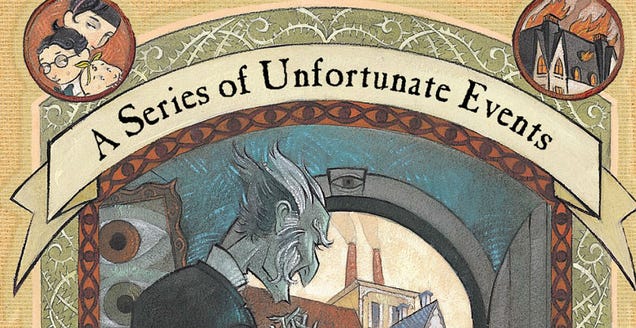
A few years back, Jim Carrey played the nefarious Uncle Olaf in the big screen version of Lemony Snicket’s A Series of Unfortunate Events. Now, that children’s book series is coming to Netflix as a show and they have their own Olaf: Neil Patrick Harris.
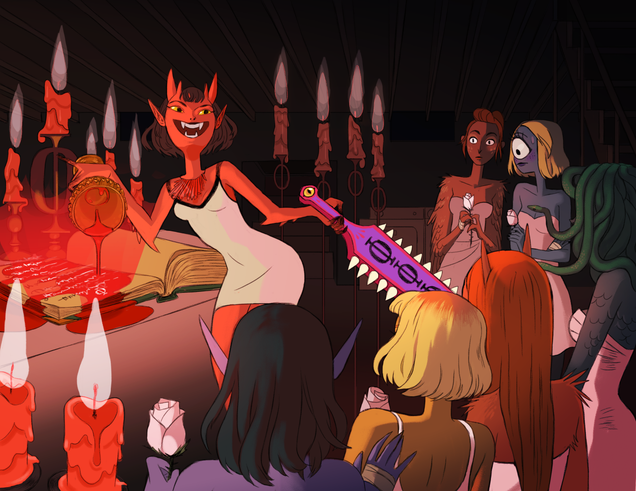
For her fall thesis at MICU, Molly Stanard brought us Tri Phi, a “sorority for collegiate monster girls.” Everything in her series is happening at the same time on a single Friday, confirming that Phi Phi Phi is the best sorority around.