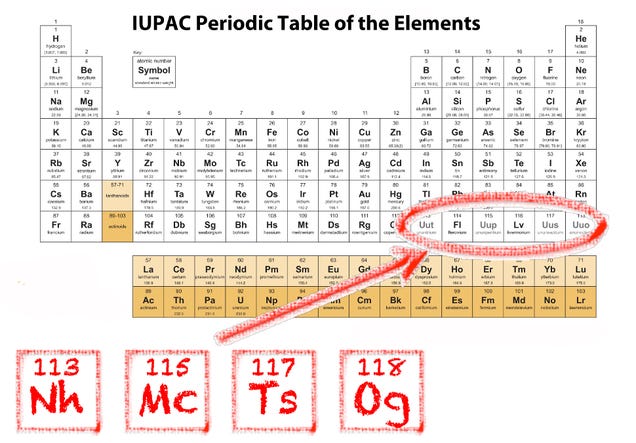
Scientists with the International Union of Pure and Applied Chemistry (IUPAC) have officially approved the names of four new elements, completing the seventh row of the periodic table.
Scientists with the International Union of Pure and Applied Chemistry (IUPAC) have officially approved the names of four new elements, completing the seventh row of the periodic table.

Have you ever found yourself dreading a leisurely activity you had eagerly scheduled days or weeks in advance?
I first caught myself doing this a few years ago when I was traveling home to Turkey. I had excitedly made plans to meet up with some old friends. But to my surprise, as the date approached, I started to feel reluctant and unenthusiastic about these long-awaited reunions.
“I have to go get lunch with my friend,” I’d grouse to others, making it sound like a chore.
Was I an anomaly? Or do other people feel this way too? We increasingly rely on scheduling to organize our lives: phone calls, appointments, dates – and, yes, fun social activities. But can planning leisure activities also start to feel like work, too? Why might they become a source of dread?
As someone who studies consumer behavior and decision-making, I decided to explore this phenomenon with Gabbie Tonietto, a Ph.D. candidate in marketing. With Tonietto leading the investigation (the results would eventually become a part of her dissertation), we conducted a series of studies to see if filling out our calendars – even with fun activities – can have unexpected side effects.
Across 13 studies, we found that the simple act of scheduling makes otherwise fun tasks feel more like work. It also decreases how much we enjoy them.
For example, in one, we asked participants to imagine grabbing a coffee with a friend. Half of the participants imagined that they planned this gathering a few days in advance and put it on their calendar, while the other half were told that they decided to grab a coffee on the fly. We found that this simple, relaxing activity was associated more with work-like qualities (“obligation,” “effortful,” “work”) when it was scheduled, compared with when it was impromptu.
In several follow-up studies, we found that simply scheduling something fun – like a movie or social outing – felt like work even if it was something you regularly did, was something new or special or when you had nothing else planned for that day.
In another study, we set up a pop-up café on a university campus during finals that served free coffee and cookies. We flagged down students studying for their finals and gave them one of two tickets. The first asked participants to choose and schedule a time for them to take a study break and enjoy the free treats. The second simply told them that the café would be open during a two-hour window.
After participants showed up and had their coffee and cookie, we gave them a short questionnaire that asked them how much they enjoyed their study break. As expected, we found that those who had scheduled the study break didn’t enjoy it as much.
So why can making set plans be such a drag?
We think that it has to do with how scheduling structures time. Scheduling, at its core, is about allocating time to activities. There are set beginning and end points. Such strict scheduling, however, is at odds with how people think about leisure and relaxation, which are associated with unconstrained freedom. As the saying goes: Time flies when you’re having fun.
On the flip side, structured time is associated with work activities: Meetings start and end at specific times, deadlines loom and the specter of the clock is omnipresent.
So when your weekend is structured and planned – even if the activities are fun – they start to take on some of the qualities we tend to associate with work.
In another one of the studies, we asked participants to imagine that they’d just decided to spend their afternoon at a forest preserve doing a variety of activities, like canoeing and guided hikes. We told half the participants that they’d simply do two activates with a picnic in between. The other half were told they had signed up for activities at specific times (say, 12:30 p.m. to 2 p.m.), with time reserved in between for a picnic. Basically all the participants were making a spontaneous trips to the park and all were going to participate in similar activities. The only difference was that some of the participants had strict schedules, while others didn’t.
We found that structuring not only made the activity feel more like work, but also decreased participants’ desire to engage in them. In other words, even an impromptu leisure event starts to feel like work once it’s structured.
But this doesn’t mean that scheduling will take the fun out of everything. After all, you can’t do everything on the fly. For those who do need to make plans days or weeks in advance, something called “rough scheduling” can work wonders.
Because scheduling can make weekend activities feel like work, we reasoned that relaxing the structure might alleviate some of these negative consequences. To test this idea, we asked students to either schedule a get-together at a set time or by referring to a gap in their day (“between classes”). We found that eliminating specific boundaries not only increased excitement, but also worked as well as doing something spur of the moment.
So next time you want to make plans, make them flexible. You’ll feel less constrained – and more likely to have fun, too.

Selin Malkoc does not work for, consult, own shares in or receive funding from any company or organisation that would benefit from this article, and has disclosed no relevant affiliations beyond the academic appointment above.

In a world of mass communication and social media, people seem prepared to share their opinion on almost any subject.
When it comes to remembering a conversation you were involved in, in most cases the deciding factor is the contribution you made to that conversation, according to British journalist Catherine Blyth in her 2008 advice book The Art of Conversation.
But today when people talk, online and offline, any real dialogue seems to have given way to parallel monologues, paired with an inability to actively listen.
A brief trip into my own discipline of health communication illustrates the dilemma. The core argument of what makes health promotion work is that the promoter must first find the barriers as to why people don’t live healthier. The promoter then converts those into convincing campaigns.
Yet, health promoters still have difficulties explaining why seemingly reasonable people still deliberately disregard or dismiss their messages. In Australia alone, the federal Department of Health says smoking still kills an estimated 15,000 people a year.
So, how do we explain that people wilfully choose to harm their future health by ignoring sound health marketing? Researchers call this phenomenon health resistance. It is basically a lack of motivation to comply with someone else’s ideas of good and bad.
And since every form of communication starts with someone’s own worldview, which has to pass through the filter of a possibly very different worldview of others, these rebellious reactions are not surprising.
In politics and social issues (debates of marriage equality, climate change, race and religion, etc), we witness an increasingly dire split and hardening of positions. But the attempt to focus on perfecting one’s own arguments has equally led to an impasse in advancing public health.
The study of communication has its origins in rhetoric and public speaking skills of the ancient Greeks and Romans.
Rhetoric teaches the art of using persuasive tools. However the idea of resolving disagreement through measured agreeable discussion, known as the dialectic method, played an equal role to the ancient Greeks and Romans.
With this in mind, it is interesting to see how our outlooks of communication have changed in modern times. Back in 1922, the American writer and reporter Walter Lippmann still called communication:
[…] a central and constitutive place in the study of social relations.
This opinion was echoed by his contemporary, philosopher John Dewey, who argued that:
[…] communication can by itself create a community.
This early definition was close to the spirit of the dialectic method. It was also in line with the root of the word “communication”, which comes from the Latin communicare (to share or to make common) and communis (belonging to all). Both terms are also related to the word “community”.
The rise of electronic communication technologies and mass media after World War II shifted the focus onto a more scientific interest of how best to disseminate information. This was famously symbolised by the communication loop model of Claude Elwood Shannon and Warren Weaver.
A growing interest in the information processing capacity of communication ultimately led to a detachment from the art of debate.
Persuasion and media effects concepts moved centre stage. Those areas were especially useful for purposeful or strategic communication that were needed in political campaigning, marketing and public relations. Those fields, not coincidentally, grew in importance at the same time.
US communication scholar William Eadie noted that by the 1980s communication in the United States had been separated from the study of speech and rhetoric. It was more associated primarily with learning journalism and media production, while the latter became subcategories of English.
The dawn of the information age intensified the focus on creating messages further by providing people with unfiltered, instant access to media and removing communicators from real audiences.
Whereas the idea of the internet as a democratic source of information and active engagement was noble, the web algorithms that filtered what someone was exposed to along their interests created an echo chamber of one’s own held opinions. It effectively reduced communicative competency to engage in human dialogue.
If we look at the current public and political dialogue in many countries, it seems bleak. The fallout from the US presidential campaign and the UK’s Brexit vote are just two examples.
But we know from psychology that humans have a natural drive toward belonging and contribution (being heard) and finding expressions of their creativity (being inspired). This explains social movements, the fan culture in sports and participatory management.
One way to arrive at practising a slower and more compassionate communication style is to borrow ideas from the Slow Movement. We can step away from instant responses and replace the idea of conversations as a competition, with a win-win mentality.
The field of health communication attempts this in the form of community-involved and -led health campaigns, creating ownership, mutual voice and togetherness in the process.
On an individual level, we need to balance impersonal with personal communication, seek out and engage with opposing opinions on purpose, and try understanding the background for someone’s position by actively listening.
This goes beyond the freedom of speech idea. It forms an attempt to find common ground when talking to each other, which is not coincidentally also a definition of the term “community”.
Besides the obvious effects in building connections, it has direct health implications, working against isolation, antagonism and stress.

Olaf Werder does not work for, consult, own shares in or receive funding from any company or organization that would benefit from this article, and has disclosed no relevant affiliations beyond the academic appointment above.

A recent BMJ Case Report outlined the story of a 59-year-old woman who went to A&E after experiencing pain when urinating and abdominal pain. Her symptoms were consistent with urinary tract infection (UTI, commonly referred to by some as cystitis) for which she was prescribed antibiotics and painkillers. During her visit to the hospital, she vomited, became shaky, muddled and had difficulty talking. It transpired that she had consumed several litres of water throughout the day based on medical advice to drink lots of fluids that she recalled from previous experience of UTIs. Unwittingly, the patient brought about a dangerous condition known as acute hyponatremia which can progress to seizures, coma and even death, which is related to drinking too much fluid.
Hyponatremia is a clinical condition in which altered brain function is associated with very low sodium concentrations in blood serum (usually below 135 mmol/L) and brain swelling. The severity depends on the overall sodium level and the rate of decline, but the condition is a medical emergency. People at the highest risk of hyponatremia can include those with kidney, liver and endocrine diseases, although specific causes are often divided into those that occur with high, normal or low fluid volume.
When we consider that water is the medium in which chemistry plays out, it is not surprising that our bodies have evolved tightly controlled processes to regulate fluid balance and plasma concentrations of sodium within a normal range. Total body water and sodium are regulated independently. The extent to which hyponatremia can be brought about via excessive drinking with normal kidney function is not clear. But during infective illness, peeing less combined with consciously drinking more fluids – because that’s the received wisdom – could be dangerous.
Healthcare practitioners often encourage patients to “drink plenty of fluids” when they are unwell. Even the well are encouraged to drink lots of water to stay hydrated and keep healthy. Yet the rationale and evidence for these recommendations are equivocal. Timothy Noakes has spoken about the dangers of over-drinking in endurance athletes for some time, where the recommendation has been to drink as much as tolerable, and to drink before thirst.

Several deaths have been caused by exercise induced hyponatremia and excessive fluid intake, and similar concerns have been raised in sports where athletes undergo rapid weight-loss to “make weight”. In relation to UTIs, drinking plenty of water is thought to help flush bacteria out of the urinary tract via diuresis (the excessive production of urine). Other potential mechanisms include maintenance of optimal urine pH and reducing the available surface area on which bacteria can thrive due to a shrinking effect on the bladder brought about by more frequent urination. However, evidence for these associations are conflicting.
The European Food Safety Agency recommends a daily total fluid intake of 2.5 litres for men and a couple of litres for women. It is worth noting that this includes water from all beverages and moisture content of foods (so not simply plain water) and will vary widely between different countries, depending on climate. A person’s fluid needs also depend on how physically active they are.
Water is clearly essential and we tend to think that more is better. Physiologically, though, this is not always the case and it is quite reasonable to consider that excessive fluid intake could have no effect at all, or could in fact be harmful. Drinking more than the body needs is not necessarily wise and, although rare, given the potential catastrophic results of hyponatremia there is a need for further research to identify risks and benefits of frequent drinking so that we can have more precise drinking guidelines.
Using exercise as an example, and to echo Noakes, it is not clear why drinking guidelines for the most intellectual of mammals should be so different. We have a feedback mechanism that has been shaped by evolution: thirst. Whether it is beneficial to drink beyond thirst when you have an infection remains speculative. As others have pointed out, even a simple pragmatic study design comparing antibiotics and high water intake with antibiotics alone, could provide evidence of an effect over a short time-frame.
Fortunately, in the instance outlined in the BMJ Case Report the patient’s hyponatremia was rapidly identified and successfully treated with simple fluid restriction. But given the scarcity and inconsistency of the available experimental and clinical data on drinking guidelines, attempts to address this dearth of information should be embraced.

Matthew Haines does not work for, consult, own shares in or receive funding from any company or organisation that would benefit from this article, and has disclosed no relevant affiliations beyond the academic appointment above.
SPECIAL TO THE ORACLE
USF’s approach to improving its first-year retention rates has resulted in national recognition after the rate went from 88.2 to 89.7 percent in the past year.
The university received the Eduventures 2016 Innovation Award from the National Research Center for College & University Admissions (NRCCUA). The NRCCUA provides data for colleges and universities so the institutions can seek out high school students who meet their preferred profiles for admission, according to the organization’s website.
USF received the Innovation Award in the category of “Defining and Reporting Outcomes,” for its work in identifying at-risk first-year students and working to keep them at the university. This identification and targeting of at-risk students is done through USF’s Persistence Committee, which was set up in February and has since been working to improve the first-year retention rates.
“(The award is) recognition that USF is doing some unique work in the area of predictive analytics and persistence because we were recognized for the way in which our Persistence Committee has been using data to identify students who are at-risk of not persisting into the next semester,” Paul Dosal, Vice Provost of Student Success, said.
The committee is composed of 15 to 20 people from various cross-campus offices and support units according to Dosal, and was formed to help coordinate efforts to boost USF retention rates. The retention rate is one of Florida’s performance metrics, which allows the university to get more in state funding.
It is also one of 12 metrics for the university to gain pre-eminent status, a goal the university has been working toward for some time. The university currently meets nine of the 11 required metrics for pre-eminence, a status that comes with more state funding and greater access to resources. The other metric USF needs for qualification is its six-year graduation rate (67 percent), which needs to be at 70 percent to meet the pre-eminence benchmark.
“On that metric, we’ve been on what we have called a performance plateau,” Dosal said. “That is, we raised our performance to about 88-89 percent, falling just short of the 90 percent required for pre-eminence.”
The university uses a platform developed by Civitas that uses predictive analytics, which generates a list of which students are at-risk for not continuing on, according to the analytics. That list is then provided to the committee members, who attempt to help the students.
They figure out who is at-risk, to what degree and for what reason. Then, the appropriate office is notified to reach out to the student. That reaching out may come from an academic advisor, financial aid counselor, resident assistant, or career counselor.
“In essence, we’re developing a case-management approach to support our students,” Dosal said.
The committee has been in operation now for about nine months. The retention rate has increased from 88.2 to 89.97, according to Dosal. That is just 0.03 short of the 90 percent needed for preeminence.
“The good news is that it seems to be working,” Dosal said.
Dosal said he is confident that when the official figure comes in, USF will have reached 90 percent.
Dosal said the challenges that come with trying to keep up a retention rate are plentiful. There are students who face financial troubles, who cannot pay their bills, or may be struggling to do so. Some students are not in the right major for them, who may not have the drive to stay in their chosen major. Some students come in with a shining academic record but are struggling in their first semester. Even more still may be pursuing a major that isn’t the major they need for their career path.
“It’s all about identifying the students in real time and providing them the services they need in a timely way,” Dosal said.
Dosal said what USF has accomplished on its first-year retention rate is a sign of what is to come.
“We are becoming, if we’re not already, a pre-eminent university and it’s this innovative, entrepreneur approach that has allowed us to achieve this much so quickly,” Dosal said. “All of us, students, faculty, staff, should be very proud of what we’ve done here.”

Neo-Nazis around the world have made it clear that they’re optimistic about what a Trump presidency will do for their cause. And while countless people have already pointed out just how dangerous Donald Trump’s rise to power has been, the historical parallels to other authoritarian regimes is still shocking. Take, for…

A sign hanging at the USF vigil in June for victims of the Pulse shooting in Orlando. Students gathered in solidarity with the LGBT community after 49 people were killed in the largest mass shooting in American history. ORACLE FILE PHOTO/ JACKIE BENITEZ
Monday, the FBI released its annual report on hate crime statistics showing a disturbing increase in crimes across the country in 2015. Nearly every demographic had seen an increase in attacks, yet anti-Muslim crimes rose by 67 percent, from 154 incidents in 2014 to 257 in 2015.
“This year’s report, which contains data from 14,997 law enforcement agencies, reveals 5,850 criminal incidents and 6,885 related offenses that were motivated by bias against race, ethnicity, ancestry, religion, sexual orientation, disability, gender, and gender identity,” according to the FBI.
These crimes are not just composed of an offender who has a bias. For them to make the list, law enforcement investigators had to reveal evidence that bias motivated the actions.
Conflicts have obviously been rising for years and it seems hope of reconciliation is low. During the past election, many on both sides referred to the escalating tensions in the nation, casting blame on their opponent and their followers.
However, hate has permeated our culture for decades and despite our claims of a more inclusive outlook, crimes motivated entirely from bigoted and prejudiced beliefs are increasing by a disturbing amount.
Sixty-seven percent.
In one year hate crimes toward Muslims living in a country that claims to be proud of its tolerance and diversity has increased by 67 percent.
Of the reported victims, 59.2 percent were targeted for their race, 19.7 percent for their religion and 17.7 percent because of their sexual orientation.
People are being attacked because of their appearance, their religion, their gender, their sexual orientation and a bias against disabilities.
Of reported incidents, 4,482 were classified as crimes against persons. Intimidation accounted for 41.3 percent of those offense, 37.8 percent were simple assault and 19.7 percent were aggravated assault.
So who’s to blame?
Those allowing intolerance to build up a well of hate in their heart and then lash out at someone solely because they are different are obviously a large part of the cause for the violence.
However, the blame in no way rests entirely on them. The report found 31.5 percent of the reported crimes happened in or near their homes. They were attacked in their homes, the one place they should be able to assume they are safe.
It isn’t a stretch of the imagination to assume those who live near them were aware of what was happening, were aware there was a problem. How many of them tried to stop it? How many stepped in and stood up against such hatred? How many of them even cared?
We cannot accept intolerance as a social norm. This country was founded on the back of immigrants who all united in a desire for freedom from an oppressive government. We’ve been fighting ever since to ensure every person living within our borders have the same rights we’ve worked endlessly for. Or at least, we claim to work for that inclusivity.
Of the 5,493 offenders in the report, 48.9 percent were white. Another 24.3 percent were African-American and the race of 16.2 percent was unknown. Minorities are facing a greater risk in this country and it appears as if the blame is on close-minded white citizens.
The sad part is, that statistic isn’t even remotely shocking. Movements like Black Lives Matter have brought to light just how aggressively divided our nation is. While African-Americans protested for our government and our justice system to consider their lives as something worth value, white-Americans responded in an uproar demanding the movement be obliterated because “all lives matter” and even going so far as to make their own parodies of the movement in an effort to squash its validity.
To an extent, they’re right. Black Lives Matter is not a movement that should be sweeping across the nation. It shouldn’t have to be discussed, and if our country treated every citizen equally, it wouldn’t need to be.
But the reality is, minorities are not considered to be equal by a disturbingly large portion of our nation. Thousands of citizens have been harassed and assaulted because they weren’t what some hate-fueled citizens believe the “perfect American” should be.
If this toxic atmosphere continues to grow, our country will unravel. We cannot afford to continue to permit this discrimination. If we see injustice in the world, we need to correct it. Otherwise, we are beckoning in a bleak tomorrow.
Breanne Williams is a senior majoring in mass communications.

The results of the 2016 presidential election has led to radicals on both sides to resort to hateful vandalism across the country. SPECIAL TO THE ORACLE
This election has led to a divisiveness not previously seen in this nation. Protests are still underway in major cities across the U.S., African-Americans have been threatened online, Muslim women are being assaulted, and vandalism — including a number of swastikas — are being sprayed on bus stops and dorm rooms.
That hate-fueled vandalism has made its way to USF.
“Graffiti was found on the walls with racial undertones that specified various individuals names and that if Hillary Clinton won there would be death,” USF University Police Public Information Officer Renna Reddick told The Oracle. “Similar types of messages were placed under their doors.”
The graffiti was thankfully written in a dry-erase marker, making it easy to remove. However, the issue is not whether the building has lasting damage or not, but rather the fact that individuals filled with so much abhorrent and detestable beliefs are still on the loose and have faced zero repercussions for their hate thus far.
This is an institution of higher learning. Everyone here has different beliefs and different morals. There are Clinton supporters who are against the protests and there are Trump supporters who are not racists. However, those who are radically acting out are stirring up the tension that has been rampant in our nation for years.
“I’m very concerned for the safety and well-being of students, faculty and staff at USF,” Viki Peer, a graduate student with Women’s and Gender Studies told The Oracle. “These explicit and public displays of racism and bigotry demonstrate the hostile environment on USF’s campus.”
Best-case scenario: the person responsible for the vandalism thought the incident would be humorous. But racism isn’t a joke.
People are being persecuted in this country because of how they look. You would have to be utterly blind to think institutional racism doesn’t exist. Making threatening statements toward your fellow students is not only inappropriate, it’s just sickening.
USF President Judy Genshaft sent an email to students Thursday reiterating that this campus was built on diversity and to not cave to the chaos created by this election.
“Whether or not you agreed with the outcome, the University of South Florida System remains a special place where respectful expression of one’s beliefs is encouraged,” Genshaft wrote. “Public universities, and particularly USF, play an integral role in moving our nation forward as a united — yet diverse — community.”
Students need to rely on unity and not animosity to get us through the next four years.
Take a moment today and do something kind for a stranger. If you see someone in need take time out of your day to help. Flood this campus with love and the few students who are a physical embodiment of slime will quickly learn to repress their loathing or be isolated for it.

The latest masterpiece to get the action figure treatment in Figma’s Table Museum series is the tortured soul featured in Edvard Munch’s famous The Scream painting from 1893. The figure won’t ever stop screaming, but with its articulated arms and torso you can at least pose it to look slightly less upset.
While Donald Trump has managed to win over many evangelical Protestants, he has failed to catch fire among Mormons.
In fact, Trump is so unpopular among Mormons that some polls suggest that Utah – the only majority-Mormon state – will go for Evan McMullin, a third-party Mormon candidate largely unknown in the rest of the country.
And even if Trump does take Utah, it will be with a fraction of the support a “generic” Republican would have been expected to receive.
The evangelical-Mormon disconnect may seem puzzling, given that both groups are culturally conservative and heavily Republican. Indeed, it may seem all the more puzzling given that Mormons are the most Republican religious group of all.
So why has Trumpism failed to catch fire among Mormons? Based on research I’ve done with John Green and Quin Monson for our book “Seeking the Promised Land: Mormons and American Politics,” there are three reasons why Mormons oppose Trump: the wall, the ban and the man.
The first explanation for Mormons’ lack of support for Trump is his rhetoric on immigration, including their resistance to his promise to build a wall along the U.S.-Mexico border and their unease with Trump’s anti-immigrant rhetoric.
As we argue in “Seeking the Promised Land,” Mormons are far more sympathetic to immigrants than other politically conservative groups.
This is true for Mormons across the board, but especially among the roughly one-quarter of LDS church members who spend up to 24 months serving as full-time missionaries between the ages of 18 and 22. Young missionaries may go abroad or serve in the United States among an immigrant population. A positive view of immigrants is even more pronounced among the 15 percent of Mormons who learn to speak a language other than English during their missionary service.
This pro-immigration sentiment is reflected in and reinforced by the rhetoric and action of the Church of Jesus Christ and Latter-day Saints, which has consistently been a voice of moderation on immigration policy. To many Mormons, a humane policy toward both documented and undocumented immigrants – including keeping families intact – is a religious imperative.
Not to mention the fact that Latinos are an ever-increasing share of the global Mormon population. Here in the United States, the percentage of Mormons who are Latino is 7 percent and growing.
The second reason why many Mormons oppose Trump lies in his vitriolic language toward Muslims, as exemplified by his call for a ban on Muslims entering the U.S.
As we report in our book “American Grace,” Robert Putnam and I have found that Mormons have a high regard for Muslims, as they do for all other religious groups.

Even more important is Mormons’ sensitivity to the dangers of animus directed toward a fellow religious minority. Mormon leaders underscored this point by releasing a statement in December 2015 that was a thinly veiled swipe at Trump’s anti-Muslim comments. They quoted Mormon founder Joseph Smith as saying that:
“for the same principle which would trample upon the rights of the Latter-day Saints would trample on the rights of the Roman Catholics, or of any denomination who may be too unpopular or weak to defend themselves. It is a love of liberty which inspires my soul – civil and religious liberty to the whole of the human race.”
In case one thinks that Muslims were somehow not included in this sentiment, in 1841 the city of Nauvoo, Illinois – the headquarters of Mormonism at the time – explicitly mentioned “Mohammedans” (that is, Muslims) in a statute guaranteeing “free toleration and equal privileges.”
Nor is this merely fusty language from the past. The principle of religious tolerance runs deep within Mormonism today, as many Mormons have personally experienced the ugliness of religious bigotry. Robert Putnam and I have found that Mormons are among the groups most likely to report hearing disparaging remarks about their religion, and are among the religious groups that are viewed most negatively by Americans of other faiths. This was underscored by the hostility directed toward Mitt Romney during his first run for the presidency in 2008.
While the wall and the ban matter to Mormons, these two issues do not fully explain why Mormons and evangelicals have diverged in their opinions about Donald Trump. After all, many evangelicals are also sympathetic to immigrants and concerned with religious freedom. Perhaps even more than the wall and the ban is the man – Mormons’ strongly negative reaction to the revelations regarding Trump’s past behavior, especially his sexual misconduct.
A recent poll by the Public Religion Research Institute and Brookings has shown that 72 percent of evangelicals believe that an immoral person can nonetheless behave ethically when fulfilling public duties, a stunning increase from only 30 percent five years ago.
That same poll did not break out the results for Mormons, but there is every reason to think that they differ sharply on this point. For Mormons, the importance of personal rectitude is paramount – including, and perhaps even especially, for elected leaders.
Mormon scripture, for example, includes this statement, believed by Mormons to be the literal word of God,
“When the wicked rule, the people mourn. Wherefore, honest men and wise men should be sought for diligently, and good men and wise men ye should observe to uphold; otherwise whatsoever is less than these cometh of evil.”
This sentiment is regularly reinforced by Mormon leaders in modern times.
While back in the 1800s, Mormons’ now abandoned practice of polygamy gave them the reputation for moral licentiousness, today Mormons hold a strict view on sexual morality – 94 percent of Mormons with a high level of religious commitment morally disapprove of sex between unmarried adults. Thus, one can see why many Mormons would be wary of voting for a presidential candidate who has been heard bragging about his extramarital sexual activity, including his infamous boast of committing sexual assault.
Mormons’ unease with Donald Trump, however, does not mean that they have flocked to Hillary Clinton. They are, after all, a strongly Republican and deeply conservative group, and thus unlikely to vote for a Democrat. Instead, many Mormons have apparently decided to cast what is essentially a protest vote for third-party candidate Evan McMullin – who is both Mormon himself and a conventional conservative. McMullin will not win the presidency, or perhaps even the state of Utah, but in voting for him many Mormons will feel that they have avoided selecting from the lesser of two evils.

David Campbell does not work for, consult, own shares in or receive funding from any company or organization that would benefit from this article, and has disclosed no relevant affiliations beyond the academic appointment above.
My colleague Nora Wood, business librarian extraordinaire, and I are excited to be first time attendees to the Charleston Library Conference this year. We’re looking forward to a number of great talks and exhibits, and will be presenting a poster at 6PM on Thursday, November 3rd.
Stop by and say hello! We’ll be talking various strategies for new liaisons and department coordinators alike when it comes to making a seamless transition in supporting academic units on campus. Topics to be discussed include:
We know that it’s not possible to see everything (it’s Halloween and we wish we had Hermione’s time-turner!); below is some of the content we’ll be providing:

For the full poster content, click here
Have a great conference, and we hope to see you! Make sure to also catch Nora’s Lively Lunch discussion in collaboration with Melanie Griffin, Liaison Librarians in the Know: Methods for Discovering Faculty Research and Teaching Needs.
:origin()/pre07/5d58/th/pre/i/2016/300/9/2/happy_halloween_2016_by_blackbanshee80-dame0nd.jpg)

Friday’s DDoS attack on Dyn’s domain name servers was unprecedented. The attack utilized a botnet made up of “internet of things” (IoT) devices (think: smart TVs, DVRs, and internet-connected cameras) to take down a major piece of internet infrastructure. The result? For most of Friday, people across the United States and some parts of Europe were unable to access sites like Amazon, Twitter, CNN, PayPal, Spotify and more. Here’s what we know so far.

“OURO” is animated short that has it all: a setting in a weird technological future, a giant snake, a weird ritual, and a vengeance spree. Also, of course, a soundtrack that feels right out of the ‘80s and is wonderful for it.

An alarming report put out by the Centers for Disease Control shows that the total combined cases of several sexually transmitted diseases have reached an “unprecedented” high in the United States.

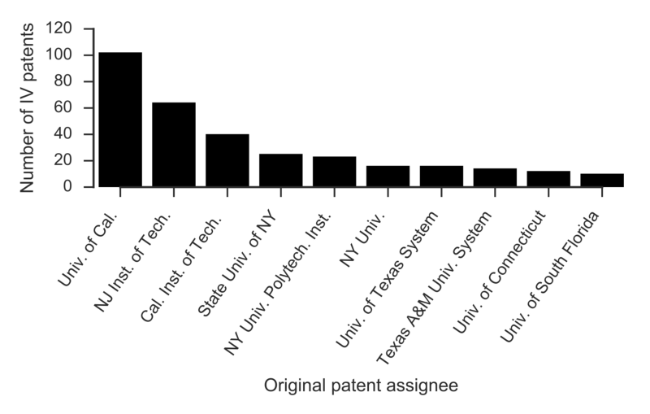
Harvard researcher Yarden Katz has just published some fascinating findings on which universities have sold patents to notorious patent-holding company Intellectual Ventures (IV). Of the nearly 30,000 active patents that IV lists publicly, 470 of them were originally assigned to universities—a total of 61 institutions.

Katz explains how he arrived at these numbers:
How many of IV’s patents came from universities?
To answer this, I have scraped the names of the original assignees for each of the U.S. patents in the portfolio from patent records (see annotated patents list). The analysis shows that nearly 500 of IV’s patents originally belonged to universities, including state schools.
Katz found some other surprises in IV’s portfolio, including nearly 100 patents from the U.S. Navy.
If you know nothing else about patent trolls, you’ve still probably heard the name Intellectual Ventures before. IV is one of the largest patent trolls in the world and has been behind many of the most egregious cases of litigation abuse. Earlier this year, we wrote about IV suing a florist over its patent on crew assignments. For many years, it has tried to cultivate relationships with American universities so it can add their patents to its portfolio.
As we’ve discussed here before, over 100 universities have endorsed a set of principles for university patenting practices. Among other points, it suggests that universities should require that licensees “operate under a business model that encourages commercialization and does not rely primarily on threats of infringement litigation to generate revenue.” Unfortunately, a number of those institutions appear not to be living up to this principle.
From Katz’s post:
Both the University of California and Caltech signed the 2007 statement, yet IV now owns tens of patents from these schools that were filed after 2007. For instance, the IV portfolio includes a Caltech patent filed in 2010 (granted in 2011) and University of California patent filed in 2008 (granted in 2014). Other universities that signed the statement, such as Stanford, Harvard and MIT, did not have patents in the portfolio.
Along with a coalition of users’ rights organizations, EFF recently launched a campaign asking universities to sign a pledge that they won’t sell or license patents to trolls.
When universities sell patents to trolls, it directly undermines the role that they play as engines of innovation: the more patents trolls hold in a certain area of technology, the more dangerous that field is for innovators. The licensing decisions that universities make today will strengthen or sabotage the next generation of inventors. That’s why we encourage everyone to speak out: students, faculty, alumni, parents, and community members. These policies affect all of us.
If you’d like to see universities pledge not to partner with trolls, then take a moment to tell your university. We’ve designed our petition to make it easy to share the results with university leadership. For example, here are all of the signatories affiliated with the University of California-Berkeley. We’re eager to work with local organizers to help you make sure that your institution hears your voice.
We’ve fought patent trolls in the courts and advocated for laws that bring fairness to the patent system. Universities are the next battleground. Together, we can stop the flow of university inventions into the hands of bad actors.

Before all of this ever went down
In another place, another town
You were just a face in the crowd
You were just a face in the crowd
Out in the street walking around
A face in the crowd
If we don’t speak up now, the days when we can walk around with our heads held high without fear of surveillance are numbered. Federal and local law enforcement across the country are adopting sophisticated facial recognition technologies to identify us on the streets and in social media by matching our faces to massive databases.
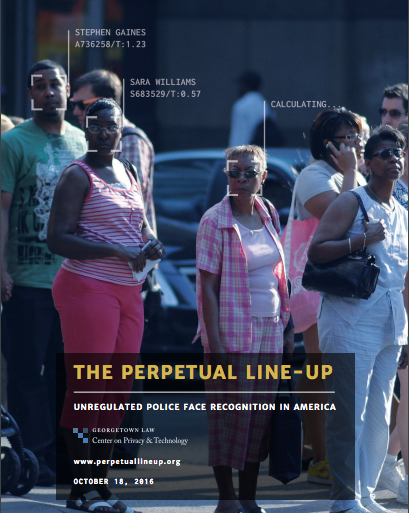
We knew the threat was looming. But a brand new report from the Georgetown Law Center for Privacy and Technology indicates the problem is far worse than we could’ve imagined. The researchers compare the use of facial recognition to a perpetual line-up, where everyday, law-abiding citizens are pulled into law enforcement investigations without their consent and, in many cases, without their knowledge.
The researchers sent more than 100 public records requests to police agencies. Among their findings:
In response to the report, EFF has joined a large coalition of privacy advocates to demand the U.S. Department of Justice, Civil Rights Division take two major steps to keep facial recognition in check:
1. Expand ongoing investigations of police practices and include in future investigations an examination of whether the use of surveillance technologies, including face recognition technology, has had a disparate impact on communities of color; and
2. Consult with and advise the FBI to examine whether the use of face recognition has had a disparate impact on communities of color.
The problem isn’t just the police but also an aggressive push by biometric tech vendors who downplay the accuracy issues while marketing the systems as crucial to contemporary policing. The danger that facial recognition poses to our privacy and civil liberties is real and immediate. While we do give up a small amount of privacy when we walk around in public, we must preserve our ability to blend in as just a face in the crowd.
Read the Georgetown Law report on facial recognition: The Perpetual Line-Up: Unregulated Police Face Recognition in America.
Read the coalition letter to the U.S. Department of Justice Civil Rights Division.
One of the advantages of having a partner who happens to be a math professor is that we can talk academic shop. A few weeks ago, over a serious dishwasher unloading, we started talking about a recurring theme manifesting itself in our college’s faculty Facebook group: toughening up college students. From debates about trigger warnings to conversations about cultivating students’ grit and comfort with failure, our colleagues are consistently inconsistent about how we should help college students succeed in academia and life. I’ll lump myself and my partner into this group, too. As a faculty we want to be sensitive to student needs and life experiences, but we also don’t want them to fall apart if they get a bad grade on an exam. We want them to make a real attempt at solving a difficult problem or tackling a challenging project on their own before asking for help, but we also recognize that many students have serious outside stressors (economic, familial, emotional, etc.) that might prevent them from giving their all to their studies.
For years librarians have been chanting that “failure is good” because it is a signal of attempted innovation, creative practice, and learning (particularly when applied to information literacy instruction). We want our students to learn from their mistakes, which means they have to make them first. Math education is no different. There’s a small but mighty push for experiential and problem-based learning within the discipline that wants students to learn from their mistakes. As my partner and I discussed this we couldn’t help but wonder:
At what point is the struggle too much?
Earlier in the day he’d met with a student who claimed she was working on one homework problem for 4 hours. Earlier that semester I’d met with a student who spent an entire weekend looking for research in the wrong places with the wrong search terms. I’m all for giving it the old college try, but in both cases, this just plain excessive struggle for little reward. As a librarian who has been doing this job for a while, I have a good sense of when I’ve tapped my intellectual well. I know when to ask for help. My partner does, too. Most academics know when to take a step back, take another approach, or ask a colleague for suggestions. But this is a learned skill. We like to think of it as tacit knowledge–students have to experience failure to know when they are failing the right way as opposed to just struggling unnecessarily–but is it really? Does the experience alone help them gain this knowledge? Or can the struggle just be too real for some students, leading them to eventually equate math or research with pointless stress?
I think the key in the library classroom is not to focus on failure but to focus on process: Model, practice, repeat–over and over again. It’s a challenge when so much of students’ grades depend on a final product (an exam, a paper, a presentation, etc.) and often requires a shift in emphasis from the professor. By modeling a process–a step I think we (and I know I) often overlook in our attempts to make our classrooms spaces for active learning–we give students a sense of what struggle can look like. Granted, there’s no one standard process for research, and we don’t want to imply that there is one, but making our thinking and doing visible to our students can go a long way towards demystifying research. We get stuck, we back-track, we try again, we struggle, but we are never alone when we do so. It’s something I try to stress to all my students in hopes that they too feel like they never have to struggle alone.
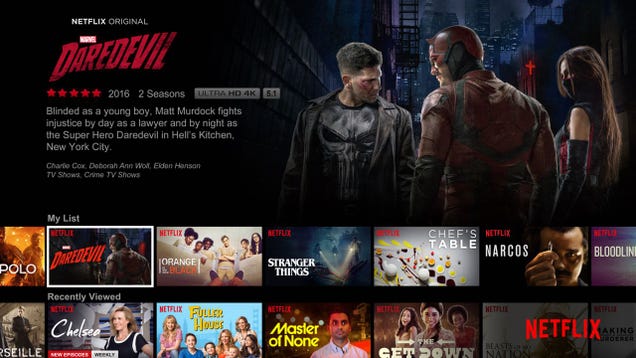
Netflix’s content library isn’t just getting smaller, it’s also increasingly losing its best movies. The Streaming Observer did some analysis, and found that only 31 movies from the IMDb Top 250 are currently available on Netflix.

In spooky short Givertaker, a high-school outcast taps into her love of the occult to get back at the mean girls in her class. The 1996 cult classic The Craft is an obvious inspiration here—especially when the spell backfires, and the teen learns the hard way that you have to be very, very careful what you wish for.
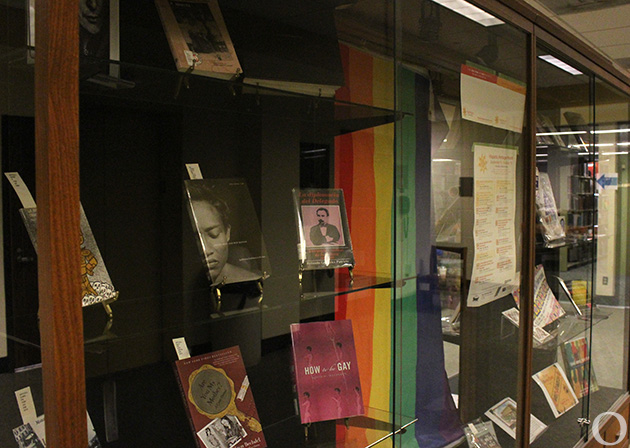
Students can view pieces related to LGBTQ history and Hispanic heritage on the fourth floor of the USF library. ORACLE PHOTO/JACKIE BENITEZ
LGBTQ and Hispanic history are prominent at USF, with both communities included in various clubs on campus.
Meetings at a Hispanic club may showcase various foods, dances, apparel and other aspects from the culture while the LGBTQ clubs pride themselves on being safe spaces for students of all sexual identities as well as educating these students on LGBTQ culture.
LGBTQ History Month and Hispanic Heritage Month overlap in October and, to celebrate, an exhibit was curated to display items that show the history behind both of these cultures. The Hispanic & Latinx (pronounced ‘la-teen-ex’) and LGBTQ Community Special Collection Exhibit was first unveiled on Sept. 15 on the fourth floor of the library.
The exhibit features items such as books, LGBTQ buttons, flags, and posters.
The exhibit was organized by Maria Merrill, the coordinator of LGBT Programs & Services, and Justin Monell, the Coordinator, Cultural Initiatives, from the Office of Multicultural Affairs.
“Looking at this piece of intersectionality, you could be a part of the Hispanic or Latinx community but also have another identity LGBTQ that intersects,” Monell said. “We really wanted to showcase both heritage and history months in one particular space so students could get the feel of you could be every identity in one.”
They chose the Special Collections section on the fourth floor of the library because this section already has a vast collection of work on both communities.
“It helps that Hispanic Heritage Month and LGBTQ Month share two weeks so that also kind of made that logical connection piece there,” Merrill said.
Matt Knight, assistant coordinator of Special Collections at the library, said students can find pieces such as “Patricia Heisman’s first book she wrote as Claire Morgan like lesbian fiction, one of the first pamphlets from what’s now USF P.R.I.D.E. from 1974, and Cuban books about Jose Marti wrapped in cigar paper.”
Synth Rosario, president of the P.R.I.D.E. Alliance at USF, said there are many other things happening this month for LGBTQ History Month. P.R.I.D.E. Alliance had its annual Coming Out Day on Thursday, where some members of the LGBTQ community told their coming out stories to the public.
“We’ve even had students come out at these events before,” Rosario said.
Rosario wants students to try and get educated on the LGBTQ community and suggests the Safe Zone program through the Office of Multicultural Affairs, where students can become allies.
While Hispanic Heritage Month runs from Sept. 15 to this Saturday, LGBTQ Month is the entire month of October. Students can find other LGBTQ events to attend on the Office of Multicultural Affairs’ website.
Tsundoku is the stockpiling of books never consumed. Sahoko Ichikawa, a senior lecturer in Japanese at Cornell University, explains that tsunde means “to stack things” and oku is “to leave for a while.” The word originated in Japan’s late 19th century Meiji Era from a play on words. Sometime around the turn of the century, the oku in tsunde oku was replaced with doku, meaning to read. But because tsunde doku rolls awkwardly off the tongue, the mashup version became tsundoku.From There’s a word in Japanese for the literary affliction of buying books you don’t read — Quartz
Guy Sims Fitch had a lot to say about the world economy in the 1950s and 60s. He wrote articles in newspapers around the globe as an authoritative voice on economic issues during the Cold War. Fitch was a big believer in private American investment and advocated for it as a liberating force internationally. But no matter what you thought of Guy Sims Fitch’s ideas, he had one big problem. He didn’t exist.
 Accordion doors: They were highly touted back in the day as a space-saving and room-hiding innovation. And, I think they most definitely can have their uses today, with the caveat that you want to look for a high-quality product, not one that’s flimsy. Looking back at a story on unusual accordian plastic window shades, I see that clever reader Joni tipped us to two places where you can get full-size accordian doors. I did even more research and tallied four to consider — including three that have been in business for decades. Above: Beautie-Vue’s vintage illustration of possible ways to use accordian doors.
Thanks so much to tipster Joni, who wrote:
Home Depot has a few acrylic accordion doors on their website–they’re kind of plain, but could be really cool with a textured window film on the acrylic panels. (Solyx has some nice window films at decorativefilm.com)
Woodfold.com has been in business for 50+ years and has woven wood, acrylic, and really cool perforated aluminum accordion shades.


 Panelfold says: Panelfold is the first company in the world to invent, patent and commercialize folding doors incorporating flexible panel connector hinges.
Indeed, I count nine different series of doors. Lots of different design options — and materials — to choose from.
 A company that’s been in business since 1957? You know that’s one of the top things that makes my heart go pitter-patter. Here’s what Woodfold says about their company on their website:
We’ve been crafting value for more than 50 years. Woodfold Mfg., Inc. was established in 1957 in Forest Grove, Oregon. Since then, we’ve grown into one of the nation’s leading suppliers of custom-crafted Accordion Doors, Roll-Up Doors, hardwood Shutters and Bookcase Doors for both residential and commercial installations. And even though times have changed, some things at Woodfold haven’t. At least, not the values that really make a difference to our customers.

 According to their catalog, they have quite a few series, depending on your usage/needs. Finishes include natural hardwoods, woodgrain vinyls, solid vinyls, textured vinyls, custom paint finishes, custom stain finishes, high pressure decorative laminate finishes, aluminum — including perforated aluminum! — and applied murals.
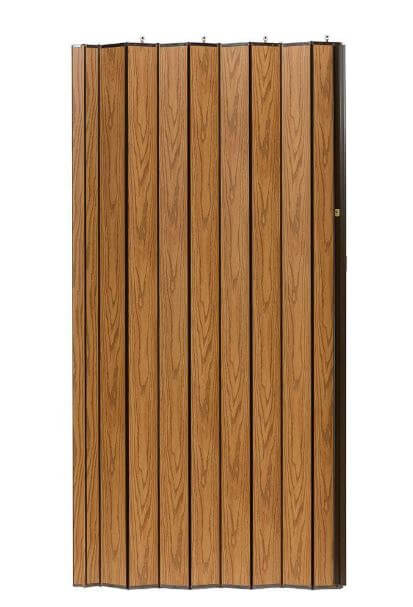
Meanwhile, you can also head to Home Depot online to check out their selection of accordian folding doors from Spectrum. There are a handful of designs from a company called Marley, too. Home Depot categorizes these as closet doors. They run the spectrum in terms of cost, based on the materials they are made of. Some of them look to be basically PVC-framed. Others, much more expensive (like the one shown above) are laminate over MDF.
 If you wanna make a big retro statement with your accordian door, get yer Beauti-Vue products before all their rolls of New Old Stock woven wood are gone! Yes, they can make them into accordian doors — see this story on that product line — LOTs of really great vintage photos to ogle, too.
Poking around the google, I see there may be other brands as well. If you’re in the market and want to be super thorough, keep researching.
The post Accordion folding doors from 4 companies — including 3 that have been in business for decades appeared first on Retro Renovation.
OCLC and Internet Archive today announced the results of a year-long cooperative effort to ensure the future sustainability of purl.org. The organizations have worked together to build a new sustainable service hosted by Internet Archive that will manage persistent URLs and sub-domain redirections for purl.org, purl.com, purl.info and purl.net.
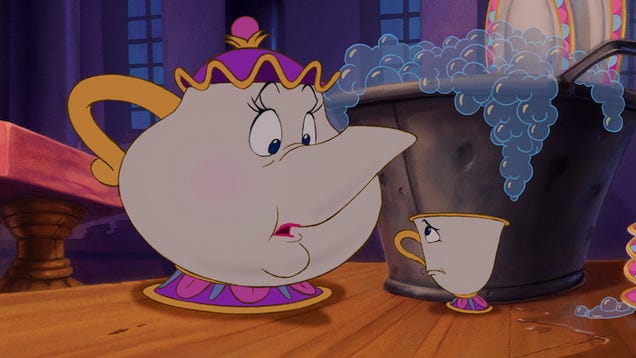
Continuing the 25th-anniversary celebrations for the animated Beauty and the Beast, Angela Lansbury took the stage before a screening of the film in New York to sing the song that she made iconic. (She even said her classic lines to Chip after it was over!)

New research shows that all present-day non-Africans can trace their origins to a single wave of migrants who left Africa 72,000 years ago, and that indigenous Australians and Papuans are descended directly from the first people to inhabit the continent some 50,000 years ago. That makes them world’s longest running civilization.

 Tell your university: Don’t sell patents to trolls.