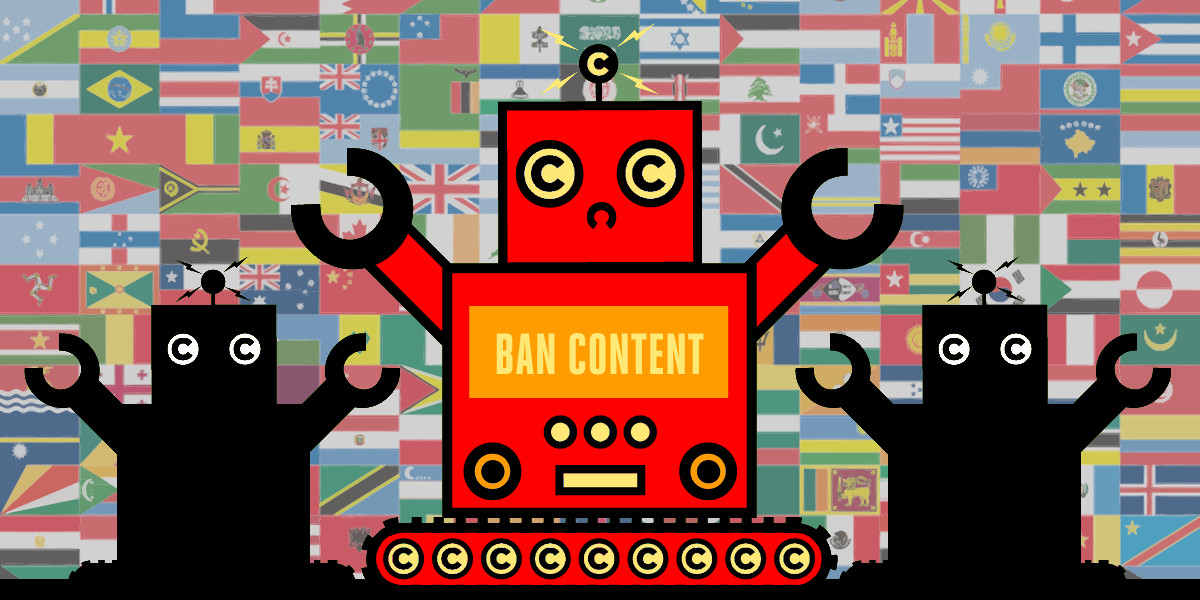
Once states totalling 35% of the EU's population oppose the new Copyright Directive, they can form a "blocking minority" and kill it or cause it to be substantially refactored. With the Italians opposing the Directive because of its draconian new internet rules (rules introduced at the last moment, which have been hugely controversial), the reputed opponents of the Directive have now crossed the 35% threshold, thanks to Germany, Finland, the Netherlands, Slovenia, Belgium and Hungary.
Unfortunately, the opponents of Article 11 (the "link tax") and Article 13 (the copyright filters) are not united on their opposition -- they have different ideas about what they would like to see done with these provisions. If they pull together, that could be the end of these provisions.
If you're a European this form will let you contact your MEP quickly and painlessly and let them know how you feel about the proposals.
That’s where matters stand now: a growing set of countries who think copyright filters and link taxes go too far, but no agreement yet on rejecting or fixing them.
The trilogues are not a process designed to resolve such large rifts when both the EU states and the parliament are so deeply divided.
What happens now depends entirely on how the members states decide to go forward: and how hard they push for real reform of Articles 13 and 11. The balance in that discussion has changed, because Italy changed its position. Italy changed its position because Italians spoke up. If you reach out to your countries’ ministry in charge of copyright, and tell them that these Articles are a concern to you, they’ll start paying attention too. And we’ll have a chance to stop this terrible directive from becoming terrible law across Europe.
A street art collective known as ArtBitch, currently operating as VoteBitch, has been droplifting humorous pro-voting signs up in a bunch of public Bay Area locations.
Each sign shows a figure holding up a dog poop bag in one hand and a leash attached to the United States in the other, with the word "VOTE" and the hashtag #itactuallymatters underneath it.
The group has made the sign's art a free download on their site.
You pick up your mess – why should the neighbors sit home watching football while you rock the whole civic duty thing? Tell folks to get with the program with this chipper yet irony-laden “Vote” sign.
photo by Rusty Blazenhoff (VoteBitch tipped me off on a few of the locations so I could photograph the signs. The lead image was captured at the bus stop on Webster Street near the corner of Atlantic Avenue in Alameda.)
For years we have chronicled the tireless fight of rogue archivist Carl Malamud (previously) whose Public.Resource.org has devoted itself to publishing the world's laws, for free, where anyone can see and share them.
The principal that the law must be both readable and writable is as old as the idea of the rule of law itself, dating back to the Magna Carta and beyond. But in recent years, governments have begun to integrate commercially developed standards into their laws as their official safety code ("The plumbing code of East Dingleberry County shall be version xyz of the Unified Plumbing Standards Body's Master Code"), and thereafter, people who want to read the law -- to make sure they're obeying it, to investigate whether someone else has violated it -- has to pay (often thousands of dollars) to get a copy of their own laws.
Malamud's position is that once a standard is part of the law, it is no longer copyrightable and he can publish it. Despite the obvious justice of this position and its long precedent, he often finds himself on the receiving end of dire legal threats and even lawsuits.
Last week, Malamud and EFF his lawyers, Alston & Bird and Elizabeth Rader scored a massive victory in this fight: the U.S. Court of Appeals for the 11th Circuit struck down the state of Georgia's bid to suppress the publication of its laws, upholding Malamud's right to publish them. The appeals court's decision was unequivocal in its support for the position that the law is free for all to read and write -- and that Georgia's bid to make its laws pay-to-read was unconstitutional and illegitimate.
Friday’s decision means that Malamud and PRO can continue with the project, as no part of the OCGA is covered by copyright. The opinion throws out the specious notion that official copies of the law can be privatized by adding annotations, when those annotations were themselves dictated by the legislature and were widely considered to be “part and parcel” of the state’s legal code.
More importantly, it makes clear that Georgia’s annotated laws “are attributable to the constructive authorship of the People.” The opinion recognizes that when it comes to accessing the work of lawmakers, the debate must be grounded in our notions of democratic rights. It isn’t simply an argument about dividing up a market for published items.
This is a major step forward in a larger fight to free the law from copyright. EFF represents PRO in a separate litigation, in which Malamud and PRO are fighting to publish codes and standards that have been incorporated by reference into law. Those standards, which relate to building and product safety, energy efficiency, and educational testing, were incorporated by reference into regulations by state and federal agencies, after heavy lobbying by the standards development organizations that created them. Yet those same groups have fought PRO’s efforts to publish the standards. That case is headed back to district court for further proceedings, after EFF and PRO scored a win this summer when an appeals court ordered the district court to re-consider the issue of fair use.
A recent Pew poll challenged subjects to distinguish between factual statements and statements of opinion in news articles; it found that there is a large gap in accuracy between 18- to 49-year-olds (32% of whom correctly labeled 100% of the facts, and 44% of whom correct labeled 100% of the opinions) and those aged 50 and up (20% correctly labeled all facts; 26% correctly labeled all opinions).
Young people performed well regardless of the ideological nature of the facts and opinions, while older subjects' ability to sort fact from opinion was more likely to struggle when such sorting cut against their ideological bias.
For example, 63% of 18- to 49-year-olds correctly identified the following factual statement, one which was deemed to appeal more to the right: “Spending on Social Security, Medicare, and Medicaid make up the largest portion of the U.S. federal budget.” About half of those ages 50 and older (51%) correctly classified the same statement. Additionally, 18- to 49-year-olds were 12 percentage points more likely than those at least 50 years of age (60% vs. 48%, respectively) to correctly categorize the following factual statement, which was deemed to be more appealing to the ideological left: “Immigrants who are in the U.S. illegally have some rights under the Constitution.”
Among the opinion statements, roughly three-quarters of 18- to 49-year-olds (77%) correctly identified the following opinion statement, one that appeals more to the ideological right – “Government is almost always wasteful and inefficient” – compared with about two-thirds of older Americans (65%). And younger Americans were slightly more likely than older adults (82% vs. 78%, respectively) to correctly categorize this opinion statement, one appealing more to the left: “Abortion should be legal in most cases.”
Section 1201 of the Digital Millennium Copyright Act bans bypassing "access controls" for copyrighted works -- that is, breaking DRM.
This was stupid when the DMCA passed in 1998, and it only got stupider since: back in 1998, DMCA 1201 was used to punish people who made region-free DVD players or homebrew Sega Dreamcast games. Today, every gadget has thousands of lines of copyrighted code, putting any "access control" on the gadget within reach of the DMCA, which has led manufacturers to claim that the DMCA gives them the right to decide who can make software for your stuff, how you can use your stuff, and who can fix your stuff. DMCA 1201 has been used to intimidate and even jail security researchers who found defects in products with DRM, which means that the people who want to warn you about problems with the gadgets you trust can't come forward without permission from the companies that stand to lose money if the news gets out.
Every three years, the Copyright Office hears petitions for "use exemptions" to the DMCA: these exemptions let you break DRM to engage in some kind of legit activity, like jailbreaking a phone or conducting security research.
This year, many groups petitioned the Copyright Office for a wide variety of exemptions and the Copyright Office just published its detailed conclusions setting out which exemptions were granted, which ones were denied, and which ones were partially granted.
It's an extremely encouraging document! The Copyright Office granted the majority of exemptions, including key exemptions around the right to repair and legal protection for security research. They did partially or completely deny some vital petitions, unfortunately, including ones related to jailbreaking media to make fair uses, and some related to preserving old video games.
Encouraging as this all is, there is one important and infuriating element to keep in mind: while the Copyright Office grants "use exemptions," it does not believe it has the right to make "tools exemptions" -- exemptions that would allow an expert to make a tool for disabling DRM so that you can make the uses they've permitted you to make. In other words, the Copyright Office says, "You're allowed to jailbreak your Iphone, but no one is allowed to give you an Iphone jailbreaking tool, and if you make a tool for your own use you can't share it or even tell people how it works."
That's pretty weird, but the infuriating part is when you bring this up with DRM advocates and the Copyright Office: they say, "Well, once the law is out of the way, people will just figure it out." In other words: "DRM is actually kinda bullshit and people who want to get around it will." But if that's the case, what is DRM supposed to be for? If any "bad guy" (someone who doesn't care about permission from the Copyright Office) who wants to get around DRM can do so, who is the DRM supposed to restrict?
That's right: honest people. People who want to do legitimate things, like fix their stuff, or format-shift their stuff, or just buy some third-party ink and have it work with their printer. These are the only people DRM works against (otherwise, granting "use exemptions" would be pointless). If these people wanted to do things that broke the law -- like making infringing copies of Bluray movies -- the law already allows companies to punish them. DRM doesn't exist to protect companies' rights, it exists to let them invent new rights (the right to decide which screen you can watch a movie on, for example), and then make those rights legally enforceable, by adding illegal-to-remove DRM to their products.
The Copyright Office decision also does nothing to address the many ways that manufacturers have monopolized repair that have nothing to do with copyright or software. Companies have made it difficult to acquire parts or repair tools needed to fix the things you own, and many companies have weaponized the Department of Homeland Security to crack down on grey market and aftermarket parts that are imported from places like China. Two prominent right to repair activists, Louis Rossmann and Jessa Jones, have had their Apple repair parts seized by customs in recent months.
The win demonstrates that right to repair advocates are making progress, but there’s still a long way to go until repair becomes easier for everyone.
"Companies use the anti-piracy rules in copyright laws to cover things that are nowhere near copying music or video games,” Proctor said. “We just want to fix our stuff. We're pleased with the progress being made, and ultimately we want to settle this by establishing Right to Repair."
Every year, the companies we rely on to make our computers, televisions, smartphones and other high tech marvels make it more difficult for us to repair their products. This dickery is accomplished through various methods: specialized screws that require a fancy screwdriver to remove, the creation of hardware that's designed in such a way that taking it apart to repair would do more harm than good, and through Digital Rights Management (DRM) to keep folks from futzing with their device's firmware. While right-to-repair advocates continue to fight for our right to unreservedly tinker with the stuff we own, The US Copyright Office gave them a wee taste of victory to hold them over until all of the fighting's done.
The Librarian of Congress and US Copyright Office just proposed new rules that will give consumers and independent repair experts wide latitude to legally hack embedded software on their devices in order to repair or maintain them. This exemption to copyright law will apply to smartphones, tractors, cars, smart home appliances, and many other devices.
The move is a landmark win for the “right to repair” movement; essentially, the federal government has ruled that consumers and repair professionals have the right to legally hack the firmware of “lawfully acquired” devices for the “maintenance” and “repair” of that device. Previously, it was legal to hack tractor firmware for the purposes of repair; it is now legal to hack many consumer electronics.
Thanks to this ruling, those inclined to do so will now be able to break the DRM on a device's firmware, provided they own it, for the sake of repairing it. The only stipulation is that doing so must not make it possible to acquire or copy other copyrighted material on the device.
As Motherboard points out, a great example of what's possible now can be found in the way that Apple's been handling third-party laptop repairs. In newer MacBooks, there's a software killswitch that'll bork the laptop if anyone that's not authorized to make the repair goes tinkering with the laptop's guts. Thanks to the Copyright Office's ruling, it's now perfectly legal for anyone that cares to do so to bypass this lockout and get their repair on.
On October 5, the Journal of the American Academy of Dermatology published a peer-reviewed article by Drs Sailesh Konda and Joseph Francis, enumerating the problems with the burgeoning field of "corporatized," private-equity-backed dermatology practices, often affiliated with private-equity-backed pathology labs, showing data to support the conclusion that private equity investment flowed to dermatology practices that were "outliers" in performing rare, high-cost procedures, including some that generated outsized Medicare billings.
The article sparked a flood of complaints from private-equity-affiliated dermatologists, including legal threats. Journal editor Dr. Dirk Elston caved and removed the paper, citing "concerns about the accuracy of a few parts" of the article.
The editors told the authors that they would have to correct "factual errors" to have the article reinstated, but the authors said that the requested corrections were not related to factual errors, but rather to true facts that put the leaders of the American Academy of Dermatology in a bad light.
Dermatologists represent 1% of US medical practices and 15% of medical private-equity acquisitions.
Among those who objected to the article was Dr. George Hruza, the incoming president of the American Academy of Dermatology. Dr. Hruza, whose one-year term as president begins in March, is a dermatologist in Chesterfield, Mo. In 2016 he sold his own dermatology practice to United Skin Specialists, a firm that manages dermatology practices and is backed by private equity. He currently serves on the board of directors of United Skin Specialists, which he said is an unpaid position.
Dr. Hruza is not named in the journal article, but he said he is easily identified by the authors’ reference to his pending presidency of the academy, and to United Skin Specialists.
In an interview, Dr. Hruza said he did not ask that the paper be taken down. He did, however, confirm that he expressed his concerns to Dr. Elston, the editor, after it was posted. Two days later, Dr. Elston removed the paper. A flurry of intense conversations ensued among Dr. Elston; Dr. Hruza; the current academy president, Dr. Suzanne Olbricht; a lawyer for the dermatology academy; and the paper’s authors.
For at least the third time, construction workers in Georgia have opened up the walls of a former dentist's office only to discover thousands of teeth in the wall cavity.
The latest discovery was made at Valdosta, Georgia's TB Converse Building, built in 1900, in a dental office occupied by Dr Clarence Whittington and then Dr Lester G Youmans, from 1900 until the 1930s.
Previous troves of entombed teeth have been discovered in old dentists' offices n Greensboro and Carrolton.
“I’m not sure if it was a common practice between dentists at that time, but it’s very strange that there were two other people that said, ‘Hey, we’ve had that happen, too,’” she said.
It’s been suggested that the Lowndes County Historical Society receive the teeth though Donald Davis, Historical Society executive director, couldn’t confirm this.
"The museum would be pleased to receive the teeth; however, it has not been officially confirmed to us that they would be offered," he said.
VPD Lt. Adam Bembry said nothing has been reported to the police department as of press time.
Australia is about to radically expand its copyright and the publishing industry has forged an unholy alliance with authors' groups to rail against fair use being formalised in Australia, rallying under the banner of "Free is not fair."
Rebecca Giblin (previously), one of Australia's leading copyright scholars and the founder of a project to examine the way that authors' interests diverge from their publishers' interests.
She points out that giving Australian authors more copyright won't do them any good if the highly concentrated publishing industry simply demands that all that copyright be transferred to corporate balance sheets as part of their standard contracts. It's like giving your bullied kid extra lunch money: the bullies will simply mug them for the extra money you've handed over.
Because even though writers' median incomes have fallen, publishing's profitability has risen. The publishing industry does not have a profitability crisis: it has a fair distribution crisis, and additional copyrights that make publishing more profitable just make them bigger and better situated to win contract negotiations with publishers.
Instead of giving writers more lunch money for the publishers to take off them, Giblin talks about measures that will gives authors negotiating leverage, like rights reversions and European-style "bestseller clauses," as well as more accountability from the collecting societies that take in money on behalf of writers.
Canada is going through a similarly backwards process to "fix copyright" that is headed on a collision course with the same bad outcomes that the Australian process is creating.
We should also be demanding greater transparency around the distribution of revenue from the statutory licences that pay for uses in schools and universities. Those are the revenues that, in Australia, are collected by the Copyright Agency. Australia’s schools pay far more to use copyrighted works than their overseas counterparts – almost $17 per student, compared to around $3 in the UK and NZ. This would be laudable if that money went to supporting authors, but as far as we can tell from the Copyright Agency’s reporting, publishers again take the lion’s share. The Macquarie University report cited above found that authors averaged just $400 in earnings from the Copyright Agency in the 2014–15 financial year – a similar amount to the year before – compared to $1,100 earned through public lending rights. To put those figures in context, the Copyright Agency, according to its annual report, paid out a total of $103 million to copyright owners, while the combined payout to authors and publishers for public and educational lending rights in the same period was barely a fifth of that.
As I’ve pointed out elsewhere, including in a recent submission to the Department of Communications and the Arts, it’s impossible to tell from the Copyright Agency’s reporting how the $103 million paid out to rightsholders is divided up between creators and investors. But it’s clear that these revenue flows are very different to those in the UK, where a bargain between authors and publishers sees revenues split pretty evenly between the two. It’s time to ask serious questions about how we want this public money accounted for and spent.
Mechanisms outside of copyright also have a big role to play. It’s a no brainer that publishers should be obliged to provide regular royalty statements that give meaningful earnings data, and that authors should have the right to an independent audit of their accounts. More provocatively, we might ask: how might things change if we required ‘fair trade’ labels disclosing whether or not an author was ethically paid?
Despite her personal stake in Trump's tax cuts, she made this amazing call to action to vote the Republicans out and end the raging movement of money to the super-rich from everyone else in America.
It's a fantastic video.
This Disney heiress is taking a stand against the GOP tax bill — even though she’s going to benefit from it pic.twitter.com/E5bmcI83mU
Speed reading isn't just an innate skill possessed by a lucky few. Anyone can learn to speed read, and the benefits are endless. The brain can process more information than most people have time to soak up, but you can make that time now with the 2018 Award-Winning Speed Reading Bundle.
The first half of the bundle, 7 Speed Reading EX, does more than just show you how to become an effective speed reader. With video tutorials, eye/ body training exercises and progress reports, you'll be breezing through novels and documents alike more than 3 times faster - with no loss in comprehension. The platform even comes with access to 20,477 eBooks free.
When you're ready, the Spreeder CX 2018 tool will allow you to put your newfound talent to practice, with a text-display app that will guide you at an increasing pace through any document you can upload or paste.
Terry Pratchett and Neil Gaiman's Good Omens is a book that I've revisited many times over the years. Each time that I do, it feels like I'm spending time with an old friend: nothing much has changed since the last time that we saw each other, but I enjoy the book's presence in my life, nonetheless.
The first trailer for Amazon's Good Omens doesn't give me those feels. That's not a bad thing. The mini-series, staring Michael Sheen and David Tennant as Aziraphale and Crowley, feels vital and expansive compared to the cozy confines of the novel I've enjoyed so often over the past few decades. I'm really looking forward to seeing how the production interprets the work.
And hey, if it sucks, I still have the wonderful written iteration to fall back on.
Indicating in your will that you want to leave some money to a charity that reflects the values you were passionate about is a fine gesture.
Living a life of frugality so that you can leave a ridiculous amount of money to charity once you're gone: that's next level philanthropy.
Chow Yun-fat, the bad ass star of such films as Crouching Tiger, Hidden Dragon and Hard Boiled is very into this latter, hardcore-level of giving. Despite the wealth that his career in film has brought him, the 63-year old icon has spent years in Hong Kong, one of the world's most expensive cities, enjoying a simple life on around $100 U.S. dollars per month. Thanks to this monk-like level of frugality, it's estimated that when he passes, Chow will be leaving behind close to $714 million to charity.
Chow’s wife, Jasmine Tan, says that her husband manages to live so frugally in one of the world’s most expensive cities by frequenting street food stalls and rarely buying new things, according to an Oriental Daily report from last week. For example, for 17 years, Chow stuck with his trusty Nokia flip phone, only recently purchasing a new smartphone when his old device finally stopped working.
The 63-year-old Chow is often seen riding public transportation where he rocks a simple wardrobe — a shirt costing him 98 yuan ($14) and sandals costing another 15 yuan ($2). When asked why he likes to shop at discount shops despite his tremendous net worth, Chow replies, “I don’t wear clothes for other people. I just wear whatever I find comfortable.”
I don't know about you, but I find it very encouraging, given our current social and economic climate, that not every crazy-rich soul in the world is a self-serving lunatic.
Ninjatrappeur built his own Raspberry Pi-based digital typewriter with an E-ink screen and a cheap keyboard. Total cost was about $180. He generously posted his build notes, and is seeking collaborators to help him improve on his prototype.
Lyft driver Shawn Pepas Lettman of Brooklyn, N.Y., calmly filmed the 16-minute tirade by passenger Robert Ortiz and his two friends, who called the New York City police after Lettman refused to turn on the radio. “I feel racially profiled … because I’m not black,” Ortiz tells the 911 operator. He later adds, “If this guy does anything to threaten my life, I have to defend myself. … I’m a little fearful.”
It's very much a thing of the moment: blithely calling the police to threaten the black dude you're slinging racial slurs at, all the while slathering everything with free-ranging sociopathic drivel talk that pinballs between giggling insincerity, "wait till the police get here" rage, and constant amateur-lawyer bullshit.
When my mother died she taught me a very important lesson, which was always useful but more now than ever. She taught patience, humble and calm will get you through anything. As a father of 2 my single means of providing for my wife and children is driving a rideshare, accommodating people from all walks of life, All of which i treat with the utmost respect, after all I must provide for my family.
There's something about his expression here that I'll remember for a long time.
As the EU advances the new Copyright Directive towards becoming law in its 28 member-states, it's important to realise that the EU's plan will end up censoring the Internet for everyone, not just Europeans.
A quick refresher: Under Article 13 of the new Copyright Directive, anyone who operates a (sufficiently large) platform where people can post works that might be copyrighted (like text, pictures, videos, code, games, audio etc) will have to crowdsource a database of "copyrighted works" that users aren't allowed to post, and block anything that seems to match one of the database entries.
These blacklist databases will be open to all comers (after all, anyone can create a copyrighted work): that means that billions of people around the world will be able to submit anything to the blacklists, without having to prove that they hold the copyright to their submissions (or, for that matter, that their submissions are copyrighted). The Directive does not specify any punishment for making false claims to a copyright, and a platform that decided to block someone for making repeated fake claims would run the risk of being liable to the abuser if a user posts a work to which the abuser does own the rights.
The major targets of this censorship plan are the social media platforms, and it's the "social" that should give us all pause.
That's because the currency of social media is social interaction between users. I post something, you reply, a third person chimes in, I reply again, and so on.
Now, let's take a hypothetical Twitter discussion between three users: Alice (an American), Bob (a Bulgarian) and Carol (a Canadian).
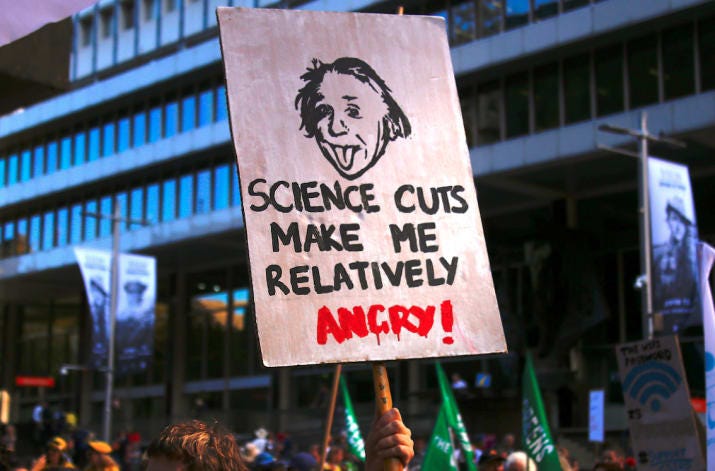
Alice posts a picture of a political march: thousands of protesters and counterprotesters, waving signs. As is commonaroundtheworld, these signs include copyrighted images, whose use is permitted under US "fair use" rules that permit parody. Because Twitter enables users to communicate significant amounts of user-generated content, they’ll fall within the ambit of Article 13.
Bob lives in Bulgaria, an EU member-state whose copyright law does not permit parody. He might want to reply to Alice with a quote from the Bulgarian dissident Georgi Markov, whose works were translated into English in the late 1970s and are still in copyright.
Carol, a Canadian who met Bob and Alice through their shared love of Doctor Who, decides to post a witty meme from "The Mark of the Rani," a 1985 episode in which Colin Baker travels back to witness the Luddite protests of the 19th Century.
Alice, Bob and Carol are all expressing themselves through use of copyrighted cultural works, in ways that might not be lawful in the EU’s most speech-restrictive copyright jurisdictions. But because (under today's system) the platform typically is only required to to respond to copyright complaints when a rightsholder objects to the use, everyone can see everyone else's posts and carry on a discussion using tools and modes that have become the norm in all our modern, digital discourse.
But once Article 13 is in effect, Twitter faces an impossible conundrum. The Article 13 filter will be tripped by Alice's lulzy protest signs, by Bob's political quotes, and by Carol's Doctor Who meme, but suppose that Twitter is only required to block Bob from seeing these infringing materials.
Should Twitter hide Alice and Carol's messages from Bob? If Bob's quote is censored in Bulgaria, should Twitter go ahead and show it to Alice and Carol (but hide it from Bob, who posted it?). What about when Bob travels outside of the EU and looks back on his timeline? Or when Alice goes to visit Bob in Bulgaria for a Doctor Who convention and tries to call up the thread? Bear in mind that there's no way to be certain where a user is visiting from, either.
The dangerous but simple option is to subject all Twitter messages to European copyright censorship, a disaster for online speech.
And it’s not just Twitter, of course: any platform with EU users will have to solve this problem. Google, Facebook, Linkedin, Instagram, Tiktok, Snapchat, Flickr, Tumblr -- every network will have to contend with this.
With Article 13, the EU would create a system where copyright complainants get a huge stick to beat the internet with, where people who abuse this power face no penalties, and where platforms that err on the side of free speech will get that stick right in the face.
As the EU's censorship plan works its way through the next steps on the way to becoming bindin g across the EU, the whole world has a stake -- but only a handful of appointed negotiators get a say.
If you are a European, the rest of the world would be very grateful indeed if you would take a moment to contact your MEP and urge them to protect us all in the new Copyright Directive.
“On Helen’s form, which was filled out with assistance from officials, there is a checked box next to a line that says, “I withdraw my previous request for a Flores bond hearing.” Beneath that line, the five-year-old signed her name in wobbly letters.”
What the Trump administration is doing to these thousands of children is morally repulsive. We have to stop it.
Here's an excerpt from a New Yorker feature on Helen, “a smart, cheerful five-year-old girl” seeking asylum from Honduras. She ends up in court, separated from her parents. The organization helping her is lupenet.org, and you should support their work.
Helen reunited with her mother.
They managed to get Helen reunited with her mother, and out of Trump's brown kid prisons. But here's what happened to her:
In July, Helen fled Honduras with her grandmother, Noehmi, and several other relatives; gangs had threatened Noehmi’s teen-age son, Christian, and the family no longer felt safe. Helen’s mother, Jeny, had migrated to Texas four years earlier, and Noehmi planned to seek legal refuge there. With Noehmi’s help, Helen travelled thousands of miles, sometimes on foot, and frequently fell behind the group. While crossing the Rio Grande in the journey’s final stretch, Helen slipped from their raft and risked drowning. Her grandmother grabbed her hand and cried, “Hang on, Helen!” When the family reached the scrubland of southern Texas, U.S. Border Patrol agents apprehended them and moved them through a series of detention centers. A month earlier, the Trump Administration had announced, amid public outcry over its systemic separation of migrant families at the border, that it would halt the practice. But, at a packed processing hub, Christian was taken from Noehmi and placed in a cage with toddlers. Noehmi remained in a cold holding cell, clutching Helen. Soon, she recalled, a plainclothes official arrived and informed her that she and Helen would be separated. “No!” Noehmi cried. “The girl is under my care! Please!”
Noehmi said that the official told her, “Don’t make things too difficult,” and pulled Helen from her arms. “The girl will stay here,” he said, “and you’ll be deported.” Helen cried as he escorted her from the room and out of sight. Noehmi remembers the authorities explaining that Helen’s mother would be able to retrieve her, soon, from wherever they were taking her.
Later that day, Noehmi and Christian were reunited. The adults in the family were fitted with electronic ankle bracelets and all were released, pending court dates. They left the detention center and rushed to Jeny’s house, in McAllen, hoping to find Helen there. When they didn’t, Noehmi began to shake, struggling to explain the situation. “Immigration took your daughter,” she told Jeny.
“But where did they take her?” Jeny asked.
“I don’t know,” Noehmi replied.
The details from the sham legal process are nauseating.
Excerpt:
According to a long-standing legal precedent known as the Flores settlement, which established guidelines for keeping children in immigration detention, Helen had a right to a bond hearing before a judge; that hearing would have likely hastened her release from government custody and her return to her family. At the time of her apprehension, in fact, Helen checked a box on a line that read, “I do request an immigration judge,” asserting her legal right to have her custody reviewed. But, in early August, an unknown official handed Helen a legal document, a “Request for a Flores Bond Hearing,” which described a set of legal proceedings and rights that would have been difficult for Helen to comprehend. (“In a Flores bond hearing, an immigration judge reviews your case to determine whether you pose a danger to the community,” the document began.) On Helen’s form, which was filled out with assistance from officials, there is a checked box next to a line that says, “I withdraw my previous request for a Flores bond hearing.” Beneath that line, the five-year-old signed her name in wobbly letters.
Summer went on, with no sign of Helen’s return. Noehmi and Jeny contacted LUPE (La Unión Del Pueblo Entero), a nonprofit community union based in the Texas Rio Grande Valley, to ask for help getting Helen released.
Continued:
Founded by the famed activists César Chávez and Dolores Huerta in 1989, lupe fights deportations, provides social services, and organizes civil mobilizations on behalf of more than eight thousand low-income members across south Texas; Jeny, employed as an office cleaner, was one such member. Tania Chavez, a strategy leader for the organization, met with the family to hear their story.
There's a positive update to share. Helen made it back to her mom. LUPE and the community of people online who read about her case took action. Other kids need help, too.
Voting rights advocacy groups are suing the state of Georgia to reinstate 53,000 blocked voter registrations, 70% of which are from African American voters, saying the current policy violates the U.S. Voting Rights Act and The National Voter Registration Act.
BREAKING: We have just filed a lawsuit against Brian Kemp to end #Georgia’s exact match law, which has put as many as 53K voter registrations on hold ahead of the #MidtermElections.
The Lawyer's Committee For Human Rights tweeted this afternoon, “We have just filed a lawsuit against Brian Kemp to end #Georgia’s exact match law, which has put as many as 53K voter registrations on hold ahead of the #MidtermElections.”
So black Georgians are affected by this registration hold-up at a rate more than double their prevalence in the population... as Brian Kemp oversees his own election.This is outrageous enough that it seems almost impossible that the courts will allow this to stand. pic.twitter.com/T4v41A1MlO
Tonya got her ID today in #Orlando#Florida! Her license expired while she was in the hospital battling cancer and she didn't have to funds to get it renewed when she recovered. But she got her ID & will be applying for a job with her local school district! @SpreadTheVoteUSpic.twitter.com/sJwJr9VyMa
Registration deadline for people in Randolph and Grady Counties, Georgia extended thru at least Monday, *October 15th*. Call our 866-OUR-VOTE hotline for help or with Qs. @LawyersComm
BREAKING: We secured an extension of the voter registration deadline for people in Randolph and Grady Counties, #Georgia -- 2 counties hit hard by #HurricaneMichael. @LawyersComm
We'll keep fighting for voters in #Midterms2018 continues. Call our 866-OUR-VOTE hotline for help.
Today I learned that by placing a teal pumpkin out on Halloween, you are signaling that you are offering non-food (read: non-allergen) treats to children. It's a secret code that you have safe goodies like stickers, stencils, and glow sticks to give out instead of candy. Clever!
The Teal Pumpkin Project encourages people to raise awareness of food allergies and promotes inclusion of all trick-or-treaters throughout the Halloween season. The nationwide movement offers an alternative for kids with food allergies, as well as other children for whom candy is not an option.
The steps to participate are:
Provide non-food treats for trick-or-treaters.
Place a teal pumpkin – the color of food allergy awareness –in front of your home to indicate you have non-food treats available.
Add your home to the Teal Pumpkin Project map.
Spread the word! Share the Teal Pumpkin Project with your friends and family.
Using our advanced technology, it is possible to look up the beaches in the National Oceanic and Atmospheric Administration’s Sea Level Rise Viewer, and to imagine what will happen if we visit them, or try to visit them, in the future—when the sea levels have risen three feet, or six feet, or more, if you want. You can use your pocket phone-computer to watch them move ahead through time below.
by Amina Aitsi-Selmi, Honorary Clinical Senior Lecturer, Epidemiology and Public Health Department, University College London, UCL
Impostor feelings include fear of failure, fear of success, a sometimes-obsessive need for perfection, and an inability to accept praise. KieferPix / Shutterstock
Research suggests that around 70% of people will experience an illogical sense of being a phoney at work at some point in their careers. It’s called the impostor phenomenon (also known, erroneously, as a syndrome). These impostor feelings typically manifest as a fear of failure, fear of success, a sometimes obsessive need for perfection, and an inability to accept praise and achievement. The phenomenon is also characterised by a genuine belief that at some point you, as the “impostor”, are going to be found out for being a fake in your role.
The phenomenon has been researched for more than 40 years and recent research into women working in sciences, technology, engineering and mathematics (STEM), suggests that there is a much higher incidence of it in women in these non-traditional roles.
Despite being something that affects people at an individual level, the relationship between toxic workplaces and well-being is well established. It seems that the impostor phenomenon breeds from a mix of genuine personal doubt over work abilities and the collective experience of a toxic work culture.
Simply put, our modern workplaces are feeding a sense of inadequacy in the face of a track record of achievement and success of individuals. The “impostor’s” internal drive for perfection and their constant expectation of external criticism pushes them to underestimate their abilities, while striving to exhaustion for advancement to avoid perceived failure and exposure to criticism.
Where this meets an ever-increasing demand to do more with fewer resources and a barrage of evaluation in risk-averse workplaces, impostor tendencies will thrive.
An unhealthy marriage
Toxic workplaces are often characterised by an environment that diminishes or manages out the humanity of the place and its people, as well as promoting competition. A focus on profit, process and minimising resources is pronounced. Bullying is normalised and embedded in managerial and colleague behaviour, while leadership is inert and ineffectual against it.
In toxic workplaces, work is often seen as drudgery, the motivating elements sucked out of the environment. Unmoderated criticism and punitive measures stifle original thinking, thus reducing the intrinsic rewards of work, such as having an outlet for expressing one’s unique talents and creative thinking.
The unhealthy marriage between the impostor phenomenon and toxic work cultures is sustained at an individual level by the basic human need for safety and belonging. This interferes with “rational” decision making and supersedes the entrepreneurialism and risk taking that would challenge the status quo. This is detrimental to both a person and their employer who might otherwise benefit from new ideas.
While technology continues to transform the nature of work, organisations are lagging behind in how they manage people. Corporate performance management practices are often little more than thinly disguised carrot and stick approaches. Employees are goaded along by financial and status incentives that glorify overwork and toeing the line. Toxic workplaces force people to jump through endless hoops on the way to an elusive, future state of success and happiness. Intellectual honesty, unorthodox thinking and self-care, meanwhile, are penalised.
A rampant competitiveness in certain workplaces often provides a breeding ground for anxiety, depression and self-degradation. The finance sector is especially prone to this. Here constant winning is the cultural norm, even though it’s just not possible to win all the time.
This breeds perfectionism, which also fuels people’s need to micromanage. Dysfunctional competition gets prioritised over collaboration. People who feel like they are impostors will often fail to delegate for fear that others won’t meet their own exacting standards and that this will reflect badly on them. As a result, they take on more than they can realistically manage.
The imbalance this produces between effort and rewards exacerbates the feeling of inadequacy and creates a negative feedback loop, which leads to mental exhaustion. And if both the person and the organisation implicitly fail to recognise the toxic combination of impostor tendencies and an unhealthy work culture, they both passively endorse this social contract.
Sadly, as the digital revolution progresses, it is becoming clearer that our contemporary workplaces are demanding productivity outcomes to match. But they are using antiquated managerial structures. Workplace processes – such as poorly constructed performance management, a lack of diversity in succession planning and limited understanding of inclusion initiatives beyond box ticking exercises – fuel the very behaviour and thought patterns that these workplace structures aim to manage out.
Addressing these toxic work cultures and organisational structures could create a less fertile ground for the impostor phenomenon. Healthier workplaces and more satisfied people are likely to deliver more positive and productive outcomes.
The authors do not work for, consult, own shares in or receive funding from any company or organisation that would benefit from this article, and have disclosed no relevant affiliations beyond their academic appointment.
America has a gun problem: the proliferation of guns in American homes has led to a largely silent epidemic of accidental shootings, intimate partner murders, and suicides.
While the sky-high fatalities from these everyday shootings are personal, quiet tragedies, the extremely public tragedies of mass shootings are both statistical outliers and rallying points for sensible gun policies in line with the rest of the world.
As welcome as the attention from high-profile atrocities is, there is danger that they will shift our focus to the extremely low likelihood that you will be shot by a deranged stranger in a public place and away from the much higher likelihood that someone you know (possibly you, yourself) will shoot you in your home.
One way this manifests is in an emphasis on "protecting" schools from mass shootings. At first, this was a minor hustle, with some petty grifters picking up small-money contracts designing "active shooter lockdown drills" for schools.
But after the Parkland shooting, the gun lobby and its purchased lawmakers came up with a new talking point: the solution to gun violence was to flood our schools with heavily armed mercenaries (or, worse yet, teachers!) who would execute would-be shooters. This strategy could be backstopped by buying all kinds of "anti-shooter" fixes, like bulletproof doors, bulletproof coffins that children could cower inside of, and Batman utility-belt gadgets like smoke cannons that could flood a school with choking, blinding clouds as a countermeasure against shooters.
This was a evilly brilliant move: by creating a "solution" that was tied to high-ticket procurements, the gun lobby created a self-perpetuating lobby machine for tooling up the schools of America -- hucksters who would divert some of their profits to pressuring governments to diverting more education dollars to weapons and armor, generating new profits and thus new lobbying dollars -- lather, rinse, repeat.
The hive of scum and villainy that is the tooled-up school industry is the sort of thing to make you vomit in your mouth: it is an unholy alliance of lying dickheads like "Joe the Plumber" (yes, that fucking guy is back) and a former US Army Ranger whose sales patter includes warnings that ISIS terrorists might start hurling molotov cocktails inside of schools. These military-industrial grifters are in a weird alliance with one of the Parkland parents, whose response to the tragic loss of his son is to advocate for massive school expenditures on these gadgets and guns.
It's working. Across America, the cash-starved schools are spending money they can't find for books, computers, desks, black mold remediation, art class, and other fripperies on armored doors, armed school guards, and yeah, actual literal smoke cannons.
“Joe the Plumber” Wurzelbacher is working with a company that incorporated two months after Parkland to sell a $139.99 “SwiftShield” that slides around a classroom door handle so a shooter cannot enter.
The company began sponsoring panels at school security conferences that featured the one-time political star. Wurzelbacher acknowledged skepticism at those conferences but said his concern is genuine: His adult son is a teacher, and he has three children ages 5 and under.
The SwiftShield barricade device, invented by a roofer, offers schools “unparalleled” safety, the company claims. It sells for one-twentieth the cost of some bullet-resistant doors or high-tech locking systems — and about 200 districts have expressed interest, Wurzelbacher said. Companies selling higher-priced security alternatives are protecting their turf when they argue barricade-style devices violate safety codes in many states, he said.
“There’s going to be a lot of money to be made here,” Wurzelbacher said. “I think there’s a lot of people who are offering school systems an illusion of security, as opposed to real security.”
Perpetual Guardian is a 250-person New Zealand investment company specialized in trusts, wills and estate planning; this March and April, the company experimented with a four-day work-week, and based on independent academic assessment of the program, they've decided to make it permanent.
The trial was prompted by the company founder's observation that workers were struggling to balance work and family commitments; this was borne out by academic assessment prior to the experiment, which found that only 54% of the staff felt they were managing to balance work and family. After the experiment, the figure was 78% (job satisfaction also rose).
The company reported no drop in productivity and has moved to make the program permanent, but not mandatory. Employees who opt for a five-day work-week will be able to work flexible, traffic-beating hours that will also accommodate childcare logistics.
Data was collected by two New Zealand academics before and after the trial period. In November last year just over half of staff (54%) felt they could balance their work and home commitments, while after the trial this number jumped to 78%.
Staff stress levels decreased by seven percentage points across the board as a result of the trial, while stimulation, commitment and a sense of empowerment at work all improved significantly, with overall life satisfaction increasing by five percentage points.
Tax Reform 2.0 was rammed through the House at the literal exact same moment that everyone in America was watching Brett Kavanaugh caper and gibber for the US Senate.
It's a tax gift of $3.1 trillion over ten years, with the major beneficiaries being those with more than $3.9 million in annual income.
The cuts will still have to pass the Senate.
In House debate on the bill, Democrats continued to denounce the existing tax law and new proposal, and repeatedly pounded on their impact on the mounting $21 trillion deficit. The Republicans will seek to fill the hole by cutting deeply into Medicare and Social Security, Democratic lawmakers warned.
"This is all borrowed money that will go to corporations and high-income earners," said Rep. Richard Neal of Massachusetts, the senior Democrat on the Ways and Means Committee. The new legislation "is another reckless tax cut for the wealthy that leaves behind average, hardworking families."
The Democrats' newly unveiled "Internet Bill of Rights" enumerates ten rights that the party says it will enshrine in law, ranging from Net Neutrality to data portability to timely notification of breaches to opt-in for data collection, the right to see the data held on you by surveillance capitalists, rights to privacy and to be free from surveillance-driven discrimination, pro-competitive measures and so forth.
But as Kara Swisher points out in the New York Times, the devil is in the details: as statements of principle, the Internet Bill of Rights is an admirable document. Its implementation in law, however, will require enormous care to prevent both loopholes and overreach (see, for example, how a well-intentioned California anti-bot bill posed real free expression risks until it was called out and cleaned up by the Electronic Frontier Foundation).
Below, I have reproduced the Bill in full.
Set of Principles for an Internet Bill of Rights
The internet age and digital revolution have changed Americans’ way of life. As our lives and the U.S. economy are more tied to the internet, it is essential to provide Americans with basic protections online.
You should have the right:
(1) to have access to and knowledge of all collection and uses of personal data by companies;
(2) to opt-in consent to the collection of personal data by any party and to the sharing of personal data with a third party;
(3) where context appropriate and with a fair process, to obtain, correct or delete personal data controlled by any company and to have those requests honored by third parties;
(4) to have personal data secured and to be notified in a timely manner when a security breach or unauthorized access of personal data is discovered;
(5) to move all personal data from one network to the next;
(6) to access and use the internet without internet service providers blocking, throttling, engaging in paid prioritization or otherwise unfairly favoring content, applications, services or devices;
(7) to internet service without the collection of data that is unnecessary for providing the requested service absent opt-in consent;
(8) to have access to multiple viable, affordable internet platforms, services and providers with clear and transparent pricing;
(9) not to be unfairly discriminated against or exploited based on your personal data; and
(10) to have an entity that collects your personal data have reasonable business practices and accountability to protect your privacy.
1) Log into Facebook. Don't look at any of the cancerous content on your feed and go directly into settings.
2) Click on "Your Facebook Information"
3) Click on "download your information".
4) Now you've got a whole lot of options
It's heartening to see people scrambling out of the dopamine trough, but the truth is we mostly fall back in. Drug-addiction metaphors are strained; gambling seems the better analogy.
by Oliver Rawashdeh, Lecturer in Biomedical Sciences, The University of Queensland
Changing to daylight saving time can impact our mood, our risk of heart attack and how much exercise we get. Gregory Pappas
On Saturday night, Australians who switch over to daylight saving time will get an hour less of sleep as they move their clocks forward.
Changing the clock causes a temporary state of misalignment in our internal biological time. We may not feel ready to go to bed an hour earlier and our alarms will wake us up before we’ve had enough sleep.
Changing the clock alters the body’s rhythmic production of melatonin, the hormone produced when it gets dark, and cortisol, the stress hormone. These regulate when we feel like going to sleep, when we’re hungry, and our ability to fight off bugs.
This misalignment is a form of jetlag, and can upset the body’s rhythms. It can affect our ability to think clearly and can increase the risk of heart attacks, depression, and even miscarriage.
Heart attack and stroke
Several studies have shown your risk of having a heart attack (myocardial infarction) and stroke increases in the two weeks after the changeover, compared with the two weeks before. The risk is highest in the first three weekdays following the switchover.
Researchers suspect the link is because an hour of sleep loss increases stress and provides less time to recover overnight.
The good news is the increased risk of a heart attack only appears to last for two weeks. After that, our biological clock seems to synchronise to the new time (though researchers are divided on this).
A person’s risk of heart attack may increase after the transition to and from daylight saving time.
from shutterstock.com
When it comes to the increased risk of heart attack, women are generally more sensitive to the spring transition to daylight saving time, while men are more sensitive to the autumn transition from daylight saving time.
The reasons are unclear but it could be related to the roles sex-specific hormones play in the adjustment.
Mood
Research from Germany shows springing forward to summertime can have a negative effect on life satisfaction levels and feelings of anger and sadness, which can last a little over a week.
The effect is largest among full-time employees. These workers must instantaneously shift their work schedule to a time that’s in disagreement with their body’s biological rhythms, while others may allow themselves to ease into their new schedule.
Your risk of depression can also increase during the month after the daylight saving comes into effect. A 17-year Danish study of 185,419 hospital visits found the patient intake for patients diagnosed with depression rose by 11%. This effect dissipated over a ten-week period.
Miscarriage
A 2017 study of IVF patients found a greater chance of pregnancy loss after embryo transfer in spring, when daylight saving time began: 24.3%, as opposed to 15.5% before daylight saving time.
There was no significant difference in pregnancy loss rates during the transition from daylight saving time.
Researchers have found a link between daylight saving time and IVF pregnancy loss.
William Stitt/unsplash
Physical activity
The transition to daylight saving time affects people’s exercise patterns. A 2010 Australian study found one in four people switched from morning to evening exercise sessions. But 8% stopped exercising altogether after the changeover.
However, a much larger study of Australian children found that daylight saving time increases children’s physical activity in the afternoon and evenings, by around two minutes per day.
The effect of daylight saving time depends on our chronotype: whether you’re a night owl or early rising lark.
We switch chronotypes as we age; adolescents are predominantly night owls but many will eventually switch to being morning larks in adulthood. So the impact of the transition to daylight saving time also changes as we age.
A 2009 German study showed that daytime sleepiness was an issue for older students for up to three weeks after the transition to daylight saving time. This is why sleep experts urge schools not to test students in the three weeks after the transition.
We all need time to adjust to daylight saving time – but students and full-time workers might have a tougher time in the weeks after the changeover. So go easy on your kids and colleagues.
Oliver Rawashdeh does not work for, consult, own shares in or receive funding from any company or organisation that would benefit from this article, and has disclosed no relevant affiliations beyond their academic appointment.
by Katina Michael, Professor, School for the Future of Innovation in Society & School of Computing, Informatics and Decision Systems Engineering, Arizona State University
New laws enacted in New Zealand give customs agents the right to search your phone. Shutterstock
New laws enacted in New Zealand this month give border agents the right to demand travellers entering the country hand over passwords for their digital devices. We outline what you should do if it happens to you, in the first part of a series exploring how technology is changing tourism.
Imagine returning home to Australia or New Zealand after a long-haul flight, exhausted and red-eyed. You’ve just reclaimed your baggage after getting through immigration when you’re stopped by a customs officer who demands you hand over your smartphone and the password. Do you know your rights?
Both Australian and New Zealand customs officers are legally allowed to search not only your personal baggage, but also the contents of your smartphone, tablet or laptop. It doesn’t matter whether you are a citizen or visitor, or whether you’re crossing a border by air, land or sea.
New laws that came into effect in New Zealand on October 1 give border agents:
…the power to make a full search of a stored value instrument (including power to require a user of the instrument to provide access information and other information or assistance that is reasonable and necessary to allow a person to access the instrument).
Those who don’t comply could face prosecution and NZ$5,000 in fines. Border agents have similar powers in Australia and elsewhere. In Canada, for example, hindering or obstructing a border guard could cost you up to C$50,000 or five years in prison.
A growing trend
Australia and New Zealand don’t currently publish data on these kinds of searches, but there is a growing trend of device search and seizure at US borders. There was a more than fivefold increase in the number of electronic device inspections between 2015 and 2016 – bringing the total number to 23,000 per year. In the first six months of 2017, the number of searches was already almost 15,000.
In some of these instances, people have been threatened with arrest if they didn’t hand over passwords. Others have been charged. In cases where they did comply, people have lost sight of their device for a short period, or devices were confiscated and returned days or weeks later.
On top of device searches, there is also canvassing of social media accounts. In 2016, the United States introduced an additional question on online visa application forms, asking people to divulge social media usernames. As this form is usually filled out after the flights have been booked, travellers might feel they have no choice but to part with this information rather than risk being denied a visa, despite the question being optional.
There is little oversight
Border agents may have a legitimate reason to search an incoming passenger – for instance, if a passenger is suspected of carrying illicit goods, banned items, or agricultural products from abroad.
But searching a smartphone is different from searching luggage. Our smartphones carry our innermost thoughts, intimate pictures, sensitive workplace documents, and private messages.
The practice of searching electronic devices at borders could be compared to police having the right to intercept private communications. But in such cases in Australia, police require a warrant to conduct the intercept. That means there is oversight, and a mechanism in place to guard against abuse. And the suspected crime must be proportionate to the action taken by law enforcement.
What to do if it happens to you
If you’re stopped at a border and asked to hand over your devices and passwords, make sure you have educated yourself in advance about your rights in the country you’re entering.
Find out whether what you are being asked is optional or not. Just because someone in a uniform asks you to do something, it does not necessarily mean you have to comply. If you’re not sure about your rights, ask to speak to a lawyer and don’t say anything that might incriminate you. Keep your cool and don’t argue with the customs officer.
You should also be smart about how you manage your data generally. You may wish to switch on two-factor authentication, which requires a password on top of your passcode. And store sensitive information in the cloud on a secure European server while you are travelling, accessing it only on a needs basis. Data protection is taken more seriously in the European Union as a result of the recently enacted General Data Protection Regulation.
Microsoft, Apple and Google all indicate that handing over a password to one of their apps or devices is in breach of their services agreement, privacy management, and safety practices. That doesn’t mean it’s wise to refuse to comply with border force officials, but it does raise questions about the position governments are putting travellers in when they ask for this kind of information.
Katina Michael receives funding from the Australian Research Council (ARC). She is affiliated with the Institute of Electrical and Electronics Engineers (IEEE) and the Australian Privacy Foundation (APF).