Protests and violent attacks by police continue across the country today, in response to the apparent killing of George Floyd at the hands of Minneapolis police officers.
The murders of David McAtee today and Tony McDade last week at the hands of law enforcement officers have further fueled Black Americans' grief and rage.
The ACLU recently sent out a notice to activists “taking to the streets to express their pain, their outrage, and their demands for racial justice and an end to police violence against Black people.”
“As this happens, we want you to have what you'll need to know your risks and know your rights.”
Emerson Sykes, staff attorney for the ACLU's Speech, Privacy, & Technology Project, shared these essentials in a video direct from the New York City protests over the weekend.
As you come out to protest, here's what our video notes to keep in mind:
• The right to protest is a fundamental human right guaranteed by the U.S. Constitution and the First Amendment.
• If you get stopped, ask if you are free to go. If the police say yes, calmly walk away.
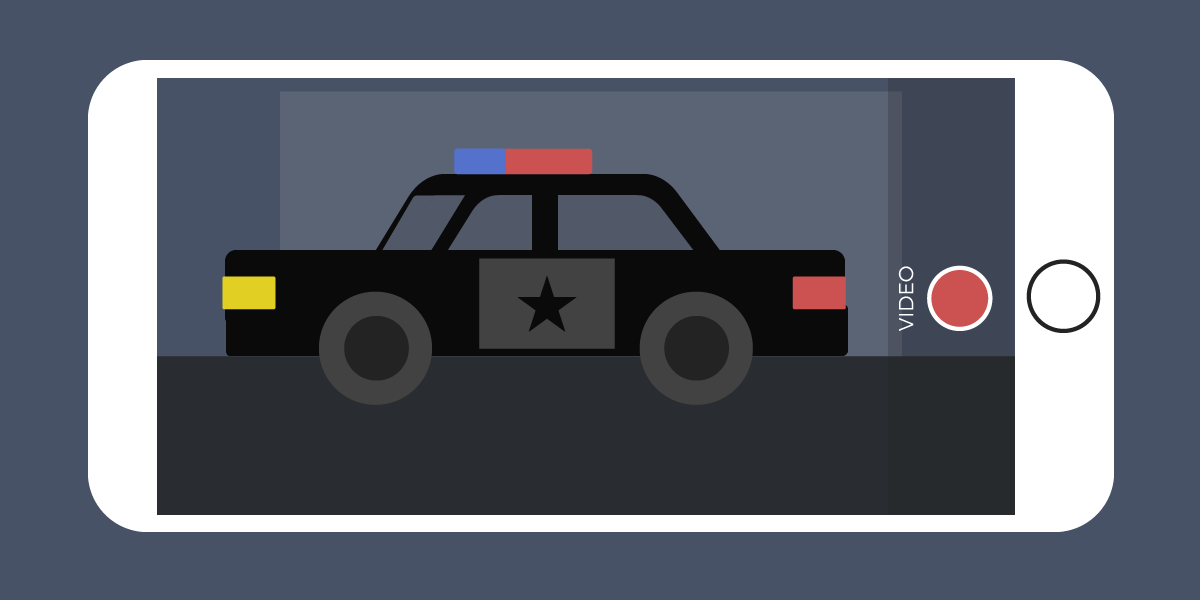
• You have the right to record. The right to protest includes the right to record, including recording police doing their jobs.
• The police can order people to stop interfering with legitimate police operations, but video recording from a safe distance is not interfering.
• If you get stopped, police cannot take or confiscate any videos or photos without a warrant.
• If you are videotaping, keep in mind in some states, the audio is treated differently than the images. But images and video images are always fully protected by the First Amendment.
• The police's main job in a protest is to protect your right to protest and to de-escalate any threat of violence.
• If you get arrested, don't say anything. Ask for a lawyer immediately. Do not sign anything and do not agree to anything without an attorney present.
• If you get arrested, demand your right to a local phone call. If you call a lawyer for legal advice, law enforcement is not allowed to listen.
• Police cannot delete data from your device under any circumstances.
“More than 3.44 million people have been reported to be infected by the novel coronavirus globally and 243,015 have died,” Reuters calculated as of 0200 GMT on Sunday, based on public health data from around the world.
At least 66,441 people in the U.S. are confirmed to have died of COVID-19, as of May 3.
There is widespread understanding that the U.S. death toll undercounts coronavirus deaths, in part because of problems with access to testing.
Does this look like a flattened curve?
Does this look like a good time to lift restrictions?
A total rockstar in my Bay Area community has created an incredible program. A big shoutout to Sydney Gressel who started Frontline Foods, a nonprofit that raises funds for restaurants so they can feed the healthcare professionals on the COVID-19 frontlines. It allows struggling restaurants to stay afloat and gives the people tirelessly fighting COVID-19 healthy meals — a real win-win. In just a few short weeks, this fledgling organization has raised over $3M and is now serving food in 52 U.S. cities. Celebrities like Sting are endorsing Frontline, raising money for it on The Late Night Show with Jimmy Fallon, no less.
And on Tuesday, she got love from the Ellen show, appearing remotely as a guest along with Frontline celeb volunteers Melissa McCarthy and Ben Falcone. Here's Sydney (who has also been working 14-hour shifts as an emergency pediatric nurse, btw) talking about how it all began:
Essential businesses across the country are trying to find ways to accommodate their community, while adhering to CDC guidelines. We respect and admire the first responders and healthcare providers who continue to work exhaustively for the betterment of the Tampa community.
We are also grateful to those who work to keep us fed. Grocery stores are beginning to enact measures to protect employees and shoppers alike. The Fresh Market has just announced that team members and shoppers will soon be required to wear masks in the store.
To help keep our communities safe during this time, our Team Members must wear face masks or cloth face coverings in the store, in accordance with the latest CDC recommendations.
Starting on Tuesday, April 14, we are requiring that all guests wear a face covering before entering the store.
This directive goes into effect on Tuesday, April 14.
Publix has also pivoted during this time. In addition to plexiglass at the registers, the store is also making its aisles one-way to assist in social distancing while shopping.
The Fresh Market has two locations in Tampa:
13147 N Dale Mabry Hwy 3722 Henderson Blvd
The Fresh Market in St. Pete is located at 2900 4th Street N.
As of April 7, 79 HP Pavilion T3 and Lenovo I5 laptops were on loan from the Tampa campus. ORACLE PHOTO
With the USF Library closed for the rest of the semester and all classes online, the facility’s computer lab was a big loss for students — until a laptop loan program was launched March 23.
After noticing that many students might not have reliable access to computers at home, the USF Library’s administration launched the program alongside the Tampa campus’ Student Government (SG), the St. Pete campus’ SG and Information Technology (IT).
The service started providing students who need computer access at home with laptops and webcams to complete their remote coursework.
Before the program was established, the USF Library had 97 laptops available, which were then repurposed for the program.
After SG partnered with the USF libraries, the number went up to 365 laptops available for loan across USF’s three campuses — Tampa, St. Pete and Sarasota-Manatee.
As of Tuesday morning, 79 laptops were checked out from the Tampa campus. Students have until May 12 to return the laptops.
In case a student needs to use the laptop for an extended period, Dean of USF Libraries Todd Chavez said that they can grant an extended loan.
For the program, the Tampa SG allocated approximately $35,000 of Activity and Service (A&S) Fees — students pay a flat fee of $7 per semester and $12 per credit hour — from the restricted reserves account, according to Student Body President Britney Deas.
Besides the SG funds, Chavez said the university provided additional funding by matching the total allocation from each campus.
All of the funds were used to purchase 136 units of the HP Pavilion T3 and the Lenovo I5 for the Tampa campus and 110 units of the HP Pavilion AMD for the St. Pete campus.
The average price per computer for the Tampa campus is $735, all of which contain built-in webcams and microphones. This is so students are able to participate in live lectures as well as complete proctored exams.
Chavez said the laptops purchased for the St. Pete campus were slightly less expensive than Tampa’s laptops because of when the orders were placed.
“That was not St. Pete trying to be cheap, they simply couldn’t get units that were at a higher performance level due to the availability,” Chavez said. “When the supply chain ran out, they sort of bought what they could.”
The idea of the program started when USF Provost Ralph Wilcox contacted Chavez about the USF Library providing remote services to students and faculty, especially after the university shifted to remote instruction on March 23.
During normal business operations, students were able to borrow laptops from the USF Library for a three-hour period.
While students were able to renew the loan, they would still have to return the computers on the same day and didn’t have the option to take them home.
“Since all the schools are closed, everybody’s fighting for their home computers,” Dean of Students Danielle McDonald said. “So we wanted to make sure that finances weren’t going to be another barrier to a student being able to academically complete this semester.”
To identify students eligible for the program, the Center for Academic Advocacy in Tampa and Compass Student Success Advocates in St. Pete considered three main variables: graduation, financial need and unforeseen circumstances surrounding COVID-19.
Out of the 5,502 who applied for graduation, 436 students qualified for first-round priority. For the second round, Chavez said that 996 were eligible to request a laptop.
During the first round of eligibility, students were contacted and invited to borrow a laptop on an as-needed basis while in the second round, students who are close to graduate regardless of financial need were invited to participate in the program.
Now, as the program works on its third round, students in need will be able to request a laptop on a first-come first-serve basis by contacting the USF Library.
Chavez said that despite having the loan program available to all students, it should not be used as an opportunity for an “upgrade.”
“We went for the lowest cost, sufficient laptops,” Chavez said. “They’re not high-end laptops or gaming machines. They’re pretty basic. They’re absolutely functional and they will help students with their coursework, research and so forth.”
Before the USF Library’s closure, students were able to get the laptops through a curbside pickup. Now, it has been shipping the laptops free of charge for students.
As the third week of remote classes comes to an end, McDonald said the focus of the initiative is to minimize barriers so students can “successfully complete the semester and graduation.”
“The university is going to try to support students as much as possible and to the extent that we can,” McDonald said. “What we’re trying to do is identify what could be some problems that students might be facing and then see what the university can do.
“Unfortunately, we can’t fix all of them and we can’t address all of them, but we’re really trying to help students overcome the barriers that we can.”
Businesses owners, residents, and community leaders are coming together in incredible ways to support those effected by the COVID-19 pandemic. No restaurant has a greater legacy in the state of Florida than The Columbia, and the restaurant group operates several concepts throughout the region, and Sunshine State.
The Columbia Restaurant Group’s street-side restaurants are closed to the public after the state mandate that dine-in restaurants close. While the doors are shut, the Restaurant Group is working hard to make sure its team is fed.
In times of crisis, it's good to remember the lessons of the past. The Columbia has 115 years of lessons to use as a…
Richard Gonzmart and chef with the Restaurant Group, in partnership with Gordon Food Service Store, have been preparing and providing meals for its nearly 900 staff members. This is in addition to providing meals for first responders.
The Columbia Restaurant Group on Monday began providing pre-prepared staff meals for pickup at the Columbia in Ybor. Meals for staff at the Columbias in Sarasota and Sand Key and at Cha Cha Coconuts in Sarasota took place today (Tuesday). Celebration and St. Augustine will follow. These are for staff only; there’s no public takeout. The measures are part of an effort by Richard Gonzmart, president and 4th-generation caretaker of the 115-year-old company, to assist furloughed staff members, including selling Columbia Restaurant gift cards online at ColumbiaRestaurant.com. For purchases before the end of April, 100 percent of the money will go to the Columbia Restaurant Group Employee Assistance Fund, a pool of money that will be provided to employees at all the company’s brands: Columbia Restaurant, Ulele, Goody Goody and Cha Cha Coconuts. During the same period, for any purchase of $500 in gift cards, the company is adding another $50 to the buyer’s order. The direct link for purchasing gift cards: https://mgd.mercury-gift.com/columbiarestaurant. In addition, Gonzmart pledged to pay full health benefits for all furloughed employees until at least through April. “The last thing you need to worry about right now is your health coverage,” he wrote to staff members on Monday.
The Columbia in Tampa’s Historic Ybor City was founded in 1905 and is Florida’s Oldest RestaurantSM. Additional locations include St. Armands Circle in Sarasota, the Historic District in St. Augustine, Sand Key on Clearwater Beach, Central Florida’s town of Celebration, the Columbia Cafe on the Riverwalk in Tampa and the Columbia Restaurant Cafe at Tampa International Airport.
All Columbia locations are owned and operated by 4th and 5th generation members of the founding family; except for Columbia Restaurant Cafe at Tampa International Airport, which is operated in partnership with HMSHost.
You can follow Columbia Restaurant Group on its website and Facebook for updates.
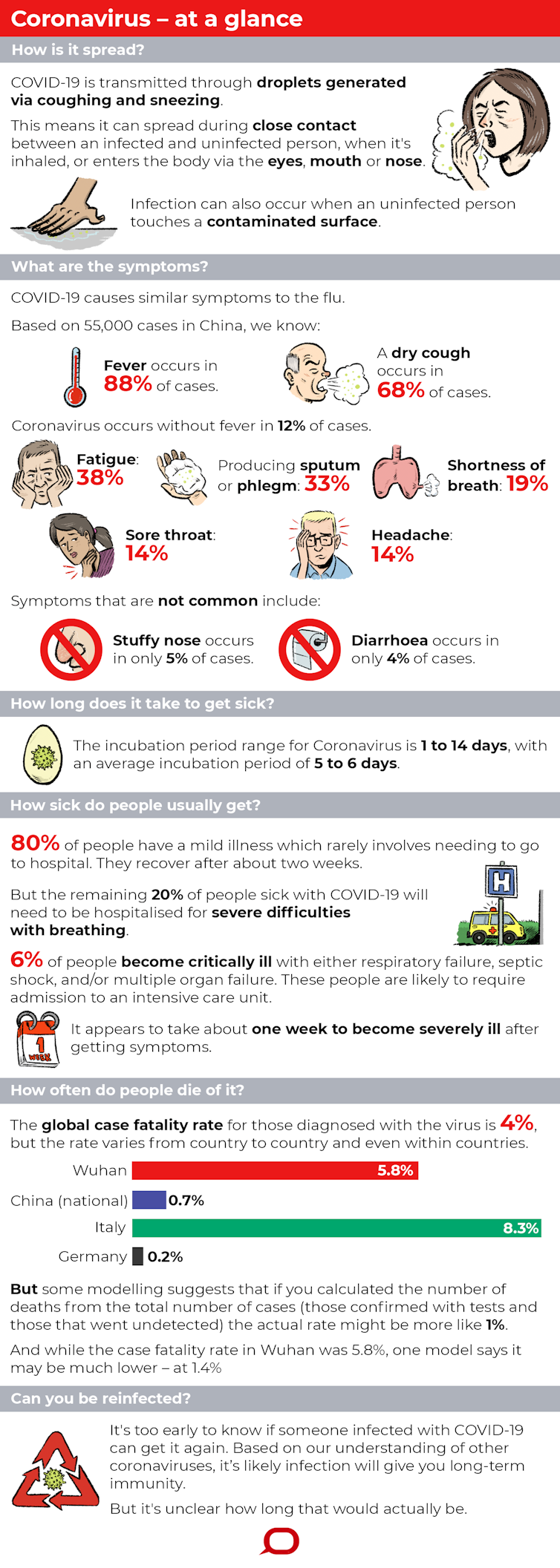
You’re probably inundated with news and messages about coronavirus at the moment. But how do you know if you’re consuming evidence-based information or just speculation and myth?
There’s still a lot we don’t know but here’s what the evidence tells us so far about the coronavirus, called SARS-CoV-2, and the disease it causes, COVID-19.
How does it spread?
COVID-19 is transmitted through droplets generated via coughing and sneezing.
This means it can spread during close contact between an infected and uninfected person, when it’s inhaled, or enters the body via the eyes, mouth or nose.
Infection can also occur when an uninfected person touches a contaminated surface.
COVID-19 causes similar symptoms to the flu. Fever is the most common symptom, occurring in almost 88% of cases, while a dry cough is the next most common, affecting almost 68% of those with the virus.
Yes, you can still have coronavirus if you don’t have a fever. This occurs in about 12% of cases.
How long does it take to get sick?
The incubation is the period from when you’re infected to when you become sick. For COVID-19, the range is 1-14 days, with an average incubation period of 5-6 days.
How sick do people usually get?
Most people who get sick (80%) have a mild illness which rarely involves needing to go to hospital. They recover after about two weeks.
But just over 20% of people sick with COVID-19 will need to be hospitalised for severe difficulties with breathing.
Of the 20% who need to be hospitalised, 6% become critically ill with either respiratory failure (where you can’t get enough oxygen from your lungs into your blood), septic shock, and/or multiple organ failure. These people are likely to require admission to an intensive care unit.
It appears to take about one week to become severely ill after getting symptoms.
How often do people die of it?
The case fatality rate refers to the number of deaths among those who have tested positive for coronavirus. Globally, the case fatality rate today stands at 4%.
But this rate varies country to country and even within countries. These variations may partially be explained by whether hospitals has been overwhelmed or not.
The case fatality rate in Wuhan was 5.8% (although one model says it may be lower at 1.4%). In the rest of China, it was at 0.7%.
Similarly in Europe, Italy’s case fatality rate is (8.3%), greatly surpassing that of Germany (0.2%).
However the case fatality rate only includes people who are tested and confirmed as having the virus.
Some modelling estimates suggest that if you calculated the number of deaths from the total number of cases (those confirmed with tests and those that went undetected) the proportion of people who die from coronavirus might be more like 1%.
How infectious is it, and how does that compare with the flu?
COVID-19 and influenza are probably fairly similarly infections.
A single ill person with COVID-19 can infect more people than a single ill person with influenza. COVID-19 has a higher “reproduction number” of 2.0-2.5. This means one person will infect, on average, 2 to 2.5 people.
But this is balanced by influenza’s ability to infect more quickly. It takes, on average, 3 days to become sick with the flu, but you can still transmit it before symptoms emerge.
It takes 5-6 days to become sick with COVID-19. We still don’t know if you can be infectious before getting coronavirus symptoms, but it doesn’t seem to be a major driver of transmission.
So influenza can spread faster than COVID-19.
The case fatality rate of COVID-19 is higher than that of seasonal influenza (4% versus 0.1%), although as noted above, the true fatality of COVID-19 is still not clear.
It’s too early to know if someone infected with COVID-19 can get it again.
On the basis of what we understand about other coronaviruses, it is likely that infection will give you long-term immunity. But it’s unclear whether that will mean one year, two years or lifelong immunity.
Still have more questions? We might have you covered in this video.
Sanjaya Senanayake does not work for, consult, own shares in or receive funding from any company or organisation that would benefit from this article, and has disclosed no relevant affiliations beyond their academic appointment.
by Brittany Harker Martin, Associate Professor, Leadership, Policy & Governance, University of Calgary
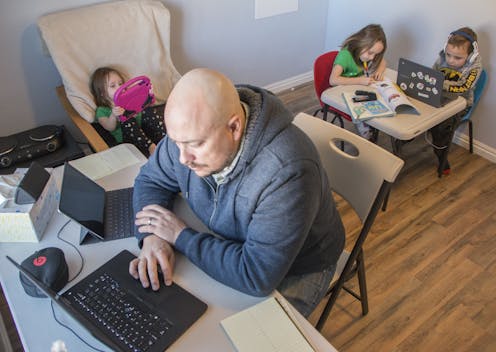
A busy workspace: Dad works while toddler does online-preschool, twins adjust to home-kindergarten and mom, on a break, takes the photo. (Lesli Harker), Author provided
With much of the globe self-isolating, many people must suddenly manage the complexities of working from home while sharing a crowded space.
Kitchens, dining rooms and other spaces have become offices for remote work with computers, cords and paperwork spilling into what was, until very recently, private space. For people with children, these spaces are also the daycare and an impromptu home-school with everyone trying to remain productive in the middle of the chaos of competing demands.
The term “remote work” means different things to different people. Many think of it as working away from a central office or school by connecting through communication technologies, such as email, intranets and video conferencing. Academia has yet to establish a common definition for this type of work that is accepted by all. In this article, I’m using the term as it is currently being used by the public in reference to working from home.
As a teacher with a doctoral degree in business that focused on remote work, I have a unique vantage point for this emerging situation of working from home in a house full of people, of all ages. In order to be effective and minimize stress, I recommend taking time to create a structure that everyone agrees to.
Here are five ways to organize the home-work environment for a more successful transition.
Create workstations
Assigning a workstation to each person gives everyone a sense that they belong in the newly shared space, while setting boundaries for personal space.
The workstations should make sense for the work being done. If the work is loud and disruptive, like video conferences or multimedia streams, assign that work to a room with a door. For quiet work that requires concentration, ear plugs or headphones with white noise may be needed.
If you have a home with a separate room for relaxing, such as a family room or den, consider making it a work-free zone.
In smaller places, this can be the bedrooms or even designated areas, such as a table with games and puzzles, or a corner with books and drawing materials. This can be especially helpful when there are children on the scene.
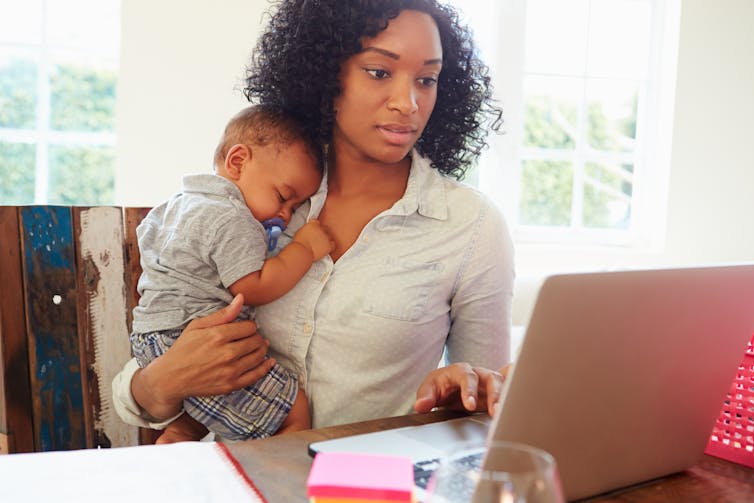
With daycares and schools closed, parents are scrambling to find ways to get work done and care for their kids.
(Shutterstock)
Designating a space that is not for work is part of creating healthy work-life boundaries for psychological wellness.
Take scheduled breaks
The most common misconception about remote work is that it enables slackers. In fact, slacking is often more about personality and fit than the work context.
Taking scheduled breaks not only keeps your mind fresh, but it also signals to others that wellness is important. If you are in self-isolation with children, your behaviour is teaching them what work-life looks like, so be sure to infuse a priority for wellness by modelling it yourself.
Integrate physical and creative activities
As adults, we know that it is important to make time for exercising and engaging our minds. Children have such activities scheduled into their school day, through recess, gym and creative subjects like art and music.
Running outside can help meet exercise needs and maintain your new social distancing routine. Hiking, walking and cross-country skiing are other activities where you can remain two metres away from others.
(Shutterstock)
If you are self-isolating, it is essential to schedule physical and creative activity into each day — for everyone. If the weather allows, get outside, or plan to do indoor physical activities like yoga, dance games and interactive video games. Make it timed. Make it fun. The important thing is to schedule it.
It is also important to schedule time for creative activities. Consider how you can add the arts to the schedule, and remember: if it makes noise or a mess don’t schedule it for children when you don’t have the capacity to manage it, or it might not be the positive experience you are trying to create.
Children who are accustomed to timed periods, bells for breaks and a set time to go home still require structure and routine to make them feel safe, especially during these uncertain times. For children and adults, setting a timer and establishing the norm that work-time has a beginning and an end can signal familiar norms of the workplace and school, and lead to more effective behaviours for sharing space together.
These five tips are research-informed, yet as a parent who has worked remotely for years, I have also used them. The most important thing, in addition to implementing each tip, is to have an open dialogue with family, roommates or whomever shares your space and to be flexible enough to adapt to the different, emerging needs as they arise.
Everyone feels the stress of uncertainty; everyone wants life to feel as normal as possible.
Brittany Harker Martin does not work for, consult, own shares in or receive funding from any company or organisation that would benefit from this article, and has disclosed no relevant affiliations beyond their academic appointment.
Last week, the Unicode Consortium released the latest version of the Unicode Standard—the universal character coding system used in computer processing (which includes the international emoji portfolio ). We’re thrilled to announce that Creative Commons (CC) license symbols were included in this new release.
The latest Unicode Standard adds 5,930 characters, including 4 new scripts, 55 new emoji characters, and the following CC license symbols:
Graphic from Emojipedia. Read their great overview of the new Unicode release.
This is the result of years of hard work by several members of CC’s staff, including our former Director of Product and Research Jane Park who submitted our initial proposal in October 2016 and our second proposal in July 2017.
What is Unicode?
Unicode is the standard for encoding characters into text. Typical examples of encoded characters that we use every day are @, $, &, #, and %. Other examples are writing scripts, like Arabic (العربية) or Devanagari (देवनागरी). Due to the nature of the internet, more characters are created every day—like the mechanical arm emoji—so the Unicode Standard must be regularly updated.
Put simply, the Unicode Standard enables virtually all text-based editing platforms and tools (e.g. WordPress, Gmail, Twitter, etc.) to use the same characters and symbols.
Why we proposed adding CC license symbols to Unicode
Way back in 2017, we surveyed more than 700 people to understand how they marked their works with CC licenses. We found that more than half (62%) use the CC license icons or buttons, which must be downloaded from our website or made accessible via an external plugin (e.g. CC WordPress Plugin). However, many more (96%) said they would like to be able to place the CC license symbols directly in their text to indicate the particular CC license being applied—hence the need for our proposal.
Font developers—please be sure to include the CC symbols in your fonts! With the CC license symbols being added to the Unicode Standard, you can help make it much easier for people to mark their work with a CC license.
The COVID-19 pandemic is affecting all aspects of life in the Tampa Bay region. We’re grateful to the City of Tampa for their response to the situation, and their continued support of the Tampa business community.
Ubereats, a meal delivery service, announced that it would waive delivery fees for all orders from independent restaurants in light of current circumstances.
$0 delivery fees for local delivery
The hope of the $0 delivery fee is done in hopes that it will help continue to stimulate business for locally owned and operated businesses in cities across the country.
You can learn more by visiting the Ubereats App on your iPhone and Android.
Additionally, the company announced a new opt-in program for all restaurants in the U.S. and Canada that use Uber Eats to get daily payouts, rather that the standard weekly payout.
MLB season pushed back
On March 16, it was officially announced that the MLB season would be pushed back as well. Initially just spring training was put to a halt, but following the CDC’s new recommendations, officials have decided to push the season back.
Other local businesses like Kahwa Coffee, which operates multiple locations throughout the Tampa Bay region, will only offer takeout service at this time.
Amalie Arena staff compensated through shutdown
The Tampa Bay Lightning also announced that all employees scheduled to work games at Amalie Arena through the end of March would be compensated. This includes both Lightning hockey games and NCAA Tournament games. In addition, Vinik Sports Group (VSG) established a fund to provide temporary assistance to employees who need support during the shutdown.
Scholastic assists kids during school closures
Scholastic is also pulling through for kids and families stuck home during the pandemic.
Scholastic set up a ‘Learn From Home’ website with four categories: PreK and Kindergarten, Grades 1 and 2, Grades 3-5, and Grades 6+. Each section is already equipped with one week of content for students with 15 additional days on the way.
Each day of content is filled with videos, and learning challenges. The students can even go on virtual field trips or meet best-selling authors.
The website provides up to three hours’ worth of content each day and can be completed on multiple devices.
Florida Governor Ron DeSantis announced that all Florida bars and nightclubs will close for the next 30 days during a press conference on March 17.
More than 170 Florida residents have tested positive for coronavirus as of this writing.
The Governor also outlined new guidelines for restaurants, stating that employees should be screened before entering the business to be sure they don’t have the virus.
Restaurants are currently advised to limit capacity by 50%, and provide staggered seating arrangements so no tables are at least 6 feet apart.
DeSantis noted that city’s in Florida can go beyond these guidelines, but wanted to set these as the minimum standards going forward.
by Cathrine Jansson-Boyd, Reader in Consumer Psychology, Anglia Ruskin University
No more hugs? Rawpixel.com/shutterstock
Touch has profound benefits for human beings. But over the last few decades, people have become increasingly cautious about socially touching others for a range of reasons. With the novel coronavirus spreading, this is bound to get worse. People have already started avoiding shaking hands. And the British queen was seen wearing gloves as a precaution not to contract the virus.
The coronavirus could very well have long-term implications for how hands-on we are – reinforcing already existing perceptions that touch should be avoided.
Why is touch so important? It helps us share how we feel about others, enhancing our verbal communication. A touch on the arm when comforting someone, for example, is often what shows that we really care. People benefit from physical touch throughout their lifespan, and there is a large body of evidence showing that it has the ability to affect both short and long-term wellbeing. For babies, it is even crucial for healthy brain development.
The emotional impact of social touch is ingrained in our biology. There is evidence that it triggers the release of oxytocin, a hormone that decreases responses to stress. In fact, touch has been shown to cushion stress levels in humans.
We know that a simple touch by a nurse prior to surgery can reduce stress levels in patients. It can also reduce feelings of social exclusion and even increase food intake among elderly people living in a nursing home. So given how essential social touch is to people’s wellbeing, it is important to ensure that it is a part of everyday life.
Decline in social touch
The last few decades has seen a decrease in social touch. Partly, this is down to the fact that we are living in a technology-focused, socially disconnected world, where people are more likely to communicate virtually rather than through meeting in person. This means that we are touching each other much less than we used to.
But the decline in touch is primarily due to a fear that it may result in an accusation of inappropriate touching. Such fear has been moulded by society as people are frequently hearing stories of inappropriate behaviour. People therefore rather resist touching others than risk having a social touch misinterpreted. The message is simple: avoid hugging a work colleague who is upset and don’t pat someone on the back for a job well done.
At the same time, the fear of accusations of child abuse has been disproportionate to the number of actual occurrences. This has seen professionals developing distorted thinking. Teachers often avoid being alone with children, and don’t touch pupils in a natural and affectionate way.
The impact of coronavirus
With the novel coronavirus, people have yet another reason to be fearful of touching others, as it means approaching people who potentially may be carriers. While we should remain careful with touching during this serious outbreak, we have to make an effort not to let it get out of control. After all, a lot of people suffer from high levels of anxiety about the virus, and touch is a way to reduce it.
The longer this goes on, the more likely that an association will be formed between social touch and a sense of negativity. People may eventually forget all about the virus, but still be wary of social touch without knowing why. This is because negative associations often create more readily available memories for people than positive associations.
So while it is not advisable to carry on touching people as usual during the outbreak, especially not people who are old or have underlying health conditions, physical contact with loved ones can still continue, as long as we take precautions and wash our hands.
More broadly, the key is to be aware that negative life events such as this epidemic could impact on social touch in the long run in an undesirable way. Bringing this to the forefront of our minds can counterbalance what may otherwise generate negative memories about touch.
Once the outbreak is over, one vital challenge will be to reset our thinking about touch, keeping in mind its importance. After all, a hug may be just what we need to move on from the traumatic experience of the coronavirus.
Cathrine Jansson-Boyd does not work for, consult, own shares in or receive funding from any company or organisation that would benefit from this article, and has disclosed no relevant affiliations beyond their academic appointment.
Over the last few days, a growing number of organizations have shut down their offices and told employees to work from home in order to prevent the spread of COVID-19. Here at Creative Commons (CC), we’ve also taken necessary precautions such as postponing all work-related travel and canceling the in-person component of the annual CC Global Summit in May.
Fortunately, however, our daily operations haven’t been disrupted to the same extent as other organizations because CC has been a global, fully remote nonprofit since 2015. Our staff is spread across Europe, North America, and South America; and although this working environment presents incredible benefits, like flexibility and rich cultural exchanges, it also presents unique challenges. For example, staff on the west coast of North America are often just waking up as staff in Europe are signing off!
In the spirit of open access and promoting good health, we’d like to share some tips for both organizations and individuals on the subject of remote work.
For organizations
Create clear policies and guidelines that are accessible to all staff. Make sure to anticipate questions and/or concerns that your staff may have, and include answers in a FAQ.
Craft an internal communications strategy that maintains clear, reliable, and regular communication across the organization and within teams. In fact, don’t be afraid of “overcommunication.”
Schedule video conferencing—encourage leadership and/or management to schedule informal video conferencing with their team members to maintain team morale and cohesiveness.
Don’t assume all staff has access to the latest technology—in particular, don’t assume all staff members have access to high-speed internet. If they don’t, work with them to figure out alternatives or to set expectations.
Ensure contact information is up-to-date—for emergency purposes, ensure that all staff’s contact information is correct.
Assess and adjust expectations and deadlines on projects that may be impacted by the lack of in-person engagement or by a disruption in schedules due to schools closing, individuals becoming ill, etc.
Provide mental health resources—it’s important to provide staff with appropriate resources in case they begin to feel isolated and/or depressed while working remotely.
Showcase flexibility, patience, and empathy—leadership and/or management should showcase these qualities in order to reduce employee anxiety and stress under challenging circumstances.
Give regular updates, either via email or through video check-ins, on the status of COVID-19.
Don’t micromanage your staff’s activities—instead, set realistic goals and trust they’ll get their work done.
For individuals
Keep your normal workday morning routine—this includes brushing your teeth, changing your clothes, eating breakfast, etc.
Do work in another room, not in your bedroom—if you live in a small apartment, try to create a space that you can designate as your “office.”
Take breaks throughout the day—make some coffee, go for a walk, read a book, or stretch.
Keep in touch with coworkers outside of formal meetings—this can help prevent social isolation, anxiety, or depression. CC staff, for example, schedule “lunches” over video or take “walks” together while talking over the phone.
Create boundaries between your life and your work—stick to your regular work hours and set expectations about email response times. This is often one of the biggest challenges of working from home!
Find other remote workers in your town—schedule coworking days with them or meet up for lunch (if it’s safe)!
Don’t buy (only) unhealthy snacks—you will eat them! Make sure you buy healthy snacks that will keep you energized throughout the day.
Be wary of your tone—especially when communicating through messaging applications (e.g. Slack) because these forms of communication can feel impersonal and cold.
Log off distracting websites—social media sites are especially distracting, so either log off of them or use a browser plugin to help you stay focused.
Be proud of working from home—just because you don’t go to an office doesn’t mean your work is less important or you’re less productive.
Here’s the gist: On an individual level, try to create a routine that makes you feel productive, included, and motivated. On an organizational level, actively listen to and check in with staff to ensure everyone feels supported and included. Most importantly, as the World Health Organization (WHO) says, “Be safe. Be smart. Be kind.”
For more insights on remote working that our staff has found helpful, check out this article from Deekit, this guide from Trello, this guide from GitLab, and this podcast from Remoter. Also, this post is licensed CC BY, so please remix and reshare it!
It is literally on everything. You can find it anywhere from the places you’d expect, such as books and movies, to virtually anything with writing or images on it include tissue boxes and (the most bizarre in my office) cans of compressed air.
Still, the copyright symbol is everywhere. and we see it hundreds of times a day, usually without thinking about it.
But where did the copyright symbol come from and how did it get started? Why is it so much less useful today? To answer those questions we have to go back to a much earlier time, back before the copyright symbol existed but it probably would have been very welcome.
Copyright notices, however, didn’t become an element of United States law until the Copyright Act of 1802. It required publishers, if they wished to enjoy copyright protection to insert a copyright notice in their books, to publish a copyright notice either on the title page or the page behind it.
That notice was very specific and read as follows:
Entered according to act of Congress, the _____ day of _____ 18 _____ (here insert the date when the same was deposited in the office) by A. B. of the State of _____ (here insert the author’s or proprietor’s name and the State in which he resides).
If that sounds like a mouthful, it certainly is but all copyrighted works had to include it. The Copyright Act of 1870 gave some reprieve to works of fine art, allowing it to be inscribed on the side that would be mounted. An amendment four years later would shorten that lengthy notice to just “Copyright, 18__, by A. B.”
To those in the 21st century, this is a much more familiar notice and closely mirrors the notices that we use today. However, there’s no copyright symbol involved. Instead, we are just using the word “Copyright”.
The actual symbol would come around in the nearly 20th century.
The Birth of the Copyright Symbol
The Copyright Act of 1909 was a major rewrite of the United States copyright code. Among other things it extended the term of copyright from a maximum of 42 years to a maximum of 56 years.
However, like most sweeping reforms, the act had many points of contention. One of them was how to apply the notice requirement to various types of works. Something of a compromise was struck.
For most works, a notice would require either the word “Copyright” or the abbreviation “Copr.” (this is a terrible abbreviation and they should feel bad). However, for maps, copies of art, photographs and prints, they introduced a new symbol.
It wouldn’t be until 1954 when the symbol would be considered an acceptable alternative for the word “copyright” on all types of works.
However, that was oddly the least important thing to happen to the copyright symbol around that time. The symbol was also starting to go international.
Becoming an International Symbol
In the 1950s the United States had a problem. Copyright was becoming a much more international affair but was not a member of the Berne Convention, the leading international treaty on copyright at the time.
The specific issue was these very formalities. The Berne Convention required that all nations remove such formalities, including notices and registrations. The United States wasn’t prepared to do that at the time.
This brought about the Universal Copyright Convention. It was created in 1952 and took effect in 1955. It harmonized copyright between the various signatory countries and, most importantly, ensure that works in UCC countries would be protected in Berne Convention countries and vice-versa.
To be clear, the prominence of the United States meant that many international works used copyright notices well before this. However, the UCC took the copyright symbol international, with many, including in countries outside of the UCC bloc, using it to ensure that their work was properly protected in the United States.
However, the UCC did not have a long life. In March 1989, the United States finally joined the Berne Convention (more than a century after the first signatories). Around that same time, negotiations began on the Agreement on Trade-Related Aspects of Intellectual Property Rights (TRIPS), which would take effect in January 1995.
Signing on to TRIPS was a requirement of joining the World Trade Organization and the TRIPS agreement also got rid of formalities and is currently the leading trade agreement on matters of copyright.
In just a few decades, the copyright symbol went from an international fixture to, in many cases, nearly useless. That said, it has clearly stuck around. You would be hard-pressed to find a book, album or movie that doesn’t have it.
But is it really useless? The answer is: Not completely.
The Continued Use of the Copyright Symbol
Under U.S. law, there’s really no requirement that you use a copyright symbol. You aren’t going to lose your copyright if you omit it (as with Night of the Living Dead) and, most likely, nothing bad will happen if you forget it.
Given that it doesn’t cost anything to include a copyright notice and it’s so common and ubiquitous, there isn’t really a reason not to. If it has any benefit at all, that’s more than enough to justify its inclusion for most.
Bottom Line
The copyright symbol is the face of copyright. It is one of the most common symbols we see on a daily basis and, yet, it’s something we think about very little. It’s just something that’s always been there and never really warranted questioning.
Still, one has to admit that its continued widespread use is somewhat bizarre. It’s extremely limited benefits outweigh the even more significantly limited costs. There’s little reason to have it but even less reason not to have it.
So, the copyright symbol lives on. Archaic and nearly useless, it remains just as common.
It’s a long, bizarre history of a very mundane thing.
by Deni Elliott, Eleanor Poynter Jamison Chair in Media Ethics and Press Policy; Co-Chief Project Officer on the National Ethics Project, University of South Florida
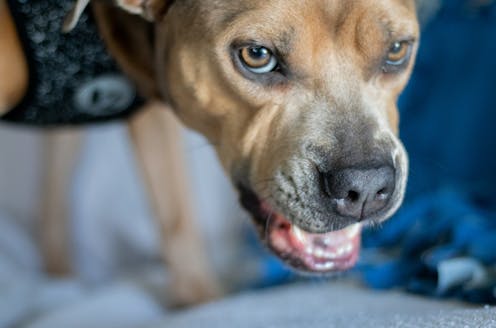
In 2017, Marlin Jackson boarded a cross-country flight. When he got to his row, another passenger was already in the middle seat with an emotional support dog in his lap.
According to Mr. Jackson’s attorney, “The approximately 50-pound dog growled at Mr. Jackson soon after he took his seat…and continued as Mr. Jackson attempted to buckle his seatbelt. The growling increased and the dog lunged for Mr. Jackson’s face…who could not escape due to his position against the plane’s window.” Facial wounds requiring 28 stitches were the result.
I can relate. I am a visually impaired person partnering with my fourth guide dog over a 20-year period. In the past decade, I have increasingly needed to cope with clueless handlers allowing their pets to interfere with my dog’s work.
Over the past decade, purported emotional support animals have increasingly appeared in stores, restaurants and airports. While peacocks, pigs and kangaroos make the headlines, almost all the animals found in no-pet zones are dogs. Dog biting, barking, growling, urinating and defecating are top complaints, with one airline reporting an 84% increase in dog-related incidents from 2016-2018.
The influx of inappropriate dogs has also generated unwarranted suspicion toward the approximately 10,000 Americans who, like me, partner with legitimate, trained guide dogs.
Animal public access in the U.S. is currently governed by a patchwork system of inconsistent laws, creating confusion for people with disabilities, citizens and, particularly, gatekeepers – the store managers, restaurant owners and building supervisors tasked with deciding which dogs should be allowed in their no-pet spaces.
Inothercountries, IDs are issued only to professionally trained service dogs who have demonstrated ability to behave in public. In the U.S., there is no such validation. As a result, pet owners have become increasingly brazen in fraudulently claiming their animals warrant legal public access.
Service dogs versus emotional support animals
The Department of Justice, which enforces the Americans with Disabilities Act, allows people with physical, sensory, psychiatric, intellectual or mental impairments to have public access with service dogs who have been individually trained to perform tasks that mitigate their owners’ disabilities.
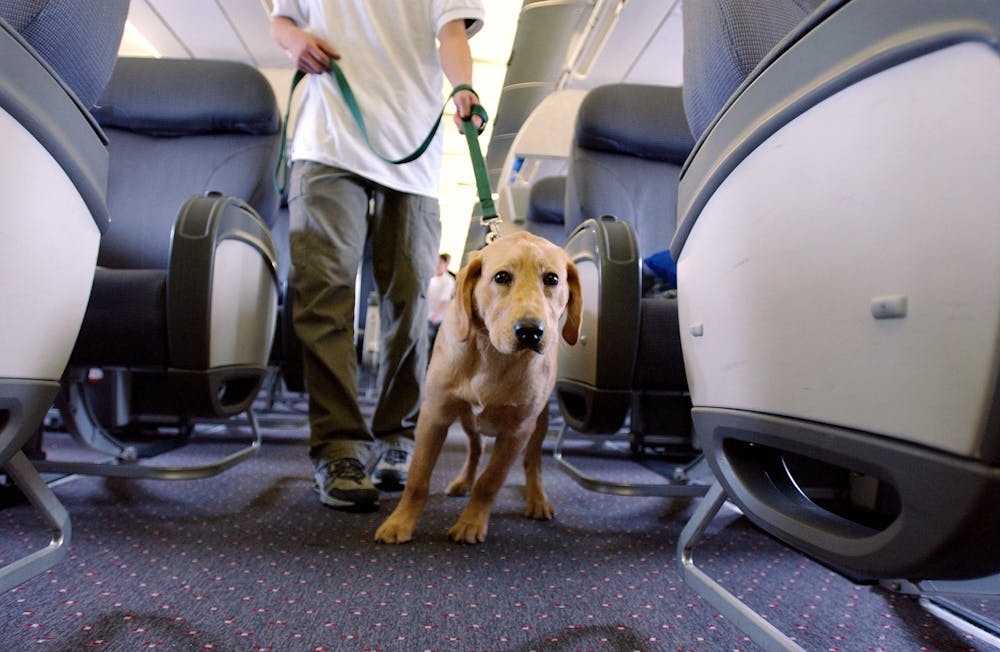
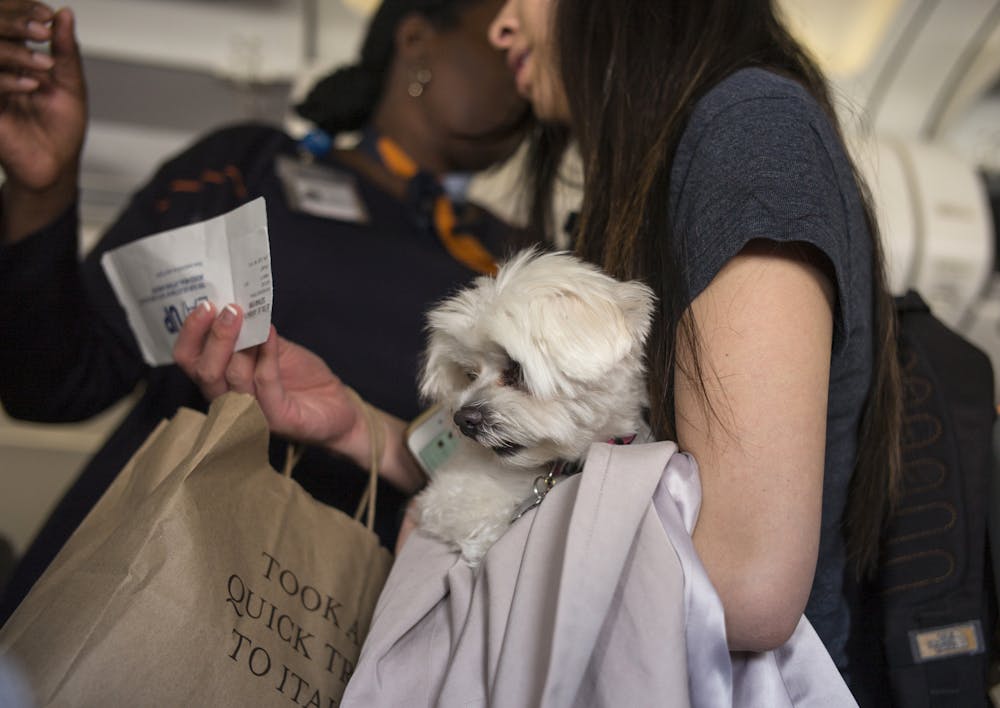
The Department of Transportation and Department of Housing and Urban Development allow service dogs on public transportation and in housing, respectively, but also grant access to people with mental and emotional disorders accompanied by emotional support animals – untrained animals who need only to contribute to their owners’ emotional well being, as any good pet would.
Technically, the individual seeking access with an emotional support animal must have certification of a mental or emotional disorder, which is a much lower standard than the disability requirement of DOJ.
Some mental health professionals have been willing to attest to an individual’s “need” for an emotional support animal without having a professional relationship with them. And none vouches for the appropriateness of specific animals.
ADA service dogs may legally accompany their handlers almost anywhere. Emotional support animals may not. For example, emotional support animals currently allowed in aircraft cabins are not legally permitted in airport shops and restaurants. Emotional support animals allowed to live in college dorms may not go with their owners to class or the cafeteria.
Online purveyors of official-looking letters, vests and patches guaranteed to get dogs access in pet-free zones take advantage of the confusion between service dogs and emotional support animals, liberally mixing the classifications. They also fail to mention that the individual seeking such accommodation must have proof of a mental disorder. This omission, itself, is an ethical problem.
A predicament for gatekeepers
Gatekeepers have to weigh the consequences of confronting an individual accompanied by a dog. Denial of access to a disabled handler with a legitimate service dog can result in a US$10,000 fine by the DOJ. The fine for a handler who falsely portrays a pet as a service dog or emotional support animal ranges from $100 to $1,000 and happens only if the handler supplies identification or waits for the police.
It is cheaper and easier for gatekeepers to just hope that questionable dogs don’t put patrons at risk. Airline attendants face a unenviable dilemma, as passengers cannot escape aggressive or stressed dogs in the tight confines of an airplane.
Change on the horizon?
There are recent signs that DOT and HUD are moving toward DOJ’s more stringent regulations. On Feb. 5, 2020, DOT opened a 60-day public comment period for a plan that would reclassify emotional support animals as pets and restrict free aircraft cabin access only to service dogs. HUD recently posted new guidelines to help housing providers better determine animal access.
In my view, more federal intervention is needed. Medical documentation of disability should be the entry point for service dog access, just as it is for handicapped parking permits. Offering a nationally recognizable ID for service dog owners who voluntarily provide documentation would eliminate some fraud.
Ideally, a dog’s ability to behave appropriately in public should be proven prior to access and affirmed annually by testers, who use a public access test to verify a dog’s manners and handling of disability-specific tasks, such as that developed by Assistance Dogs International or those performed by all U.S. guide dog schools.
Some argue documentation and testing is burdensome or a violation of disabled people’s civil rights. But physicians, who diagnose ADA-defined disabilities, already provide their patients verification for state and federal benefits. Behavior tests assure handlers their dogs can work in stressful situations. And ensuring public safety protects the civil rights of all people.
Deni Elliott does not work for, consult, own shares in or receive funding from any company or organization that would benefit from this article, and has disclosed no relevant affiliations beyond their academic appointment.
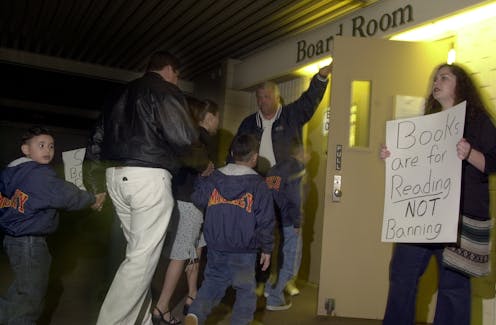
A bill pending in Missouri’s legislature takes aim at libraries and librarians who are making “age-inappropriate sexual material” available to children.
The measure, championed by Ben Baker, a Republican lawmaker, calls for establishing review boards who would determine whether materials in libraries contain or promote “nudity, sexuality, sexual conduct, sexual excitement, or sadomasochistic abuse.” In addition, the boards, which would be comprised of parents, would root out materials lacking “serious literary, artistic, political, or scientific value.”
Librarians who defy the review boards by buying and lending such materials would be subject to misdemeanor charges, fines upward of US$500, and a potential jail sentence up to one year.
The children’s book “And Tango Makes Three,” by Justin Richardson and Peter Parnell and illustrated by Henry Cole, was challenged and banned from libraries around the country for many years after its publication in 2005. The picture book is based on a true story of two male penguins in New York City’s Central Park Zoo who adopt and care for an egg and then keep caring for their daughter, Tango, after she hatched.
Separately, opponents of the storytime program known as “Drag Queen Story Hour” at libraries and other community venues, have held protests to ban and condemn such events aimed at children. The objections voiced by protesters stem from their belief that drag performers are evil and amoral and that exposure to drag queens will, in their view, cause children to become gay.
The Missouri bill is not the first of its kind. State lawmakers in Colorado and Maine both tried to pass similar legislation in 2019. Both efforts failed.
The drag queens who read to kids in libraries are attracting protesters.
David McNew/Getty Images
Librarians are professionals. Librarians working in K-12 school libraries also earn certification as school library media specialists. Librarians have expertise in children’s literature, collection development, child development, psychology, readers’ advisory, reference services and other specialized skills needed to serve children and young adults in a variety of settings.
In short, librarians are more than capable of selecting and purchasing quality books and other materials for people of all ages.
To imply otherwise, as I believe the proposed Missouri measure would, is to insult these skilled educators. If it should be enacted, I would consider it a potential threat to information access, intellectual freedom and the freedom to read.
Nicole Cooke works for the School of Library and Information Science at the University of South Carolina.
I belong to professional library associations that advocate for librarians and free speech, several of which are mentioned in the article.
Motherboard has an interesting new piece about musical copyright law, and the fact that there are only so many musical sequences using half-step frequencies possible. What happens when they're all used up, and the copyright trolls take everyone to court for any song that even remotely resembles another one, just by virtue of the fact that it relies on the same music theory?
Think about Lana Del Rey accidentally ripping off of Radiohead, who had accidentally ripped off of the Hollies. It's not crazy to write a song that goes from the I to the extra tension of a Chromatic Mediant III before resolving on a IV, which then walks down to a minor iv and returns to the tonic.
(Or, in simpler terms, as Motherboard puts it: Sam Smith's "Stay With Me" ripping off of Tom Petty's "Won't Back Down")
To get around the potential future copyright trolls, Damien Riehl and Noah Rubin developed a MIDI algorithm to automatically generate a series of melodies, then released those datasets into the public domain using a Creative Commons Zero license. The method for achieving this is pretty neat:
To determine the finite nature of melodies, Riehl and Rubin developed an algorithm that recorded every possible 8-note, 12-beat melody combo. This used the same basic tactic some hackers use to guess passwords: Churning through every possible combination of notes until none remained. Riehl says this algorithm works at a rate of 300,000 melodies per second.
Once a work is committed to a tangible format, it's considered copyrighted. And in MIDI format, notes are just numbers.
"Under copyright law, numbers are facts, and under copyright law, facts either have thin copyright, almost no copyright, or no copyright at all," Riehl explained in the talk. "So maybe if these numbers have existed since the beginning of time and we're just plucking them out, maybe melodies are just math, which is just facts, which is not copyrightable."
Ideally, this would mean that any new music that gets written is arguably remixing and adapting from these public domain melodies … which means there's no copyright infringement, just new songs. Though whether this holds up in court remains to be seen.
Lawyers have their legalese. Academics have their own intra-academialogical post-linguistic theories. And it was only before the MBAs joined the fray with their own self-important syntax. If you've ever been in the sleek office setting of a start-up or some tech-savvy corporation, you've heard it. You may have even picked up on its tics to help you sound smarter, too; after all, that's how it works.
Molly Young has a great new piece at Vulture about this phenomenon, which she has coined "Garbage Language." Her article is full of insight not only into the ways that we do and don't communicate, but also how that reflects the other issues inherent in these kinds of office cultures:
[G]arbage language works because garbage is what we produce mindlessly in the course of our days and because it smells horrible and looks ugly and we don’t think about it except when we’re saying that it’s bad, as I am right now.
But unlike garbage, which we contain in wastebaskets and landfills, the hideous nature of these words — their facility to warp and impede communication — is also their purpose. Garbage language permeates the ways we think of our jobs and shapes our identities as workers. It is obvious that the point is concealment; it is less obvious what so many of us are trying to hide.
[…]
When we adopt words that connect us to a larger project — that simultaneously fold us into an institutional organism and insist on that institution’s worthiness — it is easier to pretend that our jobs are more interesting than they seem. Empowerment language is a self-marketing asset as much as anything else: a way of selling our jobs back to ourselves.
It's a long-ish article, but unlike that padded-out garbage language, the diction is actually substantial and useful.
The Smithsonian Institution has just released 2.8 million images (2D and 3D) into the public domain via a new Smithsonian Open Access online platform where anyone can browse and download high-res files. And then reuse them! Or remix them! For whatever! For free! From Smithsonian:
Featuring data and material from all 19 Smithsonian museums, nine research centers, libraries, archives and the National Zoo, the new digital depot encourages the public to not just view its contents, but use, reuse and transform them into just about anything they choose—be it a postcard, a beer koozie or a pair of bootie shorts.
And this gargantuan data dump is just the beginning. Throughout the rest of 2020, the Smithsonian will be rolling out another 200,000 or so images, with more to come as the Institution continues to digitize its collection of 155 million items and counting...
Spanning the arts and humanities to science and engineering, the release compiles artifacts, specimens and datasets from an array of fields onto a single online platform. Noteworthy additions include portraits of Pocahontas and Ida B. Wells, images of Muhammad Ali’s boxing headgear and Amelia Earhart’s record-shattering Lockheed Vega 5B, along with thousands of 3-D models that range in size from a petite Eulaema bee just a couple centimeters in length to the Cassiopeia A supernova remnant, estimated at about 29 light-years across.
by Gregory Moore, Doctor of Botany, University of Melbourne
Shutterstock
As the brutal reality of climate change dawned this summer, you may have asked yourself a hard question: am I well-prepared to live in a warmer world?
There are many ways we can ready ourselves for climate change. I’m an urban forestry scientist, and since the 1980s I’ve been preparing students to work with trees as the planet warms.
In Australia, trees and urban ecosystems must be at the heart of our climate change response.
Governments have a big role to play – but here are five actions everyday Australians can take as well.
At the current rate of warming, the number of days above 40℃ in cities including Melbourne and Brisbane, will double by 2050 – even if we manage to limit future temperature rises to 2℃.
Trees can help cool your home. Two medium-sized trees (8-10m tall) to the north or northwest of a house can lower the temperature inside by several degrees, saving you hundreds of dollars in power costs each year.
Trees can cool your home by several degrees.
Shutterstock
Green roofs and walls can reduce urban temperatures, but are costly to install and maintain. Climbing plants, such as vines on a pergola, can provide great shade, too.
Trees also suck up carbon dioxide and extend the life of the paint on your external walls.
2. Keep your street trees alive
Climate change poses a real threat to many street trees. But it’s in everyone’s interests to keep trees on your nature strip alive.
Adequate tree canopy cover is the least costly, most sustainable way of cooling our cities. Trees cool the surrounding air when their leaves transpire and the water evaporates. Shade from trees can also triple the lifespan of bitumen, which can save governments millions each year in road resurfacing.
Tree roots also soak up water after storms, which will become more extreme in a warming climate. In fact, estimates suggest trees can hold up to 40% of the rainwater that hits them.
But tree canopy cover is declining in Australia. In Melbourne, for instance, it falls by 1-1.5% annually, mainly due to tree removals on private land.
Governments are removing trees from public and private land at the time we need them most.
Shutterstock
This shows state laws fail to recognise the value of trees, and we’re losing them when we need them most.
Infrastructure works such as level crossing removals have removed trees in places such as the Gandolfo Gardens in Melbourne’s inner north, despite community and political opposition. Some of these trees were more than a century old.
So what can you do to help? Ask your local council if they keep a register of important trees of your suburb, and whether those trees are protected by local planning schemes. Depending on the council, you can even nominate a tree for protection and significant status.
But once a development has been approved, it’s usually too late to save even special trees.
3. Green our rural areas
Outside cities, we must preserve remnant vegetation and revegetate less productive agricultural land. This will provide shade and moderate increasingly strong winds, caused by climate change.
Strategically planting windbreaks and preserving roadside vegetation are good ways to improve rural canopy cover. This can also increase farm production, reduce stock losses and prevent erosion.
Climate change is bringing earlier fire seasons and more intense, frequent fires. Fires will occur where they hadn’t in the past, such as suburban areas. We saw this in the Melbourne suburbs of Bundoora, Mill Park, Plenty and Greensborough in December last year.
It’s important to have a fire-smart garden. It might seem counter-intuitive to plant trees around the house to fortify your fire defences, but some plants actually help reduce the spread of fire – through their less flammable leaves and summer green foliage – and screen your house from embers.
Depending on where you live, suitable trees to plant include crepe myrtle, the hybrid flame tree, Persian ironwood, some fruit trees and even some native eucalypts.
Gardens play a role in mitigating fire risk to your home.
Shutterstock
If you’re in a bushfire-prone area, landscape your garden by strategically planting trees, making sure their canopies don’t overhang the house. Also ensure shrubs do not grow under trees, as they might feed fire up into the canopy.
And in bad fire conditions, rake your garden to put distance between fuel and your home.
The fear of a whole tree falling over during storms, or shedding large limbs, is understandable. Human injury or death from trees is extremely rare, but tragedies do occur.
Make sure your trees are healthy, and their root systems are not disturbed when utility services such as plumbing, gas supplies and communication cables are installed.
Coping with a warming world
Urban trees are not just ornaments, but vital infrastructure. They make cities liveable and sustainable and they allow citizens to live healthier and longer lives.
For centuries these silent witnesses to urban development have been helping our environment. Urban ecosystems depend on a healthy urban forest for their survival, and so do we.
Gregory Moore does not work for, consult, own shares in or receive funding from any company or organisation that would benefit from this article, and has disclosed no relevant affiliations beyond their academic appointment.
Facebook is designed to make you anxious, depressed and dissatisfied, three states of mind that make you more vulnerable to advertising and other forms of behavioral manipulation. Small wonder, then, that people who quit using Facebook report higher levels of life satisfaction and lower levels of depression and anxiety [pdf]. Bloomberg's article about the study is a few months old but one that should be revisited regularly between now and November.
People who deactivated Facebook as part of the experiment were happier afterward, reporting higher levels of life satisfaction and lower levels of depression and anxiety. The change was modest but significant — equal to about 25 to 40 percent of the beneficial effect typically reported for psychotherapy.
Why are people willing to pay so much money for something that reduces their happiness? One possibility is that social media acts like an addictive drug — in fact, the people Allcott et al. paid to deactivate Facebook ended up using it less after the experiment was over. But another possibility is that people use services like Facebook because they’re compelled by motivations other than the pursuit of happiness.
Back in 1938, a local Florida cruise operator called Colonel Tooey — "Colonel" was in fact his first name, according to the New York Times — let loose about a dozen rhesus macaque monkeys onto a man-made island inside Silver Springs State Park. According to National Geographic, Colonel had big plans to build a Tarzan-themed attraction there.
But naturally, the monkeys escaped, and over the years, multiplied. The International Primate Protection League tried to keep their eye on them, and they (apparently) became a bit of a tourist attraction. Eventually, wildlife officials tried to tame the population, approving the removal of more than 1,000 of these feral macaques. As of 2018, a study in the Journal of Wildlife Management estimated that there were still around 300 of them now roving around the strip malls of suburban Florida. And some of them have migrated more than 100 miles away, as far as Jacksonville.
And about 30 percent of the remaining feral rhesus macaques also have Herpes-B, also known as "monkey herpes."
Monkey herpes is rare in humans, with only about 50 known cases (none of which were actually contracted from monkeys). But it can kill a person in just six weeks.
More and more of these rhesus macaques have been found roaming around residential neighbors in Florida. While they tend to be pretty skittish, they can also get aggressive around humans; they've even been known to organize mass raids of deer feeders in Florida. So local authorities are raising red flags, in hopes of preventing the inevitable Florida-Man-Gets-Bitten-By-Feral-Herpes-Monkey headlines.
Starting in 2007, photographer and visual effects artist Dimitris Tsalkanis has been building a digital 3D model of ancient Athens. The result is an immersive historical recreation where everyone online is invited. How did Tsalkanis handle this Herculean (rather, Heraklean) task? He learned as he went. From Sarah Rose Sharp's article about Ancient Athens 3D in Hyperallergic:
“I had no previous experience on 3D and I started experimenting in my spare time,” said Tsalkanis in an email interview with Hyperallergic. “I always liked archaeology and since I am from Athens, I was always interested in its monuments and history. During my research, I realised that up until then no one had attempted a complete 3D reconstruction of ancient Athens..."
Tsalkanis stays up to date with his fantasy city, updating reconstructions constantly for better quality of models and better archaeological and historical accuracy...
Visitors to the site can browse reconstructions that date back as early as 1200 BCE, the Mycenaean period — or Bronze Age — through Classical Athens, featuring the rebuilds made necessary by the Greco-Persian War, and ages of occupation by Romans and Ottomans.
If Scott is unwilling to hold the executive branch accountable, he might as well remove the impeachment clause altogether. FLICKR/GAGE SKIDMORE
On Thursday, Sen. Rick Scott (R-FL) introduced a constitutional amendment to raise the threshold for impeachment of a federal official to 60 percent. The U.S. Constitution currently only requires a simple majority.
Speaking to USA Today, Scott explained the rationale for his amendment.
“Our country should never again suffer through the kind of partisan charade that has consumed Washington over the past several months,” he said.
While the amendment is unlikely to pass and is largely symbolic, it demonstrates the backwards logic Republican officials have used to justify Trump’s acquittal.
Contrary to Scott’s complaints, it is partisanship that has prevented Congress from holding a corrupt president accountable.
Republicans in the House and Senate have argued repeatedly that impeachment is unjust at face value because it would prevent a president from seeking reelection.
This argument completely negates the purpose of impeachment outlined in the Constitution. Nowhere in our founding document does it say that “high crimes and misdemeanors” do not count during an election year.
Florida’s senior senator Marco Rubio perfectly highlights the absurdity of this argument. Prior to his acquittal vote, Rubio explained, “Just because actions meet a standard of impeachment does not mean it is in the best interest of the country to remove a president from office.”
Rubio essentially argues that so long as a majority of people in the country support a president, any crimes that president commits are null and void.
Despite Rubio implying Trump’s July phone call with Ukrainian President Volodymyr Zelensky may have met the conditions of impeachment, he knows he can’t cross his party’s figurehead. If either of Florida’s senators voted for impeachment, it would be career suicide.
These strange arguments coming from both of Florida’s senators shows that corrupt officials may never be held accountable in a time of such overt partisanship, and Scott’s amendment will only exacerbate the problem.
If Scott is unwilling to hold the executive branch accountable, he might as well remove the impeachment clause altogether. At least then Republican senators can stop pretending they believe in any form of executive accountability.
Jared Sellick is a senior studying political science.
by Clodagh Harrington, Associate Professor of American Politics, De Montfort University
As the impeachment process of Donald Trump drew to a close, and the Republican-held Senate inevitably found the president not guilty, it was difficult to remember a more fractured moment in US political history.
There are plenty to choose from. And yet, in the early 21st century, the nation’s capacity to perceive any political matter collectively, let alone one as divisive as a presidential impeachment trial, has been made especially difficult. Such a development has come about in no small part due to the changing way in which Americans get their news.
Beyond boasts of exoneration and accusations of a “witch-hunt”, the 45th president will go down in the annals of American history as only the third to be impeached. Impeachment is the nuclear option for dealing with presidential high crimes or misdemeanours, and categorically should not be used for partisan gain. Doing so inevitably undermines its purpose and weakens impact. Yet partisan Washington reality may not allow for rational objectivity.
The impeachment trial of Bill Clinton, based on accusations of perjury and obstruction of justice, came about after the president lied about his personal indiscretions. With the culture wars in full swing, 1990s America was a divided place and, after his acquittal by the Senate, Clinton gained popularity during the rest of his term
Trump may also experience a post-acquittal sympathy bounce. As with Clinton before him, some supporters disliked his accusers more than they disapproved of their president’s actions.
Dishonesty mainstreamed
One notable difference between the two impeachment trials is the amount and variation of information available to the public. The Clinton affair was the first online political scandal, in that the news broke on the internet via the Drudge Report and was subsequently picked up by the mainstream media. But, however divided the nation was, the variation of information on offer was finite and therefore the public was at least looking at the same hymn sheet, if not singing from it.
In 2020, this is no longer the case. There have always been dishonest politicians, and there have always been biased media sources. However, it has now become acceptable for those at the highest levels of public life in the US to repeatedly offer falsehoods. In turn, it has become the norm for sympathetic media outlets to repeat and reinforce those falsehoods. Overall, social media platforms are not sufficiently proactive in counteracting the spread of fake news.
The result is that a presidential impeachment carried out in the early 21st century simply cannot carry the gravitas of previous examples. Tribal political partisanship has become normalised to such an extent that even those who are troubled by the actions of their party leader remain unconditionally loyal. With the notable exception of the senator Mitt Romney, the new normal in this hyper-partisan era is for the interests of the party to trump the interests of the country, whatever the cost.
This is dangerous and irresponsible in a number of ways. First, it sends a message to the public that lying repeatedly, and often blatantly, is acceptable. Second, it suggests that putting one’s country first is unnecessary. And finally, it undermines the seriousness of impeachment as a tool of government.
It should be the method of absolute last resort, and then engaged with meaningfully by all involved. And when it is, those allegations of high crimes or misdemeanours must be considered and voted on objectively.
‘Witch hunt’ or ‘normalised lawlessness’?
All of this begs the question of “what now?” In the short term, Trump’s acquittal will do little to change public opinion on either the man himself or perceptions of his guilt in the Ukraine affair. His public approval ratings are consistent and the Democrats are left in the unenviable position of working out how to move forward in protecting the integrity of the 2020 election, without looking over zealous.
For every Democrat wringing their hands as they listened to Trump’s hubris-laden and divisive 2020 State of the Union speech on February 4, there was one of his supporters punching the air, all the more determined to show up on election day come November.
In the longer term, the outcome of this impeachment will have a range of negative consequences. The Democratic majority leader in the House of Representatives, Nancy Pelosi, warned of “normalised lawlessness”, amid legitimate concerns that an emboldened president may act increasingly without constraint. Such a development, highlighted decades earlier by the American historian Arthur Schlesinger, is not new, but history clearly demonstrates that those periods of presidential imperialism are fraught with peril for democracy and the nation.
Polarisation will reach new levels. In addition, there will be a thirst for revenge among Republicans against their Democrat opponents. And when the next impeachment trial takes place, the chances of Americans taking this most grave of constitutional procedures seriously are as low as their capacity to access unbiased information about it.
Clodagh Harrington does not work for, consult, own shares in or receive funding from any company or organization that would benefit from this article, and has disclosed no relevant affiliations beyond their academic appointment.
The U.S. Senate has made its judgment in the impeachment trial of President Donald Trump, acquitting the president. Fifty two of 53 senators in the Republican majority voted to acquit the president on the abuse of power charge and all 53 Republican senators voted to acquit on the obstruction of Congress charge.
All 47 Democratic senators voted to convict the president on both charges. Senator Mitt Romney of Utah was the only Republican voting to convict for abuse of power.
The Republican senators’ speedy exoneration of Trump marks perhaps the most dramatic step in their capitulation to the president over the past three years.
That process, as I wrote in The Conversation last fall, recalls the ancient Roman senate’s compliance with the autocratic rule of the emperors and its transformation into a body largely reliant on the emperors’ whims.
Along with the senatorial fealty that was again on display, there was another development that links the era of the Roman Republic’s transformation into an autocratic state with the ongoing political developments in the United States. It’s a development that may point to where the country is headed.
Leader is the state
Trump’s lawyers argued that the president’s personal position is inseparable from that of the nation itself. This is similar to the notion that took hold during the ascendancy of the man known as Rome’s first emperor, Augustus, who was in power from 31 B.C. to A.D. 14.
Senate Majority Leader Mitch McConnell of Kentucky, who led the GOP response in the impeachment trial, leaves the Senate floor on Feb. 4, 2020.
Alex Edelman/Getty Images
Trump defense attorney Alan Dershowitz asserted that “abuse of power” by the president is not an impeachable offense. A central part of Dershowitz’s argument was that “every public official that I know believes that his election is in the public interest” and that “if a president does something which he believes will help him get elected in the public interest, that cannot be the kind of quid pro quo that results in impeachment.”
This inability to separate the personal interests of a leader from the interests of the country he or she leads has powerful echoes in ancient Rome.
There, no formal change from a republican system to an autocratic system ever occurred. Rather, there was an erosion of the republican institutions, a steady creep over decades of authoritarian decision-making, and the consolidation of power within one individual – all with the name “Republic” preserved.
Oversight becomes harassment
Much of Rome’s decline into one-man rule can be observed in a series of developments during the time of Augustus, who held no formal monarchical title but only the vague designation “princeps,” or “first among equals.”
But in fact the senate had ceded him both power (“imperium” in Latin) over Rome’s military and the traditional tribune’s power to veto legislation. Each of these powers also granted him immunity from prosecution. He was above the law.
In Augustus’ time the idea also emerged that the “princeps” and the Roman state were to a great extent one and the same. The identity of the one was growing to become inseparable from the identity of the other.
So, for example, under Augustus and then his successor Tiberius, insults against the emperor could be considered acts of treason against the state, or, more officially, against “the majesty of the Roman people.”
A physical demonstration of the emerging union of the “princeps” and the state came in the construction of a Temple of Roma and Augustus in cities across the Mediterranean region.
Here the personification of the state as a goddess, Roma, and the “princeps” Augustus were closely aligned and, what is more, deified together. The message communicated by such a pairing was clear: If not quite one and the same, the “princeps” and the state were intimately identified, possessing a special, abiding authority through their union.
To this point, however, a Temple of Lady Liberty and Trump along the lines of the Temple of Roma and Augustus has not yet been constructed.
But the Senate impeachment trial has shown us how far along the identification of leader and state has moved in the Trump era. A central part of the president’s impeachment defense is, as we have seen, that the personal will of the president is indistinguishable from the will of the state and the good of the people.
Will the GOP-led Senate’s endorsement of this defense clear a path for more of the manifestations – and consequences – of authoritarianism? The case of the Roman Republic’s rapid slippage into an autocratic regime masquerading as a republic shows how easily that transformation can occur.
Timothy Joseph does not work for, consult, own shares in or receive funding from any company or organization that would benefit from this article, and has disclosed no relevant affiliations beyond their academic appointment.
Our society has evolved so much, can we still say that we are part of Nature? If not, should we worry – and what should we do about it? Poppy, 21, Warwick.
Such is the extent of our dominion on Earth, that the answer to questions around whether we are still part of nature – and whether we even need some of it – rely on an understanding of what we want as Homo sapiens. And to know what we want, we need to grasp what we are.
It is a huge question – but they are the best. And as a biologist, here is my humble suggestion to address it, and a personal conclusion. You may have a different one, but what matters is that we reflect on it.
Perhaps the best place to start is to consider what makes us human in the first place, which is not as obvious as it may seem.
This article is part of Life’s Big Questions The Conversation’s new series, co-published with BBC Future, seeks to answer our readers’ nagging questions about life, love, death and the universe. We work with professional researchers who have dedicated their lives to uncovering new perspectives on the questions that shape our lives.
Many years ago, a novel written by Vercors called Les Animaux dénaturés (“Denatured Animals”) told the story of a group of primitive hominids, the Tropis, found in an unexplored jungle in New Guinea, who seem to constitute a missing link.
However, the prospect that this fictional group may be used as slave labour by an entrepreneurial businessman named Vancruysen forces society to decide whether the Tropis are simply sophisticated animals or whether they should be given human rights. And herein lies the difficulty.
Human status had hitherto seemed so obvious that the book describes how it is soon discovered that there is no definition of what a human actually is. Certainly, the string of experts consulted – anthropologists, primatologists, psychologists, lawyers and clergymen – could not agree. Perhaps prophetically, it is a layperson who suggested a possible way forward.
She asked whether some of the hominids’ habits could be described as the early signs of a spiritual or religious mind. In short, were there signs that, like us, the Tropis were no longer “at one” with nature, but had separated from it, and were now looking at it from the outside – with some fear.
It is a telling perspective. Our status as altered or “denatured” animals – creatures who have arguably separated from the natural world – is perhaps both the source of our humanity and the cause of many of our troubles. In the words of the book’s author:
All man’s troubles arise from the fact that we do not know what we are and do not agree on what we want to be.
We will probably never know the timing of our gradual separation from nature – although cave paintings perhaps contain some clues. But a key recent event in our relationship with the world around us is as well documented as it was abrupt. It happened on a sunny Monday morning, at 8.15am precisely.
A new age
The atomic bomb that rocked Hiroshima on August 6 1945, was a wake-up call so loud that it still resonates in our consciousness many decades later.
The day the “sun rose twice” was not only a forceful demonstration of the new era that we had entered, it was a reminder of how paradoxically primitive we remained: differential calculus, advanced electronics and almost godlike insights into the laws of the universe helped build, well … a very big stick. Modern Homo sapiens seemingly had developed the powers of gods, while keeping the psyche of a stereotypical Stone Age killer.
We were no longer fearful of nature, but of what we would do to it, and ourselves. In short, we still did not know where we came from, but began panicking about where we were going.
Arguably, the greater choices granted by our technological advances make it even more difficult to decide which of the many paths to take. This is the cost of freedom.
I am not arguing against our dominion over nature nor, even as a biologist, do I feel a need to preserve the status quo. Big changes are part of our evolution. After all, oxygen was first a poison which threatened the very existence of early life, yet it is now the fuel vital to our existence.
Similarly, we may have to accept that what we do, even our unprecedented dominion, is a natural consequence of what we have evolved into, and by a process nothing less natural than natural selection itself. If artificial birth control is unnatural, so is reduced infant mortality.
I am also not convinced by the argument against genetic engineering on the basis that it is “unnatural”. By artificially selecting specific strains of wheat or dogs, we had been tinkering more or less blindly with genomes for centuries before the genetic revolution. Even our choice of romantic partner is a form of genetic engineering. Sex is nature’s way of producing new genetic combinations quickly.
Even nature, it seems, can be impatient with itself.
Advances in genomics, however, have opened the door to another key turning point. Perhaps we can avoid blowing up the world, and instead change it – and ourselves – slowly, perhaps beyond recognition.
The development of genetically modified crops in the 1980s quickly moved from early aspirations to improve the taste of food to a more efficient way of destroying undesirable weeds or pests.
In what some saw as the genetic equivalent of the atomic bomb, our early forays into a new technology became once again largely about killing, coupled with worries about contamination. Not that everything was rosy before that. Artificial selection, intensive farming and our exploding population growth were long destroying species quicker than we could record them.
The increasing “silent springs” of the 1950s and 60s caused by the destruction of farmland birds – and, consequently, their song – was only the tip of a deeper and more sinister iceberg. There is, in principle, nothing unnatural about extinction, which has been a recurring pattern (of sometimes massive proportions) in the evolution of our planet long before we came on the scene. But is it really what we want?
The arguments for maintaining biodiversity are usually based on survival, economics or ethics. In addition to preserving obvious key environments essential to our ecosystem and global survival, the economic argument highlights the possibility that a hitherto insignificant lichen, bacteria or reptile might hold the key to the cure of a future disease. We simply cannot afford to destroy what we do not know.
Is it this crocodile’s economic, medical or inherent value which should be important to us?
Shutterstock
But attaching an economic value to life makes it subject to the fluctuation of markets. It is reasonable to expect that, in time, most biological solutions will be able to be synthesised, and as the market worth of many lifeforms falls, we need to scrutinise the significance of the ethical argument. Do we need nature because of its inherent value?
Perhaps the answer may come from peering over the horizon. It is somewhat of an irony that as the third millennium coincided with decrypting the human genome, perhaps the start of the fourth may be about whether it has become redundant.
Just as genetic modification may one day lead to the end of “Homo sapiens naturalis” (that is, humans untouched by genetic engineering), we may one day wave goodbye to the last specimen of Homo sapiens genetica. That is the last fully genetically based human living in a world increasingly less burdened by our biological form – minds in a machine.
If the essence of a human, including our memories, desires and values, is somehow reflected in the pattern of the delicate neuronal connections of our brain (and why should it not?) our minds may also one day be changeable like never before.
And this brings us to the essential question that surely we must ask ourselves now: if, or rather when, we have the power to change anything, what would we not change?
After all, we may be able to transform ourselves into more rational, more efficient and stronger individuals. We may venture out further, have greater dominion over greater areas of space, and inject enough insight to bridge the gap between the issues brought about by our cultural evolution and the abilities of a brain evolved to deal with much simpler problems. We might even decide to move into a bodiless intelligence: in the end, even the pleasures of the body are located in the brain.
And then what? When the secrets of the universe are no longer hidden, what makes it worth being part of it? Where is the fun?
“Gossip and sex, of course!” some might say. And in effect, I would agree (although I might put it differently), as it conveys to me the fundamental need that we have to reach out and connect with others. I believe that the attributes that define our worth in this vast and changing universe are simple: empathy and love. Not power or technology, which occupy so many of our thoughts but which are merely (almost boringly) related to the age of a civilisation.
True gods
Like many a traveller, Homo sapiens may need a goal. But from the strengths that come with attaining it, one realises that one’s worth (whether as an individual or a species) ultimately lies elsewhere. So I believe that the extent of our ability for empathy and love will be the yardstick by which our civilisation is judged. It may well be an important benchmark by which we will judge other civilisations that we may encounter, or indeed be judged by them.
When we can change everything about ourselves, what will we keep?
Shutterstock
There is something of true wonder at the basis of it all. The fact that chemicals can arise from the austere confines of an ancient molecular soup, and through the cold laws of evolution, combine into organisms that care for other lifeforms (that is, other bags of chemicals) is the true miracle.
Some ancients believed that God made us in “his image”. Perhaps they were right in a sense, as empathy and love are truly godlike features, at least among the benevolent gods.
Cherish those traits and use them now, Poppy, as they hold the solution to our ethical dilemma. It is those very attributes that should compel us to improve the wellbeing of our fellow humans without lowering the condition of what surrounds us.
Anything less will pervert (our) nature.
To get all of life’s big answers, join the hundreds of thousands of people who value evidence-based news by subscribing to our newsletter. You can send us your big questions by email at bigquestions@theconversation.com and we’ll try to get a researcher or expert on the case.
Manuel Berdoy does not work for, consult, own shares in or receive funding from any company or organization that would benefit from this article, and has disclosed no relevant affiliations beyond their academic appointment.
Australia sits on a fast-moving tectonic plate and is drifting north several inches a year. As its GPS coordinates haven't been updated since 1994, the discrepancy has grown to six feet and has begun causing trouble. The Sydney Morning Herald reports that the continent's location is being fixed.
On January 1, the Victorian and NSW governments updated the coordinates of every road, property and geographical feature in their states, essentially moving the south-eastern seaboard 1.8 metres north-east overnight. Official government road maps and property boundaries will now line up perfectly with GPS location data.
“The real importance with data is it all lines up. Roads, people's property boundaries all line up,” says Ms Underwood. It will take some time for companies like Google to pick up and implement the new data. But when they do, you will enjoy slightly more accurate satellite navigation.
President Trump has long made it a practice to tear up his papers and throw them away. It is a clear violation of the Presidential Records Act, which is supposed to prevent another Watergate-style cover-up. When the National Archives sent staff members to tape these records together, the White House fired them.
In 2017, a normally routine document released by the archives, a records retention schedule, revealed that archivists had agreed that officials from Immigration and Customs Enforcement could delete or destroy documents detailing the sexual abuse and death of undocumented immigrants. Tens of thousands of people posted critical comments, and dozens of senators and representatives objected. The National Archives made some changes to the plan, but last month it announced that ICE could go ahead and start destroying records from Mr. Trump’s first year, including detainees’ complaints about civil rights violations and shoddy medical care.
These documents include reports of detainee deaths and sexual abuse.
"Wherever books burn, human beings will also burn." – Heinrich Heine