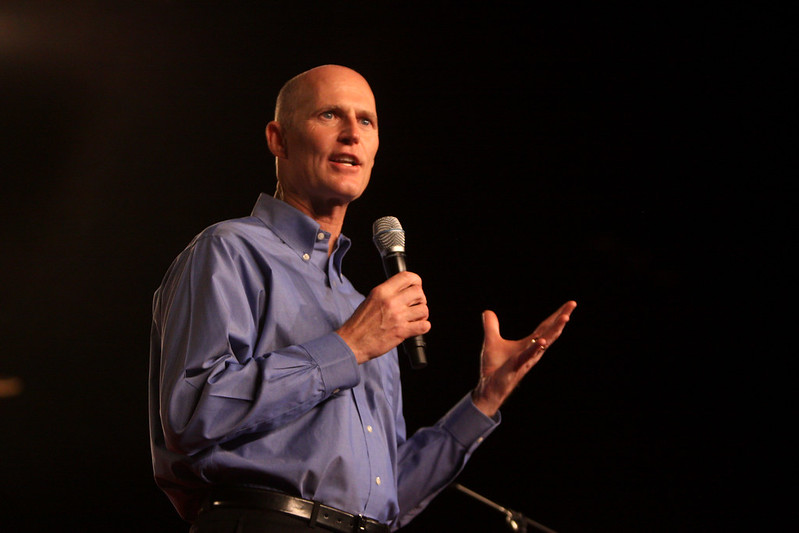
If Scott is unwilling to hold the executive branch accountable, he might as well remove the impeachment clause altogether. FLICKR/GAGE SKIDMORE
On Thursday, Sen. Rick Scott (R-FL) introduced a constitutional amendment to raise the threshold for impeachment of a federal official to 60 percent. The U.S. Constitution currently only requires a simple majority.
Speaking to USA Today, Scott explained the rationale for his amendment.
“Our country should never again suffer through the kind of partisan charade that has consumed Washington over the past several months,” he said.
While the amendment is unlikely to pass and is largely symbolic, it demonstrates the backwards logic Republican officials have used to justify Trump’s acquittal.
Contrary to Scott’s complaints, it is partisanship that has prevented Congress from holding a corrupt president accountable.
Republicans in the House and Senate have argued repeatedly that impeachment is unjust at face value because it would prevent a president from seeking reelection.
This argument completely negates the purpose of impeachment outlined in the Constitution. Nowhere in our founding document does it say that “high crimes and misdemeanors” do not count during an election year.
Florida’s senior senator Marco Rubio perfectly highlights the absurdity of this argument. Prior to his acquittal vote, Rubio explained, “Just because actions meet a standard of impeachment does not mean it is in the best interest of the country to remove a president from office.”
Rubio essentially argues that so long as a majority of people in the country support a president, any crimes that president commits are null and void.
Despite Rubio implying Trump’s July phone call with Ukrainian President Volodymyr Zelensky may have met the conditions of impeachment, he knows he can’t cross his party’s figurehead. If either of Florida’s senators voted for impeachment, it would be career suicide.
These strange arguments coming from both of Florida’s senators shows that corrupt officials may never be held accountable in a time of such overt partisanship, and Scott’s amendment will only exacerbate the problem.
If Scott is unwilling to hold the executive branch accountable, he might as well remove the impeachment clause altogether. At least then Republican senators can stop pretending they believe in any form of executive accountability.
Jared Sellick is a senior studying political science.
by Clodagh Harrington, Associate Professor of American Politics, De Montfort University
As the impeachment process of Donald Trump drew to a close, and the Republican-held Senate inevitably found the president not guilty, it was difficult to remember a more fractured moment in US political history.
There are plenty to choose from. And yet, in the early 21st century, the nation’s capacity to perceive any political matter collectively, let alone one as divisive as a presidential impeachment trial, has been made especially difficult. Such a development has come about in no small part due to the changing way in which Americans get their news.
Beyond boasts of exoneration and accusations of a “witch-hunt”, the 45th president will go down in the annals of American history as only the third to be impeached. Impeachment is the nuclear option for dealing with presidential high crimes or misdemeanours, and categorically should not be used for partisan gain. Doing so inevitably undermines its purpose and weakens impact. Yet partisan Washington reality may not allow for rational objectivity.
The impeachment trial of Bill Clinton, based on accusations of perjury and obstruction of justice, came about after the president lied about his personal indiscretions. With the culture wars in full swing, 1990s America was a divided place and, after his acquittal by the Senate, Clinton gained popularity during the rest of his term
Trump may also experience a post-acquittal sympathy bounce. As with Clinton before him, some supporters disliked his accusers more than they disapproved of their president’s actions.
Dishonesty mainstreamed
One notable difference between the two impeachment trials is the amount and variation of information available to the public. The Clinton affair was the first online political scandal, in that the news broke on the internet via the Drudge Report and was subsequently picked up by the mainstream media. But, however divided the nation was, the variation of information on offer was finite and therefore the public was at least looking at the same hymn sheet, if not singing from it.
In 2020, this is no longer the case. There have always been dishonest politicians, and there have always been biased media sources. However, it has now become acceptable for those at the highest levels of public life in the US to repeatedly offer falsehoods. In turn, it has become the norm for sympathetic media outlets to repeat and reinforce those falsehoods. Overall, social media platforms are not sufficiently proactive in counteracting the spread of fake news.
The result is that a presidential impeachment carried out in the early 21st century simply cannot carry the gravitas of previous examples. Tribal political partisanship has become normalised to such an extent that even those who are troubled by the actions of their party leader remain unconditionally loyal. With the notable exception of the senator Mitt Romney, the new normal in this hyper-partisan era is for the interests of the party to trump the interests of the country, whatever the cost.
This is dangerous and irresponsible in a number of ways. First, it sends a message to the public that lying repeatedly, and often blatantly, is acceptable. Second, it suggests that putting one’s country first is unnecessary. And finally, it undermines the seriousness of impeachment as a tool of government.
It should be the method of absolute last resort, and then engaged with meaningfully by all involved. And when it is, those allegations of high crimes or misdemeanours must be considered and voted on objectively.
‘Witch hunt’ or ‘normalised lawlessness’?
All of this begs the question of “what now?” In the short term, Trump’s acquittal will do little to change public opinion on either the man himself or perceptions of his guilt in the Ukraine affair. His public approval ratings are consistent and the Democrats are left in the unenviable position of working out how to move forward in protecting the integrity of the 2020 election, without looking over zealous.
For every Democrat wringing their hands as they listened to Trump’s hubris-laden and divisive 2020 State of the Union speech on February 4, there was one of his supporters punching the air, all the more determined to show up on election day come November.
In the longer term, the outcome of this impeachment will have a range of negative consequences. The Democratic majority leader in the House of Representatives, Nancy Pelosi, warned of “normalised lawlessness”, amid legitimate concerns that an emboldened president may act increasingly without constraint. Such a development, highlighted decades earlier by the American historian Arthur Schlesinger, is not new, but history clearly demonstrates that those periods of presidential imperialism are fraught with peril for democracy and the nation.
Polarisation will reach new levels. In addition, there will be a thirst for revenge among Republicans against their Democrat opponents. And when the next impeachment trial takes place, the chances of Americans taking this most grave of constitutional procedures seriously are as low as their capacity to access unbiased information about it.
Clodagh Harrington does not work for, consult, own shares in or receive funding from any company or organization that would benefit from this article, and has disclosed no relevant affiliations beyond their academic appointment.
The U.S. Senate has made its judgment in the impeachment trial of President Donald Trump, acquitting the president. Fifty two of 53 senators in the Republican majority voted to acquit the president on the abuse of power charge and all 53 Republican senators voted to acquit on the obstruction of Congress charge.
All 47 Democratic senators voted to convict the president on both charges. Senator Mitt Romney of Utah was the only Republican voting to convict for abuse of power.
The Republican senators’ speedy exoneration of Trump marks perhaps the most dramatic step in their capitulation to the president over the past three years.
That process, as I wrote in The Conversation last fall, recalls the ancient Roman senate’s compliance with the autocratic rule of the emperors and its transformation into a body largely reliant on the emperors’ whims.
Along with the senatorial fealty that was again on display, there was another development that links the era of the Roman Republic’s transformation into an autocratic state with the ongoing political developments in the United States. It’s a development that may point to where the country is headed.
Leader is the state
Trump’s lawyers argued that the president’s personal position is inseparable from that of the nation itself. This is similar to the notion that took hold during the ascendancy of the man known as Rome’s first emperor, Augustus, who was in power from 31 B.C. to A.D. 14.
Senate Majority Leader Mitch McConnell of Kentucky, who led the GOP response in the impeachment trial, leaves the Senate floor on Feb. 4, 2020.
Alex Edelman/Getty Images
Trump defense attorney Alan Dershowitz asserted that “abuse of power” by the president is not an impeachable offense. A central part of Dershowitz’s argument was that “every public official that I know believes that his election is in the public interest” and that “if a president does something which he believes will help him get elected in the public interest, that cannot be the kind of quid pro quo that results in impeachment.”
This inability to separate the personal interests of a leader from the interests of the country he or she leads has powerful echoes in ancient Rome.
There, no formal change from a republican system to an autocratic system ever occurred. Rather, there was an erosion of the republican institutions, a steady creep over decades of authoritarian decision-making, and the consolidation of power within one individual – all with the name “Republic” preserved.
Oversight becomes harassment
Much of Rome’s decline into one-man rule can be observed in a series of developments during the time of Augustus, who held no formal monarchical title but only the vague designation “princeps,” or “first among equals.”
But in fact the senate had ceded him both power (“imperium” in Latin) over Rome’s military and the traditional tribune’s power to veto legislation. Each of these powers also granted him immunity from prosecution. He was above the law.
In Augustus’ time the idea also emerged that the “princeps” and the Roman state were to a great extent one and the same. The identity of the one was growing to become inseparable from the identity of the other.
So, for example, under Augustus and then his successor Tiberius, insults against the emperor could be considered acts of treason against the state, or, more officially, against “the majesty of the Roman people.”
A physical demonstration of the emerging union of the “princeps” and the state came in the construction of a Temple of Roma and Augustus in cities across the Mediterranean region.
Here the personification of the state as a goddess, Roma, and the “princeps” Augustus were closely aligned and, what is more, deified together. The message communicated by such a pairing was clear: If not quite one and the same, the “princeps” and the state were intimately identified, possessing a special, abiding authority through their union.
To this point, however, a Temple of Lady Liberty and Trump along the lines of the Temple of Roma and Augustus has not yet been constructed.
But the Senate impeachment trial has shown us how far along the identification of leader and state has moved in the Trump era. A central part of the president’s impeachment defense is, as we have seen, that the personal will of the president is indistinguishable from the will of the state and the good of the people.
Will the GOP-led Senate’s endorsement of this defense clear a path for more of the manifestations – and consequences – of authoritarianism? The case of the Roman Republic’s rapid slippage into an autocratic regime masquerading as a republic shows how easily that transformation can occur.
Timothy Joseph does not work for, consult, own shares in or receive funding from any company or organization that would benefit from this article, and has disclosed no relevant affiliations beyond their academic appointment.
Our society has evolved so much, can we still say that we are part of Nature? If not, should we worry – and what should we do about it? Poppy, 21, Warwick.
Such is the extent of our dominion on Earth, that the answer to questions around whether we are still part of nature – and whether we even need some of it – rely on an understanding of what we want as Homo sapiens. And to know what we want, we need to grasp what we are.
It is a huge question – but they are the best. And as a biologist, here is my humble suggestion to address it, and a personal conclusion. You may have a different one, but what matters is that we reflect on it.
Perhaps the best place to start is to consider what makes us human in the first place, which is not as obvious as it may seem.
This article is part of Life’s Big Questions The Conversation’s new series, co-published with BBC Future, seeks to answer our readers’ nagging questions about life, love, death and the universe. We work with professional researchers who have dedicated their lives to uncovering new perspectives on the questions that shape our lives.
Many years ago, a novel written by Vercors called Les Animaux dénaturés (“Denatured Animals”) told the story of a group of primitive hominids, the Tropis, found in an unexplored jungle in New Guinea, who seem to constitute a missing link.
However, the prospect that this fictional group may be used as slave labour by an entrepreneurial businessman named Vancruysen forces society to decide whether the Tropis are simply sophisticated animals or whether they should be given human rights. And herein lies the difficulty.
Human status had hitherto seemed so obvious that the book describes how it is soon discovered that there is no definition of what a human actually is. Certainly, the string of experts consulted – anthropologists, primatologists, psychologists, lawyers and clergymen – could not agree. Perhaps prophetically, it is a layperson who suggested a possible way forward.
She asked whether some of the hominids’ habits could be described as the early signs of a spiritual or religious mind. In short, were there signs that, like us, the Tropis were no longer “at one” with nature, but had separated from it, and were now looking at it from the outside – with some fear.
It is a telling perspective. Our status as altered or “denatured” animals – creatures who have arguably separated from the natural world – is perhaps both the source of our humanity and the cause of many of our troubles. In the words of the book’s author:
All man’s troubles arise from the fact that we do not know what we are and do not agree on what we want to be.
We will probably never know the timing of our gradual separation from nature – although cave paintings perhaps contain some clues. But a key recent event in our relationship with the world around us is as well documented as it was abrupt. It happened on a sunny Monday morning, at 8.15am precisely.
A new age
The atomic bomb that rocked Hiroshima on August 6 1945, was a wake-up call so loud that it still resonates in our consciousness many decades later.
The day the “sun rose twice” was not only a forceful demonstration of the new era that we had entered, it was a reminder of how paradoxically primitive we remained: differential calculus, advanced electronics and almost godlike insights into the laws of the universe helped build, well … a very big stick. Modern Homo sapiens seemingly had developed the powers of gods, while keeping the psyche of a stereotypical Stone Age killer.
We were no longer fearful of nature, but of what we would do to it, and ourselves. In short, we still did not know where we came from, but began panicking about where we were going.
Arguably, the greater choices granted by our technological advances make it even more difficult to decide which of the many paths to take. This is the cost of freedom.
I am not arguing against our dominion over nature nor, even as a biologist, do I feel a need to preserve the status quo. Big changes are part of our evolution. After all, oxygen was first a poison which threatened the very existence of early life, yet it is now the fuel vital to our existence.
Similarly, we may have to accept that what we do, even our unprecedented dominion, is a natural consequence of what we have evolved into, and by a process nothing less natural than natural selection itself. If artificial birth control is unnatural, so is reduced infant mortality.
I am also not convinced by the argument against genetic engineering on the basis that it is “unnatural”. By artificially selecting specific strains of wheat or dogs, we had been tinkering more or less blindly with genomes for centuries before the genetic revolution. Even our choice of romantic partner is a form of genetic engineering. Sex is nature’s way of producing new genetic combinations quickly.
Even nature, it seems, can be impatient with itself.
Advances in genomics, however, have opened the door to another key turning point. Perhaps we can avoid blowing up the world, and instead change it – and ourselves – slowly, perhaps beyond recognition.
The development of genetically modified crops in the 1980s quickly moved from early aspirations to improve the taste of food to a more efficient way of destroying undesirable weeds or pests.
In what some saw as the genetic equivalent of the atomic bomb, our early forays into a new technology became once again largely about killing, coupled with worries about contamination. Not that everything was rosy before that. Artificial selection, intensive farming and our exploding population growth were long destroying species quicker than we could record them.
The increasing “silent springs” of the 1950s and 60s caused by the destruction of farmland birds – and, consequently, their song – was only the tip of a deeper and more sinister iceberg. There is, in principle, nothing unnatural about extinction, which has been a recurring pattern (of sometimes massive proportions) in the evolution of our planet long before we came on the scene. But is it really what we want?
The arguments for maintaining biodiversity are usually based on survival, economics or ethics. In addition to preserving obvious key environments essential to our ecosystem and global survival, the economic argument highlights the possibility that a hitherto insignificant lichen, bacteria or reptile might hold the key to the cure of a future disease. We simply cannot afford to destroy what we do not know.
Is it this crocodile’s economic, medical or inherent value which should be important to us?
Shutterstock
But attaching an economic value to life makes it subject to the fluctuation of markets. It is reasonable to expect that, in time, most biological solutions will be able to be synthesised, and as the market worth of many lifeforms falls, we need to scrutinise the significance of the ethical argument. Do we need nature because of its inherent value?
Perhaps the answer may come from peering over the horizon. It is somewhat of an irony that as the third millennium coincided with decrypting the human genome, perhaps the start of the fourth may be about whether it has become redundant.
Just as genetic modification may one day lead to the end of “Homo sapiens naturalis” (that is, humans untouched by genetic engineering), we may one day wave goodbye to the last specimen of Homo sapiens genetica. That is the last fully genetically based human living in a world increasingly less burdened by our biological form – minds in a machine.
If the essence of a human, including our memories, desires and values, is somehow reflected in the pattern of the delicate neuronal connections of our brain (and why should it not?) our minds may also one day be changeable like never before.
And this brings us to the essential question that surely we must ask ourselves now: if, or rather when, we have the power to change anything, what would we not change?
After all, we may be able to transform ourselves into more rational, more efficient and stronger individuals. We may venture out further, have greater dominion over greater areas of space, and inject enough insight to bridge the gap between the issues brought about by our cultural evolution and the abilities of a brain evolved to deal with much simpler problems. We might even decide to move into a bodiless intelligence: in the end, even the pleasures of the body are located in the brain.
And then what? When the secrets of the universe are no longer hidden, what makes it worth being part of it? Where is the fun?
“Gossip and sex, of course!” some might say. And in effect, I would agree (although I might put it differently), as it conveys to me the fundamental need that we have to reach out and connect with others. I believe that the attributes that define our worth in this vast and changing universe are simple: empathy and love. Not power or technology, which occupy so many of our thoughts but which are merely (almost boringly) related to the age of a civilisation.
True gods
Like many a traveller, Homo sapiens may need a goal. But from the strengths that come with attaining it, one realises that one’s worth (whether as an individual or a species) ultimately lies elsewhere. So I believe that the extent of our ability for empathy and love will be the yardstick by which our civilisation is judged. It may well be an important benchmark by which we will judge other civilisations that we may encounter, or indeed be judged by them.
When we can change everything about ourselves, what will we keep?
Shutterstock
There is something of true wonder at the basis of it all. The fact that chemicals can arise from the austere confines of an ancient molecular soup, and through the cold laws of evolution, combine into organisms that care for other lifeforms (that is, other bags of chemicals) is the true miracle.
Some ancients believed that God made us in “his image”. Perhaps they were right in a sense, as empathy and love are truly godlike features, at least among the benevolent gods.
Cherish those traits and use them now, Poppy, as they hold the solution to our ethical dilemma. It is those very attributes that should compel us to improve the wellbeing of our fellow humans without lowering the condition of what surrounds us.
Anything less will pervert (our) nature.
To get all of life’s big answers, join the hundreds of thousands of people who value evidence-based news by subscribing to our newsletter. You can send us your big questions by email at bigquestions@theconversation.com and we’ll try to get a researcher or expert on the case.
Manuel Berdoy does not work for, consult, own shares in or receive funding from any company or organization that would benefit from this article, and has disclosed no relevant affiliations beyond their academic appointment.
Australia sits on a fast-moving tectonic plate and is drifting north several inches a year. As its GPS coordinates haven't been updated since 1994, the discrepancy has grown to six feet and has begun causing trouble. The Sydney Morning Herald reports that the continent's location is being fixed.
On January 1, the Victorian and NSW governments updated the coordinates of every road, property and geographical feature in their states, essentially moving the south-eastern seaboard 1.8 metres north-east overnight. Official government road maps and property boundaries will now line up perfectly with GPS location data.
“The real importance with data is it all lines up. Roads, people's property boundaries all line up,” says Ms Underwood. It will take some time for companies like Google to pick up and implement the new data. But when they do, you will enjoy slightly more accurate satellite navigation.
President Trump has long made it a practice to tear up his papers and throw them away. It is a clear violation of the Presidential Records Act, which is supposed to prevent another Watergate-style cover-up. When the National Archives sent staff members to tape these records together, the White House fired them.
In 2017, a normally routine document released by the archives, a records retention schedule, revealed that archivists had agreed that officials from Immigration and Customs Enforcement could delete or destroy documents detailing the sexual abuse and death of undocumented immigrants. Tens of thousands of people posted critical comments, and dozens of senators and representatives objected. The National Archives made some changes to the plan, but last month it announced that ICE could go ahead and start destroying records from Mr. Trump’s first year, including detainees’ complaints about civil rights violations and shoddy medical care.
These documents include reports of detainee deaths and sexual abuse.
"Wherever books burn, human beings will also burn." – Heinrich Heine
While some children were born without faces simply because they didn't deserve them (see the Scarfolk Annual 197X), the government became increasingly concerned about citizens who did have them. They found that people with faces are more likely to have personal desires, hopes and dreams, in short: a will and ideas of their own.
Such idiosyncrasies were not only thought of as needlessly self-indulgent, they were also deemed inconsistent with the smooth running of a successful society. Scarfolk's was the first council benevolent enough to offer face removals on the NHS.
In 1976, the council trialled face removals on stray foreigners, prisoners, children nobody wanted, unsuspecting people who were picked up leisurely walking in a park after sundown and volunteers (see leaflet above).
When the full scheme was rolled out in 1977, the council soon lost track of which faceless citizen was which. By 1978 a new law was passed which dictated that all faceless people were required to have a tattoo of their old face over their lost one to make identification easier.
The 13th Circuit Court and the Hillsborough County Commission have already resolved this issue. WIKIMEDIA COMMONS/W. SLUPECKI
In November 2018, Hillsborough County voters approved a referendum creating a one-cent sales tax to pay for improvements in road maintenance, mass transit and pedestrian and cyclist infrastructure. The initiative, which received 57 percent of the vote, was authored and championed by All for Transportation (AFT), a citizen group backed by community advocates and business leaders.
Even as the sales tax is being collected, however, none of the revenue has been spent, entirely because of a frivolous lawsuit from Republican officials.
AFT’s landslide victory reflected years of dissatisfaction with transportation in the Tampa Bay area. Stifling traffic congestion is a fact of everyday life. Meager funding for mass transit makes bus routes slow and unreliable. Insufficient infrastructure and poorly designed intersections cause deadly crashes that kill pedestrians and bicyclists.
Funds from the one-cent sales tax would make substantial headway on each of these issues, helping USF students along the way. Underfunding, for instance, forced Hillsborough Area Regional Transit (HART) to cut routes running through the USF campus during a restructuring in 2017. New money could see those routes brought back.
Instead, every cent of that money is frozen. Following AFT’s approval, Republican Hillsborough County Commissioner Stacy White filed suit against the county, claiming that the referendum violated the Florida Constitution. In the meantime, the county has no access to the sales tax proceeds.
Initially, White had a reasonable case. The AFT initiative included a specific plan for spending the sales tax revenue—a strategy that helped communicate proposed improvements with voters but usurped the constitutional spending authority of the County Commission.
As a result, a judge on the 13th Judicial Circuit struck down the spending plan but upheld the tax. For their part, the Hillsborough County Commission voted to stick to the AFT spending plan, honoring the will of the voters. For all intents and purposes, these moves were common sense solutions, resolving legal issues without usurping democracy.
Now, both White and the GOP-controlled Florida Legislature are appealing the decision to the Florida Supreme Court, using a game of semantics to demand an all-or-nothing position. If the spending plan is repealed, they argue, the rest of the initiative should be overturned, too. The Supreme Court will hear oral arguments on the issue next Wednesday.
This litigation has little to do with the Florida Constitution and everything to do with politics. White and Republican state legislators like Sen. Tom Lee (R-Thonotosassa) campaigned against AFT in the 2018 election, and both White and Lee have expressed an ideological commitment against tax increases and public transportation.
By challenging the sales tax in court, these officials want to overturn a popular transportation agenda for their own political interests.
The Circuit Court and the Hillsborough County Commission have already resolved this issue. The Florida Supreme Court should reject petty partisanship by siding with Hillsborough voters and affirming the previous ruling.
Nathaniel Sweet is a senior studying political science.
by Heike Becker, Professor of Anthropology, University of the Western Cape
A human skull on display in Berlin in 2018. Germany handed back human remains seized during the Namibia genocide from 1904 to 1908.
EPA-EFE/Hayoung Jeon
Germany committed genocide in Africa 40 years before the Holocaust of the European Jews. In 1904 and 1905 the Ovaherero and Nama people of central and southern Namibia rose up against colonial rule and dispossession in what was then called German South West Africa. The revolt was brutally crushed. By 1908, 80% of the Ovaherero and 50% of the Nama had died of starvation and thirst, overwork and exposure to harsh climates.
The army drove survivors into the waterless Omaheke desert. Thousands more died in concentration camps.
For many historians this first genocide committed by Germany provided the template for the horrors that were to come 40 years later during the Holocaust of the European Jews. The philosopher Hannah Arendt, herself a Holocaust refugee from Germany, explained in 1951 that European imperialism played a crucial role in the development of Nazi totalitarianism and associated genocides.
We know very little about the experience of those who lived through this first systematic mass extinction of the 20th century. Forty-seven testimonies were recorded and published in 1918 in a scathing official British report about German colonial rule in Namibia, known as the Blue Book. One eyewitness remarked:
Words cannot be found to relate what happened; it was too terrible.
Following on an earlier Norwegian edition, a new book, Mama Penee: Transcending the Genocide, by Uazuvara Ewald Kapombo Katjivena, to be published by UNAM Press in Windhoek in February, makes an extraordinary attempt to present the lived experience of the genocide.
Surviving a genocide
Based on oral and family history, Katjivena, a former exiled liberation Namibian fighter until the country’s independence from South Africa in 1990, tells his grandmother’s story in a biography deeply infused with family and oral history. His grandmother, Jahohora, survived the genocide as an 11-year-old girl.
In the book’s opening scene young Jahohora witnesses her parents’ murder at the hands of German colonial troops in 1904. Following this traumatic experience, she wanders into the veld. The young girl survives on her own, using skills that her mother had imparted to her, to scavenge from the environment. She traps rabbits and birds, eats berries and wild honey, and occasionally feasts on an ostrich egg.
The remaining connection with her parents is cruelly cut after she is caught and forced to work for a German farmer. During the “civilising” washing and changing of her attire, her ceremonial Ovaherero headgear is cut into pieces and burnt by the farmer’s wife.
The headgear was her mother’s significant gift for the growing daughter just before the start of the hostilities in early 1904. Jahohora suffers deeply humiliating experiences.
Katjivena’s grandmother was a remarkable woman of deep thought, insight, and immense resolve. Her parents and grandparents belonged to a section of the Ovaherero called the Ovatjurure. They played a significant role in their communities by helping to maintain peace among families in the nearby homesteads and in the neighbouring villages.
Their daughter passed on this remarkable tradition to the children and grandchildren she brought up during Namibia’s colonial era under Germany and South Africa.
Regaining agency
Katjivena intersperses Jahohora’s personal perspective with historical facts. We read a detailed, chilling account of General Lothar von Trotha’s extermination order of 2 October 1904. The oral history telling, however, also indicates instances of humanity during an entirely inhumane era.
Who were these white people, the survivor wondered. Why had some German soldiers saved her from certain death and given her a chance of life while their fellows had mercilessly killed her parents? As Jahohora meets other survivors and hears their stories, she begins to understand the genocide and especially the role of Von Trotha, who is locally known as omuzepe (the killer).
Katjivena’s story looks simple, yet it exudes deep meaning. It turns the gaze onto the oppressors. The resisting gaze of the colonised, the cultural theorist Elizabeth Baer writes, is an act of self-creation. It “begins to recognize and restore agency to the victims of imperialism”.
Transcending the genocide
The subtitle of Katjivena’s book is Transcending the Genocide. It adds a tremendous living voice to the symbolic commemorations of Germany’s African genocide that have taken place over the past few years.
Importantly, human remains of genocide victims were repatriated from Germany to Namibia in 2011, 2014 and 2018. These had been shipped to academic and medical institutions in Germany, and had remained there until recently.
In 2019 some significant items of cultural memory, which had been stolen during colonial conquest, were returned to Namibia from the Linden Museum in Stuttgart. These included the slain Nama leader Hendrik Witbooi’s Bible and his riding whip.
In Windhoek a Genocide Memorial, built in 2014, signifies a noteworthy shift in post-colonial Namibian memory politics. The statue’s North Korean aesthetics and symbolism remain controversial. That aside, the new monument shows that the genocide of the Ovaherero and Nama has belatedly entered the public history narrative of Namibian nationhood. This would have been impossible a few years earlier.
Reconciliation and reparations
On the political level, the German government finally acknowledged the colonial genocide in 2015. Ever since, Namibian and German envoys have been talking about an official apology by Germany.
Most controversial have been negotiations about reparations. Also controversial has been the role of the Ovaherero and Nama communities that were directly affected by the genocide. But in January 2020 Germany’s new ambassador to Namibia, Herbert Beck, hinted that important political developments might be about to happen.
It is not clear yet where the complicated process of post-colonial reconciliation is going. Yet, with stories such as Katjivena’s remarkable biography of his grandmother, the dead and the survivors of the colonial genocide are finally given a face.
Heike Becker does not work for, consult, own shares in or receive funding from any company or organisation that would benefit from this article, and has disclosed no relevant affiliations beyond their academic appointment.
One of the best work trips I ever took was the overnight train from London King's Cross to Edinburgh: I had a comfortable berth, went from city centre to city centre, arrived rested and refreshed, and did not have to endure the indignities and discomforts of air travel.
University of Westminster Senior Lecturer in Transport Planning Enrica Papa's editorial on the glories and possibilities of overnight rail as an alternative for many air journeys describes how the phenomenon of flygskam (Swedish: "flight shame") is giving rise to an overnight rail renaissance, with many European rail services reinstating and improving their overnight rail service -- for example, in 2022 you'll be able to take a sleeper car from Malmo to London, departing after dinner and arriving before lunch.
A recent study from the Netherlands found that passengers who travel for leisure purposes seem to be most attracted to the option of night trains. It’s possible that night train services could simply generate new demand from these customers instead of substituting existing airline passengers. The researchers found that 40% of business travellers still opted to fly the day before and stay in a hotel instead, though many thought the relative comfort of sleeper trains was appealing.
Warner subsidiary Otter Media has a division called Fullscreen ("a social content company for talent and brands") that has been demonetizing Youtubers' videos that use the numbers 36 and 50 (and possibly other numbers, for all we know), claiming that their use of these integers is a copyright violation. Doing so allows Warner to steal the money that these Youtubers' videos would otherwise earn.
Youtube operates a filter called Content ID that allows rightsholders to automatically claim control over user-created videos that contain materials that are the rightsholders' copyrighted works. This system has no checks and balances and virtually no penalties for abuse, and users who complain can attract "copystrikes" -- three of these, and you lose your account and your videos, permanently, with no appeal.
“This isn’t something we usually forecast, but don’t be surprised if you see Iguanas falling from the trees tonight as lows drop into the 30s and 40s. Brrrr!” the National Weather Service's Miami bureau tweeted tonight.
Jan 21 - This isn't something we usually forecast, but don't be surprised if you see Iguanas falling from the trees tonight as lows drop into the 30s and 40s. Brrrr! #flwx#miamipic.twitter.com/rsbzNMgO01
The low temperatures stun the invasive reptiles, but the iguanas won’t necessarily die. That means many will wake up as temperatures rise Wednesday.
Iguanas aren’t dangerous or aggressive to humans, but they damage seawalls, sidewalks, landscape foliage and can dig lengthy tunnels. The males can grow to at least 5 feet (1.5 meters) long and weigh nearly 20 pounds (9 kilograms).
Female iguanas can lay nearly 80 eggs a year, and South Florida’s warm climate is perfect for the prehistoric-looking animals. Iguanas are native to Central America, tropical parts of South America and some Caribbean islands.
Cities across the US have been holding gun buyback programs since at least 1974. Most of these events have been organized by local police departments, who typically offer between $50 and $250 in cash or gift cards in exchange for a turned-in firearm with no questions asked.
The Episcopal congregation at the Church of the Holy Cross in Pittsburgh, Pennsylvania tried their hands at a similar program on Martin Luther King Jr. Day this year, largely inspired by a double homicide that occurred in front of the church in November 2019. Church leaders had planned to remain available all throughout the afternoon, offering $100 per gun.
In the first 40 minutes, more than 50 people showed up, and the church ran out of the $5,000 they had budgeted for the event.
Many gun advocate argue that events like these are nothing more than symbolic acts of virtue-signalling that ultimately make no real impact on curbing gun violence. And statistically speaking, they're probably right. But that shouldn't diminish the hope, inspiration, and community building that can be derived from such events.
That's why the Church of the Holy Cross is planning to hold another similar event soon. If you do want to donate to the cause to help buy back more guns, you can send money directly to the church at 7507 Kelly Street in Pittsburgh; unfortunately, they don't take donations online.
It's been some time since I visited AbeBooks.com's wonderful "Weird Book Room," a special curated section within the glorious online marketplace for used books. Sure, some of the books may not be so odd on their own but all together they make for quite a bizarre bibliography. Seen here are just a small sampling of the confounding covers and strange juxtapositions.
Perfluoroalkyl substances (PFAS), which are linked to cancer and liver damage, were used in a number of products, including Teflon and Scotchgard. PFAS take such a long time to break down in the environment that they are described as "forever chemicals."
David Andrews, a senior scientist at the Environmental Working Group (EWG), which just issued a report about widespread PFAS pollution in the United States water supply, told Reuters, “It’s nearly impossible to avoid contaminated drinking water from these chemicals.” From the article:
Of tap water samples taken by EWG from 44 sites in 31 states and Washington D.C., only one location, Meridian, Mississippi, which relies on 700 foot (215 m) deep wells, had no detectable PFAS. Only Seattle and Tuscaloosa, Alabama had levels below 1 part per trillion (PPT), the limit EWG recommends.
In addition, EWG found that on average six to seven PFAS compounds were found at the tested sites, and the effects on health of the mixtures are little understood. “Everyone’s really exposed to a toxic soup of these PFAS chemicals,” Andrews said.
Image: by trozzolo - Own work, Public Domain, Link
One of my FAVORITE urban legends is one I actually believed for a long time… that the official Language of the United States was almost German. It gets better! The legend says that in a Congressional vote, German lost by only one vote, and that’s why we speak English in America. I hate to bust […]
We're taking part in Copyright Week, a series of actions and discussions supporting key principles that should guide copyright policy. Every day this week, various groups are taking on different elements of copyright law and policy, addressing what's at stake and what we need to do to make sure that copyright promotes creativity and innovation.
While culture is shared, copyright law has increasingly been used to lock people out of participating in it. Although copyright law is often treated as the exclusive domain of major media and entertainment industries, it actually should be serving all of us. Because, of course, it affects all of us.
Eight years ago, a diverse coalition of Internet users, non-profit groups, and Internet companies defeated the Stop Online Piracy Act (SOPA) and the PROTECT IP Act (PIPA), bills that would have forced Internet companies to blacklist and block websites accused of hosting copyright-infringing content. These were bills that would have made censorship very easy, all in the name of copyright protection.
SOPA and PIPA have their successors. Between the Copyright Directive in the EU (previously known as Article 13, now as Article 17) and endlessly frustrating iterations of the CASE Act, there’s a push to “fix” copyright law in ways that cause harm for regular people and smaller creators, while shoring up the power of the huge entertainment companies and big tech. And that’s not to mention laws like Section 1201 of the Digital Millennium Copyright Act, which makes it difficult and expensive to tinker with or repair devices you, in theory, have bought and “own.”
But we know this play, and we know that you will stand against it the way we all did eight years ago.
We continue to fight for a version of copyright that does what it is supposed to. And so, every year, EFF and a number of diverse organizations participate in Copyright Week. Each year, we pick five copyright issues to highlight and advocate a set of principles of copyright law. This year’s issues are:
Monday: Fair Use and Creativity Copyright policy should encourage creativity, not hamper it. Fair use makes it possible for us to comment, criticize, and rework our common culture.
Tuesday: Copyright and Competition Copyright should not be used to control knowledge, creativity, or the ability to tinker with or repair your own devices. Copyright should encourage more people to share, make, or repair things, rather than concentrate that power in only a few players.
Wednesday: Remedies Copyright claims should not raise the specter of huge, unpredictable judgments that discourage important uses of creative work. Copyright should have balanced remedies that also provide a real path for deterring bad-faith claims.
Thursday: The Public Domain The public domain is our cultural commons and a crucial resource for innovation and access to knowledge. Copyright should strive to promote, and not diminish, a robust, accessible public domain.
Friday: Copyright and Democracy Copyright must be set through a participatory, democratic, and transparent process. It should not be decided through back-room deals, secret international agreements, unaccountable bureaucracies, or unilateral attempts to apply national laws extraterritorially.
Every day this week, we’ll be sharing links to blog posts and actions on these topics at https://www.eff.org/copyrightweek and at #CopyrightWeek on Twitter.
As we said last year, and the year before that, if you too stand behind these principles, please join us by supporting them, sharing them, and telling your lawmakers you want to see copyright law reflect them.
Privacy activst Murray Hunter's picture book Boris the Babybot tells the story of Boris, a robot whose job it is track all the babies and send their likenesses and preferences back to the factory so that its owners can make money by deciding who's a good baby and who's a bad baby.
By and large, this is an easy task: Boris scans the babies' smiles and noses and eyes, but records whether they like peas or puppies. But some babies can't be scanned: they're in the bath, hidden by bubbles; or they're covered in so much food their faces can't be captured, or they're just having too much fun wearing a box on their heads, meaning Boris can't get a look at their faces.
When Boris is fired from his factory job, he is initially distraught, but then he formulates a better plan: rather than scanning those babies, he joins them -- getting bubbles all over himself, smearing himself with food, and putting a box on his head.
Helen Sharman was the first British astronaut and in 1991 became the first woman to visit the Soviet Mir space station. In an interview published in The Guardian yesterday, she made a comment about extraterrestrials, the latter part of which is an eyebrow raiser:
"Aliens exist, there’s no two ways about it. There are so many billions of stars out there in the universe that there must be all sorts of different forms of life. Will they be like you and me, made up of carbon and nitrogen? Maybe not. It’s possible they’re here right now and we simply can’t see them."
These are just a small sample of Michael Schlegel's glorious photographs of trees in Fanal, the laurisilva forest of Madeira, Portugal. The otherworldly images reassure me with their quiet calm.
Jukin Media, one of the various content aggregators that buy the rights to viral video clips, has managed existing and unlicensed use of such clips by monetizing them through YouTube's contentID system. But Jukin has now reportedly threatened to use copyright strikes to shut down a channel while privately demanding money from its operator. It's extortion, says the target, hit with a $6000 "bill".
They email us with a bill and they charge us fifteen hundred dollars per clip that was in our videos. And so today we got hit with a huge bill of six thousand dollars. I think it's because in the past we've we've paid them this amount of money, so they just they're like hey this guy's willing to pay this money, let's keep you know charging him for it, he'll just pay us. So we've paid about two thousand dollars in total and now we have another six thousand dollars to pay and if you don't pay then basically they'll start striking your channel.
To publish on YouTube, you agree to let YouTube define and enforce a private regime far more expansive than copyright law provides, with no effective provisions for fair use beyond a lengthy and hostile process likely to end with your channel shut down. YouTube claims not to arbitrate copyright, but no-one is fooled: it immediately enforces claims on the basis of a promiscuous algorithmic matching system designed from the ground up to serve claimants, while burdening targets with legal process and its own broken, opaque policy-enforcement bureacracy.
If you include anything that already exists, even a moment of footage or audio, even so much as whistling a tune, you're vulnerable to YouTube's enforcement regime and the corporate parasites exploiting it.
How often have you seen news stories and videos poking fun at people who have trouble locating where a certain country is on a world map? The latest iteration of this kind of lazy journalism comes from Morning Consult: Can You Locate Iran? Few Voters Can. "The polling experiment sheds light on voters’ geographical unfamiliarity with foreign countries, even those with which the United States has been engaged in sustained conflict," says the article.
If Morning Consult wanted to shed some useful light, it could focus less on the geographic location of Iran and more on why the US and Iran have been at odds ever since the CIA and Britain's MI6 overthrew the democratically elected Iranian government in 1953 and installed a murderous and corrupt tyrant who was happy to let western petroleum concerns exploit Iran's natural resources in exchange for a dictatorship. This segment from a 2018 episode of The Daily Show has a good recap:
Our living spaces and home environments greatly impact our daily lives. I find that for those of us living spirit-based or magical lives, the above statement bears special importance. Living consciously includes infusing the spiritual with the mundane as a reminder that we are not just humans, we are spiritual beings having a human experience.
Our homes are perfect spaces to incorporate magic. Having a home in and of itself is a blessing, proof of the Universe’s abundance. No matter how humble or small our abodes may be, we can make them sacred. Even if you rent a room in a house, that space where you cook your meals, clean your body, and lay your head is not just a dwelling for your body but for your soul as well.
Fast-paced and distracted living make it hard to remember that our homes can be sacred spaces that provide sanctuary in addition to actual roofs over our heads. Many people (at least here in the USA) over-stuff their homes. Americans love our stuff! We fill every nook and cranny with action figures, tchotchkes, electronics and reading material. Cleaning preferences are highly personal and many people look upon cleaning as a burden. How can we reconcile these issues?
Witchy folks in particular have a reputation for being quite clutter-y. Some spiritual traditions actually require you to have certain objects in order to practice. I encounter the dilemma of loving to collect things and being stressed out by too much visual clutter. A fine balance must be struck in my home.
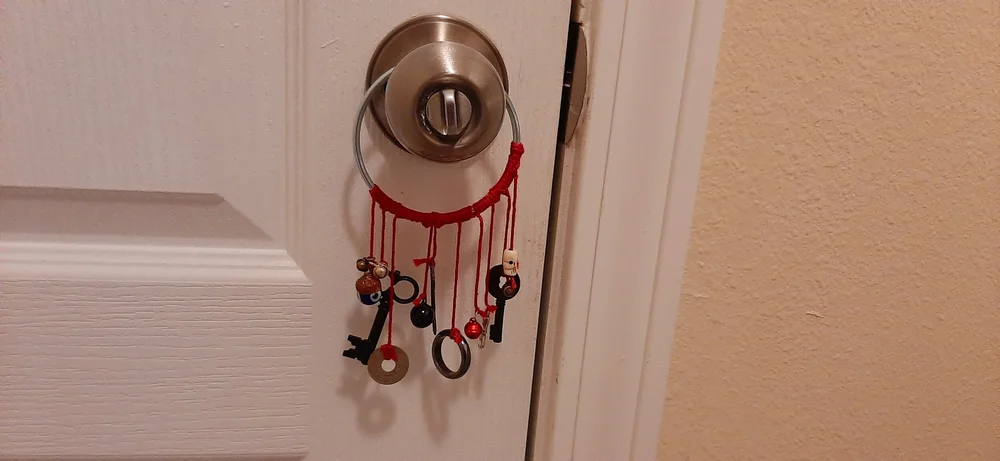
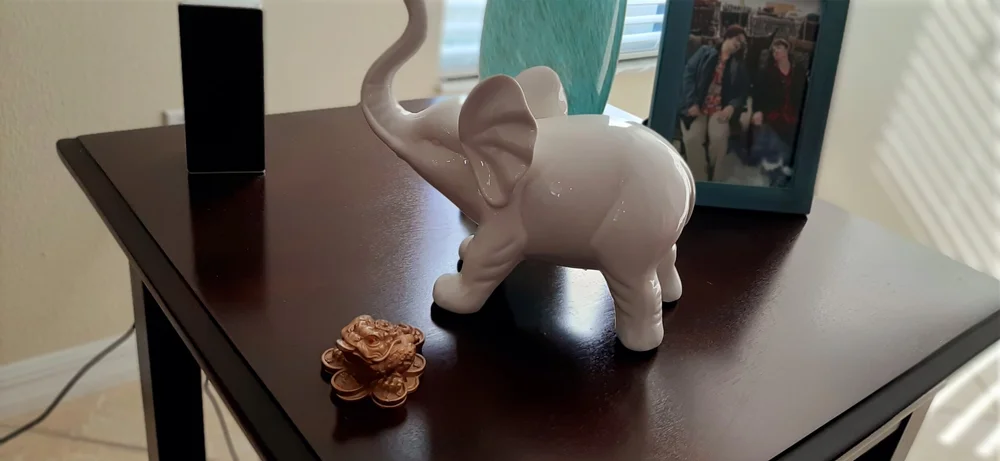
However, I consider it a fun challenge to use objects that infuse a sense of magic while also being functional or as unassuming as possible. These are fine details that one only notices upon a second look. Upon taking a second or closer look, these objects provide delight and are a reminder of my spiritual practice and experience.
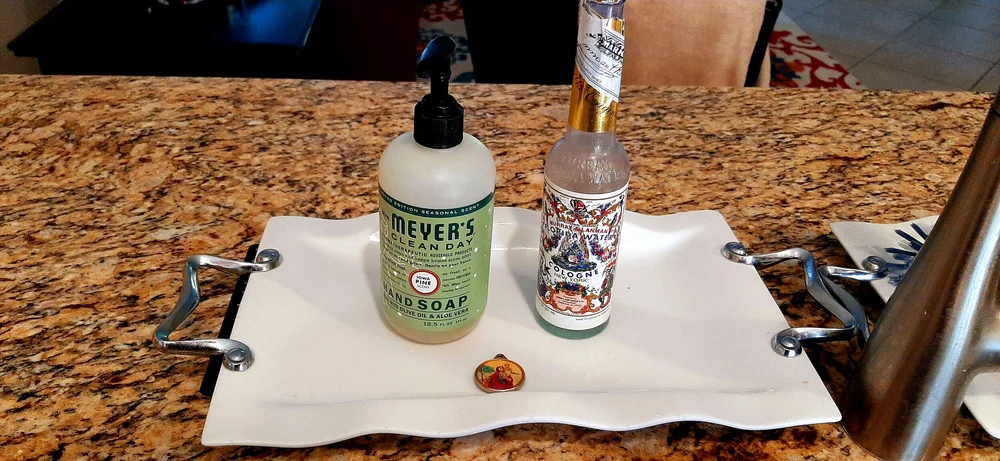
Regarding cleaning, I try to view it as an act of meditation and stewardship of the home that Great Spirit (God, Goddess, the Universe, etc.) gave me. I also see cleaning as something that not only clears away physical dirt, but also old energies. I’ll add Florida Water cologne to my mop water solution. This not only cleans the dirt from my floors but the properties of the cologne lift the vibration in my home. The positive shift is easily felt by anyone who is in the home and it smells wonderful!
Every aspect of our living spaces can potentially bring us peace and lift our spirits. Here are some tips you may want to implement in your life and home keeping.
1. Determine what you like to look at. This is a plain way of asking what your aesthetic is. I believe that what we see as we enter and walk around our living spaces is crucial. Do your eyes delight at seeing shelves lined with books? Do you love seeing clusters of sparkly crystals everywhere? Perhaps clean, open spaces make you feel best.
2. Once you know what you like best, clean and decorate accordingly. I make my bed every morning, but not because I want to be a good, organized person. I discovered it is extremely important to me to see a clean, nicely made bed every single time I enter my bedroom. That is why I make my bed – I do it because I know seeing it brings me joy and relieves anxiety. I prefer less clutter but dislike a sterile look. Therefore, my décor is sparse but each item is what I consider to be the most beautiful. Only decorate with what you actually like to look at!
3. View cleaning your home as an act of gratitude and blessing. This mindset shift helped me so much! Our most dreaded cleaning tasks seem much less odious if we view them as acts of gratitude. I dislike washing dishes. But I’m truly grateful to have dishes. My dishes get dirty because I ate food off of them. That means I have food. I’m so fortunate to have food and nice dishes off of which to eat that food. I remind myself this when I’m muttering to myself at the sink! Cleaning can be seen as blessing. Your home and the items in it bless you with their beauty and functionality. You can bless them back by honoring them, enjoying them, and keeping them clean.
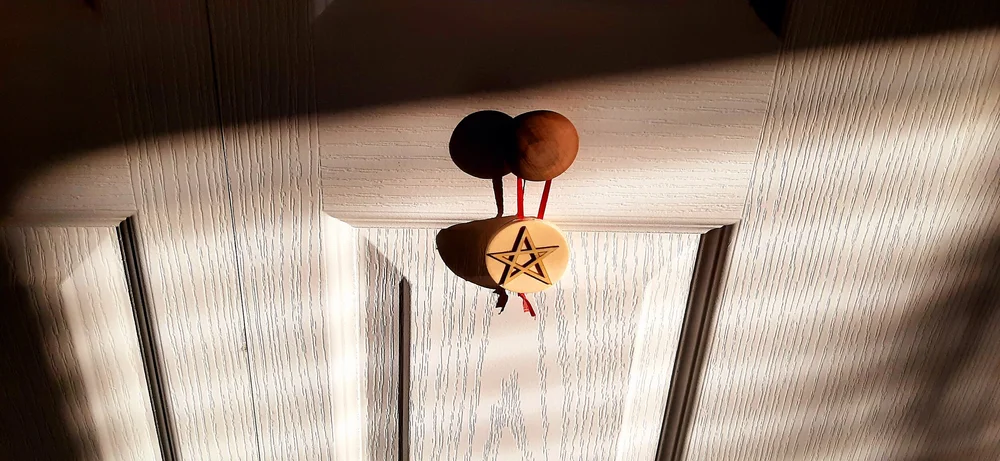
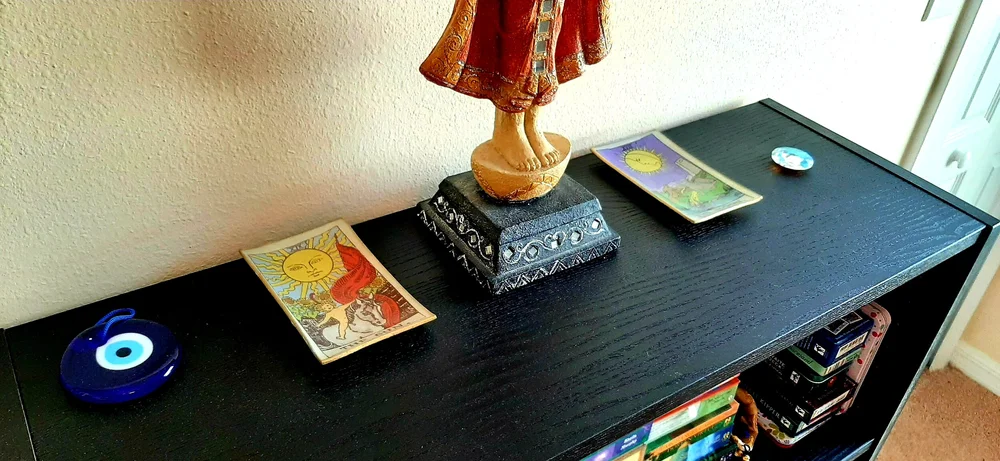
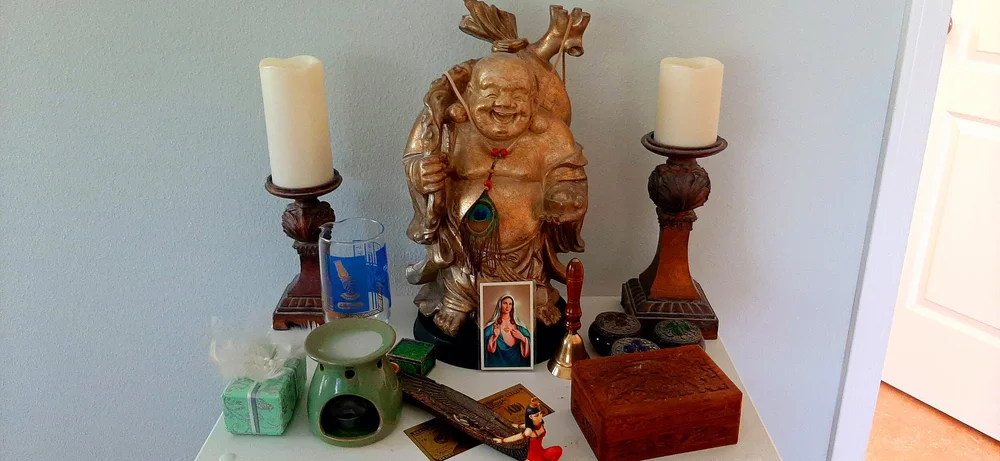
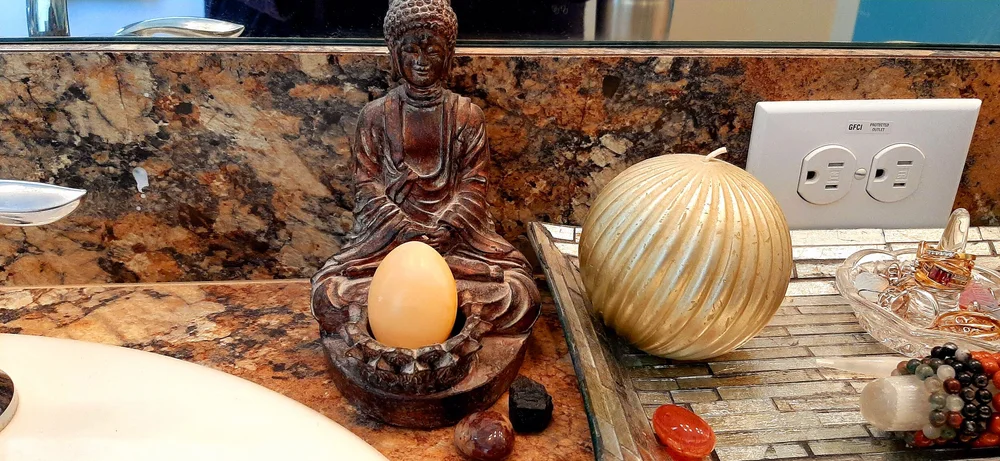
4. Incorporate Spirit wherever and however you can. You’ll see in the pictures in this blog that I have little touches of magic all over my home. I cannot recommend this enough. Place spiritual items where you can see and enjoy them. Clear off the clutter and place your favorite holy book or a statue of deity on your nightstand. Place fresh or even fake flowers on your dining table as a reminder of the beauty of Mother Nature. Setting intentions and binding them to objects is another simple act. For example, if you need to work on your communication skills, set the intention that when you notice the blue pillows on your couch, it will be a reminder to focus for a moment on your throat chakra. A selenite log on the entryway table looks gorgeous and cleans the energy of anyone who comes through the front door. The possibilities are endless. Have fun with this!
Update: On February 7, 2020, the 9th Circuit Court of Appeals denied Great Minds’ petition for rehearing (opinion (PDF)). As a result, the decision (PDF) of the panel in favor of CC’s interpretation of the licenses remains final.
The U.S. Court of Appeals for the 9th Circuit reaffirmed Creative Commons’ interpretation of activities that are permissible under the NonCommercial (NC) licenses, which allow bona fide noncommercial reusers to hire out the making of copies of NC-licensed content, even to profit-making businesses such as Office Depot and FedEx Office. Below is an excerpt from the decision:
“Under the License, a non-commercial licensee may hire a third-party contractor including those working for commercial gain, to help implement the License at the direction of the licensee and in furtherance of the licensee’s own licensed rights. The License extends to all employees of the schools and school districts and shelters Office Depot’s commercial copying of Eureka Math on their behalf.”
This is the second time a federal appellate court in the United States has adopted CC’s interpretation of NC. The first decision was published by the U.S. Court of Appeals for the 2nd Circuit last year (summarized here) and involved copying by FedEx Office at the behest of school districts admittedly using the works for noncommercial purposes.
CC’s position has been clear in both of these cases: so long as commercial actors are not acting independently for their own commercial gain but solely on behalf of noncommercial actors, they are protected by the license granted to the noncommercial actors.
After all, entities must act through employees, contractors, and agents as a necessity. To require every teacher, employee (including part-time student employees), and third-party contractor making copies of NC licensed works to forego payment for their services would make it impossible for those types of licensees to use the works and facilitate sharing for noncommercial purposes.
This is a huge win for educators, school districts and, most importantly, students.
All students deserve access to effective open education resources (OER) and meaningful, inclusive learning opportunities. These NC-licensed OER will help ensure students have access to the effective learning resources they need by allowing schools to seek assistance in making copies when they do not have sufficient resources to do so on their own. Further, because these resources were created using public funds received by the New York State Education Department from the U.S. Department of Education, it’s important that they remain openly licensed.
In October, Creative Commons requested permission to file an amicus and participate in oral argument. Our requests were granted, and our amicus brief (friend of the court brief) with the 9th Circuit became part of the record. Andrew Gass of Latham & Watkins argued the case on behalf of CC (video).
A very special thanks to Latham & Watkins for their hard work and diligence over the course of both the 2nd Circuit and 9th Circuit cases.
The passage -- through MEPs erroneously pushing the wrong buttons! -- of the new EU Copyright Directive last March means that online platforms operating in the EU will have to implement filters that allow anyone, anywhere, to claim anything as their copyright, whereupon the platforms will have to detect any attempt by anyone else to upload those claimed works and block them.
Julia Reda (previously) was an MEP during the passage of the Copyright Directive and she led the charge to reform it to remove its most odious and absurd passage. Thanks to her and other organizers, 200,000 Europeans marched in 50+ cities, and 5,000,000 Europeans signed the largest petition in continental history, opposing the inclusion of the filter mandate in the Directive. Despite this unprecedented public opposition and the near-unanimous verdict of security experts, economists, technologists, and scholars that this would not work, MEPs voted in favor of this proposal (notwithstanding that 10 of them got confused and pressed the wrong buttons, and that the proposal only passed by five votes) (no, really).
Writing for Harvard's Berkman Klein Center, Reda explains why Americans should be alarmed at this turn of events: it will cement the dominance of both large platforms and large entertainment conglomerates, at the expense of upstart competitors, like EU-based online platforms that differentiate themselves through promises of better privacy or better moderation; and like small, independent labels and publishers that offer more equitable deals to creators.
Moreover, the filters will perform in ways that are familiar to anyone who pays attention to Google's Content ID (for Youtube) or the filters used on Facebook and other platforms: they will both overblock legitimate creative or critical media, and underblock material that actually infringes copyright.
The Copyright Directive's filter mandate ignores the rich factual record on how his kind of "expedited removal process" gets abused, pressed into service by sleazy "reputation management" companies, search-engine optimizers, stalkers, bullies, harassers, and anyone else who is smart enough to realize that they can make speech that upsets them disappear simply by making false accusations of copyright infringement.
The final text of the filter mandate is "full of contradictions" -- as Reda points out, the lawmakers responsible for drafting the rule threw in a bunch of sops to fairness and due process, requiring platforms to respect limitations to copyright (like the exceptions for parody and criticism) while still requiring them to remove content at a scale and speed that is inconceivable without automated filters -- which are incapable of distinguishing these legal uses from illegal ones.
The protests against Article 17, mostly driven by young people and organized online, were not in vain. In the final days of the negotiations, the European institutions hastily introduced some safeguards into the text aimed at limiting the negative impact of Article 17 on regular internet users and publishing opinion pieces trying to convince the enraged public that their memes are not in danger. The exceptions for caricature, parody, and quotation, which were previously voluntary for EU countries to implement in their national law, were turned into mandatory users’ rights. Platforms were required to respect these exceptions and limitations and were barred from overwriting them through their terms of service. The ban on general obligations for platforms to monitor all user activity, a mainstay of the old notice-and-takedown regime, was introduced into Article 17. And perhaps most importantly, the requirement was added that the new safe harbor must not lead to the deletion of legal content.
These safeguards, as important as they are, have only led to more confusion among the national lawmakers who are now tasked with implementing the new rules into their national copyright laws by the summer of 2021. How can platforms be forced to filter out infringements without monitoring all user uploads? That is like asking them to find a needle in a haystack without looking at all the hay. How are platforms supposed to ensure that legal content stays online while doing everything they can to delete the legal content? Wrongful copyright claims are commonplace and legal uses are governed by a maze of national copyright exceptions that are often different from one European country to the next.
Where the obligations to protect rightsholders and those to protect users are in clear conflict, national legislators have to make a choice. France has already presented its proposal for national implementation of Article 17, which simply ignores all the mandatory user rights included in the directive. Such a radical approach is likely to violate European law, but until these questions are litigated, other countries may follow France’s example. And across the pond, entertainment companies are invariably going to present this extreme reading of the new rules as a blueprint for the future of US copyright enforcement, “to stay competitive with the EU”. By the time Article 17 is in force and its devastating effects on online freedom become more visible, it may be too late to stop its proliferation.
by Kelley Fanto Deetz, Lecturer in American Studies, University of Virginia
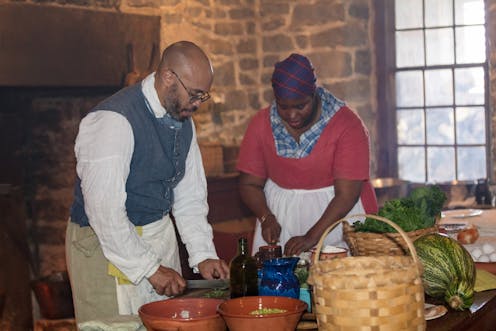
Jermone Bias and Cheyney McKnight portraying enslaved cooks at Belle Grove Plantation in Middletown, Virginia, a National Park Service property. National Park Service
Fall is almost gone and winter is coming, as are hundreds of hearth cooking demonstrations at countless historic homes and plantations throughout the nation.
Like an automated clock, historic kitchens become the center stage for historical storytelling at this time of year.
This kind of programming provides a dynamic glimpse into this particular history, and allows the guests to witness hearth cooking, smell the food, feel the heat of the fire and engage in conversations with a living history interpreter. As a scholar committed to public education about this subject, I believe such demonstrations can be evocative and inspire a contemplative visitor experience.
But out of the dozens of programs I have participated in, with costumed historical interpreters, only three have staffed the kitchen with someone depicting an African American cook. The rest of the cooks have all been white.
These historic kitchens have power as a stage for historical interpretation and learning, and it is lost when those telling the first-person stories are not representative of those who once cooked there.
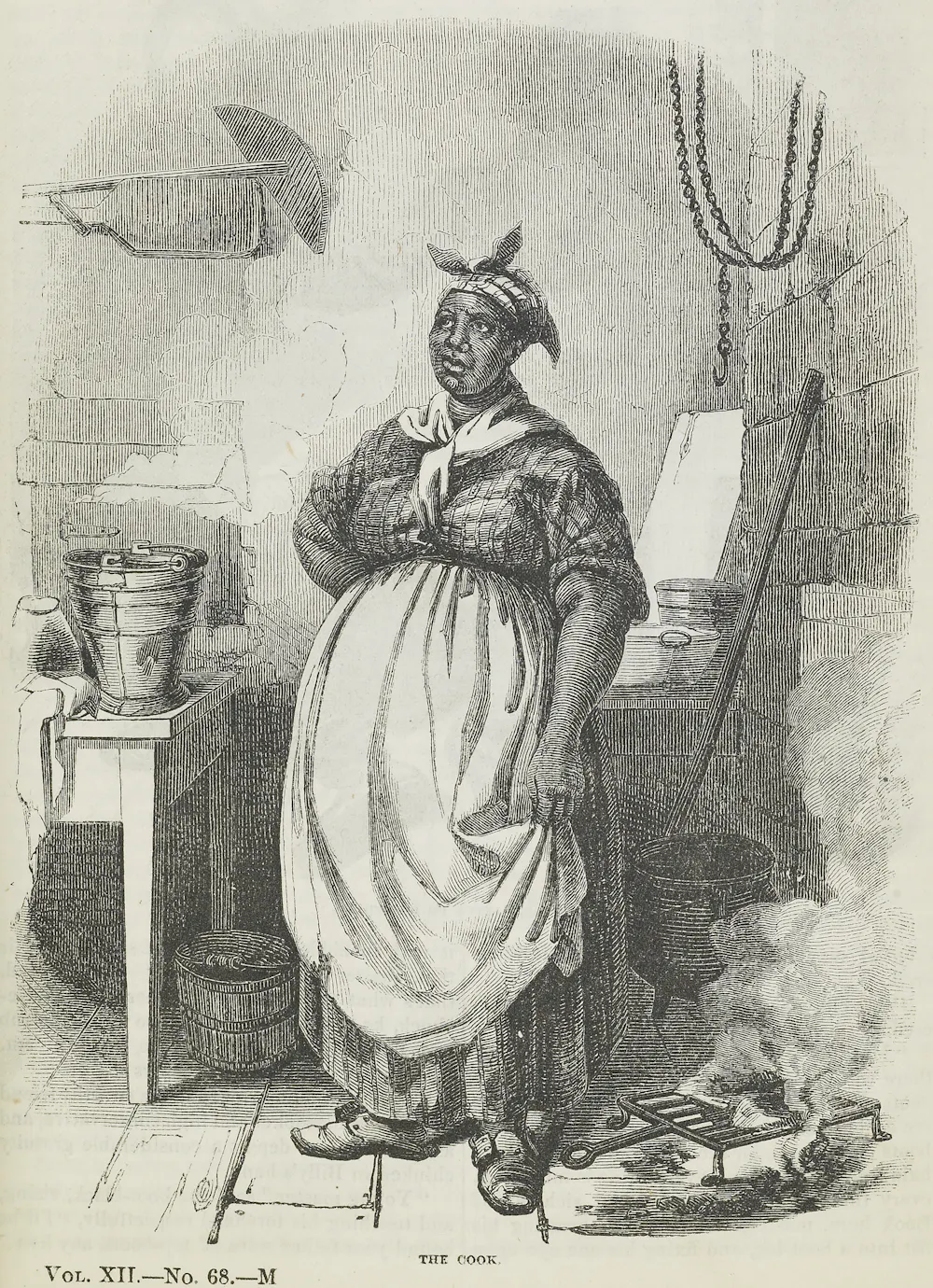
Southern plantations relied on the forced labor of enslaved African and African American cooks, who worked around the clock for the pleasure of the plantation elite. Plantation kitchens were not romantic spaces where the white mistress of the house would bake pies and sip tea while reading The Virginia Housewife.
By the late 17th century, southern plantations moved away from their reliance on white indentured servants, whose terms lasted up to seven years, and replaced them with enslaved Africans, who were held for life. By the early 18th century, the production of plantation fare was mostly in the hands of enslaved Africans and African Americans.
As revealed in diaries, journals, slave narratives and cultural landscape studies, these kitchens were landscapes of power, control, pain, sorrow, fear – and only rarely joy. These spaces hold the stories of the thousands of enslaved cooks who were bound to the fire, cooking what became southern cuisine.
Reflecting actual history
The vast majority of Americans get their history not from books, but from media and tourism. The sharp decline in Americans’ historical knowledge has been building for years and has frightened many historians, perhaps for the reason that the 19th-century philosopher George Santayana gave, that “those who cannot remember the past are condemned to repeat it.” We are living in history’s legacy. History informs the present.
Historic sites have a significant responsibility to uphold integrity and honesty and adhere to a code of ethics. The National Council on Public History’s code of ethics includes these directives: “Public historians should carry out historical research and present historical evidence with integrity. Public historians should strive to be culturally inclusive in the practice of history and in the presentation of history…research-based decisions and actions may have long-term consequences.”
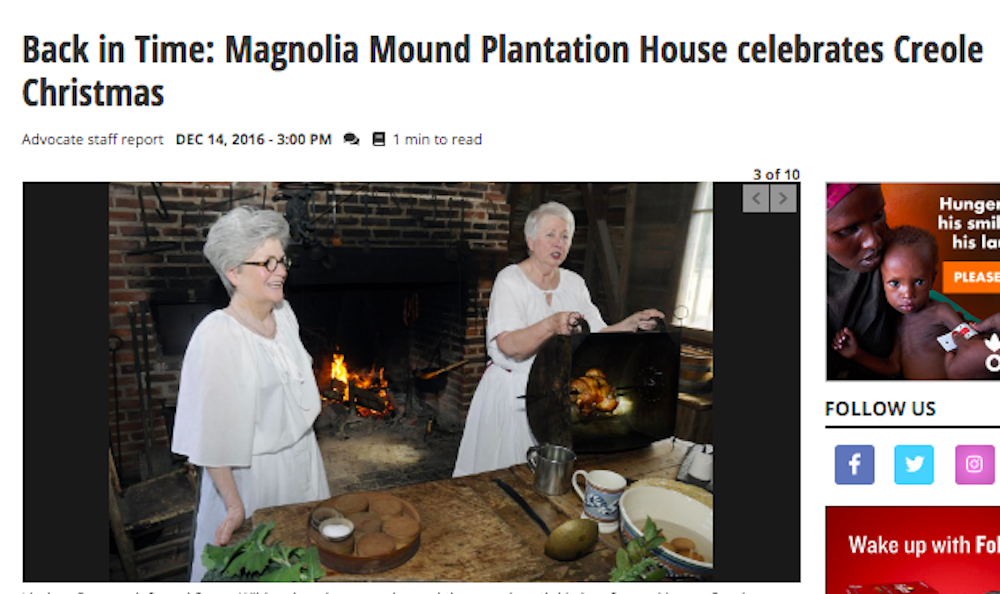
Two women giving a cooking demonstration in 2016 in Baton Rouge, Louisiana’s Magnolia Mound Plantation.
Screenshot, The Advocate
Thousands of enslaved cooks were worked to death. They spent their lives cooking for the big house and rarely receiving credit, while the white mistress of the house claimed their fame.
This legacy resonates in plantation museums, when foodways presentations are given in the kitchen or dining room. But elite white plantation mistresses did not cook in these early American kitchens, nor did they create the food that gave way to southern hospitality and American cuisine.
Recipes like gumbo, shrimp and grits, jambalaya, hoppin’ John, okra stew and fried fish were favorites among the slave-holding elite. These dishes, African in origin, became American cuisine because of the forced labor of enslaved Africans and African Americans. These were their recipes.
Museums are tasked to represent history in the most honest way possible, through lectures, programming, historical interpretation, reenactments and exhibits. But when it comes to slavery, this line is often blurred. Some museums are in the business of historical fantasy, and Nicole A. Moore, an African American interpreter and hearth cook, stated in a personal interview that it is time for museums to be responsible.
“That lack of recognition is all too common and whether sites want to acknowledge it or not… they won’t make you uncomfortable by sharing the truth, so please bring your fantasies and ideas about this time period, and they’ll keep the dream alive.”
This dream is that slavery wasn’t that bad, that the enslaved community was happy cooking for the big house, and was at most an assistant. This fantasy gives full culinary authorship to the white plantation mistresses.
Correcting the stories
Many visitors want confirmation of their limited historical perspectives, often gained from grade-school textbooks, most of which distort the reality of history. Most visit historical sites to connect with the past and to find a sense of pride in our collective history.
But the reality of the past can interrupt premeditated concepts of history. Some museums, for example, are making a conscious effort to properly represent these historic kitchens and those who cooked in them. Among them is Thomas Jefferson’s Monticello, which has led this cause for decades by using the stories of enslaved chef James Hemings and others, through interactive African American-led programming .
Williams was the first African American interpreter to cook in the plantation museum’s kitchen, marking a historic moment for the site and its public narrative.
Stratford Hall, the birthplace of Robert E. Lee and the site where I work, has also hired Williams for its Christmastide program in December, where he will cook an 18th-century meal in the historic 1738 kitchen and teach visitors about plantation kitchen labor, enslavement and the birth of American cuisine.
These sorts of programs attempt to correct the stories told at these sites, to better represent history and place.
Plantation museums are having an identity crisis. Some visitors are complaining about having to learn about slavery. Simultaneously, historic plantations are losing support from wedding venue sponsors who criticize the promotion of these sites as romantic and ahistorical.
The latest critiques highlight the divisions in public opinion about the functions of such sites. The questions remain, what role do these museums have in telling our nation’s history, and at what point does representation matter?
Alex from Copy Me (previously) writes, "Copying is one of the most essential steps to creativity. And if we don’t understand how it works, copyright can easily become detrimental to the very creativity we want to protect. Copy-Me's got a new video about how even the great geniuses copied others and how this practice goes waaaay back to the most famous artists and inventions. With loads of examples and quotes from experts.
We tried to reach the emotion behind the beliefs we all carry with us because facts alone don’t change anyone’s mind, especially when those beliefs are so woven into every aspect of our society. It’s called, appropriately, 'Geniuses Steal', the 3rd part in a miniseries about how minds really work and how the romantic notions about creation hinder our own ability to create.
We know geniuses are not real and minds don’t have Eureka moments. But we still cling to the idea of an original artist. That romantic notion of someone who creates something out of nothing, with their mind alone.
But the truth is every single piece of art and technology ever created is a remix. Shakespeare copied. Mozart copied. Picasso copied. Morse copied. Tarkovsky copied too. They’re all based in the work of others before them. The obsession with originality is quite a new phenomenon in the history of our species. And maybe it’s time to reconsider how art and inventions come about before our laws destroy the very creativity we want to protect.
Art and inventions are extraordinary, there is no doubt about that. But the steps taken are quite ordinary. We don’t need magical out-of-this world explanations when the answers are right in front of us. And it’s a lot easier to get started on something when you don’t expect your ideas to come from another world, isn’t it?
Gasparilla is a Tampa tradition. It’s rowdy, it’s loud, it’s jubilant and sometimes a little messy. While we love rocking an eye patch and a pirate hat, sometimes the aftermath of Gasparilla is worrying.
How much trash is collected after Gasparilla? More than 35 tons in 2019, according to City Officials — and they were able to recycle about 2.5 tons of what was collected. Keep Tampa Bay Beautiful Volunteers collected approximately 540 pounds of of additional materials, which includes beads.
Findings out of USF St. Pete and Eckerd College indicate there are nearly 4 billion micro plastics in Tampa Bay. That means 1 particle per liter of water.
Divers with the Florida Aquarium pulled more than 200 pounds of beads out of Tampa Bay following 2019’s Gasparilla celebration. To encourage folks to not toss their beads, Florida Aquarium offered discounted admission if you brought your beads with you.
While we love to celebrate, we also love this beautiful city and we want to keep it that way. Be jubilant, but be mindful.
On December 12, Mayor Jane Castor officially launched the #BeadFreeBay campaign, an anti-littering awareness campaign to remind the public that throwing beads and other litter in the wateris prohibited. Beads and other non-biodegradable items are incredibly harmful to the environment and they pose serious threats to marine wildlife.
The goal of the Bead-Free Bay campaign is to minimize the environmental impact of Tampa’s traditions and events on thewaterways and beyond.
“Environmental sustainability is a core tenant of my administration’s focus,” said City of Tampa Mayor Jane Castor. “And while we all love a good parade, the beads thrown during the parade have no place harming our delicate ecosystem. Together, we will transform Tampa’s tomorrow by keeping our marine wildlife safe and our environment clean by keeping beads out of the water this and every event season moving forward.”
The City of Tampa has already started taking steps to minimize the ecological impact of Gasparilla. Ye Mystic Krewe of Gasparilla worked with the Coast Guard to issue a litter law notice to all mariners. The City is also rolling out a branded campaign with signs at all city docks, and will establish designated “no-throw zones” during parades to prevent beads from accidentally being tossed in the water.
Registration is free—and open now! Please join us for an evening of celebrating our shared culture and heritage. Be on the lookout for more information coming soon.
January 30, 2020 | 5:30-8:30pm
American University Washington College of Law, Grossman Hall
4300 Nebraska Ave., NW, Washington, D.C. 20016
Reforestation has enormous potential as a cheap and natural way of sucking heat-absorbing carbon dioxide out of the atmosphere and restoring the degraded natural world, while supporting local livelihoods at the same time. But there is more than one way to plant a tree – and some of the most widely used techniques aren’t up to scratch. Here’s how to do it the right way.
The most popular approach to reforesting – adopted for example by 59 countries signed up to the Bonn Challenge, a global effort to reforest 350 million hectares by 2030 – is called Forest Landscape Restoration. This approach includes a range of different techniques, including regeneration of natural forests, plantations of exotic or native species for harvest, and agroforestry, where trees are grown around farmland.
However, these activities have very different consequences for the amount of carbon they store in the long term. Like fine wines, the carbon-storing potential of forests grows as they age. But almost half of pledged reforestation under the Bonn Challenge is for commercial plantations, which are regularly harvested – and which cycle back nearly all of the carbon it has stored back into the atmosphere every 10-20 years.
This means that on balance, these plantations store little if any carbon. Worse, activities such as logging can disturb soils, releasing additional carbon which potentially tips the scales from carbon sink to carbon source.
To meet the world’s climate targets, we need a greater focus on restoring natural forests. If protected from fire and other disturbances, the trees that return will keep storing more carbon until they match the stores of a mature, old-growth forest in around 70 years – and remain a long-term carbon sink. Natural regeneration is particularly effective in humid tropical areas, where trees grow faster than in northern latitudes.
There is a broader issue with all reforestation approaches, however. Forest landscapes must be resilient to future stresses brought by climate change, such as increasing temperatures, droughts, floods and other weather extremes – or else their benefits will be lost. This is especially important in the densely forested tropics, where climate impacts are predicted to be harshest.
There are a number of ways that we can ensure new forests are resilient to these impacts. First, having a diversity of species with a wide variety of traits in the forest landscape reduces the risk that a single event will wipe out large parts of the ecosystem. This is because tree species have different resistances and vulnerabilities.
For example, pests and diseases are likely to migrate as the climate changes. In a single-species plantation, that could wipe out the whole forest. But with many different species in the area, parts of the forest will be resilient.
We should also plant and introduce species that are adapted to the future climatic conditions projected for the area. For example, if climate models project a drier climate with increased droughts, then including native species with tolerance to drought would increase the chances of that forest staying resilient, and therefore maintaining its carbon store for longer.
Finally, it is important to accept that some trees, as well as animals and plants within the forest ecosystem, may not be able to cope with future climatic conditions in the areas they currently inhabit. They need to be able to migrate to areas with more favourable conditions, and for this to be possible, areas of forest within the landscape must remain connected. The best way of doing this is by planting forest corridors that connect fragmented forests across a vast area.
Supporting wildlife
Forests aren’t just carbon stores. How we reforest is also crucial to the health of the smaller flora and fauna that support a healthy planet.
The most appropriate way to support wildlife depends on the land’s history and natural tendencies – and sometimes this means not reforesting at all. For example, replacing native grassland and shrubland with forest plantations may actually reduce the diversity of wildlife in an area, as grassland species would be lost.
On deforested and former agricultural lands, regeneration of native forests will increase biodiversity. However, plantations of a single species of tree for harvest are unlikely to support thriving wildlife as well as natural forest would. This is particularly the case when the planted species is not native, as local wildlife will not be adapted to this new environment and the non-native tree may outcompete or threaten native trees.
One of the key principles of the Forest Landscape Restoration approach is that projects should enhance human as well as environmental wellbeing. Human livelihoods are interlinked with forest landscapes and should not be excluded from their restoration but supported, so that the intertwined problems of climate change, biodiversity loss and poverty can all be tackled together.
Working with local communities to plan, plant, protect, and take ownership of forest landscapes ensures that they will be maintained and protected long into the future. To this end, allowing a diversity of approaches – including some agricultural activities that meet the needs of local people – is key to delivering sustainable social and environmental change.
When restored well, forest landscapes can even help vulnerable communities adapt to climate change, especially in tropical regions. For example, forests add moisture to the atmosphere and limit local temperature rise by absorbing some of the Sun’s radiation.
Reforesting our landscapes has great potential to improve the health of the planet and its inhabitants. If we plant trees with resilience to climate change, supporting wildlife, and promoting local human wellbeing in mind, reforestation can play a big part in tackling the climate and ecological crises, and supporting vulnerable communities across the world.
Heather Plumpton has previously received funding from the Natural Environment Research Council (NERC), the British Ecological Society (BES), Past Global Changes (PAGES) and the UK Department for International Development (DfID).