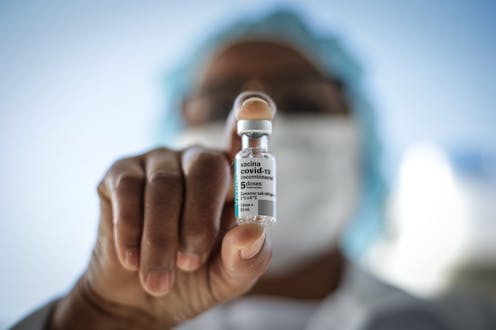
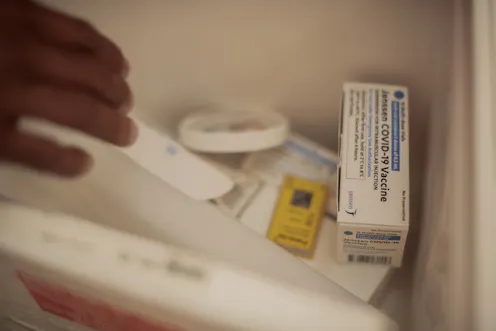
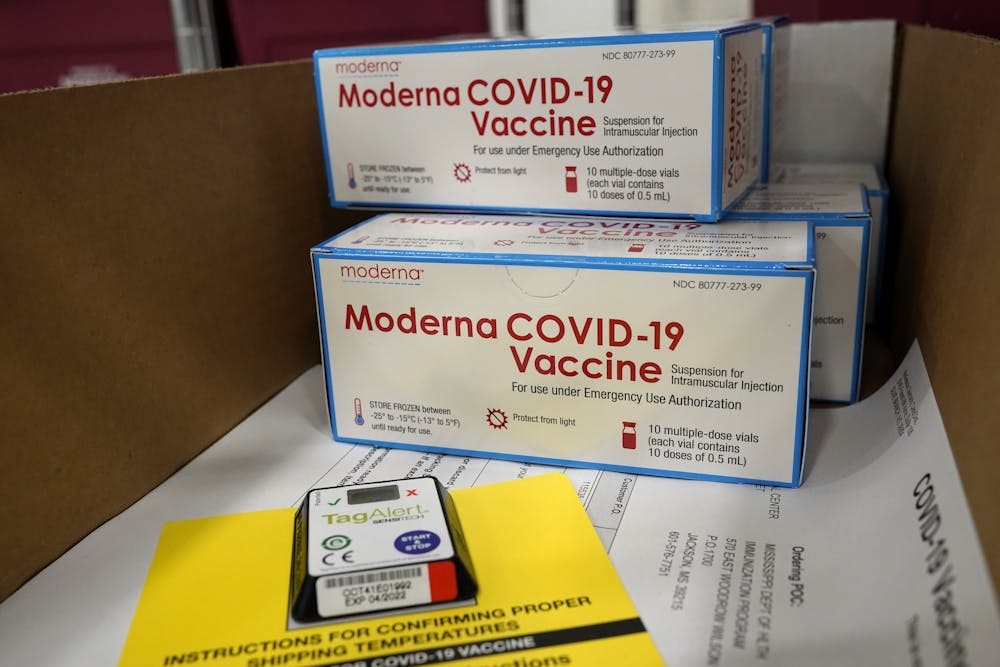
Orlando mayor Buddy Dyer is urging residents to cut way back on water, which is now needed for the stream of Covid patients flooding the city's hospitals. "The demand for liquid oxygen is extremely high, as the priority is to use it to save lives and treat critically ill patients…" he announced today (video below). — Read the rest
The COVID-19 pandemic is a dramatic demonstration of evolution in action. Evolutionary theory explains much of what has already happened, predicts what will happen in the future and suggests which management strategies are likely to be the most effective.
For instance, evolution explains why the Delta variant spreads faster than the original Wuhan strain. It explains what we might see with future variants. And it suggests how we might step up public health measures to respond.
But Delta is not the end of the story for SARS-CoV-2, the virus that causes COVID-19. Here’s what evolutionary theory tells us happens next.
Evolution is a result of random mutations (or errors) in the viral genome when it replicates. A few of these random mutations will be good for the virus, conferring some advantage. Copies of these advantageous genes are more likely to survive into the next generation, via the process of natural selection.
New viral strains can also develop via recombination, when viruses acquire genes from other viruses or even from their hosts.
Generally speaking, we can expect evolution to favour virus strains that result in a steeper epidemic curve, producing more cases more quickly, leading to two predictions.
First, the virus should become more transmissible. One infected person will be likely to infect more people; future versions of the virus will have a higher reproductive or R number.
Second, we can also expect evolution will shorten the time it takes between someone becoming infected and infecting others (a shorter “serial interval”).
Both these predicted changes are clearly good news for the virus, but not for its host.
The original Wuhan strain had an R value of 2-3 but Delta’s R value is about 5-6 (some researchers say this figure is even higher). So someone infected with Delta is likely to infect at least twice as many people as the original Wuhan strain.
The Delta variant is an example of how quickly the virus can evolve.
Shutterstock
This may be related to a higher viral load (more copies of the virus) in someone infected with Delta compared with earlier strains. This may allow Delta to transmit sooner after infection.
A higher viral load may also make Delta transmit more easily in the open air and after “fleeting contact”.
We know COVID-19 vaccines designed to protect against the original Wuhan strain work against Delta but are less effective. Evolutionary theory predicts this; viral variants that can evade vaccines have an evolutionary advantage.
So we can expect an arms race between vaccine developers and the virus, with vaccines trying to play catch up with viral evolution. This is why we’re likely to see us having regular booster shots, designed to overcome these new variants, just like we see with flu booster shots.
COVID-19 vaccines reduce your chance of transmitting the virus to others, but they don’t totally block transmission. And evolutionary theory gives us a cautionary tale.
There’s a trade-off between transmissibility and how sick a person gets (virulence) with most disease-causing microorganisms. This is because you need a certain viral load to be able to transmit.
If vaccines are not 100% effective in blocking transmission, we can expect a shift in the trade-off towards higher virulence. In other words, a side-effect of the virus being able to transmit from vaccinated people is, over time, the theory predicts it will become more harmful to unvaccinated people.
How about future variants?
In the short term, it’s highly likely evolution will continue to “fine tune” the virus:
its R value will continue to increase (more people will be infected in one generation)
the serial interval will decrease (people will become infectious sooner)
variants will make vaccines less effective (vaccine evasion).
But we don’t know how far these changes might go and how fast this might happen.
The UK government’s Scientific Advisory Group for Emergencies (SAGE) has recently explored scenarios for long-term evolution of the virus.
It says it is almost certain there will be “antigenic drift”, accumulation of small mutations leading to the current vaccines becoming less effective, so boosters with modified vaccines will be essential.
It then says more dramatic changes in the virus (“antigenic shift”), which might occur through recombination with other human coronaviruses, is a “realistic possibility”. This would require more substantial re-engineering of the vaccines.
SAGE also thinks there is a realistic possibility of a “reverse zoonosis”, leading to a virus that may be more pathogenic (harmful) to humans or able to evade existing vaccines. This would be a scenario where SARS-CoV-2 infects animals, before crossing back into humans. We’ve already seen SARS-CoV-2 infect mink, felines and rodents.
Will the virus become more deadly?
Versions of the virus that make their host very sick (are highly virulent) are generally selected against. This is because people would be more likely to die or be isolated, lowering the chance of the virus transmitting to others.
SAGE thinks this process is unlikely to cause the virus to become less virulent in the short term, but this is a realistic possibility in the long-term. Yet SAGE says there is a realistic possibility more virulent strains might develop via recombination (which other coronaviruses are known to do).
So the answer to this critical question is we really don’t know if the virus will become more deadly over time. But we can’t expect the virus to magically become harmless.
Will humans evolve to catch up?
Sadly, the answer is “no”. Humans do not reproduce fast enough, and accumulate enough favourable mutations quickly enough, for us to stay ahead of the virus.
The virus also does not kill most people it infects. And in countries with well-resourced health-care systems, it doesn’t kill many people of reproductive age. So there’s no “selection pressure” for humans to mutate favourably to stay ahead of the virus.
Finally, evolutionary theory has a warning about future pandemics.
A gene mutation that allows a virus in an obscure and relatively rare species (such as a bat) to gain access to the most common and widely distributed species of large animal on the planet — humans — will be strongly selected for.
So we can expect future pandemics when animal viruses spill over into humans, just as they have done in the past.
Last week, Twitter user @KokomRoily began to feel a creeping sense of déjà vu as they were reading a novel by prolific erotic romance author Romilly King. According to KokomRoily, the book felt familiar after reading the first chapter and, by the second they, “felt sure I could tell what was going to happen next.”
I'm what you'd call a voracious reader. I read all the time, everywhere. I read non-fiction, fiction, & fanfiction. I don't discriminate great stories.
What I do despise is plagiarism. Color me surprised when I bought "Paid to Kneel" by Romilly King. It seemed so familiar. pic.twitter.com/1iAQLAgFml
This kicked off a broad investigation where authors and readers alike began to comb through King’s library of work, which includes more than 20 novels in the past year, to find other instances. While that investigation did bear more plagiarized fruit, it also caught up some innocent bystanders as King’s editors were targeted, despite being unaware of the plagiarism, as did various authors that shared the same editors and voice actors that work on King’s audiobooks.
In short, the story may not be over, but it does appear that King’s career may well be, especially as many of the authors who were plagiarized are getting the plagiarized works removed from Amazon.
However, this case is a very fascinating one. It’s a fairly unique story in plagiarism and highlights the complexities of dealing with plagiarism when the intersection with copyright law is less-than-seamless.
Fan Fiction, Professional Plagiarism
One of the reasons that this story has received so much attention is because of the parties that are involved. King is, or at least was, a prolific professional author that had carved out a fan base for their work. Blue_Jack, on the other hand, is a fan fiction author that writes and posts their stories for free on forums dedicated to the topic.
As we’ve discussed in the past, fan fiction and fan art is a very messy scene from a legal perspective. Though most creators and rightsholders tolerate or even encourage non-commercial fan creations, commercial fan fiction is generally seen as both legally and ethically taboo in the industry.
Though there have been some attempts to legitimize commercial fan fiction, such as Kindle Worlds in 2013, those efforts have largely been short-lived, and the fan fiction community remains almost entirely free of commercialization. It’s a hobby that is created by fans for other fans.
To that end, the fan fiction community is no stranger to plagiarism. There have been many cases where a story published in one fandom was copied and converted into a very similar story in a different one. However, these types of issues are isolated within the communities themselves and are handled accordingly.
This case, however, is extremely different.
Here, a commercial and professional author took content from fan fiction communities and plagiarized them for profit. Not only does this sting a bit more, it also raises legal issues that aren’t present when matters are handled within fan fiction communities.
The reason is that fan fiction works are not authorized creations. Fan fiction authors don’t own the characters and stories that they base their works on. At most, they have a non-exclusive license to use those elements for non-commercial purposes.
However, they do own any original expression that they bring into the work. Most important for this case, that includes the exact words that they used to express their ideas.
That, in turn, appears to be a large part of why Blue_Jack was able to file a claim with Amazon and get the book pulled. However, if the plagiarism had been more limited or more vague, it could have gone very differently.
For one, it’s possible the plagiarism might not have incorporated any elements that can be protected by copyright. Second, it might have only involved elements that Blue_Jack didn’t own.
However, that was clearly not the case here. But this won’t be the last time someone plagiarizes fan fiction for commercial gain and the next one may not have as neat of an outcome.
Bottom Line
In the end, this story has about as happy of an ending as is practical. The plagiarism is clear-cut, the fan community responded well (outside attacking others not involved) and the authors are taking appropriate action.
However, this won’t be the last case like this. As more authors try to increase the rate they publish books, plagiarism will become a bigger and bigger temptation, and the fan fiction community will always be a tempting target.
The reason, as noted by the Daily Dot, is that themes that are prominent in fan fiction, especially erotic and romantic fan fiction, often times can be translated easily to other characters and other settings. Given that fan fiction communities remain one of the largest repositories of free literature available, it’s easy to see why a plagiarist may seek more than inspiration from within those virtual walls.
King likely isn’t the first, but they definitely will not be the last. This is an area to keep a close eye on, especially as self-publishing becomes more and more the norm.
I spent last week studying the 26,000 words of privacy terms published by eBay and Amazon, trying to extract some straight answers, and comparing them to the privacy terms of other online marketplaces such as Kogan and Catch (my full summary is here).
There’s bad news and good news.
The bad news is that none of the privacy terms analysed are good. Based on their published policies, there is no major online marketplace operating in Australia that sets a commendable standard for respecting consumers’ data privacy.
All the policies contain vague, confusing terms and give consumers no real choice about how their data are collected, used and disclosed when they shop on these websites. Online retailers that operate in both Australia and the European Union give their customers in the EU better privacy terms and defaults than us, because the EU has stronger privacy laws.
The Australian Competition and Consumer Commission (ACCC) is currently collecting submissions as part of an inquiry into online marketplaces in Australia. You can have your say here by August 19.
The good news is that, as a first step, there is a clear and simple “anti-snooping” rule we could introduce to cut out one unfair and unnecessary, but very common, data practice.
Deep in the fine print of the privacy terms of all the above-named websites, you’ll find an unsettling term.
It says these retailers can obtain extra data about you from other companies, for example, data brokers, advertising companies, or suppliers from whom you have previously purchased.
eBay, for example, can take the data about you from a data broker and combine it with the data eBay already has about you, to form a detailed profile of your interests, purchases, behaviour and characteristics.
The problem is the online marketplaces give you no choice in this. There’s no privacy setting that lets you opt out of this data collection, and you can’t escape by switching to another major marketplace, because they all do it.
An online bookseller doesn’t need to collect data about your fast-food preferences to sell you a book. It wants these extra data for its own advertising and business purposes.
Online shopping leaves a digital paper trail as well as empty boxes.
STRF/STAR MAX/IPx/AP
You might well be comfortable giving retailers information about yourself, so as to receive targeted ads and aid the retailer’s other business purposes. But this preference should not be assumed. If you want retailers to collect data about you from third parties, it should be done only on your explicit instructions, rather than automatically for everyone.
The “bundling” of these uses of a consumer’s data is potentially unlawful even under our existing privacy laws, but this needs to be made clear.
Time for an ‘anti-snooping’ rule
Here’s my suggestion, which forms the basis of my own submission to the ACCC inquiry.
Online retailers should be barred from collecting data about a consumer from another company, unless the consumer has clearly and actively requested this.
For example, this could involve clicking on a check-box next to a plainly worded instruction such as:
Please obtain information about my interests, needs, behaviours and/or characteristics from the following data brokers, advertising companies and/or other suppliers.
The third parties should be specifically named. And the default setting should be that third-party data are not collected without the customer’s express request.
This rule would be consistent with what we know from consumer surveys: most Australian consumers are not comfortable with companies unnecessarily sharing their personal information.
There could be reasonable exceptions to this rule, such as for fraud detection, address verification or credit checks. But data obtained for these purposes should not be used for marketing, advertising or generalised “market research”.
Can’t we already opt out of targeted ads?
Online marketplaces do claim to allow choices about “personalised advertising” or marketing communications. Unfortunately, these are worth little in terms of privacy protection.
Amazon says you can opt out of seeing targeted advertising. It does not say you can opt out of all data collection for advertising and marketing purposes.
Similarly, eBay lets you opt out of being shown targeted ads. But the later passages of its Cookie Notice state:
your data may still be collected as described in our User Privacy Notice.
This gives eBay the right to continue to collect data about you from data brokers, and to share them with a range of third parties.
Many retailers and large digital platforms operating in Australia justify their collection of consumer data from third parties on the basis you’ve already given your implied consent to the third parties disclosing it.
That is, there’s some obscure term buried in the thousands of words of privacy policies that supposedly apply to you, which says that Bunnings, for instance, can share data about you with various “related companies”.
Of course, Bunnings didn’t highlight this term, let alone give you a choice in the matter, when you ordered your hedge cutter last year. It only included a “Policies” link at the foot of its website; the term was on another web page, buried in the detail of its Privacy Policy.
Such terms should ideally be eradicated entirely. But in the meantime, we can turn the tap off on this unfair flow of data, by stipulating that online retailers cannot obtain such data about you from a third party without your express, active and unequivocal request.
Who should be bound by an ‘anti-snooping’ rule?
While the focus of this article is on online marketplaces covered by the ACCC inquiry, many other companies have similar third-party data collection terms, including Woolworths, Coles, major banks, and digital platforms such as Google and Facebook.
While some argue users of “free” services like Google and Facebook should expect some surveillance as part of the deal, this should not extend to asking other companies about you without your active consent.
The anti-snooping rule should clearly apply to any website selling a product or service.
With lockdowns barring many of us from visiting physical shops, we should be able to make purchases online without being unwittingly roped into a company’s advertising side hustle.
Katharine Kemp receives funding from The Allens Hub for Technology, Law and Innovation. She is a Member of the Advisory Board of the Future of Finance Initiative in India, the Centre for Law, Markets & Regulation and the Australian Privacy Foundation.
Four teachers have died of Covid-19 within a 24-hour period in Broward County, Florida – a state that bans mask mandates. At least three of the teachers were unvaccinated, according to CNN, and they died just days before the fall semester was about to begin. — Read the rest
by Kayla Harris, Librarian/Archivist at the Marian Library, Associate Professor, University of Dayton
People are warned that what they post on the internet will live forever. But that’s not really the case. 3alexd/E+ via Getty Images
This year the Internet Archive turns 25. It’s best known for its pioneering role in archiving the internet through the Wayback Machine, which allows users to see how websites looked in the past.
Increasingly, much of daily life is conducted online. School, work, communication with friends and family, as well as news and images, are accessed through a variety of websites. Information that once was printed, physically mailed or kept in photo albums and notebooks may now be available only online. The COVID-19 pandemic has pushed even more interactions to the web.
You may not realize portions of the internet are constantly disappearing. As librariansandarchivists, we strengthen collective memory by preserving materials that document the cultural heritage of society, including on the web. You can help us save the internet, too, as a citizen archivist.
Disappearing act
People and organizations remove content from the web for a variety of reasons. Sometimes it’s a result of changing internet culture, such as the recent shutdown of Yahoo Answers.
It can also be a result of following best practices for website design. When a website is updated, for example, the previous version is overwritten – unless it was archived.
Web archiving is the process of collecting, preserving and providing continued access to information on the internet. Often this work is done by librarians and archivists, with assistance from automated technology like web crawlers.
Web crawlers are programs that index web pages to make them available through search engines, or for long-term preservation. The Internet Archive, a nonprofit organization, uses thousands of computer servers to save multiple digital copies of these pages, requiring over 70 petabytes of data. It is funded through donations, grants and payments for its digitization services. Over 750 million web pages are captured per day in the Internet Archive’s Wayback Machine.
Why archive?
In 2018, President Donald Trump wrongly claimed via Twitter that Google had promoted on its homepage President Barack Obama’s State of the Union address, but not his own. Archived versions of the Google homepage proved that Google had, in fact, highlighted Trump’s State of the Union address in the same manner. Multiple news outlets use the Internet Archive’s Wayback Machine as the source for fact-checking these types of claims, since screenshots alone can be easily altered.
A 2019 report from the Tow Center for Digital Journalism examined the digital archiving practices and policies of newspapers, magazines and other news producers. The interviews revealed that many news media staff either do not have the resources to devote to archiving their work or misunderstand digital archiving by equating it to having a backup version.
When a news story disappeared from the Gawker website a year after the publication shut down, the Freedom of the Press Foundation became concerned with what might happen when wealthy individuals purchase websites with the intent to delete or censor the archives. It partnered with the Internet Archive to launch a web archive collection focused on preserving the web archives of vulnerable news outlets – and to dissuade billionaires from purchasing such material to censor.
Archiving websites that document social justice issues, such as Black Lives Matter, helps explain these movements to people of the present and the future.
Archiving government websites promotes transparency and accountability. Especially during times of transition, government websites are vulnerable to deletion with changing political parties.
In 2017 the Library of Congress announced it would no longer archive every single tweet, because of Twitter’s growth as a communication tool. Twitter supplies the Library of Congress with the texts of tweets, not shared images or videos. Instead of comprehensive collecting, the Library of Congress now archives only tweets of significant national importance.
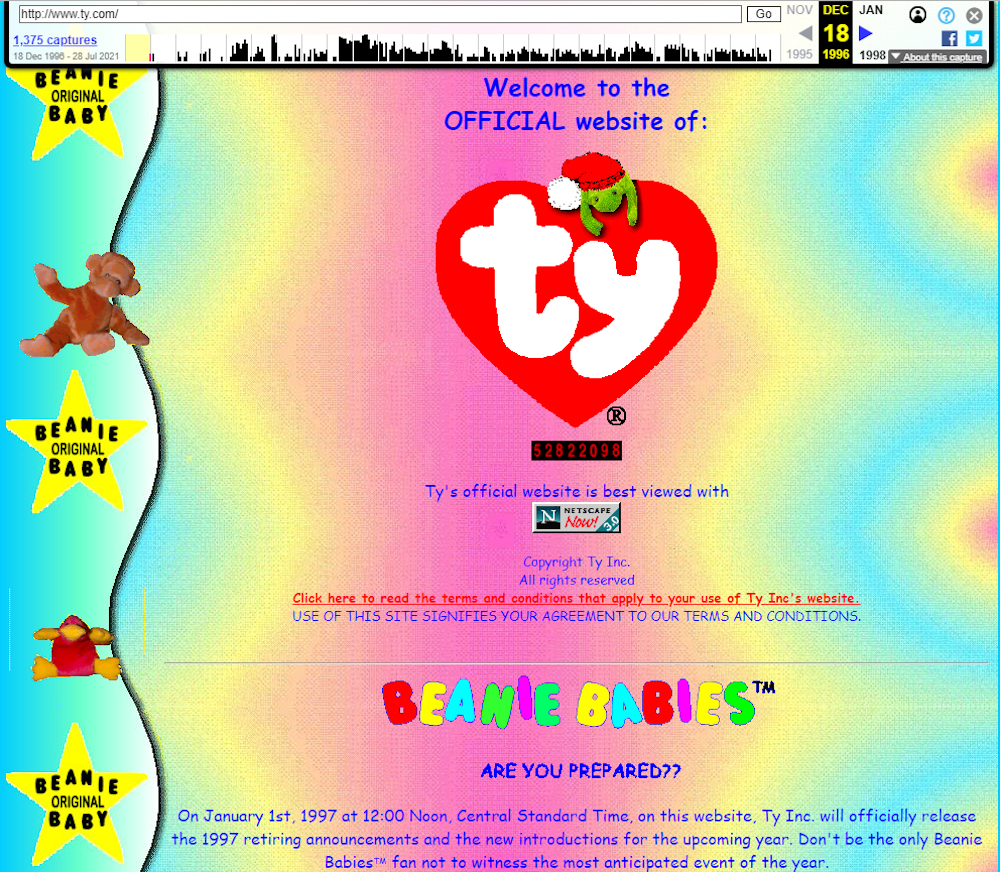
Screen capture from the Dec. 18, 1996, archived version of the Ty website, creator of.
Beanie Babies, in the Internet Archive’s Wayback Machine.
Internet Archive Wayback Machine
Archived websites that document the culture and history of the internet, like the Geocities Gallery, not only are fun to look at but illustrate the ways early websites were created and used by individuals.
Citizen archivists
Archiving the internet is a monumental task, one that librarians and archivists cannot do alone. Anyone can be a citizen archivist and preserve history through the Internet Archive’s Wayback Machine. The “Save Page Now” feature allows anyone to freely archive a single, public website page. Bear in mind, some websites prevent web crawling and archiving through special coding or by requiring a login to the site. This may be due to sensitive content or the personal preference of the web developer.
Local cultural heritage institutions, such as libraries, archives and museums, are also actively archiving the internet. Over 800 institutions use Archive-It, a tool from the Internet Archive, to create archived web collections. At the University of Dayton we curate collections related to our Catholic and Marianist heritage, from Catholic blogs to stories of the Virgin Mary in the news.
Through its Spontaneous Event collections, Archive-It partners with organizations and individuals to create collections of “web content related to a specific event, capturing at risk content during times of crisis.”
The websites of today are the historical evidence of tomorrow, but only if they are archived. If they are lost, we will lose crucial information about corporate and government decisions, modern communication methods such as social media, and social movements with significant online presences, such as Black Lives Matter and #MeToo.
Together with librarians and archivists, you can help ensure the survival of this evidence and save internet history.
The authors do not work for, consult, own shares in or receive funding from any company or organization that would benefit from this article, and have disclosed no relevant affiliations beyond their academic appointment.
Spend any time watching television or scrolling through social media, and you’ll inevitably see advertisements for pills, powders and potions that promise to grow muscle, shed body fat, improve your focus and resurrect your youth.
Globally, the nutritional supplement industry was said to be worth over US$140 billion in 2020. Within the United States alone, this figure is estimated to be around $36 billion – despite evidence that the majority of these supplements do not work.
How did products with questionable benefits and expensive prices become so mainstream? Nutritional supplements are not a new phenomenon. Their history dates back at least 150 years, and they’ve been able to thrive in the United States thanks to false promises, fanatical adherents and weak regulation.
Stoking an appetite for alternatives
Given the outlandish claims that can adorn supplement labels, it is perhaps unsurprising that some of the earliest supplement enthusiasts were religious figures. Their supplements weren’t pills, but rather food alternatives.
Sylvester Graham, born in 1794, was an American Presbyterian minister who preached salvation through a vegetarian diet.
Part of Graham’s teaching centered on temperance and whole grain foods. Graham’s followers made and marketed Graham bread, crackers and flour with the promise that these products would promote righteous living and eternal salvation.
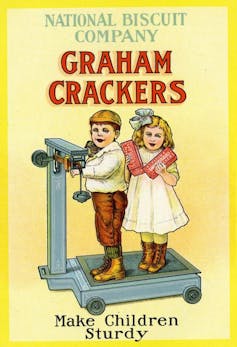
Graham crackers, which are made using course wheat flour, were pitched as a healthy alternative to traditional bread.
Transcendental Graphics/Getty Images
While Graham didn’t officially endorse these products, his spiritual successor, Dr. John Harvey Kellogg, was an eager proponent of his family’s line of new foods. A doctor, inventor and businessman rolled into one, Kellogg ran his own health spa in Michigan – the Battle Creek Sanitarium – during the late-19th and early-20th century. Although he did not create cornflakes – that was his brother, Will – Kellogg was responsible for marketing flours, protein replacements, granolas and peanut butters. Like the Graham products, Kellogg’s foods were linked to improved health and virtue.
Graham crackers and granola may seem relatively benign compared to some health and wellness products sold today, such as detox teas and vitamin-enriched waters. But they were nevertheless important in promoting the still-powerful message underpinning most of the supplements we see today: This product will improve your health and your life.
Sometime in the 1940s, the American nutritionist Paul Bragg reached out to barbell manufacturer Bob Hoffman.
At the time, Hoffman was making a small fortune selling his York Barbell workout equipment throughout the United States. Bragg, meanwhile, had firmly established himself as a leading expert on alternative nutrition. Sensing a potentially lucrative partnership, Bragg wrote to Hoffman with an idea.
In the letter, Bragg told Hoffman the fundamental flaw in his York business: his products were durable. If someone bought a barbell set in the 1930s, it was likely they could still use it in the 1950s. Bragg recommended selling nutritional supplements, which would need to be replaced on a biweekly or monthly basis.
Hoffman decided to pass on partnering up with Bragg, but he soon recognized the idea’s potential. In the 1950s, nutritionist and bodybuilding coach Irving Johnson began selling protein supplements in Hoffman’s Strength & Health magazine. Made from soy, Johnson’s “Hi Protein” powder was a huge success.
Within a year, Hoffman banned Johnson from his magazine and began selling his own “Hi-Proteen” powder. Protein supplements, as an industry, grew in size and scope. Soy protein products were eventually replaced by milk protein powders in the 1960s. By the late 1990s several other derivatives, ranging from pea protein to collagen powders, existed.
The size and scope of other offerings grew with time. Vitamin and mineral supplements became popular in the 1950s. Energy drinks and energy boosters like creatine started flying off the shelves in the late 1980s and early 1990s. Prohormones – which purported to build muscle and were eventually banned – were introduced in the early 2000s. Each decade, profits ballooned, as did the creativity in the branding of the products.
It wasn’t for lack of trying. The supplements industry and federal authorities have long been playing a game of cat and mouse.
When Hoffman and others began selling supplements, they were technically subject to the policies of the Food and Drug Administration. But during the 1950s, the FDA was ill-equipped to regulate nutritional supplements. However, some of the manufacturers’ outlandish claims and unhygienic practices started to attract the attention of the regulatory body, which soon sought to gain more control.
By the 1960s, Hoffman – who routinely claimed his products added pounds of muscles in rapid time – became a target of the FDA. The secret to his Hi-Proteen powder? A large mixing vat in which he stirred Hershey’s chocolate powder together with soy protein powder using a rowing oar.
Hoffman was regularly censored but never stopped. During the 1960s and 1970s, the FDA regularly locked horns with manufacturers for their lax production methods and incredulous claims.
The problem was that the FDA was never able to fully regulate the industry.
From 1968 to 1970, Congress held several public hearings on the FDA’s plans to regulate supplements. Legislators, supplement trade associations, manufacturers and citizens discussed restrictions and bans on certain products, such as making it illegal to sell supplements with nutrients in excess of 150% of daily intake recommendations.
Public and private outcry stopped such plans in their tracks. The FDA was forced to engage in light-touch regulation. In 1975, a court ruling allowed supplements to advertise themselves as natural. One year later, the Rogers Proxmire Act prohibited the FDA from imposing limits on vitamin and mineral amounts in supplements.
The FDA retained the right to pursue baseless or misleading claims, but this did little to slow down the industry. The number of products continued to grow.
Put simply, it became impossible to oversee what went into products. This also explains why so many supplements include a note to say they are not FDA approved or endorsed.
In the early-1990s the FDA resumed its efforts to regulate the supplement industry. In particular, the agency wanted to increase its own enforcement powers while simultaneously making it illegal to advertise therapeutic claims on supplement labels. Once more, private lobbying and public outcry watered down the agency’s powers.
Classifying supplements as a food allowed manufacturers to sidestep stringent FDA regulations applied to drugs.
JW LTD/Getty Images
The legislation also expanded which products could be classified as a supplement – and, therefore, not be subjected to the FDA’s purview.
Today, responsibility is placed on producers to self-regulate their potentially harmful products. This does expose producers to lawsuits, but it can be a long and lengthy process for consumers. In effect, supplements are brought to market before being thoroughly tested. Thus, many products are sold despite containing banned substances.
A single promise wrapped in a pill
Since the mid-20th century, nutritional supplements have been promoted in a variety of ways within the United States. But acknowledging the differences in product, taste and price, they’ve generally been marketed based upon a single promise: This product will, in some way, improve your life.
Whether this is true or not for the individual product – some supplements do, in fact, work, with creatine being one example – it has become problematic at a broader level. Federal agencies in the U.S. have continually been impeded from correctly overseeing the market. Private lobbying and public outcry about the government wanting to “take away your vitamins” have encouraged malpractice and dangerous messaging.
Mel Gibson urges people to ‘Call the U.S. Senate and tell them that you want to take your vitamins in peace.’
A study from 2018 found 776 instances of unapproved pharmaceutical ingredients being added to supplements in the United States from 2007 to 2016. Many of these additions were relatively harmless. But several ingredients – from steroid compounds to banned weight loss drugs – were not.
Supplements might promise a great deal. But in reality, most of them are articles of faith.
[Over 100,000 readers rely on The Conversation’s newsletter to understand the world.Sign up today.]
Conor Heffernan does not work for, consult, own shares in or receive funding from any company or organization that would benefit from this article, and has disclosed no relevant affiliations beyond their academic appointment.
To a casual reader, this may seem like a dry bit of industrial policy, but woven into the new order is a revolutionary idea that has rocked the antitrust world to its very foundations.
The Paradox of Antitrust
US antitrust law has three pillars: the Sherman Act (1890), the Clayton Act (1914), and the FTC Act (1914). Beyond their legal text, these laws have a rich context, including the transcripts of the debates that the bills’ sponsors participated in, explaining why the bills were written. They arose as a response to the industrial conglomerates of the Gilded Age, and their “robber baron” leaders, whose control over huge segments of the economy gave them a frightening amount of power.
Despite this clarity of intent, the True Purpose of Antitrust has been hotly contested in US history. For much of that history, including the seminal breakup of John D. Rockefeller’s Standard Oil in 1911, the ruling antitrust theory was “harmful dominance.” That’s the idea that companies that dominate an industry are potentially dangerous merely because they are dominant. With dominance comes the ability to impose corporate will on workers, suppliers, other industries, people who live near factories, even politicians and regulators.
The election of Ronald Reagan in 1980 saw the rise of a new antitrust theory, based on “consumer welfare.” Consumer welfare advocates argue that monopolies can be efficient, able to deliver better products at lower prices to consumers, and therefore the government does us all a disservice when it indiscriminately takes on monopolies.
Consumer welfare’s standard-bearer was Judge Robert Bork, who served as Solicitor General in the Nixon administration. Bork was part of the conservative Chicago School of economics, and wrote a seminal work called “The Antitrust Paradox.”
TheAntitrust Paradox went beyond arguing that consumer welfare was a better way to do antitrust than harmful dominance. In his book, Bork offers a kind of secret history of American antitrust, arguing that consumer welfare had always been the intention of America’s antitrust laws, and that we’d all been misled by the text of these laws, the debates surrounding their passage, and other obvious ways of interpreting Congress’s intent.
Bork argued the true goal of antitrust was protecting us as consumers—not as citizens, or workers, or human beings. As consumers, we want better goods and lower prices. So long as a company used its market power to make better products at lower prices, Bork’s theories insisted that the government should butt out.
This is the theory that prevailed for the ensuing 40 years. It spread from economic circles to the government to the judiciary. It got a tailwind thanks to a well-funded campaign that included a hugely successful series of summer seminars attended by 40 percent of federal judges, whose rulings were measurably impacted by the program.
Morning in America
Everyone likes lower prices and better products, but all of us also have interests beyond narrow consumer issues. We live our days as parents, spouses, friends—not just as shoppers. We are workers, or small business owners. We care about our environment and about justice and equity. We want a say in how our world works.
Competition matters, but not just because it can make prices lower or products better. Competition matters because it lets us exercise self-determination. Market concentration means that choices about our culture, our built environment, our workplaces, and our climate are gathered into ever-fewer hands. Businesses with billions of users and dollars get to make unilateral decisions about our lives. The larger a business looms in our life, the more ways it can hurt us.
The idea that our governments need to regulate companies beyond the narrow confines of “consumer welfare” never died, and now, 40 years on, it’s coming roaring back.
The FTC’s new chair, Lina Khan, burst upon the antitrust scene in 2017, when, as a Yale Law student, she published Amazon’s Antitrust Paradox, a devastating rebuke to Bork’s Antitrust Paradox, demonstrating how a focus on consumer welfare fails to deliver, even on its own terms. Khan is now one of the nation’s leading antitrust enforcers, along with fellow “consumer welfare” skeptics like Jonathan Kanter (now helming the Department of Justice Antitrust Division) and Tim Wu (the White House’s special assistant to the president for technology and competition policy).
Bombshells in the Fine Print
The Biden antitrust order is full of fine detail; it’s clear that the president’s advisors dug deep into competition issues with public interest groups across a wide variety of subjects. We love to nerd out on esoteric points of competition law as much as the next person, and we like a lot of what this memo says about tech and competition, but even more exciting is the big picture stuff.
When the memo charges the FTC with policing corporate concentration to prevent abuses to “consumer autonomy and consumer privacy,” that’s not just a reassurance that this administration is paying attention to some of our top priorities. It’s a bombshell, because it links antitrust to concerns beyond ensuring that prices stay low.
We get it, this is esoteric, technical stuff. But if there’s one thing we’ve learned in 30 years’ fighting for a better digital future, it’s that all the important stuff starts out as dull, technical esoterica. From DRM to digital privacy, bossware to broadband, our issues too often rise to the level of broad concern once they’ve grown so harmful that everyone has to pay attention to them.
We are living through a profound shift in the framework that determines what kinds of companies are allowed to exist and what they’re allowed to do. It’s a shift for the better. We know nothing is assured. The future won’t fix itself. But this is an opportunity, and we’re delighted to seize it.
Last year, according to a United Nations report published in March, Libyan government forces hunted down rebel forces using “lethal autonomous weapons systems” that were “programmed to attack targets without requiring data connectivity between the operator and the munition”. The deadly drones were Turkish-made quadcopters about the size of a dinner plate, capable of delivering a warhead weighing a kilogram or so.
Artificial intelligence researchers like me have been warning of the advent of such lethal autonomous weapons systems, which can make life-or-death decisions without human intervention, for years. A recent episode of 4 Corners reviewed this and many other risks posed by developments in AI.
Around 50 countries are meeting at the UN offices in Geneva this week in the latest attempt to hammer out a treaty to prevent the proliferation of these killer devices. History shows such treaties are needed, and that they can work.
The lesson of nuclear weapons
Scientists are pretty good at warning of the dangers facing the planet. Unfortunately, society is less good at paying attention.
In August 1945, the United States dropped atomic bombs on the Japanese cities of Hiroshima and Nagasaki, killing up to 200,000 civilians. Japan surrendered days later. The second world war was over, and the Cold War began.
The world still lives today under the threat of nuclear destruction. On a dozen or so occasions since then, we have come within minutes of all-out nuclear war.
Well before the first test of a nuclear bomb, many scientists working on the Manhattan Project were concerned about such a future. A secret petition was sent to President Harry S. Truman in July 1945. It accurately predicted the future:
The development of atomic power will provide the nations with new means of destruction. The atomic bombs at our disposal represent only the first step in this direction, and there is almost no limit to the destructive power which will become available in the course of their future development. Thus a nation which sets the precedent of using these newly liberated forces of nature for purposes of destruction may have to bear the responsibility of opening the door to an era of devastation on an unimaginable scale.
If after this war a situation is allowed to develop in the world which permits rival powers to be in uncontrolled possession of these new means of destruction, the cities of the United States as well as the cities of other nations will be in continuous danger of sudden annihilation. All the resources of the United States, moral and material, may have to be mobilized to prevent the advent of such a world situation …
Billions of dollars have since been spent on nuclear arsenals that maintain the threat of mutually assured destruction, the “continuous danger of sudden annihilation” that the physicists warned about in July 1945.
A warning to the world
Six years ago, thousands of my colleagues issued a similar warning about a new threat. Only this time, the petition wasn’t secret. The world wasn’t at war. And the technologies weren’t being developed in secret. Nevertheless, they pose a similar threat to global stability.
The threat comes this time from artificial intelligence, and in particular the development of lethal autonomous weapons: weapons that can identify, track and destroy targets without human intervention. The media often like to call them “killer robots”.
Our open letter to the UN carried a stark warning.
The key question for humanity today is whether to start a global AI arms race or to prevent it from starting. If any major military power pushes ahead with AI weapon development, a global arms race is virtually inevitable. The endpoint of such a technological trajectory is obvious: autonomous weapons will become the Kalashnikovs of tomorrow.
Strategically, autonomous weapons are a military dream. They let a military scale its operations unhindered by manpower constraints. One programmer can command hundreds of autonomous weapons. An army can take on the riskiest of missions without endangering its own soldiers.
Nightmare swarms
There are many reasons, however, why the military’s dream of lethal autonomous weapons will turn into a nightmare. First and foremost, there is a strong moral argument against killer robots. We give up an essential part of our humanity if we hand to a machine the decision of whether a person should live or die.
Beyond the moral arguments, there are many technical and legal reasons to be concerned about killer robots. One of the strongest is that they will revolutionise warfare. Autonomous weapons will be weapons of immense destruction.
Previously, if you wanted to do harm, you had to have an army of soldiers to wage war. You had to persuade this army to follow your orders. You had to train them, feed them and pay them. Now just one programmer could control hundreds of weapons.
In some ways lethal autonomous weapons are even more troubling than nuclear weapons. To build a nuclear bomb requires considerable technical sophistication. You need the resources of a nation state, skilled physicists and engineers, and access to scarce raw materials such as uranium and plutonium. As a result, nuclear weapons have not proliferated greatly.
Autonomous weapons require none of this, and if produced they will likely become cheap and plentiful. They will be perfect weapons of terror.
Can you imagine how terrifying it will be to be chased by a swarm of autonomous drones? Can you imagine such drones in the hands of terrorists and rogue states with no qualms about turning them on civilians? They will be an ideal weapon with which to suppress a civilian population. Unlike humans, they will not hesitate to commit atrocities, even genocide.
Time for a treaty
We stand at a crossroads on this issue. It needs to be seen as morally unacceptable for machines to decide who lives and who dies. And for the diplomats at the UN to negotiate a treaty limiting their use, just as we have treaties to limit chemical, biological and other weapons. In this way, we may be able to save ourselves and our children from this terrible future.
Toby Walsh is a Laureate Fellow and Scientia Professor of Artificial Intelligence at the University of New South Wales in Sydney, Australia. He is a Fellow of the Australian Academy of Science and author of the recent book, “2062: The World that AI Made” that explores the impact AI will have on society, including the impact on war.
As Indigenous community members and archaeologists continue to discover unmarked graves of Indigenous children at the sites of Canadian residential schools, the United States is reckoning with its own history of off-reservation boarding schools.
In July 2021, nine Sicangu Lakota students who died at the Carlisle Indian Industrial School in Pennsylvania were disinterred and returned to their homelands at Whetstone Bay in South Dakota.
One of these young people was Ernest Knocks Off. Ernest, who came from the Sicangu Oyate or Burnt Thigh Nation, was among the first group of students to arrive at Carlisle, in 1879. He entered school at age 18 and attempted to run away soon after arriving. He ultimately went on a hunger strike and died of complications of diphtheria on Dec. 14, 1880.
While digging into archives of Carlisle students’ writing, I found that young people like Ernest were not passive victims of U.S. colonization. Instead, they fought – in Ernest’s case, to his death – to retain their languages and cultures as the assimilationist experiment in education unfolded.
‘Unspoken traumas’
U.S. Army Gen. Richard Henry Pratt opened the government-funded Carlisle Indian Industrial School in 1879. Following his model, more than 350 government-funded and church-run boarding schools later opened across the U.S. The National Native American Boarding School Healing Coalition estimates that hundreds of thousands of young Native people attended these schools in the late 19th and early 20th centuries. The first students were recruited by Pratt and sent by their nations in hopes that they could learn English to continue fighting against treaty violations by U.S. settlers. In 1891, attendance became compulsory under federal law.
Boarding schools sought to assimilate Indigenous children into Euro-Western culture by separating them from their communities. The schools forced them to learn English and practice Christianity and trained them to work in a capitalist economy – often as servants and laborers on farms and in the households of white people.
Even as Indigenous students faced teachers and a government trying to replace their cultures, languages and identities, they resisted the assimilationist education. Their strategies were at times blatant, but often covert.
Ernest may have been one of the first boarding school students to run away, but he certainly wasn’t the last. Scholars have found that running away was a tactic used by students in boarding schools across the U.S. and Canada. It became such a significant shared experience that celebrated Native authors such as Louise Erdrich and Leslie Marmon Silko capture this act of resistance in their writings.
Running away was a way for students to communicate their rejection of assimilationist education and to fight their separation from their homeland and community. Runaways sometimes succeeded and got back home. But I believe that even when they were forcibly returned to school, running away represented courage and reminded the other students to keep fighting.
Plains Sign Talk
Plains Sign Talk is a sign language that serves as a lingua franca for trade and diplomacy among the Pawnee, Shoshone, Cheyenne, Arapaho, Crow and Siouan peoples in the Southern Plains. It became a powerful tool at Carlisle, where teachers demanded that students give up their languages for another shared tongue – English. Plains Sign Talk was a way for students to communicate with one another and across tribes that was unintelligible to their teachers.
Carlisle teachers underestimated the importance of Plains Sign Talk, viewing it as a primitive form of communication that students would leave behind as they learned English. When Pratt and his colleagues witnessed students using it, they created a new curriculum based on techniques used to teach deaf students. They did not realize that students were using the sign language to circumvent the English-only policy.
Kamloops Indian Residential School former student Evelyn Camille, 82, at a makeshift memorial to the 215 children whose remains were discovered buried near the facility in British Columbia.
Cole Burston/AFP via Getty Images
Pictographic writing
Students also drew on Plains pictography to tell their stories. Plains tribes originally painted pictographs – elements of a graphic writing system – on buffalo hides to document victories in battle and record “winter counts,” or annual historical records. After increased contact with settlers, many tribes began to document pictographic histories in ledger books. These texts served as communal histories that would prompt oral retellings of battles and other significant events.
Students at Carlisle regularly used pictographs on slates or chalkboards. On June 25, 1880, for example, a Cheyenne student who was renamed Rutherford B. Hayes at school drew a pictograph of a horse and rider on his slate. He labeled the image John Williams – the Carlisle name of an Arapaho boy who was his classmate and friend.
I argue that these pictographic records show how some students understood their time at school in the context of their developing warrior identities, underscoring their desire to act bravely and return home to recount their stories for their nations’ collective memory.
Speaking Lakota
When students spoke their languages, they faced harsh penalties. This included corporal punishment, incarceration in the campus barracks and public shaming in the school newspaper.
Pratt and his supervisors at the Bureau of Indian Affairs hoped that they could break up tribes by disrupting the transmission of language and culture from one generation to the next. By destroying tribal identities, they hoped to take land in communally held reservations and guaranteed by treaties. For U.S. settlers to gain access, the land would have to shift to a private property system. Boarding schools thus became part of the federal Indian policy later codified as the 1887 Dawes Act.
Although students were supposed to speak only English, they began to learn one another’s languages as well. Lakota, or Sioux, became particularly popular, as it was a majority language in the school’s early years when many students came from the Rosebud and Pine Ridge reservations.
In 1881, Pratt was troubled that students were still speaking their languages two years into their term. When student Stephen K. White Bear was found “talking Indian,” he received a common punishment, which was writing a composition about his discretion. In his essay “Speak Only English” Stephen revealed that “every boy and every girl would like to know how to talk Sioux very much. They do not learn the English language they seem to want to know how to talk Sioux.”
Seeds of pan-Indian resistance
As students met peers across nations as geographically far-flung as the Inuit and the Kiowa, they sowed seeds for the pan-Indian resistance movements of the 20th century. From the founding of the Society of American Indians in 1911 through the American Indian Movement of the 1960s and ‘70s, Native activists unified for advocacy and cultural revitalization. Scholars argue that these movements can trace their roots to intertribal communities of solidarity that were built in the boarding schools.
The outcry against boarding schools that we see today across Canada and the U.S. reflects not only a shared experience of trauma, but a longstanding solidarity among Indigenous peoples working together to maintain land, language, culture and identity in the face of oppression at the hands of Euro-Americans.
Sarah Klotz received funding from CCCC/NCTE Emergent Researcher Award including a grant of $10,000 for monograph project, Writing Their Bodies: Restoring Rhetorical Relations at the Carlisle Indian School, 2016
If you’re a student about to go to college, then perhaps you’ve scanned college orientation websites and social media feeds for glimpses of your new life. As a college librarian, I believe you should explore your college library, too.
This is based on countless discussions I’ve had with graduating college seniors who told me they regret they didn’t learn more about the library back in their first year of college. To help students avoid a similar fate, here are four things to know about libraries now.
1. Libraries can save you money on course readings
According to the College Board, colleges estimate that students spend approximately $1,200 per year on books and supplies. Students can cut down on that cost by borrowing books from the library instead of purchasing them from a bookstore.
What’s “reserve”? It’s a place where we keep course materials that faculty request for their classes. The print reserves collection is for physical books and, in some cases, printed “coursepacks” – which are photocopies of readings that have been bound together like a paperback book. Usually you’ll be able to check out reserve items for a few hours at a time. Sometimes the library will have several copies of each title.
In most libraries you’ll find print reserves at the circulation desk. The circulation desk is the place where all books are checked out, and it’s usually near the library entrance.
Many libraries also offer electronic reserves, with e-books and digital copies of book chapters and journal articles. You’ll usually find a link to electronic reserves on the library homepage.
Not all faculty members use reserves, so you’ll need to sleuth out how to find books and articles elsewhere in the library, too. Go to the library website and look for a link to the catalog, where you’ll find the titles and locations of all the books that the library owns.
For articles, look instead for links to journal indexes and databases. Unfortunately, these may be labeled with a variety of different names. You can always ask a librarian for advice.
2. Using the library can help you earn better grades
Research has shown that students who use the library tend to have higher GPAs than those who don’t. For this reason, it’s helpful to overcome any library anxiety – a term that describes the discomfort some people experience when they imagine walking into a library that is larger or more complex than any to which they are accustomed.
One of the best ways to overcome library anxiety is to get to know the library staff. Librarians regularly teach students how to find and use library resources. Educators who analyze student outcomes have found that making connections with staff and faculty bolsters students’ social capital, and social capital helps students succeed. Social capital is an asset that you earn by having a connection with another person.
Most librarians are accessible via email, chat or in person.
3. Libraries offer ideas for study breaks
Studying all night might seem efficient, but it doesn’t always work. Cognitive science says that when you memorize something, then set it aside, you’re helping your brain absorb the new information. You can start to envision potential study breaks at the library now.
Browse the library events calendar for yoga classes and stress-management workshops. Search the library catalog for self-help books, graphic novels and blockbuster movies. Follow the library’s social media feed and be alerted to stress-buster activities with board games, crafts and even cuddly puppies.
Go to the college’s student employment website to search for part-time jobs at the library. There’s often a lot of competition, so be sure to contact the hiring manager at the library, too. If there aren’t any openings now, ask if your name can be put on a list to be considered for jobs in the future.
Students who work at libraries can list many benefits of their jobs. Students who staff service desks are taught how to use such essential library resources as the library catalog, article databases and interlibrary loan. They become power library users. They often tell me that they’re the go-to experts among their friends.
Carrie M. Macfarlane tidak bekerja, menjadi konsultan, memiliki saham, atau menerima dana dari perusahaan atau organisasi mana pun yang akan mengambil untung dari artikel ini, dan telah mengungkapkan bahwa ia tidak memiliki afiliasi selain yang telah disebut di atas.
by Jathan Sadowski, Research Fellow, Emerging Technologies Research Lab and CoE for Automated Decision-Making and Society, Monash University
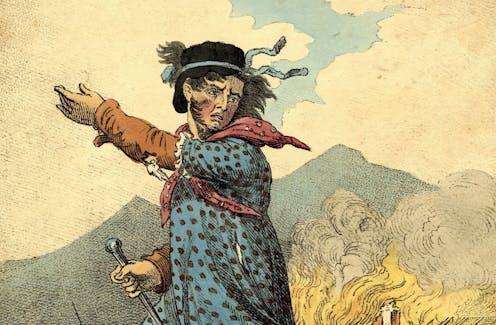
Poster showing 'The Leader of the Luddites' (1812) Wikimedia Commons, CC BY-SA
I’m a Luddite. This is not a hesitant confession, but a proud proclamation. I’m also a social scientist who studies how new technologies affect politics, economics and society. For me, Luddism is not a naive feeling, but a considered position.
And once you know what Luddism actually stands for, I’m willing to bet you will be one too — or at least much more sympathetic to the Luddite cause than you think.
Today the term is mostly lobbed as an insult. Take this example from a recent report by global consulting firm Accenture on why the health-care industry should enthusiastically embrace artificial intelligence:
Excessive caution can be detrimental, creating a luddite culture of following the herd instead of forging forward.
To be a Luddite is seen as synonymous with being primitive — backwards in your outlook, ignorant of innovation’s wonders, and fearful of modern society. This all-or-nothing approach to debates about technology and society is based on severe misconceptions of the real history and politics of the original Luddites: English textile workers in the early 19th century who, under the cover of night, destroyed weaving machines in protest to changes in their working conditions.
Our circumstances today are more similar to theirs than it might seem, as new technologies are being used to transform our own working and social conditions — think increases in employee surveillance during lockdowns, or exploitation by gig labour platforms. It’s time we reconsider the lessons of Luddism.
A brief — and accurate — history of Luddism
Even among other social scientists who study these kinds of critical questions about technology, the label of “Luddite” is still largely an ironic one. It’s the kind of self-effacing thing you say when fumbling with screen-sharing on Zoom during a presentation: “Sorry, I’m such a Luddite!”
It wasn’t until I learned the true origins of Luddism that I began sincerely to regard myself as one of them.
The Luddites were a secret organisation of workers who smashed machines in the textile factories of England in the early 1800s, a period of increasing industrialisation, economic hardship due to expensive conflicts with France and the United States, and widespread unrest among the working class. They took their name from the apocryphal tale of Ned Ludd, a weaver’s apprentice who supposedly smashed two knitting machines in a fit of rage.
The contemporary usage of Luddite has the machine-smashing part correct — but that’s about all it gets right.
First, the Luddites were not indiscriminate. They were intentional and purposeful about which machines they smashed. They targeted those owned by manufacturers who were known to pay low wages, disregard workers’ safety, and/or speed up the pace of work. Even within a single factory — which would contain machines owned by different capitalists — some machines were destroyed and others pardoned depending on the business practices of their owners.
Second, the Luddites were not ignorant. Smashing machines was not a kneejerk reaction to new technology, but a tactical response by workers based on their understanding of how owners were using those machines to make labour conditions more exploitative. As historian David Noble puts it, they understood “technology in the present tense”, by analysing its immediate, material impacts and acting accordingly.
Luddism was a working-class movement opposed to the political consequences of industrial capitalism. The Luddites wanted technology to be deployed in ways that made work more humane and gave workers more autonomy. The bosses, on the other hand, wanted to drive down costs and increase productivity.
Third, the Luddites were not against innovation. Many of the technologies they destroyed weren’t even new inventions. As historian Adrian Randall points out, one machine they targeted, the gig mill, had been used for more than a century in textile manufacturing. Similarly, the power loom had been used for decades before the Luddite uprisings.
It wasn’t the invention of these machines that provoked the Luddites to action. They only banded together once factory owners began using these machines to displace and disempower workers.
The factory owners won in the end: they succeeded in convincing the state to make “frame breaking” a treasonous crime punishable by hanging. The army was sent in to break up and hunt down the Luddites.
The Luddite rebellion lasted from 1811 to 1816, and today (as Randall puts it), it has become “a cautionary moral tale”. The story is told to discourage workers from resisting the march of capitalist progress, lest they too end up like the Luddites.
Neo-Luddism
Today, new technologies are being used to alter our lives, societies and working conditions no less profoundly than mechanical looms were used to transform those of the original Luddites. The excesses of big tech companies - Amazon’s inhumane exploitation of workers in warehouses driven by automation and machine vision, Uber’s gig-economy lobbying and disregard for labour law, Facebook’s unchecked extraction of unprecedented amounts of user data - are driving a public backlash that may contain the seeds of a neo-Luddite movement.
As Gavin Mueller writes in his new book on Luddism, our goal in taking up the Luddite banner should be “to study and learn from the history of past struggles, to recover the voices from past movements so that they might inform current ones”.
What would Luddism look like today? It won’t necessarily (or only) be a movement that takes up hammers against smart fridges, data servers and e-commerce warehouses. Instead, it would treat technology as a political and economic phenomenon that deserves to be critically scrutinised and democratically governed, rather than a grab bag of neat apps and gadgets.
In a recent article in Nature, my colleagues and I argued that data must be reclaimed from corporate gatekeepers and managed as a collective good by public institutions. This kind of argument is deeply informed by the Luddite ethos, calling for the hammer of antitrust to break up the tech oligopoly that currently controls how data is created, accessed, and used.
A neo-Luddite movement would understand no technology is sacred in itself, but is only worthwhile insofar as it benefits society. It would confront the harms done by digital capitalism and seek to address them by giving people more power over the technological systems that structure their lives.
This is what it means to be a Luddite today. Two centuries ago, Luddism was a rallying call used by the working class to build solidarity in the battle for their livelihoods and autonomy.
And so too should neo-Luddism be a banner that brings workers together in today’s fight for those same rights. Join me in reclaiming the name of Ludd!
Jathan Sadowski does not work for, consult, own shares in or receive funding from any company or organisation that would benefit from this article, and has disclosed no relevant affiliations beyond their academic appointment.
by Bhanukiran Gurijala, Assistant Professor of Computer Science & Information Systems, West Virginia University
A woman holds a phone in front of the office of NSO Group, which makes a tool that can see and hear everything a phone is used for. Jack Guez/AFP via Getty Images
End-to-end encryption is technology that scrambles messages on your phone and unscrambles them only on the recipients’ phones, which means anyone who intercepts the messages in between can’t read them. Dropbox, Facebook, Google, Microsoft, Twitter and Yahoo are among the companies whose apps and services use end-to-end encryption.
This kind of encryption is good for protecting your privacy, but governments don’t like it because it makes it difficult for them to spy on people, whether tracking criminals and terrorists or, as some governments have been known to do, snooping on dissidents, protesters and journalists. Enter an Israeli technology firm, NSO Group.
The company’s flagship product is Pegasus, spyware that can stealthily enter a smartphone and gain access to everything on it, including its camera and microphone. Pegasus is designed to infiltrate devices running Android, Blackberry, iOS and Symbian operating systems and turn them into surveillance devices. The company says it sells Pegasus only to governments and only for the purposes of tracking criminals and terrorists.
How it works
Earlier version of Pegasus were installed on smartphones through vulnerabilities in commonly used apps or by spear-phishing, which involves tricking a targeted user into clicking a link or opening a document that secretly installs the software. It can also be installed over a wireless transceiver located near a target, or manually if an agent can steal the target’s phone.
Pegasus can infiltrate a smartphone via the widely used messaging app WhatsApp without the phone’s user noticing.
Christoph Scholz/Flickr, CC BY-SA
Since 2019, Pegasus users have been able to install the software on smartphones with a missed call on WhatsApp, and can even delete the record of the missed call, making it impossible for the the phone’s owner to know anything is amiss. Another way is by simply sending a message to a user’s phone that produces no notification.
This means the latest version of this spyware does not require the smartphone user to do anything. All that is required for a successful spyware attack and installation is having a particular vulnerable app or operating system installed on the device. This is known as a zero-click exploit.
Once installed, Pegasus can theoretically harvest any data from the device and transmit it back to the attacker. It can steal photos and videos, recordings, location records, communications, web searches, passwords, call logs and social media posts. It also has the capability to activate cameras and microphones for real-time surveillance without the permission or knowledge of the user.
Who has been using Pegasus and why
NSO Group says it builds Pegasus solely for governments to use in counterterrorism and law enforcement work. The company markets it as a targeted spying tool to track criminals and terrorists and not for mass surveillance. The company does not disclose its clients.
The earliest reported use of Pegasus was by the Mexican government in 2011 to track notorious drug baron Joaquín “El Chapo” Guzmán. The tool was also reportedly used to track people close to murdered Saudi journalist Jamal Khashoggi.
It is unclear who or what types of people are being targeted and why. However, much of the recent reporting about Pegasus centers around a list of 50,000 phone numbers. The list has been attributed to NSO Group, but the list’s origins are unclear. A statement from Amnesty International in Israel stated that the list contains phone numbers that were marked as “of interest” to NSO’s various clients, though it’s not known if any of the phones associated with numbers have actually been tracked.
A media consortium, the Pegasus Project, analyzed the phone numbers on the list and identified over 1,000 people in over 50 countries. The findings included people who appear to fall outside of the NSO Group’s restriction to investigations of criminal and terrorist activity. These include politicians, government workers, journalists, human rights activists, business executives and Arab royal family members.
Other ways your phone can be tracked
Pegasus is breathtaking in its stealth and its seeming ability to take complete control of someone’s phone, but it’s not the only way people can be spied on through their phones. Some of the ways phones can aid surveillance and undermine privacy include location tracking, eavesdropping, malware and collecting data from sensors.
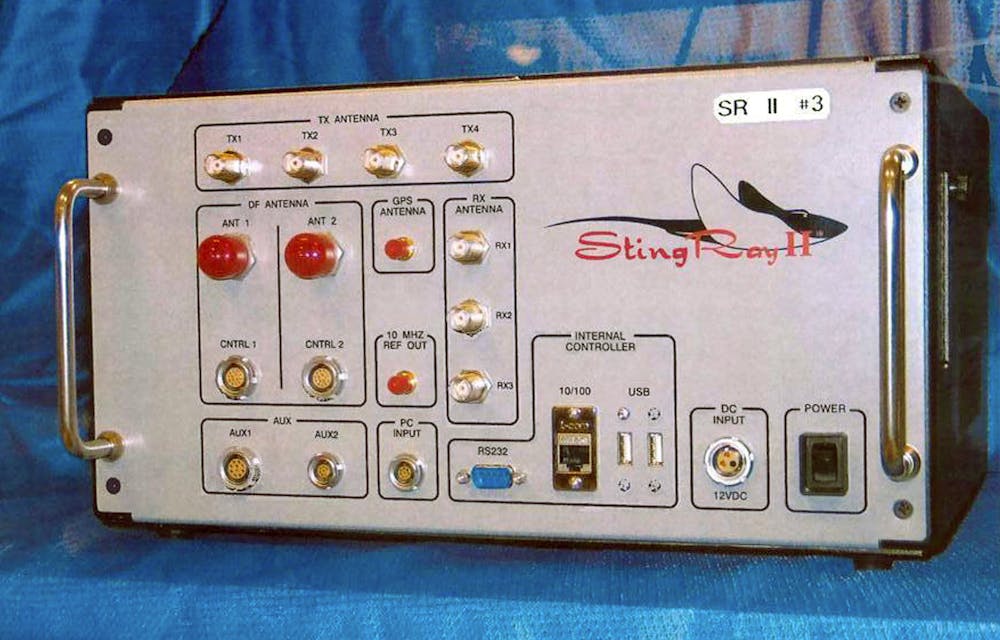
Law enforcement agencies use cell site simulators like this StingRay to intercept calls from phones in the vicinity of the device.
U.S. Patent and Trademark Office via AP
Governments and phone companies can track a phone’s location by tracking cell signals from cell tower transceivers and cell transceiver simulators like the StingRay device. Wi-Fi and Bluetooth signals can also be used to track phones. In some cases, apps and web browsers can determine a phone’s location.
Eavesdropping on communications is harder to accomplish than tracking, but it is possible in situations in which encryption is weak or lacking. Some types of malware can compromise privacy by accessing data.
The good news is, depending on who you are, you’re unlikely to be targeted by a government wielding Pegasus. The bad news is, that fact alone does not guarantee your privacy.
Bhanukiran Gurijala does not work for, consult, own shares in or receive funding from any company or organization that would benefit from this article, and has disclosed no relevant affiliations beyond their academic appointment.
Decades ago I helped organize a conference that brought together vaccine skeptics and public health officials. The debate centered on what governments can and cannot demand from citizens, and what behaviors one can rightly expect from others.
It took place many years before the current coronavirus pandemic, but many things that happened at that conference remind me of our circumstances today. Not least, as a political theorist who also studies social ethics, it reminds me that arguments grounded in self-interest can often be correct – but still deeply inadequate.
The rationality of vaccine skepticism
I recall one participant summarizing her objection to vaccines in the following way: She said that the government demanded that she allow a live biological agent to be injected into her child’s body even though it could not guarantee her child’s safety. For these reasons, she claimed, she had every right to decide that her child would not receive the vaccine.
But more importantly, this parent’s decision to reject the vaccine affected more than just her child. Because so many parents refuse vaccination for their children, outbreaks of measles have taken place throughout the U.S. In fact, in 2019 the United States reported its highest number of cases of measles in 25 years.
COVID and vaccine hesitancy
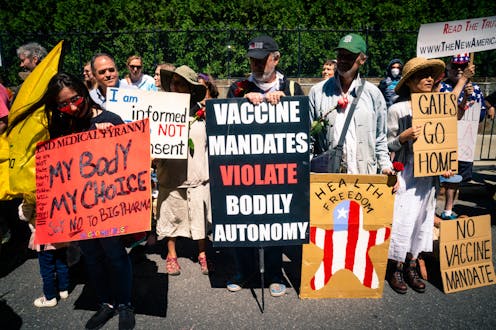
Many individuals are rejecting the COVID-19 vaccine for similar reasons – that is, reasons grounded in self-interest. They say that COVID vaccines are experimental, their long-term effects are unknown and that emergency authorization by the Food and Drug Administration was rushed.
Here again the risks associated with the vaccine are extremely small, but for some people, still real. Therefore these individuals apparently decided that they would rather take their chances with the disease itself. Many are young and don’t think the disease will affect them, and many more don’t trust the doctors, scientists and politicians who they say are pushing them to take the vaccine.
One could readily dispute these claims, too. In fact, rising vaccination rates over the past few weeks show that many people have reevaluated the risks of remaining unvaccinated. Whether these people have seen evidence of the virulence of the delta variant or have seen for themselves that millions of people have taken the vaccine and are completely fine, their evaluation of their own self-interest has changed.
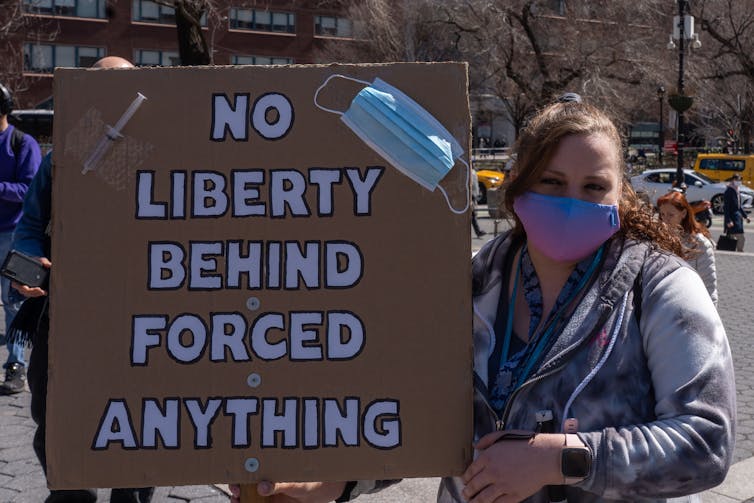
Nevertheless, many others remain adamant that these risks are unacceptable. Like that parent from many years ago, these individuals are not entirely wrong. There are risks associated with getting the vaccine. And knowing these risks, and knowing that they bear the costs of their decision, many Americans believe that they alone have the right to decide. What the government or anyone else wants is beside the point.
But here again, the costs of refusing the vaccine are not borne by the individual alone. Rising case numbers and hospitalizations, renewed restrictions regarding public events, even the emergence of the delta variant itself are happening largely because many millions of Americans chose not to get the vaccine. And for parents of children under 12 who cannot yet receive the vaccine – some of whom are immune compromised – the thought of returning to school this fall with infection rates again climbing no doubt fills them with dread.
Many would argue that this lack of concern for other people is immoral. The Golden Rule – do unto others as you would have others do unto you — manifests that concern for the well-being of others is at the core of morality. Those who choose not to take the vaccine ignore this concern and therefore act immorally. But, I would argue that their indifference to the welfare of others is not only immoral, it is also un-American.
Democracy and concern for others
Americans are a highly individualistic nation, and the spirit of “rugged individualism,” or the idea of “pulling yourself up by your bootstraps,” runs deep in American culture and history. In fact, from the nation’s very beginning, Americans have accepted the notion that human beings care about themselves and those they love more than they do about other people.
At the time of America’s founding, many contemporaries believed that a democracy is possible only if citizens love their country more than themselves. But America’s founders rejected this idea. Human beings are not angels, James Madison said. The founders accepted the reality of human selfishness and developed institutions – especially the checks and balances among the three branches of government – whereby people’s natural selfishness could be directed toward socially useful ends.
But neither Madison nor any of the other founders believed that human beings were merely selfish. Nor did they believe that a democracy could be sustained on selfishness alone. The Federalist Papers were written by James Madison, Alexander Hamilton and John Jay in support of the U.S. Constitution drafted in 1787. In Federalist 55, Madison presents this summation of human nature:
“As there is a degree of depravity in mankind which requires a certain degree of circumspection and distrust, so there are other qualities in human nature which justify a certain portion of esteem and confidence. Republican government presupposes the existence of these qualities in a higher degree than any other form.”
Yes, Madison says, human beings are selfish, and one must not ignore that reality when one is deciding how to run a society. But people are not merely selfish. We are also capable of acting with honesty and integrity and of thinking for the good of the whole rather than merely ourselves.
More, Madison argued that this other side of human nature, this concern for others, had to be operative if democracy were to survive. In fact, he insisted that, more than any other form of government, a democracy depended on virtuous citizens. Speaking at the ratifying convention for the U.S. Constitution in his home state of Virginia, Madison said:
“Is there no virtue among us? If there be not, we are in a wretched situation. No theoretical checks – no forms of government can render us secure. To suppose that any form of government will secure liberty or happiness without any virtue in the people, is a chimerical idea.”
Mere selfishness is ‘un-American’
Madison lived through the yellow fever epidemic of 1793. He even advised President George Washington about how he might address this health emergency. But there was no vaccine, nor even an understanding of what caused the epidemic.
“We all hope that the dread disease of poliomyelitis can be eradicated from our society. With the combined efforts of all, the Salk vaccine will be made available for our children in a manner in keeping with our highest traditions of cooperative national action,” he said.
Because of Madison and the other founders, the United States is a free and democratic society. Within very broad limits, Americans all have the right to make their own decisions. In some cases, Americans may even have the right to ignore the impact of their decision on others.
But a free society demands more of its citizens than mere selfishness. Political institutions can help direct and mitigate the effects of this natural human inclination to selfishness.
Throughout history, America’s leaders have recognized that without concern for others, without the highest tradition of cooperative national action, democracy is in peril. People who decide not to get vaccinated must understand that their actions are not just selfish, they are un-American.
Christopher Beem does not work for, consult, own shares in or receive funding from any company or organization that would benefit from this article, and has disclosed no relevant affiliations beyond their academic appointment.
by Enrico Bonadio, Reader in Intellectual Property Law, City, University of London
The Uffizi gallery in Florence, Italy was unhappy over Pornhub's use of Botticelli's Venus, which they house. Uffizi
Boticelli’s The Birth of Venus resides within the Uffizi gallery in Florence, Italy. It is believed to have been painted in the mid-1480s and as such is classed as being in the public domain, free from copyright around the world. However, in early July the Uffizi set its lawyers on the website Pornhub, sending the company a strongly worded letter threatening legal action over the unwelcome use of The Birth of Venus along with several of Uffizi’s other masterpieces.
This came in response to the pornography platform’s launch of an online guide to the nude or erotic aspects of artworks in well-known galleries and museums around the world, such as the National Gallery in London, the Museo del Prado in Madrid, the Louvre in Paris and the Uffizi Gallery. Particularly controversial has been Pornhub’s turning of classic artworks into pornographic videos.
It seems the letter has produced its desired effect as Pornhub has subsequently removed any references and artworks pertaining to the Uffizi. But how was it able to create this legal pressure over something in the public domain?
Protection of cultural heritage
The Uffizi has likely invoked rules within the Italian Cultural Heritage and Landscape Code. This law empowers possessors of cultural heritage artefacts to prohibit their commercial exploitation, even where the latter have been created centuries ago.
Italian law strongly protects its heritage. The definition of cultural heritage itself under Italian law is broad: any works which “are of artistic, historical, archaeological and ethno-anthropological interest”. So, if you want to use the image of the Colosseum in your pizza delivery commercial, you may need to pay (at central or local level) a licence fee. An action can be taken to stop any unwelcome or controversial use of the image, for example in a context like porn websites.
If a company wants to use an image of the Colosseum they may have to pay a fee as per the Italian Cultural Heritage and Landscape Code.
Catarina Belova/Shutterstock
In 2017, a court in Florence ordered a ticket agency to stop using the image of Michelangelo’s David on its brochures and website. In the same year, another court in Palermo condemned a bank that had used pictures of the local Teatro Massimo in their advertising campaign. Indeed, in Italy entities which own cultural artefacts can oppose any commercial use of such artefacts. Yet, whether this may happen in other countries remains doubtful.
The issue is not only legal. It also political. In 2014, the Italian culture secretary, Dario Franceschini, strongly protested against US arms engineering company ArmaLite which disseminated ads depicting the David carrying a rifle. Franceschini claimed that the Armed David jeopardised the honour and artistic value of Buonarotti’s work.
Copyright and the public domain
Museum and galleries can also rely on copyright to restrict the use of pictures of public domain pieces within their collection, or anyway charge for such use. Several of them actually do that – for example by declaring that their photographs of old paintings are subject to copyright and cannot be used without paying a fee.
But is that fair? One may note that giving custodians of old artefacts a monopoly over those pictures means to artificially monopolise the underlying works, which should instead belong to the public and be available for anyone to use or reuse it.
There is also an issue of originality. Copyright law only protects original works of authorship. While the originality requirement is interpreted generously in most countries, a threshold does exist. In a US case in the late 90s, Bridgeman Art Library v. Corel Corp, it was held that exact photographic copies of public domain images could not be protected by copyright because the copies weren’t original enough.
Titian’s Venus of Urbino was also used by Pornhub in an sexually explicit video.
Uffizi
Yet, it could be counter-argued that these photographs are not iPhone pics taken by holidaymakers.
Time, labour and skills are needed to move a painting from the gallery or museum to the studio. The photographer must be skilled, good cameras need to be used which avoid glare, and ensure careful light meter readings and faithful colours.
This is an investment – the argument goes - that must be legally protected, for example via a no-photo policy. Indeed, there are economic interests at stake. Take the Uffizi again. It is one of the most visited museums in Italy, and in 2019 around €1 million (£850,000) in revenue came from the sale of photographs of its collection.
While pictures of public domain works are not the focus in the case involving Pornhub, the Uffizi regularly relies on copyright to extract economic profits out of those pictures.
Access to culture
There is also an access to culture angle. Laws which consider pictures of paintings created centuries ago as deserving copyright protection frustrates the most important principle of copyright regimes themselves: namely, that after a specific period of time everyone should be able to use, and build upon, artworks that have fallen into the public domain.
There is the need for a wide category of people to access high quality and faithful representations of public domain works. This is the case of an art university professor showing the pic of an old artwork in class or an art historian publishing the photo in her book. Creators who want to incorporate, build on and reinterpret public domain works should be able to do so on free speech grounds.
Restricting the ability to use these pictures by tampering with copyright law is risky. Yet, it is one thing to rely on criminal law to stop crimes and another to turn copyright upside down so as to indirectly be able to monopolise artistic works, which are simply too old to be protected.
The authors do not work for, consult, own shares in or receive funding from any company or organization that would benefit from this article, and have disclosed no relevant affiliations beyond their academic appointment.
by Sunit K. Singh, Professor of Molecular Immunology and Virology, Institute of Medical Sciences, Banaras Hindu University
Andre Coelho/EPA/AAP
Over a year into the pandemic, questions around immune responses after COVID continue to confound.
One question many people are asking is whether the immunity you get from contracting COVID and recovering is enough to protect you in the future.
The answer is no, it’s not.
Here’s why.
Remind me, how does our immune response work?
Immune responses are innate or acquired. Innate, or short-term immunity, occurs when immune cells that are the body’s first line of defence are activated against a pathogen like a virus or bacteria.
If the pathogen is able to cross the first line of defence, T-cells and B-cells are triggered into action. B-cells fight through secreted proteins called antibodies, specific to each pathogen. T-cells can be categorised into helper T-cells and killer T-cells. Helper T-cells “help” B-cells in making antibodies. Killer T-cells directly kill infected cells.
Once the battle is over, B-cells and T-cells develop “memory” and can recognise the invading pathogen next time. This is known as acquired or adaptive immunity, which triggers long-term protection.
What happens when you get reinfected? Memory B-cells don’t just produce identical antibodies, they also produce antibody variants. These diverse set of antibodies form an elaborate security ring to fight SARS-CoV-2 variants.
Natural immunity is not enough
Getting COVID and recovering (known as “natural infection”) doesn’t appear to generate protection as robust as that generated after vaccination.
And the immune response generated post-infection and vaccination, known as hybrid immunity, is more potent than either natural infection or vaccination alone.
People who have had COVID and recovered and then been vaccinated against COVID have more diverse and high-quality memory B-cell responses than people who’ve just been vaccinated.
Studies indicate mRNA vaccines generate a more potent immune response with previous infection, at least against some variants including Alpha and Beta.
And studies have shown that antibody levels were higher among those who’d recovered from COVID and were subsequently vaccinated than those who’d only had the infection.
Memory B-cells against the coronavirus have been reported to be five to ten times higher in people vaccinated post-infection than natural infection or vaccination alone.
Is one dose enough after COVID?
Some reports have suggested people who’ve had COVID need only one dose of the vaccine. Clinical trials of approved vaccines didn’t generate relevant data because people who’d already had COVID were excluded from phase 3 trials.
One study from June showed people with previous exposure to SARS-CoV-2 tended to mount powerful immune responses to a single mRNA shot. They didn’t gain much benefit from a second jab.
A single dose of an mRNA vaccine after infection achieves similar levels of antibodies against the spike protein’s receptor binding domain (which allows the virus to attach to our cells) compared to double doses of vaccination in people never exposed to SARS-CoV-2.
We need more studies to fully understand how long memory B-cell and T-cell responses will last in both groups.
Also, a single dose strategy has only been studied for mRNA-based vaccines. More data is required to understand whether one jab post-infection would be effective for all the vaccines.
At this stage, it’s still good to have both doses of a COVID vaccine after recovering from COVID.
Does Delta change things?
The development of new vaccines must keep pace with the evolution of the coronavirus.
At least one variant seems to have evolved enough to overtake others, Delta, which is about 60% more transmissible than the Alpha variant. Delta is moderately resistant to vaccines, meaning it can reduce how well the vaccines work, particularly in people who’ve only had one dose.
There’s no data available yet about how effective a single jab is for people who were previously infected with Delta and recovered.
The most important thing you can do to protect yourself from Delta is to get fully vaccinated.
According to a Public Health England report, one dose of Pfizer offered only about 33% protection against symptomatic disease with Delta, but two doses was 88% effective. Two doses was also 96% effective against hospitalisation from Delta. The AstraZeneca vaccine was 92% effective against hospitalisation from Delta after two doses.
A few vaccine manufacturers, including Pfizer, are now planning to use a potential third dose as a booster to combat the Delta variant.
Sunit K. Singh does not work for, consult, own shares in or receive funding from any company or organization that would benefit from this article, and has disclosed no relevant affiliations beyond their academic appointment.
by Neelaveni Padayachee, Senior Lecturer, Department of Pharmacy and Pharmacology, University of the Witwatersrand
South Africa's COVID-19 vaccine rollout is picking up pace. Luca Sola/AFP via Getty Images
South Africa’s COVID-19 vaccine rollout programme, outlined by the Ministry of Health, had three phases, starting with the most vulnerable population.
Phase one included all the frontline healthcare workers. They received the Johnson and Johnson vaccine. Phase 2 vaccinated people over 60 years old and those in congregate settings. The third and final phase, now under way, covers the remaining South African population.
The programme got off to a shaky start in February 2021. It encountered a number of setbacks such as supply, logistics and governance issues, but has gained momentum in recent weeks. As many as 200,000 doses are being administered daily. By the end of July 2021, almost 2.9% of the South African population had been fully vaccinated and 7.5% had their first of the two Pfizer doses.
Despite this uptake, many South Africans are still hesitant to take the vaccine. The circulation of misinformation about it poses the danger of hampering efforts to control the pandemic.
In this article, we aim to dispel some of the myths surrounding the COVID-19 vaccines.
Myth 1: The COVID-19 vaccine will affect a woman’s fertility
This myth was sparked when a social media post was shared in December 2020 by Dr Wolfgang Wodarg, a physician and former chief scientist for allergy and respiratory therapy at Pfizer, and Dr Michael Yeadon, a pulmonologist. They claimed that the spike protein on the coronavirus was the same as the spike protein that is responsible for the growth and attachment of the placenta during pregnancy. The fear was that, as a result of the vaccine, the immune system would not be able to differentiate between the two spike proteins and would attack the placental protein.
This is untrue. The overall makeup of the placental protein is very different from the coronavirus spike protein.
Additionally, during the Pfizer vaccine tests, 23 women volunteers became pregnant after taking the vaccine.
Furthermore, the benefits of being vaccinated outweigh the risks of infection for pregnant women.
Myth 2: I’ve had COVID-19, so I don’t need a vaccine
Reinfection with SARS-CoV-2, the virus that causes COVID-19, can occur even in individuals who have previously contracted the virus. But receiving the vaccine can provide protection against severe COVID-19 complications.
The level of protection that is achieved from natural immunity after being infected by the virus is unknown. But scientists believe that the vaccine provides better protection than natural infection.
Myth 3: COVID-19 vaccine side-effects are dangerous
Several studies have been conducted since the start of the pandemic that have measured South Africans’ perceptions of vaccine issues. A recent study by the University of Johannesburg and the Human Sciences Research Council of South Africa found that of the respondents who did not want to be vaccinated, 25% were concerned about side-effects.
Most of the side effects of the COVID-19 vaccine are mild. They include low grade fever, sore arm and fatigue, and these usually subside after one to three days.
Rare side effects such as blood clots have been reported from the Johnson and Johnson vaccine. The chances of experiencing this side effect are low. The risks of blood clots as a result of COVID-19 infection are 8-10 times higher than risks associated with the vaccine. Doctors are aware of this concern and are trained to identify and treat the condition quickly.
A recent article by Healthline – a medically reviewed and fact checked website – compared the benefits and risks of being vaccinated with those of contracting COVID-19. Lung damage is a complication of COVID-19 while muscle fatigue can be a side effect of the vaccine. This risk-benefit decision is left to the individual to make, but vaccinations have been proven to be safe.
Myth 4: Vaccines have a microchip that will track and control an individual
This conspiracy theory has been propagated by anti-vaxxers who believe that the American business magnate, investor and philanthropist Bill Gates will implant microchips to track people’s movement, using the vaccine as the method of delivery. This is untrue and has been clarified by Gates in the media.
This myth gained traction when a video was shared on Facebook making false claims about the optional microchip on the syringe’s label of the COVID-19 vaccine. This microchip’s purpose is to confirm that the injectable and the vaccine are not counterfeit and haven’t expired. It will also confirm if the injection has been used.
People commenting on the video appeared to have misinterpreted the technology as an injectable. But the microchip is part of the syringe label and not the injectable substance itself.
Myth 5: The COVID-19 vaccine development was rushed, so it may not be effective
The vaccine was developed very quickly. This was possible because the vaccine technology had been in development for many years. When the genetic information of SARS-CoV-2 was identified, the process could begin quickly. There were sufficient resources to fund the research and social media made it easier to recruit participants for the clinical trials. Because SARS-CoV-2 is contagious, it was easy to tell whether the vaccine worked or not.
The messenger RNA vaccine (Pfizer) and the viral vector vaccine (Johnson and Johnson) cause your body to develop protection, so that when you are infected by SARS-CoV-2, your body is prepared to fight the virus. DNA is located in the nucleus of your cells and the vaccine material does not enter the nucleus. So it does not alter the DNA.
Social media plays a huge role in propagating myths and conspiracy theories. Before you share any information, you should ensure that it is from a scientific and reputable source.
Varsha Bangalee is a University of KwaZulu-Natal (UKZN) Developing Research Innovation, Localisation and Leadership in South Africa (DRILL) fellow. DRILL, is a NIH D43 grant (D43TW010131) awarded to UKZN in 2015 to support a research training and induction programme for early career academics. The content is solely the responsibility of the authors and does not necessarily represent the official views of DRILL and the National Institutes of Health.
Neelaveni Padayachee does not work for, consult, own shares in or receive funding from any company or organisation that would benefit from this article, and has disclosed no relevant affiliations beyond their academic appointment.
Babushka’s is one of the best brunch spots in the Tampa Bay region. The exceptional restaurant is a hidden gem in Temple Terrace. Creative Loafing reports that the gem is working toward opening inside the former Boca restaurant space at 901 W Platt Street.
It’s easy to forget there’s a world beyond downtown Tampa. With so many new concepts debuting on a near daily basis in this sprawling city, and in the region in general, I think it’s good to remember and focus on the local treasures that have been doing something different for a long time.
Babushka’s is a Temple Terrace Treasure serving up some Russian delicacies you may have never experienced before. The restaurant name comes from the Russian word [Bábushka], literally translating as “Grandmother.”
Napoleon Cake at Babushka’s
One of the best brunch spots in the region
So, what can you expect to eat at a traditional Russian restaurant?
Start with a sweet drink. Babushka’s serves up a golden nectar called Medovukha. It’s a Russian Homemade honey-based alcoholic drink – stronger and stouter than beer and weaker than wine.
Babushka’s introduced me to Russian Pancakes: Blinchiki. This is a traditional thin pancake, made with variety of sensational fillings. You can go savory with meat, mushrooms, salmon or caviar; or go sweet with farmer’s cheese, banana and nutella and ice cream. It will change the way you brunch forever.
Stuffed Samsa at Babushka’s
Taste Russian caviar
You can go super old school with Borscht soup and beef stroganoff with pasta. This is the epitome of Russian/Ukrainian comfort food.
In the mood for caviar? Aren’t we all. Alaskan Salmon Roe Caviar on Bruschettas is a key staple of any meal at Babushka’s. The bright hue also makes the appetizer a perfect centerpiece for the table before you devour it.
Another must-try is Pelmeni. It’s a type of dumpling served at almost any restaurant you’re bound to go to in Russia. The dumpling is usually accompanied by lashings of sour cream. Fillings for Pelmeni include minced meat (pork, beef or lamb).
Meat Blinchiki at Babushka’s
One of the city’s top local treasures
Babushka’s opened in 2018. The restaurant is located at 12639 N 56th Street in Temple Terrace. Follow the restaurant on Facebook to whet your appetite.
We have a full Tampa brunch guide too, in case you need some early morning guidance.
The Conversation asked Peter Chin-Hong, a physician who specializes in infectious diseases at the University of California, San Francisco, to help put into context the science behind the changing messages.
Some conditions make a breakthrough infection more likely in a vaccinated person: more virus circulating in the community, lower vaccination rates and more highly transmissible variants.
If vaccinated people can get infected with the coronavirus, they can also spread it. Hence the CDC recommendation that vaccinated people remain masked in indoor public spaces to help stop viral transmission.
Who’s actually protected by masking recommendations?
The recommendation that fully vaccinated people continue wearing masks is primarily intended to protect the unvaccinated – which includes kids under age 12 who are not yet eligible for vaccines in the U.S. The CDC further recommends masking in public for vaccinated people with unvaccinated household members, regardless of local community transmission rates.
Unvaccinated people are at a substantially higher risk of getting infected with and transmitting SARS-CoV-2, and of developing complications from COVID-19.
How do new variants like delta change things?
Preliminary data suggests that the rise of variants like delta may increase the chance of breakthrough infections in people who received only their first vaccine dose. For instance, one study found that a single dose of the Pfizer vaccine had an effectiveness of just 34% against the delta variant, compared with 51% against the older alpha variant in terms of warding off symptomatic disease.
Other recent preliminary reports from highly vaccinated countries like Israel and Singapore are sobering, however. Before the delta variant became widespread, from January to April 2021, Israel reported that the Pfizer vaccine was 97% effective in preventing symptomatic disease. Since June 20, 2021, with the delta variant circulating more widely, the Pfizer vaccine has been only 41% effective in preventing symptomatic disease, according to preliminary data reported by Israel’s Ministry of Health in late July. An analysis using government data from Singapore demonstrated that 75% of recent COVID-19 infections were in people who were at least partially vaccinated – though most of them were not severely ill.
In all reports and studies, however, vaccines remain very good at preventing hospitalizations and severe disease due to the delta variant – arguably the outcomes we most care about.
All of this emerging data supports the WHO’s global recommendation that even fully vaccinated individuals continue to wear masks. Most of the world still has low vaccination rates and uses a range of vaccines with variable efficacies, and countries have different burdens of circulating SARS-CoV-2 virus.
With U.S. case counts and breakthrough infection numbers headed in what public health officials consider the wrong direction, it makes sense that the CDC would modify its masking recommendations to be more conservative.
What conditions in the US warrant masking up (again)?
It makes sense that the CDC didn’t immediately change its recommendations to fall in line with the WHO’s June guidelines. With an overall high countrywide vaccination rate and a low overall COVID-19 hospitalization and death burden, the U.S. has a COVID-19 landscape very different from that in most of the world.
Additionally, some experts worried that an official message that the vaccinated should don masks might dissuade unvaccinated individuals from seeking vaccines.
The shifting recommendations don’t mean that the old ones were wrong, necessarily, only that conditions have changed. The bottom line? Masks do help cut down on coronavirus transmission, but it’s still vaccines that offer the best protection.
Peter Chin-Hong does not work for, consult, own shares in or receive funding from any company or organisation that would benefit from this article, and has disclosed no relevant affiliations beyond their academic appointment.
by Frank A. Hale, Professor, Horticultural Crop Entomology, University of Tennessee
In seven years, the lanternfly has spread from Berks County, northwest of Philadelphia, to large areas of Pennsylvania and New Jersey, and both south and north. Penn State/E. Swackhamer
The spotted lanternfly was first detected in Pennsylvania in 2014 and has since spread to 26 counties in that state and at least six other eastern states. It’s moving into southern New England, Ohio and Indiana. This approximately 1-inch-long species from Asia has attractive polka-dotted front wings but can infest and kill trees and plants. Professor Frank Hale is an entomologist who is tracking this species.
How did the spotted lanternfly get to the U.S., and how quickly is it spreading?
It is native to India, China and Vietnam and probably arrived in a cut stone shipment in 2012. The first sighting was in 2014 in Berks County, Pennsylvania, on a tree of heaven — a common invasive tree brought to North America from China in the late 1700s.
By July 2021 the lanternfly had spread to about half of Pennsylvania, large areas of New Jersey, parts of New York state, Maryland, Delaware and Virginia. It also had been found in western Connecticut, eastern Ohio, and now Indiana. To give an idea of how fast these lanternflies spread, they were introduced into South Korea in 2004 and spread throughout that entire country – which is approximately the size of Pennsylvania – in only three years.
The lanternflies lay egg masses in late summer and autumn on the trunks of trees and any smooth-surfaced item sitting outdoors. The egg masses, which resemble smears of dry mud, can also be laid on the smooth surfaces of cars, trucks and trains. Then, they can be unintentionally transported to any part of the country in just a few days. Once the eggs hatch, they crawl to nearby host plants to start a new infestation.
An adult spotted lanternfly crawls along a branch in Pennsylvania. The red, white, and black nymph below will molt into an adult.
Stephen Ausmus/USDA
How do they damage trees and plants? What do they feed on?
They feed by piercing the bark of trees and vines to tap into the plant’s vascular system to feast on sap. For a sucking insect, lanternflies are relatively big. They remove large amounts of sap and excrete copious amounts of clear, sticky “honeydew” that can coat the tree and anything beneath. A black sooty mold grows wherever the honeydew has been deposited. While unsightly, sooty mold isn’t harmful when growing on the bark of the tree or beneath it. Lanternfly feeding seriously stresses trees and vines, which lose carbohydrates and other nutrients meant for storage in the roots and eventually for new growth. Infested trees and vines grow more slowly, exhibit dieback – begin to die from the branch tips – and can even die.
How are scientists and officials trying to stop their spread?
Biological control shows some promise for the future. Two naturally occurring fungal pathogens of spotted lanternflies have been identified in the U.S. Also, U.S. labs are testing two parasitoid insects – insects that grow by feeding on lanternflies and killing them in the process – that have been brought from China for testing and possible future release.
How worried should people be about this lanternfly?
Very worried. Lanternflies easily build to high numbers. The area where host trees live is relatively wide, and lanternflies damage crops, the forest and the landscape. They damage many plants and cause a major nuisance to the general public. The heavy flow of honeydew and the resulting sooty mold makes a mess of the landscape. The adults start to aggregate on plants and structures to lay their egg masses in September. Their sudden, mass appearance can be alarming to people the way periodical cicada populations shock people when they come out of the ground. But lanternflies are more shocking because the few predators that could feed on them, like wheel bugs and predatory stink bugs, do not seem to control the infestations. That is why the introduction of parasitoids from Asia are important for achieving some meaningful level of biological control.
Spotted lanternflies invade sidewalks and buildings in Philadelphia.
Lanternflies can be a serious pest of grapes, and where found, they have reduced grape yields and damaged or killed vines. Multiple applications of insecticides are often needed to kill them, but this increases the cost of crop production. The pest threatens the major wine-producing regions in the East, such as the Finger Lakes and Long Island in New York; parts of Virginia; and Newport, Rhode Island.
Have any other pests similarly damaged trees?
Yes, the emerald ash borer, which arrived in the U.S. from China by accident and was discovered in 2002. It has killed millions of ash trees in North America. The Asian longhorned beetle, which feeds on and kills many species of trees, has turned up in multiple locations, most recently near Charleston, South Carolina. Maple, buckeye, horse chestnut, willow and elm would be threatened if this pest ever got widely established.
The box tree moth damages boxwoods and is known to live in Canada. It has been seen in Connecticut, Michigan and South Carolina. It possibly was spread accidentally into the U.S. in shipments of boxwoods from Canada. It is not known to be established in any state, but a federal government order has halted importing host plants like boxwood, euonymus and holly from Canada.
What should I do if I see one?
If it has already infested the region where you live and you find spotted lanternflies on your property, contact your local county extension office for control recommendations.
But if it has not been found in your county or state, report it to your state department of agriculture. If the infestation is caught early before it can become established in your area, hopefully it can be eradicated there. Eventually, it will spread to many parts of the country. We can slow the spread by identifying and eradicating new infestations wherever they arise.
Frank A. Hale as a representative for the University of Tennessee Institute of Agriculture (UTIA) receives funding from USDA APHIS PPQ. In 2020, UTIA received funding to survey for spotted lanternfly and other pests and diseases of grapes at Tennessee vineyards. I was a PI on that cooperative agreement. I have been the state survey coordinator for the Cooperative Agricultural Pest Survey (CAPS) in Tennessee since 2014 as a representative of UTIA. CAPS allows our state to survey for invasive pests and diseases.
In the autumn of 2020, the Tampa Bay Times published an investigation into the Pasco County Sheriff's Department, which was openly boasting about its new Minority Report-inspired intelligence gathering program. I wrote about it then, but here's a quick summary of how it works:
First the Sheriff's Office generates lists of people it considers likely to break the law, based on arrest histories, unspecified intelligence and arbitrary decisions by police analysts.
We are two researchers who work in public health and study immunity, viruses and other microbes. Since the start of the pandemic, public health experts have been concerned about what might happen if large sections of the U.S. population, for whatever reason, did not get vaccinated. Over the past few weeks, the answer to that question is starting to emerge.
In early July, Anthony Fauci, director of the National Institute of Allergy and Infectious Diseases, warned of ‘two Americas’ emerging.
‘Two Americas’ of vaccination
As of mid-July 2021, the U.S. has fully vaccinated more than 160 million people – just under 50% of the population – against COVID-19. Despite a surplus of available vaccines, in recent weeks the rate of vaccination has slowed substantially. In early April, health workers administered roughly 4 million new vaccines daily. Today, that number is about 450,000 doses a day.
As people sought vaccines over the past few months, the U.S. has split into what Dr. Anthony Fauci, director of the National Institute of Allergy and Infectious Diseases, is calling “two Americas” – one of the vaccinated population and one of the unvaccinated population. These two Americas are divided geographically and in most cases along political lines.
Vaccination rates will continue to rise, albeit slowly, as rural areas get better access to vaccines and messaging persuades some vaccine-hesitant people to get the shot. But according to survey data from late June and early July, more than 10% of adults 18 or older say they are probably not or definitely not going to get a coronavirus vaccine, with another 5% saying they are unsure. It seems likely there will be a large unvaccinated population for the time being.
In recent months, nearly every hospitalization or death from COVID-19 has been of an unvaccinated person.
AP Photo/Jae C. Hong
Which America is safer?
The vaccines themselves are nothing short of remarkable in their effectiveness at protecting against COVID-19.
Unvaccinated people, by comparison, are extremely susceptible to the coronavirus, particularly to the delta variant and the data on deaths and hospitalizations show this discrepancy clearly.
In her July 16 statement, Walensky also said that 97% of current COVID-19 hospitalizations are of unvaccinated people. An earlier analysis done by The Associated Press found that 98.9% of all hospitalized COVID-19 patients in May were unvaccinated. The director of the Los Angeles County Department of Health Services recently stated that all new hospitalized COVID-19 patients in Los Angeles were unvaccinated.
In most places across the U.S., vaccines are readily available for anyone who wants one.
AP Photo/Paul Sancya
A tale of two states
It is hard to find data about overall cases among unvaccinated compared with vaccinated individuals. This results partly from the CDC’s transition in May 2021 to focusing on hospitalizations of COVID-19 vaccine recipients rather than cases. But one way to get at this data is to compare two states with large differences in vaccination rates. As the delta variant of SARS-CoV-2 surges across the U.S., one can observe the consequences of this split into a vaccinated and unvaccinated America in real time.
Contrast this with Massachusetts, where 63% of people are fully vaccinated. Though the state is also seeing an increase in cases, total new infections numbered only around 200 to 300 per day. The number of patients hospitalized with COVID-19 in Massachussetts is also down 95% since January 2021.
As of July 20, 2021, Missouri had 1,357 patients hospitalized with COVID-19, almost 13 times more than the 106 patients in Massachusetts. This is despite Missouri’s having a slightly smaller population that is much more dispersed.
Does it matter if people stay unvaccinated?
Ultimately, with a large portion of the U.S. population still unvaccinated, COVID-19 is not going to disappear in the near future. The U.S. will continue to see outbreaks of the virus in communities with low vaccine uptake. Even if people in these undervaccinated areas rush to get shots when outbreaks happen, it takes about a month for vaccination to produce strong immunity.
As long as SARS-CoV-2 is circulating in the U.S., unvaccinated people will continue to experience the full, dangerous clinical effects of COVID–19. But in addition, while the virus spreads among the unvaccinated, it will also continue spreading at a low level to vaccinated individuals. Though most of those infections will not progress to severe COVID-19, according to the CDC, as of mid-July more than 5,000 vaccinated people, mostly over 65 years old, had been hospitalized and 1,000 had died. These numbers are of course sad, but they pale in comparison to hospitalizations and deaths among the unvaccinated population.
The vaccines are doing exactly what they were designed to do: prevent severe COVID-19 with amazing efficiency. With vaccines free and widely available, for most people in the U.S. it is a choice: Do you want to be part of the unvaccinated America or the vaccinated one?
Rodney E. Rohde has received funding from the American Society of Clinical Pathologists (ASCP), American Society for Clinical Laboratory Science (ASCLS), and other public and private entities/foundations. Dr. Rohde is affiliated with ASCP, ASCLS, ASM, and serves on several scientific advisory boards. See https://rodneyerohde.wp.txstate.edu/service/.
Ryan McNamara has received funding from the AIDS Malignancy Consortium and the National Institute for Allergens and Infectious Diseases. He is a member of the International AIDS Society and has served as a consultant for the Advanced Regenerative Manufacturing Institute on their Pandemic Response and Recovery Roadmap.
Notably, the U.S. Centers for Disease Control and Prevention has not yet taken a similar stance. On July 12, National Nurses United, the nation’s largest professional association for registered nurses, called on the CDC to reconsider in light of the spike in new infections and hospitalizations across the country. The Conversation asked Peter Chin-Hong, a physician who specializes in infectious diseases at the University of California, San Francisco, to help put into context the science behind these seemingly mixed messages.
The CDC has been following these data closely. By mid-July 2021, nearly 60% of the U.S. population age 18 or older had been fully vaccinated. Infections in those who are fully vaccinated are rare, and serious outcomes from COVID-19 in that population are even rarer – though they do still occur. However, the CDC stopped tracking nonhospitalized cases of COVID-19 for people with and without symptoms among fully vaccinated individuals on May 1, 2021.
The risk of infection leading to serious illness and death, however, differs starkly between vaccinated and unvaccinated people.
Are breakthrough infections more likely with the delta variant?
Maybe. Preliminary data suggests that the rise of variants like delta may increase the chance of breakthrough infections in people who received only their first vaccine dose. For instance, one not-yet peer-reviewed study found that a single dose of the Pfizer vaccine had an effectiveness of just 34% against the delta variant, compared with 51% against the older alpha variant in terms of warding off symptomatic disease.
But the data is more reassuring for those who have been fully vaccinated. After two doses, the Pfizer vaccine still provides strong protection against the delta variant, according to real-world data from Scotland and a variety of other countries; and in preliminary studies out of Canada and England, researchers noted only a “modest” decrease in effectiveness against symptomatic disease from 93% for the alpha variant to 88% for delta.
One recent preliminary report from Israel is sobering, however. Before the delta variant became widespread, from January to April 2021, Israel reported that the Pfizer vaccine was 97% effective in preventing symptomatic disease. However, since June 6, with the delta variant circulating more widely, the Pfizer vaccine has been 64% effective in preventing symptomatic disease, according to preliminary data reported by Israel’s Ministry of Health in early July.
And in another new report that is not yet peer-reviewed, researchers compared blood serum antibodies from people vaccinated with Pfizer, Moderna and J&J vaccines and found that the J&J vaccine lent much lower protection against delta, beta and other variants, compared with the mRNA-based vaccines. As a result, the researchers suggest that J&J vaccine recipients would benefit from booster immunizations, ideally with one of the mRNA vaccines. However, this is a limited laboratory study that doesn’t look at whether real people got sick, and contradicts a peer-reviewed study that found the J&J vaccine was protective against delta eight months after vaccination.
In all reports and studies, however, vaccine efficacy is still very high against the delta variant in preventing hospitalizations and severe disease – arguably the outcomes we most care about.
Los Angeles County, California, is again requiring all people to mask up in indoor public spaces – only a month after fully vaccinated people were freed from wearing masks.
Dania Maxwell/Los Angeles Times via Getty Images
All of this emerging data supports the WHO recommendation that even fully vaccinated individuals continue to wear masks. Most of the world still has low vaccination rates, uses a range of vaccines with variable efficacy at preventing infection and has different burdens of circulating SARS-CoV-2 virus. In this context, it makes sense that the WHO would give a conservative recommendation to mask up for all.
Who’s actually protected by masking recommendations?
The WHO’s latest call for fully vaccinated people to continue wearing masks is primarily intended to protect the unvaccinated – which includes kids under age 12 who are not yet eligible for vaccines in the U.S. Unvaccinated people are at a substantially higher risk of getting infected with and transmitting SARS-CoV-2, and of developing complications from COVID-19.
And, again, there is still a low risk of infection for vaccinated people, but this risk differs regionally. In areas of highly circulating virus and poor vaccination rates, and with highly transmissible variants, there is a higher probability of infection in vaccinated individuals compared with people living in areas with lower levels of virus in the community.
Does the US situation warrant masking up (again)?
I suspect the CDC is unlikely to pursue a universal U.S. recommendation to wear masks at this time. With an overall high countrywide vaccination rate and a low overall COVID-19 hospitalization and death burden, the U.S. has a COVID-19 landscape very different from most of the world.
Some experts also worry that sending an official message that the vaccinated should don masks may dissuade unvaccinated individuals from seeking vaccines.
What changes would signal it’s time for the US to mask up again?
There are emotional red flags and then there are more realistic red flags that may bring about a nationwide call for masking indoors for fully vaccinated people.
A more pragmatic measure for masking is the number of hospitalizations, because it is directly related to use of health care resources. Some researchers have proposed a threshold of five COVID-19 cases – averaged over several days – hospitalized per 100,000 people, which would potentially be a more ominous signal than infection rates. Los Angeles County has also surpassed that as well.
Surges will likely be a regional phenomenon based on how many people are fully vaccinated in an area. As long as hospitalizations and deaths remain generally manageable nationally, and with hospital capacity intact, the U.S. as a whole may not need to return to masking indoors for the fully immunized.
Peter Chin-Hong does not work for, consult, own shares in or receive funding from any company or organization that would benefit from this article, and has disclosed no relevant affiliations beyond their academic appointment.
The government's self-support scheme launched in 1971. It's not known when the scheme finished because nobody could ever reach the government by telephone. Letters were returned with 'Not known at this address' written across them. Even when people turned up in London to complain in person, they discovered that many government buildings were just facades of the kind one might find on a film set. The Houses of Commons and Lords were in partial ruin, seemingly vacated years before, and had become home to goats, chickens and other livestock. This fact had only gone undetected for so long because the bleating and clucking of the animals coming from within the chambers was indistinguishable from those of their political predecessors.
Spying is a risky profession. For the 14th-century English undercover agent-turned-poet Geoffrey Chaucer, the dangers – at least to his reputation – continue to surface centuries after his death.
In his July 2021 essay for the Times Literary Supplement, A.S.G. Edwards, professor of medieval manuscripts at the University of Kent in Canterbury, England, laments the removal of Geoffrey Chaucer from university curricula. Edwards says he believes this disappearance may be propelled by a vocal cohort of scholars who see the “father of English poetry” as a rapist, racist and antisemite.
The predicament would have amused Chaucer himself. Jewish and feminist scholars, among others, are shooting down one of their earliest and wisest allies. This is happening when new research reveals a Chaucer altogether different from what many current readers have come to accept. My decades of research show he was no raunchy proponent of bro culture but a daring and ingenious defender of women and the innocent.
As a medievalist who teaches Chaucer, I believe the movement to cancel Chaucer has been bamboozled by his tradecraft – his consummate skill as a master of disguise.
Outfoxing the professors
It’s true that Chaucer’s work contains toxic material. His “Wife of Bath’s Prologue” in “The Canterbury Tales,” his celebrated collection of stories, quotes at length from the long tradition of classical and medieval works on the evils of women, as mansplained by the Wife’s elderly husbands: “You say, just as worms destroy a tree, so a wife destroys her husband.”
These poems in particular generate accusations that Chaucer propagated sexist and antisemitic material because he agreed with or enjoyed it.
Severalprominentscholars seem convinced that Chaucer’s personal views are the same as those of his characters and that Chaucer is promoting these opinions. And they believe he abducted or raped a young woman named Cecily Chaumpaigne, although the legal records are enigmatic. It looks as though Cecily accused Chaucer of some such crime and he paid her to clear his name. It’s unclear what actually happened between them.
Critics cherry-pick quotations to support their claims about Chaucer. But if you examine his writings in detail, as I have, you’ll see themes of concern for women and human rights, the oppressed and the persecuted, reappear time and time again.
Chaucer the spy
Readers often assume Chaucer’s characters were a reflection of the writer’s own attitude because he is such a convincing role player. Chaucer’s career in the English secret service trained him as an observer, analyst, diplomat and master at concealing his own views.
In his teens, Chaucer became a confidential envoy for England. From 1359 to 1378, he graced English diplomatic delegations and carried out missions described in expense records only as “the king’s secret business.”
Documents show him scouting paths through the Pyrenees for English forces poised to invade Spain. He lobbied Italy for money and troops, while also perhaps investigating the suspicious death of Lionel of Antwerp, an English prince who was probably poisoned soon after his wedding.
Chaucer’s job brought him face to face with the darkest figures of his day — the treacherous Charles the Bad, King of Navarre, a notorious traitor and assassin, and Bernabò Visconti, lord of Milan, who helped devise a 40-day torture protocol.
Chaucer’s poetry reflects his experience as an English agent. He enjoyed role-playing and assuming many identities in his writing. And like the couriers he dispatched from Italy in 1378, he brings his readers covert messages split between multiple speakers. Each teller holds just a piece of the puzzle. The whole story can only be understood when all the messages arrive.
He also uses the skills of a secret agent to express dangerous truths not accepted in his own day, when misogyny and antisemitism were both entrenched, especially among the clergy.
Chaucer does not preach or explain. Instead, he lets the formidable Wife of Bath, the character he most enjoyed, tell us about the misogyny of her five husbands and fantasize about how ladies of King Arthur’s court might take revenge on a rapist. Or he makes his deserted Queen Dido cry: “Given their bad behavior, it’s a shame any woman ever took pity on any man.”
My own research shows that in the course of his career he supported women’s right to choose their own mates and the human desire for freedom from enslavement, coercion, verbal abuse, political tyranny, judicial corruption and sexual trafficking. In “The Canterbury Tales” and “The Legend of Good Women,” he tells many stories on such themes. There he opposed assassination, infanticide and femicide, the mistreatment of prisoners, sexual harassment and domestic abuse. He valued self-control in action and in speech. He spoke out for women, enslaved people and Jews.
As for Jews, Chaucer salutes their ancient heroism in his early poem “The House of Fame.” He depicts them as a people who have done great good in the world, only to be rewarded with slander. In “The Prioress’s Tale” he shows them being libeled by a desperate character to cover up a crime of which they were manifestly innocent, a century after all Jews had been brutally expelled from England.
Chaucer’s own words demonstrate beyond the shadow of a doubt that when his much underestimated Prioress tells her antisemitic blood libel tale, Chaucer is not endorsing it. Through her own words and actions, and a cascade of reactions from those who hear her, he is exposing such guilty and dangerous actors as they deploy such lies.
It is bizarre that one of the strongest and earliest writers in English literature to speak out against rape and support women and the downtrodden should be pilloried and threatened with cancellation.
But Chaucer knew the complexity of his art put him at risk. As his character the Squire dryly observed, people all too often “demen gladly to the badder ende” – “They are happy to assume the worst.”
Jennifer Wollock is a member of the New Chaucer Society.
It’s no longer science fiction or unreasonable paranoia. Now, it needs to be said: No, police must not be arming land-based robots or aerial drones. That’s true whether these mobile devices are remote controlled by a person or autonomously controlled by artificial intelligence, and whether the weapons are maximally lethal (like bullets) or less lethal (like tear gas).
Police currently deploy many different kinds of moving and task-performing technologies. These include flying drones, remote control bomb-defusing robots, and autonomous patrol robots. While these different devices serve different functions and operate differently, none of them--absolutely none of them--should be armed with any kind of weapon.
Mission creep is very real. Time and time again, technologies given to police to use only in the most extreme circumstances make their way onto streets during protests or to respond to petty crime. For example, cell site simulators (often called “Stingrays”) were developed for use in foreign battlefields, brought home in the name of fighting “terrorism,” then used by law enforcement to catch immigrants and a man who stole $57 worth of food. Likewise, police have targeted BLM protesters with facesurveillance and Amazon Ring doorbell cameras.
Today, scientists are developing an AI-enhanced autonomous drone, designed to find people during natural disasters by locating their screams. How long until police use this technology to find protesters shouting chants? What if these autonomous drones were armed? We need a clear red line now: no armed police drones, period.
The Threat is Real
There are already law enforcement robots and drones of all shapes, sizes, and levels of autonomy patrolling the United States as we speak. From autonomous Knightscope robots prowling for “suspicious behavior” and collecting images of license plates and phone identifying information, to Boston Dynamic robotic dogs accompanying police on calls in New York or checking the temperature of unhoused people in Honolulu, to predator surveillance drones flying over BLM protests in Minneapolis.
We are moving quickly towards arming such robots and letting autonomous artificial intelligence determine whether or not to pull the trigger.
According to a Wired report earlier this year, the U.S. Defense Advanced Research Projects Agency (DARPA) in 2020 hosted a test of autonomous robots to see how quickly they could react in a combat simulation and how much human guidance they would need. News of this test comes only weeks after the federal government’s National Security Commission on Artificial Intelligence recommended the United States not sign international agreements banning autonomous weapons. “It is neither feasible nor currently in the interests of the United States,” asserts the report, “to pursue a global prohibition of AI-enabled and autonomous weapon systems.”
In 2020, the Turkish military deployed Kargu, a fully autonomous armed drone, to hunt down and attack Libyan battlefield adversaries. Autonomous armed drones have also been deployed (though not necessarily used to attack people) by the Turkish military in Syria, and by the Azerbaijani military in Armenia. While we have yet to see autonomous armed robots or drones deployed in a domestic law enforcement context, wartime tools used abroad often find their way home.
The U.S. government has become increasingly reliant on armed drones abroad. Many police departments seem to purchase every expensive new toy that hits the market. The Dallas police have already killed someone by strapping a bomb to a remote-controlled bomb-disarming robot.
So activists, politicians, and technologists need to step in now, before it is too late. We cannot allow a time lag between the development of this technology and the creation of policies to let police buy, deploy, or use armed robots. Rather, we must ban police from arming robots, whether in the air or on the ground, whether automated or remotely-controlled, whether lethal or less lethal, and in any other yet unimagined configuration.
No Autonomous Armed Police Robots
Whether they’re armed with a taser, a gun, or pepper spray, autonomous robots would make split-second decisions about taking a life, or inflicting serious injury, based on a set of computer programs.
But police technologies malfunction all the time. For example, false positives are frequently generated by face recognition technology, audio gunshot detection, and automatic license plate readers. When this happens, the technology deploys armed police to a situation where they may not be needed, often leading to wrongful arrests and excessive force, especially against people of color erroneously identified as criminal suspects. If the malfunctioning police technology were armed and autonomous, that would create a far more dangerous situation for innocent civilians.
When, inevitably, a robot unjustifiably injures or kills someone--who would be held responsible? Holding police accountable for wrongfully killing civilians is already hard enough. In the case of a bad automated decision, who gets held responsible? The person who wrote the algorithm? The police department that deployed the robot?
Autonomous armed police robots might become one more way for police to skirt or redirect the blame for wrongdoing and avoid making any actual changes to how police function. Debate might bog down in whether to tweak the artificial intelligence guiding a killer robot’s decision making. Further, technology deployed by police is usually created and maintained by private corporations. A transparent investigation into a wrongful killing by an autonomous machine might be blocked by assertions of the company’s supposed need for trade secrecy in its proprietary technology, or by finger-pointing between police and the company. Meanwhile, nothing would be done to make people on the streets any safer.
MIT Professor and cofounder of the Future of Life InstituteMax Tegmark told Wired that AI weapons should be “stigmatized and banned like biological weapons.” We agree. Although its mission is much more expansive than the concerns of this blog post, you can learn more about what activists have been doing around this issue by visiting the Campaign to Stop Killer Robots.
No Remote-Controlled Armed Police Robots, Either
Even where police have remote control over armed drones and robots, the grave dangers to human rights are far too great. Police routinely over-deploy powerful new technologies in already over-policed Black, Latinx, and immigrant communities. Police also use them too often as part of the United State’s immigration enforcement regime, and to monitor protests and other First Amendment-protected activities. We can expect more of the same with any armed robots.
Moreover, armed police robots would probably increase the frequency of excessive force against suspects and bystanders. A police officer on the scene generally will have better information about unfolding dangers and opportunities to de-escalate, compared to an officer miles away looking at a laptop screen. Moreover, a remote officer might have less empathy for the human target of mechanical violence.
Further, hackers will inevitably try to commandeer armed police robots. They already have succeeded at taking control of police surveillance cameras. The last thing we need are foreign governments or organized criminals seizing command of armed police robots and aiming them at innocent people.
Armed police robots are especially menacing at protests. The capabilities of police to conduct crowd control by force are already too great. Just look at how the New York City Police Department has had to pay out hundreds of thousands of dollars to settle a civil lawsuit concerning police using a Long Range Acoustic Device (LRAD) punitively against protestors. Police must never deploy taser-equipped robots or pepper spray spewing drones against a crowd. Armed robots would discourage people from attending protests. We must de-militarize our police, not further militarize them.
We need a flat-out ban on armed police robots, even if their use might at first appear reasonable in uncommon circumstances. In Dallas in 2016, police strapped a bomb to an explosive-diffusing robot in order to kill a gunman hiding inside a parking garage who had already killed five police officers and shot seven others. Normalizing armed police robots poses too great a threat to the public to allow their use even in extenuating circumstances. Police have proven time and time again that technologies meant only for the most extreme circumstances inevitably become commonplace, even at protests.
Conclusion
Whether controlled by an artificial intelligence or a remote human operator, armed police robots and drones pose an unacceptable threat to civilians. It’s exponentially harder to remove a technology from the hands of police than prevent it from being purchased and deployed in the first place. That’s why now is the time to push for legislation to ban police deployment of these technologies. The ongoing revolution in the field of robotics requires us to act now to prevent a new era of police violence.
And while many accuse anti-vaxxers of a selfish disdain for the health and safety of others, there is a underlying aspect of these movements that needs to be more widely recognized.
Vaccine resistance movements have always been led by white, middle-class voices and promoted by structures of racial inequality.
Racist language to discredit vaccination
The intrinsic racism of anti-vaccination movements began with their historical origin in the 19th century.
Inoculation originally referred to the older form of vaccination, where pus was taken from the pustule of someone with a mild form of smallpox and purposely scratched into the arm of a healthy person. This would ideally convey a mild form of the disease and thereby protect the recipient from more deadly forms.
This type of inoculation had its foundation in a number of non-western cultures before it was incorporated into western medical practice. Indeed, inoculation was practised in China for centuries before it made its way to Europe, as well as in the Middle East and North Africa.
These non-western origins fuelled some anti-vaccination criticisms during the 19th century. Opponents to the practice declared it a “filthy, useless and dangerous rite” akin to using the “charms and incantations of an African savage.”
By the turn of the 20th century, racialized language began to appear in anti-vaccination dialogues which, on the surface, had little to do with race. These racial slurs served the purposes of anti-vaccinationists who sought to discredit the practice.
One of the most potent examples of this was in 1920, when vocal anti-vaccination writer Charles Higgins published a book against vaccination. Throughout this work he consistently referred to vaccination as a “savage rite” performed by “the Medicine Man” on helpless innocent children.
An illustration from Charles Higgins book ‘Horrors of Vaccination Exposed and Illustrated’
(Internet Archive)
Medical freedom, white freedom
The racialized language utilized by these early anti-vaxxers was all the more potent when weaponized by white leaders of anti-vaccination leagues (or organizations).
Between 1860 and 1920, numerous anti-vaxx leagues were founded in Britain, the United States and Canada. One of their main arguments was that compulsory enforcement was a “tyrannical interference with the rightful liberties of the people,” an accusation often levelled at health officials attempting to increase vaccine uptake in the general public.
These people used their social standing to loudly condemn perceived limitations of their rights, while blindly ignoring the systemic absence of the same freedoms for racialized and low-income communities.
In North America, the freedom to choose vaccination was already defined by racial identity in many places. Throughout this period, Indigenous children in Canada were forced to attend residential schools, where vaccination was either implemented or ignored at the will of federal or school officials, with little regard for parental or individual choice.
On the West Coast, civic public health officials actively enforced compulsory vaccination on Asian communities based on racial profiling during disease outbreaks. In 1900, city health officials in San Francisco issued mandatory plague vaccination orders for all Chinese individuals after a few cases of plague were found in the city.
American writer Harriet A. Washington has vividly demonstrated how Black communities were frequently enrolled in medical research trials for testing new medical treatments and vaccines, often without their knowledge or consent.
Yet the medical oppression of non-white communities was ignored by anti-vaccination leaders, who instead used their platforms to retain the medical freedoms of dominant white communities.
Two men read notices pasted to a wall in downtown Chinatown, San Francisco, 1896-1906.
(Library of Congress)
More concerning is that they have begun to deliberately target racialized communities with anti-vaccine disinformation and propaganda. Recognizing the societal factors that have eroded trust in medical institutions, anti-vaxxers are attempting to direct this distrust to benefit their own cause.
Through their actions, anti-vaxxers deliberately seek to increase the risk of infection in already vulnerable populations. We saw this in 2017 after an outbreak of measles in Minnesota among the Somali-American community in Minneapolis.
Anti-vaxxers staged two public meetings in the community, encouraging parents to avoid vaccination and pushed the false claim that the measles, mumps and rubella (MMR) vaccine is linked to rising rates of autism. The result was a drastic reduction in MMR vaccination uptake between 2004 and 2014 — dropping from 92 per cent to 42 per cent — and one of the largest measles outbreaks in the state in three decades.
Anti-vaccination leaders have also begun to co-opt narratives of persecution and suffering for their own purposes. Last month, a Washington state official wore a yellow Star of David to protest vaccine mandates, while prominent anti-vaccine voice, Naomi Wolf, was scheduled to headline a fundraiser for “liberation” from vaccine mandates on Juneteenth.
A large group of people gather in Union Square, New York City at a ‘Freedom Rally’ to protest vaccines and masks in March 2021.
(Shutterstock)
It’s not the white, middle- and upper-class anti-vaccination leaders who suffer most from a diminished herd immunity and increased prevalence of vaccine-preventable illnesses. Such individuals are generally protected by the same social and racial privileges that have historically enabled them to continuously gain a large following.
In the end, the individuals who bear the brunt of an increased burden of disease are those from historically vulnerable communities whose concerns continue to be co-opted and overshadowed by anti-vaccination activists.
Paula Larsson receives funding from the Social Sciences and Humanities Research Council of Canada (SSHRC).
Did you accidentally wash or dry your favorite shirt the wrong way, causing it to shrink? I have, and when it happens I first try to pawn it off on smaller family members before donating it. But according to Lifehacker, it's possible to unshrink clothes after they've shrunk. — Read the rest
COVID-19 numbers are again beginning to rise. Despite best efforts to vaccinate anyone eligible to be innoculated, anti-vax propaganda is winning the war.
Where winning means killing lots of people unnecessarily.