Shared posts

09 Jul 16:59

Knowing how heat and humidity affect your body can help you stay safe during heat waves

by JohnEric W. Smith, Associate Professor of Exercise Physiology, Mississippi State University
Record-breaking triple-digit heat in Olympia, Wash., on June 28, 2021. AP Photo/Ted S. Warren

Less than a month into North America’s official summer, heat waves are blistering much of the West. California and the Southwest are facing excessive heat watches for the second time, after a mid-June heat wave pushed temperatures above 100 F (38 C).

And in late June an intense heat dome settled over the Pacific Northwest for four days, setting all-time temperature records in Oregon, Washington and British Columbia. The effects were most evident in Lytton, British Columbia, which reported a temperature of 121 F (49.5 C) on June 29, far above its average high for the date of 76 F (24.4 C). A day later, the town was engulfed by a wildfire.

As an exercise physiologist, I know that the human body is an amazing machine. But like all machines, it functions effectively and safely only under certain conditions.

People frequently debate whether wet heat in places like Florida or dry heat in desert locations like Nevada is worse. The answer is that either setting can be dangerous. Hot desert climates are stressful due to extreme temperatures, while humid subtropical climates are stressful because the body has trouble removing heat when sweat doesn’t evaporate readily. As recent events have shown, hot is hot.

The influence of humidity

North America has a wide range of climates, but when people talk about heat, they often compare the Southwest and the Southeast. Some communities in the Southwest’s hot desert climates, such as Las Vegas, have average summer high temperatures over 100 F (38 C), with relative humidity typically around 20%. This means the air is holding about one-fifth of the maximum amount of moisture it can hold at that temperature and pressure.

In contrast, Southeast locations like Orlando, Florida, typically have average temperatures around 90 F (32.2 C), with humidity regularly approaching 80%. Looking only at temperature, the desert clearly is hotter on average.

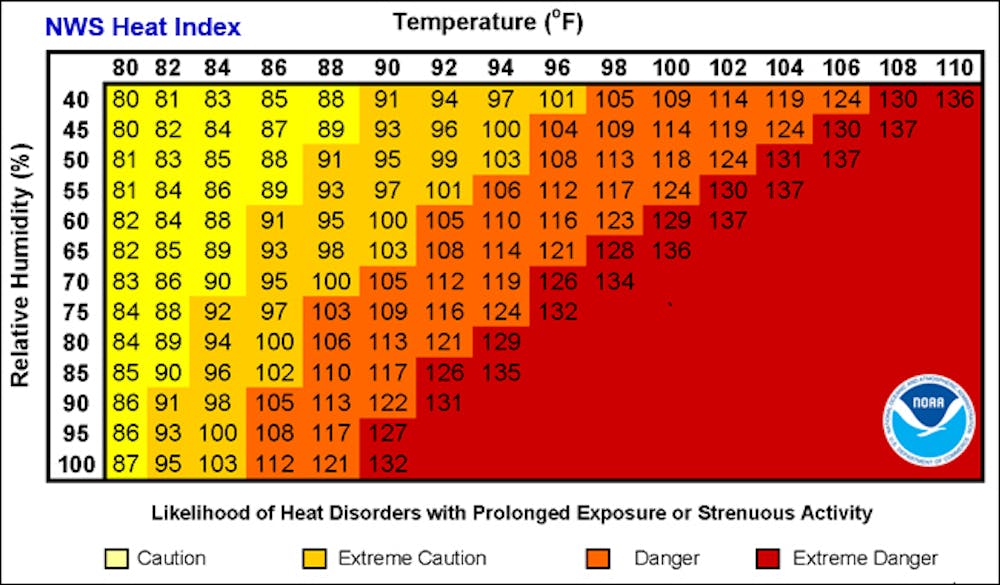
However, it’s also important to consider how heat affects the body. Weather reports often do this using the heat index, which calculates how the human body perceives conditions factoring in humidity as well as heat.

Sweating is your body’s primary way of cooling you off. When sweat evaporates away from your skin, it takes heat with it. But when humidity is high, the air already holds a lot of moisture, so the sweat remains on your skin. As it saturates clothing and drips from the body, it can remove only a small amount of heat compared with the cooling that comes with the evaporation of sweat.

As a result, when we account for humidity, the heat exposures people experience in Las Vegas and Orlando are very similar.

Table showing hazardous heat/humidity combinations.
The National Weather Service’s Heat Index shows the risk of activity based on heat plus humidity. NOAA

Adapting people and places to heat stress

As people go through their daily lives, their bodies work continuously to maintain a temperature close to a normal level of about 98.6 F (37 C). In regions that regularly experience high heat stress, such as the Southeast and Southwest, most buildings and homes now have air conditioning, which helps people maintain healthy temperatures.

But in areas where heat is unusual, such as the Pacific Northwest, many buildings and residences lack cooling. As a result, people are exposed to higher heat for longer periods of time during events like the region’s late June heat wave than they would be in regions where hot weather is the norm.

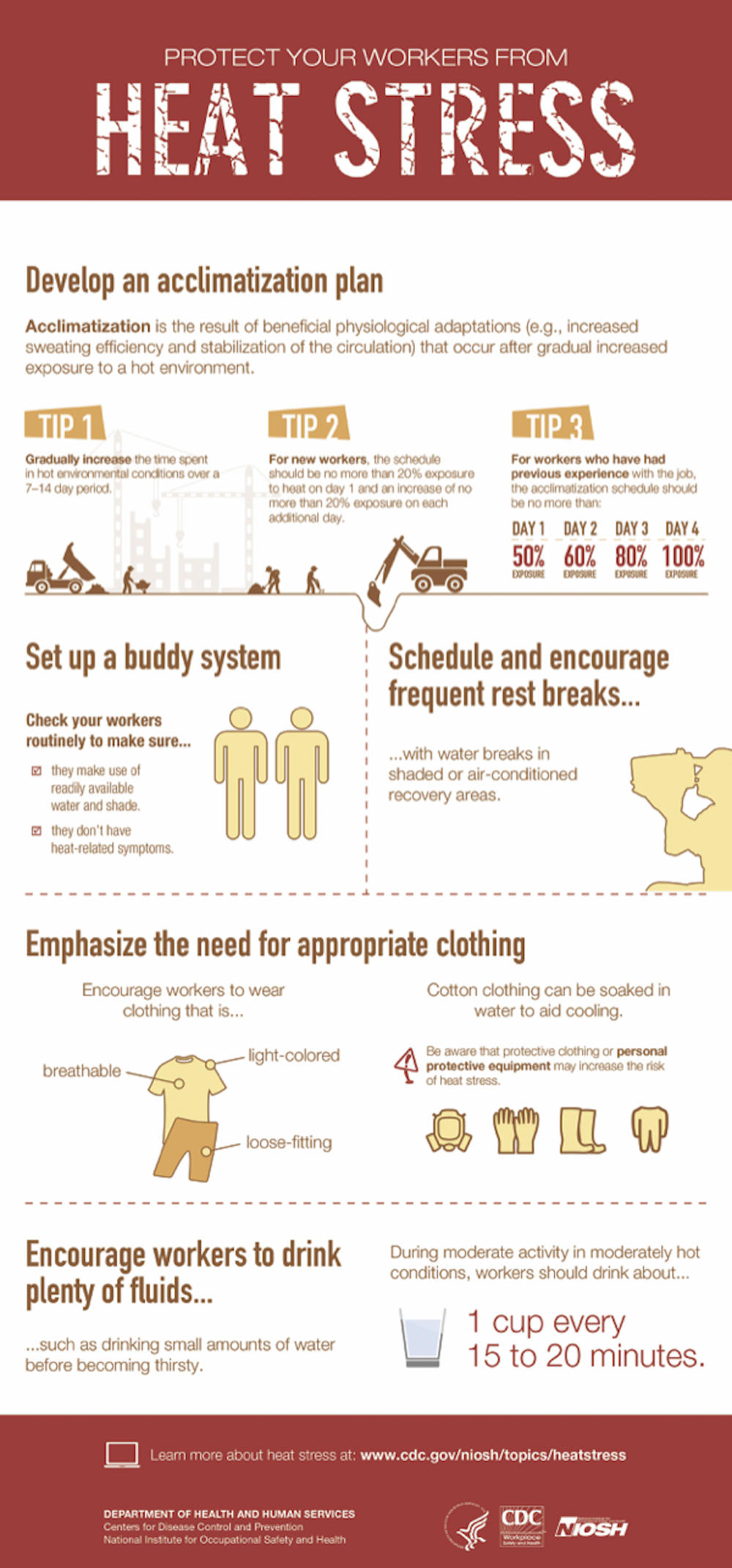
Just as buildings and residences in areas chronically exposed to heat are equipped with ceiling fans and air conditioning, bodies that are regularly exposed to heat can acclimatize, or adapt and improve their ability to cool. This starts to occur with the first heat exposure – for example, the beginning of fall sports practices in August – but take weeks of regular exposure to reach maximal levels.

One of the first things our bodies do in adapting to heat is to produce more plasma – the watery portion of blood. This enables our circulatory systems to move heat to the skin more effectively so that sweating can remove it from the body.

We also begin sweating earlier than people who are not acclimatized to heat, and our maximal sweat rate increases. These adaptations improve our bodies’ ability to dissipate heat to the environment.

Workplace flyer with tips for acclimatizing to heat.
Outdoor workers should build up to a full day in the heat to allow their bodies to acclimatize to it. CDC

Behavior changes are another way of adapting to heat stress. Since midday is typically the hottest part of the day, it makes sense to avoid physical work and exercise then. When people are active, their bodies break down nutrients – carbohydrates, fats and protein – into energy. This powers movement and also generates metabolic heat, which adds to the body’s heat stress.

Taking advantage of shade is another important strategy. Heat radiating from the Sun adds to the stress produced by warm air temperatures. Staying in the shade can significantly reduce the external heat load on people who have to be outdoors during hot spells.
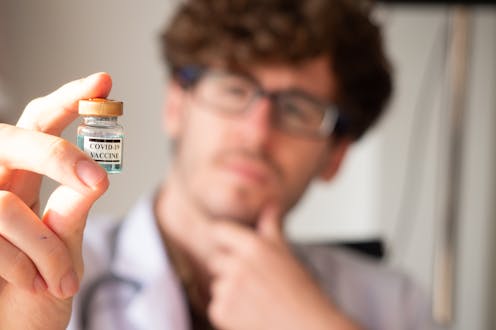
Many of the hundreds of deaths and hospitalizations that experts have attributed to the recent heat dome in the Northwest probably reflect that buildings there were less equipped to keep people cool than in hotter regions, and residents were less acclimatized to heat.

2020 was Phoenix’s hottest year on record, with 53 days reaching at least 110 F.

The old and young are most vulnerable

A healthy adult body can acclimatize to heat, but older people and children are less able to adjust. As people age, their cardiovascular systems change in ways that cause them to pump blood less effectively. This reduces the body’s ability to move heat to the skin to be transferred to the environment.

[The Conversation’s science, health and technology editors pick their favorite stories. Weekly on Wednesdays.]

Children and older adults may also have less active sweat responses, which can reduce their potential to cool off through sweating.

Humans can tolerate most areas of the Earth, but extreme heat requires extra steps. If there’s a heat wave in your local forecast, seek out shade and begin to acclimatize by increasing your activity gradually when things get too hot. Drink more fluids to account for increased fluid loss from sweat, while also making sure not to overhydrate. And avoid outdoor activity during the hottest hours of the day if possible.

Whether heat waves are humid or dry, they are health threats that everyone should take seriously.

The Conversation

JohnEric W. Smith does not work for, consult, own shares in or receive funding from any company or organisation that would benefit from this article, and has disclosed no relevant affiliations beyond their academic appointment.

09 Jul 16:52

Plant-based burgers: should some be considered 'junk food'?

by Richard Hoffman, Associate lecturer, Nutritional Biochemistry, University of Hertfordshire
barmalini/ Shutterstock

Plant-based diets have surged in popularity during the past few years. As a result, there’s been a boom in demand for plant-based alternatives to favourite foods – including meats, such as sausages and burgers. The plant-based meat alternatives industry is projected to see massive growth over the next few years. But there is still a lot we don’t know about these food products – including whether they’re as healthy as some may think.

Although many of these products claim to be made primarily from plants, they aren’t all that different to other ultra-processed food products. They often contain many similar ingredients – including protein isolates, emulsifiers, binders and other additives – and are made using industrial processing methods, so can be considered an ultra-processed food product.

Plenty of evidence links ultra-processed foods to obesity, type 2 diabetes, cancer and other chronic diseases. This is probably due to a combination of their poor nutritional content, synthetic additives and lack of fibre, which is important for giving a feeling of fullness. These types of foods are also a reason why poor diet has become the world’s top cause of death from chronic diseases, as they’re readily available, easy to overeat, lack nutrients and now provide around a half or more of the calories consumed in countries such as the US, UK, Australia and Canada.

The newness of plant-based burgers and other meat alternatives means that there hasn’t yet been time to see if these new ultra-processed foods also come with similar health costs. But the ingredients some products contain are a cause for concern.

Soy protein concentrate is the main source of protein in many plant-based meat alternatives. But soy protein concentrate contains a level of nitrites reported to be comparable to levels in high-street bacon products. The levels of nitrites in bacon and other processed meats are thought to be why eating these products leads to an increased risk of colorectal cancer. High dietary nitrites are also associated with an increased risk of other chronic diseases, including kidney disease, type 2 diabetes and respiratory diseases such as chronic obstructive pulmonary disease.

Heme, which contributes colour and taste to processed meat, is sometimes also an ingredient. In meat products, heme has been shown to react with nitrites, making them even more harmful by forming a highly reactive molecule called nitrosyl-heme. It’s uncertain whether there will be a similar effect in plant-based products, but the presence of heme and nitrites together is cause for concern.

A plant-based burger on a plate with some chips.
More research will be needed before we truly know the health effects of these products. Tracy A Collins/ Shutterstock

Many plant-based burgers also have the stabiliser and emulsifier methylcellulose added to them in order to give them a meat-like texture. Methylcellulose has been shown to alter the gut microbiome and increase inflammation in mice, and these changes may increase the risk of colon cancer, although human studies are still lacking.

At present, there’s no evidence from human studies for a link between eating plant-based burgers and colorectal cancer or other chronic diseases. But the only safety testing done so far was for the novel form of heme. And this heme product was only tested as a pure compound in experimental systems, and not in real-life conditions where it is not known if the cocktail of heme, nitrites and other additives could interact and increase cancer risk in humans.

So where does this leave people who are trying to reconcile eating healthily with concerns about the impact of their eating habits on the environment and animal welfare? Some may consider that any potential risks from plant-based burgers are worth it to address their concerns about the environment and animal welfare.

But if you are concerned about eating these ultra-processed plant-based meat alternatives, there are plenty of other things you can do. If you do eat meat, but still want to lower the environmental impact of the foods you eat, choosing more sustainably produced meat may help with this. If you follow a strictly vegetarian or vegan diet, cooking meals using lentils, beans and chickpeas can also ensure you have a high-protein meal with a lower environmental impact.

Of course not all the plant-based meat alternatives on the market are necessarily bad for you. The plant-based food market is still emerging, which means that many new products are still being developed, and research is still ongoing. But if you are thinking of buying any of these products, it may be worth checking the ingredients list first, and knowing the risks of eating too many ultra-processed foods.

The Conversation

Richard Hoffman does not work for, consult, own shares in or receive funding from any company or organisation that would benefit from this article, and has disclosed no relevant affiliations beyond their academic appointment.

09 Jul 16:49

America's founders believed civic education and historical knowledge would prevent tyranny – and foster democracy

by Maurizio Valsania, Professor of American History, Università di Torino
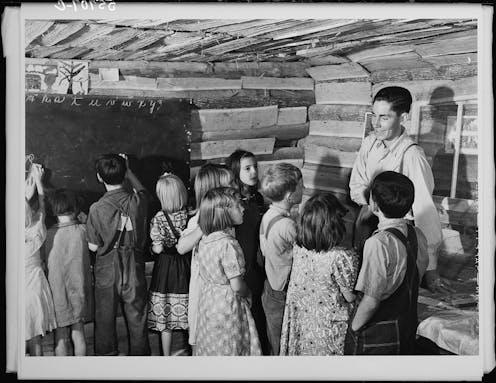
The founders believed education was crucial to democracy. Here, a one-room schoolhouse in Breathitt County, Ky. Photograph by Marion Post Wolcott/Library of Congress

The majority of Americans today are anxious; they believe their democracy is under threat.

In fact, democracies deteriorate easily. As was feared since the times of Greek philosopher Plato, they may suddenly succumb to mob rule. The people will think they have an inalienable right to manifest their opinions – which means to state out loud whatever passes through their minds. They will act accordingly, often violently. They will make questionable decisions.

Democracies may pave the way to tyrants. Self-serving leaders will appear. They will seek to rewrite national history by purging it of complexity and inconvenient truths. They will capitalize on the widespread frustration and profit from the chaotic situation.

Should these leaders seize power, they will curtail the people’s participation in politics. They will discriminate based on race, sex or religion. They will create barriers to democratic participation by certain constituents, including moral tests or literacy tests.

So, one way democracies degenerate is because of cunning leaders. But democracies crumble also because of the people themselves. As an intellectual historian, I can assure you that the specter of an ignorant populace holding sway has kept many philosophers, writers and politicians awake.

The American founders were at the forefront in the battle against popular ignorance. They even concocted a plan for a national public university.

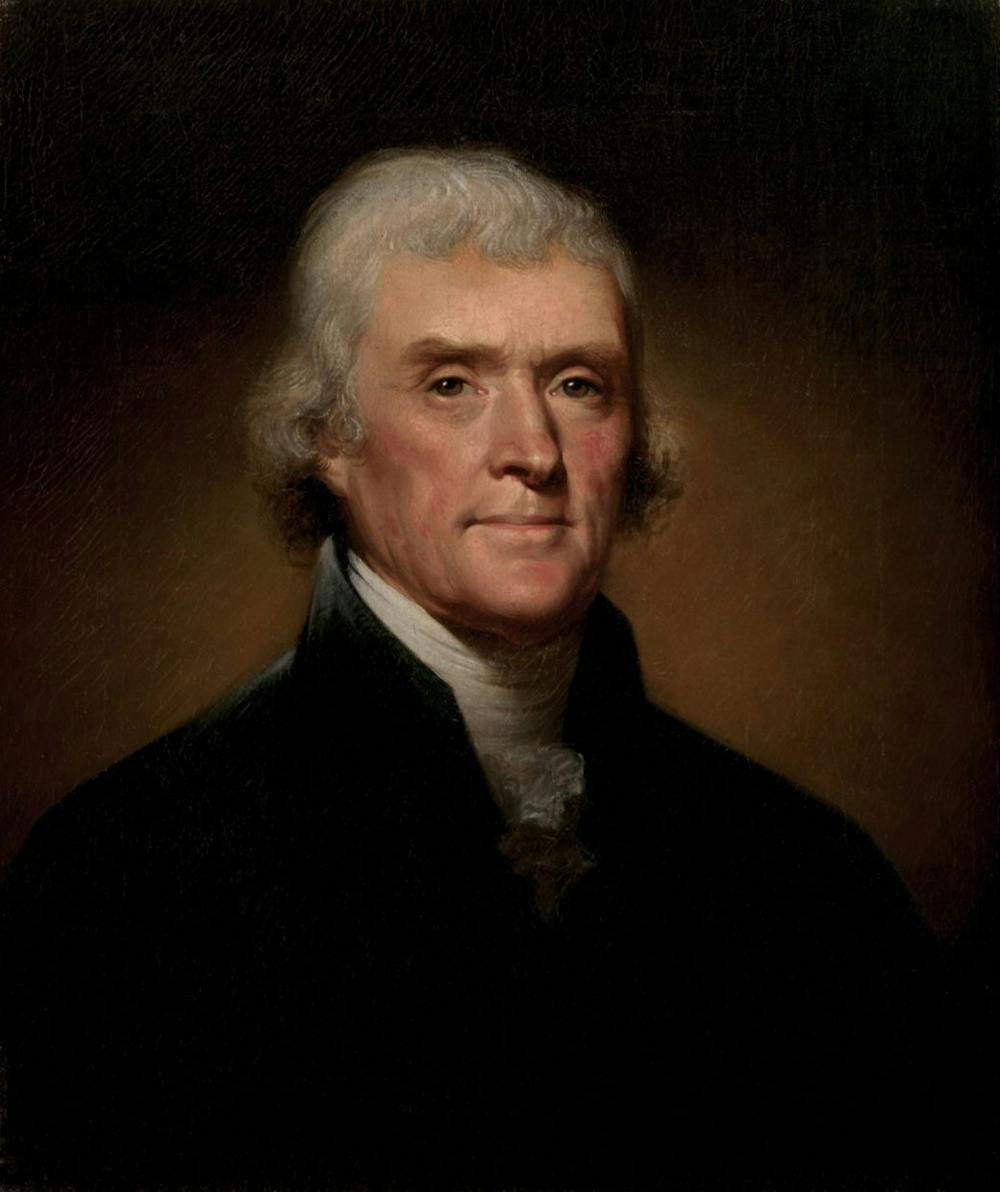
A portrait of Thomas Jefferson in his later years, wearing a black jacket, white shirt and looking dignified, as befits a president.
Thomas Jefferson believed the young United States should ‘illuminate, as far as practicable, the minds of the people at large.’ Portrait by Rembrandt Peale, the White House collection

No democracy without education

Baron Montesquieu, a French philosopher who lived from 1689 to 1755, was a revolutionary figure. He had advocated the creation of governments for the people and with the people. But he had also averred that the uneducated would irremediably “act through passion.” Consequently, they “ought to be directed by those of higher rank, and restrained within bounds.”

The men known as America’s Founding Fathers, likewise, were very sensitive to this issue. For them, not all voters were created equal. George Washington, John Adams, Thomas Jefferson and Alexander Hamilton trusted the people – “the people” being, for them, white property-owning males, of course. But only if and when they had a sufficient level of literacy.

Thomas Jefferson was the most democratic-minded of the group. His vision of the new American nation entailed “a government by its citizens, in mass, acting directly and personally, according to rules established by the majority.”

He once gauged himself against George Washington: “The only point on which he and I ever differed in opinion,” Jefferson wrote, “was, that I had more confidence than he had in the natural integrity and discretion of the people.”

The paradox was that, for Jefferson himself, the “natural integrity” of the people needed to be cultivated: “Their minds must be improved to a certain degree.” So, while the people are potentially the “safe depositories” for a democratic nation, in reality they have to go through a training process.

Jefferson was adamant, almost obsessive: the young country should “illuminate, as far as practicable, the minds of the people at large.” More precisely, let’s “give them knowledge of those facts which history exhibits.”

Educate and inform the whole mass of the people,” he kept repeating. It was an axiom in his mind “that our liberty can never be safe but in the hands of the people themselves, and that too of the people with a certain degree of instruction.”

Education had direct implications for democracy: “Wherever the people are well-informed,” wrote Jefferson, “they can be trusted with their own government.”

A national university

In 1787, Benjamin Rush, the Philadelphia doctor and a signer of the Declaration of Independence, published an “Address to the People of the United States.”

One of his main topics was the establishment of a “federal university” in which “every thing connected with government, such as history – the law of nature and nations – the civil law – the municipal laws of our country – and the principles of commerce – would be taught by competent professors.” Rush saw this plan as essential, should an experiment in democracy be attempted.

The top floor of the red brick Congress Hall in Philadelphia.
In 1796, President George Washington gave his Eighth Annual Message to the Senate and the House of Representatives at Congress Hall in Philadelphia, seen here. He wanted to alert Congress to the ‘desirableness’ of ‘a national university.’ Montes-Bradley/iStock / Getty Images Plus

George Washington stressed the same idea. At the end of his second term as president, in December 1796, Washington delivered his Eighth Annual Message to the Senate and the House of Representatives. He wished to awaken Congress to the “desirableness” of “a national university and also a military academy” whose wings would span over as many citizens as possible.

In his message, Washington embraced bold positions: “The more homogeneous our citizens can be made,” he claimed, “the greater will be our prospect of permanent union.”

Democracy’s ‘safe depositories’

A national university homogenizing the American people would likely be ill-received today anyway. We live in an age of race, gender and sexual awareness. Ours is an era of multiculturalism, the sacrosanct acknowledgment and celebration of difference.

But Washington’s idea that the goal of public education was to make citizens somewhat more “homogeneous” is worth reconsidering.

Were President Washington alive today, I believe he would provide his recipe for the people to remain the “safe depositories” of democracy. He would insist on giving them better training in history, as both Rush and Jefferson also advised. And he would especially press for teaching deeper, more encompassing political values.

He would say that schools and universities must teach the people that in their political values they should go beyond separate identities and what makes them different.

He would trust that, armed with such a common understanding, they would foster a “permanent union” and thus save democracy.

[Understand what’s going on in Washington. Sign up for The Conversation’s Politics Weekly.]

The Conversation

Maurizio Valsania no recibe salario, ni ejerce labores de consultoría, ni posee acciones, ni recibe financiación de ninguna compañía u organización que pueda obtener beneficio de este artículo, y ha declarado carecer de vínculos relevantes más allá del cargo académico citado.

07 Jul 13:08

USF Health experts concerned about COVID-19 variant spread in Hillsborough

by Clinton Engelberger, CORRESPONDENT
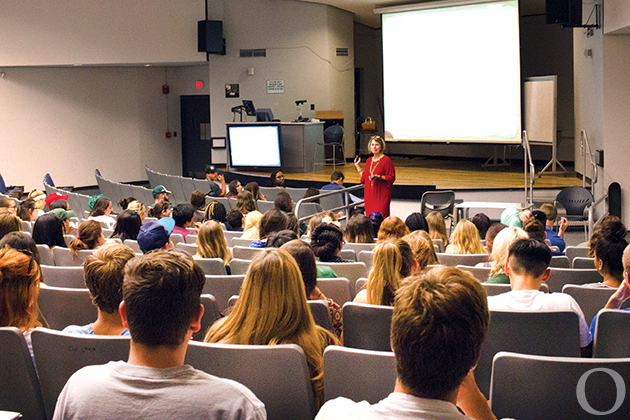
As the future remains uncertain about the delta variant of COVID-19, USF health experts discussed what it could mean for mask wearing, reopening and testing at the university. 
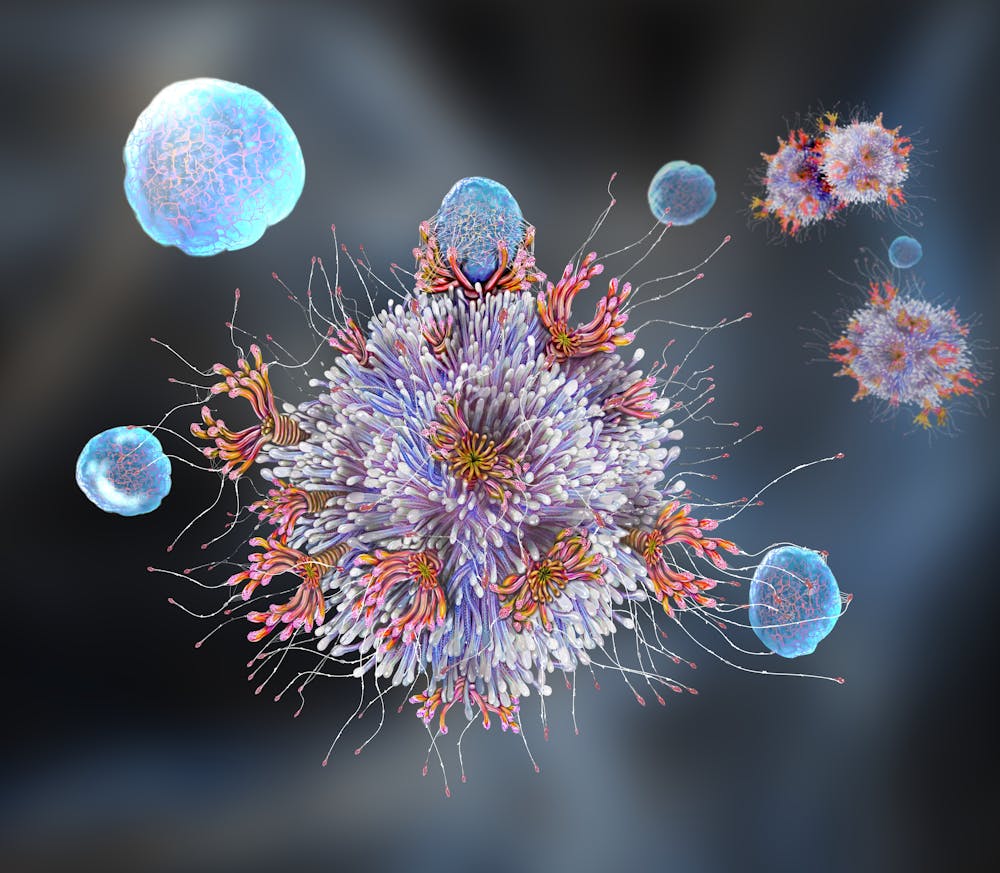
SPECIAL TO THE ORACLE/ FUSION MEDICAL ANIMATION

A strain of COVID-19, known as the delta variant, is rapidly spreading around the world, but USF Health experts said it’s tough to know right now how big of an impact the variant may have on the USF community. 

Donna Petersen, dean of the College of Public Health, said the patterns of the delta variant spread are a sign to remain cautious.

“We are seeing numbers of the delta variant cases growing in Florida,” Petersen said. “While they are only increasing slowly, it is still some cause for concern because our vaccination rates aren’t that high yet.

“We’re still learning about it in real time, but it appears that people who are already vaccinated against the earlier variants are more protected. They may get infected, but they appear to get less sick.”

In Hillsborough County, a total of 20 cases of the delta variant have been detected as of June 30. Of the 20 people infected with the variant, one person died April 21, according to the Palm Beach Post. 

Current vaccination efforts indicate the strain may become a larger issue in the future for the county, as 684,860 people have been vaccinated so far, or 53% of the eligible population, compared to a goal of 70%. In Florida, the variant has accounted for 2.8% of strains detected.   

First identified in India in December and later detected in the U.S. in March, the strain of COVID-19 known as B.1.617.2 is spreading most contagiously in places with low vaccination rates, according to Michael Teng, associate dean of the College of Internal Medicine.

“[The delta variant] seems somewhere between 40-50% more transmissible than the alpha variant, which is still dominant in Florida,” he said. “It seems to be hitting those populations that are susceptible and that have very low vaccination rates. So right now, we’re seeing it a lot in places like Nevada, Utah, Missouri and Arkansas.”

Compared to the alpha variant, delta is a more dangerous and contagious strain, according to Teng. He said the new strain is better suited for transmitting and has potential to dominate the others.

Looking into its weaknesses, Teng said the delta strain doesn’t seem to have a lot of innovation, meaning it could be more short lived than the alpha variant due to the vaccines and technology we can now access.

As the variant continues to spread globally, it remains difficult to predict what impact it will have on a more localized scale, especially with USF. The university opened its doors for in-person classes and events June 28, and it currently plans to remain open through the fall semester.

Teng said the variant has potential to affect young people, especially college students, the hardest, but USF is continuing to closely monitor the severity of the delta variant. He said the decisions on reopening or implementing mask mandates will most likely be entirely out of the university’s grip.

“We have to follow directions from the Board of Governors, and [Gov. Ron DeSantis] has not shown any willingness to go backward to reinstate policies. If anything, he’s forced everything to move toward opening more,” he said. “So, I don’t think we’ll be allowed to return to some of the public health measures like masks and physical distancing.” 

Along with plans to entirely reopen the university, Petersen said there’s no need for random on-campus testing, even with the delta variant slowly spreading.

“The numbers are growing, but they’re still pretty small,” she said. “We’re probably going to pause random testing since we’re not seeing the level of case activity that warrants random testing of the whole population. The last [positive case] we found through random testing was in April.”

While random testing may pause soon, there is a possibility it could be reinstated should the delta variant begin to rapidly spread among the community in the future, according to Petersen. 

In addition to the possibility of reinstating random testing in the future, Jill Roberts, associate professor in the College of Public Health, said the university is already preparing for the worst-case scenario as a precaution.

“The USF community has massively stressed the importance of getting vaccinated, but is aware that many will pass on the opportunity,” she said. “Therefore, we are fully preparing a return to online in the fall if necessary. This, of course, can be avoided if the community is vaccinated, and I hope everyone will do so.”

Current advisories from both the World Health Organization (WHO) and the Centers for Disease Control and Prevention (CDC) contrast one another, as the former advised fully vaccinated people should continue to wear masks due to the spread of the delta variant, while the latter continues to advise masks for those who aren’t fully vaccinated.

Roberts said the difference in guidelines could be due to the differing opinions of what the future holds.

“The CDC has taken the approach to stress a return to normal that is possible with vaccination. The hope is that this will encourage more people to get vaccinated,” she said. “In contrast, the WHO is concerned about the delta variant and other highly transmissible variants, and is taking the approach to encourage everyone to continue to wear masks to stop the spread of the variants.”

Despite the confusion the contradictory advisories create, Roberts said the decision to wear a mask should be based on the severity of local COVID-19 cases.

“Fully vaccinated people should make this choice based on their own risks, assuming local spread of coronavirus is low,” she said. “If it is high, everyone should wear a mask.”

Roberts also said the decision to wear a mask should be based on each individual’s personal situation. She said that reasons to continue wearing a mask could include being medically unable to receive the vaccine, having a desire to avoid high transmissible variants like delta or wanting to avoid new and undetected variants. 

Regardless of decisions made on reopening plans and health advisories from USF, Teng said the severity of COVID-19 is nothing to brush aside.

“When you’re in college, you may feel invincible and like you’ll never get sick or hurt,” he said. “This doesn’t work that way. This is something that’s attacking yourself and doesn’t care if you feel invincible.” 

Although the future remains uncertain, the strongest defense Floridians have is the vaccine, according to Teng. 

“This is serious for all the students out there that haven’t been vaccinated for whatever reason,” he said. “If you look at the people hospitalized for COVID, around 99% of them are unvaccinated. It’s really time to stop procrastinating.”

07 Jul 13:06

OPINION: ‘Intellectual diversity’ survey will threaten classroom discourse

by Carson Wright, CORRESPONDENT

With the State Board of Education and Board of Governors given less than two months to create a survey assessing intellectual freedom on college campuses, they need to be careful to make it anonymous and ensure it won’t punish those who provide unfavorable responses. ORACLE FILE PHOTO

HB 233 went into effect July 1 combating alleged issues with intellectual diversity on college campuses. The law requires the State Board of Education (BOE) and Board of Governors (BOG) to create a survey for universities to assess student on-campus exposure to different perspectives. 

The law hopes to ensure universities aren’t becoming “hotbeds for stale ideologies,” according to Gov. Ron DeSantis at the law’s June 22 signing in Lee County. While most likely a political tactic designed to garner votes for the upcoming gubernatorial election, the law will nonetheless discourage free speech on college campuses and silence faculty. 

Since the BOE and BOG must author the survey by Sept. 1, they should develop one that guarantees the anonymity of the participants and disregards DeSantis’ expressed desire to add repercussions for universities that give unfavorable responses.

The legislation requires the two governing bodies to create “an objective, nonpartisan and statistically valid survey to be used by each institution which considers the extent to which competing ideas and perspectives are presented.”

USF political science professor J. Edwin Benton said while trying to assess universities for diverse ideas, the survey will in turn hinder open discussion on campuses where professors are already policing themselves for fear of adverse responses.

“The greatest threat to political speech on campus is not one-sidedness but a fear of misinterpretation leading to backlash,” Benton said. “I think there will be repercussions because faculty will think twice before saying something that they might have said a year ago in the classroom for fear that it will be misconstrued.” 

Benton’s prediction could mean bad news for Florida universities trying to attract out-of-state professors, according to associate professor of political science Nicholas Thompson.

“The law is bad for faculty recruitment and retention,” Thompson said. “Top tier would-be professors will consider this law when deciding whether to accept a tenure-track job at a Florida state school or continue looking elsewhere for opportunities.” 

Thompson also noted survey responses could be modified by participants if they aren’t granted anonymity, which would likely skew the results of the survey and render it useless to assess campus intellectual diversity.

“It is likely that professors will modify their survey responses to fit political authorities’ beliefs,” Thompson said. 

In an ideal university model, professors approach political thought in ways that encourage representation on all sides of an issue. This prospect is in serious danger if the survey doesn’t make participants anonymous so as to protect them from individual backlash or praise.

If we put aside the inherent danger of the survey to university communities, the law is really a purely political tactic that serves as future ammo for conservatives targeting free speech in education. 

The law has been highly publicized by DeSantis, while the legislation itself is incredibly sparse in information regarding the content of the survey and solutions to possible ideological imbalances haven’t been outlined. 

The original bill’s sponsor, Republican Sen. Ray Rodrigues, told fellow legislators this April he hoped the BOE and BOG would create their own solutions if the surveys were to come back tipped too far to one side of the aisle.

“If the results came back and showed that there was a lack of intellectual freedom or lack of viewpoint diversity, my hope would be that the governing body of the institution would recognize and find that unacceptable and announce what the plan is to address that,” Rodrigues said. 

The solutions should’ve already been suggested and accepted into the legislation if sponsors and the state governor felt this issue was truly prevalent throughout all public Florida universities. As Benton pointed out, however, the original bill didn’t have much statistical backing to begin with.

“If it was [motivated by concerns about lack of diverse ideology], then you would see more student complaints in the mix, but this is almost all from Tallahassee,” Benton said.

There are other grounds for suspecting the law is purely political. The law states the results will be released Sept. 1, 2022, a month before the November election for governor. 

“For DeSantis, this is an attempt to continue cultivating his national celebrity,” Thompson said. “He is building a brand as someone who will slug it out with the Republican bogeymen: the elites, the media, big tech, the teachers’ unions, the college professors, bureaucrats, [Black Lives Matter] and Antifa.” 

Recent attacks on critical race theory (CRT) are among many pieces of legislation in a large pile targeting non-issues in public education in an effort to get votes. 

It is unlikely CRT was ever taught in K-12 classrooms at all, but suspicions of unfounded accusations toward education have become all too familiar. As it stands, Idaho, Oklahoma, Tennessee, Texas, Iowa and New Hampshire have all passed legislation banning or limiting CRT, according to the Brookings Institution

One of the benefits of DeSantis passing such vague legislation is the governing bodies can interpret the law in many ways, including adding or withholding possible “solutions” to the survey’s results. In addition to keeping the survey anonymous, the governing bodies should also be clear with universities that no punishments will result from whatever responses are given by students and faculty. 

The law’s political origins are clear, but this doesn’t mean its implications couldn’t continue to threaten the fabric of university thought. In a climate wherein professors already police themselves to avoid “indoctrinating” students and keep their jobs, there’s no need for this survey to create further tension.

06 Jul 19:45

8 health benefits of eating pineapple

by Kevin Reome

Any time I eat fresh pineapple I always wonder: why don't I eat this ALL the time? A single pineapple bite is so juicy that it's not just refreshing and delicious but also seems to quench one's thirst–like a little liquid blast with each chunk. — Read the rest

06 Jul 19:38

Open-plan office noise increases stress and worsens mood: we've measured the effects

by Libby (Elizabeth) Sander, Assistant Professor of Organisational Behaviour, Bond Business School, Bond University
Monkey Business Images/Shutterstock

If you’ve ever felt your noisy open-plan office makes you cranky and sends your heart racing, our new research shows you aren’t imagining it.

Prior to the pandemic 70% of office-based employees worked in open-plan offices. Employee complaints about this design are rife.

Yet there is little experimental research investigating the effects of office noise on things like cognitive performance, physiological stress and mood.

The results of our study, in experimentally controlled conditions using heart rate, skin conductivity and AI facial emotion recognition, shows the effects of that noise are very real.

We’ve found a significant causal relationship between open-plan office noise and physiological stress.

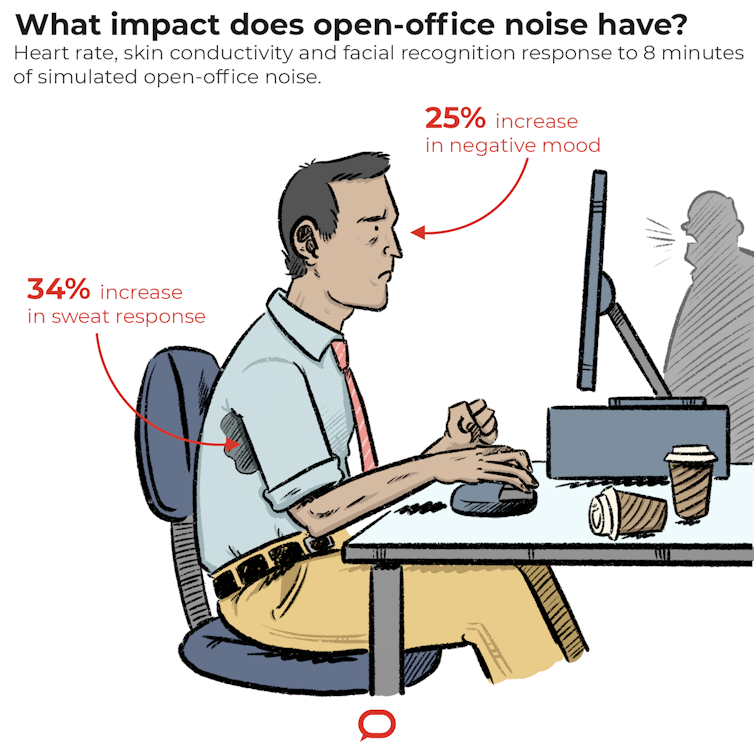
Our results show such noise heightens negative mood by 25% — and these results come from testing participants in an simulated open-plan office for just eight minutes at a time. In a real office, where workers are exposed to noise continuously during the day, we would expect the effects on stress and mood to be even greater.

How we simulated open-plan office noise

We used a simulated office setting with volunteers to compare the effects of typical open-plan office noise to a quieter private office on a range of objective and subjective measures of well-being and performance. Our carefully manipulated soundscapes included people speaking, walking, printing papers, ringing telephones, and keyboard typing noises.

Our study involved observing the same individuals “working” — participants were asked to complete a proof-reading task — under the two noise conditions. We varied the order of the sound tests to avoid bias due to fatigue and training effects. This “repeated measures experimental design” allowed us to make causal conclusions about the effects of the noise on well-being indicators.


Read more: A new study should be the final nail for open-plan offices


We used sensors to track changes in heart rate and sweat response — both reliable indicators of physiological stress. We used facial emotion recognition software to assess emotional responses. We also had participants self-report their own feeling using a mood scale.

Even after a short exposure, we found a causal relationship between open-plan office noise and both stress and negative mood. Negative mood increased by 25% and sweat response by 34%.

While there was no immediate effect on reduced work performance, it is reasonable to assume such hidden stress over the longer term is detrimental to well-being and productivity.

The Conversation, CC BY-ND

Precise causal relationships

Our study addresses a gap in the literature by using a simulated office environment with objectively manipulated noise levels and a wide range of objective and subjective dependent variables.

Reviews in research in this field show past studies have tended to only use self-reported measures. They have not used controlled experimental conditions, nor tested sound parameters.

Comparing multiple output measures has allowed us to investigate cause-effect relationships. Much research on open-plan offices has not established direct causal connections, which is necessary to understand precise relationships, and thus the how to most effectively and efficiently reduce these stressors.

Although open-plan offices rarely present an immediate physical danger in terms of sound levels, unrelenting exposure all day intensifies their effects.


Read more: How employers can design workplaces to promote wellness


Chronically elevated levels of physiological stress are known to be detrimental to mental and physical health.

Frequently being in a negative mood is also likely to harm job satisfaction and commitment. It potentially increases the likelihood of employees leaving.

What to do about it

The pandemic has changed our tolerance for office work. Surveys show up to 70% of employees will seek new jobs if their employer does not offer flexibility to work from home some of the time. So creating a healthy work environment is more important than ever.

As organisations seek to adapt to COVID-19, many are reconsidering how they set up and use the office. Though open-plan offices are unlikely to go away any time soon, our study highlights the importance of understanding employee needs in designing work spaces.


Read more: The death of the open-plan office? Not quite, but a revolution is in the air


One advantage of more employees working from home at least some of the time is a less crowded office, reducing both visual and auditory distractions.

But there are other things that can be done. Acoustic treatments and sound-masking technologies — ambient sounds designed to make other people talking less intrusive — can help. Good old-fashioned walls or partitions may also assist.

Such interventions can be costly, but so is the impact of poor office environmental quality on productivity.

And we might all feel happier about going back to the office.

The Conversation

Libby (Elizabeth) Sander receives funding from the Australian Government under the Industry Connections Grant Award.

06 Jul 19:30

Why is Delta such a worry? It's more infectious, probably causes more severe disease, and challenges our vaccines

by Michael Toole, Professor of International Health, Burnet Institute
Shutterstock

While Australians may be focused on the havoc the Delta variant is wreaking on our shores, Delta is in fact driving waves of COVID infections all around the world.

With the World Health Organization (WHO) warning Delta will rapidly become the dominant strain, let’s take a look at this variant in a global context.

The rise and rise of Delta

The Delta variant (B.1.617.2) emerged quietly in the Indian state of Maharashtra in October 2020. It barely caused a ripple at a time when India was reporting around 40,000 to 80,000 cases a day, most being the Alpha variant (B.1.1.7) first found in the United Kingdom.

That changed in April when India experienced a massive wave of infections peaking at close to 400,000 daily cases in mid-May. The Delta variant rapidly emerged as the dominant strain in India.

The WHO designated Delta as a variant of concern on May 11, making it the fourth such variant.

The Delta variant rapidly spread around the world and has been identified in at least 98 countries to date. It’s now the dominant strain in countries as diverse as the UK, Russia, Indonesia, Vietnam, Australia and Fiji. And it’s on the rise.

In the United States, Delta made up one in five COVID cases in the two weeks up to June 19, compared to just 2.8% in the two weeks up to May 22.

Meanwhile, the most recent Public Health England weekly update reported an increase of 35,204 Delta cases since the previous week. More than 90% of sequenced cases were the Delta variant.

In just two months, Delta has replaced Alpha as the dominant strain of SARS-CoV-2 in the UK. The increase is primarily in younger age groups, a large proportion of whom are unvaccinated.

2 key mutations

Scientists have identified more than 20 mutations in the Delta variant, but two may be crucial in helping it transmit more effectively than earlier strains. This is why early reports from India called it a “double mutant”.

The first is the L452R mutation, which is also found in the Epsilon variant, designated by the WHO as a variant of interest. This mutation increases the spike protein’s ability to bind to human cells, thereby increasing its infectiousness.

Preliminary studies also suggest this mutation may aid the virus in evading the neutralising antibodies produced by both vaccines and previous infection.

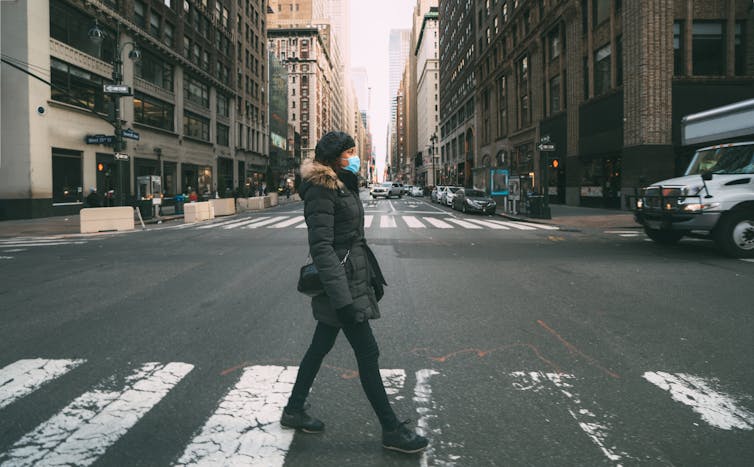
A woman wearing a mask crosses the street in New York.
Evidence shows the Delta variant is more infectious. We can understand why by looking at its mutations. Shutterstock

The second is a novel T478K mutation. This mutation is located in the region of the SARS-CoV-2 spike protein which interacts with the human ACE2 receptor, which facilitates viral entry into lung cells.

The recently described Delta Plus variant carries the K417N mutation too. This mutation is also found in the Beta variant, against which COVID vaccines may be less effective.


Read more: What's the 'Delta plus' variant? And can it escape vaccines? An expert explains


One good thing about the Delta variant is the fact researchers can rapidly track it because its genome contains a marker the previously dominant Alpha variant lacks.

This marker — known as the “S gene target” — can be seen in the results of PCR tests used to detect COVID-19. So researchers can use positive S-target hits as a proxy to quickly map the spread of Delta, without needing to sequence samples fully.

Why is Delta a worry?

The most feared consequences of any variant of concern relate to infectiousness, severity of disease, and immunity conferred by previous infection and vaccines.

WHO estimates Delta is 55% more transmissible than the Alpha variant, which was itself around 50% more transmissible than the original Wuhan virus.

That translates to Delta’s effective reproductive rate (the number of people on average a person with the virus will infect, in the absence of controls such as vaccination) being five or higher. This compares to two to three for the original strain.

There has been some speculation the Delta variant reduces the so-called “serial interval”; the period of time between an index case being infected and their household contacts testing positive. However, in a pre-print study (a study which hasn’t yet been peer-reviewed), researchers in Singapore found the serial interval of household transmission was no shorter for Delta than for previous strains.

One study from Scotland, where the Delta variant is predominating, found Delta cases led to 85% higher hospital admissions than other strains. Most of these cases, however, were unvaccinated.

The same study found two doses of Pfizer offered 92% protection against symptomatic infection for Alpha and 79% for Delta. Protection from the AstraZeneca vaccine was substantial but reduced: 73% for Alpha versus 60% for Delta.

A study by Public Health England found a single dose of either vaccine was only 33% effective against symptomatic disease compared to 50% against the Alpha variant. So having a second dose is extremely important.

In a pre-print article, Moderna revealed their mRNA vaccine protected against Delta infection, although the antibody response was reduced compared to the original strain. This may affect how long immunity lasts.


Read more: The symptoms of the Delta variant appear to differ from traditional COVID symptoms. Here's what to look out for


A global challenge to controlling the pandemic

The Delta variant is more transmissible, probably causes more severe disease, and current vaccines don’t work as well against it.

WHO warns low-income countries are most vulnerable to Delta as their vaccination rates are so low. New cases in Africa increased by 33% over the week to June 29, with COVID-19 deaths jumping 42%.

There has never been a time when accelerating the vaccine rollout across the world has been as urgent as it is now.

WHO chief Tedros Adhanom Gebreyesus has warned that in addition to vaccination, public health measures such as strong surveillance, isolation and clinical care remain key. Further, tackling the Delta variant will require continued mask use, physical distancing and keeping indoor areas well ventilated.

The Conversation

Michael Toole receives funding from the National Health and Medical Research Council. .

02 Jul 17:54

Victory! Federal Court Halts Florida’s Censorious Social Media Law Privileging Politicians’ Speech Over Everyday Users

by Aaron Mackey

A federal court on Thursday night blocked Florida’s effort to force internet platforms to host political candidates and media entities online speech, ruling that the law violated the First Amendment and a key federal law that protects users’ speech. We had expected the court to do so.

The Florida law, S.B. 7072, prohibited large online intermediaries—save for those that also happened to own a theme park in the state—from terminating politicians’ accounts or taking steps to de-prioritize their posts, regardless of whether it would have otherwise violated the sites’ own content policies. The law also prevented services from moderating posts by anyone who qualified as “journalistic enterprise” under the statute, which was so broadly defined as to include popular YouTube and Twitch streamers.

EFF and Protect Democracy filed a friend-of-the-court brief in the case, NetChoice v. Moody, arguing that although online services frequently make mistakes in moderating users’ content, disproportionately harming marginalized voices, the Florida statute violated the First Amendment rights of platforms and other internet users. Our brief pointed out that the law would only have “exacerbate[ed] existing power disparities between certain speakers and average internet users, while also creating speaker-based distinctions that are anathema to the First Amendment.”

In granting a preliminary injunction barring Florida officials from enforcing the law, the court agreed with several arguments EFF made in its brief. As EFF argued, the “law itself is internally inconsistent in that it requires ‘consistent’ treatment of all users, yet by its own terms sets out two categories of users for inconsistent special treatment.”

The court agreed, writing that the law “requires a social media platform to apply its standards in a consistent manner, but . . . this requirement is itself inconsistent with other provisions.”

The court also found that the law intruded upon online services’ First Amendment rights to set their own content moderation policies, largely because it mandated differential treatment of the content of certain online speakers, such as political candidates, over others. These provisions made the law “about as content-based as it gets,” the court wrote.

Because the law amounted to a content- and viewpoint-based restriction on speech, Florida was required to show that it had a compelling interest in the restrictions and that it doesn’t burden any more or less speech than is necessary to advance that interest.

The court ruled the Florida law failed that test. “First, leveling the playing field—promoting speech on one side of an issue or restricting speech on the other—is not a legitimate state interest,” the court wrote.

Further, the law’s speech restrictions and burdens swept far beyond addressing concerns about online services silencing certain voices, as the court wrote that the law amounted to “an instance of burning the house to roast the pig.”

As EFF wrote in its brief, inconsistent and opaque content moderation by large online media services is a legitimate problem that leads to online censorship of too much important speech. But coercive measures like S.B. 7072 are not the answer to this problem:

The decisions by social media platforms to cancel accounts and deprioritize posts may well be scrutinized in the court of public opinion. But these actions, as well as the other moderation techniques barred by S.B. 7072, are constitutionally protected by binding Supreme Court precedent, and the state cannot prohibit, proscribe, or punish them any more that states can mandate editorial decisions for news media.

EFF is pleased that the court has temporarily prohibited Florida from enforcing S.B. 7072 and we look forward to the court issuing a final ruling striking the law down. We would like to thank our local counsel, Christopher B. Hopkins, at McDonald Hopkins LLC for his help in filing our brief.

02 Jul 17:44

Supreme Court blunts voting rights in Arizona – and potentially nationwide – in controversial ruling

by Cornell William Clayton, C.O. Johnson Distinguished Professor of Political Science, Washington State University
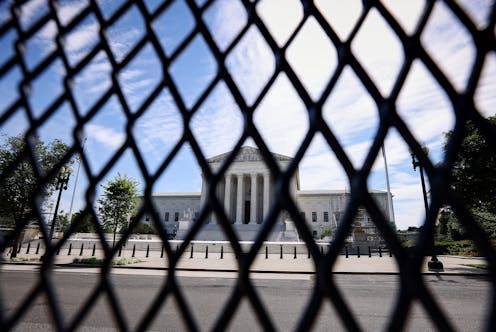
The Supreme Court waited until the final day of its 2020-2021 term, July 1, 2021, to issue two controversial decisions, including one that may dramatically limit voting rights in the US. Kevin Dietsch/Getty Images

Arizona may keep two voting laws that Republicans say protect election integrity and Democrats believe will make it harder for some residents to cast ballots.

That’s the United States Supreme Court’s decision in Brnovich v. Democratic National Committee, one of the decade’s most important voting rights cases.

One Arizona law challenged in the case, H.B. 2023, makes it a felony for anyone other than a family member, caregiver or postal worker to collect and deliver ballots. The other requires ballots to be cast in the assigned precinct where a voter lives. If a person votes at the wrong polling place, Arizona election officials will reject their ballot.

The Democratic National Committee argued at the Supreme Court that both Arizona rules disproportionately hurt minority voters. The majority of justices, split 6-to-3 along ideological lines, disagreed.

“Voting necessarily requires some effort and compliance with some rules,” Justice Samuel Alito wrote for the court’s majority on July 1, 2021. Merely making it more “inconvenient” for certain groups to vote does not violate federal law, according to the court.

The ruling will have national consequences. Arizona is one of 14 states restricting third-party ballot collection. It is one of 26 that require in-precinct voting.

The Supreme Court’s decision makes it more difficult to legally challenge such laws, which, according to our research on elections, significantly affect voting, particularly among racial minorities and the poor.

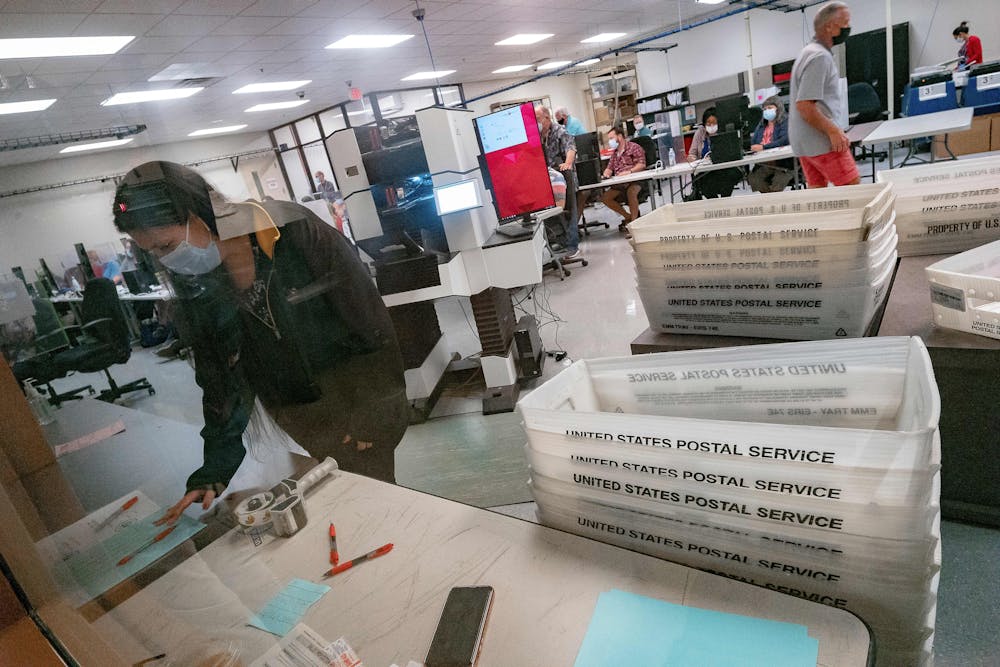
Woman in a face mask stands amid USPS boxes full of ballots
The Maricopa County Election Department counts ballots in Phoenix on Nov. 5, 2020. Olivier Touron/AFP via Getty Images

From Arizona to the Supreme Court

In Arizona, nearly 80% of voters in 2018 cast their ballots by mail. But mail service is not always available in rural areas of the state where many Hispanic and Native Americans live. Only 18% of Native Americans in the state, for example, have access to home mail delivery.

The Tohono O'odham reservation, which covers an area larger than Rhode Island and Delaware, has no home delivery and only one post office. These rural voters often rely on friends or get-out-the-vote workers to deliver their ballots to polling stations.

The burdens on rural and tribal voters were cited in a 2016 lawsuit filed by the Democratic National Committee to block the Arizona ballot collection ban and out-of-precinct vote restriction. The Democratic National Committee claimed both policies violated Section 2 of the federal Voting Rights Act, which prohibits practices that “result in a denial or abridgment of the right (to vote) on account of race or color.”

The lawsuit, which was supported by Arizona’s Democratic secretary of state, also argued that the ballot collection ban purposely targeted minority voters. That would violate the 15th Amendment to the U.S. Constitution, which prohibits states from intentionally denying the right to vote on account of race.

Arizona’s Republican attorney general and the state’s Republican Party argued the laws were race-neutral restrictions that do not impede Arizonans’ equal opportunity to vote and were enacted to safeguard election integrity.

The case reached the Supreme Court after an appeal process in which the full Arizona Ninth Circuit Court ultimately determined that the state’s ballot collection ban violated both Section 2 of the Voting Rights Act and the 15th Amendment because minority voters were more likely than nonminorities to rely on others to return their ballots. And the law could not be credibly defended as an election integrity measure because judges saw no evidence that third-party ballot collection led to vote fraud in the past.

The appeals court also found that the out-of-precinct policy violated Section 2 of the Voting Rights Act. Arizona officials frequently changed polling places in urban counties, so voters there easily made mistakes. In 2016, 3,709 out-of-precinct Arizona ballots were rejected, and minority voters were twice as likely as whites to have their ballots discarded in that process.

A small white post office that seems to be boarded up; a cactus is in front of it
Post offices are few and far between in rural Arizona. Joe Sohm/Visions of America/Universal Images Group via Getty Images

The justices’ reasoning

In deciding against Arizona in 2020, the Ninth Circuit Court relied on a “results test.” This means that a law does not require proof of an intent to discriminate to be struck down. Judges ask only whether the law disproportionately affects historically disadvantaged groups.

In overturning the Ninth Circuit, the Supreme Court concluded the Arizona laws did not intentionally discriminate and rejected the logic of the “results test.”

Section 2 of the Voting Rights Act still prevents states from enacting voting rules that purposely discriminate. But proving intentional discrimination is much more difficult than showing a law disproportionately impacts minority voting.

The three liberal justices on the court, led by Justice Elena Kagan, dissented.

The “Court has (yet again) rewritten — in order to weaken — a statute that stands as a monument to America’s greatness, and protects against its basest impulses,” Kagan wrote.

Electoral consequences

The Brnovich ruling means Arizona’s voting restrictions stand. It also gives other states greater latitude when adopting similar rules and limits the federal government’s ability to police restrictive voting practices.

Since the 2020 presidential election, legislators in at least 48 states have introduced 389 so-called “election integrity” bills placing new restrictions on voting. Of these, 22 have been enacted.

For example, Georgia’s March 2021 election law imposes new limits on the use of absentee ballots, makes it a crime for outside groups to provide food and water to voters waiting at polling stations and hands greater control over election administration to the Republican-led state legislature.

On June 25 the U.S. Department of Justice sued Georgia, arguing these rules violated Section 2 of the Voting Rights Act and that Georgia’s law is intended to discriminate.

Before 2013, states with a history of racial discrimination needed federal approval before enacting new voting laws, under Section 5 of the Voting Rights Act. But in 2013, the Supreme Court in Shelby County v. Holder – an Alabama voting rights case – dismantled these procedures.

As a “preclearance” state, Arizona was previously blocked by the federal government from enacting voter restrictions like H.B. 2023. Other former preclearance states that have passed restrictive laws since 2013 include Georgia, Texas and Florida.

Since Shelby County v. Holder, voting rights advocates have had to rely on a different part of the Voting Rights Act – Section 2 – to block these restrictive voting laws. Brnovich v. DNC was the first Supreme Court test of this strategy.

The court’s decision severely cripples it, further eroding the Voting Rights Act. Attention now shifts to Congress to see whether it will respond.

This is an updated version of an article originally published June 8, 2021.

The Conversation

The authors do not work for, consult, own shares in or receive funding from any company or organization that would benefit from this article, and have disclosed no relevant affiliations beyond their academic appointment.

30 Jun 19:44

Bubbles of Hate: How Social Media Keeps Users Addicted, Alone, & Ill-Informed

by Dr Tim Coles

Share

From New Dawn Special Issue Vol 14 No 6 (Dec 2020)

Internet communication has gone from emails, messaging boards, and chatrooms, to sophisticated, all-pervasive networking. Social media companies build addictiveness into their products. The longer you spend on their sites and apps, the more data they generate. The more data, the more accurately they anticipate what you’ll do next and for how long. The better their predictions, the more money they make by selling your attention to advertisers. 

Depressed and insecure about their value as human beings, the younger generations grow up knowing only digital imprisonment. Older users are trapped in polarised bubbles of political hate. As usual, the rich and powerful are the beneficiaries. 

Masters of Manipulation

Humans are social animals. But big business wants us isolated, distracted, and susceptible to marketing. Using techniques based on classical conditioning, social media programmers bridge the gap between corporate profits and our need to communicate by keeping us simultaneously isolated and networked.

The Russian psychologist, Ivan Pavlov (1849–1936), pioneered research into conditioned reflexes, arguing that behaviour is rooted in the environment. His work was followed by the Americans John B. Watson (1878–1958) and B.F. Skinner (1904–90). Their often cruel conditioning experiments, conducted on animals and infants, laid the basis for gambling and advertising design. As early as the 1900s, slot machines were designed to make noises, like bell sounds, to elicit conditioned responses to keep the gambler fixed on the machine: just as Pavlov used a bell to condition his dogs to salivate. By the 1980s, slot machines had incorporated electronics to advantage particular symbols whilst giving the gambler the impression that they are near victory. “Stop buttons” gave the gambler the illusion of control. Sandy Parakilas, former Platform Operations Manager at Facebook, says: “Social media is very similar to a slot machine.”

Psychologist Watson’s experiments “set into motion industry-wide change” in TV, radio, billboard, and print advertising “that continued to develop until the present,” says historian Abby Bartholomew. Topics included emotional arousal in audiences (e.g., sexy actress → buy the product), brand loyalty (e.g., Disney is your family), and motivational studies (e.g., buy the product → look as good as this guy). 

Many of these techniques involve stimulating so-called “feel good” chemicals like dopamine, endorphins, oxytocin, and serotonin. These are released when eating, exercising, having sex, and engaging in positive social interactions. Software designers learned that their release can be triggered by simple and unexpected things, like getting an email, being “friended,” seeing a retweet, and getting a like. The billionaire co-founder of Facebook and Napster, Sean Parker, said that the aim is to “give you a little dopamine hit every once in a while because someone liked or commented on a photo or a post.” But Parker also said of his company: “God only knows what it’s doing to our children’s brains.” 

Facebook’s former Vice President of User Growth, Chamath Palihapitiya, doesn’t allow his children to use Facebook and says “we have created tools that are ripping apart the social fabric.” Tim Cook, the CEO of the world’s first trillion-dollar company Apple, on whose iPhones the addictions mainly occur, bluntly said of his young relatives: “I don’t want them on a social network.”

With the understanding that “the biggest companies in Silicon Valley have been in the business of selling their users” (technology investor, Roger McNamee), social media designers built upon the history of behaviourism and game addiction to keep users hooked. For example: In the good ol’ days, sites including the BBC and YouTube had page numbers (“pagination”), which gave users a sense of where they were in their search for an article or video. If the search results were poor, the user knew to skip to the last page and work backwards. But pages were phased out and replaced with “infinite scroll,” a feature designed in 2006 by Aza Raskin of Jawbone and Mozilla. Pagination, for instance, gives the user a stopping cue. Designers have systematically removed stopping cues. Likening infinite scroll to “behavioural cocaine,” Raskin said: “If you don’t give your brain time to catch up with your impulses, you just keep scrolling.” 

How They Do It & How It Hurts

Users think that they have control over their social media habits and the information being fed to them, including news and suggested webpages, are coming to them organically. But, unbeknownst to them, the framework is calculated. The US Deep State, for instance, helped to develop social networks. Sergey Brin and Larry Page developed their web crawling software, which they later turned into Google, with money from the US Defense Research Projects Agency. Referring to the Massive Digital Data Systems, the CIA-funded Dr Bhavani Thuraisingham confirmed that “[t]he intelligence community’s MDDS program essentially provided Brin seed-funding.”

Consider how the technologies were commercialised. “Growth” means advertising money accrued from sites visited, content browsed, links clicked, pages shared, etc. “Growth hackers” are described by former Google design ethicist Tristan Harris as “engineers whose job is to hack people’s psychology so they can get more growth.” Designers build applications into software that manipulate users’ unconscious behavioural cues to lead them in certain directions. 

To give an example: The feel-good chemical oxytocin is released during positive social interactions. It is likely stimulated when social media companies send an email alert that family have shared a new photo. Other human foibles include novelty-seeking (for potential rewards) and temptation (fear of missing out or FOMO). These are linked to the feel-good chemical dopamine. Rather than including the new family photo in the email, the email is designed with a URL feature to tempt the user to click the link which directs them to the social media site in order to see the new photo. The chemical-reward response chain is as follows: family (oxytocin) → novelty/new photo (dopamine), temptation to click/FOMO → reward from positive social interaction after clicking and seeing the new photo (oxytocin-dopamine stimulation). 

This convoluted chain of events is designed to sell the user’s attention to advertisers. The more time spent doing these things, the more adverts can be directed at the user and the more money for the social media company. Harris says “you are being programmed at a deeper level.” 

In addition, tailored psychological profiles of users are secretly built, bought from, and sold to data brokers, like Experian. User behavioural patterns feed deep learning programmes which aim to predict the user’s next online move according to their personal tastes and previous browsing patterns. The more accurate the prediction, the more likely their attention is drawn to an advert and the more money social media firms accrue. Says former Mozilla’s Raskin: “They’re competing for your attention.” He asks: “How much of your life can we get you to give to us?”

Instagram was developed in 2010 by Facebook as a photo and video sharing service. It is used by a billion people globally and, unlike the teen-loving Snapchat, is used mainly by 18-44-year-olds. Instagram falls into the so-called “painkiller app” category. One designer explains that such apps “typically generate a stimulus, which usually revolves around negative emotions such as loneliness or boredom.”

Snapchat is a messaging app designed in 2011 that stores pictures (“Snaps”) for a short period of time. The app is used by 240 million people per day. Unlike YouTube, most of whose users are male, the majority of Snapchat users are female. Only 17 per cent of users are over 35. Its model is Snapstreak: a tracker that counts the days since the user replied to the Snap. Designers built FOMO (noted above) into Snapchat. The longer the user’s non-reply, the greater their credit score decline. This can lead to addiction because, unlike Facebook, Snapchat tags are “strong ties” (e.g., close friends, family), so the pressure to reply is greater.

In addition to the harmful content of social media – sexualised children, impossible and ever-changing beauty standards, cyberbullying, gaming addiction, loss of sleep, etc. – the very design of social media hurts young users. We all need to love ourselves and to feel loved by a small circle of others: friends, family, and partners. Young people are particularly susceptible to self-loathing and questioning whether someone loves them. 

The introduction of social media has been devastating. A third of all teens who spend at least two hours a day on social media, i.e., the majority, have at least one suicide risk factor. The percentage increases to nearly half for those who spend five hours or more. A study of 14-year-olds found that those with fewer social media likes than their peers experienced depressive symptoms. Teens who are already victimised at school or within their peer-group were the worst-affected.

Divided & Conquered

Another feature built into social media is the polarisation of users along political lines; a phenomenon that mainly concerns people of voting age. One of the many human foibles exploited by social media designers is homophily: our love of things and people similar and familiar to us. Homophily makes us feel safe, understood, validated, and positively reinforced. It stimulates feel-good chemicals and, in social media contexts, is exploited to keep us inside an echo-chamber so that our biases are constantly reinforced, and we stay online for longer. But is this healthy?

Referring to Usenet group discussions, the lawyer Mike Godwin formulated the Rule of Hitler Analogies (or Godwin’s Law), which correctly posits that the longer an online discussion, the higher the probability that a user will compare others to Hitler. The formula was a reflection of users’ lack of tolerance toward the views of others. 

A projection published in 2008 asked if people will be more tolerant due to the internet. Nearly six in 10 participants disagreed, compared to just three in 10 who agreed. In many ways, the industry specialists were fatalistic. Internet architect, Fred Baker of Cisco Systems, said: “Human nature will not have changed. There will be wider understanding of viewpoints, but tolerance of fundamental disagreement will not have improved.” Philip Lu of Wells Fargo Bank Internet Services said: “Just as social networking has allowed people to become more interconnected, this will also allow those with extreme views… to connect to their ‘kindred’ spirits.” Dan Larson of the PKD Foundation said: “The more open and free people are to pass on their inner feelings about things/people, especially under the anonymity of the Internet – will only foster more and more vitriol and bigotry.”

Users can artificially inflate their importance and the strength of their arguments by creating multiple accounts with different names (“sock puppets”). Some websites sell “followers” to boost users’ profiles. It is estimated that half of the Twitter followers of celebrities and politicians are bots. Gibberish-spewing algorithms have been programmed to write fake reviews on Amazon to hurt competitors’ sales. In at least one case, a pro-Israeli troll was unmasked posing as an anti-Semite in order to give the impression that anti-Semitism is rampant online and thus users should have more sympathy with Israel. Content creators increasingly find themselves de-platformed because of their political views while others’ social media accounts are suppressed by design (“shadow-banning”). 

In the age of COVID, disinformation on both sides is spread: the severity of the disease, efficacy of vaccines, necessity of lockdowns, etc. As with US politics, Brexit, climate change, etc. neither side wants to talk rationally and open-mindedly with the other. The very designs of social media make this very difficult. 

It should be emphasised that some social media are designed to create echo-chambers, and others are not. Cinelli et al. studied conversations about emotive subjects – abortion and vaccines – and found that while Facebook and Twitter show clear evidence of the echo-chamber effect, Reddit and Gab do not. Sasahara et al. demonstrate that due to users’ need for validation, when likes and friendships are withdrawn the network tends to descend into an echo-chamber. 

Conclusion: What Can We Do?

Noted above is Google’s seed-funding from the Deep State. More recently, the ex-NSA contractor Edward Snowden revealed that Apple, Facebook, Google, Microsoft, and others were passing user data onto his former employer. Government and big tech became “the left hand and the right hand of the same body.” In the UK, the NSA worked with Government Communications Headquarters on the Joint Threat Research Intelligence Group. Leaks revealed an unprecedented, real-time surveillance and disruption operation that included hacking users’ social media accounts, posting content in their name, deleting their accounts, luring them into honey-traps, planting incriminating evidence on them, and more. 

To beat the antisocial social network, we need to remember who we are and what real communication is. We need to protect the young from the all-pervasive clutches of “social media” and to realise that we are being sold. 

Ask yourself: Do you use social media solely to organise protests, alert friends to alternative healing products, and spread anti-war messages? Or do you use it to send irrelevant information about your day-to-day habits in anticipation that an emoji or “like” will appear? 

Taking a step back can allow us to see outside and indeed prick the bubble of digital hatred in which the Deep State and corporate sectors have imprisoned us. 

Dr Tim Coles’s new book The War on You can be obtained from online booksellers & www.amazon.com/exec/obidos/ASIN/B08HB68N97

This article was published in New Dawn Special Issue Vol 14 No 6.
If you appreciate this article, please consider a contribution to help maintain this website.

Footnotes

1. Roger Collier (2008) Canadian Medical Association Journal, 179(1): 23-24
2. Quoted in Hilary Andersson, BBC Panorama, 3 July 2018, www.bbc.co.uk/news/technology-44640959
3. Abby Bartholomew (2013) University of Nebraska, digitalcommons.unl.edu/cgi/viewcontent.cgi?article=1042&context=journalismdiss
4. Quoted in Mike Allen, Axios, 9 November 2017, www.axios.com/sean-parker-unloads-on-facebook-god-only-knows-what-its-doing-to-our-childrens-brains-1513306792-f855e7b4-4e99-4d60-8d51-2775559c2671.html
5. Quoted in James Vincent, The Verge, 11 December 2017, www.theverge.com/2017/12/11/16761016/former-facebook-exec-ripping-apart-society
6. Quoted in Samuel Gibbs, Guardian, 19 January 2018, www.theguardian.com/technology/2018/jan/19/tim-cook-i-dont-want-my-nephew-on-a-social-network
7. Interviewed in The Social Dilemma (2020), Netflix. 
8. Adam Alter (2017) Irresistible, London: Penguin
9. Quoted in Sean Keane, CNet, 4 July 2018, www.cnet.com/news/facebook-twitter-are-designed-to-be-like-behavioural-cocaine-for-users-insiders/
10. Quoted in Nafeez Ahmed, Insurge Intelligence, 22 January 2015, medium.com/insurge-intelligence/how-the-cia-made-google-e836451a959e
11. Interviewed in The Social Dilemma (2020), Netflix
12. Ibid. 
13. Ibid. 
14. J. Clement, Statista, 29 October 2020, www.statista.com/statistics/325587/instagram-global-age-group/
15. Quoted in Hannah Schwär & Qayyah Moynihan, Business Insider, 5 April 2020, www.businessinsider.com/facebook-has-been-deliberately-designed-to-mimic-addictive-painkillers-2018-12
16. J. Clement, Statista, 21 October 2020, www.statista.com/statistics/545967/snapchat-app-dau/
17. J. Clement, Statista, 29 October 2020, www.statista.com/statistics/933948/snapchat-global-user-age-distribution/
18. Sara Fischer, Axios, 17 October 2017, www.axios.com/teens-are-addicted-to-snapchat-1513306234-2b836b56-97c9-4b50-af8e-391fe68681ff.html
19. Leah Shafer, Usable Knowledge (Harvard), 15 December 2017, www.gse.harvard.edu/news/uk/17/12/social-media-and-teen-anxiety
20. Hae Yeon Lee et al. (2020) Child Development: DOI: 10.1111/cdev.13422
21. Rebecca Moore (2018) Nova Religio, 22(2): 145-54
22. All quoted in Janna Quitney Anderson and Lee Rainie, The Future of the Internet III, Pew Internet and American Life Project, 14 December 2008, pp. 38-46, www.pewresearch.org/internet/wp-content/uploads/sites/9/media/Files/Reports/2008/PIP_FutureInternet3.pdf
23. Caroline Forsey, HubSpot, 18 October 2020, blog.hubspot.com/marketing/buy-instagram-followers
24. Rand Fishkin, SparkToro, 9 October 2018, sparktoro.com/blog/we-analyzed-every-twitter-account-following-donald-trump-61-are-bots-spam-inactive-or-propaganda/
25. See my CounterPunch article, 4 October 2019, www.counterpunch.org/2019/10/04/robot-trolls-on-amazon-how-fake-reviews-could-undermine-progressive-politics/
26. Lance Tapley, Common Dreams, 20 August 2014, www.commondreams.org/hambaconeggs
27. Caroline Forsey, HubSpot, 27 August 2019, blog.hubspot.com/marketing/instagram-shadowban
28. Matteo Cinelli (2020) “Echo Chambers on Social Media: A comparative analysis,” arXiv:2004.09603
29. Kazutoshi Sasahara et al. (2020) Journal of Computational Social Science: link.springer.com/content/pdf/10.1007/s42001-020-00084-7.pdf
30. Quoted in Katie Collins, CNet, 4 November 2019, www.cnet.com/news/edward-snowden-says-facebook-amazon-and-google-engage-in-abuse/
21. JTRIG (2014) The Art of Deception: Training for a New Generation of Online Covert Operations, assets.documentcloud.org/documents/1021430/the-art-of-deception-training-for-a-new.pdf

© New Dawn Magazine and the respective author.
For our reproduction notice, click here.

30 Jun 17:41

Why Plagiarisms Can Outrank Originals in Google

by Jonathan Bailey
Why Plagiarisms Can Outrank Originals in Google Image

When it comes to dealing with plagiarism and copied content on the internet, Google has been a major source of contention.

Over the past 15 years, Google has repeatedly tried to calm webmasters’ fears over plagiarists and copycats. It’s assured us that they prioritize original content, that they have a good handle on the issue and don’t penalize sites that have content duplicated on other domains.

However, those words have often been in direct contradiction to many publishers’ experiences. Countless times, webmasters have been frustrated by websites that not only copy their content, but appear higher in relevant search results than them.

To address that, authors have taken a variety of approaches including filing Digital Millennium Copyright Act (DMCA) takedown notices, both with Google and with hosts, reporting the sites to Google as spam and even using public shaming.

However, in a video live-streamed on June 18th, John Mueller, Google’s Senior Webmaster Trends Analyst, said something that was both not surprising and extremely shocking: That Google sometimes favors known copies over original works.

The reason for this, according to Mueller, is simple: Google doesn’t trust the original website for one reason or another and prioritizes user experience over original content.

So what can authors do about this? It really depends on the situation.

Breaking Down What Mueller Said

In the video, Mueller responded to a question from a webmaster that was frustrated by a site that was routinely copying their content and ranking better than them in search results. They asked “What could be the factors which we should look into or what measures should we take…?”

Mueller initially responded with a familiar answer, asking the webmaster to file a DMCA notice and get the infringing site removed. However, the caller then asked a follow up, namely whether Google can tell which site is the original publisher.

It was there that Mueller said, “From my point of view, it’s something that we can determine to a large extent. But even if we know which one is the original and which one is the copy, sometimes it makes sense to show a copy in the search results.”

According to Mueller, the main reason for this is that the original website is “lower quality” than the duplicate or that there is some issue with the original site where it can not be trusted.

In short, there are cases where Google is able to tell which site is the original and which is the plagiarist, but chooses to prefer the copy because the original site doesn’t meet their standards.

The problem is that those standards are constantly changing and involve everything from website loading speed, readability on mobile devices, low quality links (inbound or outbound). It’s even possible to have a previous site on your domain “poison” the domain in Google’s eyes by engaging in spammy behavior that you do not participate in.

In short, even without doing anything wrong, Google may mistrust a website and then direct searchers to copied articles rather than the original author. It’s frustrating, but it is now a confirmed reality.

What Can Authors and Webmasters Do?

For authors and creators, this really doesn’t change much. This is really more of a reaffirmation of what we’ve long known rather than any new piece of information.

If you find that your articles are being copied without permission (with or without attribution) and that the copycat site is doing well in the search results, a DMCA notice remains your first and best line of defense. Filing either with the host to get the content removed or with Google to get it pulled from the search results will help with that issue.

However, if you find this to be a recurring problem, Mueller’s advice is sound. It’s time to take a look for any issues on your website that need addressing. It can be as simple as load time or reliability problems or as complicated as a poisoned domains or some severe penalty.

The easiest way to do that is to access Google Search Console and see if there are any issues that it has identified for your site.

If there aren’t any, it may be an issue that doesn’t get such an alert, such as a poisoned domain name and you’ll likely want to seek help from an expert in SEO.

Bottom Line

All in all, there’s not really any new information here. The only part that is newsworthy is that, after at least 15 years of trying to get answers from Google, the company finally admitted that it sometimes knowingly favors copies of posts over originals.

To anyone that has studied this area, this isn’t a surprise. Countless webmasters have seen plagiarists rise above them in Google and it’s something that was widely assumed to be more than “just a mistake” by Google.

While the rules of Google are arbitrary, every-shifting and routinely unfair, it’s the reality that publishers live in.

So, if you find that someone is outranking you with your own content, use the DMCA to stop them. However, if it’s a common problem for you, it may be time to look at other factors that might be making it possible.

Original Video

30 Jun 17:34

Top EU Court Rules Online Platforms Are Not Liable For Copyright Infringements Of User Uploads, Unless They Actively Intervene

by Glyn Moody

One of the most contentious areas of Internet law is the extent to which sites are responsible for the actions of their users. One issue concerns user-uploaded materials: if these infringe on copyright, should the platform be held responsible too? The EU's highest court, the Court of Justice of the European Union (CJEU), has just ruled on two cases touching on this question. One concerned the posting of music recordings to YouTube, while the other involved medical textbooks published by Elsevier, which appeared on some filesharing sites. Both cases were before the Federal Court of Justice in Germany, which asked the CJEU to provide guidance on the liability of online platforms as regards to copyright materials posted by users. The basic decision is straightforward (pdf), explained here by the court's press release:

the Court emphasises the indispensable role played by the platform operator and the deliberate nature of its intervention. That platform operator makes an 'act of communication' when it intervenes, in full knowledge of the consequences of its action, to give its customers access to a protected work, particularly where, in the absence of that intervention, those customers would not, in principle, be able to enjoy the broadcast work.

In that context, the Court finds that the operator of a video-sharing platform or a file-hosting and -sharing platform, on which users can illegally make protected content available to the public, does not make a 'communication to the public' of that content, within the meaning of [EU] Directive 2001/29 [on copyright], unless it contributes, beyond merely making that platform available, to giving access to such content to the public in breach of copyright.

Put simply, platforms need to be involved in making material available in some active way before they can be held liable.

In an excellent Twitter thread, Julia Reda points out some interesting aspects of the ruling. First, she notes that copyright companies have long tried to push the idea that platforms like YouTube, largely based on user-uploaded material, are automatically playing an "active" role, and are therefore not mere conduits. The latest CJEU ruling says that for a platform to be liable under the EU's eCommerce Directive "it must have knowledge of or awareness of specific illegal acts committed by its users relating to protected content that was uploaded to its platform."

However, a platform may be required to use "appropriate technical measures" to "counter credibly and effectively copyright infringements on that platform". Within the full judgment is the following comment by the judges:

YouTube has put in place various technological measures in order to prevent and put an end to copyright infringements on its platform, such as, inter alia, a notification button and a special alert procedure for reporting and arranging for illegal content to be removed, as well as a content verification program for checking content and content recognition software for facilitating the identification and designation of such content. Thus, it is apparent that that operator has adopted technological measures to counter credibly and effectively copyright infringements on its platform.

Reda points out that YouTube's "technological measures" are regarded by the court as "credible" and "effective", even though they do not use an upload filter of the kind that Article 17 of the EU Copyright Directive is likely to need. As she writes: "Providing a button that allows rightholders to easily notify infringements can be an appropriate technical measure."

That's good news, but it's important to remember that the current CJEU ruling refers to EU law as it was before the Copyright Directive came into force. As such, its views on upload filters are likely to be superseded by the important case brought by Poland, seeking to have them thrown out completely. It may be that the CJEU rules that Article 17's strict upload filters are legal in the EU, which would therefore negate the current judgment's more lenient view of what is needed. The first indication of which way the court may rule will come next month, when a CJEU adviser will offer a preliminary opinion on the matter. Although the new CJEU position on technological measures is welcome, it is the future ruling on Article 17 that will be decisive.

Follow me @glynmoody on Twitter, Diaspora, or Mastodon.

30 Jun 16:39

The ethical questions raised by COVID-19 vaccines: 5 essential reads

by Matt Williams, Religion & Ethics Editor
Pondering the ethical considerations? iStock / Getty Images Plus

The U.S. is edging closer by the day to seeing half of its population fully vaccinated against COVID-19. Although vaccination rates differs from state to state, the national figure currently stands at 46.4%. That goes up to 57.2% when looking solely at the adult population.

Vaccines were developed across the world in record time. But the rollout had to overcome the hurdles of how to best deliver the vaccine quickly and how to persuade some reluctant communities in America to get the shot.

There have also been ethical dilemmas to navigate in regards to who should get the vaccine first and what to do with people who jeopardize the success of immunization by refusing to take part. And then there is the issue of whether it is morally right that some countries and some groups in society benefit from immunizations before others.

Experts writing for The Conversation have provided guidance on how to approach some of these ethical concerns.

1. It’s never that simple!

At first glance, the question of whether someone can be compelled to be vaccinated should be a fairly straightforward ethical issue – as many have argued, surely people have a duty to get vaccinated. But as moral philosopher Travis Rieder explains, it isn’t that easy.

In fact, it is rather complex. He doesn’t suggest that there aren’t overwhelming reasons to get vaccinated. Only that these reasons do not constitute a “duty.”

Reider asks whether it is right to compel someone to engage in what could be seen as a personal, intimate act. “[Vaccination] involves having a substance injected into your body, which is a form of bodily intimacy. It requires allowing another to puncture the barrier between your body and the world,” Rieder writes.

Presenting the moral case for vaccines as straightforward can be counterproductive.


Read more: There are plenty of moral reasons to be vaccinated – but that doesn’t mean it’s your ethical duty


2. Paying people to get their shot

A majority of Americans have been more than happy to get vaccinated as a way out of the pandemic. But for others, the lure of life returned to normal hasn’t been enough to get them in front of a needle.

To encourage takeup, people have been offered the chance of a US$1 million lottery prize, $100 saving bonds, a pint of beer, donuts and guns. Christopher Robertson, law professor at Boston University, explains that incentives have long been used in health care and have been shown to be effective in changing unhealthy behaviors such as smoking or leading a sedentary lifestyle.

But he notes bioethicists’ concern that such incentives might unfairly exploit poorer U.S. residents who feel they have little choice but to be vaccinated for cash. Robertson counters that “there is no evidence that offering money is actually detrimental to such populations. Receiving money is a good thing. To suggest that we have to protect adults by denying them offers of money may come across as paternalism.” In the end, “a well-designed vaccination incentive can help save lives and need not keep the ethicists up at night,” Robertson concludes.


Read more: Paying people to get vaccinated might work – but is it ethical?


3. The ethics of skipping the line

The ethical debate isn’t just around those who refuse, or are hesitant, to be vaccinated. Those who rushed to be first in line faced their own moral questions. And those who found a way to circumvent the line altogether may have crossed an ethical line, argues Katharine Young of Boston College.

Young has studied the role of queuing in the building of trust in the fairness of delivery systems. “Those who skip the line not only displace those waiting behind them, they flout the informal rules of fair play that, with appropriate priority rules, make the [vaccination] rollout fairer than any market or lottery-based alternatives,” she writes.


Read more: Skipping the vaccine line is not only unethical – it may undermine trust in the rollout


4. Is vaccine guilt healthy?

Those who use privilege to skip the line should certainly feel a little guilty, argues Elizabeth Lanphier, a medical ethicist at University of Cincinnati. But for the rest of us, a little vaccine guilt – a feeling associated with getting immunized before others who may need it more or who may live in areas where vaccines aren’t so readily available – might be a good thing.

Lanphier writes, “one good reason to feel vaccine guilt is it helps people recognize their participation in – and sometimes advantage because of – unjust and unfair systems. It can also spur a push for better accountability and equity within one’s social and political organizations in charge of health care systems in general and COVID-19 response specifically.”


Read more: Vaccine guilt is good – as long it doesn’t stop you from getting a shot


5. A passport to an (unequally vaccinated) world?

While the U.S. is pretty far down the road of vaccinations, many other nations are not – fewer than 1% of people in low-income nations have received at least one dose. This poses real ethical concerns when it comes to the concept of vaccine passports. As Yara Asi at the University of Central Florida explains, the premise is simple: Proof of being immunized against COVID-19 could be a prerequisite for engaging in leisure activities and travel. “Given the global imbalance of vaccine availability, it is not difficult to imagine a situation where the citizens of rich countries may regain their rights to travel to environments where local populations are still in some form of lockdown.”

Furthermore, “once economies start to ‘open’ and those with vaccine passports are able to go about their business as usual, the urgency to deal with COVID-19 in marginalized communities may dissipate.”

The fact is, as Asi writes, “at every stage the pandemic has exposed society’s inequities.”


Read more: Vaccine passports may be on the way – but are they a reason for hope or a cause for concern?


[Get the best of The Conversation, every weekend. Sign up for our weekly newsletter.]

The Conversation
30 Jun 16:36

Over 100 fire scientists urge the US West: Skip the fireworks this record-dry 4th of July

by Philip Higuera, Professor of Fire Ecology and Paleoecology, The University of Montana
In heat and drought like the western U.S. and Canada are experiencing in 2021, all it takes is a spark to start a wildfire. Jim Watson/Getty Images

The heat wave hitting the northwestern U.S. and Canada has been shattering records, with temperatures 30 degrees Fahrenheit or more above normal. With drought already gripping the West, the intense heat has helped suck even more moisture from millions of acres of forests and grasslands, bringing dead vegetation in many regions to record-dry levels and elevating the fire danger to its highest categories.

With this combination of extreme drought, heat and dry vegetation, all it takes is a spark to ignite a wildfire.

That’s why over 100 fire scientists, including us, along with fire officials across the West, are urging people to skip the fireworks this Fourth of July and to avoid other activities that could start a blaze.

Humans start the most wildfires on July Fourth

For decades, one of the most striking and predictable patterns of human behavior in the western U.S. has been people accidentally starting fires on the Fourth of July. From 1992 to 2015, more than 7,000 wildfires started in the U.S. on July 4 – the most wildfires ignited on any day during the year. And most of these are near homes.

With this year’s tinder-dry grasslands and parched forests, sparks from anything – a cigarette, a campfire, a power line, even a mower blade hitting a rock – could ignite a wildfire, with deadly consequences.

Year-round, humans extend the fire season by igniting fires when and where lightning is rare. And it is these very fires that pose the greatest threat to lives and homes: Over 95% of the wildfires that threatened homes in recent decades were started by people. Farther from human development – beyond the “wildland-urban interface” – the majority of area burned by wildfires in the West is still due to lightning.

Whether ignited by people or lightning, human-caused climate change is making fires easier to start and grow larger due to increasingly warm, dry conditions. The western U.S. saw these consequences during 2020’s record fire season – and the 2021 fire season has the ingredients to be just as devastating.

Here’s how to stay safe

We’ve spent years studying the causes and impacts of wildfires across North America and around the globe, and working with managers and citizens to envision how best to adapt to our increasingly flammable world. We’ve outlined strategies to manage flammable landscapes and thought carefully about how communities can become more resilient to wildfires.

When asked “What can we do?” many of our suggestions require long-term investments and political will. But there are things you can do right now to make a difference and potentially save lives.

Around your home, move flammable materials like dried leaves and needles, gas and propane containers and firewood away from all structures. Clean out your gutters. If you tow a trailer, make sure the chains don’t hang so low that they could hit the pavement and cause a spark. If you have to mow a lawn, do it in the cooler, wetter morning hours to prevent accidental sparks from igniting fires in dry grass. Don’t drop cigarette butts on the ground.

Burned ground on a hillside adjacent to homes.
Fireworks sparked a wildfire near homes in Provo, Utah, on June 22, 2021. AP Photo/Rick Bowmer

This Fourth of July, skip the fireworks and campfires – instead, catch a laser light show, make s’mores in the microwave and celebrate by keeping summer skies smoke-free for as long as possible.

Many communities are banning personal and public fireworks and voluntarily canceling fireworks displays because of wildfire concerns.

Adapting to increasingly uncharted territory

The fingerprints of human-caused climate change are all over the current drought, the recent heat waves, and what could become another record-setting fire season. Research highlights how human-caused climate change increases the frequency and magnitude of extreme events, including drought, wildfire activity and even individual extreme fire seasons.

Adapting to longer, more intense fire seasons will require reconsidering some traditions and activities. As you celebrate this Fourth of July, stay safe and help out the firefighters, your neighbors and yourself by preventing accidental wildfires.

[Understand new developments in science, health and technology, each week. Subscribe to The Conversation’s science newsletter.]

The Conversation

Philip Higuera receives funding from the federally funded Joint Fire Sciences Program, United States Geological Survey, and National Science Foundation.

Alexander L. Metcalf receives funding from the Joint Fire Science Program, the National Fish and Wildlife Foundation, USDA Forest Service, and the National Science Foundation.

Dave McWethy receives funding from the Joint Fire Science Program, the USDA NIFA program, and the National Science Foundation.

Jennifer Balch receives funding from NSF, USGS, and the Open Philanthropy Project.

30 Jun 16:36

Critical race theory: What it is and what it isn't

by David Miguel Gray, Assistant Professor of Philosophy, Affiliate, Institute for Intelligent Systems, University of Memphis
President Lyndon Johnson signing the 1964 Civil Rights Act, which aimed to do away with racial discrimination in the law. But discrimination persisted. AP file photo

U.S. Rep. Jim Banks of Indiana sent a letter to fellow Republicans on June 24, 2021, stating: “As Republicans, we reject the racial essentialism that critical race theory teaches … that our institutions are racist and need to be destroyed from the ground up.”

Kimberlé Crenshaw, a law professor and central figure in the development of critical race theory, said in a recent interview that critical race theory “just says, let’s pay attention to what has happened in this country, and how what has happened in this country is continuing to create differential outcomes. … Critical Race Theory … is more patriotic than those who are opposed to it because … we believe in the promises of equality. And we know we can’t get there if we can’t confront and talk honestly about inequality.”

Rep. Banks’ account is demonstrably false and typical of many people publicly declaring their opposition to critical race theory. Crenshaw’s characterization, while true, does not detail its main features. So what is critical race theory and what brought it into existence?

The development of critical race theory by legal scholars such as Derrick Bell and Crenshaw was largely a response to the slow legal progress and setbacks faced by African Americans from the end of the Civil War, in 1865, through the end of the civil rights era, in 1968. To understand critical race theory, you need to first understand the history of African American rights in the U.S.

The history

After 304 years of enslavement, then-former slaves gained equal protection under the law with passage of the 14th Amendment in 1868. The 15th Amendment, in 1870, guaranteed voting rights for men regardless of race or “previous condition of servitude.”

Between 1866 and 1877 – the period historians call “Radical Reconstruction” – African Americans began businesses, became involved in local governance and law enforcement and were elected to Congress.

This early progress was subsequently diminished by state laws throughout the American South called “Black Codes,” which limited voting rights, property rights and compensation for work; made it illegal to be unemployed or not have documented proof of employment; and could subject prisoners to work without pay on behalf of the state. These legal rollbacks were worsened by the spread of “Jim Crow” laws throughout the country requiring segregation in almost all aspects of life.

Grassroots struggles for civil rights were constant in post-Civil War America. Some historians even refer to the period from the New Deal Era, which began in 1933, to the present as “The Long Civil Rights Movement.”

The period stretching from Brown v. Board of Education in 1954, which found school segregation to be unconstitutional, to the Fair Housing Act of 1968, which prohibited discrimination in housing, was especially productive.

The civil rights movement used practices such as civil disobedience, nonviolent protest, grassroots organizing and legal challenges to advance civil rights. The U.S.’s need to improve its image abroad during the Cold War importantly aided these advancements. The movement succeeded in banning explicit legal discrimination and segregation, promoted equal access to work and housing and extended federal protection of voting rights.

However, the movement that produced legal advances had no effect on the increasing racial wealth gap between Blacks and whites, while school and housing segregation persisted.

A young Black man on a skateboard pushes his son in a stroller on a sidewalk past blighted buildings in Baltimore.
The racial wealth gap between Blacks and whites has persisted. Here, Carde Cornish takes his son past blighted buildings in Baltimore. ‘Our race issues aren’t necessarily toward individuals who are white, but it is towards the system that keeps us all down, one, but keeps Black people disproportionally down a lot more than anybody else,’ he said. AP Photo/Matt Rourke

What critical race theory is

Critical race theory is a field of intellectual inquiry that demonstrates the legal codification of racism in America.

Through the study of law and U.S. history, it attempts to reveal how racial oppression shaped the legal fabric of the U.S. Critical race theory is traditionally less concerned with how racism manifests itself in interactions with individuals and more concerned with how racism has been, and is, codified into the law.

There are a few beliefs commonly held by most critical race theorists.

First, race is not fundamentally or essentially a matter of biology, but rather a social construct. While physical features and geographic origin play a part in making up what we think of as race, societies will often make up the rest of what we think of as race. For instance, 19th- and early-20th-century scientists and politicians frequently described people of color as intellectually or morally inferior, and used those false descriptions to justify oppression and discrimination.

Legal scholar Kimberlé Crenshaw, who devised the term ‘critical race theory,’ explains what it is – and isn’t.

Second, these racial views have been codified into the nation’s foundational documents and legal system. For evidence of that, look no further than the “Three-Fifths Compromisein the Constitution, whereby slaves, denied the right to vote, were nonetheless treated as part of the population for increasing congressional representation of slave-holding states.

Third, given the pervasiveness of racism in our legal system and institutions, racism is not aberrant, but a normal part of life.

Fourth, multiple elements, such as race and gender, can lead to kinds of compounded discrimination that lack the civil rights protections given to individual, protected categories. For example, Crenshaw has forcibly argued that there is a lack of legal protection for Black women as a category. The courts have treated Black women as Black, or women, but not both in discrimination cases – despite the fact that they may have experienced discrimination because they were both.

These beliefs are shared by scholars in a variety of fields who explore the role of racism in areas such as education, health care and history.

Finally, critical race theorists are interested not just in studying the law and systems of racism, but in changing them for the better.

What critical race theory is not

Florida Gov. Ron DeSantis, giving his version of what critical race theory is.

“Critical race theory” has become a catch-all phrase among legislators attempting to ban a wide array of teaching practices concerning race. State legislators in Arizona, Arkansas, Idaho, Missouri, North Carolina, Oklahoma, South Carolina, Texas and West Virginia have introduced legislation banning what they believe to be critical race theory from schools.

But what is being banned in education, and what many media outlets and legislators are calling “critical race theory,” is far from it. Here are sections from identical legislation in Oklahoma and Tennessee that propose to ban the teaching of these concepts. As a philosopher of race and racism, I can safely say that critical race theory does not assert the following:

(1) One race or sex is inherently superior to another race or sex;

(2) An individual, by virtue of the individual’s race or sex, is inherently privileged, racist, sexist, or oppressive, whether consciously or subconsciously;

(3) An individual should be discriminated against or receive adverse treatment because of the individual’s race or sex;

(4) An individual’s moral character is determined by the individual’s race or sex;

(5) An individual, by virtue of the individual’s race or sex, bears responsibility for actions committed in the past by other members of the same race or sex;

(6) An individual should feel discomfort, guilt, anguish, or another form of psychological distress solely because of the individual’s race or sex.

What most of these bills go on to do is limit the presentation of educational materials that suggest that Americans do not live in a meritocracy, that foundational elements of U.S. laws are racist, and that racism is a perpetual struggle from which America has not escaped.

Americans are used to viewing their history through a triumphalist lens, where we overcome hardships, defeat our British oppressors and create a country where all are free with equal access to opportunities.

Obviously, not all of that is true.

Critical race theory provides techniques to analyze U.S. history and legal institutions by acknowledging that racial problems do not go away when we leave them unaddressed.

[Understand what’s going on in Washington. Sign up for The Conversation’s Politics Weekly.]

The Conversation

David Miguel Gray does not work for, consult, own shares in or receive funding from any company or organization that would benefit from this article, and has disclosed no relevant affiliations beyond their academic appointment.

30 Jun 16:30

Structural racism: what it is and how it works

by Vini Lander, Professor of Race and Education and Director of the Centre for Race, Education and Decoloniality in the Carnegie School of Education, Leeds Beckett University

From the moment it was published, the UK’s Commission on Racial and Ethnic Disparities’ report was met with a media storm driven by both its supporters and detractors. Months later, amid continued division over the report’s position that racism isn’t pronounced in the UK, there’s still some confusion about what exactly some of the report’s buzzwords mean.

The terms “structural racism” and “institutional racism” are among many of the concepts that have been mentioned in relation to the report’s position on whether or not racism is ingrained in the UK.

But assessing the truth behind the Commission’s suggestion that these forms of racism aren’t factors in driving racial inequality first requires decoding these terms.

Structural and institutional racism

Defined initially by political activists Stokely Carmichael and Charles Vernon Hamilton in 1967, the concept of institutional racism came into the public sphere in 1999 through the Macpherson Inquiry into the racist murder of Black teenager Stephen Lawrence.

Institutional racism is defined as: “processes, attitudes and behaviour(s) which amount to discrimination through unwitting prejudice, ignorance, thoughtlessness and racist stereotyping which disadvantage minority ethnic people”.

As Sir William Macpherson, head of the Stephen Lawrence Inquiry, wrote at the time, it “persists because of the failure … to recognise and address its existence and causes by policy, example and leadership”.

Institutional and structural racism work hand in glove. Institutional racism relates to, for example, the institutions of education, criminal justice and health. Examples of institutional racism can include: actions (or inaction) within organisations such as the Home Office and the Windrush Scandal; a school’s hair policy; institutional processes such as stop and search, which discriminate against certain groups.

Structural racism refers to wider political and social disadvantages within society, such as higher rates of poverty for Black and Pakistani groups or high rates of death from COVID-19 among people of colour.

In plain terms, structural racism shapes and affects the lives, wellbeing and life chances of people of colour. It normalises historical, cultural and institutional practices that benefit white people and disadvantage people of colour. It also stealthily replicates the racial hierarchy established more than 400 years ago through slavery and colonialism, placing white people at the top and Black people at the bottom.


Read more: Learning about white privilege isn't harmful to white working class children – viewpoint


Structural racism is enforced through institutional systems like seemingly neutral recruitment policies, which lead to the exclusion of people of colour from organisations, positions of power and social prominence. It exists because of white supremacy: a pattern of beliefs, assumptions and behaviours which advance the interests of white people and influences decision-making to maintain their dominance.

White supremacy lies at the heart of how systems in society work. It’s the main reason behind inequalities such as the ethnic pay gap across many institutions, as well as fewer judges and university vice chancellors of colour.

How does structural racism work?

Structural racism exists in the social, economic, educational, and political systems in society. Many of the issues that come with it have been escalated by the pandemic, including the disproportionate deaths of people of colour from COVID-19.

These challenges have worsened because of existing structural racial inequalities which mean that Black and Pakistani communities are more likely to work in unskilled jobs. As a result, many have had to work through the pandemic as key workers, increasing their exposure and susceptibility to catching or dying from the virus.

In fact, large numbers of health workers of colour reported being too afraid to complain about the issues they faced, with some being “bullied and shamed” into seeing patients, despite having no PPE. Their exposure to these inequalities can’t be blamed on pessimism or class or culture, but the structures within which they worked.

Structural and institutional racism account for under-representation in many fields. These barriers are responsible for everything from the 4.9% ethnic pay gap between white medical consultants and medical consultants of colour, a lack of teachers of colour in schools, the 1% of Black professors in universities and the absence of medical training about skin conditions and how they present on black and brown skin. The examples are endless.

It would be easy to blame the people affected, but that would ignore how structural racism works. Black people, for example, can work exceptionally hard but still encounter significant barriers that can be directly traced to issues of structural racism.

It’s also tempting to believe that the success of a small selection of people of colour means that the same opportunities are available to all. The suggestion being that these gains are evidence of a meritocracy (the idea that people can gain power or success through hard work alone). But this ignores the invisible hurdles that on average make the likelihood of achievement for various communities of colour much slimmer than for white people.

Critical Race Theory (a concept devised by US legal scholars which explains that racism is so endemic in society that it can feel non-existent to those who aren’t targets of it) also debunks the idea that we live in a meritocracy. It describes meritocracy as a liberal construct designed to conceal the barriers which impede success for people of colour.

If structural and institutional racism can’t be explained away by the idea that people of colour simply don’t work hard enough, or are “overly pessimistic” about race, it’s apparent that society needs alternative solutions. One of which is accepting not only that racism exists, but that it’s much more far-reaching than it seems to white people. We can’t eradicate these forms of racism without courage, commitment and concerted efforts from those in positions of power, which in the UK especially includes action from the white majority.

The Conversation

Acknowledgement: My thanks to Professor David Gillborn for his guidance and suppport with this article.

30 Jun 16:28

Will COVID-19 vaccination enthusiasm last? Lessons from polio and H1N1

by Catherine Carstairs, Professor, Department of History, University of Guelph
Two public health nurses vaccinate adults at a polio clinic in Southey, Sask. in 1960. (Canadian Nurses Association fonds. Library and Archives Canada), CC BY

Canadian enthusiasm for COVID-19 vaccination is impressive. After repeated lockdowns, long separations from friends and family and economic losses, Canadians are lining up overnight at pop-up clinics and crashing websites with their eagerness to book appointments.

Canada is currently a global leader with over 75 per cent of the eligible population, as of June 25, having received their first dose.

Does this mean we can stop worrying about vaccine uptake? Experience from history suggests not. As historians Heather MacDougall and Laurence Monnais have argued, people do not get the recommended vaccines for a variety of reasons, including apathy. Another reason is misinformation, like the unfounded and discredited claim that the measles, mumps and rubella vaccine can cause autism.


Read more: Private messages contribute to the spread of COVID-19 conspiracies


Some are not convinced that the disease in question will impact them or their families. Others are deterred by the difficulty of accessing the vaccine. More than a few are scared of needles. We have seen all of these factors play out in past epidemics.

We examined the response to polio and the H1N1 vaccines in Canada. At the height of the epidemics, Canadians were keen to get vaccinated, but vaccine enthusiasm waned once the crisis had passed.

The case of polio

Parents were terrified by polio in the early decades of the 20th century. Usually striking in the otherwise carefree summer months, polio could leave children paralyzed. In some cases children were confined in iron lungs and in the very worst cases, death.

The first trial of the Salk polio vaccine took place in the United States in 1954, using a vaccine produced in Toronto’s Connaught Laboratories.

The vaccine proved highly effective. Other laboratories were licensed to product the vaccine, but one of them, the Cutter Laboratories, failed to properly de-activate the polio virus and 79 children contracted polio from the vaccine. The U.S. halted the vaccination program on May 7, 1955.

In Canada, a trial using the vaccine produced at the Connaught Laboratories continued. Health officials assured Canadians that the Connaught Laboratories product was safe and effective. By June 1956, 1.8 million Canadian children had been vaccinated. But this did not eradicate polio — there were significant epidemics in the late 1950s and early 1960s.

A nurse stands next to man in an iron lung
A photo of a man in an iron lung from July 1957. (Library and Archives Canada), CC BY

The Salk vaccine schedule required three separate doses, making it a challenge to complete the full course of vaccination.

Many adults believed that polio only impacted children and were reluctant to take the vaccine. Only 10 per cent of Canadian adults had received the required three doses of the Salk vaccine by June of 1959, compared to a rate of 90 per cent among school-aged children.

The year 1959 was one of the worst years for polio in Canada, with nearly 2,000 paralytic cases. In Montréal there were over 950 cases and 51 fatalities. Across Canada, more young adults died than children between the ages of five and 19, most of the cases occurring among those who had not been vaccinated.

During the 1959 epidemic people swamped the vaccination clinics in Montréal. And three years later, following an outbreak in Hull, Que., residents came to the vaccination clinics in droves.

Introduction of oral vaccine

The introduction of the oral polio vaccine (Sabin vaccine) in 1961 led to an uptick in polio vaccinations.

In just three months in 1962, over four million Canadians received the oral polio vaccine. Many adults who had resisted earlier appeals to get the Salk vaccine showed up to sip the tasteless Sabin vaccine, often served on a sugar cube. Newspapers raved that no needles were necessary. And by the 1970s, polio had all but disappeared in Canada.

When the Salk vaccine came out, parents were very keen to have their children vaccinated, but young adults were not convinced that they were at risk and did not get vaccinated. Only after additional epidemics showed that that they too could die or be paralyzed by polio did adults turn up to get vaccinated. The vaccination effort was further aided by tasty Sabin vaccine.

Group of people waiting for vaccines
People lined up to get their H1N1 vaccination in Oct. 2009 in St. Eustache Que. Waiting times of seven hours were common as vaccination centres were overwhelmed by the demand. THE CANADIAN PRESS/Ryan Remiorz

H1N1 vaccination campaign

In spring of 2009, a novel H1N1 influenza virus began spreading in Mexico. The first cases were reported in Canada that April.

In June, the World Health Organization declared H1N1 to be a global pandemic. Like the flu of 1918-19, which killed as many as 50 million people around the world, the 2009 flu had a disproportionate impact on younger people.

That fall, vaccination clinics opened across Canada for priority groups. Early polls showed that only one-third of Canadians planned to get the H1N1 vaccine, which was on par with seasonal flu shot vaccination rates. Less than perfect efficacy rates of the seasonal flu shot did little to inspire the Canadian public to seek out the H1N1 vaccine.

But four days after vaccination clinics opened in Ontario, a previously healthy boy in Toronto died. The tragic news stirred fear among Ontarians, prompting thousands to rush to clinics. Many waited in line for hours, while others were turned away.

Vaccines became available to all Ontarians in November 2009, but by then, people’s fears had eased — it seemed that H1N1 was not as lethal as had originally been feared.

Ultimately, between 40 and 45 per cent of the Canadian population was vaccinated against H1N1.

Once again, vaccine enthusiasm was high in the middle of the crisis, but it diminished after the flu appeared to be less dangerous.

Lessons for COVID-19

Polio and H1N1 reveal the complexities of vaccine enthusiasm. People rush to get vaccines when they perceive an immediate health risk to themselves or their family members. But without that fear, it is easier to delay or avoid getting vaccinated.

Many Canadians know someone who has gotten sick from COVID-19 and many have lost friends and family members to the disease. It’s no wonder we are eager to get vaccinated. But enthusiasm may wane as case counts fall.

If it proves that we need boosters, but case counts are low, will people make the same effort to get out to the vaccine clinics?

The biggest challenge may be ensuring the continuing uptake of vaccines once the initial crisis has passed. In addition to measures to combat vaccine misinformation, public health authorities need to ensure that vaccines are readily available and convenient to access.

The Conversation

Catherine Carstairs has received funding from SSHRC, AMS Healthcare and the University of Guelph. This research was funded by a grant from the University of Guelph, SSHRC Institutional Explore Grant.

Curtis Fraser does not work for, consult, own shares in or receive funding from any company or organisation that would benefit from this article, and has disclosed no relevant affiliations beyond their academic appointment.

29 Jun 20:57

The Declaration of Independence wasn't really complaining about King George, and 5 other surprising facts for July Fourth

by Woody Holton, Professor of History, University of South Carolina
Fireworks shows commonly celebrate the nation's birthday. Pete Saloutos via Getty Images

Editor’s note: Americans may think they know a lot about the Declaration of Independence, but many of those ideas are elitist and wrong, as historian Woody Holton explains.

His forthcoming book “Liberty is Sweet: The Hidden History of the American Revolution” shows how independence and the Revolutionary War were influenced by women, Indigenous and enslaved people, religious dissenters and other once-overlooked Americans.

In celebration of the United States’ 245th birthday, Holton offers six surprising facts about the nation’s founding document – including that it failed to achieve its most immediate goal and that its meaning has changed from the founding to today.

Ordinary Americans played a big role

The Declaration of Independence was written by wealthy white men, but the impetus for independence came from ordinary Americans. Historian Pauline Maier discovered that by July 2, 1776, when the Continental Congress voted to separate from Britain, 90 provincial and local bodies – conventions, town meetings and even grand juries – had already issued their own declarations or instructed Congress to.

In Maryland, county conventions demanded that the provincial convention tell Maryland’s congressmen to support independence. Pennsylvania assemblymen required their congressional delegates to oppose independence – until Philadelphians gathered outside the State House, later named Independence Hall, and threatened to overthrow the legislature, which then dropped this instruction.

A woodcut of people in colonial dress gathered in the street
A depiction of the reading of the Declaration of Independence by John Nixon, from the steps of Independence Hall, Philadelphia, July 8, 1776. Edward Austin Abbey, Harper's Magazine, via Library of Congress

American independence is due in part to African Americans

Like the U.S. Constitution, the final version of the Declaration never uses the word “slave.” But African Americans loomed large in the first draft, written by Thomas Jefferson.

In that early draft, Jefferson’s single biggest grievance was that the mother country had first foisted enslaved Africans on white Americans and then attempted to incite them against their patriot owners. In an objection to which he gave 168 words – three times as many as any other complaint – Jefferson said George III had encouraged enslaved Americans “to purchase that liberty of which he has deprived them, by murdering the people upon whom he also obtruded them.”

Numerous other white Southerners joined Jefferson in venting their rage at the mother country for, as one put it, “pointing a dagger to their Throats, thru the hands of their Slaves.”

Britain really had forged an informal alliance with African Americans – but it was the slaves who initiated it. In November 1774, James Madison became the first white American to report that slaves were plotting to take advantage of divisions between the colonies and the mother country to rebel and obtain their own freedom. Initially the British turned down African Americans’ offer to fight for their king, but the slaves kept coming, and on November 15, 1775, Lord Dunmore, the last British governor of Virginia, finally published an emancipation proclamation. It freed all rebel- (patriot-) owned slaves who could reach his lines and would fight to suppress the patriot rebellion.

The Second Continental Congress was talking about Dunmore and other British officials when it claimed, in the final draft of the Declaration, that George III had “excited domestic insurrection amongst us.” That brief euphemism was all that remained of Jefferson’s 168-word diatribe against the British for sending Africans to America and then inciting them to kill their owners. But no one missed its meaning.

A painting of five men presenting papers to a group of men
The drafters of the Declaration of Independence present their document to the Continental Congress. John Trumbull via Wikimedia Commons

The complaints weren’t actually about the king

Britain’s king is the subject of 33 verbs in a declaration that never once says “Parliament.” But nine of Congress’ most pressing grievances actually were about parliamentary statutes. And even British officials like those who cracked down on Colonial smuggling worked not for George III but for his Cabinet, which was in effect a creature of Parliament.

By targeting only the king – who played a purely symbolic role in the Declaration of Independence, akin to modern America’s Uncle Sam – Congress reinforced its novel argument that Americans did not need to cut ties to Parliament, since they had never had any.

The Declaration of Independence does not actually denounce monarchy

As Julian P. Boyd, the founding editor of “The Papers of Thomas Jefferson,” pointed out, the Declaration of Independence “bore no necessary antagonism to the idea of kingship in general.”

Indeed, several members of Congress, including John Dickinson of Pennsylvania, openly admired limited monarchy. Their beef was not with all kings and queens but with King George III – and him only as the front man for Parliament.

The Declaration of Independence fell short of its most pressing purpose

In June 1776, delegates who supported independence suggested that if Congress declared it soon, France might immediately accept its invitation to an alliance. Then the French Navy could start intercepting British supply ships bound for America that very summer.

But in reality it took French King Louis XVI a long 18 months to agree to a formal alliance, and the first French ships and soldiers did not enter the war until June 1778.

Abolitionists and feminists shifted the Declaration of Independence’s focus to human rights

A portrait of a man in a heavy coat
Lemuel Haynes, a free Black man, was one of the first to interpret the Declaration of Independence’s words as applying to individual liberties. New York Public Library

In keeping with the Declaration of Independence’s largely diplomatic purpose, hardly any of its white contemporaries quoted its now-famous phrases about equality and rights. Instead, as the literary scholar Eric Slauter discovered, they spotlighted its clauses justifying one nation or state in breaking up with another.

But before the year 1776 was out, as Slauter also notes, Lemuel Haynes, a free African American soldier serving in the Continental Army, had drafted an essay called “Liberty Further Extended.” He opened by quoting Jefferson’s truisms “that all men are created equal” and “endowed by their Creator with certain unalienable Rights.”

By highlighting these claims, Haynes began the process of shifting the focus and meaning of the Declaration of Independence from Congress’ ordinance of secession to a universal declaration of human rights. That effort was later carried forward by other abolitionists, Black and white, by women’s rights activists and by other seekers of social justice, including Abraham Lincoln.

In time, abolitionists and feminists transformed Congress’ failed bid for an immediate French alliance into arguably the most consequential freedom document ever composed.

[The Conversation’s Politics + Society editors pick need-to-know stories. Sign up for Politics Weekly.]

The Conversation

Woody Holton received funding from the National Endowment for the Humanities, the Newberry Library, and the Henry E. Huntington library.

29 Jun 16:04

Disney heiress wrote a scathing takedown on dynastic wealth and billionaire greed

by Thom Dunn

Back in 2019, Abigail Disney — granddaughter of Walt Disney Company co-founder Roy O. Disney, and grand-niece of Walt — very publicly criticized the insane compensation packages received by current Disney CEO Bob Iger. This was unexpected, to say the least; you don't often hear about someone born into a nearly incomprehensible family trustfund to say that some other billionaire doesn't deserve the money they make off the backs of underpaid workers. — Read the rest

29 Jun 15:57

Samantha Bee warns that Florida Governor Ron Desantis is a Trump 2.0 presidential threat

by Kevin Reome

"Full Frontal" host Samantha Bee looks at Governor and Florida man Ron Desantis as a Trump-esque 2024 presidential candidate due to his racism, his lack of LGBTQ compassion, his failure to contain the corona virus when his state exploded in a spring break super-super-super-spreader event which helped infect the rest of the country and his affinity for the ex-president, Dick a' L'Orange. — Read the rest

29 Jun 15:56

"Most Idahoans not wearing masks are unvaccinated. "

by Jason Weisberger

Just stopping here to point out that Israel has seen enough Pfizer vaccinated folks getting the delta variant of COVID-19 that masks are again required indoors.

The Idaho Capital Sun, however reports that unvaccinated folks in Idaho are murderous:

4. It's true.

Read the rest
28 Jun 20:27

How Cinderella lost its original feminist edge in the hands of men

by Alexander Sergeant, Lecturer in Film & Media Studies, University of Portsmouth

In the words of its publicity department, Andrew Lloyd Webber’s new production of Cinderella offers audiences nothing less than “a complete reinvention of the classic fairy-tale”. Written by Emerald Fennell (Oscar-nominated for Promising Young Women), the production promises a feminist revision of the classic fairy tale, updating the well-known story to reflect contemporary attitudes towards gender.

But Cinderella has always been a feminist text. You might have heard of figures like Charles Perrault, the Brothers Grimm and Walt Disney, each playing a key role in popularising the folk story for a new generation. But behind their versions of the classic fairytale lies an untold story of female storytellers like Marie-Catherine D’Aulnoy and the Comtesse de Murat.

Before the Grimms, these pioneering women were drawn to Cinderella not because they felt the story needed updating or revising, but because they were attracted by the culture that birthed it – a storytelling network created by and for women.

Cinderella’s origins

Cinderella began its life as a folk tale, passed orally from household to household. The earliest recorded copy dates back to China in 850-860. This version of the story probably entered into European society by the women working on the great Silk Road.

At a time when only men could be writers or artists, women used folk tales as a means of expressing their creativity. Female labourers and housewives passed the stories onto one another to dispense shared wisdom, or else to break up the boredom of another working day as they toiled away from the prying eyes of men.

These storytelling traditions echo to this day. It is where we get the notion of the old wives’ tale. According to feminist writers like Marina Warner, it is also why we have to come to associate gossip with women. Cinderella reflects these customs. It is a story about domestic labour, female violence and friendship, and the oppression of servitude. Perhaps most significantly, it is a story about female desire in a world where women were denied any role in society.

The precise story of Cinderella has always been in flux. In some, she still has a mother. In others, the stepsisters resort to slicing off their heels to win the heart of the prince. But whatever incarnation, Cinderella has historically been a story about women and for women. So what happened to poor Cinders to make her so powerless?

Well, men. As the story became increasing popular, male writers and artists became interested in adapting the tale. But in doing so, they found in Cinderella not a story of female wish-fulfilment but a more general sense of escapism.

It was Perrault who introduced the famous pumpkin and the glass slipper, giving the tale its two most iconic features. The Grimms turned the stepsisters ugly, as well as removed the fairy godmother in favour of a magical wishing tree. These adaptations reflected unconscious misogyny, stripping the story of much of its feminist potential and making it instead about enchantment over representation.

Cinderella goes to the cinema

These traditions continue in Cinderella’s cinematic adaptations. The first person to adapt Cinderella for the big screen was the French magician turned film director Georges Méliès. In his hands, the character became little more than a passive, frightened waif, her job seemingly to stand in the corners of the shots and look amazed at the latest special effect appearing on screen.

Decades later, Walt Disney used Cinderella as part of the studio’s strategy of mining European folk tales for popular entertainment, a tradition begun with Snow White and the Seven Dwarfs (1937).

Released in 1950, Disney’s Cinderella reflected the conservative values of US society at the time. The figure of the wicked stepmother took on a supervillainesque quality in the form of Lady Tremaine. While the figure of the stepmother had been the antagonist in most versions of the folk story, Disney’s Tremaine was a villain to rank among the studio’s many infamous examples of monstrous women. In Disney’s hands, an often nuanced character within the original tale was turned into a vivid caricature of feminine power and greed.

The most recent live-action remake starring Cate Blanchett as Tremaine did little to change these preconceptions of the folk tale, as Cinderella became a nostalgic symbol not only for childhood storytelling but for Disney as its most popular storyteller. The role of women in the creation of Cinderella as we know it was lost to animation and special effects.

So what is the moral of the story of this particular fairy tale? If anything, it’s that Cinderella is not a story that needs a complete reinvention. Instead, the story needs reclaiming from the hands of those who would dismiss it as just a fairy story or would use it as a vehicle for spectacle at the expense of the story buried beneath.

The Conversation

Alexander Sergeant does not work for, consult, own shares in or receive funding from any company or organisation that would benefit from this article, and has disclosed no relevant affiliations beyond their academic appointment.

28 Jun 20:24

The neuroscience behind why your brain may need time to adjust to 'un-social distancing'

by Kareem Clark, Postdoctoral Associate in Neuroscience, Virginia Tech
Maybe you're not quite feeling ready to get back out there. Grace Cary/Moment via Getty Images

With COVID-19 vaccines working and restrictions lifting across the country, it’s finally time for those now vaccinated who’ve been hunkered down at home to ditch the sweatpants and reemerge from their Netflix caves. But your brain may not be so eager to dive back into your former social life.

Social distancing measures proved essential for slowing COVID-19’s spread worldwide – preventing upward of an estimated 500 million cases. But, while necessary, 15 months away from each other has taken a toll on people’s mental health.

In a national survey last fall, 36% of adults in the U.S. – including 61% of young adults – reported feeling “serious loneliness” during the pandemic. Statistics like these suggest people would be itching to hit the social scene.

But if the idea of making small talk at a crowded happy hour sounds terrifying to you, you’re not alone. Nearly half of Americans reported feeling uneasy about returning to in-person interaction regardless of vaccination status.

So how can people be so lonely yet so nervous about refilling their social calendars?

Well, the brain is remarkably adaptable. And while we can’t know exactly what our brains have gone through over the last year, neuroscientists like me have some insight into how social isolation and resocialization affect the brain.

view from behind of woman sitting on bed and looking out window
Too much time alone can make your social thermostat feel on the fritz. Massimiliano Finzi/Moment via Getty Images

Social homeostasis – the need to socialize

Humans have an evolutionarily hardwired need to socialize – though it may not feel like it when deciding between a dinner invite and rewatching “Schitt’s Creek.”

From insects to primates, maintaining social networks is critical for survival in the animal kingdom. Social groups provide mating prospects, cooperative hunting and protection from predators.

But social homeostasis – the right balance of social connections – must be met. Small social networks can’t deliver those benefits, while large ones increase competition for resources and mates. Because of this, human brains developed specialized circuitry to gauge our relationships and make the correct adjustments – much like a social thermostat.

Social homeostasis involves many brain regions, and at the center is the mesocorticolimbic circuit – or “reward system.” That same circuit motivates you to eat chocolate when you crave something sweet or swipe on Tinder when you crave … well, you get it.

And like those motivations, a recent study found that reducing social interaction causes social cravings – producing brain activity patterns similar to food deprivation.

So if people hunger for social connection like they hunger for food, what happens to the brain when you starve socially?

billboard with public health message 'Stay home, stay safe.'
Pandemic health precautions meant many people have spent a lot more time than usual at home – possibly alone. Education Images/Universal Images Group via Getty Images

Your brain on social isolation

Scientists can’t shove people into isolation and look inside their brains. Instead, researchers rely on lab animals to learn more about social brain wiring. Luckily, because social bonds are essential in the animal kingdom, these same brain circuits are found across species.

One prominent effect of social isolation is – you guessed it – increased anxiety and stress.

Many studies find that removing animals from their cage buddies increases anxiety-like behaviors and cortisol, the primary stress hormone. Human studies also support this, as people with small social circles have higher cortisol levels and other anxiety-related symptoms similar to socially deprived lab animals.

Evolutionarily this effect makes sense – animals that lose group protection must become hypervigilant to fend for themselves. And it doesn’t just occur in the wild. One study found that self-described “lonely” people are more vigilant of social threats like rejection or exclusion.

Another important region for social homeostasis is the hippocampus – the brain’s learning and memory center. Successful social circles require you to learn social behaviors – such as selflessness and cooperation – and recognize friends from foes. But your brain stores tremendous amounts of information and must remove unimportant connections. So, like most of your high school Spanish – if you don’t use it, you lose it.

Several animal studies show that even temporary adulthood isolation impairs both social memory – like recognizing a familiar face – and working memory – like recalling a recipe while cooking.

And isolated humans may be just as forgetful. Antarctic expeditioners had shrunken hippocampi after just 14 months of social isolation. Similarly, adults with small social circles are more likely to develop memory loss and cognitive decline later in life.

So, human beings might not be roaming the wild anymore, but social homeostasis is still critical to survival. Luckily, as adaptable as the brain is to isolation, the same may be true with resocialization.

Your brain on social reconnection

Though only a few studies have explored the reversibility of the anxiety and stress associated with isolation, they suggest that resocialization repairs these effects.

several marmosets lying together
Like humans, marmosets take comfort in companionship. George Rose/Getty Images News

One study, for example, found that formerly isolated marmosets first had higher stress and cortisol levels when resocialized but then quickly recovered. Adorably, the once-isolated animals even spent more time grooming their new buddies.

Social memory and cognitive function also seem to be highly adaptable.

Mouse and rat studies report that while animals cannot recognize a familiar friend immediately after short-term isolation, they quickly regain their memory after resocializing.

And there may be hope for people emerging from socially distanced lockdown as well. A recent Scottish study conducted during the COVID-19 pandemic found that residents had some cognitive decline during the harshest lockdown weeks but quickly recovered once restrictions eased.

Unfortunately, studies like these are still sparse. And while animal research is informative, it likely represents extreme scenarios since people weren’t in total isolation over the last year. Unlike mice stuck in cages, many in the U.S. had virtual game nights and Zoom birthday parties (lucky us).

So power through the nervous elevator chats and pesky brain fog, because “un-social distancing” should reset your social homeostasis very soon.

[Understand new developments in science, health and technology, each week. Subscribe to The Conversation’s science newsletter.]

The Conversation

Kareem Clark does not work for, consult, own shares in or receive funding from any company or organization that would benefit from this article, and has disclosed no relevant affiliations beyond their academic appointment.

21 Jun 20:11

'Managed retreat' from climate disasters can reinvent cities so they're better for everyone – and avoid more flooding, heat and fires

by A.R. Siders, Assistant Professor, Disaster Research Center, University of Delaware
Low-lying communities near rivers and bays face increasing risk of flooding. RoschetzkyIstockPhoto

June’s record-breaking heat wave left more than 40 million Americans sweltering in temperatures over 100 degrees Fahrenheit. Some places reached 120 F, and energy grids were struggling to keep people cool. More than half the Western U.S. is now in extreme or exceptional drought, wildfires are already menacing homes, and hurricane season is off to another busy start.

This is what climate change looks like, and communities need to be prepared.

Sometimes small adaptations can help reduce the heat or minimize the damage. But when the risks get too high, one strategy that has to be considered is managed retreat – the purposeful movement of people, buildings and other infrastructure away from highly hazardous places.

Managed retreat is controversial, particularly in the United States, but it isn’t just about moving – it’s about adapting to change and building communities that are safer, addressing long-overlooked needs and incorporating new technologies and thoughtful design for living and working in today’s world.

5 illustrations of a coastal town showing different ways managed retreat and other tools can be combined to adapt
Managed retreat is one part of an adaptation toolkit. Elena Hartley

We argue in a new special issue of the journal Science that managed retreat is an opportunity to preserve the essential while redesigning high-risk areas in ways that are better for everyone. This week, 600 climate experts, researchers, and practitioners are meeting at Columbia University to discuss how to do just that.

What managed retreat can look like

U.S. Marine Corps Gen. Oliver P. Smith famously said of a retreat he led during the Korean War: “Retreat! Hell! We’re just advancing in a different direction.” Like Gen. Smith’s maneuver, retreat from climate change-related hazards, at its core, is about choosing a new direction.

Managed retreat could involve turning streets into canals in coastal cities. It could mean purchasing and demolishing flood-prone properties to create open spaces for stormwater parks that absorb heavy rains or retention ponds and pumping stations.

In some cases, managed retreat may involve building denser, more affordable housing that’s designed to stay cool, while leaving open spaces for recreation or agriculture that can also reduce heat and absorb stormwater when needed.

Managing retreat well is challenging. It affects numerous people – the residents who relocate, their neighbors who remain, and the communities where they move – and each may be affected differently. Soldiers Grove, Wisconsin, relocated its flood-prone business district in the late 1970s and used the opportunity to heat the new buildings with solar energy, earning the nickname “Solar Village.” The move reinvigorated the local economy, yet while the project is hailed as a success, some residents still miss the old town. For managed retreat to be a viable strategy, relocation plans must not only help people move to safer ground but also meet their needs. This may involve a wide range of social issues, including cultural practices, affordable housing, building codes, land use, jobs, transportation and utilities.

Since high-risk areas are often home to low-income communities and Black, Indigenous and other communities of color, addressing climate risk in these areas may also require addressing a national legacy of racism, segregation and disinvestment that has put these communities at risk and left many with few choices to address floods, fires and other hazards.

At its simplest, managed retreat can be a lifeline for families who are tired of the emotional and financial stress of rebuilding after floods or fires, but who cannot afford to sell their home at a loss or don’t want to sell and put another family at risk.

Talking about managed retreat

Even if an individual or community decides not to retreat, thinking critically and talking openly about managed retreat can help people understand why remaining in place is important, and what risks they are willing to face in order to stay.

The losses involved in moving can be obvious, including cost, but there are losses to staying in place, too: physical risk of future hazards, increased emotional and financial stress, potential loss of community if some residents or businesses leave to find safer ground, pain from watching the environment change and lost opportunities to improve.

If people can articulate why it is important to remain in place, they can make better plans.

A storm-battered home on stilts in Nags Head sits out over the water with sandbags below it.
Communities in North Carolina’s Outer Banks are deciding how much they’re willing to pay to continue rebuilding island roads after storms in high-risk areas. John Greim/Loop Images/Universal Images Group via Getty Images

Maybe it is important to stay because a building is historic and people want to protect that history. That opens up creative conversations about the ways people have preserved risk-prone historic buildings and sites. And it invites others to help document that heritage and educate the community, perhaps though oral histories, video records or 3D models.

Maybe it is important for owners to stay because the land has been in the family for generations. That could kick-start conversations with the next generation about their goals for the land, which may include preservation but may also include changes.

Maybe a deep, emotional attachment to a community or home could make a person want to stay. Conversations could focus on moving nearby – to a new house that’s safer but still part of the community – or physically relocating the house to a safer place. It could also mean finding strategies, like life estates, that allow people to stay in their home as long as they want, but that would prevent a new family from moving in and putting their kids at risk.

If staying seems important because the local economy depends on the beach, that could start a conversation about why moving back from the beach can be the best way to save the beach and its ecosystem, to prevent walls from narrowing it and to maintain public access without homes on stilts hovering over the tide.

Thinking carefully about what parts of our lives and communities should stay the same opens space to think creatively about what parts should or could change.

[Understand new developments in science, health and technology, each week. Subscribe to The Conversation’s science newsletter.]

The Conversation

A.R. Siders has received funding on related projects from The Nature Conservancy. She consults with state and local governments on planning for climate change.

Katharine Mach has received funding relevant to climate resilience through the Miami Foundation. She has consulted for local governments on planning for climate change and served in several advisory roles.

18 Jun 19:55

14 second clip shows why no-one can trust cops

by Rob Beschizza

No-one is shot, killed, beaten, asset-forfeited or knelt on in this 14-second clip posted to TikTok by a homeowner in Connecticut. Not a word is said. There are no threats or warnings, no contradictory commands or enraged swearing. And yet it's a perfect image of what's wrong with policing in America: an effort to make sure that none of the above — or anything else a cop does — might ever be proven. — Read the rest

18 Jun 19:49

Juneteenth: "Emancipation is a marker of progress for white Americans, not black ones"

by David Pescovitz

Tomorrow is Juneteenth, commemorating the freeing of enslaved Black people in Texas on June 19, 1865. That was the day that Maj. Gen. Gordon Granger delivered a message to the people of Galveston, Texas that the Union had won the Civil War and they could enforce the Emancipation Proclamation in Texas. — Read the rest

18 Jun 19:43

Working from home: How classism covertly dominated the conversation

by Tracey Warren, Professor, University of Nottingham
Small365/Shutterstock

Since the arrival of the pandemic, media accounts about the new world of work have painted a curiously uniform picture of the jobs that people across the UK do. Chief among them was the idea that everyone was all suddenly compelled to work fully from home, with each working day newly shaped by endless online calls and muted-microphone hitches, all brightened by the unruly entry of pets and small children into serious meetings.

It’s an idea that will be given more credence now that Sage, the government’s science advisory group, has suggested that working from home is “likely to be needed beyond the end of the current road map process” out of lockdown, namely for COVID-safety purposes. But though this may be the reality for some office employees, this popular framing of the impact of COVID-19 on how and where we work is a firmly class-based story.

As the effects of the pandemic became more apparent in the UK, class inequalities quickly shaped employee experiences, with some workers better protected from the negative impacts of COVID-19 but many more severely disadvantaged, fearing for their health, job security and income.

The importance of class for the analysis of pandemic-impacted working lives has been under-examined and too rarely discussed. In our research project with the UK Women’s Budget Group, we looked at working lives in the face of the extraordinary and shifting burdens brought on by the pandemic. We focused on how working-class women fared compared with other groups of employees. Our findings show deep inequalities in how COVID-19 affected how we work.

Very few working-class people worked from home

Focusing solely on the disadvantages, delights and future potential of working from home neglects the fact that most of the UK’s workforce rarely or never worked from home after the pandemic hit. Yet the media put emphasis on these circumstances, prioritising the experiences of a select group of workers while disguising real class inequity in both who could work from their homes and home-working conditions.

Before the pandemic, only 6% of women workers (and 4% of men) had “always” been working from home. After the first national lockdown, those figures jumped sharply to a third of the employed. Even then, home-working was a strongly classed phenomenon. Around a half of workers in managerial and professional jobs reported that they were working from home all of the time in April 2020 (with an additional 24% saying they sometimes or often did so).

The figures for working-class employees, however, tell a very different story. Only 10% of working-class women in semi-routine jobs (such as care-workers, retail assistants, hospital porters) or routine jobs (cleaners, waiting staff, bus drivers, bar staff, sewing machinists, according to the National Statistics Socio-economic Classification) were always working from home (only 10% more reported doing it sometimes or often).

Multi-coloured bar chart showing which groups of women always worked from home
Figure 1: Which women were always working from home? (Employed women aged 18-65) Clare Lyonette/Tracey Warren, Author provided

A positive experience for everyone?

While many of those who had to work fully from home already had a suitable home office set-up, far more had to make do with working at cramped tables or from sofas and beds. There were also deep class disparities in who had adequate computing facilities with reliable and fast broadband and printing and office supplies. As the summer months came to an end, inequalities in home-working conditions were intensified by stark variations in the workers’ abilities to afford to heat home work spaces over an extended period.

Working from home is only one of a range of flexible working arrangements available to many workers. Some workers were permitted more flexible working, including fitting work around intensified caring or home-schooling responsibilities, but access to good quality arrangements during the pandemic was, as it had been before, firmly classed. In June, 38% of managerial and professional women could work flexibly and 53% vary their work hours informally, compared with only 13% and 31% of working-class women.

Multi-coloured bar chart showing which women had access to flexible working arrangements
Figure 2. Which women had access to flexible working arrangements in their workplace?(Employed women aged 18-65. June 2020) Clare Lyonette/Tracey Warren, Author provided

Class inequalities persisted in workers’ wages and household earnings, with working-class women faring the most poorly, taking home the lowest weekly wages in our employed sample. Compared with senior workers, far fewer of the working class were able to make savings from their income, building up no financial safety nets. As 2020 came to a close, a growing large minority of working-class women said that they were in difficulties or just about getting by financially.

Multi-coloured bar chart showing which workers had low weekly earnings
Figure 3. Which workers had low weekly earnings? Clare Lyonette/Tracey Warren, Author provided

The idea of working in frontline and essential jobs while managing the pressures of living, working and caring through a global pandemic and struggling to make ends meet doesn’t sound much like the accounts we’re used to hearing about the pandemic’s impact on working lives. But it speaks to the lives of far more in the working population than debates that focus on the experiences of a minority and relatively privileged group. Without widespread recognition and urgent government support, the traditional working-class backbone of the workforce will be stretched to the limit, with longer-term implications for the rest of society.

The Conversation

tracey.warren@nottingham.ac.uk received funding for the research on which this article draws from by the Economic and Social Research Council, as part of UK Research and Innovation’s rapid response to Covid-19 (Project ES/V009400/1). She works for the University of Nottingham, UK.

Clare Lyonette does not work for, consult, own shares in or receive funding from any company or organisation that would benefit from this article, and has disclosed no relevant affiliations beyond their academic appointment.

16 Jun 19:34

Bias is natural: How you manage it defines your ability to be just

by Eleftherios Soleas, Adjunct assistant professor, Education, Queen's University, Ontario
By acknowledging our biases we can find ways to mitigate their impact on our decision making. (Shutterstock)

People tend to think having biases is a bad thing. From the COVID-19 pandemic, to education and the workplace, tackling and mitigating bias is very much a topic of conversation.

But, if we want to create a more just society we need to first understand biases as natural products of our environment.

We develop biases and perspectives as reactions to experiences that prepare us for evaluating information that we will encounter in the future.

We all have biases to some degree, whether we care to admit this or not. Our biases remain innocuous until our assumptions impact our behaviours toward other people. By acknowledging our biases we can find ways to mitigate their impact on our decision making.

Our perceptions of bias and our perspectives fundamentally affect how we interact with our environments. Take myself for example, I’m a motivation and education researcher in the Faculty of Education and Faculty of Health Sciences at Queen’s University. I tend to be moved by evidence that explains and explores why someone did or should do something. That’s why the motives behind bias are fascinating to me.


Baca juga: Measuring the implicit biases we may not even be aware we have


Motivation and biases

Our biases are consciously and unconsciously shaped by what motivates us. The motives behind our actions shape how we see the world and everything in it. With this understanding it is impossible to be impartial on many issues.

I’ll use a motivation theory called Expectancy-Value-Cost (EVC) to explain this. Our motivations for anything can be sorted into three overarching groups of factors: expectancies (expectations of success), values and costs.

Expectancies are a combination of self-concept (how I see myself) and self-efficacy (I believe myself to be capable of this task). For example, does a person believe they are impartial and capable of being impartial on a particular issue.

Values are the reasons why we do something (it would be fun, fulfils my identity, or I expect a reward for doing this). Someone who aspires to be even-handed or identifies as being just and fair would naturally be more willing to consider the possibility that their view might be skewed by a past experience or what they have perceived.

An illustration showing silhouettes of different people.
Our perceptions of bias and our perspectives fundamentally affect how we interact with our environments. (Shutterstock)

Confronting biases also has perceived costs. Costs are the inherent and holistic price of doing something (extra effort, pressure, discomfort). Consider how uncomfortable it can sometimes be to challenge our assumptions and admit that we might have been less than fair, intentionally or unintentionally.

When we act on biases we are driven by factors like these. Although they vary from person to person, these three factors paint a generally applicable picture.

Mitigating bias

The best you can hope for is to be aware of how you are biased and mitigate its impact. Our perspective on something as simple as a hockey hit or as complex as thoughts that spur discussion of histories that could demand a shift in worldview, are influenced by our past experiences.

By stigmatizing bias, we treat it as something to evade, avoid and conceal instead of something we must discuss. This makes unmitigated biasesthe ones that we convince ourselves that we do not have — a source of division and shame that impedes our progress.

By not addressing unmitigated biases, we are setting people up to avoid difficult conversations and to live as if some folks’ experiences don’t exist or that perspectives other than their own are not valid. This lets biases fester into something that makes injustices more likely.

Where this becomes a threat to justice is when we believe we see things more clearly than others. Instead, we should ask ourselves why we are seeing things the way we do and consider what could be informing our bias.

A woman and man argue sitting on a couch.
Acknowledging bias allows us to make amends, make better decisions and eventually change for the better. (Shutterstock)

I’ll go first. I love Canada, the nation that accepted my parents’ families as refugees who were seeking a better life and willing to work hard for it. But if I allow my love for Canada to make me blind or numb to horrific historic injustices that have happened in this country, then I am contributing to a status quo that actively harms others.

By acknowledging our biases, we make it possible to do something about them, be aware of them and control how they affect us. Acknowledging bias allows us to make amends, make better decisions and eventually change.

Understanding the motivations and broader implications of having biases means we can better contain their negative influence and advance justice in our society.

What we need is a bias literacy of sorts. When we stop challenging our biases and those of others, critical conversations stop happening. Biases are natural products of our experiences, but the ability and willingness to disclose and challenge our biases are acquired through putting in the hard work.

The Conversation

Eleftherios Soleas received funding from the Social Sciences and Humanities Research Council of Canada as well as the Royal College of Physicians and Surgeons of Canada, Ministry of Health and Long-Term Care.

16 Jun 19:02

An act of God, or just bad management? Why trees fall and how to prevent it

by Gregory Moore, Doctor of Botany, The University of Melbourne
AP

The savage storms that swept Victoria last week sent trees crashing down, destroying homes and blocking roads. Under climate change, stronger winds and extreme storms will be more frequent. This will cause more trees to fall and, sadly, people may die.

These incidents are sometimes described as an act of God or Mother Nature’s fury. Such descriptions obscure the role of good management in minimising the chance a tree will fall. The fact is, much can be done to prevent these events.

Trees must be better managed for several reasons. The first, of course, is to prevent damage to life and property. The second is to avoid unnecessary tree removals. Following storms, councils typically see a spike in requests for tree removals – sometimes for perfectly healthy trees.

A better understanding of the science behind falling trees – followed by informed action – will help keep us safe and ensure trees continue to provide their many benefits.

tree lying on home
We must try to stop trees falling over to prevent damage to life and property. James Ross/AAP

Why trees fall over

First, it’s important to note that fallen trees are the exception at any time, including storms. Most trees won’t topple over or shed major limbs. I estimate fewer than three trees in 100,000 fall during a storm.

Often, fallen trees near homes, suburbs and towns were mistreated or poorly managed in preceding years. In the rare event a tree does fall over, it’s usually due to one or more of these factors:

1. Soggy soil

In strong winds, tree roots are more likely to break free from wet soil than drier soil. In arboriculture, such events are called windthrow.

A root system may become waterlogged when landscaping alters drainage around trees, or when house foundations disrupt underground water movement. This can be overcome by improving soil drainage with pipes or surface contouring that redirects water away from trees.

You can also encourage a tree’s root growth by mulching around the tree under the “dripline” – the outer edge of the canopy from which water drips to the ground. Applying a mixed-particle-size organic mulch to a depth of 75-100 millimetres will help keep the soil friable, aerated and moist. But bear in mind, mulch can be a fire risk in some conditions.

Root systems can also become waterlogged after heavy rain. So when both heavy rain and strong winds are predicted, be alert to the possibility of falling trees.


Read more: Why there's a lot more to love about jacarandas than just their purple flowers


People inspect trees fallen on cars
A combination of heavy rain and strong winds can cause trees to fall. Shutterstock

2. Direct root damage

Human-caused damage to root systems is a common cause of tree failure. Such damage can include roots being:

  • cut when utility services are installed
  • restricted by a new road, footpath or driveway
  • compacted over time, such as when they extend under driveways.

Trees can take a long time to respond to disturbances. When a tree falls in a storm, it may be the result of damage inflicted 10-15 years ago.

tree uprroted
This elm, growing very close to a footpath, fell in Melbourne during a 2005 storm. Author provided

3. Wind direction

Trees anchor themselves against prevailing winds by growing roots in a particular pattern. Most of the supporting root structure of large trees grows on the windward side of the trunk.

If winds come from an uncommon direction, and with a greater-than-usual speed, trees may be vulnerable to falling. Even if the winds come from the usual direction, if the roots on the windward side are damaged, the tree may topple over.

The risk of this happening is likely to worsen under climate change, when winds are more likely to come from new directions.

4. Dead limbs

Dead or dying tree limbs with little foliage are most at risk of falling during storms. The risk can be reduced by removing dead wood in the canopy.

Trees can also fall during strong winds when they have so-called “co-dominant” stems. These V-shaped stems are about the same diameter and emerge from the same place on the trunk.

If you think you might have such trees on your property, it’s well worth having them inspected. Arborists are trained to recognise these trees and assess their danger.


Read more: The years condemn: Australia is forgetting the sacred trees planted to remember our war dead


car bumper stopped at fallen tree trunk
Storms can trigger falling trees which block roads. Shutterstock

Trees are worth the trouble

Even with the best tree management regime, there is no guarantee every tree will stay upright during a storm. Even a healthy, well managed tree can fall over in extremely high winds.

While falling trees are rare, there are steps we can take to minimise the damage they cause. For example, in densely populated areas, we should consider moving power and communications infrastructure underground.

By now, you may be thinking large trees are just too unsafe to grow in urban areas, and should be removed. But we need trees to help us cope with storms and other extreme weather.

Removing all trees around a building can cause wind speeds to double, which puts roofs, buildings and lives at greater risk. Removing trees from steep slopes can cause the land to become unstable and more prone to landslides. And of course, trees keep us cooler during summer heatwaves.

Victoria’s spate of fallen trees is a concern, but removing them is not the answer. Instead, we must learn how to better manage and live with them.


Read more: Here are 5 practical ways trees can help us survive climate change


The Conversation

Gregory Moore does not work for, consult, own shares in or receive funding from any company or organisation that would benefit from this article, and has disclosed no relevant affiliations beyond their academic appointment.