The "version of record" is an organizing concept in scholarly publishing. It is by referent to that version that others are understood and it is the object of financial models, policies, and recognition and reward systems.
Update 2/16/22: This article first appeared with a typo as well as a computation error that listed the manufacturing cost of printer ink at $250/oz; the correct figure is $170/gal. We regret the error and thank the eagle-eyed readers who spotted it and pointed it out on Twitter. Your service is appreciated and we salute you.
Are you well organized? Do you have a garage full of well-labeled bins or a pantry full of neatly labeled jars? Do you ship a lot of stuff and print labels? If so, you probably own and cherish your label maker. What’s not to like?
Well, if you’re a Dymo label maker owner, there’s a new scam that might convince you to switch brands - if it doesn’t scare you off labels altogether, that is.
For a certain kind of corporate executive, the printer business is a source of endless temptation. After all, printers go through lots of “consumables.” That means that printer manufacturers don’t just get to sell you a printer, they also have a chance to sell you ink, forever.
There’s nothing wrong with this business. In theory.
In practice, though, printer companies are greedy. They’re not content to be one of many companies offering ink in a competitive market. Rather, they want to be your only ink supplier, and boy oh boy do they want to charge you a lot of money for it - up to $12,000 per gallon!
Now, printers have two consumables, ink and paper, but all the manufacturers’ effort is focused on the ink side. That’s because ink comes in cartridges, and printer companies can add cheap chips to their cartridges; the printer can send these chips to cryptographic challenges that require secret keys held only by the manufacturer. Other manufacturers don’t have the keys, so they can’t make a cartridge that the printer will recognize and accept.
This strategy is lucrative but it has its limits: it falls to pieces the minute there’s a supply chain problem that means printer manufacturers can’t get chips anymore!
The pandemic was hard on a lot of companies, but it was a boom-time for the delivery industry and the firms that supply it. The desktop label maker sector thrived during the lockdown, as hundreds of millions of people switched from shopping in person to buying things online - things that were delivered in boxes bearing barcode labels printed on a desktop label-printer.
Label printers are thermal printers, which means that they don’t use ink: instead, the “print-head” consists of tiny electrical elements that heat up special, thermoreactive paper that turns black when it is heated.
Lacking ink, the label-printing market has been spared the kinds of shenanigans that plague the world of inkjets…until now.
Dymo is a household name: founded in 1958 with a breakthrough gadget that embossed capital letters onto rows of adhesive-backed tape, the company is now a division of Newell Brands, a giant, many-headed corporate hydra whose other companies include Rubbermaid, Mr. Coffee, Oster, Crock-Pot, Yankee Candle, Coleman, Elmer’s, Liquid Paper, Parker, Paper Mate, Sharpie, Waterman, X-Acto and many, many more.
For all that Dymo is part of this corporate empire, it has not heretofore been able to avail itself of the tricks that created $12,000/gal printer ink. That’s because the only consumable that Dymo owners need is labels, and labels are a standardized product, with many, many vendors producing them and selling them for use with many, many different brands of label maker.
Some people might be willing to pay a little extra for Dymo’s own label-rolls, but if not, there are plenty of other options: not just cheaper labels, but labels designed for other uses, with different adhesives and finishes.
Those people are going to be disappointed. Dymo’s latest generation of desktop label printers use RFID chips to authenticate the labels that Dymo’s customers put in their printers. This lets Dymo’s products distinguish between Dymo’s official labels and third-party consumables. That way, the printers can force their owners to conduct themselves in the ways that serve the interests of Dymo’s corporate owners - even when that is to the owners’ own detriment.
There is no (good) reason for this. In its sales literature, Dymo extols the virtues of chipping its label-rolls: auto-sensing of label types and auto-counting of remaining labels - and they boast that “[t]he direct thermal printer replaces the need to buy costly ink or toner.”
But what they don’t say is that this printer forces you to buy Dymo’s own labels, which are substantially more expensive than many of its competitors’ labels (Dymo’s labels retail for about $10-$15 per roll; alternatives, about $2-$5 per roll). The reason they don’t say this is obvious: no one wants this.
If a Dymo owner wants to buy Dymo labels, they will buy them. The only reason to add this anti-feature is to force Dymo owners who don’t want to buy Dymo labels to buy them anyway. All the advanced features that Dymo touts for its RFID-locked labels could be attained without the lock-in.
For years, Dymo owners have assumed that they can use any labels with their printers. While some third party retailers have added warnings about this label lock-in, the biggest retailers haven’t followed suit - instead, their customers are warning each other about the bait-and-switch.
There’s a good reason for that: U.S. Copyright law gives Dymo a powerful tool to intimidate commercial rivals who help us escape from label-jail. Section 1201 of the Digital Millennium Copyright Act exposes those rivals to $500,000 in fines and a five-year prison sentence for trafficking in tools that bypass an “access control” for a copyrighted work, like the firmware on a Dymo printer. While it’s not clear that a judge would rule in Dymo’s favor, very few commercial operators are willing to take the risk when the stakes are that high. That’s why we’re suing to overturn Section 1201.
The law moves slowly, and bad ideas can travel around an industry like a virus. So far, Dymo’s alone in putting DRM in paper. Its rivals, like Zebra and MFLabel, still make printers that let you decide whose labels you want to buy.
These printers aren’t cheap - $110-$120 - but they’re also not so expensive that they constitute the majority of the operating costs of owning one. Over the life of one of these printers, you can expect to spend far more on labels than on your printer.
That means that the smart move for a Dymo 550 and (Dymo 5XL) owner is to throw it away and buy a competing model from a competitor. Even after you eat the cost of your Dymo product, you’ll still save money in the long run.
Dymo is trying something unprecedented here. DRM in paper is such an abysmal, abusive idea that we should all recoil from it. Dymo’s betting that people who get suckered into buying its latest models will shrug and take it. But we don’t have to do that. Dymo has lots of competition, and it is vulnerable to bad publicity. This is one of those rare moments where a terrible plan is being hatched and we have the chance to stake it through the heart before it can reproduce.
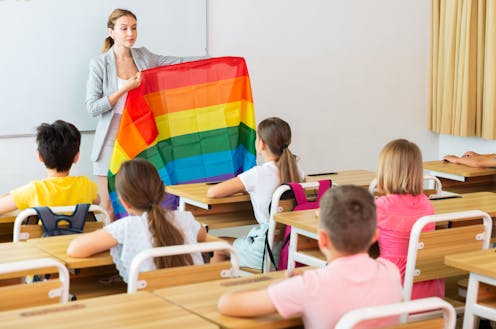
Florida lawmakers have advanced a bill that would bar teachers from discussing sexual orientation or gender identity in the classroom. The parental rights in education bill, labelled the “don’t say gay” bill by critics, would also prevent teachers and school counsellors from giving support to LGBTQ+ students, without first getting permission from their parents.
Florida follows other states with similar statutes restricting classroom discussion of same-sex relationships or mandating that sex education teaches “honor and respect for monogamous heterosexual marriage”. Florida’s bill also allows parents to sue school districts for damages if they believe a teacher has broken the law.
This bill has strong echoes of section 28, the 1988 law that prevented local authorities in the UK from promoting homosexuality. As state schools were at the time led by local authorities, section 28 prevented schools from teaching the acceptability of homosexuality as a “pretended family relationship”.
Teachers believed they would lose their jobs if they gave advice and support to LGBTQ+ students, or challenged homophobic language and bullying. LGBTQ+ teachers were left in fear, believing that their identity alone was grounds for dismissal from their job.
The legacy of section 28 shows the long-term impact legislation like this can have on students and teachers. Section 28 emerged from the Conservative party’s 1987 election campaign, based around family values and a “parents know best” agenda. The Conservatives portrayed the opposition Labour party as pro-gay, and school teachers, who traditionally voted Labour, as a danger to children.
Florida’s bill is similarly suspicious of teachers and advocates parental vigilance. Ron DeSantis, Florida governor and 2024 Republican presidential hopeful, stated: “Parents must have a seat at the table when it comes to what’s going on in their schools.” This is reminiscent of a comment in 2000 by Conservative MP Theresa May, who voted to keep section 28 in place: “Most parents want the comfort of knowing section 28 is there.”
Lasting legacy
Research shows that section 28 left a damaging legacy for the LGBTQ+ young people who were students at the time. Many are still scarred by the absence of any pastoral or mental health support at the most challenging period of their adolescence. As one student who went on to become a teacher said:
I thought I was the only person who was gay at my school. I couldn’t talk to my teachers, though I didn’t know why until years later … I now try to be the role model I never had at school, but I know some parents are not happy.
LGBTQ+ teachers are similarly, deeply affected. Fifteen years after section 28 was repealed, I surveyed LGBTQ+ teachers who had taught under the law and compared their responses with LGBTQ+ teachers who entered teaching after section 28 had been repealed. I found that teachers who worked during the section 28 era remain more cautious, vigilant and anxious in their school workplaces than those LGBTQ+ teachers entering the profession more recently.
My research showed that LGBTQ+ teachers’ principal fear remains that parents of students they teach will associate their identity with hypersexuality and paedophilia. One teacher with experience of section 28 said:
I know that I have a responsibility to LGBT+ kids in school and it upsets me when I see them struggling like I did … but I worry what parents will think of me if I try to help. Sometimes I feel like I’d be viewed as a predator or something.
64% of LGBTQ+ teachers who taught under section 28 have experienced a serious episode of anxiety or depression linked to their sexual or gender identity and role as a teacher. This compares with just 31% of the overall teaching population.
The LGBTQ+ teachers who had not worked under section 28 were much more confident to be themselves at school. One teacher new to the profession said:
I should be able to bring my whole self to work. I couldn’t stay at a school if I had to keep details of my private life a secret. If anyone had a problem with me I’d expect my headteacher to back me 100%.
Florida’s bill still has to make its way through the rest of the state’s legislature (and the governor’s desk) before it becomes law. LGBTQ+ advocates have begun to mobilise in opposition to the bill, just as opponents of section 28 did 34 years ago.
Florida should look to the UK before passing “don’t say gay”. It took 15 years to repeal section 28 and will take many more to repair the damage done to a generation of LGBTQ+ young people and teachers.
This story has been updated to clarify that the bill has been advanced, not made law, and to clarify the nature of similar statutes in the US.
Catherine Lee does not work for, consult, own shares in or receive funding from any company or organisation that would benefit from this article, and has disclosed no relevant affiliations beyond their academic appointment.
A person waves a ‘Let’s Go Brandon’ flag, code for an expletive against U.S. President Joe Biden used by supporters of former president Donald Trump, in Ottawa during the so-called freedom convoy.
THE CANADIAN PRESS/Justin Tang
The worst-case scenario in the U.S. — blood in the streets — isn’t necessarily the most likely, but we ought to resist the tendency to assign too low a probability to events that could have serious, catastrophic consequences.
Some of the most constructive academic work in the middle of the 20th century, after all, was motivated by doom-saying around nuclear war (Thomas Schelling’s Nobel Prize work on game theory, for example).
More recently, predictions about the devastation that will result from the climate crisis are being used to drive public policy and political debate. Will all the predictions bear out? Maybe not, but the intellectual exercise of preparing for the worst can improve our decision-making and position Canada to succeed in times of crisis.
Jan. 6 just a prelude?
For some reason, systematic and dispassionate analyses of what will happen if or when the American experiment with democracy ends have not happened, either in Canada or the U.S.
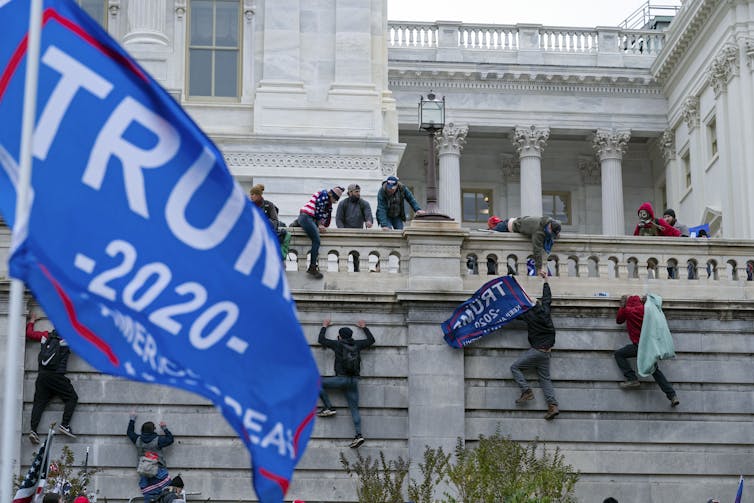
Rioters loyal to Donald Trump climb the West Wall of the the U.S. Capitol in Washington, D.C., on Jan. 6, 2021.
(AP Photo/Jose Luis Magana)
The trucker convoy is one small example of what can happen here when the dangerous forms of anti-democratic rhetoric south of the border spread into Canada.
The people in Ottawa aren’t protesters, they’re occupiers. They reject the use of democratic rhetoric in favour of authoritarian rhetoric, and they aim to dismantle the system that makes protest and free speech possible in the first place.
What happens when that anti-democratic rhetoric becomes the norm in the U.S.? The combination of media outlets like Fox News that have far-reaching impact and anti-democratic, authoritarian rhetoric is exactly a recipe for the contagious spread of the kinds of behaviours that can threaten our own democracy.
What are the likeliest problems? Most obviously, violent rhetoric tends to fuel violent actions. We will see violent rhetoric normalized by cultural figures like Tucker Carlson but also U.S. politicians.
Imagine Fox News no longer playing the role of a media outlet that’s welcoming to the fringe voices of the far right, but instead is the formally sanctioned voice of the state. The more violent, extremist rhetoric becomes the norm, the more danger and violence we’re likely to see.
Can we, should we, regulate American media if they are clearly driving the rise of authoritarianism and the spread of propaganda aimed at ending free, liberal democracy? How do we treat American broadcast media and social media if they become obviously responsible for hastening the end of liberal values like equality, reason and the rule of law?
How will Canada combat the virulent spread of propaganda and misinformation when it comes directly from a government pretending to be democratic while enacting fascism?
What if American journalists wedded to the ideals of free speech, objectivity and professional standards of fairness become targets of state violence? Will we protect the right to a free press? How?
If American elections become obviously rigged, what will our role be in monitoring that kind of democratic backsliding?
Prime Minister Justin Trudeau and Donald Trump talk at a plenary session at the NATO Summit in England in December 2019.
THE CANADIAN PRESS/Sean Kilpatrick
What about American citizens still committed to the rule of law and the basic tenets of liberal society? Will they seek asylum in Canada by the millions?
How do we negotiate trade deals with an ideological, irrational state? We’ve had some preparation for this during Donald Trump’s one term as president, but he was still constrained by a semi-functioning system of checks and balances. What happens when that system is dismantled?
Ripple effects
We need a national conversation on these urgent questions. Our security, our economy and our culture are so deeply enmeshed with the U.S. that any significant change there will have ripple effects here.
Those ripples may turn into a tsunami should the changes be as radical and dire as some predict.
Such a national conversation will require us to shore up our own democracy and to learn how to regulate and prevent the spread of authoritarian rhetoric, hate speech and other forms of misinformation in the U.S.
We must be ready and able to champion the values and advantages that are afforded by living in a democracy. We might avoid the worst, but the preparation will make Canada a stronger, freer, safer country.
Robert Danisch receives funding from the Social Sciences and Humanities Research Council of Canada.
It’s common advice for people watching their waistlines or looking to eat healthier to beware of the amount of oil they use while cooking. But that doesn’t mean we should cut oil entirely from our diet. This is because extra virgin olive oil in particular can have many benefits for our health.
Numerous studies have shown that consuming olive oil – in particular extra virgin olive oil (EVOO) – can have many different benefits for our health. For example, the Spanish Predimed study (the largest randomised control trial ever conducted on the Mediterranean diet) showed that women who ate a Mediterranean diet supplemented with extra virgin olive oil had a 62% lower risk of breast cancer compared to women who were advised to eat a low fat diet.
Experts who have since examined multiple scientific studies looking at the Mediterranean diet and its effect on chronic diseases conclude that a primary reason the diet protects against breast cancer is because of EVOO. There’s also evidence that EVOO may protect against type 2 diabetes and possibly even Alzheimer’s disease.
So what makes extra virgin olive oil better for us than other types of cooking oil? The answer lies in its composition.
Alongside its fat, EVOO also contains many natural substances, such as polyphenols. Polyphenols occur naturally in plants, and have been linked to many health benefits, such as reducing the risk of cardiovascular disease and cognitive disorders. Studies also seem to show that a major reason why EVOO is beneficial to our health is because of the polyphenols it contains. Polyphenols are thought to have many benefits in the body, such as improving the gut microbiome.
Research shows that the polyphenols in extra virgin olive oil are linked with lower risk of cardiovascular disease. In fact, when researchers stripped EVOO of its polyphenols, they found it didn’t protect the heart from disease as well. It’s believed that one of the benefits of EVOO on heart health is because its polyphenols prevent cholesterol becoming oxidised. It’s when cholesterol reacts with oxygen and is oxidised that it damages blood vessels.
The reason EVOO contains such high levels of polyphenols is because it’s produced by simply crushing olives. More processed versions of olive oil – such as light olive oil or spreads – don’t contain as many of these polyphenols. This is because to create these requires more processing, resulting in most of the polyphenols being lost.
Other cooking oils
Most other cooking oils, such as sunflower oil or rapeseed oil, are made from seeds. Seeds are very difficult to extract oil from, so they need to be heated and the oil extracted with solvents. This means that most of the polyphenols in seeds are lost during production.
It’s sometimes claimed that rapeseed oil (also known as canola oil or vegetable oil) is a healthy alternative to EVOO. While there is some evidence that raw rapeseed oil (meaning it hasn’t been heated during cooking) can temporarily lower cholesterol levels, there’s currently no evidence it can lower risk of developing diseases associated with high cholesterol – such as heart disease.
Of course, most of us use oils for cooking. But when an oil is heated at too high a temperature it reacts with the oxygen in the air, causing the fat in the oil to break down. This can lead to the formation of harmful substances that irritate the eyes and even carcinogens. Rapeseed oil is particularly prone to this process - called oxidation - especially when used repeatedly for deep fat frying.
Polyphenols help prevent fats from oxidising and so EVOO remains stable even when used at the temperatures needed to shallow fry foods. Because rapeseed oil and other oils such as sunflower oil contain lower levels of polyphenols, the fats aren’t so well protected from breaking down during cooking.
Another important reason for EVOO’s stability is that its main type of fat is monounsaturated fat. This is both a healthy fat and quite resistant to oxidation. Monounsaturated fat is also the main type of fat in rapeseed oil. But unlike EVOO, rapeseed oil also contains quite high levels of a polyunsaturated fat called alpha-linolenic acid. This is not very stable and is another reason why heating rapeseed oil too much is not a good idea.
Coconut oil is often advocated as a healthy oil to use. But coconut oil contains high levels of saturated fats, which can significantly increase low-density lipoprotein (or LDL) cholesterol levels (sometimes know as the “bad” cholesterol). Elevated LDL-cholesterol is linked to cardiovascular disease, and there’s evidence that the saturated fat in coconut oil increases the risk of heart disease.
One of the important messages about EVOO is that it seems to be far more effective when eaten as part of a Mediterranean diet – which is typically high in vegetables, fruits, legumes, grains, fish and olive oil. This is probably because extra virgin olive oil and its beneficial polyphenols interact with other foods incuding the vegetables eaten as part of this diet. The Mediterranean diet is linked with lower risk of many chronic diseases including cancer, cardiovascular disease and Alzheimer’s disease. This might just make the extra price of EVOO worth paying for.
Richard Hoffman is the author of two books on the Mediterranean diet: The Mediterranean Diet: Health and Science (2011) and More Healthy Years - Why a Mediterranean Diet is best for you and for the planet (2020).
Despite the USF campus’ library maintaining a rule of silence for the fifth floor, students fail to keep the peace and quiet. ORACLE PHOTO/LEDA ALVIM
Students need to maintain silence on the top floor of the library so as to not disturb their peers who go there to study.
Recently, students have been complaining on social media platforms such as the USF sub-reddit and on Instagram accounts like USF confessions about the excessive noise observed on multiple occasions on the fifth floor of the library — which is a designated quiet floor.
The first four floors of the library allow students to collaborate and talk with their friends. In contrast, the fifth floor is dedicated to letting students do their work in silence.
“The fifth floor is the quiet floor, a no talk zone. Even in the study rooms, people should be at a low level,” said Marie Camacho, a library student assistant, in an interview with The Oracle on Feb. 2. “We have gotten a lot of noise complaints this school year. I get about two to three a day.”
Sometimes it is people whispering to each other nonstop and listening to music and videos without using their earphones. Other times, it’s people having loud conversations on their phones.
This noise issue may be caused by some students who are new to USF or are on campus for the first time after the quarantine period and are unaware of the library etiquette.
The library has put effort into enforcing the golden rule of silence on the top floor of the library. Students who have reported this issue to the library staff have been directed to a website to file this complaint form.
After the form is submitted by students, the library floor monitor gives students a warning. If the same behavior is continued, they are asked to leave — an appropriate response to the complaints.
There is a sign at the entrance of the top level of the library that indicates that it is the quiet floor. Yet the problem persists because of students who ignore the rules.
Some students have also mentioned the study rooms also cause disruptions to the quiet atmosphere on the fourth and fifth floors of the library, since a lot of people have loud discussions, and the rooms are not soundproof.
Students can feel demotivated and annoyed when such noise interrupts their studying, especially in a library where it is meant to be quiet and there are plenty of other places on campus for socializing.
USF students should be more considerate toward others while they are trying to study, and not do things that discourage their peers from studying. The first four floors of the library are open to conversations and discussions, but the fifth floor should be maintained as the quiet floor.
People at the Copyright Office seem to get mad at me every time I suggest that the Copyright Office is captured by Hollywood, and pointing out how top officials there all seem to bounce back and forth between the Copyright Office and Hollywood.
That's not to say there aren't some good people there, because there are. But the organization is dominated by former (and, if the past is any indication, soon to be again), lobbyists and lawyers of the biggest copyright abusers on the planet. So it's difficult to take the Office seriously as a steward for the public good (as they are supposed to be), when it's currently headed by the former top lawyer at IFPI, who, before that, was the top IP lawyer for Time Warner. And, when she then decides to hire Disney's top "IP lawyer" to become General Counsel of the Copyright Office (as has just been announced), it becomes really difficult not to be cynical.
This is what regulatory capture looks like.
But even worse, actions like this are why the public doesn't believe in copyright. Over and over again all we see is abuse of copyright, and then the government puts the same people who have abused copyright in charge of copyright at the Copyright Office, it makes the public cynical and (reasonably) distrustful of the intentions of the Copyright Office. That's disappointing, as there are plenty of people who have expertise in copyright law who would be great for the Copyright Office. But, for some reason, they never get hired into the top jobs unless they've spent time working for one of the giant Hollywood or recording industry organizations.
by Robyn Autry, Associate Professor of Sociology, Wesleyan University
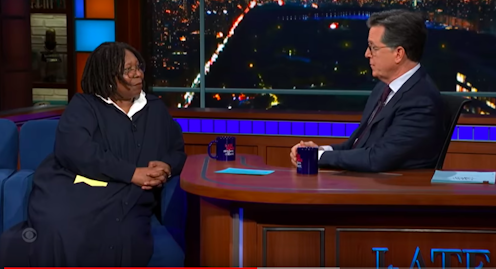
On "The Late Show with Stephen Colbert," Whoopi Goldberg said, "I don't want to make a fake apology." Youtube
Whoopi Goldberg, co-host of ABC’s “The View,” set off a firestorm when she insisted on Jan. 31, 2022 that the Holocaust was “not about race.” Hands outstretched, she went on to describe the genocide as a conflict between “two white groups of people.”
As someone who writes and teaches about racial identity, I was struck by the firmness of Goldberg’s initial claim, her clumsy retraction and apologies, and the heated public reactions.
Her apology tour on her own show the next day, on “The Late Show with Stephen Colbert” and on Twitter
raised more questions about her views on race, antisemitism and the Holocaust. Goldberg also seemed unaware of the non-Jewish victims of the Nazis. By the end of the week, the president of ABC News described Goldberg’s remarks as “wrong and hurtful” and announced that she was suspended from the show for two weeks.
How did a conversation about the controversial banning of the Holocaust graphic book “Maus” by the Tennessee Board of Education, which Goldberg opposed, turn into such a media spectacle? And what does it tell us about the social norms guiding how we talk about race and violence?
Filling the void
Sociologist and American Civil Liberties Union attorney Jonathan Markovitz defines “racial spectacles” as mass media events surrounding some racial incident that is passionately debated before dying down.
In the absence of sustained national dialogue, shows like “The View” and comedians like Goldberg can easily become lightning rods. The American public often overestimates their ability to unpack complicated social issues. Are they public intellectuals or entertainers? Critics might also ask why someone like Goldberg, who has already demonstrated odd thinking about racial identity and a willingness to defend racist acts, would have such a huge platform in the first place. But this isn’t just about Whoopi Goldberg.
Let’s clear up a few points: Race is an elastic social category, not a fixed biological one; Jewish identity and experience are not synonymous with whiteness; and Jewish people have historically been treated as a distinct racial group. The Holocaust was the systematic genocide of some 6 million Jews from 1941 to 1945, fueled by the Nazis’ belief that they were an inferior race. Other victims included Poles, Roma, gay men, lesbians and others.
The Holocaust is one of the most extreme and tragic examples of what sociologists Michel Omi and Howard Winant referred to as “racial projects.” In their work on racial formation, they used that term to describe how racial categories are formed, transformed and destroyed over time. In other words, the fact the Jewish people themselves may disagree over whether they are a racial or ethnic group does not undo their long history of being categorized and marginalized as such.
Still, it is unsurprising that an American, perhaps especially a Black one like Goldberg or myself, would think that race is about skin color given how it plays out in our lives. As a graduate student studying racial violence and collective memory, I was stunned to learn how ideas about racial difference varied wildly across societies and how those ideas could morph within the same society over time.
I learned that race is a social idea that is propped up by observable traits, only one of which is skin color. The racialization of Jewish people may not be about complexion, but physical markers are still often used to differentiate and stereotype the Jewish body.
It is also important to understand ongoing antisemitism in the U.S. and efforts to deny that the Holocaust even happened. Goldberg’s remarks were clearly the sort of “excitable speech” that gender theorist Judith Butler writes about, disorienting us by bringing violent histories to bear on us today. The way we talk about the past matters – as does the way people are held accountable for misrepresenting it – because so much of it helps to explain the contours of existing conflict.
Another lesson
At the same time, dismissing Goldberg’s comments and the backlash would mean missing an opportunity to appreciate what can result. For example, in light of the recent controversy, the Anti-Defamation League announced it will revise its definition of racism to include both race and ethnicity.
In this moment, people are talking about Jewish identity, racism and a violent history we’re meant to “never forget.” But they’re also talking about Blackness.
What can we make of the frenzied rush to chastise and publicly ridicule a Black woman for talking about race in the wrong way? On the one hand, this is similar to other celebrities condemned for racist speech whose apologies get scrutinized.
Yet, the Goldberg affair feels different to me. It reignites a recurring suspicion that Black people, while oppressed, suffer from twisted bigoted racial thinking – that Black people are not innocent victims after all. When a Black celebrity makes racist remarks, suspicions reawaken that perhaps it is a collective failing. This sort of projection of individual acts onto an entire group as if it were a shared trait is anti-Black.
Yes, many of us think Goldberg got it horribly wrong. And yes, her apologies made matters worse. There are better ways to think and talk about race and racism.
But observers shouldn’t be surprised when these conversations go awry, considering how little time is spent openly having them in the first place.
Robyn Autry does not work for, consult, own shares in or receive funding from any company or organisation that would benefit from this article, and has disclosed no relevant affiliations beyond their academic appointment.
by Dan Taylor, Lecturer in Social and Political Thought, The Open University
Extreme flooding in Germany caused roads and railways to be cut off. Bear productions/Shutterstock
Smog-ridden cities. Endless war. Water so polluted it cannot be drunk. Crop failure. Acid rain. A pandemic of antibiotic-resistant diseases. Declining life expectancy and human fertility. Endangered bees, collapsing agriculture. Mass extinctions have finished off most birds and fish. Only the wealthiest can afford quality organic food, while the poor subsist on lab-produced junk (with added tranquilisers). A celebrity president peddles misinformation in tweet-like slogans. A disillusioned academic tries in vain to bring about change, while his followers block roads and resort to terrorism.
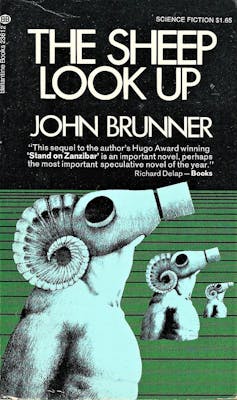
This is not a bad dream version of recent climate change headlines. This is the dark vision in the 50-year-old dystopian novel, The Sheep Look Up, by John Brunner. A British author, Brunner was one of a handful of writers who were early advocates of environmental activism.
No more heroes
Experimental in style, bleak in outlook, the novel is short on heroes and villains. The chapters follow 12 months in which the United States gradually collapses as unrestricted pollution wipes out the water and food supply. Some of its best lines go to Austin Train, an environmentalist who attempts to persuade others that that they must act now to protect human life. But throughout the novel he is mostly ignored.
The book is a reminder that the courage of activists such as Greta Thunberg and Vanessa Nakate should not be ridiculed or ignored, but celebrated for speaking truth to power. All of us must heed their warnings and act now to reduce our impact on global heating. Western countries have become too dependent on outsourcing our pollution to far away lands. It’s time to stop outsourcing our dissent.
Brunner wrote his novel the same year that the Club of Rome, an international group of policymakers, economists and business leaders, published their influential report The Limits to Growth. Using computer projections, it warned that the planet lacked the resources to sustain current projections of human consumption and growth.
The cover of sci-fi climate classic The Sheep Look Up.
Cover by Mark Rubin and Irving Freeman., CC BY
From the early 1960s there were signs that human activity was starting to be linked to environmental damage. Author Rachel Carson wrote her acclaimed Silent Spring in 1962 – and in 1965 the US science advisory committee report wrote to US president, Lyndon Johnson, about the dangers of air pollution.
Brunner was surprised that more people weren’t alarmed. The Sheep Look Up warns about what happens when people fail to act against an unfolding catastrophe. While the present might be endurable, the future will not be, as demonstrated in the recent scenarios forecast in the most recent IPCC report.
As one of Brunner’s characters observed: “This is the future, unless we prevent it.”
Fiction’s influencers
Some early readers drew a bleak analysis that environmental activism was futile, but many read it as a call to action. Brunner used sci-fi as a form of social and political criticism, something that was fairly new at the time.
Abstract projections about emissions, droughts and pollutions can be hard to grasp. But research shows that fictional narratives and metaphors have a significant role in helping us understand complex social issues.
Storytelling helps us recognise the consequences of our decisions to act or not act, as we follow the impact of choices made by characters.
Around the world, psychologists and clinicians are now observing a condition called “climate anxiety” or “eco-anxiety”. As the name suggests, it’s marked by anxiety, panic attacks, depression and feelings of anger and betrayal. A recent global survey of 10,000 young people found that 75% felt that the future was frightening and that 59% were very or extremely worried about climate change.
But what some researchers and campaigners have also found is that anxiety reduces when people get together and focus on collective action.
Great storytelling is all about revealing the choices that lie before us. And this is all part of Brunner’s technique. It connects the great 20th-century dystopias of George Orwell and Aldous Huxley to the modern-day climate fiction of Margaret Atwood and Amitav Ghosh.
There have been some important achievements in curbing pollution, from the Montreal Protocol to the 2015 Paris Agreement. And around the world, voices young and old are now demanding urgent, systemic change, something that might have surprised Brunner.
Dan Taylor does not work for, consult, own shares in or receive funding from any company or organisation that would benefit from this article, and has disclosed no relevant affiliations beyond their academic appointment.
The House of Representatives has inserted SHOP SAFE—a piece of legislation that would make it extremely difficult for any individual to sell things online and equally difficult for any online platform to compete with Amazon—into a 3,000-page trade bill. It cannot remain there.
The “Stopping Harmful Offers on Platforms by Screening Against Fakes in E-Commerce” (SHOP SAFE) is a bill that claims to be about protecting consumers but is more likely to enrich big brands at consumers’ expense. SHOP SAFE would force pretty much any online service that allows people to buy and sell items to institute a draconian trademark protection system. If they don’t, they risk crushing liability for the actions of their users.
Let’s say you want to sell something online. Some used baby clothes. Or let’s say you have a small side business selling baby clothes you make yourself online. In either case, you might list your items online, on a website like Craigslist or Etsy. Let’s say you describe what you are selling as “onesies.” Under SHOP SAFE, this will be a lot more difficult to pull off than you might expect.
Because, unbeknownst to you or to most people, Gerber has a trademark registration for the word “onesies.” Under SHOP SAFE, pretty much every website you might use to sell your used or homemade item will have to use an automated trademark filter that would prevent you from selling anything that had “onesies” as part of the description.
Furthermore, under SHOP SAFE, all of these websites would be required to have a three-strike system. So if you used “onesies” three times in one year, you would find your account terminated. And that would be that for your attempts to sell things online.
Even if the trademark filters don’t get you, SHOP SAFE will lead to plenty of other hoops for you to jump through, from providing the platform with a copy of your government-issued ID to including the country of manufacture in each listing. Hope you didn’t cut off those tags!
And let’s say you are a buyer looking to buy used items, whether you’re trying to save money or want to lower your carbon footprint. Suddenly, it’s much harder to find listings for used items. Let’s also say you are someone looking to do less shopping on the monolith that is Amazon. Suddenly, there are fewer and fewer alternatives, since other platforms can’t afford to comply with SHOP SAFE. Let’s also say you are trying to buy from local, independent, or small sellers rather than giant, multi-billion dollar brands. Once again, there are fewer and fewer sellers on sites like Etsy, as they fall victim to SHOP SAFE.
When SHOP SAFE passed out of committee last year, many elected officials expressed serious concerns about this bill. And yet, with no changes, we find it jammed onto page 1672 of the America COMPETES Act.
The good news is that SHOP SAFE isn’t in the Senate version of this trade bill. We need to tell our Senators to keep it out of the final bill. Tell them that SHOP SAFE is bad for consumers and sellers of all kinds.
Right now, the U.S. Copyright Office is collecting information on the use of "standard technical measures" to address copyright infringement, as part of a longer effort that, we fear, will lead to filtering mandates.
The Copyright Office is also holding a plenary session on February 22, to hear from the public. It will then engage in a series of “industry-sector specific consultations.” Given how often “industry” is seen as equivalent to Big Tech and Big Content, it is vital that the Copyright Office properly consider all of those who would be affected.
We want to make sure that the Copyright Office hears the real problems with technical approaches to infringement, especially automated filters, so that it understands the dangers of allowing robots to shape online expression. Automated filters are expensive, don’t work very well in many instances, and routinely suppress lawful expression. Facebook routinely removes classical musicians because of its filter. YouTube’s filter takes money from independent creators and gives them to giant corporations. Experts in copyright law talking about what counts as infringement find that video removed and can’t figure out how to respond. Twitch removes a channel owned by its parent company. And on and on.
One sadly ironic result: independent internet creators face even more challenges reaching an audience just as new technologies and platforms should be making it easier. “Big Content” cannot be the sole voice of internet creators, who are also copyright holders with a right to be included in this process. And it’s hard to imagine which “industry sectors” can adequately represent the users who would be affected by any new technical measures, much less the multiple public interests in play. If you agree, you can submit comments to remind the Copyright Office of these facts and emphasize the dangers requiring filters would create.
EFF will be filing comments to be included. But in order to make sure the Copyright Office understands the gravity of what it is considering, everyone who sees the threat of even more sensitive, legally-required copyright filters needs to speak up.
Anyone can send the Copyright Office a comment through this form. The Copyright Office asks for the negative results of widespread use of filters, which are obvious: Filters can’t factor in context, so they routinely remove legal speech. They make it harder for independent creators who want to share their work without the aid of a multi-billion dollar corporation. They are expensive, so any service trying to compete with Facebook and YouTube is at an immediate disadvantage. It also asks if there are, in general, pertinent issues the Copyright Office should consider. It should instead consider that the interests of a few giant corporations should not outweigh the public’s interest in fostering creativity and competition. Having more money does not mean they are actually more important or even more affected by the use of filters.
Comments are due February 8, 2022. They don’t need to be long. Make sure the Copyright Office knows we see what they are doing, and that we know we deserve to be involved.
by Stan Kubow, Associate Professor, School of Human Nutrition, McGill University, McGill University
Some studies have demonstrated that a significant number of obese people are metabolically healthy, leading to the contention that one could be healthy at any size. (Julia Kubow), Author provided
However, weight is only one of the metrics that medical professionals use to assess overall health. In fact, some studies have demonstrated that a significant number of obese people are metabolically healthy, leading to the contention that one could be healthy at any size. This phenomenon is referred to as metabolically healthy obesity (MHO). Research is now starting to explore what this means.
A person who is MHO has healthy blood pressure, normal levels of blood lipids (cholesterol and triglycerides) and normal blood sugar. Having high values of one or more of these measures significantly increases one’s risk for cardiovascular disease.
Healthy diets provide anti-inflammatory and antioxidant benefits that help achieve a healthy metabolic profile.
(Shutterstock)
It has been proposed that metabolically healthy obese individuals might be protected against obesity-related diseases. The extent of this protection has been controversial within the scientific community, and this is partly because we still don’t have a standardized definition of MHO.
So, over the past few years, researchers have gone to work to find out who can be defined as MHO, and to what extent people with MHO are protected from chronic disease.
Emerging consensus
Several large population studies have been initiated towards this end. So far, results show that, indeed, more rigorous definitions of MHO are needed. This can be achieved by including other measures of health such as insulin resistance and blood markers of inflammation. Insulin resistance is when the body does not respond well to the insulin hormone that helps to take up sugar from the bloodstream for use as a fuel for energy. This leads to elevated blood sugar and the consequent health complications.
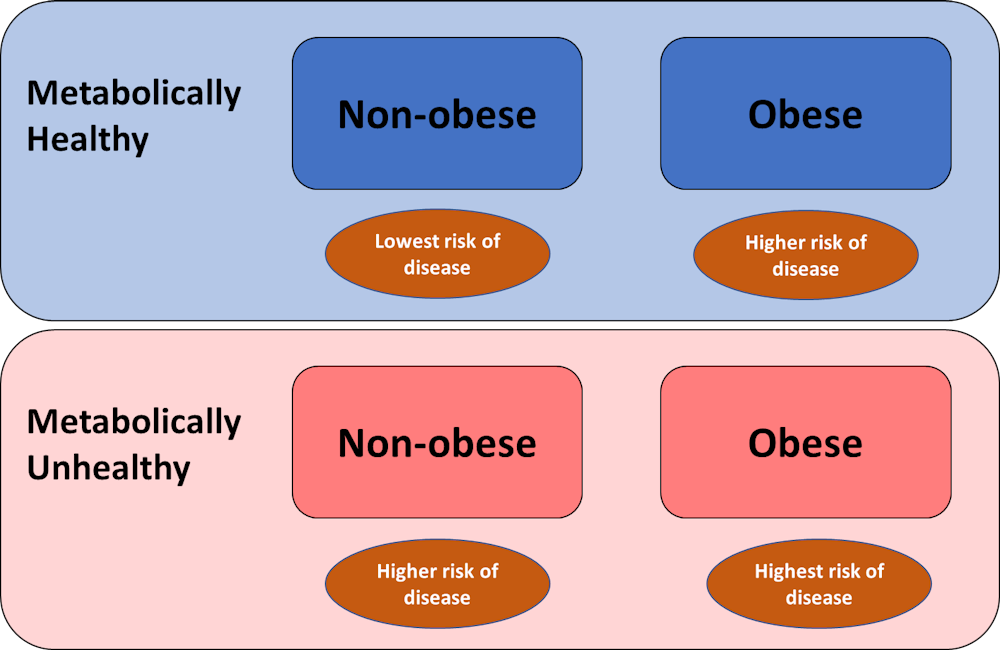
An emerging consensus has been that although MHO individuals show some protection from chronic disease, they still seem to be significantly less protected than those who are metabolically healthy and lean.
Individuals with metabolically healthy obesity have lower risk of disease than those with metabolically unhealthy obesity, but still higher risk than non-obese, metabolically healthy individuals.
(Kubow/Iskandar), Author provided
This leads to another question: is MHO truly protective over an entire lifetime, or is it just a question of time before MUO sets in, making MHO a transient state?
Protective factors
One factor to consider that might differentiate metabolically healthy versus unhealthy obesity is how fat is distributed in the body. A genetic predisposition for depositing fat under the skin, called subcutaneous fat, seems to play a protective role.
People with this predisposition are mostly premenopausal women who accumulate subcutaneous body fat in the hips rather than the waist (pear-shaped). They are better protected against diabetes and cardiovascular disease compared to people whose body fat is located more in the abdomen (apple-shaped).
In contrast, obese individuals with a high waist circumference show excessive fat deposition in the abdomen and a pro-inflammatory state that leads to insulin resistance, which can be a precursor to Type 2 diabetes.
People with metabolically healthy obesity are involved in regular physical activity to a greater extent than those with metabolically unhealthy obesity.
(Shutterstock)
Researchers have also looked at the lifestyle habits that differentiate MHO from MUO individuals to see if development of metabolically unhealthy obesity can be prevented.
Healthy diets provide anti-inflammatory and antioxidant benefits that help achieve a healthy metabolic profile. Indeed, of the MHO population, those who follow the Mediterranean diet seem to have lower mortality rates. Adopting these healthy lifestyle habits could help prevent the trajectory of metabolically healthy obesity moving towards metabolically unhealthy obesity over the course of a lifetime.
Is metabolically healthy obesity real?
So is MHO real and does it protect against disease? There isn’t a yes or no answer yet. The more we learn about it, the more nuance is injected into the concept that one can be perfectly healthy at any size. Based on the information we have so far, only a narrow segment of obese individuals are without risk of developing obesity-related chronic diseases.
We also know a lot more about their characteristics. They have less abdominal fat and more subcutaneous fat. They have less insulin resistance, less inflammation and a metabolically healthy cardiovascular profile. They also have healthy lifestyle habits such as regular exercise and a healthy diet. It seems that genetics play a role as well.
We can expect more insight from major international population studies and clinical trials that are currently underway. But in the meantime, the age-old advice holds truer than ever: regular physical activity and a healthy diet are crucial to maintain health and longevity.
The authors do not work for, consult, own shares in or receive funding from any company or organization that would benefit from this article, and have disclosed no relevant affiliations beyond their academic appointment.
The Knight Parade is an annual celebration of Tampa civic pride. Hosted by the Krewe of the Knights of Sant’ Yago, the Knight Parade has been held in Ybor City each year since 1974. The parade’s rich heritage attracts families, and adults young and old alike to join in the revelry.
A true Tampa Bay tradition, the Knight Parade draws more than 100,000 spectators each year. It’s sometimes referred to as the “Sant´Yago Illuminated Knight Parade” and mistakenly called the “Night Parade” because it’s held at night.
The Knight Parade has been a tradition since 1974
It is always held on a Saturday evening in February, typically a few weeks after the Gasparilla Pirate Invasion. The Knight Parade, as well as other fundraising events, helps raise funds for the Krewe of the Knights of Sant’ Yago Education Foundation, which has provided nearly $3 million in scholarships for local students.
This year’s event will take place on February 12 at 7pm on 7th Avenue in Ybor City. You can learn more about the celebration by visiting the official event page.
Expect to see celebrities, local dignitaries, dozens of marching bands, performers and thousands of costumed participants who will toss scores of beads to the revelers and families lining the street. The Knight Parade, presented by MOR and co-sponsored by the City of Tampa, is a free, family-friendly event. We encourage attendees to arrive early to avoid traffic and grab dinner at one of the many wonderful restaurants in Ybor City. Then claim your spot along the parade route.
See the full parade route on the Knight Parade website.
Mindfulness is seemingly everywhere these days. A Google search I conducted in January 2022 for the term “mindfulness” resulted in almost 3 billion hits. The practice is now routinely offered in workplaces, schools, psychologists’ offices and hospitals all across the country.
Most of the public enthusiasm for mindfulness stems from the reputation it has for reducing stress. But scholars and researchers who work on mindfulness, and the Buddhist tradition itself, paint a more complex picture than does the popular media.
Medicalizing meditation
Mindfulness originated in the Buddhist practice of “anapana-sati,” a Sanskrit phrase that means “awareness of breath.” Buddhist historian Erik Braun has traced the origins of the contemporary popularity of meditation to colonial Burma – modern-day Myanmar – in the late 19th and early 20th centuries. Meditation, which was practiced almost exclusively inside monasteries until then, was introduced to the general public in a simplified format that was easier to learn.
The gradual spread of meditation from that time to the present is a surprisingly complex story.
The process of translating the Buddhist practice of meditation across cultural divides transformed the practice in significant ways. Modern meditation often has different goals and priorities than traditional Buddhist meditation. It tends to focus on stress reduction, mental health or concrete benefits in daily life instead of spiritual development, liberation or enlightenment.
A pivotal moment in this transformation was the creation of the Mindfulness-Based Stress Reduction (MBSR) protocol by Jon Kabat-Zinn, a professor of medicine at the University of Massachusetts Medical School, in 1979. The stress reduction program introduced a standardized way of teaching meditation to patients so that its health benefits could be more rigorously measured by scientists.
Research on this new kind of “medicalized” mindfulness began to gather steam in the past two decades. As of today there are over 21,000 research articles on mindfulness in the National Library of Medicine’s online database — two and a half times as many articles as have been published on yoga, tai chi and reiki combined.
Scientific evidence vs. mindfulness hype
Medical researchers themselves have had a far more measured opinion about the benefits of meditation than the popular press.
For example, a 2019 meta-analysis, which is a review of many individual scientific studies, pointed out that the evidence for the benefits of mindfulness and other meditation-based interventions has “significant limitations” and that the research has “methodological shortcomings.”
Based on their review of the scientific literature, the authors warned against falling prey to “mindfulness hype.” On the positive side, they found various forms of meditation to be more or less comparable to the conventional therapies currently used to treat depression, anxiety, chronic pain and substance use. On the other hand, they concluded that more evidence is needed before any strong claims can be made regarding treatment of conditions such as attention disorders, PTSD, dysregulated eating or serious mental illnesses.
More troubling, some researchers are even beginning to suggest that a certain percentage of patients may experience negative side effects from the practice of meditation, including increased anxiety, depression or, in extreme cases, even psychosis. While the causes of these side effects are not yet fully understood, it is evident that for some patients, therapeutic meditation is far from the panacea it is often made out to be.
Putting mindfulness back into context
As a historian of the relationship between Buddhism and medicine, I argue that mindfulness can be a beneficial practice for many people, but that we should understand the broader context in which it developed and has been practiced for centuries. Mindfulness is one small part of a diverse range of healing techniques and perspectives the Buddhist tradition has developed and maintained over many centuries.
In a recent book, I have traced the global history of the many ways that the religion has contributed to the development of medicine over the past 2,400 years or so. Buddhist tradition advocates countless contemplations, devotional practices, herbal remedies, dietary advice and ways of synchronizing the human body with the environment and the seasons, all of which are related to healing.
These ideas and practices are enormously influential around the world as well as in Buddhist communities in the U.S. Such interventions have been particularly visible during the COVID-19 pandemic – for example, through the medical charity of major international Buddhist organizations as well as through health advice given by high-profile monastics such as the Dalai Lama.
Buddhism has always had a lot to say about health. But perhaps the most significant of its many contributions is its teaching that our physical and mental well-being are intricately intertwined – not only with each other, but also with the health and vitality of all living beings.
Medicalized meditation is now a self-help commodity that generates over US$1 billion per year, leading some critics to label it “McMindfulness.” But placing mindfulness back into a Buddhist ethical context shows that it is not enough to simply meditate to reduce our own stress or to more effectively navigate the challenges of the modern world.
As I argue in my most recent book, Buddhist ethics asks us to look up from our meditation cushions and to look out beyond our individual selves. It asks us to appreciate how everything is interconnected and how our actions and choices influence our lives, our society and the environment. The emphasis, even while healing ourselves, is always on becoming agents of compassion, healing and well-being for the whole.
[This Week in Religion, a global roundup each Thursday.Sign up.]
Pierce Salguero does not work for, consult, own shares in or receive funding from any company or organization that would benefit from this article, and has disclosed no relevant affiliations beyond their academic appointment.
If you are new to copyright, there are many great guides on the internet, including this one here. However, for someone coming in with almost no understanding of how copyright works, it may not be the best place to begin.
The reason is fairly simple. Most guides, including my own, are geared toward helping people understand copyright within the context of the issues they dealing with. They aren’t meant to be complete overviews, just catch up guides for those interested in that specific topic.
The guide is an amazingly thorough overview of copyright, written in a way to be understood by lay people and it includes nearly all of the important information one needs to know in just 10 pages and 4,000 words.
Best of all, since it was produced by the U.S. Copyright Office, which is part of the federal government, the work itself is in the public domain. This means that it can be freely copied, printed, shared, distributed without any permission from the U.S. Copyright Office.
This makes it great for classrooms, corporate environments and anywhere else where licensing for distribution might have been a problem.
In short, if you are new to copyright and looking to develop a better understanding of it, there’s no better place to start.
What it Includes
The document itself is very straightforward. It’s broken apart into multiple sections but, in the most broad terms includes the following:
What Works Are Protected by Copyright
What Those Protections Include and Don’t Include
Who the Copyright Holder Is
How Long Copyrights Lasts
What One Can do With a Copyright-Protected Work
Basics of Copyright Registration
If you’re either based in the United States or are interested in how copyright works in the United States, this is a great overview and it quickly dispels many of the copyright myths that still continue to plague the internet after decades.
Best of all, it’s written in plain language, making it very easy to understand, and offers references to other circulars for a deeper dive on particular topics if wanted.
As such, if all you are after is a general overview, this is likely the best place to begin.
What it Leaves Out
That said, the circular is not beyond criticism. This is especially true if you’re not interested in copyright from a U.S. perspective.
Though the circular touches on international issues some, much of the space of it is taken up with information about copyright registration. While there are definitely reasons that many creators outside the United States may want to register with the U.S. Copyright Office, it’s a fairly niche issue.
However, even when looking at it from a U.S. perspective, there are some elements missing. The largest, in my view, is any information about the Digital Millennium Copyright Act (DMCA).
The DMCA, which was passed in 1998, was a major revision to U.S. copyright law and, through its notice and takedown regime, is one of the most common ways individuals interact with the law. This makes it odd that there is no mention of the law (or any of its parts) in the Circular nor are there any circulars about it.
That is especially interesting since the Copyright Office operates the DMCA Agent directory, and Circular 1 was revised in September of last year.
In short, the circular is a great basic overview of copyright as it operates in the United States. But this omission is pretty glaring. Fortunately, it’s easily picked up elsewhere on the site.
But that doesn’t mean that the U.S. Copyright Office doesn’t do many good things. These circulars are among the best things they do and Circular 1 is by far the most useful among those.
As such, if you are coming into copyright with almost no knowledge of the law and how it works, this circular is a great place to start. From there, one can easily drill down into either other circulars of more targeted interest or onto other guides in other places.
However, every journey has a first step and, for copyright, this is a great first step for nearly everyone.
In June of 2021, Lorisia MacLeod, a librarian from the James Smith Cree Nation, published an article called “More Than Personal Communication: Templates for Citing Indigenous Elders and Knowledge Keepers,” presenting citation templates to recognize Indigenous knowledge in academia. Because both APA and MLA style guides encourage writers to cite any oral communication that does not have a written or audio recording as “personal communication,” Indigenous oral teaching gets put “on the same footing as a quick phone call, […] while even tweets are given a reference citation.”
By using MacLeod’s templates to include a full citation in a References or Works Cited list, Indigenous oral knowledge can be “presented as an equal and valid information format alongside familiar formats like books and journals.” Lorisia has generously agreed to be interviewed for ACRLog about her work; I invite you to click the link above and read her original article as well!
Q: In news coverage about this project, you’ve shared that you first realized the need for better citation of oral communication when you were an undergraduate studying anthropology, and that you worked with the Indigenous Student Centre at NorQuest College in Edmonton to develop templates for APA and MLA style. Tell me more about the process of creating custom citation templates. Was your institution supportive from the beginning? How did you select which elements to include?
A: That’s right, I was very lucky to have two amazing anthropology professors during my undergraduate—Dr. Jack Ives and Dr. Kisha Supernaut (Métis)—who really recognized the importance of including Indigenous voices especially in a field that traditionally studied Indigenous people but in a very extractive way. I felt they both really highlighted the importance of community-engaged archaeology and taught about valuing Indigenous voices despite the historical academic records lack of Indigenous representation. Of course one of the tricky things about valuing something in academia is that often our value is shown by whose voices are highlighted, so if citation styles don’t recognize Indigenous ways of knowing it can be really hard to fully achieve that level of respect it deserves. At the time, I just remember thinking someone should change that limitation—make ways of citing our oral teachings more equal. Fast forward a few years and I’m talking about things academic institutions could do as actions to support reconciliation, indigenization, decolonization etc and I realize as an Indigenous librarian that maybe it was something I could be involved in doing. Since I had developed good relationships with the staff in the Indigenous Student Centre at NorQuest it really was about drafting up some examples of alternate citation templates and just asking if I could show it to them and talk.
I think I was really lucky because there was a lot of support—folks seemed to understand that it was important to take action, to make a change, in order to make the big buzzwords mean anything. I’ll admit, the fact that it was developed by an Indigenous librarian and the input from the folks in the Indigenous Student Centre helped (big shout out to Delores, Elliott, Conor, and Karie)— I had some great friends there cheering us on every step of the way and really trying to uplift our voices. When I started out drafting up something to talk about, I actually relied heavily on Elements of Indigenous Style: A Guide for Writing By and About Indigenous Peoples by Gregory Younging (an amazing resource for anyone and everyone to read in my opinion). It does a great job of talking about how nations differ so it’s important to try to be precise, and other key ideas that lead me to look at what relationships mattered in a citation. From there it really seemed to flow together, trying to mimic the way that other citations for books are done, I tried to interweave that with elements like who is their nation, what is the teaching about. I tried to keep it general so it could be flexible—not every nation, person, or teaching would be the same, so some elements became if applicable. This was a part where having the amazing folks in the Indigenous Student Centre was irreplaceable, just talking about how we’d use this piece of the template or maybe this part would be better phrased like this. They also helped to figure out which parts should be included so it really was a group effort that organically formed in some ways. I guess it’s really fitting that citation templates about citing and valuing our words were mostly made through chats!
Q: Undergraduate research assignments often direct students toward published, written information, and students might not consider consulting other sources, like Indigenous oral knowledge. What ways could professors incorporate Indigenous knowledge in research assignments? How can we design assignments that get students to branch out from “traditional” information formats like books and articles?
A: So I’m a strong believer that there are connections to Indigenous knowledge in pretty much every subject BUT the key when it comes to incorporating Indigenous knowledge is really relationships. If instructors want to incorporate Indigenous knowledges, especially oral teachings, I really hope they are looking to invest in long-term mutually respectful relationships with Indigenous knowledge keepers. It’s technically incorporation to get the Elder-in-resident to come to speak in class once or send students to them but it isn’t really a good relationship to me. We only have so many Knowledge Keepers and they only have so much time so using them for one-offs for a class to check some box—well, it doesn’t feel any different from the extractive knowledge processes of many early settlers. Long-term engagement is more work but it’s honestly the kind of investment that has the potential to create real change.
So that’s a long-term thing but that isn’t to say there isn’t something folks could do right now. I think for instructors you’ll want to start by looking at your own syllabus—look at the readings you have and whose voices they are. If you don’t have Indigenous voices, then maybe you should change whose voices you are raising up (this can also apply to other minority voices that may not be represented in your syllabus).
In both your syllabus and in your assignments, consider why you are putting in requirements about works cited having to be academic articles? There are tons of amazing Indigenous scientists, Knowledge Keepers, language keepers, activists etc that are really active on social media platforms like Twitter and TikTok. Now I’m not saying only use Twitter feeds for your readings, but infusing these into your assignments and syllabus is actually also going to teach learners information literacy skills. It’ll teach them how to engage with social media with a critical eye and combine various information formats to get a better picture of something. But a lot of that does depend on instructors and institution policies, just remember—just because something has always been done one way, doesn’t mean it’s the best way or that it’s still the best way now.
Q: What other ways can academic libraries demonstrate respect for Indigenous ways of knowing?
A: This can be a bit of a tricky question to answer generally because it really depends on where each institution is at—some have great ties with local Indigenous groups, others have only just started trying out land acknowledgements. But here are some broad ideas:
Be honest with yourself, your institution, and your staff about where you really are: if you are still mostly doing virtue-signalling actions but aren’t able to acknowledge that’s what they are, it’s going to be really hard for anyone to be able to plan a realistic path forward. That can also impact the ability and interest of Indigenous communities to partner with you.
Who is in your collection and how? Take a look at Indigenous authors in all fields and look at how they are catalogued, what is their metadata. And when do you promote them? Please don’t only bring out the Indigenous authors for Indigenous History Month- they deserve to be highlighted in your STEM displays, your general literature displays, and the same goes for however you promote resources to your faculty.
Invest in staff learning: This has to be an ongoing area of learning and commitment with institutional support. Academic institutions have their roots in systems that kept out Indigenous peoples and our knowledges (or appropriated them) so for many professionals, the voices we have today probably weren’t something they learned about in their classes. So if there is a webinar panel of Indigenous scientists coming up then yes—the science liaison librarian should probably be attending.
Look at the Calls to Action and the CFLA TRC report: I know, these documents are getting older and are Canadian-centric but that doesn’t mean that all the calls have been met or that they aren’t useful for others. Find actions you need to take and then hold yourself/your institutions accountable to working on them. An important thing to note with this is that process is often viewed as a linear path—in my experience, true respectful actions might take a less direct path. A library might realize that they didn’t have the relationships they thought they had and need to change the plan to develop those—I don’t think that’s a failure. To me, that kind of openness to adapt and change is a reflection of respect, it acknowledges that true respect requires ongoing engagement and the needs of the parties involved naturally will change over time.
Have Indigenous knowledges in your library: Yes this, of course, means buying Indigenous books but consider how our knowledges aren’t limited to that format. What about art? What about having storytellers and Knowledge Keepers? What about partnering with your institutions’ Indigenous student centre or local Indigenous groups?
Q: Who are some librarians (or experts in other fields/identities) that inspire and influence you in your work?
A: Aside from those I talked about above, I have to start off with the obvious (and slightly sappy) answer which is that my Dad (Kirk MacLeod) and sister (Kaia MacLeod) are huge inspirations to me. My Dad was in the library field for over a decade before me, so he was one of those Indigenous librarians who helped make space for future generations like me and my sister. The field he entered was very different from when I entered shortly after the release of the TRC report; he has always cheered me on and been a role model on leading change but remaining humble. Kaia just entered librarianship and in addition to being a really awesome librarian in her own right, she motivates me to keep trying to improve the field for all future Indigenous librarians, just like our Dad did for us. Now that we are all in the same field, they give me feedback and their perspectives from other areas in the field too! Plus it’s a constant reminder that the field is full of amazing people to work with, like Jessie Loyer a fantastic Cree-Métis librarian, cousin, and friend who always seemed to know just the right thing to say to empower early-career Indigenous librarians to create change.
Gregory Younging (Opsakwayak Cree Nation): His book Elements of Indigenous Style was a huge inspiration. I’m pretty sure I recommended that read to everyone I knew—it was an amazing guide that somehow managed to walk a fine line between instructional and allowing for space for community engagement. That was a stance that I’ve really tried to emulate in my own work because I think it is a perfect way of tackling Indigenous matters without falling into the pan-Indigenous identity trap.
Eve Tuck (Unangax? ), K. Wayne Yang, Rubén Gaztambide-Fernández: If you haven’t taken a look at The Citation Challenge, I would highly recommend it. This was part of what drove home for me the important role that citation has in respect and power systems.
Dr Jessica Hernandez (Zapotec and Ch’orti’): An amazing Indigenous scientist who I’ve followed for years. Now I’m not a scientist but her work is a great example of the amazing work current Indigenous scholars make that deserves to be considered for syllabus readings. Supporting scholars like her is part of what inspires me! She recently just published a new book too: Fresh Banana Leaves: Healing Indigenous Landscapes Through Indigenous Science.
At the risk of creating a ridiculously long list I think I’ll cut myself off there.
Thank you to Lorisia MacLeod for her contributions to scholarly communication, and for sharing her thoughts with us here at ACRLog.
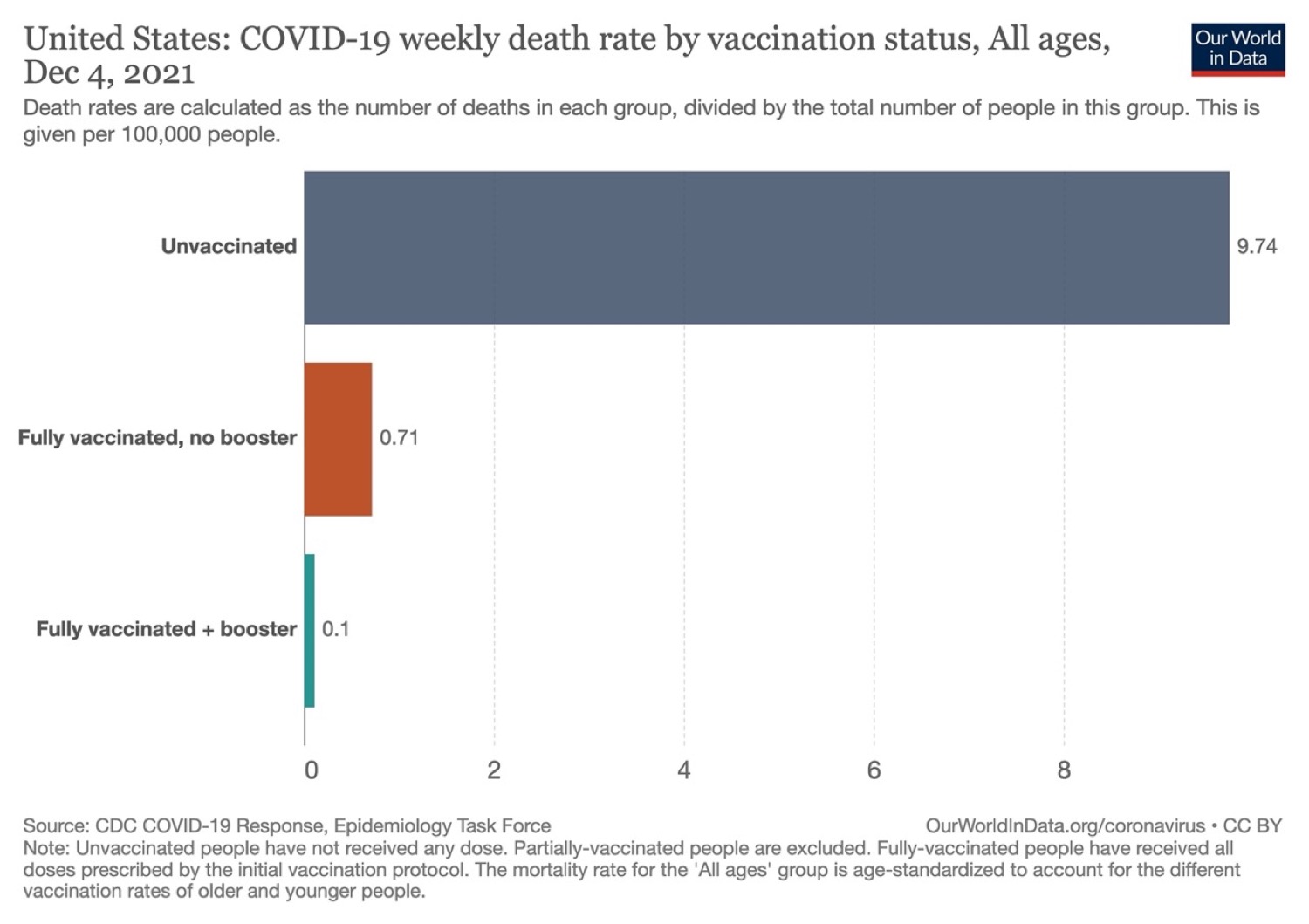
Author and physician Eric Topol made a chart using data from the CDC COVID-19 Response Epidemiology Task Force that shows how much more you are likely to die from Covd if you don't get vaccinated. @OurWorldinData redrew the chart to make it look prettier:
How to reduce your chance of dying from Covid by 99%?
Around one-third of the food produced globally every year never gets eaten. This waste often occurs along the supply chain before the food even reaches us. But consumers who throw away food because it’s gone bad, or because they think it may have gone bad, are also responsible for a large proportion of food waste.
All food production results in greenhouse gas emissions. So wasting food is not only bad for your pocket – it’s also bad for the environment.
Recently, Morrisons supermarket announced that it will move from putting “use by” to “best before” dates on milk. It says this could save seven million pints of its own-brand milk from being wasted each year.
According to British charity WRAP, milk is the third most wasted food item in the home (after potatoes and bread) with more than 490 million pints thrown away in the UK annually. So changing the advice to encourage people to keep their milk for longer is likely to be good for the planet. But is this move safe for consumers? The short answer is yes.
“Use by” is the date until which the manufacturers know the product will remain safe. This is based on scientific analysis which has determined how long a product can be stored before there’s a risk that any dangerous microbes could reach levels that will cause harm. You’ll see use-by dates on foods that can pose a danger if they’re stored too long, such as cooked meats and dairy products.
“Best before” relates to the quality of the product. This date tells you how long you can keep something before the product starts to taste less fresh, or decline in quality (for example, how long you can store bread before it gets a bit stale). But this doesn’t mean the product isn’t safe to eat after this date. You’re likely to see best-before dates on preserved products, such as tinned or frozen foods, which you can safely keep for a long time.
You might think milk should sit firmly in the “use by” category – it is a dairy product after all. But actually, shifting to a best-before date is safe for consumers, thanks to a process called pasteurisation. During pasteurisation, the milk is heated for a short time to a high temperature. This kills bacteria which can be present in raw milk and cause infections in humans (often called “pathogens”).
Although the pathogens are killed in this process, some non-harmful microbes remain in pasteurised milk. So milk is stored at a low temperature (in the fridge) to slow the growth of these remaining microbes. Nonetheless, they will still grow, and it’s the growth of these non-harmful bacteria that cause the milk to spoil. As the microbes grow they produce enzymes to help them break down the milk, which causes the milk to curdle and produces the “off” smell we associate with spoiled milk.
Notably, for pasteurised milk (and we need to be very clear that this ONLY applies to pasteurised milk) even when the milk starts to go off, there’s no evidence the microbes growing in the milk will cause you any serious harm. If you drink a significant amount of spoiled milk, you might find yourself with an upset stomach but there’s nothing to suggest spoiled milk causes infections or severe illness.
The best-before date is the manufacturers’ best estimate of how long the milk should last in the fridge before you can detect any spoilage, either by smell, taste or both. Every batch of pasteurised milk is different and will have more or less of these non-harmful bacteria remaining in it, so in reality the best-before date is an estimate of when the milk with the most bacteria left in it will spoil. But many batches of milk will be fine for much longer than this – hence Morrisons’ change in advice.
The sniff test
Morrisons have advised using the “sniff test” to see if the milk is safe to use. This is sensible advice. If there is no detectable evidence of spoilage, the milk is safe to drink.
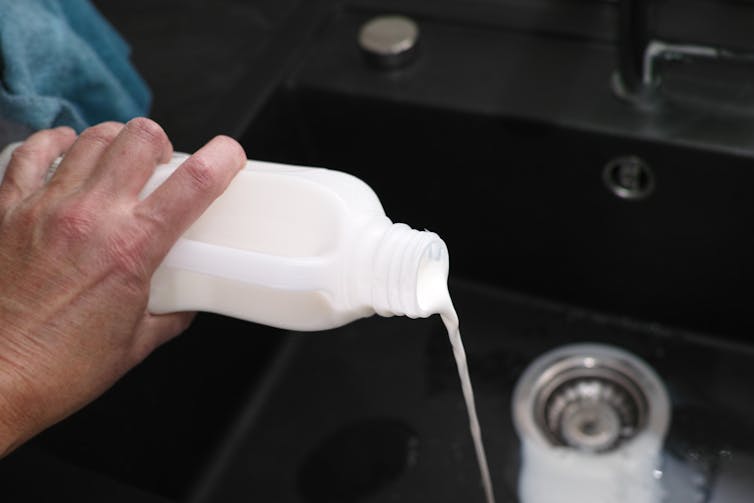
If you’ve lost your sense of smell, or don’t fancy sniffing the milk, simply pour some into a cup of boiling water as if you were making a cup of tea. If it curdles then it’s started to turn; if it mixes in normally it’s fine to use.
Should you throw milk away if its started to spoil? If you’re just using it for drinking, it’s probably not going to taste too good. But milk that’s starting to turn can be safely used as a substitute for buttermilk, yogurt or sour cream in recipes like rice pudding, pancakes and scones, or can be used to make cheese sauces.
Clearly if the milk has really spoiled (if it’s fully separated, cheesy and slimy), it should be thrown away.
Once again, this advice applies only to pasteurised milk. Raw milk can still contain pathogens and should never be consumed beyond the use-by date.
Also, because different foods naturally contain different types of microbes, this advice cannot be generalised. In other kinds of foods pathogens can reach dangerous levels without any real detectable evidence of spoilage. So generally, the advice is to stick to the use-by date.
But when it comes to pasteurised milk, we can balance expiry dates with our common sense, and reduce the impact of food waste on the planet.
Cath Rees does not work for, consult, own shares in or receive funding from any company or organisation that would benefit from this article, and has disclosed no relevant affiliations beyond their academic appointment.
HB 5 filed earlier this month aims to ban abortions after 15 weeks, completely ignoring legal precedent and the Supreme Court’s interpretation of the U.S. Constitution. CREATIVE COMMONS
The Florida House of Representatives had its first reading of HB 5 on Jan. 11. This bill — along with its Senate counterpart SB146 — would serve as a statewide abortion ban after 15 weeks of pregnancy.
HB 5 is an invasion of civil liberty and unjustly applies personal ideology to medical care. Florida constituents must implore their representatives to fight for American freedom.
The bill — filed by Representatives Erin Grall and Kelli Stargel — would ban abortion of a fetus over 15 weeks unless two doctors agree there is an abnormality fatal to the fetus or mother, similar to the Texas Heartbeat Bill passed in May 2021. There are no exceptions for rape or incest.
Roe v. Wade (1973) is the landmark Supreme Court decision regarding abortion, and the legal precedent for this debate. The court found the U.S. Constitution protects a woman’s right to have an abortion without excessive government restriction.
The court held that in most cases, restriction of abortion violates a person’s constitutional Right of Privacy, which is guaranteed by the Fourteenth Amendment.
As such, HB 5, while not outright banning abortion, encroaches on the decidedly constitutional right of a person to choose, and is an attempt to sidestep legal precedent and the court’s interpretation of The Constitution.
Supporters of this bill argue that it supports life, and that fetuses are aware and can feel pain.
“I have not seen that particular [bill], but obviously I’m supportive of 15 weeks. I think that’s very reasonable and I think that’s very consistent with being supportive of protecting life,” said Gov. Ron DeSantis in a Jan. 12 press conference.
The beginning of life is an ideological debate, and as such is difficult to apply to legislation without encroaching on the beliefs and personal freedoms of others.
The conclusion widely agreed upon in the medical community, stemming from a 2009 study by pediatric researchers Hugo Lagercrantz and Jean-Pierre Changeux, is that fetuses begin to gain consciousness as early as 24 weeks. This is also the current cutoff for abortions in Florida.
Medical legislation should be based in scientific research, not in the popular opinion of ideological debate.
As the constituents of Florida, it’s crucial that we reach out to our local representatives and speak out against the impediment of personal freedom in our state. Popular ideology cannot trump individual freedom.
Over 120,000 Japanese Americans, many of them American citizens, were incarcerated in U.S. concentration camps during World War II. The government's War Relocation Authority hired photographers to document the process in a way that masked this massively cruel act
Among the photographers was Dorothea Lange, who famously photographed migrant agriculture workers for the Farm Security Administration during the Great Depression. — Read the rest
Joslyn Diffenbaugh, an 8th-grade student from Kutztown, Pennsylvania started the Teen Banned Book Club to discuss books that have been banned by the local school district. Nine students attended the first meeting on January 12 at Firefly Bookstore in Kutztown. They discussed George Orwell's Animal Farm. — Read the rest
We're taking part in Copyright Week, a series of actions and discussions supporting key principles that should guide copyright policy. Every day this week, various groups are taking on different elements of copyright law and policy, addressing what's at stake and what we need to do to make sure that copyright promotes creativity and innovation.
In 2019, for the first time in 20 years, U.S. copyright law allowed formerly copyrighted works to join the public domain. Works in the public domain are no longer under copyright, and anyone can republish or use those works in whatever way they want. The public domain is the default home of all creative endeavors because culture isn’t owned by any single person or corporation—it’s shared.
This year, the public domain opened up to include works from 1926 and a whopping 400,000 sound recordings. Of course, the real fun is that the third Hercule Poirot novel by Agatha Christie, Ernest Hemingway’s The Sun Also Rises, and the original books of Winnie-the-Pooh and Bambi are now free for anyone to use.
In particular, the popular images of Winnie-the-Pooh and Bambi have been dominated by one rightsholder’s vision for a long time: Disney. And while Disney’s versions of those stories remain under copyright, their exclusive hold on two cornerstones of childhood has come to an end. This is a good thing—it lets those stories be reinterpreted and repurposed by people with different takes. We can all decide whether the Disney versions are the actual best ones or were simply the only ones.
Public domain works can be used for such lofty goals. Or they can simply be used for fun, allowing anyone to participate in a worldwide sport of joy. With so many more uses suddenly available to so many more people, we get a flood of works and get to choose which ones we love most. And, of course, we can try our hand at joining in.
Last year, the Great Gatsby was at the center of a flurry of internet jokes when it entered the public domain. Archive of Our Own, the award-winning fanfiction archive, suddenly found itself home to very lightly altered versions of F. Scott Fitzgerald’s famous work. Some replaced the characters in the original with those from other works, putting them in dialog with each other. One absolute internet genius replaced every use of “Gatsby” with “Gritty,” replacing a memetic capitalist played by Leonardo DiCaprio in a recent film adaptation with a memetic anti-capitalist puppet hockey mascot.
When people compete to top each other for the most creative, weird, or just funny use of a public domain work, we all win.
Wishcycling is putting something in the recycling bin and hoping it will be recycled, even if there is little evidence to confirm this assumption.
Hope is central to wishcycling. People may not be sure the system works, but they choose to believe that if they recycle an object, it will become a new product rather than being buried in a landfill, burned or dumped.
The U.S. recycling industry was launched in the 1970s in response to public concern over litter and waste. The growth of recycling and collection programs changed consumers’ view of waste: It didn’t seem entirely bad if it could lead to the creation of new products via recycling.
Pro-recycling messaging from governments, corporations and environmentalists promoted and reinforced recycling behavior. This was especially true for plastics that had resin identification codes inside a triangle of “chasing arrows,” indicating that the item was recyclable – even though that was usually far from the truth. In fact, only resins #1 (polyethylene terephthalate, or PET) and #2 (high-density polyethylene, or HDPE) are relatively easy to recycle and have viable markets. The others are hard to recycle, so some jurisdictions don’t even collect them.
The plastics industry developed codes in 1988 to identify categories of plastic resins that products were made from. Surrounding them with ‘chasing arrows’ wrongly suggested that they all were recyclable, when in fact many communities only processed the more common types. In 2013, the graphic was changed to a solid triangle.
iStock via Getty Images
The China scrap restrictions created enormous waste backups in the U.S., where governments had under-invested in recycling systems. Consumers saw that recycling was not as reliable or environmentally friendly as previously believed.
Contaminating the waste stream with material that is not actually recyclable makes the sorting process more costly because it requires extra labor. Wishcycling also damages sorting systems and equipment and depresses an already fragile trading market.
Many communities are trying to educate consumers about what not to recycle.
City of Asheville, N.C.
Huge waste management companies and small cities and towns have launched educational campaigns on this issue. Their mantra is “When in doubt, throw it out.” In other words, only place material that truly can be recycled in your bin. This message is hard for many environmentalists to hear, but it cuts costs for recyclers and local governments.
[Over 140,000 readers rely on The Conversation’s newsletters to understand the world.Sign up today.]
The authors do not work for, consult, own shares in or receive funding from any company or organisation that would benefit from this article, and have disclosed no relevant affiliations beyond their academic appointment.
by Barbara Harris Combs, Associate Professor of Sociology and Criminal Justice, Clark Atlanta University
Wanda Cooper-Jones, mother of Ahmaud Arbery, listens as attorneys speak outside the Glynn County Courthouse on July 17, 2020, in Brunswick, Georgia. Photo by Sean Rayford/Getty Images
The idea of community and who belongs and who does not was a common theme in the Jan. 7, 2022, sentencing hearing of three white men convicted of killing Ahmaud Arbery.
“They chose to target my son because they didn’t want him in their community,” said Arbery’s mother, Wanda Cooper-Jones, during the hearing. “When they couldn’t sufficiently scare him or intimidate him, they killed him.”
Arbery was the 25-year-old unarmed Black man who was shot to death on Feb. 23, 2020, while jogging through a predominantly white, middle-class neighborhood in Brunswick, Georgia. Race went largely unspoken throughout the trial, but the idea of belonging was clearly drawn in black and white.
As a professor of sociology and criminal justice at Clark and Atlanta University, I have witnessed and studied perfunctory Southern ways that are often referred to as Southern “gentility” and Southern “hospitality.” These “Southern” ways of knowing and being get presented as niceties, but they often serve to maintain the racial order of the past.
On their face, these common rituals – like waving to neighbors and strangers – brand the Southerner as gentler and kinder than others, closer to God, and perhaps even more patriotic. As practice, the actions tie people not only to the land, but to a culture.
That culture seems innocuous, innocent and friendly – but it is not. And the death of Ahmaud Arbery is a powerful example of how that gentility can camouflage deadly discrimination.
Racial reckoning
In a nation still reeling from the murder of George Floyd and other violent attacks on people of color, many breathed a momentary sigh of relief after Greg McMichael and his son Travis were sentenced to life in prison without the possibility of parole for Arbery’s murder.
McMichaels’ neighbor William “Roddie” Bryan was given life in prison with the chance of parole. He had filmed the cellphone video as Arbery fell dead in the street. A jury convicted the three in November of last year.
Before sentencing, Judge Timothy Walmsley paused for a minute of silence, which he later explained represented a fraction of the five minutes Arbery spent running from the three white men who chased him in pickup trucks on that Sunday afternoon.
“At a minimum,” Walmsley said, “Ahmaud Arbery’s death should force us to consider expanding our definition of what a neighbor may be and how we treat them. I argue that maybe a neighbor is more than the people who just own property around your house. …”
Judge Timothy Walmsley looks on during the trial last November of three white men convicted of murdering 25-year-old Ahmaud Arbery.
Photo by Octavio Jones-Pool/Getty Images
In a sense, Walmsley was asking those assembled in the courtroom and watching on television to put themselves in Arbery’s running shoes and imagine the sheer shock of discovering that Southern hospitality had a violent reality.
Terms commonly used among Southerners can likewise mean the opposite of how they sound.
Consider the “bless your heart” that is meant as anything but a blessing, and, in fact, is used as a heavy dose of sarcasm. Or the respectful and deferential, “Yes, ma’am,” “No, sir,” or other courtesy titles customarily given to whites and withheld from Blacks, irrespective of their age. W.E.B. Du Bois referred to this last practice as “the public and psychological wage of whiteness.” Du Bois was suggesting that even among low-wage white earners, the racial identity of whiteness paid dividends that people of color could not collect.
Simple Southern practices like waving to strangers are steeped with double meanings that work to preserve a de facto segregation.
Consider: There is an expected action-interaction order present in the deed of speaking or otherwise gesturing to strangers. The salutation itself is a performance of belonging in the space. A specific response is expected. It may be a nod of the head, tip of the hat, raised hand or a simple hello. The routine says, “I know the rules of engagement here, and I accept them. You want me to make you feel comfortable with my presence here, and I am willing to do that.”
Arbery did not engage the men or play the game of deference.
Race and public space
In “How Ingrained Racism Became Invisible,” I explain how place and where people belong and with whom is part of an often unspoken broader U.S. racial structure that positions whites on top and Blacks on the bottom.
In my larger body of research
I argue that despite advances by racial and ethnic minorities and other disadvantaged groups, vestiges of this American Jim Crow belief system still operate in society. This racial ideology may be more pronounced in some parts of the nation, like the U.S. South, but my research shows that this racial order is present above, below and across the Mason-Dixon Line.
That clearly was not the case with Arbery, who was Black and couldn’t claim that privilege.
A woman holds portraits of Ahmaud Arbery and George Floyd during an event in remembrance of George Floyd in Minneapolis, Minnesota, on May 23, 2021.
Photo by Kerem Yucel/AFP via Getty Images
Protecting the racial status quo
At sentencing, defense counsel continued to stress that the defendants had good intentions and simply wanted to support their community. In this telling of the story, the defendants were represented as good neighbors – hardworking individuals just looking out for one another. It was painted as the Southern way, and they were simply engaged in Southern hospitality.
But in the journal Study the South, Betsie Garner writes that Southern hospitality uses language and practices whose real purpose is “to exclude minorities and maintain their marginalized status in the community.”
Ahmaud Arbery’s sister didn’t mince words when she said she believed race – not self-defense – played a role in her brother’s shooting.
[Over 140,000 readers rely on The Conversation’s newsletters to understand the world.Sign up today.]
“Ahmaud had dark skin that glistened in the sunlight like gold. He had thick, coily hair and he would often like to twist it,” Jasmine Arbery said at the sentencing hearing. “He was tall, with an athletic build. These are the qualities that made these men assume that Ahmaud was a dangerous criminal.”
By all accounts, Arbery was not a dangerous criminal. But in the eyes of three white vigilantes, Arbery was clearly not their neighbor.
Barbara Harris Combs has received funding from UNCF/Mellon and the James Weldon Johnson Institute for the Study of Race and Difference at Emory University.
A group of researchers say Pluto was unfairly maligned by a decision to relegate it to "dwarf planet" status — and that we should consider our solar system to have more than 150 planets.
Part of the argument for classifying Pluto as a planetoid or dwarf planet was that there were many similar bodies orbiting the sun waiting to be discovered, and we'd end up with hundreds of planets. — Read the rest
A new year is upon us and, while 2021 proved that a new year doesn’t mean a fresh start, it is still an opportunity to both reflect on the past and look ahead.
To that end, 2022 is looking to be a major year for copyright in a myriad of ways. However, in pretty much all the cases below, the table was set for them in years past.
But that raises the question, with the new year what are just a handful of the major copyright stories on the horizon. While there are far too many for any single list, here are 5 copyright stories that you should definitely watch in 2022.
The idea behind the CCB is simple, it’s meant to be a cheap and easy way to handle copyright disputes over small dollar amounts. To achieve that, the process is meant to be accessible without an attorney and is done remotely. However, damages are limited to just $30,000 per case.
According to the USCO, the CCB should be up and running some time in the first half of this year. However, many questions still remain regarding it. How much use will it see? Will defendants agree to use it since it is optional? Exactly how will the process work?
With every audio track, there are two copyrights, a copyright in the audio recording itself and a copyright in the composition behind it. Musicians receive royalties from both via their record labels and publishers. However, Spotify (nor other streaming services) have been paying royalties on the composition for comedy and other spoken word tracks.
However, a new performing rights organization, Spoken Giants, is aiming to change that and has been negotiating with streaming services to reach a deal on royalties. That has not happened yet as of this writing.
Spotify, in response to the lack of an agreement, removed the tracks of many of the comedians involved. Other streamers, such as Apple and Google, have the tracks still up as negotiations continue. A resolution on this issue is likely to come about in 2022, possibly creating a landscape shift for comedians and other spoken word artists.
3: Copyright and the Takings Clause
One of the more confusing areas of copyright law in the United States is how it impacts states. Under the current law, all copyright matters are federal. However, because of state sovereign immunity, it’s technically not possible to sue a state government or any of their components in a federal court.
This came to a head in 2017 when the filmmaker Rick Allen sued the State of North Carolina over alleged illegal copying of footage he shot of Blackbeard’s sunken ship. Allen lost that lawsuit last year when the Supreme Court ruled against him, saying that Congress had overstepped its bounds when trying to abrogate state sovereign immunity.
However, that ended up not being the end of the issue. The district court is allowing Allen to try again, this time pursuing the case under the takings clause, which prevents states from taking citizens’ property without proper compensation.
Several such cases are going on right now and, though we likely won’t see a definitive answer in 2022, it’s going to be a copyright story to watch.
4: The Unicolors Case
Unicolors is locked in a long-running case against fashion retailer H&M. According to Unicolors, the retailers infringed on one of their designs and sold various goods with it. Though the infringement isn’t in question, the copyright registration is.
In the United States, a copyright registration is required before a lawsuit can begin. However, H&M alleges that the registration contained an error, namely that it was included in a collective registration when it should have been separate. A ruling at the 9th Circuit put the lower court victory, and $800,000 in damages, in jeopardy, prompting Unicolors to petition the Supreme Court.
The Supreme Court took the case and is scheduled to rule this year on whether an innocent error in a copyright registration can or should result in the case being dismissed.
5: The Public Domain Expands
Finally, with the new year comes new works that lapse into the public domain.
Due to the Sony Bono Copyright Term Extension Act in 1998, nothing entered into the public domain in the United States between 1999 and 2019. However, for the first few years of new public domain action, very little that is still culturally relevant has lapsed.
Winnie the Pooh is unique in that, even though the character was not originally a Disney character, it’s become wholly identified with Disney. Disney has produced countless movies based on the character and, though the copyright in Disney’s works remains, others will be free to adapt the original story.
It will be interesting to see if and how this changes both Disney and the public’s relationship with the iconic character as access to the original story begins to open up. It will also be a test for the impending lapse of Steamboat Willie, Mickey Mouse’s original cartoon, in a few years.
Bottom Line
It’s pretty clear that this will be a major year for copyright. The CCB alone has the potential to be a major ground shift in this area, but the other stories will continue to shift and change the landscape on their own.
So keep an eye on these and other important copyright stories. As with previous years, I’ll be covering them four times per week in the 3 Count column as well as in full posts right here.
So, if you haven’t done so yet, take a moment to either follow this site on social media or sign up for the newsletter using the links in the sidebar. This is definitely going to be a year that you don’t want to miss.
On January 1, 2022, works that were first published in the year 1926 lapsed into the public domain. Though the list of works that includes is long, some bigger names include Ernest Hemingway’s The Sun Also Rises and Dorothy Parker’s Enough Rope.
However, the name that’s received the lion’s share of the attention has been A.A. Milne’s original Winnie-the-Pooh story.
The reason for the attention is pretty obvious. Disney acquired the rights to the book and its characters in 1961 and, since then, has released a steady stream of movies, TV shows and products featuring the book’s cast of characters.
Because of this, Winnie-the-Pooh is one of the most recognizable cartoon characters in the world. Disney’s animated works are still being heavily enjoyed today by adults and children alike and the character has even found itself in international news as a way for bloggers to troll Chinese President Xi Jinping.
Winnie-the-Pooh is likely the most culturally relevant character to enter the public domain since 2019, when works started entering the public domain again in the United States due to the Sonny Bono Copyright Term Extension Act. This has raised widespread speculation as to what this means for Disney and the character’s future.
However, while some headlines sure make it seem like the situation is pretty dire for Disney, the truth is that not a lot changed on New Year’s Day and Disney probably doesn’t have that much to fear from what did.
What Actually Happened
Under U.S. copyright law, works of corporate or pseudonymous authorship lapse into the public domain after either 95 years from first publication or 120 years after creation, whichever ends first.
What this means is that the Milne’s original Winnie-the-Pooh book is now free of copyright. This means that others are free to copy, publish, distribute, create new works based upon it and otherwise make use of it without a license. That is, potentially, a big deal in many ways.
It means that, for example, if a company other than Disney wanted to make their own animated adaptation of the work, they could. Anyone could also publish their own version of the book, either with the original art or new art that they created.
However, the freedom only extends to that particular book and that which is contained in it.
Perhaps more importantly, this lapse does not impact any of Disney’s works. Disney did not release its first animated work based on the character until 1966, meaning that there are still four decades of copyright protection left on those.
Disney’s works and Disney’s versions of the characters are still very much protected and those that seek to exploit Winnie-the-Pooh will need to be careful to avoid those interpretations. The easiest way to do that would be to stick to the original work.
However, most people aren’t going to have a strong connection with that original work. The characters, in particular the line art drawings, look very little like the versions we know today and, though the book is still popular, it is far less recognizable than the Disney works.
For Disney, very little changes other than the prospect of competing adaptations of the original work. However, that’s something that I doubt they fear.
However, if you watch the commercial, it is limited to what is in that original book. It uses the art style and the meter of the original work, as well as the designs of characters from that book. Though it’s seen as a jab at Disney, it doesn’t actually use anything that Disney created.
Still, creations like this as well as fresh adaptations of the original work are possible now. Also, as the later books lapse into the public domain over the coming years, they too can be adapted similarly.
As a result, 2022 may not be much of a revolution for the character but, as the decade rolls along, we may see more adaptations of those work.
Some of those, like Reynolds, will be for comedy or novelty, but others may be more straightforward. Only time will tell.
Bottom Line
Disney is probably not worried about this work lapsing into the public domain. Their versions of the character are still very protected and what one can do with the characters in the story is very limited.
That said, this is something of a canary in the coal mine. In 2024, the cartoon Steamboat Willie will enter the public domain. That was the first appearance of Mickey Mouse. As important as Winnie-the-Pooh is to Disney, Mickey is an even bigger deal.
Disney and others will be watching over the next few years to see what the practical impacts of this transition are for Winnie-the-Pooh as a sign for what may happen in two years.
It will be interesting to see, that much is certain.