I remember having a conversation with a classmate of mine during my freshman year of college. I was trying to make small talk and being the socially awkward nerd that […]
Florida is home to a growing black bear population that has increased over 50% in the past decade. To ensure safety for both wildlife populations and Florida residents, the FWC is looking for bear response contractors to assist in bear encounters and research.
Black bears are one of the most incredible animals you can find in the wild in Florida. These magnificent creatures live in the forests and state parks of Florida, and in most cases are completely harmless. However, caution must be taken when interacting with a bear for any reason, as they have the capability to harm people and pets when feeling threatened.
Black bears are typically not a problem for Florida residents, but the FWC still invests in conservation and safety measures to maintain a healthy relationship between wildlife and human populations in Florida. In order to do so, they employ a sector of the population to act as Bear Response COntractors on an as-needed basis to handle bear sightings, resident calls, and more.
In recent years, Florida has seen a dramatic increase in bear populations across North, Central, and the Panhandle of Florida. From 2002 to 2015, population increases have been reported as follows:
West Panhandle – 120 bears (50% increase)
East Panhandle – 1,060 bears (86% increase)
North – 500 bears (92% increase)
Central – 1,200 bears (17% increase)
Statewide Total – 4,050 (53% increase)
What are bear response contractors?
Photo courtesy FWC.
If you are interested in learning more about this incredible animal and helping people avoid conflicts with black bears in state arks and their private property, you might be a great fit as a bear response contractor for the Florida Fish and Wildlife Conservation Commission (FWC).
Bear response contractors will be trained to assist with various bear conservation efforts, including but not limited to:
Helping residents and businesses avoid conflicts with bears
Collecting information from and disposing of dead bears
Setting and monitoring bear traps
The FWC is looking for part-time contractors to help respond to human-bear conflicts in Bay, Escambia, Gulf, Highlands, Lake, Marion, Okaloosa, Orange, Santa Rosa, Seminole, Volusia and Walton counties. Bear contractors will work on an “as needed” basis, which can vary by season, area and year. Contractors are paid per activity rather than hourly.
Interested individuals must be willing to work flexible hours, including nights, weekends, or holidays; use their own vehicle; have the ability to haul a small trailer and secure their own general liability insurance, which can cost $300 to $1,000 per year.
People interested in becoming a contractor should send their resume, contact information, counties of interest and three professional references to BearManagement@MyFWC.com or FWC, Bear Management Program, 620 S. Meridian St. 6A, Tallahassee, FL 32399.
This poses a wonderful opportunity for nature enthusiasts to connect to their local wildlife and help the FWC keep both Floridians and the black bear population safe. For more information on the FWC’s Florida Black Bear Management Program and the bear response contractor program, visit MyFWC.com/Bear.
by Owen Greene, Professor of International Security and Development, University of Bradford
Sweden’s application to join Nato in May marks a major shift away from its longstanding position as a neutral state, stretching back to 1812.
Yet following Russia’s invasion of Ukraine, the decision now appears to command wide political support across the Swedish government, parliament and population. Swedish public support for Nato membership has gradually increased over the last decade, with 58% now in favour and only 19% opposed. The major Swedish political parties all decided to support the membership application, too.
Sweden’s neutrality began after a disastrous loss of territory to Russia during the Napoleonic wars in 1812, and this security policy later enabled it to distance itself from the shifting military alliances in Europe during the 19th century. During the 20th century, Sweden’s neutrality developed into an active internationalist foreign policy promoting international peace and security through diplomacy, cooperative security arrangements and international organisations.
Throughout the cold war, Sweden used its neutral position to moderate the confrontation between the east-west blocs; while aligning itself clearly with support for democracy, human rights and liberal market systems. After the cold war ended, Sweden energetically supported efforts to develop a new co-operative European security order centred around rules on conflict prevention and respect for national sovereignty and national borders, as embedded in the agreements established by the Organisation for Security and Cooperation in Europe.
Within this framework, Sweden aimed not only to enhance its own security but also the security of the Nordic and Baltic Sea regions. This included the newly independent states of Estonia, Latvia and Lithuania, with which Sweden has strong cultural, social and political affiliations.
Russia’s increasingly assertive foreign and security policy under President Vladimir Putin since 2004 posed increasing challenges to these objectives. Although Sweden has not been a prominent focus for Russian government pressure and provocations, Estonia, Latvia and Lithuania definitely have. They became regular targets of cyberwarfare and military incidents with Russian forces on their borders. Russia’s 2008 military intervention in Georgia intensified Baltic security fears that their neighbour might also intervene in their territory, and Sweden and Finland inevitably followed those security debates closely.
From 2008 onwards, Sweden discovered covert Russian submarine operations within its territorial waters in the Baltic Sea. It became frustrated that these incidents continued despite making diplomatic protests to Russia. In response, Sweden reversed the winding down of its anti-submarine warfare capabilities, and imposed strong restrictions on Russian commercial activities on Gotland and other Swedish islands.
The 2014 Russian annexation of Crimea and intervention in the eastern Donbas region of Ukraine confirmed that Russia no longer accepted previous agreed national boundaries. It also strengthened the arguments within Sweden and Finland that Russian military activities in the Baltic Sea might signal preparations for an intervention into one or more of the Baltic states.
Neutral states know that they cannot rely on allies for military assistance. So they invest relatively heavily in defence. For example, Sweden and Finland, which applied at the same time to join Nato, maintain strong territorial defence forces and are well-equipped with relatively advanced weapons systems. As EU members, both countries became relaxed about interpretations of their neutrality, in the sense that they went along with the development of EU common foreign and security policy including elements of defence cooperation.
Defences added
After Russia’s 2014 interventions in Ukraine, Sweden recognised that it would need military cooperation and assistance from other states to realistically prepare for a possible Russian move in the Baltic Sea area. Sweden started cooperating closely on military matters with Finland, while also increasing Nordic defence co-operation with (Nato members) Denmark and Norway.
As EU members, Sweden and Finland could also make use of defence co-operation arrangements, though these were recognised to be inadequate for serious defence and deterrence against Russia. So they also quietly but rapidly developed defence ties with the US and UK. In May 2018, for instance, Sweden, Finland and the US signed a statement of intent to develop close co-operation on military exercises and inter-operabiity and defence readiness.
In another significant move Sweden reintroduced military conscription in January 2018, and its October 2020 defence bill included substantial increases in military spending. It also reintroduced a garrison on Gotland because of its strategic position in the Baltic Sea.
None of these developments implied that Sweden (or Finland) had plans by 2021 to join Nato – on the contrary, public debates on this issue were completely unresolved. But they provided a context for them to rapidly establish shared understandings of the implications of the Russian invasion of Ukraine in February 2022.
After Swedish public opinion on Nato membership shifted decisively, the government and interested parliamentarians could quickly recognise that Nato membership was a logical next step. The governments of Sweden and Finland co-ordinated closely on the timing of their applications to join Nato, to avoid risks of political isolation and reflect their defence co-operation. Strong Russian objections were anticipated but judged to be manageable, particularly if both countries acted together.
Sweden and Finland each bring substantial military capabilities as well as political strengths to Nato, and it is very likely that their membership applications will be accepted reasonably smoothly, despite initial Turkish objections. Their membership will strengthen both Nato and its focus on security and deterrence in the Baltic region.
In the medium to long term, it can be expected to add to Nato debates about the roles and deployments of nuclear weapons, because both countries have traditionally supported nuclear disarmament. But in the next few years, the issues of Russia’s war against Ukraine and the defence and security of the Baltic states are likely to dominate Nato and Swedish defence agendas.
Owen Greene has in the past received multiple grants and other funding from the ministries and agencies of the Swedish government, including from the Swedish International Development Agency. No such funding has been received in the last five years.
An extraordinary type of bird found only in the Sunshine State may be exemplary models when it comes to the importance of two things that are vital to longterm health and happiness among humans: family time and socializing with others. Researchers from the Archbold Biologoical Station in Florida recently studied the Florida scrub jay. They made some fascinating discoveries about their unique, human-like behavior.
Learning about the Florida scrub jay
Courtesy of MyFWC
These beautiful blue birds are naturally monogamous creatures that like to settle down with one mate and raise a family. In most bird species, once the kids are old enough they leave the nest in pursuit of their own procreation. Scrub jays, however, are unique. Some recently-matured scrub jays actually put off “moving out” and looking for their own mate to help out at home. Especially if their mom and dad still need some help taking care of their younger siblings. These stay-at-home older siblings are referred to as “helpers” by researchers. They put off their search for a mate while many of their peers around the same age without younger siblings leave the nest and spend the majority of their time in pursuit of a mate and nest of their own. These scrub jays with reproduction on the mind are referred to as “breeders.”
Despite the fact that helpers are stuck living at home, they nonetheless intend to find a mate eventually. So, helpers tend to cast a wider net in their interactions and movements in comparison to breeders who usually focus on building their own new nest and finding a mate close by.
“If helpers want to become breeders, they need their own territory and mate. In addition to helping their parents, they make forays away from home, presumably looking for available territories and potential mates. This increases the number of other birds that helpers associate with and the helpers’ importance in connecting individuals with one another,” explains lead author Dr. Angela Tringali, of the Archbold Biological Station, in a media release.
According to the research team, helpers usually know 38% more individual “associates” than breeders, and breeders are 48% more “cliquish.”
The study’s authors examined the social lives and behaviors of Florida scrub jays in 2018, a year that for whatever reason, saw these birds have unusually low reproductive success. Many breeders ended up not nesting at all that year, and the ones that did began later than normal. Here’s where things get interesting: due to this lack of reproductive success, breeders in 2018 started socializing more often with more birds, acting essentially like helpers. The breeders didn’t have any young to care for, or in many cases a nest at all. Instead they decided to socialize more outside of their immediate circle.
This behavior, researchers say, indicates that socializing is important to scrub jays beyond just a means to biological end. In summation, these observations have led the research team to conclude that many scrub jay breeders would like to socialize just as much helpers. But they just don’t have the time most years.
Courtesy of MyFWC
“We have tended to frame foray behavior strictly as a strategy for finding a territory or mate, but this analysis demonstrates that when not tending an active nest, breeders also will foray beyond their territories. Maintaining extra-group relationships may reduce the costs of territory defense, predation risk, or the time spent in vigilance, and enhance knowledge of the status of neighboring territories,” comments Dr. Reed Bowman, Research Director of the Avian Ecology Program at Archbold.
Researchers admit that their observations in 2018 were a bit hindered, consisting of “snapshots in time” taken during bi-weekly visits to scrub jay territory in Florida. Moving forward, they would like to get a more complete idea of the birds’ interaction patterns.
“We are completing a pilot project tracking scrub-jays tagged with a new technology of transmitters whose signals are received by a grid of receivers. We will know the exact location of multiple scrub-jays throughout the day, which will enable us to answer questions about social interactions in more detail and better understand habitat use, movement, and dispersal,” Dr. Bowman says.
by Stefan Wolff, Professor of International Security, University of Birmingham
As the war in Ukraine heads into its fourth month, its economic consequences are becoming more apparent and begin to move up on the global political agendas. And in the same way in which Russia’s aggression has had political ramifications far beyond Ukraine, so do the economic repercussions. This is not to belittle the economic and infrastructural devastation of Ukraine, which will necessitate an enormous reconstruction effort, but to highlight the far-reaching impact of the war and how it is amplified by the global economic dynamics associated with it.
Some predictions anticipate Ukraine’s GDP in 2022 shrinking by between 30% and 45%. While an end to the war would reverse this negative trend, extensive damage to Ukraine’s infrastructure – estimated at close to US£80bn by early May – will slow the country’s recovery, regardless of how well and by whom it will be financed.
Similarly, a ceasefire or peace agreement may stop the exodus of Ukrainians from their homeland, but a swift return of the currently more than 6 million refugees, and around 8 million internally displaced people, will take time. Among those who return, many of them will not find their homes or jobs or any operational public services. Add to this the high casualty rates that Ukraine is suffering in the war and the trauma inflicted on the population at large, and it becomes clear that the country will also be depleted of significant human capacity needed for economic recovery.
Beyond Ukraine, the war has already led to gloomy predictions about a slowdown of the global economy, and possibly a recession. This is primarily driven by the surge in the price of oil and gas and the instability in international markets since the start of the war as well as the lack of certainty about how and when it will end.
Wide-ranging food crisis
The other global economic fallout from the war in Ukraine is a major food crisis affecting many of the world’s most vulnerable populations. Ukraine is a major exporter of agricultural products, especially sunflower oil and wheat, but key export routes, through the country’s Black Sea ports, are now blocked because of a de-facto Russian naval blockade.
In addition, there have been reports that Russia, itself a major exporter of wheat, has stolen approximately 400,000 tons of grain from storage facilities in Ukraine. But it is not simply the current lack of Ukrainian agricultural products that contributes to the impending global food crisis, it is also a market expectation that this will continue, with the upcoming harvest in Ukraine greatly reduced. This is driving prices up for grain and cooking oil, making imports less affordable in poorer countries and contributing, together with rising energy prices, to a cost-of-living crisis even in rich economies, thereby further increasing the likelihood of a global recession.
The possibility of a prolonged global recession rather than the expected rapid post-pandemic recovery will have additional repercussions for global political stability. This is, of course, not entirely due to the war in Ukraine, but the consequences of the war have a potentially catalytic and exacerbating effect on already existing economic and political problems.
Among them, western economic sanctions on Russia, and secondary sanctions on companies and countries circumventing these sanctions, will go some way in decoupling major economies and scaling back the current level of globalisation, leading to a degree of long-term structural change in the global economy.
This is evident in the impending EU ban on oil imports from Russia and efforts to stop using Russian natural gas. At the same time, a large – and growing – number of western companies are leaving the Russian market.
Future US-China relations
Equally, if not more importantly, the war in Ukraine is also likely to accelerate the decoupling of the Chinese and US economies. One of the lessons China is learning from the western response to the war in Ukraine is the relative ease with which nearly half of Russia’s US$630 billion (£500bn) in foreign exchange and gold reserves have been frozen by sanctions from the US, EU, and their allies. In future, China will be more wary about having dollar reserves held abroad that could potentially be seized in this kind of manoeuvre.
This changing relationship would have an even more significant impact, further increasing an existing trend in which geo-economic and geopolitical developments are becoming more and more aligned and pitting the US and China against each other in a new global struggle for supremacy.
The speed with which this trend of US-China decoupling will continue, and whether it might be reversed, will depend, among other things, on how – and how quickly – the war in Ukraine comes to an end. The longer the war goes on and the less likely a negotiated outcome is, the more economic divisions will align with political ones and the more deeply divided will be the new European and global security order that eventually emerges.
It will be critical in this context how China will act and whether it will prioritise its economic interests (continuing trade with Europe and the US) or current ideological preferences (an alliance with Russia that makes the world safe for autocracies). If China manages to forge a solid alliance with Brazil, Russia, India and South Africa, known as the Brics countries, as envisioned by the Chinese foreign minister, Wang Yi, a new world order will have emerged.
Stefan Wolff receives funding from the United States Institute of Peace. He is a past recipient of grants from the Economic and Social Research Council of the UK, the British Academy, the NATO Science for Peace Programme, the EU Framework Programmes 6 and 7 and Horizon 2020, as well as the EU's Jean Monnet Programme. He is a Senior Research Fellow of the Foreign Policy Centre in London and Co-Coordinator of the OSCE Network of Think Tanks and Academic Institutions.
Tatyana Malyarenko receives funding from the Erasmus+ Programme of the European Union
With the Biden administration under fire for inflated gas prices, Americans need to turn blame to the real perpetrators of this issue: energy companies. SPECIAL TO THE ORACLE/PIQSELS
National gas prices are the highest they’ve been since the 2008 recession, accounting for inflation, reaching $4.30 per gallon on average, according to the U.S. Energy Information Administration. Consumers are ablaze, often placing sole blame on federal leadership, ignoring other responsible parties.
You may have seen the stickers at the gas pump with President Joe Biden pointing a finger at the price screen followed by text stating “I did that!” Then there’s the tweets, thousands of angry consumers arguing over whether or not the president is to blame for rising gas.
Biden’s misstep at a May 23 press conference in Japan, wherein he claimed the rising gas prices were a part of an “incredible transition” away from fossil fuels, only fanned the flame. Biden quickly backpedaled, but the damage was done.
Texas Sen. Ted Cruz took to Sean Hannity’s show on Monday night to voice his, and others, contempt for this comment. He claimed Biden wants Americans to get rid of their pickup trucks and minivans in favor of Priuses and Teslas.
While Biden’s administrative choices to shift from fossil fuels to green energy have impacted gas prices, he is not the sole responsible party in the up in price. Consumers must also turn a critical eye to the energy companies directly benefiting from huge per-gallon sums.
The global cost of gas per gallon is an average of about $5.13 in U.S. dollars, 16% higher than in the states alone, according to Global Petrol Prices. The U.S. is not suffering price hikes alone, so national government can’t be the only factor.
The slowed oil production by COVID-19 and Russia’s invasion of Ukraine have both contributed considerably to increased gas prices, according to a May 2022 Kiplinger report.
Despite these setbacks and the crushing prices for consumers, energy companies seem unmoved to make haste in increasing production, thus continuing the increase in gas prices.
Oil companies are slowly drilling more wells and working new rigs, but they’re also limiting how much they invest in new production so they can reward investors with larger dividends and stock purchases, according to the Kiplinger report.
In the first three months of the year, Chevron’s profits rose 33%, Shell’s jumped 42% and British Petroleum’s soared 51% as compared to the last three months of 2021, according to a May 2022 CBS News report.
“Oil companies are making a lot of money by going along for the ride. They’re selling their oil at the market price,” Berkely economist Severin Borenstein said in the report.
Energy companies are drawing out the price hike, crushing consumers to increase profit margins.
Despite Biden’s shortcomings, he is passing policies to limit the swelling of gas prices. The Consumer Fuel Price Gouging Prevention Act passed in the House with a vote of 217-207 on May 19, seeking to lower gas prices by cracking down on price gouging of gas.
No Republican supported the bill, so it’s likely to fail in the Senate.
Making gas prices a purely partisan issue is counterintuitive. It prevents effective conversation and policy to resolve the issue. Instead, consumers and politicians should turn a critical eye to those directly benefiting from the increase to demand incremental change.
by Alda Balthrop-Lewis, Research Fellow, Australian Catholic University
Eleanor Phillips/Unsplash
Australians have just decided another “climate election”. What this meant, basically, was that we had to choose between two difficult futures. The result has yielded a new mandate for meaningful work on climate policy.
“Liberal democracies” are facing some of the deepest challenges they have yet encountered in their relatively short histories. Historic carbon emissions from the richest countries – especially the nation of my birth, the United States – warm our Earth, making life difficult for us and for all things. Many species have gone extinct. Many peoples have lost their homelands. Australia has endured droughts and fires and floods.
In democracies like ours, in elections like the one we have just witnessed, politicians often frame environmental questions as a competition between two values: ecology and economy.
On the one hand, they tell us, they know that ecological flourishing is vital to society. They do their best to contribute to sustainability. They nurture green cities and promote environmental reform. On the other hand, they say, we are also reliant on a flourishing economy. Without the economic system in which we all work and exchange goods, we would not eat or find shelter.
They are not wrong. Both a flourishing ecology and a healthy economy are required for liveable human society.
But in framing ecology and economy as competing values, and all environmental questions as requiring trade-offs between them, contemporary politicians depart from older, more holistic ways of thinking about the well-being of our communities. Some of these ways of thinking do not position economy and ecology as competitive.
In Australia, of course, some of those more holistic ways of thinking include vital Indigenous knowledges about living connected to Country. In addition, there are traditions of dissent from the competitive paradigm among some environmental thinkers within European and American culture.
Thoreau was famous among his contemporaries for his love of animals. One early biographer was Edward Waldo Emerson, son of the essayist Ralph Waldo Emerson, who had known Thoreau when he was a child. Emerson observed that Thoreau “felt real respect for the personality and character of animals”.
This was true to the extent that he made friends with them. Frederick L.H. Willis visited Thoreau in Walden Woods in July 1847:
Thoreau said: “keep very still and I will show you my family”. Stepping quickly outside the cabin door, he gave a low curious whistle; immediately a woodchuck came running towards him […] With still another note several birds, including two crows, flew towards him, one of the crows nestling upon his shoulder […] He fed them all from his hand […] and then dismissed them by a different whistling, always strange and low and short, each little wild thing departing instantly at hearing its special signal.
Generalising from Thoreau’s love of animals, Edward Emerson also wrote:
For all life he had reverence, and just where the limits of conscious life began and ended he was too wise, and too hopeful, to say.
“Ecology” is a word that was invented after Thoreau, a word that points to the relationships among living organisms and the places they live. But the idea it describes – the concept of an interactive whole, the fabric of life itself – was intuitive to him.
Some strands of Western science have divorced humans from other living things in a dualistic, anthropocentric worldview. But in Thoreau’s vision, human and more-than-human sociality were integral to a full description of ecology.
Henry David Thoreau (1817-1862), photographed in 1861.
Public domain
Walden Woods is often thought of as a lonely wilderness. Many interpreters of Thoreau’s work have assumed that he went there in an individualist gesture of resistance to social life.
My research suggests Walden Woods was an alternative society. The 20th-century reception of Walden, indebted as it was to cultures of white supremacy, neglected the area’s wider communities and other forms of sociality.
A focus on white histories throughout the 20th century obscured a key fact about Walden Woods: it had been a site of human society before Thoreau arrived. In the generation before Thoreau, as he recounts in Walden, a group of formerly enslaved people made their lives independently on the shores of Walden Pond, establishing a community that endured for about four decades.
Elise Lemire has written the most in-depth account, Black Walden (2009). She suggests that those people chose the site for reasons that aligned with Thoreau’s: it was at some remove from Concord society, which protected them from harassment to a certain extent, and the forest gave them good access to the natural resources they required to live independently.
One of their number, Brister Freeman, cultivated a chestnut orchard, planning to grow old in Walden Woods and live on its produce.
Such acts of independence took their significance from the unjust economies that were their contexts. Members of the Walden community built admirable lives, claiming their freedom within a culture that had stolen their labour for too long.
As Donald Worster has shown in Nature’s Economy: A History of Ecological Ideas (1994), the concepts “economy” and “ecology” have a deeply entangled history. Before ecology had a name (the first appearance of the term was in 1866), it was sometimes called “the economy of nature”.
Thoreau’s retreat to the woods was his way of joining an alternative economy, nature’s economy, in response to the dysfunctional economic forces – including slavery – that he saw pressing down on him, his townsmen, and his nation more broadly.
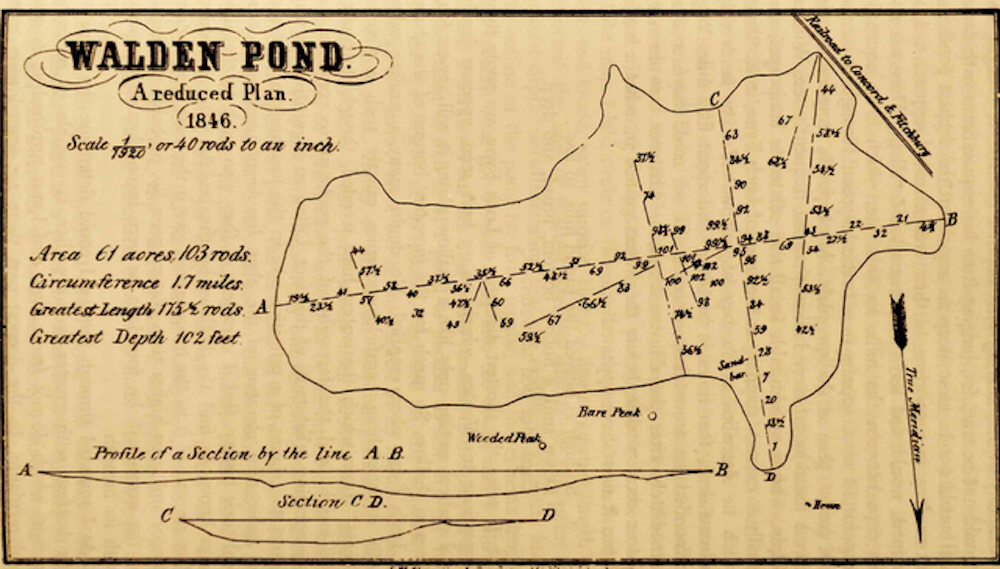
Thoreau’s map of Walden Pond.
Wikimedia commons
He says as much in Walden. While Thoreau is well known as a committed naturalist, his most famous book begins with a very long chapter titled “Economy”. You wouldn’t know it from popular understandings of Walden, which imagine Thoreau as a crank avoiding his responsibilities, but the whole book was motivated by distress over the various ways that contemporary economies were bad for people.
It is not a surprise that readers miss this – the opening chapter is long and sometimes boring on purpose. It includes lists of costs that Stanley Cavell read as jokes, but are easy to take too seriously. One teacher I know tells students that they can just skip “Economy” for the second introduction, the less cranky and more succinct “Where I Lived, and What I Lived For”.
Why did Thoreau care about economy?
Eight years before moving to Walden Woods, Thoreau graduated from Harvard College during a devastating economic depression. The panic of 1837 was the worst financial crisis the United States had yet encountered in its short life.
The settler colonial expansion of the young nation into the west had created a real estate bubble that burst in May, and property values collapsed. Factories closed; people were cold and hungry; there were riots in the streets.
Because Thoreau ranked 19th out of 41 students graduating that year, he was a speaker at commencement in June. His assigned topic, during this financial crash, was “The Commercial Spirit of Modern Times, considered in its Influence on the Moral Character of a Nation”. As Laura Dassow Walls writes in her beautiful biography, Thoreau argued that “commerce destroys moral freedom”. He suggested that the commercial spirit sprang from “an unmanly love of wealth”.
In the eight years following his graduation, Thoreau struggled to make a living. It was this economic context, and his personal experience of work and debt, that drove him to Walden Pond. He wanted to be an author. He had a longstanding unfulfilled ambition to write a book. He built the cheapest house he could knock together, on land that wasn’t his, in order to follow his dream, despite the punishing economic conditions.
Thoreau thought that his example could set other people free. It might encourage them to resist an unjust economy and follow the promptings of their own genius. He wrote Walden to show readers that a tenderer economy might be better for us.
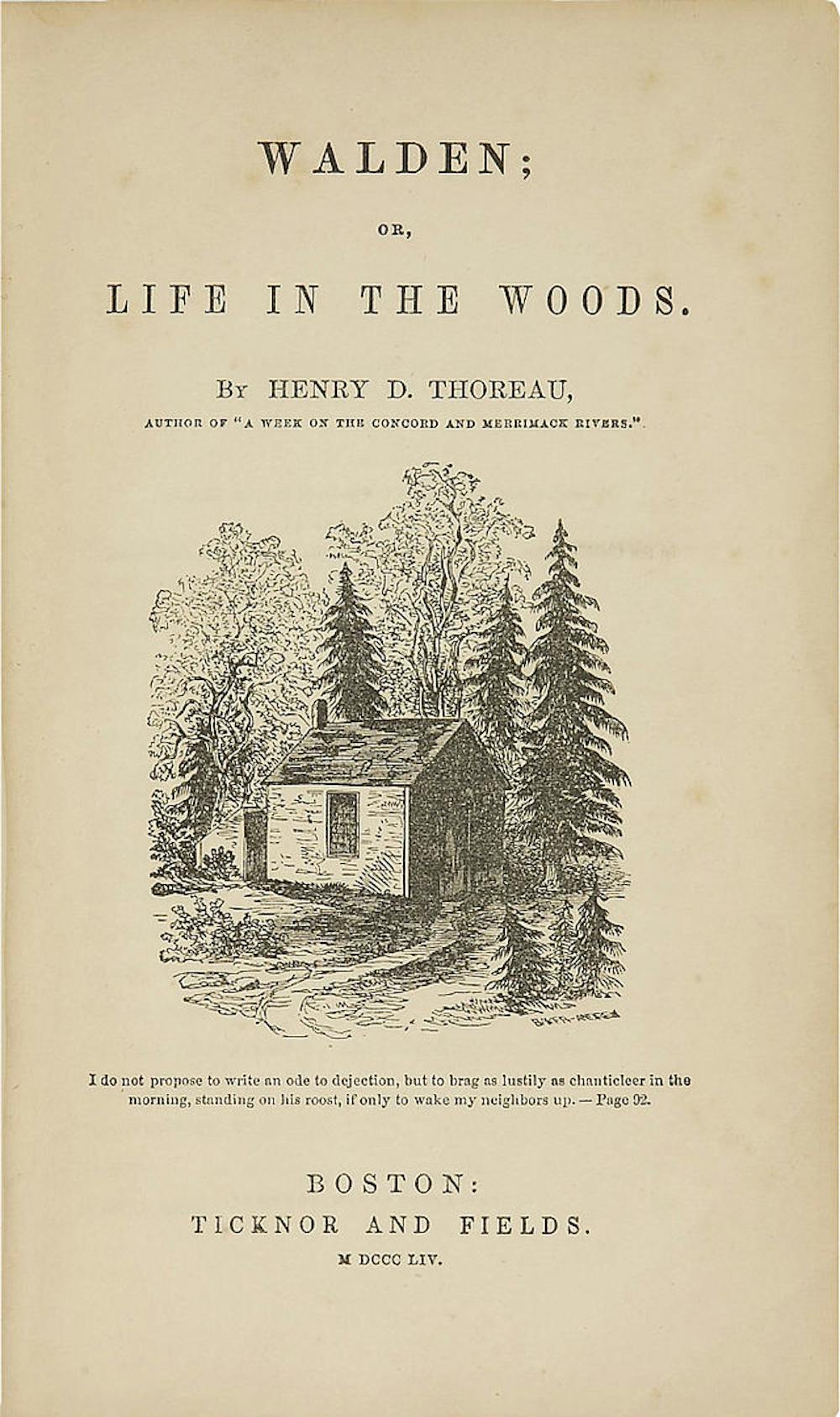
Title page of the first edition of Thoreau’s Walden (1854).
The promptings of this 19th-century Yankee provide an opportunity to ponder whether and how our own economy could be more ecological. There are creative economists and policy makers rethinking ways to bring ecology and economy back into sync. Such an effort will be required for any liveable future on our finite Earth.
Thoreau enacted this economic reform in a small way during the two years he spent living in Walden Woods. The first year, he had a fire in a hearth, but in the second year he got a stove to save wood. He did this, he said, for economic reasons and to protect the forest he loved. “The next winter I used a small cooking-stove for economy, since I did not own the forest.”
In this, Thoreau appealed to a radically different vision of economy from the politicians who pit economy against ecology. Their “economy” usually describes a system of financial gain for people who are already wealthy. Thoreau’s “economy” was about preserving something that he did not own, something that is valuable to all of us, on behalf of all of us. This is what the climate policy of a new period in Australian politics should aim at: a holistic, equitable vision of economy and ecology.
For Thoreau, as for us, “economy” was a word with many meanings. He sought to demonstrate that the “commercial spirit” he had criticised for its moral failings at his graduation was not the only possible form of economy. True economy, according to Thoreau, would lead to ecological and social flourishing among humans, and for all beings.
Alda Balthrop-Lewis does not work for, consult, own shares in or receive funding from any company or organization that would benefit from this article, and has disclosed no relevant affiliations beyond their academic appointment.
"Are you amongst us, spirit? Wake up, be bright, be golden and light. Bagpuss, oh hear what I sing..."
From page 37 of the Children's Guide To Séances & Cuddly Demons (Scarfolk Books, 1973). The book encouraged children to contact the apparitions of children's deceased television stars. It was banned briefly, however, in 1975 when Noddy and Big Ears, deranged by their time in the spirit world, broke through to the earthly realm and wreaked havoc in a branch of Marks & Spencer, causing thousands of pounds worth of damage. Additionally, a priest had to be called to perform an exorcism over the shop's entire stock of varicose vein support tights.
The COVID-19 pandemic is still fresh in the minds of the people around the world, so it comes as no surprise that recent outbreaks of another virus are grabbing headlines. So here’s what you need to know about monkeypox.
Monkeypox outbreaks have now been reported in multiple countries, and it has scientists paying close attention. For everyone else, numerous questions come to the surface:
Monkeypox is a virus in the Orthopoxvirus genus which also includes variola virus (which causes smallpox) and cowpox virus. The primary symptoms include fever, swollen lymph nodes, and a distinctive bumpy rash.
There are two major strains of the virus that pose very different risks:
Congo Basin strain: 1 in 10 people infected with this strain have died
West African strain: Approximately 1 in 100 people infected with this strain died
At the moment, health authorities in the UK have indicated they’re seeing the milder strain in patients there.
Where did Monkeypox Originate From?
The virus was originally discovered in the Democratic Republic of Congo in monkeys kept for research purposes (hence the name). Eventually, the virus made the jump to humans more than a decade after its discovery in 1958.
It is widely assumed that vaccination against another similar virus, smallpox, helped keep monkeypox outbreaks from occurring in human populations. Ironically, the successful eradication of smallpox, and eventual winding down of that vaccine program, has opened the door to a new viral threat. There is now a growing population of people who no longer have immunity against the virus.
Now that travel restrictions are lifting in many parts of the world, viruses are now able to hop between nations again. As of the publishing of this article, a handful of cases have now been reported in the U.S., Canada, the UK, and a number of European countries.
On the upside, contact tracing has helped authorities piece together the transmission of the virus. While cases are rare in Europe and North America, it is considered endemic in parts of West Africa. For example, the World Health Organization reports that Nigeria has experienced over 550 reported monkeypox cases from 2017 to today. The current UK outbreak originated from an individual who returned from a trip to Nigeria.
Could Monkeypox become a new pandemic?
Monkeypox, which primary spreads through animal-to-human interaction, is not known to spread easily between humans. Most individuals infected with monkeypox pass the virus to between zero and one person, so outbreaks typically fizzle out. For this reason, the fact that outbreaks are occurring in several countries simultaneously is concerning for health authorities and organizations that monitor viral transmission. Experts are entertaining the possibility that the virus’ rate of transmission has increased.
Images of people covered in monkeypox legions are shocking, and people are understandably concerned by this virus, but the good news is that members of the general public have little to fear at this stage.
Have you ever caught yourself talking a little bit differently after listening to someone with a distinctive way of speaking?
Perhaps you’ll pepper in a couple of y’all’s after spending the weekend with your Texan mother-in-law. Or you might drop a few R’s after binge-watching a British period drama on Netflix.
Linguists call this phenomenon “linguistic convergence,” and it’s something you’ve likely done at some point, even if the shifts were so subtle you didn’t notice.
But as a doctoral student in linguistics, I wanted to know more about how readily this behavior occurs: Would people converge based on evidence as flimsy as their own expectations of how someone might sound?
Three years of experimentation and an entire dissertation later, I had my answer, which was just published in the academic journal Language.
People do, in fact, converge toward speech sounds they expect to hear – even if they never actually hear them.
What, exactly, is convergence?
But before getting into the specifics, let’s talk about what convergence is and how it’s related to other speech adjustments like code-switching, which refers to alternating between language varieties, or style-shifting, which happens when a person uses different linguistic features in different situations.
Convergence refers to the shifts people make to their speech to approximate that of those around them. This is an intentionally broad definition meant to encompass all sorts of adjustments, whether intentional or inadvertent, prominent or subtle, or toward entire dialects or particular linguistic features.
You could imitate aspects of speech you actually observe. Or maybe you throw in some words you think kids these days use, only to have your use of “bae” and “lit” be met with teenage eye rolls.
Code-switching or style-shifting can also be examples of convergence, as long as the shift is toward an interlocutor – the person you’re talking to. But people can also shift away from an interlocutor, and this is called “divergence.”
Code-switching and style-shifting can occur for other reasons, too, like how you feel, what you’re talking about and how you want to be perceived. You might drop your G’s more and say things like “thinkin’” when reminiscing about a prank you played in high school – but switch to more formal speech when the conversation shifts to a new job you’re applying to.
Are expectations enough to alter speech?
To determine whether people converge toward particular pronunciations they expect but never actually encounter, I needed to start my investigation with a feature that people would have clear expectations about. I landed on the “I” vowel, as in “time,” which in much of the southern U.S. is pronounced more like “Tom.” This is called “monophthongization,” and it is a hallmark of Southern speech.
I wanted to know whether people would produce a more Southern-like “I” vowel when they heard someone speak with a Southern accent – and here’s the crucial part – even if they never heard how that person actually pronounced “I.”
So I designed an experiment, disguised as a guessing game, in which I got more than 100 participants to say a bunch of “I” words.
In the first part of the game, they read a series of clues on their computer screen – things like, “this U.S. coin is small, silver, and worth 10 cents.”
Then they named the word being described – “dime!” – and I recorded their speech.
In the second part of the game, I had participants listen to clues read by a noticeably Southern-accented talker and instructed them to respond in the same way. By comparing their speech before and after hearing a Southern accent, I could determine whether they converged.
Using acoustic analysis, which gives us precise measurements of how participants’ “I” vowels sound, I observed that Southerners and non-Southerners alike did, in fact, shift their “I” vowels toward a slightly more Southern-like pronunciation when listening to the Southern-accented talker.
They never actually heard how the Southerner produced this vowel, since none of the clues contained the “I” vowel. This means they were anticipating how this Southerner might say “I,” and then converging toward those expectations.
This was pretty clear evidence that people converge not just toward speech they observe but also toward speech they expect to hear.
Social asset or faux pas?
What does this say about human behavior?
For one, it means that people perceive accents as coherent collections of different linguistic features. Hearing accent features X and Y tells people to expect accent feature Z, because they know X, Y and Z go together.
But it’s not just that people passively know things about others’ accents. This knowledge can even shape your own speech.
So why does this happen? And how do those on the receiving end perceive it?
First, it’s important to point out that convergence is usually very subtle – and there’s a reason. Overly exaggerated convergence – sometimes called overaccommodation – can be perceived as mocking or patronizing.
You’ve probably witnessed people switch to a slower, louder, simpler speech style when talking to an elderly person or a nonnative speaker. This type of over-the-top convergence is often based on assumptions about limited comprehension – and it can socially backfire.
“Why are they talking to me like I’m a child?” the listener might think. “I understand them just fine.”
For expectation-driven convergence – which, by definition, is not rooted in reality – such a faux pas might be even more likely. If you don’t have an actual speech target to converge toward, you might resort to inaccurate, simplistic or stereotyped ideas about how someone will speak.
However, subtler shifts – in what might be called the “sweet spot” of convergence – can have a number of benefits, from social approval to more efficient and successful communication.
Consider a toddler who calls their pacifier a “binky.” You’d probably be better off asking “where’s the binky?” and not “where’s the pacifier?”
Reusing the terms our interlocutors use is not just cognitively easier for us – since it takes less effort to come up with a word we just heard – but it often has the added benefit of making communication easier for our partner. The same could be said for using a more familiar pronunciation.
If people can anticipate how someone will speak even sooner – before they utter a word – and converge toward that expectation, communication could, in theory, be even more efficient. If expectations are accurate, expectation-driven convergence could be a social asset.
That’s not to say that people necessarily go around consciously making these sorts of calculations. In fact, some explanations for convergence suggest that it is an unintentional, automatic consequence of speech comprehension.
Regardless of why convergence happens, it’s clear that even beliefs about others play a major role in shaping the way people use language – for better or for worse.
Lacey Wade receives funding from the National Science Foundation.
You’ve probably read the stories proclaiming that eating blueberries reduces your risk of dementia, or red wine is good for your heart, or coffee protects against type 2 diabetes – or, indeed, many of the other big health claims for a particular “superfood”. But what is the truth in these statements?
While we – a group of nutritional scientists – have been involved in this kind of research, we are not responsible for the headlines. Underneath those attention-grabbing stories, however, there is important and serious research that will help to keep us all happier and healthier.
We study parts of foods called bioactives that have an effect on health (either good or bad). Unlike vitamins and minerals, bioactives, such as certain fatty acids, fibre or flavanols (a group compounds found, for example, in tea or apples), are not essential for survival, but still affect our health.
The big challenge with research on bioactives is to separate the effect of a food from an individual compound (foods are incredibly complex and contain many compounds). In a cup of coffee are some phenolic acids that have a positive effect on heart health, but other compounds that can increase cholesterol. This makes our research difficult – but also exciting.
We must find ways to distinguish between the health effect of different parts of foods to understand what is happening and ultimately provide more confidence in the recommendations we provide.
One way to find out more about the effect of individual foods on health is to compare people with different diets and follow them over a long time. That approach has helped us to show that the Mediterranean diet – and the Nordic diet – keep us healthier for longer. But this approach is flawed when we want to find out more about individual foods or their components.
Foods are never consumed in isolation and it is incredibly difficult to take this apart in such studies. To make the results of such research easier to understand, these findings are often converted into food equivalents – the infamous punnet of raspberries, cups of tea or bottles of wine you should consume for health. In reality, it is much more difficult.
Research into diet and health is difficult because there are many things to consider. There are the essential nutrients that we need to survive. There are dietary patterns that can affect overall health and that are the basis for recommendations, such as the UK government’s Eatwell guide. And then there are bioactive compounds that are found mainly in plant foods and that may have a beneficial effect on health.
Research into bioactives often results in headlines about amazing foods. In reality, it is just a tiny part of the food, often found elsewhere as well. A notable example is blueberries. They contain bioactives, but they are also expensive. Blackberries and plums provide the same bioactives, but are much cheaper.
Over the past decades, we have learned a lot about the chemicals naturally occurring in foods – what they are and how they affect the body. Some of them confer benefits for our heart, brain and gut that will help us sprint faster, cycle longer, concentrate harder and relax more easily.
Focus on variety
Many of them cause problems when consumed in excessive amounts though. For example green tea flavanols can cause liver damage when consumed in very large amounts. We are only just starting to find out whether there is an ideal amount of these compounds that provide maximum benefits. Until then, it is safe to say that a varied diet is the best approach.
The great thing about our understanding of nutrition is that it is continuously evolving and improving and we understand much better what foods to look out for as research moves on.
Everyone should build up a sort of portfolio of diet that includes the essential nutrients, fibre and bioactives needed to keep healthy and age well. Our bodies are incredibly complex and need lots of different vitamins, minerals, macro and micronutrients to optimally keep us going. It now seems likely that we need to add bioactives to this list. But it doesn’t matter where they are coming from – it is variety that is important.
You should be wary about dietary advice that suggests you exclude the range of wonderful foods on offer and focus on a few “superfoods” that seemingly have magical properties. Nutrition is much more complex than that – and eating a healthy diet is much easier.
Gunter Kuhnle has received funding from Mars, Inc., for research into flavan-3-ols.
Charlotte Mills receives funding from UKRI to research bioactive levels in plant foods and their impact on health.
Jeremy Spencer receives funding from the UK research councils, three of which have been part of the BBSRCs Industrial Partnership Award scheme, which encourages interaction with industry.
by Eve Ringsmuth, Associate professor of poltiical science, Oklahoma State University
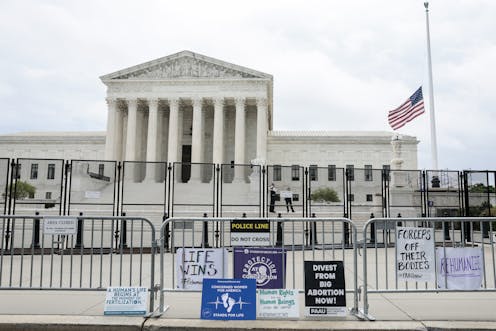
Signs belonging to anti-abortion protesters sit in front of a fenced U.S. Supreme Court building on May 16, 2022. Anna Moneymaker/Getty Images
The U.S. Supreme Court is set to announce a decision that could possibly overturn Roe v. Wade, the 1973 case that guaranteed the constitutional right to abortion.
The court is currently considering a case known as Dobbs v. Jackson Women’s Health Organization, which questions the constitutionality of a Mississippi law that bans abortion after 15 weeks of pregnancy.
But a leaked draft majority opinionwas published by Politico on May 2, 2022, indicating that a majority of justices had voted to allow the post-15-week abortion ban, which would overturn Roe v. Wade.
Most of the Supreme Court’s deliberations occur behind closed doors. And while other information has leaked from the court before, this kind of public circulation of a majority opinion draft is unprecedented.
As an expert on the Supreme Court, I think understanding the court’s decision-making process can help make sense of the leaked draft’s significance and the influence it is having on the court’s credibility. Here are four key points to consider.
Shortly after hearing oral arguments, Supreme Court justices meet privately without legal clerks or staff to discuss and take a preliminary vote on how to resolve the case.
While tentative, the first votes are significant because they determine the group of justices eligible to write the opinion that could set a legally binding precedent for future cases and legal questions.
There are nine Supreme Court justices. A majority, or at least five, need to jointly support any final decision on a case in order to set precedent.
The author of the majority opinion is selected by the most senior justice who initially voted with the majority. Since Justice Anthony Kennedy’s retirement in 2018, either Chief Justice John G. Roberts or the most senior Associate Justice, Clarence Thomas, most often chooses who authors the majority opinion.
The selected justice works with his or her team of legal clerks to write an initial draft of the opinion, which explains the legal basis for voting one way or another. The draft is then shared with the eight other justices.
Next, the other justices have an opportunity to weigh in on the content of the majority opinion and attempt to modify its language. Those in the majority have the greatest influence on the draft, but majority opinion authors may respond to points made in a draft dissent. A final decision is reached once all justices have authored or signed onto an opinion.
Justices not in the majority can write or sign onto dissenting or concurring opinions, which do not carry legal authority.
2. How much can draft opinions change over time?
In theory, a Supreme Court majority opinion draft can be completely rewritten.
Enough justices could also change their minds and create a new majority, which supports a different resolution to a case. However, since justices have already read written briefs – meaning a written legal argument submitted by each side in the case – and considered the case with their colleagues, a complete overhaul of a given majority opinion draft is unlikely.
Some revision to a majority opinion draft is common, though.
This is because the majority opinion author must craft language that will secure the votes of at least four other justices. Justices can negotiate over specific wording and also push for larger, substantive revisions.
This drafting process usually results in multiple versions. A final opinion ultimately reflects the views of all of the justices in the majority.
Majority opinion authors are more likely to circulate additional opinion drafts in cases where the justices are closely split – meaning five justices plan to vote opposite four others – and in complex cases. There is more pressure for a majority opinion author to accommodate the other justices’ views in split decisions, since losing one vote would reverse the case outcome.
The court sets a lot of its own policies, including which cases they accept, the format of oral arguments and opinion drafting procedures.
Justices have repeatedly argued that private deliberations are essential to the court’s decision-making. As former Justice Lewis F. Powell said in 1980, “There must be candid discussion. … The confidentiality of this process assures that we will review carefully the soundness of our judgments.”
The court’s procedures promote judicial independence and are designed to establish distance from public opinion and political pressure.
Some observers have argued the court should be more transparent, saying that increased access to things like court proceedings and information regarding when and why justices must recuse themselves from cases would strengthen the accountability of the court.
Roberts has defended the court’s decision-making process, saying in June 2018, “It’s not as if we’re doing this in secret. We’re the most transparent branch in government in terms of seeing us do our work and us explaining what we’re doing.”
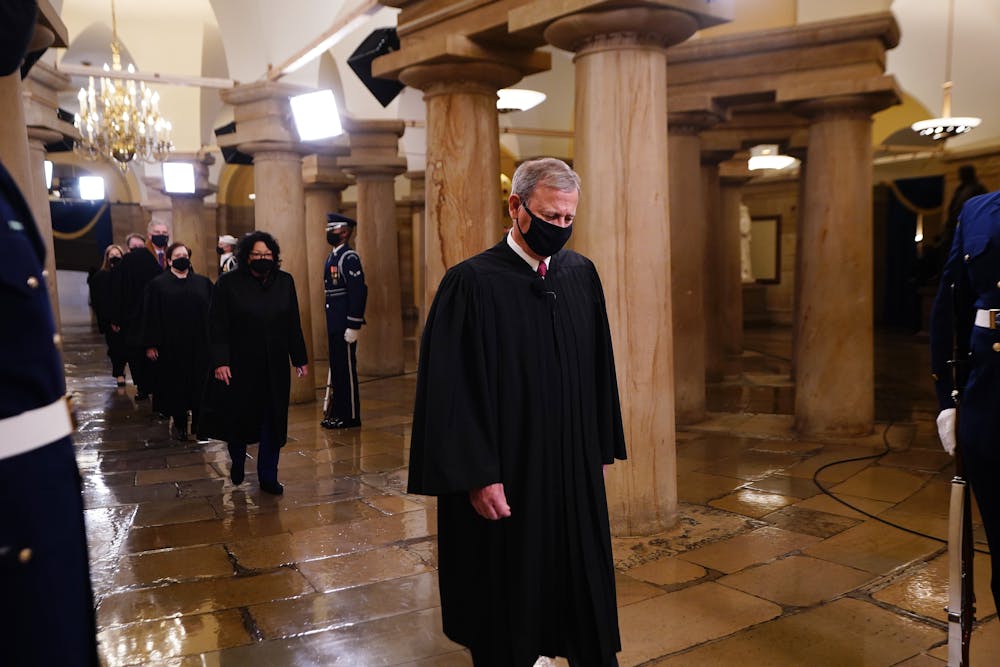
Chief Justice John Roberts leads other Supreme Court justices during President Joe Biden’s January 2021 inauguration.
Jim Lo Scalzo-Pool/Getty Images
4. What is the significance of a leaked opinion draft?
The release of the draft opinion is rare and meaningful – it violates the Supreme Court’s strict expectation of confidentiality among clerks, justices and staff.
Although the full ramifications of the leak are not yet known, this breach of trust could change the openness with which justices discuss cases internally.
Scholars and the public have previously seen records of the court’s internal discussions and early opinion drafts through justices’ personal papers. But justices typically do not make their personal papers available until they have retired or died.
Ultimately the leaked opinion draft places a spotlight on the Supreme Court that the institution prefers to avoid.
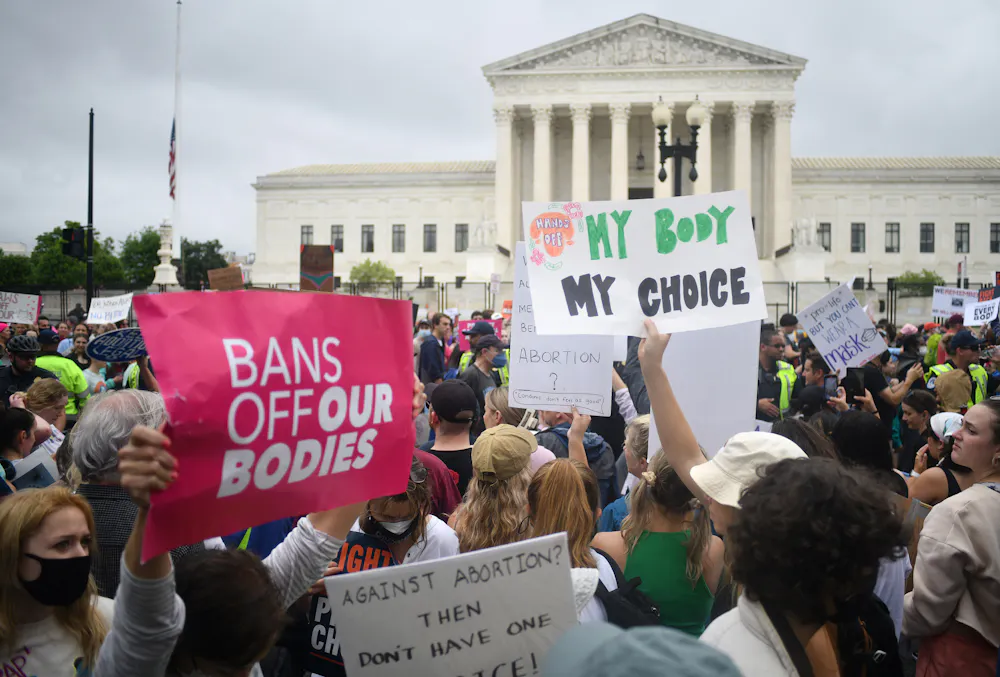
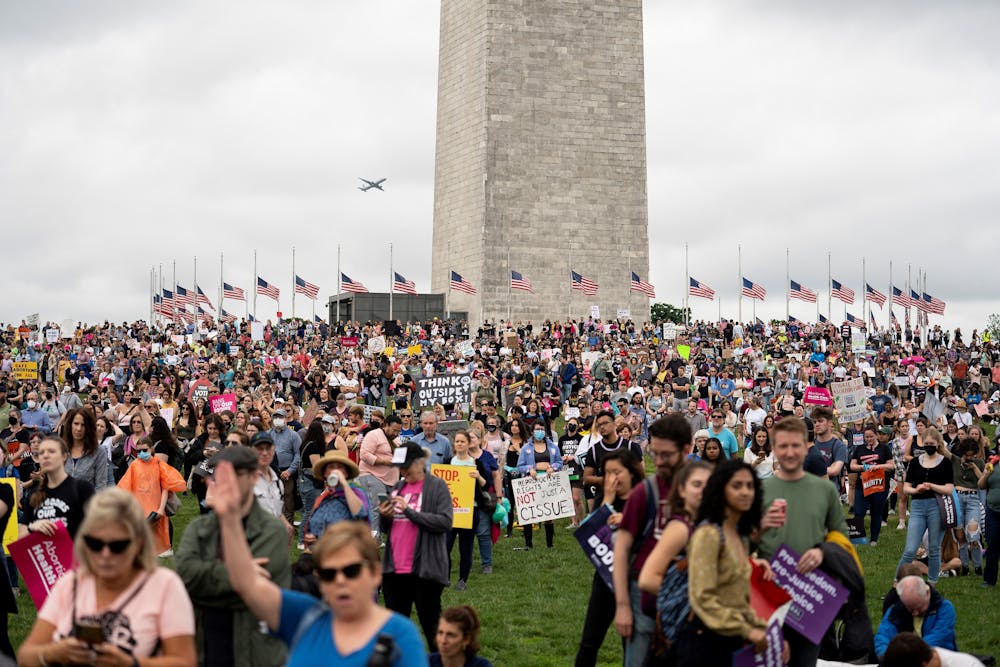
The leaked draft sparked protests outside the Supreme Court building defending Roe v. Wade and new proposed legislation that would establish abortion as a federal right. Following the leak in early May, the Supreme Court installed security fencing.
The draft opinion also brought a wave of criticism from outside experts about the legitimacy of the court.
Suggestions that the court has become politicized are a potential problem for an institution that relies on public credibility and good will to be able to enforce its decisions.
Eve Ringsmuth does not work for, consult, own shares in or receive funding from any company or organisation that would benefit from this article, and has disclosed no relevant affiliations beyond their academic appointment.
Tampa ranked as the 39th best city to live in the U.S. according to a recent list by U.S. News & World Report. U.S. News analyzed the 150 most populous metro areas to find the best places to live. To make the top of the list, a place had to have good value, be a desirable place to live, have a strong job market and a high quality of life.
etro areas in the rankings are evaluated using data from sources including the U.S. Census Bureau, the FBI, the U.S. Department of Labor and U.S. News’ own internal resources. This data was categorized into the five indexes. The percent weighting for each index follows the answers from a March 2022 public survey in which people from across the country voted for what they believed was the most important factor to consider when choosing where to live.
Tampa receives top marks for desirability, and amenities
The five indexes are:
Job Market Index – strength of each metro area’s job market
Value Index – how comfortably the average resident of each metro area can afford to live within their means
Quality of Life Index – how satisfied residents are with their daily lives in each ranked metro area
Desirability Index – whether people want to live in a given metro area
Net Migration – whether people are moving to or away from each metro area
Here’s what the report had to say about Tampa:
Residents of the Tampa Bay area enjoy both a laid-back beach lifestyle and the amenities of a large metropolitan area, including professional sports teams, museums, and an array of entertainment and dining options. The Tampa Bay metro area is a sprawling and diverse region that encompasses three cities – Tampa, St. Petersburg and Clearwater – each with a distinct personality.
This isn’t the only category Tampa has received accolades in.
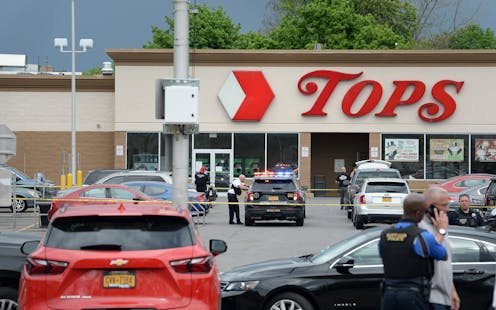
An apparently racially motivated attack at a supermarket in Buffalo, New York, resulted in 10 deaths on May 14, 2022, with the teenage suspect allegedly targeting Black shoppers in a prominently African American neighborhood.
Mass public shootings in which four or more people are killed have become more frequent, and deadly, in the last decade. And the tragedy in Buffalo is the latest in a recent trend of mass public shootings taking place in retail establishments.
Only one shooting in our database prior to 2019 took place at a supermarket. In 1999, a 23-year-old white male with a history of criminal violence killed four people at a supermarket in Las Vegas. However, there has been a raft of mass shootings at American supermarkets since.
The Buffalo shooting on May 14, 2022, is similar to an August 2019 shooting at a Walmart in El Paso, Texas. On that occasion, the 21-year-old white suspect posted a racist rant on social media before allegedly driving some distance to intentionally target racial and ethnic minority shoppers. He has been charged with killing 23 people.
Another shooting in 2019 took place at a Kosher grocery store in Jersey City, New Jersey. Two perpetrators, a man and woman, both Black and around the age of 50 with a criminal and violent history, murdered four people before being killed in a shootout with police. Social media posts and a note left behind indicated an antisemitic motive.
Then in March 2021, a 21-year-old man of Middle Eastern descent with a history of paranoid and anti-social behavior entered a King Soopers in Boulder, Colorado, and shot dead 10 people. Six months later, in September 2021, a 29-year-old Asian man killed one person and injured 13 others at a Kroger supermarket in Tennessee. The perpetrator, who worked at the store, was asked to leave his job that morning. He died by suicide before the police arrived on the scene.
No one profile of a retail shooter
Mass shootings are socially contagious. Perpetrators study other perpetrators and learn from each other, which may explain the rise in supermarket shootings in the past few years. However, the data shows there is no one profile of a supermarket mass shooter.
Racial hatred is a feature of about 10% of all mass public shootings in our database. Our analysis suggests that when it comes to retail shooters, around 13% are driven by racism – so slightly above the average for all mass shooting events.
Some grocery stores by their nature may be frequented predominantly by one racial group – for example, Asian markets that cater to local Asian communities.
But racial hatred appears to be just one of many motivations cited by retail shooters. Our data points to a range of factors, including the suspect’s own economic issues (16%), confrontation with employees or shoppers (22%), or psychosis (31%). But the most common motivation among retail shooters is unknown (34%).
Like the Buffalo shooter, 22% of perpetrators of retail mass shootings left behind something to be found, a “manifesto” or video to share their grievances with the world. And nearly half of them leaked their plans ahead of time, typically on social media.
The lack of a consistent profile doesn’t leave us helpless. Our research suggests many strategies to prevent mass shootings – from behavioral threat assessment to restricting access to firearms for high-risk people. And the way to stop the social contagion of mass shootings is to stop providing perpetrators with the fame and notoriety they seek.
Jillian Peterson receives funding from the National Institute of Justice
James Densley receives funding from the National Institute of Justice
Central Florida's Lyman High School received a huge amount of stickers to censor their yearbook, which featured images of students peacefully protesting Gov. Ron DeSantis's discriminatory "Don't Say Gay" law. Students were told they would not get their yearbook until an entire page — which included images of rainbow flags and a "love is love" sign that students held during a walkout — was "edited" out with stickers. — Read the rest
A Creative Commons license is irrevocable; it says so right in the license. But it also says you can change your mind and distribute the work differently, or not at all. What does this mean?
The Tampa Theatre in partnership with Film Tampa Bay will screen the locally produced film Paper Line on June 18. Doors to the screening open at 2pm, and the first 150 visitors will get a free bag of popcorn.
Film Tampa Bay Presents is a quarterly series designed to showcase Tampa Bay-area films, filmmakers, actors and locations through FREE community screenings at Tampa Theatre. On Saturday, June 18, the series will celebrate the Juneteenth holiday weekend with the first look at Paper Line, a locally-produced live-action short film about a secret fraternity of black martial artists at a prestigious HBCU in Florida.
Paper Line, the new all-Black cast short film from writer-director Ryan Watson (The Ivory League: Confessions of a Black Faculty, which won Best Florida Film at the 2021 Sunscreen Film Festival), features an inside look at the intense personal bonds and proud values of Black Greek culture through the lens of explosive martial-arts action. African-American sororities and fraternities have been at the cornerstone of college life for more than 100 years.
Paper Line is locally produced, and features an emerging Tampa talent
This film tells a story of the Black Greek experience through a reimagination of the initiation process, deflating the insulting subtext of the “paper line” (a fraternity class that doesn’t undergo the potentially traumatic hazing of previous eras) evolving into a new context altogether. This secret fraternity of Black martial artists live by a strict code of discipline, truth, service to the community and non-violent conflict resolution — unless provoked.
Filming this exciting new project primarily in Tampa Bay, Watson took inspiration from a broad catalog of influences, most significantly from Civil-Rights-era Black activist groups like the Black Panthers. The Panthers and others regularly held organized martial arts training as part of their plan to inspire their community and defend their neighborhoods from the violence created by gangs and drugs from within, and violence by anti-Black aggression from the outside.
“It was important to make this film because I wanted to highlight an underutilized style of martial arts film,” Watson says. “We have seen African American martial artists perform in cinema, but it’s rare that we see a large group of them perform with each other. I trained in martial arts as a youth, and all three of my kids train as well. In college I noticed that many of the lessons that are taught in the Black Greek college experience are very similar to the lessons taught in martial arts. It provides a cool alternative to the stereotypical fraternity initiation experience.”
Tampa Theatre shines a light on Tampa Bay productions
A Tampa resident since 2003, Watson is also an Associate Professor of Instruction at the University of South Florida and is the Vū Studio at USF Teaching Fellow. “[Tampa] is the place where I grew from a college student with film and videographer aspirations to a university professor and filmmaker of the same genre,” he says. “We have some amazing locations in the city that have historical relevance to the Black community to go along with the life-long friends I’ve made, so filming here was a no-brainer.”
“Being able to do it the day before the one-year anniversary of the first recognition of Juneteenth as a federal holiday makes it that much more special. It’s a chance for everyone who worked on the film to celebrate our achievement in a world class venue alongside the Tampa community, our families and friends on a weekend that celebrates the sacrifices and contributions Black Americans and our supporters and advocates have made for our country.”
Doors open at 2:00pm, and this family-friendly (PG-13 equivalent) special event will begin with a LIVE martial arts demonstration by some of the film’s cast at 3:00pm. The first 150 patrons will also receive FREE popcorn and soda. Following the screening, Paper Line writer/director Ryan Watson and his team will discuss the making of the film and answer audience questions.
Admission is FREE, but reservations are required. The Tampa Theatre is located at 711 N Franklin Street.
George Carlin nailed it 26 years ago when talking about the GOP's so-called pro-lifers. "These people aren't pro life," he said in his 1996 HBO special, Back In Town. "They're anti-woman."
"Pro-life conservatives are obsessed with the fetus from conception to nine months. — Read the rest
Enjoy this vintage (1961) documentary about the Mermaids of Weeki Wachee, a tourist attraction in Florida that has existed from 1947 to present times. The underwater show features a hot spring full of performers in mermaid costumes, where viewers watch through a glass wall. — Read the rest
If you aren’t already a Tampa Bay Times subscriber, we highly recommend you amend that ASAP. The assiduous team of journalists work exhaustively to cover the entire Tampa Bay region. Their work shines a light on the things that matter most in this region. Corey G. Johnson, Rebecca Woolington and Eli Murray of the Tampa Bay Times were award the Pulitzer Prize in Investigative Reporting for their Poisoned series. Editors on the series include Mark Katches, Kathleen McGrory, Adam Playford and Maria Carrillo. Poisoned features photography by Martha Asencio-Rhine, Luis Santana, James Borchuck, Yalonda M. James and Octavio Jones, with guidance from photo editor Boyzell Hosey.
Tampa Bay Times journalists spent 18 months investigating what happens at Florida’s lone lead factory, owned by Gopher Resource. The series itself is broken up into 3 parts, and can be read online here. The findings from the investigation include the discovery that eight out of ten workers from 2014 to 2018 had enough lead in their blood to put them at risk of increased blood pressure, kidney dysfunction or cardiovascular disease. Dust from the plant has been the suspected cause of lead exposure in at least 16 children — the sons and daughters of employees who unwittingly carried the poison home. The Occupational Safety and Health Administration hasn’t inspected the factory for lead-related issues since 2014 and has missed problems in previous visits.
If you’d like to read the full report, you can click here.
Peacocks are not native to this state. However, you can find them throughout Central and South Florida, much to the delight and sometimes disgust of their neighbors. Fanning out their splendid green, purple and gold feathers, they’ve made plenty of allies, those who enjoy their prances through places like Brandon’s Hillside Terrace, Wellswood, King Richards’ mobile home park in Gibsonton, and many other neighborhoods. However, they are not always welcome as residents.
Suburban peacocks in Tampa
Peafowl in Wellswood. Courtesy of Facebook. A peacock in Wellswood. Courtesy of Facebook.
Peacocks tend to be early morning screechers, make themselves at home on car hoods, and poop. A lot.
“I’m not sure about the pros and cons, but they are so cute in my community. I love to watch them every time they are close to my home,” said Sy Moya of Riverview.
“I live near Providence and Riverview Drive. We had someone in our neighborhood that would steal peacocks and sell them,” said Autumn Maria Laietta. “Back in the day, we had a neighbor walk around the neighborhood around 5 p.m. They start calling for each other. They sleep on our cars during the day and sleep in trees at night. They’re absolutely beautiful.”
Tasha Crabb has a different view. “We just bought our house here almost two years ago and wasn’t aware they were here. They are definitely obnoxious with their loudness and crapping, scratching up cars and running around on the roof.”
So, who regulates these large, controversial peafowl? Well, there are actually few regulations since most of them are not claimed by anyone as pets. Instead, they are protected by animal cruelty laws, and they roam at will.
Audubon Florida’s Director Julie Wraithmell says she gets few calls about peacocks. And the Florida Fish & Wildlife Conservation Commission says its officers cannot go on private property to cull their flocks or move them.
These jewel-toned peafowls sometimes pit neighbors against each other, as occurred not long ago in Miami neighborhoods. That constant pooping and sometimes extensive property damage enrage some, while others call for their continued protection and consider them a fabulous addition to otherwise ordinary streets.
Kelzy Wilder, of Riverview thinks they need more regulation.
“They need to be treated like dogs. If they’re not on a leash, they need to be on the owner’s property. Otherwise, they should be able to be picked up by animal control.”
The only problem is, they are rarely claimed by individuals.
Still, Wilder says, they wreak havoc on native birds and reptiles by eating the food those Floridians would otherwise consume.
“Peacocks and peahens can be giant nuisances and can chew through electrical wiring, and I’ve had peacocks scratch up my car badly, even chipping window glass because they thought their reflection was a rival,” Wilder says. “Just letting them roam is not a good option.”
The problem with peacocks
Peacocks in Riverview. Courtesy of Facebook.
Native to Asia and Africa, peafowl are considered a domestic species, just like pigs, cattle, chickens, and sheep. And according to FWC, they fall under the jurisdiction of local governments, most of which do not even try to regulate them.
The major problem with peacocks, some say, is their proliferation. A neighborhood might start out with a couple of beauties but end up with 50. A peahen can lay 15-30 eggs each mating season, which is why some neighborhoods end up with dozens of peacocks prowling both suburban and urban areas.
“The peacocks have been totally out of control for over two years!!” a Pinecrest resident wrote to Miami officials in an email, according to the Washington Post. “They have inundated my daughter’s neighborhood with their poop all over the place. Their wailing early morning and evening is a constant distraction and annoyance.”
Some Brandon residents got so fed up with the peafowl in 2020, they contacted WFLA’s Better Call Behnken. One woman called the birds a health hazard, especially during mating season, when they are so visible and she has to navigate that poop.
A Miami city commissioner said that while many adore them, they are one of the city’s most controversial issues, if one can imagine that. The emails sometimes pour in.
One Brandon woman told WFLA’s Shannon Behnken that she must wear earplugs to sleep at night—tuning out the peacock shrieking that can go on for hours.
Others said they get so loud that they are ready to sell their houses, fed up with the midnight chorus.
Mostly, however, people tend to just carry on, some feeding and photographing the birds, others stuffing in their earplugs and fussing under their breath.
A peahen in Wellswood. Courtesy of Facebook. A peahen in Wellswood. Courtesy of Facebook.
Severe COVID results in cognitive impairment similar to that sustained between 50 and 70 years of age and is the equivalent of losing ten IQ points, our latest research shows. The effects are still detectable more than six months after the acute illness, and recovery is, at best, gradual.
There is growing evidence that COVID can cause lasting cognitive and mental health problems, with recovered patients reporting symptoms including fatigue, “brain fog”, problems recalling words, sleep disturbances, anxiety and even post-traumatic stress disorder (PTSD) months after infection.
In the UK, a study found that around one in seven people surveyed reported having symptoms that included cognitive difficulties 12 weeks after a positive COVID test. And a recent brain imaging study found that even mild COVID can cause the brain to shrink. Only 15 of the 401 people in the study had been hospitalised.
Incidental findings from a large citizen-science project (the Great British Intelligence Test) also showed that mild cases can lead to persistent cognitive symptoms. However, these problems appear to increase with the severity of the illness. Indeed, it has been independently shown that between a third and three-quarters of hospitalised patients report suffering cognitive symptoms three to six months later.
The magnitude of these problems, and the mechanisms that are responsible, remain unclear. Even before the pandemic, it was known that a third of people who have an episode of illness that requires ICU admission show objective cognitive deficits six months after admission.
This is thought to be a consequence of the inflammatory response associated with critical illness, and the cognitive deficits seen in COVID could well be a similar phenomenon. Yet there is evidence that SARS-CoV-2, the virus that causes COVID, can infect brain cells. We cannot exclude direct viral infection of the brain.
Other factors, such as hypoxia (low oxygen levels in the blood), may also have a role. It was also unclear whether the pervasive problems with psychological health reported after COVID were part of the same problem as the objective cognitive deficits, or represented a different phenomenon.
A UK study showed that people who’d had COVID had reduced brain volume.
DedMityay/Shutterstock
Forty-six patients
To characterise the type and magnitude of these cognitive deficits, and better understand their relationship to disease severity in the acute phase and psychological health problems at later time points, we analysed data from 46 former COVID patients. They had all received in-hospital care, on the ward or ICU, for COVID at Addenbrooke’s Hospital in Cambridge, England.
The participants underwent detailed computerised cognitive tests an average of six months after their acute illness using the Cognitron platform. This assessment platform is designed to precisely measure different aspects of mental faculties such as memory, attention and reasoning and had been used in the above-mentioned citizen science study.
We also measured levels of anxiety, depression and PTSD. The data from the study participants were compared with matched controls – people of the same sex, age and other demographic factors, but who weren’t hospitalised with COVID.
COVID survivors were less accurate and were slower to react than the matched controls. These deficits resolved slowly and were still detectable up to ten months after admission to hospital. The effects scaled with acute disease severity and markers of inflammation. They were strongest for those who required mechanical ventilation, but they were also substantial for those who did not.
By comparing the patients to 66,008 members of the public, we were able to estimate that the magnitude of cognitive loss is similar on average to that sustained with 20 years of ageing, between 50 and 70 years of age. This is equivalent to losing ten IQ points.
The survivors scored particularly poorly on tasks such as “verbal analogical reasoning” (completing analogies such as laces are to shoes what buttons are to …). They also showed slower processing speeds, which aligns with previous observations post-COVID of decreased brain glucose consumption in key brain areas responsible for attention, complex problem-solving and working memory.
While people who have recovered from severe COVID can have a broad spectrum of symptoms of poor mental health – depression, anxiety, post-traumatic stress, low motivation, fatigue, low mood and disturbed sleep – these were not related to the objective cognitive deficits, suggesting different mechanisms.
What are the causes?
Direct viral infection is possible, but unlikely to be a major cause. Instead, it is more likely that a combination of factors contributes, including inadequate oxygen or blood supply to the brain, blockage of large or small blood vessels because of clotting, and microscopic bleeds.
However, emerging evidence suggests that the most important mechanism may be damage caused by the body’s inflammatory response and immune system. Anecdotal evidence from frontline doctors supports this inference that some neurological problems may have become less common since the widespread use of corticosteroids and other drugs that suppress the inflammatory response.
Regardless of the mechanism, our findings have substantial public health implications. Around 40,000 people have been through intensive care with COVID in England alone, and many more will have been admitted to hospital. Many others may not have received hospital treatment despite severe illness due to the pressure on healthcare during peak pandemic waves. This means that there are many people out there who are still experiencing problems with cognition many months later. We urgently need to look at what can be done to help these people. Studies are now underway to address this issue.
However, there is something of a silver lining. If, as we suspect, the picture we see in COVID does indeed replicate the broader problem seen in other types of severe illness, this provides an opportunity to understand the mechanisms responsible and explore treatments.
Adam Hampshire develops cognitive assessment software for external academic groups. He is funded by the National Institute of Health Research, the Biomedical Research Centre at Imperial College London, and UK Dementia Research Institute Care Research and Technology Centre.
David Menon receives funding from UKRI, Addenbrooke's Charitable Trust, Brain Research Trust, National Institutes of Health (USA), National Institute for Health Research (UK)
by Maïka Sondarjee, Professeure adjointe, International Development and Global Studies, L’Université d’Ottawa/University of Ottawa
United States Rep. Robert Johnson, D-Natchez, centre, and other members of the House express their objections to the banning of teaching of Critical Race Theory in Mississippi in March. (AP Photo/Rogelio V. Solis)
Editor’s note: This story is part of series that also includes live interviews with some of Canada’s top social sciences and humanities academics. Click here to register for this free event, on May 3 at 2 p.m. EDT, co-sponsored by The Conversation and the Social Sciences and Humanities Research Council.
Conservative observers everywhere are complaining about a supposed surge in feminist and critical race theories being taught in colleges and universities.
In Hungary, the government went even further and banned gender studies master’s degrees country-wide. Their reasoning: to avoid the spread of ideas about the social construction of gender.
In the United States, Republican lawmakers have embarked on a war against critical race theory at lower levels of education, fearing it will indoctrinate their kids even before they get to higher education institutions.
Many believe universities are spending too much money to “infuse” feminist and critical race approaches, which risk messing up curriculum and fostering division. Is this actually true? Are feminist and critical race studies taking over our classrooms and universities?
People protest against the teaching of critical race theory outside the New Mexico Public Education Department in Albuquerque.
(AP Photo/Cedar Attanasio)
My personal experience, as well as my research, points to the contrary. When I was a graduate student in international relations (IR) from 2011 to 2020, gender approaches were barely addressed, or were compartmentalized to one single week of the year. Since then, I have attended or taught 10 international relations courses at three Canadian universities in both French and English. In all courses, I noticed a trend of marginalization of non-western and non-masculine approaches to world politics.
To test and explore the inconsistency between this growing public fear of these theories invading our classrooms with my own recent experience, I analyzed the contents of 50 introductory syllabi for international relations courses in North America and Europe.
Over half of international relations instructors in western countries simply do not address gender, feminism or women. Only three per cent of mandatory and optional readings assigned by instructors address gender or feminist aspects of the world.
Of the 23 syllabi that do mention gender, 78 per cent of them (18 of 23) adopt the one-week-only philosophy. This compartmentalization condenses gender research to one meagre week, the sacrosanct “women’s week.” In students’ minds, this reduces gender to an easily dismissed sectoral framework. In short, you are either interested in war or you are interested in gender — you cannot be both.
Race and colonialism barely mentioned
International relations has also been criticized for being “blind to racism.” The ethnocentricity of the field of international relations has been called out again and again, and again and again.
My research confirms that race studies are rarely mentioned — in only seven syllabi (14 per cent). As for postcolonial studies, they are only mentioned in 17 syllabi (34 per cent). In comparison, liberalism appears in 38 syllabi (76 per cent).
The lists of historical events we present to our students are also dominated by the western world. For example, the Cold War is listed as an important event in 25 syllabi, but de/colonization processes are only listed in three syllabi and slavery in only one course plan.
Siphamandla Zondi, professor of international relations at the University of Johannesburg, notes that describing the field as international is a “masquerade.” International relations courses pretend to be about everyone, but in fact they are predominantly about western countries and their white citizens (even ignoring racialized or Indigenous populations).
Too often, international relations courses only focus on western countries and their white citizens.
(Shutterstock)
A more complex — less masculine and western — story
The lack of inclusion of women and Global South authors in reference lists is not only a problem of representation. It also means that masculine and western point of views are perpetuated in our teaching.
For example, the story of the Second World War usually includes the Axis and the Allies, the evolution of armaments, the details of German imperialism in Europe and the military support of the United States and Canada.
A more complex — less masculine and western — story would add that this war changed the face of western societies, as women replaced men combatants on the job market and did not want to leave it upon their return. It would also mention proxy wars and Global South men and women fighting alongside Europeans in foreign battles.
A western tale of international development might start in 1947, with U.S. President Harry Truman speaking for the first time of “underdeveloped” countries. It would speak of the establishment of western aid organizations like the World Bank.
A more international account would throw the net wider and might start with the appropriation of Global South wealth and knowledge by European colonizers, the destruction of living conditions of Indigenous peoples and the brutalization of African populations contributing to the ongoing enriching of capitalists in Britain and the United States. It would tie the concept of development with North/South inequalities, not only with western aid in the Global South.
Change ahead is slow
One hopeful marker of change can be seen in academic conferences and publications. Between 2000 and 2010, presentations addressing gender at the annual International Studies Association (ISA) conference have increased by 400 per cent.
It seems, however, that conference organizers also fall into similar traps as international relations course instructors. They marginalize presenters into the feminist box: on more than 320 feminist, gender and queer papers at the ISA conference in 2021, only 71 were placed in mainstream “non-gender” panels.
My perception is that gender scholars are slotted to go to a gender-specific panel on security but not the more front-and-centre panel on security.
Teaching (or not teaching) race or gender approaches influence how we present the world to scholars-to-be and to the leaders of tomorrow. This, in turn, will affect which policies and research will be prioritized.
Unfortunately, one thing is certain: these concepts are not yet mainstreamed in western classrooms. And they are certainly not taking over universities.
by Nicholas Fuller, Charles Perkins Centre Research Program Leader, University of Sydney
Shutterstock
We’re a society obsessed with numbers, and no more so than when managing our health.
We use smartwatches to count steps and track our daily activity, creating scores for our fitness, and monitor our heart rate and sleep quality to measure our health and well-being.
Doctors can be just as obsessed with numbers, relying on measurements and equations to create scores for our health, one of the most popular of which is the Body Mass Index (BMI).
But BMI – a measure of the relationship between your weight and height – is increasingly under scrutiny. More and more experts are questioning its accuracy and health practitioners’ fixation on using it as a single indicator of health and healthy weight.
Here’s everything you need to know about BMI – and why using it as the sole measure of your health is nonsense, starting with a quick history lesson.
Where did BMI come from, and why is it associated with health?
The concept of BMI was developed in 1832 (yes, almost 200 years ago!) by Belgian statistician Lambert Adolphe Quetelet, who was called on to create a description of the “average man” to help the government estimate obesity numbers among the general population.
BMI started as a way to describe the average white man in the 1800s.
Shutterstock
Fast-forward 100 years to the United States, where life insurance companies had started comparing people’s weight to an average population weight for similar individuals to calculate insurance premiums based on a predicted risk of dying.
Annoyed by this somewhat unscientific approach, US physiologist Ancel Keys completed research with 7,000 healthy men using Quetelet’s measure, finding this method was a more accurate and simpler predictor of health that was also inexpensive.
Quetelet’s calculation was subsequently renamed BMI and adopted as a primary indicator of health, thanks to subsequent studies confirming increased risks of heart disease, liver disease, arthritis, some cancers, diabetes and sleep apnoea with increased BMI.
While BMI is an accessible and affordable way to screen a person’s health, it shouldn’t be relied on as a single measure of health.
Here’s why.
1. BMI misses a more important measure – body fat percentage
BMI is based on body weight, but a person’s disease risk is linked to body fat, not weight.
While body weight can be a proxy for body fat, there’s an important reason it doesn’t always tell an accurate story: muscle is much denser than fat.
Because BMI calculators can’t differentiate fat from muscle, people can be easily misclassified. At the extreme, BMI has classified athletes in peak fitness condition, such as sprinter Usain Bolt, as almost overweight, and American footballer Tom Brady as obese.
People with lots of muscle mass are often classed as overweight according to BMI.
Shutterstock
2. BMI does not measure body fat distribution
Numerous studies have found people with the same BMI can have very different disease risk profiles, primarily driven by where fat is distributed in their bodies. This is because not all fat is equal.
If you have fat stored around your stomach, your risk of chronic disease is much higher than people who have fat stored around their hips, because this is an indicator of how much visceral fat you have – the type of fat deep inside the belly that increases your risk of stroke, type 2 diabetes and heart disease.
In white populations, a waist circumference of more than 80cm for women and more than 94cm for men is associated with an increased risk of chronic disease, and for Asian populations it is more than 80cm for women or 90cm for men.
3. BMI does not account for demographic differences
The BMI is something none of us like – racist and sexist.
When Quetelet created and Keys validated BMI, they studied largely male, middle-aged Anglo-Saxon populations. Their method prevails, even though BMI’s calculations and classifications are used universally today.
Our bodies, by nature, have some distinct characteristics driven by our gender, including that females generally have less muscle mass and more fat mass than males. We also know muscle mass decreases and shifts around the body as we age.
Research has also confirmed significant differences in body weight, composition and disease risk based on ethnicity. This includes findings from the early 2000s that found on measures for optimum health, people of Asian ethnicity should have a lower BMI, and people of Polynesian ethnicity could be healthier at higher BMIs.
This issue has led to suggested redefined BMI cut-off points for people of Asian ethnicity (where a healthy BMI is less than 23) and Polynesians (where a healthy BMI is less than 26).
So what should we be using instead?
To be clear: weight and health are related, with countless studies demonstrating people who are obese or overweight have an increased risk of disease.
But while BMI can be used as a screening tool, it shouldn’t be the only tool relied on to assess a person’s health and healthy weight.
Instead, we need to focus on measures that tell us more about fat in the body and where it’s distributed, measuring weight circumference, waist-to-hip ratios and body fat to get a better understanding of health and risk.
Waist circumference is a better predictor of health than BMI.
Shutterstock
We also need to consider the many other ways to measure your health and likelihood of disease, including levels of triglycerides (a type of fat found in your blood), blood pressure, blood glucose (sugar), heart rate, presence of inflammation, and stress levels.
As a single measure, BMI is not a good measure of health – it lacks accuracy and clarity and, in its current form, misses measuring the many important factors that influence your risk of disease.
Although BMI can be a useful starting point for understanding your health, it should never be the only measurement you use.
Dr Nicholas Fuller works for the University of Sydney and has received external funding for projects relating to the treatment of overweight and obesity. He is the author and founder of the Interval Weight Loss program.
For nearly five decades she fearlessly fought the criminal enterprise. Armed with her 35mm camera, she publicized the Sicilian Mafia’s reign of terror with her photographs of the bullet-riddled bodies of public servants, innocent bystanders and mafiosi. She later worked as a politician and local activist to wrest Palermo’s streets and piazzas from the Mafia’s grip.
Exposing the Mafia’s culture of death
Battaglia earned international acclaim for her photographs of Sicily – images that captured the island’s beauty, poverty, spirit and, perhaps most famously, violence.
The struggle over power and profits pitted the rural clan of Corleone, led by Salvatore Riina, against key clans operating in Palermo, the capital of Sicily. During the conflict, machine gun fire and car bomb explosions became commonplace in Palermo and outlying cities.
The politicians in Rome responded to the national crisis by asking General Carlo Alberto Dalla Chiesa to become the prefect of Palermo. After spending four months restoring order, Dalla Chiesa, his wife, Emanuela Setti Carraro, and police bodyguard Domenico Russo were murdered in a spray of machine-gun fire on September 3, 1982 – what became known as the Via Carini Massacre. Dalla Chiesa’s death, along with hits on police chiefs, public prosecutors and investigators, left honest citizens feeling hopeless and abandoned.
Some days Battaglia would rush from one city to another to photograph several dead bodies – of mafiosi, judges, police, political figures and journalists – “so much blood,” she later recalled.
Mafia murders became so commonplace – some 600 between 1981 and 1983 alone – that she sometimes came upon crime scenes by chance.
Such was the case with her famous photograph of the corpse of Piersanti Mattarella, the former president of the Region of Sicily. On Jan. 6, 1980, while riding in the car with her daughter and fellow photojournalist Franco Zecchin, Battaglia saw a small group of people gathering around a car. She spontaneously snapped shots from the car window, capturing Sergio Mattarella, the current President of Italy, as he attempted to help his brother, who had been shot in an ambush.
The Palermo Spring
Battaglia’s photographs of Mafia violence were published regularly on the front page of L’Ora. She also displayed large format prints of them at pop-up exhibits that she and Zecchin organized in downtown Palermo and local schools.
In doing so, she forced people to face what they had disavowed: that the Mafia existed, and that it killed.
Of course, most Sicilians had been aware of the crime organization’s influence. They watched the public parks become overrun by drug dealers, and tiptoed around used syringes dotting the sandy beaches. Some 80% of Palermo businesses regularly paid the “pizzo,” or money demanded by the Mafia to protect businesses from the Mafia’s own violence.
But Battaglia’s images of bloodshed made it impossible to continue turning a blind eye, and a shift gradually occurred.
Beginning in 1983, an anti-Mafia pool of prosecutors and uncompromised police officers started arresting numerous Mafia members. Over 450 of them were eventually put on trial in the famous Maxi-trial, which began in 1986.
With public confidence in the justice system bolstered, a social, cultural and political revolution took place between 1985 and 1990. Everyday people and new members of the city council started directly confronting the Mafia and working to loosen its grip on the region. It became known as the “Palermo Spring,” and Battaglia was a driving force behind it.
In 1985, she was elected as a council member. Together with the mayor, Leoluca Orlando, who appointed her Commissioner for Gardens and Public Life, Battaglia worked to stop the Mafia’s decadeslong sacking of Palermo. Mafia leaders and their political allies had let schools, historic palazzos and gardens fall into disrepair, with the intent of eventually razing the downtown neighborhoods and making windfall profits in reconstruction.
Battaglia was driven by the conviction that providing all citizens free access to spectacular gardens, parks, beaches and historical sites was essential for creating a culture of respect and appreciation for Palermo and its heritage. Through her projects to make Palermo more beautiful and livable, Battaglia reclaimed Mafia-controlled spaces block by block. She worked with fellow members of the city council on undertakings such as removing abandoned cars, creating a downtown pedestrian mall and restoring public gardens to their original beauty.
On streets and in piazzas controlled by clan bosses, where a glance or wrong word can represent an offense worthy of violent retaliation, Battaglia’s acts directly challenged the bosses. But public support soon coalesced behind Battaglia and her allies.
One instance is especially memorable. After having mountains of garbage hauled away from the beach near Foro Italica near the Kalsa neighborhood, which was famous for its high concentration of powerful mafiosi, she had some benches for enjoying the view bolted into the cement. The next day they were gone.
Journalist Antonio Roccuzzo was with Battaglia. He recalled how she went straight to the neighborhood and shouted, “I know who you are. The benches don’t belong to you. They belong to everyone. If all of you don’t put them back within the hour, I’m going to raise hell!”
An hour later, the benches were bolted back in place.
Keeping an invisible Mafia in the public eye
In 1992 and 1993, a series of bombings took the lives of Judges Giovanni Falcone, renowned architect of the Maxi-trial; Francesca Morvillo, a prosecutor in the juvenile court of Palermo and his wife; and Paolo Borsellino, who had worked closely with Falcone and investigated his murder. Bodyguards and bystanders in Sicily, Rome, Milan and Florence also perished.
With these bombings, known as the “strategy of massacres,” the Mafia attacked the state’s symbols of justice, government, finance and culture. Their goal was to intimidate politicians into weakening laws against organized crime.
However, the violence elicited even more public backlash, and the criminal organization soon adopted the strategy of going underground and quietly carrying on its diversified criminal activities. This shift marked a departure from spectacular bombings, brazen assassinations and shootouts in city streets.
Yet the menace of the Mafia still remains. Their murder victims now die mostly by “lupara bianca” – with any trace of their bodies destroyed by fire or acid.
In the absence of visible evidence, Battaglia’s shots documenting Mafia bloodshed and bereavement continue doing the work of keeping the ramifications of Mafia violence in the public eye.
These painful images have also become vehicles for expressing hope. In a project Battaglia began in 2004, known as “Rielaborazioni” – or “Re-elaborations” – she takes the original images of violent deaths and overlays symbols and signs of renewal, often through vibrant female figures. In her reconfiguration of her iconic picture of Falcone at Dalla Chiesa’s funeral in 1982, a youthful woman appears in the foreground, bathed in water spraying from a fountain.
In death, as in life, Battaglia’s impassioned commitment to create beauty and hope in her beloved Palermo survives. You can see it on the streets of a city reborn, and on the faces of its honest, well-meaning citizens.
Robin Pickering-Iazzi does not work for, consult, own shares in or receive funding from any company or organization that would benefit from this article, and has disclosed no relevant affiliations beyond their academic appointment.
Diversity and inclusion in the workplace is a sensitive topic. People are afraid to get things wrong or to use the wrong word. It doesn’t help that the words involved are confusing.
You have probably encountered these concepts at a mandatory training session, a workplace event, or on Twitter. They often involve decades of complex scholarship being reduced down to a single word, and, as such, they can easily be misrepresented.
But for any progress to be made, and for real diversity and inclusion to be achieved, getting to grips with what they actually mean is crucial. Here then are six of the most embattled concepts.
This article is part of Quarter Life, a series about issues affecting those of us in our twenties and thirties. From the challenges of beginning a career and taking care of our mental health, to the excitement of starting a family, adopting a pet or just making friends as an adult. The articles in this series explore the questions and bring answers as we navigate this turbulent period of life.
Once limited to LGBTQ discussions (as in “straight ally”), this term became popular in 2020 following the murder of George Floyd. As its 2021 Word of the Year, dictionary.com defines allyship as:
The status or role of a person who advocates and actively works for the inclusion of a marginalised or politicised group in all areas of society, not as a member of that group but in solidarity with its struggle and point of view and under its leadership.
Allyship, then, isn’t about waving the correct flag during the correct month, or getting drunk at Pride with colleagues (well, not just that). It’s an action word that requires action; like education (of self and others), effective activism, consistent advocacy and using your platform or privilege (see below) to amplify the voices of marginalised others.
If, for example, your workplace did the white-text-on-a-black-square thing on social media in June 2020, and nothing else, they were probably engaging in performative allyship. This kind of superficial show of solidarity chiefly benefits those performing it, as opposed to the group suffering the discrimination.
Within UK society, working-class people face inequalities related to, for example, access to sought-after unpaid internships, entering higher managerial and professional jobs and their average salary once in those jobs.
Yet the concept is easily understood – we have all seen snobbery in action (see John Cleese’s classic 1966 sketch with the Two Ronnies). However, the misunderstanding here concerns not the definition of the concept, but the legality of the discrimination.
Social class is not protected in the Equality Act 2010, the piece of UK legislation that outlaws discrimination in the workplace. This often surprises people, presumably because it feels like something that should be covered by legislation – and indeed it is, in over half of all European countries. Just not in the UK.
3. Intersectionality
This term is often vilified, but its meaning is actually straightforward. Every person has multiple intersecting identities (age, class, gender, sexuality, race and so on) which can lead to specific outcomes, particularly in relation to discrimination or privilege.
White women, Black men and Black women may face some common issues in the workplace – a pay gap, for example. But research shows that the latter group often face challenges specific to how their identities as both women and Black people intersect.
The term misogynoir was coined to designate the specific type of discrimination that Black women face. This can manifest as medical misdiagnoses; racial differences in pain management after giving birth; pervasive, harmful stereotypes such as that of the “angry Black woman”; and gendered racist abuse of the kind directed at former Labour Shadow Home Secretary Diane Abbott during the 2017 election.
4. Gender pay gap
Not to be confused with equal pay. “Equal pay” means paying a man and woman equally if they are doing the same work: this is a legal requirement. The gender pay gap, meanwhile, is the difference in average hourly earnings between all men and women in a specific company, sector or country.
Research shows that it can be caused by both old-fashioned discrimination and also differences in what economists call human capital: the economic value of an employee’s education, training, experience, skills, health and other traits. Women’s experience and career choices are often affected by gendered expectations regarding child-rearing and the wider division of labour in the family. There are other pay gaps too, relating, among other characteristics, to race, to sexual orientation and to disability.
5. Privilege
Often (and mistakenly) used interchangeably with “privileged”. To wit, the Conservative MP Jonathan Gullis, made headlines in October 2021, when he defied any “left woke warrior to visit Stoke-on-Trent North, Kidsgrove and Talke and try tell the people there that they are somehow ‘privileged’”.
As activist Janaya Khan has put it, privilege doesn’t refer to what you have gone through, but what you haven’t had to go through. It designates the advantages, and/or lack of disadvantages, that any one person might have because of who they are.
US activist Janaya Khan on what activism – and privilege – really means.
“White privilege”, therefore, does not mean that white people are always privileged. It does mean, however, that a white person living in Kidsgrove will not have to consider whether they will face discrimination – whether out shopping, going to school or playing football – simply because of their skin colour. That is a specific disadvantage they don’t have to even think about. And it is the not having to think about that is the privilege.
6. Pronouns
Gender identity and gender presentation are not always aligned. Sometimes one’s gender identity evolves over time. The move to be explicit about which pronouns we want people to use when referring to us in the third person – as the American singer Demi Lovato did in 2021, when they came out as non-binary – can be a way to signal one’s gender identity.
A recent viral video showed a man, when asked what pronouns they use, rejecting the whole idea by replying, “I don’t do pronouns”. Sharing your pronouns if you are cisgender (that is, not trans) is easy, however, and signals solidarity with trans and non-binary people.
It is also helpful because we can’t always assume we know what someone’s gender identity is. Misgendering (calling someone by the incorrect pronoun) can contribute towards the stress a trans person experiences as a minority. Recent tribunal decisions have mentioned that regular, deliberate misgendering could be considered discrimination. If you make a genuine mistake, though, apologising and correcting yourself “need be no more complicated than correcting yourself after getting someone’s name wrong”.
Ciarán McFadden has previously received research funding from The Irish Research Council, The Fulbright Ireland Commission, and the Carnegie Trust.



 They're a critical asset to urban housing.
 Don't be fooled by its beauty.
 At this point in the history of our world, I know two things to be true: People love their pets, and people love bringing plants indoors.