This is a short guide
containing a “statement of policy” aimed at clarifying the position of
the USCO regarding the examination and registration of works whose creation
implies Artificial Intelligence (AI). This publication is a follow up to the
several applications for registration of works generated by or through AI as
well as a recent decision of the USCO itself concerning the “Zarya of the
Dawn”, where some part of the works were generated by Midjourney (see IPKat
here).
The USCO underlines “human
authorship” requirement and explains that “the office will consider
whether the AI contributions are a result of the mechanical reproduction or
instead of an author’s own original mental conception, to which[the
author] gave visible form. The answer will depend on circumstances,
particularly on how the AI tool operates and how it was used to create the
final work”.
In line with this, the
USCO distinguished the following situations:
i) The author gives simple instructions to AI. In
this case “the work lacks human authorship and the Office will not register
it. For example, when an AI technology receives solely a prompt from a human
and produces complex written, visual, or musical works in response, the
“traditional elements of authorship” are determined and executed by the
technology -not the human user. In this case “users do not exercise
ultimate creative control over how such systems interpret prompts and generate
material”.
ii) AI generated works are (re)elaborated by the
author. In such cases, “a work containing AI-generated material will also
contain sufficient human authorship to support a copyright claim. For example,
a human may select or arrange AI-generated material in a sufficiently creative
way that the resulting work constitutes an original work of authorship. In
these cases, copyright will only protect the human-authored aspects of the
work, which are “independent of ” and do “not affect” the copyright status of
the AI-generated material itself”.
The USCO then specifies that the above
distinction does not prevent technological tools from being part of the
creative process, as authors have long used such tools to create their works or
to recast, transform or adapt their expressive authorship.
The above principles are in line with
the USCO’s Compendium of Practicesand with another previous decision of
the USCO dated 14 February 2022 (commented by IPKathere).
Finally, the USCO
provides a guidance for applicants, who bear the duty to disclose the inclusion
of AI-generated content in a work submitted for registration and to provide a
brief explanation of the human author’s contribution to the work.
by Matthew Sharpe, Associate Professor in Philosophy, Deakin University
German Vizulis/Shutterstock
The story of German philosopher Martin Heidegger (1889-1976) and his posthumous reception almost reads like the plot of an airport spy thriller.
Heidegger rose to global fame with Being and Time (1927). This work, which shaped philosophical existentialism, claimed Western culture had lost touch with what he portentously called the “meaning of Being”. We have become too preoccupied with material things and the ephemera of fast-moving modern societies, forgetting the larger significance of our lives.
Review: Heidegger in Ruins: Between Philosophy and Ideology – Richard Wolin (Yale University Press)
In Heidegger’s view, this was due to Western philosophy’s overly-rational approach to existence. In subsequent works, he would develop his position into a deep scepticism of modern technology. Technology, he claimed, embodies a way of seeing reality that robs everything of intrinsic value. Instead, we treat everything (including human beings) as raw materials to control, buy and sell.
Heidegger joined Adolf Hitler’s Nazi Party on 1 May, 1933. In the following months, he gave a series of fiery public speeches in favour of the Nazi regime. In lectures and seminars, Heidegger linked his thought, and his aim of “overcoming” all of previous Western philosophy, with the Nazis’ attempts to reshape Germany and the European order.
After the war, Heidegger was subject to a teaching ban under denazification. His philosophical activism during Hitler’s reign, he told the Allies, had been an insignificant “blunder”. But he never apologised for his role in legitimising the Nazi seizure of power.
Heidegger was long imagined to have remained silent about the Holocaust, in ways we now know to be untrue. In the four decades after Nazism’s “zero hour” in 1945, his works appeared in many languages. Yet, they did so with the most openly political passages redacted. Almost all of Heidegger’s Nazi-era works were withheld from publication until the 1980s in Germany and elsewhere.
Heidegger pictured in 1960.
Wikimedia Commons
On this basis, Heidegger’s thought reemerged as an unlikely inspiration for the “French theory” of the 1960s-70s. As many intellectuals sought alternatives to the Marxist tradition discredited by Stalin’s crimes, Heidegger’s later criticisms of Western philosophy as robbing the world of meaning inspired many left-liberal, ecological, even postcolonial writings.
Heidegger, formerly a National Socialist Party member, became a forefather of postmodernism, an intellectual currency reviled in some media for its alleged, intransigent leftism.
It was only years after the philosopher’s death, starting in 1983, that Heidegger’s pro-Nazi addresses reappeared in print. Over the ensuing decades, his Nazi-era lectures, seminars, correspondence, and finally, in 2014, his infamous Black Notebooks became available for scholarly assessment. In these Notebooks, the depth of Heidegger’s anti-semitism, and its link with his criticisms of the modern technological world’s alleged loss of meaning (or “nihilism”), was finally made public.
By the time the first critical works on Heidegger’s Nazism began to appear in the mid-1980s, Heidegger had become one of most celebrated intellectuals in the world. Many left-leaning scholars had built their reputations, and dedicated journals, on Heidegger’s work.
But they had done so by accepting Heidegger’s post-war underplaying of his Far Right politics, in unwitting ignorance of his estate’s suppression of many of his works and more disturbing views.
As the details and dimensions of his Nazism gradually appeared, some Heideggerians expressed disbelief, downplaying historical facts and denying their philosophicalsignificance. Some, such as leading Heideggerian Thomas Sheehan, have attacked critics with suggestions of “fraud”, rather than challenging them for making contestable scholarly claims in an ongoing important and complex debate.
Dense with historical and philosophical content, the book will be impugned by some Heideggerians for not containing much that is “new”. (A standard justification for ignoring critics’ claims). What is new is firstly that Wolin brings together so much of the newer and older evidence, systematically, in one place.
The book’s opening chapter, for example, details the long record of editorial deceit, challenging basic scholarly norms, which meant many of Heidegger’s darkest passages were simply removed from his texts published between 1945 and the 1980s, and even more recently.
One especially notable example Wolin examines was Heidegger’s unbelievable 1939 advice to his students that “it would be worthwhile inquiring into world Jewry’s predisposition to planetary criminality”. In 2014, Peter Trawny, the editor of the lecture series in which Heidegger made this claim, revealed he had been pressured by Heidegger’s literary executors to excise this anti-semitic remark when publishing the lectures in 1998. As Wolin comments:
one would urgently like to know on what editorial grounds Trawny consented to this elision as well as why he waited 16 years before finally revealing the truth.
Wolin’s subsequent chapters examine Heidegger’s ideas concerning key Nazi subjects: race (Rasse), work (Arbeit), and “earth (Erde) and soil (Boden)”. These chapters show how deeply the celebrated philosopher’s thinking was shaped by the anti-democratic German milieu of his times.
Wolin removes the veil of “greatness” that has insulated the philosopher from historically-informed criticism. Once that veil is lifted, we see clearly how many of Heidegger’s celebrated positions – including his fascinations with the preSocratic Greeks and the German poet, Hölderlin – were not the products of his solitary, apolitical genius.
They reflect his immersion in what novelist Thomas Mann called the “revolutionary obscurantism” informing Nazism. This obscurantism hailed from Völkisch forms of German romanticism going back over a century before 1933. The Völkisch authors, mostly unread outside of Germany, expressed deep anxieties about modernisation and proud claims to German uniqueness. They also often harboured deep anti-semitic prejudices.
Heidegger’s Nazi-era speeches and lectures show a figure enthusiastically caught up in the propaganda and initiatives of the totalitarian regime.
He ruminates in philosophy classes on “Joy in Work (Arbeitsfreudigkeit)”, offering what Wolin calls a “discursive embellishment” to Nazism’s “strength through joy” programs. He philosophises in an advanced seminar about the Germans’ supposed right “to strike out into wider expanses”, giving philosophical support to Hitler’s planned expansion east, and military destruction of the international order created by the Treaty of Versailles.
Wolin’s book shows how Heidegger was far from resisting Nazism in any way. Rather, he was engaged in a struggle for influence within the regime, claiming to be able to teach others about the “inner truth and greatness” of the Nazi “movement”. Heidegger wanted to be the philosopher whose ideas could “lead the leaders”.
Wolin’s central chapters also offer a clear-sighted critical examination of how the Black Notebooks reveal Heidegger to be deeply anti-semitic in ways directly linked to his philosophical hostility to modernity.
Heidegger decried “world Jewry” for exercising a “temporary increase in power” in the modern world. Their “empty rationality and calculative ability”, a supposedly racial characteristic, he believed fitted the Jewish people especially well to profit from modern societies’ embrace of technology and cosmopolitan, universalist ideas.
The forms of “world reason” associated with ideas we now call human rights, the philosopher worried, were “uprooting” all peoples from the “forces … rooted in the soil (Boden) and blood (Blut)” of peoples with particular homelands, led by the Germans.
We need to be clear. Heidegger in no way dismissed what the
Nazis called the “Jewish question (Judenfrage)” as a barbarous prejudice far beneath the dignity of philosophy. He aimed to reframe this “question” in the light of his philosophical concerns about the modern West’s supposed “uprooting” of all things from their meanings, through technology.
Wolin’s analysis hence follows a growing number of commentators in confronting, most disturbingly, how Heidegger embraced philosophical rationalisations for the Shoah itself as an act of Jewish “self-destruction (Selbstvernichtung)”. (Readers interested can find these claims discussed here).
After May 1945, the philosopher defiantly claimed Nazi crimes were “1000-fold” less grave than the “thoughtlessness” of the Western powers. As his left-leaning admirers agonised unknowingly about why the great thinker would not express remorse, we now know that Heidegger in his Notebooks was impugning “world Jewry” for orchestrating a “revenge industry” against Germany, through their supposed conspiratorial control of “world journalism”.
Again, it is worth speaking as clearly as we can. Continuing attempts to present Heidegger as in any waymeaningfully a pro-“Jewish” thinker need to take into account these, and many other, darkly anti-semitic and even revisionist positions. However great Heidegger’s thinking is supposed to have been, it did not prevent him from adopting the very worst, essentialised hatred of entire populations.
Heidegger’s second rebirth
Heidegger’s scheduling of his posthumous publications reflected his clear wish to finally get the whole truth out, concerning his political beliefs.
And alarmingly, the publication of his Nazi-era materials has coincided with Heidegger emerging as a far-right inspiration to ethno-nationalist radicals. In Russia, Germany, Austria, France, and the US, figures like Aleksandr Dugin, Martin Sellner, Steve Bannon, and Richard Spencer avow the philosopher’s guiding influence.
Ultra-nationalist Russian thinker Aleksandr Dugin.
Alexander Zemlianichenko/AP
In May 2013, French far-rightist Domenique Vellner suicided publicly in Notre Dame Cathedral, protesting the supposed “great replacement” of white Europeans by immigrants. A longstanding admirer of the German philosopher, Vellner’s self-justifying screed was entitled: “The 26 May Demonstrators and Heidegger”.
This posthumous far-right rebirth is the subject of Heidegger in Ruins’ culminating chapter. It also makes Wolin’s title worryingly disputable. Heidegger is in ruins as a source of inspiration for any progressive thinking, for all but a diminishing few. In other circles, he is being reborn, closer to how he thought of himself.
What then?
So, how should we teach Heidegger today, given his huge historical influence, and far-right revival? How can philosophy, this “love of wisdom”, be consistent with the most abhorrent inhumanity, in someone often lauded as “the greatest thinker of the 20th century”?
It is surely not setting a prohibitive bar (Heideggerians wrongly accuse critics of wanting to “cancel” him, which no one proposes) to contend that teaching or “thinking with” Heidegger now, without seriously engaging with his self-assessment as a “spiritual Nazi” and “metaphysical” anti-semite, is iresponsible.
Heidegger in Ruins shows that teaching a Heidegger separate from his own historical context, has led to partial and naively misleading understandings of his thinking.
The failure of so many, for so long, to see the philosophical roots of Heidegger’s Nazism, suggests the continuing need for better education in democratic societies – across various disciplines – about the history and ideas of the far-right.
Matthew Sharpe has received ARC funding in the past (2012-15), as a member of a Discovery (DP) Grant team researching politics and religion.
by John Dinan, Professor of Politics and International Affairs, Wake Forest University
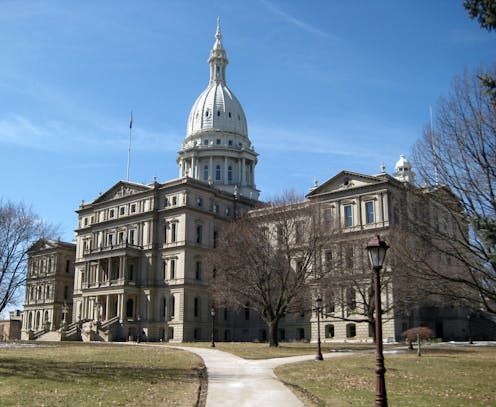
The Michigan State Capitol, like statehouses around the country, has been the site of numerous abortion policy battles. Brandon Bartoszek
The battles over abortion – who can get one, when they can get one – largely shifted from a focus on the U.S. Supreme Court back to state lawmakers and judges in June 2022. That’s when the Supreme Court ruled that there was no federal constitutional guarantee of the right to get an abortion. States, they said, should be making the rules.
That decision, Dobbs v. Jackson Women’s Health Organization, has meant a lot of activity in the past year in both state legislatures and courts. Two contradictory rulings early in April 2023 about whether women should have access to mifepristone, one of the two kinds of prescription abortion pills typically taken together for abortion, make it clear that federal courts still play a role in abortion policymaking. But states remain an important battleground.
Many people following the abortion battle focus on the part that state courts and state supreme court elections play. The intense focus on the outcome of the April 4, 2023, Wisconsin Supreme Court election, which shifted ideological control of that court, is an example.
I am a political scientist whose research focuses on state constitutions. I follow state constitutional amendments, which are adopted on a regular basis and revise the language of state constitutions. Sometimes they add new provisions. At other times they modify existing provisions. These amendments shape abortion policy as much as state court rulings – and stand to play a big role in abortion rights in the future.
Meanwhile, constitutional amendments have also protected – and in some cases, denied – abortion rights.
Before the Dobbs ruling, abortion-related amendments invariably sought to limit protection for abortion rights by clarifying that there is no state constitutional right to abortion. In fact, between 2014 and 2020, voters in Alabama, Louisiana, Tennessee and West Virginia approved amendments stating there is no state constitutional right to abortion.
These amendments were designed in some cases to overturn state supreme court rulings that previously recognized abortion rights. In other cases, they were adopted to prevent state supreme courts from ruling in the future in favor of abortion rights.
But voters don’t always approve these amendments. In August 2022, voters in Kansas rejected a proposed state constitutional amendment to deny a right to abortion. And in November 2022, voters in Kentucky did the same.
Drafting amendments to protect abortion rights
After the Dobbs decision, most proposed abortion-related amendments have aimed to expand protection of abortion rights.
In November 2022, voters in Vermont, California and Michigan approved amendments that explicitly protect reproductive rights. For instance, the California amendment declares, “The state shall not deny or interfere with an individual’s reproductive freedom in their most intimate decisions, which includes their fundamental right to choose to have an abortion.”
Eleven state constitutions already include protection for a right to “privacy.” Many others guarantee “liberty,” “due process” or “equality.”
State courts occasionally rely on these provisions to issue decisions safeguarding abortion access. But the amendments adopted in Vermont, California and Michigan marked the first time language was used in state constitutions to provide explicit protection for reproductive freedom. Similar abortion-rights amendments are set to appear on the ballot in other states.
In early April 2023, legislators in Maryland voted to place an abortion-rights amendment on the November 2024 ballot.
Meanwhile, in some states that allow citizens to put amendments directly on the ballot, bypassing the need for legislative approval, abortion-rights groups are organizing in support of putting abortion-rights amendments on the ballot. These groups in Ohio, for example, are collecting signatures to place an abortion-rights amendment before voters in 2023. And groups in Missouri are trying to put an abortion-rights amendment on the 2024 ballot.
In all 50 states, legislators have the authority to draft constitutional amendments. In some states, amendments need the support of only a majority of legislators to be placed on the ballot for voter approval. Other states set a higher bar and require amendments to earn the support of a legislative supermajority or get legislative approval in two separate sessions.
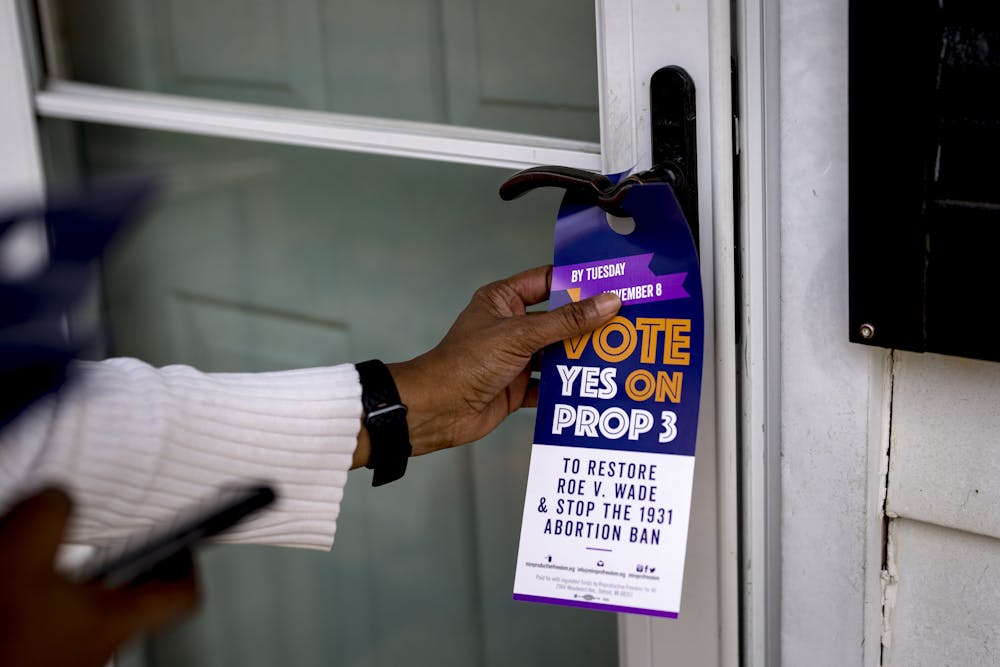
In most of these states, when groups collect enough signatures in support of a proposed amendment, that amendment automatically qualifies for the ballot. Last year in Michigan, for instance, legislators showed no signs of advancing a reproductive-rights amendment. But abortion-rights groups collected more than 500,000 signatures, much more than necessary, and were able to put a reproductive-rights amendment on the November 2022 ballot.
Once on the ballot, citizen-led amendments generally need approval from a simple majority of voters before they can be approved, similar to what is needed to approve legislature-drafted amendments.
But Florida, Colorado and Illinois set a higher threshold, and Nevada requires voters to approve citizen-led amendments in two consecutive elections.
Citizens can take the lead
In states that allow citizen-initiated amendments, citizens and groups can bypass legislators who might not support their issues. What’s more, these amendments take precedence over previous state supreme court rulings to the contrary. So, even when state supreme court justices won’t recognize a right, voters can use the amendment process to get it.
And abortion-rights groups that had success with the citizen-initiated amendment process in Michigan in November 2022 are eyeing additional opportunities in Ohio, Missouri and other states.
At the same time, opponents of abortion rights are considering making changes to amendment rules to make it more difficult for amendments to get approved.
Both developments are proof that supporters as well as opponents of abortion rights see citizen-drafted amendments as an increasingly important abortion battleground of the future.
John Dinan does not work for, consult, own shares in or receive funding from any company or organization that would benefit from this article, and has disclosed no relevant affiliations beyond their academic appointment.
How long do you spend staring at a screen every day? According to one report, the average person spends about seven hours a day on screens connected to the internet. And that figure is going to be even higher if your job is mainly done in front of a computer.
Most of us over-use digital devices, spending too long either working or enjoying being distracted on phones, tablets, laptops or even VR headsets. We are accused of being addicted to tech and warned of the dangers to our physical and mental health.
One significant paradox here is that we often retreat into the digital world to escape the stresses of the physical world, but can end up simply collecting other kinds of digital and physical stress along the way.
As a parent, I became concerned a few years ago about the effect my digital life was having on my work and family. I did some research of my own, changed the way I used my devices and even wrote a book about the dangers of what I call the “digital inferno”.
Break free from screen time addiction: seven tips for a healthier lifestyle.
pexels/anna shvets
It’s only in recent years that longer-term studies have been published on the issue. And taken together, these studies comprise a growing and significant body of knowledge, that is hard to dismiss or ignore: too much tech can cause issues for us humans.
If any of these symptoms describe you (or anyone you know), or you just feel too much of your life is taken up with staring at a screen, then you might find my advice on how to regain control of your tech helpful.
How to regain control
1. Practice putting down your digital devices consciously
Keep them out of sight and put them away when you aren’t using them, especially at night. Banish them from the bedroom, get an alarm clock (so you aren’t using your phone alarm) and you’ll sleep better without the late-night scrolling. And get out of the habit of watching TV with your phone next to you. Just focus on one task at a time without the distraction of another screen.
2. Set yourself screen time limits
Too much screen time can give you headaches. Be mindful of the way your use your tech and make use of features like voice notes, which allow you to stay up-to-date with communication without staring at a screen for a long time.
3. Stop allowing digital distractions
Constant interruption can induce physical and mental stress. Turn off notifications and alerts when you want to fully focus on a task. And keep your phone off your desk. Research shows that having your phone nearby, even if it’s not buzzing or ringing and even if the power is off, can hurt your performance.
4. Schedule proper digital-free time
Depression and anxiety is one result of digital overload. So getting away from your digital world for a while is important. Take a walk in nature, read a book, go for a bike ride – anything that takes you away from the screens for a while.
Screen overuse can strain our eyes and affect our eyesight. Don’t squint at tiny screens to do work that would be better done on a larger-screen laptop. Reduce the blue light on devices and make use of all the other helpful accessibility features. Start with that screen glare. And also make sure the volume doesn’t burst your ear drums.
6. Take control of the chaos of information overload
Organise your phone, computer and tablet so you can use them more efficiently. Some apps really do help you take charge of your life and work more calmly and effectively. Time-tracking apps measure how much time you’re spending (wasting) on your screen – prepare to be horrified! We regain mastery over our digital devices when we become more proactive in their use.
7. Sit well when you are digitally engaged
Slouching over a phone or hunching over your laptop will harm your neck and your back. Sit upright, stretch regularly and exercise often – without your phone.
Be a digital decider
These seven tips should help you regain a sense of control over your digital life. For me, it’s all about sleeping and waking better after leaving my phone downstairs. It’s about having dedicated, planned digital time and specific times when the phone has no place in what I’m doing.
Yet it’s also about enjoying these tech miracles in a more satisfying way and using them more consciously. I like to think of myself now as a digital decider and not just another digital casualty.
Paul Levy does not work for, consult, own shares in or receive funding from any company or organisation that would benefit from this article, and has disclosed no relevant affiliations beyond their academic appointment.
Saikiran Chandha discusses the impact of GPT-3 and related models on research, the potential question marks, and the steps that scholarly publishers can take to protect their interests.
One of the most pernicious effects of today’s copyright maximalism is the idea that every element of a creative work has to be owned by someone, and protected against “unauthorized” – that is, unpaid – use by other artists. That goes against several thousand years of human creativity, which only exists thanks to successive generations of artists using and building on our cultural heritage. The ownership model of art is essentially selfish: it seeks to maximize the financial gains of one creator, at the expense of the entire culture of which they are part. A good example of this clash of interests can be seen in yet another lawsuit in the music industry. This time, somebody is trying to copyright a rhythm:
The [Fish Market song] track featured the first known example of what would come to be known as a “dembow” rhythm – the percussive, slightly syncopated four-to-the-floor beat that travelled from reggae to become the signature beat of reggaeton, today the world-conquering sound of Latin American pop.
Now, more than 30 years after Fish Market was released, Steely & Clevie Productions is suing three of reggaeton’s most celebrated hitmakers – El Chombo, Luis Fonsi and Daddy Yankee – for what they characterise as unlawful interpolation of Fish Market’s rhythm (or “riddim”), and are seeking the credit – and royalties – they say they deserved from the start.
As the article in the Guardian goes on to explain, the culture that has grown up around the dembow rhythm and its many offshoots is large and flourishing. The lawsuit itself cites no less than 56 songs, and on popular sites like YouTube there many dembow and reggaeton mixes and collections that testify to the vitality and range of the music that has emerged over the last few decades. To claim “ownership” of the very simple rhythmic patterns that are used is as absurd as claiming ownership of the waltz or tango.
If successful, the court case will have a devastating effect on dembow and raggaeton culture, since many of today’s and tomorrow’s artists will doubtless prefer to move on to other styles rather than pay a dembow tax to use something as basic as a rhythm. A couple of musicians may win a few extra dollars, but there will be millions of losers in the form of fans of this music, who will have less of the style they love available to them. Culture itself will also be the poorer. But contrary to its frequent claims, the copyright industry never cared about either, and will be happy to see the courts spread the ownership obsession more widely.
Maple syrup’s desirability has made it a target for delinquent activities, including food fraud and theft. In 2011 and 2012, almost 3,000 tonnes of maple syrup were stolen from the Strategic Reserve in Québec.
The Great Maple Syrup Heist reflects the food’s status as a highly valuable commodity and the target of delinquent activities.
CBC’s The National takes a look at the Global Strategic Maple Syrup Reserve in Laurierville, Que.
In addition to the threat posed to maple syrup by thieves and smugglers, unreliable production yields due to climate events have required establishing production quotas to stabilize pricing and supply.
Consumers pay more for a lower value product. In addition, the introduction of other sugars or sugar syrups may pose risks to individuals with sugar sensitivities, as maple syrup has a lower glycemic index than white sugar or corn syrups.
Fingerprinting maple syrup glow
As such, there is a need for the development of more accurate and rapid testing tools to monitor maple syrup fraud.
In UV light, maple syrup naturally glows. Fluorescence fingerprinting maps the intensity of the light emitted by these specific fluorescent (glowing) compounds, and can provide a unique 3D rendering of a sample’s composition while also reporting on its quality, safety and identity.
Using key features found in the fluorescence fingerprints, we explored ways to better detect maple syrup adulteration even when the levels are as low as one per cent.
Our study examines the adulteration of dark and amber maple syrups with common maple syrup adulterants, at percentages ranging from one to 50 per cent.
Distinct fluorescence fingerprints were found for each tested syrup and mixture, revealing features that can be used to distinguish pure from adulterated samples.
Machine learning and identification
Maple syrup glows under UV light.
(M. Singh), Author provided
The fluorescence fingerprints obtained when the samples were exposed to UV and visible light show several features (or peaks) that gradually changed in samples tampered with adulterants. We were able to correctly detect adulteration in 70 to 100 per cent of samples, depending on how the features were quantified and analyzed, by creating a fluorescence index or by using machine learning techniques.
To fully validate this approach, we will need to use larger datasets that will help us control for other factors — like the environments maple trees grow in — that may affect the content of the syrups.
Other common fingerprinting techniques, such as DNA barcoding that examines short DNA fragments, can detect adulteration in other foods, like fish or sausages.
In contrast, fluorescence fingerprints rely on a food’s chemical composition, so identifying the presence of adulterants can happen even in highly processed samples. Most foods naturally contain intrinsic fluorescent compounds, which means they glow under UV and visible light — the amount of and type of glow represent distinguishing characteristics.
Quality control
Since using fluorescent fingerprinting only requires the use of light, it is a non-invasive, efficient and affordable strategy for checking whether maple syrup contains any other sugar syrups. It is also fast, providing information about a sample within minutes.
This approach can be applied at different points in the supply chain as part of quality assurance and control. This would ensure that consumers receive safe, high-quality foods, and that they are not cheated financially. Confirming the quality of maple syrup would also protect the brand reputation of Canadian products.
Maia Zhang, research assistant at the University of Guelph, co-authored this article.
Maleeka Singh receives funding from the Arrell Food Institute.
Maria G. Corradini receives funding from NSERC
Robert Hanner has received funding from the Arrell Food Institute, the Canadian Food Inspection Agency, and Oceana (US & Canada).
Sujani Rathnayake received funding from the Arrell Food Institute of the University of Guelph from 2019-2022.
In a marvellous leap forward, artificial intelligence combines all three in a tidy little package.
ChatGPT, and other generative AI chatbots like it, are trained on vast datasets from across the internet to produce the statistically most likely response to a prompt. Its answers are not based on any understanding of what makes something funny, meaningful or accurate, but rather, the phrasing, spelling, grammar and even style of other webpages.
It presents its responses through what’s called a “conversational interface”: it remembers what a user has said, and can have a conversation using context cues and clever gambits. It’s statistical pastiche plus statistical panache, and that’s where the trouble lies.
When I talk to another human, it cues a lifetime of my experience in dealing with other people. So when a program speaks like a person, it is very hard to not react as if one is engaging in an actual conversation — taking something in, thinking about it, responding in the context of both of our ideas.
Yet, that’s not at all what is happening with an AI interlocutor. They cannot think and they do not have understanding or comprehension of any sort.
Presenting information to us as a human does, in conversation, makes AI more convincing than it should be. Software is pretending to be more reliable than it is, because it’s using human tricks of rhetoric to fake trustworthiness, competence and understanding far beyond its capabilities.
There are two issues here: is the output correct; and do people think that the output is correct?
The interface side of the software is promising more than the algorithm-side can deliver on, and the developers know it. Sam Altman, the chief executive officer of OpenAI, the company behind ChatGPT, admits that “ChatGPT is incredibly limited, but good enough at some things to create a misleading impression of greatness.”
That still hasn’t stopped a stampede of companies rushing to integrate the early-stage tool into their user-facing products (including Microsoft’s Bing search), in an effort not to be left out.
Fact and fiction
Sometimes the AI is going to be wrong, but the conversational interface produces outputs with the same confidence and polish as when it is correct. For example, as science-fiction writer Ted Chiang points out, the tool makes errors when doing addition with larger numbers, because it doesn’t actually have any logic for doing math.
It simply pattern-matches examples seen on the web that involve addition. And while it might find examples for more common math questions, it just hasn’t seen training text involving larger numbers.
It doesn’t “know’ the math rules a 10-year-old would be able to explicitly use. Yet the conversational interface presents its response as certain, no matter how wrong it is, as reflected in this exchange with ChatGPT.
That makes sense: statistically, webpages note that famous people have often won awards, and papers usually have references. ChatGPT is just doing what it was built to do, and assembling content that could be likely, regardless of whether it’s true.
Computer scientists refer to this as AI hallucination. The rest of us might call it lying.
Intimidating outputs
When I teach my design students, I talk about the importance of matching output to the process. If an idea is at the conceptual stage, it shouldn’t be presented in a manner that makes it look more polished than it actually is — they shouldn’t render it in 3D or print it on glossy cardstock. A pencil sketch makes clear that the idea is preliminary, easy to change and shouldn’t be expected to address every part of a problem.
The same thing is true of conversational interfaces: when tech "speaks” to us in well-crafted, grammatically correct or chatty tones, we tend to interpret it as having much more thoughtfulness and reasoning than is actually present. It’s a trick a con-artist should use, not a computer.
Chatbots are increasingly being used by technology companies in user-facing products.
(Shutterstock)
AI developers have a responsibility to manage user expectations, because we may already be primed to believe whatever the machine says. Mathematician Jordan Ellenberg describes a type of “algebraic intimidation” that can overwhelm our better judgement just by claiming there’s math involved.
While we’re making the algorithms produce better and better content, we need to make sure the interface itself doesn’t over-promise. Conversations in the tech world are already filled with overconfidence and arrogance — maybe AI can have a little humility instead.
Richard Lachman does not work for, consult, own shares in or receive funding from any company or organisation that would benefit from this article, and has disclosed no relevant affiliations beyond their academic appointment.
To many people, these words won’t mean much. To others, they are a core part of the vocabulary of the “manosphere” – a collection of websites, social media accounts and forums dedicated to men’s issues, from health and fitness to dating and men’s rights.
I’m interested in how men use language, especially in the media and online, and what this tells us about contemporary masculinity and gender relations. In my recent book, I show how the language of the manosphere creates a culture of exclusion, denigration (mainly of women, but also of other men), male power and entitlement.
Understanding what manosphere terms mean can help teachers and parents start conversations with young men who are engaging with manosphere and male supremacist content. Recognising how language and ideology are connected can help with deradicalisation efforts, or ideally prevent radicalisation in the first place. And for young men and boys themselves, this awareness can improve their digital literacy and help them resist manipulation.
It is difficult to give a comprehensive overview of every instance of manosphere language. It is a constantly evolving collection of terms, sometimes in response to new issues that emerge, or in an attempt to subvert social media moderation efforts (abbreviations and acronyms are good examples of this). Here are some key terms to know.
Red and blue pill
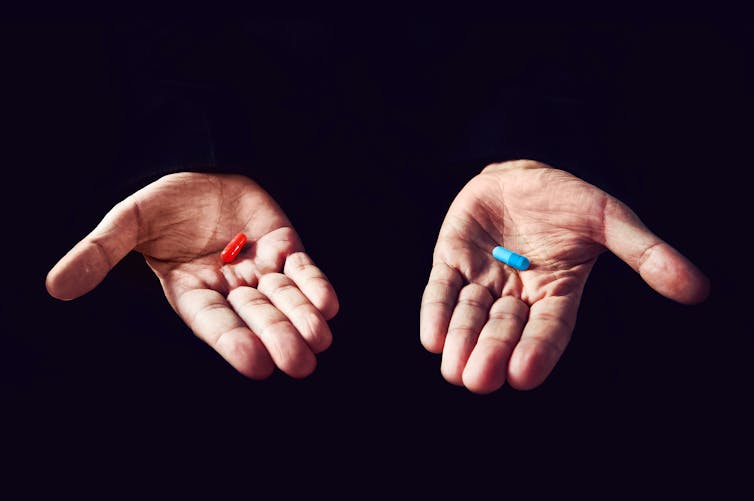
The cyberpunk blockbuster The Matrix is the source of a key symbol in the manosphere – the red pill. In the film, protagonist Neo is offered a choice of two pills. If he takes the blue pill, he will continue to exist in the world as he knows it, which is actually a simulation controlled by sentient machines who have enslaved humanity as a power source. If he takes the red pill, he will be released into the “real world”, where the curtain is pulled back and the truth is revealed.
In the manosphere, those who have been “red-pilled” see the world as it really is, understanding the so-called “real” nature of women’s behaviour and dating preferences. As researchers Megan Kelly, Alex DiBranco and Julia DeCook write:
Red pillers awaken to the “truth” that socially, economically and sexually, men are at the whims of women’s (and feminists’) power and desires.
The pill symbolism has also been taken up by the alt-right and cuts across a variety of conspiracy theories, from the claim of feminism controlling the world to shadowy global elites influencing public opinion.
The manosphere is obsessed with status, power, prestige and hierarchy. The idea of alphas and betas is central to this. Originally developed by biologist David Mech in his early work on wolf packs, the “alpha” was argued to be the most socially dominant male. Mech has since refuted this account as overly simplistic.
The concept was co-opted by the seduction community, a community organised around sharing tips and guidance for attracting and seducing women, before making its way to other parts of the manosphere.
Becoming an alpha is an aspirational goal for many men who engage with manosphere content. Alphas are in charge, have their pick of sexual partners and have ultimate control, both of themselves and others. Betas are the polar opposite: physically and psychologically weak, sexually unattractive, timid, submissive, meek and generally lacking in the qualities necessary to attain “real” manhood.
Chads and Stacys
The hierarchy of the manosphere, and the claimed primacy of looks over personality, can be clearly seen in the caricatures of Chads and Stacys.
Chads are the “ultimate alpha” – the ultra-masculine, virile, powerful and sexually attractive man to whom Stacys and other women flock. The term “gigachad” refers to the most alpha of alpha males.
Stacys are an idealisation of femininity – a hyper-attractive, sexually desirable, promiscuous but vapid woman. She is ultimately unobtainable, especially to men who are not Chads. Simultaneously the objects of disdain and desire, Chads and Stacys highlight a clichéd view of men and women, rooted in stereotypes and pigeonholes rather than in reality.
Shortened from cuckold, meaning a man whose wife has been unfaithful (a term first used as early as 1250), cuck is widely used in the manosphere and alt-right spaces.
The term is strongly associated with a subgenre of “humiliation pornography”, in which a man derives sexual pleasure from watching his female partner have sex with another man. Cuck is often used as an insult, especially since the idea of allowing one’s partner to have consensual sex with other men goes against heteronormative notions of male sexuality, control and ownership.
In some cases, such pornography also has an interracial dimension, contributing to racist stereotypes of Black men’s hypersexuality and hyperphysicality. Linguist Maureen Kosse has written about how cuck is used to “spread covertly racist online discourse by cloaking medieval sexual logic and racial anger in misogynistic humor”.
(N)awalt
(N)awalt means “(not) all women are like that”. The more common form “Awalt” is typically used to ascribe negative stereotypes to women. Denying their individuality, Awalt is used to suggest women are all vapid, insincere, sexually promiscuous, driven by emotions rather than rationality, motivated by financial gain and more. Awalt is also deployed to emphasise the claim that men are everything women are not – moral, rational, intelligent, loyal, honourable and individualistic.
It is clear that manosphere language is contributing to an increasingly politicised and fractious form of gender relations. By understanding this language, we can better counter it.
Robert Lawson is a Research Fellow in the Institute for Research on Male Supremacism.
by Paul M. Collins Jr., Professor of Legal Studies and Political Science, UMass Amherst
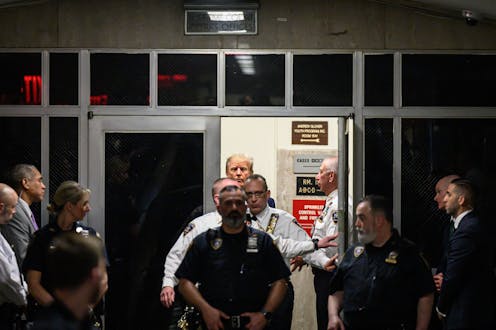
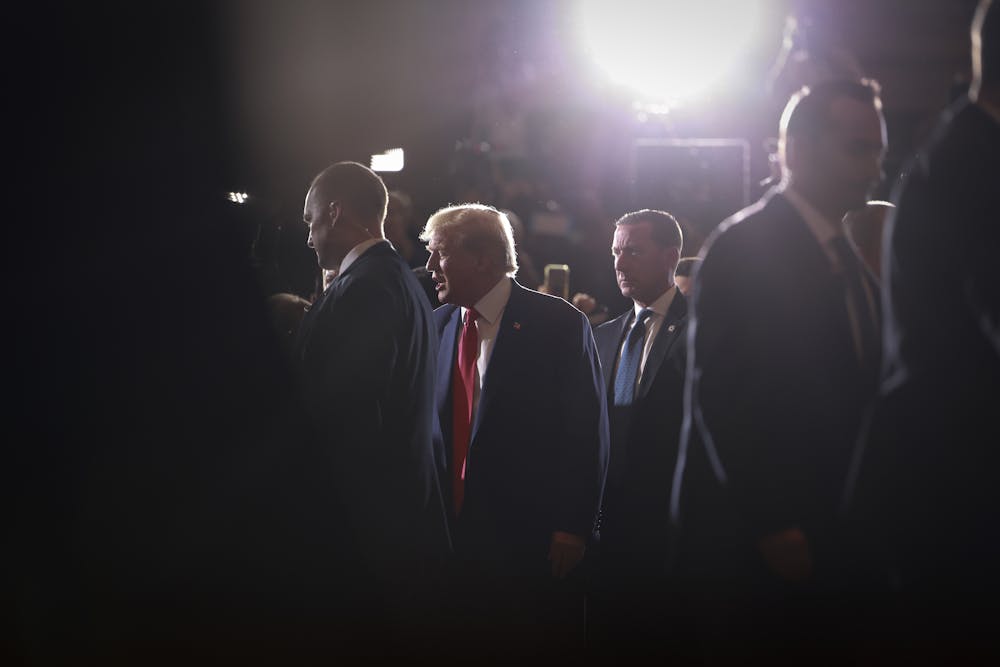
Former President Donald Trump arrives at the Manhattan Criminal Courthouse on April 4, 2023, before his arraignment. Ed Jones/AFP via Getty Images
When former President Donald Trump was arraigned in a Manhattan criminal court on April 4, 2023, Judge Juan Merchan warned him to “refrain” from making social media posts that could incite violence or “jeopardize the rule of law.”
Hours before his arraignment, Trump reposted a since-deleted photo that featured him with a baseball bat alongside Manhattan District Attorney Alvin Bragg.
After Trump pleaded not guilty and was released from custody, he attacked Merchan and the judge’s family during a speech at Mar-a-Lago.
This isn’t the first time Trump has criticized those trying to hold him accountable.
And he has targeted Merchan, claiming that the judge “hates” the former president and that he “strongarmed” one of Trump’s associates into taking a plea deal.
Trump has also questioned the integrity of the U.S. legalsystem itself, writing that it’s “impossible” for him to get a fair trial in New York City, presumably because the city’s population is heavily Democratic.
We found that presidents criticize judicial decisions infrequently. And when they do, they tend to respectfully object to the decisions courts make rather than try to undermine their legitimacy or attack individual judges.
Trump, however, is not known to follow norms and does not abide by this one.
Here are three things to know about how Trump’s words regarding his criminal indictment can undermine the rule of law and confidence in the U.S. judicial system.
Former President Donald Trump greets supporters at Mar-a-Lago on April 4, 2023, hours after he pleaded not guilty to 34 felony counts.
Joe Raedle/Getty Images
1. Trump’s attacks are bad for the rule of law
For a few different reasons, the language Trump uses to criticize those he perceives to be his legal enemies often has racist or sexist undertones and can undermine faith in the U.S. legal system.
Indeed, some studiessuggest that Trump’s attacks on legal and political institutions may do just that.
For instance, research demonstrates that public approval of the Supreme Court dropped following Trump’s tweets calling U.S. District Judge James L. Robart a “so-called judge” after he halted Trump’s travel ban in February 2017.
We think that the country is not well situated to absorb further decreases in support for the rule of law. Americans’ faith in legal institutions has dropped dramatically in recent years because of various complex factors, including controversial Supreme Court decisions.
Public disapproval of the Supreme Court is at all-time high, with 58% of Americans disapproving of the court as of September 2022. This marks an increase of 18% of Americans who disapproved of the court from a decade earlier.
Similarly, people’s confidence in the criminal justice system has dropped over the past several years, with 43% of Americans indicating in 2022 they have very little confidence in the way the country handles crime. When former President Barack Obama’s term began in 2009, only 25% of people said the same.
If public support for the rule of law weathers the storm and serves as a check on Trump’s brand of vindictive politics – as it has been on past abuses of presidential power – then American legal institutions will prevail.
But if Trump’s relentless, aggressive attacks convince large swaths of the public that he is being unfairly treated, this may lead to their questioning all kinds of other legal decisions. The end result may be a further drop in confidence in the rule of law, at least among Trump’s supporters.
2. These attacks can be dangerous
Physical threats on judges and other court personnel are at an all-time high.
Some of this increase can be linked to Trump’s time in the White House, if not his behavior directly. Over the course of his presidency, the U.S. Marshals Service reports that inappropriate communications and threats against judges, prosecutors and other protected persons increased by about 50% – from 2,847 in 2017 to 4,261 in 2020.
Robart received a wave of threats after he granted a restraining order against Trump’s travel ban in 2017 and Trump tweeted about Robart. In response to Trump’s public attacks, Robart’s personal information was leaked on the internet and the judge received more than 100 deaththreats.
3. Trump’s criticisms are in a league of their own
When both Republican and Democratic presidents have criticized legal decisions they don’t like, they have generally followed a common playbook. Typically, presidents express respect for the judicial branch and the rule of law and explain their disagreement. They do not single out people and resort to personal attacks.
President Bill Clinton, who faced indictment for lying to a grand jury in 1998, followed this playbook when he took responsibility for his “personal failure” during an address to the nation, and referred questions about the investigation to his lawyers. Although he opposed an independent prosecutor, he never criticized the prosecutor’s legitimacy.
His propensity to attack the legal system even predates his presidency.
In 2014, he tweeted that the South African judge in the Oscar Pistorius case was “a moron.” Pistorius, an accomplished runner, was found guilty of murdering his girlfriend.
During the 2016 presidential campaign, Trump used racially tinged language when attacking the judge set to overhear the fraud trial of Trump University. Trump claimed that District Judge Gonzalo Curiel would be biased against him because he was of Mexican descent and Trump was planning to build a wall between the U.S. and Mexico.
Given Trump’s long history of these type of vicious personal attacks on members of the legal community, it seems unlikely that we will see a radically different Trump now that he faces criminal charges for the first time in his career.
While this may help Trump raisemore money for his presidential campaign, it may cost the country some faith in the rule of law, while putting legal officials in danger.
The authors do not work for, consult, own shares in or receive funding from any company or organization that would benefit from this article, and have disclosed no relevant affiliations beyond their academic appointment.
by Stephen P. Leatherman, Professor of Coastal Science, Florida International University
Sargassum seaweed started washing up in Fort Lauderdale, Florida, in mid-March 2023. Joe Raedle/Getty Images
An unwelcome visitor is headed for Florida and the Caribbean: huge floating mats of sargassum, or free-floating brown seaweed. Nearly every year since 2011, sargassum has inundated Caribbean, Gulf of Mexico and Florida coastlines in warm months, peaking in June and July. This brown tide rots on the beach, driving away tourists, harming local fishing industries and requiring costly cleanups.
According to scientists who monitor the formation of sargassum in the Atlantic Ocean, 2023 could produce the largest bloom ever recorded. That’s bad news for destinations like Miami and Fort Lauderdale that will struggle to clean their shorelines. In 2022, Miami-Dade County spent US$6 million to clear sargassum from just four popular beaches.
Satellite image of sargassum concentrations in the Atlantic during the month of March.
USF/NOAA, CC BY-ND
Sargassum isn’t new on South Florida beaches, but its rapid increase over the past decade indicates that some new factor – likely related to human actions – is affecting when and how it forms.
In my work as a coastal scientist, I’ve watched these invasions become the new normal, choking beaches and turning clear blue waters golden brown. Along with other researchers, I’m trying to understand why sargassum has proliferated into this new sprawling bloom, how to deal with such massive amounts of it, and how affected countries can predict the severity of the next influx.
Sargassum has a valuable ecological role at sea, but on beaches it’s an expensive nuisance that threatens tourism.
A biological hot spot at sea
Sargassum grows in the calm, clear waters of the Sargasso Sea – a 2 million-square-nautical-mile (5.2 million-square-kilometer) haven of biodiversity that lies east of Bermuda in the Atlantic Ocean. Rather than beaches, it’s bounded by rotating ocean currents that form the North Atlantic Subtropical Gyre.
The Sargasso Sea in the North Atlantic is bounded by the Gulf Stream to the west, the North Atlantic Current to the north, the Canary Current to the east, and the North Equatorial Current to the south.
Jack/Wikipedia
In the open ocean, islands of sargassum create a rich ecosystem that ocean explorer Sylvia Earle calls “a golden floating rainforest.” Suspended by round “berries” filled with gas, the seaweed offers food, sanctuary and breeding grounds for crabs, shrimp, whales, migratory birds and some 120 species of fish. Mats of it form the sole spawning grounds for European and American eels and habitat for some 43 other threatened or endangered species.
Sargassum also shelters sea turtle hatchlings and juvenile fish during their early life in the open ocean. Ten endemic species live nowhere else on Earth. The Sargasso is a valuable commercial fishery worth about $100 million per year.
The belt is actually a collection of island-like masses that can stretch for miles. It doesn’t uniformly cover beaches when it washes up: Some areas can be relatively clear or only mildly affected. But the overall mass this year is overwhelming.
What’s fertilizing huge blooms?
What can plausibly explain the sudden increase in this floating seaweed since 2011 – the first time that large aggregations of sargassum were detected from space? While climate change is warming ocean waters, and sargassum grows faster in warmer water, I believe it’s more plausible that the cause is a drastic increase in agricultural activity in the Brazilian Amazon.
Scientists have shown that huge brown tides that were observed in the Gulf of Mexico in 2005 and 2011 were linked to nutrients carried down the Mississippi River. Now, intensive cattle ranching and soybean farming in the Amazon basin are sending rising levels of nitrogen and phosphorus into the Atlantic Ocean via the Amazon and Orinoco rivers. These nutrients are key ingredients in fertilizer, and also are present in animal manure.
Another major source of nutrients is dust clouds from the Sahara, which can stretch for thousands of miles across the Atlantic Ocean, carried by trade winds. These clouds contain iron, nitrogen and phosphorus from dust storms in Saharan Africa and biomass burning in central and southern Africa. As they blow across the Atlantic, they help fertilize seaweed.
This map shows dust from a series of Saharan storms crossing the Atlantic on June 28, 2018.
NASA Earth Observatory
A threat to sea life
Along with its devastating effects on recreational beaches in the Caribbean and South Florida, sargassum has important but less visible ecological impacts near the coast. Large floating mats of sargassum block sunlight, which is essential for the survival of underwater grasses. These grasses stabilize the seafloor and provide food and shelter for many species of fish and invertebrates and for Florida’s endangered manatees.
Coral reefs also require sunlight and clean water to survive. Reefs in Florida and the Caribbean are under many other stresses, including ocean warming and coral bleaching, so they are already highly vulnerable.
Thick masses of sargassum on beaches can make it difficult or impossible for endangered sea turtles to dig nests and lay eggs on beaches. Spring and summer, when sargassum accumulates, are prime sea turtle nesting seasons.
A manatee feeding on seagrass in Homosassa, Fla. Starvation due to loss of seagrass beds has been a primary cause of manatee deaths in Florida in recent years.
Joe Raedle/Getty Images
Taming the sargassum monster
Researchers across the Caribbean are working to find productive uses for these enormous quantities of organic material that float ashore. In South Florida, communities mainly use the seaweed as mulch, but this requires thoroughly washing it to remove the salt, either naturally via rainfall or by spraying it with fresh water. Recycling sargassum into fertilizer for use on crops is problematic because it often contains toxic heavy metals such as arsenic and cadmium.
Sargassum has become a recurring seaweed monster, but humanity is the real villain. Until nations find ways to reduce large-scale nutrient pollution, I expect that huge sargassum blooms will be a recurring presence in Florida and the Caribbean.
This is an update of an article published Aug. 2, 2021.
Stephen P. Leatherman does not work for, consult, own shares in or receive funding from any company or organization that would benefit from this article, and has disclosed no relevant affiliations beyond their academic appointment.
by Jay L. Zagorsky, Clinical Associate Professor, Boston University
It turns out paying taxes in cash ain't easy.
nikom khotjan/Moment via Getty Images
About two-thirds of all U.S. residents who file federal income taxes typically get a refund. Unfortunately, this year I am among the other third who owe the Internal Revenue Service money.
So I tried something I’ve never done before and few people do: I wanted to pay my tax bill in cash – that is, with real paper currency.
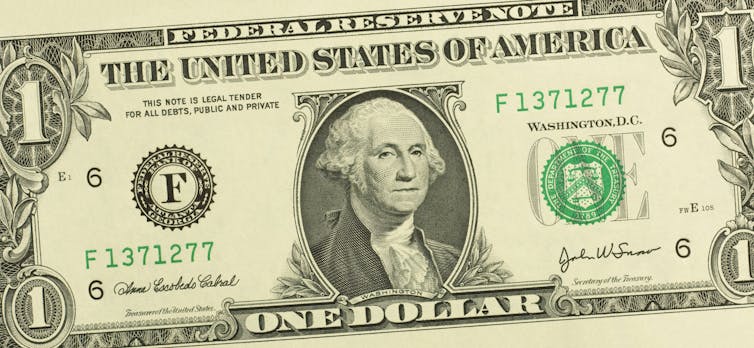
But beyond my own book-related interest in paying taxes in cash, I had other reasons for wanting to do so. For years while teaching students about money, I noted the front of every piece of U.S. currency declares: “This note is legal tender for all debts public and private.”
The statement seemed ironic since I couldn’t figure out how to pay income taxes, one of people’s most significant public debts, with currency.
I also wondered how difficult it is for the unbanked to pay taxes. Federal Deposit Insurance Corp. data shows about 6 million households have no connection to the formal banking system.
The IRS does not publish data on the methods people use to pay their taxes, but several IRS employees I spoke with told me almost no one pays the IRS in cash.
Recently, a student of mine pointed out where the instructions for paying the government with paper money are buried, so I gave it a try. The five-step set of instructions hinted that paying cash directly is a time-consuming process and that I needed to start a month or two before taxes are due.
The operator, who told me her name was “Ms. Johnson,” was cheerful and helpful – but tried her very best to dissuade me from paying in cash. She offered to walk me through the steps on the phone so that I could pay online and not have to come into my local IRS office.
The IRS also has partnered with national chains like CVS, Walgreens, 7-Eleven and Family Dollar to accept cash on its behalf. Their service fees are less, either $1.50 or $2.50 per payment. However, the steps needed to navigate the online program before you can show up at a retailer seemed almost as difficult as filling in the tax forms.
More importantly, this program has a $500 per payment limit and a $1,000 maximum amount accepted per year. This made the method impractical for me and for most people who owe the IRS money. The latest IRS figures show people who owe income taxes on average pay over $6,000.
After I declined all of Ms. Johnson’s alternative payment offers, she told me I was lucky. There was an appointment available at the downtown Boston taxpayer assistance center in a few days. Her schedule showed many other centers around the country were booked until May, long after taxes were due.
The author had to go to an IRS assistance center to try to pay his taxes in cash.
AP Photo/Patrick Semansky
An arduous process – but a successful one
I had cash at home, but not enough. I went to the bank and made sure I got exact change in crisp new bills to make the transaction as easy as possible.
I made it to the IRS building, went through airport-style screening and checked in on time. The receptionist was polite and again told me all the ways to pay without cash. After I declined, he asked me to take a seat in the waiting area filled with people clutching paperwork. As I walked away, the receptionist did a facepalm while shaking his head, which was not a positive sign.
After a 30-minute wait, another polite IRS worker came out and told me they could not accept cash that day because no courier was scheduled. Current IRS rules require that a courier take all cash immediately to the bank because they said “holding cash was not safe.” This is surprising given the federal office building was swarming with armed guards and required screening to enter.
I came back a week later when another cash payer was showing up. This time I had more success. It took 30 minutes, but after completing a multipart carbon form by hand, I got a receipt that said my taxes were paid.
A simple solution
Paying the IRS with cash is possible, but it turned out to be onerous and time-consuming.
I believe there is a simple solution. The Code of Federal Regulations, which governs the IRS and other agencies, allows authorized banks to accept tax payments. The law doesn’t specify payment only by check or other methods. This means if procedures existed, taxpayers could walk into major banks, hand the teller cash and have the bank inform the IRS of the amount paid.
For people without bank accounts, their only option for paying taxes shouldn’t require paying fees to credit card processors or retailers – especially since they are likely among the poorest taxpayers.
If the government wants everyone to pay their taxes, why doesn’t it make it as easy as possible?
Jay L. Zagorsky does not work for, consult, own shares in or receive funding from any company or organisation that would benefit from this article, and has disclosed no relevant affiliations beyond their academic appointment.
Faculty senate president Jenifer Jasinski Schneider said the new pieces of legislation ranging from abortion to critical theory are a part of Gov. Ron DeSantis’ “presidential campaign at the state level.” SPECIAL TO THE ORACLE
As the Florida legislative session continues to hear legislation concerning highly divisive topics such as critical race theory, abortion and gender-affirming care, faculty senate president Jenifer Jasinski Schneider said these bills represent an overreach in a range of different issues.
Though not each bill is extremely broad, when considering all the bills it becomes “very far-reaching,” according to Schneider. She said the impact of the recently introduced legislation will also have an impact on students, faculty and staff.
“You have bills about guns. You have bills about abortion and health care. You have bills about content and curriculum and censorship,” Schneider said. “So even if one bill doesn’t seem relevant to you, another one is going to be so I think they’re very broad.”
The legislation that seems to have the most considerable impact on higher education and is of most concern for faculty is House Bill (H.B.) 999 – along with its companion bill, Senate Bill (S.B.) 266 – according to Schneider. She said the bill targets critical race theory and diversity, equity and inclusion (DEI) programs by prohibiting expenditures in that area, as well as sets new requirements for post-tenure reviews for faculty.
In its original form, the proposal would have also eliminated critical race theory and gender and women’s studies majors and minors. However, under the revised March 15 version of the bill, critical theory – including critical race, feminist and queer theory – would be banned. The newer version also specifies under which criteria a post-tenure review might be initiated, such as negligence, poor performance, insubordination and violation of the law, among others.
The source of concern regarding H.B. 999 is that DEI content exists in a wide range of programs, according to Schneider. She said DEI is “a non-negotiable,” regardless of whether a student is in S.T.E.M., humanities or social sciences fields. The restrictions in content that will follow H.B. 999, she said, will also impact courses that are offered and whether the university will meet accreditation standards.
“If you have certain courses and programs where content is limited, then we are not meeting accreditation standards, then we’re going to lose special accreditation for different programs. If you lose accreditation, your degrees are worthless,” Schneider said.
Though Schneider said she did not know which courses could be eliminated or face restrictions if the law was put into effect, she said a survey carried out by the faculty senate for professors in all USF colleges showed the proposal’s unpopularity. A total of 705 faculty were surveyed, and all answered that the removal or censorship of DEI would affect the quality of a degree, according to Schneider.
USF is currently monitoring bills that have been introduced which could impact the university, according to Director of Media Relations Althea Johnson.
“If any laws are passed, we’ll analyze how they may affect the university and we’ll communicate updates as needed,” Johnson wrote.
Other legislations, such as the newly passed six-week abortion ban and gender-affirming care ban, will have some impacts on higher education institutions. S.B. 300 would ban abortions after six weeks of pregnancy with only some exceptions for women facing life-threatening harm and exemptions for victims of sexual assault and incest, according to an April 4 Associated Press article. The bill, however, is not currently in effect due to legal challenges to Florida’s already standing 15-week abortion ban.
The gender-affirming care ban, also known as S.B. 254 which passed in the Senate on Tuesday, prohibits offering treatments such as sex reassignment surgeries or hormone therapies to transgender minors, according to an April 4 Politico article. It would also prohibit universities, local governments and health insurance plans for state workers and providers using the state’s Medicaid Managed Care program from using public dollars to pay for treatments.
These bans will indirectly impact higher education by affecting health clinics on campus and the faculty that work in these spaces, according to Schneider.
Effects of proposed legislation are already being felt throughout state universities, Schneider said, as searches for faculty continue to fail. The university has already seen less people in candidate pools for faculty positions, but the effects will become exacerbated next fall as the hiring season begins again, according to Schneider.
In her own department, Schneider said rather than drawing the usual candidates from New York, California and New England, the candidate pool is composed mostly of Floridians. This is because, with all of the bills introduced this legislative session, many people have been alienated and therefore do not want to come to the state, according to Schneider.
“Maybe not one particular bill will catch everyone, but across all of these bills, you pretty much have targeted everybody that would be interested in being a learning and thinking person and that lives in a state where you want to be free over your body and free over your mind,” Schneider said.
As the university loses people, they will also lose the research, expertise and prestige that follows those individuals, according to Schneider. She said this can mean that the university will also lose out on the funding dollars faculty might bring to the university.
“The other problem that is on the horizon are some of these people, not all of them, but some of them have high levels of funding. And, funding can go with the individual to another university. So, we don’t just lose expertise. We also lose the funding dollars that have been coming into the university,” she said.
This effect is not limited to faculty and staff, but also students. A Forbes survey released on March 31 showed that, in a pool of 1,000 Florida high school and undergraduate students, 91% do not agree with Gov. Ron DeSantis’ policies and one in eight graduating high school students will not attend university in Florida due to the new proposals and policies. Many of these students said their concern was on the negative impact the policies will have on their education, according to Forbes.
Schneider said though the rhetoric of the bill is focused on disenfranchised communities such as people of color and LGBTQ communities, everyone will be affected if the new policies take effect.
“It’s all going to be affected. You know, people think this is just about stop woke and Black or gay issues. Because that’s what it’s intended to be. That’s what the rhetoric has been around it – it’s intended to target certain marginalized groups. And it’s a broad sweep of everyone. It’s just so disturbing… the damage that could happen here. And it’s already happening,” she said.
It's refreshing to be able to review and download a well-researched (pdf) report on a subject absolutely surrounded by an incredible amount of disinfo, speculation, hype, and curiosity.
Thankfully Stanford University and its Human-Centered Artificial Intelligence department made their report! It measures trends in artificial intelligence, AND it is free to consume and share with others, which is what I am doing here today, with you! — Read the rest
by Jeffrey Bellin, Mills E. Godwin, Jr., Professor of Law, William & Mary Law School
A supporter of former President Donald Trump protests the indictment announcement near Mar-a-Lago, Fla., on March 31, 2023. Chandan Khan/AFP via Getty Images
When former President Donald Trump turns himself over to authorities in New York on Tuesday, April 4, 2023, and is arraigned, the charges on which a Manhattan grand jury indicted him will likely be made public.
Manhattan District Attorney Alvin Bragg obtained the indictment on March 30, 2023, following a grand jury vote, but the exact charges against Trump remain sealed. Multiple media sources are reporting the indictment alleges the former president committed business fraud.
I am a former prosecutor and law professor who studies the criminal justice system. While the complexities of Trump’s case will continue to unfold, The Conversation asked me to break down the complex legal situation. Here are four key points to understand about the prosecution and what will likely come next.
From what we understand of the investigation, the charges against Trump appear to stem from a US$130,000 payment in 2016 by Trump’s then-lawyer, Michael Cohen, to an adult film star, Stormy Daniels. In return, Daniels promised not to tell the media about her alleged affair with Trump.
Media reports suggest that there could be about 30 counts against Trump, and at least some of those counts will be felonies.
Just the fact that there are so many counts does not mean that there are many different criminal events or kinds of crimes alleged. Prosecutors often charge similar, repeated conduct – for example, multiple drug sales – as separate counts. In this case, the multiple counts may refer to a series of business records that record the same or similar transactions. Or the charges may, indeed, span multiple alleged criminal events.
Media reports indicate that Bragg does not appear to be alleging that Trump’s payment to Daniels was itself illegal.
Instead, Trump will likely be charged with “falsifying business records” for trying to hide the payment by lying about its nature in the records of the Trump Organization, his company.
Creating a false business record with the intent to defraud is a Class A misdemeanor offense in New York. But the offense can become a low-level Class E felony if Bragg can prove that Trump created false business records for the purpose of facilitating a second crime.
It is not yet clear what the second crime will be – or even that a second crime is being alleged – but possibilities include federal or state campaign finance violations or tax evasion.
2. Bragg will have to prove Trump’s involvement, fraudulent intent
If there is a trial, the prosecution will have to put together a series of pieces to secure a conviction on each of the charges facing Trump.
First, the prosecution would have to prove that the Daniels payment was recorded by Trump officials as something clearly inaccurate. It is not enough to show that the payment was recorded ambiguously – like “miscellaneous” or even “legal services.” The business records at issue must be unequivocally “false.”
Second, it is not necessary that Trump himself created false records. The prosecution would just have to prove that Trump was the direct cause of the false entry – meaning someone followed his specific directions.
Third, the prosecution would have to prove that Trump created the false record for a fraudulent purpose and, to prove a felony, with the specific purpose of committing – or covering up – another crime.
This is important because there could be other potentially plausible reasons the defense might offer, including that Trump sought to avoid embarrassment to his family or himself. Another option is indifference, that Trump gave little thought to how the transaction was recorded. That’s why the details of the allegedly false records, and Trump’s degree of involvement in their creation, will be central questions at trial.
Finally, for the felony offense, the prosecution would also have to prove that there was another crime that was either committed or covered up by using this false business record.
People gather March 31, 2023, in front of Trump Tower the day after former President Donald Trump was indicted by a New York grand jury.
Spencer Platt/Getty Images
3. It’s the most complex straightforward case in history
While everyone will be watching to see if this case is handled like other cases, differences are inevitable. For example, the New York Police Department and court officers will need to coordinate the arrest process with Trump’s Secret Service agents.
Further complications will arise if there is any prospect of incarceration. Based on what we know now, there is little prospect that Trump will be jailed pending trial for this allegation of a nonviolent crime. And even if he is ultimately convicted, it’s still unlikely he’ll be locked up, based on the nature of the charges and his lack of a prior criminal record. That said, judges have broad discretion in determining sentences.
That is only a small window into the logistical challenges that await the Manhattan district attorney’s office and the New York courts. If this were any other defendant, this would be a relatively straightforward case, the kind that make up the hundreds of cases in a typical prosecutor’s caseload.
However, Trump is not any other defendant. That means this is likely to be the most complex straightforward case in American history.
Manhattan District Attorney Alvin Bragg leaves his New York office on March 22, 2023.
Scott Olson/Getty Images
4. The judicial process will be a messy affair
Most low-level felony and misdemeanor cases are resolved before trial, especially when there is no obvious victim. Typically, the prosecution will offer a plea deal, perhaps including a term of probation, or even propose a diversion program with community service, for example, which will lead to a dismissal of the charges.
It will be interesting to see if Bragg makes an offer along those lines. Even if he does, defendants must typically admit guilt to take advantage of these arrangements, and Trump may refuse for political, personal or legal reasons to admit guilt.
So it’s likely the case will go to trial, a process that will be messy for many reasons – most importantly, the jury.
When choosing a jury in a criminal case, the trial judge is supposed to screen out potential jurors who are biased in favor of, or against, the defendant. That’s normally easy because the jurors have usually never have heard of the defendant.
But most potential jurors will have opinions about Trump and many will need to be excused from jury service because of a lack of objectivity.
In a trial with this much media attention, there will also be people who have strong feelings about Trump and want to be on the jury. Some of them may hide their biases. That’s a problem by itself.
Then, once the trial starts, the media attention will shine a spotlight on the selected jurors. If it becomes clear that the jurors lied or failed to disclose information in jury selection, that could be grounds for removing them from the jury in the middle of the trial. If enough jurors are removed, the case will end in a mistrial, sending everyone back to square one.
So, while there is a lot about this prosecution that isn’t yet clear to the general public, one thing is clear – this will be a case with unprecedented attention and complexity.
Jeffrey Bellin does not work for, consult, own shares in or receive funding from any company or organization that would benefit from this article, and has disclosed no relevant affiliations beyond their academic appointment.
by Karen A. Spiller, Thomas W. Haas Professor in Sustainable Food Systems, University of New Hampshire
The Uphams Corner Food Forest in Boston's Dorchester neighborhood was built on a vacant lot. Boston Food Forest Coalition, CC BY-ND
More than half of all people on Earth live in cities, and that share could reach 70% by 2050. But except for public parks, there aren’t many models for nature conservation that focus on caring for nature in urban areas.
One new idea that’s gaining attention is the concept of food forests – essentially, edible parks. These projects, often sited on vacant lots, grow large and small trees, vines, shrubs and plants that produce fruits, nuts and other edible products.
Atlanta’s Urban Food Forest at Browns Mill is the nation’s largest such project, covering more than 7 acres.
Unlike community gardens or urban farms, food forests are designed to mimic ecosystems found in nature, with many vertical layers. They shade and cool the land, protecting soil from erosion and providing habitat for insects, animals, birds and bees. Many community gardens and urban farms have limited membership, but most food forests are open to the community from sunup to sundown.
As scholars who focus on conservation, social justice and sustainable food systems, we see food forests as an exciting new way to protect nature without displacing people. Food forests don’t just conserve biodiversity – they also promote community well-being and offer deep insights about fostering urban nature in the Anthropocene, as environmentally destructive forms of economic development and consumption alter Earth’s climate and ecosystems.
Community stewards planting a tree at Boston’s Edgewater Food Forest at River Street, July 2021.
Boston Food Forest Coalition/Hope Kelley, CC BY-ND
Protecting nature without pushing people away
Many scientists and world leaders agree that to slow climate change and reduce losses of wild species, it’s critical to protect a large share of Earth’s lands and waters for nature. Under the U.N. Convention on Biological Diversity, 188 nations have agreed on a target of conserving at least 30% of land and sea areas globally by 2030 – an agenda known popularly as 30x30.
But there’s fierce debate over how to achieve that goal. In many cases, creating protected areas has displaced Indigenous peoples from their homelands. What’s more, protected areas are disproportionately located in countries with high levels of economic inequality and poorly functioning political institutions that don’t effectively protect the rights of poor and marginalized citizens in most cases.
In contrast, food forests promote civic engagement. At Beacon Food Forest in Seattle, volunteers worked with professional landscape architects and organized public meetings to seek community input on the project’s design and development. The city of Atlanta’s Urban Agriculture Team partners with neighborhood residents, volunteers, community groups and nonprofit partners to manage the Urban Food Forest at Browns Mill.
And those gaps still exist. In 2021, the city reported that communities of color that had been subjected to redlining in the past had 16% less parkland and 7% less tree cover than the citywide median. These neighborhoods were 3.3 degrees Fahrenheit (1.8 degrees Celsius) hotter during the day and 1.9 F (1 C) hotter at night, making residents more vulnerable to urban heat waves that are becoming increasingly common with climate change.
Encouragingly, Boston has been at the forefront of the national expansion of food forests. The unique approach here places ownership of these parcels in a community trust. Neighborhood stewards manage the sites’ routine care and maintenance.
The nonprofit Boston Food Forest Coalition, which launched in 2015, is working to develop 30 community-driven food forests by 2030. The existing nine projects are helping to conserve over 60,000 square feet (5,600 square meters) of formerly vacant urban land – an area slightly larger than a football field.
Neighborhood volunteers choose what to grow, plan events and share harvested crops with food banks, nonprofit and faith-based meal programs and neighbors. Local collective action is central to repurposing open spaces, including lawns, yards and vacant lots, into food forests that are linked together into a citywide network. The coalition, a community land trust that partners with the city government, holds Boston food forests as permanently protected lands.
Aerial view of the Ellington Community Food Forest in Boston’s Dorchester neighborhood.
Boston Food Forest Coalition, CC BY-ND
Boston’s food forests are small in size: They average 7,000 square feet (650 square meters) of reclaimed land, about 50% larger than an NBA basketball court. But they produce a wide range of vegetables, fruit and herbs, including Roxbury Russet apples, native blueberries and pawpaws, a nutritious fruit native to North America. The forests also serve as gathering spaces, contribute to rainwater harvesting and help beautify neighborhoods.
The Boston Food Forest Coalition provides technical assistance and fundraising support. It also hires experts for tasks such as soil remediation, removing invasive plants and installing accessible pathways, benches and fences.
Hundreds of volunteers take part in community work days and educational workshops on topics such as pruning fruit trees in winter. Gardening classes and cultural events connect neighbors across urban divides of class, race, language and culture.
Boston residents explain what the city’s food forests mean to them.
A growing movement
According to a crowd-sourced repository, the U.S. has more than 85 community food forests in public spaces from the Pacific Northwest to the Deep South. Currently, most of these sites are in larger cities. In a 2021 survey, mayors from 176 small cities (with populations under 25,000) reported that long-term maintenance was the biggest challenge of sustaining food forests in their communities.
From our experience observing Boston’s approach close up, we believe its model of community-driven food forests is promising. The city sold land to the Boston Food Forest Coalition’s community land trust for $100 per parcel in 2015 and also funded initial construction and planting operations. Since then, the city has made food forests an important part of the city’s open spaces program as it continues to sell parcels to the community land trust at the same price.
Smaller cities with much lower tax bases may not be able to make the same sort of investments. But Boston’s community-driven model offers a viable approach for maintaining these projects without burdening city governments. The city has adopted innovative zoning and permitting ordinances to support small-scale urban agriculture.
Building a food forest brings together neighbors, neighborhood associations, community-based organizations and city agencies. It represents a grassroots response to the interconnected crises of climate change, environmental degradation and social and racial inequity. We believe food forests show how to build a just and sustainable future, one person, seedling and neighborhood at a time.
Orion Kriegman, the founding executive director of the Boston Food Forest Coalition, contributed to this article.
Karen is Principal of KAS Consulting, which works with health and equity-focused initiatives. She serves on the Steering Committee and as Massachusetts Ambassador for the Food Solutions New England network and on the boards of the Boston Food Forest Coalition, the Sustainable Business Network of Massachusetts, the Northeast Organic Farmers Association: Massachusetts Chapter. Also serves on the Advisory Council of Global Council of Science and the Environment; founding member of Southern New England Farmers of Color Collaborative; committee work with Association for the Advancement of Sustainability in Higher Education and member of Agriculture, Food & Human Values Society.
Prakash Kashwan does not work for, consult, own shares in or receive funding from any company or organization that would benefit from this article, and has disclosed no relevant affiliations beyond their academic appointment.
Muslim students shared insight on how they balance Ramadan rituals with student life. ORACLE PHOTO/JUSTIN SEECHARAN
Fares Ibrahim has practiced the demanding rituals of Ramadan since childhood, which has helped the Muslim Student Association Financial Officer and junior computer engineering major balance the month of fasting and prayer with his college schedule.
“Fasting itself isn’t hard for me as I have been doing it since I was 4 years old, thankfully. Maybe for the first few days my body wasn’t used to the lack of caffeine, but gradually that also went away. I would say though, the hardest part would be time management,” he said.
“I am able to balance my religious and college schedule at the same time. I am able to do Qiyam and read Qur’an while also studying for midterms and finishing assignments. I wake up at 5-5:30 a.m. to eat Suhoor before starting the fast, pray the dawn prayer and then get back to sleep for my 9:30 a.m. class on campus.”
Ramadan is the ninth month in the Muslim Hijri Calendar and is thought to be the time in which the Qur’an was revived by the Prophet Muhammad from God, according to the Islamic Networks Group.
Sawm, or fasting, is the fourth of the five pillars of Islam – a Muslim’s faith is not complete without the practice, according to Islamic Relief.
For disciplining one’s body and soul, the fast imposes a dawn-to-sunset abstinence from food, drinks and sexual intercourse for 29 to 30 days, according to the Islamic Networks Group. This obligation is exempt for Muslims who are young children, ill, pregnant or nursing women.
This year’s Ramadan began on March 22 and will end on April 21, according to Muslim Aid.
However, for Muslim students on campus, Ramadan can also be understood as a time to connect with others within the religion and honor those struggling with food insecurity. While the month can often be misunderstood as a ritual of fasting and prayer, the Muslim faith also encourages followers to give Zakat, or charitable donations, according to Ibrahim.
It can be difficult to undergo the fast while being away from family, Ibrahim said. Back home, different types of foods and meals would be prepared to eat at sunset as people gathered to break their fasts with their families. Though Tampa is a Muslim-friendly city, he said international students will often go through it alone and miss out on being with family for Ramadan.
“Here though, since you can’t really take the culture with you to the airport, you don’t really get a sense of ‘home’ when you break your fast, let alone without your family,” Ibrahim said.
For the month of Ramadan, USF Dining will accommodate dining guests who observe and celebrate Ramadan, according to the USF Dining website. Each Ramadan bag will contain two tea bags, dates, applesauce, a snack pack of almonds, a snack bag of pretzels, a whole fruit or fruit cup and one flavored instant oatmeal packet.
Ramadan bags will be available to purchase at 813 Eats, The Corner Market, Bulls Xpress, P.O.D. Market and Central Market for $10.75 each.
Firial Mahmoud, a freshman biomedical sciences major, said some people may wonder why Muslim students would add more pressure on top of their everyday issues as college students. However, she said many Muslims find themselves counting down the months and days to Ramadan as it allows them to be closer to Allah and bring them peace.
“Being able to fast strengthens our relationship with Allah, in knowing that with patience we reach everything we put our mind to. Muslims count down the months and days from the moment Ramadan ends until the next one to feel the peace, vibes and energy it brings,” she said.
“Ramadan allows us Muslims to be better human beings for ourselves, others and for strengthening our relationship with our lord.”
Celebrations have an impact on not only his life as a Muslim student, but for Muslims around the world, Ibrahim said. The practices Muslims start and maintain during Ramadan facilitate the creation of lifelong habits that help them to not only care for their physical bodies, but to also keep their souls at peace and connected with others.
“Ramadan brings out the best versions of us Muslims around the world. During this time, we are engaged in intense supplication and praying as it helps us connect with God. We are encouraged to be more forgiving and more lenient when dealing with unpleasant [situations],” Ibrahim said.
“We try to stay away from foul language to preserve our fast and keep our disciplinary mindset by controlling our emotions. We are also recommended to be open to welcome guests in our homes and invite them over for food.”
If this bill is passed, universities may no longer be allowed to teach or endorse anything pertaining to race and diversity. ORACLE GRAPHIC/JEISLIAN QUILES
House Bill (H.B.) 999 was passed in the House on March 13. If passed in the Senate, the bill will allow the state of Florida to remove any major or minor pertaining to critical race theory (CRT) or diversity, equity and inclusion (DEI).
The passing of this bill is a threat to university education and would set a precedent for further destructive bills to be passed against Florida’s education system. It should be rewritten entirely to emphasize post-tenure reviews but not prohibit exposure to DEI.
Along with removing classes related to these subjects, students would be barred from creating organizations in relation to or in support of any of those topics.
The bill also prohibits universities from releasing statements committing to or against any viewpoints about “equity, inclusion, CRT rhetoric or political identity or ideology.”
“In Florida, we are not going to back down to the woke mob, and we will expose the scams they are trying to push onto students across the country. Florida students will receive an education, not a political indoctrination,” said Gov. Ron DeSantis in a March 13 roundtable discussion.
For decades, it has been a standard viewpoint that students should attend college to broaden their horizons and be exposed to new ideologies. USF even states that one of the primary goals of the university is “to foster a diverse and inclusive community for learning and discovery,” according to its mission statement.
If this bill gets passed into law, Florida will no longer be able to provide that to its public university students.
H.B. 999 turns public universities into an echochamber of confirmation biases by removing important opportunities to engage with a variety of different beliefs and opinions.
G’nique Stokes, a sophomore and criminology major, currently interns in the office of state representative Michele Rayner-Goolsby in Tallahassee. Part of her job is to answer calls from constituents.
“Of the dozens of calls about H.B. 999, they have all been in overwhelming opposition of the bill,” said Stokes in a March 29 interview with the Oracle. “It’s a bill designed to restrict the freedom that universities have in teaching topics pertaining to race, culture and identity.”
Charles Suor, a junior and president of the USF Trans+ Student Union, came to USF seeking to make friends with other trans people.
“Joining the Trans+ Student Union was a way for me to meet and connect with other trans people… now I fear for the future of that community and worry that other students who were like me won’t have that opportunity,” said Suor in a March 29 interview with the Oracle.
Preventing the formation of student organizations like the Trans+ Student Union is just a way to make many minority groups feel further ostracized.
Though there are few, there are some positive aspects to this bill.
There is a subsection that would allow universities’ boards of governors to “adopt a regulation requiring each tenured state university faculty member to undergo a comprehensive post-tenure every 5 years and a post-tenure review at any time for cause.”
This would help hold professors accountable, even after they have been teaching for years, and it seems like a positive addition to the bill.
However, this section allows universities to choose whether or not to do post-tenure reviews. It does not require universities to do them, so no change is guaranteed to be made.
For these reasons, the bill should be completely rewritten. Every section prohibiting classes that require critical thinking about race, gender and feminism should be taken out. Instead, more should be written guaranteeing students’ educational rights.
H.B. 999 threatens academic freedom for students all over Florida, especially anyone who wants to be exposed to new ways of thinking that they may not have experienced in high school. This bill will likely lead to a new generation of college graduates who are worker bees and not free thinkers.
This is the 4th comic we did to promote the Texas Library Association’s annual conference this year, based on a reader’s story. Come find our booth in the exhibit hall if you’re there, we’ll be debuting a new T-shirt!
The shooting deaths of three children and three adults inside a Nashville school has put further pressure on Congress to look at imposing a ban on so-called assault weapons. Such a prohibition would be designed cover the types of guns that the suspect legally purchased and used during the March 27, 2023, attack.
Speaking after the incident, President Joe Biden issued his latest plea to lawmakers to act. “Why in God’s name do we allow these weapons of war on our streets and at our schools?” he asked.
That ban was limited – it covered only certain categories of semiautomatic weapons such as AR-15s and applied to a ban on sales only after the act was signed into law, allowing people to keep hold of weapons purchased before that date. And it also had in it a so-called “sunset provision” that allowed the ban to expire in 2004.
Nonetheless, the 10-year life span of that ban – with a clear beginning and end date – gives researchers the opportunity to compare what happened with mass shooting deaths before, during and after the prohibition was in place. Our group of injury epidemiologists and trauma surgeons did just that. In 2019, we published a population-based study analyzing the data in a bid to evaluate the effect that the federal ban on assault weapons had on mass shootings, defined by the FBI as a shooting with four or more fatalities, not including the shooter. Here’s what the data shows:
Before the 1994 ban:
From 1981 – the earliest year in our analysis – to the rollout of the assault weapons ban in 1994, the proportion of deaths in mass shootings in which an assault rifle was used was lower than it is today.
In the years after the assault weapons ban went into effect, the number of deaths from mass shootings fell, and the increase in the annual number of incidents slowed down. Even including 1999’s Columbine High School massacre – the deadliest mass shooting during the period of the ban – the 1994-2004 period saw lower average annual rates of both mass shootings and deaths resulting from such incidents than before the ban’s inception.
From 2004 onward:
The data shows an almost immediate – and steep – rise in mass shooting deaths in the years after the assault weapons ban expired in 2004.
Breaking the data into absolute numbers, from 2004 to 2017 – the last year of our analysis – the average number of yearly deaths attributed to mass shootings was 25, compared with 5.3 during the 10-year tenure of the ban and 7.2 in the years leading up to the prohibition on assault weapons.
Saving hundreds of lives
We calculated that the risk of a person in the U.S. dying in a mass shooting was 70% lower during the period in which the assault weapons ban was active. The proportion of overall gun homicides resulting from mass shootings was also down, with nine fewer mass-shooting-related fatalities per 10,000 shooting deaths.
Taking population trends into account, a model we created based on this data suggests that had the federal assault weapons ban been in place throughout the whole period of our study – that is, from 1981 through 2017 – it may have prevented 314 of the 448 mass shooting deaths that occurred during the years in which there was no ban.
And this almost certainly underestimates the total number of lives that could be saved. For our study, we chose only to include mass shooting incidents that were reported and agreed upon by all three of our selected data sources: the Los Angeles Times, Stanford University and Mother Jones magazine.
Furthermore, for uniformity, we also chose to use the strict federal definition of an assault weapon – which may not include the entire spectrum of what many people may now consider to be assault weapons.
Cause or correlation?
It is also important to note that our analysis cannot definitively say that the assault weapons ban of 1994 caused a decrease in mass shootings, nor that its expiration in 2004 resulted in the growth of deadly incidents in the years since.
Many additional factors may contribute to the shifting frequency of these shootings, such as changes in domestic violence rates, political extremism, psychiatric illness, firearm availability and a surge in sales, and the recent rise in hate groups.
Nonetheless, according to our study, President Biden’s claim that the rate of mass shootings during the period of the assault weapons ban “went down” only for it to rise again after the law was allowed to expire in 2004 holds true.
As the U.S. looks toward a solution to the country’s epidemic of mass shootings, it is difficult to say conclusively that reinstating the assault weapons ban would have a profound impact, especially given the growth in sales in the 18 years in which Americans have been allowed to purchase and stockpile such weapons. But given that many of the high-profile mass shooters in recent years purchased their weapons less than one yearbefore committing their acts, the evidence suggests that it might.
Michael J. Klein does not work for, consult, own shares in or receive funding from any company or organization that would benefit from this article, and has disclosed no relevant affiliations beyond their academic appointment.
Bringing a child to a drag show is not inherently abuse, and such an accusation can be dangerous. ORACLE PHOTO/ MARCELENE PILCHER
Senate Bill 1438, or the Protection of Children bill, was filed on March 2, according to The Florida Senate.It would give the Business and Professional Regulation authority to fine or revoke the license of businesses that admit children to live adult performances.
Some said this law would tighten restrictions for establishments that allow minors into drag queen shows, according to a March 21 article from The Tampa Bay Times. Additionally, there was a congressional meeting with the Senate Judiciary Committee on March 21 where advocates for the bill called the spread of the LGBTQ community’s presence very disturbing and compared its exposure to children to child abuse.
To claim that the LGBTQ community is trying to sexually abuse children is an appalling mischaracterization. In the case of drag shows, it diminishes the very purpose of these events — allowing people to express themselves and celebrate their breakaway from traditional gender norms.
Charles Suor, president of the Trans+ Students Union at USF, expressed concerns over the bill.
“Picking drag queens is especially concerning for a trans person because these hateful folks just see trans people as drag performers. Of course we aren’t but they don’t want to learn that. In my opinion, it’s a first step to even heavier anti-trans legislation,” Suor said in a March 27 interview with The Oracle.
The perception that gay and trans people are specifically attracted to children is a sadly popular stereotype used against the LGBTQ community. Most recently, the term “grooming,” or when adults befriend children as a means to engage in sexual activity with them, has become a buzzword among conservatives to deride the entire community, according to a 2022 article from NPR.
In spite of this, most sources have shown that a majority of child predators are actually heterosexual. Only 20% of people on the U.S. sex offender registry are part of the LGBTQ community, according to a 2022 study by the UCLA School of Law.
People within the LGBTQ community have also spoken out against child predators. Several viral Facebook images that tried correlating the community with pedophiles were dismissed by LGBTQ activists and groups as being “not representative of the LGBTQ community,” according to a 2020 article from USA Today.
The LGBTQ community has indeed seen a massive growth in recent years, with children themselves developing an interest in drag shows. However, the interest that kids have in drag events is not because of any sexual content. It’s due to children liking the concept of dressing up in unique, colorful costumes, which has even helped kids relieve stress in their lives, according to CBC.
There are drag shows that are more adult-oriented in content, and therefore shouldn’t have children involved. However, there are also plenty of toned-down drag events aimed toward families, according to a 2022 report from The New York Times.
The sooner that conservatives realize not every drag show is overtly sexual, the better.
TIME Magazine recently listed Tampa as one of the world’s greatest places in 2023, yet students had mixed reactions to Tampa’s overall safety levels. ORACLE PHOTO
A March 16 TIME magazine article listed Tampa as one of the world’s greatest places in 2023.
Despite the recognition, students expressed concerns for their safety on and off-campus.
Tampa was the only Florida city that was included in the magazine’s top 50 list and has become notable for its blossoming downtown scene and multi-billion dollar landmark development, according to the article. The criteria covered livability, sustainability, art and food scenes, as well as demographic wealth.
Simultaneously, USF students have complained about the severe lack of safety in Tampa despite the rise in its attractiveness as a tourist-friendly city. Daniel Majerczyk, a sophomore econometrics major, said students’ pressing concerns include the recent influx of crime alerts around campus, news of local shootings and the consistent sound of circulating police sirens.
Areas just outside campus have garnered an extremely negative reputation, with students describing it as ‘sketchy’ or ‘concerning,’ according to Majerczyk. He said the shift in safety levels on and around campus is disturbing.
Although Majerczyk, who is a Tampa native, praised the presence of University Police patrolling the area 24/7, he said there are still lingering concerns about robberies and violence, especially once the sun sets.
“I feel completely safe on campus, but as soon as I set one foot off campus my safety rating drops drastically. I’ve seen and heard gunshots around the Fowler and Busch Gardens area,” he said.
The area within a three mile radius from the Tampa campus has the second highest crime rate in the entire Tampa Bay area, according to Upgraded Home. The article added that areas like Sulphur Springs and North Tampa have witnessed exacerbated crime rates, with the latter neighbourhood experiencing rates that are 150% higher than the Tampa average.
Mirna Chakhachiro, a junior forensic studies and justice major, said her biggest concern is that anyone can come in and hangout at the university. She said she strongly believes that it would be beneficial if security would perform frequent student ID checks in order to prevent suspicious visitors.
“It’s understandable that it’s an open space, but some people can even pretend to be students just to have that connection with actual students,” Chakhachiro said. “With that being said, the phrase ‘stranger danger’ is always applicable, especially since anyone has the capability to pretend to be someone they’re not.”
After describing an incident where a friend was stalked and harassed by a 26-year-old claiming to be a student, Chakhachiro said she finds it alarming that not enough is being done to prevent or resolve cases like these.
“[It’s strange] that the USFPD arrests four students for peacefully protesting but dangerous strangers are just roaming around,” Chakhachiro said.
For freshman economics major Zainab Fatima, concerns about gender-based harassment are worrying, especially as a woman.
“As a female, I suppose every woman experiences some amount of fear or anxiety against any unwanted sexual contact or sexual harassment. I think it’s a natural concern that is always in the back of any female’s mind,” Fatima said.
In 2021, 16 sexual offenses including rape and fondling were reported on the Tampa campus, according to USFPD’s 2022-23 Annual Security Report.
With rising safety concerns on and around campus, Majerczyk said he recommends being cautious by staying together as a group if walking around the Tampa Bay Area. He said he dodged an otherwise dangerous encounter with suspicious individuals that he strongly felt would have robbed him had he not been with a group.
The Tampa Police Department released a violent crimes per capita survey on Feb. 23 outlining cumulative rates of violent crime between 2021 and 2022 among 16 major cities. Despite having the lowest ranking for violent crime, the report stated that both homicide and robbery rates in Tampa have gradually increased from 43 to 48 and 318 to 353, respectively.
A way Chakhachiro said she stays safe is by ensuring she really knows the people she gets into contact with before taking further steps.
Carrying tools like pepper spray is something Fatima said she advises in case of danger.
Other safety resources provided by USF include BlueLight Poles, which are emergency call stations scattered throughout campus, as well as Safe Team, the after-dark campus escort service. The University Police Department also offers educational programs on personal safety, theft prevention and stalking, among other topics.
The USF SAFE app also provides users with emergency contact shortcuts, an option to share location, crime prevention tips, current weather reports, annual crime statistics and a flashlight function.
Majercyzk said that Tampa should still be praised as a city that is emerging as a popular metropolitan hub while slowly but steadily placing effort on decreasing crime rates.
“I agree that Tampa is one of the nicest cities to live in the United States. We have the sunshine and beaches that most states lack,” Majerczyk said. “Every city has their bad areas and high crime rates just like Tampa.”
President of the United Faculty of Florida USF chapter Steve Lang said the request for collective bargaining records and costs in higher education institutions is misguided and fails to understand the collective bargaining process. ORACLE PHOTO/LEDA ALVIM
The Board of Governors’ recent request for public state universities to hand over collective bargaining records and associated costs signals a misguided attack on unions, according to president of the United Faculty of Florida (UFF) USF chapter Steve Lang.
The request, originally sent out to the state university system (SUS) on March 1 by SUS Chancellor Ray Rodriguez, asked the university to report details on the last round of negotiation with their two largest unions. This included names of the bargaining units, length of negotiations and total cost incurred.
Philosophy department chair and professor Alex Levine said there is an attempt to drive a wedge between unions from different professions focused on law enforcement. H.B. 1445, for example, would exclude law enforcement officers and firefighters from the changes. Levine said it is an attempt to divide and conquer. He said the bill targets labor unions’ effectiveness, which depends on their ability to establish solidarity throughout different professions.
Opposition to public unions in the state legislature is misguided and the request is a “knee-jerk” response to suppress them, according to Levine. He said it is a mistake since both employees and management benefit from unions as it keeps management from receiving a flood of grievances that would otherwise all be handled through the CBA.
Lang said requests and legislation targeting unions and higher education are likely to continue because it provides the legislature with cover to go after a “low-hanging fruit” rather than give focus to issues the legislature would rather not deal with.
“Unless you lived in a cave or something, you would be aware that this administration is essentially attacking higher education,” Lang said. “They’re putting us down. They’re telling everybody how horrible we are, what a bad job we do and we’re biased … And yet, in fact, I think that our higher education system is not that way.”
In their report, USF accounted for a time period of 113 days spent in negotiation with the American Federation of State, County and Municipal Employees (AFSCME) and 152 days with UFF. The date for the last agreements with AFSCME and UFF occurred on March 7, 2023 and July 19, 2022, respectively, according to the report.
The university also disclosed that 12 university employees had been involved in the collective bargaining agreement (CBA) process for AFSCME and 22 for UFF. The estimated numbers of hours used by university employees were 148 for AFSCME and 342 for UFF.
Total cost incurred by the university was reported to be $173,456 including $19,122 spent in negotiations with AFSCME over 19 weeks and $36,371 with UFF over 30 weeks. The university also detailed costs relating to outside consultants totaling $13,833 and $37,005 spent on AFSCME and UFF negotiations, respectively.
These costs included USF employee salaries and benefits, release time for UFF bargaining team members and outside consultant fees.
While the university prepared the report, Lang said there was no communication to UFF from the university and that he is unaware of how the university obtained these numbers and data. The data is also inaccurate, according to Lang.
“They come up with their answers with whatever methods they use. My guess is that USF is trying their best to answer what they’re asked to do. But they’re doing it and they’re trying not to step on any toes,” Lang said.
“They don’t want to make someone in Tallahassee angry so that they get their budget cut or whatever punishment USF gets. They don’t want to make people mad for no reason. But as far as how they do it, and what their motivations are, we’re not party to that.”
The university did not respond for comment regarding the data reported and how it was gathered at the time of publication.
Lang said the amount of time reported for the length of negotiations with UFF is “not entirely accurate,” since it fails to include the memorandum of understanding (MOU) signed between UFF and USF in 2020. The exclusion of the MOU fails to provide context and accuracy, according to Lang.
“[The report] says that it took 152 days. I find that to be somewhere between stupid and disingenuous, if you want to call it that. It just absolutely does not capture what was going on in 2020 and 2021,” Lang said.
One of the problems with the request is it does not understand the process of collective bargaining, according to Lang. He said both sides are always constantly noting and making plans to keep in mind when a new contract is negotiated. Because of this, the “hunt for information” is misguided.
“When you say ‘When does the date start and when is the end of negotiating?’ It’s a chicken and egg kind of thing,” he said.
Costs incurred by the university are also “wildly inaccurate,” he said. Nine USF employees on the UFF bargaining team were given release time totaling a cost of $67,125, according to the report. Lang, however, said he estimates an approximate spending of $25,000 on release time.
The vast majority of the release time also relates to enforcing the contract rather than negotiating it, according to Lang. Enacting the contract is not bargaining, he said. It is the “obligation of the contract.”
“We don’t have any idea how they came up with these crazy numbers,” Lang said. “They never asked us who was on the bargain. They never asked us how many times we met. They never asked us how much of that was volunteer time. They never asked us how much we put into any of the bargaining efforts or even how many copies of that we made.”
Lang said the request is a fishing expedition aimed at producing various legislation which would be harmful to the university.
Levine said it does not matter what the data from the request shows because legislators will make a decision to enact laws regardless of it. He said he expects to see legislation targeting unions, such as House Bill 1445 (H.B.), which prevents union members from having their dues deducted from their paychecks in this legislative session.
“They’ll decide it has proved them right and use that decision to enact whatever they want,” he said. “I mean, we’re in a situation right now in the state government where there’s no oversight. There are no checks and balances.”
“The governor can request anything he wants and no one in the legislature, at least in the majority party, is questioning what he wants. If anything, they’re racing to outdo each other, and expressions of loyalty and support. So, it doesn’t matter what it shows.”
by Hany Farid, Professor of Computer Science, University of California, Berkeley
Images generated by AI systems, like these fake photos of Donald Trump being arrested (he hasn't been arrested), can be a dangerous source of misinformation. AP Photo/J. David Ake
Shortly after rumors leaked of former President Donald Trump’s impending indictment, images purporting to show his arrest appeared online. These images looked like news photos, but they were fake. They were created by a generative artificial intelligence system.
Generative AI, in the form of image generators like DALL-E, Midjourney and Stable Diffusion, and text generators like Bard, ChatGPT, Chinchilla and LLaMA, has exploded in the public sphere. By combining clever machine-learning algorithms with billions of pieces of human-generated content, these systems can do anything from create an eerily realistic image from a caption, synthesize a speech in President Joe Biden’s voice, replace one person’s likeness with another in a video, or write a coherent 800-word op-ed from a title prompt.
Even in these early days, generative AI is capable of creating highly realistic content. My colleague Sophie Nightingale and I found that the average person is unable to reliably distinguish an image of a real person from an AI-generated person. Although audio and video have not yet fully passed through the uncanny valley – images or models of people that are unsettling because they are close to but not quite realistic – they are likely to soon. When this happens, and it is all but guaranteed to, it will become increasingly easier to distort reality.
In this new world, it will be a snap to generate a video of a CEO saying her company’s profits are down 20%, which could lead to billions in market-share loss, or to generate a video of a world leader threatening military action, which could trigger a geopolitical crisis, or to insert the likeness of anyone into a sexually explicit video.
The technology to make fake videos of real people is becoming increasingly available.
Advances in generative AI will soon mean that fake but visually convincing content will proliferate online, leading to an even messier information ecosystem. A secondary consequence is that detractors will be able to easily dismiss as fake actual video evidence of everything from police violence and human rights violations to a world leader burning top-secret documents.
As society stares down the barrel of what is almost certainly just the beginning of these advances in generative AI, there are reasonable and technologically feasible interventions that can be used to help mitigate these abuses. As a computer scientist who specializes in image forensics, I believe that a key method is watermarking.
Watermarks
There is a long history of marking documents and other items to prove their authenticity, indicate ownership and counter counterfeiting. Today, Getty Images, a massive image archive, adds a visible watermark to all digital images in their catalog. This allows customers to freely browse images while protecting Getty’s assets.
Imperceptible digital watermarks are also used for digital rights management. A watermark can be added to a digital image by, for example, tweaking every 10th image pixel so that its color (typically a number in the range 0 to 255) is even-valued. Because this pixel tweaking is so minor, the watermark is imperceptible. And, because this periodic pattern is unlikely to occur naturally, and can easily be verified, it can be used to verify an image’s provenance.
Even medium-resolution images contain millions of pixels, which means that additional information can be embedded into the watermark, including a unique identifier that encodes the generating software and a unique user ID. This same type of imperceptible watermark can be applied to audio and video.
The ideal watermark is one that is imperceptible and also resilient to simple manipulations like cropping, resizing, color adjustment and converting digital formats. Although the pixel color watermark example is not resilient because the color values can be changed, many watermarking strategies have been proposed that are robust – though not impervious – to attempts to remove them.
Watermarking and AI
These watermarks can be baked into the generative AI systems by watermarking all the training data, after which the generated content will contain the same watermark. This baked-in watermark is attractive because it means that generative AI tools can be open-sourced – as the image generator Stable Diffusion is – without concerns that a watermarking process could be removed from the image generator’s software. Stable Diffusion has a watermarking function, but because it’s open source, anyone can simply remove that part of the code.
OpenAI is experimenting with a system to watermark ChatGPT’s creations. Characters in a paragraph cannot, of course, be tweaked like a pixel value, so text watermarking takes on a different form.
Text-based generative AI is based on producing the next most-reasonable word in a sentence. For example, starting with the sentence fragment “an AI system can…,” ChatGPT will predict that the next word should be “learn,” “predict” or “understand.” Associated with each of these words is a probability corresponding to the likelihood of each word appearing next in the sentence. ChatGPT learned these probabilities from the large body of text it was trained on.
Generated text can be watermarked by secretly tagging a subset of words and then biasing the selection of a word to be a synonymous tagged word. For example, the tagged word “comprehend” can be used instead of “understand.” By periodically biasing word selection in this way, a body of text is watermarked based on a particular distribution of tagged words. This approach won’t work for short tweets but is generally effective with text of 800 or more words depending on the specific watermark details.
Generative AI systems can, and I believe should, watermark all their content, allowing for easier downstream identification and, if necessary, intervention. If the industry won’t do this voluntarily, lawmakers could pass regulation to enforce this rule. Unscrupulous people will, of course, not comply with these standards. But, if the major online gatekeepers – Apple and Google app stores, Amazon, Google, Microsoft cloud services and GitHub – enforce these rules by banning noncompliant software, the harm will be significantly reduced.
Signing authentic content
Tackling the problem from the other end, a similar approach could be adopted to authenticate original audiovisual recordings at the point of capture. A specialized camera app could cryptographically sign the recorded content as it’s recorded. There is no way to tamper with this signature without leaving evidence of the attempt. The signature is then stored on a centralized list of trusted signatures.
Although not applicable to text, audiovisual content can then be verified as human-generated. The Coalition for Content Provenance and Authentication (C2PA), a collaborative effort to create a standard for authenticating media, recently released an open specification to support this approach. With major institutions including Adobe, Microsoft, Intel, BBC and many others joining this effort, the C2PA is well positioned to produce effective and widely deployed authentication technology.
The combined signing and watermarking of human-generated and AI-generated content will not prevent all forms of abuse, but it will provide some measure of protection. Any safeguards will have to be continually adapted and refined as adversaries find novel ways to weaponize the latest technologies.
In the same way that society has been fighting a decadeslong battle against other cyber threats like spam, malware and phishing, we should prepare ourselves for an equally protracted battle to defend against various forms of abuse perpetrated using generative AI.
In 1976, a woman from Roanoke, Virginia, named Rhoda received a prescription for two drugs: estrogen and progestin. Twelve months later, a local reporter noted Rhoda’s surprisingly soft skin and visible breasts. He wrote that the drugs had made her “so completely female.”
Indeed, that was the point. The University of Virginia Medical Center in nearby Charlottesville had a clinic specifically for women like Rhoda. In fact, doctors there had been prescribing hormones and performing surgeries – what today we would call gender-affirming care – for years.
The founder of that clinic, Dr. Milton Edgerton, had cut his teeth caring for transgender people at Johns Hopkins University in the 1960s. There, he was part of a team that established the nation’s first university-based Gender Identity Clinic in 1966.
When politicians today refer to gender-affirming care as new, “untested” or “experimental,” they ignore the long history of transgender medicine in the United States.
It’s been nearly 60 years since the first transgender medical clinic opened in the U.S., and 47 years since Rhoda started her hormone therapy. Understanding the history of these treatments in the U.S. can be a helpful guide for citizens and legislators in a year when a record number of bills in statehouses target the rights of transgender people.
Christine Jorgensen, who received gender-affirming treatments in the 1950s, was one of the first trans celebrities in the U.S.
Bettmann/Getty Images
Treating gender in every population
As a trans woman and a scholar of transgender history, I have spent much of the past decade studying these issues. I also take several pills each morning to maintain the proper hormonal balance in my body: spironolactone to suppress testosterone and estradiol to increase estrogen.
When I began HRT, or hormone replacement therapy, like many Americans I wasn’t aware that this treatment had been around for generations. What I was even more surprised to learn was that HRT is often prescribed to cisgender women – women who were assigned female at birth and raised their whole lives as women. In fact, many providers in my region already had a long record of prescribing hormones to cis women, primarily women experiencing menopause.
I also learned that gender-affirming hormone therapies have been prescribed to cisgender youths for generations – despite what contemporary politicians may think. Disability scholar Eli Clare has written of the history and continued practice of prescribing hormones to boys who are too short and girls who are too tall for what is considered a “normal” range for their gender. Because of binary gender norms that celebrate height in men and smallness in women, doctors, parents and ethicists have approved the use of hormonal therapies to make children conform to these gender stereotypes since at least the 1940s.
Clare describes a severely disabled young woman whose parents – with the approval of doctors and ethicists from their local children’s hospital – administered puberty blockers so that she would never grow into an adult. They deemed her mentally incapable of becoming a “real” woman.
The history of these treatments demonstrates that hormone therapies and puberty blockers have been used on cisgender children in this country – for better or for worse – with the goal of regulating the passage from girlhood to womanhood and from boyhood to manhood. Gender stereotypes concerning the presence or absence of secondary sex characteristics – too tall, too short, too much body hair – have all led parents and doctors to perform gender-affirming care on cisgender children.
Enforcement of binary gender norms has led to unwanted medical interventions on intersex children.
For over half a century, legal and medical authorities in the U.S. have also approved and administered surgeries and hormone therapies to force the bodies of intersex children to conform to binary gender stereotypes. I myself had genital surgery in infancy to bring my anatomy into alignment with expectations for what a “male” body should look like. In most cases, intersex surgeries are unnecessary for thehealth or well-being of a child.
Historians such as Jules Gill-Peterson have shown that early advances in transgender medicine in this country are deeply interwoven with the nonconsensual treatment of intersex children. Doctors at Johns Hopkins and the University of Virginia practiced reconstructing the genitalia of intersex people before applying those same treatments on transgender patients.
Given these intertwined histories, I contend that the current political focus on prohibiting gender-affirming care for transgender people is evidence that opposition to these treatments is not about the safety of any specific medications or procedures, but rather their use specifically by transgender people.
How transgender people access care
Many transgender people in the U.S. have deeply complicated feelings about gender-affirming care. This complexity is a result of over half a century of transgender medicine and patient experiences in the U.S.
In Rhoda’s time, medical gatekeeping meant that she had to live “full time” as a woman and prove her suitability for gender-affirming care to a team of primarily white, cis male doctors before they would give her treatment. She had to mimic language about being “born in the wrong body” – language invented by cis doctors studying trans people, not by trans people themselves. She had to affirm she would be heterosexual and seek marriage and monogamy with a man. She could not be a lesbian or bisexual or promiscuous.
Many trans people still need to jump through similar hoops today to receive gender-affirming care. For example, a diagnosis of “gender dysphoria,” a designated mental disorder, is sometimes required before treatment. Many trans people argue that these preconditions for access to care should be removed because being trans is an identity and a lived experience, not a disorder.
Transgender people undergo more evaluations to obtain gender-affirming care than do cisgender people.
Feminist activists in the 1970s also critiqued the role of medical authority in gender-affirming care. Writer Janice Raymond decried “the transsexual empire,” her term for the physicians, psychologists and other professionals who practice transgender medicine. Raymond argued that cis male doctors were making an army of trans women to satisfy the male gaze: promoting iterations of womanhood that reinforced sexist gender stereotypes, ultimately ushering in the displacement and eradication of the world’s “biological” women. The origins of today’s gender-critical, or trans-exclusionary radical feminist, movement are visible in Raymond’s words. But as trans scholar Sandy Stone wrote in her famous reply to Raymond, it’s not that trans women are unwilling dupes of cis male medical authority, but rather that we have to strategically perform our womanhood in certain ways to access the care and treatments we need.
The future of gender-affirming care
In many states, especially in the South, where I live, governors and legislatures are introducing bills to ban gender-affirming care – even for adults – in ignorance of history. The consequences of hurried legislation extend beyond trans people, because access to hormones and surgeries is a basic medical service many people may need to feel better in their body.
Prohibitions on hormone therapy and gender-related surgeries for minors could mean ending the same treatment options for cisgender children. The legal implications for intersex children may directly clash with proposed legislation in several states that aims to codify “male” and “female” as discrete biological sexes with certain anatomical features.
Prohibitions on hormone replacement therapy for adults could affect access to the same treatments for menopausal women or limit access to hormonal birth control. Prohibitions of gender-affirming surgeries could affect anyone’s ability to access a hysterectomy or a mastectomy. So-called cosmetic surgeries such as breast implants or reductions, and even facial feminization procedures such as lip fillers or Botox, could also come under question.
These are all different types of gender-affirming procedures. Are most Americans willing to live with this level of government intrusion into their bodily autonomy?
Almost every major medical organization in the U.S. has come out against new government restrictions on gender-affirming care because, as doctors and professionals, they know that these treatments are time-tested and safe. These treatments have histories reaching back over 50 years.
Trans and intersex people are important voices in this debate, because our bodies are the ones politicians opposing gender-affirming care most frequently treat as objects of ridicule and disgust. Legislators are developing policies about us despite the fact that most Americans say they do not even know a trans person.
But trans and intersex people know what it is like to have to fight to access the care and treatment we need. And we know the joy of finally feeling comfortable in our own skin and being able to affirm our gender on our own terms.
G. Samantha Rosenthal is co-founder of the Southwest Virginia LGBTQ+ History Project
by Teurai Rwafa, Senior Researcher, SAMRC/Wits Centre for Health Economics and Decision Science – PRICELESS SA, University of the Witwatersrand
Shutterstock
It’s now more commonly known that alcohol and tobacco use make us ill. Less known is that just four industries account for at least one-third of global preventable deaths. These industries are: unhealthy processed food and drinks, fossil fuels, alcohol and tobacco. Collectively they cause 19 million deaths every year, according to a recent series of reports published in The Lancet.
These deaths happen because of accepted business practices that prioritise profit over health - and not only through the companies’ products. This include cigarettes that cause cancer, sugary drinks that result in obesity or coal that drives carbon dioxide emissions, for example. The world’s largest commercial companies routinely operate in a way that masks their practices and allows them to continue and expand in the name of neoliberal economic freedoms.
These transnational corporations drive rapidly rising sickness and death levels, disability, environmental damage, and widening social inequities. The Lancet series describes a “pathological system” in which a substantial group of commercial actors are increasingly enabled to cause harm and to make others pay the costs of doing so. They profit without bearing any of the costs of the harmful products marketed to an unsuspecting public.
Commercial actors must meet the actual costs of the harm they
cause if further damage is to be prevented. Governments will need to hold commercial actors to account. And norms need to be reshaped in the public interest, drawing attention to the right to health and the governmental obligation to protect health, not just corporate freedoms.
The commercial sector exists to make a profit. In the logic of the private sector, this outweighs public health and well-being considerations. Commercial activity’s health impacts can be positive, such as employing people in communities. But most are harmful. In public health, we call these “commercial determinants of health”.
The commercial practices that lead to these impacts range from legal to illegal, evident to subtle. They often overlap. At the same time, several types of practices used by commercial actors harm us. The most obvious are marketing, reputation management, questioning scientific evidence, and financial manipulation.
This matters because it is the unsuspecting public that pay. They bear the suffering and the costs of the global epidemic of noncommunicable diseases, and the rapidly accelerating climate emergency.
Marketing: making people consume more
The commercial sector uses various “dark marketing” strategies to create demand for brands and increase product consumption. Advertising for fast food and other ultra-processed food (high in fat, sugar and salt) dominates many countries’ advertising space. Nearly half of the advertisements viewed during child or family time in South Africa are for ultra-processed food and drink products.
A case study from South Africa that features in the Lancet series, on Coca-Cola’s marketing of sugar-sweetened drinks, illustrates how seemingly “normal” business practices can have devastating health impacts.
Coca-Cola and other beverage companies operate in South Africa in the context of alarming rates of obesity. Of the obese population, 68% are women, 31% are men and 13% are children. School children aged 10-13 consume at least two servings of sugary drinks daily. This makes South Africa one of the top 10 global consumers of Coca-Cola products.
The company’s marketing practices target mostly poor South Africans, seen as its growth market. Its products are available everywhere, from supermarkets to street vendors and remote rural areas. Branding is pervasive, from school and shop signs to billboards, TV advertisements and social media presence. One under-discussed aspect of this practice is how marketing reshapes cultural norms. It makes a deadly product aspirational – much as the tobacco industry did decades ago.
Reputation management: covering their tracks
Creating brand loyalty can fall into the realm of reputation management, sometimes in the guise of “corporate social responsibility”.
For example, some big food companies distributed unhealthy products with no nutritional value during the COVID-19 pandemic. Coca-Cola donated sugary drinks in Ghana. Krispy Kreme donated doughnuts to frontline emergency workers in the US. South African Breweries claimed to have recycled beer crates to make face shields for health workers.
The commercial sector seeks to influence policies so that they support the trade of harmful products or services. For example, the sugar industry in South Africa successfully lobbied to halve the proposed tax on sugary drinks.
The alcohol industry once formed an interest group, known as the Association for Responsible Alcohol Use, to influence government policies in South Africa.
Skewing science
Commercial influences on the scientific process can be subtle but pervasive. Funding research in non-transparent ways creates bias. Many commercial sectors attempt to manipulate scientific findings in their favour or to hide or falsify results. In 2017, for example, independent researchers uncovered how Exxon Mobil had intentionally misled the public about how extractive activities contributed to climate change.
Pharmaceutical companies use intellectual property rights to keep drugs at a high price. This limits access to medicines. Recently, COVID-19 vaccines were affordable for only the wealthiest countries. The same thing happened two decades earlier with antiretroviral drugs for HIV.
Financial manipulation: tax avoidance and more
Multinational mining companies continue to cheat Africa out of billions of dollars by under-reporting profits and paying lower taxes. In Zambia, for example, copper earns transnational copper mining companies billions annually. It’s estimated that their corporate tax avoidance denies the country US$3 billion in taxes yearly. This is more than 12.5% of Zambia’s entire GDP.
Some companies exploit labour (for instance, in the agricultural sector) and pollute the environment (for example, in the mining sector). These practices harm human and environmental health but were previously considered “normal” modes of doing business.
Looking ahead
Many of these “routine” commercial methods overlap and support each other. Transnational corporations with deep pockets can use them particularly well in weakly regulated low- and middle-income countries.
Individuals and their families, civil society, and governments increasingly bear the costs of harm caused by corporations.
It will take concerted joint efforts, such as an international convention, to change the system. This change needs to be in the direction of prioritsing societal and environmental well-being and health impacts. Until this happens, health and equity will continue to be threatened, causing significant economic damage and declining social development.
This article is part of a media partnership between The Conversation Africa and PRICELESS SA, a research-to-policy unit based in the School of Public Health at the University of the Witwatersrand. Researchers from the SAMRC/ Wits Centre for Health Policy and Decision Science - also contributed to the Lancet Series on the commercial determinants of health.
Teurai Rwafa does not work for, consult, own shares in or receive funding from any company or organisation that would benefit from this article, and has disclosed no relevant affiliations beyond their academic appointment.