Shared posts

13 Oct 18:13

‘We knew we had to do something’: USF students rally to show solidarity with Palestine

by Lily Belcher, Correspondent
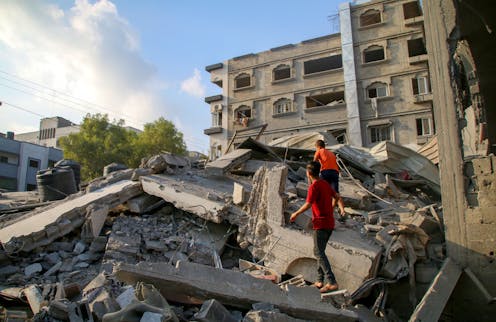
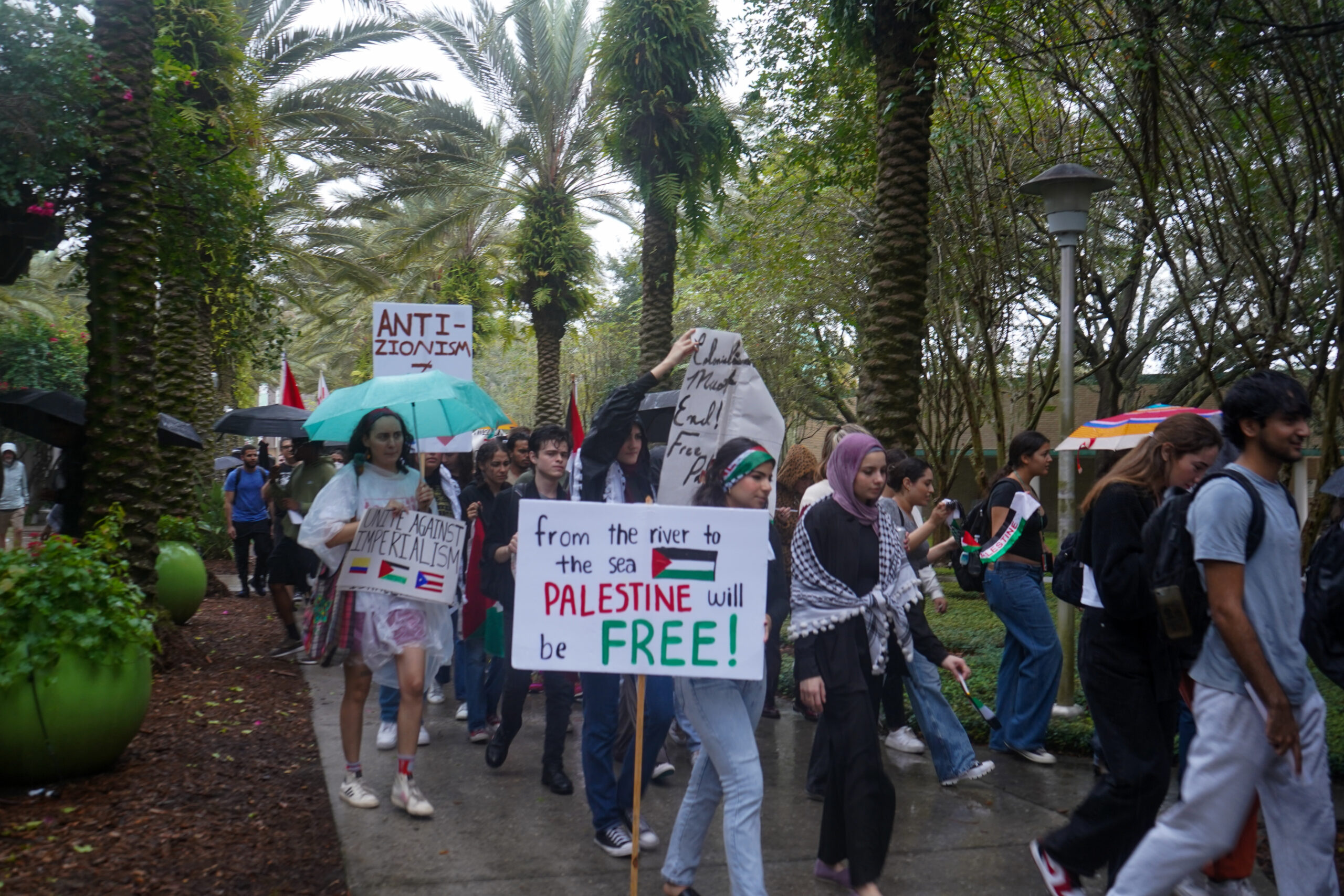
Students expressed their support for Palestinian people in an emergency rally outside of the USF Library on Thursday. ORACLE PHOTO/JULIA SAAD

Around 50 students rallied in the rain on Thursday afternoon to express their solidarity with Palestine at the Library, holding signs and waving flags. 

Students chanted “From the river to the sea, Palestine will be free” and “Free, free Palestine.” They expressed their position on the conflict, by chanting “One, two, three, four, this is not a religious war. Five, six, seven, eight Israel is a terrorist state.”

Students for Socialism (SFS) organized the half-hour rally and was joined by Tampa Bay Students for a Democratic Society (SDS), Students for Justice in Palestine (SJP), Tampa Bay Community Action Committee (CAC) and other students concerned about the international conflict.

A student with SFS, who wished to remain anonymous, said the rally was an opportunity to protest violence against the Palestinian people. 

“We’re aware that there is violence on both sides and that has to be kept in mind. And we are all here opposed to Hamas. We are all here opposed to Hezbollah. We’re all here opposed to Islamic terrorism. We’re all here opposed to extremism,” they said.

“But the truth is, Israel is the one who has all the power, holds all of the cards. Israel, if they really wanted to, could have peace tomorrow if they so choose.”

They said real peace requires justice and the return of the Palestinian people.

“We do not hate Jews. We do not support genocide. What we want is a free, secular, independent Palestine where Jews and Palestinians are able to live in peace,” they said.

On Oct. 7, Hamas, designated as a terrorist group by the U.S., launched an unexpected attack on Israel, according to a Wednesday BBC article. The attack prompted the Israeli cabinet to declare war against Hamas, according to the Council of Foreign Relations.

The group gathered at the MLK fountain, protecting handmade signs and flags with umbrellas. They then marched to the Library, past crosswalks blocked off by University Police (UP). 

Outside of the Library, which was the original location posted on social media, the students continued the rally.

A handful of UP officers were present at the protest to monitor the situation. One SDS member, who wished to remain anonymous, said they informed USF of their plan to rally and communicated with officers that the demonstration was intended to be peaceful. 

UP Public Information Representative Michael Lavelle said blocking the crosswalks was not specifically coordinated with the protesters ahead of time. He said UP responded to the movement of the group to ensure safety for protesters.

The SDS member said their organization requested UP presence at the rally because of social media threats organizers of the rally had received. 

They said they were concerned about their safety ahead of the rally after seeing posts on the USF Snapchat story. A student with SFS, who wished to remain anonymous, said they told members to wear masks and cover their faces so they would not “get blacklisted” for their involvement with the rally.

A SFS student, who wished to remain anonymous, said the on-campus rally was organized after seeing protests outside campus after the initial attacks.They said that while many students attended the off-campus rally, they wanted to host one on-campus to show USF students also stand with Palestine. 

“We knew that we had to do something. We knew that we had to stand with Gaza. We knew that we had to stand with our Palestinian brothers and sisters in America and in Tampa,” they said.

One student’s motivation for attending was their concern for children affected by the conflict. The student, who wished to remain anonymous, said their concerns have grown after seeing images and videos of children being killed. 

Ahead of the early October attack, tensions along the West Bank and Gaza strip have escalated following the deadliest year for Palestinian children in the area in the last 15 years, according to an Aug. 28 Human Rights Watch article

Like other Palestinian students at the rally, the student personally knows citizens in Gaza and the West Bank who are being impacted by the war. They said it was important to attend because educating students is their way of supporting them from overseas. 

Another student, who wished to remain anonymous, took off from their job to attend the rally because it was important to them to show their support for Palestine. Their family is from Palestine and, prior to the war, they planned to visit Palestine over the summer. Now, they said they are afraid to return to their home because of the conflict.

“At this point, I don’t even know if we are going back. I don’t want to feel that fear of not being able to go back to my home,” they said.

After seeing the turnout for the rally and the mutual support of USF students, they said they felt a sense of pride.

“To see that people are standing here, not just yelling for Palestine, but also in the rain, I think that really shows something,” they said. “I think it shows us that, if it’s raining, snowing, pouring, terror, whatever it is, we’re always here to stand up for our people regardless.”

Editor’s note: For privacy reasons, The Oracle refrained from providing names of those who requested to remain anonymous.

13 Oct 17:59

UK Teacher Banned After Plagiarizing on Behalf of Students

by Jonathan Bailey

A UK teacher has been banned from teaching after she plagiarized on behalf of two students, without the students' knowledge.

The post UK Teacher Banned After Plagiarizing on Behalf of Students appeared first on Plagiarism Today.

13 Oct 13:37

AI: we may not need a new human right to protect us from decisions by algorithms – the laws already exist

by Elena Abrusci, Senior lecturer in Law, Brunel University London
Hiring algorithms could filter candidates before interviews even take place. fizkes / Shutterstock

There are risks and harms that come with relying on algorithms to make decisions. People are already feeling the impact of doing so. Whether reinforcing racial biases or spreading misinformation, many technologies that are labelled as artificial intelligence (AI) help amplify age-old malfunctions of the human condition.

In light of such problems, calls have been made to create a new human right against being subject to automated decision-making (ADM), which the UK Information Commissioner’s Office (ICO) describes as “the process of making a decision by automated means without any human involvement”.

Such systems rely on being exposed to data, whether factual, inferred, or created via profiling. But if effective regulation of ADM is the goal, creating new laws is probably not the way to go.

Our research suggests we should consider a different approach. Legal frameworks for data protection, non-discrimination, and human rights already offer protection to people from the negative impacts of ADM. Rules from these bodies of law can also guide regulation more generally. We could therefore focus on ensuring that the laws we already have are properly implemented.

Current harms and future risks

Automated decision making is being used in various ways – and there are more applications on the way. Areas subject to automation include the processing of asylum and welfare support applications and the deployment of lethal military technology. But even where ADM is considered to bring benefits, it can also have negative effects.

The criminalisation of children is one possible risk of using certain ADM systems, where “predictive risk models” used in child protection services can result in vulnerable children being further discriminated against. ADM can also make securing work harder –- a hiring algorithm developed by Amazon “scored female applicants more poorly than their equivalently qualified male counterparts.”

In several countries, including the UK, courts also rely on ADM. For example, it’s used to make sentencing recommendations, calculate the probability of a person reoffending, and assess the flight risk of defendants, which determines whether they will be released on bail pending trial.

These applications can result in unfair processes and unjust outcomes for many reasons. This could happen because a judge unwittingly accepts erroneous results produced by ADM, or because no one is able to understand how or why a particular system arrived at its conclusion.

Historically, human prejudices have also been embedded in the design of such software. This is because the algorithms are trained on real world data, often from the internet. Exposing the system to this information may help improve their performance at a task from one perspective, but the data also reflects people’s biases. This means that members of marginalised groups can end up being punished, in the way we saw earlier when women were disadvantaged by a hiring algorithm.

Protection and regulation

The urge to adopt new legal rules is perhaps understandable considering the stakes and the potential harm ADM could and does do. However, as regards creating a new human right, negotiating new laws takes time, money and resources. And once any new law comes into force it can take decades to be accurately understood for the purposes of practice.

Given that many relevant laws already exist, it’s unclear whether a new human right would significantly influence how systems for automated decision making are designed and deployed.

Yet without tangible implementation and enforcement, the content of these existing laws can become hollow. Effective governance of ADM by these laws requires impact assessments of automated decisions, human supervision of ADM systems, and complaints processes. These should all be mandated. A thorough impact assessment will be able to identify, for example, unintended harms to individuals and groups, and help shape appropriate mitigation measures.

Yet these information gathering measures need to be accompanied by sufficient oversight by a competent, resourced, and – possibly – public body. This would help uphold democratic accountability. Such bodies would also be tasked with ensuring that people negatively affected by ADM could file complaints that are adequately dealt with. These steps would make current laws on data protection, non-discrimination, and human rights more meaningful and effective in protecting individuals and groups from the harms of automated decisions.

The law across many areas is often criticised – sometimes rightly – for struggling to adapt to change. But a merit of the law in general is its ability to provide recourse to people that have experienced wrongdoing. It provides principled teeth to take a bite out of unprincipled conduct.

This capacity is significant for another reason. Corporate spin regarding digital technologies matches how they are often portrayed in public. Commentary, too, frequently tends towards “hyperbole, alarmism, or exaggeration”. This hype complements practices such as ethics-washing that provide a means of feigning commitment to regulation, while ignoring the very laws capable of providing it.

Chatter about the likes of “AI ethics” grease the wheels of these strategies, sometimes turning nuanced and significant philosophical insights into box-ticking exercises. Ethics are an essential component of guiding the design, development, and deployment of automated decision making. However, the language of “ethics” can also be used by spin doctors to distract us.

If anything here is worth remembering, it’s that ADM is not only a future problem, it’s a present problem. The laws that exist now can be used to address pressing issues stemming from this technology.

Whether this happens depends on public and private bodies improving the procedural machinery needed to enforce and oversee legal rules. These rules, many of which have been around for a while, just need a bit more life breathed into them to function effectively.

The Conversation

Richard Mackenzie-Gray Scott receives funding from the British Academy, and is Visiting Professor at the Center for Technology and Society, Getulio Vargas Foundation.

Elena Abrusci does not work for, consult, own shares in or receive funding from any company or organisation that would benefit from this article, and has disclosed no relevant affiliations beyond their academic appointment.
13 Oct 13:36

The Gaza Strip − why the history of the densely populated enclave is key to understanding the current conflict

by Maha Nassar, Associate Professor in the School of Middle Eastern and North African Studies, University of Arizona
Destruction from the latest siege of Gaza. Ashraf Amra/Anadolu via Getty Images)

The focus on conflict in the Middle East has again returned to the Gaza Strip, with Israel’s defense minister ordering a “complete siege” of the Palestinian enclave.

The military operation, which involves extensive bombing of residences, follows a surprise attack on Oct. 7, 2023, by Hamas militants who infiltrated Israel from Gaza and killed more than 900 Israelis. In reprisal airstrikes, the Israel military has killed over 800 Gazans. And that figure could escalate in the coming days. Meanwhile, an order to cut off all food, electricity and water to Gaza will only worsen the plight of residents in what has been called the “world’s largest open-air prison.”

But how did Gaza become one of the most densely populated parts of the planet? And why is it the home to militant Palestinian action now? As a scholar of Palestinian history, I believe understanding the answers to those questions provides crucial historical context to the current violence.

A brief history of Gaza

The Gaza Strip is a narrow piece of land on the southeastern shore of the Mediterranean Sea. Roughly twice the size of Washington, D.C., it is wedged between Israel to its north and east and Egypt to its south.

An ancient trade and sea port, Gaza has long been part of the geographic region known as Palestine. By the early 20th century, it was mainly inhabited by Muslim and Christian Arabs who lived under Ottoman rule. When Britain took control of Palestine following World War I, intellectuals in Gaza joined the emergent Palestinian national movement.

During the 1948 war that established the state of Israel, the Israeli military bombed 29 villages in southern Palestine, leading tens of thousands of villagers to flee to the Gaza Strip, under the control of the Egyptian army that were deployed after Israel declared independence. Most of them and their descendants remain there today.

Following the 1967 Six-Day War between Israel and its Arab neighbors, the Gaza Strip came under Israeli military occupation. The occupation has resulted in “systematic human rights violations,” according to rights group Amnesty International, including forcing people off their land, destroying homes and crushing even nonviolent forms of political dissent.

Palestinians staged two major uprisings, in 1987-1991 and in 2000-2005, hoping to end the occupation and establish an independent Palestinian state.

Hamas, a Palestinian Islamist militant group centered in Gaza, was founded in 1988 to fight against the Israeli occupation. Hamas and other militant groups launched repeated attacks on Israeli targets in Gaza, leading to Israel’s unilateral withdrawal from Gaza in 2005. In 2006, Palestinian legislative elections were held. Hamas beat its secular rival, Fatah, which had been widely accused of corruption. Elections haven’t been held in Gaza since 2006, but polling from March 2023 found that 45% of Gazans would back Hamas should there be a vote, ahead of Fatah at 32%.

After a brief conflict between Hamas and Fatah militants in May 2007, Hamas took complete control of the Gaza Strip. Since then, Gaza has been under the administrative control of Hamas, even though it is still considered to be under Israeli occupation by the United Nations, the U.S. State Department and other international bodies.

Who are the Palestinians of Gaza?

The more than 2 million inhabitants of the Gaza Strip are part of the 14 million-strong global Palestinian community. About one third of Gaza’s inhabitants trace their family’s roots to land inside the Gaza Strip. The remaining two-thirds are refugees from the 1948 war and their descendants, many of whom hail from towns and villages surrounding Gaza.

A blue, red and yellow mural on a wall in which there is a window through which a young boys looks.
A freshly painted mural at the Shati camp for Palestinian refugees in Gaza City. Majdi Fathi/NurPhoto via Getty Images

The Palestinians of Gaza trend young: nearly half the population is under 18. The enclave is also very poor, with a poverty rate that stands at 53%.

Despite this grim economic picture, education levels are quite high. Over 95% of Gazan children ages 6-12 are in school. The majority of Palestinian students in Gaza graduate from high school, and 57% of students at the prestigious Islamic University of Gaza are female.

But because of the circumstances of their surroundings, young Palestinians in Gaza find it difficult to live fulfilling lives. For graduates between the ages of 19 and 29, the unemployment rate stands at 70%. And a World Bank survey earlier this year found 71% of Gazans show signs of depression and high levels of PTSD.

There are several factors that contribute to these conditions. A major factor is the crippling, 16-year blockade that Israel and Egypt – with U.S. support – have imposed on Gaza.

Years of blockade

Shortly after the 2006 elections, the Bush administration tried to force Hamas from power and bring in a rival leader from the Fatah party who was considered friendlier to Israel and the U.S. Hamas preempted the coup and took full control of Gaza in May 2007. In response, Israel and Egypt – with U.S. and European support – closed the border crossings into and out of the Gaza Strip and imposed a land, air and sea blockade.

The blockade, which is still in effect, limits the import of food, fuel and construction material; limits how far Gaza’s fishermen can go out to sea; bans almost all exports; and imposes strict limitations on the movement of people into and out of Gaza. In 2023, Israel has allowed only around 50,000 people a month to exit Gaza, according to U.N. figures.

The years of closure have devastated the lives of Palestinians in Gaza. Inhabitants there don’t have enough water for drinking and sanitation. They face electricity cuts that run 12 to 18 hours each day. Without adequate water and electricity, Gaza’s fragile health care system is “on the brink of collapse,” according to the medical rights group Medical Aid for Palestine.

These restrictions hit the young and the weak of Gaza particularly hard. Israel routinely denies sick patients the permits they need to receive medical care outside of Gaza. Bright students with scholarships to study abroad often find that they are unable to leave.

U.N. experts say this blockade is illegal under international law. They argue that the blockade amounts to a collective punishment of the Palestinians of Gaza, a violation of the Hague Convention and the Geneva Conventions that form the backbone of international law.

No end to the suffering

Israel says that the blockade on Gaza is necessary to secure the safety of its population and will be lifted when Hamas renounces violence, recognizes Israel and abides by previous agreements.

But Hamas has consistently rejected this ultimatum. Instead, militant fighters stepped up the firing of homemade rockets and mortars into populated areas surrounding the Gaza Strip in 2008, seeking to pressure Israel to lift the blockade. They have sporadically attacked Israel in this way in the years since.

Three men in army clothing and armed stand by a wall.
Israeli soldiers take up a position in Gaza in 1993. STR/AFP via Getty Images

Israel has launched four major military assaults on Gaza – in 2008-09, 2012, 2014 and 2021 – in efforts to destroy Hamas’ military capabilities. Those wars killed 4,000 Palestinians, more than half of whom were civilians, along with 106 people in Israel.

During that time, the U.N. estimates that there has been more than $5 billion worth of damage to Gaza’s homes, agriculture, industry, electricity and water infrastructure.

Each of those wars ended in a fragile cease-fire but no real resolution to the conflict. Israel seeks to deter Hamas from launching rockets. Hamas and other militant groups say that even when they have upheld previous cease-fires, Israel has continued to attack Palestinians and has refused to lift the blockade.

Hamas has offered a long-term truce in exchange for Israel ending the blockade on Gaza. Israel has refused to accept the offer, sticking to its position that Hamas must first end violence and recognize Israel.

In the months leading up to the latest escalation, conditions in Gaza have deteriorated even further. The International Monetary Fund reported in September that Gaza’s economic outlook “remains dire.” Conditions became more dire when Israel announced on Sept. 5, 2023, that it was halting all exports from a key Gaza border crossing.

Without an end in sight to the suffering caused by the blockade, it appears that Hamas has decided to upend the status quo in a surprise attack on Israelis, including civilians. Israel’s reprisal airstrikes and its imposition of a “complete siege” on the strip have heaped even further suffering on ordinary Gazans.

It is a tragic reminder that civilians bear the brunt of this conflict.

The Conversation

Maha Nassar does not work for, consult, own shares in or receive funding from any company or organization that would benefit from this article, and has disclosed no relevant affiliations beyond their academic appointment.

13 Oct 13:24

Why the crisis in Israel is putting pressure on GOP to act over vacant House speaker role

by Laura Blessing, Senior Fellow, Government Affairs Institute, Georgetown University
With Patrick McHenry leading the House as speaker pro tempore, spending and legislative options appear limited. AP Photo/J. Scott Applewhite

In the wake of the Hamas surprise attacks on Israel, and that country’s resulting heavy military response, calls for Republicans in the U.S. House of Representatives to pick a new speaker quickly have grown, including from GOP members themselves. The absence of a speaker may slow or limit any aid the U.S. could provide to Israel.

The Conversation U.S. asked congressional scholar Laura Blessing, a senior fellow at Georgetown University’s Government Affairs Institute, to explain what a major crisis abroad has to do with internal divisions within one U.S. political party.

How has the violence in Israel and Gaza shifted the dynamics within the GOP around the speaker search?

Israel has strong support within Congress in general, and certainly among House Republicans and Republican voters. Both of the speaker candidates, Rep. Steve Scalise and Rep. Jim Jordan, have expressed their strong support for Israel. The attacks on Oct. 7, 2023, call attention to the leadership vacuum in the House and place more urgency on the speaker search.

Both parties have voiced concern about the situation in Congress. The notable exceptions have come from those who engineered the ouster of former Speaker Kevin McCarthy, including Matt Gaetz, who said, “I don’t think that other countries think about Kevin McCarthy’s speakership quite as much as Kevin McCarthy does.”

Some House Republicans have even suggested reinstating McCarthy, though apparently not at his direction.

The Republican chair of the House Foreign Affairs Committee, Michael McCaul, has strongly called for action on Israel, wanting a House statement of support even in the absence of a newly elected speaker. But the current consensus in Congress is that the power of the temporary speaker, Speaker Pro Tempore Patrick McHenry, is very limited, which creates more pressure for a new speaker to be elected. McHenry appears to agree with this consensus.

Jordan opposes Ukraine aid and supports larger appropriations cuts; he is seen as the populist, anti-establishment insurgent in contrast to Scalise’s establishment credentials. Both candidates support Israel.

But if Jordan were speaker, he would be expected to be more resistant to packaging support for Israel with other items, such as Ukraine aid, or the passage of appropriations generally. Scalise, by contrast, is expected to be far closer to the Kevin McCarthy mold of leadership.

But whether the higher stakes of the crisis in Israel prompt those in the Republican conference to reconsider their votes, enlist McCarthy again, or prompt a faster process is hard to tell in this fast moving and, for now, opaque process.

Initial tracking of support, from FiveThirtyEight journalist Nathan Rakich, for both Scalise and Jordan shows that neither candidate has a clear path to a win, that Jordan initially has more support, and that Scalise has the more establishment-minded members of the party backing him. But it took 15 votes and four days for McCarthy to win the speakership this January, even though no one mounted an organized, opposing candidacy.

What difference would it make if there were a House speaker already in place?

Initially, the Biden administration is accelerating delivery of aid the U.S. has already promised Israel, which receives more than US$3 billion in U.S. aid a year.

But when the administration wants more funding, which is very likely, it will need to go to Congress. The position of speaker would need to be filled for legislation to move forward. General congressional support for Israel may mean that proposal could more easily be coordinated with the Senate than other spending bills.

Soldiers kneel and lie on the ground.
Israeli soldiers take up positions near a kibbutz overrun by Hamas. AP Photo/Ohad Zwigenberg

What can the House do with only a temporary speaker in office?

Nobody is really certain, and there are legitimate disagreements of how to interpret the powers of the speaker pro tempore. The bipartisan consensus of those in Congress, at least for now, is that McHenry can’t call up legislation, including the appropriations bills that would be needed to give additional funding to Israel.

The part of the House rules governing the interim speaker, Rule 1, Clause 8, is very much open to interpretation. Congress could have gone in a different direction and voted to interpret the position’s powers as more active, though that would have reduced pressure for a new speaker.

The possibility of even having this office of a temporary speaker was a precaution taken in the wake of 9/11, imagining that a speaker might somehow be incapacitated; it’s never been tested. McHenry and the Congress are making precedent with every new action.

How might different results in the speakership race affect the US positions toward Israel and Hamas?

Aid for Israel, as a stand-alone item, has strong bipartisan support in Congress and with both candidates for speaker. But it is hard to say how quickly a new speaker would be elected; certainly it could be a drawn-out process.

The White House has expressed interest in a combined aid package that includes assistance to both Israel and Ukraine. Many House Republicans oppose such a move, and a Jordan speakership would be expected to make negotiations with the Senate and White House more difficult in general, with a greater appetite for government shutdowns. Jordan voted against the recent stopgap spending measure that averted a government shutdown; Scalise voted for it.

The wider state of government funding will be far more difficult, with the appropriations process revealing strong partisan disagreement. Even typically bipartisan bills such as defense spending are very partisan after the inclusion of different socially conservative amendments in the House.

Ukraine funding is also in a difficult position, emerging more recently as a partisan flashpoint even though back in July most House Republicans supported aid to Ukraine. If funding for Israel becomes embroiled in other spending debates, agreement will become more difficult.

The lessons the House learns from deposing a speaker for the first time can also be consequential. Will members tire of the few in the hard-right flank who engineered McCarthy’s ouster, thus giving the incoming speaker more political capital, perhaps by eliminating the motion to vacate, with which a speaker can be ousted? Or will a very difficult governing situation become more so, as the next speaker continually looks over his shoulder? Much remains to be seen.

The Conversation

Laura Blessing does not work for, consult, own shares in or receive funding from any company or organization that would benefit from this article, and has disclosed no relevant affiliations beyond their academic appointment.

13 Oct 13:07

How – and why – did homosexual behaviour evolve in humans and other animals?

by Jenny Graves, Distinguished Professor of Genetics and Vice Chancellor's Fellow, La Trobe University
Shutterstock

Since gay couples have fewer children, the high frequency of same-sex relationships in humans is puzzling from an evolutionary point of view. Perhaps there are social advantages such relationships confer on a group, or perhaps “gay genes” are selected for other reasons.

A group of Spanish researchers have studied same-sex sexual behaviour and social relationships in more than 250 species of mammals – and in a recent paper in Nature Communications, they conclude it arose independently many times, and is related to other kinds of social behaviour.

Darwin’s paradox

Research has shown the basis of male homosexuality in humans is at least partially genetic. I know of no work on a genetic basis for female–female sexual behaviour.

Why then is male–male sexual behaviour so common? You’d think, because gay couples have fewer children, these gene variants would be passed on rarely, and their frequency would decline over time.

Geneticists, sociologists and psychologists have advanced many possible explanations for this conundrum.

One is that gay genes are really “male-loving genes”. In this case, though gay males have fewer children, their female relatives who share these gene variants may be more inclined to mate earlier and have more children, making up the deficit.


Read more: Born this way? An evolutionary view of 'gay genes'


Other hypotheses referenced in the new paper propose that same-sex behaviour has beneficial effects for human groups. One idea is that same-sex relationships are important for forming and maintaining bonds and alliances within the group. This predicts same-sex behaviour should be more frequent in social species than in non-social species.

Alternatively, same-sex behaviour may help to diminish conflict between members of the same sex, and contribute to establishing social hierarchies. If this is so, we would expect same-sex behaviour to be more common in species where aggression and killing among members is also common.

The big picture of same-sex relationships

Human aren’t the only mammals to show a high frequency of same-sex relationships. There are reports of same-sex behaviour (courtship, mounting, genital contact and copulation, pair bonding) in 261 (out of 5,747) mammal species.

Mostly this behaviour is frequent and overt, occurs in the wild, and in half the species is displayed by both sexes. It is very widespread. These species represent about half of all mammal families.

Primates are strongly represented. Fifty-one species, from lemurs to great apes, show same-sex sexual behaviour.

Photo of a group of lemurs
Same-sex sexual behaviour has been observed in 51 primate species, including lemurs. Shutterstock

The even bigger picture is given by studies on many other animals, which reveal same-sex behaviour in birds, reptiles, frogs and fish, as well as many invertebrates.

Most studies of same-sex relationships focus on a particular species, which makes it hard to test these competing hypotheses.

The new research explores same-sex relationships across a wide range of mammals. It asks whether this behaviour was ancestral to all mammals, or whether it evolved independently in response to the establishment of different social systems.

Same-sex sexual behaviour evolved many times and quite recently

It has been proposed that the common ancestor of mammals indulged in indiscriminate sexual behaviour, which manifested as a mix of same-sex and heterosexual relationships. The new study contradicts this.

Using a tree of relationships of mammals to each other – confirmed with DNA sequence comparisons – the patterns of same-sex sexual behaviour were mapped onto the relationships between species. The distribution of same-sex behaviour over all mammals didn’t fit the pattern we would expect if it were present in the common ancestor of all mammals, and was retained in some lineages but not others.


Read more: Homosexuality may have evolved for social, not sexual reasons


A better explanation for the evidence is that same-sex sexual behaviour was rare in mammalian ancestors overall, but evolved independently many times in many different families. Species exhibiting same-sex sexual behaviour had shared ancestors much more recently than species not showing the behaviour. This suggests same-sex sexual behaviour has been gained and lost many times, and quite recently, during mammalian evolution.

Different lineages showed different times at which same-sex sexual behaviour evolved. It became more frequent in Old World monkeys (those found in Africa and Asia today) and increased again during the evolution of the great apes.

Same-sex sexual behaviour and social organisation

Next, the researchers examined the correlation of same-sex sexual behaviour to different measures of social organisation in different mammal species. They compiled information about sociality (how the animals live together) and aggression between members of the same species, and tested for correlations with male or female same-sex sexual behaviour.

The study found same-sex sexual behaviour, both male and female, was more common in more social species. This suggests same-sex sexual behaviour was selected for in social species.

The frequency of male, but not female, same-sex sexual behaviour was also correlated with the frequency with which animals of the same sex attacked and killed each other. This supports the hypothesis that homosexuality evolved to mitigate male–male aggression in mammals.

We conclude from this study that same-sex sexual behaviour in both males and females evolved as species shifted from solitary living to sociality. It helps to establish and maintain social relationships and alliances, resolve conflicts and avoid aggression.

The high frequency of same-sex sexual behaviour in ape and monkey species suggests it was present in a social great ape ancestor, and maintained in present day social species, including humans.

Everybody might be right

Establishing that homosexuality confers selective advantages in social species such as humans and other great apes does not rule out other explanations.

There may still be fertility advantages accruing to the other sex who inherit “male-loving” or “female-loving” gene variants, for example. These benefits are not necessarily the same in different mammal lineages, and may include others that have not yet been investigated.

In any case, the ubiquity and frequency of same-sex sexual behaviour in mammals means homosexuality cannot be considered aberrant or maladaptive in humans, or any other species. It was selected because it confers different and overlapping social and fertility benefits.

The Conversation

Jenny Graves receives funding from the Australian Research Council.

13 Oct 12:53

What is a strong El Niño? Meteorologists anticipate a big impact in winter 2023, but the forecasts don't all agree

by Aaron Levine, Atmospheric Research Scientist, CICOES, University of Washington
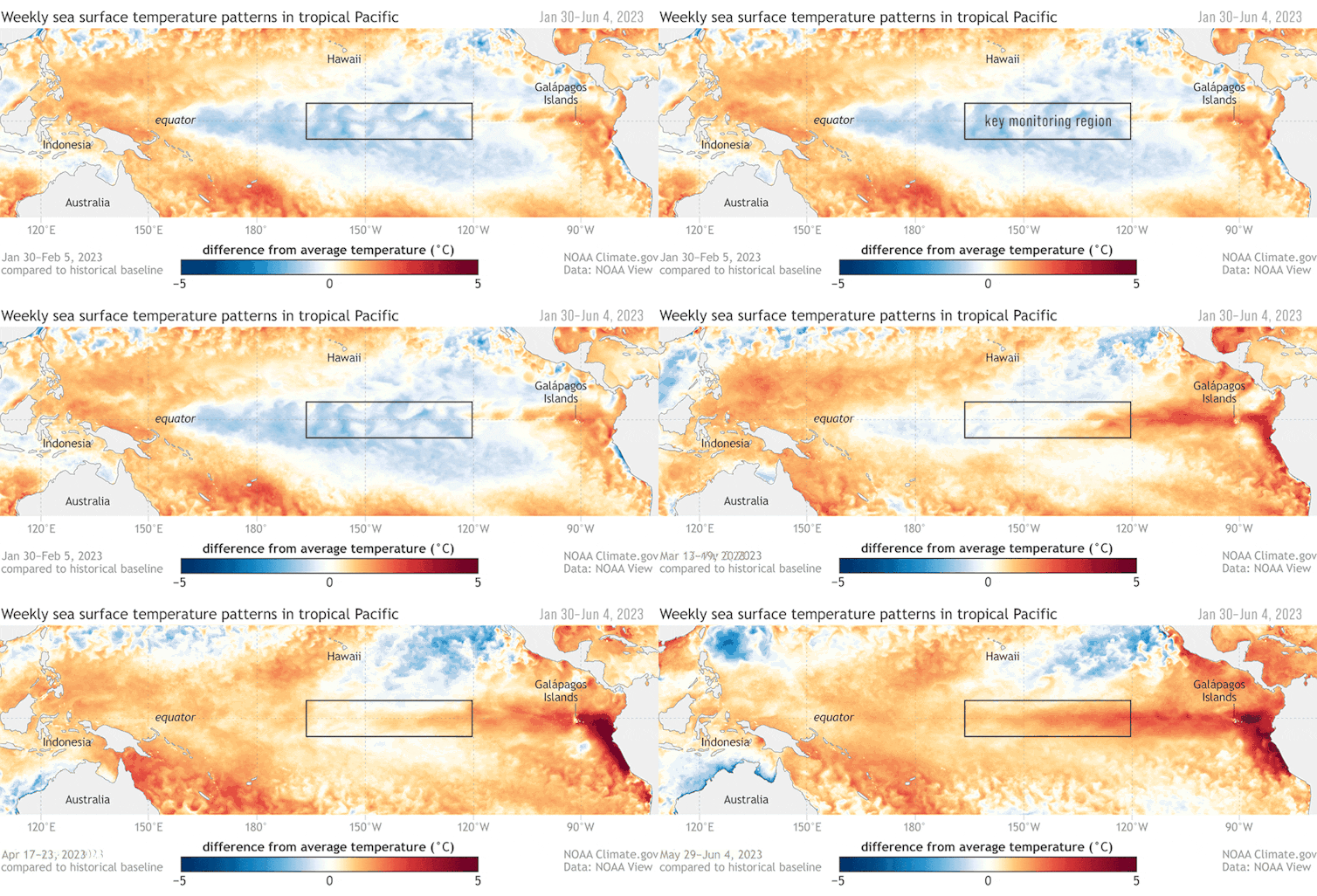
The El Niño pattern stands out in the warm sea surface temperature anomalies in the Pacific in 2023 NOAA Climate.gov

Winter is still weeks away, but meteorologists are already talking about a snowy winter ahead in the southern Rockies and the Sierra Nevada. They anticipate more storms in the U.S. South and Northeast, and warmer, drier conditions across the already dry Pacific Northwest and the upper Midwest.

One phrase comes up repeatedly with these projections: a strong El Niño is coming.

It sounds ominous. But what does that actually mean? We asked Aaron Levine, an atmospheric scientist at the University of Washington whose research focuses on El Niño.

NOAA explains in animations how El Niño forms.

What is a strong El Niño?

During a normal year, the warmest sea surface temperatures are in the western Pacific and the Indian Ocean, in what’s known as the Indo-Western Pacific warm pool.

But every few years, the trade winds that blow from east to west weaken, allowing that warm water to slosh eastward and pile up along the equator. The warm water causes the air above it to warm and rise, fueling precipitation in the central Pacific and shifting atmospheric circulation patterns across the basin.

This pattern is known as El Niño, and it can affect weather around the world.

An animation shows how warm water builds up along the equator off South America. The box where temperatures are measured is south of Hawaii.
The box shows the Niño 3.4 region as El Niño begins to develop in the tropical Pacific, from January to June 2023. NOAA Climate.gov

A strong El Niño, in the most basic definition, occurs once the average sea surface temperature in the equatorial Pacific is at least 1.5 degrees Celsius (2.7 Fahrenheit) warmer than normal. It’s measured in an imaginary box along the equator, roughly south of Hawaii, known as the Nino 3.4 Index.

But El Niño is a coupled ocean-atmosphere phenomenon, and the atmosphere also plays a crucial role.

What has been surprising about this year’s El Niño – and still is – is that the atmosphere hasn’t responded as much as we would have expected based on the rising sea surface temperatures.

Is that why El Niño didn’t affect the 2023 hurricane season the way forecasts expected?

The 2023 Atlantic hurricane season is a good example. Forecasters often use El Niño as a predictor of wind shear, which can tear apart Atlantic hurricanes. But with the atmosphere not responding to the warmer water right away, the impact on Atlantic hurricanes was lessened and it turned out to be a busy season.

The atmosphere is what transmits El Niño’s impact. Heat from the warm ocean water causes the air above it to warm and rise, which fuels precipitation. That air sinks again over cooler water.

The rising and sinking creates giant loops in the atmosphere called the Walker Circulation. When the warm pool’s water shifts eastward, that also shifts where the rising and sinking motions happen. The atmosphere reacts to this change like ripples in a pond when you throw a stone in. These ripples affect the jet stream, which steers weather patterns in the U.S.

This year, in comparison with other large El Niño events – such as 1982-83, 1997-98 and 2015-16 – we’re not seeing the same change in where the precipitation is happening. It’s taking much longer to develop, and it’s not as strong.

Part of that, presumably, is related to the whole tropics being very, very warm. But this is still an emerging field of research.

How El Niño will change with global warming is a big and open question. El Niño only happens every few years, and there’s a fair amount of variability between events, so just getting a baseline is tough.

What does a strong El Niño typically mean for US weather?

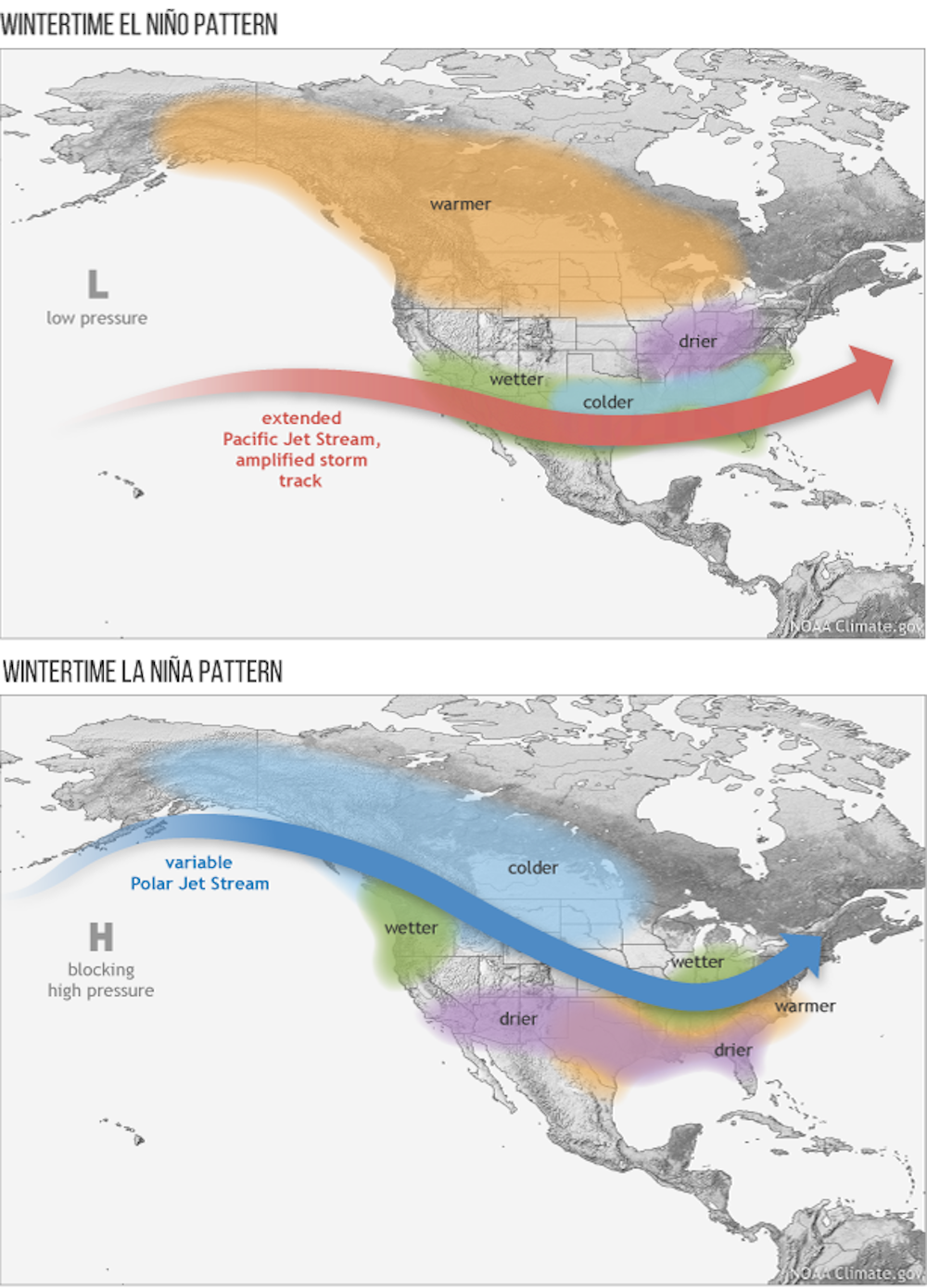
During a typical El Niño winter, the U.S. South and Southwest are cooler and wetter, and the Northwest is warmer and drier. The upper Midwest tends to be drier, while the Northeast tends to be a little wetter.

The likelihood and the intensity generally scale with the strength of the El Niño event.

El Niño has traditionally been good for the mountain snowpack in California, which the state relies for a large percentage of its water. But it is often not so good for the Pacific Northwest snowpack.

Two maps showing wetter, cooler weather in the Southeast and drier warmer air in the north during El Nino.
The jet stream takes a very different path in a typical El Niño vs. La Niña winter weather pattern. But these patterns have a great deal of variability. Not every El Niño or La Niña year is the same. NOAA Climate.gov

The jet stream plays a role in that shift. When the polar jet stream is either displaced very far northward or southward, storms that would normally move through Washington or British Columbia are steered to California and Oregon instead.

What do the forecasts show for 2023?

Whether forecasters think a strong El Niño will develop depends on whose forecast model they trust.

This past spring, the dynamical forecast models were already very confident about the potential for a strong El Niño developing. These are big models that solve basic physics equations, starting with current oceanic and atmospheric conditions.

However, statistical models, which use statistical predictors of El Niño calculated from historical observations, were less certain.

Even in the most recent forecast model outlook, the dynamical forecast models were predicting a stronger El Niño than the statistical models were.

If you go by just a sea surface temperature-based El Niño index, the forecast is for a fairly strong El Niño.

But the indices that incorporate the atmosphere are not responding in the same way. We’ve seen atmospheric anomalies – as measured by cloud height monitored by satellites or sea-level pressure at monitoring stations – on and off in the Pacific since May and June, but not in a very robust fashion. Even in September, they were nowhere near as large as they were in 1982, in terms of overall magnitude.

We’ll see if the atmosphere catches up by wintertime, when El Niño peaks.

How long do El Niños last?

Often during El Niño events – particularly strong El Niño events – the sea surface temperature anomalies collapse really quickly during the Northern Hemisphere spring. Almost all end in April or May.

One reason is that El Niño sows the seeds of its own demise. When El Niño happens, it uses up that warm water and the warm water volume shrinks. Eventually, it has eroded its fuel.

The surface can stay warm for a while, but once the heat from the subsurface is gone and the trade winds return, the El Niño event collapses. At the end of past El Niño events, the sea surface anomaly dropped very fast and we saw conditions typically switch to La Niña – El Niño’s cooler opposite.

The Conversation

Aaron Levine receives funding from NOAA and has received funding in the past from the National Research Council. He is a member of the American Geophysical Union

13 Oct 12:49

If the first solar entrepreneur hadn't been kidnapped, would fossil fuels have dominated the 20th century the way they did?

by Sugandha Srivastav, British Academy Postdoctoral Fellow, Environmental Economics, University of Oxford
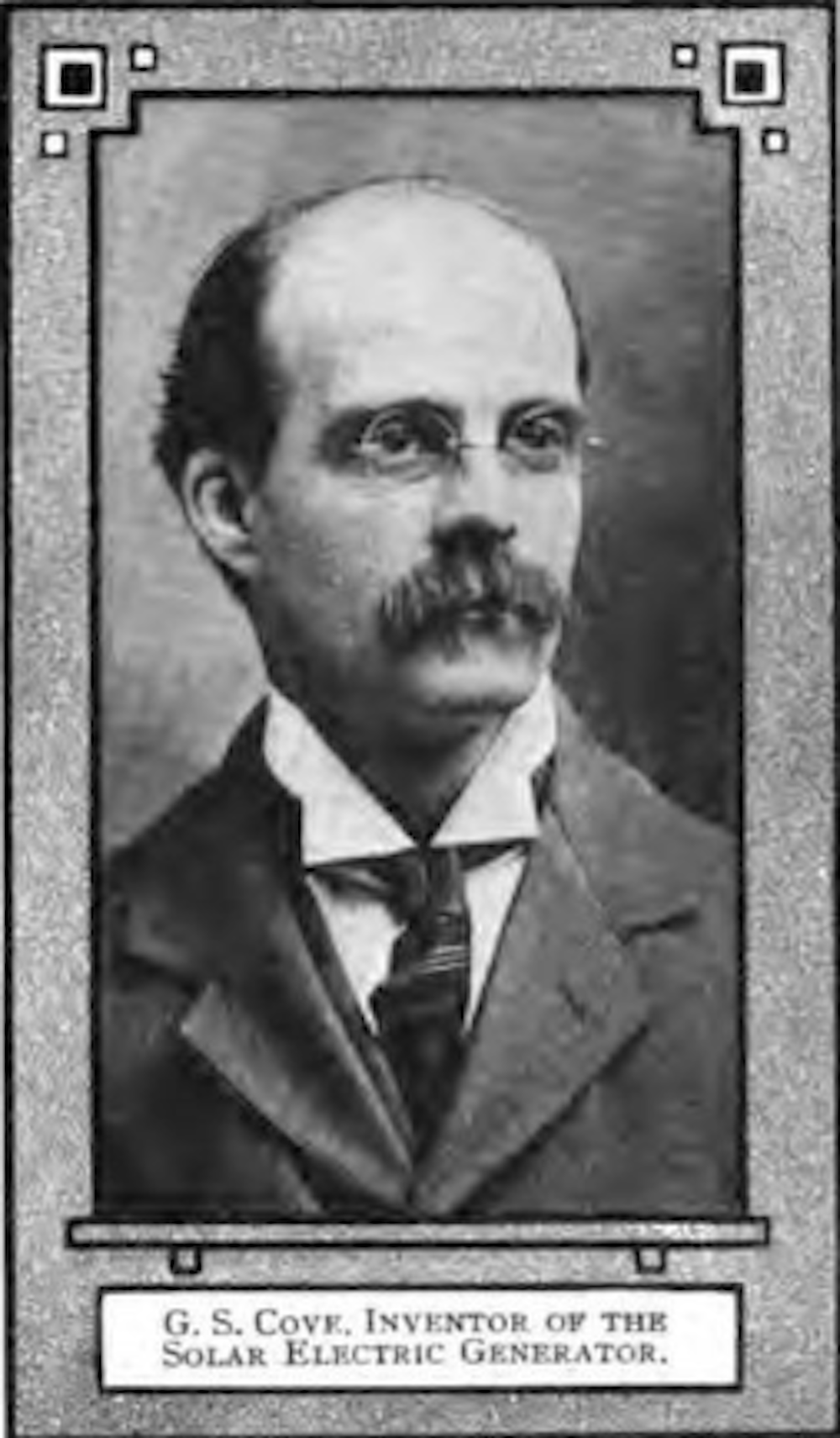
George Cove stands next to his third solar array. Popular Electricity Magazine, April 1910 / Low Tech Magazine

One argument put forward in defence of fossil fuels is that they were a historical necessity, because there was no other viable substitute for much of the 20th century. We owe fossil fuels a debt of gratitude, the argument goes, because they supercharged our development. But what if I told you there was a viable alternative, and that it may have been sabotaged by fossil fuel interests from its very inception?

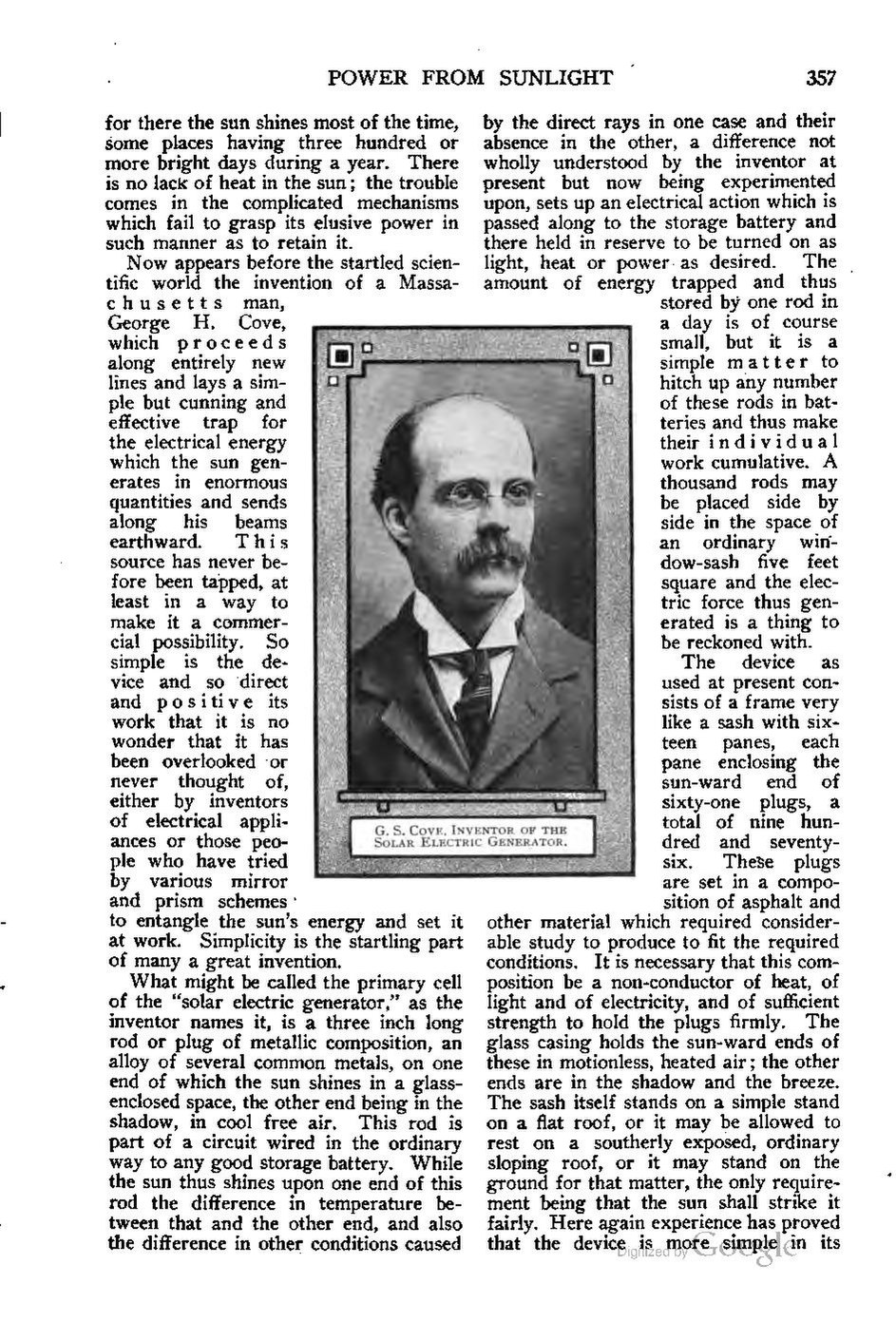
While researching the economics of clean energy innovation, I came across a little-known story: that of Canadian inventor George Cove, one of the world’s first renewable energy entrepreneurs. Cove invented household solar panels that looked uncannily similar to the ones being installed in homes today – they even had a rudimentary battery to keep power running when the Sun wasn’t shining. Except this wasn’t in the 1970s. Or even the 1950s. This was in 1905.

Modern Electrics newspaper article on solar power
Harnessing sunlight, 114 years ago. Modern Electrics / Hathi Trust

Cove’s company, Sun Electric Generator Corporation, based in New York, was capitalised at US$5 million (around US$160 million in today’s money). By 1909, the idea had gained widespread media attention. Modern Electric magazine highlighted how “given two days’ sun… [the device] will store sufficient electrical energy to light an ordinary house for a week”.

It noted how cheap solar energy could liberate people from poverty, “bringing them cheap light, heat and power, and freeing the multitude from the constant struggle for bread”. The piece went on to speculate how even aeroplanes could be powered by batteries charged by the sun. A clean energy future seemed to be there for the taking.

Vested interests?

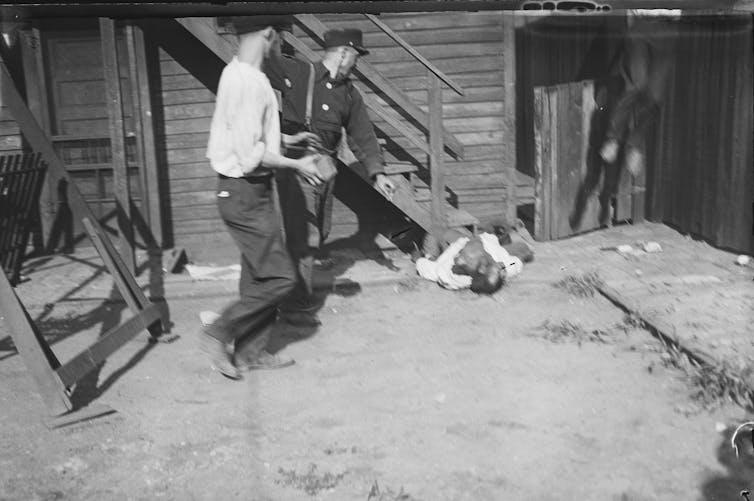
Then, according to a report in The New York Herald on 19 October 1909, Cove was kidnapped. The condition for his release required forgoing his solar patent and shutting down the company. Cove refused and was later released near Bronx Zoo.

But after this incident, his solar business fizzled out. Which seems odd – in the years before the kidnapping, he had developed several iterations of the solar device, improving it each time.

Old photo of solar panel
Cove’s solar panel in 1909. Technical World Magazine / wiki

I can’t say with certainty if vested interests were behind it. Some at the time accused Cove of staging the kidnapping for publicity, although this would seem out of character, especially since there was no shortage of media attention. Other sources suggest that a former investor may have been behind it.

What is well-known though, is that fledgling fossil fuel companies commonly deployed unscrupulous practices towards their competitors. And solar was a threat as it is an inherently democratic technology – everyone has access to the sun – which can empower citizens and communities, unlike fossil fuels which necessitate empire-building.

Standard Oil, led by the world’s first billionaire John D Rockefeller, squashed competition so thoroughly that it compelled the government to introduce antitrust laws to combat monopolies.

Similarly, legendary inventor Thomas Edison electrocuted horses, farm animals and even a human on death row using his rival Nikola Tesla’s alternating current to show how dangerous it was, so that Edison’s own technology, the direct current, would be favoured. Cove’s Sun Electric, with its off-grid solar, would have harmed Edison’s business case for building out the electric power grid using coal-fired power.

While some scattered efforts in solar development occurred after Cove’s kidnapping, there were no major commercial activities for the next four decades until the concept was revived by Bell Labs, the research branch of Bell Telephone Company in the US. In the meantime, coal and oil grew at an unprecedented pace and were supported through taxpayer dollars and government policy. The climate crisis was arguably underway.

Four lost decades

When I discovered Cove’s story, I wanted to know what the world lost in those 40 years, and ran a thought experiment. I used a concept called Wright’s law, which has applied to most renewables – it’s the idea that as production increases, costs decline due to process improvements and learning.

George Cove photo
Solar pioneer George Cove also patented an early tidal power device. Technical World Magazine / wiki

I applied this to calculate the year solar would have become cheaper than coal. To do this, I assumed solar power grew modestly between 1910 and 1950, and worked out how this additional “experience” would have translated into cost declines sooner.

In a world in which Cove succeeded and solar competed with fossil fuels from the get go, it would have trumped coal by as early as 1997 – when Bill Clinton was president and the Spice Girls were in their heyday. In reality, this event occurred in 2017.

An alternate century

Of course, this still assumes that the energy system would have been the same. It is possible that if solar were around from 1910 and never disappeared, the entire trajectory of energy innovation could have been very different – for example, maybe more research money would have been directed towards batteries to support decentralised solar. The electric grid and railways that were used to support the coal economy would have received far less investment.

Alternatively, more recent advances in manufacturing may have been essential for solar’s take-off and Cove’s continued work would not have resulted in a major change. Ultimately, it is impossible to know exactly what path humanity would have taken, but I wager that avoiding a 40 year break in solar power’s development could have spared the world huge amounts of carbon emissions.

While it might feel painful to ponder this great “what if” as the climate breaks down in front of our eyes, it can arm us with something useful: the knowledge that drawing energy from the sun is nothing radical or even new. It’s an idea as old as fossil fuel companies themselves.

The continued dominance of fossil fuels into the 21st century was not inevitable – it was a choice, just not one many of us had a say in. Fossil fuels were supported initially because we did not understand their deadly environmental impacts and later because the lobby had grown so powerful that it resisted change.

But there is hope: solar energy now provides some of the cheapest electricity humanity has ever seen, and the costs are continuing to plummet with deployment. The faster we go, the more we save. If we embrace the spirit of optimism seen during Cove’s time and make the right technology choices, we can still reach the sun-powered world he envisioned all those years ago.


Imagine weekly climate newsletter

Don’t have time to read about climate change as much as you’d like?
Get a weekly roundup in your inbox instead. Every Wednesday, The Conversation’s environment editor writes Imagine, a short email that goes a little deeper into just one climate issue. Join the 20,000+ readers who’ve subscribed so far.


The Conversation

Sugandha Srivastav receives funding from the British Academy and the Climate Compatible Growth Programme.

13 Oct 12:47

Ukraine recap: what war in the Middle East means for Putin and Ukraine

by Rachael Jolley, International Affairs Editor

For some people it was a week when they forgot that the Ukraine war was happening.

As news from the Middle East took up longer and longer slots on news programmes and websites, reports from Ukraine were pushed off the front pages, at least for now.

But as Robert Dover, professor of intelligence and national security at the University of Hull, explains, any reduction in the world’s attention on the Ukraine war could be an significant opportunity for President Vladimir Putin. It could easily distract the west and undermine its commitment to financial and military support for Ukraine, he argues.

This could open up time for Russia to regroup, slow the number of battlefield deaths and prolong the conflict. It could also divert military equipment to the Middle East. A longer war is generally seen as being in Russia’s favour as the commitment of allies is potentiallworn away by national political opposition, and worries about cost, potentially.


Read more: Israel-Gaza conflict: an opportunity for Putin while the world is distracted


Meanwhile, on the Baltic coast, a gas pipeline between Estonia and Finland has been hit by an explosion, and nobody is quite sure what or who is behind it. But since both countries are Nato members, and there’s a possibility that it could be an attack by Russia, the incident is coming under intense scrutiny.

Supplies of gas and energy, of course, have become a hugely political issue since the beginning of the war, when European countries realised their overdependence on Russia and suddenly had to make alternative arrangements at speed or risk no heating through the winter.

Thomas Froehlich, a research fellow at King’s College London, who studies the geopolitics of energy, talks us through the importance of a thorough investigation into the damaged pipeline and why Europe needs to diversify and protect its energy sources.


Read more: Estonia-Finland pipeline explosion: what's the evidence that the damage was deliberate?


Since Vladimir Putin sent his war machine into Ukraine on February 24 2022, The Conversation has called upon some of the leading experts in international security, geopolitics and military tactics to help our readers understand the big issues. You can also subscribe to our fortnightly recap of expert analysis of the conflict in Ukraine.


Away from the frontlines, Russians are queueing up to see the latest Hollywood blockbuster Barbie, despite the government suggesting the film does not uphold “Russian values”. No one knows exactly what punters’ motivation might be, a dash of escapism, a desire to see the latest global movie hit, or as a small act of defiance.

Marina Miron, a post-doctoral researcher at King’s College London, studies the power of information and how information is used during conflicts. She points out that the Kremlin likes to keep a tight grip on what is said and viewed. After all, this is a country where people are not currently allowed to call the “special military operation” in Ukraine a war and journalists can face up to 15 years in prison for publishing “false” information.


Read more: The power of pink: how Barbie's popularity is pushing back against Kremlin control of information


The overuse of the word “tragedy” is letting Russia off the hook, argues Mariana Budjeryn, a research associate, at the Harvard Kennedy School. The word “tragedy” is used far too often and it suggests that is something that is out of anyone’s control.

If you look at the roots of the word tragedy in its deeper original sense, it implies inadvertence and inevitability, she explains. And therefore masks the responsibility of perpetrators in causing injustices and human suffering through malicious intent and deliberate wrongdoing.

The word that should be used more often, she suggests, is crime. Russia is breaking international law, and therefore should be called to account, and calling what is happening in Ukraine a tragedy is not the way to do it.


Read more: Calling the war in Ukraine a 'tragedy' shelters its perpetrators from blame and responsibility


When people flee from their homelands they often cling to the few possessions they are able to take with them. There are incredibly poignant images of Ukrainian families holding on to a teddy bear or a favourite book as they jostled for spaces on trains leaving the country as war broke out.

But Ukrainians living away from their homes in foreign lands are choosing another way to commemorate and remember their home, by getting tattoos of Ukrainian symbols or words inscribed on their bodies. Our French edition recently published an article looking at the Ukrainian diaspora in Portugal, and how tattoos are growing in popularity as a mark of resistance against Russian occupation, according to Amandine Desille, a post-doctoral researcher at the University of Lisbonne and an associate member at the University of Bordeaux.


Read more: Vivre l’Ukraine en exil, son héritage culturel dans la peau


And finally for an update on how The Conversation has been covering the Israel-Gaza conflict from all its bureaux around the world, here’s a round-up of coverage, compiled by global editor Stephen Khan.


Read more: Israel-Hamas war: updates on The Conversation's coverage of the conflict


The Conversation
11 Oct 19:36

How Google’s Web Environment Integrity Proposal Could Change the Web

by Jonathan Bailey

Google's new Web Environment Integrity (WEI) proposal has been almost universally derided. Here's what it could do to the web.

The post How Google’s Web Environment Integrity Proposal Could Change the Web appeared first on Plagiarism Today.

11 Oct 13:25

Brightline expansion in Florida: “Tampa’s the next big market for us”

by Andrew Harlan

We want more high-speed rail service in Florida, especially in Tampa. The potential for a speedy connection from Tampa to Orlando is officially in the works. We’re already imagining a traffic-free excursion to Disney – or better yet a leisurely ride from Tampa all the way to Miami.

“It’s a big part of our future, right? We love Tampa. Tampa’s the next big market for us. You connect Tampa to the rest of this system and suddenly 75% of the state is within close proximity to a Brightline train. We like that a lot,” Brightline CEO Mike Reininger said in an interview with Fox 13.

Hillsborough County Commissioner Harry Cohen believes a Tampa station is coming soon near Tampa’s Union Station between Ybor and Port Tampa. A map on the Brightline app also highlights a Tampa station in the works.

a map showing route extensions for a train in florida
Photo via Brightline

Brightline could one day connect Tampa and Orlando

Officials recently debuted a new spot in the heart of Orlando, and Brightline West will soon provide service between Vegas and Southern California.

Brightline launched operations in South Florida in 2018, connecting Miami, Fort Lauderdale and West Palm Beach. Stations in Boca Raton and Aventura opened last year. Construction on its 170-mile extension from West Palm Beach to Orlando began in 2019.

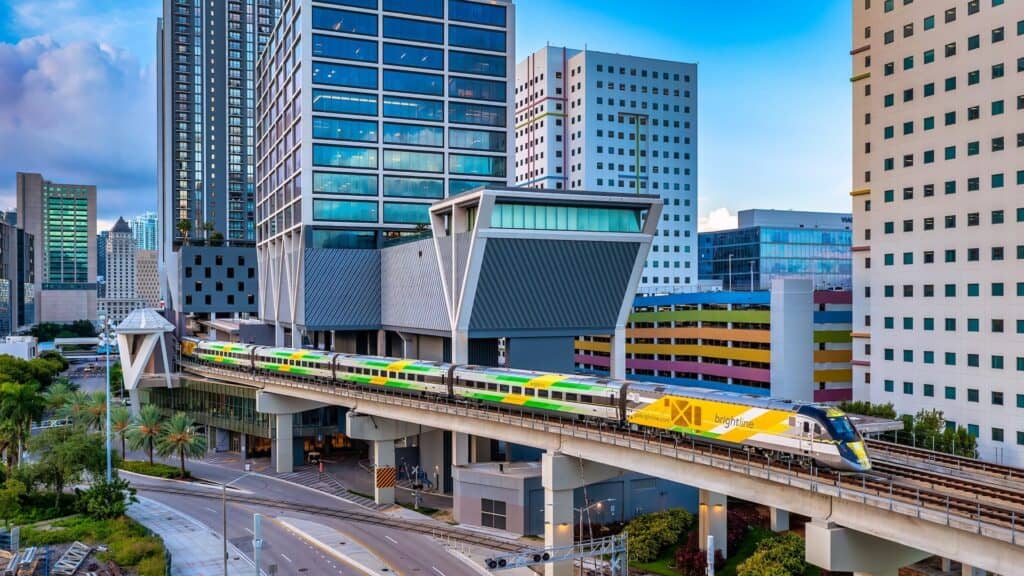
Photo of a high speed rail on an elevated track
Brightline’s Miami Terminal | Photo via Brightline

The $6 billion project has generated substantial economic benefits in Florida creating 10,000 jobs and approximately $6.4 billion in direct economic impact to the region, according to Brightline officials. Construction teams worked more than seven million hours over the course of four years to complete the project.

Covering more than 200 miles in Florida

Brightline covers 235 miles between Miami and Orlando and the new route will take between 3 and 3.5 hours depending on South Florida station stops.

The surging popularity of Tampa International Airport and the announcement of the huge new Rays Stadium in St. Pete are major factors that could help make this Brightline expansion a reality.

Visit Brightline’s website to learn more about its current service offerings.

interior of a train station
Rendering of a Brightline Station in Florida

What to read next:

The post Brightline expansion in Florida: “Tampa’s the next big market for us” appeared first on That's So Tampa.

11 Oct 13:24

Bootleggers, tourism booms and bathing suits: Decade of Change explores Florida in the 1920s

by Andrew Harlan

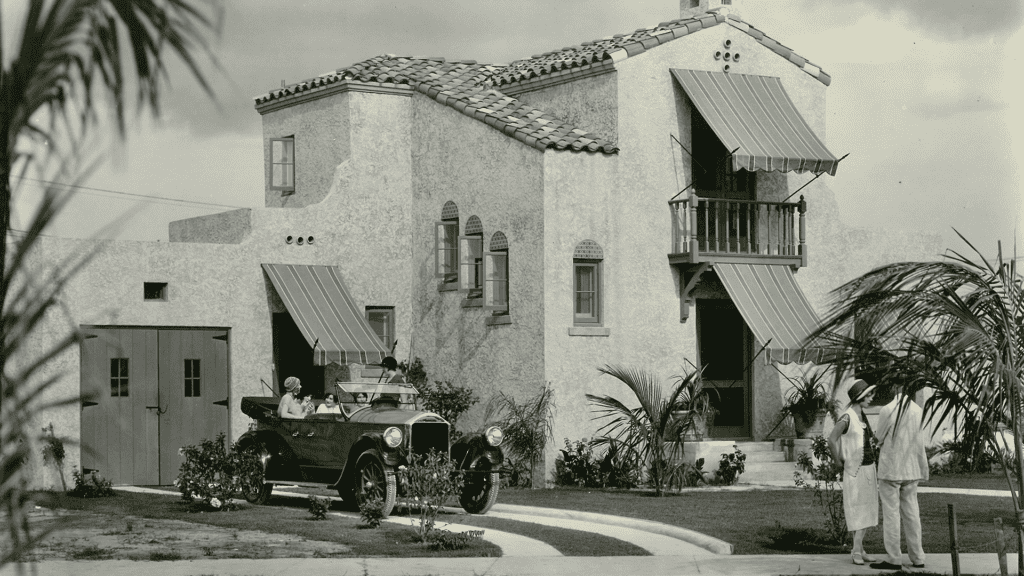
The 1920s were a formative time for the state of Florida, especially in Tampa. Bootleggers flocked to our brick streets to smuggle illegal booze, and the very first Art Deco buildings began to rise. At the same time, Mediterranean fruit flies attacked citrus groves and the state’s brutal convict-leasing program ensnared thousands. Tampa Bay History Center’s upcoming exhibition Decade of Change: Florida in the 1920s officially debuts on November 4 and will remain on view through July 14, 2024.

Among the many seismic shifts in culture occurring in this time period was the evolution of the bathing suit. The quintessential Gulf Coast uniform received a major upgrade in the 1920s. Gone were the days of stockings and bloomers, making way for more revealing styles that bared the knee and lower thigh. This sartorial rebellion raised eyebrows, prompting the American Association of Park Superintendents to issue strict Bathing Suit Regulations in 1917, limiting swim skirts to a mere two inches above the knee. Meanwhile, in Miami, Jane Fisher, the dynamic spouse of developer Carl Fisher, took credit for introducing lightweight beach attire. As a passionate swimmer, she loathed cumbersome swimwear and proudly declared that after donning the modern suit in South Florida, “not a black cotton stocking was to be seen on the beach.”

The road to a tourism boom in Florida

Get ready to dive into the Prohibition era at Decade of Change. Florida took a legal stand against booze in 1919, a year ahead of the nationwide prohibition. But the dry movement was already in full swing, with local and statewide laws making many counties parched between 1900 and 1918. This exhibit features fascinating relics like a Polk County newsletter championing the Prohibition cause, and snapshots of Tampa’s own Judge Leo Stalnaker, a steadfast advocate for the dry movement.

In 1925, nearly 2.5 million tourists visit to enjoy Florida’s developing roadways. Gone were the days of solely relying on trains or steamboats; now, folks were hitting the Florida roads in style, be it in fancy coupes, quirky jalopies, or something in between. Let’s not forget the motorist camps that sprung up during this tourism frenzy! One of the pioneers in this trend? Tampa’s very own DeSoto Park, a true trailblazer in the movement.

A deep dive into the history of the Sunshine State

The exhibition also peels back the layers on Jim Crow politics, architectural marvels, and the surge of religious fervor in the 1920s. Brace yourself for a journey into a complex political landscape, where Jim Crow policies and anti-immigrant sentiments took center stage in Florida’s political arena.

Meanwhile, the roaring twenties saw a spiritual awakening, with Pentecostalism, revivals, and charismatic radio preachers leaving an indelible mark on American culture. As suburban landscapes began to bloom, iconic bungalows sprung up, forever altering the architectural fabric of the era. This exhibit takes you on a whirlwind tour through a transformative decade that shaped Florida’s cultural landscape. You can learn more about the upcoming exhibition on Tampa Bay History Center’s website.

black and white photo of a home in the 1920s in florida
Mediterranean Revival-style home

Explore new digital collections at The History Center

A new digital collection, Florida Front and Center, also launches this October. Florida Front and Center is putting our state’s story front and center in the grand tapestry of U.S. history. This showcase shines a spotlight on Florida’s colonial roots, tracing back even before the Pilgrims set foot on Plymouth Rock. And don’t blink, because it also dives into Florida’s colossal post-World War II expansion and political clout. Altogether, Florida Front and Center unveils a 500+ year saga of the Sunshine State.

There’s still time to visit the museum’s current exhibition Etched Feathers. The brilliant collection of avian-inspired works will remain on view through October 15.

The state of Florida is a birders paradise. Our recent stint of flamingo-mania post-Idalia is proof of that. Pelicans, spoonbills, herons, hawks, screech owls, parrots, and other stunning avian species make the Sunshine State an even more lush and lovely place to call home. Artist John Costin and other infatuated creatives have used dynamic processes to capture the majesty of these creatures. Both their works and their processes are on fulll display at the Tampa Bay History Center.

a large statue with a green face plays a saxophone
Perry Harvey Sr Park

Experience the Tampa Soul Walk

If it’s one event you put on your calendar for October, make it Florida Conversations: Tampa Soul Walk on October 17. Fred Hearns, curator of Black history, and Robin Nigh, arts and cultural affairs manager for the City of Tampa, join a distinguished guest panel that designed the Soulwalk arts and heritage “trail.” Nearly 100 stops spanning approximately 46 miles across 25 neighborhoods tell the rich history of Tampa’s Black communities and highlight the diverse, thriving, creative community in present-day Tampa.

The event begins at 6:30pm; it’s free to attend but registration is required.

On October 22, in the spirit of Halloween, the history center hosts A Night at The Museum. Guests will enjoy trick-or-treating in the museum galleries, along with a costume contest, photo opportunities, crafts and games, and special characters roaming the museum. Tickets are selling out fast, and you can reserve yours here.

See all of Tampa Bay History Center’s current and upcoming exhibitions on its website. The museum is located at 801 Water Street.

What to read next:

The post Bootleggers, tourism booms and bathing suits: Decade of Change explores Florida in the 1920s appeared first on That's So Tampa.

11 Oct 13:22

Hidden History: The Tampa Bay Hotel

by Gillian Finklea

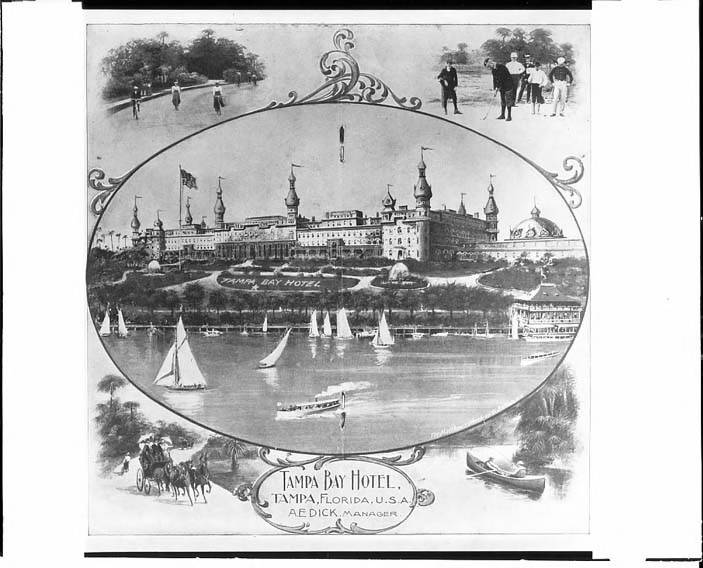
As a Tampa native, I used to think The Tampa Bay Hotel was a castle. When I was told later that it was actually a university, it became my top school choice. (That didn’t work out. I went further north, Go Gators.) But my original classification wasn’t too far off. What’s now The University of Tampa, and Henry B. Plant Museum, was once called the crown jewel in Henry Bradley Plant’s train system — The Tampa Bay Hotel. This gorgeous resort was meant to entice Northerns to exotic and hot Florida. And it did — for a time.

Let’s learn more about what once was The Tampa Bay Hotel.

Henry Bradley Plant. Courtesy Henry B. Plant Museum

Trains in Florida

There once was a man who believed in train transportation in Florida — Henry Bradley Plant. It was mostly to the benefit of himself and his many businesses ventures, including transportation of goods in and out of Florida. In the late 19th century, Plant undertook the ambitious project of connecting remote areas of Florida with his expanding railway network. His efforts culminated in the creation of the Plant System, a web of railroads that facilitated the rapid growth of commerce, tourism, and settlement throughout the state.

Plant’s railways not only provided essential links for trade and travel but also played a pivotal role in opening up Florida as a desirable winter destination for the wealthy elite of the era. These wealthy elite needed a place to stay and Plant knew just the port city to house them.

  • Women at tea garden on Tampa Bay Hotel grounds, 1923. Courtesy, Tampa-Hillsborough County Public Library
  • Tampa Bay Hotel advertisement copied from Hotel brochure, 1902. Courtesy, Tampa-Hillsborough County Public Library
  • Tampa Bay Hotel piano and stacked chairs in ballroom, 1926. Courtesy, Tampa-Hillsborough County Public Library
  • Tampa Bay Hotel tables set for service in dining room, 1926. Courtesy, Tampa-Hillsborough County Public Library

The Tampa Bay Hotel

Plant’s goal was to connect his rail lines to a port terminus in Florida and Tampa emerged as the ideal location. Constructed in 1891, this opulent resort redefined luxury and sophistication in its era. The hotel’s striking Moorish Revival architecture, featuring minarets, domes, and ornate details, captured the imagination of visitors and showcased Plant’s commitment to creating a grand destination.

Guests of the hotel could enjoy including wild game hunting, fresh and salt-water fishing, sailing, rowing, and canoeing. Bicycles and carriages were also at their disposal. Rickshaws were available for tours of the property or an afternoon ride to see and be seen.1

Beyond its architectural marvels, the Tampa Bay Hotel was equipped with modern amenities like electricity, elevators, and telephones. The hotel’s lush gardens, serene courtyards, and exotic wildlife added to its charm. Notably, the Tampa Bay Hotel played a crucial role in Florida’s history, acting as a hub for economic and cultural exchanges during the state’s period of transformation.

The construction of the hotel became a symbol of the region’s progress and allure.

  • Furnished bedroom suite, 1926. Courtesy, Tampa-Hillsborough County Public Library
  • Advertisement copied from Hotel brochure, 1902. Courtesy, Tampa-Hillsborough County Public Library
  • Schooner on Hillsborough River in front of the Tampa Bay Hotel, 1919. Courtesy, Tampa-Hillsborough County Public Library
  • Tampa Bay Hotel piano and stacked chairs in ballroom, 1926. Courtesy, Tampa-Hillsborough County Public Library

Becoming a university and museum

The City of Tampa bought the building in 1905 after the death of Plant in 1899. The City continued to operate the hotel until 1932. Only a year later, the south wing on the first floor became the Tampa Municipal Museum. Later renamed the Henry B. Plant Museum in the 1970s. The museum’s mission is to interpret the hotel and the experiences of the diverse individuals who contributed to its success.

The rest of the hotel became a school. In 1933 Tampa Junior College, which was previously housed within a local high school, moved to into the rest of the hotel. From then on it was known as The University of Tampa.2

  • College students at main steps of Plant Hall, University of Tampa, 1946. Courtesy, Tampa-Hillsborough County Public Library
  • Elise Frank and two women with paintings on display at Henry B. Plant Museum, 1951. Courtesy, Tampa-Hillsborough County Public Library
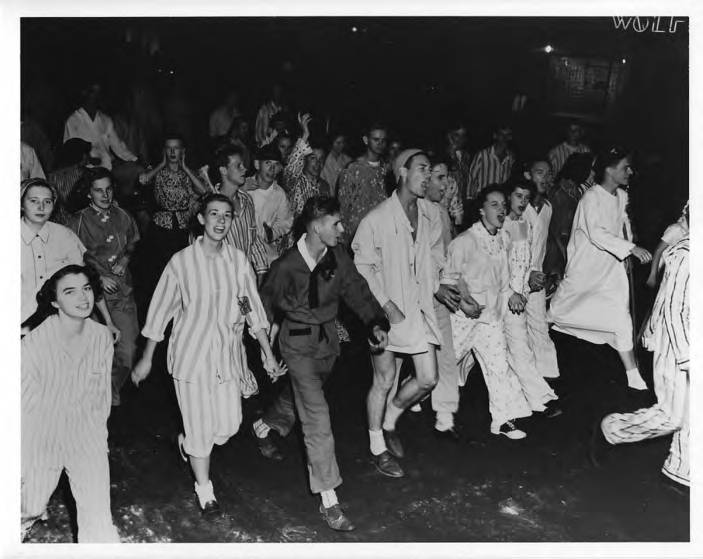
  • University of Tampa students in pajama parade on Franklin Street, 1950. Courtesy, Tampa-Hillsborough County Public Library
  1. https://www.plantmuseum.com/about/history ↩
  2. https://www.ut.edu/about-ut/history ↩

The post Hidden History: The Tampa Bay Hotel appeared first on ModernGlobe.

10 Oct 18:33

Libraries, Archives, Choice and Red Envelopes: The Growth of Streaming, the Decline of Choice, and the Death of the Red Envelope

by Todd A Carpenter

The role of libraries and archives as streaming grows, choice declines, and the death of the red envelopes arrives.

The post Libraries, Archives, Choice and Red Envelopes: The Growth of Streaming, the Decline of Choice, and the Death of the Red Envelope appeared first on The Scholarly Kitchen.

10 Oct 16:51

Is Taiwan a country or not?

by Joshua Holzer, Assistant Professor of Political Science, Westminster College
A soldier holds Taiwan's national flag during military drills. AP Photo/Chiang Ying-ying

Defining what is and isn’t a country is a lot more complicated than many people would realize. Take the case of Taiwan.

On Aug. 30, 2023, a committee of the U.K. Parliament referred to Taiwan as an “independent country” in a report. This is the first time any part of the British political system has used that phrasing.

Officially, the U.K. “does not recognise Taiwan” as a country, nor does it “maintain formal diplomatic relations with the island,” which is one way states recognize each other as equals on the international stage.

Like the U.K., the U.S. also “does not have diplomatic relations with Taiwan,” although there is a “robust unofficial relationship,” according to the State Department. Many other countries are in a similar boat.

So where does that leave Taiwan? Is it, or is it not, a country?

From my perspective as a political scientist, here’s how I would approach this question.

A country by declaration

According to what’s known as the “declarative theory of statehood,” a country – which is often referred to as a “state” in political science and international relations terminology – must possess the following qualities: “(a) a permanent population; (b) a defined territory; (c) government; and (d) capacity to enter into relations with the other states.”

These four qualities were agreed upon in the 1933 Montevideo Convention on the Rights and Duties of States, which is an international treaty registered with the League of Nations, the precursor to the United Nations.

Article 3 of that treaty says that the existence of a “state is independent of recognition by the other states.” In other words, as long as the four qualities above are met, an area qualifies as a country even if other countries choose not to recognize it.

One criticism of this framework is that it opens the door for many areas to be considered countries, even though they may seem outlandish.

For example, in the 1960s, Italian engineer Giorgio Rosa built a 4,000-square-foot (400-square-meter) platform 7 miles (11 kilometers) off the coast of Italy. On June 24, 1968, Rosa – whose last name means “rose” in English – declared that his platform was an independent country named the Republic of Rose Island. This artificial island had a restaurant, bar, souvenir shop and post office. Its official language was Esperanto.

It could be argued that Rose Island met the criteria outlined in the Montevideo Convention, as there was a permanent population because Rosa lived there; his humanmade platform had a defined territory; there was a government because Rosa declared himself president; and Rose Island’s post office gave it the capacity to communicate with, and thus enter into relations with, other countries.

Although several countries, including the U.S., have ratified the Montevideo Convention, Italy has not. So, 55 days after Rose Island declared independence, the Italian military destroyed the platform.

A country by recognition

In contrast to the declarative theory of statehood, what’s called the “constitutive theory of statehood” considers a country to be a country only if it is recognized by other already recognized countries.

There is no magic number for how many countries one must be recognized by. Rather, those that aspire to be regarded by the world as an independent country must join the United Nations as a full member.

In order to join the United Nations, applicants must be recommended by the Security Council, which comprises 15 members. Five of those members are permanent and have a veto. Applicants must have the support of nine of the 15 members, including each of the permanent members.

If the Security Council recommends admission, the application is presented to the General Assembly, where each full member of the United Nations has a single vote. A two-thirds majority is necessary before a country can join.

People stand in a row watching two people shake hands.
U.S. Rep. Rob Wittman, vice chairman of the House Armed Services Committee, met with Taiwan’s President Tsai Ing-wen, right, at the presidential office in Taipei, Taiwan, in September 2023. Taiwan Presidential Office via AP

One China or two?

Today, most of the world’s countries officially adhere to some variation of the idea that there is only one China, whose capital is Beijing, and which encompasses both the mainland territory and the island of Taiwan.

There is a government there, but there is also a government on Taiwan, based in its capital, Taipei. That government calls itself the Republic of China and traces its history to the early 20th century, when a revolution overthrew the emperor of China.

Notably, at that time, nobody’s definition of China included the island of Taiwan, which was then commonly called Formosa. Japan had seized the island in a war in the late 19th century.

In 1927, an uprising by the Chinese Communist Party attacked the Republic of China government. That kicked off a bloody civil war that lasted until 1949.

In that year, the government of the Republic of China retreated to the island of Taiwan. That same year, Mao Zedong, leader of the Chinese Communist Party, proclaimed the founding of the People’s Republic of China, with its capital in Beijing.

But Mao still sought control over his enemy’s territory, declaring, “Taiwan is ours, and we will never compromise on this issue, which is an issue of internal affairs.”

To this day, the government of the People’s Republic of China, whose capital is Beijing, considers Taiwan part of its “sacred territory.” The constitution of the People’s Republic of China states that “(i)t is the lofty duty of the entire Chinese people, including our compatriots in Taiwan, to accomplish the great task of reunifying the motherland.” Its foreign affairs ministry says, “Taiwan is a sacred and inseparable part of China’s territory.” On Oct. 2, 2023, the Beijing government celebrated its national day by releasing a video signifying its focus on unity with the people of Taiwan.

In contrast, the Republic of China refers to the area under its control as “the Taiwan area,” or “the free area.” It refers to the rest of China as “the mainland area,” which the Taiwanese government has described as being under a “Period of Communist Rebellion.”

Other countries are similarly delicate. For example, in 1972, the U.S. “acknowledge(d) that all Chinese on either side of the Taiwan Strait maintain there is but one China and that Taiwan is a part of China.” In 1979, the U.S. again “acknowledge(d) the Chinese position that there is but one China and Taiwan is part of China.”

A crowd of people gathers in a public area.
Taipei’s Mid-Autumn Festival drew crowds to the Night Market. AP Photo/Chiang Ying-ying

Taiwan’s place in the world

Taiwan argues that it meets the Montevideo Convention’s criteria for being considered a country under the declarative theory of statehood. However, Taiwan has not yet formally declared itself to be a new, independent country. According to President Tsai Ing-wen, “(w)e don’t have a need to,” because “(w)e are an independent country already and we call ourselves the Republic of China.”

But recall that, according to the constitutive theory of statehood, a country is only a country if it’s recognized by other already recognized countries, and the ultimate manifestation of such recognition is full membership in the United Nations.

Interestingly, the Republic of China was actually a founding member of the United Nations. However, in 1971, the United Nations voted “to expel” the Republic of China, and instead recognized the Communist government “as the only legitimate representative of China to the United Nations.” Subsequent attempts by Taiwan to join the United Nations have been unsuccessful.

Today, only a dozen or so countries continue to maintain formal diplomatic ties with Taiwan, most of which are small island developing states such as Nauru, Palau and Tuvalu.

Each of these countries recognizes Taiwan as “the Republic of China,” and none of them simultaneously maintains offical ties with the People’s Republic of China.

Until Taiwan formally declares itself independent of the rest of China – or until Taiwan is recognized by the international community as being independent of the rest of China – Taiwan’s status as a country will continue to be questioned.

The Conversation

Joshua Holzer does not work for, consult, own shares in or receive funding from any company or organisation that would benefit from this article, and has disclosed no relevant affiliations beyond their academic appointment.

10 Oct 16:45

Children in Palestine and Israel continue to suffer as international law is routinely ignored

by Jason Hart, Professor of Humanitarianism and Development, University of Bath

Among the hundreds already dead in the latest hostilities between Israel and Hamas, very many are children. And despite the killing of children being invoked by both sides as evidence of their enemy’s brutality, the death toll will no doubt continue to rise.

Because for decades now, neither Israel nor Hamas has shown any willingness to abide by a basic principle of international humanitarian law – that at times of conflict, every effort should be made to spare the young.

This aspect of the conflict rarely receives the attention it deserves from politicians or the media. And even charities working in the region often don’t address the issue as they’d like to. However, researchers such as myself have been able to highlight how significantly children’s lives are affected.

The indiscriminate launch of rockets into Israel has exposed children there to trauma, injury and death. Meanwhile, countless Palestinian children die in bombardments of the Gaza Strip. In the West Bank and East Jerusalem, the killing of Palestinian children is a frequent occurrence that invariably goes unpunished.

Yet a 1977 addition to the Geneva conventions (article 77) states that: “Children shall be the object of special respect and shall be protected against any form of indecent assault.”

It goes on to say that the opposing sides should provide children with “the care and aid they require”. But there is scant evidence of this care being shown by either Hamas or Israel.

We also see a complete disregard for international law in the abduction of children by enemy forces. Following the recent Hamas attack on Israel, shocking reports have emerged of Israeli children taken hostage by Hamas and transported into the Gaza Strip alone or with their parents.

Also shocking is the longstanding and routine abduction of Palestinian children, some as young as 12. Evidence gathered by UK charity Save The Children and others shows that these children are held in prisons, often with adults, and are commonly assaulted by guards.

Administrative detention often lasts for months, with release offered only after signing a confession, typically for throwing stones. But those confessions are reportedly obtained under threat of continued imprisonment should the child refuse.

Such violations continue with impunity and without comment or intervention. The mainstream media rarely report on violations of Palestinian children’s basic rights, while political leaders have proven reluctant to engage.

Charity workers on the ground, many of whom I have interviewed in the occupied territories, feel unable to speak out. Although keenly aware of the violence visited upon Palestinian children, they feel constrained by governmental donors eager not to alienate Israel’s political and business elites. Even when there is a major outbreak of violence, these organisations have little power to demand accordance with international law.

That said, Save the Children has condemned the current violence, saying the scale of the attacks in Israel and Gaza is causing damage that will endure long after the immediate crisis.

The sort of damage they are referring to was the subject of a recent study in which my colleagues and I explored the protection of refugee children in the Gaza Strip and Jordan. We looked at the threats they were exposed to, and how those threats could be reduced.

Constant fear

We found the situations in the two places to be markedly different. In Jordan, daily life was tough, but somehow families managed. In the Gaza Strip, children were routinely exposed to mortal danger which rained down from the skies at any time. The helplessness of Palestinian parents was regularly laid bare.

As one mother in Gaza told us: “Honestly, […] I never feel safe, and I am always terrified that something bad might happen and hurt my children. They never feel safe or comfortable. They are not mentally or physically healthy.”

That interview was conducted a few months after a major outbreak of military violence in 2021 in which 66 Palestinian children were killed. Two years later even greater hostilities are occurring.

Compounding the threat to children’s survival, Israel has announced that the 16 year blockade of Gaza will become even more punitive with the withholding of food, water, electricity and fuel. Meanwhile, major donors to the Palestinians, including the European Commission and the governments of Germany and Austria, are considering the suspension of aid.

The ability of Palestinian parents to protect their children is being comprehensively undermined as never before. And it seems that international law counts for nothing.

The Conversation

Jason Hart receives funding from the UK Foreign, Commonwealth and Development Office and the UK Arts and Humanities Research Council.

10 Oct 16:44

Shadow work: why you should be cautious of the TikTok self-help trend

by Roger Bretherton, Associate Professor, School of Psychology, University of Lincoln
Melinda Nagy/Shutterstock

I doubt the psychologist Carl Gustav Jung (1875-1961), in all his prescience, would have predicted that his work would one day fuel a TikTok trend called “shadow work”.

Life coaches and self-help gurus on the platform promote the exploration of shadow as a path to self-development. The exercises they recommend include thought experiments imagining parental rejection, journal exercises recalling a misunderstood talent that was neglected, and the accomplishment of perfect peace through radical self-acceptance.

All of this is apparently based on a premise of Jungian psychology: if we accept the parts of ourselves we despise or disown, they can become assets to us.

Our uncontrollable rage, when welcomed, can become powerful positive self-assertion. Our habitual lying, put to good use, may be the ability to write an engaging novel. The monster that chases us in a recurrent dream may have wisdom for us if we stop and turn to consult it.

Jung apparently said that 90% of the shadow is pure gold. There are riches to be found in the darkest corners of human consciousness.

The kinds of exercises touted on TikTok as shadow work, though, can be found in many therapeutic approaches. It is not unusual, for example, in cognitive behavioural therapy (a type of talk therapy) to ask anxious clients to imagine the worst that could happen to explore the resourcefulness they possess to cope with it.

Existential psychotherapy finds that while anxiety about dying can make people more defensive and prejudiced, deeper reflection on mortality brings people to a more accepting stance as they consider how they would like to be remembered.

Studies of “journalling” practice suggest that reflecting on uncomfortable truths about ourselves is an effective way to gain wisdom in living. These are just a few examples, but they show that something very much like shadow work can be effective without having to buy into the entire Jungian explanation of how personal development works.

It is not a bad idea to invite people to think about some of the more difficult areas of their lives. In this sense, TikTok is on to something. The problem is that to learn from confrontation with something difficult, we must be able to do two things at the same time: feel the negative emotion (fear, shame, sadness or whatever) and be able to think about it enough to come to a more helpful perspective.

Effective shadow work is not just raking up old psychological wounds for the sake of it, but coming to a new acceptance and understanding of them so that our capacity and resilience grow as a result.

We need other people

The problem with shadow work arises when we run into powerful emotions that completely take us over. Even without a traumatic personal history it is possible to run into feelings of shame, rage and terror that so overwhelm us we have no capacity left to think about them. At such times, when we can’t think – we need other people to do the thinking for us.

This is why we turn to friends, or a good therapist, to help us when we reach the edge of our ability to regulate ourselves. This is not to say that we can’t learn beautiful things from traumatic experiences. We can. But we have to gain some degree of psychological recovery from our trauma before we go delving for life lessons in the deepest, darkest events of our lives.

This is something that Jung knew but seems to be missing from the TikTok trend.

When I listen to the self-help gurus glibly advocating shadow work as a way of being a better person, I can only assume that none of them know the history that led Jung to establish the concept.

It is true that he emerged from a period of psychological crisis in his late thirties, joyfully clutching new insights into the human mind. But commentators are still divided on whether this was a kind of spiritual enlightenment or a psychotic breakdown.

Either way, it tells us that confronting the shadow, while creative and illuminating, is not to be taken lightly.

I find it difficult to believe that anyone who has explored their shadow in any depth could commend it without a sober note of caution. It makes me wonder if the TikTok advocates of shadow work are oblivious to the most obvious shadow question that confronts them: what would it be like if no one ever watched you on TikTok?

The Conversation

Roger Bretherton does not work for, consult, own shares in or receive funding from any company or organisation that would benefit from this article, and has disclosed no relevant affiliations beyond their academic appointment.
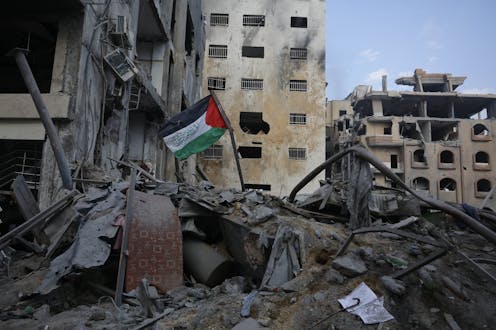
10 Oct 16:36

Dark patterns: how online companies strive to keep your money and data when you try to leave

by Richard Whittle, University Fellow in AI and Human Decision Making, University of Salford
Artem Samokhvalov/Shutterstock

Have you signed up to an online service for a free trial, decided it isn’t for you, but still ended up paying for it months – or even years – later? Or tried cancelling a subscription, and found yourself giving up during the painstaking process? If so, there’s a good chance you have encountered a “dark pattern”.

Dark patterns are clever tricks built into apps and websites to encourage you to do things you may not necessarily want to do. They make it easy to “accept all” tracking cookies for example, and swiftly agree to terms and conditions while you hurry along with making your purchase.

They also make it easy to sign up to a service – but time consuming and frustrating to leave. And our recent research shows how most of the time they benefit companies at the expense of consumers.

This imbalance has not gone unnoticed by regulators. The US Federal Trade Commission (FTC), which aims to protect consumers from unfair business practices, believes an increasing number of companies are “using digital dark patterns to trick people into buying products and giving away their personal information”.

For instance, the FTC is currently investigating Amazon over its alleged use of dark patterns to enrol customers into its Prime service, while making it difficult for them to leave. Our research supports the agency’s observation that “consumers who attempted to cancel Prime were faced with multiple steps to actually accomplish the task of cancelling”.

In a statement on its website, Amazon said the suit showed the FTC’s “misunderstanding of retail”. It also said: “We make it clear and simple for customers to both sign up for or cancel their Prime membership.”


Read more: US regulator is suing Amazon – here's what this could mean for your online shopping


The FTC is not alone in its concerns about dark patterns. The EU recently passed legislation which can be used to fine companies that use dark patterns, and the UK’s Financial Conduct Authority has launched rules designed to protect consumers from dark patterns in financial services.

Meanwhile, the UK’s Competition and Markets Authority (CMA) recently announced its first investigation into dark patterns with an open letter warning business against what it calls “harmful online choice architectures”.

“Choice architecture” is a term coined by the authors of the extremely popular and influential book Nudge. They describe it as the “the design of different ways in which choices can be presented to decision makers”.

For instance, a “choice architect” could help a consumer by reducing the amount of irrelevant information presented to them, allowing space for a considered, focused decision to be made. But most dark patterns work by manipulating choice architecture.

Rather than helping consumers, the architecture is designed to hinder choice. So instead of removing irrelevant material, it may bombard a user with excessive information, extra steps and distractions to stop them cancelling a subscription.

As the CMA notes, in today’s online world “businesses can design and control every aspect of their interactions with us to an extent that is unprecedented in traditional brick and mortar businesses”.

Research suggests the CMA is right, and that online companies have an almost unlimited ability to refine their interactions with consumers. Online experiences are increasingly personalised, and tech-savvy firms have more ways than ever to engage with – and manipulate – us.

Seeing the light

And while regulators tend to focus on dark patterns as a way of getting consumers to part with their money or data, others have expressed concerns about potential psychological harms and a loss of freedom by users of online services.

With these risks in mind, we have used insights from behavioural science to identify some of the processes which make dark patterns work and created a simple framework to describe the most pervasive strategies. “Detours” for example, is the name we have given to the tools used to delay and distract us, such as requiring an excessive number of actions to cancel a subscription.

“Roundabouts” try to bore or frustrate us to the point of giving up, like clicking on link after link, taking users round in circles. And “shortcuts” offer an immediately easy – but potentially costly – choice, like the “accept all” buttons on cookie prompts or requests to accept terms and conditions. In one study, a particularly long terms and conditions document led 98% of participants to agree to hand over their firstborn child as payment.

Our framework of terms is designed for simplicity – to empower consumers to spot dark patterns themselves, and to help regulators intervene. For the freedom to create and delete accounts for a service is a fundamental step in navigating the online world.

And it should not be drastically more straightforward to set up a social media account than it is to delete it. There is no good reason for detours, roundabouts and shortcuts to get in the way. We believe it should be as easy – if not easier – to delete an account as it is to create one. Most of the services we examined failed this standard.

Without consumer push back and regulatory muscle, the online world is likely to become even harder for ordinary people to navigate. On the plus side, regulators seem to be stepping up, and new tools for protecting consumers from dark patterns are emerging. There may yet be light at the end of this manipulative tunnel.

The Conversation

Richard Whittle receives funding from the ESRC, Research England, and various industry sources including AJ Bell and the Money Advice Service. The research mentioned in this article was supported by the Research England CAPE and Y-PERN awards.

Stuart Mills does not work for, consult, own shares in or receive funding from any company or organisation that would benefit from this article, and has disclosed no relevant affiliations beyond their academic appointment.
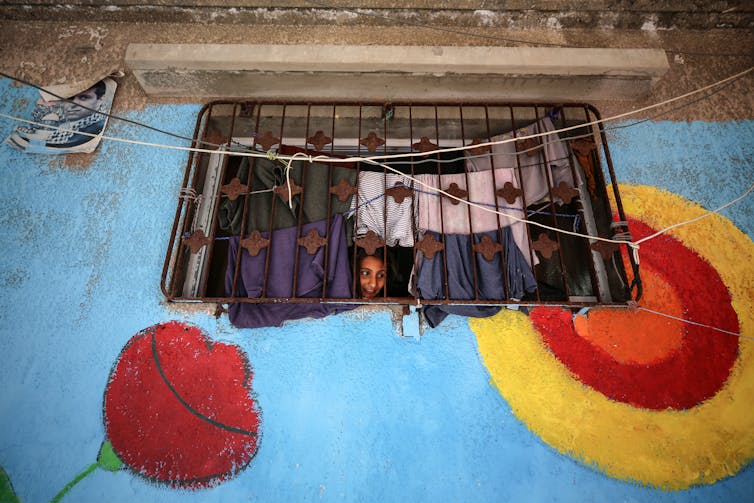
09 Oct 19:07

Change your password!

by Judy G. Russell

23andMe suffers data hack

Like everyone else who’s DNA-tested at 23andMe, The Legal Genealogist was dismayed this past week to learn of an apparent data hack at the DNA testing website.

If the reports are accurate, it’s not exactly a security hole that 23andMe could have plugged. The story is that hackers collected passwords associated with specific email addresses that had already been hacked at other sites and then reused them at 23andMe to see if they worked.

And because 23andMe uses email addresses as usernames and so many of us do engage in this risky business of reusing passwords, the hackers got access to a ton of data.

So far, personal information about roughly a million users of Ashkenazi Jewish descent and 300,000 users of Chinese descent was offered for sale on the so-called Dark Web. The data offered included full names, birth years, location information and more. Nobody knows how many accounts were accessed, how much data was scraped and what it might be used for.

As yet, there’s no indication that raw DNA data was hacked, but the incident is still under investigation.

But here’s the bottom line: no company can protect us from our own folly. Using a password across multiple websites in this day and age of data hacking is just that: folly. (And yeah, I’ve done it too. My pointing finger here is pointing right back at me too.)

Particularly at a website like a DNA testing company, don’t use a password you’ve ever used anywhere else.

And if you have — change your password now.

23andme password

At 23andMe, the steps are to log in, go to the top right of the user page where your name or initials can be found, click on that and choose Settings. From Settings, choose to Edit your Account Settings. When the edit page opens, choose Change Password. You’ll need to enter your current password to change it to a new one.

Don’t wait. Do it today. And do a security check on every website where you have sensitive personal information: DNA testing sites and financial sites of any kind right at the top of the list.

Never ever reuse a password across multiple sites, and particularly not at a website where accessing your data could be dangerous to your health — financial or otherwise.

Change your password.

Now.


Cite/link to this post: Judy G. Russell, “Change your password!,” The Legal Genealogist (https://www.legalgenealogist.com/blog : posted 8 Oct 2023).

09 Oct 18:35

The case for continuing to write by hand

by Javier Marín Serrano, Profesor Titular de Universidad. Psicología del Lenguaje. Psicología del Pensamiento, Universidad de Murcia
Ivan Kruk/Shutterstock

At the beginning of 1882, the philosopher Friedrich Nietzsche received a machine called the “Malling-Hansen Writing Ball”, a nifty little gadget covered with keys. The thinker’s eyesight had been getting worse, to the point where he could no longer write by hand. In March of the same year he was able to continue writing thanks to this new instrument.

His friend, the composer Heinrich Köselitz, noted a certain stylistic change in his texts from that time onwards, as his prose became more terse and succinct. It appears that the content of some of his philosophy was also affected.

Malling-Hansen writing ball, as used by F. Nietzsche following his loss of eyesight. The keyboard is oval in shape, and the roll that holds the paper is inserted underneath.
Malling-Hansen writing ball, as used by F. Nietzsche following his loss of eyesight. Wikicommons Media /Tekniska museet, Estocolmo, Suecia., CC BY-SA

Embodied cognition

This change –a reminder that “the medium is the message”– might be explained by new theories of embodied cognition. Modern cognitive science indicates that motor and sensory aspects of our behaviour have consequences that reach further than we may, at first, suspect.

Our minds are not filled with disembodied ideas. We need to take our bodies and senses into account in order to explain phenomena that are otherwise inexplicable.

In a study carried out almost two decades ago, subjects were presented with words carrying a positive connotation (such as “sweet”) or negative (such as “rubbish”). Subjects had to indicate whether a word was “good” or “bad” by moving a joystick. Half of the subjects were told to indicate that a word was “good” by pulling the joystick towards their bodies, and the other half were told to indicate “good” by pushing it away.

To indicate that a word was “bad”, the subjects made the opposite movement to “good”. A consistent correlation was observed between meaning and movement: the quickest responses were produced by the subjects who were told to indicate “good” by pulling the joystick towards themselves, and to indicate “bad” by pushing it away.

This direct involvement of the body and senses in mental processes can explain how writing by hand (as opposed to other types of writing) helps us to learn letters and words. This is backed up by the results of various studies, which we will now present.

Memory ability

As an example, a 2021 study compared short and mid term recall of words learned either by typing or writing by hand. Recall was better when words had been learned with a pencil and paper.

In another study, a small group of adults learned new symbols (from a language of Asian origin) that they then had to reproduce with a pencil or a keyboard. When they had finished learning the symbols, there were no differences in recall between the two methods, but the keyboard users forgot a significant amount of what they had learned as time passed by.

Some experts suggest that learning by pen and paper is better because it is more “embodied”. This means that it involves a set of more complex sensory-motor processes particular to each letter. This complexity leaves a more distinctive footprint in our memories and, as a result, makes things easier to memorise and recall, much like how a two metre tall supermodel might be more memorable than someone with average features.

Mental resources

Another benefit to writing by hand is that is puts less strain on our brains. Typing puts more demand on our mental resources, causing difficulties when it comes to word memorisation tasks. The increased mental load is due to the greater speed at which words are typed. This, in turn, means there are more individual elements to process over a certain period of time.

The idea of complexity appears in other studies to explain similar differences when writing in a second language. Other authors have also suggested that more mental resources are used because writing is more complex when performed on the keyboard.

Planning and composition

The way we write can also affect higher levels of word processing in our brains. It is thought that the type of writing sets the pace of cognitive processing – if the writing process is slow and cumbersome it can interfere with the higher processes on which it depends, causing ideas and relevant information to be forgotten.

In several experiments, an improvement has been noted in overall written composition (quality, length and fluidity of text) after subjects completed handwriting exercises. In the same vein, a study has shown that students plan their texts more carefully when using pen and paper than they do when using a keyboard.

Longer and better quality texts

Nevertheless, it must be recognised that keyboards have also brought us many advantages. For example, some meta analyses comparing hand written texts with those written on a computer found the latter to often be longer and better composed.

In addition, people with literacy problems are those who feel these benefits most acutely. However, some of these studies lack experimental rigour, which raises doubts about their clarity and general usefulness.

A disembodied mind

The Matrix film tetralogy presents the idea of a mind without a body. But a disembodied mind that exists only in the virtual world is much like Plato’s cave. The torches that cast shadows on the wall are replaced by computer simulations. In real life, however, the mind performs its operations alongside the functioning of our entire body.

We are closer to a purely symbolic, disembodied mind when we type on the keyboard (a device that works with minimal sensory involvement) than when we put pen to paper, as our cognitive system reacts differently depending on the motor and sensory inputs that we experience.

Implications for education

The results of these studies all indicate that eliminating handwriting from school – as has reportedly been done in Finland– is not a good idea.

Obviously, this does not mean that we should stop using keyboards, not even in infancy. However, we must be on the lookout for future studies on this topic, and act on their repercussions in the education sector as promptly as possible.

The Conversation

Javier Marín Serrano receives funding from the Spanish Ministry of Science and Innovation.

Miguel Ángel Pérez-Sánchez receives funding from the Spanish Ministry of Science and Innovation.

Olena Vasylets does not work for, consult, own shares in or receive funding from any company or organization that would benefit from this article, and has disclosed no relevant affiliations beyond their academic appointment.

09 Oct 18:28

It wasn't just a tree: why it feels so bad to lose the iconic Sycamore Gap tree and others like it

by Rebecca Banham, Postdoctoral fellow, University of Tasmania
Shutterstock

The famous Sycamore Gap tree was felled last week, prompting global expressions of sorrow, anger and horror. For some, the reaction was puzzling. Wasn’t it just a single tree in northern England? But for many, the tree felt profoundly important. Its loss felt like a form of grief.

Trees tell us something important about ourselves and who we are in the world. That is, they contribute to ontological security – our sense of trust that the world and our selves are stable and predictable.

Trees – especially those celebrated like England’s sycamore or Tasmania’s 350-year-old El Grande mountain ash – feel like they are stable and unchanging in a world where change is constant. Their loss can destabilise us.

What makes a tree iconic?

Individual trees can become important to us for many reasons.

When the wandering ascetic Siddhartha Gautama sat at the foot of a sacred fig around 500 BCE, he achieved the enlightenment which would, a few centuries later, lead to his fame as the Buddha. This sacred fig would become known as the Bodhi Tree. One of its descendants attracts millions of pilgrims every year.

Mahabodhi Temple sacred fig
This sacred fig in India’s Mahabodhi Temple is believed to be the descendant of the fig the Buddha sat beneath. Globe Trotting/Flickr, CC BY-NC-ND

Sometimes a tree becomes iconic because of its association with pop culture. U2’s hit 1987 album The Joshua Tree has inspired fans to seek out the tree on the cover in the United States’ arid southwest – a potentially dangerous trip.

Other trees become famous because they’re exceptional in some way. The location of the world’s tallest tree – a 115-metre high redwood known as Hyperion – is kept secret for its protection.

Niger’s Tree of Ténéré was known as the world’s most isolated, eking out an existence in the Sahara before the lonely acacia was accidentally knocked down by a truck driver in 1973. Its site is marked by a sculpture.

The Tree of Tenere in 1961, before it was knocked over. Michel Mazeau/Wikimedia Commons, CC BY

In 2003, the mountain ash known as El Grande – then the world’s largest flowering plant – was accidentally killed in a burn conducted by Forestry Tasmania. The death of the enormous tree – 87 metres tall, with a 19 metre girth – drew “national and international” media attention.

This year, vandals damaged a birthing tree sacred to the local Djab Wurrung people amidst conflicts about proposed road works in western Victoria.

And in 2006, someone poisoned Queensland’s Tree of Knowledge – a 200-year-old ghost gum famous for its connection to the birth of trade unionism in Australia. Under its limbs, shearers organised and marched for better conditions. The dead tree has been preserved in a memorial.

What is it to lose a tree?

Sociologist Anthony Giddens defines ontological security as a “sense of continuity and order in events”.

To sustain it, we seek out feelings of safety, trust, and reassurance by engaging with comfortable and familiar objects, beings and people around us – especially those important to our self-identity.

When there is an abrupt change, it challenges us. If your favourite tree in your street or garden dies, you mourn it – and what it gave you. But we mourn at a distance too – the Sycamore Gap tree was world-famous, even if you never saw it in real life.

In my research, I have explored how Tasmanian forests – including iconic landscapes and individual trees – can give us that sense of security we all seek in ourselves.

As one interviewee, Leon, told me:

These places should be left alone, because in 10,000 years they could still be there. Obviously I won’t be, we won’t be, but perhaps [the forest will be].

Temporality matters here. That is, we know what to expect by looking to the past and imagining what the future could be. Trees – especially ancient ones – act as a living link between the past, present, and future.

As my interviewee Catherine said:

You lie under an old myrtle and you just go, ‘wow - so what have you seen in your lifetime?’ Shitloads more than me.

That’s why the loss of the Sycamore Gap tree has upset seemingly the entire United Kingdom. The tree was famous for its appearance: a solitary tree in a photogenic dip in the landscape.

Its loss means a different future for those who knew it. It’s as if you were reading a book you know – but someone changed the ending.


Read more: Sycamore Gap: what the long life of a single tree can tell us about centuries of change


Loss of connection

We respond very differently when humans do the damage compared to natural processes. In one study, UK homeowners found it harder to accept their house being burgled than for it to be flooded, seeing flooding as more natural and thus less of a blow to their sense of security.

This is partly why the sycamore’s death hurt. It didn’t fall in a storm. It was cut down deliberately – something that wasn’t supposed to happen.

The sycamore was just a tree. But it was also not just a tree – it was far more, for many of us. It’s more than okay to talk about what this does to us – about how the loss of this thread of connection makes us grieve.

Yes, we have lost the Sycamore Gap tree, just as we lost El Grande and many others. It is useful to talk about this - and to remember the many other beautiful and important trees that live on.


Read more: Photos from the field: capturing the grandeur and heartbreak of Tasmania's giant trees


The Conversation

Rebecca Banham received funding from an Australian Government Research Training Program Scholarship, which funded the research associated with this article.

09 Oct 18:26

Made in America: how Biden's climate package is fuelling the global drive to net zero

by Alan Finkel, Chair of ARC Centre of Excellence for Quantum Biotechnology, The University of Queensland

This article is part of a series by The Conversation, Getting to Zero, examining Australia’s energy transition.

Just over a year since US President Joe Biden signed the Inflation Reduction Act (IRA) into law, it’s becoming clear this strangely named piece of legislation could have a powerful impact in spurring the global transition to net zero emissions by 2050.

But the vast amount of investment unleashed by the IRA has raised tensions with some of the United States’ closest allies, and creates risks, as well as opportunities, for Australia’s transition to clean energy sources.

In his 2020 presidential campaign, Biden promised to commit the US to net zero by 2050, and to spend US$2 trillion to get there – the biggest investment in manufacturing since World War II. Biden is delivering on those promises.


Read more: The road is long and time is short, but Australia's pace towards net zero is quickening


The 2021 Infrastructure Investment and Jobs Act included about $100 billion for electric vehicles and for speeding the electricity grid’s transition to clean energy sources.

The IRA changes the landscape

Passage of the IRA, in August 2022, ensured a swathe of green technologies would benefit from tax credits, loans, customer rebates and other incentives.

The original announcement estimated that uncapped subsidies over ten years would be US$369 billion, but Goldman Sachs Research now estimates that total subsidies could reach US$1.2 trillion and attract US$3 trillion investment by industry. That’s trillion, not billion.

Already, 272 new or expanded clean energy manufacturing projects in the US, including 91 in batteries, 65 in electric vehicles and 84 in wind and solar power, have been announced. These projects are estimated to create 170,000 jobs, predominantly in Republican-led states.

The IRA is all carrot, no stick. It contains no carbon taxes or emissions trading schemes. Instead, tax credits for capital expenditure and production costs encourage companies to invest in solar, wind, hydrogen, batteries, electric vehicles and other zero emissions technologies.

This approach is shifting the debate on the best way to reach net zero emissions. To free-market economists who ask why government should invest in private sector industries, the answer is that the green energy transition is not natural. Renewable energy would never have advanced without Germany subsidising solar and Denmark subsidising wind.

Subsidies and mandates are also crucial in explaining why, last year, Chinese vehicle manufacturers produced 64% of the global total of 10.5 million electric vehicle sales, and deployed about half of the global capacity additions in solar and wind power.


Read more: Too hard basket: why climate change is defeating our political system


Industrial policy to protect the climate

The IRA is America’s response. More than climate policy, it is industrial policy, replete with made-in-America provisions. Companies are more likely to obtain tax credits if they employ unionised labour, train apprentices and set up shop in states that are transitioning out of fossil fuels.

Consumers will earn a $7,500 federal tax credit on an electric car only if that car is assembled and at least half the battery made in America. Similarly, wind and solar projects will earn tax credits only if half of their manufactured components are made in America.

These policies were made with China in mind. Both main US parties agree the US must reduce its dependence on sourcing minerals and products from China, and move towards a new form of “strategic economic nationalism”.

Yet while America’s strongest allies are also alarmed by the challenge from China, they are disturbed by aspects of the IRA. They fear that to benefit from its subsidies, their own clean energy companies might pack up shop and establish plants in the US.

The European Union, for example, has praised the IRA’s overall approach, but fiercely criticised its made-in-America provisions. French President Emmanuel Macron called the Act “super aggressive” toward European companies. European leaders say the IRA violates trade rules by discriminating against imported products, and could “trigger a harmful global subsidy race to the bottom on key technologies and inputs for the green transition.”

Yet even as it criticises the US, the EU has responded to the IRA by relaxing its rules and allowing individual states to provide direct support to clean energy companies to stop them taking their projects to the US.

Canada, worried about investment flowing south to benefit from the IRA even though its free trade agreement with the US should give its companies access to the subsidies, has also announced tax credits and programs to boost clean energy production. Japan and South Korea have announced similar programs.

Why the IRA challenges Australia

In Australia, before the IRA was legislated, the Morrison government provided a A$1.25 billion loan to Iluka Resources to fund construction of an integrated rare-earths refinery in Western Australia. The refinery will produce separated rare earth oxide products that are used in permanent magnets in electric vehicles, clean energy generation and defence.

But Australia risks being left behind in the race to build clean energy industries. The US could so heavily subsidise green hydrogen production that our own planned industry – seen as a foundation of our aspiration to be a clean energy superpower – will be uncompetitive, leading our aspiring manufacturers to set up shop in the US.


Read more: 'Green steel' is hailed as the next big thing in Australian industry. Here's what the hype is all about


The IRA, however, brings Australia many potential benefits. The US wants to source the raw and refined materials it needs from countries, such as Australia, with which it has a free trade agreement. To respond to this interest, Australian industry, transport and mining must have access to low-emissions electricity.

The US will be an essential market for our rare earths such as neodymium, praseodymium, dysprosium and terbium, used to make the powerful permanent magnets in wind turbines and electric car motors. Australia can also build new industrial processes and supply chains so that we earn more from decarbonised metallic iron, aluminium and nitrogenous fertiliser. We can ship our renewable energy in the form of hydrogen and ammonia.

In this race, Australia’s friendship with the US and volatile relationship with China could be decisive. The IRA does not spell out the concept of friend-shoring but nevertheless it seeks “to onshore and friend-shore the electric vehicle supply chain, to capture the benefits of a new supply chain and reduce entanglement with China,” according to the US Centre for Strategic and International Studies.

The IRA denies electric vehicle tax credits when any component or critical mineral in the vehicle is sourced from China or any “foreign entity of concern.”

A clean energy trade war is just one of the potential obstacles that could prevent the full benefits of the IRA being realised. Many communities in the US and Australia are resisting the installation of new transmission lines, wind farms and other clean energy infrastructure, and these objections are often on environmental grounds – the so-called Greens’ Dilemma. And a win for Donald Trump in next year’s presidential election could reverse American climate policy.

Yet on balance, the IRA can only be good for getting to net zero. It brings the US in from the climate wilderness to be a leader in emissions reduction, helping to drive new technologies and lower costs that will benefit not only America but the world.

The Conversation

Alan Finkel is chair of the Hysata Advisory Council and an investor in the company. He is a member of the Rio Tinto Innovation Advisory Council.

09 Oct 18:13

Nagorno-Karabakh: Azerbaijan's energy wealth gives it de facto impunity for ethnic cleansing

by Sossie Kasbarian, Senior Lecturer in Politics, University of Stirling

A United Nations mission finally arrived in Nagorno-Karabakh on October 1 to find its towns and villages almost completely deserted. Two weeks after Azerbaijan launched an all-out military assault on the disputed territory in the south Caucasus, the Armenian government has said there are now almost no ethnic Armenians left in an area they have lived in for more than two millennia.

The only people left are reportedly either too old, too poor, too remote or too infirm to flee to safety along the Lachin corridor to Armenia.

Before the military assault, Armenians living in the enclave had been trapped and living under siege since December 12, 2022. Azerbaijan established an illegal blockade of the narrow land bridge connecting Nagorno-Karabakh with Armenia, blocking supplies, including food and medicine.

After more than nine months, having reduced the population of 120,000 to near starvation, Azerbaijan launched a military assault on September 19. The attack killed an estimated 200 Armenian troops and seized control of strategic high ground around the enclave.

Under the terms of the ceasefire that followed, both Armenian troops and the 2,000 Russian peacekeepers were required to disarm and disband. Armenians were given the “choice” of “reintegration” into Azerbaijan.

These sanitised terms mask a violence and dispossession that the pictures in the media last week can only hint at. The queues of desperate Armenians fleeing were so long that they could be viewed from space.

Map of Armenia and Azerbaijan showing Nagorno Karabakh
Contested region: Armenia and Azerbaijan have fought for 20 years over contested territory in the South Caucasus. kamilewski/Shutterstock

Dehumanisation of Armenians

It was always highly unlikely that any Armenians would “choose” to stay under Azeri control of Nagorno-Karabakh. The regime of President Ilham Aliyev does not tolerate criticism or plurality of voice among its own citizens.

So Azerbaijan’s pledge “to protect the rights and safety of ethnic Armenians” has a hollow ring. Azerbaijan is rated as a “consolidated authoritarian regime” by US-based democracy think tank Freedom House, which rates it at a paltry nine out of a possible freedom score of 100 and judges it as “not free”.

For decades, the Aliyev regime has promoted ethnic hatred of Armenians. Azerbaijan has actively worked for the eradication and appropriation of its Armenian religious and cultural heritage. This was referred to in a recent report as “the worst cultural genocide of the 21st century”.

Meanwhile, atrocities committed by Azeri troops during the previous Nagorno-Karabakh war in 2020 have been well documented. The so-called “Military Trophies Park” in the Azeri capital of Baku, built as a memorial of the war, is filled with grotesque mannequins representing Armenians.

Ethnic hatred of Armenians is normalised by the government. A postage stamp issued in 2021 depicted the fumigation of Nagorno-Karabakh, implying that ethnic Armenians were a virus that needed to be eradicated (the stamp was not registered by the Universal Postal Union).

While Nagorno-Karabakh was being emptied, Azerbaijan reissued a map of Stepanakert, the capital city, with Azeri street names. One street has been renamed Enver Pasha, after one of the three Turkish architects of the Armenian genocide of 1915.

Caviar and energy diplomacy

Reporting of the conflict has largely overlooked the complex history and forces involved – as well as wider regional power struggles.

Instead, the global media has been lending credence to Azerbaijan’s script, referring to “anti-terrorist operations” against “separatists” and “ethnic Armenian rebels” to describe the Nagorno-Karabakh Armenians. This language obfuscates the expulsion of 120,000 Armenians from their ancestral homeland by a clear aggressor.

But Azerbaijan wields significant international influence thanks to its immense oil and gas wealth and the unqualified support of its “big brother” Turkey.

In addition, Azerbaijan uses all the propaganda weapons at its disposal. The Aliyev regime has become adept at courting political influence in the west through what has been dubbed “caviar diplomacy”. Events such as the Formula 1 Grand Prix also function as high-profile projections of soft power, effectively “sportwashing” Azerbajan’s corruption and human rights record.

A statement of solidarity with Nagorno Karabakh signed by more than 100 UK academics on September 26 singled out the UK’s close relationship with Azerbaijan and the Aliyev regime as providing “a useful veneer of ‘respectability’ to the laundering of funds and history”.

Azeri impunity

Experts in international law have described the forced exodus of Armenians from their homes as a “war crime”. And former UN independent expert Alfred de Zayas has called for recent events to be investigated by the International Criminal Court.

But since Russia’s invasion of Ukraine, Azerbaijan has become an essential source for western energy. The country now seems to have a protected status as what EU commission president, Ursula von der Leyen, calls a “crucial energy partner”.

The question of sanctions against Azerbaijan has been raised in the EU parliament and expressions of concern have been made by the Council of Europe and the US government. But any concrete action from the west is thought unlikely.

While Armenians were fleeing their homes, an advertisement from the UK’s Department for Business and Trade in The Telegraph of September 29 enthused about the 450 UK companies already doing business in Azerbaijan. It noted that the UK is the country’s largest foreign investor. On the same day, the government announced it would give one million pounds to the International Committee of the Red Cross (ICRC) as a response to “events” in Nagorno Karabakh.

The international spotlight now has understandably shifted to the plight of 120,000 refugees. But the focus on the humanitarian crisis risks overlooking the ethnic cleansing carried out by Azerbaijan and the web of complicity that enabled it.

The fate of Nagorno-Karabakh offers us a glimpse into the casualties of the so-called “rules-based order”, where economic and geopolitical interests and whitewashing campaigns converge to a point where ethnic cleansing is of little note and apparently no consequence.

The Conversation

Sossie Kasbarian does not work for, consult, own shares in or receive funding from any company or organization that would benefit from this article, and has disclosed no relevant affiliations beyond their academic appointment.

09 Oct 18:06

Discovery of half-a-million-year-old wooden structure shows we're wrong to underestimate our ancient relatives

by Shadreck Chirikure, Prof of Archaeological Science & British Academy Global Professor, University of Oxford
Excavators found part of a structure formed by two overlapping logs. Barham et al. Nature (2023), Author provided

To most people, complex technologies separate modern humans from their ancestors who lived in the Stone Age, thousands or hundreds of thousands of years ago. In today’s fast changing world, older technologies, even those from a few years ago, are often described dismissively as “Stone Age”.

Such terms serve to disconnect us from our ancient relatives, who were much more sophisticated than we sometimes think they were.

A team led by archaeologist Larry Barham at the University of Liverpool recently published robust and well dated evidence for the earliest known use of wood technology. The wooden structure, along with artefacts, date to 476,000 years ago and have been excavated from waterlogged deposits at Kalambo Falls, Zambia.

This archaeological site is famous for producing traces of human cultural development dating to hundreds of thousands of years ago.

The remarkably well preserved evidence found by Barham and colleagues include, among other things, a wedge (a type of wooden tool), a digging stick, a log cut with the help of tools and a branch with a notch cut into it.

But why, in the age of AI and robotics, should wood technology from nearly half a million years ago generate so much interest from both scientists and the public?

The evidence from Kalambo Falls demonstrates a remarkable ability by early hominins (ancient human relatives) to source wood and shape it with tools. They were able to produce, not only an assortment of other tools, but also sophisticated wooden structures. We don’t know exactly what species made the structure, but Homo heidelbergensis or a species similar to Homo naledi might be candidates, among others.

These results have far reaching implications for our understanding of how sustainable materials were used in the Early Stone Age. It also sheds light on the capabilities of early hominins.

From speculation to fact

Archaeology is the study of deep and recent history using the remains of things left by people who came before us. However, these histories are biased in favour of things that have either survived the passage of time or decayed but left traces.

Humans lived in the era known as the Stone Age for nearly 99% of human history. The Early Stone Age is considered the earliest and perhaps longest “technological age”, stretching from nearly four million years ago to 300,000 years ago.

We know more about stone tools during this early phase of human development, in part because inorganic materials such as rocks are nearly indestructible compared to those made of perishable materials like wood.

Indeed, wood is very scarce in deposits belonging to the Early Stone Age, requiring exceptional conditions of preservation to avoid decaying. It survives only in extremely dry environments such as deserts, or extremely wet conditions – as was the case at Kalambo Falls.

Given the scarcity of evidence, direct proof of the intentional use of wood from more than 400,000 years ago sharply transforms our understanding of the antiquity of wood as a technology – and how long hominins have been interacting with this versatile material. They used it to make tools, to build shelters, to obtain food and perhaps even for fuel as they went about their daily lives.

Although researchers had suspected that wood technology was widely used by early hominins, without hard, direct evidence, we could not accept that as fact. Archaeology is a discovery and evidence-based field of study –- seeing is believing. The Kalambo Falls discovery transformed speculation into fact, changing our understanding of the history of technology.

Benefiting the environment

However, part of the challenge comes from concepts of human history which could be described as progressivist or linear – that envisage history as an inevitable advance towards modernity through scientific and technological achievement.

In the past, some scientists considered the minds of early hominins to have been more limited compared to those of modern humans. They believed technology and culture improved in sophistication as human brain size increased, moving from a “simple” state to the complex, algorithm-dominated world we live in today.

Despite the fact that brain sizes have increased over time, and that technology has changed, it is possible that those who came before us had an impressive understanding of the materials around them and cared for their surroundings.

The intentionally-shaped wood construction from Kalambo Falls is an illustration of design, technology and creativity – using what in today’s world we would call a green technology.

Notions of “progress” are quite deeply embedded in culture. This can also be a proxy for the exceptionalism of modern humans (Homo sapiens) – the belief that there is something unique or exemplary about our species compared with earlier hominins. If we put these notions aside, we can recognise that so called “backward technologies” can greatly benefit the environment and the planet.

The fact that wood is perishable makes it a more sustainable material, unlike some modern construction materials that are nearly indestructible, and leave conspicuous ruins. Manufacturing these modern materials also emits greenhouse gases that contribute to climate change.

Of course, there are risks associated with using wood as a construction material, such as fire and decay. But in appropriate situations, we should continue our long tradition of building in wood. Perhaps the ancients were not so backward, but more progressive than us when it came to looking after the planet through sound decision making.

In summary, the Kalambo Falls evidence suggests that, at least sometimes, early hominins were able to take advantage of materials other than stone for their everyday needs, including tool-making and shelter. They might also have been able to use the resources in their environment for fuel and medicine.

However, we need more direct evidence, going back to the beginnings of the Stone Age to demonstrate how those who came before us used and worked with wood. More discoveries like this might even lead us to rename the mighty Stone Age as the Wood Age.

The Conversation

Shadreck Chirikure receives funding from the British Academy, the University of Oxford, National Research Foundation of South Africa, and the University of Cape Town.

09 Oct 17:55

What you should (and shouldn't) do with all of your old phone chargers and other e-waste

by Ian Williams, Professor of Applied Environmental Science, University of Southampton
Most of us have accumulated a stash of old devices, chargers and cables that sit forgotten in our homes. MikhailSk/Shutterstock

The statistics surrounding mobile phones are staggering. There are more than 7 billion mobile phone users worldwide, nearly 5 billion of whom use a smartphone.

These devices are a fundamental part of our lives. But, as electronic devices are constantly improving, older models quickly become outdated.

In a survey conducted by Nevis Security, a Swiss software company, it was found that 62% of respondents replace their smartphones every three to four years. A significant portion of people change their phones even more frequently than this, with nearly 20% of the respondents reporting that they replace their phone every year.

This rapid turnover doesn’t only involve getting a new device; it often means purchasing a brand new set of cables and chargers that are compatible with the latest model of phone.

Fortunately, change is on the horizon. The European Commission has recently implemented a regulation mandating that, by 2024, all phones and small electronic devices sold within the EU must feature a universal USB-C charging port. As a result, 30 different models of charger have been reduced to just three.

Despite this development, most of us have already accumulated a stash of old devices, chargers and cables that sit forgotten in our sheds, drawers and cupboards. Many of these chargers ultimately end up being discarded, contributing to more than 51,000 tonnes of electronic and electrical equipment waste each year.

So, what should or shouldn’t you be doing with all of the obsolete electronic equipment that is piled up in your home?

Don’t bin them

Many people do not realise that disposing of old phone chargers and cables in standard waste bins has negative environmental consequences. Chargers and cables consist of various plastics, metals and other materials that do not decompose naturally.

Polyvinyl chloride – commonly known as PVC – is a plastic that is often used in chargers and cables. It breaks down very slowly, typically taking 30 years or more to degrade. PVC also fragments into harmful microplastic particles.

The safe handling of e-waste is important, yet the issue of electronic waste is frequently overlooked. In fact, much of the electronic waste that is generated goes undocumented.

Developed nations, including the United States, certain Europe nations and some in Asia, often export their electronic waste to poorer countries. In places where suitable facilities and national electronic waste legislation are lacking, electronic waste is often treated as general waste and either ends up in landfill or is recycled along with other metal or plastic waste.

Nevertheless, any electronic waste that includes a plug, battery or cable can be managed in an environmentally responsible manner. All cables contain copper, a valuable material, making them suitable for recycling. Many standard cable plastics can be recycled too, although some may pose challenges due to the presence of additives.

Electronic waste in a landfill.
Used electronics or e-waste often end up in landfill. Morten B/Shutterstock

What should you do with them?

There are several recommended methods for managing old chargers and cables responsibly.

Some retailers offer convenient options for disposing of old products. These include paid pick-up services where your old item is collected when delivering a new one, or free drop-off programmes. For instance, Apple provides a national trade-in system in the UK where people can trade in their devices or cables in return for credit towards the purchase of a new device or, if not eligible for this scheme, will recycle them at no cost

Most recycling centres also accept common wires and cables, including mobile phone cables, electrical and home appliance wires, Ethernet cables, power cords and chargers. Dropping your old phone cables off at a recycling centre will ensure they are properly recycled.

It’s worth noting that wireless mobile phone chargers are emerging as a promising future charging option. This technology is helping to reduce the need for cables.

If your chargers are in working condition, you can opt to sell them through online auction sites such as eBay. Alternatively, you can sell your devices online or at stores such as Music Magpie, which claims to refurbish 95% of the products received from consumers, all of which are resold in the UK.

Rather than selling your functional but unwanted chargers, consider donating them to a local charity shop for others to use. Some local authorities also offer curbside collection services for small electrical items. Check with your local council to see if this service is available in your area.

There are lots of ways to manage your old cables and chargers sustainably. By prioritising electronic waste prevention, reuse and recycling, you will not only help the environment, but also ensure that today’s products can form tomorrow’s raw materials.


Imagine weekly climate newsletter

Don’t have time to read about climate change as much as you’d like?
Get a weekly roundup in your inbox instead. Every Wednesday, The Conversation’s environment editor writes Imagine, a short email that goes a little deeper into just one climate issue. Join the 20,000+ readers who’ve subscribed so far.


The Conversation

Ian Williams receives funding from EU Horizon 2020 and EPSRC. Ian Williams is a member of the International Solid Waste Association, the Chartered Institution of Wastes Management and the Royal Society of Chemistry.

09 Oct 17:44

Romantic heroes or ‘one of us’ – how we judge political leaders is rarely objective or rational

by Suze Wilson, Senior Lecturer, School of Management, Massey University

Given the presidential style of modern politics, the intense media focus on party leaders is unavoidable. But this involves a degree of artifice. New Zealanders don’t vote directly for a prime minister, they vote for their preferred party and electorate candidate.

Technicalities aside, though, party leaders play a key role in shaping their party’s policies and soliciting public support. The upside of the attention they receive, therefore, is that voters get to scrutinise before they “buy”.

That’s especially important for undecided or swing voters. Not only can they compare policies, they can also examine each leader’s strengths and weaknesses, and gauge what values guide their approach.

Being head of state is a hugely challenging role – not least because leaders fundamentally get results through mobilising collective effort. If no one’s following, there is no leadership.

This is different from management, which largely revolves around detailed planning and then implementing and monitoring progress toward goals.

Leadership, however, involves connecting with people’s values and needs, and helping them make sense of events. It entails crafting a vision for the future and formulating credible strategies to achieve that.

It involves the capacity to make wise decisions, and role modelling what it means to be a person of good character. While managerial competency still matters, being a prime minister demands far more.

That said, trying to objectively evaluate a potential leader is not easy.

Favouring our own team

Humans strongly favour those they view as being “one of us”. A large body of research shows people trust, respect, support, care for and are more influenced by those they feel an affinity with. This sense of a shared identity might be based on common demographic characteristics, or shared interests and values.

Dedicated sports fans illustrate this well. Individually and collectively, they back their team no matter what. They wear team colours, idealise team members, mock opponents and boo referees – even if the ref is right.

The same socio-psychological forces are at play in the political domain.


Read more: Controlling the political narrative is key to winning the NZ election – no easy task for Chris Hipkins


The party faithful are unlikely to offer an objective view. They will likely overestimate the strengths and underestimate the weaknesses of their party’s policies and its leaders (and do the opposite when evaluating opposing parties).

This is clearly not helpful for undecided or swing voters. But even beyond partisan influences, determining what constitutes good leadership is a more vexed issue than we might imagine.

While people often hold strong views, the actual evidence about what constitutes “good” leadership is quite diverse and complex.

Fantasies and realities

There are many different theories, but researchers generally agree that “good leadership” is both ethical and effective. But people can often ignore those considerations when evaluating someone in (or aspiring to) a leadership role.

Subconsciously, we are inclined to judge leaders according to our own personal theories of leadership. This “implicit” bias is typically shaped by the kinds of behaviours role-modelled by the authority figures we were exposed to early in life.


Read more: Liz Truss is now a case study in poor leadership


A very strict parenting style, for example, which a child finds reassuring rather than restrictive, can lead them in later life to favour command-oriented or even authoritarian leaders.

Research indicates that even in democracies, about one-third of the population favours that kind of traditional “strong man” leadership style.

But scholars have long argued such leaders tend to be intolerant, oppressive, punitive, lacking in empathy and prone to bullying. They may resist being held to account for their actions, arrogantly believing they know best.

Romantic attachments

Popular culture and media narratives are other important influences on people’s ideas about leadership. In books, TV shows and movies, leaders are often depicted as heroic, larger-than-life characters with the capacity to save others, even the world. In the business media, it’s often implied CEOs have somehow turned a company around single-handedly.

Researchers call this the “romance” of leadership – a tendency to overstate what leaders can actually do, and to blame them when they fail to meet unrealistic expectations.

Indeed, no matter how skilled and dedicated, leaders are inevitably flawed, just like the rest of humanity. Nor are they omnipotent. New Zealand is a small and remote trading nation in an interconnected world, not a superpower or totalitarian state. There are many things its prime minister cannot control.

In that sense, an ability to manage expectations is an indicator of good leadership. Having the personal integrity to avoid making unrealistic promises is what serves democracy. Offering false hope is not good leadership, it’s more like what con artists and charlatans hungry for power do.


Read more: 'Some leaders only want to hear the good news': politicians tell us how political careers can end


Check your bias

Overall, the evidence is that we’re not very rational or objective when it comes to evaluating leaders. Even if we’re not swayed by ideological factors, our personal experience and a romantic view of leadership can unconsciously cloud our judgment.

But there are some things we can do to help us make a more informed and balanced judgement. Firstly, we can try to step back and reflect on our own biases and assumptions about leadership. (You can even test your own bias on a number of issues with the Project Implicit online resource.)

Secondly, look for indicators of behaviours associated with good leadership. Many of these are the same character virtues we’d admire in anyone: integrity, fair-mindedness, the determination to do their best, confidence (but not arrogance), being accountable for their actions, and empathy and respect for others. These are vital foundations for good leadership.

And thirdly, look for actual evidence of leadership skills. Being prime minister is complex and challenging. It demands an ability to address serious issues in a serious-minded way.

Good leaders are not glib, superficial or unable to answer valid and reasonable questions. Consequently, a good leader may not tell you what you want to hear. But if they encourage us all to address difficult realities, that’s to be admired, not condemned.

As to whether that’s enough to win your vote, only you can be the judge of that.

The Conversation

Suze Wilson does not work for, consult, own shares in or receive funding from any company or organisation that would benefit from this article, and has disclosed no relevant affiliations beyond their academic appointment.
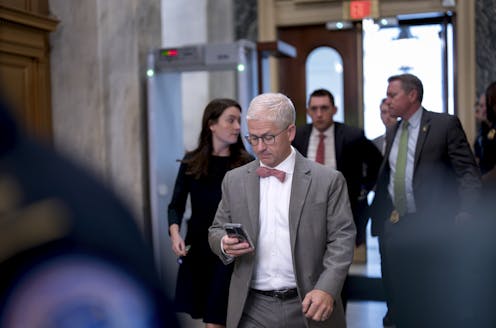
09 Oct 16:37

Today's white working-class young men who turn to racist violence are part of a long, sad American history

by Colin Kohlhaas, Doctoral Candidate, History, Binghamton University, State University of New York
Dressed in orange prison garb, Payton Gendron is sentenced to life in prison for the murder of 10 Black people in Buffalo, N.Y. Derek Gee/Buffalo News/Pool via Xinhua

In recent years, the United States has seen a surge of white supremacist mass shootings against racial minorities. While not always the case, mass shooters tend to be young white men.

Some journalists and researchers have argued that class and ideals of white masculinity are partly to blame.

This argument is not surprising. Throughout U.S. history, white men’s anxieties over their manhood and social class help explain many violent attacks on Black people, whom the perpetrators blame for denying them their rightful privileges.

Such was the case with Dylann Roof, a then 22-year-old white supremacist who was convicted and sentenced to death in the 2015 deaths of nine Black worshippers at the Emanuel African Methodist Episcopal Church in Charleston, South Carolina.

In another case involving a racist mass shooting, Payton Gendron, a white supremacist who believed a slew of racist conspiracy theories he discovered online, was sentenced to life in prison after his convictions on the 2022 murders of 10 Black people at a Buffalo, New York, grocery store in a predominantly Black neighborhood.

One such unfounded conspiracy that then 18-year-old Gendron frequently cited was the “great replacement theory,” the false idea that a group is attempting to replace white Americans with nonwhite people through immigration, interracial marriage and, eventually, violence. Such ideas reflect white supremacist beliefs, but they also reveal deep insecurities about white men’s social status in America.

It’s my belief as a scholar of U.S. history, labor, ethnicity and masculinity that Roof, Gendron and other recent mass shooters in racist attacks share similar insecurities with their historical predecessors.

Though finding solutions is not an easy task, recognizing the link between white anxiety and racial violence is a first step in addressing the problem.

Class, masculinity and violence

In modern-day society, young men face many hurdles to traditional avenues of masculine success. It’s more difficult than ever for young people to purchase a home, secure a high-paying job or find a marriage partner. These difficulties result in a great degree of anxiety among young people who struggle to achieve the security of their parents’ generation.

Many young men become particularly resentful of these conditions. Male socioeconomic power is traditionally linked with patriarchal authority, a position to which many white men may feel they are entitled.

Throughout American history, white manhood was often defined “through the subjugation of racialized and gendered others,” according to historian Eduardo Obregón Pagán. But when they felt their superiority was threatened, white men acted against the supposed enemies whom they felt blocked them from enjoying these benefits of their white male privilege.

The 1863 New York City draft riots

During the Civil War, northern states like New York instituted a lottery draft of fighting-age white men. At the time, Black men were exempted from the draft because they were not considered U.S. citizens.

The draft infuriated the white working-class population of New York in part because rich white men could hire a substitute or pay $300 to secure an exemption to the draft. This sum was roughly the average yearly salary of an American worker.

In response, thousands of white workers rioted between July 13 and July 16, killing over 100 people. They concentrated their attacks on African Americans, whom they beat, tortured and killed. Most egregiously, rioters burned down the Colored Orphanage Asylum, which sheltered over 200 black children.

In one particular display of gendered symbolism, a 16-year-old white youth dragged a black corpse through the street by his genitals.

The rioters’ anger over their subordinate social class largely drove their attacks against Black men who were an easier target than the real cause of the draft inequalities – elite white men and government agents.

The 1919 Chicago race riot

During the turn of the 20th century, the Great Migration saw many southern Black people move from the rural South to northern cities like Chicago. As waves of Black people moved into the city, white Chicagoans on the city’s South Side began bombing campaigns against Black-owned homes to keep them out of white neighborhoods.

In July 1919, a black teenager inadvertently drifted into what was considered the white section of Lake Michigan. Angry whites threw rocks at him and he eventually drowned. The incident sparked the infamous Chicago race riot, which left 38 people dead, most of whom were black.

The main perpetrators of riot violence were organized white youth gangs operating under the moniker of “athletic clubs”, a phenomenon that is the primary focus of my own research. While these clubs participated in athletic competitions, they were, in effect, violent gangs who targeted Black men.

These gangs prowled the streets in automobiles and attacked African Americans, burned black homes and businesses, and kept the fires of racial violence inflamed for days. They blamed Black men for invading their communities.

A Black man who is bleeding and laying on a sidewalk is pelted with rocks by two white men.
White attackers throw rocks at a Black man during the Chicago race riots in 1919. Jun Fujita/Chicago History Museum/Getty Images

Many of the youth gang members were the sons of Chicago packinghouse workers and did not want to endure the menial wage work of their parents. Unable to secure social and financial success through legitimate means, such youths turned to crime and violence to make money and build a sense of masculine identity.

Instead of traditional notions of manhood centered on the family, they internalized what historians call “rough masculinity,” which prioritized fighting and physical toughness.

The 1943 Los Angeles Zoot Suit Riots

During World War II, the U.S government rationed many foods and materials for the war effort. One such item was fabric, which forced clothing designers to fashion clothes using less material.

Most Americans embraced wartime rations, viewing sacrifice as their patriotic duty. But in communities on the West Coast, young Mexican American men flaunted flamboyant “zoot suits.” Zoot suits were brightly colored and distinctly flashy, but more importantly, they required a large amount of fabric.

Two men show where their clothes had been sashed by angry white servicemen.
Two Latino youths had their clothes slashed by angry white servicemen during the Zoot Suit Riots on Jun. 10, 1943, in Los Angeles, Calif. Anthony Potter Collection/Hulton Archive/Getty Images

White Americans viewed the zoot suits as a mockery of the war effort. On June 3, 1943, a series of riots broke out in Los Angeles as white servicemen attacked young Mexican Americans sporting zoot suits.

Demonstrating their fury over the clothing, servicemen stripped the suits off many victims and burned them. Over the course of three days, over 150 Latino men were injured, but the police did not arrest a single white serviceman.

In many ways, the zoot suiters challenged the masculinity of the servicemen. On one hand, the white men felt affronted by the Mexican Americans’ audacity to scoff at their manly sacrifice to go to war. On the other hand, by attacking the zoot suiters and ripping off their clothes, the servicemen effectively denied their claims to manhood.

There are many parallels between racial violence of the past and mass shootings of today. Understanding anxieties about class and masculinity can perhaps go a long way to addressing such concerns in a new generation of young white men.

The Conversation

Colin Kohlhaas does not work for, consult, own shares in or receive funding from any company or organization that would benefit from this article, and has disclosed no relevant affiliations beyond their academic appointment.
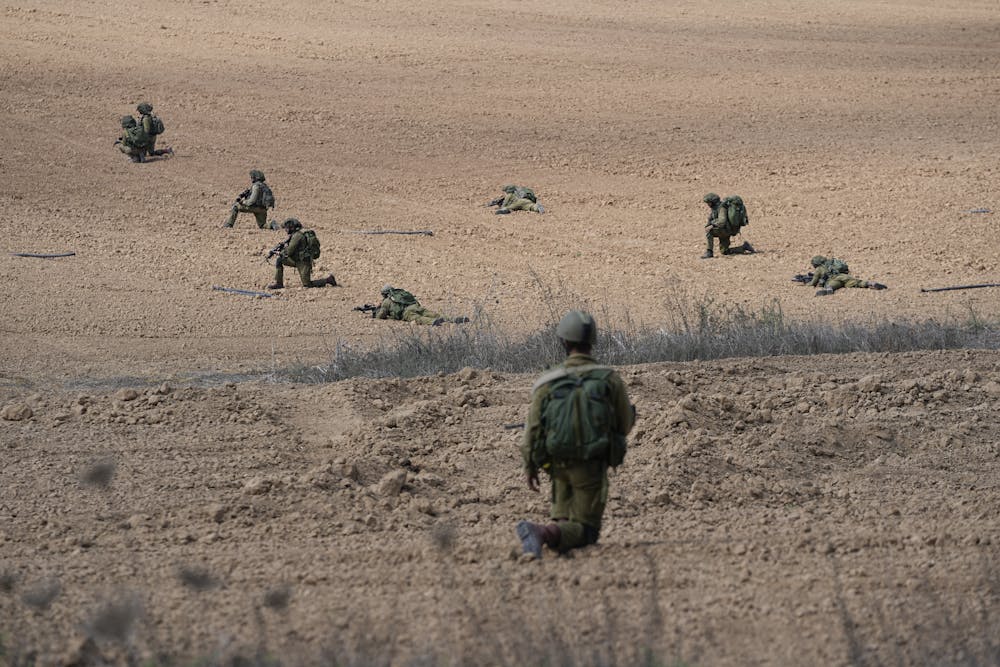
09 Oct 16:35

Israel-Hamas war: updates on The Conversation's coverage of the conflict

by Stephen Khan, Global Executive Editor, The Conversation

The dramatic and shocking renewal of hostilities in Israel and the Palestinian territories over the weekend has dominated traditional and social media outlets as viewers and readers seek to understand the rapidly moving events. Within hours of the Hamas incursion into Israel from Gaza, The Conversation published analysis by academic researchers. Conversation content is always grounded in such expertise.

As ever at these moments, we receive many pitches from within our global academic community. Our journalists are engaging with potential authors to provide extensive coverage of this issue through the week and beyond. We thought it may be useful to produce a rolling guide to the articles and audio we’re publishing, giving you a single place to catch up on all our analysis and explanation on the subject from across the network.

Unlike our articles, this page is updating from the top, so older references will be moved down the page as the week moves on and newer pieces of content are published. As a start point it might be useful to check in on our Monday morning Global newsletter which includes a brief note from me, also posted at the bottom of this page, plus links to five articles we published over the weekend and early on Monday.

Latest content


The Samy Cohen article mentioned below has now been translated into English by the French edition of The Conversation. Meanwhile, the Parmenter piece has moved into Spanish, courtesy of our Madrid team.


I mentioned this piece by Ian Parmeter yesterday. He’s now recorded an interview with our regular columnist and podcaster in Australia, Michelle Grattan. It’s about 25 minutes long, but well worth dipping into. Parmeter is a former Australian ambassador to Lebanon, and held a series of diplomatic posts in the region. He’s now a Research Scholar at the Centre for Arab and Islamic Studies, Australian National University.

His observations include: The difficulty for Israel is that in cutting off food, electricity and water, you could have after a relatively short time a humanitarian disaster unfolding among civilians in Gaza […] Israel has a difficult problem with its international relations in the sense that the peace process [with Palestine] has effectively stopped working - Israel is seen by many in the West as a country which is not doing enough to try to resolve the peace process.

He’s also particularly interesting on the role of Hezbollah and Iran, and on what he feels is the real chance Netanyahu could struggle to hang on to power.


It’s now Tuesday morning, 8.45am in London where I am and 10.53am in Jerusalem. Three days have passed since the concerted series of Hamas terror attacks on Israel began. Since then, Israel has mounted retaliatory strikes on Gaza, with the promise of more to come. There are reportedly hundreds dead on both sides, thousands displaced and hostages being held. Academic researchers continue to analyse developments on The Conversation. We will abbreviate, update and link to their work here through the day. Scroll down for summaries of all content published since hostilities began. Remember, all Conversation content is free to read, and to republish.

If you are a reader of French head straight to this Q&A with Samy Cohen, emeritus research director at Sciences Po (CERI), published by our team in Paris. It can, of course, also be read in English through browser translate tools. He’s particularly interesting on the political challenge facing Netanyahu and is pessimistic about the prospect of the hostages being released soon. I’ve pulled out a couple of key quotes:

Netanyahu has said he wants to form a government of national unity; Is it possible? SC: It will be complicated. Former Prime Minister Yaïr Lapid demanded, in return for his possible entry into government, the departure of the ultra-religious. But can Netanyahu do without them? It is possible that they will reach a compromise on this matter. Today, he has donned the costume of a warlord and is showing off his muscles, claiming that he will destroy Hamas …

Is that possible? SC: No.

What will Hamas do with all the hostages it took to Gaza?

SC: Currently, Hamas has no interest in negotiating the release of the hostages. Imagine, simply hypothetically, that the movement obtains the release of all its prisoners who are currently in prison in Israel, and releases the Israeli hostages it is holding. It would then lose a formidable human shield


What Hamas terror seeks to achieve

UK editors have posted an article by Michele Groppi of the Defence Studies Department at King’s College London. He writes:

“In a twisted way, Hamas arguably needs this escalation. In the past weeks, growing numbers of Gazan residents have reportedly been protesting the group’s leadership, accusing it of corruption and failing to improve living conditions. But most importantly, the growing possibility of an agreement between Israel and Saudi Arabia would be a tremendous blow to Hamas’s credibility within the Islamic world because it would directly contradict its anti-Israel position.

"Hamas can divert Palestinian attention away from its problems and score points in its competition with the rival Palestinian Authority (PA). If Israel attacks, Hamas will silence criticism coming from PA and others in the West Bank, who will never side with Israel, rallying the Palestinian population around its flag.”


Al-Aqsa

The name chosen by Hamas for their attacks against civilians and military forces – Operation Al-Aqsa – references the mosque that has become symbolic of the conflict between the Israelis and Palestinians. Al Aqsa is widely recognised as the third holiest site in Islam, but sits of a hill of important significance to Jews, the Temple Mount. Three years ago we published an article on why Al-Aqsa is such a sensitive site and at the heart of tension between numerous groups of various faiths in the city. Editors in Boston, working with the author Ken Chitwood, of the Center for Religion and Civic Culture at University of Southern California, have now updated this article. Do check it out.

He writes of Al-Aqsa: “Described as ‘the most sensitive site in the Israel-Palestinian conflict,’ it has frequently been host to political acts.

"On Sept. 28, 2000, Israeli opposition leader Ariel Sharon and a delegation guarded by hundreds of Israeli riot police entered the precinct. This sparked protests and a violent crackdown by Israeli authorities, with multiple casualties. Many Muslims worldwide considered this a "desecration” of the sacred mosque, and the event helped ignite the Second Intifada, or Palestinian uprising.

“Tensions peaked again after an attack on Yehuda Glick, a controversial right-wing rabbi, in autumn 2014. In response, Israeli authorities closed down access to Al-Aqsa for the first time since 1967. In March and April of that year, Israeli police used tear gas and stun grenades on Palestinians inside Al-Aqsa, prompting an international outcry.

"Numerous other incidents between Israeli forces and worshipers have occurred at Al-Aqsa in recent years.”


Translations

Of those articles below, a number have moved into langauges other than English, and, as with all Conversation content, are available for republication free. Our Paris bureau is leading on a translation of the Mayroz article. And thanks to our operations in Spain and Brazil, it is also available in Spanish and Portuguese. The Pilkington article is also running in Spanish.


Initial articles

The first piece we published in the aftermath of the Hamas assaults was this, by Eyal Mayroz, Senior Lecturer in Peace and Conflict Studies at the University of Sydney. He highlighted an apparent intelligence failure on the Israeli side, covered the news as it was breaking, drew parallels with the opening hours of the 1973 Yom Kippur War, pointed to the shocking capture of civilian hostages and warned of the risk of escalation.

There followed two articles from our US bureaux, including this, by Dov Waxman, a Professor of Israel Studies, at the University of California, Los Angeles, which goes into the Yom Kippur comparison and legacy in more detail.

Aaron Pilkington, a PhD Candidate at Korbel School of International Studies at the University of Denver, meanwhile, concluded that:

“There are at least three possible outcomes to the war, and they all play in Iran’s favor.”

From Canada, Michael J. Armstrong, Associate Professor, Operations Research, at Brock University has been researching rocket defenses and missile combat for years. “But the intensity of the Hamas attack this time was astounding,” he wrote.

“The barrage wasn’t restricted to border areas. It reached across southern and central Israel, including the suburbs of Tel Aviv.”

He concluded: “While civilians in both Israel and Gaza are already mourning the deaths of hundreds, there is likely more bloodshed to come.”

On Monday, our editors in Melbourne commissioned Ian Parmeter, a researcher at the Centre for Arab and Islamic Studies, Australian National University. He considered the tactics, strategy and motivation behind the Hamas attacks.

“Significantly, Hamas has named its action "Operation Al-Aqsa Flood”. This provides some clues to the primary reason for striking at this time, which emphasises what Hamas sees as Israeli acts of desecration of a holy Islamic site.

“However, an additional motivating factor was likely the increasing tendency of Arab states to make peace agreements with Israel, as evidenced by the 2020 Abraham Accords, involving the United Arab Emirates, Bahrain, Sudan and Morocco.”


Monday newsletter note

Edited version of the newsletter note from Monday, October 9:

A few weeks ago, The Conversation published a three-part podcast series marking the 30th anniversary of the Oslo Accords which sought to bring peace to the Middle East and deliver a two-state solution to the decades-old conflict between Israel and the Palestinians. In it, leading negotiators and intermediaries from that period lamented the lost opportunity, and warned that matters were likely to deteriorate, rather than improve.

That deterioration came at the weekend, in the most rapid and shocking way. The scale, speed and nature of the attacks launched by Hamas from Gaza, across into Israel, were unexpected. The targeting of civilians, killed or taken back into Gaza as hostages, has been a grim hallmark of the attacks.

Here, you will find a series of reaction articles, commissioned by our editors around the world and written by experts on conflict and the Middle East. In the days to come we will of course publish more from across our network and in multiple languages.

The Conversation
09 Oct 13:21

OPINION: Read the fine print this flu season

by Brenda Guajardo, correspondent
Students are unaware of the Tamiflu controversy during this flu season, making it important for USF to guide students towards the proper medications. ORACLE PHOTO/JUSTIN SEECHARAN

Flu season has officially begun and may last until February, according to the CDC website.

During flu season, individuals begin to flood doctor’s offices and take medications prescribed by their physician.

Students need to keep in mind that what a doctor prescribes isn’t always reliable and it is essential to do research before taking any medication. USF’s Center for Student Well-Being should provide resources explaining the well-researched side effects and functions of common medications.

Tamiflu is an antiviral medication used to treat those who have experienced no more than two days of flu symptoms, according to the Tamiflu website. The CDC strongly advocates for people to take Tamiflu when diagnosed with the virus, according to the CDC website.

Physicians continue to believe Tamiflu is reliable to take when infected with the flu. 

“If Tamiflu is taken early enough, it can shorten your illness by a couple of days and reduce the severity of your symptoms. It can also be prescribed preventively for high-risk patients who have been exposed to a family member with influenza,” said family medicine doctor Richard Oley in a September 2022 Geisinger Health article.

However, many students and physicians have not been informed of the Tamiflu controversy that has been ongoing since the early 2000s. 

In 2009, during the swine flu pandemic in Japan, people taking Tamiflu began to develop psychotic symptoms as a result of the medication, according to The Skeptic’s Guide to Health, Medicine and the Media, a 2019 book written by Roy Benaroch. 

This side effect has not been reported by the FDA as a direct cause of Tamiflu, only as an effect of influenza, according to the FDA website. However, a 2014 review by Cochrane, a global organization of researchers and professionals that investigate global health policies, stated that Tamiflu can cause these psychotic events.

Cochrane discovered that previous research conducted on Tamiflu was based on unpublished data from Roche, the pharmaceutical company that manufactured the drug, according to a March 2020 article from McGill University.

Roche claimed that Tamiflu had the ability to significantly reduce hospitalizations and flu symptoms. Although the medication is able to reduce symptoms, Cochrane proved that the reduction in hospitalizations was a false claim.

Currently, the only reported symptoms of Tamiflu include vomiting, nausea and headaches, according to the Tamiflu website.

Through the data fabrication and falsification conducted by Roche, people – including physicians – are misled.

The USF Center for Student Well-Being exists so that students can access resources that allow them to live healthy, well-balanced lives, according to its website.

If the Center for Student Well-Being is able to provide resources on mental health and physical education, it should also be able to provide resources that guide students toward taking safe medications that are better for their health.

To help students figure out what medications are safe, the Center for Student Well-Being should provide students with a guide of common medications prescribed by physicians and their common side effects. 

This guide should be created with an extensive literature review of published research articles on each drug in order to ensure that the proper functions and side effects of the medications are listed. This literature review should be conducted by physicians and medical researchers on campus who have been trained in analyzing research articles pertaining to these topics.

It is essential for students to be cautious of the medications they are taking and to be skeptical of what professionals may say as it is not always correct. USF’s Center for Student Well-Being should take action to assist students in preventing being misled and give them healthy medication options to take during this flu season.

05 Oct 17:56

Popular Scam Phone Numbers: Never Answer These Suspicious Calls, Texts

by Staff

Get ready to block a whole bunch of bad numbers! A new study is revealing the most common scam phone numbers that experts say you should never answer. Many on this list try to bait Americans into all sorts of schemes, posing as everything from your bank to package delivery services.

Out of more than 150,000 suspicious phone numbers reported by users over the last two years, researchers with BeenVerified cut that list down to 12 scammers and spammers who constantly call Americans. The team also categorized them by the specific tactics they used to trick people who answered the phone.

Nine of the 12 fall into the category of a “text scam message,” meaning these numbers send a text to cell phone users, trying to get them to click on a suspicious link or call another number. The bait typically involves some urgent message that gets the victim to fear that something has gone wrong.

Four of the 12 popular scam numbers involved “business imposter cons.” These numbers pretend to be your bank or credit card company, possibly to gain access to your accounts.

“Call companies directly to check fraud claims. Do not use links or phone numbers provided. Instead, check your card or account for the authorized fraud prevention number,” writes BeenVerified’s Kevin Voigt in a statement.

Three of the 12 top scam numbers involved “delivery scams.” These schemes pretend to notify victims about a supposed package from companies like DHL or FedEx in order to get people to click a suspicious link. BeenVerified notes that these schemes skyrocketed during the COVID-19 pandemic. Two other numbers try to trick people by telling them they’ve won a prize. While it sounds enticing, experts warn that it’s all a lie.

The top 12 numbers on BeenVerified.com’s list received the most comments on the site’s Scam Call Monitor, with almost all of them complaining that they were suspicious. Out of the 150,000 numbers cited, the top 12 all had between 100 and 200 complaints from Americans.

Top 12 Scam Phone Numbers You Should Never Answer:

1. (865) 630-4266 — Notice-Account [WellsFargo] Reach us NOW

This text message warns victims that their Wells Fargo account has been temporarily locked and they should call right away.

2. (469) 709-7630 — We have a failed delivery attempt for XXX.

Users reported either they or a loved one were mentioned by name for a failed delivery attempt. Another user reported, “When I called to see who they were, I was asked to enter only the last two digits of my SSN for verification. I hung up.”
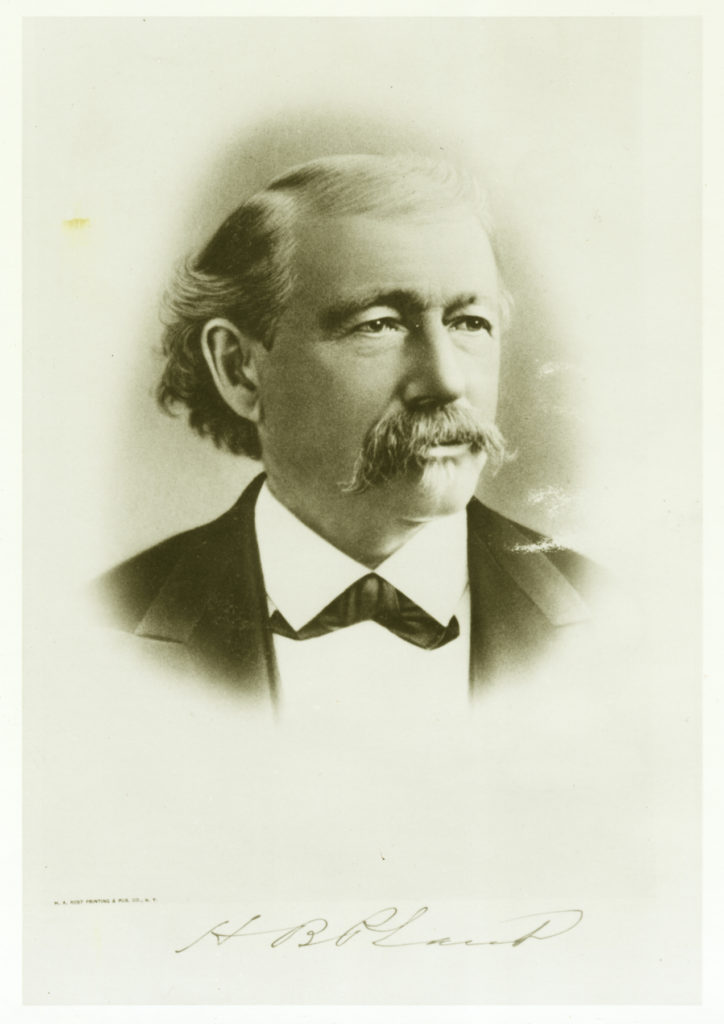
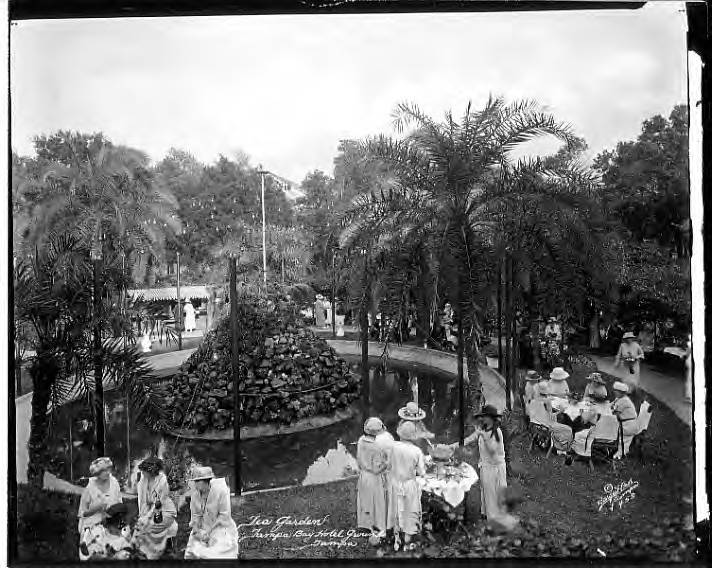
Related: Infographic: 11 Tech Trends to Watch For

3. (858) 605-9622 — Bank Account temporarily ON HOLD! Call now

Users reported this text-based scam from this number that namechecks a variety of brand name banks such as PNC, Chase, and Wells Fargo. The scam text reads: (Bank name): ACCNT #5674 temporarily ON HOLD! Your security is our priority. Call now: (858) 605-9622 (Do Not Disregard!)

4. (863) 532-7969 — Debit Card Frozen Call Immediately

Another bank-related scam, this time without using any bank name because it’s so common for people to at least have a debit card.

5. (904) 495-2559 — AT&T Free Msg: Congrats to 2 lucky users!

Lottery and prize scams are among the most commonly reported. One person reported receiving this message: “ATT Free Msg: Congrats to 2 lucky users! Today’s winners of our raffle are: Tim N***** and you, (Name)! Claim now: j2kmz.info/XXXXX (904) 495-2559”

6. (312) 339-1227 — Lose weight! – or – Track your parcel

Again, spammers appear to recycle the same phone numbers for different scams. Americans reported seeing this number either touting a weight-loss product or acting as a delivery scam.

7. (347) 437-1689 — Small-dollar tax scam and a Dyson vacuum

Fraudsters often bait victims with bogus claims of big-ticket purchases on their accounts. In this new variation, scammers claim instead only a small amount of unpaid taxes are owed to lure victims into clicking links. This number also sent fake texts about Dyson vacuums to try to ensnare victims.

8. (301) 307-4601 — U.S-Post: Your package is on hold for address issue

Another delivery scam. This one claims to be from the US Postal Service and sends users an allegedly bogus text with a link to click.

9. Call (878) 877-1402 Now! 994# Card-Locked Alert

Similar to the “Debit Card Frozen” scam phone number, this text message personalized the message by adding the victim’s phone number. Users reported seeing “Call 878-877-1402 Now ! 994# Card-Locked Alert Account-ID: then my phone number.”

10. (202) 221-7923 — Student loan forgiveness deadline coming. Call Kelsey

“Scammers follow the news and tailor their scams accordingly. As student-loan debt forgiveness has been a hot topic in recent years, scammers are making false claims about nonexistent deadlines,” BeenVerified warns. “Dozens of users reported getting phone messages from a “Kelsey Adams” about a fast-approaching deadline for student-loan forgiveness and the need to act—or else.”

Story attributed to Study Finds.

The post Popular Scam Phone Numbers: Never Answer These Suspicious Calls, Texts appeared first on ModernGlobe.