When you’re conducting research and investigations, it’s easy to get sidetracked by opinions, expectations, and wishful thinking. Sometimes we hope for or have too much invested in a particular outcome. Other times, we rely on our usual tools and techniques and don’t consider their limitations.
The technical term is cognitive bias, and it means that our assumptions and beliefs affect how we process or interpret our findings. It means that we alter our judgments based on these biases, and it distorts the truth.
When you’re conducting research or an investigation, it’s important to park your biases and proceed with an open mind. We’re not there to judge or prove anyone else’s point. We need to focus on the facts. And we can’t do our best when opinions get in the way.
What are some of the most common cognitive biases that you might encounter when you’re gathering information for research and investigations, and what can you do to avoid them? Here are just five that might come into play:
1. Confirmation bias – Favoring information that conforms to our opinion or hypothesis and discounting what doesn’t We’re not here to prove what our clients want us to prove. We’re not here to judge the information we find, except for its authenticity and reliability. Just gather and report the facts, adding context as appropriate.
2. Anchoring bias – Relying too heavily on the first piece of information that we find We all do it. We get excited when we finally find something useful and base the rest of the investigation on that one piece. While we need to follow leads, spend a little more time on gathering those initial facts before making changes in direction.
3. Automation bias – Over-reliance on automated tools and not verifying through manual methods Comprehensive reports, packaged due diligence, online court record systems, software for mining social media, and other tools save time, but they’re a starting point. It’s just raw data that needs to be analyzed and verified, often through boots-on-the-ground research.
4. Overconfidence bias – Overestimating our ability or knowledge in a particular area A lot of research and investigations is specialized these days, and you can’t do it all. I’ll never be able to take on surveillance cases, and even some research, like verifying patents, is best left to the experts.
5. Bias blind spot – Recognizing the effect of bias in the judgment of others but not in ourselves Yes, it can can happen to any of us. We’re only human, and our own biases can get in the way. Take stock of how you approach your research, and stay aware throughout the process.
Don’t taint your research and investigations with cognitive biases. Keep an open mind, gather as many perspectives as you can, and explore the possibilities. Expand your toolkit, and never rely on just one source. Verify everything, and build your network of experts. It’s the only way to keep those biases from interfering with finding and reporting the truth.
At the beginning of 1882, the philosopher Friedrich Nietzsche received a machine called the “Malling-Hansen Writing Ball”, a nifty little gadget covered with keys. The thinker’s eyesight had been getting worse, to the point where he could no longer write by hand. In March of the same year he was able to continue writing thanks to this new instrument.
His friend, the composer Heinrich Köselitz, noted a certain stylistic change in his texts from that time onwards, as his prose became more terse and succinct. It appears that the content of some of his philosophy was also affected.
This change –a reminder that “the medium is the message”– might be explained by new theories of embodied cognition. Modern cognitive science indicates that motor and sensory aspects of our behaviour have consequences that reach further than we may, at first, suspect.
Our minds are not filled with disembodied ideas. We need to take our bodies and senses into account in order to explain phenomena that are otherwise inexplicable.
In a study carried out almost two decades ago, subjects were presented with words carrying a positive connotation (such as “sweet”) or negative (such as “rubbish”). Subjects had to indicate whether a word was “good” or “bad” by moving a joystick. Half of the subjects were told to indicate that a word was “good” by pulling the joystick towards their bodies, and the other half were told to indicate “good” by pushing it away.
To indicate that a word was “bad”, the subjects made the opposite movement to “good”. A consistent correlation was observed between meaning and movement: the quickest responses were produced by the subjects who were told to indicate “good” by pulling the joystick towards themselves, and to indicate “bad” by pushing it away.
This direct involvement of the body and senses in mental processes can explain how writing by hand (as opposed to other types of writing) helps us to learn letters and words. This is backed up by the results of various studies, which we will now present.
Memory ability
As an example, a 2021 study compared short and mid term recall of words learned either by typing or writing by hand. Recall was better when words had been learned with a pencil and paper.
In another study, a small group of adults learned new symbols (from a language of Asian origin) that they then had to reproduce with a pencil or a keyboard. When they had finished learning the symbols, there were no differences in recall between the two methods, but the keyboard users forgot a significant amount of what they had learned as time passed by.
Some experts suggest that learning by pen and paper is better because it is more “embodied”. This means that it involves a set of more complex sensory-motor processes particular to each letter. This complexity leaves a more distinctive footprint in our memories and, as a result, makes things easier to memorise and recall, much like how a two metre tall supermodel might be more memorable than someone with average features.
Mental resources
Another benefit to writing by hand is that is puts less strain on our brains. Typing puts more demand on our mental resources, causing difficulties when it comes to word memorisation tasks. The increased mental load is due to the greater speed at which words are typed. This, in turn, means there are more individual elements to process over a certain period of time.
The idea of complexity appears in other studies to explain similar differences when writing in a second language. Other authors have also suggested that more mental resources are used because writing is more complex when performed on the keyboard.
Planning and composition
The way we write can also affect higher levels of word processing in our brains. It is thought that the type of writing sets the pace of cognitive processing – if the writing process is slow and cumbersome it can interfere with the higher processes on which it depends, causing ideas and relevant information to be forgotten.
In several experiments, an improvement has been noted in overall written composition (quality, length and fluidity of text) after subjects completed handwriting exercises. In the same vein, a study has shown that students plan their texts more carefully when using pen and paper than they do when using a keyboard.
Longer and better quality texts
Nevertheless, it must be recognised that keyboards have also brought us many advantages. For example, some meta analyses comparing hand written texts with those written on a computer found the latter to often be longer and better composed.
The Matrix film tetralogy presents the idea of a mind without a body. But a disembodied mind that exists only in the virtual world is much like Plato’s cave. The torches that cast shadows on the wall are replaced by computer simulations. In real life, however, the mind performs its operations alongside the functioning of our entire body.
We are closer to a purely symbolic, disembodied mind when we type on the keyboard (a device that works with minimal sensory involvement) than when we put pen to paper, as our cognitive system reacts differently depending on the motor and sensory inputs that we experience.
Implications for education
The results of these studies all indicate that eliminating handwriting from school – as has reportedly been done in Finland– is not a good idea.
Obviously, this does not mean that we should stop using keyboards, not even in infancy. However, we must be on the lookout for future studies on this topic, and act on their repercussions in the education sector as promptly as possible.
Javier Marín Serrano receives funding from the Spanish Ministry of Science and Innovation.
Miguel Ángel Pérez-Sánchez receives funding from the Spanish Ministry of Science and Innovation.
Olena Vasylets does not work for, consult, own shares in or receive funding from any company or organization that would benefit from this article, and has disclosed no relevant affiliations beyond their academic appointment.
by Rebecca Banham, Postdoctoral fellow, University of Tasmania
Shutterstock
The famous Sycamore Gap tree was felled last week, prompting global expressions of sorrow, anger and horror. For some, the reaction was puzzling. Wasn’t it just a single tree in northern England? But for many, the tree felt profoundly important. Its loss felt like a form of grief.
Trees tell us something important about ourselves and who we are in the world. That is, they contribute to ontological security – our sense of trust that the world and our selves are stable and predictable.
Trees – especially those celebrated like England’s sycamore or Tasmania’s 350-year-old El Grande mountain ash – feel like they are stable and unchanging in a world where change is constant. Their loss can destabilise us.
What makes a tree iconic?
Individual trees can become important to us for many reasons.
When the wandering ascetic Siddhartha Gautama sat at the foot of a sacred fig around 500 BCE, he achieved the enlightenment which would, a few centuries later, lead to his fame as the Buddha. This sacred fig would become known as the Bodhi Tree. One of its descendants attracts millions of pilgrims every year.
This sacred fig in India’s Mahabodhi Temple is believed to be the descendant of the fig the Buddha sat beneath.
Globe Trotting/Flickr, CC BY-NC-ND
Sometimes a tree becomes iconic because of its association with pop culture. U2’s hit 1987 album The Joshua Tree has inspired fans to seek out the tree on the cover in the United States’ arid southwest – a potentially dangerous trip.
Other trees become famous because they’re exceptional in some way. The location of the world’s tallest tree – a 115-metre high redwood known as Hyperion – is kept secret for its protection.
Niger’s Tree of Ténéré was known as the world’s most isolated, eking out an existence in the Sahara before the lonely acacia was accidentally knocked down by a truck driver in 1973. Its site is marked by a sculpture.
In 2003, the mountain ash known as El Grande – then the world’s largest flowering plant – was accidentally killed in a burn conducted by Forestry Tasmania. The death of the enormous tree – 87 metres tall, with a 19 metre girth – drew “national and international” media attention.
This year, vandals damaged a birthing tree sacred to the local Djab Wurrung people amidst conflicts about proposed road works in western Victoria.
And in 2006, someone poisoned Queensland’s Tree of Knowledge – a 200-year-old ghost gum famous for its connection to the birth of trade unionism in Australia. Under its limbs, shearers organised and marched for better conditions. The dead tree has been preserved in a memorial.
To sustain it, we seek out feelings of safety, trust, and reassurance by engaging with comfortable and familiar objects, beings and people around us – especially those important to our self-identity.
When there is an abrupt change, it challenges us. If your favourite tree in your street or garden dies, you mourn it – and what it gave you. But we mourn at a distance too – the Sycamore Gap tree was world-famous, even if you never saw it in real life.
In my research, I have explored how Tasmanian forests – including iconic landscapes and individual trees – can give us that sense of security we all seek in ourselves.
As one interviewee, Leon, told me:
These places should be left alone, because in 10,000 years they could still be there. Obviously I won’t be, we won’t be, but perhaps [the forest will be].
Temporality matters here. That is, we know what to expect by looking to the past and imagining what the future could be. Trees – especially ancient ones – act as a living link between the past, present, and future.
As my interviewee Catherine said:
You lie under an old myrtle and you just go, ‘wow - so what have you seen in your lifetime?’ Shitloads more than me.
That’s why the loss of the Sycamore Gap tree has upset seemingly the entire United Kingdom. The tree was famous for its appearance: a solitary tree in a photogenic dip in the landscape.
Its loss means a different future for those who knew it. It’s as if you were reading a book you know – but someone changed the ending.
We respond very differently when humans do the damage compared to natural processes. In one study, UK homeowners found it harder to accept their house being burgled than for it to be flooded, seeing flooding as more natural and thus less of a blow to their sense of security.
This is partly why the sycamore’s death hurt. It didn’t fall in a storm. It was cut down deliberately – something that wasn’t supposed to happen.
The sycamore was just a tree. But it was also not just a tree – it was far more, for many of us. It’s more than okay to talk about what this does to us – about how the loss of this thread of connection makes us grieve.
Yes, we have lost the Sycamore Gap tree, just as we lost El Grande and many others. It is useful to talk about this - and to remember the many other beautiful and important trees that live on.
Rebecca Banham received funding from an Australian Government Research Training Program Scholarship, which funded the research associated with this article.
by Alan Finkel, Chair of ARC Centre of Excellence for Quantum Biotechnology, The University of Queensland
This article is part of a series by The Conversation, Getting to Zero, examining Australia’s energy transition.
Just over a year since US President Joe Biden signed the Inflation Reduction Act (IRA) into law, it’s becoming clear this strangely named piece of legislation could have a powerful impact in spurring the global transition to net zero emissions by 2050.
But the vast amount of investment unleashed by the IRA has raised tensions with some of the United States’ closest allies, and creates risks, as well as opportunities, for Australia’s transition to clean energy sources.
In his 2020 presidential campaign, Biden promised to commit the US to net zero by 2050, and to spend US$2 trillion to get there – the biggest investment in manufacturing since World War II. Biden is delivering on those promises.
Passage of the IRA, in August 2022, ensured a swathe of green technologies would benefit from tax credits, loans, customer rebates and other incentives.
The original announcement estimated that uncapped subsidies over ten years would be US$369 billion, but Goldman Sachs Research now estimates that total subsidies could reach US$1.2 trillion and attract US$3 trillion investment by industry. That’s trillion, not billion.
The IRA is all carrot, no stick. It contains no carbon taxes or emissions trading schemes. Instead, tax credits for capital expenditure and production costs encourage companies to invest in solar, wind, hydrogen, batteries, electric vehicles and other zero emissions technologies.
This approach is shifting the debate on the best way to reach net zero emissions. To free-market economists who ask why government should invest in private sector industries, the answer is that the green energy transition is not natural. Renewable energy would never have advanced without Germany subsidising solar and Denmark subsidising wind.
Subsidies and mandates are also crucial in explaining why, last year, Chinese vehicle manufacturers produced 64% of the global total of 10.5 million electric vehicle sales, and deployed about half of the global capacity additions in solar and wind power.
The IRA is America’s response. More than climate policy, it is industrial policy, replete with made-in-America provisions. Companies are more likely to obtain tax credits if they employ unionised labour, train apprentices and set up shop in states that are transitioning out of fossil fuels.
Consumers will earn a $7,500 federal tax credit on an electric car only if that car is assembled and at least half the battery made in America. Similarly, wind and solar projects will earn tax credits only if half of their manufactured components are made in America.
These policies were made with China in mind. Both main US parties agree the US must reduce its dependence on sourcing minerals and products from China, and move towards a new form of “strategic economic nationalism”.
Yet while America’s strongest allies are also alarmed by the challenge from China, they are disturbed by aspects of the IRA. They fear that to benefit from its subsidies, their own clean energy companies might pack up shop and establish plants in the US.
The European Union, for example, has praised the IRA’s overall approach, but fiercely criticised its made-in-America provisions. French President Emmanuel Macron called the Act “super aggressive” toward European companies. European leaders say the IRA violates trade rules by discriminating against imported products, and could “trigger a harmful global subsidy race to the bottom on key technologies and inputs for the green transition.”
Yet even as it criticises the US, the EU has responded to the IRA by relaxing its rules and allowing individual states to provide direct support to clean energy companies to stop them taking their projects to the US.
Canada, worried about investment flowing south to benefit from the IRA even though its free trade agreement with the US should give its companies access to the subsidies, has also announced tax credits and programs to boost clean energy production. Japan and South Korea have announced similar programs.
Why the IRA challenges Australia
In Australia, before the IRA was legislated, the Morrison government provided a A$1.25 billion loan to Iluka Resources to fund construction of an integrated rare-earths refinery in Western Australia. The refinery will produce separated rare earth oxide products that are used in permanent magnets in electric vehicles, clean energy generation and defence.
But Australia risks being left behind in the race to build clean energy industries. The US could so heavily subsidise green hydrogen production that our own planned industry – seen as a foundation of our aspiration to be a clean energy superpower – will be uncompetitive, leading our aspiring manufacturers to set up shop in the US.
The IRA, however, brings Australia many potential benefits. The US wants to source the raw and refined materials it needs from countries, such as Australia, with which it has a free trade agreement. To respond to this interest, Australian industry, transport and mining must have access to low-emissions electricity.
The US will be an essential market for our rare earths such as neodymium, praseodymium, dysprosium and terbium, used to make the powerful permanent magnets in wind turbines and electric car motors. Australia can also build new industrial processes and supply chains so that we earn more from decarbonised metallic iron, aluminium and nitrogenous fertiliser. We can ship our renewable energy in the form of hydrogen and ammonia.
In this race, Australia’s friendship with the US and volatile relationship with China could be decisive. The IRA does not spell out the concept of friend-shoring but nevertheless it seeks “to onshore and friend-shore the electric vehicle supply chain, to capture the benefits of a new supply chain and reduce entanglement with China,” according to the US Centre for Strategic and International Studies.
The IRA denies electric vehicle tax credits when any component or critical mineral in the vehicle is sourced from China or any “foreign entity of concern.”
A clean energy trade war is just one of the potential obstacles that could prevent the full benefits of the IRA being realised. Many communities in the US and Australia are resisting the installation of new transmission lines, wind farms and other clean energy infrastructure, and these objections are often on environmental grounds – the so-called Greens’ Dilemma. And a win for Donald Trump in next year’s presidential election could reverse American climate policy.
Yet on balance, the IRA can only be good for getting to net zero. It brings the US in from the climate wilderness to be a leader in emissions reduction, helping to drive new technologies and lower costs that will benefit not only America but the world.
Alan Finkel is chair of the Hysata Advisory Council and an investor in the company. He is a member of the Rio Tinto Innovation Advisory Council.
Students are unaware of the Tamiflu controversy during this flu season, making it important for USF to guide students towards the proper medications. ORACLE PHOTO/JUSTIN SEECHARAN
Flu season has officially begun and may last until February, according to the CDC website.
During flu season, individuals begin to flood doctor’s offices and take medications prescribed by their physician.
Students need to keep in mind that what a doctor prescribes isn’t always reliable and it is essential to do research before taking any medication. USF’s Center for Student Well-Being should provide resources explaining the well-researched side effects and functions of common medications.
Tamiflu is an antiviral medication used to treat those who have experienced no more than two days of flu symptoms, according to the Tamiflu website. The CDC strongly advocates for people to take Tamiflu when diagnosed with the virus, according to the CDC website.
Physicians continue to believe Tamiflu is reliable to take when infected with the flu.
“If Tamiflu is taken early enough, it can shorten your illness by a couple of days and reduce the severity of your symptoms. It can also be prescribed preventively for high-risk patients who have been exposed to a family member with influenza,” said family medicine doctor Richard Oley in a September 2022 Geisinger Health article.
However, many students and physicians have not been informed of the Tamiflu controversy that has been ongoing since the early 2000s.
In 2009, during the swine flu pandemic in Japan, people taking Tamiflu began to develop psychotic symptoms as a result of the medication, according to The Skeptic’s Guide to Health, Medicine and the Media, a 2019 book written by Roy Benaroch.
This side effect has not been reported by the FDA as a direct cause of Tamiflu, only as an effect of influenza, according to the FDA website. However, a 2014 review by Cochrane, a global organization of researchers and professionals that investigate global health policies, stated that Tamiflu can cause these psychotic events.
Cochrane discovered that previous research conducted on Tamiflu was based on unpublished data from Roche, the pharmaceutical company that manufactured the drug, according to a March 2020 article from McGill University.
Roche claimed that Tamiflu had the ability to significantly reduce hospitalizations and flu symptoms. Although the medication is able to reduce symptoms, Cochrane proved that the reduction in hospitalizations was a false claim.
Currently, the only reported symptoms of Tamiflu include vomiting, nausea and headaches, according to the Tamiflu website.
Through the data fabrication and falsification conducted by Roche, people – including physicians – are misled.
The USF Center for Student Well-Being exists so that students can access resources that allow them to live healthy, well-balanced lives, according to its website.
If the Center for Student Well-Being is able to provide resources on mental health and physical education, it should also be able to provide resources that guide students toward taking safe medications that are better for their health.
To help students figure out what medications are safe, the Center for Student Well-Being should provide students with a guide of common medications prescribed by physicians and their common side effects.
This guide should be created with an extensive literature review of published research articles on each drug in order to ensure that the proper functions and side effects of the medications are listed. This literature review should be conducted by physicians and medical researchers on campus who have been trained in analyzing research articles pertaining to these topics.
It is essential for students to be cautious of the medications they are taking and to be skeptical of what professionals may say as it is not always correct. USF’s Center for Student Well-Being should take action to assist students in preventing being misled and give them healthy medication options to take during this flu season.
Get ready to block a whole bunch of bad numbers! A new study is revealing the most common scam phone numbers that experts say you should never answer. Many on this list try to bait Americans into all sorts of schemes, posing as everything from your bank to package delivery services.
Out of more than 150,000 suspicious phone numbers reported by users over the last two years, researchers with BeenVerified cut that list down to 12 scammers and spammers who constantly call Americans. The team also categorized them by the specific tactics they used to trick people who answered the phone.
Nine of the 12 fall into the category of a “text scam message,” meaning these numbers send a text to cell phone users, trying to get them to click on a suspicious link or call another number. The bait typically involves some urgent message that gets the victim to fear that something has gone wrong.
Four of the 12 popular scam numbers involved “business imposter cons.” These numbers pretend to be your bank or credit card company, possibly to gain access to your accounts.
“Call companies directly to check fraud claims. Do not use links or phone numbers provided. Instead, check your card or account for the authorized fraud prevention number,” writes BeenVerified’s Kevin Voigt in a statement.
Three of the 12 top scam numbers involved “delivery scams.” These schemes pretend to notify victims about a supposed package from companies like DHL or FedEx in order to get people to click a suspicious link. BeenVerified notes that these schemes skyrocketed during the COVID-19 pandemic. Two other numbers try to trick people by telling them they’ve won a prize. While it sounds enticing, experts warn that it’s all a lie.
The top 12 numbers on BeenVerified.com’s list received the most comments on the site’s Scam Call Monitor, with almost all of them complaining that they were suspicious. Out of the 150,000 numbers cited, the top 12 all had between 100 and 200 complaints from Americans.
Top 12 Scam Phone Numbers You Should Never Answer:
1. (865) 630-4266 — Notice-Account [WellsFargo] Reach us NOW
This text message warns victims that their Wells Fargo account has been temporarily locked and they should call right away.
2. (469) 709-7630 — We have a failed delivery attempt for XXX.
Users reported either they or a loved one were mentioned by name for a failed delivery attempt. Another user reported, “When I called to see who they were, I was asked to enter only the last two digits of my SSN for verification. I hung up.”
3. (858) 605-9622 — Bank Account temporarily ON HOLD! Call now
Users reported this text-based scam from this number that namechecks a variety of brand name banks such as PNC, Chase, and Wells Fargo. The scam text reads: (Bank name): ACCNT #5674 temporarily ON HOLD! Your security is our priority. Call now: (858) 605-9622 (Do Not Disregard!)
Lottery and prize scams are among the most commonly reported. One person reported receiving this message: “ATT Free Msg: Congrats to 2 lucky users! Today’s winners of our raffle are: Tim N***** and you, (Name)! Claim now: j2kmz.info/XXXXX (904) 495-2559”
6. (312) 339-1227 — Lose weight! – or – Track your parcel
Again, spammers appear to recycle the same phone numbers for different scams. Americans reported seeing this number either touting a weight-loss product or acting as a delivery scam.
7. (347) 437-1689 — Small-dollar tax scam and a Dyson vacuum
Fraudsters often bait victims with bogus claims of big-ticket purchases on their accounts. In this new variation, scammers claim instead only a small amount of unpaid taxes are owed to lure victims into clicking links. This number also sent fake texts about Dyson vacuums to try to ensnare victims.
8. (301) 307-4601 — U.S-Post: Your package is on hold for address issue
Another delivery scam. This one claims to be from the US Postal Service and sends users an allegedly bogus text with a link to click.
Similar to the “Debit Card Frozen” scam phone number, this text message personalized the message by adding the victim’s phone number. Users reported seeing “Call 878-877-1402 Now ! 994# Card-Locked Alert Account-ID: then my phone number.”
“Scammers follow the news and tailor their scams accordingly. As student-loan debt forgiveness has been a hot topic in recent years, scammers are making false claims about nonexistent deadlines,” BeenVerified warns. “Dozens of users reported getting phone messages from a “Kelsey Adams” about a fast-approaching deadline for student-loan forgiveness and the need to act—or else.”
Three of the tiniest manatee calves ever treated at ZooTampa’s David A. Straz, Jr. Critical Care Center, have returned to ZooTampa at Lowry Park to continue their rehabilitation journey after traveling more than 1,000 miles alongside five other manatees as part of a multi-institution collaboration effort.
In an intricate operation, the manatees- Piccolina, Soleil and Calliope who now weigh a total of more than 2500 pounds – were placed alongside five other manatees in custom-built, state-of-the-art containers on a specially scheduled DHL cargo plane. In the upcoming months, the manatees will complete the final stages of their rehabilitation before they are released back into the wild.
Photo via ZooTampa
Manatee calves are on the road to recovery in Tampa
“These transfers are extremely important as it allows us to make room to care for critically injured, ill and orphaned manatees,” said Tiffany Burns, senior director of animal programs. “We are grateful to our partners in Ohio for providing secondary rehabilitation. It’s an incredible team effort and we are excited about the manatees’ return to Florida waters early next year.”
Yet even as the three females return to their native state, the conservation work to save manatees never ends – three other young manatees, Nolia, Waffles, and Amethyst caught the return flight back to Ohio to continue their rehabilitation. Juvenile manatees must reach a goal weight of 600 pounds to be considered for release.
ZooTampa’s David A. Straz, Jr. Critical Care Center has cared for more than 500 injured, sick, and orphaned manatees. A dedicated team of animal care and medical staff tend to Florida’s iconic species 24 hours a day, 7 days a week.
Federal agents are using face recognition software without training, policies, or oversight, according to the Government Accountability Office (GAO).
The government watchdog issued yet another report this month about the dangerously inadequate and nonexistent rules for how federal agencies use face recognition, underlining what we’ve already known: the government cannot be trusted with this flawed and dangerous technology.
The GAO review covered seven agencies within the Department of Homeland Security (DHS) and Department of Justice (DOJ), which together account for more than 80 percent of all federal officers and a majority of face recognition searches conducted by federal agents.
Across each of the agencies, GAO found that most law enforcement officers using face recognition have no training before being given access to the powerful surveillance tool. No federal laws or regulations mandate specific face recognition training for DHS or DOJ employees, and Homeland Security Investigations (HSI) and Marshals Service were the only agencies reviewed to now require training specific to face recognition. Though each agency has their own general policies on handling personally identifiable information (PII), like facial images used for face recognition, none of the seven agencies included in the GAO review fully complied with them.
Thousands of face recognition searches have been conducted by the federal agents without training or policies. In the period GAO studied, at least 63,000 searches had happened, but this number is a known undercount. A complete count of face recognition use is not possible. The number of federal agents with access to face recognition, the number of searches conducted, and the reasons for the searches does not exist, because some systems used by the Federal Bureau of Investigation (FBI) and Customs and Border Protection (CBP) don’t track these numbers.
Our faces are unique and mostly permanent — people don’t usually just get a new one— and face recognition technology, particularly when used by law enforcement and government, puts into jeopardy many of our important rights. Privacy, free expression, information security, and social justice are all at risk. The technology facilitates covert mass surveillance of the places we frequent and the people we know. It can be used to make judgments about how we feel and behave. Mass adoption of face recognition means being able to track people automatically as they go about their day visiting doctors, lawyers, houses of worship, as well as friends and family. It also means that law enforcement could, for example, fly a drone over a protest against police violence and walk away with a list of everyone in attendance. Either instance would create a chilling effect wherein people would be hesitant to attend protests or visit certain friends or romantic partners knowing there would be a permanent record of it.
GAO has issuedmultiple reports on federal agencies’ use of face recognition and, in each, they have found that agencies don’t track system access or reliably train their agents. The office has repeatedly outlined recommendations for how federal agencies should develop guidance for face recognition use that takes into account the civil rights and privacy issues created by the technology. GAO’s latest report makes clear that law enforcement agencies continue to fail to heed these warnings.
Face recognition is intended to facilitate tracking and indexing individuals for future and real-time reference, a system that can be easily abused. Even if it were 100% accurate — and it isn’t — face recognition would still be too invasive and threatening to our civil rights and civil liberties to use. The federal government should immediately put guardrails around who can use it for what and cease its use of this technology altogether.
I am a scholar of Colonial-Indigenous relations and think that officially recognizing Indigenous Peoples Day – and, more broadly, Native Americans’ history and survival – is important.
Yet, Indigenous Peoples Day and Columbus Day should also serve as a reminder of the violent past endured by Indigenous communities in North America.
This past – complete with settlers’ brutal tactics of violence – is often ignored in the U.S.
My research on New England examines the important role that settlers’ wars against Native Americans played in their colonization of the region.
This warfare often targeted Native American women and children and was often encouraged through scalp bounties – meaning people or local governments offering money in exchange for a Native American’s scalp.
Understanding scalping
Scalping describes the forceful removal of the human scalp with hair attached. The violent act is usually performed with a knife, but it can also be done by other means. Someone can scalp victims who are already dead, but there are also examples of people being scalped while they are still alive.
In several Indigenous cultures in North America, scalping was part of human trophy taking, which involves claiming human body parts as a war trophy. Scalps were taken during warfare as displays of military prowess or for ceremonial purposes. But just because scalping was practiced by some Native American societies, it does not mean that it was practiced by all.
Eyewitness accounts, histories and even art and popular films about the American West have perpetuated the false idea that scalping is a uniquely indigenous practice.
White settlers’ wide use of scalping against Indigenous peoples is far less acknowledged and understood. In fact, Colonists’ use of scalping against Native American people likely accelerated this practice.
Various European American colonizers also scalped Native American people from at least the 17th through the 19th centuries. It was a way to provide proof that someone killed a Native American person. Several North American colonial powers, from the British to the Spanish empires, paid bounties to people who turned in scalps of killed Native Americans.
Scalp bounties in New England and California
Colonies, territories and states in what is now the U.S. used scalp bounties widely from the 17th through the 19th centuries.
Colonial governments in New England issued over 60 scalp bounties from the 1680s through the 1750s, typically during various conflicts between Colonists and Native Americans.
Massachusetts made the widest use of scalp bounties among the New England Colonies in the 1700s.
Massachusetts’ lieutenant governor issued one of the most notorious scalp bounty declarations in 1775. This declaration, called the Spencer Phips Proclamation of 1755, provides a glimpse into how this brutal system worked.
“For every scalp of such Female Indian or male Indian under the Age of Twelve Years, that shall be killed and brought in as Evidence of their being killed …, Twenty Pounds,” the declaration reads.
This reward was a large amount of money for Colonists, equivalent to more than 5,000 pounds, or US$12,000 in today’s currency. The scalp of a male Native American could fetch two and a half times this amount.
In the Colonial era, such violence was normalized by anti-Native American sentiment and a sense of racial superiority among Colonists.
And the violent trend was long-standing. As several historians point out, violence against and scalping of Native Americans also played a significant role in the conquest of California in 1846.
One historian has called California “the murder state” in the 1800s, as the scalping and massacres of Native Americans accompanied white settlers’ taking Native American land. State and federal officials, as well as several businesses, supported this genocide by paying bounties to scalp hunters.
From a contemporary perspective, the United Nations would consider the targeted killing of Indigenous women and children to be genocide.
The Spencer Phips Proclamation offered a bounty for Native Americans’ scalps in 1755. The town of Spencer, Mass., is named after this Spencer Phips, the former lieutenant governor of the colony.
Journal of the American Revolution
Memory and violence
Centuries later, California and Massachusetts have had different responses to their role in these sordid histories.
California has acknowledged “historic wrongdoings” and the violence committed against the Indigenous people who live in the state. In 2019, California Gov. Gavin Newsom set up a a Truth and Healing Councilto discuss and examine the state’s historical relationship with Native Americans.
In Massachusetts, state officials have largely been silent on this issue. This places Massachusetts more in line with much of the United States.
This is true even as Massachusetts, under the leadership of then-Gov. Charlie Baker, put a special emphasis on genocide education in the school curriculum.
Legacies of scalping
The legacies of violence and scalping are deeply rooted and can be observed in numerous parts of U.S. society today.
For instance, various communities, including Lovewell, Maine, and Spencer, Mass., are named after scalp bounty hunters. Locals are often not aware of the history behind these names. Such town names, and the history of violence connected to them, often hide in plain sight.
But if you look closely, from the writings of early Euro-American colonizers and American literature to popular sport mascots and state and town seals, the brutality wrought upon Indigenous people remains at the forefront of U.S. culture more than five centuries after it began.
Christoph Strobel does not work for, consult, own shares in or receive funding from any company or organization that would benefit from this article, and has disclosed no relevant affiliations beyond their academic appointment.
When Mitt Romney announced his intended retirement from the U.S. Senate on Sept. 13, 2023, the Atlantic published an excerpt from his upcoming biography, in which the 2012 Republican presidential nominee told author McKay Coppins, “A very large portion of my party really doesn’t believe in the Constitution.”
This claim would have been startling 15 years ago. For decades, the Republican Party has been the party of conservatism and a champion for the Constitution.
Former Vice President Mike Pence, now running for the GOP presidential nomination, recently asked a crowd at a campaign event, “Will we be the party of conservatism, or will we follow the siren song of populism unmoored to conservative principles?”
What are the conservative principles Romney and Pence spoke about? And what has happened to them since Trump’s rise?
Defining “conservatism” is complicated. It has taken many forms over the course of U.S. history. It reinvents itself over time. But a main tenet was summed up by President Ronald Reagan in his 1989 farewell address to the nation: “There’s a clear cause and effect here that is as neat and predictable as a law of physics: As government expands, liberty contracts.”
I focus here on features of what’s called “principled conservatism,” the cohesive belief system that emphasizes liberty and the status quo.
Former Vice President Mike Pence, now a GOP presidential candidate, has asked, ‘Will we be the party of conservatism, or will we follow the siren song of populism?’
Anna Moneymaker/Getty Images
The Constitution and limited government protect liberty
Though Republican Sen. Chuck Grassley still considers Republicans to be “a party of free trade,” Trump’s trade war deviated from past GOP policies – with some exceptions – and was mostly met with “statements of discomfort”.
Institutions can support stable civic life
In addition to protecting limited government and free markets, conservatism strives to preserve American institutions such as the military and the justice system, in the belief that they help organize and maintain the stability of civic life.
Is Donald Trump solely to blame for the unraveling of American conservative ideals?
Yes and no. One the one hand, he is responsible for implementing anti-conservative policies like trade wars, eroding trust in institutions through his rhetoric and inspiring candidates to run for office in his image.
However, Trump is also a product of his voter base. He loses power without them and therefore often reflects what they want. What do they want, though? Here’s where it’s handy to know some political science.
One of the most cited findings in political psychology is that the average American lacks “ideological sophistication.” Most people simply don’t structure their politics around an abstract attitude about the proper role of government. This includes many Americans who call themselves “conservatives.”
Instead, people often form preferences by asking, “How will this policy or person help me and people who are like me? How will this protect the status of my group?” Positive feelings toward one’s own group and positive – or negative – feelings toward other demographic groups hold real influence over political orientations. This is the stuff that motivates people politically – consequently, there has been a disconnect between the conservative ideals promoted by elites and the attitudes of their voter base.
You may hear conservative principles mentioned sporadically as the 2024 election nears. But until Republican voters reward politicians who embody them, it is unlikely actual conservative ideals do – or will – guide politics on the right.
Karyn Amira does not work for, consult, own shares in or receive funding from any company or organization that would benefit from this article, and has disclosed no relevant affiliations beyond their academic appointment.
Researchers at the University of South Florida and Florida Atlantic University have released findings from a statewide survey that measures Floridian opinion on Coronavirus and other key health policy issues. The survey addresses how Floridians feel about topics including COVID-19 misinformation, artificial intelligence, medical marijuana and the opioid crisis.
COVID-19
Misinformation about the safety and efficacy of COVID-19 vaccines continues to persist after more than two years. A significant number of Floridians expressed some degree of belief in several statements classified as “False” by the Centers for Disease Control and Prevention. The list below shows the percentage of respondents who said that each statement was either “probably” or “definitely true”:
51% believe getting sick with COVID-19 builds better immunity than getting a vaccine
49% think COVID-19 vaccines contain a “live strain” of the virus
42% think COVID-19 vaccines are causing new variants of the virus to emerge
42% believe vaccines can cause you to get sick with COVID-19
42% think a COVID-19 vaccine will cause you to temporarily test “positive” for the virus
26% believe COVID-19 vaccines alter your DNA
24% think COVID-19 vaccines can cause infertility
14% believe COVID-19 vaccines contain microchips
During this recent uptick in COVID-19 cases, attitudes toward the pandemic remain starkly divided along political lines.Democratic respondents were significantly more willing to receive ongoing vaccine boosters than their Republican counterparts (84% of Democrats vs. 53% of Republicans). Conversely, Republicans reported lower levels of trust in public health guidance and were significantly more likely to express belief in the misinformation themes noted above.
Artificial intelligence
Floridians are mostly divided on the benefits of artificial intelligence (AI) to American society. Although most express concerns over the risks associated with rapid AI development. While 46% of respondents believe that AI will improve American society, nearly the same portion (45%) disagree. Moreover, 75% say that they’re concerned about the risks AI poses to human security, and more than two-thirds (70%) would support a temporary “pause” on AI development in the United States.
While a plurality of Floridians say that AI will improve health care outcomes, they are more comfortable with some proposed applications of the technology than others. A plurality of respondent (50%) believe that AI will improve patient outcomes, while just under a third (32%) disagree. When considering specific potential applications of AI, respondents expressed a range of comfort levels and concerns.
The list below shows the percentage of respondents who say they are either “very” or “somewhat comfortable” with AI being used for each of the following purposes.
To schedule patient appointments and follow-ups 84%
To collect and enter patient intake data (such as symptoms and medical histories) 61%
To read and interpret medical imaging (such as X-rays and radiology images) 57%
To assist doctors in making a diagnosis 50%
To assist doctors in conducting surgical procedures 46%
To recommend medication and treatment plans for patients 45%
To administer prescribed medications to patients 34%
Floridians are generally supportive of the legalization of both medical and recreational marijuana.When considering top concerns regarding medical marijuana, respondents generally disagreed that medical marijuana was being misused. The list below shows the percentage of respondents who say they “strongly” or “somewhat” agree with these statements about medical marijuana.
Medical marijuana is being abused 45%
Medical marijuana is too easy to obtain 39%
There should be harsh penalties for sharing medical marijuana 40%
Opioid crisis
When it comes to the opioid crisis, Floridians had mixed opinions on harm reduction policies, expressing stronger support for syringe exchange options than Narcan administration. A majority of respondents (73%) felt that exchange programs should be available in all counties, with 68% welcoming these programs in their own communities. Regarding Narcan, a slight majority of respondents (44%) would either “somewhat” or “strongly” oppose limiting the number of times first responders use Narcan on the same person.
Floridians hold mixed opinions about when persons living with HIV (PLH) should be required to disclose their HIV status to potential sexual partners. The top circumstances in which participants felt that persons living with HIV should be required to disclose their status to potential sexual partners were either before kissing (47%) or before intercourse (40%).
Floridians supported increasing public education on HIV prevention methods. The list below shows the percentage of respondents who say they either “strongly” or “somewhat” support the following HIV prevention efforts:
Raising awareness on condom use 95%
Raising awareness on HIV medications 94%
Making condoms easily accessible and free 88%
Making HIV medications easily accessible and free 85%
The survey included a representative sample of 600 adult Floridians, fielded Aug. 10-21, 2023. Respondents are representative of the state’s population based on age, gender, race, ethnicity and political affiliation. Results are reported with a confidence level of 95% and a margin of error +/- 4%.
Sound Thinking, the company behind ShotSpotter—an acoustic gunshot detection technology that is rife with problems—is reportedly buying Geolitica, the company behind PredPol, a predictive policing technology known to exacerbate inequalities by directing police to already massively surveilled communities. Sound Thinking acquired the other major predictive policing technology—Hunchlab—in 2018. This consolidation of harmful and flawed technologies means it’s even more critical for cities to move swiftly to ban the harmful tactics of both of these technologies.
ShotSpotter is currently linked to over 100 law enforcement agencies in the U.S. PredPol, on the other hand, was used in around 38 cities in 2021 (this may be much higher now). Shotspotter’s acquisition of Hunchlab already lead the company to claim that the tools work “hand in hand;” a 2018 press release made clear that predictive policing would be offered as an add-on product, and claimed that the integration of the two would “enable it to update predictive models and patrol missions in real time.” When companies like Sound Thinking and Geolitica merge and bundle their products, it becomes much easier for cities who purchase one harmful technology to end up deploying a suite of them without meaningful oversight, transparency, or control by elected officials or the public. Axon, for instance, was criticized by academics, attorneys, activists, and its own ethics board for their intention to put tasers on indoor drones. Now the company has announced its acquisition of Sky-Hero, which makes small tactical UAVS–a sign that they may be willing to restart the drone taser program that led a good portion of their ethics board to resign. Mergers can be a sign of future ambitions.
In some ways, these tools do belong together. Both predictive policing and gunshot recognition are severely flawed and dangerous to marginalized groups. Hopefully, this bundling will make resisting them easier as well.
As we have written, studies have found that Shotspotter’s technology is inaccurate, and its alerts sometimes result in the deployment of armed police who are expecting armed resistance to a location where there is none, but where innocent residents could become targets of suspicion as a result.
PredPol’s claim is that algorithms can predict crime. This is blatantly false. But that myth has helped propel the predictive policing industry to massive profits; it's projected to be worth over $5 billion by the end of 2023. This false promise creates the illusion that police departments who buy predictive policing tech are being proactive about tackling crime. But the truth is, predictive policing just perpetuates centuries of inequalities in policing and exacerbates racial violence against Black, Latine, and other communities of color.
Predictive policing is a self-fulfilling prophecy. If police focus their efforts in one neighborhood, most of their arrests are likely to be in that neighborhood, leading the data to reflect that area as a hotbed of criminal activity, which can be used to justify even more police surveillance. Predictive policing systems are often designed to incorporate only reported crimes, which means that neighborhoods and communities where the police are called more often might see a higher likelihood of having predictive policing technology concentrate resources there. This cycle results in further victimization of communities that are already mass policed—namely, communities of color, unhoused individuals, and immigrants—by using the cloak of scientific legitimacy and the supposedly unbiased nature of data.
Some cities have already banned predictive policing to protect their residents. The EU is also considering a ban, and federal elected officials have raised concerns on the dangers of the technology. Sen. Ron Wyden penned a probing letter to Attorney General Merrick Garland asking about how the technology is being used. And big cities and major customers of Shotspotter have been canceling their contracts as well, and now, the U.S. Justice Department has been asked to investigate how cities use the technology, because there is “substantial evidence” it is deployed disproportionately in majority-minority neighborhoods.
Skepticism about the efficacy and ethics of both of these technologies are on the rise, and as these companies consolidate, we must engage in more robust organizing to counter them. At the moment of this alarming merger we say–ban predictive policing! And stop using dangerous, inaccurate gunshot detection technology! The fact that these flawed tools reside in just one company is all the more reason to act swiftly.
Until recently, scientists thought it was impossible for them to breed. However, the discovery of a dog-fox hybrid in Brazil suggests that The Fox and the Hound might sometimes be a little more Lady and the Tramp.
This female, dog-like creature was first noticed when she was she was hit by a car and taken to a wildlife rehabilitation facility. The staff at the wildlife centre noticed she had a strange mix of physical and behavioural characteristics.
Her pricked ears and preference for eating small mammals seemed fox-like, but her barking was more reminiscent of a dog. Throughout the centuries there have been unverified reports of fox-dog hybrids, but none have been confirmed before with genetic testing.
Genetic testing revealed that she was a hybrid between a female pampas fox (Lycalopex gymnocercus) and a male domestic dog (Canis lupus familiaris). This is the first documented case of a dog-fox hybrid. Genetic analysis revealed she had a total of 76 chromosomes, compared to the 78 chromosomes of the domestic dog and 74 of the pampas fox.
Differences in the number of chromosomes (the structure in which DNA is packaged within the cell nucleus) often make species genetically incompatible with each other. Mating behaviour and courtship rituals tend to be individual to a species, such as the vocalisations of rutting deer, as is reproductive anatomy and physiology.
The more closely related (and thus genetically alike) two species are, the higher the chance of successful hybridisation. For example, dogs (Canis lupus familiaris) and grey wolves (Canis lupus) only diverged between 11,000 and 35,000 years ago. Wolf-dog hybrids are relatively common because their genetics, reproductive anatomy and behaviour are still fairly similar.
Most hybrids are sterile, meaning they are biological dead-ends. Even if differences in chromosome numbers and behaviour don’t prevent two species from producing young, it may make the hybrid infertile.
How common are hybrids?
Hybrids are more widespread than you might think - they are all around us in the plant world, both natural and as a result of human intervention.
Many domesticated species can breed with their wild relatives too. In Poland, a 2018 study found high numbers of free-living wild boars had domestic genes, for example.
Hybrid offspring are not always infertile, and some people are concerned about how this affects the long-term survival and purity of individual species. Hybrids can outcompete and eventually even replace their parent species. For endangered species with small, fragile populations, this is a serious threat. In the case of the dogxim, her fertility was not verified. Sadly, reports suggest she has since died, so we will probably never know.
Hybridisation is also a problem for vulnerable populations or endangered species, leading to reduced fitness and therefore the survival of individuals and even whole populations. The Scottish wildcat wild population, for instance, is now almost entirely made up of wildcat-domestic cat hybrids.
The dogxim might well be a warning of the destructive impact humans and domesticated animals are having on biodiversity. We don’t know how many other hybrids may be living in the wild. Although the pampas fox is not considered endangered, this example of hybridisation between a domestic and wild species signals the importance of monitoring interactions between different species, to protect vulnerable or numerically low populations.
It is important to note that the pampas fox species is very different to the red fox (Vulpes vulpes). We probably do not need to worry about creating dog-fox hybrids on our daily dog walks, because of the genetic distance between the two. However, the dogxim should warn us that our dogs’ interactions with nature can have unexpected consequences.
Jacqueline Boyd is affiliated with The Kennel Club (UK) through membership, as Chair of the Activities Health and Welfare Subgroup and member of the Dog Health Group. Jacqueline also writes, consults and coaches on canine matters on an independent basis in addition to her academic affiliation.
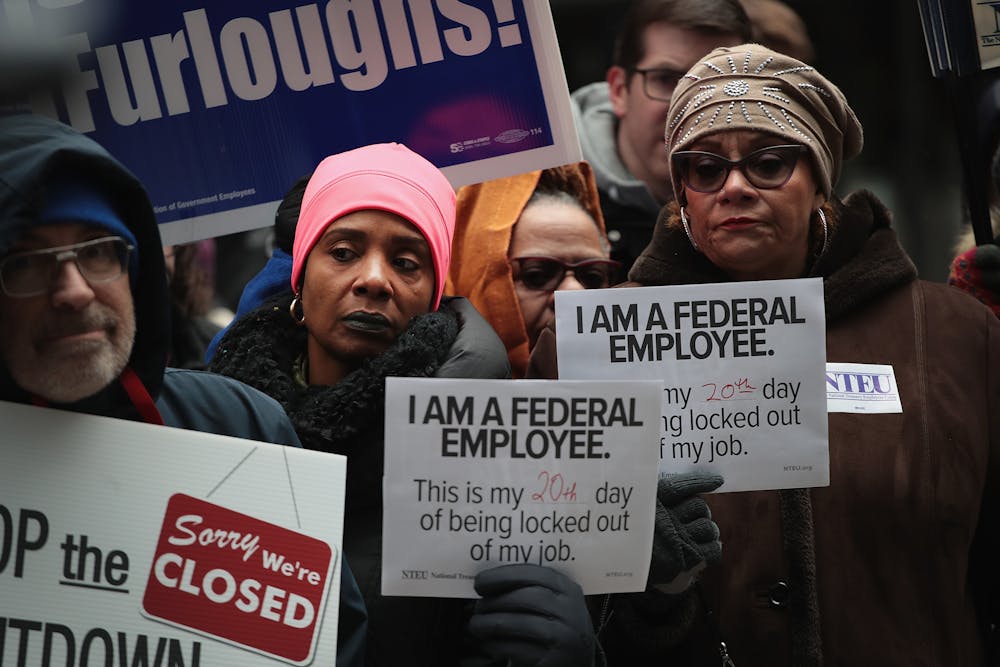
This means that approximately 2.2 million civilian federal employees would be furloughed and face delayed paychecks and lost work hours – in addition to 3.7 million federal contractors who would also be forced to stop working and forgo their pay.
I am a scholar of public administration with a focus on government employees’ career paths. Much of my research centers on how turbulent politics filter into career employees’ daily lives, influencing their choices to join, stay with or leave the government workforce.
Shutdowns lead to more people being more likely to leave government employment – and higher workloads and lower motivation for those who remain. These conditions may feed Republican political goals, but they harm the millions of Americans who depend on competent, timely assistance from the public servants on the government payroll. This ultimately leads to lower work performance and employee retention problems.
My interviews with federal employees show that some will consider leaving if they are told that their work is not essential, they face financial stress or they don’t have a big enough project budget to do their job.
I have found that politicians and other people deriding government employees’ work is another factor that can push them to look for work elsewhere.
The shortest shutdown lasted only a day, and the longest – and most recent – in 2019 was 35 days. The average shutdown is 7.6 days if all shutdowns are included. If you exclude the record-setting eight consecutive short shutdowns in 1981, the average length is 11.2 days.
These shutdowns are often expensive. The U.S. Congressional Budget Office estimated that one 35-day shutdown, from December 2018 to January 2019, cost the U.S. economy over US$3 billion, given the loss of federal workers’ contributions to the economy and other factors.
But federal employees and contractors – people who work for the government, though not in a full-time, salaried capacity – feel the worst effects of a government shutdown.
Essential and nonessential workers
Almost all civilian federal employees – with the exception of U.S. Postal Service workers – do not receive paychecks when the government is closed, regardless of whether federal agencies determine their work is considered “essential” or “nonessential.”
A large range of employees, from National Park rangers to medical researchers, are typically considered nonessential and stay home during a shutdown. Essential workers who must stay on the job could include law enforcement officials and federal prison guards.
Both nonessential and essential workers, whether they are working during a shutdown or not, won’t get paid until after the shutdown ends.
Even short delays in pay can have substantial financial effects.
In 2017, a quarter of the federal workforce made less than $56,143 a year, and the median salary was $79,386. Some of these workers live paycheck to paycheck.
My research shows this gap in pay can leave people unable to pay their rent or mortgages and can also lead to difficulty paying for everyday expenses like groceries.
Many end up depending on food banks and other resources to bridge the gap between paychecks. Federal workers like administrative assistants or security guards who receive lower wages, or young workers who haven’t built up financial reserves, are the first affected.
Different results for employees
Workers who are considered “essential” must work through a shutdown without receiving pay until after the government reopens. Their “nonessential” peers are not allowed to do any work, also without receiving their salary until the government reopens.
Contractors will not be allowed to work during a shutdown and will never receive any compensation.
But contractors and federal employees are often working in the same office. They are functionally co-workers who know that some will be paid and others will not if a shutdown happens.
Individual managers make the decision about which employees are “essential” and which are not.
Some managers use the work itself to guide their choices, while others may look at fairness concerns and individual employee circumstances, like how long someone has been on the job.
Inconsistency in these decisions leaves room for tensions over fairness.
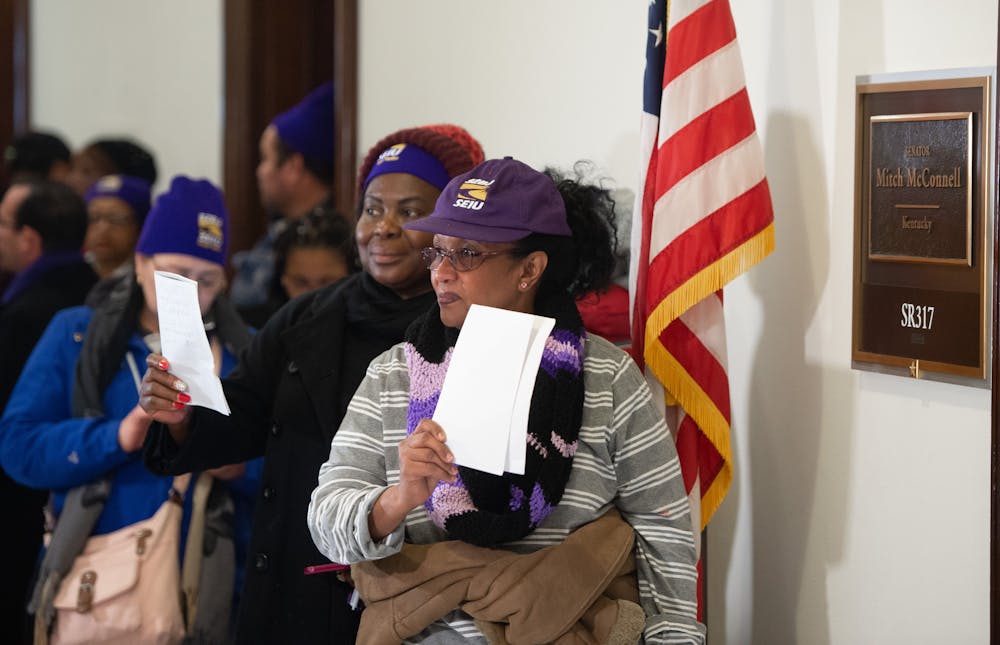
Furloughed contract workers, including custodians and security officers, hold unpaid bills on Capitol Hill during a shutdown in 2019.
Saul Loeb/AFP via Getty Images
‘Really offended’
My research shows that a discrepancy in how workers are treated during a shutdown can create workplace conflicts. As a result, employees can wind up feeling low morale, which reduces work productivity.
One federal worker I interviewed following a two-week shutdown in 2013 said: “Up to September 30th we were working 10-hour days. On October 1st we were nonessential.”
Another furloughed employee explained why the division between employees who were asked to continue working or stay home during a shutdown made some people upset.
“We had to put together two lists: mission essential and not. People who were not essential were really offended thinking that others thought what they did was not important. That government shutdown had a greater effect than what I thought it was going to have on the workforce,” this employee explained.
A loss for the workforce
Shutdowns have other hidden costs that could undermine the federal workforce’s strength.
If a wave of future retirements leaves a smaller pool of workers who are questioning their careers in government, this could weaken the federal workforce and its performance.
Shutdowns become a part of workers’ decision-making process about their career paths.
My research shows that workers at the beginning of their careers are more likely to change jobs than colleagues who have been there longer.
Many people I have interviewed also say that the strain of shutdowns made them consider retiring earlier instead of waiting a few more years.
Long-term damage
Conservative politicians have long advocated for reducing the size of the federal government. Then-President Ronald Reagan succinctly made this point in 1981, when he said, “Government is not the solution to our problem, government is the problem.”
If one views government and spending as fundamentally flawed, then taking drastic action to reduce spending and even shutting down the government becomes a viable path for achieving policy goals and political points.
The problem is that shutting down government is expensive and causes long-term damage.
By authorizing a shutdown, elected officials are signaling in concrete ways that the work of the federal government and its employees is not valued. And regular Americans rely on federal employees to do quality work for all sorts of things, including maintaining national park monuments, inspecting hazardous waste sites and monitoring drinking water facilities.
Even if public proclamations about firing federal employees and “draining the swamp” are not acted on, they could make anyone interested in federal service think twice.
I think people need to recognize that government shutdowns have a price that is far greater than a temporary disruption.
Susannah Bruns Ali does not work for, consult, own shares in or receive funding from any company or organization that would benefit from this article, and has disclosed no relevant affiliations beyond their academic appointment.
by Jonathan Este, Senior International Affairs Editor, Associate Editor
At a press conference after talks with the Ukrainian president, Volodymyr Zelensky, this afternoon, Nato secretary general Jens Stoltenberg sounded like a man determined to take a “glass half full” attitude when he said that “every metre that Ukrainian forces regain is a metre that Russia loses”.
His statement, if a bit obvious, showed commendable optimism. Reports from the frontlines in Ukraine have been mixed over the past few months, with nothing like the lightning-fast territorial gains made by Ukraine in its late summer offensive last year, when it liberated vast swathes of territory occupied by Russia. Some of this was retaken only days after it had been declared part of the motherland by Vladimir Putin, who annexed four regions in the east and south on September 30 – only to hear that quite a lot of these regions were now Ukrainian soil once again.
This year, Kyiv’s planned counteroffensive was late coming, partly due to the slow delivery of western military aid. This gave Russia ample time to build imposing defensive fortifications. The sort of swift manoeuvring responsible for last year’s successful counterpunches have been nigh on impossible this year.
Since Vladimir Putin sent his war machine into Ukraine on February 24 2022, The Conversation has called upon some of the leading experts in international security, geopolitics and military tactics to help our readers understand the big issues. You can also subscribe to our fortnightly recap of expert analysis of the conflict in Ukraine.
It hasn’t helped that western commentators have continuously talked up Ukraine’s chances of a signifcant military success. Ukraine’s allies should manage their expectations, writes Frank Ledwidge, a lecturer in military strategy at the University of Portsmouth and former military intelligence officer.
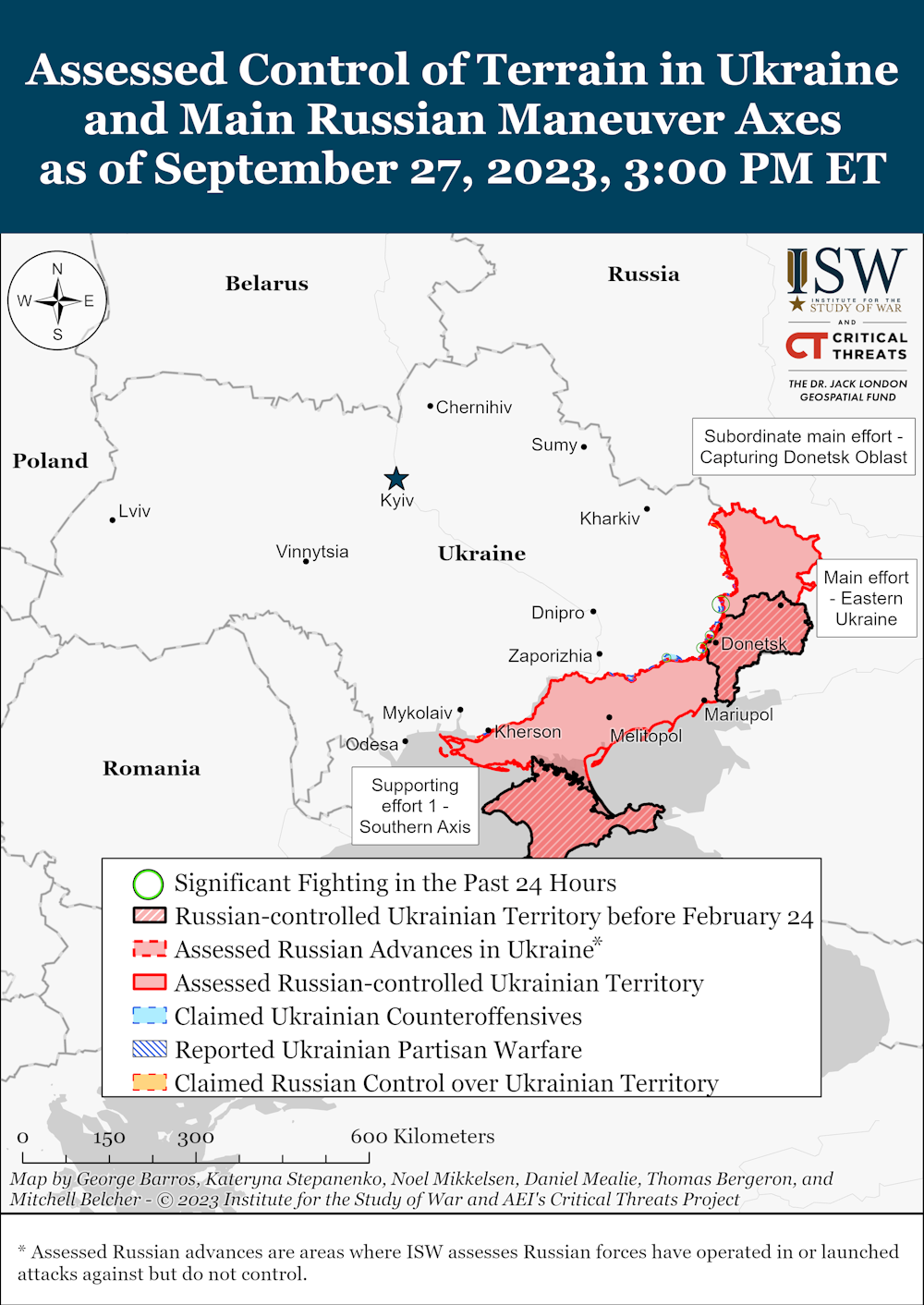
The state of the conflict in Ukraine as at September 27, 2023.
Institute for the Study of War
Ledwidge points to mounting Ukrainian losses this year. The body count is significantly higher than last year, with more to come as Ukraine struggles to push Russian forces back literally metre by metre. Beware all the talk of “gamechanging weapons” and “breakthroughs”, he warns. This is going to be a long, bloody and bitter struggle, and there is no prospect of an end in sight.
This time last year, we were talking about Ukrainian morale being sky high and things being grim in Russia, where Putin had been forced to announce the first mobilisation since 1941 to shore up Russia’s faltering military. Then came the battle for Bakhmut – a “meatgrinder”, as it has been described, for both sides, but principally for Russia’s Wagner group mercenaries, 20,000 of whom are estimated to have been killed in the bid to take what was, in reality, a strategically insignificant target.
Alexander Titov, who researches Russian history and foreign policy at Queen’s University Belfast, visits Russia regularly and says the mood on the Moscow street in May this year was at rock bottom. Bad news from the front was amplified by the likes of the now late and unlamented Wagner group boss, Yevgeny Prigozhin, whose viral videos regularly savaged Russian military commanders for their shambolic conduct. Meanwhile, there was trepidation as the Russian people awaited Ukraine’s counteroffensive.
Titov was back in Russia last month and reports a far more buoyant mood there, given the apparent failure of the counteroffensive to score any significant breakthroughs. Now, says Titov, it is Ukraine that is having to strengthen its conscription laws – and a recent scandal concerning people bribing recruitment officers has hit morale hard. Russia’s annual round of conscription, meanwhile, has delivered 300,000 fresh troops from its military reserves without Putin having to resort to what would have been a deeply unpopular second mobilisation.
While things haven’t moved as quickly as Ukraine might have hoped on the battlefield, Kiev’s military has diversified its strategy by attacking Russian targets in the Black Sea region and Crimea. A missile strike on September 22 is reported to have killed 34 officers and wounded 105 others. Initially, the dead were said to include the commander of Russia’s Black Sea fleet, Admiral Viktor Sokolov – but this has been denied by the Kremlin, which has released an undated and unverified picture of Sokolov, apparently still alive.
Basil Germond, a maritime expert at the University of Lancaster, believes that this is akin to a second front in the war. Not only do these attacks undermine Russian morale, they have effectively denied it control of the Black Sea. This not only has implications for Russia’s grain blockade, but means Moscow will need to deploy troops away from the main defensive lines in the south and east of Ukraine.
Meanwhile, one of the Kremlin’s reasons to be more cheerful is the recent deal it struck with North Korea, enabling it to address its shortage of ammunition. And according to Robert M. Dover – a professor of intelligence and security at the University of Hull – there are other reasons the west needs to be concerned about Moscow’s ever-closer relations with Pyongyang.
Once of these, Dover writes, is the fact that both countries have highly developed and sophisticated cyber-warfare capabilities. We’ve already seen how North Korea’s Lazarus group of hackers has been able to steal tens of millions of dollars in cryptocurrency, and the potential to wreak havoc by hacking into western military systems could be extremely dangerous.
As the war creeps towards its 600th day and the body count mounts on both sides, Kyiv’s allies in the west are also looking to their own depleted armouries, not to mention their national budgets. It has been calculated the US alone has spent or allocated US$113 billion (£92 billion) on supporting Ukraine, and the UK, the EU and Kyiv’s other allies have also strained their coffers. Meanwhile, the strain of increased energy and food prices has been heavy.
Stefan Wolff, from the University of Birmingham, and Tetyana Malyarenko, from the University of Odesa, have been watching for signs of combat fatigue among Ukraine’s allies, as well as anger from those countries in the global south who feel as if their concerns have been sidelined.
Zelensky’s visit to the US, where a growing number of Republicans are openly questioning Washington’s commitment to supporting Kyiv “whatever it takes”, as well as a recent row with Poland over Ukraine selling cheap grain to the disadvantage of its own farmers, are signs that there may be limits to the solidarity that was so evident last year.
Another country where support for Kyiv, once rock solid, looks to be crumbling is neighbouring Slovakia, which goes to the polls on Saturday. The election is too close to call, but one of the people most tipped to be able to form a coalition government is three-times former prime minister Robert Fico. Fico has said if successful, he will halt his country’s military aid to Ukraine.
As Veronika Poniscjakova, an expert in international relations and security at the University of Portsmouth, writes, it’s a campaign pledge which may mean Fico has to get into coalition with some extreme far-right partners. But with support for Ukraine falling among the Slovakian people, it’s certainly not a pledge that will lose him votes this weekend.
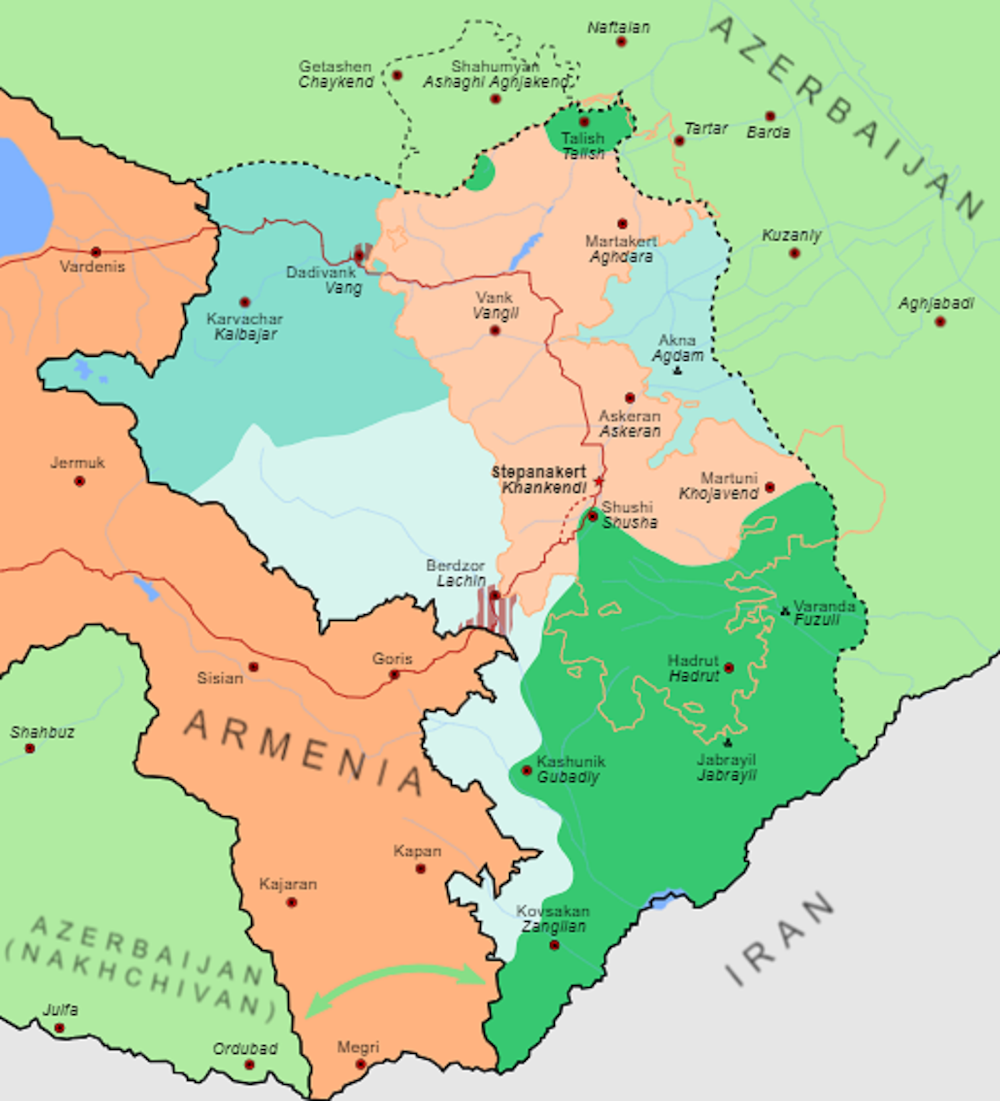
While Russia has been busy in Ukraine – or perhaps because Russia has been busy in Ukraine – hostilities have erupted once again in the troubled Nagorno-Karabakh region. Azerbaijan launched a massive assault on September 19 on the mainly ethnic Armenian enclave.
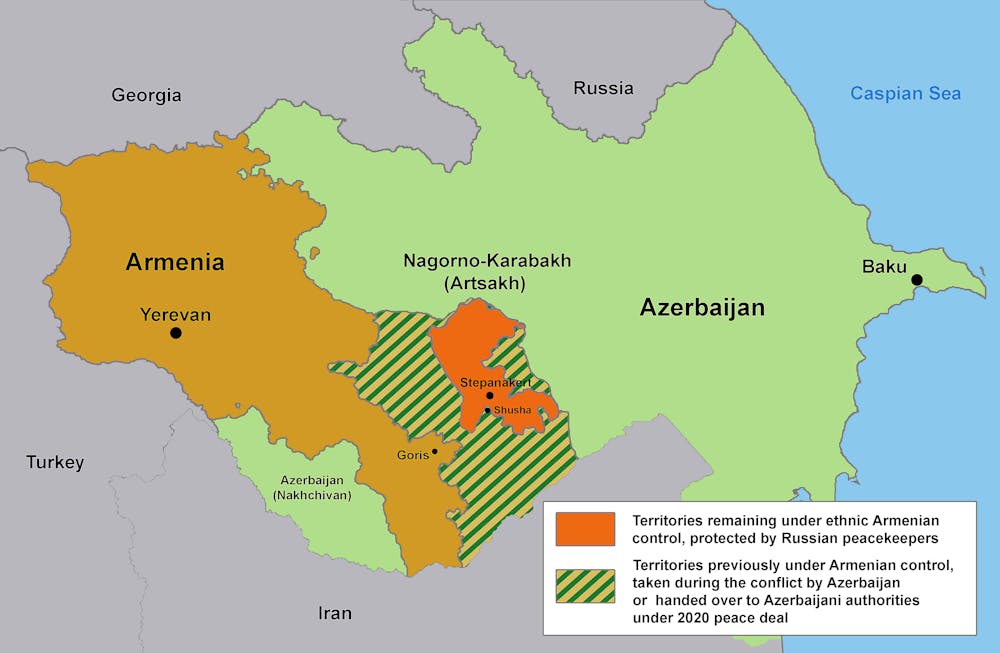
Contested region: Azerbaijan and Armenia have fought two all-out wars over the contested territory of Nagorno-Karabakh.
kamilewski/Shutterstock
Stefan Wolff recounts the history of this troubled region and tracks the motivations of Russia, once a staunch ally of Armenia. Moscow, he writes, may be preoccupied with its war in Ukraine, but Putin is no fan of Armenia’s prime minister, Nikol Pashinyan, so may not be dismayed at the mounting anti-government protests in Armenia’s capital, Yerevan, calling for him to go.
Writing as the flow of ethnic Armenian refugees across the Lachin corridor into Armenia grew steadily into a flood, Anna Matveeva – a visiting professor at King’s College London and expert in the post-Soviet space – took a broader look at the geopolitical implications of the 24-hour assault. Azerbaijan has its own enclave inside Armenia, Nakhichevan, which borders Turkey and Iran and is only accessible to Azerbaijan by air. Any peace deal over Nagorno-Karabakh, therefore, will have to involve Iran and Turkey as well as Russia, and could have consequences for the whole region.
As a result of the Azerbaijani attack on the Armenians of Nagorno-Karabakh on September 19 and the forced exodus that followed it, this region will soon be empty of Armenians – for the first time in more than two millennia.
This was a tragedy that could have been avoided. The New York Times recently wrote about what’s now happening in Nagorno-Karabakh that “almost no one saw it coming”. Nothing could be more wrong. Armenians, as well as those who have followed the conflict, have warned for a long time that this was coming.
The global community and its institutions, including the EU, arguably let Azerbaijan get away with its military adventures, which only spurred the country on.
In the summer of 2022, the president of the European Commission, Ursula von der Leyen, visited Baku and concluded an agreement on gas supplies from Azerbaijan to Europe. She has several times since then praised the country as the EU’s “reliable energy partner”.
Bolstered by this backing, a few months later Azerbaijan launched an attack, not on Nagorno-Karabakh but on several areas inside Armenia itself. Since then, Azerbaijan has occupied more than 100 square kilometres of Armenia’s uncontested and internationally recognised territory.
The EU could only appeal for restraint and was relieved when the fighting stopped after two days.
Global inaction
In December 2022, Azerbaijan began a blockade of the Lachin corridor, the only connection between Nagorno-Karabakh and Armenia. In February, the International Court of Justice in The Hague issued a binding order that Azerbaijan must immediately allow the unimpeded movement of people and goods along the corridor. Azerbaijan ignored this.
During the summer, the situation worsened for the 120,000 residents of Nagorno-Karabakh, with acute shortages of food, petrol and medicine. Malnutrition was rife. The situation became so serious that several organisations warned of a possible genocide.
At the beginning of August, Luis Moreno-Ocampo, a former prosecutor of the International Criminal Court issued an expert opinion, in which he stated that what Azerbaijan was doing “should be considered a Genocide under Article II, (c) of the Genocide Convention”.
The article in question gives one definition of genocide as: “Deliberately inflicting on the group conditions of life calculated to bring about its physical destruction in whole or in part.”
During the more-than-nine months that the blockade lasted, western leaders condemned it and demanded that Azerbaijan lift it. But no measures of force whatsoever were put behind this demand and there were no sanctions, or even threats of sanctions.
The government of Azerbaijan understood the signals. You can bring down a humanitarian crisis on more than a 100,000 people, even to the brink of genocide, without suffering anything but verbal condemnations.
This is ethnic cleansing
After the latest escalation, various prominent EU representatives have once again condemned the use of force and made various appeals. It is as if they don’t see what’s in front of them: the aggressive plans of authoritarian states are not stopped by condemnations and appeals. Much sharper measures are required.
The government that ran what Armenia called Artsakh, or the Republic of Nagorno-Karabakh, has now collapsed. Its president, Samvel Shahramanyan, has declared that the state will be formally dissolved at the end of this year. The UN has estimated that 88,000 of its 120,000 inhabitants have already fled to Armenia.
Azerbaijan claims that they were not forced to do this, they fled voluntarily. On a superficial level, that is correct as no Azerbaijani soldiers forcibly removed them.
But they are not fleeing voluntarily. Instead they have been put in a situation where they have no other choice. In just over 30 years, Azerbaijan has attacked them four times.
In 2020, many of them sat for weeks in bomb shelters while Azerbaijan attacked with missiles and drones. This summer they have endured acute shortages of food and medicine due to the illegal blockade.
The last straw was the 24-hour bombardment on September 19 that has finally driven the ethnic Armenian population from their homes. I therefore believe it is correct to call this ethnic cleansing.
Five days before the Azerbaijani attack on the enclave a representative of the US government said that the USA would not tolerate the ethnic cleansing of Nagorno-Karabakh. Now it has happened and Washington seems to tolerate it, if the lack of sanctions on Azerbaijan are any indication.
It is not over
There is reason to remain concerned about Azerbaijan’s plans. After the suppression of the Karabakh Armenians, President Ilham Aliyev reiterated what he has said before that he sees what he calls “western Azerbaijan” as historical Azerbaijani territory that his country therefore has the right to reclaim.
Map of the region showing the concept of the ‘Zanzegur corridor’ which would cut across the southernmost region of Armenia to connect Azerbaijan with Nakhchivan, and Turkey to the rest of Turkic world through Armenia’s Syunik Province.
Mapeh/Wikimedia Commons, CC BY-NC
By this he means Armenia. In these plans, he has the full backing of Turkey. The first target will be the southern part of Armenia, the province of Syunik, which Azerbaijan calls Zangezur.
Resolute action from the west is needed to ensure that the aggressive Azeri regime does not, in its current victory rush, embark on new military adventures. The EU could introduce sanctions against this regime, something that more than 60 MEPs from different party groups have already recently called for.
Azerbaijan’s assault on Nagorno-Karabakh must have consequences. Should the regime in Baku get away with this with impunity, it will be inspired to continue its aggression against Armenians. This would be a dangerous signal to leaders of other authoritarian states.
The lesson of the tragedy now unfolding in Nagorno-Karabakh is that verbal condemnations and appeals do not stop the aggression of authoritarian states. Only sharp measures can do that.
This article has been amended to say Syunik/Zangezur has been referred to as “western Azerbaijan”, not “western Armenia” as previously stated.
Svante Lundgren does not work for, consult, own shares in or receive funding from any company or organisation that would benefit from this article, and has disclosed no relevant affiliations beyond their academic appointment.
by Glenda Mary Davison, Associate Professor, Cape Peninsula University of Technology
It’s normal to have bacteria in your mouth. But harmful bacteria have been linked to a host of health problems. Medical scientist Glenda Davison and microbiologist Yvonne Prince, who have researched the oral cavity, explain why it’s so important to practise good oral hygiene.
Can poor oral hygiene lead to serious diseases? Why and how?
Like the gut, the mouth is home to several diverse colonies of bacteria, fungi, viruses and protozoa. It’s the second largest microbial community in humans, after the gut.
More than 700 species of microorganisms reside in the mouth. New technologies, such as 16S rRNA analysis, have allowed researchers to study their genetic makeup and family trees.
These microbes are found all over the mouth: in and around the teeth, the gums, tongue, palate and saliva. They usually remain stable during our lifetime but if the balance in the bacterial community is disrupted, harmful bacteria may become dominant. This can lead to bleeding gums and oral diseases such as gingivitis and periodontitis.
How do problems in the mouth lead to other illnesses?
Changes in the pH (acidity or alkalinity), temperature and oxygen in the oral cavity are known to lead to abnormal growth of groups of bacteria which are usually harmless. When they become dominant, they can cause disease.
This disruption in the oral biota causes inflammation and the slow development of periodontitis, bleeding gums and tooth decay. As the gum disease destroys the gum and begins to erode the bone, inflammatory molecules called cytokines can enter the blood stream.
These chemicals activate immune cells and can result in low grade chronic inflammation with the development of diseases such as type II diabetes, atherosclerosis or thickening of the arteries and many others, even obesity. The bacteria themselves can also move from the gums into the surrounding tissue and release toxins which can move throughout the body.
Similarly, the gut hosts more than 1,000 species of bacteria which reside in the large intestine and play a vital role in digestion, absorption, immunity and protection against toxins and harmful bacteria.
Human beings cannot live without a healthy, diverse gut biota. If this well-balanced community of microbes is disturbed and not restored, gastrointestinal disorders can be experienced.
Recent research has linked an abnormal gut biome to diseases as diverse as autoimmunity, obesity, cardiovascular disease and even Alzheimer’s.
It all starts with our microbes, tiny organisms which share our bodies and are vital to the health of human beings. There are 39 trillion microbes in the human body, outnumbering the estimated 30 trillion human cells, and they inhabit almost every organ and crevice in the human body. They can be found in the gut, skin, lung, seminal and vaginal fluid, eyes, scalp and mouth.
Each of these habitats has its own environment, attracting different organisms which adapt to their surroundings and make it their home. They live in synergy with each other and the surrounding tissue. If this relationship is disrupted it can result in disease.
Most of these microbes come from our mothers and enter our bodies when we are born. The womb is sterile but as the baby moves down the birth canal and enters the outside world, bacteria and other microbes occupy the newborn infant and create a unique ecosystem called the human microbiome.
As we grow and begin to explore the world, these microorganisms become more diverse and varied and are influenced by our diets, lifestyles, interactions with animals and the environment. It is important to maintain this balance to reduce the risk of developing disease.
What should people do to avoid these risks?
Good dental hygiene includes regular dental check-ups, preventing the build-up of plaque by brushing your teeth regularly, and avoiding foods high in carbohydrates and sugar, which can lead to increased tooth decay and cavities.
To further support the balance of the bacteria in the mouth it is recommended that foods rich in antioxidants, such as fresh fruit and vegetables, are included in our diet.
Dentists also recommend avoiding the use of antibacterial mouth washes, which have been shown to disrupt the balance of microbes. Overuse can lead to disturbances and stimulate species of bacteria that could cause disease.
Elevated levels of stress and lack of exercise have also been linked to disruptions in the balance of the oral biota. So a well balanced diet with enough rest, accompanied by good dental hygiene, is recommended.
The mouth is the door to the gut and the rest of the body. Ensuring the harmony of the microbes that live there is important to reduce the risk of disease.
Glenda Mary Davison receives funding from the South African Medical Research Foundation and serves as the Interim DSI-NRF SARChI chair in cardiometabolic health which is funded by Nedbank.
Yvonne Prince does not work for, consult, own shares in or receive funding from any company or organization that would benefit from this article, and has disclosed no relevant affiliations beyond their academic appointment.
If you’re looking for things to do this fall in Tampa, look no further than this Tampa market guide. Tampa is renowned for its funky vintage markets, dreamy nightlife, fresh […]
American democracy has reached a discouraging low that is only made worse by media and user consumption. SPECIAL TO THE ORACLE/UNSPLASH
President Biden delivered a speech at a campaign reception on Thursday in which he posed a critical question to the American people: “What will we do to maintain our democracy?”
Biden emphasized the need to restore trust in democratic institutions and referenced polarization, the division of opposing ideology, as a core concern. Intolerance to conflicting views is establishing a democracy at the mercy of partisan divides.
American democracy is under threat, and this issue is only amplified by biased news outlets and ideological echo chambers generated by internet algorithms. By mandating thorough media literacy courses in universities, we can prevent further political polarization and empower a more informed voter base.
Media literacy is defined as “the ability to critically analyze any story or event presented in the media and to determine its accuracy or credibility.”
The internet has allowed the media to widen its scope and its delivery, but simultaneously narrow the perspectives users consume. Many receive their news from social media – particularly college students. At USF, 35.2% of students admit to receiving news from social media.
Social media algorithms analyze user clicks to tailor users’ feed to feature more of what they regularly consume. Companies like Facebook curate news feeds based on predictive factors such as likes, follows and views. In terms of political and news content, this structure creates an echo chamber of information, ideology and influence.
The systems put in place by social media companies like Facebook reduce the perspectives users are exposed to. Naturally, polarizing patterns are likely if consumers are not receiving news from various viewpoints.
“We have moved from broadcasting to narrowcasting,” said former President of the Council on Foreign Relations Richard Haass in his 2023 book “The Bill of Obligations.”
“Many gravitate to outlets that reflect not just their interests, but their biases. Missing is any quality control. Misinformation is rampant, balance rarely found.”
All sources are not equal – many are biased. Of 70 major news media outlets, 43% were very politically biased and 37% were slightly politically biased, according to an analysis by AllSides. Additionally, citizens are 30% less likely to follow news stories that conflict with their views.
Media no longer serves as a means of informing citizens, but rather as an instigator of polarization. Students must understand their responsibility to educate themselves with information rooted in fact, and to recognize and work toward the public good despite common divisive ideology.
But in order to do so, they must learn the skills to recognize biased sources through media literacy.
Beyond polarization, the media facilitates the rapid exposure of disinformation, or false content deliberately created for distribution. Unfortunately, disinformation is very present online, and particularly on social media.
This false information not only prevents users from receiving factual news, but it is also used by creators to take advantage of the uninformed. Disinformation surrounds incredibly important news such as U.S. elections, COVID-19 and the Russian invasion of Ukraine, according to a March 2022 article by The Hill.
The media only aggravates the flaws of democracy, therefore threatening its future. Despite the grave nature or these issues, there are solutions. And they can begin in universities like USF through media literacy education.
Media literacy is vital in identifying false information online. By requiring a course in media literacy and current events, USF can combat these issues and help create an informed student population.
While USF currently requires an Ethical Reasoning and Civic Engagement course for graduation, these courses do not focus on media literacy or civic duty. Universities such as UF or FSU do not require media literacy courses for graduation, but they do offer courses and graduate study for the topic.
USF must adapt to critical needs and develop a new course to immerse students in national and global affairs and teach critical analysis and civic engagement. If students graduate understanding the importance of media literacy as a democratic duty, American democracy has a second chance.
Media is now a vast institution capable of demonizing government officials, lying about public health, weaponizing social media and diminishing democracy.
However, universities can be the catalyst to restoring an informed population by instilling the value of democracy and providing students with the skills to sustain it.
Program Director Katie Webster said she’d like to move Feed-a-Bull to a larger pantry but has been unable to do so due to lack of funding. ORACLE PHOTO/JUSTIN SEECHARAN
The Feed-a-Bull pantry is experiencing an increase in demand from students compared to previous years, according to Program Director Katie Webster.
The organization serves as supplemental food assistance to offset grocery expenses, Webster said. The pantry is already close to reaching the total number of visits typically seen in one school year.
From academic year 2021-22 to 2023-24, the total visits and pounds of food given to students for each school year are:
2021-22: 1,300 total visits, 16,000 pounds of food
2022-23: 4,770 total visits, 38,000 pounds of food
First four weeks 2023-24: 1,000 total visits, 6,000 pounds of food (since Aug. 21)
Every category of food is in demand, including canned fruit, vegetables, snack or breakfast items, beans, tuna, chicken, rice, pasta, soup and tomato products, Webster said.
There are food limitations in place to help accommodate the demand. Students that come in can only retrieve a limited amount of certain types of food like fruit, vegetables and proteins. This helps with the rising demand so that the inventory is more controlled, Webster said.
Webster attributes the increased traffic to the pantry’s promotional efforts and USF’s rising student population. They have been featured on Bay 9 News and also have a donation page on USF Foundation, where donors are able to give back to the community.
She said she wanted Feed-a-Bull to move into a larger pantry space, but could not do so due to inadequate funding.
The addition of more shelves would help to accommodate the influx of student demand, Webster said.
The need for a larger pantry space is also about implementing additional resources for students.
There are new programs that Feed-a-Bull wants to offer that require more space, Webster said, such as adding a station for students that want to apply for Supplemental Nutrition Assistance Program (SNAP) benefits.
The pantry receives standard biweekly deliveries. But to keep up with demand, the program has already ordered emergency deliveries from Feeding Tampa Bay to increase their inventory.
Webster said she requested an emergency delivery within the first three weeks of this semester. The quantity of each delivery from Feeding Tampa Bay can sum up to 1500-2000 pounds of food and 100 pounds for produce, Webster said.
Webster has been keeping up with supply and demand by adjusting the pantry’s inventory as needed and ordering adequate amounts of food. She said a lot of what is needed generally has a price associated with it, clearing the misconceptions about the food being free.
Success at this year’s Charit-a-Bull, a food drive hosted at USF, would help the pantry manage demand, Webster said. The drive comes every fall semester with homecoming activities. The pantry partners with the organization in hopes of receiving donations and access to more resources.
About two out of five of USF students are facing food insecurity, according to USF’s food resources website. Because of this and its large student population, many would benefit from Feed-a-Bull and their resources at the pantry, Webster said.
“The utilization will continue to increase as more students learn that Feed-A-Bull is an available resource for any student struggling to afford adequate food for themselves,” she said.
by Phillip M. Carter, Professor of Linguistics and English, Florida International University
Indian Prime Minister Narendra Modi welcomes delegates to the G20 leaders summit in front of a placard reading 'Bharat,' the Hindi word for 'India.' Dan Kitwood/Getty Images
When India invited delegates attending the G20 summit in September 2023 to dinner with “the President of Bharat,” rather than “the President of India,” it may have looked to the world like a simple case of postcolonial course correction.
The word “India” is, after all, an exonym – a placename given by outsiders. In this case, the name came from the British, who ruled the subcontinent from 1858 to 1947, a violent period of colonialism that later came to be called “the British Raj.”
“Bharat” may, therefore, look like a well-reasoned and uncontroversial replacement for a term anointed long ago by outsiders – something akin to how Eswatini, Zimbabwe and Burkina Faso updated their countries’ names from the colonial designations “Swaziland,” “Rhodesia” and “Upper Volta,” respectively.
But the use of “Bharat” has elicited outcry from the political opposition, some Muslims, and Hindu conservatives in the south, reflecting ongoing tensions in India between language, religion and politics.
Hindi is the most-spoken language in India, but its use is largely relegated to a part of the country that linguists refer to as “the Hindi belt,” a massive region in northern, central and eastern India where Hindi is the official or primary language.
Around 1500 B.C.E., a group of outsiders from Central Asia – known now as the Indo-Aryans – began migrating and settling in what is now northern India. They spoke a language that would eventually become Sanskrit. As groups of these speakers separated from one another and spread out over northern India, their spoken Sanskrit changed over time, becoming distinctive.
Most of the languages spoken in northern India today – Hindi, Punjabi, Bengali and Gujarati, among many others – derive from this history.
But the Aryans were not the first group to inhabit the Indian subcontinent. Another group, the Dravidians, was already living in the region at the time of the Aryan migrations. They may have been the original inhabitants of the Indus-Valley Civilization in northern India. Over the millennia, the Dravidians migrated to the southern part of the subcontinent, while the Aryans fanned out across the north.
By the time the Raj ended in 1947, English had been established as the language of the elites and was used in education and government. As the new nation of India took shape, Mahatma Gandhi advocated for a single Indian language to unite the diverse regions and for many years championed Hindi, which was already widely spoken in the north.
But after independence, opposition to Hindi grew in the Dravidian-speaking south, where English was the favored lingua franca. For Tamils and other Dravidian groups, Hindi was associated with the Brahmin caste, whom many felt marginalized Dravidian languages and culture.
For many people in the south, Hindi came to be seen as a language as foreign as English. To keep tensions from spilling over, the first prime minister of India, Jawaharlal Nehru, supported verbiage in the constitution adopted in 1950 allowing for the continued use of English in government for a limited period.
Violence nevertheless continued in the south for years around what was seen as the unfair promotion of Hindi. It abated only when Indira Gandhi – Nehru’s daughter and the third prime minister of India – pushed to codify English, alongside Hindi, as an official language in the constitution.
The Partition of India in 1947 – corresponding to the dissolution of the Raj – led to the creation of Pakistan, which was set up to aggregate the majority Muslim regions from the colonial state. An independent India was set up to include the majority non-Muslim regions.
This is where modern domestic politics come into play.
“Hindutva” is a brand of far-right Hindu nationalism that emerged in the 20th century in response to colonial rule but gained its biggest following under the leadership of Prime Minister Narendra Modi and his Bharatiya Janta Party, or the BJP.
As a political ideology, Hindu nationalism should be distinguished from Hinduism, a religion. It advances policies that seek to promote Hindu supremacy and are widely considered anti-Muslim.
One such policy is the promotion of Hindi as the sole official language of India. Speaking in 2022 at a Parliamentary Official Language Committee meeting, BJP Home Minister Amit Shah said, “When citizens of states speak other languages, communicate with each other, it should be in the language of India.”
To Shah, the “language of India” and Hindi were one and the same.
Suppressing Urdu
Muslims in India speak the languages of their communities – Hindi among them – as do Hindus, Sikhs, Jains and Christians.
However, making Hindi the national language could be viewed as one part of a broader political project that can be characterized as anti-Muslim. That’s why the political opposition is against using “Bharat,” even though many Muslims are themselves Hindi speakers.
Although Urdu and Hindi are remarkably similar, their differences take on outsized religious and national significance.
Whereas Hindi is written in the Devanagari script, which has strong cultural associations with Hinduism, Urdu is written in the Perso-Arabic script, which has strong associations with Islam. Whereas Hindi draws on Sanskrit for new words, Urdu draws on Persian and Arabic, again emphasizing associations to Islam. And whereas Hindi predominates in India, Urdu is the official language of Pakistan, along with English.
Thus the appearance of “Bharat” in official government correspondence may reopen old wounds for Muslims – and even for conservative Hindus in the Dravidian-speaking south who might otherwise support Modi and the BJP.
Although an official name change is unlikely in the immediate future, “Bharat” will likely continue to serve as a rallying cry for right-wing nationalists.
To them, the conciliatory language politics of Nehru and Indira Gandhi are a thing of the past.
Phillip M. Carter does not work for, consult, own shares in or receive funding from any company or organization that would benefit from this article, and has disclosed no relevant affiliations beyond their academic appointment.
The U.S. is moving toward a government shutdown. House and Senate appropriators are divided on spending levels, policy riders and additional items, such as support for Ukraine.
As a political scientist who studies the evolving budget process, as well as brinksmanship in Congress, it is clear to me that this episode prompts many important questions for how the U.S. is governed.
There’s the larger, long-term question: What are the costs of congressional dysfunction?
But the more immediate concern for people of the country is how a shutdown will affect them. Whether delayed business loans, slower mortgage applications, curtailed food assistance or postponed food inspections, the effects could be substantial.
Air traffic controller training will be halted in a government shutdown.
Joe Raedle/Getty Images
Affected: Farm loans to Head Start grants
The total federal budget is almost US$6 trillion. A little over one-fourth is discretionary spending that is funded by the annual appropriations process and thus debated in Congress. This portion of spending provides money for virtually every federal agency, roughly half of which goes to defense. The rest of yearly federal spending is on mandatory entitlement programs, mainly Social Security and Medicare, as well as interest on the national debt.
The Office of Management and Budget, which oversees both development of federal budget plans by federal agencies and their performance, regularly requires agencies to develop shutdown plans. Because agencies continually update these plans, no two shutdowns are exactly alike. Details depend on the agency, program and duration of the shutdown, as well as laws passed with funding since the previous shutdown, and the administration’s priorities. These plans identify a variety of ways the shutdown will affect Americans.
If a shutdown happens this year, new loan approvals from the Small Business Administration will stop. The Federal Housing Administration will experience delays in processing home mortgage loans and approvals. The Department of Agriculture will not offer new farm loans. Head Start grants will not be awarded, initially affecting 10,000 young children from low-income families who are in the program.
Some food inspections by the Food and Drug Administration, workplace safety inspections by the Occupational Safety and Health Administration, and environmental safety inspections by the Environmental Protection Agency could be delayed, as they have been when the government stopped functioning in the past.
During the last shutdown, about 60,000 immigration hearings, organized by the Department of Justice and not the courts, were canceled and had to be rescheduled. This year would also see cases involving noncitizens who are not being held by the government reset for a later date, even as other immigration services proceed.
Infrastructure projects awaiting approval from the Environmental Protection Agency could be stalled. The National Institute of Health’s clinical trials for diseases could also be slowed.
This is not a comprehensive list. Agency plans show what happens when federal workers are furloughed – that is, those who cannot report to work in a shutdown. Furloughs will apply to over 700,000 out of roughly 3.5 million federal employees, but even more workers will be “excepted” and required to work without pay until the shutdown ends.
That of course means employee hardship. But like past shutdowns, unpaid workers can fail to report to work in larger numbers. Americans relying on those services will face delays. There may be air travel delays as well, as air traffic controllers and Transportation Security Administration agents go without pay.
Not affected: The IRS, postal service and entitlement programs
Social Security, Medicare and Medicaid benefits are entitlement programs that are not included in the annual appropriations process. Americans relying on these programs will not see those benefits affected. But these programs require administration. Federal employees would not be available to verify benefits or send out new cards.
There are additional funding sources for government activities, beyond entitlement programs, that aren’t included in the annual appropriations bills and thus are unlikely to be affected by a shutdown.
The U.S. Postal Service, independently funded through its own services, will be unaffected by a shutdown. The federal judiciary could operate for a limited time, funded by court filings, fees and appropriations allocated off the yearly cycle. But this funding won’t last long – 10 days was an estimate for the 2013 shutdown. The Supreme Court, which has functioned in previous shutdowns, is expected to continue its typical schedule.
National parks will be closed in a shutdown, as the Lincoln Memorial in Washington was in the 2013 shutdown.
AP Photo/Carolyn Kaster
Sometimes, agencies have funding that exceeds the typical annual appropriations cycle. Or, earlier laws may have been passed that fund activities of an agency in whole or in part. The Inflation Reduction Act provided funds to run the IRS through 2031. Previous shutdowns saw significant IRS furloughs and employees walking off the job. This year, the IRS promises to be fully operational despite a shutdown.
A variety of advance appropriations also exist that provide funding for various programs one year or more beyond the year the appropriations bill was passed, including Veterans Affairs medical care; most VA benefits are unaffected.
The primary law governing funding gaps also makes exceptions for “emergencies involving the safety of human life or the protection of property,” which includes a variety of military activities.
The big question mark
The major unknown is, of course, how long a shutdown might last. Food assistance programs – including the federal food program for poorer women, infants and children, called WIC, and the Supplemental Nutrition Assistance Program, or SNAP – which have some contingency funds that carry over into the next fiscal year but are running low, run the risk of those accounts running out.
The federal judiciary has limited funds. There are also a variety of federal grants to states and localities that could be short on funds, such as disaster relief and economic development programs, in addition to nutrition assistance. Government officials at the federal, state and local levels will have to make choices about whether a federal shortfall should be covered by state funds, or if workers should be furloughed. Some of these funds have been protected by increased funding in recent laws: The Highway Trust Fund is solvent through 2027, due to the Bipartisan Infrastructure Law of 2021.
The economy as a whole will suffer more the longer a shutdown continues. The Congressional Budget Office estimated that the last shutdown, in 2018-2019, reduced gross domestic product growth by 0.2% in the first quarter of 2019. While that 35-day partial shutdown was the longest in U.S. history, it did not affect all agencies.
Federal employees and contractors are disproportionately hurt. Federal employees who are furloughed or excepted and do not receive pay during the shutdown will receive it retroactively, according to a 2019 law passed as a response to the last shutdown.
No such policy exists for contractors working for the federal government, including services ranging from janitorial to manufacturing. Beyond affecting individual workers, the private sector loses business and adjusts its hiring decisions and other practices.
Laura Blessing does not work for, consult, own shares in or receive funding from any company or organisation that would benefit from this article, and has disclosed no relevant affiliations beyond their academic appointment.
Of all the debate over teaching U.S. slavery, it is one sentence of Florida’s revised academic standards that has provoked particular ire: “Instruction includes how slaves developed skills which, in some instances, could be applied for their personal benefit.”
Does this sentence constitute “propaganda,” as Vice President Kamala Harris proclaimed, “an attempt to gaslight us?”
Or is it a reasonable claim in a discussion of a difficult topic?
Whatever it is, the sentence is of a sort not unique to the teaching of enslavement in Florida. It is, instead, an example of how some Americans transform the racist history of this country into an uplifting – and sanitized – moral lesson.
It is a fact that small numbers of the enslaved acquired skills that allowed them to earn money, to save it and to buy their freedom and the freedom of family members.
It is also a fact that freed Black people in the antebellum era helped other Black people to also acquire skills and became part of a segregated Black middle class in many Southern cities.
One might argue that such a sentence, because it is true, should not give rise to protest. But as scholars who have studied how history is taught in America, we learned that this particular nugget is neither trivial nor insignificant.
Instead, the one sentence in Florida’s new standards allows Americans to transform a story about what we today call structural racism into an apocryphal story about Horatio Alger and America’s rags-to-riches melting pot.
As this line of thinking goes, enslaved ancestors of contemporary African Americans labored just as most contemporary Americans’ ancestors labored: at the bottom, but able to climb up the social ladder with hard work and discipline.
And this is the problem: To portray enslaved people as laborers like free laborers is exactly how not to teach about slavery.
But it is a commonly used method that is called a “switching mechanism.” In this example, the story about the horrors of the slave system is transformed into a story about opportunity, success and the American dream.
Switching the story at Colonial Williamsburg
Thirty years ago, when we conducted anthropological research at Colonial Williamsburg, we encountered the same narrative switching mechanism that is occurring now in Florida.
At that time, the world-famous Virginia outdoor history museum depicting a genteel, colonial America was trying to present the public with a truer picture of the past by incorporating the history of what they called “the Other Half” – the enslaved people who had been all but absent from the museum’s past portrayals.
In this 2001 photograph, Black ‘interpreters’ are acting as carpenters in Colonial Williamsburg.
Education Images/Getty Images
But it was difficult, we found, for the museum to sustain a narrative about the evils of the slave system. That’s because much of its paying audience of white middle-class tourists did not want to dwell on such tales, and second, its “interpreters,” or guides, found ways to switch the narrative.
Starting from a story about the enslaved being someone else’s property, they would transition to one suggesting the enslaved were working for their own advancement.
• Don’t imagine that 18th century Williamsburg was like mid-19th century Mississippi cotton plantations, with families torn apart by avaricious masters, whippings, shackles and rape. Instead, in Williamsburg, slaves were valuable property.
• Consider that your average white yeoman farmer of the time had an annual income of about 20 pounds. Now consider that a highly trained slave cook was worth 500 pounds. Would your average owner be likely to abuse such a valuable piece of property? No! They’d treat that slave like an NFL quarterback!
Such stories conflated an enslaved laborer’s monetary value to his owner and the income of a white laborer. And that is how many visitors we listened to interpreted what they were hearing.
In other instances, we found conflicting messages.
In a skit that took us to the basement of an elite white Williamsburg household during Christmas, we witnessed Black interpreters portraying enslaved houseboys, maids and cooks complaining that they had to work harder than ever to create the festive atmosphere their owners desired. Meanwhile, upstairs, white interpreters portraying gentlemen conversing waxed philosophical about the evils of slavery coupled with the impossibility of getting rid of it.
At the conclusion of the story, we talked to two members of the audience who, it turns out, had learned different lessons.
One concluded that she had witnessed a universal story because workers everywhere grumble about their bosses. The other pointed out that if she disliked her boss, she could quit her job – something the enslaved couldn’t do.
Still, both were relieved to hear that slavery did not sit easy on the consciences of the white elite.
Structural inequality or Horatio Alger?
Switching mechanisms such as these are hard to dislodge. They remake the worst parts of the American story into a story consonant with the American Dream.
Today, not much has changed in Williamsburg. In Florida and many other states, switching allows designers of history curricula to avoid discussions on the lasting effects of racialized slave labor. They avoid discussing what that has meant to millions of people who did not, will not and cannot start on the same rung of the ladder of upward mobility that is available to other Americans who do not share a history of enslavement.
In our view, that is not a story that many Americans want to tell, teach or hear.
And so they switch to a different one, in which equal opportunity has been achieved, every one of us is capable of overcoming seemingly insurmountable odds, and failure to rise must be a result of individual weakness and vice.
The authors do not work for, consult, own shares in or receive funding from any company or organization that would benefit from this article, and have disclosed no relevant affiliations beyond their academic appointment.
So, what is originalism, and why is it so influential today?
Originalism is the theory that judges are bound to interpret the Constitution as it would have been interpreted in the historical era when it was written. Understood this way, originalism is the idea that judges must follow the law as written and not merely ignore it or reinterpret it to their liking.
Why, then, aren’t all judges and legal scholars originalists?
What these have in common is that they are written in vague, open-ended language, with no concrete guidance for interpreting the law. Few if any people would deny that all Americans are entitled to the equal protection of the law. But what exactly does that mean?
Does a law providing for marriage only between a man and a woman violate equal protection, because it excludes gay marriages? Does a law that prohibits bigamy violate equal protection, since it excludes plural marriages? How is a judge to decide, given the vagueness of the text?
It is here in these moments that the originalists and their critics part ways.
For the critics, the only way to interpret the abstract principles such as “due process” or “equal protection” is to look to the overall values and purpose of the Constitution as well as evolving societal values – after all, the very words “due” and “equal” are value terms.
When the Constitution was written, for example, only men were eligible for public office. Thus, the Constitution uses “he” 26 times, in reference to the president, vice president, citizens and others, and never uses “she.” Do these rules now apply only to males?
Of course not.
When the Constitution was written, it was assumed that the sexes had separate spheres. Men belonged in politics, women to the domestic sphere. When that fundamental value judgment shifted radically in the 20th century – as expressed in the 19th Amendment giving women the vote – it meant that the Constitution had to be read in a new way so that “he” is now interpreted as inclusive.
Flexible originalism
Now compare the equal protection clause and its application to sexual orientation.
For the originalist, the 14th Amendment guarantee of equal protection was clearly not intended to protect gay rights, given that sodomy was a crime at the time. For the non-originalist, societal values have changed radically on this issue, so they believe that now the Constitution should be read in a new way, such that equal protection extends to sexual orientation as well.
For the originalist, allowing such interpretive freedom is to abandon the Constitution altogether.
Future President James Madison wrote that laws may not have a determinate meaning until they are tested by experience.
AP Photo
James Madison, for example, wrote in Federalist 37 – part of a collection of essays by Madison, Alexander Hamilton and John Jay endorsing adoption of the Constitution – that all new laws will always be “more or less obscure and equivocal, until their meaning be liquidated and ascertained by a series of particular discussions and adjudications.”
That is, the meaning of these phrases are not fixed at the time of the passage of the Constitution. That meaning is only “liquidated,” that is, made determinate, in light of future experience involving debate that Madison called “particular discussions” and judicial decisions that he called “adjudications.”
Laws, for Madison, may not have a determinate meaning until they are tested by experience: Just what level of process is “due,” and what does “equality” require?
Hence, in Madison’s view, faithfulness to the original understanding actually requires that laws be interpreted in light of changing values and new circumstances. Principles in the Constitution like “due process” and “equal protection” were deliberately left vague and open-ended precisely so they could evolve in the future.
Ironically, I believe, it is the non-originalists who can claim to be the true originalists.
Why then is originalism so influential? The answer is that the movement arose in the 1970s and 1980s among conservatives, in response to the liberal decisions of the Supreme Court headed by Chief Justice Earl Warren. Originalism began not as a neutral theory of interpretation but as a rallying cry for conservatives. It is no surprise that the originalists on today’s Supreme Court are also the conservatives.
The central and plausible core of originalism is the idea that judges should not impose their own personal values on the Constitution. But the real debate, I believe, is not about originalism versus the freedom to ignore the Constitution, but rather it is about just what the true, original meaning of the Constitution is.
Whitley R.P. Kaufman does not work for, consult, own shares in or receive funding from any company or organization that would benefit from this article, and has disclosed no relevant affiliations beyond their academic appointment.
by Michaela M. McGuire, PhD Candidate, School of Criminology, Simon Fraser University
The term BIPOC amalgamates distinct experiences of racism and colonialism and misses those that do not fit within one category, like individuals of mixed ancestry. (Shutterstock)
When I first heard the acronym BIPOC, my stomach tightened and I immediately felt resistance. It was a gut reaction at having my identities seemingly collapsed into an acronym.
Exploring this discomfort, I read an article by American author Kearie Daniel. She shared similar unease from her perspective as a Black woman. Reading Daniel’s words, I knew I was not alone in my reaction to the abbreviation.
BIPOC is an acronym for “Black, Indigenous and People of Colour,” and has become increasingly popular in recent years. The acronym came about as a way to address the erasure of Black and Indigenous Peoples and centre their unique struggles while promoting solidarity.
However, the problem is BIPOC amalgamates distinct experiences of racism and colonialism and misses those that do not fit within one category, like individuals of mixed ancestry.
What’s in an acronym?
Acronyms like POC, BIPOC, IBPOC, BAME, AAPI and others can highlight the similar ways racism, colonialism and inequality impact different communities. However, they can also undermine and gloss over the distinct experiences of those who do not easily fit into one of those letters.
Observed race can shift based on context, clothing and appearance. For instance, if I show my tattoos or wear clothing with Haida designs, I am more likely to be seen as broadly Indigenous. Based on my appearance, I might be vaguely classified as a person of colour, however, I am also white. Instead of being Haida, Irish, Ojibwe and British, my identities are collapsed into an acronym for ease of reference.
An explainer on the term BIPOC. Acronyms for racialized people have become more common over the years.
Indigenous identity: contestation and self-determination
Indigenous Peoples have long been subject to identity control through legislated elimination in the Indian Act and categorized as non-status versus status Indian, Inuit or Métis.
Our Nations have been identified as one group (Aboriginal, Native, First Nations, First Peoples, Indian, Indigenous) to facilitate colonial control, and the BIPOC acronym contributes to the further grouping of distinct identities.
Being Indigenous in Canada involves continually pushing for our self-determination and inherent rights to be recognized while ensuring our survival as distinct nations. Acronyms like BIPOC represent a step back in the struggle to assert and sustain nationhood.
Oppression Olympics
Scholars have argued that Indigenous and Black liberation movements are interconnected, and the possibility of coalition-building increases the chances for racial justice.
However, despite the intentions of those who use BIPOC, the combination of these experiences can have the opposite effect and contribute to a sort of oppression Olympics.
For example, some organizations and news outlets have more recently switched the order of the acronym to IBPOC (Indigenous, Black and people of colour) to recognize Indigenous Peoples as First Peoples. This Indigenous first acronym is an inadequate solution. It still results in racialized people being broadly categorized and essentialized.
Acronyms can highlight the similar struggles of different racialized groups, but they can also undermine and gloss over their distinct experiences.
(Shutterstock)
Furthermore, these kinds of debates over the order of letters can also disrupt coalition-building among racialized people. American activists Angela Davis and Elizabeth Martinez suggest that competition between racialized peoples, or the oppression Olympics, perpetuates harm and division.
This kind of debate further reinforces white supremacy and settler colonialism that rely on the continued marginalization of racialized peoples.
Indigenous Peoples are in a place of contestation over lands, rights, self-determination and reparation. Being amalgamated further into acronyms distracts attention from our work towards self-determination. Rather than accepting the convenient terminology of BIPOC, IBPOC, First Nations, Indigenous or Aboriginal, we need to assert our Nationhood and unique identities.
So, what should we call people?
When discussing individuals, use the terms they use to identify themselves where possible and do not assume someone fits within a predetermined category. Many people occupy the space in between racialized categorizations. If a broad term is required, “racialized” is much more appropriate. It includes recognition of the socially constructed nature of race and allows room for further specificity.
The terminology that we use has real-world impacts. Racial justice requires recognizing the distinct and socially situated identities of racialized people and providing space for those with diverse identities.
The right of Indigenous self-determination is asserted and affirmed in the United Nations Declaration on the Rights of Indigenous Peoples. To protect our identities as distinct Nations, we must be cautious of the language we use to describe ourselves and others use to describe us.
Michaela M. McGuire receives research funding from the Vanier Canada Graduate Scholarship.
I don’t have a dog in this fight, no skin in the game as they say. There is more benefit to me opting out of this conversation and staying quiet. In fact, speaking up would be ill-advised; I only stand to lose. First, a quick statement about my personal background, as that will be context …
by Polly Rippon, University Teacher in Journalism, University of Sheffield
The allegations of rape, sexual assault and emotional abuse by comedian and actor Russell Brand seemed like a bombshell scoop to many readers and viewers. But for the journalists at The Times, Sunday Times and Channel 4’s Dispatches, the publication of their report was the result of four years of reporting, investigating and fact checking.
The claims related to four alleged victims from 2006-13, when Brand was at the height of his fame. Pre-empting the release of the Channel 4 documentary and the Sunday Times splash, Brand posted a video denying the allegations and stating that all his previous relationships were consensual.
Brand, who has amassed a following of over 6.5 million with his videos on wellness, politics and conspiracy theories, criticised the “mainstream media” and claimed he was a victim of a “coordinated attack” by those wanting to silence him. He ended by questioning whether there was “another agenda at play”.
Some of Brand’s defenders have added to this narrative, implying that the timing of the report was connected to his critiques of mainstream media. In a reply to Brand’s video, X CEO Elon Musk wrote: “Of course. They don’t like competition.”
But allegations of serious criminal offences cannot be published at the drop of a hat without serious consequences. Newspapers must be rigorous in reporting to avoid violating the Defamation Act 2013.
Defamation is a spoken or written statement that turns out to be false, but is harmful to the reputation of the person spoken or written about. To sue for defamation, a claimant must prove they suffered “serious harm” to their reputation, trade or profession as the result of a published statement. The statement can be spoken (slander), or published in writing or broadcast (libel).
How much proof is needed?
The “burden of proof” in England and Wales is different in criminal and civil courts. A jury in a criminal case must find the defendant guilty beyond “reasonable doubt”. In a civil case, like defamation, the burden of proof is lighter. The judge will decide on the “balance of probabilities” – they will weigh up all the evidence and decide who is telling the truth.
Among the handful of defences available, publishers or individuals accused of defamation may use the defences of “truth” and “public interest”.
A judge hears evidence from both sides and decides whether or not the allegations are “substantially true”. If the defendant uses a public interest defence, the court will scrutinise whether the information was researched and presented responsibly and the publisher reasonably believed publication was in the public interest.
A publisher may present their reporting as proof of a truth defence. When actor Johnny Depp sued The Sun newspaper, which published a story calling him a “wife-beater”, News Group Newspapers’ lawyers did just that.
They produced a raft of evidence including 38 witness statements, video recordings, live witness testimony, medical evidence, photographs, digital evidence and text messages. Depp lost the case, but two years later won a defamation suit in the US against his former partner Amber Heard, which was decided by a jury.
How do newspapers investigate sexual assault allegations?
Allegations about Brand were reportedly an “open secret” in the industry. But rumour and gossip is not enough to defend a defamation case in court and it seems no outlet can have believed they had enough evidence to publish.
The Sunday Times said reporters were working on the investigation since 2019. As part of any investigation of this nature, media regulators set out guidelines around how ethical journalism should be conducted in their codes of practice.
The Independent Press Standards Organisation’s editor’s code of practice – to which The Times and Sunday Times have signed up – says journalists must keep an “audit trail” of evidence gathered. The Ofcom broadcasting code has a similar provision.
The journalists in the Brand investigation reportedly interviewed “hundreds” of sources including friends and relatives of the alleged victims, comedians, TV and film executives, taxi drivers and therapists. It has been reported that accusers undertook lengthy interviews and provided information intended to corroborate the allegations.
Generally speaking, the material for an in-depth investigation can include signed and dated witness statements, affidavits, text messages, medical evidence, therapy notes, telephone call records, photographs, emails and other communications. Everything must be verified, and logged meticulously, which is why it takes so long for an investigation to see the light of day.
Once it is reported, the story is scrutinised by defamation lawyers – “legalled”, in industry lingo. Lawyers’ advice is given, intended to ensure every word is legally sound, and enough evidence has been gathered to run a defence in court, should the subject sue. It is up to the editors, however, if that advice is taken.
In order to run either a truth or public interest defence, the news organisation must usually offer the subject the chance to respond, known in law as a right of reply. Brand was approached and initially his lawyers refused to comment. He later published his YouTube denial.
What are the consequences of a defamation suit?
A defamation lawsuit can be costly – damages can reach £350,000 and court costs run into the millions. This is why most defamation cases are settled out of court.
But it is not just the financial cost which makes editors cautious. Journalists have a professional responsibility to be accurate, and being successfully sued for libel could damage the reputation of a trusted media brand and a journalist’s career.
Editors may run a mile from difficult stories for fear of being sued, particularly if the subject is rich and famous. This was evident in the wake of the Jimmy Savile scandal, which was not reported until after his death – you can’t, in law, defame the dead.
Why are Brand’s accusers anonymous?
In response to the reports, many social media commentators have made potentially libellous statements of their own about Brand and his accusers – remember, individuals can be sued for defamation too.
Some of the comments about the victims have been rife with misogyny and misconceptions about sexual assault victims, accusing them of lying and questioning why they have remained anonymous.
In England and Wales, the identity of victims and alleged victims of sexual assaults are protected by law. They are granted lifelong anonymity from the moment they disclose the attack to someone else, and even if they don’t report it to the police. It is illegal to publish their name or other identifying details, unless they are over 16 and waive their anonymity in writing.
Reporters do not just publish the allegations of anonymous victims. The complainant will not be anonymous to the reporter, they will know the person’s true identity and will be under pressure to conduct a detailed and meticulous investigation to verify their claims.
Ultimately, taking someone at their word alone is too risky. If you want to know whether you can trust a newspaper or television report, consider the amount of work that has gone into the story – and the high stakes for the publisher. The history of successful libel cases does, however, show that these high standards are not always adhered to.
Polly Rippon does not work for, consult, own shares in or receive funding from any company or organisation that would benefit from this article, and has disclosed no relevant affiliations beyond their academic appointment.
by David Martin Shaw, Bioethicist, Department of Health Ethics and Society, Maastricht University and Institute for Biomedical Ethics, University of Basel
We expect medical professionals to give us reliable information about ourselves and potential treatments so that we can make informed decisions about which (if any) medicine or other intervention we need. If your doctor instead “bullshits” you (yes – this term has been used in academic publications to refer to persuasion without regard for truth, and not as a swear word) under the deception of authoritative medical advice, the decisions you make could be based on faulty evidence and may result in harm or even death.
Bullshitting is distinct from lying – liars do care about the truth and actively try to conceal it. Indeed bullshitting can be more dangerous than an outright lie. Fortunately, of course, doctors don’t tend to bullshit – and if they did there would be, one hopes, consequences through ethics bodies or the law. But what if the misleading medical advice didn’t come from a doctor?
By now, most people have heard of ChatGPT, a very powerful chatbot. A chatbot is an algorithm-powered interface that can mimic human interaction. The use of chatbots is becoming increasingly widespread, including for medical advice.
In a recent paper, we looked at ethical perspectives on the use of chatbots for medical advice. Now, while ChatGPT, or similar platforms, might be useful and reliable for finding out the best places to see in Dakar, to learn about wildlife, or to get quick potted summaries of other topics of interest, putting your health in its hands may be playing Russian roulette: you might get lucky, but you might not.
This is because chatbots like ChatGPT try to persuade you without regard for truth. Its rhetoric is so persuasive that gaps in logic and facts are obscured. This, in effect, means that ChatGPT includes the generation of bullshit.
The gaps
The issue is that ChatGPT is not really artificial intelligence in the sense of actually recognising what you’re asking, thinking about it, checking the available evidence, and giving a justified response. Rather, it looks at the words you’re providing, predicts a response that will sound plausible and provides that response.
This is somewhat similar to the predictive text function you may have used on mobile phones, but much more powerful. Indeed, it can provide very persuasive bullshit: often accurate, but sometimes not. That’s fine if you get bad advice about a restaurant, but it’s very bad indeed if you’re assured that your odd-looking mole is not cancerous when it is.
Another way of looking at this is from the perspective of logic and rhetoric. We want our medical advice to be scientific and logical, proceeding from the evidence to personalised recommendations regarding our health. In contrast, ChatGPT wants to sound persuasive even if it’s talking bullshit.
For example, when asked to provide citations for its claims, ChatGPT often makes up references to literature that doesn’t exist – even though the provided text looks perfectly legitimate. Would you trust a doctor who did that?
Dr ChatGPT vs Dr Google
Now, you might think that Dr ChatGPT is at least better than Dr Google, which people also use to try to self-diagnose.
In contrast to the reams of information provided by Dr Google, chatbots like ChatGPT give concise answers very quickly. Of course, Dr Google can fall prey to misinformation too, but it does not try to sound convincing.
Using Google or other search engines to identify verified and trustworthy health information (for instance, from the World Health Organization) can be very beneficial for citizens. And while Google is known for capturing and recording user data, such as terms used in searches, using chatbots may be worse.
Beyond potentially being misleading, chatbots may record data on your medical conditions and actively request more personal information, leading to more personalised – and possibly more accurate – bullshit. Therein lies the dilemma. Providing more information to chatbots may lead to more accurate answers, but also gives away more personal health-related information. However, not all chatbots are like ChatGPT. Some may be more specifically designed for use in medical settings, and advantages from their use may outweigh potential disadvantages.
What to do
So what should you do if you’re tempted to use ChatGPT for medical advice despite all this bullshit?
The first rule is: don’t use it.
But if you do, the second rule is that you should check the accuracy of the chatbot’s response – the medical advice provided may or may not be true. Dr Google can, for instance, point you in the direction of reliable sources. But, if you’re going to do that anyway, why risk receiving bullshit in the first place?
The third rule is to provide chatbots with information sparingly. Obviously, the more personalised data you offer, the better the medical advice you get. And it can be difficult to withhold information as most of us willingly and voluntarily give up information on mobile phones and various websites anyway. Adding to this, chatbots can also ask for more. But more data for chatbots like ChatGPT could also lead to more persuasive and even personalised inaccurate medical advice.
Talking bullshit and misuse of personal data is certainly not our idea of a good doctor.
The authors do not work for, consult, own shares in or receive funding from any company or organization that would benefit from this article, and have disclosed no relevant affiliations beyond their academic appointment.