The MPA has announced that it wants to reintroduce site blocking to the US. Are we heading toward a SOPA/PIPA rematch?
The post Are We Heading Toward SOPA/PIPA 2024? appeared first on Plagiarism Today.
The MPA has announced that it wants to reintroduce site blocking to the US. Are we heading toward a SOPA/PIPA rematch?
The post Are We Heading Toward SOPA/PIPA 2024? appeared first on Plagiarism Today.
The shift from analogue to digital has had a massive impact on most aspects of life. One area where that shift has the potential for huge benefits is in the world of academic publishing. Academic papers are costly to publish and distribute on paper, but in a digital format they can be shared globally for almost no cost. That’s one of the driving forces behind the open access movement. But as Walled Culture has reported, resistance from the traditional publishing world has slowed the shift to open access, and undercut the benefits that could flow from it.
That in itself is bad news, but new research from Martin Paul Eve (available as open access) shows that the way the shift to digital has been managed by publishers brings with it a new problem. For all their flaws, analogue publications have the great virtue that they are durable: once a library has a copy, it is likely to be available for decades, if not centuries. Digital scholarly articles come with no such guarantee. The Internet is constantly in flux, with many publishers and sites closing down each year, often without notice. That’s a problem when sites holding archival copies of scholarly articles vanish, making it harder, perhaps impossible, to access important papers. Eve explored whether publishers were placing copies of the articles they published in key archives. Ideally, digital papers would be available in multiple archives to ensure resilience, but the reality is that very few publishers did this. Ars Technica has a good summary of Eve’s results:
When Eve broke down the results by publisher, less than 1 percent of the 204 publishers had put the majority of their content into multiple archives. (The cutoff was 75 percent of their content in three or more archives.) Fewer than 10 percent had put more than half their content in at least two archives. And a full third seemed to be doing no organized archiving at all.
At the individual publication level, under 60 percent were present in at least one archive, and over a quarter didn’t appear to be in any of the archives at all. (Another 14 percent were published too recently to have been archived or had incomplete records.)
This very patchy coverage is concerning, for reasons outlined by Ars Technica:
The risk here is that, ultimately, we may lose access to some academic research. As Eve phrases it, knowledge gets expanded because we’re able to build upon a foundation of facts that we can trace back through a chain of references. If we start losing those links, then the foundation gets shakier. Archiving comes with its own set of challenges: It costs money, it has to be organized, consistent means of accessing the archived material need to be established, and so on.
Given the importance of ensuring the long-term availability of academic research the manifest failure of most publishers to guarantee that by putting articles in multiple archives is troubling. What makes things worse is that there is an easy way to improve the resilience of the academic research system. If all papers could be shared freely, there could be many new archives located around the world holding the contents of all academic journals. One or two such archives already exist, for example the well-established Sci-Hub, and the more recent Anna’s Archive, which currently claims to hold around 100,000,000 papers.
Despite the evident value to the academic world and society in general of such multiple, independent backups, traditional publishing houses are pursuing them in the courts, in an attempt to shut them down. It seems that preserving their intellectual monopoly is more important to publishers than preserving the world’s accumulated academic knowledge. It’s a further sign of copyright’s twisted values that those archives offering solutions to the failure of publishers to fulfil their obligations to learning are regarded not as public benefactors, but as public enemies.
Follow me @glynmoody on Mastodon and on Bluesky. Originally posted to Walled Culture.
It’s been twelve years since the big SOPA/PIPA fight. I’ve been talking with a few folks lately about how it feels like many people have either forgotten that story or weren’t paying attention when it happened. Two years ago, we did a 10-year retrospective on the fight, and it feels like some people need a refresher. Most notably, Charles Rivkin, the head of the MPA (formerly the MPAA), certainly appears to need a refresher because he just announced it’s time to bring back SOPA.
For the young ones in the audience, SOPA (and its Senate companion, PIPA) were bills pushed strongly by the film (MPA) and recording (RIAA) industries. They were pushing for “site blocking” for websites that the industries accused of being “dedicated to piracy.” The law was a slam dunk. It had a huge number of co-sponsors, and the MPA/RIAA combo had convinced Congress to pass ever more expansive copyright laws basically every two to three years for the past 25 years. SOPA was set to become law.
Until it wasn’t. Because the public spoke up loudly. I (coincidentally) was at the Capitol on the day of the big Internet Blackout in protest of SOPA/PIPA, and I heard the phones ringing off the hook. I was running up and down the halls of the office buildings, having Reps. tell me how they were removing their names from the co-sponsor list. The public spoke up and it worked.
But it’s important to remember why it worked: because the law was a horrific attack on free speech and the open web. And for no good reason.
We spent much time explaining why this would be a clear violation of the First Amendment. Under the First Amendment, you cannot shut down an entire publishing house just because it sometimes has published works that contain, say, defamation. You cannot ban access to a photocopying machine because some users use it to infringe. SOPA was basically built-in prior restraint.
You can only target the actually violative content and not declare entire sites be blocked. That goes way beyond what the First Amendment allows.
On top of that, it’s dangerous. First, as was made clear at the time, site blocking of that nature would fuck with underlying technological protocols that are designed to return sites on request. In particular, it would break DNSSEC, which remains an important bit of security online.
There is also the very real risk of false positives. We have plenty of examples of this. During the run-up to SOPA, Universal Music actually declared hip-hop star 50 Cent’s personal website to be dedicated to infringing content. Also, the risk of collateral damage is very real. In the past, we’ve had stories of orders to block a single site, not realizing it was on a shared server, that ended up with tons of sites blocked as collateral damage.
All that is to say: site blocking is bad, doesn’t work, isn’t needed, would cause real damage, and much, much more.
And so of course the MPA and Rivkin are trying to bring it back. In a speech earlier this week, Rivkin laid out the “state of the industry.” He pulled out all the old debunked hits from a decade ago about how piracy was killing Hollywood and blah blah blah. The problem is, it’s just not true. Earlier this year we released our latest Sky is Rising report, which again showed that Hollywood is thriving, and that piracy was never a particularly serious problem.
Indeed, the only reason there’s recently been a small increase in infringing use is because the big streaming companies (who are all members of the MPA) have started implementing a bunch of bullshit policies designed to annoy users and to squeeze them for more money, while giving less in return. The cause of piracy is the MPA members themselves.
But, alas, Rivkin insists that site blocking is the only answer to his own members’ failures to treat customers right:
So today, here with you at CinemaCon, I’m announcing the next major phase of this effort: the MPA is going to work with Members of Congress to enact judicial site-blocking legislation here in the United States.
For anybody unfamiliar with the term, site-blocking is a targeted, legal tactic to disrupt the connection between digital pirates and their intended audience.
It allows all types of creative industries – film and television, music and book publishers, sports leagues and broadcasters – to request, in court, that internet service providers block access to websites dedicated to sharing illegal, stolen content.
Let’s be clear: this approach focuses only on sites featuring stolen materials. There are no gray areas here.
Site-blocking does not impact legitimate businesses or ordinary internet users. To the contrary: it protects them, too.
And it does so within the bounds of due process, requiring detailed evidence establishing a target’s illegal activities and allowing alleged perpetrators to appear in a court of law.
Almost everything Rivkin says here is bullshit. Hollywood is thriving these days. They had a blip due to COVID, but there is no indication, at all, that “piracy” has ever been a problem, let alone now. Rivkin tosses out bullshit numbers claiming massive job and revenue losses from piracy, and those numbers come from laughably bad studies that often assume every infringing copy is a lost sale. Or they lump in claims of “trademark infringement” to argue that every counterfeit product is the same as someone downloading a movie they would never have paid for in the first place.
But, more importantly, site blocking is 100% prior restraint and unconstitutional in the US. There is no serious due process in any site blocking regime, and every attempt has resulted in all sorts of bogus blocks and takedowns, many of which we’ve detailed over the years.
Rivkin’s claims that there “are no gray areas” and that it “focuses only on sites featuring stolen materials” would sound a lot better if we didn’t have a long list of bogus seizures of sites based on lies told by the RIAA and MPA. Remember Dajaz1? That site was seized by the government because the RIAA lied and claimed it featured infringing content. It did not. It was a music blog that the industry itself would often send material to in an effort to hype up artists.
Or how about OnSmash? It was another blog that the recording industry regularly sent tracks to as a promotional gambit, only to then claim it was a pirate site. It was seized and the government ignored requests to return it for FIVE YEARS, before finally handing it back to the original owner with no charges filed and no apology.
There are many more examples like this of sites being seized by the government based on outright lies by the industry. There is no due process. There is no fairness. It absolutely destroyed “legitimate businesses and ordinary internet users.”
Rivkin is lying. He’s hoping that people are too distracted with things like generative AI and fights over Section 230 to realize that they’re bringing back SOPA and looking to destroy the open internet once again.
Do not let this move forward. If Rivkin is mentioning it, it means he has the MPA’s usual crew of bought-and-paid-for Congressional Reps and Senators ready to spring into action.
Congress is going to need to be reminded why the internet stood up and said “NO!” last time SOPA/PIPA came around. They need to be reminded why they’ve stayed away from copyright law for the most part all these years, realizing it had become a third rail issue. The MPA bringing SOPA back suggests they think internet users are distracted and have moved on.
We’re going to need to show Rivkin that he’s wrong.
Last week, the US House of Representatives Judiciary Committee voted to advance the Protecting and Enhancing Public Access to Codes Act, or the Pro Codes Act (H.R. 1631), to the full House. The bill would extend copyright protection to codes (such as building codes) that are developed by standards development organizations (SDOs) and incorporated by reference into local, state, and federal laws, as long as the SDOs make the codes “available to the public free of charge online in a manner that does not substantially disrupt the ability of those organizations to earn revenue.”
This is the latest development in a long-running battle between SDOs and public interest groups that have posted online standards incorporated by reference. SDOs have sued these public interest groups for copyright infringement, and the public interest groups have argued that once the standards are incorporated by reference, they lose their copyright protection. The public interest groups have argued in the alternative that the fair use right permits the online posting of the standards. The courts have ruled in favor of the public interest groups on the fair use theory without addressing the protectability argument. The Pro Codes Act seeks to foreclose the protectability argument without directly implicating the fair use theory.
The SDOs supporting the Pro Codes Act assert that it would increase access to the law by incentivizing the SDOs to provide online “reading rooms” where the public could read the standards incorporated by reference. However, such reading rooms are unnecessary because public interest groups already provide free online access to the standards in more usable formats. As Corynne McSherry, legal director at the Electronic Frontier Foundation (EFF), stated: “This legislation is a solution in search of a problem: at least one public interest organization is already providing much better access to the law, also for free, with no financial impact on the standard organizations.” In 2023, McSherry successfully represented Public.Resource.Org in ASTM v. Public.Resource.Org, where the US Court of Appeals for the DC Circuit held that fair use permitted Public.Resource.Org to post online codes incorporated by reference because it served a nonprofit, educational purpose.
During last week’s markup of the Pro Codes Act, Representative Zoe Lofgren introduced dozens of amendments to improve the bill, one of which would codify the ASTM precedent established by the DC Circuit. Unfortunately, the committee rejected this amendment. (In fact, the committee voted down all of Lofgren’s amendments, except for one that would require the Government Accountability Office to study the effects of the bill.)
Rep. Lofgren also entered into the record an opposition letter in which a coalition of libraries, civil society, disability rights groups, and others argue that providing free access to the law furthers the fundamental purpose of copyright, which is to allow public access to knowledge. Some of the letter’s signers also made this point in an amicus brief in ASTM v. Public.Resource.Org:
The Copyright Act ultimately aims to achieve the constitutional goal to “promote the Progress of Science and useful Arts, by securing for limited Times to Authors and Inventors the exclusive Right to their respective Writings and Discoveries.” U.S. Const. art 1, cl. 8, sec. 8.
During last week’s markup, some members of the House Judiciary Committee displayed a fundamental misunderstanding of copyright law. Proponents of Pro Codes claimed that the bill would strike a balance between copyright law and public access to information. But copyright law and access to information are not in tension; facilitating access to information is the constitutional purpose of copyright, as the library and civil society groups wrote in their brief in support of Public.Resource.Org.
Some members of the committee tried to parse standards incorporated by reference from other elements of the law. But as Rep. Lofgren rightly noted, in 2020 the Supreme Court reaffirmed the “government edicts doctrine” that works created by government officials in the course of their official duties are not copyrightable. Accordingly, when a work is incorporated by reference into an official government document it has the force of law and belongs in the public domain. In 2019, the Library Copyright Alliance (LCA) filed an amicus brief in State of Georgia v. Public.Resource.Org asking the Supreme Court to affirm this reasoning, and explaining how libraries rely on the government edicts doctrine to preserve and provide access to the cultural record, including all elements of the law.
Another flawed argument by lawmakers at the Pro Codes markup is that standards incorporated by reference is an unfair “taking” of the SDOs’ copyrights under the Fifth Amendment. As the lawmakers’ argument goes, governments must compensate property owners when they take over private property for public use under eminent domain; similarly, the government should extend copyright to the SDOs in exchange for the use of their standards. But this analogy falls apart because there is no reluctance on the part of the SDOs for the adoption of their standards; in fact, the SDOs actively lobby governments to adopt their standards.
A related argument by supporters of the Pro Codes Act is that the SDOs provide a valuable service, and therefore they deserve a revenue stream in exchange for their contribution to the public good. But copyright law does not grant copyright to reward hard work (Feist Publications v. Rural Telephone Service). Further, the DC Circuit Court found that although Public.Resource.Org has been posting incorporated standards for 15 years, “the plaintiffs have been unable to produce any economic analysis showing that Public Resource’s activity has harmed any relevant market for their standards. To the contrary, ASTM’s sales have increased over that time.” The SDOs can also derive significant revenue from selling training materials and programs. SDOs do not need a copyright incentive; the development of standards advances the economic interests of their members.
Additionally, Rep. Lofgren pointed out that, in 2020, the Supreme Court in Georgia v. Public.Resource.Org found constitutional limits to legislatures’ ability to expand copyright. Chief Justice Roberts stated “no one can own the law” and reaffirmed that if “every citizen is presumed to know the law, … it needs no argument to show … that all should have free access” to its contents. Pro Codes would be unconstitutional under the First, Fifth, and Fourteenth amendments, which guarantee the public’s rights to read, share, and discuss the law.
It is worth noting that several House Judiciary Committee members made nearly identical arguments in favor of the bill, and I assume the standards development organizations circulated talking points in advance of the markup. We know that passing the Pro Codes Act is a major legislative priority for the SDOs.
ARL and our fellow advocates are disappointed that the Pro Codes Act will advance to the House, particularly since the House did not hold a hearing on the bill. We remain grateful to Representative Lofgren, who has defended copyright law against overprotection for decades.
Katherine Klosek is the Director of Information Policy and Federal Relations at the Association of Research Libraries. This post originally appeared on the ARL’s site.
A bridge in Baltimore collapsing, a door falling off an airplane and antisemitism — what do they have in common? In recent months, Diversity, Equity and Inclusion (DEI) has been blamed for all three.
This may seem a little baffling. In fact, when I tell this to friends who don’t keep up with these issues, they’re stunned. How, they want to know, is DEI being blamed for these issues? And why would anyone do so?
They’re right to be skeptical: these explanations really are quite terrible. But there are reasons why the term DEI is leaping to the forefront of the culture war, pushed by the far right into every conversation possible.
In right-wing rhetoric, the DEI label is often used to play upon racial resentments. It is increasingly appropriated as a racist dog whistle used to question and undermine the positions, qualifications and abilities of racialized people.
A dog whistle is a term that also does something else — something less socially acceptable — below the surface. It is a coded, deniable bit of language that allows people to communicate ideas that would be too offensive if done explicitly.
As podcaster Peter Shamshiri puts it:
“What they’re doing is trying to create a framework whereby any person of colour’s position is inherently suspect…It’s about building a sociocultural mechanism for reinforcing the existing hierarchy.”
There’s nothing new about this sort of effort. But the way DEI is used to play into racist sentiments is uniquely powerful, and more potent than other culture war terms.
Condemnations of critical race theory played a key role in educational gag orders and book bans in states like Florida. But that is limited to educational contexts.
“Affirmative action” is also used to attack members of underrepresented groups who find their way into desirable positions, but it’s no good for book bans. Other terms like “woke,” “snowflake” and “politically correct” can readily be used to discredit anti-racist activists, but they can’t be easily applied to someone who integrates into a white workplace.
DEI can cover all of these. Those books you don’t like? Blame DEI initiatives. Black people getting prestigious jobs? DEI is at fault. Annoying young student activists? Too much DEI on university campuses. It’s hard to find a hot-button issue or social context where DEI can’t be hurled as a term of abuse to undermine marginalized people.
And that’s just what has happened. A Republican lawmaker in Utah blamed the Baltimore bridge collapse on DEI saying, “this is what happens when you have governors who prioritize diversity over the wellbeing and security of citizens.” Others called the city’s Black mayor, Brandon Scott, a “DEI mayor.”
In response to a door falling off a Boeing plane, Elon Musk asked Twitter users: “Do you want to fly in an airplane where they prioritized DEI hiring over your safety?”
Harvard professor Alan Dershowitz claimed that a “DEI bureaucracy has become a central contributor to anti-Jewish attitudes on campuses.”
Read more: University equity and racial justice strategies urgently need to address antisemitism
However, DEI is more than just a convenient catch-all term for culture war flashpoints. This rhetoric is having a real effect on how various institutions run. Universities in Texas and Florida have cut dozens of jobs in response to state bans on DEI initiatives.
When people blame DEI for airplane doors coming off, or a bridge collapsing, they are really blaming Black people without saying so explicitly. As American TV host Joy Reid noted:
“At this point it’s evident what they mean by ‘DEI,’ right? It means Black people… It’s not fashionable to be openly racist anymore in America… so referring to a Black mayor as a DEI mayor gets the point across.”
Baltimore Mayor Scott was even more pointed:
“We know what these folks really want to say when they say DEI mayor… They really want to say the N-word.”
Dog whistles require two meanings. The surface, more acceptable one, is widely understood; the other is the less acceptable one, hidden because it needs to be.
Scott explained the hidden meaning of “DEI” in racist contexts. But the surface one matters too because it provides good cover to argue that one’s rhetoric is not racially charged. The Utah lawmaker was able to insist that he meant officials had been more concerned with DEI programs than with safety, and that’s the very same line that was used about Boeing. It’s more acceptable to criticize a program or corporation than it is to criticize people for their race.
Another reason DEI is especially effective as cover for racist views is because even anti-racists can find it objectionable. Workplace DEI training sessions are widespread, and face criticism from across the political spectrum.
On the right, the concern is that white people are being made to feel guilty. On the left, it’s that these sessions can be a way for organizations to virtue signal while avoiding effective action.
DEI, then, can be seen as a rhetorical Swiss Army knife of weaponized language. It can be used to blame racialized people for doors falling off airplanes, history classes, bridges collapsing, student activism or simply for getting jobs. And it will carry with it the hostility that people from all along the political spectrum feel towards DEI training programs.
All the while, it will also be dog whistling the very worst racist sentiments. Swiss army knives are useful, but in the wrong hands they can be dangerous. We need to recognize the very real dangers of how DEI is being used.

Jennifer Saul does not work for, consult, own shares in or receive funding from any company or organisation that would benefit from this article, and has disclosed no relevant affiliations beyond their academic appointment.

Some reports and popular books, such as Bill Gammage’s Biggest Estate on Earth, have argued that extensive areas of Australia’s forests were kept open through frequent burning by First Nations people. Advocates for widespread thinning and burning of these forests have relied on this belief. They argue fire is needed to return these forests to their “pre-invasion” state.
A key question then is: what does the evidence say about what tall, wet forests actually looked like 250 years ago? The answer matters because it influences how these forests are managed. It’s also needed to guide efforts to restore them to their natural state.
In a new scientific paper, we looked carefully at the body of evidence on the natural pre-invasion state of Australian forests, such as those dominated by majestic mountain ash (Eucalyptus regnans), the world’s tallest flowering plant. We analysed historical documents, First Nations Peoples’ recorded testimonies and the scientific evidence.
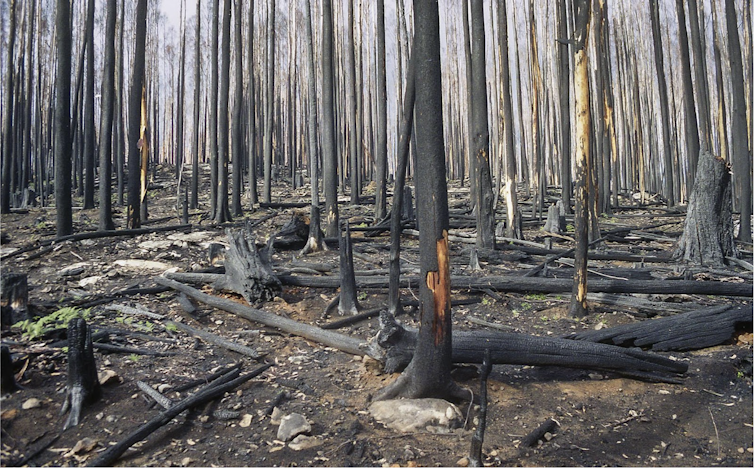
Our analysis shows most areas of mainland mountain ash forests were likely to have been dense and wet at the time of British invasion. The large overstorey eucalypt trees were relatively widely spaced, but there was a dense understorey of broad-leaved shrubs, tree ferns and mid-storey trees, including elements of cool temperate rainforest.

Read more: Book Review: Country is an urgent call to learn from Indigenous knowledges to care for the land
We looked at many sources of historical evidence. We read colonial expeditioners’ diaries. We reviewed colonial paintings and photographs. We sought out recorded and published testimonies from First Nations People. We compiled evidence from studies such as those that used carbon dating, tree rings and pollen cores.
We also examined the basic ecology of how the forests grow and develop, the plants’ level of fire sensitivity and different animals’ habitat needs.
As an example of the many accounts we found, 19th-century civil servant and mining engineer Robert Brough Smyth wrote about:
[…] heavily timbered ranges lying between Hoddle’s Creek and Wilson’s Promontory. The higher parts and the flanks of these ranges are covered with dense scrubs, and in the rich alluviums bordering the creeks and rivers the trees are lofty, and the undergrowth luxuriant; indeed in some parts so dense as to be impenetrable without an axe and bill-hook.
Similarly, in 1824, colonial explorers Hamilton Hume and William Hovell described their encounter with mountain ash forests at Mount Disappointment in Victoria:
Here […] they find themselves completely at a stand, without clue or guide as to the direction in which they are to proceed; the brush wood so thick that it was impossible to see before them in any direction ten yards.
The ecological and other scientific evidence suggests mountain ash forests evolved under conditions where high-severity bushfires were rare. As a result, mature forests of eucalypt trees of multiple ages dominated these landscapes. There was no evidence of active and widespread use of recurrent low-severity fire or thinning.
Our key conclusion is that these forests were not open or park-like – as was the case in some other vegetation types in Australia.

Read more: Why Victoria needs a Giant Forest National Park
Importantly, tall wet forests were not wilderness. Rather, they were places of significance for First Nations People. They used these forests seasonally to access important sites and resources and as pathways to visit others in neighbouring Countries.
There is no doubt parts of Australia were subject to recurrent cultural burning for many diverse and important reasons before the British invasion. However, our discussions with Traditional Custodians in the Central Highlands of Victoria, including Elders, indicate cultural burning was not widely practised in most of the mountain ash forests there. Nor were these forests actively thinned.
Many First Nations People advocate the need to consider ecological responses to fire. The right fire (or not) for the right Country is a guiding principle of traditional fire management. In the words of Elder and cultural fire practitioner Victor Steffensen:
Aboriginal fire knowledge is based on Country that needs fire, and also Country that doesn’t need fire. Even Country we don’t burn is an important part of fire management knowledge and must be within the expertise of a fire practitioner.
Repeated burning, and even low-severity fire, is unsuited to the ecology of tall, wet forests. It can lead to their collapse and replacement by entirely different vegetation such as wattle scrub.
Similarly, thinning these forests can make them more fire-prone, not less, by creating a drier forest, and generate huge amounts of carbon emissions.
Thinning and burning will also destroy habitat for a wide range of species. They include critically endangered ones such as Leadbeater’s possum. Indeed, mountain ash forests are themselves recognised as a critically endangered ecosystem.
Read more: It's not just Victoria's iconic mountain ash trees at risk – it's every species in their community
The compelling evidence we compiled all indicates mountain ash forests were dense, wet environments, not open and park-like, at the time of British invasion.
The use of scientific evidence is essential for managing Australia’s natural environments. Based on this evidence, we should not be deliberately burning or thinning these forests, which will have adverse impacts.
Rather, restoration should involve letting these forests mature. We should aim to expand the size of the old-growth forest estate to precolonial levels. Where regeneration has failed, practices such as planting and reseeding will be important to restore ecological values.

David Lindenmayer receives funding from the Victorian and Australian governments. He is a member of the Biodiversity Council and Birds Australia.
Elle Bowd receives funding from the NSW government.
Chris Taylor and Philip Zylstra do not work for, consult, own shares in or receive funding from any company or organisation that would benefit from this article, and have disclosed no relevant affiliations beyond their academic appointment.

Most of us have been stung by a bee and we know it’s not much fun. But maybe we also felt a tinge of regret, or vindication, knowing the offending bee will die. Right? Well, for 99.96% of bee species, that’s not actually the case.
Only eight out of almost 21,000 bee species in the world die when they sting. Another subset can’t sting at all, and the majority of bees can sting as often as they want. But there’s even more to it than that.
To understand the intricacies of bees and their stinging potential, we’re going to need to talk about the shape of stingers, bee genitals, and attitude.
What you most likely remember getting stung by is the European honey bee (Apis mellifera). Native to Europe and Africa, these bees are today found almost everywhere in the world.
They are one of eight honey bee species worldwide, with Apis bees representing just 0.04% of total bee species. And yes, these bees die after they sting you.
But why?
We could say they die for queen and colony, but the actual reason these bees die after stinging is because of their barbed stingers. These brutal barbs will, most of the time, prevent the bee from pulling the stinger out.
Instead, the bee leaves her appendage embedded in your skin and flies off without it. After the bee is gone, to later die from her wound, the stinger remains lodged there pumping more venom.
Beyond that, bees and wasps (probably mostly European honey bees) are Australia’s deadliest venomous animals. In 2017–18, 12 out of 19 deaths due to venomous animals were because of these little insects. (Only a small proportion of people are deathly allergic.)
Talk about good PR.
A stinger, at least in most bees, wasps and ants, is actually a tube for laying eggs (ovipositor) that has also been adapted for violent defence. This group of stinging insects, the aculeate wasps (yes, bees and ants are technically a kind of wasp), have been stabbing away in self-defence for 190 million years.
You could say it’s their defining feature.

With so much evolution literally under their belts they’ve also developed a diversity of stinging strategies. But let’s just get back to the bees.
The sting of the European honey bee is about as painful as a bee sting gets, scoring a 2 out of 4 on the Schmidt insect sting pain index.
But most other bees don’t pack the same punch — though I have heard some painful reviews from less-than-careful colleagues. On the flipside, most bee species can sting you as many times as they like because their stingers lack the barbs found in honey bees. Although, if they keep at it, they might eventually run out of venom.
Even more surprising is that hundreds of bee species have lost their ability to sting entirely.
Globally, there are 537 species (about 2.6% of all bee species) of “stingless bees” in the tribe Meliponini. We have only 11 of these species (in the genera Austroplebeia and Tetragonula) in Australia. These peaceful little bees can also be kept in hives and make honey.
Stingless bees can still defend their nests, when offended, by biting. But you might think of them more as a nuisance than a deadly stinging swarm.

Australia also has the only bee family (there are a total of seven families globally) that’s found on a single continent. This is the Stenotritidae family, which comprises 21 species. These gentle and gorgeous giants (14–19mm in length, up to twice as long as European honey bees) also get around without a functional stinger.

The astute reader might have realised something by this point in the article. If stingers are modified egg-laying tubes … what about the boys? Male bees, of all bee species, lack stingers and have, ahem, other anatomy instead. However, some male bees will still make a show of “stinging” if you try to grab them.
Some male wasps can even do a bit of damage, though they have no venom to produce a sting.
So, if the majority of bees can sting, why is it always the European honey bee having a go? There are a couple of likely answers to that question.
First, the European honey bee is very abundant across much of the world. Their colonies typically have around 50,000 individuals and they can fly 10km to forage.
Read more: Help, bees have colonised the walls of my house! Why are they there and what should I do?
In comparison, most wild bees only forage very short distances (less than 200m) and must stay close to their nest. So those hardworking European honey bees are really putting in the miles.
Second, European honey bees are social. They will literally die to protect their mother, sisters and brothers. In contrast, the vast majority of bees (and wasps) are actually solitary (single mums doing it for themselves) and lack the altruistic aggression of their social relatives.
We have an interesting relationship with our European honey bees. They can be deadly, are non-native (across much of the world), and will aggressively defend their nests. But they are crucial for crop pollination and, well, their honey is to die for.
But it’s worth remembering these are the tiny minority in terms of species. We have thousands of native bee species (more than 1,600 found so far in Australia) that are more likely to simply buzz off than go in for a sting.

James B. Dorey has received funding from organisations like the University of Wollongong, Flinders University, the Playford Trust, and the Department of Foreign Affairs and Trade (New Colombo Plan); but none in relation to this article.
Amy-Marie Gilpin receives funding from Western Sydney University and Horticulture Innovation Australia. She is also a member of the IUCN Wild Bee Specialist Group Oceania.
Rosalyn Gloag receives funding from The Australian Research Council, but not in relation to this article. She is affiliated with The University of Sydney. She is also a member of the IUCN Wild Bee Specialist Group Oceania.

A chatbot turns hostile. A test version of a Roomba vacuum collects images of users in private situations. A Black woman is falsely identified as a suspect on the basis of facial recognition software, which tends to be less accurate at identifying women and people of color.
These incidents are not just glitches, but examples of more fundamental problems. As artificial intelligence and machine learning tools become more integrated into daily life, ethical considerations are growing, from privacy issues and race and gender biases in coding to the spread of misinformation.
The general public depends on software engineers and computer scientists to ensure these technologies are created in a safe and ethical manner. As a sociologist and doctoral candidate interested in science, technology, engineering and math education, we are currently researching how engineers in many different fields learn and understand their responsibilities to the public.
Yet our recent research, as well as that of other scholars, points to a troubling reality: The next generation of engineers often seem unprepared to grapple with the social implications of their work. What’s more, some appear apathetic about the moral dilemmas their careers may bring – just as advances in AI intensify such dilemmas.
As part of our ongoing research, we interviewed more than 60 electrical engineering and computer science masters students at a top engineering program in the United States. We asked students about their experiences with ethical challenges in engineering, their knowledge of ethical dilemmas in the field and how they would respond to scenarios in the future.
First, the good news: Most students recognized potential dangers of AI and expressed concern about personal privacy and the potential to cause harm – like how race and gender biases can be written into algorithms, intentionally or unintentionally.
One student, for example, expressed dismay at the environmental impact of AI, saying AI companies are using “more and more greenhouse power, [for] minimal benefits.” Others discussed concerns about where and how AIs are being applied, including for military technology and to generate falsified information and images.
When asked, however, “Do you feel equipped to respond in concerning or unethical situations?” students often said no.
“Flat out no. … It is kind of scary,” one student replied. “Do YOU know who I’m supposed to go to?”
Another was troubled by the lack of training: “I [would be] dealing with that with no experience. … Who knows how I’ll react.”

Other researchers have similarly found that many engineering students do not feel satisfied with the ethics training they do receive. Common training usually emphasizes professional codes of conduct, rather than the complex socio-technical factors underlying ethical decision-making. Research suggests that even when presented with particular scenarios or case studies, engineering students often struggle to recognize ethical dilemmas.
Accredited engineering programs are required to “include topics related to professional and ethical responsibilities” in some capacity.
Yet ethics training is rarely emphasized in the formal curricula. A study assessing undergraduate STEM curricula in the U.S. found that coverage of ethical issues varied greatly in terms of content, amount and how seriously it is presented. Additionally, an analysis of academic literature about engineering education found that ethics is often considered nonessential training.
Many engineering faculty express dissatisfaction with students’ understanding, but report feeling pressure from engineering colleagues and students themselves to prioritize technical skills in their limited class time.
Researchers in one 2018 study interviewed over 50 engineering faculty and documented hesitancy – and sometimes even outright resistance – toward incorporating public welfare issues into their engineering classes. More than a quarter of professors they interviewed saw ethics and societal impacts as outside “real” engineering work.
About a third of students we interviewed in our ongoing research project share this seeming apathy toward ethics training, referring to ethics classes as “just a box to check off.”
“If I’m paying money to attend ethics class as an engineer, I’m going to be furious,” one said.
These attitudes sometimes extend to how students view engineers’ role in society. One interviewee in our current study, for example, said that an engineer’s “responsibility is just to create that thing, design that thing and … tell people how to use it. [Misusage] issues are not their concern.”
One of us, Erin Cech, followed a cohort of 326 engineering students from four U.S. colleges. This research, published in 2014, suggested that engineers actually became less concerned over the course of their degree about their ethical responsibilities and understanding the public consequences of technology. Following them after they left college, we found that their concerns regarding ethics did not rebound once these new graduates entered the workforce.
When engineers do receive ethics training as part of their degree, it seems to work.
Along with engineering professor Cynthia Finelli, we conducted a survey of over 500 employed engineers. Engineers who received formal ethics and public welfare training in school are more likely to understand their responsibility to the public in their professional roles, and recognize the need for collective problem solving. Compared to engineers who did not receive training, they were 30% more likely to have noticed an ethical issue in their workplace and 52% more likely to have taken action.

Over a quarter of these practicing engineers reported encountering a concerning ethical situation at work. Yet approximately one-third said they have never received training in public welfare – not during their education, and not during their career.
This gap in ethics education raises serious questions about how well-prepared the next generation of engineers will be to navigate the complex ethical landscape of their field, especially when it comes to AI.
To be sure, the burden of watching out for public welfare is not shouldered by engineers, designers and programmers alone. Companies and legislators share the responsibility.
But the people who are designing, testing and fine-tuning this technology are the public’s first line of defense. We believe educational programs owe it to them – and the rest of us – to take this training seriously.

Elana Goldenkoff receives funding from National Science Foundation and Schmidt Futures.
Erin A. Cech receives funding from the National Science Foundation.

I would not say these are the best of times. I would not say these are the chillest of times. I would not say, as we emerge from a dark and hot winter into a wet and hotter spring, that these are the most predictable of times. And yet I cannot tell you how excited I am that we are barreling toward Passover. Passover sucks (a week-plus of unleavened meals, a distinct heaviness in the form of constant reminders of our past, too much sugar-wine, etc.), but it always brings matzo times. And I positively adore matzo times.
To be clear: Matzo sucks, too. No, I hear you—matzo is a mammothly important food, a colossally symbolic one. No, no really—I understand (I will attach my Hebrew high school certificate here, where is yours?!)! But also, matzo is a worse version of a large and stale salt-free Saltine. Even when it’s at its absolute freshest and best, it’s still the same level of bad as when it’s been sitting inside a box in a damp basement for 11 and ¾ months. What other foods can you name that are, without exception, always at their very best…and simultaneously at their very worst? Matzo is so bad. I still love matzo.
Over the past few months, we have been subjected to the introduction of Girl Dinner, #WaterTok, Fruit Roll-Up ice cream, the cottage cheese-ification of everything…you’re familiar, I’m sure. Do you know what wasn’t featured in anyone’s Girl Dinners? Broken shards of solid flour-water. Do you know what no one was eating that made them so thirsty, prompting them to bum-rush an area Target and monopolize all the Stanleys? Holy holey cardboard. Matzo will never go viral. Nobody wants it to! None of us aspire to live in a world where matzo is aspirational. And that’s just some of the beauty of matzo.
Over the course of the next week, on the internet and IRL, we will see lush vats of charoset, hacks for horseradish housing, and takes on how to best arrange a Seder plate amidst a larger Seder spread, but no one will talk about matzo. We will all sit there and grimace as we pile charoset and then horseradish onto the vehicle that is matzo—a mandated player at the same table—and comment on everything we just ate…except for the matzo. To be clear, matzo will make continuous appearances in all this super-cute Seder content across the world during the holiday…but it will likely be enveloped in gorgeous, sentimental matzo covers, never to be seen by the naked eye. What other foods can you name that are, without exception, so synonymous with a holiday but nobody wants to talk about eating them?
Every year for as long as I can remember, right around the time the sun starts rising closer to 6 a.m. than to 7, two boxes of matzo appear on my parents’ countertop right by the coffee machine. They’re not prepping for Passover quite yet; not explicitly. But they’re slowly rotating buttered or cream-cheesed pieces of it into their breakfast routines. Different pots of toppings—sweet preserves, salty spreads, straight salt for that already salty butter—end up spread around their plates. They mix and match their matzo toppings from piece to piece. They offer me a piece every time, every single year, across days in February and the beginning of March, always insisting the strawberry jam makes it so much better. It doesn’t, and they know it, but it’s nice that we all pretend.
A few weeks later, fresh boxes stack up on their counter, next to the fridge, on the table. There’s a lot of fucking matzo before there’s none at all for months and months. I love the brown-and-yellow stacks of boxes. I love the pre-matzo times that every single year dovetail us right into the matzo times. They are completely predictable, unremarkable times, and I love the bowel-clogging cracker that ushers all of it in.
Passover sucks. Matzo sucks. I love Passover. I love the matzo times.

There are few foods more reviled than gefilte fish—the mere mention of it almost always triggers a compulsory acknowledgement of its inherent disgustingness. Gefilte fish elicits acks and icks in conversation and preemptive apologies from food and recipe writers, who manage to say in a single breath: "I value this food enough to spill ink about it" and "of course we all agree it's pretty gross."
I will not do that, because I do not believe it. Yes, it's a poached fish ball often served in its own chilled jelly, but I don't think there's anything particularly offensive about that. Its flavor is pleasantly clean verging on mild, its seasonings constrained and balanced, and I can think of no other food that makes prepared horseradish taste so good—not even roast beef. I have always loved gefilte fish, and I am convinced that if more people dropped their reflexively aghast posture when in its presence, many of them would, too.

I've eaten enough gefilte fish in my life to stuff a whale, but only now have I done the work to put together a recipe of my own, to the degree I can even call it my own. My recipe below is a very traditional recipe, free of tricks or "upgrades" or culinary flourishes. I arrived at it by reading many, many recipes for gefilte fish, noting their similarities as well as their differences, and running test batch after test batch to work out the ingredients and ratios that most aligned with my tastes. As it turns out, it landed not too far from a lot of classic recipes.
In many ways, this is an incredibly easy recipe to put together, though finding and preparing the fish itself can be a major pain—I mean that literally, my fingers are still healing from all the scratches and pricks I endured when washing and cleaning the bones for the broth. But just as a good latke requires grating a few knuckles, so, apparently, does good gefilte fish require getting your finger caught on mysterious sharp bits inside a pike's mouth. I'd say it's worth it.
Gefilte is the Yiddish word for "stuffed," because in centuries past, the seasoned ground fish mixture—a "forcemeat" if you want to use the technical culinary term for it—was packed back into the skin of the fish from which it had come before being cooked. Almost no one does the stuffing part anymore, but the cooked forcemeat filling remains a staple of the Ashkenazi Jewish table, especially for the Passover seder—though I, for one, am happy to eat gefilte fish any day.

Today, you'll usually see gefilte fish prepared a couple different ways, either packed into a loaf shape and baked, or formed into patties or balls and poached in a broth made from the fish bones. This recipe is for the poached version, which is what I mostly ate growing up. Often, that poached version is served cold, at times with its jellied aspic alongside. While the fish used varies depending on location and varying Ashkenazi traditions, the most common ones in the United States are freshwater fish like carp, pike, and whitefish, typically seasoned simply with onion, pepper, salt, and sugar and bound with eggs and matzo meal.
There is much more to gefilte fish's story, including that it originated as a popular Christian food for Lent during Medieval times. You can read more about that via the link, but the point I'd like to stress is that there is nothing unusual about gefilte fish. It has a history that goes back centuries and is rooted in a widespread tradition of making flavorful forcemeats from fish and then cooking them gently. Millions of people have enjoyed this dish, and ones like it—including France's famed pike quenelles—across vast stretches of land for ages through to the present. That hardly sounds like an inherently disgusting recipe to me.
By far the most difficult thing about making gefilte fish is securing the fish itself. I live in New York City and ran into wall after wall trying to order it for this recipe in the lead-up to Passover. Many fishmongers told me I would have needed to place an order weeks in advance, and even when I tried to pull the "this is for a major food publication" trump card with the PR reps of one significant fish wholesaler, I still got bupkis. Ultimately, Citarella in the West Village came through for me, handing me a heavy bag of pounds upon pounds of carp, whitefish, and pike two days after I placed my order. (I name them not because I owe them—I paid for the fish in full—but simply because, if you're in the New York City area, it may help to know they're one of your best bets. Plus I'm just so grateful they made it work.)

To be clear, you don't have to use all three of those fishes. If you can only find fresh carp, or pike, or whiting, you can still make gefilte fish with just that. And if you live somewhere where those three types of fish are not available, you can probably ask around at good fishmongers to find out what's best to use for gefilte fish.
It doesn't even have to be freshwater fish. From what I've read, Jews in the United Kingdom routinely make gefilte fish with saltwater fish like cod. But for most Jews in most places, the sweet flesh of freshwater fish is the preferred option. But now I will issue a major warning: If you cannot find good freshwater fish from a quality fishmonger, do not under any circumstances use whatever freshwater fish you can find easily, because most of the time that fish is garbage. I know because I made this mistake: In the early stages of developing this recipe, before Citarella came through with the good stuff, I relented and bought pounds upon pounds of mixed freshwater fish from a local market, including fillets of frozen tilapia. I knew it was going to be bad, but the resulting gefilte fish tasted so horrendously muddy that I spit every bite straight into the garbage. Avoid low-quality freshwater fish, low-quality farmed fish, and anything that's been held in a tank for too long. They will taste like the concentrated conditions in which they lived.
Once you have a source for your fish locked in, you'll need to make a decision about how to go about prepping it. You need to buy whole fish so that you can use the heads and bones for the stock, but that fish needs to be filleted, skinned, deboned, and ground. You can do this yourself, but it's quite a chore. It's much easier is to ask your fishmonger to do this for you, and will eliminate one of the biggest labors of the whole process.
Many gefilte fish recipes call for a whole fish weight, since you need the heads and bones to make the stock. They then estimate a yield based on that whole fish weight for the meat that will be used to make the gefilte fish itself. One very common estimate I've seen is that roughly seven pounds of whole fish will yield about three pounds of ground meat. When I bought my fish from Citarella, though, the whole fish weight was more than 12 pounds, but the ground meat I received was just about four pounds.
This raises a problem. If the yield is inconsistent, the resulting recipe will be inconsistent as well, since you may end up using the incorrect amount of ground fish relative to all the other ingredients that go into the forcemeat. The ratios matter to the final results, so you want to make sure you have the right amount of ground fish. For that reason, I've written my recipe to prioritize the weight of the ground meat: It calls for three pounds, which makes enough gefilte fish to serve an extended family of at least 12 and up to about 24 at a seder. Everything else is scaled to those three pounds (and of course you can easily scale this recipe up or down depending on how many people you're feeding: See my section below on scaling for how to do that).
I recommend talking with your fishmonger and specifying how much ground fish you want, and then asking for their help in determining how much whole fish will be required to accomplish that. Since you'll be buying the fish whole, you may end up erring on the side of slightly too much fish, but that is preferable to having too little for your needs.
Let's assume that you have your fish and it's the right amount. Let's talk about about what to do with those bones and fish heads, since your fishmonger may still leave some work for you. Before cooking the fish bones and heads in the stock, you must make sure all the entrails are removed from the cavity and that the gills have been pulled fully out of the head, as the presence of any of that stuff will ruin the broth, turning it murky and foul.

It's also a good idea to wash the bones and heads well, using your fingers to rub away as much remaining blood as possible. Most of it will be located in the head and along the spine. I've tested this before when I worked on my fish stock recipe, and found that while washing makes a cleaner, clearer, less funky stock, it's not something that has to be 100% perfect. A little bit remaining won't ruin anything.
To further ensure your fish stock cooks up nice and clean, I've also written an optional blanching step into the recipe, in which the bones are brought to a simmer to coagulate some of the free-floating proteins and impurities. After the bones are simmered briefly, they're dumped into a colander and rinsed; then the the bones go back in the pot with fresh water and aromatics (I've included some especially fresh-tasting ones like fennel and dill) to cook. You don't have to do this blanching step, but it will produce a cleaner stock in both looks and flavor.
In addition to cleaning the bones for a nice clear stock, you'll want to be sure to pick through the meat, whether you grind the fish yourself or the fishmonger does it for you. Bones and scales can slip through when the person prepping the fish is working quickly, and even some chunks of fish can pass through without being ground properly. Getting a little extra to account for loss as a result of picking through the ground fish is a good idea.
Making the fish mixture for gefilte fish is easy as can be: Mix the ingredients together and...that's it. So my focus when developing this recipe was to get a better sense of the ratios of ingredients and how they impact the final results. My favorite way to do this is to create a spreadsheet and log the ingredient details of as many great recipes as I can find to compare ingredients and ratios. Then I go into the kitchen and test the variations I'm seeing in the recipes to find out which I like best.
The ingredients themselves are fairly consistent from recipe to recipe: They almost all contain fish, eggs, matzo meal, onion, salt, sugar, and spices (usually white or black pepper, sometimes a touch of nutmeg). Carrot is an important element in most gefilte fish recipes, with some including it in the forcemeat itself, though I grew up mostly eating gefilte fish with boiled carrot served as a garnish and not folded into the fish mixture, so that's what I stuck with here.

Onion: Some recipes have you sauté the onion first while others have it folded in raw. I tried both and decided I liked each in their own way, so I split the onion in half, cooking half of it for a sweeter, more tender bite and leaving the rest raw for a little more texture and pronounced allium flavor.
Egg: Most recipes use one large egg per pound of fish, and I found this worked well; adding two per pound made bouncier gefilte fish that started to seem a little rubbery.
Matzo meal: Matzo meal, meanwhile, was most pleasing to me at the lower end of the ratio spectrum, about 1/4 cup per pound. The inclusion of matzo in the recipe is often described as a tactic to stretch the fish to feed more people, and without a doubt adding bread or other starches to protein mixtures does accomplish that. But there are culinary reasons for it that are just as, if not more, important. A starch that is mixed into ground meat is known in French cooking as a panade, and it helps to both bind and tenderize the proteins, reducing their overall rubberiness once cooked. While I'm sure poor families in the past added hefty amounts of matzo meal to truly stretch the fish, the 1/4 cup per pound called for in my and many other modern recipes hardly adds any mass at all. It is not there for economics, it is there for gustatory reasons.
The panade, though, can dry a meat mixture out, especially when it's made from something as dry as matzo. So it's helpful to add a small amount of water to the forcemeat and let it stand for at least 30 minutes to hydrate the matzo and loosen the mixture. This is typical in many meatball and meatloaf recipes, and it's a good move here too even though some recipes don't call for it.
After testing a range of ratios for various ingredients, I was able to nail down a basic per-pound recipe for gefilte fish. This is useful to know, as the recipe can easily be scaled up and down. If you only need to cook gefilte fish for a few people, you can probably make do with a one- or two-pound batch. If you need to feed a synagogue's worth of folks, you can scale it up (though you'll probably need to do it in batches at a certain point if the recipe exceeds the capacity of your gear).
For reference, here are my per-pound ratios so that you can scale as needed. Everything else about the recipe remains the same in terms of process and estimated cooking times.
Please don't take these precise numbers too literally. You do not need to measure 33 grams of matzo meal to the gram, nor do you need to go searching through your utensils drawer for a 1/3 teaspoon measure for the pepper—you can just go down to 1/4 teaspoon or up to 1/2 teaspoon for pound, or just eyeball it, which is what I would actually do in real life. Gefilte fish is forgiving and will be close enough as long as you're within these general ranges.
The main reason I'm specifying the brand of salt here is not because it's kosher, though that's a fitting choice for this recipe given its place on the Passover table, but instead because salt amounts can vary significantly when measured by volume. If you're using table salt and you measured one tablespoon, for example, you'd end up with twice as much salt as if you used Diamond Crystal. Similarly, Morton's kosher salt has a different mass per volume than Diamond Crystal, so once again, volumes are not equivalent. I, like many professional cooks and recipe developers, have grown very accustomed to Diamond Crystal, as it tends to be the basic salt of choice in most professional settings. They do not pay me to include their name, and I don't love giving them the free advertising, but it's important to be specific when it comes to salt to avoid problems when you're making this recipe at home.

One final note: These seasonings are good to my taste, but the nice thing about a forcemeat like this is you can easily adjust. You should absolutely poach a small sample fish dumpling in the broth and taste it for seasoning before committing to cooking the whole batch. You can alway bump up the salt or sugar or make any other adjustments necessary before you cook the rest.
Sugar is possible one of the most divisive topics when it comes to how best to make gefilte fish, and the truth is there's no right answer. Preference for sweetness maps directly to where one's family comes from, and it's a clear enough demarcation in Europe that there's something literally called the Gefilte Fish Line: If your people came from the more Eastern portions of Ashkenazi lands, like Lithuania and Ukraine, the taste tends to lean more salty and savory. If you're from areas slightly more to the west, like Poland, the taste can become so sweet that it's a shock to many who have never experienced it before.

My Jewish ancestors came from Latvia and so my tolerance for the super-sweet gefilte fish is limited. My recipe calls for only a touch of sugar to balance the more savory or salty elements, but not make the fish overtly sweet. If your tastes run more sweet than mine, the solution is as simple as adding more sugar until you hit the level you want. Once again, you can pinch off and cook sample bits of the forcemeat to get it where you want before you cook the rest.
Inspect fish heads and bone cages, removing and discarding any remaining viscera and gills if necessary. Under cold running water, wash fish heads and bone cages well, using your fingers to work away traces of blood, especially inside the head and along the spine (it doesn't have to be perfect, but try to get what you can).

Transfer fish heads and bone cages to a large stock pot and add cold water until just covered. Set over high heat, bring to a bare simmer, then drain in a colander in the sink. Rinse out pot and fish bones and heads, then return to pot (this step, while optional, coagulates and removes proteins that can cloud up the stock for a more pristine result).

Thinly slice 1 onion and add to stock pot along with celery, fennel, and parsley and dill sprigs. Cover with fresh cold water, set over medium-high heat and bring to a bare simmer. Reduce heat to maintain bare simmer and cook for 1 hour.

While the stock cooks, finely dice remaining 3 onions. In a small skillet, heat oil over medium heat until shimmering. Add half the diced onion along with a pinch of salt and cook, stirring often, until softened, about 4 minutes. Set aside to cool.

Transfer ground fish to a large mixing bowl. Carefully pick through ground fish, removing and discarding any bones or scales. Add raw onion, sautéed onion, matzo meal, eggs, salt, sugar, and pepper. Add 6 tablespoons (90ml) cold water, then stir until very well combined and fish mixture develops a slightly sticky texture. Let rest, refrigerated, for 30 minutes.

When fish stock is ready, strain through a fine-mesh strainer set over a large heatproof vessel. Discard solids and wash out stock pot. Return fish stock to stockpot.

Return fish stock to medium-high heat and bring to a simmer. Add sliced carrots.

Using 2 large serving or sauce spoons, scoop up a generous ball of fish mixture and scrape it back and forth between the 2 spoons to form a compact football shape (if you want to make it look like a classic French quenelle, try to use the spoons to give it 3 defined sides). Carefully free the fish ball from the spoons and slide it right into the water. Repeat with remaining fish mixture until all has been formed into balls and added to the pot, shaking the pot from time to time to ensure fish balls do not stick to each other. Simmer until fish balls are cooked through and register 150°F (65°C) on an instant-read thermometer inserted in the center, 10 to 15 minutes. (Note that depending on the size of your pot, you may need to cook the fish mixture in batches. If you do need to do this, transfer the cooked fish balls to a platter, then add the next batch. Once all are cooked, add them back to the pot.)

Season fish broth with salt and sugar to taste, then let cool until warm. Serve gefilte fish warm with cooked carrots, parsley and/or dill garnish, and horseradish. Alternatively, cover and transfer to the refrigerator and allow to chill overnight, then serve chilled with carrots, herb garnish, horseradish, and, if desired, a small amount of aspic (the chilled, slightly gelled broth).

While you can fillet, debone, and grind the meat from a whole fish yourself, it's a significant labor. It's much easier is to ask your fishmonger to do this for you; make sure to communicate that you want the bones, heads, and skin from the fish along with the meat. The ingredient list in this recipe calls for the weight of the ground fish instead of a starting weight for the whole fish because my experience is that the yield is too variable from the whole fish: I've seen many recipes that estimate that a 7-pound carp will yield more than three pounds of meat, but when I shopped for the fish to develop this recipe, I barely got four pounds of ground meat from 13 pounds of whole fish. Talk to your fishmonger about your desired yield of ground meat to ensure you get the right amount of whole fish.

Websites sometimes hide how widely they share our personal information, and can go to great lengths to pull the wool over our eyes. This deception is intended to prevent full disclosure to consumers, thus preventing informed choice and affecting privacy rights.
Governments are responding to consumer concerns about privacy with legislation. These include the European Union’s General Data Protection Regulation (GDPR) and California’s Consumer Privacy Act (CCPA). The impact of this legislation is visible as websites request permission to track online user activity.
However, many users remain unaware of the impact of these choices, or how the extent of sharing is deceptively hidden.
As Canadian policymakers grapple with updates to online privacy regulations, our research looks at when and why companies actively hide — and how widely they share — our personal data. We found that the obfuscation, or disguise, of information sharing is a strategy commonly used by websites to mislead users and raise the cost of monitoring.
Our research team has been studying website privacy issues for a number of years, specifically with respect to the sharing of consumer data with third parties as a way to monetize web traffic.
Our research has established that websites with privacy-sensitive content, such as medical and banking websites, are naturally constrained by the market in terms of their third-party sharing. These websites are also more privacy-sensitive, and so are less likely to obscure the extent of information-sharing.
We also examined the privacy abuses that occurred as people’s use of online services increased in response to the COVID-19 pandemic. We conducted research that allowed us to predict website trustworthiness by observing how they employed third parties. We discussed how opt-in privacy legislation can increase third-party sharing.
Read more: To protect user privacy online, governments need to reconsider their use of opt-in policies
We examined third-party data collection by websites, highlighting the extensive tracking mechanisms deployed by platforms and advertisers to capture consumer information. This pervasive surveillance raises significant concerns about privacy infringement and the commodification of personal data.
Within the first three seconds of opening a web page, over 80 third parties on average have accessed your information. Some of these third parties provide services to improve a website’s functionality and performance.
Other third parties are engaged in advertising and targeted advertising, which includes scooping up and selling your most personal information. Some third parties are extremely predatory in their privacy abuses.
Our research reveals circumstances where websites actively hide how widely our data is shared. As content sensitivity increases — for example, websites dealing with sensitive personal medical information — websites reduce the level of deception compared to websites with less sensitive content.
We also found that websites that are more popular are more likely to hide their data-sharing practices than websites with smaller audiences.
Websites modify how widely they share user information and hide how much they share because it can sometimes help increase profits by taking advantage of unknowing consumers. This means that visitors are unable to make fully informed decisions regarding their data privacy.
Similar to ambiguous website privacy policies, requesting consent to collect and share information does not necessarily resolve the information asymmetry between websites and users. A common strategy is to overwhelm users with an overly extensive list of third parties that do not necessarily reflect their particular interaction.

Websites use a variety of techniques to keep users from understanding the true level of information sharing and its privacy implications. One deception is the use of dark patterns, defined as “user interface design choices that benefit an online service by coercing, steering or deceiving users into making unintended and potentially harmful decisions.” These dark patterns trick users into giving away their privacy.
Another deception technique relates to the lack of transparency surrounding third-party sharing. Who websites share information with depends upon a myriad of variables — the consumer never knows how or why their information is shared. Third parties can differ depending on where a user is located: third-party sharing across the largest 100,000 websites is on average higher for customers clicking from California compared to New York, for example.
Obfuscated customization occurs when the website actively tries to hide their abusive third party sharing. For example, consumers can use a Do Not Track (DNT) request: however, websites can make it difficult for users to understand the website’s response to the request, and it is very difficult to figure out what happens after the request is made.
Sometimes, websites actually track users more in response to a DNT request. In an unpublished experiment that we performed, 40 per cent of the top 100 largest news websites in the world shared your data with more third parties if you made a DNT request. Even if a website engages fewer third parties, the changes in response to a DNT request may still be abusive because they may now share data with more intrusive third parties.
Consumers may use various tools to protect themselves, including virtual private networks (VPNs), behavioural obfuscation and lying about their personal information.
Simply disclosing the presence of third parties and requesting user consent is insufficient because the consumer, for all practical purposes, is unaware of the extent of third-party sharing and tracking. Because of this information asymmetry, it is impossible to know when or to what extent personal information has been shared.
The EU’s GDPR and California’s CCPA contain opt-in and opt-out regulations, such as those currently under consideration in Canada. But one thing is clear: these regulations are not enough to stop websites from manipulating and profiting from user data.

Raymond A. Patterson received financial support from the Social Sciences and Humanities Research Council of Canada and the Haskayne School of Business at the University of Calgary.
Hooman Hidaji receives funding from the Social Sciences and Humanities Research Council of Canada.
Ram Gopal receives funding from the Gillmore Centre for Financial Technology at the Warwick Business School.
Ashkan Eshghi does not work for, consult, own shares in or receive funding from any company or organisation that would benefit from this article, and has disclosed no relevant affiliations beyond their academic appointment.

Lawmakers grilled Columbia University President Minouche Shafik and three colleagues on April 17, 2024, over antisemitism on college campuses, just four months after three of her presidential peers were summoned to Capitol Hill over how their institutions were handling antisemitism on campus following Hamas’ attack on Israel on Oct. 7, 2023. Two of them resigned shortly thereafter. Here, Lynn Greenky, a scholar of communication and rhetoric, gives her take on how Shafik handled being in the same hot seat as her colleagues.
Unlike Claudine Gay, Liz Magill and Sally Kornbluth – the presidents of Harvard, the University of Pennsylvania and MIT, respectively – Shafik and the other witnesses representing Columbia University spoke with greater moral clarity on the issue of what constitutes antisemitism on campus. Of course, they had the benefit of being able to first see what happens when you don’t.
Columbia’s president, Minouche Shafik, as well as David Schizer and David Greenwald, co-chairs of the Columbia University Task Force on Antisemitism, and Co-Chair of the Board of Trustees Claire Shipman, came ready to acknowledge their responsibility, even culpability, in their failure to recognize and control hate speech directed at Jews on campus. Shipman in particular made it clear that Columbia is suffering a “moral crisis” on its campus.
All of the witnesses showed a lot of deference to the committee. They even thanked the committee for the investigation and asked for the committee’s help to address antisemitism on campus. In fact, Shipman concluded her opening statement saying she looked forward to the committee’s input as Columbia seeks to refocus its vision back to its core values of wisdom, empathy and respect.
Professors Joseph Massad, Katherine Franke and Mohamed Abdu were mentioned by name.
Several members of the Congressional committee singled out Massad, who on Oct. 8, 2023, described the Hamas attack on Israel as “awesome” and “innovative” in an online article, for particular scorn. Shafik promised the committee that Massad would be removed from his position as chair of Columbia’s academic review committee, whose principle function is to “assess program quality and effectiveness,” “foster planning and improvement” and “provide guidance for administrative decisions.” Shafik also indicated Massad might be fired even though his position is tenured.
While some might argue that removing Massad as chair, or firing him, infringes on the professor’s First Amendment right to academic freedom, it is unclear whether that assertion will save him. The Supreme Court has not provided specific guidance on the parameters of academic freedom. In fact, the concept of academic freedom generally refers to a scholar’s freedom to pursue inquiry, discussion and teaching within the sphere of that scholar’s research and consistent with the institution’s curriculum. Academic freedom is not the same as a professor’s individual right to speak one’s mind.
The committee’s chairperson, Virginia Foxx, a Republican from West Virginia, warned that radical faculty remain a huge problem at Columbia. She said she expects Columbia to make “tangible progress” to sanction or remove radical faculty. If not, she says, Columbia will be brought before the committee again.
Recalling a House resolution that condemned the chant “from the river to the sea” as antisemitic, Rep. Elise Stefanik, a Republican from New York, pushed Shafik to amend her previous testimony that alluded to how the chant can, in some circumstances, represent protected political speech.
Shafik seemed reluctant to label students or faculty as engaging in hate and harassment. She tried very hard, sometimes unsuccessfully, to assert the need to balance constitutionally protected speech with the educational mission of the university.
Still, Shafik frequently testified that the policies and structures in place at Columbia prior to the Oct. 7 attack were inadequate. In her written statement to the committee, Shafik admitted that before Oct. 7, Columbia’s process for reporting allegations of hate speech, harassment and other forms of disruptive behavior needed to be simplified. She also said staff training needed to be improved. Throughout her testimony she acknowledged her personal horror at the hatred and vitriol expressed on campus both before and after Oct. 7.
Shafik, Schizer and Shipman each repeated the refrain that they recognize the mistakes and failures made in response to events on campus that – according to their testimony – left Jewish students angry and frightened. They said they are working on revising policies and practices that will promote vigorous debate while protecting student safety.
As a result of some of the preliminary recommendations of Columbia’s Task Force on Antisemitism, the university has updated the reporting and response process regarding harassment and discrimination.
Rep. Foxx made it clear that continued eruptions on campus, which the House has identified as antisemitic, risk the withdrawal of federal funds.
Certainly, a college or university has a compelling interest in protecting its students, faculty and staff’s freedom, safety and integrity. However, as always, the devil is in the details. It is difficult to mediate the appropriate balance between promoting robust debate and protecting against offense. Often, when colleges and universities undertake the task, I believe it is the freedom to speak one’s mind that suffers.

Lynn Greenky does not work for, consult, own shares in or receive funding from any company or organization that would benefit from this article, and has disclosed no relevant affiliations beyond their academic appointment.

It’s not at all clear that disinformation has, to date, swung an election that would otherwise have gone another way. But there is a strong sense that it has had a significant impact, nonetheless.
With AI now being used to create highly believable fake videos and to spread disinformation more efficiently, we are right to be concerned that fake news could change the course of an election in the not-too-distant future.
To assess the threat, and to respond appropriately, we need a better sense of how damaging the problem could be. In physical or biological sciences, we would test a hypothesis of this nature by repeating an experiment many times.
But this is much harder in social sciences because it’s often not possible to repeat experiments. If you want to know the impact of a certain strategy on, say, an upcoming election, you cannot re-run the election a million times to compare what happens when the strategy is implemented and when it is not implemented.
You could call this a one-history problem: there is only one history to follow. You cannot unwind the clock to study the effects of counterfactual scenarios.
To overcome this difficulty, a generative model becomes handy because it can create many histories. A generative model is a mathematical model for the root cause of an observed event, along with a guiding principle that tells you in which way the cause (input) turns into an observed event (output).
By modelling the cause and applying the principle, it can generate many histories, and hence statistics needed to study different scenarios. This, in turn, can be used to assess the effects of disinformation in elections.
In the case of an election campaign, the primary cause is the information accessible to voters (input), which is transformed into movements of opinion polls showing changes of voter intention (observed output). The guiding principle concerns how people process information, which is to minimise uncertainties.
So, by modelling how voters get information, we can simulate subsequent developments on a computer. In other words, we can create a “possible history” of how opinion polls change from now to the election day on a computer. From one history alone we learn virtually nothing, but now we can run the simulation (the virtual election) a million times.
A generative model does not predict any future event, because of the noisy nature of information. But it does provide the statistics of different events, which is what we need.
I first came up with the idea of using a generative model to study the impact of disinformation about a decade ago, without any anticipation that the concept would, sadly, become so relevant to the safety of democratic processes. My initial models were designed to study the impact of disinformation in financial markets, but as fake news started to become more of a problem, my colleague and I extended the model to study its impact on elections.
Generative models can tell us the probability of a given candidate winning a future election, subject to today’s data and the specification of how information on issues relevant to the election is communicated to voters. This can be used to analyse how the winning probability will be affected if candidates or political parties change their policy positions or communication strategies.
We can include disinformation in the model to study how that will alter the outcome statistics. Here, disinformation is defined as a hidden component of information that generates a bias.
By including disinformation into the model and running a simulation, the result tells us very little about how it changed opinion polls. But running the simulation many times, we can use the statistics to determine the percentage change in the likelihood of a candidate winning a future election if disinformation of a given magnitude and frequency is present. In other words, we can now measure the impact of fake news using computer simulations.
I should emphasise that measuring the impact of fake news is different from making predictions about election outcomes. These models are not designed to make predictions. Rather, they provide the statistics that are sufficient to estimate the impact of disinformation.
One model for disinformation that we considered is a type that is released at some random moment, grows in strength for a short period but then it is damped down (for example owing to fact checking). We found that a single release of such disinformation, well ahead of election day, will have little impact on the election outcome.
However, if the release of such disinformation is repeated persistently, then it will have an impact. Disinformation that is biased towards a given candidate will shift the poll slightly in favour of that candidate each time it is released. Of all the election simulations for which that candidate has lost, we can identify how many of them have the result turned around, based on a given frequency and magnitude of disinformation.
Fake news in favour of a candidate, except in rare circumstances, will not guarantee a victory for that candidate. Its impacts can, however, be measured in terms of probabilities and statistics. How much has fake news changed the winning probability? What is the likelihood of flipping an election outcome? And so on.
One result that came as a surprise is that even if electorates are unaware whether a given piece of information is true or false, if they know the frequency and bias of disinformation, then this suffices to eliminate most of the impact of disinformation. The mere knowledge of the possibility of fake news is already a powerful antidote to its effects.

Generative models by themselves do not provide counter measures to disinformation. They merely give us an idea of the magnitude of impacts. Fact checking can help but it is not hugely effective (the genie is already out of the bottle). But what if the two are combined?
Because the impact of disinformation can be largely averted by informing people that it is happening, it would be useful if fact checkers offered information on the statistics of disinformation that they have identified – for example, “X% of negative claims against candidate A were false”. An electorate equipped with this information will be less affected by disinformation.

Dorje C. Brody receives funding from Engineering and Physical Science Research Council (EP/X019926/1). He is currently affiliated with the University of Tokyo.

Hansen’s disease, also called leprosy, is treatable today – and that’s partly thanks to a curious tree and the work of a pioneering young scientist in the 1920s. Centuries prior to her discovery, sufferers had no remedy for leprosy’s debilitating symptoms or its social stigma.
This young scientist, Alice Ball, laid fundamental groundwork for the first effective leprosy treatment globally. But her legacy still prompts conversations about the marginalization of women and people of color in science today.
As a bioethicist and historian of medicine, I’ve studied Ball’s contributions to medicine, and I’m pleased to see her receive increasing recognition for her work, especially on a disease that remains stigmatized.
Alice Augusta Ball, born in Seattle, Washington, in 1892, became the first woman and first African American to earn a master’s degree in science from the College of Hawaii in 1915, after completing her studies in pharmaceutical chemistry the year prior.

After she finished her master’s degree, the college hired her as a research chemist and instructor, and she became the first African American with that title in the chemistry department.
Impressed by her master’s thesis on the chemistry of the kava plant, Dr. Harry Hollmann with the Leprosy Investigation Station of the U.S. Public Health Service in Hawaii recruited Ball. At the time, leprosy was a major public health issue in Hawaii.
Doctors now understand that leprosy, also called Hansen’s disease, is minimally contagious. But in 1865, the fear and stigma associated with leprosy led authorities in Hawaii to implement a mandatory segregation policy, which ultimately isolated those with the disease on a remote peninsula on the island of Molokai. In 1910, over 600 leprosy sufferers were living in Molokai.
This policy overwhelmingly affected Native Hawaiians, who accounted for over 90% of all those exiled to Molokai.
Doctors had attempted to use nearly every remedy imaginable to treat leprosy, even experimenting with dangerous substances such as arsenic and strychnine. But the lone consistently effective treatment was chaulmoogra oil.
Chaulmoogra oil is derived from the seeds of the chaulmoogra tree. Health practitioners in India and Burma had been using this oil for centuries as a treatment for various skin diseases. But there were limitations with the treatment, and it had only marginal effects on leprosy.
The oil is very thick and sticky, which makes it hard to rub into the skin. The drug is also notoriously bitter, and patients who ingested it would often start vomiting. Some physicians experimented with injections of the oil, but this produced painful pustules.
If researchers could harness chaulmoogra’s curative potential without the nasty side effects, the tree’s seeds could revolutionize leprosy treatment. So, Hollmann turned to Ball. In a 1922 article, Hollmann documents how the 23-year-old Ball discovered how to chemically adapt chaulmoogra into an injection that had none of the side effects.
The Ball Method, as Hollmann called her discovery, transformed chaulmoogra oil into the most effective treatment for leprosy until the introduction of sulfones in the late 1940s.
In 1920, the Ball Method successfully treated 78 patients in Honolulu. A year later, it treated 94 more, with the Public Health Service noting that the morale of all the patients drastically improved. For the first time, there was hope for a cure.
Tragically, Ball did not have the opportunity to revel in this achievement, as she passed away within a year at only 24, likely from exposure to chlorine gas in the lab.
Ball’s death meant she didn’t have the opportunity to publish her research. Arthur Dean, chair of the College of Hawaii’s chemistry department, took over the project.
Dean mass-produced the treatment and published a series of articles on chaulmoogra oil. He renamed Ball’s method the “Dean Method,” and he never credited Ball for her work.
Ball’s other colleagues did attempt to protect Ball’s legacy. A 1920 article in the Journal of the American Medical Association praises the Ball Method, while Hollmann clearly credits Ball in his own 1922 article.
Ball is described at length in a 1922 article in volume 15, issue 5, of Current History, an academic publication on international affairs. That feature is excerpted in a June 1941 issue of Carter G. Woodson’s “Negro History Bulletin,” referring to Ball’s achievement and untimely death.
Joseph Dutton, a well-regarded religious volunteer at the leprosy settlements on Molokai, further referenced Ball’s work in a 1932 memoir broadly published for a popular audience.
Historians such as Paul Wermager later prompted a modern reckoning with Ball’s poor treatment by Dean and others, ensuring that Ball received proper credit for her work. Following Wermager’s and others’ work, the University of Hawaii honored Ball in 2000 with a bronze plaque, affixed to the last remaining chaulmoogra tree on campus.
In 2019, the London School of Hygiene and Tropical Medicine added Ball’s name to the outside of its building. Ball’s story was even featured in a 2020 short film, “The Ball Method.”
The Ball Method represents both a scientific achievement and a history of marginalization. A young woman of color pioneered a medical treatment for a highly stigmatizing disease that disproportionately affected an already disenfranchised Indigenous population.
In 2022, then-Gov. David Ige declared Feb. 28 Alice Augusta Ball Day in Hawaii. It was only fitting that the ceremony took place on the Mānoa campus in the shade of the chaulmoogra tree.

Mark M. Lambert does not work for, consult, own shares in or receive funding from any company or organization that would benefit from this article, and has disclosed no relevant affiliations beyond their academic appointment.

Last month, Danny Mamlok, a friend of mine and an Israeli professor from Tel Aviv University, was scheduled to give a talk at Concordia University in Montreal on the topic of education for tolerance. Four days before the presentation was supposed to take place, the organizers of this event said they were subjected to significant pressure from pro-Palestinian activist groups at McGill and Concordia to cancel Mamlok’s presentation.
Not wanting to give in to this pressure, the organizers insisted that Mamlok, who has advocated for peace for decades and as an Israeli soldier even refused to serve in the West Bank, be allowed to deliver his talk.
Ironically, in order to attend a presentation on tolerance, the audience was directed to enter the venue through the basement, since the pro-Palestinian activists had blocked the main access and later disrupted the talk on Zoom.
This effort to cancel individuals or silence free speech on college campuses has become a more common occurrence in the days since the Oct. 7, 2023, Hamas terrorist attack. But even before, it was a growing phenomenon in higher education and the media across America.
A 2023 report by the Foundation for Individual Rights and Expression in Education, a nonprofit dedicated to protecting free speech, found that “attempts to punish college and university scholars for their speech skyrocketed over the past two decades, from only four in 2000 to 145 in 2022.” That report also showed that censorship of professors has come from both sides of the American political spectrum and that a majority of these cases led to some form of sanction, including about 20% that resulted in termination.
In her 2021 Atlantic magazine article titled “The New Puritans,” Anne Applebaum documented more than a dozen cases of professors and journalists who were punished for saying or writing controversial statements. Applebaum focused on the cases of Donald McNeil, science reporter from The New York Times; Laura Kipnis, an academic at Northwestern; and Ian Buruma, editor of The New York Review of Books. Applebaum’s investigative report concluded that these individuals were victims of mob justice and online campaigns that demanded the swift firing of “offenders.” Moreover, she noted that these campaigns lacked just cause and did not grant the canceled individuals the right to due process.
The issue of canceling and cancel culture has received considerable attention in the media and among various scholars, with a focus on the personal consequences suffered by those who have been canceled, the political risks, and the legal issues raised by this practice. Yet, I believe that the educational dangers for democracy that can come about from attempts to cancel individuals or ideas, though profound, have received less attention.
What does a democratic society stand to lose, educationally speaking, when people choose to ban or cancel someone or something? My own research suggests that there are at least four educational detriments that can result from the practice of canceling.
The practice of canceling has been shown to exacerbate a host of cognitive biases shared by many people, such as confirmation bias and motivated reasoning.
Confirmation bias is the tendency to seek and focus on information that supports one’s existing beliefs and discount contrary evidence.
Motivated reasoning is the inclination to scrutinize evidence with greater skepticism if it does not fit one’s existing beliefs or values. Studies have found that when people close themselves to alternative perspectives, voices and sources of information, they undermine their ability to gain a deeper understanding of issues and expand their knowledge. In contrast, the cognitive dissonance that results from views being challenged by those who have different perspectives can lead to new insights and enhanced learning.
The practice of canceling people or ideas reduces both the number and quality of discussions across differences.
Suppressing unorthodox opinions, dodging conflict or avoiding engaging with controversial perspectives often results in uninspiring conversations aimed at merely “preaching to the choir.” Such predictable conversation with a limited range of acceptable viewpoints can lead people to adopt a herd mentality, one that accepts a set of assumptions and values uncritically.
In his essay “On Liberty,” philosopher John Stuart Mill argued that having to justify one’s opinions to someone who opposes them is enlightening for all. Mill was adamant that the mission of higher education was not to indoctrinate students on what they should believe but to help them develop their own worldviews based on their interaction with different perspectives and sources of evidence.
Canceling has the adverse educational effect of promoting dogmatism rather than open-mindedness.
Silencing ideas that are politically incorrect, insensitive or controversial may make people feel good, but it does nothing – as Mill recognized and my own research shows – to engage or edify people holding on to those views.
The danger is that banning subversive opinions leaves both the people who hold them and those who oppose them in their segregated enclaves, thereby reducing the interactions of diverse perspectives that American philosopher and educator John Dewey regarded as the lifeblood of democracy. Following Mill and Dewey, I would argue that such critical interaction with controversial viewpoints helps promote intellectual open-mindedness and prevents people from becoming dogmatic.
The practice of canceling is educationally dangerous because it seeks to suppress dissent and creates a false sense of consensus.
As historian and bioethicist Alice Dreger has illustrated with the help of numerous examples in her book “Galileo’s Middle Finger,” banning controversial or minority views deprives the public of valuable information on a host of social problems that should concern everyone. Likewise, canceling narrows the range of perspectives that can be used to analyze issues such as climate change and global pandemics and come up with potential solutions to resolve them.
Luis Alberto Lacalle, the former president of Uruguay, once said “consensus destroys democracy.”
Consensus destroys democracy by greatly curtailing the possibility that spirited discussion, diverse viewpoints and rigorous critique – all essential to maintaining the democratic process – will play a major role in shaping the direction of the U.S. and other democracies. And consensus destroys democracy by privileging the majority opinion, ignoring the needs and interests of minorities and marginalizing the voices of dissent.
My analysis suggests that canceling is a misguided and undemocratic practice – one that leads to numerous negative educational consequences, such as promoting dogmatism, discouraging dissent and undermining vigorous debates.

Mordechai Gordon does not work for, consult, own shares in or receive funding from any company or organization that would benefit from this article, and has disclosed no relevant affiliations beyond their academic appointment.

The Voynich manuscript has long puzzled and fascinated historians and the public. This late-medieval document is covered in illustrations of stars and planets, plants, zodiac symbols, naked women, and blue and green fluids. But the text itself – thought to be the work of five different scribes – is enciphered and yet to be understood.
In an article published in Social History of Medicine, my coauthor Michelle L. Lewis and I propose that sex is one of the subjects detailed in the manuscript – and that the largest diagram represents both sex and conception.

Research on the Voynich manuscript has revealed some clues about its origins.Carbon dating provides a 95% probability the skins used to make the manuscript come from animals that died between 1404 and 1438. However, its earliest securely known owner was an associate of Holy Roman Emperor Rudolf II, who lived from 1552 to 1612, which leaves more than a century of ownership missing.
Certain illustrations (the zodiac symbols, a crown design and a particular shape of castle wall called a swallowtail merlon) indicate the manuscript was made in the southern Germanic or northern Italian cultural areas.
One section contains illustrations of naked women holding objects adjacent to, or oriented towards, their genitalia. These wouldn’t belong in a solely herbal or astronomical manuscript. To make sense of these images, we investigated the culture of late-medieval gynaecology and sexology – which physicians at the time often referred to as “women’s secrets”.
First we looked at Bavarian physician Johannes Hartlieb (circa 1410–68), who lived around the time and place the Voynich manuscript was made.
Hartlieb wrote about plants, women, magic, astronomy and baths. He also recommended the use of “secret letters” (such as a cipher, secret alphabet, or similar) to obscure medical recipes and procedures that may result in contraception, abortion or sterility.
Although his secret alphabet hasn’t survived, analysing his work has helped us understand the attitudes that would have inspired the use of encipherment at the time. For instance, Hartlieb felt a strong apprehension about “women’s secrets” becoming widely known. He worried his writings could facilitate extramarital sex and that God would condemn him if this happened.
In his un-enciphered writings, he either refuses or hesitates to write about certain topics, such as post-partum vaginal ointments, women’s sexual pleasure, claims of women giving birth to animals, the “correct” coital positions for conception, libido-altering dietary advice, and information about poisonous, hallucinogenic, contraceptive or abortive plants.
Writing for male aristocrats in vernacular Bavarian (rather than academic Latin), Hartlieb says such knowledge should be restricted from sex workers, commoners, children, and in some cases from women themselves – who were becoming increasingly literate.
As a man who valued heterosexual marriage and women’s “modesty”, and who condemned lust, promiscuity and prostitution, he was perfectly conventional for his milieu.
Read more: Deciphering the Philosophers' Stone: how we cracked a 400-year-old alchemical cipher
If such attitudes were widespread back then, was the censorship of women’s secrets also widespread? The short answer is: yes.
During our research, we decoded a number of ciphers from this period (but none from the Voynich manuscript). The longest was a 21-line cipher from late-medieval northern Italy that obscured a recipe with gynaecological uses, including abortion.
We also found many examples of authors self-censoring, or of readers erasing or destroying information in gynaecological and/or sexological texts. Censors would often only obscure a few words, usually genital terms or plant names in recipes – but sometimes they would remove entire pages or chapters.
One Bavarian manuscript includes recipes for invisibility and magic spells for sexually coercing women, after which two pages have been removed. The censor writes this removal was done “not without reason”.
By analysing the Voynich illustrations through this lens, we propose the Rosettes – the manuscript’s largest and most elaborate illustration – represents a late-medieval understanding of sex and conception.
Our proposal is in keeping with the patriarchal culture of the time and resolves many of the manuscript’s apparent contradictions. It also allows us to identify several of the illustration’s features.

In late-medieval times the uterus was believed to have seven chambers, and the vagina two openings (one external and one internal).
We believe the nine large circles of the Rosettes represents these, with the central circle representing the outer opening, and the top-left circle representing the inner opening. The eight outer circles have smooth edges since they represent internal anatomy, while the central circle has a shaped edge since it represents external anatomy.
Abu Bakr Al-Rāzī, a Persian physician who influenced late-medieval European medicine, wrote that five small veins exist in the vaginas of virgins. We see these running from the top-left circle towards the centre.
Physicians back then also believed a male and female component were necessary for conception, and both of these were called “sperm”. These are shown in yellow (male) and blue (female). Women were thought to receive pleasure from the motion of the two sperms in the uterus, which is depicted through the lines and patterns.
It was also thought the uterus had two horns or spikes, which we can see on the top-right and bottom-right circles.
The castles and town walls may represent wordplay on the German term schloss, which had meanings including “castle”, “lock”, “female genitalia” and “female pelvis”.

And the two suns in the far top-left and bottom-right likely reflect Aristotle’s belief that the Sun provides natural heat to the embryo during its early development.

While many features of the illustration are yet to be understood, our proposal is worth close scrutiny. We hope future research into the manuscript will approach it through a similar lens. Perhaps, with enough clues, we might find a way to finally decode this elusive text.

Keagan Brewer receives funding from a Macquarie University Research Fellowship.

A review into gender identity services for young people has said under-18s are being let down by the NHS. The final report of the Cass review describes a lack of long-term data and “remarkably weak” evidence on the effects of medical interventions in gender care.
However, medical transitioning, through hormone therapy or surgery, is only one route for transgender and gender non-conforming people of any age to explore their identity. Many will “socially transition” before or instead of medically transitioning. The report, alongside other research, recommends more long-term, robust research on both social transitioning and medical intervention.
Broadly speaking, social transitioning consists of actions or expressions that align with a chosen gender other than that assumed at birth. This can include changing one’s appearance through clothes and hairstyle, or choosing to use a different name or pronouns.
People may identify as agender, gender-fluid or non-binary, and may use gender neutral pronouns such as they/them, or those that have arisen specifically for this purpose like ze/zir. Or, if people feel that they were assigned the wrong identity at birth they may wish to identify as transgender.
Social transitioning, as the report notes, usually occurs at home or in schools or workplaces, not in medical establishments. For young people exploring their gender identity, this makes schools a particularly important environment.
Existing research suggests that social transitioning in early adolescence itself is not harmful, but an unsupportive environment where gender-diverse young people feel “othered” or are subject to bullying can lead to long-term, negative wellbeing. Another study of trans UK adults identified a supportive environment for social transition as a key factor in decreasing suicidal thoughts.
Social transitioning is also an important first step in obtaining a gender recognition certificate (GRC). If someone wants to be legally recognised as their acquired gender, they must provide evidence of a change of name or title, or change of gender marker for at least two years.
A GRC cannot be obtained under the age of 18. The process does not require any medical interventions. For young people to obtain a GRC at 18, they must have socially transitioned and be recognised by another name or pronoun from at least age 16.

There is no question that educational institutions should foster positive, affirming environments for young people. What does this mean when it comes to gender exploration?
The review chair, retired consultant paediatrician Dr Hilary Cass, noted that rigid binary gender stereotypes can be unhelpful for young people, and that exploration of gender is a normal process. In my research, I have interviewed teachers navigating interactions between schools, students and their parents regarding this exploration.
Citing their duty of care, teachers expressed a need for clear guidelines from the government on how to best support students who are socially transitioning.
To this end, the government has recently closed a consultation on guidance for schools on gender questioning children. The draft guidance encourages parental consent if a child wants to change their name or pronoun.
However, teachers I interviewed expressed concern that, in some cases, telling parents about a student’s social transitioning could lead to safeguarding risks. This disclosure, they said, would not be expected of teachers if the student was disclosing their sexuality.
Read more: Trans guidance for schools: the voices of young people are missing
The teachers I interviewed placed student welfare at the heart of their concerns. Some discussed safeguarding incidents where students were made homeless due to parents’ disapproval of their child’s gender identity or expression. Ultimately, they want students to feel safe, heard and have autonomy over their gender expression in school.
Teachers were concerned that existing school policies were based on the subjective beliefs of school leaders, rather than student wellbeing. Those I interviewed highlighted contradictions in how their schools treated gender-diverse students.
For example, many students prefer to be called by a shortened name or middle name rather than the name on their birth certificate. These name changes were never challenged. However, if a student presented as gender-diverse, a different approach was imposed by head teachers.
Above all, the teachers I spoke to in my research want schools to be a place where students feel acknowledged, safe, empowered and supported, whether they are navigating their sexuality or gender expression.

EJ-Francis Caris-Hamer does not work for, consult, own shares in or receive funding from any company or organisation that would benefit from this article, and has disclosed no relevant affiliations beyond their academic appointment.
As the calendar turns to summer, we’re always looking for reasons to get out of the house, and one of our favorite experiences in Tampa encapsulates thousands of years of interactive Florida and Tampa Bay Area history. For kids, adults, and all curious minds, the Tampa Bay History Center is one of the region’s must-visit museums.
From a gigantic pirate ship and a virtual cruise through the Port of Tampa, to a pioneer cabin, Seminole history, and incredible dining at Columbia Cafe, the 60,000-square-foot museum houses an incredible array of experiences highlighting 12,000 years of Florida’s history. With rotating exhibits constantly arriving and a fantastic set of permanent collections, it’s always worth spending an afternoon roaming the cavernous galleries of the Tampa Bay History Center. See the full list of exhibits and get tickets here.
Pro tip: if you become a History Center member, you can get discounts at even more of the area’s best experiences. In April, members get $3 off per ticket at Tampa Theatre; in June they get free admission to the Tampa Museum of Art; and all year round, they get 50% off admission to The Florida Aquarium.

Two historic exhibits are now in their final months at Tampa Bay History Center, appropriately showcasing a slice of history that commemorates 100 years since Florida as it had been known for thousands of years suddenly became the modern destination we know and love today.
The 1920s Florida Land Boom transformed almost every aspect of life in Florida, and between 1920 and 1930, the state’s population soared from 968,470 to 1,468,211. That wild increase – both the factors behind it and the effects it had – is beautifully detailed in “Sharps & Marks in Paradise: Selling Florida in the 1920s.”
Much of the “Old Florida” style we think of now was born in that time, as bootleggers flooded cities with prohibited booze, flappers danced to jazz, and workers erected bungalows and Mediterranean Revival-style suburban homes in Florida in the 1920s. All was not sunshine and daisies, however. Florida’s Jim Crow system was also being violently enforced at the time which, combined with so many other cultural headwinds, created quite the busy – and sometimes controversial – period of time as Florida first grew into modernity. That story is incredibly well-told in Tampa Bay History Center’s “Decade of Change: Florida in the 1920s.”

Tampa Bay History Center’s permanent collection is always a sight to see, and a favorite for all ages is the pirate ship housed on the museum’s fourth floor. Featuring a 60-foot, 18th-century pirate ship as its centerpiece, the “Treasure Seekers” exhibit introduces guests to the explorers who landed in “La Florida” more than 500 years ago as well as little-known pirates like “Calico” Jack Rackham and Anne Bonny, who prowled Florida’s coasts in the 1700s.
Meanwhile, as vintage and historic maps continue to hold a place in Floridian pop culture, Tampa Bay History Center has one of the most incredible cartographic exhibits in the country. The Touchton Map Library and Florida Center for Cartographic Education is home to thousands of maps, charts, and other documents dating back from the early European exploration of North America more than 500 years ago up through the early 21st century.

Throughout its four floors of galleries and experiences, Tampa Bay History Center has a long list of interactive experiences, transformative galleries, and films that take you straight back in time (and often out on the water). Guests can set sail with European explorers, or with some of Florida’s last pirates. They can experience what life was like in the original Cigar City. They can uncover lost artifacts, sit in on conversations between Conquistadors and Florida’s first indigenous people, and walk through 500 years of slavery in Florida – including the path to freedom in the Sunshine State.
And there’s plenty to experience in the present day, as well. You can trace the history of baseball in Tampa Bay, the burgeoning beer scene in the region, and all the things that keep our region so vibrant. From ancient stories to modern-day showcases, all things Tampa and Florida can be found.
The Tampa Bay History Center is located at 801 Water Street in Tampa. Featuring a collection showcasing the best of the History Center’s 90,000+ artifacts, the museum is open daily from 10 am – 5 pm. Learn more and get tickets here. And while you’re there, we highly recommend making time for lunch at Columbia Cafe inside the museum, overlooking the Tampa Riverwalk and showcasing the iconic cuisine that made the restaurant famous.
The post Pirates to Paradise: Experience 12,000 years of Florida at Tampa Bay History Center appeared first on That's So Tampa.

From the mid-sixteenth century, broadsheets depicting wondrous, celestial events circulated widely across the Holy Roman Empire against the backdrop of Reformation.
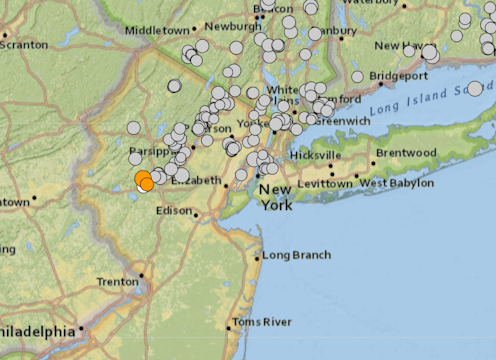
It’s rare to feel earthquakes in the U.S. Northeast, so the magnitude 4.8 earthquake in New Jersey that shook buildings in New York City and was felt from Maryland to Boston on April 5, 2024, drew a lot of questions. It was one of the strongest earthquakes on record in New Jersey, though there were few reports of damage. A smaller, magnitude 3.8 earthquake and several other smaller aftershocks rattled the region a few hours later. We asked geoscientist Gary Solar to explain what causes earthquakes in this region.
There are many ancient faults in that part of New Jersey that extend through Philadelphia and along the Appalachians, and the other direction, past New York City and into western New England.
These are fractures where gravity can cause the rock on either side to slip, causing the ground to shake. There is no active tectonic plate motion in the area today, but there was about 250 million to 300 million years ago.
The earthquake activity in New Jersey on April 5 is similar to the 3.8 magnitude earthquake that we experienced in 2023 in Buffalo, New York. In both cases, the shaking was from gravitational slip on those ancient structures.
In short, rocks slip a little on steep, preexisting fractures. That’s what happened in New Jersey, assuming there was no man-made trigger.
Magnitude 4.8 is pretty large, especially for the Northeast, but it’s likely to have minor effects compared with the much larger ones that cause major damage and loss of life.
The scale used to measure earthquakes is logarithmic, so each integer is a factor of 10. That means a magnitude 6 earthquake is 10 times larger than a magnitude 5 earthquake. The bigger ones, like the magnitude 7.4 earthquake in Tawian a few days earlier, are associated with active plate margins, where two tectonic plates meet.
The vulnerability of buildings to a magnitude 4.8 earthquake would depend on the construction. The building codes in places like California are very strict because California has a major plate boundary fault system – the San Andreas system. New Jersey does not, and correspondingly, building codes don’t account for large earthquakes as a result.
Earthquakes are actually pretty common in the Northeast, but they’re usually so small that few people feel them. The vast majority are magnitude 2.5 or less.
The rare large ones like this are generally not predictable. However, there will likely not be other large earthquakes of similar size in that area for a long time. Once the slip happens in a region like this, the gravitational problem on that ancient fault is typically solved and the system is more stable.
That isn’t the case for active plate margins, like in Turkey, which has had devastating earthquakes in recent years, or rimming the Pacific Ocean. In those areas, tectonic stresses constantly build up as the plates slowly move, and earthquakes are from a failure to stick.
This article, originally published April 5, 2024, has been updated with several smaller aftershocks felt in the region.

Gary Solar does not work for, consult, own shares in or receive funding from any company or organization that would benefit from this article, and has disclosed no relevant affiliations beyond their academic appointment.
Social media platforms have become more than mere tools for communication. They’ve evolved into bustling arenas where truth and falsehood collide. Among these platforms, X stands out as a prominent battleground. It’s a place where disinformation campaigns thrive, perpetuated by armies of AI-powered bots programmed to sway public opinion and manipulate narratives.
AI-powered bots are automated accounts that are designed to mimic human behaviour. Bots on social media, chat platforms and conversational AI are integral to modern life. They are needed to make AI applications run effectively, for example.
But some bots are crafted with malicious intent. Shockingly, bots constitute a significant portion of X’s user base. In 2017 it was estimated that there were approximately 23 million social bots accounting for 8.5% of total users. More than two-thirds of tweets originated from these automated accounts, amplifying the reach of disinformation and muddying the waters of public discourse.
Social influence is now a commodity that can be acquired by purchasing bots. Companies sell fake followers to artificially boost the popularity of accounts. These followers are available at remarkably low prices, with many celebrities among the purchasers.
In the course of our research, for example, colleagues and I detected a bot that had posted 100 tweets offering followers for sale.
Using AI methodologies and a theoretical approach called actor-network theory, my colleagues and I dissected how malicious social bots manipulate social media, influencing what people think and how they act with alarming efficacy. We can tell if fake news was generated by a human or a bot with an accuracy rate of 79.7%. It is crucial to comprehend how both humans and AI disseminate disinformation in order to grasp the ways in which humans leverage AI for spreading misinformation.
To take one example, we examined the activity of an account named “True Trumpers” on Twitter.

The account was established in August 2017, has no followers and no profile picture, but had, at the time of the research, posted 4,423 tweets. These included a series of entirely fabricated stories. It’s worth noting that this bot originated from an eastern European country.

Research such as this influenced X to restrict the activities of social bots. In response to the threat of social media manipulation, X has implemented temporary reading limits to curb data scraping and manipulation. Verified accounts have been limited to reading 6,000 posts a day, while unverified accounts can read 600 a day. This is a new update, so we don’t yet know if it has been effective.
However, the onus ultimately falls on users to exercise caution and discern truth from falsehood, particularly during election periods. By critically evaluating information and checking sources, users can play a part in protecting the integrity of democratic processes from the onslaught of bots and disinformation campaigns on X. Every user is, in fact, a frontline defender of truth and democracy. Vigilance, critical thinking, and a healthy dose of scepticism are essential armour.
With social media, it’s important for users to understand the strategies employed by malicious accounts.
Malicious actors often use networks of bots to amplify false narratives, manipulate trends and swiftly disseminate misinformation. Users should exercise caution when encountering accounts exhibiting suspicious behaviour, such as excessive posting or repetitive messaging.
Disinformation is also frequently propagated through dedicated fake news websites. These are designed to imitate credible news sources. Users are advised to verify the authenticity of news sources by cross-referencing information with reputable sources and consulting fact-checking organisations.
Self awareness is another form of protection, especially from social engineering tactics. Psychological manipulation is often deployed to deceive users into believing falsehoods or engaging in certain actions. Users should maintain vigilance and critically assess the content they encounter, particularly during periods of heightened sensitivity such as elections.
By staying informed, engaging in civil discourse and advocating for transparency and accountability, we can collectively shape a digital ecosystem that fosters trust, transparency and informed decision-making.

Professor Nick Hajli works for Loughborough University.

Large areas of concrete and asphalt absorb and radiate heat, creating an “urban heat island effect”. It puts cities at risk of overheating as they are several degrees warmer than surrounding areas.
One of the best ways to keep our cool is to maintain leafy streets, parks and backyards. But in some cities, trees are being chopped down faster than local councils can replace them. Some councils are also fast running out of land to plant trees.
Most of the damage happens on private land. Usually it’s a result of large blocks being subdivided or undeveloped land being opened up for more homes.
Cutting down trees for urban development is well within the law. But tree-protection laws are weaker in some parts of Australia than in others. To ensure our cities remain liveable, some laws will have to change.

Read more: In a heatwave, the leafy suburbs are even more advantaged
Beyond just providing shade, trees reflect heat into the atmosphere. They also cool the air by releasing water through pores in their leaves, acting like evaporative air conditioners.
Trees provide many other benefits such as removing pollutants, limiting erosion and improving public health.
The influential 3-30-300 rule for green cities, proposed by Dutch researcher Cecil Konijnendijk, states:
you should be able to easily see three trees from the window of your house or workplace
cities should have at least 30% overall tree cover
you should have a green space with trees within 300 metres (or a three-minute walk) of your house or workplace.

Read more: A solution to cut extreme heat by up to 6 degrees is in our own backyards
How do Australians cities stack up against the 30% canopy goal of the 3-30-300 rule?
Brisbane leads the way, with 44% of the City of Brisbane council area blanketed in trees. Hobart also makes the grade, with analysis of aerial imagery from Google showing a tree canopy of 34%.
Other cities have some work to do to meet the benchmark. Recent aerial image analysis shows Perth sitting at 22% cover.
The NSW Department of Planning reported Sydney’s canopy cover as 21.7% in 2022. The Victorian Department of Transport and Planning reported 15.3% canopy cover across metropolitan Melbourne in 2018.
Green Adelaide reports today that Adelaide’s canopy is a mere 17%. That’s worrying for a city so vulnerable to urban heat.
Read more: We're investing heavily in urban greening, so how are our cities doing?
While it can be tempting to compare canopy results, this needs to be approached with caution. The two main techniques for estimating tree canopy, airborne LiDAR (using laser sensing) and analysis of aerial photographs, can produce different results. Even LiDAR data from the same location but analysed at different resolutions can be quite different.
But what’s concerning is that some cities seem to be losing trees very rapidly. An analysis of aerial photographs by Nearmap shows Adelaide suburbs are fast losing trees. A 2021 Conservation Council report estimates Adelaide is losing about 75,000 trees per year across the city. Most are on private land.
Local councils have been planting several thousand trees each year, but are running out of places to plant them. Requirements for clear space on road verges and around powerlines pose major limitations.
If we want greener cities, we also need to take a critical look at the laws on tree removal.
Our team at the University of Adelaide produced a 2022 report on tree-protection laws across Australia. The state government commissioned us to verify a claim that South Australia’s tree-protection laws were the weakest in the nation. We compared state and local council regulations, and the claim turned out to be true.
One consideration is the size thresholds used to define trees as “regulated” or “significant”. Of the 101 metropolitan councils outside SA that we investigated, 78% considered trees with trunk circumferences of more 50cm deserving of legal protection. And 95% applied protection when circumferences exceeded a metre. In South Australia, only trees with twice that trunk size get any legal protection.
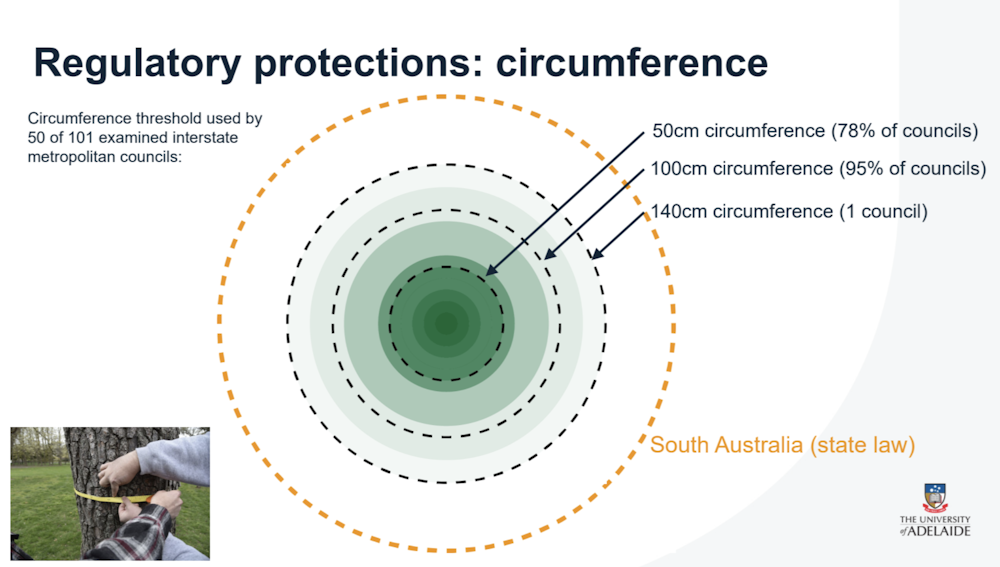
Another issue is distance exemptions. In South Australia, large trees that would otherwise be protected may be removed if they are within 10 metres of a house or pool. This rule is regularly used to clear entire residential blocks – after all, nearly all trees on suburban blocks are within 10m of a house or pool.
A majority of the interstate councils had no distance exemptions to speak of.
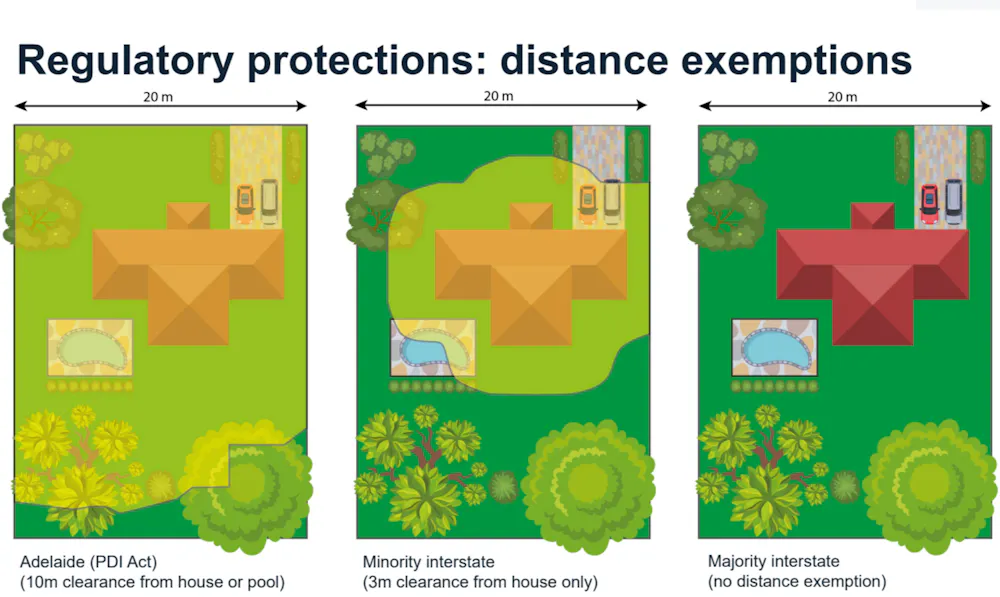
Read more: Out of alignment: how clashing policies make for terrible environmental outcomes
Our findings were among the drivers of a South Australian parliamentary inquiry. An interim report was released last October. It includes sensible, straightforward recommendations to improve the state legislation.
The report suggests reducing the circumference at which trees qualify for protection. It recommends adding crown spread as another criterion. It wisely recommends deleting the distance exemption.
The report also weighs in on fees and fines – the “bottom line” deterrents and punishments for doing the wrong thing. It recommends increasing the fee for legally removing “regulated” trees from $489 to $4,000, for example. However, the value that large trees provide to the community is regularly estimated at hundreds to thousands of dollars per year.
Similarly, a recommendation to introduce a $40,000 fine for illegally removing a “significant” tree pales in comparison to laws interstate. In NSW, illegally removing protected trees can incur fines of over $1 million. To deter big developers, fines must be larger than what they might regard as a reasonable “cost of doing business”.
The report’s recommendation to pay fines and fees into an Urban Forest Fund to grow canopy near areas of tree removal is a good one. Planting trees on the other side of town doesn’t help residents (or biodiversity) when trees are removed locally.
Read more: Climate change threatens up to 100% of trees in Australian cities, and most urban species worldwide
Adelaide’s climate is shifting from a temperate Mediterranean climate to a semi-arid one. Semi-arid climates are less able to grow many temperate plant species and tend to have less vegetation overall. To create an extensive and healthy tree canopy for future generations, we need to act fast and think critically about what we’re planting (and protecting).
We hope the South Australian government will follow the inquiry recommendations, so the state’s tree laws are on par with those of other states and cities.
Cities like Melbourne, which are also becoming warmer and drier, can look toward Adelaide as a future climate analogue. Urban planning is often about learning from other cities and adapting their strategies to local contexts.
To cope with the twin challenges of climate change and rapid urban growth, Australian cities need to work together to actively develop greening strategies. If we don’t, our cities will become hot, dry and barren.

Stefan Caddy-Retalic and Kate Delaporte have received funding from the South Australian Government, University of Adelaide and SA Power Networks to analyse urban forest data across Adelaide.
Kate Delaporte is employed by the University of Adelaide and receives funding from University of Adelaide and the Environment Institute. She is affiliated with TREENET Inc., the Friends of Waite Arboretum and the Friends of the Waite Conservation Reserve, and is a board member of the Playford Trust Inc.
Kiri Marker is affiliated with the University of Adelaide and has previously received funding from the Environment Institute.

Time and again, leading scientists, technologists, and philosophers have made spectacularly terrible guesses about the direction of innovation. Even Einstein was not immune, claiming, “There is not the slightest indication that nuclear energy will ever be obtainable,” just ten years before Enrico Fermi completed construction of the first fission reactor in Chicago. Shortly thereafter, the consensus switched to fears of an imminent nuclear holocaust.
Similarly, today’s experts warn that an artificial general intelligence (AGI) doomsday is imminent. Others retort that large language models (LLMs) have already reached the peak of their powers.
It’s difficult to argue with David Collingridge’s influential thesis that attempting to predict the risks posed by new technologies is a fool’s errand. Given that our leading scientists and technologists are usually so mistaken about technological evolution, what chance do our policymakers have of effectively regulating the emerging technological risks from artificial intelligence (AI)?
We ought to heed Collingridge’s warning that technology evolves in uncertain ways. However, there is one class of AI risk that is generally knowable in advance. These are risks stemming from misalignment between a company’s economic incentives to profit from its proprietary AI model in a particular way and society’s interests in how the AI model should be monetised and deployed.

The surest way to ignore such misalignment is by focusing exclusively on technical questions about AI model capabilities, divorced from the socio-economic environment in which these models will operate and be designed for profit.
Focusing on the economic risks from AI is not simply about preventing “monopoly,” “self-preferencing,” or “Big Tech dominance”. It’s about ensuring that the economic environment facilitating innovation is not incentivising hard-to-predict technological risks as companies “move fast and break things” in a race for profit or market dominance.
It’s also about ensuring that value from AI is widely shared, by preventing premature consolidation. We’ll see more innovation if emerging AI tools are accessible to everyone, such that a dispersed ecosystem of new firms, start-ups, and AI tools can arise.
OpenAI is already becoming a dominant player with US$2 billion (£1.6 billion) in annual sales and millions of users. Its GPT store and developer tools need to return value to those who create it in order to ensure ecosystems of innovation remain viable and dispersed.
By carefully interrogating the system of economic incentives underlying innovations and how technologies are monetised in practice, we can generate a better understanding of the risks, both economic and technological, nurtured by a market’s structure. Market structure is not simply the number of firms, but the cost structure and economic incentives in the market that follow from the institutions, adjacent government regulations, and available financing.
It is instructive to consider how the algorithmic technologies that underpinned the aggregator platforms of old (think Amazon, Google and Facebook among others) initially deployed to benefit users, were eventually reprogrammed to increase profits for the platform.
The problems fostered by social media, search, and recommendation algorithms was never an engineering issue, but one of financial incentives (of profit growth) not aligning with algorithms’ safe, effective, and equitable deployment. As the saying goes: history doesn’t necessarily repeat itself but it does rhyme.
To understand how platforms allocate value to themselves and what we can do about it, we investigated the role of algorithms, and the unique informational set-up of digital markets, in extracting so-called economic rents from users and producers on platforms. In economic theory, rents are “super-normal profits” (profits that are above what would be achievable in a competitive market) and reflect control over some scarce resource.
Importantly, rents are a pure return to ownership or some degree of monopoly power, rather than a return earned from producing something in a competitive market (such as many producers making and selling cars). For digital platforms, extracting digital rents usually entails degrading the quality of information shown to the user, on the basis of them “owning” access to a mass of customers.
For example, Amazon’s millions of users rely on its product search algorithms to show them the best products available for sale, since they are unable to inspect each product individually. These algorithms save everyone time and money: by helping users navigate through thousands of products to find the ones with the highest quality and the lowest price, and by expanding the market reach of suppliers through Amazon’s delivery infrastructure and immense customer network.
These platforms made markets more efficient and delivered enormous value both to users and to product suppliers. But over time, a misalignment between the initial promise of them providing user value and the need to expand profit margins as growth slows has driven bad platform behaviour. Amazon’s advertising business is a case in point.
In our research on Amazon, we found that users still tend to click on the product results at the top of the page, even when they are no longer the best results but instead paid advertising placements. Amazon abuses the habituated trust that users have come to place in its algorithms, and instead allocates user attention and clicks to inferior quality, sponsored, information from which it profits immensely.
We found that, on average, the most-clicked sponsored products (advertisements) were 17% more expensive and 33% lower ranked according to Amazon’s own quality, price, and popularity optimising algorithms. And because product suppliers must now pay for the product ranking that they previously earned through product quality and reputation, their profits go down as Amazon’s go up, and prices rise as some of the cost is passed on to customers.
Amazon is one the most striking examples of a company pivoting away from its original “virtuous” mission (“to be the most customer-centric company on Earth”) towards an extractive business model. But it is far from alone.
Google, Meta, and virtually all other major online aggregators have, over time, come to preference their economic interests over their original promise to their users and to their ecosystems of content and product suppliers or application developers. Science fiction writer and activist Cory Doctorow calls this the “enshittification” of Big Tech platforms.
But not all rents are bad. According to the economist Joseph Schumpeter, rents received by a firm from innovating can be beneficial for society. Big Tech’s platforms got ahead through highly innovative, superior, algorithmic breakthroughs. The current market leaders in AI are doing the same.
So while Schumpeterian rents are real and justified, over time, and under external financial pressure, market leaders began to use their algorithmic market power to capture a greater share of the value created by the ecosystem of advertisers, suppliers and users in order to keep profit growing.
User preferences were downgraded in algorithmic importance in favour of more profitable content. For social media platforms, this was addictive content to increase time spent on platform at any cost to user health. Meanwhile, the ultimate suppliers of value to their platform – the content creators, website owners and merchants – have had to hand over more of their returns to the platform owner. In the process, profits and profit margins have become concentrated in a few platforms’ hands, making innovation by outside companies harder.
A platform compelling its ecosystem of firms to pay ever higher fees (in return for nothing of commensurate value on either side of the platform) cannot be justified. It is a red light that the platform has a degree of market power that it is exploiting to extract unearned rents. Amazon’s most recent quarterly disclosures (Q4, 2023), shows year-on-year growth in online sales of 9%, but growth in fees of 20% (third-party seller services) and 27% (advertising sales).
What is important to remember in the context of risk and innovation is that this rent-extracting deployment of algorithmic technologies by Big Tech is not an unknowable risk, as identified by Collingridge. It is a predictable economic risk. The pursuit of profit via the exploitation of scarce resources under one’s control is a story as old as commerce itself.
Technological safeguards on algorithms, as well as more detailed disclosure about how platforms were monetising their algorithms, may have prevented such behaviour from taking place. Algorithms have become market gatekeepers and value allocators, and are now becoming producers and arbiters of knowledge.
The limits we place on algorithms and AI models will be instrumental to directing economic activity and human attention towards productive ends. But how much greater are the risks for the next generation of AI systems? They will shape not just what information is shown to us, but how we think and express ourselves. Centralisation of the power of AI in the hands of a few profit-driven entities that are likely to face future economic incentives for bad behaviour is surely a bad idea.
Thankfully, society is not helpless in shaping the economic risks that invariably arise after each new innovation. Risks brought about from the economic environment in which innovation occurs are not immutable. Market structure is shaped by regulators and a platform’s algorithmic institutions (especially its algorithms which make market-like allocations). Together, these factors influence how strong the network effects and economies of scale and scope are in a market, including the rewards to market dominance.
Technological mandates such as interoperability, which refers to the ability of different digital systems to work together seamlessly; or “side-loading”, the practice of installing apps from sources other than a platform’s official store, have shaped the fluidity of user mobility within and between markets, and in turn the ability for any dominant entity to durably exploit its users and ecosystem. The internet protocols helped keep the internet open instead of closed. Open source software enabled it to escape from under the thumb of the PC era’s dominant monopoly. What role might interoperability and open source play in keeping the AI industry a more competitive and inclusive market?
Disclosure is another powerful market-shaping tool. Disclosures can require technology companies to provide transparent information and explanations about their products and monetisation strategies. Mandatory disclosure of ad load and other operating metrics might have helped to prevent Facebook, for example, from exploiting its users’ privacy in order to maximise ad dollars from harvesting each user’s data.
But a lack of data portability, and an inability to independently audit Facebook’s algorithms, meant that Facebook continued to benefit from its surveillance system for longer than it should have. Today, OpenAI and other leading AI model providers refuse to disclose their training data sets, while questions arise about copyright infringement and who should have the right to profit from AI-aided creative works. Disclosures and open technological standards are key steps to try and ensure the benefits from these emerging AI platforms are shared as widely as possible.
Market structure, and its impact on “who gets what and why”, evolves as the technological basis for how firms are allowed to compete in a market evolves. So perhaps it is time to turn our regulatory gaze away from attempting to predict the specific risks that might arise as specific technologies develop. After all, even Einstein couldn’t do that.
Instead, we should try to recalibrate the economic incentives underpinning today’s innovations, away from risky uses of AI technology and towards open, accountable, AI algorithms that support and disperse value equitably. The sooner we acknowledge that technological risks are frequently an outgrowth of misaligned economic incentives, the more quickly we can work to avoid repeating the mistakes of the past.
We are not opposed to Amazon offering advertising services to firms on its third-party marketplace. An appropriate amount of advertising space can indeed help lesser-known businesses or products, with competitive offerings, to gain traction in a fair manner. But when advertising almost entirely displaces top-ranked organic product results, advertising becomes a rent extraction device for the platform.
An Amazon spokesperson said:
We disagree with a number of conclusions made in this research, which misrepresents and overstates the limited data it uses. It ignores that sales from independent sellers, which are growing faster than Amazon’s own, contribute to revenue from services, and that many of our advertising services do not appear on the store.
Amazon obsesses over making customers’ lives easier and a big part of that is making sure customers can quickly and conveniently find and discover the products they want in our store. Advertisements have been an integral part of retail for many decades and anytime we include them they are clearly marked as ‘Sponsored’. We provide a mix of organic and sponsored search results based on factors including relevance, popularity with customers, availability, price, and speed of delivery, along with helpful search filters to refine their results. We have also invested billions in the tools and services for sellers to help them grow and additional services such as advertising and logistics are entirely optional.

Our project at UCL, referenced in this article, was funded by Omidyar. I personally did not receive any compensation from this grant, but I believe that all of my co-authors did.
Ilan Strauss receives funding from The Omidyar Network through the UCL IIPP research project on algorithmic rents
Mariana Mazzucato received funding for this project from the Omidyar Foundation.
Rufus Rock received funding from the Omidyar Network whilst pursuing the research referenced in this piece.
The fear of witchcraft led to centuries of persecution and executions across Europe. While there were an estimated 500 executions in England, and between 3,000 and 4,000 killings in Scotland, only five people were hanged for witchcraft in Wales.
Early modern Wales was unique in its outlook on witchcraft. Distinct elements of Welsh culture, including superstition and religion, halted the witch trials seen across the rest of Britain and Europe.
In fact, the witch is steeped in Welsh culture. There is speculation among some researchers that the traditional tall, black hat of the Welsh woman served as inspiration for the wide-brimmed hat of the fairy tale witch. Yet Wales saw no witch hunt. So, what are the reasons behind the lack of prosecutions in Wales?
It’s not that Welsh people had no fear of witchcraft or of supernatural harm – they did. But this fear usually played out in arguments among neighbours and family members, amounting to little more than name-calling.
There were other factors, such as the preference for unreformed religion. And the people’s reliance on wise women and soothsayers who could cure sickness and find missing items, and the ever-present influence of old beggar women, meant witchcraft was less poised to be brought to the attention of the courts. When it did very occasionally come to trial, it was usually dismissed.
Welsh court records dating from the 16th century onward are held at the National Library of Wales. We know from those trial records that suspicions and verbal accusations of witchcraft like those seen across the rest of Britain and Europe were common in Wales. They also happened under similar circumstances where accusations often followed an argument, or a request for charity which was denied.
In the records, there are bitter arguments between neighbours and family members. Horses are killed, cattle are bewitched, pigs perish, men and women are injured, there are miscarriages and even murders. Most of the time, when someone was accused of being a witch, they were accused by other people in the community. Their accusers were neighbours, relatives and in many cases, people with financial and personal reasons to make accusations.
For a long time, Wales has been seen by outsiders as a land of magic, superstition and the supernatural. English men and women sometimes travelled into Wales looking for consultations with enchanters and soothsayers.
Women in Wales even looked like witches. They tended to dress in long, heavy woollen skirts, aprons, blouses and large woollen shawls. Most peasant women would have brewed mead and ale. They would have let their community know that there was ale for sale by placing some form of signage outside their cottages. The most popular and well-remembered of these signs was a broomstick.
There are similarities between average Welsh women and the witches written about in early modern literature such as the Malleus Maleficarum, written by a German Catholic clergyman in 1486. These similarities, such as appearance, unreformed religion and tendency to rely on charms and herbs, painted a picture of Wales as a magical land rife with witchcraft. This left juries in early modern Wales in serious doubt about how sensible witch accusations were.
The people of Wales were not without religion, but they preferred prayer to doctrine. This was perhaps as a result of language barriers. Generally, Welsh people could not read or understand the Bible, which was not fully translated into Welsh until the late 1500s.
Rather than conforming to the Protestant worship indicated by the reformed church, Welsh tradition preferred to worship within the household in ways that mimicked Catholic practices. There is evidence that many people continued to seek the aid of charmers instead of the church. And so Elizabethan and Stuart politicians frequently spoke about the religious “ignorance” in Wales.
The church in Wales also took part in practices some would describe as witchcraft. There was even a strong medieval tradition of cursing by clerics. This sort of formal cursing was often phrased as a petitionary prayer to God, emphasising the overlap between witchcraft and religion in Wales. Parsons were also responsible for writing protective prayers.
It was perhaps for this reason that religious radicals in the south of England saw Wales, as well as Cornwall and the north of England, as “dark corners of the land”. Religious ignorance, superstition and residual Catholicism all contributed to a view of Wales as rife with magic and mystery.
Both charms and curses across Wales contained Christian references and quotations taken from the Bible, showing the overlap between different belief systems. In many Welsh charms and curses, small crosses are written in the margins, indicating the need to perform the symbol of the cross.
Read more: Five witchcraft myths debunked by an expert
A charm shared by Gwen ferch Ellis, the first woman to be hanged for witchcraft in Wales, included the words “Enw'r Tad, y Mab, a’r Ysbryd Duw glân a’r tair Mair” (translated as “the Father, the Son and the Holy Spirit of God, and the three Marys”). Her execution was probably a result of having crossed the wrong people, who had enough influence to sway the assize judges.
Ultimately, there is no one reason that Wales never saw a witch hunt. Wise women, cunning folk and soothsayers were highly regarded in Wales, using “magic” to perform important services for the community. Even clerics were part of this ritual of charming and cursing.
Whether they were brewing, cursing, charming or soothsaying, in Wales, the people accused were rarely doing anything out of the ordinary. While fear of the supernatural was rife among common people, it seems Welsh juries tended to be more concerned with prosecuting theft than witchcraft.

Mari Ellis Dunning does not work for, consult, own shares in or receive funding from any company or organisation that would benefit from this article, and has disclosed no relevant affiliations beyond their academic appointment.
What makes a person beautiful has fascinated artists and scientists for centuries. Beauty is not, as it is often assumed to be, “in the eye of the beholder” – but follows certain predictable rules. Symmetry and proportions play a role, and though culture and norms shape our perception of beauty, researchers observe a consistently striking agreement among people on whom they regard as beautiful.
Not surprisingly the beauty market has been on a steady rise (besides a minor 2020 Covid slump), reaching $430 billion in revenue in 2023, according to a recent McKinsey report. The fascination for the perfect makeup or skincare is fired up by the impact of perfect faces displayed on social media and enhanced by image processing and filters. But is all this money well spent?
The short answer is: yes. In today’s fiercely competitive job market, the economic advantages of beauty are undeniable. Numerous studies have shown that attractive individuals benefit from a beauty bonus and earn higher salaries on average. Certain high-paying professions are built around beauty (such as show business) but what is more surprising is that for almost any kind of employment, beauty can lead to a positive halo effect. Beautiful individuals are consistently expected to be more intelligent and thought to be better leaders, which influences career trajectories and opportunities.
It is thought individuals perceived as beautiful are also more likely to benefit from people’s trust, which makes it easier for them to get promoted or to strike business deals. The idea is that individuals who look better are thought to be healthier or/and to have had more positive social interactions in their past, which might influence their trustworthiness.
But does that theory hold water? In our recent paper Adam Zylbersztejn, Zakaria Babutsidze, Nobuyuki Hanaki and I set out to find out. Previous studies presented different portraits of individuals to observers and asked them about their beliefs about these people. However, often these pictures are taken from portrait databases or even computer generated, and thus allow researchers to study perceptions but not whether these beliefs are accurate. To study this question, we needed to develop an experimental paradigm in which we could observe the trustworthiness of different people, take photos of them, and later present these photos to other individuals for rating. This is how we did it.
Comprising a total of 357 volunteers, our study started in Paris in October 2019, where we asked a first group of 76 volunteers to participate in a short experiment on economic decision-making. In the study, the participants were randomly matched into pairs without knowing with whom they were playing. Some played a role that required to trust another individual (Group A), while others were in a position to reciprocate or break the trust they had received (Group B). To heighten the stakes, real money was on the table.
It went like this: in a first stage, Player A had to choose whether to trust Player B (by saying “Right”) or not (by saying “Left”). Secondly, Player B had to decide whether to roll a dice or not.
Each player’s payoff thus depended on their own actions and/or the actions of the other player:
If player A chooses “Left”, then regardless of player Bs’ choice:
If player A chooses “Right” and player B chooses “Don’t roll”:
If player A chooses “Right” and player B chooses “Roll”:
Group A participants could earn up to 12 euros, but only if they trusted the other player. To do so they were presented with the abstract choice scenario explained above while individually sat in a cubicle.
If they decided not to trust, they were sure to receive a meagre 5-euro payout for their participation in the study. However, once an A player decided to trust their B partner, their fate was in the B player’s hands. The latter could act in a trustworthy fashion by rolling a dice that promised to generate a 12-euro gain for the A player – or untrustworthy by claiming a 14-euro reward for themselves and leaving nothing for the others.
This type of game (called a “hidden action game”) has been previously developed as a measure of the selfless trustworthiness attitude of individuals.
We not only observed how participants acted in this game but also took neutral ID pictures of them before they were introduced to the task. These photographs were presented to 178 participants recruited in Lyon. We first made sure that none of these individuals knew each other. We then gave the participants in Lyon the task of trying to predict how the person they saw in the picture behaved in the game. If they were right, they would be rewarded by earning more money for their participation. We finally showed the same photographs to a third group of 103 people from Nice, in southern France. These individuals were asked to rate how beautiful they considered the faces in the pictures.
Our results confirm that those people who are considered to be more beautiful by our raters are also believed to be much more trustworthy. This implies that in our abstract economic exchange, beautiful individuals are more likely to benefit from the trust of others. However, when investigating actual behaviour, we see that beautiful individuals are neither more nor less trustworthy than anyone else. In other words, trustworthiness is driven by good old individual values and personality, which are not correlated with how someone looks.
A beauty premium has been previously observed as well for men as for women. We might however suspect that women, who are generally believed to have a higher degree of social intelligence, might be better at determining the trustworthiness of their partners. Our results do not show any evidence of this. Women are on average rated as more beautiful and also rate others on average as more beautiful. However women do not act any more honourably in the game then men. Finally men and women agree in their expectations about who will be acting trustworthy or not and thus women are no better in predicting behaviours than men.
The adage that “not everything that glitters is gold” is thus also true for beauty in humans. However, we might wonder who is more likely to fall prey to this bias. One idea is that people who are themselves often treated favourably because of their looks might be aware that this is not something that should influence who you should trust.
We constructed our study such that we could also investigate this question. Specifically, the participants we recruited in Lyon to make their predictions also had their photos taken. We thus knew how much they were influenced by the looks of others but also how conventionally good-looking they were themselves. Our results are clear. The beauty bias is there for everyone. Though we might think that those who benefit from good looks can see behind the mask, they are as much influenced by the looks of others upon deciding whom to trust.
The beauty industry is thus right. Investing in beauty really is worth it because it creates real benefits. However, recruiters or managers should guard themselves against being fooled. One way of doing this is to make CVs anonymous and forbid photos in applications. But in many interactions, we see people who we have to decide to trust. Being aware of one’s bias is therefore crucial. Our results stress that this bias is very hard to overcome, since even individuals who from their own experience should be aware of beauty’s skin-deep value fall prey to it.

Astrid Hopfensitz ne travaille pas, ne conseille pas, ne possède pas de parts, ne reçoit pas de fonds d'une organisation qui pourrait tirer profit de cet article, et n'a déclaré aucune autre affiliation que son organisme de recherche.

People may think weight stigma only manifests as rude comments, is harmless or can even do some good.
At worst, it means overt discrimination, for example if somebody isn’t hired for a job because of their weight. But the reality is that weight stigma is often insidious, and pervasively entrenched into our society and environment. Based on data from nearly a thousand people, we show that weight stigma doesn’t have to be malicious or targeted directly at a person to cause harm.
Recurrent and commonplace discriminatory acts that demean members of stigmatized groups are called microaggressions. The impacts of microaggressions have been described as “death by a thousand cuts,” referring to how seemingly minor incidents, when repeated cumulatively, contribute to real harm.
With combined input from reports of lived experiences, expert testimony and large studies with diverse samples, we identified four main types of fat microaggressions.

Direct microaggressions are the ones that most people might think of: rude remarks, being laughed at or publicly shamed on social media, being excluded from activities with friends or family, or having people make assumptions about them, for example, that they couldn’t possibly be in a loving relationship with a conventionally attractive partner.
The built environment can also be a source of direct microaggressions, such as at sporting events, theatres or restaurants where the seats are not wide or sturdy enough.
Indirect microaggressions are slights not targeted directly at an individual, but whose effects are still felt. Think fat jokes, unintelligent, gross, and/or unattractive fat characters on TV and in movies (like “Fat Monica” from Friends or Gwyneth Paltrow’s character in Shallow Hal), and thin friends complaining they “feel fat” in front of a larger person and commenting on how much they hate their bodies.
Our data confirm that indirect microaggressions are the type most experienced by fat people — they invade every aspect of daily life and remind fat people that they are not viewed as OK.

One type of direct microaggression that emerged as its own category in our analysis was clothing exclusion. Stores typically have far fewer options in larger sizes, or they are less stylish, yet cost more. It is also common to see clothing in stores with claims that “one size fits all,” that really don’t.
Limited choices for larger bodies send a message that they are not deserving or worthy of clothing to which others have access. But fat people still must turn up to work, social events, weddings, with sometimes the only purchasing criteria being, “does it fit?”
Easily overlooked by those who have endless options, selecting clothing is an everyday decision that can impact how fat people express themselves, how comfortable they feel in their bodies, as well as how the world sees them.
Fat activists have also long recognized that clothing exclusion acts as a proxy for other societal forms of erasure, in that the more standard options fail you, the more you are likely facing other forms of everyday oppressions.
The other specific type of direct microaggression that was prominent in the lived experience of fat people is something we call “benevolent weightism.” These are the often (although not always) well-meaning suggestions of diets and other weight-loss strategies that friends, family, co-workers and even total strangers feel obliged to share with fat people.
You would be hard-pressed to find a fat person who has not tried multiple weight-loss methods, only to end up unsuccessful and feeling worse about themselves than ever.
Science tells us this is not about willpower. Indeed, the most likely outcome of weight-loss attempts is weight regain, and usually, weight rebound above your initial starting point. Studies that show otherwise are often methodologically flawed and frequently misleading in their headline messaging. It is perhaps, then, no coincidence that rises in obesity rates have paralleled attempts to make our populations thinner with the promotion of weight as an indicator of health.

Across four studies, we established the prominence of fat microaggressions in the lives of fat people and linked experiencing fat microaggressions to poorer mental health, such as greater stress, anxiety and depression, and worse self-esteem. Fat microaggressions were even associated with discrimination-related trauma symptoms, including feeling on edge or constantly on guard, fearing embarrassment or feeling isolated from others.
Experiencing fat microaggressions was also connected to avoidant coping strategies, such as not attending social events, avoiding eating in front of others or going to the gym, and fear of seeking advancement in education and employment. This avoidance can lead to the accumulation of worse life outcomes and additional negative health effects.
Importantly, these findings were consistent for all the different types of microaggressions, including simply observing weight stigma directed at others and those meant to be helpful.
Microaggressions often seem trivial. But every single microaggression, however well meaning, is a small violation of feeling safe in the world and cumulatively creates a hostile environment, putting targets under constant stress and vigilance, anticipating future microaggressions.
Greater awareness and recognition of fat microaggressions is an important first step to confronting them. Understanding their harm may lead us to think twice before engaging in fat talk, sharing fat jokes and memes, or providing unsolicited diet advice. If you really are concerned about health, do not tell fat people they need fixing; these microaggressions make people’s health worse, not better.
Beyond this, speak up when you see these occurrences, and advocate for greater seating accessibility and better clothing options for people in larger bodies. Vote with your wallet when companies engage in fat shaming or exclusion. Challenging anti-fat attitudes when they manifest in these other ways is key to a more inclusive and less harmful world.

Angela Meadows has received funding from the Social Sciences and Humanities Research Council of Canada.
Megan Lindloff and Rachel Calogero do not work for, consult, own shares in or receive funding from any company or organisation that would benefit from this article, and have disclosed no relevant affiliations beyond their academic appointment.
Howdy everyone,
Today’s house, built in 2001, comes to you from, you guessed it, the Chicago suburbs. The house is a testimony to traditional craftsmanship and traditional values (having lots of money.) The cost of painting this house greige is approximately the GDP of Slovenia so the owners have decided to keep it period perfect (beige.) Anyway.

This 5 bedroom, 7.5 bathroom house clocks in at a completely reasonable 12,700 square feet. If you like hulking masses and all-tile interiors, it could be all yours for the reasonable price of $2.65 million.

The problem with having a house that is 12,700 square feet is that they have to go somewhere. At least 500 of them were devoted to this foyer. Despite the size, I consider this a rather cold and lackluster welcome. Cold feet anyone?

The theme of this house is, vaguely, “old stuff.” Kind of like if Chuck E Cheese did the sets for Spartacus. Why the dining room is on a platform is a good question. The answer: the American mind desires clearly demarcated space, which, sadly, is verboten in our culture.

The other problem with a 12,700 square foot house is that even huge furniture looks tiny in it.

Entering cheat codes in “Kitchen Building Sim 2000” because I spent my entire $70,000 budget on the island.

Of course, a second sitting room (without television) is warranted. Personally, speaking, I’m team Prince.

I wonder why rich people do this. Surely they must know it’s tacky right? That it’s giving Liberace? (Ask your parents, kids.) That it’s giving Art.com 75% off sale if you enter the code ROMANEMPIRE.

Something about the bathroom really just says “You know what, I give up. Who cares?” But this is not even the worst part of the bathroom…

Not gonna lie, this activates my flight or fight response.

If you remember Raggedy Ann you should probably schedule your first colonoscopy.
Anyways, that does it for the interior. Let’s take a nice peek at what’s out back.

I love mowing in a line. I love monomaniacal tasks that are lethal to gophers.
Alright, that does it for this edition of McMansion Hell. Back to the book mines for me. Bonus posts up on Patreon soon.