Shared posts

18 Apr 14:52

Library Consortium Tests Interlibrary Loans of e-Books

by Blake

http://chronicle.com/article/Library-Consortium-Tests/144743/
Worried about security and sales, many publishers and vendors permit individual e-book chapters to be shared but don’t routinely include the lending of whole e-books in library contracts. Even when licenses do allow e-book lending, libraries typically lack the technology to make it work. You can’t just pop an e-book into an envelope and ship it off by delivery van or the post office.

But lending e-books may soon get easier. This spring a pilot project called Occam’s Reader will test software custom-built to make it both easy and secure for libraries to share e-book files while keeping publishers happy—or so the software’s creators hope.

17 Apr 20:08

HOWTO make your own head-in-a-jar illusion

by Cory Doctorow

By photoshopping a pair of mirror-flipped profile-shots of your face onto either side of a full-on shot, you can make a gimmicked photo that, when curled and placed in a jar of water, creates a convincing illusion of your head in a jar. Mikeasaurus's Instructable has easy-to-follow instructions for making your own.


You'll need a jar large enough to hold your picture. I got this 5 litre glass jar at my local hardware store for $15.

Filling the jar about halfway with water, I used a mix of yellow, orange, and green liquid food dye I tinted the water to resemble a preserving solution. Just like in the vintage science fiction movies.

Curling the laminated printout to fit through the jar neck the sheet was inserted, the jar was then topped off with water until full. The jar was then sealed. The head in a jar was now ready to be placed inside the fridge to prank hungry foragers.

Since the solution reminded me of brine solution I decided to add a few hard boiled eggs to my head jar for fun.

Head in a jar prank by mikeasaurus (via Crazy Abalone)


25 Mar 18:32

FIRST of all, THIS is why you should never trust publishers

by Michael Eisen

When President Obama announced last year that he was requiring federal agencies that fund science to develop policies to make papers arising from the work they publish freely available to the public, major subscription-based publishers responded in a generally favorable manner – reflecting the extent to which they had drawn the White House back from more aggressive proposals on the table. They even put forth a proposal – called CHORUS (Clearinghouse for the Open Research of the United States) through which they offered to implement  these public access policies for federal agencies – providing free access to articles on their own websites.

wrote at the time about why CHORUS was a ruse, that would never work. In particular, I warned that, despite their public veneer of support, publishers would continue to work to reverse these public access policies, and, because with CHORUS they would never have to give up control of published papers, they could just turn off public access if they ever succeeded.

Well, they’re trying to do just this. Last week a bill was introduced – The Frontiers in Innovation, Research, Science and Technology (FIRST) Act of 2014 – a section of which (Section 303) is designed to undermine this already fairly weak policy. The language is a bit dense and confusing, but here is what it would do.

  • The surest way to kill a policy initiative in DC is to call for more study. FIRST calls for 18 additional months of study of public access policies, specifically calling for “data-driven” justification for embargo periods. This is language publishers have used before and is code for “set embargo periods so that they do not harm the bottom line of publishers”.
  • It calls for the use of existing infrastructure, including the NLM, but also in the private sector, and minimizing the burden of providing access – things that the publishers use to promote CHORUS
  • It weakens the embargo period to 24 months from its already unacceptably long 12 months, and allows for agencies to EXTEND this period for up to an additional year

I don’t have direct evidence that publishers are behind this, but it echoes all the main talking points they’ve been using to complain about public access. It’s not clear how far this will go, since this is just the House version of the bill, and the Senate version has not emerged. But it’s worth using the tools available through SPARC to voice your opposition to this bill.

11 Mar 11:31

Queen Elizabeth I

by Ana Galvañ
Isabel I de Inglaterra. Muestra de un encargo para el libro: Women Rulers of History de la editorial Belly Kids. Más imágenes aquí: www.anagalvan.com/Queen-Elizabeth-I 

Queen Elizabeth I. Illustrations for a forthcoming book titled 'Women rulers of history'. Belly Kids publishers. More images here: www.anagalvan.com/Queen-Elizabeth-I 


Ps: www.anagalvan.com
www.facebook.com/AnaGalvanPage
twitter.com/AnaGalvan666
anagalvandrawings.tumblr.com
07 Mar 15:39

Want to read the IPKat at 1,000 words per minute? Spritz it…

by noreply@blogger.com (Darren Meale)
Leettaschmidt

This is genius!

This one is about a new piece of technology that might very well change the way we read on a screen, something most lawyers spend rather a lot of time doing these days. In writing it up I may stray into a little bit of tech blogging, but if Eleonora can get away with a touch of celebrity blogging, then why not.

Spritz is a remarkable piece of technology which takes written content and sort of streams it to the reader from a single spot on a desktop, tablet or mobile screen, word by word. The technology identifies the “Optimal Recognition Point” of a word (apparently the point in the word which our eyes and brains focus on to recognise it) and centres the word in the stream accordingly. By doing so, it cuts out the estimated 80% of reading time we spend moving our eyes from word to word and further optimises the reading experience. The makers, Spritz Technologies, Inc, are seeking patent protection for the technology around the world.

The technology really needs to be experienced to be understood, so hopefully these animated gifs will assist (if they don't work on your device, I highly recommend having a look at the next link). This gif shows the tech at 250 words per minute, a starting speed: 

This next one is 500 words per minute, and one can apparently get up to around 1,000:

You can get more Spritz-ing practice on the company’s website.

It looks like the plan for the technology is to roll it into apps designed to serve the ever-more popular mobile and device market, where small screens tend to limit the traditional presentation of text and other information. It takes only a little imagination to consider the possibilities, with integration into any of the new and forthcoming wearable technologies an obvious starting point.

What does this have to do with intellectual property? There is the patent angle: the patent linked above features 85 claims many of which will need to be considered in light of the limitations on patenting methods for performing mental acts (ie, reading) and computer programs in some jurisdictions (including Europe). Spritz is also another example of a clever piece of technology that looks to change the way the consumer interacts with existing content. This is just the sort of technology that so frequently comes into conflict with copyright law, as an ever growing list of case law demonstrates. In Europe, we’ve had TVCatchup (a service which allows consumers to watch "live" streams of free to air of television broadcasts on their computers and smart phones); its parallel in the US in Aereo; the great Meltwater saga (concerning an online news monitoring service; which has considered the legality of internet browsing); and Svensson (which looked at online linking), not to mention the great Google Books debate. I could go on. These are all difficult cases, because they generally seek to apply laws which years later have to be gently massaged or painfully twisted to fit a technology which no one had thought about when the laws were made. All very interesting for lawyers, but a challenge for the entrepreneurs and inventors who keep coming up with (and commercialising) these ideas.

07 Mar 15:25

America's top 99 problems

by Rob Beschizza
Max Read ranks the nation's problems in order of severity: "5. A loss of perspective on what is and is not important."


06 Mar 16:06

The Supernatural Bunnymother of Surrey

Listen to this episode

The men from London arrived just in time to see Mary Toft give birth to her fifteenth rabbit.

It was the winter of 1726, and Nathaniel St. André and Samuel Molyneux arrived in the market town of Godalming in Surrey to meet Mary Toft, a short, stout peasant of “stupid and sullen temper” (per St. André’s later, embittered description). They found the country-woman waiting at the house of local man-midwife John Howard. She was lingering on the edge of a bed, stripped down to her corset. Howard assured the Londoners that they had come just in time.

Soon Mary Toft’s body began to twist and contort. Her throes could be so powerful that her clothes would fly off her body, and the woman would have to be held down in her chair. Sometimes the labors lasted up to a day and a half. Toft’s belly would “leap,” a phenomenon Howard thought was caused by baby rabbits jumping around inside Toft’s uterus. One was observed to hop like this for eighteen hours.

But that winter day, the labor was not prolonged, and soon Toft had delivered her child–the skinned torso of a small rabbit. The men from London started dissecting it right there on the floor. St. André–surgeon anatomist to the King of England himself–took a section of lung and put it in a basin of water. It floated, showing that the lungs had air in them, which suggested that the creature had breathed before it died. The rabbit’s anus was found to have feces in it, which meant that the small animal must have eaten something. There was no blood.

St. André then turned his attention to the mother, who had been waiting patiently by the fire. He found that one breast produced a thin, watery milk. After palpating Mary’s stomach, St. André found a hard lump in the woman’s right side. From this he concluded that the rabbits had been bred in Toft’s fallopian tubes, after which they had hopped down to her uterus, where they developed. With no prospect of another birth any time soon, the men retired.

In the evening Mary Toft fell into convulsions again–this time so violent she had to be held in her chair. “After three or four very strong Pains that lasted several minutes, I delivered her of the skin of the rabbet, rolled and squeezed up like a Ball,” St André wrote later. The rabbit’s head came soon after, complete except for one ear.

Satisfied, St. André and his companion Molyneux returned to London with some of Mary’s purported offspring, preserved by Howard in jars of alcohol. By the end of the year, all of England–even King George I himself–would know about the woman who had given birth to rabbits.

Continue reading ▶

03 Mar 18:53

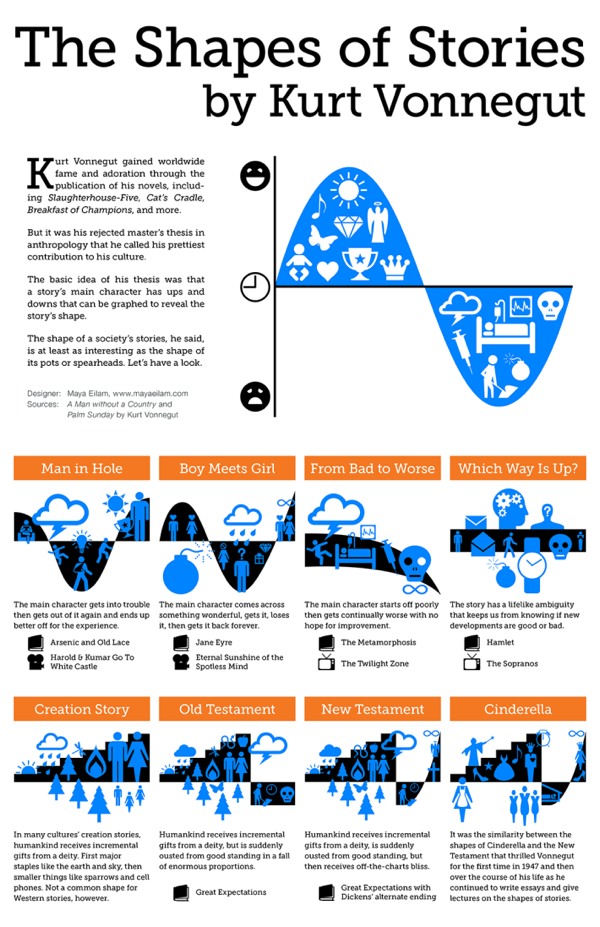
Kurt Vonnegut's Shapes of Stories in infographic form

by Mark Frauenfelder


A nice infographic by Maya Eilam. She's going to offer this as an 11 x 17 print! (Via This isn't Happiness)


03 Mar 18:37

Librarybox beta goes 2.0: self-powered Wifi file-server that fits in your pocket

by Cory Doctorow


Jason writes with an update to the amazing, kickstarted Librarybox project: "The LibraryBox Project, as a part of its ongoing efforts to bring information to areas without communication infrastructures, announced the release of the v2.0 public beta today. Boing Boing was kind enough to post about the very successful Kickstarter from July and this is the next stage of the project arising from that funding.

"LibraryBox is an open source digital distribution device, designed to route around both censorship and poor infrastructure by creating a hyperlocal digital file distribution point for use by libraries, educators, or anyone who wants to share files quickly and easily. The v2.0 release makes building your own LibraryBox easier than ever, while increasing the customizability and flexibility of the interface."

LibraryBox v2.0: Portable Private Digital Distribution (Thanks, Jason!)


03 Mar 18:33

Forgotten Foods: reviving weird old food and figuring out what should be brought back

by Cory Doctorow


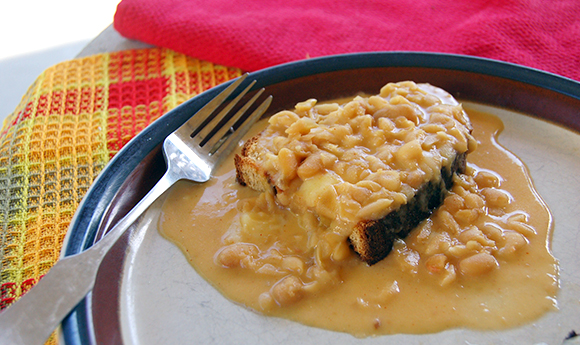
Meg Favreau writes, "I thought you guys might be interested in this column I've been writing for the last year-ish -- I scour old cookbooks for once-popular recipes that have fallen out of favor, explore the (often weird) history of the food, and provide a recipe. Favorites include Welsh rarebit (the OG bachelor food, cooked in proto-microwave chafing dishes, and known for causing dreams so batshit that Little Nemo creator Winsor McCay did a long-running strip just about rarebit nightmares), beef tea (the chicken soup of its day, which tastes like hamburger water in the best way), and a Halloween about a booklet that juxtaposes candy recipes with testimonials about feminine ills (That ended up being posted on Table Matters' non-food sister site).

And if the chafing dish is the lady, Welsh rarebit is its lord. The Bachelor and the Chafing Dish actually says exactly that, describing, “toasted or cooked cheese” – the base of rarebits – as “the king of the chafing-dish.” 1900′s The Bachelor Book, meanwhile, notes that Welsh rarebit is an excellent after-theater food, and says this about serving the rarebit in perfect bachelor style:

If there is one bachelor there should be one pretty girl, two bachelors, two pretty girls, ad infinitum, to say nothing about the chaperone, who may be pretty or ugly so long as she is shortsighted and harmonizes with your decorations.

But having an excuse to hang out with pretty ladies (“Hey baby, wanna come back to mine for some hot cheese sauce?”) isn’t the only reason why Welsh rarebit was eaten as an evening food. See, Welsh rarebit was traditionally served as what Taco Bell has tried to tactfully call FourthMeal – late-night drunk food. It has all the hallmarks of today’s post-bender eats – cheesy, fatty, with plenty of bread to soak up the booze. (OK, I don’t think that actually works, but it’s what I’ve tried to convince myself was happening every time I’ve had a misguided late-night burger.) What’s interesting about Welsh rarebit’s typical late-evening consumption, though, is that the dish is also supposed to induce absolutely batpoop-crazy dreams.

Forgotten Foods (Thanks, Meg!)


21 Feb 20:29

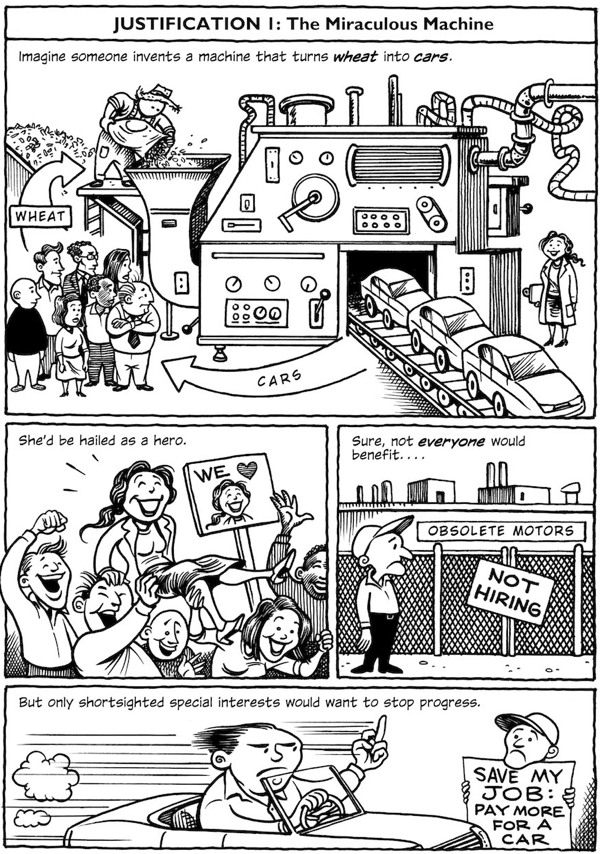
Comic book explains why the Transpacific Partnership serves no one but the ultra-rich

by Mark Frauenfelder

In 2012 I reviewed Economix, a terrific cartoon history of economics by Michael Goodwin and illustrated by Dan E. Burr. (After reading it, I bought a few copies of the book to give as gifts.)

Today, Michael emailed to let me know that he and Dan have posted an excellent and free 27-page online comic called The Transpacific Partnership and "Free Trade," which describes how the negotiated-in-secret treaty is a "global coup that's disabling our democracies and replacing them with multinationals and Wall Street," and is making the US "police state more extensive, more restrictive, and global."


21 Feb 20:05

Prepare yourselves. Dr. Steve Brule's television show is returning for a third season.

by Xeni Jardin


Dr. Steven Brule, local cable news personality.

[Video Link]. Here are some clips from the upcoming third season of Check it Out! with Dr. Steve Brule, starring John C. Reilly, and created by Tim and Eric. The new season premieres on Adult Swim Feb. 27, at 12:30 a.m. ET / PT.

Buy seasons 1 and 2 here, if you're not already hip to it. This show is not for everyone, but it is for everyone who is cool and knows what is truly funny. That is why it is my favorite funny show. If you do not agree, you are a big dummy.

There's a longer version of the preview here. And for those truly obsessed, Eric Wareheim has been posting other little video snippets to Instagram and Vine and Facebook.

For those in Los Angeles, there's a free season 3 premiere and screening on Sunday, Feb. 23rd, 10pm at the Vista Theater.


Only hunks fly pranes. I have a prane, too. It's no big deal. Who cares?


An exclusive behind-the-scenes shot of Dr. Steve Brule's home life.


Dr. Brule advises you to "Check Out" his new show on Adult Swim.


21 Feb 20:01

Will US condemn UK for using terrorism laws to suppress journalism?

by Trevor Timm


Journalist Glenn Greenwald after being reunited with his partner, David Miranda, in Rio de Janeiro's International Airport after British authorities used anti-terrorism powers to detain Miranda. RICARDO MORAES/REUTERS

In a disturbing ruling for democracy, a lower court in United Kingdom announced today that the detainment of journalist Glenn Greenwald’s partner David Miranda was lawful under the Terrorism Act, despite the fact that the UK government knew Miranda never was a terrorist. This disgraceful opinion equates acts of journalism with terrorism and puts the UK on par with some of the world’s most repressive regimes. Miranda has vowed to appeal the ruling.

Glenn Greenwald has much more on what this means for press freedom, but I’d like to expand on one particular point:

Over the past several years, the US State Department has publicly criticized several governments for using overly-broad terrorism laws against journalists and has even claimed its their policy to oppose “misus[ing] terrorism laws to prosecute and imprison journalists.” As we pointed out a couple months ago, they have criticized Turkey, Ethiopia, Morocco, and Burundi all within the past year.

Just last week, the State Department harshly criticized Egypt for detaining over twenty Al-Jazeera journalists and charging them under the regime’s terrorism statute. A State Department spokesman said, Egypt’s "targeting of journalists and others on spurious claims are wrong and demonstrates an egregious disregard for the protection of basic rights and freedoms.” She continued: "any journalist, regardless of affiliation, must not be targets of violence, intimidation or politicized legal action. They must be protected and permitted to freely do their jobs in Egypt."

Will the US State Department condemn very similar behavior by one of its closest allies, the United Kingdom? Sadly, in November when the UK first made its argument in court, the State Department refused to comment when asked about its stance by the Guardian's Paul Lewis. Now that a court has ruled in the UK’s government favor, it’s time for the State Department to speak out.

With the ruling, the UK government has vastly widened the definition of terrorism to include ensnare people who have not committed violence, who have no intention to commit violence, and who aren’t even associated with people who intend to commit violence. The lower court essentially agreed with the government’s warped definition it put forth in court documents in November:

"Additionally the disclosure, or threat of disclosure, is designed to influence a government and is made for the purpose of promoting a political or ideological cause. This therefore falls within the definition of terrorism..."

Under the UK government’s logic, several Guardian reporters and editors could also be guilty of engaging in “terrorism”, and as well as New York Times or Pro Publica journalists who have received the same news-worthy documents for publication. In fact, if publishing or threatening to publish information for the purpose “promoting a political or ideological cause” is "terrorism," than the UK government can lock up every major newspaper editorial board that dares write any opinion that strays from the official government line.

The UK already has draconian measures in place that prevents newspapers from reporting freely on government. Newspapers are under constant fear of being censored under the Official Secrets Act, the Guardian was forced to destroy harddrives containing the Snowden files last year, and they are reportedly under active criminal investigation as well.

But this ruling is more troubling than all of it, and quite seriously threatens democracy. If journalism can be equated with terrorism in the court of law, any press freedom that is left in the UK will quickly disappear.

Note: Glenn Greewald is a member of Freedom of the Press Foundation's board of directors.


21 Feb 18:50

Of Lies And Sushi

by Koichi

As a reader of Tofugu, there’s a decent chance that you eat or are interested in eating sushi. In fact, the chances of you eating sushi are most likely much higher than the chances that you are eating the type of fish you think you’re eating, at least in the US (and possibly other countries as well).

“Hi there, I’d like to order some tuna, wild salmon, and snapper, please.”

“Great, I won’t bring you any of those, right away.”

Here’s the bottom line: If you’re eating sushi in the United States, chances are you’re not eating what you ordered. Oceana’s 2013 report showed that 74% of sushi in the US is mislabeled. Yes, you are getting screwed over by a combination of sushi shop owners, fish sellers, and fishermen. They’re making a lot of money off of it, too.

Fraudulent Fish

Oceana went around buying fish from grocery stores, restaurants, and sushi venues. By far, the worst offenders were sushi restaurants (we’ll get into some theories on why this is in the next section). Through genetic testing of the fish, they found that 18% of fish in grocery stores, 38% of fish in restaurants, and 74% of fish of sushi venues are mislabeled.

sushi_restaurants

There are, after all, a lot of fish in the sea, and many of them look and taste pretty alike. Sometimes it’s a case of “one fish looks just like another fish.” Other times it’s “wow, this fish is way cheaper but I can sell it at fancier fish prices because they look and taste nearly the same!”

Even though this may be true (that they taste and look like the real thing) it can be dangerous. Putting aside the fact that you’re not getting what you think you’re paying for, certain fishes have much higher mercury levels. For example, if you’re pregnant and you think you’re getting one fish (that’s known to have lower mercury levels, and is therefore safer for your unborn baby), and you get another fish (that is known to have high mercury levels), but you didn’t know about this… well, I can imagine you’d be very upset about this. Not to mention the uncontrollable anal leakage that certain fishes can cause. Don’t worry, we’ll get into the gory details below.

Wild Salmon

wild-salmon-sushi

Photo by GlennFleishman

Everyone knows that wild salmon is so much more delicious than farm raised salmon. Also, it has that beautiful orange color, unlike farmed salmon which is a sickly grey. But guess what? If you add canthaxanthin and astaxanthin to their food, it will turn their skin a natural wild color (this is not to say that doing this is bad or dangerous, wild salmon eat shrimp and small fishes that contain the same chemical, which gives them their color).

By putting these additives into a farmed salmon’s food, though, farmers are able to sell their salmon as “wild” salmon, because really, who’s going to know the difference? Plus, you get paid a lot more for the real deal wild salmon than the sad grey one. Chaching! $$$. The problem is, farmed salmon contains seven times the amount of PCBs, have more disease, and are prone to sea lice. They also have way less Omega 3, which I think is a reason why a lot of people eat wild salmon.

27% of wild salmon is mislabeled in this way, so things could be much worse.

Snapper

87% of snapper that got tested came back with the “not snapper” result. Odds aren’t good if you want snapper. However, if you wanted giltheaded seabream, madai, tilapia, Pacific ocean perch, widow rockfish, or yellowtail rockfish then you’re in luck, because those are the things that got substituted in instead. In case you don’t know, those aren’t “great” fish… but they are cheap! Too bad the savings isn’t passed on to you.

Red Snapper

redsnapper

Photo by Pen Waggener

With a “not lying” score of 7/120, red snapper comes in right after regular snapper. What kinds of things are being sold instead of red snapper? Let’s start with tilefish, which happens to be on the FDA’s “Do Not Eat” list due to high mercury. Then, we can move on to tilapia, which happens to be dirt cheap (and are then sold as red snapper, which is not as dirt cheap). Other fish you might be eating instead of red snapper are the Caribbean red snapper, crimson snapper, spotted rose snapper, Pacific ocean perch, yellowtail rockfish, giltheaded seabream, madai, and white bass. There’s a pattern here. A lot of these fish are quite cheap. Red Snapper is not so cheap.

Apparently, though, if you want red snapper you should go to Atlanta, Georgia, as it was one of the few cities that did sell real red snapper.

White Tuna

white-tuna

Here’s the deal. Never order white tuna. 84% of white tuna is actually escolar… and wow, let me tell you about escolar. Sure, it’s nice and oily and tasty. Also, it’s pretty low in mercury, not to mention it’s cheap. But, it also a fish that cannot metabolize the wax esters naturally found in its diet. These esters are known as gempylotoxin (that has the word toxin in it, I’ll have you know) which can cause gastrointestinal issues. “What kind of issues?” asks the proverbial reader inside this article. “Well, thank you for asking!” I reply. “Let me tell you: uncontrollable anal leakage as well as buttery, oily diarrhea!” The nickname escolar is the “ex-lax” fish, if that gives you any idea. [source]

There’s a reason why Japan and Italy have banned the importation of this fish. Other governments like Canada, Sweden, and Denmark require warning labels. That being said it is really delicious, so eat with caution. The word on the street is to stay under 6 ounces, though that’s going to vary person to person.

And More…

This isn’t anywhere near the end of the list. Chilean seabass and regular sea bass are replaced with Antarctic toothfish, which is probably too ugly of a name to call a fish you want to eat raw, so it’s sold as seabass. Then there’s Alaskan, Pacific, and Atlantic cod, which gets replaced with Asian catfish, threadfin slickhead, tilapia, and white hake. There’s more than this too, I’d recommend checking out the study yourself, though I think I’ve touched on the more popular sushi-related fish.

As you can see things aren’t what they seem. Have you ever wondered why cheap sushi restaurants are so much cheaper? You’re probably not eating what you think you’re eating.

On a side note before we move on, I’d also like to throw out an honorable mention to wasabi, which is rarely real either. Okay, now back to fish.

Who’s Fault Is This?

sushi-chef

In the US, 84% of fish is imported. Out of all that fish, only 2% is inspected. So, who’s going to be the wiser? Companies importing fish can sell cheaper fish as more expensive fish and nobody’s going to know the difference 98% of the time.

From there, we get down the the middlemen selling the fish. Maybe they bough the fish as what they’re supposed to be. Now they can turn around and sell the fish down to the grocery stores and sushi joints as something else… Oh, you want some snapper? Here, I have some delicious and fresh tilap… err… snapper for you that I’ll sell for slightly below regular snapper prices! This deal is too good to be true!

If the fish manages to get down to the sushi chefs without being mislabeled, then it’s their turn to lie to you. 74% of sushi venue fish that was tested is mislabeled, you’ll remember, which makes me think a lot of this corruption is at the sushi-restaurant level. Grocery stores are only at 18%, probably because they’re not out to make a big profit. While this isn’t true across the board, most sushi restaurants aren’t run due to one sushi chef / shop owner’s passion for sushi. They’re there to make a profit, and sushi restaurants in the US are some of the most profitable around. I’ve always thought this, but now I’m certain. If you’re doing sushi to make a profit you’re going to stretch that profit as far as you can. How do you do that? You mislabel fish, and you mislabel a lot of it.

So that’s why sushi fish is mislabeled so much. I find it hard to believe that they don’t know better, unless they’re not buying whole fish (which is possible, I suppose). They see the money they could make by charging inflated snapper prices for tilapia and rock fish and start slicing.

What Can You Do About It?

sushi

Photo by Yusuke Kawasaki

Of course, it’s not like every sushi restaurant is bad like this. There are plenty of really good, really high quality sushi restaurants that I’m sure are giving you the real thing. Of course, if you’ve ever wondered why one sushi place costs so much more and tastes so much better, perhaps this is going to be a reason why.

Oceana has some suggestions for how to prevent yourself from getting swindled, but they’re not all that helpful. They say you should ask questions, think about the cost of the fish (if it’s cheap, it’s probably a cheap fish), or purchase the whole fish. Since we’re talking about sushi, all of those things are much more difficult. You could get to know your sushi chef and hope that you can trust him or her, but there’s only so much you can do before you either insult the chef for suggesting they may be screwing you over or just plain getting lied to.

I’ve always known that the state of sushi in America wasn’t that great, so I was sad to run into this study. I will certainly feel much more paranoid and suspicious, and I’ll never ever order white tuna again.

Bonus Wallpapers!

sushi-1280
[1280x800] ∙ [2560x1600]

20 Feb 20:57

Fuchur, der Glücksdrache

by Uwe Heidschötter
Some character design ideas of Falkor, the luckdragon from The Neverending Story.

17 Feb 15:35

How Wolves Changed an Entire Ecosystem

by twistedsifter


When wolves were reintroduced to Yellowstone National Park in the United States after being absent nearly 70 years, one of the most remarkable trophic cascades occurred.

Trophic cascades occur when predators in a food web suppress the abundance and/or alter traits (e.g., behavior) of their prey, thereby releasing the next lower trophic level from predation (or herbivory if the intermediate trophic level is a herbivore). For example, if the abundance of large piscivorous fish is increased in a lake, the abundance of their prey, zooplanktivorous fish, should decrease, large zooplankton abundance should increase, and phytoplankton biomass should decrease.

This theory has stimulated new research in many areas of ecology. Trophic cascades may also be important for understanding the effects of removing top predators from food webs, as humans have done in many places through hunting and fishing activities.


see more videos button How Wolves Changed an Entire Ecosystem


12 Feb 19:34

Rethinking Resource Sharing Innovation Award, 2014

by mchaney

The Rethinking Resource Sharing (RRS) Innovation Award recognizes and honors an individual or institution for making changes to improve user access to information through resource sharing in a library, consortium, state or country. The purpose of the award is to showcase innovation and to encourage librarians and libraries to change the way they do resource sharing to improve service to library users.  RRS seeks efforts in which individuals and/or organizations have taken the initiative to improve resource sharing services without waiting for others to reduce the barriers to information access.

The Rethinking Resource Sharing Innovation Award for 2014 consists of a $500.00 cash award and a citation.  In addition to showcasing the award-winning innovation, we will also recognize other highly valuable ideas on the Rethinking Resource Sharing website in the hope that they will inspire others to implement innovative resource sharing ideas, as well.

In 2013, the winner was the Information Delivery Services (IDS) Project, for the development and implementation of their Regional User Groups.

2014 is the seventh year in which the Rethinking Resource Sharing Initiative will select an innovation award winner. Funding for the 2014 Innovation Award is provided by Atlas Systems, Inc.

Eligibility:  Individuals, library institutions, and/or consortia may apply for or be nominated for the award.  Individuals nominated must be employed in a library (anywhere in the world) and hold some responsibility for their institution’s resource sharing services at the time they are nominated.  Nominated innovations must have been implemented in the past three years (after January 2011).

Application process:  We encourage self-nominations as well as nominations of other individuals/institutions/consortia.   Nominations should clearly describe the development and implementation of an innovative idea to improve resource sharing in a library, consortium, state/province or country, and include the following information:

  • Overview of the library or consortium in which the innovation is in place (e.g. size of institution, number of requests processed and filled, etc.)
  • How the individual/library/consortia determined that a change was needed in this area
  • How any barriers to implementing the new or improved service were overcome
  • How long the innovation has been in place; when was it implemented
  • Ways in which the new service or changes in an existing service improved user access to resources or information.  Provide statistics, examples and/or other indicators of positive impact
  • Ways in which the new or improved service aligns with some or all of the seven principles of the Rethinking Resource Sharing Manifesto
  • How the changes will be sustained. What steps are being taken to insure that the new or improved services will continue?

The deadline for applications/nominations is March 31, 2014

Submit applications/nominations to the Chair of the Rethinking Resource Sharing Award Committee:

Mary Lehane
Manager, Resource Sharing Department
York University Libraries
4700 Keele Street
Toronto, ON, Canada M3J 1P3
mlehane@yorku.ca

The Rethinking Resource Sharing Innovation Awards Committee for 2014:

Mary Lehane, Manager, Resource Sharing Department, York University. Chair
Margaret Ellingson, Head of Interlibrary Loan, R. W. Woodruff Libraries, Emory University
Beth Posner, Head, Interlibrary Loan Services, CUNY Graduate Center

Selection Criteria: The Award Committee will select the best-qualified innovation to receive this year’s award based on the completeness and quality of the application/nomination and on the impact that the innovation has made on user access to information and resources. Factors considered in selection of the award winner:

•Impact on users
•Scalability
•Sustainability
•Ability for other libraries/consortia to replicate the idea
•Initiative and risk-taking

The 2014 Award winner will be announced at the ALA Annual Conference in Las Vegas, June 26-July 1, 2014.

Background:  The Rethinking Resource Sharing Initiative (RRSI) is an ad hoc group that advocates for a complete rethink of the way libraries conduct resource sharing in the context of the global internet revolution and related developments.

07 Feb 20:58

Claire Hummel’s Gotham City Circus Joker & Harley Quinn

by Dean Trippe

mr__joker_s_gotham_city_circus_by_shoomlah-d6rn52t

Check out this slick circus-themed take on Mistah J and Harl from P:R Pal Claire Hummel AKA Shoomlah! -Dean

29 Jan 20:11

Writers Guild of America tells US government that copyright shouldn't trump free expression

by Cory Doctorow

The Writers Guild of America submitted an exemplary set of comments to the U.S. Government's Internet Policy Task Force green paper on the future of American copyright. The WGA calls for balance in copyright law, and stresses that censorship, surveillance and chilling of critical speech have no place in copyright policy. It's amazing to see artists' groups taking a stand for free expression when it comes to copyright -- far too often, arts groups are staunch free speech defenders except when it comes to unproven accusations of copyright infringement, which they hold to be sufficient grounds for arbitrary censorship.

But artists who think the issue through know that communications policies like copyright can't do their job if they compromise free expression. Artists have a wide variety of business-models and commercial opportunities, but if you're making art in a way that requires total surveillance and arbitrary censorship, you're doing art wrong.

Torrentfreak summarizes the best of the WGA submission. It's an important read: it shows that the entertainment industry's regulatory agenda doesn't serve the creators they employ (and exploit).

The writers don’t agree with the Hollywood studios, who argue that high damages are needed as a deterrent. Instead, they warn that the current legislation stifles innovation as people may be hesitant to start innovating businesses, fearing that copyright holders may come after them.

“Rather, the threat of such large damages and the cost of litigation may deter further investment in web sites that serve as venues for independent production and allow users to upload content without gatekeeper permission for fear of liability.”

The same “chilling effect” applies to a proposal which would make streaming of copyrighted videos a felony. This could introduce jail sentences for people who watch or stream copyrighted material on YouTube, and prevent people from showing off their talent online.

“A broad interpretation of such a law could chill innovation through the use of copyrighted works in remixes, cover versions of songs and fair use. For example, artists like Justin Bieber have used YouTube videos of themselves singing covers as a way to gain exposure,” WGAW writes.

“Allowing felony charges for such activities could have a chilling effect on artists who use such independent forums and may harm sites that allow streaming of user-generated content by driving away contributors,” the writers add.

With regard to the DMCA the labor union suggests that the Government could setup a common template for takedown notices, making them easier for smaller copyright holders to issue and for websites to process. At the same time, DMCA abuse and mistakes should be prevented where possible.

Finally, the writers warn against the voluntary anti-piracy agreements that have emerged recently, including the six-strikes Copyright Alert System. WGAW fears that these initiatives are not always in the best interests of consumers.

Hollywood Writers Warn Against Draconian Anti-Piracy Measures [Ernesto/Torrentfreak]


27 Jan 19:26

Lovecraftian rant about the horrors of Blackboard

by Cory Doctorow

Anyone who's ever had the misfortune to attend or work at an academic institution that uses the horrible classroom software Blackboard knows that it is a worse-than-useless exercise in technological sadism that is responsible for more pain and suffering than practically any other technology in educational history. But it takes the eloquence of Dave Noon's epic, Lovecraftian rant to truly express the loathing that Blackboard inspires in its users: "After generations of dry-throated croaking and lung-starched wheezing, their tongues swollen with thirst and punctured with abscesses that never heal, these distant people will bring forth a new language to survey the boundaries of their pain."

At first, their speech will flow together in single, blasphemous strands of adjectival protest; they will speak without subjects, no proper names or pronouns to jolt them into the kind of self-recognition that could only serve as a spur to mass, urgent suicide. In time, their words will be hacked into tinier fragments of salivated fury, as their lips and tongues and few-remaining-teeth jostle ruthlessly to disgorge themselves into the foul space that separates one antagonist from another. With arm-sized splinters of trees that were fortunate enough to perish centuries before, they will jab massive holes into their upper palates to accommodate the new sounds needed to register their misfortune and threaten each other with gross physical harm. Inbred mutants with hideous nasocranial deformities will gain selective advantage in the linguistic struggle for existence. They will use this new language to enslave one another, to plot out gristly sprees that might be called murder if there were anything near to law restraining them, like a weak sphincter, from unleashing their worst. There will be decades of forced labor, violent spasms of resistance and recrimination carried out with grossly disproportionate injury to bystanders who are, alas, never as innocent as they seem.

On the outskirts of this new language, lurking on its crimsoned frontier, will lie words that will themselves have been cast into exile – foul offgassings within a lexicon that itself stands as a towering monument to the boundlessly obscene, words that will curve backward and devour themselves, each one an afflicted universe in the process of total collapse, words that exist for microseconds before streaking, unremembered and unmourned, into the void.

Christ, I hate Blackboard [Dave Noon/Lawyers Guns Money]

(via Hacker News)


24 Jan 19:07

Severed bride-and-groom-heads wedding cake

by Cory Doctorow


Natalie is the proprietor of Austin's Side Serf Cakes. When she married Dave, they had a "Til Death Do Us Part"-themed wedding, whose centerpiece was this amazing cake that resembled their severed heads on a platter.

The Most Gruesome Wedding Cake Ever [Dmitry/Design You Trust] (via WTBW)


22 Jan 12:44

Marjane Satrapi’s new horror film makes a splash at Sundance

by Heidi MacDonald
Leettaschmidt

There are so many things about this movie that make me want to see it, and I haven't even seen a preview.

A 610x408
What could be cuter than the above image of Ryan Reynolds talking to a kitty and a puppy and…a woman’s severed head? Oops. It’s all part of Marjane Satrapi’s directing career.

Satrapi’s Persepolis led the way for the Graphic Novel boom of the Aughts, and she could probably coast along as an ink-slinger for a while, but no, she’s gone celluloid on us, co-directing the award-winning cartoon adaptation of her masterpiece and establishing herself as a “stand alone” director—how stand alone? Her new film, The Voices, stars Ryan Reynolds, Gemma Arton and Anna Kendrick in

a film about a man whose cat tells him to dismember women. And it’s apparently quite the gorefest:

Surprisingly, the movie was directed by Marjane Satrapi, the Iranian-born cartoonist who first earned Hollywood’s attention in 2007 with the very different, Oscar-nominated animated feature Persepolis. Even Satrapi could hardly believe that she pulled off such a blood-drenched film. “I read the script and I said to my producer, we are not going to do anything with gore,” Satrapi said at the post-premiere Q&A. “I don’t like blood, there’s no way I’m gonna do this kind of stuff.” But when it came time to film a scene where Arterton is splashed with blood by a talking deer who asks to have his throat slit (it’s that kind of movie, guys), some sort of switch went off in Satrapi. “I was just completely crazy,” she said. “I was like, ‘MORE BLOOD! MORE BLOOD!’ And I realized that I actually really liked it.”


A poster was just released for the film, which doesn’t have a release date yet.
The voices teaser poster 395x600
Unlike Satrapi’s previous three films—Persepolis, Chicken with Plums and The Gang of the Jotas—she did not write The Voices—it’s more of a commercial directing job. (Her L’Association comrade Joann Sfar also has quite an accomplished directing career going in France.) It will be interesting to see if Satrapi can bust through some more glass ceilings in her new career.

One thing she hasn’t conquered: like the Coen Brothers with Inside Llewyn Davis, Satrapi found directing a cat to be a nightmare.

21 Jan 18:39

whimsy-cat: Handmade crowns by Elemental Child.

by sarahcross


whimsy-cat:

Handmade crowns by Elemental Child.

15 Jan 19:56

Make a drawer that opens with your secret knock

by Mark Frauenfelder

A couple of years ago inventor Steve Hoefer wrote a how-to project for MAKE called the Secret Knock Gumball Machine. You record a special knock pattern by rapping your knuckles against the case. After that, only people who enter the correct knock pattern get a gumball.

Recently Steve made a Secret Knock Drawer Lock and wrote a tutorial for Adafrut’s learning site.

Steve remarks, "I’ve built this project a dozen times and every single time I finish it, it makes me incredibly happy to see it work. Even though I know every detail of it, it still feels a little bit magical." Indeed!

Below, a video of the lock in action.


14 Jan 20:12

Tales of the Undead…Learning Theories: The Learning Pyramid

by acrlguest

ACRLog welcomes a guest post from Candice Benjes-Small, Head of Information Literacy and Outreach, and Alyssa Archer, Instruction Librarian at Radford University.

“If I have to sit through YET ANOTHER freaking ‘professional development’ session based on these cockamamie theories, I am going to pluck my eyeballs out and throw them at whatever charlatan the administration hired to conduct said session.”- professor on an online academic forum discussing learning myths, including the pyramid.

Some educational myths just can’t be killed. Case in point: the learning pyramid.

If you’re  involved with student learning, you are probably familiar with the Learning Pyramid. This diagram breaks down different modes of learning and argues that more active modalities are better for long-term learning: we remember10% of what we read, 20% of what we hear, 30% of what we see, and so on, all the way up to 90% of what we do.

learningpyramid1

Just in the last few weeks, we have witnessed two experts in separate presentations (one in librarianship, the other in education) refer earnestly to the pyramid.  And while we didn’t gouge our eyeballs out, it made us both wince. This is a zombie learning theory that refuses to die.  Whether it’s called the Cone of Learning or the Learning Pyramid, or demonstrates retention rates by another graphic, it keeps getting its head methodically removed by a dedicated cadre of researchers, yet rises up again in search of more brains. In this post, we’ll review the history of the pyramid, why it’s wrong, and why it never dies.

History of the Learning Pyramid

Edgar Dale, an expert in audiovisual education, created a model in his 1946 book Audio-Visual Methods in Teaching that he named the Cone of Experience to discuss various modalities/channels of imparting information. His cone did not refer to learning or retention at all, instead modelling levels of abstraction: words being the most abstract in his model, at the top of the cone, and real-life experiences the most concrete, and at the base of the cone (Lalley & Miller, 2007, p. 68). Take a look at the image below left: note that there are no percentages listed, this is purely a theoretical model. Dale did not value one mode over another, but argued for a wide variety of modes depending on context (Molenda, 2004, p. 161). Researchers speculate that Dale based the Cone on an earlier theoretical graph (below right) from 1937’s Visualizing the Curriculum, by Charles F. Hoban, Charles F. Hoban, Jr., and Samuel B Zisman.

learningpyramid2 learningpyramid3

Edgar Dale’s Cone of Experience from the first edition of Audio-Visual Methods in Teaching, a model of abstract to concrete experiences.  

The probable inspiration for the Cone of Experience, from Visualizing the Curriculum, Charles F. Hoban, Charles F. Hoban, Jr., and Samuel B Zisman (1937, p 23)

Unfortunately, this conceptual model took on a life of its own. While Dale included caveats in the several editions of his work that the Cone was a theoretical model, and that multiple modes could apply to situations depending on the context, his work was ripe to be misused as a practical tool. As Michael Molenda notes, by the third edition of Audio-Visual Materials in Teaching in 1969, Dale had to include a full six pages of disclaimers regarding the cone, titled “Some Possible Misconceptions.”

Despite Dale’s warnings, the Cone of Experience was misapplied and renamed the Learning Pyramid. However, there is no conclusive evidence to back up these average retention rates. How did this happen?

learningpyramid4learningpyramid5


Examples of what the Cone of Experience became. The links to the images above have been removed to protect the mistaken. They are just two examples of the hundreds found on a simple Web search.

Who first came up with the retention rates associated with the learning pyramid is murky, but researchers have theories. Molenda (working with several sources) believes the development involved Paul John Phillips, an instructor working at the Aberdeen Proving Ground’s Training Methods Branch during World War II. Phillips returned to work after the war to the University of Texas, where he trained members of the petroleum industry. The University of Texas records tie Phillips to the retention rates used in the pyramid. However, when Michael Molenda contacted both the University of Texas Division of Extension and the archivist at the Aberdeen Proving Ground, they could find no research regarding the percentages.

In Molenda’s history, the learning pyramid with retention rates was first published in a magazine article in 1967, by D. G. Treichler. The author included no citations or evidence to back up the retention rates, but Molenda suspects that they probably they came from Phillips, as he distributed training materials to the industry while at UT.

However, the current propagator of the learning pyramid is the unassociated NLT Institute for Applied Behavioral Science, which claims to have research from the early 1960s which supports the pyramid, but has lost the evidence. Will Thalheimer points out in an excellent post on the pyramid, that this lack of evidence negates all credibility. Even if research were conducted at one time, we cannot trust it. The context has been lost, as well as the ability to retest the method and examine it for errors.

Why the Learning Pyramid is False

Beyond its sketchy background, the learning pyramid should raise concerns:

  1. What kind of research results end up in such tidy percentages, all multiples of 10?
  2. How would one even develop a method for testing such broad claims?
  3. Do we really believe a learner can remember 90% of anything?
  4. Can an activity be separated from its content and be given credit for learning?

Many distinguished authors have gutted the pyramid’s claims. Educational expert Daniel Willingham provides excellent arguments against the pyramid related to oversimplification; providing an optimal learning experience does not boil down to the instruction method. There are many different variables that impact learning.

Our field has also tried to dispel the myth. In her book Reflective Teaching, Effective Learning, Char Booth explains another danger of the pyramid, that relying too heavily on the idea of mode strips away designing instruction for differences in context and content (2011, p. 41). Booth’s anecdote about how she embraced the pyramid because of its implications for student engagement illustrates another flaw with it. The pyramid is a visual sighting. If we only remember 30% of what we see, then a picture of the pyramid should not have such a dramatic memory impact on so many people.

What’s the Harm?

As the opening quotation exemplifies, many teaching faculty members know the learning pyramid is false. If you bring it up to them, you will greatly diminish your credibility. (Because the pyramid is so popular, though, we also suggest you tread carefully if a professor speaks of it in a positive way!)

The pyramid also leads one to believe that mental activities themselves produce set amounts of learning. But this mindset fails to address the quality of the mental activity. A librarian might decide to implement a peer coaching activity because the pyramid says teaching others is the best way to remember something, but if the students don’t have the appropriate knowledge, they will probably just end up confusing each other. You should never design a lesson just so students are “active.” As Bill Cerbin states in his essay on active learning research and it’s implications for college teaching, “Active learning is most effective when the experience supports students to interact with and reflect on the subject matter in substantive ways.”

The Lure of the Pyramid

Despite the pyramid having been debunked in many venues for decades, it continues to show up in educational presentations and literature. How people learn is a complex topic, complicated by advances in neuroscience and cognitive psychology research. It’s natural that we should seek commonalities in learning. As the authors of the white paper “Multimodal learning through media” state, “The person(s) who added percentages to the cone of learning were looking for a silver bullet” (2008, p. 8). Shortcuts to ‘what works’ would be especially tempting to librarians who do not have extensive training in education.

In the library field, both of us have attended presentations where the speakers used the pyramid as a quick way to reinforce the importance of engaging students during class. “Remember, people learn better when they are doing!” we are exhorted, as the famous image appears in a slide. The “short cut” is not only a way to simplify complicated processes to ourselves, but to rapidly convince others that student activity is a worthy goal.

Finally, the pyramid speaks to us. When discussing the pyramid with other instructors, we often find ourselves agreeing to the “truthiness” of it: intuitively, it just feels right. Of course being active and participatory should lead to more learning than does more passive activities, like reading or listening. Who among us has not sat in an auditorium during a lecture (library or otherwise), surrounded by sleeping audience members? In fact, the research supports that lecture is of limited use when it comes to retention of material; people’s minds tend to wander after a short period of time. It seems common sense to conclude that methods alternative to lecturing would be better. And if we already believe that other methods are better, then when we view the learning pyramid, confirmation bias kicks in, prompting us to not question premises that support what we already believe.

Grains of Truth

So should we throw away the learning pyramid? Although we hope we have debunked the idea of that different methods of teaching will lead to set percentages of learning, we think this myth does address some valuable ideas:

1.    Memory matters. One of the best ways to measure learning is to assess the retention of material covered. We should continue to survey the literature on memory and retention, such as the 2013 article, “Improving students’ learning with effective learning techniques: Promising directions from cognitive and educational psychology.”

2.    Think multimodal. As has been mentioned, Dale did not intend to create a hierarchy of mental activities, but to suggest there was a continuum from which to choose. People’s attention spans are short, but they do tend to retain more when the instructor mixes it up: interspersing short lectures with peer collaboration, or after reading a passage, interacting with an online tutorial.

3.    Student engagement. The literature strongly supports that active learning exercises promote students thinking and caring about the material. This greatly aids retention, but it also helps lessen library anxiety and gives students a more positive feeling about the library sessions.

Final Words

Since the 1960s, experts have been trying to convince people that the learning pyramid is bogus. But for every article written exposing its weaknesses, there seem to be dozens of instances where it is invoked as truth in presentations, websites, and trade publications. We hope that having read this post, you will join the forces of pyramid slaying and base your instructional choices on valid research, not educational myths.

14 Jan 19:12

NEW BOBBINS for January 9th 2014

Leettaschmidt

I need that card for my wallet.

comic

Readers outside the USA! You know the new Bad Machinery book, The Case Of The Team Spirit, is on Amazon, right? You can get it on amazon.co.uk HERE - or check your local version.

10 Jan 19:37

Internet-Speak is Improving English Because Empathy

by John McWhorter
We hear so much about how English is going to the dogs. But I'm having a hard time seeing those dogs of late. In the way young people are texting, tweeting and just plain talking, I see, of all things, warmth. American English is getting sweeter all the time.Take the peculiarly witty locution that t
09 Jan 15:51

Sherlock and co are finally in the public domain

by Cory Doctorow

Patrick writes, "After more than 125 years and countless crappy incarnations on film, A federal judge has issued a declarative judgment stating that Holmes, Watson, 221B Baker Street, the dastardly Professor Moriarty and other elements included in the 50 Holmes works Arthur Conan Doyle published before Jan. 1, 1923, are no longer covered by United States copyright law and can be freely used by creators without paying any licensing fee to the Conan Doyle estate."

The estate are notorious bullies, and have relied upon bizarre legal theories to extract funds from people who use the Sherlock canon characters in new works, even though those characters come from stories that are largely in the public domain.

“They’ve heard about the way the estate is going around bullying people,” said Darlene Cypser, a lawyer in Denver and the author of a self-published trilogy about the young Holmes, for which the estate initially demanded a licensing fee. (She declined to pay, she said.) “This has been coming for some time. I’m glad Les decided to take it up.”

Several other authors and publishers of Holmes-based work reported receiving somewhat friendlier versions of a threatening letter cited in Mr. Klinger’s complaint. In the letter Mr. Lellenberg suggested that the estate regularly worked with “Amazon, Barnes & Noble, and similar retailers” to “weed out unlicensed uses of Sherlock Holmes,” and would not hesitate to do so with Mr. Klinger’s volume as well.

Mr. Klinger did pay a fee for a similar collection in 2011 at the insistence of his earlier publisher, but this time said he is calling the estate’s bluff. “It’s the ultimate case of the emperor having no clothes,” said Jonathan Kirsch, a publishing lawyer who represents him. “Everyone is making the decision to pay for permission they don’t need to avoid the costs and risks of litigation.”

Suit Says Sherlock Belongs to the Ages [Jennifer Schuessler/NYT]

(Thanks, Patrick!)

(Image: A Study in Scarlet (Beeton's Christmas Annual), a Creative Commons Attribution Share-Alike (2.0) image from 43021516@N06's photostream)


09 Jan 15:42

America is in love with its libraries: Pew report

by Cory Doctorow


The Pew Internet and American Life Project released a new report today entitled How Americans Value Public Libraries in Their Communities (PDF), that shows a very large majority of Americans value libraries, viewing them as critical to their communities and vital to providing services that ensure equality of opportunity for people who would otherwise be at a terrible disadvantage in life.

This is in contrast to a few privileged blowhards who've opined that the library is an obsolete institution in the age of the Internet -- and worse, an unaffordable luxury in a time of austerity and recession. The mission of libraries is to help the public navigate information and become informed -- a mission that is more important than ever. As Eleanor Crumblehulme said, "Cutting libraries in a recession is like cutting hospitals in a plague."

Read on for the study's key findings.


95% of Americans ages 16 and older agree that the materials and resources available at public libraries play an important role in giving everyone a chance to succeed;

95% say that public libraries are important because they promote literacy and a love of reading;

94% say that having a public library improves the quality of life in a community;

81% say that public libraries provide many services people would have a hard time finding elsewhere.

How Americans Value Public Libraries in Their Communities

(Image: CuttingLibraries, a Creative Commons Attribution (2.0) image from daniel_solis's photostream)


09 Jan 14:26

UK legal proposal: authorities can prevent anyone from doing anything for any reason

by Cory Doctorow


The UK's proposed new Antisocial Behaviour, Crime and Policing Bill creates a new kind of injunction, the Ipnas ("injunctions to prevent nuisance and annoyance"), which judges can hand down without proof of wrongdoing to anyone over ten, and send them to jail to violate them (kids go to young offenders centres for up to three months). Along with the Ipnas comes "dispersal orders," which police can use to order anyone to leave any public place for any length of time, for any reason, on their own say-so.

As George Monbiot writes in the Guardian "The new injunctions and the new dispersal orders create a system in which the authorities can prevent anyone from doing more or less anything."

The bill would permit injunctions against anyone of 10 or older who "has engaged or threatens to engage in conduct capable of causing nuisance or annoyance to any person". It would replace asbos with ipnas (injunctions to prevent nuisance and annoyance), which would not only forbid certain forms of behaviour, but also force the recipient to discharge positive obligations. In other words, they can impose a kind of community service order on people who have committed no crime, which could, the law proposes, remain in force for the rest of their lives.

The bill also introduces public space protection orders, which can prevent either everybody or particular kinds of people from doing certain things in certain places. It creates new dispersal powers, which can be used by the police to exclude people from an area (there is no size limit), whether or not they have done anything wrong.

While, as a result of a successful legal challenge, asbos can be granted only if a court is satisfied beyond reasonable doubt that antisocial behaviour took place, ipnas can be granted on the balance of probabilities. Breaching them will not be classed as a criminal offence, but can still carry a custodial sentence: without committing a crime, you can be imprisoned for up to two years. Children, who cannot currently be detained for contempt of court, will be subject to an inspiring new range of punishments for breaking an ipna, including three months in a young offenders' centre.

At last, a law to stop almost anyone from doing almost anything [George Monbiot/The Guardian]

(Image: HMP London, a Creative Commons Attribution (2.0) image from kradlum's photostream)