
Cellphone game incredible
Text u from my pedestal
Just making sure everyone is aware that Swifty is a real person who exists in this space/time
CaseymaloneYaaaaaaaay
Cellphone game incredible
Text u from my pedestal
Just making sure everyone is aware that Swifty is a real person who exists in this space/time
CaseymaloneSo stupid.

Less than a year after a masked gunman killed 12 people and wounded 58 others at a midnight screening of The Dark Knight Rises, the management of a Missouri theater paid an actor — or, rather, actors — dressed in tactical gear and carrying fake guns to walk into the multiplex last weekend to promote the opening of Iron Man 3. Needless to say, it wasn’t well-received by everyone, including the police.
Columbia, Missouri’s ABC 17 News reports Jefferson City police responded to a series of 911 calls from moviegoers stating “that a man dressed in all black and body armor and a rifle was walking into Capital 8 Theaters.” However, instead of confronting the active shooter that they expected, Capt. Doug Shoemaker said police arrived to find a publicity stunt orchestrated by the theater.
“Everything was in place, it’s the opening night of a superhero movie, it’s somebody walking in all-dark clothes, everything pointed to bad things about to happen,” he told the news station. “There’s really no good that can come of this.”
According to a commenter on the station’s website, the theater actually hired multiple actors, including one in an Iron Man costume, to appear over several evenings, and that, “Their fake guns were obviously plastic, with bright orange tips and one with a completely clear outer case.” Although the news coverage doesn’t reflect any of that, there are photos from at least one of the nights (via Reddit) showing the actors posing together.
Theater manager Bob Wilkins is unapologetic, and apparently oblivious to the tragedy that could have unfolded at the premiere. He told ABC 17 he had no regrets about the publicity stunt, which had been planned well in advance of the screening. “No, my job is to entertain people,” he said.
Shoemaker, whose department held an active-shooter training at the theater only months earlier, said it was fortunate an off-duty officer wasn’t at the multiplex, as the cop likely would’ve engaged the “gunman.” It’s not difficult to imagine how events might’ve unfolded from there.
“It’s an unfortunate lack of wisdom in this particular judgment that hopefully will never occur again,” Shoemaker concluded.
(via Gawker)
 It’s 2013, and headlines reading “Comics aren’t just for kids anymore” have been cliched for about 25 years. Art Spiegelman’s Maus is a classic, Marjane Satrapi’s Persepolis is widely read and widely taught. The late Harvey Pekar’s name is, if not a household name, as close to one as those of most prose authors get in America. Thanks to Joe Sacco and Alison Bechdel and Jeffrey Brown and John Porcellino and Joe Matt and Chester Brown and dozens of other cartoonists, journalism, autobiography and memoir are successful, respected, even commonplace genres for the graphic novel, which, it’s worth highlighting, is a term that exists now.
In fact, autobiographical graphic novels are so mainstream that Jess Fink’s We Can Fix It reads like an outlier — a subversive, transgressive reversion to the good old bad days of comics. Her new memoir, with its fictive premise, is differentiated from most in the genre by the prominent inclusion of elements from the medium’s trashy superhero and humor past. Its protagonist wears a skin-tight bodysuit, she travels through time in a big, goofy time machine that goes ZIPPITY ZAP, and there’s a sixth-grade lunch period’s worth of scatalogical humor.
Despite the embrace of the low-brow aspects of comics history — We Can Fix It looks and reads like an autobiographical comic book, not an autobiographical graphic novel — Fink’s new work ultimately ends up in the same thoughtful, dramatic, epiphany-having place that the slicker, more obviously literature-focused comics works do. This is a very funny comic book that is functions as an effective piss-take on the autobio genre while, remarkably enough, simultaneously being one hell of an autobiography.
Fink’s book, billed by publisher Top Shelf as a “time-travel memoir,” features the Jess Fink of the future using a time machine to travel back into her own past to relive some of her fondest — and sexiest — memories by watching them occur before her.
After trying to enjoy acting as a voyeur to some of her own sexual history and, naturally enough, making out with herself, Jess soon realizes that once the rose-colored glasses of nostalgia are removed, some of her memories aren’t quite as sexy or happy as she remembered them, and she sets out trying to teach herself to perform better (a strategy that culminates in a “masturbation” session that is basically an orgy with a half-dozen version so herself).
This may come as a surprise given Fink’s previous best-known work, the well-regarded robot erotica Chester 5000, but Fink, working in a looser, more stripped-down, big-head style, doesn’t try to present such scenes as hot; despite the early focus on sex and our hero’s expressed interest in her own sexy past, the scenes are played for laughs.
This, for example, is as hot as the girl-on-past-version-of-the-same-girl sex gets:

Beyond her own sexual gratification, Jess is just trying to help out her own past selves, but eventually she realizes she was kind of a brat at times, and, in an effort to make herself a better person, goes a little nuts appearing in her own time-stream and generally making a pest of herself.
In an increasingly hectic adventure, she gradually comes to some realizations about the past, present and future and what makes us who we are. She also appears on the school bus to poop on the head of boy who was bullying her as a kid.
Fink the creator doesn’t screw around with what Fink the character’s screwing around with time travel might actually do to the integrity of the time stream or the universe or her own memories or life — speculative physics and paradoxical logic problems aren’t the reason the real Fink’s making a comic with a time machine in it, after all. Rather, it’s a device through which she can re-present formative memories from throughout her youth — some happy, some sad, some traumatic, most dramatic — in a fast, funny way that doesn’t require too great an amount of detail or attention.
It’s a like a greatest hits of the memories that might appear in a memoir were Fink engaged in a more straightforward, traditional memoir. It’s also a meditation on nostalgia and regret, and both the limitless appeal and severe limitations of wishing you could change the past. And it’s got a lot of jokes about boobs and poop.

Can the presentation of choices on an upgrade screen or talent tree affect how we feel about those choices? Consider the two screenshots of talent trees below. No, look, don’t ask why just yet. Just consider them!


The first one is from the first person shooter Syndicate while the second is from the latest Tomb Raider game. It may not be self evident from still screenshots, but these games handle the presentation of player choices differently. In the Syndicate tree, all your options are set out in one screen. Every time you have a skill point available you can mouse over any of those icons to get descriptions then choose the one you want. In Tomb Raider the choices are presented a little differently: you scroll from left to right through a sequence of skills at the bottom of the screen before deciding where to spend your precious point.
Which system, do you think, is more likely to result in commitment to and satisfaction with skill choices? Which do you think would be less likely to make players feel regret over their decisions and make them less likely to reload a saved game so they can make another choice?
A 2012 study by Cassie Mogilner, Baba Shiv, and Sheena Iyengar in the Journal of Consumer Research suggests that Syndicate’s system would be better, based on the metrics of likely satisfaction, commitment, and regret. It comes down to hope for a better alternative and the way our brains tend to process the sequential versus simultaneous presentation of choices.
In one of their experiments the researchers had subjects review a list of 5 different chocolate treats, including a description for each one –e.g., “Waikiki: dark chocolate ganache with a blend of coconut, pineapple, and passion fruit”. In one condition (the “simultaneous condition” or “Syndicate group” in my reckoning) all the chocolate names and descriptions were listed at once. In another condition (the “sequential condition” or the “Tomb Raider group”) participants scrolled through the names and descriptions one at a time before making their choice. Subjects then got a free sample of the confection –YUM!– and were told they were being entered into a lottery to win 25 more pieces.
Then, to get a feeling for how likely each group would be to abandon their choice right before going out the door, the experimenters offered to let them either change their lottery entry in favor of one of the other 4 chocolates they had seen, OR a mysterious sixth chocolate that they knew nothing about.
The results? Those who had seen their choices all at once were much more likely to stick with their original pick and rated their satisfaction with the choice much higher than those who were shown their choices sequentially. Those in the sequential group were twice as likely to switch their lottery entry to another chocolate, but the amazing thing is that they were almost four times as likely to switch it to the mystery chocolate.
The authors argue that invoking the emotion of hope in the sequential group is responsible for this finicky behavior and relative dissatisfaction with decisions. When we see all our possible choices, we know what we need to compare to what –it’s all right there. When, however, we receive one choice at a time, we get into the mindset of comparing each option to an ideal or potential (but not certain) better choice. In other words, we hope that the next one is better. This, in turn, triggers feelings of dissatisfaction with each alternative and ultimately on whatever alternative we settle on. Those little dissatisfactions carry forward and make us more likely to abandon our choices if we’re given a chance –especially for something that we think could satisfy our hope for something better.
While we’re on the topic, there’s one other time when this sequential vs. simultaneous presentation comes to mind: Amazon.com’s Lightning Deals vs. Steam’s holiday sales. Amazon will sometimes queue up hourly deals that go on throughout the day. The catch is that they don’t tell you what the hourly deals are going to be. This sounds to me like a sequential presentation of options for those of us without the funds to buy anything we want.

Free shipping on all orders that you start to regret one hour later.
Compare that to the daily smorgasbord of deals that Steam dumps on you every day of their major sales events. Instead of a sequential list of deals that are dripped out, you get a fire hose of bargains all at once. Based on what I described above, which do you think would result in more satisfaction once consumers have made their choice?

You should have no regrets except that your wallet is now empty.
Finally, game designers might look to hijack this effect and bend it to their own ends. Sometimes maybe they WANT to have players feel regret over a choice or have a feeling that things might have been better if they had made a different narrative or moral choice. In that case, designers might want to not offer all those choices in one menu or one dialog list. Maybe they would be better served by presenting them one by one and not giving players the option of backtracking. Little things matter.
Did you find this kind of thing interesting? Really? Well, who am I to judge? You might want to follow me on Twitter, RSS, or Facebook to see more.
REFERENCES
Mogilner, C., Shiv, B., Iyengar S. (2012). Eternal Quest for the Best: Sequential (vs. Simultaneous) Option Presentation Undermines Choice Commitment. Journal of Consumer Research, 39, 1300-1312.
CaseymaloneWoah.

For Pierce. “selfie” vs “self portrait” vs “GPOY”

“Yes he [Aquaman] talks to fish, but it’s more interesting to find out what drives him and motivates him. How are those powers a metaphor that we can relate to? [...] The best characters are relatable. They don’t have to be relatable in a literal sense where they have a problem with a job. The things that they experience and the things that they go up against have to reflect upon us emotionally. It doesn’t have to be timely. It’s nice when it’s timely, but it has to be emotional.”
– Geoff Johns, addressing his penchant for injecting new life into neglected characters, in an article that includes a rundown of DC and Vertigo titles that influenced him as a young fan


Maybe it’s the control freak in me, but I love being able to customize and tweak all aspects of the things I own. Whether it’s painting the legs of an Ikea couch or redoing the hardware on an old dresser, making a few changes to create a slightly more custom version of a standard object makes me happy. That custom obsession even applies to things like computers- so when I saw these beautiful hand-drawn icons from Nina Azzarello I was hooked. Nina is a graphic designer who created a set of hand-drawn and hand-cut computer icons that you can download and use to customize your computer desktop. Nina hand drew and cut out each little icon (for music, calendars, word processing, etc.) and then turned them into digital image files you can upload and use to replace the standard icons that come with your computer. I’ve always been someone who swapped out my desktop wallpaper on a regular basis, so I love the idea of designers creating more beautiful versions of the standard icons we all have to see on a daily basis. Click here to check out Nina’s website and here for her Etsy shop where you can buy and download this set of 12 icons for $6. Thanks, Nina! xo, grace


|

One of the many great things about being a parent is getting to share your interests with your kids. Keven Gardner, publisher of 12 Gauge Comics, has gotten to do just that, which has resulted in a pretty awesome room for his son. Keven was kind enough to share some pictures of the room, which has a Batman: The Brave & the Bold theme. Check it out below as Keven walks you through it!
A few months ago it was time to redo my son’s bedroom and when his mom and I asked what kind of room he wanted he screamed “Batman!” (it’s in the genes, I guess). My son was close to turning 5 at the time, and his favorite cartoon was still Cartoon Network’s Batman: The Brave & The Bold series, so I wanted to use those characters as much as possible. I decided to do a few murals, so I projected images of his favorite characters onto the walls for an outline, then painted them using acrylics. Throw in a bunch of toys and accessories, and the bedroom was complete. And my son loves it, so life is good.
This is the view of my son’s bedroom as you walk in.

These are framed stills from the Batman: The Brave & The Bold cartoon.

Here’s a mural of Batman fighting the Joker on the right, with a Bat-Signal night-light and his action figure wall on the left.

My wife found this wall-mount organizer while out shopping and thought it would be a cool addition to the room. We both agreed that using it to display our son’s favorite action figures was the perfect choice. It’s kind of like Hollywood Squares for superheroes. All his favorites are here—from Batman to the Avengers to the Imaginetics toys. This thing is usually empty at the end of every day, but setting the figures back up is kinda fun.

Moving from left-to-right around the room, the next batch of murals can be seen.

Hanging here is my original Batman Halloween costume from when I was 5 or 6. My mom had saved it from when I was a kid and wanted us to use it in the room. My mask didn’t survive all I put it through, so we had to swap it out for a newer one.

Honestly, I can probably thank Pottery Barn for this room. Since they carry all the “mom-approved” bedding, this idea was a much easier sell than it could have been!

Green Lantern mural.

Batman mural.

Shazam mural.

Shot of all three superheroes over the bed.

This has turned into his Lego nightstand. This wasn’t supposed to be anything but a nightstand, but Santa brought a few Lego sets and this is where they ended up. And I have to say, my son is now completely obsessed with Legos. And since he just turned 5, that means I spend a lot of time every night trying to put them back together for him.

On top of the dresser we have a few more things from my childhood that my mom held onto; a talking Batman & Robin alarm clock (that no longer works, unfortunately) and a plate that I made her in kindergarten. Other kids were drawing stick figures of their family, sailboats, flowers, etc., and this is what she got from me. Ha!

We’ve made it all the way around the room. Over the door is a Batmobile decal, and on the left are some old-school Batman pictures.

Here’s a better shot of the pictures. The images are printed on old dictionary paper. Not sure where the idea came from, but they look pretty cool.
That’s it! A big thanks to Jonah and John for running these pictures. Hopefully it reminds all of us how fun it is to be a kid.
CaseymaloneI feel what KFan is saying here by sharing and emphasizing (and this is also kind of a direct reaction to that Onion article) but as someone who feels like his day job is strangling him and like I never have enough time to do the things I actually would like to be doing (even if it's a stressful version of that thing) it's difficult for me to sympathize with this writer too deeply.
I guess people should just stop assuming that it's better way of life one way or the other, because everyone's got a different way they want to live.
Do You, I guess is both of our points.
So I sent an email to me editor last night telling her I think Forbes and I are no longer a good fit. I explained in detail why I’m struggling with publishing articles the past three weeks.
I haven’t heard from her yet.
Who gives up a paying writing gig, you are asking yourself right now. Who does that?
It is more important to me to keep my stress and anxiety levels down than it is to get a paycheck for something I’m not happy doing.
Remember when I thought having a full time job was a burden keeping me from writing for a living? Well turns out having a full time job is a luxury that enables me to not take writing jobs that make me feel inadequate and like a failure.
Maybe I can work something out with my editor, but I doubt it. Forbes is what it is. They have parameters in which they expect you to write. I write outside of that.
Honestly, after I sent that email I felt a ten second twinge of regret. It lasted only as long as it took for that feeling of relief to wash over me.
Time to start writing pitches. Again.
Emphasis mine because yes
CaseymaloneAre you kidding me with this shit.
This orphaned female Sea Otter pup was rescued off the side of a road by Alaska SeaLife Center volunteers on October 19, 2012, after efforts to locate her mother were unsuccessful and the U.S. Fish and Wildlife Service authorized the intervention.The pup was immediately transferred to its I.Sea.U. critical care unit in Seward, Alaska for emergency treatment. She was estimated to be approximately eight weeks old when found, and was deemed non-releasable by the U.S. Fish and Wildlife Service due to the maternal care required by young otters.
She has just been transferred from the Alaska SeaLife Center to its new permanent home at the Vancouver Aquarium, which will allow the pup to receive the ongoing care and companionship she needs. Described as playful, and sometimes mischievous, she has adjusted well and soon will be introduced to Tanu and Elfin -- two Sea Otters who were also found stranded as pups and rescued by the Alaska SeaLife Center in years past.
Photo Credit: Alaska SeaLife Center
Local students from the Alaska SeaLife Center’s Ocean Sciences Club provided three possible Alaskan names for the baby Otter: Susitna, Katmaiand Glacier. The final choice will be made through a voting contest held by the Vancouver Aquarium.
Learn more of this story of teamwork below the fold:
According to Brett Long, Alaska SeaLife Center husbandry director, “Getting this Otter pup to her new home would not have been possible without two key partnerships – with the Vancouver Aquarium in day-to-day care over the past few months, and with the U.S. Fish and Wildlife Service who facilitated the permits required for the international transfer.”
Once the pup was stabilized and its care regime established, the Alaska SeaLife Center invited Vancouver Aquarium’s animal care team to help provide intensive, around-the-clock care —a collaboration that helps to expand rescue and rehabilitation expertise across North American teams.
Brian Sheehan, Vancouver Aquarium Curator of Marine Mammals said, “Over the past 17 weeks, our team has rotated shifts—flying to and from Alaska to help share our expertise and care for the pup—and spent many long hours providing around-the-clock, rehabilitative care. We’ve already established a special bond with her and are so pleased to welcome her to her new home at the Aquarium.”
Vancouver Aquarium has been one of the leading facilities in North America to work with rescued sea otters, as its participation in the rescue, rehabilitation, breeding, care and expertise is recognized by peers around the world.
The Alaska SeaLife Center operates a 24-hour hotline for the public to report stranded marine mammals or birds, and encourages people who have found a stranded or sick marine animal to avoid touching or approaching the animal; instead, those individuals should call 1-888-774- SEAL (7325).
The Alaska SeaLife Center is a private non-profit research institution and visitor attraction which generates and shares scientific knowledge to promote understanding and stewardship of Alaska’s marine ecosystems. The Alaska SeaLife Center is an accredited member of the Association of Zoos and Aquariums and the Alliance of Marine Mammal Parks and Aquariums.
This pricing I just saw on Bioshock Infinite inspired me to make a quick note:
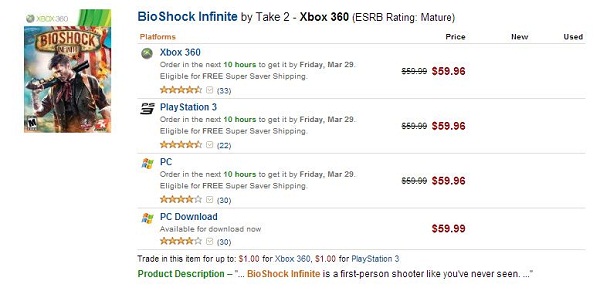
This is just a nice example of what psychologist and influence connoisseur Robert Cialdini would call a “click, whirr” moment. Bioshock Inifinite is only discounted three cents here, but we’re so used to thinking that something is a good buy if its full price is scratched out and a “SALE!” price is written in red that our brains develop what’s called a heuristic –an effort saving mental shortcut.
Though even just a second of observation reveals that the discount is meaningless, that first impression has already been seized by the fast-processing part of your brain and it can subtly and subconsciously influence your perception of price. It’s an old trick.
Imagine Rigney built a Reaper from Mass Effect 3 with full posability and movable faceplates that reveal a light-up laser eye. I really like this shot that shows the massive size of the Reaper towering over a microscale city. Check out MOCpages for more photos.

CaseymaloneKevin. Fucking. Fanning.

OK by now you’ve seen this article in The Onion and been like UGH TOO REAL. Yes! It is too real. It is painful and we recognize ourselves and the choices we have made in this article.
But I think the reason this article is painful is because culturally we define success in such a weird and outdated way. There’s this idea that if you’re not doing what you’re most passionate about all the time, you’re a failure. If you aren’t make a living at it, you’re a failure. If you’re not Stephen King or Christina Aguilera, you’re a failure. And I think we grew up in this kind of 50-year pop culture bubble where we saw many people becoming huge megastars, actors and singers and writers and whatever else. And part of the disconnect we have now about what we should pay for music and books and movies, and how these things should be funded, are tied up with these questions about what we owe to ourselves, and what we feel society & culture owe to us, and the media value we assign to certain “professions”.
I was having dinner with Mary-Kim the other night and we talked a lot about how much more successful as writers we would feel if we didn’t give a shit about our families and lives. I might have gotten farther faster as a writer if that’s all I ever did or thought about, but like, so what? Is that a good model for how a person should live their life? It’s not that I love my day job all the time, but it’s a thing that someone needs to be doing, same as a lot of people’s jobs. And it’s not like me and my job and my writing are completely separate and siloed aspects of my self. My creativity is a thing that comes out in my writing on the internet, in my parenting, and in the rejection letters I send as part of my day job. That’s kind of a success, right? Albeit not one that sells magazines or drives clicks.
Maybe it’s not useful to define one person as the garbage collector and one person as the singer. Maybe everyone is a lot of things. Maybe the self-obsessed celebrity artist culture isn’t that helpful or useful. Maybe eventually we get to a place where we see that books and music and art are created by us, people who have school and day jobs and other shit we care about. And we’re not rich celebrities, and we are all always being pulled in different directions, but we’re present and engaged with the people in our lives? And we value what we contribute as much as what we create? And we create things because want to, and not because we have expectations for what it will get us, or how it will cause society to value us? And we don’t berate and hate ourselves for the very human failure of having a lot of complicated shit to juggle in our lives? That might be kind of cool?
Here’s another old-fashioned writing instrument to follow up my last one.
The building team calling themselves BricksBen (Benjamin Cheh & Jeffrey Kong have built an adorable little typewriter, not just with a great retro look but full of novel parts uses and solid building techniques.

To achieve the even slope of the keys within the case, Benjamin and Jeffrey used headlight bricks:

See more photos on BricksBen.com.
And since this isn’t something inspired by a movie or video game, I’m happy to suggest you head on over to LEGO CUUSOO and support this project. In the meantime, I may need to build one of these for myself…
P.11 We shouldn’t see any dead or bloodied kittens.
P.12 The use of “dick” in the phrase “eat a dick” will need to be censored for broadcast.
P.13 We shouldn’t see any sort of brown or yellow substance in the cup or on their faces as Sam and Daisy eat something awful from the cup; it shouldn’t play like feces or urine.
P.13 We shouldn’t see any dead kittens when Trent dumps out the box.
”Before the filming of the Kung Fu TV movie began, there was some discussion as to whether or not an Asian actor should play Kwai Chang Caine. Bruce Lee was considered for the role. In 1971, Bruce Lee wasn't the cult film hero he later became for his roles in The Big Boss (1971), Fist of Fury (1972), Way of the Dragon (1972) and Enter the Dragon (1973). At that point he was best known as Kato on TV's Green Hornet (1966–1967) (Kung Fu guest actor Robert Ito reports that Lee hated the role of Kato because he "thought it was so subservient"). "In my eyes and in the eyes of Jerry Thorpe," says Harvey Frand, "David Carradine was always our first choice to play Caine. But there was some disagreement because the network was interested in a more muscular actor and the studio was interested in getting Bruce Lee." Frand says Lee wouldn't have really been appropriate for the series — despite the fact that he went on to considerable success in the martial arts film world. The Kung Fu show needed a serene person, and Carradine was more appropriate for the role. Ed Spielman agrees: "I liked David in the part. One of Japan's foremost Karate champions used to say that the only qualification that was needed to be trained in the martial arts was that you had to know how to dance. And on top of being an accomplished athlete and actor, David could dance." Nonetheless, grumbling from the Asian community would have made sense, given the fact that major roles for Asian actors were almost nonexistent. James Hong, an actor on the show and ex-president of the Association of Asian/Pacific American Artists (AAPAA) says that at the time Asian actors felt that "if they were going to do a so-called Asian hero on Kung Fu, then why don't they hire an Asian actor to play the lead? But then the show went on, we realized that it was a great source of employment for the Asian acting community." In fact, Hong says, Carradine had a good relationship with the Asian community. (pages 32–33, via Wikipedia)
