Shared posts

16 Sep 12:39

Civility and So-Called Objectivity is No Way to Contain a Plague of Lies

by Siri Hustvedt
Trump

“Nazism permeated the flesh and blood of the German people through single words, idioms, and sentence structures which were imposed upon them in a million repetitions and taken on board mechanically and unconsciously,” the linguist Victor Klemperer wrote about the language of the Third Reich. A German Jew who managed to survive the Nazi era, Klemperer understood that words shape perception, change lives, and convulse the histories of nations. The meanings of words grow and change. New words appear.

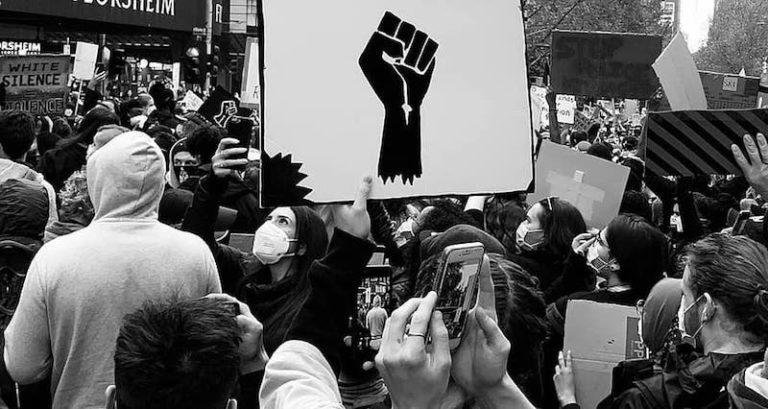
Rhetoric is a driving force in the imminent US election, and effective rhetoric is a catalyst for powerful, contagious feelings that can lead to catastrophic events, such as the end of Weimar Republic and the rise of Hitler’s Germany or the re-election of Donald Trump and, as appears ever more likely, a time of authoritarian rule.

Words matter. They are the connective tissue of collective life and, as Klemperer noted, they move us not only in conscious but unconscious ways. A failure to understand the degree to which human beings in particular situations are inflamed by the dogged repetition of what may appear to others in very different situations as worn phrases, absurd ideas, and blatant fictions has had a crippling effect on our national discourse and generated a peculiar blindness to the gravity of what is happening now.

The many organizations of what is known as “mainstream” media have created a contagious language all their own, which has been broadly accepted and repeated by their consumers. We live in a “post-truth,” “anti-science” era of “viral” social media, and the job of upright journalists is to report the facts. The notion that these precious nuggets of reality will somehow counter the anti-democratic, racist, demagogic forces that catapulted Donald Trump into office is naïve at best and morally suspicious at worst. A fact is a wan thing without interpretation. The same facts are often marshaled to prove wholly contradictory arguments. Journalism is not mathematics. There is no single correct answer or proof.

The push for objective news began in the 19th century and grew in the 20th. Journalism sought to drape itself in the dignity of impartial, value-free science. Whatever their pretensions, the sciences are human endeavors and have never been free of ideology. In journalism the dubious ideal of objectivity is even more remote. No human being can be scrubbed clean of subjectivity and regard unfolding events from a distant perch that allows “the truth” to emerge. What passes for objectivity is a tone of neutrality, sobriety, and inhibition written in the third person with a heavy reliance on the passive voice so dear to the science paper: The effects of the additive were then examined.  X-number of women were killed in incidents of domestic violence last year. Actors are missing. No one is doing anything.

A fact is a wan thing without interpretation. The same facts are often marshaled to prove wholly contradictory arguments.

The New York Times managed to write about the 1943 uprising in the Warsaw ghetto without once using the word Jew. In 2015 the venerable paper covered a report on lynching in the US, which avoided the word white. “A Black man was hanged…” The word white appeared solely to qualify the girls and women whom Black men had supposedly offended. The suppressed: White people murdered Black people. It is important to say it.

Mainstream media outlets continually described Donald Trump and Hillary Clinton as equally abhorrent candidates during the 2016 campaign. They leapt on the story of a private email server as if its use were tantamount to business fraud, tax evasion, and sexual assault. As far as I can tell, government officials routinely use their private servers improperly, but no one seems to care anymore.

The same serious news organizations wobbled for years over whether to use the word “lie” to describe a presidential statement, and, mesmerized by Trump’s “norm-breaking” outrages, have amplified every spoken or tweeted word, idiom, and fractured sentence verbatim by repeating them over and over. As the linguist George Lakoff has pointed out since before Trump was elected, “It doesn’t matter if you are promoting Trump or attacking Trump [by repeating his words] you are helping Trump.” A million repetitions strengthens the message, and the message sells. Moral outrage sells, whether it is to endorse an ideological position or disparage it. The emotional jolt it promises to bring is attractive. For some it is irresistible.

*

Josef Goebbels, Hitler’s chief of propaganda, never said, “If you repeat a lie often enough, it becomes accepted as a truth.” Variations on this sentence are ubiquitous on the internet. Countless journalists have quoted it and attributed it to Goebbels before they proceed to explain the big lie. In fact, Goebbels claimed he always told the truth. The propaganda minister nevertheless understood the crucial elements of efficient political rhetoric: incessantly repeat a few simple ideas in stereotyped phrases, appeal to people’s emotions, avoid abstract thought, and identify particular enemies to vilify.

Goebbels was a ferocious anti-Semite. He depicted Jews as parasites on the pure Aryan body politic and conveniently blamed them for all the ills of Germany, just as Mexicans, Muslims, Black people, feminists, amorphous left-wing radicals and numerous others serve the Republican party and its millions of adherents as scapegoats for what they perceive as personal emasculation and humiliation. The elevation of a Black man to the presidency became the image of their ultimate degradation. Barack Obama’s Ivy League education, his elegance, his calm demeanor all fed the fire. “Birtherism” entered the American language to designate the racist suspicion, endlessly repeated by the man who followed Obama into office, that the Black man was not born in the US, that he was not only of “us.”

The factual documentation of the birth certificate did not end the spreading fiction. It ended only when Trump conceded the truth.

I do not believe that Donald Trump has read Goebbels, but he is a master of the rhetorical techniques the Nazi advocated and has used them with great skill. He reinforces a statement by saying it twice, if not three times. In a typical performance at a news conference during the Kavanaugh/Blasey-Ford hearings, September 26, 2018: “It does impact my opinion. You know why? Because I have had a lot of false charges made against me. I am a very famous person. Unfortunately. I have been a famous person for a long time. But I’ve had a lot of false charges made against me. Really false charges. I have had friends that have had false charges.” After a few more words, he repeats “false charges.” False charges made by dishonest, bad, disgraceful, disgusting people against the immaculate, perfect self is a reiterated Trump theme that resonates among those who feel that the simple cultural recognition of Others—a female, Black, brown, trans, immigrant, Muslim, or disabled person—is itself a false charge against them, a perceived attack on and diminishment of them. This is “purity politics.” I spew all my demons onto you. It is old, deep, and human. “Witch hunt” becomes a verbal trajectile that purges the self of the very sin it names.

What passes for objectivity is a tone of neutrality, sobriety, and inhibition written in the third person with a heavy reliance on the passive voice.

Negativity, simplicity, repetition, hyperbole work. Donald Trump offers his followers a speedy route from shame to pride. He is the personification of their redemption, a potent medicine for what ails them, which works best at rallies when indignant, hostile emotions can travel from one body to another in rhythmic repetitive beats and swell to a peak that belongs not to the individual but to the crowd. And when it reaches that climax, the relief after exorcism is palpable. The now docile crowd files out of the convention center satiated. The pandemic has interrupted this mass purgative, and that respite may have benefited the Democratic ticket, but the itch for release can be felt in roaming militias; unmasked, armed right-wing agitators; and the unidentified military personnel sent by the government to quell protest. Facts will not protect Americans from this mounting violence.

Aren’t the parallels to the 1930s in Europe obvious? No, the US is not the frail Weimar Republic. Fascism attracted the young in large numbers. The American right does not.  Hitler and Trump are not identical. European fascism abhorred individualism. Rugged individualism is an American mantra. Ironically, Trump is perceived as the incarnation of our masculine fantasy of complete autonomy and mastery, a self-made entrepreneurial hero—despite his less than vigorous appearance, despite his inherited riches, despite his multiple bankruptcies, despite his brutal treatment of women. Then again, it may be that these same factors enhance him in the eyes of those who love him.

The far right in Germany has anointed the American president as savior. He panders to neo-Nazis, codes his language for white evangelicals, some of whom have been reading political reality through the Book of Revelation for a long time: Hillary Clinton as the Whore of Babylon, Barack Obama as the forerunner of the Anti-Christ. Trump bestows his muted blessing on Q. QAnon is growing internationally. The protagonist of this conspiracy fiction, the great man fighting the deep state of Satanists, pedophilic brutes, and rich Jews—is Trump.

Anti-Semitic tropes reappear in a new guise. The Nazis used religious imagery to depict Hitler, a man who radiated light, a man with a halo, a man to lift the nation from the misery of humiliation and defeat after the First World War to national glory. There is a “Trump the Redeemer” Christmas ornament for sale. The president is equipped with a halo. It is advertised as “a great gift for anyone you know who loves Trump and an even better gift for someone who hates Trump.” There are portraits of the president illuminated in sacral light. “I am the chosen one,” Trump says. Just a joke? Irony? A coded remark? How does one interpret this sentence? Doesn’t it depend not only on who you are but where you are? Doesn’t it depend on your situation?

A million repetitions strengthens the message, and the message sells. Moral outrage sells, whether it is to endorse an ideological position or disparage it.

The meaning of words is social, created in and by the lived experience of a group. Human beings are always looking beyond what is said to glean more. We interpret the gestures, gazes, and intonations of other people for signs of welcome or danger. To do otherwise risks missing important clues. And yet, we often over-read or misread. The delusions of patients with schizophrenia are dense with potent signs. Numbers on a license plate correspond to significant birthdays, biblical passages, news reports. Patterns are established and whole cosmologies are born from them. The CIA, global corporations, the medical establishment, God and Satan figure frequently in psychotic delusions, powerful forces that pull invisible strings to torment the patient. Telling her that the facts do not support her conclusions is futile. The enthusiasts of QAnon are not psychotics, but the quest for a secret meaning that will explain a deeply felt malaise is strikingly similar

There is some evidence that those with less schooling take to conspiracy theories more readily than those with university degrees. Then again, Goebbels had a PhD and he believed in an international Jewish cabal. “We are condemned to meaning,” wrote the French philosopher Maurice Merleau-Ponty. Human beings look for patterns and for words that confirm their feelings about the world. Language is shared, but every language is also shot through with power relations that have established rules of speech. The master can rant and rave with impunity. The slave is forbidden to speak. Brett Kavanaugh is free to wail out his grief and vituperation, but the woman who accuses him must remain calm and polite, untouched by any sign of anger. Public rage is reserved for the powerful. What is said is secondary to who is allowed to say it. There are moments when these implicit societal speech laws are challenged. The United States is living through one of them. It is sheer fantasy to imagine that a measured, “balanced” recitation of facts or an appeal to science and hard evidence will carry the day.

Those who brandish symbols of the Klan in secret meetings or tattoo themselves with neo-Nazi signs or decode Q’s cryptic messages substantiate their paranoia about enemies and sinister global plots, but they also aggrandize themselves by creating a sense of control over an uncertain world and comfort themselves with the superiority of knowing what others don’t. The pleasures of exegesis are many, but in the land of white delusion, just as important as uncovering a grand narrative of good and evil is the role of ritual. And ritual, after all, is repetition.

Public rage is reserved for the powerful. What is said is secondary to who is allowed to say it.

The incantation has magical properties in many cultures. It is a form of shared understanding that has less to do with the specific meanings of the words spoken than enacting them in a repetitious pattern that affords both mystery and succor. Chanting, like drums and dance, binds the group into one. In fascism, politics took on the aura of religious rite.

“Mechanical” is a good expression for the slogan that is taken on board automatically and unconsciously, whether it is Deutschland über Alles or America First. These slogans are defensive acts that create a magic circle for those who step inside it, and that inner space is effectively thoughtless. This is what Hannah Arendt stressed when she wrote about her much-misunderstood concept of the banality of evil. Conventional, stock phrases and the complacent repetition of received knowledge are bricks in a wall that protect people from a multifarious, ambiguous, and threatening reality. On trial for crimes against humanity, the Nazi Adolph Eichmann said again and again that he was just doing his “duty,” just “following orders.” Those orders included genocide. For Arendt this was the thoughtless evil of the ordinary. Evil is not a superhuman force that resides exclusively in psychopaths or monsters. After all, Adolph Hitler would have been nothing without popular support. Donald Trump would vanish tomorrow without his “base.”

Evil, Arendt argued, resides in apparently innocuous human beings. This is the immense difficulty, of course. Mainstream media have taken great pains to protect the patriotic white guy from the accusation of evil, the guy who drives his SUV to the Trump rally; the guy who loves his wife and kids; the guy whose heart pounds with joyful malice as he howls, “Lock her up!” and “Send her back!” It is much easier to look back in horror at the ordinary German who railed against Jews, Slavs, Roma, the mentally disabled, and psychiatric patients as unfit. How could they believe all that? What possessed them? It’s unthinkable. Will thinking help us now?

Arendt idealized thought. “Thinking,” she wrote, “means that each time you are confronted with some difficulty in life, you have to make up your mind anew.” I suspect this is not possible. Every person is a creature of habits of mind and of feeling, but there is terrible danger in the rote and the mechanical, in the thoughtless repetitions of hatred and cruelty celebrated by a significant portion of the US population, led by a cynical redeemer and his Republican defenders. Huey Long did not say, “When fascism comes to America, they will call it Americanism.” The sentence was written in a paper by an obscure professor decades ago. The sentiment is hardly new.

History doesn’t repeat itself, but the past reveals similarities to the present. It provides lessons and insights. In the early 1930s, serious American journalists regarded Hitler as a wannabe Mussolini, a buffoonish character whose tenuous hold on power would quickly evaporate—including the sages at the New York Times.

16 Sep 12:38

The Joy of Watching Old, Damaged Things Get Restored: Why the World is Captivated by Restoration Videos

by Colin Marshall
Bgarland

I have watched some of these restoration videos and, much to my surprise, found them oddly relaxing.

The internet has given us a few new ways to watch things, but many more new things to watch. It's not just that we now tune in to our favorite shows online rather than on television, but that our "favorite shows" have assumed forms we couldn't have imagined before. Thirty years ago, if you'd gone to a TV network and pitched a program consisting of nothing but the process of antique restoration — no music, no narration, no story, and certainly no stars — you'd have been told nobody wanted to watch that. In 2020, we know the truth: not only do people want to watch that, but quite a lot of people want to watch that, as evidenced by the enormous view counts of Youtube restoration videos.

At Vice, Mike Dozier profiles the Swiss Youtube restoration channel My Mechanics. Its "videos don’t just appeal to people interested in antique restoration, which they surely do, but many viewers watch because they find the process relaxing."

Some come for the techniques and stay for the "hypnotic quality — the sounds of clinking metal, the grinding of sandpaper and the whirring of a lathe populate each video. And watching something, like a rusty old coffee grinder, come back to life, shiny and looking brand-new, is uniquely satisfying." This verges on the newly carved-out territory of "autonomous sensory meridian response," or ASMR, a genre of video engineered specifically to deliver psychologically pleasing sounds.

In Korea, where I live, ASMR has attained disproportionately massive popularity — though not quite the popularity of mukbang, the style of long-form eating-on-camera video that has gone international in recent years. One theory of the appeal of mukbang holds that it offers vicarious satisfaction to viewers who are dieting, broke, or otherwise unable to consume enormous meals themselves. That may also be true, to a degree, of restoration videos. To bring a 19th-century screwdriver, say, or a World War II military watch back to like-new condition requires not just the right equipment but formidable amounts of knowledge and dexterity as well. Clicking on a Youtube video asks of us much less in the way of time and dedication. And yet, among the billions of views restoration videos have racked up, there are surely fans who have acted on the inspiration and built old-school skills of their own.

In our increasingly digital age — characterized by nothing more acutely than our tendency to spend hours clicking through increasingly specialized Youtube videos — skilled physical work has become an impressive spectacle in itself. As everywhere on the internet, subgenres have produced sub-subgenres: take the vintage toy restoration channel Rescue & Restore or art restorer Julian Baumgartner (who produces both narrated and ASMR version of his videos), both previously featured here on Open Culture. If those don't absorb you, have a look at Cool Again RestorationIron Man Restoration, Hand Tool Rescue, MrRescue (a model-car specialist), Restoration and Metal, Random Hands... and the list goes on, given how much needs restoring in this world.

via metafilter

Related Content:

Watch Battered & Bruised Vintage Toys Get Mesmerizingly Restored to Near Mint Condition

Watch an Art Conservator Bring Classic Paintings Back to Life in Intriguingly Narrated Videos

How an Art Conservator Completely Restores a Damaged Painting: A Short, Meditative Documentary

Watch a 17th-Century Portrait Magically Get Restored to Its Brilliant Original Colors

The Art of Restoring a 400-Year-Old Painting: A Five-Minute Primer

The Art of Restoring Classic Films: Criterion Shows You How It Refreshed Two Hitchcock Movies

Based in Seoul, Colin Marshall writes and broadcasts on cities, language, and culture. His projects include the book The Stateless City: a Walk through 21st-Century Los Angeles and the video series The City in Cinema. Follow him on Twitter at @colinmarshall, on Facebook, or on Instagram.

The Joy of Watching Old, Damaged Things Get Restored: Why the World is Captivated by Restoration Videos is a post from: Open Culture. Follow us on Facebook, Twitter, and Google Plus, or get our Daily Email. And don't miss our big collections of Free Online Courses, Free Online Movies, Free eBooksFree Audio Books, Free Foreign Language Lessons, and MOOCs.

14 Sep 20:06

Google Introduces 6-Month Career Certificates, Threatening to Disrupt Higher Education with “the Equivalent of a Four-Year Degree”

by Colin Marshall

I used to make a point of asking every college-applying teenager I encountered why they wanted to go to college in the first place. Few had a ready answer; most, after a deer-in-the-headlights moment, said they wanted to be able to get a job — and in a tone implying it was too obvious to require articulation. But if one's goal is simply employment, doesn't it seem a bit excessive to move across the state, country, or world, spend four years taking tests and writing papers on a grab-bag of subjects, and spend (or borrow) a large and ever-inflating amount of money to do so? This, in any case, is one idea behind Google's Career Certificates, all of which can be completed from home in about six months.

Any such remote educational process looks more viable than ever at the moment due to the ongoing coronavirus pandemic, a condition that also has today's college-applying teenagers wondering whether they'll ever see a campus at all. Nor is the broader economic harm lost on Google, whose Senior Vice President for Global Affairs Kent Walker frames their Career Certificates as part of a "digital jobs program to help America's economic recovery." He writes that "people need good jobs, and the broader economy needs their energy and skills to support our future growth." At the same time, "college degrees are out of reach for many Americans, and you shouldn’t need a college diploma to have economic security."

Hence Google's new Career Certificates in "the high-paying, high-growth career fields of Data Analytics, Project Management, and User Experience (UX) Design," which join their existing IT Support and IT Automation in Python Certificates. Hosted on the online education platform Coursera, these programs (which run about $300-$400) are developed in-house and taught by Google employees and require no previous experience. To help cover their cost Google will also fund 100,000 "need-based scholarships" and offer students "hundreds of apprenticeship opportunities" at the company "to provide real on-the-job training." None of this guarantees any given student a job at Google, of course, but as Walker emphasizes, "we will consider our new career certificates as the equivalent of a four-year degree."

Technology-and-education pundit Scott Galloway calls that bachelor's-degree equivalence the biggest story in his field of recent weeks. It's perhaps the beginning of a trend where tech companies disrupt higher education, creating affordable and scalable educational programs that will train the workforce for 21st century jobs. This could conceivably mean that universities lose their monopoly on the training and vetting of students, or at least find that they'll increasingly share that responsibility with big tech.

This past spring Galloway gave an interview to New York magazine predicting that "ultimately, universities are going to partner with companies to help them expand." He adds: "I think that partnership will look something like MIT and Google partnering. Microsoft and Berkeley. Big-tech companies are about to enter education and health care in a big way, not because they want to but because they have to." Whether such university partnerships will emerge as falling enrollments put the strain on certain segments of the university system remains to be seen, but so far Google seems confident about going it alone. And where Google goes, as we've all seen before, other institutions often follow.

Note: You can listen to Galloway elaborate on how Google may lead to the unbundling of higher ed here. Listen to the episode "State of Play: The Sharing Economy" from his Prof G podcast:

Related Content:

Free Online Computer Science Courses

Free Online Engineering Courses

Google Launches a Free Course on Artificial Intelligence: Sign Up for Its New “Machine Learning Crash Course”

Google Launches Free Course on Deep Learning: The Science of Teaching Computers How to Teach Themselves

Malcolm Gladwell Asks Hard Questions about Money & Meritocracy in American Higher Education: Stream 3 Episodes of His New Podcast

Nietzsche Lays Out His Philosophy of Education and a Still-Timely Critique of the Modern University (1872)

Based in Seoul, Colin Marshall writes and broadcasts on cities, language, and culture. His projects include the book The Stateless City: a Walk through 21st-Century Los Angeles and the video series The City in Cinema. Follow him on Twitter at @colinmarshall, on Facebook, or on Instagram.

Google Introduces 6-Month Career Certificates, Threatening to Disrupt Higher Education with “the Equivalent of a Four-Year Degree” is a post from: Open Culture. Follow us on Facebook, Twitter, and Google Plus, or get our Daily Email. And don't miss our big collections of Free Online Courses, Free Online Movies, Free eBooksFree Audio Books, Free Foreign Language Lessons, and MOOCs.

13 Sep 20:20

The Education Department is purging itself of anti-racist literature.

by Aaron Robertson

At this point, although stories that pass us by in the news cycle do continue to anger and sadden me, I wouldn’t say much has been surprising recently.

Unfortunately, that also applies to a story by Politico which revealed that the Education Department will be targeting employee book clubs that contain “Anti-American propaganda,” that is, work that discusses “white privilege” and other race-related concepts like systemic racism and white supremacy.

This is a consequence of the president’s recent declaration against the application of critical race theory throughout federal agencies.

An internal email sent by the Education Department and obtained by Politico ordered a review of any material that contradicts Nikki Haley’s reassuring conclusion that the United States is not a racist country. (I wasn’t sure, but now I’ll get my eight hours—hell, even nine hours of beauty rest.)

Every Education Department office in Washington, D.C., and regional locations throughout the country, will be required to assess training materials and existing contracts for events like diversity training workshops. The email stated that department officials agreed to continue diversity and inclusion training.

How sweet.

10 Sep 17:53

Sounds of the Forest: A Free Audio Archive Gathers the Sounds of Forests from All Over the World

by Josh Jones

Some of my fondest memories are of hiking the Olympic National Forest in Washington State and the forests of the Shenandoah Valley in Virginia, seeking the kind of silence one can only find in busy ecosystems full of birds, insects, woodland creatures, rustling leaves, etc. This experience can be transformative, a full immersion in what acoustic ecologist Gordon Hempton calls a “natural acoustic system,” the endless interplay of calls and responses that evolved to harmonize over millennia.

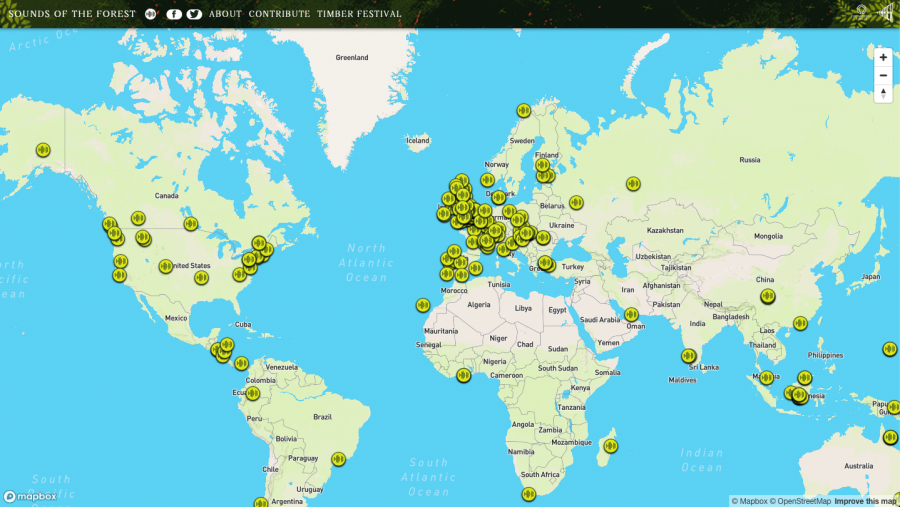
Tragically, human noise pollution encroaches on the acoustic space of such refuges, and climate change may irrevocably alter their nature. But they will be preserved, in digital recordings at least, thanks in part to the efforts of a project called Sounds of the Forest, which has been documenting the pregnant silences of forests around the world and has so far collected audio files from six continents, with western Europe most heavily represented.

The Sounds of the Forest library, accessible via its interactive map or Soundcloud page, “will form an open source library,” the project announces, “to be used by anyone to listen to and create from.”

Nature lovers can contribute their own recordings, helping to fill in the many remaining areas on the map without representation. “Visit a woodland,” the project recommends, “recharge under the canopy and record your sounds of the forest.” The site gives specific instructions for how to upload audio file submissions.

Sounds of the Forest came out of the annual Timber Festival, an international gathering in the UK’s National Forest, which is the “boldest environmentally-led regeneration project: the creation of England’s first new forest in a thousand years… an imaginative and ambitious statement of sustainable development.” When the pandemic scuttled plans for an in-person 2020 Timber Festival, organizers conceived of the sound files as a way to bring the world together in a virtual forest gathering. They are also foraging material for next year’s fest, in which “selected artists will be responding to the sounds that are gathered, creating music, audio, artwork or something else incredible.”

If you can’t make it to Timber Festival 2021 next summer, or to your forest refuge of choice this autumn, you can still immerse yourself in the restorative sounds of forests worldwide. Open the sound map, click on a file, close your eyes, and imagine yourself in Nelson Lakes National Park in New Zealand, Yasuni National Park at night in Ecuador, or Chernyaevsky Forest in Russia. Experiencing the busy silences of nature brings us back to ourselves—or to the ancient parts of ourselves that once also harmonized with the natural world.


via Kottke

Related Content:

How to Find Silence in a Noisy World

The British Library’s “Sounds” Archive Presents 80,000 Free Audio Recordings: World & Classical Music, Interviews, Nature Sounds & More

Free: Download the Sublime Sights & Sounds of Yellowstone National Park

10 Hours of Ambient Arctic Sounds Will Help You Relax, Meditate, Study & Sleep

Josh Jones is a writer and musician based in Durham, NC. Follow him at @jdmagness

Sounds of the Forest: A Free Audio Archive Gathers the Sounds of Forests from All Over the World is a post from: Open Culture. Follow us on Facebook, Twitter, and Google Plus, or get our Daily Email. And don't miss our big collections of Free Online Courses, Free Online Movies, Free eBooksFree Audio Books, Free Foreign Language Lessons, and MOOCs.

09 Sep 23:45

Here’s what pausing the AstraZeneca-Oxford coronavirus vaccine trial really means

by Tina Hesman Saey

A single volunteer’s illness has sparked a temporary halt to the late-stage clinical trial of a leading coronavirus vaccine, an action that highlights the level of rigor needed to ensure that a vaccine is safe and effective, experts say.

AstraZeneca, which is developing the vaccine in concert with the University of Oxford, pushed pause on September 8 after a study volunteer in the United Kingdom had a suspected serious reaction. The hiatus will allow an independent review board to decide what to do next.

The illness may turn out to have nothing to do with the vaccine. If so, the trial, which may enroll as many as 50,000 people worldwide, including up to 30,000 in the United States, may resume. If the vaccine caused the illness — known as a serious adverse event — it could spell the end for AstraZeneca’s vaccine hopes. But experts say the pause is part of the tricky business of doing science and needed to happen to ensure safety. 

See all our coverage of the coronavirus outbreak

“It was actually encouraging to see AstraZeneca take it so seriously,” says Esther Krofah, executive director of the Washington, D.C.-based nonprofit FasterCures, part of the Milken Institute think tank. “They did exactly the right thing.”

AstraZeneca is among pharmaceutical companies testing COVID-19 vaccines that, in an open letter released September 8, pledged not to be rushed by political considerations and to follow standard procedures to make sure vaccines are thoroughly tested. 

What members of the public often don’t understand is that the courses of clinical trials often don’t run smoothly and Phase III trials are put on hold temporarily on a regular basis, says Seema K. Shah, a bioethicist at Lurie Children’s Hospital in Chicago. In fact, “bumps in the road are normal for vaccine trials, and they should happen if you’re studying them rigorously,” she says. “If nothing goes wrong while you’re testing it, maybe you didn’t test it well enough.” 

We’ll have to wait to see if there really is a safety concern or if this was a false alarm, she says. “In normal times this would happen and it wouldn’t be international news. But right now the whole world is watching these vaccine trials and we’re all holding our breath waiting for the results.”

Vaccine trials resumed in the United Kingdom on September 12 after the U.K.’s Medicines & Healthcare products Regulatory Agency said it was safe to do so, AstraZeneca said in a statement. Brazil’s trial also resumed September 12. In the United States, AstraZeneca had just started recruiting volunteers for a Phase III trial when the pause occurred. The company, citing privacy concerns, declined to release any more medical information about the participant involved in the incident.

Prior to the restart, Science News spoke with experts about what a pause might mean for the future of a coronavirus vaccine.

What is this vaccine?

The vaccine is a combination of two viruses. Researchers at Oxford and a university spin-off company Vaccitech started with a weakened version of an adenovirus that causes colds in chimpanzees. This same chimpanzee adenovirus was used to make an Ebola vaccine. To fight coronavirus, the chimp virus was engineered to deliver instructions to human cells for making the iconic knobby “spike” protein from SARS-CoV-2, the virus that causes COVID-19 (SN: 7/21/20). 

Some other potential coronavirus vaccines now in testing use human adenoviruses to carry the spike protein. But since many people have caught colds caused by adenoviruses, they may already have antibodies that could make the vaccine less effective. Using a chimpanzee virus that doesn’t infect people could get around that problem.

tray of vials of vaccine
AstraZeneca, a British-Swedish pharmaceutical company, has been working with researchers at the University of Oxford to scale up manufacturing of their coronavirus vaccine.University of Oxford

In preclinical tests with rhesus macaques, the vaccine protected against coronavirus infections, researchers reported July 30 in Nature. And in early studies in people, the vaccine stimulated production of antibodies against the spike protein, researchers reported online July 20 in the Lancet. That study tested the coronavirus vaccine in 534 volunteers. 

Those people reported mostly mild side effects, such as headaches, fatigue and muscle pain. But to determine whether the vaccine actually works, and is safe, it has to be tested in many thousands of people. The halted Phase III trials were comparing the vaccine candidate to a placebo. If the vaccine works, more people in the placebo group will wind up getting COVID-19 than in the vaccinated group. 

What happened?

All that is known officially is that one of the study volunteers went to the hospital after having neurological problems. Some news reports have cited unnamed sources saying that a woman participating in the trial experienced symptoms consistent with transverse myelitis, a spinal cord inflammatory syndrome. 

Transverse myelitis has surfaced in vaccine trials before. Symptoms range from numbness, tingling or pain to limb paralysis and bladder problems. Doctors often treat the disorder with steroids that calm the inflammatory process, though serious cases can have long-term consequences.

“In the history of vaccine development, cases of myelitis are not especially surprising,” says Carlos Pardo-Villamizar, a clinical neurologist and director of the Johns Hopkins Transverse Myelitis Center. Though rare, transverse myelitis has popped up in vaccine trials for rabies, yellow fever and H1N1 influenza, among others, he says. 

The disorder is “inflammation as a consequence of some immunological triggering factor,” he says, like a virus, bacteria or autoimmune disorder. On rare occasions, vaccines can elicit the same sort of immunological misfiring. 

A similar reaction, called Guillain-Barré syndrome, was associated with the 1976 flu vaccine, where one out of 100,000 people had an elevated risk of experiencing symptoms like muscle weakness or paralysis. Since then, some vaccines have been associated with Guillain-Barré syndrome, but it’s rare. Typically, there are one or two cases per million doses of the vaccine, according to the Centers for Disease Control and Prevention.

“My message for the public is don’t panic, this is somewhat expected,” Pardo-Villamizar says, These are the sorts of complications that need to be rigorously evaluated before a vaccine is made public, he says. 

Is halting a trial unusual?

No. It’s routine if an adverse event is serious enough to send a person to the hospital. It’s built into the process. 

One main point of a clinical trial is to tease out any health issues related to the vaccine. Some side effects are expected and manageable, such as redness or swelling at the site of the injection, fever, aching muscles or joints, headaches or fatigue. But serious adverse events need to be studied to understand whether it was related to the vaccine or a coincidence.

Sign up for e-mail updates on the latest coronavirus news and research

Pausing a clinical trial to investigate a serious health issue “is certainly part of standard practice in ongoing trials,” says Susan Ellenberg, a biostatistician at the University of Pennsylvania’s Perelman School of Medicine. Taking time to scrutinize a reported severe reaction is a sign that the system is working, says Ellenberg. “This is what’s supposed to happen.” 

Some trials’ rules would require an investigation even if a volunteer got into a car accident, just to be sure there’s no way it’s connected to participating in the trial. “These triggers are predetermined and written into protocols in ways that mean that you can’t change your mind” to gloss over a potential safety problem, says Paul G. Thomas, an immunologist at St. Jude Children’s Research Hospital in Memphis, Tenn. 

What happens next?

An independent data safety monitoring board will collect the data and investigate what went wrong. Such safety boards are required for all clinical trials. “They have no vested interest in the vaccine. They’re not the people who invented the vaccine. They’re not people who could ever make money off the vaccine,” Thomas says.  

Sometimes boards stop trials early because of safety concerns. Trials also might come to an early end if it becomes blindingly obvious that one group is faring much better than another, because a drug or vaccine works really well, Thomas says. 

In the case of the AstraZeneca-Oxford vaccine, the first thing the board will probably do is determine whether the woman was in the group that got the placebo or the one that got the vaccine, says William Schaffner, an infectious diseases doctor at Vanderbilt University Medical Center in Nashville. 

“This investigation could be very brief,” he says. “They could discover, oh that person got a placebo. No problemo. The trial can continue. It was a coincidence.” 

But if the person got the vaccine, “then we’re stuck in a difficult position.” The board will have to evaluate all the data, including the volunteer’s medical history, to determine whether the vaccine caused her illness. If the board determines the vaccine was the cause, “it could bring the whole trial of this vaccine to a halt.” Schaffner says. “That’s how serious this event and its subsequent investigation is. Very heavy.”

There was no way to tell from testing in animals or in smaller numbers of people that such a side effect might happen when the vaccine was given to large numbers of people. Phase III trials are designed in part to uncover rare side effects and reactions, Schaffner says. “This is a vastly rare and unforeseen event that could not have been anticipated.” 

Even if the AstraZeneca-Oxford vaccine fails, FasterCures is tracking 210 vaccines at various stages of development, Krofah says. “If one fails, there are many more under investigation.” She is encouraged that the company is following the normal clinical trial procedures. “We need to continue to focus on the science and be adamant about transparency in the data on safety and efficacy.” 

08 Sep 00:04

Racists politicized the US postal system when they burned abolitionist literature in 1835.

by Aaron Robertson

As the election nears and House Democrats continue to spar with USPS Postmaster General Louis Dejoy, one could be forgiven for feeling anxious about the mail.

On Monday, the UCLA Voting Rights Project published a report on the need to build trust among Americans in the vote-by-mail process. Although the president’s stance against mail-in ballots might seem to suggest otherwise, the issues the Postal Service has faced this summer aren’t solely the result of recent efforts to restructure the agency.

Still, many Americans—including this one—weren’t soothed by the Postal System’s assurance that they’ll be able to process large volumes of ballots. That’s nice, but one of the more alarming aspects of the mail controversy is the way in which the current administration has politicized a normally beloved arm of the government.

Fears that disinformation, disenfranchisement, and voter mistrust will severely impact voter turnout are not without justification. To be clear, 2020 is not the first time racists have cast doubt on the federal postal system in an attempt to maintain power.

Nearly 200 years ago, in the summer of 1835, northern abolitionists organized a massive effort to flood the country with anti-slavery literature. This included the more than 100,000 newspapers and political tracts that were sent to the South. Historian Jennifer Rose Mercieca, writing of the 1835 abolitionist campaign, notes that many landowning elites in the region interpreted the campaign as an attack on their community norms (read: slavery).

Slaveholders called the mail inflammatory, incendiary, and insurrectionary. One of the most notable incidents in response to the influx of abolitionist literature took place in Charleston, South Carolina.

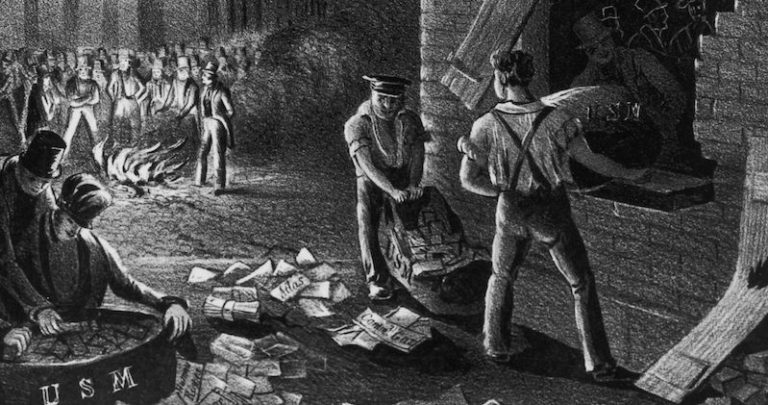
On the night of July 29th, 1835, a vigilance society known as the Lynch Men broke into the town’s post office, identified the mail from the American Anti-Slavery Society and, the next night, burned the literature and effigies of prominent abolitionists in a lurid bonfire. Hundreds of onlookers were said to have gathered.

How was this allowed to happen so publicly? It helped that Postmaster General Amos Kendall had advised the postmaster of Charleston to suppress the abolitionist tracts. In fact, the havoc some white southerners unleashed on the streets was mirrored in the actions of certain postmasters and even shipyard workers, who sometimes spotted and summarily destroyed the northern “contagion” in their cargo.

South Carolina was one of four southern states that outlawed the abolitionist writings in their jurisdictions. Slaveholders tended to justify such reactions by appealing to patriotic service at the expense of law. Some accused the postal system of supporting abolitionist endeavors.

One newspaper, the Charleston Southern Patriot, declared that if white people saw fit to take action: “Let it be performed in open day light and on the highway, and that persons of responsibility and weight of character be deputed to act in the name and for the good of the whole of the citizens.”

The abolitionist campaign is often considered one of the events that reignited interest in the slavery question down South, which had been terrified by the rebellion Nat Turner led in 1831. Multiple rumors of planned slave revolts circulated in 1835.

Rose Mercieca observes that the universalization of white male suffrage in the 1820s increased the number of non-slaveholding whites who could potentially weaken the political influence of slaveholders. This irony, egalitarianism as the unwinding of elitist influence, might also have influenced the attack on the mail. The postal system itself, rather than non-slaveholding  white people, became the scapegoat for anti-slavery opposition.

Whenever the current president inaccurately claims that universal mail-in voting favors Democratic candidates, spreads unfounded fears of voter fraud (thanks, Russia), or finds another way to question the integrity of the US postal system, he is using an effective, centuries-old tactic. In times of social unrest in the US, enablers of white supremacy have been terrified by the power of the mail and so tried to discount it.

In 1835, white supremacists feared the information Black people might be receiving. One-hundred eighty-five years later, the supremacists fear the ballots they are in all likelihood sending.

07 Sep 23:28

Summer Is for Chilly Bears: A Frozen Treat Packed With History

by Amethyst Ganaway

Chilly bears, a.k.a. flips, a.k.a. honeydrippers, a.k.a huckabucks, are a frozen treat that embodies the twinned culinary histories of frozen desserts in America and the traditional red drinks of the African-American diaspora. Read More
03 Sep 23:05

Steroids reduce deaths of critically ill COVID-19 patients, WHO confirms

by Tina Hesman Saey

In June, a large study in the United Kingdom suggested that the steroid dexamethasone could help reduce the risk of death for critically ill COVID-19 patients. Now, more evidence suggests that steroids are an effective weapon against the coronavirus.

Researchers from the World Health Organization combined data from seven randomized clinical trials for severely or critically ill COVID-19 patients treated with steroids versus standard care or a placebo up to June 9. The trials used the steroids hydrocortisone, dexamethasone or methylprednisolone. 

People who were on ventilators when their clinical trial started had a 30 percent chance of dying from the virus if given steroids compared with a 38 percent chance on standard care or a placebo, researchers report September 2 in JAMA. Results were even more promising for critically ill people who were not on ventilators: Those taking steroids had a 23 percent chance of death compared with a 42 percent for people taking a placebo or getting standard care. 

Sign up for e-mail updates on the latest coronavirus news and research

Results of three of the studies included in the combined analysis — one from France testing hydrocortisone, a trial of dexamethasone in Brazil and an international study of hydrocortisone — were published at the same time in JAMA. Those and other trials in the WHO analysis were stopped early because it wouldn’t have been ethical to continue and deny some sick patients steroids once the U.K. study found them effective.

Based on the results of the combined analysis, the WHO recommended on September 2 that doctors give dexamethasone or hydrocortisone to severely and critically ill COVID-19 patients, but not to people with milder illness. Giving steroids to people with moderate or mild cases might dampen the immune system too much, allowing the virus to do more damage. The U.S. National Institutes of Health have also recommended use of steroids for hospitalized people who need extra oxygen or are on ventilators.

20 Aug 20:03

Serve This Silky, Flaky Paratha With Your Favorite Curries, Stews, and Vegetables

by Patty Diez

Trinbagonian YouTuber Natasha Laggan shares her quick and easy recipe for buss up shut

Since filming her first cooking video five years ago — a how-to on her favorite dessert, cassava pone — YouTuber Natasha Laggan has become known to her over 170,000 followers for her authentic Trinbagonian dishes. Her focus has always been simple, if ambitious: to promote and educate global audiences about Trinidad and Tobago’s food and culture via easy cooking tutorials.

With over 1,070 episodes now under her belt on her Trini Cooking with Natasha channel, Laggan has tackled everything from the most traditional Trinbagonian dishes, like Trini chicken soup and chicken pelau, to Latin-inspired dishes like tres leches cake and her own take on Guyanese staples like garlic pork.

Still, Trini food is Laggan’s north star, and she’ll argue that fewer dishes represent her background like buss up shut, Trinidad’s version of paratha and one of the various types of roti you’ll find locally. (The name refers to its similarity in appearance to a busted up T-shirt, not unlike Cuba’s beloved ropa vieja.)

As part of Eater at Home, Laggan broke down her beloved buss up shut recipe for Instagram viewers. Check the recipe out below and try buss shut up for yourself alongside curries and stews, or just on their own.


Trinbagonian Paratha Roti aka Buss up Shut

Makes 4 medium parathas

Ingredients:

3 cups all-purpose (AP) flour
1 12 teaspoon baking powder
1 teaspoon brown sugar (optional)
34 cup whole milk
14 cup water, lukewarm
12 cup dry flour
3 tablespoons butter
3 tablespoons vegetable shortening, preferably Crisco
14 cup oil

Step 1: In a bowl or measuring cup, blend water and milk; set aside.

Step 2: In a large bowl, mix the flour, baking powder, and sugar (if using). Working slowly, add milk/water mixture gradually to form a soft dough. Knead until smooth, about 5 to 8 minutes. Drizzle with 1 teaspoon oil to coat the dough. Cover and rest for 15 minutes.

Step 3: Break into 3-inch dough balls (or smaller if your pan or griddle is small) and rest for an additional 5 to 10 minutes. Meanwhile, mix butter with vegetable shortening; set aside.

Courtesy of Natasha Laggan

Step 4: Sprinkle flour on a work surface and roll out dough, remembering to take the size of your pan into consideration. Once rolled out, coat the dough with the butter and shortening mixture and sprinkle with more flour. Cut one slice in dough starting in the center and moving outwards as if you were slicing a pie or pizza. Begin to roll either clockwise or counterclockwise to form a cone. Once you have a cone shape, tuck both ends in to form a ball. Allow roti balls to rest for a minimum of 1 hour. These can also be made the night before and refrigerated.

Step 5: Once ready to cook, roll out roti balls and grease the pan or griddle (or a tawa if you have one) and place the rolled out dough directly on top and brush it with oil. Cook on medium-low heat until bubbles form, about 3 minutes, then flip. Grease the other side and cook for an additional 3 minutes or until lightly golden brown. To get the “torn shirt” look, crush and tear the paratha with two spatulas as you turn on the griddle. Serve alongside your favorite curries, stews, or vegetables and enjoy.

20 Aug 15:49

Free Courses to Maintain Mental & Physical Health During a Pandemic

by Ted Mills

As I write this, the smoke from the numerous forest fires across California are making the air quality terrible, so we are being told to stay inside. However, the heatwave is making it insufferable to *be* inside. And we also have to be wary of COVID-19 and wear a mask. You could say this is a slightly stressful situation. And a lot of us are dealing with even more than that--job stability, rent, and on and on. Just typing this made me anxious!

During this time we should try not to neglect our mental health. Fortunately Coursera offers free online courses about Mental Health and Well-Being.

The Coursera video above comes from a Facebook live event that features Yale University’s Laurie Santos, who teaches Coursera’s Science of Well-Being course. This 30 minute Q&A dives right in to our current situation, with Santos outlining a protocol for mental health that should be as much a part of your regimen as wearing a mask and washing your hands with soap (while singing Happy Birthday to yourself, don’t forget.)

Here's a top ten of Coursera's most popular health & well-being courses to check out:

Santos answers questions from viewers, covering topics like avoiding tension and arguments with our loved ones, staying informed on the world without creating more anxiety, how can frontline/healthcare workers combat anxiety, how to keep yourself positive when living alone without family or friends, how to keep productive and healthy at work with the threat of layoffs, how to look for a new job after being laid off because of COVID, how to help your child who is missing their school friends, how do we create good experiences to create good memories, what we can do about sleep problems, how to care for family members with COVID while also working a job, and how to show random acts of kindness during this time (which is what Santos covers often in her Happiness Lab podcast).

Overall, focus on self-compassion, Santos says, which has to be the starting point for all of this. When you enroll in these courses, Coursera gives you two options. You can enroll as a paid student and get a certificate at the end. Or choose to "audit" the course (as shown here) and the course is free. Just like in college! All the learning, none of the blue book essays!

Related Content:

Free Online Psychology & Neuroscience Courses

Coursera Makes Courses & Certificates Free During Coronavirus Quarantine: Take Courses in Psychology, Music, Wellness, Professional Development & More Online

1,500 Free Online Courses from Top Universities

Free Courses on the Coronavirus: What You Need to Know About the Emerging Pandemic

Ted Mills is a freelance writer on the arts who currently hosts the Notes from the Shed podcast and is the producer of KCRW's Curious Coast. You can also follow him on Twitter at @tedmills, and/or watch his films here.

Free Courses to Maintain Mental & Physical Health During a Pandemic is a post from: Open Culture. Follow us on Facebook, Twitter, and Google Plus, or get our Daily Email. And don't miss our big collections of Free Online Courses, Free Online Movies, Free eBooksFree Audio Books, Free Foreign Language Lessons, and MOOCs.

20 Aug 15:46

Prik Gaeng Panang (Thai Panang Curry Paste)

by Derek Lucci

Bust out the mortar and pestle for this peanut-spiked Thai curry paste . Read More
18 Aug 01:52

Philosophers On Reopening Colleges and Universities in a Pandemic

by Justin Weinberg

Six philosophers discuss various issues related to the operation of institutions of higher education this fall, in this edition of Philosophers On, guest edited by Lisa Fuller. 
Introduction
Lisa Fuller, Guest Editor

Over the next several weeks, the Fall 2020 semester will begin at colleges and universities across the US. While the number of new COVID-19 cases varies widely across states, there is no place in which the pandemic is adequately contained, and no state in which masks and social distancing are not considered necessary for safety in some contexts.

Despite some state efforts at lockdown and some support from the Coronavirus Aid, Relief and Economic Security Act, institutions of higher education have been largely left to navigate the financial, logistical and moral difficulties of the continuing pandemic on their own. Some institutions face the real possibility of closure, and many have already introduced layoffs, furloughs and other budget cuts. The result of governmental failure at the national level is that staff, students and faculty are now in a situation in which no single response will be satisfactory to everyone. Accordingly, there have been a wide variety of institutional responses, and quite a few last-minute policy reversals. Some schools chose to go fully online early, and some made the same choice quite late. Some schools chose face-to-face classes and gave their faculty complete freedom to choose to teach online if they wished. Other schools permitted only those faculty willing to ask for and/or document medical vulnerabilities to teach remotely. Still others have used shaming, intimidation and administrative obstacles to actively discourage faculty from teaching online.

In this installment of “Philosophers On” I have encouraged contributors to reflect on the troubling moral and political situation in which we find ourselves. While they employ distinct approaches, together their comments demonstrate both the weight and complexity of the decisions our communities are being asked to make. The contributions address the assessment and undertaking of risk, issues of social justice and the distribution of sacrifices, the responsibilities of faculty, the administrative emphasis on student preferences and the implications of the corporate model of higher education. As always, the idea is not to provide a comprehensive discussion of these problems, but rather to stimulate further conversation and showcase the insights philosophers can bring to bear on current events.

The contributors are: Mitchell Aboulafia (Manhattan College), Ben Hale (University of Colorado-Boulder), Keisha Ray (University of Texas Health Science Center at Houston), Daniel Star (Boston University), Yolonda Wilson (National Humanities Center & Encore Public Voices Fellow), and myself (Merrimack College). I extend my sincere thanks to them all.

Scroll down to view their contributions or click on the titles in the following list:

Please join the discussion in the comments (see the comments policy) and feel free to share this post.


The Cost of Doing Business
by Mitchell Aboulafia

The American form of crony capitalism can be pretty heartless, forcing people back to work when doing so might endanger not only their own health, but also that of family members. Here’s Missouri’s governor, Mike Parson, making it clear back in May that the state of Missouri isn’t going to tolerate any COVID-19 laggards when businesses call:

When we open the state up, if you’ve got to go back to work, if your boss calls and says you have to go back to work, you have to go back to work.

Parson just couldn’t wait to reopen businesses. Of course, some people recognized that there were going to be more deaths if places reopened, Chris Christie, for instance. (See, “Chris Christie pushes to reopen country despite dire Covid-19 projections: ‘There are going to be deaths’.”) But, hey, that’s the way the cookie crumbles.

There is a problem here. If businesses know that their employees are at risk and could even die, they could get sued. Never fear. Politicians will have their backs. Mitch McConnell is insisting on liability protection for employers. It’s a red line for him.

Profits over people, no doubt. But universities—typically non-profit institutions committed to enlightened understanding and promoting the common good—would never dream of insisting on liability protection, right? Inside Higher Ed published a piece in May, “Colleges Worry They’ll Be Sued if They Reopen Campuses,” which offered a very different take:

Wednesday afternoon, 14 college presidents from around the country gathered in front of their computers. On their screens they saw their peers, along with Vice President Mike Pence and U.S. Education Secretary Betsy DeVos, who asked what they needed to reopen their campuses in the fall.

The presidents spoke about the need to be able to do more testing for the coronavirus, according to those who were either on the call or were knowledgeable about the conversation. But the presidents also said they needed to know their college wouldn’t get sued if anyone got sick, which is almost inevitable.

“They were mostly in listening mode, wanting to hear what the federal government could do to be helpful,” said University of Texas at El Paso president Heather Wilson, who was on the call. One way it can help, said Wilson, a former Republican congresswoman from New Mexico and secretary of the Air Force, “is to have some kind of liability protection.”

None of this should surprise us. Colleges and universities have increasingly seen themselves as businesses, with students as customers. We in academia have known this for years. COVID-19 has just made it transparent. Academia is now officially unmasked. So perhaps we need to ask administrators a straightforward question about the cost of doing business: How many people are you willing to see get sick, and how many lives is your institution willing to sacrifice, in order to open for business this Fall?

No doubt, a tough question. The problem here is not only the difficulties involved in answering the question. It’s that administrators, who are hell-bent on reopening, refuse to address the issue. Because once you do, you can’t stop by supposing that only a very small number of students might get sick and even die. There are faculty and staff. There are their partners and family members. There is the impact on the surrounding community and the nation. If you start cooking the virus in the university as a laboratory, you have to consider what happens when the virus escapes.

But cook it you will. Take dormitories, necessary for the business plans of many colleges. They are the landlubber equivalent of cruise ships: places in which large numbers of people congregate day after day, sleep and meet in small rooms, and engage in recreational activities. Like cruise ships they will be virus breeders, but potentially more dangerous than cruise ships. First, they aren’t surrounded by water. And lest we need any reminding, college students living in dormitories are typically 18-22 years old, and are known to take their sex, drugs, and rock & roll pretty seriously.

Administrators have made impossibly elaborate plans, which are supposed to make us all feel better about going back to campus. They claim that with all of their precautions everything will be just fine if everyone follows the rules.

Nonsense. People will get sick, some will die, and some will be scarred for years or for life. Sadly, every faculty member who sets foot back in a classroom will be an accomplice. Faculty are indeed victims, but even victims can be morally culpable. Faculty have a responsibility to stand up and say, “Not in our name” if administrators won’t. Tenured faculty should collectively refuse to return to the classroom until the virus is under control, especially since we have a viable, although not ideal, alternative in online courses. And then they should campaign to have colleges and universities abandon the corporate ethos that has been undermining higher education and leaving students buried in debt.

*A longer version of this contribution, American Universities Unmasked,” appears on Aboulafia’s blog, UP@NIGHT. 


COVID-19 and the Demands of Conscience in Higher Education
by Lisa Fuller

 Most colleges and universities planning to offer in-person classes claim to have based this decision on what students and parents want. Despite considerable debate about the actual desires of students, (as contrasted with how these desires have been interpreted by administrators) there has been virtually no discussion of what anyone involved ought to do. The preferences of the student body have been treated as paramount, since these determine the financial situation of the institution. I propose to re-orient this discussion towards the moral obligations of everyone involved.

In ordinary circumstances, we insist that people be given autonomous control over decisions about their health and well-being. Each person has a unique set of goals, values and obligations that they must consider in combination with their personal level of tolerance for risk and suffering. Whether or not I will choose a risky surgery over a more conservative approach to a health problem might well depend on a variety of factors, including how old I am, whether I have a family to support, and the impact a bad outcome would have on my life goals. We leave it to people to make final judgments about how best to conduct themselves in light of their responsibilities and plans. We allow people to follow their consciences.

The uncontrolled pandemic requires us to make hard decisions about our well-being almost constantly. What activities are too risky? Which relationships should I prioritize? What sacrifices am I willing to make and to what ends? Unlike ordinary health-related decisions, in a pandemic we must also consider our obligations to refrain from harming others. We all have a moral obligation not to impose harm or risk of harm on other people needlessly. Normally straightforward, the pandemic makes fulfilling this obligation more difficult. How much will any particular action expose others to risk of infection, given that I might be an asymptomatic carrier? How much will my actions contribute to the spread of COVID-19 in the community, and so to the suffering involved in increased illness, self-isolation and economic hardship? How much personal freedom must I sacrifice in order to be confident I haven’t infringed on the rights of others to be safe from harm?

There is no one right answer to these questions. While faculty, staff and students cannot control what happens at the national level, at least with regard to our campus communities, we can act on the basis of our duties to others, rather than on the basis of our mere desires. To the fullest extent possible, we should give each other the options necessary for each person to negotiate their obligations to spouses, children, friends, fellow students, and the larger community in ways that are compatible with the demands of each person’s individual conscience. We must each decide what balance of risks, sacrifices and obligations left unmet we can live with over the long term.

Most students have been given this opportunity. Generally, they can choose remote learning or a leave of absence if they decide against in-person classes. The most vulnerable students often have the fewest choices, since they may be on scholarships or part of work-study programs that require them to be on campus. Institutions should not require students in these situations to fulfill the normal requirements of these programs. No young person should have to live with the personal consequences of behaving in a way they judge is wrong because they would otherwise have to forgo an education altogether. These consequences could be devastating. For instance, if someone feels responsible for infecting another person, and that person is permanently disabled, or even dies, what psychological impact will that have on them over their lifetime? Further, since many young people are susceptible to persuasion by trusted authority figures, faculty and administrators should not use their positions to minimize the risk to students or to signal by their actions that student concerns are overblown. Our responsibility as trusted mentors is to be direct about our own conscientious assessment of the situation. (See the open letter to undergraduates from tenured faculty at UNC Chapel Hill for an example.)

By contrast, in many cases faculty and staff have not been given the same freedom to honor the requirements of their consciences while keeping their jobs. Many schools have not given faculty and staff the flexibility to work from home, or to work in conditions they find acceptable from a moral or safety perspective. In almost all cases these requirements could be met by the institutions if they were willing to make further financial sacrifices, and/or to communicate to students that their preferences are not necessarily the most important consideration in determining policy in an emergency. The refusal of institutions to do this creates an intractable moral conflict for their faculty and staff, who both need to make a living and to be able to live with themselves.

Exceptions made for individuals who are medically at-risk or have immediate family members at-risk are not sufficient to alleviate this conflict. Many faculty and staff have children at home who will not be in school full time, or have aging parents or others that they have a responsibility to care for and protect from harm. It might not be morally acceptable to them, all things considered, to abandon these responsibilities or to live with the consequences of potentially infecting these people. Other staff and faculty may fundamentally object to welcoming thousands of newcomers to small communities where colleges are located and so putting their neighbors at increased risk. Still others may feel compromised by standing in front of classes pretending that gathering in groups is a risk they think is acceptable when they fundamentally disagree.

Giving people the unfettered choice to act on the basis of their best moral judgment in this extraordinary situation is the right policy. It allows members of the college and university communities to endure the pandemic in ways that maintain their integrity while at the same time adequately fulfilling their roles as employees and students. It is important to be a good employee and to have a good college experience, but these values do not universally outweigh the other social and individual goods at stake here.


Colleges Can’t Dance: Choose Precaution Over Risk
by 
Ben Hale

One natural and straightforward approach to reopening colleges involves looking at the overall prevalence of disease and making a risk assessment based on the likelihood of any given student getting sick. Deans and school administrators often name some threshold level of infections that will justify opening, suggesting that once the prevalence is low enough, then the risk to the university is low enough to be tolerable. Sometimes they even do this rhetorically, to push back on objections to opening: “Well, how many cases of disease in the community would you recommend?”

I recently recorded a short video explaining why I think a risk analysis model of this sort is the wrong model for K-12 school districts to use when determining whether to go back to school. The upshot is that frequentist risk analysis dramatically underdetermines the nature of an emergent phenomenon (in this case, COVID-19 infections), since the emergence of the phenomenon churns up the base rate. (In other words, the prevalence of disease and the probability of being infected changes with the “attack” of the virus into different communities; and it changes because it has not attacked the population completely.) Because frequentism can’t be relied upon to make assessments about the risks associated with emergent phenomena, we can’t and ought not to depend on prevalence data to make our decisions about schools. I suggested instead that realistic and successful testing and tracing protocols ought to have lexical priority over risk.

The same analysis applies to colleges and universities, but maybe even more so, since students are coming in from parts of the country with wildly divergent numbers of cases. Opening colleges and universities up for face-to-face (F2F) instruction increases pathways for transmission, exposing students, faculty, families, and the broader community to increased spread. With a novel virus and a widely susceptible population, no matter what the current prevalence in any given location, we’re always just somewhere on the curve. Maybe lower. Maybe higher. By opening up schools and increasing channels for transmission, we almost invariably push this curve northwards.

There’s another point that I think is relevant to philosophical reflection on risk models. That is, we also can’t adequately understand this problem using simple risk models because the social systems driving this pandemic – namely, a bunch of people with varying needs and beliefs – are, to borrow a term from Russell Hardin, indeterminate. What I mean here is that as people are affected both by the pandemic and the laws and decisions aimed to mitigate damage from the pandemic, they will take actions strategically and in response to events around them. Social systems such as these are complex, strategic, and open.

We see evidence of this indeterminacy in the various public responses to policy interventions: opening states for business doesn’t drive customers back to the restaurants or stores as politicians and business owners expected because people stay away on their own, independently of the law. Alternatively, as the infection numbers in a given area go down, even if there are legal orders in place, people naturally start expanding their social circles, driving the infections back up again. It’s a delicate, weird, wicked problem.

The same kind of indeterminacy complicates the opening of our colleges and universities. No matter what decisions we make about the safety of opening schools or bringing students in for education, people will respond to those decisions by modifying and adapting their behavior, and very likely undercutting the outcomes that we idealize. Students who do return to campus, thinking the risk low enough to tolerate, will likely hang out with one another, even if social distancing. Parents who hear that campus is opening may be thrust into a new set of challenges in which they’re forced to make the decision to prevent their children from returning on their own. Whatever decisions we make at the University level will always be tempered by the range of options available to the people we’re trying to manage, and those options themselves only become “live” options once the universities announce what they’re going to do.

I think the safe bet is to go with the simplest strategy that promotes the least likelihood for trouble: we should take a precautionary approach, not a risk approach. Why tempt fate? Why not keep things stable through the semester while the rest of the country sorts things out? Opening for in-person classes just increases the likelihood that there will be substantial setbacks and upheaval throughout the semester.

Having said this, I do believe that colleges can eventually open safely, and maybe even soon. Early in the pandemic, Tomas Pueyo wrote a piece on Medium called The Hammer and the Dance. This piece got a lot of early attention, but as calls to flatten the curve grew louder, it faded into obscurity. I think it’s probably worth revisiting. Long story short: first we need to beat the pandemic back, then slowly and methodically keep it from resurging. If the numbers are low enough, we can prevent resurgence using an aggressive, realistic test-and-trace regime. Much as we may want to get everything back to normal — to keep our colleges and businesses afloat, to get our lives back on track — I don’t think it’s realistic to get back to normal until our colleges learn to dance.


Going Back to School During a Global Pandemic: A Case Study
by Keisha Ray

Bioethicists often rely on the four principles of biomedical ethics—autonomy, justice, beneficence, and non-maleficence—as a method of inquiry, deliberation, and evaluation. Here, I treat returning to in-person classes as a bioethics case study and apply the four principles to evaluate the ethical defensibility of sending students, faculty, and staff back to campus for in-person classes during the COVID-19 pandemic.

Case Study

COVID-19 is a very contagious virus threatening the lives of people around the world. In the United States over 4.5 million people have been infected with the virus and over 150,000 people have already died. There is no vaccination for COVID-19. We know that some people are asymptomatic carriers of the virus and we know that it is spread through respiratory droplets, but we still have still a lot to learn about the virus. Although many universities and colleges are taking a variety of precautions, such as having fewer students in classrooms, many schools are planning to conduct in-person classes.

Autonomy. If students want to remain in school and their school is not providing the option of online classes, then they do not have a choice but to return to campus for in-person classes. Students in programs such as medicine, dentistry, or nursing may not have many online options. Additionally, many schools made their decision to conduct in-person classes very close to the start of the Fall 2020 semester, making it impossible for students to enroll in other universities that may have offered online classes. Even if colleges had given students enough time, changing universities is not an option for many students, especially students who are close to graduating or for students whose funding is tied to their current school.

Similarly, for faculty, if they want to remain employed, they also do not have a choice but to return to campus. The significant difficulty of finding employment at other universities is well known. In addition, because of the economic hardships imposed by COVID-19, many schools are under hiring freezes making it even more difficult for faculty to find other employment at other universities. The only real autonomous decision for students and faculty who do not want to risk their health is to not go back to campus, jeopardizing their education, career, health insurance, and other benefits.

Justice. One way to think about justice in this case is to think about what sacrifices we can reasonably ask people to take. For instance, is it acceptable to ask faculty to enforce mask policies in their class? If the answer is yes, then we are asking faculty to act as public health officials, and if they teach in a state where people are required to wear masks by law then we are asking faculty to add to police officer to their list of roles. Alternatively, if faculty don’t enforce mask policies then they are jeopardizing their health and their students’ health.

Most importantly, justice requires us to ask whether it is acceptable to ask students and faculty to risk their health and their lives for the sake of returning to campus and whether the loss of lives is an acceptable sacrifice. And if so, how many lives are acceptable?

Beneficence/Non-maleficence. In bioethics, these two principles are often thought of as two sides to a coin. In clinical ethics, for instance, the idea of beneficence when applied to patients is to commit those actions that benefit them. Non-maleficence, on the other hand, means we are not to commit those actions that harm patients. When applying these concepts to whether we should be holding in-person classes during a global pandemic, however, the “patient” becomes the “global community.” We must consider whether holding in-person classes benefits individuals as well as everyone in the world, given the public health crisis COVID-19 presents to us all. When considering the principle of non-maleficence, however, what is ethically permissible is slightly less clear. Non-maleficence asks us to establish what “harm” to people looks like given differences of culture, values, wants, and needs. Businesses that rely on revenue produced by students and faculty, students who have difficulty learning in an alternative online format, or faculty who have difficulty teaching online may see forgoing in-person classes as a harm. But for the sake of our global community, we have to extend our considerations of harm beyond Americans and our desires.

Discussion. The four principles of biomedical ethics challenge the ethical permissibility of in-person classes during a pandemic on the grounds that universities have left students and faculty with no real autonomous choice about their education and working conditions. Universities have unjustly asked students and faculty to jeopardize their lives, while substantially raising the risk of suffering and death for people across the world. Holding in-person classes during a pandemic is ethically impermissible, especially given that we have a viable alternative in on-line classes. Online classes may not be ideal for many people, but online classes do pose a lower risk of contracting and spreading COVID-19 than in-person classes and they increase students’ access to higher education. In bioethics the four principles are used to uphold human dignity, and in this case, their application exposes a gross disregard for the value of student and faculty lives.


The Students Will Be Disappointed: On Truth, Marketing and the Hybrid Model*
by Daniel Star

When making decisions about their plans for the Fall, some universities followed a poorly calibrated consumer-knows-best approach that led them to make a serious mistake. I base my comments here on observations concerning my own university, and while the lessons I draw from these observations may not be fully generalizable, they are also not peculiar to Boston University. My university is a private university that is presently following a “hybrid” model for classes, locally known as Learn from Anywhere. The mistake I wish to highlight consists in promising an experience to students that cannot be delivered in a way that meets their expectations. The consumerist approach that is being followed is poorly calibrated because it is based on a static view of student preferences. It is also an approach that reveals a crisis at the heart of higher education in the US, both in terms of the way the apparent preferences of students were given so much more weight than concerns about faculty wellbeing when plans for the Fall were drawn up, and insofar as our universities turned their back on the ideal of faculty governance when it came to the process of arriving at those plans. This mistake might not have been made in the first place if university administrators had listened to genuine experts concerning pedagogy, namely their own teachers and researchers. But it was not a surprise that they didn’t do this, given that their commitment to the ideal of faculty governance had already been severely eroded, as education has more and more come to be all about consumer “deliverables,” rather than understanding and insight.

We have been told that students overwhelmingly want classes to be in person, rather than online. Let us assume, since university administrators are saying this, that most students presently want the option to be able to take classes in person. The crucial question is: why should we think such preferences will not shift substantially once students experience socially distanced, mask-to-mask classes (or stay at home watching a bad video feed of an instructor whose attention is divided, speaking through a mask)? Bear in mind that it will soon become apparent to students that if everyone opts to stay away from the classroom, instructors will be able to remove their masks and the online alternative will then be more straightforward and relaxed. Indeed, instructors can and probably should begin the semester by pointing this out to students. It is important not to confuse the in-person classroom experience prior to COVID-19, to which we all wish to return, with what the as yet unexperienced, in-person classroom experience will be like during this pandemic. Of course, one thing students are desiring, in particular, is interactions with their fellow students, but this desire might be satisfied by living on campus, rather than by being in closely monitored, socially distanced classrooms (as Harvard has recognized). Furthermore, the probability that students will be able to stay on campus, rather than be sent home, will be higher if they stay away from physical classrooms altogether.

University leaders have indicated that not following a hybrid model involves accepting very significant financial risks, since students disapprove of universities moving their classes fully online, and it might be that not enough students would then be willing to pay fees and board. We do well to consider, however, that amongst the financial risks that many universities are taking is the risk to the reputation and good standing of those universities if major outbreaks of COVID-19 occur because of the mistaken policy choices of the universities themselves (including the choice to force all instructors not covered by health risk accommodations to work on campus, increasing the population density there). There will be long-term costs. In addition, we can ask what a sudden transition to online classes, and students possibly needing to leave campus, might mean for fees and board in the Spring.

Universities should not be behaving like used car salespeople. Students need to be holding universities to account, not by refusing to be their customers, but by insisting that they are not merely customers, hence should not be treated as such. Instead, they should be treated as people who are capable of reasoning and considering reasons (as I and a coauthor have said before), who might be encouraged to come to accept that this must be a year where the educational experience they receive won’t offer everything that they hoped it would, as classes are likely to end up being online only, at least for much of the year. University teachers can help bridge the gap between university leaders and students by promoting critical thinking, being innovative in their teaching, and doing their very best when teaching remotely. Teachers should aspire to be role models with respect to demonstrating honesty and a commitment to truth, both when teaching and in their communications with administrators and students. These communications may, in part, contain critical reflections on the policies of their own institutions. Faculty owe it to students to guard against being recruited into the business of offering PR spin, or worse.

* A version of this essay previously appeared at Inside Higher Ed.


Whose Lives Matter?
by Yolonda Y. Wilson

College and university administrators have been eerily optimistic in their messaging with regard to plans for Fall instruction, “We’re a family!” “We’re a community!” “We’re [insert mascot] strong!” I often wonder when I hear these pronouncements who is included in the “we.” I was in particular struck by the op-ed that Notre Dame’s president, Father John Jenkins, published in The New York Times. The title boldly proclaims, “We’re Reopening Notre Dame. It’s Worth the Risk.” So, while Jenkins says that “we” (there goes that word again) “strive to protect the health of our students, faculty, staff, and their loved ones,” he also claims that not only is reopening worth the risk, but that reopening is a risk that “we” should be willing to bear in the name of educating the society’s “young.”

Not to pick on Father Jenkins (I’m sure he’s a lovely man), and to be sure he concedes that there will be deep disagreements about what the nature and limits of such risk-taking, but plenty of the young are themselves concerned about the possibility of being on campus and how their safety will be ensured. This brings me back to who administrators mean by “we.” Because some of the young are taking on greater risks than others. Across the country, dozens of (primarily black) student-athletes have been on campus for weeks, and the results have been… disastrous. LSU, Clemson, UT Austin, Kansas State, and others have all reported that several members of their respective football teams have tested positive for COVID-19. In spite of all of this, there is still discussion about whether to cancel the football season. Where do those students fit in campus reopening plans?

Football is big money, and colleges and universities are revealing that they are willing to throw their student-athletes into the COVID-19 maw in the name of preserving it. However, two NCAA conferences stand out in thinking about the health of their players. The Southern Intercollegiate Athletic Conference (SIAC) and the Central Intercollegiate Athletic Conference (CIAA) took the decisive step in early July of cancelling the Fall 2020 sport season. In a joint statement they proclaimed, “the welfare of our student-athletes is sacrosanct.” I don’t think it is any coincidence that two NCAA conferences comprised primarily of HBCUs (Historically Black Colleges and Universities) would be the conferences that step up and show that they aren’t willing to sacrifice their athletes and staff. The numbers have revealed that black people are disproportionately suffering and dying from COVID-19, so perhaps HBCU leaders have a different incentive to think about their student-athletes given the larger demographics of their campuses. However, due to continuing antiblack racism, there is, in general, a fundamentally different value placed on black lives. PWI treatment of their (mostly black) student athletes bears this out.

In the midst of a global pandemic and a summer of protests for racial justice, and despite their careful acknowledgements of systemic racism (likely crafted in campus PR departments), colleges and universities throughout the country are showing through their actions whose black lives don’t matter.

Black student-athletes are not alone in their vulnerability. The housekeeping staff at UNC Chapel Hill have petitioned for more protective equipment and safer working conditions, after athletes living in the dorms they’ve been tasked to clean tested positive for COVID-19. In fact, the housekeeping staff are among the most vulnerable members of the campus “family.” They are the lowest paid, the most likely (as a function of their jobs) to risk infection, and as a result of the status hierarchies on campuses, least well positioned to vociferously advocate for themselves. So, while administrators craft and revise their reopening plans (sometimes with faculty and staff input), it is important for tenured faculty in particular to advocate for student-athletes, housekeeping employees and cafeteria workers who are at greater risk for COVID-19 but who have the most to lose by speaking out.

While some faculty have a justifiably healthy skepticism with regard to the actions and promises of administrators, too often that skepticism starts and stops with what is best for faculty while ignoring the relatively privileged position those of us who are tenured or tenure-track occupy within the university. If faculty are serious that black lives do, in fact, matter, then faculty have an obligation to think about the spaces that black and brown people disproportionately occupy on campuses. (HBCUs are an interesting case because although the overall demographics of HBCU campuses skew predominately black, the white and Asian people on campus are not generally working in housekeeping or the cafeteria. They are much more likely to be found in the professoriate or in other high-status positions, which is the opposite of how black employees tend to be positioned at PWIs. So, yes, the racial dynamics of where white people exist in the campus hierarchy and the racial hierarchy is still replicated at HBCUs.)

Campus reopening plans aren’t merely practical documents. They are also moral documents, reflecting who and what “we” value, or more precisely, who and what “is” valued. As importantly, campus reopening documents implicitly show and tell who is included in the “we” when administrators proclaim that we are a community.


Discussion welcome.

The post Philosophers On Reopening Colleges and Universities in a Pandemic appeared first on Daily Nous.
18 Aug 01:43

Reconstructing the Self Through Memoir, After Psychosis

by Catherine Cho

The early pages are fragments, cramped lines—“I am alive,” “Breakfast time – 8:00”—and half-dashed phrases: “words and symbols are powerful,” “perception =/= reality.”

It’s a plain gray journal, fabric with bound pages—my husband’s favorite, because they lie open flat. He was the one to leave the journal for me in the psychiatric ward. He’d asked the staff if I could have it. I’d found it tucked under my pillow.

The journal was a way of finding order after a psychotic episode where my sense of time and reality had been scrambled with visions of the apocalypse and the belief that I was experiencing a simulation, surrounded by animals and voices and demonic faces. The journal was also my first clue of what was real.

I remember the feel of the soft paper. On the front page, my husband had written the date and year and the name of the hospital in his precise handwriting. In doing so, he’d given me a bearing.

In the ward, I was the girl with the notebook tucked under my arm. It made me a target of suspicion: What is she writing about? I had been allowed a pen, a privilege not given to many. Writing in the journal was a way of escaping from the feeling of suffocation and ignoring the ward around me; I could judge the passing of hours by the feel of a pen on a page.

But, most importantly, the journal was a tentative effort to reconstruct myself from the things I knew to be true. I drew my family tree over and over again, childlike smiley faces to stand in for my parents, my brother. In the middle of each, I would draw a triangle, my husband and me, and my three-month-old son.

The act of reconstruction was something I looked to when I first started to write a memoir. I had gone through psychosis in February, and it was May when I first tried to put it together as a narrative. The months in between had been spent mostly in bed, in recovery, pulled down by a deep depression. I had initially planned to write an article about psychosis, but the more I tried to write, the less it made sense.

In the journal I had felt that I was writing myself into existence. I had been trying to capture each moment, each passing emotion.

I realized that it needed to be a book, because in order to show what had been broken, I needed to narratively build a life and an individual before showing the way they had shattered. I approached the writing of a memoir as an investigation. I had spent so many hours trying to capture myself in a journal, and now I had to translate it, to distill it into a narrative.

I remember that one of my writing professors said that in fiction, you write to find the truth, but in writing memoir, you have to begin with truth. I wondered about this. What was that place of truth? Could I know what was true if I wasn’t sure of who I was? And if you begin from the truth then where do you have left to go?

When I was rereading my journal, I believed that the truth began from the opening pages, where I had written a list of the things I knew to be real. And so I began there. I wrote about myself in the ward, about the fragments of things I knew to be real. And then, slowly, I brought in the other strands of my life: my memories, my past, the stories I’d heard as a child. I wasn’t sure what to include, but I found myself writing about a violent ex boyfriend, the Korean fairytales my mother told me, memories of my husband, being pregnant, and the early days of taking care of my son.

I was building a self. And then I knew I had to start writing about the madness, about the moment when the self was shattered. I wanted the narrative to show how it felt to be completely unmoored from oneself, to have “the self” blown apart in the way that psychosis does. When suddenly, your mind is not something to be trusted, the barriers between reality and the subconscious are broken, and there is just the pulsing experience and imagination meeting as one.

In the journal I had felt that I was writing myself into existence. I had been trying to capture each moment, each passing emotion. The journal was a groundwork, sediment—even the act of writing in it was physical, I can follow the heaviness of the ink, the underlining of words and capital letters. The writing of the book felt much more mechanical. I was typing on a laptop, dutifully working each section in Scrivener, pulling it apart and putting it back together again.

I wrote the first draft in a couple of months. I had never felt that kind of focus before. Perhaps it was because it was a memoir, and so there was nothing I had to create; I only had to uncover, to excavate.

When I was a child, my father used to try and explain his topological research to us, it was the study of shapes and surfaces. He’d make drawings, bending paper and ask us to envision things in different dimensions. I never could, I could only understand what was flat, what could be captured in words. I remember he tried to show us the way that a sphere could be turned “inside out” in an eversion, a mathematical paradox.

I think I understand this more now. I felt that in the act of writing, I was only inhabiting myself after beginning from a place of truth. I’d thought that the truth was a path to follow, something linear, but in actuality it was a form of turning myself inside out, a reconstruction of self.

__________________________________

inferno

Inferno by Catherine Cho is available via Henry Holt and Company.

15 Aug 02:12

This Tiny Tool Makes Knife Sharpening Way Easier

by Daniel Gritzer

These cheap little guides keep your knife-sharpening angles honest. Read More
14 Aug 21:51

AnonyMouse Wedges Miniature Shops and Restaurants Built For Mice into Busy City Streets

by Grace Ebert

All images © AnonyMouse, shared with permission

In cities across Sweden, France, and the Isle of Man lies a parallel universe fit only for a mouse. Miniature restaurants, record shops, and apothecaries squeeze into ground-level windows on the street next to their human-sized equivalents. The adorable universe is a project from a collective aptly named AnonyMouse, which started crafting the charming scenes in the spring of 2016.

Suggesting that the mice have a symbiotic relationship with the pedestrians on the street, the team repurposes items people throw away, turning a champagne topper into a stool or a matchbox into a table. Twenty-five installments currently exist across Europe, which largely are inspired by Astrid Lindgren’s and Beatrix Potter’s whimsical tales and movies from Don Bluth and Disney. “We thought it would bring a bit of joy to pedestrians passing by, but it grew into something slightly bigger, and as such we’ve probably dedicated more time on each project than we originally envisioned. But that’s just part of the fun,” they say. The team crafts each scene with incredible detail, from recreating iconic record covers to plastering up posters advertising mouse- and rat-based happenings.

As its name suggests, the group’s individual identities are unknown. “We like to think that part of the allure of our installations is that they could be done by anyone,” they say. “And since we do not have a specific agenda with them our identities are unimportant.” AnonyMouse won’t divulge plans for upcoming installations, but you can follow all of its adventures on Instagram.


14 Aug 21:43

The Good Humor truck asks RZA to bring the ruckus

by Allison Robicelli

Many of you might already know that the origins of American folk song and popular ice cream truck jingle “Turkey in the Straw” are problematic at best. I didn’t know about its racist roots until recently, because in the part of Brooklyn I grew up in, the song that used this tune was “Do Your Balls Hang Low,” and all…

Read more...

14 Aug 21:41

COVID Risk Comfort Zone

Bgarland

I'm just saying, I'm pretty much always coming Too Direct on this.

I'm like a vampire, except I'm not crossing that threshold even if you invite me.
10 Aug 12:03

Seriously Awesome Ukulele Covers of “Sultans of Swing,” “Sweet Child O’ Mine,” “Thunderstruck,” and “Smells Like Teen Spirit”

by Josh Jones

The ukulele has gotten a bad rap, thanks to some well-meaning musicians who turned the small, guitar-like Hawaiian lute into a novelty instrument. Chief among the offenders is Tiny Tim. Exploding into fame in the early sixties with his ukulele version of the ‘20s ditty “Tiptoe Thru’ the Tulips,” he became so famous, wrote Roger Ebert, “The Beatles asked him to sing ‘Nowhere Man’ on a bootleg Christmas recording. He did a night at Royal Albert Hall.” His marriage to Vicki Budinger on Johnny Carson’s Tonight Show is “still one of the top-rated TV shows of all time.”

Tiny Tim played the guileless manchild, the Pee Wee Herman of his day. He was not a serious spokesperson for the instrument he popularized. He died in 1996, doing what he loved, playing his hit to a Women’s Club in Minneapolis. “The last thing he heard was the applause,” his widow said.

Tiny Tim had a good run, but it may not be mere coincidence that since he tiptoed thru’ his last tulip, the ukulele has seen a major pop culture revival, from indie folk singer/songwriters to TV theme songs, an orchestra, and Jake Shimabukuro, “a genre-demolishing artist,” writes NPR, “who plays jazz, blues, funk, classical, bluegrass, flamenco and rock” on his four-string axe.

Joining the ranks of serious ukulele artists are Overdriver Duo, who interpret songs with some very challenging guitar riffs and solos, like Guns ‘n’ Roses’ “Sweet Child O’ Mine,” Dire Straits’ “Sultans of Swing,” and AC/DC’s “Thunderstruck.” One thing these songs all have in common is their melodies in the upper register, where the ukulele, and their vocals, really shine. Nirvana’s “Smells Like Teen Spirit,” on the other hand, depends on power chords and pounding drums for its impact. Leave it to these accomplished players to turn their tiny-bodied instruments into a convincing alt-rock rhythm section.

Contemporary players have more than earned the ukulele the respect it deserves. That’s not to say ukulele lovers of the past, like devoted life-long player George Harrison, did not appreciate the instrument. Harrison played a mean jazz uke, and took it seriously. But even he declared “you can’t play and not laugh!” Players like Shimabukuro and Overdriver Duo tend to inspire more awe than comedy.

Related Content:  

Jimi Hendrix’s “Voodoo Child” Shredded on the Ukulele

George Harrison Explains Why Everyone Should Play the Ukulele

The Ukulele Orchestra of Great Britain Performs Stunning Covers of Nirvana’s “Smells Like Teen Spirit,” Talking Heads’ “Psycho Killer” & More

Josh Jones is a writer and musician based in Durham, NC. Follow him at @jdmagness

Seriously Awesome Ukulele Covers of “Sultans of Swing,” “Sweet Child O’ Mine,” “Thunderstruck,” and “Smells Like Teen Spirit” is a post from: Open Culture. Follow us on Facebook, Twitter, and Google Plus, or get our Daily Email. And don't miss our big collections of Free Online Courses, Free Online Movies, Free eBooksFree Audio Books, Free Foreign Language Lessons, and MOOCs.

10 Aug 01:59

Hundreds of Symbols From Prehistory to Modern Day Comprise a Gold ‘S’ Screenprint by Seb Lester

by Grace Ebert

“S” (2020), metallic rose gold screenprint on black Plike art paper, 330 gsm, 24.4 x 24.4 inches. All images © Seb Lester, shared with permission

Centered on the letter “S,” an anachronistic print from Seb Lester (previously) blends hundreds of symbols into one embellished form. Rendered in metallic on black paper, the typographic piece captures an incredibly long timeline, from prehistory to the Dark Ages to the Renaissance to present day. Look closely and you’ll spot snippets of cave paintings, Egyptian hieroglyphics, emojis, and modern logos.

Based in Lewes, England, the artist and calligrapher channeled the heavily detailed marginalia and flourishes of illuminated manuscripts. “I have spent two decades studying the most beautiful examples of intricate letterform and ornamental design I can find. This letter ‘S’ is arguably the most intricate letterform that has ever been drawn,” he shares with Colossal.

Lester released a limited run of 150 gold screenprints, which currently are available in his shop. Check out the video below to see all of the piece’s gleaming intricacies, and follow the artist on Instagram to keep up with his latest releases.


View this post on Instagram


A post shared by Seb Lester (@seblester) on

10 Aug 00:54

Unused Microchips, Motherboards, and Other Electronic Waste Make This Upcycled Watch Tick

by Grace Ebert

All images © Vollebak

Recent reports estimate that the world produced 53.6 million metric tons of electronic waste last year alone, a record high that’s expected only to rise. In an effort to prevent digging up precious materials like gold, silver, and aluminum just to return them to the ground later on as trash, the sustainable fashion brand Vollebak has introduced Garbage Watch.

As its name suggests, the upcycled timepiece is constructed with old motherboards, microchips, and computer parts, utilizing bright electrical cords as the strap with an open face and exposed mechanisms. “We’ve taken an ‘inside-out’ design approach with the Garbage Watch, making the functional inner workings highly visible,” said Vollebak co-founder Nick Tidball in a statement to Inhabitat. “Our aim was to reframe an often invisible and hazardous end of the supply chain, and make people think deeply about the impact of treating their wearables in a disposable manner.”

An undertaking in partnership with the Wallpaper* Re-Made project, the timepiece officially launches in 2021, although a waitlist is currently open. Until then, find more of Vollebak’s sustainable designs on Instagram.


31 Jul 21:12

What Happens When Trump Refuses to Accept an Electoral Loss?

by Lawrence Douglas
Bgarland

Lawyers. We think like this a lot.

trump

Trump’s tweet from Thursday should concern all Americans, regardless of political affiliation. We have never had a delayed presidential election in our history—not during the Civil War, not during the Second World War. The fact that Trump lacks the power to delay an election—only Congress could do that—provides cold comfort. The very idea that he would float the idea smacks of the kind of threat to peaceful succession that is the focus of my book.

*

Imagine the following scenario: It’s November 3, 2020, election day. The most expensive—and nastiest—presidential race in US history is over. Turnout is light but only because the COVID-19 outbreak has led tens of millions to vote by absentee ballot. By the time polls close on the West Coast, the race remains too close to call. President Trump carries the crucial swing state of Ohio, keeping his chances of a second term alive. But shortly after midnight, CNN projects that Joe Biden has won Pennsylvania, giving him 283 electoral votes, 13 more than the 270 needed for victory. Wolf Blitzer announces that Biden has been elected the 46th president of the United States.

The other major networks also declare Biden the winner, with one exception—Fox. At 2 am, Biden delivers a short speech to his jubilant supporters. He notes, to a chorus of boos, that President Trump has not yet called to congratulate him and expresses the hope that he will be hearing from the president shortly.

His wait is in vain; the call never comes. And so begins a constitutional crisis of unprecedented gravity.

Trump’s refusal to accept defeat is not possible or even probable—it is all but inevitable.

Of course, it may never come to this. To begin with, there is no guarantee that the American people will vote Trump out of office. He continues to enjoy fervent support among his base; he holds the same geographic Electoral College advantage he had in 2016; and he has amassed an enormous war chest of contributions to finance a campaign far more sophisticated and organized than his prior bid. While the COVID-19 pandemic has rattled the world economy and exposed the administration’s epic failure to mount an effective response, the stock market remains high, and wages, after years of stagnation, have seen modest increases. If anything, the fact that a president who had presided over three years of economic growth would even face a serious electoral challenge is a testament to how divisive and unhinged Trump’s leadership has been.

But while his defeat is far from certain, what is not uncertain is how Donald Trump would react to electoral defeat, especially a narrow one. He will reject the result. Our nation needs to prepare for this scenario. Trump’s refusal to accept defeat is not possible or even probable—it is all but inevitable.

*

We have made the disturbing but confident prediction that anything short of a clear and emphatic defeat in 2020 will embolden Trump to either reject an electoral loss outright or, in the case of an uncertain result, refuse to accept any outcome other than victory. Could he succeed in such an unprecedented act of electoral nullification? How well equipped is our system to repulse such an attack?

The impressive stability that our system of presidential succession has demonstrated for over two centuries might suggest we are very well prepared. Alas, we are not. That we have largely avoided electoral disasters has more to do with our democratic culture and the character of those seeking public office than with any inherent strengths of the electoral system itself. In fact, the peculiar way by which we elect a president is tailor-made for exploitation by an authoritarian intent on causing mayhem. To understand this point moving forward, we need to keep in mind three looming dates: November 3, 2020; December 14, 2020; and January 6, 2021.

Some of this may sound unfamiliar. December 14? January 6?

The overwhelming majority of Americans remain unaware that anything of importance happens on those latter two days. Only one day registers—November 3, election day. It is on election day that our votes are cast; CNN and MSNBC and Fox declare a winner, and that is that. This is certainly what happens in the normal run of things. But in the case of a very close result, these other dates suddenly loom large. As we cast our gaze to the 2020 contest, we will have to pay close attention to what happens on them to appreciate how an electoral crisis might take shape and dangerously escalate.

No one tasked with crafting a system of presidential election today would come up with anything remotely like the Electoral College.

What will become clear is that once such a crisis ignites, the Constitution and federal law will prove powerless to contain it. To the contrary, defects in both constitutional and legislative design are likely to enable a defiant Trump and his supporters to push the nation toward a complete electoral meltdown.

*

No one tasked with crafting a system of presidential election today would come up with anything remotely like the Electoral College. American jurists, who played an instrumental role in fashioning the postwar constitutions of Germany and Japan, never considered imposing one on those fledgling democracies. And not one of the new democracies created after the unraveling of the Soviet Union has sought to emulate the American electoral system.

For good reason: We alone among the world’s democracies have a system of presidential election that can choose the loser of the popular vote and place him in the highest political office in the land. While the entire twentieth century passed without such an epic misfiring, it has happened already twice in this century—first in 2000, when Al Gore received half a million more votes than George W. Bush, and again in 2016.

Nor can 2000 and 2016 be dismissed as statistical aberrations. Given present-day political and demographic realities, experts estimate the current chance of the popular-vote loser winning an electoral majority as roughly one in three. Indeed, those who predict Trump’s reelection in 2020 expect him to once again lose the popular vote—perhaps by an even larger margin than his three-million-vote loss to Clinton in 2016.

*

With that in mind, let’s return to the 2020 election and imagine that on Wednesday morning, November 4, results indicate that despite receiving five million fewer votes than Joe Biden, President Trump has won reelection, garnering 271 electoral votes to Biden’s 267. The president celebrates his historic victory in a triumphant tweet: “Winning the popular vote is easy, winning the electoral college is HARD! They said it couldn’t be done TWICE. But the PEOPLE in their WISDOM LOVE Trump!! KAGA!!”

Things are looking good for the president—that is, until December 14, 2020, when electors across the nation meet in their respective state capitals and officially cast their votes. The balloting proceeds as anticipated—except in Pennsylvania. The Pennsylvania contest was among the tightest in the country, with Trump prevailing by 15,000 votes, capturing the state’s hefty prize of twenty electoral votes and effectively securing his victory over Biden. Only now something extraordinary happens in the Pennsylvania State Capitol in Harrisburg. Despite the best efforts of the Trump campaign to draw the party’s electors from the most faithful and die-hard Trumpians, two Republican electors unexpectedly break ranks. In an interview later that day, one elector explains, “I am pledged to the GOP, not to President Trump. I can no longer abide by Mr. Trump’s politics of destruction. I have therefore cast my vote for Mitt Romney.” A second Republican elector follows suit, issuing a similar statement. “I cannot in good conscience stand with this president. I have joined my colleague in voting for Senator Romney. Long live the GOP.”

These defections leave Trump with 269 electoral votes, one short of a constitutionally required majority. The nation struggles to absorb the meaning of what has happened, and yet the Constitution is clear on the matter: If no candidate has an Electoral College majority, the matter moves to the House of Representatives. As it did in 1800 and 1824, the House will elect the next president.

Chaos erupts. The president unleashes a Twitterstorm coarse even by his standards. “BULLSHIT rains [sic] in PA!!! TREASON-OUS ‘electors’ trying to DEFRAUD the American People. They won’t get away with this UNCONSTITUTIONAL fraud!” More ominously, Trump ends a second tweet with a simple declaration: “I AM the president for the next four years.”

Right-wing media echo Trump’s insistence that the two electors have acted in an unconstitutional and even criminal fashion. By contrast, in the pages of the New York Times and the Washington Post, legal pundits opine that the Constitution vests electors with the right to cast their vote for whomever they choose. Some, including such prominent conservatives as George Will, note that in voting for Romney, the two “faithless” electors exercised their own independent judgment—that is, they acted in precisely the manner that framers such as Hamilton intended. One pundit dubs the two electors the “Hamiltonian duo.” Democrats hail them as national heroes. In a press conference, Nancy Pelosi objects to the “faithless” label; “by defending our Constitution against a dangerous demagogue who has placed himself above our law,” she says, “the ‘Hamiltonian duo’ are keeping the faith.” Faithful not Faithless bumper stickers appear on thousands of Subarus and Priuses on the East and West Coasts.

Who is correct? Have the two electors acted in blatant violation of the Constitution and perhaps the law? Or have they acted in accordance with a power granted them in the Constitution?

The incredible and rather disastrous answer is—it’s not clear.

__________________________________

will he go

Essay adapted from Will He Go? by Lawrence Douglas, available via Twelve Books.

30 Jul 21:04

Architectural Gifs Restore Damaged Cultural Sites Around the World

by Grace Ebert

Hatra, Al-Jazīrah, Iraq

Evoking a bit of time-travel, NeoMam (previously) recently animated a series of gifs that restore impressive, human-made structures around the globe to pristine condition. Although the six landmarks are now in some form of decay and have made UNESCO’s list of endangered world heritage, the short clips digitally reconstruct the sites to show what they’d look like had they not faced the ravages of time.

Included in this round of restoration are a remnant of Hatra, a large fortified city that was capital of the first Arab Kingdom, and the hundreds of islets that make up Nan Modol in Micronesia. UNESCO designated these landmarks in danger because of natural and human-generated threats like earthquakes, military conflict, and urbanization. Dig into the history behind the six restorations, which were completed in partnership with BudgetDirect and architect Jelena Popovic, in addition to other at-risk locations on UNESCO’s site.


Nan Madol, Temwen Island, Federated States of Micronesia

Leptis Magna, District of Khoms, Libya

Jerusalem, Israel

Palmyra, Tadmur, Homs Governorate, Syria

Fort San Lorenzo, Province of Colon, District of Cristobal, Panama

30 Jul 20:46

An Antarctic ice dome may offer the world’s clearest views of the night sky

by Maria Temming

An observatory in the heart of Antarctica could have the world’s clearest views of the night sky.

If an optical telescope were built on a tower a few stories tall in the middle of the Antarctic Plateau, it could discern celestial features about half the size of those typically visible to other observatories, researchers report online July 29 in Nature. The observatory would achieve such sharp vision by peering above the atmosphere’s lowermost layer, known as the boundary layer, responsible for much of the undulating air that muddles telescope images (SN: 10/4/18).

The thickness of Earth’s boundary layer varies across the globe. Near the equator, it can be hundreds of meters thick, limiting the vision of premier optical telescopes in places like the Canary Islands and Hawaii (SN: 10/14/19). Those telescopes usually cannot pick out celestial features smaller than 0.6 to 0.8 arc seconds — the apparent width of a human hair from about 20 meters away.

“But in Antarctica, the boundary layer is really thin,” says Bin Ma, an astronomer at the Chinese Academy of Sciences in Beijing, “so it is possible to put a telescope above.”

Ma and colleagues took the first-ever measurements of nighttime atmospheric blur from the highest point in East Antarctica, called Dome A. From April to August 2019, instruments on an 8-meter-tall tower at China’s Kunlun research station tracked how Earth’s atmospheric turbulence distorted incoming starlight. A nearby weather station also monitored atmospheric conditions, such as temperature and wind speed. Using these observations, researchers characterized the boundary layer at Dome A and its effect on telescope observations.

Kunlun research station
From April to August 2019, instruments atop an 8-meter-tall tower at China’s Kunlun research station in East Antarctica observed how the local atmosphere distorted light from celestial objects.Zhaohui Shang

The boundary layer was, on average, about 14 meters thick; as a result, the light sensors at the top of the 8-meter tower were completely free of boundary layer blur only about one-third of the time. But when these instruments were above the layer, atmospheric interference was so low that a telescope could pick out details on the sky 0.31 arc seconds across, on average. The best recorded atmospheric conditions would let a telescope see features as small as 0.13 arc seconds.

“One-tenth of an arc second is extremely good,” says Marc Sarazin, an applied physicist at the European Southern Observatory in Munich who was not involved in the work. This is “really something you rarely achieve in Chile or on Mauna Kea” in Hawaii.

Researchers have found similarly excellent visibility above the boundary layer at another spot on the Antarctic Plateau, known as Dome C. But the boundary layer there is around 30 meters thick — making it more difficult to build an observatory above it. An optical telescope planned for construction on a 15-meter tower at Kunlun could take advantage of Dome A’s stellar views above the boundary layer, Ma says. Such crisp telescope images could help astronomers study a range of celestial objects, from solar system bodies to distant galaxies.

28 Jul 00:57

A Woman Avoiding ICE Officials in a Md. Church Experiences a Different Kind of Social Isolation

by Will Lennon, Anahi Hurtado
Bgarland

This is my church.

Rosa Gutierrez Lopez has spent 18 months avoiding ICE at a Maryland church. She hopes the COVID-19 quarantine will help people better understand her ordeal.
28 Jul 00:39

County Offering In-Home COVID-19 Testing to Eligible Residents

by Mike Diegel
County Offering In-Home COVID-19 Testing to Eligible Residents - The county is now offering no-cost, in-home COVID-19 testing for eligible residents who live in area zip codes most affected by the coronavirus. A response team of a health worker and a human services worker will provide temperature checks, monitor vital signs and give COVID-19 saliva tests to all household members who give consent.

The county is now offering no-cost, in-home COVID-19 testing for eligible residents who live in area zip codes most affected by the coronavirus.

A response team of a health worker and a human services worker will provide temperature checks, monitor vital signs and give COVID-19 saliva tests to all household members who give consent, according to a press release.

In addition, a telemedicine assessment will be conducted.

If necessary, the team members will provide referrals to emergency or urgent medical care and human services, emergency food referrals, or a referral to temporary hotel shelter for anyone who is ill and can’t be isolated effectively at home.

The visits are available seven days a week at no cost, though insurance information will be collected, if available, to bill for the assessment and test.

The visits are conduced through a partnership with Ready Responders. Residents can be referred for this service by a community-based agency or refer themselves by calling the Testing Helpline at 240.777.1755 (open 8 a.m.–6 p.m. seven days a week).

Callers will be asked a series of questions to determine eligibility, including which of the 10 eligible zip codes the home is located in and whether a resident is homebound or faces significant barriers to accessing community COVID-19 testing.

Two of the 10 affected zip codes are the close-in Silver Spring areas, 20901 and 20910.

Earlier this week, Councilmembers Gabe Albornoz (D-At Large) and Nancy Navarro (D-District 4) introduced a $7.5 million special appropriation to establish Por Nuestra Salud y Bienestar (For Our Health and Wellbeing) to provide COVID-19 testing, health resources and public education targeted to the county’s Latino residents.

Those residents have been some of the hardest hit in the area, according to data from the county’s Department of Health and Human Services.

Residents who are not eligible for the home testing program can still make an appointment to visit one of the county’s testing centers.

Image from Wikimedia Commons licensed under the Creative Commons Attribution-Share Alike 4.0 International license.

27 Jul 23:41

Sumptuous Cakes Designed by Tortik Annushka Emerge as Elegant, Sculptural Desserts

by Grace Ebert

All images © Tortik Annushka, shared with permission

Tortik Annushka’s fondant-wrapped desserts more closely resemble luxurious, edible artworks than the buttercream sheet cakes available from grocery bakeries. Based in Moscow, the confectionary designs lavish pastries that mimic a tub of ice cream, asymmetric sculptures, and famous paintings. Each pristinely shaped tier is made by hand entirely from scratch.

Founded in 2009 by a brother and sister, Torik Annushka hopes to offer more workshops and open a spot to enjoy the luxurious sweets in the future. You can follow the family business’s delightful creations on Instagram. (via swissmiss)


View this post on Instagram


A post shared by Tortik Annushka (@tortikannuchka) on

27 Jul 20:05

It turns out people have been planting (and eating) the mystery seeds from China [Updated]

by Marnie Shure

Update, September 9, 2020: Just when we thought the “mystery seeds” story had died down, Motherboard has provided a comprehensive update on what, exactly, people have been doing with the unsolicited seed packets they’ve received from China. Having filed dozens of FOIA requests with every state’s department of…

Read more...

23 Jul 01:33

Japan’s New Kadokawa Culture Museum is Housed in an Angular, Granite Structure Designed by Kengo Kuma

by Grace Ebert

All images © Kadokawa Culture Museum

Slated to open in the next few weeks, the new Kadokawa Culture Museum in Japan is situated within a starkly designed structure by architect Kengo Kuma (previously). Appearing pixelated, the facade is formed with 20,000 individual pieces of granite, and the polyhedron-shaped building is broken up into five floors, including a garden, art gallery, two museums, and a cafe. The most alluring feature is the bookshelf theater, an eight-meter-high library that holds around 50,000 titles. On level four, the multifunctional space can be transformed into a performance venue through projection mapping.

Located west of Tokyo, the museum is part of the larger Tokorozawa Sakura Town complex, which includes an anime hotel, an outdoor space lined with cherry trees, an indoor pavilion, shrine, shops, and restaurants. An exhibition dedicated to Kuma will mark the museum’s launch, although a definitive schedule for public visits hasn’t been released due to concerns about COVID-19. To follow Kuma’s architectural projects and updates on Kadokawa’s full opening, head to Instagram. (via designboom)


20 Jul 13:58

Across the country, essential workers are on strike for Black lives

by Vox Staff

Racial injustice and Covid-19 have collided for many essential workers. Today they’re on strike.

https://www.vox.com/the-goods/2020/7/20/21327424/strike-for-black-lives-essential-workers-covid-19-racism