Shared posts

15 Jul 01:27

Remdesivir may work even better against COVID-19 than we thought

by Tina Hesman Saey

Remdesivir can not only speed recovery, but may cut the chance of dying of COVID-19, preliminary data released by the drug’s maker suggest.

Among severely sick people, the antiviral drug reduced the risk of dying by 62 percent compared with standard care, the Foster City, Calif., drugmaker Gilead Sciences Inc. reported at a virtual scientific conference on July 10.

Hospitalized people taking remdesivir had a 7.4 percent death rate two weeks after treatment started, while those not taking the drug had a 12.5 percent mortality rate, the company reported.

The new data, along with another newly reported study in mice and human cells, add to evidence that remdesivir is effective as a treatment for the coronavirus.

In a previous clinical trial run by the U.S. National Institute of Allergy and Infectious Diseases, the drug shortened hospital stays by about four days, and showed a trend toward lower death rates that was not statistically meaningful (SN: 4/29/20).

The new data come from two studies: a Phase III study of 312 patients, which was aimed at studying the efficacy of the drug, and a study that retrospectively examined the effect of the drug in 818 people with COVID-19. The company also found that 74.4 percent of people taking remdesivir recovered by day 14, compared with 59 percent of those getting standard care.

Sign up for e-mail updates on the latest coronavirus news and research

Gilead also reported data on remdesivir given for “compassionate use” to children and pregnant women, meaning no other treatment was available and the individuals could not join a clinical trial. Of 77 pediatric patients taking remdesivir, 73 percent, or 56 kids, were released from the hospital by day 28. Twelve percent remained hospitalized but breathing on their own without needing extra oxygen, and 4 percent died. Among 86 infected women, the drug helped lessen the amount of extra oxygen needed in 96 percent of pregnant women and 89 percent of women who had newly given birth.

Those data were presented shortly after other good news about remdesivir emerged.

For the first time, researchers have direct evidence that the antiviral drug can halt replication of SARS-CoV-2, the coronavirus that causes COVID-19, in human lung cells grown in lab dishes, and in animals.

Researchers had tested remdesivir against other coronaviruses that infect bats or humans and shown that the drug could inhibit those viruses’ growth. “But we hadn’t actually shown that it was active against SARS-CoV-2, even though [the drug] was already in clinical trials,” says Andrea Pruijssers, a virologist at Vanderbilt University Medical Center in Nashville.

Pruijssers and colleagues grew SARS-CoV-2 in human lung cells or monkey kidney cells. Remdesivir worked better at fighting the virus in the lung cells, because those cells are better at converting the drug to an active form, the researchers report July 7 in Cell Reports. That’s good news because lung cells are among those that suffer the most damage from the virus.

See all our coverage of the coronavirus outbreak

In the animal part of the study, the researchers infected lab mice with a hybrid version of the original SARS coronavirus, engineered to carry an enzyme from SARS-CoV-2. (The COVID-19–causing coronavirus doesn’t typically infect lab mice, so the researchers had to engineer the hybrid SARS virus.) Rodents had about 100 viruses in each lung lobe after taking remdesivir. Mice that didn’t get the drug had thousands to millions of viruses in their lungs, the team found. In addition, lung function improved in mice taking remdesivir, Pruijssers says.

Together, the cell and animal studies “are the preclinical data that would normally be required for a drug trial to actually start,” she says. Now, with those trials already under way, the data provide support for the continued use of remdesivir in people.

Currently, remdesivir is given intravenously to people who are hospitalized with COVID-19. But many researchers think giving the drug earlier in an infection would be even better. Gilead announced July 8 that it would begin a clinical trial to test the safety of an inhaled form of the drug. If the inhaled form is safe and effective, it might be used to treat people at home. The company also announced it would begin testing the intravenous drug in children.

15 Jul 01:16

Colson Whitehead is the youngest writer to win the Library of Congress Prize for American Fiction.

by Katie Yee

It’s been quite a year for Colson Whitehead! First, he won the Pulitzer Prize for fiction (again) and then he received the Orwell Prize for political fiction. And now the Library of Congress is honoring him with their lifetime achievement prize. (Previous recipients include Toni Morrison, Denis Johnson, Don DeLillo, Marilynne Robinson, and Philip Roth, among others.)

In his statement, Colson Whitehead, who at 50 is the youngest writer to receive the award, said:

“I hope that right now there’s a young kid who looks like me, who sees the Library of Congress recognize Black artists and feels encouraged to pursue their own vision and find their own sacred spaces of inspiration.”

[via USA Today]


Further Reading:

An excerpt from The Underground Railroad

The Essential Colson Whitehead: A Reading List

09 Jul 20:14

What you need to know about the airborne transmission of COVID-19

by Jonathan Lambert

The scientific debate over evidence that the coronavirus can float in the air for extended periods of time is intensifying.

The World Health Organization has repeatedly downplayed the importance of such airborne transmission, instead emphasizing, with substantial evidence, the risks of close contact with infected people. 

But now, over 200 experts have signed an open letter to the WHO saying it’s time to recognize evidence that the coronavirus is airborne. The letter, published July 6 in Clinical Infectious Diseases, argues that the public health institution must update its prevention recommendations to help people avoid those risks.

“We acknowledge that there is emerging evidence in this field,” Benedetta Allegranzi, coordinator of WHO’s global infection prevention unit said July 7 in a news conference. “We have to be open to this evidence and understand its implications regarding the modes of transmission and also regarding the precautions that need to be taken.” The WHO plans to issue updated guidelines in the coming days

Here’s what you need to know about the ongoing debate and what it means for fighting the spread of COVID-19.

What is airborne transmission?

At the beginning of the outbreak, scientists thought that the virus was spread largely through bits of spit or mucus that people coughed or sneezed. Those droplets, up to roughly a millimeter across, would fall from the air within a short amount of time. The WHO has long maintained that the coronavirus spreads primarily via these larger droplets, which don’t easily travel farther than about six feet.

Sign up for e-mail updates on the latest coronavirus news and research

But researchers increasingly think that the coronavirus can stay in the air longer and travel farther in tinier bits, called aerosols, that can be generated by people talking, breathing or singing (SN:4/2/20).

These aerosols, which are less than 5 microns in diameter, can linger in the air for extended periods in places without ventilation, possibly infecting people long after the infected person has left.

What’s the evidence the virus is airborne?

Laboratory studies have found that infectious coronavirus can persist in the air for at least three hours when artificially aerosolized, though these results are hard to translate to real-world conditions. But evidence from “superspreader” events also point to airborne transmission. For example, a single infected person at a choir practice in Mount Vernon, Wash., infected at least 45 other people, many of whom were farther than six feet from the sick singer (SN: 4/17/20). 

And one of the first outbreaks in Guangzhou, China was linked to a single positive case eating at a restaurant on January 24 (SN: 6/18/20). That person infected nine others that night, and an analysis of airflow patterns suggests that viruses were propelled as far as 20 feet by an air conditioning unit.

Scientists are still working out whether airborne transmission is a common feature of COVID-19’s spread, but evidence suggests it does happen.

Why does it matter?

The mode of transmission informs prevention strategies. The WHO has continually emphasized the importance of social distancing and handwashing to fight the spread of COVID-19. While still important, these measures are insufficient against an airborne virus, which can travel far in enclosed, poorly ventilated spaces. Masks may be necessary in such situations, even with proper social distancing. 

The authors of the open letter implore the WHO to consider updating its recommendations to possibly include avoiding overcrowding in public buildings, properly ventilating indoor spaces and introducing germicidal ultraviolet light to air filtration systems to help mitigate airborne transmission. Even a simple open window might create enough ventilation to prevent an airborne coronavirus from infecting a new host.

09 Jul 17:01

Imagined, Homebound Characters by Felicia Chiao Illustrate the Struggles of Mental Health

by Grace Ebert

“Dissociation.” All images © Felicia Chiao, shared with permission

Felicia Chiao (previously) often channels anxiety and other complex emotions into layered illustrations depicting anonymous characters in a variety of states. The fictional works are connected to narratives of the mundane: a supine character floats in a bathtub, another grasps a coffee mug while peering out the window, and others sit idly. Despite their whimsy, many of the scenes evoke a sense of loneliness and feature a frowning face or dark, foreboding character looming nearby.

Chiao’s recent pieces often confine subjects to their plant-filled homes, a timely adjustment to reflect the current moment. “The drawings help me explore emotions that I don’t know how to describe with words,” the illustrator tells Colossal. She frequently shares her gel pen and Copic marker works on Instagram, where she says she’s grown a supportive, empathetic audience that resonates with her emotive projects.

Chiao currently is part of a group exhibition at Giant Robot and offers prints, stickers, and face masks of her fantastic illustrations on Society6.


“Peonies”

“Anxiety Attack”

Left: “Quarantine.” Right: “Bath”

“Better Days”

“Blue”

Left: “Nothing Lasts.” Right: “Strange Feeling”

“Flood”

06 Jul 20:46

Look inside Oslo’s stunning new public library, now open to the public.

by Emily Temple

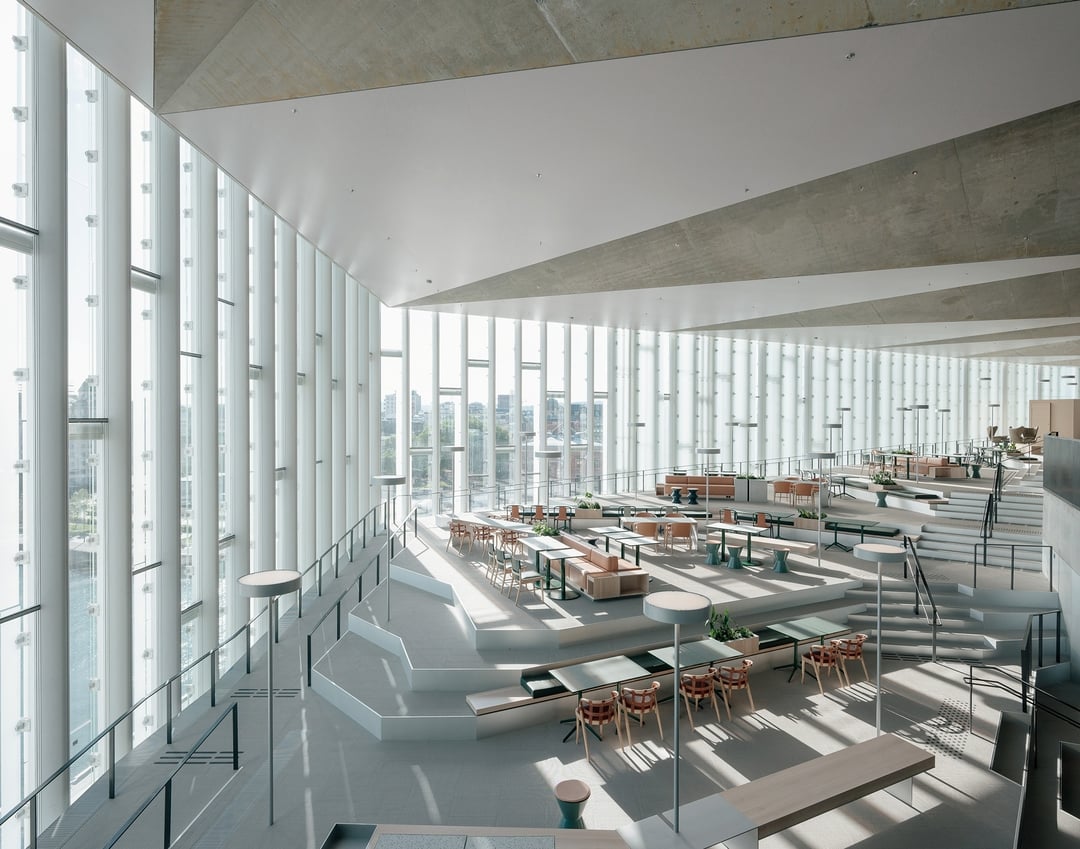
On June 18th, Oslo’s new public library, Deichman Bjørvika, opened its doors to the public. Located on Oslo’s waterfront, and spanning six floors and 140,000 square feet, “Norway’s biggest bookshelf” (as its director Knut Skansen calls it) will contain some 450,000 books, as well as “a children’s section with playful hiding places, technology and knowledge in all forms; and on the fifth floor, a magical little room dedicated to the unique art project Future Library.” The building was designed by Atelier Oslo and Lundhagem, who won the project after an international architecture competition in 2009.

“The librarians wanted a house that would inspire visitors to explore all the new facilities and activities the modern library can offer,” Atelier Oslo writes.

This motivated us to create an open and intriguing building in which you are constantly invited around the next corner, to discover new places. With its central location in Bjørvika, the new library becomes a vibrant hub—a modern meeting place for learning and exchange of knowledge.

The site is relatively small. In order to avoid building too many floors, the building cantilevers out above its footprint: The first floor above the street to the east, and the fourth floor almost 20 meters out above the urban plaza, creating a protective covering. Three “light shafts” cut diagonally through the building from each of the entrances, giving a glimpse into different sections of the library. The light shafts connect the floors and distribute daylight downwards from three big skylights in the roof.

Originally, Deichman Bjørvika had been scheduled to open on March 28th 2020, but the Covid-19 pandemic delayed the plans. Now, the library is finally open. “Finally the people of Oslo and visitors can come to us and start using the library,” Skansen said in a press release. “We are looking forward to show them this building which we are so proud of. Deichman Bjørvika will be a library for the future. I think many people will be very surprised by the building itself and what the library has to offer.” Once the pandemic has passed, the library hopes to welcome 2 million visitors a year.

I will be one of them, because it looks absurdly cool:

Einar Aslaksen Einar Aslaksen Einar Aslaksen Einar Aslaksen Einar Aslaksen Einar Aslaksen Einar Aslaksen Einar Aslaksen Einar Aslaksen Einar Aslaksen Einar Aslaksen Einar Aslaksen Einar Aslaksen Einar Aslaksen Einar Aslaksen

[via Dezeen]

02 Jul 00:23

The late John Prine is the first honorary poet laureate of Illinois.

by Aaron Robertson

When John Prine died earlier this year, there were a few things his obituary writers agreed on.

If you weren’t a huge music fan, you might not have known who he was. If you knew who he was, you undoubtedly loved him. And if you really loved him, you knew that his admirers often called him “the Mark Twain of folk music.”

Prine, the mailman turned singer-songwriter who inspired artists like Willy Nelson and Joan Baez, and who had been an active musician since the early 1970s, was recently named the first honorary poet of Illinois, his home state.

Prine was an influential artist in the Chicago folk scene before moving to Nashville in the early 1980s. Though he never achieved the same popularity as contemporaries like Johnny Cash or Leonard Cohen, he was widely recognized as one of folk’s greatest songwriters, “a sort of folk hero for people who felt overlooked, instead of forgotten” Jayson Greene wrote in Pitchfork.

In one of his more famous quotations, Prine said this about his job: “Writing is about a blank piece of paper and leaving out what’s not supposed to be there.”

01 Jul 18:22

Learn How to Make Trinbagonian Doubles With Two Renowned New Orleans Chefs

by Patty Diez

Queen Trini Lisa and Mason Hereford cook up the fried, chickpea-filled treat on Instagram Live

Is there a more universally appealing food than fried bread?

In Trinidad and Tobago, fried bread is a staple in the form of doubles. The popular street food snack — enjoyed for breakfast, lunch, dinner, or a second, later dinner — consists of fried flatbreads spiced with turmeric, sandwiching a curried chickpea filling (it’s vegan, too). And as Queen Trini Lisa — a New Orleans chef who hails from Trinidad and has doubles on the menu at her eponymous “island soul food” restaurant — frequently puts it, “More doubles, less troubles!”

As part of our Eater at Home series, Lisa showed fellow New Orleans chef Mason Hereford of Turkey and the Wolf just how Trinbagonian doubles are done on Instagram Live, from the spiced chickpea filling to a mango chutney finish. Check out the recipe below and watch the chefs walk through the entire process on Instagram.


Mango Chutney

 Photo by Mason Hereford

1 firm mango, peeled and diced into medium pieces
2 tablespoons of cilantro, chopped
1 tablespoon of Tabasco Sauce
1 teaspoon of Kosher salt

Trinbagonian Doubles

For the dough:
3 cups all purpose flour
1 tablespoon baking powder
1 teaspoon active dry yeast
½ teaspoon turmeric powder
1 teaspoon Kosher salt
1 tablespoon vegetable oil for separating the dough, plus more to fill a medium pan with
1 12 cups of warm water
¼ teaspoon brown sugar

For the chickpea filling:
2 15-ounce cans of cooked chickpeas
1 onion, peeled and roughly chopped
2 tablespoons of vegetable oil
1 12 teaspoons of curry powder
1 teaspoon of geera powder (ground roasted cumin seeds)
3 cloves of garlic
2 tablespoons of chopped cilantro
2 teaspoons of Tony’s seasoning salt or your favorite brand (Kosher salt works well as a substitute)

1 cucumber, grated (for serving)

Start by making the mango chutney. Blend mango, Tabasco Sauce, cilantro, and salt in a blender or food processor on high until completely incorporated. Set aside.

Next make the dough: Mix the flour, baking powder, dry yeast, turmeric, salt, and sugar in a medium bowl. Make a well in the middle and slowly pour in the water. (Depending on the brand of flour, you may need a little more or less water.) Incorporate the ingredients by hand and knead the dough while spinning the bowl until it’s ready, about 5 minutes. Cover the bowl with plastic wrap and let it rest for 30 minutes, or until the dough roughly doubles in size.

While the dough rests, make the chickpea filling: Blend the onion, garlic, and cilantro until finely minced in a blender. Add the oil to a pan over medium heat. Add the curry powder and briefly sauté. Add a splash of water to form a paste. Then add the blended ingredients and cook for 2 to 3 minutes. Add the chickpeas and cook for about 20 minutes, until they are softened enough to be easily mashed with a wooden spoon. Season with the seasoning salt as you go. Finish by folding in the geera powder. Set aside.

Begin frying the dough by heating a heavy bottomed pan over medium high heat. Add about half an inch of oil to the pan and get it nice and hot (350 degrees ideally). Tear a couple golf ball-sized pieces of dough from the bowl — coating them in a splash of oil — and flatten on a plate, cutting board, or counter. (The oil makes it easy to flatten the dough without it sticking to your fingers or to the surface.) Working one at a time, fry each piece of dough for 5 to 10 seconds, then flip and let fry for another 5 to 10 seconds. Move to a paper towel lined plate or bowl.

Add a spoonful of the chickpea filling on top of the fried dough. Garnish with grated cucumber, mango chutney, and Tabasco Sauce.

01 Jul 15:11

Chrome-Plated Pistols and Pink Polos: The Face of Elite Panic in the USA

by Rebecca Solnit

Ever since Trump was elected, we have been living through things that we would find overplayed and unbelievable in fiction and film and they keep on coming. Sunday night they came in the form of a rich, white sixty-something couple waving deadly weapons at a St. Louis Black Lives Matter march.

The casually dressed personal injury lawyers Mark and Patricia McCloskey looked incongruous in front of their imposing mansion. The mansion—or palazzo as this ostentatious midwestern imitation of Renaissance splendor in Italy is sometimes called—makes a claim to be a pinnacle of civility and culture and graciousness. So a man out front with a semiautomatic weapon and a woman waving a chrome-plated handgun “like it was a garden hose,” as one Twitter commentator put it, were in some ways undermining the claims their house makes. And in some ways reinforcing it. There was the trial lawyer in a pink polo shirt brandishing a black spewer of death next to a grand pale gray urn that made me think of the gardens at Versailles, but is apparently an imitation of urns at the Vatican.

But the lawyer was certainly thinking of Versailles when he told a local television station afterward, “We were threatened with our lives, threatened with a house being burned down, my office building being burned down, even our dog’s life being threatened. It was, it was about as bad as it can get. I mean, those you know, I really thought it was Storming the Bastille, that we would be dead and the house would be burned and there was nothing we could do about it.” If the fortress-prison known as the Bastille is being stormed, you don’t actually have much to worry about unless you’re defending the Bastille or you’re the ancien regime. And if you are, you should probably ask yourself some questions.

Of course McCloskey’s claims seem likely to be fictions or excuses taking place at the intersection of megalomania and paranoia. For the protestors to be threatening his office building they’d have to care who he was and the protest would have to be about him and there would have to be some coherent grievance against him personally. For them to be posing a deadly threat to him personally, there’d maybe have to be a recent history of mobs lynching white people in their homes. But they were just passing by.

They seem to believe the underclass is only held back from sowing chaos and destruction by the state’s threat of violence, and in the absence of that threat all hell will break loose.

They were on a march to the Mayor’s nearby home. People were outraged that she had publicly read off the home addresses of constituents who had written in to her about defunding the police, seeing that gesture as putting people at risk and violating their privacy (their names and addresses may have been on the record, but amplifying their visibility amplified their danger). So the first violation of private space—and the safety that each of us desires it be surrounded by—came from the mayor. As the Washington Post notes, “The public identification, or doxing, of activists is not illegal, but such an act carries a particularly fraught legacy in the St. Louis area: Since Michael Brown was shot by police in nearby Ferguson, Mo., six people connected to the protests that followed in 2014 have been found dead—some of them in violent, mysterious ways, the Associated Press reported.” The palazzo is less than ten miles from Ferguson.

The street the protestors marched down belongs to a gated community of residents, and Mark McCloskey declared, “Everything inside the Portland Place gate is private property. There is nothing public in Portland Place. Being inside that gate is like being in my living room. There is no public anything in Portland Place. It is all private property.” It is true that the first amendment, the right of the people peaceably to assemble in order to petition the government for a redress of grievances, doesn’t apply to private property, which is why shopping malls (and the Las Vegas Strip, private property pretending to be a great public boulevard) have been able to crack down on free speech.

It’s also true that private streets are oxymorons; streets are for walking and the free movement of the public; people should flow down them the way water flows along a riverbed, only sometimes there are dams, which we call gates and gated communities. The vast mansion sits at the corner of a major public thoroughfare and this street and sidewalk privately owned by a group, not by the McCloskeys personally. The protestors on the sidewalk may have assumed it was public; there’s irony in that the imposing palazzo itself looks more like a university or civic structure than what most of us think of as a home.

Ironically enough one of the protestors in the video seen more than 13 million times so far is wearing a “hands up don’t shoot t-shirt,” and the protestors in the footage I’ve seen don’t seem interested in the property, though of course they take notice of the guns being pointed at them. One young man waves everyone on. The Washington Post notes that the female half of the McCloskeys had her finger on the trigger; photographs show her pointing it straight at protestors; others note that the male half’s semiautomatic seems to be pointed at her some of the time. An article about their home notes, “The dining room is a re-creation of a residence chamber in the Palazzo Pitti in Florence, constructed in 1458 by Luca Pitti, though its more famous residents included the Medicis and Napoleon Bonaparte. It took six people an entire year to carefully remove multiple layers of paint glommed over the intricate woodwork.”

Since George Floyd’s extrajudicial execution prompted an uprising, one of the rifts running through American society has become more obvious, the one between those who think a society should rest on a foundation of liberty and justice for all and those who think it should rest on orderly property relations. We’ve seen the latter view often, in this uprising, in which a sector of the population downplayed the violence of the police against human flesh and life and played up the property destruction as the real chaos and crime (or preached that violence against life and limb should be imposed to protect lifeless property).

We saw it in New Orleans in 2005, in the wake of Hurricane Katrina, when wealthy white people sat on their porches with weapons awaiting the mob, according to Michael Lewis, and other white people went further, and in the name of protecting property shot Black men who weren’t actually doing stuff to property. Elsewhere, white vigilantes killed Black men—I wrote about this at length in my 2009 book A Paradise Built in Hell—and police killed other Black people, in one case for suspected shoplifting and in others for being Black people moving freely in a ruined city.

What the lawyers with the midwestern palazzo seem to think is what a lot of elite people and police seem to think: society is basically unfair, and they are willing to go to extremes to preserve that unfairness, since they’re on the winning side of it. They seem to believe the underclass is only held back from sowing chaos and destruction by the state’s threat of violence, and in the absence of that threat all hell will break loose (or you’ll have to walk out in your socks and pink polo shirt yourself and threaten your own violence). That is, to air one of their favorite cliches, that society is a thin veneer beneath which seethe all sorts of Hobbesian nastiness, and the veneer must be kept clamped on by any means necessary. It’s an assertion that other people are ruthless and dangerous, but as a justification for elites being themselves ruthless and dangerous.

Those elites project onto the masses their own ruthlessness and savagery; they fear others on the basis that they may be like themselves.

As Adam Weinstein wrote in the New Republic, “But the entire appeal of the Trump presidency, like Stand Your Ground, has been to flatter the id-impulses of excitable whites when they construct nonwhite people—their existence, their persistent presence, and their agency—as inherent threats to public safety.” This is where the protests began; with the assumption by white supremacy and the police that Black and Brown people are inherently threatening and therefore violence against them, including lethal violence, is inherently justified. They began with a man murdered in public for allegedly passing a counterfeit $20 bill, a small act against proper financial relations for which the penalty was extrajudicial homicide.

Here are elites willing to see others die to preserve orderly property relations—we saw another version of it a few months ago when wealthy and conservative businesspeople started suggesting it would be fine for people, people other than themselves, to die in order for the economy to come roaring back. Those elites project onto the masses their own ruthlessness and savagery; they fear others on the basis that they may be like themselves. I’m sure you want to kill me so I will kill you first.

That’s basically the plot of a movie about all this, Mr. and Mrs. Smith. Some years ago, a while after it came out, I watched it with fascination, convinced it was a biting allegory, not just an entertainment. In it Angelina Jolie and Brad Pitt play two assassins who are hiding their profession from each other while preserving the veneer—and here the word works—of an upwardly mobile young couple with what is supposed to be exquisite taste. Their existence is justified by their good looks, their good taste, and their skill at killing; the McCloskeys are a parody of them, with a lot less grace, good looks, and skill, and a lot more luxury goods. The grand finale is a brawl in their own well-appointed home and then an upscale home-and-garden store, with wreckage of china cabinets and kitchen fixtures galore. The movie seemed to me to be saying that the white upper middle class, when its aspirations were ruthless and its indifference to life was brazen, was no better than mercenaries. And of course there are a lot of literal murderers for hire in the people who decide to perpetrate climate change or push gun sales as gun deaths keep climbing or lobby to dismantle workplace and environmental safety standards. Or open up for business when that’s going to spread the pandemic.

But the white people who saw this as their country—and only theirs—to run are right in one key way: their time is running out. They are not literally threatened by violence, much, but they are threatened by something much more powerful, a revision of who matters and who will run things in the future, which is why BLACK LIVES MATTER is the central affirmation. Even to admit that this change is underway is dangerous, because then you might have to admit that it’s just and fair that others share power and opportunity and privilege. It’s safer for the status quo to imagine that the protests and protestors and uprisings are just violent and criminal, and that’s exactly what the McCloskeys seem to have done—imagined that a march for justice was coming for them directly in their fortress-palazzo. Which was in its own way an admission that they embody injustice.

27 Jun 02:07

Why scientists say wearing masks shouldn’t be controversial

by Tina Hesman Saey

To mask or not to mask? To the dismay of many public health experts, that remains a question up for debate in the United States even as the coronavirus pandemic rages on.

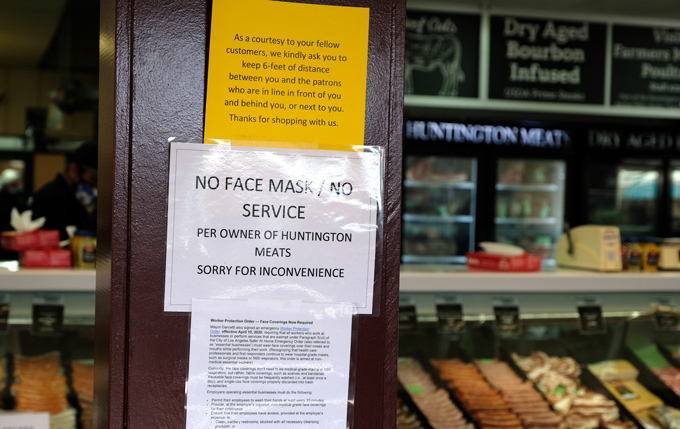
The U.S. Centers for Disease Control and Prevention has recommended that everyone wear masks when in public to curb the spread of COVID-19. But as lockdowns have lifted, many people haven’t followed that advice, and case numbers are rising in some states. In response, some states like California have made wearing face coverings mandatory in public. But in Nebraska, the governor has blocked city- and county-level efforts to require wearing masks in public. Other states, such as Texas, recommend, but don’t require face coverings in public, though some counties within the state are requiring masks.

At the individual level, some people have protested that their personal freedoms are being infringed upon by being told to cover their mouths and noses. Others are masking up whenever they leave their homes.

Sign up for e-mail updates on the latest coronavirus news and research

Meanwhile, scientists have been collecting data on whether cloth masks worn by members of the general public can cut down on the spread of the coronavirus. Science News rounded up the latest data and talked to experts about how well these masks really protect against the coronavirus.

Why are masks now recommended by public health experts?

At the beginning of the outbreak, public health officials thought that the virus was primarily transmitted by people touching contaminated objects or surfaces and then touching their face. Regular handwashing and refraining from touching your face were the main prescriptions (SN: 3/4/20). The CDC and the World Health Organization both at first said that healthy people didn’t need to wear masks.

But it has become clear that contact with virus-laden objects isn’t the major way that the coronavirus passes from person to person, says immunologist Robert Quigley.  He is senior vice president and regional medical director of International SOS, a company based in Trevose, Penn., that helps devise strategies for mitigating medical and security risks. Instead, researchers now think COVID-19 is spread mainly by someone inhaling the virus expelled by another person.

That explains the reasoning behind the CDC’s recommendation that everyone wear a mask in public: The covering may lessen the risk of mask wearers who don’t know they’re infected from passing the virus to someone else.

“We believe now that we are learning more about this novel virus that there is transmission from asymptomatic individuals,” Quigley says. Studies have determined that people can transmit the virus for a couple of days before symptoms start, and that some people who never develop symptoms can be contagious (SN: 6/9/20).

In Singapore, researchers used contact-tracing data to estimate that about 40 to 50 percent of COVID-19 cases from January 23 to February 26 were transmitted by people who weren’t yet having symptoms. The same team found that in Tianjin, China, the amount of such presymptomatic transmission was even higher. From January 21 to February 22, 60 to 80 percent of cases were attributed to spread before symptoms appeared, the researchers report June 22 in eLife.

Since even seemingly healthy people can spread COVID-19 if they’re infected but don’t know it, health officials now recommend that everyone wear masks in public.

mask signs
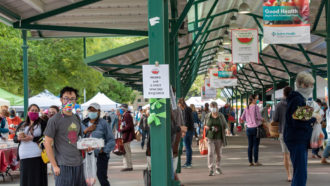
In many places in the United States, face coverings are now required when out in public. Studies indicate such measures can help stop the coronavirus from spreading.Sarah Morris/Getty Images

Is there evidence that a cloth mask can block virus spread?

Many studies have tested surgical masks and N95 masks and found that they reduce viral spread, but until now, there hasn’t been much evidence that cloth masks also work  (SN: 4/9/20).

Matthew Staymates, a mechanical engineer and fluid dynamicist at the U.S. National Institute of Standards and Technology in Gaithersburg, Md., usually works on devising ways to detect narcotics and other illicit substances in the air. But while he was on mandatory telework, Staymates found he missed doing experiments. So he convinced his supervisors to let him bring home some equipment so he could evaluate whether cloth masks cut down on the number of potentially virus-laden particles that spew from people’s mouths and noses when they talk, cough or breathe.

He set up the apparatus in his woodshop and filmed himself coughing without and with a mask. He ultimately tested 26 types of cloth mask, including ones made from common sewing fabrics like lightweight flannel, cotton T-shirts, quilting cotton, cotton-polyester blends and polypropylene from reusable shopping bags.

Staymates didn’t use any viruses in his experiments, so he can’t say whether one type of mask does a better job of catching viruses than another. But using high-speed visualizations, he could determine which masks blocked the trajectory of air coming from his lungs when he coughed or talked.

Wearing any face covering, including bandanas or neck warmers, could at least partially block the cloud of droplets released in a cough, the experiment showed. Masks that are fitted to the nose, cheeks and chin did a better job of blocking droplet flow, and, theoretically, of stopping viruses, too, Staymates describes in a blog post on the NIST website.

Provided that people wear the masks properly, that is. “At one point, I pulled my mask down below my nose in the video” and coughed, he says. The video showed a jet of air streaming from his nose as he coughed. “I was stunned when I saw that footage,” he says. “I was really surprised at how much air comes out of your nose when you cough.” Now when he sees people with their masks covering their mouths, but not their noses, “I [think] ‘No. Don’t do that. You’re defeating the purpose,’” he says.

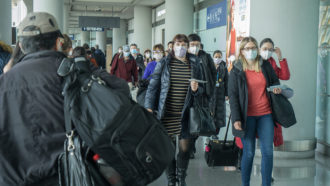
Mask wearing has become controversial in the United States, even as data are amassing that masks may help limit spread of the coronavirus. Not much has been known about the effectiveness of cloth masks, so a researcher set up a home lab to test whether these masks can reduce the amount of potentially virus-laden material people expel from their mouths and noses. See what he discovered.

Does a cloth mask prevent me from catching the virus from someone else?

Alone, cloth masks aren’t great at protecting the wearer, says Abba Gumel, a mathematical biologist at Arizona State University in Tempe.

Cloth masks can vary widely in the amount of particles, including virus, they prevent from reaching the mask wearer. The best cloth masks, which are fitted to the face and made of optimal materials, such as tightly woven cotton, might block up to 80 percent of particles, while most — especially masks that aren’t fitted properly, or made of flimsy material — filter out only about 20 to 50 percent of particles, he says. But even the lowest efficiency mask, “is still better than nothing,” Gumel says.

Cloth masks are for protecting other people from you, Quigley stresses. “Let’s make no bones about it; the cloth mask is not anywhere near as effective in preventing one from inhaling the coronavirus compared with a medical-grade N95 mask,” he says.

Surgical masks may block 70 to 90 percent of infectious particles from reaching the wearer, and N95 masks filter out more than 95 percent, Gumel says. Medical-grade N95 masks have been in short supply and should be reserved for health care workers and others who are high risk of being exposed to the coronavirus, he and other experts agree.

Masks are better at shielding others from the mask wearer than at protecting the wearer because when someone wearing a face covering breathes, talks, coughs or sneezes, most of the air carrying any potential viruses is filtered through the mask, increasing the chances of catching most of the infectious particles. Inhaling while wearing a mask that doesn’t form a seal on the face may draw in unfiltered air from the sides, top or bottom, as well as air filtered through the mask.

Does everybody need to wear a mask?

There is strength in numbers, Gumel and colleagues found. In simulations of epidemics with a low rate of transmission, widespread mask wearing is “very, very effective at reducing hospitalizations and mortality,” he says. If half the population wore masks that block half of particles, transmission rates could also be roughly halved, Gumel and colleagues report April 21 in Infectious Disease Modeling

Even low-effectiveness cloth masks that block only 20 percent of viral particles could cut transmission rates by a third, provided 80 percent of people wore the coverings, the researchers estimate. In areas where transmission rates are high, if 80 percent of people wore masks that block half of infectious particles, 17 to 45 percent of projected deaths over two months might be prevented, the researchers calculate.

Those calculations are in line with estimates made by other scientists. Epidemics could be brought under control if everyone wore a mask all the time when in public, even if face masks are only 50 percent effective, researchers report June 10 in the Proceedings of Royal Society A.

And even though masks are less effective at protecting the wearer, personal protection went up as a greater percentage of people wore masks in the researchers’ calculations. That’s because “my mask protects you, your mask protects me,” the researchers write, so more mask wearing means greater protection for everybody.

Some real-world data also suggest masks are effective at helping curb the spread of the coronavirus. George Wehby and Wei Lyu, health policy researchers at the University of Iowa in Iowa City, tracked daily coronavirus case counts in 15 states and Washington, D.C., that mandated face coverings for the general public in some settings like grocery stores, during the study period from April 8 to May 15. The pair also monitored case counts in states that required masks only for essential employees, such as restaurant workers, health care providers and police or firefighters.

See all our coverage of the coronavirus outbreak

States that required everyone to wear masks saw small, but steady declines in daily case counts after instituting the mandate compared with counts in the one to five days before the mandates took effect, the researchers report June 16 in Health Affairs. By the time mask orders had been in place for 21 days, daily case counts had declined by 2 percentage points. An estimated 230,000 to 450,000 coronavirus cases may have been prevented between April 8 and May22 because people wore masks, the team calculates.

The researchers accounted for shelter-in-place orders and other public health measures, but can’t say for sure that masks are the sole reason for the decline, Wehby says. Requiring employees, but not the general public, to wear masks didn’t lower case counts, the researchers found. But that might be because businesses are often already requiring employees to wear masks, so the state mandates are just enforcing measures that are already in place.

“There’s a general consensus now that masks work, and research is supporting that,” Wehby says. “Going forward, masks are an alternative to some of the strict social distancing measures. They don’t replace [social distancing], but where social distancing cannot be enacted, mask use makes common sense.”

Gumel agrees. “If everybody wore a face mask, we’d be doing a lot better.”

27 Jun 01:58

City Lights: Learn to Edit Wikipedia

Don't just vandalize it! Contribute to the project of greater knowledge.
26 Jun 14:36

The ‘Thanksgiving Tribe’ Is Still Fighting for Food Sovereignty

by Alexandra Talty

On a Friday afternoon in late March, Cedric Cromwell, Chairman of the Mashpee Wampanoag tribe in Massachusetts, received a call, from Bureau of Indian Affairs (BIA) director Darryl LaCounte. Cromwell assumed LaCounte was calling to see how the agency could assist the Mashpee Wampanoag Nation in the middle of the coronavirus pandemic, which was already disproportionally affecting Indigenous peoples across the U.S.

Instead, Cromwell learned that, based on an order from Department of Interior, the federal government was de-establishing the Mashpee Wampanoag’s reservation, effective immediately. De-establishment would mean the tribe could continue to hold onto their land, but they would have to pay steep back taxes on it. They would no longer be able to operate as a sovereign nation, and would suddenly be unable to operate their own police or judicial system.

The land in question is their ancestral home, where the Mashpee Wampanoag greeted the Pilgrims in 1620, and from where the Mashpee helped the colonizers farm, taught them about local vegetation and aquatic life, and even held the first Thanksgiving with them. Their 321-acre reservation is far smaller than the tribe’s original nation, which stretched from eastern Rhode Island into Massachusetts, and has been inhabited by the Mashpee Wampanoag for 12,000 years.

Describing the revocation as a “terroristic attack from this administration against my tribe,” Cromwell likened it to how colonizers used smallpox to exterminate Indigenous peoples 400 years ago, after the Mashpee Wampanoag welcomed the Pilgrims to their shores.

“They killed us off and took our land. . . . Talk about re-opening wounds and repeating history,” said Cromwell, referencing how Pilgrims distributed diseased blankets to the tribe, after the Wampanoag taught the Pilgrims to fish and hunt for cod, sea bass, turkey, rabbit, and lobster. “When you think of our homelands being taken away, that would take away our ability to farm our land as a sovereign nation,” he added.

“They killed us off and took our land. Talk about re-opening wounds and repeating history.”

An East Coast tribe, the Mashpee retain their indigenous fishing and hunting rights, relying on wild foods like striped bass or deer for sustenance. They also rely on gathering herbs, vegetables and fruits, like elderberry, blueberries, beach plum, wild garlic, milkweeds or fiddlehead ferns, many of which grow wild on their reservation.

In response to the U.S. government’s move, the Mashpee filed an emergency restraining order against the Department of Interior to stop its actions, and tribes across the country were watching the case closely: The BIA move was the first time since the end of the Termination Era in the late 1960s that the U.S. government attempted to de-establish a reservation, and observers feared that it foreshadowed how the Trump administration intends to approach tribal relations.

On June 5, the U.S. District Court for the District of Columbia reversed the Interior Department’s move, effectively saying that the Department of Interior did not follow its own guidelines.

“I believe this president really thought he could get away with it,” said Cromwell. “There is no legal precedent for how he can do this.”

Despite the legal win, which allows the Wampanoag to continue developing their food sovereignty plans, the tribe still needs to federally establish their reservation, which is necessary to secure their long-term sovereignty.

Fighting for Access to Traditional Foods

Although the Mashpee are a smaller tribe, the fact that they have remained on their historical lands is significant in the U.S., where many tribes have been forcibly removed, and gives them access to some of their traditional hunting and fishing grounds and the cultural traditions centered around food.

An overhead view of the Mashpee Wampanoag's traditional territory on Cape Cod. (Photo courtesy of the Mashpee Wampanoag)

An overhead view of the Mashpee Wampanoag’s traditional territory on Cape Cod. (Photo courtesy of the Mashpee Wampanoag)

As the tribe’s land has been systematically taken away, they face food insecurity and are turning to greenhouses to try and ensure the ability to raise year-round crops in the cold Northeast climate, said Cromwell. In addition to their agricultural enterprises, they have an operational oyster farm, as well as recreational shellfishing, crabbing and fishing in their traditional waters. As recently as 2015, they’ve fought locally to protect parts of their waterways from development.

“[My parents] taught us how to survive by the season—food sovereignty is everything for us,” said Sherry Pocknett, a Mashpee Wampanoag tribal member and chef who is in the process of opening Sly Fox Den, an indigenous food restaurant, in Connecticut. “It is just really hard for East Coast Indians to keep their lifeways going because . . . no one wants you on their property or to cut through to get to the source [for shellfishing].”

The Mashpee tribe built a 3,500-square-foot greenhouse on their land in an effort to provide more food for elders, as well as promote agriculture in their community. They raise squash, potatoes, and corn—vegetables that are part of a typical Thanksgiving, said Cromwell. Additionally, the tribe’s health services use the greenhouse to grow natural herbal remedies, while the larger farm is also as an educational tool for the tribe’s native language project.

“Diabetes is very high amongst our people, because of the industrialized food that our bodies weren’t really accustomed to eating,” said Cromwell. Pointing out that reservation status would help support the tribe’s farm initiative, he stressed the importance of “getting back more to the traditional foods—beans, squash, and corn—that help heal the body.”

Food Sovereignty and Legal Status

Since the Mayflower arrived from England in November 1620, Indigenous peoples’ ability to sustain their cultural and food traditions has been irrevocably linked to their ability to access land, which is why this recent decision to further divorce the Mashpee from their traditional holdings has many up in arms.

“Our Indigenous ancestors had the luxury of the knowledge of generations handed down to them, we’ve lost a lot of that. People don’t even know their own environment anymore,” said Sean Sherman, a chef and the creator of North American Traditional Indigenous Food Systems (NATIFS) a Minnesota-based nonprofit that works to promote Indigenous foodways. At his Minneapolis business, The Sioux Chef, he said that many patrons are surprised by the cedar tea they serve, and the fact that the common tree is actually a flavorful food source.

Recent history in the United States shows that it is “extremely important” for Indigenous peoples to have access to their ancestral land, he added. “Because of the loss of land, and because of the loss of connection and access to our own foods, we see a lot of loss of culture . . . especially to the East,” Sherman said.

The Shinnecock tribe in New York also has access to, and is fighting to retain, hunting and fishing rights on their traditional lands. And they’re facing a food sovereignty challenge similar to the Mashpee Wampanoag. Traditionally a hunter-gatherer tribe with a strong connection to the water, the Shinnecock’s local waterways have been increasingly circumscribed by local and state authorities, as well as non-Indigenous fishermen.

Similar to their sister tribe, the Mashpee Wampanoag, the Shinnecock are also now turning to a greenhouse and community garden, in an effort to bolster their food sovereignty, as some of their traditional gathering methods, and where they are able to hunt, have been affected by modern development.

Two Mashpee Wampanoag tribal members in silhouette at a tribal gathering. (Photo courtesy of the Mashpee Wampanoag)

Describing the Shinnecock as a “wealthy tribe” because they can still access traditional foods such as beach plums, clams, and deer, tribal member Jason Colfield said, “that one word—sovereignty—holds a lot of power within Indian Country. We don’t take it for granted. And we are constantly fighting for it.”

In 2009, the U.S. Supreme Court handed down a decision in Carcieri v. Salazar that upended the status of every tribe not federally recognized in the landmark 1934 Indian Reorganization Act, which aimed to “conserve and develop Indian lands and resources” and strengthen tribes’ sovereignty and cultures.

“That one word—sovereignty—holds a lot of power within Indian Country. We don’t take it for granted. And we are constantly fighting for it.”

This decision created legal confusion for dozens of tribes, including the Mashpee Wampanaog, who in 2007 were federally recognized, but in 1934 were left off the U.S. government’s list of “recognized” tribes. The 2009 decision made it impossible for the government to take the Mashpee Wampanoag land into trust, the legal process for creating a reservation, as well as the land of dozens of other tribes across the U.S.

“[The Carcieri] decision threw into limbo the status quo that all tribes should be treated the same under federal law, including that land could be taken into trust,” said Derrick Beetso, general counsel of the National Congress of American Indians.

Despite legal contracts that predated the formation of the U.S., the Mashpee tribe among those tribes left out of the 1934 Act, and it was the first to try to establish a new reservation after 2009. That’s why the Mashpee case is important: Other tribes who were similarly left off the 1934 federal list are hoping to follow the Mashpee approach and establish their own sovereign nations.

In addition to the threatened loss of sovereignty for the Mashpee Wampanoag people, many worry about what kind of legal precedent the proposed de-establishment will set. Indigenous law in the U.S. has gone through many phases, and while some feel that tribal sovereignty has moved in a positive direction in recent decades, the Trump Administration’s sudden move seems to be a worst-case consequence of the 2009 Carcieri v. Salazar decision.

While the tribe was able to block the Department of Interior’s decision to de-establish their reservation, they are still not federally established and Mashpee Chairman Cromwell underlined the importance of having H.R. 312, which would re-affirm their status, or H.R. 375 which would amend the controversial Indian Reorganization Act, passed in Senate.

Either bill would allow the Mashpee to federally establish their reservation, giving them more ability to make long-term plans for tribal food sovereignty, and it would also set legal precedent for other tribes, including the Shinnecock, to follow suit.

“The Mashpee Wampanoag tribe . . . greeted the pilgrims and shared their harvest in this thing called Thanksgiving. We are American history,” said Cromwell. “The U.S. is almost saying, ‘Well, we got what we wanted, [now] we are going to completely erase you.’”

Photos courtesy of the Mashpee Wampanoag.

The post The ‘Thanksgiving Tribe’ Is Still Fighting for Food Sovereignty appeared first on Civil Eats.

26 Jun 14:36

Explore 1,100 Works of Art by Georgia O’Keeffe: They’re Now Digitized and Free to View Online

by Ayun Halliday

Lake George Reflection (circa 1921) via Wikimedia Commons

What comes to mind when you think of Georgia O’Keeffe?

Bleached skulls in the desert?

Aerial views of clouds, almost cartoonish in their puffiness?

Voluptuous flowers (freighted with an erotic charge the artist may not have intended)?

Probably not Polaroid prints of a dark haired pet chow sprawled on flagstones…

Or watercolor sketches of demurely pretty ladies...

Or a massive cast iron abstraction…

If your knowledge of America’s most celebrated female artists is confined to the gift shop’s greatest hits, you might enjoy a leisurely prowl through the 1100+ works in the Georgia O’Keeffe Museum’s digital collection.

A main objective of this beta release is to provide a more complete understanding of the life and work of the iconic artist, who died in 1986 at the age of 98.

Her evolution is evident when you search by materials or date.

You can also view works by other artists in the collection, including two very significant men in her life, photographer Alfred Stieglitz and ceramicist Juan Hamilton.

Each item’s listing is enhanced with information on inscriptions and exhibitions, as well as links to other works produced in the same year.

If your explorations leave you in a creative mood, the museum’s website has devised a host of  O’Keeffe-inspired, all-ages creative assignments, such as an advertising challenge stemming from her 1939 trip to Hawaii to design promotional images for the Hawaiian Pineapple Company (now known as Dole).

Visit the Georgia O’Keeffe Museum’s online collection here. And watch a documentary introduction to O'Keeffee, narrated by Gene Hackman, below:

Related Content:

The Real Georgia O’Keeffe: The Artist Reveals Herself in Vintage Documentary Clips

Georgia O’Keeffe: A Life in Art, a Short Documentary on the Painter Narrated by Gene Hackman

How Georgia O’Keeffe Became Georgia O’Keeffe: An Animated Video Tells the Story

Ayun Halliday is an author, illustrator, theater maker and Chief Primatologist of the East Village Inky zine. Follow her @AyunHalliday.


Explore 1,100 Works of Art by Georgia O’Keeffe: They’re Now Digitized and Free to View Online is a post from: Open Culture. Follow us on Facebook, Twitter, and Google Plus, or get our Daily Email. And don't miss our big collections of Free Online Courses, Free Online Movies, Free eBooksFree Audio Books, Free Foreign Language Lessons, and MOOCs.

25 Jun 21:18

Browse Hundreds of Artist’s Zines, Prints, and Other Works at the Virtual Brooklyn Art Book Fair This Weekend

by Grace Ebert

Kiss” by Sophie Page, four-color risograph print, white paper, 14 x 8.5 inches. All images courtesy of Brooklyn Art Book Fair

The Brooklyn Art Book Fair has moved its 2020 market online, extending the opportunity to pore through the offerings from artists and independent publishers to those who don’t reside in New York City. This year’s fair boasts more than 400 publications presented by 45 vendors, like The Free Black Woman’s Library, Printed Matter, and Paradise Systems. Founded in 2017 to provide smaller presses and artists the opportunity to showcase their work without a financial barrier, this is the fourth iteration of the annual event organized by Endless Editions.

We’ve gathered a few of the offerings here: Khari Johnson-Ricks’s “A real Conversation,” a vibrant screenprint of one of the artist’s incredibly detailed collages; “Friendship Forever,” a humorous collection of comics, by Inkee Wang; and Sarula Bao’s queer romance narrative “Changing Faces.” Browse the available prints, zines, and other artworks on the fair’s site, and pop into the artist chats throughout the weekend.


Left: “Changing Faces” by Sarula Bao, 7 x 5 inches, 10 pages. Middle: “A real Conversation” by Khari Johnson-Ricks, five-color screenprint on paper, 22 x 30 inches. Right: “Friendship Forever” by Inkee Wang, 5.6 x 8.25 inches, 24 pages

From the NYC Amidst COVID-19 Fine Art Print Bundle by Felicita Felli Maynard, 5 x 7 inches

The Free Black Women’s Library” poster by Olaronke and John Andrews, 24 x 36 inches

Mushrooms & Friends 2” by Phyllis Ma, 28 x 22 centimeters, 32 pages

Lost Things” by fenta, 5 x 3.5 inches, 44 pages

Abecedarian” by Ashley May, four-color risograph, accordion book, 11 x 9 inches

23 Jun 15:49

For those not going back to work this week: here’s how to make a pop-up book.

by Emily Temple
popup

As many of us head into our fourth month of isolation, our at-home activities are getting . . . unusual. So today, if you’ve already voted (if you’re in Kentucky or New York) and called your representatives about defunding the police and you’re looking for something creative to do with your kids (or just with yourself), why not recreate the singular childhood joy of the pop-up book? Just follow along with this wordless video from MK Art Studio, which gives you all the tools you need (except, you know, paper and tape) to make your own fun (and/or functional) piece of book art.

22 Jun 15:56

Liberation is a Long Haul: Lessons from Juneteenth

by Lovey Cooper

This piece was originally published by 100 Days in Appalachia.


Juneteenth is a joyful ritual of collective memory and cultural cohesion. A summer tradition commemorating the end of slavery, Juneteenth is also an opportunity to challenge facile understandings of the past and reckon with a national heritage of racism. 

But over 155 years of observance, Juneteenth celebrations have often been staged against a backdrop of horrors that belie the holiday’s significance. Still, the defiant expression of pride amid precarity offers a lesson about the contours of Black struggle today. 

See also: Modern abolition and the lasting truth of change

The [In]Considerate Judgment of Mankind

First, though, we must begin with a lesson in American history.

Among the many structural outcomes of the U.S. Civil War, the emancipation of enslaved Black people is one of the most striking. While the basic understanding of slavery’s dissolution often stops at the Emancipation Proclamation, it is important to note that the Proclamation, which went into effect on January 1, 1863, was originally issued by Abraham Lincoln four months earlier—in September of 1862. 

The “lead time” reveals, among other things, the complex intention of the measure. 

According to the text, the emancipation of Southern slaves was a “fit and necessary war measure for suppressing... rebellion.” That is, Lincoln anticipated that, for Confederate states, the possibility of Black freedom would be so disruptive to white supremacist values, property systems, and legal infrastructure, it could either function as an incentive to abandon the Confederate cause or punish Confederate states for their insurgency. 

Notably, the Emancipation Proclamation did not outlaw slavery in states that remained loyal to the Union. Slave states like the Commonwealth of Kentucky—which continues to enjoy the politicizable claim of having been a Civil War border state—were allowed to maintain the institution through the end of 1865. Like their Northern “free” state counterparts, they benefited directly and intergenerationally from the racial order entrenched through slavery and its afterlife. 

When writing the Emancipation Proclamation, Lincoln noted that the act was “sincerely believed to be an act of justice, warranted by the Constitution,” and to honor it, he “invoke[d] the considerate judgment of mankind and the gracious favor of Almighty God.” The considerate judgment of mankind, of course, could scarcely be relied upon, and most Confederate states refused to change legal doctrine or de facto slavery practice until the 13th Amendment was passed in December 1865. Still, the Proclamation gave crucial legal and military backing for slaves who had engaged extravagant and everyday fugitivity  since the beginning of New World captivity. 

[T]he abolition of chattel slavery is not the same as the abolition of prisons.

In the remote state of Texas, the news of freedom (and the resources to support it) were intentionally suppressed by slaveholders. Two years after the Emancipation Proclamation (and two months after Robert E. Lee’s final surrender at Appomattox), Union General Gordon Granger issued General Order Number 3, officially emancipating Texas slaves. 

It was June 19th—Juneteenth—1865. 

The date became a crucial and enduring touchpoint of Black liberation narratives. Formal celebrations of slavery’s end began in Texas the following year and never stopped. Observance of the day spread, too, to other states, though many outside the Black community remain unfamiliar with the holiday. 

This year, Juneteenth has gained unprecedented national attention, following outcry over a presidential campaign rally controversially scheduled on the date in Tulsa, Oklahoma. In the context of a massive national uprising against anti-Black state violence, more than a dozen major corporations have announced new Juneteenth observances. But for many reasons, contemporary commemorations of this watershed moment offer lessons on much more than a historical register.

See also: Uncontrolled Images—Documenting Raleigh’s Black Revolt

Liberation is a Long Haul: Lessons in Black Struggle

In the criss-crossing discourse of contemporary racial justice, there exists an almost dizzying number of calls for change. Among the most profound is the call to abolish policing, prisons and other sites of state violence.

Scholars like Ruth Wilson Gilmore rightly caution overly simplistic analogies between contemporary and historical systems of oppression; the abolition of chattel slavery is not the same as the abolition of prisons, incarceration is not exactly the same as slavery. At the same time, it is clear that so many systems of surveillance, violence, criminalization, extraction, dehumanization, displacement and premature death were perfected in slavery and are sustained by our current racial landscape. 

Not only do we find echoes of that radical capacity in contemporary struggles for Black freedom, the particularly bright and blooming energy of the Juneteenth moment [...] provides an apt and sustaining inspiration for organizers today.

To that end, the unprecedented consideration of abolitionist proposals may find organizers revisiting the Juneteenth moment with the same combination of celebration, strategy and existential crisis as the freedmen did for decades after gaining formal liberation. The question now – as it was then—is: Where do we go from here? What brilliant, imaginative things can we think up? What lingering attachments to oppression threaten us still? Who’s coming along? How shall we go about this? 

In the context of Juneteenth, these questions particularly haunt.

For many, the most affecting element of Juneteenth’s history is the audacious clarity of white commitment to Black subjugation in and after the final days of slavery.  This is well exemplified in the frequently skipped final lines of General Granger’s Order:

The freedmen are advised to remain quietly at their present homes and work for wages. They are informed that they will not be allowed to collect at military posts and that they will not be supported in idleness either there or elsewhere.

A militarized command for Blacks to respond to something as surreal as emancipation with quietude and dutiful labor signal so much about the enduring terms of racial control. These lines are not dissimilar to fervid condemnation of contemporary uprisings, and the danger of both is that they seek to moralize and arrest Black consciousness and agency.  

See also: The South Hollers ‘Black Lives Matter’

Indeed these seemingly innocuous lines (echoing similar ones found in the text of the Emancipation Proclamation) prefigured oppressive mechanisms like the Black codes and lynch law. This enunciation of control is but one of many signals that the social, symbolic and labor economies of slavery were never eradicated, just morphed and replaced, leaving Black survival as fraught as ever.

Still, for newly freed Blacks, over a century of multifaceted resistance—including abolition, mass revolt, escape, crop destruction, reproductive sabotage, community care and the spread of revolutionary ideology—all provided a blueprint for negotiating new iterations of racist domination and the continued work of survival.

Not only do we find echoes of that radical capacity in contemporary struggles for Black freedom, the particularly bright and blooming energy of the Juneteenth moment—a complicated situation that depended on old knowledges and new imagination—provides an apt and sustaining inspiration for organizers today. 

Over the past three weeks, more than 3,600 cities and towns in Appalachia and across the country have erupted in protest over anti-Black state violence in all its forms. The current fight is waged against multiple sites of oppression, from erased violence against women and trans people to issues of reproductive justice, education, equitable housing and health. 

Resistors have smartly and inclusively used every tactic in their arsenal, loosening ground and dreaming up possibilities for serious, seismic change. From the proliferation of political education to community-based research, medicine and mutual aid, the work is being done by (as has been the case throughout our history) by preachersqueer and trans people, philosophers, community organizers, vulnerable women, “criminals,” mothers and radical teenage girls.

See also: Slave rebellion replaces Confederate reenactments. Watch now.

Juneteenth teaches us, just as it taught Black freedmen, that liberation is a long haul. It’s iterative, fragmented, complex and local. Its victories are costly and sometimes obscure. Juneteenth teaches us that few things are certain, but one thing you can count on is swift backlash in the form of new and shockingly inventive technologies of oppression. Juneteenth reminds us that the logics of anti-Blackness are neither invented nor undone in single events: They exist as premise, backdrop, atmosphere, constitution, 24,000 pounds of granite and bronze built three and a half feet into the ground. And they must be undone.

Like Juneteenth, this Jubilee moment carries as much catharsis and deeply embodied joy as it does seriousness, study and cautious looks ahead. It seems nearly impossible, but somehow the dense combination of feeling and praxis, the unbound promise of Black struggle captured by this and many other moments are best and most powerfully expressed with the two-word greeting: Happy Juneteenth.


Jakeya Caruthers is a cultural studies scholar and Assistant Professor of African and African American Studies at Berea College. Current projects include an essay examining curiosity as a radical black feminist feeling, a co-edited special edition of Abolition Journal, and a collaborative archive and data project focused on criminalized survivors of gender violence.

12 Jun 16:56

Have Celebrities Become the Grifters of Quarantine?

by Joelle Kidd
Even in a pandemic, the famous are finding new ways into our minds and wallets
11 Jun 01:35

Two Recycled Woods are Engineered into a Modest, Airy Church in Indonesia

by Grace Ebert
Bgarland

That structure is incredible.

All images © TSDS, by Mario Wibowo

Constructed entirely with locally sourced wood waste, “Oikumene Church” erected in Sajau, East Kalimantan, Indonesia, is designed to conform to its natural environment. The unassuming project features a slatted facade made of Rimba, or teak, while the inner structure utilizes meranti. An open-air hallway wraps around the perimeter of the building that’s situated at the highest elevation in the region.

For the worship space, TSDS Interior Architects relied on the Dayak people’s “Rumah Betang” design concept, which is an elongated, single-room dwelling that must have entryways on the east and west sides. Varying roof heights improve airflow throughout the interior, allowing it to stay cool throughout the day when temperatures hover around 90 degrees Fahrenheit with more than 85 percent humidity.

See more of TSDS’s environmentally thoughtful architecture on Instagram. (via designboom)


05 Jun 18:16

A Bold Black Lives Matter Statement Transforms a Street Leading to the White House in Washington D.C.

by Grace Ebert

Photograph © Nadia Aziz

In a show of solidarity, a massive tribute to Black Lives Matter has been painted on the street leading to the White House in Washington, D.C. Completed in permanent street paint, the message features bold, yellow letters that span more than a block of 16th Street and marks a historic moment in the United States after weeks of protests.

Mayor Muriel Bowser commissioned the banner-style piece, which city workers and volunteers began at 3 a.m. Friday morning ahead of weekend demonstrations. The new message is just two blocks north of Lafayette Square, where police charged peaceful protestors and released tear gas and flash-bang shells to clear the crowd for a photo-op for President Trump earlier this week. It sits at the foot of St. John’s Church.

Update: Black Lives Matter D.C. has denounced the public display, saying, “This is performative and a distraction from her active counter organizing to our demands to decrease the police budget and invest in the community. Black Lives Matter means Defund the police.”

Update 2: An earlier version of this article erroneously attributed the mural to a single artist.

#BlackLivesMatter pic.twitter.com/OQg6977n5r

— Muriel Bowser #StayHomeDC (@MurielBowser) June 5, 2020

04 Jun 15:38

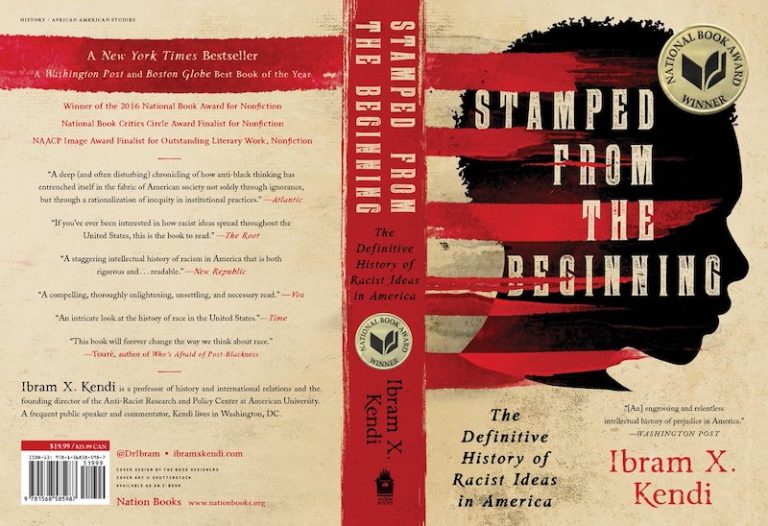
Listen to Ibram X. Kendi’s Stamped from the Beginning for free.

by Emily Temple

If your local bookstore is all sold out of its books on anti-racism, good. Finally. Backorder them for yourself. But in the meantime, the audiobook version of Ibram X. Kendi’s Stamped from the Beginning: The Definitive History of Racist Ideas in America, which won the 2016 National Book Award for Nonfiction, is now available for free on Spotify. Honestly, listening to this brilliant, engrossing, and important book is the very least you can do.

[h/t BookRiot]

03 Jun 15:22

Want to See Food and Land Justice for Black Americans? Support These Groups.

by Civil Eats
A protester carries a hand painted picture of a red fist in the air at the top of a flower made to resemble a rose. A protester in New York City on June 2 | Ira L. Black/Corbis via Getty Images
As the nation rises up to protest police brutality and racial injustice, here are some organizations working to advance Black food sovereignty

This story was originally published on Civil Eats.


Food justice is racial justice. Food and agriculture, like everything in this country, are deeply intertwined with our nation’s entrenched history of slavery and structural racism. Our food system actively silences, marginalizes, and disproportionately impacts people of color, who are also being hardest hit by COVID-19.

As Americans rise up to respond to the deaths of George Floyd, Breonna Taylor, Ahmaud Arbery, and countless others, and to the ongoing violence, suppression, and brutality facing the Black community, we hope this list of organizations working to strengthen food justice, land access, and food access in the Black community will inform, inspire, and energize you to show up for racial justice.

Black Church Food Security Network works to connect Black communities and other urban communities of color with Black farmers in hopes of advancing food and land sovereignty. Read more.

Black Dirt Farm Collective is a collective of Black farmers, educators, scientists, agrarians, seed keepers, organizers, and researchers guiding a political education process.

Black Urban Gardeners and Farmers Cooperative of Pittsburgh works with Black communities in Pittsburgh, Pennsylvania, to grow food and to share Black cultural traditions through a farm, youth program, and policy work. Read more.

Black Urban Growers (BUGS) is committed to building networks and community support for growers in both urban and rural settings. Through education and advocacy around food and farm issues, it nurtures collective Black leadership.

Castanea Fellowship offers a two-year fellowship for diverse leaders working for a racially just food system in any of the areas of health, environment, agriculture, regional economies, or community development. Read more.

Cooperative Food Empowerment Directive (CoFED) is a queer and transgender people of color-led organization that partners with young folks of color to build food and land co-ops.

Detroit Black Community Food Security Network ensures that Detroit’s African American population participates in the food movement through urban farming, youth education programs and the much-anticipated Detroit People’s Food Co-op. Read more.

Family Agriculture Resource Management Services (FARMS) is a legal nonprofit, committed to assisting Black farmers and landowners in retaining their land for the next generation. Read more.

Federation of Southern Cooperatives/Land Assistance Fund is a non-profit cooperative association of Black farmers, landowners, and cooperatives, with a primary membership base in the Southern States.

Food Chain Workers Alliance is a coalition of worker-based organizations whose members plant, harvest, process, pack, transport, prepare, serve, and sell food, organizing to improve wages and working conditions for all workers along the food chain. Read more.

Food First works to end the injustices that cause hunger through research, education, and action.

Freedom School Demonstration Farm runs a Fresno, California-based program aimed at empowering Black and brown youth to grow their own food. Read more.

HEAL Food Alliance brings together groups from various sectors of movements for food and farm justice to grow community power, develop political leadership, and exposing and limiting corporate control of the food system. Read more.

The Land Loss Prevention Project responds to the unprecedented losses of Black-owned land in North Carolina by providing comprehensive legal services and technical support to financially distressed and limited resource farmers and landowners. Read more.

The National Black Farmers Association is a non-profit organization representing African American farmers and their families in the United States.

National Black Food and Justice Alliance organizes for Black food and land, by increasing the visibility of visionary Black leadership, advancing Black people’s struggle for just and sustainable communities, and building power in our food systems and land stewardship. Read more.

New Communities Land Trust is a grassroots organization that has worked for more than 40 years to empower African American families in Southwest Georgia and advocate for social justice. Read more.

The Northeast Farmers of Color Land Trust advance land sovereignty in the Northeast through permanent and secure land tenure for Indigenous, Black, Latinx, and Asian farmers and land stewards.

Planting Justice works to empower people impacted by mass incarceration and other social inequities through a nursery, land trust, and various community farming efforts. Read more.

Restaurant Opportunities Centers United is fighting to improve wages and working conditions for the nation’s restaurant workforce. Read more.

Sankofa Farms seeks create a sustainable food source for minorities in both rural and urban areas located in Durham and Orange County, North Carolina.

The Seeding Power Fellowship is an innovative 18-month, cohort-based food justice fellowship program. Read more.

Soil Generation is a Philadelphia-based Black- and Brown-led coalition of growers building a grassroots movement through urban farming, agroecology, community education, and more. Read more.

Soul Fire Farm is a Black, Indigenous, and people of color-centered community farm committed to ending racism and injustice in the food system. Read more.

Southeastern African American Farmers’ Organic Network is a regional network for Black farmers committed to using ecologically sustainable practices to manage land, grow food, and raise livestock that are healthy for people and the planet. Read more.

Want more? Read our ongoing coverage of the many worthwhile efforts to expose and address structural inequities in the food system.

Want to See Food and Land Justice for Black Americans? Support These Groups [Civil Eats]

03 Jun 15:05

Reckoning with white supremacy: Five fundamentals for white folks

by Lovey Cooper

For our folks on the frontlines: Bail funds across the South

As demonstrations in response to the murders of George Floyd, Ahmaud Arbery, Breonna Taylor, and countless others gain momentum across the United States, many white people nationwide are being forced to confront the idea that flashpoints like this are not isolated missteps within an otherwise faithful system. Rather, more and more white folks are realizing each day that the very fabric of our society is in fact based on enduring violence against Black people and other marginalized groups.

In this time, the sharing of trauma-porn and reactionary social-media solidarity—while perhaps the most readily available avenue of action for most—are nowhere near suitable surrogates for a factual, historical understanding of this moment. 

Southerners are no strangers to white supremacy and police brutality. From slavery to secession, the KKK to “states rights” strategies, from Jim Crow to mass incarceration—we’ve been here before.

If you’re a “well-meaning” white person feeling lost in your own self-actualization process, here are five basic ideas you must grasp:

1. White supremacy is not “just” racism.

Racism often refers to acts of overt, intentional prejudice and visions of social order that debase people of color while glorifying whiteness. But white supremacy is a systemic and systematic phenomenon woven throughout our society—rather than just the work of racist individuals who intentionally and maliciously discriminate. Our institutions and social practices themselves prop up white advantage and protect white communities, while making Black and brown people vulnerable to exploitation, domination, and violence.

Conceiving of white supremacy as a problem of individual bad actors is too limited. It reduces a deep social problem to narrow questions ("Are they racist?" "Is this racist?") and shallow defensiveness ("I’m not being racist, but..."), while ignoring that white supremacy is not just a vestigial remnant of the past. White supremacy’s inequities are actively reproduced across history and through the present, in new forms and with new mechanisms of white power.

Understand too that white supremacy is irrevocably tied up in anti-Blackness—a socialized way of stereotyping, stigmatizing, and discarding Black people in ways that oppress and harm them. Our culture supports the viewpoint that Black lives don’t matter in myriad ways, small and big, conscious and unconscious, intentional and unintentional, every day.

Read: Kari Points & Evangeline Weiss’s tactics for helping white women challenge white supremacy, Lizzy Hazeltine

“What reinforces it is how individual white people access and are assimilated into [white supremacy]. It’s a mixed metaphor, but it’s like an echo chamber of silence as long as [white supremacy’s] not named.”

See also: We’re talking about white supremacy and anti-Blackness (and you should too)

2. Today’s police system is rooted in slavery.

Slavery is often defined in two ways: the economic condition of bondage and forced labor, as well as a condition of dishonor or “social death,” the systematic rupture of familial ties and genealogical continuity, and gratuitous violence. 

Modern policing fulfills the conditions of both perspectives. America’s policing system reproduces and reinforces both patterns on Black people: that of forced labor—through the use of unpaid labor in prisons, by preventing acts of collective expropriation, by criminalizing lifestyles that resist wage work—just as it ensures “social death”—by breaking up familial connections via prison system, destroying Black social organizations, or enacting limitless violence against young Black people in poorer neighborhoods across the country.

The law today grants prosecutors complete authority to determine who will be prosecuted. The law is also supposed to leave room for any person to dissent or resist police conduct directed toward them. But because of its fundamentally racist roots, the law is deliberately designed to protect police officers from prosecution for misconduct as enforcers of white supremacy.

Read: Where do the police come from? Neal Shirley & Saralee Stafford

We would ask those who desire an “accountable” or “just” police force: At what point in this history, in what period, do they believe that police became an institution that intended anything other than the reproduction of capital and the enforced social death of Black people? When has there ever been a break, either social or economic, political or existential, with this contiguous line of flight towards dispossession and misery? Slavery functions not just as the historical origin point of policing, but also as its continued ontological force and psychological foundation. How could there ever be “accountability” with such an institution?

See also: The Police, the Law, and the Unjustified Use of Force, Irving Joyner

In 2015, a time when there are civil rights laws on the books and many police departments and prosecutors’ offices are racially integrated, you would not expect the responses to police killings of African Americans to meet the same fate as in 1952. But the failure to investigate is the same today as it was then—except now it is a national problem.

3. The news has always been influenced to evoke sympathy towards cops and resentment towards protestors.

In periods of mass unrest, police departments always strive to show measured sympathy for the Black communities they often criminalize or neglect in other contexts. They also portray widespread criticism of policing—especially the protests themselves—as dangerous threats to public order. The national media plays into this false narrative—a calculated tactic that can be traced back to the Freedom Riders.

Example: In Ferguson, Missouri, during the peak of the unrest around the murder of Michael Brown in 2014, Captain Ronald Johnson—a Ferguson native who touted his local ties to the Black community—was put in front of cameras to announce a new practice of community policing that would presumably replace military tactics used against protesters and reporters. The media ate it up. But protestors still had reason to continue demonstrations a year later.

Read: Police and the silent majority, Seth Farber

This narrative, which claims that protests embolden violent criminals and destabilize cities, has come to be called the “Ferguson effect.” Despite record low numbers of murdered police officers, many politicians and pundits insist that the U.S. is in the throes of a “war on cops.” Although now widely debunked, the “Ferguson effect” narrative continues to gain broad acceptance, making it easier for White Americans to express antipathy toward protesters without acknowledging the injustices visited upon Black communities by the criminal justice system. In the context of an imagined war on police, it feels noble to call for civility first and foremost. Doing so makes the act of dismissing Black protest seem a sensible response, rather than a blatantly self-serving one.

See also: White churches ‘aren’t naming racism as a sin,’ says Rob Lee, Sammy Hanf

4. Yes, you are inherently part of the problem.

As we see this narrative play out on social media, we all have the instinct to virtue-signal and efface self-criticism, almost without recognizing it. White folks must work to find ways to speak without absolving ourselves and without denying the fact we are continually at risk of failing. As Sara Ahmed has argued, “the language we think of as critical can easily ‘lend itself’ to the [things] we critique... Saying ‘we are racist’ becomes a claim to have overcome the conditions (unseen racism) that require the speech act in the first place.”

This kind of self-absolution is fundamental to the ways white Americans talk about race: Racism is always the fault of someone else, someone who doesn’t know what I know. As Black activists continue to make racial oppression an unavoidable topic, the mainstream media wants you to avoid necessary self-criticism by pinning blame on others.

Read: White silence is tragic silence, Matt Hartman

At their best, responses like these are meant to begin a conversation that leads to a larger struggle. More commonly—for myself, anyway—they are a defeatist response, a way of soothing my own guilt when I don’t know what else I could do, or when the prospect of long-term, continuous struggle against the culture of a nation where hate groups are “surging” is too overwhelming to comprehend.

See also: Read, Watch, Listen, Do: a Scalawag resource guide for understanding white supremacy

5. If you really care about what’s going on, you need to listen to people of color before doing anything else.

White skin, Isaac S. Villegas

To be a racial minority involves the constant negotiation of bodies and speech—to notice the meaning of my skin in relation to yours, to discern the value of my tongue among the languages and accents echoing in a room. ‘Do I belong here,’ I always ask myself, ‘In this language, among these people?’

I pledge allegiance to the Always Not Yet, Zaina Alsous

What would it look like to fully sit with Hughes’ “America never was”? What would it mean to disentangle hope from White nationalism? To situate our position—here, right now, on sacred, stolen land. There is no American model absent paradigmatic violence to cling to, to return to. What would it mean to say I feel devoted to you and not this flag? What would it mean to pledge allegiance to the not yet and the could be?

A dispatch from the streets of Charlotte, Danielle Purifoy

If folk had come last night wanting a war, there would have been one, especially after that shooting. Instead, people chanted, sang, danced, and supported one another. They stopped one man from getting into a fight with a White guy who had been throwing fireworks, allegedly in solidarity. Someone yelled—"that's not what we're here for."

Don’t call the police on poverty, Lamont Lilly

Poor people are not stupid. They’re not criminals. They’re human beings that live in a society where jobs are drying up and opportunities often don't exist.

Further reading:

Black lives matter—so should their votes, Mac McCann

The Electoral College was balanced to empower slave states in the 18th century—today it continues to disempower Black voters.

White people who want to end gun violence need to combat white supremacy, David Straughn

No one is immune to the bullets sprayed or the cars driven in the intense, seething rage of white supremacist anger at its peak. No one is safe. When white supremacy prevails, we all suffer.

03 Jun 14:42

You can order today from these black-owned independent bookstores.

by Corinne Segal
loyalty books

Across the country, black-owned bookstores have served as community gathering spaces, support for emerging authors, and educational resources. Those listed below are open and ready for online orders, with the exception of several stores that are only taking orders over the phone, which are noted in parentheses.

*
Order from these independent bookstores:
*To add your store to the following list, please email info@lithub.com

Little Rock, AR
Pyramid Art Books & Custom Framing

Long Beach, CA
Shades of Afrika

Los Angeles, CA
Eso Won Bookstore · Reparations Club

Vallejo, CA
Ashay by the Bay

Oakland, CA
Marcus Books (local phone orders)

Sacramento, CA
Carol’s Books (local phone orders) · Underground Books

District of Columbia
Mahogany Books · Sankofa Video Books & Cafe · Loyalty Bookstore

Boynton Beach, FL
Pyramid Books

Longwood, FL
Dare Books

St. Petersburg, FL
Cultured Books

Tampa, FL
Best Richardson African Diaspora Literature & Culture Museum

Atlanta, GA
Medu Bookstore (launches online bookstore in a month, contact store if you want to be notified) · For Keeps Bookstore

Decatur, GA
The Listening Tree · Brave + Kind Bookshop

Lithonia, GA
Black Dot Cultural Center

Mableton, GA
All Things Inspiration Giftique

Morrow, GA
NuBian Books (local phone orders)

Chicago, IL
Frontline Bookstore · Semicolon Bookstore & Gallery · The Underground Bookstore (local phone orders)

Maywood, IL
Afriware Books, Co

South Bend, IN
The Brain Lair Bookstore

Kokomo, IN
Beyond Barcodes Bookstore

Evansville, IN
Akoma Novelties & Books

New Orleans, LA
Community Book Center (local phone orders)

Baltimore, MD
Everyone’s Place (local phone orders)

Gwynn Oak, MD
Wisdom Book Center

Silver Spring, MD
Loyalty Bookstore

Boston, MA
Frugal Bookstore

Springfield, MA
Olive Tree Books N Voices (local phone orders)

 Detroit, MI
Source Booksellers · Detroit Book City

Highland Park, MI
Nandi’s Knowledge Cafe

Ypsilanti, MI
Black Stone Bookstore & Cultural Center

University City, MO
EyeSeeMe

Kansas City, MO
Willa’s Books and Vinyl

 Omaha, NE
Aframerican Book Store

Camden, NJ
La Unique African American Books & Cultural Center

Newark, NJ
Source of Knowledge Book Store (call 973-824-2556 for local orders)

 New York, NY
The Lit. Bar · Cafe con Libros · Sister’s Uptown Bookstore

Buffalo, NY
Zawadi Books (local phone orders)

Cleveland, OH
A Cultural Exchange

Columbus, OH
Alkebulan Ujaama Book Store (local phone orders)

Tulsa, OK
Mocha Books

Philadelphia, PA
Books & Stuff · Uncle Bobbie’s Coffee & Books · Harriett’s Bookshop

Ross Township, PA
The Tiny Bookstore

Lansdale, PA
The Black Reserve Bookstore (call 267-221-3090 for local orders)

Goose Creek, SC
Turning Page Bookshop

Dallas, TX
Pan-African Connection

Duncanville, TX
Enda’s Booktique

Fort Worth, TX
The Dock Bookshop

Killeen, TX
Black World Books

Alexandria, VA
Harambee Books and Artworks

Chesapeake, VA
Urban Moon Books

Norfolk, VA
House of Consciousness

Martinsville, VA
Books and Crannies

Virginia Beach, VA
Positive Vibes

Online only
Loving Me Books

Special thanks to the Book Industry Charitable Foundation, Bookshop.org, the African American Literature Book Club, and Jenna Johnson for providing information.

03 Jun 06:18

Kitchen Safety 101: How to Prevent Cuts, Burns, and Other Injuries

by Daniela Galarza
Bgarland

This is for Abigail! Keep all your fingers on your hands!


Rules for cooking safety at home: best practices for using knives, stoves, ovens, and other appliances to avoid common injuries. Read More
03 Jun 06:15

Last Call: It’s time for each of us to decide whether we would eat the murder hornet

by Marnie Shure
Bgarland

Nope. Nope, nope, nope. Nopenopenopenopenopenopenopenopenopenopenopenopenopenopenope. No.

Brooklyn Bugs is an awesome organization any way you slice it (or saute it, or deep-fry it, or sprinkle it on top of popcorn). It’s a group of “edible insect ambassadors” whose mission is to “raise appreciation and awareness for edible insects through delicious, educational, and creative programming.” We’ve marveled…

Read more...

03 Jun 06:11

Some good pandemic news: Small local grocery stores are booming

by Marnie Shure

One thing we’ve learned this week is that 2020 is the year of the pizza. And largely, this has meant massive success for the chain pizza restaurants, the ones with large production facilities or widespread delivery infrastructure already in place; these are not necessarily boom times for the independent outlets trying…

Read more...

29 May 19:04

Masculinity As Radical Selfishness: Rebecca Solnit on the Maskless Men of the Pandemic

by Rebecca Solnit

I grew up with the old axiom “my right to swing my arm ends where your nose begins,” which is about balancing personal freedom with the rights of others and one’s own obligation to watch out for those rights. The maliciously gendered rhetoric of the National Rifle Association, the incels and pick-up artist subcultures, Trumpism, and a lot else have proposed, in recent years, that actually their right to swing their arms doesn’t end and my nose and your nose are not their problem or are just in the way and need to move. Wearing masks, it turns out, is not manly, when the definition of manly is not having to do fuck-all out of concern for others.

There are a lot of other things that turn out not to be manly, including caring about climate change and environmental problems, and even according to some studies recycling (and others, handwashing). Taking care of things is not manly. Four of the worst-hit countries in this pandemic are also afflicted with heads of state preoccupied with meeting the terms of machismo—Bolsanaro, Putin, Boris J., Trump—in ways that conflict with recognizing the gravity of the Covid-19 crisis and responding adequately.

This is a definition of masculinity as radical selfishness, and just as it’s taken a huge toll in American lives by demanding and utilizing deregulation of access to semiautomatic weapons and other implements of mass death, so it’s taken a huge toll by insisting that we don’t have to respond to the pandemic because the “we” that is not responding imagines itself as invulnerable and full of unlimited arm-swinging rights. As conservative philosophy intent on cutting taxes (limits on my right to swing my arm) and social services and safety regulations (your nose) it’s been making inroads for decades.

In the USA, unlimited armswinging peaks at an intersection between whiteness and maleness, with plenty of white women on board who seem to believe that a white lady’s job is to protect white men’s armswinging (often with a selfless disregard for their own noses). It all reached a peak with the white men with guns in the Michigan legislature a few weeks ago, the guns and the lack of masks and the belligerence against medically important regulation all forms of fistswinging united at last.

And maybe another peak of whiteness, if not maleness, earlier this week with the white executive apparently beside herself with rage that a black birdwatcher wanted her to leash her cocker spaniel while in the Ramble, a leashed-dogs-only part of Central Park legendary for its birds (because, the birdwatcher reported, her dog was tearing through the underbrush that’s part of the bird habitat there; among other things the incident made me realize that all my own decades of miserable-to-scary encounters with aggressive off-leash dogs have involved white owners). She called 911 and pretended her fury was fear, turning her aggression with the dog into an attempted escalation of aggression via the police by pretending that the other party, a black man, was the aggressor. That he was the arm and she was the nose. “Get your cut throat off my knife,” as Diane DiPrima once put it.

So we have parties insisting that their rights are boundless, which is what the Trump Administration has been all about, notably Betsy DeVos rewriting Title IX legislation to enhance the freedoms and rights of rapists and curtail those of the raped. The logic behind all this stuff is that the isolated individual—ideally white, ideally male; they are the fists; the rest are inconvenient noses—must rule supreme. (Thus the perfection, at least as specimen, of the Nashville man who yelled at singer Roseanne Cash’s masked daughter “liberal pussy.”) Of course no one is isolated, and that’s what pandemics, climate change, and all the other evidence of disturbed natural systems keep trying to tell us.

Why is doing what literally billions of women do day after day framed as some terrible ordeal? Where is the headline “Local Man Cannot Parent Own Child”?

As Martin Luther King, Jr., once put it, “In a real sense all life is interrelated. All men are caught in an inescapable network of mutuality, tied in a single garment of destiny. Whatever affects one directly, affects all indirectly.” Which is exactly what libertarianish conservatives and the hypermasculine deny to justify an every-man-for-himself ethos instead. And as it turns out, radical self-reliance ends where social withdrawal actually begins to be a form of care for others in this pandemic. Thus the white men who have been telling us all along that they are rugged commandos of self-sufficiency who could live alone in the post-apocalyptic woods off what they could hunt with their bare hands suddenly claim they need help right away with their hair.

At the other end of the spectrum are women making masks so that vulnerable populations and frontline workers have a better chance of surviving this thing. Caregiving has been gendered as feminine and so has sewing, and though I have seen men making masks, I have seen a lot more women doing this, many of them I’ve kept tabs on sewing steadily day after day, making hundreds of cloth masks by hand. The mostly women-of-color Auntie Sewing Squad group (full disclosure; I’m a nonsewing member) sewed 5,000 masks for Native populations in a week earlier this month. This is the extreme antithesis of too-manly-to-wear-a-mask syndrome. It’s not just caring enough to do the no-real-work of wearing a mask; it’s caring enough to do the huge work of trying to see that everyone has a mask, and so all over America are (mostly) women—solo, in repurposed quilting groups, in newly formed organizations—sewing for strangers.

It’s nurturance work and protective work. Mega-masculinity only likes the idea of protection if it’s in the Charles Bronson/Clint Eastwood mode of protecting something by blowing something else away. It’s worth noting that the part of the world—Asia—in which wearing masks is routine is one in which one wears masks not to protect oneself, but others, out of courtesy toward where everyone else’s nose begins. Speaking of Asia,  a 2013 study found that American boys are socialized differently than girls, and that any argument that the differences are innate withers away when you look at Asian children: “In the United States, girls had higher levels of self-regulation than boys. Self-regulation is defined as children’s ability to control their behavior and impulses, follow directions, and persist on a task. It has been linked to academic performance and college completion, in past studies by Oregon State University researchers. In three Asian countries, the gender gap in the United States was not found when researchers directly assessed the self-regulation of three- to six-year-olds.” In other words, in this country, parents and the culture giveth the latitude to swing arms without regard for noses and could taketh away.

Not to idealize the largest continent and all its people, since an article in an Indian publication notes of the pandemic there, “More people at home means more food to be cooked, more clothes to be washed and more similar chores to be done. Women…are expected to do it all, despite the presence of men who are equally responsible to participate.” Similarly, we are being told that the stay-at-home decrees in the USA have meant, for that peculiarly popular arrangement that is heterosexual two-parent families, that women are doing most of the work.

The New York Times ran a piece suggesting that men don’t even recognize the inequality—“Nearly Half of Men Say They Do Most of the Home Schooling. 3 Percent of Women Agree” is the headline that says it all. Many academic outlets note that women’s scholarly productivity, measured as submissions to scholarly journals, have fallen off during the pandemic, while men’s have stayed steady or risen. This is, as the journal Nature put it, because “women scholars may be more likely to face an intensification of domestic responsibilities when confined to the home and, consequently, a reduction in scholarly production.”

You could rewrite that sentence as “men scholars may be less likely to take responsibility at home and have as a result less professional impact” from the closing of schools and shelter in place. But we always tell these stories as being about women, as being stuff that somehow happens to women, and that women need to address. One way this happens is by segregating articles about such things in women’s sections of publications. Women’s sections in newspapers and magazines have always annoyed me, because they too often make concerns that maybe should be everyone’s women’s concerns and women’s work to fix.

The Washington Post has a section called The Lily, a name clearly designed to funnel women in and filter men out, and recently ran a story that provoked a lot of strong responses. The story has the headline “‘I had to choose being a mother’: With no child care or summer camps, women are being edged out of the workforce.” Subtitle: “When parents can’t do it all, women’s paid labor is often the first to go.” It’s very placement says “this happens to women; this is a woman’s problem.”

We’ve had the story told this way about so many things. About how men’s actions, in other words, are more women’s work, and what women should do more not to get raped, beaten, murdered. I’ve written here before about the use of the passive tense and evasive language to erase perpetrators. Changing the grammar changes whose responsibility it is to do something about it, or to stop doing it, and so does changing who’s the subject of the story.

I looked at this Lily story and wanted to retitle it and put it where men would see it, or see someone write a story for them, about them, with interviews about the decisions they made, and how they benefitted from them. With headlines like, “I Chose Not to Coparent Equally and Helped Edge My Wife Out of the Workforce” or “How to Unwittingly Ruin a Marriage and a Career at the Same Time By Being a Selfish Jerk.” Maybe in the spirit of peppy women’s sections, a men’s section piece titled “Strategic Obliviousness Is How I Perpetuate Patriarchy, and I Bet You Do Too!” Maybe we got it in the New York Times: “Nearly Half of Men Say They Do Most of the Home Schooling. 3 Percent of Women Agree.”

The feature in the Lily falls into framing childcare as a thing women need, which assumes that it’s women’s responsibility and maybe something men give to women, rather than that every parent ought to care for their offspring. It focuses on a woman with a demanding career and a stay-at-home husband who had to quit her job because he wouldn’t do jack and claimed, with what’s often labeled “learned helplessness” but could be called strategic helplessness, he couldn’t. “But could she ask her husband to handle 12-hour shifts of child care, with no help, no breaks and no clear end point? She wasn’t sure her family could survive that. She wasn’t sure he’d do it, even if she asked.” Why does one (working) parent have to ask the other (nonworking) one to parent? Why is doing what literally billions of women do day after day framed as some terrible ordeal? Where is the headline “Local Man Cannot Parent Own Child”?

The Hawaiʻi State Commission on the Status of Women just issued “A Feminist Economic Recovery Plan for COVID-19” that says some of this beautifully: “Caregiving, associated with and expected of women, is necessary for economic production to take place and yet it is split off from economic production, thereby structurally subordinating women in society. This is why even within their own racial, indigenous status, and economic groups, women are the most marginalized. Case in point: Native Hawaiian women are more economically vulnerable than Native Hawaiian men, earning 70 cents for every dollar a man makes, and 79 cents for every dollar a Native Hawaiian man makes. Women will never be able to equally participate in Hawaiʻi’s economy without a social care infrastructure and if men are not supported and incentivized to share care activities.”

All of which is to say, we are having a pandemic, and it has been experienced unequally along race and class lines, and it also intersects with what maybe we should call the pandemic of patriarchy, which has made it far worse by action and inaction that has amplified the spread and impact of the disease and has punished women in the ways it always punishes women, through violence and the shifting of the responsibility of caregiving onto them.

Which intersects with the malignancy of whiteness, when it is white people threateningly demanding unlimited freedoms in a pandemic that, here in the USA, disproportionately kills black and brown people. The good news is that unlike Covid-19, we know what the cure is for the gender part. The short version is: feminism. Now in size XXL for men. And the rest: feminism is just a subset of human rights, and universal human rights and absolute equality would answer all those questions about what to do about coronavirus and nearly everything else.

Featured photo by Jeff Kowalsky/AFP via Getty Images

29 May 19:02

An Outbreak of Contagious Laughter Threatens to Destroy the World

by Angela Chen

Cape Town, a major city on the coast of South Africa, owes its existence partly to scurvy. During the age of exploration in the 17th century, sailors traveling on the spice routes were dying of the disease—and so the Dutch East India Company created a pit stop where vegetables could be grown and sailors could be treated. 

The Down Days

That pit stop is today the home of writer Ilze Hugo, whose new novel, The Down Days, takes place in a version of Cape Town that has been overtaken by a laughter epidemic. The novel follows a wide cast of characters—a woman who collects corpses and freelances as a detective, a trader obsessed with a mysterious sighting, and an orphan looking for her may-not-actually-exist brother—over the course of a week as they try to navigate life amidst suspicion and uncertainty. 

Hugo first had the idea for The Down Days about a decade ago, when she visited “this very obscure little medical museum you’d never hear of, tucked away behind a hospital.” The Cape Medical Museum was then featuring an exhibit on how disease shapes culture, showing how the same themes show up again and again: misinformation, fear, prejudice. “Every time there’s an epidemic, it gives society and those in charge an excuse to live out those prejudices without realizing what they’re doing,” Hugo says, and of course they’re happening now too, during COVID-19. I sat down with Ilze Hugo to ask her about what she learned from a decade researching pandemics and why her novel isn’t the typical bleak, apocalyptic tale. 


Angela Chen: In The Down Days, laughter is a contagious disease. Why laughter? 

A society under chronic stress is more susceptible to mass hysteria. And South Africa hasn’t recovered from the injustices of apartheid.

Ilze Hugo: Originally, it was going to be something more simple. I was looking at tuberculosis and Ebola, and then I came across this piece of information about laughter disease in Tanganyika, in what is now Tanzania, in 1962. That just resonated with me. I did more research on mass hysteria, and a lot of scientists are saying that it’s due to chronic stress. A society under chronic stress is more susceptible to mass hysteria. And I feel like South Africa is a society under chronic stress. We haven’t recovered from the inequalities and the injustices of apartheid. Plus, there’s something really ominous about laughter, like how a lot of people are afraid of clowns. The more I thought about it, the more it made sense as a fantastic metaphor for society in collapse. 

AC: You say that, in your research, you found the same thing happening again and again all over the world in pandemics, and yet you wanted a very specific South African story. How did you make sure that the story used those enduring themes while still being local? 

IH: When I was writing, someone said, “do you realize this is just going to be another post-apocalyptic pandemic novel?” and I saw that as a challenge. I decided, let’s really unpack how Cape Town is different and what would happen specifically in our city. 

For example, I liked the idea of focusing on a city because you don’t see a lot of these novels set in a city; usually, people flee to the country. Cape Town geographically is still very much unequal because we had the Group Areas Act under apartheid and so a lot of people were sent out of the city to live in the flats. I liked the idea of my pandemic novel bringing these people back into the city. You have a lot of rich people moving out of the city, some are going overseas, and I liked the idea of bringing people back to the city and righting that sense of injustice in a very, very small way. 

If you’re talking about serious things, sometimes it’s hard to look at straight on and if you look at them from an angle you almost see more because you’re not focusing on the reality too much. It’s almost an easier pill to swallow, especially in South Africa. I find that, growing up, a lot of people telling me that the country doesn’t talk about apartheid because it’s too depressing. And then you have writers like [South African sci-fi novelist] Lauren Beukes showing that if you write about anything traumatic or serious through that lens of science fiction, people find it easier to understand. They don’t take it as personally. 

AC: I find the role of misinformation and truth in The Down Days really interesting. There’s a journalist character who has a slippery attitude toward facts and people are always saying not to trust various publications, or debating what truth really is. Where did that come from?

IL: The more I researched, it came up again and again and again. Periods of great uncertainty and crisis have always been the perfect breeding ground for myths and conspiracies to spread. People seem to gravitate towards conspiracy theories and alternative facts when they feel powerless and out of control, and all the historic epidemics I looked at showed examples of this, which I found fascinating.

Periods of great uncertainty have always been the perfect breeding ground for myths and conspiracies to spread.

Another thing is that we have an unusual relationship with myth and magic in South Africa. We’re very culturally diverse and, in the book, I tried to incorporate how different cultures would react to the situation. We have these beliefs and they’re not magic or magical realism, they’re very real beliefs. That makes the city a unique place to talk about fake news and conspiracy. It’s not as black and white as it would be in a Western country and it’s not so easy to say, “listen, this is the science, so I’m going to disregard the way that you think about this situation.” 

In the novel, one character used to be a member of the occult police, and that was a real thing. We did have an occult unit in the police force. Another plot point has to do with spirit possession, and that was inspired by a real paper on Amakhosi possession. At the same time, some of the tech parts of the novel that sound crazy are real too. For instance, I got the idea for the data dealer character from an article on real data smugglers

AC: The Down Days is, and others have noted this too, fundamentally an optimistic novel. There’s a pandemic going on, but there’s no true villain and a lot of resilience. Why did you want to buck the trope of the pandemic that reveals the cracks in humanity’s foundation?

IH: When we read these pandemic novels, we think people are inherently cruel, but they’re also inherently good and I wanted to showcase that part of society. As humans, we have an incredible ability to adapt. 

When I was writing, Cape Town had a water crisis. We could only use 13 gallons of water a day, which is quite a small amount. It sounded very apocalyptic and like a problem we would need to deal with for a long time, but that too passed. I also read a memoir called The Last Resort and the author is very worried about his parents not surviving land invasions in Zimbabwe. He went back to Zimbabwe and found that his parents were actually totally fine. They found new ways to adapt. They were growing pot in their garden. It’s such a funny, humorous memoir. 

It really made me about how people learn new things about themselves and how strong they really can be in a situation like this. I wanted to focu on that more than I wanted to focus on the negative. Hopeful pandemic novels have an important message to tell. 

The post An Outbreak of Contagious Laughter Threatens to Destroy the World appeared first on Electric Literature.

27 May 17:39

Newborn Deaths Have Halved Worldwide

by Information is Beautiful
Children are at their most vulnerable during their first 28 days. But they’re receiving better care than ever before – particularly in low-income countries. More midwives and neonatal nurses. Closer monitoring for diseases and complications. Better treatment and immunisation programmes.
26 May 20:03

The Best Flour for Sourdough Starters: An Investigation

by Tim Chin

A diary of two weeks in the life of five sourdough starters made with different flours. Read More
25 May 12:34

An Appreciation for Lee Calhoun, the Man who Saved Southern Apples

by Jodi Helmer

In the late 1970s, Creighton “Lee” Calhoun planted a couple of Red Delicious apple trees on his homestead in Pittsboro, North Carolina. When a neighbor suggested other traditional Southern varieties to add to his blossoming orchard and Calhoun couldn’t find them, he set out to discover where they’d gone.

In the decades since, the agronomist and history buff traveled the state, stopping at houses where he saw apple trees growing and asking permission to cut a twig, which he would later graft onto rootstock at his home orchard. He cataloged his research varieties in three-ringed binders, which he stored in the guest bedroom of his house.

Cidermaker Diane Flynt, founder of Foggy Ridge Cider in Virginia, still recalls the moment Calhoun—who has been referred to as the “savior” of Southern apples—showed her those binders. It was 2017, and Calhoun had just been diagnosed with pancreatic cancer, which would take his life this February, at the age of 85.

Flynt remembers Lee telling her, “I got there at the last minute; these people were [old], and they remembered their grandparents, who were alive in the 1800s, and who really knew what those apples were.”

With Calhoun’s future uncertain at the time, Flynt wanted to be sure that his research lived on, and so she called colleagues at the Southern Oral History Program at the University of North Carolina. A team started recording conversations with Calhoun and cataloging his research to ensure that his legacy would be preserved.

Collecting Southern Apples—and Their Stories

Most traditional apple varieties disappeared from the landscape when growers started planting varieties that were better suited to industrial production. In the 1980s, when Calhoun started researching and cataloging rare varieties, he was tireless in his efforts.

Calhoun would place ads in rural electric co-op newsletters asking for stories about apple trees—and receive hundreds of letters in response.

Knocking on the doors of people’s home, he would ask, “What kind of apple tree is growing in your backyard?” He would place ads in rural co-op newsletters asking for stories about apple trees—and receive hundreds of letters in response.

“The letters are amazing,” says Flynt. “Some are from botanists, and some are from folks who are hardly literate. They all wanted to tell Lee the stories of their apple trees. Some sent pictures or hand-drawn maps to [the locations of] the trees.”

Calhoun eventually traveled from North Carolina to the National Agricultural Library in Maryland to trace the history of the fruit’s varieties.

His collection of research became the basis for his seminal work, Old Southern Apples, first published in 1995. Featuring 1,800 apple varieties that originated in the South or were grown there before 1928, his publisher, Chelsea Green, called the work “an indispensable reference for fruit lovers.” The depth of his research—and his passion for the topic—helped Calhoun earn a reputation as one of the foremost figures in American apple conservation.

“His book produced a shockwave,” says Dr. Elizabeth Engelhardt, John Shelton Reed distinguished professor of Southern Studies at the University of North Carolina Chapel Hill. At first, people expected Calhoun to find around ten kinds of Southern apples. “He found hundreds, and he found those because in the South, we like to tell stories,” Engelhardt says. “Once you talk about apples, you start to see them… in backyards, along roadways—and Lee cared about the varietals that had these important stories.”

In addition to writing about Southern apples, Calhoun used his knowledge of grafting (which he learned from an article in Sunset magazine) to grow iconic varieties like Nickajack and Magnum Bonum, along with lesser-known ones like Buff and Cullasaga, and to sell them through his nursery.

Lee Calhoun at Horne Creek Farm in 2019. (Photo courtesy of Diane Flynt)

Lee Calhoun at Horne Creek Farm in 2019. (Photo courtesy of Diane Flynt)

Calhoun operated the nursery, which opened in 1986 with 60 apple trees, with his late wife, Edith. By the time he retired in 2002, he was growing more than 400 varieties. Horne Creek Living Historical Farm in Pinnacle, North Carolina maintains the nursery collection.

Helping Others to Grow

Calhoun was generous with his time, writing letters and spending hours on the phone with apple enthusiasts who had questions, needed help, or wanted to share stories.

Flynt first came across Calhoun’s book in 1997 while researching cider apple varieties for the orchard she was planting in Dugspur, Virginia, to start Foggy Ridge Cider. In addition to offering advice, Calhoun traveled from North Carolina to Virginia to tour the site and help Flynt choose the best cider varieties for her location; it turned into an enduring friendship.

While Flynt has worked to help ensure that Calhoun’s legacy lives on, others, too, are helping make sure his work endures. In 1999, when Calhoun was just getting out of the nursery business, David Vernon, owner of Century Farm Orchards in Reidsville, North Carolina, was just getting started. Vernon had moved back to his family farm and discovered apple trees that his grandfather planted in the 1800s.

“Someone said that the only way to save them was to graft them, and I had no idea how to do that,” Vernon recalls. “I came across an ad in an electrical co-op magazine… and I called him.”

“Lee preserved hundreds of apple trees that would have gone into extinction had he not made them available for other people to grow.”

The phone call led to another long friendship. Calhoun taught Vernon how to graft and, over a period of years, their connection resulted in the passing of the torch. Vernon’s nursery now grows and sells more than 500 varieties of apples, including several from Calhoun’s collection.

“Lee preserved hundreds of apple trees that would have gone into extinction had he not made them available for other people to grow,” Vernon says.

Vernon has found a lot of interest in heritage apples in recent years. While some growers want trees that are well-suited to growing in Southern climates, others are simply looking for non-GMO varieties (there is only one genetically engineered variety on the market, however). Flavor, however, is one of the biggest reasons for the resurgence. “Most of the uses of the apples in the grocery store are for snacks, they’re not for cooking; they’re not for making cider,” Vernon explains.

A Living Legacy

Calhoun donated the papers he kept from the 1970s until 2010 to the University of North Carolina Chapel Hill, and last year, Engelhardt assembled a team of archivists from the Southern Historical Collection at Wilson Library to record his oral history. Thanks to those efforts, all of his work—an estimated 1,200 items—have been archived in the library and made available online.

“Lee was, fundamentally, a scientist who was fascinated by the diversity of apples and their complications; he was also fascinated by the stories of apples,” says Engelhardt.

From left: Keia Mastrianni, Lee Calhoun, Diane Flynt, Chef Andrea Resuing. Photo courtesy of Diane Flynt.

From left: Keia Mastrianni, Lee Calhoun, Diane Flynt, Chef Andrea Resuing. Photo courtesy of Diane Flynt.

Students in the undergraduate Southern Studies program use Calhoun’s papers as the basis of their final projects. Their work ranged from the evolution of apples in advertising to exploring apple smoke flavor to mapping fruit trees around Chapel Hill.

In the Spring of 2019, about a year before he died, Calhoun was the guest of honor at a reception where students presented their work. The attendees included friends, students, apple enthusiasts, and cider makers.

“I think it can feel like if you donate papers to a library, they might just sit there,” Engelhardt says. “But these are not just going to sit there; people are going to use them.” At the reception, Engelhardt continued, “Lee told me that he was especially moved that the students were already using the materials.”

Most importantly, Calhoun’s legacy lives on in the orchards throughout the South, where some of the 400 varieties that he managed to preserve (and the 1,800 Southern apples he cataloged) throughout his lifetime are growing today—apples that would have otherwise disappeared from the landscape.

Top photo by Donn Young, UNC College of Arts & Sciences

The post An Appreciation for Lee Calhoun, the Man who Saved Southern Apples appeared first on Civil Eats.