Shared posts

27 Mar 21:37

Instacart Workers Plan Nationwide Strike to Demand COVID-19 Protections [Updated]

by Jenny G. Zhang
Instacart app on a phone. Workers for grocery delivery app Instacart plan to walk off the job on March 30. | Photo: Tada Images/Shutterstock

Gig workers on the front lines of the coronavirus pandemic want hazard pay, safety gear, and extended sick pay

Instacart gig workers are planning a nationwide strike on Monday, March 30 over the grocery delivery service’s response to the novel coronavirus outbreak, citing the company’s failure to implement “proper safety precautions” as requested by workers.

Instead, Instacart shoppers and the Gig Workers Collective write in a Medium post published today, Instacart “has turned this pandemic into a PR campaign, portraying itself the hero of families that are sheltered-in-place, isolated, or quarantined.”

The shoppers allege that the delivery app’s promise to provide 14 days of pay to “any part-time employee or full-service shopper who is diagnosed with COVID-19 or placed in mandatory isolation or quarantine, as directed by a local, state, or public health authority” rings hollow, as it has been “virtually impossible” to meet the qualifications while the U.S. has struggled with testing shortages. (An Instacart spokesperson told Eater that the company does not require a positive COVID-19 diagnosis for a shopper to qualify for the extended pay policy, emphasizing that the other possible condition of the policy is being placed under “mandatory isolation or quarantine, as directed by a local, state, or public health authority.”) The workers’ statement also notes that Instacart’s extended pay policy had been set to expire April 8, before the period that experts predict could be the peak of COVID-19 across the country.

The workers write that the March 30 walkout will continue until Instacat agrees to provide the following: safety gear including hand sanitizer, disinfectants, and soap; hazard pay of an extra $5 per order, plus a default of 10 percent tip in the app; an expansion of the extended pay policy that would cover anyone who has a preexisting condition who has been advised by a doctor to self-quarantine; and an extension of the benefits window beyond April 8.

Instacart, in a statement provided to Eater, said:

“The health and safety of our entire community — shoppers, customers, and employees — is our first priority. Our goal is to offer a safe and flexible earnings opportunity to shoppers, while also proactively taking the appropriate precautionary measures to operate safely. We want to underscore that we absolutely respect the rights of shoppers to provide us feedback and voice their concerns. It’s a valuable way for us to continuously make improvements to the shopper experience and we’re committed to supporting this important community during this critical time.”

In a blog post published on March 27, the grocery delivery service highlights updates to its health and safety measures for shoppers, including extending the sick pay policy through May 8, and offering bonuses for in-store shoppers. None of the listed updates directly address the specific demands that Instacart workers put forth in their walkout statement.

“While Instacart’s corporate employees are working from home, Instacart’s [gig workers] are working on the frontlines in the capacity of first responders,” Vanessa Bain, a lead organizer of the upcoming walkout, told Motherboard, which first reported news of the strike. Instacart’s corporate employees enjoy benefits like health insurance, paid time off, and sick pay, while the gig workers whose labor is the basis of the service get none of these, Bain said. “Without [us], Instacart will grind to a halt. We deserve and demand better.”

On Sunday, Instacart announced plans to manufacture and ship its own hand sanitizer to the app’s shoppers, in light of hand sanitizer shortages across the country. The company also rolled out a new feature that allows customers to set their own default tip setting based on their previous order’s tip — for instance, if a user tipped 15 percent on the last order, their next order would automatically default to a 15 percent tip — instead of having the tip default to the customary 5 percent.

In response, Instacart shoppers and the Gig Workers Collective maintained that the strike, scheduled to start today, is still on. Calling the app’s response a “sick joke” and “insulting,” the workers wrote that the new customer tip default setting would likely “provide no meaningful benefit to shoppers” and pointed out that hazard pay, one of their primary demands, went unaddressed.

Update: March 30, 2020, 10:10 a.m.: This post has been updated to include the latest responses from Instacart and its workers.

26 Mar 16:39

How to Teach and Learn Philosophy During the Pandemic: A Collection of 450+ Philosophy Videos Free Online

by Colin Marshall

The term philosophy, as every introductory course first explains, means the love of wisdom. And as the oldest intellectual discipline, philosophy has proven that the love of wisdom can withstand the worst human history can throw at it. Civilizations may rise and fall, but sooner or later we always find ways to get back to philosophizing. The current coronavirus pandemic, the most frightening global event most of us have seen in our lifetimes, doesn't quite look like a civilization-ender, though it has forced many of us to change the way we live and learn. In short, we're doing much more of it online, and a new collection of educational videos free online is keeping philosophy in the mix.

"In order to aid philosophy professors during the pandemic as they transition from in-person to online teaching, Liz Jackson (ANU) and Tyron Goldschmidt (Rochester) created a spreadsheet of videorecorded philosophy classes and lectures," writes Daily Nous' Justin Weinberg. At the time of Weinberg's post on Monday, the spreadsheet, available as an open Google document, contained more than 200 videos, a number that has since more than doubled to 457 and counting.

You'll find an abundance of introductory courses to the entire subject of philosophy as well as to subfields like logic and ethics, and also specialized lecture series on everything from Hume and Nietzsche to Stoicism and metaphysics to death and the problem of evil.

Weinberg adds that "anyone can add their own videos or ones that they know about," so if you're aware of any video philosophy courses that haven't appeared on the spreadsheet yet, you can contribute to this ongoing effort in at-home philosophy by inserting them yourself. Even as it is, Jackson and Goldshmidt's course collection offers more than enough to give yourself a rich philosophical education in this time of isolation — or, if you're a philosophy professor yourself, a way to enrich any remote teaching you have to do right now. Putting as it does so close at hand lectures by such figures previously featured here on Open Culture as Nigel Warburton, Michael SandelPeter Adamson, and the inimitable Rick Roderick, it reminds us that the love of wisdom is best expressed in a variety of voices.

In addition to the spreadsheet, can find many more philosophy videos in our collection, Free Online Philosophy Courses.

via Daily Nous

Related Content:

Learn Philosophy with a Wealth of Free Courses, Podcasts and YouTube Videos

A History of Philosophy in 81 Video Lectures: From Ancient Greece to Modern Times

350 Animated Videos That Will Teach You Philosophy, from Ancient to Post-Modern

Why You Should Read The Plague, the Albert Camus Novel the Coronavirus Has Made a Bestseller Again

Use Your Time in Isolation to Learn Everything You’ve Always Wanted To: Free Online Courses, Audio Books, eBooks, Movies, Coloring Books & More

Based in Seoul, Colin Marshall writes and broadcasts on cities, language, and culture. His projects include the book The Stateless City: a Walk through 21st-Century Los Angeles and the video series The City in Cinema. Follow him on Twitter at @colinmarshall or on Facebook.

How to Teach and Learn Philosophy During the Pandemic: A Collection of 450+ Philosophy Videos Free Online is a post from: Open Culture. Follow us on Facebook, Twitter, and Google Plus, or get our Daily Email. And don't miss our big collections of Free Online Courses, Free Online Movies, Free eBooksFree Audio Books, Free Foreign Language Lessons, and MOOCs.

26 Mar 16:22

Patrick Stewart Is Reading Every Shakespeare Sonnet on Instagram: One a Day “to Keep the Doctor Away”

by Josh Jones

After receiving a very enthusiastic response when he “randomly and elegantly recited Shakespeare’s Sonnet 116 to his fans on social media,” writes Laughing Squid, Stewart “decided to read one Shakespeare sonnet aloud each day in hopes of ‘keeping the doctor away.’” Think of it as preventative medicine for the itchy, cooped-up soul. On his Instagram, Sir Patrick shows up lounging comfortably in casual clothes, furthering the illusion that he’s joined us in our living rooms—or we’ve joined him in his.


View this post on Instagram


A post shared by Patrick Stewart (@sirpatstew) on


Where the intimacy of celebrity social media can sometimes feel cloying and insincere, Stewart seems to feel so genuinely at home with his setting and his text that we do too. The actor occasionally adds some brief commentary. In his reading of Sonnet 2, above, he says before beginning, “this is one of my favorites.”

When forty winters shall besiege thy brow,
And dig deep trenches in thy beauty's field,
Thy youth's proud livery so gazed on now,
Will be a totter'd weed of small worth held: 
Then being asked, where all thy beauty lies,
Where all the treasure of thy lusty days; 
To say, within thine own deep sunken eyes,
Were an all-eating shame, and thriftless praise.
How much more praise deserv'd thy beauty's use,
If thou couldst answer 'This fair child of mine
Shall sum my count, and make my old excuse,'
Proving his beauty by succession thine!
This were to be new made when thou art old,
And see thy blood warm when thou feel'st it cold.

Maybe we all feel we’re growing old in the boredom and anxiety of our new siege-like conditions. The poet urges us to make the most it. Sure, plenty of people are already engaged in making children, without any help from Shakespeare or Patrick Stewart, but those who aren’t might decide to work on other legacies that will outlive them.

Stewart tells Variety that his only regret during his time with the RSC is that he “might have perhaps been a rather bolder, pushier and more extravagant actor.” But it’s his understatement and subtlety that make him so compelling. He also says that his first year with the RSC was, “at that point, the happiest year of my working life,” though he was only cast to play small roles until he was made an Associate Artist in 1967, just one year after joining.


View this post on Instagram


A post shared by Patrick Stewart (@sirpatstew) on


He worked alongside a “new nucleus of talent” that included Helen Mirren and Ben Kingsley and remained exclusively with the company until 1982. (See a young Stewart as Oberon in A Midsummer Night’s Dream production from 1977.) Stewart returned to the stage with the RSC often, and while his Instagram readings are hardly comparable in scope and intensity to his Shakespearean work on stage and screen, they have proven a true balm for lovers of Shakespeare's poetry, as read by Patrick Stewart as a loveably bookish homebody, which turns out to be an unsurprisingly large number of people.

If you’re in dire need of such a thing—or just can’t miss the opportunity to see one of the greatest living Shakespearean actors read all of the Sonnets in his sweats—check in with Stewart’s Instagram to get caught up and for the latest installment, and follow along with poems here. For even more Shakespearean Stewart geekery, read his recollection of his 1965 Royal Shakespeare Company audition—in which company co-founder John Barton had him perform Henry V’s famous Agincourt speech four times in a row before inviting him to join.

via Laughing Squid

Related Content:

An Innocent Christmas Typo Causes Sir Patrick Stewart to Star as Satan In This Animated Holiday Short

Patrick Stewart Talks Candidly About Domestic Violence in a Poignant Q&A Session at Comicpalooza

Sir Patrick Stewart & Sir Ian McKellen Play The Newlywed Game

Josh Jones is a writer and musician based in Durham, NC. Follow him at @jdmagness

Patrick Stewart Is Reading Every Shakespeare Sonnet on Instagram: One a Day “to Keep the Doctor Away” is a post from: Open Culture. Follow us on Facebook, Twitter, and Google Plus, or get our Daily Email. And don't miss our big collections of Free Online Courses, Free Online Movies, Free eBooksFree Audio Books, Free Foreign Language Lessons, and MOOCs.

25 Mar 14:17

What Happened to U.S. Cities That Practiced–and Didn’t Practice–Social Distancing During 1918’s “Spanish Flu”

by Josh Jones

Americans have long been accused of growing socially distant, bowling alone, as Robert Putnam wrote in 2000, or worse becoming radicalized as "lone wolves" and isolated trolls. But we are seeing how much we depend on each other as social distancing becomes the painful normal. Not quite quarantine, social distancing involves a semi-voluntary restriction of our movements. For many people, this is, as they say, a big ask. But no matter what certain world leaders tell us, if at all possible, we should stay home, and stay a safe distance away from people who don’t live with us.

People in the U.S. have done this before, of course, just a little over a hundred years ago during the influenza epidemic called the “Spanish Flu,” though the buzzy term "social distancing" wasn’t used then. As the short VOA News video above explains, during the spread of the disease, city officials in St. Louis did what cities all over the country are doing now: shut down schools, playgrounds, libraries, churches, public offices, and parks and banned gatherings of over 20 people. Philadelphia, on the other hand, refused to do the same. The city “allowed a major World War I support parade to take place that attracted 20,000 people.”

The refusal to shut down large gatherings cost thousands of lives. “Three days later, every bed in Philadelphia’s 31 hospitals was filled with sick and dying Spanish flu patients.” COVID-19 may be a far milder illness in children and most healthy people, but this is exactly what makes it so insidious. One person can infect dozens before showing any symptoms, if ever. During the “Spanish” flu pandemic, “the best approaches were layered,” writes German Lopez at Vox. “It wasn’t enough to just tell people to stay home, because they might feel the need to go to school or work, or they could just ignore guidance and go to events, bars, church or other big gatherings anyway.”

The comparison between St. Louis and Philadelphia stresses the need for city officials to intervene in order for social distancing strategies to work. However we might feel in ordinary circumstances about governments banning public gatherings, the global spread of a deadly virus seems to warrant a coordinated public response that best contains the spread. “In practical terms,” Lopez points out, “this meant advising against or prohibiting just about every aspect of public life, from schools to restaurants to entertainment venues (with some exceptions for grocery stores and drugstores).”

Lopez cites several academic studies of the 1918 influenza outbreak as evidence of the effectiveness of social distancing. For even more data on our current pandemic, see Tomas Pueyo’s extensive Medium essay compiling data and statistics on COVID-19’s spread and prevention. And if you’re still having a little trouble figuring out what exactly “social distancing” involves, see this excellent guide from Asaf Bitton, physician, public health researcher, and director of the Ariadne Labs at Brigham and Women’s Hospital and the Harvard T.H. Chan School of Public Health.

As Bitton tells Isaac Chotiner in a recent New Yorker interview, “social distancing isn’t some external concept that applies only to work and school. Social distancing is really extreme. It is a concept that disconnects us physically from each other. It profoundly reorients our daily life habits. And it is very hard.” No matter how polarized we become, or how glued to our various screens, we are “social creatures” who need connection and community. When we make the transition out of life at a distance, maybe the memory of that need will help us overcome some of our pre-virus social alienation.

Related Content:   

Free Courses on the Coronavirus: What You Need to Know About the Emerging Pandemic

Watch “Coronavirus Outbreak: What You Need to Know,” and the 24-Lecture Course “An Introduction to Infectious Diseases,” Both Free from The Great Courses

How to Protect Yourself Against COVID-19/Coronavirus

Josh Jones is a writer and musician based in Durham, NC. Follow him at @jdmagness

What Happened to U.S. Cities That Practiced–and Didn’t Practice–Social Distancing During 1918’s “Spanish Flu” is a post from: Open Culture. Follow us on Facebook, Twitter, and Google Plus, or get our Daily Email. And don't miss our big collections of Free Online Courses, Free Online Movies, Free eBooksFree Audio Books, Free Foreign Language Lessons, and MOOCs.

24 Mar 20:38

Use Your Time in Isolation to Learn Everything You’ve Always Wanted To: Free Online Courses, Audio Books, eBooks, Movies, Coloring Books & More

by Colin Marshall

"I have never let my schooling interfere with my education." Mark Twain may or may not have actually said that, but either way the sentiment resonates — and with a new strength now, since schools have closed all over the world in an attempt to halt the spread of the pandemic coronavirus. For many, this period of isolation (self-imposed or otherwise) represents an opportunity to rediscover the value of education: not the kind directed by an institution, but the much more valuable kind that runs on one's own steam. If you count among that select group of self-educators (or educators of children whom you can no longer send to school), we here at Open Culture have spent nearly the past decade and a half amassing just the resources you need.

At our selection of more than 1,500 free online courses, you can take deep dives into subjects from archaeology and architecture to law and literature to physics and psychology. (We've even got courses specifically designed to help you understand the coronavirus itself.) If you've been meaning to catch up on the work of the aforementioned Twain — or that of Dostoevsky, Wittgenstein, Kafka, and Proust, among others — he appears in our roundup of more than 800 free eBooks.

Should you prefer reading through earphones while exercising or cleaning — especially important activities these days — we can also offer you more than a thousand free audiobooks, whether you prefer Isaac Asimov or Jane Austen, Adrienne Rich or Charles Bukowski. (You can also get audiobooks from Audible if you sign up for a free 30-day trial there.)

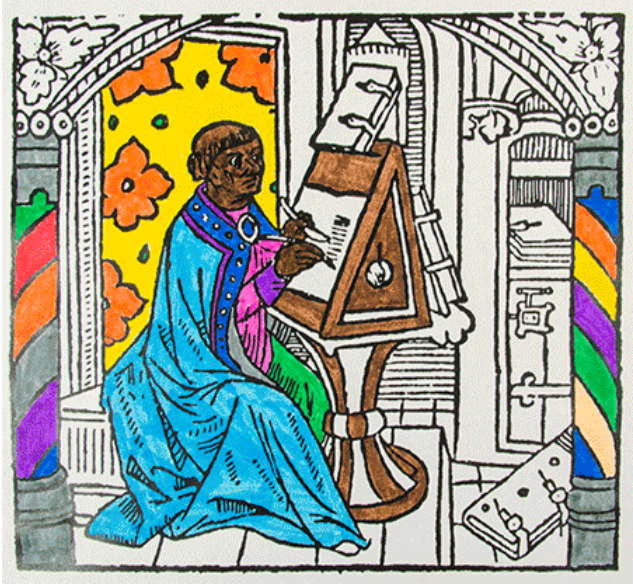
While quarantine puts a temporary stop to many of our usual activities, it shouldn't get in the way of movie night. Our collection of 1,1500 free movies will cover all your movie nights through the time of the coronavirus and then some, including as it does classic films noirs, thriller and horror pictures (including some by no less a suspense master than Alfred Hitchcock), documentaries, and even the fruits of the film industries of countries like Russia and South Korea. And though we can't get enough cinema here at Open Culture, it's hardly the only visual art form we feature: you might spend some time, for instance, with this collection of two million images from 30 world-class museums. This range of art also appears in free museum-produced coloring books geared to all ages.

If you'd like to use your time of "social distance" to develop skills other than coloring, we can point you toward resources for learning to cook, to draw (like an architect, like a Japanese mangaka, like Lynda Barry), to play the guitar, and to practice yoga. Bear in mind also the online-education offerings from Masterclass we've featured here on Open Culture, from "Margaret Atwood Teaches Creative Writing" to "David Sedaris Teaches Storytelling and Humor" to "Werner Herzog Teaches Filmmaking." Those aren't free, but everything else in this post is, including our collection of online language-learning resources. Having spread through world travel, the coronavirus will keep many wary of going abroad in the foreseeable future. But when the pandemic ends, you'll want to be prepared to enjoy foreign lands again. Italy, a country especially hard-hit by the virus, will surely welcome all the visitors it can get. Until then, why not get a grasp on its language — and its cuisine — with a course like MIT's "Learn Italian with Your Mouth Full"?

Related Content:

Free Courses on the Coronavirus: What You Need to Know About the Emerging Pandemic

Coursera Providing Free Access to Its Course Catalog to Universities Impacted by COVID-19

Why You Should Read The Plague, the Albert Camus Novel the Coronavirus Has Made a Bestseller Again

Quarantined Italians Send a Message to Themselves 10 Days Ago: What They Wish They Knew Then

Based in Seoul, Colin Marshall writes and broadcasts on cities, language, and culture. His projects include the book The Stateless City: a Walk through 21st-Century Los Angeles and the video series The City in Cinema. Follow him on Twitter at @colinmarshall or on Facebook.

Use Your Time in Isolation to Learn Everything You’ve Always Wanted To: Free Online Courses, Audio Books, eBooks, Movies, Coloring Books & More is a post from: Open Culture. Follow us on Facebook, Twitter, and Google Plus, or get our Daily Email. And don't miss our big collections of Free Online Courses, Free Online Movies, Free eBooksFree Audio Books, Free Foreign Language Lessons, and MOOCs.

23 Mar 21:49

Libraries that close due to coronavirus should keep the Wi-Fi on, says ALA.

by Corinne Segal
wifi

More and more public libraries are temporarily closing shop across the country to limit the spread of coronavirus, but their Wi-Fi can still be a valuable resource for communities, the American Library Association said Monday.

Libraries that close should leave their Wi-Fi open to the public 24/7, the ALA said in a statement:

America’s 16,557 public library locations are essential nodes in our nation’s digital safety net—connecting people with no-fee access to computers and the internet, lending internet hotspots and devices, and providing digital literacy training and expansive learning and enrichment digital collections for all ages. The COVID-19 pandemic is disrupting this safety net and spotlighting the persistent digital gaps for more than 20 million people in the United States, including millions of school-age children and college students forced out of classrooms and many more workers also displaced.

Libraries can and should leave their Wi-Fi networks on even when their buildings are closed wherever possible. As we have noted to the Federal Communications Commission, the ALA believes a 2010 Order from the Commission permits this use without jeopardizing E-rate funding that many public libraries and schools rely on to sustain and build their broadband capacity. In these unprecedented times, we should take whatever steps we can to leverage our resources to maximize benefit to our communities—particularly for those with the fewest resources.

19 Mar 13:40

Sometimes You Need a Book To Just Make You Laugh: A Reading List

by Matthew Norman

I have a confession to make. When I’m writing, I’m almost always trying to be funny. Sure, the rules of society and literature and plot-building force me to sneak some serious things in every now and again, like divorce and financial crises and dying and all that. But, about 85 percent of the time, when I’m sitting here at my computer, caffeinated to the gills and flanked by two emotionally needy dogs, I’m just trying to get a laugh

Consequently, it probably comes as no surprise that for my entire reading life I’ve been most drawn to books whose authors, I suspect, were up to the same thing.

Below, you’ll find a list of seven such books, along with a bonus book, free of charge. In terms of subject matter, they’re all over the place: from a classic send up of academia to a woman coping with her father’s Alzheimer’s disease to a grown man swearing about birds. The link, though, is that each of these books will make you laugh.

And, when I say laugh, I mean LAUGH—all caps. I’m talking snort-laughter here. These are the kinds of books that make you look like an insane person on public transport. That ruin perfectly good shirts because you spit Diet Dr Pepper all over yourself. That cause your wife to roll over at midnight and say something like: “Matt, seriously, I have a meeting in the morning, please shut up. Also, are you eating Doritos in bed again?”

*

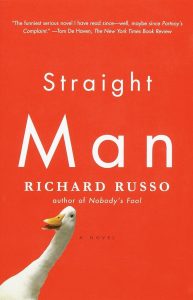
Richard Russo, Straight Man

After a quick prologue, Straight Man begins just after our main character, creative writing professor Hank Devereaux, Jr., has his nose impaled by a colleague’s spiral notebook, and…well, it goes on from there. Comedically speaking, the narrative voice is pitch-perfect, and the plot is full of hilarious dramatic action—fueled mostly by Hank’s relentless determination to make the exact wrong decision whenever possible. In addition, Richard Russo offers a valuable piece of advice for young writers: “Always understate necrophilia.”

Article continues after advertisement

Maria Semple, Where’d You Go, Bernadette

Like any writer, I seethe with open hostility whenever I read a book that’s “too” good. That was definitely the case with Where’d You Go, Bernadette. The zaniness is fun and infectious, the insights are brilliant at every turn, and the laugh-out-loud humor feels so natural that it gives the illusion of effortlessness. If you missed it a few years ago when EVERYONE was reading it, go get it ASAP. I suggest borrowing it from a friend or shoplifting it, though, because… how dare you, Maria Semple.

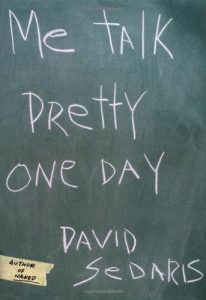
David Sedaris, Me Talk Pretty One Day

A little obvious, right? Like walking up to some teenagers who are talking about basketball and suggesting that they check out LeBron James. But, like LeBron, David Sedaris is a living legend. We could argue all day about which of his very funny books is funniest, but, for me, Me Talk Pretty One Day remains his comedic masterpiece. Seriously, I dare you—DARE YOU—to get through the essay “You Can’t Kill the Rooster” without pulling a muscle.

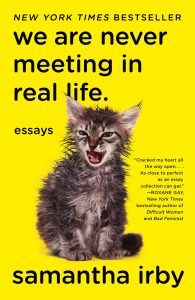
Samantha Irby, We Are Never Meeting in Real Life

Not to sound overly romantic here, but you just know that Samantha Irby’s books are going to be funny before you even read them. Pick up We Are Never Meeting in Real Life and you’ll know what I mean. The thing buzzes in your hand—practically hot to the touch. Same goes for the essays within. They’re cringy and human and fearless in the best and funniest ways possible, and, just as important, they’re empathy-building machines. If I ever meet Samantha Irby in real life, I’m going to hug her. And, if I get roughed up a little by security in the process, it’ll be worth it.

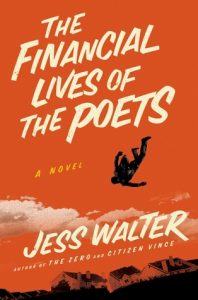
Jess Walter, The Financial Lives of the Poets 

Jess Walter is ridiculously talented, and he’s celebrated accordingly. Financial Lives of the Poets is my favorite of his books, though, because it’s his most unabashedly funny. A journalist quits his job to launch poetfolio.com, a website that combines financial news and blank verse. What? Exactly. It fails, of course, which leads to fiscal ruin. In an attempt to redeem himself, our narrator, Matthew Prior, stumbles into a scheme that’s even riskier than money poems…and far more dangerous. Jess Walter is satirizing the American Dream here. Unsettling? Very. But, it’s also comedy gold.

Rachel Khong, Goodbye, Vitamin 

I’ve read Goodbye, Vitamin a couple of times now, and, I still don’t know how Rachel Khong pulled this thing off. Here’s the elevator pitch: a broken-hearted woman moves back home with her parents to help out as her ailing father slips further and further into dementia. Sound hilarious, right? But, here’s the thing: it is! It’s a classic case of Humor as Trojan Horse, and it’s amazing. Just as the sadness threatens to overpower the narrative, boom, a perfectly whimsical turn of phrase saves the day. You know what? How dare you, too, Rachel Khong!

Matt Kracht, The Field Guide to Dumb Birds of North America

And sometimes, you just need something silly in your life. And, holy shit, this book is the silliest. Like the title suggests, it’s set up like any one of the countless “birding” manuals that you’ve seen, maybe at your grandpa’s house. The twist, though, is that instead of paying reverence to the birds of North America, Matt Kracht makes fun of the chattery little bastards by calling them names and detailing just how stupid they are. The swearing is top-notch, and the birds—bless their dumb little hearts—come off as lovable, dim-witted heroes.

Jon Klassen, I Want My Hat Back

(Bonus Book for Parents)

If you’re a parent like me, you like the idea of your kids being literate. Unfortunately, children’s books can be monotonous, particularly at bedtime when your nerves are shot and you’re exhausted from doing whatever the hell it is that you do all day. I suggest I Want My Hat Back. A bear retraces his steps back through the forest in search of his missing hat, encountering animals along the way. The writing is Bob Newhart-style deadpan and the illustrations, complete with lots of blank animal stares, are a delight. It’s so good that you’ll have no problem reading it again and again and again and aga…

________________________________________

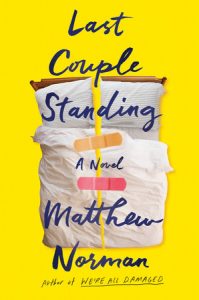
Matthew Norman’s Last Couple Standing is available March 17 from Ballantine, an imprint of Penguin Random House.

19 Mar 00:15

Letter From Rome: Dear Americans, Please Stay Inside

by Igiaba Scego

Dear Americans,

I’m very worried for you. My phone flashes as the number of coronavirus cases around the world goes up, and many of those are in the United States. Part of me feels as though I’m speaking to you from the future because what’s about to happen to you (starting now and stretching into the coming weeks) has already happened to us here in Italy.

We were skeptical, too, at first. Many shrugged their shoulders and dismissed the virus as a “Chinese sickness” (revealing a fierce strain of racism against Italy’s Asian communities) or a “foreign disease.” I saw people going easily about their lives, drinking their aperitifs and stepping calmly onto impossibly packed trams. I was one of them. Fear hadn’t yet enveloped our country. Daily routines went on like undisturbed rivers and we all kept filling our calendars with meetings, birthday parties, Easter vacations.

Everyone was far too busy and not paying enough attention to the virus that was on its way. Of course we had seen the pictures from Wuhan, the epicenter of what was once an epidemic, and some were alarmed by the fact that China had, in a mere six days, become a field hospital. Despite this, Italians thought the virus was too far away to do any real damage. Everyone had forgotten how interconnected we all are.

We knew only a lockdown could save us and others.

Nothing is so far away anymore. In a country like Italy, which is so obsessed with borders, no one thought the virus would rip right through ours. When it finally did, people weren’t sure how to behave. This is especially true of the politicians. The issue on most people’s minds was economic: could a city, a country, truly come to a standstill? The social costs seemed impossible to bear. Timidly, like the city of Milan, someone hoping to help the economy tried organizing aperitivos using the hashtag #Milanononsiferma [Milan doesn’t stop]. From the first tweets, it was clear to all that the plan was suicidal.

Milan is in Lombardy, the region where the virus has hit the hardest. In a relatively short time, it became evident that stopping our activities was the only possible, concrete thing to do. We had to do something like what we were seeing in China: enforce a total lockdown so as not to further strain intensive care units and try to flatten the contagion curve as much as possible.

It’s worth remembering just how contagious the coronavirus is. In Italy we had to learn how to properly wash our hands, maintain a meter’s distance from our neighbor, disinfect our homes, our bodies. We anxiously listened as virologists told us the best things we could do to protect others and ourselves. When the lockdown went into effect, first in the north and then throughout the country, we were almost relieved. We knew only a lockdown could save us and others.

Changing the rhythm of our lives and staying inside didn’t come easy. Every Italian has to deal with their own household, no matter the size, their children (or the fact that their kids are far away in another country), and concern for their elderly relatives. It was a seismic shift for all generations. The eldest immediately understood that they might die alone (because when you’re hospitalized with coronavirus, you are isolated in the ward). The middle-aged were trapped between multiple concerns of work and family. For younger crowds used to meeting up, confined life was hellish. It wasn’t easy for the children either. Every person was affected, but we each had to find a way to keep going.

In the world where humans are not, the fountains of Rome fill with ducks and fish return to the Venetian lagoon.

Besides the anxiety, the virus has made everyone’s life difficult: parents who suddenly became inspectors, sitting in front of their laptops and watching their kids do their homework, on the one hand, and taking care of their own work on the other; women living with their abusers with little aid from the outside; the homeless who’ve never had a home to speak of. Though Italy has one of the best healthcare systems in the world, the life of the confined raises ethical questions for everyone.

As all of us here are realizingand soon you will as wellin the world where humans are not, the fountains of Rome fill with ducks and fish return to the Venetian lagoon. I notice, opening my window, that the air is better. Europe, which has shuttered its borders to so many, now knows what that feels like. This virus has shaken us as it has also shown how our society compares to those next to us, and to nature itself.

Many are saying that once this is over we must change the way we live our lives, make them more sustainable for the planet’s sake. Staying at home is not easy, but one must stay balanced. Personally, books are helping me. I’m reading voraciously and watching old TV shows. It is not easy, I’ll say again, but we will do it. And you will too. You must take action now. It affects your life and your neighbors’.

Igiaba Scego

–Translated by Aaron Robertson

16 Mar 18:29

As Coronavirus Closes Schools, USDA Offers Limited Help to Kids Who Rely on School Meals

by Bettina Elias Siegel

Editor’s note: This is a developing story; we will update this article as the situation changes.

March 12, 2020 update: The USDA announced today that 14 states have received waivers to “congregate feeding” requirements. To date, Washington, California, Maryland, Alaska, Utah, Pennsylvania, Wyoming, Maine, Kansas, New Jersey, New York, South Carolina, South Dakota, and Virginia have all received waivers.

March 10, 2020 update: The USDA has now approved waiver requests in three states—Washington, California, and Alaska—to allow use of the Summer Food Service Program (SFSP) to serve free meals to low-income children affected by school closures, and also waiving the SFSP’s requirement that children eat these meals in a group setting.

This morning, Agriculture Secretary Sonny Perdue also made clear that such waivers will be made freely available to any other state that needs one. Speaking before the House Agriculture Committee, Perdue told lawmakers (comments start at 47:25) that, “Our legal counsel tells us that we have to be asked, [so] we’ve sent the message to all the states that they can preemptively assume a positive response . . . once a waiver request comes in.”

It’s important to note, however, that even with a USDA waiver in place, states may not be able to ensure that all low-income children facing a school closure will have access to free meals. That’s because the SFSP only allows meal service at “area eligible” sites—that is, locations serving populations with at least 50 percent children entitled to free or reduced-price lunch, based on the latest U.S. Census data or school enrollment data. So while low-income children in any part of these states are technically entitled to free meals, as a practical matter, they may live too far from an approved meal distribution site to take advantage of this benefit.

Perdue is aware of this significant limitation and addressed it with federal lawmakers this morning, telling them that “We would love” to allow meal service outside of high-poverty areas, but “we don’t believe we have the legal and statutory authority” to do so. “That’s something we need to look at together,” he added.

The USDA also has yet to respond to an open letter sent to the agency last week by the School Nutrition Association (SNA), asking for additional flexibilities to make it easier to feed children during COVID-19-related school closures. SNA spokesperson Diane Pratt-Heavner told Civil Eats today, “We encourage USDA to consider SNA’s additional suggestions, in particular ways to allow all schools the opportunity to serve needy students. This is an evolving situation with many unknowns and complex considerations that vary from one community to the next. SNA will continue conversations with our members, USDA and allied groups to continue to identify solutions moving forward.”

March 7, 2020 update: USDA has approved requests by Washington state and California to allow meal service during school closures. The waivers run through June 30, and will allow food to be served in non-group-eating settings.

The original article begins below.

The rapidly growing spread of COVID-19, the disease caused by the novel coronavirus, has forced the closure of schools in 22 countries on three different continents, according to UNESCO. In the U.S., as of Thursday, just a small number of schools are closed in Washington, California, and New York—so far—but 13 countries have taken the drastic step of closing all their schools nationwide. As a result, nearly 300 million school children are at home right now, with some able to keep up with their studies remotely while others are surely losing educational ground.

But missing school can mean more than lost instructional time; it can also deprive children of critically needed nutrition. In this country, more than two-thirds of the 31 million students who regularly eat school lunch are economically dependent upon the meal, and low-income kids similarly constitute the majority of the 14.6 million who eat school breakfast and the 1.3 million who receive an after-school supper.

So what will happen to at-risk children if this school-based social safety net falls prey to the growing pandemic?

That question is no longer hypothetical. Earlier this week, when Los Angeles declared a state of emergency due to COVID-19, parents in the nation’s second-largest school district were told to plan for school closures. In Washington state, where 11 people have so far died from the illness, a number of schools were closed temporarily for deep cleaning, while others will remain closed for the next two weeks. And in New York’s Westchester County, four schools recently closed after a local man there tested positive for the virus.

Kathy Reeves, director of communications in the Everett School District in Washington state, says the question of school meals has been very much on the minds of officials in her district. “Right now, we’ve had just one closure,” she said. “But we have a large number of kids on free and reduced-price lunch, and these kids are going to have a very hard time getting food each day if there are widespread closures. We’re working on contingencies right now.”

Fortunately, Reeves’s district doesn’t have to figure out those contingencies entirely on its own. The U.S. Department of Agriculture (USDA), the federal agency that oversees the nation’s school meal programs, has long had guidance in place for feeding children during unexpected school closures—whether caused by extreme weather, safety concerns, labor disputes, or other unforeseen causes.

According to the most recent USDA guidance memorandum, any districts pre-approved to do so may continue to serve meals during a state- or federally declared state of emergency by offering those meals under the Summer Food Service Program (SFSP) or the National School Lunch Program’s Seamless Summer Option (SSO). Both of these programs were created to feed low-income children during the summer months by allowing meal service at sites like libraries, churches, and community centers, and that very flexibility makes these programs particularly adaptable to emergencies that occur during the school year.

But the SSO and SFSP also have some limitations that could prove problematic during a COVID-19 outbreak. For one thing, not all districts have been pre-approved by their relevant state agencies to participate in these programs; they would instead need to seek a waiver in a COVID-19 outbreak. While likely to be expedited, the process would still add an additional layer of bureaucracy that could slow down relief efforts. In addition, while some districts in the past used their schools as emergency food-distribution sites, the agency’s most recent memo put a stop to that practice; it now also requires a waiver to allow SFSP or SSO meal service at schools.

And finally, both the SSO and SFSP specifically require “congregate feeding”—providing meals to children in a group setting—a practice that may be ill-advised in the context of a viral outbreak. Indeed, in its own COVID-19 guidance to schools, the Centers for Disease Control and Prevention is encouraging administrators to “design [meal distribution] strategies to avoid distribution in settings where people might gather in a group or crowd . . . such as ‘grab-and-go’ bagged lunches or meal delivery.”

For these reasons, the School Nutrition Association (SNA), the leading association of school food professionals, is now seeking even more flexibility in responding to potential COVID-19-based school closures. In an open letter sent yesterday to Agriculture Secretary Sonny Perdue, the organization asked the USDA to waive requirements for congregate feeding, allow all districts impacted by coronavirus closures to participate in the SFSP, even if not pre-approved, and allow SFSP meals to be served at school sites, in addition to community sites, without a waiver.

It also asked the agency to permit districts to deliver meals to satellite sites, “so schools equipped to do so can deliver meals to multiple locations throughout the community, minimizing families’ dependence on public transportation to access meals.” And the SNA urged the USDA to maximize the availability and use of USDA commodity foods for emergency feeding operations, and to minimize complicated or burdensome regulatory requirements for districts seeking to launch emergency feeding operations.

On Monday, the SNA’s leadership will address these proposals with the USDA in person: The organization’s annual Legislative Action Conference was already slated for this coming week in Washington, D.C. While the SNA will still be pushing its legislative agenda, spokesperson Diane Pratt-Heavner says the organization also plans to use the occasion to pose its COVID-19-related concerns to USDA officials—including Perdue, who is scheduled to appear.

Whether and how the USDA responds to the SNA’s letter and concerns remains to be seen. An agency spokesperson told Civil Eats that the “USDA is monitoring the situation closely in collaboration with our federal and state partners” adding that “all of our programs—including SNAP, WIC, and the National School Lunch and Breakfast Programs—have flexibilities and contingencies built-in to allow us to respond to on-the-ground realities and take action as directed by Congress.”

And in fact, the agency does have a good track record of relaxing regulations as needed to more nimbly feed school children during various crises. In 2017, for example, when schools in Oregon were closed due to poor air quality caused by wildfires, the agency approved the state’s request to allow children to take home individually sealed meals instead of eating them on site. Similarly, the USDA has waived certain meal requirements on an as-needed basis, such as allowing schools to not serve milk when it wasn’t locally available following a natural disaster, and it allowed New York City to serve free meals to all school children in the aftermath of Hurricane Sandy.

“The USDA has taken a proactive approach in the past,” agrees Crystal FitzSimons, director of school and out-of-school time programs at the Food Research & Action Center. “And we’re hopeful that they continue to do so, because there may be a tremendous amount of need if school closures become more widespread.”

At the top of FitzSimons’s wish list would be allowing children to have access to multiple non-perishable meals if needed. “If a child is facing a two-week school closure, it would be great if USDA not only waives the congregate feeding requirement but also allows schools to say, ‘Here’s 10 breakfasts and 10 lunches that you can take with you and help carry you through.’ That would go a long way,” says FitzSimons. “Because in situations like this, it’s always the low-income people who get hurt first.”

Top photo CC-licensed by D.C. Central Kitchen.

The post As Coronavirus Closes Schools, USDA Offers Limited Help to Kids Who Rely on School Meals appeared first on Civil Eats.

16 Mar 17:45

Stay Home, They Told Us… Diary of an Italian Editor

by Sara Reggiani

“Stay home, if you can,” they told us in the beginning. And I could. I run a small publishing house from my home and at home is where I have always spent the majority of my time. I was not afraid. I can do it, I told myself. This changes nothing. Then the advice became an order. “Stay home!” they told us. And everything changed.

We live as if a predator roams outside. And no one knows when it will tire of the hunt and move on. Usually crowded with tourists from all over the world, the streets of our beloved Florence are now totally empty. Pigeons and doves and carrion crows, taken aback from the sudden quiet, look at each other in disbelief. Spring is coming but we know we won’t be able to enjoy it. Things we used to take for granted, like taking a walk in the park or paying a visit to a friend, have become a luxury that we cannot afford. This used to be a time when gatherings were welcome; now we are asked to stay away from each other, to be wary of anyone who comes too close. When this will be over, how long will it take before we feel safe again to greet each other with a kiss on the cheek? And where will all the homeless people go while we are busy complaining of getting bored at home?

At least we have refuge, even if it is starting to feel tighter and tighter, I tell myself as I ration food for the week: the less time we spend in crowded areas like supermarkets the better, and in any case only one family member is allowed out at a time to go food shopping and must carry a document with them stating the reason for which they have left home—if the statement turns out to be false, charges are filed.

It’s not a war we’re living through, we have everything we need: food and distractions, books, music and technology to communicate with the rest of the world. But for the past few days I have woken with a drone in my ears. I get up, drink coffee, sit at the computer, talk and downplay things with my husband, make lunch, work some more, make dinner and the drone is always there, a thin veil that separates me from what little I can still see and touch. I am a robot, performing the actions for which I was programmed. My mind attempts to establish contact with a new, static body—for now we are permitted to go out for a walk, but alone and never far from home—a body that does not do the things it once did. It’s the isolation, I tell myself. The uncertainty of tomorrow. The lack of oxygen.

This sacrifice is necessary and will even lead to good on many levels if only, when it is all over, we don’t forget we are fundamentally vulnerable and that our actions have consequences.

The truth is that in this funereal silence—the sounds of the city have vanished, only the bells of Santa Croce articulate my days—we now feel the full weight of our thoughts. And behind mine is a voice that says, I had no choice, I had to stop you. This will pass, but don’t forget. This is why I do not die of fear—of the illness, of the economic crisis, of the loss of points of reference. Because I know that voice is right, that this sacrifice is necessary and will even lead to good on many levels if only, when it is all over, we don’t forget we are fundamentally vulnerable and that our actions have consequences.

Perhaps I talk like this because I am lucky: first off I have a home where all day, I sit at my desk, I pore over and translate stories to be published. This is my job. Stories. The virus has already infected the way I read them and has told me which to publish in the coming year, when my readers will need to recover from this trauma and look forward. It’s not the end of the world, I tell myself as I fold the clean linen with unusual care and attention. Because this is another unforeseen consequence: every act, even the most insignificant, has taken on new weight, every caress I give to the cat I also give to myself, every “goodnight” is pronounced with the sincere hope that the night doesn’t bring nightmares worse than the one we are already living.

Some times, at dawn, my eyes still shut, body relaxed and mind already tired, I think this new slowness the virus is teaching us is nice, that this lesson in patience is healthy. That what was wrong was the frenetic energy of before, which never let us enjoy anything, which took our breath away, energy that has now been poured into social media, morphing into the urge to tell, to warn, to show solidarity. We wrap ourselves up in one another. We make noise to stop this silence becoming a mirror. If the virus wanted us alone, there is a reason. Why not try and embrace it, the silence, to finally reflect on how our lifestyle should be changed?

It’s not the end of the world, I tell myself as I fold the clean linen with unusual care and attention.

Stay home, read a book! yells everyone, but how am I to know which book I need amidst this din of suggestions that often seem like just another attempt to impose ones own identity and tastes onto someone else? Perhaps this time books are insufficient, and I say this in amazement, considering the work I do. It is not easy to concentrate on reading while the world around you trembles. Maybe once we have grown fully accustomed to the change we will rediscover the necessary calm, but it is still early, and music is what is needed now, to soothe the nerves.

Egotism still abounds, but even here the virus has a lesson to teach us. Anyone who leaves home without a valid reason now risks killing his or her neighbor with a mere cough. Some are afraid, have come to their senses—or simply fear punishment will arrive from on high. Others are unmoved, but man is man, and this is a whole other story.

It has been months since I have seen my parents—they still live in the city where I grew up, Pesaro, Marche, one of the regions with the highest number of infections—but we have never spoken as many times a day as we do now. They are 70 years old and never imagined they would experience something like this. “I’m not afraid,” my mother told me last night, “I feel like a silent bee, but I’m not afraid.” A silent bee. So that’s the drone I have in my head, I thought. It is the old me struggling, unable to come to terms with having to be still. But what if I were to try?

16 Mar 13:32

Restaurants and Bars Shuttered Across the U.S. in Light of Coronavirus Pandemic

by Amanda Kludt
Crowd of people outside Comedy Cellar Crowds gather in Manhattan outside Comedy Cellar. Management of the club told Eater it turned many people away due to a reduced capacity mandate. | Gary He/Eater

Curfews, capacity caps, and outright shutdowns are in play

As the number of cases of the novel coronavirus continue to grow, states and municipalities across the U.S. are taking drastic measures to enforce social distancing — a step that’s imperative to slowing the virus’s spread — from curfews and reduced capacities to mandatory closures.

The governors of Massachusetts, Illinois and Ohio have taken the most dramatic state-wide steps so far, ordering all bars and restaurants closed. In Ohio, restaurants and bars in the state will be required to close dining rooms effective at 9 p.m. on March 15; Illinois’s mandatory closures begin March 16; and the Massachusetts shut down starts on March 17. Carryout and delivery will continue to be permitted in all three states.

Late Sunday night, Mayor Bill De Blasio announced that all bars and restaurants in New York City must shutter starting Tuesday for a to-be-determined period of time. Delivery and takeout will be allowed, but theaters, concert venues, and nightclubs must close completely.

The mayor of Los Angeles also announced the closure of all bars in his city and is considering closing dine-in restaurants; the state of California has merely asked bars and wineries to voluntarily close. Washington D.C.’s mayor ordered licensed nightclubs to shut down operations and asked all eating and drinking establishments to eliminate bar seating while the city works to prevent the spread of the novel coronavirus. The city of Hoboken closed all bars and forced restaurants to transition to takeout-only, while enacting a 10 p.m. to 5 a.m. curfew. Finally, in Michigan, all casinos are temporarily closed.

Scores of restaurants have voluntarily closed across the country, with more closing by the hour. Nationally, large restaurant groups Momofuku and José Andrés have closed all of their restaurants in New York and D.C. Momofuku also shuttered its Los Angeles restaurants, while some of Andrés’s are being converted to takeout-only “community kitchens.” Blue Bottle has also announced that it’s closing all of its domestic cafes.

Anthony Fauci, the director of the National Institute of Allergy and Infectious Disease, said Sunday in an appearance on CNN that he wouldn’t rule out supporting a national lockdown on the country’s restaurants as a strategy to prevent wider spread. Spain and France closed down all restaurant and bar activities over the weekend to prevent the spread of the novel coronavirus, the Republic of Ireland closed down pubs.

The move towards closures highlights the importance of social distancing in fighting the global pandemic. By reducing contact and increasing distance between individuals, people can reduce the rate of transmission of the virus. If countries don’t succeed in “flattening the curve” (reducing the number of patients requiring treatment at a given time), the disease threatens to overwhelm hospitals with patients.

Top Infectious Disease Expert Doesn’t Rule Out Supporting Temporary National Lockdown to Combat Coronavirus [CNN]
Ohio Governor Orders All Bars and Restaurants Be Shut Down Amid Coronavirus Pandemic [WEWS News]
All Coronavirus Coverage [E]

This post will be updated as new information becomes available.

12 Mar 21:32

What Does It Really Cost to Run a Restaurant?

by Erin Spencer
Bgarland

Amazing. I might actually watch the webinar tonight.

Chef stirs a work that’s on fire. WStudio/Shutterstock

Restaurants have notoriously slim margins. Mei Mei in Boston reveals just how slim they really are. 

“I have always thought to myself that the version of Top Chef that I would want to watch would be chef-owners plunging a toilet, cleaning an overflowing grease trap, balancing a balance sheet, and running payroll as fast as they could — a decathlon of all the administrative bullshit,” says Irene Li, the chef and owner of Mei Mei, a Chinese-American restaurant in Boston. “And obviously, people would be bored to death by that show, but that’s what it really is.”

These days, Li spends a lot of her time thinking about what it takes to keep a restaurant like hers running. In 2016, she was the recipient of an Eater Young Gun award; she’s been a Zagat 30 Under 30 winner, and a six-time James Beard Rising Star Chef semifinalist. That said, she kind of fell into the industry and comes by her genuine enthusiasm for “all the administrative bullshit” honestly.

In the early days at Mei Mei, success was measured by having enough dumplings to get through the day and confirming that the bank account wasn’t empty. Today, every single staff member, from the dishwasher to the line cook, can interpret and speak to the restaurant’s entire profit-and-loss statement because, for two years now, Mei Mei has been opening its books to its staff. This means all staff are able to see every line item associated with money coming in the door and all of the expenses the restaurant takes on — from paying its employees to keeping the lights on. Not only that, each employee actually plays a hand in working to move the bottom line, working on teams tasked with the goal of reducing costs and increasing profits for the business. If the team wants to research and vet new vendors, they have that power. If they want to change the menu prices for a fixed period of time, they’re able to do that too.

In the three years since implementing this practice, Li says she’s seen a measurable difference. The line cook who once questioned Li about the $9 price attached to the Double Awesome menu item, an oozy egg sandwich, can now speak to all of the other costs — the things beyond the eggs, the pesto, and the scallion pancake breading — that they wouldn’t have known to consider before. Because there’s a staff member who called the electric company for refunds when the power went out, one who negotiated for better alarm fees, and another who put in the work to source a cheaper linen provider, there’s an understanding of the full picture of what goes on at the restaurant. As Li puts it, “There’s buy-in because their fingerprints are there.”

Now, it’s no longer enough for Li to share the nitty-gritty financial info with her team. She wants the public to understand it, too.

“The lack of willingness to talk about finances in this industry is holding us back,” says Li. “Culturally, we don’t talk about money at all, and my experience, even with other restaurant owners who I’m really friendly with, is that we’ll talk about all kinds of stuff. HR drama, health inspections — warts and all — but we definitely don’t talk about money. I feel like that is the last barrier that we have to break down in order to really all get on the same page and all figure out how to do a better job.”

Armed with the blessing of her most trusted friends and family, and a lot of nervous “wows,” Li decided that 2020 was the year to start the conversation. So, in the middle of the restaurant, as the Friday dinner crowd was beginning to pick up, we sat down to review the full profit-and-loss statement for Mei Mei for 2019 — something that any diner will soon be able to do.

What exactly are we looking at here?

Profit-and-loss statements (P&Ls) offer a record of a business’s profits and losses over a defined period of time. Essentially, the larger formula you’re looking at is sales - expenditure = profit. When we opened up Li’s P&L, she explained that there are four larger buckets that all of the many line items can be sorted into: income, cost of goods sold (COGS), direct labor, and finally, pages and pages of overheads.

For a restaurant, there are a few goal ratios associated with the major expense categories. Ideally, most operators aim to see COGS and direct labor together at 60 percent (at Mei Mei they target 20 percent and 40 percent, accordingly) and other expenses at 30 percent, leaving you with 10 percent profit. She then explained that independently owned restaurants most often hang out in the 4 to 6 percent range for profit. Don’t worry — there won’t be a quiz.

Businesses are required by law to pull a P&L annually. Most restaurants look at theirs quarterly. At Mei Mei, the entire staff digs in every four weeks.


Total income in 2019 was $1,215,037. Broken down, the specific sales were: $655,000 in restaurant sales (53.9% of total income) and $559,931 in catering sales (46.1% of total income), minus $6,492 for “surprise and delight.”

At Mei Mei, the catering line item includes traditional drop-off catering, weddings, staff-led cooking classes, and restaurant buy-outs. Historically, Li has seen this line item trend upward over the past few years, which she says is an argument for doing more catering in 2020.

Surprise & delight — easily the most objectively “fun” line item name on the document — covers the $40 worth of product (nonalcoholic) that can be given away at each shift. “Sometimes it’s for when we need to fix something. Sometimes it’s for someone who had a hard time choosing between two dumplings, and we just let them have both. It’s for first-time customers we want to wow, and it’s for that person that comes in soaking wet because they didn’t have an umbrella and could really use a hot tea and a free brownie,” Li says. In 2020, Li actually wants to see this expenditure grow, and is now requiring staff to note what was doled out at the end of each shift.


Total Cost of Goods were $257,298 in 2019, representing 21.2% of total income. Broken down, the specific costs were: Food purchases (-16.3% of total income) and alcohol purchases $18,492 (-1.5% of total income). 

COGS covers not only direct food purchases, but also anything that is necessary for providing the product to the guest. So included within this category are things like takeout boxes, napkins, and paper bags. Remember, restaurants are aiming for 20 percent here, and as Mei Mei focuses on high-quality ingredients, Li’s proud of where they’re at.

Catering margins are better due to the fact that the restaurant is able to plan around the exact amount of food and labor that a given job needs — something they, of course, aren’t able to do in the restaurant. Another reason Li believes they’re staying close to their target, all things considered, is the fact that the catering menu is fairly light on meat. This is helpful because Mei Mei only serves meat that is pasture-raised, humanely slaughtered, and sourced from the Northeast — meaning it isn’t cheap.


Total expenditures for direct labor were $546,124 in 2019, representing -44.9% of total income. Broken down, the specific costs were: Staff wages, $473,132 (-39% of total income); Health insurance, $11,760 (-1% of total income); Employee benefits, $2,515 (-0.2% of total income).

Direct labor is high at Mei Mei, but Li says she’d rather overspend a little on COGS and direct labor because she believes it reflects the values of the company — paying people well and serving good food. Back-of-house staff with no experience and front-of-house tipped workers who are still going through training start at $12.75, the Massachusetts minimum wage. Once tipped workers are fully trained and ready to work shifts on their own, they’ll start at $5/hour, slightly higher than the legal tipped wage ($4.95 as of Jan 2020; $4.35 in 2019). Managers start at $17/hour. Everyone makes overtime if they work more than 40 hours (1.5 times their standard rate), though Li says it’s rare to see 50-plus hours, as she and the team work hard to avoid burnout. “Salary plus 90-hour work weeks are a pretty common way that restaurant employers exploit their most valuable staff, and I’ve seen how negative the impacts are,” says Li.

On the health insurance front, Mei Mei contributes half the cost of health insurance for full-time staff. Li says, “It’s the best place we’ve been at, but we’d like to do a lot better.” She also shared that the restaurant does benefit from the fact that a lot of the staff is still able to stay on their parents’ insurance plans. The benefit line item includes training and certification expenses for things like ServSafe, a FOH safety training and certificate program, as well as public transit benefits through the Perq MBTA program. Additionally, staff members have access to a grocery program where they can order what’s used by the restaurant at Mei Mei’s rate.

Throughout 2019, Mei Mei had between 25 and 30 employees on staff. One important caveat when looking at staff wages is that not all of the employee wages actually fall into this bucket. Often, businesses will log salaried employees who work on administrative tasks into the overhead category rather than this direct labor section. As Mei Mei’s staff all have their hands in administrative work, a portion of these wages is allocated to the overhead section instead — more on this later.


Total direct operating expenses for 2019 were $32,141 (-2.6% of total income), including $6,542 for equipment lease (-0.5% of total income) and $5,348 for linens (-0.4% of total income).

What most people probably don’t realize is that restaurants often rent a lot of their equipment. For Mei Mei, that includes a dishwasher and an ice machine — so yes, it can cost over $6,000 a year just to clean some dishes and to have a reliable source for ice cubes. Next year, this number will go down a bit as Mei Mei purchased its very own ice-making machine.

Another surprisingly large sum? Linens. And at Mei Mei, linens are actually pretty limited compared to fine dining establishments with tablecloths and cloth napkins in the mix. Again, thanks to a staff member identifying a new linen provider, this cost should go down in 2020.

Software services include everything from bookkeeping to scheduling to playing music in the restaurant. Fees, permits, and licenses are a necessary evil for staying on the good side of the law.


Repair and maintenance costs were $16,591 in 2019, representing 1.4% of total income. Broken down, the specific costs were: Cleaning & Warewash Supplies: $4,625 (-0.4% of total income), Hood Cleaning: $1,350 (-0.1% of total income), Emergency Repairs: $7,189 (-0.6% of total income). 

If you’ve ever bought a bunch of household cleaning supplies at once, you’ll know they don’t come cheap — multiply that times more messes, a commercial-sized space, and the need to keep food inspectors happy, and you’ll see why keeping Mei Mei looking spick and span is a pretty sizeable expense.


General administrative expenses were $227,678 in 2019, representing -18.7% of total income. The specific costs were: Administrative Payroll: $115,780 (-9.5% of total income), Insurance: $21,169 (-1.74% of total income), Merchant Fees: $57,973 (-4.8% of total income).

Remember when I said a portion of all paychecks was allocated to another section to account for staff members working on administrative duties? At Mei Mei, administrative payroll covers these multitalented folks as well as salaried employees like Li, who’d already fall into this bucket.

Insurance here refers to all of the business’s insurance needs, covering things like vehicles, the building, and workers compensation.

Merchant fees are a biggie on the expense front. A lot of these fees are associated with our favorite delivery apps, which tend to take a pretty sizable cut. For Mei Mei, Uber Eats is walking away with 30 percent of the revenue, DoorDash and GrubHub are pocketing 25 percent, and Caviar is taking 17 percent — Li says that’s thanks to being grandfathered into a pretty good deal. “One thing we tell people is that if you can help it, pick up your food. If not, maybe ask the restaurant what delivery service they prefer you use.”


Total occupancy costs fo 2019 were $116,009 (-9.6% of total income), including rent: $86,700 (-7.1% of total income) and utility services: $22,473 (-1.9% of total income).

It’s pretty expensive just to have a place to operate a business and to keep it lit, with running water and a controlled temperature — especially in a city like Boston. That said, Mei Mei does tack on an optional utility service: composting. And composting actually cost over $4,000 for the company in 2019. But it’s important to Li and to the staff, so that’s an expense that isn’t going anywhere.


2019 net income total: $22,116 (1.8% of total income).

And once we account for the expenses, this is what we’re left with. Notably, this amount doesn’t include the debt repayment for the business or the taxes that they would owe. In Li’s own words, “This is the final story. It’s not nothing. It’s not great. But this is where we are.”

Li will review Mei Mei’s books during a webinar on March 9 at 6pm EST. She invites the public to tune in.

Erin Spencer is a writer and content marketer based in Boston.

12 Mar 18:36

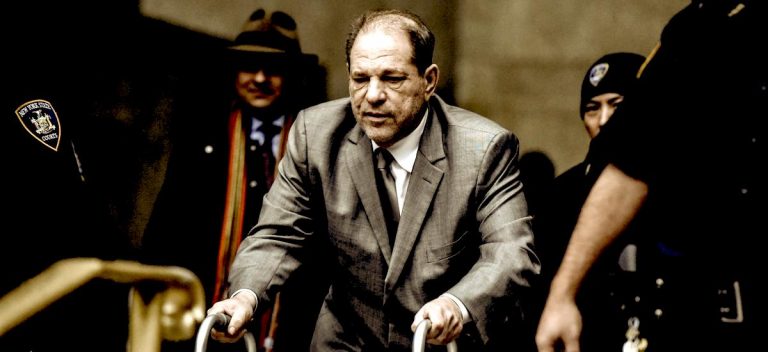
The Storykiller and His Sentence: Rebecca Solnit on Harvey Weinstein

by Rebecca Solnit

There was a man who was in charge of stories. He decided that some stories would be born, expensive, glamorous stories that cost more than a hundred minimum-wage earners might make in a hundred years, filmy stories with the skill of more hundreds expended so that they would slip in like dreams to the minds of millions and make money, and he made money and the money gave him more power over more stories.

There were other stories he decided must die. Those were the stories women might tell about what he had done to them, and he determined that no one must hear them, or if they heard them they must not believe them or if they believed them it must not matter.

His work to let stories out was public, and he was on many stages accepting many awards for them and at many parties exerting influence and handing out favors and malevolent disfavor. His work to keep stories in was also strenuous, expensive, and masterful in a way, because it worked: perhaps he took particular pleasure in stifling the stories of women who were otherwise so visible, so audible, who were in those stories we all saw, in making them dolls who said the words of others, the words that brought him awards and a fortune, and in preventing them from telling their own stories, the stories of what kind of monster he was, of what felonies he had committed.

He sat like a malevolent god, deciding whose voice and vision would live and whose would die, or like a king with courtiers to produce this story in a shower of money and networking and to kill this other story with nondisclosure agreements that also required showers of money, sometimes directly out of his business-partner brother’s pocket to keep them off the company records, or he spent political capital to persecute and discredit the women who had stories of what he had done, and to drive them out of their profession, their vocation, and their living, to push them over a cliff at the bottom of which was isolation and inaudibility.

There were grips and gaffers and best boys, sound engineers and editors and acting coaches to make the stories; there were spies, lawyers, insurance companies, underlings to unmake the other stories, some of them skilled actors themselves, and they went even after the newspapers and journalists who got wind of those stories. The whole society was complicit in allowing a system of silencing to exist, even a formal legal contract called a nondisclosure agreement, which meant that her (and sometimes his or their but so often her) story would be silent forever. One of his victims was not allowed to talk even to her family or therapists about what happened and when she finally broke her long silence she spoke of what torment it was and joined a congresswoman in sponsoring legislation; many of them at last violated their NDAs to speak, and the complicity of celebrity lawyers and the legal strategy for strangling stories, the silence for sale, looked bad when it was dragged out in the light of day, and some states passed laws limiting them, at least as they pertained to sex.

“He who controls the past, controls the present,” wrote George Orwell in 1984, “he who controls the present controls the future.” He who has the story has the power; she who has no story, not even her own, has no power.

It seems as though there are always these stories about women, the insinuating sneering stories, the stories in which women are unforgivable for things men are forgiven for as soon as they’ve done them.

And so he clawed his way through the years, destroyer and generator of stories, sitting like a judge over them all, shaping the public imagination, both with what we saw and heard and what we did not, and what we do not know is always the heavier side of the scale, and those of us who find ourselves there find ourselves silent, mute, gagged, our stories murdered before they can go out into the world, or our stories stillborn because they died at birth, because we did not dare to speak or because we despaired that if we spoke our words would not do the work words should do in the world—connect us, weave us into the society—but would endanger us or make them ostracize us. And so the scale dipped low with the weight of strangled, murdered, stillborn, stunted stories. The stories sat inside, like impacted wisdom teeth, like ectopic pregnancies, something that needed to come out. But they could not because the women with stories were not in charge of stories.

In the middle of 2017, this powerful man somehow decided (or a minion decided and invoked his name) that I should watch a film or rather a screener—an early release DVD—of one of the stories he had put out into the world. I knew almost nothing about the man, but I began to be pestered to watch the story. Here’s how the letter that was supposed to be from him described it: “the gripping story about a young girl’s murder on a Native reservation… I think you’ll find it intensely chilling. I’d love to hear your thoughts after you’ve had a chance to screen. All my best, Harvey.”

Article continues after advertisement

I didn’t watch it. I’m sick of the pretense of sympathetic interest in movies and books and the rest that murder women over and over, and too many native women are being murdered without adding a fictional murder to the spatter pattern. I see women die violently every day. I’m getting weary of it. Sometimes I take a screenshot of the front page of the Guardian and ask people how many items have to do with violence against women or men who have abused women, and sometimes it’s most of the lead stories. Sometimes this violence is the story, or sometimes someone who has a record of abusing women is just running for president or is president and the story is about something else, but their power reminds you of your powerlessness if you’re a woman, or the story about Wexner selling control of Victoria’s Secret on February 20 is a reminder of his mysterious financial relationship with pederast-pimp Jeffrey Epstein, who used the relationship as well to pretend to recruit girls as models.

But also directly in the news are gruesome stories—a few weeks ago I ran into news about an American man who dismembered his ex- with a saw, an Australian ex- who did so by pouring gasoline over her and the kids and burning them to death and a Mexican man who skinned his ex- like a rabbit after murdering her. And right after that there was a day when I opened an envelope a publisher sent me (please stop, publishers) to find a memoir about a woman whose sister had been murdered, which I decided not to read, and then I sat down next to a woman on the ferry reading the book by James Ellroy about his mother being murdered, with apparently a picture of her corpse on the back cover.

I wasn’t looking for these stories; they’re there all the time because women are getting killed all the time; I’m just the anomaly who’s been noting their frequency for the last 30 years or so, and who has felt impacted by that. I am the Ancient Mariner of violence against women, because for 35 years I’ve been trying to fix people with my glittering eye and make them listen.

And then I published a book about the intensely chilling experience of being a woman in a world where so many men harm women and so little is done to stop them and the stories I told prompted women to tell me new stories about when they too were young, imperiled, and alone in that peril. We have a word, voiceless, that is a misnomer, because we all had voices; we just had no one to listen to them, and so we need another word—something like listenerless—for that condition. I wrote about the way that I was menaced so often and so convincingly and was so traumatized that I had intrusive fantasies in which I was assaulted, as I had been in real life, and in the fantasies I was more successful at violence than my assailant and killed him, and so I killed over and over in the dankest years of my fear. It wasn’t the only fantasy I had when I was so haunted during my years as a target. I wasn’t the only one who had fantasies either.

Something changed, and the forces that prevented them from telling their stories were overcome by those who willed those stories into the room and their own fury to speak.

A woman told me, in response to the book, that she imagined over and over again, in the same mode, how to go numb and disassociate when she was raped—she thought it was likely she would be and so this was the unspeakable way she prepared for it, and by unspeakable I mean literally: she spoke to no one of how though her body had not been invaded by a penis, her mind had been invaded by the likelihood of it. One of the things I wanted to do with my book is to argue that we have been telling the story of violence against women wrong.

We treat it as a sort of binary: either direct literal physical violence has happened directly personally to you or it hasn’t, and if it hasn’t you don’t have a story and you haven’t been harmed. But we have. We all have. To live in a society that puts a target on your back because of your category is a hard thing indeed, and to live in a society that put the target there and then doesn’t want to hear about it, is harder yet, and that’s exactly where we have been all along. To be a woman is to be forever vigilant against violence, which means thinking about it all the time and making decisions based on the possibility. (And of course the same is true of being black or queer or trans.)

I wrote a book about what it means to be voiceless, or listenerless, and realized afterward that I was writing about that all along and also writing about what it meant to be the opposite: someone who was so amplified and fortified that he could shout down facts and truth and evidence and make stories die or never be born or go away unbelieved. Storykillers. The day before my book came out, women in Mexico marched on strike to protest the epidemic of femicide there. And then the day after my book came out, the man who sat like a god, a judge, a king calling some stories into being and sending ex-Mossad spies to hunt down and kill other stories was sentenced, and that so many thought the day would never come says a lot about the dim expectations of women even in this age.

It came a week after a woman who ran for president resigned herself to defeat and stepped out of the race, and the experts said that it was not that not enough people wanted her to be president. It was that they did not believe other people wanted a woman, this supremely brilliant and empathic and innovative woman, to be president and so they voted down their own desires, dampened by fear of others. They did not believe others would let us have what we wanted and so we did not get it, and it was also dampened down by stories that were not particularly true but were told so often too many people thought they were, and too many of them who did not have time to check the stories had time to spread them.

It seems as though there are always these stories about women, the insinuating sneering stories, the stories in which women are unforgivable for things men are forgiven for as soon as they’ve done them which is part of why they do them. Sometimes it seems the unforgivable thing is just that they’re women. She was, too, a woman who had just confronted a man—the ninth richest man in the world—on national television about the 64 nondisclosure agreements associated with him and made him allow 3 of the 64 to speak after all. The current president and this man who would be president before she skewered him had a lot of NDAs to their name. There are storykillers everywhere.

It came less a week after the young man who had helped to expose the crimes of the king of the storykillers threatened to leave his publisher in protest because they were going to publish his father’s book and his father from whom he had long been estranged was a storykiller too, a man who had been smearing his former partner, the young man’s mother, for decades and smearing the daughter who told a very credible story from childhood into adulthood, that he had molested her. So many people at the publishing house walked out in protest—younger people, I heard, people who were sick of the old stories and in solidarity with the new stories—that the book died, at least in that house. Because there are stories built out of silence and lies and the stopping of others’ stories too. There are stories that are all about storykilling.

And then the king of the storykillers was sentenced to 23 years in prison, which means if he serves all his time, he will be 90 when he gets out. He was handcuffed to a wheelchair, having declined physically, as though his fall from power had been a physical collapse or perhaps to try to spark a story with sympathy for him in it. He bled with sympathy for himself and people like him, “I was the first example,” he said, of men whose crimes finally came to light, “and now there are thousands of men who are being accused.” That the great majority of them are being accused because they did the things they are accused of is something too terrible to grasp for the old story kings, too damaging to their own story about themselves, even when they themselves are storykillers and sexual predators.

“I’m worried about this country,” the Guardian reported the storykiller as saying, because there are “thousands of men and women who are losing due process” after being accused. “I’m totally confused. I think men are confused about these issues.” That perhaps as many as a hundred women didn’t have due process because he was as much a storykiller as a literal assailant and groper and harasser and rapist seemed to be an idea he could not imagine. Because this man who had made so many of our stories, the ones we paid to see, the ones that got the Oscars, could not imagine the stories of these women, could not imagine their stories about him, could not imagine.

I saw little boys jeering and mocking the other day, and I began to wonder if this behavior so common in boys and young men and sometimes older ones (and yes sometimes in girls and women, but far less so), is practice in being without empathy. That game of taking satisfaction and seeing others’ discomfort and distress as your own victory is practice, sometimes on a small scale of insults, sometimes on the larger scale of bullying, of a self-aggrandizement by the annihilation of others, a disconnection, a death of empathy. This does not mean that most of them will go the lengths the storykiller did, but it does mean that the behavior is an extreme version of an everyday thing.

“He is baffled at finally being held accountable,” one of the victims said. It is not a story he imagined; it is a story he cannot comprehend. But he was no longer in charge of stories. Something changed, and the forces that prevented them from telling their stories were overcome by those who willed those stories into the room and their own fury to speak. And then he became the protagonist of the last story he ever imagined, and his story is now a single interminable sentence, and that 23-year-long sentence is about a storyteller who failed to imagine their stories or the end of his own.

___________________________________

Rebecca Solnit, Recollections of My Nonexistence

Rebecca Solnit’s  Recollections of My Nonexistence is available now from Viking.

11 Mar 19:09

The Biased Ways We Praise “Smart Kids”

by Anne Thériault
When we prioritize certain interests as being “better” or “smarter,” we’re failing children whose talents lie in other areas
10 Mar 21:37

Haim Could Be Gulping Down Matzo Ball Soup and Playing at a Deli Near You

by Jenny G. Zhang
Alana Haim, Este Haim, and Danielle Haim attend the Vanity Fair Oscar Party. Photo: Taylor Hill/FilmMagic

Ahead of their “Women in Music Pt. III” album release, the sister trio will be playing select delis around the country

Good news for anyone who takes their favorite sister-driven pop rock with a side of knishes: Haim is playing at different delis across the U.S. in what the band is calling a “deli tour.”

“We’ve never done anything like this before so let’s all get together and eat some matzo ball soup and we’ll play you some songs live,” Haim announced in an Instagram post.

As the trio call out in their Instagram caption, the first show that sisters Este, Danielle, and Alana Haim played together as kids was at Canter’s Deli — a Jewish deli with an 89-year history in Los Angeles — where they were apparently paid in matzo ball soup. The trio hit up Canter’s again in 2017, with a celeb-studded party to celebrate the band’s single “Right Now” off their Something to Tell You album. Canter’s is also pictured in the album cover art — depicting the sisters lined up in front of hanging sausages (heh) and a sign that reads “NOW SERVING 69” (nice) — for Haim’s upcoming record Women In Music Pt. III, out April 24.

The tour kicks off on March 10 in New York, followed by March 11 in D.C., March 13 in Chicago, and future dates in Denver and LA. Fans who want to attend have to fill out this form, Rolling Stone reports. The specific delicatessens in question have yet to be announced, but who wants to bet that Canter’s will be the final destination in LA?

View this post on Instagram

no soup for you

A post shared by HAIM (@haimtheband) on

10 Mar 21:35

Can anyone solve the mystery of New Jersey’s ghost diner?

by Aimee Levitt

The Franklin Diner sits on Route 23 in Sussex County, New Jersey, all set up and ready for business. The chairs are lined up at the counter. Salt and pepper shakers sit on the tables beside the filled napkin dispensers. The corkboard by the front door is filled with ads and public notices. But the Franklin Diner…

Read more...

29 Feb 19:08

The Documentary Miles Davis: Birth of the Cool Is Streaming Free for a Limited Time

by OC

PBS' American Masters series has released the new documentary, Miles Davis: Birth of the Cool, and it's streaming free online for a limited time. (Some geo-restrictions may apply.) With full access to the Miles Davis Estate, "the film features never-before-seen footage, including studio outtakes from his recording sessions, rare photos and new interviews." Watch the trailer above. Stream the full documentary here.

Would you like to support the mission of Open Culture? Please consider making a donation to our site. It's hard to rely 100% on ads, and your contributions will help us continue providing the best free cultural and educational materials to learners everywhere.

Also consider following Open Culture on Facebook and Twitter and sharing intelligent media with your friends. Or sign up for our daily email and get a daily dose of Open Culture in your inbox. 

Related Content:

1,150 Free Movies Online: Great Classics, Indies, Noir, Westerns, etc.

Miles Davis Iconic 1959 Album Kind of Blue Turns 60: Revisit the Album That Changed American Music

1959: The Year That Changed Jazz

Kind of Blue: How Miles Davis Changed Jazz

Herbie Hancock Explains the Big Lesson He Learned From Miles Davis: Every Mistake in Music, as in Life, Is an Opportunity

The Influence of Miles Davis Revealed with Data Visualization

The Documentary Miles Davis: Birth of the Cool Is Streaming Free for a Limited Time is a post from: Open Culture. Follow us on Facebook, Twitter, and Google Plus, or get our Daily Email. And don't miss our big collections of Free Online Courses, Free Online Movies, Free eBooksFree Audio Books, Free Foreign Language Lessons, and MOOCs.

18 Feb 19:39

35 Recipes That Celebrate the Humble Bean

by The Serious Eats Team

35 bean recipes for your heart. Read More
13 Feb 19:16

A happy thing on the mid-week internet: Kids celebrating Hair Love.

by Corinne Segal
hair love

After this week’s Oscar win for Karen Rupert Toliver and Matthew A. Cherry’s animated short “Hair Love,” the story of a young black father trying to style his daughter’s natural hair, kids are turning back to the book that the film inspired—and they are all extremely cute.

Hair Love” follows Zuri, a young girl who tries to style her own hair with a vlogger’s help before enlisting her loving father to tackle it together. Kokila published the book, written by Cherry and illustrated by Vashti Harrison, last May.

In no particular order, here are some very joyful kids and teachers who are loving it this week:

11 Feb 00:53

Old British people declare their love of marmalade in letters to the editor

by Allison Robicelli

In January of 2018, The Guardian published a simple, classic recipe for orange marmalade. Since mid-January of this year, for reasons that have not been revealed, the Guardian newsroom has seen an uptick of letters to the editor from elderly people proclaiming their love for for the bittersweet fruit spread. Why is…

Read more...

04 Feb 17:00

The Cool Beans cookbook holds the key to this garlicky, toasty winter dish

by Allison Robicelli
Bgarland

I just really like beans.

In my quest to achieve a more minimalist lifestyle, I, a recovering cookbook collector, have purged myself of most of my beloved possessions. Thinning the herd was agonizing at first, but once the books were finally gone, I found I didn’t actually miss them all too much. Generally I find recipe inspiration online at…

Read more...

28 Jan 21:06

We Owe Food Regulation to a 19th-Century Chemist Who Poisoned His Colleagues

by Jaya Saxena
The rust on a white tin plate forms the shape of a skull and crossbones; a fork and spoon frame it on either side. AmEx Films/PBS

The Poison Squad, as they became known, was a group of men who willingly consumed dangerous substances to force the government into consumer protections

What does it take to get the American government to care about its citizens more than corporations? It’s a dilemma that activists have been churning over for centuries, but one chemist in the early 1900s thought he had the answer: he systematically poisoned a bunch of strapping young men.

At the turn of the 20th century, American food producers could get away with putting just about anything in their food. And they did. Milk was full of chalk and formaldehyde. Canned food had salicylic acid, borax, and copper sulfate. Producers sold corn syrup as honey and colored lard as butter, and there were no laws or consequences to false labeling. Dr. Harvey Wiley, a chemist at the USDA, spent years researching mislabeled food, and realized that consumers had no idea what they were consuming and no one knew the long term effects of these additives. So he gathered “the Poison Squad,” a group of young men who voluntarily consumed poison so that Dr. Wiley could examine the effects. They became a pop culture sensation, inspiring poems and minstrel shows. And eventually, their work brought about the 1906 Pure Food and Drug Act, which led to the creation of the FDA.

Watching The Poison Squad, the new documentary by American Experience based on Deborah Blum’s book of the same name, gave me a bad case of deja vu. It’s all about greedy corporations that have secret (and not-so secret) partnerships with greedy politicians; rich people having access to healthier, cleaner food than poor people; an American public fighting for the right to eat, the most basic thing anyone needs to do, safely. It’s eerily familiar as President Trump rolling back federal inspections on pork, and it feels like we’re in The Jungle again.

I spoke to Blum about her research on Dr. Wiley, the ongoing fight to keep our food safe, and the question of who has the luxury of knowing what’s in their food. (This interview has been edited for brevity and clarity.)


Eater: At The Poison Squad premiere, everybody was talking about the modern parallels of the film. The fight between what big food corporations want to do with food and what’s good for the people who eat it...it’s a constant, ongoing battle.

Deborah Blum: I didn’t realize when I started the book how many parallels to today there would be. The book and now the film allow for this platform to let people know how critical this is, and how important these kinds of safety consumer protections are, and that we’re at a moment where we once again have to plant our feet and say, this matters. I felt very lucky about the timing, and unlucky because I don’t like these things being rolled back.

At the turn of the 20th century, we had food with preservatives that were literally lethal. There was the swill milk scandal where thousands of people, mostly children, were poisoned. Just from a business standpoint, this seems like it would be bad business for the milk producers. So why were they continuing to use these dangerous additives?

Why do you alter a natural product in the ways that they do? Because it’s profitable. And in the case of milk, one of the ways that both dairymen and breweries could make extra product was to take the spent mash from the swill (that’s what a swill dairy was) from fermenting and making beer and give it to cows as food because it had grain in it. Of course, it was screwed up, horrible grain but it was cheap for the dairymen and it gave a little extra money to the breweries. So you had this sort of non-nutritive milk; it both destroyed the health of the cows and it produced this horrible milk. They did other things; they’d water the milk, they’d re-whiten it with chalk and plaster of Paris. They didn’t really care about cleanliness. If the milk was teeming with bacteria, they’d put formaldehyde in it, which became famous after the Civil War. It’s cheap, it’s synthetic, it tastes kind of sweet-ish; Now your milk lasts a long time and the formaldehyde disguises the taste of the rot even as it’s rotting. So, huge profits.

There was no public health service. So even if your kids are dying, you can’t prove what it is. Everything errs on the side of the corrupt manufacturer in the 19th century, because not only are there no safety regulations and no powerful advocate to say “this killed your kid.” The information wasn’t out there. There was no requirement for labeling. Our labels are inaccurate today, but at least we have them.

Today, the European system is precautionary, this appears to be dangerous; the American system is more, people aren’t dropping in the streets so we’re going to permit it. We have a lot of food additives that we don’t understand, and we buy them because they’re inexpensive and we’re on a limited budget. We can get all holy roller about processed food but sometimes that’s all people can afford.

That was a parallel that really came through — even today you have people who can afford organic milk, or the farmer’s market milk, and people who can’t.

That’s why when people go, “Oh well, be an informed consumer,” I’m like, “Yeah, but…”

You call yourself more of a science writer than a food writer. How did you first come across Dr. Wiley’s work?

I often describe myself as a toxicology journalist. We live on a chemical planet, and we exist in this web of chemicals. Very few people give us the maps and the navigation tools to know when to freak out and when not, what matters and what doesn’t. I used to tell people to just apply common sense to this particular chemical, but then I’d realize they didn’t have the information to even do the common sense thing.

While I was deep into looking at things that are dangerous to us, I’d occasionally see references to this experiment called the Poison Squad. Just the word “poison” was magic to me, like a magnet. And what got me interested in it wasn’t Wiley, although he’s fascinating, but the actual motive behind the experiment. How would you get to the point that you were so desperate to understand something, and so worried about public health, that the only solution you could come up with as a scientist was to poison your coworkers. That’s essentially what Wiley did, these were mostly young clerks in the Department of Agriculture who joined the study, and he was deliberately feeding them things that he suspected or knew were dangerous.

I realized that I had bought into this American mythology of the pink-cheeked, healthy 19th century American eating, which now makes me roll my eyes. It made me think about what food and drink was really like before regulation. Also I’m attracted to complicated people. The warm fuzzy teddy bear of a person that everyone loves is sadly often not that interesting a story to a biographer. From doing science history, I’ve come to believe that you don’t change the world if you’re a nice fuzzy teddy bear. You change the world if you’re a complicated, obsessive, determined person who plants their feet and says, this has to change.

Were there other people that were sounding this alarm? Was Wiley part of a bigger movement, or was it really just him who created change?

Part of it was the progressive movement itself. In the late 19th and early 20th century, you start seeing people push back against the Gilded Age, its big corporations and the horrible treatment of workers — which also plays into today. So the progressive movement was pushing that forward, and food safety was part of that. Upton Sinclair’s main point was to treat workers like they’re human beings, which led him into The Jungle. Teddy Roosevelt was a trust-buster who thought trusts and monopolies were actually dangerous to American society. So, all of that rolls into this.

Wiley coming to Washington, D.C. is the start of what people later called the Pure Food Movement. Other food chemists were sounding the alarm, particularly at the state level. The leaders in the Pure Food Movement were the Dakotas, Indiana, Wisconsin — states that we now think of as conservative, but were once progressive. I think Massachusetts passed its first state food safety law in the early 1880s. So, there was a widespread recognition that things weren’t safe. Wiley’s real mission was to standardize this and get this down at the federal level.

The Poison Squad was a very extreme way to test theories, and Dr. Wiley embraced the power of public opinion that it evoked. What was more effective? The results of his experiments or the attention he called to the issues in food safety.

Originally he wanted to keep this really low-key because he was afraid that if it became too much of a public spectacle, the science wouldn’t be taken seriously. He initially called it hygenic table trials, and he was trying to control the flood of information, but that just didn’t work.

Wiley was always aware of the importance of public opinion. He gradually accepted that the publicity surrounding the Poison Squad was ultimately educating the public. This was going to be the tool to help him raise awareness. It caught the public imagination in such a profound way, partly because of the drama ramped up by the Washington Post and other papers, but also the poetry and minstrel shows it inspired. People were paying attention and that was as important as the scientific response.

You described the Pure Food and Drug Act of 1906 as an early instance of consumer protections. The government is basically saying, okay, we need to protect consumers by regulating the food production. Do you think that declaring safe food a consumer good, rather than a human right, affects how the government sees food production?

It’s really interesting when you look at these arguments that are going on about the federal role in consumer protections. States had accepted that this is their role, and the federal government was hugely resistant to it, partially because people were actively advocating for states’ rights: it’s post-Civil War, a lot of the opposition comes from the South; they don’t want the feds telling them what to do, and Wiley is an example of a federal policeman. And there’s this central American trait of individual rights over collective rights. All of that meant huge resistance.

The 1906 is a paradigm shift. Now we’re talking about collective versus individual right; the government is in the business of consumer protection, protecting our right to safe food and drink and drugs. We have the right to not be poisoned by what we eat and drink. But that law was deeply flawed — not the law itself so much but its administration by the industry-government handshakes that followed. But it lays down the foundation for the Food Drug and Cosmetic Act that creates the modern FDA. And that principle of course underlies everything; it underlies OSHA, it underlies the EPA, it underlies all the consumer protection laws that will follow. It basically lays down that principle of collective over individual rights. It is a huge idea.

There’s a fabulous book I’ve carried around with me for years called One Hundred Million Guinea Pigs which was written by consumer protection advocates in the 1930s, when there were a hundred million people in the United States. They made the point that the way our system works is the American people are the guinea pigs. And when people die, when people get sick, when problems arise, then the government responds. That really hasn’t changed all that much. We, sadly, still operate on that principle. And immediately after the law is passed, the government works behind the backs of consumers to make sure that industry is accommodated in all of these consumer protections.

I interviewed an author who’s tracking the rise of a resurgence small dairies in America, and how so many of the FDA laws, even though they are put in place to protect people, extremely favor these big factory producers. As you said, almost as soon as these laws are put into place, you have the big industries and the big companies saying, how can we use this to our advantage, or how can we get around this.

You see in the internal memos of the USDA, the head of the Department of Agriculture saying to Wiley, you’re not being accommodating enough to business, and Teddy Roosevelt saying the same thing, then actually appointing a shadow scientific consulting group to undermine Wiley. It’s just crazy.

We accepted the role of government consumer protection, but at the same time we said as long as it isn’t too hard on industry. Both of those principles were laid down and we embraced them. Today, in the current federal administration, we shift even farther away from consumer protection and toward more accomodation of big business. Both of those principles still stand, but depending on who’s in charge, you see that balance shift.

There’s two things I hope people will take away from the film. I hope they think it’s a fascinating story. But as an American citizen today, I think the most important takeaway is that this is still relevant. We cannot take the protections we have, whether we consider them adequate or not, for granted. We all need a little Harvey Wiley in us, to plant our feet and say, no, you can’t take all of that away. We need to be aware of how strong that federal government-industry handshake is, and try to bring it out in the open.

You can watch the first part of The Poison Squad here.

28 Jan 19:22

Heroic mathematicians discover a better way to brew coffee

by Allison Robicelli
Bgarland

Finally! A use for math!

The rules of mathematics are constant, and they will always guide mankind to its greatest accomplishments, from the building of the Great Pyramid of Giza, to putting a man on the moon, to finally brewing the perfect shot of espresso.

Read more...

27 Jan 00:30

Americans Are Right To Think the Economy Is Rigged

by Nicholas D. Kristof and Sheryl WuDunn

America’s proudest boast throughout history has been that we have no class system, and that opportunity is available to all.

Yet a starting point in an exploration of our nation must be to acknowledge that today we do have a class hierarchy, and the Greens and the Knapps are on the bottom tier. Billionaires like Jeff Bezos are the new American aristocrats, while people like the Kristofs and WuDunns, and probably you if you’re reading this book, constitute a new privileged class. This 21st-century version of feudalism rests not only on money but also on access to education and the ability to pass down inherited benefits and values to one’s children. Children from the richest 1 percent of households are 77 times more likely to attend an Ivy League college than children from the bottom 20 percent.

The writer Matthew Stewart noted that in the old aristocracies, the rich were better nourished and thus were physically distinct from the malnourished, stunted masses; in 19th-century England, upper-class 16-year-olds were eight inches taller than boys of the lower classes. These days, the physical difference isn’t height but obesity, diabetes, heart disease, kidney disease, liver disease—all at least twice as common among low-income Americans as among wealthy ones.

In the feudal era, the lords lived in the manor house as the peasants worked the fields. There’s an echo of that when the CEO of an agri-business firm has a private jet at his disposal, while ordinary workers toiling on the assembly line wear adult diapers because they are not given adequate bathroom breaks, as was reportedly the case at poultry processing plants in the United States. In 2019, the hedge fund manager Ken Griffin purchased the most expensive home ever sold in the United States, a 24,000-square-foot penthouse on Central Park South in Manhattan, for $238 million—but because of a tax break for owners of condos in prime locations, he will pay property taxes as if it were worth only $9.4 million. In Florida, a developer is completing a home that is modeled on the palace of Versailles and has eleven kitchens, five swimming pools and a garage for thirty cars. These are monuments to today’s inequality just as the original Versailles was such a symbol of the ancien régime. As in historic feudalism, the paramount need is not just for redistribution of income within an unfair system, but for a restructuring of the rules to create a more just society and greater opportunity for those below.

More than a century ago, Theodore Roosevelt described a similar crisis: “Exactly as the special interests of cotton and slavery threatened our political integrity before the Civil War, so now the great special business interests too often control and corrupt the men and methods of government for their own profit. The absence of effective State, and, especially, national, restraint upon unfair money-getting has tended to create a small class of enormously wealthy and economically powerful men, whose chief object is to hold and increase their power. The prime need is to change the conditions which enable these men to accumulate power.”

As The Chronicle of Higher Education noted, America’s education system is now “an inequality machine.”

Education is supposed to be “the great equalizer of the conditions of men,” as Horace Mann put it. The two of us were beneficiaries of an education system that became more meritocratic in the 1960s. But then our generation created a new elite caste preserved in part by large parental investments in kids. Today’s youths get into Ivy colleges because of their perfect SAT scores, but they attain those scores because their parents have been reading to them since infancy, sending them to “enrichment” programs since they were toddlers and spending thousands of dollars on SAT preparation. Ivy Coach, a company based in New York City, charges $1.5 million for a five-year package: counseling to get a child into the right boarding school, then get top SATs, and finally acceptance into a top college—and it seems to work.

There’s not much room for scrappy, bright kids whose parents don’t have a book in the house and are indifferent to schooling. College entrance may be based on metrics that seem meritocratic, like board scores and grades, but consider that 77 percent of kids in the top quartile of incomes graduate from college, compared to 9 percent of kids in the bottom quartile. This matters hugely for life outcomes and social mobility: a college degree on average is worth an additional $800,000 in lifetime earnings. Because Canada does not have such large educational disparities, low-income Canadian children are about twice as likely as their American counterparts to vault to higher incomes. As The Chronicle of Higher Education noted, America’s education system is now “an inequality machine.”

In most of the world, the public school system allocates more resources to disadvantaged kids than to rich ones. In the United States, we rely on local property taxes to fund public schools, so rich suburbs enjoy first-rate public schools that are a pipeline to the best universities, and underprivileged children suffer in third-rate schools with, often, the worst teachers. More than 65 years after Brown v. Board of Education, the disparities in public education between white kids and black and brown kids remain enormous, and this is a civil rights issue for this century. Since 1988, American schools have gone backward and become increasingly segregated by race. Today 15 percent of black students attend “apartheid schools,” in which at most 1 percent of the student body is white, and they graduate at lower rates than in integrated schools. Black students are on average two grade levels behind white students, and kids in poor districts are four grade levels behind those in rich districts. “Quietly and subtly, the opponents of integration have won,” writes Rucker C. Johnson in his book Children of the Dream, about school integration.

We came to a historic fork in the road in 1973, when this school funding system came within one vote of being overturned in a 1973 Supreme Court decision, San Antonio Independent School District v. Rodriguez; if it had been found unconstitutional, American education would look more like European and Canadian systems and we would be a more egalitarian country. The court based its decision in part on the idea that poor schools wouldn’t necessarily have worse outcomes, but mounting evidence shows that that is as wrong as “separate but equal” was in 1896.

Since 1988, American schools have gone backward and become increasingly segregated by race.

California’s best public elementary schools are in Palo Alto, accessible to anyone who can buy a house in a district where the median home price exceeds $3 million. Next door in East Palo Alto, which is disproportionately poor and minority, children attend inferior schools that lead to an inferior future. In New York State, Governor Andrew Cuomo told us, per-pupil spending at public schools ranges from $11,000 to $33,000, with affluent suburban kids getting the higher sums. “We have to close that disparity,” he told us, but he acknowledged that it’s a third rail of politics to touch the issue. Liberal hypocrisy is at work here as well. Affluent liberals haven’t agitated to address school funding inequity because their children benefit by attending elite, well-funded schools.

Some elements of America’s modern feudalism are so embedded that we don’t notice them. Dentists are paid substantially more in America than in Canada or Europe, and Americans often can’t afford to care for their teeth, partly because the dental lobby has worked ferociously to block dental therapists (found in 50 other countries) from providing cheap and simple services, even in rural areas where there are few dentists.

Americans flying in coach class subsidize the tycoon flying in a private jet, because air traffic control is financed by commercial tickets. Tax depreciation rules subsidize the purchase of private planes. Everybody knows about the cost of food stamps for the poor, but few people are aware that the median taxpayer is also subsidizing the corporate executives whose elegant French dinner is tax deductible.

The public frets about cheating with food stamps (the fraud rate is about 1.5 percent) yet doesn’t understand that zillionaires hide assets abroad and thereby deprive the Treasury of some $36 billion a year in taxes—enough to pay for high-quality pre-K and day care for all. Joseph Stiglitz, the Nobel Prize–winning economist, has said that “we confused the hard work of wealth creation with wealth-grabbing.”

While the new aristocracy is opening up to women in some areas, in others, such as finance, it remains a white, male bastion. Only 2 percent of partners in venture capital firms are women, and—probably not a complete coincidence—about 2 percent of venture capital is directed to companies founded by women. Only one-fifth of 1 percent of American venture capital goes to companies founded by African-American women. Facebook, Google and Amazon soared partly because they were built by hard-driving, brilliant visionaries, and partly because those visionaries were white men who had access to capital.

The old feudal aristocracy kept its wealth through a combination of rules and norms, and so does today’s new aristocracy. There are the subsidies to the wealthy, like the carried interest tax loophole or the mortgage subsidy for yachts. By some calculations, corporate subsidies, credits and loopholes are 50 percent higher than entitlements to the poor (not including Medicare and Medicaid). Some of the other subsidies are outlandish: put a few goats on your golf course and you can classify it as farmland, as President Trump did, and save large sums in taxes.

Our political system responds to large donors, so politicians create benefits for the rich, who then reward the politicians who created them.

The tax code has come to serve the interests of the wealthy in myriad other ways. According to documents obtained by The New York Times, Jared Kushner appears to have paid zero federal income tax, year after year, even as his net worth quintupled to more than $300 million. In 2015, he had an income of $1.7 million. It’s all quite legal, because lobbyists won loopholes for real estate tycoons. The custodians in the buildings don’t have artful options like these to avoid paying taxes. Similarly, Amazon paid zero federal income tax in 2018 despite profits of $11.2 billion; indeed, it managed to get a $129 million “rebate” from taxes it didn’t pay. That’s an effective tax rate of negative 1 percent. Something is wrong with America’s tax structure when the working poor pay taxes so the federal government can make a payment to an e-commerce giant owned by the world’s richest man.

Then there are the incentives for economic development awarded by states and local areas, often never made public. Oregon awarded Nike $2 billion for 500 jobs, or $4 million per job. Meanwhile, Louisiana paid $15 million for each of 15 jobs with Valero Energy. In 2013, Washington State granted Boeing subsidies worth $8.7 billion over 16 years, the largest subsidy in history for a company. By late April 2016, Boeing had laid off 5,600 workers.

Americans pay about $30 more per month for smartphone service than Europeans do, for the same-quality service. Researchers believe that’s because European regulators pursue antitrust policy more aggressively, while for a generation, American antitrust regulators have been asleep at the wheel. “The United States invented antitrust and for decades has been the pioneer in its enforcement,” Luigi Zingales, a finance professor at the University of Chicago, noted. “Not anymore.” The wealthy have also fought to underfund and defang the Internal Revenue Service, so it doesn’t have the resources to audit or fight dubious deductions. Only about 6 percent of tax returns of those with income of more than $1 million are audited, along with 0.7 percent of business tax returns.

Meanwhile, there is one group that the IRS scrutinizes rigorously: the working poor with incomes below $20,000 a year who receive the Earned Income Tax Credit. More than one-third of all tax audits are focused on that group struggling to make ends meet, even as the agency cuts back on audits of the wealthy—while the top 5 percent of taxpayers account for more than half of all under-reported income. Overall, criminal prosecutions of tax cheats are now exceedingly rare, just one for every 385,000 households. Every dollar invested in the IRS for audits brings in $200 in new revenue—which is precisely why so many wealthy people want to starve it, while pretending that this is a populist move.

Criminal justice is a prime example of a two-tier system. Pass a bad check, and you may end up with a felony conviction, serve time in prison and lose your kids. But commit a white-collar crime like tax evasion or fraud, and in most cases crime will pay. Even if you are actually prosecuted and convicted, you’re very unlikely to end up behind bars. For example, Joel Sanders, the former chief financial officer of the law firm Dewey & LeBoeuf, was convicted in 2017 of felonies for engaging in fraud while at the law firm, which collapsed. In a very unusual arrangement, Sanders was given no jail time, only a $1 million fine  to pay over three years. Sanders found a new $375,000-a-year job as chief operating officer at a different firm and continued to hold on to a Long Island home, a top-floor oceanfront condominium in Miami and about $1 million in liquid assets, according to the Manhattan District Attorney’s Office. He also leased two luxury vehicles, an Audi and a Mercedes-Benz, but in 2018 his attorney asked that the fine be canceled because paying it “would impose an undue hardship” on Sanders and his family.

As Heather Heyer, the young woman killed by a white supremacist in Charlottesville, Virginia, in 2017, observed in her last Facebook post: “If you’re not outraged, you’re not paying attention.”

When we traveled to modern feudalist countries, like Pakistan, we were discomfited by the gaps between the high life inside the barbed-wire compounds and the struggle for survival in slums outside. It seemed ridiculous for tycoons to ride around in Mercedes-Benzes over deeply rutted roads. Yet that’s the direction we’re moving toward, with public goods like parks and libraries squeezed of resources. As a result, wealthy Americans have developed their own workarounds.

Alan Krueger, the late Princeton University economist said, “The economy is rigged.”

Public schools may deteriorate, but the aristocracy dispatches its children to private schools. If public security deteriorates, live in a guarded, gated compound or rely on a private bodyguard. If the public swimming pool becomes too crowded or limits its hours, build a pool in the backyard or get a weekend house. When airports become zoos, fly private. When the power grid becomes unreliable, buy a backup generator. When the subway is plagued by delays, rely on Uber.

Philip Alston, the United Nations special rapporteur on extreme poverty and human rights, has toured some of the world’s poorest and most wretched countries to call attention to global poverty. But he also investigated the United States and wrote wonderingly and scathingly about American acceptance of poverty and inequality. “The United States already leads the developed world in income and wealth inequality, and it is now moving full steam ahead to make itself even more unequal,” he declared. In particular, he called on the United States to, as he put it, “decriminalize being poor.” It’s worth quoting at length from his report:

Punishing and imprisoning the poor is the distinctively American response to poverty in the 21st century. Workers who cannot pay their debts, those who cannot afford private probation services, minorities targeted for traffic infractions, the homeless, the mentally ill, fathers who cannot pay child support and many others are all locked up. Mass incarceration is used to make social problems temporarily invisible and to create the mirage of something having been done.

It is difficult to imagine a more self-defeating strategy. Federal, state, county and city governments incur vast costs in running jails and prisons. Sometimes these costs are “recovered” from the prisoners, thus fueling the latter’s cycle of poverty and desperation. The criminal records attached to the poor through imprisonment make it even harder for them to find jobs, housing, stability and self-sufficiency. Families are destroyed, children are left parentless and the burden on governments  mounts. In the United States, it is poverty that needs to be arrested, not the poor simply for being poor.

The United States has been much more hostile to private labor unions than other countries have been, with fewer than 7 percent of private-sector workers now in a union—one reason almost half of American jobs pay less than $15 an hour. Consider this sentiment: “Labor is prior to and independent of capital. Capital is only the fruit of labor, and could never have existed if labor had not first existed. Labor is the superior of capital, and deserves much the higher consideration.” Was that said by Karl Marx, Eugene Debs, Bernie Sanders or another socialist? Actually, it was said by Abraham Lincoln, in his first State of the Union address. Yet in recent decades, the political system has become more pro-business and suspicious of labor. “This country is the cesspool of labor relations,” AFL-CIO president Richard Trumka told us. “It’s much better in Europe.” He argues that union membership brings a 30 percent wage premium for white men, and a somewhat greater gain for women and people of color.

Union featherbedding was real, but it has been replaced by corporate featherbedding with substantial interference in free markets. Noncompete agreements, which prevent an employee from getting a job at a competing company (even low-level jobs at fast-food outlets), constrain some 18 percent of American workers, or 30 million people, and have become a way for large corporations to intimidate employees, limit their mobility and keep labor costs down. Overall, economists have estimated that up to one-third of the increase in earnings inequality is a result of the weakening of unions.

In Denmark, partly because of strong unions, workers at McDonald’s earn $20 an hour, have paid maternity and paternity leave, overtime, work schedules four weeks in advance, pension plans and five weeks of paid vacation each year. (Note also that while taxes are high, the average Dane works one-fifth fewer hours in a year than the average American.) We once asked Alan Krueger, the late Princeton University economist who was previously chairman of the White House Council of Economic Advisers, about our perception that the American economy increasingly is structured unfairly to benefit corporations and hurt ordinary citizens. We thought he might push back, but he agreed completely. “The economy is rigged,” he said.

That in turn reflects a political dimension that exacerbates the inequity: the Citizens United ruling by the Supreme Court and related cases in effect legalize graft by ruling that corporations and other players can spend “independent” money on campaigns without any limit. This legalized graft is accentuated by the revolving doors among industry, Congress and the federal bureaucracy. Of the senior congressional staff who worked on the 2010 Dodd-Frank law overseeing the financial industry, 40 percent have moved on to work on behalf of the finance companies that they purported to regulate. “The American people think this system is completely rigged,” Fred Wertheimer, a longtime expert on government ethics, told us. “And they’re correct.”

One might think that economic inequality leads to self-correction in democracies, as the public becomes alarmed or outraged by income gaps and institutes taxes or other policies to take from the rich or give to the poor. But this doesn’t happen often. Researchers have found that instead, in countries around the world, the accumulation of wealth also often leads to accumulation of political power that is then harnessed to multiply that wealth. Indeed, that’s what we’re seeing in America. Our political system responds to large donors, so politicians create benefits for the rich, who then reward the politicians who created them. How different is this from the symbiosis in the Middle Ages between a king and the nobility, elevating aristocrats who repressed the peasantry at the same time that they hailed their own magnanimity and rolled their eyes at the peasants’ morals?

——————————————

tightrope

Excerpted from Tightrope: Americans Reaching for Hope by Nicholas D. Kristof and Sheryl WuDunn. Copyright © 2020 by Nicholas D. Kristof and Sheryl WuDunn. Excerpted by permission of Alfred A. Knopf, a division of Penguin Random House LLC. All rights reserved. No part of this excerpt may be reproduced or reprinted without permission in writing from the publisher.

26 Jan 23:49

When it comes to tackling food insecurity, Baltimore gets creative

by Allison Robicelli

I left my hometown of Brooklyn for Baltimore four years ago because it was one of the most magical places I’d ever stepped foot in. Yes, it has its well-publicized problems. It is also full of people who see these problems and step up. It’s a city of entrepreneurs and innovation. It’s a city where people create, where…

Read more...

22 Jan 01:17

During Civil Rights Era, Native American Communities in the South Armed Themselves Against the Klan

by Malinda Maynor Lowery

This essay draws on research that appears in The Lumbee Indians: An American Struggle, University of North Carolina Press, Fall 2018. This story was originally shared in April 2018.

I first heard this story when I was probably eight or nine years old—old enough to know what the Ku Klux Klan was and why it was so dangerous, but young enough to believe the story had clear heroes and villains. My family and I are members of the Lumbee Tribe of North Carolina, the largest Indian tribe east of the Mississippi, headquartered in the southeastern part of the state. I was born there, in Robeson County, but my parents raised me in Durham, where they taught at North Carolina Central University, one of the state’s 12 historically-Black colleges and universities. Between my African-American elders at NCCU and my Lumbee elders at “home” in Pembroke, I grew up with several different versions of the Civil Rights struggle to inspire me. This particular story comes from the Lumbee side, but its lessons are for everyone.

My father’s cousin, Simeon Oxendine, first told me about how the Lumbees organized armed resistance to the Klan in 1958. Following Brown v. Board of Education and several years of rising violence and political tension, everyone began to see that Jim Crow might one day die, though it would be a long and painful struggle. In North Carolina, the Ku Klux Klan used violent intimidation and baseless appeals to racial purity to keep Jim Crow on life support. But when the Klan came to Lumbee territory to show off their power, Lumbees got together and taught them a lesson about power that they’d never forget.

***

We called my dad’s Oxendine cousins “Uncle” or “Aunt,” terms of affection and respect. Uncle Sim was a key player in these events, and he first told me and my little brother this story on his back deck in Charlotte, North Carolina. I remember being awed at the bravery of our Lumbee people. Before this, I had thought the Klan could not be challenged. I saw them as powerful villains; I didn’t realize they could be scared, and then neutralized.

Years later, as a historian, I’m able to see more than the good or bad in these actions. And, although the theme of good-vs-evil is more complicated than I once thought, I see clearer relevance to our own present moment. In the wake of neo-nazi violence in Charlottesville, and anti-racist victories in Durham and in Murfreesboro, our generation wrestles with questions that my Lumbee and African-American elders addressed long ago: When is violence justified? What do we do when oppression masquerades as free speech? What can happen when the targets of white supremacist violence take violence into their own hands, and when law enforcement protects those who are actually oppressed, rather than those who simply believe they are oppressed?

Before this, I had thought the Klan could not be challenged. I saw them as powerful villains; I didn’t realize they could be scared, and then neutralized.

These questions resonate differently depending on where you are located in the power relations that define our society. Since the beginning of the African slave trade, Lumbees have occupied an ambiguous place within a region obsessed with racial dichotomy and the separation between Blacks and whites. Groups that do not fit neatly into this false dichotomy have developed their own special strategies in the long war for justice. And, they have been courted by proponents of white supremacy, including North Carolina’s famously “moderate” politicians who, after the Civil War, sometimes rejected the Klan’s violence but nonetheless shared the goals of maintaining segregation and white authority. For example, at the very dawn of Jim Crow, in the 1880s, the state legislature created Indian-only schools in a bid to draw Lumbee support from the Republican Party—then the party most open to empowering people of color—to the Democrats, who openly avowed white supremacy. This was tempting, as Indians believed that having their own schools would sustain their independence, and mitigate the destructive influence of white supremacy, at least to a degree. Economically, Lumbees had few options other than farming, and they suffered much the same oppression that poor farmers everywhere in the South experienced. But when it came to religion, family, and land, Lumbees exercised greater power and autonomy, and were, generally speaking, more successful at keeping white authority at bay. When the Klan came to Lumbee territory to intimidate the Indians, it specifically intended to challenge Lumbee independence in these spheres. Accordingly, it faced stiff resistance.

What can happen when the targets of white supremacist violence take violence into their own hands, and when law enforcement protects those who are actually oppressed, rather than those who simply believe they are oppressed?

Lumbees, in general, are a deeply religious people, a Christian people. We have been for hundreds of years, worshiping in our own churches, created by and for our own communities. We ignore the stereotypes of “real Indians” who reject the “white man’s” beliefs; instead, we simply made Christianity our own, and most of us credit our very survival to faith in a Christian God and a willingness to submit ourselves to His (or Her) mercy. When I tell my version of Uncle Sim’s story, this verse, spoken by the prophet Nehemiah, rings in my ears:

And I looked, and rose up, and said unto the nobles, and to the rulers, and to the rest of the people, Be not ye afraid of them: remember the Lord, which is great and terrible, and fight for your brethren, your sons, and your daughters, your wives, and your houses (1).

My Uncle Sim was far from the only hero of this story. There were many Nehemiahs that night.

***
When the Klan gathered in Lumbee territory in 1958, it wasn’t the first time. Indian farmer Sanford Locklear recalled seeing hooded Klansmen in a field near his home back in the 1930s, when he was 16 years old. Later, when retelling the story, Locklear recalled his father’s halting voice struggling to explain what was going on. “He said, ‘When they gather like that… they talk about…’ He said, ‘Sometimes they go to people’s house and beat them.’” This was a difficult truth to convey to a young son—that the Klan beat people like him. Sanford asked why didn’t somebody stop them, and his father said, “It’s their land. They’re having meetings on it. They can do what they want to do” (2).

In many ways, the racial situation in Robeson County had not changed much by the early 1950s. But in 1954, nearly 5,000 white workers lost jobs in textile mills across piedmont North Carolina, causing an economic crash for white families and a coinciding rise in attendance at Klan rallies. Three years later, the Klan’s new Grand Dragon, James “Catfish” Cole, began a publicity campaign in the Union County town of Monroe, where NAACP activists led by Robert F. Williams had been pushing to end the system of separate and unequal in the town’s public facilities. In retaliation for the NAACP’s civil rights work, Cole led a full-scale armed assault on the home of a Black doctor in Monroe. In a brazen show of support, county sheriff’s deputies escorted the Klan caravan to the doctor’s home. Williams and about 60 armed Black men had been guarding Perry’s home for weeks, so they were prepared—when the Klansmen opened fire, Williams and 60 men fired right back, driving Catfish Cole and his minions away in a haze of humiliation (3).

The Klan continued its intimidation, moving to different targets. In the first weeks of 1958, a Lumbee family staggered out their front door in the middle of the night to find a fiery cross in their yard. The family had recently moved into a white neighborhood in Lumberton, the county seat, and this attracted the ire of Cole’s Klansmen, who were dedicated to enforcing segregationist ideals of white ‘purity’. The same warning—a flaming cross—was given to a white woman from a nearby town for dating an Indian man. In the press, Cole announced his desire to “put Indians in their place, to end race-mixing.” He said, “I am for segregation” (4).

But, for centuries, Lumbees had been crossing the racial lines constructed by whites. They believed they were as good as white people, and that they could live in any neighborhood they could afford or date anyone they wanted. And, more deeply, their very existence as Indians belied the “truth” of white supremacy and the binary structure of race-based segregation. Segregation depended on reducing everyone into one of two categories—white or Black. Anyone else was, by definition, an affront to the system. Even though Lumbees were not openly advocating to end segregation in their schools, Cole targeted them anyway, to demonstrate the Klan’s commitment to protecting white supremacy.

Following the cross burnings, Catfish Cole announced a Klan rally for Saturday, January 18, 1958, at Hayes Pond near the town of Maxton. As with other gatherings, Cole encouraged his followers to come with guns. As word of the rally spread to Klan members, it also spread through Lumbee communities. Sanford Locklear heard about it at a barbershop in Pembroke. He recalled some of the men wanted to confront the Klan, saying, “Let’s meet them in Maxton; let’s not give them the chance to come to Pembroke” (5).

With the proposed gathering, the Klan wasn’t merely insulting Indian people; its presence would infringe on Indian land. Even though Maxton was only 10 miles away, few Indians lived in town and they didn’t consider it an Indian place. Rather than allow Klansmen to meet and then caravan to Indian homes near Pembroke, the way they had done in the assault on Williams in Monroe, these Indian men decided to ambush the Klan outside Lumbee territory. There was no way they were going to let Catfish Cole on their land.

Robeson County sheriff Malcolm McLeod drove to Cole’s home in South Carolina and asked him to cancel the rally. The year before, in Monroe, police cars had escorted Klan demonstrations, but McLeod promised Cole no such protection. The day before the planned rally, Maxton’s police chief told a reporter that he didn’t want “outsiders” like Cole to “stir up trouble” in otherwise “good race relations.” The Robeson County sheriff warned that Indians planned to kill Cole if he spoke at the rally (6).

Cole did not heed the sheriff’s warnings. That night, about 50 Klan members drove to Hayes Pond and circled their cars; Cole set up a small generator, a PA system, and a lamp. Most of Robeson County’s Klan members stayed home; the 50 Klan members, women, and children at the rally were part of Cole’s following from South Carolina. Soon they were surrounded by 500 Indian men, many of whom were U.S. military veterans, and about 50 Indian women. Many were armed with rifles, shotguns, pistols, and knives.

Sanford Locklear and his brother-in-law Neil Lowry walked up to Cole. As Locklear remembered(7):

I asked him what was he doing there. He said, “We come to talk to these people.” I said, “Well, you’re ain’t gon’ talk to these people tonight.” He said, “Yes, I am.” I said, “No, you ain’t.” And so words was exchanged, you know. And about that, about that time, I pushed on him and pushed him back, and I throwed the gun on him. I pushed him, you know, and I throwed the gun on him. And I told him not to move. “And don’t you move; if you do, well, I’ll kill you,” that’s what I said. And he had his light up there. My brother-in-law shot, he shot his light out, and when he shot the light out, I kicked his tape player, recorder.

At that moment, the Indian crowd erupted, firing guns into the air and roaring.

Cole took off running into the swamps. His panicked followers dropped their guns, jumped in their cars, and drove in all directions—some straight into the ditches surrounding the field. Cole abandoned his own wife, Carolyn, at the scene. She either escaped on foot with her three children or, as some Lumbees tell the story, drove her car into a ditch and had to have Lumbee men pull her out (8). Miraculously, no one was seriously injured, even though Sanford Locklear’s threat to kill Cole was real. “I am still puzzled that no one got killed,” said one of the women who confronted the Klan (9).

Catfish Cole didn’t come out of his hiding place for two days.

***

The Lumbee response was both euphoric and measured. The night of the rally, my Uncle Simeon Oxendine, a Hell’s Angels veteran and son of Pembroke’s mayor Sonny Oxendine, seized the KKK’s flag with fellow veteran Charlie Warriax. With the crowd, they set up a bonfire in Pembroke, where they burned Catfish Cole in effigy. The next day, the two men traveled to Charlotte with the flag, and a newspaper took a picture of them, wrapped in it, winking at the camera. The nation’s most threatening organization seemed thoroughly routed.

Lacy Maynor, the second Lumbee judge to be elected since Reconstruction, presided in civil court over a hearing for the only Klan member arrested immediately after the incident, a man named James Garland Martin. Martin worked in a tobacco plant in Reidsville, North Carolina, over two and a half hours north of Pembroke. He was Cole’s sergeant-at-arms in the Klan; sheriff’s deputies had found him in a ditch and charged him with public drunkenness and carrying a concealed weapon. At his hearing, amid a crowd of journalists and photographers, Judge Maynor gave him the lightest possible sentence, and a lecture(10):

You came with a gun. Obviously you did not bring goodwill. Our people can’t understand why you would want to come among a happy people and… create discord. [We] want to create a community that would be an asset to our nation…. If your organization had something worthwhile to offer, we would be happy to have you. But the history of your organization proves that it has nothing to offer.

Later, both Catfish Cole and James Martin faced additional civil and criminal charges in the Robeson County Superior Court, including inciting a riot. In a Lumberton courtroom filled with 350 Indian onlookers, the prosecutor told the jury, “Gentlemen, you had better stop this. If you don’t, there will be more bloodshed.” Gesturing toward the Indian audience in the courtroom, he continued, “If you think you can take [any] Kluxer… and drive that crowd around, you’ve got another think a-coming”(11).

The next day, the all-male, all-white jury took 43 minutes to return guilty verdicts for both Cole and Martin. The judge gave Cole the strongest possible sentence, 18 to 24 months on the chain gang, and handed Martin a lighter sentence, which also included prison time. When asked why he voted to convict, one jury member told a reporter, “People from out of this county came here with shotguns—and they didn’t come bird-hunting”(12). Defiant, Cole promised more rallies, but Martin said he was leaving the Klan (13). Cole never did organize any more rallies in Robeson County, and if the Ku Klux Klan has held any there since 1958, they have not been publicized.

“People from out of this county came here with shotguns—and they didn’t come bird-hunting.”

On local, state, and national levels, white observers struggled with the question of who should be properly identified as the aggressor in this incident. North Carolina Governor Luther Hodges blamed Cole and his cohort, saying “The responsibility for the Maxton incident rests squarely on the irresponsible and misguided men who call themselves leaders of the KKK”(14). Nevertheless, the Washington Post ran an editorial called “Cowboys and Indians,” asserting that the Klan acted within their First Amendment rights and that Indians used mob action to interfere with the Klan’s threats. While expressing sympathy for the “Indian braves” who the Klan repeatedly threatened, the editorialist emphasized that “by taking the law into their own hands [the Indians] encouraged lawlessness of the very sort that the Ku Klux Klan embodies”(15). An irate reader of the local newspaper, the Robesonian, heaped scorn on Indians. She wrote that “Chief ‘Heap Big Mouth’ Oxendine” deserved the same charge for inciting a riot (she was probably referring to Pembroke’s Indian mayor, Sonny Oxendine). “There are thousands of white people who feel about it almost like the KKK do,” she asserted. In conclusion, she blamed the media: “This week [the papers] ought to print the Palefaces’ side”(16).

Similar to today’s defenses of white supremacist bullying, Cole’s and Martin’s defense attorneys argued that their clients were simply exercising their right to free speech at the Klan rally. The jury obviously did not agree. And it’s fair to say that the Indians didn’t think about the Klan’s First Amendment rights too much. After decades of being denied those rights themselves, they were hardly anxious to exercise constitutional fair play. Yet clearly the Indians were aggressive and could justifiably have been charged and sentenced under any number of statutes.

Nonetheless, locally, regionally, and nationally, whites offered support to the Lumbees, even though that support did not acknowledge their full humanity, or their rights to defend themselves with violence. Rather, that support served to affirm white authority and the laws it upheld. Much of the white South saw itself as under assault—and Catfish Cole’s actions reflected this mood. Even North Carolina’s “moderate” politicians were not so very different; they certainly did not rush to integrate schools. But, they supported the Lumbees because that was the safe, even conservative thing to do, since it deterred further violence. Moreover, siding with the Lumbees, after the fact, had a double advantage: it made the state government’s own inaction on racial equality look progressive in contrast to the Klan’s stance, and it positioned the government as the defender of order in contrast to the Klan’s unlawfulness. In this context, law enforcement and politicians did not do Lumbees any favors—indeed, they had inherited and in most cases eagerly perpetuated the systems that prevented Lumbees from access to equal opportunities. From the local sheriff up to the governor, self-interest ironically dictated support for a group whose needs they otherwise ignored. As a result, the Klan could not win, but the forces of white supremacy were unshaken.

Siding with the Lumbees, after the fact, had a double advantage: it made the state government’s own inaction on racial equality look progressive in contrast to the Klan’s stance, and it positioned the government as the defender of order in contrast to the Klan’s unlawfulness.

How to defeat these forces, once and for all? To Lumbees, the perceptions of outsiders did not matter—whether they were Klan members activated by violence, law enforcement driven by order, or politicians seeking to forestall change, they had no business in Lumbee land or interfering with Lumbee families. At Maxton, Lumbees confronted a specific form of terror, a hatred they knew well, with equal measure. They had confidence in the experience and self-control they brought from centuries of defending their territory. And, of all the lessons learned throughout those centuries, that night Lumbees brought a respect for the love that reigns from a great and terrible God, and a strong vision for the American nation they had co-created. As Judge Lacy Maynor told Catfish Cole, in a courtroom over which he presided while the Klan Dragon was on trial, the Lumbees acted with a sense of purpose, to be an asset to the nation. The same cannot be said for the white supremacists, back then or today, who bring no love, respect, knowledge, or reverence for anything but an outdated sense of their own significance.

Footnotes:
1.Neh. 4:14, King James Version.
2.Jefferson Currie II, “The Ku Klux Klan in North Carolina and the Battle of Maxton Field,” Tar Heel Junior Historian, Fall 2004, 1.
3.David Cunningham, Klansville, U.S.A.: The Rise and Fall of the Civil Rights-Era Ku Klux Klan (New York: Oxford University Press, 2013), 32; Timothy B. Tyson, Radio Free Dixie: Robert F. Williams and the Roots of Black Power (Chapel Hill, N.C.: University of North Carolina Press, 1999), 60-61, 88-89.
4.“Bad Medicine for the Klan: North Carolina Indians Break Up Ku Klux Meeting,” Life, January 1958, 28. For details of the incident, which vary, see Dial and Eliades, The Only Land I Know (Syracuse, N.Y.: Syracuse University Press, 1996), 159-62; Karen Blu, The Lumbee Problem: The Making of an American Indian People (Lincoln, Neb.: University of Nebraska Press, 2001), 156-60; Tyson, Radio Free Dixie, 137-40; Frye Gaillard and Carolyn DeMerritt, As Long As the Waters Flow: Native Americans in the South and East (Winston-Salem, N.C.: John F. Blair, 1998), 155-7; “An Indian Victory at Hayes Pond,” Native Visions 3 (January 2008), 4; Lorraine Ahearn, “Narrative Paths of Native American Resistance: Tracing Agency and Commemoration in Journalism Texts in Eastern North Carolina, 1872-1988” (Ph.D. dissertation, UNC-Chapel Hill, 2016), chapter 3.
5.Currie, “The Ku Klux Klan in North Carolina,” 2.
6.“Maxton Ku Klux Rally Plans Provoke Threats of Violence,” News and Observer, January 17, 1958.
7.Currie, “The Ku Klux Klan in North Carolina,” 2.
8.Ahearn, “Narrative Paths of Native American Resistance,” 127, 184.
9.Jacobs and Jenkins, “Showdown at Hayes Pond.”
10. Bloys Britt, "Judge Deplores Klan Entry Into Peaceful Indian Land," Robesonian, January 22, 1958, 1.
11.“Cole Case Is Slated for the Jury Today,” (Burlington, N.C.) The Daily Times-News, March 13, 1958, 1.
12.“Judge Gives Cole Long Road Term,” The Daily Times-News, March 14, 1958, 1.
13.“Cole Plans More Rallies By Klansmen,” The Daily Times-News, 14 March 14, 1958, 1.
14.Quote from letter on display in an exhibit about the “Battle of Maxton” at the Native American Resource Center, UNC-Pembroke, Pembroke, N.C.
15.“Cowboys and Indians,” Washington Post, reprinted in Robesonian, January 28, 1958.
16.Sara Adcox, “Raps Press and Sheriff For Way Maxton Clash Handled,” Robesonian, January 28, 1958.

22 Jan 01:15

The Impeachment Trial Is Brought to You by Milk

by Jaya Saxena
A cat looking at a glass of milk Disgusting

Milk is one of the two things senators are allowed to drink on the Senate floor. We have many questions.

How about that impeachment trial! Today the Senate began debating the rules of the proceedings, with Democrats and Republicans disagreeing over what would constitute a fair trial of President Donald Trump over two articles of impeachment: abuse of power and obstruction of Congress. However, what’s not being debated is what sweet, refreshing beverages senators can use to quench their thirst on the floor. According to journalist Matt Laslo, the Senate is strict, allowing just two options. The first is water, which is probably obvious. The second, however, is milk.

We are not the first to be unsettled by the idea of grown-ass adults merrily chugging a glass of milk, especially when in public. America is sort of weird in that this behavior is tolerated in general, but let’s be clear: Plain milk as a standalone beverage is only okay if you’re a baby, a cat, or Santa. It is unsavory any other way. Like, did you see Get Out? Even if milk wasn’t a substance used to specifically evoke white supremacy, do you think this is the behavior of a rational person who should be dictating the laws of our country?

 Get Out

And given that most adults can’t even digest the stuff properly, who exactly does this serve? According to the Washingtonian, milk isn’t even allowed on the House floor, but “one senator is said to have specifically requested [milk] during a recent filibuster,” which has allowed for this beverage transgression to take place. I have become a single-issue voter now, and that issue is voting out every senator who has specifically requested a glass of milk. They do not represent American values, which are obviously better represented by Coca-Cola slushies and Dunkin’ iced coffee.

On the other hand, fine: the dairy industry is going bankrupt, so maybe this and the hot milkman can save it. But do not make me picture Mitch McConnell lubricating his throat with that smooth white liquid. That image in itself is worse than the idea of downing an entire glass of cold milk.

22 Jan 01:13

How a Book Cover Gets Made: Nicole Caputo on Belletrist’s Studio Sessions

by Literary Hub

The folks behind Belletrist—which is so much more than a beloved Bookstagram account—are debuting a short video documentary series, Studio Sessions, in which they take a behind-the-scenes look at the artistic process of graphic novelists, illustrators, and designers. (Check out episode one, with illustrator Cecilia Ruiz.)

Nicole Caputo x Belletrist from Weird Heroes on Vimeo.

Second in the series is Catapult and Counterpoint Creative Director Nicole Caputo, book designer extraordinaire, who offers a glimpse at what goes into making beautiful analog objects for a digital age. As Caputo says about designing for the Internet, “Social media has had a strong influence on cover design, everything is screaming at the viewer—bright, bold colors—because it’s all geared toward the thumbnail and Instagram.” By way of example, Caputo walks us through the process for Lara Prior-Palmer’s Rough Magic, a gorgeous cover that is, indeed, bold and beautiful…

_____________________________________

Directed and Produced by Weird Heroes.

21 Jan 21:12

3 States Moving to Make More SNAP Recipients Eligible for Hot Meals

by Cassie M. Chew
Bgarland

Go Maryland!

Esperanza Fonseca was trying to get her life back on track. It was 2017, and she had recently lost her job and her apartment in Southern California, and was living out of a friend’s car. After enrolling for SNAP food-assistance benefits in her county, she tried to use her benefits card to buy the salmon lunch special at a Ralph’s supermarket, but she was refused.

“They told me that they could only sell me raw fish. They couldn’t sell me anything that had been cooked or prepared. It was against the law,” Fonseca said. “And in that moment, it was really humiliating because there’s no dignity in this. Having no access to a kitchen, there was no way I could cook food.”

Fonseca was denied a hot meal because that county did not have a Restaurant Meals Program (RMP), an obscure provision in the federal Food Stamp Act that lets food assistance programs in California and elsewhere allow SNAP recipients to buy prepared foods from restaurants and supermarkets. Since 2003, some of California’s food assistance agencies have used RMPs to make prepared meal purchases an option for people who might otherwise be unable to cook.

Fonseca, who was a Women’s Policy Institute Fellow in 2019, worked with her teammates to focus on expanding the program statewide.

Esperanza Fonseca

Esperanza Fonseca

Now, their efforts appear to be having an impact. A bill signed into law in October 2019 will expand the RMP to SNAP users throughout California, allowing people over the age of 60, and people living with disabilities or experiencing homelessness, to buy prepared meals using their EBT cards.

“We decided that this bill idea was the most feasible one to get passed, and it would also lift a lot of people out of hunger,” Fonseca, who is now National Deputy Organizing Director at the nonprofit United for Respect, told Civil Eats. “We know that a lot of people who have SNAP benefits don’t fully utilize their benefits because they live in an area without the restaurant meals program.”

The expansion of the RMP across California is the product of a sizable collective effort. “A lot of people have been working for two decades to try to get this to be available to everybody who needed it in the state,” said Jessica Bartholow, a policy advocate at the Western Center on Law & Poverty, which in 2012 coproduced a report that advocates have used to expand the program to where it currently operates in 10 of California’s 58 counties.

Alongside the recent California victory, two other states are trying to implement their own RMPs. But advocates there worry that recent changes to food assistance policy may introduce obstacles to implementing the program in their states.

Using the Restaurant Meals Program to Target Food Insecurity

Food access experts say the recent focus on the RMP, which made its way into federal food assistance policy in 1971 (though some say 1977), is a response to the demographic changes taking place nationwide as the country’s population ages. The number of adults over age 65 is expected to nearly double to 95 million by 2060.

“We’re seeing renewed interest because of the elderly population,” said Ellen Vollinger, legal director of the Food Research and Action Center.

“We’re also seeing renewed interest unfortunately because of the numbers of people who are homeless and a new appreciation for the fact that people may have difficulty accessing food in the traditional purchase-and-prepare manner,” Vollinger said.

Advocates for people experiencing hunger and homelessness in Illinois and Maryland have successfully passed bills that were similar to California’s. And in all three states, food insecurity among the homelessness—as well as awareness of people who may not be able to cook their meals—are among the list of challenges to alleviating food insecurity.

Even as all three states have legislation on the books authorizing a statewide RMP, they will still need approval from the federal government to get their programs up and running.

For the handful of states that have experimented with the program in prior years, getting the green light from the U.S. Department of Agriculture (USDA), the federal agency that administers SNAP, might not have been a hurdle. But the current efforts come at a time when the USDA appears to be set on implementing policy changes that, analysts say, could result in millions of adult SNAP recipients losing eligibility.

In December 2019, the USDA finalized the first of such policies. Under guidelines set to take effect in April, states will have less flexibility for opening enrollment to some adults. The USDA estimates that the rule will result in as many as 668,000 individuals losing eligibility if they don’t meet certain work requirements.

“States are seeking waivers for wide swaths of their population and millions of people who could work are continuing to receive SNAP benefits,” Agriculture Secretary Sonny Perdue said in December while announcing the policy change. States should focus on screening individuals for fitness for work and providing them with access to work and workfare programs, USDA said. Otherwise unemployed adults are only eligible to receive SNAP benefits for three months during a three-year period. Even as the new rule may not impact individuals older than 60, it could affect efforts to reach people in Fonseca’s situation—those trying to recover from homelessness.

California currently has high numbers of people experiencing poverty and homelessness—the highest in the nation. The state also has more than a decade of experience with the RMP, and Bartholow says advocates in the Golden State have made allies with local USDA officials who in past years encouraged California counties to establish this option for their residents.

Considering California’s well-documented epidemic of homelessness, “I can’t imagine a scenario in which USDA would deny a single restaurant meals program request from our state,” Bartholow said.

States Still Waiting for Federal Approval

With two more federal proposals that could reduce eligibility for as many as 3 million adults currently on the table, anti-hunger advocates in Illinois and Maryland don’t share that same confidence.

The Hot Meals Act became public law in Illinois in July 2019 and required the Illinois Department of Human Services (IDHS) to begin operating the program by January 2020. As of mid-January 2020, Illinois hadn’t received USDA approval. Advocates who worked on getting the bill passed in the Prairie State say stereotypes about people living in poverty are at the center of recent federal scrutiny of food assistance programs.

“I don’t want to say that it is an automatic no, but we do know that there have been some challenges with the current administration and how they view people who receive public benefits and people living in poverty,” says Niya Kelly, state legislative director for the Chicago Coalition for the Homeless.

“There’s a lot of enthusiasm in our state around the prospect of [offering the program], so that’s what makes it particularly frustrating that we are running into bumps at the federal level,” says Nolan Downey, a staff attorney for the Shriver Center on Poverty Law. While he didn’t want to speculate about the reason, he added that the USDA has told the state agency “it would not be supportive of the program.” The USDA threatened IDHS with fines for over issuing federal food assistance to a significant number of individuals in 2018.

USDA Photo of a sign reading "We Welcome SNAP Benefits"

Photo courtesy of the USDA.

USDA’s Food and Nutrition Services has asked the IDHS to submit research that demonstrates the need for a prepared meals program in Illinois as well as show a willingness among food establishments to offer meals to SNAP beneficiaries at a reduced rate, said Meghan Powers, an IDHS spokesperson.

“We have several folks working on our implementation plan and we would really like to receive approval,” Powers said.

In May 2019, Maryland lawmakers approved a three-year pilot for a statewide restaurant meals program with an expected December 2019 start date, but it hasn’t received USDA approval either.

Taking care to explain that the restaurant meals program isn’t new and that implementation won’t expand SNAP eligibility, Maryland advocates and policy makers say its program will be designed to improve access to food among people who face barriers to shopping and cooking.

“The goal was to try to make sure that those people who aren’t able to really use their benefits right now are able to actually access food,” said Scott Tiffen, chief of staff for Maryland State Senator Clarence Lam.

“Some older people may have difficulty bringing groceries to and from the store or preparing them,” Tiffen said. “Similarly, some people who are homeless may not have a place to store food … or to prepare it.”

Beyond Fast Food?

Although the restaurant meals program hasn’t been the subject of much scholarly research, the program has received criticism about the kinds of food establishments that have signed on to participate. In California’s counties and a few other states, authorized restaurants include fast food chains such as Subway, Burger King, Domino’s Pizza, and Jack-in-the-Box.

In a 2013 report, San Francisco County outlined strategies to expand the range of vendors and recruit food establishments that could offer healthy and culturally diverse meals. At the time, 49 of the county’s 64 vendors were fast food chains and the remaining 15 were independent local restaurants.

In 2017, California began requiring food establishments on college campuses to seek approval from USDA to become a restaurant meals program vendor. But gaining that approval hasn’t been straightforward, Jessica Bartholow says.

“The application process is kind of clumsy,” she says. “For example, it asks for the social security number of the owner of the restaurant, Who’s social security number should we put down? Is it the governor’s—because these are state universities? Is it the chancellor of the school?”

USDA’s RMP policy requires food establishments to have a seating area for patrons to consume their meals and restaurants must sign a memorandum of understanding with the local SNAP agency agreeing to offer low-cost meals.

In addition to restaurants, counties in California with RMP’s have reached out to “corner stores” that offer prepared food and “supermarkets with deli counters” to participate.

Maryland advocates say their research indicates interest from potential vendors who offer healthier options. “There are lots of restaurants around the state that might be interested in applying to serve as vendors,” Michael J. Wilson, the director of Maryland Hunger Solutions, says. “I’ve had conversations with The Land of Kush, which does vegan soul food, and they’re interested.”

Even though grocery stores aren’t named eligible vendors in federal policy, Illinois, a state where urban and rural areas have been designated as significantly lacking access to healthy food, wants to expand the options for buying prepared foods beyond restaurants. “We think that the prospect of grocery stores providing hot meals is really exciting,” Downey says. “Once we [get] federal approval, a lot of our outreach is going to be focused on grocery stores because they play such a critical role for folks in those communities.”

“People are doing what America has asked of them. They’re working and going to school and trying to better their future and the future of their kids,” Bartholow says. “They could really benefit from being able to stop by and pick up a hot chicken instead of having to pick up a cold one and cook it at home.”

The post 3 States Moving to Make More SNAP Recipients Eligible for Hot Meals appeared first on Civil Eats.

19 Jan 19:45

When a Swedish poet tried to sabotage Samuel Beckett.

by Dan Sheehan
Samuel-Beckett

It’s true. According to the Guardian, fifty years after Sammy B deservedly won the Nobel Prize—for a body of work which by then included the plays Waiting for Godot, Endgame, and Krapp’s Last Tape, as well as the novels Molloy, Murphy, and Watt—newly opened archives reveal the serious doubts one milquetoast member of the Swedish Academy had about what he called Beckett’s “artistically staged ghost poetry, characterized by a bottomless contempt for the human condition.” As if bottomless contempt for the human condition were a bad thing. Madness.

That flaccid member was none other than poet and ornery company man Nobel committee chair Anders Österling, who had campaigned against Beckett for years, scuppering the Irish playwright’s chances in both 1964 and 1968.

Thankfully, my boy Karl Ragnar Gierow (who understood that life isn’t all smiles and sunshine, Andres) intervened in 1969, countering that Beckett’s “black vision” was “not the expression of animosity and nihilism.” Beckett, he argued, “portrays humanity as we have all seen it, at the moment of its most severe violation,” and searches for the depths of degradation because even there, “there is the possibility of rehabilitation.”

Damn right, Karl. Damn. Right.


[via The Guardian]