That beat dropped harder than McDonald’s sales last quarter.
The post McDonald’s Cup Dubstep [Video] appeared first on Geeks are Sexy Technology News.
That beat dropped harder than McDonald’s sales last quarter.
The post McDonald’s Cup Dubstep [Video] appeared first on Geeks are Sexy Technology News.
 When I saw this comic on Friday my verbal response was, "Fuckin' brilliant!" I love a good Dragonball Z fusion joke and this one was perfect. Major kudos to Peter Sciacca for coming up with such an awesome comic.
 I've always believed that I get smarter as the day goes on. By the time I go to bed, I have my next day thoroughly planned out completely; including what time I will wake up and what I will do with that time when I do. Unfortunately I usually wake up the next morning as a useless slug and it takes the entire day to get back to the previous night's level of wisdom.
NEW YORK CITY—Today YouTube announced "YouTube Red," a $9.99-per-month subscription service for YouTube that will launch on October 28. The service lets you watch videos ad-free among other premium features, and it will eventually fund the production of premium, members-only video content.
At an announcement event, YouTube also launched "YouTube Music," another specialized "vertical" app interface along the lines of YouTube Gaming and YouTube Kids.
Google describes YouTube Red as "the ultimate YouTube experience." The $9.99 subscription will cover all of YouTube products, meaning YouTube, YouTube Gaming, YouTube Kids, and the newly announced YouTube Music. The new service will let you watch YouTube videos without ads, save videos to watch offline on a mobile device, and play videos in the background on a mobile device.
Read 9 remaining paragraphs | Comments

(credit: Mythbusters Live)
In 2016, Mythbusters creators Jamie Hyneman and Adam Savage will warn viewers not to try this at home for the last time. The duo announced on Wednesday that the Discovery Channel TV series' 14th season, which begins airing January 9, will be its last.
The news came by way of an Entertainment Weekly report, which went live at the same time as the duo's announcement of the "farewell tour" of their long-running Mythbusters Live event series (though Savage will likely continue some form of live-experiment show). EW conducted interviews with both Hyneman and Savage, and the report remarked on the famous animosity between the duo while pointing out that their interviews were conducted separately.
"I think it’s probably safe to say that continuing our on-screen relationship in front of the camera is probably not happening," Hyneman told EW. "I expect Adam may well pursue things in front of the camera, but I’m most likely not." When told about that comment, Savage replied in his own interview, "I would say the same thing. It has been an incredibly productive marriage, but I think this is plausibly the end of the line. Though you never say never." In addition, the duo will continue working together off-camera on a scripted TV series that they're executive producing for CBS.
Read 2 remaining paragraphs | Comments
Turing Pharmaceuticals, the company that last month raised the price of the decades-old drug Daraprim from $13.50 a pill to $750, now has a competitor.
Imprimis Pharmaceuticals, Inc., a specialty pharmaceutical company based in San Diego, announced today that it has made an alternative to Daraprim that costs about a buck a pill—or $99 for a 100-pill supply.
“While we respect Turing's right to charge patients and insurance companies whatever it believes is appropriate, there may be more cost-effective compounded options for medications, such as Daraprim,” Mark L. Baum, CEO of Imprimis, said in a news release.
Read 3 remaining paragraphs | Comments

(credit: Harmonix)
We're not really sure why people put any trust in user reviews posted by random strangers online. There's just no way of knowing much about the people posting those reviews or what motives might lie behind them. Case in point: the Amazon user reviews for Rock Band 4, which developer Harmonix admits include many positive takes from employees that worked on the game.
The potential connection was first noticed by Redditor Documental38, who found the real names of some pseudonymous Amazon reviewers by clicking through to their Amazon wish lists. A few of the names found by Reddit and sites like Destructoid (some since deleted) matched up with those of Harmonix employees: Project Manager Matthew Nordhaus, consultant Jayne Tan, Senior Designer Chris Foster, Audio QA Tester Richard Cody, Lead Character Artist Shawn Witt, and Legal and Music Coordinator Morgan Milardo. In Milardo's case, the review made the remarkable claim that the game is "a perfect introduction to video games and music-gaming for me."
While that name-matching could have all been a huge coincidence or perhaps a frame-up job by some outside actor, Harmonix owned up to the employee reviews in a statement given to Destructoid:
Read 3 remaining paragraphs | Comments
Talynebearif they only shared with artists....

(credit: RIAA)
Internet radio company Pandora has agreed to pay the major US record labels $90 million over streaming of pre-1972 songs, which aren't covered under federal copyright but are covered by state-level copyrights in areas including New York and California.
It's the second big payment that will go to the Recording Industry Association of America, which has already won a $210 million settlement with SiriusXM satellite radio over the same issue.
The settlement covers Pandora's past plays of pre-1972 music, and it also covers the music service through the end of 2016. At that time, Pandora will have to reach another licensing deal with the RIAA if it wants to keep playing the old music.
Read 5 remaining paragraphs | Comments
The Federal Communications Commission is drawing up rules for extremely high frequency spectrums that could be used in "5G" mobile broadband.
4G (fourth generation cellular technology) LTE in the US relies on frequencies from 700MHz to 2.5GHz, with the lower frequencies being best suited for covering long distances and penetrating building walls. The FCC's vote today proposes new "flexible use service rules in the 28GHz, 37GHz, 39GHz, and 64-71GHz bands," and seeks public comment on other bands above 24GHz that could also be used.
The FCC has said these frequencies could enable speeds between 1Gbps and 10Gbps. But it will take a lot of work to overcome distance limitations and physical obstacles that can block the signals.
Read 6 remaining paragraphs | Comments

Enlarge / Here's the control panel hackers can access by exploiting a just-patched Joomla vulnerability. (credit: Spiderlabs)
Millions of websites used in e-commerce and other sensitive industries are vulnerable to remote take-over hacks made possible by a critical vulnerability that has affected the Joomla content management system for almost two years.
The SQL-injection vulnerability was patched by Joomla on Thursday with the release of version 3.4.5. The vulnerability, which allows attackers to execute malicious code on servers running Joomla, was first introduced in version 3.2 released in early November 2013. Joomla is used by an estimated 2.8 million websites.
"Because the vulnerability is found in a core module that doesn't require any extensions, all websites that use Joomla versions 3.2 and above are vulnerable," Asaf Orpani, a researcher inside Trustwave's Spiderlabs, wrote in a blog post. The vulnerability, and two closely related security flaws, have been cataloged as CVE-2015-7297, CVE-2015-7857, and CVE-2015-7858.
Read 4 remaining paragraphs | Comments
I don’t think this has anything to do with Canada’s newest prime minister, but the Canadian Government has just issued an “official” recall on the DELOREAN DMC-12 model.
Update: the link now returns a 404 so I’ve removed it from the post.

Advisory details
On a certain DMC-12 car converted into a time machine, a defect in the flux capacitor could lead to inability to travel through time while travelling at 88 miles per hour (141.6 km/h) and may increase energy consumption beyond 1.21 gigawatts. This could have disastrous consequences. Correction: Doc Brown will affect repairs.
Well played, Canada, well played.
The post Canadian Government WIN: Official Recall on DELOREAN DMC-12 model appeared first on Geeks are Sexy Technology News.

We all have different opinions on how our tax dollars are spent, and in forming those opinions, it helps to know exactly where they are being spent. This interactive tool from the White House makes it easy to see where your tax dollars are proposed to go in 2016.

The folks from Jalopnik got on board a Tesla Model S and drove with the autopilot system turned on. Let’s just say that even though I was not behind the wheel, just seeing the thing breaking and changing lane by itself kind of freaked me off.
[Jalopnik]
The post Tesla’s New Autopilot System Is Creepy And Wonderful [Video] appeared first on Geeks are Sexy Technology News.

Overwatch is set to go into closed beta later this month, with open beta weekends to follow in November.
The post Public Beta for Blizzard’s New Shooter Starts This Month appeared first on WIRED.

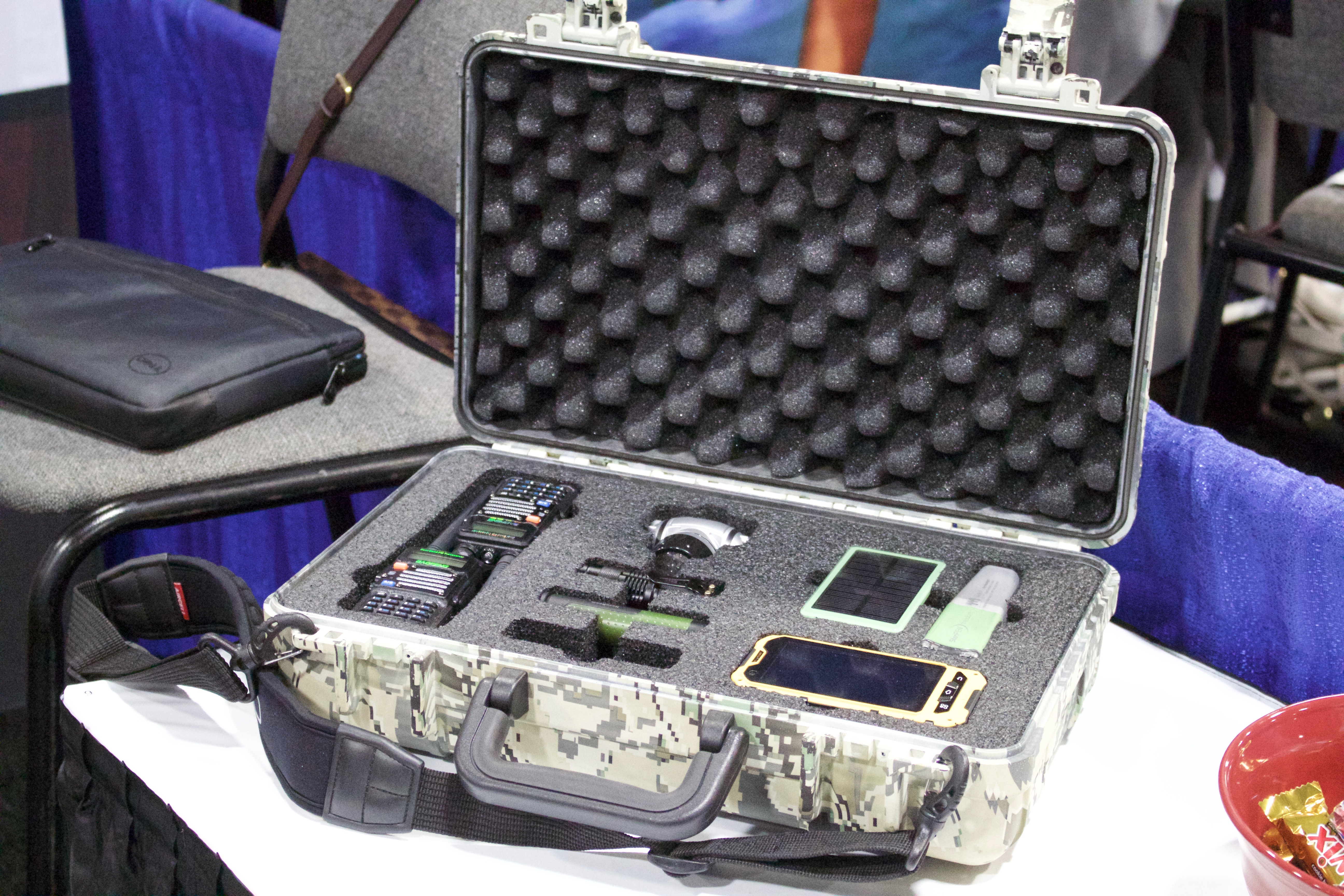
A Faraday Cases travel case, configured to keep communications gear safe in transit from unfriendly electromagnetism.
2 more images in gallery
WASHINGTON, DC—A small company from Utah has developed a composite material that combines carbon fibers with a nickel coating. The result is an extremely lightweight electric-conducting material with the properties of plastic. And now that material is being used to create cases and computer enclosures that are essentially lightweight Faraday cages—containing electromagnetic radiation from digital devices and shielding them from electronic eavesdropping or electromagnetic pulse attacks. Ars got a brief hands-on with some of the materials at the Association of the United States Army expo this week.
The company, Conductive Composites, is now selling cases built with the Nickel Chemical Vapor Deposition (NiCVD) composite material through its Faraday Cases division. The cases range in size from suitcase-sized units for carrying smaller digital devices to wheeled portable enclosures that can house servers—providing what is essentially an EMP-shielded portable data center. The cases and enclosures are being marketed not just to the military but to consumers, corporations, and first responders as well.
The materials used in Faraday Cases can also be used to create ultra-lightweight antennas, satellite communications reflector dishes, and hundreds of other things that currently need to be made with conductive metal. And they could be a boon to anyone trying to prevent electronic eavesdropping—be it through active wireless bugs, radio retroreflectors used by nation-state intelligence agencies, or passive surveillance through anything from Wi-FI hacking to electromagnetic signals leaking from computer cables and monitors. And in some cases, they could make it possible to create the kind of secure spaces used by government agencies to prevent eavesdropping nearly anywhere.
Read 9 remaining paragraphs | Comments

The Internet has claimed one of its highest profile victims yet: As of March 2016, Playboy magazine will no longer feature fully nude models. This follows on from August last year, when the Playboy website also stopped publishing nude photos and videos. Yes, you'll now be able to read Hugh Hefner's flagship publication, which published its first nude centrefold way back in 1953, just for the articles.
Speaking to The New York Times, Playboy CEO Scott Flanders explained the reasoning behind the change: "You’re now one click away from every sex act imaginable for free. And so it’s just passé at this juncture." Basically, Playboy stems from a time when nudity was racy and exciting; today, it's de rigueur. The circulation figures illustrate that fact nicely: from a peak of around 5.6 million subscribers in 1975, Playboy is now down to around 800,000.
The decision to revamp the magazine is no doubt predicated on last year's decision to remove nudity from the Playboy website. In 2014, before the change, the Playboy website had about 4 million users with an average age of 47; today, with no nudity, the site has about 16 million users with an average age of "just over 30."
Read 4 remaining paragraphs | Comments

Earlier today, Toyota unveiled a bold new plan for the company's sustainability efforts. By the year 2050, it plans to have cut CO2 emissions from its new cars by 90 percent (compared to 2010). Toyota also wants to completely eliminate CO2 pollution from new car manufacturing, as well as over the entire life cycle of a car, including its recycling.
These are bold goals. The company says it will build off the success of its Prius hybrids to cut vehicle emissions. Advanced hybrid powertrains will be a big research focus, and the company even gave a shout-out to silicon carbide supercapacitors. In addition, big things are planned for hydrogen. The Japanese government has been incentivizing its car industry to work with fuel cells, and road cars are starting to appear. The Toyota Mirai is already in production and coming to America, even if the fueling stations it will depend upon are few and far between.
Completely eradicating CO2 from the production and recycling of new cars is an equally big challenge. The company wants all its production factories to have zero emissions, in part through renewable energy and fuel cells. And it has goals to promote recycling and conservation around the world. More specifics are included in Toyota's new environmental action plan—its sixth so far—which runs from 2016-2020. That means it will be a few years before we can judge if Toyota's commitment to the environment is succeeding.
Read on Ars Technica | Comments
Talynebearoooooo that explains a lot


 True origin of the Mavericks.