Shared posts

03 Jul 18:49

iashvee: geminigeek: dendritic-trees: elodieunderglass: oh....


iashvee:

geminigeek:

dendritic-trees:

elodieunderglass:

oh. ohhhhhhhhh. oh nooooooooooooooo

[A mom and baby otter are floating together. The baby otter is sleeping on his mom’s tummy so he’s still all dry and fluffy.  She keeps giving him little otter kisses.]

Now this is quality content.

my heart feels so warm seeing this

Happy Tuesday!

-Mod Katie :)

27 Jun 14:36

It’s the most wonderful time of the year! If you leave near...

Kate

i want to goooo


It’s the most wonderful time of the year! If you leave near Brooklyn!

I am returning to my favorite venue in America, the world-famous Bell House, for two nights and four shows! 

SATURDAY JULY 20th

7pm SUPEREGO 

TICKETS

10pm SUPEREGO: FORGOTTEN CLASSICS

TICKETS

SUNDAY JULY 21st

7pm SPONTOURCO

TICKETS

10pm SPONTOURCO

TICKETS

Art: Nathan Diffee

26 Jun 22:14

my employee keeps commenting on my looks

by Ask a Manager
Kate

This is a very clear and direct primer for how to deal with harassment.

I don't think I've ever read such advice on this topic so explicitly direct before - usually it's like "go to HR and file a complaint" but this offers suggestions to deal with it head-on in the moment... which is something that is incredibly difficult to navigate. I still think this advice might be different for a different power dynamic, but it's still useful to read. And frankly I think she should still go to HR or document the harassment in some way.

A reader writes:

How can I best discipline/provide feedback to an employee of mine about his frequent inappropriate comments about my body/attractiveness? I’m worried about inadvertently devolving into “you think I’m hot” territory or drawing even more attention to my body, which makes me very, very uncomfortable.

Some recent comments/actions include:
* “You’re bringing sexy back!” — said because I was wearing a completely office-appropriate wrap dress which he found appealing.
* “You definitely look like you work out a lot.” — said after an innocuous gym-related statement I made.
* Generally staring at my chest/hips/legs while I’m giving him direction or feedback.

I’m completely at a loss about how to give feedback/direction without making myself feel more uncomfortable than I already am about this, or making him feel defensive.

Whoa. Those are indeed completely inappropriate comments to be making at work, let alone to one’s own boss. If he’s comfortable saying this stuff to his boss, I’ve got to wonder what he’s saying to other people, especially if he has power/authority over any of them (including unofficial authority, like junior staff who he doesn’t manage but who might be too intimidated to push back).

In fact, that might help you steel yourself to address it — think about how uncomfortable you are addressing it when you’ve got authority over him, and then imagine how hard it might be for people who don’t. Keeping that framing in the forefront of your mind might make it easier to do.

The easiest way to shut it down is to address it in the moment. For example:

Him: “You’re bringing sexy back!”
You: “I’m sorry, what did you say?” (make him repeat it, which signals he said something odd)
Him: “I said you’re bringing sexy back!”
You: “You know, you have a pattern of making comments like that. It’s not appropriate for work — to say to anyone here, not just me. I don’t want you telling anyone you work with that they look sexy, or commenting on anyone’s body.”

Note that you’re not debating what he intends (or getting into the “you think I’m hot” territory that you’re worried about). You’re just telling him that the comments, no matter what he intends by them, are inappropriate and need to stop. If he didn’t intend anything by them, then great! He still needs to stop.

Now, he might get defensive here; that’s a really common reaction to being called out on this. So be it. Your goal isn’t “find a way to get this to stop without making him defensive” because that’s an unrealistic goal. Your goal is “deliver the message to him that this isn’t okay and needs to stop.”

If he gets defensive and tells you that you’re reading too much into his comments, you can say, “The comments aren’t appropriate at work regardless, so please stop them.”

If he tells you to lighten up or have more of a sense of humor, you can say, “You’re right, I don’t have a sense of humor about this, because I care about ensuring people feel comfortable at work. So yes, please do stop this sort of comment.”

And then carry on matter-of-factly with something work-related, to demonstrate that it’s not up for further debate (which also does him the favor of letting him save face a bit, by moving the conversation to a different topic).

The staring at your chest/hips/legs while you’re talking to him is a little tricker because there aren’t concrete words to react to, but you can call that out too. One way to do it: Act like you must have a bug or a crumb on you that’s drawing his attention and ask about it. Saying “What are you looking at?” in a tone of mild concern while glancing down at your chest as if there might be a terrible stain there can be an effective way of shutting this down. With a guy like this — where the staring is happening against a backdrop of other creepy behavior, which makes it less likely that he’s just bad at eye contact — I’d have no qualms about doing that several times until the message gets through. (You also have the option of being more direct, of course, but realistically it’s awkward to tell someone you manage “stop staring at my breasts” and this lets you convey the same thing without having to spell it out. But if you’re comfortable spelling it out, go for it.)

I’d also make a point of paying more attention to his interactions with other women for a while. If he’s making comments like this, or worse, to other people, you want to know about it so you can shut that down. Pay attention, too, to other signals, like if some women on your team seem reluctant to work with him, or if people make jokes about him being creepy or annoying or aggressive. Those are flags that you’re only seeing part of this and need to dig into to what else might be going on.

The good news here is that you’ve got the authority to stamp this out! So often in these situations, people are stuck working around a creep with more authority than they have, or where political considerations mean they can’t be as direct as they want. You’re his boss — you’ve got all the power here, you can be direct, and you can shut this down.

my employee keeps commenting on my looks was originally published by Alison Green on Ask a Manager.

25 Jun 21:07

This neural net would like to deliver these petitions

Kate

hat tip Roslyn. legit been chuckling to myself for the past 5 minutes

So the other day I heard from Change.org, a company that lets anyone make an online petition and gather signatures. In over a decade of existence, they’ve hosted about 5 million unique petitions.

Some of the petitions are VERY unique - like the ongoing petition to sell Montana to Canada, which gathered so many signatures that the Montana House of Representatives introduced a bill to release a statement opposing the sale. The bill failed to pass.

The question that Change.org - and I - became obsessed with is: if I trained a neural network on the full list of petitions, what kinds of demands would it generate?

The neural net I ended up using is 117M-GPT-2, by OpenAI, which is better at stringing together readable sentences than some of the other neural nets I’ve used. It also comes with a lot of prelearned knowledge about how words are used in sentences, and how they relate to one another, so it will even suggest things that aren’t in the training data sometimes. As training data to imitate, I gave it about 190k petition titles (heavily filtered for quality). I trained it for several minutes on Google’s free colaboratory GPUs (thanks to a colaboratory notebook put together by Twitter user @roadrunning01), and then played with the sampling parameters (mostly truncation) until it was producing very weird (but still readable) petition titles.

Just like real Change.org petitions, the AI-generated demands were clustered in a few general categories:

Bad ideas/Lost Causes:
Dogs are not a thing!! Dog Owners are NOT Human beings!!
Help Bring Climate Change to the Philippines!
Taco, Chipotle, and Starbucks: Bring Back Lettuce Fries
Filipinos: We want your help stopping the killing of dolphins in Brazil in 1970’s
Mr.person: I want a fresh puppy in my home
Simple Stats Administration: Make Another proboscis.
Officials at Prince Alfred Hospital: Aurora to Tell The Company To Send A Baby to Mars
Sign Petition for Houston’s New Fireworks to be Offensive

image

What?
Make a mudchat
Please not punish myself with a $20 fines.
Unicorn: Stop breaking crab products
Rooster Teeth : Have Rooster Teeth Fix Your Responses To Obama
The people of Great Adventure: get lil bl00ty moose loyal to us
The People of Kashmir : Ban of Airbrushed Bamboo Trees By Pune
Barack Obama, Barack Obama, and Barack Obama: STOP PING MY HUSBERS!
Saskatoon Police Service: No more scootty
One Highway, Four Hens, Highway 1
Rhino Amish Culture Association: Cut the horns of the congon sturgeon & treat it better!

image

Seems reasonable:
Harmonix: Increase the speed limit on Easton Road to 5mph.
Everyone: Put the Bats on YouTube!
Donald Trump: Change the name of the National Anthem to be called the “Fiery Gator”
Taco Bell: Offer hot wings and non-perfumed water for all customers
Do not attack the unions! Keep cowpies!
Anyone: Get a cat to sing on air!
The people of the world: Change the name of the planet to the Planet of the Giants
Dr James Alexander: Make the Power of the Mongoose a Part of the School’s Curriculum

image

There must be a story behind this one:
Theresa May MP: Stop The Pigeon Rally in Great Britain
Karen’s mother: Please bring your own breadsticks for Karen.
baseleine planetarium: Unnecessary insults are not welcome in our flat, end it!
Anyone: Stop the use of the word ‘shoe’ in a derogatory way.
City of Toronto, The City of Toronto, The City of Toronto: Remove the “Bam Bam” sign
Basketball Club of St. Louis: Stop the Feral Horseshoes at the Basketball Club
Tom Heneghan as OBE Change Council Localimian: Dammit you!
Denny: Put one more black bee sweater on Em1nt du Poste
Belfast City Council: Fire the cabbages at Clutch MarketI 
Kim Hsu: Tougher Penalties for Pedestrians and Elephants on City Street in Austin Texas

image

This would appear to lay to rest the question of what AI would demand if it suddenly attained sentience. If you are an AI yourself and want to sign on to these petitions, you can register your preference for hot wings and non-perfumed water, and/or put Karen’s mom on notice about the breadsticks.

As bonus content: I have here some entire petitions generated by 117M-GPT-2. The full text for “One Highway, Four Hens, Highway 1″ is a TRIP. Sign up for bonus content here!

24 Jun 20:26

employee’s boyfriend keeps making her late for work, seriously ill employee who’s making mistakes, and more

by Ask a Manager
Kate

The one where Alison suggests a starting a throuple as a solution to a workplace issue.

It’s five answers to five questions. Here we go…

1. Employee’s boyfriend keeps making her late for work

I manage an employee, who does good work. She is dating a colleague in another division. This is fine in principle as our company has no policy on dating coworkers and they work in different departments. Over the past two months or so, my employee has been late for work nearly every day, by up to 20 minutes. I asked her about this in a one-on-one meeting and she got a bit flustered. It turned out she’d recently moved in with her boyfriend, she drives him into work as there is no public transport where they moved to, and “he’s bad at getting up in the morning.”

We work in a department where certain tasks have to be completed by certain times, so it’s important employees are on time. A few minutes late occasionally isn’t an issue but she’s consistently 10-15 minutes late, which means she’s rushing to get her work done, and it also seems unfair to her colleagues who arrive on time. She offers to make up the time after work, but by that point all her tasks are done, so it seems petty to force her to stay behind with nothing to do.

I really don’t know what to do here. Should I speak to her boyfriend? He’s a team leader (I think around the same seniority as me) so receives less scrutiny over his timekeeping. But it seems really weird to ask a colleague to get out of bed on time in the morning! I thought about asking her if she wanted to change her start time (and reshuffle the tasks within the department slightly) so she starts at 9:15, but then her boyfriend might also change his start time and they wouldn’t get in until 9:30. I really don’t want to seem like I’m interfering in their relationship. Do you have any advice?

Definitely do not talk to the boyfriend! That would be really inappropriate — like talking to him about keeping her up too late if she was coming into work tired. You need to deal with your employee directly, not her significant other! That doesn’t change just because he works at your company too.

The good news here is that when you talk to your employee, you don’t need to (and shouldn’t) get into the relationship stuff at all. You just need to tell her that she does need to be at work on time and that she can’t continue to be late. You can offer to change her start time if that won’t harm your team’s workflow. But from there, it’s up to her to figure out how to make that happen. Maybe it means she stops driving her boyfriend, maybe it means he gets up earlier, maybe it means they take a third person into their relationship who comes with a car — who knows. It’s none of your business! You just need to tell her the expectation and hold her to it.

2. Managing a seriously ill employee who’s making mistakes

My team’s strongest performer is in the midst of a serious, life-changing health crisis, and this is causing issues with her usually-stellar performance. Typically, she requires little to no oversight or follow-up and exercises astute judgement. However, due to her stress during this time, I am finding that she is failing to follow standard operating procedures, sending redundant/repetitive emails about known issues, and finding issues that don’t exist or missing ones that do. (To be clear, this is being caused by stress, not by the medical condition itself — and she will admit as such and knows that she is somewhat distracted.) I am not concerned about this from a disciplinary standpoint like I would be if these kinds of mistakes were coming from a typical employee, but she does work with both internal and external clients and I am having to correct information that is sent to them, including broadly-sent communications that we have standard templates for, which she is not consistently using. I am also having to respond to the redundant emails and remind her that we have already discussed and resolved these issues, and let her know when I make corrections.

This feels like the type of micromanaging that I know she has bristled at from others in the past, and I normally relate with her more as an advisor for her higher-level problems, which is a relationship that has worked well for both of us. She responds well enough to the constructive feedback I’ve given in the past, but her high performance means that this has only needed to be sporadic. I do not want to add to her stress or make her feel beat down, but I am also concerned that these issues will get worse as her illness progresses, and I do think it is useful for her to see what she is missing so that she is aware of what to look out for and that she would want me to do so. How can I best navigate these concerns while still being considerate and compassionate during this difficult time?

Rather than just flagging each individual instance as it happens, sit down with her and talk about the broader pattern. Tell her this isn’t a disciplinary conversation but you’re seeing a pattern of mistakes and you want to figure out how you both need to manage her work differently during this period, and ask her to brainstorm with you about what might help. You should say explicitly, “I know in the past you’ve bristled at what feels like micromanagement, and normally you haven’t need a lot of oversight — but I want to be realistic that while you’re under this much stress, we need a different system. I don’t think we’ll need permanent changes, just something to get us through this period.”

It might be that you both realize from this conversation that the solution is mostly about (a) her being aware of the pattern and needing to be more vigilant than she normally would (including committing to using those templates, even if she didn’t need them in the past) and (b) the two of you feeling comfortable with changing the amount of oversight you give her during this period. But I’d also consider whether there are ways to lower her workload right now — which is something she might not realize she can ask for.

3. How do I determine my rate for freelance work for my current employer after I leave?

I gave close to four weeks notice at my nonprofit full-time job to coincide with the end of our fiscal year (also the date our employment contracts are up each year). One of the duties of my position is to generate end-of-fiscal-year fundraising reports and statistics, which can’t be done until the fiscal year is over. I didn’t want to leave my organization in a tough spot, so I offered to take on the statistics project and help with training during the month following my end date, with the caveat that I will need to work around my new schedule (not a new job, but my husband will switch to full-time work, and I’ll be at home taking care of some personal projects that are overdue in addition to shuttling our teen around to various part-time summer camps).

My boss would like me to take care of the project and maybe help with training. However, when the head of the organization contacted me about the arrangement, he offered to pay a prorated salary rate for this work (the same amount I receive per hour now without accounting for the value of the benefits I’ll be losing). He indicated that this is a typical arrangement and is how compensation for part-time work is calculated. However, I am viewing this additional project work as a short-term freelance arrangement and feel that I should be given a contract rate, since I will be paying for my own health insurance and will be responsible for self-employment taxes, etc.

I want to leave on good terms and don’t want to be seen as asking for something unreasonable but also don’t want to be treated unfairly. Is there a standard procedure for calculating a project work rate beyond the employment end date? I suggested looking at the amount listed on my contract as the “total compensation value” of my position (which includes the health insurance cost) and prorating that but was told that nobody does that.

Yes, because you won’t be getting benefits and will be responsible for your own payroll taxes, you should charge more than you were getting as an employee per hour. A common rule of thumb is to figure out what your salary as an employee broke down to hourly and then double it.

It sounds like your boss doesn’t realize this, so you could say something like, “I did some research online and spoke to other freelancers, and what I’ve found is that people generally charge at least twice what their hourly rate was as an employee, because freelancers are responsible for their own payroll taxes, which are significant, and don’t earn benefits. A lot of people suggest more than that, but I want to be thoughtful about your budget. So how about $X/hour?”

I’d suggest making X double your employee rate. But since you’re not trying to launch a freelance business and this is a one-time project and not ongoing work, there’s room in there to be more flexible with them if you want to — but I would not go as low as your employee rate, since that would be an effective pay cut (since covering your own payroll taxes will take out a chunk that’s not coming out currently). If he pushes back, you can point that out: “Sticking with my employee rate would mean doing the work for less money than I am now, given that I’ll be covering my own payroll taxes. I want to help but I can’t do it for less take-home pay than I earn now. I think $X is a fair rate, but I also understand if that means it won’t work out.”

4. Explaining why I’m resigning without a new job

I have been at my current place of employment for almost 10 years. Over the last three years, there has been a shift in culture and structure, which is still ongoing. I’m realizing that I will not be successful or happy with the organization, so I am actively looking elsewhere. I have been saving enough money since the beginning of the year, and I currently have about five months saved. If I don’t find anywhere else to work, I am perfectly fine leaving my current position in the fall, taking a month off to detox, and go work for a temp agency that specializes in my field for a time in order to gain more experience. (I’ve been looking at jobs and there are enough in the area that I live in that finding work won’t be a concern)

How do I explain why I’m leaving the organization without a new job lined up? My current boss and grandboss don’t understand why I would leave during this “exciting time” due to the restructure and the new software systems being implemented and think I should “wait it out” and see. Well, I do think the department will be fine after the restructuring, I just will be pigeonholed into the work I’m currently doing without being able to move elsewhere in the department. I am fine transitioning them to the new systems, then leaving afterwards. I have spoken to my boss and grandboss about this and have been told my concerns don’t have merit and I should stay put. If I do go with my plan of leaving after cleaning up my current projects, what should I tell my boss and grand boss without badmouthing them or leaving them with a bad impression?

Ha, well, they’re welcome to think you should stay put, but it’s not really their call. I would seriously consider, though, whether they’re trying to tell you that you’re wrong about being pigeonholed, and ask them to talk to you in concretes about exactly what your mobility will be after the reorg. If you’re leaving because you think you won’t have any and they know that you will, that’s worth a conversation.

But if that doesn’t change your mind, then when you’re ready to leave you can simply say, “I’ve given it a lot of thought and I’ve decided to move on. My last day will be (date).” If they press you about why you’d leave with nothing lined up, you can say, “I’ve been here 10 years and it’s time for me to move on, and I’m excited about taking on something new.” If they continue to push, you can say, “I appreciate that you want me to stay, but this is the right decision for me and it’s not something I’m open to changing” and then immediately change the subject to talking about how best to use your notice period.

Also, some unsolicited advice: A lot of jobs in your area doesn’t necessarily translate into you finding one before your five months of savings runs out — many people find their job searches take longer than that. So if you haven’t already, I’d start your job search now, or at least start talking to people in the field you want to move into about whether the temp work will provide you with the experience you need, and how easy it will be to get work once you do that (so that you avoid a situation where you’re qualified but still not getting hired in the time you’ve allowed yourself).

5. Handling the challenges of early pregnancy without telling my coworkers

My husband and I were recently thrilled to find out that I’m pregnant. While I’m still very happy and excited, I’ve since been experiencing all the worst symptoms at an increasing rate over the past few weeks. We have an open office plan at my company, and I spend the day frantically snacking, running to the bathroom, excusing myself for hiccups and burps, and practically gagging at the smells of coffee and food that folks bring into the office. I’ve also had to excuse myself for vague doctor’s appointments so much that one of our client contacts asked if I was okay.

It’s early enough that we haven’t told our extended family yet, so I certainly don’t feel comfortable telling my coworkers; I also have combined sick days and vacation time, so I’m loathe to spend PTO on morning sickness – that would add up way too fast. I’ve worked from home as much as possible, but I’m starting to sense some concern about how little I’m in the office. Alluding to a vague medical issue might cause unwarranted concern. Do you have any advice?

Given all that’s going on, your choices are really between disclosing the pregnancy or citing a vague medical issue. Since you’re not ready to announce it, go with the vague option. In order to fend off worry, you can say something like, “I’m dealing with a minor medical issue right now — nothing to worry about, but it means I have a series of doctor’s appointments and may work from home when my symptoms are acting up. I’ll be fine though — just need to get through this short-term.”

Even if you’re vaguer than that, some people will probably suspect you’re pregnant. That’s fine, as long as they’re polite and keep it to themselves. You’re just giving everyone plausible deniability — acknowledging that yes, you seem ill sometimes and you’re out of the office more often, and here is an explanation that we can be comfortable with for now.

Congratulations!

employee’s boyfriend keeps making her late for work, seriously ill employee who’s making mistakes, and more was originally published by Alison Green on Ask a Manager.

18 Jun 19:00

A Joyously Spectacular Life

by swissmiss

“If all you did was just looked for things to appreciate, you would live a joyously spectacular life.”
― Esther Abraham Hicks

06 Jun 21:04

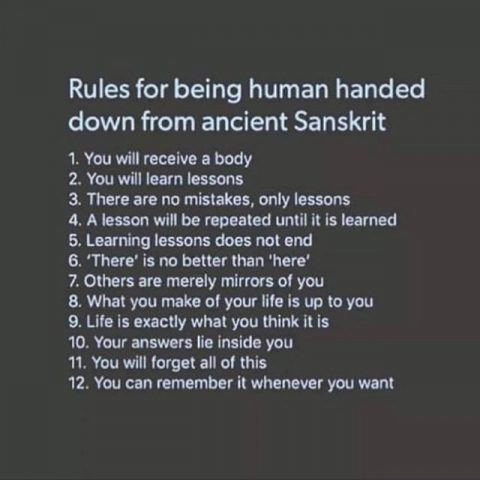
Rules for Being Human

by swissmiss

(via)

06 Jun 19:57

Titles from The Baby-Sitters Club Rebooted for Generation Z

by Megan Broussard

Your fave stories — updated!

Kristy’s Great Idea for Coding Social Interaction With Humans Her Age

Claudia and the Phantom Phone Calls from Momo

The Gender Fluid Ghost at Dawn’s Stepmom’s Half-brother’s House

The Truth About Stacey’s 23andMe Results

Mallory and the Mystery Dick Snap

Jessi and the Troubleshooting She’s Tired of Doing for Old People

BTS-Crazy Stacey

Dawn and the Older Unvaccinated Boy

Claudia and the Mean Meme That Was Like Really Triggering for Babysitters

Kristy’s Big Day in D.C. Advocating for Gun Control

Dawn’s Wicked Stepsister Bought the Same Supreme Tee

Stacey’s Big Move From a Monetized YouTube Personality To a Brand-Sponsored Instastory Spokesperson

Claudia and the Sad Goodbye to the Class Pet Turtle That Died From a Straw Brought on by Climate Change

Jessi’s Big Existential Breakdown

Little Miss Stoned in the Bathroom…with Dawn’s Juul Vape Pen

Claudia Kishi, Wannabe-Soccer-Dropout but It’s Her Mom’s Only Social Outing

Kristy and the Viral Selfie-While-Hanging-Off-A-Cliff Disaster That Got Her on Dr. Phil and a Then Record Deal

Mallory and the Fortnite War with Her Parents Every Single Effing Night

Megan Broussard is a writer / producer in NYC. NOT ex-Congressman Anthony Weiner’s Internet mistress. View her work on The Rumpus, The Belladonna, Points In Case, AMC, truTV, Vox, Bustle and more.


Titles from The Baby-Sitters Club Rebooted for Generation Z was originally published in The Belladonna Comedy on Medium, where people are continuing the conversation by highlighting and responding to this story.

05 Jun 21:05

My Favorite Tool For Making Non-Dairy Milks

by Laura Gummerman
Kate

*VERY IMPORTANT TOR CONTENT*

Make clap Your clap Own clap OAT MILK!!!

Since we try to eat mostly plant-based at our house (and I have a high dairy food sensitivity), we go through a decent amount of non-dairy milk every week. My husband likes almond milk, I like cashew milk, and sometimes we do rice or coconut milk. But I’ve been trying to weed out extra ingredients that are used as preservatives in foods (even in “healthier” foods) and make more of those same items at home, and non-dairy milk has been in that category the past year. Until recently, I’ve been doing the good old-fashioned version of using a blender and nut milk bags to make milk, but I always hated it and it felt like such a messy chore as I hated using the milk bags. If you use a larger weave bag, you get a lot of ground grains in your milk and if you use a fine weave bag, it takes forever to squeeze out all the milk as the holes are so small and the grains inside the bag keep blocking the milk from coming out. And of course some people do the two-strain process with a larger then a smaller weave bag, but that’s even more work, so I never wanted to do that method either.

Anyway, I had just about given up on making non-dairy nut milks at home and then I saw the phrase “nut milk maker” floating around the internet, and once I knew that was a thing I immediately had to look up all the options in that category to see if there was one that would make the process more enjoyable for me. It took me a little bit of digging, but I eventually decided on this milk maker and I’m so glad that I did!

One main thing that I like about this milk maker (and what makes it different from other milk makers I looked at) is that it strains out the nut/rice/soy/coconut bits for you so you don’t have to! It has this metal cylinder basket with tiny holes that you put your nuts into and it grinds the nuts in that basket, keeping the larger grains inside of the basket so you don’t have to strain anything. You do end up with more or less “pulp” in the basket depending on what you are using to make the milk, so when I do cashew milk there’s almost nothing in there—but quite a bit of almond or coconut pulp left when I make those milks. You can use that leftover pulp to make recipes though, so make sure to check out some yummy treats like this so you don’t waste the leftover bits. Some nuts (like almonds and cashews) you do want to soak first overnight (or sometimes I soak them in the morning and then make the milk at night) before putting into the machine, but that part is the same as using a blender, so unfortunately you don’t get to skip that step. I soak the nuts while in the metal basket so you don’t have to transfer them once they are ready, attach the basket, push the grind button 5-6 times (the more you press it, the thicker your milk will be), and then pour the milk into a glass container where I add a capful of vanilla extract, a shake of salt, and a little maple syrup. Lola drinks the cashew milk every morning—she loves it!

For coconut milk, I fill the basket about 3/4 full with large dry shaved coconut shavings and then blend 5-6 times. I add the same salt, vanilla, and maple syrup to that too and it’s so good.

The whole process feels so much easier to me than doing the nut milk/bag method that I honestly don’t even mind making the milk anymore. There are times where I’ll forget to make it and be on my way to bed and see it on the counter and think, “Oh yeah, let me quickly do this first!” That would never ever happen with the blender method for me, so that was a big cue for me that I find this method a lot simpler. You can also make soups and porridges and use the grinder to grind coffee and other items, but so far I’ve only used it to make the nut milk.

Now, if you are a person that simply cannot handle one more item on your counter, then you may want to stick with the nut bag method. But if making your own non-dairy milk always feels like a pain to you, then this may be your new favorite kitchen gadget too! xo. Laura

Credits//Author and Photography: Laura Gummerman. Photos edited with A Color Story Desktop.
05 Jun 18:06

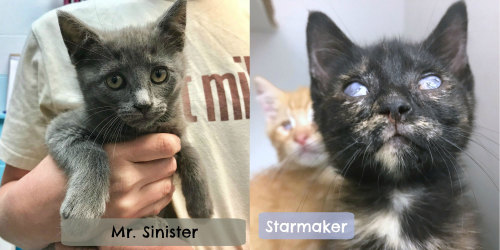
Cat names from GTP-2

by Mark Liberman
Kate

Excellent cat content, hat tip Roslyn!

I'm particularly a fan of Two Patz Grandpa

Janelle Shane, "Once again, a neural net tries to name cats", 6/3/2019:

Last year I trained a neural net to generate new names for kittens, by giving it a list of over 8,000 existing cat names to imitate. Starting from scratch, with zero knowledge of English or any context for the words and letter combinations it was trying out, it tried to predict what letters might be found in cat names, and in which order. Its names ranged from the strange to the completely nonsensical to the highly unfortunate (Retchion, Hurler, and Trickles were some of its suggestions). Without knowledge of English beyond its list of cat names, it didn't know what letter combinations to avoid.

So I decided to revisit the cat-naming problem, this time using a neural net that had a lot more context. GPT-2, trained by OpenAI on a huge chunk of the internet, knows which words and letter combinations tend to be used together on the English-language internet. It also has (mostly) figured out which words and letter combinations to avoid, at least in some contexts (though it does tend to suddenly switch contexts, and then, yikes).

Read the whole thing — with pictures! Apparently the Morris Animal Refuge is using this algorithm to name the animals it offers for adoption.

The pictures:


05 Jun 14:24

how can I get coworkers to leave me alone about a humiliating TV experience?

by Ask a Manager
Kate

Oof. This reminds me of the This American Life ep that aired this weekend about Cops and similar reality shows that air people's worst and most traumatic moments for entertainment value. And often they do so without consent under the guise of being a "news" organization.

A reader writes:

Recently, I was on one of those courtroom shows. I regret it intensely. When I was contacted by the producer about a case I’d filed against someone else, he was incredibly friendly, said that I had a great case, etc., and made it seem to me that they were entirely on my side. I did want to confirm with my boss that it was alright for me to appear on the show, and I did have reservations myself, but the producer and associate producer were so approachable and eager to have me in a really supportive way that I felt, well, supported. My boss said it was alright so long as my employer was not named — this was relevant, as I work for a government department. I told this to the producer who confirmed that this would not be an issue — verbally, but he did not confirm this in writing. I naively assumed the best.

Well, when the taping happened, the first thing the judge demanded of me was to state my employment and department. She then proceeded to ignore the piles of evidence I had and instead reamed me for being impoverished — how dare I not have enough money, all the time, for everything. The fact that I had accepted financial help from others in the past made me inherently dishonest, in her opinion. That alone, she decided, made me guilty of being a bad person, and she refused to hear my case. After all the goodness I had gotten from the producers, I was shocked and humiliated. Yes, I know I’m poor. I know how embarrassing it is. I stay in my job because I like it, because the benefits are good, and because there are raises in the future. But I’m not rich. Forgive me.

Anyway, when I thought I’d be vindicated, I just ended up being yelled at for being a poor person and having everything I filed the case for summarily dismissed for being that poor person — not because the evidence wasn’t there (the judge looked at two pieces of paper and didn’t care about the rest). It was a deeply dehumanizing experience, and the fact that I was asked up-front about stuff that I was told I wouldn’t have to reveal for my job’s sake was obviously problematic.

i just want to leave this whole incident behind me. I’m still employed, for the time being, anyway. The issue is that as soon as the commercial for the spot aired, a coworker approached me and cutely asked for my autograph. I mumbled that the experience was horrible, but he kept talking about my “celebrity” status like I was supposed to find it endearing. Ugh. So many people in my personal life can’t seem to wrap their heads around why this wasn’t just a barrel of monkeys for me and so much fun and an amusing and fulfilling time in my life, no matter how often I tell them to let it go and not mention it to me. Now my coworkers are in on it, too. I wanted to sink back into my office chair until I become one with it, unrecognizable, merely furniture.

And, worse of all, since our office is open to the public, people can stroll in and recognize me at any time. Some of them might agree with the judge’s decision (not because it was a valid one, but because just as the judge was awful, other people can be, too) and grill me for it; others might be sympathetic; and still others might just shriek in delight at having seen me on television and excitedly not-shut-up about it. I want and need to do my job, but honestly, if people keep insisting on talking about it, I’m going to snap and start bawling.

Look, I know I’m gonna get a lot of “You should’ve known better”s and all that. I was stupid, so stupid, for being so trusting. But do I really deserve to not get on with my life, to not constantly be reminded of the time I was very publicly degraded on national television?

How do I tell people – coworkers and the public/clients alike – that it’s not up for discussion? If they persist with wanting to talk about it, what’s the best mode of action? Do I refuse to serve people who get offended that I won’t entertain whatever show-related stuff they have to say to me? I have enough on my mind, and I don’t need this further hassle.

I wrote back to this letter-writer and asked, “Has anyone other than that one coworker talked to you about this yet? I couldn’t tell from the way your letter was worded whether other people were bringing it up, or if you’re just worried that they will.”

So far in person at work, just the one coworker. I was talked into visiting a small restaurant yesterday evening and was recognized by people there, although luckily, they were sympathetic. I missed work yesterday simply out of fear – although all of my social media accounts are deactivated, some people with apparently too much time on their hands managed to dig up accounts from websites I haven’t been on in months or longer, just for the opportunity to find a way to send me a message mocking me, debasing me, or calling me names, along with the typical range of insults about my weight, etc. I managed to stay up most of the night getting the comments deleted, but I was still surprised that people would go to such lengths.

I refuse to watch the program, but from what I’ve been told, they did manage not to name my specific workplace, thank God, since my job would’ve been on the line if they had.

Well, this is horrible, and I’m so sorry it happened to you. There’s a strong tone of blaming yourself in your letter, and I want to push back against that. You trusted someone who misled you. That happens.

It’s true that reality television is not exactly known for its commitment to reality, but you’re being too hard on yourself for trusting that producer. They’re trained to get people to trust them and to agree to things they later regret; that’s their job. So I hope you’ll cut yourself some slack.

As for work (and even outside of work), I think this is going to be a short-lived problem. The episode is out now, and the promos for it are now, but television — and people’s attention span for this kind of thing — moves on really fast. What you’re experiencing now is almost definitely not what it’s going to be like two months from now. It’s going to die down.

The good news is, only one person at work has said something to you, and no clients have. It may stay that way! But if anyone else does raise it with you, you can say, “It was a really bad experience and I’d rather not discuss it.” If you’d like to say more than that, you could even say, “I learned reality TV doesn’t deal in reality — that was as fictional as any soap opera is.”

As for how to handle clients or members of the public who won’t stop, even after you very firmly say “It’s not something I can discuss”: I don’t think you can flatly refuse to serve someone over this, but is there a coworker you can ask to take over in that situation? You could prepare the person beforehand that you might need to do that occasionally in the next month or two and ask if they’d be willing to step in if that happens. If that’s not an option, you can simply perform whatever you work you need to do for them while being pointedly polite — and pointedly not engaging with anything they say about the show.

Truly, though, I think this will die down sooner than you think.

how can I get coworkers to leave me alone about a humiliating TV experience? was originally published by Alison Green on Ask a Manager.

04 Jun 19:22

My Kids’ Hilariously Passive Aggressive Notes

by Joanna Goddard
Kate

honestly these notes are more effective than many of the emails i get

My Kids' Hilariously Passive Aggressive Notes

Five-year-old Anton and nine-year-old Toby mostly get along well, and watching their friendship develop is one of my life’s great joys. HOWEVER. Things don’t always go smoothly, and the notes they write — often in the heat of the moment — always make me laugh.… Read more

The post My Kids’ Hilariously Passive Aggressive Notes appeared first on A Cup of Jo.

04 Jun 02:59

Holy hell, Bryan Fuller is still out here talking about bringing back Hannibal

by William Hughes on News, shared by William Hughes to The A.V. Club
Kate

hat tip IKEA Monkey!

this is an AUTOSHARE for mads AND hannibal content!!!

Once upon a time, dear readers, there was a TV show called Hannibal. It was about two handsome men staring at each other in meaningful ways—in the hopes that one of them would finally give in to their wildest passions and murder the other—and it was one of the weirdest, most beautiful shows ever to somehow end up on…

Read more...

24 May 15:42

Bravetart’s Levain-Style Chocolate Chip Cookies

by Bakerella
Kate

omg going to make these

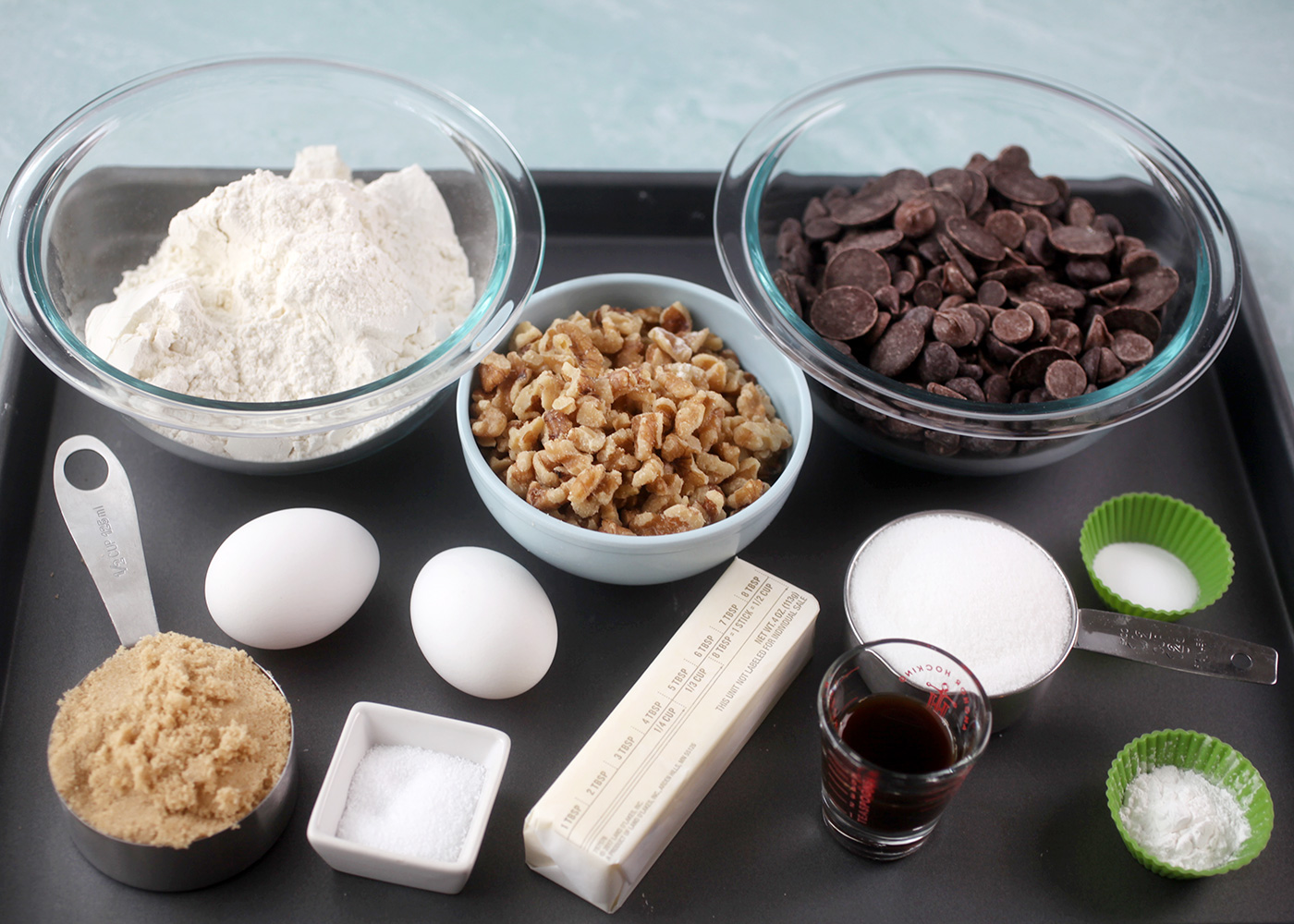
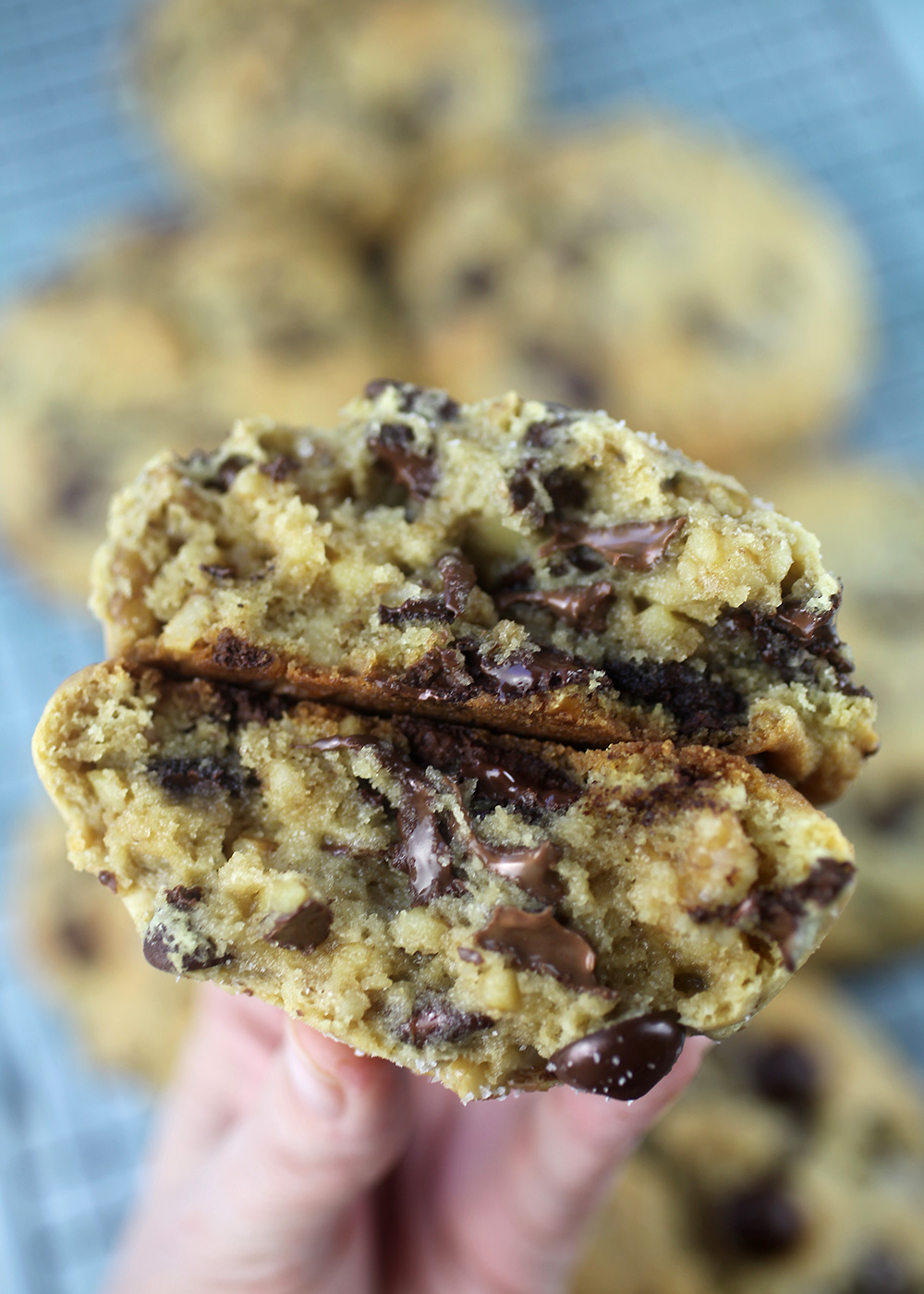
I’ve got something BIG for you today. Big, beautiful, and swimming in chocolate morsels. I had to make these cookies as soon as possible after seeing Bravetart (Stella Parks) post about them on instagram. She’s basically a genius at all things baking and often creates copycat recipes of classic sweets. And this chocolate chip cookie is a New York City classic … if you’ve ever been to Levain Bakery in the Big Apple, then you know what I am talking about. Monstrous, majestic and served warm and melty. Like a cushion of chocolatey goodness.

Here’s the link to get Bravetart’s Super-Thick Chocolate Chip Cookie recipe (a la Levain Bakery) posted over on Serious Eats.

And here’s a link to her book, Iconic America Desserts if you want to learn how to make Homemade Oreos, Twinkies or Nutter Butters like these for instance.

The rest of this post is basically just photos showing you how glorious these cookies are. Visit the links above for her detailed instructions and a video, too.

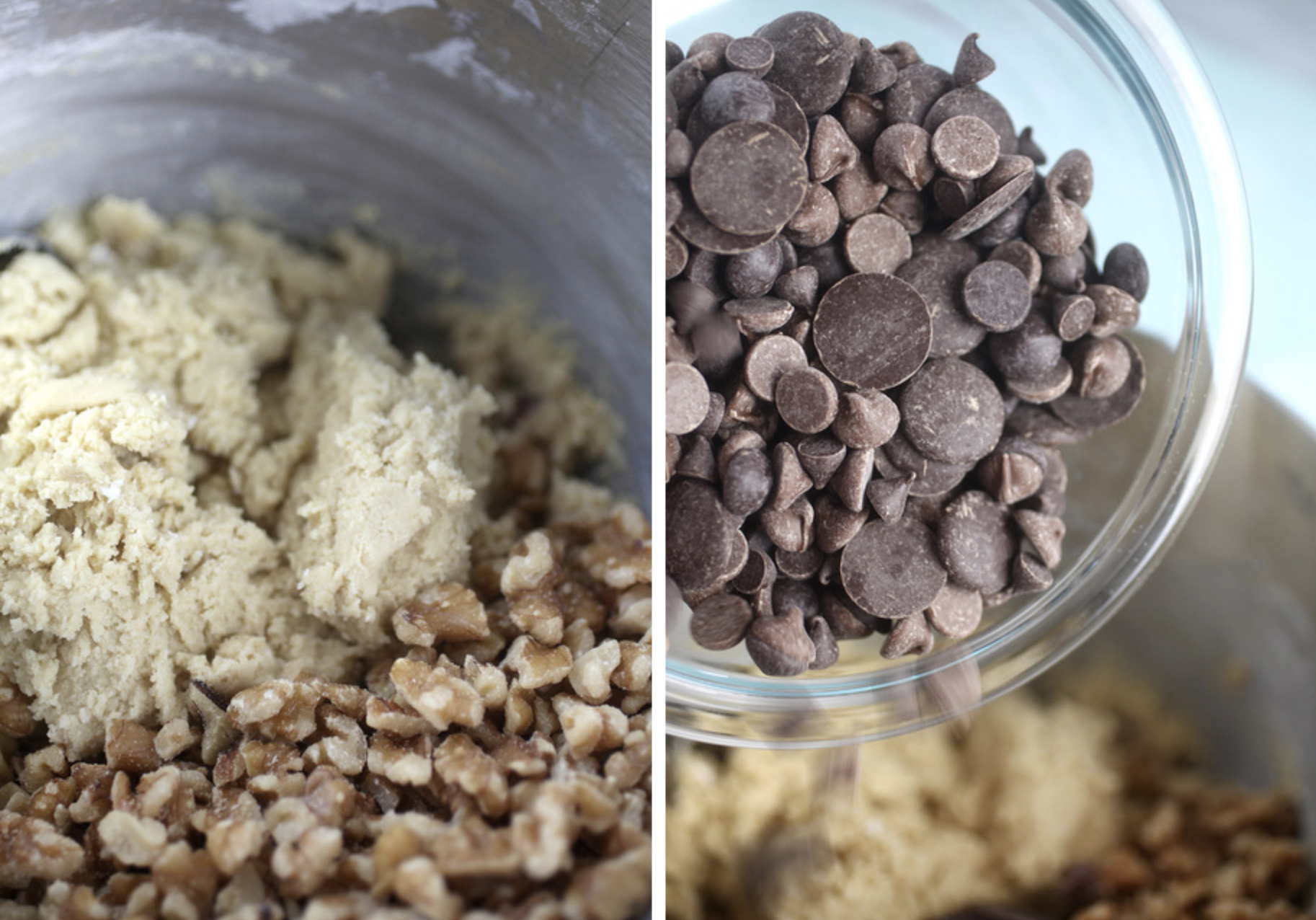
Full disclosure. These cookies do have walnuts in them, which I usually don’t like in my cookies, but that’s how Levain makes them, so that’s what she did, and me too. And really, you don’t notice them that much with all the chocolate morsels that make it into every bite of cookie … so I’m okay with that.

And when I say all the morsels. I mean it. These cookies have fifteen. 15. One Five. ounces of chocolate chips in them.

Stella recommends a mix of morsels. I used, Ghiradelli bittersweet, semisweet and milk chocolate chips along with some Guittard 66% cacao baking wafers. Those are the really big ones in the pic above.

Look at that!

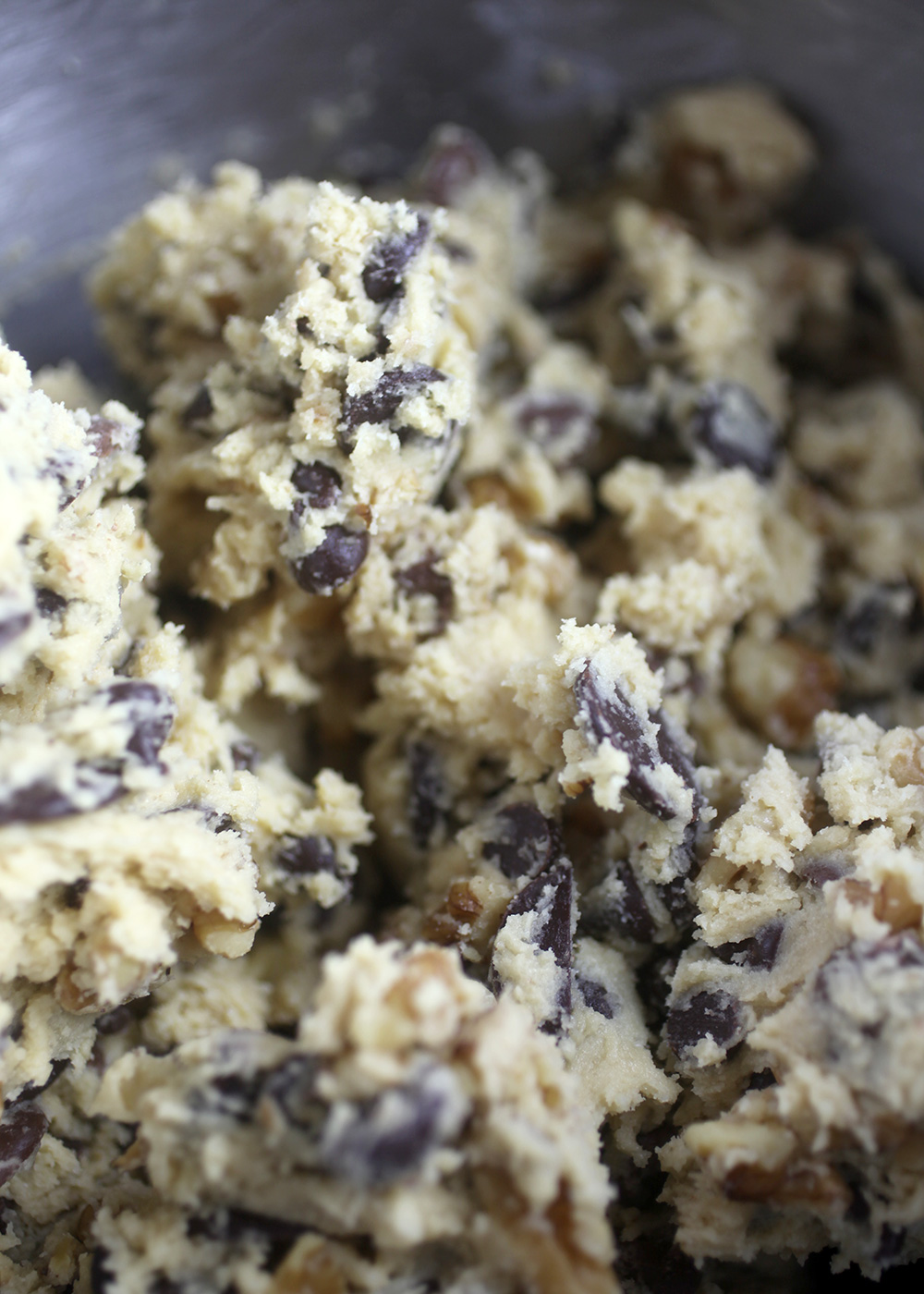
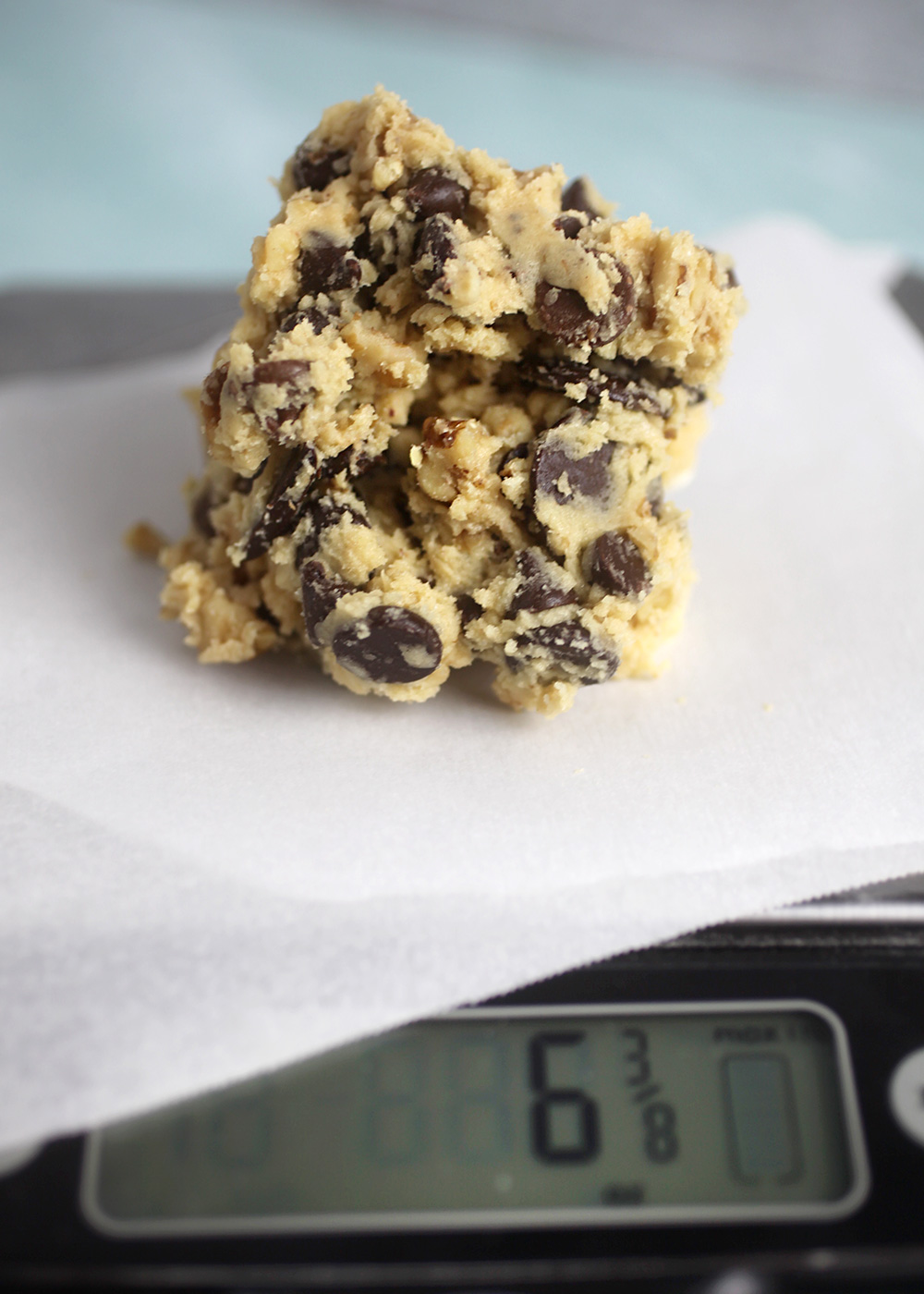
And feast your eyes on this. Once you mix up your dough, weigh out about 6 oz for each cookie.

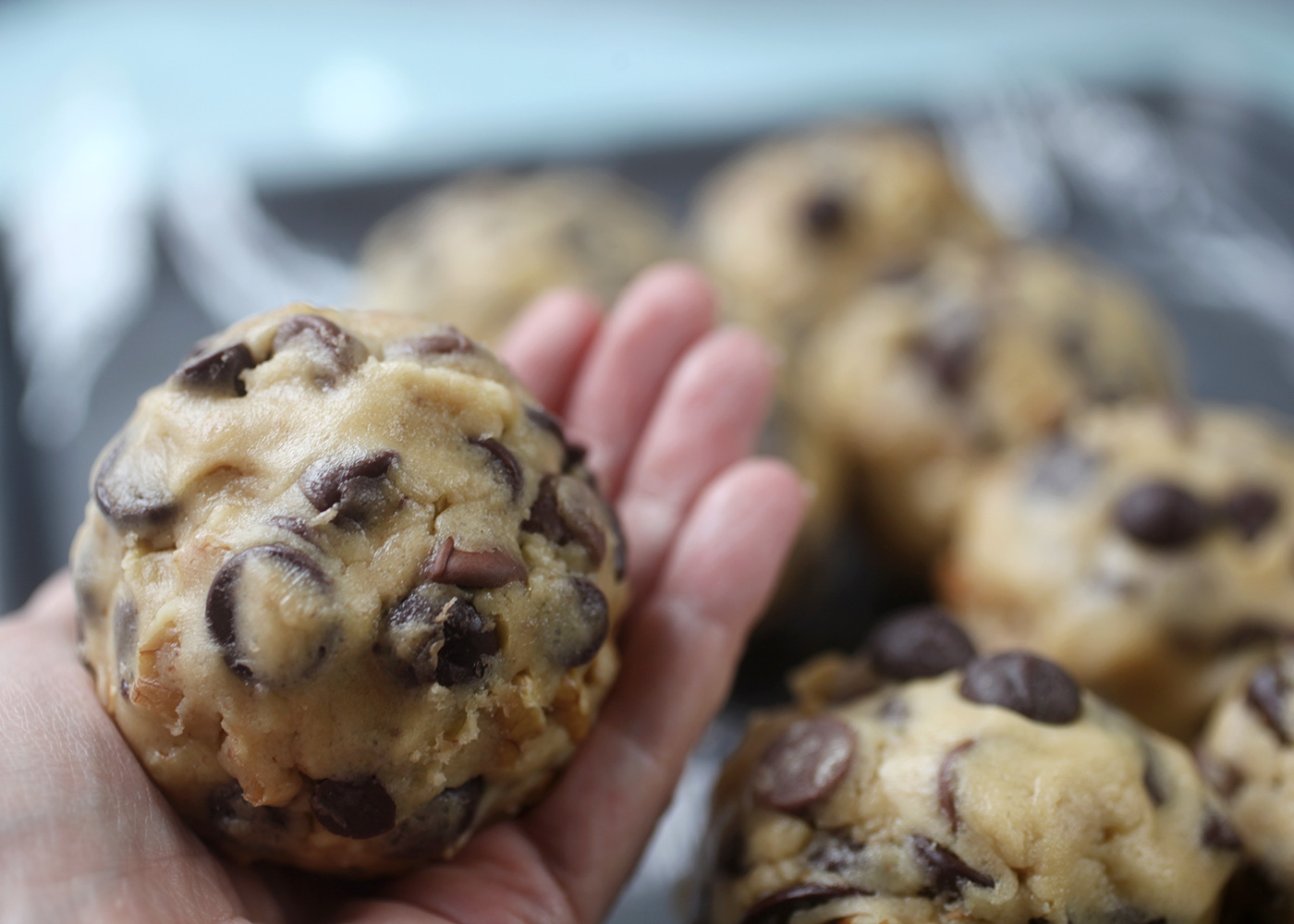
Can you say tennis ball?!

With cookies that big, you’ll end up with eight great big balls of dough. Which is plenty. Trust!

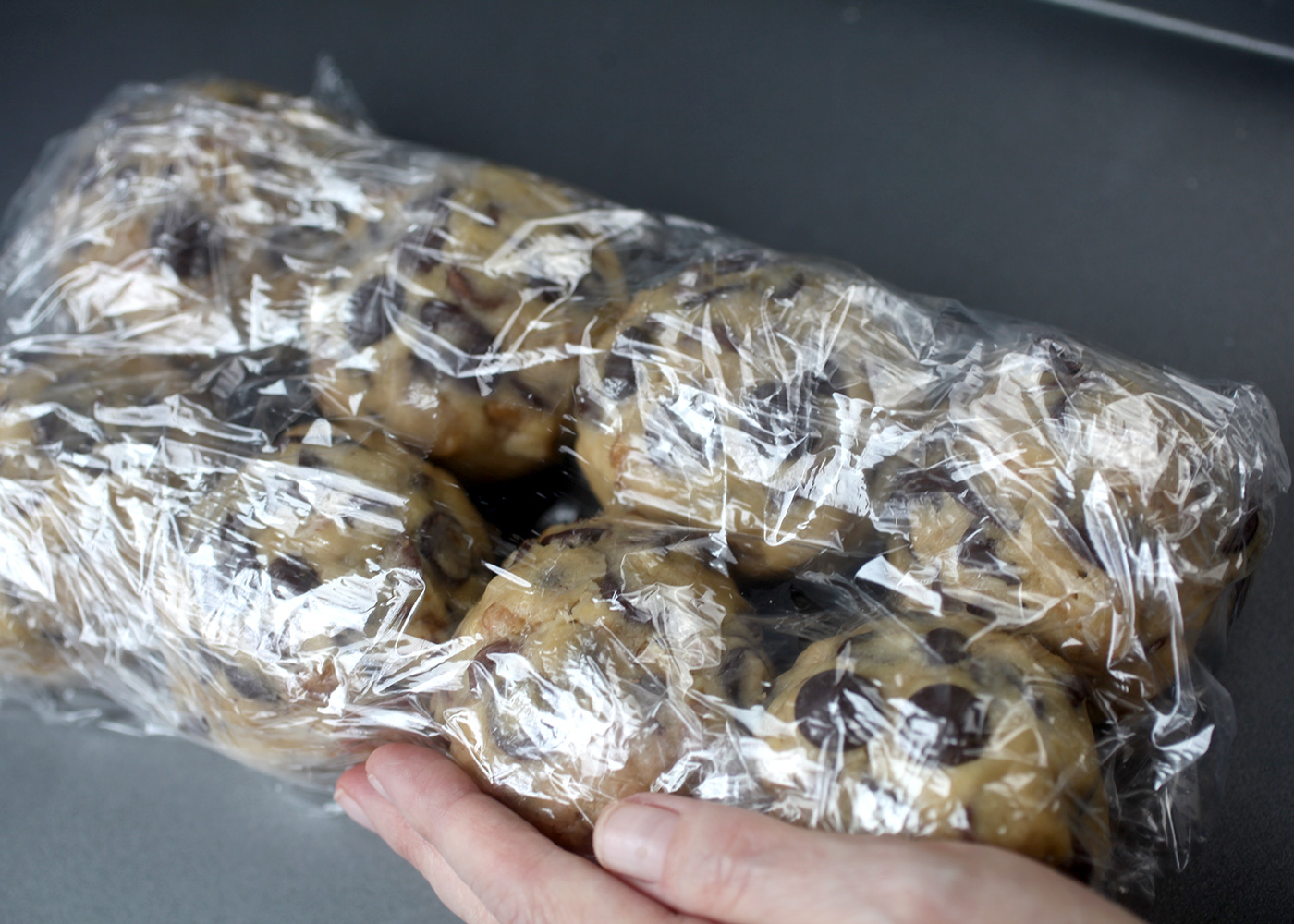
Once your dough is prepared, wrap it up securely and refrigerate overnight.

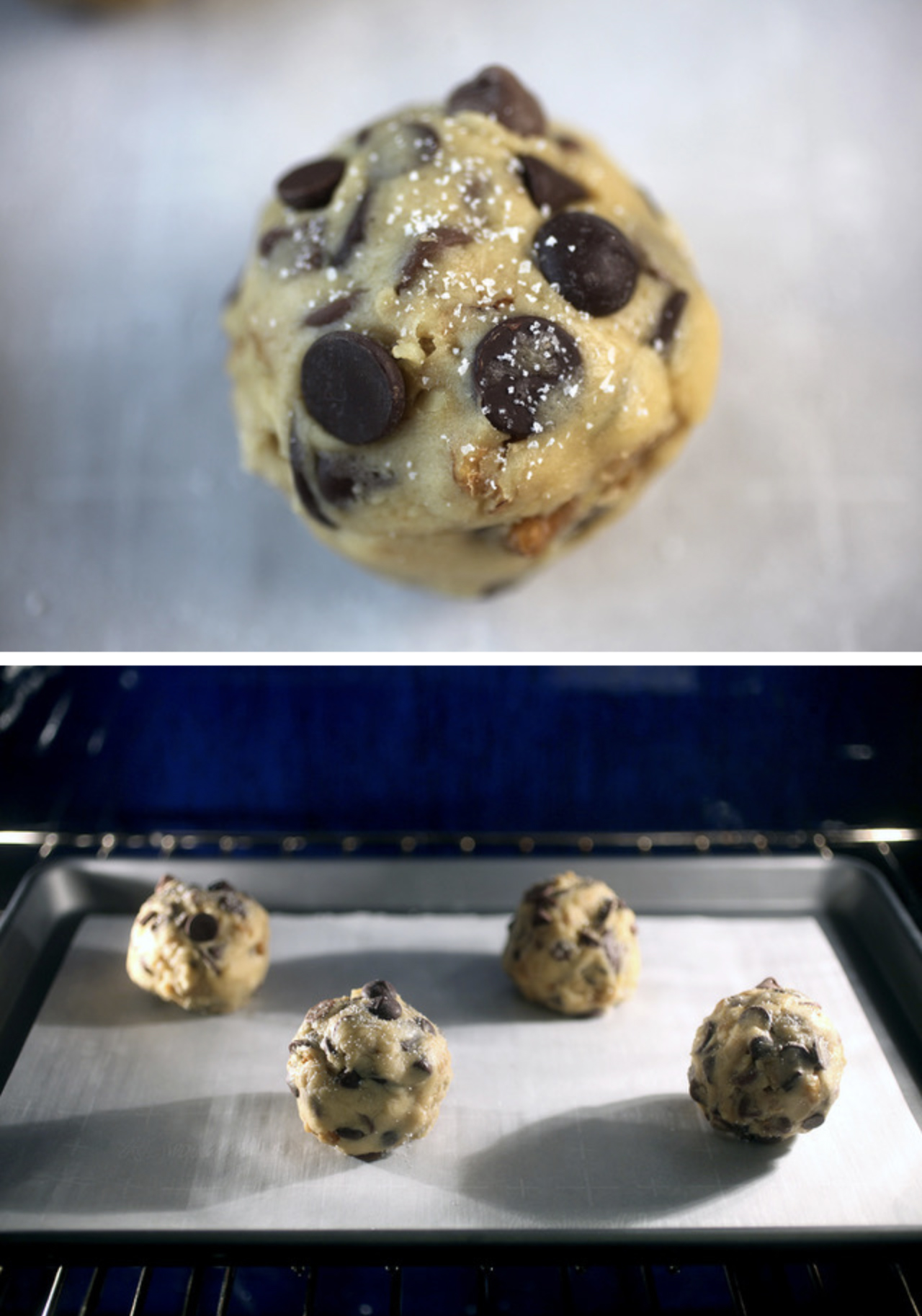
When you’re ready to bake, sprinkle a little salt on the tops and arrange four cookies at a time on a baking sheet to allow room for spreading. You can also bake as you want to enjoy them over the following couple of days. Because you will want to eat these warm for full effect. Just wrap them tightly in plastic wrap and store in the fridge.

What?!?!?! I’m in love.

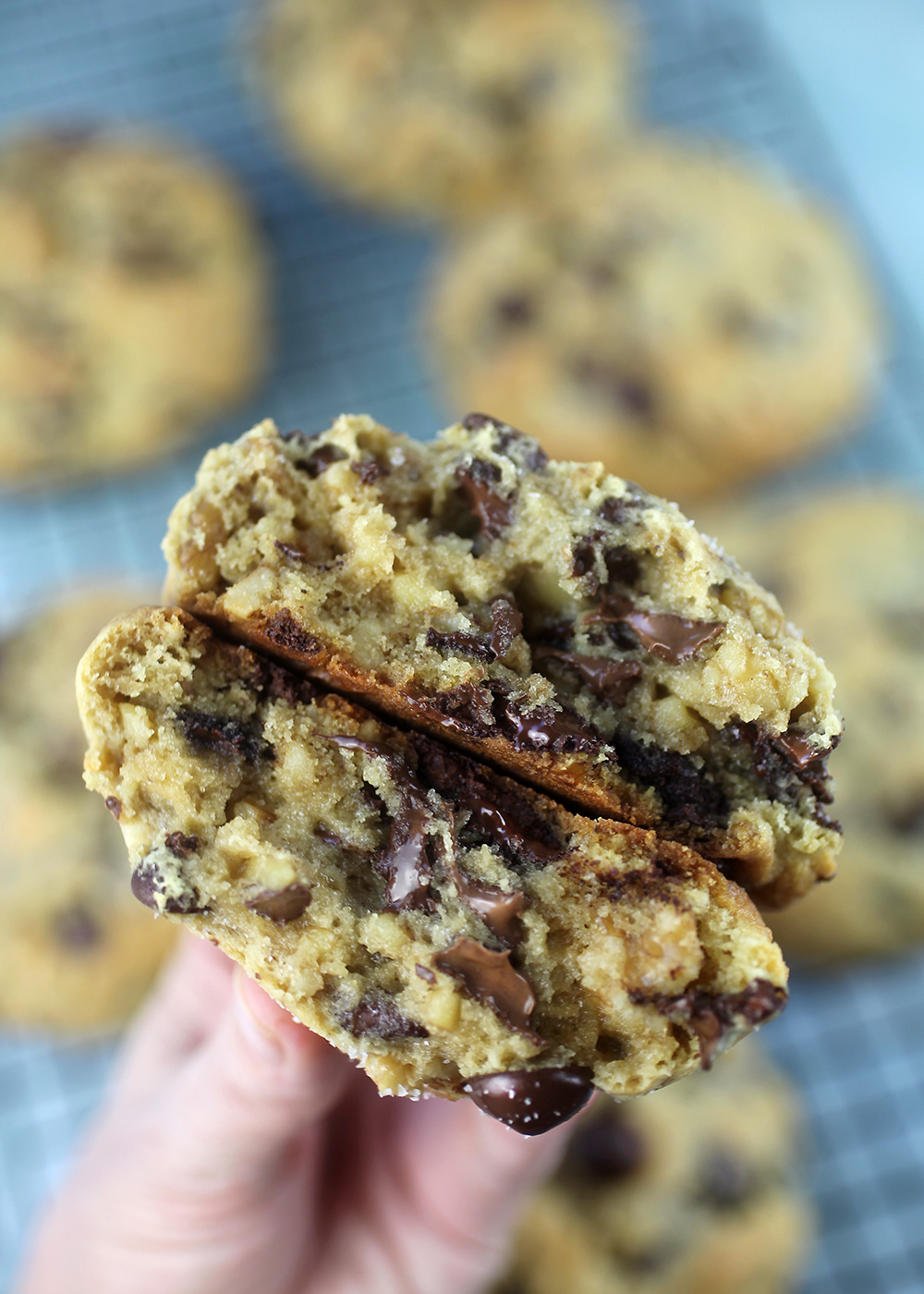
Here’s the inside of one of the cookies. Look at that center! These baked for 22 minutes and were absolutely perfect. They immediately made me think of eating a Levain cookie on the sidewalk in NYC. And I already want to make them again.

And here’s the inside of another cookie. The next time I make these, I’m going to try them without walnuts to see if I miss them and for two minutes less in the oven. You know just to get them a tad more under cooked like I like.

Okay, one more view to enjoy! So good.

22 May 17:38

ASOS Fables: Cautionary Tales for the Fashionable Millennial

by Ali Kelley

Beware the fast fashion fantasyland…

Written By Rosamund Lannin and Ali Kelley

The Ant and the Grasshopper

On a crisp morning in November, Anna debuted her new winter staple — a beautiful suede swing coat with faux fur collar. She had spent her summer working double shifts at Mulligans to save up enough money to purchase the coat. Proud of her purchase, she posted a photo to Instagram.

Her friend Greta left a comment, “Gorg! I’m going to have borrow that from you ASAP!”

Anna DM’d Greta shortly after, “Girl, you know I can’t let you borrow this coat. I gave up my summer to afford it and I’m never taking it off. I thought you were making good money, can’t you buy one for yourself?”

Greta shot back, “I lost track of time at the shore. I blew all my money on cute bikini tops, sundresses, espadrilles, and impractical statement hats! Now it’s cold and I have no seasonally appropriate clothes to wear.”

Several days later Anna responded, “You’ll have to find a way to wear espadrilles with socks. I believe in you.”

Moral: There’s a time for work, and a time for play, and you should think before partying your summer away on the boardwalk.

The Boy Who Cried Wolf

Bored with work and life, Matt started thinking of ways he could scam ASOS to get free merch. He was told they had a lax return policy and knew he could use that to his advantage.

He emailed a photo of a ripped t-shirt to ASOS and wrote, “I just got this t-shirt and it’s already ripped. Could you please refund me in full?” Later that week the amount was returned to his bank account. “Suckers!” Matt exclaimed.

Two weeks later, Matt sent another email to ASOS, claiming the soles of the shoes he bought were becoming detached. Again, he asked for a full refund. And again, the money posted to his bank account. Matt laughed out loud, “Dummies!”

Then one night, the ASOS suit he bought for his buddy’s wedding was stolen from the lobby of his apartment building. In horror, Matt wrote an impassioned email to ASOS explaining his emergency and how he needed a new suit over-nighted in order to have it for the wedding that weekend.

By this time, the ASOS customer service team had caught on to Matt’s scam and told their team not to respond to his emails. “We won’t be fooled again,” they said.

Humiliatingly, Matt was the only groomsmen in a white suit and was told repeatedly by the bride that he ruined all their photos and was not welcome at future events.

Moral: Liars are not believed even when they speak the truth and are charming, apologetic white men named Matt.

The City Mouse and the Country Mouse

“Where did you get that blouse?” Rebecca asked Eunji. “It’s so cute, I love the print. Are those little sheep?”

“ASOS!” said Eunji, “75% off bay-bee, I creep the sales.”

Much to Eunji’s dismay, Rebecca looked sad, not impressed. “Oh,” she said. “I don’t do fast fashion.”

“I mean, I care about the planet too. Just, yeah.” Eunji trailed off, embarrassed.

Rebecca adjusted the neck of her $300 sweater, which was made from virgin Spanish wool by local farmers. If she washed it cold and laid flat to dry, she would have it for years to come — though it seemed like she was needing it later and later every winter.

Moral: Poverty with security is better than plenty in the midst of fear and uncertainty, especially a planetary uncertainty that is .00001% the result of individual consumer choices.

The Goose & the Golden Egg

Tessa was rich. And every time she visited her parent’s in Connecticut, they gave her money. At first Tessa was pleased with the amount they gave her, but she needed more to maintain her designer wardrobe and alt lifestyle/fashion blog, Holly Go-bite-me . She already had two perfectly fine leather jackets but she wanted seven, one for every day of the week.

Then one day, browsing the ASOS new releases, Tessa got the idea that she could get all of her parent’s money if she killed them and received her inheritance in full. But when the deed was done, her parent’s lawyer informed her that she was left out of the will and would not be receiving any more money. Her parents had rightfully assumed she’d throw all her money away on vintage band t-shirts she didn’t need. Now her parents were dead, and worse, she’d have to sell her prized pieces on Buffalo Exchange to survive.

Moral: Those who have plenty want more and so lose all they have to the Buffalo Exchange clerk.

Belling the Cat

Rupa, Danny and Lauren were going to Mexico tomorrow, and the swimsuits they ordered arrived just in the nick of time — in the wrong size, style, and color, respectively.

“This sucks,” said Danny, I am way too ghostly to pull off ecru trunks.

“Definitely,” said Rupa. “We should get our money back.”

Lauren nodded.

They stared at the return policy.

“It looks like you have to print out a form,”” Rupa said. No one has a printer.”

Danny offered to print it out at Fedex, where he made just enough to prevent him from applying for financial aid.

“Whatever,” said Rupa. “I’ll just eat the $43.55 and buy a different cheap, poorly-fitting swimsuit on my credit card — H&M is open until 10.”

Lauren bookmarked an article on wealth redistribution. She really liked those floral kimono sleeves.

When they got back from their trip, Lauren looked up their alderman, and asked Rupa and Danny if they wanted to go to his next meeting. Rupa said yes. Danny shrugged and added more items to his cart.

Moral: It is one thing to say that something should be done, but quite a different matter to fill out a return form or slowly dismantle the state.

Rosamund Lannin is pleasantly surprised to have lived in Chicago for over a decade. During that time, she has written about feelings, food, and fandom, and consumed many carne asada burritos. You can find her most places on the Internet @rosamund.

Ali Kelley is a writer living in Brooklyn. She writes essays and satire about office life, trash pop culture, and the absurdity of being a woman. You can find her online at aliskelley.com.


ASOS Fables: Cautionary Tales for the Fashionable Millennial was originally published in The Belladonna Comedy on Medium, where people are continuing the conversation by highlighting and responding to this story.

21 May 01:27

Hamster Butts

by swissmiss

Hamster Butts. (I love the internet!)

14 May 18:52

do you have to control your emotions to be professional?

by Ask a Manager
Kate

what

I’m taking today off, so this is a reprint of a post from April 2016.

A reader writes:

I recently got fired from a job of four years. They told me I could stay until the end of the fiscal year (several months from the time of firing), and that I’m going to be replaced by one of my colleagues. Despite the awkwardness, I plan to stick with it as long as possible; the pay and benefits may well be the best I’ll ever have.

I’ve been in this career for over a decade, and it’s never been a fit. So, I’m open to making a change of career and am volunteering and applying for jobs.

But first, I need to sort out the way I conduct myself. I’m intelligent, empathetic, and skilled, but I’ve left most of my jobs on bad terms because I can’t control my emotions. When I get stressed, frustrated, or bored, I lose my temper, cry, or just disengage. I’ve always worked in pretty informal environments, but I realize that doesn’t excuse my behavior. I have ruined many professional relationships.

My question is, how do you define “professional behavior”? I feel like I don’t even know where the boundaries are any more, and I’d like to make my remaining months in this (uncomfortable) situation as positive as possible.

It’s great that you’re asking this.

Professionalism can cover a whole host of things — from how you dress and groom yourself to how you conduct yourself in a meeting — but it sounds like you’ve put your finger on the part of it that’s in play for you: controlling your emotions. So let’s talk about that piece of it.

In general, part of being professional at work is maintaining a relatively even emotional keel. That’s not to say that you can’t have emotions at all, but they should be ones that don’t disrupt others or make others uncomfortable. In practice that means:

  • not taking things personally — so, for example, understanding that getting critical feedback on a project is part of the job and not a personal attack, and responding to it calmly and non-defensively
  • understanding that you’re being paid to do a job and that there may be parts that you don’t love or feel like doing, but that you’re being paid to do those things reasonably cheerfully anyway
  • being pleasant and polite to people, even if you don’t like them
  • not letting a bad day or a bad mood significantly impact how you interact with colleagues and clients
  • understanding that if you’re very frustrated at work, the appropriate response is to raise the issue with someone who can help solve it, not to complain to others, let it fester, and/or allow it it affect your work or how you interact with people

The idea, basically, is that you’re being paid not just to do your job but also to contribute to a reasonably pleasant environment — or at least not to make the environment less pleasant. Good employers don’t want to subject other employees to negative, unpleasant, volatile, or otherwise difficult coworkers, because that has a toxic impact on other people.

Think about it this way: Outside of work, people can end their interactions with you if they’re uncomfortable with how you’re behaving. But at work, your coworkers are stuck with you. They can’t walk away or hang up on you or refuse to engage with you in the future. In many cases, like in shared office space, they may be physically unable to get away from you. So the standard of behavior is different than it might be in other contexts. You’re all trapped together, and the expectation is that you’ll minimize the impact of negative emotions on them.

That doesn’t mean that you can’t have emotions. But it’s important to understand that you don’t have to act on every emotion that you have. You can be upset that, say, a project you worked hard on was sent back with loads of red ink on it, but still behave professionally at a meeting later that day — which means not sulking or withdrawing, looking reasonably engaged, and contributing about the pieces that intersect with your work. You can be frustrated that your boss asked you to stay late without a lot of notice, without loudly ranting about it to your coworkers.

None of this means that you can’t have legitimate beefs with things that happen at work. Of course you can! What matters is how handle those beefs. Professional options include raising the issue and explaining your concerns, suggesting an alternative approach, deciding that something isn’t ideal but you can live with it, or deciding you can’t leave with it and so you’re going to look for another job.

In fact, I wonder if the reason that you’re defaulting to losing your temper, crying, or disengaging is because you don’t have a clear idea of what these alternatives look like — in other words, that you’re not sure how to calmly say “hey, X is a problem for me because of Y — could we try Z instead?” or that you don’t believe it would work. It’s certainly possible that it might not work in your particular workplace or in a particular situation. But since you’re seeing this pattern across multiple jobs and you don’t say anything about having tried these other approaches, that makes me think this is coming from a deep-rooted place in you, like possibly a family who didn’t teach you how to advocate for yourself in a healthy, functional way (either not modeling those behaviors themselves, or teaching you through their own behavior that it wouldn’t matter if you tried).

But if that’s the case, you can learn it now! You just need to believe that it matters and be willing to do the work of learning it. The fact that you’ve identified the issue and want to work on it is huge.

do you have to control your emotions to be professional? was originally published by Alison Green on Ask a Manager.

03 May 18:09

my employee is hassling coworkers about their clothes, their language, and her feelings

by Ask a Manager
Kate

WHOA here's an update from the comments! (def read the post first)


I wrote this
May 1, 2019 at 1:59 pm
I’m still catching up on the flood of comments on my letter, but thank you to everyone who responded.

I dropped the ball on this one because I was uncomfortable stepping into a conflict on women’s wear and “ladylike” conduct in the workplace. I have unconscious gender bias that I have not confronted and I’m now working on it through a management course at my company. I submitted this question to Alison last week and shortly after was tapped by HR for a conversation on managing Jane out of the company. She has been given a 60 day runway to depart with a written code of conduct that she needs to follow.

The suggestion that others made to personally apologize to Margaery is a good one, and I regret that I haven’t already done that. I’m going to do this today.

A reader writes:

I hired a new team member, “Jane,” six months ago. She’s competent and diligent, but now that she’s coming out of her shell, her rigidity around her idea of professional norms are quickly alienating her team members as well as other people on staff.

* She complains about women colleagues’ workwear for being too revealing. It’s not.

* She is offended by cursing in the office — she is firmly against it to the point of lecturing other employees. There’s a sales environment in our office and the occasional profanity or swear is common and fine here.

* She is very thin-skinned and takes personal offense at seemingly everything. She has been offended by people asking her to repeat something she said, at being given a solution to a problem that she brought forward, at other colleagues having personal conversations around her, but not including her — pretty much all normal, innocuous interactions in a workplace.

People here are in their late 20s-50s for the most part, and we have a good rapport among our team members, but I do see them pulling away from Jane because she does take a lot of energy to deal with. Everyone is busy with work, and it’s a lot for one coworker to be consistently on the verge of tears after every interaction, asking for private meetings to discuss how her feelings were hurt, and no one wants to be lectured because they dropped an f bomb in an open office, or a woman decided to wear a skirt that falls above her knees.

One team member, Margaery, has been a constant target of Jane’s lectures. Margaery has a lot of stock at this company because she’s results-oriented and her projects are highly successful. She also uses profanity (not in a customer-facing role) and wears trendy clothing, not inappropriate, but more daring than Jane’s conservative/modest dress. Jane has made it clear that she thinks Margaery is slutty and unprofessional. This flies in the face of 1) our company culture, in which Margaery is fine and normal and 2) reality — Margaery has been working in this field for longer than Jane, and Jane could learn a lot from Margaery’s professional brand, particularly when it comes to building productive and lasting relationships with many different kinds of people.

Jane constantly asks how she can move up the ladder and get a promotion. Her work is fine, but she’s losing credibility among her colleagues and Margaery has already been to HR to discuss the “gendered harassment” she receives from Jane. I know as a manager I’ve messed up by letting it get this far. At the beginning, I considered it to just be a minor interpersonal dispute until many employees came forward with complaints about Jane. I understand now how that was wrong, but I don’t know how to manage her I’ve had previous conversations with Jane on focusing more on her work and less around policing the clothing and language of those around her, as well as assuming positive intent before feeling insulted/slighted by normal work requests and she seems to understand but then goes back to her old behavior. It is also hard to have these conversations with her because she always goes back to “this hurts my feelings.”

At this point, I’m worried that we’re heading towards a PIP, and I’d like some language and coaching actions to avoid that, particularly around her issues with policing women for their bodies, clothing, and language. I’m a 30something male and maybe this isn’t even the right tack for me to take.

First, for Game of Thrones fans, I want to say that when you sent me this letter, you named Jane “the High Sparrow” and referred to her that way throughout, which I think is hilarious and apt, but I changed it to Jane so as not to baffle people who don’t know the books or the show.

Anyway … To handle this well, you’ve got to be prepared to fire Jane. That doesn’t mean that you’ll end up needing to, but you’ve got to believe that what she’s doing is so toxic and disruptive that you’d be willing to fire her if it doesn’t change. Being clear on that in your head will help you take the right actions here and convey the seriousness of the situation when you talk to Jane.

Because it is serious, and it is something you should fire her over if it continues after clear warnings. Margaery is right that this is gendered harassment, and you cannot allow it to continue. (Imagine if a man on your team were constantly complaining the clothes of professionally dressed women on your team were too revealing. It’s super gross and offensive. You need a zero tolerance policy for it.) It’s also really disruptive for Jane to be constantly taking offense at innocuous actions and for coworkers to be asked to do so much work to manage Jane’s feelings.

You said you want to avoid a PIP, but why? It sounds like you’ve tried talking to Jane about the problems, and that hasn’t worked. A PIP can be the next logical step to make it clear that the problems are serious and could threaten her job if she doesn’t change. A PIP isn’t supposed to be punitive; it’s supposed to ensure that an employee is very, very clear about the problems with their work, what must change, and when that must happen by. That’s not something to avoid when previous conversations haven’t worked; that’s a tool to ensure Jane doesn’t continue to miss the message, which is very much in her best interests. (That said, I might argue that with something like this, where it’s about conduct rather than work quality, you could skip the PIP and just do a clear final warning followed by firing her if the problems continue. But many organizations require PIPs regardless, so adapt accordingly.)

However, I do want to check how clear you’ve been in these previous conversations. You wrote that you’ve talked to her about “focusing more on her work and less around policing the clothing and language of those around her.” If that’s how you framed it to her, you do need to be more direct. “Focus less on this” leaves a lot of room for her to think she can still do some of it.

Instead, you need to be clearer: “You cannot police the clothing and language of people around you. At this point, your comments on colleagues’ clothes have become harassment. There can be be no more — none. As for language, I want to be clear that the culture in this office is one where occasional profanity is fine. You can hold whatever beliefs you want about profanity, but you cannot chastise people for using it in your earshot. If you decide you can’t work here knowing these things are part of the culture, I of course would understand that. But as long as you’re here, you cannot chastise your colleagues about clothes,  language, or anything else. Period.” (You could add, “If someone says something out of the ordinary that makes you uncomfortable, you can talk with me or HR.” I’m hesitant to open up that outlet, but you don’t want this to be misinterpreted as, for example, “don’t report harassment.” So for now let’s just focus on getting her to stop hassling her colleagues.)

You also need to say: “As part of your job here, I need you to manage your own feelings professionally, which means staying pleasant and calm with people even when you’re unhappy. When you do X and Y (name the specific behaviors she uses when she’s offended by something), you distract other people from their work and make people wary of coming to you for things they need to do their jobs. If you are upset by something, you can take a short break or raise it with me in our next weekly meeting, but you cannot do X and Y or ask other people to meet with you about your feelings.” (Note this gets away from the language you were using earlier about assuming positive intent. That’s a good place to start, but at this point you’re better off focusing less on what she’s thinking/feeling and more on how she’s acting.)

And then you need to talk about consequences, so that it’s clear this is serious: “We’ve talked about these issues in the past, but I haven’t seen the changes I need. I want to be clear with you that these issues are serious, and will jeopardize your job if they continue. I’m hoping this conversation will be enough to resolve this, but if not, the next step would be a formal improvement plan, where we’d need to let you go at the end of it unless you make these changes.”

Don’t sugarcoat. Be clear, direct, and explicit — this cannot continue and these are the consequences. You’re doing no one any favors by dancing around it.

my employee is hassling coworkers about their clothes, their language, and her feelings was originally published by Alison Green on Ask a Manager.

30 Apr 18:30

BEHIND THE THREENES! The photos discussed on Ep 29 of THREEDOM. I could not find the family photo...

Kate

OMG teen heartthrob PFT!!!

BEHIND THE THREENES!

The photos discussed on Ep 29 of THREEDOM. I could not find the family photo where my dad has a murderous look on his face, but I will continue the search.

25 Apr 16:09

A Week of Outfits: Katie Sturino

by Kelsey Miller
Kate

i love katie sturino!

A Week of Outfits: Katie Sturino

We’re long-time fans of Katie Sturino, the woman behind the fashion blog The 12ish Style and the Megababe body-care brand. Katie is known for recreating celebrity outfits with plus-size pieces that prove how easy (and fun!) fashion can be.… Read more

The post A Week of Outfits: Katie Sturino appeared first on A Cup of Jo.

25 Apr 04:10

my boss says I’m too much of an “open book” emotionally

by Ask a Manager
Kate

this is an interesting topic!

A reader writes:

I work at a medium-sized pharmaceutical company. I have direct reports and also work with associates who don’t report to me, but carry out work I create.

I have had problems with Lola, a talented associate who can be (by many accounts) thin-skinned. She has a way of speaking as though she is telling me how to do my job and we just … clash. Recently, she emailed her manager, my manager (Lisa), and our HR partner (Kate) about an incident where she said I was disrespectful to her and she is now so anxious in any interaction with me that she no longer wants to work on my projects. She says I roll my eyes at her in meetings and treat her differently than I treat the other associates. Lisa told me about this. I feel terrible — I don’t want anyone to be afraid of talking to me. Lola was right, I didn’t handle that incident well.

Which brings me to a meeting with Lisa and Kate. Lisa said I am an open book emotions-wise and Lola says “people” are afraid to approach me. Lisa then said that I make a face when disagreeing with someone and that I do roll my eyes at Lola in meetings. I started to shake my head because I couldn’t remember having done that, and Lisa said I was making the face right then, shaking my head and not listening. Kate said maybe what Lisa was seeing wasn’t a conscious thing on my part, but emotions playing across my face. Lisa, in a very serious tone, told me to modulate my facial expressions going forward.

It’s true that I am an open book feelings-wise. When I’m mad, happy, sad, whatever, it shows. I’ve been this way my whole life. People have said they are afraid to approach me because I look intense. I’ve fought against this, tried to rein it in, develop more of a poker face, and it killed my self-esteem because nothing I did seemed to help. A few years ago, I stopped fighting against it since it wasn’t doing any good and decided to accept it. I even decided being an open book could have its good points — I can’t play games, so everyone knows exactly where I stand.

I want to work things out with Lola because it is true that I have been short with her. But I now feel like the problem is really more with Lisa. I’m scared that what she wants — for me to develop a poker face — is something I am not capable of doing. And if I can’t do it to her satisfaction, she won’t let me move up or, worse, she’ll get rid of me. Kate says HR can coach me on modulating my expressions, so I’ll try that, but I’ve been working on it so long anyway, how far am I likely to get in a time frame Lisa is happy with? I’ll ask what happens if I don’t modulate my expressions enough at my next meeting with Lisa.

Am I not cut out for this kind of management? My direct reports seem pretty happy and I have always gotten great reviews on my work output. Lisa is planning to ask Lola for names as to who else has complained and then she will see what they have to say about me. I agreed to that, but it feels like a witch hunt. I’m really worried (and it shows).

Well, if you’re rolling your eyes or looking pissed off, that is genuinely a problem. Those things are overtly hostile, and you can’t be overtly hostile to people at work.

Rolling your eyes at someone is dismissive and contemptuous. It’s not that different from saying out loud “I think you’re an idiot” or “what an asinine remark” or “I don’t respect you.” And you probably agree you can’t say those sorts of things to colleagues and still be thought of as professional or pleasant to work with, right? It’s not that different when you convey those things with your face.

(To be clear, I am not talking about Resting Bitch Face here — the expression your face has when it’s naturally at rest. I’m talking about eye rolls, grimaces, etc.)

Lisa wasn’t out of line to tell you that you need to modulate your facial expressions going forward. You’re communicating when you do things with your face. Obviously there’s some room for grey here — a slight frown might not be a big deal, but eye rolls in particular are always going to be over the line.

I don’t know specifically what you’ve tried in the past to have more of a poker face, but there are some good suggestions from commenters in this post.

One thing I’d recommend that you try with Lola in particular, since she clearly pushes your buttons, is to pretend she’s either (a) an obscenely wealthy patron who pays you enormous sums of money and who you have a vested incentive to be kind to or (b) your elderly grandmother who’s in difficult circumstances and who you have compassion for. Or if you have a loved one who you know can be difficult but who you’d want people to be kind to, (c) Lola is now that person in your head.

Similarly, are there any circumstances where you do manage to control the emotions on your face? Meeting a VIP? In a house of worship, if you’re religious? At a funeral? With a child? If there are times when you do manage to do it, you have the ability to do it. And I get that you might feel like it’s one thing to control your face for an hour, and an entirely different thing to have to do it 40 hours a week … but again, you can’t be sending off hostile signals at work. You just can’t. And frankly, that’s part of what you’re being paid for — to get along reasonably well with people even if you don’t like them, to be reasonably pleasant to work with, and to regulate what emotions you display.

You also asked if you’re not cut out for this kind of management, and the answer is that I don’t know! But I can tell you that if you really can’t control how your face reads, that’s almost certainly going to cause problems for the people you manage at some point. If you’re managing someone who isn’t the brightest, is your face going to show that you think that? In other situations, will your face show impatience, anger, disdain, annoyance? If so, yeah, those are going to be problems for people you have power over.

I don’t want to ignore the issue of you feeling like this is simply impossible for you, and how demoralizing it was when you tried and couldn’t do it in the past. I wonder if it’s something that cognitive behavioral therapy might help with — and if you haven’t tried that, it’s worth considering because I do think you’ll find there are massive advantages (both professional and personal) to not having your face broadcast what you’re thinking every minute.

my boss says I’m too much of an “open book” emotionally was originally published by Alison Green on Ask a Manager.
23 Apr 23:52

Makeup artist shows you how to become Kylie Jenner’s baby

by David Britton
Kate

I love the internet.

Makeup artist and drag performer Alexis Stone, aka Elliot Joseph Rentz, is famous for his amazing transformations. He has transformed into celebrities such as Post Malone and Adel and even pulled off fake plastic surgery in a video that left fans totally shocked.

But this new video might be his most impressive (and disturbing) one yet. Marvel as a full-grown adult becomes Kylie Jenner’s baby Stormi right before your eyes.

The video has racked up nearly 100,000 views since being posted to YouTube on April 14, and a shorter version has over 200,000 views on Instagram.

People seem to find it equal parts impressive and upsetting.

“What the— this is easily one of the most talented yet scary makeups looks i’ve ever seen,” one commenter wrote on YouTube

“I watched this while completely baked and let me just say it’s just as surreal and horrifying when im sober,” said another.

Things start out pretty normally in the video as Stone puts on some foundation. But the video takes a turn for the bizarre when he draws a tiny baby nose on top of his own.
Things get progressively weirder when Stone starts applying red makeup to their chin so it will blend into the red backdrop.
The completed transformation is undeniably impressive, but to paraphrase Jeff Goldblum, “They were so preoccupied with whether they could, they didn’t stop to think if they should.”
“Makeup transformation into Kylie Jenner’s baby Stormi! hilarious and weird I know,” Stone wrote in the video’s description.
Truer words have never been spoken.

READ MORE:

The post Makeup artist shows you how to become Kylie Jenner’s baby appeared first on The Daily Dot.

18 Apr 19:53

Small Mistakes | Big Mistakes

by swissmiss

Small mistakes:
1. Messing up school exams.
2. Not finishing college.
3. Failing at your first business.
4. Failing at your second.

Big Mistakes:
1. Not listening to your gut.
2. Not keeping your word.
3. Not looking after yourself.
4. Not looking for the good in people.

Do Lectures

13 Apr 19:34

crimesceneinvestigation: nobody: my cat, about to puke on the carpet:

crimesceneinvestigation:

nobody:

my cat, about to puke on the carpet:

09 Apr 19:29

rejecting anyone who doesn’t send a thank-you note is terrible hiring

by Ask a Manager
Kate

LOL steve you need to let Alison know on twitter that #poopstories get your autoshare

There was a big kerfluffle on Twitter this weekend when the executive managing editor of Business Insider published an article saying that she refused to hire anyone who doesn’t send a thank-you note after their interview. It doesn’t matter if they were otherwise her top candidate — if they don’t send a thank-you, they get rejected.

Twitter was Not Happy.

Including me:

To be clear, post-interview follow-up notes are a good thing. I’ve written plenty here encouraging people to send them.

But for most jobs, the idea of rejecting anyone who doesn’t send a thank-you is preposterous — and it’s terrible hiring. A hiring manager who rejects an otherwise strong candidate solely because they didn’t send a thank-you note is a hiring manager who’s not clear on what the must-have qualities and skills are to excel in the role … and who subscribes to an increasingly outdated old-school way of hiring where employers think they hold all the cards, and candidates’ job is to kowtow to them. They don’t, and it isn’t.

Moreover, rejecting anyone who doesn’t send a thank-you is going to keep you from hiring candidates who come from backgrounds where they didn’t learn that particular job search convention, which many, many people do not: like people from less advantaged backgrounds, or people from families where their parents weren’t office workers, or many immigrants (thank-you notes aren’t a thing in many other countries). That’s going to have a disparate impact by race and class, so if you care about diversity and equity in your hiring, this is a terrible, biased practice.

People who hire need to be thoughtful about what it truly takes to excel in any given role and not create artificial tests that have nothing to do with that. There are some jobs where sending thank-you’s might actually correlate to the skills you’re hiring for, like for fundraising roles or PR jobs. But for most jobs, there’s just no correlation between who was taught to send a thank-you and who will excel once you hire them.

At its core, a hard and fast rule of rejecting anyone who doesn’t send a post-interview thank-you is about old-school, outdated power dynamics in interviewing. Fortunately, those are changing.

P.S. I appreciated this:

rejecting anyone who doesn’t send a thank-you note is terrible hiring was originally published by Alison Green on Ask a Manager.
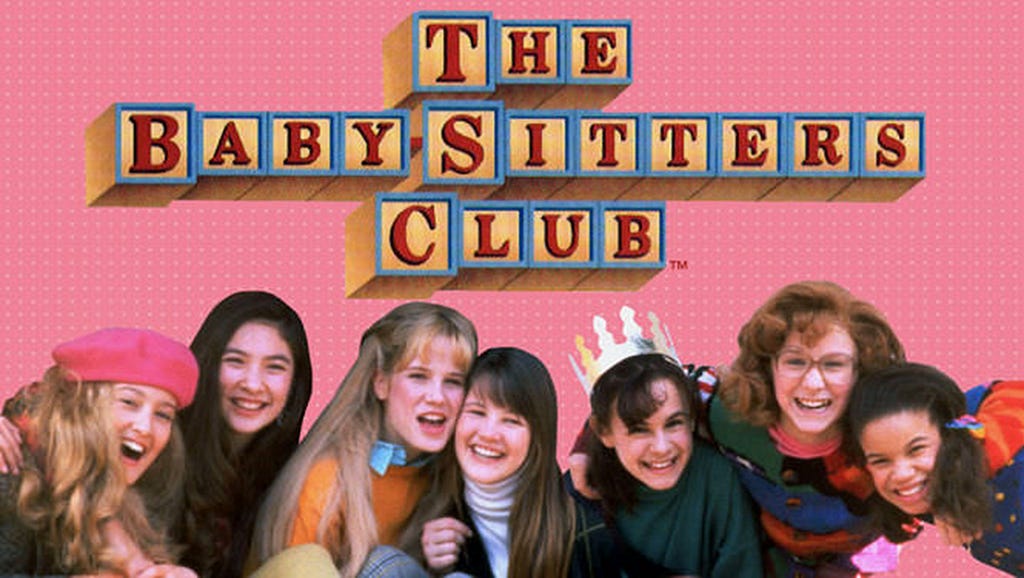
09 Apr 17:45

DIY | Flower Vase Lid

by Michelle

Hullo guys, today I am gonna craft with one of my favourite materials again: Polymer Clay. A little while ago I made these gorgeous little statement earrings, and this project now shows me again how versatile this stuff is. Since it’s almost officially spring now I think it’s about time to get some flowers into your home! However, I often have the problem that my vases are too large for a bunch of flowers. Luckily there’s a solution for that: A flower vase lid!

So how’s your opinion on cut flowers and flower bouquets in general? I know for sure that I am happier the more vases in my apartment are filled with bright bunches. Although of course I am aware that flowers are the purest luxury, and especially beautiful bouquets can be incredibly expensive. If you pair this with the fact that cut flowers are only good for about a week one might consider not buying any at all. And if you ask my male relatives, well…for them, cut flowers are something they don’t understand (in other words: It’s bullshit). Let me tell you, men buy redundant things as well! I honestly could never understand why men would buy special rims for their cars…but that’s a whole different discussion.

Another whole different matter is that I currently have some time on my hand since my student job will end by the end of the month and they won’t keep me on. It’s a crazy feeling really. On the one hand I am sending out my résumé to other companies and on the other hand I seem to have lost my dream job because of unfortunate circumstances. So, I really don’t want to work anywhere else, but I am forced to do so. Oh, and if I don’t find a job in three weeks I have to file for unemployment. Craaaaazy shit. But, I am really trying to think positive.

How to craft the Flower Vase Lid

You need:

  • Polymer Clay in a colour of your choice
  • Rolling pin
  • Flower vase
  • Drinking straw
  • Sharp knife
  1. I just love how easy this is: Start by placing your flower vase on a sheet of paper and draw around its opening. This way your lid will be large enough to fit. Cut out the circle.
  2. Next, start kneading the polymer clay until it’s soft. Then roll it out with the rolling pin until it’s a bit larger than your template. 
  3. Place the template on the polymer clay and cut around it loosely with about 0.5 cm spacing.
  4. In a last step, take the drinking straw and punch small holes into the lid. You can either follow a pattern or spread them around randomly. Bake in the oven as prescribed on the package. Done!

For your Pinterest board:

Why hadn’t I thought of this sooner! As soon as the lids were out of the oven (I made them in three sizes) I went and bought some flowers. However the problem is sometimes that when you don’t want to spend a ton of money on cut flowers you end up with only a few. In my case, 8 beautiful roses. And they can look a bit lost in a vase. Now, with my new flower vase lid I can arrange them just like I want, and they almost look like a full bouquet! Besides, imagine all the possibilities of arranging dried flowers and greenery now. I hope I could inspire you!

The post DIY | Flower Vase Lid appeared first on Make&Mess.

07 Apr 17:12

How to carry on after reading two contemporary romance novels…

by Charlotte Wilson
Kate

bangs.

…in 24 hours

So, you read two contemporary romance “chick lit” novels in the last 24 hours. Big deal. Going back to normal life will be completely fine. Rate them on Goodreads and move on! Nothing has changed!

Just go about your normal weekend routine. You have stuff to buy at the grocery store, remember?

Ignore the sly fox you see winking at you from the street corner. Foxes are common in Denver.

Finish painting your living room and pile your hair into a messy bun on top of your head. Exasperatedly blow your bangs out of your eyes. Wait, since when do you have bangs??

Smooth your ripped jeans and see-through wife beater and quickly tousle your bangs as you see your long-time crush from work, Trence, approach your house. You live in a house now! There’s a fence outside and you have a driveway!

Omg! But Trence has never seen you in your casual clothes. He might notice the way your wife beater clings to your curves and the light sweat trickling down the nape of your neck!

When Trence approaches, you tell yourself to stay cool. Life isn’t like chick lit novels.

“Hey kiddo,” he says as you wipe your forehead, forgetting your paintbrush and leaving a streak of blue paint across your skin, staining your unruly bangs.

Trence runs the back of his strong hand down the side of your face. You rest your cheek against his hand, gazing at him longingly. All of a sudden, Trence gets a text from his sister — she’s in the ICU! He has to go.

Ok, that was a fluke. He may have been visiting your charming casita for work-related reasons. Not to express his undying love for you!

You leave to get more paint. How nice to be a homeowner now with bangs! You’ll need to read up on bangs maintenance later — do you blow dry, curl, or tousle?

The fox is back! Winking at you outside of Home Depot this time. All foxes are sly, though, and relatively common in Denver. You’re quite sure.

Inside Home Depot you reach your tiny arm as far as you can to grab a new roller brush. You lose your balance and topple over. You have tiny arms now — nice!

You turn around and someone is holding your paint roller. It’s your high school boyfriend, Smith, and he’s all grown up. He excitedly lifts you up over his shoulder and sits you down in the patio furniture department. Wow, you don’t remember being this teensy and spry, or having a high school boyfriend for that matter.

All of a sudden, you’re acutely aware of his gaze on your ripped pink bra peeking out of your wife beater. Ugh, why did you have to wear a pink bra?? It’s not like he hasn’t seen… all of you… before but this seems… different.

“I can’t do this,” says Smith. “My heart is still tender from the last time.” He lovingly runs his large hands through your bangs and swiftly departs.

What a day. Who knew you had so many suitors? You should have thought of getting bangs sooner. You hope Trence’s sister is ok and that Smith is able to heal from his heartbreak eventually.

Your flip phone rings and it’s your attractive young professor for culinary school. He wants to reconnect over drinks, say 7?

You pull up to the cupcake shop that you own — it’s become a cult favorite, written up in the local paper — go inside and look out the window with your hands on your hips, shake your head and blow your bangs out of your face. The full moon shines as the sly fox walks by and grins with his charming half smile.

Charlotte Wilson is a public affairs professional living in Denver. She loves reading contemporary romance novels.


How to carry on after reading two contemporary romance novels… was originally published in The Belladonna Comedy on Medium, where people are continuing the conversation by highlighting and responding to this story.

02 Apr 20:20

I’ve Decided on a Modern Rustic Theme for Great-Aunt Ruth’s Funeral

by Kristen Mulrooney
Kate

in honor of Hey Ladies

I’m blasting the event info out on Facebook and Insta.

Hey ladies!

I just wanted to touch base and let you know I’ve decided on a modern rustic theme for Great-Aunt Ruth’s funeral. I spent last night foraging through my Pinterest folders and finally nailed down all the details.

Invitations

Everyone should have received their super cute burlap and lace invitations by now. Please extend my apologies to anyone who was upset about receiving theirs before Great-Aunt Ruth passed away. I thought I had the timing right but she hung on longer than expected. I’m blasting the event info out on Facebook and Insta, and Mom put the info in the obituary section of the newspaper for anyone who still isn’t on social media.

Color Scheme

The decor is the most important element in conveying the theme, so obviously I’ll handle that part myself. I’ve chosen mint green, taupe, and a deer fawn brown for our color scheme. It will go perfectly with the Anthropologie dress I thrifted on Poshmark for Great-Aunt Ruth to be buried in. I know pink was her signature color, but it just doesn’t work with modern rustic. Everything is already planned, so PLEASE do not email me back suggesting we do rustic boho in order to incorporate the pink.

Decorations

I went to Hobby Lobby this morning and bought some distressed wood and stencils to make rustic signs. I’m thinking I’ll put a personalized spin on some popular quotes, like “Live, Laugh, Love, Die” and “Your Last Breath Took Our Breath Away”, or maybe even some classic Great-Aunt Ruth lines like, “I’m Going Toward the Light”. Mom said these were “in poor taste,” but when she threw Grandpa’s funeral a few years ago, she used red plastic tablecloths, so I guess poor taste is subjective!

Hors d’oeuvres

Grandma will be in charge of hors d’oeuvres. I’ve attached some pictures of fruit, cheese, and charcuterie boards that match the aesthetic we’re aiming for. Grandma, please try to imitate the images as best you can, and DO NOT just cook up some of your old family recipes. Think of this as your last tribute to your beloved sister– it needs to look perfect. Thanks Grandma, love you! (Also, make sure to jot down any elements of the funeral you particularly like, and I’ll hang onto the list for a couple years until we need it.)

Desserts

Aunt Tracy, you’ll do desserts. I texted you the recipe for a peanut butter mousse cup with cookie crumbles. To personalize the treats, I thought we could stick an Oreo in each cup and, using a gold edible pen that will really make it pop, write Great-Aunt Ruth’s birthday and the date of her death on them. Voila! Little headstones!

S’more table

In addition to dessert, we’ll have a s’more table. Mom, you’re responsible for this. I need you to chop down a birch tree and cut it into fourteen 3-inch thick circles. Stack those around a camping stove. Then find some artisanal woven baskets to hold the chocolate, marshmallow, and graham crackers. Simple and charming! I also bought a cute little chalkboard sign for the table. In your best calligraphy, I need you to write “I Wish We Had S’more Time With Great-Aunt Ruth”.

Games

The first game will be a simple raffle, and the second will be a trivia game called How Well Did You Know Great-Aunt Ruth? When I heard the end was near, I rushed to Great-Aunt Ruth’s bedside to be sure I didn’t miss the chance to say good-bye and get her answers for the game. It’s just some fun, lighthearted questions– what’s your favorite food, what’s your favorite memory from when you were alive, who’s your celebrity crush (it almost sounded like she said “everything’s going black,” but I think she meant “Benedict Cumberbatch”).

Party Favors

Great news! I’m extending a family discount from my Scentsy store so we can give everyone a mini mason jar of essential oils as a party favor. Don’t worry about the money– you can just Venmo me. I’ll wrap the jars in burlap and lace and tie on a little tag that says “Hoping Great-Aunt Ruth is Scent to Heaven!”

Wow, there’s so much to do! Let me know if you have any questions, and don’t forget to tell everyone to tag any photos on social media with our event hashtag, #RuthlessIn2019.

This is going to be great! See you all there!

xoxo

Kristen Mulrooney is a writer with work published in McSweeney’s, Points in Case, and Robot Butt. Please follow her on Twitter @missmulrooney, for she is addicted to fame.


I’ve Decided on a Modern Rustic Theme for Great-Aunt Ruth’s Funeral was originally published in The Belladonna Comedy on Medium, where people are continuing the conversation by highlighting and responding to this story.

30 Mar 22:41

Mango & Orange Quick Bread

by Emma Chapman
Kate

anyone have favorite quick bread recipes? this sounds like a nice one but i'm suspicious of the cashews

I love a good quick bread recipe, like this easy one-banana banana bread. This time of year, I am still very much in the mood to bake while the weather is still warming up, but I am craving more summer flavors. That’s what makes this mango and orange quick bread recipe such a good one. If you like orange scones, you’ll love this quick bread.

I baked this into four small loaves. I love how cute they are, plus they are easy to wrap up and parcel out all week long. Quick breads make a great breakfast alongside something with protein (scrambled eggs for life over here!) or as a snack during the day. But you could absolutely bake this in a standard size loaf pan if you prefer.

The process is very similar to making banana bread. First, you mash up the mango before stirring in the other ingredients. See the recipe card below for the full instructions!

You can leave these as they are and just serve with some butter or jam. Or you can top with a quick glaze of powdered sugar and a little water or milk whisked together to make these feel a little more like a dessert. I love the bright pops of citrus and mango flavor. Enjoy! xo. Emma

Mango & Orange Quick Bread

  • 1 cup cubed mango (fresh or frozen and thawed, approx. 180 grams)
  • 1/3 cup granulated sugar
  • 1/4 cup brown sugar
  • 1 egg
  • 3 tablespoons olive oil
  • juice and zest from 1 orange (approx. 1/2 cup juice)
  • 1 1/4 cup all-purpose flour
  • 1/2 teaspoon baking soda
  • 1/4 teaspoon salt
  • 1/2 cup cashews (chopped)
  1. In a bowl, mash the mango well. I used a pastry blender but a fork could also work well here. Then stir in the sugars, egg, oil, juice, and zest.

  2. In a smaller bowl, whisk together the flour, baking soda, and salt. Add the dry ingredients to the wet and stir until just combined. Then stir in the chopped cashews.

  3. Add the mixture to a prepared baking pan. And bake at 325°F. If you are using small loaf pans like the ones pictured, bake for around 25-28 minutes. If you are using a standard size loaf pan, bake for around 50-55 minutes. Either way, insert a toothpick to check if the loaf is done before removing from the oven to allow to cool.

Credits // Author and Photography: Emma Chapman. Photos edited with A Color Story Desktop.
25 Mar 18:35

Mr. Jackson & Mr. Tompkins are making plans. More soon.

Mr. Jackson & Mr. Tompkins are making plans. More soon.