Gpscruise
Shared posts
Justice Department Sues 'Monopolist Google' For Violating Antitrust Laws
Room-temperature superconductivity has been achieved for the first time
Gpscruiseblack swan!
Room-temperature superconductors—materials that conduct electricity with zero resistance without needing special cooling—are the sort of technological miracle that would upend daily life. They could revolutionize the electric grid and enable levitating trains, among many other potential applications. But until now, superconductors have had to be cooled to extremely low temperatures, which has restricted them to use as a niche technology (albeit an important one). For decades it seemed that room-temperature superconductivity might be forever out of reach, but in the last five years a few research groups around the world have been engaged in a race to attain it in the lab.
One of them just won.
In a paper published today in Nature, researchers report achieving room-temperature superconductivity in a compound containing hydrogen, sulfur, and carbon at temperatures as high as 58 °F (13.3 °C, or 287.7 K). The previous highest temperature had been 260 K, or 8 °F, achieved by a rival group at George Washington University and the Carnegie Institution in Washington, DC, in 2018. (Another group at the Max Planck Institute for Chemistry in Mainz, Germany, achieved 250 K, or -9.7 °F, at around this same time.) Like the previous records, the new record was attained under extremely high pressures—roughly two and a half million times greater than that of the air we breathe.
“It’s a landmark,” says José Flores-Livas, a computational physicist at the Sapienza University of Rome, who creates models that explain high-temperature superconductivity and was not directly involved in the work. “In a couple of years,” he says, “we went from 200 [K] to 250 and now 290. I’m pretty sure we will reach 300.”
Electric currents are flowing electric charges, most commonly made up of electrons. Conductors like copper wires have lots of loosely bound electrons. When an electric field is applied, those electrons flow relatively freely. But even good conductors like copper have resistance: they heat up when carrying electricity.
Superconductivity—in which electrons flow through a material without resistance—sounds impossible at first blush. It’s as though one could drive at high speed through a congested city center, never hitting a traffic light. But in 1911, Dutch physicist Heike Kamerlingh Onnes found that mercury becomes a superconductor when cooled to a few degrees above absolute zero (about -460 °F, or -273 °C). He soon observed the phenomenon in other metals like tin and lead.
For many decades afterwards, superconductivity was created only at extremely low temperatures. Then, in late 1986 and early 1987, a group of researchers at IBM’s Zurich laboratory found that certain ceramic oxides can be superconductors at temperatures as high as 92 K—crucially, over the boiling temperature of liquid nitrogen, which is 77 K. This transformed the study of superconductivity, and its applications in things like hospital MRIs, because liquid nitrogen is cheap and easy to handle. (Liquid helium, though colder, is much more finicky and expensive.) The huge leap in the 1980s led to feverish speculation that room-temperature superconductivity might be possible. But that dream had proved elusive until the research being reported today.
Under pressure
One way that superconductors work is when the electrons flowing through them are “coupled” to phonons—vibrations in the lattice of atoms the material is made out of. The fact that the two are in sync, theorists believe, allows electrons to flow without resistance. Low temperatures can create the circumstances for such pairs to form in a wide variety of materials. In 1968, Neil Ashcroft, of Cornell University, posited that under high pressures, hydrogen would also be a superconductor. By forcing atoms to pack closely together, high pressures change the way electrons behave and, in some circumstances, enable electron-phonon pairs to form.
Scientists have for decades sought to understand just what those circumstances are, and to figure out what other elements might be mixed in with hydrogen to achieve superconductivity at progressively higher temperatures and lower pressures.
In the work reported in today’s paper, researchers from the University of Rochester and colleagues first mixed carbon and sulfur in a one-to-one ratio, milled the mixture down to tiny balls, and then squeezed those balls between two diamonds while injecting hydrogen gas. A laser was shined at the compound for several hours to break down bonds between the sulfur atoms, thus changing the chemistry of the system and the behavior of electrons in the sample. The resulting crystal is not stable at low pressures—but it is superconducting. It is also very small—under the high pressures at which it superconducts, it is about 30 millionths of a meter in diameter.
The exact details of why this compound works are not fully understood—the researchers aren’t even sure exactly what compound they made. But they are developing new tools to figure out what it is and are optimistic that once they are able to do so, they will be able to tweak the composition so that the compound might remain superconducting even at lower pressures.
Getting down to 100 gigapascal—about half of the pressures used in today’s Nature paper—would make it possible to begin industrializing “super tiny sensors with very high resolution,” Flores-Livas speculates. Precise magnetic sensors are used in mineral prospecting and also to detect the firing of neurons in the human brain, as well as in fabricating new materials for data storage. A low-cost, precise magnetic sensor is the type of technology that doesn’t sound sexy on its own but makes many others possible.
And if these materials can be scaled up from tiny pressurized crystals into larger sizes that work not only at room temperature but also at ambient pressure, that would be the beginning of an even more profound technological shift. Ralph Scheicher, a computational modeler at Uppsala University in Sweden, says that he would not be surprised if this happened “within the next decade.”
Resistance is futile
The ways in which electricity is generated, transmitted, and distributed would be fundamentally transformed by cheap and effective room-temperature superconductors bigger than a few millionths of a meter. About 5% of the electricity generated in the United States is lost in transmission and distribution, according to the Energy Information Administration. Eliminating this loss would, for starters, save billions of dollars and have a significant climate impact. But room-temperature superconductors wouldn’t just change the system we have—they’d enable a whole new system. Transformers, which are crucial to the electric grid, could be made smaller, cheaper, and more efficient. So too could electric motors and generators. Superconducting energy storage is currently used to smooth out short-term fluctuations in the electric grid, but it still remains relatively niche because it takes a lot of energy to keep superconductors cold. Room-temperature superconductors, especially if they could be engineered to withstand strong magnetic fields, might serve as very efficient way to store larger amounts of energy for longer periods of time, making renewable but intermittent energy sources like wind turbines or solar cells more effective.
And because flowing electricity creates magnetic fields, superconductors can also be used to create powerful magnets for applications as diverse as MRI machines and levitating trains. Superconductors are of great potential importance in the nascent field of quantum computing, too. Superconducting qubits are already the basis of some of the world’s most powerful quantum computers. Being able to make such qubits without having to cool them down would not only make quantum computers simpler, smaller, and cheaper, but could lead to more rapid progress in creating systems of many qubits, depending on the exact properties of the superconductors that are created.
All these applications are in principle attainable with superconductors that need to be cooled to low temperatures in order to work. But if you have to cool them so radically, you lose many—in some cases all—of the benefits you get from the lack of electrical resistance. It also makes them more complicated, expensive, and prone to failure.
It remains to be seen whether scientists can devise stable compounds that are superconducting not only at ambient temperature, but also at ambient pressure. But the researchers are optimistic. They conclude their paper with this tantalizing claim: “A robust room-temperature superconducting material that will transform the energy economy, quantum information processing and sensing may be achievable.”
One doctor’s campaign to stop a covid-19 vaccine being rushed through before Election Day
Gpscruisethis reminds me of Reagan pushing for Christa McAuliffe shuttle launch. Hope it doesn't end bad.
After being released from Walter Reed National Military Medical Center on October 5, US President Donald Trump praised the doctors who treated him for covid-19 and promised that the public would soon have a vaccine against the deadly coronavirus. “We have the best medicines in the world, and very shortly they are all getting approved, and the vaccines are coming momentarily,” he said in a video statement shared with millions of Twitter followers.
Across the country, in California, a doctor named Eric Topol was responding in real time on social media. He questioned the president’s health, his doctors’ actions, and even his mental status.
By that point Topol, a heart expert and researcher with a huge Twitter following of his own, was already weeks into a personal campaign to make sure the administration could not rush a covid-19 vaccine through regulatory authorization before Election Day on November 3.
An editorial in the New York Times had raised the possibility of an “October surprise” vaccine back in June, and warned that a vaccine approval could turn into a “campaign stunt.” Topol, who works at the Scripps Research Institute in La Jolla and is one of the country’s most prominent doctors, aimed to prevent Trump from greenlighting a vaccine before scientists could prove it to be safe and effective. To Topol, developing an effective vaccine against covid-19 is “the biggest event in our generation” and one that should be evaluated on the basis of scientific data, not political implications.
If Trump badgered the US Food and Drug Administration into prematurely releasing a vaccine that wasn’t effective, or even caused harm, it could shake the public’s trust in any covid-19 vaccine. And if we are to achieve wide immunity against SARS-CoV-2, we’ll need to vaccinate more people than the number that get flu shots each year. Releasing a vaccine that people are afraid of could do more harm than good.
To prevent such a scenario, Topol led online calls for FDA commissioner Steve Hahn to resign after his agency was criticized for cowing to political pressure—and then phoned Hahn a number of times to urge him to resist Trump’s influence. Topol also targeted Pfizer, the only pharmaceutical company likely to seek approval of its vaccine before Election Day, which eventually set up a meeting for him with its vaccine team.
On October 16, Topol and his allies were able to claim success: Pfizer CEO Albert Bourla said the company would not be able to seek emergency approval for its vaccine before the third week in November, owing to safety standards that had been put in place by the FDA. Those standards had been issued against Trump’s wishes, but at the urging of Topol and other advocates.
We were on a path for a vaccine emergency authorization (EUA) before November 3rd. Thanks to the FDA, Trump's plan was disrupted. That won't happen.
— Eric Topol (@EricTopol) October 10, 2020
First real sign of the independence of FDA since the pandemic started. And that's important. https://t.co/Taxb2iL4db
Political pressure
Since the outbreak started, the White House has been at odds with its science agencies and has sometimes steamrolled them in key decisions. For instance, political appointees have changed advice from the US Centers for Disease Control and Prevention about testing and opening schools. The FDA, which oversees vaccines, is one of the strongest agencies in Washington. But during the pandemic it has come under pressure to make new covid-19 drugs available, even those with little evidence to back them up.
Evaluating a new drug or vaccine is typically a long process. But after the 9/11 attacks, Congress introduced a fast-track option called “emergency use authorization.” The idea was that in the event of, say, a nuclear attack, the usual rules could be set aside. Instead of proof that a treatment works, the emergency standard requires only a “reasonable” belief that the treatment “may be effective.”
The flexible process also allows political decision makers to take control as they did in August, when the FDA announced an EUA for convalescent plasma therapy (pdf), a treatment involving blood serum donated by covid-19 survivors. Just a day before the agency allowed wider use of the treatment, Trump accused it in a tweet of deliberately postponing the decision until after the election.
The deep state, or whoever, over at the FDA is making it very difficult for drug companies to get people in order to test the vaccines and therapeutics. Obviously, they are hoping to delay the answer until after November 3rd. Must focus on speed, and saving lives! @SteveFDA
— Donald J. Trump (@realDonaldTrump) August 22, 2020
While there was incomplete evidence to show the treatments worked, most people agreed the transfusions could meet the loose “may be effective” standard. But during a White House press conference, officials departed from the evidence to tout the treatment as a “major advance.” And an FDA press release headlined “Another achievement in administration’s fight against pandemic” was oddly triumphant for an agency whose communications are normally dry and technical. Clearly, someone other than agency scientists was now writing the script.
What alarmed Topol and other critics is that Hahn played along and badly misrepresented the facts, saying plasma transfusions would save 35 out of 100 covid-19 patients. In reality, no evidence for that claim existed. The therapy’s benefit remained uncertain.
“That was the moment I decided, it’s time to become an activist,” says Topol. “I got very upset. I said he should resign or tell the truth. There was just this complete subservience to Trump.”
Topol began loudly calling on Hahn to confess or step down. Others joined the campaign. “Eric has courage, no question about that—he’s not afraid to stand up for things,” says Holden Thorp, editor of the journal Science. “He has a huge amount of credibility scientifically, combined with an enormous platform.”
In an editorial in Science Translational Medicine entitled “We’re on our own,” Thorp weighed in too, saying Hahn’s distortions of science meant he could no longer be trusted to handle a vaccine. “The administration knows that Hahn caved … after it pressured him,” Thorp wrote. “So why not try it again.”
Hahn later apologized, but his error gave critics leverage. “That event was fundamental,” says Topol. “I think [the FDA was] sensitive to external pressure that this cannot be tolerated with a vaccine.”
I have been criticized for remarks I made Sunday night about the benefits of convalescent plasma. The criticism is entirely justified. What I should have said better is that the data show a relative risk reduction not an absolute risk reduction.
— Dr. Stephen M. Hahn (@SteveFDA) August 25, 2020
Topol says he and Hahn had several private phone conversations in the weeks following the debacle. What they said is confidential, but all signs indicate that Topol urged Hahn to defy the White House effort to deliver a vaccine by Election Day. “I came to respect him,” says Topol. “I was convinced he’d do the right thing.” An FDA spokesperson declined to comment on the phone calls.
A “choke point”
To stop rush authorization of a vaccine before the election, Topol also began working on another front. The US has poured billions into Operation Warp Speed, which includes funding for a half-dozen trials to study potential covid-19 vaccines. Those trials won’t have efficacy data on the vaccines until late in the year, at the earliest.
But one company—Pfizer—never joined the federal program and has been running ahead of the companies that did. Its CEO, Bourla, had boldly said for months that its study of a genetic vaccine would have early efficacy results in October. If Trump could anoint any vaccine as the winner, it would have to be Pfizer’s. On the other hand, if no company actually applied for authorization before November 3, then no announcement could be made. Pfizer was the “choke point,” Topol believed.
So the choke point here is that a company has to apply for an EUA. @realDonaldTrump @SecAzar cannot get a vaccine approved unless that happens. So our attention turns to Pfizer since it has been outspoken about its intent and timetable. 7/
— Eric Topol (@EricTopol) September 26, 2020
On September 25, Topol joined 60 other experts in sending a letter to Pfizer’s CEO, asking that the company not apply for an EUA before late November, when there would be more safety data. Topol says he also peppered some of Pfizer’s board members with his concerns. The company later reached out to him, arranging an early October Zoom meeting with Kathrin Jansen, its vaccine chief, and her team. Pfizer confirmed the meeting, saying its staff regularly meets with “key opinion leaders.”
“Whether you are Pfizer, Johnson & Johnson, or Moderna, you want to win the race. But that is a different motivation than Trump has. He’s in a different contest,” says Topol. “Trump wants to win, but we need all the companies to win, because none can make enough vaccine [on] their own.”
Any push to rush through a vaccine approval, in other words, would be motivated politically more than medically. Even though the pandemic is killing more than 600 people a day in the US, Topol doesn’t believe very much can be gained by declaring success a few weeks early. “We’re still going to be physical distancing and wearing masks after a vaccine. It’s not magic,” he says. “It’s more important that we get it right.”
Still, many experts say there’s no reason the EUA mechanism can’t apply to a vaccine. A military vaccine for inhalation anthrax—impossible to test because hardly anyone gets that disease—was cleared in that way.
“I don’t think that EUA is a bad idea. To me the question is, how good is the evidence?” says Alison Bateman-House, a professor and health policy researcher at NYU Langone Medical Center. “In the US, there is a lot of pressure to bring something forward, but in the biopharma industry, there is also a lot of pressure to play by the book.”
In fact, though Trump had accused “deep state” players at the FDA of delaying the approval of plasma therapy, the connections between doctors, drug companies, and health agencies run even deeper than he probably realized. All are heavily invested in evidence-based drug approval. “The fact is that drug corporations are composed of a lot of scientists,” says Thorp. “It makes it harder for Trump to paint the entire group into his ʹdeep state’ enemies category.”
“Bureaucratic jujitsu”
By the time Trump left Walter Reed and said vaccines could appear “momentarily,” the chance that any vaccine would be approved before the election was actually about to disappear. The White House had been holding up publication of an FDA recommendation that companies developing any covid-19 vaccine should search for side effects for at least two months in half their trial patients. If that guideline were followed, it would make an EUA in October essentially impossible, even for Pfizer.
On the same day of Trump’s discharge, the FDA transmitted its recommendation to a key vaccine advisory committee, in what outside observers viewed as an end run past the White House. An FDA spokesperson said that nothing out of the ordinary had occurred. But Topol believes Hahn and his deputies “stood up to Trump for the first time” and executed a “masterful” tactical maneuver. “Bureaucratic jujitsu,” Thorp calls it. By the next day, the Wall Street Journal reported, the White House had “cast aside” its objection to the rules, allowing the FDA to publish them in full.
The import of the maneuver wasn’t lost on Trump, either.
New FDA Rules make it more difficult for them to speed up vaccines for approval before Election Day. Just another political hit job! @SteveFDA
— Donald J. Trump (@realDonaldTrump) October 7, 2020
A week later, on Friday, October 16, Pfizer—citing the FDA recommendations—finally said it would not seek an EUA until after the election, even if the company thought its vaccine was working.
Daniel Littman, a board member at Pfizer, says Topol never contacted him, but he agrees that the company found itself in a difficult position. “My guess is that this reflects Albert Bourla’s response to the general politicization of the process, and the reaction by members of the scientific and medical community, not only Topol,” says Littman. “I’m glad that there was further clarification from Pfizer.”
Pfizer has never discussed @US_FDA’s #COVID19 vaccine guidelines with the White House and will never do so as it could undermine the agency’s independence.
— AlbertBourla (@AlbertBourla) October 6, 2020
While a vaccine approval before November 3 may now be out of the question, other medical developments in the fight against covid-19 could still come into play during the countdown to the vote. During his stay at Walter Reed, Trump received a cutting-edge experimental antibody treatment developed by the biotech company Regeneron. A similar drug, which blocks the virus, is being tested by Eli Lilly. Although neither company has published scientific results of its drug tests, Trump touted the drugs as “cures” for covid-19 when he was released from the hospital.
Within days, both companies filed for emergency use. Those authorizations could still come before Election Day.
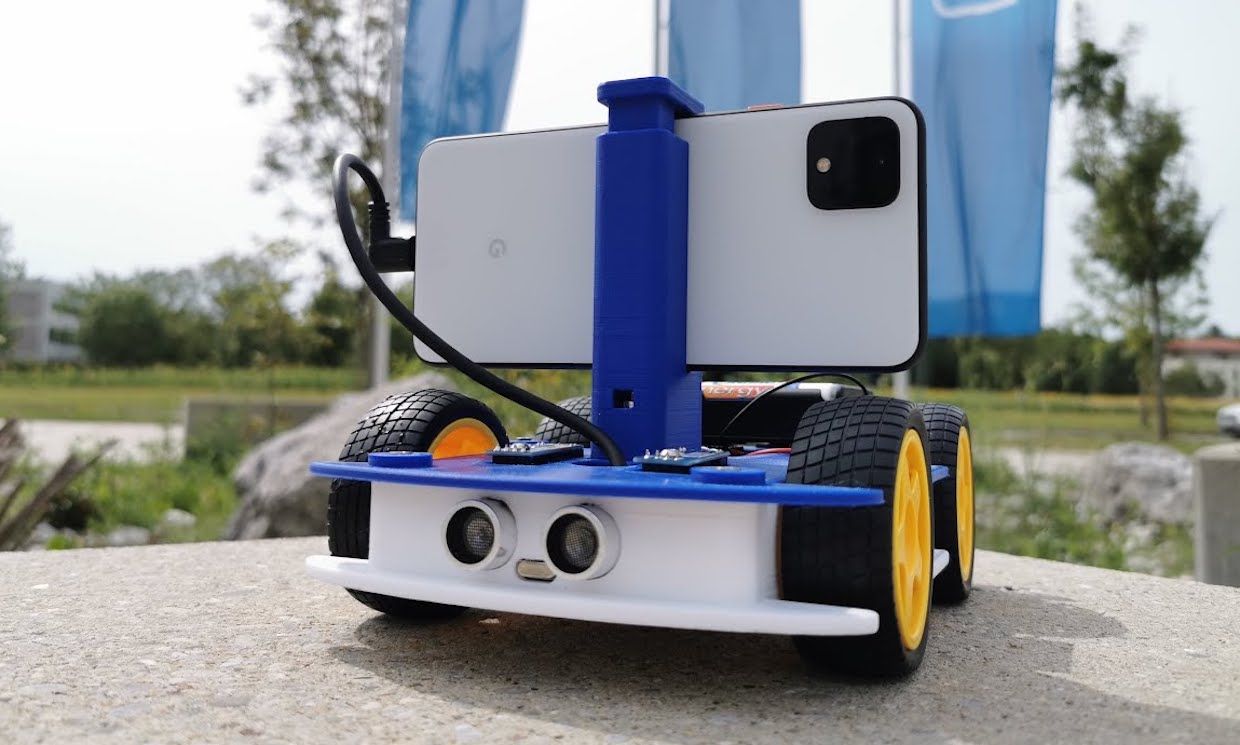
How Intel's OpenBot Wants to Make Robots Out of Smartphones
Gpscruisei guess phone camera isnt stereo-enough....
Amy Coney Barrett Says She 'Wept Together' With Adopted Haitian Daughter Over George Floyd's Death
Gpscruiselast time i wept was when trump was elected! I couldn't believe it. Gave me great pride in fair elections.
Bill Gates says Donald Trump is wrong to call Regeneron's monoclonal antibodies 'a cure'
Gpscruiseno one trusts gates.

IBM to break up 109-year old company to focus on cloud growth
Gpscruisecrowded space, but i wish them well.. They are really a trusted-brand, and could leaverage that in cloud i guess...
International Business Machines Corp is splitting itself into two public companies, capping a years-long effort by the world’s first big computing firm to diversify away from its legacy businesses to focus on high-margin cloud computing.
IBM will list its IT infrastructure services unit, which provides technical support for 4,600 clients in 115 countries and has a backlog of $60 billion, as a separate company with a new name by the end of 2021.
The new company will have 90,000 employees and its leadership structure will be decided in a few months, Chief Financial Officer James Kavanaugh told Reuters.
I have no idea what to say about this. IBM is so far out of my comfort zone these days.
Global Privacy Control, a new Privacy Standard Proposal, now Available in Brave’s Desktop and Android Testing Versions
Gpscruiseget snowden on board, and i will try it out...
Global Privacy Control, a new Privacy Standard Proposal, now Available in Brave’s Desktop and Android Testing Versions
GPC launches today from a consortium of privacy-respecting organizations, to protect consumer privacy and provide consumers with greater control of their data
By Peter Snyder (@pes10k), Senior Privacy Researcher at Brave,
and Implementation by Anton Lazarev, Research Engineer at Brave

One of Brave’s core goals is to improve privacy on the Web. The main way Brave improves Web privacy is by building strong, on-by-default privacy protections in the Brave browser. However, Brave also works to improve privacy on the Web in general, particularly by advocating for privacy in the W3C 1.
As part of our privacy-in-Web-Standards work, we’re proud to have been involved in the design for the “Global Privacy Control” (GPC) proposal. The GPC proposal allows Web users to signal that they do not want to be tracked online, and where relevant, assert legal privacy rights, as described in legislation like the EU’s GDPR and California’s CCPA. GPC is meant as an additional privacy tool for browser vendors and Web users; it does not take the place of any existing privacy protections Brave provides.
We are also excited to announce our implementation of the GPC proposal, available today in the Nightly channel of our Desktop browser and in our Android browser beta release.
Why Brave supports the “Global Privacy Control” proposal
First, anything that makes it clearer to the surveillance-economy that users don’t want, don’t approve of, and don’t consent to being followed and tracked on the Web is a good step (and something that Brave has been promoting since we started).
Second, similar consent mechanisms being pushed by the AdTech industry are incompatible with the kinds of privacy protections which Brave includes. For example, the Orwellian-named “consent management platforms” often require your browser to execute code from tracking companies, just to ask them to not track you. Brave blocks these network requests to tracking companies, which the tracking companies often interpret as “no preference expressed yet”.
Good solutions to improving Web privacy cannot require browsers to interact with companies that have already lost users’ trust; the “Global Privacy Control” proposal is a strong framework to begin building better privacy protections on.
Third, Brave is interested in working with responsible, ethical, privacy-respecting publishers who want to respect user privacy without requiring users to click through intentionally confusing dialogs and “consent forms”. We’re especially interested in working with publishers who want to respect user privacy both where the law requires it (e.g., GDPR, CCAP), as well as in areas where the law hasn’t yet caught up to recognize privacy as a right (and pervasive, non-consensual tracking as wrong). We’re excited by the publishers we’ve worked alongside during the “Global Privacy Control” proposal, and we hope others will follow their lead.
Brave’s Implementation of the “Global Privacy Control”
Brave is currently testing an implementation of the GPC proposal in our Nightly desktop and Android beta channels, and expect to implement it in our iOS browser as the proposal goes through the standardization process.
Importantly, Brave does not require users to change anything to start using the GPC to assert your privacy rights. For versions of Brave that have GPC implemented, the feature is on by default and unconfigurable. We’ve decided to implement GPC in this way for several reasons.
First, we believe that anyone choosing to use Brave has already made an unambiguous expression that they do not want their data to be sold or shared online. Legislation like the CCPA recognizes that the decision to use privacy-focused tools like Brave is itself an expression of user preference for privacy. Requiring users in Brave to take an additional step to enable GPC therefore seems both unnecessary and disrespectful to our users (who have already made their preference clear!).
Second, the more configuration options available in the browser, the easier it is to “fingerprint” 2 users. We build strong, unique, and innovative defenses against “fingerprinting” into the Brave Browser, and are cautious about adding configuration options that could reduce your privacy. Unless we expect configurability to be useful to a significant number of users, we err on the side of reducing configuration options. We expect few, if any, Brave users would want to disable GPC, and so have not included any configuration option.
Brave, GPC, and The Inevitability of a Private-by-Default Web
Since we started, Brave has argued that a healthy, sustainable, vibrant Web requires a privacy-preserving, privacy-by-default Web; business models that depend on tracking will soon look as antiquated as Flash, Java Applets or “made for IE” badges.
Privacy-preserving tools like Brave are just one part of what’s needed to keep improving the Web. Legislation (like the CCPA and GDPR) that enshrines and protects privacy is a second necessary part, and proposals like GPC that allow users to conveniently and privately assert their rights is a third. We’re excited for browsers to implement GPC, more publishers to interpret and respect GPC as discussed in the proposal, and more ways of protecting privacy on the Web.
- ⭡ Brave also advocates for, and improves privacy in, proposed Web standards, as members of the W3C and co-chairs the W3C’s privacy review interest group (PING).
- ⭡ i.e., identify users by their browser configuration and characteristics, instead of through stored identifiers like cookies.
Related Articles
Continue reading for news on ad blocking, features, performance, privacy and Basic Attention Token related announcements.

Brave and Gala Games Partner to Feature BAT Support in New Mirandus Game
Cyber Monday Promotion Gives Brave Users 25% Discount for Land Deed Purchases with BAT Gala Games, the blockchain games studio expanding the network of player-owned game assets, and Brave, makers of the innovative Brave browser combining privacy with the Basic...

Binance Widget Now Available to Brave Android Users, Allowing Easy Trading, Buying, and Managing of Cryptocurrency
Today’s Brave Android browser update (version 1.17) features the Binance widget, which is already available to Brave desktop users and was the first exchange-browser integration of its kind last April. Brave Android users can now seamlessly trade and manage...

Sunsetting the referral program and planning for the future
Effective today, November 9th, 2020, we will begin to wind-down the current referral program. Creators using the Brave referral program have 14 days to wrap up their Brave promotional activity. Creators not using the referral program will experience no change.

Brave Passes 20 Million Monthly Active Users and 7 Million Daily Active Users
November marks one year since we launched Brave 1.0, the most private, safest, and fastest (3-6x) browser. Over the past year, we’ve seen amazing growth on multiple fronts and we’re happy to celebrate Brave 1.0’s first anniversary by announcing that we officially passed 20 million monthly active users (20.5), up from 8.7 million this time last year.

What’s Brave Done For My Privacy Lately? Episode #6: Fighting CNAME Trickery
This post discusses a recent technique trackers use, CNAME cloaking, and a new feature in Brave that keeps Brave users protected.

Splinterlands and Brave Announce Partnership
Brave and Splinterlands both share a similar mission of rewarding users for their time and attention as well as increasing user privacy and freedom, and are looking forward to working together to spread those goals.
Ready to Brave the new internet?
Brave is built by a team of privacy focused, performance oriented pioneers of the web. Help us fix browsing together. Download BraveContact
Support
Advertising
Business
Referral Program
Press
Offices
Brave San Francisco
512 Second St., Floor 2
San Francisco, CA 94107

The post Global Privacy Control, a new Privacy Standard Proposal, now Available in Brave’s Desktop and Android Testing Versions appeared first on Brave Browser.
Most Zoombombing is not done by external hackers – they're inside jobs
Gpscruisethis is all a ploy to drive zoom stock price down so microsoft can skype them....
Experts slam Donald Trump's 'irresponsible' claim that he was cured of coronavirus by Regeneron
Gpscruisei think covid-summer-edition is weaker. Lots of kids I know are over it in 3 days.
Mainstream media is the biggest amplifier of White House disinformation
GpscruiseMIT politics? Shame.
The president is running a disinformation campaign, and too many people won’t call it what it is.
“The simplest disinformation is explicitly false or misleading information disseminated for political ends,” says Yochai Benkler, a Harvard law professor who led a team that recently dissected the way disinformation is amplified.
Take President Trump’s claim that voting by mail invites widespread fraud.
“There’s no question that the assertion that mail-in voting leads to massive voter fraud is false,” Benkler says. “That consensus has emerged over years of study, so that by the time this disinformation campaign starts in April, it’s known to any person who wants to know. As the president says, they think mail-in voting will help Democrats. Why is it anything other than a disinformation campaign when someone tells you they have a specific electoral goal and, in pursuit of that goal, they’re engaging in a sustained and repeated campaign of disseminating information that is false and misleading?”
Benkler’s team just published its study, which examines the president’s disinformation campaign against mail-in votes and details the methods—and people—he’s using to accomplish his goals. The findings found that some of the biggest names in American mass media and the political elite are primarily responsible, and that social media plays only a secondary role. The findings run contrary to the popular idea that it’s foreign troll factories doing the worst disinformation dirty work.
The study examined 55,000 media stories, 5 million tweets, and 75,000 Facebook posts. The conclusion, echoing their research from 2015 to 2018, is that Donald Trump and Fox News are the key players in this crucial disinformation campaign, not Russian trolls. The researchers mapped the campaign out, showing a clear and recurring culprit: Trump, whether on TV or Twitter or by close proxy.
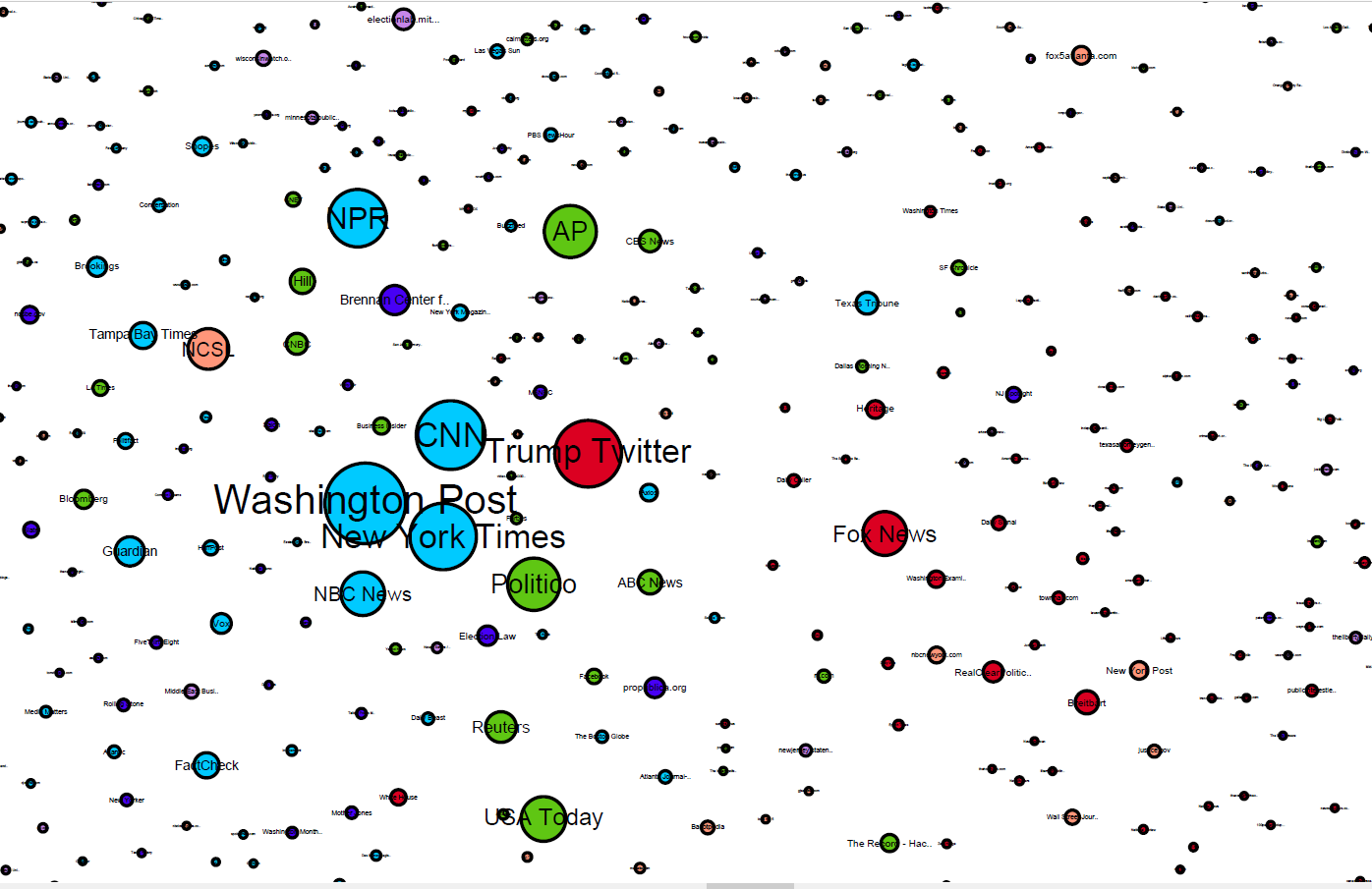
There’s been a lot of alarm over Russian interference and clickbait factories on social media, says Benkler, but “in 2016 and today, what we see is that mass media is much more important.”
The American press amplifies this dramatically because outlets cannot resist giving attention to the White House. Calling his actions a disinformation campaign would be profoundly difficult for some journalists who are desperate to project balance as if it is equal to fairness.
But this has real consequences. Mail-in voting expands access to an election in the middle of a national health crisis, and lies are being used as justification to undercut or eliminate this access—a tactic clearly at play in Texas and other states.
There is a way forward, however. The research argues that the “primary cure” is for these media outlets to more aggressively police the president’s disinformation.
While many Americans are set in their beliefs on election fraud, there is still a substantial group of persuadables, says Benkler. They are unsure of the truth about election fraud, they watch network news, and they read local papers that aggregate journalism from outlets like the Associated Press.
That means “the only meaningful players are the news editors and the journalists at those outlets most often used for political news by the least attentive, least politically engaged people in society,” Benkler says.
That includes tackling the question of the president’s misinformation clearly and directly, and avoiding false balance. Even the New York Times, whose readers are well informed on the reality of voter fraud, sometimes publishes credulous and noncritical journalism on this. One recent story about Texas shutting down ballot drop-off sites, for example, was headlined “Citing security, Texas governor limits counties to one spot each for in-person ballot drop-offs,” giving credence to the idea. Not until the seventh paragraph does the story mention, as a brief aside, that there is absolutely no evidence that mail-in voting causes fraud.
None of this lets social networks off the hook for disinformation, by the way: it’s a real problem that exists on Facebook, YouTube, and beyond. Trump’s Twitter account is central to this disinformation campaign. He reliably wields its authority and influence as a tool to summon coverage and shape the agenda of American media almost at will.
But whether he tweets or goes on TV, the study says, it’s media coverage of the tweets that amplifies the message—often uncritically—far beyond what the account accomplishes alone.
Trump’s antibody treatment was tested using cells originally derived from an abortion
Gpscruiseso now, half the US wont touch Regeneron !
This week, President Donald Trump extolled the cutting-edge coronavirus treatments he received as “miracles coming down from God.” If that’s true, then God employs cell lines derived from human fetal tissue.
The emergency antibody that Trump received last week was developed with the use of a cell line originally derived from abortion tissue, according to Regeneron Pharmaceuticals, the company that developed the experimental drug.
The Trump administration has taken an increasingly firm line against medical research using fetal tissue from abortions. For example, when it moved in 2019 to curtail the ability of the National Institutes of Health to fund such research, supporters hailed a “major pro-life victory” and thanked Trump personally for taking decisive action against what they called the “outrageous and disgusting” practice of “experimentation using baby body parts.”
But when the president faced a deadly encounter with covid-19, his administration raised no objections over the fact that the new drugs also relied on fetal cells, and anti-abortion campaigners were silent too. Most likely, their hypocrisy was unwitting. Many types of medical and vaccine research employ supplies of cells originally acquired from abortion tissue. It would have taken an expert to realize that was the case with Trump’s treatment.
Last Friday, as Trump developed worrisome symptoms of covid-19, the president received an emergency cocktail of anti-coronavirus antibodies made by Regeneron. These molecules are manufactured in cells from a hamster’s ovary, so-called “CHO” cells, according to the company—not in human cells.
But cells originally derived from a fetus were used in another way. According to Regeneron, laboratory tests used to assess the potency of its antibodies employed a standardized supply of cells called HEK 293T, whose origin was kidney tissue from an abortion in the Netherlands in the 1970s.
Since then, the 293T cells have been “immortalized,” meaning they keep dividing in the lab, somewhat like a cancer, and have undergone other genetic changes and additions.
According to Regeneron, it and many other labs employ 293T cells to manufacture virus “pseudoparticles,” which are virus-like structures that contain the “spike” protein of the deadly coronavirus. It needs those to test how well different antibodies will neutralize the virus.
The two antibodies Regeneron eventually put forward as an experimental treatment, which may have saved Trump’s life, would have been selected using exactly such tests. Because the 293T cells were acquired so long ago, and have lived so long in the laboratory, they are no longer thought of as involving abortion politics.
“It’s how you want to parse it,” says Alexandra Bowie, a Regeneron spokesperson. “But the 293T cell lines available today are not considered fetal tissue, and we did not otherwise use fetal tissue.”
The Trump administration has sought to block or curtail research that requires tissue from recently performed abortions. In August, for example, a new board created by the Department of Health and Human Services, and stacked with figures opposed to abortion, voted to withhold funding from 13 of 14 proposals.
The rejections centered on research seeking fresh supplies of abortion tissue, rather than ongoing research involving older, well-established cell lines in use for many years, like the type Regeneron employed. However, one reason some scientists want to study abortion tissue is so they can create new and valuable cell lines.
Update: An earlier version of this story was headlined “Trump’s antibody treatment was tested using cells from an abortion.” The words “originally derived” were added to clarify that the cells are not from a recent abortion.
Derek Chauvin: George Floyd murder suspect released from jail on $1m bail
Gpscruisegood he is out.
A PULITZER PRIZE THAT SHOULD BE REVOKED….
Gpscruisei need to add that to my burn box. https://www.youtube.com/watch?v=fNM7A6fjNkg&t=378s
How to Stop Being Offended by Everyone (in just 13 steps)
Gpscruisethen clock the f@cker
It seems like you can’t do or say anything nowadays without someone being offended by it. It’s gotten out of hand, and I want to help.
Are you sick of getting your “feathers ruffled” every time you go on social media, talk to a certain relative, or hear some BS on Zoom? Do you want to maximize the amount of time in your life that you’re filled with joy rather than rage? Then this article is for you.
I’ve found that the easiest way to stop doing something, is to start doing something else. So bookmark this page and begin reading it the minute you feel yourself getting “offended.”
These insights take less than 3 minutes to digest, and will help you transmute the emotional energy of offense, to attract more positivity into your life and radiate it in the world around you.
So, someone said or did something that “offended” you…
1. First, recognize that your being offended is your choice. And just because you are offended, does not mean you are right.
2. Take several deep breaths, and allow yourself to feel any emotion that arises, processing it internally without reacting just yet. Every emotion is a valid one, if you are feeling it. Then choose to be “the boss” of your emotions by silently repeating this mantra: “I am calm when wronged.”

3. Stop and consider the source. Is this coming from a human being with whom you are generally aligned or not?
4. Discern, as best you can, whether what was said or done was on purpose (with malice or ill intent) or unintentional (accidental or as a result of lack of knowledge).
5. Hover above the situation, see yourself getting triggered and ask yourself, “Why am I offended?” Is it because I’m “supposed to be”, or because I actually am?”
6. Locate the part of you that feels victimized. Recognize that this is where a wound exists, and this is why you’re more vulnerable there.
7. Instead of “going off” on someone, send loving energy to where you are broken. Be compassionate with yourself that there is obviously more healing to do on that subject.
8. Listen to the opposing perspective; you will either learn something new that enlightens you to take a step in the direction of their view, or the contrast may further deepen your commitment to your own belief. Both have a great outcome.
9. Drop your ego or desire to direct, control, or change other’s beliefs. Release the need to gain a specific outcome. Then, laugh at how ridiculous it is to waste another precious moment of your life policing someone else’s thoughts.
10. If you can, wait at least 24 hours before responding. And when you do, use “I feel” statements like, “I feel hurt that you said…” as opposed to “You hurt me when you said…” with your focus being peace and understanding. If peace and understanding is not being reached, and the other person challenges back demanding more explanation, you are not required to further defend or explain. You are allowed to say, “It’s just how I feel,” and leave it at that.

11. Remind yourself that we are a collective, and that the person that “wronged” you is from the same Source as you. We all have the same “cosmic DNA”. So hating them is hating you.
12. See the lesson brought to you from this resistance as a gift, and be grateful that it came to you, because it revealed a deeper truth within you. Vow to move towards love and acceptance on this and all future “offenses.”
13. Remember that sitting in the energy of offense does not feel good, and you love yourself enough to choose to feel good as much as possible in your life. You get to decide.
Notice how none of these steps involve you making the other person change?
Why?
Because we can only control the space within us and 3 feet around us – how we react, how we accept, and how we choose to deal with perceived adversity.
I’m not saying that the other person isn’t wrong as hell. They probably are in your humble opinion, but it’s not your job to change someone else. It’s your job to be the happiest, most loving version of you possible, for as much time as possible. And walking around with disdain for everyone that is not in agreement with you has gotta be getting old by now, hasn’t it?
…There, I said it. I hope this was helpful, and I hope you’re not offended.
But then again, if you are? Remember, that’s on you.
The post How to Stop Being Offended by Everyone (in just 13 steps) appeared first on Dumb Little Man.
Donald Trump says COVID is like the FLU and 'are we going to close our country down for the flu?'
Gpscruiseeveryone seems to get the mild version in the summer?!

Michelle Obama calls Donald Trump 'racist' as she pleads with undecided voters to end 'chaos'

From Hope Hicks to Joe Biden and members of his family. Who has Donald Trump met in the last week?
GpscruiseThis is a real game changer. I imagine the stock market will be in a tizzy for the next month based on Trumps' reaction to Covid!

SPOILER: THEY WON’T. Why California Should Let Markets, Not Mandates, Drive Vehicle Choice….
Gpscruiseneed buses that are private. Have solid window on outside and solid opaque on inner wall. Keeps bad behavior to a minimum.
SPOILER: THEY WON’T. Why California Should Let Markets, Not Mandates, Drive Vehicle Choice.
BEN SHAPIRO IS GONNA NEED A BIGGER BLOG: Why I’m Leaving California. When my family moved to No…
Gpscruiseif your customers are online, like Shapiro, he could live anywhere. But he will miss seeing all those big breasts.
BEN SHAPIRO IS GONNA NEED A BIGGER BLOG: Why I’m Leaving California.
When my family moved to North Hollywood, I was 11. We lived in a safe, clean suburb. Yes, Los Angeles had serious crime and homelessness problems, but those were problems relegated to pockets of the city—problems that, with good governance, we thought could eventually be healed. Instead, the government allowed those problems to metastasize.
As of 2011, Los Angeles County counted less than 40,000 homeless; as of 2020, that number had skyrocketed to 66,000. Suburban areas have become the sites of homeless encampments. Nearly every city underpass hosts a tent city; the city, in its kindness, has put out port-a-potties to reduce the possibility of COVID-19 spread.
Police are forbidden in most cases from either moving transients or even moving their garbage. Nearly every public space in Los Angeles has become a repository for open waste, needles, and trash. The most beautiful areas of Los Angeles, from Santa Monica beach to my suburb, have become wrecks.
My children have personally witnessed drug use, public urination, and public nudity. Looters were allowed free reign in the middle of the city during the Black Lives Matter riots; Rodeo Drive was closed at 1 p.m., and citizens were curfewed at 6 p.m.
To combat these trends, local and state governments have gamed the statistics, reclassifying offenses and letting prisoners go free. Meanwhile, the police have become targets for public ire. In July, the city of Los Angeles slashed police funding, cutting the force to its lowest levels in over a decade.
Decay is a choice.
AREN’T WE ALL? VIDEO: Students shocked by footage of Biden’s alleged cognitive decline….
Gpscruiseshows what I say all along, Steelers v Cowboys. No one sways from "their team" no matter what. What will decide this election is whether the weather is good and Bernie kids bother to get out of bed that day.
The Death Of Q-Anon? Bartiromo Reports Durham Report 'Unlikely' to Be Released Before Election
Gpscruisemy dumbass neighbor breathes this crap.
Michael Cohen: Trump's 'biggest fear' was release of tax returns
Gpscruisejew, jew, jew. All three of these stories are by jews. They love them democrats. Its their team, not mine. Go team!

Donald Trump tax returns: Eric Trump demands investigation of leak
Gpscruiseall presidents are ashamed of how rich they are. Good for him.

Watergate reporter Carl Bernstein says Trump created 'the first grifter presidency' in US history
Gpscruisejew=democrat for some reason. But, its their team, not mine. Go team.

Bernie Sanders warns that there are a 'number of plans' to make sure Trump leaves office if he loses
Gpscruiselooser

TRUMP’S GET-OUT-THE-VOTE EFFORT ENTERS A NEW PHASE: Some Protests Against Police Brutality Take a M…
Gpscruiselooks like ima gonna need some rounds.
TRUMP’S GET-OUT-THE-VOTE EFFORT ENTERS A NEW PHASE: Some Protests Against Police Brutality Take a More Confrontational Approach: The protests are moving into white residential neighborhoods, where activists demand that people choose a side.
“It went from a peaceful march, calling out the names, to all of a sudden, bang, ‘How dare you fly the American flag?’” said Mr. Moses, who is Black and runs a nonprofit group in the Portland, Ore., area. “They said take it down. They wouldn’t leave. They said they’re going to come back and burn the house down.”
Mr. Moses and others blocked the demonstrators and told them to leave.
“We don’t go around terrorizing folks to try and force them to do something they don’t want to do,” said Mr. Moses, whose nonprofit group provides support for local homeless people. “I’m a veteran. I’m for these liberties.”
Nearly four months after the killing of George Floyd by the Minneapolis police, some protesters against police brutality are taking a more confrontational — and personal — approach. The marches in Portland are increasingly moving to residential and largely white neighborhoods, where demonstrators with bullhorns shout for people to come “out of your house and into the street” and demonstrate their support.
These more aggressive protests target ordinary people going about their lives, especially those who decline to demonstrate allegiance to the cause. That includes a diner in Washington who refused to raise her fist to show support for Black Lives Matter, or, in several cities, confused drivers who happened upon the protests. . . .
A small free literature selection was set up on the grass and overseen by three people in ski masks. It was a popular offering, and people crowded around, craning to see the pamphlets.
Titles included “Why Break Windows”; “I Want To Kill Cops Until I’m Dead”; “Piece Now, Peace Later: An Anarchist Introduction to Firearms”; “In Defense of Smashing Cameras”; and “Three-Way Fight: Revolutionary Anti-Fascism and Armed Self Defense.” . . .
Neighbors in impressive Craftsman-style homes pulled down their shades and turned off their lights, though many could be seen peering out of dark windows. One woman stepped out of an expansive home looking angry; upon seeing the crowd, she quickly retreated indoors. A few young couples stood in their doorways. A Black woman driving past honked and cheered.
One white man stepped onto his patio clapping and hollering in support of the passing march. The group called for him to join. He smiled and waved them on, still clapping. They began to chant that he was spineless. He looked worried. But the march moved along, and he went back into his house.
“You’ll never sleep tight, we do this every night,” the protesters chanted.
This isn’t protest, this is domestic terrorism.
Why Boston Dynamics Is Putting Legged Robots in Hospitals
Gpscruisei just had an epiphony. What we want is to RIDE these beasts!!!

FASTER, PLEASE: Trump Wants Supreme Court Justice Confirmed ASAP to Counter Democrats’ Election ‘S…
Four people, including the partner of a man killed during the protests, are suing Facebook
GpscruiseI thought there was a title-99 thing that both dems and republicans want to nullify which prohibits suing them over anything?? This might be test case to get rid of it....
