Gpscruise
Shared posts
Salesforce to buy Slack for $27.7B
Gpscruisediscord is better
THE EXODUS IS HERE: Tech giant Hewlett Packard Enterprise moving headquarters from California to Spr…
Gpscruisethere goes texas
THE EXODUS IS HERE: Tech giant Hewlett Packard Enterprise moving headquarters from California to Spring, Texas, near Houston.
GOP governors better get cracking on Glenn’s Welcome Wagon kits ASAP, if they want to keep their states in the red column. Otherwise, as a — [cough] — longtime resident of Texas, I’m all in favor of this proposal by America’s Newspaper of Record: Texas Passes Law Banning Californians From Voting After They Move There.
Nervous Woman Still Hasn’t Gotten Up Courage To Check Election Results
GpscruiseGore was president for 37 days....

US Election 2020: Donald Trump says fraud fight not for own benefit
Gpscruisehttps://twitter.com/MattBraynard
-Data Scientist. Shows 10-10k spike in fake 2020 mailin requests. Says Covid is not a reason to request mailin ballot.

Stats I Did For the Sidney Powell Suits: 150 Thousand Missing Votes
GpscruiseRemlaps, are you a fan of Scott Adams Youtube vids? I am captivated!
Autonomous Robot Cars to Deliver Medicine Around London
GpscruiseRemlaps, would you like to write an article on wikispeedia.org ?
A fleet of autonomous, electrically-powered robot vehicles has started delivering medicine to care homes in London's Borough of Hounslow as part of a public trial.
Hacking the ES&S 650… Used in 24 states
Gpscruisehttps://www.youtube.com/watch?v=01vnDL4yFrA&t=688s
explains it all.
Holocaust memorial adds George Floyd exhibit…
Gpscruisebecoming southern poverty law center....
Giuliani laughs in reporter’s face…
Gpscruisethis election pushes out all news orgs and ushers in youtube!
ONE WOULD THINK THAT GINNING UP A BOGUS CRIMINAL INVESTIGATION AIMED AT UNSEATING A NEWLY ELECTED PR…
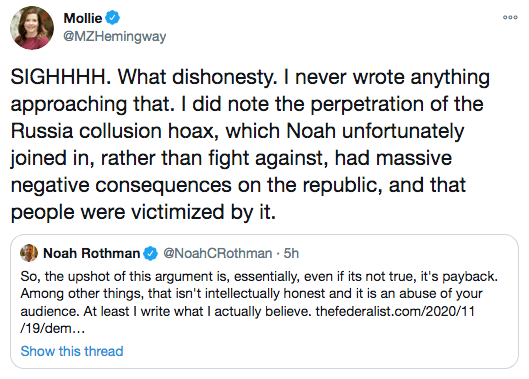
ONE WOULD THINK THAT GINNING UP A BOGUS CRIMINAL INVESTIGATION AIMED AT UNSEATING A NEWLY ELECTED PRESIDENT WOULD BE BAD FOR DEMOCRACY. But remember that when leftists talk about “democracy” it’s just a synonym for their political power. But it’s certainly rich to hear them talk about Trump trampling norms. The poison started with Al Gore’s un-concession in 2000, if not before.
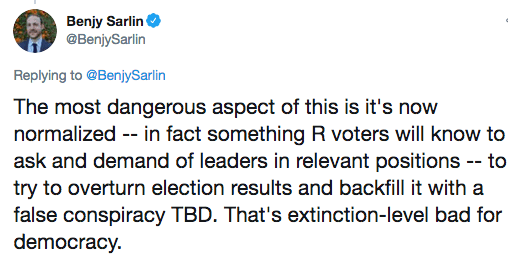
Don’t ever expect them to admit it, though, or even realize it.
UPDATE: Related:
Rudy Giuliani press conference inspires a wave of hilarious memes
Gpscruiserudy is awesome. This is the crime of the century.

An Engineer Explains Why We Must Kill Software-Based Voting
Gpscruisetrump said use paper. I agree.
Rudy Giuliani gives voting fraud 'evidence' at odd press conference
Gpscruise60% of americans see cheating this time

PLEASE, DON’T CALIFORNICATE THE REST OF AMERICA: One might think people fleeing a disaster would avo…
Gpscruisei had a math pblm on gre. 40% of california leaves every year, 60% of us moves to california every year, what is the mix....
PLEASE, DON’T CALIFORNICATE THE REST OF AMERICA: One might think people fleeing a disaster would avoid at all costs doing things that could repeat the calamity in their new home.
Sadly, as Issues & Insights notes in today’s editorial, that’s not always the case: “Here’s the problem. It’s one thing to move from a state because it’s going in the wrong direction. It’s quite another to move and not understand that you had something to do with it.”
RUNNING AN “ELECTION” ON CLOSED-SOURCE VENEZUELAN VOTING SOFTWARE: That voting machine software in A…
GpscruiseI demans a SOX audit
RUNNING AN “ELECTION” ON CLOSED-SOURCE VENEZUELAN VOTING SOFTWARE: That voting machine software in America is not open source and auditable is such a preposterously obvious security and hacking risk that the only reasonable conclusion is that it’s meant to be insecure and hackable. There is no commercial value in closed source voting software (it’s the machines themselves they’re selling; as software goes, it is trivial and nobody wants weird innovations or updates) unless part of the value proposition is that the vote can be rigged. The media and politicians can gaslight us all they want on this, but something this “stupid” doesn’t happen accidentally, even today and with our incompetent ruling class.
Drone images reveal massive cliff fall on Dorset's Jurassic Coast
Gpscruiseneed some kudzu

Report outlines route toward better jobs, wider prosperity
Gpscruisei just tweeted to MIT News.... Funny on twitter they only have 15 followers... Perhaps they will read my tweet on hacking voting machines.
Decades of technological change have polarized the earnings of the American workforce, helping highly educated white-collar workers thrive, while hollowing out the middle class. Yet present-day advances like robots and artificial intelligence do not spell doom for middle-tier or lower-wage workers, since innovations create jobs as well. With better policies in place, more people could enjoy good careers even as new technology transforms workplaces.
That’s the conclusion of the final report from MIT’s Task Force on the Work of the Future, which summarizes over two years of research on technology and jobs. The report, “The Work of the Future: Building Better Jobs in an Age of Intelligent Machines,” was released today, and the task force is hosting an online conference on Wednesday, the “AI & the Future of Work Congress.”
At the core of the task force’s findings: A robot-driven jobs apocalypse is not on the immediate horizon. As technology takes jobs away, it provides new opportunities; about 63 percent of jobs performed in 2018 did not exist in 1940. Rather than a robot revolution in the workplace, we are witnessing a gradual tech evolution. At issue is how to improve the quality of jobs, particularly for middle- and lower-wage workers, and ensure there is greater shared prosperity than the U.S. has seen in recent decades.
“The sky is not falling, but it is slowly lowering,” says David Autor, the Ford Professor of Economics at MIT, associate head of MIT’s Department of Economics, and a co-chair of the task force. “We need to respond. The world is gradually changing in very important ways, and if we just keep going in the direction we’re going, it is going to produce bad outcomes.”
That starts with a realistic understanding of technological change, say the task force leaders.
The task force aimed “to move past the hype about what [technologies] might be here, and now we’re looking at what can we feasibly do to move things forward for workers,” says Elisabeth Beck Reynolds, executive director of the task force as well as executive director of the MIT Industrial Performance Center. “We looked across a range of industries and examined the numerous factors — social, cognitive, organizational, economic — that shape how firms adopt technology.”
“We want to inject into the public discourse a more nuanced way of talking about technology and work,” adds David Mindell, task force co-chair, professor of aeronautics and astronautics, and the Dibner Professor of the History of Engineering and Manufacturing at MIT. “It’s not that the robots are coming tomorrow and there’s nothing we can do about it. Technology is an aggregate of human choices.”
The report also addresses why Americans may be concerned about work and the future. It states: “Where innovation fails to drive opportunity, it generates a palpable fear of the future: the suspicion that technological progress will make the country wealthier while threatening the people’s livelihoods. This fear exacts a high price: political and regional divisions, distrust of institutions, and mistrust of innovation itself. The last four decades of economic history give credence to that fear.”
"Automation is transforming our work, our lives, our society," says MIT President L. Rafael Reif, who initiated the formation of the task force in 2017. "Fortunately, the harsh societal consequences that concern us all are not inevitable. How we design tomorrow’s technologies, and the policies and practices we build around them, will profoundly shape their impact."
Reif adds: "Getting this right is among the most important and inspiring challenges of our time — and it should be a priority for everyone who hopes to enjoy the benefits of a society that’s healthy and stable, because it offers opportunity for all."
Six big conclusions
The task force, an Institute-wide group of scholars and researchers, spent over two years studying work and technology in depth. The final report presents six overarching conclusions and a set of policy recommendations. The conclusions:
1) Technological change is simultaneously replacing existing work and creating new work. It is not eliminating work altogether.
Over the last several decades, technology has significantly changed many workplaces, especially through digitization and automation, which have replaced clerical, administrative, and assembly-line workers across the country. But the overall percentage of adults in paid employment has largely risen for over a century. In theory, the report states, there is “no instrinsic conflict between technological change, full employment, and rising earnings.”
In practice, however, technology has polarized the economy. White-collar workers — in medicine, marketing, design, research, and more — have become more productive and richer, while middle-tier workers have lost out. Meanwhile, there has been growth in lower-paying service-industry jobs where digitization has little impact — such as food services, janitors, and drivers. Since 1978, aggregate U.S. productivity has risen by 66 percent, while compensation for production and nonsupervisory workers has risen by only 10 percent. Wage gaps also exist by race and gender, and cities do not provide the “escalator” to the middle class they once did.
While innovations have replaced many receptionists, clerks, and assembly-line workers, they have simultaneously created new occupations. Since the middle of the 20th century, the U.S. has seen major growth in the computer industry, renewable energy, medical specialties, and many areas of design, engineering, marketing, and health care. These industries can support many middle-income jobs as well — while the services sector keeps growing.
As the task force leaders state in the report, “The dynamic interplay among task automation, innovation, and new work creation, while always disruptive, is a primary wellspring of rising productivity. Innovation improves the quantity, quality, and variety of work that a worker can accomplish in a given time. This rising productivity, in turn, enables improving living standards and the flourishing of human endeavors.”
However, a bit ruefully, the authors also note that “in what should be a virtuous cycle, rising productivity provides society with the resources to invest in those whose livelihoods are disrupted by the changing structure of work.”
But this has not come to pass, as the distribution of value from these jobs has been lopsided. In the U.S., lower-skill jobs only pay 79 percent as much when compared to Canada, 74 percent compared to the U.K., and 57 percent compared to Germany.
“People understand that automation can make the country richer and make them poorer, and that they’re not sharing in those gains,” Autor says. “We think that can be fixed.”
2) Momentous impacts of technological change are unfolding gradually.
Time and again, media coverage about technology and jobs focuses on dramatic scenarios in which robots usurp people, and we face a future without work.
But this picture elides a basic point: Technologies mimicking human actions are difficult to build, and expensive. It is generally cheaper to simply hire people for those tasks. On the other hand, technologies that augment human abilities — like tools that let doctors make diagnoses — help those workers become more productive. Apart from clerical and assembly-line jobs, many technologies exist in concert with workers, not as a substitute for them.
Thus workplace technology usually involves “augmentation tasks more than replacement tasks,” Mindell says. The task force report surveys technology adoption in industries including insurance, health care, manufacturing, and autonomous vehicles, finding growth in “narrow” AI systems that complement workers. Meanwhile, technologists are working on difficult problems like better robotic dexterity, which could lead to more direct replacement of workers, but such advances at a high level are further off in the future.
“That’s what technological adoption looks like,” Mindell says. “It’s uneven, it’s lumpy, it goes in fits and starts.” The key question is how innovators at MIT and elsewhere can shape new technology to broad social benefit.
3) Rising labor productivity has not translated into broad increases in incomes because societal institutions and labor market policies have fallen into disrepair.
While the U.S. has witnessed a lot of technological innovation in recent decades, it has not seen as much policy innovation, particularly on behalf of workers. The polarizing effects of technology on jobs would be lessened if middle- and lower-income workers had relatively better support in other ways. Instead, in terms of pay, working environment, termination notice time, paid vacation time, sick time, and family leave, “less-educated and low-paid U.S. workers fare worse than comparable workers in other wealthy industrialized nations,” the report notes. The adjusted gross hourly earnings of lower-skill workers in the U.S. in 2015 averaged $10.33, compared to $24.28 in Denmark, $18.18 in Germany, and $17.61 in Australia.
“It’s untenable that the labor market has this growing gulf without shared prosperity,” Autor says. “We need to restore the synergy between rising productivity and improvements in labor market opportunity.” He adds: “We’ve had real institutional failure, and it’s within our hands to change it. … That includes worker voice, minimum wages, portable benefits, and incentives that cause companies to invest in workers.”
Looking ahead, the report cautions, “If those technologies deploy into the labor institutions of today, which were designed for the last century, we will see similar effects to recent decades: downward pressure on wages, skills, and benefits, and an increasingly bifurcated labor market.” The task force argues instead for institutional innovations that complement technological change.
4) Improving the quality of jobs requires innovation in labor market institutions.
The task force contends the U.S. needs to modernize labor policies on several fronts, including restoring the federal minimum wage to a reasonable percentage of the national median wage and, crucially, indexing it to inflation.
The report also suggests upgrading unemployment insurance in several ways, including: using very recent earnings to determine eligibility or linking eligibility to hours worked, not earnings; making it easier to receive partial benefits in case of events like loss of a second job; and dropping the requirement that people need to seek full-time work to receive benefits, since so many people hold part-time positions.
The report also observes that U.S. collective bargaining law and processes are antiquated. The authors argue that workers need better protection of their current collective bargaining rights; new forms of workplace representation beyond traditional unions; and legal protections allowing groups to organize that include home-care workers, farmworkers, and independent contractors.
5) Fostering opportunity and economic mobility necessitates cultivating and refreshing worker skills.
Technological advancement may often be incremental, but changes happen often enough that workers’ skills and career paths can become obsolete. The report emphasizes that U.S. workers need more opportunities to add new skills — whether through the community college system, online education, company-based retraining, or other means.
The report calls for making ongoing skills development accessible, engaging, and cost-effective. This requires buttressing what already works, while advancing new tools: blended online and in-person offerings, machine-supervised learning, and augmented and virtual reality learning environments.
The greatest needs are among workers without four-year college degrees. “We need to focus on those who are between high school and the four-year degree,” Reynolds says. “There should be pathways for those people to increase their skill set and make it meaningful to the labor market. We really need a shift that makes this a high priority.”
6) Investing in innovation will drive new job creation, speed growth, and meet rising competitive challenges.
The rate of new-job creation over the last century is heavily driven by technological innovation, the report notes, with a considerable portion of that stemming from federal investment in R&D, which has helped produce many forms of computing and medical advances, among other things. As of 2015, the U.S. invested 2.7 percent of its GDP in R&D, compared to 2.9 percent in Germany and 2.1 percent in China. But the public share of that R&D investment has fallen from 40 percent in 1985 to 25 percent in 2015. The task force calls for a recommitment to this federal support.
“Innovation has a key role in job creation and growth,” Autor says.
Given the significance of innovation to job and wealth creation, the report calls for increased overall federal research funding; targeted assistance that helps small- and medium-sized businesses adopt technology; policies creating a wider geographical spread of innovation in the U.S.; and policies that enhance investment in workers, not just capital, including the elimination of accelerated capital depreciation claims, and an employer training tax credit that functions like the R&D tax credit.
Global issues, U.S. suggestions
In addition to Reynolds, Autor, and Mindell, MIT’s Task Force on the Work of the Future consisted of a group of 18 MIT professors representing all five Institute schools and the MIT Schwarzman College of Computing; a 22-person advisory board drawn from the ranks of industry leaders, former government officials, and academia; a 14-person research board of scholars; and over 20 graduate students. The task force also consulted with business executives, labor leaders, and community college leaders, among others. The final document includes case studies from specific firms and sectors as well, and the Task Force is publishing nearly two dozen research briefs that go into the primary research in more detail.
The task force observed global patterns at play in the way technology is adopted and diffused through the workplace, although its recommendations are focused on U.S. policy issues.
“While our report is very geared toward the U.S. in policy terms, it clearly is speaking to a lot of trends and issues that exist globally,” Reynolds said. “The message is not just for the U.S. Many of the challenges we outline are found in other countries too, albeit to lesser degrees. As we wrote in the report, ‘the central challenge ahead, indeed the work of the future, is to advance labor market opportunity to meet, complement, and shape technological innovations.’”
The task force intends to circulate ideas from the report among policymakers and politicians, corporate leaders and other business managers, and researchers, as well as anyone with an interest in the condition of work in the 21st century.
“I hope people are receptive,” Reynolds adds. “We have made forceful recommendations that tie together different policy areas — skills, job quality, and innovation. These issues are critical, particularly as we think about recovery and rebuilding in the age of Covid-19. I hope our message will be picked up by both the public sector and private sector leaders, because both of those are essential to forge the path forward.”

Pennsylvania courts throw out 6 Trump election challenges…
Gpscruisegood, makes going the the supreme court faster.
Christopher Bedford: The Media Are Covering Up Left-Wing Violence Because They Agree With The Mission
GpscruiseGOP ers dont buy newspapers.... No conspiracy, just business-101.
I’LL TAKE TWEETS THAT DIDN’T AGE WELL FOR $500, ALEX: I can’t wait for the explanation for th…
GpscruiseI am going to burn a PA flag and put it on youtube.
I’LL TAKE TWEETS THAT DIDN’T AGE WELL FOR $500, ALEX:
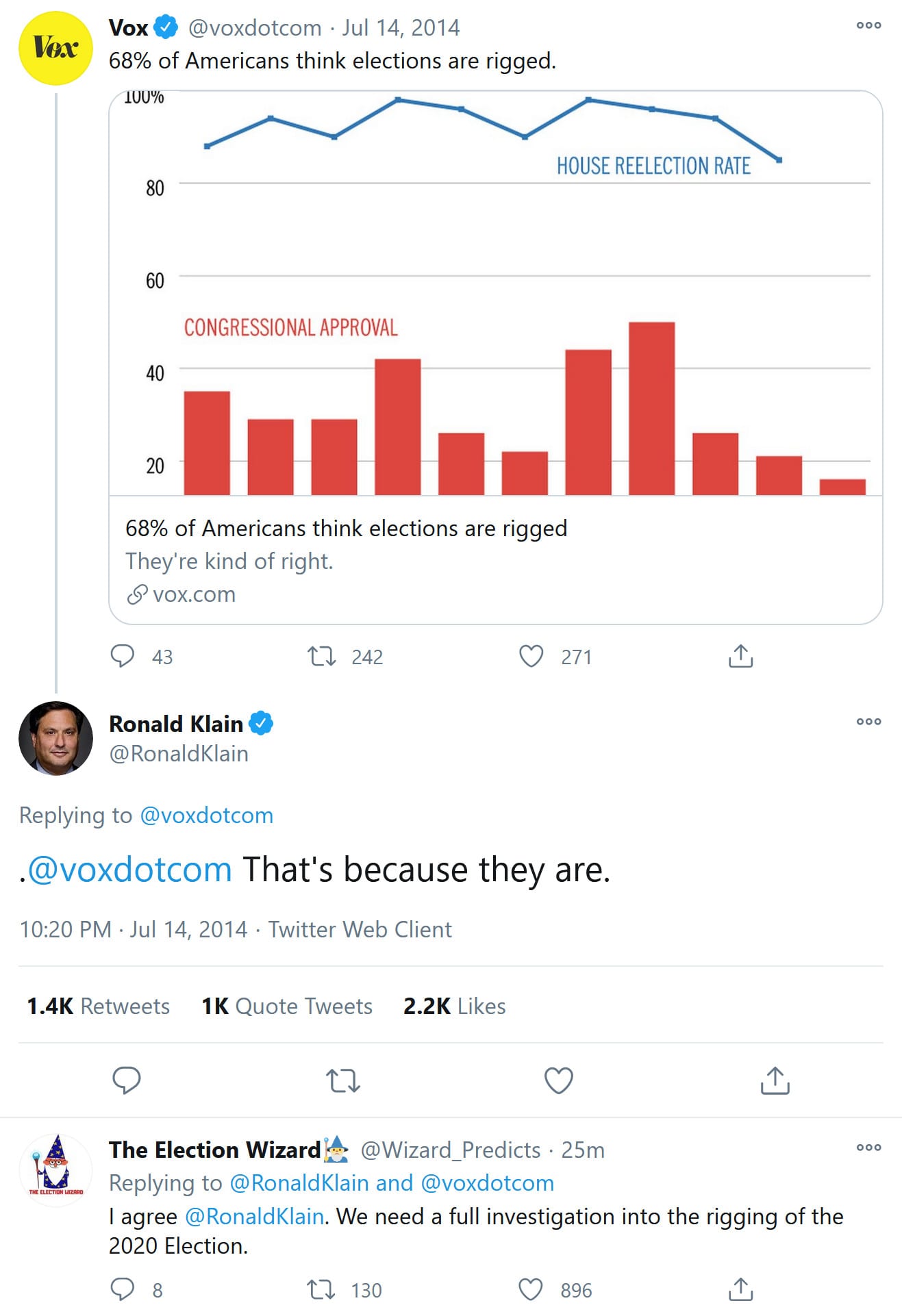
I can’t wait for the explanation for this. Have Joy Reid’s time-traveling hackers struck again?
Joe Biden the Highest Recipient of Pfizer’s Political Donations in 2020
Gpscruisehey Jts5665, go to quora.com and fight back. I did and got banned. I was posting this vid. https://www.youtube.com/watch?v=Be5JCXePth4&t=2s
The post Joe Biden the Highest Recipient of Pfizer’s Political Donations in 2020 appeared first on The Bongino Report.
Science and Technology links (October 31st 2020)
Gpscruiseawesome list!
- Amazon has 1 million employees.
- “The iPhone 12 contains a Lidar. The first 3D Lidar was released a decade ago and cost $75,000.” (Calum Chace)
- There is water on the Moon, possibly enough to make fuel.
- Good looking people have greater social networks and may receive favorable treatment from others, but it is a mixed blessing. They are better supported, but might also be enticed to party more and invest more in sex which takes time away from work.
- It looks like the regular use of skin creams could reduce inflammation in your whole body and thus, possibly, keep you healthier. (speculative)
- You can predict someone’s height within a few centimeters from their genes.
- We found new salivary glands hidden under our skull’s base.
- People are driving forklifts remotely from an office.
- Toronto (the Canadian city) is going to try out automated shuttles.
- Genes may predict mathematical abilities and related brain volume .
- Bees have five eyes.
- In vitro (in laboratory), we have been able to regenerate cartilage. This will not help you in the near future if you have joint pains, but people in the future may fare better.
- As we age, we accumulate senescent cells and they are believed to cause trouble. Senolytics are midly toxic compounds that target senescent cells and destroy them. Researchers found that a particular senolytic proved capable of improving frailty and cognitive functions in old mice. There are ongoing clinical trials regarding senolytic drugs in human beings, but we still have some time to go.
- In A global decline in research productivity? Evidence from China and Germany, the authors verify recent results related the United States pointing that while the number of researchers is steadily increasing, high-value outputs do not seem to increase at a similar rate. One possible implication for these results is that, keeping everything else equal, increasing the number of researchers is wasteful. In fact, it may suggest that we are overesting in the production of new researchers (i.e., we might be training too many PhDs). My own take is that we are insufficiently preoccupied with research productivity. We encourage researchers to write grant applications, publish papers, acquire rents (i.e., patents), but innovation is based on a “throw over the wall” model from the researcher’s point of view. A typical researcher believe that it is not his or her purpose to enhance products, cure diseases and so forth. The simplistic approach of “getting more researchers” may therefore not translate into new innovative products and cancer cures. To get to Mars, we may need more people like Elon Musk and Jeff Bezos, more Moon projects, and fewer new PhDs. Even if you disagree with this last assertion, the fact is that it becomes harder and harder to justify training more PhDs in the hope of getting more prosperity.
Rudy Giuliani's witness who claims he saw voting fraud is a convicted child sex offender
Gpscruisewitness, not jury selection.

Trump refuses to concede…
Breaking — Trump campaign files lawsuit on rejected votes in Arizona…
US election: Being with Trump the day he lost
Gpscruisewait until tomorrow.
Watch Live — Trump Team lawyers hold press conference in Philly…
GpscruiseSo, what you gonna do? They calculated the opportunity and went for it.
$1 billion bitcoin wallet seizure linked to Silk Road…
Gpscruiseat least the coin wont be lost because the FBI will need new Jaguars.
US Election 2020: Donald Trump Jr says dad should 'go to total war'
Gpscruiseat least demand machines that give receipts.

Vote count livestreams are here to stay
Gpscruisedoesnt do any good to prevent fraud. Until the vote machines gives me a receipt, and i can verify it on a website, I wont trust any of this shit. Too much money at stake
As the US election process wore on from Tuesday evening into Wednesday, multiple counties across the country are broadcasting the ballot counting process.
What it is: Given the closeness of the election, it’s not surprising that voters and candidates alike are nervous about how votes are being tallied. So officials across the country have taken a note from Twitch and Instagram by installing a camera in ballot counting rooms and livestreaming the whole thing. The hope is to combat allegations of possible fraud.
What are these livestreams like? Think less Twitch stream, more store surveillance video. The quality is often grainy, the audio is on mute, and the streams are, frankly, quite boring to watch. Many cities have opted for YouTube as their platform. Here’s what it looks like in Los Angeles:
Denver’s camera offers aerial shots of multiple areas:
Not all livestreams are on YouTube. Several municipalities have opted for home surveillance cameras; Arizona’s hotly watched Maricopa County uses Google’s Nest to keep an eye on the counting (you can watch here). Washington’s King County installed cameras not too different from store surveillance equipment (you can watch here). And Union County in New Jersey uses the Angelcam app, a cloud surveillance tool (you can watch here).
Arizona is a peek into the future of livestreaming vote counts. In 2019, Arizona’s state legislature passed a law that required election officials to “provide for a live video recording of the custody of all ballots while the ballots are present in a tabulation room in the counting center.”
Panda cam, this is not. While zoo livestreams have gained popularity as calming, escapist windows of cuteness, there are higher stakes here. Sure, watching election officials sift through and sort ballots might be some people’s definition of “soothing,” but the purpose—being transparent and ensuring the validity and accuracy of election results—is very different, and perhaps more nail-biting than comforting for viewers.
Why is it important? Vote tabulation was rarely considered something the public had to see, but during this year’s contentious election, voters and politicos alike worry about fraud to the extent that the authenticity of every vote and counting process is under scrutiny. (It bears repeating: studies have repeatedly shown that voter fraud is nearly nonexistent.) Election officials are hoping that these livestreams will ensure voter confidence and counter any fraud allegations.
Philadelphia is ground zero for vote livestreaming: In late October, the Trump campaign was shown to be engaging in voter intimidation in the city by videotaping voters as they dropped off their ballots at designated centers. Trump exacerbated the situation by suggesting that “bad things happen” in Philadelphia. The stakes were upped last Wednesday, when the Supreme Court ruled that mail-in ballots would count so long as they were postmarked by Election Day, even if they arrived later. Philadelphia’s role in what’s arguably the most contested state in the country is huge: the city leans Democrat and could push the state’s electoral votes toward Biden. It’s no surprise, then, that Philadelphia became the focus of intense scrutiny.
The Office of Philadelphia’s City Commissioners went on the offense on Tuesday evening:
Philadelphia will NOT stop counting ALL legitimate votes cast by eligible voters. And we will report and report and report until the last vote is counted. See for yourself: https://t.co/El2XfWKxQw
— Commissioner Al Schmidt (@Commish_Schmidt) November 4, 2020
As of publication, the livestream was still going on, with thousands of watchers:
Don’t be surprised if you see vote count livestreams in 2022—and beyond. This year’s election was historic in expanding absentee and mail-in voting options, resulting in record turnout. Even when voters feel it’s safe to vote in person, mail-in and absentee options will probably be here to stay. Livestreams are a cheap, easy way to help fight allegations of voter fraud and might be a first step in ensuring transparent and fair elections, all from the comfort of your couch.