In the same week a team of Russian prank callers duped Secretary of Energy Rick Perry into a conversation about pig poop, a con artist in the UK managed to impersonate top Trump administration officials and trick his "colleagues" into responding to a series of bogus emails, CNN reports.
The self-described "email prankster"—known as @SINON_REBORN on Twitter—masqueraded as Eric Trump, Donald Trump Jr., and Jared Kushner. He even managed to fool ousted communications director Anthony "the Mooch" Scaramucci into responding to a phony email from Reince "Fucking Paranoid Schizophrenic" Priebus.
On Saturday, the Mooch received an email from an account that appeared to belong to Priebus, who'd been forced out as White House chief-of-staff a day earlier. Despite the fact that the email was sent from a mail.com account by the prankster, the Mooch apparently fell for it.
"I had promised myself I would leave my hands mud free, but after reading your tweet today which stated how; 'soon we will learn who in the media who has class, and who hasn't,' has pushed me to this. That tweet was breathtakingly hypocritical, even for you. At no stage have you acted in a way that's even remotely classy, yet you believe that's the standard by which everyone should behave towards you? General Kelly will do a fine job. I'll even admit he will do a better job than me. But the way in which that transition has come about has been diabolical. And hurtful. I don't expect a reply."
But he got one.
"You know what you did," the real Scaramucci wrote. "We all do. Even today. But rest assured we were prepared. A Man would apologize."
Although it's unclear what the hell that means, somehow, the prankster managed to roll with it.
"I can't believe you are questioning my ethics! The so called 'Mooch,' who can't even manage his first week in the White House without leaving upset in his wake. I have nothing to apologize for."
At this point the Mooch apparently got fed up and fired off a final missive in which he basically calls Priebus a cuckold, or maybe a conniver? Who knows.
"Read Shakespeare. Particularly Othello. You are right there," real Mooch wrote. "My family is fine by the way and will thrive. I know what you did. No more replies from me."
White House press secretary Sarah Huckabee Sanders told CNN the White House is aware of the havoc the prankster has wrought and is "looking into these incidents further." The emails only spanned a few days, but SINON_REBORN managed to get a number of replies. He even duped Homeland Security Adviser Tom Bossert—Trump's cyber security official—into handing over his private email address in an exchange he thought he was having with Jared Kushner.
I wonder if he'll be buried in one of those Costco coffins they advertise as you walk out of the store. Its literally the last kiosk you pass. Just so you never forget, as you push your 10,000 rolls of toilet paper and 28 pack of hot dogs out to your car, you are going to die someday. Why not go out Costco style.
The results of the 2017 National Geographic Travel Photographer of the Year Contest are now in, with grand-prize winner Sergio Tapiro Velasco set to receive a 10-day trip for two to the Galápagos Archipelago with National Geographic Expeditions, for his incredible shot of lightning striking the erupting Colima Volcano in Mexico. National Geographic was kind enough to allow me to share the winners and honorable mentions with you here, from three categories: Nature, Cities, and People. The photos and captions were written by the photographers, and lightly edited for style.
Very long ago in December of 2016, Sarah Palin got so excited reading about retired Marine Gen. Jim Mattis, the man who would become our current secretary of Defense, that she shouted “HOOHAH,” which is not the thing Marines yell, but is rather a common term for a lady’s vaginals. In actuality, the Marines yell “OORAH,” because they wisely decided many years ago that yelling “VAGINA!” as they charged into battle would just be weird.
Retired Marine Lt. Col. Amy McGrath, a Democrat from Kentucky, obviously won’t make that common Sarah Palin mistake as she runs for Congress to unseat wingnut GOP dickhead Rep. Andy Barr, a guy who votes with Donald Trump 100% of the time. Is Kentucky’s 6th district doable for the Democrats? Trump only won it by 15 points, so sure, why the fuck not, because badass Democrats should be challenging A-hole Republicans in ALL THE DISTRICTS, KATIE. Besides, Marines have that “Can Do” thing going for them, which should prove helpful in such a race.
McGrath has released a really great ad. It is very PEW PEW! BANG BANG! MARINES! That’s just fine with us because A) McGrath is running in KY-06, which in case you are not up on your geography, is not located in Berkeley, B) she was the first lady Marine to fly an F-18 in combat, so she can do what she wants, and C) PEW PEW! BANG BANG! WE ARE A CORPORATIST HILLARY-MONSTER WAR-MONGER DEMOCRAT!
Just kidding, we are not really a war-monger, but we are a pro-military, national security Democrat, so we like it fine, though your mileage and that of other Wonkette writers and editors AHEM may vary. Regardless of whether you are a #War Democrat or a #GivePeaceAChance Democrat, look at this through the lens of a voter in KY-06, which includes the city of Lexington (which is pretty lib-gay) and Frankfort, the little bitty state capital:
Ret. Lt. Col. Amy McGrath, the 1st female Marine to fly an F-18 in combat, is running against KY GOP Rep. Andy Barr. She’s out w/ a new ad. pic.twitter.com/dIIVDzxbQN
Did you like that ad? Did it make you yell “HOOHAH!” like a common Sarah Palin? WELL STOP IT, because that’s still not what Marines say.
We really like how McGrath pivots from “I AM A BIG BAD GRRRR MARINE WHO BEATED UP AL-QAEDA AND THE TALIBAN” to “I AM A BIG BAD GRRRR MARINE WHO WILL SAVE YOUR HEALTHCARE, UNLIKE THAT PIG TURD ANDY BARR!”
And this last part is fantastic:
This is my new mission. To take on a Congress full of career politicians who treat the people of Kentucky like they’re disposable. Some are telling me a Democrat can’t win that battle in Kentucky. That we can’t take back our country for my kids and yours.
WE’LL SEE ABOUT THAT.
WE’LL SEE ABOUT THAT, is what she just said.
Reckon we will!
Wonkette salaries are fully paid by lovely people like you! If you love us, click below to pay our salaries!
This thoroughly rehabbed one-bedroom unit on Wells Street can be had for $325,000
What does luxury even mean anymore? Is it about being ostentatious? Is it about spending the absolute top dollar on every finish and amenity imaginable just to say you did it? Does it have to be a sprawling penthouse overlooking the city’s skyline? What if it were possible to be luxurious without having to do or be any of the above? This one-bedroom unit at 1636 N. Wells Street proves that you can be really cool and still be really cool on a budget.
Sure, it’s not a huge apartment, but this one-bedroom rehab in a modernist high-rise impresses on many levels. And it’s not just about finishes (can we please hang up the granite countertops already?), this one is about having a cohesive look and feel that works really well for all of the spaces. Just to name a few specs here, we’ve got quartz counters, custom cabinets, dark-stained oak flooring, a boss bathroom, and a sprawling outdoor deck space designed for entertaining—and it all works together.
Considering the amount of look and functionality this one boasts, how much would you expect to pay for this unit? If you guessed $325,000, then you hit this one right on the money. Can you get a larger, more blinged-out pad? Of course you can, but you’d be paying a lot more than $325,000. The work here has been complete and it’s ready for a new owners.
I have a lot of thoughts about this. Reading this took up all of my emotional spoons though. I'll have to think about it some more. But... yeah. I have a lot of thoughts.
Steve Mallen thinks the signs first started to show when his son stopped playing the piano. Edward, then 18, was a gifted musician and had long since passed his Grade 8 exams, a series of advanced piano tests. Playing had been a passion for most of his life. But as adulthood beckoned, the boy had never been busier. He had won a place to study geography at the University of Cambridge and was reviewing hard for his final exams. At his school, Edward was head boy and popular among pupils and teachers. His younger brother and sister idolized him.
“We didn’t attach any particular significance to it,” says Mallen of what he saw as merely a musical pause. “I think we just thought, ‘Well, the poor lad’s been at the piano for years and years. He’s so busy ... ’ But these are the small things—the ripples in the fabric of normal life—that you don’t necessarily notice but which, as I know now, can be very significant.”
Three months after Edward stopped playing, and just two weeks after he handed in an English essay his teacher would later describe as among the best he had read, police knocked at the door of the family home in Meldreth, a village 10 miles south of Cambridge. Steve Mallen was at home, alone. “You become painfully aware that something appalling has happened,” he recalls. “You go through the description, they offer commiserations and a booklet, and then they leave. And that’s it. Suddenly you are staring into the most appalling abyss you can ever imagine.”
The next time Mallen heard his son play the piano, the music filled Holy Trinity Parish Church, a mile from the station where Edward caught the train to school every morning, and where he died by suicide on February 9, 2015. Steve says 500 people came to the funeral. Friends had organized a sound system to play a performance of Edward’s filmed on a mobile phone. “My son played the music at his own funeral,” Mallen says as he remembers that day over a mug of tea in a café in central London. “You couldn’t dream this stuff.”
I first talk to Mallen, who is 52, in November 2016, 21 months to the day since Edward’s death. His hair is white; his blazer, navy. He wears a white shirt and a remembrance poppy. He talks in perfect paragraphs with a default setting of businesslike, but it is clear that the abyss still falls away before him. He says it always will. But life has also become a mission, and in the two years since his son’s death by suicide, Mallen, a commercial property consultant, has become a tireless campaigner, a convener of minds. He has earned the prime minister’s ear and given evidence to health select committees. The study at his home is filled with files and research papers.
“As a father, I had one thing to do and I failed,” he says, his voice faltering for the first time. “My son was dying in front of me and I couldn’t see it, despite my education, despite my devotion as a father ... So you see this is coming from an incredible sense of guilt. I suppose what I’m trying to do is save my boy in retrospect. I stood next to his coffin in the church. It was packed with people—a shattered community—and I made him a public promise. I said that I would investigate what had happened to him and that I would seek reform for him, and on behalf of his generation.
“Quite simply, I’m just a guy honoring a promise to his son. And that’s probably the most powerful motivation that you could imagine, because I’m not about to let him down twice.”
* * *
Edward’s suicide was one of 6,188 recorded in the U.K. in 2015, an average of almost 17 a day, or two every three hours. In the U.K., suicide is the leading cause of death among women under 35 and men under 50. The World Health Organization estimates that 788,000 people died by suicide globally in 2015. Somewhere in the world, someone takes their life every 40 seconds. And despite advances in science and a growing political and popular focus on mental health, recorded suicides in the U.K. have declined only slightly over the past few decades, from 14.7 per 100,000 people 36 years ago to 10.9 in 2015.
A simple belief drives Mallen: that Edward should still be alive, that his death was preventable—at several stages during the rapid onset of his depression. Moreover, Mallen and a growing number of mental health experts believe that this applies to all deaths by suicide. They argue that with a well-funded, better-coordinated strategy that would reform attitudes and approaches in almost every function of society—from schools and hospitals to police stations and the family home—it might be possible to prevent every suicide, or at least to aspire to.
They call it Zero Suicide, a bold ambition and slogan that emerged from a Detroit hospital more than a decade ago, and which is now being incorporated into several National Health Service trusts. Since our first meeting, Mallen has himself embraced the idea, and in May of this year held talks with Mersey Care, one of the specialist mental health trusts already applying a zero strategy. His plans are at an early stage, but he is setting out to create a Zero Suicide foundation. He wants it to identify good practices across the 55 mental health trusts in England and create a new strategy to be applied everywhere.
The zero approach is a proactive strategy that aims to identify and care for all those who may be at risk of suicide, rather than reacting once patients have reached crisis point. It emphasizes strong leadership, improved training, better patient screening and the use of the latest data and research to make changes without fear or delay. It is a joined-up strategy that challenges old ideas about the “inevitability” of suicide, stigma, and the idea that if a reduction target is achieved, the deaths on the way to it are somehow acceptable. “Even if you believe we are never going to eradicate suicide, we must strive toward that,” Mallen says. “If zero isn’t the right target, then what is?”
Zero Suicide is not radical, incorporating as it does several existing prevention strategies. But that it should be seen as new and daringly ambitious reveals much about how slowly attitudes have changed. In The Uses of Literacy: Aspects of Working-Class Life (1957), a semiautobiographical examination of the cultural upheavals of the 1950s, Richard Hoggart recalled his upbringing in Leeds. “Every so often one heard that so-and-so had ‘done ’erself in,’ or ‘done away with ’imself,’ or ‘put ’er ’ead in the gas-oven,’” he wrote. “It did not happen monthly or even every season, and not all attempts succeeded; but it happened sufficiently often to be part of the pattern of life.” He wondered how “suicide could be accepted—pitifully but with little suggestion of blame—as part of the order of existence.”
Hoggart was writing about working-class communities in the north of England, but this sense of expectation and inevitability defined broad societal attitudes to suicide as well. It was also a crime. In 1956, 613 people in England and Wales were prosecuted for attempting to “commit” suicide, 33 of whom were imprisoned. The law only changed in 1961, but the stigma endured; mental health experts and the U.K. helpline Samaritans advise against the use of the term “commit” in relation to suicide, preferring “to die by suicide,” but the word still regularly appears in newspaper headlines. The same voices have strongly opposed the view that suicide is “part of the pattern of life,” ultimately giving rise to the idea that its eradication—or at least a drastic reduction—might be possible.
* * *
Traditionally, suicide has been viewed as a deliberate action, a conscious choice. As a result, mental-health systems have tended to regard at-risk patients in one of two ways. “There were the individuals who are at risk but can’t really be stopped,” says David Covington, a Zero Suicide pioneer based in Phoenix, Arizona. “They’re ‘intent on it’ is the phrase you hear. ‘You can’t stop someone who’s fully intent on killing themselves.’ So there is this strange logic that individuals who die couldn’t be stopped because they weren’t going to seek care and tell us what was going on. And those who do talk to us were seen as somehow manipulative because of their ambivalence. You heard the word ‘gesturing.’ So we have this whole language that seemed to minimize the risk.”
Covington is president and CEO of RI International, a mental-health group based in Phoenix that has more than 50 crisis centers and other programs across the United States, as well as a number in Auckland, New Zealand. A prominent and energetic speaker, he is also president-elect of the board of directors of the American Association of Suicidology, a charitable organization based in Washington, D.C., and leads an international Zero Suicide initiative. When he started in mental health more than 20 years ago, he was dismayed by the gaps in training and thinking he found in the system. Breakthroughs have come only recently, long enough for Covington to have observed and promoted a shift away from a fatalism—and a stigma—that was preventing any progress in reducing death from suicide while we eradicated diseases and tackled other threats, such as road accidents and smoking.
Covington credits a book and a bridge with accelerating that change. In Why People Die by Suicide (2005), Thomas Joiner, a professor of psychology at Florida State University, drew on the testimony of survivors, stacks of research and the loss of his own father to upend minds. He recognized the myriad pressures on a suicidal mind—substance abuse, genetic predisposition to mental illness, poverty—but identified three factors present in all of those most at risk: a genuine belief, however irrational, that they have become a burden to those around them; a sense of isolation; and the ability, which goes against our hard-wired instincts of self-preservation, to hurt oneself (this combines access to a means of suicide with what Joiner describes as a “learned fearlessness”; Covington calls it an “acquired capability”). “[The book] gave an architecture to what was going on that we had not seen before,” Covington says. “It was like a crack through the entire field.”
Then came the bridge—or The Bridge, the 2006 documentary about suicides at the Golden Gate Bridge. A swirl of outrage greeted its release, although anger was generally directed at the filmmaker rather than the toll of death and bereavement at the San Francisco landmark. Its maker Eric Steel also faced accusations of ghoulishness; The Bridge features footage of people falling to their deaths and subsequent interviews with their families. “This could be the most morally loathsome film ever made,” film critic Andrew Pulver wrote in TheGuardian. Yet Steel intended to shock, and to expose an attitude to suicide on the bridge that exemplified society’s. “It hit the public psyche, it challenged core myths in a way that was extremely powerful,” Covington says.
In the 1970s, local newspapers launched countdowns to the 500th death on the bridge since its completion in 1937 (deaths have occurred on average once every two to three weeks). In 1995, a radio DJ promised a case of Snapple to the 1,000th victim’s family. Only when police intervened did official counting cease, at 997.
For decades the bridge’s directors have resisted calls, on financial and aesthetic grounds, for a safety barrier between the pedestrian walkway—which has a low railing—and the water 75 meters below. In 1953, one bridge supervisor argued that it was better that jumpers die there than on a pavement below a tall building. But in 1978, Richard Seiden, then a professor emeritus at the University of California, Berkeley’s School of Public Health, found 515 people who had been stopped from jumping from the Golden Gate Bridge between 1937 and 1971. Ninety-four percent were living or had died of natural causes.
The study, which Covington says was “ignored for 25 years,” suggested what several others have shown: Simply by removing access to danger, and an easy outlet for “learned fearlessness,” simple interventions can dramatically reduce suicide rates. On a bridge that could not be constantly patrolled, it also intensified calls for a safety net. Later, in 2008, the bridge’s board of directors voted in favor of one. Construction began only in May of this year. The steel net, to be placed six meters below the walkway, is due to be completed in 2021. It is designed not to catch people, but to deter them from jumping.
Anthony Gerace / Mosaic Science
Edward Mallen’s own Golden Gate Bridge was the train station he used every day to get to school. His father Steve will never know what went through his mind that day, but those who survive attempts to take their own life—and go on to talk about it—are being embraced in the fight for further understanding. As of 2005, a year before Steel’s documentary came out, only 26 people had lived after hitting the water below the Golden Gate Bridge at 75 mph. Those whose injuries—broken bones, punctured organs—do not kill them on impact typically then drown in pain. Recovered bodies have shown the effects of shark and crab bites.
Kevin Hines was 19 and suffering from severe bipolar disorder when he caught a bus, alone, toward the bridge in September 2000. His family knew that he had been mentally ill, and he was receiving treatment, but the voices in the young man’s head, which often came with hallucinations, willed him to take his life. They told him that he was nothing but a burden to everyone around him, and that if he revealed to anyone the extent of his suffering he would be locked up. “When you self-loathe long enough, and believe the voices, you lose all hope and suicide becomes an option,” Kevin says by phone from his home in Atlanta. “What people in that position can’t recognize is that the voice is nothing but a liar—a false reality created by your brain’s misaligning chemistry ... they believe the people around them don’t have the ability to empathize.”
Kevin was neglected by his birth parents, who had drug and mental health problems. As a newborn, before he was placed into foster care, they left him alone on the concrete floor of a motel in San Francisco and fed him Coke and stolen, sour milk. A landmark 1998 study published in the American Journal of Preventive Medicine, and cited in a report published in March by the Samaritans, showed that people with exposure to four or more “adverse childhood experiences” (known as ACEs, which include physical abuse, violence against the mother, exposure to substance abuse, or the imprisonment of a parent) were 12 times more likely to have made a suicide attempt in their lifetimes.
Kevin’s devoted adoptive parents were aware something was wrong, and helped him get treatment, but Kevin kept everyone in the dark. He told doctors he was following a plan he had not read and that he was taking his medication, which he only took sporadically, often while drinking until he blacked out. “I was a wrestling state champion, a football player, by all accounts doing great on the outside.” By the night before his bus ride, Kevin had suffered days of decline. “That’s when the bridge was the spot I decided on,” he recalls.
Anthony Gerace / Mosaic Science
Kevin rejects the notion that anyone “chooses” to take their own life. “It’s not a choice when a voice in your head, a third party to your own conscience, is literally screaming in your head, ‘You must die, jump now.’” He also challenges the idea that suicide is a selfish act, because to a person in extremis, compelled to believe they are a burden, living can feel like the selfish act. Yet he also remembers feeling how little it would have taken to deter him that morning in 2000. “I had made a pact with myself, and many survivors report this, that if anyone said to me that day, ‘Are you OK?’ or ‘Is something wrong?’ or ‘Can I help you?’—I narrowed it down to those three phrases—I would tell them everything and beg for help.” As he sat on the bus, where he remembers crying, yelling aloud at the voices to stop, nobody said anything. “It still baffles me that human beings can’t see someone like that, wailing in pain, and say something kind—anything,” he says.
As Kevin walked along the bridge and leaned over the rail, he thought help might have arrived when a woman approached him. “But she pulled out a digital camera and asked me to take her picture. She had a German accent. I figured the sun was in her eyes, maybe she didn’t see the tears. So I take this woman’s picture five times, hand her the camera, she thanks me and walks away. At that moment I said, ‘Absolutely nobody cares. Nobody.’ The voice said, ‘Jump now,’ so I did.”
It takes just under five seconds for a person to fall from the Golden Gate Bridge into the water below. “It was instant regret the moment my hand left the rail,” Kevin recalls. “But it was too late.” He opened his eyes deep underwater, his spine broken. “All I wanted to do was survive. I remember thinking, before I broke the surface, I can’t die here. If I do, nobody will know I didn’t want to die, that I’d made a mistake.” Kevin struggled to stay afloat while the coastguard came to his aid. He spent weeks recovering in a psychiatric ward and says it took years to be honest with himself about his mental health. He still works hard to stay stable, and has become a powerful voice in suicide prevention, as a researcher, writer and speaker. “Of the 25 or 26 people who have survived jumping from the Golden Gate Bridge and are still alive, 19 have said they felt instant regret the second their hand left the rail,” he says. “The act of suicide is separate from the thought of suicide.”
Removing the means of suicide has become a growing part of modern prevention strategies, whether or not they come with a “zero” tag. In the early 2000s, the U.K. Department of Health asked the National Confidential Inquiry into Suicide and Homicide by People with Mental Illness, based at the University of Manchester, to recommend a way to reduce suicides in mental health wards. “From our data, we said remove the ligature points that make it possible for people to hang themselves,” recalls Louis Appleby, a professor of psychiatry and the director of the inquiry. He also leads the National Suicide Prevention Strategy for England.
By 2002, wards were required to remove non-collapsible curtain rails in bathrooms and around beds. A later study by Appleby’s team, published in 2012, showed that inpatient suicide cases by hanging on the ward in England and Wales fell from 57 in 1999 to 15 in 2007. “There was also a broader effect, because mental health wards seem to have got safer more generally as the issue of safety became more prominent,” Appleby says. Outside hospitals, measures that have reduced suicide by specific methods, whether or not that was the intention, have included legislation to reduce the size of paracetamol packages (intended) and the conversion of coal-gas ovens to natural gas in the 1950s (unintended).
* * *
Edward Mallen and Kevin Hines had some things in common; they were young men suffering from severe mental illness. But while Kevin identifies his traumatic first months as a cause, Edward had no adverse childhood experiences. His father is not aware of a history of depression in his family, but can only surmise that genetic flaws created the fatal cocktail of chemicals that compelled him to end his life. Research in this field is evolving. Last year, scientists at Massachusetts General Hospital identified 17 genetic variations that appeared to increase the risk of depression, in an analysis of DNA data from more than 300,000 people, published in Nature Genetics. “There are vulnerability factors we all have and part of them are genetically influenced,” says Rory O’Connor, a professor of psychology at the University of Glasgow, where he leads the Suicidal Behavior Research Laboratory.
More significantly, Kevin and Edward both attempted suicide while seeking treatment for mental illness. According to the National Confidential Inquiry into Suicide and Homicide by People with Mental Illness, just over a quarter of suicide victims have had contact with mental health services in the preceding 12 months. Soon after the piano playing stopped, it became clear Edward was not well. Mallen remembers his son withdrawing. He became pale and looked unwell. He told his mother, Suzanne, that he was down, but never revealed to his parents he felt suicidal. Two weeks before his death, Edward saw his family’s general practitioner, who immediately referred him to an NHS crisis intervention team, recommending he be assessed within 24 hours. But when a triage mental health nurse with limited experience spoke to Edward, he downgraded the risk and recommended a five-day wait. Moreover, while Edward had turned 18 less than two months before his death, he had given permission for his parents to be told about his suicidal thoughts. They never were.
After an inquest in June last year, Cambridgeshire and Peterborough NHS Foundation Trust said in a statement that “while there are elements in what occurred that may well not have been foreseeable there were also things the Trust could have done better. The Trust has held an internal inquiry and also commissioned an independent report and it is implementing [their] recommendations.”
Mallen describes in an email his son’s case as “a haphazard fiasco of confused process, unclear responsibilities and tortuous post-tragedy contention which greatly deepened a family’s distress,” adding: “The real concern here is that this was not an isolated incident.”
The Zero Suicide approach started as an attempt to reduce deaths in mental health systems. At a meeting in 2001 at the Henry Ford Health System, which manages hospitals, clinics and emergency rooms across Detroit, Ed Coffey, then the CEO of its Behavioral Health Services, remembers discussing Crossing the Quality Chasm, a report published that year by the Institute of Medicine (now the National Academy of Medicine) that called for sweeping healthcare reforms. The report had triggered a debate about the idea of “perfect care,” and Coffey wondered what that might mean for mental health. “I remember a nurse raising her hand and saying, ‘Well, perhaps if we were providing perfect depression care, none of our patients would commit suicide,’” Coffey has said. (Coffey, who is now president and CEO of the Menninger Clinic, a psychiatric hospital in Houston, Texas, did not respond to requests for interview.)
Coffey took that as a challenge and set about reforming the Henry Ford Health System’s own approach with a new, Zero Suicide goal in mind. The initiative involved improvements in access to care and restrictions in access to the means of suicide. Any patient with a mental illness was treated as a suicide risk and asked two questions at every visit: “How often have you felt down in the past two weeks?” and “How often have you felt little pleasure in doing things?” High scores triggered new questions about sleep deprivation, appetite loss and thoughts about self-harm. Screenings would create personal care and safety plans and involve a patient’s family. Every death would be studied as a “learning opportunity.”
What caught global attention were the results that the Henry Ford system reported. In 1999, its annual suicide rate for mental health patients stood at 110 per 100,000. In the following 11 years, there were 160 suicides, but the average rate fell to 36 per 100,000. And in 2009, for the first time, there were zero suicides among patients. The stats were startling. But the strategy also faced criticism, partly in the way staff felt it made medical professionals hostages to fortune, with many already operating in a culture of blame. Louis Appleby also points out a lack of hard evidence to back up the strategy. But he does believe in its power to raise the profile of suicide prevention and compel mental health authorities to consider their own practices. At Magellan Health Services in Arizona, where Covington was an early adopter of Zero Suicide before moving to RI International, the network has reported a 50 percent fall in the suicide rate in the past 10 years. “We had an enormous pushback in our community and healthcare providers to get started,” he admits. “But as soon as the resistance gave way, ‘zero’ goes into the brain ... Once that seed plants, people get really excited.”
* * *
In 2013, Ed Coffey visited Mersey Care—which employs more than 5,000 people and serves more than 10 million across North West England—to talk about suicide prevention. In 2015, the trust, which sees more than 40,000 patients a year, became the first in the U.K. to adopt a Zero Suicide policy, which it ratified last year, committing to eliminating suicide from within its care by 2020. In a nondescript office at the trust’s headquarters at a business park in east Liverpool, I meet Jane Boland, a health administrator and Mersey Care’s suicide prevention clinical lead. When she started as a mental health clinician 18 years ago, she says suicide training did not exist. “We weren’t taught how to speak to someone who is suicidal,” she recalls. “It was talked about as an occupational hazard, an inevitability.” As part of Mersey Care’s new policy, Boland is responsible for delivering training to all the trust’s staff, from senior clinicians to receptionists and cleaners. “And these 5,000 people don’t exist in isolation,” she says. “They’re out in the city, on trains, noticing when people aren’t feeling great.”
The training begins with an online course designed to help staff look out for signs of distress. It also challenges the inevitability and selfishness myths around suicide. Boland gives talks too, and invites people who have been affected by suicide to share their experiences. She has even persuaded her own husband to talk about the death by suicide of his sister when he was 16 and she was 21. “He’d talked to me about it, but I hadn’t realized I was one of about four people he’d ever told,” Boland says. “Now he tells hundreds of people that there’s not a day goes by that he doesn’t think about this sister, and you can hear a pin drop.”
Anthony Gerace / Mosaic Science
Mersey Care’s plan also includes easier access to crisis care, better safety plans for each patient and swifter investigations after deaths or suicide attempts, with a focus on learning rather than blame. Joe Rafferty, the trust’s chief executive, told me in May this year that it is too soon for the policy to have shown an effect on its suicide rates, which are 5.5 per 100,000 patient contacts (Rafferty says this equates to a death per fortnight on average, and places Mersey Care in the lowest 20 percent of mental health trusts).
“But the big win has been around culture and attitude,” he says. “Even two years ago I’d talk to senior colleagues about suicide and the conversation would finish with, ‘Don’t worry, we’re in the lowest quintile’ or ‘We benchmark very favorably’ ... The biggest change has been moving to an absolute view that the benchmark should be zero.”
Rafferty sees the Zero Suicide foundation he has discussed with Steve Mallen as a way to spread this thinking to other trusts, and to any organization that might be willing to change. Mersey Care is already trying to reach some of the 70 percent of suicide victims who do not have contact with mental health services in the year before they die. Boland works with local authorities and has delivered suicide training to Job Center staff in Liverpool. The trust is in talks about delivering training to taxi drivers and barbers.
Versions of a Zero Suicide strategy have also been adopted by NHS clinical networks covering large areas of the southwest and the east of England. The spread of the approach coincides with belated political focus on suicide. In January 2015, Nick Clegg, then the deputy prime minister, launched a new mental health initiative and called on the NHS to adopt a Zero Suicide campaign. Earlier this year, the health select committee welcomed the Zero Suicide pilots, but noted that the strategy had not been more widely adopted, while outcomes were still to be evaluated. The most recent Conservative manifesto made no mention of suicide, but reaffirmed government commitment to improving mental health care. The current government target, set by the independent Mental Health Taskforce, is a modest reduction of 10 percent by 2020. Meanwhile, mental health advocates are pushing hard for better funding for mental health research, which remains a fraction of that devoted to physical health conditions such as cancer.
* * *
As a businessman, Steve Mallen finds it hard to understand why, if not the moral case for suicide prevention alone, the economic case has not brought about more rapid change.
“We’re losing so many people who would have gone on to contribute to society,” Mallen says. He wants a new focus on earlier intervention, in schools and homes and general practitioners’ offices, to identify problems before they lead to crisis, and improvements in mental health literacy. “Edward existed in a family, in a friendship group, at a sixth-form college and nobody picked up what was happening to him,” he says. “Yet in retrospect when I think back, the signs were there.”
Edward’s death devastated his family. “He was empathetic, sharing, nurturing,” Mallen says, preferring not to name his other two children, who are themselves now approaching adulthood. “We never had a lot of squabbling. He also kept me and Suzanne in check. He was wise beyond his years. Losing any member of a family is difficult, but it’s like the heart has been ripped out of the middle of ours and that has made it practically impossible.”
Mallen, in common with the mental health experts I speak to, does not believe total eradication is possible. Suicide will always be more complicated than polio. But no one doubts that huge reductions can—and must—be made, and there is a growing body of evidence to show how. If there is one thing he could change first, it would be continuing shifts in attitudes.
“Why didn’t my son ask for help?” he says as he heads to the station for the train home to Cambridge. “If my son had been taught about mental health in the same way he was taught about diet, citizenship, physical health, he would have understood that it’s okay to feel shit. But despite his brilliance, he didn’t have the education to help him come forward. At the start of that eight-week period when he stopped playing the piano, he would have said, ‘Dad, I think I might need some help.’ And we’d have got him help.”
I love it but I cannot get over the blown foam ceilings. Had those growing up and hated them.
The Glenbrook Valley, Houston, home has only had three owners
Have a nomination for a jaw-dropping listing that would make a mighty fine House of the Day? Get thee to the tipline and send us your suggestions. We'd love to see what you've got.
Location: Houston, Texas
Price: $425,000
A wonderfully maintained, oft-photographed midcentury modern home has come on the market in the historic Glenbrook Valley district in Houston, Texas. Designed by Doughtie and Porterfield and completed in 1955, the three-bedroom-three bath boasts a wealth of original elements as well as period-appropriate updates throughout.
The mod house begins with the original front door and sconce leading to a foyer that immediately opens onto a sunken living room with a brick accent wall, sloping ceiling, and a band of redwood running horizontally along the wall. A slatted room divider separates this space from the formal dining room two steps up, where a mirrored wall and floor-to-ceiling windows keep it bright.
Moving back toward the entrance again is the second, larger living area, directly across from the first. Here, a brick fireplace anchors the space, where the ceilings are vaulted and beamed, and a wall of sliding glass doors opens onto the brick patio. This space flows into the renovated avocado green kitchen with suspended cabinets and original Thermador ovens.
As for the private quarters, the cool master bedroom features clerestory windows and a beam running through it and out, a wrap-around brick accent wall, sliders opening onto a terrace, and an ensuite bathroom with original pink tiling, yellow boomerang formica vanity, and period hardware. The other two bedrooms come with original wood closet doors, while another of the bathrooms is characterized by pink and black tiling.
Still, there’s more. A party room dubbed the Kit Kat was built in 1960 and becomes the home’s de facto hangout. It goes without saying that there’s a wet bar and a vintage sound system. Walls are paneled or otherwise papered in textured fabric, and this part of the house—and only this part of the house—comes furnished with the original furniture. Oh, and did we mention that there’s a built-in projector and a concealed movie screen? And a tiny room behind the bar, plus a half-bath down here?
If all that wasn’t enough, the 3,419-square-foot dwelling includes lovely outdoor spaces like the aforementioned brick patio and a bedecked garden terrace. Located at 7911 Santa Elena Street, the property, which has only had three owners since 1955, is offered at $425,000.
LONG POND, PA—Hunching over the steering wheel of his idling No. 88 Chevrolet SS to closely inspect the odometer, NASCAR driver Dale Earnhardt Jr. was reportedly in the process of submitting paperwork Monday to reimburse his gas expenses for the month. “Let’s see, how many miles was that Saturday?” Earnhardt reportedly said to himself before jotting down the mileage total, his full legal name, and the date of his 2017 Overton’s 400 race onto a form titled “2017 Driver Reimbursement Requests,” before rifling through his glove compartment to find a missing gas receipt from a race earlier in the month. “Jesus, this whole thing is always such a fucking hassle, and of course H.R. is going to send this right back to me because I filled out something wrong, like they always do. I’m still owed like 10 grand from the 2016 Sprint Cup Series, for Christ’s sake.” At press time, Earnhardt was reportedly explaining to Overton 400 winner Kyle Busch that the NOS energy drink he sprayed everywhere following his victory can count as a meal reimbursement.
Torneo Chileno, los jugadores de Colo Colo salen a la cancha con perros que buscan ser adoptados. Enormes acciones para imitar ❤️ pic.twitter.com/Svz6uEKoFf
On Sunday, Chilean club Colo-Colo held a soccer game and invited some furry friends. Before the game, they brought along some good dogs who are looking to be adopted, as part as the club’s partnership with Union de Amigos de los Animales.
Some of the dogs were on leashes while others were carried to the pitch by the players.
via Colo-Colo’s Facebook
The dog up front looks like its having the time of its life walking on the grass. The one walking behind looks a bit confused but is still super cute.
This is great for everyone involved. Not only do fans get to watch a soccer game but they also have a pup parade to look forward to. Plus, you could adopt one of these adorable dogs. Win-win.
Antofagasta vs. Colo-Colo ended in a 0-0 tie. Still, the good dogs probably had a great time at the game and we hope a few of them went home with a new human.
the only reason they won't hire him is racism. plain and simple.
Kaepernick is the only player in the top 50 for merchandise sales who isn’t on a roster.
There are 1,696 players on active NFL rosters each season. The way things are going, Colin Kaepernick may not be one of them this year, but that hasn’t stopped people from buying his merchandise. Kaepernick is ranked No. 39 on the NFLPA’s official NFL merchandise Top 50 list, according to Good Morning Football’s Peter Schrager.
The most common working theory for Kaepernick’s continued unemployment is that he’s being blackballed by owners who fear a negative fan response to his national anthem protests. Giants owner John Mara, who was slow to cut kicker Josh Brown despite a known history of domestic violence, claimed there was an outpouring of fan anger about last year’s national anthem protests like he had never seen.
“All my years being in the league, I never received more emotional mail from people than I did about that issue,” Mara said, via the MMQB. “If any of your players ever do that, we are never coming to another Giants game. It wasn’t one or two letters. It was a lot.”
But there are reasons to believe that the owners’ fear of a negative fan response is irrational, starting with Kaepernick’s merchandise sales.
There’s also the J.D. Power 2017 Fan Experience Survey, which comes out later this month. Of 9,200 people who participated in the survey, only 3 percent said national anthem protests were a reason they watched fewer NFL games last season. Other reasons included (ahem, John Mara) the league’s poor handling of domestic violence issues, game delays, and election coverage.
There are plenty of other theories on why Kaepernick isn’t on a roster right now. Some people think it’s his vegan diet, or maybe his work in the community keeps him from being focused on football. Michael Vick said Kaepernick’s hair may be holding him back.
But we all know the reason. Kaepernick chose to use his platform to protest the oppression of minorities in America. He did it in a peaceful way, and he backed up his protest by dedicating tireless work and hundreds of thousands of dollars so far to various community initiatives.
Kaepernick has said that he won’t continue his national anthem protest this year. And he’s working with a trainer to make sure he’s in game shape. He has more experience and has achieved more in this league than quarterbacks like Josh McCown, Brian Hoyer, and Nick Foles, who are all on rosters right now.
The fear of fan backlash is a flimsy excuse. Kaepernick’s officially licensed merchandise sales demonstrate that he has plenty of fan support.
On Sunday in Milwaukee at a Cubs-Brewers game, New Jersey governor Chris Christie confronted a Cubs fan like a stern father trying to make a teachable moment out of a situation.
We don’t know what the Cubs fan said. Probably something very smart ass, but who knows. We also don’t know what Christie said to the Cubs fan. We can hear him say, ‘You’re a big shot,” but that’s about it.
My analysis is this. Christie is a professional when it comes to holding nachos to ensure minimal risk of spillage or at getting stains on his shirt. This is something that takes years of experience. Also, Christie wears his slacks ridiculously high.
Have a nomination for a jaw-dropping listing that would make a mighty fine House of the Day? Get thee to the tipline and send us your suggestions. We'd love to see what you've got.
Location: Nine Mile Falls, Washington
Price: $675,000
A well-maintained midcentury modern home on ten acres of lakefront land in Nine Mile Falls, Washington, has come on the market, with many original details still intact. Designed in 1962 by Spokane architect Moritz Kundig (father of Tom Kundig of Seattle firm Olson Kundig), the Wallmark House has been in the same family since its construction.
The nearly 4,000-square-foot home boasts many elements from the era, including a broad, shallow-pitched roof with overhanging eaves, glass expanses, open living spaces, and the use of natural materials.
The open-plan great room is the highlight of the heritage-listed home, with terrazzo floors, a massive stone fireplace, beamed and paneled ceilings, and floor-to-ceiling windows facing lake views. On the opposite side of the double-sided hearth is a smaller family room.
A built-in shelving unit separates the living room from a large kitchen featuring original custom wood cabinetry. And on the other side of that is a skylit solarium with brick flooring, a wood-burning stove, and large windows. As for private quarters, there are three bedrooms and two baths.
Outside, a huge deck takes in gorgeous views of Long Lake, where the house enjoys over 700 feet of water frontage. Located at 14701 North Oxford Street, the historic property is offered at $675,000.
Tomi Lahren is proof that if you're white and traditionally pretty you can pretty much get away with literally ANYTHING despite being a COMPLETE IDIOT
Making fun of Tomi Lahren has become so easy, we’re starting to feel like this is some elaborate trap. Like she’s the carrot at the end of a stick that goes all the way to the top of American life, keeping us distracted and smug and tweeting nail-polish emojis while oligarchs strip-mine our political system for profit. Or maybe she just never bothered to look into what the Affordable Care Act, a.k.a. The Dread Pirate Obamacare, actually says, and has no idea that, without the bill’s provision requiring insurance providers to allow kids to stay on their parents’ health insurance until age 26, her ass would have lost her healthcare along with her job at The Blaze.
But then again, why should we be surprised at the staggering sense of entitlement behind Lahren—who weaseled her way onto the public stage by telling campfire tales ...
When my middle brother was 7, he was adorable. I mean like, child movie star adorable. And so my parents would send him to auditions and his "big break" was a national commercial for Stove Top Stuffing. He was in a commercial where he played a little brother discussing with his big brother about how mom made potatoes instead of Stove Top Stuffing, and they speculated that maybe mom was actually an alien. And in the commercial the "mom" turned into an "alien" to give you a visual of what was being adorably imagined in these Stove Top-cravin' kids heads. It was an adorable commercial, and successful enough that it helped pay for all 5 of us kids to go to college (not full tuition or anything, but def a couple grand toward it fo sho.) He was so cute in that commercial, too. The best was at the end they show that mom DID make Stove Top, and the cameras did a close-up on his cherubic face and he goes "MOM, ITS YOU!" and his eyes light up and you really believe that wow, this lil kid is just so happy mom is real. 30 seconds, from tragedy to comedy to ecstatic relief... his babyface told it all. You believed him. You loved him. And you bought Stove Top Stuffing.
Why do I tell this story? Because my brother, as adorable as he is, didn't actually in real life think people turned into aliens because they wouldn't cook Stove Top Stuffing for dinner. He was an actor. A paid actor.
What I'm saying is, there is a greater-than-zero chance that adorable lil Dylan "Pickle" here is as real as my brother was when he just wanted some high sodium, chicken-flavored wet bread with his dinner.
As improbable as it may seem, Dylan, aka “Pickle,” the nine-year-old boy who wrote a love letter to Donald Trump, is not Donald Trump in disguise. Pickle is real, according to TheWashington Post, who tracked down Dylan and his mother, SueAnn, via Facebook.
Small rooms but I kinda love how they've styled all of them
Here’s a rare opportunity along Lakeview’s most popular shopping corridor
If you’re a die-hard Lakeview lover and have a stash of cash squirreled away, here’s one that you might be interested in. Here’s an old three-flat in the heart of the popular Southport Corridor that features two retail spaces and a residential units. This is not your most typical real estate listing, but for the right buyer, this could be an excellent investment opportunity.
The building is currently home to Que Syrah Fine Wines on the first level and Stella Blue Design in the undergrade level. And on the third floor is a nicely finished three-bedroom apartment with a large outdoor deck. There’s a lot to like about this listing, and for those who have a passion for their neighborhood, it’s an opportunity to become more involved in the Southport Corridor as a retail landlord.
This lovely building, which is located almost directly across the street from Chicago’s beloved Music Box Theater, can be had for $1.2 million.
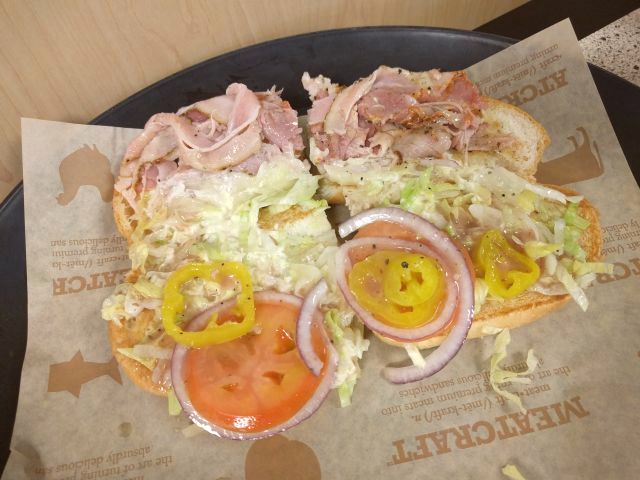
Arby's Smoked Italian Porchetta Sandwich features sliced smoked pork loin porchetta, banana peppers, Italian seasoning, red onion, tomato, lettuce, smoked provolone, a red wine vinaigrette, and garlic aioli, on a toasted Italian roll.
I picked one up for $5.99.
There was a fairly generous amount of porchetta in my sandwich for the most part, but it was spread a little unevenly. The meat was sliced thicker than is typical for Arby's (especially compared to the paper-thinness of their roast beef) and gave the porchetta a more textured, satisfying mouth feel (which is to say it felt more like eating a cut of meat and less like chopped ham or a thin-sliced hot dog).
Taste-wise, the porchetta delivered a very enjoyable seasoned and porky flavor that stood out well against the other ingredients in the sandwich. The Italian seasoning added a slight herbiness.
The cheese was nicely melted but otherwise just disappeared into the sandwich.
The veggies were fresh with the banana peppers standing out with the occasional burst of tanginess, while the onion and lettuce provided a light crispness. They were a bit stingy with the tomato and onions though. I got two small slices of tomato and, maybe, two strands and two rings of onion.
Between the veggies, the garlic aioli, and red wine vinaigrette, my particular sandwich was a tad on the wet side. Not so much that the bread was soggy but it made for some pretty messy eating. I don't recommend eating it in your car.
The bread was soft, chewy, and resilient. It could have stood to have a bit more toasting.
When it comes down to it, Arby's Smoked Italian Porchetta Sandwich made for a tasty eating experience largely on the strength of the porchetta itself. It would probably be better with a bit more onion and tomato and a lot less vinaigrette though (although that probably varies from location to location).
My husband works for Redfin and says this: "100% yes. Appraisals, 100% yes. Inspections, never, but appraisals are already a joke."
A developer has filed a zoning application for a new four-story medical office building at Webster and Lister
A trapezoidal lot near the Kennedy Expressway along the western edge of Lincoln Park is being eyed as the future site of a four-story office development. Located at 1842-58 W. Webster Avenue, the nearly 52,000-square-foot site is currently occupied by a single-story structure and parking lot previously used to administer vehicle emissions tests. The facility was closed by the State of Illinois in November of last year and has sat vacant since.
According to paperwork filed with the City of Chicago, developer Warren Baker is applying to change the current zoning from M3-3 Heavy Industrial to C2-5 Commercial District. Architecture firm Solomon Cordwell Buenz (SCB) has been selected to design the 100,000 plus square foot building which will include medical offices and parking for 185 motor vehicles and 50 bicycles. Baker previously teamed up with the Chicago-based architect on the 191-unit Elevate Lincoln Park apartment development currently under construction at 2518-2549 N. Lincoln Avenue.
“Our research tells us that medical use [in this area] is underserved,” Baker told Crain’searlier this week. With the Chicago City Council passing legislation to open up the nearby North Branch Industrial Corridor to new mixed-use development—including thousands of new residences—demand for medical-related services is only expected to grow moving forward.
I kind of like to think whoever wrote this had a full blown mental breakdown at the end there, because that's where we're at these days
:(
Poor, poor Donald Trump. Russia elected him president (ALLEGEDLY) and they wined and dined him and bought him a pair of their finest Russian pee hookers (ALLEGEDLY) to make sure he would be sweet to them and pursue a “Russia First” foreign policy (what do you think #MAGA stands for in Russian, HUH?), and now the mean and unfair United States Congress has pushed him up against a wall and trapped him in a headlock and even Republican senators and congressmen are fixin’ to slam his dick in one of the gold-plated sliding doors of Mar-a-Lago. You see, Congress reached an agreement Wednesday night to levy a shitload of new sanctions on Russia (and Iran and North Korea). That is not what Trump’s real dad Vladimir Putin requested! That is not why that Russian lady lawyer lollygagged around Trump Junior’s office last year, promising dirty nasty Hillary Clinton dirt and MAYBE IF HE’S GOOD, he can touch her boob (ALLEGEDLY, okay, nobody actually alleged that), as long as his Daddy lifts all the sanctions when he becomes president!
As CNN explains, the agreement between the House and the Senate (which hit some snags but Senator Bob Corker #FixedIt) “rebukes Trump by giving Congress newfound veto power over any administration attempt to remove sanctions on Moscow.” In the House, it passed 419-3. In the Senate, it was 98-2. The agreement increases sanctions on Russia over its extracurricular activities in Ukraine and Syria, and OH YEAH, that little matter of how Russia stuck its foul, unwashed dick in the U.S. American election last year.
Obviously those are veto-proof majorities. So of course, precious and brand new White House Comms Director Anthony Scaramucci told CNN that maybe Trump will veto it:
Anthony Scaramucci, White House communications director, said on CNN that Trump “may sign the sanctions exactly the way they are, or he may veto the sanctions and negotiate an even tougher deal against the Russians,” citing Trump’s “counterintuitive, counterpunching personality” to explain why the president is considering a veto.
Hahahahahahaha OK, babydoll! It’s definitely because he’s a TOUGH COUNTERPUNCHER and not because he wants to be able to call Daddy Putin and say he TRIED to stop the sanctions, and please please please please pretty please do not upload “Donald Trump (ALLEGEDLY!) Frolicks In The Yellow Russian Snow” on to XTube, PLEEEEASE?
The European Union is kinda pissed at Congress for passing this bill, not because they are gay for Putin like Trump is, but because Russia is literally in their backyard and supplies a lot of their energy needs and they’re worried the sanctions could end up hurting their own wallets. We think the EU needs to STFU, but at the same time we understand they might have to deal with Russia a hair differently from how we do over here in the good old US and A.
Meanwhile, Russia is OBVIOUSLY pissed off and making its own threats to retaliate. What are they going to do, stop importing their luxurious Russian cars and home electronics to America? HAHA JUST KIDDING Russia is a worthless shell of a country that doesn’t make anything the United States wants. One Russian senator, Alexei Pushkov, tweeted some malarkey about how Trump is a “prisoner of Congress and anti-Russian hysteria” (that’s right, fuckhead!), and added that Russian McDonald’s locations are not a “sacred cow,” which is weird, because we were pretty sure Russians worshiped our American McRib sandwiches each and every day.
So anyway.
Hey Trump. Whatcha gonna do? Whatcha gonna do, Trump? Hey Trump! Trump! Gonna veto it? Gonna pull out the pen you stoled from the G20 because Vladimir Putin breathed on it and misspell “VETO” on the bill? Gonna spell it with two E’s? Gonna squirm around in your President Chair a little bit because you don’t know where the cameras are, but you know Putin’s watching you right now to see what you’re gonna do? Whatcha gonna do? You gonna pussy out? Gonna pussy out? Gonna pussy out? Gonna pussy out? Gonna sign the bill? Gonna veto it? Whatcha gonna do, big president man? Who’s your daddy, Donald? WHO’S YOUR DADDY? WHERE’S YOUR GOD NOW?
WHERE’S
YOUR
GOD
NOW?
Wonkette salaries are fully funded by readers like you! If you love us, click below to fund us!
The Chicago Bungalow Association is offering cash prizes to homeowners with the best gardens
What’s better than a classic Chicago-style bungalow? A classic Chicago-style bungalow with a gorgeous garden, that’s what. This week, the Chicago Bungalow Association is hosting its first-ever Bungalow Garden Contest and will be offering cash prizes to winners. Association members are competing in three different categories, including best front garden, best rear or side garden, and the best window planter boxes. Old masonry bungalows in Chicago were often built with large concrete or limestone slabs specifically for window planters, and the Chicago Bungalow Association is encouraging homeowners to use them.
Dozens of homeowners are competing in this year’s contest, but only one can win each category. Winners will be each be rewarded with a $250 cash prize. Voting ends tomorrow at noon and winners will be announced at noon on Monday. According to the Chicago Bungalow Association, 4,000 votes have already been cast—but now it’s time to add yours.
ANCHORAGE, Alaska (AP) — A Utah man killed his wife aboard an Alaska cruise and told an acquaintance who later walked into the blood-splattered cabin that he did it because she would not stop laughing at him, the FBI said in documents released Thursday.
These winged critters have never had such luxe accommodations
Hate mosquitoes? A new company wants to help you eliminate the pesky pests by taking in a few new bug-hungry tenants: bats! BatBnB is a line of designer accommodations for bats, offering the first good-looking bat boxes we’ve ever seen.
Made of sustainably sourced, rot-resistant cedar, the four bat box models feature clean lines and angular edges, making them look like a cross between a modern art piece and a skinny bee hive. They’re easily attachable to the side of a house, barn, or tree.
But most importantly, each BatBnB was designed to provide an ideal home for the furry fliers. Creators Harrison Broadhurst and Christoper Rännefors ensured that the boxes had features like grip pads, good ventilation, and appropriate spacing between interior panels. The design is so good, in fact, it’s been endorsed by the director of the Organization for Bat Conservation, Rob Mies, whom Inhabitat dubbed “Beyonce of the bat world.”
Broadhurst and Rännefors founded the bat-friendly startup because of concerns over the spread of the Zika virus and an awareness that chemicals used to kill mosquitoes can also poison local wildlife. But the average bat can eat thousands of insects in a single night.
“We think there's a demand in the market for more effective natural solutions for pest control, and luckily enough, we know a thing or two about bats,” Broadhurst and Rännefors write on their site.
Corey and Erin were at this show. It sounds like it was magic.
Summer is concert season, and these past few months have brought out a variety of outfits that all fall on the scale somewhere between reinvention and nostalgia. I have been on a bit of a tear this summer, kicking off with the Hall & Oates/Tears For Fears double bill, bookending that with Violent Femmes/Echo And The Bunnymen double-play only last Sunday. In between, there have been some crazy anomalies, like when I saw Elvis Costello, Nick Cave, and Robyn Hitchcock at separate shows in a single week.
Obviously, there have been varying degrees of success throughout, especially for these bands and performers who have been touring for decades now. Nick Cave was probably the most transformative, somehow channeling his grief over the recent death of his son into a show that I can only describe as a religious experience, becoming a death-defying manic preacher leading a besotted crowd ...
That's a lot of jobs. Wonder if Trump will tweet about it, since he's been on a real mission to link Jeff Bezos --> Amazon --> Washington Post
The e-commerce behemoth Amazon is so keen to fill 50,000 open jobs that it’s holding a series of job fairs across the country. Most of those jobs are in its warehouses and sortation centers, and the problem Amazon is encountering is that the labor market for people who work in warehouses is becoming very competitive.
At the beginning this year, Amazon announced plans to hire more than 100,000 people in the United States, with a target date of a year from now. Out of the 50,000 jobs that it’s looking to fill now, 40,000 of them are in warehouses, choosing and packing your orders with the help of shelves mounted on very graceful robots. Most of the rest are part-time jobs in the company’s sortation centers.
“The workers that used to work in the retail stores, now we need those same workers in warehouses,” Brian Devine of ProLogistix, a staffing company in the logistics business, told the WSJ.
Now unemployment rates are plummeting near those warehouses, and the industry is starting to worry about finding enough workers to keep the places going once the holiday shopping season begins.


/cdn.vox-cdn.com/uploads/chorus_asset/file/8974305/1636_wells_2.jpg)
/cdn.vox-cdn.com/uploads/chorus_asset/file/8974307/1636_wells_1.jpg)
/cdn.vox-cdn.com/uploads/chorus_asset/file/8974313/1636_wells_4.jpg)
/cdn.vox-cdn.com/uploads/chorus_asset/file/8974315/1636_wells_5.jpg)
/cdn.vox-cdn.com/uploads/chorus_asset/file/8974319/1636_wells_6.jpg)
/cdn.vox-cdn.com/uploads/chorus_asset/file/8974321/1636_wells_7.jpg)
/cdn.vox-cdn.com/uploads/chorus_asset/file/8974329/1636_wells_14.jpg)
/cdn.vox-cdn.com/uploads/chorus_asset/file/8974327/1636_N_Wells_St__40315.jpg)
/cdn.vox-cdn.com/uploads/chorus_asset/file/8974331/1636_wells_8.jpg)
/cdn.vox-cdn.com/uploads/chorus_asset/file/8974333/1636_wells_9.jpg)
/cdn.vox-cdn.com/uploads/chorus_asset/file/8974349/1636_wells_10.jpg)
/cdn.vox-cdn.com/uploads/chorus_asset/file/8974351/1636_wells_11.jpg)
/cdn.vox-cdn.com/uploads/chorus_asset/file/8974353/1636_wells_12.jpg)
/cdn.vox-cdn.com/uploads/chorus_asset/file/8974355/1636_wells_13.jpg)






/cdn.vox-cdn.com/uploads/chorus_asset/file/8969893/hr4186775_21.jpg)
/cdn.vox-cdn.com/uploads/chorus_asset/file/8969903/hr4186775_14.jpg)
/cdn.vox-cdn.com/uploads/chorus_asset/file/8969905/hr4186775_2.jpg)
/cdn.vox-cdn.com/uploads/chorus_asset/file/8969925/hr4186775_24.jpg)
/cdn.vox-cdn.com/uploads/chorus_asset/file/8969911/hr4186775_9.jpg)
/cdn.vox-cdn.com/uploads/chorus_asset/file/8969965/hr4186775_19.jpg)
/cdn.vox-cdn.com/uploads/chorus_asset/file/8969917/hr4186775_3.jpg)
/cdn.vox-cdn.com/uploads/chorus_asset/file/8969929/hr4186775_4.jpg)
/cdn.vox-cdn.com/uploads/chorus_asset/file/8969935/hr4186775_15.jpg)
/cdn.vox-cdn.com/uploads/chorus_asset/file/8969945/hr4186775_7.jpg)
/cdn.vox-cdn.com/uploads/chorus_asset/file/8969949/hr4186775_12.jpg)
/cdn.vox-cdn.com/uploads/chorus_asset/file/8969953/hr4186775_17.jpg)
/cdn.vox-cdn.com/uploads/chorus_asset/file/8969955/hr4186775_22.jpg)
/cdn.vox-cdn.com/uploads/chorus_asset/file/8969957/hr4186775_11.jpg)
/cdn.vox-cdn.com/uploads/chorus_asset/file/8969969/hr4186775_13.jpg)
/cdn.vox-cdn.com/uploads/chorus_asset/file/8969971/hr4186775_8.jpg)
/cdn.vox-cdn.com/uploads/chorus_asset/file/8969975/hr4186775_23.jpg)
/cdn.vox-cdn.com/uploads/chorus_asset/file/8969979/hr4186775_5.jpg)
/cdn.vox-cdn.com/uploads/chorus_asset/file/8969983/hr4186775_28.jpg)
/cdn.vox-cdn.com/uploads/chorus_asset/file/8969985/hr4186775_26.jpg)
/cdn.vox-cdn.com/uploads/chorus_asset/file/8969989/hr4186775_16.jpg)


/cdn.vox-cdn.com/uploads/chorus_asset/file/8967143/20545156_1529625407075694_3514441930705334043_o.jpg) via Colo-Colo’s Facebook
via Colo-Colo’s Facebook



/cdn.vox-cdn.com/uploads/chorus_asset/file/8963533/3_2_gallery.jpg)
/cdn.vox-cdn.com/uploads/chorus_asset/file/8963535/4_2_gallery.jpg)
/cdn.vox-cdn.com/uploads/chorus_asset/file/8963537/6_2_gallery.jpg)
/cdn.vox-cdn.com/uploads/chorus_asset/file/8963541/7_2_gallery.jpg)
/cdn.vox-cdn.com/uploads/chorus_asset/file/8963545/8_2_gallery.jpg)
/cdn.vox-cdn.com/uploads/chorus_asset/file/8963547/9_2_gallery.jpg)
/cdn.vox-cdn.com/uploads/chorus_asset/file/8963549/11_2_gallery.jpg)
/cdn.vox-cdn.com/uploads/chorus_asset/file/8963553/12_2_gallery.jpg)
/cdn.vox-cdn.com/uploads/chorus_asset/file/8963555/13_2_gallery.jpg)
/cdn.vox-cdn.com/uploads/chorus_asset/file/8963557/16_2_gallery.jpg)
/cdn.vox-cdn.com/uploads/chorus_asset/file/8963559/19_2_gallery.jpg)
/cdn.vox-cdn.com/uploads/chorus_asset/file/8963561/20_2_gallery.jpg)

 Reconciliation complete. Finally. [
  Players have brought a class action lawsuit against the fest hosts, calling the Saturday fest's interactive game "unplayable." [
/cdn.vox-cdn.com/uploads/chorus_asset/file/8948079/3714_southport_2.jpg)
/cdn.vox-cdn.com/uploads/chorus_asset/file/8948081/3714_southport_3.jpg)
/cdn.vox-cdn.com/uploads/chorus_asset/file/8948083/3714_southport_4.jpg)
/cdn.vox-cdn.com/uploads/chorus_asset/file/8948085/3714_southport_5.jpg)
/cdn.vox-cdn.com/uploads/chorus_asset/file/8948089/3714_southport_6.jpg)
/cdn.vox-cdn.com/uploads/chorus_asset/file/8948093/3714_southport_7.jpg)
/cdn.vox-cdn.com/uploads/chorus_asset/file/8948095/3714_southport_8.jpg)
/cdn.vox-cdn.com/uploads/chorus_asset/file/8948101/3714_southport_9.jpg)
/cdn.vox-cdn.com/uploads/chorus_asset/file/8948105/3714_southport_10.jpg)
/cdn.vox-cdn.com/uploads/chorus_asset/file/8948109/3714_southport_11.jpg)
/cdn.vox-cdn.com/uploads/chorus_asset/file/8948113/3714_southport_12.jpg)
/cdn.vox-cdn.com/uploads/chorus_asset/file/8948117/3714_southport_13.jpg)
/cdn.vox-cdn.com/uploads/chorus_asset/file/8948163/3714_southport_14.jpg)




/cdn.vox-cdn.com/uploads/chorus_asset/file/8948233/Screen_Shot_2017_07_28_at_10.54.12_AM.png)
/cdn.vox-cdn.com/uploads/chorus_asset/file/8947745/Screen_Shot_2017_07_28_at_9.41.43_AM.png)


/cdn.vox-cdn.com/uploads/chorus_asset/file/8939421/BatBnB_bat_box_house_cedar_sustainable_3.jpg)
/cdn.vox-cdn.com/uploads/chorus_asset/file/8939417/BatBnB_bat_box_house_cedar_sustainable_5.jpg)

