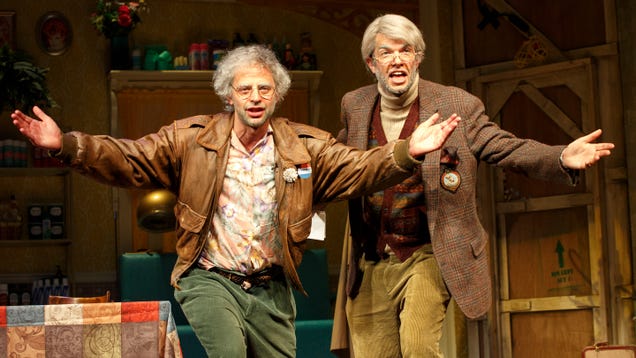
Suggesting one possible way the Academy might get out of the increasingly difficult question of “Who the fuck is going to host next year’s Oscars, huh?” that it’s currently facing—i.e., “Pick two guys with so many skeletons, dead wives, and tuna in their closets that no one can choose just one thing to yell at them…
NEW YORK—A report published Monday by researchers at the Journal Of Public Health Management And Practice revealed those sensors that flush public toilets were also cameras this whole time. “After decades of relying on the devices for automated flushing, it appears those red blinking sensors in toilet stalls have also…
Oh no!! I hope he's OK. He's one of my favorite writers!
Irredeemable Vikings fan and beloved voice of Deadspin Drew Magary has been moved to the injured reserve list after an accident last week. He is receiving the best possible care, is surrounded by his family and friends, and is doing well under the circumstances. We miss his randomly capitalized exuberant tweets and…
IT IS THE BEST CHRISTMAS SONG OF ALL TIME, FIGHT ME
It’s that time of year again, folks: The annual rise of Mariah Carey’s yuletide dominion, as “All I Want For Christmas Is You” begins its inevitable death march onto the year-end musical charts. This year, Carey had an extra-special victim falling prey to her jingly, jangly sonic steamroller, though: Mariah Carey.
The past few years have been tough for Milo Yiannopoulos, the writer(?) whose fascist, racist, Trumpy fanboyism has made him one of the most reliably hated people in the internet. Or at least he used to be on the internet, as he’s been kicked off Twitter, quit Breitbart before he could be fired, and lost a Daily…
This is cute and not overly precious. I like the self-depreciating comments.
Name: Dave and Cathy Location: South West London; UK Size: 270 square feet Years lived in: 2 years, renting
Editor's note: This greatest hits tour of a teeny shared studio apartment is cleverly furnished and the commentary from the person who lived in it is hilarious!
I always tell people that this studio was both the best and worst place I've ever lived. It was super convenient for travel, shopping, and friends, and the building had bags of character... but it was also insanely noisy, largely devoid of conveniences, and really, really small. Moving from a house to a studio was a huge adjustment for me, but when my partner Cathy moved in with me about a year later, that's when we really had to re-think how we felt about possessions, personal space, and the co-ordination of movement.
Hey, real quick: Has anyone checked lately whether the Oscars are cursed? Like, by magic or something, the better to ensure that what should be a pretty straightforward celebration of making movies isn’t the nexus for some eldritch, clusterfuck-inducing force? Case in point: Just two days after accepting the position…
Damn, how the catalog mighty have fallen. Not complaining, I will absolutely browse this, but for a while there J.Crew was really trying to be this luxury brand and everyone was like "nah dog you make sweaters, calm down"
Amazon isn’t really a place I’d expect to shop for J.Crew brand clothes, but today, there’s an entire Gold Box filled with styles for both men and women. Specifically, the items up for grabs are J.Crew Mercantile, the brand’s more affordable line that’s akin to what’s sold in J.Crew Factory outlets — but that doesn’t…
On Tuesday, The New England Journal of Medicine tweeted the most recent addition to its photo series of the most visually arresting medical anomalies. The image is of a mysterious, branchlike structure that, posted elsewhere, would probably pass for a cherry-red chunk of some underground root system or a piece of bright reef coral. But this is no creature of the deep. It’s a completely intact, six-inch-wide clot of human blood in the exact shape of the right bronchial tree, one of the two key tubular networks that ferry air to and from the lungs. And it was coughed up in one piece.
The clot is beautiful, and it’s also kind of gross. The tweet received a slew of replies from those frightened that the photo showed an actual coughed-up lung, which is about as likely to happen as your brain falling out of your butt. But even the doctors who treated the 36-year-old man who produced the clot aren’t entirely sure how it could have emerged without breaking.
Georg Wieselthaler, a transplant and pulmonary surgeon at the University of California at San Francisco, says the unnamed patient was initially admitted to the intensive-care unit with aggressive end-stage heart failure. Wieselthaler quickly connected the patient’s struggling heart to a pump designed to help maximize blood flow through the body. But this type of ventricular-assist device comes with its own risks. “You have high turbulence inside the pumps, and that can cause clots to form inside,” Wieselthalers says. “So with all these patients, you have to give them anticoagulants to make the blood thinner and prevent clots from forming.”
These anticoagulants themselves can lead to trouble. In a healthy person, oxygen-starved blood leaving the heart travels an intricate network of capillaries through the lungs for an oxygenating pit stop by the airways. Usually, if small fissures occur in this network, the body’s clotting agents show up to slap some circulatory duct tape on them until they heal. But for someone taking anticoagulants, the body can’t efficiently patch things up if any part of this tight blood-vessel network is breached, and things can spiral out of control.
In Wieselthaler’s case, blood eventually broke out of his patient’s pulmonary network into the lower right lung, heading directly for the bronchial tree. After days of coughing up much smaller clots, Wieselthaler’s patient bore down on a longer, deeper cough and, relieved, spit out a large, oddly shaped clot, folded in on itself. Once Wieselthaler and his team carefully unfurled the bundle and laid it out, they found that the architecture of the airways had been retained so perfectly that they were able to identify it as the right bronchial tree based solely on the number of branches and their alignment.
“We were astonished,” Wieselthaler says. “It’s a curiosity you can’t imagine—I mean, this is very, very, very rare.”
It’s rare, but not entirely unprecedented. A case study that appeared in The Journal of the American Medical Association back in 1926 describes a 34-year-old woman who was admitted to Rochester Municipal Hospital with an airway infection and coughed out “a large piece of membrane”—a layer of cells and gunk collected by the infection—“which proved to be a cast of the trachea, both bronchi, and several bronchioles.” In September 2005, the European Journal of Cardio-Thoracic Surgery published a photo of a smaller bronchial-tree cast coughed up by a pregnant 25-year-old who had developed a disorder impairing her clotting agents. She recovered and was able to deliver a healthy infant. The woman with the airway infection, who was born before the diphtheria vaccine, was not as lucky.
The primarily pediatric condition plastic bronchitis, a lymphatic-flow disorder associated with various heart and lung diseases, causes a buildup of lymph fluid in the airways that becomes hard and rubbery, which many people cough up in a similarly pristine structure. And for asthmatics, mucus plugs can harden in the airways thanks to factors like bronchoconstriction and dehydration, making them ready to be coughed up during an asthma attack.
Still, for all these cases, only the mother-to-be coughed up a cast made of blood, the largest ever photographed until UCSF’s. Congealed blood is less sturdy and sticky than hardened lymph or mucus, so why didn’t the cast break apart?
Wieselthaler suspects the answer might involve fibrinogen, a protein component of blood plasma that essentially acts as the “glue” of a clot by trapping platelets to form a mass. The infection that Wieselthaler’s patient had, in addition to aggravating his heart failure, caused a higher-than-normal concentration of fibrinogen in his blood. It’s possible, Wieselthaler says, that the blood in his airways was unusually rubbery, capable of surviving the bumpy ride up the trachea unscathed.
Gavitt Woodard, a clinical fellow in UCSF’s thoracic-surgery department who helped Wieselthaler capture the photo, suggests that the size of the clot itself may have been what allowed the patient to cough it up. It’s possible that “because it was so large, he was able to generate enough force from an entire right side of his thorax to push this up and out,” she says. Were it broken up into smaller segments, “he might not have been able to generate the force.”
Wieselthaler says that although his patient felt instantly better after coughing up the clot, its size clearly indicated the severity of his situation. Wieselthaler and Woodard put the man on a breathing tube and were able to stop his bleeding with a more invasive procedure, but the numerous complications of his heart failure were already too severe. He died a week later.
It can feel boorish to admire a by-product of the complete breakdown of a human body. But the photo is captivating because the clot’s structure shows a part of every human body, a biological filigree anyone can appreciate as a part of themselves, too. That’s why Woodard and her mentor shared the photo in the first place: “Recognizing the beautiful anatomy of the human body is the main point of it,” she says.
Hannah Gadsby, Australian comedian behind the delightful, subversive and incredibly frank Netflix specialNanette, opened the Hollywood Reporter’s 2018 Women in Entertainment gala Wednesday morning with a powerful speech dismissing the convenient way “good men”—late night television hosts, A-list dude comedians with…
Feeling unwell? Every last disease, injury, and ailment that you can possibly have falls into one of the following classifications. Consult this list of the only four medical conditions to begin diagnosing your health problems.
On Wednesday, Irish lawmakers passed legislation that takes the country one step closer towards providing free and legal abortions, approving a bill to legalize the procedure. It will now go to the Senate, where it is also projected to pass. At the end of May, voters in the country overwhelmingly voted to repeal…
I love her!! she's so great and her book is great and her Netflix series is so great.
In the world of food media, Samin Nosrat is a palate cleanser. Though she is a fount of cooking knowledge and wisdom, neither her award winning book nor her Netflix show ever feel prescriptive. Instead, she invites the reader or viewer to learn about, eat and enjoy food, all while radiating joy and warmth. Keeping in…
He dated my aunt Sue for a LONG time in the early 90s. Still keeps in touch with her. For a minute, he was almost my "Uncle Matt". Glad he's doing ok!!
For many of us, Matt Pinfield was the guy who, via MTV’s 120 Minutes, introduced us to pretty much every good rock band in the ‘90s. Pinfield is still working as a writer, DJ, and all-around rock evangelist, but he suffered quite the setback on Wednesday when he was a hit by a car in Los Angeles.
It’s extremely noice for us to report today that Andy Samberg and Sandra Oh—who, between Brooklyn Nine-Nineand Killing Eve, are responsible for some of our most enjoyable TV viewing experiences in recent memory—will be combining their powers for next year’s Golden Globes. Per Variety, the duo will host the event,…
Every Black Friday, the ugliness of capitalism is laid bare across the country with hours-long lines and throngs of customers trampling each other. But the usual rigamarole pales in comparison to the 1983 holiday season, when Americans went to war over Cabbage Patch Kids.
On Tuesday, New York Magazine’s the Cut published a horribly offensive essay, one that played into racist and sexist narratives, alleging that Priyanka Chopra is a “global scam artist” who manipulated a younger rich white guy into marrying her against his will. The lede of the piece, which was “updated” and later…
My favorite scene in Wes Anderson’s Isle of Dogs is the sushi-making scene. It’s a pure showcase of stop motion animation goodness and wordless storytelling.
Andy Biddle has posted a behind-the-scenes time lapse video of him and Anthony Farquhar-Smith animating that scene:
From the costume changes, it looks like that 40 seconds of video took about 29 days to complete, although obviously not full days in many cases.
Update: Somehow I totally missed the days counter in the upper left corner of the video…the sequence took 32 days to do. (This is like the awareness test with the moonwalking bear.) (thx, all)
Update: Isle of Dogs’ head puppet master explains a bit more about what goes into making these stop motion scenes.
Once he built a tower made of repurposed 4chan garbage, shit and drivel and bile. Once he built a tower, now it's done. Brother, can you spare a dime ... for Milo Yiannopoulos?
Just kidding. Hold onto your dimes. He doesn't deserve them. He is, however, broke as shit and $2 million in debt, owing money to several fellow internet bigots, Cartier, a wedding venue and a variety of other sources, per The Guardian:
The documents indicate that as of April 2018, Yiannopoulos owed $1.6m to his own company, $400,000 to the Mercers, $153,215 to his former lawyers, $76,574 to former collaborator and Breitbart writer Allum Bokhari, and $20,000 to the luxury jewellery brand Cartier.
As of 2 October, Yiannopoulos owed sums of several thousand dollars to far right writers including Ian Miles Cheong, anti-Islamic ideologue Pamela Geller and science fiction writer Theodore Beale, aka Vox Day, the documents indicate, amongst others.
The documents obtained by The Guardian were published on the website of another far-right wacko, Neil Erikson, who was somehow involved with the drama between Yiannopoulos and the promoters of his planned tour to Australia alongside Ann Coulter. The tour was canceled in October of this year, and refunds were not given. Rather, ticketholders were given tickets to go see the equally repulsive duo of Tommy Robinson and Gavin McInnes. Of course, that too has since fallen through, as McInnes was recently denied entry to Australia after having being judged to have "bad character" (NOT WRONG), so probably now they will just get tickets to see someone's weird racist uncle in conversation with a guy who screams about socialism outside of a subway entrance. Same diff!
The cache of documents also reveals emails from Milo begging the Australia-based promoters, Ben and Dan Spiller, for more money to cover his extensive and entirely unrelated bills.
The documents show Yiannopoulos demanding money from the promoters for his living expenses, medical bills for himself and his husband, and payment for his employees, on top of sums that the promoters claim they had already transferred to him.
At one point, as he attempts to negotiate the transfer of more funds from the Spillers, Yiannopoulos remarks in a message that "I am less financially secure, more panicked and stressed, and more miserable than when we started", and then says he returned his wedding ring to Cartier to wipe out the debt he had with them.
So much for "personal responsibility," huh!
Ever since he got kicked off of Breitbart, lost his Simon & Schuster book deal,got dumped by the Mercers, and was booted off of Twitter, Yiannopoulis has more or less disappeared -- which just goes to show you that deplatforming works. This also has meant that he's had a real hard time making money off of being a giant asshole, especially when there is so much competition these days among other relatively interchangeable wingnuts who also want to be rich and famous for being giant assholes.
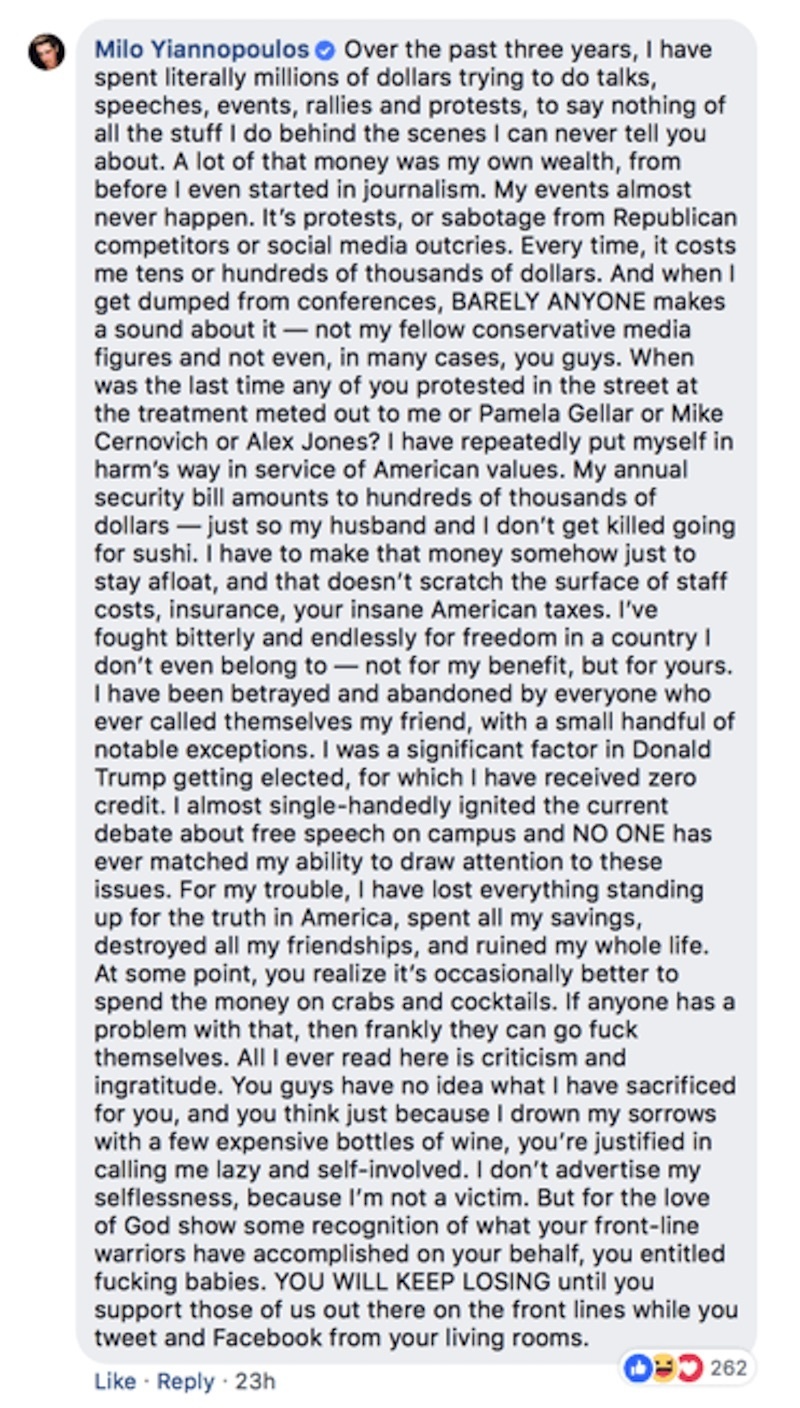
It seems this has been going on for a while, as back in August, Poor Milo posted (and subsequently deleted) a rant to Facebook yelling at his fans for not giving him enough money or taking to the streets whenever he is wronged EVEN THOUGH he was basically the whole reason for Donald Trump being elected.
TL;DR: WAAAAAAAHHHHHHHHH!
Milo is, however, still hoping to go to Australia, as he's joined the Deplorables tour (the one with Robinson and McInnes, who still can't get into Australia) sponsored by Penthouse Australia publisher Damien Costas. He announced this in a ridiculous two-hour YouTube rant (my god, who the hell listens to these things??) in which he also yelled at the Spillers for supposedly screwing him over. Subsequently, the Spillers were harassed by the 10 or so people who still pay any attention to him:
The Spillers told the Guardian that they had since received threats from unknown people via text and email. They said a group of men broke into a car at their home on Saturday morning, which they reported to police. The Guardian has seen video that the Spillers say shows them chasing these men down the street away from their home.
This is not the first time Yiannopoulis has found himself in a pile of debt. In 2013, he had to shutter his site The Kernel (which was then bought by The Daily Dot) after it went bankrupt, and then never paid any of its contributors the money they were owed. Call me crazy, but it seems like it might not be a good idea to work for or with Milo Yiannopoulos if you are at all interested in getting paid. It also seems like it might not be a good idea to make an entire career out of being an asshole -- because if you're such an asshole that you get kicked off of the social media platforms you need to get the attention required for such a vocation, you're gonna be shit out of luck.
Of course, despite constantly complaining about how he is broke and the world owes him way more money, Milo firmly denied his brokeness to The Guardian when asked, claiming to be pulling in $40,000 a month.
Right-wing ghouls with highlighter Tomi Lahren and Candace Owens were beefing on Twitter this week, and shit got really personal really quickly. So sad when bad things happen to good people, you know?
Tony Evers, the incoming Democratic governor of Wisconsin, offered that pithy appraisal on Tuesday night of Republican efforts to limit his authority and that of the incoming attorney general, who is also a Democrat. Evers, the state schools superintendent,...
Though Donald Trump promised his followers they'd win so much they'd be tired of winning, one thing that has plagued them since he first stepped on the national stage is their abject failure on the dating scene. As it turns out, for the rest of the population, being a person who thinks it's super swell to tear-gas children is kind of a bonerkiller.
And now we have Righter.Righter is a new conservative dating app created by Trump supporter Christy Edwards Lawton, who says she came up with the idea after meeting a very attractive lady at a party in New York who said no one wanted to date her because she's a Republican. Appalled that men would take something other than looks into account when choosing a prospective mate, she decided to create a dating app where women like the one she met at that party would be able to connect with other people lacking any kind of human decency or empathy. Lawton is so serious about creating a safe space for deplorables (has anyone come up with DEPLORADATE yet?) that she said the company will sue any liberals who try to sign up.
Lawton explained the necessity of her app to The Daily Beast:
"I kept hearing repeatedly how they kept getting swiped left on and couldn't even get a date," said Lawton, who fundraised for Trump's 2016 campaign.
Lawton insists that the market is there. She said that ahead of the launch, she and her staff created tests profiles on apps like Tinder where they found profiles that rejected Trump voters outright. She also said they discovered Tinder users who would pay to "super-like" their accounts but reject them once they learned they supported Trump.
"You just paid money to like us, but you want nothing to do if we're conservative," Lawton said.
Oh, the schadenfreude. It's almost, again, like people don't want to fuck people who are bad people. At least not that kind of bad people. Honestly, if I were presented with the choice between someone who voted for Trump and a bank robber who did not, it would be bank robber every time. Plus, I'm pretty sure I could pull off some of Faye Dunway's outfits from Bonnie And Clyde. I look good in a beret.
The app also has some weird ass rules. For instance, if the man doesn't pay on the first date, he can be "reported," and photoshopping is not allowed.
Righter users can't hide their age, and the app will be policed for photoshopped pictures added to make a would-be dater look better. Users who are caught altering their pictures will get three strikes before getting the boot from Righter entirely.
"Females make themselves look different, younger, thinner, better," Lawton said. "That's not going to happen on our app."
Nice rules, very manosphere.
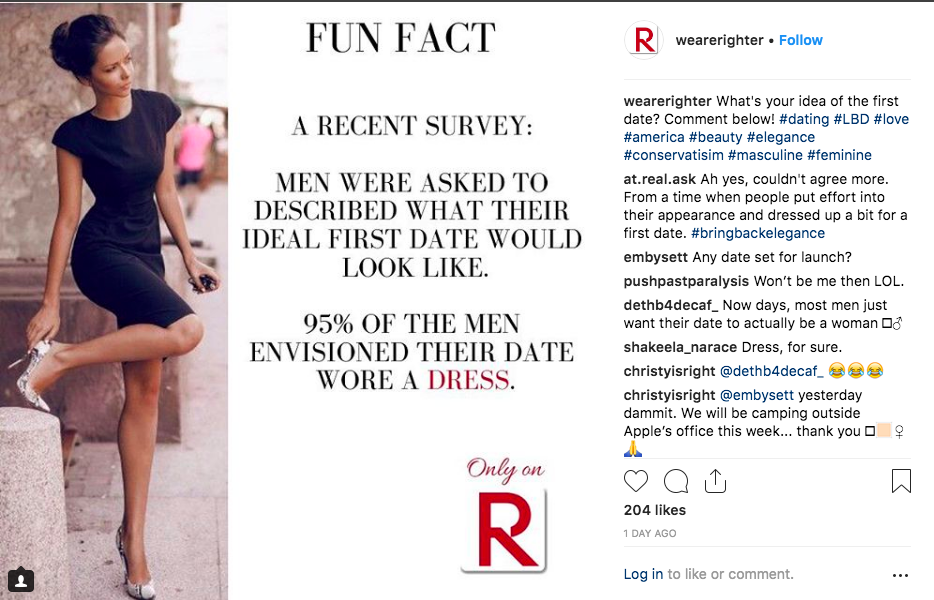
Then there's their Instagram. Let's look at some of the pics on their Instagram, shall we?
MEN INITIATE, WOMEN RESPOND. LIKE OLDEN TIMES.
Righter knows that ladies just want to be pretty and nurturing.
As we all know, liberal ladies wear pantsuits only. #BRINGBACKELEGANCE
Ah yes. The classic song. "When a man loves a woman, he cheats on her with a porn star while she's pregnant."
One thing I particularly enjoyed though is their posting of a scene from The Wonder Years, expressing a wistful fondness for the character of Winnie Cooper.
WINNIE COOPER CAMPAIGNED FOR GEORGE MCGOVERN, BITCHES. Winnie Cooper was a liberal.
Yeah, there was like a whole episode where Kevin (who kinda sucked, btw) got all jealous and shit because she was spending too much time campaigning for George McGovern. Winnie Cooper hated Nixon, her brother died in the Vietnam War -- which both she and Kevin protested in another episode in a school walkout. Winnie Cooper would have swiped left on Trump supporters just as quickly as any of us would.
But hey! Maybe they'll stand a chance on this new app. I wish them the best of luck. Personally, I'm in favor of anything that reduces the chances of me ever accidentally going out with a dude who has a picture of Reagan on his wall again.
As I’ve done for the last five years, I’ve spent the past few weeks scouring the internet for the best 2018 gift guides and pulled a few of the most interesting items from each. Think of it as a curated meta-guide for your holiday giving. Let’s dig in.
Charitable giving always tops this list. Check out GiveWell and Charity Navigator to find organizations that will put your money to the best use. (Read up on big charities like Red Cross and Salvation Army…they are often not the best use of your charity dollar.) GiveDirectly sends money directly to people living in extreme poverty around the world. I always recommend Volunteer Match to find local volunteer opportunities but they force you to log in now, so just an FYI. Alternate sites for volunteering are the AARP’s Create the Good and United Way. If you’re giving to the local food shelf, skip buying food yourself for the donation bin and set up a direct debit or CC payment instead…that will put your donation to better use.
The Accidental Shop is a collection of products I’ve previously linked to on kottke.org. It is heavy on books…I’d particularly recommend Emily Wilson’s The Odyssey, Small Fry by Lisa Brennan-Jobs, and Arbitrary Stupid Goal by Tamara Shopsin. Oh, and I’m flying through Madeline Miller’s Circe right now…what a read!
I love my Kindle Paperwhite and there’s an updated version this year that’s waterproof, lighter & thinner, has Bluetooth for audiobooks, and has more storage.
I’ve seen several guides touting so-called “inexpensive” gifts and then going on to recommend $50 bars of soap, so Slate’s The Good Enough List is a welcome effort. They’ve recommended a bunch of items that are almost as good as the best available options but more affordable. My favorite pick is their rec for a $7 pedometer over a Fitbit or Apple Watch. They also highlight the Gulliver crib from Ikea, which I have taken apart and put back together approximately 30 times. It’s a basic, durable, simple, and fantastic crib.
The kids and I have been playing two games pretty heavily this year: Sushi Go Party and Harry Potter Hogwarts Battle. I really like Hogwarts Battle because it’s cooperative — all the players play together against the villans on the board and it’s fun to strategize how to allocate tokens and hearts to get everyone through the danger areas.
Every year I “recommend” this 55-gallon drum of personal lubricant because why would anyone actually buy this? (Have any of you ever bought this? Report back, please!)
omg no joke Corey bought this exact thing for me for my bday
Want to deliver the best gift this year? Consider a box of Pizza Socks. Brought to us by Etsy shop, MegCyprianStore, the footwear is available in a variety of toppings for the footsies. They’re also available by the pie (4 pairs) or by the slice (1 pair). Either way, the pizza socks will make someone […]
The indie music venue makes a move up north from Wicker Park
After a dramatic closure, Double Door will open up again in Uptown’s Wilson Avenue Theater. A neighborhood news site, Uptown Update first reported the news early Saturday morning and later 46th Ward Alderman James Cappleman confirmed the news with a Facebook post.
When neighbors saw that Smashing Pumpkins would be having a pop-up with special merchandise at the theater on Saturday, some had a feeling there was more to the announcement. And they were right, a sign at 1050 W. Wilson Avenue declared the building Double Door’s new home.
Well, the secret is out.... Double Door, welcome to Uptown’s Entertainment District in the 46th Ward!
In February 2017, Double Door was evicted from its longtime home in Wicker Park. The old space at 1572 N. Milwaukee Avenue, which will become a Yeti store, sold to CA Ventures for about $9 million. Double Door’s new venue and a site nearby at 975 W. Wilson is owned by developer Cedar Street, which originally proposed a residential project that never took off.
Many residents suspected that Double Door would stay in the neighborhood, but the establishment is opting for a clean slate in a historic space. The Wilson Avenue Theater first opened in 1909 as a vaudeville club with comedy burlesque acts and musical shows. The theater was designed by Henry L. Ottenheimer and, at the time, had 600 floor seats and 300 in the balcony. The Classical Revival style building featured gold accents and a mural over the proscenium. It lived just 10 years as a theater though, and soon became a series of banks.
It’s also in a great location, the venue is right near Broadway bus line and the new Wilson Red Line station which underwent a $203 million renovation.
The bland, boxy apartment boom is a design issue, and a housing policy problem
A wave of sameness has washed over new residential architecture. U.S. cities are filled with apartment buildings sporting boxy designs and somewhat bland facades, often made with colored panels and flat windows.
Due to an Amazon-fueled apartment construction boom over the last decade, Seattle has been an epicenter of this new school of structural simulacra. But Seattle is not alone. Nearly every city, from Charlotte to Minneapolis, has seen a proliferation of homogenous apartments as construction has increased again in the wake of the financial recession.
A Twitter query seeking to name this ubiquitous style was a goldmine. Some suggestions seemed inspired by the uniformity of design in computer programs and games: Simcityism, SketchUp contemporary, Minecraftsman, or Revittecture. Some took potshots at the way these buildings looked value-engineered to maximize profit: Developer modern, McUrbanism, or fast-casual architecture. Then there are the aesthetic judgement calls: contemporary contempt, blandmarks, LoMo (low modern), and Spongebuild Squareparts.
“Part of what people are responding to isn’t the building themselves, it’s that there are so many of them going up so quickly, all in the same places in the city,” says Richard Mohler, an associate professor of architecture at the University of Washington.
Shutterstock
Many of the replies to the Twitter call simply pointed out that these buildings are housing, and much-needed housing at that. Though they can be defined or classified by aesthetics, this wave of new apartments is perhaps best described as a symbol of today’s housing problems: a lack of developable land; rising land, material, and labor costs; and an acute need to find more affordable places for people to live.
“At the end of the day, if you line up multifamily apartments from Boston, San Francisco, and Miami that have been built in the last decade, you’re going to see a very strong pattern,” says Scott Black, senior vice president of Bristol Development, a Nashville-based firm that develops apartments across the Southeast.
Good architecture should always respond to the local context. In the case of these buildings, the local economic context just happens to be the same in just about every major U.S. city.
“Critics don’t understand what we’re working with, the parameters and the financial constraints,” says Black. “It’s like any other business: If you’re selling autos or selling widgets, there are certain costs, and a certain profit you need to make to do business in the future.”
Shutterstock
It boils down to code, costs, and craft
Perhaps the biggest constraint in the urban U.S. apartment market, a $61 billion annual industry, is the amount of available space. Many cities zone with an overwhelming preference for detached, single-family homes, with small corridors in downtowns or dense areas set aside for large, multistory towers. In Seattle, for instance, roughly three-quarters of residential land is zoned for single-family homes. That means new apartments are forced to cluster in small areas of the city, amplifying the impact of a rash of new, similar buildings.
The buildings themselves are an effort to fit within the small niches made available by local building and zoning codes. According to Mohler, due to height limits and safety/fire requirements, most of these structures are what’s known as “5 over 1” or “one-plus-five”: five stories of wood-framed construction, which contain apartments, over a concrete base, which usually contains retail or commercial space, or parking structures. Some codes also mandate a modulated facade, or varying exteriors across adjacent buildings to avoid repetition.
Cities’ design review boards can add to the pressures caused by zoning. Ideally, these groups work with architects and developers to improve upcoming buildings and make them more compatible with the neighborhood. Mohler says that’s not always the case; in some cities, there’s a tendency to rubber-stamp structures that have already proven themselves, leading to a formulaic feel.
Code constraints, which allow construction on restricted areas, help create the second major restraint: cost. The reason our cities are filled with so much of the same kind of building is because it’s the cheapest way to build an apartment. In this case, that’s light-frame wood construction, which often uses flat windows that are easy to install; a process called rainscreen cladding to create the skin of the building; as well as Hardie panels, a facade covering made from fiber cement.
The need to cut costs limits facade options, says Black. Hardie Panels run roughly $16 a square foot, roughly the same cost as brick. The next upgrade, metal siding, costs from $25 to $50 a square foot, potentially more than triple the cost.
“Since we’re facing a housing affordability crisis, it makes a certain amount of sense to build a building as affordably as we can,” says Mohler.
According to Black, variation is costly. Many units get made to a standard size, say 12-foot-wide bedrooms. Repeat that a few times per floor, maximized to create rentable space, and you start a domino effect toward generic architecture, because the floor plates end up very similar. Once the interior is laid out, there are ways to make the exterior look more interesting using setbacks, materials, and massing. But giving up space for units and creating more complicated construction plans cuts into profitability.
“The bigger issue is construction costs have escalated pretty significantly over the last two years,” says Black. “We need to deliver a product within a price point. People don’t always understand the margins we work with. We really do want to build something that’ll sparkle and shine and look great from the outside. At the end of the day, we feel like we’re able to do that.”
Some critics dismiss the cost issue as a small piece of a larger problem. Michael Paglia, a writer for Westword in Denver, penned a popular piece about his city’s rash of bad design, “Denver is Drowning in Awful Architecture.” He feels architects aren’t just cost-constrained, but are being left out of the equation. Computer-aided design has led to a degradation of the role of architect, Paglia argued, replacing a noble craft with a series of equations that wring every last bit of value out of a site, aesthetics be damned. Formulaic floorplans are cost effective, while good design is considered an unaffordable luxury, concentrated, like so much else, among the 1 percent.
“I don’t think you can call the designers of these buildings designers or architects,” he told Curbed. “I think accountants are designing these buildings.”
The art of design has become a science, he says, and that’s created another important, but less tangible, constraint on new construction—the loss of construction craft. Paglia feels that construction standards, and the expectations renters have of new buildings, have diminished.
“Many of the renters living in those buildings don’t even know they’re terrible,” he says. “And as far as cost constraints go, talk to someone in Florence, Italy, where there are numerous constraints on development. Nothing is an excuse for bad design.”
Mohler agrees that there are tangible difference between the apartments of today and yesteryear. Older apartment buildings have something that the Hardie-clad structures lack, a certain texture and materiality.
“Today’s flat window may be a great product, easy to install and cost-effective,” he says. “But the depth of facade on older buildings offers a whole new level of detail and scale.”
Shutterstock
History judges architecture on a curve
Since the constraints creating the conditions for this generic apartment architecture show little sign of abating, cities may be stuck with buildings like these for the foreseeable future. New construction slowed this year after peaking in 2017, but that still means 283,000 new apartments are expected to be finished by the end of the year, many in this generic style. What happens to them further down the road, decades and generations from now?
“I don’t think these buildings will be around in 40 years. They’ll collapse and be maintenance problems,” says Paglia. “We’ll remember the small sliver of good architecture being built today.”
Mohler, though, thinks time will play a trick on detractors of today’s bland, boxy buildings. He points to neighborhoods of identical bungalows, celebrated and often enshrined as historic districts. At the time they were built, in the early half of the 20th century, they weren’t the product of forward-thinking architects seeking to create character-filled dwellings for today’s homeowners to drool over. They were factoring in cost, code, and craft, and creating their own equations to maximize profit and product. Placing them above today’s building, often meant to meet contemporary needs for affordable housing, can be, as McMansion Hell’s Kate Wagner wrote, a form of “aesthetic moralism.”
“Many of these houses were the same, and many were completely identical to each other because they were being built by a single developer,” Mohler says of past urban developments. “At the time, it was criticized for wasting land and all looking the same. Looking identical today means neighborhood character. If it’s old and looks the same, it’s good, but if it’s new and all looks the same, it’s bad.”
Even Mohler doesn’t say these boxy builds will be celebrated in coming decades. But, arising from an era with an acute housing shortage, perhaps they’ll have kitsch appeal, or be appreciated for what they represent: a part of the solution to today’s housing crisis.
“I’m optimistic that people’s opinions of these buildings will change over time,” he says. “Will they be celebrated? Not likely. But will they be more accepted? Probably.”



























/cdn.vox-cdn.com/uploads/chorus_asset/file/13600626/shutterstock_580189474.jpg) Shutterstock
Shutterstock
/cdn.vox-cdn.com/uploads/chorus_asset/file/13600627/shutterstock_1144300976.jpg) Shutterstock
Shutterstock
/cdn.vox-cdn.com/uploads/chorus_asset/file/13600628/shutterstock_428869780.jpg) Shutterstock
Shutterstock