With the Legion of Boom falling apart—Kam Chancellor retired, Richard Sherman went to the 49ers, Earl Thomas was treated like shit then broke his leg and flipped off his sideline—the Seattle Seahawks looked like a team reaching the end of an era. To their credit, they’re 7-5 and in position for a playoff spot. One…
As the number of millionaires and billionaires in the world climbsever higher, there are a growing number of people who possess more money than they could ever reasonably spend on even the lushest goods.
But at a certain level of wealth, the next million isn’t going to suddenly revolutionize their lifestyle. What drives people, once they’ve reached that point, to keep pursuing more?
There are some good explanations, I found, after talking to a few people who’ve spent significant amounts of time in the presence of and/or researching the really, really rich. Michael Norton, a Harvard Business School professor who has studied the connections between happiness and wealth, had a particularly elegant model for understanding this pattern of behavior.
Norton says that research regularlypoints to two central questions that people ask themselves when determining whether they’re satisfied with something in their life: Am I doing better than I was before? and Am I doing better than other people? This applies to wealth, but also to attractiveness, height, and other things that people fret about.
“But the problem is,” Norton says, “a lot of the things that really matter in life are hard to measure. So if you wanted to be a good parent, it’s a little hard to know if you’re being a better parent now than you were a year ago, and it’s also hard to know if you’re a better parent than the neighbors.”
So people turn to dimensions of comparison that can be quantified. “Money is a terrific one,” Norton says. “If I need to know if I’m doing better than I was, the easy thing to ask is, Am I making more money? or Does my house have more square feet? or Do I have more houses than I used to?”
This instinct to measure and compare doesn’t disappear once people have an obscene amount of money. “The problem is, Am I doing better than I was? is only [moving people in] one direction, which is up,” Norton says. And if a family amasses, say, $50 million but upgrades to a neighborhood where everyone has that much money (or more), they feel a lot less rich than if they had stuck to the peer comparisons they were making tens of millions of dollars ago. Hence the ever-shifting goalposts of wealth and satisfaction.
The research Norton has conducted illustrating this phenomenon is dispiriting. In a paper published earlier this year, he and his collaborators asked more than 2,000 people who have a net worth of at least $1 million (including many whose wealth far exceeded that threshold) how happy they were on a scale of one to 10, and then how much more money they would need to get to 10. “All the way up the income-wealth spectrum,” Norton told me, “basically everyone says [they’d need] two or three times as much” to be perfectly happy.
Where did Norton find his rich people? For that particular study, an investment bank connected him with some of its high-net-worth clients. But Norton also told me that he had previously consulted with a pool of Dutch millionaires willing to respond to researchers’ questions, making themselves marginally richer in the process: For one study, Norton and his collaborator paid each respondent about 46 euros for every completed questionnaire. “You can run a survey on regular people for like a dollar,” he says.
Jeffrey Winters, a professor of political science at Northwestern University and the author of Oligarchy, said that in addition to social comparison, really rich people are often motivated to acquire more money by the thrill that comes with multiplying one’s fortune by making investments, buying up businesses, and so forth. “For those of us who make wages and have expenditures that we are trying to meet—a mortgage, pay our health insurance, food, whatever happens to be our kid’s tuition—we link the making of money to our expenses,” he says. Meanwhile, many ultra-wealthy people “use their money to make money,” he says—an exciting, status-enhancing process.
Those two ways of putting money to use—as a way of covering expenses or as a way of building a bigger fortune—come with two different points of diminishing returns. “Say you wanted to have a mega-yacht plus six mansions in six different locations around the world,” Winters says. “You could probably do all of that fairly comfortably with a few hundred million dollars.” It’s different if the goal is to keep accumulating, in which case “there’s no number at which you have enough,” Winters says. He adds, “Every billionaire I’ve spoken to, and I’ve spoken to quite a number of them, is extremely excited by each additional increment of money they make.”
Another expert I consulted, Brooke Harrington, a professor at the Copenhagen Business School who has studied and written about the financial practices of the super-wealthy, says that the question many rich people ask themselves about their money is not Do I have enough to buy this expensive thing I want? but rather Do I have as much or more than these people I’m comparing myself with?
“The sensation of ‘being well-off,’” she wrote to me in an email, “is not about fulfilling a childhood dream of buying a sailboat or something; feeling wealthy is about comparison with others in your reference group. So the question is not what individuals want to buy, but what they feel they must buy in order to keep up their status.”
The novelist Gary Shteyngart also has firsthand experience seeing how rich people think about their wealth. The protagonist of his recent novel, Lake Success, published a few months ago, is a New York financier, and in the course of researching the book, Shteyngart cultivated friendships with more than a dozen highly wealthy, mostly male hedge funders, the sorts of people who say they’re allergic to flying commercial and who hire chief financial officers to manage their family’s abundant wealth. “They’ve reached the point where you have all the money you ever really need for anything, and the things that they can buy are not that expensive compared to what they have,” he told me. “The gull-wing Tesla, the latest Tesla, I don’t know what it [costs], but it’s not that much if you have $100 million.”
One thing Shteyngart noticed after spending time with this crowd was how competitive they were. “They’d compete against one another on their Bloomberg terminals all day and then at the end of the day they would play competitive poker with each other,” he says; this spirit of one-upmanship pervaded even the donations they made to charities. Shteyngart speculates that underneath this competitiveness is a need to seem smarter and more capable than their peers: Managers of hedge funds can sometimes get rich from making one or two bets that had more to do with luck than anything else, which might make them feel like their intelligence is in question even if their money stands as evidence of their professional success.
Shteyngart also witnessed the hedge funders making the sort of social comparisons that Norton and Harrington described, treating money as a “scorecard.” He remembers one of them saying something along the lines of “We don’t have best-seller lists and book awards. What we have is this—the number at the end of the day.”
The whole experience did not leave Shteyngart feeling good. Here were people who could purchase anything they could ever want and whose wealth was widely envied, and even they weren’t content—just as these researchers studying happiness and wealth might have predicted. “At the end of the day,” Shteyngart told me, “I was just happy to end this research, because it was quite depressing.”
This is the one we have and it is AMAZING. It is the only coffee we drink at home anymore.
Cold brew coffee is basically the only kind of coffee I like, and when there wasn’t a Starbucks readily available, I’d been using the popularTakeya cold brew pitcher for over a year to make it at home. That all changed when my mother-in-law got me OXO’s alternative last Christmas, and it quickly became one of my…
Chance The Rapper continues to make it very clear that he’s not fucking around on the topic of Chicago politics and civic life; fresh off his donations to the city’s schools, his critiques of mayor Rahm Emanuel, and his purchase of local news site Chicagoist—once a mainstay of street-level city reporting, back before…
Music producer DJ Khaled and boxer Floyd Mayweather Jr. were charged by the Securities and Exchange Commission Thursday with promoting investments in initial cryptocurrency coin offerings without revealing that they'd been paid.
This is outstanding. Seriously, just incredible and marvelous.
Earlier this year, I wrote that director Peter Jackson was working on a documentary about WWI that would feature film footage cleaned up and colorized with the same special effects technology used to produce massive Hollywood films like Jackson’s own LOTR movies.
The footage has been stabilized, the grain and scratches cleaned up, and the pace slowed down to from comedic to lifelike. Jackson’s also planning on using colorization to make the people in that old footage seem as contemporary as possible.
The brief glimpses of the cleaned and colorized footage in the initial trailer were tantalizing, but the newly released trailer above is just breathtaking or jaw-dropping or however you want to put it. I’ve watched it three times so far…some of those scenes are so vivid they could have happened yesterday! That what viewing early color photography and film does to you:
Until recently, the color palette of history was black and white. The lack of color is sometimes so overpowering that it’s difficult to imagine from Matthew Brady’s photos what the Civil War looked like in real life. Even into the 1970s, press photos documenting the war in Vietnam were in B&W and the New York Times delivered its news exclusively in B&W until the 90s, running the first color photograph on the front page in 1997.
Which is why when color photos from an event or era set firmly in our B&W history are uncovered, the effect can be jarring. Color adds depth, presence, and modernity to photography; it’s easier for us to identify with the people in the pictures and to imagine ourselves in their surroundings.
Jackson talked to the BBC about how the film was made:
They Shall Not Grow Old just became my #1 most-anticipated movie for the rest of 2018. It’s only showing in the US on Dec 17 and Dec 27…I just got my ticket here.
This was in Rosemont at the convention center, down the block from where I work. I shared a walk from the train to work with several furries this past week.
Spending time with family is what the holidays are all about. That’s the only explanation we have for why Insane Clown Posse’s Violent J joined his 12-year-old daughter at a furry convention this weekend, wearing his very own ICP-themed fursuit. That’s honestly and truly all we’ve got.
Juan has been detained in an unaccompanied child shelter for nearly a year, long enough to see the emotional impact prolonged confinement has on children.
The Kremlin was caught off guard by President Trump’s sudden cancellation of a planned meeting between with Russian president Vladimir Putin, Russian state news agencies said Thursday. Trump had planned to sit down with Putin at the G-20 summit in Argentina, but canceled the meeting in a tweet Thursday, citing Russia’s Sunday capture of three Ukrainian ships and 24 sailors. “Based on the fact that the ships and sailors have not been returned to Ukraine from Russia, I have decided it would be best for all parties concerned to cancel my previously scheduled meeting in Argentina with President Vladimir Putin,” Trump wrote.
On Wednesday, a tweet went viral that was, perhaps, the purest form of Twitter imaginable. It was 240 characters of pure, uncut discourse, straight from the people behind Burger King’s social media accounts. And now PornHub is involved.
I want to see this. He's one of my favorite directors.
Shoplifters is, very quietly, a film about a crisis. The Shibata family comprises three generations crammed together into a small home—the adults earn low wages; work menial jobs; and struggle to feed, clothe, and educate the kids. This family, and their lives, could easily be framed in the dreariest way possible, and the writer and director Hirokazu Kore-eda has been up front about wanting to use his film to address the widening class divides in Japan, which have shredded the country’s social safety net. But his storytelling touch is deft, rendering Shoplifters a warm, heartfelt, and engrossing experience that’s entirely deserving of the Palme d’Or it won at Cannes this year.
One of Japan’s premier directors, Kore-eda is usually drawn to intimate stories. Even though his masterful breakout film, 1998’s After Life, is a supernatural tale about what happens when you die, the movie centers on a tiny governmental office where people are processed before entering heaven. His most recent films, 2016’s After the Storm and 2017’s The Third Murder, were a deadbeat-dad comedy and a mystery, respectively, but both relied on Kore-eda’s sensitivity, his focus on small gestures and meaningful pockets of dialogue, and his gift for developing nuanced characters quickly without relying on exposition.
The situation in Shoplifters is, on the surface, rather complicated. The whole Shibata family lives in the home of grandmother Hatsue (the legendary Kirin Kiki in her final role), who receives a small pension. That income is supplemented by the others taking odd jobs, committing petty theft, and, for Hatsue’s daughter Aki (Mayu Matsuoka), working in a peep show. Early in the movie, Aki’s sister Nobuyo (Sakura Ando) and her husband, Osamu (Lily Franky), come across a little girl named Yuri (Miyu Sasaki), who has been abandoned and shows signs of abuse. The Shibatas take her in, even though they don’t really have room for her, thus beginning a peculiar year that Kore-eda meticulously chronicles.
Shoplifters is littered with wry humor and is refreshingly free of judgment. The premise—a poor family essentially kidnaps a young child—could be the foundation for a thriller, but Shoplifters feels more like modern Dickens, with Osamu as a kindly and benevolent version of Fagin, teaching his young charges how to survive in a harsh environment. Along with Yuri, there’s Shota (Jyo Kairi), an older boy who has been raised as a son by Osamu but doesn’t know who his biological parents are. Shota is crucial to the family’s shoplifting schemes and their desperate efforts to scrape by, though Kore-eda is careful to examine the moral repercussions of such a lifestyle.
So much of what the Shibata family does is out of love, but there are heavy prices to pay for not obeying societal rules. Kore-eda isn’t writing a fantasy film where those rules can be ignored forever with impunity. When the Shibatas take Yuri in, they give her a haircut and change her name to avoid attracting attention, but they also show her, for the first time in her life, the value of familial connection.
Early on, Nobuyo offers Yuri something nice and the girl flinches away—she associates gift-giving with her abusive mother, who would buy her things as a cheap apology for her short temper. Nobuyo quickly discerns the situation and gathers Yuri into a hug, whispering in her ear that this is what people who love you should do. Kore-eda’s brutal honesty and matter-of-fact sensibility keep the scene from feeling mawkish. This moment between Nobuyo and Yuri doesn’t solve everything for either character; it’s merely a recognition of how family can both inflict deep pain and heal wounds. The members of the Shibata household are all bruised in their own ways, but that makes their love for one another only more profound.
Eventually, sadly, and unsurprisingly, this world begins to crumble. The film never leans into pure horror or tragedy, but it has elements of both in its denouement, as governmental authorities get involved and everyone tries to figure out a way to stay alive in a country that’s ill-equipped to protect them. The final act of Shoplifters, like all of Kore-eda’s best work, is devastating. After seeing the director tease out every strange bond in this makeshift group, investing his audience fully in their future, one finds it that much harder to watch when things fall apart.
Neighbors asked about open space, density and transit
The second community meeting about the Lincoln Yards development, hosted by the developer Sterling Bay and 2nd Ward Alderman Brian Hopkins, packed hundreds of seats and even spilled out into the hallway on the third floor of Park Community Church Near North on Thursday night.
Sterling Bay’s presentation focused on three things: providing details on building heights and layout, showcasing the next-level park design, and highlighting the street, bridge and other infrastructure improvements.
Often at community meetings those who are against a project far outnumber those in support of it, which isn’t necessarily representative. While lots of people were skeptical of the development, there were people in attendance who support Sterling Bay’s plans and complimented the developer’s work in transforming the West Loop.
Another demand from attendees was for Sterling Bay to create a true public park, instead of a privately owned, publicly accessibly park within the development. Keating Crown, principal and senior management at Sterling Bay, said that he was in support of the Park District owning the park.
Earlier the team has presented the Park District with a plan where the city would own the park and Sterling Bay would maintain the cost and manage it in perpetuity. However, the city turned down the deal, likely because the Park District is struggling to financially manage what it operates now, Keating said. The Park District did not immediately respond to a request for comment this.
Open space and parks
While much of the meeting was spent addressing concerns from attendees, the team did reveal that the design for the green space would be inspired by the site’s industrial history. Sarah Weidner Astheimer, a principal at the project’s landscape architecture firm Field Operations, presented the vision for the playground, promenades, seasonal gardens, recreation fields and more.
The landscape design team has already surveyed the site and found industrial artifacts that have inspired the way the open space will look. Giant industrial ladles, originally used as vessels for molten metals, will be planters for trees. Designs on the pavement that mimic train tracks will flow along The Slipway path near the river. Curvy, tubular slides at the Foundry Playground mimic what could have actually been made at a former foundry, or metal factory. A furnace garden, with large fire pits, hints again at the area’s industrial past.
The northern section of the park will be filled with rolling hills, winding pathways, lots of trees, playgrounds and parks, and the Great Lawn which overlooks the Chicago River. Crossing over into the southern portion, there will be more athletic fields and the 20,000-seat soccer stadium.
The owners of the Hideout, a beloved live music space, along with other indie music venues, have banded together to ask for more transparency regarding the entertainment district that will be just four blocks from their establishment. Supporters of the city’s music scene showed up in full support of the new coalition CIVL, which is asking Sterling Bay for a seat at the table and to slow down the development process which will affect their industry.
Sterling Bay
Sterling Bay
Building plans and height reductions
Sterling Bay also reworked the building heights cutting about a total of 100 stories from its shorter buildings and chopping its tallest tower from 806 feet to 650 feet and moving it much farther away from the park location.
Although, at first those changes were lost on many residents who couldn’t read the tiny numbers on the projection screen. Several people also complained during the open forum that they didn’t have time to digest the new information presented and ask proper questions since Sterling Bay didn’t release the presentation ahead of time making it harder on residents trying to keep up with the massive development.
Sterling Bay
Sterling Bay
While the building heights were shortened, the density remains similar and when you compare proposals the buildings do look wider. However, Scott Duncan from SOM addressed this saying the designers paid special attention to the space between the buildings.
SOM’s design references other low-rise cities rediscovering industrial river fronts such as Hamburg, Germany and Copenhagen, Denmark. That means considering how buildings can engage the environment, stitch together neighborhoods and feel porous rather than barricading.
The first buildings to break ground will be three right next to Sterling Bay’s recently completed headquarters for C.H. Robinson. The first part of this would involve building out Dominick Street which connects the buildings and the river. The street would also have a pedestrian and bike pathway, Duncan said.
Sterling Bay
“Why three buildings? It’s important to create a destination. At this point putting a single building wouldn’t achieve anything,” Duncan said.
The buildings will have what SOM is calling “21st century lofts” which are modern, open workspaces with large windows and a smooth cave-like ceiling. Architects focused on making the building as efficient as possible by reducing building materials, shrinking the carbon footprint, creating a bird-friendly design, and adding solar responsive facades.
It was also important to the design team to make sure the buildings had a “porch-like quality” at the riverfront, so that neighbors and occupants both felt welcome to use the ground-floor restaurants and shops. SOM also designed a sculptural parking garage for the buildings that can later be converted into offices or shops if the world becomes less car-centric.
Sterling Bay
Sterling Bay
Traffic and infrastructure
Sterling Bay spent a lot of time going over the infrastructure improvements that need to happen for Lincoln Yards to avoid becoming a dreadful, congested traffic nightmare.
The specifics of Sterling Bay’s infrastructure plan entails extending Dominick Street over the river to North Avenue, connecting Southport Avenue to Kingsbury Street and extending Armitage Avenue across the river. Connections for bikers and pedestrians would include the Concord Pedestrian Bridge, the 606 extension and pathways on all bridges in the area. It also calls for more north-south and east-west connections, simpler intersections, wider streets and safer crosswalks.
The developer also funded a traffic study to find solutions for the congestion at the Armitage-Ashland-Elston intersection, which the city is now reviewing. CDOT will also do its own engineering studies. According the the presentation, it generally recommended creating more parking, making streets more walkable, and improving alternative modes of transportation.
The plan for public transportation includes a new Metra stop and other improvements, shuttles to CTA stations, and three water taxi stops. One woman advocated for a Clybourn bus during the open forum while asking the alderman and Sterling Bay to do a better job of addressing the needs of people who use public transportation which is already near capacity.
I got the Eevee version, but this sums up nicely why its so fun to play. I love it.
Nintendo Switch
One of the most interesting things about entertainment in 2018 is the evolution of the reboot. So many movies, TV shows and other forms of entertainment have been revived almost exclusively for nostalgia’s sake. Every television show that gained even a hint of a cult following in the 90s feels like it’s coming back to network television. But as Halloween (2018) showed, not every one of these properties have to directly follow the original, and some of them can even be good.
In a very strange sense, Let’s Go Pikachu is the Halloween version a video game reboot in 2018. The Nintendo Switch title dropped alongside Let’s Go Eevee in mid-November and brings the iconic Game Freak RPG onto Nintendo’s hybrid console. While it’s not an altogether new journey, it does have some interesting quirks that make it something unique.
But first, let’s make this clear: If you’ve played Pokemon Red or Blue, you’ve played this game before. The first 151 Pokemon are there. You walk through Saffron City and need the Sliph Scope to see ghosts in Pokemon Tower. The same general arc of the RPG you fell in love with alongside Dominik Hasek and the 1999 Buffalo Sabres is back. OK, so maybe that last part was just me.
Nintendo Switch
Still, it’s not a port. This is Pokemon Red if it were made in 2018, which includes modern graphics and animation and a much different feel than when the game first arrived stateside in 1998. Nintendo has done this before with FireRed and LeafGreen — which were essentially remakes of Red and Blue with some updates and minor tweaks. But the mood is different and, quite frankly, the game is more fun to play on the Nintendo Switch.
There are some callbacks to the original Red and Blue — a Youngster trainer still talks about how much he likes wearing shorts, the Lass trainers all have cute Pokemon, and yes, you have a rival you can name after your best frenemy. But your rival is, gasp, nice to you. You work together to take down Team Rocket, they’ll give you potions and, oh, while you’re here let’s battle to see how you’ve been treating your Pokemon friends. My Eevee evolved into a Jolteon. That’s cool, right?
“What happened to Blue?” you might wonder, but then he actually shows up, an adult talking like the jerk you remember from back in the day and you realize that this is a story taking place a few decades after you first saved your Master Ball to catch MewTwo. Sometimes things are the same, sometimes Team Rocket double teams you and you get to use two Pokemon at once. Sometimes you have to pet your Pikachu a few times and shake the Switch controller so he provides a boost to your other party members in a key battle. Life is weird in 2018, but we’re all trying our best.
Nintendo Switch
It’s far from perfect. The fixed camera means wandering behind things you can’t pivot your view around and buildings that don’t become semi transparent. The catching system — which except in rare circumstances eschews weakening wild Pokemon through battles for the Pokemon Go-style of using berries and tossing a ball at a glowing circle — simply isn’t as satisfying from an RPG standpoint. Using a single Switch remote, you can actually throw the ball and follow the Pokemon on the screen, which is a fun use of the technology and a sacrifice of strategy in a number of ways. Clicking down on the joystick to press A can lead to accidental move selections when you somehow press down and click all at once.
But the option to put your Switch in the dock, remove one controller and play on your TV while laying on a couch or in bed is extremely appealing. The controls are simple enough that you can basically multitask while you battle pocket monsters, if you wanted to, and the mobility that made Pokemon wildly popular on every Game Boy ever produced is still basically there. Pokemon looks good on the Switch. It feels right at home, with or without the bonus peripherals.
On the other hand, some of the weird quirks of the original RPG are cleaned up here, too. Your Pikachu (or, presumably, Eevee) is resourceful enough to learn all the techniques like Cut and Swim you need to get around, which means HMs are a thing of the past. Players can learn a lot more information about the moves Pokemon try to learn as they level up so you don’t get stuck with a bunch of fun-sounding but not very useful support moves. Your bag is organized with different pockets for medicine and so on, and not needing a computer at a Pokemon Center to switch members of your party is a welcome change from the long trudge back to a city when the Pokemon you thought would be strong gets immediately shelled.
Overall, the game seems a bit too easy, especially in the beginning. But Pokemon has always been a game of strengths and weaknesses, and maybe I just have a good memory for what beats ghosts after a few decades. Battle animations are fun and unique for different Pokemon, and there’s real care taken there to make spamming the same attacks at least visually intriguing. Trust me, the first time you see a Machop do a seismic toss and throw a Pokemon so far into the air you can see Earth in the background is laugh-out-loud hilarious. That alone might be worth teaching someone in your party the TM you get for beating the Ace Trainer.
It could be argued that all of this is essentially window dressing for the story you’ve almost certainly paid to play at one point in your life. Put it all together, though, and it certainly seems worth playing again, plus there’s an entire generation of gamers who will get one of the Let’s Go games as a first foray into Pokemon, and they’ll be getting a worthy title to start with. As I stunk hours into Let’s Go Pikachu to get to Saffron City to explore the Pokemon Go connectivity (it’s fine, but feels tacked on more than a distinct portion of the game at first blush) I think I realized what was truly enjoyable about the game.
So many of the Big Games in 2018 are incredibly serious titles. Red Dead Redemption 2 is a revelation in modern gaming, and it will keep you occupied for hours as you grapple with morality in the dying Wild West. Fallout 76 explores retro-futurism in the apocalypse that seems increasingly more likely as our longest year on record trudges on. Let’s Go Pikachu, meanwhile, is so far away from those things in a very good way. It’s adorable, first and foremost, and a return trip to a simpler world many of us first experienced when the real world also felt similarly uncomplicated.
Nintendo Switch
There are surprising moments of joy in this trip through Kanto that can’t be found in the original, and many show up when your character’s dialogue expressly roots for and encourages your Pokemon. It’s all fairly basic stuff, but with Pikachu, there’s a bit more going on. At one point my Pikachu was fighting against a Tangela, who attempted to use Sleep Powder. Because I had recently “played” with Pikachu, my “yell” made him get out of the way in time. A heart formed above Pikachu’s head and, for a moment, I melted. Later, when Pikachu decimates a Squirtle with Zippy Zap, your trainer says he “knew” that Pikachu could do it. Pikachu turns back to the camera ever so slightly and gives a brief, satisfied smile in response to the encouragement. Even behind ridiculous 80s sunglasses or a Team Rocket outfit, Pikachu looking back and giving that smile always seemed to make me smile in return.
In Red Dead Redemption 2, there’s bonding with a horse with extremely realistic anatomy that you can name “Jeff” or, uh, literally anything you want. In Let’s Go Pikachu, though, there’s a virtual Pikachu, your Pikachu, appreciating that you’ve always believed in them, even after all these years.
Former fast food spokes-“person” Mac Tonight was many things to many people. For McDonald’s, he was a chance to promote post-lunch dining options to a late-’80s crowd. For actor Doug Jones, he was the first step toward a career full of fantastical creations and acting in bulky suits. For the estate of the late Bobby…
The commander in chief had an uplifting message to start the Thanksgiving holiday. In a series of tweets Thursday morning, Trump warned of the “bedlam, chaos, injury, and death” that would result if judges continue to put limits on his power. The president made the stark warning as he apparently felt he had more to say to respond to Supreme Court Chief Justice John Roberts’ extraordinary rebuke of the president in which he defended judicial independence.
Corey - its happening. Just moving further down the blue line.
The project could break ground as early as next spring
A vacant Northwest Side lot across the street from the Jefferson Park Transit Center could sprout a new transit-oriented development (TOD). The proposal at 4900 N. Milwaukee Avenue calls for 31 apartment units, 9,870 square feet of commercial space, and just 9 parking spaces.
Designed by Chicago architecture firm Laura Garcia Design, the four-story plus penthouse building will require a zoning change (B3-2 to B3-3) to move forward. 45th Ward Alderman John Arena hosted a community meeting on November 19 to discuss the proposal with Jefferson Park residents.
“There was a lot of discussion from neighbors around parking,” Alderman Arena’s chief of staff Owen Brugh told Curbed Chicago. “But this is a location served by the CTA blue line, the Union Pacific Northwest Metra line, and multiple bus lines. We expect the type of person who leases here would take advantage of the transit options right outside his or her door.”
The 4900 N. Milwaukee Avenue project comes from developer Michael Loukas, who renovated and expanded an existing nearby building at 4872 N. Milwaukee Avenue. The apartments and commercial spaces in that mixed-use project are fully leased, according to Brugh.
Other nearby developments include the $25 million overhaul of the Jefferson Park Transit Center and the four-story, mixed-use development at 5201 W. Lawrence Avenue. “The alderman had made his feeling clear about the need for this type of development and we look forward to filling this vacant lot and bringing more shoppers to Jefferson Park,” added Brugh.
Unless there is need to make major changes 4900 N. Milwaukee’s design, Alderman Arena’s chief of staff expects the project to go before the Chicago City Council this winter and break ground sometime in the spring, depending on permit review.
Comedy Central will come out swinging next year with two new scripted series, one from actor and comedian Rory Scovel and another from Crazy Rich Asians star (and recent Saturday Night Live host) Awkwafina.
I actually love some of these. I've been to the Prague TV tower. It is brutalist but if you look close you can see what look like little grey dots sprouting from the base. Those are sculptures of "babies" that look like old VW bugs with faces that look like HDMI ports. It was an art exhibit that was supposed to be temporary but Prague loved it so much they kept it permanent. Its weird and awesome.
He directed one of my all-time favorite movies, Il Conformista.
Italian film-maker Bernardo Bertolucci, who won Oscars with "The Last Emperor" and whose erotic drama "Last Tango in Paris" enthralled and shocked the world, died Monday. He was 77.
Bertolucci's press office, Punto e Virgola, confirmed the death in an email to The Associated Press. Italy's state-run...
Continue to save through Monday—and maybe even the end of the month
Black Friday is over, but savings for the home continue to roll in as part of Cyber Monday (and beyond).
Many retailers have simply extended their Black Friday offers through Monday while others are throwing in something extra. Dormify, for example, has upped its discount from 25 percent to 30 percent off, while Snowe will hand out gift cards starting at purchases of over $250. We’ll also be highlighting specific Cyber Monday deal picks at Amazon and Wayfair.
Need some more inspiration to nail down gifts for everyone on your list? Check out Curbed’s holiday gift guide and foolproof book roundup.
Here’s a closer look at Cyber Monday sales worth shopping—we’ll be updating the list so keep checking back.
Furniture and decor
abc carpet & home: Save 20 percent on select furniture, lighting, decor, and more with code gratitude2018.
AHAlife: Take 20 percent off sitewide with code KARMA—$5 from every purchase will be donated to the California Fire Foundation to benefit victims of wildfire in California.
AllModern: Take an extra 20 percent off select items with code ACTNOW through 11/26. Look out for 6-hour flash sales through 11/27.
Article: The furniture retailer is offering discounts of up to 60 percent off over 300 items through 12/2.
Campaign: Take $100 off seating with code BLACKOUT through 11/27 at 3:00 am ET.
Clare: The new paint startup is offering 10 percent off paint and supplies through 11/26 with code THANKS10.
Coral & Tusk: Take 20 percent off sitewide and free domestic ground shipping through 11/26.
Dormify: Take 30 percent off on 11/26 with code CYBERMONDAY2018.
Etsy: Take up to 60 percent off decor, accessories, gifts, and more.
Houzz: Save up to 75 percent at the Cyber Week Sale through 12/2.
Ikea: Take $25 off $100 purchase or more through 11/26 with code bzkhwP5H. Ikea Family members can look out for deals like up to 25 percent off Poäng chairs, Grusblad and Rödtoppa comforters, and up to 20 percent off Kivik and Bestå (through 12/2) series.
Interior Define: Get 10 percent off 1 item, 15 percent off 2 items, or 20 percent off 3 items across I/D’s range of customizable sofa, chaise, accent chair, bed frame, and recently launched dining set through 11/26.
Joss & Main: Take 25 percent off select items with code EXTRA25 through 11/26 and get free shipping from 11/27 through 12/1.
Kelly Wearstler: Take 30 perfect off sitewide through 11/28 with code CYBER2018
Lamps Plus: Shop sales of up to 70% percent beginning 11/19.
Lulu & Georgia: Take 20 percent off $400+, 25 percent off $800+, 30 percent off $1200+ percent off on 11/26 (shop these discounts at the 1-day encore sale on 11/27 with codes CYBER20, CYBER25, and CYBER30).
Maison Numen: Take 30 percent off select handcrafted home decor from around the world through 11/30.
Modsy: Take 30 percent of all interior design packages with code HOLIDAY30 through 11/26.
Society6: Take 50 percent off posters and 40 percent off tapestries and art prints.
Tempaper: Shop a variety of removable wallpaper collections at 40 percent off through 11/27.
Mattress and bedding
Bear Mattress: Save $125 off any purchase $500 and over, or $225 off any purchase $1,200 and over. Each order that includes a mattress will receive two free Cloud Pillows. Runs through 11/27.
Brooklinen: Take 10 percent off $250, 15 percent off $350, and 20 percent off $450 across the brand’s selection of comforters, sheets, pillows, and more through 11/26.
Casper: Get 10 percent off any order with a mattress in stores and online through 11/26.
Crane & Canopy:Take 20 percent off sitewide with code CHEER through 11/26.
Eight: Take $100 off your smart mattress purchase and get a free Amazon Echo Dot through 11/26.
Kassatex: Take 25 percent off and get free U.S. shipping from 11/26 through 11/27.
Nectar Sleep: Save $125 on a Nectar mattress plus two free Nectar pillows. Save $200 on Nectar’s hybrid mattress, DreamCloud Sleep.
Nest Bedding: Take $150 to $200 off select mattresses, a free sheet set, and buy one pillow, get one 25 percent off for select pillows through 11/26 or 15 percent off sitewide.
Parachute: Take 20 percent off everything with code SALE18 through 11/26.
Purple Mattress: Take up to $100 off the Original Purple Mattress and get a free Purple Blanket through 11/26.
Rebecca Atwood: Take 20 percent off sitewide on orders over $100 (wallpaper excluded); newsletter subscribers get 30 percent off $100 through 11/27.
Riley Home: This purveyor of “affordable luxury” in bedding and bath is offering 30 percent off $200+ with code HOLIDAY30 through 11/26.
Serta: Save up to $400 on iComfort mattresses and up to $500 on select adjustable foundations through 11/27.
Snowe: Get 20 percent off all orders $75+ through 11/26 (plus gift cards starting at $250+). May we recommend Curbed staffers’ favorite percale sheet set? Besides bedding, the home essentials brand also offers for elevated basics for dining and bathing.
tulo: Get up to 30 percent the Comfort Series (e.g. a Queen mattress for $499) through 11/28.
Kitchen
Canvas Home: Get up to 25 percent off site wide through 11/26.
Food52: Take 20 percent off everything with code YAYMONDAY on 11/26.
Absolut Art: Get 20 percent off on all art with code BLACKFRIDAY through 11/26 11:59 PM ET
Art.com: Take 50 percent off sitewide from 11/26 through 11/27.
Framebridge: Get 20 percent off all black frames with code BLACK20.
Gray Malin: Take 30 percent all photography through 11/27.
Saatchi Art: Get 20 percent off original art of $5000+ with code JOYFUL20 and 15 percent off all other originals with code JOYFUL15X. Save on limited edition art prints too, use code JOLLY20X to get 20 percent off all framed limited edition art prints.
Don’t miss a single deal on home essentials. And head right here for the latest savings in games, tech,sports, and kitchen.
“I love ‘em all!” exclaims the National Dog Show announcer, just before the Best in Show Award is announced. Cut to a little wiry guy that looks like he has a beard, cut to three stuffy-looking white guys holding a silver platter, cut to Whiskey the Whippet, the winner and a cool-ass looking little thin dude who is…
On Friday, the busiest shopping day of the year, the federal government published a massive and dire new report on climate change. The report warns, repeatedly and directly, that climate change could soon imperil the American way of life, transforming every region of the country, imposing frustrating costs on the economy, and harming the health of virtually every citizen.
Most significantly, the National Climate Assessment—which is endorsed by NASA, NOAA, the Department of Defense, and 10 other federal scientific agencies—contradicts nearly every position taken on the issue by President Donald Trump. Where the president has insisted that fighting global warming will harm the economy, the report responds: Climate change, if left unchecked, could eventually cost the economy hundreds of billions of dollars per year, and kill thousands of Americans to boot. Where the president has said that the climate will “probably” “change back,” the report replies: Many consequences of climate change will last for millennia, and some (such as the extinction of plant and animal species) will be permanent.
The report is a huge achievement for American science. It represents cumulative decades of work from more than 300 authors. Since 2015, scientists from across the U.S. government, state universities, and businesses have read thousands of studies, summarizing and collating them into this document. By law, a National Climate Assessment like this must be published every four years.
It may seem like a funny report to dump on the public on Black Friday, when most Americans care more about recovering from Thanksgiving dinner than they do about adapting to the grave conclusions of climate science. Indeed, who ordered the report to come out today?
It’s a good question with no obvious answer.
The report is blunt: Climate change is happening now, and humans are causing it. “Earth’s climate is now changing faster than at any point in the history of modern civilization, primarily as a result of human activities,” declares its first sentence. “The assumption that current and future climate conditions will resemble the recent past is no longer valid.”
At this point, such an idea might be common wisdom—but this does not make it any less shocking, or less correct. For centuries, humans have lived near the ocean, assuming that the sea will not often move from its fixed location. They have planted wheat at its time, and corn at its time, assuming that the harvest will not often falter. They have delighted in December snow, and looked forward to springtime blossoms, assuming that the seasons will not shift from their course.
Now, the sea is lifting above its shore, the harvest is faltering, and the seasons arrive and depart in disorder.
The report tells this story, laying simple fact on simple fact so as to build a terrible edifice. Since 1901, the United States has warmed 1.8 degrees Fahrenheit. Heat waves now arrive earlier in the year and abate later than they did in the 1960s. Mountain snowpack in the West has shrunk dramatically in the past half century. Sixteen of the warmest 17 years on record have occurred since 2000.
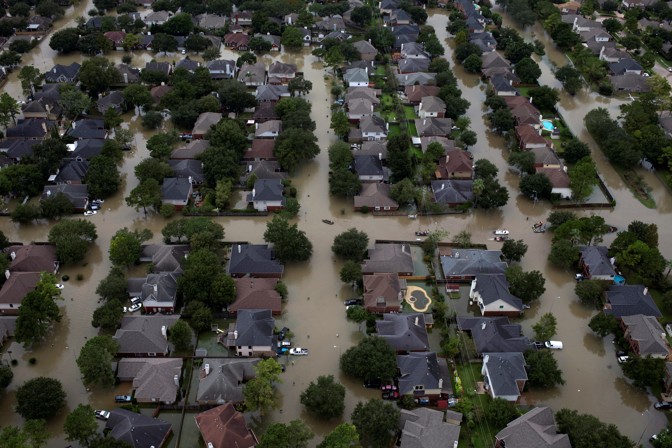
Houses lay submerged in floodwaters caused by Tropical Storm Harvey in Houston in August 2017. The National Climate Assessment warns that climate change will make catastrophic floods more likely. (Adrees Latif / Reuters)
This trend “can only be explained by the effects that human activities, especially emissions of greenhouse gases, have had on the climate,” the report says. It warns that if humans wish to avoid 3.6 degrees of warming, they must dramatically cut this kind of pollution by 2040. On the other hand, if greenhouse-gas emissions continue to rise, then the Earth could warm by as much as 9 degrees by 2100.
“It shows us that climate change is not a distant issue. It’s not about plants, or animals, or a future generation. It’s about us, living now,” says Katharine Hayhoe, an author of the report and an atmospheric scientist at Texas Tech University.
The report visits each region of the country, describing the local upheavals wrought by a global transformation. Across the Southeast, massive wildfires—like those seen now in California—could soon become a regular occurrence, smothering Atlanta and other cities in toxic smog, it warns.In New England and the mid-Atlantic, it says, oceanfront barrier islands could erode and narrow. And in the Midwest, it forecasts plunging yields of corn, soybeans, wheat, and rice.
Its projections of sea-level rise are just as ominous. If carbon pollution continues to rise, a huge swath of the Atlantic coast—from North Carolina to Maine—will see sea-level rise of five feet by 2100. New Orleans, Houston, and the Gulf Coast could also face five feet of rising seas. Even Los Angeles and San Francisco could see the Pacific Ocean rise by three feet.
Even if humanity were to reduce the burning of fossil fuels, the report forecasts that New Orleans could stillsee five feet of sea-level rise by 2100.
Andrew Light, another author of the report and a senior fellow at the World Resources Institute, said that although the report cannot make policy recommendations, it might be read as an endorsement of the Paris Agreement on climate change.
“If the United States were to try and achieve the targets in the Paris Agreement, then things will be bad, but we can manage,” he said. “But if we don’t meet them, then we’re talking about hundreds of thousands of lives every year that are at risk because of climate change. And hundreds of billions of dollars.”
If you think the Friday after Thanksgiving seems like an odd day to publish such a major report, you’re right. The assessment was originally scheduled to be released in December at a large scientific conference in Washington, D.C. But earlier this week, officials announced that the report would come out two weeks early, on the afternoon of Black Friday. When politically inconvenient news is published in the final hours of a workweek, politicos call it a “Friday news dump.” Publishing a dire climate report in the final hours of Black Friday might be the biggest Friday news dump of them all.
So who ordered such a dump? During a press conference on Friday, the report’s directors in the government repeatedly declined to say. “It’s out earlier than expected,” said Monica Allen, a spokeswoman for NOAA. “This report has not been altered or revised in any way to reflect political considerations.”
Yet the change in scheduling took the report’s authors by surprise. John Bruno, an author of the report and a coral biologist at the University of North Carolina, told me that he only learned last Friday that the report would be released today. “There was no explanation or justification,” he said. “The [assessment] leadership implied the timing was being dictated by another entity, but did not say who that was.”
Hayhoe told me she only learned on Tuesday that the report would be released on Friday. At the time, she was preparing three pies for a family Thanksgiving. She put the pies aside and picked up her laptop to submit any final revisions to the document.
The White House did not respond directly when asked who had ordered such a change. It also did not respond directly when asked if the report would lead President Trump to reconsider his beliefs.
But a White House spokeswoman did send me a lengthy statement saying that “the United States leads the world in providing affordable, abundant, and secure energy to our citizens, while also leading the world in reducing carbon-dioxide emissions.” (This is only true if you start counting in 2005, when U.S. emissions peaked.) The spokeswoman said this new assessment was based on the “most-extreme scenario,” and promised any future report would have a “more transparent and data-driven process.”
Not that Hayhoe ever had high expectations about President Trump’s reaction to the report. “It wasn’t the hope that the federal government would look at it and go, ‘Oh my goodness! I see the light,’” she told me.
Rather, she said, she hoped the report would inform the public: “This isn’t information that’s only for the federal government. This is information that every city needs, every state needs, increasingly every business needs, and every homeowner needs. This is information that every human needs.”
“It’s not that we care about a 1-degree increase in global temperature in the abstract,” she said. “We care about water, we care about food, we care about the economy—and every single one of those things is being affected by climate change today.”
This is exhausting. She is right. It is exhausting.
Yesterday afternoon, a man went to Mercy Hospital in Chicago and killed three people: a pharmacy resident named Dayna Less, a police officer named Samuel Jimenez, and Dr. Tamara O'Neal, the man's former fiancé. The shooter, Juan Lopez, 32, was seen arguing with Dr. O'Neal in the parking lot before taking his gun out and shooting her nine times. People called 911, police arrived. Lopez ran into the hospital and ended up in a shootout with Samuel Jimenez that ended in both of their deaths and the death of Dayna Less.
Also, yesterday, a man walked into a Catholic supply store in St. Louis, pulled out a gun, ordered two women to take their clothes off, sexually assaulted them and then shot one of them in the head. She didn't survive, he still hasn't been caught.
Also, yesterday, a man in Denver shot five people, killing one, wounding four. No one knows why, and police are still looking for him.
That was all in one day.
This week, in Colorado, Christopher Watts was sentenced to three life sentences, to be served consecutively, for the murders of his pregnant wife and two children, whom he killed so he could have a "fresh start." He put their bodies in oil tanks.
These are all unrelated crimes. The last one didn't even involve a gun, the third one does not appear to be misogyny-related that we know of (though if we find out the guy's got a history of domestic violence, I won't be surprised -- most of them do). But it still just feels like a lot at once. It feels like this never goddamn stops.
At the same time, we've got message boards full of incels (who probably already have threads up praising at least one of these men), fucking Nazis and Proud Boys, MGTOWs and Red Pillers and every possible variety of angry men constantly screaming and raging about how they're not getting what they feel the world owes them.
It's just goddamned exhausting.
I was sitting at the bar when I found out that the Chicago shooter was going after his ex-fiancé. Some of my girlfriends were sitting down the other end, also talking about the shooting, and I walked over to tell them. We talked for a minute about how literally every time this happens it turns out to be some guy with issues with women or a history of domestic violence -- but then some asshole dude, whom I did not know, stood up and started angrily demanding to know whether the shooter was white or black. At that point they hadn't said anything. But this guy, he says, "Well you know he wasn't white because if he was white they'd be going on and on again about another angry white man but do you know the actual statistics on crime in this country? Black men..."
"Holy shit, I am really going to need you to shut your mouth right now," I told him. He kept going anyway. A friend said, "Dude, she covers this stuff for a living, she knows what she's talking about." I forget what I said, eventually, to shut him up, but eventually he spun back around in his seat and left it alone.
Well, he left it alone for 10 minutes, anyway, right up until he walked over to tell me that he has friends who are cops and a cop was also shot. "Yes, I know. It is in the news." He then proceeded to explain to me that he was not racist, but that he had a very fancy MBA and was thus interested in statistics and facts.
I think I finally got him to leave on the third "For the love of god I am not interested in anything you have to say."
I'm relaying this story now because, you know, it just felt a little too on the nose.
Toxic masculinity is literally killing us and I genuinely do not know what the fuck to do about it. I don't know what to do about it when I see it in real life, and I sure as hell don't have any good answers for how to solve it on a larger scale -- outside of mandatory therapy for every man in America. As much as I believe in gun control, it's not the only answer here. Obviously we need more of it and it would sure as hell save a lot of lives -- but it's not the only issue here. Women have guns, too, and we don't see three women in a day going on murder sprees. Out of all the mass shootings we've had since 1982, only three in total have been perpetrated by women.
It's almost as if these post-baby boom generations of men, lucky enough to avoid an actual draft, are simply finding a new way to wage war in its absence. But if it were simply that men, in general, are more violent and need some kind of outlet for violence, we wouldn't also have a situation where the vast majority of these entitlement-based mass shootings were carried out by white men. They are losing social power and status and they are retaliating in violence, they are retaliating in organized hate.
I am so tired of writing this article. I am so tired of this happening. I am so tired of seeing a mass shooting happen, then waiting a few hours to find out what grievance the shooter had with one woman or all women in general, and then seeing it and going "Yep, just as expected."
Donald Trump issued a statement Tuesday on the Saudi government’s killing of journalist Jamal Khashoggi in October, saying it was an open question whether Crown Prince Mohammed Bin Salman was responsible for the killing and pointing out that, hey, Saudi Arabia opposes Iran and buys lots of weapons from U.S. arms manufacturers.
The actor had his neck cut with glass during the match.
This past weekend David Arquette took part in a professional wrestling death match in Los Angeles that left the actor bloody and injured after his neck was cut with glass from a fluorescent glass tube used in the match.
Wrestling against Nick Gage, Arquette took a shot to the head with the light tube before it appeared the shards slit his neck as Gage fell. Arquette, stunned by what took place, seemingly stood up and held his throat — concerned the damage was more severe than expected.
The actor then “no-sold” the finish, meaning he didn’t make the end of the match seem real — and stormed out of the ring, clutching his bleeding neck and seemingly furious with Gage.
I think it’s right about here where David Arquette got it in the jugular & he was bleeding a freaking lot. Holy hell. #JJLACpic.twitter.com/zruTuE5VtP
A particular brand of hardcore wrestling, death matches are essentially anything-goes brawls that incorporate the use of foreign objects and weapons, originating in the mid-20th century, but gaining popularity in the 60s, 70s and 80s with superstars like The Sheik and Abdullah The Butcher . Initially used as a high-stakes conclusion to long-standing feuds, death matches became more prominent during wrestling’s proliferation in the late-90s, particularly in the United States with ECW (Extreme Championship Wrestling).
As WWE returned to its roots and aimed to pitch its product to a younger audience, so too did the traditional hardcore match die out of mainstream popularity. However, death matches are still commonplace in smaller promotions looking to fill a niche abandoned by the bigger companies.
Why the heck was David Arquette wrestling?
The 47-year-old Scream star is a long-time fan of professional wrestling, but there’s more history here than that. In 2000 he was stunningly given the WCW World Championship belt during the promotion of the movie Ready to Rumble, which is still viewed today as one of the worst decisions in professional wrestling history.
Putting the belt on an untrained actor was symptomatic of the issues WCW had prior to being bought by WWE, but Arquette’s 12 day title run is held as the moment the company truly jumped the shark and was unable to recover. Wrestling fans have routinely mocked the decision, and Arquette by proxy.
In 2018, during an appearance on Wendy, Arquette announced his return to wrestling with the desire to redeem himself in the eyes of fans and prove them wrong.
“For 18 years I’ve been trolled on the internet, and people have attacked me — and I just want to bring some respect back to my name.”
Arquette announced that he had been getting in shape, training and in July of 2018 he made his debut with Championship Wrestling from Hollywood, an independent promotion based out of Los Angeles.
Is Arquette okay?
Immediately following the match he was taken to hospital to receive stitches and repair his wounds. Following the match he made light of the situation on Twitter, just as the wider public were becoming aware of the match.
On Monday he issued a statement, saying he was unaware how brutal the match would be — and apologized to wrestling as a whole for bringing “negative attention” to it.
The main reason I got injured was because of my lack of experience - don’t try this at home pic.twitter.com/icQK2wnQNc









/cdn.vox-cdn.com/uploads/chorus_asset/file/13592463/Screen_Shot_2018_11_30_at_12.27.09_PM.png) Sterling Bay
Sterling Bay
/cdn.vox-cdn.com/uploads/chorus_asset/file/13592068/Screen_Shot_2018_11_30_at_10.28.31_AM.png) Sterling Bay
Sterling Bay
/cdn.vox-cdn.com/uploads/chorus_asset/file/13592282/Screen_Shot_2018_11_30_at_11.03.38_AM.png) Sterling Bay
Sterling Bay
/cdn.vox-cdn.com/uploads/chorus_asset/file/13592286/Screen_Shot_2018_11_30_at_11.04.21_AM.png) Sterling Bay
Sterling Bay
/cdn.vox-cdn.com/uploads/chorus_asset/file/13592438/Screen_Shot_2018_11_30_at_12.23.21_PM.png) Sterling Bay
Sterling Bay
/cdn.vox-cdn.com/uploads/chorus_asset/file/13592293/Screen_Shot_2018_11_30_at_11.06.02_AM.png) Sterling Bay
Sterling Bay
/cdn.vox-cdn.com/uploads/chorus_asset/file/13592289/Screen_Shot_2018_11_30_at_11.05.33_AM.png) Sterling Bay
Sterling Bay





/cdn.vox-cdn.com/uploads/chorus_asset/file/13589839/Straight_View__1_.jpg) Image courtesy of the 45th Ward
Image courtesy of the 45th Ward