SlickText.com, a leader in the SMS marketing industry, has just released their first infographic entitled “The Power of SMS Marketing”. The statistics shown here really help to explain why SMS marketing has grown so fast in popularity over the past few years.
There’s not really much to say that George from Arlen’s Transmissions doesn’t sing in this remarkably creepy local commercial. If you have a shifting problem (wink, wink, say no more!), then you ought to pay George a visit because he’s basically the Cesar Millan of transmissions. Unless you’re a dude — George doesn’t help dudes.
This took me three days before i found a time to watch this with nobody looking over my shoulder. Totally worth the wait.
Lo, and so it came to pass that the internet was created; and was originally used in the 1960s as a way for researchers to transmit information. Then, in the 1980s, internet usage was standardized, followed by widespread civilian usage beginning in 1995. And thus was accomplished the creation of a world-wide network of computers capable of sharing massive amounts of information and changing our lives, so that we could watch videos like this one, with a half-interested cat dressed in a shark suit sitting on a robot vacuum and sort of chasing a baby duck around. And then Western Civilization came to an end, probably by next Thursday or so.
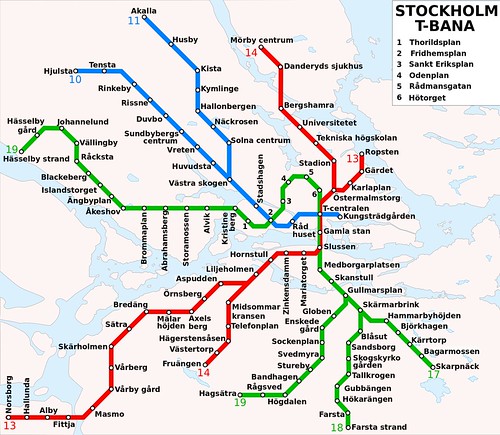
The Wikipedia entry for Stockholm’s Metro system says that it has 100 stations in use along about 65 miles of track. I seem to recall that Stockholm was one of the cities used to illustrate the concept of transit-oriented development in Michael Bernick and Robert Cervero’s 1996 book on the subject, Transit Villages in the 21st Century. I also know that Stockholm was an early adopter of congestion pricing for roadways.
What I didn’t know until now, however, was that transportation innovation in the Swedish capital and its suburbs also extends to a flamboyant display of public art in its Metro stations. Indeed, The website Twisted Sifter relays the claim that the system is basically "the world’s longest art exhibit":
Travellng by metro is like travelling through an exciting story that extends from the artistic pioneers of the 1950s to the art experiments of today. Over 90 of the 100 subway stations in Stockholm have been decorated with sculptures, mosaics, paintings, installations, engravings and reliefs by over 150 artists. What a fun and inexpensive way to explore the art and culture of an incredible city like Stockholm!
Several of the underground stations, especially on the system’s Blue Line, are left with the shape of the bedrock exposed, covered in sprayed concrete, as part of the exhibits. At the Rissne station, says Wikipedia, a wall fresco depicting the history of Earth's civilizations runs along both sides of the platform. In six of the stations the art is temporary and replaced periodically.
Twisted Sifter says the movement to install art in the Metro began in the mid-1950s. There are guided tours of the highlights. Enjoy these photos garnered from the collections of photographers generous enough to license their work for public use (as always, move your cursor for the credits).
For an especially fun presentation, watch this video (Spanish with English subtitles) of an animated host taking us on a tour of some of the highlights:
This post originally appeared on the NRDC's Switchboard blog, an Atlantic partner site.
According to a new poll by the Pew Research Center, when reached for comment on this week, 93 percent of Americans responded “Okay, enough’s enough here, you have seriously got to be kidding me with this week,” with 84 percent saying “Is it Sunday yet? What? How in the hell are we only at Thursday? What the hell is going on?” and 100 percent of Americans responding “No, no, go ahead, just pile some more horrific shit on this hellish shitshow of a week. Have at it.”
The Aca-Tramps from Pitch Perfect are headed back to the theaters in 2015. Kay Cannon is returning as the screenwriter (yes!), but nothing is confirmed beyond that — though it's hard to imagine the cast would pass up the opportunity to reprise their rolls in a Cannon-penned script. Besides, what else does that cast of (mostly) medium-talent randoms have to do?
The numbers are undeniably mind-boggling: An estimated two million people in Beijing are said to be living below the earth's surface, in thousands of 100-square-foot spaces located just one or two stories below street level. These figures have been makingheadlines (and trending upwards) for a couple of years now. Assuming they're accurate, that would mean 10 percent of the city's 20 million people sleep in windowless, subterranean residences.
That they are there speaks to the crushingly expensive housing market in China's bulging top-tier cities. The makeshift conversion of approximately 20,000 antiquated bomb shelters and basements across Beijing has also no doubt led to a rise in dangerous living conditions: it's common to find multiple people sharing these small emergency shelters made only slightly more hospitable with space heaters and hot plates.
The only affordable alternative would be way out on the city's periphery.
And yet, if you ask them, many of these people, most of them migrant workers, will tell you their choice to live underground is vastly better than the alternative.
"The plus side for them of living underground was, of course, better economic opportunities," says Annette M. Kim, associate professor of urban planning at the Massachusetts Institute of Technology. "They had multiple jobs in the vicinity, and they didn’t have enough time to travel far." The only affordable alternative for most migrant workers in Beijing, Kim says, would be way out on the city's periphery – beyond the Sixth Ring Road – where the combination of distance and poor transit access creates hours-long commutes.
Kim and her team have gleaned these preliminary findings from extensive interviews with about 20 underground Beijing residents. Of the subterranean residents they've talked with so far, there are waiters, maids, cooks, salespeople, deliverymen, vendors, construction workers, and security guards. Tenancy in these underground units ranged from just a few days to more than eight years.
They've also been collecting more concrete data from classified ads for this unique class of housing. Based on an analysis of more than 600 ads posted to the website Ganji.com, the median monthly rent for one of these units is about $64.
"Of course there's a sampling bias with these online ads," Kim says. "I think they're going to be on the slightly higher end of the bomb shelter market."
This ad from Ganji.com offers a 10-square-meter room in the basement of a building just outside the 3rd Ring Road for 240 yuan a month, or about $39.
A holdover of Cold War anxieties, bomb shelters are still required by Beijing's official building code. In the 1990s, the city enacted a policy to open up these spaces for use. But the government has since grown weary of the underground dwellings. In August 2010, the city stopped granting new use permits for these spaces and has a three-year plan to move all the subterranean residents. Kim says many, if not most, remain for now. But the policy raises some questions about the accuracy of the city's tally of underground residents, which may be inflated to justify evictions.
Kim is planning to go back to do more field research this summer to get a better idea of how extensive this lifestyle really is and how the underground dwelling market functions. She hopes to gather more data on transportation access and to look at the relationship between the above- and below-ground local real estate. If indeed there are two million people living underground in Beijing, Kim thinks there may be a way to make this housing stock work better. Or maybe it's fine as it is, providing exactly what this growing class of migrant workers needs at the right price and location.
"I'm still grappling with how to understand it," she says.
This much we know to be true: dogs hate cats. But maybe they don't hate cats. Had you ever considered that? Had you ever considered that the only thing your dog ever wanted in this wide world of domestic animals was a kitten to cuddle and irritate for the entirety of its degraded feline life as the pet of a common dog? You should listen to your dog more often and not be so self-centered, jeez.
Irish Cheese company LowLow's new advertisement is a parody of standard diet ad cliches — Smug Girl, Ditzy Girl and Muffin Girl dance around with yogurt and zip up their jeans — because even though its cheeses only have one-third the fat of regular cheese, LowLow is hip enough to know that diet ads suck. Meta!
In the town of Camina, in northern Chile, 147 km from the city of Iquique, and approximately 3,700 meters above sea level, lies a strange Red Lagoon. The waters of the lagoon is so intense red that it seems like ink or blood. The lake was known to locals, but unknown even to the National Service of Tourism until 2009, although several miles downstream lies the Caritaya Reservoir.
This area has historically been populated by the Aymara culture and ancient civilization, who have managed to preserve the secrets and legends of its land, and which have just recently been revealed. Like the mysterious curses that have been associated with Egyptian tombs, this red pool is possesses by a curse that affects those who approach its red waters. That's why nobody knows where it is exactly and it does not appear on maps. The disappearance of thousands of Aymaras is also attributed to this lake because they drank from its waters.
The red lagoon is surrounded by two other pools of yellow and green water, and they are said to bubble when surrounded by unpleasant people. it is therefore common belief that these accumulations of colored water are owned by the devil himself. According to a few experts the color is due to different species of algae living in its depths.
It turns out that sitting an an exercise ball instead of an office chair has no real health benefits, doesn't improve your posture, and doesn't work your core. Basically, you look like a tool for nothing.
The Central Library in St. Louis has been a city landmark since the architect Cass Gilbert first designed it a century ago. Its 185,000 square feet occupy a full block of downtown, with a grand stone stairway rising off of Olive Street and opening onto an ornate central pavilion that feels like something quite the opposite of a reading nook. To put it succinctly, the whole building looks as if it were designed by the same man who dreamed up the Supreme Court (as, in fact, it was).
Today, its grandeur is one of its great assets, turning the city's central book hub into a historical monument. But the 21st century library primarily aspires to be something that Cass Gilbert's building was decidedly not: flexible – in programming, in mission, in space, in anticipation of a changing future. "Central library is anything but flexible," says Waller McGuire, the executive director of the St. Louis Public Library. "It is a mountain of granite, and it has stunning, but very divided spaces."
Courtesy Timothy Hursley
This contrast – between monumental architecture and the modern need for flexibility – touches many of America's great urban libraries. Much has been said about how these institutions should remake themselves in the age of the ebook, redefining even the role of the librarian. But the architecture of libraries is relevant, too; buildings built for a different kind of relationship to books can't be changed as easily as the books themselves.
St. Louis' Central Library closed for two years for a massive renovation that sought to reconcile the institution's past with its future (while also correcting some serious fire hazards).
"On one side, you have Cass Gilbert," says George Nikolajevich, the design principal for the project with Cannon Design. First and foremost, he says, he didn't want to "desecrate" the original structure. "On the other side, [you have] the 21st century and the transformation of parts of the building."
The library reopened in December, its 3 million books and artifacts rearranged and moved backed in from air conditioned storage, many of them into an entirely remade north wing. Amid the transformation, though, the one change library pessimists keep anticipating is nowhere to be found: The books themselves haven’t been pushed to the side for computer kiosks and iPad charging stations. They are more prominent than ever.
"This question often comes up: Are the books something that will disappear?" Nikolajevich says. The new Central Library is in fact betting on the opposite. "I think they’re here to stay and live together with all kinds of electronic equipment. And if you look at the life of that library today, you would see an amazing amount of enjoyment by people – if you look at kids it’s particularly interesting – using books."
The most problematic part of the building was its north wing, where the "stack towers" housing seven-story-tall shelves held the bulk of the museum’s books for a century. This is how the cavernous room originally appeared before the shelves were inserted:
St. Louis Public Library
And during that building process:
St. Louis Public Library
Glass floors enabled librarians and researchers to access the stacks:
St. Louis Public Library
This was neither the kind of place you would want to browse for new authors nor accidentally light a match. "One of the world's great public library collections," McGuire says, "was stored in what was in effect a chimney."
The room was also a relic of another library era. When Gilbert designed the building, readers would typically enter the grand front stairway to finger the card catalog in the library's Great Hall. They'd scribble down the books they wanted on small cards, and hand those over to librarians. Those cards would travel through pneumatic tubes back to the stacks to librarians who'd hunt down the correct title. Eventually, the book would come back across the counter to the waiting reader.
"That's not the way patrons want to use a collection now," McGuire says. "They want to browse the shelves themselves, they want to see the collection and touch it themselves."
When contractors tore down all of those original seven-story bookshelves, it turned out, Nikolajevich says, that Cass Gilbert had left the modern-day architects a beautiful, flood-lit white box covered in porcelain tile in need of only a good wash. This is what the space looks like today:
Courtesy Timothy Hursley
The majority of the books in the stacks have been moved into public parts of the library (those spaces were also vastly expanded when the administrative offices were relocated). Those books that do remain "behind the scenes" are now behind glass walls. Cannon kept the two-toned white and dark-wood color of the original space. The rest of the decoration now comes from the colorful books themselves, from what Nikolajevich calls the "crown of books" that pulls your eye around the space.
This part of the building now also has dedicated computer spaces, and McGuire says he knows the library is becoming a portal for many people onto the Internet. "But I don't worry about what used to be called 'the death of the book,'" he says. "All you have to do is go into the children's library and watch a group of kids for a story time get led out and dash into the collection and grab mounds of books that they clutch to themselves."
Elsewhere throughout the library, historic spaces have been refurbished and new ones created, enabling visitors to touch and browse the books more as you would in a bookstore sorted by topic. The dramatic renovation of the north wing also enabled one other change: For the first time in 100 years, the Central Library now has an entrance on its north side, too. Until now, the building had essentially turned its back on the neighborhood to its north, the downtown area that the city is now trying to revitalize.
"That feels as though we have opened ourselves to the 21st century as well, to the St. Louis that's being built land developed all around us now," McGuire says. Cannon created a new sculptured entrance of stainless steel (mirroring the St. Louis Arch), with the names of authors and suggested lines from readers’ favorite books carved into the supporting pillars and water feature.
Courtesy Timothy Hursley
The grand Olive Street entrance still remains, just as Gilbert designed it. "You can kind of choose the library you want to walk into," McGuire says. And this is the very definition of flexibility. "I've had patrons tell me they do it that way – some days they feel like coming into the historic library, some days they feel like coming into the new library. And I feel like Yes! We got it right."
Salt, an essential element for all animal life, is abundant here on Earth, but it still requires extraction from stone deposits or salty waters. The process of mining that salt can produce beautiful landscapes, including deep, stable caverns, multicolored pools of water, and geometric carvings. Some of these locations have even become tourist destinations, serving as concert halls, museums, and health spas touting the benefits of halotherapy. Collected here are images of salt mines across the world, above and below ground. [31 photos]
One of the colorful brine pools that are part of a lithium salt pilot plant on the Uyuni salt lake, which holds the world's largest reserve of lithium, located at 3,656 meters (11,995 ft) above sea level in southwestern Bolivia, on November 5, 2012. (Reuters/David Mercado)
In honor of the opening of a new garden in Paris, Reuters has pulled together a list of some of their favorite green spaces. Here are a couple of our favorites:
1. Paris, France. Who doesn't want to pull weeds with a view of the Eiffel Tower? This 150 square meter garden sits on top of the Palais de Tokyo museum. According to Reuters: "This temporary rooftop garden is a creation by three-star Michelin French chef Alain Passard who specializes in vegetable cuisine."
(Philippe Wojazer/Reuters)
2. London, England. This is a covert operation: England's "guerrilla gardeners" (armed with seed bombs and pitchforks) plant flowers and herbs in "urban wastelands" under the cloak of night. "Their tactics are anarchistic," Reuters writes "their attitude revolutionary. Their aim: to beautify."
(Alessia Pierdomenico/Reuters)
3.Paris, France. Well, they don't call it the city of gardens for nothing. This 30-meter vertical garden lives in the courtyard of Pershing Hall. It was designed by French botanist Patrick Blanc.
(Charles Platiau/Reuters)
4. Torshavn, Faroe Islands. This government building keeps its carbon footprint relatively small by using grass as its rooftop material of choice.
(Bob Strong/Reuters)
5. San Francisco, California.This 2.5-acre "living roof" on top of the California Academy of Sciences houses native California plans. Inside, a natural history museum, aquarium, planetarium, and research facility offer some insight into what's growing above.
(Robert Galbraith/Reuters)
6. Mexico City, Mexico. More art piece than garden, "Not everything green is ecological" turns old VW Beetle taxis into lush bushes. It was created by artist Betsabee Romero and lived in a pond.
Australian born, UK based designer-maker, Jay Watson, has created furnishings that will leave you with a long lasting impression. This wonderfully sleek table, as beautiful as it is in its pure form, has a special touch. Using Thermochromism, the science that changes the colours of properties due to change in heat (Thanks Wikipedia), Jay has encompassed both beautiful design with remarkable lasting impressions and created this project titled ‘Linger a little longer‘.
Jay Watson explains on his website the thoughts behind the project:
[box style="rounded" border="full"]Making entertaining that bit more fun (while also commenting on how ‘precious’ we can become about the functionality of furniture, or how oblivious we can be to every effect we have on our environment) the thermochromic finish of the table and benches responds to the heat of any plate, mug or serving dish – or body part – placed on it, to leave an ephemeral ‘watermark.’[/box]
Whatever stance you decide to take towards Jay’s work, it is undeniably creative. This piece takes the Art of Science and adds function and aesthatics to an already wonderful piece of furnishing. Furnishings that change their form, in a way which is relative to the end user’s experience and movement is something that may change the way we envision our home furnishings.
Someone not feeling well? Don’t sweat it, there is a clever thermometer to help measure your child’s temperature. In a way that feels natural to you. This brilliant thermometer is based on a common and natural behavior of putting your hand on the forehead to measure internal heat of their body. Checking the temperature by scanning the forehead with this device is easier and faster, since it eliminates the need to insert an external tool while holding them in a still position.
The intuitive shape of the device allows the user to easily understand how to hold and use the device. The organic and ergonomic shape provides a secure grasp in the user’s hand. After simply placing the device on the forehead, a beeping sound followed by a flashing LED alerts the user when it is done. In addition, the user can clearly see the temperature on the LCD screen, while holding the device and their baby.
Designed by Duck-Young the Korean has won many design awards including the Red Dot Design Award.
Currently, you can see former Disney child stars going bad in Spring Breakers, but what happens when the Disney Princesses do the same thing? Here's to a whole new fucked up side of Cinderella, Jasmine, Ariel and Snow White. More »
Welcome to the first annual Urbanist Toolkit Bracket Challenge, where the hottest trends in urbanism go head-to-head in a winner-take-nothing bonanza. As this is the first time the competition has taken place, we don't yet have any great statistics to offer -- no legends of tournament history, no Cinderella stories. But we will soon.
Before we get started, rest assured, we know your objections. How contrived! Urbanism isn't a zero-sum game! No city should have to choose between red light cameras and libraries with water slides!
But this is a game. One that pits your instincts, tastes, and urban design wisdom against those of your fellow readers. Here's how it works.
Thirty-two in-form tools of urbanism have been seeded, according to their popularity and utility, into four regional groups: the Ed Koch, the Sidewalk Ballet, the Le Corbusier, and the Dandyhorse. The four #1 seeds -- car share, bike lanes, farmers' markets, and the waterfront promenade -- are paired off against decidedly more obscure options.
You'll need to make tough choices. Bus rapid transit or streetcars? A convention center or a festival? Privately owned public space or highway decks? Think of it as a mid-20th century version of SimCity; or perhaps the Strat-O-Matic of city games.
Here's the full bracket (click through for a PDF, which you can download and fill in):
Fill out a bracket and send it into us -- theatlanticcities [at] gmail.com -- by Monday evening, with "Bracket" in the subject line. (Double-check that the bracket you attach has your entries saved!) If your prediction is the closest match to the actual results (with weighted points for predicting higher levels of the competition, of course), we'll give you your fifteen minutes of fame when we announce the winner here in a couple weeks.
But here's where our bracket challenge differs from the NCAA March Madness basketball tournament: you don't just predict the winners, you choose them, too. Below, we run through the four regions with polls for every first-round match-up.
If you were mayor, what would you choose for your city?
Sidewalk Ballet regional
It's been another strong year for farmers' markets, with more and more cities making it easier for residents to farm and purchase local produce. Only a fool would expect adventure playgrounds, though zany and interesting in their way, to come out of this first round with an upset.
Business Improvement Districts: smart, efficient public-private governance for 21st century cities or unconstitutional allocation of power? You decide. A toss-up 4-5 match-up sees BIDs go head-to-head with Wi-Fi in public parks -- the concept is a crowd-pleaser, but can it go far?
The Sidewalk Ballet regional is stacked full of great contenders. Food trucks are an awfully tough #3 seed, given their mass appeal, low cost, and tasty snacks. But even if they dispatch pop-up parks, can food trucks get past pedestrian streets? And are they environmentally friendly?
Pedestrian streets have found success in cities like Memphis, TN, and Ithaca, NY, and are hugely successful in European city centers. In New York, Times Square is about to receive a permanent pedestrian-only redesign. Re-purposed malls, meanwhile, are just emerging as a tactic for dealing with the changing retail economy. Providence is turning an old mall into micro-apartments. Elsewhere, they've become churches or office complexes.
Innovative new intersection designs like the Diverging Diamond are all the rage, but city-sponsored car-share systems -- like the one rolled out in Paris last year -- could have a major impact on urban life. A tough draw for crazy intersections.
Automated parking garages, or car elevators, are incredibly efficient at storing vehicles. But they're also expensive. Uber, the on-demand taxi service, is efficient too -- but its costs are more political than economic, with taxi lobbies across the country doing whatever they can to keep the start-up away.
Nearly every U.S. city has parking minimums, requiring developers to construct a certain number of parking spots for every new building. But in Zurich, they have parking maximums, limiting center city parking construction to keep more space available for people. In London, meanwhile, they don't let the cars into the downtown in the first place -- unless they pay a heavy tax.
Red light cameras activate strange regions of people's brains. If you believe in traffic lights, they seem to be a sound follow-through step, and they're proven to make roads safer. And still, many people hate them. Why not spend that money on electric car charge stations? That's what San Diego's doing now, betting that electric car infrastructure will be a crucial facet of city life in the 21st century.
Cities like Bus Rapid Transit (BRT). It's cheaper to build than fixed-guideway routes, and faster than normal bus service. Is it too good to be true? Many U.S. cities are taking a page from Europe, and investing in rebuilding the streetcar systems they demolished a half-century ago. When does light rail work, and when doesn't it?
It's striking that so many cities don't yet have displays to tell commuters what time the next bus or train is coming. (In some cases, it's difficult to find that information even with a smartphone.) But as real-time arrival clocks become more common, Boston is trying to take the next step and turn riders' smart phones into rail passes. Is "mobile ticketing" the ride of the future, or a waste of money?
Bike share hardly needs explanation for readers of this site. It's a favorite to go far in the tournament, with an ambitious new program set (finally) to premier in New York City this spring. The cable car may be an underdog but it's having its fifteen minutes of fame. Medellin, where a cable car is part of the mass transit system, won an award as the "Most Innovative City" this year, and London built a big cable car this summer.
Waterfront redevelopments have been hugely successful in Baltimore, New York, and San Francisco, and nearly every city seems to have such a plan somewhere in the works. But with climate change a rising threat, are they still the favored son in visions of the post-industrial future? Elsewhere, cities are considering investing their money in putting water slides in libraries.
For decades, New York City has traded zoning concessions in densely packed Midtown in exchange for POPS, or "privately owned public spaces." Whether those spaces have been worth it is now a hot debate. Other cities, like Dallas and Phoenix, are creating new public spaces by placing decks over highways, turning noisy trenches into tranquil parks.
It used to be conventional wisdom that a mid-sized city ought to have a convention center, which brought in periodic crowds of lawyers, dentists, comic book enthusiasts, and so on. But following the lead of Miami Beach's Art Basel and Austin's South by Southwest, some mid-sized cities -- like Charlottesville -- are trying to get in the festival game instead, eschewing expensive convention facilities in favor of a citywide approach to events.
Every big city wants a big stadium. Are they a tax-payer boondoggle or an economic engine? You decide. Meanwhile, last year Austin became the first U.S. city to host Formula 1 since Indianapolis in 2007 -- will more cities try to tap into the world's biggest sport?*
Check back next week when the first-round winners are revealed, and vote for which urban design concepts make it into the Elite Eight. Get your own bracket here, and send it in by Monday evening.
*Correction: Austin was not the first U.S. city to host F1 -- as Bob Hellrich-Dawson points out below, Indianapolis hosted the U.S. Grand Prix between 2000 and 2007. Phoenix, Detroit, Dallas and Long Beach all hosted races during the 1980s.
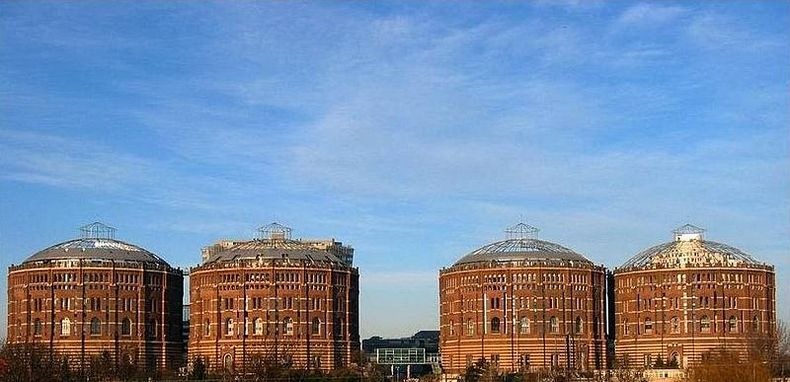
In 1896, Viennese authorities decided to invest in large-scale gas and electric utilities to provide the townsfolk with coal gas for stoves, street lights and furnaces. Previously gas was provided by an English firm called Inter Continental Gas Association (ICGA). Once the contracts with the ICGA expired, the city decided to construct facilities to handle its own gas needs. So they constructed four massive storage tanks called gasometers, in the 11th district of Simmering. The tanks were enclosed by a brick façade, each approximately 70 meters tall and 60 meters in diameter, and with a storage capacity of over 90,000 cubic meters. At the time, they were the largest in Europe.
Overtime, town gas (coal gas) was replaced by natural gas and the gasometers were no longer needed. After nearly a century of operation, in 1984, the gasometers were decommissioned. But owing to their outstanding architectural and historic value, the gasometers were not demolished, rather classified as the country’s heritage building.
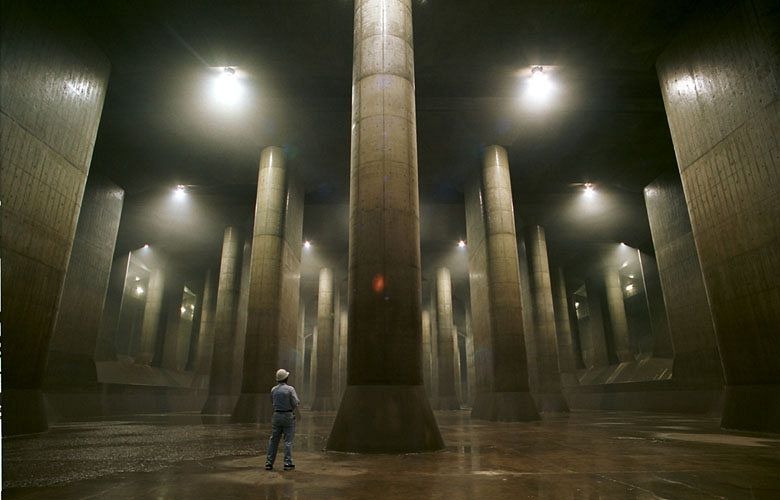
Located on the outskirts of Tokyo, behind a small government building, underneath a soccer field and skateboard park, is an incredibly huge storm sewer system, built to protect the city’s 13 million residents from heavy rainfall and tropical storm floods. The official name of these long, underground tunnels is the “Metropolitan Area Outer Underground Discharge Channel”, but is more commonly called G-Cans. Built between 1992 and 2006, at the cost of $3 billion, this huge underground water management system comprises of 6.4 km of tunnels up to 50 meters underground connecting 5 giant silos, 65 meters tall and 32 meters wide, to one massive tank – the Temple.
The Temple. Photo: Michael Johngrist
The “Underground Temple” is the most impressive feature of G-Cans, that has been used as an atmospheric backdrop in various films and dramas. This giant metal reservoir measures 25.4 meters by 177 meters by 78 meters and is supported by 59 gargantuan pillars. Flood water from the city’s waterways are collected through the tunnels and into the silos. When these fill, water from the silos works its way through a series of tunnels and into the massive “Underground Temple”. From there, four turbines powered by jet engines, pump out 200 cubic meters or 53,000 gallons of water per second into the Edo River.
In his ongoing street art series “The Living Wall,” Russian artist Nikita Nomerz brings life to decrepit buildings in Russia by painting faces on them. Nomerz travels extensively around Russia and makes an effort to paint a character in each place he visits. He talks about his art in this interview with Global Street Art.
I paint in the street, in public spaces, but I do not position myself as an invader of the city or a destroyer. I position myself as a creator. With my street art work, I fill the urban emptiness. I am inspired by the process of painting, city, people, music, movies and art by other artists. All this is interesting: it pushes the creation of art works.
Girl Scout Season officially came to an end on Sunday — there, there. It's gonna be OK, because we've got word of something even better — Girl Scout Cookie-inspired beers! Finally, we can feel guilty about finishing off an entire keg of Thin Mint beer while watching Burning Love! Evening plans, done and doner. More »
In 2010, Poland's National Library performed a survey to determine the reading habits of the Polish citizenry. The results were not buoying: 56 percent of Poles had not read a book in the past year, either in hard or electronic form. Just as bad was that 46 percent had not attempted to digest anything longer than three pages in the previous month – and this included students and university graduates.
But who's to blame here: The willfully non-literate masses for not trekking to the public library? Or is it the library's fault for not attracting these individuals, what with its classically stodgy, hermetic-cage-for-learning design?
At least one Polish architect believes libraries should bear some of the blame for a lack of reading. Hugon Kowalski, who runs UGO Architecture and Design, thinks that no matter how grand or inspiring a library's appearance is, many people will not flock to it unless it offers amenities other than plopping down with a book. “A modern building will not attract new users to a library, at least not in the long run," he writes. "People interested in its novelty will probably go there only once.”
So Kowalski conceived of a new kind of library that he hopes will one day be built in Mosina, a town just south of Poznań. On its first floor, it's all bibliotheca: Patrons squat on moddish stools among stacks and stacks of books. But then it gets weird: In the middle of the library is a glass column full of water and flailing human bodies. Go up one level and you're suddenly in the middle of a vast swimming facility, complete with a snaking water slide that takes whooping swimmers on a ride inside and outside of the building.
Kowalski got to thinking about his watery wonderland of reading after consulting surveys that showed Poles "rarely indicated" a desire to build new libraries. Rather, they wanted to see more sports halls, pools, kindergartens and retail shops. So the architect decided to supply the public with a fun reason to repeatedly visit a mixed-use library facility. If it so happens that bathers exit the pool's locker room with a fierce desire to consume Hans Fallada, that's just a happy side effect of the building's design.
The cost of operating the library could conceivably be subsidized with the above-ground pool, Kowalski believes. Such libraries would "parasitize" on their neighbor facilities, with the revenues generated from charging pool admission going toward librarian salaries, book repair and other things. The mixed-use library is an idea that a few cities over the world have already experimented with. The Hague's public library tries to throw a net over a large audience by offering jazz concerts, art shows and a piano-practice room. The Hollywood Library in Portland, Oregan, entices potential readers with an adjoining cafe offering coffee and buttery pastries.
Here are a few more renderings of the poolbrary from Kowalski's portfolio, which also includes this beehive-shaped parking garage and a Barcelona “rock hostel” that literally is a pile of rocks, meant for mountain-climbing practice. In this imagined scene, chlorinated patrons take to an open-air balcony to soak in the weirdly grayish Polish sunlight:
A view inside reveals columned book stacks, an outdoor reading area and the see-through bottom of the pool:
The works of Ryszard Kapuściński only get better when savored after a brutal, no-holds-barred pool-noodle fight:
Here are some of the other uses that UGO conceived for a mixed-use library structure, such as a skate park, grocery store, night club, etc., etc.:










 Currently, you can see former Disney child stars going bad in Spring Breakers, but what happens when the Disney Princesses do the same thing? Here's to a whole new fucked up side of Cinderella, Jasmine, Ariel and Snow White. More »


 neat dude | via biotv







 Girl Scout Season officially came to an end on Sunday — there, there. It's gonna be OK, because we've got word of something even better — Girl Scout Cookie-inspired beers! Finally, we can feel guilty about finishing off an entire keg of Thin Mint beer while watching Burning Love! Evening plans, done and doner. More »


