Shared posts

23 Apr 20:04

"Basic": a beginner's guide to everyone's favorite new insult

by Alex Abad-Santos
Dzaleznik

Ezra Klein's new website informs me about teenage slang in policy-brief format! This article is guaranteed to make you an old person.

Over the past month, people across this great nation found themselves looking in the mirror and asking themselves one thing: Am I basic?

"Basic" and its more aggressive counterpart, "basic bitch," have been in usage for years now, but usage has spiked over the past year or so. Rihanna declared open season on basics, saying that the set of her video "Pour it Up" was a "no basic zone"; men's websites have been instructed not to date a "basic"; and recently, VICE shamed Coachella's music lineup by hinting that the music festival might be a playground for the basic.

You might have questions. In particular, you might be wondering what in the world the insult even means. So here's a short guide that will hopefully calm your fears and, at the same time, help you understand the current pop culture fascination with the term.

I think I might be "basic." I'm scared.

Step away from the ledge. Being basic isn't that serious, nor should it paralyze, incapacitate or cripple your life.

But am I basic?

Well, it depends on who you ask. If someone doesn't like you, they've probably already commented and laughed about your basic-ness. But the joke's on them. They might not even be using it correctly.

Okay, so what is the correct usage?

There's a video from College Humor that distills the current meaning of "basic":

It references a lot of things like having a penchant for Friends, sentimental picture frames, "sexy" sweat pants, Ugg boots, and the —

Stop describing my life.

That video, thanks to the power of sharing (it has over 2.8 million views on YouTube), has sort of crystallized the term "basic" and a "basic bitch" into these possessions and cultural touchstones.

And the video also represents the peak in popular knowledge of a slang term which has grown dramatically in usage in the past year. Here are the Google analytics of "basic bitch", and notice how it's dramatically spiked since 2013:
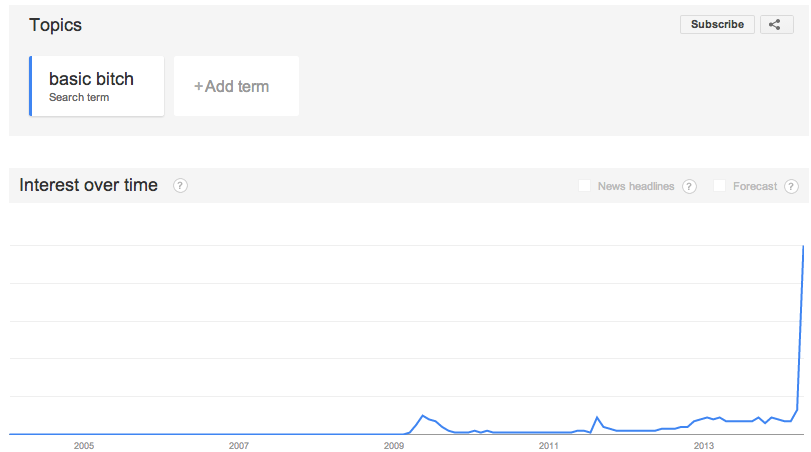
Screen_shot_2014-04-21_at_10 So there's a lot of interest right now, and that's part of the reason College Humor and a few think pieces capitalized on that and this image of being basic. But what you'll notice is that "basic bitch" actually had a small peak in 2009 and another in 2011.

Right. That was around the time Krea ... Kreaz ... that young woman came out with that one song.

Kreayshawn. And you're right, her song "Gucci Gucci" came out in 2011 which probably accounts for that blip on the Google trend radar. That song used the lyrics: "Gucci Gucci, Louis Louis, Fendi, Fendi Prada ... basic bitches wear that shit so I don't even bother":

Kreayshawn defined basic as being unoriginal. The brands she mentioned are very popular designers, but also are known for their trademarked logos. This was also an implicit dig on people with money. In a sense, Kreayshawn was saying that you could have all the money in the world and still be kind of terrible and not that cool— or not as cool as Kreayshawn.

And the current permutation of "basic" seems like an extension of that. But instead of punching up, it's more punching down on people (but women in particular) who like certain brands or enjoy a certain kind of lifestyle.

Am I being sexist if I am calling someone a "basic bitch?"

Let's be clear: you're not calling someone a "basic bitch" because you're paying them a compliment. You are insulting someone, and on top of that, adding gender to that insult.

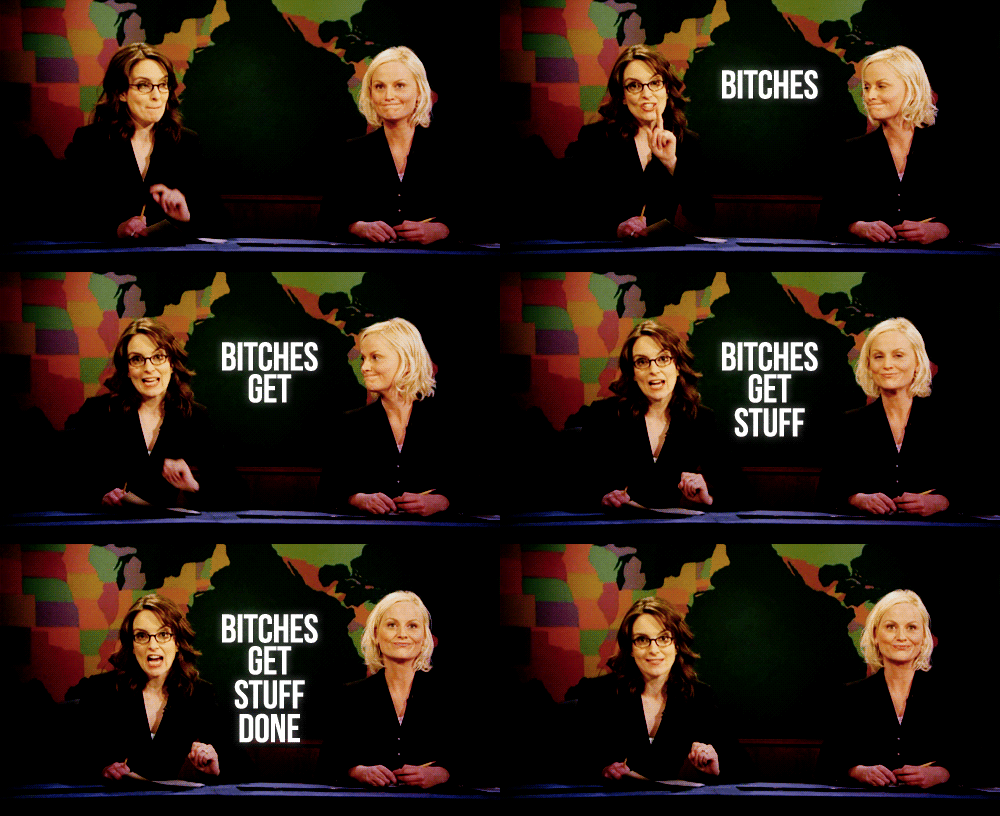
"Bitch", has had a long and twisty history of being a putdown to women. Recently, there's been more of an acceptance of the term and reclaiming of the word (thanks to influences like Bitch magazine, Tina Fey and Amy Poehler) to mean a cool, powerful woman who gets stuff done.

But calling someone a "basic bitch", whether it's your intention or not and whether you believe the word "bitch" to be a putdown or not, relies on the idea that there are certain "bitches" who are inferior to other non-basic "bitches."

You keep saying things like, "current" or "right now"— what gives?

Think about street-slang and slang for a second. While the web has been responsible for creating different dialects and languages, and as much as we like to say the Internet is our virtual hang out, it's still not the same thing as talking to someone face to face.

And by the time someone's Googling a term, that term has usually hit some kind of mainstream saturation point far from where it started. And people using "basic" in real life are already evolving the term beyond the College Humor video's definition.

"Basic" and "basic bitch" existed long before Kreayshawn made the terms popular in 2011, and even before people started Googling it in 2009. Back then, and even before then, it existed in black and hip-hop culture.

So is there a feeling that white people have changed the meaning?

Yup. "White people: Where did this sudden obsession with being "basic" come from? Who hurt you (this time)?" Buzzfeed's Saeed Jones wrote on Twitter, observing the rise of "basic-ness" and its newfound mainstream and popularity among white people.

Jones points out that the word has become more or less a cousin of "first world problems" or "white girl problems"— popular memes and internet terms for minor frustrations that draw the ire and complaints from affluent and, yes, white people. And Jones's dismay at what "basic" has turned into raises the question of what its true meaning is.

Jones and others point out that "basic" had already lived a full life in hip-hop slang long before this current wave of people using it.

So what did "basic" mean before?

It's not entirely clear because language and words aren't simple (it's the reason that if you ever use a thesaurus, you will hate 82 percent of the suggestions it gives you). But basic was more or less a way to say that someone was unsophisticated. And when it's passed to us by way of Kreayshawn, College Humor, and whatnot, that meaning somehow turns into "wearing a lot of North Face."

It might be helpful to think of slang (in this case black or hip-hop) going mainstream (or white) in the same fashion as any language you run through a translator — you lose a little bit of nuance no matter how good your translation might be. That's a big reason Google translate is can be a laughable experience, and big reason why no one has perfected (but many have tried) a translation app yet.

So let me get this straight: We're using an outdated insult that barely means what it was supposed to mean to put down people and think we're being kind cool?

In short: yes.

But, you should live your life. Just be you. But also keep in mind that it isn't the first time slang (from hip-hop, black/white/Asian/Latino/LGBT/etc. culture) has gone mainstream and underwent a change

Like?

"Throwing shade." The term was used in the South and in (drag) ball culture an—

That means a nasty look— like when Michelle Obama "threw shade" at John Boehner?

No. But that's the point. "Throwing shade" was originally meant to be a clever, subtle and thoughtful putdown. But that eventually evolved into what you might otherwise call a "side eye" or a dirty look. And while it maintains some tenets of what its original meaning was (a way to show your displeasure with someone), it can convey something different.

So, like the person calling me basic might be even more basic than me?

Yup. Basically. They might be as unoriginal as the kind of "basic" Kreayshawn rapped about, as mainstream as College Humor, and as unsophisticated as basic's observers first noted.

That makes me feel better. One last question.

Yes?

Am I normcore?

Maybe.

22 Apr 13:18

The saddest way to default on your student loan

by Libby Nelson
Dzaleznik

Wow that's a tremendously shitty practice.

Young adults dealing with the death of a parent or grandparent can get an unpleasant surprise: a bill for their entire outstanding student loan, paid in full, even if they're up to date with payments.

If anyone whose name is on a student loan dies or declares bankruptcy, the lender can put the loan in default

Nearly all new private student loans now have a cosigner — a parent, grandparent or other adult taking out the loan jointly with a student. In some cases, this is a bank requirement for taking out the loan in the first place; in other cases, a cosigner with good credit makes it easier for a student to get a good interest rate.

But there's a catch. If anyone whose name is on a private loan dies or declares bankruptcy, the lender can put the loan in default and demand payment in full. If a loan is in default, it makes it easier for lenders to collect on the unpaid balance. Default can hurt the survivor's credit score, and it's particularly unfair if the loan actually was being repaid.

this isn't just bad public relations for banks; it's a bad financial model, too

The Consumer Financial Protection Bureau has been getting complaints about the practice. Rohit Chopra, the agency's official advocate for borrowers, writes in a new report today that this isn't just bad public relations for banks; it's a bad financial model, too. If the cosigners' survivors really do pay back the entire balance when asked, that means the bank will get less in interest than they would have if repayments proceeded as normal.

Putting a grieving borrower in default also creates a "poor customer experience," Chopra writes with considerable understatement. "For a borrower who has proven to be a responsible paying customer and is facing the death of a parent or grandparent co-signer, debt collection calls demanding the full balance with limited explanation will probably not be welcomed."

Federal student loans, which make up more than 80 percent of all outstanding student debt, don't have a credit check for students and don't have cosigners.

One solution for private loans: releasing cosigners from their obligations after borrowers make a certain number of payments. But Chopra notes that many student lenders don't tell borrowers this is an option at all.

21 Apr 16:01

Au Za'atar's Middle Eastern is a Winner

by Lauren Rothman

From Serious Eats: New York

Au Za'atar's vibrant, flavorful Mediterranean mezze are beautifully presented and made with care. [Photographs: Lauren Rothman]

Au Za'atar, a so-called "Arabian French bistro," opened on Avenue A last month to unusually high fanfare for a casual Middle Eastern restaurant. The menu, spanning kebabs and couscous to a whole range of mezze, doesn't tread much new territory, but Au Za'atar is something of a treasure box, turning out reliably more delicious versions of these standards that stand far apart from the pack.

Things get off to a promising start with a generous platter of Au Za'atar's complimentary Za'atar-Dusted Pita: warm, yeasty and chewy, the excellent bread has tons of flavor from its eponymous spice mixture of dried thyme, ground sumac and sesame seeds, and is served with a dollop of cool, smooth, tangy labneh, or thick strained yogurt.

Arnabeet Mekle, or fried marinated cauliflower ($7), is bright and flavorful, the greaseless and nicely browned florets tossed in a piquant dressing heavy on spicy raw garlic, fragrant fresh cilantro, and plenty of lemon juice.

Fassoulia, or Middle Eastern-style beans ($8), varies in preparation from country to country: sometimes it's made with white beans, other times green; it can be dressed with lemon and olive oil or stewed in beef broth. Au Za'atar's take is a hearty lima bean stew, the huge, creamy beans braised in a thick, rich tomato sauce slick with fruity olive oil and flecked with fresh parsley.

Pickled fruits and vegetables are integral to Middle Eastern cuisine, and are well-represented at Au Za'atar. Batin Jan Makdous, or tiny pickled eggplants ($8), are sweet and vinegary at the same time, their creamy flesh stuffed with spicy pickled red pepper and soft walnuts. Excellent crunchy cucumber pickles on the side add one more hit of brine.

Au Za'atar offers not just one but five types of vegetarian Stuffed Vegetables: bell peppers, grape leaves, eggplant, zucchini and cabbage. The latter option ($12) arrives as six tender, almost translucent cabbage leaves wrapped tightly around a light tomato-and-rice filling that sparkles with lemon and fresh dill. A well-seasoned chopped salad served on the side doesn't disappoint either, even when it's made with out-of-season vegetables.

This is the kind of food that has you craving more before your plate is half empty. If there's any better sign of a restaurant's quality, you tell us.

About the author: Lauren Rothman once interned at Serious Eats and recently graduated from journalism school. Try the original recipes on her blog, For the Love of Food, and check out her (many) food photos on Instagram.

21 Apr 15:37

Here's why your Facebook feed is full of marathon finish photos

by Danielle Kurtzleben
Dzaleznik

...a rift in the running community between the racers and the growing ranks of "plodders."

Y'know what. Fuck the running community. Fucking jerks being elitist about the most common form of human locomotion outside of walking.

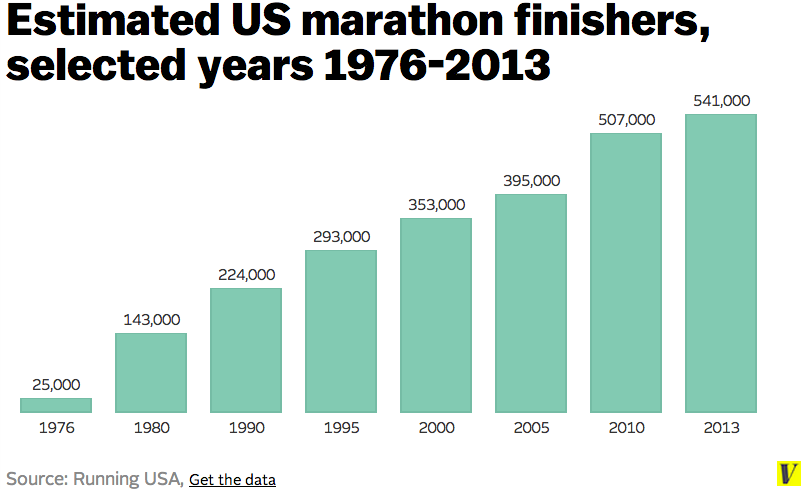
Around 36,000 runners will line up at Hopkinton, Massachusetts, today to power (or slog) through the Boston Marathon's 26.2 miles. Those 30,000-odd runners are a part of a marathon explosion that has happened in the US over the last four decades.

Screen_shot_2014-04-21_at_10

The above chart shows marathon finishers for selected years from 1976 through 2013, as estimated by Running USA, a nonprofit organization that promotes distance running. Not only has the number of finishers nearly quadrupled since 1980, but it has also grown by more than 20 times since 1976, from 25,000 runners in that year to 541,000 finishers in 2013.

What's behind that boom? One factor is women. According to Running USA, women made up 11 percent of marathoners in 1980. As of 2013, it was 43 percent.

Another factor is that marathoning has come down to earth a bit. Times have slowed down considerably over the years, suggesting that many of the new runners are also slower runners. The median marathon finishing time for women in 1980 was 4:03:34, around 9:18 per mile. As of 2013, it was 4:41:38, around 10:45 per mile. Men's median times have climbed by a similar interval, from 3:32:17 in 1980 to 4:16:24 in 2013. This has created something of a rift in the running community between the racers and the growing ranks of "plodders."

In Boston, the ranks of the racers are perhaps stronger than at any other US marathon. Of the more than 1,100 marathons in the US in 2013 (another new record), Boston had the fastest median time in 2013, at 3 hours, 31 minutes (around 8:00 per mile), according to Running USA.

Updated April 21, 2013: This post was updated to clarify that the chart data point to single-year marathon finisher totals.

17 Apr 04:21

Game of Thrones theory

by Jason Kottke
Dzaleznik

Good Sherlocking! No comment as to whether or not it is a red herring...

[Warning: season 4 spoilers ahoy!] So, in the second episode of this season of Game of Thrones, something wonderfully unpleasant happens. If you've seen it, you know what I'm talking about and if you haven't, you should really stop reading right now. I've been thinking about why it happened and who did it. This series of images over at Imgur presents a compelling explanation.

Lady Olenna gives sympathies to Sansa for the murder of her family. Watch carefully. Yoink! Olenna rubs Sansa's neck, plays with her hair and finally snatches the right-most jewel on Ser Dontos's necklace.

Interesting, right? (I mean, maybe not if you've read the books, but I haven't so I have no idea who killed Joffrey in the books or if you ever even find out.) But there are two puzzling things about the Tyrell plot:

1. Why the hell was it so convoluted? Couldn't Lady Olenna have brought the poison to the reception herself? Why use Sansa's necklace? There's no CSI: Westeros so no one would have ever suspected Sansa's necklace being part of it. Unless the Tyrells tipped someone off about it after the fact. Also, for the love of the old gods and the new, Grandma, hasn't Sansa been through enough without being framed for that little turd's murder?

2. Why do it? Why then? Does Margaery stay Queen? She has no heir by Joffrey. Or is one of Joffrey's little brothers in now? I suspect these questions will be answered in the next episode, but unless Margaery stays Queen, the Baratheon reign ends, and the Lannisters get bupkiss, I don't see a compelling reason for the Tyrells to do this.

Bonus tidbit: this is the last we'll see of Joffrey and also the last we'll see of the actor who plays him, Jack Gleeson. Gleeson is retiring from acting, saying he "stopped enjoying it as much as I used to". I bet the guy who played Malfoy in the Potter movies is breathing easier.

Tags: Game of Thrones   TV
16 Apr 17:00

The Sleazy PR Campaign to Prevent the IRS From Making Your Taxes Simpler

by Jordan Weissmann

Theoretically, it should be far easier for Americans with simple finances to file their tax returns. Instead of making tax filers putz around W-2s and tax prep software, the IRS could electronically prepopulate their paperwork with the information it already receives from banks and employers, and tell filers how much they owe. If the final figure looked about right, you’d have the option to file. As Matt Yglesias wrote here last year, the whole process could be a five-minute snap.

Theoretically. But for years now, Intuit, the maker of TurboTax, has fought tooth and nail to prevent automatic tax filing from becoming a reality, lobbying against bipartisan legislation to introduce it with the help of a powerful tech industry trade group and conservative anti-taxers like Grover Norquist. Intuit and its competitors in online tax prep don’t want the government cutting its market share. The tax-crusaders want to ensure that paying the government remains as much of a painful, resentment-generating slog as ever. And thus a potent alliance has been born.

Today, ProPublica, which published a great report on this subject last tax season, explains that the Computer & Communications Industry Association, which counts Intuit as a member, has been sponsoring an astroturf campaign to convince Congress that easyfiling would end up hurting the poor. A public relations firm working on the trade group’s behalf has been luring unsuspecting spokespeople to join its cause—reaching out to them without mentioning any lobbying ties.

Here’s how ProPublica sums up one example:

One letter-writer, Richard Smith, the president of the NAACP Delaware State Conference, was approached by a longtime acquaintance with information about how return-free filing would take dollars out of poor people's pockets. Smith felt so strongly he fired off a letter to Sen. Tom Carper, D-Del., and encouraged other local NAACP leaders to do the same.
Smith said the acquaintance, Anne Farley, told him that if return-free filing was adopted, the government would stop offering free tax filing help to low-income communities. (In fact, none of the bills on return-free filing propose that.)
When ProPublica told Smith that Farley is also a registered lobbyist, he said he was now questioning the information she gave him.
"We may have to retract so far based on my research," Smith said. "I didn't question her."

There’s a reasonable argument against easy tax filing and an unreasonable argument. As you might be able to guess from the underhanded tactics, this seems to be an example of the latter.

The unreasonable argument is that the IRS can’t be trusted to fairly fill out most Americans’ tax forms while also enforcing compliance. Moreover, they say, the poor would be most likely to be victimized, since they have the fewest resources to challenge a bum return. This is nonsense for a few reasons. First, nobody is suggesting that taxpayers be forced to accept the IRS’s calculations. If someone looked at their refund and thought it was bizarrely small, they could go ahead and file their taxes as normal. Nor, as ProPublica notes, is anybody suggesting that we eliminate free tax prep services for low-income Americans. And most importantly, the IRS already receives all of this information. It would simply be transcribing the data it otherwise might use to audit you. As some advocates have written, it’s “scrivener’s work.”

The reasonable argument against e-filing is that such a system wouldn’t be ideal for Americans with complicated taxes. Countries that already have automatic filing, such as Denmark, Sweden, and Spain, have much simpler tax codes, they note. Meanwhile, small businesses might also have to spend extra money getting payroll information to the IRS on a tighter schedule so the government could pre-populate everybody’s paperwork. But there are probably enough Americans who simply input some W-2s and take a standard deduction without adding on any complicated breaks to make the system worth it. Some studies have suggested the system could work for somewhere around 40 percent of taxpayers, saving them time and money.

Of course, e-filing wouldn’t instantly turn everyone’s taxes into a snap. There would still be state returns to deal with, and if we’ve learned anything from health care reform, it sometimes takes the government a while to get a website up and working.

But, in the end, it doesn’t speak well for an argument if you have to trick a mouthpiece into making it for you.

12 Apr 15:41

NSA Used Heartbleed Bug

Dzaleznik

Wot? Out of control.

"The U.S. National Security Agency knew for at least two years about a flaw in the way that many websites send sensitive information, now dubbed the Heartbleed bug, and regularly used it to gather critical intelligence," Bloomberg reports.

"The NSA's decision to keep the bug secret in pursuit of national security interests threatens to renew the rancorous debate over the role of the government's top computer experts."
09 Apr 17:17

Now You Can Search for a Sad Face on Yelp

by Alison Griswold
Dzaleznik

PACK UP AND GO HOME ALL OF OUR PROBLEMS HAVE BEEN FIXED

In a move that promises both to entertain and confound users, Yelp recently rolled out a new feature for its mobile app: search by emoji. Instead of bothering to type out “pizza” or "mailbox" or “beer” in the search field, you can now drop in the appropriate icon and watch the results filter in. For example, searching the bowl of noodles image near East Village, Manhattan, yields the following:

Pretty nifty, right? The search function’s interpretation of some emojis are surprisingly clever and, often, quite useful. Searching a pair of scissors produces listings for hair salons; an Italian flag gives a list of Italian restaurants; and a high heel spits out the nearest shoe stores and cobblers.

The new feature begins to get wonky, though, when using emojis that are less obviously related to food, retail, or a specific service. Keeping the search set near the East Village (for the sake of consistency), I tried plugging in the broken heart symbol. The results? “Broken Heart Tattoos,” “Smooth Skin Factory,” and “Pirka” (a hair salon). Searching a monkey resulted in a Yelp ad for “Chevys Fresh Mex” (a Mexican bar), two other bars with “monkey” in their names, and “Tech Grease Monkey,” an IT services and computer repair shop. It sort of made sense but wasn’t exactly helpful.

Even weirder were the results for traditional emotion-bearing emojis—i.e., a smiley face, an angry face, a crying face. Once again sticking near the East Village, I searched the wide-grin happy face icon. The ad Yelp returned at the top was for a Thai café with a mediocre 3.5-star rating. Below that were results for a pricey Japanese sushi bar, a coffee shop named “The Smile,” and an organic health market.

Then I tried the flip: a sad, teary face. Again, Yelp picked an ad to display at the top of the search, this time for Takamichi Hair, a hair salon in the Lower East Side. The next result was “Cry Wolf,” a clothing shop, then a bar/music venue called “EP,” a Thai place, and a pizzeria. Their ratings ranged from 4.5 to 3.5 stars and they seemed to have little in common other than their mostly inexplicable association (setting aside “Cry Wolf”) with the teary-eyed icon.

The emoji search was born from Yelp's last hackathon and officially launched for users on March 24. Most—if not all—emojis on iOS and Android are now tagged with keywords to return search results. "We enjoyed it so much we wanted to share the fun with Yelpers," said Rachel Walker, a company spokeswoman. Users undoubtably will have fun with the new feature, but some businesses might be rankled. If I were the owner of Takamichi Hair, I wouldn’t be too happy knowing that my Yelp ad was coming up by searching an emoticon most commonly associated with grief and sadness.

The unexplained rollout could actually be more for Yelp’s purposes than for its users’. Emojis can be extremely useful for tech companies when it comes to labeling and collecting data, because they are easier for machines to interpret than informal, everyday language. Machines are notoriously bad at picking up tone, but emoticons, photo tags, hashtags, and the like create categories computers can understand. The users do the heavy lifting and the company reaps the rewards of more effective ads and better data mining.

In Yelp’s case, having users incorporate emojis into restaurant and store reviews could be a better measure of customer sentiment for data-driven algorithms than the hundreds of different adjectives and phrases that pop into reviews. But if the company were smart, it might want to pare down the range of symbols that actually work. Some of the results right now are just too weird.

03 Apr 11:58

Ford Votes 'No' on Congratulating Olympians

Associated Press: "What could be controversial about the city of Toronto congratulating Canada's Olympic and Paralympic athletes?"

"Ask Rob Ford. The Toronto mayor on Wednesday cast the sole "no" vote on a City Council motion to offer the athletes kudos. Minutes earlier, he also was the only council member to vote against a proposal to name a Toronto street after the late Nelson Mandela."

"Ford asked for a re-vote on both motions a half-hour later but was denied."
02 Apr 17:10

Design and Violence debates

by Jason Kottke
Dzaleznik

Interested?

The MoMA is hosting a series of debates on the intersection of design and violence. The first one took place last week and pitted Rob Walker against Cody Wilson on the topic of open source 3D printed guns. The next two center on a machine that simulates the "pain and tribulation" of menstruation and Temple Grandin's humane slaughterhouse designs.

The debates this spring will center upon the 3-D printed gun, The Liberator; Sputniko!'s Menstruation Machine; and Temple Grandin's serpentine ramp. Debate motions will be delivered by speakers who are directly engaged in issues germane to these contemporary designs -- the Liberator's designer Cody Wilson; Chris Bobel, author of New Blood: Third-Wave Feminism and the Politics of Menstruation, and distinguished professor of law Gary Francione, to name a few. We want them -- and you -- to explore the the limits of gun laws and rights, the democracy of open-source design, the (im)possibility of humane slaughter, and design that supports transgender empathy.

Tickets are still available; only $5 for students!

Tags: design   MoMA   museums   NYC
01 Apr 05:05

The art of street typography

by Jason Kottke

I don't know exactly what my expectations were of how lettering is painted on city streets, but this was not it. The level of precision and artistry is surprising.

Reminds me of this video of a hand-lettering master at work.

Tags: art   typography   video
26 Mar 17:26

“This Is A Generic Brand Video”

by Andrew Sullivan

Ah yes, that’s it:

25 Mar 04:30

Mental Health Break

by Andrew Sullivan

You would think these dogs could sniff out the magic trick:

24 Mar 18:33

Photo


24 Mar 15:12

The Food Lab: Really Awesome Black Bean Burgers

by J. Kenji López-Alt
Dzaleznik

Nice.

It's time for another round of The Food Lab. Got a suggestion for an upcoming topic? Email Kenji here, and he'll do his best to answer your queries in a future post. Become a fan of The Food Lab on Facebook or follow it on Twitter for play-by-plays on future kitchen tests and recipe experiments.

20140324-black-bean-burger-recipe-food-lab-primary-final.jpg

[Photographs: J. Kenji Lopez-Alt]

Even in my earlier days as an unabashed eater of all things ground and beefy, I always had a place in my heart for black bean burgers. I'd occasionally sneak one off of my vegetarian friends during backyard barbecues. If a bar claimed to have excellent homemade black bean burgers, I'd order one (with cheese and bacon, if I felt like it). In its ideal form, a black bean burger should be moist and meaty, with a patty that holds together and forms a substantial crust, packed with robust bean flavor and the seasonings that complement it.

Scan your way through the internet or the cooking section at the book store and you'll find recipe after recipe for black bean burgers that follows the same basic procedure: Chop your black beans in a food processor along with some aromatics; stir them together with eggs, breadcrumbs, and some more whole or partially chopped beans; form them into patties, and cook. I've followed a half dozen of these recipes, and while most of them produce pretty good flavor, they all have one fatal flaw: mushy texture.

I mean, how could they not? They're essentially made up of mashed beans and egg.

So what's the secret to black bean burger patties that have textural variation and nuance to match their great flavor? I had to cook my way through a few dozen to figure it out.

Primary Flavors

I like to iron out small problems before addressing the larger ones, so I decided that I'd start by nailing down a flavor profile I'd be happy with before addressing the issue of texture. Some black bean burgers go full Southwest on you, with chili powder and cumin. I wanted my burgers to be a little more neutral in flavor, so I opted to leave out the spices. Instead, I settled for a mixture of onions, garlic, and poblano peppers (you can use bell peppers if you don't want any heat).

Mixing them straight into the patties results in an undesirable steamed onion flavor. Instead, I sauté all the vegetables in oil until they're soft before incorporating them into the patty.

20140320-black-bean-burgers-food-lab-recipe-12.jpg

Onions and peppers

Chipotle peppers packed in adobo might be so common in black bean recipes that it borders on tacky to include them. But you know what? I've loved them ever since I was kid, and when used the right way, they can add just the right amount of smoky, savory flavors without overwhelming the burgers or pushing them all the way into Southwestern territory. I found that a single pepper for two cans of beans was just the right amount.

20140320-black-bean-burgers-food-lab-recipe-01.jpg

Mixing ingredients

I formed my patties using the standard method: pulsing half of the beans in the food processor until pasty, them folding in the sautéed vegetables, an egg, the chipotle pepper, and some breadcrumbs (panko provide the best texture), seasoning the mixture before forming it into patties and grilling it. As expected, the flavor was fine, but here's what we got inside:

20140320-black-bean-burgers-food-lab-recipe-21.jpg

Mushy patty

Time to get to work on that.

Beef vs. Beans

So here's a question for you: Why does a black bean burger behave so differently from a ground meat burger when you apply heat to it? Cook a hamburger and it changes from being mushy and soft to having a wide variety of textures, with an interior that clings together in springy, juicy clumps, interspersed with pockets of rendered fat and juicy meat. Cook a black bean burger and you may develop a crust on the exterior through dehydration, but the interior remains largely the same: soft, mushy, and uniform.

This is because a black bean burger patty is made up of already-cooked ingredients. Raw meat has long, sticky proteins that cling together. As a meat patty cooks, those proteins remain entangled while contracting and changing shape. This is what creates that springy and juicy texture. On the other hand, a black bean patty is made up mostly of starch and proteins that have already been cooked once. They no longer cling together in the same way and don't really change shape when you cook them for a second time (ever notice how a black bean patty doesn't shrink on the grill the way a meat patty does?)

Eggs can help mitigate this to a degree—they are a source of raw proteins that help to bind the chopped beans together as they cook—but they never get as firm or sticky as an entire patty of raw meat.

What does this mean for our burgers? It means that we have to build that texture into the patty mixture right from the start.

Filling 'er Up

So what textures am I looking for here? Just like in a meaty patty, I want a mix of hearty, robust bits interspersed with tenderness, along with juicy pockets that burst with flavor. I ran through the usual gamut of add-ins: cooked grains like barley, bulgur wheat, wheat berries, and farro, as well as nuts including peanuts, macadamia, pistachio, walnuts, and pine nuts. The victor in the end? Chopped cashews.

20140320-black-bean-burgers-food-lab-recipe-15.jpg

Cashew

When cooked in a moist environment, they soften up to the point that they offer just a bit of pleasing resistance to each bite, but quickly give way as you start to chew. Their flavor is also mild enough that they don't distract from the bean flavor I wanted highlight.

For the flavorful eruptions of moisture, I knew that I wanted to add some extra fat. A couple of tablespoons of mayonnaise helped, but it was more of an overall moisture-booster, rather than the concentrated pockets I was looking for. What about cheese? I figured grated or crumbled cheese might work: it'd keep its shape until the burger is hot enough to melt it, whereupon it'd soften up into just the kind of fatty, flavorful burst I was looking for.

Semi-soft melting cheese like cheddar, jack, and muenster all worked well on the flavor and juice fronts, but they were a bit of a pain to cook (the melted cheese would drip into the grill or the skillet). They were also a little too gooey. Incorporate them into the patty and you no longer had a black bean burger; you had a black bean-cheddar burger or a black bean-jack burger.

Instead, firmer, fresh cheese proved just the ticket.

20140320-black-bean-burgers-food-lab-recipe-16.jpg

Feta

Both cotija and feta cheeses provided exactly the right salty, moist, textural variance I was looking for. Combine the cashews, mayo, and cheese with the original burger and you get this:

20140320-black-bean-burgers-food-lab-recipe-20.jpg

Feta and cashew cross-section

Texture-wise, it's a good step above every other recipe I'd tried, but it still wasn't quite there—I was still encountering that unpleasant mushiness between the chunkier bits.

Perhaps the problem was with the black beans themselves.

Baked Beans?

Up until now, my treatment of the beans had been no different than any other recipe: mush half and fold in the rest, the idea being to offer some textural variation. The problem is, even whole cooked beans are still kinda mushy. So the question is: how do we get our beans less mushy?

I tried starting with dried beans and boiling them, halting the cooking while they were still a little shy of done. That didn't work. Undercooked beans don't taste good, no matter what you're going for (I also wanted to avoid having to cook beans from dry in what should be a relatively quick and easy recipe).

Instead, I remembered the recipe for a Roasted Chickpea and Kale Salad I developed last month and noted how baking canned beans can turn them dense and meaty without rendering them inedible.

I spread a couple cans of drained beans onto a baking sheet and tossed them into the oven. Thirty minutes later, here's what emerged:

20140320-black-bean-burgers-food-lab-recipe-03.jpg

Dried beans

They don't look too pretty, but I popped one into my mouth. The transformation is incredible. They go from soft and mushy to dense, meaty, and packed with intense black bean flavor.

I tossed them into the food processor to grind them up for burgers.

20140320-black-bean-burgers-food-lab-recipe-14.jpg

Processing

After combining them with my egg, aromatics, breadcrumbs, cashews, and cheese, I formed them into patties and seared off a few in a cast iron skillet.

20140320-black-bean-burgers-food-lab-recipe-18.jpg

Pan-Searing

Cutting them open, here's what I got:

20140320-black-bean-burgers-food-lab-recipe-19.jpg

Final cross-section

Check out that texture! Biting into them, they're as tasty as they look. Tons of bean flavor, plenty of juicy, salty pockets of cheese, and a texture that is tender but not a bit mushy. Black bean burger nirvana, if such a state exists.

Cooking Notes

Now listen: these burgers are plenty meaty in texture and flavor, but there are two important things to remember: First, they don't taste anything like a beef burger, nor are they meant to. They are a delicious thing-to-stick-in-a-bun all on their own. Second, they don't cook the same way beef burgers do because, well, they're not beef burgers.

The biggest trick to cooking them is to use moderate heat. A beef burger wants to be cooked in a ripping hot skillet or a blazing inferno on the grill to get some nice charring on the exterior before the middle has a chance to overcook. Do the same with a bean burger, and you end up with a blackened-on-the-outside, raw-egg-in-the-middle hockey puck.

20140320-black-bean-burgers-food-lab-recipe-05.jpg

Brushing oil

Don't go for anything more than medium heat in a skillet or a moderate flame on the grill.

Each method offers its own advantages. In the skillet you can get a much deeper, more evenly crisped and browned crust, while the grill produces those smoky, charred flavors that adde even more meatiness to the mix.

If you're going the grill route, brush the patties with oil before placing them over the heat. This oil acts as a buffer, helping them to brown more evenly while preventing them from sticking to the grates.

20140320-black-bean-burgers-food-lab-recipe-06.jpg

Nicely browned

Cheese is not a must, but it's hard to resist.

20140320-black-bean-burgers-food-lab-recipe-08.jpg

Melt the cheese!

Any good melting cheese like American, cheddar, jack (pepper jack if you'd like) or—my new favorite—muenster works. Just make sure you get it on there with enough time for it to fully melt and optimize that goo factor.

20140324-black-bean-burger-recipe-food-lab-primary-2-final.jpg

As for toppings, the sky's the limit. I have to admit: I gave in and went full Southwest a couple of times with pepper jack cheese and a dollop of guacamole, but most of the time I like to stick with the classics: shredded lettuce, pickles, and onions, and—aw, who am I kidding?—since I have those chipotles out already, some chipotle mayonnaise.

The best thing about these burgers? I consider beef burgers to be an only-when-I'm-ready-to-go-into-food-coma treat. These, on the other hand, are hearty, but not heavy: they're the kind of burger I can eat whenever I feel like it. It's a good thing too, because considering how tasty they are, that's going to be pretty darn often.

About the author: J. Kenji Lopez-Alt is the Chief Creative Officer of Serious Eats where he likes to explore the science of home cooking in his weekly column The Food Lab. You can follow him at @thefoodlab on Twitter, or at The Food Lab on Facebook.

Get the Recipe!
20 Mar 20:22

Starbucks Wants to Get You Drunk

by Jordan Weissmann
Dzaleznik

Best sentence(s) in Starbucks business analysis ever: "For a while now, Starbucks has been moving away from its identity as coffee purveyor toward becoming an all-purpose stop for stuff upper-middle-class people like. Think white-collar McDonald’s."

So pretty soon you’re going to be able to get tipsy at Starbucks, no flask necessary. The coffee chain announced that it will begin serving beer and wine along with upscale bites like bacon-wrapped dates during the evening at thousands of locations, according to Bloomberg. The chain currently sells booze at 40 stores. It expects the rollout to take several years.

“We’ve tested it long enough in enough markets—this is a program that works,” Chief Operating Officer Troy Alstead told the wire service.* “As we bring the evening program to stores, there’s a meaningful increase in sales during that time of the day.”

For a while now, Starbucks has been moving away from its identity as coffee purveyor toward becoming an all-purpose stop for stuff upper-middle-class people like. Think white-collar McDonald’s. They’ve branched out into tea (now with an Oprah-endorsed chai blend), bought a bakery for $100 million, and of course sell sandwiches, among other snacks.

In the end, though, this move seems to be mostly about luring customers at night. In 2010, when Starbucks first began experimenting with alcohol sales at a Seattle location, USA Today reported that the company’s coffee shops made more than 70 percent of their sales before 2 p.m. Even if a store closes around 5, that’s lots and lots of dead time for real estate. Starbucks makes its money selling one addictive beverage. If it’s going to fill those hours, it might as well branch out to another.

*Correction, March 20, 2014: This post originally misspelled the last name of Starbucks COO Troy Alstead.

14 Mar 04:03

This timelapse from a San Francisco street may change how you see the Google bus

by Emily Badger
Paul Supawanich

Paul Supawanich

All sides of the Google Bus Wars in San Francisco have come to look like caricatures. On the one side, we have entitled tech workers: high-paid employees of companies like Apple and Google who commute to work every day in tinted coach-bus luxury. On the other, we have their picketing neighbors: long-time San Francisco residents who spy gentrification on every corner and suspect Silicon Valley behind it.

The reality is not quite so melodramatic. San Francisco does have a real problem: Hundreds of private commuter shuttles move through the city every day, collecting people who work in Silicon Valley but can't bear the thought of living there (with some ingenious sleuthing, Wired's Kevin Poulsen just counted 36 Apple buses passing by his house on an average day). These shuttles clog city streets. Sometimes they block public bus stops. In a city wary of the rising might of tech giants, these things have come to constitute a massive (and exclusive) parallel transit network that competes for space with publicly funded transportation.

But strip away all the demagoguery attached to the issue, and it simply looks like this:

Paul Supawanich, a transportation planner with the consulting firm Nelson\Nygaard, shot that timelapse video last Thursday morning near his San Francisco home with a GoPro camera. The video, which spans the morning rush from about 6:15 a.m. to 9:15 a.m., shows what Supawanich believes to be commuter buses bound for Google on the same street corner where Muni buses also stop. This neighborhood hasn't been home to any of the city's anti-shuttle protests, but it's clearly located in an area full of tech workers.

"I come out and see these buses every morning," Supawanich says. "But I really didn't have a sense of how the morning unfolds."

He made the video more or less out of curiosity. In it, we can see tech workers lining up on the wall out of the way of the Muni stop. An occasional Muni rider turns up, while the tech queue lengthens behind him. There's no sign denoting this place as a Google bus stop, but the tech workers clearly know when and where to turn up, and periodically a large white coach bus stops to pick them up.

The video has a Rorschach quality to it. It's easy to look at this scene and conclude that – see! – tech workers are overrunning San Francisco streets (this one corner never seems to exhaust its supply of them). It's also true – as occurs at about the 1:20 mark – that the Google bus appears to occasionally get in the way of the Muni bus, confirming the complaints of many San Franciscans.

On the other hand, these Googlers seem pretty unobtrusive, standing in a neat line thumbing over all of their smartphones. They've made a point of staying out of the way. They don't look all that menacing.

"You can have this neutral-tone video, with no sound, just ‘hey watch what’s happening,’" Supawanich says, "and even with that, people can take it in very different ways."

He's suspicious of the timelapse video as a policy tool. "It is essentially anecdotal: This is one morning, at one spot in space," he says, "and it’s not necessarily a good thing that someone should say 'look what happened at minute 1:30, we should definitely ban all shuttles!"

But this video does have another benefit in a contentious debate: it humanizes the issue. We're looking at actual people, wearing dorky backpacks, heading off to work alongside neighbors walking their dogs.

The situation on this corner isn't an epic clash between tech culture and working-class San Francisco. We're just watching people on their way to work. We're watching two systems of transportation – operating at very different tempos – that largely coexist within the same space.

"I think at end of day, from a transportation end," Supawanich says, "this doesn’t need to be a zero-sum game necessarily."

The city, after all, has more than one interest here. Yes, it wants to run an efficient public transit system that's not disrupted by charter buses. But the city also has an interest in the efficient commutes of everyone who works or lives in San Francisco. And tech companies argue that each of these shuttles removes dozens of cars (and all their emissions) from the road. What if the solution wasn't zero-sum? "Is there a way to design around that," Supawanich asks, "to accommodate both?"

That's the other power of this video. It shows how space might be shared, how you might begin to think about allocating a street corner to simultaneously serve both systems. Supawanich drew the idea for the timelapse from an earlier Nelson\Nygaard project in Vancouver, where he and colleagues tried a few small design interventions to manage bus commuters who had been clogging a sidewalk and blocking access to an indoor SkyTrain stop.

Maybe a timelapse video isn't the best policy tool. But it tells a compelling story about design:


10 Mar 21:35

Fargo TV series

by Jason Kottke

I had forgotten the Coens were turning Fargo into a FX TV series. But time has ground onward steadily and lo, the series is set to premiere in April. Here are a whole set of teaser trailers:

Billy Bob Thornton, Martin Freeman, Colin Hanks, Bob Odenkirk, Oliver Platt? Could be good. (via devour)

Tags: Coen brothers   Fargo   trailers   TV   video
10 Mar 16:08

California Democrats Now Officially Support Legal Marijuana

by David Weigel

Seema Mehta reports from the California Democrats' annual convention:

On the marijuana issue, state Democrats “support the legalization, regulation and taxation of marijuana, in a manner similar to that of tobacco or alcohol,” the platform reads. ... There was no debate on the proposals, only cheers and then a voice vote at the Los Angeles Convention Center.

Keep in mind that the California Democratic Party rules the state with only token challenges. It runs every statewide office. It has overwhelming control of the legislature, a supermajority unless one of its members manages to end his career with a scandal. (Hey, it happens.) That doesn't even matter like it used to, because in 2012, voters undid the supermajority requirement for tax increases that had been in place since the late 1970s. Barack Obama was the first presidential candidate since FDR to carry the state with more than 60 percent of the vote—twice. (No, not even Reagan pulled that off.)

So it's safe for the Democrats to back legalization. Hey, in 2010, 47 percent of Californians voted to legalize marijuana. That was a relatively weak campaign in a horrible year for Democrats. Pro-legalization groups learned to save their energy for better years; they plan to back legalization on the California ballot again in 2016, when a larger electorate comes out to (we assume) give 60 percent or so of the vote to Hillary Clinton's presidential campaign. By that point, marijuana legalization may be even more mainstreamed as a revenue source—not as offensive to conservatives, quite attractive to tourists.

09 Mar 19:13

Drone carries a taser

by Tyler Cowen

A Texas firm has revealed a personal security drone with a stun gun capable of unleashing 80,000 volts.

The firm showed off the drone in a series of shocking demonstrations bringing a volunteer to the ground.

It says the drone uses a smart app to track intruders, and once it had received the go ahead from a human operator, it fires taser darts and unleashes 80,000 volts.

…Called Cupid which stands for Chaotic Unmanned Personal Intercept Drone, the security product was revealed today at the SXSW Festival in Austin as a concept for the future of security.

Furthermore there is an app:

It can find a subject and send live video to the owner’s phone and ask if you want to authorise the subject or detain them.

‘If you detain them, it drops into fully automomous mode to detain them until police arrive, if need be stunning them with 80,000 volts of electricity to render them incapacitated.’

There is more here, with video demonstration.  For the pointer I thank Mark Thorson.

09 Mar 19:10

Markets in everything

by Tyler Cowen

Horse head squirrel feeder.  Who could possibly want such a thing?  Is that the result of a fixed point theorem?  Aren’t fixed costs God’s way of keeping such nasty stuff away from us?:

You have a Creepy Horse Mask, why not the squirrels in your yard? It turns out it’s even funnier on a squirrel. This hanging vinyl 6-1/2″ x 10″ squirrel feeder makes it appear as if any squirrel that eats from it is wearing a Horse Mask. You’ll laugh every morning as you drink your coffee while staring out the window into your backyard. Now, if only the squirrels would do their own version of the Harlem Shake video. Hole on top for hanging with string (not included).

horse-head-squirrel-feeder-930x709-480x365

For the pointer I thank John De Palma.

08 Mar 22:30

Google's Eric Schmidt Has Ideas About How to Solve Income Inequality

by Jordan Weissmann
Dzaleznik

Oy indeed.

Eric Schmidt, the inexplicably well-compensated chairman of Google, stopped over at South by Southwest today, where he decided to share some ideas about how the country should grapple with income inequality. His comments—which he made in conversation with Google Ideas director Jared Cohen and Wired’s Steven Levy—didn’t quite have the plutocratic verve of a Tom Perkins interview. But they did nicely encapsulate a more subtly corrosive outlook common among wealthy, vaguely liberal-minded Americans.

Things started off well enough. As The Verge reports, Schmidt explained that he was “very, very worried” about the conflicts over techie-fueled gentrification that have been rocking the Bay Area. San Francisco’s problems, he said, were a manifestation of a problem across the developed world by which technology is replacing traditional jobs, enriching the few while leaving behind the many. "Ninety-nine percent of people have seen no economic improvement over the last decade," he said.

Ten points for empathy. But then…

The solution to this displacement, according to Schmidt, is to foster conditions that encourage the creation of fast-growing startups that generate lots of jobs, or "gazelles." Those conditions include better education, looser immigration laws, and deregulation in strictly-controlled areas like energy and telecommunications.
When Levy noted that fast-growing "gazelles" seem to lead to more inequality, at least in the case of the 50-employee WhatsApp which was acquired by Facebook for a reported $19 billion, Schmidt brushed aside the apparent contradiction. "Let us celebrate capitalism," he said, opening his arms. "$19 billion for 50 people? Good for them."

Oy. There’s a lot to wade through here. “Let us celebrate capitalism” is a gold-medal-worthy feat of dismissive hand-waving. And the bit about gazelles isn’t ridiculous so much as facile: Gazelle is a term of art some economists and think tanks use to describe the fast-growing young companies that provide a disproportionate fraction of all new jobs each year. Some are the kinds of startups that we associate with Silicon Valley. Some are good old-fashioned industrial companies, or retail chains. He just wants to make it easier to start a new business. Great. Join the club.

The problem is that in the end, Schmidt’s solution to the hardships inherent in globalized capitalism is … more capitalism. He senses a problem and conveniently lands on a solution that doesn’t involve any personal sacrifice on his part, or the part of other well-educated, well-paid folks he might run into on the thought-leader circuit. Which is pretty much why nobody learns much at those events, anyway.

08 Mar 15:32

East 12th Osteria's Brunch is More Than Eggs and Pancakes

by Nicole Lam

From Serious Eats: New York

Editor's note: Welcome back to The Brunch Dish, our series on the best brunches in New York. Know a brunch spot we should check out? Email us!

20140303-East12Osteria-Front.jpg

[Photographs: Nicole Lam]

Situated on the unassuming corner of 12th Street and 1st Avenue, East 12th Osteria can be easy to miss. Even with its gorgeous floor-to-ceiling windows, the place seems to have a generic quality to it. But don't be foole—the food here can be quite good—and as a brunch spot it has something to offer. It's easy to get a table during peak hours so you can enjoy a meal next to the sunbathed windows and still have plenty of elbowroom.

If you're looking for more than just standard egg dishes, then you've come to the right place. There's a Brunch Prix Fixe menu ($23) and a brunch a la carte menu, both filled with a variety of Italian dishes. The prix fixe includes a pastry plate, an main, and a drink of your choice. If you order the orange juice, it'll be freshly squeezed right at the bar.

20140303-East12Osteria-PastryPlate.jpg

Pastry plate.

On the day I visited, the Pastry Plate had croissants, mini blueberry muffins, and chocolate croissants, all served warm and baked in-house by Chef Deiaco.

20140303-East12Osteria-BreadBasket.jpg

Bread basket.

Even if you don't opt for the prix fixe, you'll always get the generous Bread Basket. Filled with a variety of housemade bread, it's also straight-from-the-oven warm and accompanied with a side of olive oil.

20140303-East12Osteria-ShreddedPancakes.jpg

Strapazzato all'uvetta.

Bored with French toast and pancakes but want something on the sweeter side? Order the Strapazzato all'Uvetta ($17), Chef Deiaco's version of "shredded pancakes" from the Italian province of Alto Adige. While the classic recipe yields a thin and flat crepe-lie cake, Deiaco makes his fluffier and caramelizes the edges. The fruit accompaniment changes based on the season; right now it's grapes and sultanas, but in a few months it could be cherries or apples. That fruit adds most of the sweetness to the moist-but-not-sweet pancake, which is so popular it's offered at dinner as well.

20140303-East12Osteria-Carbonara.jpg

Tonnarelli alla carbonara.

For something savory, the Tonnarelli alla Carbonara ($18) makes a fitting brunch pasta. Deiaco makes his own noodles and cooks them al dente. A golden sauce clings nicely to them; perched atop is an egg yolk in a pancetta cup a garnish best stirred right in

20140303-East12Osteria-SeafoodPolenta.jpg

Pesce di mare caldo su soffice di polenta.

Another standout is the Pesce di Mare Caldo su Soffice di Polenta ($19), a dish common in the Veneto region of Italy. A mix of plump shrimp, mussels, calamaretti, and a firm scallop sit on a bed of soft, velvety polenta. A red sauce made from seafood stock, white wine, herbs, and chili pepper spices up the porridge.

It's a brunch dish that'd be just as welcome on any lunch of dinner menu, and it goes to show how Deiaco is bringing some much-needed variety to New York's brunch landscape.

About the author: Nicole Lam is based in NYC and eats carbs whenever possible. She is always adamant about having dessert. Follow her travels and eats on Instagram @niclam

07 Mar 16:08

Nick Anderer's Best Eats in the East Village and Alphabet City

by Bao Ong
Dzaleznik

Some interesting things to note under "bagels."

From Serious Eats: New York

View Nick Anderer's Neighborhood Guide in a larger map.

As a longtime resident on the east side of Manhattan, Nick Anderer has seen more restaurants pop up closer to the East River each year. The 35-year-old chef currently lives in Stuyvesant Town, not far from Maialino, where he's the head chef, and the East Village, where he lived before. He's discovered more favorites through years that he can keep track of, but Anderer shared his favorites with us this week.

Pizza: I like the vibe at Luzzo. Technically speaking, it may not be the prize-winning pizza. But it's got lots of history to it. They do a solid job with the pizza, and they do it the same everything time I'm there. I'm boring and usually get the margherita with anchovies. The eggplant parm is also really good. It's about proportions of sauce to eggplant. I hate when you get one that's all cheese. This one has more eggplant and it's all thinly sliced.

Burgers: People would not pick Swift as a food place. Their late night sliders are addictive. They're like tiny miniature burgers. There's an English musturd that I slather on them. I've only been in there post 2-a.m. through all the years, because they're open late. Every night you go in, people go here because they know it as the 4 a.m. spot. The bartenders are awesome. They have some of the best Irish food, too.

Sandwich: Sunny and Annie's is a very unassuming deli. You could walk past it a hundred times and miss it. Once you step up there, they have a menu with the biggest sandwich menu I've ever seen. Tell them what you want to have and they'll build it. It's one of the best Reubens I've had in New York. They nail the sandwiches all the time.

Bar food: Linen Hall is right next to Ngam. I think they do a solid job with their bar menu. They do a patty melt that's out of this world. It's the right balance of cheese, meat and toast. It's Texas-style toast with sharp cheddar cheese. The wings are sick, too—the dry spice is good. The bar itself is still a bit of a hidden gem. It feels grown up when you're there because it's not overrun with NYU students. It's a nice reprieve.

Bagel: I'm sure this is going to be a controversial pick. There are three or four bagels near me but David's Bagel is the newest of them all. They run the most efficient business. Essa Bagel is great, but they don't do hot toppings. And they won't toast your bagels. David's has fun with their bagels. I get mine so many different ways. I like whitefish, lettuce/ham/onion, lox and cream cheese, scallion cream cheese, or even a toasted bagel with butter.

[Photograph: Nick Solares]

Thai: I get something different every time at Ngam. I think the chef [Hong Thaimee] is super talented. Even the weird things like the burger are good there. There are a slew of mediocre Thai restaurants in New York, and Ngam is one that adheres to tradition when it's necessary but breaks it, too. It feels personal there.

Chinese: Han Dynasty is great, especially when you want to have your mouth blown open. It's like a flavor punch in the face. It's fun for the neighborhood to have a place that has bold food. I think overall they do it really well. I had a great whole steamed fish last time I was there. It's a fresh of breath air for the area.

Mexican Grocery: Zaragoza is an interesting place. It's right on Avenue A between 13th and 14th street. It's where I go if I'm cooking Mexican at home. They have good corn tortillas, spices, chocolate. They also have a steam table that you can make tacos or burrittos. They've had interesting stuff there like tongue, lamb, goat and also more traditional stuff.

Last Stop: After-Dinner Drinks

[Photograph: Carey Jones]

Mexican: I originally started going to Mayahuel because I had some bartender friends. I thought the mezcal in the cocktails was sick. Then on my third or fourth pizza, I met the chef and he was like, "Dude, why don't you eat here?" They have the best chilaquiles I've ever had. I don't even put meat on them.

Take-out: Balade is my standard take-out stuff. I've actually never sat down and eaten there. When I order Seamless, that's the spot I order from. They do this chicken sandwich which is more like a chicken wrap. I always get a side of hummus and baba ghanoush. Their food is perfectly seasoned to me—they get the balance right.

Fried Chicken at Bobwhite Lunch and Supper Counter

[Photograph: Robyn Lee]

Fried chicken: Bob White. That's some serious stuff. This one is a step up from most fried chicken I've had in New York. They brine their chicken and it pays off. They nail all the sides, like the collard greens, cole slaw, potato salad. The banana pudding is amazing.

Egg Cream: I feel like it would be poor form if I didn't mention an egg cream spot. I just like Ray's Candy Store, and Ray is still there doing his thing. They do little beignets, too, but I only go there for the egg creams.

20130701-hearth-meatballs-polenta.jpg

[Photograph: Max Falkowitz]

Fine dining: I have so few nods to fine dining, but Hearth stands out. Marco Canora crushes it. He makes awesome meatballs. They do a killer brunch there too that's under the radar. It's a cool, mellow brunch. I think they're just very creative. You can keep going back and keep having different things.

Favorite David Chang restaurant: Ssam Bar just has something for everybody. They have a good cocktail program, fun snacks, your Asian influence, your American influence. It all comes together. There's a reason it's so popular.

Neighborhood Bar: I believe that Louis 649 is named after Louis Armstrong. It's one of those unassuming neighborhood bars. It's not a crazy mixology spot, but they do cocktails really, really well. You can also get a good bottle of beer or a shot. I get a Tommy margarita. It's basically a tequila sour that originated in San Francisco.

Dive Bar: Three of Cups is a total rock and roll bar, boarder line heavy metal bar. It's just a cool, old New York spot. Upstairs there's this quasi-Italian restaurant. It's a can-of-PBR-type-of-place. It's just a fun, New York vibe. You feel a little more bad ass every time you walk into Three of Cups.

25 Feb 08:07

This restaurant fable explains everything wrong with San Francisco right now

by James Grimmelmann
Dzaleznik

Ben and Marlee: I am still provoked by the brief comment conversation RE: Google Busses. I'm still thinking that whatever we think about public transportation or inequality, the busses are simply irrelevant to that conversation. But I'm not sure I'm right.

In any event, this is an interesting take. What say you?

The city of Junipero has a problem. Some of its citizens are starving, even as others gorge themselves on 28-course tasting menus. Food inequality has become a visible and painful symbol of class conflict. Activists accuse Junipero's foodies of snatching food from their neighbors' mouths. Some of the foodies have turned defensive, complaining aloud that people who forgot to pack a lunch are jealous of those who remembered.

How could it have come to this in such a great American city? Ten years ago, Junipero passed an anti-hunger ordinance limiting the total number of meals served in the city each day. The goals were many, but they included reducing food waste, preventing wild swings in the supply of food, promoting home-cooked dishes over bulk processed junk, and fighting obesity by keeping compulsive eaters from downing 12 meals in a day.

The cap was set at 4 million meals a day, enough for each of Junipero's million citizens to have a decadent four meals each. And for the first few years, everything was fine. But then the city's birdcage industry took off, and artisanal birdcage makers from around the world flowed into Junipero. They recruited their friends to this culinary capital, and started birdcage foundries of their own, bringing in even more birdcage designers, painters and extruders. By the time the birdcage boom peaked, a million new birdcage makers and their families had arrived, swelling Junipero's population to an even 2 million.

Under the 4-million-meal cap, every Juniperan could have had two meals a day, itself far from ideal. But even that is not what happened. Instead, the birdcage makers, flush with cash but peckish, started spending more and more to get their third meal each day. And as the price of a hamburger rose, from $3 to $30 and beyond, many native Juniperans found even the humble hamburger beyond their means. The same thing happened to fried eggs, cans of soup, and plates of rice and beans. Soon, many were scraping by on nothing but breakfast. For a while, those with cars would drive to nearby towns to eat out, but those towns had meal caps too, and soon the prices there were just as outrageous.

Food quality inequality soon followed. Wealthy birdcagers, more often than not, decided that if they were going to pay $200 for a pork chop, it might as well be a sous-vide, humanely raised, singing and dancing pork chop on a bed of truffled six-squash puree with a quince reduction. But native Juniperans found that after paying $20 for a baked potato, they simply couldn't afford to put butter on top. Fake bacon bits were out of the question. Their quality of life has suffered in other ways, too. They're maxing out credit cards, taking third jobs, and wearing scraps of rubber as shoes--all to keep putting food on the table.

"Fair's Fair! Two Squares!"

Everyone has a theory of how to fix things. The mayor has suggested requiring restaurants to serve a certain number of affordable meals per week. Chefs protested, saying that every pair of affordable meals takes them one two-top further from making their rent. Instead, they suggested opening more public soup kitchens, but then the mayor objected that $20 potatoes are already blowing a hole in the city's social services budget.

Activists chanting "Fair's Fair! Two Squares!" say that the food market has failed; they want prix fixe menus and rationed rations. The celebrity chefs from some of the city's great birdcage company cafeterias have offered to teach community cooking classes; an anonymous donor used his birdcage fortune to set up stands throughout the city to put free fake bacon bits on poor people's potatoes.

Restaurateurs proposed raising the meal cap for anyone who opens a new restaurant, but a Junipero Times editorial responded that these new restaurants would literally cater to Junipero's 1 percent, serving fare like foie gras cupcakes and accelerating Junipero's out-of-control gourmetization.

Public health experts are pushing for better nutritional standards, since total caloric intake is way down but candy consumption is way up. An Occupy Junipero movement takes the position that the whole thing is the fault of the birdcage industry, which should be banned as an engine of culinary destruction. Nothing has worked so far, but the proposals keep coming.

Junipero's cultural politics have gotten ugly. Angry protesters are smashing restaurant windows, hurling garbage at anyone who eats in public, and picketing the private food trucks that provide box lunches for birdcage foundries. One prominent birdcage CEO turned the anger back, saying in a TV interview that making birdcages is hard work and requires a full stomach, and people who don't deserve or appreciate good food should stop complaining about those who will put it to better use. A graffiti mural downtown has become a symbol of the city's tensions: it depicts a tide of bone-thin children, pressed up against the bars of a locked and gilded birdcage, staring forlornly at platters of grilled-cheese sandwiches stacked within.

Junipero has a food problem

Junipero definitely has a problem. But first and foremost it has a food problem, not an inequality problem. And the problem with food in Junipero is simple: there isn't enough of it. Junipero's population of 2 million souls needs 6 million meals a day, but the meal cap means there are only 4 million to go around.

Inequality enters, with a vengeance, because fortune favors those with fortunes. Junipero has locked its citizens in a cage and told them to fight for their food. When money is the weapon of choice, the fight will always by definition be rigged in favor of the rich. They are rich. This is unfair and tragic, but the tragedy for the poor is not just that the fight is unfair, but that they were locked in a cage and forced to fight in the first place.

In a sense, this happens all the time in a market economy: People compete against each other for things. But there is a crucial difference. If too many people want bicycles, other people make more bicycles. It matters less who gets the only bicycle left in the store today, when tomorrow there will be more on the delivery truck. Take away the truck, as Junipero has, and we will start to gaze upon each other with malice aforethought.

It feels like inequality is Junipero's biggest problem because inequality manifests itself locally, in people's daily lives. The footrace for food pits all against all, and makes everyone acutely conscious of where in the pack they fall. The poor see the rich as mad wastrel kings; the rich see the poor as a mob seething with jealousy; those in the middle live lives of stress and fear as they scramble to stay out of ranks of the unfed.

But the hidden limit -- the meal cap -- is global and systemic, not local and personal. No one is told, "I'm sorry, the city just served its 4-millionth meal of the day, so you're out of luck." The meal cap itself is invisible, mediated through the price of food, which then becomes the visible bone of contention between the rich and the poor. Inequality in Junipero would be far less devastating and far less divisive if it weren't being channeled into a daily fight for food. The single biggest source of suffering for Junipero's poor is the meal cap.

Everything else that is wrong with how Juniperans eat and live is wrong because there isn't enough food. Eating is expensive because there isn't enough food. Some people's meals are meager because there isn't enough food. Other people gorge themselves when they do eat because there isn't enough food. Food is a flashpoint because there isn't enough of it.

One thing and one thing only will bring peace to Junipero. More food.

James Grimmelmann is Professor of Law at the University of Maryland. You can follow him on Twitter.


22 Feb 18:36

Cold? You Need This Mezcal Hot Toddy

by Nick Guy

From Drinks

20140302remonteltoddy.jpg

This hot toddy will warm you up with flavors from south of the border. [Photograph: Nick Guy]

It shouldn't come as much of a surprise that a hot toddy from a mezcal bar plays with more spices than just classic clove and nutmeg. At The Pastry War in Houston, Bobby Heugel brings together big flavors with smoky mezcal, herbal-anisey Green Chartreuse, spicy ginger beer, and mole bitters. The cocktail will get you through one more snowstorm on its taste alone, but the thoughts of a Mexican sun certainly don't hurt.

It's a drink in balance, with no single flavor overpowering the others. A little sweet agave nectar helps to tie it all altogether, and mole bitters give it a dry chocolate note. And while it's not a bubbly drink, the effervescence of the ginger beer gives the Remontel Toddy an extra kick and tingle on your tongue.

This warm drink is a great use for mezcal, and the one Heugel uses, Mezcal Vago Elote, is particularly tasty. The smooth spirit has undertones of sweet citrus; it's infused with roasted sweet corn for a week and then distilled a third time, and though the corn flavor isn't necessarily obvious, the mezcal has a richness that helps support its smoky flavor.

About the author: Nick Guy is the accessories editor for iLounge, and covers barware and drinking accessories for The Sweethome. He is based in Buffalo, NY, and on Twitter is @thenickguy. Liquor samples for this series were provided for recipe testing.

Get the Recipe!
22 Feb 16:26

Staffers Say De Blasio is an Awful Driver

Dzaleznik

BdB can't catch a break.

New York City Mayor Bill de Blasio (D) "is proposing a traffic-safety initiative that would dramatically reduce fatal car accidents by making it nearly impossible to drive recklessly without getting caught. Among the drivers affected by the initiative would be ... Bill de Blasio," Capital New York reports.

"According to four former de Blasio staffers, all of whom would talk about their former boss only on background, he was inclined to speed or direct staffers to drive faster when he was public advocate and a mayoral candidate."

Said one: "Dear God. Some of the worst road rage I've ever seen, seriously."
22 Feb 14:08

The Worst Place In America To Rent

by Andrew Sullivan

6177086220_015235d125_b 2

Forget the West Village. In Williston, North Dakota, a 700-square-foot one-bedroom will set you back $2,394, the highest rate in the US for such ”entry level apartments”:

In Williston, a city on the edge of the Bakken Oil Fields, the population has doubled in the last five years, from 14,700 in the 2010 census to over 30,000 people today. The growth is akin to the way the Gold Rush quickly urbanized parts of California in mid-1800s. In fact, so many people are moving to the area to work for oil companies that so-called “man camps” made from temporary structures were built over the last few years to keep up with demand. … The housing shortage is so dire that people are living in their cars and the homeless population has swelled 200 percent over the last year. Since there are no official homeless shelters, churches apply for temporary permits to help house the thousands of workers who come seeking employment. A $35-million housing incentive fund was introduced in 2011 with the hope of subsidizing the cost of new, affordable housing. Unfortunately, the fund was depleted late last year.

Previous Dish on the Bakken boom here and here.

(Photo by Flickr user Karendesuyo)

14 Feb 21:31

Slow Cooker Penang Curry Soup With Chicken and Kale

by Jennifer Olvera
Dzaleznik

Good soup option!

013114-281794-Serious-Eats-Slow-Cooker-Red-Curry-Chicken-Kale-Soup-edit.jpg

Hearty and warming, this slow cooker curry soup is bolstered by chicken, kale, potatoes and mushrooms. [Photograph: Jennifer Olvera]

This simple and sustaining Thai red curry soup is cooked slowly with a hearty mix of chicken thighs, kale, mushrooms, and potatoes, and finished with lime and fish sauce to give it oomph and depth. It can easily be made vegetarian by replacing the chicken broth with vegetable stock and omitting the chicken thighs. In that case, using fish sauce is at your discretion.

You may substitute chicken breasts in place of thighs, but shorten the cooking time to no more than six hours since they're prone to drying out.

As for the lime wedge that's added during cooking, it's a quick fix when you can't get your hands on fresh or dried kaffir lime leaves. If you have them, by all means use two instead.

About the author: Jennifer Olvera is a veteran food and travel writer and author of "Food Lovers' Guide to Chicago." Follow her on Twitter @olverajennifer.

Get the Recipe!
14 Feb 02:08

Republicans Spent a Million Dollars in Florida This Week

by David Weigel

Wondering what the fallout of the debt limit votes might be? You can check the FEC reports of new independent expenditures. The Senate Conservatives Fund spent more than $100,000 on new material for Matt Bevin, Mitch McConnell's primary foe. The TeaParty.net Leadership fund spent around $12,000 against John Boehner. That's about it.

Here's how it contrasts with Republican-friendly spending in Florida's open House race, pitting Democrat Alex Sink against Republican David Jolly.

Chamber of Commerce: $400,000 for TV against Sink.

American Crossroads: $49,840 for print against Sink.

American Action Network: $215,249.13 on direct mail against Sink.

NRCC: $379,425.68 on various media against Sink.

That's a million in a week, a month before the election, for a candidate who says he'd have voted for the clean debt limit increase. There's more money in trying to expand the GOP majority than there is in keeping it ideologically pure.