
Eugene is 4 year old chines crested/chihuahua mix. He is only 5 pounds but full of character! You can follow his shenanigans on instagram @captainpoutyface
Michael AkermanWhy would anyone mix a Chinese crested and a Chihuahua?
Eugene is 4 year old chines crested/chihuahua mix. He is only 5 pounds but full of character! You can follow his shenanigans on instagram @captainpoutyface
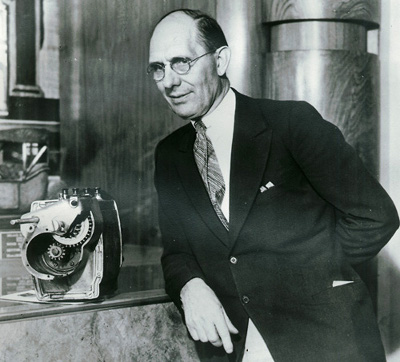
“An inventor is simply a fellow who doesn’t take his education too seriously.” — Charles F. Kettering

AND IT’S FUN TO PUT CHILDREN IN SMALL BOXES AND WATCH THE BOXES SHAKE AND PRETEND THEY ARE FULL OF RABBITS EVERYONE LOVES RABBITS THEY ARE SO SOFT
A THING PEOPLE DO NOT KNOW IS THAT RABBITS POOP LITTLE HARD PELLETS SO IT IS EASY TO CLEAN UP AFTER THEY DIE
By Karen Abbott (Regular Contributor)
Perils of the Era
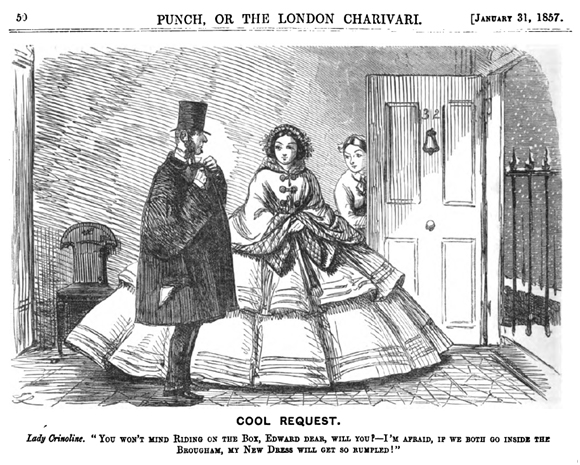
Cartoon in Punch Magazine, which frequently lampooned crinoline.
In addition to smallpox, cholera, and consumption, Victorian era denizens had to consider the perils of crinoline, the rigid, cage-like structure worn under ladies’ skirts that, at the apex of its popularity, reached a diameter of six feet. The New York Times first reported the phenomenon of crinoline-related casualties in 1858, when a young Boston woman, standing by the mantel in her parlor, caught fire and within minutes was entirely consumed by flames—an unfortunate incident that came on the heels of nineteen such deaths in England in a two-month period. Witnesses, impeded by their own crinolines, were forced to watch the victims burn. “Certainly an average of three deaths per week from crinolines in conflagration,” the Times admonished, “ought to startle the most thoughtless of the privileged sex.” A similar tragedy occurred shortly thereafter in Philadelphia, when nine ballerinas burned to death at the Continental Theatre.
Non-fatal consequences of crinoline included entanglement in carriage wheels and being toppled by strong winds, often with mortifying consequences. Such was the case with Consuelo Montagu, the Duchess of Manchester, who snagged her hoops while climbing over a stile and landed upside down, revealing a pair of scarlet knickers. “I wish that people who wear crinoline could see the indecency of their own dress as other people see it,” wrote Florence Nightingale in her 1859 book, Notes on Nursing: What It Is, and What It Is Not. “A respectable elderly woman stooping forward, invested in crinoline, exposes quite as much of her own person to the patient lying in the room as any opera dancer does on the stage. But no one will ever tell her this unpleasant truth.”
Advantages (In the Face of Sartorial Danger)
Nevertheless, crinoline offered some marked advantages over the traditional mode of dressing. It was much lighter and cooler than numerous petticoats suspended from a corseted waist, and, with the invention of the sewing machine in the 1850s, was able to be mass-produced. At the onset of the Civil War, resourceful Southern women discovered new and unexpected benefits of the contraption when they “ran the blockade,” circumventing President Lincoln’s strategy of preventing goods from reaching the Confederate states. One managed to conceal inside her hoop skirt a roll of army cloth, several pairs of cavalry boots, a roll of crimson flannel, packages of gilt braid and sewing silk, cans of preserved meats, and a bag of coffee—the contraband tally for a single crossing. Others tied sabers and pistols around the coils, smuggling small arsenals across the lines. Northern newspapers regularly described the “Secesh in petticoats” who artfully stuffed dozens of bottles of precious quinine beneath their skirts.
The backlash against crinoline intensified during and after the war. Ministers took to the pulpit to warn that wearing hoops was akin to renouncing Christianity. The fad was a “social evil” almost on par with smoking, spitting, and whoring, and women who wore crinoline did so with complete disregard for society. “We have seen the choicest flowers in our gardens and the most cherished plants in our greenhouses cut off by the hoop,” opined The Guardian. “Our wardrobes afford no room for our cloths, because the women of the family want more space than they can get. For five years we have no had room to turn ourselves round in our own homes.” The crinoline craze, or “crinolinemania,” as it was called, waned in the late 1860s, only to threaten revival thirty years later during what would become the heyday of the bustle (Mrs. Grover Cleveland was adamantly anti-crinoline), and again in the 1910s, just before the flapper would change women’s fashion for good. “Greatly daring are the women of today,” declared the New York Times in 1925. “And how they pity their ancestors in crinoline.”
Sources:
Books: Alison Gernsheim, Victorian & Edwardian Fashion. New York: Dover Publications, 1981; Susan J. Vincent, The Anatomy of Fashion. New York: Berg, 2009. Florence Nightingale, Notes On Nursing: What It Is, and What It Is Not. London: Harrison, 1859.
Articles: “Christianity and Crinoline.” New York Times, September 15, 1858; “The Shocking Age.” New York Times, September 20, 1925; “Crinoline: A Real Social Evil.” The Guardian, October 16, 1861; “Mrs. Cleveland Against It.” New York Times, February 19, 1893; “The Perils of Crinoline.” New York Times, March 16, 1858; “Secesh in Petticoats.” New York Times, November 2, 1862.
A study in perspective by University of Hertfordshire psychologist Richard Wiseman:
(Thanks, Paul.)
Thoroughly caramelizing onions, that is removing most of their moisture and converting the natural sugar to mahogany-dark, candy-like goodness, (not to mention the conversion of amino acids to brown deliciousness via the Maillard reactions), can be achieved on the cook-top or even in the oven. But doing so requires vigilance, careful heat control and a heck of a lot of stirring.
This method requires a glass bowl and a microwave oven. So …
CARAMELIZED ONIONS, MICROWAVE-STYLE
Yield: Makes approximately 1 cup
SOFTWARE
4 large yellow onions (enough for 2 pounds), sliced thin
1 tablespoon dark brown sugar*
1 tablespoon butter
1 teaspoon kosher salt
1/4 teaspoon baking soda**
HARDWARE
Microwave
Large glass bowl
Rubber spatula (for stirring)
Mandolin or food processor with slicing blade
Microwave-safe plastic wrap
PROCEDURE
NOTE: All use of microwave is at high-power only.
1. Peel onions and slice thin (3mm) on a mandolin, or quarter and run through slicing blade of a food processor. (I personally prefer the ceramic blade, hand-held mandolin by Kyocera and no, they don’t pay me to say that.)
2. Place half the onions in a large glass mixing bowl and toss with half the salt. Add the rest of the onions and sprinkle with the remaining salt. (Although salt will certainly enhance the flavor of the final result, it’s being added here for it’s ability to pull moisture out of the onions.)
3. Cover tightly with plastic wrap and microwave for 10 minutes.

4. Uncover (carefully … steam hurts) and drain to pour off any excess moisture. Stir in the butter, baking soda and brown sugar.
5. Microwave uncovered for 15 minutes.

6. Stir thoroughly then drain excess liquid again.
7. Microwave 15-20 minutes more at 3 minute intervals, stirring thoroughly after each until the desired level of brownness is achieved.

* Although the onion will probably be sweet enough on their own, I like the complexity of the flavor that the molasses in the brown sugar adds.
** Adding even a small amount of baking soda increases the pH of the onions, which promotes browning. It’s the same reason pretzels are dipped in a lye solution before baking.
So now that you have caramelized onions …
1. Add them to a frittata
2. Top crostini with onions and goat cheese or something stronger like gorgonzola
3. Take finished onions and shredded Gruyere and toast until melted (photo below)

Recipe and images © Alton Brown, 2015.
Michael AkermanNeat, but I would place a bet that a huge number of the tourists there felt the opposite of lucky.
Thanks to a temperature inversion last week, the Grand Canyon was filled with fluffy white clouds, making the natural wonder look like a giant bowl of milk.
"Total cloud inversion" is a result of a layer of warm air trapping cold, wet air underneath. In this case, the unusually warm weather encased thick white fog into the canyon. The result is reminiscent of a giant, ghostly swimming pool. These weather conditions are pretty rare, but also happened last December; they most commonly occur in the colder months as a result of long, cold nights.
Tourists in the area lucked out, but you at home can also enjoy the sight: the Grand Canyon National Park took some incredible pictures, and even a timelapsed video.
For your viewing pleasure:


Michael AkermanInteresting that popular gifts have gotten more versatile. Both standard parental genders love consumer electronics!
When trying to come up with gift ideas for your parents this year, look to the past for inspiration. They say history repeats itself, and you can see it in action with these infographics: My dad could use a new pair of Sperries, and my mother still wears Chanel No. 5 perfume. It makes you wonder if mom's velour sweatsuit is due for a comeback (please no).


Just a quick reminder that for the entire month of December my novels, Off to Be the Wizard and Spell or High Water are on sale over at Amazon US. The Kindle editions are $2.00 and the paper versions are only $9.50.
As always, thanks for using my Amazon Affiliate links (US, UK, Canada).
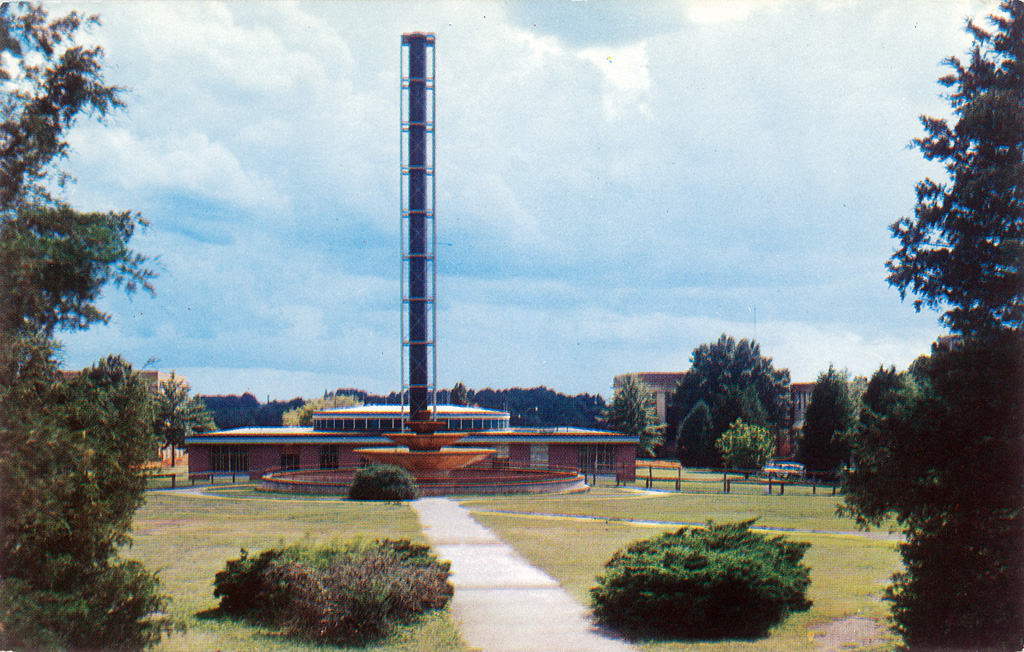
Did you know Raleigh is the home of the nation’s “First Temple of the Atom”? You can find out why this week on Flashback Friday as we visit the Nuclear Reactor Building on the NC State campus.
No message this week!
Nuclear Reactor Building
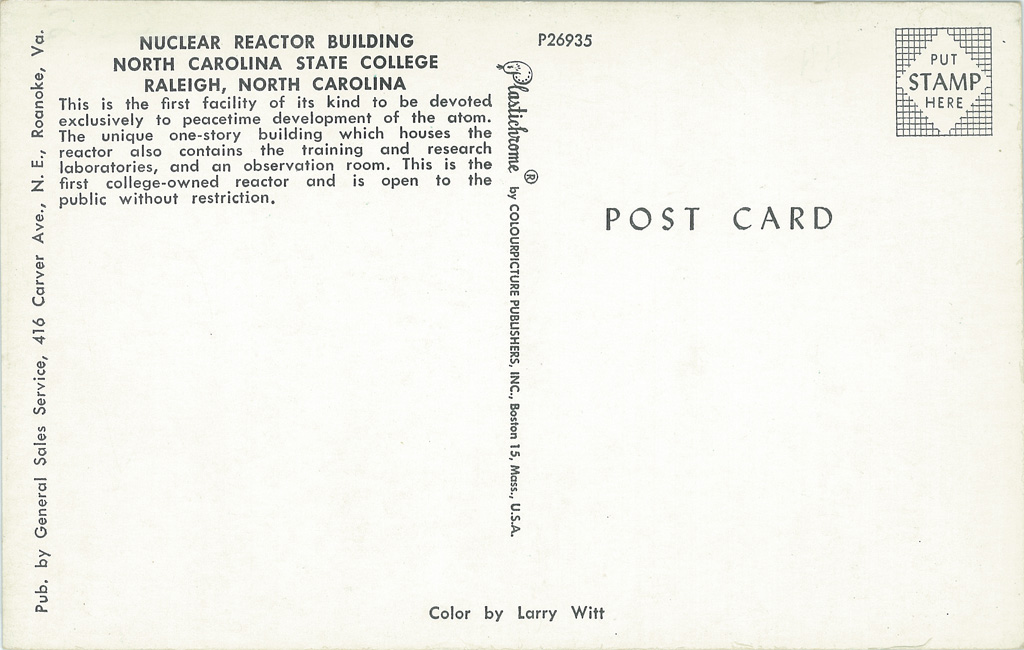
This is the first facility of its kind to be devoted exclusively to peacetime development of the atom. The unique one-story building which houses the reactor also contains the training and research laboratories, and an observation room.This is the first college-owned reactor and is open to the public without restriction.
The R-1 reactor was the first non-government-run nuclear reactor in the world and the first designed, built, and operated by an academic institution. Design and construction began in 1950, and was completed in 1955.
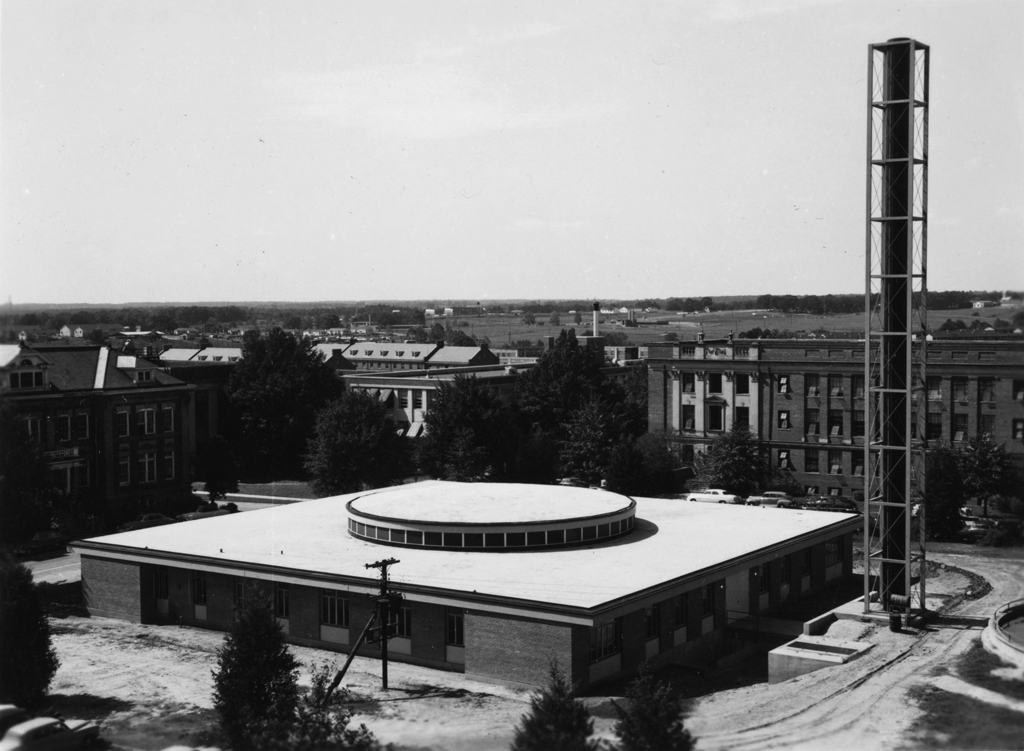
Photo courtesy NCSU Libraries Special Collections Research Center
In this ca 1955 photo the brand new Nuclear Reactor Building is ready to split its first atom.
National attention was brought to NC State in 1955 when the first nuclear reactor in the world devoted solely to the peacetime application of nuclear fission was installed in a building on campus specifically designed for the purpose.
Nicknamed the ‘first temple of the atom’ by the Associated Press, the nuclear reactor building, later renamed Burlington Nuclear Laboratories, was designed in 1951 by Raleigh architect G. Milton Small, Jr. It was his first major commission following the establishment of his own firm in 1949, and the first of his several subsequent projects for NC State.
The site chosen for the reactor building was an open, unpaved plaza on central campus, adjacent to the Diesel Engineering Building. At the time, a large concrete fountain, which had been built in 1947 as a cooling tower for the diesel engines, occupied the site.
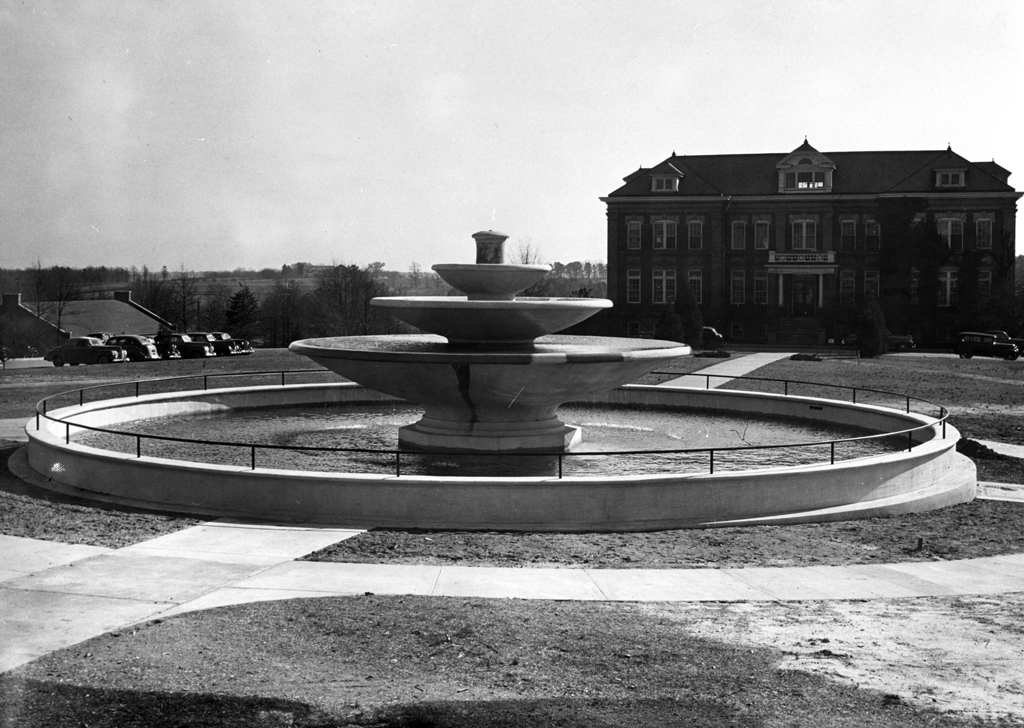
Photo courtesy NCSU Libraries Special Collections Research Center
The futuristic-looking concrete fountain cooled the water which cooled the diesel engines located in the nearby Diesel Building. It was well over 20 feet tall.
(Note to readers: the structure seen in the background is not the Diesel Building. Anybody care to guess what that building is and what later replaced it; and where the Diesel Building itself is located?)

Photo courtesy NCSU Libraries Special Collections Research Center
Construction of the Nuclear Reactor Building began with the installation of the R-1 reactor. Below, the steel framework of the building and its cooling tower takes shape.

Photo courtesy NCSU Libraries Special Collections Research Center
The reactor sits in the center of a room that is 8 feet below ground level, 60 feet in diameter, and 35 feet high.
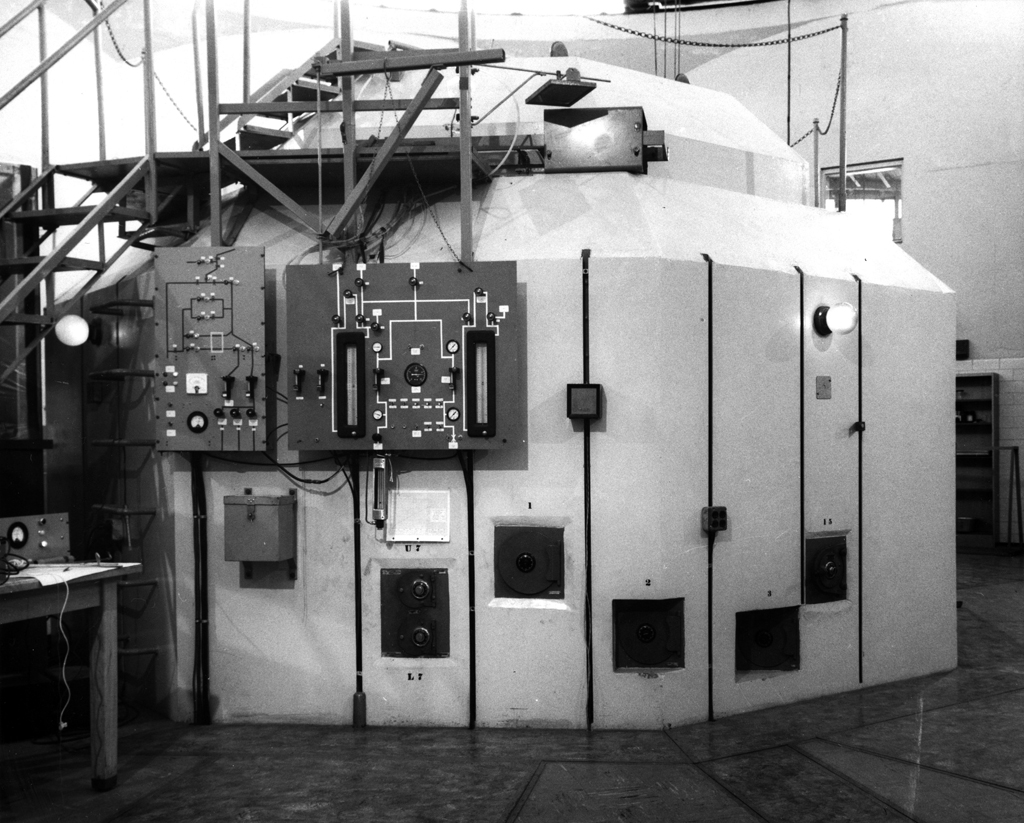
Photo courtesy NCSU Libraries Special Collections Research Center
Here is the control panel which operated the reactor.

Photo courtesy NCSU Libraries Special Collections Research Center
At the dedication of the Nuclear Reactor Building in 1955 Gov. Luther Hodges himself takes the controls.

State Archives of North Carolina photo
This 1960s video features technicians operating the R-1 nuclear reactor. (Run time 6 minutes. Courtesy NCSU Libraries Special Collections Research Center)
Curiously, in November 1963, as a condition of maintenance, 60 gallons of anti-freeze were poured into the reactor’s cooling tower to keep the 250 gallons of water in the tower from freezing during the winter.
The nuclear reactor building was enlarged in 1973, at which time the name was changed from Burlington Nuclear Laboratories to Burlington Nuclear Engineering Laboratories.
Nowadays nuclear studies at NC State University include training of nuclear reactor operators, methods of power generation using nuclear science, and the medical and industrial uses of radiation.

Photo courtesy NCSU Libraries Special Collections Research Center
This mid-1960s aerial view shows Burlington Labs and the adjacent diesel cooling fountain. The oddball campus landmark was demolished in 1972 to make way for a three-story addition to Burlington Labs. The rest of the plaza was later transformed into the Gardner Arboretum in the mid-1970s.
Our Flashback Friday photochrome postcard this week was printed by Colourpicture Publishers of Boston, MA.
Colourpicture Publishers (1938-1969)
Boston and Cambridge, MAA major publisher and printer of linen view-cards of the United States. They later went on to publish photochromes and small spiral bound picture booklets under the name trade name Plastichrome in the 1950’s.
“Flashback Friday” is a weekly feature of Goodnight, Raleigh! in which we showcase vintage postcards depicting our historic capital city. We hope you enjoy this week end treat!
New Zealand engineer Bill Phillips found a unique way to model a national economy in 1949: He used water. Working in his garage, he assembled a conglomeration of tanks, pipes, sluices, and valves into MONIAC, a 7-foot hydraulic computer that modeled the economy of the United Kingdom. Colored water, representing money, is pumped from a bottom reservoir to the top, where it’s distributed among taxes, consumer expenditure, and investment, then finds its way downward through the economy. The user can set “functions” that regulate the effect of national income on tax revenue, government spending on consumption, domestic spending on imports or exports, the interest rate on investment, and the exchange rate on exports and imports.
“To approximate a national economy, a ‘Federal Reserve System’ is added (from a tank through the top U-shaped pump) and bank credit is drawn to expand surplus balances when needed,” noted Fortune in a March 1952 feature. “And, if a Keynesian touch is wanted, the government can engage in ‘deficit financing’ by tapping the surplus balances to increase its own expenditures without additional taxation.”
Phillips unveiled the computer at the London School of Economics in 1949 and impressed his audience so much that he was asked to build copies for Harvard, Cambridge, Oxford, the Ford Motor Company and the Central Bank of Guatemala. Unfortunately his invention was soon outmoded by electronic computers, and today only two working “Phillips machines” remain: one at Cambridge and the other (above) at the Reserve Bank of New Zealand.
UPDATE: Yale economist Irving Fisher proposed a similar system in his Ph.D. dissertation in 1891, described by Paul Samuelson as “the best of all doctoral dissertations in economics.” Fisher used a working model of his machine as a teaching tool for 25 years. (Thanks, Sroyon.)

acetarious
adj. used in salads
Michael Akerman"The clerks at the front desk are clearly not very selective" Need to use that sometime...
I'm glad that this blog post exists. It's a lengthy, detailed rebuttal to a sheet of advice that the "Food Babe" recommends for her followers. For example, you are apparently supposed to start off the day with some warm lemon juice in water with some cayenne pepper in it. Why would I do that to myself, you ask - to ensure that nothing worse happens to me the rest of the day? No, you fools, you do it to "eliminate environmental and lifestyle toxins" from your system by waking up your liver. And so on, and very much so on.
Life is just too short to swat every bizarre misconception caroming around inside Vani Hari's skull. It's pandemonium in there, because the clerks at the front desk are clearly not very selective. But when someone does take the time, I'll gladly point it out. There's plenty for everyone.
Michael AkermanTrigger warning: teeth
Prepare to be mesmerized, slightly horrified, and then say "Huh—those really work!"
Michael Akerman"Of course, Piotr Naskrecki is an entomologist rather than an etymologist, and he encountered the Goliath birdeater rather than discovering it (it was known in the early 18th century if not before), but hey, journamalism."
 "Scientist discovers puppy-sized spider in rain forest", ABC 11 Eyewitness News 10/20/2014:
For all readers with arachnophobia, take a moment to collect yourself before proceeding further, because this spider will haunt your dreams.
Harvard Etymologist Piotr Naskrecki recently posted on his blog about an encounter in Guyana's rainforest with a South American Goliath birdeater, a spider so large it's the size of a small dog or puppy. According to Naskreski, "Their leg span approaches 30 cm (nearly a foot) and they weigh up to 170 g."
More of the spider's endearing characteristics:
As Naskrecki describes his encounter with the spider, it truly comes across as the stuff of nightmares. "The spider would start rubbing its hind legs against the hairy abdomen. 'Oh, how cute!', I thought when I first saw this adorable behavior, until a cloud of urticating hair hit my eyeballs, and made me itch and cry for several days." The Etymologist goes into further detail saying the spider was "capable of puncturing a mouse's skull, and would try to jab me with the pointy implements," and that it produced a large hissing sound.
Of course, Piotr Naskrecki is an entomologist rather than an etymologist, and he encountered the Goliath birdeater rather than discovering it (it was known in the early 18th century if not before), but hey, journamalism.
Obligatory screenshot:

[h/t Charles Hallinan]
Michael AkermanBeen saying this for YEARS

If God is all-knowing, all-powerful, and perfectly good, why do we pray to him to intercede in our lives? A human father is finite and fallible — he may not know that his child needs help; he may be unable to give it; or, conceivably, he may not care enough to make the effort. But an omnipotent, omniscient, infinitely good god is incapable of these failings. We’re already certain that he’s aware of our problems, that he cares about us infinitely, and that he’s able to help us if he chooses. So why do we pray?
“That the believer desires divine assistance in various situations is perfectly understandable,” writes Roberts Wesleyan College philosopher David Basinger. “But that a believer would feel the need to request such assistance from a being who is more knowledgeable, concerned and powerful than he or she is not.”
(David Basinger, “Why Petition an Omnipotent, Omniscient, Wholly Good God?”, Religious Studies, March 1983.)
Michael AkermanShared for title
Laura Starecheski, "Can Changing How You Sound Help You Find Your Voice?", NPR All Things Considered 10/14/2014:
Just having a feminine voice means you're probably not as capable at your job.
At least, studies suggest, that's what many people in the United States think.
There's a gender bias in how Americans perceive feminine voices: as insecure, less competent and less trustworthy. This can be a problem — especially for women jockeying for power in male-dominated fields, like law.
The first of those studies seems sound to me, but as I noted a few months ago ("Vocal fry probably doesn't harm your career prospects", 6/7/2014), the second study seems mainly to have shown that listeners are put off by people who try to imitate a voice-quality that isn't natural to them. The All Things Considered piece goes on, paradoxically, to try to combat voice-based stereotyping by promoting voice-based stereotyping:
Men often speak in more of monotone, with a percussive, staccato rhythm, explains Annette Masson, a voice coach at the University of Michigan who works with actors, singers and sometimes other professionals, like Hanna. Feminine speech patterns — more musical, with more pitch variation — reflect the different way women connect with other people, she says.
Women tend to be more collaborative communicators than men, Masson says. We say "we" more than we say "I."
"Musicality" is in the ear of the listener, I guess, but "pitch variation" can be quantified. And Eli Anne Eiesland, who wrote to me about this, asked
Do women really have more pitch variation in their speech? That sounds like something that might be true, but also like it could just be made-up stereotypes. Likewise with the claim that women use "we" more than "I". I looked at your post about pronoun use in facebook posts, but I can't say that the difference between first person pronouns looked all that big.
It's certainly not true that women "use 'we' more than 'I'" — in fact they typically use "I" many times more often than "we", in pretty much genre and context, just as men do. In the Facebook data (see "Sex, age, and pronouns on Facebook", 9/19/2014), women actually use first-person singular pronouns (I, me, my, mine) more than men. And in the same dataset, there's essentially no sex difference in the use of first-person plural pronouns (we, us, our, ours):
 |
 |
But what about the question of pitch variation? There's no doubt that post-pubescent women have higher voices, in general, than post-pubescent men. Here is the distribution of median f0 (fundamental frequency) values in 2,393 female call sides from the Switchboard corpus, compared to the distribution of f0 values in 2,483 male call sides. The left-hand plot shows the distributions in Hz (cycles per second), while the right-hand plot shows the distributions in semitones relative to 50 Hz.
 |
 |
On either scale, there's very little overlap — this is a case where the infamous "gender binary" really is pretty binary, since 99+ percent of humans are chromosomally either XX or XY, and respond in the typical way to testosterone, which causes the larynx to increase substantially in size at puberty for the XY genotype. (For more, see "Biology, sex, culture, and pitch", 8/16/2013.) However, this doesn't tell us anything about "pitch variation", since that's a matter of pitch ratios — and a baritone or tenor can in principle execute the same set of pitch ratios, i.e. musical intervals, as an alto or soprano. One simple way to look at pitch variation is to calculate, for each speaker, the ratio between the 90th percentile of f0 values and the 10th percentile. Here's what the distribution of that ratio looks like for the male and female speakers in Switchboard. As before, the blue histogram is the male speakers, and the red histogram is the female speakers — but now the purple part, where blue and red overlap, dominates the display:  There are a few more male speakers on the low-ratio left-hand side of the graph, and a few more female speakers in the middle-ratio area, but mostly the distributions are quite similar. And I'd bet that the mumblers on the left margin are not impressing anyone as especially secure, competent, or hireable.
Michael AkermanKind of cheesy kind of awesome



In November 1869 Missouri farmer Charles Burden sued his neighbor, Leonidas Hornsby, for shooting his dog Drum. Hornsby denied it, but neighbors had heard the shot and the dog’s cries of pain on the night in question, and Drum had been found dead of a gunshot the following morning. Furious, Burden sued Hornsby for $50, the maximum amount allowed by law. The two battled back and forth in the courts for a year. Finally, at end of the fourth trial, Burden’s attorney George Graham Vest rose to make this closing argument:
Gentlemen of the jury. The best friend a man has in the world may turn against him and become his enemy. His son or daughter whom he has reared with loving care may prove ungrateful. Those who are nearest and dearest to us, those whom we trust with our happiness and our good name, may become traitors to their faith. The money that a man has he may lose. It flies away from him perhaps when he needs it most. A man’s reputation may be sacrificed in a moment of ill-considered action. The people who are prone to fall on their knees to do us honor when success is with us may be the first to throw the stone of malice when failure settles its cloud upon our heads. The one absolutely unselfish friend that a man can have in this selfish world, the one that never deserts him, the one that never proves ungrateful or treacherous, is the dog.
Gentlemen of the jury, a man’s dog stands by him in prosperity and in poverty, in health and in sickness. He will sleep on the cold ground when the wintry winds blow and the snow drives fiercely, if only he can be near his master’s side. He will kiss the hand that has no food to offer, he will lick the wounds and sores that come in encounters with the roughness of the world. He guards the sleep of his pauper master as if he were a prince.
When all other friends desert, he remains. When riches take wings and reputation falls to pieces, he is as constant in his love as the sun in its journey through the heavens. If fortune drives the master forth an outcast in the world, friendless and homeless, the faithful dog asks no higher privilege than that of accompanying him, to guard him against danger, to fight against his enemies. And when the last scene of all comes, and death takes the master in its embrace and his body is laid in the cold ground, no matter if all other friends pursue their way, there by his graveside will the noble dog be found, his head between his paws and his eyes sad but open, in alert watchfulness, faithful and true, even to death.
Burden won, getting $50 and justice for his dog. Hornsby appealed to the state supreme court but lost.
Vest, the attorney, had said he would “win the case or apologize to every dog in Missouri.”

This is my baby Comeau back when we first adopted him! He’s a purebred Chihuahua and the spunkiest guy around.
Michael AkermanThis makes them look absolutely disgusting

Big! Juicy! Delicious!

GOD YOU ARE SUCH A LOSER. STOP IT.


