Robert Browning’s 1841 verse drama Pippa Passes, source of the famous lines “God’s in His heaven — All’s right with the world,” ends on a strange note:
But at night, brother Howlet, far over the woods,
Toll the world to thy chantry;
Sing to the bats’ sleek sisterhoods
Full complines with gallantry:
Then, owls and bats, cowls and twats,
Monks and nuns, in a cloister’s moods,
Adjourn to the oak-stump pantry!
When the editors of the Oxford English Dictionary inquired delicately how Browning had settled on the word twats, the poet indicated a 1660 rhyme called “Vanity of Vanities”: “They talk’t of his having a Cardinall’s Hat/They’d send him as soon an Old Nun’s Twat.” There the word had been intended as a dismissive insult, but Browning had taken it seriously. Today’s OED still cites Browning’s usage, noting that he’d used the word “erroneously” “under the impression that it denoted some part of a nun’s attire.”
Editor James A.H. Murray later complained, “Browning constantly used words without regard to their proper meaning. He has added greatly to the difficulties of the Dictionary.”
Journalists keep repeating the same bunkum about "Chinese" having 1.197 or even 1.39 billion or some other ridiculously large number of speakers. Countering a Washington Post article, I debunked this notion in "Maps and charts of the world's languages" (5/1/15).
I will not repeat here what I wrote in my 5/1/15 post about the WP article and in dozens of other Language Log posts over the years, except to say that, on the same SCMP map that lumps all of the Sinitic languages together as "Chinese", which allegedly has 1,197 million speakers, the following languages are listed separately (in millions of speakers):
Persian 57
Italian 63.8
Urdu 64
Russian 166
English 335
Marathi 71.8
Hindi 260
German 78.1
Portuguese 203
Spanish 399
Bengali 189
French 75.9
Lahnda 88.7 (Western Punjabi); the map doesn't mention Eastern Punjabi, nor does it include Greek, Albanian, Armenian, Baltic languages, Assamese, Nepali, Ceylonese, and many other IE languages of the South Asian subcontinent and elsewhere, some of which are of substantial size)
If we only count the numbers of the IE languages on the map, they add up to 1,962.6 million, which is larger than the inordinate figures claimed for "Chinese" and linguistically about as coherent as "Chinese". Even "Mandarin", which supposedly has 848 million speakers, has widely varying degrees of mutual intelligibility among its numerous varieties.
By now, however, it would seem that even the most ardent proponents of "Chinese" as an imagined megalanguage are slowly beginning to realize that it's not a single, monolithic language with a unified vocabulary, phonology, and grammar that is mutually intelligible among all of its speakers. Consequently, the SCMP article refers to "Chinese" as a "macrolanguage [that] includes different languages and dialects". But those are weasel words; moreover, they are in fine print. Most people who walk away from reading the SCMP article are going to think that "Chinese" is a single language with 1,197 million speakers.
Michele Morrow, noted video gamer and hosts of things like DirecTV’s BlizzCon coverage and Heroes of the Dorm recently sat down with a bhut jolokia (also known as a ghost pepper — the hottest pepper on the planet) and reviewed Heroes of the Storm for @HotPepperGaming. The result? Perhaps the internet’s best review of a video game ever. You’ve got a bit of everything in it: beer, milk, tears, and lore references. What more could one possibly want out of a review?
The best part is when she drinks milk out of the tiki glass at the end.
We hope Michele continues this for other Blizzard games. Lost Vikings review next?
UPDATE: Turns out this story took place in Mansfield, OH, not Mansfield, TX. Sorry, Texas!
When you believe all kids are in constant danger, you get situations like this one, in Mansfield, OH:
MANSFIELD – Stranger danger education saved one Butler Elementary School student from possible abduction Tuesday.
The student was leaving the building after school Tuesday when a man described as wearing a backward ball cap and a scruffy beard came up to them. The student turned and immediately ran back into the building, where they notified staff of a stranger on campus, Clear Fork Valley Local Schools Superintendent Janice Wyckoff said.
A letter sent home Wednesday alerting parents about the attempted abduction said the man was a passenger in a white colored Ford Ranger pickup. The vehicle was driven by an older woman with gray hair, the letter said.
The school was able to provide security camera footage of the vehicle and its occupants to the Butler Police Department. The department could not be reached for a report on the abduction or photos of the alleged suspects.
“I’m really proud of the students and staff, the way they reacted,” Wyckoff said.
Really? She’s proud? Because here’s what they reacted to (from a news story a day later):
BUTLER – The attempted abduction reported Tuesday in Butler has turned out not to be one.
Butler police Chief Brian Darby said Thursday the incident outside Butler Elementary School was a miscommunication.
Darby contacted the News Journal on Thursday morning after a grandmother who lives in the village called him at 8 a.m. to say she was reading the newspaper story and realized it was her vehicle, she and her son being described in the incident outside the school.
Darby said Cindy McCready, 55, was driving a white Ford Ranger and she has gray hair, just as the student described the alleged stranger on campus to school officials. And, as the student said, McCready’s son Stephen, 32, got out of the vehicle.
But what really happened was that the man got out of the vehicle near the end of the school zone to wave at his two children, who were outside on the school grounds.
You mean, rather than witnessing one of the rarest crimes in America — a stranger abduction of a child — the kids and staff actually witnessed one of the most common things in the world, a parent greeting his kids?
What are the odds of THAT? Thank goodness for that stranger danger education! – L.
Welcome to Mansfield, OH, where there’s even a MAN in its name! Terrifying!
Whenever medical researchers conduct clinical trials of a new drug, they have to account for the placebo effect—the fact that if you give people a treatment, even if it’s sugar pills, some of them will feel better. Though the treatment might be inactive, patients (and sometimes even the investigators in charge of the study) have an implicit bias toward believing that it works. Whether or not you’re the kind of person who feels better after taking a placebo may have something to do with your genes, though, as a new study from Trends in Molecular Medicine argues.
Recent research has shown that the placebo effect isn’t just psychological—it’s physiological. Several things happen when you take a placebo, including anxiety reduction, pain suppression, or the activation of reward centers in the brain, which might make you feel better. When you think about it, a placebo can be a beautiful thing. Why wouldn’t you want to feel better without having to pay for real medicine (which might also come with annoying side effects)?
Hence, it would be nice to be able to figure out who, exactly, is most susceptible to the placebo effect, since not everyone feels great after a course of sugar pills. Led by Kathryn Hall of Harvard Medical School, a group of scientists reviewed previous research for evidence of a genetic variation in the placebo effect by looking for correlations between certain genetic mutations and the strength of a person’s placebo response. Common genetic mutations called Single nucleotide polymorphisms, or SNPs, have been implicated in changing the placebo response in clinical trials. Hall and her team found 11 of these SNPs to be associated with the placebo response in previous research, including those in the dopamine system (the brain’s reward system), the serotonin system (which deals with mood), and the opioid and cannabinoid systems (which both deal with pain).
With this evidence, it’s looking like the placebo response is even more complicated than we thought. “Given the complex interplay of behavior, expectation, neurotransmitter signaling, disease, and the context of the medical treatment ritual, the molecular pathways and genes involved in contributing to placebo responses is unfolding as a potentially complex network,” the researchers write.
This study is just a preliminary look into the genetics of placebo responses, but if your response to placebos is coded into your genes, that could affect the reliability of studies that measure a drug’s efficacy against the efficacy of the placebo treatment. If a trial featured all people who respond strongly to placebos in the control group, for instance, the results would skew toward indicating that the drug treatment was completely ineffective. Furthermore, it could lead to honest placebo treatments, where patients knowingly receive placebo treatments (as has been suggested for certain conditions, like Irritable Bowel Syndrome). Because in some cases, feeling better is more important than which medicine you take.
That belief leads to situations like this: In an Australian Target store on Wednesday, a man stopped to take a selfie with a cardboard Star Wars cut-out.
A figure of mythic horror…and Darth Vader.
He thought it would be fun to show his kids. Another woman saw him with his camera in the toy department and immediately assumed the he was photographing her children. She snapped his photo, pasted it on Facebook along with what she thought he’d done, and it went viral.
THE MAN at the centre of a social media firestorm has been left devastated at being labelled a paedophile on Facebook.
While he was reluctant to speak about his experience, he told the Knox Leader exclusively that he wanted some good to come from the “nightmare”.
We have chosen not to identify the man.
He said he was horrified that his image had been shared thousands of times and he had been called a “creep” and a “sex offender”. He said he has also had death threats on Facebook.
Us. Every day we are groomed by the media to believe the worst of the worst about men anywhere near kids. The Joey Salads video did not create that fear. It just repeated it, like a tired sermon. Mr. Salads believes he has warned parents of something they didn’t realize — that their kids could be carted off by a man in the blink of an eye — when actually that is something most parents already believe in every fiber of their souls, because that’s the modern day religion: Fear. Especially fear for our kids.
Yes. Because the media figured out how to bend it to tell the same old story: When they boy walked home, even though he wasn’t abducted, he COULD have been. The reporter tells us there are sex offenders in town. The implication is obvious: It’s just incredible LUCK that they didn’t spot him out their window, run outside and lure them to their doom, the way Joey Salads does.
Over. And over. And over.
Every story that somehow fits that narrative will make it to the media because that is the story the media knows we want to keep hearing: Kid almost/maybe/could have been/will someday be ABDUCTED. We keep sharing and repeating it, as if it is new and vital information WE are lucky enough to have learned. It’s like hearing the word of the Lord and feeling compelled to share it with others.
Mark my words — well, actually, Prof. Frank Furedi‘s words in this remarkable lecture: In our atomized, pluralistic society, the one unifying belief we share is that our kids are in constant danger from “creeps.” If you doubt it, you are a heretic.
16 is not a very big study but meditation is also just nice from time to time.
When we meditate, our brains benefit, according to a new study from a team of Harvard-affiliated researchers. The study showed that the act of meditating can actually re-grow gray matter in the brain.
Earlier studies had demonstrated that regular meditators do have consistent, notable structural differences in their brains, specifically a thickening of the cerebral cortex in areas associated with attention and emotional integration. But this was the first attempt to prove causation and not just correlation.
The study tracked 16 participants' gray matter density in the hippocampus—the part of the brain associated with self-awareness, compassion, and introspection—through MRIs before and after participating in an eight-week Mindfulness-Based Stress Reduction (MBSR) Program. Program participants spent an average of 27 minutes per day practicing mindfulness exercises. A control group that did not meditate also had MRIs taken.
"Although the practice of meditation is associated with a sense of peacefulness and physical relaxation, practitioners have long claimed that meditation also provides cognitive and psychological benefits that persist throughout the day," lead author Sara Lazer said. "This study demonstrates that changes in brain structure may underlie some of these reported improvements and that people are not just feeling better because they are spending time relaxing."
It's also an excellent reminder that you can give your brain health a major boost with just a little time and intention.
Google Play has Monument Valley for Android on sale for $0.99. Thanks c_bird
Apple iTunes has Monument Valley for iOS on sale for $0.99.
Deal Editor's Notes & Price Research: This is a fantastic price on an outstanding game that I played my self and highly recommend. It is also highly rated among the Google Play Community and receives 4.7 stars out of 5 stars with nearly 72,000 Reviews. -slickdewmaster
"“Our duty is to our shareholders and to maximize the value” of the products that Valeant sells, said Laurie Little, a company spokeswoman. “Sometimes pricing comes into it, sometimes volume comes into it.”"
A pharma company's first duty ought to be to customers, not shareholders. Assholes.
Readers might remember a small company called Catalyst Pharmaceuticals, who have had a business plan that goes something like this: take the known small molecule that's used for the rare disease Lambert-Eaton Myasthenic Syndrome LEMS, 3,4-diaminopyridine. Rebrand it as "Firdapse", and do the clinical work needed to get it officially recognized by the FDA (it's one of those therapies that's been grandfather in for many years). Oh, and charge a lot more than the current supplier, Jacobus Pharmaceuticals, who provide it for free. (It truly is a small market).
Well, that plan has been diverted somewhat. As mentioned in that 2013 post, Jacobus was planning a clinical trial of their own, and Catalyst was apparently taken by surprise when those results showed up last week in a poster presentation. Now no one's sure who will file with (or get approval from) the FDA first.
Jacobus Pharma decided to conduct a clinical trial of 3,4 Dap in LEMS and seek FDA approval as a way to stop Catalyst from profiting off LEMS patients with Firdapse, Laura Jacobus said in a 2013 interview. Laura runs the eponymously named drug company with her father David.
"Firdapse is not a new compound. It's the same drug we make. What Catalyst is doing is not the same as a company profiting from a new invention. What Catalyst is doing is making money off LEMS patients. They don't want to help LEMS patients, they just want to make money. If I worked for Catalyst, I wouldn't be able to sleep at night," said Laura Jacobus.
She has a point there about new inventions. As mentioned in those posts I linked to in the first paragraph, and in several others here over the years, many of these cases are unintended consequences that the FDA unleashed when it asked for older drugs to be put through the regulatory system. But that doesn't always have to be the case. Companies can buy up older approved drugs and just ram a new price home, because why not? That's what's been going on with Thiola, and this new piece at Pharmalot details a number of other recent cases.
Valeant, for example, seems to have a very predictable strategy: the day that they get the rights to an old drug, its price at least doubles, and can go up fivefold or more, depending on what they think the market will put up with. You sometimes hear companies like Catalyst talking about how now that the old drug under study has been taken under their regulatory and manufacturing wing, that it'll be so much better quality, and be so much better for the patient community. Valeant doesn't bother with any of that crap:
On Feb. 10, Valeant Pharmaceuticals International Inc. bought the rights to a pair of life-saving heart drugs. The same day, their list prices rose by 525% and 212%.
Neither of the drugs, Nitropress or Isuprel, was improved as a result of costly investment in lab work and human testing, Valeant said. Nor was manufacture of the medicines shifted to an expensive new plant. The big change: the drugs’ ownership.
“Our duty is to our shareholders and to maximize the value” of the products that Valeant sells, said Laurie Little, a company spokeswoman. “Sometimes pricing comes into it, sometimes volume comes into it.”
Pricing power should come to those who have earned it, as far as I'm concerned. Do the work, conduct the research, take the risk, and you should be able to reap the rewards. Take over a smaller company that (from your standpoint) is just too dumb to realize that they could have put the squeeze on by cranking the price up by a factor of five? That doesn't deserve so much of a reward. What I'd like to see is an easier path for generic competition in such cases. Let someone come in and compete on price, because there's clearly room for it.
Whenever I write about these cases, there are always a couple of comments to the effect that hey, that's the free market, dude - that's what you like, isn't it? But drugs are not generally sold under a free market system. No market in which a single supplier can raise the price by 525% overnight for no reason other than "Because we can" can be all that free, or all that much of a market, if by "market" we mean "competition between various firms for a share of the customers". The market-exclusivity incentives provided by the FDA (through deliberate action or through regulatory barriers) are strong ones, but they should be handed out with care. As it stands, I think it's too much of a reward, in these cases, for too little work.
We will never leave Earth because we will spend the time we have left and the one chance we have to leave Earth bickering over who did what to who.
We will never leave Earth because instead of building spaceships, we decided to build walls and razor wire and prisons and bombs instead.
We will never leave Earth because we aren’t building space elevators and warp drives and new kinds of space suits and lasers – just in case we ever meet anyone as petty and mean as ourselves out there.
We will never leave Earth because we’re too busy building tanks to fight over the last barrels of oil and planes to drop the bombs we made on the people who disagree with us over the specifics of the story about where we all come from.
We will never leave Earth, even though all our stories agree, that heaven lies above us.
We will never leave Earth. Even though Stephen Hawking says we’ve only got 200 years left. The last 2000 don’t give us much hope.
We will never leave Earth because so many of us have agreed that passing laws about what someone else does with their genitals is more important, than leaving the Earth.
We will never leave Earth and we will sink and drown on this ship while we fight over the deck chairs.
We will never leave Earth.
The Last Starfighter, is a lie.
Babylon 5, is a lie.
Star Wars, is a lie.
Iain M. Banks, is a lie.
We will, never, leave Earth.
We will never leave Earth and we will never be anything more than a strange thought the universe had, a moment in which it went, “Heh, wouldn’t that be crazy. Na.”
We will never leave Earth because the world will erupt in fire and ice while we’re still debating whether or not fire and ice actually exist. We will still be arguing over whether we’re burning or freezing to death when we die.
We will never leave Earth and the few robots we’ve sent out in our place will be our only fingerprints on the firmament, the only proof that a grabbing, desperate hand shot out of our coffin, before it sunk beneath the soil.
We will never leave the Earth and meet Aries, Taurus, Gemini, Cancer, Leo, Virgo, Libra, Scorpio, Sagittarius, Capricorn, Aquarius, or Pisces.
We will never touch Gemini’s face and hear her say, “You look just like me. You look just like me.”
We will never leave Earth because we’re too busy arguing over who you’re allowed to love to bother actually doing the work of love, of leaving the Earth.
We will never leave the Earth because we’re obsessed with the soil we were born on and we never realised that all the dirt that we stand on and all the dirt we’re made of, isn’t dirt. It’s star dust. Our dirt, is their dirt, and we will never ask their dirt for help and so, we will never leave earth.
Carl Sagan, is a lie.
Douglas Adams, is a lie.
Guardians of The Galaxy, is a lie.
Space Quest, is a lie.
We will, never, leave Earth.
Except as dust and ashes and minerals, returned to the sender, to be light, burning, in someone else’s stars.
Green Man Gaming.com has Cities: Skylines (PC Digital Download) on sale for $21.89 when you visit their VIP page and be logged into your Green Man Gaming account. Thanks Halewafa
Note, game requires a free Steam account to play. You will need to sign up for a free Green Man Gaming account to visit the VIP page.
Deal Editor's Notes & Price Research: Cities: Skylines is a modern take on the classic city simulation. It includes features such as multi-tiered/challenging simulation, extensive local traffic simulation, districts/policies, and plenty of modding features. Be sure to checkout IGN review or Metacritic (scored 85/100) - Discombobulated
Price Comparison: Our research indicates that the Cities: Skylines (PC Digital Download) is $8 lower (27% savings) than the next best available price from a reputable merchant with prices starting from $30. - yuugotserved
This matches the frontpage deal from last month with +160 votes!
It is a truth universally acknowledged that beauty is in the eye of the beer-holder. (See: the many t-shirts featuring that very slogan available for purchase.) Knock back a drink or three and suddenly, the homely individual sitting at the end of the bar looks like a rock star. But take away your buzz and the mere fact that he's had a drink could make him look more attractive, according to a new study.
“We sought to explore the possibility that alcohol consumption leads to the consumer being rated as more attractive than sober individuals,” the authors write in the resulting paper, published in Alcohol and Alcoholism. “In other words, we asked whether the consumption of moderate amounts of alcohol enhances the attractiveness to the opposite sex of the consumer.”
Researchers asked 40 students from the University of Bristol to pose for photos, both while sober and after consuming alcohol. Photographers snapped three shots of each study participant: one taken completely sober, one after a single drink, and the final image after he or she had consumed two beverages.
A different group of heterosexual subjects were asked to look at the photos. In some cases they examined both the sober photo and the one-drink snap; in others, participants looked at the sober photos and the images taken after two drinks.
The result: those who had enjoyed one cocktail were said to be better looking than in their sober portraits. But if a person consumed two drinks, the group perceived them as less attractive.
The researchers don’t know why one drink makes someone sexy, but they have a theory: Drinking can alter a person’s physical appearance. For example, even a little bit of alcohol causes cheeks to look rosier, which people are wired to interpret as sexually appealing.
"Rosiness is attractive because it characterizes good physical health characteristics,” Marcus Munafò, one of the authors of the paper, told LiveScience. “What it means is that alcohol is sort of hijacking that mechanism, or promoting the aspects of facial features that we regard as attractive for other reasons."
The authors conclude that booze’s role in sexual behavior might be a two-way street; people who drink perceive others as hotter while also making themselves look better.
“That is, in addition to perceiving others as more attractive, “ the authors write, “an alcohol consumer may also be perceived by others as more attractive, and therefore receive greater sexual interest from potential mates.”
My theory is that this song is impossible to sing well unless you are in fact Frank Sinatra. I've tried it and I was terrible and never again.
We’ve all gotten talked into doing karaoke at some point or another, or maybe it’s one of your secret passions (I’m not judging). Whatever circumstance leads you to the stage on karaoke night, here’s a tip: Avoid “My Way” by Frank Sinatra. It doesn’t matter if it’s Rat Pack night. It doesn’t matter if you happened to wear your best fedora. It doesn’t even matter if you could be a voice double for Ol’ Blue Eyes himself. If you value your life, do not allow yourself to be seduced by “My Way” when you see it in the selection book—it’s literally a killer.
In 2007, a man was performing the song in San Mateo in the Philippines when a security guard loudly informed the singer that he was off-key. When man continued to croon, the guard pulled out a .38 caliber pistol and shot the performer in the chest, killing him.
Freak occurrence? Nope. Since 2000, at least half a dozen people have been murdered after (or while) performing the Sinatra classic. Dubbed the “‘My Way’ Killings,” the strange phenomenon has gotten so bad that some bar owners have removed it from the selection list entirely.
Theories abound as to why this particular song seems to evoke such violence. It could be that the song is just so Sinatra that anyone else who sings it is bound to pale in comparison. It could be, according to singing school owner Butch Albarracin, that the lyrics inspire “pride and arrogance in the singer, as if you’re somebody when you’re really nobody.” Pop culture expert Roland Tolentino believes it’s all about location—these killings have all occurred in the Philippines. “The Philippines is a very violent society, so karaoke only triggers what already exists here when certain social rules are broken,” he said.
While the “My Way” Killings do seem to be limited to a certain locale, karaoke rage seems to happen all over the world. My advice: The next time you find yourself with a microphone and a screen of lyrics in front of your face, opt for something—anything—other than Sinatra.
Amazon.com has 4.5 Pounds Miracle-Gro Shake 'n Feed Continuous Release All Purpose Plant Food on sale for $6.24. Shipping is free with Prime or if you spend $35 or more. Thanks Sanshell
Deal Editor's Notes & Price Research: For all flowers, vegetables, trees, shrubs and house plants. Feeds up to 3 months (NPK analysis: 12-4-8) - Discombobulated
Wearable Planter is a Georgia design studio that makes tiny vases that let you bring your plants everywhere. Created by Colleen Jordan, these impossibly tiny gardens come as rings, necklaces, and other fun accessories. The pieces are meant to make life more pleasant; Jordan's inspiration comes from the many places she's lived: Louisiana, Hawaii, South Carolina, Georgia, New Jersey, and Sweden.
Thanks to 3D printing, the pieces can be complex despite their small size. They are printed with nylon, painted with bright colors, and then finished with acrylic varnish. Most come with a flat bottom so you can place your planter on a desk when you're not wearing it. If you're wondering how you would be able to keep your new accessory alive, the website includes a helpful planting guide for those who lack a green thumb.
Jordan sells these gorgeous plants on her Etsy, and you can see more pictures on her Instagram.
Office Depot has DYMO LabelManager 160 Handheld Label Maker for $9.99 with free store pickup. Thanks Discombobulated
Amazon also has DYMO LabelManager 160 Handheld Label Maker for $9.99. Shipping is free with Prime or if you spend $35 or more.
Home Depot also has DYMO LabelManager 160 Handheld Label Maker for $9.88 with free store pickup only. Availability may vary by location.
Deal Editor's Notes & Price Research: If you don't have Prime, there's free 30-day trial with free 2-day shipping, video streaming & more available.
Our research indicates that the DYMO LabelManager 160 Handheld Label Maker is $9 lower (47% savings) than the next best available price from a reputable merchant with prices starting from $19. - yuugotserved
For what it's worth, this is currently the #1 best seller in label makers with nearly 800 Amazon reviews with an average rating of 4.1/5 stars.
Trying to decide between Papyrus or Comic Sans for your next flyer? Now you can use both with this versatile new font!
Evil mastermind Ben Harman has created a font that perfectly blends the two most universally hated and overused fonts into one lumbering abomination. It's called Comic Papyrus and I hate it.
"Comic Papyrus combines the timeless rustic qualities from centuries past with the hilarious fun-loving wit of today's funny pages," the creator explains on CreativeMarket.com. "It'll make you laugh (like a joke) and cry (like a mummy). Simultaneously!"
This upsetting font will only set you back $5, and the potential applications are endless. Use that bad boy in a resume and see what happens!
Okay I mean this is a pretty hipster coffee alarm clock, but my parents had a coffee maker with a blade grinder with time-based brew setting. That thing would have woken you up I'll tell you what
For those who can't function in the morning, a cup of coffee is key. For those who can't even function enough to make that cup of coffee, there's The Barisieur.
This innovative gadget awakens the sleeper with the smell of coffee and the gentle rattle of stainless steel ball bearings as the water boils. Picture waking up slowly to the smell of roasted coffee beans and only having to sit up to enjoy.
Take sugar or milk? There's a special compartment for milk so the liquid stays fresh and cool until you're ready to use it in the morning. On the front, there's a drawer for sugar. The whole tray can even be removed for easy cleaning.
The gadget also has an actual alarm that can be set to sound before or during the coffee making process.
This invention was thought up by Joshua Renouf, a recent graduate from Nottingham Trent University, for his final project. You can't buy the product just yet, but Renouf is in the process of making it accessible to the public this year. You can send in an inquiry here.
This is a good way to encapsulate my controversial view that it is in no way wrong to hit on/ask out/"seduce" a married person unless they ask you to stop (after which it's harassment). It's the married person's job to stay faithful, not the single person's. If they don't want to, that says something.
If the metric of art is its ability to cause people to question, highlight, or elucidate the nature of their reality, and I believe it is, then Lolita is the most arty art I've ever encountered.
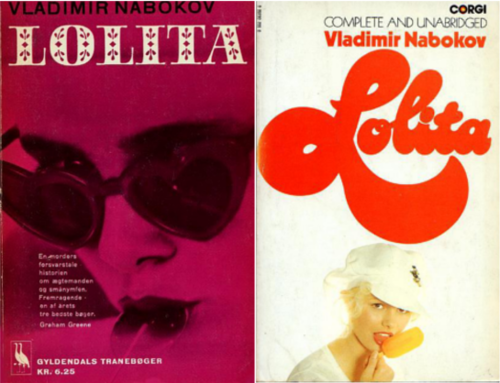
here’s a question: if vladimir nabokov’s “lolita” is truly the psychological portrait of a messed up dude and not the girl — let alone a sexualized little girl, as all of the sexualization happens inside humbert humbert’s head — then why do all the covers focus on a girl, and usually a sexy aspect of a girl, usually quite young, and none of them feature a portrait of humbert humbert?
here are nabokov’s original instructions for the book cover:
I want pure colors, melting clouds, accurately drawn details, a sunburst above a receding road with the light reflected in furrows and ruts, after rain. And no girls. … Who would be capable of creating a romantic, delicately drawn, non-Freudian and non-juvenile, picture for LOLITA (a dissolving remoteness, a soft American landscape, a nostalgic highway—that sort of thing)? There is one subject which I am emphatically opposed to: any kind of representation of a little girl.
and yet, the representations of the sexy little girl abound.
i became driven by curiousity. why did this happen? why is this happening?
i am not alone — there’s a book about this, with several essays and artists’ conceptions about the politics and problems of representation surrounding the covers of “lolita.” this new yorker article gives a summary of the book and its ideas, and interviews one of the editors:
Many of the covers guilty of misrepresenting Lolita as a teen seductress feature images from Hollywood movie adaptations of the book— Kubrick’s 1962 version, starring Sue Lyon, and Adrian Lyne’s 1997 one. Are those films primarily to blame for the sexualization of Lolita?
As is argued in several of the book’s essays, the promotional image of Sue Lyon in the heart-shaped sunglasses, taken by photographer Bert Stern, is easily the most significant culprit in this regard, much more so than the Kubrick film itself (significantly, neither the sunglasses nor the lollipop ever appears in the film), or the later film by Adrian Lyne. Once this image became associated with “Lolita”—and it’s important to remember that, in the film, Lolita is sixteen years old, not twelve—it really didn’t matter that it was a terribly inaccurate portrait. It became the image of Lolita, and it was ubiquitous. There are other factors that have contributed to the incorrect reading, from the book’s initial publication in Olympia Press’s Traveller’s Series (essentially, a collection of dirty books), to Kubrick’s startlingly unfaithful adaptation. At the heart of all of this seems to be the desire to make the sexual aspect of the novel more palatable.
here’s a couple of kubrick inspired covers:
which very well could have, after tremendous sales, have influenced the following covers:
…straying so far from the intention of nabokov that the phenomenon begins to look more like the symptom of something larger, something sicker.
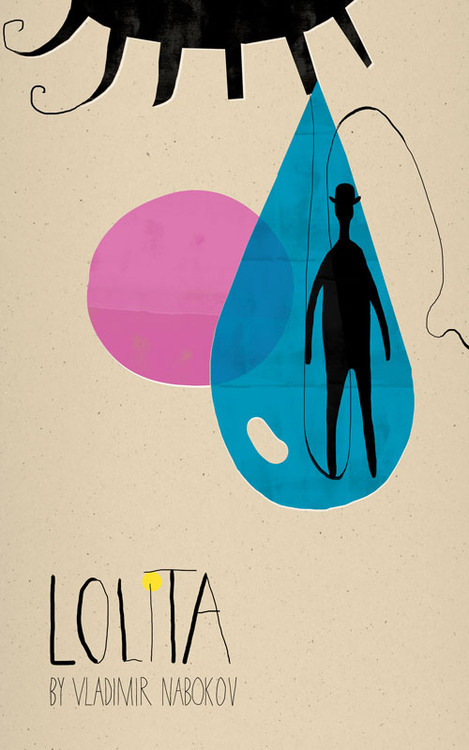
after a lot of researching covers, it was here, in this sampling of concept covers for the book about the lolita covers, that i found an image that best represents the story to me:
[art by linn olofsdotter]
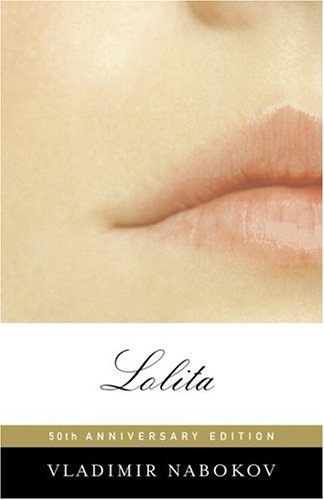
but why aren’t all the covers like that? even the ones published by “legitimate” publishing companies, with full academic credentials, with no intended connection to the film; surely they must have read nabokov’s instructions for the cover. and yet, look at the top row of lolita covers: all legitimate publishing companies, not prone to smut. and yet.
my conclusion is that the lolita complex existed before “lolita” (and of course it did) — a patriarchal society is essentially operating with the same delusions of humbert humbert. nabokov did not produce the sexy girl covers of lolita, and kubrick had only the smallest hand in it. it was what people desired, requested and bought. the image of the sexy girl sells; intrigues; gets the hands on the books.
as elizabeth janeway said in her review in the new york review of books: “Humbert is every man who is driven by desire, wanting his Lolita so badly that it never occurs to him to consider her as a human being, or as anything but a dream-figment made flesh.”
isn’t that our media as a whole? our culture as a whole?
the whole lot of them/us — seeing the world through humbert-tinted glasses, seeing all others as Other and Object, as solipsistic dream-reality. as i scroll through the “lolita” covers i wonder: where’s the humanity in our humanity?
Part 2 of the Wikihow listicle "Be a Good Writer" is about learning vital skills, and item 3 of part 2 says you should "Learn the rules of grammar". Where should you turn to find out what they are? The article (as accessed on March 2, 2015) says:
If you have a question about grammar, refer to a grammar book, such as The Elements of Style by William Strunk and E. B. White or The American Heritage Book of English Usage.
And the link attached to the title The Elements of Style is to an online reproduction of the text of the original 1918 edition of Strunk's dreadful little book of drivel.
O God, grant me thy precious gift of patience… and I need it right now.
Virtually nothing useful about English grammar can be learned from Strunk. Setting aside a few standard conventions of punctuation, which barely deserve to be called part of the grammar, the grammatical claims Strunk makes are foolish assertions like that however in the sense "nevertheless" cannot be correctly used to begin a sentence; or that none of us cannot take plural agreement; or that passive clauses are inherently bad; or that they cannot have a singular antecedent (so No parent would harm their own child is a mistake; Strunk insists it should be No parent would harm his own child). Strunk condemns words as familiar as very or clever or system, and phrases as ordinary as six people or so warm or the student body. His booklet is replete with superannuated hogwash about English.
You can see that Strunk is telling untruths if you simply take a look at the usage in high-quality literary works published when he was in his prime. His claims not only aren't true of English now; they never were true, at any time in the history of the human species.
Some people think that I overstate the extent to which Strunk's booklet (and the even worse subsequent editions that were augmented and tampered with by E.B. White) harms the English teaching and writing instruction professions. I don't overstate it (though I will continue to try). I have set out clear arguments and evidence in an article in The Chronicle of Higher Education and in a longer paper in English Today, attempting to counteract the hundreds of thousands of web pages and writing instructors that praise Strunk and White every single day. The Wikihow listicle is only one particularly feeble example that happened to come to my attention.
Stay away from the advice of anyone who recommends Strunk (or Strunk and White). If you want a book on how to write, read Steven Pinker's superb book The Sense of Style. Compare, for example, Pinker's highly intelligent advice on using passive clauses in discourse (pages 132 to 135) with Strunk's dishonest and incompetent remarks about the passive. The two books are not only from different centuries, they're from different planets.
Thanks to our mistaken belief that no one under 18 can have any legitimate sexual feelings—and hence any sex they’ve engaged in was coerced and bound to render unspeakable emotional harm—we have laws on the books like this one in Wisconsin, according to USA Today (boldface mine, all mine!):
In 2012, state lawmakers passed into law a mandatory, minimum three-year prison sentence for possessing child pornography. Previously, judges had the discretion to order lesser penalties depending on the circumstances. That means a 17-year-old who receives explicit images from a younger friend can be sent to prison for possession of child pornography.
Gee, what a great idea. Prison solves so many problems, including reforming those incredibly deviant teens who are interested in sex.
So how’s that working for the Dairy State? Here’s what happened in the town of Rhinelander:
Until November, when the mother of a Rhinelander High School student turned over a nude image of one of her son’s classmates that she found on his cellphone, law enforcement officials had no idea the problem was so pervasive. That single image led police to identify dozens of students, all of whom had been trading explicit images with one another on a regular basis.
“It was overwhelming how many kids were involved,” said Oneida County sheriff’s Lt. Terri Hook…More than 40 students were involved in distributing teen pornography, police said. Few understood that just having the photos in their possession could have landed them in prison — and on the sex offender registry for life.
Some good news, at least:
Increasingly, judges and lawmakers recognize that criminalizing every case, especially those involving common teenage behavior, might not be the best response.
Some states have passed sexting-specific statutes to lessen the penalties against minors engaged in sexting. For example, Texas has passed a law that will impose a misdemeanor on a minor’s first sexting offense. Under the statute, a minor may be sentenced to community supervision if he or she completes a state-sponsored sexting education course.
(Which sort of sounds like a class on how to sext. But anyway…) Now that we’re getting a handle on how normal it is for young people to send sexy images of themselves, maybe we can also start understanding that when teens have actual sex, that should not be a felony either, except in cases of coercion and rape. A high school senior with a freshman girlfriend is not a sex offender, nor is a 20-year-old with a 16-year-old partner a rapist. In fact, acting as if teens don’t want to have sex until the day they turn 18—and at that point they couldn’t possibly be interested in anyone younger than themselves—is just plain insane. We are criminalizing hormones.
It’s time to examine our sex offender laws, and reconsider what we deem child porn. There are too many teens on the registry for being horny, not horrible.
(I posted this at Reason.com, as well and hope to cross-post much more, to spread the word.)
Uh…please don’t look at my text and if you do, please don’t send me to prison.
Since the uptick in outbreaks of measles in the US, those arguing for the right not to vaccinate their children have come under increasing scrutiny. There is no journal of “anti-vax psychology” reporting research on those who advocate what seems like a controversial, “anti-science” and dangerous position, but if there was we can take a good guess at what the research reported therein would say.
Look at other groups who hold beliefs at odds with conventional scientific thought. Climate sceptics for example. You might think that climate sceptics would be likely to be more ignorant of science than those who accept the consensus that humans are causing a global increase in temperatures. But you’d be wrong. The individuals with the highest degree of scientific literacy are not those most concerned about climate change, they are the group which is most divided over the issue. The most scientifically literate are also some of the strongest climate sceptics.
A driver of this is a process psychologists have called “biased assimilation” – we all regard new information in the light of what we already believe. In line with this, one study showed that climate sceptics rated newspaper editorials supporting the reality of climate change as less persuasive and less reliable than non-sceptics. Some studies have even shown that people can react to information which is meant to persuade them out of their beliefs by becoming more hardline – the exact opposite of the persuasive intent.
For topics such as climate change or vaccine safety, this can mean that a little scientific education gives you more ways of disagreeing with new information that don’t fit your existing beliefs. So we shouldn’t expect anti-vaxxers to be easily converted by throwing scientific facts about vaccination at them. They are likely to have their own interpretation of the facts.
High trust, low expertise
Some of my own research has looked at who the public trusted to inform them about the risks from pollution. Our finding was that how expert a particular group of people was perceived to be – government, scientists or journalists, say – was a poor predictor of how much they were trusted on the issue. Instead, what was critical was how much they were perceived to have the public’s interests at heart. Groups of people who were perceived to want to act in line with our respondents’ best interests – such as friends and family – were highly trusted, even if their expertise on the issue of pollution was judged as poor.
By implication, we might expect anti-vaxxers to have friends who are also anti-vaxxers (and so reinforce their mistaken beliefs) and to correspondingly have a low belief that pro-vaccine messengers such as scientists, government agencies and journalists have their best interests at heart. The corollary is that no amount of information from these sources – and no matter how persuasive to you and me – will convert anti-vaxxers who have different beliefs about how trustworthy the medical establishment is.
Interestingly, research done by Brendan Nyhan has shown many anti-vaxxers are willing to drop mistaken beliefs about vaccines, but as they do so they also harden in their intentions not to get their kids vaccinated. This shows that the scientific beliefs of people who oppose vaccinations are only part of the issue – facts alone, even if believed, aren’t enough to change people’s views.
Reinforced memories
We know from research on persuasion that mistaken beliefs aren’t easily debunked. Not only is the biased assimilation effect at work here but also the fragility of memory – attempts at debunking myths can serve to reinforce the memory of the myth while the debunking gets forgotten.
The vaccination issue provides a sobering example of this. A single discredited study from 1998 claimed a link between autism and the MMR jab, fuelling the recent distrust of vaccines. No matter how many times we repeat that “the MMR vaccine doesn’t cause autism”, the link between the two is reinforced in people’s perceptions. To avoid reinforcing a myth, you need to provide a plausible alternative – the obvious one here is to replace the negative message “MMR vaccine doesn’t cause autism”, with a positive one. Perhaps “the MMR vaccine protects your child from dangerous diseases”.
Rational selfishness
There are other psychological factors at play in the decisions taken by individual parents not to vaccinate their children. One is the rational selfishness of avoiding risk, or even the discomfort of a momentary jab, by gambling that the herd immunity of everyone else will be enough to protect your child.
Another is our tendency to underplay rare events in our calculation about risks – ironically the very success of vaccination programmes makes the diseases they protect us against rare, meaning that most of us don’t have direct experience of the negative consequences of not vaccinating. Finally, we know that people feel differently about errors of action compared to errors of inaction, even if the consequences are the same.
Many who seek to persuade anti-vaxxers view the issue as a simple one of scientific education. Anti-vaxxers have mistaken the basic facts, the argument goes, so they need to be corrected. This is likely to be ineffective. Anti-vaxxers may be wrong, but don’t call them irrational.
Rather than lacking scientific facts, they lack a trust in the establishments which produce and disseminate science. If you meet an anti-vaxxer, you might have more luck persuading them by trying to explain how you think science works and why you’ve put your trust in what you’ve been told, rather than dismissing their beliefs as irrational.
Pokemon Shuffle.com is offering Pokemon Shuffle (Nintendo 2DS/3DS Digital Download) for Free via Nintendo's eShop or by scanning the QR code listed on the site w/ your Nintendo console. Thanks specsation
Note, this offer requires a Nintendo 2DS/3DS console w/ an internet connection.
Deal Editor's Note: In Pokemon Shuffle, your goal is to clear various stages by lining up the same Pokemon and clearing these matches from the puzzle area. Pokemon Shuffle is a freemium game - Discombobulated