Is “Big Bottom” in G?

Is “Big Bottom” in G?



Yes, this is a comic that is basically a giant pun. But I couldn't not draw it when I thought of it.
PUNS
I probably should not assume that everyone either knows about Anne of Cleves' Holbein portrait or has read Anne of Green Gables but here we are. Anyway, everyone knows that Anne of Cleves was the raddest of Henry's wives, divorced and living in her party castle. Go Anne! Keep that head, gurl.
 By Popof
  By Johannes S
  By Jonathon J
  By Emil P
  Mountain Fiji, Colonel Ninotchka, Debbie Debutante, Susie Spirit, Spike, Chainsaw and their colleages were underestimated from the start. They were the Gorgeous Ladies of Wrestling (or G.L.O.W.) and for four years that started in 1986 they were a day-glo staple of Saturday morning programming. No one expected them to catch on ("It was almost an infomercial!" recalls one of the wrestlers on the show's rampant product placement) or last as long as they did, but then when it was clear that they had (after 104 episodes), the show's primary backer Meshulam Riklis stopped funding it supposedly because his then-wife, camp icon Pia Zadora, forced him to. More »
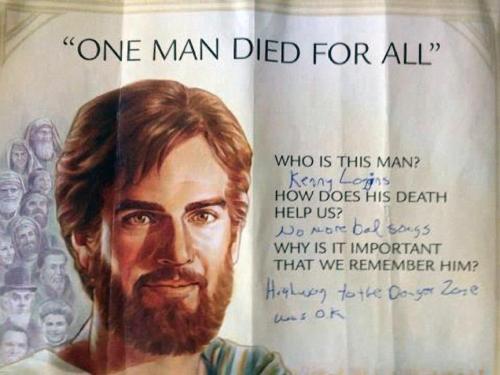
This is hilarious, but slightly inaccurate.
Kenny Loggins wrote some awesome songs.
Danger Zone.
Jurassic Park Meets Metal
HERE COMES THE METALSAURUS MOTHER FUCKER WOOO
sweet guitar shred version of the JP theme.


Just Paul McCartney in a Red Raiders jersey, a mystery the internet has left at our doorstep to ponder forever. Accepting leads on any explanation for this in the comments below. (Via)
Like many of you, we were dismayed to learn that Google will be shutting down its much-loved, if under-appreciated, Google Reader on July 1st. Through its many incarnations, Google Reader has remained a solid and reliable tool for those who want to ensure they are getting the best from their favorite sections of the Internet. And though they were not wholly appreciated at the time, Reader’s early social features were forward-thinking and hugely useful.
We’ve heard people say that RSS is a thing of the past, and perhaps in its current incarnation it is, but as daily (hourly) users of Google Reader, we’re convinced that it’s a product worth saving. So we’re going to give it our best shot. We’ve been planning to build a reader in the second half of 2013, one that, like Digg, makes the Internet a more approachable and digestible place. After Google’s announcement, we’re moving the project to the top of our priority list. We’re going to build a reader, starting today. [read more]
Anyone notice how freaking awesome Digg has gotten since it got sold to the Betaworks folks? Just saying. They have one of the best daily emails and they’re killing it on the content front. It’s not the same company and it doesn’t spread content the same way, but maybe that’s a good thing because it doesn’t piss you off as much as Digg Mark 2010 did.
Now they’re creating a Google Reader replacement. Awesome.
Knowing that my son is gay prompted me to consider the issue from another perspective: that of a dad who wants all three of his kids to lead happy, meaningful lives with the people they love, a blessing Jane and I have shared for 26 years.
I wrestled with how to reconcile my Christian faith with my desire for Will to have the same opportunities to pursue happiness and fulfillment as his brother and sister. Ultimately, it came down to the Bible’s overarching themes of love and compassion and my belief that we are all children of God.
”
Last week, the Saudi daily Al-Youm reported that Saudi Arabia is considering transitioning away from the state's institutionalized method of executing convicts: beheading by sword. Beheading -- the approach to carrying out death sentences in the Arabian Peninsula in the seventh century -- has long been practiced in the kingdom in observance of its strict interpretation of Islamic law, which seeks to mimic practices at the time of Mohammed. But a committee of Saudi government officials recently ruled that execution by firing squad would also be permissible under the national brand of sharia.
"This solution seems practical, especially in light of shortages of official swordsmen," the committee explained in a statement quoted by the Egyptian newspaper Al-Ahram. The committee also complained that official swordsmen have been known to show up late to executions.
Does this mean those few remaining swordsmen will be out of a job soon? It turns out the Saudi newspaper Okaz asked one of them: Mecca-based executioner Mohammad Saad al-Biishi. He says he's not concerned, citing the fact that he's already received firearms training. In the meantime, he'll keep on with the beheadings.
"I just returned from Ranyah governorate, where one of the judgments was implemented with a blow from a sword," he told the paper.
Even if the transition to firing squad occurs, al-Biishi is optimistic about the future of his profession, and has been apprenticing his son in beheadings. He acknowledges, though, that the government's concerns about a shortage of qualified swordsmen are justified. "This profession is not desired by many," he told Okaz, "despite the salary and personal reward we gain from it."
The execution business in Saudi Arabia is booming. Human rights groups estimate that approximately 70 people were beheaded in the kingdom last year, and 14 so far this year. The January execution of a Sri Lankan national, who was accused of the murder of a 4-year-old in her care as a maid while still a 17-year-old minor, prompted Sri Lanka to recall their ambassador from Riyadh last month.
Marya Hannun contributed to this post.
Let’s be clear that this has nothing to do with revenue vs operating costs. Reader never made money directly (though you could maybe attribute some of Feedburner and AdSense for Feeds usage to it), and it wasn’t the goal of the product.
Reader has been fighting for approval/survival at Google since long before I was a PM for the product. I’m pretty sure Reader was threatened with de-staffing at least three times before it actually happened. It was often for some reason related to social:
2008 - let’s pull the team off to build OpenSocial
2009 - let’s pull the team off to build Buzz
2010 - let’s pull the team off to build Google+
It turns out they decided to kill it anyway in 2010, even though most of the engineers opted against joining G+. Ironically, I think the reason Google always wanted to pull the Reader team off to build these other social products was that the Reader team actually understood social (and tried a lot of experiments over the years that informed the larger social features at the company)[1]. Reader’s social features also evolved very organically in response to users, instead of being designed top-down like some of Google’s other efforts[2].
I suspect that it survived for some time after being put into maintenance because they believed it could still be a useful source of content into G+. Reader users were always voracious consumers of content, and many of them filtered and shared a great deal of it.
But after switching the sharing features over to G+ (the so called “share-pocalypse”) along with the redesigned UI, my guess is that usage just started to fall - particularly around sharing. I know that my sharing basically stopped completely once the redesign happened [3]. Though Google did ultimately fix a lot of the UI issues, the sharing (and therefore content going into G+) would never recover.
So with dwindling usefulness to G+, (likely) dwindling or flattening usage due to being in maintenance, and Google’s big drive to focus in the last couple of years, what choice was there but to kill the product?
Personally, I think that there is still a lot of value a service like Reader could provide — particularly in a world with increasing information overload coming us from many different sources. But Reader at Google was pigeonholed as an RSS-reader explicitly, and didn’t have a chance to grow beyond that to explore that space. But that’s neither here nor there.
[1] See Reader’s friends implementations v1, v2, and v3, comments, privacy controls, and sharing features. Actually wait, you can’t see those anymore, since they were all ripped out.
[2] Rob Fishman’s Buzzfeed article has good coverage of this: Google’s Lost Social Network
[3] Reader redesign: Terrible decision, or worst decision? I was a lot angrier then than I am now — now I’m just sad.
”words like “gender” and “celibacy” and “pedophile” and phrases like “irrelevant to the modern world.” But when they just prattle on with their indignant words—gender, celibacy, irrelevant—
One of those words in the first list has disappeared from the second! How can this be?A couple of folks also notice Noonan's surly reference to the Mohammedans, in which she complains of the media-that-is-not-Peggy-Noonan:
They think they’re brave, or outspoken, or something. They don’t have enough insight into themselves to notice they’d never presume to instruct other great faiths. It doesn’t cross their minds that if they were as dismissive about some of those faiths they’d have to hire private security guards.I thought the whole you-don't-have-the-guts-to-make-fun-of-Mohammed thing had long since passed into wingnut oblivion, along with "Democracy Whiskey Sexy" and "That Andrew Sullivan is one of the good ones," but I guess under stress these guys tend to revert.
در نوشته قبلی ۱۲ عکس کمتر دیده شده تاریخی را دیدید، این هم مجموعه ۱۲ تایی دوم از عکسها:
- سال ۱۹۱۷: زنان فرانسوی در کارخانه مهمات:

- سالهای بین ۱۹۱۴ تا ۱۹۱۸: تیربار روی فیل:

- آلبرت اینشتین در کودکی:

- سال ۱۹۷۹: فیدل کاسترو در حال ترک نیویورک:

- ساخت مجسمه یادبود آبراهام لینکلن:

- سال ۱۹۷۵: هیلاری و بیل کلینتون:

- سال ۱۹۸۴: استیو جابز:

- سال ۱۹۴۵: باز کردن تابلوی مونالیزا بعد از پایان جنگ جهانی دوم

- سال ۱۹۴۰: مشت جان وین:

- سال ۱۸۹۹: نیکولا تسلا در آزمایشگاه:

- سالهای دهه ۱۹۴۰: آگهی دوربین کداک:

- سال ۱۹۷۸: کاتالوگ آتاری:

تبلیغات:


یک پزشک را در شبکههای اجتماعی دنبال کنید:


پذیرش آگهی در «یک پزشک» و تماس با ما

If Lucian Rudaux was the Grandfather of space art, Chesley Bonestell was the father. He was born on January 1, 1888, 15 years before the Wright brothers first flew and 38 years before the launch of the first liquid-fuel rocket. When he died 98 years later, men had walked on the moon and spacecraft had visited most of the planets and many of the moons of the solar system.
Bonestell's paintings not only anticipated 20th century space exploration, they helped to bring it about. So realistic were his depictions of other worlds that visiting them no longer seemed fantasy. His artwork looked like picture postcards taken by some future astronaut.
Bonestell started drawing at age five and began formal art instruction by the time he was 12. When he was 17, he visited Lick Observatory where he was inspired by seeing Saturn through the observatory's giant refractors. As soon as he returned home, Bonestell sketched a picture of the planet as he had observed it—probably his first attempt at space art.

Bonestell eventually became an architectural designer and renderer. One of his first professional jobs was working with the legendary Willis Polk on the reconstruction of San Francisco after the great earthquake and fire. Polk quickly made Bonestell his chief designer. In New York, Bonestell assisted William van Alen in the design of the Chrysler Building (its famous gargoyles are Bonestell's work). Later, Bonestell worked on the Golden Gate Bridge.
During this time, he kept up his interest in astronomy, filling sketchbooks with extraterrestrial scenes, like this one:

In 1938, Bonestell began a new career in Hollywood as a special effects matte painter. The first film he worked on was Orson Welles's Citizen Kane. All the views of turn-of-the-century New York and of Charles Foster Kane's mansion, Xanadu, are Bonestell's artwork. In The Fountainhead, Bonestell in a sense was Howard Roark: all of the buildings created by Ayn Rand's superheroic architect are by Bonestell. He eventually became Hollywood's highest-paid matte artist.


After his success as an astronomical artist, Bonestell returned to Hollywood to provide special effects art for George Pal’s Destination Moon, War of the Worlds and When Worlds Collide. The complete panoramic matte painting for the latter is here, and an unused alternate version below:


And Bonestell's 14-foot-wide lunar landscape created for Destination Moon:

It occurred to him that he could employ what he’d learned as a special effects artist to create astronomical art with a level of realism never seen before. "As my knowledge of the technical side of the motion picture industry broadened,” he wrote, “I realized I could apply camera angles as used in the motion picture studio to illustrate 'travel' from satellite to satellite, showing Saturn exactly as it would look, and at the same time I could add interest by showing the inner satellites or outer ones on the far side of Saturn, as well as the planet itself in different phases."
For instance, he often employed a laborious technique of constructing detailed model landscapes, which he then photographed, painting over the final print. This resulted in a level of realism that was utterly convincing. It was a laborious technique, however, that he seldom used after the 1950s. Here is a detail from one these models:

e
This project resulted in his first published space art, a series of paintings depicting scenes on Saturn’s moons, that appeared in the May 29,1944, issue of Life. The public—to say nothing of science fiction fans—were astonished and delighted. Among the paintings was a ethereally beautiful view of Saturn seen from Titan. Inspiring an entire generation of scientists and space enthusiasts—countless scientists, engineers and astronauts have been inspired in their choice of careers by Bonestell's images, including a young Carl Sagan—it has been called “the painting that launched a thousand careers.”

Around this time, Bonestell began a long-term collaboration with Willy Ley, an expatriate German historian and science popularizer who had been a member of the German Spaceflight Society (Verein fur Raumschiffahrt). Taking advantage of Ley's advice, Bonestell began adding spacecraft to his paintings. In 1946 Life published another set of his illustrations, this time depicting a manned flight to the moon.

Bonestell's art began appearing regularly in magazines, from Look, Coronet, Pic and Mechanix Illustrated to Air Trails, Scientific American and Astounding Science Fiction. So popular had his art become that Bonestell once mistakenly sent the cover painting for a science-fiction magazine to the wrong publication. The editor of that magazine promptly ran it! Bonestell's first book, The Conquest of Space, created in collaboration with Ley, featured 48 of his paintings. It became an immediate best-seller. The cover painting has become one of the iconic images of the 1950s:

In addition to the artwork he was creating for books, magazines and movies, Bonestell created a magnificent mural for the Boston Museum of Science. Forty feet wide, it depicted a lunar landscape with breathtaking realism. The mural was removed after the Apollo 11 landing in 1969 because “it was no longer accurate.” The mural is now in the collection of the National Air & Space Museum, where plans are being made to restore and display it.

Sir Arthur C. Clarke tried to explain Bonestell’s popularity at this time by saying that his “...remarkable technique produces an effect of realism so striking that his paintings have sometimes been mistaken for actual colour photographs by those slightly unacquainted with the present status of interplanetary flight.... In the years to come it is probably destined to fire many imaginations, and thereby to change many lives."

Clarke was only too right. In 1951 Cornelius Ryan, the associate editor of Collier's magazine, invited Bonestell to illustrate a series of five articles on the future of spaceflight. The prime author was Wernher von Braun.

Just as Clarke had been, von Braun found himself awed by Bonestell's sharp eye for scientific and engineering accuracy. He once wrote that "Chesley Bonestell's pictures... are far more than reproductions of beautiful ethereal paintings of Worlds Beyond. They present the most accurate portrayal of those faraway heavenly bodies that modern science can offer. I do not say this lightly. In my many years of association with Chesley I have learned to respect, nay fear, this wonderful artist's obsession with perfection. My file cabinet is filled with sketches of rocket ships I had prepared to help him in his art work—only to have them returned to me with penetrating detailed questions or blistering criticism of some inconsistency or oversight."


The Collier's series—published between 1952 and 1954—took America by storm. The country turned space-happy; reproductions and knockoffs of Bonestell's paintings appeared in settings ranging from commercial advertisements to television programs to school lunch boxes. The series was eventually collected in three books: Across the Space Frontier, Conquest of the Moon and Exploration of Mars, now all collector’s items. Bonestell's artwork strongly influenced the American public and, in turn, the government to support an investment in space exploration. An influence that has been repeatedly acknowledged.

Over the following decade Bonestell watched manned space exploration become a reality. He grumpily noticed that the softly rolling lunar hills seen by the Apollo astronauts bore little resemblance to the craggy, romanticized, Doresque landscapes he had painted. But such inaccuracies do little to diminish the primary importance of Bonestell's work. His illustrations gave immediacy and verisimilitude to dry astronomical data. What had once been columns of numbers and blurry telescopic images took on a new, compelling reality.

Bonestell continued to work until he died in 1986, an unfinished painting still on his easel. Asteroid number 3129 and a crater on Mars have been given the name "Bonestell"—a fitting honor for the man whose art contributed to the birth of the space age.
All art copyright by and reproduced courtesy of Bonestell LLC


An expertly done three point turn
Weren’t expecting that house