Shared posts

09 Apr 17:30

Gabb on Thatcher

by Gary Chartier

Sean Gabb, of the UK Libertarian Alliance, offers a fairly acidic take on the late Baroness Thatcher.

Gabb’s bottom line: Thatcher was an authoritarian and a corporatist. He offers multiple examples of her hostility to civil liberties and notes that she didn’t seem to have received the memo about the distinction between being pro-business and being pro-market:

Her encouragement of enterprise never amounted to more than a liking for big business corporatism. Genuine enterprise was progressively heaped with taxes and regulations that made it hard to do business. Big business, on the other hand, was showered with praise and legal indulgences. Indeed, her privatisation policies were less about introducing competition and choice into public services than in turning public monopolies into corporate monsters pampered by the State with subsidies and favourable regulations – corporate monsters that were expected in return to lavish financial rewards on the political class.

While I am a free speech absolutist, I doubt that Thatcher’s tightening of “the laws constraining free speech about race and immigration” was anything like the worst of her sins. I don’t suppose  that unions are all hotbeds of violent thuggery. And of course I would add criticisms to Gabb’s list. Thatcher’s militarism—consider the Falklands war and her support for Bush 41′s Gulf War—is further reason to see her as a foe rather than a friend of liberty, for instance. And her privatization program hardly involved the kind of radical handover of state enterprises and other state assets acquired with stolen funds to workers and community members that I’d be inclined to favor.

Some libertarians are touched by the fact that Thatcher praised Hayek and identified The Constitution of Liberty as a source of useful guidance. I am inclined to view her praise for Hayek as on roughly the same level as Ronald Reagan’s famous willingness to photographed reading The Freeman. I have no burden to argue that everything Thatcher did was an instance of unmitigated evil—the world is always messier than Manichæans would have us believe. But it is difficult to see her as any sort of libertarian hero. She was first and foremost and foremost a defender of order—of state power and of the continuing authority of various traditional social institutions she happened to favor—rather than of liberty.

08 Apr 11:47

Men-are-People and Women-are-Women: The Obituary Edition

by Lisa Wade, PhD

“You just have to be cheerful about it and not get upset when you get insulted,” said rocket scientist Yvonne Brill.

She must be chuckling in heaven, because her obituary at the New York Times made the common mistake of making her femaleness and femininity a central part of their retrospective.  After objections, NYT corrected the obit.  Here are the tracked changes, courtesy of NewsDiffs:

1

At Feministe, Caperton offers a nice discussion of this phenomenon and draws our attention to the Finkbeiner Test, named after journalist Ann Finkbeiner.  Inspired by the Bechdel Test for movies, the Finkbeiner Test is used to judge whether stories about women focus excessively on the fact that they are women.  To pass the test, the story cannot mention:

  • The fact that she’s a woman
  • Her husband’s job
  • Her child care arrangements
  • How she nurtures her underlings
  • How she was taken aback by the competitiveness in her field
  • How she’s such a role model for other women
  • How she’s the “first woman to…”

Awesome.

We’ve documented lots of instances of the men-are-people and women-are-women phenomenon.  It’s no wonder it shows up in obituaries too.  I’m glad that we’re becoming sensitive enough to the issue to notice it and that institutions like the NYT are responsive enough to change the most egregious examples of it.  Next step: prevention.

Lisa Wade is a professor of sociology at Occidental College. You can follow her on Twitter and Facebook.

(View original at http://thesocietypages.org/socimages)

07 Apr 14:59

New Stanford Encyclopedia Entry on Markets

by Matt Zwolinski

Over at the Stanford Encyclopedia of Philosophy, Lisa Herzog has written a very nice entry on “markets” that will likely be of interest to readers of this blog. In particular, section three provides a very helpful overview of some of the most common and influential arguments for and against markets. Rawls, Hayek, Buchanan, McCloskey, Tomasi, Satz – it’s all in there.

One thing I found particularly useful was Herzog’s claim that it is often more useful to talk about the vices and virtues of particular markets than of “markets” as a general abstract category.

When comparing markets to other institutional solutions, the comparison has to take place at the same level of abstraction. Otherwise one compares apples to oranges, e.g. when a very imperfect market with great asymmetries of power is contrasted with an idealized public bureaucracy, or when a market in which all individuals are fully rational is contrasted with corrupt public institutions. It makes more sense to compare a reasonably well-functioning market with a reasonably well-functioning bureaucracy, and it is likely that one will have to be more specific about the kind of market and the kind of bureaucracy in question in order to define the standards of “well-functioning” one can reasonably expect.

The whole thing is worth reading. And if your summer reading list needs beefing up, be sure not to miss the bibliography!

07 Apr 04:52

A Questionable Argument for Paternalistic Legislation

by Fernando Teson

Following Mill, libertarians have condemned paternalistic legislation. Examples of such legislation are the criminalization of drugs, and the failure to wear motorcycle helms or seat belts. Mill’s argument is that society is not entitled to protect people against themselves. Society is instead entitled to prevent people from making decisions that harm others. When I run this argument, people immediately reply: “But the Millian standard is satisfied here. The fellow who refuses to wear a motorcycle helmet is harming others, because the state must care of him if he suffers an accident. This guy imposes costs on society, namely the costs of providing him with the care he needs after irresponsibly failing to wear a helmet.”

I think this reply is problematic. Suppose that in the absence of state-subsidized health care the behavior in question (failing to wear a helmet) would have been morally innocent on Millian grounds. Then I don’t think the state is entitled to create subsidy schemes that turn morally innocent behavior into punishable behavior. In other words: the only reason that the failure to wear a helmet is now socially harmful (and thereby punishable) is that the state has coercively decided that all persons injured in accidents will receive state-subsidized health care. The puzzle is this: can the state do that? Can the state turn morally innocent behavior into criminal behavior just by increasing the number of state services?  This really deserves some serious thinking, which I have not done, but I’m inclined to say no.

06 Apr 21:01

Intense Manliness

by Doug

Intense Manliness

Dedicated to Timmy Tofu fan Maria Elena, who is celebrating her birthday today – happy birthday Maria Elena!!

Here are more of Timmy’s pickup lines.

05 Apr 21:51

What is a Fair Price for a Kidney?

by Matt Zwolinski

Libertarians often claim that a just price is whatever people are willing to pay in the absence of force or fraud. So, if sweatshop workers are willing to sell their labor for close to subsistence wages, that’s fair as long as no one lied to them about the terms of their employment or held a gun to their head. If price gougers charge inflated prices in the wake of a disaster, that’s fine too. And if poor people in the developing world are willing to sell their kidney for a pittance, there shouldn’t be any problem with that either. Exchanges of this sort are positive-sum, and consistent with individual liberty. Prohibiting them isn’t.

Regular readers of this blog will be aware that I have more than a little sympathy with the libertarian position on sweatshops and price gouging. But as I’ve written here before, I also think that the moral issues involved in these cases are more complicated than the standard libertarian analysis would suggest.

Over at Libertarianism.Org, philosopher Neera Badhwar has a very nice post laying out the case for a more sophisticated libertarian view of just exchange, drawing Aristotle’s concept of voluntary action and John Locke’s theory of just exchange (as explained in his mostly unknown essay Venditio)Badhwar, like Locke, rejects the simplistic libertarian view that whatever people agree to in the absence of force or fraud is necessarily just. “A desperately poor but healthy woman whose family is on the brink of starvation because of a drought might be willing to sell her kidney to a well-off man (or his broker) for a large sack of rice,” but

By the baseline of simple humanity, the exchange is both disproportionate, and disrespectful of the desperate individual’s humanity (the idea for such a distinction between baselines is due to Alan Wertheimer, Exploitation, 1996). Indeed, it is no more just than an exchange between a man dying of thirst in a desert and a well-off, well-stocked tourist who, passing by him, agrees to give him some water in return for all his property after they reach home. Every philosophical ethical theory joins commonsense morality in condemning such a deal as unconscionable, and the common law agrees by refusing to uphold it if the thirsty man reneges on it.

So what would a fair price be? Badhwar suggests that it is the price that would be the price that emerged in a competitive market. And what does that mean?

Whatever else it might be, it is a market in which people are free to buy and sell. The kidney market, then, is decidedly not a competitive market, since kidney sales are banned in every country but one (Iran). If kidney sales were legal everywhere, or at least in most countries, and there was free legal trade in kidneys, many rich people would go to poor countries for kidney transplants (as they do for other medical procedures) and the price of kidneys would rise in those countries. Ironically, it is the attempt to save people from exploitation by banning kidney markets that has led to the unimaginably high levels of exploitation and injustice that we see in underground kidney deals.

This, too strikes me as exactly right, and very well-put. Read the whole thing yourself. It’s a great essay. And it’s great to see another heretic joining the blogging team at Libertarianism.org! Maybe she can draw some of the fire away from me on their Facebook page…

05 Apr 21:39

Sul da América no espelho

by ImpedCorp

anistia
Eu estava em Corinthians x River em 2006 com a namorada. Eu não tentei entrar no campo, nem ela. Estávamos na arquibancada, lá em cima. Vimos tudo do alto. Quando aparentemente tinha parado, a PM, essa excelente e bem treinada força que só “às vezes” faz merda, começou a atirar bomba de gás lá pra cima. Onde tinha quem? Quem não desceu pra brigar nem invadir campo, um monte de mulher, criança.

Subimos mais, demos a volta, saímos do estádio. Do lado de fora, tivemos que subir as escadas laterais CORRENDO, sob ameaça da polícia que ATIRAVA BALAS DE BORRACHA pra cima. Dava pra ouvir elas pegando nas árvores e nas folhas acima da nossa cabeça. Chegamos lá em cima sem ar e brancos, amarelos, azuis de cagaço de tomar um tiro. Não tinha como saber que era de borracha, aliás. Nunca senti tanto medo na vida – e já fui assaltado com faca levando murro na cara.

Jogo seguinte, Corinthians x Alguém pelo Brasileiro. Armaram uma praça de guerra na Charles Miller. Até lá embaixo no Pacaembu. Por ali, a gente longe, começou uma merda qualquer. Começaram as bombas e balas. Corremos pra entrar logo no estádio. A PM começou a atirar bombas NA NOSSA DIREÇÃO, onde não acontecia absolutamente NADA. A PM resolve FECHAR a entrada do estádio, encurralar TODO MUNDO. Gás começa a voar e ser respirado. Do meu lado e de um amigo, uma mulher com criança de colo pede pra entrar. O PM responde:

- Vocês não gostam de criar confusão? Agora aguenta.

Nunca na vida tive TANTA vontade de esmurrar alguém. E eu nunca esmurrei ninguém.

Final da Libertadores, Buenos Aires. Os argentinos trogloditas arrogantes. Policiamento pra entrar no estádio, exaustivo, burro. Apertam as filas e fazem demorar. Lá pela terceira barreira de policiais, alguns resolvem pular as grades. Um PM vai até lá, com o cacetete na mão, calmamente arrasta a barreira de metal de volta pro lugar e para na frente pra ninguém mais pular. Não espanca ninguém, os que pularam já se foram, nem sequer ameaçados. Na sequência, um outro PM percebe que uma mulher está sendo esmagada por 500 homens e abre espaço no meio deles, tira ela de lá e deixa ela passar por entre as barreiras de metal. Sim, um policial argentino. E nós todos brasileiros.

Veja bem, eu odeio a polícia, qualquer polícia. Todas servem pra reprimir, oprimir e manter a mesma ordem que tá aí todo dia. Mas não posso negar o que vi.

Jogo da volta, Pacaembu. A PM faz uma praça de guerra de novo. Entrei até sem maiores problemas. Faltando uns 20min pro começo do jogo, bombas, gás, cacetete. Subo as bancadas pra ver, era a PM espancando a torto e a direito, INCLUSIVE TORCEDORES COM INGRESSO.

Não adianta negar que há uma diferença cultural enorme. ENORME. Um policial argentino tem muito mais respeito – e medo, porque sabe que a população média não gosta dele e o liga à ditadura – por um torcedor do que um brasileiro. Na Argentina a polícia não rela a mão nas bandeiras (trapos) dos torcedores. Aliás, na Argentina PODE levar QUALQUER bandeira pro jogo, sem precisar pedir autorização pra polícia. Uma torcida argentina, quando a PM agride a outra torcida, fica do lado da outra torcida, não da polícia. Faz protesto unificado na rua, entende ser torcedor como uma classe.

Um policial brasileiro quer que torcedor se foda, trata como gado porque sabe que tem um poder que nunca será questionado de fato, não quando agride a massa. É treinado pra agir assim, pensar assim, sabe que a população média tem medo ou idolatra ele – viva o Tropa de Elite. A PM é herança da ditadura. Não tem polícia MILITAR na Argentina – aqui não só tem como mesmo após o regime continuou sendo uma instituição violenta, permitida e com enorme poder. Uma torcida brasileira celebra quando a torcida adversária toma pau da PM. Dá risada, faz piada no Facebook.

Não tem como não olhar pra tudo isso e não entender porque o brasileiro médio acha que a PM de Minas tá certa e que os argentinos folgados começaram e pediram. E que essa é a coisa certa a se fazer, o jeito de se parar uma confusão entre jogadores e juiz, principalmente entre selvagens argentinos e juiz. Nós somos mais, somos melhores, não fazemos esse tipo de merda quando perdemos.

Não, não. O que somos é patéticos, patéticos de permitir não só que a PM continue existindo como que continue agindo como age. Cagamos de medo, isso sim.

Se você é daqueles que curte Tropa de Elite porque a PM mata bandido, não deve ter visto o segundo filme. Quando o celebrado Capitão Nascimento diz, com todas as letras:

- A PM do estado do Rio de Janeiro tem que acabar.

Vamos além, Nascimento: a PM do Brasil todo tem que acabar, faz tempo. Difícil é achar que isso vai acontecer no país que ao invés de julgar ditadores e torturadores os homenageia colocando seus nomes em rodovias – Dutra, Castelo Branco, Fleury, a lista é interminável.

Não custa lembrar aonde estava o atual presidente da CBF durante o regime militar.

Mas isso tudo é papo de esquerdinha. Argentino tem que apanhar mesmo. Xenofóbico? Não, não sou, apenas sensato.

Afinal, foram eles que começaram.

P.S.: em nome da nossa memória falha, fica aqui a lembrança de Nilton César de Jesus, morto em 2008 em Goiânia por um policial, mesmo após se render, antes do Goiás x São Paulo que decidiria o Brasileirão: http://manihot.wordpress.com/2008/12/09/de-novo-a-policia/

Eternamente em vossos corações,
Kadj Oman

(ensejado por um comentário neste post)

* * *

ERRATA: na versão original do texto, listou-se absurdamente o nome de Mário Covas entre torturadores/ditadores homenageados por aí. Como percebido amplamente pelos comentários, tal identificação de Covas com o regime nunca existiu, de modo que corrigimos agora e pedimos sinceras desculpas.

28 Mar 00:44

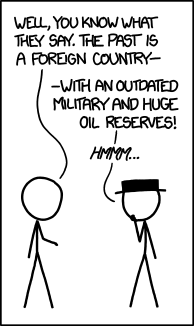
The Past

If history has taught us anything, we can use that information to destroy it.
28 Mar 00:42

PEC pra que te quero (edição 2013)

by Wagner Artur Cabral
A verdadeira casa (ou casas) dos comuns

A verdadeira casa (ou casas) dos comuns

Tivemos em 2013, até o presente momento (Março), 35 propostas de emendas à nossa alquebrada e remendada Constituição Federal. Aproveitando o bafafá originado pela PEC 99/2011, aquela sobre extensão da legitimidade de propositura de ADI às entidades religiosas nacionais, a Casa dos Comuns traz para seu deleite particular algumas das propostas mais interessantes em circulação na Câmara e no Senado. Lembrando que as opiniões são todas da casa e todos estão convidados a concordar, discordar e/ou mesmo apresentar outras PECs interessantes entre Janeiro e Março de 2013.

Lembrando que se você se interessar por qualquer uma delas pode escolher assinar um informativo e ser avisado de qualquer desdobramento da proposta. O exercício da boa cidadania agradece!

Direto da Câmara:

PEC 243/2013 – autoria de Onofre Santo Agostini – PSD/SC

Ementa: Dá nova redação ao art. 101 da Constituição Federal, alterando a forma e os requisitos de investidura dos Ministros do Supremo Tribunal Federal.

Aval: Basicamente Agostini tenta resolver o caos que é a nomeação de Ministros do STF criando uma nova regra: para ser Ministro seria necessário passar por um “concurso público de provas e títulos”. E como seria esse concurso? Bem, isso Agostini não diz, deixa para lei complementar posterior decidir. O detalhe é que a emenda teria vigência imediata, o que implica no fato de que se algum Ministro precisar ser substituído e ainda não houver elaboração dessa lei complementar podemos chegar à exótica situação em que alguém pode entrar com uma Ação Direta de Inconstitucionalidade do Omissão para proteger o STF, que ficaria impedido de ser preenchido. Dureza.

PEC 247/2013 – autoria dos deputados Mauro Benevides – PMDB/CE,  Alessandro Molon – PT/RJ,  Andre Moura – PSC/SE

Ementa: Altera o “Capítulo IV – Das Funções Essenciais à Justiça” do “Título IV – Da Organização dos Poderes” e acrescenta artigo ao Ato das Disposições Constitucionais Transitórias da Constituição Federal.

Explicação da Ementa (!): Propõe a fixação de um prazo de oito anos, para que a União, os Estados e o Distrito Federal se organizem para poder contar com defensores públicos em todas as unidades jurisdicionais.

Aval: O problema das defensorias públicas é tão antigo quanto a Constituição e sua solução é extremamente complicada. O que a PEC faz é dar um prazo de oito anos pra todos os estados terem defensorias instaladas e em funcionamento. É factível, mas demanda uma vontade política e alocação de verbas grande. Não tenho certeza se essa seria a via mais adequada mas, pelo menos, é uma questão essencial para a democratização dos direitos no Brasil. Para quem não sabe, a defensoria defende quem não tem condições de ter uma boa defesa custeada por si. Se tivermos um sistema de defesa pública de qualidade com certeza a prestação jurisdicional será bem melhorada.

PEC 241/2013 – de autoria do deputado Amauri Teixeira – PT/BA

Ementa: Dá nova redação ao art. 165 da Constituição Federal incluindo o § 10 para que cada município brasileiro apresente uma emenda a Lei Orçamentária Anual.

Aval: Basicamente o deputado sugere que os 4.953 municípios de até 50 mil habitantes tenham direito a propor uma emenda à Lei Orcamentária Anual a ser avaliada em audiência pública local. A emenda deve indicar quais áreas são consideradas prioritárias para a população, entre algumas listadas no texto da PEC. Não que a ideia não seja interessante, favorecer a gestão que inclui os cidadãos, mas eu não consigo nem imaginar como seria, numa questão de logística e organização, incluir obrigatoriamente 5.000 emendas ao orçamento. Alguém me explicaria?

No Senado da República:

PEC 03/2013 – de autoria de Fernando Collor

Ementa: Altera a Constituição para determinar novo procedimento de composição do Supremo Tribunal Federal e alterar a idade de aposentadoria compulsória.

Aval: Proposta bastante interessante, especialmente se contraposta à 243 mencionada acima. Aqui Collor sugere que o STF passe a ser composto por 15 membros com mandatos de 15 anos. E tem mais: muda o regime de aposentadoria de magistrados, criando uma aposentadoria automática para o Ministro do STF ao final do seu mandato. Além disso estabelece que a indicação de ministro não seria de livre escolha, mas uma seleção numa lista quádrupla fornecida por: Tribunais Superiores (?), CNJ, Conselho Nacional do Ministério Público e OAB. Não fica claro como funciona essa indicação por parte dos componentes dos tribunais superiores (O mesmo ministro pode votar em um tribunal superior e no CNJ?), mas no geral parece uma proposta bacana, com atenção especial para o Direito Comparado.

PEC 10/2013 – autoria do Senador Álvaro Dias

Ementa: Altera os arts. 102, 105, 108 e 125 da Constituição Federal para extinguir o foro especial por prerrogativa de função nos casos de crimes comuns.

Explicação da Ementa: Altera a Constituição Federal para extinguir o foro especial por prerrogativa de função em casos de crimes comuns.

Aval: A questão é direta mas de consequências complicadas. Basicamente a PEC retira a proteção do foro privilegiado em caso de crime comum, deixando que crimes como homicídio, estelionato e etc. sejam julgados nas instâncias normais, por uma questão de isonomia. Fica o foro especial no caso de crime de responsabilidade. É uma mudança GRANDE, inclusive, alterando vários artigos. Fica a dúvida: e os argumentos de “perseguição política”? Nossas instituições são fortes e confiáveis o suficiente para aplacar essas dúvidas (e/ou factóides)?

PEC 15/2013 – de autoria do Senador Pedro taques

Ementa: Cria a solicitação de urgência por iniciativa popular para proposições em tramitação no Congresso Nacional ou qualquer de suas Casas.

Aval: Esse é o típico caso de PEC que não resolve mas cria uma possibilidade muito interessante para resolver problemas (e para agravá-los). Basicamente a PEC cria um regime de urgência nos casos de iniciativa popular, com um adendo bastante significativo: ficará a cargo de lei posterior regulamentar o exercício dessa iniciativa popular, sendo incluído até o uso de meios digitais! Ou seja: podemos chegar a ter um sistema de consulta popular via internet. Isso é potencialmente muito bom e/ou muito ruim, é o ideal numa ideia de democracia de cidadãos conscientes, é o inferno numa democracia de cidadãos vitriólicos e incapazes de pensar de forma cívica. Assim sendo, é uma espécie de teste da tessitura de um sistema sócio-jurídico. Bastante interessante, merecedora de muitos estudos e opiniões. Que tal?

27 Mar 00:54

brooklynmutt: Homosexual agenda REVEALED! (via @jbendery)

by joberholtzer


brooklynmutt:

Homosexual agenda REVEALED!

(via @jbendery)